





John Garrison Marks
The ongoing struggle over Washington's legacy as enslaver and emancipator
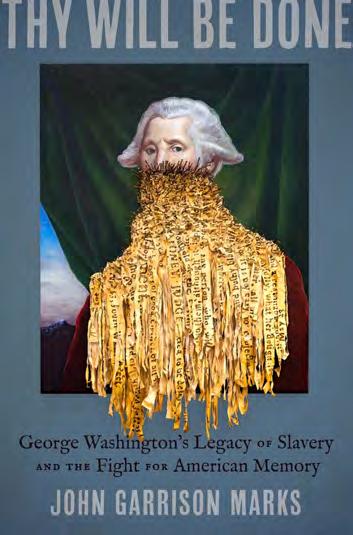
How should we remember George Washington’s entanglement in slavery? Americans have argued over that question for nearly 250 years. More than any other Founding Father, Washington’s ties to slavery have vexed us. He enslaved more people than any of his fellow founders, yet he was the only one of them to emancipate the people he held in bondage. Since his death, Americans have grappled with this contradiction, shaping and reshaping our collective memory of Washington and slavery—along with our understanding of the nation.
InThyWillBeDone, historian John Garrison Marks tells the story of Americans’ long, fraught struggle to come to terms with Washington’s legacy of slavery. He traces how politicians, abolitionists, educators, activists, Washington’s former slaves and their descendants, and others have remembered, forgotten, and manipulated slavery’s place in Washington’s story, and how they have wielded versions of that story in the political and cultural fights of their time. Marks shows how generational struggles over our collective memory of Washington and slavery have always been part of a bigger conversation about defining the United States and its people. As debates about the founders’ participation in the system of slavery continue to roil public discourse, Marks shows with new clarity that Americans have never collectively reconciled Washington’s conflicted legacy. By truly grappling with Washington’s role as enslaver and emancipator we may come to better understand the nation and ourselves.
John Garrison Marks is a historian, writer, and author of BlackFreedomintheAge ofSlavery.
April 2026
$35.00 | t ISBN: 9781469693521
Hardcover
304 Pages 6 halftones
9.250 in H | 6.120 in W | 1.000 in T
History / United States / Revolutionary Period (1775-1800)
“I pass the proverbial baton to John Garrison Marks, who finishes what I started in this fascinating and frustrating look at how we remember George Washington. Of all his impressive titles, he held 'master' the longest, and it was arguably the key to his success—and our own. But for the last 250 years, Americans have done their best to ignore that reality in favor of a more fashionable, palatable one. In the process, we've lost sight of him, and of ourselves. The 250th anniversary of the Declaration of Independence offers us a unique chance to set the record straight—because if we don’t try, it may just be our last.”—Alexis Coe, NewYorkTimesbestselling author of YouNeverForgetYourFirst:ABiographyofGeorgeWashington
Gautham Rao
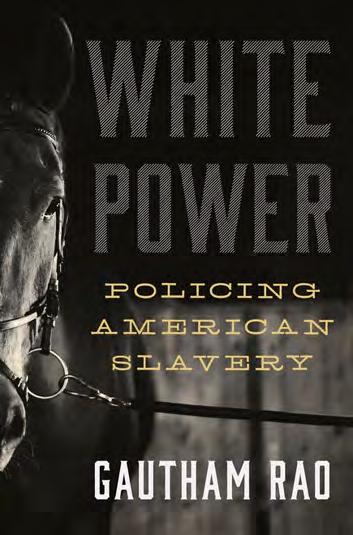
Beginning in the colonial era and growing through the American Revolution and the Southern plantation system, slaveholders’ violent police regime continued after Emancipation, through Reconstruction, to today. Moving across time, space, and place, WhitePoweruncovers how slaveholders created their own white supremacist police and government to deny Black people rights, power, and humanity.
Legal historian Gautham Rao introduces us to laws that empowered white people to forcibly exercise their desired racial superiority over Black people, shows how they spread from the South throughout the nation, and traces the rebellions, fugitivity, activism, and legal systems that challenged them. Rao’s narrative includes slaveholders, lawmakers, and the Ku Klux Klan, dramatic escapes by runaway enslaved people, abolitionist activism in courtroom showdowns, and pitched battles between white paramilitaries and enslaved rebels. He offers a new interpretation of the history of policing in the US, centering the institution and legacy of slavery and speaking to the origins of today’s persistence of white vigilance, white supremacist militia groups, and white racist cops determined to maintain power over Black people by force. Equally determined, however, was Black Americans’ refusal to accept it.
June 2026
$30.00 | t ISBN: 9781469694849
Hardcover
320 Pages 11 halftones, 4 maps
9.250 in H | 6.120 in W | 1.000 in T
Social Science / Violence in Society
W. Hodding Carter III Books

Gautham Rao is associate professor of history at American University in Washington, DC, and Editor-in-Chief ofLawandHistoryReview.
“A sweeping and strikingly counterintuitive argument that the colonial and antebellum system of white power did not end with emancipation, but was reconfigured afterward with the same motivation and intent. Rao’s longitudinal approach presents a significant contribution to scholarship on the origins of modern policing.”—Stephanie McCurry, author ofConfederateReckoning:PowerandPoliticsintheCivilWarSouth
“Rao has crafted a history of slavery and law that stretches beyond the local or regional, illuminating the longnational history of slavery and policing.WhitePowerexpertly shows how everyday people and seemingly august institutions were shaped by and bent to the fears and desires of the slaveholding oligarchy, profoundly shaping jurisprudence and practical governance at the local and national level for more than two centuries.”—Ryan A. Quintana, author of Making a Slave State: Political Development in Early South Carolina
Charles L. Ponce de Leon
A look into Rolling Stone's Golden Age
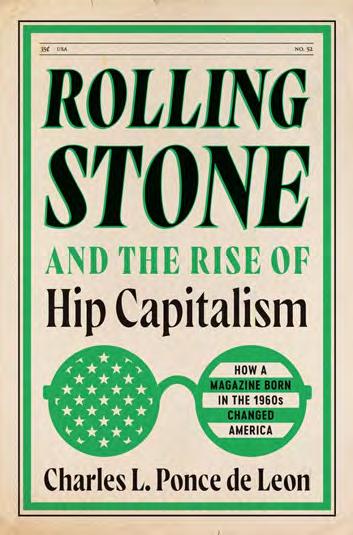
In its early years,RollingStonestood out on the magazine rack: an iconoclastic bimonthly aimed at young Americans, dedicated to music, culture, and politics. Magazine cofounder Jann Wenner’s vision of a magazine that blended politics with sophisticated coverage of rock music and related social and cultural trends was groundbreaking and a surprising commercial success, turning the brash young publisher into the era’s quintessential “hip capitalist.”
This is a history ofRollingStone’s heyday, from its founding in 1967 to its twentieth anniversary, examining its coverage of notable social, cultural, and political developments and the contributions of its distinguished and often brilliant writers—from Greil Marcus and Hunter S. Thompson to William Greider and P. J. O'Rourke. It also reveals how, in response to shifts in its audience, the magazine industry, and the broader culture,RollingStonegradually changed, becoming more successful but also less innovative and influential. In the magazine’s prime, however, Wenner and company showed how a thoughtful, irreverent magazine could attract advertisers as well as readers and spread sixtiesinspired values into the mainstream.
$30.00 | t ISBN: 9781469694399 Hardcover
304 Pages 5 halftones, notes, index 9.250 in H | 6.120 in W | 1.000 in T
History / United States / 20th Century
Charles L. Ponce de Leon is the author of several books, includingFortunateSon: TheLifeofElvisPresleyandThat’stheWayItIs:AHistoryofTelevisionNewsin America.
“Ponce de Leon brilliantly contextualizes the history ofRollingStonewhile attending to the broader historical transformations that had swept up the magazine by the time of Reagan’s ascent. A brilliant examination of the 1960s and its legacies.”—Andrew Hartman, author ofKarlMarxinAmerica
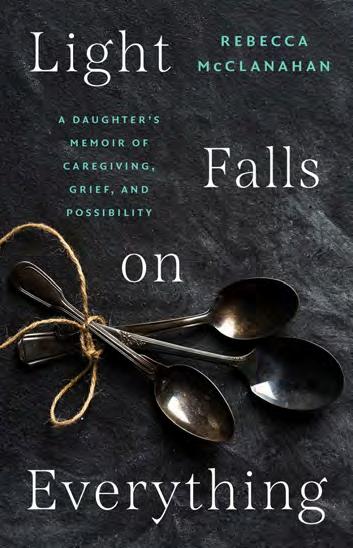
Rebecca McClanahan
A daughter’s moving journey through elder care and impending loss Myfather’sheart,andmymother’s,canstillbreak.Inthismostessentialway,they arestillthemselves.Theyarestillhere.
To stay together until the end was the deepest wish of Rebecca McClanahan’s elderly, frail parents. So when the two of them could no longer care for themselves, Rebecca and her siblings moved them from Indiana to North Carolina, where she and her husband assumed the roles of “first responders” with support from the extended family. Over the course of her parents' final years, Rebecca discovers that the landscape of dementia isn’t entirely bleak if we can hold on long enough to rediscover in our loved ones the essential selves we feared were lost.
LightFallsonEverythingtakes us inside the intimate rooms of long-term caregiving, where exhaustion, confusion, heartbreak, and grief can shadow the most ordinary days. Still, light flickers in even the darkest corners, revealing moments of tenderness, laughter, absurdity, surprise, and unrelenting love. Emotionally gripping and unstintingly honest, this memoir invites us to reflect on the timeless nature of love and loss and, with it, the unexpected lessons of caregiving: how to move forward into our own uncertain futures, accept grief as a longtime companion, and approach death with some measure of grace.
March 2026
$24.00 | t ISBN: 9781469693217
Paperback
256 Pages 8.500 in H | 5.500 in W | 1.000 in T
Biography & Autobiography / Memoirs
Rebecca McClanahan is the author of twelve books, including memoirs, essays, poetry, and a writing guide. She teaches in the Queens University of Charlotte MFA program and conducts workshops and readings throughout the country.
“A powerful and moving look at how love evolves even through our most trying times.”—Lee Martin, author of TheEvening Shades
“McClanahan is a bold and gentle guide as she examines what looking after, and saying goodbye to, our dearest beloveds requires of us. This book is a treasure.”—Jill Christman, author of IfThisWereFiction
J. C. Raulston, Horticultural Ambassador
Revised and Updated Edition with a new foreword by Tony Avent and afterword by Mark
Bobby J. Ward
Weathington
The fascinating story of the beloved but conflicted man often called "America's horticultural ambassador"
J. C. Raulston, described by theNewYorkTimesupon his untimely death as “a generous-spirited giant among horticulturists,” changed the availability of plants in North Carolina, the South, and beyond. Bobby J. Ward, the foremost authority on Raulston’s life, offers a portrait of the legendary figure that will captivate general readers, amateur gardeners, and horticulturists alike.
ChlorophyllinHisVeinschronicles Raulston’s life from his Oklahoma boyhood, through his horticultural education, army service in Vietnam, research and teaching, and his experiences as a gay man. It also includes his greatest achievements: the establishment of the arboretum at North Carolina State University in Raleigh (now bearing his name), the creation of a free plant distribution system for the nursery industry, and the mentoring of some of today’s most prominent horticulturists. The fraught personal life revealed in Raulston’s journals and letters contrasts with his outgoing public persona, reflecting the influences and pressures that produced his triumphs and heartbreaks. This book includes lists of Raulston’s honors and excerpts from his lectures, plant introductions, and personal writings that illuminate the care, passion, and dedication that Raulston brought to his mantra: “Plan—and plant for a better world.”

$30.00 | t ISBN: 9781469695075
Paperback
328 Pages
15 color plates, 23 halftones, notes, index 9.250 in H | 6.120 in W | 1.000 in T
Gardening / Essays & Narratives
Bobby J. Ward is a garden writer and retired environmental scientist who lives in Raleigh, North Carolina.
“Ward illuminates the foundation, life experiences, pain and joy behind the vision for the world-renowned JC Raulston Arboretum. It’s a story of following your passion, working hard, and persevering when things don’t look like they're going your way.”—Anne M. Spafford, Mississippi State University
“A unique view of a nearly legendary figure. J. C. Raulston has a warm place in the heart of plant growers, and Ward opens a door into understanding his life and legacy.”—Alan S. Weakley, North Carolina Botanical Garden
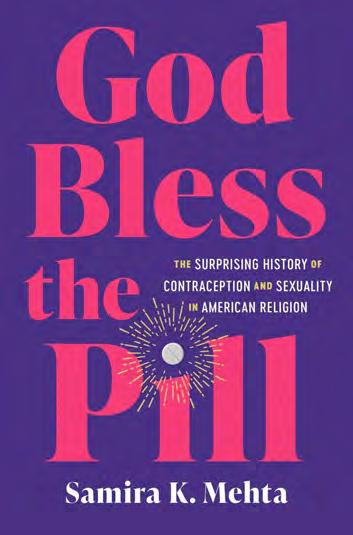
Samira K. Mehta
How American religious leaders and their congregations debated—and embraced—contraception in the postwar era
Most people today understand contraception as central to women’s liberation, and when the birth control pill arrived in 1960, the media thought it would usher in a sexual revolution. But a surprising number of religious Americans in the midtwentieth century also saw contraception as part of God’s plan—a tool to create happy, prosperous American families in the post–World War II era.
InGodBlessthePill, Samira K. Mehta traces the remarkable story of how midtwentieth-century Catholic, Protestant, and Jewish voices promoted the use of birth control and made it more accessible for many Americans. They hoped birth control methods would curb divorce rates by encouraging sexually dynamic marriages and families unstrained by “too many” children—thereby creating a postwar upwardly mobile middle class. Religious leaders also promoted this understanding of the family as tied to Cold War capitalism and encouraged neither racial nor gender equity.
But then came the backlash, both from the Right—which failed to anticipate the feminist potential of contraception—and from the Left, where women, particularly women of color, sought to ensure that birth control was a tool of liberation rather than one rooted in patriarchal and racial oppression. Ultimately, Mehta offers compelling new insights into the way religion accommodates itself to social, technological, and medical change.
April 2026
$29.95 | s ISBN: 9781469693439 Paperback
272 Pages 12 halftones, notes, bibl., index 9.250 in H | 6.120 in W | 1.000 in T
Social Science / Women's Studies
Samira K. Mehta is associate professor of women and gender studies at the University of Colorado Boulder, where she also serves as the director of the Program in Jewish Studies.
“A historical narrative that holds together religion, race, and economics to give us a deep—and sometimes surprising—account of how cultural discussions of birth control got where they are today.”—Sarah Imhoff, Indiana University
Rashad Shabazz
The rise of Prince told through the musical geography of Minneapolis
When nineteen-year-old Prince took the stage to perform “I Wanna Be Your Lover” onAmericanBandstand, those who watched couldn’t reconcile how Prince’s funky disco-pop sounds had hailed from a place like Minneapolis. But the Minneapolis Sound, Prince’s signature pop-musical fusion of funk, R & B, rock, punk, and new wave, did not emerge from a vacuum. The place and space of Minneapolis shaped the musical ecosystem that made Prince famous. And in turn, a complex array of social forces shaped the city’s soundscape.
An expert on place, race, and culture, geographer Rashad Shabazz reveals the hidden history of the Minneapolis Sound, Prince, and his beloved city. More than a biography of Prince, this is a biography of the city and the world of sound from which Prince emerged. Shabazz traces the history of the Minneapolis Sound alongside the city’s history, from colonial contact and through periods of Indigenous removal, white settlement, mass migration, industrialization, music education, suburbanization, and systemic racism. This complex history, combined with the exceptional talent cultivated in Minneapolis’s small Black communities, gave rise to a groundbreaking genre, the otherworldly legend that was Prince, and music that captivated the world.

February 2026
$24.95 | s ISBN: 9781469690957
Paperback
272 Pages
7 halftones, notes, bibl., index 9.250 in H | 6.120 in W | 1.000 in T
History / Historical Geography
Rashad Shabazz is associate professor of geography and African and African American studies at Arizona State University and author ofSpatializingBlackness: ArchitecturesofConfinementandBlackMasculinityinChicago
“A revelatory exploration of early Minneapolis history and music education in the city’s public schools. This is the first biography of Prince to trace the origins of his music so far back in time in so much detail.”—Andrea Swensson, author of GottoBeSomethingHere:TheRiseoftheMinneapolisSound
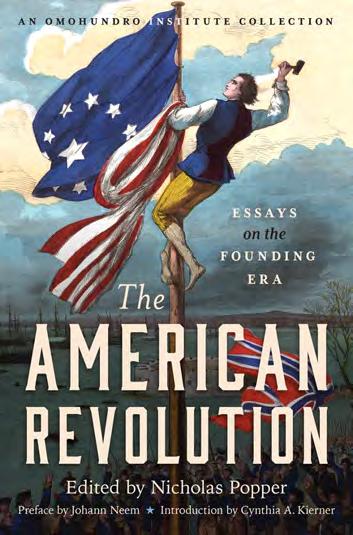
Edited by Nicholas Popper, Preface by Johann N. Neem, and Introduction by Cynthia A. Kierner
The long conflict that culminated in the American Revolution and the founding of the US Republic upended the lives of men and women throughout the colonies. In a time of upheaval and uncertainty, they reinvented their lives, their communities, and their vision of the world.
Drawing from the pathbreaking scholarship published by the Omohundro Institute over the past fifty years, these essays reflect on the experiences and legacies of the struggle for American independence, from the first inklings of the imperial crisis through the war’s global aftershocks.
Contributors include David Armitage, Christopher Leslie Brown, Katherine Carté, Eliga H. Gould, Woody Holton, Rhys Isaac, Michael J. Jarvis, Maya Jasanoff, Linda K. Kerber, Cynthia Kierner, Michael A. McDonnell, Johann N. Neem, Mary Beth Norton, Robert G. Parkinson, Benjamin Quarles, John A. Ruddiman, Manisha Sinha, and Alfred F Young.
March 2026
$29.95 | s ISBN: 9781469695129
Paperback 336 Pages 10 halftones
9.250 in H | 6.120 in W | 1.000 in T
History / United States / Colonial Period (1600-1775)
Published by the Omohundro Institute of Early American History and Culture and the University of North Carolina Press
Nicholas Popper is professor of history at William & Mary and former interim editor of books at the Omohundro Institute.

“This superb collection explores lesser-known aspects of the American Revolution, including the participation of ordinary men and women, Native Americans, citizen soldiers, and enslaved people. Accessible to students, scholars, and general readers alike, the essays deepen our knowledge of the founding moment in our nation’s history.”—Rosemarie Zagarri, author ofRevolutionaryBacklash:WomenandPoliticsintheEarlyAmericanRepublic
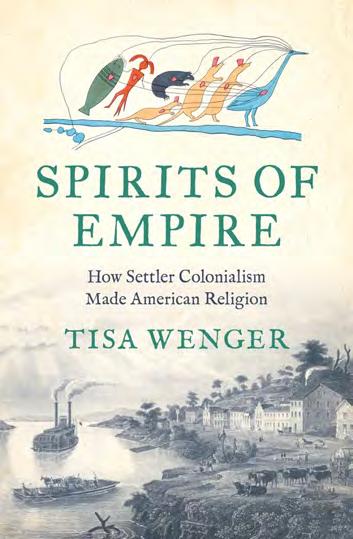
Tisa Wenger
How the domination of people and territory across the US shaped American religion
The Declaration of Independence depicted Native Americans as bloodthirsty savages, and from its founding the United States aimed to expand westward by seizing Indigenous lands. While white settlers saw these conquests as victories for “true religion,” native people invoked the spirits in their own defense. Some claimed the powers of Christianity, while others drew on the English-language concept of religion to redefine their own ancestral traditions. As all sorts of people struggled to make their way within this new empire, a broad variety of new religious movements emerged.
In this groundbreaking book, historian Tisa Wenger shows how the history of American religion unfolded on these settler colonial foundations. The imperatives of US empire, she argues, shaped the category and traditions of what we know as religion. Wenger also introduces the concept of “settler secularism” to explain how white settlers defined and managed religion in their own image, in order to facilitate their own rule. She shows how the concept of “religion”—whether as a special thing that requires protection or a mark of the primitive that must be transcended—has most often served the interests of those in power. Ultimately, settler colonialism organized American religion and created religious hierarchies that still influence the United States today.
$34.95 | s ISBN: 9781469693620
Hardcover
368 Pages 14 halftones, 2 maps, notes, bibl., index 9.250 in H | 6.120 in W | 1.000 in T
Religion / History
“Tisa Wenger’s lively study has the potential to recharge and reorient American religious history.SpiritsofEmpiregives a rich documentary account of the entanglements between secularism and settler colonialism.”—Tracy Fessenden, Arizona State University
“A compelling and convincing argument that shows us the many sizes and shapes of religious actors in American history.”—Kevin Bruyneel, Babson College
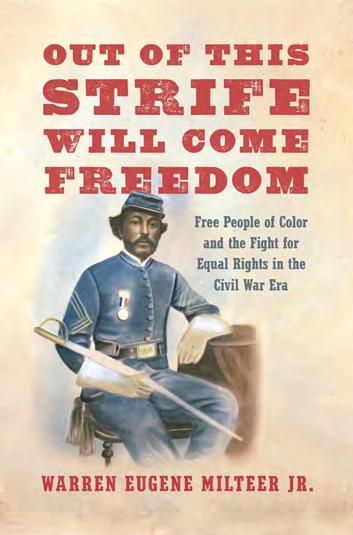
Free People of Color and the Fight for Equal Rights in the Civil War Era
Warren Eugene Milteer Jr.
A definitive study of free people of color that reshapes our understanding of freedom and citizenship in the Civil War era
Free people of color were both architects of equal rights and active participants in the Civil War, on and off the battlefield. Their unique status as already free persons before emancipation shaped their experiences of military service, political activism, and community life in ways distinct from those newly freed from slavery and impacted how they navigated the pursuit of equal rights.
In this groundbreaking work, Warren Eugene Milteer Jr. brings the stories of free people of color to the forefront, revealing that freedom was not simply the absence of enslavement but a powerful foundation of identity, rights, and belonging. Their determined struggles and strategies before, during, and after the war helped redefine what it meant to be a citizen in a nation grappling with democracy and equality. Through military service, vital civilian roles, and political advocacy, free people of color stood at the heart of the nation’s most transformative conflict. Centering their voices and histories, OutofThisStrifeWillComeFreedomshows how their sacrifices and strategies helped forge America’s path toward justice, reshaping our understanding of freedom and their enduring legacy in the national story.
April 2026
$27.95 | s ISBN: 9781469694993
Paperback
288 Pages
21 halftones, notes, bibl., index 9.250 in H | 6.120 in W | 1.000 in T
History / United States / Civil War Period (1850-1877)
Warren Eugene Milteer Jr. is associate professor of history at The George Washington University.
“A richly researched and incisive portrait of free Black Americans in the long Civil War era. Drawing on an extraordinary range of sources, Milteer shows how their varied experiences, political activism, and dissent shaped the war’s course and redefined freedom as a positive set of rights. This essential work deepens our understanding of the Civil War by placing free Black communities at the center of America’s struggle over equality and citizenship.”—Chandra Manning, author of TroubledRefuge:StrugglingforFreedomintheCivilWar
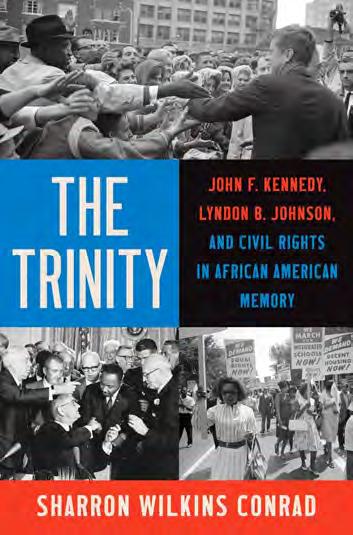
John F. Kennedy, Lyndon B. Johnson, and Civil Rights in African American Memory
Sharron Wilkins Conrad
A striking triptych once displayed in countless African American households, the Trinity typically features Jesus Christ, Martin Luther King Jr., and John F. Kennedy. More than decoration, these portraits were deliberate acts of memory and quiet resistance, a medium through which African Americans asserted their own narratives of hope, leadership, and the fight for justice.
In this provocative history, Sharron Conrad traces the Trinity across several decades, showing how African Americans didn’t merely remember the civil rights movement; they shaped its meaning.TheTrinityreveals why Kennedy’s image hung beside King and Christ, while Lyndon B. Johnson, despite signing landmark legislation such as the 1964 Civil Rights Act, remained largely unheralded. Kennedy’s charisma, symbolic promise, and perceived martyrdom placed him among sacred icons, while Johnson—seen as transactional and confronted by the era’s growing impatience—never secured the same emotional legacy. In a gripping exploration of memory and meaning-making, Conrad reveals how communities create historical truths by elevating some leaders, sidelining others, and preserving their own visions in defiance of the official record.
May 2026
$27.95 | s ISBN: 9781469694443
Paperback
256 Pages
37 halftones, notes, bibl., index 9.250 in H | 6.120 in W | 1.000 in T
Social Science / Cultural & Ethnic Studies / American / African American & Black
Sharron Wilkins Conrad is professor of history at Tarrant County College and senior fellow at Southern Methodist University’s Center for Presidential History.
The John Hope Franklin Series in African American History and Culture
“A groundbreaking examination of Kennedy and Johnson through the eyes of African Americans, weaving grassroots voices, movement history, and media analysis into a vivid, multilayered narrative. Conrad’s archival brilliance and fresh theoretical insights open new avenues for understanding the politics, culture, and civil rights struggles of the 1960s.”— Charles W. McKinney Jr., author of GreaterFreedom:TheEvolutionoftheCivilRightsStruggleinWilson,North Carolina
Mary Ruffin Hanbury and Ian F. G. Dunn
Landmarks with great historical, architectural, and cultural value are often demolished in the name of progress, leaving little but memories behind. In the growing city of Raleigh, many important buildings have been razed, but even when no longer present, these landmarks hold histories that can help us understand not only what Raleigh used to look like but what kind of place Raleigh used to be.
Mary Ruffin Hanbury and Ian F. G. Dunn, building on the work of the late Karl Larson, have gathered photographs and stories of Raleigh landmarks from the late eighteenth century to the late twentieth century, including private homes, public and educational buildings, parks, malls, churches, and businesses. Among these noteworthy places are the home of controversial newspaper editor Josephus Daniels; the nineteenth-century municipal building Metropolitan Hall; and the famous Eduardo Catalano house. Full of photos and fascinating stories,Lost Raleigh is a comprehensive look at the city’s cultural and architectural past and a plea to protect and preserve the landmarks that make our cities unique, connecting us to our shared history.

May 2026
$30.00 | t ISBN: 9781469694122 Paperback 224 Pages 124 halftones
10.000 in H | 7.000 in W | 1.000 in T
Architecture / Historic Preservation
“An indispensable guide to the city’s lost buildings and landscapes. By highlighting this architectural history with numerous documentary photographs, the authors make a much-needed case for preservation in Raleigh at a time when the city’s growth is burgeoning.”—J. Myrick Howard, president emeritus of Preservation North Carolina
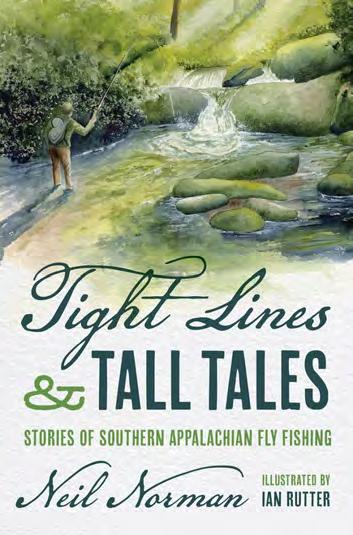
Neil Norman
Illustrated by Ian Rutter
A hell of a tall tale
Southern Appalachia has its own vibrant and dynamic fishing culture, distinct from other regions of the United States—one that combines the contemplative nature of fly fishing with a focus on Southern Appalachian ecology, folklore, and storytelling. For the first time, Neil Norman uncovers the hidden history of Southern Appalachian fly fishing that stretches back generations. Drawing on archival research, his own memories of fishing, and personally collected oral histories, Norman offers a fascinating history of the sport, beginning with Mark Cathey, a renowned North Carolinian angler active in the early twentieth century, and ending in the present day in the age of Trout Unlimited.
In recounting the history of Southern Appalachian fly fishing, Norman tells the story of the land itself—its streams, rivers, mountains, and valleys—while also challenging the idea that Southern Appalachia is an insular backwater or simply a tourist destination. He shows us that, as with any angling tradition, understanding where we are is key to understanding who we are.
$28.00 | t ISBN: 9781469693323
Paperback 232 Pages 16 halftones 9.250 in H | 6.120 in W | 1.000 in T
Nature / Essays
Neil Norman is an angler, writer, and teacher based in Tennessee.
Ian Rutter is an artist and professional fly fishing guide.
“I can think of no other book like this that has North Carolina as its topic. Part reminiscence, part how-to by example, and part history of the state’s portion of the Southern Appalachians, Norman’s book is an illuminating portrait of trout fishing and fishermen in the region over the past seventy-five years.”—Jim Wilson, writer and outdoorsman
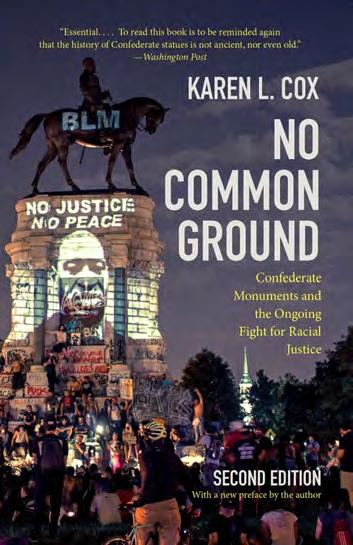
Confederate Monuments and the Fight for Racial Justice
Second Edition with a new preface by the author
Karen L. Cox
The definitive history of Confederate monuments—and the century-long fight over their meaning
When it comes to Confederate monuments, there is no common ground. Debates over their meaning have sparked legislative battles, courtroom fights, and public protests that sometimes turn destructive. These conflicts have persisted for over a century, but never with today’s intensity.
In NoCommonGround, historian Karen L. Cox examines the rise, preservation, and contestation of Confederate monuments. She explores what these statues meant to their builders and how movements arose to challenge them. Cox traces the forces behind symbols of white supremacy and how antimonument sentiment —suppressed during the Jim Crow era—reemerged with the civil rights movement and grew after the Voting Rights Act of 1965. Monument defenders used gerrymandering and heritage laws to block removals, while civil rights activists fought to reclaim public space and history.
This second edition includes a new preface tracing developments in the monument conflict since 2020—from George Floyd’s murder to the removals, legal battles, and federal actions that followed—revealing a nation still divided, with no common ground in sight.
$18.00 | t ISBN: 9781469695969 Paperback 232 Pages 14 halftones 8.500 in H | 5.500 in W | 1.000 in T
History / African American & Black
A Ferris and Ferris Book

“Engrossing. . . . This clear and thorough account, essential for Southern libraries, is likely to become a standard reference work on its subject. . . . A well-documented history of Confederate monuments and the conflicting views they inspire.”— KirkusReviews
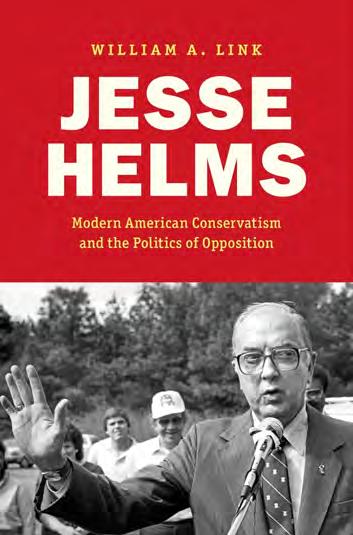
William A. Link
Jesse Helms (1921–2008) dominated the political landscape of North Carolina during the last half of the twentieth century. Though Helms’s thirty years in the US Senate are most remembered for what he opposed rather than what he achieved, he was a central figure in modern conservativism.
In this concise interpretive biography, William A. Link centers Helms in the political realignment of the late twentieth-century South and the national ascendance of modern conservatism. He helped to lead a coalition known for advocating staunch anti-communism, opposing civil rights legislation, and denouncing liberalism. Helms innovated strategies for consolidating political power by using broadcast media to generate grassroots outrage. In addition, Helms’s National Congressional Club successfully raised a powerful war chest that could be used in television attack ads. Helms’s career-long penchant for racebaiting and homophobic rhetoric created many opponents, but even they acknowledged his uncanny ability to piece together slender electoral majorities in a rapidly changing nation.
2026
$29.95 | s ISBN: 9781469694498
Paperback
336 Pages
21 halftones, notes, bibl., index 9.250 in H | 6.120 in W | 1.000 in T
Biography & Autobiography / Political
“Key reading for everyone who wants to understand modern southern politics.”—Christopher A. Cooper, author of AnatomyofaPurpleState:ANorthCarolinaPoliticsPrimer
“A captivating biography that reveals how Jesse Helms contributed to the rise of New Right conservatism, the Reagan revolution, and MAGA.”—Karl E. Campbell, author ofSenatorSamErvin,LastoftheFoundingFathers
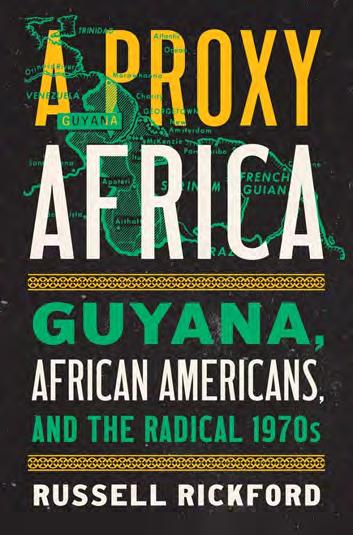
Guyana, African Americans, and the Radical 1970s
Russell Rickford
How Guyana became the epicenter of anticolonial pan-African movements
Nestled between Brazil, Venezuela, and Suriname, Guyana is the third-smallest sovereign state in mainland South America, and one of its youngest. Originally a Dutch colony, Guyana remained under British rule from the late eighteenth century until gaining independence in 1966 and becoming a republic in 1970. Apart from the 1978 mass murder-suicide of cult leader Jim Jones’s followers in Jonestown, Guyana has been mostly peripheral to mainstream geopolitics. Yet for a generation of Black revolutionaries from around the world, Guyana was a vibrant site of panAfrican activism. The country was particularly attractive to veterans of the US civil rights movement who sought alternative places to construct flourishing postcolonial, pan-African nation-states.
In this first, comprehensive history of Guyana’s core role in anticolonial, Black internationalist movements in the 1960s and 1970s, historian Russell Rickford traces the history of African Americans who traveled to the country to work with, learn from, and teach Guyanese politicians, activists, and other international figures in the long fight for Black freedom. With encouragement from Prime Minister Forbes Burnham, they eagerly accepted the invitation to move to Guyana to establish new cooperative settlements. Rickford compellingly narrates Guyana’s allure and promise for Black Americans, along with the limitations they faced when ideology clashed with lived realities—especially political ones—once there.
University.
$34.95 | s ISBN: 9781469690803
Paperback
376 Pages
27 halftones
9.250 in H | 6.120 in W | 1.000 in T
History / Caribbean & West Indies
InterConnections: The Global Twentieth Century
“A sweeping history that focuses intently on Guyana and especially African Americans that is well-researched, wellwritten, and revelatory. The contribution to the field is overwhelming to the point that it carves out new territory, due in large part to Rickford’s granular research.”—Gerald Horne, author ofRevoltingCapital:RacismandRadicalismin Washington,D.C.,1900–2000
How I Found Love, Humor, and Beauty in My Quest for Ethical Food
Zackary Vernon
What can you eat to feel like you aren't part of the problem?
When Zackary Vernon moved to the Appalachian town of Boone, North Carolina, he had a goal: to make more ethical food choices. Soon he was working on an organic farm; volunteering at a pay-what-you-can restaurant; and interviewing a range of people, from fishermen and farmers to biologists and even reality television star Eustace Conway. He found that when he stepped outside the industrial food system, he often ended up in the company of folks on the fringe—people who rejected not only industrial farming methods but also many modern beliefs and conventions that have proven harmful to our food system.
Disillusioned by extremist positions on the left and right, such as anarchist fantasies and myopic conservative worldviews, Vernon, like many of us, struggled to be an ethical eater without fully sacrificing pleasure and joy. While there are no easy answers, he invites readers to consider their own responsibilities to both the places they live and the far-off places their lifestyles affect. With dry wit and personal stories, Vernon offers ways for us to fail better as we consider how to eat more ethically in the future.

June 2026
$19.95 | s ISBN: 9781469695518 Paperback
160 Pages
9.250 in H | 6.120 in W | 1.000 in T
Social Science / Agriculture & Food
Zackary Vernon is the author of OurBodiesElectricand is associate professor of English at Appalachian State University.
“Zackary Vernon tackles the ethics of growing and consuming food from a deeply personal and engaging perspective. From the outset, it’s clear that here is an author who can both grow a tomato and butcher a chicken.”—Diane Flynt, author ofWild,Tamed,Lost,Revived:TheSurprisingStoryofApplesintheSouth
Mary E. Mendoza
The first environmental history to chronicle the construction of race, fencing, and policing at the US-Mexico border
When most people picture the US-Mexico border, they think of walls, fences, concrete, and wire. But in this first history of how the environment influenced physical boundary-making between the two nations, Mary E. Mendoza focuses on how the natural world shaped ideas about race, gender, and security. In so doing, she unearths surprising origins of the modern-day immigration debate.
Mexican migrants have historically been seen by some in the US as invasive and less than human. But actual invasive pests are part of this story.DeadlyDivideshows how cattle ticks, the body louse, foot-and-mouth disease, and the female Mexican fruit fly contributed to the ever-increasing racialization of Mexican migrants, which in turn led to increased policing, criminalization, and fears about immigrants infiltrating the US. As Mendoza follows the stories of migrants in relation to various species, Indigenous peoples, and officials on both sides of the border, she argues that the need for mobility overpowered both governments’ laws, fences, and agents. At the same time, the border’s symbolic power became a source of terror not only for migrants who try to cross into the US but for those who feel they cannot cross back, making the US a nation that suspends immigrants between two worlds.

$29.95 | s ISBN: 9781469695402
Paperback
256 Pages
33 halftones, 2 maps, 2 graphs, notes, bibl., index 9.250 in H | 6.120 in W | 1.000 in T
History / Historical Geography
Mary E. Mendoza is assistant professor of history at Penn State University and the editor ofNotJustGreen,NotJustWhite:Race,Justice,andEnvironmentalHistory
“A brilliantly researched, clearly written book. Mendoza shows, in exquisite detail, the environmental, geopolitical, and social dimensions of the history of border-making.” —Virginia Scharff, University of New Mexico
“In adding the nonhuman to the history of the border, Mendoza makes one of the most important contributions that I have read in a while. This book will become part of the central set of books on the US-Mexico border.” María E. Montoya, New York University
Jason R. Young
How Southern white elites shaped the historical memory of enslavement
Many of the sights and sounds that Americans associate with slavery are rooted in a grand historical myth. The image of the Big House, sitting atop carefully manicured rolling green hills is, in large part, a fantasy—as is the idea of the plantation as an expansive family home to chivalrous planters and happy slaves. Still, these myths persist.
Jason R. Young explores the persistence of these myths and the historical memory of slavery by focusing on the elite white mythmakers who helped shape our understanding of slavery. In the early twentieth century, a group of white writers, artists, and performers from the cultural hub of Charleston, South Carolina, created and curated a highly sanitized view of slavery. They imagined a once and future plantation society that would reestablish them as the proper heirs of the slave past. In the process, they crafted a set of dangerously durable and virulent stereotypes about slavery. Focusing on literature, art, and performance, Young examines both the power and the folly of these ideas. In uncovering the origins of these racial myths, TheMaskofMemoryresists these racial fantasies and challenges their stubborn resurgence in our own time.

May 2026
$29.95 | s ISBN: 9781469694351
Paperback
272 Pages 15 halftones, 2 maps, notes, bibl., index 9.250 in H | 6.120 in W | 1.000 in T
Social Science / Cultural & Ethnic Studies / America
Boundless South
Jason R. Young is professor of history at the University of Michigan.
“Young writes with originality and versatility on the problems at the nexus of race, power, profit, performance, authenticity, meaning-making, and historical memory. This compelling work will change how we understand representations of slavery.”—Lisa Gail Collins, author of StitchingLoveandLoss:AGee’sBendQuilt
“A lyrical, witty, and incisive work that exposes the absurdity of the purported racial expertise claimed by elite white Charlestonians. Young shows how their distorted narratives about enslaved people persist to this day.”—Sharla M. Fett, author ofRecapturedAfricans:SurvivingSlaveShips,Detention,andDislocationintheFinalYearsoftheSlaveTrade
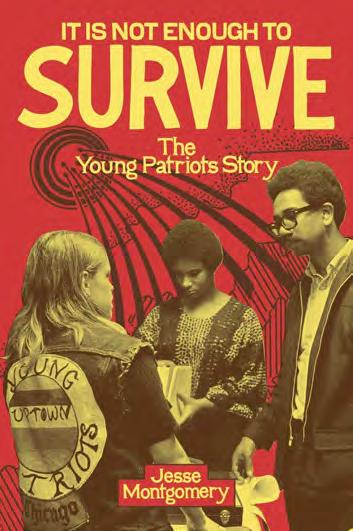
Jesse Montgomery
Formed in the late 1960s, the Young Patriots Organization was a Chicago-based radical group made up of young white migrants from Appalachia and the South who helped found Black Panther activist Fred Hampton’s Rainbow Coalition. The YPO grew from a local street gang into a powerful political and social force in the city’s Uptown neighborhood, where it fought against police brutality, racism, economic exploitation, and displacement through community organizing, the establishment of survival programs, and working-class cultural organizations.
In this first stand-alone history of the YPO, Jesse Montgomery presents the group as one of the New Left’s most enigmatic anti-racist organizations—one inspired by the moral and political power of the civil rights movement and the street corner socialism of the Black Panthers but also one that embraced regressive Southern identifiers, such as Confederate flags, that belied its liberatory message. Though the YPO’s existence was short-lived, its story helps us to reimagine radical unity in the face of dislocation, political oppression, and the brutal incentives of racial capitalism. As Montgomery argues, its work to cross racial and class lines and build coalitions for the greater good is a symbol of the America that could still be.
May 2026
$32.50 | s ISBN: 9781469693965
Paperback
304 Pages
15 halftones
9.250 in H | 6.120 in W | 1.000 in T
Social Science / Cultural & Ethnic Studies / American
Jesse Montgomery is visiting assistant professor of English at Berea College.
“Essential reading for scholars and students interested in the history of the New Left and the various legacies of the 'first' Rainbow Coalition. There is no book that comes close to doing what Jesse Montgomery has now done for the Young Patriots Organization The buck stops here, as they say.”—Max Fraser, author ofHillbillyHighway:TheTransappalachian MigrationandtheMakingofaWhiteWorkingClass
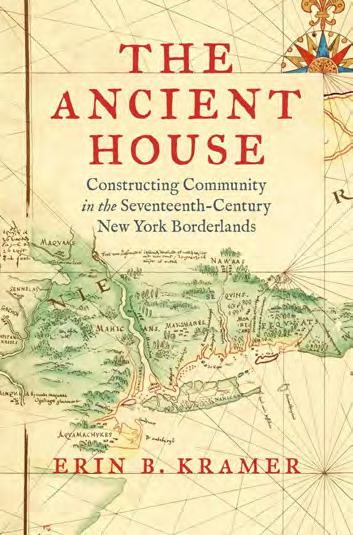
Erin B. Kramer
While New Amsterdam has captured public imagination and scholarly attention for centuries, the Dutch borderland settlement that became Albany, New York, was no less vital to the development of early America. InTheAncientHouse, historian Erin B. Kramer examines how early relationships between the Dutch and Haudenosaunee (Iroquois) built a foundation for the town’s oversized role in European and Indigenous diplomacy in the seventeenth and eighteenth centuries.
Albany (called “the ancient house” by a Haudenosaunee orator) was an essential space where Indigenous people articulated what it meant for Europeans to settle in their world. Kramer illustrates how Haudenosaunee people shaped the town, its politics, and the laws enforced there through a century of negotiations, and how they sought redress and hold colonists to their agreements. By incorporating Haudenosaunee stories into the broader narrative of New York history,TheAncient Housereveals how Albany became a negotiated community, a site of dialogue, and a critical central place in early America.
April 2026
$27.95 | s ISBN: 9781469693798 Paperback 224 Pages 4 halftones, 3 maps, notes, index, glossary 9.250 in H | 6.120 in W | 1.000 in T
History / United States / Colonial Period (1600-1775)
Erin B. Kramer is associate professor of history at Trinity University.
The David J. Weber Series in the New Borderlands History
“A welcoming and interesting look into the Mohawk, Iroquois, and Dutch histories of the region of upstate New York.”—Eugene Tesdahl, University of Wisconsin, Plattsville
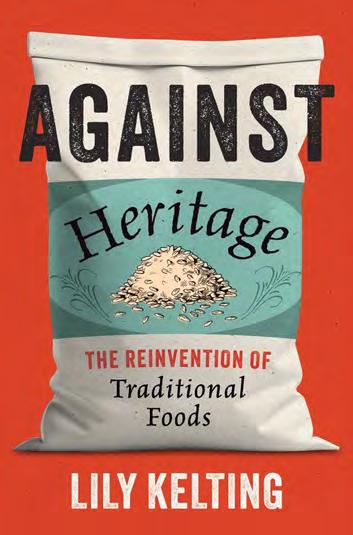
Lily Kelting
A provocative look at how traditional food movements erase culinary pasts
The rise of “heritage” foods—that is, the reinvention of traditional foods—has enjoyed a high profile thanks to the oft-praised efforts of chefs such as Sean Brock and René Redzepi. But Lily Kelting observes the popularity of heritage foods as something more: a global movement in response to climate catastrophe and the rise of right-wing, populist movements that center a return to the past as part of their ideology.
Weaving ethnography, discourse analysis, critical theory, and sensory, embodied critique, Kelting tracks and critiques the boom of traditional food revival movements in the American South, Denmark, and India. Ultimately, Kelting argues that the heritage that culinary professionals wish to revive is equal parts nostalgia and invention: They engage, subvert, and ignore food histories in their creation of new food movements. As Kelting documents our contemporary moment, she shows how the conversations surrounding these new food movements leave out those already keeping their traditions alive. AgainstHeritage, then, serves as a reparative revaluation of the work of the cooks largely excluded from the prevailing media conversation about heritage revival.
May 2026
$29.95 | s ISBN: 9781469694542 Paperback 240 Pages 10 halftones, notes, bibl., index 9.250 in H | 6.120 in W | 1.000 in T
Social Science / Agriculture & Food
Lily Kelting is assistant professor of literary and cultural studies at FLAME University in Pune, India.
“A brilliant provocation that reconsiders the value and labor of women and racialized cooks in the heritage food movement.”—Krishnendu Ray, New York University
“A robust and expansive study that combines theoretical analysis with practical interventions.”—Catarina Passidomo, Washington and Lee University
Transborder collaboration as a critical model for species conservation
What happens to species when climate disruption causes suitable habitat within one country to move or vanish? In BordersofBiodiversity, Will Wright examines the histories of transnational conservation efforts to address the tension between a warming world in which living things are on the move and an increasingly walled world in which their movements are constrained. Focusing on the histories of three border-crossing species—gray wolves, monarch butterflies, and giant sequoias—from the 1850s to the present day, Wright reveals how nonstate actors like citizen scientists think beyond political borders and diplomatic traditions and find collaborations with fellow-minded conservationists by following nature beyond the nation-state.
The people at the heart of these intertwined stories in Canada, Mexico, the United States, and Indigenous nations of North America recognize that biota have their own forms of territoriality that should be respected and defended. Wright argues that the realities of climate change are fundamentally at odds with site-specific conservation, which follows the possessive logic of nation-building by bounding space to protect habitats when many ecologies do not naturally fit within traditional protected areas. Taken together, these stories make clear that conservation efforts must forge solidarity across borders for biological well-being —or face the extinction of shared species.

March 2026
$34.95 | s ISBN: 9781469694078
Paperback
352 Pages
33 halftones, 3 maps, notes, bibl., index 9.250 in H | 6.120 in W | 1.000 in T
Nature / Environmental Conservation & Protection
Flows, Migrations, and Exchanges
Will Wright is assistant professor of history and environmental studies at Augustana University.
“Will Wright’s in-depth exploration of a key tension in conservation—that many ecosystems, species ranges, and environmental issues do not align with political borders—is an important and timely contribution.”—Germán Vergara, author ofFuelingMexico:EnergyandEnvironment,1850-1950
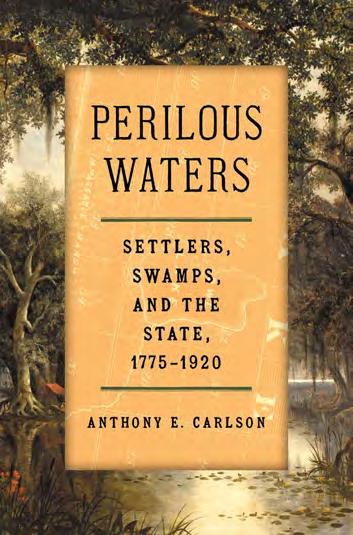
Swamps, and the State, 1775–1920
Anthony E. Carlson
What swamps can tell us about race and power in the United States
Wetlands—particularly swamps—have evoked contradictory responses from different groups in the United States from the early republic to the end of World War I. White, enslaved, and Indigenous peoples alternately envisioned swamps as future agricultural paradises, uninhabitable wastelands, portals to freedom, spaces to gather vital resources, eugenic sanctuaries, and future homes for settlers. This contested, evolving thinking shaped how Americans interacted with swamps, and PerilousWatersaddresses how those interactions influenced their management.
Anthony E. Carlson shows how settlers demonized swamps as one of the gravest environmental impediments to agricultural expansion and the establishment of secure and stable communities. In doing so, they enlisted the knowledge, resources, and authority of the state to organize institutions that enabled drainage and erased any vestiges of prior occupation and usage. By the mid-nineteenth century, drainage became a paramount public policy objective, inaugurating new social institutions and mobilizing state resources to assist settlers in fashioning dry, healthy, and domesticated landscapes. After 1900, all levels of government worked to implement cooperative social institutions and systemize environmental and technological knowledge to facilitate drainage and accelerate the transformation of the nation’s wet spaces into farms and crop fields.
March 2026
$29.95 | s ISBN: 9781469694801
Paperback
288 Pages
12 halftones, 2 maps
9.250 in H | 6.120 in W | 1.000 in T
History / United States
Anthony E. Carlson is professor of history at the School of Advanced Military Studies, US Army Command and General Staff College.
“A particularly prescient history of wetlands, swamps, and other watery landscapes in early America as historians and the public grapple with the intertwined questions of environmental justice, Indigenous dispossession, and settler colonial capitalism in the era of human-induced climate threats.”—John William Nelson, author ofMuddyGround: NativePeoples,Chicago’sPortage,andtheTransformationofaContinent
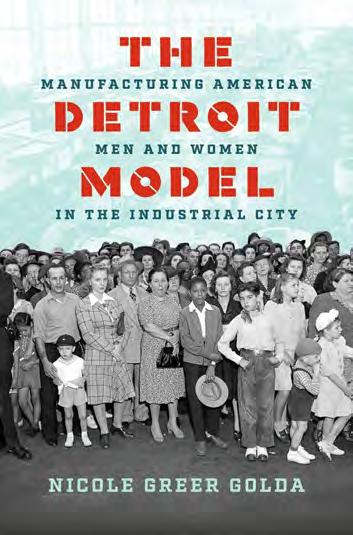
Nicole Greer Golda
As Detroit reached dizzying new heights of industrial success and urban growth at the turn of the twentieth century, hundreds of thousands of migrants flocked to the Motor City. In response, organizations such as the YMCA launched wide-reaching Americanization programs to instill patriotism, conservative gender roles, traditional family values, and industry-favorable labor relations in the city’s immigrant communities. As the “Ford Man” became a model for masculinity and the housewife for femininity, supporters of these programs believed Detroit could become a model for the nation. In this impressively researched book, Nicole Greer Golda reveals how the Detroit Model became embedded in American culture and forged the ideal of proper American citizenship.
Delving into Immigration Bureau files, migrant letters, and unexplored Ford Motor Company records, Greer Golda examines debates over family order, sexual relationships, race and labor relations, immigration policy, and the status of women. She illustrates how businessmen, government officials, white women, native-born workers, immigrants, and Black Detroiters challenged each other for the power to define the contours of the new American city. Ultimately, the Americanization programs prevailed and their conservative values became the backbone of Cold War sensibilities that enabled the Cold War consensus to gain popularity. As TheDetroitModelcontends, the backlash to shifting demographics in Detroit shaped American life for decades to come.
Nicole Greer Golda is lecturer of history at Kennesaw State University.
$29.95 | s ISBN: 9781469695242
Paperback
288 Pages 19 halftones, 1 table, notes, bibl., index 9.250 in H | 6.120 in W | 1.000 in T
History / United States
“This deftly argued book offers a compelling narrative of European, Mexican, Japanese, and Black migrant experiences, illuminating the long history of culture wars rooted in the persecution and harassment of immigrants in the United States.”—Ashley Johnson Bavery, author ofBootleggedAliens:ImmigrationPoliticsonAmerica’sNorthernBorder
“A refreshing and nuanced study that weaves together histories of immigration, class struggle, and gender to uncover Detroit’s enduring influence on American culture and politics.”—Holly M. Karibo, author of RehabontheRange: AddictionandIncarcerationintheAmericanWest
Mary Bickerdyke, Civil War–Era Nurse
Megan VanGorder
How one nurse's life helps us understand medicine and motherhood
Mary Anne Bickerdyke led a remarkable life. A widowed mother from Illinois, she became an influential traveling nurse and Sanitary Commission agent during the American Civil War. She followed the Union Army through four years and nineteen battles, established hundreds of hospitals, assisted surgeons with amputations, treated fevers, and fed the soldiers in her care. Known affectionately as “Mother” to thousands of soldiers, Bickerdyke’s work bridged the private world of home caregiving and the public demands of wartime and institutional medicine.
Drawing on a rich archive of personal letters, military records, and newspapers, Megan VanGorder explores how Bickerdyke used her maternal identity to challenge norms, advocate for soldiers, and pioneer compassionate care practices before, during, and after the Civil War. AMother’sWorkuses key episodes from Bickerdyke’s life to reveal broader truths about motherhood, medicine, and women’s roles in the nineteenth century, and offers an intimate and historically grounded portrait of one woman’s evolving identity and the use of the moniker that made her famous. In reassessing her work and legacy, this book also serves as a new perspective on how white working-class women contributed to the transitional period of the Civil War era to reshape public health, social care, and national memory.

$29.95 | s ISBN: 9781469692326 Paperback
272 Pages
20 halftones, 2 tables 9.250 in H | 6.120 in W | 1.000 in T
Biography & Autobiography / Medical
Megan VanGorder is assistant professor of history at Illinois State University.
“Megan VanGorder superbly illuminates the myriad ways Bickerdyke’s story matters—including as a window into working-class women’s Civil War experiences and her pioneering role in palliative and hospice care.”—Elizabeth R. Varon, author ofLongstreet:TheConfederateGeneralWhoDefiedtheSouth
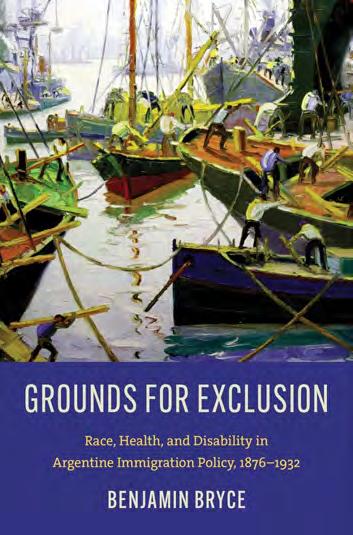
Race, Health, and Disability in Argentine Immigration Policy, 1876–1932
Benjamin Bryce
How immigration shaped Argentina's history and its place in the modern world
Argentina has been one the most important destinations for international labor migrants in the modern world. But while it was long imagined as a nation of immigrants, a closer look at its history and policies reveals that the country’s doors were only open to certain people. In the late nineteenth and early twentieth centuries, officials developed a long list of grounds for exclusion that deterred many people from ever boarding a ship to the country. Travelers who did come to Argentina were frequently barred at ports of entry on account of race, health, or disability.
Tracing the attempts of European, Asian, and Middle Eastern migrants to enter Argentina, Benjamin Bryce shows how the modern state worked to privilege white supremacy and expansion over diversity and magnanimity. As Argentine officials, politicians, and influential thinkers envisioned their country’s future, they tried to define the ideal citizens who would live, work, vote, and reproduce in Argentina— and the characteristics of those who would not. Anyone deemed unhealthy or disabled was labeled unproductive or a potential burden on the state. Race often shaped notions of health and productivity and therefore determined who was welcome. Bryce’s thorough analysis of immigration exclusions reconceptualizes Argentina’s long-accepted reputation as a haven for newcomers.
May 2026
$34.95 | s ISBN: 9781469695358 Paperback 288 Pages 9 halftones, 9 tables
9.250 in H | 6.120 in W | 1.000 in T
History / Latin America / South America
Benjamin Bryce is associate professor of history at the University of British Columbia.
“Truly remarkable multilanguage research that illuminates the international system of immigration restriction at work during the nineteenth and twentieth centuries. Readers will be intrigued by the parallels between the United States and Argentina’s systems of exclusion in immigration policy.”—Benjamin Montoya, author of ADiplomaticHistoryofUS ImmigrationDuringthe20thCentury:Policy,Law,andNationalIdentity
“Benjamin Bryce’s careful attention to how state officials and their allies used race, national origin, and health to build a 'system of exclusion' provides fresh challenges to popular histories of Argentina that overlook the restriction of immigration to the country.”—Eduardo Elena, author ofDignifyingArgentina:Peronism,Citizenship,andMass Consumption
Michael Staudenmaier
A portrait of the Puerto Rican community's experience of racialization in Chicago
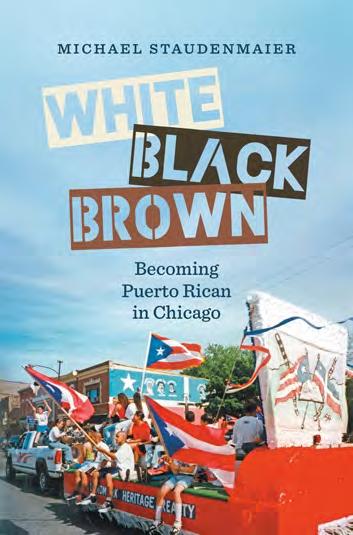
Facing persistent exploitation, discrimination, and marginalization in the second half of the twentieth century, generations of Puerto Rican organizers and activists drew on multiple competing versions of nationalism to challenge the racial order in Chicago, one of America’s most segregated cities. Initially, both supporters and opponents of Puerto Rican independence promoted the assimilation of fellow migrants as white citizens. The three-night-long Division Street Riots marked a fundamental pivot point in 1966, ending the pursuit of whiteness and opening the door to waves of nationalist militancy during the 1970s. By the 1980s and 1990s, Puerto Rican nationalists in Chicago had entered electoral politics, building a broader notion of Latinidad even as they softened its radical edges.
Drawing on an extraordinary array of archival material, much of it previously inaccessible, Michael Staudenmaier highlights cultural and political projects profoundly informed by nationalist sentiments, from beauty pageants and parades to protests and bombings to elections and legal battles. Revealing how nationalism became a key site of racial formation for Puerto Ricans in Chicago,White,Black, Brownshows how they understood themselves and demanded to be seen by their neighbors and the world.
$32.95 | s ISBN: 9781469689265 Paperback 256 Pages 12 halftones, 2 tables, notes, bibl., index 9.250 in H | 6.120 in W | 1.000 in T
History / Hispanic & Latino
Latinx Histories
Michael Staudenmaier is an independent historian and serves on the Board of Directors of Dr. Pedro Albizu Campos Puerto Rican High School in Chicago.
“Michael Staudenmaier’s emphasis on the historical peculiarities of how race, space, and place are linked makes a crucial and necessary addition to both Puerto Rican historiography and studies of Latinxs' experience of racialization in the United States.” —Marisol LeBrón, author ofPolicingLifeandDeath:Race,Violence,andResistanceinPuertoRico
“An impressive work that defies any simplistic understanding of Puerto Rican racial politics. Staudenmaier’s innovative approach to race, nationalism, and identity highlights the plurality of Puerto Rican identities and contributes to important debates in Chicago and beyond.”—Michael Innis-Jiménez, author of SteelBarrio:TheGreatMexican MigrationtoSouthChicago,1915–1940
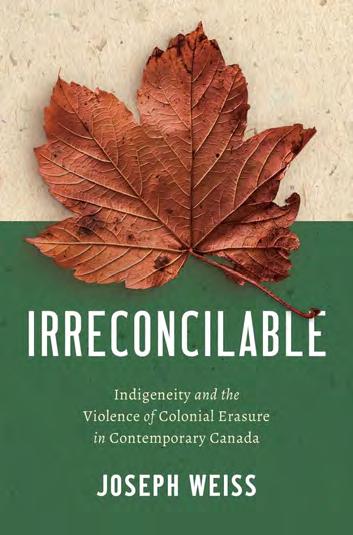
Since the early 2000s, the Canadian government has attempted reconciliation with Indigenous nations through varied efforts: treaty processes, government commissions, rebranding campaigns for settler-owned businesses, workshops for state and local officials, school curriculum changes, and a recently christened national holiday. However, as Joseph Weiss argues, these state-driven initiatives reinforce Indigenous subordination to the settler state. This incisive study of the varied responses from both Indigenous Nations and individuals to reconciliation illuminates how it is implicated in ongoing colonial erasure.
Critically engaging with a variety of fields, including Indigenous studies, anthropology, history, political theory, semiotics, and museum studies, Weiss captures the multiple scales at which these contested dynamics unfold and explores their underlying technologies of erasure.Irreconcilableunpacks how reconciliation offers amends for anti-Indigenous violence while disavowing responsibility for that violence, and argues that settler promises of reconciliation cannot be reconciled to the fact of Indigenous sovereignty. Nevertheless, Weiss illustrates how Indigenous Peoples refuse erasure at every turn, instead building alternate futures and lived worlds that are not always already colonially overdetermined.
March 2026
$29.95 | s ISBN: 9781469693736 Paperback 224 Pages 8 halftones
9.250 in H | 6.120 in W | 1.000 in T
Social Science / Cultural & Ethnic Studies / Canadian Studies
Critical Indigeneities
Joseph Weiss is associate professor of anthropology and science and technology studies at Wesleyan University.
“A powerful study that reveals the anti-Indigenous violence of reconciliation politics in Canada. Sparkles with theoretical acuity and clarity.”—Audra Simpson, author ofMohawkInterruptus:PoliticalLifeAcrosstheBordersofSettlerStates
“Synthesizing an impressive range of Indigenous scholarship with research on ruins, museum objects, and legal language, Joseph Weiss delivers a brilliant analysis of reconciliation as a settler response to Indigenous sovereignty.”— Eugenia Kisin, author ofAestheticsofRepair:IndigenousArtandtheFormofReconciliation
Native Americans and the Transformation of Work in the Twentieth Century
Colleen O’Neill
Native workers' rights are sovereignty rights
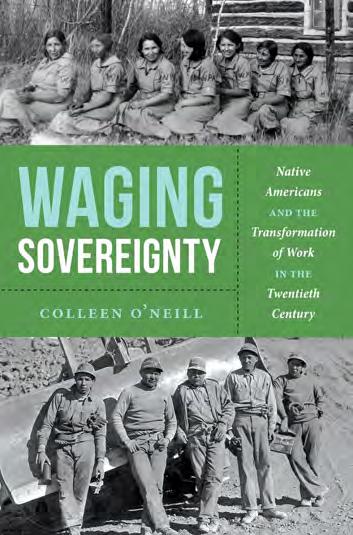
Wage work was supposed to "kill the Indian and save the man," or so thought Richard Pratt and other late nineteenth-century policymakers. Nevertheless, even as American Indians entered the workforce, they remained connected to their lands and cultures. In this powerful history of resilience and transformation, Colleen O'Neill uncovers the creative strategies Native workers employed to subvert assimilation and fight for justice in the workplace, their collective strength expanding the very meaning of sovereignty.
Drawing on federal archives, Native memoirs, oral histories, and field research, O'Neill traces a sweeping story that stretches from the era of boarding schools to the contemporary world of high-stakes gaming. For more than a century, federal policymakers tried to reshape Native lives through labor. In some cases, children were sent to pick crops and scrub settlers' homes. In others, families were relocated to distant cities for permanent year-round jobs that were designed to replace traditional seasonal labor and lifestyle patterns. But Native workers persevered. They rebuilt their communities, fought to reclaim control of the reservation workplace, and developed distinctive institutions to defend their cultural, political, and economic sovereignty. AsWagingSovereignty illuminates, wage work was a focal point of assimilationist efforts and, in turn, labor became a key factor in anti-colonial struggle.
Colleen O'Neill is associate professor of history at Utah State University.
$29.95 | s ISBN: 9781469693286
Paperback
240 Pages 18 halftones, notes, index 9.250 in H | 6.120 in W | 1.000 in T
History / Native American
“A powerful and much-needed contribution to the scholarship on Indigenous labor.”—Chantal Norrgard, author of SeasonsofChange:Labor,TreatyRights,andOjibweNationhood
“O'Neill skillfully demonstrates how tribes and Native workers rejected the language of rights-based liberalism, instead firmly rooting their rights as workers and managers within the more durable protections of tribal sovereignty.”—Kevin Whalen, author of NativeStudentsatWork:AmericanIndianLaborandShermanInstitute’sOutingProgram,1900–1945
West African Sufi thought and its reckoning with race and memory
In the mid-1990s, Shaykh Arona Rashid Faye al-Faqir arrived in South Carolina from Senegal. Settling in Moncks Corner, he brought with him the Mustafawiyya Tariqa, a Sufi movement that emphasizes remembrance and inward cultivation, which he inherited from its founder, Shaykh Muhammad Mustafa Gueye. Today, Masjid Muhajjirun wal Ansar in Moncks Corner remains the center of this North American transnational community despite the Mustafawiyya Tariqa’s spread to larger cities like Philadelphia and Atlanta. Monck’s Corner serves as a haven for Muslims to build community and, as Youssef J. Carter argues, to construct diasporic consciousness as they connect with Muslims across the Atlantic.
In TheVastOceans, Carter shows that this expansion of a West African Sufi movement in the Black Atlantic offers those traveling the Mustafawiyya path empowerment through spiritual care as they confront historical and contemporary anti-Blackness. As Carter tracks the community’s thought and practice over time and space, he examines how practices of solidarity and remembrance aid in healing. Ultimately, his richly textured depiction of lived religion expands our understanding of global Islam, particularly the dynamic Black Muslim devotional practices of study and remembrance that span from West Africa to the American South.

June 2026
$32.50 | s ISBN: 9781469693576
Paperback 304 Pages 13 halftones, appends., notes, bibl., index 9.250 in H | 6.120 in W | 1.000 in T
Religion / Islam / Sufi Islamic Civilization and Muslim Networks
YoussefJ.Carter is assistant professor of religious studies at the University of North Carolina at Chapel Hill.
“An incredibly rich and novel ethnography, TheVastOceanscreates and documents conversations between voices that are rarely brought together to show how much has been lost by their separation.”—Oludamini Ogunnaike, University of Virginia
Susan B. Ridgely
In the summer of 1872, a white doctor and a formerly enslaved African American farmer walked through a field near Newton Grove, North Carolina, and mapped out the dimensions of a new clapboard church. The men, John Carr Monk and Solomon Monk, had been raised together on a nearby plantation. While neighbors attended newly segregated Protestant congregations, the Monks converted to Catholicism, which offered a framework of racial universalism. Alongside the church, the parish ran parochial schools for the area’s Black and white children long before state public schools existed. But visits from night riders emphasized the congregation’s threat to the social order. Despite these threats and others, the church used their common theology and local history to navigate the nativism of the 1920s and the bishop's decision to segregate. Then, in 1953, the church community reintegrated.
While the parish was far from a utopia, it embraced the daily struggle to embody the true church that its founders believed God desired. Drawing from archives, ethnographic observations, and the living histories of parish members, Susan B. Ridgely offers a rich understanding of the ongoing interplay of race, religion, and rural life in this parish, in North Carolina, and in the United States.

$24.95 | s ISBN: 9781469694597
Paperback
224 Pages 14 halftones, 1 map, notes, bibl., index 9.250 in H | 6.120 in W | 1.000 in T Religion / Christianity / History
Susan B. Ridgely is professor of religious studies at the University of WisconsinMadison.
“A much larger story about racial discrimination in the Jim Crow South . . . Ridgely uncovers a history drawn from living memory, bringing it much closer to our own lived experience.”—Gerardo Marti, author ofWorshipAcrosstheRacial Divide:ReligiousMusicandtheMultiracialCongregation
“A fascinating local history of a small but extraordinary Catholic community in Newton Grove, North Carolina, and a case study of how global currents shaped a single parish.”—John T. McGreevy, author of Catholicism:AGlobalHistoryfrom theFrenchRevolutiontoPopeFrancis
Anna L. Krome-Lukens
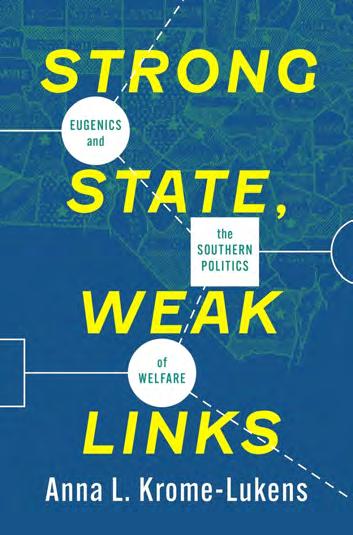
In the early twentieth century, most US states established eugenics programs to “improve” the human race through selective breeding. North Carolina ran one of the nation’s most aggressive programs; between 1927 and 1977, at least 5,700 people were sterilized and thousands more were committed to institutions. While sterilizations in the 1950s and 1960s disproportionately targeted Black women receiving public assistance, the program’s early focus was on poor white women. These policies were framed as scientific and progressive, yet they were deeply intertwined with racial and class biases, reflecting long-standing social hierarchies in the South.
Anna L. Krome-Lukens examines those early years and reveals how white reformers such as social workers, politicians, and activists promoted the principles of eugenics while shaping the emerging welfare state before and during the New Deal. By using claims about fitness and mental defects to justify unequal access to public benefits, they defined who was worthy of care. Tracing this history, illuminates how North Carolina’s eugenics programs influenced the modern welfare state and how their legacy continues to shape debates over social policy today.
June 2026
$37.50 | s ISBN: 9781469693675
Paperback
336 Pages
25 halftones, 1 map, 4 tables 9.250 in H | 6.120 in W | 1.000 in T
Political Science / Public Policy
Anna L. Krome-Lukens is a member of the faculty in the Department of public policy at the University of North Carolina at Chapel Hill.
“Engaging and richly detailed, Krome-Lukens offers a gripping history of how eugenic ideas shaped North Carolina’s welfare state, initially targeting young white women to preserve white racial purity and uphold white supremacy. The book deftly connects state politics, personal stories, and national trends. This is a significant contribution to US history that will engage scholars across multiple fields.”—Susan J. Pearson, author of TheBirthCertificate:An AmericanHistory
Pamela A. Popielarz
Though the industrial revolution pushed Americans into radically new modes of living, working, and organizing, patriarchy and white supremacy survived in the new institutions of the industrial economy. Fraternal orders flourished so spectacularly between the Civil War and World War I that this era—the peak of the industrial revolution—is known as the Golden Age of Fraternity. In this work of historically informed sociology, Pamela A. Popielarz explores the hidden impact of fraternal orders on systemic inequalities in American business. Most orders welcomed only white men, yet members ranged from capitalist elites to wage workers. Popielarz analyzes the Freemasons and the Knights of Pythias, illuminating who they were, what they aimed to do, and how they adopted novel business practices during the Golden Age. In doing so, she reveals the collective imprint of fraternal orders on business culture and offers new ways to understand contemporary racial and gender inequalities.
June 2026
$29.95 | s ISBN: 9781469694252 Paperback
288 Pages 22 halftones
9.250 in H | 6.120 in W | 1.000 in T
Social Science / Race & Ethnic Relations
Pamela A. Popielarz is associate professor of sociology at the University of Illinois Chicago.
“An engaging, beautifully written, and highly original analysis of the economic life and legacies of the Golden Age of fraternalism in the United States that builds on our understanding of how fraternities both contributed to upward mobility and exacerbated patterns of inequality.”—Elisabeth S. Clemens, author of CivicGifts:Voluntarismandthe MakingoftheAmericanNation-State
How a New Orleans DA Prosecuted the Kennedy Assassination as a Sex Crime
Alecia P. Long
The making of a conspiracy
New Orleans district attorney Jim Garrison’s decision to arrest Clay Shaw on March 1, 1967, set off a chain of events that culminated in the only prosecution undertaken in the assassination of John F. Kennedy. In the decades since Garrison captured headlines with this high-profile legal spectacle, historians, conspiracy advocates, and Hollywood directors alike have fixated on how a New Orleans–based assassination conspiracy might have worked.CruisingforConspiratorssettles the debate for good, conclusively showing that the Shaw prosecution was not based in fact but was a product of the criminal justice system’s long-standing preoccupation with homosexuality.
Tapping into the public’s willingness to take seriously conspiratorial explanations of the Kennedy assassination, Garrison drew on the copious files the New Orleans police had accumulated as they surveilled, harassed, and arrested increasingly large numbers of gay men in the early 1960s. He blended unfounded accusations with homophobia to produce a salacious story of a New Orleans-based scheme to assassinate JFK that would become a national phenomenon.
At once a dramatic courtroom narrative and a deeper meditation on the enduring power of homophobia,CruisingforConspiratorsshows how the same dynamics that promoted Garrison’s unjust prosecution continue to inform conspiratorial thinking to this day.
Alecia P. Long is professor of history at Louisiana State University.
February 2026
$27.95 | s ISBN: 9781469696171
Paperback
264 Pages
10 halftones, notes, bibl., index 9.250 in H | 6.120 in W | 1.000 in T
History / United States
Boundless South
“CruisingforConspiratorsis a valuable source and a worthy addition to any library as it corrects the historical record in the Kennedy case by challenging Oliver Stone’s resurrection of Jim Garrison.”—CHOICE
“A worthy addition to Kennedy assassination literature . . . Long has crafted a convincing story of intolerance and abuse of power.”—Michael Wade,JournalofSouthernHistory
Daniel S. Chard
How a war on the radical left crafted the tools of counterterrorism
During the presidency of Richard Nixon, homegrown leftist guerrilla groups like the Weather Underground and the Black Liberation Army carried out hundreds of attacks in the United States. The FBI had a long history of infiltrating activist groups, but this type of clandestine action posed a unique challenge. Drawing on thousands of pages of declassified FBI documents, Daniel S. Chard shows how America’s war with domestic guerrillas prompted a host of new policing measures as the FBI revived illegal spy techniques previously used against communists in the name of fighting terrorism. These efforts did little to stop the guerrillas— instead, they led to a bureaucratic struggle between the Nixon administration and the FBI that fueled the Watergate Scandal and brought down Nixon. Yet despite their internal conflicts, FBI and White House officials developed preemptive surveillance practices that would inform US counterterrorism strategies into the twenty-first century, entrenching mass surveillance as a cornerstone of the national security state.
Connecting the dots between political violence and “law and order” politics, Chard reveals how American counterterrorism emerged in the 1970s from violent conflicts over racism, imperialism, and policing that remain unresolved today.

$29.95 | s ISBN: 9781469696102 Paperback 384 Pages 14 halftones
9.250 in H | 6.120 in W | 1.000 in T
History / United States
Justice, Power, and Politics
“An immersive and eye-opening account of how the Nixon administration’s fight against the Weather Underground, the Black Liberation Army, and other insurgent groups gave rise to counterterrorism tactics and philosophies of 'punitive policing' that reshaped American politics. . . . Making excellent use of declassified FBI documents, Nixon’s White House tapes, and other sources, Chard shines a light on this turbulent era.”—PublishersWeekly
“An impressive first book by a young historian. . . . Nixon’sWaratHomeoffers genuine contributions to the continuing examination of the Long Sixties.”—CHOICE
Brian Michael Murphy
The quest to save humanity’s most vital data
Locked away in refrigerated vaults, sanitized by gas chambers, and secured within bombproof caverns deep under mountains are America’s most prized materials: the ever-expanding collection of records that now accompany each of us from birth to death. This data complex backs up and protects our most vital information against decay and destruction, and yet it binds us to corporate and government institutions whose power is also preserved in its bunkers, infrastructures, and sterilized spaces.
WetheDead traces the emergence of the data complex in the early twentieth century and guides readers through its expansion in a series of moments when Americans thought they were living just before the end of the world. Depressionera eugenicists feared racial contamination and the downfall of the white American family, while contemporary technologists seek ever denser and more durable materials for storing data, from microetched metal discs to cryptocurrency keys encoded in synthetic DNA. Artfully written and packed with provocative ideas, this haunting book illuminates the dark places of the data complex and the ways it increasingly blurs the lines between human and machine, biological body and data body, life and digital afterlife.
February 2026
$29.95 | s ISBN: 9781469696157
Paperback
328 Pages
20 halftones, notes, bibl., index 9.250 in H | 6.120 in W | 1.000 in T
Social Science / Media Studies
Brian Michael Murphy is Associate Professor of American Studies at Williams College and Faculty Associate at The Berkman Klein Center for Internet & Society at Harvard University.
“Provocative. . . . Murphy is a witty writer—and a 'media archaeologist'!—who travels deep underground to see for himself the weirdest and most fanatical efforts to preserve records. . . . An engaging tour of the crises that propelled each new wave of preservation anxiety and the attendant technological advancements—from time capsules to wax cylinders to DNA-based memory chips.”—Ron Charles,WashingtonPostBookWorld
“This thought-provoking, often revelatory book is highly recommended for college and university libraries as well as for supplemental reading lists for graduate students in information science—and cultural studies, specifically cultural anthropology. It provides a context for the work of librarians that lends depth and—sometimes frightening—context to their work.”—Jeffrey Garrett,College&ResearchLibraries
The definitive biography of the twentieth century’s most influential American historian
With an epic career that spanned two-thirds of the twentieth century, C. Vann Woodward (1908–1999) was a historian of singular importance. A brilliant writer, his work captivated both academic and public audiences. He also figured prominently in the major intellectual conflicts between left and right during the last half of the twentieth century, although his unwavering commitment to free speech and racial integration that affirmed his liberalism in the 1950s struck some as emblematic of his growing conservatism by the 1990s. Woodward’s vision still permeates our understandings of the American South and of the history of race relations in the United States. Indeed, as this fresh and revealing biography shows, he displayed a rare genius and enthusiasm for crafting lessons from the past that seemed directly applicable to the concerns of the present—a practice that more than once cast doubt on his scholarship.
James C. Cobb offers many original insights into Woodward’s early years and private life, his long career, and his almost mythic public persona. In a time where the study and substance of American history are profoundly contested, Woodward’s career is replete with lessons in how myths about the past, some created by historians themselves, come to be enshrined as historical truth.
$29.95 | s ISBN: 9781469696164
Paperback 504 Pages 16 halftones, notes, index 9.250 in H | 6.120 in W | 1.000 in T
Biography & Autobiography / Historical
James C. Cobb is B. Phinizy Spalding Professor Emeritus of History at the University of Georgia.
“Drawing on his subject’s writings and his voluminous papers at Yale, where Woodward taught from 1961 to 1977, Cobb portrays a scholar impatient with the mythologies, distortions and misguided hero worship that for most of the 20th century inhibited discussion of the South’s many problems.”—Eric Foner, LondonReviewofBooks
“Cobb’s biography is a masterpiece. . . . deeply researched, movingly written, and thought-provoking. . . . Cobb’s confident command of every part of the story, his exquisite selection of quotations, and the way he blends sophisticated analysis with folksy jabs keep the reader captivated.”—JournalofSouthernHistory
Paul J. Polgar
Paul Polgar recovers the racially inclusive vision of America’s first abolition movement. In showcasing the activities of the Pennsylvania Abolition Society, the New York Manumission Society, and their African American allies during the postRevolutionary and early national eras, he unearths this coalition’s comprehensive agenda for black freedom and equality. By guarding and expanding the rights of people of African descent and demonstrating that black Americans could become virtuous citizens of the new Republic, these activists, whom Polgar names “first movement abolitionists,” sought to end white prejudice and eliminate racial inequality. Beginning in the 1820s, however, colonization threatened to eclipse this racially inclusive movement. Colonizationists claimed that what they saw as permanent black inferiority and unconquerable white prejudice meant that slavery could end only if those freed were exiled from the United States. In pulling many reformers into their orbit, this radically different antislavery movement marginalized the activism of America’s first abolitionists and obscured the racially progressive origins of American abolitionism that Polgar now recaptures.
By reinterpreting the early history of American antislavery, Polgar illustrates that the late eighteenth and early nineteenth centuries are as integral to histories of race, rights, and reform in the United States as the mid-nineteenth century.
$29.95 | s ISBN: 9781469696119
Paperback
352 Pages 16 halftones, 2 tables, notes, index 9.250 in H | 6.120 in W | 1.000 in T
History / African American & Black
Paul J. Polgar is lecturer in history at Tufts University.
Published by the Omohundro Institute of Early American History and Culture and the University of North Carolina Press
“Polgar . . . here seeks to expand the breadth, depth, and length of what he terms 'the first abolition movement' . . . In accentuating the first movement abolitionist program’s contributions, Polgar underscores the degree to which those who supported 'gradualist' antislavery helped set the free North and slave South on the tortured road to civil war that ultimately abolished slavery and provided a blueprint for equal rights and citizenship for black Americans during Reconstruction and in 20th-century civil rights campaigns.”—CHOICE
“With analytic subtlety as well as deep archival research, Polgar reveals how relatively privileged northern whites worked closely with blacks. . . . and shows that they required fearless, imaginative, and resolute political activism to overcome powerful proslavery interests.”—Sean Wilentz, NewYorkReviewofBooks
Gonzalo M. Quintero Saravia
Although Spain was never a formal ally of the United States during the American Revolution, its entry into the war definitively tipped the balance against Britain. Led by Bernardo de Gálvez, supreme commander of the Spanish forces in North America, their military campaigns against British settlements on the Mississippi River—and later against Mobile and Pensacola—were crucial in preventing Britain from concentrating all its North American military and naval forces on the fight against George Washington’s Continental army. In this first comprehensive biography of Gálvez (1746–86), Gonzalo M. Quintero Saravia assesses the commander’s considerable historical impact and expands our understanding of Spain’s contribution to the war.
A man of both empire and the Enlightenment, as viceroy of New Spain (1785–86), Gálvez was also pivotal in the design and implementation of Spanish colonial reforms, which included the reorganization of Spain’s Northern Frontier that brought peace to the region for the duration of the Spanish presence in North America. Extensively researched through Spanish, Mexican, and US archives, Quintero Saravia’s portrait of Gálvez reveals him as central to the histories of the Revolution and late eighteenth-century America and offers a reinterpretation of the international factors involved in the American War for Independence.
$37.50 | s ISBN: 9781469696126
Paperback
616 Pages
46 halftones, 2 maps, 3 graphs, 23 tables, appends., notes, bibl., index 9.250 in H | 6.120 in W | 1.000 in T
Biography & Autobiography / Military
Gonzalo M. Quintero Saravia, SJD, PhD, is the author of several books on eighteenth-century Spanish American history and a former fellow at the Weatherhead Center for International Affairs at Harvard University.
“In tracing the experiences of this one individual, Saravia is able to glean several important insights into the eighteenthcentury Iberian Atlantic world. . . . Readers across several subfields are sure to benefit from his re-introduction of a significant figure in the history of the revolutionary Atlantic world.”—JournalofAmericanHistory
“For anyone seeking to know more about the Spanish dimensions of the American Revolution, Quintero Saravia’s Bernardo de Gálvez should be required reading. Rarely has a historian treated the subject so thoroughly or with so much erudition. The result is an important addition to scholarship on the American founding, one that situates the revolution in the wider continental and hemispheric context where it belongs.”—WilliamandMaryQuarterly
Edited by Gary W. Gallagher and J. Matthew Gallman
Photographs by Will Gallagher
Civil War historians reflect on where they visit and what they see
Much has been written about place and Civil War memory, but how do we personally remember and commemorate this part of our collective past? How do battlefields and other historic places help us understand our own history? What kinds of places are worth remembering and why? In this collection of essays, some of the most esteemed historians of the Civil War select a single meaningful place related to the war and narrate its significance. Included here are meditations on a wide assortment of places — Devil’s Den at Gettysburg, Hollywood Cemetery in Richmond, the statue of William T. Sherman in New York’s Central Park, Burnside Bridge at Antietam, the McLean House in Appomattox, and more. Paired with a contemporary photograph commissioned specifically for this book, each essay offers an unusual and accessible glimpse into how historians think about their subjects.
In addition to the editors, contributors include Edward L. Ayers, Stephen Berry, William A. Blair, David W. Blight, Peter S. Carmichael, Frances M. Clarke, Catherine Clinton, Stephen Cushman, Stephen D. Engle, Drew Gilpin Faust, Sarah E. Gardner, Judith Giesberg, Lesley J. Gordon, A. Wilson Greene, Caroline E. Janney, Jacqueline Jones, Ari Kelman, James Marten, Carol Reardon, Aaron Sheehan-Dean, Brenda E. Stevenson, Elizabeth R. Varon, and Joan Waugh.
$29.95 | s ISBN: 9781469696133 Paperback 216 Pages 37 halftones, notes, index 9.000 in H | 9.000 in W | 1.000 in T
History / United States / Civil War Period (1850-1877)
Gary W. Gallagher is the John L. Nau III Professor in the History of the American Civil War, Emeritus, at the University of Virginia.
J. Matthew Gallman is professor of history at the University of Florida.
Will Gallagher is a commercial photographer based in Austin, Texas.
“Talk about finding the Mother Lode! . . . Augmented by evocative black-and-white photographs by Will Gallagher, this collection of deeply moving essays allows the reader to accompany each scholar on a personally guided literary tour probably impossible to replicate in the real world.”—America’sCivilWar
“In a masterful combination of expert photography and thoughtful essays, twenty-five of the Civil War’s foremost authorities have explained the haunting and unchangeable impact of hallowed locations on the Civil War’s history and legacy. . . . This book belongs on the shelves of all Civil War enthusiasts and is a needed addition to the historiographies of the Civil War and contested memory.”—NorthCarolinaHistoricalReview
Ricardo A. Herrera
The Continental Army's battle to survive at Valley Forge centered on one enemy: starvation
In this major new history of the Continental Army’s Grand Forage of 1778, awardwinning military historian Ricardo A. Herrera uncovers what daily life was like for soldiers during the darkest and coldest days of the American Revolution: the Valley Forge winter. Here, the army launched its largest and riskiest operation—not a bloody battle against British forces but a campaign to feed itself and prevent starvation or dispersal during the long encampment. Herrera brings to light the army’s herculean efforts to feed itself, support local and Continental governments, and challenge the British Army.
Highlighting the missteps and triumphs of both General George Washington and his officers as well as ordinary soldiers, sailors, and militiamen,Feeding Washington’sArmy moves far beyond oft-told, heroic, and mythical tales of Valley Forge and digs deeply into its daily reality, revealing how close the Continental Army came to succumbing to starvation and how strong and resourceful its soldiers and leaders actually were.
$24.95 | s ISBN: 9781469696140
Paperback 272 Pages 20 halftones, 6 tables 9.250 in H | 6.120 in W | 1.000 in T
History / United States / Revolutionary Period (1775-1800)
Ricardo A. Herrera is professor of military history, retired, at the US Army War College.
“Impeccably researched, this is a needed addition to the story of the war for independence.”—LibraryJournal
“Through his telling, Herrera is in command of the primary sources, which are disparate and separated by the Atlantic Ocean. His breadth and depth are so great that his introductory chapter, which sets the stage for Valley Forge, almost reads like a narrative conversation between Washington and various civilian officials, from the commissary general of the Continental army, William Buchanan, to the governor of Maryland, Thomas Johnson. The author accomplishes the rare feat of making logistics interesting and illustrates the specifics of how logistics was a critical component of the larger strategic picture for the Americans and the British.”—H-War
J. Noel Hubler
Play with history! New gamebook from the Reacting Consortium
Travel back to 258 BCE and step into the Royal Council of King Ashoka, the powerful ruler of Magadha whose empire spanned most of India. Ashoka’s bold vision is to rule not by force but through dharma—a growing concept of universal order and ethical governance. As councillors, students join a diverse group of voices— Brahmin traditionalists, Jains, Ajivikas, and Buddhists—each with unique beliefs about truth and leadership. Together they will debate crucial proposals: abolishing animal sacrifice, building public welfare, appointing dharma officials, and regulating groups seen as threats.
Balancing Ashoka’s Buddhist faith with political unity, councilors must navigate competing moral and spiritual values, form alliances, and advocate for their communities without alienating others. Students explore the rise of Buddhism, religious pluralism, and the challenges of ethical leadership in ancient India through the game. Engaging with these complex debates gives students insight into how spiritual ideals and political realities shaped Ashoka’s lasting legacy.
April 2026
$30.00 | s ISBN: 9781469695471
Paperback
208 Pages
2 halftones, 1 maps
10.000 in H | 8.000 in W | 1.000 in T
History / Asia
Reacting to the Past™
Nicolas W. Proctor
Step into the turbulent aftermath of the Civil War, where the abolition of slavery marked the start of a fierce struggle over property, politics, and personhood. In Louisiana—a wealthy, diverse state shaped by a history of brutal enslavement and devastating war—former Confederates pushed to restore white supremacy through violence and new systems of control. Meanwhile, the US Congress enforced military occupation and passed the Fourteenth Amendment to protect the rights of formerly enslaved people. Set in the vibrant and volatile city of New Orleans, this game puts students in the shoes of Black freedpeople, French-speaking Creoles, white Unionists, German immigrants, and Northern transplants (carpetbaggers), all grappling with the challenges of rebuilding society.
Students face tough choices on civil rights, suffrage, education, religion, and political power amid corruption, economic instability, and violent white supremacist resistance. Will you compromise, fight, or build coalitions? As students navigate this complex landscape, they'll discover how democracy can be both rebuilt and broken at the local level—and what it truly takes to advance justice and equality in the face of fierce opposition.
April 2026
$30.00 | s
ISBN: 9781469695440
Paperback
136 Pages
4 halftones, 3 figs., 1 map, 2 graphs, 1 table, notes, bibl. 10.000 in H | 8.000 in W | 1.000 in T
History / United States
Reacting to the Past™
Stevie Ruiz
The historic environmental movement as a multiracial endeavor
The history of the environmental movement—from environmentalism to the environmental justice struggles of the late twentieth century—has often been portrayed as a series of efforts led by white environmentalists. In Stewards of the Land, Stevie Ruiz reassesses the movement and reveals that it has always been a multiracial endeavor. From Southern California berry fields to Japanese American concentration camps, and from Chinese cooks in national parks to Chicano Civilian Conservation Corps workers, Ruiz traces how the racialized labor and environmental knowledge of Asian migrants and Chicana/o communities built the material foundations of modern environmentalism.
Spanning from the late nineteenth century to the 1980s, StewardsoftheLandargues that environmental justice was never just a reaction to pollution in the 1970s but has a much longer history tied to land theft, labor exploitation, and the everyday struggles of frontline communities to live and work with dignity. Drawing from comparative ethnic studies, archival research, and a commitment to decolonial praxis, Ruiz recovers the stories of those who labored—often invisibly—to build, maintain and reimagine environmental space in the American West.
April 2026
$34.95 | s ISBN: 9781469693354
Paperback 224 Pages 9 halftones, 2 maps
9.250 in H | 6.120 in W | 1.000 in T
History / Hispanic & Latino
Justice, Power, and Politics
Stevie Ruiz is associate professor of Chicana and Chicano studies at California State University, Northridge.
“A highly original and innovative approach to understanding environmental justice struggles across multiple marginalized communities.”—David Naguib Pellow, author of WhatisCriticalEnvironmentalJustice?
Edited by Raf De Bont, Vanessa Bateman, and Tom Quick
A call to reconceptualize globalization and wildlife through their entanglements
Humans have always incorporated wildlife into processes of work, capture, and exchange. During the nineteenth and twentieth centuries, globalization became the latest in a long line of forces affecting human-animal relations. Grey parrots traveled the world as pets; rats used global shipping infrastructure to spread to faroff islands and became the object of cross-border extermination campaigns; and California sea otters were relocated to accommodate global oil transportation needs. The language of globalization, however, is rarely used to understand the history of these creatures.GlobalizingWildlife shows how wild animals were not simply affected by globalization but shaped its concrete trajectories at local, national, and international scales.
The editors and contributors of this collection bring the more-than-human turn to globalization studies, foregrounding not only how globalization matters for wildlife but also how wildlife matters for and constitutes globalization. The volume presents a range of geographically- and species-diverse case studies spanning from the 1870s to the present day to show that globalizing wildlife is far from a homogenous process. Ultimately, contributors reconceptualize globalization and wildlife in relation to one another and foster new connections between the longstanding study of globalization and the dynamic, rapidly consolidating field of historical animal studies. Contributors are Vincent Bijman, Christina DunbarHester, Regina Horta Duarte, George Iordachescu, Nancy J. Jacobs, Ajit Menon, Gregg Mitman, Nitin D. Rai, Simone Schleper, Jules Skotnes-Brown, Monica Vasile, and James L. A. Webb Jr.
Raf De Bont is professor of history at Maastricht University.
Vanessa Bateman is Social Sciences and Humanities Research Council (SSHRC) Postdoctoral Fellow at Trent University.
Tom Quick is a Berlin-based independent scholar and historian of animals, science, and technology.
May 2026
$39.95 | s ISBN: 9781469694757
Paperback
336 Pages
15 halftones, 6 maps
9.250 in H | 6.120 in W | 1.000 in T
Nature / Ecosystems & Habitats
Flows, Migrations, and Exchanges
“An essential and timely intervention. The authors demonstrate how global processes have always been more-thanhuman events and, by centering animals, they offer exciting, cutting-edge vantages on crucial global histories.”—Daniel Vandersommers, author ofEntangledEncountersattheNationalZoo:StoriesfromtheAnimalArchive
Allison S. Curseen
Scholars and critics have long understood the writing of nineteenth-century Black women as critiquing the figure of Topsy—an enslaved girl in Harriet Beecher Stowe’s influential novel UncleTom’sCabin. Many interpret the works of authors such as Harriet Jacobs, Harriet Wilson, and Hannah Crafts as rejecting Topsy and providing their own corrective representations of Black girls. Through close readings, Allison S. Curseen revisits some of these works to argue otherwise. Instead, she contends that Black girls' physical movements emerge in their narratives not as rejections but as critical reenactments of Topsy.
MinorMovesdraws on performance studies, literary studies, and childhood studies to offer provocative and incisive readings of Black girls' movements in nineteenthcentury US literature. Curseen challenges readers to pay attention to “minor” movements that appear fleeting, inconsequential, and easy to overlook. Attending to these movements, Curseen argues, is urgent to the project of imagining Black girl life amid the anti-Blackness embedded in American culture. These movements reveal modes of being that work to elude dominant structures and gesture to the abundance of Black life: to growing bodies, fugitive Black female desires, queer geographies, and unruly, childish plotting.
May 2026
$37.50 | s ISBN: 9781469694207 Paperback
240 Pages notes, index 9.250 in H | 6.120 in W | 1.000 in T
Literary Criticism / American / African American & Black
Allison S. Curseen is Cooney Family Assistant Professor of English at Boston College.
“Allison Curseen’s wonderfully playful interpretations of 'minor' scenes in antebellum literature are uniformly stunning. Readers who have spent years teaching and studying these texts will find rich, new insights.”—Karen Sánchez-Eppler, author ofDependentStates:TheChild’sPartinNineteenth-CenturyAmericanCulture
Edited by Jonathan S. Coley and Golshan Golriz
Despite the LGBTQ movement’s rapid growth and significant policy successes over the past few decades, many mainstream religions continue to discriminate against queer communities. In response, LGBTQ people have mobilized across a wide range of religious traditions, advocating for church leaders to ordain LGBTQ clergy, accept LGBTQ people as members, officiate same-sex weddings, and affirm the dignity and worth of transgender and nonbinary people. Bringing together leading scholars of social movements, religion, and gender and sexuality in one volume, Jonathan S. Coley and Golshan Golriz have curated a comprehensive look at religiously affiliated social movements within many faiths, charting everything from why and how LGBTQ people engage in activism to the outcomes of their efforts.
Contributors include Joseph Anthony, Orit Avishai, James Cavendish, Stephen Ellingson, Leya Essex, Melinda D. Kane, Nancy Malcom, Dawne Moon, A. J. Ramirez, Shanon Shah, Theresa Tobin, and Michelle Voyles.
June 2026
$34.95 | s ISBN: 9781469692920
Paperback
304 Pages
1 fig., 2 maps, 2 graphs, 8 tables 9.250 in H | 6.120 in W | 1.000 in T
Social Science / LGBTQ+ Studies
Jonathan S. Coley is associate professor of sociology at Oklahoma State University.
Golshan Golriz is assistant professor of sociology at Queen’s University in Canada.
“With a diverse set of chapters that span methodologies, geographies, and religious traditions, this book broadens our understanding of how activism can take place withinrestrictive social institutions and the multiple ways in which religion and sexual identities unfold.”—Kelsy Burke, author of ChristiansUnderCovers:EvangelicalsandSexual PleasureontheInternet
Joshua Mentanko
In the mid-twentieth century, Mexico became a hub for global experiments in public health and social science. Best known as the birthplace of the Green Revolution, Mexico also pioneered the first large-scale effort to train community health workers to combine Western medical practices with Indigenous healing traditions. The PowertoHarmandHealuncovers how that groundbreaking program, led by the state-run Instituto Nacional Indigenista, reshaped healthcare across rural Mexico.
Drawing on archival sources and oral histories, Joshua Mentanko illuminates the lives and labors of the early intercultural health workers who toiled in this program decades before international health agencies adopted similar models. Mentanko also examines the complex relationships between policymakers, scientists, and the communities they aimed to serve, and how medicine became a tool for both nation-building and cultural negotiation. Further connecting Mexico’s rural health initiatives to shifting global geopolitics, Mentanko elucidates how such initiatives emerged alongside decolonization movements and Third World struggles for economic development. Placing intercultural medicine at the center of debates surrounding modernization, Indigenous rights, and the global history of primary care, ThePowertoHarmandHealreveals the critical roles Indigenous people—as western and traditional medicine practitioners and patients—played in the creation, development, and resistance to the shifting practice of medicine.
Joshua Mentanko is a historian and practitioner of applied social science research at Erasmus University.

April 2026
$37.50 | s ISBN: 9781469692432
Paperback 256 Pages 10 halftones
9.250 in H | 6.120 in W | 1.000 in T
History / Latin America
“A novel and compelling history of traditional medicine in Mexico that centers and critically evaluates Indigenous agency in histories of development, science and medicine, and the Global South.”—Sarah Foss, Oklahoma State University
“An original study of political and economic rationales that guided state policy on traditional medicine in twentiethcentury Mexico. An important contribution.”—Claudia Agostoni, Universidad Nacional Autónoma de México
Erin Joyce Kappeler
Throughout the twentieth century, scholars accepted that there was something called “traditional” poetic meter, and that free verse liberated poets from the fetters of old forms. In this version of literary history, free verse saved poetry from cultural irrelevance and marked a broadly oppositional politics. This book tells a different story—and offers a radically new account of the rise of free verse poetry in the United States.
In the 1910s, white academics, editors, and critics popularized free verse by arguing that it was the formal expression of a white American race. For Black and Indigenous authors, free verse did not reliably function as a break or an opening; it was instead a form of enclosure and used to shore up racial hierarchies. The story of the racialization of free verse has been consistently edited out of accounts of modernism—especially those that focus on how free verse was promoted in storied little magazines such asPoetryand Others In TheEnclosuresofFreeVerse, Erin Joyce Kappeler returns to those magazines and their associated anthologies to show that free verse was a racial formation of whiteness and to explore how Black and Indigenous poets navigated this racialization of poetic form.
February 2026
$39.95 | s ISBN: 9781469693064
Paperback
216 Pages
9.250 in H | 6.120 in W | 1.000 in T
Literary Criticism / Poetry
Erin Joyce Kappeler is an instructional designer, scholar of modernist poetry and poetics, and author.
“A multilayered and, frankly, overdue interrogation of the racist underpinnings of much modernist white prosody. By reframing considerations of 'modern' or 'experimental' literary forms, Erin Joyce Kappeler’s work problematizes the exclusion of many Black authors from the canon.”—James Smethurst, author of TheAfricanAmericanRootsof Modernism:FromReconstructiontotheHarlemRenaissance
Alyssa A. Hunziker
Since its founding, the United States has colonized more than five hundred Indigenous nations in North America and dozens more in the Pacific and the Caribbean. Alyssa A. Hunziker considers how American imperialism in the Pacific typically thought of as separate from the colonization of North America—is deeply intertwined with US settler colonialism. By examining novels, poems, and archival records, Hunziker analyzes literary convergences between global Indigenous communities, and uses an Indigenous transpacific methodology to examine how contemporary authors from Native America, Hawai'i, Guam, the Marshall Islands, and the Philippines reimagine and uncover their historical connections.
While the colonial archive has been discussed in both postcolonial and Indigenous studies, archives appear frequently in contemporary Indigenous fiction. Hunziker contends that Indigenous authors use literary form to emphasize seemingly peripheral, or “extra,” histories that have been erased from official US records. Using literary archives—like a character’s collection of calendars, a degrading film reel, or a discovery of unorganized notes—alongside discussions of institutional archives, the authors under discussion subvert Indigenous erasure by questioning how history is told, and which stories go unrecognized.
$39.95 | s ISBN: 9781469695662
Paperback
232 Pages 2 halftones
9.250 in H | 6.120 in W | 1.000 in T
Literary Criticism / Native American
“HistoriesinCommonprovides a timely contribution to the growing body of scholarship attendant to the intimacies, contestations, and affinities between Pacific and Turtle Island peoples who continue to live under US occupation. The richness of Hunziker’s scholarship is balanced with prose that is crisp and eminently readable.”—Kathryn Walkiewicz (Cherokee Nation), UC San Diego
“This is a timely and generative engagement with the archives of empire and their excesses. What emerges from Hunziker’s analyses is an incisive unfolding of unexpected colonial and imperial linkages and trans-Indigenous exchanges across the United States, Pacific Islands, and Asia.”—Quynh Nhu Le, University of South Florida





For more information about our journals, please contact our Journals Manager or scan the QR code to visit our website.

stacy.lavin@uncpress.org www.uncpress.org/journals

All books in this catalog are available on uncpress.org, through bookstores, or directly from Longleaf Services.

uncpress.org/how-to-order

Longleaf Services, an affiliate of UNC Press, was formed to provide cost-effective fulfillment services for not-for-profit publishers.
www.longleafservices.org
Longleaf Services, Inc.
116 S. Boundary St. Chapel Hill, NC 27514-3808
P: 800-848-6224
F: 800-272-6817
customerservice@longleafservices.org
Order through Edelweiss: edelweiss.abovethetreeline.com
Bookseller Discount Codes Pubnet
Discount Schedules may be found in the ABA Handbook or obtained from your sales rep or the publisher.
Trade: t
Short s
Text: x
Longleaf SAN: 2033151
Please confirm account information with us (800848-6224) before submitting your first PUBNET order.
Elizabeth Orange Lane
Assistant Sales Manager, UNC Press 919-918-5885 elizabeth.orange@uncpress.org
United States: Columbia University Press Sales Consortium
VA, WV, TN, NC, SC, GA, FL, AL, MS, AR, LA, TX

Permission to return overstock is not required provided books are returned within 18 months of sale. Books must be clean, undamaged, and saleable copies of titles currently in-print as listed on our website. Full credit allowed if customer supplies copy of original invoice or correct invoice number; otherwise, maximum discount applies.
Returns of OP titles accepted within 6 months after notification. Please send carefully packaged books prepaid via traceable method to our warehouse: Longleaf Returns
c/o Ingram Distribution Solutions 1280 Ingram Drive Chambersburg, PA 17202
Media Inquiries
Catherine Hobbs Sales Consortium Manager & Southern US Representative 804-690-8529 | ch2714@columbia.edu
DE, MD, PA
ME, VT, NH, MA, CT, RI, NY, NJ
AK, AZ, CA, HI, ID, MT, NV, NM, OR, UT, WA
CO, IL, IN, IA, KS, KY, MI, MN, MO, NE, ND, OH, OK, SD, WI, WY
Canada
Sam Jaffe Goldstein Mid-Atlantic Sales Representative 347-645-3949 | sj3176@columbia.edu
Conor Broughan Northeastern US Sales Rep 917-826-7676 | cb2476@columbia.edu
William Gawronski Western US Sales Representative 310-488-9059 | wg2289@columbia.edu
Kevin Kurtz Midwestern US Sales Representative 773-316-1116 | kk2841@columbia.edu
Send orders to: UTP Distribution utpbooks@utpress.utoronto.ca 5201 Dufferin St · Toronto, ON · M3H 5T8 · CANADA Telephone: 1.800.565.9523 Fax: 1.800.221.9985 www.utpdistribution.com
Sales Representation
Ampersand – Head Office Suite 213 321 Carlaw St., Toronto, ON · M4M 2S1 · CANADA Toll Free: 866-736-5620 Fax: 866-849-3819
UK, Ireland, Continental Europe, Middle East, Africa, Australia & NZ, Latin American & Caribbean
Mare Nostrum Group 39 East Parade Harrogate North Yorkshire HG1 5LQ United Kingdom
Trade Orders & Enquiries:
Email: trade@wiley.com
Tel: +44 (0)1243 843291
Individual Orders & Enquiries: Orders should be placed through your local bookstore, an online retailer, or via email: mng.csd@wiley.com
john.mcleod@uncpress.org uncpress.org/for-educators publicity@uncpress.org
22 Against Heritage: The Reinvention of Traditional Foods
8 American Revolution: Essays on the Founding Era
21 Ancient House: Constructing Community in the Seventeenth-Century New York Borderlands
43 Ashoka: Becoming the Dharma King
46 Bateman, Vanessa
40 Bernardo de Gálvez: Spanish Hero of the American Revolution
23 Borders of Biodiversity: How Gray Wolves, Monarch Butterflies, and Giant Sequoias Transformed Large Landscape Conservation
27 Bryce, Benjamin
38 C. Vann Woodward: America’s Historian 24 Carlson, Anthony E.
31 Carter, Youssef J.
36 Chard, Daniel S.
5 Chlorophyll in His Veins: J. C. Raulston, Horticultural Ambassador
41 Civil War Places: Seeing the Conflict through the Eyes of Its Leading Historians
38 Cobb, James C.
48 Coley, Jonathan S.
13 Cox, Karen L.
35 Cruising for Conspirators: How a New Orleans DA Prosecuted the Kennedy Assassination as a Sex Crime
47 Curseen, Allison S.
46 De Bont, Raf
19 Deadly Divide: How Insects, Pathogens, and People Defied the US-Mexico Border
25 Detroit Model: Manufacturing American Men and Women in the Industrial City
12 Dunn, Ian F. G
17 Eating on a Mountain at the End of the World: How I Found Love, Humor, and Beauty in My Quest for Ethical Food
50 Enclosures of Free Verse: Racializing Poetic Form in the Modernist Era
42 Feeding Washington’s Army: Surviving the Valley Forge Winter of 1778
41 Gallagher, Gary W.
41 Gallman, J. Matthew
46 Globalizing Wildlife
6 God Bless the Pill: The Surprising History of Contraception and Sexuality in American Religion
48 Golriz, Golshan
25 Greer Golda, Nicole
27 Grounds for Exclusion: Race, Health, and Disability in Argentine Immigration Policy, 1876–1932
12 Hanbury, Mary Ruffin
42 Herrera, Ricardo A.
51 Histories in Common: Native American Literatures, Extra Archives, and the Indigenous Transpacific
43 Hubler, J. Noel
51 Hunziker, Alyssa A.
29 Irreconcilable: Indigeneity and the Violence of Colonial Erasure in Contemporary Canada
20 It Is Not Enough to Survive: The Young Patriots Story
15 Jesse Helms: Modern Conservatism and the Politics of Opposition
50 Kappeler, Erin Joyce
22 Kelting, Lily
21 Kramer, Erin B.
33 Krome-Lukens, Anna L.
48 “LGBTQ Religious Activism: Rethinking Identity, Faith, and Social Change”
4 Light Falls on Everything: A Daughter’s Memoir of Caregiving, Grief, and Possibility
15 Link, William A.
35 Long, Alecia P.
12 Lost Raleigh: Exploring the Oak City’s Architectural History
1 Marks, John Garrison 19 Mask of Memory: White Racial Fantasy After the Civil War
10 Milteer Jr., Warren Eugene
Minor Moves: Black Girls and Unruly Performance in Antebellum Narratives
Montgomery, Jesse
Mother’s Work: Mary Bickerdyke, Civil War–Era Nurse
Murphy, Brian Michael
Nixon’s War at Home: The FBI, Leftist Guerrillas, and the Origins of Counterterrorism
Common Ground, Second Edition: Confederate Monuments and the Ongoing Fight for Racial Justice
One True Church: An American Story of Race, Family, and Religion
Order of Business: The Golden Age of Fraternity and Its Legacy of Inequality
Out of This Strife Will Come Freedom: Free People of Color and the Fight for Equal Rights in the Civil War Era
Perilous Waters: Settlers, Swamps, and the State, 1775–1920
Polgar, Paul J.
Ponce de Leon, Charles L.
Popielarz, Pamela A.
Popper, Nicholas (ed.) 49
Power to Harm and Heal: Intercultural Medicine in Modern Mexico
Prince’s Minneapolis: A Biography of Sound and Place 44 Proctor, Nicolas W. 16
Proxy Africa: Guyana, African Americans, and the Radical 1970s 46
Quick, Tom
Quintero Saravia, Gonzalo M.
Radical Reconstruction in New Orleans, 1868–1876
Rao, Gautham
Rickford, Russell 32 Ridgely, Susan B.
3 Rolling Stone and the Rise of Hip Capitalism: How a Magazine Born in the 1960s Changed America 45 Ruiz, Stevie 7 Shabazz, Rashad 9
Spirits of Empire: How Settler Colonialism Made American Religion 39 Standard-Bearers of Equality: America’s First Abolition Movement
28 Staudenmaier, Michael
45 Stewards of the Land: Race and Reclaiming Environmental Labor in the American West
33
Strong State, Weak Links: Eugenics and the Southern Politics of Welfare
1 Thy Will Be Done: George Washington’s Legacy of Slavery and the Fight for American Memory
13 “Tight Lines and Tall Tales: Stories of Southern Appalachian Fly Fishing”
Trinity: John F. Kennedy, Lyndon B. Johnson, and Civil Rights in African American Memory
VanGorder, Megan 31
Vast Oceans: Remembering Allah and Self on the Mustafawiyya Sufi Path
Vernon, Zackary 30
Waging Sovereignty: Native Americans and the Transformation of Work in the Twentieth Century
5 Ward, Bobby J.
37 We the Dead: Preserving Data at the End of the World
Weiss, Joseph
Wenger, Tisa 2
White Power: Policing American Slavery 28
White, Black, Brown: Becoming Puerto Rican in Chicago
Wilkins Conrad, Sharron
Wright, Will
Young, Jason R.