2019
Improving the early management of dry sown cereal crops Authors: Amanda Cook Research Team: Ian Richter and Neil King SARDI, Minnipa Agricultural Centre Funded By: SAGIT S419 Project Title: Improving the Early Management of Dry Sown Cereal Crops Peer Review: Nigel Wilhelm (SARDI) Key Words: dry sowing, cereals, fertiliser placement
Key Messages • • • • • •
At Streaky Bay and Cungena in 2019, establishment was similar with dry sowing or sowing at the break, and at Minnipa establishment was better with dry sowing. There was a yield penalty if no fertiliser had been applied at Minnipa. Dry sowing increased grain yield at Minnipa by 0.2 t/ha compared to waiting for the break in the season. Dry sowing at Streaky Bay and Cungena reduced grain yield, by 0.7 and 0.3 t/ha respectively, compared to waiting for the break and sowing into a moist soil bed. All three sites showed a decrease in early dry matter with dry sowing. The herbicides and fungicides evaluated in the trial did not impact on plant establishment when dry sowing.
Background With larger seeding programs, increased summer weed control to conserve soil moisture and more variable autumn rainfall patterns, many growers Australia wide are continuing to dry-sow. More traditionally, growers may have previously ‘dabbled a little’ in dry-sowing and are observing with interest the successes and failures of dry-sowing systems. On upper Eyre Peninsula in 2017 and 2018, seed was placed in the soil for many weeks with limited soil moisture; some seed still germinated but the delayed plant emergence often resulted in a lower plant establishment. This raised questions by EP farmers and consultants about the soil factors which influence seed germination and establishment. Research trials were established in 2019 to assess the impact of management on seed germination and establishment on three different soil types in field trials and pot experiments; a red loam [Minnipa Agricultural Centre (MAC)] and two grey calcareous soils (Cungena and Streaky Bay) for: • Impact of fertiliser type (P and N) and fertiliser placement, • Impact of practices, herbicides and seed dressings. This article reports on field trials undertaken in 2019 at three sites.
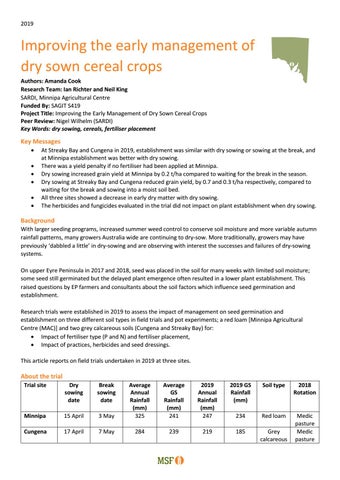
About the trial Trial site
Dry sowing date
Break sowing date
Average GS Rainfall (mm) 241
2019 Annual Rainfall (mm) 247
2019 GS Rainfall (mm)
Soil type
2018 Rotation
3 May
Average Annual Rainfall (mm) 325
Minnipa
15 April
234
Red loam
7 May
284
239
219
185
Grey calcareous
Medic pasture Medic pasture
Cungena
17 April
Page 5
Streaky Bay
18 April
8 May
377
303
278
262
sandy loam Grey calcareous sandy loam
Medic pasture
Each site had two trials with CL Razor wheat sown @ 72 kg/ha. The replicated trials (plots 12 m x 2 m with 3 replicates) were sown with a small plot seeder on 25.5 cm (10”) row spacing with Harrington points and press wheels. The seeder had the ability to sow the fertiliser either with the seed or deeper (4-5 cm), or the fertiliser could be split (50% with seed: 50% below the seed). The treatments in the trials at each site were: Trial 1: Sowing conditions [dry sown vs break (wet)] x fertilisers (13 treatments). • Nil – Control (no fertiliser) – dry and break • 60 kg/ha DAP with the seed – dry and break • 60kg/ha DAP below the seed – dry and break • 60 kg/ha DAP plus 50 kg/ha urea with seed – dry and break • 60 kg/ha DAP with seed plus 50 kg/ha urea below seed (4-5 cm deeper than seed) – dry and break • 60 kg/ha DAP with the seed and 50 kg/ha urea broadcast early – dry • 60 kg/ha DAP split; 30 kg/ha with the seed and 30 kg/ha below the seed (deep) – dry • Phosphoric acid (12 units) with the seed and urea (10.8 units) broadcast early – dry. Trial 2: Management - Dry sown with 60 kg/ha DAP with the seed: 10 treatments [CL Spartacus barley, herbicides (Trifuralin @ 2L/ha, Boxer Gold @ 2.5 L/ha or Sakura @ 118 g/ha), shallow sowing (2-3 cm), deep sowing (6-7 cm), higher seeding rate (100 kg/ha), fungicides (Baytan, EverGol, Uniform or EverGol)]. During the growing season the trials were assessed for plant establishment, early and late dry matter, NDVI (level of ‘greenness’), plant nutrient analysis, grain yield and grain quality. The results were analysed using GENSTAT 64, Version 20, using an unbalanced design analysis.
Results & Discussion The 2019 season was just below average rainfall for most regions on upper EP with Streaky Bay achieving a decile 4-5 rainfall season, Minnipa a decile 4, but Cungena a decile 2-3 season. The 2019 season started with very little subsoil moisture but with good opening rains received in late April/early May which enabled seeding to be within an ideal sowing window. The first rainfall events were on the 21 April with Minnipa receiving 10 mm, Streaky Bay receiving 15 mm and Cungena receiving 6 mm. The next rain was on 1 May with 16 mm at Minnipa, 26 mm at Streaky Bay and 16 mm at Cungena. The timing of the season break meant the dry sowing treatments did not emerge before the early May rainfall events which resulted in plant establishment. The Streaky Bay site was affected by Take-all (Gaeumannomyces graminis var. tritici) in spring. The most affected areas of the plots were removed (hand mown) to remove the effect on grain yield. Trial 1: Sowing Conditions There were differences in plant establishment at Minnipa and Cungena depending on the time of sowing and fertiliser treatments. At Minnipa (break – wet only) and Cungena at both times of seeding, 60 kg/ha DAP plus 50 kg/ha urea with seed directly impacted on seed germination resulting in lower plant establishment compared to nil fertiliser (Figure 1). At Minnipa dry sowing resulted in higher plant establishment with an average of 166 plants/m2 compared to sowing on the break with 126 plants/m2. At Streaky Bay and Cungena there were no differences in plant germination between dry sowing or sowing after the break.
Page 5
Plant Establishment (plants/m2)
Plant Establishment (plants/m2) 200 150 100 50 0 Break (wet)
Dry sown
Break (wet)
Cungena
Dry sown
Break (wet)
MAC
Dry sown
Streaky Bay
DAP below seed
DAP&urea with seed
DAP split
DAP with seed
DAP with seed urea below
DAP with seed urea broadcast
Control (no fert)
Phos acid with seed
Figure 1 Plant establishment of CL Razor wheat at the three trial site locations in 2019. (LSD (P=0.05) Location*Break*Fertiliser = 29)
Location and timing of sowing affected early dry matter production, which was sampled at the same time after sowing. At all sites, sowing after the break of the season showed greater dry matter production than dry sowing (Table 1). Minnipa had the greatest early dry matter production overall, then Streaky Bay and Cungena. The only difference in early dry matter between fertiliser treatments over the three sites was the lowest dry matter production being the Nil Control (no fertiliser) treatment, which was similar to the 60 kg/ha DAP and 50 kg/ha urea with the seed treatment, but less than for all other treatments. Table 1 Early dry matter (t/ha) of CL Razor wheat at the three trial site locations in 2019.
Trial Location Minnipa Streaky Bay Cungena LSD (P=0.05)
Dry sowing 0.21 a 0.13 b 0.07 c
Break 0.27 a 0.30 a 0.14 b 0.06
At Minnipa dry sowing compared to waiting for the break in the season and sowing into a moist seed bed increased grain yield by 0.2 t/ha (Table 2). In the highly calcareous soils at Cungena and Streaky Bay however, dry sowing decreased yield compared to sowing on the break of the season into a moist seed bed. At Streaky Bay dry sowing decreased yield by 0.7 t/ha, and at Cungena by 0.3 t/ha (Table 2). Table 2 Grain yield (t/ha) of CL Razor wheat at different sowing times at three locations in 2019.
Trial Location Minnipa Streaky Bay Cungena LSD (P=0.05)
Dry sowing 1.83 c 2.14 b 1.28 e
Break 1.60 d 2.86 a 1.59 d 0.18
At Minnipa the nil fertiliser treatment was lower yielding than all other treatments except DAP fertiliser placed below the seed. At Streaky Bay higher grain yields were achieved with the addition of extra and early nitrogen as urea (Table 3). At Cungena the addition of nitrogen did not increase grain yield (Table 3). Table 3 Grain yield (t/ha) of CL Razor wheat with different fertilisers at three locations in 2019.
Fertiliser
Cungena Minnipa
Streaky Bay
Page 5 DAP below seed DAP & urea with seed DAP split DAP with seed DAP with seed, urea below DAP with seed, urea broadcast Nil - Control (no fert) Phosphoric acid with seed LSD (P=0.05)
1.50 gh 1.25 i 1.31 hi 1.50 gh 1.47 gh 1.36 hi 1.43 gh 1.46 gh
1.67 fg 1.83 cdef 1.85 cdef 1.81 def 1.77 ef 1.83 cdef 1.51 gh 1.99 cd 0.21
2.50 b 2.78 a 1.96 cde 2.41 b 2.73 a 2.42 b 2.04 c 2.31 b
Trial 2: Management trial Treatments affected both germination and early dry matter but the effects varied between locations. Streaky Bay had lower establishment than the other sites (Table 4). The highest plant establishment was with high seeding rate (207 plants/m2) compared to the average of 150 plants/m2 (data not shown) which was the standard seeding rate. Early dry matter was similar at Minnipa and Streaky Bay, and lowest at the Cungena site due to the seasonal conditions. High seeding rate was the only treatment which increased early dry matter production; CL Razor wheat (0.17 t/ha compared to 0.14 t/ha with the standard seeding rate) and CL Spartacus barley (0.18 t/ha compared to 0.14 t/ha of wheat with the standard seeding rate). Table 4 Site averages for crop performance of dry sown management trials in 2019.
Trial location
Establishment (plants/m2) 165 a 129 b 156 a 10
Minnipa Streaky Bay Cungena LSD (P=0.05)
Early dry matter (t/ha) 0.17 a 0.15 a 0.09 b 0.02
Yield (t/ha) 1.85 b 2.50 a 1.06 c 0.11
The management strategies evaluated in the trial did not impact on grain yield when dry sowing. The highest grain yield across the sites was achieved with CL Spartacus barley (Figure 4). Despite better plant establishment and greater early dry matter, higher seeding rate did not yield well, nor did deeper sowing. 2.50
Yield (t/ha)
2.00
2.16
1.91
1.92
1.91
1.83
1.79
1.78
1.73
1.68
1.61
1.60
1.50 1.00 0.50
CL Sp ar ta cu sb ar DA le P y wi Un t ifo h se rm ed an d ev er Tr go ifu l ra l in Sa 2 ku L/ Sh ra ha al 1 18 lo w gm so /h wi a ng (2 -3 cm ) Bo Ba xe yt rG an ol Hi d gh 2. 5 er L/ se ha ed in Ev gr er at Go e (1 De l 00 ep k so g/ ha w in ) g( 67 cm )
0.00
Figure 4 Average cereal yield (t/ha) of management treatments across three sites (Minnipa, Streaky Bay and Cungena) in 2019. LSD (P=0.05) = 0.10.
Page 5
Implications for commercial practice Overall, at Minnipa there were no differences in establishment with dry sowing or sowing with the break. Under good seeding conditions the Streaky Bay and Cungena soils had similar plant establishment with dry sowing, however all soil types showed a decrease in early dry matter with dry sowing. Dry sowing compared to waiting for the break of the season increased grain yield at Minnipa by 0.2 t/ha on a red loam soil. Dry sowing at Streaky Bay and Cungena in 2019 reduced the grain yield, by 0.7 and 0.3 t/ha respectively, compared to waiting for the break and sowing into a moist soil bed. Dry sowing early, especially on the grey calcareous soils, may not always result in better crop production, possibly due to fertiliser toxicity effects or lower early fertiliser uptake. Placing 23 kg N/ha as urea with the seed reduced plant establishment on all soil types due to fertiliser toxicity effects, but placing nitrogen below the seed improved early plant dry matter compared to no fertiliser which had the lowest early dry matter production. The management trial which was dry sown showed that while increasing the seeding rate of wheat will improve plant establishment and early dry matter, it can reduce grain yield. CL Spartacus barley had improved early dry matter production compared to wheat. The herbicides and fungicides evaluated in the trial did not impact on plant establishment when dry sowing. This research will continue for another two seasons with further trials to be established to determine the impacts of dry sowing and management on plant establishment, along with additional research on the calcareous soils.
Acknowledgements This research was funded by SAGIT through the ‘Improving the early management of dry sown cereal crops’ (S419). Sincere thanks to SAGIT and their extremely valuable input into regional South Australian research and researchers. Thank you to Phil and Jan Wheaton, Myles and Kylie Tomney and MAC for having field trials on their property. Thank you to Katrina Brands, Steve Jeffs and Bradley Hutchings for field work and processing samples.