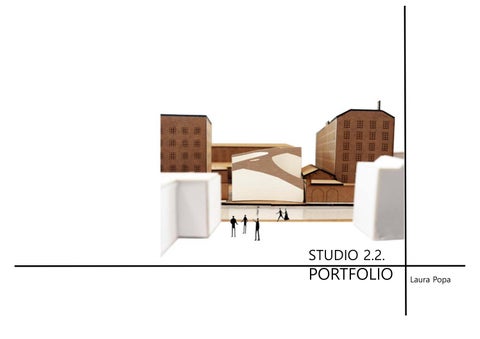
Laura Popa
STUDIO 2.2. PORTFOLIO
CONTENTS 01 02 01 02 Exploration Art Hou se.....................................12 3
5 4

7 6
9 8
11 10






Art House PORTFOLIO Laura Popa CONTENTS 01 02 03 04 05 06 07 01 02 03 04 05 06 07 Position.............................14 Site Research..................18 Process work...................26 Spatial visualisation .....33 Performing art investigation...............41 Proposal........................51 Exhibition piece ..............69 Design journal.................. 76 08
Making a connection with the context
What is Performance
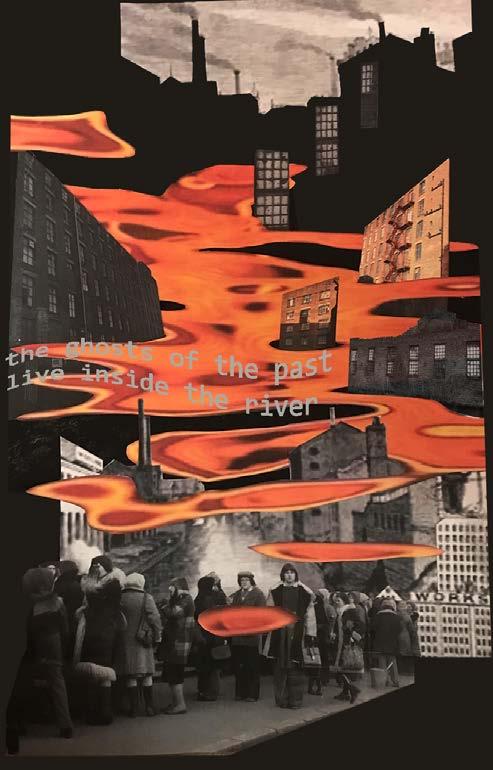
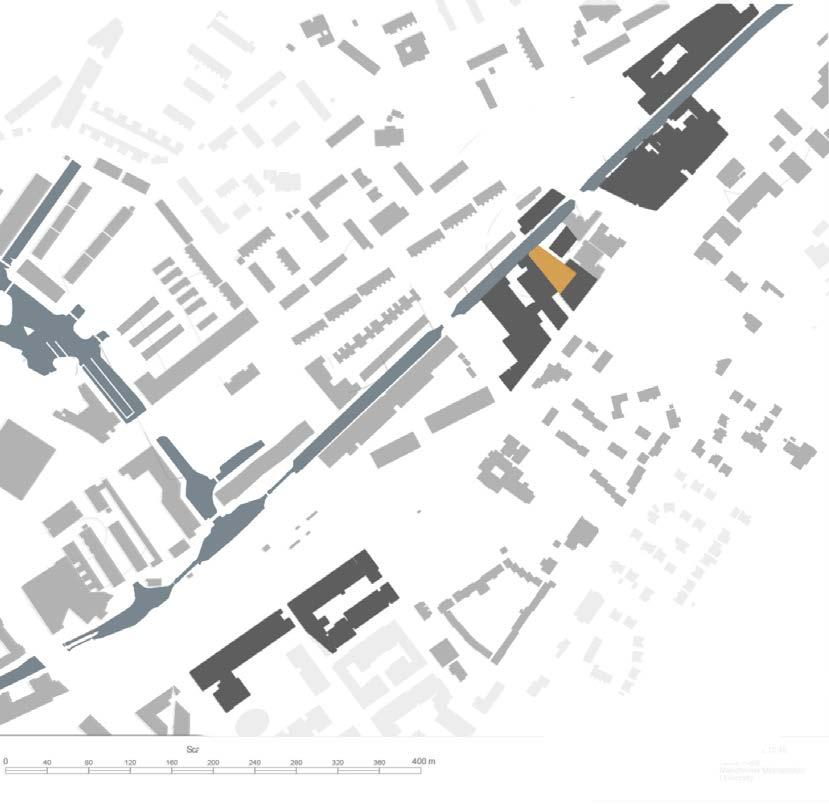
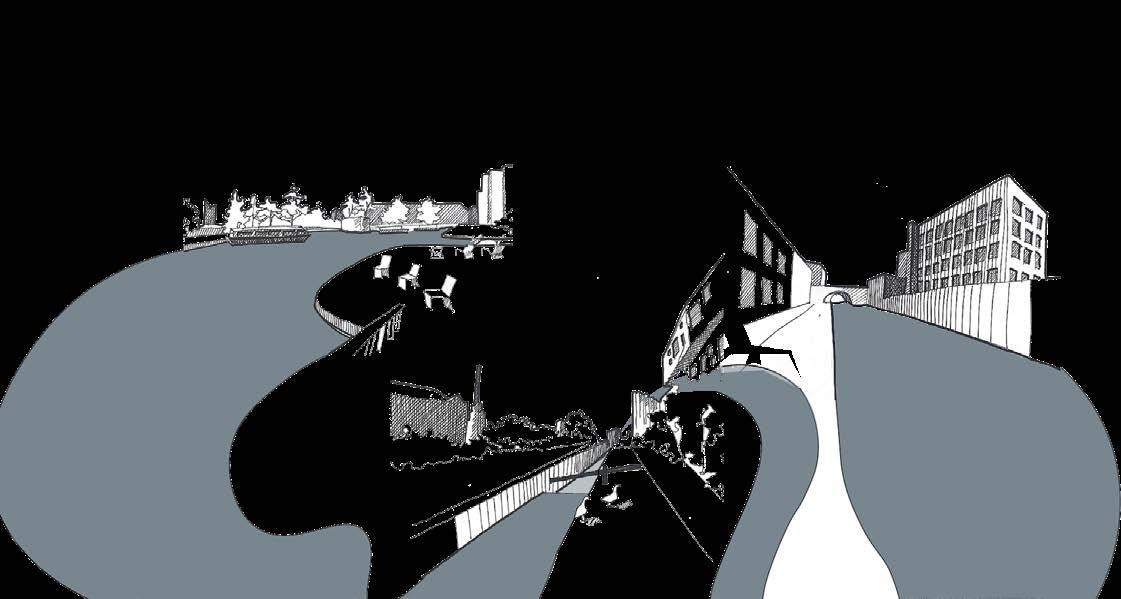
The two most striking aspects of the site are the water feature, it’s direct connection with Ashton Canal, and the industrial heritage, that has such a vibrant presence in Ancoats. These two elements are not only historically intertwined, but connected on a deeper level. Normally seen as a separator element, in this case the river acts like a connector between people and between the built environment of different eras. Present through the always changing context, since the Roman Empire, through the Industrial Revolution, to the present day, the river has been witness to all.....
It is an ‘always changing constant’ that connects us with the past. The intertwined, mangled and distorted reflections seen on the surface of the water bring a visual unification to the different types of architecture present in Ancouts.
This is why I see this project as an opportunity to make a connection with the canal, create a complex relationship with the element that connects with all else......
Mona Hatoum Performance Still (1985, 1995) Tate
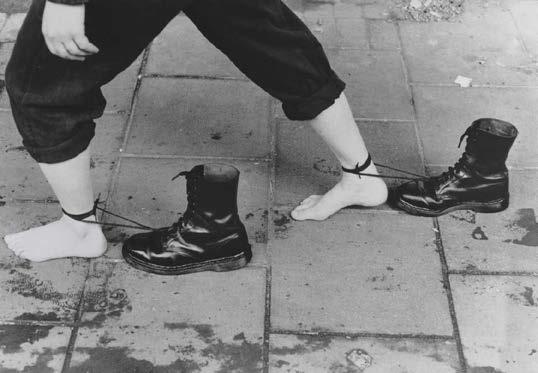
Artworks that are created through actions performed by the artist or other participants, which may be live or recorded, spontaneous or scripted.It is generally based around a specific event which some artists document with film or photography. Artists have experimented with performance techniques throughout the twentieth century but the term is usually applied to works from the 1960s onwards.
Performance has been understood as a way of engaging directly with social reality, the specifics of space and the politics of identity.
NARRATIVE
15 14
WHAT DO THEY NEED?
A creative context
Performance art differs from traditional theatre in its rejection of a clear narrative, use of random or chance-based structures, and direct appeal to the audience. The art historian Rose Lee Goldberg writes:
Historically, performance art has been a medium that challenges and violates borders between disciplines and genders, between private and public, and between everyday life and art, and that follows no rules. *
Artists do not create contexts; they work within them. Context is the web of complex circumstances in which artists work in relation to their physical environment, historical trends and traditions, social movements, cultural values, intellectual perspectives, personal commitments, and more. Likewise, art is received within a context of corresponding dynamics that shape meaning and interpretation. As such, context is an inescapable dimension of art in both its production and its reception and interpretation.
When designing a residential project for performance artists, a place where they would perform, as well as conceptualize their art, you need to be aware of the impact you will have on their work. saw this as a challenge to design a versatile, inclusive environment, that inspires creation and provides the context that visual artists need.
With this project, am attempting to break the boundaries between public and private, between inside and outside, between everyday life and art and make art accessible to a wider audience so that they might enjoy and discover how art plays a significant role in their lives.
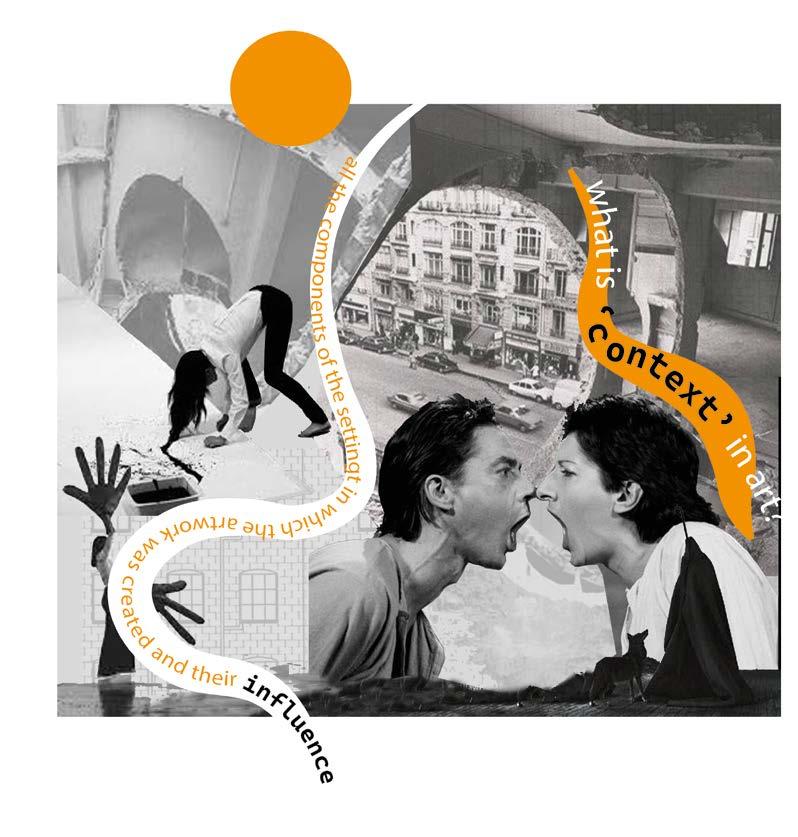
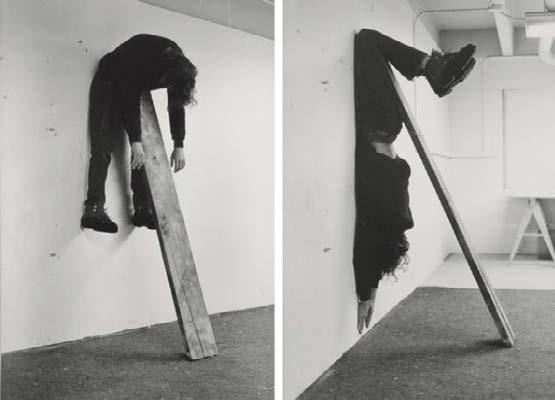
Charles Ray Plank Piece I-II 1973 © Charles Ray
17 16
THE BIRTH OF ANCOATS

The connection with the water feature
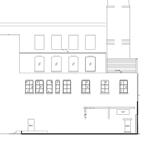
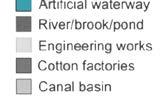
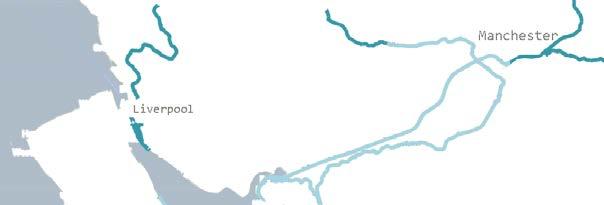
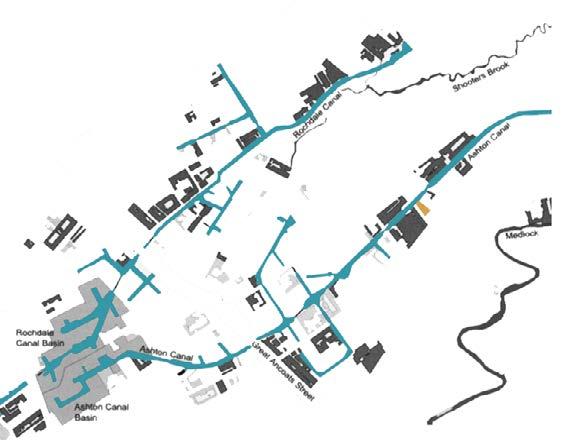
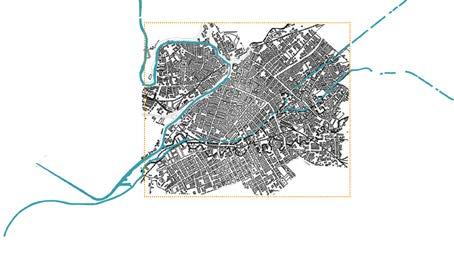
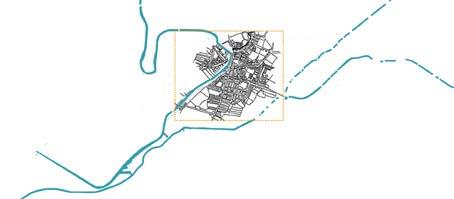
As shown in the first diagram on the left, Manchester has developed intensively during the Industrial Revolution. This was due to it’s rich water features and connection to the Sea, fact that facilitated the transport of goods all the way into the heart of the city, turning Manchester in the first industrial city. This marked a strong relationship between the industrial buildings of Manchester and the canals today and gave me the key to connecting with the industrial context of the site - by using the intermediary element- the river.
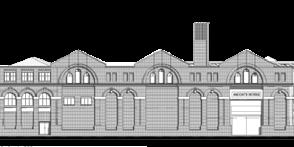
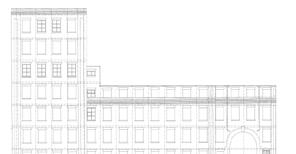
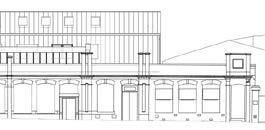
Buildings of the industrial revolution still standing today
1750 1850
1850
1850 1 2 3 4 1 2 4
SITE ANALYSIS
19 18
SITE ANALYSIS

Natural features
City grain SITE ANALYSIS



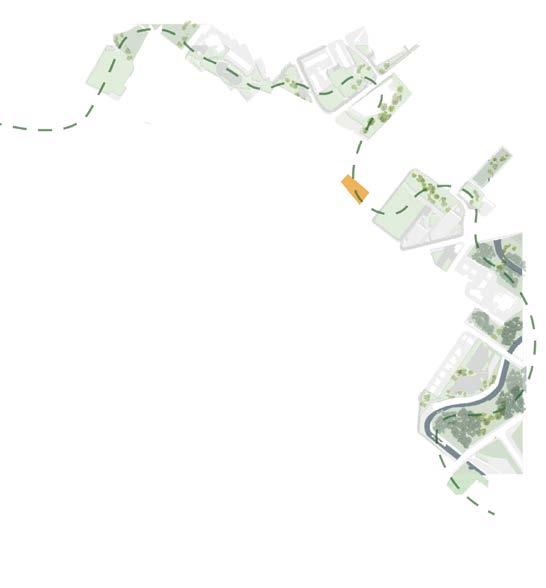
By analysing the greenery layer of the larger context of the site, noticed an opportunity to close an existing gap in the green space, and so- create a continuous ribbon of vegetation. This would make the whole green patch stronger, as a connected green system is known to show an increase in pollination and the overall health of the vegetation. Therefore, this would not only benefit the community of artists inhabiting the building, (by purifying the air, reducing the risk of flooding, providing shadow and reducing nice pollution) but the whole community of Ancoats.
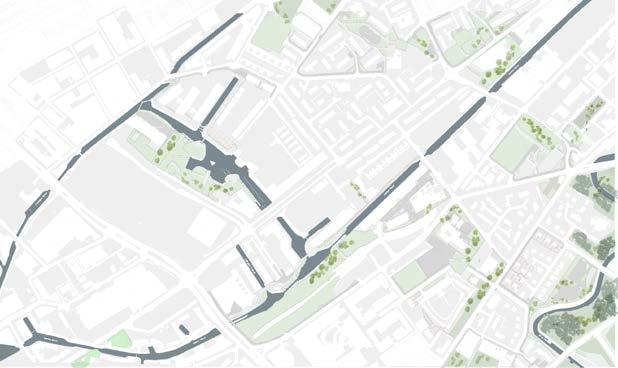
Map of the residential buildings of the area, highlighting the opportunity to close yet another gap in the fabric of the city, by creating a residential project that connects with the wider community
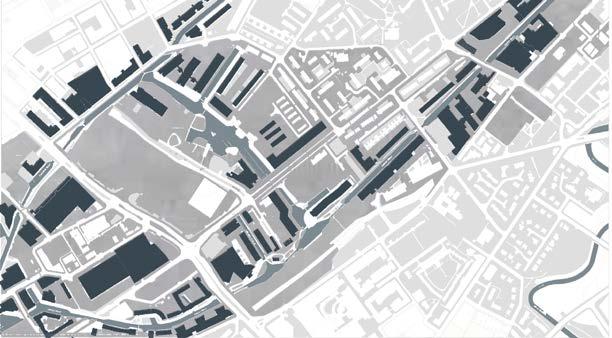
City grain map

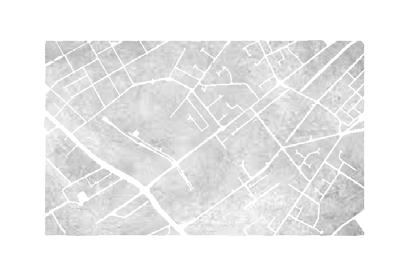
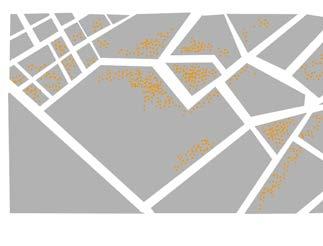
boundaries 21

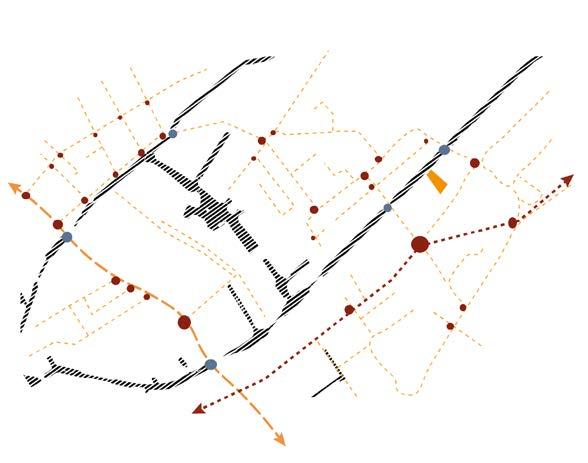
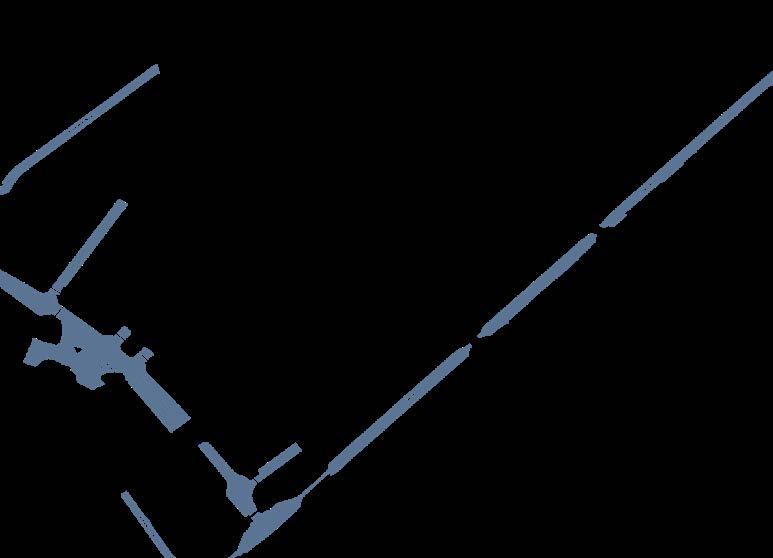
Map of connectors and boundaries highlighting a problem that the site is faced with- the lack of direct connections with main roads and accessibility issues.
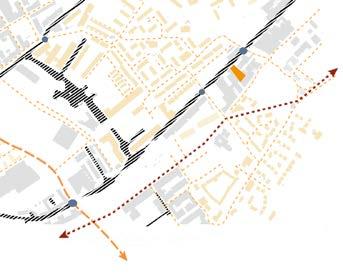
Built environment that interacts with the Canal
The greenery layer
Residential buildings other use buildings site crossing points primary road secondary road tertiary road nodes 20
Routes and paths SITE ANALYSIS
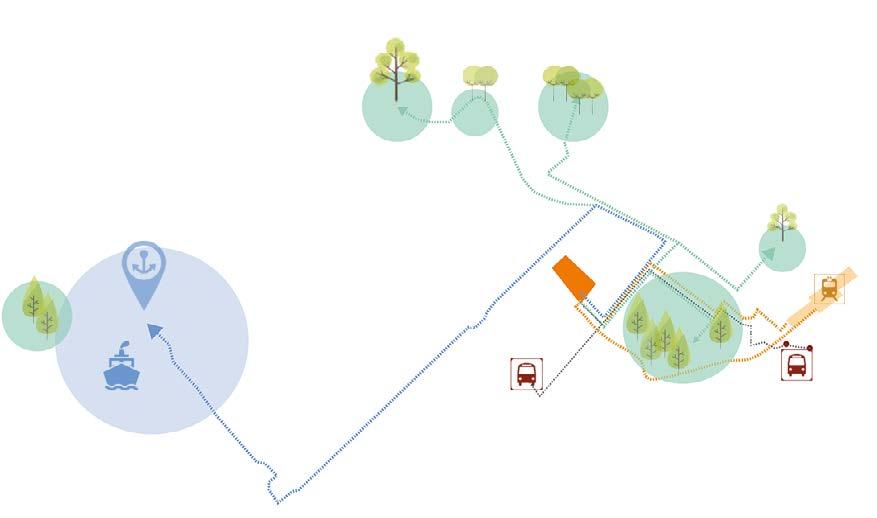
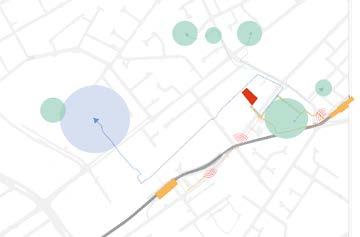
Routes from the site to the main points of interest for the inhabitants of the residential project; green spaces and public transport
When the routes are overlapped, it becomes obvious that the site has accessibility issues.
I noticed a solution to this problem when analysing the map that also includes the street system- elongating the spectator street so it reaches the site marked with a red dashed line) The area is public and wide enough; the only thing stopping access to the site from that street at the moment is a break wall, that delimits the site on the east side.
I propose taking the wall in reference down and creating another route to the site, fixing one of the primary issues that the site is faced with.

The new possible routes are shown in the diagram below.
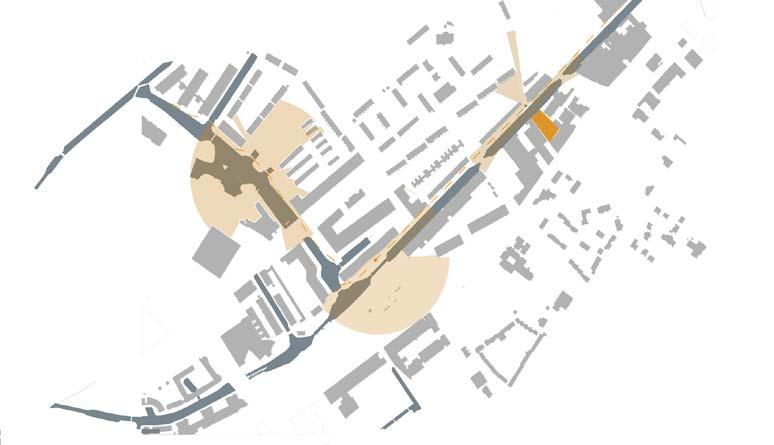
River as a connector SITE ANALYSIS

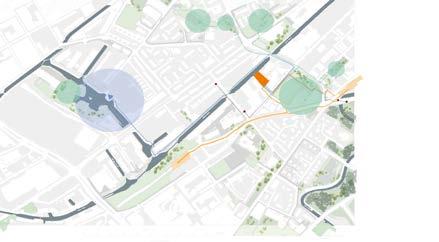
Typically classified as a border, because of the difficulty of crossing it; the river can be seen as an element that connects points across the city as well. The canal is accompanied by a pavement everywhere in the city. By taking this route, people can walk all the way to the city centre (Gay Village) and Castlefield. Not only is this route more environmentally friendly to take then any other means of transportation, but very pleasant as well, taking the pedestrian through some of the most beautiful areas of the city.
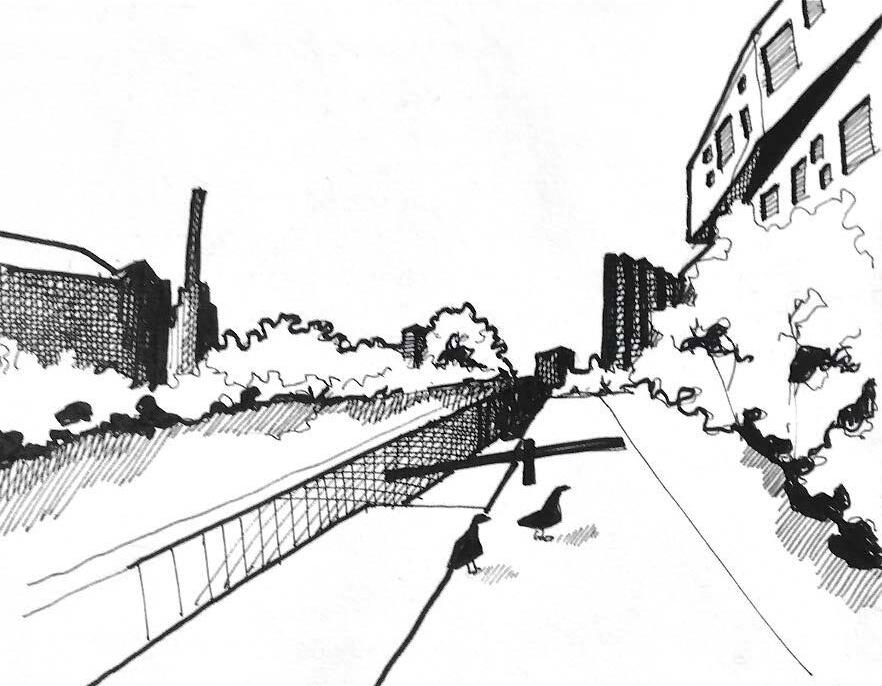
The map also shows the views from three chosen points. Point no. 3 offers a very narrow view along the river. It doesn’t reach the site because of a 2.5m tall wall. I believe that taking this wall down would focus the attention of the passers by to the architectural proposal and amplify the architectural value of the ‘canal route’.
400 400 m
1 2 3 1 2 3
23 22
WHAT DO ‘THEY’ NEED?
A Light Strategy
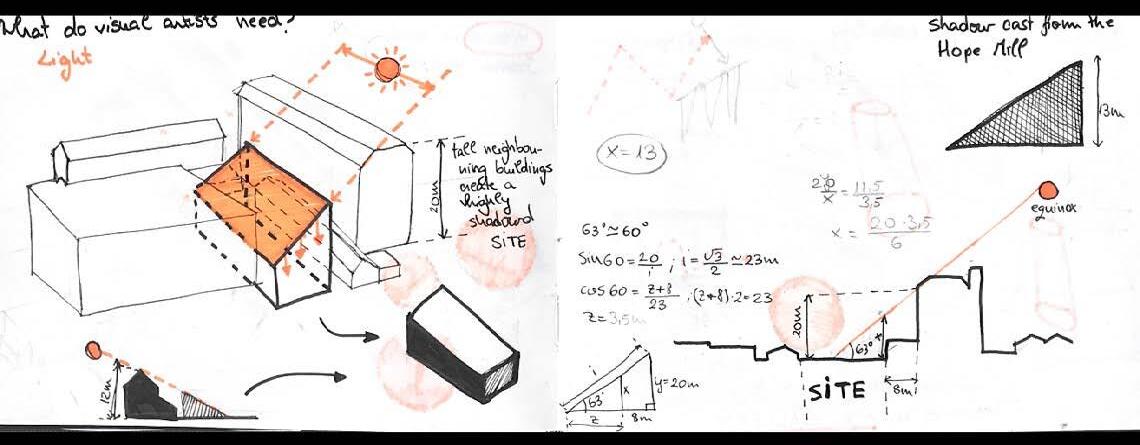
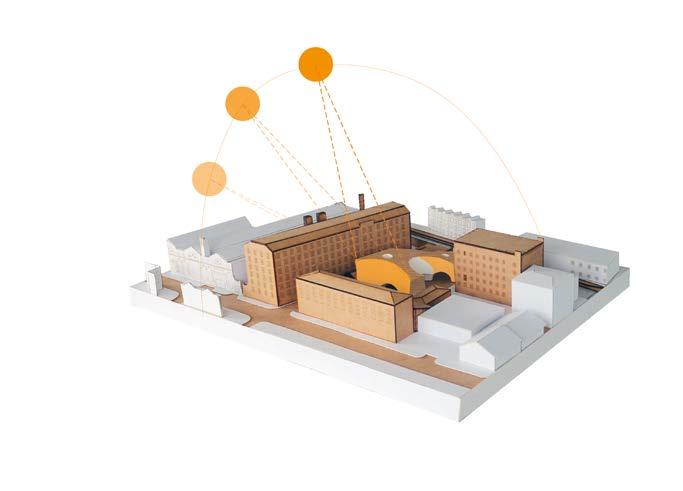
The orientation of the site imposes further challenges. The plot is obscured by tall Mills on the south, making it really difficult to get direct sunlight on the site.
The volumetric model highlighted just how ‘hidden’ the site is. This in addition to the fragile, industrial context, that I do not want to overtake, cover with my design, made me reach to the conclusion that my intervention must be as minimal as possible.
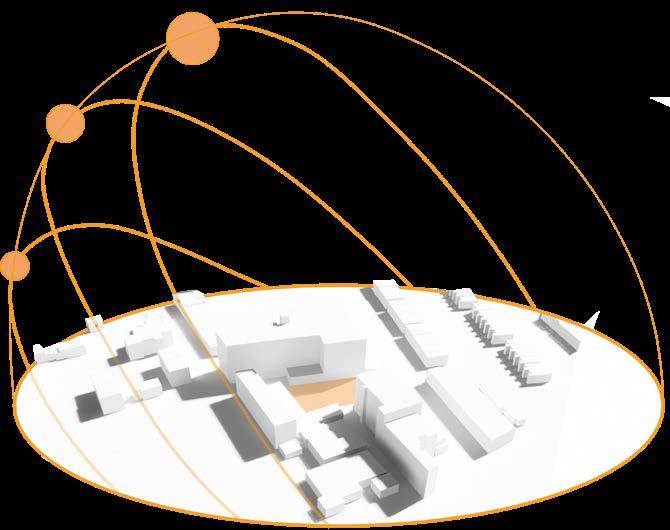
Therefore, I will try to make my proposed design as small as possible, while still being able to meet the programme requirements of the brief.
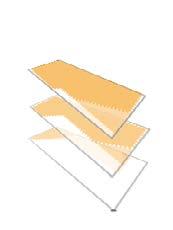
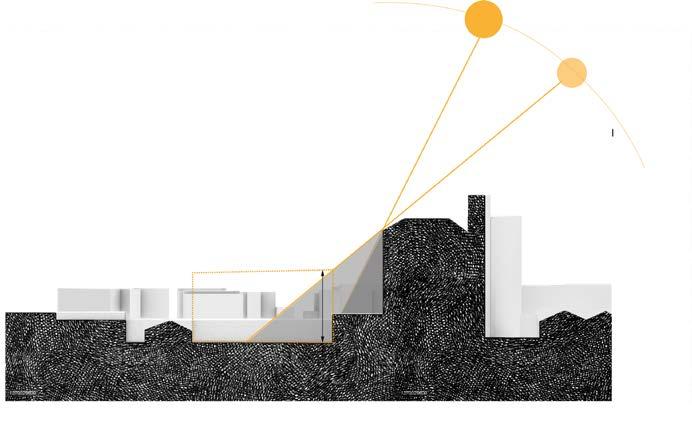
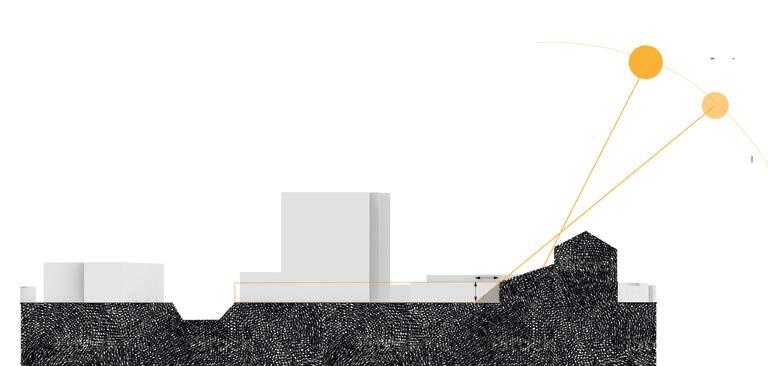
By considering the angle of light at the Equinox (50 degrees), calculated the dimensions of the shadow cones casted by the buildings south of the site. This gave me the minimum height of the building required in order to reach direct sunlight on the rooftop of the building at all times. This gave me the necessary height of 13m.
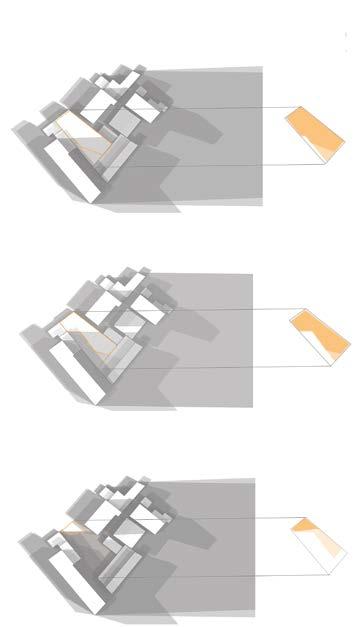
The shadow analysis taken on ground floor, 5m up and 10 m up shows how the pattern of light changes with height, getting increasingly bigger, with only the north corner of the site getting direct sunlight at all times.
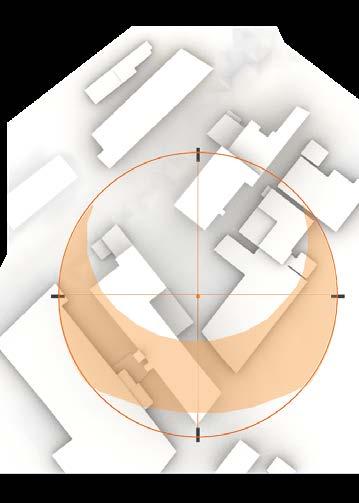
N
Site orientation and volumetric study SITE ANALYSIS
10 m off the ground-mostly lit 5 m off the ground- partially lit 5 m off the ground- mostly shadowed Equinox Summer solstice Equinox Summer solstice 25 24
Light Strategy PROCESS WORK
PROCESS WORK
Views ‘Inside’ the Site
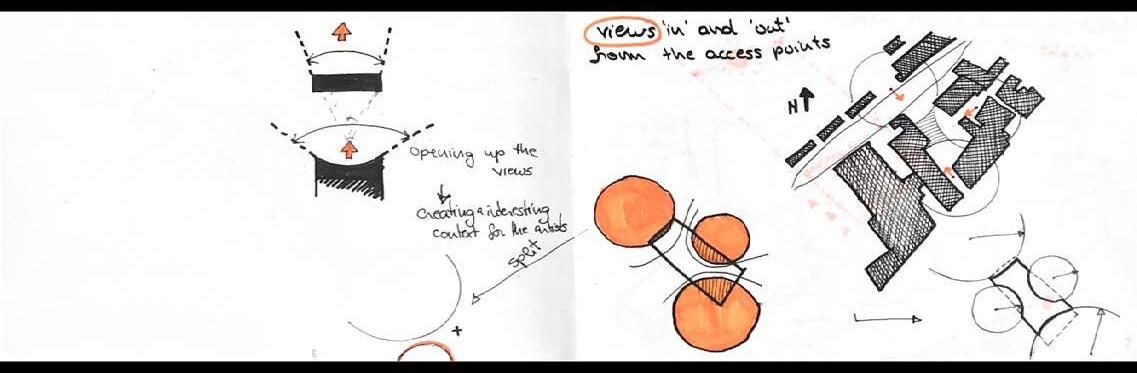
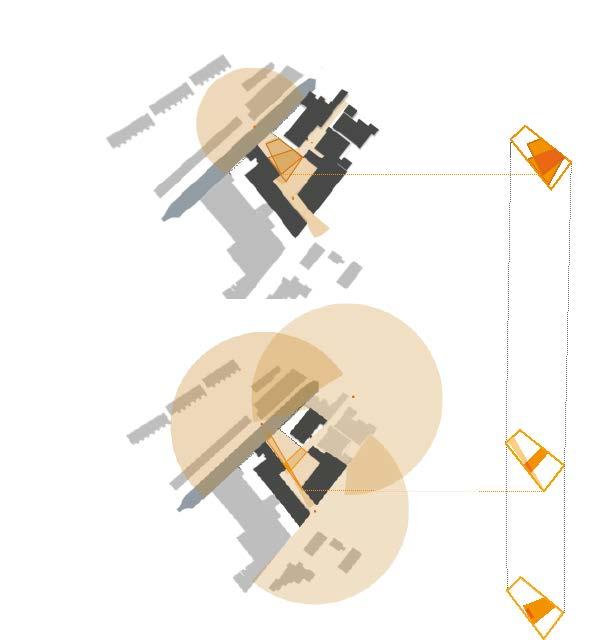
I then looked at the main points where the site would be visible from, being bound at a height of only 13m. I took the views span from both the streets closest to the site, and closer on the routes that enter the site and overlapped them.

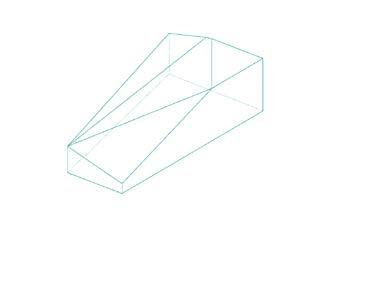
By overlapping the light diagrams previously achieved into a volume shaped like the site, I was able to notice which points of the site would get light at lower levels and then take cuts through the volume in order to achieve the smallest shape possible that would still reach sunlight on all the top facets.

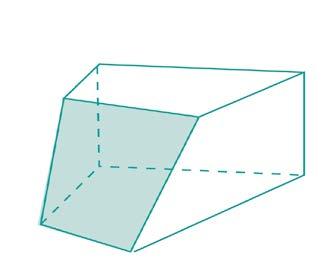
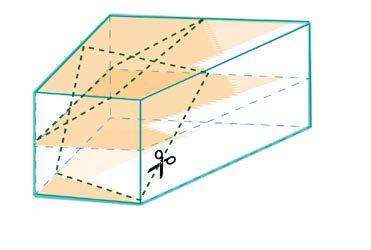
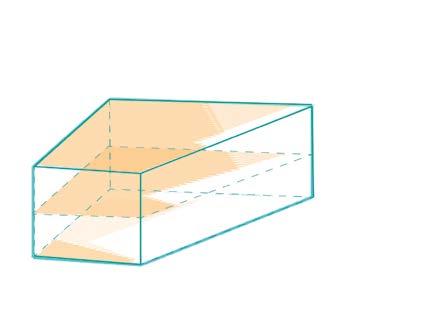
This gave me the point of the site that would be most visible, therefore the one point where the building should be at it’s highest in order for the most surface of the building to be visible.

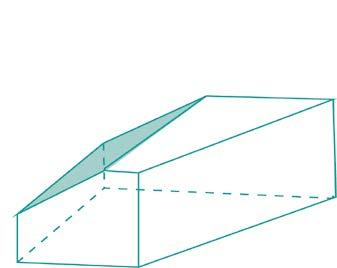
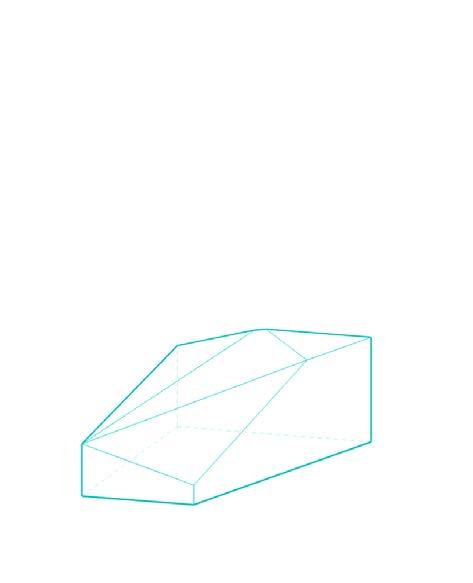
Building viewing trajectory visible surface 27 26
PRECEDENT STUDY
Fjordenhus (Vejle, Denmark) 2018
Architect: Sebastian Behmann, Studio Olafur Eliasson
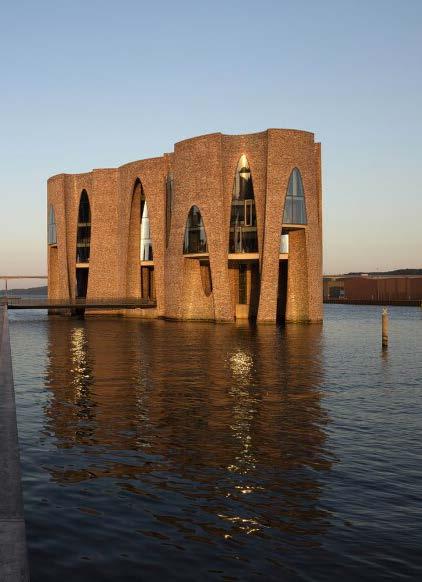
1:750 scale model VOLUMETRIC TESTING




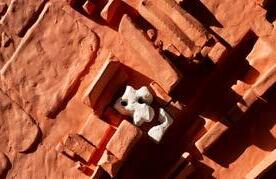
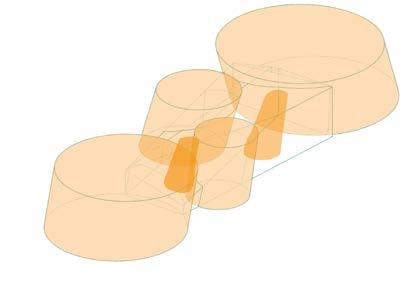
Step 1 Modelling a void as a positive entity within a cylinder frame


Step 2 Multiplying the volume to cover the circumference of the cylinder
Step 3 Reversing the geometry
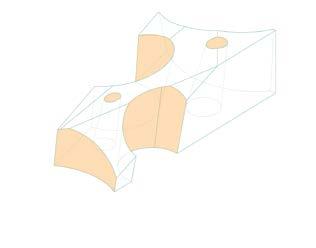
Step 4 Multiplying the perforated volumes and intersecting them to achieve the desired complexity

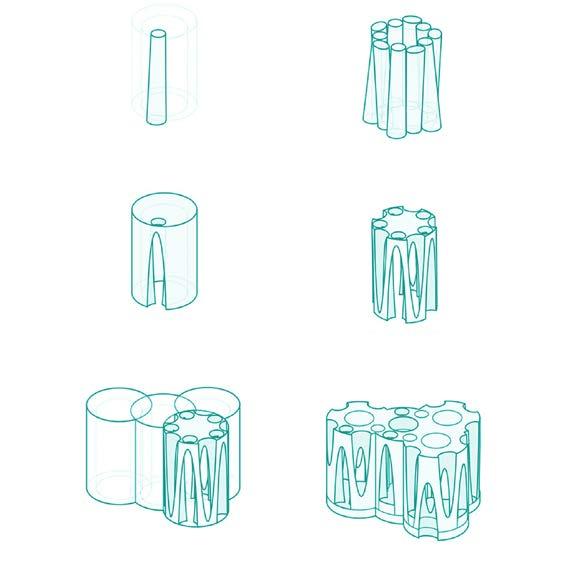
Step 5 Reaching the final form by adjusting the heights and openings
Design process in plan
Following the four principles decided on earlier, dictated by the light study, views study, the tubular principle inspired by Fjordenhus and the intention of making the intervention as small as possible, I started testing some other options.
In the end, I continued my process with the one design shown in the main picture.
29 28
PROCESS WORK
Letting the site dictate the volume
PROCESS WORK
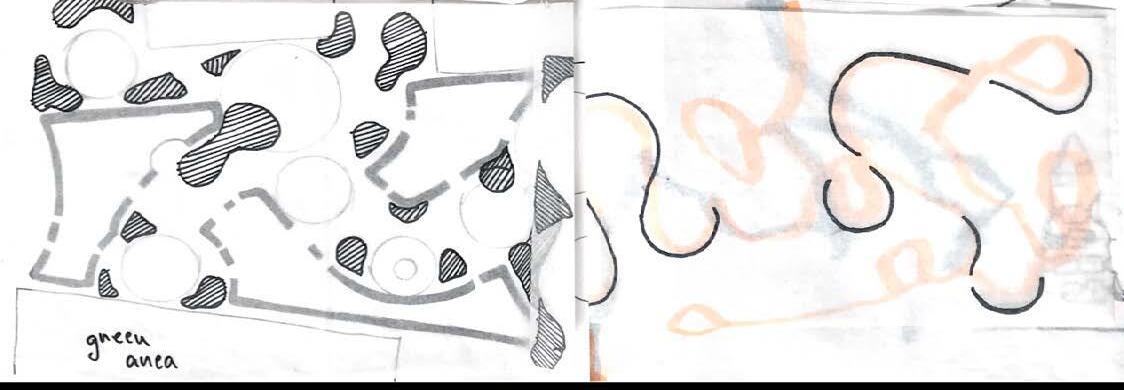
Creating routes
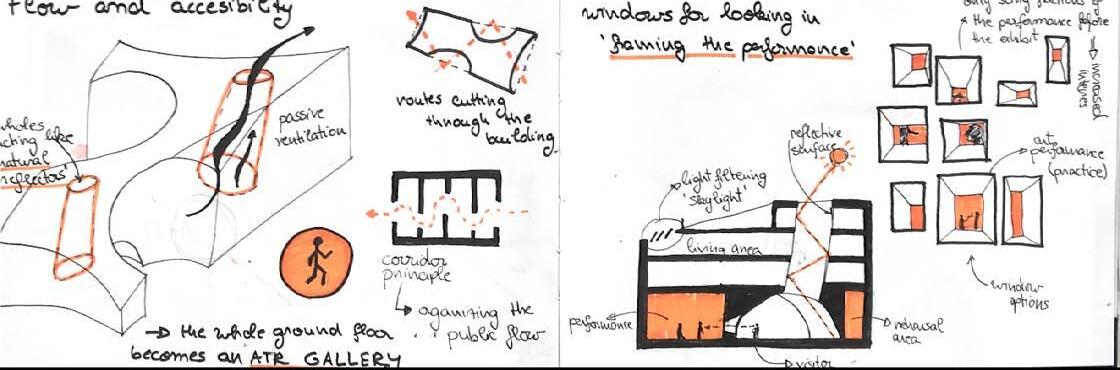
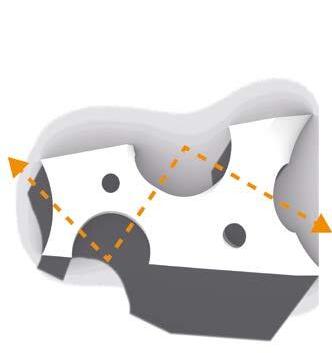
‘Corridor’ circulation strategy
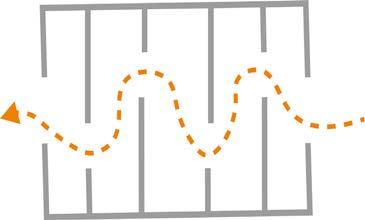
When creating the routes through the building, I utilised the primarily strategy used in museums, as the ground floor doubles up as an art museum for the performing artists.
applied the same ‘views maximising’ concept in plan and ‘cut out’ the shapes that would create the biggest surface of ‘contact’.
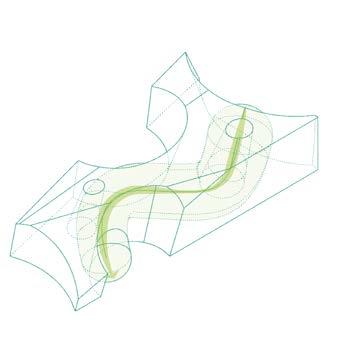
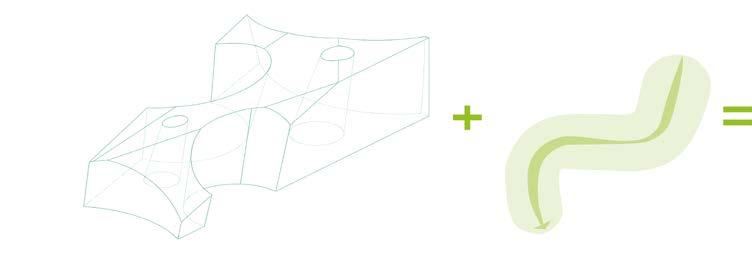
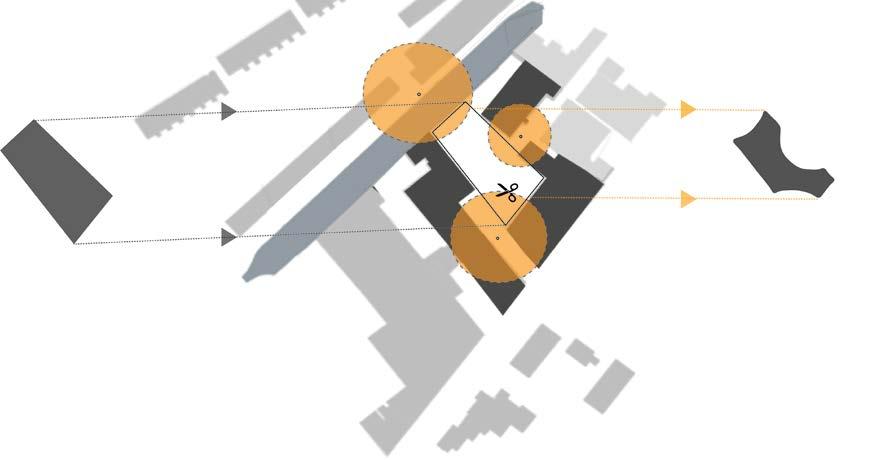
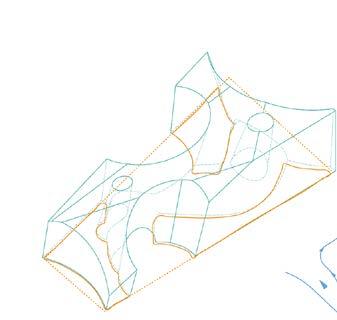
The initial concept shifted slightly as a result of the volumetric study at 1:750.
Cylindrical volume with the radius of 5m and shaped in the zig-zag shape arrived at previously.
 Lorem ipsum dolor sit amet, consectetur adipiscing elit.
Lorem ipsum dolor sit amet,
Lorem ipsum dolor sit amet, consectetur adipiscing elit.
Lorem ipsum dolor sit amet,
31 30
PROGRAMME
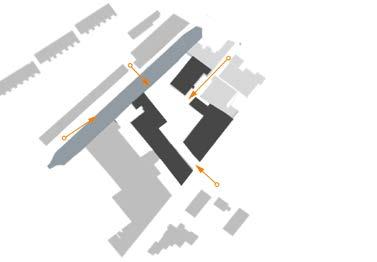
As one of my creative drivers for this project is to break the boundaries between the public and private realm, I wanted to create a mixed use ground floor level that acts like rehearsal space when the exhibition is closed, but leaving the outside areas open to the public; and completely public when the
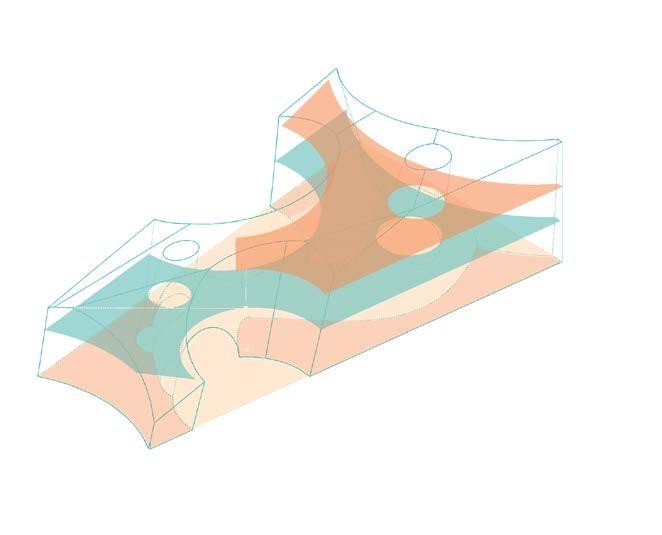
Exclusive (only artists) Private (artists and families) Semiprivate Public
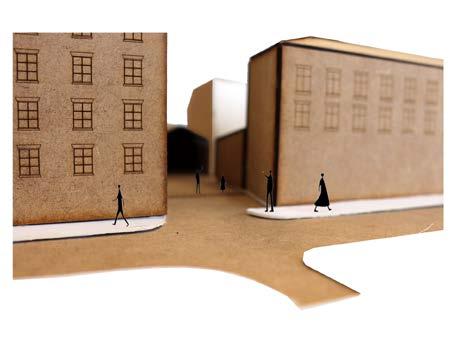
STREET VIEWS
1:200 Scale Model
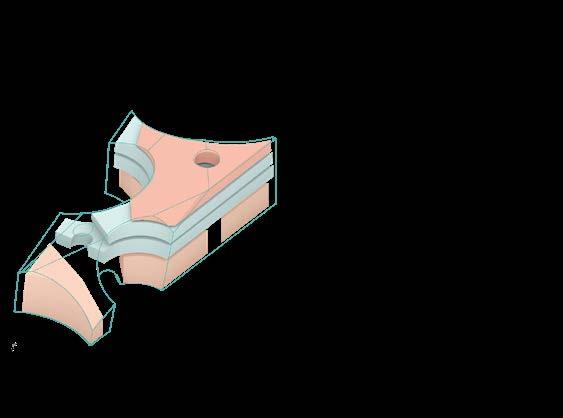
The next 2 floors are dedicated to the residential aspect of the building and the top floor is reserved for a photo-video studio accessible for the artists to record their performances.
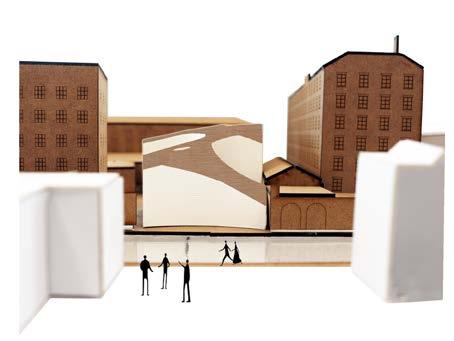
View 1 - access for the artists and the public when performances are not on View 2- main facade of the building; primary view
1 2 33 32
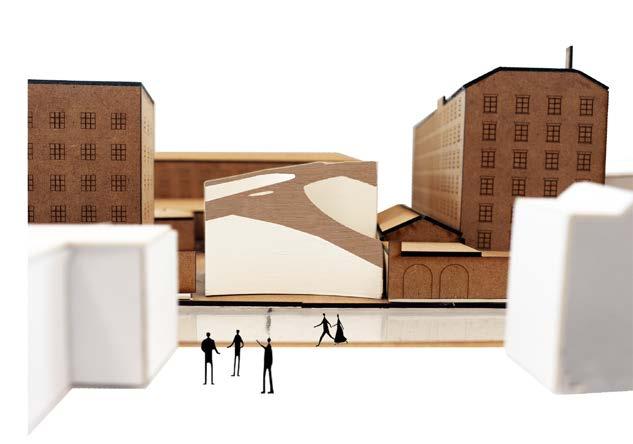
Visualisation 1:200 Scale Model
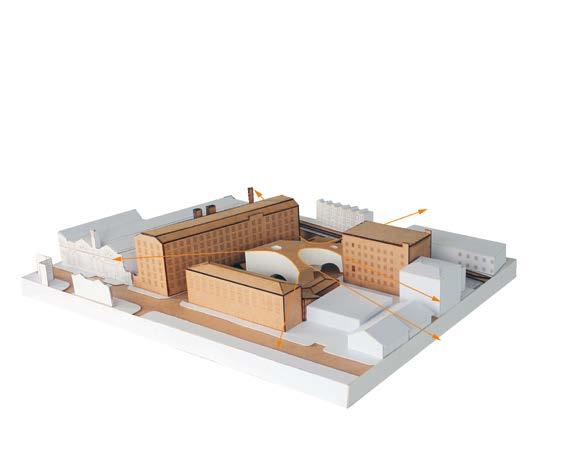
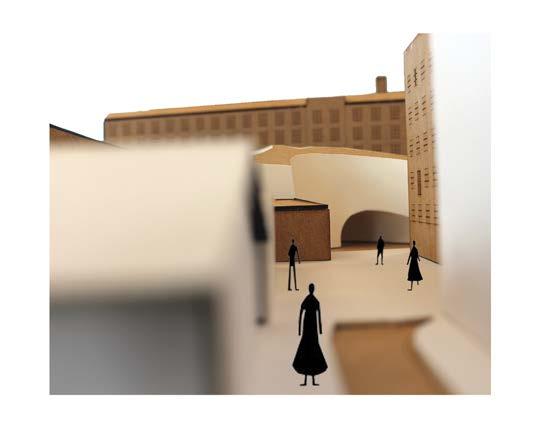
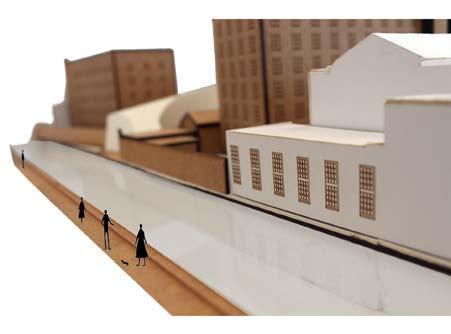
The Relationship With the Context Visualisation
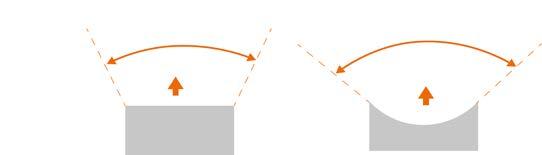 View 3 first glimpse of the design when arriving through the canal route connected with the city centre View 4 access for the artists, as well as for the public when performances are on
3 4
Opening the façades towards the south to maximise the sun exposure. Opening up towards the ‘gaps’ in the context to maximise the views out
35 34
Materiality Visualisation
Dancing with the River
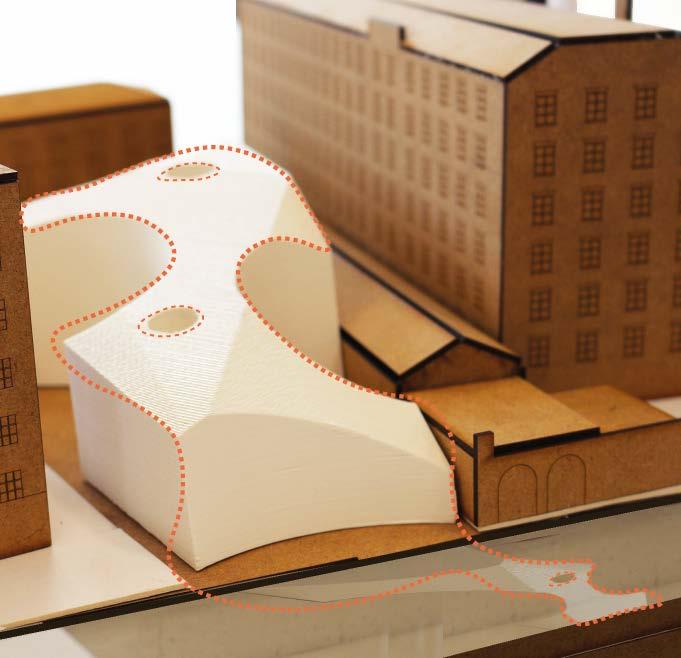
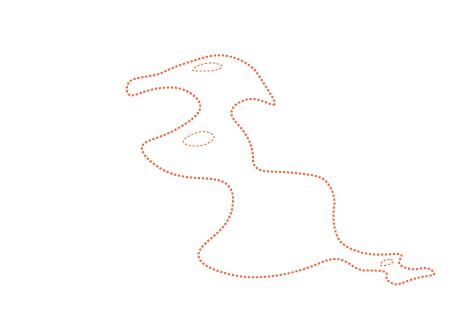
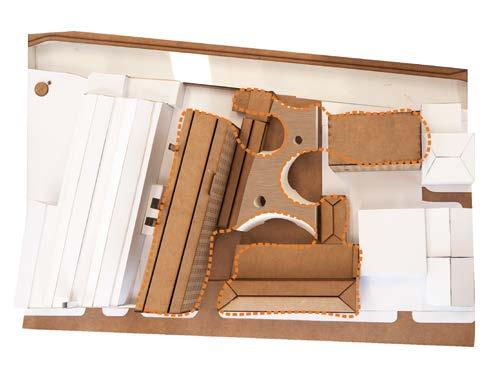
 Using brick on the roof layer of the design in order to create a visual connection with the industrial context from a birds eye’s view.
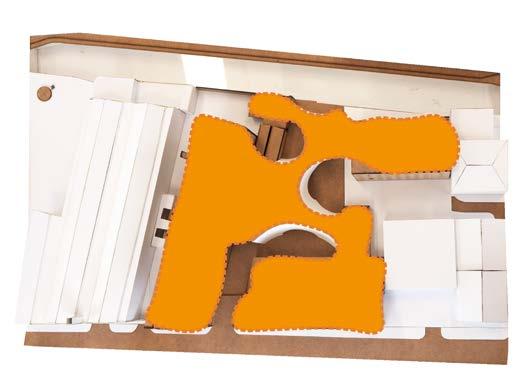
Mimmicing the reflections of the industrial buildings in the water of the river and therefore, creating a strong bond with the Canal.
Using brick on the roof layer of the design in order to create a visual connection with the industrial context from a birds eye’s view.
Mimmicing the reflections of the industrial buildings in the water of the river and therefore, creating a strong bond with the Canal.
37 36
Peaking in
A Semi-Private Concept
A semi-private concept
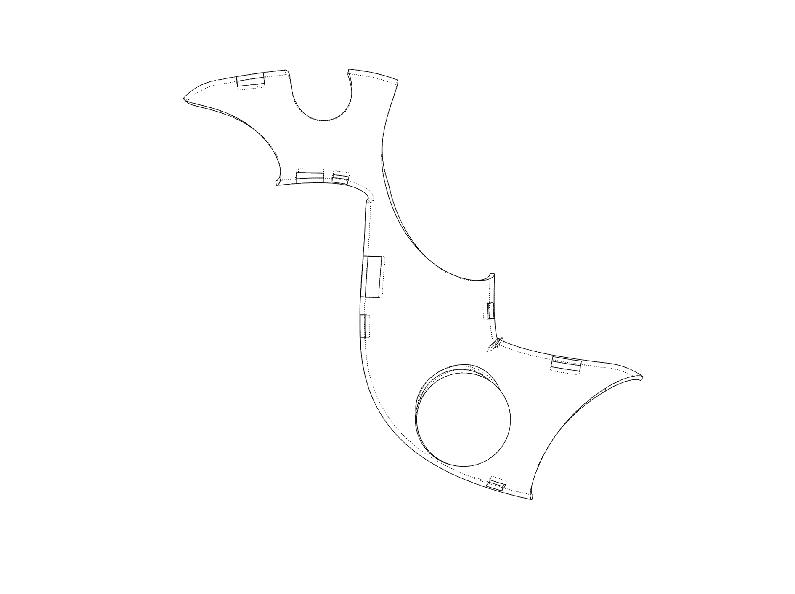
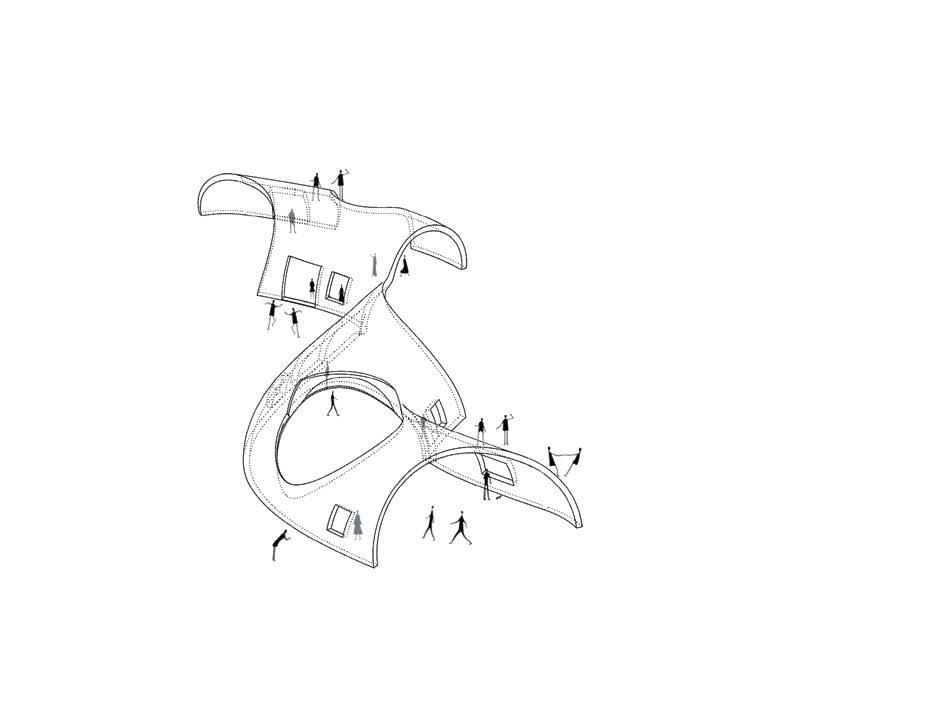
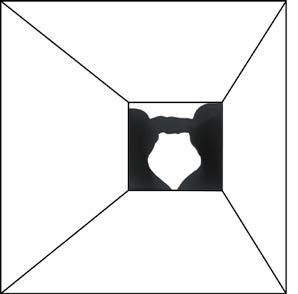

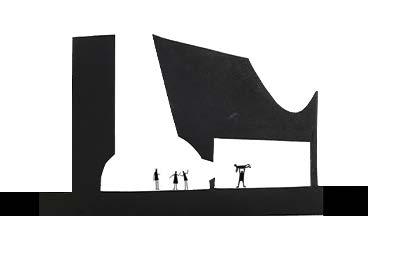
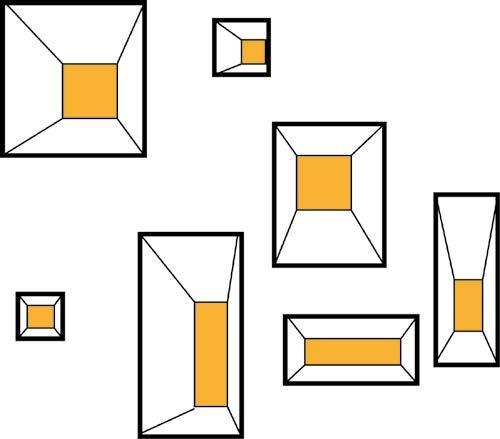 Le Corbusier inspired windows placed along the private routes on the ground floor to allow visitors to get a glimpse of the performances from the outside, without disturbing the artists in their studios.
What the visitors see through the window What the performance actually looks like
PERFORMANCE 39 38
PEAKING IN
PRECEDENT STUDY
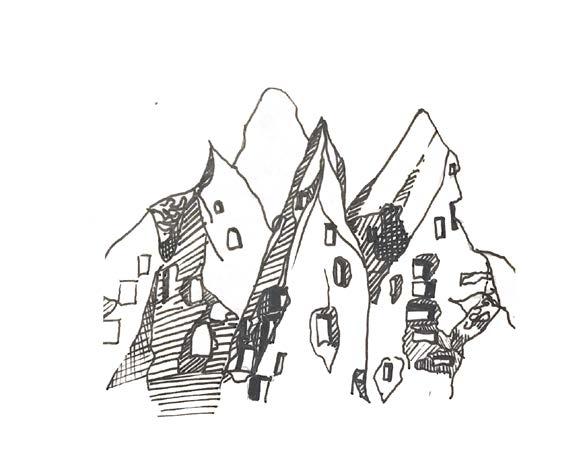
Cappadocia Around 400 BC
PRECEDENT STUDY
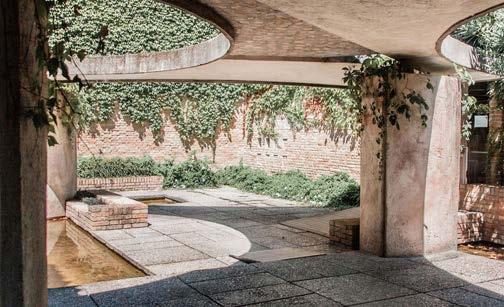
Giardini Sculturalle Architect : Carlo Scarpa
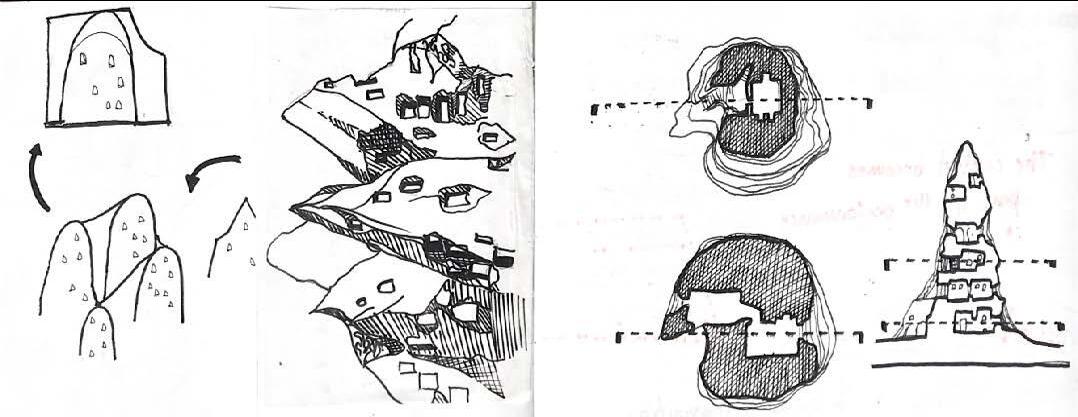
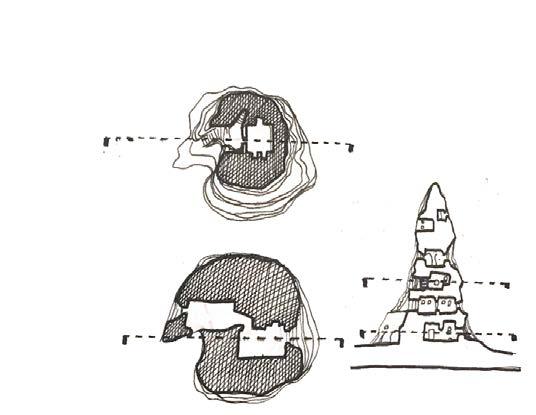
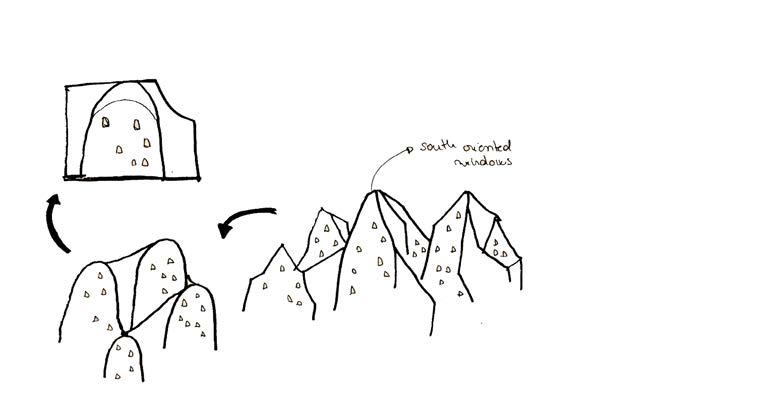
Cappadocia, a semi-arid region in central Turkey, is known for its distinctive “fairy chimneys,” tall, cone-shaped rock formations clustered in Monks Valley, Göreme and elsewhere.
The houses in Cappadocia interested me because of the way the local community lived; in separate ’ apartments’ within the same rock formation, sharing the same ventilation systems and in many cases-access routes.
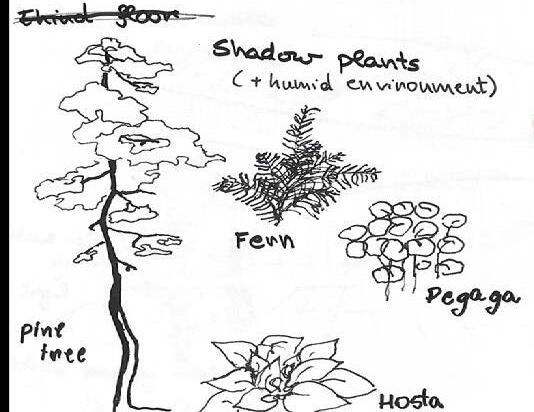
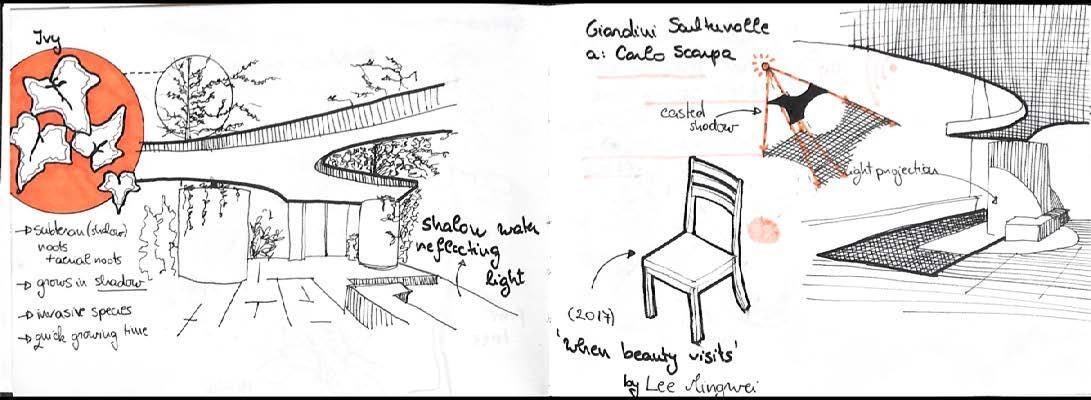
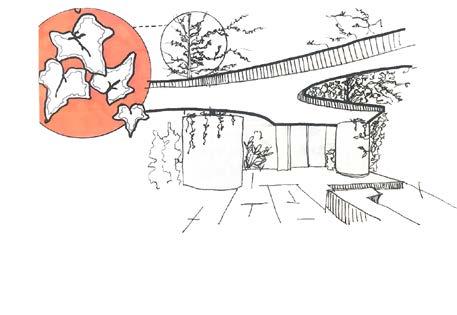
Ivy planted to grow on the north wall
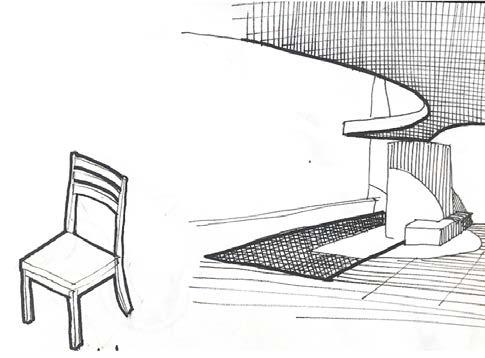
When looking for adaptable exterior performing spaces, I came across Giardini Sculturalle, garden used in the context of the art and architecture biennalle in Venice. What inspired me in this design was the intricate light game created through shadow projections and the great use of vegetation, dictated by the orientation of the garden.
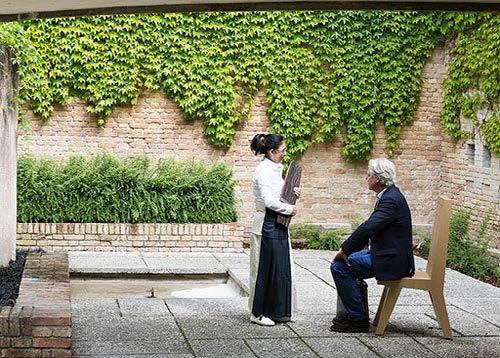
One of the performances held in the garden was “When beauty visits” by artist Lee Mingway in 2017
The Inspiration taken from this precedent was quite literal in the beginning of the process -trying to carve out apartments from the main volume - but it further evolved in only a visual similarity adapted from form simplification.
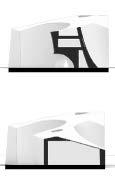
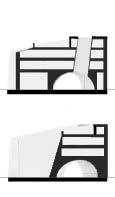
This is a project about how each of us defines, remembers and shares our encounters with beauty. The piece involved the artist picking a person from the public to sit on the chair in the garden. Once sited, the chosen person only has to appreciate the garden and remain sited for as long as they want. Seeing the performance, the rest of the public starts paying attention to the garden- the context of the art.
41 40
PROCESS WORK
Space Needs
PROCESS WORK Space Needs
Optimal viewing area
Performance area
Spectator
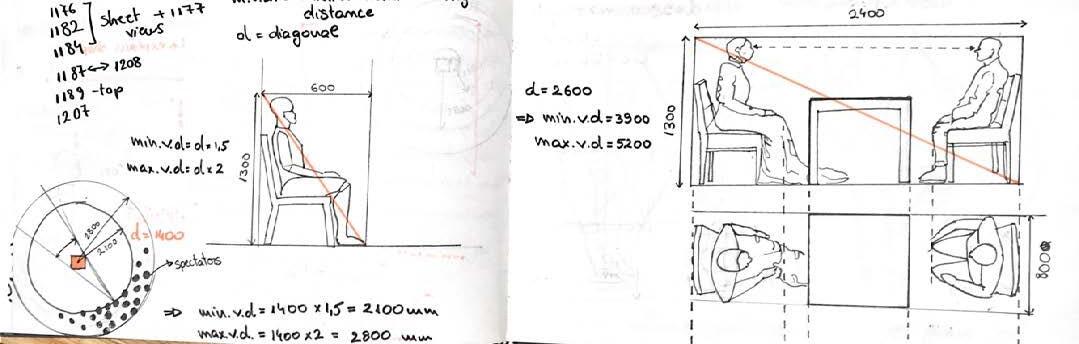
d= 2600mm min.v.d=1.5xd=1.5x 2600=3900mm max. v.d.=2 x 2600= 5200mm
Optimal viewing area
Performance area
Spectator
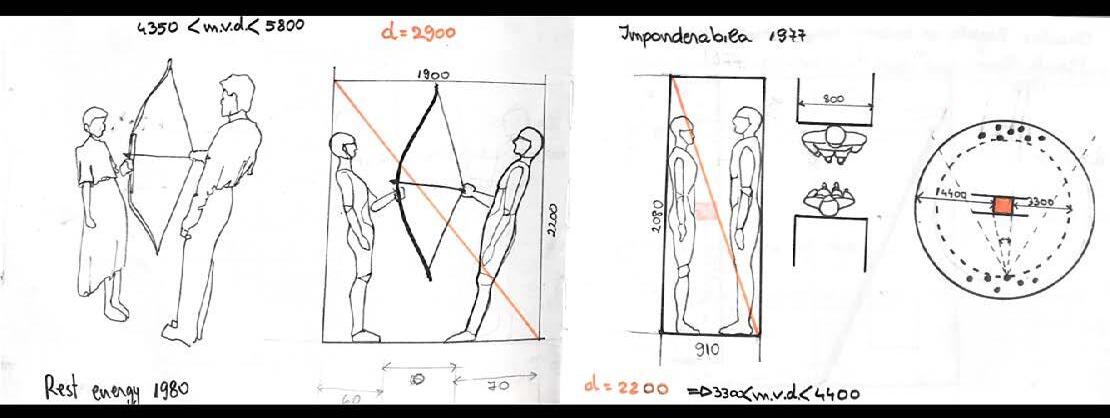
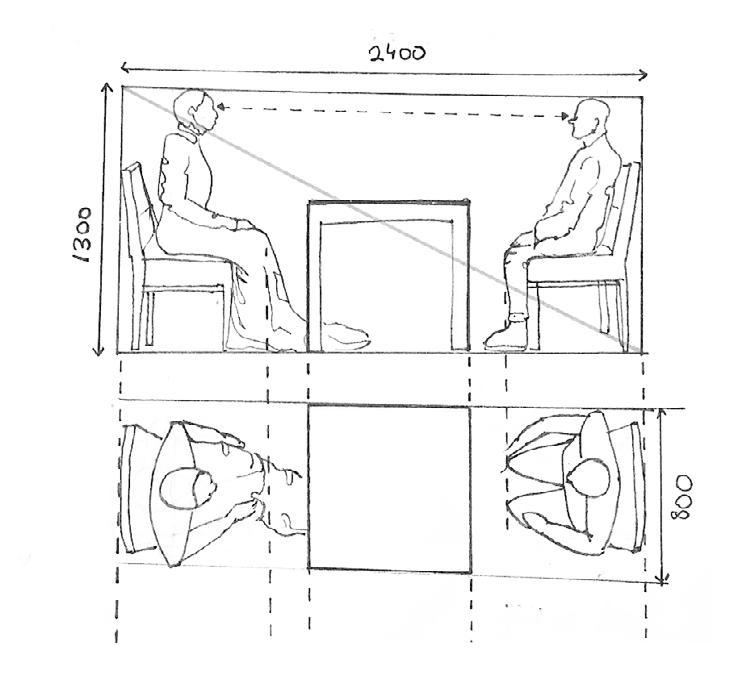
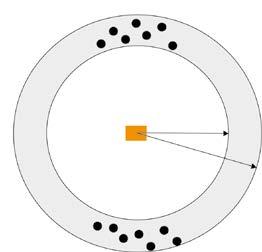
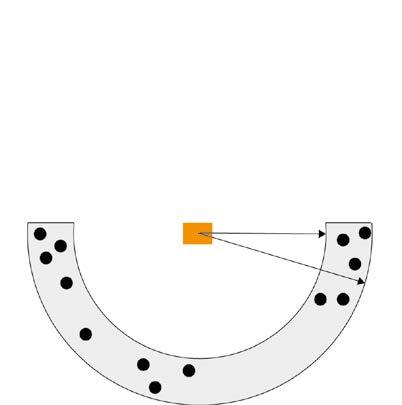
further examined the performance and tried to determine the perfect distance to view it from as well as the area necessary for the performance.
Because of the angle of our visual field, the perfect distance to view a ‘piece’ from is between 1.5 and 2 times the diagonal of the object in reference.
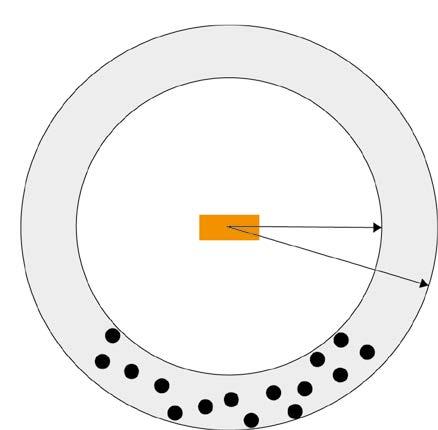
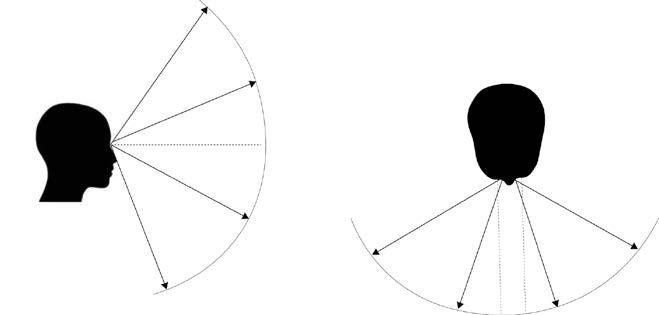
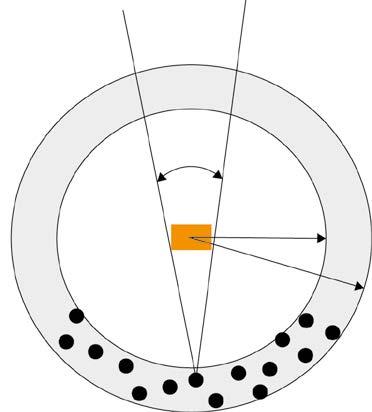
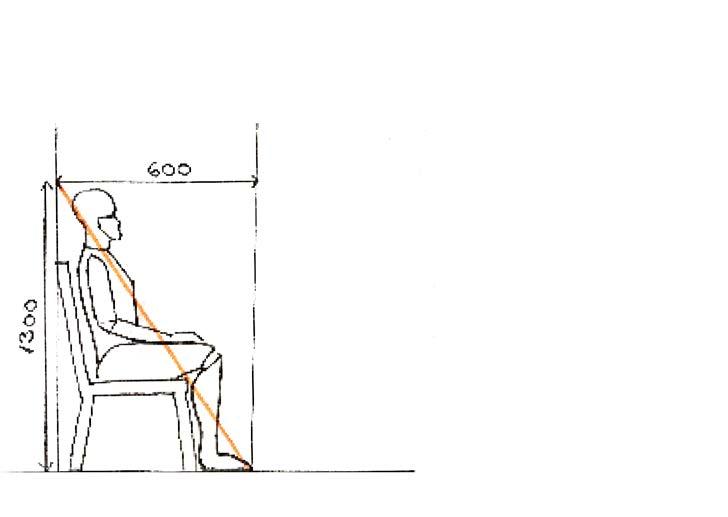
Using this principle, I managed to calculate the optimal viewing distance for each of the following performances.
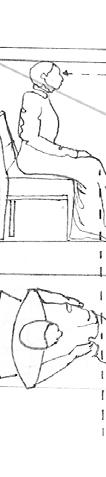
In 2010 at MoMA, Marina Abramović engaged in an extended performance called, The Artist Is Present. The work was inspired by her belief that stretching the length of a performance beyond expectations serves to alter our perception of time and foster a deeper engagement in the experience. Seated silently at a wooden table across from an empty chair, she waited as people took turns sitting in the chair and locking eyes with her. Over the course of nearly three months, for eight hours a day, she met the gaze of 1,000 strangers, many of whom were moved to tears.
43 42
v.d.=2
1400= 2800mm 2100 2800
Diagonal= d d= 1400mm min.v.d= minnimum viewing distance min.v.d=1.5xd=1.5x 1400=2100mm max.
x
3900 5200
PROCESS WORK Space Needs
optimal viewing area
performance area
spectator
PROCESS WORK Space Needs
optimal viewing area
performance area
spectator
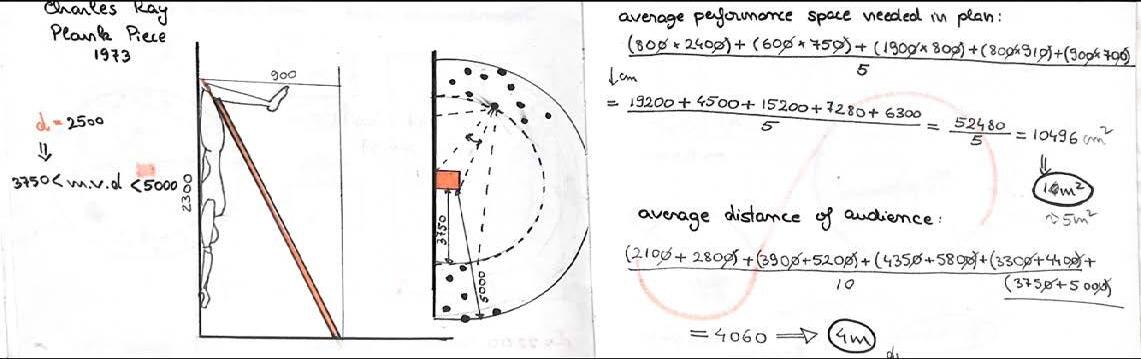
Ray created the work using his own body, experimenting with the ways in which he could balance himself against the wall using a single plank of wood. The critic Michael Fried has noted that ‘both arrangements, it seems clear, could have been achieved only with the help of at least one other person, who, however, does not appear in the photographs.’ (Fried 2011, p.72.) Indeed Ray deliberately presents the arrangements of body and plank as completed structures, offering no evidence of how the artist arrived in these poses
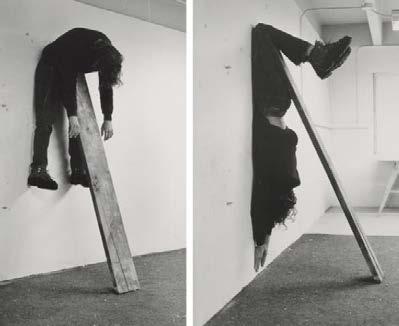
d= 2200mm 3300<v.d.<4400
The use of the artist’s body in Plank Piece also reflects the rise of performance art in the 1970s by artists such as Vito Acconci and Chris Burden. Yet this work remains predominantly sculptural, since the body is treated as an object rather than as a living and moving entity. The disconcerting nature of the image, as Ray slumps like a rag doll, is also counterpoised by its deadpan humour.
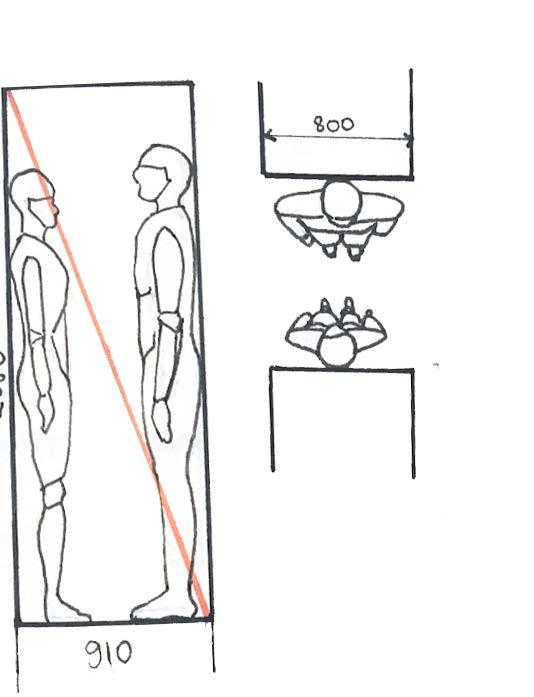
d= 2500mm min.v.d=1.5xd=1.5x 2500=3750mm max. v.d.=2 x 2500= 5000mm
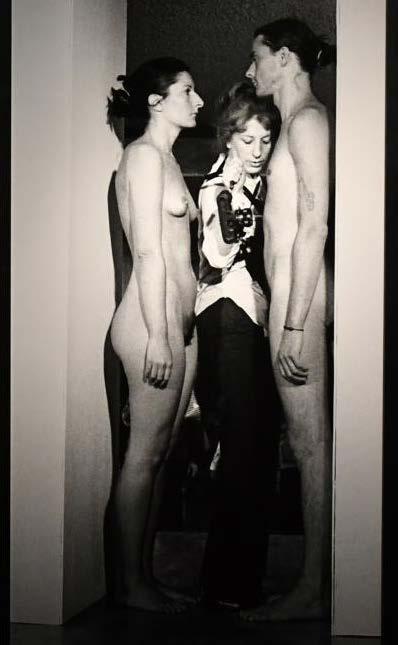
“We decide to rebuild the main entrance of the museum, smaller, and stood there completely naked, so the public who have come to the museum to see the performances have to make a choice to face one or another of us, because the entrance is so narrow they could not go frontally,” Abramović told Glenn Lowry, director of New York’s Museum of Modern Art. Some 300 to 400 people walked through the bodies in the original show, some quickly, others returning for a second passage. Still others opted to walk around the doorway, eschewing such close contact with the nude artists.
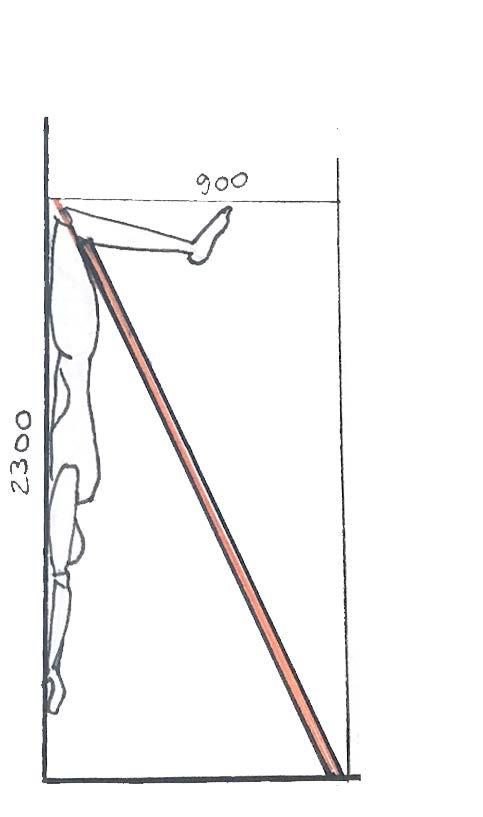 Charles Ray Plank Piece I-II 1973 © Charles Ray
45 44
Marina Abramović and Ulay, Imponderabilia (1977)
PROCESS WORK Space
Needs
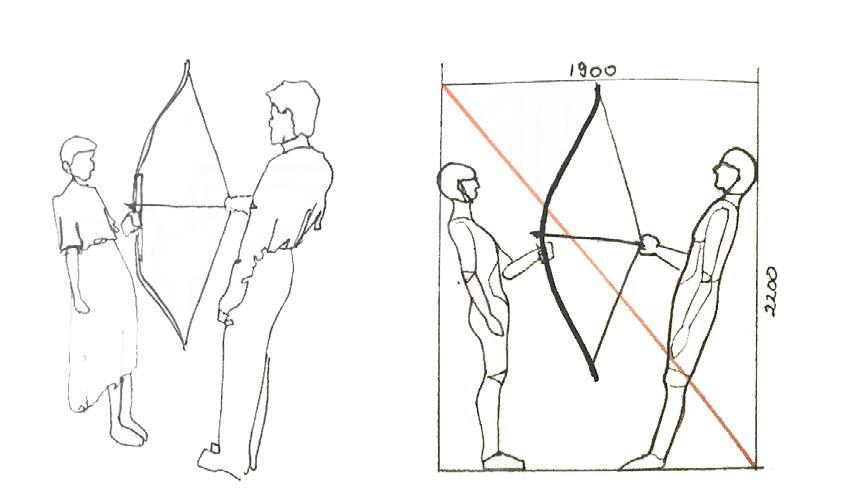
Marina Abramović and ULAY. Rest Energy. 1980
The two face each other and Ulay aims an arrow tensed on the bow straight at her- in fact, a few inches from her heart.
The performance evokes emotions of individual vulnerability and total trust with Mariana holding the bow. At the same time, Ulay grasps the arrow and bowstrings, both slightly tilted back on their heels, making eye contact. The captured pose is tense; a reaction evoked because the two put tension on the bow and arrow. What draws one’s eye is the fiery red arrow and the focus on Marina though her pose is suggestive of subordination.
optimal viewing area
performance area
spectator
PRECEDENT STUDY
What makes this piece raw and resonant with emotions is the fact that the two artists had fallen in love and were in a relationship at the time of shooting this piece. The pose was held for four minutes and streamed on live television.
d= 2900mm
min.v.d=1.5xd=1.5x 2900=4350mm
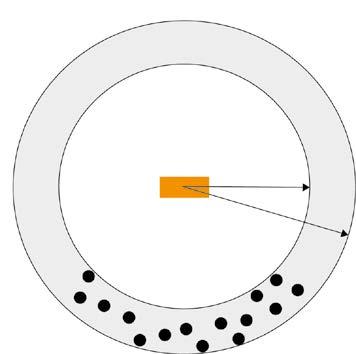
max. v.d.=2 x 2900= 5800mm
Lorem ipsum dolor sit amet, consectetur adipiscing elit. Suspendisse vitae eleifend augue. Cras pretium fringilla neque quis dictum. Praesent efficitur fringilla tellus, at viverra magna bibendum eu. Integer magna risus,
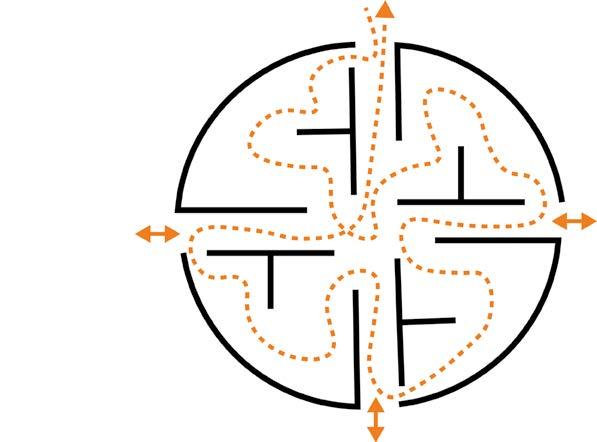
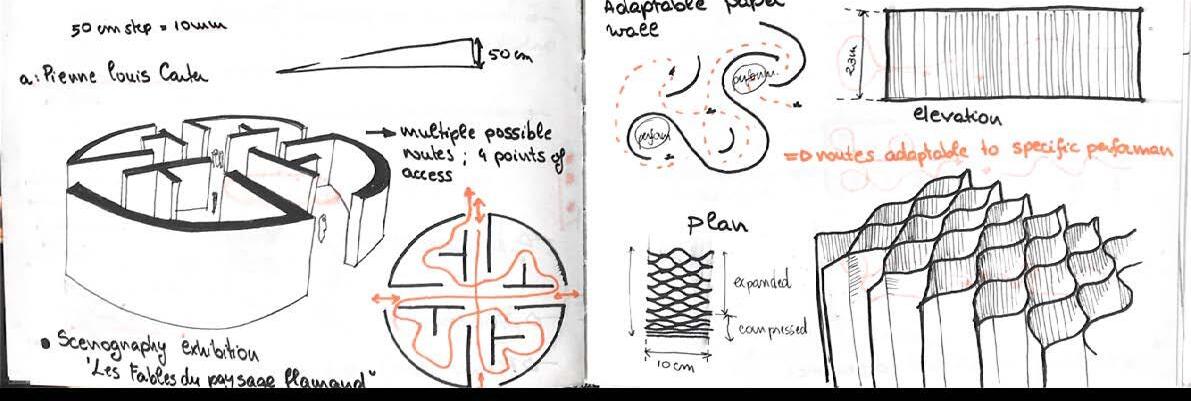
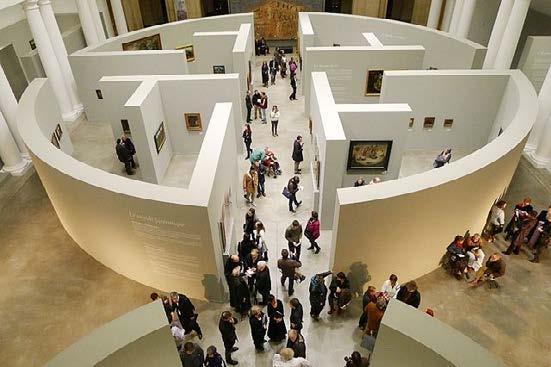
The labirinthic plan invites the visitor to get lost inside the exhibition; to get completely absorbed by the pieces of art presented. The numerous routes possible increase the ....of the art gallery and create a trully unlike environment for art to be experienced in.
47 46
PROCESS WORK
A flexible performance space
PERFORMANCE
A Flexible Performance Space
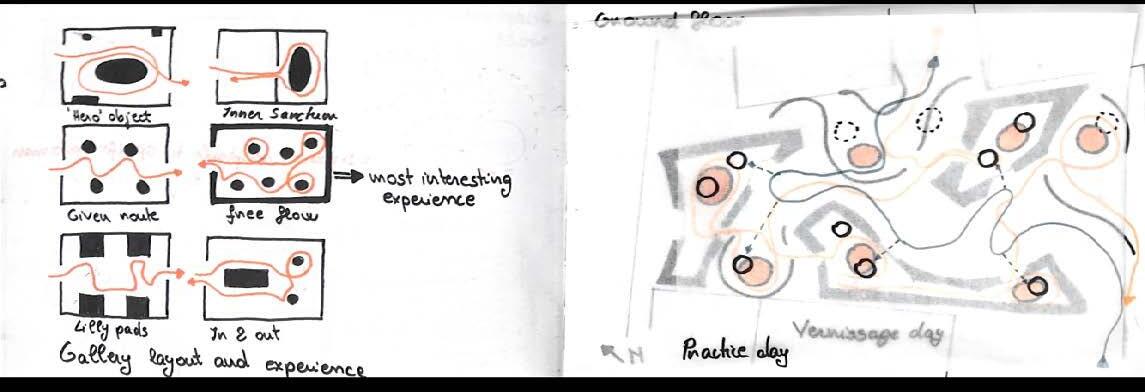
Hero object
Given route
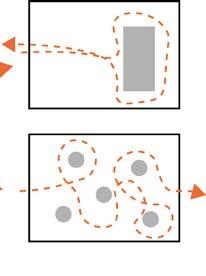
Lilly pads
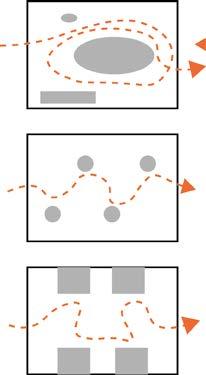
In and out
Free flow
After examining other classiclal art gallery arrangements, I decided to implement the Free flow concept, as I see it like a simplified version of the labirinthic exhibition plan. One that invites the visitor to explore the pieces without a pre-set route or guide, to merge within the artworks.

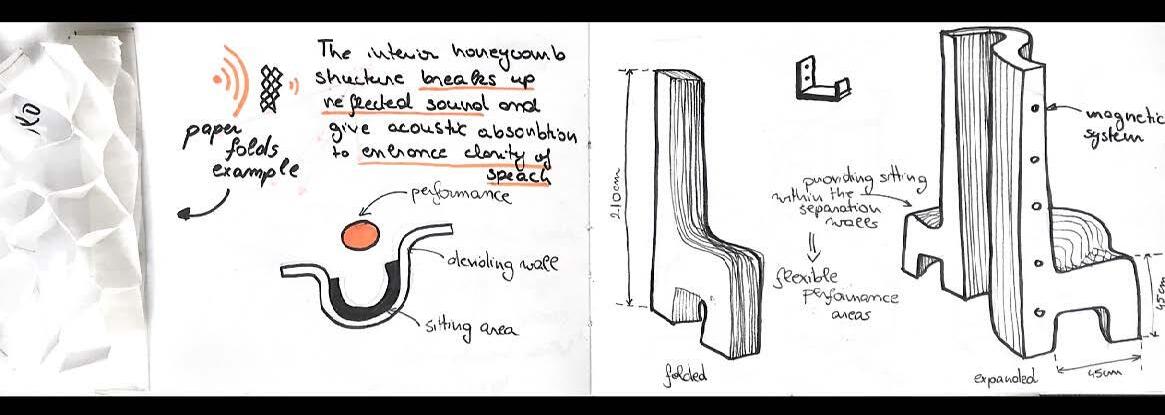
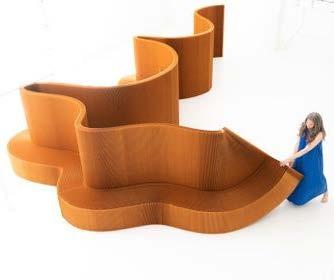
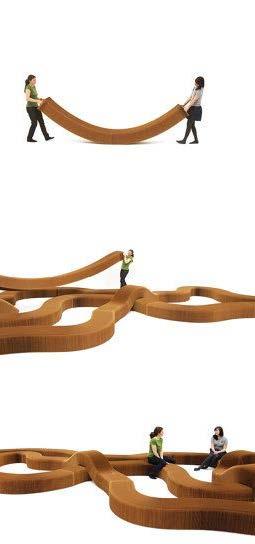
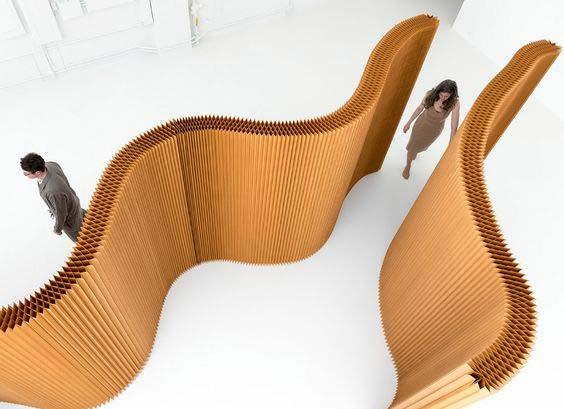
In order to implement such a concept within my outside areas on ground floor, I had to find a temporary and flexible way of creating space partitions. This is how I came across MOLO’s soft partition walls collection.
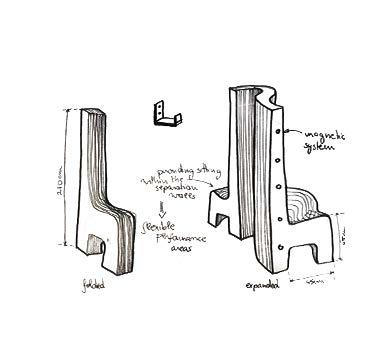
The tactile act of rearrangement heightens the sensory experience of one’s surroundings and deepens the emotional connection to place. Using a honeycomb geometry to flex, expand and compress, in a multi-patented system with magnetic end panels for modular arrangement.
Using such walls, I would be able to incorporating flexible sitting and separation walls within the performing space, doubling the available performative spaces and giving each performance a unique context.
PERFORMANCE SITTING AREA
49 48
A flexible performance space
Performance space
Flexible walls and sitting
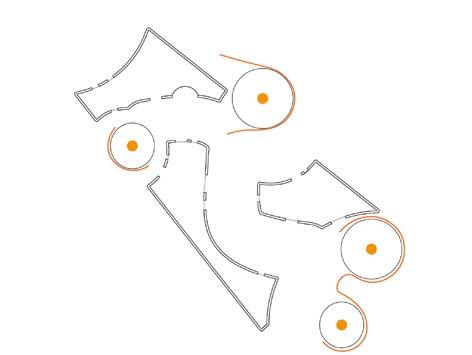
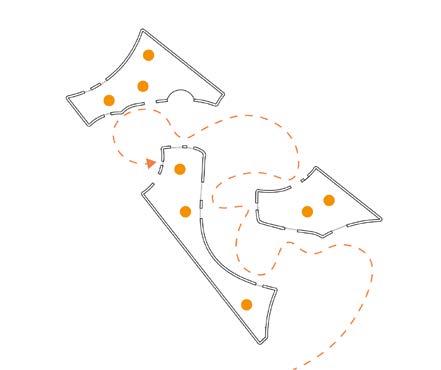
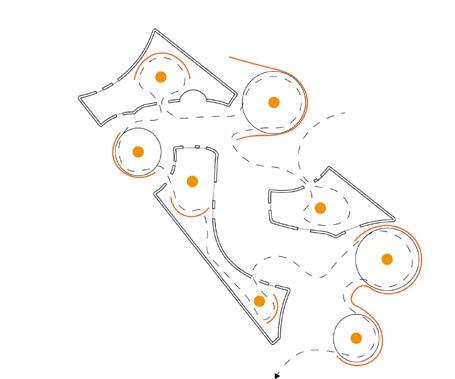
‘Closed hours route
‘Open hours route

PROPOSAL
By calculating the average of the 10 measurements taken before (pages 42-46) I found the optimal viewing distance (3m<d<4m) for the average performance and used that to place the flexible walls at a appropriate distance.
Positionig the walls in accordance to the dimensions previously discoverded, created two possible layout alternatives for the foldable walls, depending on the number of performances taking place.
Residential arrangement, including four units for living
Foldable sitting is provided inside as well, creating a visual connection to the outside spaces. This diagram presents the layout of the gallery during open hours, when the artists are performing for the public. The design offers eight adaptable performing spaces.
Possible route of a spectator visiting during ‘closed hours’ when they can only view the performances through the windows.
Residential arrangement, including four units for living
Gallery/ workspace desalinated area
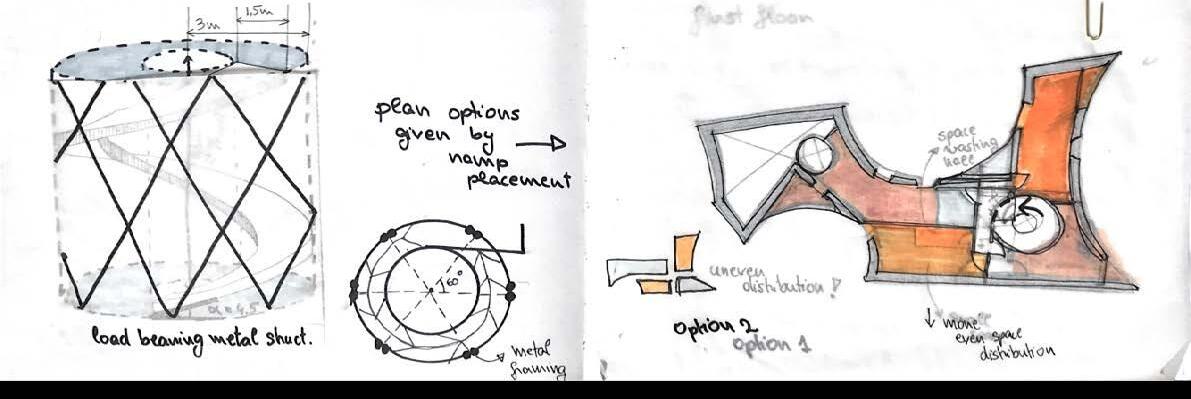
The access to the upper floors is made using the ramp spirling through the central opening, or using the fire protected stairs.
1 1 1 2 2 3 3 5 5 4 4 6 2 3 4 5 6
Photo-video Studio, open to all artists
Storage area Communal hallway Open plan living room and kitchen Bathroom Bedroom Balcony 7 7 7 Fire protected stairs 51 50
3m 4m 0.6m

1 1 1 2 3 1 2 3 Studios Bike storage Recycling
1
Ground floor as workspace Plan at 1:200 @A3
facilities
53 52
Ground floor as a gallery plan at 1:200 @A3

First floor plan at 1:200 @A3 A A’ B’ B C C’ Second floor plan at 1:200 @A3 55 54
Third floor plan at 1:200 @A3
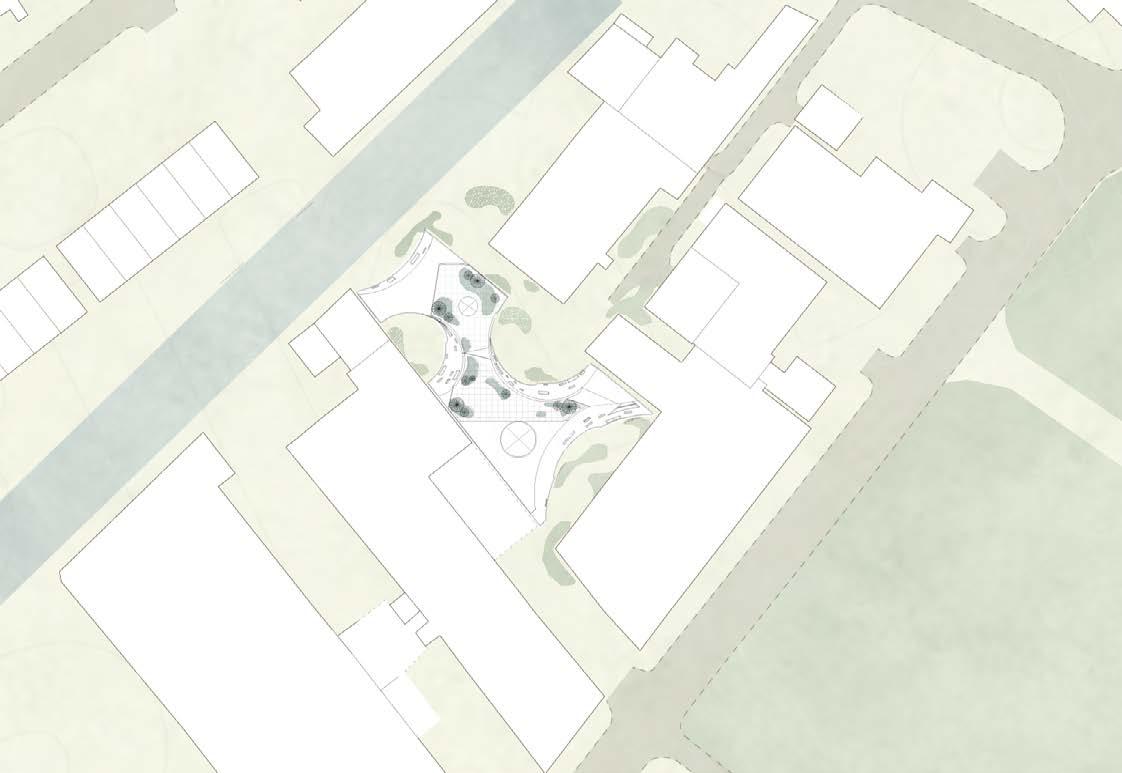
Site plan at 1:1000 Rooftop Plan at 1:500 @A3


57 56
Apartment plan at 1:50 @A3
1:200 @A2 0m 2 8 12m 59 58
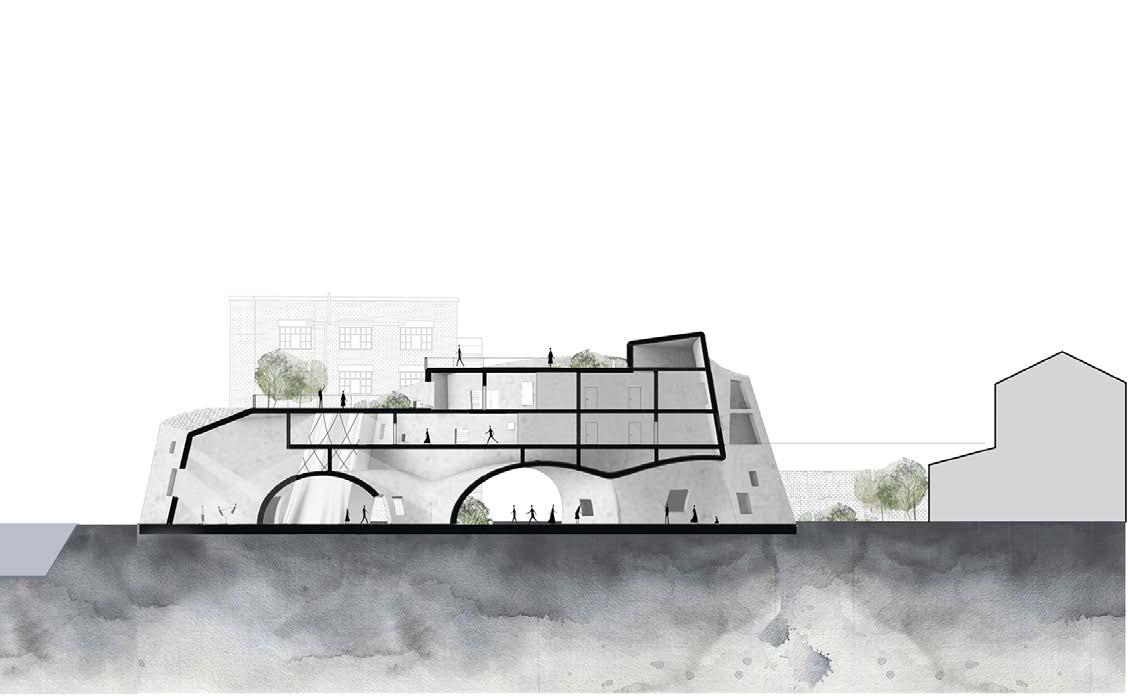
Section A-A’
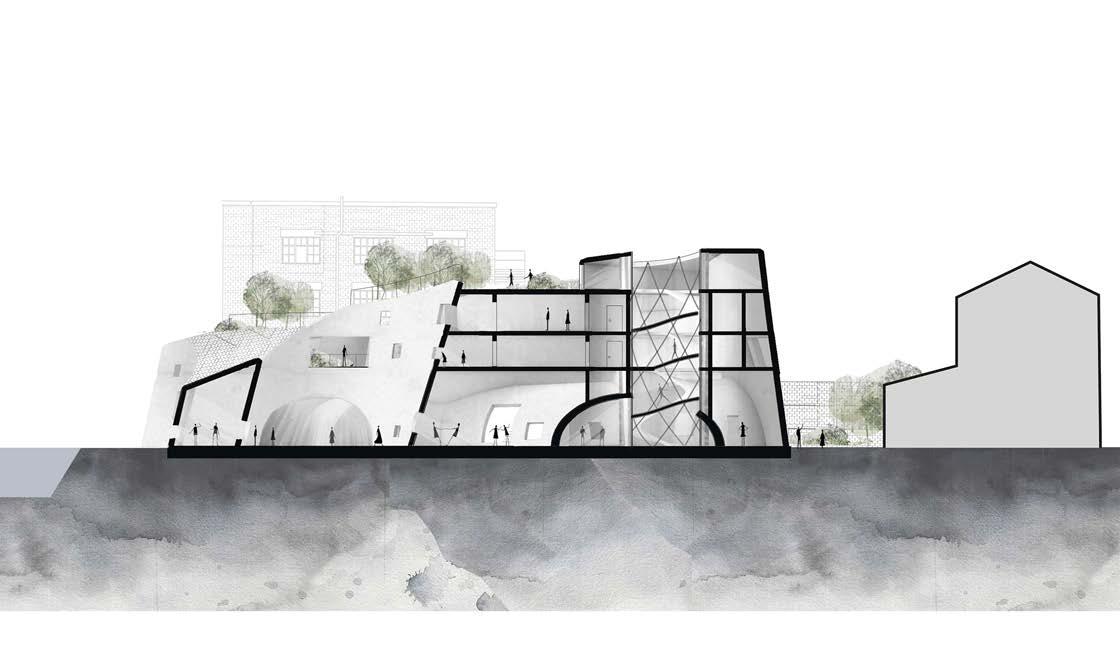
Section B-B’ 1:200 @A2 0m 4 12m
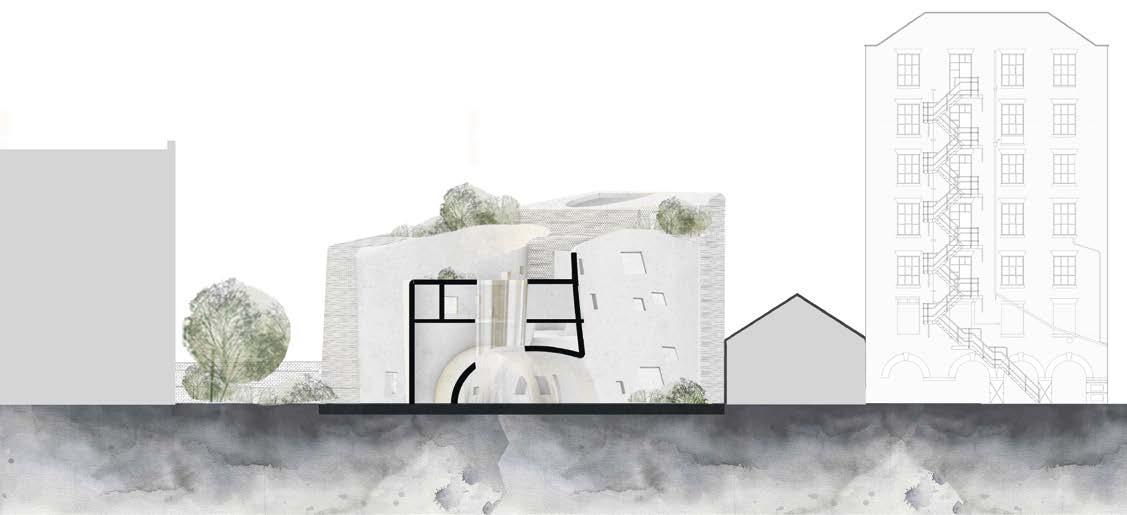
c-c’
0m 4 12m 61 60
Section
1:200 @A2
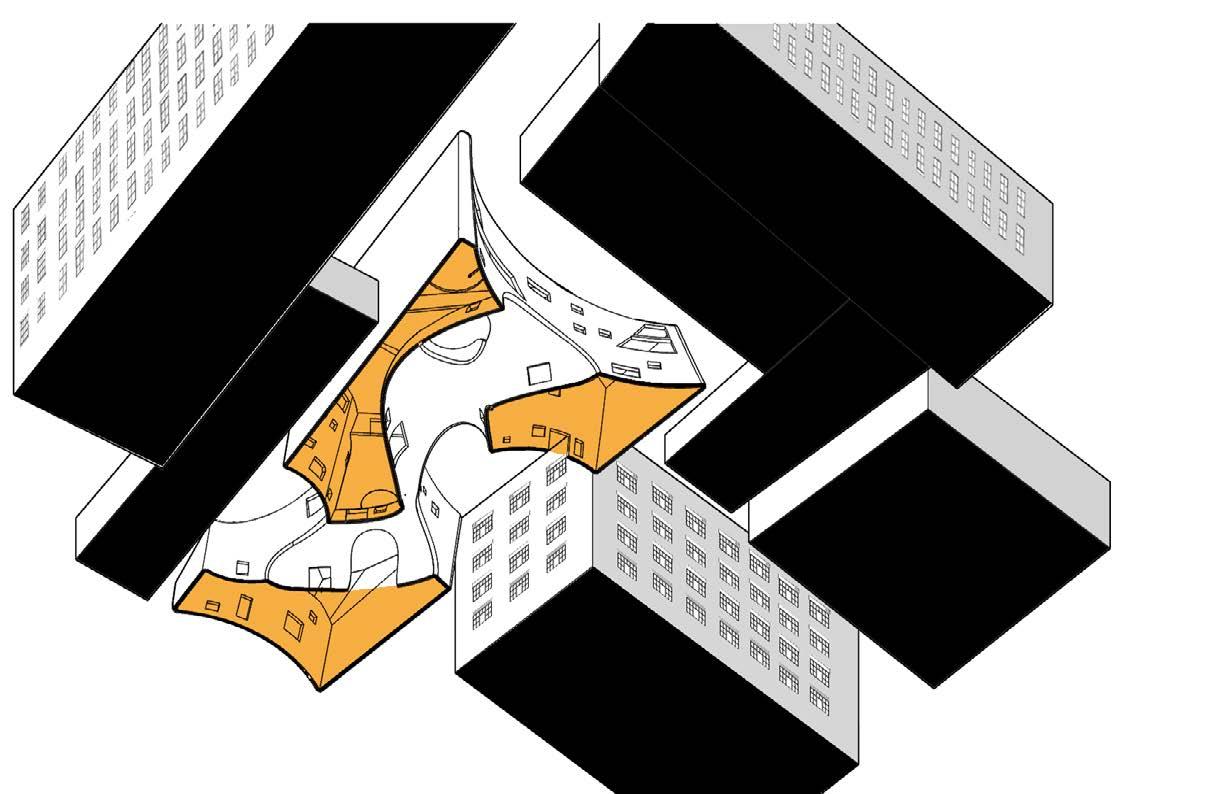
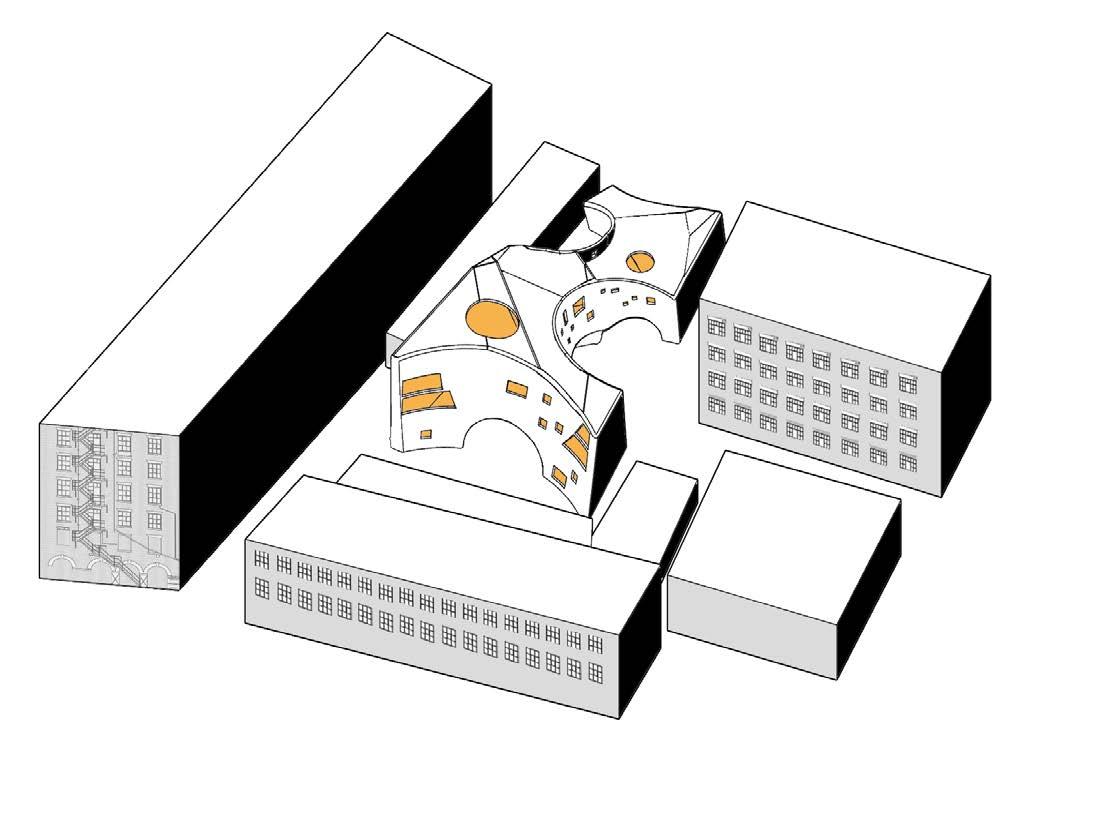
63 62
Axonometric View Axonometric View
PRECEDENT STUDY
Sendai Mediatheque
Sendai Shi, Japan
Architect :Toyo Ito 2001
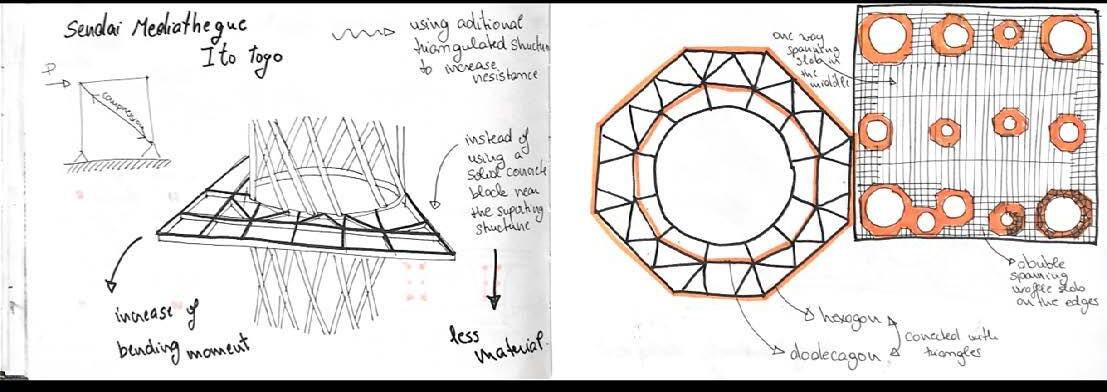
Six steel-ribbed slabs, each 15-3/4” thick, appear to float from the street, supported by only thirteen vertical steel lattice columns that stretch from ground plane to the roof. This striking visual quality that is one of the most identifiable characteristics of the project is comparable to large trees in a forest, and function as light shafts as well as storage for all of the utilities, networks and systems.
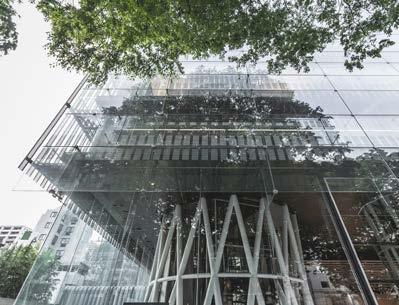
Each plan is free form, as the structural column lattices are independent of the facade and fluctuate in diameter as they stretch from floor to floor, as it can be seen in the next diagrams.
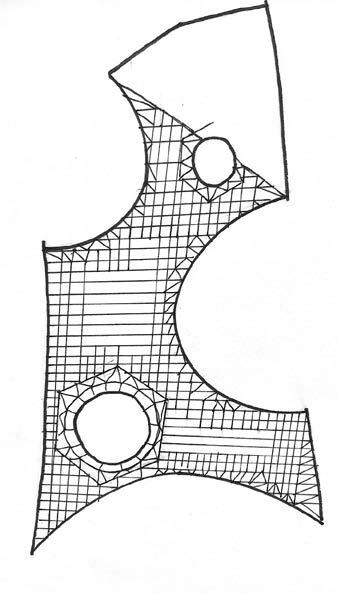
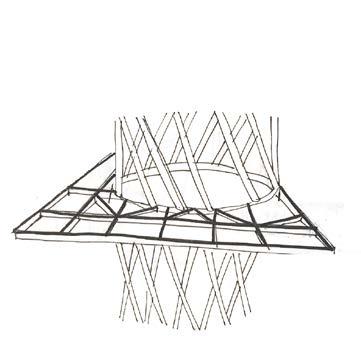
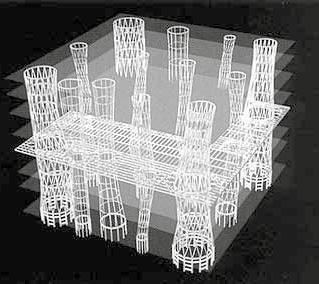
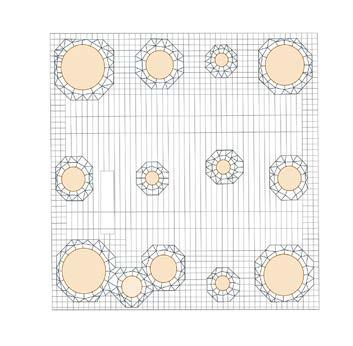
was inspired by the open plan of the building and the lack of additional supports, so decided to implement the same structural concept within my design.
Using methods of triangulation in order to increase the bending moment of the bloorslab in the close proximity of the load-bearing columns.
Ground level
STRUCTURAL STRATEGY Ground level
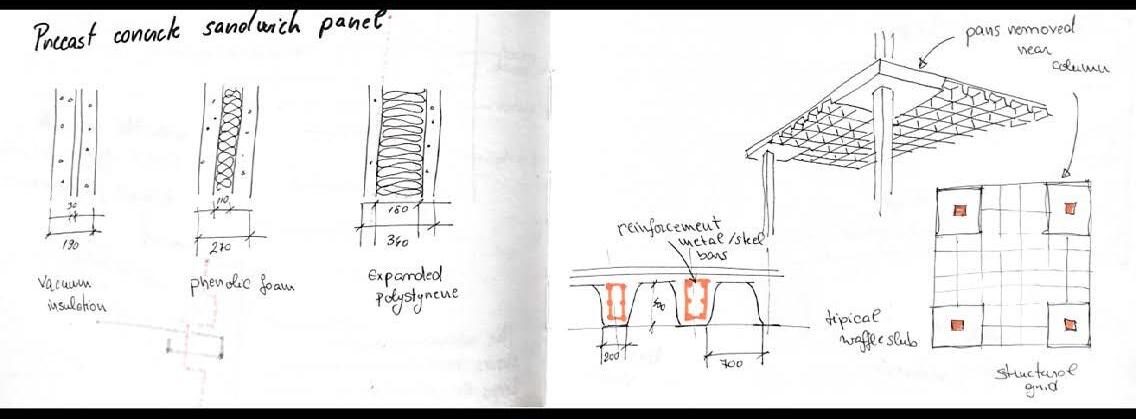
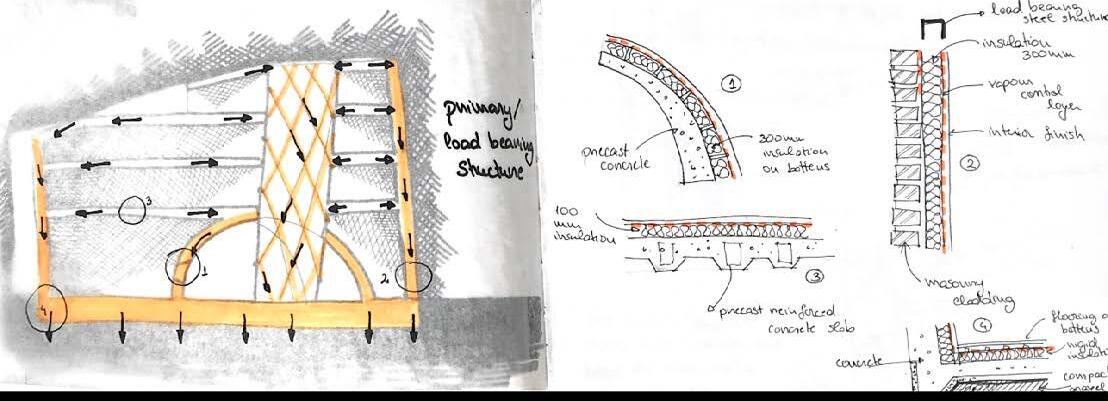
Reinforced concrete Phenolic foam Insulation
Air
Vapour control layer Gravel Vapour retarder Masonry
gap
65 350 mm 100 mm 64
Waffle floor plate structural grid
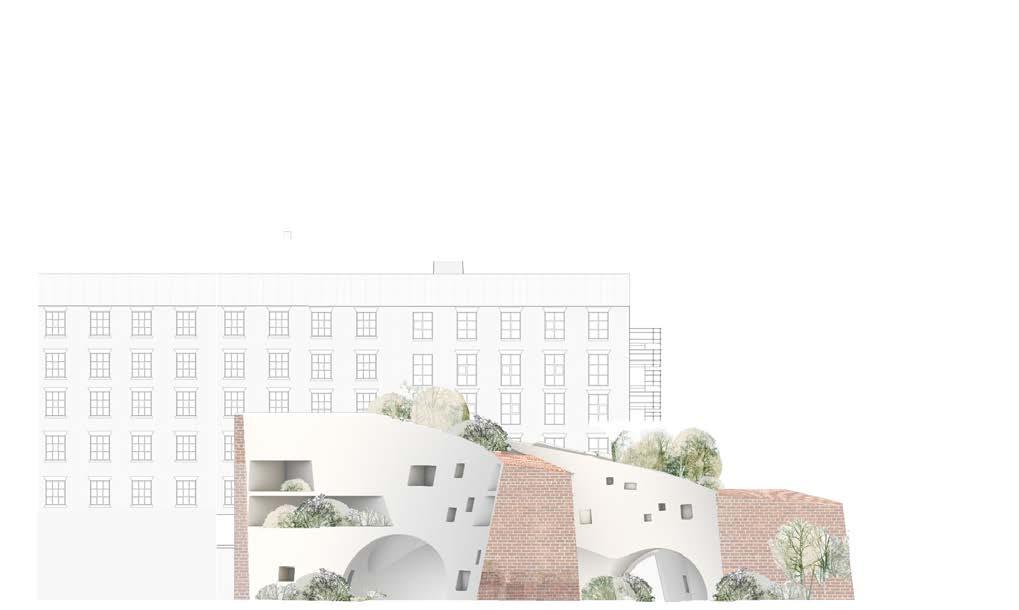
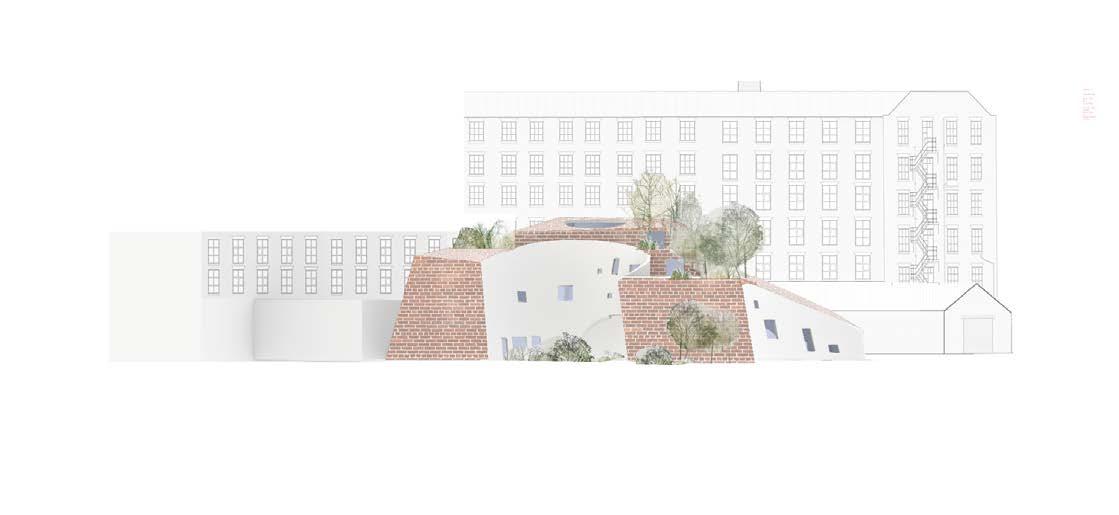
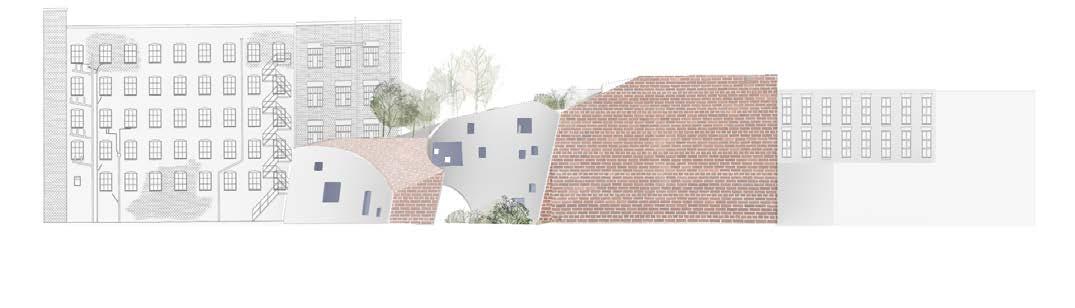
East Elevation 0m 15m North Elevation East elevation 0m 5 15m 0m 15m 66
ENVIRONMENTAL STRATEGY
A Carbon Negative Building
Social Sustainability
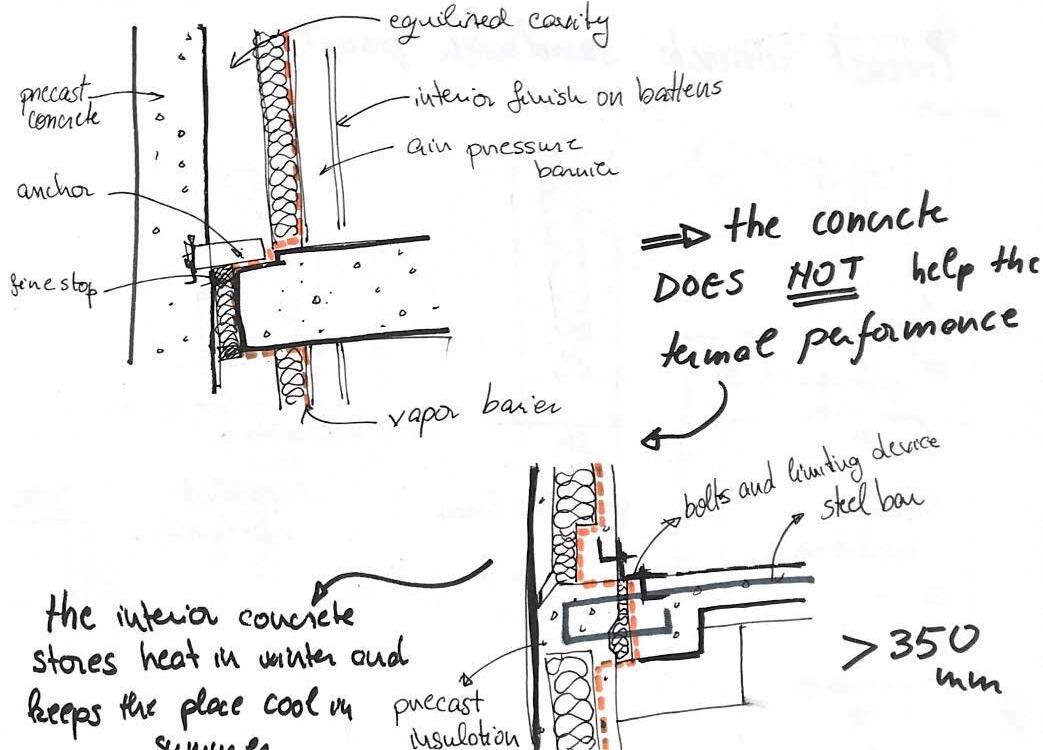
The good health and well-being of the residents was one of the essential creative drivers that informed my design. In my design, I tackled this by creating a range of green areas, designing spaces with good natural indoor lighting and air quality (facilitated by the circular voids) as well as providing acoustic comfort yet another advantage of using concrete as the main construction material). Furthermore, by creating inclusive, mixed use spaces for social iteration and providing a high quality pedestrian public realm (on ground floor), I managed to incorporate social sustainability as one of the main aspects of this design.
EXHIBITION PIECE
Energy Efficiency
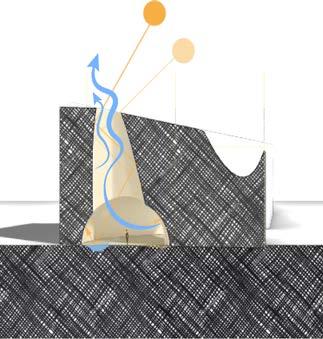
As natural daylight is fundamental for the health of the occupants and mandatory for a community of visual artists, creating a system that would bring light all the way down to the ground floor was the main creative driver of my design process. I overcame the initial restriction of the site by incorporating two south-oriented circular voids into the design. The partially reflective glazing ensures that natural daylight reaches the ground floor at all times during the day. The voids offer even more benefits for the residents, acting like a vertical vacuum. The hot air lifts up, creating a passive ventilation system through the building.
Thermal Strategy
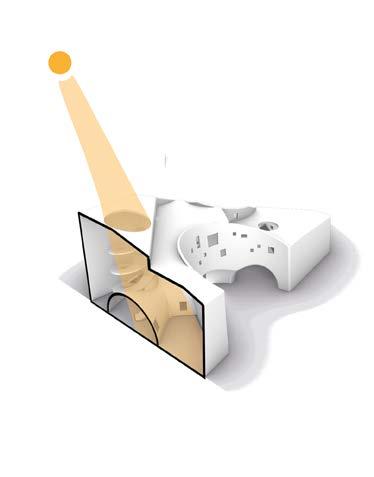
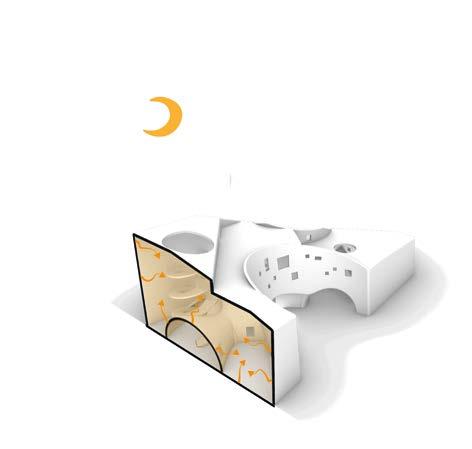
The interior layer of concrete acts like a thermal bank, reducing the need for additional heating in winter. The concrete absorbs thermal energy during the day and radiets it back during the night. The two tubular wholes that cut through the building insure a deep solar energy penetration within the core of the building.
Can Concrete be Sustainable?
A British manufacturer, Novacem has developed a carbon dioxide absorbing concrete, using magnesium sulfate. According to the manufacturer, this new kind of concrete can absorb up to 0.6 tons of carbon dioxide, compared to a ton of traditional concrete which emits around 0.4 tons of C02. By using this type of concrete as well as providing a highly effective passive ventilation system, the building could potentially reach negative carbon emissions.
68
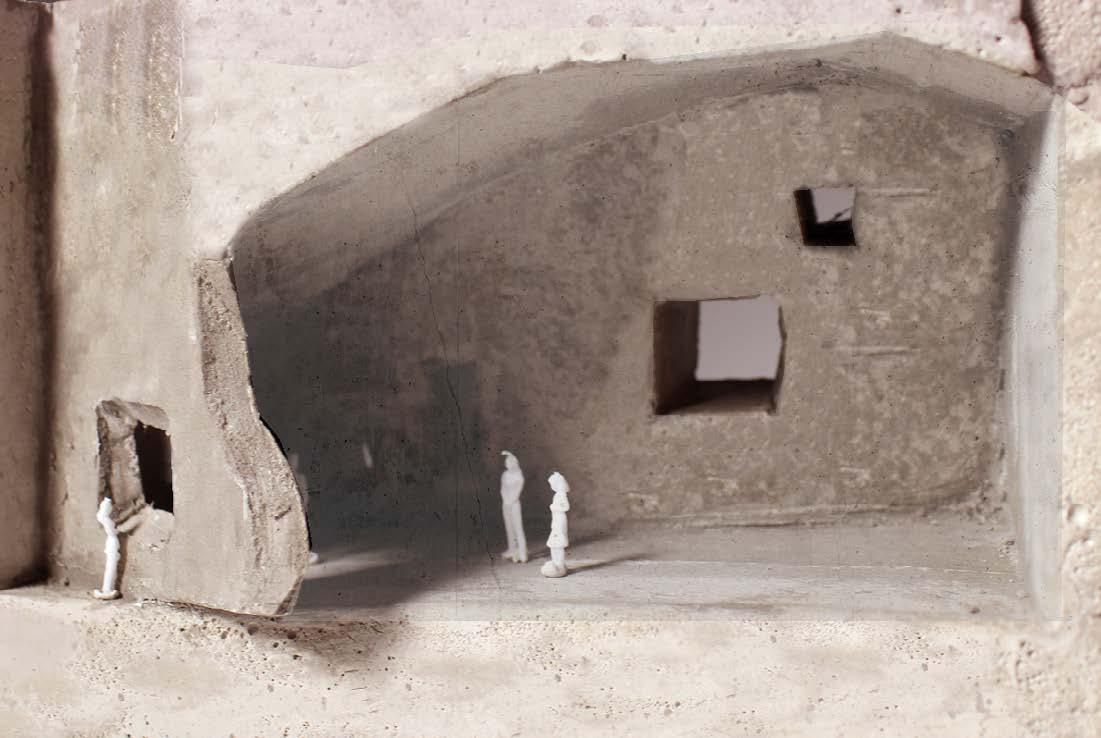
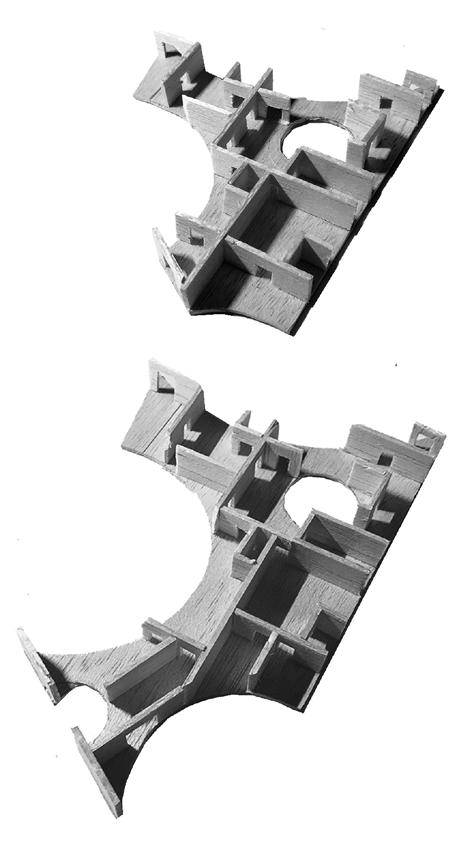
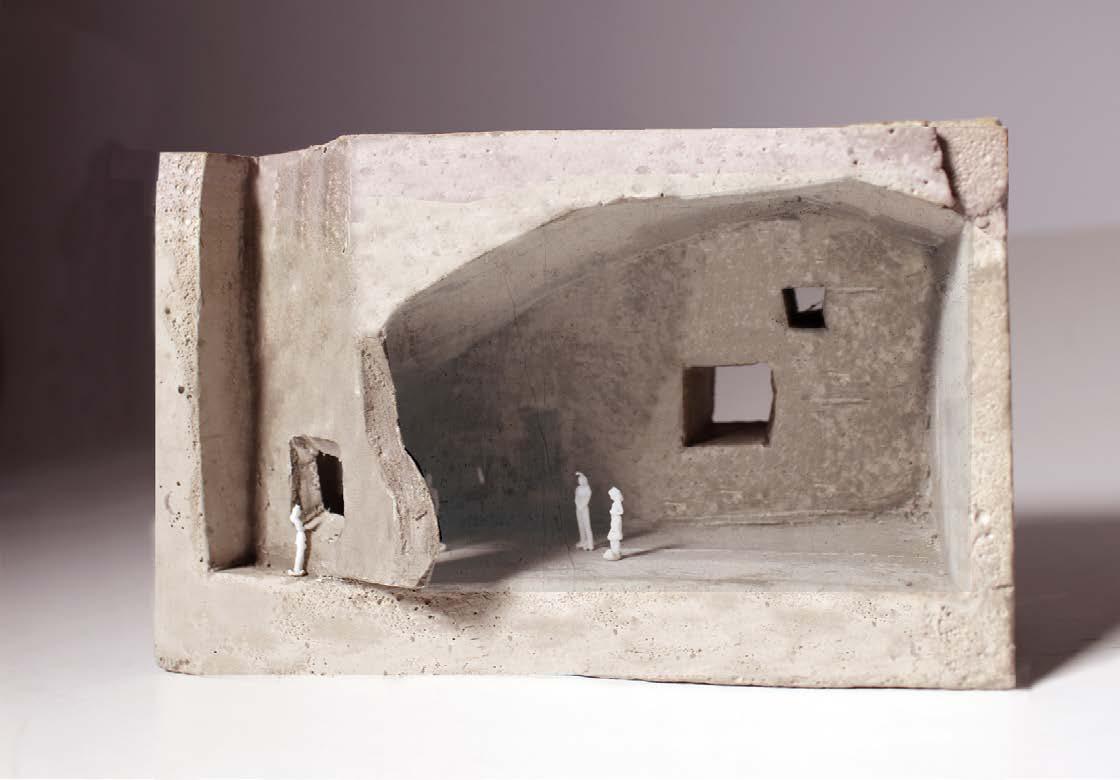
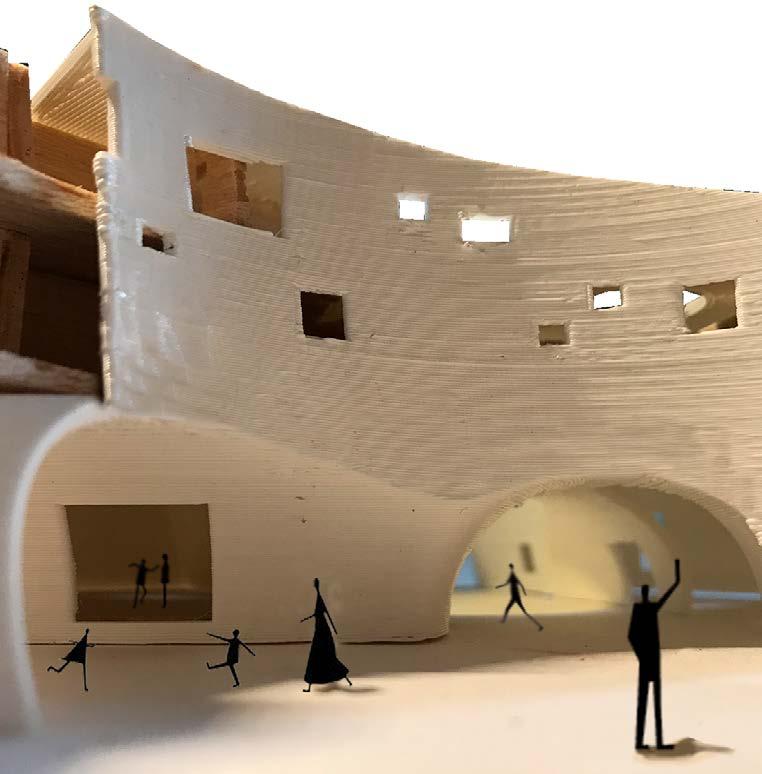
Casted model at 1:100 highlighting the atmosphere and materiality of the performance spaces

EXHIBITION PIECE 1:200
70
72
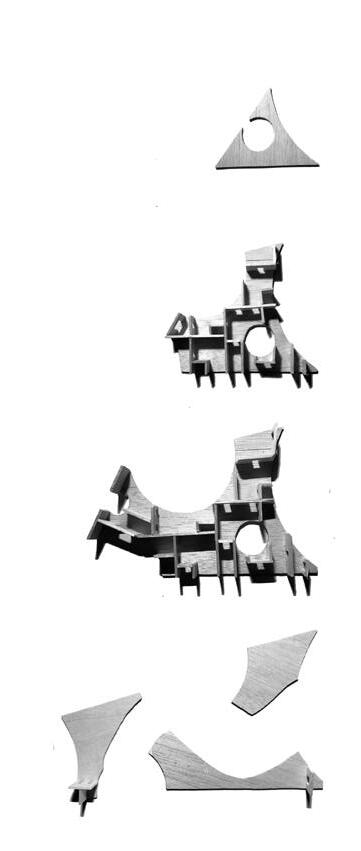
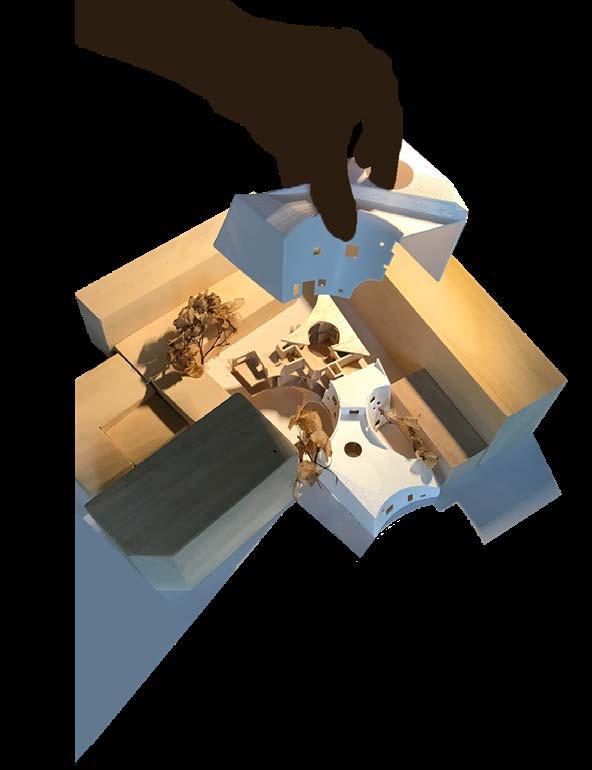
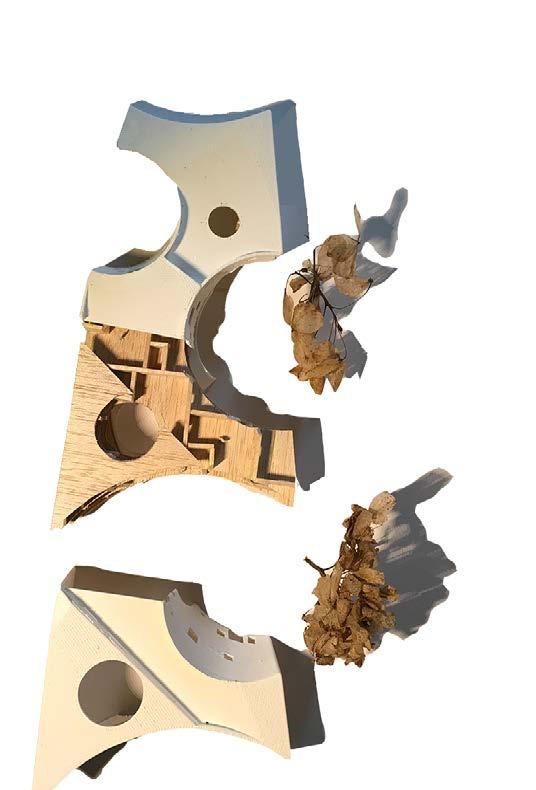
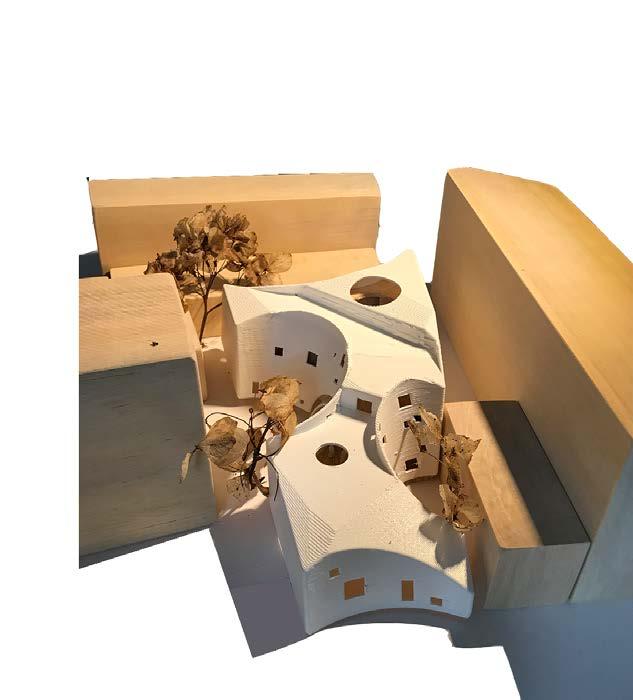
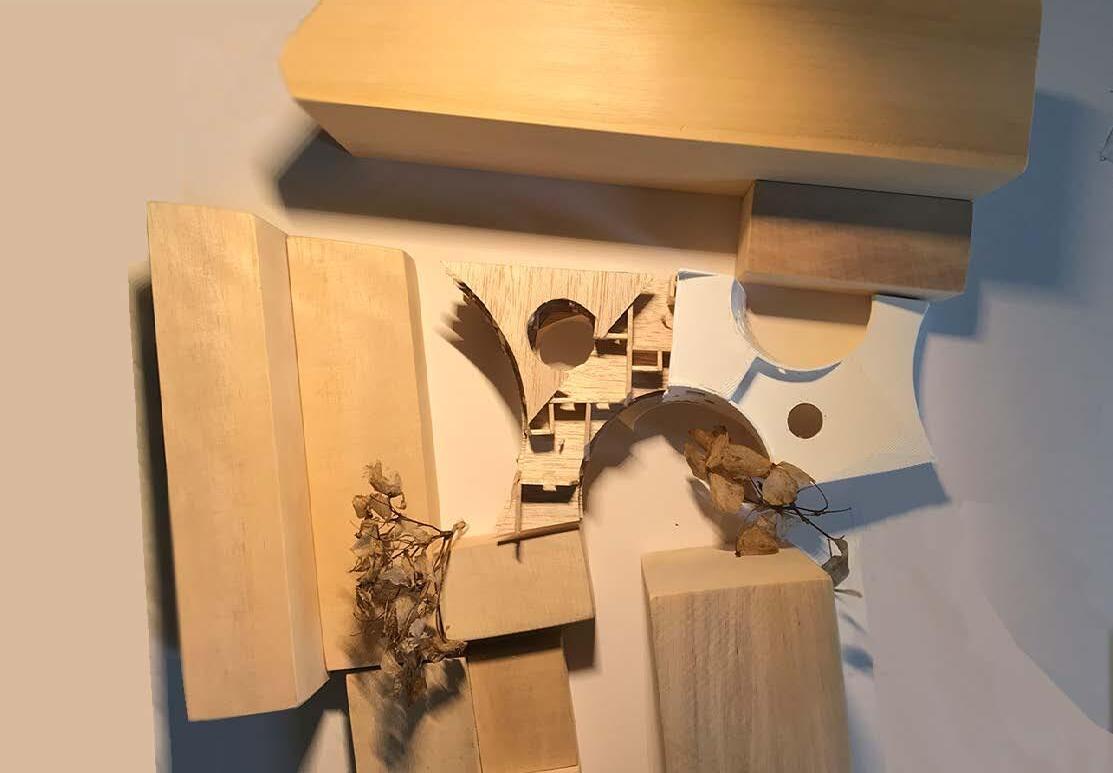
1:200 scale model highlighting the different layers that can be found within the building and it’s functionality.
74
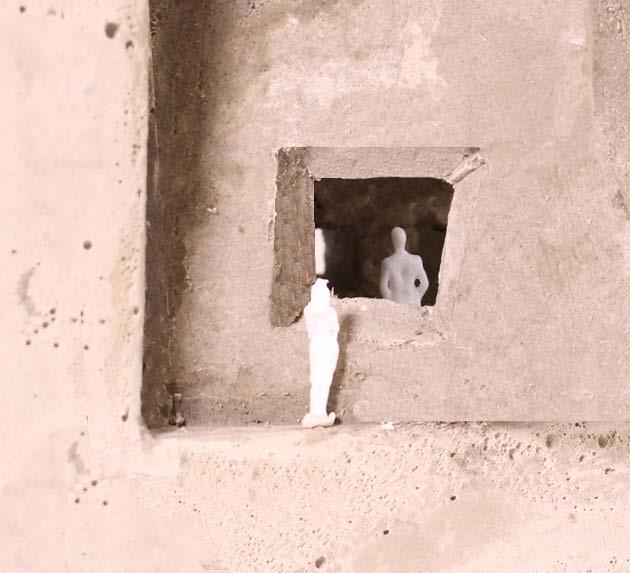
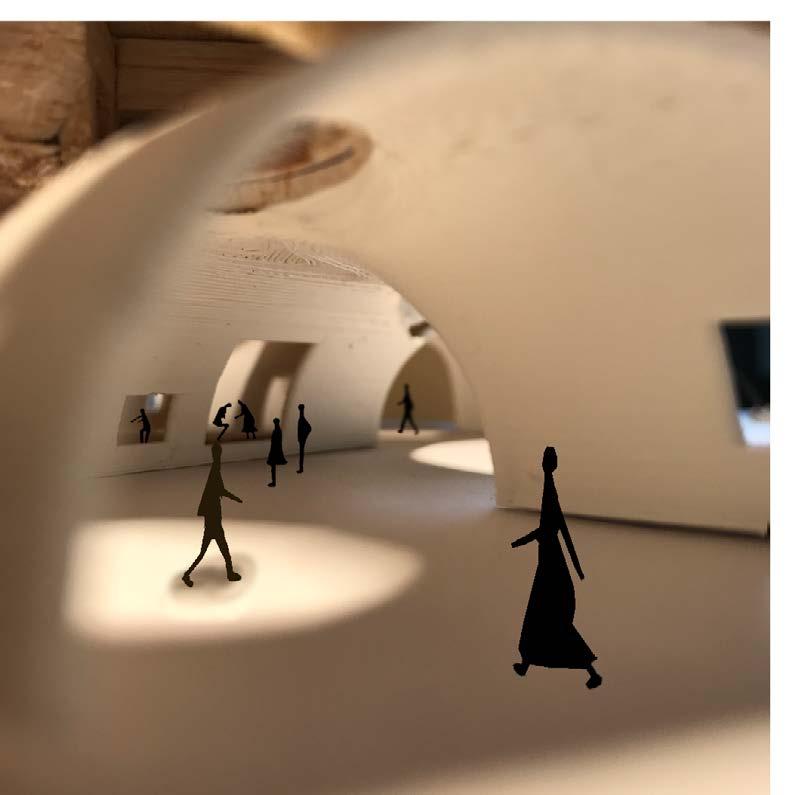
Visual representation of the main corridor acting as a viewing space for performances that are being rehearsed in the studios.
DESIGN JOURNAL