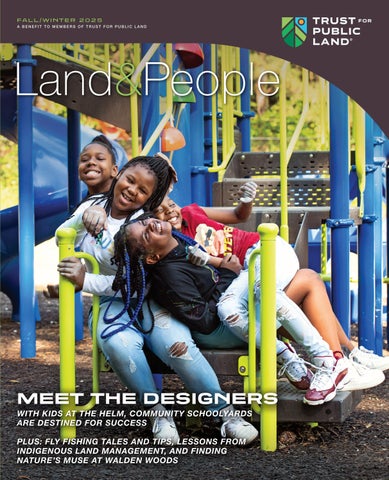
WITH KIDS AT THE HELM, COMMUNITY SCHOOLYARDS ARE DESTINED FOR SUCCESS
PLUS: FLY FISHING TALES AND TIPS, LESSONS FROM INDIGENOUS LAND MANAGEMENT, AND FINDING NATURE ’ S MUSE AT WALDEN WOODS
IS DECEMBER 2
DONATE THROUGH MIDNIGHT ON TUESDAY, DECEMBER 2, AND YOUR GIFT WILL BE TRIPLED.
Your year-end, tax-deductible contribution will protect beloved outdoor places and create new ones for future generations.
Thank you for your support!
A toddler delights in the beauty of fall in Vermont, where TPL has protected over 72,000 acres, including this section of the Green Mountain National Forest.
JERRY
Fish Tales Come True 30
Not long ago, native trout were near-mythical creatures around Weatherly, Pennsylvania, due to coal-mining pollution. But with time and help from TPL and partners, the streams are attracting fish—as well as eager anglers and others looking to explore an up-and-coming recreation destination.
Teaching—and Learning—Outside the Box 38
Every TPL community schoolyard is created in collaboration with kids, teachers, and neighbors. Come on a journey from start to finish as we revitalize playgrounds and reenergize communities one schoolyard at a time.
From Boom to Bloom 48
After Cleveland’s once-robust manufacturing base crumbled, the city struggled to regain its footing. Now, visionary residents, policymakers, and TPL are working together to ensure residents in and beyond the city have green, climate-resilient places that connect them to the outdoors.
“[TPL] brought us together from across the city and both sides of the river. That’s no small thing.”
48
~ RONALDO RODRIGUEZ JR., IN FROM BOOM TO BLOOM , PG. 48
GIVING GUIDE
With a variety of ways to give, we offer something to suit everyone.
Send your gift by using the envelope bound inside this magazine, donate online, or learn about more ways to give at tpl.org/support .
Grow Your Giving
Simplify your charitable giving and meet your philanthropic goals by giving through your donor-advised fund (DAF), individual retirement account (IRA), or appreciated securities. Learn more at tpl.org/daf
Give the Gift of the Outdoors
The holiday season is the perfect time to share your love of nature and outdoor adventures with others. Make a difference and honor someone special with a tribute gift at tpl.org/tribute.
Become a Conservation Champion
Donate $1,000 or more annually and receive the recognition due a champion, such as invitations to special events and insider updates on our projects. Call 415.495.4014 or email champions@tpl.org to learn more.
Leave a Legacy
Reimagine the future. Consider including us in your will or trust, or as a remainder beneficiary of your retirement fund or DAF—and explore other tax-wise ways of giving. Call 202.856.3748 or email plannedgiving@tpl.org to learn more.
Donate Your Vehicle
Car recycling benefits people and the environment by conserving natural resources, reducing pollution, and lessening energy consumption. Call 855.500.RIDE (7433) or visit tpl.org/cars to get started.
Scan with your mobile device’s camera to make a gift today!
Trust for Public Land depends on your support. You make our work possible. tpl.org/support
DEPARTMENTS
From the President · 11
Reflecting on her first year at TPL’s helm, our CEO embraces challenges and shines a light on what TPL does best: get things done.
Board Spotlight · 12
Get to know Jodi Archambault.
First Look · 13
Buzzworthy updates on projects and happenings, tips to get you fly fishing, and an excerpt from our Mountainfilm panel about Indigenous wisdom and land management.
On Topic · 58
A roundup of insightful book and podcast recommendations from partners and staff.
TPL Near Me · 60
Tribal leader Reno Keoni Franklin describes the impact of his people’s land return, a decade after the Kashia Band of Pomo Indians partnered with TPL to make it happen.
Member Center · 62
Offices · 63
Trail’s End · 64
We know time outside is good for our physical and mental health, but it’s also a boon to our creativity. Explore the muse of nature at Walden Woods.
on the cover
Children in Atlanta, Georgia, enjoy playtime after engaging in art activities at their new community schoolyard. Photo: Leah Overstreet
18 & 22
Albany Town Forest
New
Hampshire
There’s nothing quite like the rush of a freshwater stream, the zip of fishing line slicing through crisp air, and a canopy of gorgeous trees.
At Albany Town Forest, where TPL helped protect 300 acres on the edge of the White Mountain National Forest, locals can have these experiences close to home, and visitors seeking outdoor beauty are likewise attracted, boosting nearby economies. This community-managed forest supports wildlife, climate resilience, sustainable timber harvesting, and access to trails, and it includes over a mile of frontage on the Swift River—a popular area for fishing, boating, and swimming. Get tips on fly fishing and learn more about TPL community forests in this issue.
Pages · 18 & 22
JERRY AND MARCY MONKMAN
New York City Community Schoolyards
The Bronx, New York
Designed by experts—by which we mean kids, of course—TPL community schoolyards deliver a host of benefits. They provide precious green play space, often in dense areas where there’s little room for new parks; such was the case at this location in the Bronx, which serves four different schools. They also become outdoor learning labs with climate-smart features that teach students about their world. Plus, many are open to neighbors outside of school hours. It almost sounds too good to be true, but it’s a reality we’re creating nationwide. Get the full community schoolyards experience in this issue.
Page · 38
ALEXA HOYER
Kashia Coastal Reserve
Sonoma County, California
Native wildflowers grace the coastal bluffs of central California, where the Kashia Band of Pomo Indians lived for thousands of years—until they were forcibly moved to an inland reservation. Ten years ago, TPL helped the Tribe regain their land, including access to the coast, which is integral to their identity and traditions. In fact, we’ve worked with 70 Tribes and Indigenous groups to protect more than 200,000 acres nationwide so far. Read about the impact of the Kashia land return—in the words of a Tribal leader who helped negotiate it—in this issue.
Page · 60
TERRAY SYLVESTER
Lead the Way
tpl.org/champions | champions@ tpl.org
Become a Conservation Champion, and help us connect even more people to the outdoors with your annual leadership-level contribution of $1,000 or more.
Discover the impact you’ll have as a Conservation Champion by contacting us at 415.495.4014 or champions@tpl.org.
Stay Connected
Join us online for project updates, stunning photos, and inspiring stories.
Follow us on social media:
@trustforpublicland
@TheTrustforPublicLand
@the-trust-for-public-land @tpl_org
TrustforPublicLand
Be sure to tag us in your posts!
Sign up for our emails: tpl.org/email-signup
And listen to our podcast, People. Nature. Big Ideas. tpl.org/podcast
All rights reserved. All In for Outdoors, Connecting Everyone to the Outdoors, Conserving Land for People, Fitness Zone, Land&People, LandVote, Northwoods Initiative, Our Land, Outside Matters, ParkEvaluator, Parkology, Parks for People, ParkReviewer, ParkScore, ParkServe, 10-Minute Walk, The Trust for Our Land, Trust for Public Land, TPL, and all other names of Trust for Public Land programs referenced herein, as well as their logos, are registered or common-law trademarks of Trust for Public Land.
After just over a year serving as president and CEO of Trust for Public Land—one of the greatest honors of my life— I’m inspired by our passionate team, the strength of our partnerships, and the impact of our work, even—and especially—when the going is tough.
This year, we operated in one of the most difficult national political environments in recent memory. We faced proposals to sell or transfer public lands, as well as unprecedented budget cuts. Our community and agency partners—already under-resourced— were asked to do more with less. So, we did what we always do: We rolled up our sleeves and got to work.
This spring, we took more than 100 dedicated volunteers to Washington, DC, armed with polling data commissioned by TPL that underscores the deep, nonpartisan, and universal support Americans have for their public lands. We held dozens of meetings with policymakers on Capitol Hill and with the Department of the Interior, further strengthening our relationships with Congress and the administration.
For more than five decades, we have successfully collaborated across nine administrations and 25 sessions of Congress—and we’ll continue advocating for the funding, policies, and partnerships needed to expand outdoor spaces for all. That includes protecting gains we’ve made through the Great American Outdoors Act to defend the Land and Water Conservation Fund and scaling our Community Schoolyards initiative to make it the national standard (learn more on page 38).
Over the past year, I’ve traveled across the country, meeting with our teams, rallying with our partners and supporters, visiting our projects, and hearing countless success stories. During a trip to Maine, where TPL is supporting the return of nearly 30,000 acres to the Penobscot Nation, I heard firsthand about the importance of providing a model for Indigenousled conservation (read more on page 24). It was a valuable reminder of how TPL’s engagement demonstrates our deep commitment to this cause.
And in Placer County, California, we recently closed a $6.4 million deal to acquire more than 1,500 acres, protecting access to Lake Clementine, one of the state’s most popular destinations (see page 14). TPL also sustained a strong national presence at the
Outside Festival and Summit in Denver, Colorado (see page 17).
In Arizona, we protected a new section of the Sweetwater Preserve at Saguaro National Park, adding 47 acres to its iconic desert landscape.
This all underscores the work that TPL has been engaged in for decades. Take Concord, Massachusetts, in the 1990s. Trust for Public Land helped permanently protect 112 acres of lush forests and waterways, including Bear Garden Hill, where Henry David Thoreau took his famous moonlit walks (read more on page 64). Not unlike Thoreau, TPL focuses on what matters most, staying firm in our resolve, responding with clarity, purpose, and action.
We’re committed to investing in solutions that directly address current challenges: from revitalizing community forests that foster environmental health and economic opportunities (see page 22) to our work in rural America. Like in Weatherly, Pennsylvania, where TPL and local partners are positioning what was once a coal-era railroad hub for a recreation revival (see page 30). These people-centered outcomes ripple outward, transforming places and lives with innovation and ingenuity.
This is a pivotal moment for our country, our communities, and TPL. There has never been a more urgent—or promising—time for us. We’re moving forward with a commitment to lead with courage. And we’ll achieve our goals by emphasizing community and equity as our guiding principles, ensuring that everyone, regardless of background or zip code, can discover the joys and benefits of the outdoors.
Today, I’m proud to stand with our team, our partners, our friends, and everyone who supports our work, our connections to nature and one another. This is our time. This is our moment. Let’s rise together and seize it.
Dr. Carrie Besnette Hauser president & ceo
from the president
Get to Know Jodi Archambault
Board of Directors
chair
Lucas St. Clair
Jodi Archambault
J. Franklin Farrow
Mickey Fearn
Anita Graham
Carrie Besnette Hauser
Allegra “Happy” Haynes
Alex M. Johnson
Jennifer Jones
Philip June
Chris Knight
Christopher G. Lea
Joseph E. Lipscomb
Eliot Merrill
Ignacia S. Moreno
Julie Parish
Michael Parish
David Poppe
Laura Richards
Ted Roosevelt V
Anton Seals Jr.
Sheryl Crockett Tishman
Taylor Toynes
Jerome C. Vascellaro
Lindi von Mutius
Alvin Warren
Keith E. Weaver
Susan D. Whiting
Florence Williams
Kenneth Wong
EVEN AT A GLANCE, JODI ARCHAMBAULT’S interests and achievements have a lot in common with Trust for Public Land values. Her upbringing on the Pine Ridge Indian Reservation and membership in the Standing Rock Sioux Tribe give her a deep connection to nature. Her prior work in government—as special assistant for Native American Affairs under President Barack Obama—provided firsthand evidence of the power of effective policy and community engagement. And her experiences and leadership have fueled a commitment to advancing meaningful human connection to the outdoors. These days, Archambault is the founder of ANPO, a nonprofit that works toward the restoration and protection of Indigenous lands, languages, and cultures. The Lakota word “anpo” signifies the morning dawn and the possibilities of each new day, so we started by asking what gives her hope.
What TPL projects encourage you at this moment and why? I had the opportunity to visit the Halulu Fishpond project and witness TPL’s work with Native Hawaiians on the north shore of Kaua‘i. They’re employing millennia of Indigenous wisdom and cultural practices to restore the ecosystems— the fishponds and taro farms—of their homelands. It’s one of the most inspiring examples of humans doing good through Indigenous stewardship that I’ve ever seen.
The result of this work is literal abundance: revitalized natural habitats, restored biodiversity, and the harvesting of highly nutritious food. Trust for Public Land brought together so many partners to support the local community’s effort to protect the land and preserve access to it. I strongly believe that we need more access to traditional foods in Native communities, and I am proud to say that TPL supports these efforts and the overall mission to reconnect all humans with nature.
What sets TPL apart from other conservation organizations? Our individual and shared relationships to land continue to be at risk for
National Board of Directors since 2024
all communities. For the human species to thrive, we must be more mindful of our connection to the outdoors. TPL knows this and has set itself apart not only by its generosity but also through its long-standing work with Indigenous peoples, which has evolved into a true partnership at this point.
Trust for Public Land works side by side with Tribal governments and is continuously open to learning from Indigenous peoples about the important role that place plays in human lives. Read more on pages 24 and 60.
How do you connect to the outdoors? I enjoy helping with a buffalo restoration project at the Standing Rock community of Cannon Ball, which utilizes Indigenous wisdom and Native technology to restore vital ecosystems and lands through free-roaming bison herds. I also enjoy walking or biking on the public trails there. learn more @ TPL.ORG/JODI
First Look
TURN THE PAGE FOR:
Tips to Get You Fly Fishing
A Community Forest Grows in Maine
Talking Land with Indigenous Leaders
“I don’t know of any other city where you can walk through so many culturally diverse neighborhoods, and you’re never out of sight of the wild hills. Nature is very close here.” — Poet and activist Gary Snyder
When Gary Synder wrote those words about San Francisco, he wasn’t talking about the city’s impressive ParkScore ® ranking— sixth in the country this year—but he certainly could have been. Wild hills, close-to-home nature, and green spaces that serve a wide variety of communities are all important to a high score, and the City by the Bay checks many of those boxes. Here, it’s seen from Tiburon Ridge, where TPL protected 100 acres and preserved a breathtaking 360-degree view. Learn more about cities that earned top spots (or greatly improved) on page 20.
Immortal Beloved, Lake Clementine
Long after the gold rush of the late 1840s, intrepid explorers continue to strike it rich in the canyons and riverways of Northern California’s Sierra Nevada. Only today, the treasure they’re unearthing is joy and connection with nature.
The North Fork of the American River is considered one of the most exciting stretches of whitewater for kayakers in California, and the 2,000-foot rock walls it has carved through the canyon make awe-inspiring views for climbers, hikers, birders, and boaters. Nearly 1 million people visit the area every year. It’s also home to mountain quail, mourning doves, western bluebirds, warblers, mountain lions, and other wildlife.
Lake Clementine, created when the river was dammed to capture mine tailings (by-products such as crushed rock and trace metals), is now a sparkling, crystal clear 3.5-mile-long reservoir. Although it’s within the Auburn State Recreation Area, a portion of the lake’s waterfront and an additional 2.5 miles of shoreline and canyon along the river were privately owned and at risk of being developed for housing.
Eyed by conservationists for decades, the property is vital to the health of the American River’s watershed, a main source of drinking water for Sacramento, about an hour away. Trust for Public Land and Placer Land Trust worked together for several years to purchase the 1,567-acre property using private donations and public funds from the Land and Water Conservation Fund, then conveyed it to the Bureau of Land Management.
Eventually, additional access points will help ease some of the congestion at the recreation area’s other entries. As part of its future planning, the BLM will also develop strategies to reduce the risk of catastrophic wildfires that have become an ever-present reality in this part of the state.
Heidi Krolick,
TPL’s project manager On Lake Clementine, knows how valuable this will be to the local community because she is, herself, a local. “My family has been enjoying the recreation around Lake Clementine for years,” she says, “and to know that it will be available for future generations only deepens our connection to and appreciation of it.”
In addition to expanding access to a popular outdoor destination for the nearby towns and weekend warriors from Sacramento, the property contributes to a national goal to restore, connect, and conserve 30 percent of land and water across the country by 2030 (known as 30x30). Neither lost nor gone forever— thanks to TPL’s commitment and valued partnerships—this darling gem will keep shining in the Sierra Nevada.
The North Fork of the American River was dammed to create Lake Clementine. An additional 2.5 miles of shoreline and canyon along the river were privately owned and at risk of being developed—until TPL stepped in.
The Spirit of Nicodemus
Founded in 1877, Nicodemus, Kansas, is the oldest and only remaining historic Black settlement west of the Mississippi River.
A beacon of resilience, Nicodemus reflects the determination of formerly enslaved Americans to persevere, to celebrate their culture, and to create their own destiny as part of the post–Civil War migration and westward expansion. Its spirit is encompassed by five principles: church, self-government, education, home, and business.
Those values are represented by the buildings that make up Nicodemus National Historic Site, where Trust for Public Land preserved the African Methodist Episcopal Church, secured land for a future visitor center that is in development, and—most recently—protected the historic First Baptist Church.
In partnership with the National Park Foundation, TPL successfully acquired and donated this latest building for inclusion in the historic site last fall. During the acquisition process, we also worked with NPF to make much-needed repairs to the roof, ensuring it’s watertight for years to come.
The First Baptist Church has been a cornerstone of the Nicodemus community since its beginning, serving as a symbol of strength, a place of worship, and a gathering place for generations of families. But it has been in disrepair and vacant since 1973.
The National Park Service is planning to restore the First Baptist Church as part of the historic site, where they will install signs and exhibits to educate and inspire locals and visitors alike.
“Preserving the First Baptist Church is not just about protecting a historic building,” says Dr. Jocelyn Imani, TPL’s senior director of Black History and Culture. “It’s about safeguarding the legacy of those who made monumental sacrifices for freedom and equality.”
Now, Trust for Public Land is working toward preserving the St. Francis Hotel, a building that signifies both business and family. Currently under private ownership, it’s the oldest standing structure in Nicodemus, and its protection will ensure even more of the town’s story remains intact for others to learn from.
Like all of TPL’s Black History and Culture work, Nicodemus represents our dedication to protecting these important places while we still can, so future generations can know, touch, and experience our country’s full history.
read more @ TPL.ORG/NICODEMUS
The historic First Baptist Church is TPL’s latest addition to Nicodemus National Historic Site, where it will be restored and opened to the public.
A High Note
In late May, TPL descended on the Outside Festival and Summit in Denver, Colorado—or shall we say ascended?
Marking a high note in the Mile High City, our appearance emphasized TLP’s leadership in the outdoor industry with a compelling panel discussion featuring our president and CEO, Dr. Carrie Besnette Hauser, and brought festivalgoers closer to our mission through an interactive booth and a unique forest-bathing experience.
As an event sponsor and major contributor, TPL addressed a national audience of outdoor recreation professionals, elevating the topic of how to shape public lands policy in a divided government. Hauser (pictured, inset, left), who was joined by Jessica Wahl Turner, president of the Outdoor Recreation Roundtable (inset, right), and Colorado Senator John Hickenlooper (inset, center), emphasized the power of parks to bring people together across differences. We’ve seen that the process of creating parks, in particular, builds trust and lays the groundwork for lasting community connections.
The conversation also highlighted recent polling by TPL showing that 74 percent of Americans support keeping public lands open and available, and it featured this year’s ParkScore results (see page 20)—both of which demonstrate our crucial
and expanding role in the outdoor sector.
At TPL’s interactive booth, attendees marked their favorite outdoor spots on a map. Hundreds of people discovered that their most cherished parks, trails, and forests were saved or revitalized thanks to TPL. We also gathered signatures in support of the bipartisan Public Lands in Public Hands Act.
On the final day, author and National Board Member Florence Williams, who penned this issue’s feature on community schoolyards (see page 38) as well as The Nature Fix, led a forest-bathing session on behalf of TPL. Rooted in the Japanese tradition known as shinrin-yoku, forest bathing encourages us to engage with our senses and deepen our connection to nature. Those who joined us—most first-timers— left feeling more in touch with the outdoors and themselves.
TPL’s booth (above) and panel speakers (inset) at the Outside Festival and Summit in Denver, Colorado.
Get Hooked on Fly Fishing
Fly fishing can take you to beautiful places. With these essential tips from a seasoned pro on everything from demystifying gear to finding fishing holes, you’ll be casting a line and getting your toes wet in no time.
By Amy McCullough with Erica Nelson
As a self-taught angler and professional fly-fishing guide, Erica Nelson is all about learning new things— and sharing her experience with others. She likens fly fishing to solving a really satisfying puzzle: “Figuring out where the fish are, I’ll call it an addiction,” she says. While Nelson recognizes the barriers to getting in the water and casting your first fly, she also knows the rewards are well worth it. Host of The Awkward Angler podcast, she uses her position as a Diné (or Navajo) woman to highlight and honor our relationship to the land. Her goal is to expand the sport and spread the joy of fishing through education—while infusing her efforts with a “dry fly humor.” These are Nelson’s pro tips to get you started.
DON’T STRESS ABOUT GEAR. Nelson says many well-known brands offer equipment for those just starting out. You can always upgrade once you become a more seasoned angler. The essentials you’ll need are a rod and reel; fly line; a leader (a clear section of line that attaches to the fly line); fingernail clippers (for cutting line); and a hemostat, a medical tool that’s used to get hooks out of fish. You’ll also need flies, of course. See tip number five for details.
FIND YOUR COMMUNITY. Nelson started fly fishing with coworkers in Wyoming who would “just go out and fish from the shore wearing jeans and flip-flops.” It made the sport seem less daunting and drove home the value of sharing outdoor time with friends. She recommends seeking out local fishing groups via online message boards or by searching social media platforms to connect with others in your area. You can also ask in person at fly shops or contact your regional fish and wildlife office for leads. The more people
you know who are engaged with the sport, the more you can fish together, learn from one another, carpool to fishing holes, and even share gear.
EMBRACE THE AWKWARD. Fly fishing—especially when you’re starting out—is going to be full of mishaps. Nelson has experienced her fair share of tangled lines, soggy clothes, and lost flies. It’s just part of the experience: “You might lose flies, and your line might break off, but understanding how that happens are lessons you learn along the way.”
BE SAFETY MINDED. “Falling in the water is very common,” says Nelson. Her number one safety item is a pair of shoes with good grip. Those can be wading boots or even old tennis shoes that you don’t mind getting wet. If you decide to wear waders, she strongly advises a belt, which can prevent your waders from filling up if you do fall in. “Don’t worry about what you look like,” Nelson adds. She suggests fishing with others and trying locations where there are people and amenities around. Also consider simply casting from the shore to start. “The more safe you feel,” she notes, “the more fun you’re going to have.”
MATCH THE HATCH. For successful fishing, you have to know what’s currently on a local fish’s dinner menu. You want the fly you’re casting to strongly resemble the insects fish are eager to eat. “Any fly shop can help you out,” says Nelson. Or check out online resources such as area hatch charts and fly shop websites. There are three ways to fly fish: with streamers, nymphs, or dry flies. Good beginner flies in each category are woolly buggers (try the olive color), pheasant tails, and the parachute Adams, respectively. You can even learn to tie your own flies, adding a level of artistry to the act of fishing.
FIND THE RIGHT WATER. It’s important to consider the wellness of fish populations and the ecology of the waterways you visit. Is a place so heavily fished that you—and the trout—would be better off if you went elsewhere? Local wildlife offices and fly shops should be aware of current conditions, and they can point you to water that’s suited to your level. Once there, cast along bubble lines where deep, calm pools meet moving water. If you’re wading in, move slowly so as not to spook the fish.
HONOR THE LAND, ITS HISTORY, AND YOUR CONNECTION TO IT.
“When I take my fly-fishing clients out, we acknowledge the land that we’re on,” says Nelson, who commonly fishes on the homelands of the Ute Tribe in Colorado. “Understanding the history of why a place is special can really grow your relationship with the land” and create a deeper sense of connection to it.
REMEMBER: IT’S NOT ABOUT CATCHING FISH. IT’S ABOUT HAVING FUN—AND CONNECTING WITH NATURE. “If your goal is to catch the biggest and greatest fish, then you’re going to be disappointed,” quips Nelson. “People can get a lot from just sitting next to the river,” she adds. “By letting yourself be in nature, you’re going to have a really enjoyable time.”
For more on trout fishing, see page 30. Get to know Nelson and listen to her podcast at awkwardangler.com
Cast a Line in TPL-Protected Waters
Sure, we’re known for land protection, but many acres in our project portfolio contain beloved bodies of water that are enjoyed by anglers. If you’d rather be fishing, here are a few locations to get you outdoors with tackle in tow.
Hood Canal – Washington
One of Washington’s most-visited natural areas, Hood Canal includes the Dosewallips and Duckabush Rivers, home to various salmon and trout species. TPL protected more than 6,000 acres here, including shoreline where you can expand your bounty by gathering shellfish.
Madison River – Montana
In 2006, anglers celebrated the conservation of 1,500 acres including some of the finest fly-fishing water in southwest Montana. Head out near the famous Three Dollar Bridge between Ennis and West Yellowstone to test your rod and reel.
Moose River – Vermont
We’re currently fundraising to save 333 acres along the Moose River in the northeast corner of Vermont, a portion of which will be added to Victory State Forest. This waterway is a popular destination for anglers as well as whitewater paddlers—aquatic fun for everyone.
The Moose River in Vermont is a popular fishing destination for locals and visitors alike; TPL is working to protect 333 acres along the water for recreation and conservation.
CHRIS
Going for ParkScore Gold
When you think of a high-quality park, what comes to mind? Walking paths, cozy picnic spots, an off-leash dog area, or really nice restrooms? At TPL, we collect data on thousands of park systems across the country, ranking those in the 100 most populous cities annually. Their scores are based on five important measures: access, such as convenience and walking distance; investment, or a percentage of spending on parks per person; equity (are parks available to all residents?); amenities (e.g., sports fields or rec centers); and acreage. The result is our annual ParkScore ® index, and earning a top spot is legitimately bragworthy. Since 2021, our nation’s capital has reigned supreme at number one. Here, we nod to other high-ranking cities and recognize a few that have dramatically ascended in recent years—with TPL’s help.
By Amy McCullough
Illustration by Nate Padavick
Portland, Oregon
ParkScore Rank: 9
Green spaces such as PDX’s Mount Tabor Park, which sits on an extinct volcano, require greenbacks to flourish, and the Rose City scores a perfect 100 on investment, spending $274 per person on parks each year. In 2020, TPL helped by leading a ballot initiative for park funding, which passed easily. Plus, 89 percent of residents have a park within a 10-minute walk of home. Notable project: TPL protected 50 acres in Forest Park, one of the largest urban forests in the country, creating greater access to the Wildwood Trail in 2007.
San Francisco, California
ParkScore Rank: 6
One-hundred percent of San Franciscans can walk to a park in 10 minutes or less; now that’s what we call access! The variety of recreation is great too, with offerings from boating and hiking to hang gliding. But efforts toward greater equity—such as opening TPL’s India Basin Waterfront Park in the historically underserved Bayview–Hunters Point neighborhood—helped push SF up to sixth place. Notable project: In the Tenderloin, home to more than 4,000 kids, TPL renovated Boeddeker Park in 2014, bringing playtime to a neighborhood with few options.
Santa Ana, California
ParkScore Rank: 79
This Orange County city rose a whopping 14 spots since 2024, after tripling its parks spending in recent years. Santa Ana also adopted a new parks master plan and opened Gerardo Mouet Park; named after a former parks director, it includes a skate park, basketball hoops, and more. With 72 percent of residents living near a quality park, the city’s access score is also solid. Notable project: Only a 25-minute drive away, Randall Preserve is an in-the-works natural area where TPL helped save nearly 400 acres. It will bring nature closer to 8 million people, including Santa Anans.
PORTLAND
DENVERDENVER
SAN FRANCISCO
SAN FRANCISCO
SANTA ANA
SANTA ANA
Denver, Colorado
ParkScore Rank: 10
Denver’s parks spending has risen a tremendous 90 percent since 2018, when TPL rallied support for its Parks Legacy Fund, which dedicates a portion of sales tax to parks. (We cowrote the ballot language and managed the campaign.) And the recent inclusion of pocket parks, which offer close-to-home connection with nature, brought the city’s access score up 52 points. Notable project: On the east side, we transformed a vacant lot into New Freedom Park, where garden plots, a soccer field, and shaded seating have brought multinational neighbors together since 2012.
Cincinnati, Ohio
ParkScore Rank: 4
Cincinnati skipped from eighth in 2024 to fourth in 2025— quite the rise! Its investment score stands out, with an impressive $239 spent per person on parks. And the city’s involvement in TPL’s Park Equity Accelerator upped its equity score by 20 percent. But amenities reign supreme here, scoring 99/100 with a wide assortment of basketball hoops, rec centers, sports fields, playgrounds, and splashpads. Notable project: About a half hour away, Timberman Ridge offers nature-observation platforms and hiking paths across 254 acres of former farmland protected by TPL.
Buffalo, New York
ParkScore Rank: 22
CINCINNATICINCINNATI
FORT WORTH
FORT WORTH
Fort Worth, Texas
ParkScore Rank: 72
Rising 19 spots in the past year, Fort Worth increased its investments in parks as part of the mayor’s Good Natured initiative. Cowtown also opened several new parks and started counting HOA-managed green spaces, adding to the already great hiking, birding, and biking ops along the Trinity River. The city got a boost through TPL’s Park Equity Accelerator program; in this case, we helped identify future park sites. Notable project: Six miles of trails await at Eagle Mountain Park just outside the city, where TPL brokered a complicated deal to bring the natural area into the city’s park portfolio.
Up 19 spots from last year, Buffalo’s park system has been on the rise since 2021, when TPL partnered with the city on a new master plan— its first in 40 years. While 90 percent of residents live within a 10-minute walk of a park, the plan will improve equity and add amenities such as rock-climbing walls, historic murals, walking trails, and improved lighting. A $100 million investment in the upcoming Ralph Wilson Park will likely continue the city’s upward climb. Notable project: TPL expanded Braddock Bay Wildlife Management Area, a popular birding location, by adding 240 acres at Salmon Creek
Port St. Lucie, Florida
ParkScore Rank: 73
Port St. Lucie, where locals enjoy activities such as paddleboarding and pickleball, squeaked into the 100th spot on last year’s rankings, then launched 27 places after opening two new parks totaling 30 acres. As a grant recipient in TPL’s On Common Ground program, which focuses on community engagement at parks, the city is poised to grow greener yet.
Notable project: About 25 miles up the coast sits McKee Botanical Garden. While most of its original 80 acres were developed, TPL saved the remaining 18, which offer walking paths through tropical gardens and outdoor education for adults and kids.
PORT ST. LUCIE
PORT ST. LUCIE
BUFFALOBUFFALO
A Forest Reborn
In
Maine, TPL is working with the community to turn a property
that
was at risk of development into a shared public forest that will connect residents and visitors to the outdoors,
support the local economy, and improve climate resilience.
By Natalie Olsen
Around 2008, a 446-acre property overlooking Rumford, Maine, was set to become a sprawling subdivision with over 400 residential lots. Then the subprime mortgage crisis hit, the housing market collapsed, and the quiet patch of forest sat in a long limbo.
More than a decade later, however, a locally based investor focused on smart, sustainable growth and communitydriven impact stepped in to buy and hold the property until the community could repurchase it and fulfill a vision that served the public good.
That opportunity came when Trust for Public Land partnered with Inland Woods + Trails and the Northern Forest Center. They had all collaborated in nearby Bethel, Maine, on a successful community forest that is now helping to spur public outdoor recreation in the area. “We said, ‘Let’s take the Bethel success and replicate it in Rumford,’” says Lynnette Batt, senior project manager for Trust for Public Land in Maine. “Same partners, same funding stack, new community with strong local interest. It just worked.”
In fact, TPL has created 45 community forests to date— largely in the Northeast and Pacific Northwest. But the Rumford project came together in record time.
In January 2023, TPL was contacted about the land. By March 2023, funding applications were submitted. And in February 2024, the deal was done, with TPL acquiring the land and transferring it to Inland Woods + Trails. “It was very fast,” says Batt. “It was less than 12 months from funding applications to closing, which is pretty unheard of.”
The wooded parcel, which boasts cascades, a trout stream, ecologically productive wetlands, and great views, is slated to offer a wellspring of recreational opportunities in the future, including hiking, fishing, biking, and skiing, all of which will support the town of Rumford as it focuses on diversifying its economy beyond the local paper mill. The community forest, which sits directly across from regional ski area Black Mountain, will also eventually serve as a connective piece to downtown Rumford via a network of trails that aim to boost year-round access to public land for tourism and recreation.
This is a great opportunity for the town and residents to make decisions about this land, and how folks will use and benefit from it.”
LYNNETTE BATT, TPL SENIOR PROJECT MANAGER
“In resort areas where they repurposed winter trails into summer mountain biking trails, like Carrabassett Valley and Sugarloaf, they have so much more year-round economic and recreation activity,” says Batt (pictured, below right, with Gabe Perkins from Inland Woods + Trails). “That’s an opportunity with this project, depending on what the local community decides for trails.”
Overall, TPL raised and secured $1.3 million to complete Rumford Community Forest. Two major funding sources—Land for Maine’s Future and the U.S. Forest Service’s Community Forest Program—provided the core capital, while TPL raised private funds to seed trail development and long-term stewardship, including a generous gift from L.L.Bean, which recognized the project with an L.L.Bean Community Award in 2024. Additional support was provided by McKee Foods, Maine Community Foundation, Athletic Brewing, Maine Mountain Collaborative, The Nature Conservancy, and others.
A key part of the vision involved community members themselves who shaped the forest’s future. Monthly public planning meetings, hosted by Rumford’s Planning Board and open to all, took place on the third Wednesday of every month for the better part of a year. Community members were able to hike the land, offer ideas, and debate uses.
“In the community forest model, we can honor the community by inviting input as we lay out the future of a piece of land,” says Julie Renaud Evans, program director for the Northern Forest Center. “People are excited to have conservation projects that are community focused, and they appreciate having public land available.”
Travis Palmer, a high school social studies teacher who chairs the planning board, was one such appreciative local. “We have some outdoor recreation available, including Black Mountain, the Androscoggin River, and some more moderate hiking trails, but I feel like this property is going to be a lot more accessible for beginning hikers and a good way to get people outdoors,” he says, referring to easier hiking trails that are in the process of being developed.
Flooding and climate resilience issues were another big part of the project. In 2023, large portions of Rumford were washed away, including ball fields and a community center, when flash floods ravaged the area. As part of the community
forest project, organizers mapped and recognized the various natural resources on the property, such as wetlands that help absorb floodwater. Some areas will remain untouched for ecological preservation, while others will be managed for sustainable timber harvesting—with any proceeds reinvested into forest stewardship and trail maintenance. Trails will run throughout the property.
Though this will be a multiyear endeavor, progress is already visible. Infrastructure work started at the end of last year, including a bridge across Scotty Brook (pictured, below left), a lush area teeming with beaver activity.
“This is a great opportunity for the town and residents to make decisions about this land and how folks will use and benefit from it,” says Batt, noting residents’ excitement and early involvement. “The story is still unfolding,” she adds. If other TPL community forests are any indication, it will be a tale worth telling.
Natalie Olsen is a writer living in the West. A former editor for the Associated Press, she has also written for The New York Times, The Washington Post Magazine, and many other publications.
read more @ TPL.ORG/RUMFORD
On Land, Language, and Leadership
Conservationists are increasingly recognizing the critical role that Native voices, Tribal governance, and Indigenous knowledge have always played—and must continue to play—in land management and stewardship.
efforts are ongoing, but once complete, it will be one of the largest land returns between a U.S.-based nonprofit and a Tribal
and it will provide much-needed public access to the national monument.
Fog hangs in the trees over Katahdin Woods and Waters National Monument in Maine. Trust for Public Land is collaborating with the Penobscot Nation to restore nearly 30,000 nearby acres known as Wáhseht k w to the Tribe. Fundraising
nation,
From the stillness of pin-drop silence, the steady crescendo of a Mohawk drumbeat fills the room with a driving rhythm.
A woman begins to sing, her voice accompanied by austere white text on a black screen introducing the Ohèn:ton Karihwatéhkwen, a statement of thanks used by members of the Haudenosaunee Confederacy to open and close each day. For 10 minutes, 20 members of the Six Nations—children, adults, and elders—appear on screen and speak the lines in their Mohawk language. Each line honors a different, sacred element of nature, from roots and insects to the moon, the winds, the four sacred beings, and the Creator. Punctuating each line is a single word: “Tho.” In English: “All are agreed.”
Also known as the Opening Address, it’s a message of peace and gratitude for Mother Earth and those who inhabit her—a reminder to walk gently and live in harmony. It’s also the name of the short documentary film that screened at this year’s Mountainfilm festival in Telluride, Colorado. The annual gathering brings activists together to inspire audiences on topics at the intersection of outdoor recreation and conservation.
Trust for Public Land was also selected to premiere a short film called Good Relatives, which highlights our partnership with the Penobscot Nation in Maine. We’re currently working to restore nearly 30,000 acres to the Tribe to ensure preservation of this special landscape and provide public access to Katahdin Woods and Waters National Monument. It’s a model for partnership between Tribal nations, nonprofits, and the National Park Service
Our senior director of Tribal and Indigenous Lands, Dr. Ken Lucero (pictured, above left), was invited to Mountainfilm to speak about our efforts and the larger movement to re-Indigenize conservation. He was joined by former U.S. Secretary of the Interior and current New Mexico gubernatorial candidate Deb Haaland; Konwanahktotha Alvera Sargent of the Friends of the Akwesasne Freedom School, who also codirected The Opening Address; and moderator Jade Begay, an Indigenous rights and climate policy expert. Together, they stirred the sold-out crowd to think and act more deeply about how Tribes and conservation organizations can lead our country’s approach to land conservation.
Here, excerpts from the panel, edited for clarity, illuminate how we got where we are and how we can move forward by honoring Tribal sovereignty and preserving Indigenous language, culture, and practices—which are inextricably tied to land. Incidentally, these are also top priorities for TPL’s Tribal and Indigenous Lands work.
JADE BEGAY: Deb, I want to begin with you. I know I’m not the only one at the edge of my seat waiting to hear your thoughts on these topics. Can you share with us some reflections on your time serving as Secretary of the Interior— and the opportunities, but also the challenges, you faced in weaving our Native values into that department?
DEB HAALAND: When I got there, I learned that the Bureau of Indian Affairs often wasn’t on equal footing with all the others in the department. It wasn’t a priority. So I focused on putting our [nation’s] treaty obligations to our 574 federally recognized Tribes on equal footing within the department. We were able to help the Bureau of Indian Affairs have a seat at the table. That’s what brought us 400 co-stewardship agreements with Tribes and a return of the Bison Range to the Confederated Salish and Kootenai Tribes and the return of the Dworshak National Fish Hatchery to Tribal management for the Nez Perce Tribe. I feel like when Tribes are doing well, our country’s doing well.
BEGAY: I was honored to attend the event last year where President Biden gave an official apology for boarding schools [and the U.S. government’s role in assimilating Indigenous children]. One of the things you, Secretary Haaland, said at that event that stuck with me was, “They tried and they tried. They tried to assimilate us. They tried to annihilate our cultures. They failed.”
Alvera, if the United States built the boarding schools to annihilate us as a people and our cultures, what you’re doing now is the remedy. You built the Akwesasne Freedom School, which, for the last 41 years, has been immersing Native students in the Mohawk language and teaching them about [their] culture. Can you tell us why it is so critical for young people to be connected to language and culture in order to become good stewards of the land? How do you see your students’ connection to land strengthened by your teachings?
KONWANAHKTOTHA ALVERA SARGENT: School is the answer. It’s the key to our healing, all of us learning our languages, learning our cultures, and living it. We have to learn to walk our talk. So that ’s what we do at the freedom school. And there’s a lot of other Native nations today that have immersion schools. That’s growing, that whole movement of language and cultural revitalization, it goes together.
And we teach them to plant. We have community gardens. So they’re working in the garden and learning all these words that have to do with nature. Our students know where their food comes from and how to protect our seeds. It’s important that it continues.
BEGAY: Alvera spoke about protecting culture and language, which is so connected to how we protect our nations. Ken, you work with the Trust for Public Land, which has supported Native peoples in reconnecting with their ancestral lands. Can you talk about Tribal sovereignty in this current moment and how we can all better work to be allies?
KEN LUCERO: I think one of the most important things to understand is that Tribes are sovereign nations within the sovereign nation of the United States. We have always had our own governance structures, and that goes back to long before first contact with other countries. Part of that structure was the ability to manage and take care of the land.
We’re trying to make good on the return of lands to their rightful owners because it’s to all our benefit that this happens. Tribal people know how to steward the land in a way that will help with the climate, that will help with food sustainability—both in our lifetimes and in future generations. Together, all of us can work toward a better future for the whole country. That’s what’s at stake now.
Trust for Public Land has returned more than 200,000 acres to the ownership of Tribes. Right now, we’re working on at least
Members of the Nez Perce Tribe ride horses through Precious Lands Wildlife Area in Oregon. In 1997, TPL raised money to purchase the 10,300-acre property and return it to the Tribe, which has been successfully stewarding the land while maintaining areas for public recreational use.
In Kaua‘i, TPL protected Alakoko Fishpond, a 600-yearold site that provides sustainable, traditional foods and serves as a place for youth to learn about Native Hawaiian aquaculture and history.
20 of these projects. One of our most notable is Wáhseht kw in Maine with the Penobscot Nation, which will be one of the largest land returns between a Tribe and a U.S.-based nonprofit. These agreements deliver on what we mean by honoring Indigenous conservation ethics. They put the land and its management into the hands of those who know it best, who have stewarded it for centuries—that’s a growing commitment that we’re leading.
And as Alvera said, school—education—is so important. How we educate our youngest citizens is part of that selfgovernance and sovereignty. And that education doesn’t only happen inside the classroom. The whole school property is a place for learning, including the schoolyard. We got a great gift when Secretary Haaland was at the Department of the Interior: We entered into a memorandum of understanding with the Bureau of Indian Education to do nine Tribal schoolyards.* And we make sure that—much like at Alvera’s freedom school—the Tribe, the culture, the tradition, and the language are central to each schoolyard’s development.
Remember, as Deb said, they tried to annihilate us through assimilation. Thankfully, it hasn’t worked, but assimilation has had an impact on each successive generation.
SARGENT: I grew up a Catholic. I didn’t know anything about our longhouse ceremonies and all that. But since being involved with the freedom school, I’ve learned along the way with our students. We have to protect everything we have. We have to protect our identities as Indigenous people.
HAALAND: All of us need to use our voices—every single person in this room and beyond. We need to use our voices.
LUCERO: Right. When we engage these communities and ask what they want their children to learn about, what’s important to them, every time they say, “We want them to know our language. We want them to know the culture. We want them to know just who their ancestors are and the responsibilities that they’ll have as they move forward in their lifetimes so they can pass that on to their children.”
It’s to all our benefit that this happens. Tribal people know how to steward land in a way that will help with the climate, that will help with food sustainability— both in our lifetimes and in future generations.
DR.
KEN LUCERO, SENIOR DIRECTOR OF TPL’S TRIBAL AND INDIGENOUS LANDS PROGRAM
That includes lessons about how to care for the land—and perpetuating the benefits that come with it. A fact we often point to is that lands stewarded by Indigenous peoples, compared to governments or corporations, have much lower rates of deforestation and habitat loss.
An example from TPL’s work is the Kashia Coastal Reserve in California, where the Tribe has been working to improve habitat for fish and abalone, where responsible forest management has led to healthier waterways, and where Indigenous methods of timber harvesting are creating more functional, biodiverse forests. There’s a similar story with the Yurok Tribe, also in California, where we helped return 2,500 acres of the Ke’pel Creek watershed that are being traditionally managed. Or the Patawomeck Indian Tribe, who now owns their land along the Rappahannock River in Virginia—and many others in our portfolio. It’s a hopeful model, and the results are heartening. I’m sure you all have similar examples.
HAALAND: With respect to forests and how Indigenous people manage their forests, I went to [visit] the Menominee Tribe [of Wisconsin], and they were very proud to show me a satellite image of the forest that they manage as opposed to the [surrounding] forest. It was like this beautiful emeraldgreen gem right in the middle of a not-emerald-green gem. It’s pretty clear that the stewardship practices that Indigenous people have handed down for millennia actually work. During the time I was at the Department [of the Interior], we were very grateful that Tribes were generous with their knowledge and willing to help us move those practices forward. I wholeheartedly support the Indigenous stewardship of our forest lands. I think it ’s valuable and important.
Learn more about the Kashia Coastal Reserve on page 60. *Funding for these projects is now in jeopardy due to government cuts. Support our work today at tpl.org/donate
TRUST FOR PUBLIC LAND would
like to thank the following supporters. We couldn’t achieve our goal of connecting everyone to the outdoors without their generous financial contributions to our mission and our work.
Wildfire Resilience Initiative
Southern California
Boston Parks for People & Atlanta Community Schoolyards
Atlanta, Georgia & Boston, Massachusetts
Community Schoolyards Nationwide
California Parks for People
Northern & Central California
School Gardens Newark, New Jersey
Community Schoolyards New York City & Colorado
PROTECT OUR OUTDOOR SPACES FOR GENERATIONS TO COME.
By naming Trust for Public Land as a beneficiary of your will or living trust, retirement plan, life insurance, donor-advised fund, or other financial account, you can create a legacy that lasts beyond a lifetime. Your gift will protect access to public lands for all, now and in the future.
Preserve your values across generations. Leave a legacy with Trust for Public Land.
To learn more, visit our website via the QR code or at tpl.planmygift.org
Come True Fish Tales
In rural Pennsylvania, fish are returning to natural streams, trails are being blazed, and the small town of Weatherly is poised for a recreation revival.
By Amy McCullough | Photos by Alexandre da Veiga
Ray Youngblood has been fishing in Carbon County, Pennsylvania, for 75 years—basically his entire life. But the local waterways still hold surprises, even for him.
When he and fishing buddy Mike Gondell saw an eastern brook trout in Hazle Creek, “It was like a religious experience,” he says. “We were transfixed. It was totally astounding.”
Their shock, he explains, was because Hazle Creek had been considered a dead waterway for over a century. The county is named “carbon” for a reason: It was once a coal-producing railroad hub centered around Penn Haven Junction. That history, dating back to the early 1800s, left many local waters with acid mine drainage—contamination by heavy metals. “They’re abandoned mines,” says Youngblood, “but they still spew out acidity and a lot of other toxic stuff.”
Now, there are wild, breeding trout in Hazle Creek. The area’s mining of anthracite, or “hard coal,” took a sharp decline after World War I, so the water has had about 100 years to
transition toward recovery naturally. But it took a dedicated remediation process to get it to its current, healthy state.
The trout Ray and Mike saw—the size of which, of course, is a topic of debate—was a female, surrounded by males: “She needs a special place to lay her eggs,” says Youngblood. “She needs an infusion of good, clean, cold water.” In Hazle Creek, which runs through the borough of Weatherly, she found a suitable spot, much to their astonishment.
It’s an unlikely sounding fish tale, but it’s true. And it’s coming true along 8 more miles of water near Weatherly.
At Quakake and Black Creeks, where Trust for Public Land protected more than 1,000 acres of streamside land, local partners are working to replicate the same purification process.
The benefits to fish—and the greater ecosystem they’re a part of—are as clear as a freshwater trout stream. But the creek restorations could also put this area of the Pocono Mountains—two hours from Philly and four hours from Pittsburgh—on the map as a fishing destination. And that’s not all. There’s a trail coming too.
considered
Hazle Creek, which runs through Weatherly, was once
a dead waterway. Now, it’s a healthy trout stream that’s inspiring similar conservation nearby.
Weatherly Area Museum
Weatherly
Eurana Park
Hazle Creek
QuakakeCreek BlackCreek
Linking to the Corridor
Coal mining and timber harvesting were the dominant industries here between the mid-19th and early 20th centuries. In the following years, Weatherly and other small towns in the region stayed afloat on the backs of textile mills, foundries, and other manufacturing industries. Today, they’re looking for new strategies to sustain their economies. And thanks to leaders like Borough Manager Harold Pudliner, Weatherly’s future looks bright: It extends beyond thriving streams to include hiking, biking, and even railroad history.
Over his 28 years as borough manager, Pudliner has seen restaurants and other small businesses open—and fail— time and time again. “There’s not enough people here,” he attests. Weatherly’s population has remained steady since the 1900s, hovering around 2,500 residents, with geography and limited modern infrastructure isolating the town. “We’re an island,” Pudliner says, explaining why it’s
tough for new enterprises to take root. “It’s very difficult when Hazleton is only 20 minutes away, and it has all kinds of restaurants and everything else.”
Wracking his brain for new means of economic development, Pudliner extended his gaze about 5 miles east to the 165-mile Delaware and Lehigh National Heritage Corridor. Known more casually as the D&L, the corridor’s multiuse trail sees close to 300,000 visitors annually, who use it for daily recreation such as hiking and biking, as well as community events like charity runs. Pudliner knew connecting Weatherly to the D&L would not only improve access to nature and recreation for residents; it could also draw tourists—and their spending power—to his humble borough.
Hence the now-in-development Weatherly Trail, a spur connector that will link Weatherly to the D&L. According to a feasibility study done for the trail, “Tourists would now see Weatherly as a destination, not just a drive-through town.”
to Lehigh Gorge State Park and White Haven
Penn Haven Junction
D&L Trail
Weatherly Trail (in development)
The study also predicted that the trail would have “the single most important economic impact that . . . Carbon County has seen in more than a century.” But you can’t build a trail without land.
Enter Ellen Lott, a project manager at Trust for Public Land. Pennsylvania born and bred and well-connected to land and landowners in the Poconos, she was familiar with an old uranium road on a nearby mountain. Lott knew it was used (on the sly) by local mountain bikers, but she saw its potential to be much more than a well-kept secret. “This is my backyard,” says Lott of her local knowledge. “These are my people.”
In a move that pushed Pudliner’s vision from conceivable to foreseeable, TPL purchased the mountain’s 1,125 acres, which were transferred to the state’s Bureau of Forestry in the spring. They’re now part of Weiser State Forest, and the first phase of the trail connecting Weatherly to the D&L—and many other regional amenities—is in progress.
Trust for Public Land secured state and national funding for the land, while a grant from the state Department of Conservation and Natural Resources (DCNR) supported the initial feasibility study. “I don’t think Weatherly could have handled an acquisition of this nature on their own,” says Christine Dettore, a regional advisor with DCNR’s Bureau of Recreation and Conservation. “So when Trust for Public Land stepped in, it was a great team.”
“I don’t think Weatherly could have handled an acquisition of this nature on their own. So when Trust for Public Land stepped in, it was a great team.”
–
CHRISTINE DETTORE, REGIONAL ADVISOR WITH DCNR’S BUREAU OF RECREATION AND CONSERVATION
To Jim Thorpe
Teamwork Makes the Trail Work
Dettore had worked with TPL before and knew it was the right organization to guide Penn Haven—a catchall name for the trail project and stream restorations—out of the starting gate and over the finish line.
Dettore credits Trust for Public Land’s unique combination of ability, connections, and knack for identifying funding sources with the positive outcome. “Ellen and TPL knew the dollars Weatherly could go after,” she says—“and how to get them.”
Pudliner agrees: “When Ellen came on, it really started kicking off. She was just fantastic with the people she brought in and everything else. It gave me a lot of hope.”
Lott, in turn, describes Pudliner as “a real dynamo. He’s the one who’s been pushing this boulder up the hill,” she says. The boulder, in this case, included getting the feasibility study done and applying for funding to build the first phase of the trail and a trailhead parking lot. It also involved working with the Pennsylvania Department of Environmental Protection (DEP) on the stream cleanups—including more grant applications to install weirs, or small dams, for water-quality testing, which was done with Trout Unlimited, the Wildlands Conservancy, the Pennsylvania Fish and Boat Commission, and the U.S. Geological Survey.
It was a truly massive, multifaceted effort. “Remember, I’m running a municipality and doing this on the side,” says Pudliner of his two decades leading the Penn Haven effort. “TPL being involved really took a lot of pressure off me,” he adds. “Ellen has always been right there.”
One thing that quickly becomes apparent talking to partners involved in Penn Haven is that they’re exceedingly humble and quick to heap praise on each other. It’s charming and reveals the close-knit nature of the communities and agencies at work here. True to form, Lott says, “Penn Haven is a great example of local leaders taking all the right steps to bring recreation and the associated economic impact to their town. It’s their vision, and they have really worked hard to implement it.”
“Penn Haven is a great example of local leaders taking all the right steps to bring recreation and the associated economic impact to their town. Itʼs their vision, and they have really worked hard to implement it.”
– ELLEN LOTT, TPL PROJECT MANAGER
Christine Dettore (left) of the Pennsylvania Department of Conservation and Natural Resources and TPL’s Ellen Lott collaborated to protect land for a new trail.
Sharing the Love—and Dollars
In many of these conversations, the nearby town of Jim Thorpe—named for the first Native American athlete to win Olympic gold—is a harbinger. Known as the “Little Switzerland of America,” its Victorian architecture, scenic mountain setting, fall foliage festival, and quaint shops and lodgings have made it a tourist destination, once second in popularity in the U.S. to Niagara Falls.
In recent years, Jim Thorpe has become congested with visitors seeking outdoor recreation such as rafting, kayaking, and fishing on the Lehigh River and birding, hiking, and biking on the D&L Trail—which goes right through town. (Fun fact: Lott met her husband mountain biking in Jim Thorpe.)
By contrast, the Dollar General on Weatherly’s Main Street has a handwritten sign in the window reading, “FRESH PRODUCE.” That tells you something about the current economy here: There’s only one store in Weatherly, and it’s where residents have to go for everything
The idea behind Penn Haven is that, with active trout streams and a trail of its own, Weatherly will be poised to absorb some overflow from Jim Thorpe, drawing enough visitor traffic to support new local businesses.
There’s potential for Weatherly to become what Dettore calls a “mini–Jim Thorpe” and to help this area meet demand for its growing outdoor recreation appeal (possibly even attracting a new generation of residents). To that end, Weatherly is working hard to increase its draw.
Under Pudliner’s guidance, the borough recently opened the Weatherly Area Museum, which features regional locomotive history at the trailhead parking lot, and the former train station is just waiting for an entrepreneur to transform it into a brewery or coffee shop.
“We may not see activity out of that museum and parking area now,” says Dettore, “but once that trail’s done, you’ll have an option of another place you can come into [from the D&L].”
What’s more, Weatherly’s Eurana Park, a sprawling green space with a disc golf course, playground, music shell, picnic areas, and a pond, is only a 10-minute walk from the trailhead. A revitalized population could lead to community gatherings there as well.
In another win, the borough recently received funding to look at how Weatherly can connect to the Greater Hazleton Rails-to-Trails network, which will eventually branch to the D&L and other nearby small towns. Spreading the recreation demand around will take pressure off places like Rockport, an access point to the D&L and Lehigh Gorge State Park, where Youngblood says you sometimes can’t even get in the parking lot.
Connecting Weatherly to Lehigh Gorge State Park is yet another achievement TPL’s Penn Haven trail project makes possible. More than 20 miles of the D&L run through the state park along the Lehigh River. Even on a chilly May afternoon, the trail through this stunning gorge was busy with bikers, hikers, and parents pushing strollers. And the water was studded with kayakers in hard and inflatable crafts.
Rushing water cascaded down rocky trailside bluffs while leaves rustled in the canopy of the mixed pine-and-deciduous forest. It’s a place that draws nature lovers from near and far—some portion of which could eventually wind up spending a few dollars in Weatherly.
Scenes from downtown Weatherly show its locomotive history and rustic charm.
Natural Connections
Sure, the protected land and forthcoming trail will provide great opportunities for recreation and public health. But Penn Haven isn’t solely a place for people: It’s also home to critical wildlife habitats.
The creekside acres TPL conserved fall within an Audubondesignated Important Bird Area, which indicates a high diversity of birds. Species spotted in the region include red-tailed hawks, red-winged black birds, and great blue herons, to name just a few. (Non-avian critters include groundhogs, black bears, and bobcats.)
And because Penn Haven cannot be developed, the land and skyway will remain available as migratory corridors, connecting to a broader landscape of more than 24,000 acres of public forest—about the size of Disney World. These include state game lands and Lehigh Gorge State Park. Unbroken tree canopies capture carbon and keep areas cooler, supporting climate resilience and longevity for creatures of all kinds.
Improved water quality is yet another advantage. The forest provides essential food sources for wildlife and access to fresh water, and the restorations at Quakake and Black Creeks will positively impact fish near Weatherly and Philadelphia alike.
“Everything flows down from the streams,” says Dettore, from Black Creek to the Lehigh River to the Delaware River in Philly. The stream remediation will ultimately decrease the load of pollutants going into the Lehigh River and southward.
Weatherly Borough Manager Harold Pudliner (left) led the effort behind the Weatherly Trail. A variety of flies (above) helps anglers attract fish with timely selections.
“I think once the word gets out that we have a good fishing stream, people will come.”
– HAROLD PUDLINER, WEATHERLY BOROUGH MANAGER
Improving the area’s water quality, again, points back to Harold Pudliner—and to trout. “I used to fish when I had time,” he says, “and to find a natural stream is very difficult. A lot of people go to the Lehigh, but that’s a stocked area. I think once the word gets out that we have a good fishing stream, people will come.”
Good fishing requires high-quality water, and the path to making Carbon County creeks vibrant again requires testing, treatment, and patience—but only a little of the last. Pudliner says a resident went weekly to record readings from the Hazle Creek weirs, and it took only about a year to see improvement. The U.S. Geological Survey indicates creeks can turn around rather quickly once remediation begins.
Hazle Creek became healthy primarily due to the restoration of natural wetlands at its headwaters, an effort led by the DEP. “Now it’s a Class A stream,” Pudliner says with pride. That means it ranks among the best places to fish for wild trout in Pennsylvania (per the Pennsylvania Fish and Boat Commission).
After the success at Hazle Creek, partners cooperated to instigate similar processes at Quakake Creek, including the addition of lime to counter acid and other chemicals in the water. Quakake Creek flows into Black Creek, alongside the mountain TPL protected for the Weatherly Trail, meaning all of these waters will be much cleaner in years to come—and accessible for anglers to enjoy. Notably, 97 percent of the Class A section runs through public land.
ANDY
RICHTER
Curiosity Blossoms
Walking toward the confluence of Hazle, Quakake, and Black Creeks, Youngblood and Gondell casually drop Latin names of plants and insects with the ease of biologists.
Gondell says a certain patch of riffling water has perfect breeding conditions for Epeorus pleuralis , or quill Gordons, a type of mayfly that trout feed on. Youngblood IDs a patch of mahogany mushrooms and recognizes hay-scented fern and grasspink orchids at a glance.
“Fly fishing leads you down many paths,” Youngblood attests. “You get into botany, birdwatching, entomology. If you have just a normal amount of curiosity, you can’t help it.” It’s a notion that could have positive impacts on future generations of Pennsylvanians: Get them into fishing, and their interest in other aspects of nature will surely blossom.
“Hey, Ray, look at that water!” Gondell blurts out, noting a perfect pool for trout. The creeks are running high due to recent rainfall, and these seasoned anglers instinctively read the stream as they go—eyeing the best casting spots even without their poles in hand that day.
They both believe in a catch-and-release approach because they want the wild trout to have a chance to repopulate.
“It’s the cold-water wild trout that you want to keep [in the stream],” says Gondell, who cofounded a Trout Festival in
nearby White Haven. In its third year, the festival features recreation outfitters and fishing vendors, fly-tying, kids’ activities, and a pulled-pork dinner hosted by a local restaurant. This year, it also included a group bike ride on—what else?—the D&L.
When asked how realistic he thinks it is that Weatherly will become a trout-fishing destination, Gondell says, “Very realistic—now that Ellen has done such a great job with Penn Haven,” he teases.
“Don’t quote him on that,” quips Ellen, ever the humble conservationist.
On a more serious note, Gondell leans in: “A good fisherman is going to keep his fishing hole secret,” he observes. “But as the saying goes, a stream that doesn’t have friends, doesn’t last very long. There’s a lot of space where people can enjoy themselves here.”
Explore tips from a pro angler on how to get into fly fishing on page 18.
Amy McCullough is a senior writer at Trust for Public Land and managing editor of Land&People magazine. This story is dedicated in memory of Dr. Randy A. Poncher, her stepdad and an avid trout fisherman.
“Fly fishing leads you down many paths. You get into botany, birdwatching, entomology. If you have just a normal amount of curiosity, you can’t help it.”
– RAY YOUNGBLOOD, CARBON COUNTY FISHERMAN
Local anglers Ray Youngblood (left) and Mike Gondell (below) have been fishing in Carbon County for decades. They never thought they’d see healthy trout in certain waterways, but remediation efforts have changed that.
Teaching—and Learning—Outside the Box
You could stand at the front of a classroom and write science and engineering principles on the chalkboard, or you could step outside to immerse students in those concepts—all without leaving school grounds. Trust for Public Land community schoolyards allow teachers to do just that, and they’re designed with climate benefits and public health in mind. Come along as kids work with teachers, designers, neighbors, and friends to create revitalized playgrounds and reenergize their communities one schoolyard at a time.
BY FLORENCE WILLIAMS
The rainbow chard is growing so quickly that the third graders at the Pacific School in New York City can hardly believe it.
“We started them from seeds under a heat lamp,” says Georgia, who wears a ball cap atop her long ponytail. “They need a little bit of water but not too much,” she adds, surveying the plants as she slides her glasses up her nose. Georgia and her classmates Henry and Jason are part of the public school’s Team Tomato, a club that lets them take extra outdoor breaks to tend the garden in their new schoolyard built last year—and made possible by Trust for Public Land.
Jason surveys the herbs, telling me his mother and grandparents were born on a farm in the Dominican Republic. Team Tomato, one of the school’s most popular student groups, has planted an entire bed of them, and another of greens, along with ground covers such as catnip. Last week, the third graders weeded around the blooming redbud trees. “My mom says growing things will also grow my mindset,” adds Jason. “It makes me feel like I’m carrying on the generations.”
“I don’t like herbs,” pronounces Henry, making a face. Wiry and constantly moving, he nevertheless seems to enjoy smelling the basil and rosemary. When Assistant Principal Valerie Vanderpuije asks him if he remembers the name of a plant growing low along the path, he shakes his head. But then he leans down and touches the fuzzy leaves. “Lamb’s ears!” he shouts.
It’s hard to believe this verdant side yard was, until recently, a closed-off tangle of wires, cables, and utility sheds in the middle of Boerum Hill, Brooklyn. Now it’s part of a sprawling amalgam of student-designed play spaces, outdoor classrooms, fields, and shaded tables and benches, plus a gazebo to boot. A new avenue of gingko and elm trees separates the soccer turf and running track from an inviting arrangement of monkey bars, slides, and pirate netting.
A few moments later, the school day officially ends. Children, newly sprung from their chairs, run into the happy mayhem of a glinting spring day. Some start a kickball game while others play parkour around the slides as their parents ply younger siblings with snacks.
It all looks fun, but this schoolyard, like many TPL projects, fulfills multiple purposes. Underlying the play zones are sophisticated layers of porous material to help siphon over a million gallons of floodwater annually. The landscaping helps reduce surface temperatures to
“Three years ago, there wasn't much happening, but now we’re fielding requests from schools across the region. Everyone wants to be part of this.”
– FRANCESCA DE LA ROSA, TPL CALIFORNIA GREEN SCHOOLYARDS CAMPAIGN MANAGER
mitigate a warming climate. And even more subtle dynamics are at work: Kids who play in enriched outdoor spaces have higher test scores and get along better with each other.
The kids who used to segregate in small clumps on the boring old playground now widen their social circles, playing on teams, looking out for younger kids, and hanging out together here after school and on the weekends. Only the parents are looking at their phones.
How does a schoolyard like this—literally gamechanging—come together? And how has TPL managed to pull off over 300 of them (with 90 more in progress) across the country as part of its Community Schoolyards initiative? Let’s take a closer look.
BEFORE: THE ASPHALT CANVAS
Public schools collectively occupy 2 million acres of land in the U.S. Many reside in the middle of under-resourced communities, and sometimes on the edge of industrial sites and freeways. It would be a stretch to call the yards at some of these schools “playgrounds.” Not only do they lack equipment for imaginative, active play, but they present real liabilities.
Researchers at TPL have found that, across the nation, onethird of public school students attend facilities that contribute to heat islands, defined as areas that generate temperatures higher on average than the surrounding blocks. On a hot day, that effect can become extreme. Surface temperatures have reached 145 degrees Fahrenheit on one Southern California schoolyard, according to research from UCLA. Materials like asphalt and rubber absorb and radiate heat.
Paved surfaces also contribute to flooding during storms— to the point where standing water can keep kids from using these spaces for days.
Yet the potential for improvement is great. These are, after all, public spaces in neighborhoods lacking park access and climate-smart infrastructure. The needs are clear: Only a quarter of children ages 6 to 17 meet the daily recommended guidelines for physical activity, according to the most recent National Health and Nutrition Examination Survey. (A study published in Archives of Pediatrics and Adolescent Medicine says this amounts to an average of 12.6 minutes per day of vigorous physical activity, including time spent indoors in gym class, compared to a recommended 60 minutes of free play, preferably outdoors). These days, kids of all ages spend afterschool hours largely on screens.
“This is heartbreaking when you think of the wonder and joy—and imagination—that nature can open kids up to,” says Danielle Denk, director of TPL’s Community Schoolyards
initiative: “Schoolyards foster a stronger connection to the outdoors for children, which lays the foundation of care for nature and land conservation. It’s the kind of impact that unfolds over time and reverberates for generations.”
There’s also the issue of access to green space: There are communities where TPL can’t simply build parks because there’s no room for them. But a local schoolyard can serve that role. Finding the right projects requires a mix of data analysis, community collaboration, and funding. That’s a Venn diagram TPL uniquely understands, says Denk. After launching the program in New Jersey nearly 30 years ago and expanding across the country, TPL is now turning its sights to Los Angeles, where more than 1.5 million residents, including a third of the city’s children, lack access to nearby parks. Over 200 elementary schools there have less than 10 percent green space.
Trust for Public Lands’s goal for L.A. is ambitious: 28 new schoolyards by 2028, just in time for the Summer Olympics. It’s a motivating deadline, and also a hook to showcase the importance of getting young people outside and moving. Schoolyards are quite realistically the training grounds of
and concrete absorb heat, making many schoolyards unsafe for play.
future Olympians. Kids need courts to play on, tracks for running, and the encouragement to get outside.
Notably, the slate of revamped schoolyards would also provide new quality green space within a 10-minute walk for 260,000 Angelinos, and these spaces would be up to 20 degrees cooler than the asphalt they replace. To meet the goal, TPL is partnering with local school districts, the Office of the Mayor, L.A.’s Department of Recreation and Parks, parent communities, and nonprofits such as TreePeople and the Los Angeles Neighborhood Land Trust.
Together, they identify the best candidates. Trust for Public Land applies its own matrix. “Is there a need for a park within a 10-minute walk?” asks Francesca de la Rosa, who directs the state’s schoolyards program. “Is there income inequity? Where is the most heat island distress? Is there a tree-canopy issue? What about stormwater resilience?”
The coalition has identified 10 schools so far. The first project was Castellanos Elementary School in South L.A.,
Asphalt
TPL STAFF
completed in January 2024. Previously asphalt, a new grass field is now surrounded by California western sycamore, Torrey pine, desert-willow, and western redbud trees. The project’s success has created plenty of demand.
“Three years ago, there wasn’t much happening, but now we’re fielding requests from schools across the region,” says de la Rosa. “Everyone wants to be part of this.”
She emphasizes that these projects are led by the school communities. The districts must commit to opening the schoolyards as neighborhood parks during evenings and
on weekends, and to figuring out how to maintain them, often partnering with local parks departments.
Trust for Public Land then provides technical and financial support, helping facilitate design and construction. Funding usually comes from a mix of governmental and private sources. Finding the money, generally between 1 and 2 million dollars per schoolyard, requires creativity—and hustle. Individual donations are an important part of seeing each community schoolyard through to completion. Plus, “TPL is working on legislation, always,” says Denk.
In California, TPL recently advocated for two successful statewide bond measures: $10 billion for school facilities and $10 billion for climate mitigation. Each of those allocates funding to plant trees and reduce heat by removing pavement. At the local level, TPL helped pass a $9 billion school facilities bond in the Los Angeles Unified School District, $1.25 billion of which is dedicated to building green schoolyards. The state also allocated $170 million for wildfire prevention, and last year’s catastrophic Eaton and Palisades Fires underscore the need for more green spaces in the city.
In New York City, TPL has been able to leverage grants from the Department of Environmental Protection for 50 climate-
“The students really were making and driving the decisions.”
– VICTOR BONINI, TEACHER
AT MONTAUK INTERMEDIATE SCHOOL IN BROOKLYN, NEW YORK
adaptation projects on public school grounds since 2013. In addition to planting trees, these often include floodmitigation materials and design.
Corporate and private foundations help round out the mix, from Con Edison in New York, for example, to the El Pomar Foundation in Colorado and the Roundhouse Foundation in Oregon. But as with any labor of love, it’s essential to build awareness and support from individuals who see the value in these singularly beneficial green spaces and put philanthropic dollars behind them: TPL members and dedicated proponents of connecting more people to the outdoors.
Once funding is secured, next comes the fun part.
DURING: PARTICIPATORY DESIGN, ANYONE?
Nothing swells a math teacher’s heart quite like seeing a group of kids meticulously walking a straight line using engineer’s tape on a wheel.
“It all starts with, ‘Let’s go measure things,’” says Victor Bonini, a middle school teacher at Montauk Intermediate
ALEXA HOYER
Students at the Bronx Latin School in New York City play soccer on a turf field that, combined with other features, is capable of absorbing millions of gallons of stormwater.
School in Brooklyn, New York. He helped oversee a special playground committee made up of 30 student volunteers. Over the year, this cadre of sixth, seventh, and ninth graders got to learn about their existing playground in a whole new way, he explains, and engage firsthand with the principles of STEM (science, technology, engineering, and math) learning. They watched how areas of shade and sun moved across their schoolyard and noticed where rain collects, which informs the best places for capturing stormwater. According to TPL Senior Program Manager Tiffany Briery, students typically use the seven s’s— size, shape, sun, shade, slope, surroundings, and site history—to assess conditions, adding measurements and drawings to personal design notebooks. Kids at Montauk considered what type of landscape used to be there (was it a forest or prairie?) and even got to see what their existing grounds look like from space. They went on a field trip to a nearby TPL schoolyard to play there for an hour and see for themselves what a finished site could look like. They got to dream big dreams, imagining some things they might want: a roller coaster, a swimming pool, a helipad!
Although the design sessions were facilitated by a TPL staff member, “The students really were making and driving the decisions,” says Bonini. “It was iteration after iteration in small groups, then presentations to the larger group, then critiques and feedback, like, ‘Remember we want to add trees; we only have this budget.’ There were two final designs, and the entire school got to vote. In the end, they really didn’t lose anything they wanted.”
That schoolyard, now fully constructed, features a volleyball court and two badminton courts, two basketball half-courts, a soccer field with bleachers, 11 new trees, a gazebo with grass on the roof, new tables and benches, a jungle gym, and a running track. Along with those impressive features came valuable lessons in negotiation, problem solving, and cooperation.
Sometimes the design process also includes cultural and linguistic elements, which is often the case at schools with large Tribal populations. At Chiloquin Elementary School in southern Oregon, for instance, TPL organizers ensured the design committee included members of the Klamath Tribes, who have lived in the area for thousands of years.
Although the rural town of Chiloquin is surrounded by forested mountains, the local schoolyard sat on barren ground—proof that scenic outskirts don’t necessary translate to accessible, high-quality green spaces. When the Klamath Tribes asked TPL to consider a redesign in 2019, Oregon State Director Kristin Kovalik (pictured, opposite page, far left)
went to check the site out. “It was sad, weedy, with broken equipment,” she remembers, “and I thought, oof, this could use some help.” The need was palpable, and so was the potential of the schoolyard to become a driving force for positive change in the community at large.
Art Ochoa (pictured, right), a retired principal with roots in the small town, says he was skeptical at first: “We get a lot of promises from a lot of people.” But once he got to know the TPL team, he felt more comfortable. “We got some funding. We persevered. We got excited about getting the kids actively involved. It took off.”
Over the course of a year, plans took shape around themes of cultural ties to the land. The team wanted signage about the ecology of the area, including plant species and their spiritual and practical significance, featuring the Klamath language. The signs include information on historic harvest cycles and food sources, such as wocus seeds (taken from the pods of yellow pond lilies), which are ground into flour and used to make traditional Klamath bread.
In addition to swings and playing fields, the designers installed audio boxes that allow Tribal elders to share verbal pronunciations and introduce each topic. One elder procured a special type of plum tree—cherished for its lush fruit in an otherwise dry landscape where many food sources are reedy plants and roots—and transplanted it to the site.
In Southeast Colorado Springs, the children at Bricker Elementary School are working not only with teachers and TPL design professionals but also with local teenagers. The teens get involved through a place-based nonprofit called RISE Southeast, which facilitates resident-led change. The pairing offers teenagers a fulfilling experience, and younger kids get to see positive examples of older peers and how such partnerships can change their communities for the better.
The organization also addresses health disparities in the city, where residents in the southeast have a life expectancy dramatically lower than in other neighborhoods, partly because they have fewer parks and trees and therefore endure hotter temperatures (up to about 7 degrees higher than other parts of the city); a dearth of healthy food outlets and scarce medical services compound their challenges.
Building better parks is a focus of the group, which identified Bricker as a site with potential and brought the project to TPL. “We’re working with the students to see what they want because it’s their school,” says 19-year-old Deshaun Hill, who serves on the RISE Southeast Youth Advisory Council. Ideas so far include new swings, a community garden, monkey bars, and “buddy benches,” where students can sit and talk to someone new.
“Chiloquin has been neglected in the past. But the people there saw what could happen. People just took that and ran with it.”
–
ART OCHOA, PLAYGROUND COMMUNITY COORDINATOR AT CHILOQUIN ELEMENTARY SCHOOL IN SOUTHERN
OREGON
And engagement goes beyond park features to include the science behind them. Students learn about the heat island effect, for example, and how trees and vegetation can lower temperatures and improve air quality. And they discover how landscapes can be engineered to capture colossal amounts of excess stormwater, reducing neighborhood flooding.
Before this project, Hill worked on another collaboration with TPL to redesign nearby Panorama Park. He spoke up at community meetings and made presentations before the local parks board. The entire process, he says, influenced not only the park but the course of his life. “It definitely gave me more confidence in my ability to change things or work around things. It helped me with my problem-solving skills. It opened a lot of things,” says Hill, who now attends a community college for culinary arts. “I’ll keep doing community engagement. I love helping people, and I’ll continue doing that as long as I live.”
AFTER: RUNNING WITH IT
Deshaun Hill’s story doesn’t surprise TPL’s Parks for People director in Colorado, Chandi Aldena-Somerville. “The most fun part for me is working with the teens and the community, seeing how residents are so passionate,” she says. “Their participation in the process, their willingness to show up, provides a runway for them to keep going. Teens are more engaged in the civic process because of their experience.”
Younger kids, too, learn they can have an impact and help improve their world. As sixth-grader Sebastian D’Agostino, who served on the design committee at Brooklyn’s Pacific School, puts it, “I felt really accomplished after I helped design it. I was like, ‘Yeah, I did that.’” The experience led him to seek out a middle school with an emphasis on climate science.
At Chiloquin Elementary School in southern Oregon, the design incorporated elements representing the culture of the Klamath Tribes.
PHOTOS: SPAYNE MARTINEZ
The data keeps rolling in: Revitalized schoolyards help kids physically, socially, and academically. Recent research from TPL schoolyards in Tacoma, Washington, found that children were 52 percent more physically active after the conversion compared to a schoolyard that was not renovated, emphasizing the importance of access to green space. “Having that type of data can be foundational for fundraising and convincing people that every schoolyard should provide opportunities for children and communities to connect with nature,” notes TPL Health Director Dr. Pooja Tandon, who contributed to the study.
Abby Sloan, the principal at Tacoma’s Jennie Reed Elementary, didn’t need to read the statistics to see the positive effects. She says the whole vibe of the place has changed since the old schoolyard was renovated in May 2024: “The children are playing beautifully. You can see the difference,” notes Sloan, adding, “I now know for sure that green space affects mood and psyches.” That also translates to better behavior in the classroom and less absenteeism.
Sloan believes it works because it’s a cleaner, more fun, and more accessible space. Plus, the number of trees on the grounds has tripled, dramatically improving the quality of air wafting over from nearby Interstate 5. Broken equipment and uneven surfaces were replaced. “We have zero broken ankles now,” she says. “Is it safer? Absolutely!”
“I felt really accomplished after I helped design it. I was like, ‘Yeah, I did that.’”
– SEBASTIAN D’AGOSTINO, SIXTH-GRADE STUDENT AT THE PACIFIC SCHOOL IN BROOKLYN, NEW YORK
In New York City, researchers were able to compile data as conditions changed across three types of schoolyards, around 300 total: those that remained unimproved but opened to the public for use, those that received some renovation through the city, and those that received the full TPL-enriched treatment. The soon-to-be-published study found that schools with comprehensive schoolyard renovations saw an improvement in test scores for elementary school students, particularly in math. The strongest effects were observed among students from communities with little access to closeto-home green spaces. Additionally, schools that underwent the complete TPL process, including participatory design and relationship-building among school staff and students, saw a reduction in school-level crime.
The results align with a growing body of literature showing that urban green space is linked to reduced violence,
less aggression, better attention spans, and improved health outcomes in children. New York study author Dr. Chris Lim, based at the Health and Urban Modeling Lab at the University of Arizona, believes the greening of these schoolyards, including improvements in temperature and air quality as well as in the ability to play, likely contributes to buffering stress and promoting exercise for underserved students.
We know that kids who spend more time outside have fewer symptoms of ADHD, for instance, and outdoor play contributes to the development of motor skills, spatial awareness, and emotional intelligence. “These renovations are an impactful tool to increase students’ performance and safety,” says Lim, “with higher degrees of renovation having stronger effects.”
Art Ochoa, the retired principal from Chiloquin, compiled survey data in the year before and after that schoolyard was renovated. The results showed that chronic absenteeism had declined significantly afterward, as did academic suspensions. And twice as many kids passed language arts.
But the benefits also reached beyond the fence, says Ochoa. People felt pride in the success of the schoolyard project, and it empowered residents to pursue other improvements, such as a new community center, a bike lane, and a new high school softball field. Enriched by its murals and slides
and green fields, the schoolyard serves as a symbol of transformation and as a catalyst for future change.
“Chiloquin has been neglected in the past,” says Ochoa. “But the people there saw what could happen. People just took that and ran with it.”
Revitalized schoolyards make great playgrounds. But it turns out they can make quite a bit more than that: Pride. Citizenship. Vital community gathering spaces. More equitable and resilient cities. Sharper brains and happier bodies.
Sometimes it simply starts with a kid who can find a better day, as third-grader Jason from the Pacific School reminds me: “Like if I was having a bad day, or I just . . . felt tired,” he explains, brushing his fingers along the tops of the rosemary, “this would wake me up and make my body just wake up.” And with that, he runs off.
Florence Williams is the author of The Nature Fix: Why Nature Makes Us Happier, Healthier, and More Creative, among other books. She has served on Trust for Public Land’s National Board of Directors since 2021.
Bloom FROM BOOM to
When the manufacturing boom that built Cleveland went bust, its industry and its population took a downturn. But the city’s spirit wouldn't wither: Community leaders with patience, pride of place, and the boldness to embrace simple strategies—such as more parks, trails, and green spaces— have put Cleveland and surrounding areas on an upward trajectory.
By Lisa W. F0derar0
Take a walk through downtown Cleveland, and you’re immediately reminded of the city’s former reputation as an industrial powerhouse. Cleveland’s perch on Lake Erie—and access to markets through the Ohio and Erie Canal—unleashed a manufacturing boom that, by 1920, had made it the fifth-largest city in the country, with a skyline to match. When the Beaux-Arts Terminal Tower opened in 1928, it was the second-tallest building in the world. But like many great industrial centers, Cleveland began a swift decline in the 1960s, shedding its population along with its manufacturing base. The city became ground zero for suburban flight, and the number of residents has since plunged by 60 percent from the 1950s peak of nearly a million people. From a parks perspective, the downturn was both a curse and a blessing.
Fiscal turmoil constrained the city’s investment in the parks system. But at the same time, the loss of residents and factories opened opportunities for new green spaces. Tens of thousands of vacant houses were torn down, clearing the way for community gardens and pocket parks. And the pullback of industry from the city’s waterfront, along both Lake Erie and the Cuyahoga River, left room for new trails and greenways.
Planting its flag in Cleveland in 1974, Trust for Public Land made the most of those opportunities.
These two images of Cleveland depict very different scenes: In the background photo, taken in 1973, sewage from a water treatment plant is being dumped into the Cuyahoga River. Today, residents enjoy a cleaner, greener waterfront and multiuse trail. The Terminal Tower can be see in both.
A Green Space Renaissance
Before concepts like climate resilience and equitable access to the outdoors entered the national discourse, TPL staff had been in Cleveland for decades, connecting underserved neighborhoods to parks and helping areas adapt to weather extremes.
One such initiative was a critical link between the city’s downtown and Lake Erie: the Cleveland Foundation Centennial Lake Link Trail. The paved multiuse path wends along the sinuous Cuyahoga River using an old railroad right-of-way, delivering walkers, joggers, and cyclists to the shores of Lake Erie.
The trail, which opened in two phases a decade ago, is a powerful example of how communities can transform an abandoned piece of infrastructure into a vibrant greenway for people to get outside. Its first run/walk 5K, held in 2019, had more than 500 enthusiastic participants. What was once a neglected space is now lined with trees and vegetation that reduce stormwater runoff, filter pollution, and cool the air. The trail also provides a safe alternative transportation route for those seeking to avoid getting in their cars, thus lowering greenhouse gas emissions.
And in 2010, TPL partnered with the Cleveland Rowing Foundation to save 7 acres of waterfront land at Rivergate Park, turning a vacant lot into a popular spot for picnics and lawn games; plus, it has a public boat launch for paddlers.
These days, the TPL team in Cleveland is working in both the urban core and rural areas beyond the city. We’ve partnered with local nonprofits on projects that include the expansion of Cuyahoga Valley National Park—whose woodlands and waterfalls lie only 30 minutes south of downtown—and a new mountain bike trail planned for Kerruish Park, located on the city’s outskirts in the historically African American Lee-Seville neighborhood. (The community was dubbed the “Black suburb in the city” when it was developed in the 1920s.)
But first, Trust for Public Land had to convince the city to put parks and green spaces back on its radar. After the financial crisis of 2008, the City of Cleveland decided to disband its parks department in order to cut costs. Parks were folded into public works, which was more focused on trash collection and road improvements. What happened next surprised precisely no one: “It was thought to be a good tactic at that time, but over the course of 10 years or more, there wasn’t much emphasis on parks, and they suffered from long-deferred maintenance,” points out Sean Terry, TPL’s Ohio state director. When Terry arrived at TPL in 2020, Cleveland had been led by the same mayor, the one who had abolished the parks department, for 16 years. An election was scheduled the following year, and TPL joined a parks coalition that held a
series of brainstorming sessions culminating in a forum for two mayoral candidates. The final question was whether the candidates supported bringing back a stand-alone parks department. “One candidate said ‘no,’ and the candidate who said ‘yes,’ Justin Bibb—he became the mayor,” recalls Terry.
Now the city is enjoying something of a downtown—and parks—renaissance. Parts of the downtown are sprouting condos and rentals, geared toward the young professionals turning the suburban-flight phenomenon on its head.
Last fall, Cleveland hired a new parks director. And this past spring, the parks department released a 15-year parks master plan, with a strong emphasis on equity. Trust for Public Land plans to keep pressure on the city to bring the master plan to fruition, as well as make other improvements in the parks system in the near term.
The Village Voice
“It’s a great plan, but residents have to be part of the process,” says Kaela Geschke, TPL’s Ohio Parks for People program director. “Our 10-Minute Walk® score is not bad, at 88 percent.” She’s referring to the percentage of the 365,000 Cleveland residents who live within a 10-minute walk of a park, a goal that’s a cornerstone of TPL’s work nationwide but that still eludes 100 million Americans.
“But what is the quality of those parks?” Geschke asks. “How well is the quality distributed? Sometimes it’s the neighborhoods where people get the council members’ ear and have the time and energy to push, push, push that get the investment. A lot of the work we are doing is getting more resources to residents in other parts of the city, to help them be part of that process.”
Much of the advocacy is centered on a group led by TPL: the Cleveland Parks and Greenspace Coalition, designed to be a bridge between city residents and the reconstituted parks department. Tait Ferguson, TPL’s parks program assistant, is the coalition’s point person. He organizes park forums across three dozen neighborhoods where residents can ask questions and swap ideas. And he works directly with the parks department to improve relations with various park “friends” groups.
“The number one challenge was a lack of transparency and consistent processes,” Ferguson explains in TPL’s offices overlooking the Cuyahoga River. For residents who are eager to be active stewards of their neighborhood parks, the inability to communicate with the city’s parks staff had been frustrating.
“The city has not been the greatest partner,” says Ronaldo Rodriguez Jr., a community activist and member of the Tremont Garden Club, which looks after Lincoln Park.
Recently, for example, the lights in the park had been broken for five months. Only after Rodriguez repeatedly contacted a local councilmember did the parks department fix them: “There was no way to get permission to do anything, even if it was planting some annuals,” he says. “You just had to do it and hope the public works department doesn’t mow over it.”
“There weren’t systems in place to disseminate information to residents uniformly, or at all,” Ferguson adds. “If you wanted to host an event in your park, you couldn’t just go to a website to get a permit. It was also unclear whom to contact about repairs. That’s changing right now. We are finally seeing the rollout of a new process that will make all of that much easier.”
Rodriguez—who also leads local composting workshops— says he appreciates TPL’s efforts to convene park stewards and advocates to share ideas and speak with one voice. “We had
[TPL] brought us together from across the city and both sides of the river. That's no small thing in a city as segregated and fragmented as Cleveland.”
– Ronaldo Rodriguez Jr., community activist
all been working informally and independently,” he explains. “Tait brought us together from across the city and both sides of the river. That’s no small thing in a city as segregated and fragmented as Cleveland.”
Ronaldo Rodriguez Jr. (bottom) volunteers with a group that cares for the grounds at Lincoln Park (inset). He says it’s typically been difficult to make improvments at city parks, but TPL is helping change that.
DANIEL LOZADA
Poplars for Public Health
Collaborating with local nonprofits, whether through the Cleveland Parks and Greenspace Coalition or on individual park projects, is central to TPL’s approach. That’s true both for the most ambitious undertakings, which benefit an entire region, and for pilot projects affecting small neighborhoods. The latter is the kind of partnership we’re pursuing in southeast Cleveland’s Slavic Village, one of the city’s oldest neighborhoods, so named for the waves of Polish and Czech immigrants who settled there.
In recent decades, the demographics have shifted in Slavic Village to include Latinx and African American residents.
Faded two-story homes are interspersed with vacant lots where houses were demolished—scars of the relentless population loss that has only recently begun to plateau.
The new trees are a point of pride for the neighborhood.”
– Krystal Sierra, Slavic Village Development
When the city tore down houses, the ground was often left with lead contamination, a result of the lead-based paint commonly used in homes until the late 1970s, when it was banned. TPL’s Terry was familiar with a process called phytoremediation, in which certain trees absorb contaminants, and he reached out to scientists at Ohio State University (OSU) about teaming up on an experiment.
Working with OSU and Slavic Village Development, a community nonprofit, TPL planted two vacant lots last spring with scores of poplar trees, which have been shown to remove and destroy pollutants in the ground. Soil samples taken before the plantings revealed contamination that was up to six times the Environmental Protection Agency’s “level of concern” for lead, which is 200 parts per million.
Trust for Public Land is leasing the plots from the Cleveland Land Bank, a repository of parcels that reverted to city owner-
ship after they were abandoned by their owners. The soil will be tested annually to watch for improvement. Adjacent parcels will serve as control sites, so scientists can tell if lead levels change without any intervention.
On an overcast day in late spring, Terry and Ferguson returned to the planting site to check on the trees’ progress. They were joined by representatives from the Cleveland Tree Coalition, which funded the initiative, and Slavic Village Development. “They are really fast growing,” says Sara Tillie, director of the tree coalition, referring to the poplars. “This pilot project could expand our notion of what a healthy tree canopy is for— not just economic development, community revitalization, or carbon capture, but environmental remediation.”
Rising in the shadow of Interstate 77, the new poplars are essentially a budding “pocket forest,” a new trend in urban planning in which small lots are densely planted with trees. Residents had joined Slavic Village Development, along with TPL staff, to plant the poplars. “The new trees are a point of pride for the neighborhood,” says Krystal Sierra, the nonprofit’s director of neighborhood planning.
Activating (and Funding) a New Generation of Parks
A few miles to the east, Kerruish Park—one of the city’s largest green spaces—has a full-fledged forest, but one that is little used. Ten years ago, the tangle of trees covering 20 acres in one corner of the park was eyed for a potential mountain bike trail. But residents objected because of concern that the illegal use of dirt bikes and all-terrain vehicles there would only increase.
In the past year, however, that sentiment has changed. Trust for Public Land is now partnering with a local nonprofit called Syatt, which strives to “introduce our community to sports that are under-represented in Black and brown [neighborhoods],” explains cofounder Ebony Hood, “and mountain biking is one of those.”
Krystal Sierra of Slavic Village Development (opposite) checks on a poplar tree, one of many that will provide environmental health benefits to the neighborhood. Trust for Public Land is working with community members at Kerruish Park (below) to maximize its potential.
The park already has a heavy emphasis on recreation, with tennis courts, baseball diamonds, a swimming pool, and other ball fields. A few years ago, TPL launched a partnership with the International Mountain Bicycling Association (IMBA), which is designing the new trail. The result will incorporate input from residents who attended workshops held by Syatt. The goal: a mountain bike trail that will capture the imagination of a young generation, introducing them to a new, self-powered outdoor activity they might not otherwise experience.
Terry added that TPL is in talks with a national mountain bike manufacturer that has expressed interest in donating a fleet of bicycles that could be used as free loaners in Kerruish Park. And he hopes that, in addition to a mountain bike course through the woodlands, the project will include a “pump track”—an undulating surface that allows children and adults to practice mountain-biking skills before hitting the actual trails.
Erika Hood, who founded Syatt with her sister and their mother, Marcia, says the group hopes that interest in the future mountain bike trail will draw attention to nagging problems in the park, from the lack of bathrooms to splin-
tered bleachers by the sports fields. “How can we use this as a catalyst to bring other amenities to the park?” she asks. “We can’t do a mountain bike trail without addressing other needs of the community.”
Of course, building trails or adding amenities of any kind requires funding. The 15-year parks master plan—for which TPL led community feedback pop-ups and provided research and technical advice—recommends several potential revenue streams, such as a voter-approved tax levy. Trust for Public Land staff members have helped write and support such ballot measures for decades, with an impressive passage rate of 84 percent. That’s because communities repeatedly prioritize creating and improving local green spaces.
The Commonsense Schoolyards Solution
Offering positive experiences for young people to get outside is a common thread running through TPL’s work in Cleveland. Earlier this year in East Cleveland, a small city just over the Cleveland border, we broke ground on a new schoolyard at Caledonia Elementary School. (See page 38 for more on the development of TPL community schoolyards.)
Erika Hood (left) and her sister, Ebony, cofounded local nonprofit Syatt, which is partnering with TPL to improve amenities at Kerruish Park.
When communities are dealing with complicated challenges, oftentimes the simple solution is the one we ignore. But at TPL, we like to
lean into those commonsense strategies that amplify the fun and peel back the layers
on the environmental justice issues that plague our neighborhoods.”
– Sean Terry, TPL Ohio state director
In keeping with TPL’s community schoolyards model, we target schools in communities with little access to green space and aim to improve their outdoor play and learning areas. Often, the schoolyard itself is nothing more than bare asphalt—a parking lot without the cars. Trust for Public Land then orchestrates brainstorming sessions with students and professionals such as landscape architects. Kids are encouraged to generate ideas and dream big in the realm of playground design, all while learning about the importance of adapting to climate change.
At Caledonia Elementary, which includes kindergarten through second grade, students chose basketball hoops, a climbing wall, an outdoor classroom, and new play equipment, as well as a walking path and expanded garden beds, as top priorities for the renovation. What’s more: New trees and shrubs will capture stormwater and counter extreme heat.
Just beyond the schoolyard is a ravine that, over the years, had become a dumping ground. During multiple weekends, TPL worked with community partners such as the Cleveland Heights Green Team to clean up the ravine, transforming it into a sylvan setting visible from the nearby walking path.
“We pulled out mattresses, toilets, lots of tires, and garbage,” TPL’s Geschke recalls. “It looks the best it has right now. And the walking path will have benches. Before, people were right next to nature but couldn’t sit and enjoy it.”
The school district has agreed to open the school grounds to the public after school and on weekends, expanding access to green space for the community.
At the groundbreaking ceremony, Terry talked about the potential for renovated schoolyards to address both equity and climate in a city like East Cleveland, where 44 percent of residents live in poverty (compared to 13 percent statewide).
“For inner-city neighborhoods, the equity disparities are common,” he told a crowd of students, teachers, and parents assembled for the groundbreaking under a brilliant sun in early May. “We lack safe places to play. We live in heat islands,
so when the weather warms up, so does the anxiety and the tension. And we reside in communities that are food insecure.
When communities are dealing with complicated challenges, oftentimes the simple solution is the one we ignore. But at TPL, we like to lean into those commonsense strategies that amplify the fun and peel back the layers on the environmental justice issues that plague our neighborhoods. We know that parks are essential for healthy and equitable communities.”
Now TPL is in conversation with Akron Public Schools— where students face similar challenges—about bringing the community schoolyards model there.
Ohio State Director Sean Terry leads TPL's work to ensure every Cleveland resident lives within a 10-minute walk of a park; currently, 88 percent do.
Beyond the Metro
Trust for Public Land’s work in the Cleveland metro area also extends to the outlying landscapes where Ohioans like to spread out and recreate. The biggest magnet is likely Cuyahoga Valley National Park, established more than a half century ago. The 33,000-acre national park includes woodlands, streams, waterfalls, and even a few small villages that were grandfathered in during its creation.
“President Nixon said, ‘Hey, we have this beautiful story of national parks, but half the country doesn’t have access to them because they’re mostly out West,’” says Stacey Rusher, director of park projects for a conservancy that supports the national park. “So the focus turned to urban parks. We fit that bill beautifully because we are right between Cleveland and Akron.”
Just five years before the park’s creation in 1974, the Cuyahoga River itself caught fire when a spark from a passing train in Cleveland ignited an oil slick on the water. The fire became a symbol of ecological degradation and helped spark the environmental movement. Today, after decades of restoration, the river, which flows through the national park, is home to otters and beavers, with bald eagles soaring above.
The national park is a quilt of public and private lands. (Indeed, there are 125 private homes within the park’s boundary.) Larger pieces of private property occasionally come up for sale, and when they do, TPL moves quickly to conserve them, preventing new development.
Over the decades, TPL has added more than 2,300 acres to the national park through two dozen acquisitions. “The federal government moves incredibly slowly, regardless of the administration,” says Joan Sweeny Dent, a business management specialist for the national park. “So it’s imperative we have partners like TPL who can help us navigate some of these protections.”
One of the biggest came in 2011. That’s when TPL completed a conservation deal that protected 578 acres surrounding the Blossom Music Center, summer home of the Cleveland Orchestra in Cuyahoga Valley National Park. The Musical Arts Association, the orchestra’s parent, sold the land to raise money and protect its natural surroundings. Conservation of
It’s imperative we have partners like TPL who can help us navigate some of these protections.”
– Joan Sweeny Dent, business management specialist, Cuyahoga National Park
this land, which officially became part of the national park, ensured the continued health of the watershed, as well as a number of woodland species.
More recently, we got involved when Brandywine Golf Course, also in the park, came on the market. The owner had died, and demand for golf courses was waning. Trust for Public Land urged the estate to consider selling the 213-acre property, which included both an 18- and a nine-hole course, to the National Park Service rather than let it sprout McMansions. But real estate developers were circling, and the seller was motivated.
Ultimately, TPL and the park service decided to pass the baton to the Conservancy for Cuyahoga Valley National Park, since the nonprofit didn’t have to wait for an official appraisal, as TPL would have. The conservancy’s offer was accepted, and the group turned 198 acres over to the National Park Service in 2022. In true TPL fashion, we put our mission first and did what was necessary to bring the land into public ownership as efficiently as possible—in this case, handing it to the player with the greatest chance of success. “The threat of development was real,” says Laura Hnat, TPL’s director of philanthropy in Ohio.
The Cuyahoga River on fire in 1952 (below), just one of many times pollutants ignited the waterway. Twenty miles upstream, Cuyahoga Valley National Park (opposite) hosts nearly 3 million annual visitors.
The conservancy retained 15 acres that sit on a bluff overlooking the Cuyahoga, which glinted in the sun on a mild afternoon. On the other side of the river is the old Ohio and Erie Canal Towpath, now a popular multiuse trail that bustles with bicyclists and joggers.
About a mile south of the former golf course is TPL’s latest conservation project in Cuyahoga Valley National Park. There, we have a contract to buy a former homestead on 85 acres. “The original owner was a high school teacher with a hobby farm,” Hnat notes. “He had a house that he built himself and outbuildings and animal pens.”
The densely wooded property is crossed by two streams, and last spring, red-bellied woodpeckers and white-breasted nuthatches could be heard amid the black oaks and red maples. The farmhouse and buildings are gone, but a horsedrawn wagon—its lone wooden wheel now a silver-gray— lay forgotten in the tall grass.
The property is one of the largest remaining private inholdings in the national park; TPL plans to transfer it to the National Park Service once the acquisition is completed, which is expected in 2026. The land will support wildlife and climate resilience—and provide a more expansive view of nature for park visitors. As part of a national park, says Dent, “It’s your land.”
That attitude carries back to the parks and trails of Cleveland, too, where every piece of public green space serves a mix of purposes: inspiring recreation, bringing ecological balance to the city, cleaning the air and water—and ultimately, advancing greater health for nature and people.
Lisa W. Foderaro is a senior writer and researcher for Trust for Public Land. Previously, she was a reporter for The New York Times, where she covered parks and the environment.
Read. Watch. Listen.
A community compendium of recommendations to bring you closer to the outdoors.
Encountering Dragonfly: Notes on the Practice of Re-enchantment by Brooke Williams
Naturalist and writer
Brooke Williams awakens from a nap after having a strangely vivid dream involving a dragonfly. Suddenly he starts seeing the winged insects everywhere, forcing him to examine some uncomfortable questions about the intersection of conscious observation and an imagination fueled by something deeper. An engaging meditation on what we’ve lost, and what we stand to gain, when we explore our human legacy of “radical intimacy” with an enchanted world.
Florence Williams, National Board of Directors, Trust for Public Land, and author of The Nature Fix: Why Nature Makes Us Happier, Healthier, and More Creative
Read Florence’s feature on TPL community schoolyards on page 38; for more on nature and creativity, see page 64.
Life After Dead Pool: Lake Powell’s Last Days and the Rebirth of the Colorado River by Zak Podmore
As a professional angler —and I do a lot of whitewater rafting as well—I believe connecting with watersheds is really important. Life After Dead Pool is about how Lake Powell is at or close to “dead pool,” which means the water is so low that it can’t go through the dam and flow downstream. Especially in the
West, water is such a precious resource, and Podmore’s book encourages us to examine how we interact with it . If you live near a stream, pull up a Google map and see where it comes from and where it goes. Is it connected to a mountain or reservoir, or something else? The book also looks at water management policies and the impact of our regulations and infrastructure, which will shape the water-use conversation for years to come.
Erica Nelson, professional fly-fishing guide and host of The Awkward Angler podcast
Get Erica’s pro fly-fishing tips on page 18, and read about land protection and water quality on page 30.
The Seed Keeper by Diane Wilson
The Seed Keeper offers a glimpse into what it means to be connected to nature and your surrounding area. The story, written by Dakota author Diane Wilson, weaves together separate timelines of an Indigenous woman’s family using seeds as a means of survival for generations. The novel touches on the danger of not protecting our lands and the harm caused by climate change and mass production. It’s a devastating book that leaves you with questions—and some solutions—about how we are deeply connected to one another through nature. The TPL Minnesota team read it together, so I can say from experience that it’s a great book club selection.
Chris Vazquez, Minnesota Program Assistant, Trust for Public Land
For more about Indigenous cultural practices, see page 60.
Under the Stars: How America Fell in Love with Camping by Dan White
For a textbook urban child like me, sleeping outside on the ground was beyond the realm of my imagination—until I did it for the first time and it forever became a part of my life. Dan White answers the questions that kept me awake that first night: Who were the first campers? Who did they include and exclude? And why did they do it in the first place? With locals as guides, White hikes and camps across the country—to well-known and not-so-well-known places—and tells the fascinating and sometimes weird history of camping and hiking in America
Michelle Leighton, Associate Vice President, Philanthropy Programs, Trust for Public Land
For more on outdoor recreation, see page 30.
In Good Citizen, TPL National Board Member
Ted Roosevelt V takes a meandering stroll through American life via the lens of his storied family’s legacy and values. As issues and perspectives on citizenship and democracy get complex, his tone is patient and empathetic. There’s no grandstanding, just thoughtful conversations about belonging, community building, and civic action . One memorable moment has NYT bestselling author Heather McGhee unpacking solidarity economics in plain terms that stick. Another features a town hall focused on the ultimate mundane controversy: potholes. In another episode, our own CEO, Dr. Carrie Besnette Hauser, shares a formative experience from her childhood in northern Arizona. It’s these grounded moments that give shape to Roosevelt’s bigger point: Democracy isn’t a lofty ideal that Americans renew every four years; it’s embedded in our everyday lives. Listening feels more like pulling up a chair to a lively conversation at your local coffee shop than attending a lecture by someone whose family tree includes two American presidents.
Cary Simmons, Director of Community Strategies, Trust for Public Land
Visit trlibrary.com/podcast/good-citizen to listen.
Hello, Nature
The New England Philanthropy team listened to the podcast Hello, Nature, which is deeply tied to TPL’s mission of inclusivity in the outdoors. It follows host Misha Euceph, a Pakistani American woman, as she travels across the country, engaging with nature. She visits national parks over the course of the first season and explores urban outdoor spaces in season two. Euceph interviews a bunch of interesting people, and she focuses on the stories of folks who aren’t the typical (or stereotypical) patrons of these spaces—including herself.
Jessica Sullivan, Philanthropy Coordinator, Trust for Public Land
Visit rei.com/blog/podcasts/hello-nature to listen.
Camping alongside the Appalachian Trail, where TPL has protected 340,000 acres of trail corridor—that’s twice the size of Texas.
Listening with Ears to Hear
In 2015, Trust for Public Land purchased a 688-acre property along California’s central coast and, a year later, returned it to the Kashia Band of Pomo Indians, who steward it once again. The Kashia have over 12,000 years of history in this place but, for 150 years, were forced inland onto a 40-acre reservation. To access the ocean— a resource that’s crucial to their cultural practices—they had to request passage from a private landowner. Roughly a decade after the Tribe’s return to its homeland, Tribal leader Reno Keoni Franklin reflects on the power of not having to ask for permission to go where he and his people belong.
By Reno Keoni Franklin
We’ve always known this land as ours. The spirit of the land has always resided with the Tribe. But being able to possess the land—and use it for our harvest and teaching and ceremonies—that’s a different feeling. Knowing that it’s available for any of our Tribal members, that’s the thing that I love the most about having this land back.
We never assimilated. We’ve always been Kashia; we have our Kashia way of thinking and living and understanding the world around us. And it could never be full without our land. Regaining the land gives us back our freedom. I remember when we established the Kashia Coastal Reserve, I encouraged my grandma to head out to the coast with us, and she said, “Don’t we need to go ask the guy on the hill?”
She meant the Richardson family, who had owned the land since 1925. And they’re great. I love all three of the Richardson siblings; they’re amazing people. And they were always cool about granting access. But it hurt to have to ask, and it just drove home why that happened, why they were able to own it—because our land was taken away.
And I was like, “No. This is our land now, Grandma.”
I was Tribal chairman when the Richardsons expressed interest in selling the land to our Tribe, and I knew we had to grab hold of this opportunity and not budge. We started looking for partners who were likewise committed to Indigenous land return.
So we connected with TPL, and we realized that we’re definitely in alignment. They have the same goals that
we do. They understood our process, what we wanted to do, and supported it. Trust for Public Land had ears to hear. I was told this statement by an elder veteran up in Alaska, and TPL embodies this idea: “They hear to listen and not to respond.” That’s an important part of talking to Tribes. We knew TPL was the group we were going to move forward with. That was the beginning of a beautiful relationship.
Now, over the last decade, we’ve been able to usher in a new era of Tribal participation for Kashia Tribal members and for our youth. We just finished our youth camp, where the kids learn about all the animals around here and our traditional plants. There’s a portion of the property that’s just filled with our traditional teas—and there are huckleberries and thimbleberries, which I love, and mushrooms and acorns. The kids are getting doses of all that. It’s not like, “Here’s how to be a medicine man or anything like that,” but elders explain the traditional uses of these plants.
And going down to the coast—which we used to be cut off from—there are salt-gathering areas. Salt is a really defining thing for us. It made us rich; Tribes from everywhere used to come to trade with the Kashia for salt. So having that restored to the Tribe has been big: being able to explain what salt collection looks like and show where we do that.
Our elders have been involved in all of this and see it as their place. They think, “This is my opportunity to educate our kids.” It’s a little hard to do when you’re on somebody
else’s land. So it’s exciting to see our kids and adults out there using the property, getting comfortable, feeling—realizing— that this is theirs.
With access to the coast, we’re also checking on the health of our abalone and fish populations. We recently had some Tribal members get SCUBA certified, so we’re doing aquatic testing, and we share that data with the state.
And then of course there’s the forest management. When you have a forest that’s been managed for logging over a period of years, it gets pretty cluttered and choked up. Waterways get disturbed. We do selective logging to promote a healthier forest. You can see the change. And the water is moving through the land in a much healthier way, opening the flow of the creeks and improving habitat. It’s also a safer property.
My favorite thing is showing people around—and fishing. I’ve been out several times and brought other Tribal leaders and friends from all across Indian Country—as far away as Connecticut. Especially for the folks who are from the Midwest and used to the Great Lakes, I can show them, “This is how we fish on the ocean.” I like to tease them by
saying, “Is it really fishing if there’s not something out there that can eat you too?”
I love fishing with my kids. I bring my backpacking stuff, a little stove, and when we catch a fish, we will cook it right there on the spot. Get some traditional herbs that are growing nearby, get the salt, and fry ’em up.
And the thing with the young Tribal members is that they are born with the property. Their understanding of that property is that it’s only Kashia’s. There’s something to be said for that. It breaks those chains, breaks us out of that cycle, and provides possibilities for the next generation.
It’s a healing process. Not just for the land but for us spiritually too. It’s a place of healing. It offers you somewhere to sit at the coast, look at the water, hear waves, hear birds, and just do nothing. It’s a comfort. It brings balance to our world and the world around us.
Franklin invites anyone who’d like to learn more about land sovereignty and the Kashia Coastal Reserve to email him at
reno@stewartspoint.org
It’s exciting to see our kids and adults out there using the property, getting comfortable, feeling—realizing—that this is theirs.”
RENO KEONI FRANKLIN, TRIBAL LEADER
TERRAY SYLVESTER
Member Center
OUR MISSION: TRUST FOR PUBLIC LAND CREATES PARKS AND PROTECTS LAND FOR PEOPLE, ENSURING HEALTHY, LIVABLE COMMUNITIES FOR GENERATIONS TO COME.
As a Trust for Public Land member, you’re a leader in the movement to create healthier, more resilient, and more equitable communities for all. Together, we’re connecting everyone to the outdoors.
Since 1972, supporters like you have helped protect 4 million acres of public land; create more than 5,500 parks, trails, schoolyards, and iconic outdoor places; raise over $110 billion in public funding for parks and public lands; and connect nearly 10 million people to the outdoors. Our work depends on the generous contributions of people like you.
Land&People magazine is a benefit to members of Trust for Public Land.
Renew your membership today:
Other Ways to Support
Our Mission:
Donate
Use the envelope inside this magazine or visit tpl.org/land&people to make an additional gift.
Match
Many employers match donations made to nonprofit organizations. Ask your workplace if they participate, and sign up to start doubling your impact today.
Share
When you’ve finished reading this issue, pass it on! Or give a gift subscription to Land&People by making a donation on behalf of someone special.
Contact Us
For questions about our work, call 800.714.5263 or email donor.outreach@tpl.org
Letters to the editor can be sent to mailroom@tpl.org
Charity Ratings
Trust for Public Land is a registered 501(c)(3) public charity. Because we spend so little to connect everyone to the outdoors, TPL is one of the country’s top-rated nonprofit organizations. Explore our standings at tpl.org/stewardship.
CHARITABLE SOLICITATION DISCLOSURE
A copy of our latest financial report may be obtained by writing to The Trust for Public Land, 23 Geary St., Suite 1000, San Francisco, CA 94108. Telephone number (415) 495-4014. The Trust for Public Land has been formed to facilitate the transfer of privately held land into protective public and not-for-profit ownership, and to promote other ways to ensure healthy livable communities for generations to come. If you are a resident of one of these states, you may obtain financial information directly from the state agency: FLORIDA – A COPY OF THE OFFICIAL REGISTRATION AND FINANCIAL INFORMATION MAY BE OBTAINED FROM THE DIVISION OF CONSUMER SERVICES BY CALLING TOLL-FREE, 1-800-435-7352 (800-HELP-FLA) WITHIN THE STATE OR VISITING www.800helpfla.com. REGISTRATION DOES NOT IMPLY ENDORSEMENT, APPROVAL, OR RECOMMENDATION BY THE STATE. Florida Registration number CH104; GEORGIA – A full and fair description of the programs of (The Trust for Public Land) and our financial statement summary is available upon request at the office and phone number indicated above; MARYLAND – For the cost of copies and postage, Office of the Secretary of State, State House, Annapolis, MD 21401; MISSISSIPPI – The official registration and financial information of (The Trust for Public Land) may be obtained from the Mississippi Secretary of State’s office by calling 1-888-236-6167. Registration by the Secretary of State does not imply endorsement; NEW JERSEY –INFORMATION FILED WITH THE ATTORNEY GENERAL CONCERNING THIS CHARITABLE SOLICITATION AND THE PERCENTAGE OF CONTRIBUTIONS RECEIVED BY THE CHARITY DURING THE LAST REPORTING PERIOD THAT WERE DEDICATED TO THE CHARITABLE PURPOSE MAY BE OBTAINED FROM THE ATTORNEY GENERAL OF THE STATE OF NEW JERSEY BY CALLING (973) 504-6215 AND IS AVAILABLE ON THE INTERNET AT http://www. state.nj.us/lps/ca/charfrm.htm. REGISTRATION WITH THE ATTORNEY GENERAL DOES NOT IMPLY ENDORSEMENT; NEW YORK – Office of the Attorney General, Department of Law, Charities Bureau, 120 Broadway, New York, NY 10271; NORTH CAROLINA – FINANCIAL INFORMATION ABOUT THIS ORGANIZATION AND A COPY OF ITS LICENSE ARE AVAILABLE FROM THE STATE SOLICITATION LICENSING BRANCH AT 1-888-830-4989. THE LICENSE IS NOT AN ENDORSEMENT BY THE STATE; PENNSYLVANIA – The official registration and financial information of (The Trust for Public Land) may be obtained from the Pennsylvania Department of State by calling tollfree, within Pennsylvania, 1-800-732-0999. Registration does not imply endorsement; VIRGINIA – Virginia State Office of Consumer Affairs, Department of Agricultural and Consumer Services, P.O. Box 1163, Richmond, VA 23218; WASHINGTON – Charities Division, Office of the Secretary of State, State of Washington, Olympia, WA 98504-0422, 1-800-332-4483; WISCONSIN – a financial statement of (The Trust for Public Land) disclosing assets, liabilities, fund balances, revenue, and expenses for the preceding fiscal year will be provided upon request; WEST VIRGINIA – Residents may obtain a summary of the registration and financial documents from the Secretary of State, State Capitol, Charleston, WV 25305. Registration with any of these state agencies does not imply endorsement, approval or recommendation by any state.
It’s been proven that time in nature is beneficial to our health, but—as countless writers and musicians have shown—it’s also a boon to our creativity.
By Anne Bokma
When life becomes too much—too loud, too fast, too full—where do we go to think, to make sense of things, to create? For me, the answer has always been outside.
The summer I was trying to decide whether to end my 30-year marriage, I spent long afternoons floating on my back in a crystal clear pond, searching the sky for answers in the shifting shapes of cotton-ball clouds. It worked. I left.
Five years ago, when a dear friend was killed in a collision with a truck, I found solace in long walks through an old cemetery. Beneath the shade of oak trees stretching skyward in quiet optimism, and walking past weathered monuments that gently reminded me all things eventually end, I discovered an unexpected sense of peace.
When I reach a dead end in my writing, heading out for a walk on a leafy trail untangles a twisted ball of thoughts.
Nature heals. Nature inspires. Nature helps us figure things out. Artists have always known this. Nature has long served as a generative force for scribes and songwriters alike.
Consider Joni Mitchell, who famously sang about getting “back to the garden” in “Woodstock,” or Neil Young conjuring haunting imagery with “the full moon in my eyes” on “After the Gold Rush.” British poet Eleanor Farjeon drew on the simple serenity of nature when she penned “Morning Has Broken” in 1931, later popularized by Cat Stevens. Stevie Nicks, in “Landslide,” uses the metaphor of shifting landscapes and
seasons—“Can I sail through the changing ocean tides?”—to depict change and vulnerability.
Similarly, nature has provided some of our most beloved writers with a wellspring of creative fuel. Nature becomes an emotional mirror, like the glass surface of Walden Pond (pictured, above) on a still day in summer. Incidentally, the acreage around this famous body of water in Massachusetts— where author and naturalist Henry David Thoreau lived simply and deliberately for two years, inspiring his famous tome, Walden; or, Life in the Woods—is protected thanks in part to Trust for Public Land. The land includes Bear Garden Hill, where Thoreau took his famous moonlit walks.
In the early ’90s, TPL teamed up with partners and supporters —including musicians such as Don Henly, who organized a concert to benefit the site’s protection—to secure 112 acres of the surrounding forest. In doing so, they preserved a remarkable place that will surely inspire writers to come. In Thoreau’s words: “We need the tonic of wildness—to wade sometimes in the marshes where the bittern and the meadow-hen lurk . . . We can never have enough of nature.”
Louisa May Alcott, a friend and neighbor of Thoreau’s and author of Little Women, shared his connection to the natural world. She would run through the woods, imagining herself as a deer or horse, embodying the wildness and freedom that nature evokes. Poet Mary Oliver’s mantra, “Attention is the
Concertgoers at an IN A
beginning of devotion,” drove her to take long solitary walks resulting in such iconic poems as “The Summer Day,” in which she marvels at a grasshopper that “lifts her pale forearms and thoroughly washes her face” and gazes around “with her enormous and complicated eyes.”
How, exactly, does nature make us more creative? Being outside, whether in the woods, a park, or a playground, is a conduit to a cognitive reset, refreshing our capacity for directed attention; boosting our mood, health, and memory; reducing mental fatigue; and making space for awe and wonder.
Science shows us that time outside bolsters divergent thinking—a key component of creativity. In a 2012 study by the Universities of Utah and Kansas, participants exposed to wilderness for several days showed a 50 percent improvement in creative problem-solving. In the great outdoors, the senses awaken. The noise within stills long enough for a spark of creativity to flicker—like a firefly’s lantern—then flare into a fully formed idea. Perspective shifts and settles, like the slow bloom of sunrise or the soft glow of a milky moon, briefly lighting up an elusive thought. In those moments, our notions can be caught and shaped into song lyrics or words on a page.
Throughout human history, time in nature has helped us better understand ourselves. In the words of Robert Louis Stevenson, “It is not so much for its beauty that the forest makes a claim upon [our] hearts, as for that subtle something, that quality of air, that emanation from old trees, that so wonderfully changes and renews a weary spirit.”
Today, in an age of screens and speed, nature offers an essential counterbalance. Trees comfort us; animals charm us; the sight, sound, and feel of water are a balm. The modern ills that plague us disappear for a time under the shade of an elm, clearing our minds and opening us up to something new, something never before dreamed of or written or sung.
So go for a walk in the snowy woods. Contemplate a grasshopper or a harvest moon. Swim in a pond. You might be surprised at what rises to the surface.
Anne Bokma is a memoir coach, workshop leader, and author of My Year of Living Spiritually. Find her at annebokma.com
Classical Music Goes off the Beaten Path
Under a canopy of sky and using nature as a stage, a 9-foot Steinway grand piano rolls into some of America’s most breathtaking landscapes—not to disrupt the silence, but to deepen it. IN A LANDSCAPE: Classical Music in the Wild, founded by pianist Hunter Noack, is a series that brings live classical music performances to the great outdoors.
Since its launch in 2016, IN A LANDSCAPE has presented over 300 concerts across the American West. In partnership with TPL, some of the latest have been at TPL-conserved spaces, such as Story Mill Community Park in Bozeman, Montana, which hosted an IAL concert this summer. The collaboration speaks to a shared mission: connecting people with land, art, and each other.
“I want to get people in the landscape by giving some context for each piece—some more spacious pieces are great to wander to,” says Noack, adding, “What surprises me at every show are the moments that we could never plan: when the waves seem to flow to the pulse of the music or a flock of geese flies over at just the right time. The synchronicity feels like magic.”
In the open air, concertgoers are invited not just to listen, but to feel.
Keep an eye on events.tpl.org for upcoming concerts.
Being outside . . . is a conduit to a cognitive reset, refreshing our capacity for directed attention . . . and making space for awe and wonder.”
LANDSCAPE event in Wyoming; at the nearby Astoria Hot Springs Park, TPL protected 97 acres for public enjoyment.