International Research Journal of Engineering and Technology (IRJET)
e-ISSN: 2395 -0056
Volume: 03 Issue: 12 | Dec -2016
p-ISSN: 2395-0072
www.irjet.net
Iris recognition and feature extraction in iris recognition System by employing 2D DCT Abhineet Kumar1, Dr. Anjali Potnis 2, Akhand Pratap Singh3 1Department of Electrical and Electronics Engineering, NITTTR, MP, India
2Asst. Professor, Department of Electrical and Electronics Engineering, NITTTR, MP, India 3 Department of Electrical and Electronics Engineering, NITTTR, MP, India
---------------------------------------------------------------------***---------------------------------------------------------------------
Abstract - Biometric system is a reliable and highly
i.
accurate system for identification of individuals. Iris recognition system is a relatively new biometric system which produces better results in comparison with other biometric systems. The work presented in this paper involved an iris feature extraction and recognition based on 2D discrete cosine transform. A primary iris recognition system includes mainly four steps which includes image acquisition, image pre-process, feature extraction and matching. Iris localization has been done by circular Hough transform. After locating the iris, iris images are normalized by Daughman rubber-sheet model so as to transform the iris region into a fixed dimension. Feature encoding has been used to extract the most discriminating features of iris and is done by 2D DCT. The feature extraction capabilities of DCT has been tested on two publicly available CASIA V4 and IIITD database. Hamming distance is used for matching the iris templates. For verification, a variable threshold value has been applied to the distance metric and false acceptance rate and false rejection rate are recorded. An accuracy of 99.4% and 98.4% are recorded on CASIA V4 and IITD database respectively. The information and conclusion drawn in this paper will help others who are investigating the usefulness of iris recognition system for secure biometric identification.
ii. iii. iv.
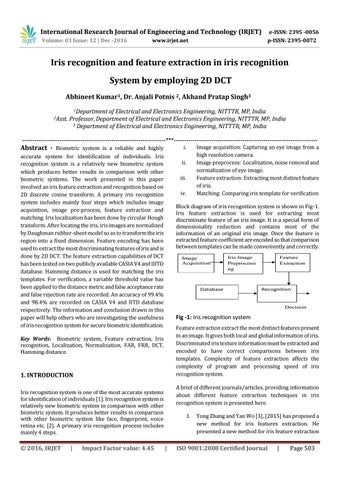
Block diagram of iris recognition system is shown in Fig-1. Iris feature extraction is used for extracting most discriminate feature of an iris image. It is a special form of dimensionality reduction and contains most of the information of an original iris image. Once the feature is extracted feature coefficient are encoded so that comparison between templates can be made conveniently and correctly.
Fig -1: Iris recognition system Feature extraction extract the most distinct features present in an image. It gives both local and global information of iris. Discriminated iris texture information must be extracted and encoded to have correct comparisons between iris templates. Complexity of feature extraction affects the complexity of program and processing speed of iris recognition system.
Key Words: Biometric system, Feature extraction, Iris recognition, Localization, Normalization, FAR, FRR, DCT, Hamming distance.
1. INTRODUCTION
A brief of different journals/articles, providing information about different feature extraction techniques in iris recognition system is presented here.
Iris recognition system is one of the most accurate systems for identification of individuals [1]. Iris recognition system is relatively new biometric system in comparison with other biometric system. It produces better results in comparison with other biometric system like face, fingerprint, voice retina etc. [2]. A primary iris recognition process includes mainly 4 steps.
© 2016, IRJET
|
Impact Factor value: 4.45
Image acquisition: Capturing an eye image from a high resolution camera. Image preprocess: Localization, noise removal and normalization of eye image. Feature extraction: Extracting most distinct feature of iris. Matching: Comparing iris template for verification
1.
|
Yong Zhang and Yan Wo [3], [2015] has proposed a new method for iris features extraction. He presented a new method for iris feature extraction
ISO 9001:2008 Certified Journal
|
Page 503
International Research Journal of Engineering and Technology (IRJET)
e-ISSN: 2395 -0056
Volume: 03 Issue: 12 | Dec -2016
p-ISSN: 2395-0072
www.irjet.net
by using 2D and 1D log Gabor filter. 2D Gabor filter extract phase information as 2D and 1D log Gabor filter extract phase information as 1D. Hamming distance is used for the matching of feature vector. He also proposed Fisher’s linear discriminate (FLD) to evaluate weights of combination. IITD database is used for conducting experiments which has 224 subjects, each subjects contains 10 images .Upon experiment, this method produces satisfactory results as accuracy was 98.921 which is better than 2D and 1D log-Gabor filter alone. 2.
5. In this paper [Amir and Hamid] [7] has developed an iris feature extraction method based on Contourlet transform. The intrinsic geometrical part of iris is taken into consideration and decomposed into a set of directional sub bands. The sub-band with texture information are captured in different orientation at various scales to reduce the direction of feature vector. It extracts only significant bit and information from normalized iris image. The matching of iris template is done by hamming distance. The proposed algorithm has lower accuracy level of 94.2% against Daugman (100%) and Wilde (94.18%).
Charles O Ukpai [4], [2015] has presented a novel approach for iris feature extraction. It is based on principle texture pattern and dual tree complex wavelet transform. The principal direction of the iris texture using principal component analysis is computed and an angle of principal direction is
6. [J. Daugman[1], 2004] used Gabor filter for extracting features of iris images which have different sets of frequencies and different orientations that can be used for extracting useful information from iris images. He demodulated the result produced by convolving the Gabor filter by phase quantization in order to reduce the amount of data that was produced. A biometric template was created by quantizing phase information into four levels. The number of bits used for comparisons was 2048.
obtained. After that complex wavelet filter are constructed which are situated in the direction of principal direction and opposite direction image is decomposed into 12 sub band using dual tree complex wavelet transform. The highest recognition rate of 98.86 % has been achieved by the applied algorithm. 3.
4.
Number of bits required for feature extraction by different algorithm is shown in Table-1.
In his paper [Tze Wang [5], 2010] has used Haar wavelet decomposition method to analyze the pattern of iris. The proposed iris recognition system has two main module which are feature extraction and iris matching. Haar wavelet transform is chosen for computational simplicity in feature extraction. To produce corresponding coefficients, iris images are filtered using high pass filter and low pass filter for four times. The matching distance algorithm used is hamming distance and database is of CASIA. The recognition rate of 98.45% is achieved using this algorithm.
Table -1: Complexity of different algorithms
|
Impact Factor value: 4.45
Feature vector(bits)
2D Gabor
2048
Log-Gabor
1024
Wavelet transform
400
2. RESEARCH METHODOLOGY
[Kshamaraj Gulmire and Sanjay Ganorkar [6], 2012] present the paper “Iris recognition using Gabor wavelet for feature extraction in iris recognition system”. The two dimensional Gabor filter was constructed and the image was filtered. The phase information produced from the filter was encoded into 2048 bits. It is found to be appropriate for texture representation. The iris database used in this research is CASIA iris database. The hamming distance is used for matching purpose.
© 2016, IRJET
Algorithm
Iris recognition system composed of various sub-systems which are localization, normalization, feature extraction and matching of characteristics template as shown in Fig-2. For the purpose of analysis and to increase the iris system performance, the original iris image needs to be preprocessed. The preprocessing steps includes localization and normalization of iris images. It also includes the removal of unwanted noise present in the system. One of the most important pre-processing steps is to isolate the actual iris region from digital image in order to remove all irrelevant
|
ISO 9001:2008 Certified Journal
|
Page 504
International Research Journal of Engineering and Technology (IRJET)
e-ISSN: 2395 -0056
Volume: 03 Issue: 12 | Dec -2016
p-ISSN: 2395-0072
www.irjet.net
parts. After that normalization is employed in order to have fixed dimensions of iris images.
Where
=
The g parameter is thus defined as:
-
Assuming a circle with its center (
4
) and radius r, the
points that fall on the circle result in a zero when evaluated by the function. The problem with Hough transform is that
it require threshold values to be chosen for edge detection which leads to sometimes critical edge-points removal which can result in failure to detect circle/arc. Fig -2: Purposed methodology steps
2.1 Iris Localization Iris localization is one of the most important steps in iris recognition system. It is used for locating the inner and outer boundary of iris. An eye composed of sclera, iris and pupil. Sclera is white in color and is out of iris. Pupil is inside iris and its size changes due to intensity of light falling on it. Iris contains texture information, so there is need to localize the iris and pupil. Some details of iris part such as its location, shape and size must be known for feature extraction technique to be employed effectively. To achieve desired results for localization, circular Hough transform is used. Hough transform [2] is able to determine the parameter of simple geometric objects such as lines and circles present in image. The center coordinates and radius of pupil and iris can be easily found by employing circular Hough transform. The method proposed by Wilde-et-al [8], an edge map as shown in Fig-3 is obtained just by thresholding the image intensity gradients magnitude.
Fig -3: Iris localization
2.2 Normalization
Normalization refers to the transformation of image from Polar Coordinates to Cartesian Coordinates. On having successfully localizing the iris image, the next step is to transform the iris region of eye image in order to have fixed dimensions which is depicted in Fig-4. The fixed dimension iris image allows the feature extraction process to compare the two iris images. There may be the dimensional inconsistencies due to dilation of pupil from changing level of illumination [9, 10]. The other causes of dimensional inconsistence include varying image distance, camera rotation, head tilt and rotation of eye within the eye socket. Thus normalization process is needed to produce same constant dimensions so that two images of same iris under varying condition will have characteristics features at the same spatial locations.
1 Where
And G(x, y) =
2
G(x, y) is a Gaussian function used for smoothing scalar parameter .Taking the obtained edge points as =1, 2......n, a Hough transform can be written as:
H(
© 2016, IRJET
Fig -4: Normalization process on CASIA database image
3
, )=
|
Impact Factor value: 4.45
|
ISO 9001:2008 Certified Journal
|
Page 505
International Research Journal of Engineering and Technology (IRJET)
e-ISSN: 2395 -0056
Volume: 03 Issue: 12 | Dec -2016
p-ISSN: 2395-0072
www.irjet.net
Although there are several algorithms for normalization but here Daugman Rubber Sheet Model [1] has been taken which is shown in Fig-5. The homogeneous rubber sheet model which was devised by Daugman remaps each points inside iris into a pair of polar coordinates (r, ) where r refers for (u, 1) and
the input signal. The higher frequencies are represented by the coefficients present at the end and these generally represent the finer details about the original signal. The remaining coefficients carry other levels of information of the input signal given by:
refers for (u,z).
5
I(x(r, ), y(r, )) With
x
= (1-r)
(
y
= (1-r) (
(
6
( )
7 8
F(u,v)= (u) (v)
Fig -5: Daugman’s rubber sheet model. The reference point taken is the center of pupil and the radial vector pass through iris region. A number of data point has been selected along each radial line which has been termed as radial resolution. The total number of radial lines which are going around the iris region is termed as angular resolution.
Where 9 (u) (v)=
2.3 Feature extraction by employing 2D DCTIn
Where f(x, y) is the intensity of pixel at coordinates (x, y),u varies from 0 to M-1 and v varies from 0 to N-1, where M N
biometric system feature extraction is one of the most important steps in authentication of biometric system. It is the process of extracting feature of desired images from a large collection to be used in selection and classification task. Feature extraction extract the most distinct features present in an image. Discriminated iris texture information must be extracted and encoded to have correct comparisons between iris templates. Complexity of feature extraction affects the complexity of program and processing speed of iris recognition system. In this paper feature extraction has been done by 2D-DCT.The Discrete Cosine Transform (DCT) can be described as a finite sequence of data points which are in terms of summation of cosine functions oscillating at different frequencies. Like other transforms, it also attempts to de-correlate a given signal. After being de-correlated, the transform coefficient are encoded independently in such a way that there is no loss in compression efficiency. The DCT coefficients are reflection of the different frequency components which are present in it. The coefficient at the first place of the DCT refers to the DC component of the signal which is its lowest frequency and most of the time, it carries the maximum of the relevant information present in
© 2016, IRJET
|
Impact Factor value: 4.45
is the size of image. Here the system gets a normalized image which has fixed dimensions. First DCT is applied on entire normalized image in order to extract features. DCT when applied to an image all the low frequency components gets accumulated towards the top corner of DCT spectrum. These low frequency components corresponds to the main distinguishable features of the iris while the high frequency components corresponds to the finer details of the iris. The low frequency components are sufficient in recognition based applications and that is why the components which resides on top left corner of the spectrum are extracted and remaining are discarded. Fig-6 shows image transformation from spatial domain to frequency domain. Working from left to right, top to bottom, DCT is applied to each block. Each block is compressed through quantization. The obtained DCT coefficients are then binaries to form the templates of the images. For binary bits, the value of positive coefficients is assumed one and negative coefficients are discarded. Templates are compared under same nominal size, position, orientation and illumination conditions. The feature vector
|
ISO 9001:2008 Certified Journal
|
Page 506
International Research Journal of Engineering and Technology (IRJET)
e-ISSN: 2395 -0056
Volume: 03 Issue: 12 | Dec -2016
p-ISSN: 2395-0072
www.irjet.net
contains all the low to mid frequency DCT coefficients, having the maximum variance.
contained successfully segmented iris images. The first test was carried in order to find the uniqueness of iris pattern. Since iris recognition relies on iris pattern from different eyes being entirely independent. Failure of a test of statistical independence results in a match. The uniqueness of iris was determined by comparing iris template generated from different eye images. It was then examined by the Hamming distance value produced during comparison. This distribution is called inter class distribution. According to the statistical theory, the mean Hamming distance is 0.5 for inter class distributions. Therefore, half of bits will agree between two iris templates, and half of them will disagree, which results in hamming distance of 0.5.
Fig -6: Image transformation from spatial domain to frequency domain
2.4 Matching The template that is generated in the feature encoding process will also need a corresponding matching metric, which gives a measure of similarity between two iris templates. This metric should give one range of values when comparing templates generated from the same eye, known as intra-class comparisons, and another range of values when comparing templates created from different irises, known as inter-class comparisons. These two cases should give distinct and separate values, so that a decision can be made with high confidence as two templates are from the same iris, or from two different irises. After extraction of features, feature vectors are now compared using a similarity measure. Hamming distance code has been used here in order to compare two iris code. For comparing the two iris patterns X and Y, the hamming distance is defined as the sum of the exclusive-or (XOR) between X and Y over N, the total number of bits present in the bit pattern.
For recognition of individuals, a threshold value of hamming distance must be taken in order to take a decision whether there is a match or not between iris templates. The optimum value taken by Daughman was 0.5. It means if the hamming distance value is less than 0.5, then it is assumed that two iris templates are of same eye. Otherwise if hamming distance value calculated is greater than threshold value then it is considered that two iris templates are of different irises. In this paper three threshold values have been taken and their corresponding results are shown in the Table-3. Table -3: Threshold values and their corresponding FAR and FRR
HD= For an example, a hamming distance of 0.4 means that two iris codes differ by 40%. Here code ‘a’ and code ‘b’ contains seven bits each. Here code ‘a’ and code ‘b’ differs by 2 bits as shown in Table-2 from each other. Hence the hamming distance will be (2÷7) which is 0.28.
3. RESULT ANALYSIS
Impact Factor value: 4.45
FRR
0.45
0.1025
0.285
0.55
0.1410
0.142
0.65
0.1538
0.138
3.1 Result of DCT approach
It was very difficult to use all the eye images from each database as it contains lots of eye images in each database. Instead a subset of each database was selected, which
|
FAR
With a threshold value, a decision can be made as whether two iris templates were created from different irises (mismatch) or whether they were created from same iris (match). But the inter class and intra class distributions may have some overlap which could results in incorrect matches or false acceptance. It is also possible that it would results in false rejection. Thus the threshold value will influence the false acceptance and false rejection rate. A lower threshold value will decrease false acceptance rate while it increases the false rejection rate and vice versa. Therefore, when choosing a threshold value it is important to consider both the false reject rate and false accept rate.
Table -2: Calculation of hamming distance
© 2016, IRJET
Threshold value
DCT is highly used in image compression and signal analysis due to its “energy compaction” property. It thus compresses
|
ISO 9001:2008 Certified Journal
|
Page 507
International Research Journal of Engineering and Technology (IRJET)
e-ISSN: 2395 -0056
Volume: 03 Issue: 12 | Dec -2016
p-ISSN: 2395-0072
www.irjet.net
3.2 Comparison with existing algorithms
the signal in some reduced coefficients. Thus. DCT has been used here for feature extraction process. DCT gives both low and high frequency components but low frequency components were taken and high frequency components were discarded. This is because most of the information of the signal lies in the low frequency components. Thus it helped in reducing feature vector length. DCT approach is applied on both CASIA [11] and IITD [12] database and very encouraging results have been found by this approach. To evaluate our method, it was applied first on CASIA database on 50 classes (eyes) and then to 20 classes on IITD database. The result obtained by this approach as shown in Table-4 was very encouraging.
The performance analysis of iris recognition system is based on FAR, FRR, ERR, recognition rates and number of coefficients requirement for matching iris templates. Comparison of this novel approach has been made with other existing algorithms of feature extraction in iris recognition system. Table-6 shows the comparison of recognition rate of various algorithm and our approach. Table -6: Different algorithms and their recognition rates
Table -4: DCT results
Researcher
Algorithm
Year
Recognition rate(in percentage)
S.Hariprasd and S.Venkatsubramian
Wavelet packet
2012
93
Charles O Ukpai
Dual tree complex wavelet transform
2015
98.86
Proposed method
2D DCT
Hamming distance value
0.5
FAR
0.19
Tze Wang
Haar wavelet
2010
98.45
FRR
0.26
Yong Zhang and Yan Wo
2013
98.92
Recognition rate
99.4
Fusion of 2D Gabor and 1DlogGabour
EER
0.1
Amir and Hamid
Contourlet transform
2009
94.2
Mah Mond Elgana and Nasser Al Biqami
Wavelet transform
2013
99.5
Kshamaraj Gulmire and Sanjay Ganorkar
Gabor wavelet
2012
99
J.Daugman
Gabor filter
2004
100
Hui Lui
2D log Gabor
2010
98.5
Viaden Velisaulesevic Pravin S Patil
Directionlets
2009
97.4
Log Gabor
2012
98.4
Chia Te Chu
LPCC
2005
96.8
Mohd. Tariq
1D Gabor
2013
99
Libor Masek
1D Log Gabor
2003
98.5
Ankush Kumar
1D Wavelet
2013
97.5
Proposed method
2D DCT
2016
99.4
Both identification and verification test were carried out. All the comparisons at feature extraction level were carried out on the same set of normalized iris images in order to achieve a fair comparison. The number of DCT coefficients used and their recognition rates are enlisted in the Table-5. It can be seen that DCT approach uses very less number of coefficients without much affecting the accuracy. Thus it increases the response of the iris recognition system. Thus the computational complexity is very much reduced by employing DCT approach. Table -5: Result analysis on different databases Database
Proposed DCT
Threshold value
Number of bits
CRR
ERR
CASIA
99.40
0.10
0.5
120
IITD
98.46
0.17
0.5
120
© 2016, IRJET
|
Impact Factor value: 4.45
|
ISO 9001:2008 Certified Journal
|
Page 508
International Research Journal of Engineering and Technology (IRJET)
e-ISSN: 2395 -0056
Volume: 03 Issue: 12 | Dec -2016
p-ISSN: 2395-0072
www.irjet.net
REFERENCES
Table -7: Different algorithms and their corresponding feature vector length
[1] Algorithm
Feature vector(bits)
Daugman, “How iris recognition works, ” IEEE Transactions On Circuits and Systems for Video Technology”. Vol. 14, No. 1, pp. 21-30, January 2004.
2D Gabor
2048
Log-Gabor
1024
by a test of statistical independence," IEEE transactions
Wavelet transform
700
on Pattern Analysis and Machine Intelligence, Vol. 15,
Directionlets
1042
1D Gabor
2048
DCT
225
[2]
Daugman,"High confidence visual recognition of persons
No. II, pp. 1148-1161, 1993. [3]
Yong Zhang, yan wo, “A fusion iris feature extraction based on linear discriminant”. IEEE Proceedings of the 2013 International Conference on Machine Learning and
It can be seen from the table that the Doughman approach gives higher recognition rates than any other existing algorithms. It produces 100% recognition rate. But Daugman approach has comparatively lower speed than any other existing algorithms. It used large number of bits for comparison of two iris templates. Table 7 shows number of bits used by different algorithms in feature extraction process.
Cybernetics, Tianjin, 14-17 July, pp 5-9, 2013 [4]
Charles O Ukpai, Prof. S.S Dlay,Dr. Wl. Woo, “Iris feature extraction using principally rotated complex wavelet filter”. IEEE International Conference on Computer Vision and Image Analysis Applications, Print ISBN: 978-1-4799-7185-5, 2015.
CONCLUSION AND FUTURE WORK
[5]
Tze Weng Ng, Thien Lang Tay, SiakWang Khor, “Iris recognition using rapid haar wavelet decomposition”.
The iris recognition system that was developed proved to be a highly accurate and efficient system that can be used for biometric identification. This paper again proved that iris recognition is one of the most reliable methods available today in the biometrics field. The accuracy achieved by employing 2D DCT as a feature extraction technique is very good and helped in reducing the feature vector length. It thus improved the speed response of iris recognition system. The applications of the iris recognition system are innumerable and have already been deployed at a large number of places that require security or access control. The system in this paper was able to perform very accurate results, however there are still number of issues which need to be addressed. The feature extraction in this paper were done on cooperative iris database. It needs to be applied on noncooperative databases in order to see how it performs on these databases. Other issues includes iris on the move and iris at a distance. These databases only includes stationary eye images and the distance between the camera and iris was less than 50m. So these factors needs to be addressed in near future.
IEEE 2nd international conference on signal processing system, 5-7 , vol.1 , Issue 6, pp. 234-238, july 2010. [6]
Kshamaraj Gulmire, Sanjay Ganorkar, “Iris Recognition Using Gabor Wavelet”. International Journal of Engineering Research & Technology (IJERT) Vol. 1, Issue 5, pp. 1-5, July –2012.
[7]
Amir Azizi, Hamid Reza Pourreza, “Efficient iris recognition through improvement of feature extraction and subset selection”, International journal of computer science and information security,Vol.2 ,No.1, pp. 6-16, 2009.
[8]
Mahmoud Elgamal,Nasser Al- Biqami, “An efficient feature extraction method for iris recognition based on wavelet transformation”.
International journal of
computer and information technology, Vol.02, Issue 03, pp. 445-450, 2013.
© 2016, IRJET
|
Impact Factor value: 4.45
|
ISO 9001:2008 Certified Journal
|
Page 509
[9]
International Research Journal of Engineering and Technology (IRJET)
e-ISSN: 2395 -0056
Volume: 03 Issue: 12 | Dec -2016
p-ISSN: 2395-0072
www.irjet.net
R. Wildes, J. Asmuth, G. Green, S. Hsu, R. Kolczynski, J.
iris databases”. IEEE International conference on
Matey, S. McBride, “ A system for automated iris
contemporary computing, pp. 445-450, 2013.
recognition”.
Proceedings
IEEE
Workshop
on
[19]
Applications of Computer Vision, Sarasota, FL, pp. 121-
biometric”, Department of Computer Science and
128, 1994. [10]
Engineering, National Institute of Technology Rourkela
W. Boles, B. Boashash, “A human identification technique
2013.
using images of the iris and wavelet transform”. IEEE
[20]
Transactions on Signal Processing, Vol. 46, No. 4, pp.
The school of Computer Science and Software
CASIA-Database.
Engineering, The University of Western Australia, 2003.
http://www.cbsr.ia.ac.cn/english/IrisDatabase.asp. [12]
[13]
[14]
Masek L, Kovesi P, “MATLAB source code for a Biometric Identification System Based on Iris Patterns”,
1185-1188, 1998. [11]
Ankush Kumar, “Development of novel feature for iris
[21]
Choras, R.S., (2007). “Image feature extraction techniques
Database of Indian Institute of Technology Delhi.
and their applications for CBIR and Biometrics Systems”.
http://www.comp.polyu.edu.hk/~csajaykr/IITD/Data
International journal of biology and biomedical
base_Iris.htm.
engineering 1(1), pp. 6 – 16, 2007.
S Hariprasad and S Venkatsubramamian, “Iris feature
[22]
Suganthy M. and Ramamoorthy P., “Principal component
extraction and recognition using wavelet packet analysis”
analysis based feature extraction, morphological edge
IEEE International conference on signal and image
detection and localization for fast iris recognition”.
processing, ISBN: 978-1-4244-8595-66, 15-17 Dec. 2010.
Journal of Computer science. 8(9), pp.1428 - 1433, 2012.
Hui Lui and Jing Shang, “An improved algorithm for iris feature extraction”, IEEE international conference on intelligent computing and intelligent system, Vol.4, No. 2, pp. 6-16, 29-31 Oct. 2010.
[15]
Viaden Velisavljevic, “Low complexity iris coding and recognition based on directionlets”. IEEE transaction on information forensic and security, Vol. 4, Issue 3, pp. 410417, 2009.
[16]
Pravin S.Patil, “Iris recognition based on Gaussian hermite moments”. International journal on computer science and engineering,Vol. 4, No. 11, pp. 1794-1803, Nov. 2012.
[17]
Chia Te Chu, “High performance iris recognition based on LDA and LPCC”. 17th IEEE International conference on tools and artificial intelligence, Vol. 2, No.3, pp.234-242, 14-16 Nov. 2009.
[18]
Mohd. Tariq khan, Deepak Arora, “Feature extraction through iris images using 1D log gabour filter on different
© 2016, IRJET
|
Impact Factor value: 4.45
|
ISO 9001:2008 Certified Journal
|
Page 510