International Research Journal of Engineering and Technology (IRJET)
e-ISSN: 2395 -0056
Volume: 03 Issue: 12 | Dec -2016
p-ISSN: 2395-0072
www.irjet.net
IoT Based Smart Garbage Detection System Abhishek Dev, Maneesh Jasrotia, Muzammil Nadaf, Rushabh Shah Student Member, Dept. Of Computer Engineering, KJ College Of Engineering, Pune, India. ---------------------------------------------------------------------***---------------------------------------------------------------------
Abstract - Owing to a paradigm shift toward Internet of
Things (IoT), researches into IoT services have been conducted in a wide range of fields. As a major application field of IoT, waste management has become one such issue. The absence of efficient waste management has caused serious environmental problems and cost issues. We here propose a probable solution to this problem for urban cities. Using IoT technologies for waste management is one probable solution that we have proposed through our work. We explain our idea with the help of a simulation model. This model consists of an Arduino controller, a few garbage bins loaded with sensors and they are monitored continuously through a web. This system also has a scope for citizen participation, wherein any grievances from citizens related to waste management is heard.
3. MOTIVATION Pune city's current waste [10] collection logistics is carried out by emptying containers according to predefined schedules and routes which are repeated at a set frequency. Such a System has major disadvantages:
Key Words: Ultrasonic sensors, Web portal, Arduino, IoT, Cloud Services, Login.
A.
Time consuming:
B.
High costs
1. INTRODUCTION
C.
Greater traffic and congestion.
Internet of Things is nothing but the applications performing with the help of internet access. Its an advanced domain of technology in which all your data is stored on the cloud with real time quick access to data as well as its data mining. While the data is stored on the cloud and people having the internet access, will provide a great access to people on the same application from anywhere in and around the world. Such advancement also equips sensors and routers for gathering and sending data across the internet. Such a domain can be used in all sorts of Pervasive Computing, and Business Intelligence applications. This paper introduces you to the use of IoT on one such area, that is, Garbage Detection in smart ways using IoT and see how this can also be a major part of developing a city into a smart city.
D. Unnecessary fuel consumption. E.
Increased noise and air pollution as a result of more trucks on the road [4]. All the above disadvantages are a result of lack of real time information resulting in unsuccessful collection of waste. The Pune Municipal itself finds this as a big problem and a big hurdle in between Pune’s Smart City [3] initiative. There is an urgent need to optimize the management of this service to reduce infrastructure, operating and maintenance costs, as well as reduce contamination directly associated with waste collection.
2. OVERVIEW OF THE TITLE The basic project idea is to design a smart waste detection system which would automatically notify the officials about the current status of various garbage bins in the city, would have real-time monitoring capabilities, which would be remotely controlled using IoT techniques.
© 2016, IRJET
|
Impact Factor value: 4.45
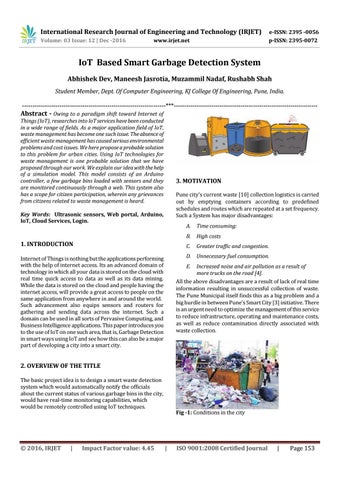
Fig -1: Conditions in the city
|
ISO 9001:2008 Certified Journal
|
Page 153
International Research Journal of Engineering and Technology (IRJET)
e-ISSN: 2395 -0056
Volume: 03 Issue: 12 | Dec -2016
p-ISSN: 2395-0072
www.irjet.net
4. LITERATURE SURVEY
city which is big enough to have problems regarding to waste management.
The idea of smart garbage bins and systems have been in discussion for quite a long time. The technologies used at disposal to develop this smart system have also evolved, i.e. from WSNs to RFIDs to now the most popular Internet of Things (IoT). Each idea seems to be similar but is slightly different at its core and our proposed work is no exception from the same. After the IoT field, finding its hold in our lives, this is our original plan for designing a smart garbage collection system which has provision for citizen participation and analysis of data for better decision making. At hardware level, the smart system is a garbage bin with ultrasonic sensor, a micro-controller and Wi-Fi module for transmission of data. The worldwide implementation of Internet of Things is possible with a Cloud centric vision [1]. This work exploits the future possibilities, key technologies and application that are likely to drive IoT research. But a strong foundation to our work is provided, where the basics and applications of Arduino board is explained [5]. It is quite interesting as it implements a GAYT (Get As You Throw) system concept as a way to encourage recycling among citizens [6]. As we would discuss further, the citizen participation part of our system is quite influenced by their work.
5. PROPOSED WORK Fig -2: Process Layout
The main objective of our project involves applying IoT technology (electronics and applications) to the current urban waste management scenario and enables a two way communication between the infrastructures deployed in the city and the operators/administrators. A centralized system for real-time monitoring is our goal to achieve. In this way both the municipal and citizens benefit from an optimized system which results in major cost savings and less urban pollution.
7. PROPOSED APPLICATIONS 1. 2. 3. 4. 5.
6. PROCESS 1. The system would be dealing with two types of users, i.e an official/operator/administrator with privileged rights and a citizen with limited rights.
6.
2. The user's only way to interact with the system is the web portal.
7.
3. An operator user may have rights like checking status of all bins, deploying collection vehicles and generating data analysis report. Whereas a citizen user may only have the right to check the bin status of his locality and register a complaint if any related with to the system.
8. COMPONENTS AND COMPATIBILITY
4. The scope of our project is not restricted to any particular geographic area as long as it has the required IoT infrastructure. This work of ours can be implemented in any
© 2016, IRJET
|
Impact Factor value: 4.45
Waste Level detection inside the garbage bins. Transmission of the information wirelessly to concerned officials [9]. System can be accessed anytime and from anywhere. Real-time data transmission and access. Avoids the overflows of garbage bins. This project can only be used by municipal authorities or other private firms to tackle the current problem of urban waste collection. This system has no individual use, but can be used by a city, state or a country. Using this system, waste collection would become efficient and also reduction in transportation costs can be witnessed.
For small scale simulation purposes we need the following hardware components –
|
ISO 9001:2008 Certified Journal
|
Page 154
International Research Journal of Engineering and Technology (IRJET)
e-ISSN: 2395 -0056
Volume: 03 Issue: 12 | Dec -2016
p-ISSN: 2395-0072
www.irjet.net
1. Arduino Mega 2560 R3 board. “Arduino is an open-source electronics prototyping platform based on flexible, easy-to-use hardware and software. It’s intended for artists, designers, hobbyists, and anyone interested in creating interactive objects or environments” [2].
all in all, an Iot Concept based software project with electronic devices used, is the one that will be a great service to the world and make it a better place to live in, to some extent.
REFERENCES
2. Four SR04 Ultrasonic Sensors. One of the advantages of ultrasonic sensing is its outstanding capability to probe inside objectives non-destructively as ultrasound can propagate through any kinds of media including solids, liquids and gases except vacuum. In typical ultrasonic sensing the ultrasonic waves are travelling in a medium and often focused on evaluating objects.[1] 3.
A WiFi module - Rees52 Arduino Compatible Esp8266 Serial Esp-01 Wifi Wireless Transceiver Module.
4.
Other necessary wires and PBCs.
[1] Ikuo Ihara; Nagaoka University of Technology; Ultrasonic Sensing: Fundamentals and Its Applications to Nondestructive Evaluation. [2] Arduino, “Available at http://www.arduino.cc,” 2010. [3] M. Batty, “Smart Cities, Big Data,” Environment and Planning B: Planning and Design 2012, vol. 39, pp. 191–93. [4] Xu Li, Student Member, IEEE, Performance Evaluation of Vehicle-Based Mobile Sensor Networks for Traffic Monitoring.
Platforms: 5.
Operating System: Windows XP and above, Linux(Kernel version- 3.01 and above), Mac OS X.
6.
Browser: IE(v10+), Chrome(v35+).
7.
Programming Language: JS enabled in browser.
Opera,
[5] Yusuf Abdullahi Badamasi, The Working Principle Of An Arduino, Electronics, Computer and Computation (ICECCO), 2014 11th International Conference on 29 Sept.-1 Oct. 2014.
Firefox(v40+),
[6] Pedro Reis , Rui Pitarma, Celistino Goncalves, Intelligent System for Valorizing Solid Urban Waste, Filipe Caetano Faculty of Engineering UBI University of Beira Interior Covilha, Portugal, 2015.
9. CONCLUSION
[7] Adnan Aijaz, Member, IEEE; Cognitive Machine-toMachine Communications for Internet-of-Things: A Protocol Stack Perspective
This implementation of Smart Garbage Collection System using IoT, assures the cleaning of dustbins soon when the garbage level reaches its maximum. If the dustbin is not cleaned in specific time, then the record is sent to the higher authority who can take appropriate action against the concerned official. This system also helps to monitor the fake reports and hence can reduce the corruption in the overall management system. This reduces the total number of trips of garbage collection vehicle and hence reduces the overall expenditure associated with the garbage collection. It is ultimately helps to keep cleanliness in the society. This is quite a significant project in its originality and concept. We are using Internet of Things theory which gives this project its charisma and uniqueness about the concept. The project aims at cleanliness of the areas where trash bins are located and the very basic management that it contains with it. It aims at advanced management of the whole garbage collection system. We use ultrasonic sensors (details mentioned above) and its other hardware microcontrollers and processors such as Arduino for analyzing the garbage levels and sending information about it to administrators and then garbage trucks are being deployed by them. Another very important aspect of our project is the web portal that is designed in such a way that operators and citizens both will find it user friendly to monitor the garbage information of various places (as discussed above). Hence,
© 2016, IRJET
|
Impact Factor value: 4.45
[8] IEEE; INTERNET OF THINGS JOURNAL. [9] Dr. K.G. Srinivasa Head of the Department; Department of Computer Science; M S Ramaiah Institute of Technology Bangalore, India; ParaSense - A Sensor Integrated Cloud based Internet of things Prototype for Real Time Monitoring Applications. [10] Ni-Bin Chang, Smart and Green Urban Solid Waste Collection Systems: Advances, Challenges, and Perspectives.
|
ISO 9001:2008 Certified Journal
|
Page 155