FAITH IN ACTION: The Story of The Dorothea Project
BY LAUREN WINTER
When I first learned about The Dorothea Project, it wasn’t through an organization or campaign—it was through a Facebook post. Katie Holler wrote about how she wanted to live her faith in defense of all people and communities. She wanted dignity and justice. She wanted peace.
Those words stayed with me. I didn’t know exactly what to expect when I clicked the Zoom link she shared, but I knew I’d find other Catholic women who felt that same tug— who wanted to live their faith boldly and beautifully in a world that felt increasingly fractured.
That first meeting had maybe a dozen of us. We were cautious but hopeful, unsure what this would become but certain the Holy Spirit was doing something new.
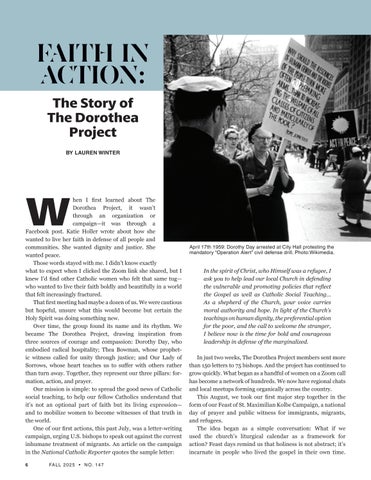
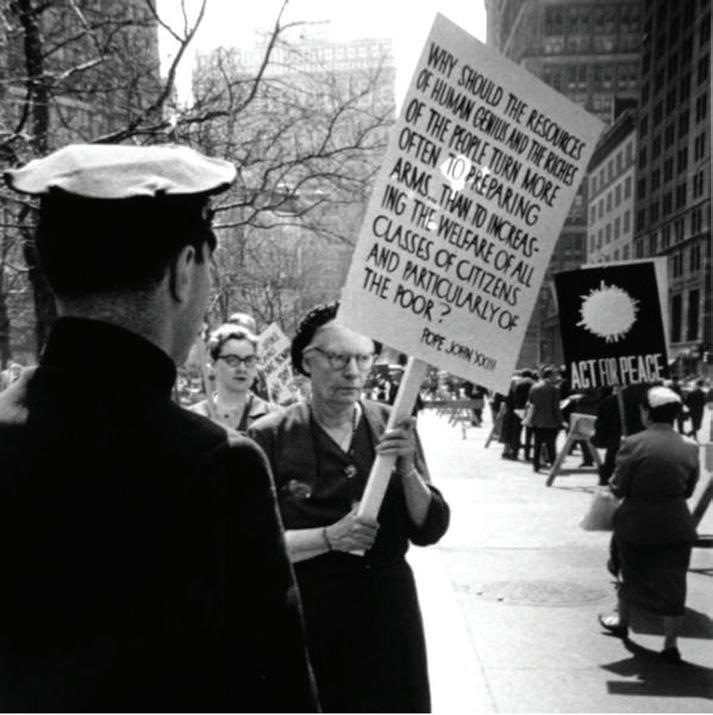
Over time, the group found its name and its rhythm. We became The Dorothea Project, drawing inspiration from three sources of courage and compassion: Dorothy Day, who embodied radical hospitality; Thea Bowman, whose prophetic witness called for unity through justice; and Our Lady of Sorrows, whose heart teaches us to suffer with others rather than turn away. Together, they represent our three pillars: formation, action, and prayer.
Our mission is simple: to spread the good news of Catholic social teaching, to help our fellow Catholics understand that it’s not an optional part of faith but its living expression— and to mobilize women to become witnesses of that truth in the world.
One of our first actions, this past July, was a letter-writing campaign, urging U.S. bishops to speak out against the current inhumane treatment of migrants. An article on the campaign in the National Catholic Reporter quotes the sample letter:
In the spirit of Christ, who Himself was a refugee, I ask you to help lead our local Church in defending the vulnerable and promoting policies that reflect the Gospel as well as Catholic Social Teaching… As a shepherd of the Church, your voice carries moral authority and hope. In light of the Church’s teachings on human dignity, the preferential option for the poor, and the call to welcome the stranger, I believe now is the time for bold and courageous leadership in defense of the marginalized.
In just two weeks, The Dorothea Project members sent more than 150 letters to 75 bishops. And the project has continued to grow quickly. What began as a handful of women on a Zoom call has become a network of hundreds. We now have regional chats and local meetups forming organically across the country.
This August, we took our first major step together in the form of our Feast of St. Maximilian Kolbe Campaign, a national day of prayer and public witness for immigrants, migrants, and refugees.
The idea began as a simple conversation: What if we used the church’s liturgical calendar as a framework for action? Feast days remind us that holiness is not abstract; it’s incarnate in people who lived the gospel in their own time.
They give us spiritual and practical anchors around which the faithful can rally.
We chose St. Maximilian Kolbe for our first campaign, because his life so powerfully reflects the heart of Catholic social teaching. Imprisoned at Auschwitz, Kolbe offered his life in exchange for another man’s, choosing love over selfpreservation. His witness reveals that every life, no matter how forgotten, has infinite value.
In that same spirit, we dedicated his feast day, August 14, to prayer and advocacy for immigrants and detainees—those often treated as disposable in our world today.
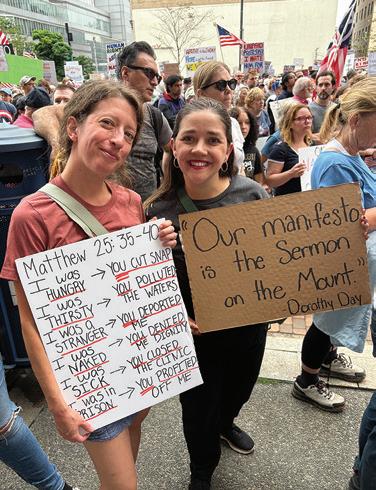
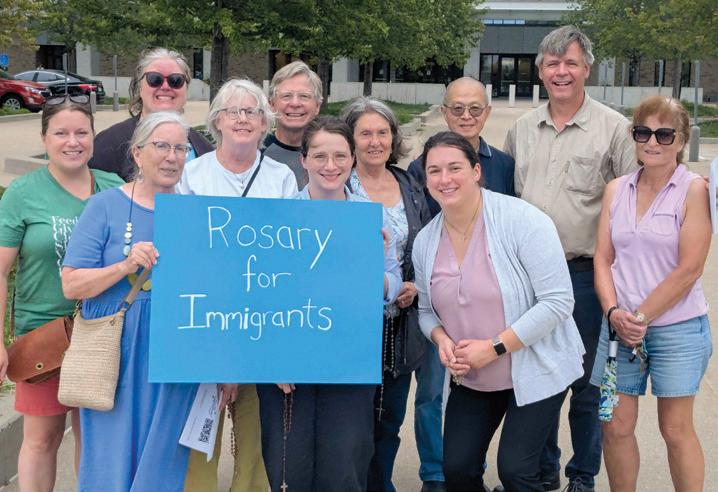
Our campaign invited women across the country to unite in prayer, fasting, and concrete action. We asked them to pray the rosary for immigrants and refugees, to write to their bishops and representatives, and to participate in public witnesses outside courthouses, detention centers, and parish grounds. Some gathered in small groups; others stood alone. But in every case, they stood as Catholics who refuse to look away.
One of the most impactful parts of the campaign was encouraging members to email their parish priests, asking them to speak on immigration from the pulpit and to shepherd and guide the faithful on this urgent moral issue.
The response was extraordinary. Women prayed more than 300 rosaries across the United States. They held public witnesses in Pennsylvania, Michigan, Florida, Minnesota, California, and Washington, D.C. In many cases, these were the first public Catholic actions for immigrant justice in those local communities.
The day wasn’t about numbers; it was about courage, unity, and fidelity. It showed us that Catholic women—often underestimated—can be a prophetic voice in the church when we act together.
The campaign also reminded us what the Dorothea Project is working toward in the long term: bringing Catholic social teaching to life as a grassroots effort on the parish and diocesan level through formation, prayer, and courageous public witness.
Some women involved in the Project are drawn to the theological side—studying encyclicals and papal documents—while others feel called to outreach, organizing, or intercessory prayer. But all of us share the same conviction: that fidelity to Christ means defending the dignity of every human person.
At its heart, The Dorothea Project is about accompaniment. It’s women encouraging women to stand firm in faith, to speak truth with charity, and to bring the church’s social teaching to life in their own communities.
The Maximilian Kolbe campaign reminded us that transformation begins small—a few people, a shared prayer, a spark of faith. But as those sparks gather, they can light something much larger.
The Dorothea Project began with a Facebook post and a dozen women on a Zoom call. Now, it’s hundreds of Catholic women across the country praying, organizing, learning, and acting in fidelity to Christ.
Our work is still humble, still forming. But we believe that when the church’s social teaching is lived out fully—with intellect, with courage, and with love—it has the power to renew the world.
The gospel was never meant to stay in our hearts. It’s meant to be carried into the streets.
Lauren Winter is a Catholic mom, small-business owner, and organizer with The Dorothea Project. She is passionate about equipping Catholic women to live out the church’s social teaching with clarity, courage, and hope.