Visible Signs of a God Whose Love Knows No Exclusion
BY ANNA ROBERTSON

In Luke’s gospel, we have a story about the wideness of God’s mercy. Traveling near the border of Samaria and Galilee, Jesus is approached by a group of lepers asking for healing. In ancient Israel, lepers were the lowest of the low, relegated by their communities to lives of squalor, suffering, and exclusion. Any of Jesus’ contemporaries hearing this story would have heard “leper” and thought “outcast.” In healing them, Jesus was not only relieving them of a physical affliction; he was restoring them to belonging in the community.
Lest the gospel writer’s audience miss the memo, he reiterates his point about God’s expansive love by telling us that the only one of the 10 lepers who stopped to thank Jesus was a Samaritan. We recall here an earlier parable in Luke’s gospel, where the only person to offer mercy to a man waylaid by the side of a dangerous road was also a Samaritan. In Jesus’ day, the enmity between neighboring Samaritans and Judeans was at a fever pitch. Just as any ancient listener would have heard “leper” and thought “outcast,” they would have heard “Samaritan” and thought “enemy.” And yet, twice the author of the Gospel of Luke lifts up a despised Samaritan as the model Jesus-follower, first demonstrating mercy in the parable of the Good Samaritan and now exemplifying thanksgiving in today’s gospel. These outsiders and enemies are not only the recipients of Christ’s love but model disciples, signs of the very love they have received.
Earlier this month, I participated in a pilgrimage that ended at Tacoma’s Northwest Detention Center, one of the largest immigrant prisons in the United States. There, outside the chain-link fence that surrounds the for-profit prison, Auxiliary Bishop of Seattle Eusebio Elizondo presided over a Mass for several hundred Catholics and people of goodwill. Our witness offered a visible sign of the church’s solidarity with migrants at a time when they have been relegated to the status of the leprous Samaritan—reviled, scapegoated, excluded, and dehumanized. This is what the church is meant to be: a visible sign of a God whose love knows no exclusion. Just as the gospel writer, by featuring a protagonist who was not only a leper but a Samaritan, refused to let their listeners off the hook, so we should refuse to let each other off the hook when we seek to claim God’s preferential love for ourselves or to cast others outside its scope.
Reflection questions:
n What might it look like for you to move your church or community toward being a “visible sign of a God whose love knows no exclusion”—particularly in light of the villainization of and violence directed at migrants in the United States today?
n How can you practice a life marked by mercy and thanksgiving, as the Samaritans of Luke’s gospel model?
n What groups of people do you revile, exclude, scapegoat, or vilify? Ask for the grace to be healed of your hatred and restored to belonging in Christ’s love.
SOURCE: Ignatian Solidarity Network’s “Rise Up” reflection series, https://ignatian solidarity.net/blog/2025/10/13/visible-signs-of-a-god-whose-love-knows-no-exclusion/.
LOOKING BACK
Sacred Salmon Pilgrimages
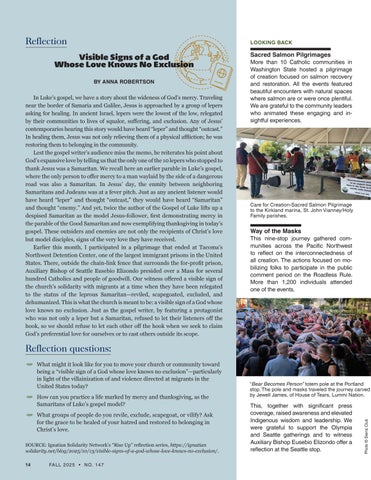
More than 10 Catholic communities in Washington State hosted a pilgrimage of creation focused on salmon recovery and restoration. All the events featured beautiful encounters with natural spaces where salmon are or were once plentiful. We are grateful to the community leaders who animated these engaging and insightful experiences.
Way of the Masks
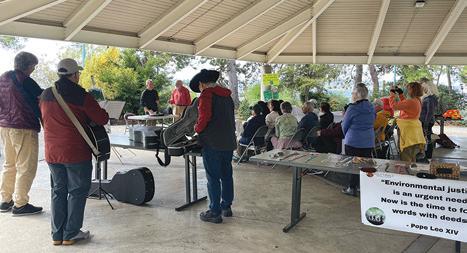
This nine-stop journey gathered communities across the Pacific Northwest to reflect on the interconnectedness of all creation. The actions focused on mobilizing folks to participate in the public comment period on the Roadless Rule. More than 1,200 individuals attended one of the events.
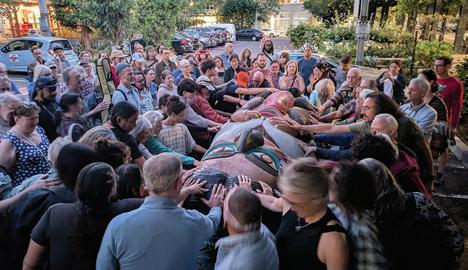
This, together with significant press coverage, raised awareness and elevated Indigenous wisdom and leadership. We were grateful to support the Olympia and Seattle gatherings and to witness Auxiliary Bishop Eusebio Elizondo offer a reflection at the Seattle stop.