GE T
NASA’s GRX-810: The story of an oxide-dispersionstrengthened superalloy designed for AM In high-temperature propulsion applications, it is materials that set the boundaries of what is possible. Additive Manufacturing may have changed how we build components, but it hasn’t necessarily changed what extremes these components can endure in service. NASA’s GRX-810 oxide-dispersionstrengthened superalloy tackles that constraint head-on: a high-temperature alloy designed, unlike legacy alloys, specifically for AM. Here, NASA’s Tim Smith and Paul Gradl explain how GRX-810 was developed, what has been demonstrated to date, and the pathway to commercial success.
Throughout history, major leaps in civilisation often trace back to breakthroughs in materials and manufacturing. Entire eras were even named after the metals that defined them: the Bronze Age, when humans mastered metalworking and established long-distance trade networks, and the Iron Age, when abundant iron and practical tools laid the groundwork for technological progress. Centuries of experimentation and refinement eventually transformed iron into steel, and later led to the advanced alloys and composites that define modern industry and made our technological advances possible. Materials have propelled us beyond Earth, too – aluminium alloys, titanium, refractory metals, and superalloys made it possible for humans to break free of low Earth orbit and walk on the Moon. Even today, advances in batteries, supercapacitors, and other modern materials drive the electronics that power our daily lives. Interestingly, materials and manufacturing innovation often isn’t the main goal – it emerges from larger missions, with
Vol. 11 No. 4 © 2025 Inovar Communications Ltd
manufacturing and materials development forming a circular, symbiotic cycle: new applications demand new materials, and new materials unlock new applications.
The advent of Additive Manufacturing was widely hailed as a revolutionary pathway, capable of producing complex component shapes that conventional processes could not
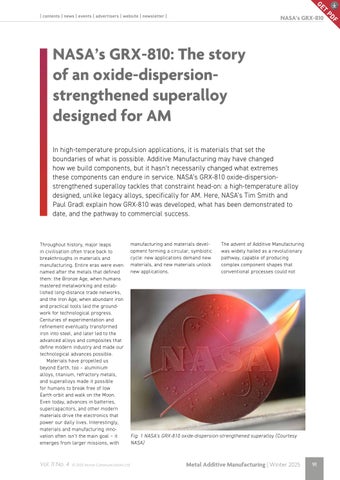
Fig. 1 NASA’s GRX-810 oxide-dispersion-strengthened superalloy (Courtesy NASA)
Metal Additive Manufacturing | Winter 2025
91
F
NASA’s GRX-810
PD
| contents | news | events | advertisers | website | newsletter |