Vol. 11 No. 4 WINTER 2025
THE MAGAZINE FOR THE METAL ADDITIVE MANUFACTURING INDUSTRY
METAL AM
TAKING THE HEAT: NASA ON GRX-810 EOS M4 ONYX | JEWELLERY FOCUS SUPPORT REMOVAL | SIMULATING LARGE PARTS Published by Inovar Communications Ltd
www.metal-am.com
GE T
Group News Editor & Director Paul Whittaker, paul@inovar-communications.com Advertising Sales Director Jon Craxford Tel: +44 (0)207 1939 749 jon@inovar-communications.com News Editors Charlie Hopson-VandenBos, charlie@inovar-communications.com Amelia Gregory, amelia@inovar-communications.com Features Editor Emma Lawn, emma@inovar-communications.com Technical Consultant Dr Martin McMahon Marketing Lead Mulltisa Moung, mulltisa@inovar-communications.com Production Manager Hugo Ribeiro, hugo@inovar-communications.com Operations & Partnerships Manager Merryl Le Roux, merryl@inovar-communications.com Office & Accounts Manager Jo Sheffield, jo@inovar-communications.com SUBSCRIPTIONS
Metal Additive Manufacturing is published on a quarterly basis as either a free digital publication or via a paid print subscription. The annual print subscription charge for four issues is £175.00 including shipping. Rates in € and US$ are available on application. ACCURACY OF CONTENTS
Whilst every effort has been made to ensure the accuracy of the information in this publication, the publisher accepts no responsibility for errors or omissions or for any consequences arising there from. Inovar Communications Ltd cannot be held responsible for views or claims expressed by contributors or advertisers, which are not necessarily those of the publisher. ADVERTISEMENTS
Although all advertising material is expected to conform to ethical standards, inclusion in this publication does not constitute a guarantee or endorsement of the quality or value of products or of the claims made by its manufacturer. REPRODUCTION, STORAGE AND USAGE
Single photocopies of articles may be made for personal use in accordance with national copyright laws. All rights reserved. Except as outlined above, no part of this publication may be reproduced, modified or extracted in any form or by any means without prior permission of the publisher and copyright owner.
Formnext’s 10th anniversary – and a change in the air This year’s 10 th anniversary edition of Formnext, the leading international exhibition for the global Additive Manufacturing community, was always going to be a big deal. Since the inaugural event a decade ago, it has served as a bellwether for the industry. This year, that role felt more pronounced than ever. Between the turmoil driven by US tariffs and broader political uncertainty, the collapse and withdrawal of several high-profile firms, and the dawning realisation that past growth predictions would not be realised in the expected time frame, it has been a tough year for the industry. There was a palpable sense of nervousness on the show’s opening day. Even before the doors had opened, we were aware of a number of companies that had chosen not to attend, driven by tightened budgets or a belief that end-user markets might not yet be ready to invest in AM. For those of us on the ground, the bigger question was simple: how many visitors would turn up? Put another way, just how hungry is the world for Additive Manufacturing? Thankfully, visitors came – and in record-breaking numbers. By the end of day two, the anxiety among exhibitors (and, no doubt, the organisers) had lifted. As one prominent industry figure optimistically pronounced when passing, “The wind has changed...” It is therefore not overly optimistic to suggest that things are looking up for the metal Additive Manufacturing industry. It was also fitting (and surely not purely coincidental) that on the opening day of the industry’s biggest show, Apple lifted the lid in more detail than we could ever have hoped for on its use of metal AM. In terms of marketing the technology to the wider world, it was the best possible gift – and a powerful signal that, the wind has indeed changed. Nick Williams Managing Director
DESIGN AND PRODUCTION
Inovar Communications Ltd ISSN: 2057-3014 (PRINT) ISSN: 2055-7183 (ONLINE) www.metal-am.com © 2025 Inovar Communications Ltd
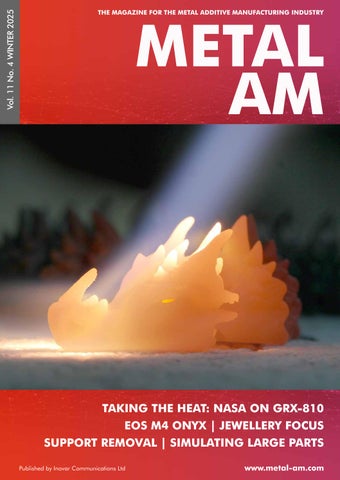
Cover image This glowing hot GRX-810 dragon’s head illustrates the hot, oxidising environment that injectors and combustor domes have to endure (Courtesy NASA)
Metal Additive Manufacturing | Winter 2025
3
F
Managing Director & Editor Nick Williams, nick@inovar-communications.com
METAL ADDITIVE MANUFACTURING MAGAZINE
PD
PUBLISHER & CONTACTS
Inovar Communications Ltd 11 Park Plaza Battlefield Enterprise Park Shrewsbury SY1 3AF United Kingdom Tel: +44 (0)1743 469909 www.metal-am.com
| contents | news | events | advertisers | website | newsletter |
Introducing
Our latest technological development in laser powder bed fusion, the MetalFab 420K is an automated, modular system that unlocks the most advanced metal AM applications in the most demanding industries. Featuring: 4 x 1kW full field lasers
Quality & productivity for manufacturers
Optimised gas flow for increased productivity & quality Variable beam diameter on demand Automated & in-process calibration System enhancements for operation & serviceability
4
Metal Additive Manufacturing | Winter 2025
www.additiveindustries.com team@additiveindustries.com © 2025 Inovar Communications Ltd Vol. 11 No. 4
GE T PD F
11
20
103
111
135
Contents 91
NASA’s GRX-810: The story of an oxide-dispersion-strengthened superalloy designed for AM
107 EOS M4 ONYX: Exploring a customer-led path to scaling series metal Additive Manufacturing
In high-temperature propulsion applications, it is materials that set the boundaries of what is possible. Additive Manufacturing may have changed how we build components, but it hasn’t necessarily changed what extremes these components can endure in service. NASA’s GRX-810 oxide-dispersionstrengthened superalloy tackles that constraint head-on: a high-temperature alloy designed, unlike legacy alloys, specifically for AM. Here, NASA’s Tim Smith and Paul Gradl explain how GRX-810 was developed, what has been demonstrated to date, and the pathway to commercial success. >>>
Ahead of its Formnext launch, Metal AM was invited to EOS’s facilities near Munich, Germany, for an exclusive preview of the new EOS M4 ONYX and in-depth discussions with the developers, product managers, and senior leadership behind it. What emerges is a development story shaped by customer priorities: not a departure into recordbreaking extremes, but a focused evolution designed to deliver what production users value most. Dr Martin McMahon, Nick Williams, and Emma Lawn examine the technical priorities behind this response – process stability and repeatability, scan-field strategy, powder and waste handling, and the software controls supporting qualified series production. >>>
Regular features... 11
Industry news >>>
167 Events guide >>> 171 Advertisers’ index & buyer’s guide >>>
Vol. 8 No. 3 © 2022 Inovar Communications Ltd
Vol. 11 No. 4 © 2025 Inovar Communications Ltd
Metal Additive Manufacturing | Winter 2025
5
| contents | news | events | advertisers | website | newsletter |
Osprey® MAR 55 – bridging the gap between strength and weldability Discover our latest and highly versatile tool steel powder Osprey® MAR 55. This new alloy bridges the gap between maraging steels and tool steels. With Osprey® MAR 55 you no longer have to choose between good weldability of carbon-free maraging steels and the strength and high wear resistance of carbon bearing steels. Also, Osprey® MAR 55 gives you good mechanical properties and wear resistance already in the as-built condition.
Learn more and explore how Osprey® MAR 55 creates opportunities for your business.
6
Metal Additive Manufacturing | Winter 2025
Read more metalpowder.sandvik © 2025 Inovar Communications Ltd
Vol. 11 No. 4
GE T PD F
123 Metal AM at the Vicenza Symposium: From Bulgari’s Cabochon ring to materials and process innovation The inaugural Vicenza Symposium, which took place from September 2-4, 2025, brought jewellery manufacturers, researchers and industry leaders to Italy’s ‘Capital of Gold’ for three days of technical exchange in the UNESCO-listed Basilica Palladiana. Metal Additive Manufacturing featured prominently, from a striking Bulgari case study to research on hard-tobuild precious metal alloys and emerging work on the Binder Jetting of gold. In this report, Michela Ferraro presents insights from three selected presentations, based on in-depth conversations with the authors. >>>
OUR READERS YOUR AUDIENCE Metal AM magazine is the only publication exclusively dedicated to covering the world of metal Additive Manufacturing. Our mission is simple: to be the leading source of knowledge for industry professionals while actively championing the adoption of metal AM technology globally. Advertising with Metal AM is more than exposure; it is a strategic partnership that elevates your brand’s visibility and authority within the complex and multifaceted metal AM industry. Together, we can shape the conversation and accelerate the global adoption of metal Additive Manufacturing.
BE VISIBLE Discover our 2026 advertising & webinar
135 Dry-ice blasting for metal AM: toolcraft’s SupportBlaster approach to support removal for PBF-LB As manufacturers push towards higher Additive Manufacturing throughput, the limitations of traditional support removal methods become increasingly visible. Manual practices cannot reliably meet the safety, repeatability, and cost targets required for industrial Laser Beam Powder Bed Fusion (PBF-LB).
opportunities > jon@inovar-communications.com
FOLLOW US 40,000+ metal AM professionals can’t be wrong Follow Metal Additive Manufacturing magazine on LinkedIn
toolcraft’s SupportBlaster 320-HA offers a semi-automated alternative, using dry-ice pellets to detach supports in a controlled manner. In this article, Joseph Kowen reviews the technology’s development, underlying process physics, and experimental data, highlighting its relevance for more scalable metal AM production. >>>
Vol. 11 No. 4 © 2025 Inovar Communications Ltd
Metal Additive Manufacturing | Winter 2025
7
| contents | news | events | advertisers | website | newsletter |
Your partner in additive manufacturing
Faster, more flexible e-beam metal additive manufacturing process that enables the production of bigger parts from more material options.
Get in touch today. Email us at enquiries@waylandadditive.com or find out more at www.waylandadditive.com Follow us at www.linkedin.com/company/wayland-additive 8
Metal Additive Manufacturing | Winter 2025
© 2025 Inovar Communications Ltd Vol. 11 No. 4
GE T PD F
147 PanOptimization’s PanX: Scalable simulation and optimisation for large-format metal AM As metal Additive Manufacturing shifts toward larger, higher-value components, conventional AM simulation often fails to scale and remains focused on prediction rather than actionable process improvement. PanOptimization’s PanX seeks to address this gap with a scalable, highfidelity Finite Element Analysis (FEA) solver for PBF-LB and DED that supports feedforward optimisation of parameters, timing, and distortion compensation.
157 SMEs in focus: Denmark’s AM Summit 2025 targets industrial adoption and defence opportunities Denmark’s AM Summit 2025, held on October 1, alongside the HI Tech & Industry Scandinavia Expo in Herning, offered a clear snapshot of the country’s fast-maturing AM scene. With a new format aimed at production-focused SMEs, the event drew many first-time attendees and sought to strengthen links between AM innovators and traditional manufacturers. Across keynotes and panels, speakers explored the current shift from prototyping to manufacturing that delivers resilience and measurable value. Here, the Danish AM Hub’s Rikke UldallEkman reports on event highlights. >>>
In this article, Erik Denlinger and Pan Michaleris examine the technical innovations enabling next-generation AM simulation and the commercial implications for throughput and yield, as well as market directions. >>>
Regular features... 11
Industry news >>>
167 Events guide >>> 171 Advertisers’ index & buyer’s guide Our advertisers’ index serves as a convenient guide to suppliers of AM machines, materials, part manufacturing services, software and associated production equipment. In the digital edition of Metal AM magazine, available at www.metal-am.com, simply click on a company name to view its advert, or on the weblink to go directly to its website. >>>
Vol. 11 No. 4 © 2025 Inovar Communications Ltd
Metal Additive Manufacturing | Winter 2025
9
| contents | news | events | advertisers | website | newsletter |
Thank you for a great time at Formnext 2025 in Frankfurt, Germany. Our LPBF-XXL part was a huge success: People were fascinated by the size of our pavilion and had a lot of fun post-processing it with the VR glasses. We are looking forward to the next show!
SEE YOU AGAIN IN 2026!
10
Metal Additive Manufacturing | Winter 2025
© 2025 Inovar Communications Ltd Vol. 11 No. 4
GE T PD
| contents | news | events | advertisers | website | newsletter |
F
Industry news
To submit news please contact Paul Whittaker, Group News Editor: paul@inovar-communications.com
Saab and Divergent collaborate on additively manufactured fuselage Saab AB, headquartered in Linköping, Sweden, reports it has worked with Divergent Technologies, Torrance, California, USA, to design and additively manufacture a software-defined aircraft fuselage. The fuselage was developed and realised without the use of unique tooling or fixturing, instead utilising the Divergent Adaptive Production System (DAPS™), an end-to-end structural engineering design and manufacturing system that leverages AI-driven design, Laser Beam Powder Bed Fusion (PBF-LB) Additive Manufacturing, and universal robotic assembly. At over five metres long and comprising twenty-six unique additively manufactured parts, the fuselage will be one of the largest AM metal structures to undergo powered flight. “Many traditional truths in aircraft manufacturing were possible to challenge by the joint Saab & Divergent design team,” stated Axel Bååthe, head of Saab’s internal startup for transformative innovation known as the Rainforest. “With Additive Manufacturing, load-bearing structures do not have to follow straight lines and right angles as ribs and stringers, but can rather, organically, follow the optimal load-paths. It is impossible to, as a human, draw these parts, instead they must be generated by optimisation and AI-algorithms.” This innovative approach to industrial hardware manufacturing enables the team to rapidly produce,
Vol. 11 No. 4 © 2025 Inovar Communications Ltd
test, and iterate physical structures at speeds comparable to those of software engineering workflows. The lead time from design to finished product is no longer dictated by expensive investments in new tooling but is instead determined by the speed of design algorithms and Additive Manufacturing build time. This approach also reduces the
cost of change, making redesign and implementing innovative ideas easier. With this technology, the number of parts in a fuselage can be reduced by at least a factor of 100, claimed Saab, replacing traditional riveted machine parts with organic, interwoven structures. This leads to dramatically lower lead times in assembly. “This collaboration with Saab highlights what becomes possible when ambitious aircraft concepts are
The fuselage is five metres long and comprises of twenty-six unique additively manufactured parts (Courtesy Saab)
Metal Additive Manufacturing | Winter 2025
11
| contents | news | events | advertisers | website | newsletter |
Industry News
paired with an end-to-end, softwaredefined manufacturing platform,” said Lukas Czinger, co-founder and CEO of Divergent. “By tightly integrating digital design, Additive Manufacturing, and automated assembly, our teams were able to realise a large-scale fuselage structure aligned with Saab’s vision, while moving with a level of speed, flexibility, and structural integration that traditional approaches cannot match.” The technology also enables more flexible weight optimisation and functional integration within fuselage structures, allowing for the building of wiring, thermal management systems, and hydraulic and liquid systems directly inside the structure, further improving performance. Divergent’s early customer base included luxury automotive OEMs such as Aston Martin, Bugatti, and McLaren. In 2022, the company expanded into aerospace and defence
Laser Beam Powder Bed Fusion was used to additively manufacture the fuselage parts (Courtesy Saab) and has contracts with dozens of aerospace and defence customers. The company’s technology enables faster development cycles, higher performance, and lower cost structures for customers. Saab’s additively manufactured aircraft fuselage has successfully passed its structural proof-loading
US Navy shipbuilder HII orders twelvelaser NXG 600E from Nikon SLM Nikon SLM Solutions, a unit of Nikon Advanced Manufacturing, has received an order from HII’s Newport News Shipbuilding (NNS) division for its first NXG 600E Laser Beam Powder Bed Fusion (PBF-LB) Additive Manufacturing machine. Huntington Ingalls Industries, Inc (HII) is reportedly the largest military shipbuilder in the United States and designs, builds, and refuels US Navy nuclear-powered aircraft carriers and submarines at NNS.
Expanding the use of large-format metal Additive Manufacturing to support US Navy surface and submarine shipbuilding programmes is a key component of Nikon Advanced Manufacturing’s goal of supporting the defence industrial base on US shores. Earlier this year, Nikon AM and the US Navy Maritime Industrial Base (MIB) programme announced a foundational partnership, also utilising an NXG 600E machine, to accelerate qualification, workforce
HII’s NNS division has purchased its first NXG 600E Additive Manufacturing machine (Courtesy Nikon SLM Solutions)
12
Metal Additive Manufacturing | Winter 2025
and is scheduled to fly in 2026. “The joint team has done an excellent job working to prepare for first flight and in paving the way forward as we advance towards our ambition of ‘CAD in the Morning, Fly in the Afternoon,” concluded Bååthe. www.divergent3d.com www.saab.com development, and deployment of metal AM using copper nickel (CuNi) to support shipbuilding. The NXG 600E is Nikon SLM Solutions’ large-volume, multi-laser PBF-LB Additive Manufacturing machine engineered for highproductivity, performance-critical components. It can produce parts up to 600 x 600 x 1,500 mm and uses twelve 1 KW lasers. The AM machine will be installed at Newport News Shipbuilding, reportedly making it the first US shipyard with this model. “This latest NXG 600E order underscores the strategic importance of metal Additive Manufacturing to US Navy shipbuilding programmes, and marks another milestone in Nikon AM’s holistic approach towards scaling the defence industrial base on US shores,” stated Hamid Zarringhalam, CEO of Nikon Advanced Manufacturing and chairman of the board, Nikon SLM Solutions. “We are proud to strengthen our relationship with HII and the Navy to deliver the AM capabilities that are imperative to national security.” www.nikon-slm-solutions.com www.hii.com © 2025 Inovar Communications Ltd Vol. 11 No. 4
GE T
THE FURNACE. THE BENCHMARK.
PD
| contents | news | events | advertisers | website | newsletter |
F
E N G I N E E R E D FO R P E R FO R M A N C E . Subheading B U I LT O N I N N OVAT I O N . M EAS U R E D O N R ES U LTS.
e l n i k .co m
YOUR PARTNER IN THE PROCESS: TROUBLESHOOTING, EDUCATION, OPTIMIZATION, INNOVATION, D E B I NVol. D 11&No.S4I ©N2025 T EInovar R Communications S E R V I Ltd CES
Metal Additive Manufacturing | Winter 2025
d s h t e c h .co m
13
| contents | news | events | advertisers | website | newsletter |
Industry News
Fabric8Labs secures $50M to expand US ECAM production capacity Fabric8Labs, located in San Diego, USA, announced a $50 million funding round to expand its US-based advanced manufacturing facilities, with the aim of boosting capacity to up to 22 million components annually. The latest round of financing was led by NEA and Intel Capital, with participation from existing investors Lam Capital, the corporate venture arm of Lam Research Corp, TDK Ventures, and SE Ventures, as well as new investors Marunouchi Innovation Partners, SK hynix, Ericsson Ventures, Masco Ventures, and Toppan Global Venture Partners. Powered by its Electrochemical Additive Manufacturing (ECAM) technology, a room-temperature metal AM process that leverages electroplating principles to create ultra-high resolution, three-dimensional metal parts without the need for post-processing, Fabric8Labs is scaling up production of nextgeneration electronics components that enable leading-edge systems in thermal management (AI/HPC), wireless communications (RF), and power electronics. The US-based manufacturing footprint is ISO9001
Fabric8Labs is scaling up production of next-generation electronics components (Courtesy Fabric8Labs) certified, and ITAR registered. It is intended to enable customers move from prototyping to high-volume production. The new funding will accelerate: • Capacity expansion: Ramp production of Fabric8Labs’ US manufacturing footprint from five to twenty-two million components per year to meet growing demand across thermal management, RF, and power applications. • Team growth: Expand the team across manufacturing, design, quality, and process engineering to support growth customer programmes. • Production ramp‑up: Expand production team to support engagements in AI/HPC thermal
Fabric8Labs uses its Electrochemical Additive Manufacturing technology to create ultra-high resolution, three-dimensional metal parts without the need for post-processing (Courtesy Fabric8Labs)
14
Metal Additive Manufacturing | Winter 2025
management, RF/wireless, and power electronics, moving quickly from first article to full production. Jeff Herman, co-founder and CEO of Fabric8Labs, shared, “This investment accelerates our mission to scale Electrochemical Additive Manufacturing for customers in high-growth, fast-moving industries where we are solving their most demanding challenges. With ECAM, we’re reshaping how critical components are designed and manufactured - delivering the performance, reliability, and supply chain resiliency that enables customers to rapidly innovate and deploy advanced systems.” Greg Papadopoulos, PhD, Venture Partner at NEA, stated, “We believe Fabric8Labs is redefining Additive Manufacturing with its breakthrough ECAM technology. Early on, we recognised the potential of ECAM to deliver unmatched precision, scalability, and design freedom unlocking new opportunities across thermal management, aerospace, and power electronics. We’re thrilled to continue supporting the team as they expand US production and scale this transformative platform.” Fabric8Labs’ US-based manufacturing footprint is ISO9001 certified, and ITAR registered. www.fabric8labs.com
© 2025 Inovar Communications Ltd Vol. 11 No. 4
GE T PD
| contents | news | events | advertisers | website | newsletter |
F
BUILD THE FUTURE. SUSTAIN THE MISSION.
MANUFACTURE AT
THE FRONTIER. Unleash new manufacturing capabilities with AML3D’s ARCEMY® Systems. Purpose-built for mission-critical environments, ARCEMY® delivers Wire Additive Manufacturing (WAM®) solutions to rapidly produce certified, large-scale metal components on-demand. From sovereign defense readiness to energy infrastructure resilience, ARCEMY® Systems enable: • Agile, scalable production of complex metal parts; • On-site manufacturing readiness; • Reduced lead times, lower carbon emissions, and enhanced performance.
Discover how ARCEMY® empowers manufacturing supply chains.
ADDITIVE MANUFACTURING FACILITY QUALIFICATION
Quality Certified AU1769-QCM
ISO 9001:2015
DNV.COM/AF
AS 9100D
URER CT FA
ITIME MAN AR U M
CERTIFIED
Visit aml3d.com/arcemy-build-the-future
APPRO VE D
2025-06-19 Metal AM Summer 2025
Build parts bigger, stronger, faster, greener with AML3D’s ARCEMY® Wire Additive Manufacturing Systems.
Quality Certified AU1769B-QC
Vol. 11 No. 4 © 2025 Inovar Communications Ltd
www.aml3d.com info@aml3d.com Australia +61 429 550 593 United States +1 330 900 7610
Metal Additive Manufacturing | Winter 2025
Aus. Pat. 2019251514. JP 7225501. EP 3781344. WAM ®: Wire Additive Manufacturing. AML3D ®, WAM ®, WAMSoft ®, ARCEMY® are all registered trademarks of AML3D Limited.
15
| contents | news | events | advertisers | website | newsletter |
Industry News
6K Additive secures $27.4M EXIM funds for powder expansion 6K Additive, a division of 6K, based in North Andover, Massachusetts, USA, has received a $27.41 million financing package from the Export-Import Bank of the United States (EXIM). The strategic funding is intended to bolster domestic production of metal powder for Additive Manufacturing and traditional Powder Metallurgy processes used in component production for defence, nuclear, and other critical applications for the US Department of Defence (DoD) and its supply chain partners, as well as commercial organisations. The EXIM loan complements 6K Additive’s $23.4 million Defence Production Act grant award in supporting the Pennsylvania plant expansion. The company expects that this expansion will scale the powder capacity of its Burgettstown site from 200 metric tons to over 1,000 metric tons per year. “We are experiencing growth in demand for our refractory, titanium and nickel powders for Additive Manufacturing, and the EXIM financing supports scaling to meet this growth by expanding our state-of-the-art powder and alloy footprints. We also intend to expand our product offerings with ingot production for forging and
castings,” stated Frank Roberts, 6K Additive CEO. “Key to our success is our talented employee team. The EXIM loan supports hiring the very best engineers, operators and support staff to significantly grow the organisation to meet anticipated market demand over the next three to five years.” “This US Export-Import Bank loan will scale domestic production capacity for advanced metals needed for defence applications and strategic economic sectors,” said the Honorable Michael Cadenazzi, the Assistant Secretary of War for Industrial Base Policy. “This loan also builds upon the Department of War’s 2023 Defense Production Act Title III investment in 6K Additive and exemplifies the whole-of-government approach to building and scaling critical mineral capabilities.” Like all EXIM loans, once approved, 6K Additive’s loan is subject to mutually agreed upon and fully executed documentation and satisfaction of condition precedent which is expected to be finalised in the next ninety days. In line with the Make More in America Initiative (MMIA), launched in 2021, the expansion is expected to generate fifty new skilled positions
Quickparts invests $2.5M in Aerospace & Defense Centre of Excellence Quickparts, based in Seattle, Washington, USA, has completed a $2.5 million investment in new equipment and facility upgrades at its headquarters, establishing the site as an Aerospace & Defence Centre of Excellence. “For more than three decades, we’ve been driving and redefining global manufacturing, delivering continuous innovation across on-demand services,” stated Avi Reichental, CEO of Quickparts. “As we continue to build upon our rich
16
history and proven track record of innovation to help companies rapidly address their most complex manufacturing challenges, today’s announcements reflect this ongoing vision and commitment to our customers.” With this latest investment in its headquarters, Quickparts has expanded its QuickCast investment casting patterns and stereolithography (SLA) capacity in the Americas. This is intended to enable higher throughput,
Metal Additive Manufacturing | Winter 2025
6K Additive has received $27.4M financing to boost production of metal powders for Additive Manufacturing and Powder Metallurgy (Courtesy 6K Additive) in engineering, technical operations, and administrative roles. These jobs are expected to provide opportunities for residents while attracting specialised talent to the region. 6K Additive offers a range of powders, including nickel, titanium, and refractory metals such as tungsten, niobium, and rhenium. The company utilises its UniMelt production-scale microwave plasma process, which spheroidises metal powders while controlling the chemistry and porosity of the final product, as well as enabling zero contamination and high-throughput. www.6kadditive.com increased repeatability, and fidelity for precision investment casting patterns used in drone, satellite, propulsion, aviation, and defence systems. The expansion builds on Quickparts’ thirty-five years of experience delivering advanced manufacturing solutions globally, including decades of producing high-fidelity casting patterns. According to the company, the enhanced operation is intended to strengthen its ability to support aerospace and defence programmes where consistency, dimensional accuracy, and repeatability are mission-critical. www.quickparts.com © 2025 Inovar Communications Ltd Vol. 11 No. 4
GE T F
Höganäs Aluminum Powder Properties Comparison Chart
PD
| contents | news | events | advertisers | website | newsletter |
Höganäs Aluminum Powder Properties Comparison Chart Yield Strength (MPa)
750
625
Modulus of Elasticity (GPa)
Hardness (HRB) 500
120 100
150 125
375 100
80 250
60
75 50
40
125 25
20 0
50
5
100 150
50
200
10 15
2
20
250
Yield Strength at Temperature (250°C)(MPa)
25
300
30 100
4
Elongation (%) 6
150
8
200
250
10
300
12
Print Speed (mm3/s)
Thermal Conductivity (W/(m·K))
Legend:
Al-HS1
Al-HS2
A2024-RAM2
A6061-RAM2
AlSi10Mg
Revolutionize Your 3D Printing with Höganäs’ Aluminium-Based Metal Powder
3599HOG
Discover Höganäs’ extensive selection of premium AM powders, including specialized aluminium powders for higher operating temperatures, tailored to meet a diverse array of applications. We are dedicated to pioneering innovative solutions that enhance performance, boost material efficiency, and promote sustainability. Our expert engineers craft cutting-edge alloys specifically for additive manufacturing, optimizing particle size, distribution, morphology, flow properties, and oxide content to perfectly align with your unique requirements. Choose Höganäs for unparalleled quality and precision in additive manufacturing.
Scan the QR-code to learn more:
www.hoganas.com Vol. 11 No. 4 © 2025 Inovar Communications Ltd
Metal Additive Manufacturing | Winter 2025
17
| contents | news | events | advertisers | website | newsletter |
Industry News
Incus unveils Hammer Pro25 for highthroughput sinter-based metal AM Incus GmbH, based in Vienna, Austria, launched the Hammer Pro25 sinter-based metal Additive Manufacturing machine at this year’s Formnext 2025 exhibition. Using a Vat Photopolymerisation (VPP) process, the Hammer Pro25 is designed to combine industrial-scale metal AM with high precision, automation, and throughput. Incus states that the machine can produce MIM-like quality, while allowing every part to be fully customised. The Hammer Pro25 offers continuous, automated production metal parts with material throughput of up to a reported 980 cm 3/h, with automated material refill and removal of finished parts. Engineered for 24/7 production, the machine supports lights-out manufacturing and is capable of producing large, heavy-duty parts as well as small, intricate geometries.
The Hammer Pro25 offers high resolution, with a lateral resolution of 25 μm, powered by dual scrolling projectors, enabling simultaneous manufacturing on two platforms. The machine has a build volume of 200 x 205 x 140 mm and flexible layer thicknesses between 10-100 μm. Additionally, the Hammer Pro25 reportedly offers high surface quality after sintering (Ra approx. 2 μm), often eliminating the need for postprocessing. The machine design is intended to enable the highest productivity, and, together with the Evo series, provide a solution for the workflow from R&D and small-series production to mass manufacturing. “With the Hammer Pro25, we are empowering manufacturers to scale up Additive Manufacturing with unprecedented reliability and efficiency,” stated Gerald Mitteramsko-
Meanie*
Incus unveiled the Hammer Pro25 at Formnext 2025 (Courtesy Incus GmbH)
gler, CEO at Incus. “The system’s combination of precision and automation provides true industrial capability, while its surface finish drastically reduces the need for costly post-processing.” www.incus3d.com
*a very particular raw material [abrasive or toxic]
Raw materials automatically converting | storing | dosing | conveying | weighing | screening
We Love Ingredients. www.azo.com
18
Metal Additive Manufacturing | Winter 2025
© 2025 Inovar Communications Ltd Vol. 11 No. 4
GE T
HP announces material innovations and global collaborations at Formnext HP Additive Manufacturing Solutions (HP AM) unveiled a series of developments and collaborations at Formnext 2025. These included the introduction and qualification of new materials and partnerships focused on establishing on-demand supply chains. Materials Continuum Powders, based in Houston, Texas, USA, and INDO-MIM, headquartered in Bengaluru, India, have qualified OptiPowder Ni718 for use on the HP Metal Jet S100, reportedly achieving sintered components with over 98% density, consistent hardness (74-79 HR15N), and precise carbon control. Building on this qualification, HP AM Solutions is collaborating with Continuum and Tecnalia, based in Donostia-San Sebastián, Spain, to advance the development of
OptiPowder M247LC. This material is a low-carbon, nickel-based superalloy designed for high-temperature applications where both strength and corrosion resistance are essential, making it well-suited to sectors like aerospace and energy. Once qualified, the framework will be extended to include additional high-performance nickel specialty alloys in an effort to further advance Binder Jetting (BJT) technology as a scalable, productionready solution. HP AM is also collaborating with the AM team at GKN Powder Metallurgy to expand access to copper applications, enabling production of advanced components for cloud computing, electrification, and thermal management. The collaboration is expected to drive measurable efficiency gains and operational savings at end user-data centres,
projected in the millions over the next five years. Simplified supply chains HP AM and Würth Additive Group, Greenwood, Indiana, USA, have partnered to integrate HP manufacturing with Würth’s Digital Inventory Services and global logistics network. This will enable manufacturers to shift from physical stock to on-demand spare parts management, anywhere in the world. By embedding digital inventory directly into Würth’s logistics ecosystem, users are shown real-time availability and consistent part validation. The collaboration marks the first official implementation of the 3MF Secure Content extension, enabling secure AM workflows directly to HP machines. Through this integration, the companies are working to reduce inventory costs, accelerate delivery, and build more resilient, sustainable supply chains worldwide. www.hp.com
Pure Titanium. Infinite Potential. From aerospace to medical innovation, our Titanium Powder is the foundation of the future—where strength meets precision, and performance takes flight.
Precision Powder, Engineered Excellence www.metalpowderprocess.co.uk
Vol. 11 No. 4 © 2025 Inovar Communications Ltd
Metal Additive Manufacturing | Winter 2025
19
F
Industry News
PD
| contents | news | events | advertisers | website | newsletter |
| contents | news | events | advertisers | website | newsletter |
Industry News
Apple confirms laser-based Additive Manufacturing of titanium Apple Watch cases Apple officially announced that it was using metal Additive Manufacturing in its Apple Watch Series 11, Apple Watch Ultra 3, and the new iPhone Air in early September. This was the first time the company had confirmed the use of metal AM; however, at the time, it did not confirm which particular AM process, or processes, it had adopted. Apple has now confirmed the use of Laser Beam Powder Bed Fusion (PBF-LB) Additive Manufacturing technology for producing the watch cases. Why Additive Manufacturing? The company discussed the thought behind its adoption of Additive Manufacturing in a recent post on
its site. Apple stated, “It started with a pie-in-the-sky idea: What if 3D printing – historically used to create prototypes – could be leveraged to produce millions of identical enclosures to Apple’s exact design standards, with high-quality recycled metal?” “It wasn’t just an idea – it was an idea that wanted to become a reality,” continued Kate Bergeron, Apple’s vice president of Product Design. “Once we asked the question, we immediately started testing it. We had to prove, with continuous prototyping, process optimisation, and a tremendous amount of data gathering, that this technology was capable of meeting the high standard of quality we demand.”
Apple has confirmed the use of Laser Beam Powder Bed Fusion Additive Manufacturing for its watch cases (Courtesy Apple)
20
Metal Additive Manufacturing | Winter 2025
Recycled titanium powder All Apple Watch Ultra 3 and titanium Apple Watch Series 11 cases are additively manufactured with 100% recycled aerospace-grade titanium powder. “Every team at Apple rallied behind a shared ambition. The polished mirror finish on Series 11 had to be pristine. Ultra 3 had to maintain its durability and lightweight form to meet the demands of everyday adventurers. They both also had to be better for the planet without compromising performance, and use the same or better-quality materials.” “At Apple, every team holds environment as a core value,” says Sarah Chandler, Apple’s vice president of Environment and Supply Chain Innovation. “We knew 3D-printing was a technology with so much potential for material efficiency, which is critical for getting to Apple 2030.” Apple 2030 is the company’s goal to be carbon neutral across its entire footprint by the end of this decade, which includes the manufacturing supply chain and lifetime use of its products. Already, all of the electricity used to manufacture Apple Watch comes from renewable energy sources like wind and solar. Reducing material usage Using Additive Manufacturing enables Apple to produce the components as close to the final shape as possible. Historically, machining forged parts is subtractive, requiring large portions of material to be removed. This shift enables Ultra 3 and titanium cases of Series 11 to use just half the raw material compared to their previous generations. “A 50% drop is a massive achievement – you’re getting two watches out of the same amount of material used for one,” Chandler added. “When you start mapping that back, the savings to the planet are tremendous.” In total, Apple estimates more than 400 metric tonnes of raw titanium will be saved this year alone thanks to this new process.
© 2025 Inovar Communications Ltd Vol. 11 No. 4
GE T
MADE IN AMERICA Explore Amaero’s innovative, high-performance materials, specifically engineered to meet the demanding needs of industries such as Defense, Space, Aerospace, Oil & Gas, Industrial, Heavy Industry, Medical, and Energy. Partner with us to harness cutting-edge solutions for your most challenging applications.
TITANIUM & REFRACTORY POWDERS Metal powders designed for mission-critical, high-temperature applications.
PM-HIP
(Powder Metallurgy Hot Isostatic Pressing) Near-net-shape components with reduced lead times, ideal for high-mix, low-volume demand.
HEADQUARTERS
SEE AMAERO AT THE UPCOMING SHOWS:
130 Innovation Drive SW McDonald, TN 37353
Shot Show | Las Vegas, NV Jan. 20-23, 2026 MILAM | Tampa, FL Feb. 3-5, 2026 AMUG | Reno, NV Mar. 15-19, 2026 DMC | Orlando, FL Mar. 30 – Apr. 2, 2026
REGISTRATIONS AND CERTIFICATIONS
FOLLOW US
Vol. 11 No. 4 © 2025 Inovar Communications Ltd
CONTACT SALES
21 Metal Additive Manufacturing | Winter 2025 contactsales@amaeroinc.com
F
The Future of Engineered Materials & Manufacturing
PD
| contents | news | events | advertisers | website | newsletter |
| contents | news | events | advertisers | website | newsletter |
Industry News
The Apple Watch Series 11, Apple Watch Ultra 3 (above), and the new iPhone Air USB-C port are additively manufactured from titanium (Courtesy Apple)
Over the past decade, Apple reports it has been experimenting with AM, while the industry itself was starting to take off. “We’ve watched this technology mature for a long time and seen its prototypes become more representative of our designs,” says Dr J Manjunathaiah, Apple’s senior director of Manufacturing Design for Apple Watch and Vision. “Using less material to make our products has always been the intention. Previously, we hadn’t been able to make cosmetic parts at scale with 3D printing. So we started to experiment with 3D-printing metal to make cosmetic parts.” Additive Manufacturing machines Unsurprisingly, Apple did not identify who is producing the AM parts. However, it did say that each AM machine features a galvanometer that houses six lasers, all working simultaneously to build layer after layer – over 900 times – to complete a single watch case. Regarding the titanium used, Manjunathaiah stated, “The powder had to be 50 microns in diameter, which is like very fine sand. When you hit it with a laser, it behaves differently if it has oxygen versus not. So we had to figure out how to keep the oxygen content low.”
22
Additive Manufacturing has enabled key design enhancements that were impossible in the forging process (Courtesy Apple)
“Dialing in that thickness so that each layer is exactly 60 microns means very finely squeegeeing this powder,” Bergeron added. “We have to go as fast as we possibly can to make this scalable, while going as slow as we possibly can to be precise. This allowed us to be efficient, while still hitting the goals of the design.” Once removed from the build plate, an automated optical inspection system is used to measure each watch case, checking that its dimensions and cosmetics are accurate. This is the final quality check to ensure the enclosures are ready for final processing. “The mechanical engineers have to be the most skilled puzzle solvers in the entire world,” Bergeron continued. “They take the circuit board, the display, the battery – all of the things that go inside the case during final assembly – and make them fit. We test along the way to make sure the watch is functional; then add software and run it for a period of time to check that all the functionality meets our requirements.” AM Design advantage Another key design enhancement that AM unlocked is the addition
Metal Additive Manufacturing | Winter 2025
of textures in locations that were historically inaccessible in the forging process. For the Apple Watch, this meant being able to improve the waterproofing process for the antenna housing in cellular models. Within the case, cellular models have a split filled with plastic to enable antenna functionality, and including a specific texture on the inner surface of the metal enabled Apple to achieve better bonding between plastic and metal. The design flexibility also unlocked another benefit for the USB-C port on the new iPhone Air. By creating an entirely new port with a titanium enclosure that is additively manufactured with the same recycled titanium powder, Apple was able to make it incredibly thin yet durable. “We’re extraordinarily committed to systems change,” added Chandler. “We’re never doing something just to do it once – we’re doing it so it becomes the way the whole system then works. Our North Star has always been to design products that are better for people and planet. When we come together to innovate without compromise across design, manufacturing, and our environmental goals, the benefits are exponentially greater than we could ever imagine.” www.apple.com
© 2025 Inovar Communications Ltd Vol. 11 No. 4
GE T PD
| contents | news | events | advertisers | website | newsletter |
F
Vol. 11 No. 4 © 2025 Inovar Communications Ltd
Metal Additive Manufacturing | Winter 2025
23
| contents | news | events | advertisers | website | newsletter |
METAL AM
HIGH-PERFORMANCE PARTS
Metal Additive Manufacturing – from Concept to Serial Production Global mid-to-high volume production capabilities Cost-efficiency due to high level of automation and digital processes State-of-the-art metal AM technologies (LPBF & Metal Binder Jetting) Automotive quality standards (IATF) Advanced (co-)development capabilities, incl. FEM, CFD and thermal design Wide range of qualified materials (titanium, aluminum, stainless steels, Inconel, copper)
24
Metal Additive Manufacturing | Winter 2025
© 2025 Inovar Communications Ltd Vol. 11 No. 4
GE T
One Click Metal introduces PROline for larger parts and higher-volume metal AM One Click Metal, Tamm, Germany, has expanded its product portfolio with the announcement of its new PROline, including the MPRINTpro Laser Beam Powder Bed Fusion (PBF-LB) Additive Manufacturing machine and MPUREpro unpacking station. The PROline is intended for customers looking to produce medium- to large-parts in high volumes, placing emphasis on runtime costs as well as the initial investment. The MPRINTpro is designed for series production. It uses a 500 W laser, which enables reliable and fast production, especially for high-volume or serial parts. The machine also features a self-cleaning filter system developed with Herding Filtertechnik. The MPRINTpro can operate for up to 500 hours without user interaction, lowering run-time costs and reducing the cost per part.
One Click Metal’s new MPRINTpro and MPUREpro (Courtesy One Click Metal) The new filter system is intended to make high-end filter technology accessible for medium-format Additive Manufacturing machines. The MPRINTpro is fully compatible with existing One Click Metal unpacking and sieving stations. The machine’s Extended Module will be launched alongside the PROline. This interchangeable build module enables the production of parts up to 250 mm in height (depending on the material used), expanding the range of applications and manufacturing capabilities.
Niobium AM specialist Thrustworks acquired by The Exploration Company The Exploration Company (TEC), headquartered in Munich, Germany, has announced the acquisition of Thrustworks Additive Manufacturing GmbH, a service provider specialising in the Additive Manufacturing of refractory alloys for aerospace and hypersonics, based in Mönchengladbach. The transaction is intended to strengthen TEC’s supply chain and enable new investment in North Rhine-Westphalia to expand advanced manufacturing, create skilled jobs, and accelerate the production of high-performance propulsion components. In a joint statement, Thrustworks founders Christopher Mihm, Alexander Albrecht, and Felix Thiel, stated, “Joining The Exploration
Vol. 11 No. 4 © 2025 Inovar Communications Ltd
Company marks a defining step for ThrustWorks. Together, we will scale our operations in North Rhine-Westphalia and expand our Additive Manufacturing capabilities to strengthen Europe’s resilient space supply chain.” TEC noted that Thrustworks is one of the first companies to commercialise an EU-based capability for the Additive Manufacturing and coating of high-performance thrust chambers made from niobium alloy C103, used for both civil and defence applications. TEC’s in-house products have been developed to support its own programmes and operational needs, giving full control over performance, quality, and techno-
The MPUREpro unpacking and sieving station is designed to provide a fast unpacking process, enabled by vacuum conveying the powder to the automatic sieving station. This process is ideally suited for large powder volumes and is intended to save time for the operator. An additional tool holder in the unpacking chamber and a storage for up to six powder cartridges on the bottom of the machine aim to further streamline the unpacking and sieving process. www.oneclickmetal.com
logical differentiation. The company believes that, beyond the internal value of its product, they represent a strong commercial opportunity with external customers facing similar technical and operational challenges. By opening these products to the market, TEC intends to transform its capabilities into a commercial asset, supporting growth and innovation. Thrustworks is reportedly aligned with this approach. “With this merger, we integrate within TEC and scale at the service of the European industry a unique niobium printing capability and a great team,” stated Helene Huby, CEO and founder of TEC. “We intend to serve our clients with applications ranging from satellite thrusters to thrusters for defence applications.” www.thrustworks.com www.exploration.space
Metal Additive Manufacturing | Winter 2025
25
F
Industry News
PD
| contents | news | events | advertisers | website | newsletter |
| contents | news | events | advertisers | website | newsletter |
Industry News
ATLIX debuts TruPrint 5000 and 3000 at Formnext 2025
ATLIX also unveiled the new generation mid-size TruPrint 3000, offering 30% more build area compared to the previous model. It features a 300 x 300 x 400 mm Multilaser Alignment, ensuring ATLIX, formerly TRUMPF Additive continuous and precise laser alignment build plate, 700 W dual lasers and Manufacturing, presented its new enhanced process stability. throughout the build. Additionally, it TruPrint 5000 and TruPrint 3000 The company also announced includes an automatic build job restart, Laser Beam Powder Bed Fusion the latest release of TruTops Print, maximising machine utilisation. With (PBF-LB) Additive Manufacturing ATLIX’s advanced data preparation four 1 kW lasers, adjustable spot size machines at Formnext 2025. software. This reportedly reduces ranging from 80-200 μm, and doubleThe new TruPrint 5000, ATLIX’s file sizes and accelerates build job sided recoating, the TruPrint 5000 is flagship model, features a build processing and transfer, further reported to deliver high productivity volume of 500 x 500 x 400 mm. It enhancing workflow efficiency. and reduced cost per part. is equipped with in-situ Automatic “In continuity with our legacy as Trumpf Additive Manufacturing, our innovations all have one target: make Additive Manufacturing a truly industrial reality,” said Marino Ferrarese, Head of Sales and Marketing at ATLIX. “With the new TruPrint 5000 and TruPrint 3000, we continue to turn our vision of scalable, reliable, and industrial grade Additive Manufacturing production into reality.” ATLIX presented the new TruPrint 3000 (left) and TruPrint 5000 at Formnext www.atlix.com 2025 (Courtesy ATLIX)
Velo3D posts $13.6M in Q3, expects positive EBITDA in the first half of 2026 Velo3D, Inc, headquartered in Fremont, California, USA, has announced financial results for its third quarter ending September 30, 2025. “Our third-quarter results reflect the progress we are making in strengthening our operational efficiency and positioning the Company for sustained growth and profitability,” stated Arun Jeldi, CEO. The quarter’s GAAP revenue was $13.6 million at a gross GAAP margin of 3.2%. Operating expenses for the third quarter were $11.1 million ($22.9 million Q3 2024). Non-GAAP adjusted operating expenses, excluding stock-based compensation expense of $2 million, were $9 million, down from $19.7 million year over year. GAAP net loss for the third quarter was ($11.8) million compared to ($23.1) million in the third quarter
26
of 2024. Non-GAAP net loss was ($9.2) million in the three months ended September 30, 2025. Adjusted EBITDA for the quarter was ($7.3) million compared to ($9.7) million in Q3 2024. As of September 30, 2025, Velo3D had a reported $11.8 million of cash and cash equivalents compared to $1.2 million as of December 31, 2024. In Q3, Velo3D’s common stock was uplisted to Nasdaq. It completed a public offering of 5,833,333 shares of its common stock at $3.00 per share for aggregate gross proceeds of approximately $17.5 million. Rapid Production Services Velo3D anticipates that, while machine sales are expected to remain the primary driver of revenue in 2025, the company anticipates that its Rapid Production Services (RPS) business will contribute an
Metal Additive Manufacturing | Winter 2025
increasing share of revenue under the new go-to-market strategy. The company noted the continuing momentum of its RPS, with a backlog increase over 22% from the previous quarter. Of its Q3 bookings, 48% were from the space and defence sector. New customers represented over 9% of its total quarterly bookings. The RPS Quality Management System also achieved AS9100D certification in this quarter. “We are encouraged by the commercial market response to our Rapid Production Services, which is leading to repeat customer orders, new customer signings and strategic agreements across aerospace and defence,” Jeldi stated. “Recent partnerships […] strengthen our backlog and support the delivery of high-value, cost-effective production capabilities. Through disciplined cost management and targeted investments, we are improving margins and moving toward positive EBITDA in the first half of 2026 while scaling our technology for long-term growth.” www.velo3d.com
© 2025 Inovar Communications Ltd Vol. 11 No. 4
GE T PD
| contents | news | events | advertisers | website | newsletter |
F
Vol. 11 No. 4 © 2025 Inovar Communications Ltd
Metal Additive Manufacturing | Winter 2025
27
| contents | news | events | advertisers | website | newsletter |
Industry News
CNPC Powder announces AiMS centre for AI-driven materials innovation CNPC Powder, headquartered in Vancouver, Canada, has announced its new Additive Intelligence & Materials Science Center (AiMS). The facility is located in Shanghai, China, and has been designed to operate as a multidisciplinary innovation ecosystem for industry partners, serving as a hub for integrating materials science, process automation, and artificial intelligence within a single framework. “The goal is simple but ambitious: to evolve from a traditional material supplier into a Material-Process-AI solution partner,” explained Nathaniel Preston, Sales Manager at CNPC Powder. “Our clients not only look for quality materials that meet standards but increasingly require a partner to redefine what’s possible in production performance and reliability.”
The initiative is reported to sit within CNPC Powder’s incorporation of artificial intelligence into material design and manufacturing control. The AiMS centre has been The development and deployment organised around five interconnected of tailored AI models will be used departments. These include: to predict material performance, streamline powder consistency, • Advanced Materials Develop‑ and accelerate iteration cycles in ment & AI R&D: focused on customer applications. high-performance alloys and Chief Operation Officer Kathy Liu formulation optimisation. stated, “By embedding AI into every • Technology Innovation & step of material development, we can Automation: dedicated to process predict optimal parameters before refinement and automated line they are even tested. This shortens transformation. the path from concept to production • Application Development & AI and ensures our customers always Validation: for AM parameter receive consistent, validated results.” development, small-batch protoPaul Shen, CEO of CNPC Powder, typing, and AI model validation. commented, “Our vision is to create • Global Sales & Technical Support: a world-class hub that not only managing client collaboration and develops materials but empowers international project delivery. customers to innovate faster. Shanghai will be our launch point • International Logistics & Supply Chain: ensuring agile distribution for global-scale cooperation and with global delivery to major hubs AI-driven manufacturing excellence.” www.cnpcpowder.com in Europe and North America.
ADVANCED SOLUTIONS
SCAN TO LEARN MORE
28
Metal Additive Manufacturing | Winter 2025
© 2025 Inovar Communications Ltd Vol. 11 No. 4
GE T
Equispheres unveils oxygen-free copper powder for serial Additive Manufacturing Equispheres, Inc, based in Ottawa, Ontario, Canada, has announced a new oxygen-free copper powder designed for Additive Manufacturing serial production in aerospace, automotive and semiconductor industries. Validation testing of Equispheres’ North American-made Cu-OF (C10200) powder is reported to demonstrate high sphericity, high flowability, and excellent processability, with published data available on the AconityX Laser Beam Powder Bed Fusion (PBF-LB) Additive Manufacturing machine. “At Equispheres, we’ve harnessed our proven expertise in advanced powder technology, demonstrated through our success with aluminium AM, to introduce
a next generation of copper powders,” stated Kevin Nicholds, CEO of Equispheres. “By applying the same breakthrough technology that set our aluminium powders apart, we’ve achieved remarkable results in copper. We’re excited to offer manufacturers a new benchmark in quality and performance.” Equispheres’ powder production technology is designed to precisely control copper particles during formation to achieve high purity and optimised characteristics for industrial applications. High sphericity, ultra-thin oxide layer, and controlled particle size enable consistent spread density and energy absorption in the PBF-LB process.
Equispheres has added a portfolio of oxygen-free copper powders (Courtesy Equispheres) Equispheres is also working to develop other copper alloy powders intended to address manufacturers’ diverse requirements, including strength, conductivity, wear and oxidation resistance. www.equispheres.com
Pro25 Accuracy. Productivity. Scalability.
Unlocking new industrial applications Subscribe to learn more
Vol. 11 No. 4 © 2025 Inovar Communications Ltd
+43 1 2803403 office@incus3d.com www.incus3d.com
Metal Additive Manufacturing | Winter 2025
29
F
Industry News
PD
| contents | news | events | advertisers | website | newsletter |
| contents | news | events | advertisers | website | newsletter |
Industry News
3D Lab launches AI-powered ATO Sparq atomiser and ATO Pure post-processing At this year’s Formnext 2025, 3D Lab, headquartered in Warsaw, Poland, showcased the new ATO Sparq, an AI-powered metal powder atomiser, along with the ATO Pure, an ultrasonic cleaning and drying device for post-processing metal powders.
Together, the machines are designed to enable customers to design, produce, condition, and reuse powder on-site, in both research and industrial environments. The new atomiser combines redesigned hardware with advanced
3D Lab’s new ATO Sparq atomiser and ATO Pure powder post-processing machine alongside the existing ATO Noble atomiser (Courtesy 3D Lab)
Anzu unifies leadership of ExOne and voxeljet under single holding company Anzu Partners, a US-based industrial technology investment firm, has announced that ExOne Global Holdings has combined ExOne and voxeljet under a unified holding strategy. Going forward, the businesses will integrate operations to offer customers a broader product line, more aftermarket support and global Additive Manufacturing services. ExOne Global Holdings will maintain operating subsidiaries in Germany, the United States, Japan, China, and India, which comprise the combined organisation. To leverage expertise from both organisations whilst providing strategic oversight and continuity,
30
the leadership structure will consist of: • Eric Bader, currently the Managing Director of ExOne GmbH, who will become the CEO of ExOne Global Holdings • Rudolf Franz, currently CEO of voxeljet AG, will join the board of directors of the holding company when he concludes his role as CEO at the end of the year • Whitney Haring-Smith, Managing Partner at Anzu Partners, will serve as chair of the board of the holding company • The managing directors at each of the country organisations will remain the same
Metal Additive Manufacturing | Winter 2025
control software in an effort to deliver high-quality spherical powders with good flowability and low oxygen content. Feedstock options include wire, rods, ingots, scrap, and more. The machine can be monitored and coordinated remotely, while multi-atomiser control supports multi-material campaigns or higher throughput with shared recipes, data logging, and lot traceability. ATO Sparq’s automation and integrated materials allows it to guide alloy setup, manage recipes and control atomisation parameters in real time. This approach is designed to reduce operator load while maintaining process consistency. ATO Pure extends the workflow into post-processing by removing sub-5 µm fines and surface residues that degrade flowability and build stability, then drying to target moisture to help limit oxidation and porosity. The process preserves particle morphology and integrates natively with the control stack, turning cleaning and drying into a repeatable, recipe-driven step that improves material recovery. www.metalatomizer.com
“Our customers and partners will experience ongoing stability and consistency as we move forward,” stated Bader. “In bringing together ExOne’s leadership in digital sand casting and voxeljet’s capabilities in large-format industrial printing supporting sand and investment casting, our focus is to leverage our joined strengths, preserve reliability, and deliver new growth.” In total, ExOne and voxeljet have deployed more than 500 industrial Additive Manufacturing machines globally. The combination strategy intends to offer its customers complementary technology portfolios, shared R&D, optimised operational AM solutions, and cross-selling opportunities between the two customer bases. www.exone.com www.voxeljet.com
© 2025 Inovar Communications Ltd Vol. 11 No. 4
GE T PD
| contents | news | events | advertisers | website | newsletter |
F
WHERE PRECISION MEETS PRODUCTIVITY
Guangchi II Technology Redefines Your Production TM
500% efficiency vs. gaussian beam 99.9% part density with minimal defects Lower energy use and maintenance costs
Find out how we can improve your metal printing productivity! info@hb3dp.com Vol. 11 No. 4 © 2025 Inovar Communications Ltd
Metal Additive Manufacturing | Winter 2025
31
| contents | news | events | advertisers | website | newsletter |
Industry News
Xact Metal launches XM200G and adds powders from Sandvik and Equispheres Xact Metal, headquartered in State College, Pennsylvania, USA, launched its new XM200G µHD metal Additive Manufacturing machine at this year’s Formnext exhibition. The company also announced the addition of two new metal powders to its portfolio, as well as reaffirming the development of its XM300G metal AM machine. “This year we have introduced several enhancements to our XM200G family of single- and duallaser printers, including an optional extended build cylinder capable of printing up to 290 mm in the Z direction, a material development module reduced build size, and a low-cost, longer-life filter,” stated Juan Mario Gomez, CEO of Xact Metal. “Many customers require better printing performance to achieve micro sizes and smoother surfaces that have
generally not been suitable for use in metal Laser Based Powder Bed Fusion (PBF-LB) printers. Through the last year we have developed the capability to print 5-15 µm size powder, which traditionally has been used in the Metal Injection Moulding (MIM) industry and in binder metal printers.” The XM200G µHD is able to print 5-15 µm size powder and has a laser spot size of 25 µm. The build area is 140 x 140 x 150 mm (with an option of 290 mm in the Z direction), and is available with 100, 200 or 400 W lasers. “The XM200G µHD allows us to help customers with product development and low-volume manufacturing micro applications like electronics, micro mechanics, antennas and waveguides, defence and medical devices,” added Gomez.
The company reported that it has also been working on the detailed design of the XM300G, after validating design features with key customers. This new machine will offer one, two or four 500 W or 1,000 W lasers with a 300 x 300 x 400 mm build area. Xact Metal also announced two new partnerships with metal powder suppliers. To further enhance its offerings in the tooling industry, Sandvik will supply its Osprey MAR 55 tool and high-speed steel. The company has also partnered with Equispheres to offer its NExP-1 non-reactive aluminium powder. This is expected to help customers in automotive and other industrial production applications reduce the complexity and challenges associated with aluminium powder handling. Equispheres’ NExP-1 aluminium powder provides fast build speeds, and due to its non-reactiveness, it requires minimal special handling processes or storage. www.xactmetal.com
Aluminium, Zinc and Tin Metal and Alloy Powders
We are your development and production partner for Aluminium, Zinc and Tin Metal and Alloy Powders. We are providing customized powder solutions, creating new opportunities for metal and metal-containing components as well as coating applications. www.imr-metalle.com
Untitled-1 1
32
Metal Additive Manufacturing | Winter 2025
09/05/2025 10:42:29
© 2025 Inovar Communications Ltd Vol. 11 No. 4
GE T
Powder Alloy Corporation scales production for GRX-810 and GRCop-42 with VIM and atomisation upgrades Powder Alloy Corporation (PAC), headquartered in Loveland, Ohio, USA, has announced the expansion of its manufacturing capabilities with the installation of a new Vacuum Induction Melting (VIM) furnace, along with enhanced inert gas and vacuum melting technologies. As part of this growth initiative, the company also announced the addition of eight atomisation furnaces, enabling larger production volumes of high-quality metal powders. The strategic investments are expected to increase the company’s capacity to meet growing global demand for advanced materials, including the NASA-developed GRX-810 oxide dispersion strengthened (ODS) alloy and high-thermalconductivity copper-chromiumniobium alloy GRCop-42. Together with its expanded inert gas and vacuum induction capabilities, the company now anticipates delivering higher precision and throughput across its product portfolio. “As the industry pushes the boundaries of material performance, Powder Alloy Corporation remains committed to providing the highest-quality alloys that enable innovation,” stated Richard Meklus, VP of Additive Materials. “Adding this new VIM furnace and scaling our melting technologies allows us to significantly expand our melt capacity, accelerate delivery timelines, and strengthen our role as a critical supplier for advanced aerospace, propulsion, and hightemperature applications.” The expansion of PAC’s atomisation capabilities is anticipated to improve the company’s ability to support simultaneous large-scale and specialty alloy runs. “These upgrades ensure the control, reliability, and responsiveness necessary for next-generation
alloys such as GRX-810 and GRCop42,” the company stated. The company also noted that these combined investments underline its dedication to serving industries that require advanced materials for extreme-environment and missioncritical applications.
“This expansion ensures we are ready to support the next generation of engineering breakthroughs,” added Meklus. “Demand for high-temperature and high-strength alloys continues to rise, and our upgraded facility positions us to meet these needs with unmatched quality and consistency.” The new VIM furnace is fully commissioned and scheduled to begin production in January 2026. www.powderalloy.com
HIGH-PERFORMANCE SOLUTIONS for Additive Manufactured Parts
Our vacuum furnaces solutions for INDUSTRY and R&D LAB: - Debinding & Sintering - Solution Treatment - Stress Relieving Used in the most AM technologies: BINDER JETTING, DMLS, SLS, SLM, WFMD
TAV VACUUM FURNACES SPA | info@tav-vacuumfurnaces.com | tav-vacuumfurnaces.com |
Vol. 11 No. 4 © 2025 Inovar Communications Ltd
Metal Additive Manufacturing | Winter 2025
33
F
Industry News
PD
| contents | news | events | advertisers | website | newsletter |
| contents | news | events | advertisers | website | newsletter |
Industry News
Exentis secures order for ten machines for large-scale industrial Additive Manufacturing in Asia Exentis Group AG, located in Stetten, Switzerland, announced that it has received a major order from a strategic partner in Asia for ten Additive Manufacturing machines. The new AM machines will be delivered progressively, in line with the customer’s expansion of its production facilities. Delivery of the first machine is planned for the first quarter of 2026.
Dr Rolf Bachmann, Chief Executive Officer of Exentis Group, stated, “We are very pleased about the order for ten production systems from our long-standing Asian partner. This is yet another confirmation of the strong demand for our unique and innovative technology platform for truly industrialised additive large-scale manufacturing, and a clear sign
of the confidence international customers place in Exentis.” Exentis Additive Manufacturing machines utilise screen printing technology to process a range of metals, ceramics, and custom materials. Features include channel widths from 125 μm, wall thicknesses from 75 μm, and surface roughness levels of 2 μm. The cold printing process operates at room temperature and is followed by a sintering stage. Applications include industrial parts, new energy, pharma and ultra-fine structures. www.exentis-group.com
The Exentis Additive Manufacturing machines use an additive screen printing process (Courtesy Exentis Group)
Farsoon’s FS1211M designed for industrial-scale large-part metal Additive Manufacturing Farsoon Technologies, headquartered in Changsha, China, has launched the FS1211M Laser Beam Powder Bed Fusion (PBF-LB) Additive Manufacturing machine intended for industrial-scale manufacturing. Featuring up to sixteen fibre lasers and a 1,330 x 700 x 1,700 mm build envelope, the new machine is designed to efficiently produce large, high-integrity components at lower costs, whilst meeting the requirements of demanding sectors such as aerospace, oil & gas, and energy. Targeting large-format production The FS1211M is intended to address the serial production of large-scale components, particularly for industries that require bi-axially oversized parts. The machine’s multi-laser architecture, configurable with
34
ten or sixteen 500 W lasers with high-speed galvo systems, is said to deliver production yields of up to 400 cm³/h. According to Farsoon, a common pain point in large-format metal Additive Manufacturing is maintaining consistent material properties and mechanical performance across the entire build plate. The FS1211M targets this through an advanced chamber airflow system. Through iterative simulation and design, the engineered wind field offers uniform flows across the build chamber; combined with optimised vent designs and flow guidance, it offers a stable processing environment. The results are said to be repeatable build quality with high surface finish and good mechanical properties in the final part.
Metal Additive Manufacturing | Winter 2025
Streamlined, sustainable production The FS1211M is designed as an integrated production cell including three-station workflow (build, breakout, and extract) with an internal conveyor intended to streamline part handling, maximising operational efficiency for serial production. Using a common modular container for loading, recycling, and sieving under full inert gas protection, it enables an efficient and continuous powder supply. This streamlined process allows users to easily monitor powder quality, leading to increased material efficiency and reduced waste. A permanent filtration system enables uninterrupted operations for the long build times associated with large-format parts. As with the other Farsoon machines, the FS1211M is built on an open platform, offering users the flexibility to tailor process parameters, materials, and software to their specific application needs. www.farsoon.com © 2025 Inovar Communications Ltd Vol. 11 No. 4
GE T
Caracol raises $40M to ramp up metal AM and global expansion Caracol, based in Barlassina, Italy, has announced the closing of its $40 million Series B round, co-led by Omnes Capital, Move Capital Fund I, alongside CDP Venture Capital – Large Ventures Fund, which played a key role as a catalyst for international investors. The new round adds to existing backing from long-standing shareholders, including Primo Capital SGR, Eureka! Venture SGR, and Neva SGR (the Intesa Sanpaolo Group’s venture capital company). Due to oversubscription, the round also enabled some early investors to exit with significant returns. This new funding is expected to accelerate Caracol’s global scaling and international expansion. The company plans to strengthen its position in Europe, the United States, and the Middle East while expanding
further into high-growth markets such as Asia Pacific, building on the strong traction it has already achieved in Japan. On the technology side, Caracol said it will deepen the capabilities of its multi-process, multi-material platforms, focusing on software, automation, and artificial intelligence to deliver data-driven process control. The company will also intensify the ramp-up of its metal Additive Manufacturing technologies, particularly in highly regulated sectors such as aerospace and defence, energy, and maritime, while continuing to expand its polymer offering. Caracol also plans to expand its global team to help drive innovation and growth. The company currently employs over 100 people across three offices in Milan (Italy), Austin (USA), and Dubai (UAE), with a global
Print-as-One-Solution: complex micro metal mechanisms directly from our DMP machines
6 parts
•
the market trend toward miniaturization demands processes that integrate functions directly and efficiently
•
the key: Print-as-One by 3D MicroPrint GmbH
•
multi-part assemblies become a single, fully functional component – no assembly, no joining processes
n parts
intelligent, additive-oriented product design enables joints, channels, and flexible structures in a single print, complemented by precise wire EDM
•
with our µ-LPBF process, we manufacture metallic micro parts with wall thicknesses from 30 µm and an accuracy of 5 µm
Print-as-One from 3D MicroPrint demonstrates the potential of our technology: high-precision, durable metal components with a level of detail and functionality that cannot be achieved using conventional manufacturing methods.
Vol. 11 No. 4 © 2025 Inovar Communications Ltd
1 part
arthroscopic shaver
•
www.3dmicroprint.com
footprint spanning more than fifty countries. Over the past five years, Caracol has installed more than 100 robotic platforms worldwide and delivered hundreds of projects across various industries. Revenues are said to have more than doubled year-over-year, a trend that continued in H1 of 2025. “This Series B represents a generational step for Caracol,” stated Francesco De Stefano, CEO and co-founder of Caracol. “In just a few years, we’ve built strong global traction, doubling revenues year after year. This round validates our vision and the outstanding execution of our team, while bringing on board some of the world’s leading deeptech investors. With their support, we’re ready to accelerate our global scale-up and help advanced industries strengthen supply-chain and manufacturing resilience through the flexibility, efficiency, and sustainability of our technology.” www.caracol-am.com
1 part
manipulable tubes for endoscopes 6 parts
1 part
micro forceps assembly required no assembly
Metal Additive Manufacturing | Winter 2025
35
F
Industry News
PD
| contents | news | events | advertisers | website | newsletter |
| contents | news | events | advertisers | website | newsletter |
Industry News
Prima Additive rebrands as AltForm, launches Print 300 and Print 400 Prima Additive by Sodick, a company specialising in metal Additive Manufacturing and advanced laser technologies, has officially changed its name to AltForm. The rebranding follows the full acquisition of Prima Additive by Sodick Co, Ltd in May 2025 and reflects both a new ownership structure and an expanded technological perimeter. AltForm’s portfolio now extends beyond metal AM to include laser remote welding and advanced surface treatment processes such as laser hardening. The company stated that its mission is to make AM truly industrial, moving from prototyping to large-scale, automated production. The new name, AltForm, stands for Advanced Laser Technologies
for Manufacturing. It signifies a broader technological vision, from the company’s established position in Laser Beam Powder Bed Fusion (PBF-LB) and Directed Energy Deposition (DED), to a growing portfolio that now includes remote laser welding, laser hardening, high-speed surface treatments, and integrated automation for laserbased production. AltForm reported it will continue with the same team that guided Prima Additive, including its CEO Paolo Calefati, and its headquarters will remain in Turin. “With the solid backing of Sodick, a global leader in precision manufacturing solutions, AltForm will further accelerate its mission to bring Italian genius and Japanese precision together
AltForm’s new Print 300 and Print 400 series of PBF-LB machines are available in one, two or four laser options (Courtesy AltForm)
36
Metal Additive Manufacturing | Winter 2025
in order to industrialise metal Additive Manufacturing and other advanced laser processes,” the company stated. “Changing our name to AltForm is much more than a rebranding. It reflects who we have become and where we are going. Over the past ten years, we have fostered the industrialisation of metal Additive Manufacturing. Today, together with Sodick, we are expanding our scope to the full spectrum of advanced laser technologies and automation. We remain an Italian team with deep engineering roots, now strengthened by the global expertise of Sodick. Our mission is clear: deliver reliable, scalable, and intelligent laser manufacturing solutions for the factories of tomorrow,” Calefati added. Print 300 and Print 400 The rebrand was announced one week before Formnext 2025. At the event, AltForm introduced its Print 300 and Print 400 Series of Laser Beam Powder Bed Fusion (PBF-LB) AM machines. The new architecture incorporates modular build chambers, enhanced gas-flow stability, redesigned thermal management, and improved multi-laser coordination. Both platforms integrate seamlessly with AltForm’s powder management ecosystem, enabling scalable production workflows from pilot lines to fully automated environments. The Print 300 series enables scalable productivity, from R&D to full-scale manufacturing. It has a build chamber of 330 x 330 x 450 mm with one, two or four lasers. The Print 400 series has the same laser options, but with a build chamber of 420 x 420 x 450 mm, and an XL variant offering 420 x 420 x 1000 mm. Both machines are also customisable with various laser sources, ranging from more powerful IR lasers (up to 1 kW) to green or blue lasers, as well as mixedwavelength setups for reflective materials. www.altform.tech
© 2025 Inovar Communications Ltd Vol. 11 No. 4
GE T
Metalysis expands capacity to meet critical material demand Metalysis, based in Rotherham, UK, reports it has added two more Gen 2 demonstration units, doubling its capacity to meet increased demand from advanced industries, including electronics, hypersonics, defence, clean energy and space. The expansion supports customers developing next-generation materials and is said to reflect the heightened urgency to secure non-Chinese midstream processing options following ongoing uncertainties surrounding new Chinese export controls on critical minerals and rare earth elements. “We are delighted to be doubling our Gen 2 units, just seven months after we increased our Gen 1 capacity by one third,” stated Nitesh Shah, CEO of Metalysis. “We are seeing increasing demand for our products at the Gen 2 level, sending material to clients for evaluation and
Vol. 11 No. 4 © 2025 Inovar Communications Ltd
qualification into specialist markets, with particular interest from sputtering target manufacturers.” At the heart of Metalysis’ capability is the patented Metalysis FFC Cambridge electrolysis process, which reduces metal oxides to pure metal or alloy powders in the solid state, using a calcium chloride electrolyte at moderate temperatures, between 650–950°C. The metal oxide acts as the cathode, and when a voltage is applied between it and the anode, which is typically carbon, oxygen is released from the metal oxide. The oxygen moves toward the anode, leaving a porous metal structure, or metal sponge. The sponge is then crushed, milled, and dried to create a powder. Variations in the anode material are possible depending on the off-gassing being produced.
This process consumes less energy compared to traditional high-temperature melting, avoids hazardous chemicals, and enables precise control over material chemical and physical properties. Unlike multi-stage methods, such as those used in titanium alloy production, the Metalysis process is single-stage, resulting in higher yields, improved efficiency, and a more sustainable manufacturing footprint. The Gen system provides a scalable platform, from gram-scale R&D (Gen 1) to kilogram-scale demonstration (Gen 2), commercial (Gen 3), and industrial-scale (Gen 4) production. The process is agnostic to oxide composition. As a result, the Gen units are not constrained by product type, allowing Metalysis to support a wide variety of customer applications using the same core technology. www.metalysis.com
Metal Additive Manufacturing | Winter 2025
37
F
Industry News
PD
| contents | news | events | advertisers | website | newsletter |
| contents | news | events | advertisers | website | newsletter |
Industry News
Nikon SLM and Interspectral debut AI-powered quality assurance for metal AM Nikon SLM Solutions AG, based in Lübeck, Germany, and Interspectral, located in Norrköping, Sweden, have partnered to deliver an advanced, integrated quality assurance and process monitoring solution for industrial metal Additive Manufacturing. The collaboration connects Interspectral’s AM Explorer software with Nikon SLM Solutions’ openarchitecture metal AM platforms, providing users with real-time data visualisation, process insight, and AI-powered analytics, all designed
is a strong proof point, showing how integrated data insights can protect and enhance some of the world’s most valuable AM production workflows.” Martin Thordén, Vice President, GKN Aerospace, commented, “AM Explorer enhances our manufacturing process by automating complex workflows and ensuring robust quality assurance. It supports our goal of scaling AM production while maintaining stringent aerospace industry standards.” Simon Merkt-Schippers, Executive Vice President Product Management, Nikon SLM Solutions, added, “Today I am proud to announce our strategic collaboration with Interspectral. Together with our partner, we are enabling and easing the transition from low-series to large-scale AM production through advanced quality assurance solutions. Our combined total AM solutions will improve operational efficiency and unlock AM at true scale - proven by pioneering end customers like GKN Aerospace.” AM Explorer provides manufacturers with a unified platform to visualise, analyse, and correlate build data from multiple sources, including machine logs, sensor data, and CT scans, for a comprehensive digital thread from setup to final inspection. www.nikon-slm-solutions.com www.interspectral.com
to accelerate qualification, improve repeatability, and simplify certification workflows in industries such as aerospace, energy, and defence. Customers include GKN Aerospace, who are already realising its value in advancing towards serial production. “We are proud to collaborate with Nikon SLM to support customers on their journey toward industrialised Additive Manufacturing,” stated Isabelle Hachette, CEO of Interspectral. “Our shared work with GKN Aerospace
The partnership will connect Interspectral’s AM Explorer software with Nikon SLM Solutions’ open-architecture metal AM platforms (Courtesy Interspectral)
Phasio and AMIS debut integrated production workflow and build preparation software Phasio, based in San Francisco, California, USA, and AMIS, Merelbeke, Belgium, debuted their fully operational, validated software integration for Additive Manufacturing workflows at this year’s Formnext 2025. Designed to be machine-agnostic and scalable, the intelligent data handling and automation aims to reduce manual input and associated risks. This integration combines Phasio’s end-to-end digital produc-
38
tion workflow and AMIS advanced build preparation software. The Formnext demonstration showcased how data flows between the platforms, the automated preparation of multiple Additive Manufacturing technologies – including Binder Jetting (BJT) and Laser Beam Powder Bed Fusion (PBF-LB) – and how the system enables full traceability and repeatability for future orders. According to the companies, the demonstration drew positive feedback from attendees.
Metal Additive Manufacturing | Winter 2025
“This isn’t just a vision, it’s a working solution that’s already helping manufacturers scale,” stated Harry Conor Lucas, CEO of Phasio. “By removing bottlenecks and reducing errors, we’re enabling production teams to operate with confidence and efficiency.” Kris Binon, Managing Director at AMIS, added, “Formnext was the perfect stage to demonstrate the real-world impact of this integration. The response from visitors confirmed what we’ve seen in practice: this combined solution transforms Additive Manufacturing operations.” www.phas.io www.amispro.be
© 2025 Inovar Communications Ltd Vol. 11 No. 4
GE T PD
| contents | news | events | advertisers | website | newsletter |
F
For delicate structures
SFM-AT350-E
with piezoelectric excitation in ultrasonic range
self-regulating excitation avoiding harmful vibrations silent process minimized compressed air consumption
solukon.de Vol. 11 No. 4 © 2025 Inovar Communications Ltd
Metal Additive Manufacturing | Winter 2025
39
| contents | news | events | advertisers | website | newsletter |
40
Metal Additive Manufacturing | Winter 2025
© 2025 Inovar Communications Ltd Vol. 11 No. 4
GE T
Eplus3D debuts EP-M550 multi-laser Additive Manufacturing machine Eplus3D, headquartered in Hangzhou, China, launched its EP-M550 Laser Beam Powder Bed Fusion (PBF-LB) Additive Manufacturing machine at Formnext 2025. Offering a build volume of 550 x 550 x 450 mm within a machine footprint of 4,000 x 1,900 x 2,840 mm, the EP-M550 is a mid-to-large format machine intended to fit the market’s need for high-speed, multi-laser Additive Manufacturing in a smaller footprint. Building on the company’s EP-M400S PBF-LB Additive
Manufacturing machine, the EP-M550 retains the same design while reportedly enabling increased output. The machine offers flexible laser numbers, up to eight, which enables accelerated production speeds and enhanced manufacturing capacity while maintaining competitive cost, according to Eplus3D. Compatible with titanium alloy, aluminium alloy, nickel alloy, maraging steel, stainless steel and cobalt chrome, and more, the EP-M550 is reported to be ideal for direct manufacturing of large-size,
XJet launches compact Carmel Pro AM machine for metals and ceramics XJet, Rehovot, Israel, has announced the Carmel Pro, a metal and ceramic Additive Manufacturing machine based on the company’s NanoParticle Jetting (NPJ) technology. The compact machine represents a 60-70% reduction in initial investment compared to XJet’s existing Carmel machines, making it accessible to small-to-medium enterprises, research centres and premium jewellery manufacturers. “The Carmel Pro represents a significant milestone in democratising access to industrial, powderless and safe metal and ceramic Additive Manufacturing,” stated Guy Zimmerman, CEO of XJet. “By delivering the same precision and material capabilities of our larger systems in a compact, cost-efficient format, we’re enabling a new generation of manufacturers, designers, and researchers to leverage the unique advantages of NanoParticle Jetting technology.” Multi-material capability and automation The Carmel Pro features multi-material Additive Manufacturing capability with four material channels and is
Vol. 11 No. 4 © 2025 Inovar Communications Ltd
fully compatible with XJet’s complete portfolio of metal and ceramic inks, including the company’s precious metals capabilities. XJet intends to further expand the machine’s capabilities into high-value materials and specialised applications. The machine introduces smart automation features designed for ease of use and minimal operator intervention. Single-button job starts with automated pre-checks, guided setup wizards, and self-monitoring systems make the platform wellsuited for non-expert users and shift operators. It also requires less than a twenty-minute turnaround between jobs, with rapid cleaning and setup processes intended to minimise downtime. Expanding market reach The launch of Carmel Pro is expected to expand the company’s market beyond large-scale industrial manufacturing players to serve small-to-medium-sized enterprises, startups, and research institutes and universities that focus on product and technology development. XJet’s existing product portfolio, featuring the Carmel 5000X, 1400C and 1400M,
The EP-M550 is classed as a midto-large format machine, but with a compact footprint (Courtesy Eplus3D) high-precision and high-performance parts in the tooling, automotive and aerospace industries. www.eplus3d.com
was developed to deliver serial production at an industrial level. “We’ve seen incredible innovation happening in smaller organisations – startups developing breakthrough medical devices, university labs pushing the boundaries of materials science, and independent jewellery designers creating extraordinary pieces,” Zimmerman continued. “These innovators have been locked out of advanced metal and ceramic 3D printing because of cost and complexity barriers. The Carmel Pro changes that equation entirely. We’re not just selling a machine; we’re enabling the next generation of manufacturing innovators to bring their ideas to life.” The Carmel Pro is expected to be commercially available in Q2 2026. www.xjet3d.com
XJet’s Carmel Pro is scheduled to be commercially available in Q2 2026 (Courtesy XJet)
Metal Additive Manufacturing | Winter 2025
41
F
Industry News
PD
| contents | news | events | advertisers | website | newsletter |
| contents | news | events | advertisers | website | newsletter |
Industry News
Colibrium debuts high-power M Line 4 x 1 kW Additive Manufacturing machine Colibrium Additive, a GE Aerospace company, based in Lichtenfels, Germany, has announced the commercial availability of its M Line 4 x 1 kW Laser Beam Powder Bed Fusion (PBF-LB) Additive Manufacturing machine. Building on the M Line 4 x 400 W, the new M Line 4 x 1 kW machine is intended to address customer requirements for increased productivity, offering aerospace and defence manufacturers a cost-
efficient method to produce complex, high-specification parts in regulated sectors. It features a build area of 500 x 500 x 400 mm. With 2.5 times higher laser power than the previous iteration, the M Line 4 x 1 kW combines high-quality AM for complex features with high-productivity AM on features of the same component that are less demanding. The new M Line 4 x 1 kW version already supports CoCr and Ni718
Colibrium Additive has announced the commercial availability of its M Line 4 x 1 kW Additive Manufacturing machine (Courtesy Colibrium Additive)
Euler raises €2M to scale AI monitoring of Additive Manufacturing Euler, based in Hafnarfjörður, Iceland, has announced a €2 million seed funding round co-led by Iceland’s Frumtak Ventures and Nordic industrial tech investor Kvanted. Euler is a developer of AI-native software used to identify faults via intelligent real-time monitoring, helping to deliver more reliable and consistent production. Euler intends to use this investment to accelerate the rollout of its platform, expand its team with a focus on its sales and marketing departments, and scale product development. This round follows
42
an initial €2 million raised in public European grants since the company’s founding. Additionally, Euler has begun the process of trademarking its core technology, having already applied for three separate patents. Euler’s platform aims to alert manufacturers to potential defects before they occur, thereby saving crucial time and resources, and enabling more reliable part production at scale. In a white paper conducted with the Danish Technological Institute, Euler reported a 77% reduction in failed build
Metal Additive Manufacturing | Winter 2025
parameters, with additional options under development. Existing M Line 4 x 400 W machine parameters remain compatible with the M Line 4 x 1 kW, reportedly without compromising part quality. All parameters are fully visible and editable through standard software suite WRX3, which also enable free access to sensor data and other operational data streams via an OPC/UA interface. “The M Line 4 x 1 kW system allows manufacturers to accelerate productivity without sacrificing quality,” stated Philipp Schumann, product manager – M Line at Colibrium Additive. “It meets the rising demand, especially in highly regulated industries, for faster, more cost-effective production by combining precision where it matters most with efficiency across the rest of the part.” The M Line’s modular architecture supports economical, industrialscale serial production by separating the Laser Processing System (LPS) and the Material Handling Station (MHS) units, allowing upstream and downstream tasks to run in parallel. This flexible and centrally controllable configuration is intended to reduce stoppage times from manual processes, such as powder supply or extraction. www.colibriumadditive.com
time and more than 20% increase in revenue through improved overall equipment effectiveness. Euler leverages deep AI and process expertise to enhance fault detection for Laser Beam Powder Bed Fusion (PBF-LB) and Selective Laser Sintering (SLS). Euler can be easily integrated with market-leading AM machines and leverage machine camera data and AI algorithms to conduct AM analysis without expensive monitoring equipment. Euler already serves several highprofile international clients, including Alloyed and KMWE, as well as innovative RTOs such as the Danish Technological Institute and the Korea Institute of Industrial Technology. www.euler3d.com
© 2025 Inovar Communications Ltd Vol. 11 No. 4
GE T PD
| contents | news | events | advertisers | website | newsletter |
F
More than technology integrators— ↑
↔
↔
Process
Our 360° approach covers
↔
Your strategic partner in LP-DED industrialization
Materials
Our expertise spans every stage, from machine design to quality control, delivering high-tech, reliable solutions that empower your production process.
↔
With a 360° vision and expert support in LP-DED, we provide tailor-made turnkey systems that accelerate adoption, ensure consistency, and bring additive manufacturing to the heart of industrial production.
Monitoring
More information:
Vol. 11 No. 4 © 2025 Inovar Communications Ltd
etxetar.com
Metal Additive Manufacturing | Winter 2025
43
| contents | news | events | advertisers | website | newsletter |
Industry News
Record number of visitors attend tenth Formnext Additive Manufacturing event This year marked the tenth anniversary of Formnext, with the show welcoming some 38,282 visitors. According to the organiser, Mesago Messe Frankfurt, this represented a record for the leading international Additive Manufacturing event. “The last ten years have been characterised by tremendous technological progress. Additive Manufacturing is no longer a promise for the future, but a reality in numerous industries,” stated Sascha F Wenzler, Vice President Formnext at event organiser Mesago Messe Frankfurt. “With progress, however, come new challenges. And this is exactly where Formnext comes in: It showcases solutions for the ongoing industrialisation of AM, greater supply-chain flexibility, and the technology’s increased accessibility for SMEs.”
Of the visitors to Formnext 2025, almost 18,000 (47%) came from outside of Germany. The exhibition included 804 exhibitors, with 61% of them from outside Germany, and showcased innovations from the entire process chain. A more extensive supporting programme at this year’s event also highlighted the scope of applications and business opportunities that Additive Manufacturing presents in a wide range of industrial sectors. Petra Haarburger, Mesago Messe Frankfurt President, added, “Formnext shows how important it is to not only make progress visible, but to work together to drive the transformation of industrial manufacturing forward. Just like our slogan says: ‘driving technologies by connecting bright minds.’”
The Metal AM, PIM International and Metal Powder Technology booth at this year’s Formnext (Courtesy Inovar Communications)
Programme expansion In addition to its traditional format – which offers free talks on three stages, numerous showcases, the Formnext Awards, a partner country, specialised seminars and events – this year visitors were offered guided tours of the trade fair, AM live shows and more. “Formnext has shown that it’s far more than just a trade fair; it’s a source of inspiration and home to a steadily growing global fAMily [sic],” stated Christoph Stüker, Vice President Formnext at Mesago Messe Frankfurt. Global reach With a high percentage of international attendees, Formnext clearly reaffirmed its position as the leading global platform for Additive Manufacturing and advanced industrial production. Exhibitors were said to have noted the strong visitor turnout, the quality of professional discussions, and the event’s role as a hub for innovation and new business opportunities. “3D Systems is appreciative of the continuous support we receive from Formnext – their efforts enable us to continuously make an impact in the Additive Manufacturing industry and connect with the decision-makers and attendees year after year,” stated Cassie Harris, Global Tradeshow Manager, 3D Systems, US. Formnext.TV The presentations from Formnext’s Industry and Application Stages will soon be available via Formnext’s digital channels: Formnext.TV and YouTube. The next Formnext will take place from November 17-20, 2026, in Frankfurt am Main, Germany. www.formnext.com
READ BACK ISSUES FOR FREE, VISIT: WWW.PIM-INTERNATIONAL.COM
44
Metal Additive Manufacturing | Winter 2025
© 2025 Inovar Communications Ltd Vol. 11 No. 4
GE T PD
| contents | news | events | advertisers | website | newsletter |
F
Vol. 11 No. 4 © 2025 Inovar Communications Ltd
Metal Additive Manufacturing | Winter 2025
45
| contents | news | events | advertisers | website | newsletter |
Industry News
Amazemet adds AI automation to rePOWDER atomisation Amazemet, based in Warsaw, Poland, has announced the integration of an advanced artificial intelligence model to fully automate its rePOWDER ultrasonic atomisation machine. The move is intended to address the need for constant, manual supervision of metallurgical processes, often required in industrial and academic R&D. In particular, the company noted the suitability of this upgraded machine for use in high-throughput materials testing facilities. “In most institutions, it is far easier to buy new equipment than to hire new technical staff,” stated Dr Łukasz Żrodowski, CEO of Amazemet, Adjunct Professor at Carnegie Mellon University. “Amazemet focused its efforts on limiting the time users must commit to atomising novel alloys. Our new AI process control
delivers much more autonomy, allowing researchers to focus on discovery or supervise more devices and processes at the same time.” The AI model utilises machine vision, processing a live video feed from a welding camera to analyse melt pool characteristics in realtime. It autonomously determines and adjusts torch position, power, and material feeding every 120 milliseconds. According to Amazemet, this continuous optimisation ensures high wettability of the atomised material on the sonotrode, a key element for an efficient process, resulting in the highest possible yield in the desired Particle Size Distribution (PSD). The AI also controls the ultrasonics, overspray removal, atomisation atmosphere and gas flow.
Artificial intelligence has been integrated into the company’s new rePOWDER ultrasonic atomiser (Courtesy Amazemet)
The integration process The integration of AI required a comprehensive machine overhaul, centred around a new Advanced Control Cabinet featuring an industrial-grade GPU and highspeed, industrial PLC. Its integration with industrial networks via API enables remote process control and monitoring. The rePOWDER machine features a new, specially designed and optimised plasma source and connected feedstock feeders to track the quantity of processed material. The machine also features integrated gas recirculation with a passivation system for increased safety. The AI-integrated rePOWDER was benchmarked using Ti-6Al-4V (Titanium Grade 5) wire, reportedly achieving production rates of up to 0.5 kg/h and a minimum of four hours of unattended processing. Amazemet aims to extend this autonomous operation to eight hours in the next year. Future development While Ti-6Al-4V is the benchmark, the company stated that it is already developing autonomous processes for other high-value materials, including NiTi for shapememory applications and the C-103 (Nb) alloy for high-temperature applications. Amazemet is also developing new feeder systems for bar/rod, machining chips, and powder feedstocks, further expanding the machine’s autonomy and material flexibility. www.amazemet.com
SUBSCRIBE
TO OUR NEWSLETTER https://bit.ly/48QqCMe
46
Metal Additive Manufacturing | Winter 2025
© 2025 Inovar Communications Ltd Vol. 11 No. 4
GE T PD
| contents | news | events | advertisers | website | newsletter |
F
EDMMax “Fast” Wire EDMs Horizontal/Submerged Models
FC series features:
The 650 and 1100 HW feature:
• Pure deionized water dielectric • Inverted cutting, submerged • Easy wire threading, one person, 300 meters/ load • No wire conditioning • Small footprint 71 x 79” • Optional loading cart • Two models 400 x 400 mm and 625 x 625 mm • Panasonic drive • On site training • Low operating costs ~$1.00/ hour • Made in Taiwan • US patent pending
• Easy set up • Submerged cutting • Safer loading of large and heavy build plates • No concern with “ catching” the cut parts • Very large cut capacity 650 x 1000 mm and 1100 x 1400 mm. Weights up to 2000 and 3000 kg • Panasonic drive • UL electrical components • On site training • Low operating cost ~$1.00/ hour • US patent pending
Sold and supported by an exclusive EDM company, since 1992 (630) 466-5588 | 17974 Bucktail Ln, Sugar Grove, IL 60554 sales@edmnetwork.com
Vol. 11 No. 4 © www.edmnetwork.com
2025 Inovar Communications Ltd
Metal Additive Manufacturing | Winter 2025
47
| contents | news | events | advertisers | website | newsletter |
48
Metal Additive Manufacturing | Winter 2025
© 2025 Inovar Communications Ltd Vol. 11 No. 4
GE T
HP and Continuum collaborate to qualify M247 for metal Binder Jetting Continuum Powders, based in Houston, Texas, USA, and HP Additive Manufacturing Solutions have entered into an agreement to accelerate the development of high-performance alloys using HP’s Metal Jet S100 Binder Jetting (BJT) Additive Manufacturing machine. “This collaboration underscores the future of Additive Manufacturing, where best-in-class printing platforms meet sustainable, high-quality powders,” stated Don Magnuson, Senior Vice President of Continuum Powders. “Working alongside HP, we are not just qualifying materials – we are enabling Binder Jetting of superalloys once considered out of reach. This means higher-performance parts, reduced supply chain risk, and faster pathways to production.” The first alloy in development is OptiPowder M247LC. This is a lowcarbon, nickel-based superalloy engineered for high-temperature strength
and corrosion resistance in aerospace and energy applications. The companies’ multi-phase development programme includes: • Powder characterisation Using Continuum’s Melt-toPowder process to achieve control over chemistry, particle size distribution (PSD) and morphology to meet BJT requirements. • Build parameter development HP AM’s Barcelona, Spain, R&D team will work to optimise process settings to achieve part densities exceeding 98% of theoretical, with repeatable green strength and sintering response. • Mechanical & metallurgical properties The programme will evaluate hardness, microstructure (γ/γ′ phase distribution), and mechanical properties to confirm aerospace-grade performance.
“Binder Jetting is delivering industrial-scale production today and extending such production to high performing alloys requires a rigorous materials development programme,” added Brett Harris, Global HP Metal Jet Product Manager, HP Additive Manufacturing Solutions. “With Continuum, we are demonstrating the robustness of the Metal Jet S100 system across demanding alloys like OptiPowder M247LC, ensuring our customers can move from pilot runs to full-scale production with confidence.” The Continuum–HP collaboration is designed as a scalable framework: once M247LC is qualified, additional high-value alloys – including other nickel superalloys and future titanium grades – can be advanced through the same methodology. The development of this framework is intended to better-position Binder Jetting Additive Manufacturing as a production-ready solution for aerospace, defence, and energy applications. www.continuumpowders.com www.hp.com
Neoshapes and Incus partner to bring metal AM to watches and jewellery Neoshapes SA, headquartered in Geneva, Switzerland, and Incus GmbH, based in Vienna, Austria, have announced a strategic partnership in which the companies combine Neoshapes’ experience in precious metal Additive Manufacturing with Incus’ Lithography-based Metal Manufacturing (LMM), a Vat Photopolymerisation (VPP) process, for luxury timepieces and fine jewellery. LMM is said to enable the creation of complex geometries, delicate details, and flawless surface finishes in pieces that were once impossible to produce using traditional methods. This reportedly results in lighter, more intricate, and more expressive designs.
Vol. 11 No. 4 © 2025 Inovar Communications Ltd
Neoshapes SA and Incus GmbH have partnered to advance precious metal AM using LMM technology for luxury watches and jewellery (Courtesy Incus) “With Incus’s LMM systems, we can offer our partners the ability to bring visionary designs to life in precious metals - faster, more sustainably, and with the uncompromising quality that defines their artistry,” said Stéphane Vigié, CEO of Neoshapes SA. “This partnership allows us to bring our technology into the heart of the world’s most demanding and creative industries,” stated Dr Gerald Mitteramskogler, CEO of Incus GmbH.
“Together, we are giving luxury brands new tools to innovate without limits - where every micron matters, and every detail tells a story.” The partnership looks to establish a new benchmark for luxury manufacturing excellence, where digital precision meets artisanal heritage and technology becomes a true enabler of imagination. www.incus3d.com www.neoshapes.com
Metal Additive Manufacturing | Winter 2025
49
F
Industry News
PD
| contents | news | events | advertisers | website | newsletter |
| contents | news | events | advertisers | website | newsletter |
Industry News
Additure named exclusive ATLIX distributor in UK, Ireland & GCC Kingsbury, based in Gosport, UK, has announced that its Additive Manufacturing arm, Additure, has made a strategic deal to become the exclusive dealer of ATLIX’s Laser Beam Powder Bed Fusion (PBF-LB) AM solutions in the United Kingdom, Ireland and the Gulf Cooperation Council (GCC) region. Starting in January 2026, Additure will be responsible for the sales, installation, service, and aftermarket support of ATLIX’s industrial metal Additive Manufacturing machines in the designated territories. This partnership enables ATLIX to strengthen its channel presence and market penetration in key geographies, while Kingsbury is able to expand its AM portfolio. “This strategic alliance aims to deliver exceptional service and innovative solutions to our valued
50
customers in these regions. Together with Additure and Kingsbury, we are committed to fostering the growth of our customers through the adoption of our industrial-grade Additive Manufacturing technology,” stated Marino Ferrarese, Head of Sales & Marketing, ATLIX. “The history and experience of the organisation, together with a renewed energy and agility within the sector, are what first attracted us.” Ian Brooks, Technical Director, Additure, added, “The scope of ATLIX’s machine portfolio to serve every sector is something that, I believe, is unparalleled in the industry, and we look forward to growing the industrial adoption of AM together with our current and future clients.” From early 2026, Additure will offer operational views of ATLIX
Metal Additive Manufacturing | Winter 2025
Left to right: Carmen Prats, Area Manager, ATLIX; Richard Kingsbury, Managing Director, Kingsbury; ATLIX’s Matthias Himmelsbach, CEO, and Marino Ferrarese, Head of Sales & Marketing; and Ian Brooks, Technical Director at Additure (Courtesy Kingsbury) machines, including the TruPrint 5000, via open houses and demonstration initiatives. Kingsbury stated that bundled offerings – including machine purchase/leasing with process support and validation – are under consideration. www.kingsburyuk.com www.additure.co.uk www.atlix.com
© 2025 Inovar Communications Ltd Vol. 11 No. 4
GE T
AML3D to install ninth ARCEMY X Additive Manufacturing machine in the US AML3D Limited, headquartered in Edinburgh, Australia, announced that it has received a AUS$1.69 million (US$ 1.09 million) order for a large-scale ARCEMY X Wire Arc Directed Energy Deposition Additive Manufacturing machine from FasTech LLC, Danville, Virginia, USA. Supplied by AML3D’s US Technology Centre in Stow, Ohio, the ARCEMY X is expected to be installed and operational during the third quarter of the 2026 financial year. To expedite delivery, the FasTech ARCEMY X will be supplied with a ~2.7 tonne (6,000 lb) positioner from AML3D’s fleet of machines already in operation at Stow. A replacement ARCEMY X will then be installed at Stow to ensure
the company maintains production capacity at its US Technology Centre. The FasTech ARCEMY X Additive Manufacturing will be the ninth to be installed in the US, directly supporting AML3D’s US scale-up strategy, which focuses on supporting defence, marine and oil & gas sectors. “The FasTech ARCEMY X sale builds on AML3D’s success in supporting the US defence sector and demonstrates relevance to the broader US industrial manufacturing,” stated Sean Ebert, CEO, AML3D. “ARCEMY technology delivers large-scale industrial parts faster, using less energy, creating less waste and to a higher standard than traditional manufacturing process.”
The FasTech ARCEMY X AM machine will be the ninth to be installed in the US (Courtesy AML3D) “Demand for ARCEMY systems and their high-speed component manufacturing capability continues to grow in the US. The addition of FasTech to the network of US-based, ARCEMYenabled, third-party industrial manufacturers which helps to meet that demand. AML3D is becoming increasingly embedded and indispensable at multiple levels across the US manufacturing landscape,” Ebert concluded. www.aml3d.com
Continuous high temperature pusher furnaces for high volume 3D printed metal parts The furnaces have both debind and sinter capabilities
www.cmfurnaces.com info@cmfurnaces.com Vol. 11 No. 4 © 2025 Inovar Communications Ltd
103 Dewey Street Bloomfield, NJ 07003-4237 | Tel: 973-338-6500 | Fax: 973-338-1625
Metal Additive Manufacturing | Winter 2025
51
F
Industry News
PD
| contents | news | events | advertisers | website | newsletter |
| contents | news | events | advertisers | website | newsletter |
Industry News
Continuum unveils Direct Powder Feeder for immediate re-atomising of reclaimed powder Continuum Powders, based in Houston, Texas, USA, has announced the deployment of its next-generation Direct Powder Feeder (DPF), which enables unused advanced manufacturing powder to be reclaimed and fed directly back into the powder production process. By reintroducing non-yielded powder into the atomisation process, without the need for intermediate consolidation, this innovation significantly reduces waste, shortens
Continuum Powder’s Direct Powder Feeder enables unused AM powder to be reclaimed and reintroduced into powder production (Courtesy Continuum Powders)
processing times, and preserves the integrity of high-value materials. In traditional workflows, powder left over after AM builds, whether oversized, undersized, or otherwise non-yielding, often goes unused or must undergo additional processing before it can re-enter production. Continuum’s Direct Powder Feeder eliminates these extra steps, allowing reclaimed powder to be re-atomised immediately. This is particularly impactful for reactive materials like titanium, where quality, oxygen control, and efficient material utilisation are critical. Rizk Ghafari, COO of Continuum Powders, stated, “This is a game changer - it’s a major milestone in powder production. By reclaiming material that would otherwise be lost and returning it to the feedstock stream without compromising quality, we’re improving efficiency, reducing costs, and setting a new benchmark for circular manufacturing in advanced metals.” David Vega, Manufacturing Manager, and Paul Meese, Technical Fellow, shared in a joint statement, “From the start, our goal has been
Volkmann debuts closed-loop powder system for AM scale-up Metal powder conveying equipment manufacturer Volkmann USA, Bristol, Pennsylvania, has announced a fully automated, closed-loop metal powder management system for highvolume Additive Manufacturing operations. Intended for seamless integration with Additive Manufacturing machines from any AM manufacturer, Volkmann’s central metal powder management systems aim to provide precise control over the transfer and loading of metal powder from storage into multiple
52
AM machines, part depowdering and cleaning, as well as the capture, sieving, and transfer of excess powder to storage or back for reprocessing. By replacing manual operations with a scalable approach, the company intends its closed-loop systems to offer an uninterrupted flow of metal powder to hundreds of Additive Manufacturing machines simultaneously to maximise uptime and reduce the cost per part. Running unattended 24/7 and controlled remotely, the metal
Metal Additive Manufacturing | Winter 2025
to engineer systems that cut waste and keep valuable material in circulation.” “The Direct Powder Feeder advances that mission by simplifying how reclaimed powder is fed back into our process-helping customers meet production demands while maximising powder quality and sustainability,” they added. Alongside dedicated powder consolidation, which enables Continuum to puck and toll powder for external atomisation, the Direct Powder Feeder represents a leap forward in reclaiming and reusing feedstock with greater speed and precision. Continuum’s advancements in powder reuse and atomisation efficiency align with its mission to deliver certified, high-performance metal powder solutions for advanced manufacturing, intended to help customers improve part quality, enhance supply chain resiliency, and accelerate innovation through deep partnerships, technical excellence, and sustainable practices. These improvements also reflect the company’s commitment to establishing a circular supply chain that meets the rigorous standards of industries such as aerospace, energy, and industrial manufacturing. www.continuumpowders.com powder management systems are intended to operate as a fully enclosed, sealed circuit that creates a barrier between the material and the work environment throughout every stage of the process, thereby reducing risks of metal powder contamination, nuisance dust, and worker injury. The proprietary, closed-loop metal powder systems are suitable for tungsten, cobalt, silver powder, iron, stainless steel, alumina, nickel chrome, copper, titanium, and other metallic powders. They may be customised with inline vacuum drying, buffer storage, and other accessories. Inert gas systems are also available. www.volkmannusa.com © 2025 Inovar Communications Ltd Vol. 11 No. 4
GE T PD
| contents | news | events | advertisers | website | newsletter |
F
® PMAX: Maximum Quality & Highest RoboWAAM : The future of large-scale ® RoboWAAM : The future of large-scale Process Control additive manufacturing
additive manufacturing
Elevate your manufacturing potential with the cutting-edge RoboWAAM® XP system driven by the groundbreaking Cold-Wire Gas Metal Arc (CWGMA) technology. Delivering exceptional deposition rates of up to 15 kilograms per hour, it redefines efficiency without sacrificing precision or quality.
Benefits: • Patented CWGMA process for 5 x process speeds
• Energy, space, marine, mining, repair
• Includes also MIG, MAG, CMT
• Monitoring of melt pool, wire feed speeds, current, voltage, pre-deposition temperature, layer height an shape, air quality
• Printing more than 100 kg in a day is now a reality • Build parts of up to 2 m x 2 m x 2 m (configuration dependent) and 2,100 kg • Celebrate geometrical complexity with 8 axes of motion • Alloys of iron, aluminium, nickel, and copper
• User friendly software package with WAAMPlanner for tool path planning and WAAMCtrl® for monitoring ensuring a uniform workflow across all WAAM3D integrated systems.
• Discover the next level of manufacturing with RoboWAAM® XP • Boost production capabilities, achieve exceptional quality, and transform large-scale fabrication withwith ease Elevate your manufacturing potential the cutting-edge RoboWAAM® XP system, Total process control & high deposition rates: ® Elevateby your manufacturing potential with theMetal cutting-edge RoboWAAM XP system, •the Embrace the future of manufacturing excellence. driven groundbreaking Cold-Wire Gas Arc (CWGMA) technology. The next leap in control and productivity is here! driven by the groundbreaking Cold-Wire Gas Metal Arc (CWGMA) technology. Delivering exceptional deposition of up to 15 kilograms per hour, it redefines PMAX is WAAM3D’s advanced plasma-basedrates WAAM process, engineered for unmatched Delivering exceptional deposition rates of up to 15 kilograms per hour, it redefines efficiency without sacrificing precision or quality. stability, clean deposition and superior control—especially for demanding alloys such as info@waam3d.co efficiency without sacrificing or quality. titanium, nickel alloys and high-strengthprecision steels.
+44 (0)1234 7546
Benefits: Benefits: Ultimate Control for High-Value Materials
WAAM3D.COM Zero Compromise and High Productivity
• Energy, space, marine, mining, repair •• Energy, space, marine, repair Designed for demanding industrial environments, PMAX Monitoring of melt pool,mining, wire feed speeds, current,
• Patented CWGMA process for 5 x process speeds PMAX delivers a stable, low-spatter plasma process •• Patented CWGMA process for 5 x process speedswith Includes also MIG, MAG, CMT
minimal fume and negligible elemental loss, making it an •• Includes also than MIG, MAG, Printing more 100 kgCMT in high-performance a day is now a reality ideal solution for reactive or materials— •• Printing more than 100 kg in a day is now a reality particularly titanium, where process control is critical. Build parts of up to 2 m x 2 m x 2 m
Independent control of energy • (configuration Build parts of up to 2 m x 2 and m xinput 2 m and dependent) 2,100 kg wire delivery allows you to tune bead shape, thermal profile even influence dependent) and 2,100 kgand • (configuration Celebrate geometrical complexity with 8 axes of motion microstructure with exceptional repeatability.
•• Celebrate geometrical complexity with 8 axes of motion Alloys of iron, aluminium, nickel, and copper • Alloys of iron, aluminium, nickel, and copper
Why PMAX?
provides of high deposition rates without sacrificing • voltage, Monitoring melt pool, temperature, wire feed speeds, current, pre-deposition layer height and metallurgical integrity. You gain the throughput advantages voltage, pre-deposition temperature, layer height and shape, air quality of plasma while retaining the fine control normally shape, air quality • User friendly software package with WAAMPlanner® associated with lower-energy processes.
• User friendly softwareand package with ®WAAMPlanner for tool path planning WAAMCtrl for monitoring,® ® for tool path planning and WAAMCtrl monitoring, ensuring a uniform workflow across allfor WAAM3D ensuring uniform workflow across all WAAM3D integrateda systems. integrated systems.
AI-Driven Accuracy
® XP • Discover therates next level of manufacturing • Deposition up to 6 kg/hour (material dependent) with RoboWAAM Our AI-assisted®wire-positioning system ensures consistent XPbead •• Discover the next level of manufacturing with RoboWAAM Boost production capabilities, achieve exceptional quality, and transform droplet transfer and geometry, automatically adjusting • Ultra-stable, clean, precision-controlled plasma process • Boost production capabilities, achieve exceptional quality, and transform for multiple cold-wire feeds and mixed-material deposition. large-scale fabrication ease • Multi-wire & mixed-materialwith capability This enables stable production of graded structures, dualfabrication with ease • large-scale Embrace the future of manufacturing excellence.material builds, and optimized thermal control within a broad, • Reduced dilution and excellent thermal management • Embrace thesuited future of manufacturing excellence. • Particularly for titanium and other high-value alloys forgiving process window.
Unlock the full potential of advanced WAAM! Speak to our team today.
Vol. 11 No. 4 © 2025 Inovar Communications Ltd
info@waam3d.com info@waam3d.com info@waam3d.com +44 (0)1234 754693 info@waam3d.com +44 (0)1234 754693 WAAM3D.COM WAAM3D.COM +44 (0)1908 101030 WAAM3D.COM WAAM3D.COM
Metal Additive Manufacturing | Winter 2025
53
| contents | news | events | advertisers | website | newsletter |
Industry News
MTC instals UK’s first HP Metal Jet following HP partnership The UK Manufacturing Technology Centre’s (MTC) National Centre for Additive Manufacturing (NCAM), located in Coventry, UK, has acquired a new HP Metal Jet S100 Binder Jetting (BJT) Additive Manufacturing machine. In a separate announcement, it was also reported that HP Inc has become a Tier 2 member of the MTC, with the partnership focusing on advancing Additive Manufacturing technologies in the UK. Reported to be the first HP Metal Jet installed in the UK, the machine is expected to allow MTC to develop capabilities for Additive Manufacturing hard-to-process and crackprone materials. “We’re delighted to announce HP as new members to MTC. This partnership aims to unlock further collaboration and innovation in the Additive Manufacturing space, positively impacting MTC’s members and wider industry,” stated Ajdin Foric, Business Development Manager – MTC.
Dr Hoda Amel, Technology Manager, Additive Manufacturing – MTC, added, “Our partnership with HP supports NCAM’s mission to accelerate the uptake of Additive Manufacturing in the UK by helping industry de-risk emerging technologies like metal Binder Jetting. Together, we’re taking a step towards scalable, costeffective AM solutions that are ready for real-world production.” The MTC houses a wide range of Additive Manufacturing machines and equipment, used to process metal, polymer and ceramic materials. “MTC has a strong history of driving new and innovative manufacturing technologies, and together we want to create an open-door policy for metal Binder Jetting collaboration,” said Micheal Goodwin, Commercial Account Manager, UK/I & Nordics, Metal 3D Printing Solutions – HP Inc. “The value of metal Binder Jetting as a scalable, cost-effective, and production-ready technology is
INDO-MIM qualifies Continuum’s Ni718 for Binder Jetting INDO-MIM, headquartered in Bengaluru, India, has qualified OptiPowder Ni718 from Continuum Powders, based in Houston, Texas, USA, using its HP Metal Jet S100 Binder Jetting (BJT) Additive Manufacturing machines. In extensive evaluations, INDOMIM reported achieving sintered parts with density levels exceeding 98% of theoretical, with consistent hardness values (74–79 HR15N) and tightly controlled carbon content (0.013–0.014%) across multiple sinter runs. “Qualifying Ni718 on the HP Metal Jet S100 is a major step forward for binder jet adoption in high-performance industries,” said Jag Holla, Sr VP Marketing, INDOMIM Additive Technologies. “This milestone demonstrates INDO-MIM’s
54
commitment to advancing Binder Jetting into production and enabling our customers to benefit from scalable, cost-effective solutions for superalloy components.” According to INDO-MIM, metallographic analysis confirmed that OptiPowder Ni718 met the powderquality requirements for denser parts in BJT Additive Manufacturing, enabling the expected gamma phase microstructure critical to Ni718’s high-temperature strength and oxidation resistance. Because of its ability to withstand extreme environments, Ni718 is one of the most widely used superalloys in aerospace, defence, and energy applications. According to Continuum, the successful qualification of OptiPowder Ni718 on a Binder Jetting Additive Manufac-
Metal Additive Manufacturing | Winter 2025
Dr Hoda Amel, Technology Manager Additive Manufacturing – MTC, with the new HP Metal Jet S100 Binder Jetting machine (Courtesy MTC) clear, and establishing a collaborative centre in the UK will give industry and academia the opportunity to explore, develop, and scale this innovation into real production. Creating this shared space ensures that the benefits of the technology are accessible to all, accelerating adoption and strengthening the UK’s position in advanced manufacturing.” www.the-mtc.org www.hp.com
turing machine may enable scaled production of high-performance components while leveraging BJT’s speed and cost advantages. “This qualification is an important milestone not just for INDO-MIM, but for the wider adoption of Binder Jetting,” stated Dr Mukund Nagaraj, Senior Manager – Additive Manufacturing Operations, INDO-MIM. “By combining our production expertise with Continuum’s US-based environmentally friendly powders, we’re demonstrating that binder jet can deliver complex, high-value components with the consistency and performance our customers demand.” “Achieving this milestone with INDO-MIM on an HP Metal Jet S100 system represents a breakthrough for binder jet adoption in aerospace, defence, and energy,” added Rob Higby, CEO of Continuum Powders. www.continuumpowders.com www.indo-mim.com © 2025 Inovar Communications Ltd Vol. 11 No. 4
GE T PD
| contents | news | events | advertisers | website | newsletter |
F
Vol. 11 No. 4 © 2025 Inovar Communications Ltd
Metal Additive Manufacturing | Winter 2025
55
| contents | news | events | advertisers | website | newsletter |
Industry News
strengths with their Saturne adds ten-laser Farsoon FS811M-U technological exceptional expertise in manufacfor large-format metal AM turing and qualification. Together, Farsoon Europe GmbH, Sindelfingen, Germany, announced that Saturne Technology, based in Contern, Luxembourg, has purchased an FS811M-U Laser Beam Powder Bed Fusion (PBF-LB) Additive Manufacturing machine. The new machine is expected to become the centrepiece of Saturne’s new large-format metal Additive Manufacturing production cell, fully integrated with in-house machining, heat treatment, and quality-control infrastructure. Once operational, the machine will enable metal-parts production at industrial scale, with qualified
systems aligned with the requirements of leading aerospace OEMs and tier suppliers. “On behalf of the entire Farsoon team, I would like to warmly congratulate Saturne Technology on this exciting step forward,” stated Oliver Huizhi Li, Managing Director at Farsoon Europe. “Farsoon’s mission has always been to offer highperformance, truly open industrial AM solutions, but we approach this mission with humility, knowing that real progress comes from strong partnerships. Collaborating with Saturne allows us to combine our
The FS811M-U Additive Manufacturing machine is equipped with ten 1 kW beam-shaping lasers (Courtesy of Farsoon Europe GmbH)
3D Spark closes community round to expand industrial AM software strategy 3D Spark, a B2B manufacturing and procurement SaaS startup based in Hamburg, Germany, has successfully closed its invite-only community round, which brings together a select group of industry leaders, strategic advisors, and investors to support its stated mission of making industrial production more efficient, transparent, and sustainable. Following its €2 million seed funding earlier this year, the initiative further strengthens 3D Spark’s
56
network, bringing together individuals who combine deep technical expertise, strong industry networks, and proven leadership in scaling technology ventures. “This round was about more than funding – it was about building a community around our mission,” said Ruben Meuth. “We’re honoured to have such outstanding leaders from industry, research, and entrepreneurship join us in driving more efficient, sustainable, and digital manufacturing globally.”
Metal Additive Manufacturing | Winter 2025
we will help accelerate the adoption of metal AM for the most demanding aerospace applications.” The FS811M-U features an extra-tall 1.7 m Z-axis and an 840 × 840 mm platform. It is equipped with ten 1,000 W fibre lasers with beam shaping, coupled with advanced multi-laser scanning strategies designed to enable uniform properties on oversize parts and high-throughput production across the large build area. The machine integrates optimised gas-flow management, tight chamber sealing for low oxygen and inert-gas consumption, and a long-life filtration system, supporting consistent quality and productivity during extended production cycles. “We are excited to announce our partnership with Farsoon, a key player in industrial Additive Manufacturing,” stated Walter Grzymlas, CEO of Saturne. “This collaboration represents an important milestone for Saturne Technology, as it enables us to expand our machinery fleet and offer even more efficient and flexible production solutions to our clients. Together, we aim to accelerate the adoption of Additive Manufacturing in demanding industrial applications.” www.saturne-technology.com www.farsoon-gl.com
The round brings together prominent figures from manufacturing, software, finance, and academia who will support 3D Spark in its next growth phase. Several other angel investors and 3D Spark team members also participated, underscoring their personal commitment to the company’s mission and long-term success. With this strong network of strategic investors and advisors, 3D Spark states that it is preparing to expand into new verticals beyond rail, diversify into manufacturing technologies beyond AM, and enter new international markets. www.3dspark.de
© 2025 Inovar Communications Ltd Vol. 11 No. 4
GE T PD
| contents | news | events | advertisers | website | newsletter |
F
Serial Additive. Industrial Solutions. Innovating for the next chapter in high-volume AM production.
Visit us > Hall 7, Booth 7F05 | Shanghai Mar 17-19, 2026
World's first serial production line for Serial AM
Be Inspired by our innovations: • • • • •
Large-Format Copper Printing powered by beam Shaping Automated Serial-production line Fine laser spot printing Advanced Post-processing And more!
Farsoon Technologies Co., Ltd
farsoon-gl.com Vol. 11 No. 4 © 2025 Inovar Communications Ltd
globalinfo@farsoon.com 400-055-2155
Metal Additive Manufacturing | Winter 2025
57
| contents | news | events | advertisers | website | newsletter |
Industry News
Hypermetal adds NXG XII 600 to boost aerospace and defence Additive Manufacturing Hypermetal, Vila Nova de Gaia, Portugal, has acquired an NXG XII 600 Laser Beam Powder Bed Fusion (PBF-LB) Additive Manufacturing machine from Nikon SLM Solutions AG, based in Lübeck, Germany. This investment is intended to act as an expansion of the company’s position in the aerospace and defence sectors. The new NXG XII 600 machine was adopted to address previous production limitations in build volume and throughput, enabling Hypermetal to manufacture larger, flight-critical components faster and with more consistency. By adopting Nikon SLM Solutions’ multi-laser technology, the company aims to strengthen its process control and qualification capability in compliance with EN9100 and ISO9001 standards. This investment is part of Hypermetal’s approved project under Portugal 2030 – Productive Innovation, a national funding programme that supports companies in adopting advanced technologies and expanding industrial capabilities. Hypermetal’s project was said to
have been selected for its strategic relevance to the aerospace and space sectors. The investment is also aligned with national priorities. In a formal letter of endorsement, the Portuguese Space Agency (PT Space) recognised Hypermetal’s contribution to strengthening Portugal’s and Europe’s independent access to space. “This investment marks an important step in Hypermetal’s growth,” stated Afonso Nogueira, founder and CEO of Hypermetal. “By adding the Nikon SLM NXG system to our production capabilities, we are strengthening our ability to support demanding aerospace and defence programmes with certified, highquality Additive Manufacturing.” “It also allows our customers to access state-of-the-art technology on demand, whether to expand their own production capacity or to accelerate new developments,” Nogueira continued. “We see this as a strategic move toward deeper integration in the European advanced manufacturing supply chain.”
Hypermetal has acquired an NXG XII 600 Laser Beam Powder Bed Fusion AM machine from Nikon SLM Solutions (Courtesy Nikon SLM Solutions)
58
Metal Additive Manufacturing | Winter 2025
Hypermetal uses PBF-LB to additively manufacture a wide range of components (Courtesy Hypermetal) The NXG XII 600 will be used to produce functional components and demonstrators for propulsion systems, structural assemblies, and thermal management applications. While initially focused on the aerospace, space, and defence industries, the machine is expected to also support the production of complex geometries and lightweight structures using high-performance materials such as Inconel across other advanced industrial sectors. “Nikon SLM Solutions offers unmatched reliability and productivity for large-scale Additive Manufacturing,” Nogueira added. “The NXG platform’s precision, scalability, and proven performance for aerospace applications perfectly align with Hypermetal’s goals of delivering flight-critical components under EN9100 and ISO 9001 quality standards.” Sam O’Leary, CEO of Nikon SLM Solutions, stated, “Hypermetal represents exactly the type of forward-looking partner driving the European AM ecosystem forward. Their investment in the NXG XII 600 underscores how industrial-scale metal AM is evolving from an experimental technology to a trusted production tool for critical applications in aerospace and defence. Together, we’re enabling a more resilient, capable, and independent European manufacturing supply chain.” www.nikon-slm-solutions.com www.hypermetal.eu
© 2025 Inovar Communications Ltd Vol. 11 No. 4
GE T PD
| contents | news | events | advertisers | website | newsletter |
F
Improving Properties of AM Parts Aerospace
Electronics
Power Generation
Oil & Gas
Biomedical
Military
Serving the HIP industry for over 45 years
13 HIP Units in Continuous Operation
Units to 30" in Diameter and 105" in Length with Pressures to 30,000 psi and Temperatures to 2550°F
Serving the Northeastern, Mid-Atlantic, Midwestern and Southeastern United States
415 Patricia Drive Warminster, PA 18974
7996 Auburn Road Concord, OH 44077
13451 NW 104th Terrace Alachua, FL 32615
Pressure Technology, Inc. Warminster, PA | 215-674-8844 www.pressuretechnology.com Concord, OH | 440-352-0760 9001/AS9100 59 No. 4 © 2025 Inovar Communications Ltd Alachua,Vol. FL11| 386-518-0502 Metal Additive Manufacturing | Winter 2025
ISO
| contents | news | events | advertisers | website | newsletter |
Industry News
Angstrom acquires Mantle to scale metal Additive Manufacturing tooling Angstrom Group, Southfield, Michigan, USA, has acquired metal Additive Manufacturing tooling manufacturer Mantle, based in San Francisco, California. The acquisition adds Mantle’s AM technology to Angstrom Group’s diverse portfolio of manufacturing-focused companies. Mantle combines precision metal Additive Manufacturing and CNC machining to produce high-quality tooling components. The investment is expected to provide Mantle with the resources to expand production capacity, strengthen its partner network, and accelerate deployment of its hybrid additive–subtractive manufacturing machines. “With Mantle now part of the Angstrom family, our goal is clear: to industrialise this breakthrough
metal additive technology and make it broadly accessible,” stated Nagesh Palakurthi, founder and CEO of Angstrom Group. “By offering financing solutions and integrated tool design services, we will help customers adopt and benefit from advanced metal 3D printing, transforming manufacturing at scale.” Ted Sorom, Mantle’s CEO, added, “This is a very exciting day for Mantle and our customers. The Angstrom Group has a stellar reputation in the manufacturing industry, and by combining forces, Mantle will be able to further our mission of revolutionising toolmaking for plastic part manufacturers globally. Toolmakers should expect to see continued innovation and efficiency as Mantle’s True-
Mantle is expected to expand the availability of its hybrid Additive Manufacturing-CNC machining technology (Courtesy Mantle)
Shape technology is further advanced and expanded with the full backing of the Angstrom Group.” www.angstrom-usa.com www.mantle3d.com
STINAKO 3D METAL PRINTING Precision. Innovation. Efficiency. Specializing in AlSi10Mg and 316L, our Trumpf TruPrint 3000 delivers high-quality, custom components for prototyping and production.
production@stinako.si www.stinako.si Serving Europe and beyond Let’s build the future together
60
Metal Additive Manufacturing | Winter 2025
W W W . S T I N A K O . S I
Partner with us to achieve complex designs, lightweight structures and optimized manufacturing.
© 2025 Inovar Communications Ltd Vol. 11 No. 4
GE T
Stoke Space orders five MetalFab 420K machines from Additive Industries Additive Industries, headquartered in Eindhoven, the Netherlands, has announced that Stoke Space, located in Kent, Washington, USA, will be the first production customer of the MetalFab 420K, the company’s latest metal Additive Manufacturing machine. Following a successful beta programme, Stoke Space has invested in five MetalFab 420K machines, expanding its AM capacity and reinforcing its commitment to advanced, high-rate production. As a valued MetalFab G2 customer, Stoke Space was selected to conduct a rigorous six-month beta programme with one of the first MetalFab 420K systems built. The machine was installed at Stoke’s production facility in Kent, Washington, in May 2025. During the beta period, Stoke worked closely with the Additive Industries
development team to produce various complex components for its reusable launch vehicle. Kunal Naik, Senior Manager, Additive Manufacturing, Stoke Space, shared, “Additive Manufacturing plays a critical role in our manufacturing and production efforts. The MetalFab 420K gives us the productivity, precision, and reliability we need to move quickly from design iteration to flight hardware. Additive Industries has been a strong partner throughout the beta programme, and this next step reflects our confidence in the system’s readiness for production.” Equipped with four 1 kW full-field lasers, the MetalFab 420K is designed to meet the demands of advanced AM production environments. Mark Massey, CEO of Additive Industries, stated, “We are extremely
Stoke Space has ordered five MetalFab 420K machines (Courtesy Additive Industries)
proud that Stoke Space has placed its continued trust in Additive Industries’ MetalFab technology. The system has been designed and developed with exactly this type of customer and application in mind, and it is exciting to see innovative companies like Stoke Space adopt our technology for production.” www.additiveindustries.com www.stokespace.com
3D-PRINTED TUNGSTEN CARBIDE WEAR SOLUTIONS METAL POWDERS | PRINTED COMPONENTS | SERIES PRODUCTION
Contact us today to find out how we can help you unlock the full value of 3D printing for your demanding wear, erosion, corrosion, and high-temperature applications.
www.kennametal.com/am
Vol. 11 No. 4 © 2025 Inovar Communications Ltd
Metal Additive Manufacturing | Winter 2025
61
F
Industry News
PD
| contents | news | events | advertisers | website | newsletter |
Industry News
| contents | news | events | advertisers | website | newsletter |
Tungsten and Refractory Metal 3D printing with Electron Beam Powder Bed Fusion Additive Manufacturing
Electron Beam Powder Bed Fusion
JAM-5200EBM Metal 3D Printer
Advantages for Refractory Metal Printing: Tungsten Microstructure – No microcracks
6kW Electron Beam – High Power and Speed Maintains Preheated powder bed up to 1600C Greater than 99% density achievable 150mm Diameter x 300mm Height Build Envelope No oxygen content increase in Reused Powder
Tungsten Parts Printed by EB-PBF 62
Metal Additive Manufacturing | Winter 2025
© 2025 Inovar Communications Ltd Vol. 11 No. 4
GE T
and certification, all targeted at MTC and ASTM International UK join accelerating industrial exploitation. £38M DECSAM project for aerospace AM The Manufacturing Technology Centre (MTC), Coventry, UK, and ASTM International UK are reported to have joined the Digitally Enabled Competitive and Sustainable Additive Manufacturing (DECSAM) consortium. The £38 million, four-year project aims to accelerate the adoption of Laser Beam Powder Bed Fusion (PBF-LB) in civil aerospace. “Additive Manufacturing can unlock new efficiencies in aerospace, lowering costs, optimising material use, reducing weight, and consolidating complex assemblies into single parts,” stated Jacqueline Castle, Chief Technology Officer at the Aerospace Technology Institute. “DECSAM unites a strong consortium to accelerate adoption in civil aerospace, aligning closely with the ATI’s Additive Manufacturing strategy to drive future economic growth and sustainability.” “As the National Centre for Additive Manufacturing, we’re excited to help improve the cost-competitiveness of the technology so that it can be scaled and adopted more widely across the UK’s aerospace industry,” added Dr David Brackett, Chief Engineer – Digital Engineering, MTC. “This large programme is an opportunity to make a major step forward towards this, and we’re proud to be playing a central role in its delivery and working with excellent partners.” Led by Airbus, the DECSAM programme will develop and deploy the latest Additive Manufacturing technologies (e.g. beam shaping and in-situ process monitoring) in an effort to make PBF-LB AM more cost-effective, productive and sustainable for flight-ready parts. The project, which runs until June 2028, is a research and innovation project funded by Innovate UK, the Aerospace Technology Institute (ATI) and the UK Department for Business and Trade. Beyond Airbus Operations Limited (lead), the project now includes Renishaw plc, ASTM International UK,
Vol. 11 No. 4 © 2025 Inovar Communications Ltd
Authentise, The Manufacturing Technology Centre, GKN Aerospace Services, Additive Manufacturing Solutions, APEX Additive Technologies, Domin, University of Sheffield, and ToffeeX. DECSAM’s goals DECSAM aims to cut part cost, raise quality, and shorten design-build-test loops for aerospace applications. The project is structured around four key pillars: 1. Performance: new and improved alloys, multi-physics modelling and physics-driven design 2. Productivity: high-power lasers, beam shaping, advanced scan strategies, in-situ monitoring and closed-loop control 3. Scalability: end-to-end digital thread, automated sustainable factory concepts, and efficient post-processing/inspection 4. Application: integration of technologies developed to demonstrate overall cost benefit on target product applications. Planned outputs include ground and flight-test demonstrators, validated recycled/repurposed powder routes, widened powder specifications, verified parameter themes for quality and throughput, in-process monitoring software, and guidance for routes to qualification
Expected impact PBF-LB Additive Manufacturing is flight-proven, but uptake is constrained by end-to-end productivity gaps, fragmented data/QA, and reliance on overseas steps (powder, HIP, advanced heat treatment). DECSAM intends to close those gaps by linking UK materials supply, machine capability, in-process quality assurance, a robust digital thread, and factory scale-up, so parts are repeatable, cost-competitive, and producible at volume in the UK, supporting net-zero 2050. The programme is business-case led: recycled/UK-made powders; optimised build and nesting; in-process monitoring with closedloop control to reduce or eliminate HIP/CT where feasible; parameter/ alloy development to cut finishing time; and cost-modelled demonstrators (e.g., an aircraft floor beam). Focus use cases include ultraefficient wing & engine structures, as well as hydrogen subsystems (conformal heat exchangers, fuel-cell manifolds). Alongside performance gains, DECSAM aims to mitigate single-source casting risks, on-shore critical pre-form manufacture, and advance compact Additive Manufacturing-enabled actuation toward power-by-wire. www.the-mtc.org www.astm.org www.the-mtc.org
The MTC (above) and ASTM International UK have joined the £38 million DECSAM consortium aimed at accelerating the adoption of PBF-LB Additive Manufacturing in civil aerospace (Courtesy MTC)
Metal Additive Manufacturing | Winter 2025
63
F
Industry News
PD
| contents | news | events | advertisers | website | newsletter |
| contents | news | events | advertisers | website | newsletter |
Industry News
Automated Solukon depowdering supports Nikon’s AM facility in Japan Solukon, based in Augsburg, Germany, has reported on the use of its SFM-AT1000-S automated depowdering machine at Nikon’s latest Additive Manufacturing research, development and service centre located in Gyoda, Japan. Opened in February 2025, the Nikon AM Technology Center Japan (NAMTC Japan) houses a NXG XII 600 Laser Beam Powder Bed Fusion (PBFLB) Additive Manufacturing machine, along with various post-processing and measuring equipment.
Developed specifically for the NXG XII 600 large format AM machine, with part dimensions up to 600 x 600 x 600 mm, the SFM-AT1000-S from Solukon is suitable for large components weighing up to 800 kg. It features a short swivel arm for a better centre of gravity, and is equipped with the Digital-Factory-Tool, a sensor and interface kit. This records all relevant data on the cleaning process, ensuring maximum transparency. Nikon aims to produce complex, high-specification components at the
From left: Hiroyuki Nagasaka, Assistant General Manager Advanced Manufacturing Business Unit; Yuichi Shibazaki, General Manager Advanced Manufacturing Business Unit and Director & Co-President & Co-CEO of Nikon Advanced Manufacturing Inc, Officer in charge of Riblet Solution Development Department; and Yuki Furuya, Staff, Advanced Engineering Section, Business Planning Department Advanced Manufacturing Business Unit, in front of the depowdering SFM-AT1000-S at NAMTC Japan (Courtesy Solukon)
Matsuura appointed UK reseller for HP’s Metal Jet Additive Manufacturing range Matsuura Machinery Ltd, based in Coalville, UK, has been named as the exclusive UK reseller of HP’s Metal Jett Additive Manufacturing machines. The high-volume, production-grade Metal Jet machines are intended for sectors such as automotive, industrial, medical and consumer products. “Our appointment as the exclusive UK stockist for the HP Metal Jet represents a natural evolution of
64
our partnership with HP,” stated David Chapman, Managing Director, Matsuura Machinery. “We have been supporting UK manufacturers with HP’s polymer 3D printing technology for years, and our customers can now benefit from the same world-class service, training, and applications expertise for metal Additive Manufacturing. Our decades of experience with our own AM/CNC hybrid LUMEX
Metal Additive Manufacturing | Winter 2025
NAMTC. As the complexity of these parts increase, so do the requirements for automated depowdering. The SFM-AT1000-S enables fully automated, programmable cleaning of complex structures and channels. In addition to the standard rotation and vibration, NAMTC Japan’s Solukon machine is equipped with a specifically developed high-frequency knocking stage. This loosens powder clogs in component channels through targeted knocking that does not damage the component. The SPR-Pathfinder software also allows for automated calculation of how the additively manufactured part needs to be moved in the Solukon system. It analyses the CAD file of the component and calculates the ideal movement pattern. This calculation can take place as soon as the CAD file of the component has been created. Users can therefore simulate depowdering during the design process and assess whether their geometry can be depowdered. “Our aim is to offer our customers and interested parties the highest quality equipment in the NAMTC Japan. Solukon systems stand for the highest quality and reliability, so it is only logical that we chose a Solukon system for automated post-processing,” stated Hiroyuki Nagasaka, Assistant General Manager Advanced Manufacturing Business Unit at Nikon. www.solukon.de www.nikon.com platform gives us a deep understanding of metal 3D printing.” Matsuura’s Additive Manufacturing Centre in Leicestershire will serve as the hub for Metal Jet demonstrations, applications development, training, and long-term customer support. As with HP’s MJF printers, customers using the Metal Jet machine will be backed by Matsuura’s team of specialised AM applications engineers. Demonstrations of HP’s Metal Jet will be available by appointment at Matsuura’s AM Centre. www.matsuura.co.uk www.hp.com
© 2025 Inovar Communications Ltd Vol. 11 No. 4
GE T PD
| contents | news | events | advertisers | website | newsletter |
F
What do all of these have in common?
POST PROCESSING
POWDER BED FUSION
POWDER PRODUCTION
DIRECT ENERGY DEPOSITION
COLD SPRAY SINTER-BASED
High-quality gas. Reliable supply. Expert support.
The right gas matters. The right supplier makes the difference. Airgas and Air Liquide: building your AM success
Ready to see what we can do for you? Contact us or visit us at AMUG and RAPID + TCT! Vol. 11 No. 4 © 2025 Inovar Communications Ltd
Metal Additive Manufacturing | Winter 2025
65
| contents | news | events | advertisers | website | newsletter |
Industry News
Nanoe launches ultra-high-temperature ceramic composite and corrosionresistant filaments At Formnext 2025, Nanoe, headquartered in Ballainvilliers, France, debuted an ultra-high-temperature ceramic (UHTC) composite, consisting of zirconium diboride (ZrB 2) and silicon carbide (SiC). The material is available in powder form for pressing and Ceramic Injection
Moulding, as well as in filament form for Additive Manufacturing. Nanoe also showcased its collaboration with French nuclear group Orano on anti-corrosion materials. This partnership has resulted in the development of 304L and Monel 400 Zetamix filaments.
Sintervac® AM debind and sinter vacuum furnaces for Additive Manufactured parts Over 6,500 production and laboratory furnaces manufactured since 1954 • Metal or graphite hot zones • Processes all binders for metals or ceramics • Sizes from 8-1500 liters (0.3–54 cu ft.) • Pressures from 10-6 mbar to Atmosphere • Precision heat treating post processing available • Vacuum, Ar, N2 and H2 • Max possible temperature 3,500°C (6,332°F) • Worldwide field service, rebuilds and parts for all makes
Ultra-high-temperature ceramic composite “UHTC ceramics have been the subject of extensive research in recent years, particularly with a view to developing materials capable of withstanding hypersonic conditions,” stated Guillaume de Calan, CEO of Nanoe. “However, the market has so far lacked ready-touse commercial products, without which industrial applications cannot emerge. That’s why we’re launching both a powder for traditional processes like pressing, and a filament for 3D printing.” Nanoe’s new UHTC composite consists mainly of ZrB 2 (80%) and SiC (20%), with additional doping elements including B 4C. This enables pressureless sintering at 2,000°C under partial argon pressure. Guillaume Bouchet Doumenq, CTO of Nanoe, added, “One commonly accepted limitation of UHTCs is the need for pressureassisted sintering. While pressure sintering often results in better densities, it significantly restricts the geometry of the parts. Our work on material formulation and preparation has enabled us to achieve a dense material through conventional sintering, with parts that are either cold-pressed or 3D printed.” The first customers for this material are said to include laboratories working in aerospace and defence, such as NASA and ONERA, as well as a ‘New Space’ startup and a major European defence contractor.
Sintervac® AM WorkhorseTM AM Centorr Vacuum Industries
www.centorr.com/am 66
Metal Additive Manufacturing | Winter 2025
55 Northeastern Blvd Nashua, NH 03062 USA Tel: +1 603 595 7233 Fax: +1 603 595 9220 Email: sales@centorr.com
Nanoe debuted ultra-hightemperature ceramic composite, Monel and 304L filaments for Additive Manufacturing at Formnext (Courtesy Nanoe)
© 2025 Inovar Communications Ltd Vol. 11 No. 4
GE T
Sample components made from Nanoe’s ultra-high-temperature ceramic material (Courtesy Nanoe)
Additively manufactured reactor vessel with a welded gas exhaust tube (Courtesy Nanoe)
and lead times compared to other Additive Manufacturing technologies.” For less critical applications, the companies also developed a 304L filament. Initially, this will be used to manufacture small tanks for R&D assemblies to simulate the industrial process in a laboratory environment. “One of the main advantages of our Zetamix 3D printing technology is its ability to print a wide range of materials,” de Calan explained. “We
are very pleased to have been able to apply our skills and know-how to serve the French nuclear industry, which specifically requires dedicated material, whether metals or ceramics such as SiC. This is a great example of the kind of collaboration we can establish with industrial partners, thanks to our ‘Zetamix on demand’ offer.” www.nanoe.com www.zetamix.com www.orano.group
Aluminium powder 30 years of expertise – at your service Standard and custom alloys of consistent quality for additive manufacturing and beyond. Let’s shape the future together.
Vol. 11 No. 4 © 2025 Inovar Communications Ltd
Metal Additive Manufacturing | Winter 2025
67
F
Anti-corrosion materials Monel is a nickel-copper alloy already widely used by Orano in the nuclear fuel electrolysis process. Taking place under extreme conditions of temperature and corrosion, this process requires specially adapted materials. The ability to additively manufacture these materials will enable the production of spare parts, R&D assemblies and other small components necessary to the electrolytic process. Nanoe and Orano therefore worked together to develop a custom Monel filament. Jeremy Paul-Joseph, Head of 3D Printing Activities at Orano Tricastin, stated, “The ability to 3D print components directly in Monel opens up very interesting opportunities for Orano, both for prototyping, test bench manufacturing, and eventually for maintenance. The Nanoe– Orano partnership is a true catalyst for feasibility studies involving specific alloys, with controlled costs
Industry News
PD
| contents | news | events | advertisers | website | newsletter |
| contents | news | events | advertisers | website | newsletter |
Industry News
Aurora Labs targets small-arms Additive Manufacturing with Ares Aurora Labs Limited (A3D), headquartered in Canning Vale, Australia, has entered into a Memorandum of Understanding (MoU) with Ares Armaments Australia Pty Ltd, Adelaide, which will focus on advancing R&D initiatives across design and rapid production techniques using exotic metals in small-arms ammunition and armaments. Ares is a sovereign defence manufacturer specialising in madeto-order, industrialised hand-loaded precision ammunition, with a specific focus on ballistically matched natures for defence and law enforcement agencies. The group has an established presence and customer network across Australia and operates advanced R&D and testing facilities in South Australia, with ISO 9001 accreditation. Under the non-binding terms, the initial focus will be on how alloys and A3D’s advanced metal processing capabilities may be used to produce lighter, stronger, more consistent and cost-effective components intended to improve performance while adhering to any safety and regulatory standards required. While initial projects will focus on select small components, both parties recognise the potential for significant scalability. Small-arms programmes
typically require large production volumes, providing A3D with an opportunity to potentially deploy its technology in a high-throughput manufacturing setting with substantial future commercial potential. Initial exploratory work has commenced with information sharing between the two parties, while prototyping, first production and testing is anticipated in Q1 26. Testing will then be undertaken at Ares’ South Australian facilities prior to engagement with the group’s customer network across the defence industry. Beyond technical collaboration, the partnership will also seek to engage with government and defence stakeholders to build industry awareness and support of Australia’s capability in advanced manufacturing and defence technology. The agreement acts as A3D’s expansion in the sovereign defence sector. The partnership builds on A3D’s previous research AM work with the Department of Defence for advanced additively manufactured components of exotic metals. “This collaboration represents an expansion for the company and will allow us to apply our extensive manufacturing expertise to a highvolume, strategically important sector to further demonstrate the versatility
Farsoon opens European HQ and AM hub in Germany Farsoon Europe GmbH has opened its new Additive Manufacturing Innovation Centre in Sindelfingen, Germany. The facility serves as the company’s European headquarters and establishes a hub for industrial Additive Manufacturing development. The Innovation Centre will house several of Farsoon’s Additive Manufacturing machines and is designed to help customers
68
achieve series production through hands-on testing, validation, and partnership programmes. “The Sindelfingen Innovation Centre marks an important milestone in Farsoon’s European journey,” stated Oliver Huizhi Li, Managing Director, Farsoon Europe. “It’s where ideas become industrial reality, enabling our customers to move beyond pilots into true series production and
Metal Additive Manufacturing | Winter 2025
Aurora Labs and Ares Armaments Australia will focus on advancing R&D initiatives in small-arms ammunition and armaments (Courtesy LA (Phot) Dave Jenkins/MOD) of our technology in real-world applications,” stated Rebekah Letheby, Aurora Labs Chief Executive Officer. “Working alongside an established and respected counterparty such as Ares positions Aurora Labs to capitalise on a new commercial pathway that aligns with the national focus on onshore capability and advanced manufacturing.” She concluded, “This partnership underscores the growing relevance of our technology across the defence industry and reinforces the company’s role in delivering innovative, high-performance manufacturing solutions in Australia which have grown from accepted research and development into product streams.” www.auroralabs3d.com www.aresaus.com.au
long-term competitiveness.” Through partnerships with OEMs, suppliers, and research institutes, Farsoon aims to help transform Additive Manufacturing concepts into certified production. The facility will help Farsoon’s customers achieve series production readiness by validating processes, materials, and workflows under real manufacturing conditions. This is expected to help businesses scale efficiently with minimised financial risk and early production pathways. www.farsoon.com
© 2025 Inovar Communications Ltd Vol. 11 No. 4
GE T PD
| contents | news | events | advertisers | website | newsletter |
F
Vol. 11 No. 4 © 2025 Inovar Communications Ltd
Metal Additive Manufacturing | Winter 2025
69
| contents | news | events | advertisers | website | newsletter |
Industry News
NSL reports complete material analysis with ICP and LECO NSL Analytical Services, Inc, based in Cleveland, Ohio, has shared a case study by Dr Ross Cunningham, its Director of Science and Technology, exploring how Inductively Coupled Plasma (ICP) analysis and LECO (which includes Combustion Analysis and Inert Gas Fusion) testing deliver complete material analysis. ICP and LECO testing are two industry-leading methods for testing elemental composition of a wide variety of materials, ranging from enhanced metal alloys and ceramics on aircraft to pharmaceuticals and cosmetics. Each method brings a unique capability to accurately generate compositional information on most material systems. ICP is capable of detecting bulk and trace elements across the majority of the periodic table, while LECO is used to detect light elements, like oxygen and nitrogen, that ICP is unable to measure. When used together, they provide nearly the whole spectrum of elements from bulk to trace levels, ensuring a high confidence of material quality and regulatory compliance. These techniques are believed
to be essential tools for engineers and manufacturers, offering fast, accurate and repeatable results, and require only a small amount of test material. As a result, they enable enhanced quality control and assurance at every stage of the production cycle, from raw materials to end products. What are the methods and princi‑ ples behind ICP testing? Depending on the required detection range (the percentage of an element of interest, from bulk to ultra-trace), ICP testing utilises one or both of two techniques to precisely detect and measure elements in a wide range of materials. If the sample is initially solid, it is first dissolved in an acid to form a liquid solution. Each technique involves vaporising, atomising and ionising the liquid sample by injecting it into an argon plasma formed by a radio frequency generator, known as an Inductively Coupled Plasma, or ‘ICP’. Optical Emission Spectroscopy (ICP-OES), otherwise known as Atomic Emission Spectroscopy (ICPAES), operates on the principle that excited atoms emit light at specific
LECO utilises Combustion Analysis or Inert Gas Fusion to identify specific light elements that are generally not measurable by ICP (Courtesy NSL Analytical Services)
70
Metal Additive Manufacturing | Winter 2025
characteristic wavelengths. In this technique, the liquid sample is injected as an aerosol into the plasma, where the intense heat vaporises the sample and ionises the atoms therein. When the ions return to their ground state, they release the energy as photons of light, whose intensity is measured with photomultiplier tubes (PMTs) or charge-coupled devices (CCDs). The wavelength of an emitted photon is characteristic of the specific element, while the intensity is proportional to its concentration. This allows for accurate, quantitative analysis of a wide spectrum of elements simultaneously. Mass Spectrometry (ICP-MS) combines the high-temperature ionisation capabilities of ICP with mass spectrometer detection. It is similar to ICP-OES in that the sample is introduced into an argon plasma to be atomised and ionised but is unique in that this method directly measures the ions the plasma produces. The charged ions are then extracted through an interface (typically a pair of water-cooled cones) and directed through ion optics (electrostatic lenses) that guide the ions into a mass analyser where the ions are separated and measured based on their mass-tocharge ratio, or m/z value. The signal generated is directly proportional to the relative concentration of the element in the sample, which is converted to a concentration by comparing it to a calibration standard of a known value. How does LECO testing work in elemental analysis? While powerful in its breadth of elements and range of detection limits, ICP is not capable of detecting all elements. This is where LECO testing comes in, which is the common brand name of equipment for methods that utilise Combustion Analysis or Inert Gas Fusion to identify specific light elements in a sample that are generally not measurable with ICP, namely for C, S, O, N and H. Combustion analysis heats a small sample to a high temperature in an oxygen-rich environment, converting carbon and sulphur into their gaseous oxides, like CO 2, which are measured using an infrared absorption detector. © 2025 Inovar Communications Ltd Vol. 11 No. 4
GE T
Inert gas fusion heats the sample in an inert atmosphere, such as helium or argon, to release nitrogen, oxygen, and hydrogen. These elements are then processed through a series of catalysts, detectors, and scrubbers to independently analyse the constituent elements. Why are ICP and LECO testing valuable to manufacturers? These testing methods ensure that the raw materials and finished products meet precise specs for elemental composition. This is a key consideration for performancecritical industries like aerospace and defence, automotive, and medical devices, because users are now demanding more from materials, and even the smallest out-of-spec variations in trace elements like carbon or sulphur content can impact the material’s properties and fitness-for-use, ultimately undermining the safety or performance of the product.
Vol. 11 No. 4 © 2025 Inovar Communications Ltd
ICP testing is a method for testing the elemental composition of a material utilising ICP Mass Spectrometry and/or ICP Optical Emission Spectrometry to precisely detect and measure elements in a wide range of materials, including advanced metal alloys and ceramics (Courtesy NSL Analytical Services) Accurate and repeatable elemental analysis allows manufacturers to meet strict compliance and specification targets through each stage of the product lifecycle, whether it’s R&D, quality assurance or failure analysis. While invaluable in making sure elements are present in the
appropriate concentrations in alloys and materials, they are equally useful in ensuring contaminants like oxygen or sulphur in alloys or dangerous elements, like lead or mercury, are absent or below acceptable limits for medical or consumer-facing products. www.nslanalytical.com
Metal Additive Manufacturing | Winter 2025
71
F
Industry News
PD
| contents | news | events | advertisers | website | newsletter |
| contents | news | events | advertisers | website | newsletter |
BIG OUTPUT EP-M550
Up to 280 cm3/h theoretical printspeed
Metal PBF Machine
Only 7.6m2 footprint layout
550 x 550 x 450 mm build volume
4 / 6 / 8 lasers optional
Up to 280 cm3/h theoretical printspeed
www.eplus3d.com
www.eplus3d.com
72
info@eplus3d.com
info@eplus3d.com Metal Additive Manufacturing | Winter 2025
Date: 19-22 November, 2024 120-E101 2025 InovarBooth: Communications Ltd Vol. 2212 11 No. 4 Booth:© 7E15 Booth:
GE T
ASTRO America and US Navy launch GAMMA AM hub in Guam The Applied Science and Technology Research Organization of America (ASTRO America) and the US Navy’s Maritime Industrial Base (MIB) Program celebrated a groundbreaking and Benedición (blessing) to mark the launch of the Guam Additive Materials and Manufacturing Accelerator (GAMMA). This marks the establishment of a cutting-edge facility that will use AM to produce mission-critical parts at the point of need, supporting both national defence and local economic growth. “GAMMA is more than a facility, it’s a model for how forwarddeployed advanced manufacturing can advance and enhance supply chain agility, economic development, and military regional readiness,” stated Neal Orringer, President of ASTRO America. “We’re honoured to work alongside the people of Guam, the Navy, and our partners to turn this vision into reality.” Located in Dededo, Guam, the GAMMA Applications Center will house a full suite of advanced manufacturing equipment centred around metal AM. Precision machining centres, metrology systems, and materials testing labs complete the facility envisioned as an end-to-end production ecosystem capable of rapid design, fabrication, inspection, and qualification of parts. GAMMA will also serve as a collaboration hub, bringing together engineers, students, Navy maintainers, and industry experts to solve real-world sustainment challenges and employ Guam’s next generation of technical talent. Construction and equipment installation will continue through early 2026, with phased operations commencing shortly thereafter. The initiative represents a historic investment in Guam’s economic and national security future. Driven by collaboration with the US Navy and Guam’s
Vol. 11 No. 4 © 2025 Inovar Communications Ltd
government, workforce, and higher education institutions, GAMMA will: • Build and scale advanced manufacturing capabilities on-island. • Produce mission-critical parts for the US Navy and Department of War. • Enable dual-use production to support the development of fundamental infrastructure for long-term commercial manufacturing capacity. • Increase US Navy fleet readiness and logistical resilience across the Indo-Pacific region. • Support the development of the Navy’s maritime industrial base, with the potential to expand into adjacent defence sectors, including Air Force aircraft maintenance and other missioncritical applications. • Lay the foundation for the next phase of Navy-sponsored efforts focused on real-world use cases and the production of key naval replacement parts.
• Create high-skilled jobs and expand partnerships with the University of Guam, Guam Community College and mainland engineering leaders like Colorado School of Mines. Alex Benham, Director & General Manager of GAMMA, said, “This project represents years of collaboration and commitment to something much bigger than just a building. It’s about creating capability, opportunity, and resilience here on-island.” “For the Navy, GAMMA represents accelerated access to critical parts, shorter repair timelines, and stronger readiness across the IndoPacific. For Guam, it means highvalue technical jobs, training for the next generation, and a lasting role in strengthening our nation’s defence industrial base. I’m proud to be part of this meaningful work and excited to see Guam leading the way in how America sustains its fleet and builds its future,” Benham added. The ceremonial event included a traditional Benedición, symbolising the cultural significance and community partnership at the heart of the GAMMA initiative. www.astroa.org
From left: Alex Benham, GAMMA General Manager; V Anthony “Tony” S Ada, Vice Speaker, 38 th Guam Legislature; Joshua F Tenorio, Lt. Governor of Guam; Lourdes A Leon Guerrero, Governor of Guam; Neal Orringer, President and Co-Founder, ASTRO America; James C Moylan, Congressman, Guam; Jason Gorey, Executive Director and Co-Founder, ASTRO America; and Christina Garcia, CEO/Administrator, Guam Economic Development Authority (Courtesy the Office of the Governor of Guam)
Metal Additive Manufacturing | Winter 2025
73
F
Industry News
PD
| contents | news | events | advertisers | website | newsletter |
| contents | news | events | advertisers | website | newsletter |
Industry News
Tekna accredited under new NADCAP metal powder standard Tekna Holding AS, Sherbrooke, Québec, Canada, has received accreditation from NADCAP (National Aerospace and Defense Contractors Accreditation Program) for its metal powder manufacturing. Reported to be the first metal powder producer to achieve NADCAP Audit Criteria AC7143, the certificate was officially granted on October 15, following the formal audit completed in August. About AC7143 The NADCAP Audit Criteria AC7143 define requirements specifically tailored for metallic powder material manufacturing. These include: • Raw material traceability and certification • Powder production process controls (e.g. atomisation, classification, handling) • Contamination control and cleanliness protocols • Quality assurance testing and documentation (e.g. particle size, composition, morphology) • Change control, calibration, and preventive maintenance • Audit trail, reporting, and nonconformance management Standards development The development of AC7143 was a collaborative initiative involving key aerospace and defence stakeholders,
including BAE Systems, GKN Aerospace, Safran, and the Performance Review Institute (PRI). Since 2023, Tekna has actively participated in development and hosted training sessions for auditors at its Canadian manufacturing facility. “From day one, we saw this effort not just as an internal quality upgrade, but a contribution to the aerospace and defence supply chain globally,” stated Claude Jean, CEO of Tekna. “By helping to shape the audit criteria, and then demonstrating compliance through our own processes, we believe we are offering reassurance to our customers that our powders meet the most rigorous standards possible.” The new AC7143 standard aims to establish a global benchmark for quality, traceability, and consistency in powder manufacturing. Its criteria define mandatory practice areas such as traceability, process controls, quality assurance, contamination control, documentation, and equipment maintenance. Achieving the accreditation included: 1. Auditor training hosted on-site: To ensure consistent interpretation of the new standard, Tekna’s Canadian facility hosted training sessions for NADCAP and OEM auditors, providing
MPIF’s Outreach Program continues to promote metal powders to future engineers The Metal Powder Industries Federation (MPIF) has shared that its Industry Development Board is continuing with its University Outreach Program. Launched earlier this year, the Outreach Program provides an opportunity to engage with future engineers in their own educational environ-
74
ment. It enables representatives from the metal powder industry to showcase the range of metal powder technologies. At the latest event, Scott Davis of Hoeganaes Corporation and Stefan Joens of Elnik Systems, LLC, led sessions at the University of North Car-
Metal Additive Manufacturing | Winter 2025
Tekna has received NADCAP accreditation for metal powder production (Courtesy Tekna) direct exposure to real-world metal powder workflows and thereby improving mutual understanding, and validating the audit checklist in practice 2. Internal readiness and mock audits: Throughout 2024–2025, Tekna teams ran internal gap analyses, mock audits, and process refinements to ensure full compliance with AC7143 ahead of the formal audit 3. Formal audit and certification: The auditor team thoroughly examined the powder manufacturing facility, procedural controls, documentation, traceability systems, quality records, etc; after solving two minor non-conformances, Tekna passed the audit Achieving NADCAP accreditation under AC7143 demonstrates that Tekna’s metal powders now adhere to a high industry standard of quality and traceability from raw materials to final inspection. www.tekna.com
olina at Charlotte. They presented three classes discussing Manufacturing, Systems, and Design of Machine Elements. The feedback from the students and professors was reportedly very positive. They remarked that they appreciated the industry providing a first-hand look at what the metal powder sector has to offer. Upcoming Outreach Program visits include the University of Texas at El Paso and Purdue University, Indianapolis. www.mpif.org
© 2025 Inovar Communications Ltd Vol. 11 No. 4
GE T PD
| contents | news | events | advertisers | website | newsletter |
F
Find every defect. Measure every detail. Analyze with confidence. Struggling with complex AM geometries and hidden defects? Experience AI-driven segmentation and precision analysis free for 30 days.
Dragonfly 3D World already equips additive manufacturing professionals with powerful tools for visualization, segmentation, and defect analysis - and our latest release takes it to the next level. Smarter segmentation models cut hours from your workflow, sub-voxel surface determination delivers cleaner meshes and more accurate measurements, and GPU-accelerated performance ensures faster results even on the largest datasets. Image shown: Exemplary visualization capabilities of Dragonfly 3D World based on a CT scan of an additively manufactured impeller. Data courtesy of Comet Yxlon.
dragonfly.comet.tech Vol. 11 No. 4 © 2025 Inovar Communications Ltd
Metal Additive Manufacturing | Winter 2025
75
| contents | news | events | advertisers | website | newsletter |
Industry News
Babcock and Plastometrex support UK MOD’s Additive Manufacturing push Babcock International Group, headquartered in London, UK, and Plastometrex, Cambridge, have announced their support for Project TAMPA, the UK Ministry of Defence’s flagship initiative to accelerate the adoption of Additive Manufacturing in defence. The programme aims to ensure that armed forces can access vital components when global supply chains are stretched, traditional suppliers are unavailable, or parts have become obsolete. By proving that parts can be manufactured digitally, produced by multiple suppliers, and still meet stringent defence standards, Project TAMPA is working to lay the foundation for a more resilient, secure, and flexible supply chain. “Project TAMPA is about more than advancing Additive Manufacturing, it’s about national resilience,” stated Dr Mike Coto, CCO at Plastometrex. “The ability to securely share digital designs, manufacture parts where they are needed, and know with confidence that those parts will perform as expected is transformative for defence. PIP enables that confidence, reducing reliance on slow and destructive
methods, and ensuring that the MOD can access the parts it needs, when it needs them.” Babcock, a current Plastometrex customer, will coordinate the manufacture of parts via Laser Beam Powder Bed Fusion (PBF-LB) Additive Manufacturing and oversee the comparison of components produced by different suppliers. The company’s task is to demonstrate that distributed manufacturing can deliver equivalent, certifiable outcomes to those already approved, enabling the Ministry of Defence to maintain operational readiness even when conventional routes are disrupted. Plastometrex will contribute its Profilometry-based Indentation Plastometry (PIP) technology via the PLX-Benchtop system. PIP is a physics-based approach that extracts stress-strain curves from indentation test data using an inverse finite element method. It is said to offer faster, lower-cost, and improved evaluations of mechanical properties than destructive tensile testing. Unlike tensile testing, PIP can also be performed directly on parts or samples as small as 1.5 x 1.5 x 0.75 mm and at a finer resolution.
Babcock uses metal Additive Manufacturing to produce replacement parts for the British Army (Courtesy Babcock International Group)
76
Metal Additive Manufacturing | Winter 2025
Plastometrex will contribute its PIP technology via the PLX-Benchtop system (Courtesy Plastometrex) Areas that this capability will support the project with include: • Within-build variation, detecting property changes through the height of an AM build that tensile testing may miss • Build-to-build variation, reportedly identifying differences between builds more rapidly and affordably • Equivalency demonstrations, proving alignment with tensile results across a range of alloys produced via PBF-LB Additive Manufacturing By enabling rapid, non-destructive validation of part performance, PIP reportedly makes it possible to compare and qualify parts at the speed digital supply chains demand, an essential capability for ensuring availability in critical defence programmes. Kate Robinson, Managing Director of Through Life Equipment Support (TLES), Babcock, added, “We will develop solutions for complex parts across various platforms to ensure material availability, reduce obsolescence, and enhance the MOD’s defence capabilities. Our collaboration with Plastometrex is a terrific example of how innovation can accelerate the adoption of Additive Manufacturing within the defence supply chain.” www.babcockinternational.com www.plastometrex.com
© 2025 Inovar Communications Ltd Vol. 11 No. 4
GE T PD
| contents | news | events | advertisers | website | newsletter |
F
Vol. 11 No. 4 © 2025 Inovar Communications Ltd
Metal Additive Manufacturing | Winter 2025
77
| contents | news | events | advertisers | website | newsletter |
Surface Technology
ENESKApostprocess the safe postprocessing system NEW! Give it a try: www.joke-technology.com/eneskapostprocess#app
100% Germany made in
joke Technology GmbH Asselborner Weg 14 -16 51429 Bergisch Gladbach, Germany +49 2204 8390 sales@joke.de www.joke-technology.com Visit us
Boston, USA
78
3D Lyon, France
Metal Additive Manufacturing | Winter 2025
© 2025 Inovar Communications Ltd Vol. 11 No. 4
GE T
Aerotech opens laser lab at German service branch Aerotech, headquartered in Pittsburgh, Pennsylvania, USA, announced that it will open a laser laboratory connected to its existing service branch in Fürth, Germany. From this central hub for application and development testing, European customers will receive practical support and be offered the opportunity to test solutions for complex laser processes. Aerotech has been developing high-precision motion control systems for applications in laser material processing, medical technology, semiconductor manufacturing, and other high-tech industries for over fifty years. Prior to establishing this site in Germany, Aerotech relied on a laboratory in the US to test laser applications and optimise products. “The laboratory in Fürth will enable us to provide even better support to our customers in Europe,” stated Brian O’Connor, Vice President of Growth & Strategy at Aerotech. “Many companies want to test their processes under realistic conditions using our products. We are creating the right environment for this here.” “We work very closely with our customers in a consulting-oriented manner to develop the right solutions in motion control and automation,” continued O’Connor. “The new laboratory in Fürth makes this exchange much easier.”
Equipment and capabilities The LaserLab is equipped with a range of Aerotech machines, including two-, three-, and five-axis laser scan heads, high-precision servo tables, and the Automation1 control platform. This offers special functions for laser material processing, such as an infinite field of view (IFOV) and positionsynchronised output (PSO). Additionally, the company offers an ultra-short pulse laser from Light Conversion, featuring multiple wavelengths. Complementary machines enable the processing of a wide variety of substrates and materials, allowing standard processes and customer-specific applications to be demonstrated and optimised practically. “We provide systems that represent the entire spectrum of our capabilities in laser processing,” explained Bryan Germann, Optomechatronics Lead at Aerotech. “This creates a platform on which customers can develop their processes and test them directly in the laboratory.” According to Aerotech, typical applications for the LaserLab include medical device manufacturing, electronics and semiconductor production, aerospace applications, and the watch industry. The combination of precision motion, laser scan heads, and an automation platform is
Aerotech will add a laser laboratory to its Fürth, Germany, service site (Courtesy Aerotech) specifically designed to support the requirements of these industries. Cooperation and outlook Aerotech has been cooperating with international partners for many years and intends to continue this collaboration. However, the company sees the laboratory in Fürth as a necessary addition in its product development and customer service goals. Germann concluded, “Our goal is to work with our customers to develop solutions for tomorrow’s manufacturing. This close collaboration will lead to better products that meet the growing demands for precision and process reliability.” www.aerotech.com
TRUSTED CONTENT TARGETED AUDIENCE Advertise with Metal AM and access a global base of over 50,000 AM professionals Contact Jon Craxford: jon@inovar-communications.com
Vol. 11 No. 4 © 2025 Inovar Communications Ltd
Metal Additive Manufacturing | Winter 2025
79
F
Industry News
PD
| contents | news | events | advertisers | website | newsletter |
| contents | news | events | advertisers | website | newsletter |
Industry News
measurement, significantly reducing Phase3D launches two large-format qualification timelines and costs. The Fringe Inspection machines for metal AM result is intended as a path toward Phase3D, based in Chicago, Illinois, USA, has announced the release of two Fringe Inspection machines for metal Additive Manufacturing, the Large Format Fringe Inspection and the Large Format Fringe Inspection Hi-Rez. This in-situ inspection technology is intended to support the EOS M 400 series of machines and other large-format platforms such as the Nikon SLM NXG product line. Both Phase3D machines can also be retrofitted to be compatible with Additive Manufacturing machines featuring build areas up to 600 x 600 mm. Fringe Inspection is an in-situ structured light inspection machine that delivers unit-based, quantitative measurements during the Additive Manufacturing process. Using structured light projection and proprietary calibration, the systems achieve ±10 µm vertical accuracy, 60 µm spatial resolution, and repeatability of 5 µm at the calibration plane. These measurements provide real-time information on layer height, deposition consistency, and melt surface quality, all critical for detecting anomalies such as short feeds, chatter, protrusions, over-melting, and recoater interference.
Both new configurations provide full build plate coverage for large PBF-LB Additive Manufacturing machines while maintaining NISTtraceable calibration and optimised performance for speed, repeatability, and integration flexibility. Phase3D has recently published and presented results showing a causal link between in-situ layerwise surface roughness measurements and specimen density, enabling immediate prediction of final part quality based on porosity. This discovery allows manufacturers to connect in-situ data directly to part integrity and accelerate qualification workflows. Enabling efficient delta qualification The Large-Format Fringe Inspection machines introduce a new capability for efficient delta qualification across Additive Manufacturing machines. Using deterministic height map data, AM users can now compare build and part quality between single and multi-laser machines of different brands and build sizes without requiring full requalification campaigns. This approach enables organisations to demonstrate process equivalency and machine conformance through direct, unit-based
cross-platform qualification, allowing production to move between machines while maintaining dimensional and material integrity. Adoption by aerospace prime contractor According to Phase3D, an aerospace prime contractor has adopted the large-format machine to address challenges in CT scanning of large, dense metal components, a process often limited by material attenuation and geometry. By using Fringe Inspection, the customer can now leverage in-situ height-based data to verify build quality and mitigate CT requirements. In the next phase, the same dataset will support qualification and certification efforts, correlating layer-wise measurement data with mechanical performance and meeting standards such as SAE AMS7032. “Scaling Fringe Inspection to large-format systems demonstrates our commitment to enabling qualification through direct measurement, not inference,” stated Dr Niall O’Dowd, founder and CEO of Phase3D. “Aerospace manufacturers are realising that in-situ data with units, accurate to microns, can replace the uncertainty of post-build inspection. This is how qualification moves from months to minutes.” www.phase-3d.com
The system uses digital fringe projection to measure Phase3D has released the Large Format Fringe Inspection and the surface of the AM process (Courtesy Phase3D) Large Format Fringe Inspection Hi-Rez (Courtesy Phase3D)
80
Metal Additive Manufacturing | Winter 2025
© 2025 Inovar Communications Ltd Vol. 11 No. 4
GE T PD
| contents | news | events | advertisers | website | newsletter |
F
Aheadd CP1 ®
Aluminium Powders designed for laser powder bed fusion Post Processing
Printability & Geometry
Corrosion performance
Aheadd® CP1
Al-Si Alloys Mechanical performance
Thermal stability Thermal conductivity
by Courtesy of PWR Advanced Cooling Technology
Proven performance on all leading LPBF Platforms AVIATION MOTORSPORT
SATELLITES
AUTOMOTIVE
TRANSPORTATION
DEFENCE
SEMICONDUCTOR
aheadd@constellium.com Vol. 11 No. 4 © 2025 Inovar Communications Ltd
Metal Additive Manufacturing | Winter 2025
81
| contents | news | events | advertisers | website | newsletter |
Industry News
MX3D to deliver DED systems for Framatome’s nuclear AM hub MX3D, based in Amsterdam, the Netherlands, has been selected by Framatome to provide two advanced Directed Energy Deposition (DED) robotic systems for its new Additive Manufacturing facility in Romans-surIsère, France. The €26 million site will produce large-scale metal components for nuclear fuel assemblies, reactor cooling circuits, and naval propulsion systems. By integrating MX3D’s DED technology, Framatome will accelerate the production of missioncritical components, reducing lead times by up to 50% compared to conventional forging and machining. “MX3D’s technology has proven uniquely capable of delivering industrial-grade WAAM solutions at scale,” said Mohamed Zouari, Head of Additive Manufacturing at Framatome. “Their ingenuity and commitment to
82
collaboration made them the ideal partner for this strategic project.” The facility will reportedly be the first of its kind in Europe, housing both DED and Laser Beam Powder Bed Fusion (PBF-LB), creating a versatile production hub for the French and European nuclear supply chain. As part of EDF’s investment in MX3D earlier this year, the collaboration underscores a shared commitment to strengthening European industrial sovereignty through advanced manufacturing. Gijs van der Velden, CEO of MX3D, shared, “We are proud to support Framatome in this landmark project for the European nuclear industry. Our WAAM technology is designed for exactly these kinds of high-demand, high-quality applications. We replace casting and forging with data-driven technology delivering repeatable
Metal Additive Manufacturing | Winter 2025
MX3D will supply two advanced DED robotic systems for Framatome’s new AM facility (Courtesy MX3D) quality and significantly improved lead times for the next generation of nuclear manufacturing.” With this partnership, MX3D further expands its footprint in the energy sector, positioning Wire Arc Additive Manufacturing as a key enabler for the future of sustainable and resilient industrial production. www.mx3d.com
© 2025 Inovar Communications Ltd Vol. 11 No. 4
GE T
Giancarlo Scianatico named Managing Director of metal powder producer Mimete Fomas Group, headquartered in Osnago, Italy, has announced the appointment of Giancarlo Scianatico as Managing Director of Mimete, the group’s metal powder business. With over fifteen years of experience in the industrial sector, Scianatico brings a foundation in mechanical engineering as well as sales and human resources management. His international career spans France, Germany, and Italy, where he has worked with leading industrial companies, gaining deep insights into global operations and multicultural business environments. “I am proud to join Fomas Group, a prestigious multinational company and global leader in the science and technology of metals,”
stated Scianatico. “I am honoured to contribute to the success of Mimete in advancing the metal powder business, where we already hold a leading position in key industries such as power generation and aerospace.” “Giancarlo’s arrival strengthens our commitment to the metal powders business, a key pillar in Fomas Group’s technological evolution,” added Jacopo Guzzoni, president & CEO of the Fomas Group. “His expertise will help us expand our presence in this highly specialised market and deliver advanced solutions that meet the growing demands of global industries.” The Fomas Group has been working in the metals industry
Giancarlo Scianatico, Mimete Managing Director (Courtesy Fomas Group) since 1956, from forging to metal powders and rolled rings. The group offers iron, nickel, and cobalt-based powders under the Mimete brand, designed for applications in Additive Manufacturing, thermal spray coating, and across industries such as power generation, oil & gas, industrial, biomedical, and aerospace. www.mimete.com www.fomasgroup.com
P O ST- P R O C E S S I N G , R E D E F I N E D. Advanced solutions for automated depowdering of 3D-printed parts.
600 x 600 x 1000 mm
Vol. 11 No. 4 © 2025 Inovar Communications Ltd
900 kg
Metal Additive Manufacturing | Winter 2025
83
F
Industry News
PD
| contents | news | events | advertisers | website | newsletter |
| contents | news | events | advertisers | website | newsletter |
Industry News
RES2AM funding for large-scale metal Additive Manufacturing demonstrator The RESilient and RESource efficient Additive Manufacturing (RES2AM) project aims to advance sustainable, resilient manufacturing by achieving first-time-right production of large, complex metallic components using Laser Beam Powder Bed Fusion (PBF-LB). The project’s goal is to reduce material waste and energy consumption while ensuring highquality output through real-time monitoring and process control. Following a one-year feasibility study funded by Vinnova, based in Stockholm, Sweden, under the Net-Zero Impact Innovation programme, the RES2AM project has secured further funding to build a strategic system demonstrator. The project is coordinated by RISE, Sweden’s research institute and innovation partner, in collaboration with its academic partner Chalmers University of Technology’s Centre for Additive Manufacture – Metal (CAM2) and an international industry team from Sweden, Germany, Switzerland, and Australia. The project will look to tackle: • Multi-sensor monitoring • Digital QA & traceability • Qualification • Decision Support System (DSS)
The project is co-financed by Vinnova under the Net Zero Industry programme, with matched industrial contributions from GKN Aerospace Sweden, Nikon SLM Solutions, Saab, Ringhals AB, SKF Group, Quintus Technologies, Interspectral, AMiquam, Additive Assurance, Hexagon AB, MTC Powder Solutions, and Dyndrite. Stage 1 feasibility study The Stage 1 feasibility study aimed to develop sustainable and resilient Additive Manufacturing methods for producing large and complex metallic components using Laser Beam Powder Bed Fusion (PBF-LB). By prioritising ‘first-time-right’ production, RES2AM aims to achieve a 50% reduction in both material waste and energy consumption, laying the groundwork for a more efficient and environmentally friendly manufacturing paradigm. RES2AM addresses critical challenges in the production of large components, such as process monitoring, thermal stresses, process stability, and material handling. The goal of the Stage 1 feasibility study was to demonstrate a resourceefficient and resilient manufacturing system with minimal environmental impact for producing large-scale metallic components for high-end
The RES2AM project aims to advance sustainable, resilient manufacturing of large, complex metallic components using PBF-LB (Courtesy RISE) applications such as aerospace and energy using Additive Manufacturing technologies. Additionally, a framework for life cycle assessment and a business model platform tailored to large-scale metal AM is being developed during the feasibility study stage, with plans for implementation in the next phase of the project. Potential long-term effects include reduced material waste and energy consumption; creation of new business opportunities and markets, particularly in aerospace and energy; and strengthening Sweden’s role and EU leadership in manufacturing innovation through advanced technologies and collaboration. www.ri.se
SUBSCRIBE TO THE NEWSLETTER The Metal Additive Manufacturing newsletter is sent to key metal AM industry professionals worldwide, twice a week. Register today to ensure you benefit from reading the latest industry news and advances in metal AM. Newsletter subscribers also benefit from a free digital subscription to Metal AM magazine. As soon as each new issue is available we’ll send you an email containing a direct link to your free digital copy. www.metal-am.com
84
Metal Additive Manufacturing | Winter 2025
https://bit.ly/48QqCMe
© 2025 Inovar Communications Ltd Vol. 11 No. 4
GE T PD
| contents | news | events | advertisers | website | newsletter |
F
www.indo-mim.com www.indo-mim.com
www.indo-mim.com www.indo-mim.com
LOOKING FOR PROTO-SAMPLES LOOKING IN FOR 15 PROTO-SAMPLES DAYS ? LOOKING LOOKING FOR FOR PROTO-SAMPLES PROTO-SAMPLES IN 15 DAYS ? IN 15INDAYS 15 DAYS ? ?
3D PRINTING IS YOUR SOLUTION 3D PRINTING IS YOUR SOLUTION LPBF Binder-Jetting Metal SLA 3D PRINTING 3D PRINTING IS YOUR IS YOUR SOLUTION SOLUTION
(Nikon SLM) LPBF
(HP | Ex-One) (Incus) Binder-Jetting Metal SLA (Nikon SLM) (HPBinder-Jetting | Ex-One) LPBF LPBFBinder-Jetting Metal(Incus) SLA Metal SLA
Material Options(Nikon SLM) (Nikon SLM) (HP | SS Ex-One) (HPSS| 304, Ex-One) (Incus) SS 17-4PH, 316, Tool Steel M2, S-7, & (Incus) H13, IN 625, IN 718 (Metal) Material Options SS 17-4PH, SS 316, SS 304, Tool Steel M2, S-7, & H13, IN 625, IN 718 (Metal) Weight: 1gm to 8Kg Material Material Options BuildOptions Envelope SS 17-4PH, SSSS17-4PH, 316,Thickness: SS SS 304, 316, Tool SS Steel 304, Tool M2, S-7, Steel&M2, H13, S-7, IN &625, H13, ININ 718 625, IN 718 Minimum Wall 0.2 to 1mm (Metal) (Metal) Weight: 1gm to 8Kg Build Envelope Minimum Wall Thickness: 0.2 toon1mm 10-50 samples/build box based envelope dimension/Serial Quantity Weight: 1gm Weight: to 8Kg1gm to 8Kg production possible Build Envelope Build Envelope Minimum Wall Minimum Thickness: Wallbox Thickness: 0.2based to 1mm to 1mmdimension/Serial 10-50 samples/build on0.2 envelope Quantity production possible Within 2% of the feature size, 2~3 Ra Surface finish, Option of finishing 10-50 samples/build 10-50 samples/build box based box on envelope based ondimension/Serial envelope dimension/Serial Tolerance capability Quantity Quantity to closer tolerances available production production possible possible Within 2% of the feature size, 2~3 Ra Surface finish, Option of finishing Tolerance capability to closer tolerances available Within 2%Within of the feature 2% of the size, feature 2~3 Ra size, Surface 2~3 Ra finish, Surface Option finish, of finishing Option of finishing ToleranceTolerance capabilitycapability to closer tolerances to closer tolerances available available Powders List CONTACT FOR MORE DETAILS ASIA Email: InfoHQ@indo-mim.com Ph: +9198459 47783 / +91 8970081826 CONTACT FOR MORE DETAILS EUROPE Email: InfoEU@indo-mim.com Ph: +49 71165500243 ASIA Email: InfoHQ@indo-mim.com Ph: +9198459 47783 / +91 8970081826 NORTH AMERICA Email: shrikant.t@indo-mim.com Ph: +1 609-651-8238 EUROPE Email: CONTACT FOR CONTACT MOREInfoEU@indo-mim.com DETAILS FOR MORE DETAILS Ph: +49 71165500243 ASIAISO Email: ASIA InfoHQ@indo-mim.com Email: InfoHQ@indo-mim.com Ph:/+9198459 Ph: 47783 +9198459 / ISO +91 8970081826 47783 / +91 /8970081826 NORTH AMERICA Email: shrikant.t@indo-mim.com +113485:2016 609-651-8238 9001:2015 / IATF 16949:2016 AS 9100:Rev D /Ph: ISO 14001:2015 EUROPE Email: EUROPE InfoEU@indo-mim.com Email: InfoEU@indo-mim.com Ph: +49 71165500243 Ph: +49 71165500243 NORTH AMERICA NORTH/Email: AMERICA shrikant.t@indo-mim.com Email: shrikant.t@indo-mim.com Ph: 609-651-8238 Ph: +1 609-651-8238 ISO 9001:2015 IATF 16949:2016 / AS 9100:Rev D +1 / ISO 13485:2016 / ISO 14001:2015
Powders List Powders List
ISO 9001:2015 ISO/ 9001:2015 IATF 16949:2016 / IATF 16949:2016 / AS 9100:Rev / AS D 9100:Rev / ISO 13485:2016 D / ISO 13485:2016 / ISO 14001:2015 / ISO 14001:2015 Vol. 11 No. 4 © 2025 Inovar Communications Ltd Metal Additive Manufacturing | Winter 2025
85
Powders List
| contents | news | events | advertisers | website | newsletter |
Industry News
EOS represents metal Additive Manufacturing with Formnext win The winners of the Formnext 2025 Additive Manufacturing Awards were announced during the event. While other AM technologies are reflected in the majority of the winners, metal AM was recognised in EOS GmbH’s win of the Sustainability Award. The Sustainability Award aims to spotlight applications and products based not just on production processes, but on the entire life cycle. The Formnext 2025 jury recognised EOS for its chemicalfree, oxidation-integrated filtration system, which is reportedly capable of reducing waste and emissions in metal AM by over 90%. This is done by neutralising reactive particles
and recovering powder while sustainably lowering costs. In response to its win, EOS stated, “In metal-based 3D printing, condensate, soot, and ultrafine particles are not only hazardous but also expensive to dispose of. The RFS Pro changes that; It separates usable powder from the exhaust stream and neutralises reactive materials directly during the process, converting them into stable metal oxides that can be safely disposed of.” “This innovation doesn’t just protect the environment, it also delivers economic sustainability by cutting disposal costs and reducing CO 2 emissions,” the company concluded.
The other winners of the Formnext 2025 Awards were as follows: • AMbassador Award Irena Heuzeroth – Research Assistant and Trainer, SKZ • Start-up Award PERFI Technologies • Design Award Hochschule für Gestaltung Schwäbisch Gmünd • (R)Evolution Award Laempe Mössner Sinto GmbH • Rookie Award IAM3DHUB All winners received trophies designed by SUTOSUTO and produced by FKM Additive Manufacturing. Renishaw and Fluxo Technologies also sponsored the awards. www.formnext.com www.eos.info
EOS won the Sustainability Award in the Formnext 2025 Additive Manufacturing Awards (Courtesy EOS GmbH)
ATL adopts Oerlikon’s first Surface Two thermal spray machine ATL Turbine Services, Dundee, Scotland, UK, has invested in a Surface Two thermal spray machine from Oerlikon Metco, Pfäffikon, Switzerland. The move is said to be part of ATL’s broader initiative to increase automation and sustainability. “This investment reflects our commitment to innovation and to providing our customers with the most advanced and dependable coating technologies available,” stated Tom Hanratty, Business Development Manager, ATL. “Surface
86
Two gives us the flexibility and performance we need to support future growth and evolving customer requirements.” The Surface Two is designed for scalable, IIoT-enabled thermal spray applications and reportedly offers increased capacity, readiness for automation and consistent process performance. Focusing on medium- to large-scale turbine parts, the machine is able to handle components up to 2,000 mm in diameter and 1,500 mm in height.
Metal Additive Manufacturing | Winter 2025
“The new system has been fully integrated into ATL’s production environment, supporting both refurbishment and new component coating processes,” Hanratty continued. “Its smart manufacturing features – including the MultiCoat 5 controller and Clarity2 user interface – enable ATL to optimise process control, minimise downtime and improve operational efficiency.“ The installation at ATL is the first worldwide for Oerlikon’s new Surface Two, strengthening the longstanding collaboration between the two companies. www.atlturbineservices.co.uk www.oerlikon.com
© 2025 Inovar Communications Ltd Vol. 11 No. 4
GE T PD
| contents | news | events | advertisers | website | newsletter |
F
Ferrous Alloys
Nickel Alloys
Cobalt Alloys
NORTH AMERICA Email: Shrikant.t@indo-mim.com Ph: +1 510-707-2098
ASIA Email: Joel.f@indo-mim.com Ph: +918970081826, 9845947783
EUROPE Email: John.s@indo-mim.com, Paul.d@indo-mim.com Ph: +49 173-758-3850
ISO 9001:2015/IATF 16949:2016/AS 9100:Rev D/ISO 13485:2016/ISO 14001:2015
Vol. 11 No. 4 © 2025 Inovar Communications Ltd
Thermal Spray Alloys
Metal Additive Manufacturing | Winter 2025
87
| contents | news | events | advertisers | website | newsletter |
Industry News
AMCRC launches to boost Australia’s Additive Manufacturing sector Australia’s Additive Manufacturing Cooperative Research Centre (AMCRC) celebrated its official launch on October 22, 2025. Established with $57.5 million in Commonwealth Government funding through the Department of Industry, Science and Resources, AMCRC brings together thirteen leading Australian universities, CSIRO, and over sixty industry and membership organisations. Over the next seven years, the partner base will invest an additional $200 million to build a world-class AM ecosystem that enhances industry capacity across the country. AMCRC aims to translate Australian research into commercial outcomes, accelerate innovation, explore
88
Left to right: Nicholas Mulé, Director of AM, Boeing; Matthew Wall, Additive Manufacturing and Innovation Cell Lead, Boeing; Senator Lisa Darmanin; Simon Marriott, Managing Director, AMCRC; Susan Jeanes, Chair, AMCRC, at Boeing Aerostructures Australia’s facility (Courtesy AMCRC) high-growth business models, enable sustainable supply chains, and reinvigorate local manufacturing through new technological capabilities. For businesses, this means local production that’s faster, more responsive and better tailored to customers’ needs. The CRC’s research ambitions are said to be structured around four core programmes:
Metal Additive Manufacturing | Winter 2025
• Sustainable and environmentally friendly manufacturing • Advanced materials development, including critical mineral processing and feedstock enhancement to upcycle local production • New technology and certified process development • Enhanced finishings and surface
© 2025 Inovar Communications Ltd Vol. 11 No. 4
GE T
Vol. 11 No. 4 © 2025 Inovar Communications Ltd
AMCRC Managing Director, Simon Marriott, added, “Today marks the start of seven years of industry-led research collaboration to advance Australia’s Additive Manufacturing capabilities. Additive Manufacturing is no longer limited to targeted prototyping, it is transforming industrial processes and supply chains, enabling a new era of efficient and sustainable manufacturing. Through AMCRC, we’re ensuring Australian industry not only keeps pace but leads.” Following the official launch event, AMCRC hosted an Additive Manufac-
turing Forum bringing together local manufacturers and researchers to explore how AM can drive innovation and growth. The forum featured a keynote from Terry Wohlers, Distinguished Fellow of Advanced Manufacturing at Wohlers Associates, who shared insights on global AM trends and emerging opportunities for Australia, and two industry roundtables that explored the potential of AM when applied in the unmanned aerial vehicle industry and the benefits of artificial intelligence. www.amcrc.com.au
+Made in Taiwan
Al
Fe
Ti
Ni
Co
Cu
Expert of Spherical Metal Powder Standard Metal Powder ● Fe based alloys: SS316L, 17-4PH, 420, Maraging steel ● non-Fe based alloys: AlSi10Mg, In718, In625 Biomedicine powders (Certificated by ISO 10993, ISO 13485) ● CoCrMo, CoCrMoW ● Ti6Al4V Customized Metal Powder ● High Strength Stainless Steel : SS316LM (SS316L modified) ● Printable Aluminum Matrix Nano-composite (7075, 6061, 2024) ● Printable High Entropy Alloy(HEA/BMG powder) The composition and particle sizes are adjustable.
Characteristics High Purity Excellent Sphericity High Flowability Customization
Our Powder Will Power Your Business
Metal Additive Manufacturing | Winter 2025
89
F
technologies for medtec and defence applications. AMCRC will also focus on developing a skilled, future-ready workforce, ensuring widespread adoption of AM technologies and strengthening Australia’s manufacturing resilience and competitiveness. “AMCRC represents a unique opportunity to position Australia as a global leader in Additive Manufacturing innovation,” stated AMCRC Chair, Susan Jeanes. “By uniting industry, researchers and government behind a shared agenda, we will drive research, fast-track commercialisation, and build sovereign capability – delivering new materials, technologies and production solutions that improve productivity, efficiency and local capacity.” The official launch, held in partnership with Boeing Aerostructures, was attended by industry partners, research organisations and government representatives, including The Hon Colin Brooks, Victorian Minister for Industry and Advanced Manufacturing and Federal Senator Lisa Darmanin, representing Senator the Hon. Tim Ayres, Minister for Industry and Innovation, Minister for Science. Nicholas Mulé, Director of Additive Manufacturing at Boeing, stated, “We have a long history of investing in Australian innovation and recognise the increasing role Additive Manufacturing can play in aerospace production. Together with the AMCRC, we look forward to deepening our collaboration with Australian researchers and local companies to explore novel applications that enhance safety, quality and technology in our operations.” Two industry partners already set to commence projects with AMCRC are entX, a South Australian nuclear engineering and technology company developing advanced energy solutions with applications across defence and space exploration, and Rosebank Engineering, an Australian aerospace maintenance, repair, and overhaul provider.
Industry News
PD
| contents | news | events | advertisers | website | newsletter |
| contents | news | events | advertisers | website | newsletter |
EXTREME STRENGTH Developed by NASA. Made by Carpenter Additive.
PowderRange® GRX-810 ODS is a superalloy developed by NASA to withstand the extreme temperatures and harsh conditions of space exploration. Engineered to last up to 2,500x longer than other nickel-base alloys and 2x as oxidation-resistant, it sets a new standard for strength under pressure. Imagine what it could do for your part performance.
PowderRange® GRX-810 ODS
The materials you need aremost in the Hopper. applications CarpenterAdditive.com/Hopper In-demand AM powder for the demanding CarpenterAdditive.com © 2025 Inovar Communications Ltd Vol. 11 No. 4 Metal Additive Manufacturing | Winter 2025 90
GE T
NASA’s GRX-810: The story of an oxide-dispersionstrengthened superalloy designed for AM In high-temperature propulsion applications, it is materials that set the boundaries of what is possible. Additive Manufacturing may have changed how we build components, but it hasn’t necessarily changed what extremes these components can endure in service. NASA’s GRX-810 oxide-dispersionstrengthened superalloy tackles that constraint head-on: a high-temperature alloy designed, unlike legacy alloys, specifically for AM. Here, NASA’s Tim Smith and Paul Gradl explain how GRX-810 was developed, what has been demonstrated to date, and the pathway to commercial success.
Throughout history, major leaps in civilisation often trace back to breakthroughs in materials and manufacturing. Entire eras were even named after the metals that defined them: the Bronze Age, when humans mastered metalworking and established long-distance trade networks, and the Iron Age, when abundant iron and practical tools laid the groundwork for technological progress. Centuries of experimentation and refinement eventually transformed iron into steel, and later led to the advanced alloys and composites that define modern industry and made our technological advances possible. Materials have propelled us beyond Earth, too – aluminium alloys, titanium, refractory metals, and superalloys made it possible for humans to break free of low Earth orbit and walk on the Moon. Even today, advances in batteries, supercapacitors, and other modern materials drive the electronics that power our daily lives. Interestingly, materials and manufacturing innovation often isn’t the main goal – it emerges from larger missions, with
Vol. 11 No. 4 © 2025 Inovar Communications Ltd
manufacturing and materials development forming a circular, symbiotic cycle: new applications demand new materials, and new materials unlock new applications.
The advent of Additive Manufacturing was widely hailed as a revolutionary pathway, capable of producing complex component shapes that conventional processes could not
Fig. 1 NASA’s GRX-810 oxide-dispersion-strengthened superalloy (Courtesy NASA)
Metal Additive Manufacturing | Winter 2025
91
F
NASA’s GRX-810
PD
| contents | news | events | advertisers | website | newsletter |
| contents | news | events | advertisers | website | newsletter |
NASA’s GRX-810
Fig. 2 This glowing hot GRX-810 dragon’s head illustrates the hot, oxidising environment that injectors and combustor domes have to endure (Courtesy NASA) achieve. This forte drove large investments by industries around the world. However, early AM had notable weaknesses. Machines were often designed by mechanical engineers to get a working solution, and materials engineering was not the primary focus. As a result, challenges like defects, inconsistent microstructures, and surface roughness were (and still are) common.
Perhaps the greatest limitation, though, was the materials themselves. Alloy selection for AM was extremely restricted – aptly expressed by modifying the famous Henry Ford quote for AM: “Any component can be made in any shape you want, so long as it’s Ti6Al4V or 304 stainless steel.” While these alloys allowed complex shapes to be produced within AM design limits,
“Alloy selection for Additive Manufacturing was extremely restricted – aptly expressed by modifying the famous Henry Ford quote for AM: ‘Any component can be made in any shape you want, so long as it’s Ti6Al4V or 304 stainless steel.’”
92
Metal Additive Manufacturing | Winter 2025
this severely constrained the technology’s broader adoption in component production. AM offered many advantages, but limited material options that may not suit a specific application made it difficult to fully realise its potential. Today, as we push new designs for supersonic and hypersonic flight and aim to (again) travel beyond low Earth orbit, the demand for superalloys and extreme environment materials has never been higher. Still, most of these ‘new’ alloys built using AM are legacy metals that were developed for cast and wrought manufacturing and not specifically developed or optimised for the additive process. A notable example of this is the Nb-based alloy C-103, which was explored in the 1960s alongside many other Nb alloys, which almost all possessed superior mechanical properties. However, C-103’s castability eventually won out, and many of the other Nb-based alloys were forgotten. Fast forward sixty years, and many US companies are using C-103 in AM. Not because
© 2025 Inovar Communications Ltd Vol. 11 No. 4
GE T
Vol. 11 No. 4 © 2025 Inovar Communications Ltd
Fig. 3 Turning up the heat on a GRX-810 metal (Courtesy NASA)
“Traditionally, aerospace component designs were limited by what shapes skilled machinists could produce and what master welders could assemble. AM removed those barriers [...] Yet, despite these advances, availability of suitable materials often remained the limiting factor.” that the ‘off-the-shelf’ AM superalloys would not work (specifically CoCr alloys and Inconel 718 – you know, the same high temperature alloys everyone used). In 2017, one of the combustor dome designers, Dr Kathy Tacina, asked materials researchers at NASA Glenn Research Center if there was an alloy they could use that could be additively manufactured and operate easily at these temperatures in air. This ended up being
an important catalyst and perfectly timed as NASA researchers were already considering this problem. As Dr Tacina was trying to develop a combustor dome built using AM, NASA material researchers were investigating AM-based GRCop-84 combustors. This Cu-based alloy is strengthened by dispersing Cr2Nb intermetallic into the Cu matrix. GRCop-84 was matured prior to the development of GRCop-42.
Metal Additive Manufacturing | Winter 2025
93
F
it’s the best Nb alloy that is suitable for AM builds, but because it’s the alloy we have legacy data on and understand. Across every alloy system, the same story exists. For nickel alloys, it’s Inconel 718. Iron-based it’s 304 stainless steel, titanium – Ti64, and aluminium – AlSi10Mg. None of these alloys were developed for AM. These alloys may make sense for certain temperature and stress regimes, but in many cases are being employed in environments they are not well suited for. Industry uses them because they are accessible using AM. Are we missing opportunities or even novel technology because the industry has failed to develop materials specifically for Additive Manufacturing? One such example is the extremely hot, oxidising environment found in turbine jet engines, impacting the lives of components like injectors or combustor domes. NASA has a long history of alloy innovation, including the more recent development and maturation of GRCop-42 (explored in depth in the Winter 2023 issue of Metal AM) and NASA HR-1 (a high-strength Fe-Nibase superalloy). To extend that legacy, NASA set out to address a key constraint in AM components for high temperature applications: material readiness. Traditionally, aerospace component designs were limited by what shapes skilled machinists could produce and what master welders could assemble. AM removed those barriers, enabling much more complex fuel passages and optimised geometries, within design for AM (DfAM) constraints. Yet, despite these advances, availability of suitable materials often remained the limiting factor for new technologies. One research group at the NASA Glenn Research Center was exploring how AM could help improve the combustor dome design for supersonic flight. New designs were produced, and the components successfully built using AM. There was just one prevailing issue: the parts needed to survive operating temperatures above 1,100°C and be reusable. The group quickly found
NASA’s GRX-810
PD
| contents | news | events | advertisers | website | newsletter |
| contents | news | events | advertisers | website | newsletter |
NASA’s GRX-810
a)
b)
Fig. 4 SEM images of an (a) uncoated metal powder particle and (b) coated metal powder with nano Y 2O 3 particles [1]
This intermetallic phase significantly strengthens the Cu alloy and improves its high temperature properties. However, dispersing these intermetallic particles was difficult using conventional wrought processes and the alloy was never used at scale until recent years. While developing additively manufactured Cu-based combustor domes, NASA researchers stumbled upon an interesting observation. The Cr 2Nb intermetallics in its AM GRCop-84 parts were much finer and better dispersed compared to the cast and wrought version. This discovery immediately sparked discussion on leveraging AM for oxide dispersionstrengthened alloys.
What is GRX-810? The beginning Oxide dispersion strengthening (ODS) was first discovered in the early 1950s when Swiss metallurgist Roland Irmann discovered exceptional high temperature properties using sintered aluminium powder that had dispersed the naturally forming oxide layer throughout the component [2]. Oxide dispersion strengthened Ni-based alloys were heavily investigated in the 1980s and 90s for next-generation turbine blade material. However, the material’s complex and expensive processing methods were ultimately displaced by cast single crystal alloys. Despite
“...NASA researchers stumbled upon an interesting observation. The Cr2Nb intermetallics in its AM GRCop-84 parts were much finer and better dispersed compared to the cast and wrought version. This discovery immediately sparked discussion on leveraging AM for oxide dispersion-strengthened alloys.” 94
Metal Additive Manufacturing | Winter 2025
the potential of this class of materials, ODS alloys fell out of favour with industry, and few investments were made through the early 2000s. Yet, with the advent of AM, a new, more economical method to produce ODS alloys was introduced. The first observations of the finer intermetallic dispersions in GRCop-84 and later GRCop-42 suggested that Laser Beam Powder Bed Fusion (PBF-LB) may be amenable to producing ODS alloys. With this idea and the issues associated with the combustor dome application need, an internal research project was established at NASA GRC to investigate the production of an ODS alloy that could be additively manufactured. The foundational study used an equiatomic NiCoCr alloy based on previously reported interesting properties and demonstrated suitability for Additive Manufacturing. Still, an issue that had plagued all previous iterations of ODS alloy development remained. How to incorporate the nano-oxides into the alloy? Rare earth oxides such as yttria (Y 2O 3), as well as zirconia (ZrO 2), alumina (Al 2O 3), and thoria (ThO 2), provide exceptional high temperature stability but possess vastly different densities and thermal properties compared to metal alloys, resulting in manufacturing difficulties.
© 2025 Inovar Communications Ltd Vol. 11 No. 4
GE T
Vol. 11 No. 4 © 2025 Inovar Communications Ltd
Fig. 5 GRX-810 creep testing at 1,315°C (2,400°F) (Courtesy NASA)
composition and coated with nano oxides when researchers eventually returned to their lab. Initially dubbed as ‘Alloy X’ (not to be confused with another Ni-based superalloy), it was successfully built at the end of 2021 and tested in creep at 1,093°C/21 MPa (2,000°F/3 ksi). At this temperature, even the best AM superalloys fail after a few hours. The original precursor NiCoCr-ODS samples survived around 80 hours; a significant improvement over Inconel 718, but not enough to warrant excitement beyond a few academic researchers.
Alloy X samples were sent to an external testing house, with updated results arriving in late November 2021. The first samples of ‘Alloy X’ ODS had been under load for over 300 hours and appeared to have not crept at all. Dr Smith wondered whether the results were real – or just a sleep-deprived hallucination from caring for his newborn. It was a shocking first result and much of the discussion was concerning the accuracy of the update and test set-up. Still, after a few more creep tests it became apparent that this new alloy was genuinely special. For the next few months more tensile and creep
Metal Additive Manufacturing | Winter 2025
95
F
Early attempts utilising ball milling to incorporate oxides into the metal powder showed proof of concept but ultimately led to the same economic dead end as earlier ODS alloy efforts. Less costly and more reliable alternatives to ball milling were needed to make ODS alloys commercially viable. The research team evaluated several new mixing methods including one utilising resonant acoustics to impart high energies into the mixing volume. This approach was then applied to ball mill NiCoCr powder with nano Y 2O 3 particles. The ball milling trials proved to be a disaster, except for one pivotal observation. The steel balls used for the milling trials were getting coated by the nanosize yttria powder. A closer examination of the metal NiCoCr powder revealed a similar result. Thus, the question was asked: ‘Could metal powder coated in Y 2O 3 nanoparticles be additively manufactured and result in a true ODS alloy?’ Yttria was mixed with the metal NiCoCr powder and SEM analysis revealed oxide coated metal powder that resembled ‘powdered sugar donut holes’ as highlighted in Fig. 4. After several AM trials using the coated powder, the first successful builds of an ODS NiCoCr alloy had been achieved. Early mechanical results suggested the ODS version possessed a 10x longer creep life compared to non-ODS NiCoCr builds – a significant breakthrough for the team in late 2019. Unfortunately, this discovery and excitement was halted when the Covid pandemic hit and the researchers could not be in the lab. The silver lining during this quarantine was that the NASA GRC and Ames Research Center (ARC) researchers were able to produce new thermodynamic and atomistic simulations to develop an optimised composition to truly leverage the new ODS manufacturing technique that had just been discovered. The model-driven alloy design produced a complex NiCoCr-based superalloy with nine components. A small pilot scale lot of atomised powder was produced of the
NASA’s GRX-810
PD
| contents | news | events | advertisers | website | newsletter |
| contents | news | events | advertisers | website | newsletter |
NASA’s GRX-810
AM 718 HIP+HT AM 625 HIP (14 MPa) Wrought H230 HIP NiCoCr As-built ODS-ReB HIP ODS-ReB As-built GRX-810* GRX-810*
Creep strain (%)
35 30 25 20 15 10 5 0
0
1,000
2,000
3,000
4,000
5,000
6,000
7,000
Time (h) Fig. 6 High temperature creep curves at 1,093°C/21 MPa comparing GRX-810 and other ODS and conventional superalloys [3] (Courtesy NASA)
“Thus, GRX-810 was born. ‘GRX’ stands for Glenn Research Center eXtreme temperature alloy, while the ‘810’ is associated with the temperature cutoff used in its thermodynamic modelling.”
tests were performed on the new lot of ‘Alloy X’ ODS powder. Each test confirmed the superior high temperature properties of the alloy compared to other commercial alloys (Fig. 6). An alloy without applications might as well not exist. AM adoption was scaling across the agency, with NASA GRC and Marshall Space Flight Center (MSFC) actively collaborating and transitioning the alloy laboratory work to produce components to test in rocket engines. NASA had recent success in infusion of GRCop-42 for commercial applications and just completed a successful launch with commercial space partners. The lessons and steps necessary to introduce a new alloy into industry were becoming well known. A critically important collaboration between multiple NASA researchers, projects, and centres had developed at just the
96
right time to help push the development of ‘Alloy X’ from Technology Readiness Level (TRL) 3 to TRL 5 demonstrating components in an actual rocket engine environment. Although models and early tests suggested this alloy composition was optimal, confirming it required significant effort – just ask any engineer whose job it is to qualify an AM component or new material. While Alloy X seemed novel, it needed a distinct name to reflect its results. Concerns arose that ‘Alloy X’ could be confused with commercial developments, so a more unique name was required. Dr Gradl appreciated the practical naming convention of the GRCop alloys and suggested a name that credited NASA GRC and the researchers behind it. Thus, GRX-810 was born. ‘GRX’ stands for Glenn Research Center eXtreme
Metal Additive Manufacturing | Winter 2025
temperature alloy, while the ‘810’ is associated with the temperature cutoff used in its thermodynamic modelling. GRX-810 – the material – now had its name, though in case any cycling enthusiasts are reading this, a quick internet search will reveal that it wasn’t the first use of GRX-810.
Does it stand the test? Scale up of GRX-810 What does it take to mature a new high temperature alloy? Patience, data, potentially many iterations, and lots and lots of property data. In order to produce the needed property data, a significant amount of material was necessary and up to this point NASA GRC had only produced 45 kg (100 lb) of GRX-810 feedstock. Therefore, the first test on the scalability of GRX-810 was its ability to be coated in larger, faster batches and built on larger machines. The first GRX-810 builds had been completed on an EOS M100. The EOS M100 machine possesses a uniquely fine beam diameter (40 µm) and there was already concern that the larger laser diameters may not be able to produce the same fine, nano-scale oxide dispersion that the M100 achieved, and that the properties would be negatively impacted. As NASA GRC researchers went about optimising the coating process for scalability, MSFC prepared to build large batches of tensile and fatigue specimens using PBF-LB. Performing this work in parallel with new alloy development introduces risk, as even minor changes in powder characteristics can influence build behaviour and resulting mechanical properties. Though there were a few lessons learned during the scale up process, NASA researchers were able to produce large enough batches of feedstock to fill an EOS M280 machine and build the necessary test coupons. Considering the new alloy and samples were produced for testing at 1,093°C (2,000°F) and above, NASA researchers quickly ran into
© 2025 Inovar Communications Ltd Vol. 11 No. 4
GE T
Vol. 11 No. 4 © 2025 Inovar Communications Ltd
Intact GRX-810 sample
Fig. 7 Terminated GRX-810 creep test due to failed Alloy 713 load bar (Courtesy NASA)
300
CMSX-4 Wrought 718 Wrought Haynes 230 Wrought 625 As-built GRX-810 HIP GRX-810
250 200 Strength (MPa)
Tensile behaviour Equipped with newly fabricated GRX-810 test grips, the team was ready to push the alloy to its limits. Across several laboratories, GRX-810 was tested at temperatures approaching 98% of its melting temperature (solidus) – 1,316°C. Fig. 8 reveals the behaviour of GRX-810 at elevated temperatures compared to conventional superalloys and even single crystal cast alloys such as CMSX-4. The comparison of strength between these alloys and GRX-810 helps highlight the type of temperatures and conditions where it makes sense to employ this alloy. Below 800-900°C the conventional Ni-base superalloys (Inconel 718, H230) may possess higher strengths or other
Failure
150 100 0 50 0 900
1,000
1,100 1,200 Temperature (°C)
1,300
1,400
Fig. 8 Yield strength vs temperature plots for the single crystal CMSX-4, wrought Inconel 718, wrought H230, wrought 625, vertical as-built GRX-810, and vertical HIP GRX-810 [4] (Courtesy NASA)
Metal Additive Manufacturing | Winter 2025
97
F
another critical issue. The grips and test frames kept failing before the GRX-810 samples would. One example was a test to confirm the creep results from that first test of Alloy X – ODS using the new ‘scale up’ version of GRX-810. The test was expected to be long – thousands of hours – and the first few thousand appeared to be promising. The new GRX-810 samples were performing even better than the first, implausible creep result. However, after about 5,000 hours the test abruptly failed just after 1% creep strain had been reached. Though the result was still a great achievement, apparently much lower ductility was disappointing until the team learned what had happened. When the furnace was finally opened, to everyone’s surprise it was revealed that the GRX-810 sample was completely intact, and that it was the much larger Alloy 713 load bar that had corroded and failed (Fig. 7). Similar issues sprang up in high temperature tensile and fatigue tests. Therefore, to fully characterise this material at the targeted temperatures, the grips and load rods needed to be built from GRX-810 as well. GRX-810 fixtures are in place in test laboratories across the US, enabling mechanical testing of GRX-810 specimens at the targeted temperatures.
NASA’s GRX-810
PD
| contents | news | events | advertisers | website | newsletter |
| contents | news | events | advertisers | website | newsletter |
NASA’s GRX-810
10
21 MPa
9 8
52 MPa
Strain (%)
7
31 MPa
41 MPa
6 5 4
1 Strain (%)
3
0.5
2 1 0
NiCoCr-ODS horizontal creep
0
0
20
40
60
80
0
1 Time (h)
100
2
120
Time (h) Fig. 9 Creep curves of horizontal HIP GRX-810 at 1,093°C under various stresses. Lower right: same curves compared to horizontal NiCoCr-ODS at 21 MPa [4] (Courtesy NASA)
“Interestingly, other ODS alloys developed alongside GRX-810, such as NiCoCr-ODS, continued to exhibit the same ductility limitations that plagued the earlier ODS alloys. This provided further evidence that GRX-810 possessed unique characteristics not observed in other AM ODS alloys.” mechanical properties and based on economics alone probably make the most sense to use. In contrast, as operating temperatures increase beyond 900°C, their thermal stability and mechanical properties fall off and GRX-810 begins to possess more notable high temperature properties. Even cast single crystal blade alloys deteriorate significantly by 1,200°C. Instead, GRX-810 maintains usable strength almost up to melting. Creep behaviour The first creep test results of GRX-810 sparked the investment
98
needed to scale the alloy. Yet, ODS alloys carried another longstanding challenge beyond cost – severe creep brittleness in the transverse orientation of their recrystallisation axis, a limitation that had hindered their adoption for decades. Rarely would the creep ductility exceed 1% for the ODS superalloy Inconel MA754 in this orientation, limiting the use of these materials to single-axis load conditions. Additionally, the creep lives were considerably shorter. The cause of this anisotropy is purely driven by
Metal Additive Manufacturing | Winter 2025
grain structure. Having long grain boundaries orthogonal to the load axis always results in faster failures at higher temperatures [5]. Hence, the existence of single crystals for turbine blades which do not possess any grain boundaries at all. It was already highlighted that the vertical orientation of GRX-810 performed even better in its scaled-up version, but a major question looking over its development was still unanswered. Would the same creep ductility issues plague GRX-810 in the horizontal build direction due to the columnar grains that form associated with Additive Manufacturing? As shown in Fig. 9, GRX-810 did not exhibit this issue. Although creep life was lower in this orientation compared to the vertical samples, as expected, the samples demonstrated excellent creep ductility at these temperatures. In fact, despite having shorter creep lives, GRX-810 in the horizontal orientation still outperformed alloys such as Haynes 230 or Inconel 625 – sometimes by orders of magnitude. Interestingly, other ODS alloys developed alongside GRX-810, such as NiCoCr-ODS, continued to exhibit the same
© 2025 Inovar Communications Ltd Vol. 11 No. 4
GE T
2.5 2 1.5 1 0.5 GRX-810 vs IN718
0 1.0E+04
1.0E+05
1.0E+06 N f (cycles)
1.0E+07
1.0E+08
Stress amplitude (MPa)
Tensile and creep performance, σ a/σ w
Unmachined Non-HIP GRX-810 Machined Non-HIP GRX-810 Unmachined HIP GRX-810 Machined HIP GRX-810 Machined HT1 IN718 Machined HT2 IN718
60 55
GRX-810 2,200°F R=0.1 77% Yield strength (50 MPa) 66% Yield strength (44 MPa) 59% Yield strength (38 MPa)
50 45 40 35 30 10 4
10 5
10 6
Number of cycles
Fig. 10 Left: room temperature fatigue results comparing GRX-810 and AM Inconel 718. Right: high temperature high cycle fatigue life at 1,204°C (2,200°F) (Courtesy NASA)
ductility limitations that plagued the earlier ODS alloys. This provided further evidence that GRX-810 possessed unique characteristics not observed in other AM ODS alloys. Fatigue performance In high temperature alloy development, the mechanisms that improve creep strength often degrade fatigue performance. For example, when a researcher presents a new Ni-based disk alloy with superior creep resistance to an engine manufacturer, the immediate response is typically to request fatigue data, as poor fatigue behaviour is strongly anticipated. GRX-810 clearly has impressive creep strength, but did it compromise its fatigue properties to achieve it? It’s well known that the nano-oxide dispersions improve tensile and creep, but could they also act as initiation sites for cracks? In Fig. 10, the fatigue properties of GRX-810 are compared to Inconel 718. Fatigue tests revealed that even at room temperature, where GRX-810 isn’t expected to be utilised, it possessed good fatigue strength and, more importantly, no evidence was observed relating the nano-oxides to crack initiation. Ongoing testing at temperatures exceeding 1,204°C (2,200°F) revealed excellent fatigue life far exceeding what conventional alloys could achieve.
Vol. 11 No. 4 © 2025 Inovar Communications Ltd
Fig. 11 Removing a thermally cycled specimen from a high‑temperature furnace at 1,300°C (Courtesy NASA)
“Fatigue tests revealed that even at room temperature, where GRX-810 isn’t expected to be utilised, it possessed good fatigue strength and, more importantly, no evidence was observed relating the nano-oxides to crack initiation.”
Metal Additive Manufacturing | Winter 2025
99
F
3
NASA’s GRX-810
PD
| contents | news | events | advertisers | website | newsletter |
| contents | news | events | advertisers | website | newsletter |
NASA’s GRX-810
100 thermal cycles at 1,100°C
Uncycled
Tensile tests at room temperature 154-T21H
1,000
154-T9H after 100 thermal cycles at 1,100°C
900
Stress (MPa)
800 700 600 500
Data can only take you so far
400 300 200 100 0
0
10
20 30 Strain (%)
40
50
Fig. 12 Mechanical tensile specimen before and after thermal cycling at 1,100°C. Room temperature tensile tests of uncycled and cycled GRX-810 (horizontal orientation) (Courtesy NASA)
Oxidation and thermal cycling The oxidation resistance of GRX-810 is improved by the dispersion of nano oxides throughout its metal matrix. These oxides have been found to promote and stabilise alumina and chromia protective layers [6]. Overall, the combination of oxidation resistance and thermal stability enables operating temperatures previously
attainable only with refractory alloys. The high temperature stability is best demonstrated in a new test series at NASA GRC, where fully machined tensile specimens are thermally cycled and subsequently tested to evaluate the resulting microstructural and property changes. In Fig. 12, GRX-810 and another experimental ODS alloy underwent
“In the summer of 2023, less than two years after the first GRX-810 build jobs, enough feedstock was being produced by NASA to explore part design and components for liquid rocket engine hot-fire testing.”
100
100 1-hour cycles at 1,100°C. GRX-810 exhibited virtually no weight change, while over 70% of the mass in the experimental alloy was consumed. More notable was the minimal change, if any, observed in GRX-810 tensile properties following the thermal cycling. This result best highlights the alloy’s ability to be thermally cycled – from high temperature back to room temperature – without any microstructural evolution or degradation. These findings suggest that GRX-810 may perform well in the extreme environments encountered with spaceflight.
Metal Additive Manufacturing | Winter 2025
Performing static load creep test in a lab under idealised, controlled conditions – no vibrations, air flow, or other disturbances – is one thing. It is another entirely to expose the same material in an actual operating environment, where the variables are not all controlled. What unexpected behaviours or limitations might a new material reveal that are not apparent in the lab? In the summer of 2023, less than two years after the first GRX-810 build jobs, enough feedstock was being produced by NASA to explore part design and components for liquid rocket engine hot-fire testing. Two different series were performed using GRX-810 components. The first was incorporating GRX-810 injectors in the NASA RAMFIRE project using liquid hydrogen (LH 2) and liquid oxygen (LOX) propellants. The second test series employed a GRX-810 injector, GRCop-42 combustion chamber, and a GRX-810 nozzle using liquid methane (LCH 4) and LOX propellants. An image from this hot-fire test is shown in Fig. 13. The test series found GRX-810 to be robust against the extreme thermal, pressure, and mechanical forces associated with rapid cycling of the hot-fire test series. It was decided that the best way to explore GRX-810’s performance at high temperature was by continu-
© 2025 Inovar Communications Ltd Vol. 11 No. 4
GE T
Fig. 13 Liquid CH 4/liquid O 2 hot-fire test of GRX-810 injector and nozzle (Courtesy NASA)
ally reducing the cooling fuel flow through the nozzle to increase the temperature of the nozzle. This is why the nozzle in the GRX-810 is glowing red hot when most hot fires don’t push their components to this extent. The injectors and nozzles tested in both series performed incredibly well, especially when compared to other AM injectors produced using state-of-the-art
a)
superalloys such as Alloy 625. An empirical comparison of the durability and corrosion resistance of GRX-810 compared to Alloy 625 can be shown in Fig. 14. In a similar test series, the superalloy 625 injector experienced significant erosion after ten test cycles. In comparison, the GRX-810 injector experienced almost no erosion after thirteen cycles and only after eighty cycles did some
b)
Superalloy 625: 10 tests
erosion appear at the injector outer edges. This comparison also highlights the ability of GRX-810 to be built into similar geometries as those currently used in other AM superalloys. To date, the addition of the nano-oxides has not been found to limit wall thickness and other intricate geometries necessary for these complex aerospace components. The successful hot-fire tests and scale up
c)
GRX-810: 13 tests
GRX-810: 84 tests
Fig. 14 LOX/CH 4 hot-testing: (a) Inconel 625 injector after ten tests, (b) GRX-810 injector following thirteen tests, (c) GRX-810 injector following eighty-four tests (Courtesy NASA)
Vol. 11 No. 4 © 2025 Inovar Communications Ltd
Metal Additive Manufacturing | Winter 2025
101
F
NASA’s GRX-810
PD
| contents | news | events | advertisers | website | newsletter |
| contents | news | events | advertisers | website | newsletter |
NASA’s GRX-810
occurred in October of 2024, less than three years after the alloy was first additively manufactured. In that short time, the production of GRX-810 went from 0.5 kg per hour – as used to coat powder in a NASA lab – to hundreds and thousands of kilograms per week. This rapid turnaround highlights both the advances in model-driven alloy design and NASA’s ability to develop materials capable of withstanding the extreme environments of space travel.
Conclusions and next steps
Fig. 15 A Rotating Detonation Rocket Engine (RDRE) injector produced from GRX-810 (Courtesy NASA)
“In the summer of 2024, four commercial partners were given co-exclusive licences to produce GRX-810 and sell it commercially. All four companies: Linde AMT, Elementum3D, Carpenter Technologies, and Powder Alloy Corporation, have successfully produced and qualified their versions of GRX-810.”
to industrial-size machines created the conditions for the successful commercialisation of GRX-810. NASA continues to use GRX-810 for propulsion components and is leveraging it to enable new propulsion concepts, such as rotating detonation rocket engines, where operating environments are even more severe than traditional deflagration-combustion engines. In short, new alloys like
102
GRX-810 enable new technologies. In the summer of 2024, four commercial partners were given co-exclusive licences to produce GRX-810 and sell it commercially. All four companies: Linde AMT, Elementum3D, Carpenter Technologies, and Powder Alloy Corporation, have successfully produced and qualified their versions of GRX-810. The first commercial shipments of GRX-810
Metal Additive Manufacturing | Winter 2025
What does this mean moving forward with GRX-810 and alloy design in general? NASA plans to continue advancing and supporting the use of GRX-810 across industry. This includes exploring additional AM techniques, such as Directed Energy Deposition and wire arc additive. GRX-810 is increasingly being deployed for a variety of flight demonstrations and each new test provides further insight about the alloy’s behaviour under different environments. One key lesson is that alloy development must be intentional, guided by requirements and data, optimised through the entire lifecycle including feedstock, building, and post-processing – and ultimately validated in the actual operating environment. In the long term, the ability to utilise this next-generation alloy will help realise other advanced technologies, such as rotating detonation rocket engines and high-speed vehicles, and enable future exploration. Discussions around space travel have evolved in recent years, with renewed interest in pushing the boundaries of human exploration to establish a more permanent presence on the Moon and beyond. Achieving our most ambitious objectives will require new materials, components, and propulsion technologies. Such technologies were not feasible in the 20 th century because the materials available at the time could not meet the necessary performance requirements.
© 2025 Inovar Communications Ltd Vol. 11 No. 4
GE T
Fig. 16 NASA’s Darren Tinker (left) and Tim Smith (right) with a GRX-810 rocket engine (Courtesy NASA)
Fig. 17 shows a selection of GRX-810 components featuring a range of complex geometries. GRX-810 represents a new class of 21 st century alloys that can now be leveraged to develop and realise these new vehicle and propulsion systems. NASA has already begun this effort, developing ODS alloys tailored for a variety of environments, such as ORCAlloy-21 and Alloy 754-ODS for oxygen-rich environments, and GR-91 ODS for nuclear propulsion.
“GRX-810 is increasingly being deployed for a variety of flight demonstrations and each new test provides further insight about the alloy’s behaviour under different environments.”
Fig. 17 GRX-810 components featuring a range of complex geometries (Courtesy NASA)
Vol. 11 No. 4 © 2025 Inovar Communications Ltd
Metal Additive Manufacturing | Winter 2025
103
F
NASA’s GRX-810
PD
| contents | news | events | advertisers | website | newsletter |
| contents | news | events | advertisers | website | newsletter |
NASA’s GRX-810
Fig. 18 GRX-810’s development team: Aaron Thompson, Dr Timothy Smith, and Dr Christopher Kantzos (Courtesy NASA)
A year ago, if a commercial space company or defence contractor had sought to use ODS alloys for critical components, industrial metal providers would likely have responded, “That’s impossible – these shapes cannot be made with ODS feedstock.” Today, thanks to the maturity of Additive Manufacturing, that constraint no longer exists. New, exotic, dispersionstrengthened alloys can now be produced in incredibly complex geometries. As this new alloy system is explored, made possible by Additive Manufacturing and accelerated by AI, it will support technologies that have the potential to significantly advance human spaceflight.
References [1] T.M. Smith, A.C. Thompson, T.P. Gabb, C.L. Bowman, C.A. Kantzos, Efficient production of a high-
104
performance dispersion element alloy, (2020) 1–9. doi:10.1038/ s41598-020-66436-5 [2] Roland Irmann, Sintered Aluminium with High Strength at Elevated Temperatures, Metallurgia. 46 (1952) 125–133 [3] T.M. Smith, C.A. Kantzos, N.A. Zarkevich, B.J. Harder, M. Heczko, P.R. Gradl, et al., A 3D printable alloy designed for extreme environments, 617 (2023). doi:10.1038/ s41586-023-05893-0 [4] T. Smith, C. Kantzos, B. Harder, A. Bezold, M. Heczko, J. Miao, et al., The mechanisms underlying the improved high-temperature properties of GRX-810, Nat. Commun.
Authors Dr Timothy M Smith Research Materials Engineer at NASA Glenn Research Center Dr Paul Gradl Principal Engineer at NASA Marshall Space Flight Center NASA Glenn Research Center 21000 Brookpark Rd Cleveland, OH 44135, United States www.nasa.gov
[5] T. Totemeier, T. Lillo, Effect of orientation on the tensile and creep properties of coarse-grained INCONEL alloy MA754, Met. Mater. Trans. A. 36 (2006) 785–795 [6] W. Quadakkers, Oxidation of ODS Alloys, J.Phys. IV. 3 (1993) 177–186
Metal Additive Manufacturing | Winter 2025
© 2025 Inovar Communications Ltd Vol. 11 No. 4
GE T
The GRCop story: The development, production and Additive Manufacturing of NASA’s rocket engine alloys
F
From the archives
NASA’s GRX-810
PD
| contents | news | events | advertisers | website | newsletter |
A DVANCED Materials for Advanced Applications
The new space race is powered by metal Additive Manufacturing. In turn, the Additive Manufacturing of rocket engines is powered by advanced alloys. Of these, NASA’s GRCop family has found use in numerous critical applications. In this article from the Winter 2023 issue of Metal AM, Austin Whitt and David Ellis, NASA Glenn Research Center, and Paul Gradl, NASA Marshall Space Flight Center, dig deep into the history, production, processing and maturation of these unique materials. As the authors reveal, there is good reason why Additive Manufacturing of GRCop begins by understanding the process-microstructure-propertyperformance relationship. READ ONLINE: https://bit.ly/3KnL1jR
aluminum • cobalt • copper nickel • GRX-810 • ODS stainless steel • titanium
www.powderalloy.com additivesales@powderalloy.com
Vol. 11 No. 4 © 2025 Inovar Communications Ltd
PACAdMetalAM90x255FA.indd 1
Metal Additive Manufacturing | Winter 2025
12/8/25 2:18 PM
105
| contents | news | events | advertisers | website | newsletter | Messe Frankfurt Group
HUB FOR ADDITIVE MANUFACTURING Expo & Convention Industry Insights Industry Events
We are the central platform for production professionals around the globe and offer you industry information, networking, exchange and access to the latest AM solutions all year round.
STAY UP-TO-DATE WITH US! Find AM
AM regularly
AM4U Newsletter
Understand AM
AM Directory Read AM
Experience AM
Fon Mag print & online
AM event calendar
Discover AM
Watch AM
Explore AM
AM around the globe
Formnext Whitepapers
Formnext events worldwide
AM updates
Discuss AM
Shaping AM
Formnext.TV Newsroom
AM Field Guide Seminars & Deep Dives
Formnext Technology Talks
AM Jobs
Stay up to date with us and visit:
formnext.com
Stay informed. Stay inspired. Subscribe here:
formnext.com/getindustryinsights
106
Metal Additive Manufacturing | Winter 2025
© 2025 Inovar Communications Ltd Vol. 11 No. 4
GE T
EOS M4 ONYX: Exploring a customer-led path to scaling series metal Additive Manufacturing Ahead of its Formnext launch, Metal AM was invited to EOS’s facilities near Munich, Germany, for an exclusive preview of the new EOS M4 ONYX and in-depth discussions with the developers, product managers, and senior leadership behind it. What emerges is a development story shaped by customer priorities: not a departure into record-breaking extremes, but a focused evolution designed to deliver what production users value most. Dr Martin McMahon, Nick Williams, and Emma Lawn examine the technical priorities behind this response – process stability and repeatability, scan-field strategy, powder and waste handling, and the software controls supporting qualified series production.
Over the past two to three years, the metal Additive Manufacturing industry has been approaching a strategic crossroads: pursue ever larger and more complex builds, or focus on improving productivity and accelerating wider industrial adoption. While some argue that progress can be achieved simply by scaling machines through additional lasers and increased build volumes, the reality is considerably more nuanced. EOS, a long-standing leader in industrial Laser Beam Powder Bed Fusion (PBF-LB), is at the centre of this crossroads, advancing along the path that most directly supports industrial maturity and customer demand. Rather than chasing the largest build volumes or the most lasers, EOS’s latest machine development reflects a purposeful, production-focused evolution of its established technology. This strategy prioritises operational efficiency, long-term sustainability, and engineering discipline, underlining the importance of customer feedback and reliable performance
Vol. 11 No. 4 © 2025 Inovar Communications Ltd
over headline-grabbing scale. While others increasingly move towards ever larger, multi-laser machines and double-digit laser counts, EOS’s new machine will not set records for photon usage; instead, it signals the growing maturity and real-world
expectations of industrial AM. Of course, the wider EOS group includes AMCM, which is more than familiar with larger format AM, but with a focus on lower volumes of customised machines rather than fleets of industry workhorses.
Fig. 1 The EOS M4 ONYX was revealed to the public at Formnext 2025 (Courtesy EOS)
Metal Additive Manufacturing | Winter 2025
107
F
EOS M4 ONYX
PD
| contents | news | events | advertisers | website | newsletter |
| contents | news | events | advertisers | website | newsletter |
EOS M4 ONYX
Fig. 2 The M4 ONYX took centre stage at Formnext 2025 (Courtesy EOS)
During an advance preview at EOS’s production facility in Maisach and its headquarters in Krailling, near Munich, Germany, we met with the company’s leadership and product management teams. Those present included Joachim Zettler, Chief Technology Officer; Sebastian Becker, Head of Product Management, Metal Solutions; Jens Karnapp, Product Manager for the new EOS M4 ONYX; Peter Hofbauer, Project Lead for the Recirculating Filter System (RFS Pro); and Mirco Schöpf, Product Manager in the Metal Solutions team. The discussions explored technical innovations, market outlook and broader strategic direc-
108
tion that define this new chapter. Marie Niehaus-Langer, CEO, also provided strategic context.
EOS M4 ONYX: a new machine for a changing market The latest metal AM machine from EOS addresses the growing demand for scalable, production-ready midsized machines, bringing enhanced performance to the segment where many industrial users need it most. The result is the new EOS M4 ONYX – a carefully calculated step up from the popular and proven EOS
Metal Additive Manufacturing | Winter 2025
M 400 Series. EOS reports that it has sold more than five hundred EOS M 400-4 machines, a figure that likely maintains its market-leading position in mid-sized platforms and indicates strong user confidence. The EOS M 400-4 is already used in full production environments, a base of experience that EOS says has given it a deep understanding of serial production requirements and underpins the step to the new EOS M4 ONYX. There is no radical departure from what EOS has previously developed in terms of the overall build volume size – now 450 x 450 x 400 mm. Rather, EOS has focused on refinements aimed at wider industrial adoption: reliability, repeatability, safety and sustainability. All those involved in the EOS M4 ONYX’s development emphasise that the machine is designed to meet the stringent requirements of highly regulated industries such as aerospace and defence. Karnapp explained that the priority was to “keep the quality and reliability as it is – ideally increase it – but make it more accessible in terms of the business case.” This emphasis on production discipline over scale reflects a market that has moved on from its early fixation on build volume. “There is plenty of work for an upper-end mid-sized machine,” Karnapp explained, “and this is a response to customer feedback, not just speculative R&D.” Discussions with a leading aerospace OEM underscored how critical platform continuity has become for metal AM suppliers in highly regulated industries. Once an application has taken years to develop for series production, the incremental evolution of a proven machine architecture is often far more valuable than a completely new platform that forces engineers to relearn the process and capabilities of the machine. Seen in this light, EOS’s decision to evolve the EOS M 400 Series platform into the EOS M4 ONYX, rather than pursue a clean-sheet giant, appears firmly customer-driven.
© 2025 Inovar Communications Ltd Vol. 11 No. 4
GE T
Fig. 3 From left to right: Sebastian Becker, Head of Product Management Metal Solutions, Marie Niehaus-Langer, CEO, Joachim Zettler, Chief Technology Officer (Courtesy EOS)
Reliability, repeatability, and industrial adoption EOS is pursuing a subtle yet significant repositioning here. Karnapp explained that the early market focus was often driven by the ambition of reducing cost per part, an approach well-suited to one-off parts, prototypes, and low-volume, high-value applications. He noted that, for many experienced users, repeatability is now largely considered a solved topic: “We sat down with a couple of customers, and the outcome was that repeatability is at a point where technically knowledgeable users say, ‘We’re fine with that – let’s focus on the next step that needs our attention.’” Building on this foundation, Karnapp emphasised that EOS now considers reliability, repeatability, and safety as the non-negotiable cornerstones
Vol. 11 No. 4 © 2025 Inovar Communications Ltd
of industrial series production – forming the basis on which further productivity gains and process improvement can be achieved. EOS claims that, with the new EOS M4 ONYX, this level of consistency can be achieved not only in a single build but also shift after shift, across multiple machines and even at different locations. It has achieved
this in part through its collaboration with Siemens, bringing improvements in controls and process automation. A key benefit for users is the ability to operate entirely within the Siemens digital workspace: creating optimised AM designs, simulating build performance, nesting parts, and sending build jobs directly to the EOS M4 ONYX.
“We sat down with a couple of customers, and the outcome was that repeatability is at a point where technically knowledgeable users say, ‘We’re fine with that – let’s focus on the next step that needs our attention.’”
Metal Additive Manufacturing | Winter 2025
109
F
EOS M4 ONYX
PD
| contents | news | events | advertisers | website | newsletter |
| contents | news | events | advertisers | website | newsletter |
EOS M4 ONYX
thermal and optical conditions inside the build chamber. The value generated by series production is, of course, far greater than that of low-volume manufacturing, allowing the market to tolerate higher ownership costs. As Karnapp put it, “We had a focus on bringing up productivity, but not at the cost of reliability.”
Prioritising performance over scale
Fig. 4 Inside the M4 ONYX (Courtesy Metal AM)
“If you sum it up at the highest level, one thing is bringing down cost per part, with all its different facets. The other one is safer and easier handling – it links back to cost per part, but it also has its own safety dimension. These are the two top-level criteria we designed the machine around.” Additionally, to support industrial adoption, the company has focused on simplifying integration into existing production facilities – a far simpler task with a reasonably compact machine than with a multistorey, large-format unit. As one aerospace OEM commented during discussions at Formnext, while AM machines represent a significant investment, the cost of the land, buildings, and infrastructure required to accommodate the new generation of large-format machines can be even higher.
110
Karnapp framed the EOS M4 ONYX design around two headline criteria: “If you sum it up at the highest level, one thing is bringing down cost per part, with all its different facets. The other one is safer and easier handling – it links back to cost per part, but it also has its own safety dimension. These are the two top-level criteria we designed the machine around.” Reflecting that second pillar, the EOS M4 ONYX incorporates revised powder and waste handling to reduce operator interaction and tighten control over
Metal Additive Manufacturing | Winter 2025
With the EOS M4 ONYX, the company has focused on a set of core enhancements to its proven technology platform, strengthening stability, continuity, and user confidence while introducing targeted improvements in performance and usability. The new PBF-LB machine builds on the proven EOS M 400 Series, with a measured increase in build volume of approximately 25%. According to EOS, this expansion opens opportunities in the rapidly developing space and aerospace sector. Crucially, the larger volume has not resulted in extended build preparation times: EOS states that the chamber can be purged, filled with inert gas, and prepared for build in around 15 minutes. Because the size increase is relatively modest, the build-change mechanism can still be reused in the same fully integrated configuration as in the EOS M 400 Series. Hence, build platforms can still be exchanged via the familiar side opening, allowing for dual build job operation, and transferred to the same Grenzebach depowdering unit. This provides the essential first step in recovering unprocessed powder trapped in and around the parts. While the EOS M4 ONYX builds on the strengths of the EOS M 400 Series machine, many of its most significant advancements lie beneath the surface. These include the seamlessly integrated Volkmann powder recirculation system, as well as a series of targeted improvements to the core AM process that have been developed in collaboration with specialised partners.
© 2025 Inovar Communications Ltd Vol. 11 No. 4
GE T
Another point of focus for the development team was maintaining the machine’s compact footprint. Karnapp explained the underlying rationale: industrial-scale Additive Manufacturing must remain feasible within realistic facility constraints. The EOS M4 ONYX therefore delivers higher performance without increasing the required floorspace, and its more uniform height has been specifically designed to integrate easily alongside existing auxiliary equipment. One visible but unexpected change, however, is a move away from the familiar ‘EOS white’ to black, signalling a visual step into the next generation of EOS metal machines.
Six lasers and smarter coverage The most visible technical innovation in the new machine is the inclusion of six lasers covering the square build platform, rather than just four. While it might seem intuitive to divide the area into four quadrants, each with some intrinsic ability for its laser to cover the entire field, EOS has instead chosen to split the build area into smaller, overlapping rectangular regions. More significantly, none of the lasers can reach the entire field. EOS explained that coverage is achieved through intelligently overlapped scan fields, with the added benefit that scan angles remain moderate rather than overly shallow at the edges of each region. Karnapp noted that this results in faster exposure of the build area, with more stable and uniform laser spots. He also explained that this configuration helps to mitigate stitching risks that can arise when scan vectors become long and shallow across wider areas. Through this development, EOS has chosen to pursue scan-field strategies that prioritise repeatable part quality and higher production throughput, even if it comes at a slightly higher machine cost. By avoiding extreme scan angles, while still leveraging overlap where it adds value to the process, the EOS M4
Vol. 11 No. 4 © 2025 Inovar Communications Ltd
Fig. 5 The launch version of the M4 ONYX features six 400 W lasers, however a version with four AFX beam shaping lasers from nLight will also be released (Courtesy EOS)
“EOS explained that coverage is achieved through intelligently overlapped scan fields, with the added benefit that scan angles remain moderate rather than overly shallow at the edges of each region [...] this results in faster exposure of the build area, with more stable and uniform laser spots.”
Metal Additive Manufacturing | Winter 2025
111
F
EOS M4 ONYX
PD
| contents | news | events | advertisers | website | newsletter |
EOS M4 ONYX
| contents | news | events | advertisers | website | newsletter |
ONYX achieves a pragmatic balance: higher throughput with greater uniformity. Although operating six lasers introduces the challenge of maintaining consistent performance across all sources, EOS is confident that this approach ensures repeatable mechanical properties and process stability. In a further development, what might at first seem like a step backwards actually represents another major advance: a second version of the EOS M4 ONYX incorporates just four AFX lasers from nLight. By building on the earlier work carried out by sister company Additive Manufacturing Customised Machines (AMCM) on the improved M290 platform, EOS has opened up the field of advanced scanning strategies. EOS stated that nLight’s AFX lasers are expected to deliver up to 3x productivity increase per laser. It is exciting to consider what may now be possible when applying four lasers with beam shaping capabilities to a single build. This approach is not limited to producing large, single components; the same benefits extend to high-volume series production, where these lasers can significantly expand process flexibility and throughput. Fig. 6 The Grenzebach depowdering unit Dual Setup Station – EOS Edition is designed to safely and efficiently remove builds from the EOS M4 ONYX (Courtesy Metal AM)
“During the discussion, Karnapp emphasised that this new build volume is fully capable of accommodating single-part rocket motor components, even if the largest parts still need to be supported by AMCM machines. As such, the new EOS M4 ONYX enables EOS to definitively enter the space race.”
112
Metal Additive Manufacturing | Winter 2025
Targeting aerospace and defence EOS stated that it had listened closely to customer feedback, and there was clearly strong market demand behind the decision to limit the size increase to 450 mm. During the discussion, Karnapp emphasised that this new build volume is fully capable of accommodating singlepart rocket motor components, even if the largest parts still need to be supported by AMCM machines. As such, the new EOS M4 ONYX enables EOS to definitively enter the space race. Across both Europe and the United States, defence has also become a critical area of focus, with significant effort directed toward maintaining existing assets, developing new ones,
© 2025 Inovar Communications Ltd Vol. 11 No. 4
GE T
Fig. 7 Detail of the Volkmann powder recirculation system as fitted on the M4 ONYX (Courtesy EOS)
and advancing drone-based technologies. Alongside aerospace, where demand for single-aisle aircraft has soared, these are industries in which repeatability, qualification, and productivity are paramount, and these qualities are central to the design of the EOS M4 ONYX. This is further reinforced by the introduction of an AM version of a well-known nickel-based alloy, CM 247, developed specifically for the high-temperature turbine and engine applications common in these sectors.
Beyond the build chamber: the surrounding ecosystem EOS’s machine development strategy recognises that success in industrial AM depends as much on what happens around the build as on what happens inside it – and, crucially, on listening closely to customer needs. The EOS M4 ONYX, for example, introduces a new filtration system that allows safe and straightforward
Vol. 11 No. 4 © 2025 Inovar Communications Ltd
handling of automatically passivated condensate. These improvements were driven by customer input, particularly from the US aerospace and defence sectors, where safer powder handling and reduced operational costs are key priorities.
The Recirculating Filter System (RFS Pro) All PBF-LB machines use a gas to create an inert atmosphere within the machine and to carry away process by-products, such as metal condensate, spatter, and entrained powder particles. However, managing reactive waste from these processes has long been a challenge. Initially, condensate was passivated using sand and oil, which effectively reduced reactivity by blocking any contact with oxygen. As a result, the waste became safer to handle, but the material mix created a secondary waste stream that was difficult to classify. Users were uncertain
about the chemical composition and long-term environmental risks of this waste mixture. In many regions, this uncertainty meant that the secondary waste was still classified as hazardous and flammable, requiring special handling, documentation and high disposal costs. In response to customer feedback and ongoing safety concerns, EOS developed a new solution: the Recirculating Filter System (RFS Pro). Project lead Peter Hofbauer, a chemical engineer with more than a decade of experience at EOS, describes the RFS Pro as “a completely new system and a genuine game changer.” Explaining why he chose to lead the project, he added, “It was far more interesting and challenging than simply scaling up machines. Safe disposal is essential – but economic disposal is one of the biggest issues for the industry.” To illustrate its importance, he offered an everyday analogy: “The process chamber is the living room everyone admires, but the real work
Metal Additive Manufacturing | Winter 2025
113
F
EOS M4 ONYX
PD
| contents | news | events | advertisers | website | newsletter |
| contents | news | events | advertisers | website | newsletter |
EOS M4 ONYX
one month of operation before extraction is required. Emptying the bin takes about 15 minutes and can be performed while the build job is running. The remaining 10% – the condensate – passes through the cyclone and ends up at the lifetime filters, where the nano-sized particles are filtered. The filter cake that builds up there is periodically cleaned off using inert gas pulse jets and subsequently transported to the new oxidation unit. “We move this condensate into an area with a controlled oxygen atmosphere and heat where it is oxidised to form stable metal oxides. What drops out is completely inert,” he explained. Hofbauer explained that, in the case of titanium, the condensate becomes a whitish titanium dioxide (TiO 2). These oxides are completely non-flammable and therefore easier and safer to handle: “It does not ignite any more. You can simply remove the material and transfer it into an appropriate container for further handling or disposal.” In some cases, this inert material may even be suitable for alternative uses. The separation of powder in the cyclone and the absence of chalk, sand and oil significantly reduces the volume of waste, so that emptying and cleaning are required only infrequently. Fig. 8 Good powder bin with extraction connection flap for reusable, recyclable separated powder (Courtesy EOS)
happens in the bathroom, where all the dirt comes out. We’ve made that bathroom golden.” How the RFS Pro works One of the two major upgrades is the inclusion of a cyclone as a particle separator. This unit separates heavier particles – those larger than 1 µm – from the condensate, whose particles are orders of magnitude smaller than the powder. Hofbauer explained, “To further optimise separation performance, the cyclone design was
114
refined using advanced large-eddy computational fluid dynamics (CFD) simulations, achieving a separation efficiency of approximately 90% for 5 µm particles and 99% for particles of 10 µm or larger.” The powder collected by the cyclone is non-pyrophoric and can be handled safely, much like the original feedstock powder. It consists primarily of powder and spatter ejected from the melt pool and is collected in a ‘good powder’ bin, with a typical capacity of around
Metal Additive Manufacturing | Winter 2025
Economic and operational impact The timing of this innovation is significant. EOS noted that one of its major users had recently raised concerns about the escalating costs of filters, waste disposal, and the downtime associated with changing them. Hofbauer added, “Safe disposal is essential, but economic disposal is one of the biggest issues for the industry.” Hofbauer explained that, by reducing the frequency of waste removal, the RFS Pro lowers the maintenance burden. The system requires only minor gas top-ups during oxidation and none for the particle collection bin exchange. “You do this exchange only once a month with a much lighter powder
© 2025 Inovar Communications Ltd Vol. 11 No. 4
GE T
collection bin, within 10-15 minutes, instead of every four days for about half an hour,” Hofbauer noted. As a result, the volume of hazardous waste is reduced by around 90%, further decreasing handling effort and disposal frequency. The EOS M4 ONYX incorporates new and improved process chamber flow concepts designed to help keep process by-products away from the laser protection glass. A redesigned, centrally located top-down gas port is complemented by inward flow along the side walls. Together, these create a more controlled, layered flow profile (almost ‘stratospheric’ in character) that improves chamber cleanliness, platform-wide homogeneity and, ultimately, supports part quality. Hofbauer is understandably proud of his involvement in this development, summarising it as follows: “We’ve put a lot of effort into making this system as modern as possible. It’s not just an upgrade, it’s a transformation.”
Dispelling the ‘Black Box’ myth A particularly lively topic in the AM industry is machine openness – specifically, how accessible process parameters really are. It is a subject that often becomes emotive and has, at times, perhaps left reputations affected long after the reality in the industry has moved on. When this issue was raised directly during our visit, Karnapp sought to clarify the record. He explained that a cornerstone of EOS’s current strategy is its commitment to software openness. While he acknowledged that EOS had previously been criticised for its ‘black box’ approach, he emphasised that the company has been actively dismantling this perception for some time. Further insight came from Mirco Schöpf, Product Manager in the Metal Solutions team: “To be honest, I think there has been a lot of misconception of EOS, especially over the past five years in terms of openness.
Vol. 11 No. 4 © 2025 Inovar Communications Ltd
Fig. 9 RFS Pro waste bin with fully oxidised waste material (Courtesy EOS)
“The system requires only minor gas top-ups during oxidation and none for the particle collection bin exchange. ‘You do this exchange only once a month with a much lighter powder collection bin, within 10-15 minutes, instead of every four days for about half an hour.’”
Metal Additive Manufacturing | Winter 2025
115
F
EOS M4 ONYX
PD
| contents | news | events | advertisers | website | newsletter |
| contents | news | events | advertisers | website | newsletter |
EOS M4 ONYX
Fig. 10 Manufactured on the EOS M4 ONYX, this plate of eighty-one titanium suppressors took less than 29 hours to build (Courtesy Metal AM)
And it’s really a matter of how you define openness, right?” He explained that EOS’s definition of openness is not about exposing raw machine code. Instead, EOS aims to provide meaningful and accessible control through tools such as the EOSPRINT software development kit (SDK) and EOSCONNECT. “Our definition and strategy of openness comes down to the APIs […] If openness means a DIY machine, then that definitely does not apply to EOS.” For those not fully aware, the EOSPRINT SDK integrates with a range of third-party platforms, such as Siemens NX, SolidWorks, Magics and 3DXpert. This allows users to manage the entire workflow – from
116
manipulating the CAD model, generating supports and assigning parameters through to creating the final build file and sending it to the AM machine – all within familiar design environments and software tools. Schöpf added, “This reduces manual steps, minimises errors, and shortens process lead times by up to 30%.” There is no need to understand the nitty-gritty details such as protocols or the timing of sensors, valves and drives. EOSCONNECT offers a high-level software interface based on industry standards such as Open Platform Communications Unified Architecture (OPC UA); this interface is versioned, well documented and
Metal Additive Manufacturing | Winter 2025
stable. This enables a variety of use cases via third-party software – for instance, allowing users to pause, stop or resume jobs based on realtime, ‘on-the-fly’ powder-bed image analysis. Returning to the persistent critique of closed parameters, this concern is now largely outdated. Schöpf was quick to correct that assumption, pointing out that EOSPRINT has long supported the editing of standard parameters. The major change came when EOS moved away from the ‘very oldtime’ practice of selling individual process parameters (for example, Titanium 40 µm vs Titanium 80 µm) toward a much simpler subscription model called EOS Build. This includes everything: EOSPRINT, all material sets and full parameter editing capabilities, offered at a flat rate as a bundled package. For customers with smaller fleets or those just getting started with EOS systems, EOS Build Start is available at more accessible pricing. Additive Manufacturing still comes with a learning curve – but with EOS’s all-inclusive software packages, there is one decision less to take and one thing less to worry about. For those with deeper process expertise, EOS offers the Toolpath API, which allows vector-level control of the laser. This capability is purposefully reserved for users who understand the intricacies of scan strategies and melt pool dynamics. Schöpf emphasised that EOS Build Start already provides robust starting values and reliable processes that cover the majority of applications. These should not require further optimisation, but he also acknowledged that as the industry matures, competitive advantage increasingly lies in refining the final 20-30% of the process. This layered approach to openness reflects EOS’s commitment to enabling industrial maturity through accessible, productionready tools, while still safeguarding the integrity of the process for those who require deeper control.
© 2025 Inovar Communications Ltd Vol. 11 No. 4
GE T
Smart Fusion and digital fingerprinting There are two other notable innovations that EOS is excited about: Smart Fusion and digital fingerprinting. These have been introduced as process-control and quality-assurance enhancements, designed explicitly for fully qualified series production applications. Both tools are directly intended to build more confidence in the PBF process and, like many of the machine’s other upgrades, are direct responses to customer feedback. Smart Fusion dynamically adjusts laser power in real time to stabilise the melt pool. Improving melt pool stability can significantly reduce build defects by limiting spatter and convection, and it also influences how the metal solidifies, which can result in lower residual stresses. In some cases, this greater control over melt pool dynamics, tailored to specific regions of the geometry, can also reduce the need for support structures, enabling faster builds, better surface quality, and more consistent part properties. Furthermore, although not directly accessible for external manipulation, the calculations of the Smart Fusion algorithm can be previewed in the EOSPRINT software or retrieved via EOSCONNECT. Digital fingerprinting is scheduled for the next release of EOS software. Rather than relying on post-build inspection, it shifts quality assurance (QA) towards in-process monitoring using Statistical Process Control (SPC). Data from the optical tomography (OT) camera is used to create a statistical fingerprint of each new part in series production, enabling instant comparison of subsequent builds against a numerical standard. With this capability, it is possible to have an immediate Go/ No Go result for each part as it is being built. This should certainly go a long way towards building confidence in metal AM and speeding
Vol. 11 No. 4 © 2025 Inovar Communications Ltd
“Data from the optical tomography (OT) camera is used to create a statistical fingerprint of each new part in series production, enabling instant comparison of subsequent builds against a numerical standard. With this capability, it is possible to have an immediate Go/No Go result for each part as it is being built.”
up the process of getting parts into real-world service. With innovations such as digital fingerprinting, the need to perform labour-intensive, highly detailed post-process inspections may soon be a thing of the past. Schöpf concluded, “This is a game changer for quality assurance in Additive Manufacturing because it can significantly reduce downstream QA costs and generate a viable business case for even more applications.”
Expanding the materials portfolio It would be incomplete to discuss new machine developments and other innovations in metal Additive Manufacturing without also mentioning new materials. EOS expanded its materials portfolio ahead of Formnext 2025 with four new metal AM alloys, each optimised for its PBF-LB machines, including the EOS M 290, EOS M 400, EOS M 400-4 and EOS M 300-4. To accompany the new beam shaping technology available for the EOS M 290 and, later, the EOS M4 ONYX, the company has also introduced an additional nickel alloy, CM 247, which was launched at Formnext 2025.
EOS FeNi36 Many readers will already be familiar with the name INVAR®, and numerous well-publicised success stories have been reported with this group of alloys. EOS FeNi36 represents EOS’s addition to its portfolio in the iron-nickel alloy family for Additive Manufacturing, developed specifically for applications that demand outstanding dimensional stability during thermal cycling. With a coefficient of thermal expansion of less than 2 ppm/K between 30°C and 150°C, FeNi36 offers up to ten times lower thermal expansion than steel. It is ideal for optical housings, mirror mounts, cryogenic instruments and other critical components in aerospace, space, and defence. EOS Nickel Alloy C22 Nickel Alloy C22 is a nickelmolybdenum-chromium alloy. It is well known for its high resistance to corrosion and pitting, making it suitable for use in highly aggressive chemical environments as well as high-temperature conditions. It is no great surprise that this has been launched as a new advanced AM alloy, given its excellent weldability and established industrial relevance. It is often used in the chemical, petrochemical, energy, and marine sectors.
Metal Additive Manufacturing | Winter 2025
117
F
EOS M4 ONYX
PD
| contents | news | events | advertisers | website | newsletter |
| contents | news | events | advertisers | website | newsletter |
EOS M4 ONYX
Fig. 11 A lobed jet engine nozzle manufactured from EOS’s new FeNi36 powder (Courtesy EOS)
EOS Steel 42CrMo4 and Stainless Steel 316L-4404 Both steels are widely used in industry, but only the engineering steel 42CrMo4 is an entirely new addition to the EOS family of AM steels. This steel is used across a wide range of applications, from structural engineering to automotive
parts. It is frequently employed in high-stress and fatigue environments and is renowned for its toughness and wear resistance. It is clear from the recent press release that EOS is targeting the mobility industry with this new powder. Next is the widely recognised 316L grade. According to EOS, this material
“...it is about exposing the right processes through APIs across the workflow. This includes CAD-to-print integration, parameter editing, and access to all process data. The machine may be ‘open’ enough for expert users to extract the last 20% of performance, but not so open that every build turns into a research experiment.”
118
Metal Additive Manufacturing | Winter 2025
represents the most commonly used 316L grade that adheres to a European material standard, whereas the previously released EOS 316L-4414 conforms to a US standard. EOS StainlessSteel 316L-4404 performs in the same way as 316L-4414 and is compatible with all existing EOS 316L process parameters across the entire machine portfolio. EOS Nickel Alloy CM 247 Nickel Alloy CM 247 is recognised as a challenging alloy to work with in PBF-LB. EOS has achieved meaningful progress by utilising the beam-shaping capabilities of the new AFX-laser-enabled version of the EOS M 290. This important high-temperature superalloy is still being developed with key partners, and the complete solution will be made available to customers together with consulting services from Additive Minds. A release of the CM 247 solution for the EOS M4 ONYX is expected to follow in 2026.
© 2025 Inovar Communications Ltd Vol. 11 No. 4
GE T
Positioning the EOS M4 ONYX within EOS’s portfolio For EOS, these new machines show how software has increasingly surpassed hardware in strategic value. Taken together, the improvements we have outlined reveal a clearer picture of a business driven by long-term investment, guided by market needs and committed to responsible manufacturing. Within this broader strategy, the product teams have been steadily diversifying the EOS M 400 Series platforms with enhancements aimed at true serial production. With the new EOS M4 ONYX, EOS is underlining its strategic distinction between development machines and production-ready machines. This positioning arguably began with the EOS M 400 Series and was further developed with the EOS M 300 Series. Earlier, we outlined how EOS has responded to the need for AM machines to be more open; however, the reality today is more nuanced. EOS’s position is that openness does not mean unrestricted access to controllers or allowing users to drive the scanners at will. Instead, it is about exposing the right processes through APIs across the workflow. This includes CAD-to-print integration, parameter editing, and access to all process data. The machine may be ‘open’ enough for expert users to extract the last 20% of performance, but not so open that every build turns into a research experiment. Crucially, it does not mean reducing a production machine to a lab-grade science project. If you are wondering where application development should take place, even when it is intended for serial production, the answer from EOS is that it belongs on the EOS M 290 model. Universities and earlystage R&D will continue to gravitate towards the EOS M 290, as well as Additive Manufacturing Customised Machines (AMCM) variants equipped with flexible light engines, custom control systems, and experimental diagnostics.
Vol. 11 No. 4 © 2025 Inovar Communications Ltd
Fig. 12 Demonstrator components manufactured from Nickel Alloy 247 by PSM on an EOS M 290 FLX using beam shaping technology (Courtesy Metal AM)
For EOS, this division of strategies is significant. It preserves a space where scan strategies, alloy chemistries, and in-situ sensing can be pushed to the limit, while keeping the shop-floor production optimised for throughput, reliability, and cost. However, Karnapp admitted that the transfer from EOS M 290 to any of the larger machines would never be completely automatic. The gas-flow environment in the EOS M 400 Series and the new EOS M4 ONYX is different. Thermal distributions will inevitably change with scale, and process parameters will require some adjustment. EOS
does not see these as difficulties, but as steps in a known pathway to serial production.
Global market dynamics and regional strategies Now that EOS has introduced a new metal machine targeting the aerospace sector and broader industrial adoption, what does this mean for the Additive Manufacturing sector as a whole? Joachim Zettler, Chief Technology Officer of EOS, highlighted the stark contrasts in AM adoption across regions. The US has embraced AM, supported by robust funding frame-
Metal Additive Manufacturing | Winter 2025
119
F
EOS M4 ONYX
PD
| contents | news | events | advertisers | website | newsletter |
| contents | news | events | advertisers | website | newsletter |
EOS M4 ONYX
Fig. 13 EOS M4 ONYX (Courtesy EOS)
“Looking five to ten years ahead, I see Additive Manufacturing as a cornerstone of Europe’s industrial competitiveness and sustainability. EOS is committed to leading this transformation, not just for our company, but for the entire industry.” works and centralised initiatives such as America Makes. In contrast, Europe has continued to lag due to its lack of cohesion and significantly lower investment. In Zettler’s view, the absence of a unified European body to champion AM has hindered industrial uptake in all territories, and there has been hardly any influence from political policy. Despite this difference, he admits that EOS sees defence as the fastest-growing
120
global market for AM. This is, of course, being driven by geopolitical tensions and the resulting supply chain disruptions. Zettler added that AM’s potential to reshore production and enhance resilience is being increasingly recognised, but nowhere more strongly than in the US. In contrast, across Europe, each nation is having to come to this realisation on its own, and, despite some NATO and pan-European defence activities
Metal Additive Manufacturing | Winter 2025
aimed at sharing experiences, there is still considerably less momentum. In terms of the global market, Europe remains fragmented for EOS; however, this is the current status quo for all machine vendors in the sector. Hence, the demand for metal AM capabilities is currently led by the US. Government‑driven programmes in defence and space, supported by a few giants in the private sector, provide the volumes and access to faster funding streams. These sectors in the US market appear to be more comfortable with the risk of adopting metal AM and have already brought PBF-LB into serial production. EOS says that double-digit machine orders for the existing EOS M 400 Series have typically followed relatively soon after a business case is validated. As a result, the company sees strong opportunities for the EOS M4 ONYX
© 2025 Inovar Communications Ltd Vol. 11 No. 4
GE T
Vol. 11 No. 4 © 2025 Inovar Communications Ltd
“EOS M4 ONYX, EOS has not simply refined a proven EOS M 400 Series platform – it has strengthened it for upper mid-size applications where qualification, repeatability and cost per part are decisive.”
the financial independence to back rapid development in close proximity to customers. Adding, “This balance between solid roots and adaptive growth is what keeps us resilient in a fast-moving market like Additive Manufacturing.”
Conclusion At Formnext, EOS ensured that the launch of the EOS M4 ONYX made a decisive impression. A packed stand, a carefully choreographed reveal just after 11:00 am, and a strong, steady flow of visitors around the machine highlighted the level of interest in what the company positions as its next production workhorse. Once the initial reveal passed, conversations shifted quickly to what the machine is designed to do in day-to-day production. Discussions on the stand centred on powder recirculation and waste handling, the RFS Pro, and how the platform connects into Siemens’ digital toolchain as much as on laser count or build volume. That balance of questions was revealing: in mature AM environments, materials management, software capability and process stability now shape performance as much as hardware specifications. With the EOS M4 ONYX, EOS has not simply refined a proven
EOS M 400 Series platform – it has strengthened it for upper mid-size applications where qualification, repeatability and cost per part are decisive. Combined with Smart Fusion, digital fingerprinting and a more open software ecosystem, the direction is clear: provide predictable, scalable production capability rather than compete in a race for size alone. Viewed in this context, the EOS M4 ONYX is not just a pragmatic evolution of an established machine, but a well-positioned cornerstone in EOS’s wider move towards truly industrialised metal AM.
Contact EOS GmbH Robert-Stirling-Ring 1 82152 Krailling, Munich Germany www.eos.info
Authors Martin McMahon Founder & Additive Manufacturing Advisor, M A M Solutions www.mamsolutions.uk info@mamsolutions.uk Nick Williams and Emma Lawn Metal AM magazine
Metal Additive Manufacturing | Winter 2025
121
F
to operate in what is already an almost mature market segment for EOS. Zettler believes that Europe is catching up, but remains encumbered by slower procurement and funding cycles. He says that Asia splits three ways: China has become increasingly closed to Western OEMs and increasingly presents as a competitor; Japan and South Korea remain steadfast quality markets with a developing internal competition; India is emerging as a manufacturing base for offshore supply chains to rival the Far East, and is also starting to build up its own machine capability. Where Europe is taking a lead is in sustainability. This sits at the heart of what EOS is trying to achieve with its business strategy. Niehaus-Langer, EOS’s CEO, is also passionate about this topic: “For us, sustainability is not just a message… it is a measurable, strategic commitment, and is embedded in our strategy and operations.” The company’s net zero target is 2045, however in the shorter term, Niehaus-Langer’s goal is a combination of sustainability and competitiveness. “Looking five to ten years ahead, I see Additive Manufacturing as a cornerstone of Europe’s industrial competitiveness and sustainability. EOS is committed to leading this transformation, not just for our company, but for the entire industry.” Niehaus-Langer considers EOS’s family ownership a strategic advantage. She describes how the company has the freedom to invest with a long‑term horizon, without expectations of immediate returns, stating, “We don’t measure success in quarters.” However, NiehausLanger also recalls that the family has had to bootstrap and run lean, taking calculated risks to grow the company into the stable business it is today. Asked if the current stability in the company has any effect on its ability to be agile and adapt to change, she responded that “stability and agility are not opposites.” She explained that family ownership gave the company
EOS M4 ONYX
PD
| contents | news | events | advertisers | website | newsletter |
Conference: April 13-16 Exhibits: April 14-16
2026
| contents | news | events | advertisers | website | newsletter |
Boston, MA
Thomas M. Menino Convention & Exhibition Center
CONFERENCE EXPERIENCE:
PUTTING 3D PRINTING TO WORK
168
PRESENTATIONS
rapid3Devent.com
Expert-lead presentations from the world’s top manufacturers
9
TOTAL SATISFACTION GUARANTEE
TRACKS
From industry verticals to materials and process development — with a heavy dose of Essential AM
Insights, connections, and impact — or your money back
NORTH AMERICA’S LARGEST ADDITIVE MANUFACTURING AND INDUSTRIAL 3D PRINTING EVENT
REGISTER TODAY
Register with promo code RPMS to save 20% on your Full Conference Pass!
Produced by
122
Metal Additive Manufacturing | Winter 2025
© 2025 Inovar Communications Ltd Vol. 11 No. 4
GE T
Metal AM at the Vicenza Symposium: From Bulgari’s Cabochon ring to materials and process innovation The inaugural Vicenza Symposium, which took place from September 2-4, 2025, brought jewellery manufacturers, researchers and industry leaders to Italy’s ‘Capital of Gold’ for three days of technical exchange in the UNESCO-listed Basilica Palladiana. Metal Additive Manufacturing featured prominently, from a striking Bulgari case study to research on hard-tobuild precious metal alloys and emerging work on the Binder Jetting of gold. In this report, Michela Ferraro presents insights from three selected presentations, based on in-depth conversations with the authors.
The Vicenza Symposium for Jewellery Technology and Fashion Makers took place from September 2-4, 2025, in Vicenza, Italy’s self-styled ‘Capital of Gold’. Hosted in the Basilica Palladiana, a UNESCO World Heritage Site temporarily transformed into an aula magna for the occasion, the three-day event brought together speakers from industry and academia to share advances and practical experience with professionals, researchers and decision-makers across the jewellery sector. The programme presented several insights into the status of the jewellery industry, including surface finishing, metallurgy, Additive Manufacturing, technology evolutions, and sustainability, among other topics. As stated by Damiano Zito, CEO of Progold SpA and president of the event, “The Vicenza Symposium not only celebrates technological innovations but also serves as a key platform for dialogue among professionals, academics, and industry leaders. Its mission is to foster continuous learning, encourage networking, and share advancements
Vol. 11 No. 4 © 2025 Inovar Communications Ltd
that can have a tangible impact on the industry at a global level, always keeping a close eye on the evolving needs of the sector. Innovation in the sector is, and will increasingly be, a powerful ally to artisanal talent.” The gathering is the result of a tight-knit partnership between two leaders in the precious metal alloy
industry – Progold and Legor. Both companies trace their origins to the same family workshops active in Vicenza in the early 20 th century. Today, their strengths span alloy formulation, casting chemistry and consistent metallurgical performance. The third organising partner is Italian Exhibition Group (IEG), through its
Fig. 1 The inaugural Vicenza Symposium was held at the Basilica Palladiana, a UNESCO World Heritage Site (Courtesy Vicenza Symposium)
Metal Additive Manufacturing | Winter 2025
123
F
Vicenza Symposium 2025
PD
| contents | news | events | advertisers | website | newsletter |
Vicenza Symposium 2025
| contents | news | events | advertisers | website | newsletter |
Fig. 2 Damiano Zito, CEO of Progold SpA and president of the event, opening the symposium (Courtesy Vicenza Symposium)
Fig. 3 Ezio Dadone from Bulgari on stage (Courtesy Vicenza Symposium)
“Despite this progress, PBF-LB’s scalability remains constrained by surface-finishing challenges and the need to design parts that minimise support structures and the extra postprocessing they create.”
124
Metal Additive Manufacturing | Winter 2025
Vicenzaoro international jewellery fair and the T.Gold technology exhibition. This combination of alloy specialists and trade fair organisers makes the Vicenza Symposium a natural extension of existing industry networks. In particular, this article focuses on insights gathered from in-depth conversations with three key contributors: Ezio Dadone, Jewellery Industrialisation & Manufacturing Senior Director at Bulgari, LVMH Group; Hossein Ghasemi, Scientific Project Manager at Switzerland Innovation Park Biel/Bienne; and Associate Professor Nora Lecis, from the Mechanical Engineering Department of Politecnico di Milano, Materials for Mechanical Application Division. Laser Beam Powder Bed Fusion (PBF-LB), often referred to as Selective Laser Melting (SLM), is carving out its own niche in precious-metal jewellery production. However, the process remains relatively expensive, and throughput is still lower than that of established routes, such as casting. Notably, casting itself has been accelerated by AM, thanks to affordable high-resolution wax and resin printers that enable efficient, cost-effective direct casting from additively manufactured tree-structured patterns. Despite this progress, PBFLB’s scalability remains constrained by surface-finishing challenges and the need to design parts that minimise support structures and the extra postprocessing they create [1].
Bulgari’s reinvention of the Cabochon ring: from multiple parts to a single build Bulgari, drawing on processes that have proven successful in other sectors such as aerospace, is championing PBF-LB under the direction of the company’s senior industrialisation and manufacturing leader, Ezio Dadone. Working with his team, Dadone has overseen a complete redesign of the manufacture of the iconic Bulgari Cabochon ring.
© 2025 Inovar Communications Ltd Vol. 11 No. 4
GE T
Vol. 11 No. 4 © 2025 Inovar Communications Ltd
Fig. 4 Bulgari’s renowned Cabochon ring reimagined using metal Additive Manufacturing. The ring shown, in yellow gold, features a cabochon-cut amethyst, surrounded by diamonds (Courtesy Bulgari)
“Bulgari, drawing on processes that have proven successful in other sectors such as aerospace, is championing PBF-LB under the direction of the company’s senior industrialisation and manufacturing leader, Ezio Dadone.”
Metal Additive Manufacturing | Winter 2025
125
F
The team adopted a rigorous approach, systematically dissecting the existing production workflow. Traditionally, the Cabochon ring was assembled from several components that are soldered together after a casting step – the dominant technique in the jewellery sector because the equipment is inexpensive and the process is highly flexible. Aware of PBF-LB’s potential, which he explored extensively in the aerospace industry during a seventeen-year career, Dadone urged a reassessment of Bulgari’s processes to identify where meaningful improvements could be achieved. Dadone describes Bulgari Manifattura, the company’s major jewellery manufacturing site in Valenza, as ‘a unique ecosystem dedicated to jewellery making where tradition and craftsmanship are in perfect synergy with technology, innovation and sustainability’. Just as Benvenuto Cellini, in the 16 th century, created his bronze Perseus with the Head of Medusa as a single casting rather than assembling multiple parts, the Cabochon ring is now produced as a single PBF-LB build instead of being soldered from several components, reducing the risk of hidden defects in joints and allowing the manufactured ring to follow the designer’s geometry more closely. This shift, he stressed, does not replace craftsmanship; it changes where it is applied. After the Additive Manufacturing and postbuild milling steps, the functional geometry of the semi-finished rings has been defined. However, final shaping and polishing remains in the hands of Bulgari’s craftsmen, preserving a visibly hand-finished character. Recognising the challenges of PBF-LB, particularly with regard to surface quality, Dadone argued for focusing on industrialisation rather than attempting a radical redesign of the product. In the paper presented on the symposium stage by Alessandro Scianca, the author described precisely this
Vicenza Symposium 2025
PD
| contents | news | events | advertisers | website | newsletter |
| contents | news | events | advertisers | website | newsletter |
Vicenza Symposium 2025
METAL AM CABOCHON WITH SUPPORTS INVESTMENT / DIRECT INVESTMENT CASTING
PROCESSED CABOCHON METAL AM CABOCHON WITHOUT SUPPORTS
5
Fig. 5 Development of the Cabochon ring’s production route, from investment/direct casting to PBF-LB. From left: conventionally cast ring; PBF-LB build with supports; PBF-LB part after support removal, with machining fixtures remaining; processed Cabochon ring. Although the cast design has a lower volume than the AM ring, the PBF-LB route offers a shorter, more automated process with lower costs, higher productivity, and a reduced carbon footprint (Courtesy Bulgari)
4
Fig. 6 The PBF-LB ring features additional structures to optimise subsequent CNC milling. These are later cut away, leaving an almost finished piece, ready for final polishing (Courtesy Bulgari)
“The carbon footprint of conventional direct investment casting was reported as around 800 g CO2-eq per ring, compared with roughly 350 g CO2-eq for the combined PBF-LB and CNC route – a reduction of more than 50%.”
126
Metal Additive Manufacturing | Winter 2025
hybrid approach: PBF-LB is used to generate the ring’s basic geometry while minimising precious-metal engagement, and subsequent CNC milling removes excess material and refines the surface to the required specification. From a sustainability standpoint, this route offers a measurably lower impact. The carbon footprint of conventional direct investment casting was reported as around 800 g CO 2-eq per ring, compared with roughly 350 g CO 2-eq for the combined PBF-LB and CNC route – a reduction of more than 50%. The final, polished ring illustrates that PBF-LB can be integrated into existing jewellery manufacturing without compromising design intent, provided that downstream processes are considered as part of the initial process development. Dadone summarised this division of responsibilities succinctly: “Designers must be free to create the best aesthetic solution; manufacturing teams have to identify the right processes to be developed.”
© 2025 Inovar Communications Ltd Vol. 11 No. 4
GE T
Rethinking PBF-LB for precious metals: beam shaping, wavelength and jewellery-specific software Dr Hossein Ghasemi, from the Switzerland Innovation Park Biel/Bienne (SIPBB), explained that the precious metals sector has specific requirements that current PBF-LB Additive Manufacturing machines do not yet fully meet. Consequently, metal AM has not delivered the level of benefit and performance that the jewellery industry could potentially achieve. As has been reported on several occasions, one of the principal reasons why metal AM has not achieved the same level of success in the jewellery sector as it has in other industries is the issue of surface quality and pore formation [1]. Surface finish is arguably the most critical parameter, as the aesthetics and perceived value of a piece of jewellery depend heavily on its visible appearance. To realise the potential of metal AM for jewellery, Ghasemi proposed a completely new design approach – one that deliberately tackles the surface quality challenge while still exploiting the benefits of Additive Manufacturing for precious metals. He also reminded us that the AM machines in use today, originally developed for other alloys, were never truly intended for metals such as gold, which have distinct properties. Why use the existing technology? Ghasemi highlighted several findings from his institute’s work that are attracting interest not only from high-end jewellery brands but also from the watch industry. He began by challenging the assumption that a conventional Gaussian laser beam is optimal for processing gold. Tests showed that, by adjusting the melt-pool size and reshaping the beam, hatching efficiency can be significantly improved by minimising unnecessary remelting. In a direct comparison, the conventional Gaussian beam remelted material equivalent to over 140% of the
Vol. 11 No. 4 © 2025 Inovar Communications Ltd
Fig. 7 Dr Hossein Ghasemi from Switzerland Innovation Park Biel/Bienne (Courtesy Vicenza Symposium)
“He began by challenging the assumption that a conventional Gaussian laser beam is optimal for processing gold. Tests showed that, by adjusting the melt-pool size and reshaping the beam, hatching efficiency can be significantly improved by minimising unnecessary remelting.” prior layer’s area, while the shaped beam cut this to about 50%. This more uniform energy distribution improves productivity, reduces energy consumption and limits excessive heating of the part, while also opening the door to processing alloys such as Bulk Metallic Glasses (BMGs), which are notoriously difficult to build using a Gaussian beam [2].
Closely related to beam shape is wavelength selection, and the research also questioned whether the commonly used wavelength is suitable for highly reflective metals such as gold. To address this, SIPBB established a blue-laser processing technology centre to enable systematic testing on precious metals. Video footage presented at the symposium showed that laser processing with a
Metal Additive Manufacturing | Winter 2025
127
F
Vicenza Symposium 2025
PD
| contents | news | events | advertisers | website | newsletter |
Vicenza Symposium 2025
| contents | news | events | advertisers | website | newsletter |
Fig. 8 A PBF-LB watchcase build. Video footage presented at the symposium showed that laser processing with a blue laser produced virtually spatter-free results for both Pt950/Ru and 5N red gold samples (Courtesy SIPBB)
Fig. 9 SIPBB has established a blue-laser processing technology centre (Courtesy Switzerland Innovation Park Biel/Bienne)
“Blue laser sources with improved beam quality are increasingly entering the market, and wider industrial adoption is expected to drive down their cost over time.”
128
Metal Additive Manufacturing | Winter 2025
blue laser produced virtually spatterfree results for both Pt950/Ru and 5N red gold samples. The higher absorption of the blue light provides greater process stability and improved temperature control and, compared to green laser sources, offers a more stable process for continuous rapid on/off cycling during AM. Blue laser sources with improved beam quality are increasingly entering the market, and wider industrial adoption is expected to drive down their cost over time. At the same time, Ghasemi highlighted that only a few software packages are currently available for metal AM, and none adequately address the specific requirements of jewellery production. In response, the research team is pursuing a three-pronged solution that combines the optimised beam shape and the appropriate laser wavelength with the development of dedicated software explicitly tailored to jewellery applications. This approach aims to align process parameters, material behaviour, and design requirements within a coherent, application-driven toolset. In our conversation, Ghasemi emphasised that the limited success of metal AM in the jewellery sector primarily stems from a mismatch between the technology’s original design parameters and the specific behaviour of precious metals. He argued that by redefining these parameters with gold and other precious alloys in mind, many of the current limitations can be addressed, and Additive Manufacturing can be applied more effectively to high-value jewellery and watch components.
Binder Jetting vs PBF-LB for precious metal jewellery production Associate Professor Nora Lecis of Politecnico di Milano opened with an observation that was almost startling in its simplicity: only two metal Additive Manufacturing processes have, to date, earned the confidence of industry-scale production: PBF-LB
© 2025 Inovar Communications Ltd Vol. 11 No. 4
GE T
Vol. 11 No. 4 © 2025 Inovar Communications Ltd
Fig. 10 Associate Professor Nora Lecis from Politecnico di Milano (Courtesy Vicenza Symposium)
Fig. 11 Top view of a pickled yellow-precious-metal test coupon with square recess, optical micrograph at 8x magnification (scale bar 2,000 µm) (Courtesy Nora Lecis)
Metal Additive Manufacturing | Winter 2025
129
F
and Binder Jetting (BJT). Both technologies benefit from robust feedstock availability. The powders that feed a PBF-LB machine (whether they are 18 K gold, platinum, or silver) are already stocked worldwide, and the same is true for the finer, more flowable powders that feed a BJT machine. In that sense, the raw material supply chain does not discriminate between the two. Yet the cost picture begins to diverge. A PBF-LB machine still carries higher overall costs, and the energy required to melt metal layer by layer adds to operating expenses. Binder Jetting, by contrast, looks cheaper at first glance. Instead of using a high-energy laser to melt the metal, the machine deposits a liquid binder, and the subsequent sintering step can be carried out in a furnace that is far less specialised than a PBF-LB chamber. The tradeoff, however, is that this sintering process must be managed with equal rigour. The two technologies also differ in terms of resolution. PBF-LB can achieve details down to around 20 μm, delivering a surface that, while still needing polishing, is already close to the finish expected by discerning clients. Binder Jetting captures geometry with surprising fidelity, but the green (as-built) part is fragile, and the surface that emerges after sintering is noticeably rougher. Lecis reminded the audience that the need for supports – a standing challenge in PBF-LB – remains a genuine concern: every overhang must be scaffolded, later to be removed, often leaving tiny blemishes that demand careful hand-finishing. BJT sidesteps that problem because the binder itself holds the part together, but the resulting texture still feels too rough for the standards expected in a piece of jewellery. Lecis went on to discuss the ‘unfinished business’ that continues to haunt both processes. She spoke of the relentless quest for finer resolution and stronger green parts in BJT, as well as the delicate balance of temperature, time, atmosphere,
Vicenza Symposium 2025
PD
| contents | news | events | advertisers | website | newsletter |
| contents | news | events | advertisers | website | newsletter |
Vicenza Symposium 2025
The Vicenza Symposium: a new technical forum for jewellery manufacturing
with twenty-one invited speakers presenting in seven themed sessions, each followed by extended Q&A. The scientific programme is overseen by a committee drawn from industry and academia, chaired by Damiano Zito (Progold) with Massimo Poliero (Legor) as Vice President. Members include Giorgio Bodei (Pomellato), Ezio Dadone (Bulgari), Frédéric Diologent (Richemont), Valerio Doppio (Progold), Andrea Friso (Legor), Florian Bulling (FEM), Joyce Lam (Pandora) and Ulrich Klotz (Hochschule München).
Conceived as a European counterpart – in spirit – to the long-running Santa Fe Symposium, the Vicenza Symposium aims to carry forward that event’s emphasis on shared technical research and community-building, with Eddie Bell, co-founder of the Santa Fe Symposium, serving as Honorary President of its Scientific Committee. The symposium is organised by Italian Exhibition Group (IEG) in partnership with Progold and Legor, and in collaboration with Vicenzaoro and T.Gold. The format is deliberately non-commercial,
BJT
PBF-LB
High
High
Resolution
Medium
High
Throughput
High
High
Material flexibility
High
Medium
Supports need
Medium
High
Printer availability
Medium
High
Cost
Medium
High
Powder availability
Table 1 The pros and cons of Binder Jetting vs Laser Beam Powder Bed Fusion for jewellery applications (Courtesy Nora Lecis)
130
Metal Additive Manufacturing | Winter 2025
and even the influence of gravity during sintering. For PBF-LB parts, the industry has already assembled a toolbox: manual polishing for the occasional bespoke piece, mass finishing for larger batches, and electropolishing when a mirror-like sheen is required without sacrificing detail. Binder Jetting, however, is still searching for a comparable suite of solutions. A range of methods can address the roughness that remains after sintering in the furnace – from ultrasonic media blasting and localised laser polishing to emerging chemical-mechanical approaches – but none has yet become the de facto standard. During our conversation, Lecis highlighted a more businessoriented challenge: machine manufacturers and furnace builders often operate in parallel worlds, with limited alignment and insufficient collaboration. This makes it difficult to support a seamless workflow and hampers the development of industry-wide standards, which may be one of the factors preventing broader BJT adoption. Furthermore, Lecis noted that the software used to predict shrinkage is only as reliable as the inherently unpredictable thermal treatment and subtle gravitational effects that follow. Lecis added several points that resonated deeply with anyone who has ever tried to marry tradition and technology. She emphasised that material choice must be driven by the intended application, not by the allure of a new process. Precious metals behave in idiosyncratic ways under heat: a powder that sinters beautifully in a lab may react in unexpected ways when scaled up. She also highlighted the lack of standardisation – from agreed-upon test coupons to a shared data format for Binder Jetting process parameters – that threatens to keep the technology in a fragmented state. When asked whether Metal Injection Moulding (MIM) might eclipse BJT for small, intricate components,
© 2025 Inovar Communications Ltd Vol. 11 No. 4
GE T
she replied that MIM remains the go-to solution for ultra-small parts where distortion must be minimised. BJT, on the other hand, shows promise for larger parts, provided the industry can bridge the void between BJT machine developers and the sintering process. The current disconnect, she noted, is the biggest obstacle to a smoother, more predictable workflow. Ultimately, Lecis painted a picture of Binder Jetting not as a revolutionary challenger, but as a complementary process, a tool that slots neatly alongside conventional casting, hand-fabrication and even PBF-LB.
Conclusion In the jewellery sector, where the narrative has long been one of artisanship tempered by incremental technological gains, the Vicenza Symposium offered a realistic appraisal of metal AM’s role. Metal AM has not toppled centuries-old practices; instead, it has carved out a niche in areas such as rapid prototyping, low-volume custom runs and the creation of geometries that would be prohibitively expensive to cast, as the Bulgari case study has demonstrated. The development of metal AM in jewellery is, therefore, not a tale of sudden disruption but of slow, deliberate evolution. The hype that once promised a wholesale replacement has given way to a more measured implementation: technology excels when it takes over repetitive, standardisable steps, while the human hand continues to deliver the final, personalised touch that defines a piece of fine jewellery. For educators, designers and manufacturers alike, the lesson is clear: embrace the strengths of each process, respect their limitations and weave them into a workflow that honours both the precision of modern engineering and the soul of conventional craftsmanship. In doing so, the next generation of jewellery will reflect not only the value of
Vol. 11 No. 4 © 2025 Inovar Communications Ltd
Capturing the atmosphere of the inaugural Vicenza Symposium (Courtesy Vicenza Symposium)
Metal Additive Manufacturing | Winter 2025
131
F
Vicenza Symposium 2025
PD
| contents | news | events | advertisers | website | newsletter |
| contents | news | events | advertisers | website | newsletter |
Vicenza Symposium 2025
Best presentation award At the Vicenza Symposium, the Best Presentation Award recognised the talk that received the most audience votes. The 2025 winner was Baptiste Rouxel, Materials Scientist at Richemont International SA, for his paper, ‘An 18-carat green gold with improved mechanical properties’, which also secured him an invitation to present at the next edition of the event.
the metals it contains, but also the thoughtful integration of established craftsmanship and modern engineering that brings each piece to life.
References [1] Michela Ferraro-Cuda, ‘Innovation and differentiation: Precious metal Additive Manufacturing in the jewellery sector’, Metal AM, Vol. 6, No. 2, Summer 2020. Available at: https://www.metal-am.com/articles/ innovation-and-differentiationprecious-metal-additive-
132
manufacturing-3d-printing-in-thejewellery-sector/
Author
[2] Metal AM, ‘Additive Manufacturing of Bulk Metallic Glass using advanced laser beam shaping technology’, 25 March 2024. Available at: www.metal-am.com/ additive-manufacturing-of-bulkmetallic-glass-using-advanced-laserbeam-shaping-technology/
Michela Ferraro
More information www.thevicenzasymposium.com
Metal Additive Manufacturing | Winter 2025
Michela Ferraro is an expert in the field of jewellery with over thirty years of experience and a strong international background. Her focus lies in luxury, innovation, sustainability, and precious Additive Manufacturing (metal AM) within the jewellery industry, which she considers essential for promoting ethical and sustainable practices. www.michelaferraro.com
© 2025 Inovar Communications Ltd Vol. 11 No. 4
GE T PD
| contents | news | events | advertisers | website | newsletter |
F
th ANNUAL
NEW YORK CITY
February 24-26, 2026
DIAMOND SPONSOR
PRESENTING SPONSORS
SAPPHIRE SPONSORS (to date)
NETWORKING SPONSOR
PLATINUM SPONSORS (to date)
PRODUCED BY
Sponsorship inquiries: jeff@3dprint.com Group, Government and Academic rates: info@3drholdings.com
additivemanufacturingstrategies.com Metal Additive Manufacturing | Winter 2025
Vol. 11 No. 4 © 2025 Inovar Communications Ltd
133
| contents | news | events | advertisers | website | newsletter |
2026
ADDITIVE MANUFACTURING USERS GROUP The AM Conference Where Users Lead the Conversation
JOIN US
March 15 - 19, 2026 | Reno, NV
REAL CONNECTIONS Camaraderie, conversations, and meaningful relationships —without the agenda.
R E A L E XP E RT I S E
Hands-on learning, real-world solutions, and a community of problem-solvers.
FOR USERS. BY USERS.
REGISTER TODAY!
R E A L VA L U E
All-inclusive access: 4 days of sessions, workshops, expo, competitions, meals, and entertainment.
WWW. A MU G .COM #AMUG2026
134
Metal Additive Manufacturing | Winter 2025
© 2025 Inovar Communications Ltd Vol. 11 No. 4
GE T
Dry-ice blasting for metal AM: toolcraft’s SupportBlaster approach to support removal for PBF-LB As manufacturers push towards higher Additive Manufacturing throughput, the limitations of traditional support removal methods become increasingly visible. Manual practices cannot reliably meet the safety, repeatability, and cost targets required for industrial Laser Beam Powder Bed Fusion (PBF-LB). toolcraft’s SupportBlaster 320-HA offers a semi-automated alternative, using dry-ice pellets to detach supports in a controlled manner. In this article, Joseph Kowen reviews the technology’s development, underlying process physics, and experimental data, highlighting its relevance for more scalable metal AM production.
Metal Additive Manufacturing has come a long way. Some would say it has made great progress quickly. Others might claim that its progress has not been fast enough. Walking the halls of an AM exhibition never ceases to excite even seasoned professionals in the industry. There is always something new, perhaps not earth-shattering, but incremental and steady progress nonetheless. Progress is a complex concept to measure at the best of times. Progress in manufacturing is best measured holistically by observing all of the stages of a particular process. Most manufacturing processes comprise an often-complex series of steps in a process chain that produce a final product. The maturity or robustness of a new manufacturing technology will be judged, in many cases, by the weakest link in the process chain. Certainly, when a process relies on a weak or expensive link, its overall cost and ease of adoption will weaken its chances for consideration as a candidate for manufacturing that product. This,
Vol. 11 No. 4 © 2025 Inovar Communications Ltd
in turn, places a higher burden for viability on other advantages of the process, such as, in the case of AM, design complexity and freedom, and lightweight parts. Supports are a necessary part of Laser Beam Powder Bed Fusion (PBF-LB); some might say a neces-
sary evil, and not without reason. A comprehensive review of many of the issues and factors involved in the use of supports was published in the Autumn 2021 edition of Metal AM [1]. Supports perform a range of functions, more than many users realise. Keeping parts in place is the obvious
Fig. 1 SupportBlaster 320-HA semi-automated dry-ice blasting system for support removal (Courtesy toolcraft)
Metal Additive Manufacturing | Winter 2025
135
F
toolcraft: support removal
PD
| contents | news | events | advertisers | website | newsletter |
| contents | news | events | advertisers | website | newsletter |
toolcraft: support removal
tion highlight the contrast between highly sophisticated digital manufacturing technologies reduced in one of its downstream stages to a low-tech, manual practice of workers chipping away at supports with a hammer and chisel. In this task, a nod to earlier eras in the history of manufacturing, the critical path is the manual dexterity or state of mind of a labourer performing that task on that day. It is operatordependent and inconsistent – an unpredictability that drives manufacturing engineers to frustration.
Current approaches to support removal Several approaches are used today to minimise the pain of support structure removal.
Fig. 2 Clamping a component in the SupportBlaster 320-HA (Courtesy toolcraft)
main goal. Additionally, supports counter recoil pressure, gravity or consolidation forces. They even impact microstructure and dissipate electrical current. Of all the steps in the PBF-LB process chain, the pain of support removal is the most acute, the most frustrating, and, in general, the most expensive challenge with which many, if not most, users must deal. It is a significant factor complicating the adoption of PBF-LB, the most widely used metal AM process.
Automation of the PBF-LB process chain has, however, made progress in recent years. Automated systems can unload a build, transfer the build box to a cooling station, and even move the build plate into a depowdering station. Advanced, automated depowdering can remove trapped powder down to the last grain. Despite this progress, removing supports has remained a persistent challenge. The impressive advances in Additive Manufacturing automa-
“Of all the steps in the PBF-LB process chain, the pain of support removal is the most acute, the most frustrating, and, in general, the most expensive challenge with which many, if not most, users must deal.”
136
Metal Additive Manufacturing | Winter 2025
Design for AM: reducing, not eliminating, supports Clever design, as well as positioning and angulation of the parts, can potentially reduce the need for support structures. Designers can give thought in advance to using elements of the part itself, instead of removable supports, to anchor the element. Alternatively, adding elements to the part can serve as an integral support that does not have to be removed. In many, if not most, cases, design cannot eliminate the problem; at best, it can alleviate it to a degree. Parts would be more expensive to design by engineers with suitable design skills and above-average knowledge of AM to produce a low-support design. Integrally designed supports can also add to the cost and weight of the part. ‘Support-free’ machines and process parameter strategies Several PBF-LB machine suppliers claim to be able to reduce the need for supports. Velo3D has promoted support reduction as a key feature and differentiator for its machines. EOS and several other PBF-LB machine suppliers have introduced
© 2025 Inovar Communications Ltd Vol. 11 No. 4
GE T
Fig. 3 PBF-LB and DED machines in toolcraft’s AM centre (Courtesy toolcraft)
approaches aimed at reducing or, in some cases, avoiding supports. In practice, these systems can significantly cut support volume, but most applications still require some manual removal. The offerings of those machine manufacturers promising solutions to the problem do not eliminate the need for some support removal by another method. Further, it is not a universal solution offered by all machine providers. Chemical thinning and supportremnant removal This solution uses chemistry to dissolve support structures. Chemical removal in PBF-LB is generally only feasible for thinning, eroding, or removing support remnants, not completely dissolving bulk supports. Therefore, this group of solutions is best for smoothing rough areas, including the points where the supports were connected to the parts. Chemical processes can be valuable to reach internal channels and complex shapes.
Vol. 11 No. 4 © 2025 Inovar Communications Ltd
“Mechanical support removal in metal PBF-LB is the process of physically removing supports using tools, chisels, grinders, and CNC milling. They range from completely manual to semi-automated processes.”
Chemical support removal is expensive and not a complete solution for all support removal challenges. The chemistry may also cause unwanted issues with the metal part, presenting environmental and workplace health and safety challenges. Mechanical and CNC-based support removal Mechanical support removal in metal PBF-LB is the process of physically removing supports using tools, chisels, grinders, and CNC milling.
They range from completely manual to semi-automated processes. These solutions may be suitable for large, less complex parts, and in the case of milling, can produce high-quality machined surfaces, making it suitable for an accurate structural interface between metal parts and other machined parts. Use of milling is a suitable solution, but only for certain parts. Given that in any event some AM parts require milling for finishing to achieve required tolerances or surface finish, it is not difficult to
Metal Additive Manufacturing | Winter 2025
137
F
toolcraft: support removal
PD
| contents | news | events | advertisers | website | newsletter |
| contents | news | events | advertisers | website | newsletter |
toolcraft: support removal
tion over time. The process should also minimise accidental damage to good parts, thereby maximising overall AM yield. In parallel, it would avoid harsh, environmentally unfriendly chemicals that might affect material properties and add waste-disposal costs or occupational risks for operators. Finally, it needs to keep set-up costs per part low, including by reducing demands for high-precision fixturing and extensive programming.
Fig. 4 toolcraft AG’s headquarters and primary production site in Georgensgmünd, Germany (Courtesy toolcraft)
Fig. 5 A view of part of toolcraft’s metal AM production area with PBF-LB machines installed (Courtesy toolcraft)
imagine using milling technology, including robot-mounted rotary tools, to improve surface finish and interface tolerances while also removing supports. However, this is limited to areas the tool can reach and struggles with internal or intricate geometries. CNC can distort thin-walled parts due to cutting forces. It also requires fixturing, programming, and significant labour, and is not a universal solution. Manual mechanical support removal runs the risk of damaging the part with a slip of the hand or a misplaced chisel struck too hard by a worker’s hammer.
138
What an ideal supportremoval system should deliver Summarising all the current methods and considering the disadvantages of each, we can begin to form a picture of what an ideal automated support-removal system would look like. After maximising the possibilities of reducing support structures through design rules, a metal AM user would want a controlled, predictable, and repeatable process. It should be at least semi-automated from the outset, with a clear path to higher automa-
Metal Additive Manufacturing | Winter 2025
A new approach: toolcraft’s SupportBlaster 320-HA The good news is that there may now be a solution entering the market that meets all or most of the above requirements. Given the dearth of solutions out there, this is potentially very good news for the industrialisation of AM. In January 2025, the German company toolcraft introduced the SupportBlaster 320-HA, a semi-automatic system for removing support structures using dry-ice blasting. The innovative working principle uses accelerated dry-ice pellets to loosen support structures directly at the point of connection, thereby significantly reducing machining time. Its first commercial unit is on its way to installation early next year at a German automobile OEM. Since toolcraft, a well-known parts manufacturer to leading global OEMs, is not known as a machine manufacturer for standard systems (it does however develop custom systems for certain applications), it is worth describing the company, its roots and how it came to develop a system that just might trigger an important jump forward in the industrialisation of AM in general. toolcraft AG was founded in 1989 in Georgensgmünd, Germany, as a precision machining company specialising in CNC manufacturing for high-tech industries. It is a mid-size family-owned company that employs around 500 people. Its industrial focus is on the aerospace, defence, medical, and
© 2025 Inovar Communications Ltd Vol. 11 No. 4
GE T
semiconductor industries. Over the 2000s and 2010s, it expanded into injection moulding, mould making, robotics/automation, and advanced metrology, gradually building a vertically integrated production ecosystem. In 2011, toolcraft identified the potential of adding AM to its services. It adopted in large part machines from Trumpf and became a flagship customer of the company, which was recently spun off and rebranded as Atlix. toolcraft’s automated and well-equipped AM operation is recognised as one of the most advanced and sophisticated AM facilities in Germany. In addition to systems from Trumpf/Atlix, toolcraft operates units from EOS, Colibrium (formerly Concept Laser) and Farsoon. For powder removal, toolcraft also operates Solukon depowdering systems. It offers parts in aluminium, titanium, nickel-based alloys, and stainless steel. In addition to PBF-LB, toolcraft operates Directed Energy Deposition (DED) machines. The AM facility is accredited with a range of quality systems, including TÜV, Nadcap and DEKRA.
From internal pain point to product idea As a major producer of metal AM parts, toolcraft was acutely aware from the start of the challenge and cost of support removal, having itself experienced the pain of removing them. It suffered from all the ills that support removal brings with it: dust; sharp edges and potential injuries to hammer and chisel operators; lengthy investment of time and related manpower costs; and economic losses from damage to and consequent invalidation of AM parts due to mistakes with the hammer and chisel. The parts produced range from delicate structures that require extremely careful handling to components where support geometries are difficult to access and remove. The company learned to think carefully about how
Vol. 11 No. 4 © 2025 Inovar Communications Ltd
Fig. 6 SupportBlaster 320-HA dry-ice blasting system (Courtesy toolcraft)
“In 2011, toolcraft identified the potential of adding AM to its services. It adopted in large part machines from Trumpf and became a flagship customer of the company, which was recently spun off and rebranded as Atlix.”
Metal Additive Manufacturing | Winter 2025
139
F
toolcraft: support removal
PD
| contents | news | events | advertisers | website | newsletter |
| contents | news | events | advertisers | website | newsletter |
toolcraft: support removal
post-processing. Dry-ice blasting has been used across various industries, primarily for cleaning purposes. Scientific papers [2] have examined the efficacy of this process compared to other cleaning methods, such as sandblasting, hydroblasting, and solvent-based methods. The company began experimenting with dry-ice blasting, expecting it to provide an internal solution for its own needs. The improvement and success of the development led toolcraft to decide to offer the solution to the AM market, and thus the SupportBlaster concept emerged. As it goes to market, other users suffering from the pain of support removal will now be able to take advantage of an innovative solution to a costly and frustrating problem.
Fig. 7 An operator using the SupportBlaster machine (Courtesy toolcraft)
to design a post-processing workflow that meets internal and customers’ quality requirements. toolcraft has not been satisfied with a passive role in the use of AM as a fully developed manufacturing solution to complement its tradi-
tional manufacturing business. It began searching for solutions for support removal in 2020. Since the company was already using dry-ice blasting in toolmaking and parts cleaning, it examined whether the technology could be adapted for AM
Dry-ice blasting as a supportremoval process The principle of dry-ice blasting is that the cold shock causes the bond between the support structures and the component to break, making them easier to remove. toolcraft took this effect a step further and built a prototype system that allowed for precise control, ensuring that only the supports were removed while the component remained intact. The principle combines thermal and mechanical effects. The temperature difference creates a cold shock. Dry ice transitions from solid to gas at -78.5°C, causing the material to become brittle. Once cold and brittle, the mechanical function goes into effect. The critical variables here are the velocity of the blast and the mass of the dry-ice pellets.
Inside the system
“The principle of dry-ice blasting is that the cold shock causes the bond between the support structures and the component to break, making them easier to remove.”
140
Metal Additive Manufacturing | Winter 2025
The system comprises an enclosure in which the support blasting takes place. Inside the enclosure, the part being cleaned is clamped to a controllable turntable that rotates and swivels to position the supports that must be removed in an optimal position and angle to meet the stream of dry-ice pellets projected from the nozzle.
© 2025 Inovar Communications Ltd Vol. 11 No. 4
GE T
Verifying part integrity and surface quality Both for its own internal use and once it was decided to commercialise the product, toolcraft went to great lengths to test the effect of the dry ice stream on the substrate properties. Most importantly, it was critical to understand that the support removal, an aggressive mechanical process, did not damage the part itself. If there had been any effect on the substrate in the form of material removal from the body of the part itself, then the invention would not have been viable, and the project
Vol. 11 No. 4 © 2025 Inovar Communications Ltd
Fig. 8 Initial state of the component to be processed with supports intact (Courtesy toolcraft)
Fig. 9 Removal of the support structures by dry-ice blasting (Courtesy toolcraft)
Fig. 10 Final state of the processed component (Courtesy toolcraft)
Metal Additive Manufacturing | Winter 2025
141
F
During the development phase, it became apparent that the air pressures and flow rates of conventional compressed air systems were insufficient for a reliable process. Likewise, the traditional supply of prefabricated dry-ice pellets was not suitable. toolcraft developed a nozzle through which a high-pressure blast unit fires the dry-ice pellets at speeds of up to 130 m/s. To ensure a clean and reliable stream of dry ice, toolcraft equipped its test system with a separate high-performance compressor and a dry-ice pelletiser that produces dry ice from liquid CO 2 on demand. The system is fully enclosed and equipped with exhaust ventilation that filters and discharges air to the outside. Dust and material particles, potential environmental and occupational health risks, are effectively mitigated. The positioning of the part is achieved through a joystick control unit that swivels the turntable to the operator’s desired position, offering maximal exposure to the pellet stream directed from the nozzle. The operator can also control the exact location of the nozzle. By combining operator-controlled nozzle movement with joystick control of part position, the operator can quickly and intuitively find the most effective setup for support removal. The left hand operates the nozzle location, and the right hand manipulates the joystick-controlled turntable. The on/ off control for initiating the stream of dry ice is operated by a foot pedal.
toolcraft: support removal
PD
| contents | news | events | advertisers | website | newsletter |
| contents | news | events | advertisers | website | newsletter |
toolcraft: support removal
Fig. 11 Micrographs (top) and microscopic surface examinations (bottom) of the samples in the as-built condition and after blasting for 90 s and 180 s. Scale bars: 50 µm (top row) and 100 µm (bottom row) (Courtesy toolcraft)
Fig. 12 Surface roughness (Ra, Rz) for Samples 1 and 2 in the as-built condition and after 90 s and 180 s dry-ice blasting; error bars show variability (Courtesy toolcraft)
Cabin footprint
1,500 mm x 2,000 mm x 3,500 mm
Footprint for peripheral equipment (approx)
1,800 mm x 2,000 mm
Internal cabin dimensions
800 mm x 1,490 mm x 2,000 mm
Maximum component size
Around 300 x 300 x 300 mm (x-y-z)
Turntable
Continuously rotatable and swivelling, height adjustable
Part table load capacity
Up to 22 kg
Table 1 Key technical data and capacity limits (Courtesy toolcraft)
142
Metal Additive Manufacturing | Winter 2025
would have been shelved. The unpredictability of how much material could potentially be removed from the body of the part would have been the deal-breaker for a digital manufacturing process where digital accuracy is its central feature. The company conducted an analysis of the part at various lengths of exposure to the blast, as well as pellet sizes, to measure for unwanted effects from the process (Fig. 11). The company also measured hardness and surface roughness before and after blasting. Hardness was unchanged by the blasting and no significant deviation was shown for both Ra (roughness average) and Rz (the average height between the five highest peaks and five deepest valleys in the sampling) (Fig. 12). Optical scanning was also used to measure dimensional changes and deformations before and after blasting. The process has been successfully tested on different materials, including stainless steels, aluminium, nickel-based alloys, titanium, copper and tool steel.
© 2025 Inovar Communications Ltd Vol. 11 No. 4
GE T
Building the business case for installing dry-ice support removal How exactly will this technology justify itself? Time is the most significant saving that can be realised instantly. Time translates to money in the form of manpower cost reduction. The exact amount of the savings will vary according to the application in question: the more complex the part, the greater the support removal challenge. toolcraft has measured time savings of up to 80% per part. Damage avoidance has an even greater potential for cost savings that translate immediately to the bottom line. Most operators complain about the damage that occurs when the slip of a hand tool damages a part, which, in some cases, renders it unusable. Here, too, the actual saving will be design- and application-dependent. Supports located in tricky areas of the part require more skill (at a higher cost) to remove by hand, or conversely, pose a higher risk of yield reduction through the disqualification of parts damaged during manual support removal. Quality assurance is not always an immediate cash saving, but it is no less important when a manufacturer’s overall reputation for quality is at stake. Performing a repeatable and consistent semiautomated process that can be well-documented lays the groundwork for removing doubts about quality across operators, machines, and facilities. As is already the case with automated depowdering, some manufacturers will place a value on workplace satisfaction by eliminating difficult, dirty, old-fashioned and potentially risky practices. Not all users (or their financial managers) will recognise this intangible value. Still, others will see in automated solutions a standard and a workplace environment that befits a modern, advanced manufacturing technology.
Vol. 11 No. 4 © 2025 Inovar Communications Ltd
Fig. 13 SupportBlaster 320-HA dry-ice blasting system with cabin door open (Courtesy toolcraft)
Future development and the potential for automation As with many technological breakthroughs, an innovative basic process that offers a problemsolving solution that its users will value will not remain stuck in place. The learning curve kicks in, as is already the case with SupportBlaster. Feedback and learnings are already informing ideas for an
improved version of the system. The solution will undoubtedly become smaller and more efficient, with improved results. The basic technology is well suited to integration with other automation technologies. A blaster nozzle mounted on a robot with a programmed path for optimised support removal makes sense for serial manufacturing applications of AM parts, as opposed to prototype work or high-mix, lowvolume manufacturing.
Metal Additive Manufacturing | Winter 2025
143
F
toolcraft: support removal
PD
| contents | news | events | advertisers | website | newsletter |
| contents | news | events | advertisers | website | newsletter |
toolcraft: support removal
“In the case of toolcraft’s SupportBlaster, the company listened to its own needs and recognised that what it suffered from in terms of support removal was worthy of a solution that everyone should have access to.” The role of third-party innovation in AM industrialisation Additive Manufacturing pioneers have tended to devote much of their efforts to developing and improving the basic manufacturing process itself. After all, there is both challenge and professional excitement in getting to grips with a complex technology that stands at the crossroads of mechanics, software and materials. The development of industrially robust AM processes and systems has been far from a ‘walk in the park.’ Scant attention was paid by these machine pioneers to all of the peripheral functions that are necessary to turn a science experiment or a development tool into a reliable and cost-effective platform for production. This understandable lack of attention has opened up opportunities for third-party developers of peripheral AM equipment to step in. These solutions are agnostic to machine manufacturers, and so, in an industry where many smaller machine suppliers are still fighting for a place at the main table, perhaps the model of a third-party, machineagnostic, post-processing solution has emerged as the best. It is admirable to see innovative and entrepreneurial companies stepping up to offer solutions that not only make the lives of AM technology users better, but also help move more applications onto the AM side of the manufacturing ledger through the efficiencies that advanced postprocessing solutions bring about.
144
Even more kudos is due when the third party that develops the solution is not a regular provider of solutions but steps up to the challenge by creating an internal solution and then makes that solution available to the broader AM community. Attentive and successful companies listen to what the market wants and work to deliver it. In the case of toolcraft’s SupportBlaster, the company listened to its own needs and recognised that what it suffered from in terms of support removal was worthy of a solution that everyone should have access to. As a successful parts manufacturer for some of the world’s leading manufacturers, employing hundreds of employees, toolcraft could easily have decided to keep the development in-house and avoid the headache, effort and resource usage needed to bring a product to market.
Conclusion Persevering with the development of SupportBlaster reflects the solidarity that toolcraft feels towards the AM community, as a leader and pioneer in a quickly developing industry. There are sound business reasons why a solution like SupportBlaster makes sense. toolcraft is at the start of a journey to bring practical relief to one of the most irritating and frustrating functions in metal AM.
Metal Additive Manufacturing | Winter 2025
Many AM users and production teams will be watching the adoption and continued refinement of this solution. toolcraft has taken an important first step, and with continued effort, its impact on support removal and wider postprocessing workflows will become clearer over time.
References [1] Jennifer Coyne and John E Barnes, ‘I want to break free: The journey towards reducing or eliminating support structures,’ Metal AM, Vol. 7 No. 3. Autumn 2021, pp 155-163. Available at: https://issuu.com/ inovar-communications/docs/ metal_am_autumn_2021/155?fr=s NDM0MDQzMzgxMjE [2] Vítězslav Máša, David Horňák, and Dalimil Petrilák, ‘Industrial use of dry ice blasting in surface cleaning,’ Journal of Cleaner Production , Vol. 329, 20 December 2021. Available at: https://www. sciencedirect.com/science/article/ abs/pii/S0959652621038087
Contact toolcraft AG Handelsstrasse 1 91166 Georgensgmünd Germany www.toolcraft.de
Author Joseph Kowen Joseph is an industry analyst and consultant who has been involved in Additive Manufacturing since 1999. He is an Associate Consultant at Wohlers Associates, part of ASTM International’s AM Center of Excellence. www.linkedin.com/in/ joseph-kowen-a5129b3/
© 2025 Inovar Communications Ltd Vol. 11 No. 4
GE T
REGISTER BY JANUARY 9, 2026 AND SAVE!
2 0 2 6
International Conference on Injection Molding of Metals, Ceramics and Carbides February 23–25, 2026 • Jacksonville, Florida
Attend the Only International Powder and Metal Injection Molding Event of the Year! Innovation in different segments of metal injection molding (MIM), ceramic injection molding (CIM), and cemented carbide injection molding (CCIM), is responsible for the rapid growth of this technology. Estimated global sales are over $3.5 billion and could possibly double in a span of five years. The objective of this conference is to explore the innovations and latest accomplishments in the areas of part design, tooling, molding, debinding, and sintering of MIM parts. The conference will also focus on the developments in MIM processing of different materials, including metals and alloys, ceramics, and hard metals.
OPTIONAL: Powder Injection Molding Tutorial Monday, February 23 Conducted by: Matthew Bulger, Former MIMA President Conference Sponsors:
Metal Injection Molding Association
Metal Powder Industries Federation APMI International
Vol. 11 No. 4 © 2025 Inovar Communications Ltd
Visit MIM2026.org for more information and to register!
Metal Additive Manufacturing | Winter 2025
145
F
toolcraft: support removal
PD
| contents | news | events | advertisers | website | newsletter |
| contents | news | events | advertisers | website | newsletter |
The Metal Powder WORLD CONGRESS Returns to North America in 2026!
WorldPM2026
TECHNICAL PROGRAM Attendees will have access to hundreds of technical presentations from worldwide experts on the latest research and development.
TRADE EXHIBIT Showcasing leading suppliers of powder metallurgy and metal additive manufacturing powders, equipment, and products. 146
AMPM2026 | Tungsten2026
June 25–29, 2026 • Montreal, Canada Learn more at: WorldPM2026.org • AMPM2026.org • Tungsten2026.org
Metal Additive Manufacturing | Winter 2025
Metal Powder Industries Federation MPIF.org © 2025 Inovar Communications Ltd Vol. 11 No. 4
GE T
PanOptimization’s PanX: Scalable simulation and optimisation for large-format metal AM As metal Additive Manufacturing shifts toward larger, higher-value components, conventional AM simulation often fails to scale and remains focused on prediction rather than actionable process improvement. PanOptimization’s PanX seeks to address this gap with a scalable, high-fidelity Finite Element Analysis (FEA) solver for PBF-LB and DED that supports feed-forward optimisation of parameters, timing, and distortion compensation. In this article, Erik Denlinger and Pan Michaleris examine the technical innovations enabling next-generation AM simulation and the commercial implications for throughput and yield, as well as market directions.
PanOptimization was founded to meet the simulation demands of the Additive Manufacturing industry. These can be summarised as two priorities. First, the industry needs tools that optimise build outcomes, not just predict them. Second, it needs simulation methods that can handle components of any size or complexity. Together, these priorities reflect how frequently AM parts encounter manufacturing failures driven by plastic deformation, metallurgical transformations, and the thermal cycles inherent to the process. Such failures include any issue that prevents a build from completing successfully or meeting specification, such as distortion leading to out-of-tolerance parts, cracking, recoater jams, buckling, excessive surface oxidation, powder sticking, over-melting or keyholing, bolt or support failure, and unacceptable material properties. AM simulation helps identify and correct these issues virtually, avoiding expensive and time-consuming trialand-error physical builds.
Vol. 11 No. 4 © 2025 Inovar Communications Ltd
Historically, even though many commercial tools existed for simulating ‘part-scale’ AM components, they were limited in terms of the types of build problems that they could address and the size and complexity of the components that they could simulate, restricting their use primarily to predicting distor-
tion and residual stress trends on small- to medium-size parts. Even for medium-complexity cases, the simulations could take weeks to perform. As the metal AM market continued to move in the direction of manufacturing large and complex parts, these limitations meant that many organisations were not able to use
Fig. 1 PanX simulation results for large metal AM parts (Courtesy Velo3D)
Metal Additive Manufacturing | Winter 2025
147
F
PanOptimization
PD
| contents | news | events | advertisers | website | newsletter |
| contents | news | events | advertisers | website | newsletter |
PanOptimization
Solve time per layer (s) 12,000
Memory use (GB) 1,400
10,000
1,200 1,000
8,000
800
6,000
600
4,000
400
2,000 0
200 0
10
20
30
40 Layer
50
60
70
0
0
10
20
30 40 Layer
50
60
70
Fig. 2 Multi-Grid Modeling and advanced meshing technologies available in PanX (plotted in green) allow for the computational performance of simulations to scale linearly with problem size, rather than exponentially as in traditional part-scale modelling approaches (plotted in orange) (Courtesy PanOptimization) simulation at all on production parts. This inability to apply simulation was particularly painful, given that as part size and complexity increase, so does the cost of AM components and the resulting failures of those components. This all came at a time when organisations began to face increased pressure to generate revenue from AM applications, rather than just invest in the hype surrounding the technology. This combination of market factors created increased demand for tools that improve machine throughput by reducing build time and part failures. PanOptimization commercially launched PanX, a Finite Element Analysis (FEA)-based solver for simulating and optimising Laser Beam Powder Bed Fusion (PBF-LB) and Directed Energy Deposition (DED) manufacturing processes, with the intention of capitalising on this opportunity. By applying a set of new technologies, PanX enables users to accurately simulate and optimise all aspects of the AM process, including even the largest and most complex components. Users can optimise laser parameters spatially across each layer to achieve uniform melt quality and material properties, or optimise wait times to avoid issues with overheating. High-accuracy distortion and stress predictions enable users to pre-deform (compensate) the part’s geometry to achieve tight tolerances, as well as predict cracking, recoater jams, and buckling.
148
PanX runs locally on-premises on an engineering workstation and does not require costly Graphics Processing Units (GPUs). Unlike previous generation AM simulation tools that are typically run by simulation experts and sit outside of the design/build-prep/build workflow, PanX is specifically designed to seamlessly integrate with existing user workflows, interfacing directly with build processors and allowing for information like energy input, machine timing, and build layout to be easily passed to the solver and for optimised parameters to be passed back to the build processor. In short, the solver guides users toward successful builds without experimental trial and error, while fitting seamlessly into existing workflows. PanOptimization refers to this simulation as ‘Next-Generation AM Simulation.’ This article will discuss innovations that have fuelled the rise of next-generation AM simulation, how they enable accurate and scalable simulation and optimisation, and how they are being applied in industry today. It also provides insight into where the AM simulation market is likely to go next.
Predicting large-scale build behaviour Over the years, the size and complexity of AM parts have dramatically increased. In the early 2010s, most available machines had build
Metal Additive Manufacturing | Winter 2025
volumes that limited part height to about 250 mm. It is now common to encounter parts that stand at over 1 m tall. AMCM, Nikon SLM Solutions, and Velo3D all offer large-format machines able to make parts of this size. The increasing size and complexity of AM components present a major challenge for FEA models, severely limiting the adoption of simulation tools in industry. Small feature sizes (~200 µm) combined with large part volumes (~1 m 3) result in massive FEA models and equation counts. The computational performance (run time and memory consumption) of simulation tools scales roughly cubically with part size/complexity, meaning that if a particular part takes 10 hours to simulate, another part twice as complex would not take 20 hours to simulate, but rather 80 hours. The same trend goes for random access memory (RAM) consumption. Fig. 2 illustrates this issue, showing that for conventional modelling approaches (plotted in orange), as more material is added into the analysis, runtime and memory consumption grow exponentially, with the limiting factor being the available memory. This exponential explosion makes most modern parts far too computationally expensive to simulate using typical part-scale modelling strategies. For smaller geometries that can be simulated using traditional modelling approaches, model accuracy is still
© 2025 Inovar Communications Ltd Vol. 11 No. 4
GE T
Vol. 11 No. 4 © 2025 Inovar Communications Ltd
Performance speedup 1,000,000 100,000 100,000 1,000 100 10 1
1,000
10,000 100,000 1,000,000 Model size (node count)
10,000,000
Fig. 3 As part size and complexity increase, the performance benefit of Multi-Grid Modeling grows exponentially when compared with conventional modelling approaches. The plot is logarithmic (Courtesy PanOptimization)
Fig. 4 PanX enables the meshing and solving of even the largest and most complex parts, while preserving all geometric detail within the part. This AMCM M 8k component has dimensions of 820 mm x 820 mm x 1,200 mm (Courtesy AMCM)
Metal Additive Manufacturing | Winter 2025
149
F
limited. Prediction errors arise for several reasons: simulations are often run with very coarse settings to ease scalability issues, models frequently neglect the build’s thermal response or approximate it only roughly, and solvers typically lack integration with the build processor, so they cannot account for key machine details such as varying parameters and deposition timing. For DED, prior part-scale models are generally not applicable because they rely on assumptions that are invalid for the actual manufacturing process. PanX overcomes these issues, which have prevented AM simulation from reaching its full potential, by employing a set of novel technologies centred on FEA meshing and simulation. PanOptimization’s new Multi-Grid Modeling (MGM) approach, combined with advanced meshing techniques, is a new approach to solve AM simulation problems, enabling high-accuracy predictions on parts of any size or complexity. Fig. 2 illustrates the computational performance of MGM (plotted in green) in comparison with traditional FEA approaches as successive layers are deposited on a part. Multi-Grid Modeling scales roughly linearly with the problem size and avoids the exponential computational explosions that occur when using other modelling approaches. The larger the model gets, the more advantageous Multi-Grid Modeling becomes. Fig. 3 plots the speed-up of MGM compared with traditional FEA part-scale modelling. Even for a small geometry, MGM provides a nearly 10x performance speed-up. For a medium-sized geometry, the advantage grows to 100x. For large geometries, the speed-up becomes effectively unbounded, as such geometries are impossible to solve using legacy approaches. The scalability enables the simulation of the AM process for geometries of any size or complexity, while still capturing all geometric detail, as demonstrated by the 1,200 mm tall, complex rocket component shown in Fig. 4. The scalability improvements in PanX do not come at the expense of
PanOptimization
PD
| contents | news | events | advertisers | website | newsletter |
| contents | news | events | advertisers | website | newsletter |
PanOptimization
1.500000 1.125000 0.750000 0.375000 0.000000 0.375000 0.750000 1.125000 1.500000
Fig. 5 PanX Multi-Grid Modeling distortion (mm) prediction (right) compared with experimental measurement on a 1,200 mm tall component (left). The entire thermomechanical simulation runs in under 4 hours on a 48-core engineering desktop workstation (Courtesy AMCM)
Experiment
Units: mm
accuracy. In fact, the MGM approach is inherently more accurate than conventional modelling methods. PanX can also input actual machine parameters, timing, and boundary conditions, further improving the accuracy of predictions. These PanX predictive capabilities are widely used on production parts across the industry, with popular applications including the prediction of temperature, distortion, and residual stress on PBF-LB parts. Fig. 5 shows the PanX simulated distortion prediction of the large 1,200 mm rocket component compared with the experimental result, and the simulation is in very close agreement with the measurement. PanX is also used to predict temperature, distortion, and residual stress on electron beam, laser, and wire-deposition DED parts, as well as cladding. Fig. 6 shows a PanX simulation compared to an actual AM build of a 2.65 m long grid-fin additively manufactured on a Sciaky DED system. The simulation accurately predicts
Simulation
Fig. 6 PanX Multi-Grid Modeling distortion prediction (bottom right) compared with experimental measurement (bottom left) on a 2.65 m long DED grid-fin. The top right image plots Mises Stress. The entire simulation runs in 11 minutes on an 8-core laptop (Courtesy Ankit Aerospace and Sciaky Inc)
150
Metal Additive Manufacturing | Winter 2025
© 2025 Inovar Communications Ltd Vol. 11 No. 4
GE T
Fig. 7 An example heat exchanger shrink-line prediction from PanX (right) compared with the actual AM part (left). The simulation contained 41.5 million nodes and solves in 11.5 hours on a 48-core desktop machine (Courtesy PanOptimization) the distortion of the component, which bent a 4-inch thick steel fixture by approximately 1 inch during manufacturing. Other common applications include shrinklines, or build-lines, with Fig. 7 showing a predicted shrinkline compared to an experimental
build of a large heat exchanger, crack prediction as shown in Fig. 8 on an AlSi10Mg heat exchanger compared to the as-built AM part, and buckling, with Fig. 9 presenting a PanX buckling prediction on a thin-walled structure. Beyond these, PanX is used to anticipate
Fig. 8 PanX stress prediction compared with an experimentally observed crack. The simulation runs in 14 hours on a 48-core workstation and contains 54.8 million nodes (Courtesy PanOptimization)
Vol. 11 No. 4 © 2025 Inovar Communications Ltd
other common issues such as bolt or support failure, recoater jams, and overheating. Each example part shown in Figs. 5-8 is of a size and complexity that would make it impossible to simulate using any other product on the market.
Fig. 9 PanX buckling prediction on a thin-walled structure (Courtesy PanOptimization)
Metal Additive Manufacturing | Winter 2025
151
F
PanOptimization
PD
| contents | news | events | advertisers | website | newsletter |
| contents | news | events | advertisers | website | newsletter |
PanOptimization
Fig. 10 Machine process parameters are typically established by characterising simple test samples. Actual geometries have a substantially different thermal history, introducing possible issues related to over-melting (Courtesy AMPL at Northwestern University)
Feed-forward optimisation for production builds The field of AM optimisation is largely unexplored, particularly beyond research and into production settings. Historically, this has been due to the lack of predictive modelling capabilities on the market for simulating such components. Without scalable and accurate modelling, manufacturing optimisation problems are effectively impossible to solve. Now that PanX has addressed the forward (predictive) issue related to the manufacturing process in a scalable manner, it becomes possible to tackle the inverse (optimisation) problem. PanX therefore offers a range of optimisation modules, all aiming to intelligently optimise inputs to the
manufacturing process in order to achieve a successful build and an acceptable end component. These optimisations include tuning machine process parameters such as power and scan speed to achieve uniform melt quality and material properties, optimising dwell times to avoid overheating-related issues like oxidation and powder-sticking, applying geometry compensation to reduce distortion and meet dimensional tolerances, and performing topology optimisation of the geometry or supports to ensure manufacturability. The specific type of optimisation of interest will vary depending on the application and the constraints of the individual customer. For example, it is common to encounter use cases where it is not permissible to alter the nominal machine parameters or
“Feed-forward parameter optimisation involves modulating energy density spatially across each build layer in order to achieve uniform melt characteristics and material properties. The need for such optimisation is driven by the fact that many builds experience issues related to over-melting...”
152
Metal Additive Manufacturing | Winter 2025
the part topology. These constraints would result in the end-user most likely opting to manage the thermal response of the build by adding wait times and managing distortion by applying pre-deformation (compensation), rather than opting to use parameter optimisation or topology optimisation. The industries PanOptimization works with (primarily aerospace and defence) also typically require that the processing conditions for AM be known beforehand and ‘locked down.’ That means the demand the company sees is for ‘feed-forward’ optimisation based on simulation predictions, not ‘feedback’ optimisation based on in situ measurements. Parameter optimisation Feed-forward parameter optimisation involves modulating energy density spatially across each build layer in order to achieve uniform melt characteristics and material properties. The need for such optimisation is driven by the fact that many builds experience issues related to over-melting, e.g. keyholing, degradation of material properties, etc. These issues are caused by the fact that nominal machine parameters are established by characterising simple test geometries, which will have a significantly different thermal history than actual builds, a concept illustrated in Fig. 10.
© 2025 Inovar Communications Ltd Vol. 11 No. 4
GE T
Fig. 11 PanX Feed-forward power optimisation achieves uniform melt quality by varying laser power spatially across each layer based on the predicted interlayer temperatures (°C) (Courtesy PanOptimization)
Ideally, these machine parameters would be adjusted based on the temperature of the material that is about to be lased. For example, if depositing on top of room temperature material, the nominal machine parameters should be applied. However, if the material temperature is significantly elevated, the energy density should be modulated downward to achieve consistent melting. PanX’s ability to accurately predict interlayer temperatures, along with its ability to integrate closely with build processors, makes it ideal for this type of feed-forward parameter optimisation. PanX is able to input machine process parameters spatially across the build, simulate the thermal response, select optimal parameters, automatically update the parameters in the simulation, and then pass the parameters back to the build processor. Fig. 11 shows that even when processing regions of the part that may be very hot, the optimised laser powers result in uniform melting characteristics compared to the overheated baseline case. This type of optimisation can dramatically improve the process consistency; however, it will not solve all problems related to part overheating, since it is still necessary to input enough energy to melt the material.
Vol. 11 No. 4 © 2025 Inovar Communications Ltd
Interlayer temperature control Dwell-time optimisation involves computing the required wait time between each layer to achieve a target interlayer temperature that is acceptable for depositing atop. PanX is able to compute these wait times given that it can accurately compute the interlayer temperatures. Dwell optimisation is a widely used tool despite the obvious drawback that it
will add build time to manufacturing due to the fact that process parameters and geometry are frequently fixed. Even if a user can change process parameters or part geometry, they may still experience issues with overheating and need to add dwell times. Fig. 12 illustrates the concept of the 1.2 m tall AMCM component. Above bulk temperatures of
Fig. 12 Dwell time optimisation computes the minimum cooling time required to meet acceptable interlayer temperatures for deposition, allowing the 1.2 m tall AMCM component to be built via AM with minimal surface oxidation and powder sticking in the internal channels. The PanX thermal simulation and optimisation takes 1 hour on a 48-core engineering desktop workstation (Courtesy AMCM)
Metal Additive Manufacturing | Winter 2025
153
F
PanOptimization
PD
| contents | news | events | advertisers | website | newsletter |
| contents | news | events | advertisers | website | newsletter |
PanOptimization
1.500000 1.125000 0.750000 0.375000 0.000000 -0.375000 -0.750000 -1.125000 -1.500000
Fig. 13 Distortion (experiment) measured on the AMCM component with no geometry compensation compared to the nominal geometry (left) and the predicted distorted shape of the compensated geometry compared to the nominal geometry (right) (Courtesy AMCM)
150°C, the material experiences issues with surface oxidation and powder sticking, which can close off internal channels. PanX can run the thermal analysis and compute the required wait times in about 1 hour of compute time, leading to a successful AM part. Distortion-based geometry compensation Distortion compensation involves offsetting the pre-form geometry in a way such that when it distorts, it distorts into the desired shape and within the tolerances of the nominal target geometry. The distortions are typically determined experimentally or numerically (via FEA), with both options offering benefits and potential limitations. When the distortions are determined experimentally, there is a high degree of certainty (depending on the amount of measurement error) that the distortions used for the compensation will be accurate. However, a costly experimental build of the component is needed to determine the distortion, and the measurement data will only
154
be available on external surfaces of the part. When performing distortion compensation using simulated distortions, the data will be available for any feature included in the model; however, the result of the compensation can only be as good as the simulation result. This is particularly problematic for components that have tight tolerances. The capability of PanX to compute high-accuracy distortion predictions makes it well-suited for use in compensation workflows. Fig. 13 illustrates the concept of distortion compensation on a large 1,200 mm tall geometry by comparing the distorted result of the uncompensated build to the simulated result of the compensated build. As of publication, the compensated build has not been manufactured; therefore, no scan data are available. The figure serves only to illustrate the concept of distortion compensation. Given that the primary challenge of simulationbased distortion compensation is computing accurate distortions (as shown in Fig. 5), the compensation
Metal Additive Manufacturing | Winter 2025
is expected to be highly successful. While many tools exist on the market for distortion compensation, the size and complexity of this example are such that it can only be modelled using PanX.
Future directions: sensitivity-based optimisation and AI surrogates PanX’s simulation capabilities have achieved significant commercial success, enabling simulation and optimisation that improve manufacturing throughput. Whereas, prior to PanX, simulating large and complex components was impossible, these types of components are now the most commonly simulated. Beyond the commercially available capabilities for AM process optimisation, the future of AM optimisation in PanX is heading toward sensitivity-based geometry optimisation, which can be thought of as topology optimisation for the build process.
© 2025 Inovar Communications Ltd Vol. 11 No. 4
GE T
Interlayer temps
Sensitivities
Not optimised
Optimised
Fig. 14 The constraint is to maintain interlayer temperatures (°C) below a threshold, and the objective is to minimise the support volume. The density of every element in the support volume is a design variable. The optimisation converges in eight iterations and takes only a total of 31 seconds on an 8-core laptop (Courtesy PanOptimization)
Fig. 14 shows an example with the following problem statement: minimise the support volume while maintaining a specified interlayer temperature. The density of each element in the support volume is a design variable. The solver iteratively converges toward a solution. This is only an example. Any model output can function as a constraint, and any input can be optimised. The optimiser could modify either the support material or the geometry itself. This type of optimisation is appealing as it could result in non-obvious designs that ensure manufacturability without requiring additional manufacturing time. The optimised geometry could be combined with functionality like process parameter optimisation and distortion compensation, resulting in fully optimised end components. A beta release of this capability already exists within PanX. Machine Learning and Artificial Intelligence also remain popular topics of discussion in the industry regarding potential future directions of simulation and optimisation.
Vol. 11 No. 4 © 2025 Inovar Communications Ltd
Generally, the idea is that FEA models like PanX could be used to train surrogate models, with the fully trained surrogate then eventually replacing the FEA model entirely in the workflow and allowing for much faster compute times. The challenge in realising this idea is that the nature of the thermomechanical problem is highly geometry- and boundary condition-dependent, and these are design spaces with no obvious way to parameterise them. Essentially, extensive training of an AI model would be needed, and the findings would only be applicable to the geometry or class of geometry on which the AM model was trained. A generalisable, commercial-grade AI-based solution likely remains a goal for the far future.
Conclusion
solver on the market capable of simulating large-scale production AM components. Beyond the rapid prediction of temperature, distortion, and residual stress for PBF-LB and DED parts, PanX enables the optimisation of all aspects of the manufacturing process, including geometry, process parameters, and process timing. PanOptimization continues to expand PanX with additional simulation and optimisation capabilities to support reliable builds and more efficient production.
Authors Erik Denlinger Co-founder (COO, Chief Engineer) erik.denlinger@panoptimization.com Pan Michaleris Co-founder (CEO, CTO)
PanX’s Multi-Grid Modeling approach is a technological breakthrough that marks the beginning of nextgeneration AM simulation and positions PanX as the only FEA
PanOptimization State College PA 16803 www.panoptimization.com
Metal Additive Manufacturing | Winter 2025
155
F
Support density
PanOptimization
PD
| contents | news | events | advertisers | website | newsletter |
| contents | news | events | advertisers | website | newsletter |
2026 上海国际增材制造应用技术展览会
2026 Shanghai International Exhibition for Additive Manufacturing Application Technology
同期举办:粉末冶金及硬质合金展、先进陶瓷展、磁性材料展、粉体加工展
2026年3月24-26日 国家会展中心(上海)
March 24-26, 2026 National Exhibition and Convention Center (Shanghai)
帮展商找 终端客户 帮观众找 解决方案 Where you can find clients and solutions
www.amatex.cn
主办单位 Organizers
上海市增材制造协会
新之联伊丽斯:021-5988 1253/4000 778 909 邮箱:amchina@unirischina.com 156
Metal Additive Manufacturing | Winter 2025
上海市增材制造协会:135-2416 4215(徐老师) 邮箱:xufang@samafb.org © 2025 Inovar Communications Ltd Vol. 11 No. 4
GE T
SMEs in focus: Denmark’s AM Summit 2025 targets industrial adoption and defence opportunities Denmark’s AM Summit 2025, held on October 1 alongside the HI Tech & Industry Scandinavia Expo in Herning, offered a clear snapshot of the country’s fastmaturing AM scene. With a new format aimed at production-focused SMEs, the event drew many first-time attendees and sought to strengthen links between AM innovators and traditional manufacturers. Across keynotes and panels, speakers explored the current shift from prototyping to manufacturing that delivers resilience and measurable value. Here, the Danish AM Hub’s Rikke Uldall-Ekman reports on event highlights.
The AM Summit 2025, held on October 1, 2025, in conjunction with HI Tech & Industry Scandinavia at the MCH Messecenter in Herning, offered a timely snapshot of Denmark’s rapidly evolving Additive Manufacturing landscape. While HI Tech & Industry remains Scandinavia’s largest industrial fair, with more than 20,000 visitors across multiple sectors, the spotlight in Herning was firmly on the AM Summit, which this year adopted a more focused format aimed directly at small- and mediumsized manufacturing companies and their decision-makers. AM Summit has grown in recent years to become the leading Nordic conference on Additive Manufacturing. The 2024 edition, held in Copenhagen, marked a milestone with more than 1,000 participants, three presentation stages, an extensive exhibition area, breakout sessions, a Hackathon, and the AM Impact Award – celebrating outstanding innovation and talent in Danish manufacturing. Building on that success, the 2025 summit adopted a more targeted approach,
Vol. 11 No. 4 © 2025 Inovar Communications Ltd
designed specifically to address the needs and challenges of productionfocused SMEs. The move from Copenhagen to Herning reflects a strategic shift to bring AM closer to Denmark’s industrial heartland. By hosting the summit alongside the country’s
largest manufacturing trade fair, the Danish AM Hub sought to ensure that new technologies reached the companies most capable of implementing them. That shift proved effective, with nearly one-third of the participants at this year’s event being first-time
Fig. 1 The AM Summit 2025 was held in conjunction with HI Tech & Industry Scandinavia at the MCH Messecenter in Herning (Courtesy Danish AM Hub)
Metal Additive Manufacturing | Winter 2025
157
F
Denmark’s AM Summit 2025
PD
| contents | news | events | advertisers | website | newsletter |
| contents | news | events | advertisers | website | newsletter |
Denmark’s AM Summit 2025
opportunities, and experience live demonstrations of industrial AM. The event once again confirmed that Additive Manufacturing in Denmark has moved beyond the experimental phase. While prototyping remains a critical entry point, the focus has shifted towards strategic integration of AM into production, supply chains, and product development. From insights into high-performance motorsport applications to practical guidance for SMEs, AM Summit 2025 captured the breadth of AM’s industrial potential in Denmark. Just as importantly, it demonstrated how collaboration, innovation, and curiosity are driving the technology’s adoption in real manufacturing settings.
Fig. 2 Frank Rosengreen Lorenzen, CEO, Danish AM Hub (Courtesy Danish AM Hub) attendees, representing companies and professionals who had never previously attended the AM Summit. This influx of new visitors demonstrated how the new location and focused programme succeeded in expanding the community – bridging the gap between Denmark’s AM innovators and the broader base of traditional manufacturers now beginning to explore the technology’s potential.
Beyond the conference halls, the Danish AM Hub maintained a strong presence on the HI show floor, partnering with the 3D TECH area, which featured leading technology providers, research institutions, service bureaus, and the Danish 3D Printing Championship. The AM Hub’s stand attracted heavy traffic throughout the week, creating a vibrant meeting point for professionals to exchange ideas, explore
“...according to figures compiled by the Danish AM Hub and Statistics Denmark, the share of Danish manufacturing companies using AM has grown from 16% in 2018 to 30% in 2025. The steady rise confirms that AM adoption is no longer limited to research environments or niche sectors...”
158
Metal Additive Manufacturing | Winter 2025
Mapping the Danish AM landscape: Vision and direction Frank Rosengreen Lorenzen, CEO of the Danish AM Hub, opened the summit with a keynote that set the tone for the day. He presented a comprehensive overview of the current AM ecosystem in Denmark, highlighting its trajectory towards industrial-scale adoption and innovation. Clear data trends support that trajectory: according to figures compiled by the Danish AM Hub and Statistics Denmark, the share of Danish manufacturing companies using AM has grown from 16% in 2018 to 30% in 2025. The steady rise confirms that AM adoption is no longer limited to research environments or niche sectors, but that it is increasingly becoming part of everyday industrial practice across Denmark. The data also reflects a growing curiosity among SMEs, a trend mirrored by the many first-time participants at this year’s AM Summit. A central theme of his address was the rapid rise of Artificial Intelligence (AI) in the manufacturing landscape. Lorenzen emphasised that AI should not be regarded as a ‘nice-to-have’ enabler but as a critical tool that
© 2025 Inovar Communications Ltd Vol. 11 No. 4
GE T
Vol. 11 No. 4 © 2025 Inovar Communications Ltd
Fig. 3 Steffen Haslund Schmidt, CTO, Danish AM Hub (Courtesy Danish AM Hub)
“Quoting the legendary ice hockey player Wayne Gretzky, “I skate to where the puck is going to be, not where it has been”, Lorenzen framed AM in Denmark as a forward-looking journey.”
The Danish AM Hub also leverages national clusters, innovation hubs, and knowledge-sharing platforms, giving SMEs access to technical expertise, strategic guidance, and collaborative networks. This ecosystem-oriented strategy enables companies to move beyond experimentation towards measurable value creation, positioning Denmark as one of the few European countries where small- and
medium-sized enterprises can effectively scale advanced manufacturing technologies. Through this combination of national coordination, education, and forward-looking technology adoption, Denmark is establishing a foundation for industrial-scale AM integration, where AI, sustainability, and collaboration converge to drive competitiveness and innovation across the manufacturing sector.
Metal Additive Manufacturing | Winter 2025
159
F
must be integrated into AM workflows to remain competitive. AI can support design optimisation, process simulation, and predictive maintenance, helping companies reduce material use, shorten lead times, and improve overall part quality. Quoting the legendary ice hockey player Wayne Gretzky, “I skate to where the puck is going to be, not where it has been”, Lorenzen framed AM in Denmark as a forward-looking journey. Companies are encouraged to anticipate technological developments and adopt proactive strategies, ensuring they remain at the forefront of innovation rather than being left behind. Lorenzen also highlighted Denmark’s collaborative approach to AM adoption. The Danish AM Hub serves as the national hub for Additive Manufacturing, with a mission to make Denmark a global leader in sustainable production using AM. The organisation supports companies in reducing waste, material use, transportation, and CO 2 emissions, while helping them take the first steps toward strategically integrating Additive Manufacturing into their operations. Among its initiatives, AM Sustain is a tailored programme for Danish companies that are starting or further developing their use of Additive Manufacturing to increase competitiveness and generate sustainable gains. While Lorenzen introduced the programme during his keynote, its detailed presentation was delivered later by Steffen Schmidt, CTO at Danish AM Hub, who outlined how companies can benefit from structured guidance and practical support. Opening his presentation with the question ‘Why should you 3D print?’, Schmidt provided insight into the benefits of AM adoption and how it can create value across industries, from sustainable construction and the green transition to design, production, and materials use. He emphasised that companies need the right mix of competencies, ranging from design and engineering to process management, in order to capture the full value of AM.
Denmark’s AM Summit 2025
PD
| contents | news | events | advertisers | website | newsletter |
| contents | news | events | advertisers | website | newsletter |
Denmark’s AM Summit 2025
Fig. 4 Marco Gehrig, Head of Mechanical and Additive Manufacturing, Sauber Motorsport AG (Courtesy Danish AM Hub)
Lessons from the fast lane: Formula 1 insights into AM performance Marco Gehrig, Head of Mechanical and Additive Manufacturing at Sauber Motorsport AG, Switzerland, delivered a keynote titled ‘Pushing AM Performance: Insight from Formula 1,’ drawing parallels between high-performance motorsport and industrial AM. Gehrig traced Sauber’s
AM journey from its first applications in 1995 to its current state-of-the-art machine park, highlighting continuous growth and the adoption of metal additive technologies. The presentation underscored that AM’s value extends far beyond its novelty. It is about performance, speed, and flexibility. Sauber’s AM operation, utilising Laser Beam Powder Bed Fusion of both metals and polymers (PBF-LB/M, PBFLB/P), Vat Photopolymerisation
“As Gehrig argues, AM should not be viewed solely as a prototyping tool, but as a lever to improve speed, quality, and flexibility in production. Even modest gains in lead time or part quality can translate into a meaningful competitive edge for smaller firms.”
160
Metal Additive Manufacturing | Winter 2025
(e.g. SLA) and material jetting (e.g. PolyJet), produces thousands of parts annually. These range from engine mounts and aerodynamic components to functional connectors and housings. The company’s approach demonstrates how automation, AI integration, and optimised post-processing workflows such as depowdering, finishing, and quality inspection help reduce lead times, increase in-house capacity, and lower costs per part. Gehrig stated that Sauber’s use of metal PBF-LB cut lead times by 20% and reduced costs per aluminium part by 10%. These improvements are not just incremental gains; they reflect a strategic use of AM to accelerate product development, optimise materials and enhance overall competitiveness. For Danish manufacturers, the lessons from Formula 1 are particularly instructive. While most SMEs cannot match the scale or budget of a high-performance racing team, the underlying principles can be applied in smaller contexts. The first
© 2025 Inovar Communications Ltd Vol. 11 No. 4
GE T
Vol. 11 No. 4 © 2025 Inovar Communications Ltd
Fig. 5 Gehrig shared insight into the volume of metal and polymer AM production at Sauber Motorsport (Courtesy Sauber Motorsport)
“Gehrig’s examples underscore the importance of strategic resource allocation: AM investment delivers the greatest value when it is clearly aligned with business priorities, whether that is reducing lead time, improving product reliability, or enabling new designs that were previously impossible to manufacture.”
How Danish companies are strategically embracing Additive Manufacturing A panel session on the transition from prototype to production emphasised that AM adoption requires more than purchasing AM machines. Panellists from Carmo, Grundfos, KK Wind Solutions, and KC Denmark shared experiences highlighting how AM can reshape product design, business models, supply chains, and manufacturing strategies. Jørgen D Vestergaard, Director Specialist at KK Wind Solutions, stressed that the true potential of
AM lies in rethinking the product itself. “If we can think it, we can print it,” he said, emphasising that design freedom allows companies to optimise parts for weight, material use, and functional performance. The panel emphasised that successful AM adoption involves integrating design, production, and strategic planning, rather than simply replacing traditional components with additively manufactured alternatives. The discussion also explored how Danish companies are moving from plastic prototyping to metal AM, expanding possibilities for end-use production. This transition is often
Metal Additive Manufacturing | Winter 2025
161
F
is a performance-driven mindset. As Gehrig argues, AM should not be viewed solely as a prototyping tool, but as a lever to improve speed, quality, and flexibility in production. Even modest gains in lead time or part quality can translate into a meaningful competitive edge for smaller firms. A second lesson lies in integrating processes and automating tasks. By introducing more automated workflows for postprocessing, monitoring, and quality control, SMEs can increase capacity and reduce errors without a corresponding rise in labour costs. This is closely connected to a third theme: data-informed decisionmaking. Continuous measurement and optimisation, similar to the use of telemetry in F1, enables manufacturers to identify bottlenecks, improve material efficiency, and refine their production strategies over time. This is combined with an iterative approach to innovation. Just as F1 teams refine designs from race to race, Danish SMEs can systematically experiment with redesigning parts for AM, testing alternative materials, and exploring new geometries to achieve better performance, lower weight, or improved resource efficiency. Finally, Gehrig’s examples underscore the importance of strategic resource allocation: AM investment delivers the greatest value when it is clearly aligned with business priorities, whether that is reducing lead time, improving product reliability, or enabling new designs that were previously impossible to manufacture. Ultimately, the keynote reinforced that AM is not merely a prototyping technology; it can serve as a strategic enabler for operational excellence, agility, and innovation. For Danish SMEs, adopting this performance-oriented approach can translate into tangible competitive advantages, allowing smaller manufacturers to leverage AM not just as a tool, but as a catalyst for transforming their production capabilities.
Denmark’s AM Summit 2025
PD
| contents | news | events | advertisers | website | newsletter |
| contents | news | events | advertisers | website | newsletter |
Denmark’s AM Summit 2025
Fig. 6 Panel discussion: From Prototype to Production. From left to right: Tonny Stenberg, CPO, KC Denmark, Jørgen Vestergaard, Director Specialist, KK Wind Solutions, Dagny Primdahl, Chief Engineer AM, Grundfos, and Anders Johnsen, VP R&D and Technology, Carmo A/S (Courtesy Danish AM Hub)
driven by the need to test functional components, improve performance, or explore new designs that are not feasible with conventional manufacturing. Many SMEs initially use plastics for concept validation and gradually adopt metal AM as they gain expertise and confidence. Several Danish companies already show how these possibilities can be realised in practice. Carmo A/S has leveraged AM to complement its injection moulding processes, using additively manufactured moulds and components to enable rapid iteration and early testing of product concepts. This allows the company to experiment with designs, shorten development cycles, and reduce material waste – approaches developed in collaboration with the Danish AM Hub. Similarly, KK Wind Solutions has applied AM to develop an aluminium busbar for wind turbines, producing a component that is significantly
162
lighter and optimised for strength and performance. Working with the Danish AM Hub, the company has been able to identify suitable materials, refine the design, and explore geometries that would have been impossible to manufacture using conventional methods. Taken together, these cases underline several important lessons for Danish SMEs adopting AM. First, design optimisation and material efficiency are central: rethinking parts specifically for AM can reduce weight, material consumption, and assembly complexity. Second, AM adoption is a strategic choice; firms must evaluate whether to invest in in-house equipment or rely on external providers, balancing capability building, scalability, and cost. Third, an iterative learning pathway often proves effective, with many companies beginning with polymer-based applications to gain experience before progressing to
Metal Additive Manufacturing | Winter 2025
metal for functional, high-performance components. Finally, both examples show that workforce and competence development are critical. Skilled staff, structured knowledge transfer, and ongoing training are essential for SMEs to capture the full value of AM, rather than treating it as a standalone technical add-on. The panel underscored the importance of strategic foresight. Danish companies are discovering that AM adoption is most successful when aligned with broader business objectives, ensuring that technology investments deliver measurable value in terms of competitiveness, efficiency, and sustainability. By combining lessons from high-performance industries with local innovation programmes, Danish SMEs are increasingly able to leverage AM not just for prototyping but as a strategic tool to drive operational excellence and product innovation.
© 2025 Inovar Communications Ltd Vol. 11 No. 4
GE T
Fig. 7 Panel discussion: Prepare your factory for defence. From left to right: Frank Rosengreen Lorenzen, CEO, Danish AM Hub (moderator), Poul Skadhede, Chairman, Odense Maritime Technology, Anne Angaard, Chief of Staff, Chora A/S, Anders Puck Nielsen, Officer and Military Analyst, Royal Danish Defence College, and Nicholas Hawtin, Startup Specialist, Defence Tech Denmark (Courtesy Danish AM Hub)
AM supporting defence and national resilience A further panel explored the role of AM in Denmark’s defence and national security sectors, examining how industrial AM can enable resilient production and supply chain security. Panellists discussed opportunities for Danish manufacturers to contribute to defence production, highlighting the potential for rapid prototyping, spare parts production, and customised solutions. Anders Puck Nielsen, Officer and Military Analyst at the Royal Danish Defence College, provided context on current strategic challenges, emphasising that the evolving geopolitical landscape requires agile and adaptable industrial capabilities. AM offers a mechanism for companies to respond quickly to changing requirements, optimise supply chains, and reduce dependency on international suppliers.
Vol. 11 No. 4 © 2025 Inovar Communications Ltd
“The panel also highlighted that success in defence-related AM adoption depends on more than technology alone. Companies must invest in workforce development, material qualification, and process standardisation to ensure reliability and compliance...” The panel also highlighted that success in defence-related AM adoption depends on more than technology alone. Companies must invest in workforce development, material qualification, and process standardisation to ensure reliability and compliance with stringent defence requirements. Danish manufacturers are thus uniquely positioned to leverage AM for both commercial and strategic applications, combining innovation with national priorities.
The discussion also emphasised the concept of dual-use technologies, where AM solutions developed for defence applications can also create commercial opportunities in civilian industries. By designing processes and products that meet the high standards of military requirements, Danish manufacturers acquire capabilities that can be leveraged in other sectors, thereby enhancing competitiveness and innovation across the board.
Metal Additive Manufacturing | Winter 2025
163
F
Denmark’s AM Summit 2025
PD
| contents | news | events | advertisers | website | newsletter |
| contents | news | events | advertisers | website | newsletter |
Denmark’s AM Summit 2025
Fig. 8 Paw Mortensen, Co-Founder & CEO, Heatflow ApS (Courtesy Danish AM Hub)
turing (DfAM) can yield functional, sustainable, and production-ready solutions. The Danish ecosystem fosters innovation through collaboration among research institutions, technology providers, and end-users, enabling SMEs to transition from proof-of-concept projects to scalable production. Beyond Heatflow, presentations from Mikael Sohlberg, Area Sales Manager at EOS, and Ronnie Manley, Technical Project Manager at Danish Additive Manufacturing Research Center (DAMRC), highlighted additional pathways for industrial adoption. Manley emphasised that AM is not just a technical solution but a strategic enabler, allowing companies to rethink both their products and their production and business processes through design freedom, improved quality control, and efficiency gains. Examples include rapid prototyping, iterative testing, simplified documentation, and cross-departmental collaboration. These initiatives provide SMEs with access to advanced facilities, expert guidance, and practical case studies, enabling them to adopt AM not as a novelty but as a strategic capability. By bridging hands-on experimentation, iterative learning, and ecosystem collaboration, Denmark continues to establish itself as a testbed for practical, value-driven AM adoption.
Outlook for AM in Denmark Enabling innovation: Knowledge, collaboration, and practical cases Practical guidance for AM adoption was provided by Jeppe Byskov, Center Manager at the Center for Industrial 3D Printing, Danish Technological Institute. Byskov illustrated the benefits of industrial AM with concrete case studies, such as Heatflow, a project demonstrating how AM can unlock new design possibilities and improve product performance in thermal management applications.
164
Heatflow faced the challenge of creating an evaporator capable of efficiently dissipating heat from server CPUs, a task that conventional manufacturing could not address effectively. Using AM, in one application example, the team consolidated six components into a single part, optimising geometry, fluid flow, and heat distribution. The final design reduced weight from 299 to 221 g, improved surface area efficiency, and enabled integration into district heating systems, while maintaining performance equivalent to the conventional solution. This highlights how Design for Additive Manufac-
Metal Additive Manufacturing | Winter 2025
The summit concluded with reflections on the future trajectory of AM in Denmark, emphasising the critical themes of AI, sustainability, and competitiveness. AI integration is increasingly recognised as a fundamental enabler rather than a revolutionary force. By integrating AI into design, simulation, and production workflows, companies can enhance efficiency, reduce material waste, and improve product performance. However, speakers cautioned that AI’s impact depends on effective implementation rather than hype.
© 2025 Inovar Communications Ltd Vol. 11 No. 4
GE T
Vol. 11 No. 4 © 2025 Inovar Communications Ltd
Fig. 9 Jeppe Byskov, Director Additive Manufacturing, Danish Technological Institute (Courtesy Danish AM Hub)
small- and medium-sized nations can leverage AM to strengthen industrial competitiveness. As the country looks to the future, the message is clear: Additive Manufacturing is no longer just a promise – it is a practical, value-generating tool that will shape the next generation of Danish production.
References [1] Danish AM Hub, ‘AM Sustain’, Available at: am-hub.dk/am-sustain/ [2] Danish AM Hub, ‘Carmo A/S – combining AM and injection
moulding’, Available at: am-hub. dk/carmo-kombinerer-amsprojtestobning-game-changer/ [3] Danish AM Hub, ‘Improved product and functionality with 3D printing and sustainability in focus’, Available at: am-hub.dk/ kk-wind-baner-vejen-for-fremtidensvindmoller/
Author Rikke Uldall-Ekman Communications and Event Manager Danish AM Hub
Metal Additive Manufacturing | Winter 2025
165
F
Sustainability emerged as another priority. Danish manufacturers are exploring how AM can reduce material consumption, energy usage, and logistical complexity, supporting both environmental and economic objectives. By combining AM with forward-thinking design practices, companies can achieve resource optimisation and contribute to circular economy goals. Finally, competitiveness remains the overarching driver. Danish SMEs are leveraging AM to gain flexibility, accelerate innovation, and respond to dynamic market demands. The AM Summit 2025 highlighted that AM is most valuable when integrated into strategic decision-making, design processes, and production planning, rather than treated as an isolated technology. Frank Rosengreen Lorenzen closed the summit with a call to action: AM is a tool for future competitiveness, and companies must act now to embrace its potential. Denmark’s collaborative ecosystem, forward-looking mindset, and focus on practical implementation position it well to lead in industrial AM adoption across Europe. AM Summit 2025 demonstrated that AM in Denmark is transitioning from potential to performance. From high-performance motorsport applications to practical guidance for SMEs and strategic insights for defence and national security, the summit showcased the breadth and depth of AM’s impact. Danish companies are increasingly adopting AM not as an experimental novelty but as a strategic enabler, driving innovation, efficiency, and sustainability. By combining design freedom, advanced technologies, and ecosystem support, Denmark is setting a benchmark for how
Denmark’s AM Summit 2025
PD
| contents | news | events | advertisers | website | newsletter |
| contents | news | events | advertisers | website | newsletter |
A WIDE RANGE OF TOPICS:
•
Powder Consolidation Technologies : Additive Manufacturing (AM), Hot Isostatic Pressing (HIP), Metal Injection Moulding (MIM), Press & Sinter (P&S), and Other PM Technologies Such SPS, CGS...
•
Materials : Ferrous, Lightweight, High Temperature and Functional Materials, Hard Metals and Other PM Materials
•
Applications : Aerospace, Automotive, Energy, Medical, Tooling, Microelectronics...
•
Tools for Improving PM : Design and Modelling, Sustainability and Circularity, Digitalization, Health & Safety
•
Powders : Atomization, Mechanical and Chemical Processes, Post Processing and Powder Characterization
11-14 OCT 26 | Budapest, Hungary
CALL FOR PAPERS SUBMISSION DEADLINE
From 5 Nov 2025 21 Jan 2026
THE BEST EUROPEAN EVENT FOR AM AND PM MATERIALS & TECHNOLOGIES
Networking
166
Technical Congress
World Exhibition
Metal Additive Manufacturing | Winter 2025
Scan To Submit an Abstract: www.europm2026.com/ callforpaper
© 2025 Inovar Communications Ltd Vol. 11 No. 4
GE T
Industry events Metal AM magazine is dedicated to driving awareness and development of metal Additive Manufacturing and its related technologies. Key to this aim is our support of a range of international partner conferences and exhibitions. View our complete events listing on www.metal-am.com
2026 Military Additive Manufacturing Summit & Technology Showcase (MILAM) February 3–5, Tampa, FL, USA www.militaryam.com
MIM 2026 International Conference on Injection Molding of Metals, Ceramics and Carbides February 23–25, Jacksonville, FL, USA www.mim2026.org
Additive Manufacturing Strategies 2026 February 24–26, New York, NY, USA www.additivemanufacturingstrategies.com
10 th AM Forum 2026 March 10–11, Berlin, Germany en.am-forum.de
AMUG 2026 March 15–19, Grand Sierra Resort, NV, USA www.amug.com
PM China 2026 | AM China 2026 March 24–26, Shanghai, China en.pmexchina.com | www.amatex.cn
RAPID + TCT 2026 April 14–16, Boston, MA, USA www.rapid3devent.com
Elmia 3D May 19–22, Jönköping, Sweden www.elmia.se/en/3d/for-exhibitors/
3D Print Lyon Congress & Exhibition June 2–4, Lyon, France www.3dprint-exhibition-lyon.com
EMATec 2026 – International Conference on Emerging Applications of PM & AM Materials and Technologies: Sustainable Materials and Technologies June 2–5, Dresden, Germany www.ifam.fraunhofer.de/EMATec
Access all our back issues at
www.metal-am.com
Vol. 11 No. 4 © 2025 Inovar Communications Ltd
Metal Additive Manufacturing | Winter 2025
167
F
Events guide
PD
| contents | news | events | advertisers | website | newsletter |
Events guide
| contents | news | events | advertisers | website | newsletter |
2026 EPMA Seminars – Powering the Future: Powder Metallurgy for Advanced Energy Solutions June 2–3, Lyon, France seminars.epma.com/event/powering-the-futurepowder-metallurgy-for-advanced-energy-solutions/
EPMA Seminars – Gearing Up for the Future: PM Breakthroughs in Automotive Engineering June 3–4, Lyon, France seminars.epma.com/event/gearing-up-forthe-future-pm-breakthroughs-in-automotiveengineering/
WAAMATHON #3 Berlin June 11, Berlin, Germany www.waamathon.de
HI-AM Conference – Holistic Innovation in Additive Manufacturing June 22–23, Banff, AB, Canada hiam.uwaterloo.ca/2026/
WorldPM 2026 | AMPM 2026 | Tungsten2026 June 25–29, Montreal, Canada www.worldpm2026.org | www.ampm2026.org www.tungsten2026.org
The Advanced Ceramics Show The Advanced Materials Show July 8–9, Birmingham, United Kingdom www.advancedceramicsshow.com www.advancedmaterialsshow.com
Formnext Asia Shenzhen August 26–28, Shenzhen, China qr.messefrankfurt.com/s0606
Powder Metallurgy and Additive Manufacturing of Titanium (PMAMTi 2026) September 2–4, Taipei, Taiwan www.pmti2026.com
ASTM International Conference on Advanced Manufacturing September 28 – October 2, Orlando, FL, USA amcoe.org/event/icam2026/
Euro PM 2026 Congress and Exhibition October 11–14, Budapest, Hungary powdermetallurgycongress.com
Formnext November 17–20, Frankfurt am Main, Germany www.formnext.com
Running an event? Partner with us If you would like to see your metal Additive Manufacturing related event listed in this magazine and on our websites, please contact: Merryl Le Roux, Operations and Partnerships Manager merryl@inovar-communications.com
TRUSTED CONTENT TARGETED AUDIENCE Advertise with Metal AM and access a global base of 50,000+ AM professionals Contact Jon Craxford: jon@inovar-communications.com 168
Metal Additive Manufacturing | Winter 2025
© 2025 Inovar Communications Ltd Vol. 11 No. 4
GE T PD
| contents | news | events | advertisers | website | newsletter |
F
THE ONLY MAGAZINE DEDICATED TO MIM, CIM AND SINTER-BASED AM TECHNOLOGIES
WWW.PIM-INTERNATIONAL.COM Vol. 11 No. 4 © 2025 Inovar Communications Ltd
Metal Additive Manufacturing | Winter 2025
169
| contents | news | events | advertisers | website | newsletter |
We Convene...
The most brilliant minds from industry and academia
We Coordinate...
We Catalyze...
Transformative technical and workforce data
High-value, high-impact collaborative projects
America Makes is the leading collaborative partner for additive manufacturing and 3D printing technology research, discovery, and innovation in the U.S. Structured as a public-private partnership, we innovate and accelerate AM/3DP to increase global manufacturing competitiveness.
Focused on additive manufacturing, America Makes is the first institute of the Manufacturing USA® network. 170
Metal Additive Manufacturing | Winter 2025
Learn more at
®
www.AmericaMakes.us
© 2025 Inovar Communications Ltd Vol. 11 No. 4
GE T
Advertisers’ index & buyers’ guide Our advertisers’ index and buyers’ guide serves as a convenient guide to suppliers of AM machines, materials, part manufacturing services, software and associated production equipment. In the digital edition of Metal AM magazine, available at www.metal-am.com, simply click on a company name to view its advert, or on the weblink to go directly to its website: www.metal-am.com
Electron Beam Powder Bed Fusion (PBF-EB)
AM MACHINES Laser Beam Powder Bed Fusion (PBF-LB) 3D MicroPrint GmbH
JEOL Ltd. 35
www.3dmicroprint.com
3D Systems, Inc.
62
www.jeol.com
Wayland Additive Limited
08
www.waylandadditive.com
OBC
www.3dsystems.com
Additive Industries
04
www.additiveindustries.com
Avimetal AM Tech Co., Ltd
48
www.avimetalam.com
Eplus3D
72
43
Vat Photopolymerisation (VPP)
57
Incus GmbH
www.farsoon.com
HBD
WAAM3D Limited
53
10
www.etxetar.com
Farsoon Technologies
15
www.waam3d.com
www.ervin.eu
Etxetar S.A.
AML3D Limited www.aml3d.com
www.eplus3d.com
Ervin Germany GmbH
Directed Energy Deposition (DED)
29
www.incus3d.com
31
en.hb3dp.com
Wish you were listed? For information on advertising contact: Jon Craxford, Advertising Sales Director Tel: +44 207 1939 749 jon@inovar-communications.com
Vol. 11 No. 4 © 2025 Inovar Communications Ltd
Metal Additive Manufacturing | Winter 2025
171
F
Advertisers’ index / buyers’ guide
PD
| contents | news | events | advertisers | website | newsletter |
| contents | news | events | advertisers | website | newsletter |
Advertisers’ index / buyer’s guide
Alphabetical index
METAL POWDER Amaero Ltd
21
www.amaeroinc.com
3D MicroPrint GmbH. . . . . . . . . . . . . . . . . . . . . . . . 35
Avimetal AM Tech Co., Ltd
3D Systems, Inc.. . . . . . . . . . . . . . . . . . . . . . . . . OBC
www.avimetalam.com
Addiblast by FerroECOBlast . . . . . . . . . . . . . . . . 83
Carpenter Technology
Additive Industries . . . . . . . . . . . . . . . . . . . . . . . 04
Chung Yo Materials www.cymaterials.com.tw
Airgas, Inc. . . . . . . . . . . . . . . . . . . . . . . . . . . . . . . 65
CNPC Powder Group Co., Ltd. Constellium www.constellium.com
America Makes . . . . . . . . . . . . . . . . . . . . . . . . . . 170
Epson Atmix Corporation
AML3D Limited . . . . . . . . . . . . . . . . . . . . . . . . . . . 15 AMUG 2026. . . . . . . . . . . . . . . . . . . . . . . . . . . . . 134 ASTM International - Wohlers Associates. . . . . . 88 ATO by 3D Lab . . . . . . . . . . . . . . . . . . . . . . . . . . . 69 Avimetal AM Tech Co., Ltd . . . . . . . . . . . . . . . . . . 48 AZO Gmbh& Co. KG . . . . . . . . . . . . . . . . . . . . . . . . 18 Carpenter Technology . . . . . . . . . . . . . . . . . . . . . . 90 Centorr Vacuum Industries . . . . . . . . . . . . . . . . . 66 Chung Yo Materials . . . . . . . . . . . . . . . . . . . . . . . 89 CM Furnaces Inc. . . . . . . . . . . . . . . . . . . . . . . . . . 51 CNPC Powder Group Co., Ltd. . . . . . . . . . . . . . . . 27 Comet Technologies Canada Inc . . . . . . . . . . . . . . 75 Constellium . . . . . . . . . . . . . . . . . . . . . . . . . . . . . . 81
GKN Powder Metallurgy
81
77 24
www.gknadditive.com
Global Advanced Metals Pty Ltd
37
www.globaladvancedmetals.com
Gränges Powder Metallurgy GmbH
67
www.granges.com
Höganäs AB
17
www.hoganas.com
Hunan Hualiu New Materials Co., Ltd
71
www.hlpowder.com
IMR Metal Powder Technologies GmbH
32
www.imr-metalle.com
Indo-MIM
87
www.indo-mim.com
Kennametal Inc.
61
www.kennametal.com
Kymera International
40
www.kymerainternational.com
Linde Advanced Material Tech. Inc.
EDM Network Inc. . . . . . . . . . . . . . . . . . . . . . . . . . 47
www.linde-amt.com
Osaka Titanium Technologies Co. Ltd.
IFC 50
www.osaka-ti.co.jp
Eplus3D . . . . . . . . . . . . . . . . . . . . . . . . . . . . . . . . . 72
Powder Alloy Corporation
Epson Atmix Corporation . . . . . . . . . . . . . . . . . . . 77
www.powderalloy.com
Ervin Germany GmbH . . . . . . . . . . . . . . . . . . . . . . 10
27
www.atmix.co.jp
DSH Technologies . . . . . . . . . . . . . . . . . . . . . . . . . 13
Elnik Systems . . . . . . . . . . . . . . . . . . . . . . . . . . . . 13
89
www.cnpcpowder.com
Amaero Ltd . . . . . . . . . . . . . . . . . . . . . . . . . . . . . . 21
American Isostatic Presses, Inc. . . . . . . . . . . . . . 55
90
www.carpentertechnology.com
Additive Manufacturing Strategies 2026 . . . . . 133
AM China 2026 . . . . . . . . . . . . . . . . . . . . . . . . . . 156
48
Sandvik Additive Manufacturing
105 06
www.additive.sandvik
Etxetar S.A. . . . . . . . . . . . . . . . . . . . . . . . . . . . . . . 43
Ultra Fine Specialty Products
Euro PM2026 . . . . . . . . . . . . . . . . . . . . . . . . . . . . 166
www.ultrafinepowder.com
23
more >>>
172
Metal Additive Manufacturing | Winter 2025
© 2025 Inovar Communications Ltd Vol. 11 No. 4
GE T
3D MicroPrint GmbH
35
www.3dmicroprint.com
GKN Powder Metallurgy
24
www.gknadditive.com
Indo-MIM
61
www.kennametal.com
Sòphia High Tech
45 60
www.stinako.si
83
www.addiblast.com
AZO Gmbh& Co. KG
18
www.azo.com
EDM Network Inc.
47
www.edmnetwork.com
joke Technology GmbH
78
www.joke-technology.com
Solukon Maschinenbau GmbH
28
www.upmet.com
Volkmann GmbH
HBD . . . . . . . . . . . . . . . . . . . . . . . . . . . . . . . . . . . 31
Hunan Hualiu New Materials Co., Ltd . . . . . . . . . . 71 IMR Metal Powder Technologies GmbH. . . . . . . . . 32
Indo-MIM. . . . . . . . . . . . . . . . . . . . . . . . . . . . . . 85/87 Isostatic Toll Services, Inc. . . . . . . . . . . . . . . . . . . 55 JEOL Ltd. . . . . . . . . . . . . . . . . . . . . . . . . . . . . . . . . 62 joke Technology GmbH . . . . . . . . . . . . . . . . . . . . . 78 Kennametal Inc. . . . . . . . . . . . . . . . . . . . . . . . . . . . 61 Kymera International . . . . . . . . . . . . . . . . . . . . . . . 40 Linde Advanced Material Technologies Inc. . . . . IFC Metal Powder and Process Ltd . . . . . . . . . . . . . . . 19 MIM 2026. . . . . . . . . . . . . . . . . . . . . . . . . . . . . . . . 145 Osaka Titanium Technologies Co. Ltd. . . . . . . . . . 50
39
www.solukon.de
United Performance Metals
Gränges Powder Metallurgy GmbH . . . . . . . . . . 67
Incus GmbH. . . . . . . . . . . . . . . . . . . . . . . . . . . . . . . 29
PRE & POST-PROCESSING TECHNOLOGY, PROCESS AUTOMATION Addiblast by FerroECOBlast
GKN Powder Metallurgy . . . . . . . . . . . . . . . . . . . . 24
Höganäs AB. . . . . . . . . . . . . . . . . . . . . . . . . . . . . . . 17
www.sophiahightech.com
Stinako d.o.o.
Formnext . . . . . . . . . . . . . . . . . . . . . . . . . . . . . . . 106
Global Advanced Metals Pty Ltd . . . . . . . . . . . . . . 37
85
www.indo-mim.com
Kennametal Inc.
Farsoon Technologies . . . . . . . . . . . . . . . . . . . . . . 57
Powder Alloy Corporation . . . . . . . . . . . . . . . . . . 105 Pressure Technology, Inc. . . . . . . . . . . . . . . . . . . . 59 RAPID + TCT2026 . . . . . . . . . . . . . . . . . . . . . . . . . 122
82
www.volkmann.info
Sandvik Additive Manufacturing . . . . . . . . . . . . . . 06 Solukon Maschinenbau GmbH . . . . . . . . . . . . . . . . 39
AM SOFTWARE Comet Technologies Canada Inc
Sòphia High Tech . . . . . . . . . . . . . . . . . . . . . . . . . . 45
75
dragonfly.comet.tech
TAV Vacuum Furnaces SPA . . . . . . . . . . . . . . . . . . 33
POWDER PRODUCTION & ANALYSIS Atomisers ATO by 3D Lab
Ultra Fine Specialty Products . . . . . . . . . . . . . . . 23 United Performance Metals . . . . . . . . . . . . . . . . . 28 Volkmann GmbH . . . . . . . . . . . . . . . . . . . . . . . . . . 82 WAAM3D Limited . . . . . . . . . . . . . . . . . . . . . . . . . 53
69
www.3D-lab.pl
Metal Powder and Process Ltd
Stinako d.o.o. . . . . . . . . . . . . . . . . . . . . . . . . . . . . . 60
19
Wayland Additive Limited . . . . . . . . . . . . . . . . . . . 08 World PM2026 | AMPM2026 | Tungsten2026 . . . 146
www.metalpowderprocess.co.uk
Vol. 11 No. 4 © 2025 Inovar Communications Ltd
Metal Additive Manufacturing | Winter 2025
173
F
PART MANUFACTURERS
Advertisers’ index / buyer’s guide
PD
| contents | news | events | advertisers | website | newsletter |
| contents | news | events | advertisers | website | newsletter |
Advertisers’ index / buyer’s guide
HEAT TREATMENT & SINTERING
CONSULTING, TRAINING, MARKET DATA & ASSOCIATIONS
Sintering, debinding and heat treatment systems Centorr Vacuum Industries
America Makes 66
170
www.americamakes.us
www.vacuum-furnaces.com
ASTM International - Wohlers Associates
CM Furnaces Inc.
www.wohlersassociates.com
51
www.cmfurnaces.com
DSH Technologies
Elnik Systems
www.dshtech.com
13
88 13
www.elnik.com
TAV Vacuum Furnaces SPA
33
www.tav-vacuumfurnaces.com
EVENTS & COURSES Additive Manufacturing Strategies 2026
Toll debinding & sintering
www.additivemanufacturingstrategies.com
DSH Technologies
www.amatex.cn
13
www.dshtech.com
AM China 2026
156
AMUG 2026
134
www.amug.com
Gas generation Airgas, Inc.
133
65
www.airgas.com
Euro PM2026 Congress & Exhibition
166
www.europm2026.com
Formnext
106
www.formnext.com
HIP SYSTEMS & SERVICES American Isostatic Presses, Inc.
55
www.aiphip.com
Isostatic Toll Services, Inc.
55
www.isostatictollservices.com
Pressure Technology, Inc.
59
www.pressuretechnology.com
MIM 2026
145
www.mim2026.org
RAPID + TCT 2026
122
www.rapid3devent.com
World PM2026 | AMPM2026 | Tungsten2026
146
www.worldpm2026.org | www.ampm2026.org | www.tungsten2026.org
SUBSCRIBE TO OUR NEWSLETTER The Metal Additive Manufacturing newsletter is sent to key metal AM industry professionals worldwide, twice a week. Register today to ensure you benefit from reading the latest industry news and advances in metal AM. Newsletter subscribers also benefit from a free digital subscription to Metal AM magazine. As soon as each new issue is available we’ll send you an email containing a direct link to your free digital copy. www.metal-am.com
174
Metal Additive Manufacturing | Winter 2025
https://bit.ly/48QqCMe
© 2025 Inovar Communications Ltd Vol. 11 No. 4
ADVERTISE WITH METAL AM AND ACCESS A GLOBAL BASE OF 50,000+ AM USERS & PROFESSIONALS
TRUSTED CONTENT
TARGETED AUDIENCE CONTACT JON CRAXFORD: JON@INOVAR-COMMUNICATIONS.COM
Transforming Manufacturing for a Better Future - Cost-Driven End-to-End Metal AM Produce high-performance metal components with reduced weight and enhanced functionality. Our expertise in metal additive manufacturing enables rapid design and production of consolidated parts across a wide range of industries. We help streamline qualification processes, shorten development cycles, and optimize your manufacturing and supply chain workflows. • Solve your application-driven requirements partnering with our experts • Explore, fabricate, qualify and scale • A fully integrated solution that seamlessly fits into your existing ecosystem
Where others print, we engineer the impossible. Revolutionize your manufacturing with DMP. © 2025 by 3D Systems, Inc. All rights reserved. Specifications subject to change without notice. 3D Systems and the 3D Systems logo are registered trademarks of 3D Systems, Inc.