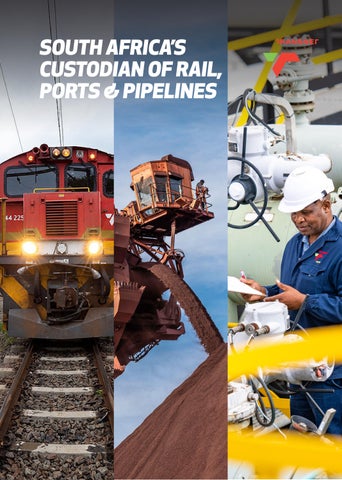
SOUTH AFRICA’S
CUSTODIAN OF RAIL, PORTS & PIPELINES


Transnet is South Africa’s state-owned logistics infrastructure company responsible for the port, rail and pipeline network. It is mandated to:
Assist in lowering the cost of doing business in South Africa;
Enable economic growth; and
Ensure security of supply by providing appropriate infrastructure in a costeffectively and efficiently.
Through its 7 operating divisions, Transnet delivers an integrated bulk freight transportation system:
vision mission
To fuel Africa’s growth and development as the leading provider of innovative supply chain solutions.
SEVEN OPERATING DIVISIONS ACROSS SOUTHERN AFRICA
To link economies, connecting people and growing Africa.
• •Namibia
• Botswana
• South Africa
• Zimbabwe
• Tanzania
• Four joint operating centres
• Three satellite offices
• Head office
50 988
employees providing cargo handling services to a wide range of customers
30 400 km
railwaytrack (general freight and two heavy haul lines)
8 wagons operating
69 241
R12,2 bn
commercial and residential properties
16
port terminals operating across 7 south african ports (exc. mossel bay)
3 114 km
high pressure petroleum and gas pipeline network in south africa
132
engineering depots and 11 engineering yards manufacturing, maintaining, converting, repairing and the rolling stock, equipment and machines
TRANSNET LEADERSHIP
ORGANOGRAM
GROUP CHIEF OPERATING OFFICER
CHIEF PROCUREMENT OFFICER
CHIEF OF PEOPLE MANAGEMENT AND LEARNING
CHIEF BUSINESS DEVELOPMENT OFFICER
GROUP CHIEF EXECUTIVE
CHIEF AUDIT EXECUTIVE
CHIEF EXECUTIVE: TRANSNET ENGINEERING
CHIEF EXECUTIVE: TRANSNET RAIL INFRASTRUCTURE MANAGER
CHIEF EXECUTIVE: TRANSNET FREIGHT RAIL
CHIEF EXECUTIVE: TRANSNET PORT TERMINALS
CHIEF LEGAL OFFICER
CHIEF STRATEGY & PLANNING OFFICER
CHIEF EXECUTIVE: TRANSNET NATIONAL PORTS AUTHORITY
CHIEF INFORMATION OFFICER
CHIEF EXECUTIVE: TRANSNET PIPELINES
GROUP CHIEF FINANCIAL OFFICER
CHIEF EXECUTIVE: TRANSNET PROPERTY
GROUP TREASURER
INVESTING IN OUR VALUE CHAINS
Transnet aims to bring in investments from industry partners and the major sectors we serve. These sectors contribute to 80% of Transnet’s revenue and include:
HOW RAIL OPERATIONS ADD VALUE
Wagons from different customers are consolidated and compiled before departing for the Port of Saldanha.
Perway maintenance enables safe train traversing.
Electric locomotives are powered through overhead track equipment (OHTE).
Train communication and signaling enable safe train movement. Smart scheduling of train crew shi s ensure optimum performance.
A preventative maintenance programme pre-empts failure to improve rail reliability.
“Not to go wagons” are removed from trains for maintenance.
Trains are compiled and decompiled before departing for the final stretch on route to the Port of Saldanha.
Berth capacity is created and maintained for optimum vessel docking.
Vessels are handled at the iron ore facility.
Marine services guide deep-sea vessels to the berths and lead them out once loaded.
VALUE PROPOSITION
value for the economy
• Reduce logistics costs as a proportion of transportable gross domestic product
• Maximise rail transportation’s

contribution to national transport to accelerate mode transfer
• Leverage private sector resources for infrastructure and operational services
value for domestic & regional customers
• Deliver reliable and predictable customer volumes
• Focus on customercentred business innovations
• Offer full value chain service propositions
• Customise products and services for each market segment
• Integrate the South African economy with regional and global economies
• Enhance the positive social and economic impacts of interventions
• Provide integrated customer support across the logistical value chain
socio-economic value and environmental stewardship
• Ensure continued expansion of commercial activities and financial viability
• Implement digital transformation throughout the value chain
Transnet is committed to sustainable development outcomes (SDOs) to improve South Africa’s socio-economic climate. As a State-owned company, Transnet will actively participate in initiatives that positively impact the regions and communities it operates in through its Environmental, Social and Governance (ESG) Framework, which outlines nine SDOs:
• Industrial capability building
• Investment leveraged
• Regional integration
• Skills development
• Transformation
• Employment
• Environmental stewardship
• Health and safety
• Community-oriented outcomes
Transnet continues to implement various initiatives, such as the Phelophepa health trains, to make primary healthcare accessible in
rural areas. The Company’s artisan and graduate programmes address unemployment and critical skills shortages. These SDOs are embedded in the Company’s operations, contributing to the
eradication of socioeconomic ills and disparities. Transnet strives to be a responsible corporate citizen, holding Itself accountable through its ESG Framework.
value for our shareholder
• Support broad industrial development in key commodity segments through the Reinvent for Growth Strategy
• Financial and socioeconomic value: Deliver sustained financial returns and broad socioeconomic benefits
value for financial partners
• Create and sustain value for financial stakeholders
• Financial stability: Maintain a strong balance sheet and generate consistent cash flow
• ESG commitment: Uphold a robust ESG record with sustainable outcomes
• Leverage sector expertise: Utilise expertise in rail, ports and pipelines for regional market growth
value for employees
• Uphold a safety-first work ethos
• Provide opportunities for professional and academic advancement
• Offer exposure to broader regional and national opportunities
• Regulatory compliance and ethical practices: Ensure compliance with regulations, ethical leadership and responsible corporate citizenship
• Alignment with Government initiatives: Align investment priorities with Government’s infrastructure programme
value for suppliers & service providers
• Maintain an ethical and transparent procurement process
• Ensure fair and equitable tender processes
• Manage contracts fairly, transparently and efficiently
• Take a proactive, collaborative approach to local supplier development
• Funding strategy: Develop a funding strategy in line with the Reinvent for Growth Strategy’s priorities
• Strategic value and logistics: Reduce regional logistics costs and ensure a secure supply chain to enhance strategic value
TRANSNET OPERATING DIVISIONS
ENGINEERING
Transnet Engineering is an integral part of South Africa’s railway and port industry value chains, serving as a provider and maintainer of the assets used in operations. The division’s core business activities include the manufacturing, remanufacturing, assembly and maintenance of railway rolling stock, such as locomotives, freight wagons, passenger coaches and port equipment.
Specialist engineering capabilities, including research, design, condition monitoring, testing, systems integration and certification support these offerings. With more than 150 years’ experience in rail, Transnet Engineering is an independent African original equipment manufacturer (OEM) for wagons and has made significant progress in developing its
Manufacturing division of Transnet has
143 depots 6 main factories
OEM status for locomotives, exemplified by the manufacturing of the ‘Trans-Africa’ locomotive.
Through its Engineering unit, Transnet Engineering has researched, designed and built the Transnet Port Hauler, which is currently undergoing operational testing.
The division also provides products and services to customers located outside of the Republic of South Africa, including: Tanzania, Zambia and the Democratic Republic of Congo.
Capacity to build and remanufacture
4 000 wagons
core capabilities in research, design, testing, manufacturing, re-manufacturing, assembly and maintenance of railway rolling stock including locomotives, freight wagons, passenger coaches and port equipment.
RAIL INFRASTRUCTURE MANAGER
Transnet Rail Infrastructure Manager (TRIM) is a key player in managing South Africa’s vast rail network, which spans 30 400 kilometres. Established under the National Rail Policy and the Economic Regulation of Transport Act, 2024, TRIM is responsible for ensuring the country’s rail infrastructure is reliable, efficient and well-maintained. Its mission is to connect people, businesses and regions, supporting economic growth and regional trade.
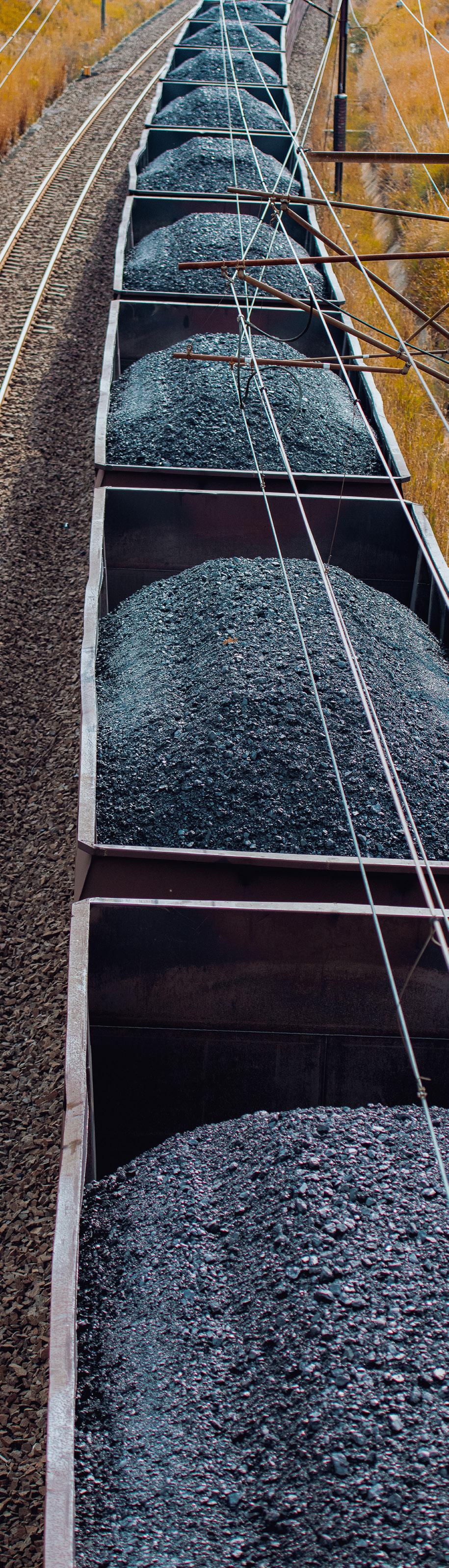
TRIM manages a core network of 9 875 route kilometres, which includes vital heavy-haul lines for transporting goods like iron ore and coal. The Sishen-Saldanha line (iron ore export) and Ermelo-Richards Bay line (coal export) are built to carry heavy loads of up to 30 tons/axle and 26 tons/axle, respectively. The network also includes branch lines with axle loads of up to 20 tons/axle, connecting smaller regions and communities.
TRIM plays a crucial role in connecting South Africa’s ports, terminals and
production hubs, especially in the SADC region. It supports landlocked countries by providing essential rail links, promoting regional trade and economic growth.
TRIM’s mission is to empower seamless rail connectivity through reliable, intelligent and resilient infrastructure management. By ensuring safe, efficient and affordable rail operations, TRIM drives economic growth, supports regional connectivity and fosters sustainable development.
exporters
TRIM facilitates costeffective, high-volume transport for heavy-haul commodities, boosting South Africa’s trade economy.
government
TRIM aligns with providing sustainable rail infrastructure that supports economic growth.
train operators
TRIM offers a reliable and regulated network, enabling efficient and profitable operations.
communities
TRIM strengthens local economies by improving transport infrastructure and creating jobs.
investors
TRIM provides opportunities for partnerships in upgrading and modernising rail infrastructure to meet global standards.
FREIGHT RAIL
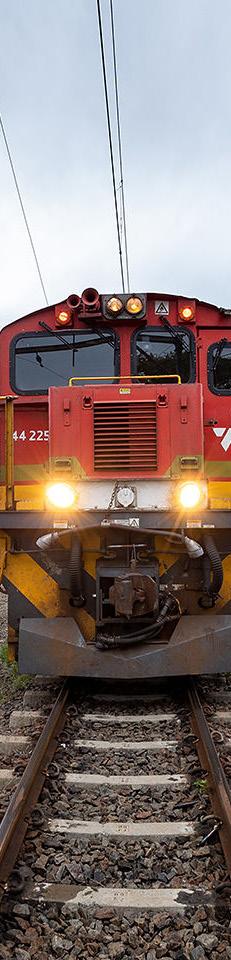
Transnet Freight Rail is the largest Operating Division of Transnet. it currently manages the rail network infrastructure and operates rail services across major corridors.
Transnet Freight Rail transports a wide variety of bulk and general freight commodities, including mining, agricultural and manufacturing goods, bulk liquids, containerised freight and automotive units and components for export, regional and
The corridors are as follows:
• Cape Corridor
• Ore Line
• Container Corridor
• Cape Corridor
• Ore Line
• Container Corridor domestic markets. Operating Corridors are logical units of accountability that together produce results not obtainable by the elements alone – the whole being greater than the sum of its parts.
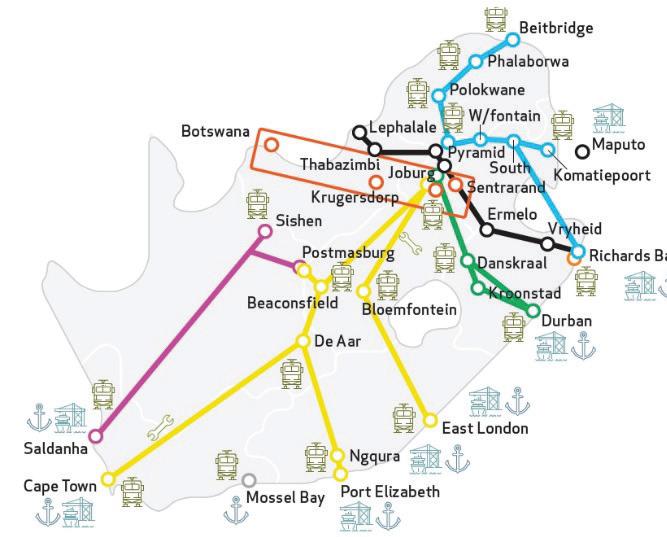
Top 10 freight railways in the world and owns the largest railway in Africa.
80%
Africa’s total rail
Operates the awardwinning luxury Blue Train.
1 500km dedicated heavy haul lines.
PORT TERMINALS
Transnet Port Terminals plays a strategic role in the South African economy by enabling the efficient flow of imports, exports and trans-shipments through its cargo terminal operations.
Through its management of these key trading hubs, Port Terminals ensures yearround connectivity between the South African economy with other key trading partners in the region and the rest of the world. As a vital enabler of trade between
5 cargo sectors handled
68 berths
South Africa and the global market, Port Terminals continuously strives to improve the reliability and efficiency of its operations through holistic business innovation, reducing business costs and enhancing service delivery.
3 three geographical regions
3 inland terminals KZN, Northern Cape and North West. Bulk, break bulk and automotive (roll on-roll off/RORO) namely Eastern Cape, Western Cape and KwaZul-Natal
16 sea cargo terminals
7 commercial seaports along the South African coastline
NATIONAL PORTS AUTHORITY
Transnet National Ports Authority, as prescribed in the National Ports Act, No 12 of 2005 (Ports Act), was established as a landlord port authority to manage, control and administrate safe, efficient, effective and economic functioning of the national ports system on behalf of the State.
The National Ports Authority holds a strategic position in the country’s transport logistics chain, managing South Africa’s eight commercial seaports. The ninth port, Port Nolloth, entirely leased to De Beers Consolidated Diamond Mines.
Operating within the port industry, the National Ports Authority provides services to port users, including terminal operators,
2 798km coastline
shipping lines, ship agents, cargo owners and the clearing and forwarding industry.
The National Ports Authority serves as both the regulator of all port users and is self-regulated. The Ports Regulator of South Africa (Ports Regulator) exercises economic regulation over the division and addresses complaints against the National Ports Authority.
8 commercial seaports
Plans, provides, maintains and improves port infrastructure. Provides marine-related services, including dredging, aids to navigation, ship repairs and marine operations.
PIPELINES
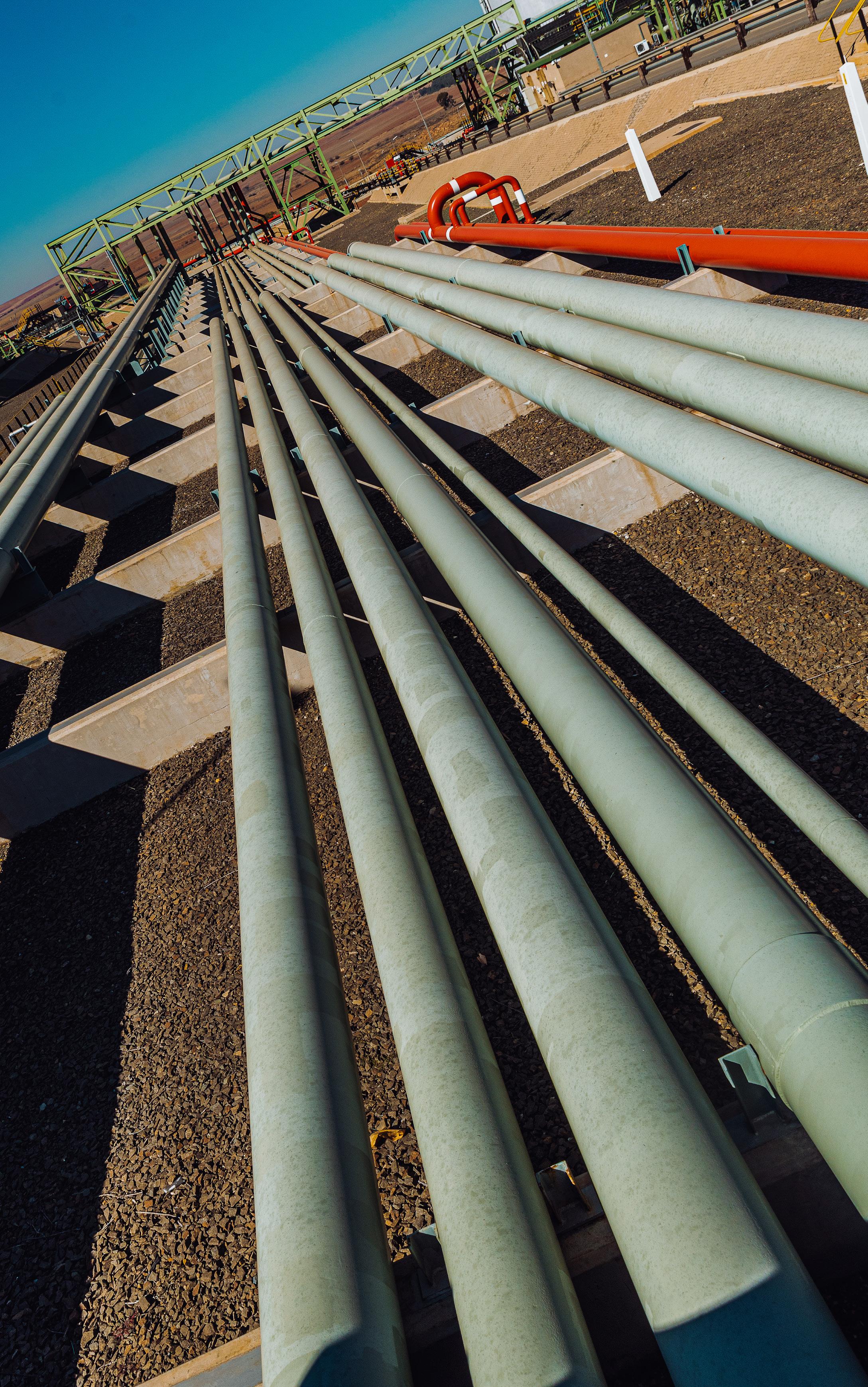
Transnet Pipelines is the largest multi-product pipeline operator in southern Africa, with over 55 years of experience in operating and maintaining a 3 800 kilometer highpressure petroleum and gas pipeline network in South Africa.
The core strategic mandate of Transnet Pipelines is to ensure petroleum security of supply for the inland market and gas security of supply for the Kwa-Zulu-Natal market, using environmentally responsible methods while ensuring optimum efficiencies.
The liquid fuels network traverses various provinces in South Africa. The network includes a tank farm in Tarlton with a capacity of 30 million litres, which is used
transnet pipelines market share
primarily for storage and distribution of liquid fuels to Botswana. The gas pipeline, a converted line previously used for liquids, runs from Secunda to Durban via Empangeni.
Transnet Pipelines is strategically positioned to enable regional integration from pipelines to other modes of transport. It is regulated by the National Energy Regulator of South Africa (NERSA).
65% of the total inland demand of refined petroleum products transported
of all jet fuel requirements for OR Tambo International Airport
crude oil requirements for Natref
methane-rich gas from Secunda to KZN
PROPERTY
Property serves as the custodian of Transnet’s vast commercial, industrial and residential property portfolio. the value of the portfolio increased by 10% to R12.2 billion in 2025, with further growth projected over the next five years.
Transnet Property generates revenue primarily from leasing its properties to both external and internal tenants and from monetising its asset management expertise, which includes property development, facilities management and other specialised services.
The portfolio excludes properties that are essential for rail and logistics
operations, as well as regulated properties that remain under direct management of the Operating Divisions. Transnet Property plays an enabling and strategic role by providing specialised property management services to the Operating Divisions and the Corporate Centre through fomal service level agreements.
One of South Africa’s most significant property owners with a national footprint
Provides specialised property services including valuations, municipal valuations, roll analysis, land surveys, drawing of plans and deeds management
Manages a portfolio of properties used for core operations and investment properties generating revenue from external tenants
ENVIRONMENTAL, SOCIAL & GOVERNANCE (ESG)
Transnet strives to conduct its business in a way that prioritises its stakeholders and minimises environmental impact. Under the principle of operating responsibly, the following are prioritised:
transnet minimising environmental impact
Reducing the environmental impact of its operations, ensuring compliance to avoid fines, protecting biodiversity, managing pollution, mitigating and adapting to climate change and adopting the Just Transition agenda.
transnet improving governance
Transnet is committed to rooting out corruption and improving governance.
transnet caring for its people
Building industrial capability, skills development, valuing health and safety, creating employment and fostering a talented, inclusive and diverse workforce with meaningful career development, community development, employment equity and transformation.
transnet assessing all ESG factors
Impacting its strategic areas of borrowing, growth, profitability, capital investment and risk exposure and develop a programme that adequately meets and manages investors and other stakeholders’ ESG (Environmental, Social and Governance) expectations.
environmental stewardship
Carbon footprint:
2,75 mtCO2e
Cumulative carbon emission savings from ‘road to rail’
health and safety
LTIFR rate – 0,77 against tolerance of 0,75
Employee Wellness Programme service offerings across all 11 official South African languages
Absenteeism reduced to 1.90%(2024:3,34%)
building industrial capability
R321 million in ESD spend,
Local content spend R2,8 billion
creating employment
Transnet’s total headcount 50 988 (incl. contract employees)
R105 million invested in Corporate Social Investment
skills development
R860 million was spent on skills development
B-BBEE skills development points achieved – retaining Transnet’s Level 2 B-BBEE status.
community development
Invested R11 million in community development
Phelophepa
Healthcare Trains I and II treated
733 000 patients
R75 million in communitity wellbeing
transformation employment equity
Black employees: 93,8% of total employees
75% women in executive roles
People with disabilities 2,1% of employees
91,8% Black professionals
transformation b-bbee spend
Total measured procurement spend
R33 630 million
Black-owned enterprises spend accounts for 105,65%
Black women-owned enterprises spend: 35,91%
EME spend at 15,52%
QSE spend at 15,95%
Black youth enterprises at 7%
Black owned suppliers 58,75%
*Source: Transnet 2025 Integrated Report
INTEGRATING REGIONAL FREIGHT
Business development’s core function is to retain and grow Transnet’s customer base while increasing the revenue-generating capabilities. This is achieved through existing markets and diversified business growth initiatives. What sets Transnet apart is our ability to offer an integrated freight and logistics service. Our internal collaboration and integrated approach are what create the most value and impact for our customers.
STRATEGIC INTENT
Developing new business opportunities through strategic transactions and partnerships.
Strategic building and maintaining good relations with the government, business communities and other stakeholders.
Enhancing service delivery and customer satisfaction by fostering a customer-centric culture across the value chains.
GROUP BUSINESS DEVELOPMENT & GROWTH STRATEGY
The Group Business Development strategy for growth and diversification is designed to position Transnet for sustained revenue growth and market expansion by leveraging strategic partnerships, optimising asset utilisation and enhancing customer-centric service delivery. Business Development aims to drive significant value creation for Transnet and its stakeholders.
Leading the development of integrated regional freight systems by leveraging Transnet’s unique position as a leading logistics provider in sub-Saharan Africa.
Growing volumes by supporting regional integration through leveraging shared hinterlands and rail corridor connectivity. Jointly developing rail and maritime trade corridors in support of the African Continental Free Trade Area model. This involves cross-border cooperation, government-togovernment agreements and long-term trade and growth opportunities.
strategic port and maritime trade corridors
Significant opportunities exist in the rest of subSaharan Africa, aligned with the AfCFTA model of cross-border cooperation, G20 agreements and long-term growth prospects.
Regional operations, joint ventures and partnerships with aligned growth synergies such as shipping lines, private local operators, key commodity customers and state-owned rail, port and pipeline operators, will present new opportunities on the continent.
“sa
incorporated”
Promoting South African content and positioning with ‘SA Inc’ partners to pursue regional opportunities. This include collaborating with South African DFIs, IDZs and agencies to leverage project development funding.
GOALS & ASPIRATION
Business Development Growth and Diversification aims to grow Transnet’s revenue from domestic and into new markets.
cross border volumes maputo, north south & eastwest corridors
• Focus on three rail corridors,
• Set up joint-operating centres,
• Increase cross-border rail volumes.
leasing of rolling stock
• Demand for rolling stock in Africa is increasing,
• There is also a corresponding need for maintenance services for locomotives & wagons.
strategic partnerships
The introduction of PSPs represents an opportunity,
• to develop partnerships that provide access capital and other resources and,
• capabilities to meet customer needs while simultaneously building a sustainable and competitive business into the future.
Collaboration with Kenya railways
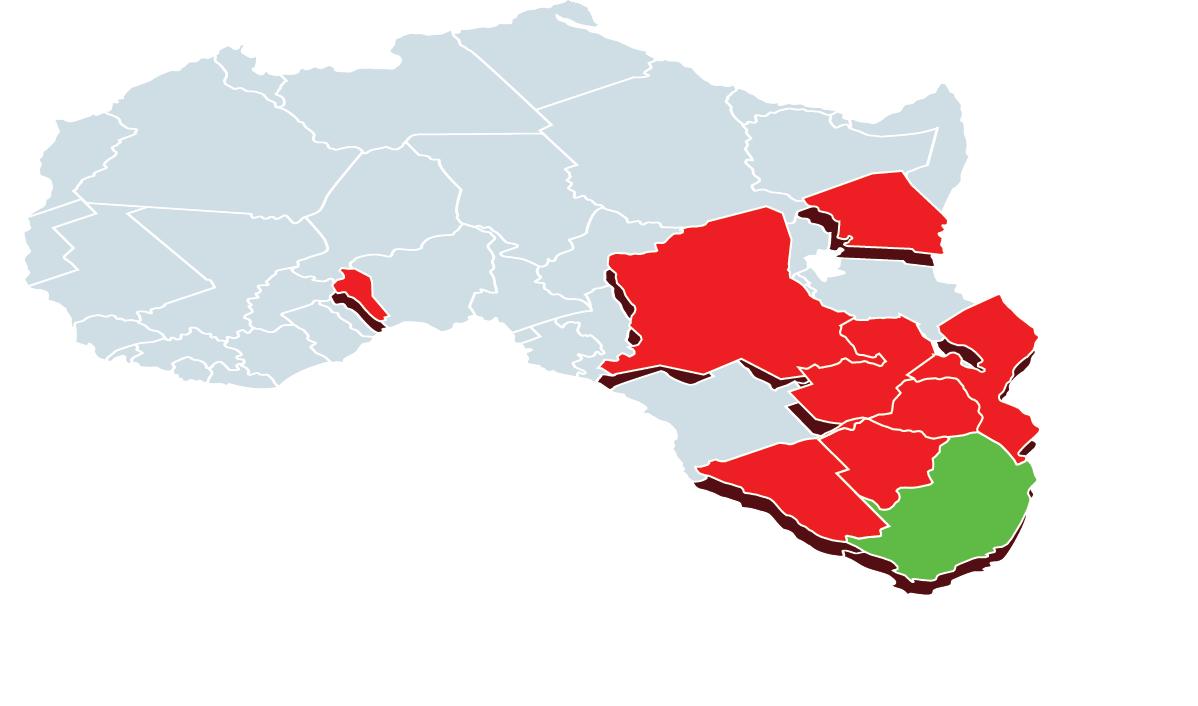
Collaboration on terminal operations Port dredging

botswana GABCON Teminal (JV) Botswana Rail Link
mozambique Collaboration with MPDC and CFM Port dredging
Leasing of rolling stock
north-south corridor
Optimise, rehabilitate and upgrade the North-South Corridor to facilitate intraAfrica trade as part of SARA
beniSA phase ii Technical cooperation agreement at the Port of Cotonou zambia Leasing of rollling stock
namibia
zimbabwe
kenya
democratic republic of congo Participation in SA Inc. Consortium in rail and port oportunities
CONTACTS
corporate contacts
+27 (0)11 308 3000 enquiries@transnet.net
physical address
138 Eloff Street Braamfontein
Johannesburg
2000
transnet corporate centre
Wilson Mogoba
General Manager: Growth and Diversification wilson.mogoba@transnet.net
+27 (0) 60 539 6614
Bonginkosi Mabaso
General Manager: Commercial bonginkosi.mabaso@transnet.net
+27 (0) 83 791 0736
transnet engineering
Reginald Mokoena
Head: Strategic Business Development
reginald.mokoena@transnet.net
+27 (0) 83 951 7814
transnet freight rail
Tiisetso Shabangu
General Manager Commercial tiisetso.shabangu@transnet.net
+27 (0) 83 282 0730
transnet rail infrastructure manager
Shamina Krishnaswamy
General Manager: Commercial shamina.krishnaswamy@transnet.net
+27 (0) 83 286 2114
transnet property
Meshack Phiri
General Manager: Asset Management meshack.phiri@transnet.net
+27 (0) 83 297 2589
transnet national ports authority
Dineo Mazibuko
General Manager: Commercial Services dineo.mazibuko@transnet.net
+27 (0) 83 243 5212
transnet port terminals
Michelle Van Buren Schele
General Manager: Commercial & Planning michelle.vanburenschele@transnet.net
+27 (0) 78 099 0033
transnet pipelines
Kresen Naicker
Head: Business Development & Customer Engagement
kresen.naicker@transnet.net
+27 (0) 83 278 6360