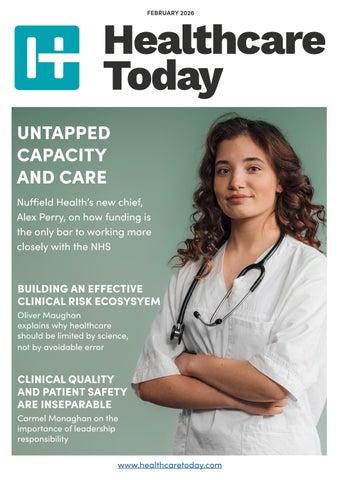
Nuffield Health’s new chief, Alex Perry, on how funding is the only bar to working more closely with the NHS
BUILDING AN EFFECTIVE CLINICAL RISK ECOSYSYEM
Oliver Maughan explains why healthcare should be limited by science, not by avoidable error
CLINICAL QUALITY AND PATIENT SAFETY ARE INSEPARABLE
Carmel Monaghan on the importance of leadership responsibility
WELCOME
FEBRUARY 2025
“The diagnostic backlog in the NHS is fundamentally a problem of capacity,” says Alex Perry. “There is substantial untapped capacity in the independent sector that could be mobilised to help address it –indeed, likely more than enough to clear the backlog altogether.”
In his first interview since becoming chief executive of Nuffield Health, Perry talks to Healthcare Today about why Britain’s largest not-for-profit independent hospital provider has been focusing on diagnostics and why human oversight remains essential for artificial intelligence.
Also in this issue, Oliver Maughan discusses the founding of Maulin Group - a “unified architecture that integrates clinical consultancy, healthcare technology, legal services and indemnity into one connected ecosystem”; former Ramsay Healthcare Australia chief executive Carmel Monaghan reveals why clinical quality and patient safety are inseparable from operational or financial performance; and much more...
We hope you enjoy!
To download a copy of
28-31 34-37
MAULIN GROUP ACQUIRES HEALTHCARE TODAY
MAULIN GROUP has strengthened its position in the healthcare intelligence space with the acquisition of Healthcare Today, one of the UK’s fastest-growing news and insight platforms for healthcare professionals.
The media platform currently reaches more than 120,000 clinicians, business owners and operators across the NHS and independent care sectors, providing timely analysis on risks, innovations and market developments. Maulin Group stated that the move will enhance its ability to keep pace with a rapidly evolving healthcare landscape, where access to reliable intelligence supports safer, more sustainable care delivery.
Healthcare Today will continue operating with the same editorial team, independent direction and values that have driven its recent growth. The publication’s core role - to deliver clear, balanced and actionable insight - remains unchanged.
“Healthcare Today plays an important role in helping the sector understand what is changing, why it matters and where the opportunities are for better patient care,” said Oliver Maughan, Founder and CEO of Maulin Group. “Its mission aligns closely with ours, and we are pleased to support the next stage of its growth.
“We see real value in ensuring breakthroughs, risks and new ideas are shared widely and quickly across the healthcare community. Our aim is to strengthen the platform, widen its reach and help it continue delivering the level of insight that has earned it such a loyal following.”
Maulin Group plans to support scaling efforts and expand audience reach while maintaining the trusted voice that has defined Healthcare Today’s success. The publication will continue serving its full readership across NHS bodies, independent providers, clinical teams and healthcare organisations.
“Healthcare Today has grown rapidly over the past year because the sector values clear, practical and accessible insight. Joining Maulin Group enables us to enhance that work, invest in our platform and reach an even wider audience,” said Glen Ferris, Managing Director of Healthcare Today. “We share a commitment to improving patient care through better access to information, and this partnership allows us to push that mission further while continuing to provide the balanced coverage our readers rely on.”
This acquisition reinforces Maulin Group’s overarching strategy to create the world’s most integrated clinical-risk intelligence platform, connecting clinical investigations, technology, defensibility and indemnity to reduce avoidable harm and improve the reliability of care across global healthcare systems.
IN THE private healthcare market, doctors and consultants working in hospitals must arrange their own medical indemnity cover. Unlike NHS doctors, they are not covered by a state scheme.
Under the Competition and Markets Authority’s (CMA) Private Healthcare Market Investigation Order 2014, hospitals are prohibited from subsidising or paying for consultants’ indemnity insurance unless the consultant reimburses the hospital at a fair market value.
At the time, the order made sense.
The CMA was concerned that private hospitals were distorting the market and gaining unfair advantage. Hospitals sometimes offered high-value benefits like subsidised indemnity, secretarial support, or consulting rooms to lock in consultant loyalty. This distorted competition as it steered consultants to admit more patients to a particular hospital, which, in turn, made it harder for new hospitals to attract consultants.
The effect of the order has been that consultants since then have shouldered the full cost of indemnity themselves, which can run to tens of thousands of pounds per year in some specialities. Hospitals, even if willing to ease this burden, are not allowed to do so.
This has led to a distortion in the market. All NHS Trusts and Health Boards in England, Scotland and Wales are members of the statebacked NHS medical schemes.
TIME TO UPDATE PRIVATE MEDICAL INDEMNITY RULES
In England, indemnity is provided through the Clinical Negligence Scheme for Trusts (CNST), which is administered by the NHS Resolution; while in Wales, indemnity is provided through the Clinical Negligence Scheme for Trusts and Health Boards by Welsh Risk Pool Services. For Scottish doctors, indemnity is provided by the Clinical Negligence and Other Risks Indemnity Scheme (CNORIS). NHS National Services Scotland is the scheme manager, with the central legal office providing legal advice and guidance to Health Boards. And in Northern Ireland, each health and social care trust provides its own indemnity, funded by the Department of Health, Social Security and Public Safety.
But as the General Medical Council warns: “If you carry out any private or independent practice, you must arrange adequate and appropriate insurance or indemnity (even if this work takes place on NHS or Health and Social Care body premises). This applies even if the work is in addition to work you do for an NHS or HSC body.”
With rising indemnity costs, some consultants are reducing private practice, which has distorted the market by leaving patients with
fewer options. What hasn’t helped, is that it is also a barrier to entry for younger consultants who are unable to enter into private practice because they must finance high indemnity premiums upfront themselves.
On top of that, it is also harming Britain’s healthcare competitiveness. In other jurisdictions, hospitals are allowed to cover or negotiate indemnity on behalf of clinicians, which keeps British doctors on the back foot.
The rule was designed to tackle competition concerns a decade ago, but today the greater risks today come from workforce shortages and reduced access to private care, rather than excessive inducements.
In the House of Lords last July, Natalie Bennett, Baroness Bennett of Manor Castle, asked what plans there were “to re-assess and update” the order. Margaret Jones, Baroness Jones of Whitchurch, brushed off the question, saying that the responsibility for reviewing the order lay with the CMA, though she did indicate that the door for change was open for change by adding that it “welcomes submissions from relevant parties where existing remedies may no longer be fit for purpose”.
There is a sense that a desire, indeed a need for change, is gathering speed.
As Oliver Maughan, chief executive of Maulin Group, wrote in Healthcare Today recently: “The private healthcare market of 2026 is materially different from that of 2014, and it is legitimate to ask whether parts of the framework now warrant careful re-examination, not to weaken competition protections, but to strengthen patient protection in a changed risk landscape.”
Healthcare chief executives approached by Healthcare Today agreed that change is needed.
Practice Plus Group’s Ross Dowsett said that anything that could be done to simplify the indemnity landscape “would make sense”.
Steven Gray, the former chief executive of Nuffield Health, went even further. The rules, he says, “get in the way of practice, pragmatism and progress” adding that the rules were “bureaucratic and completely illogical”.
As Maughan concludes, this is not about weakening safeguards, it is about ensuring that the regulations serve patients in the market as it exists today.
CONCERNS THAT THE MOVE TOWARDS AI IS NOT SEAMLESS
ON ONE level, the government’s continued push towards AI in healthcare is having an impact. Four out of five care providers have said that they now use digital social care records.
An estimated 30 million administrative hours will be saved per year through this digital-first approach, the government states, so carers can spend more time looking after those with care needs, giving back at least 20 minutes per care worker per shift.
“This government is driving digital innovation, and digital care records are making a major difference for people drawing on care and their carers,” said minister of state for care, Stephen Kinnock, speaking at Kallar Lodge, a residential care home in Dagenham, in early December.
“As we shift more care out of hospital and into the community, digital transformation is critical to ensure we create a coordinated system of social care and primary care,” he continued.
The push has been embraced by the private sector too. To give just one example, an independent evaluation at Guy’s & St Thomas’ NHS Foundation Trust (GSTT), which is using Proximie’s intelligence suite across two NHS robotic thoracic surgery lists, has found that it reduced surgical procedure lengths by nearly 20 minutes per case on average.
“These results reflect tangible, real improvements that can help reduce cancellations, make better use of NHS resources, and ultimately allow more patients to receive the care they need sooner,” said Andrea Bille, consultant thoracic surgeon at the Trust.
The move to digital is undoubtedly unstoppable, but the journey is not seamless.
At the end of November, the UN World Health Organization warned that while the use of artificial intelligence is accelerating in healthcare, basic legal safety nets that protect patients and health workers are lacking.
In the first comprehensive assessment of how AI is being adopted and regulated in health systems across Europe, although nearly all recognise that AI could transform healthcare, only four countries have a dedicated national strategy and a further seven are developing one.
“Without clear strategies, data privacy, legal guardrails and investment in AI literacy, we risk deepening inequities rather than reducing them,” said Hans Kluge, WHO regional director for Europe.
There is a deeper problem that technology is moving more quickly than medical professionals can cope with.
A new Nuffield Trust and Royal College of General Practitioners survey has found that although 28% of GPs say they use AI tools to help with their work, there is confusion about which tools to use and how, due to a lack of consistent national guidance or formal AI training.
With general practice under immense pressure, GPs say AI is mainly helping them to reduce overtime work and the burden of admin, but the use of AI currently depends too heavily on a postcode lottery of local policies developed by their practice, primary care network and Integrated Care Boards.
GPs often have to make decisions about which tools to use based on peer experience or direct marketing from AI companies.
“The government is pinning its hopes on the potential of AI to transform the NHS, but there is a huge chasm between policy ambitions and the current disorganised reality of how AI is being rolled out and used in general practice,” said Nuffield Trust director of research and policy Becks Fisher.
TEMPORARY care environments, commonly referred to as “corridor care”, are being used across NHS trusts, and there are widespread concerns about normalising their use and the impact on patients and staff.
A report from the Health Services Safety Investigations Body (HSSIB) urges healthcare leaders and NHS Trusts to understand and manage the risks temporary care environments may present to patient safety.
“Until there is a solution to the complex underlying issues related to patient flow, we must recognise that hospitals may have no choice but to use temporary care environments,” said HSSIB senior safety investigator Saskia Fursland.
“By working together with a shared understanding, healthcare leaders and NHS trusts can better understand the use of temporary care environments and their impact on patient safety in a consistent way and systematically address the risks to patient safety,” she added.
The issue of corridor care is a political hot potato that much of the healthcare sector believes is not being taken seriously enough.
As Healthcare Today has repeatedly written, not only is the issue not being alleviated, new corridor care guidance published by NHS England has been criticised. The impact of the issue is being mitigated rather than eliminated.
Temporary care environments are spaces not originally designed, staffed or equipped for patient care, such as waiting rooms, corridors, chairs on wards, ambulances outside emergency departments and other hospital areas not designed for inpatient care. They are used when demand exceeds capacity, in an attempt to balance risks across the patient care pathway.
CORRIDOR CARE PERMANENT FIXTURE
These decisions often compromise standard and quality of care delivered, which affects patients’ experiences, including the provision of dignity and respect.
The HSSIB points out that it is getting worse rather than better. Over the few years, demand has usually peaked during the colder months when the NHS experiences winter pressures. Its investigation, however, visited 13 hospitals and had insights from four other hospitals, from August to December last year.
They were all experiencing issues patient flow, showing there is no longer significant seasonal variation.
The report calls for the adoption of a nationally agreed definition of temporary care environments as well as improved understanding of how when temporary care environments are used in NHS hospitals. In the
CORRIDOR CARE IS A PERMANENT FIXTURE
compromise the delivered, experiences, and getting past peaked the pressures. to with longer well how and environments
absence of an agreed definition and improved data collection of the use of temporary care environments, there is a limited understanding of the safety risks and impact on patients, it concludes.
“We must end the need to use corridors or other temporary spaces. More beds may be the obvious answer, but before saying this is the only solution, we must make reality the desired shift to looking after more people in the community – at or close to home – and prevent as many hospital admissions as possible,” said Daniel Elkeles, chief executive of NHS Providers.
The response to the report from the sector has been one of resigned frustration.
“This report is the latest damning evidence of how normalised corridor care has become in emergency departments across the country,” said
BMA consultants committee emergency care lead Den Langhor. “What’s particularly disheartening is how accepted it has become – spelled out in this report that it’s often seen by staff as the ‘least worst’ option. Doctors and their colleagues time and time again prove how innovative and flexible they are in the face of huge challenges, but there is only so much that individual hospitals and staff can do to adapt to keep patients safe.”
His view was echoed by Royal College of Nursing chief nursing officer Lynn Woolsey. “A national safety investigator finding that corridor care is no longer an exception but entirely normalised all year round is a damning indictment. It means every day vulnerable people are being treated in unsafe and undignified conditions,” she said.
The Health Foundation’s assistant director of policy, Tim Gardner, pointed out that trolley waits in A&E
– one measure of the problems in emergency care – are set to have hit record levels last year, with more than 500,000 patients having already waited more than 12 hours for admission to a hospital bed. “Such delays were uncommon before the pandemic, but are now the worst since record-keeping started in 2011. They reflect an NHS exhausted by the pandemic and a decade of underfunding before that,” he said.
And the longer the issue remains, the greater the problems.
“Corridor care risks fundamentally undermining the public’s trust in the health service. We must address issues with patient flow, capacity and take action to reduce the number of people becoming sick enough to need emergency admission in the first place,” said Hilary Williams, clinical vice president at the Royal College of Physicians.
MENOPAUSE AND PROSTATE CONDITIONS PRIORITISED FOR NHS’S ONLINE HOSPITAL
THE government is clarifying details about its plans to launch a fully digital hospital model, NHS Online, by 2027. Menopause and prostate problems will be among its priorities when it launches next year.
At the end of September last year, the government announced the fully digital hospital model as part of its 10 Year Health Plan to shift the NHS from analogue to digital.
It will allow patients to access specialist care, book scans, manage prescriptions, and receive clinical advice from home via the NHS App.
The idea is that patients referred by their GP will be able to book specialist appointments directly. If scans or procedures are needed, they can be scheduled at Community Diagnostic Centres closer to home. The hope is that this will offer greater convenience and faster access.
The NHS has selected nine common conditions – glaucoma, macular degeneration, cataracts, inflammatory bowel disease, iron deficiency anaemia, prostate enlargement, raised PSA, menopause and menstrual problems, which may be a sign of endometriosis – as the first to be treated by the NHS Online service, providing faster access to specialist care.
“We know that these conditions can be painful and difficult to cope with, so providing faster, more convenient access to diagnosis and treatments will have a real and positive impact on people’s lives,” said Stella Vig, national clinical director for elective care at NHS England.
Women’s health issues, including severe menopause symptoms and menstrual problems that can be a sign of endometriosis or fibroids, will be among the conditions available for online referrals.
“Endometriosis UK welcomes NHS England’s decision to prioritise menstrual health, including endometriosis, in the new NHS Online hospital,” said Emma Cox, chief executive of Endometriosis UK.
“For too long, those with endometriosis have faced unacceptably long waits and uneven access to specialist care. This new initiative has the potential to be a real step forward if it delivers faster diagnosis, quicker access to specialists, and genuine patient choice,” she added.
Prostate problems like prostate enlargement and a raised prostatespecific antigen (PSA) level will also be covered by the service.
NHS Online will also provide support for other painful and distressing conditions, such as iron deficiency anaemia and inflammatory bowel disease.
Patients will have the option of using NHS Online when their GP makes a referral for specialist care. Instead of having a physical site, patients will be able to receive care from doctors around the country directly through the NHS App –without leaving their home or having to wait longer for an in-person appointment.
Tests, scans or procedures will continue to take place at healthcare sites closer to patients’ homes, while clinicians will be able to review their notes remotely. This streamlines the process and allows patients to move quickly from referral to treatment to follow-up care. The new model of care will allow patients to be seen at a convenient time without needing to go to hospital, while those who would prefer to be referred via the traditional route will always have the choice to see specialists at a healthcare site.
As more patients choose NHS Online, waiting lists are expected to fall. This will also free up in-person appointments for those who need and want them, helping people be seen more quickly.
MATERNITY SERVICES AT ROYAL SUSSEX COUNTY HOSPITAL REMAIN POOR
IMPROVEMENTS to maternity care are being seen in hospitals across the UK, but movement is still slow and, for many, still not fast enough.
The Care Quality Commission (CQC) has upgraded the maternity service rating at Royal Sussex County Hospital, run by University Hospitals Sussex NHS Foundation Trust, from inadequate to requires improvement, but has told the trust that more work is needed to ensure maternity services are fully effective in meeting the needs of women and babies.
But the small print shows that there is a great deal of work still to do.
Inspectors found five breaches of regulation. These related to the induction of labour and caesarean section delays, safeguarding, medicines management, the premises at Sussex House and how well the department was being managed.
“The design and environment of the maternity unit didn’t fully meet the needs of women, people using the service and their babies,” said Amanda Williams, CQC deputy director of hospitals, secondary and specialist care in Sussex, who pointed out that there was still only one dedicated obstetric theatre, which impacted the flow of the department.
The trust ran a pilot in July 2024 to introduce a second theatre permanently. Even though the pilot had been successful and wellreceived, no permanent solution had been put in place.
Suzanne White, head of medical negligence at law firm Leigh Day and who recently settled a case against the Trust, said that she remained “deeply concerned” about maternity care at Royal Sussex County Hospital. “In our cases, both here and more widely, we have seen a culture where mothers and their babies are treated with a lack of empathy. Too often, mothers’ voices are ignored, and their concerns are dismissed,” she said.
The picture at Royal Sussex County Hospital is one that is reflected across the country. Although the interim report from Valerie Amos, Baroness Amos – her initial thoughts into the inquiry – made for reading that was shocking, even for those inured to the poor state of maternity care across the country, as Healthcare Today has reported, the message is beginning to get through.
Last year’s Care Quality Commission (CQC) maternity survey gives some indication of progress and the NHS is clearly paying attention too. At the beginning of December, it rolled out a new safety signal system across
maternity services. And one shouldn’t forget that individual Trusts are taking the issue into their own hands and making improvements at a local level. But the problem remains that the message is not getting through quickly enough. The issues that the CQC highlighted as requiring improvement at Royal Sussex County Hospital are not those of education or technology, rather they are the basics.
The CQC said that leaders at the hospital needed “to address the delays women scheduled for elective caesarean sections and induction of labour faced”. Some of the delays were up to three days. Given that women using the service were asked to be nil by mouth from 0600 on the day of surgery, their discomfort when delays occurred was significant.
The department did not routinely undertake or embed audits and had no audit schedule. For example, sepsis cases were not audited, so data on case numbers or actions taken were unavailable. Leaders didn’t provide staff with up-to-date guidance aligned with legislation and evidence-based best practice. The Trust did not use benchmarking performance effectively to ensure consistent, positive outcomes.
Until these are addressed, improvements are going to be slow.
MENTAL HEALTH BILL RECEIVES ROYAL ASSENT
JUST before Christmas, the new Mental Health Act received royal assent. It is intended to reform the Mental Health Act of 1983, which provides the legal framework to detain and treat people in a mental health crisis who are at risk of harm to themselves or others.
For years, the government says, patients have been let down by a mental health system that needs reform. Those detained under the Mental Health Act have had too little say over their care and treatment and who should be involved in it.
It pointed out that Black people are 3.5 times more likely to be detained than their White counterparts. Autistic people and those with learning disabilities who don’t have a mental health condition have often been inappropriately detained.
The new Act will ensure patients have stronger rights and greater control over their treatment through new statutory care and treatment plans. Families and carers will have more involvement in decisions around treatment, giving them a real say in supporting their loved ones.
Racial disparities in treatment will be addressed through clearer guidance for mental health professionals. The act will also strengthen the rights of children and young people to make their wishes and feelings more central to decision-making, ensuring they, and those close to them, are consulted and involved where appropriate with decisions around their care and treatment.
“Mental health patients are among the most vulnerable in our society and their safety and rights must be protected. Both patients and staff
have been calling for a twentyfirst-century Mental Health Act that supports both those receiving and those delivering modern mental health care,” said Parliamentary and Health Service Ombudsman Paula Sussex.
“When I chaired the Independent Review of the Mental Health Act, I met a service user who told me that she was certain that being sectioned had saved her life, but she added, ‘why was it such a terrible experience?’ Why indeed,” said Simon Wessely, chair of psychological medicine at King’s College London and who proposed the reforms in a review in 2018.
“Our review proposed giving patients more of a say over their care, to ensure they were treated with greater dignity and respect, but without jeopardising the safety of others,” he said.
The Act was broadly welcomed.
“The new Mental Health Act is a major step towards ensuring that people in mental health crises get care that is safe, effective and centred on their needs,” said Adrian James,
medical director for mental health and neurodiversity at NHS England.
“It will give every detained patient a real say in their treatment and a timely care plan, with any period of detention focused on therapeutic benefit and kept as short as possible.”
“This is a landmark moment and a vital step towards ending the inappropriate detention of people with a learning disability and autistic people in mental health hospitals,” agreed Jon Sparkes, chief executive of learning disability charity Mencap.
Rebecca Fitzpatrick, partner and head of health advisory and inquests at law firm Browne Jacobson, called the Act a “significant step forward” in modernising mental health legislation and placing patient choice and autonomy at the heart of the system.
Though for her, concerns still remained. “Robust community services must be available to support individuals with autism and learning disabilities, underpinned by an appropriate legal framework to safeguard their welfare,” she said.
HOLLY HEALTH PARTNERS WITH PATIENT.INFO
LONDON-based digital healthcare company Holly Health has partnered with health education platform Patient.info to widen access to its personalised digital health coaching.
Through the collaboration, Holly Health is now featured on Patient. info’s platform, offering readers a simple way to turn evidence-based advice into practical, day-to-day habit changes that last.
“Our organisation’s missions are very aligned, to empower the public through providing intelligent tools and education for prevention and health improvement, so it made perfect sense to us,” said Grace Gimson, chief executive and cofounder at Holly Health.
This collaboration represents a shared commitment to enhancing prevention and self-management, key pillars of the UK’s evolving healthcare strategy. With conditions like Type 2 diabetes, cardiovascular disease and anxiety on the rise, accessible and scalable behavioural change support is increasingly recognised as essential to improving population health and reducing pressure on NHS services.
At the end of April, Holly Health announced a £320,000 Prevention Innovation Fund, offering up to four Integrated Care Systems, or the equivalents in Scotland and Wales, up to £80,000 credit each towards deploying a proven, psychology-based digital health coaching service, to increase selfmanagement support across their region. More recently, it completed an Innovate UK-funded 18-month project focused on advancing digital self-management for people living with or at risk of multimorbidity with Loughborough University and Modality Partnership.
PSA PUBLISHES NEW GMC REVIEW
OVERSIGHT body, the Professional Standards Authority, has published its annual performance review of the General Medical Council (GMC), concluding that the GMC has met 18 out of the 18 standards. Reviews are carried out every three years.
There were four highlights of the review. First, the GMC’s regulatory role has expanded in this review period, the PSA said, and it now regulates anaesthesia associates (AAs) and physician associates (PAs).
They have been invited to register with the GMC since December 2024, and registration will be mandatory from December this year, it continued. As a result, the GMC has introduced new standards, guidance, and assessments for registration for AAs and PAs, alongside quality assurance for course providers. It has also published good practice advice for doctors supervising AAs and PAs, and has completed in-person visits to all AA and PA course providers.
In October last year, it was reported that some doctors who had restrictions on their practice overseas were allowed to practise without restriction in the UK. Some doctors were already dual registered at the time the sanction was imposed overseas, and there were two doctors who registered with the GMC after
being sanctioned overseas. The GMC took steps to restrict the practice of the doctors involved and is considering how it can continue to strengthen its registration processes.
“This is an area of risk that we will continue to monitor closely with the GMC through our routine engagement and performance review assessments,” the PSA said.
Next, the PSA said it had introduced a new approach to assess regulators against its equality, diversity and inclusion (EDI) standard. In order to meet that standard, regulators must assure the PSA that they are delivering the four high-level outcomes against the evidence matrix.
“The GMC continues to perform well against this standard,” it said, adding that the council has collaborated with partners to develop EDI guidance for registrants and has provided more detail about how it collects data from those raising fitness to practise concerns.
Finally, the report notes that fitness to practise timeliness has improved slightly despite an increase in older open cases.
“We noted the GMC has reviewed its new approach to how it handles cases with third-party investigations and has identified areas for improvement,” it said.
Trusted by Clinicians, Chosen by Patients
Located in the Harley Street Health District, Pharmacierge supports over 4,500 GPs and Consultants with seamless, secure e-Prescribing apps tailored for private practitioners.
With our state-of-the-art robotically enabled dispensary and nationwide delivery, we ensure your patients receive their medications promptly, while you prescribe with confidence - anytime, anywhere.
mPrescribe®
Revolutionises private prescribing by allowing you to prescribe flexibly without a laptop, for delivery to your patients nationwide.
Medication range
Due to the range of specialists we support, we stock and source medication not typically found outside of a hospital setting, including refrigerated, controlled, injectable and biologic medication.
Courier delivery
We include same weekday delivery to London postcodes, or next weekday nationally as standard. International deliveries are also available.
"Your mobile app changed my life!"
— Dr Dominic Paviour, Consultant Neurologist "Intuitive and secure."
— Dr Tim Wigmore, Consultant Intensivist & Anaesthetist
Join thousands of clinicians today. Download the app and register online www.pharmacierge.com/register
GOVERNMENT DROPS MEDICINE REBATE
THE payment rate next year for newer medicines under the Voluntary Scheme for Branded Medicines Pricing and Access (VPAG) will be 14.5%, down from 22.9% this year.
In a statement, the government said that the lower rate has been driven by “falling costs, including due to drugs going off patent, so lower revenues can be absorbed within existing budgets”.
In reality, however, the rate has been cut to appease US president Donald Trump, who had threatened additional tariffs on Britain’s pharmaceutical sector. As part of the deal, the UK agreed that the newer medicines payment rate scheme would not exceed 15% of company sales revenue to the NHS for the next three years.
Britain’s pharmaceutical sector has long campaigned against the VPAG and demanded that it be cut. The payment rates for older branded medicines remain unchanged next year, with companies continuing to pay between 10% and 35% on their sales of each older medicine to the NHS, depending on the levels of price discount already offered to the NHS.
Companies will also pay an additional 1% on top of the newer and older payment rates next year as a pre-agreed voluntary contribution to support an industry-funded investment programme aimed at improving the UK’s health and life sciences sector infrastructure. For example, 18 new clinical trials hubs have been created across the UK to accelerate research. Over the next ten years, the UK plans to increase investment in new medicines from around 0.3% of GDP to 0.6% of GDP. Spending on all medicines will rise from 9% to 12% of total health spending, with key target milestones along the way. The UK government has stated it expects this to cost up to £1 billion in additional spending over the next three years.
“It’s good that the amount of revenue companies will need to pay to the UK government has come down in 2026. The proposed cap on payment rates for newer medicines should also provide companies with greater certainty up to 2028,” said Richard Torbett, chief executive of the Association of the British Pharmaceutical Industry.
This year has seen a flurry of international pharmaceutical companies leave the UK in opposition to what they see as an uncompetitive environment. AstraZeneca announced in February that it had halted a planned £450 million investment in Speke after the government pulled back from the previous government’s offer of support, and US pharmaceutical giant Merck scrapped plans for a £1 billion research centre in London and made 125 scientists redundant in September.
CONSUMERS EMBRACE DIGITAL HEALTH SOLUTIONS
UK
HEALTHCARE
consumers are showing a strong interest in smart homes and digital health solutions to help them age independently.
The latest research from EY, which surveyed 4,500 consumers, including more than 700 from the UK, aged 50 and older across six markets and interviewed more than 30 health executives and ageing professionals, shows that 70% of UK respondents would likely adopt a smart home, equipped with sensors and devices to monitor and alert their healthcare team and family to potential emergencies.
The driver is a strong desire to maintain independence, with access to both private and shared spaces, as well as amenities that support accessibility.
As a result, many are open to leveraging technology to support healthy ageing: 59% reported they are moderately to extremely likely to use digital tools that collect health data –such as blood pressure readings – and share it with their healthcare team.
Additionally, 56% indicated interest in digitally enabled care models offering both virtual and in-person options. Notably, 44% said they are receptive to AI-driven technologies that analyse health data to identify potential risks and recommend appropriate treatments as they age.
“As people live longer, their expectations for ageing are changing. Our study shows that consumers want more than traditional care – they want technology-enabled solutions that help them stay independent, connected and safe at home,” said EY UK&I head of health Niamh O’Beirne.
For those who may need more than tech-assisted monitoring later in life, 65% say they would be moderately to extremely likely to consider hospitalat-home programmes – those that deliver hospital-level care at home.
Their top priorities for such programmes include receiving basic support for daily living activities, medication assistance, sensors to alert their family if they have fallen, and installation of safety equipment in the home.
Health executives interviewed for the study advocate shifting from a treatment-focused model to a wellness-oriented approach.
Evidence points to the importance of nutrition, socialisation, mobility and intellectual challenges in ageing well, and some professionals are pushing for cognitive screenings to become a routine part of primary care.
Despite this, the study reveals that only 24% of UK respondents participate in social clubs; 21% follow a personalised nutrition plan, 41% follow a fitness plan, and 57% undertake intellectual challenges. These gaps highlight opportunities for health organisations to improve the levers that impact healthy ageing.
“This is a clear signal for health systems and innovators to rethink ageing care and invest in models that combine digital tools with personalised support. By centring care in the home and community, health organisations have a fantastic opportunity to deliver better outcomes and experiences for consumers, their families, their budgets and society,” said O’Beirne.
THE PROBLEM OF DELAYED HOSPITAL DISCHARGE
DELAYED discharge from hospital can affect people’s physical and mental health, and make it harder to admit others to hospital. It also includes increased risk of infections, reduced mobility and independence and can result in higher social care needs upon discharge.
A new report from Audit Scotland finds that around only 3% of all people discharged from hospital experienced a delay. Last year, people delayed from being discharged spent 720,119 clinically unnecessary days in hospital. While the full costs to the health and social care system are likely to be much higher, the estimated cost of hospital days alone is over £440 million a year.
“Significant change is critical across our health and social care services, shifting towards preventative care, greater use of technology and ongoing investment in the workforce. Without this, the care and support individuals
need to leave hospital won’t always be available,” said Malcolm Bell, member of the accounts commission.
Last year, 11.7% of hospital beds were unnecessarily occupied. “This means that the system cannot function as intended, and it will be challenging to meet the projected increase in demand if delayed discharges are not reduced,” the report says.
The causes for delayed discharge are complex, including rising demand for health and social care services,
financial pressures, long-standing recruitment and retention problems across Scotland and for some, not having a power of attorney in place.
The tabloids earlier this month led with the story of Brian Donohoe, Labour MP for Central Ayrshire from 2005 until 2015, who had had to wait eight hours in a chair after five days in Ayrshire’s Crosshouse Hospital last month with pneumonia. It prompted an apology from health secretary Neil Gray.
The report is bleak about how to improve the situation: “It is not clear how the shared accountability and joint decision-making needed across all stakeholders will be achieved and how the underlying challenges in the social care sector will be addressed,” the report concludes adding that more needs to be done to understand the true costs of delays, what actions and initiatives are providing better quality of outcomes for individuals, and which approaches represent value for money for public spending.
CLEARER PAY BAND PROGRESSION RECOGNISED FOR NURSES
THE accountability and responsibility for patient safety which nurses quickly acquire at the start of their careers has been recognised with a change to Annex 20 in the NHS Terms and Conditions of Service handbook. This section concerns the development of professional roles, enabling progression from band 5 to 6 for certain graduate-level roles.
The updated section now specifically mentions nurses.
The Royal College of Nursing (RCN) has been campaigning and lobbying governments, NHS Employers and within NHS Staff Council for Annex 20 to apply to the nursing workforce
given the profession’s demands, responsibility and the pivotal role nursing plays in the NHS. This annex can inform workplace planning and these changes remove a significant barrier to nursing progression.
Annex 20 forms part of RCN members’ contractual terms and conditions in the NHS and has been applied to other allied health professions. Although examples of its limited use in respect of nursing have been seen, it hasn’t been used universally for the nursing profession by employers across the UK.
“This update is a symbolic and important step towards recognition
of nursing’s value. We’ve been calling for this for a long time – nursing staff have been left falling behind for too long,” said RCN general secretary and chief executive Nicola Ranger.
“We firmly believe nursing deserves a career structure that supports clear progression with greater reward to recognise skills, competence, expertise and greater responsibilities assumed while keeping care close to the patient,” she added.
During the Health and Social Care Select Committee in Westminster on 17 December, health secretary Wes Streeting directly referred to the issue.
MHRA CONTINUES BATTLE AGAINST ILLEGAL DRUGS
THE Medicines and Healthcare products Regulatory Agency (MHRA) has warned about the risks linked to buying weight-loss products from unregulated websites or through social media. Products sold illegally may be fake, contaminated, incorrectly dosed, or contain powerful ingredients not listed on the packaging, it has said. These can lead to side effects, including heart problems, psychological effects and low blood sugar.
“As a practising doctor and patient safety minister, I want to be absolutely clear - please do not buy weightloss medications from unregulated sources,” said health minister Zubir Ahmed.
“These products are made with no regard for safety or quality and pose
a major risk to unwitting customers. Don’t line the pockets of criminals who don’t care about your health.”
It emphasised that some medicines used for weight management –including all GLP-1 medicines, sometimes referred to as “skinny jabs” – are prescription-only. They should only ever be supplied following a proper assessment by a qualified healthcare professional to ensure the treatment is appropriate and safe.
The warning is the latest battle in the government’s continuing war against illegal weight-loss drugs.
In December, three individuals were convicted for their roles in an organised criminal group responsible for the large-scale unlawful supply of unauthorised medicinal products online, one individual was found not guilty. A fifth pleaded guilty at an
earlier hearing. The investigation, led by the MHRA criminal enforcement unit and known as Operation Lamborghini, uncovered an organised criminal network operating a series of websites to illegally supply unlicensed medicines – including those controlled as Class B and Class C drugs.
The previous month, officers dismantled a major illicit manufacturing facility, making and distributing unlicensed weight-loss jabs, during a raid on a warehouse in Northampton.
And in October, the MHRA, in partnership with the Advertising Standards Authority (ASA) and General Pharmaceutical Council (GPhC), jointly released an updated enforcement notice to reiterate the rules around the advertising of prescription-only medicines used for weight management.
GOVERNMENT LIKELY TO MISS GYNAECOLOGY TARGETS
GYNAECOLOGICAL waiting lists remain high and inequalities are widening. Although the number of women on waiting lists has dropped marginally by 3% since November 2024, 743,312 women still remain on the list.
As the Royal College of Obstetricians and Gynaecologists (RCOG) points out, if every woman currently waiting stood shoulder to shoulder, the queue would stretch over 191 miles.
Women living in the most deprived areas make up the highest share of those waiting the longest for care. They account for 15% of those waiting more than 52 weeks, compared with 7% from the least deprived areas. Waiting lists have also risen most sharply among women from Black and Asian backgrounds, and incomplete ethnicity data suggests the true scale may be underestimated.
“The data highlights what we’ve long known – that in a system where women are already struggling to access timely gynaecology care,
health inequalities are leaving women from South Asian and Black communities further behind,” said Neelam Heera-Shergill, founder of community-led charity Cysters.
“Cultural barriers, stigma, and systemic bias all compound the harm of long waits,” she added.
Demand in England has grown, with 1.61 million gynaecology referrals between October 2024 and October 2025, up from 1.22 million between October 2019 and October 2020 - an increase of around 24%.
To meet the government’s target of seeing 92% of patients within 18 weeks by March 2029, performance would need to improve by around 1 percentage point every month from now on. Based on the current trajectory, the government will fail to meet this target.
Gynaecology now has the fifth largest waiting list of all elective specialities across the UK – and is the only speciality that solely affects women.
“Our members are working tirelessly to meet rising demand, but pressures across services mean capacity is stretched at every stage of care. With the right investment, there is a real opportunity to change this situation for women,” said RCOG president Alison Wright.
“By re-prioritising the health needs of 51% of the population, we can make genuine improvements to women’s lives - ensuring they can access the high-quality care they need, when they need it,” she added.
“Long waiting lists aren’t just numbers; they represent lives on hold. For people with conditions like adenomyosis and endometriosis, every month waiting can mean worsening pain, escalating symptoms, strained relationships, and missed opportunities. These delays force lives to shrink around illness instead of receiving timely care to live fully,” said Tanya Simon-Hall, founder of the Adeno Gang, which supports, advocates and educates those with adenomyosis and other menstrual health conditions.
THE MISDIAGNOSIS RATE FOR PERINEAL TEARS IS TOO HIGH
NEARLY six in ten women who experienced serious perineal tears during childbirth and brought a claim had their injuries initially misdiagnosed.
A review by NHS Resolution in collaboration with the Royal College of Obstetricians and Gynaecologists analyses obstetric anal sphincter injuries (OASI) claims made by claimants between 2011 and 2022.
Analysis of the 237 claims in that period found that 58% of women had their injuries graded as less severe than they actually were, with most initially assessed as second-degree tears when they had in fact sustained third- or fourth-degree injuries requiring specialist repair.
The average delay before correct diagnosis was 294 days – nearly 10 months – during which women experienced debilitating symptoms including faecal incontinence (80% of cases), pain (74%), and psychological trauma (47%).
The total cost of closed claims during the period hit £40.6 million.
“While an OASI can be an unavoidable complication of childbirth, immediate diagnosis and proper repair offer the best chance of good outcomes,” said Megan Bidder, director of safety and learning at NHS Resolution.
The report finds that 61% of claimants had assisted births, with forceps used in 54% of all cases, but only 65% of women received the recommended rectal examination before suturing.
A similar percentage of women (58%) had a misdiagnosed perineal tear that was more severe than initially assessed, almost one-in-five (19%) of women required surgical repair of the anal sphincter, and as many as 12% needed a temporary colostomy.
The report recommends six areas for improvement. First, obstetricians need to be properly trained in instrumental delivery techniques and the appropriate use of episiotomy.
There should be better supervision of trainee doctors and midwives performing complex deliveries. And all clinicians should be trained to perform systematic vaginal and rectal examinations using the pill rolling technique.
Above all, there needs to be a focus on education. This should encompass both raised awareness of symptoms, risk factors and the significant impact on women’s lives, as well as recognising rare but devastating complications like rectovaginal fistula.
Finally, the review recommends the development of national guidance for managing women with missed injuries.
“Many of these injuries could be better managed with improved training and earlier recognition. Women deserve care that ensures every birth injury is properly identified and treated from the outset,” said Katherine Barton, lead author of the review and national obstetric clinical fellow at NHS Resolution.
Providing first class medical consulting and therapy rooms at prime locations in Central London and Liverpool
London
tenharleystreet.co.uk 020 7467 8300
Liverpool eightyeightrodneystreet.co.uk 0151 709 7066
Harley-quarter-ad-60x100.indd 1
NEW GUIDANCE FOR ROBOTIC PROCEDURES
THE Royal College of Surgeons of England (RCS England) has issued new guidance urging NHS Trusts to strengthen training and tighten governance for surgeons who perform robotic procedures.
Robotic-assisted surgery has become increasingly common across NHS operating theatres, and there is no doubting the speed with which robotic procedures have accelerated.
In December alone, Healthcare Today has covered the opening of an additional theatre for robotic surgery at Bupa’s Cromwell Hospital in Kensington, London, and HCA Healthcare UK, which successfully performed the first Robotic-Assisted Minimally Invasive Direct Coronary Artery Bypass (RA-MIDCAB) in the UK private sector.
Currently, there are no standardised NHS protocols or minimum training requirements in place, and adoption varies widely between Trusts. The updated guidance sets out a strengthened national framework to ensure safe, consistent, and evidence-based rollout across the NHS.
13/10/2016 11:08
The updated guidance aims to improve patient safety across hospitals as robotic procedures become more common in the NHS. It also provides clear national standards for training, competency, and governance, drawing on the latest evidence and policy from the National Institute for Health and Care Excellence (NICE), the British Orthopaedic Association (BOA) and GIRFT/NHS England.
Updates and recommendations include baseline structured practice on robotic surgery simulators that a surgical trainee must complete before progressing to real patient cases; a formal, supervised stage of training that ensures surgeons are safe and competent before operating independently; formal governance structures to be set up in every Trust to approve independent practice, review data, and oversee safe implementation; and an emphasis on teamwork and structured learning.
RCS England said that it intends to review the guidance to reflect emerging evidence, new technologies, and best practice, ensuring surgical teams are equipped with up-to-date standards and support for safe, effective practice.
THE REFERRALS BLACK HOLE REMAINS
ONE in seven patients (14%) have been stuck between their GP and hospital teams, often due to a delay in the referral being sent, or the referral being lost, rejected, or never sent.
Seven in ten of this group (71%) only found out that they hadn’t joined a waiting list for specialist care after chasing NHS teams up themselves.
The figures come from a Healthwatch report which polled 2,622 adults in England referred by their GP for specialist tests or treatment last year.
It suggests that quicker referral confirmations, clearer communication, and greater patient choice significantly improve people’s satisfaction with the referral process.
Since 2023, both the government and the NHS have taken steps to improve the referral process, including using the NHS App to give patients greater visibility of their referral, piloting the use of pharmacies to refer people with suspected cancer, and enabling GPs to get expert advice before making a
formal referral to help direct patients to the right care they need more quickly.
The independent statutory body commissioned the research to assess whether recent changes to the referral process had made a difference following reports of poor patient experience in 2023.
Overall, fewer people fell into the referrals black hole compared to the last time, which saw more than a fifth (21%) of patients vanish in 2023. Yet despite progress, many patients still report that poor communication, delays and uncertainty caused by long waits are affecting their health, well-being, and ability to work.
“GP referrals are the gateway to specialist care, and that’s why healthcare leaders need to take action to ensure they work for everyone,” said Chris McCann, deputy chief executive at Healthwatch England.
“Behind every delayed, lost, or rejected referral is a human story of pain, stress, and uncertainty. And while improvements have been made,
too many people remain stuck in the referral ‘black hole’, telling us they’re ‘existing, not living’ due to delays,” he added. He called a referrals checklist with clear responsibilities across NHS teams, accurate waiting time estimates, and rapid implementation of Jess’ Rule to ensure patients are referred when health issues remain unresolved.
Responding to the report, Kat James, managing director of Consultant Connect, said: “Not only are these findings a sign of hospital services being overwhelmed, but they also show the extent of the disconnect between primary and secondary care.”
“The government’s announcement in the budget to invest in neighbourhood health centres will shift even more care away from hospital. This makes it even more important that we make sure the different entities in the system are strongly connected. Some of the solutions are already here and need to be ramped up faster, otherwise even more patients will fall into the referrals black hole,” she added.
UPDATED GUIDANCE FOR OVARIAN CANCER
MORE women with ovarian cancer could be diagnosed earlier under proposed new National Institute for Health and Care Excellence (NICE) guidance that replaces a one-sizefits-all blood test threshold with personalised, age-based criteria.
A draft update to our guideline on suspected cancer proposes new thresholds for the CA125 blood test that reflect how ovarian cancer risk changes as women get older.
A CA125 blood test measures levels of a protein in blood, which are often elevated in cases of ovarian cancer, and can be used for monitoring existing cancer or guiding further investigation. Currently, all women are referred for further investigation if their CA125 level reaches 35 IU/ml or above, regardless of age. This fixed threshold can miss cancers in older women while triggering unnecessary investigations in younger women.
The guideline also recognises that for women under 40, CA125 testing alone
is not sufficiently accurate to guide decisions. For this group, GPs should consider arranging an ultrasound scan directly for those with persistent symptoms. The updated guideline also proposes a new age threshold so that people aged 60 and over with unexplained weight loss (greater than 5% over six months) receive an urgent investigation or suspected cancer pathway referral.
With hormone replacement therapy (HRT) prescriptions in England rising, the guideline acknowledges a growing need for clearer evidence on when
unexpected bleeding while taking HRT should prompt investigation for endometrial cancer. NICE’s guideline committee has recommended that research is undertaken to fill this gap and help clinicians make betterinformed decisions.
“The committee’s proposed recommendations will ensure more personalised, targeted testing, so women at greatest risk of ovarian cancer are identified and referred sooner,” said Eric Power, deputy director, Centre for Guidelines.
“This tailored approach will mean GPs can make more informed decisions about which patients need urgent investigation, while reducing unnecessary ultrasound scans, freeing up NHS resources,” he added.
Around 1 in 50 women will develop ovarian cancer in their lifetime, with around 7,000 women diagnosed each year in the UK. The disease is often caught late because symptoms such as bloating, abdominal pain and feeling full quickly can be vague and overlap with other conditions.
AMGEN ACQUIRES DARK BLUE THERAPEUTICS
US BIOTECH company Amgen has acquired Oxford-based discovery and development biotech firm Dark Blue Therapeutics for $840 million (£624.6 million).
Dark Blue Therapeutics is a biotech spinout from the University of Oxford and is focused on the next generation of precision oncology medicines.
The company’s strategy has been to leverage partnerships with academic experts to exploit insights into novel Achilles heel vulnerabilities and dependencies in cancer.
The firm’s lead candidate DBT 3757, currently in IND-enabling studies, is a therapeutic strategy for acute myeloid leukaemia (AML) and acute lymphoblastic leukaemia (ALL), with the potential for producing strong, broad and durable responses as an effective single-agent therapy.
“Amgen has the expertise and resources to accelerate development of DBT 3757 to treat patients with acute leukaemia, including those that do not respond to current standard therapies,” said Dark
Blue’s chief executive Alastair MacKinnon. The firm’s favourable safety profile also suggests that it could serve as a foundation for combination treatments earlier in the therapeutic course.
“This acquisition complements and extends our research in targeted protein degradation and leukaemia therapeutics, advancing our strategy to invest early in rising medicines for novel therapeutic targets,” said Jay Bradner, executive vice president of research and development at Amgen.
ALEX PERRY:
UNTAPPED CAPACITY AND
IN HIS first interview since becoming chief executive of Nuffield Health in September last year, Alex Perry spoke to Healthcare Today about why Britain’s largest not-for-profit independent hospital provider has been focusing on diagnostics, why human oversight remains essential for artificial intelligence (AI) and what it is like to work with the NHS.
Diagnostics has become one of the NHS’s biggest bottlenecks. What does Nuffield bring to solving that challenge – speed, innovation, geography, or capacity?
The diagnostic backlog in the NHS is fundamentally a problem of capacity. There is substantial untapped capacity in the independent sector that could be mobilised to help address it – indeed, likely more than enough to clear the backlog altogether.
The challenge lies in unlocking the necessary funding and demonstrating the will to make this happen. Across several diagnostic modalities, that capacity clearly exists within the independent sector.
As demand surges, how do you avoid diagnostics becoming transactional – tests without meaningful follow-up care?
Appropriate follow-up and oversight are essential to ensure diagnostic results are properly interpreted and acted upon, whether that responsibility sits with a GP or a specialist. However,
The chief executive of Nuffield Health says that the only bar to working more closely with the NHS is funding.
Written by Adrian Murdoch.
this is not generally the main issue when it comes to people’s ability to access diagnostic tests.
AI-supported diagnostics promise faster results. Where does AI fit into imaging and pathology today?
Predictions that artificial intelligence would make radiologists redundant within a decade have not materialised; in fact, more radiologists are now employed in the UK and the US than ever before.
The reasons are complex, but AI is primarily augmenting rather than replacing clinical expertise. It is helping radiologists work more efficiently through support with report writing and administrative tasks, improving image quality to make interpretation easier, and, in some cases, shortening scanning times.
There are also documented examples of AI identifying specific pathologies on scans. The technology has not, however, reached a point where it can operate independently. Human oversight remains essential, particularly because scans often reveal incidental findings that a model trained to detect a single condition may miss. For these
reasons, radiologists are unlikely to be displaced in the near future; instead, AI is increasingly enabling them to do their jobs more efficiently and supporting, rather than supplanting, clinical interpretation of scans.
Security and data are frequently cited as the new risk with AI. Has that problem been overblown?
There is certainly a risk, but it sits alongside other equally significant concerns. These include the possibility of models hallucinating or misinterpreting information, as well as issues around data security.
Such risks are not unique to artificial intelligence, but they do need to be carefully managed, and they are not the only challenges to consider.
The government’s plans to work with the private sector earlier this year were a significant change of tone. Where do you see the opportunities for the private and public sectors to work more closely together?
The independent sector is keen to support the NHS and to play its part in tackling the substantial treatment backlog. It is important to remember that each person waiting represents
PERRY:
AND CARE
a life affected by pain, disability or ongoing discomfort. There is ample capacity within the independent sector to do more, and many providers are eager to increase their contribution.
The current obstacle is funding: resources are not in place to enable the independent sector to take on additional NHS work. As a result, it is not guaranteed that more treatment will be delivered through the independent sector this year than last.
In some areas, integrated care boards are scaling back the use of independent providers because they cannot afford the costs, leaving patients facing longer waits for treatment.
This is deeply regrettable, and the sector would welcome a reversal of this trend, standing ready to do more to support NHS patients.
Is this just a blip? Do you expect funding to be smoothed out?
I would love to believe it will be smoothed out in due course. It remains to be seen.
The independent sector is keen to support the NHS and to play
its
part in tackling the substantial treatment backlog.
Are private healthcare providers prepared for a world where people expect immediate appointments, digital tracking, and personalised care pathways?
Expectations are increasingly shaped by on-demand services, with people looking for rapid access and immediate answers. We’ve all been trained by Amazon! Younger patients in particular are turning to independent healthcare for this reason. They want to be seen quickly at the time that suits them and get answers quickly, and which really is how healthcare should be. The independent sector still has work to do to improve accessibility and efficiency, but it already offers relatively fast appointments and a high standard of service. Patient satisfaction among those who use it is very high. There is always room for improvement, but overall, we’re not in a bad place.
Where is the demand for the private sector coming from? Is it via selffunded patients, or is there an uptake in private medical insurance (PMI)?
Private medical insurance has seen a significant uptick in subscriber numbers over the past few years, driven largely by the employer-paid market, with companies funding cover for their employees. This is expected to translate into higher treatment volumes over time, as policyholders gradually become
more familiar with how to use their insurance and make claims. By contrast, the self-pay market is closely influenced by local NHS performance. Where patients can access timely treatment free of charge, demand for self-pay tends to be lower; longer waits, however, push more people towards paying privately. Overall demand is holding up. While there was strong growth in self-pay immediately after the pandemic, this has since levelled off. More recently, there are signs of renewed growth in some areas, as patients lose confidence that waiting lists will be reduced decisively, but the market as a whole has been broadly flat for the past few years.
The growth of PMI has gone handin-hand with greater interest in prevention. Is that driving the growth of the market in preventative care?
The tenet that prevention is better than cure has long been accepted, but the Covid-19 pandemic marked a significant shift in attitudes. As people became more aware that underlying health conditions increased vulnerability, there was a growing recognition of the importance of maintaining good health. At the same time, employers placed health much higher on their agendas and began to think more seriously about how they support their workforce. This has led to greater investment in preventative services, such as on-site gyms,
health assessments and similar initiatives that help people stay well. Interest in prevention remains strong and continues to grow.
We saw the figures earlier this year from NHS Resolution figures and the NAO figures that came up recently. How are you geared up to deal with clinical risk and clinical negligence liabilities?
All surgery carries an element of risk, and the priority is to do everything possible to ensure that treatment is successful and delivers the positive outcomes patients come to hospital expecting. That is the first and most important focus. Secondly, while complications can occasionally arise, as they do in all healthcare settings, the key is being prepared to respond effectively. This means ensuring patients receive the best possible care and attention when something does go wrong, and that any incident is thoroughly investigated so lessons are learned and action is taken to reduce the likelihood of recurrence. The organisation has been an early adopter of the patient safety incident response framework, putting robust systems in place to ensure complications are handled appropriately and used as opportunities for learning and improvement.
We make sure that we when there is a complication that we respond to it and learn from it in the best possible way possible.
THE POWER OF HEALTH WORKING
DOCTORS are a caring profession; therefore, there is no way they can realise the impact of charging the poorest for GP reports.
The charge of between £60 and £175 for a critical report can be 15% to 43.75% of a person’s monthly universal credit payment. For people experiencing deprivation, poverty and with complex health needs or disabilities, these GP reports are critical for enabling assessments against a backdrop of authorities which are incentivised to save money.
These authorities are limiting access to benefits, housing decisions, social care assessments and aids and adaptations, for example, special educational needs for children and a ramp for people to leave their home.
Healthcare Today is rightly committed to spotting clinical risks before they escalate, safeguarding patients and advancing care. All too often, patients are unable to afford these critical GP reports and as a result are pushed into poorer health, stress and isolation.
We witness first-hand at Central England Law Centre (CELC) patients stuck in unsuitable accommodation faced with choices like not putting the heating on, buying cheaper and poor nutritional food, while experiencing increasing levels of stress and anxiety contributing to even poorer health outcomes. But when justice and health work side by side and share their expertise, they
can improve social determinants of health outcomes.
Recently, a CELC client had been newly diagnosed with dementia, with deteriorating eyesight. CELC successfully supported the client to claim a personal independence payment; however, the client did not qualify for the mobility element. He was advised he would need a disabled person’s bus pass. As part of the support process, Transport for West Midlands wanted evidence of his medical condition from a qualified medical expert. The client’s GP required the client to pay £60 for the letter, and without this letter, the client would have been isolated from family and support networks.
Liz Curran and Emma medical letters are a hindrance out of inequality.
We urge all doctors to think twice before charging the poorest of patients. This practice drives inequality and is counterproductive. Research is so clear about the morbidity outcomes for the poor and people with disabilities, the elderly and those with mental health issues.
The solution here is for GPs to decide not to charge those with limited incomes for such a report, as is the case with domestic abuse cases, given the significant impost on the poor.
OF JUSTICE AND WORKING TOGETHER
Bates ask whether GP hindrance or a pathway inequality.
Particularly pertinent is evidence for those wanting to access improved housing. As well as not charging the poorest for such reports, the following advice might assist GPs in ensuring their reports are fir for purpose for the authorities:
The letter’s information must be specific and exact. Only include the relevant diagnosis or condition; how the housing/disability/ poor health situation is affecting the patient (for example, damp worsening asthma,
Next, state any risks if the housing situation remains unchanged. Clearly detail specific needs, for example, a clear explanation of what type of housing or adaptation will assist the patient (for example, ground-floor property, step-free access, extra bedroom for their carer, proximity to medical facilities).
Finally, summarise with a professional medical opinion as the patient’s GP, that housing or any other specified change is necessary for the patient’s health and wellbeing. This will make
time spent on the letter worthwhile, as this advice incorporates the criteria that a decision-maker must consider.
As a law centre with six health justice partnerships, CELC sees how, with justice interventions, people’s life outcomes can be improved. Justice is a health intervention. If health and justice can work together, each bringing their disciplinary expertise and perspective, we can only improve patient outcomes.
An example of this has been the honing of housing regulations by health and justice coming together to improve living conditions caused by asthma in social housing. This has reduced multiple hospitalisations of babies and family members in accident and emergency wards in Australia, Canada and the US and makes sense in early intervention and downstream saving at the acute end.
There is so much power in combined efforts that we, as justice and health partners, can make. These sorts of collaborations can bring about reductions in inequality and improve conditions for a good life.
Liz Curran is associate professor at Nottingham Law School. She has recently been appointed as academic health justice partnership advisor (pro bono) for Central England Law Centre.
Emma Bates is the director of positive action on poverty and partnerships at Central England Law Centre (CELC).
OLIVER MAUGHAN: BUILDING AN EFFECTIVE CLINICAL-RISK
AS THE head of Maulin Group, a “unified architecture that integrates clinical consultancy, healthcare technology, legal services and indemnity into one connected ecosystem”, Oliver Maughan is steering a raft of entities –including specialist medical indemnity insurers THEMIS Clinical Defence, boutique clinical negligence defence firm Maulin Law, healthcare tech company Elysium Web Services and media platform Healthcare Today – with patient safety as its north star.
Here, Maughan talks about why he founded the group, why the separate parts of the organisation are now going to be brought together, and what the future holds.
Why did you create Maulin Group in the first place?
You take certain important things for granted in life. You assume that if your health fails, the healthcare system will do what it is there to do; world-class clinicians will know the answers, curative drugs and treatments will exist, and somewhere in the system, there will be the people and facilities to get you back on your feet.
What I did not expect, after working in healthcare and clinical risk for more than a decade, was how often outcomes were limited not by the boundaries of science but by avoidable human or systemic errors. Most are accidental, some
The chief executive of the newly formed Maulin Group explains why healthcare should be limited by science, not by avoidable error.
Written by Adrian Murdoch.
are negligent, and a few are catastrophic. But the real shock to me was the scale; errors repeat because the system around clinicians is fragmented.
Over the years, investigating incident after incident, it became obvious that healthcare providers sit inside a disconnected ecosystem. They have consultants advising on risk in one place, lawyers responding to issues in another, insurers underwriting the unknown, and technology siloed rather than helping drive improvements. The left hand rarely knows what the right hand has already learned. When a system is built like that, avoidable harm continues, costs escalate, and no one, patients, professionals or providers, gets what they deserve.
That is why I built Maulin Group. My belief was simple: healthcare should be limited by science, not by avoidable error. And to achieve that, you need a system where clinical risk management, technology, legal defensibility and insurance operate as one connected framework, not four separate industries expecting the healthcare provider to join the dots manually.
MAUGHAN: CLINICAL-RISK ECOSYSTEM
types of errors repeat across the UK and internationally, and the financial and human consequences continue to climb. In England alone, around £60 billion has been reserved for clinical negligence. This is money that should be supporting care, not compensating for avoidable mistakes.
At the same time, private healthcare is accelerating rapidly. More people are choosing private medical insurance (PMI) and self-pay
because confidence in public provision is strained. That growth is positive, but without intervention, the private sector risks inheriting the same structural weaknesses that have burdened the state system, namely fragmented risk management, disconnected stakeholders, and no central mechanism for shared learning.
On the state side, change is happening, but it is slow and piecemeal. Some of this work has been excellent, but it tackles pockets in isolation. It does not create a system-level solution, which is what is needed if we want to prevent harm at scale and reduce the financial burden that is overwhelming budgets.
After years of watching these patterns repeat, it became clear to me that incremental improvement is not enough. We need a new model, one that brings clinical risk, legal defensibility, technology and insurance together into a single, intelligent system.
A model that prevents errors, learns from incidents instantly, and supports providers with clarity, stability and continuous improvement.
In practical terms, what will the group offer that the individual entities couldn’t deliver on their own?
Each entity on its own has always been highly
effective. For example, THEMIS underwrites with precision and Maulin Law protects providers when things go wrong.
Our technology platforms strengthen documentation and governance. But if we stopped there, we would just be another collection of professional services.
The mission we are on demands more than that. We are here to build a healthcare system where mistakes are identified early, fixed quickly and, crucially, never repeated. You cannot achieve that through siloed services.
This is the difference. On their own, each entity can improve parts of healthcare. Together, they can transform how the entire system prevents harm.
What does this new group allow you to do that no competitor can match?
Our competitors are strong in their individual fields, but none can match what the group structure enables.
By bringing these services together, we can respond to clinical risk as one connected system rather than as isolated providers. It gives us a neural network effect. Any issue detected in one area triggers an immediate, coordinated response across all others.
Others deliver excellent services, but the integrated architecture that allows us to strengthen healthcare in real time is unique to the Maulin Group.
How will customers or partners notice the difference? What will be new to them?
What they’ll feel immediately is that, for the first time, they have a partner that stays with them from end to end. Historically, we could help with individual issues, but the impact was always limited by the fact that everything around them was fragmented.
Now, as one group, we can finally deliver what we always set out to do: work hand-in-hand with providers to control their risk, control their costs and strengthen the standard of care they deliver.
They will notice that they can innovate and scale with far greater confidence. Whether they are adopting new drugs, new technologies, new patient pathways or expanding capacity, they’ll know the ecosystem behind them is continuously managing the risk in the background. That means fewer claims, a stronger reputation and the ability to focus on care without the fear of financial or operational consequences.
In simple terms, what’s new is that they finally have a vertically integrated partner whose only mission is to help them deliver exceptional care, without attracting the avoidable errors, cost and reputational damage that have held healthcare back.
Let’s talk about the cultural or organisational shifts needed to make the new group function effectively. Are they an issue?
Healthcare is understandably protective of its culture. I’ve seen countless task teams, focus groups, and external boots-on-theground projects attempt to drive improvement, and it’s natural that when outsiders arrive with clipboards or recommendations, people feel defensive. That reaction isn’t the issue; it’s human nature.
By bringing these services
can respond to clinical risk as system rather than as isolated
What matters is how you approach it. Our mission is crystal clear; we are not here to assign blame or point fingers.
We are here to remove avoidable errors from healthcare, strengthen patient safety and give providers the freedom to focus on care without being consumed by risk. When clinicians and leaders understand that, the dynamic shifts immediately. We are aligned, not adversarial.
The larger shift is mindset. For years, improvement efforts have been isolated. They produce good work, but they don’t transform the system.
What we are proposing is a bigger ambition: a connected model that tackles risk at scale and learns in real time. That does require a cultural evolution, but it is one that many providers are already hungry for.
We’re not expecting overnight adoption. We’re realistic. Healthcare has deep-rooted structures, and meaningful change takes time. But what encourages me is the response we are already getting.
Conversations with providers across the UK, Australia and other markets show a real appetite for doing things differently. People are ready for solutions that go beyond isolated fixes and finally address the architecture of risk.
Are there areas where you expect tension or trade-offs between the legacy brands or business units?
Not really. The organisations within the group were brought together because they shared a much wider purpose from the outset. Each entity operated in its own domain, but all were aligned in their commitment to improving healthcare quality and reducing avoidable error. They weren’t acquired to be siloed businesses; they were brought in because they contribute something essential to an end-to-end model of safer, smarter healthcare.
Does the new structure open the door to acquisitions, partnerships or investments that weren’t possible before?
Absolutely. But what’s equally important is the geographical scale it now gives us. We already have a strong footprint in the UK, and our Australian operation is growing rapidly. At this scale, the opportunities widen significantly. International acquisitions, partnerships and investments are continual considerations because the ecosystem we’ve built can be deployed with far greater confidence. In markets like Australia, Asia, the US and the Middle East, we’re evaluating organisations that can accelerate our mission and help us bring our model to providers far sooner than would have been possible as separate entities.
together, we one connected isolated providers.
What is the game plan for the next three years?
The bigger ambition is simple: to build the most effective clinical-risk ecosystem in the world, so healthcare is limited by science rather than avoidable error. That is the north star.
Over the next few years, the focus is on scale and depth. We’ll strengthen our UK position, continue expanding internationally and move into a small number of additional jurisdictions where the appetite for our model is already clear. The group structure now gives us the platform to do that properly. We’ll also look at the right-fit partnerships and acquisitions that accelerate our mission internationally, but always with one aim: to support providers in delivering exceptional care with far greater confidence, stability and resilience.
In short, the next three years are about scale, focus and impact, taking a proven model and deploying it where it can make the greatest difference.
CARMEL CLINICAL QUALITY SAFETY ARE
ARMEL MONAGHAN
is one of the most respected leaders in global healthcare. The former chief executive of Ramsay Health Care Australia, she spent 27 years with the group before recently joining ’s global strategic advisory board.
Here she talks to Healthcare about why clinical quality and patient safety are inseparable from operational or financial performance, the differences between the regulatory environments in Australia and the UK, and national reporting standards.
How have your experiences at the frontline of hospital performance shaped your views on what healthcare should look like in practice?
My experience has reinforced my belief that high-performing healthcare systems consistently share three core characteristics.
First, they are patientcentred – the patient always comes first, and when care is designed around patient outcomes and experience, everything else follows. Next, they are clinicianled. Doctors, nurses and allied health professionals are not just
MONAGHAN: QUALITY AND PATIENT ARE INSEPARABLE
The former chief executive of Ramsay Health Care Australia explains why leadership responsibility is as important as compliance with national patient safety standards.
Written by Adrian Murdoch.
service providers but partners in care delivery. The strongest outcomes come when clinicians are actively involved in governance, feedback loops, medical and surgical committees and continuous improvement processes. A strong partnership between clinicians and management is critical.
Finally, the best systems make sustained investments in teaching, training and research. These are not just “nice-to-haves”, they are fundamental to delivering safe, evidence-based care and to continuously improving outcomes over time.
During your time at Ramsay, how did you balance clinical quality and patient safety priorities with operational pressures such as demand growth, workforce constraints and financial sustainability?
I’ve always believed that clinical quality and patient safety are not in competition with operational or financial performance – they are inseparable. Paul Ramsay, the
founder of Ramsay Health Care, often said: “If you look after the patient, the rest will follow.”
That philosophy guided my leadership approach. When patients receive safe, high-quality care and clinical risk is reduced, outcomes improve, staff engagement improves, and organisations become more sustainable.
This was especially evident during the COVID-19 pandemic. The business impact was significant, but our absolute priority was the safety of patients, staff and doctors. That focus enabled us to navigate extraordinary operational challenges while maintaining trust and performance.
Alongside day-to-day operational management, I deliberately invested in long-term quality and safety enablers – programs such as the Vanderbilt Speaking Up for Safety approach, participation in national and international clinical registries, and the expansion of teaching and research. These are sometimes viewed as costs, but in reality, they
are investments that drive better outcomes, lower risk, and stronger performance over time.
What made you join Maulin Group’s strategic advisory team?
I am a strong believer in evidencebased, continuous learning, both at an individual and system level. Despite advances in healthcare, there remains enormous untapped potential to share learning more effectively across professions, facilities, sectors and jurisdictions.
Maulin Group brings together several complementary capabilities: medico-legal insight, indemnity, risk management, data, technology and a healthcare media network. That combination positions the organisation well to support learning from real-world experience, to identify emerging risks, and to translate insight into practical improvement.
At this stage of my career, I am particularly motivated to contribute to initiatives that help healthcare systems learn faster and safer, and Maulin’s integrated model provides a credible platform to support that ambition.
What specific gaps or opportunities in current UK/Australian systems do you think Maulin Group can address?
Healthcare is still highly siloed. There are further opportunities for shared learnings between
professions, between public/private systems and across jurisdictions such as the UK and Australia that face similar challenges and operate to high clinical standards. That fragmentation limits the speed at which learning and development can occur.
I am particularly interested in the role of data-informed insight, using aggregated, real-world data to identify patterns of risk, variation in outcomes and opportunities for improvement. Organisations that can help translate complex data into practical learning for clinicians, managers and policymakers can make a meaningful contribution to quality and safety.
What differences do you see between the regulatory environments in Australia and the UK in terms of driving quality improvement and patient safety? Which elements from each system could be adopted crossjurisdictionally?
Both Australia and the UK are world-leading in their use of clinical registries and data to drive improvement. Australia has longestablished national clinical quality registries in areas such as joint replacement, cardiac care, trauma, bariatric surgery and cancer, with strong data linkage and academic research capability. These registries have materially improved outcomes.
The UK benefits from the scale and centralisation of the NHS, which enables powerful systemwide monitoring, benchmarking and policy evaluation. There are opportunities for cross-learning. The UK could potentially leverage its vast datasets more flexibly for bespoke research and outcomes analysis, including greater linkage beyond NHS data where appropriate. In Australia, state-based governance can sometimes inhibit national consistency, and there is scope to further align approaches across jurisdictions.
The UK benefits from the scale and centralisation of the NHS, which enables powerful system-wide monitoring, benchmarking and policy evaluation.
Access to timely diagnosis and treatment is also critical. Australia’s mixed public-private system helps relieve pressure on the public sector and improves access for vulnerable patients. Evidence such as the CONCORD cancer survival studies demonstrates that faster access translates into better outcomes. Australia now has some of the highest five-year cancer survival rates globally because of this.
There is a huge drive from Australia to attract UK healthcare professionals – is this working on the ground?
Workforce shortages are a global issue and will only intensify as populations age. Not all clinicians want to relocate internationally, but for those who do, we should be making mobility simpler and more efficient – particularly between countries like the UK and Australia, where education and training standards are well aligned. There are still too many barriers.
In the UK, we see well-trained nurses unable to secure clinical placements and working outside healthcare altogether. In Australia, the cost, time and bureaucracy involved in bringing in UK-trained nurses and clinicians can be prohibitive.
Reducing unnecessary regulatory and administrative hurdles would benefit both systems and help ensure skilled professionals are able to work where they are most needed.
When you led Ramsay, how did you engage with national quality standards and reporting like the NSQHS safety standards in Australia? Are there any useful parallels for UK quality reporting mechanisms?
Australia’s national quality standards have evolved well over several decades and now provide a strong, appropriate baseline for safe care.
The introduction of short-notice accreditation against these standards was a particularly positive
development in Australia. As a leader, it provided me with greater assurance that hospitals were meeting standards consistently, not just at accreditation time!
Adherence to standards alone is not enough, however. Leadership responsibility extends beyond compliance. At Ramsay, I ensured we had strong national and hospitallevel clinical governance capability, including the appointment of a chief nurse and head of clinical governance. One of the most important roles of that function was driving shared learning and continuous improvement across hospitals. This approach was mirrored in our UK operations, and learnings were actively shared between countries to continually lift performance.
How do you ensure data generated at the point of care feeds back into operational decision-making and strategy rather than just meeting reporting requirements?
I have two examples of how data changed our strategy from my own experience.
The first is the expansion of clinical trials within Ramsay’s cancer services. They began after we observed that a single site running trials not only offered patients new treatment options, but also lifted overall care quality through stronger protocols, monitoring and clinical discipline.
That insight informed a broader strategy, and Ramsay is now a leader in cancer care delivery in Australia.
The second was my exposure to outcomes data through an ICHOM conference in London. Evidence showed that participation in clinical registries was one of the strongest predictors of improved outcomes.
From that point, Ramsay expanded registry participation wherever
possible and established clinicianled national committees to review results and drive improvement.
In both cases, data-informed strategy, governance and investment, not just reporting.
Looking ahead, what changes or innovations in quality and safety do you think will have the biggest impact in Australia, the UK, or globally?
It’s hard to go past technology and specifically AI. When embedded thoughtfully into clinical workflows, AI can help detect errors earlier, reduce medication and diagnostic risks, standardise best practice, and reduce unwarranted variation. Just as importantly, it can reduce administrative burden and cognitive overload for clinicians, freeing up time for more personalised, humancentred care.
The key will be implementation –ensuring AI supports clinicians rather than replaces judgment, and that safety, transparency and governance remain central.
Where do you see the greatest opportunities for collaboration between public systems like the NHS and private sector innovators like Maulin?
Private sector organisations can often move more quickly – testing ideas, conducting bespoke research, and implementing innovation with less bureaucracy.
The greatest opportunity lies in collaborative models where public systems define the problems, and private organisations bring agility, specialist capability and data-driven insight to help solve them.
When collaboration is focused on shared goals - improving quality, safety and outcomes - rather than organisational boundaries, both sectors and, most importantly, patients benefit.
DATA, AI FOR UK
BY LATE 2025, it had become clear that pharmaceutical investment in the UK was nearing an inflexion point. Major companies had cancelled or paused more than £1 billion of planned investment, including Merck’s £1 billion research centre in London and AstraZeneca’s £200 million expansion in Cambridge.
At the same time, voluntary pricing schemes designed to balance access with affordability required manufacturers to pay back a large share of their UK sales through rebates, even on new medicines.
As a result, pharmaceutical companies were starting to treat the UK less as a priority market and more as a difficult outlier, raising the risk that the UK would combine world-class science with weakening incentives to develop, launch, and manufacture innovative treatments there.
On 1 December, the US and UK announced an agreement in principle on pharmaceutical pricing. The deal keeps tariffs on UK medicines entering the US at zero for at least three years and shields UK pricing from specific US trade actions linked to mostfavoured-nation policy. In return, the UK has committed to increasing what the NHS spends on new medicines by about 25%. This is to be achieved through higher costeffectiveness thresholds at the National Institute for Health and Care Excellence (NICE) and revisions to key parts of
AND A SECOND CHANCE PHARMA INVESTMENT
Robert Albarano and Ben van der Schaaf, partners at Arthur D. Little, explain that while the US-UK drug deal will increase what the NHS pays for branded medicines, it will also offer a chance to reset the UK’s value proposition to innovators.
reimbursement system. The agreement is a significant shift, but it remains a political understanding rather than a finished rulebook.
A clearer set of rules
In recent years, companies have faced a commercial environment in which list prices and mandatory rebates have sat on top of a valuation framework based on quality-adjusted life-years (QALYs), whose core assumptions have changed little in more than two decades.
If implemented as described, the new agreement would allow government and industry to move away from that crisis-prone model toward a clearer set of rules.
The current opportunity is to use this external deal as the basis for a durable domestic framework. Building on it, the UK government should set clear boundaries on future rebate requirements and introduce regular, evidence-based reviews of costeffectiveness thresholds. It should also link higher prices to something concrete.
Rather than focusing only on prices, policymakers should commit to long-term cost-effectiveness reassessments using NHS data so prices and access conditions reflect actual outcomes.
The UK also holds advantages that few other countries can match.
A single-payer system with large longitudinal datasets, a respected health technology assessment body, and a network of elite universities and teaching hospitals already gives the UK an enviable base.
AI now offers tools to analyse those datasets at scale, helping identify cohorts for trials, target treatments more precisely, and generate realworld evidence on safety, outcomes, and utilisation.
These are the capabilities that longterm, real-world cost-effectiveness reassessments require.
If the UK can demonstrate that it is the best place to generate and interpret such evidence, it can turn its scientific and data strengths into earlier access for patients, better outcomes, and a stronger case for long-term life sciences investment.
A starting point
Realising this potential will require investment in people and local capability, not just technology. NHS trusts and integrated care systems need analytical and digital teams that can join platform trials, build registries, and generate the realworld evidence the wider system requires.
They also need to treat data quality and coding as strategic priorities because weak data will undermine any attempt to assess long-term value or deploy AI safely.
Clinicians need protected time for research, data, and service redesign alongside immediate operational pressures. National policy already points in this direction, from the UK Life Sciences Vision to the roll-out of secure data environments and clinical research reform. The question is whether those strategies will translate into visible change on the ward, in the clinic, and in the pharmacy.
For readers of Healthcare Today, what happens next will be shaped as much by decisions inside the health system as by trade policy.
Hospital leaders and integrated care systems can decide whether research, data partnerships and pathway redesign are treated as core infrastructure.
Clinical teams can determine how completely outcomes and utilisation are recorded and whether tools that free time for direct patient care are adopted. Together, these choices will influence both the UK’s appeal to life sciences investors and the speed with which patients see the benefits of innovation.
If the country uses this agreement as a starting point for a domestic framework that combines predictable pricing, long-term value assessment, and serious investment in data, AI, and research, it can move from stalled investment to competing again as a place where life sciences innovation is developed, tested and delivered for patients.
PROFESSOR SIR
FIGHTING BACK AGAINST
The former National Medical Director of NHS England, Maulin Group Advisory Board Member and Clinical Ambassador for the Stroke Association, talks about prevention, rehabilitation and unfinished business.
Written by Glen Ferris.
HAVING run NHS England between 2018 and 2025 as National Medical Director, and as the former executive lead for the NHS national cardiovascular disease, respiratory disease, stroke and prevention programmes, Professor Sir Stephen Powis has seen public health battle one health crisis after another.
Now retired, he’s set his sights on effecting real change in stroke management.
Here, the Maulin Group Advisory Board Member and Clinical Ambassador for the Stroke Association talks about prevention, rehabilitation and unfinished business…
What drew you to stepping up as Clinical Ambassador for the Stroke Association after stepping down from your national post?
The National Stroke programme was part of my portfolio at NHS England
when I arrived as National Medical Director in early 2018. In the acute stroke area, we set a particular ambition around mechanical thrombectomy – that’s the procedure where, for around 10% of patients, a radiologist can remove the clot causing the stroke. It’s one of the most effective procedures in the NHS.
We settled on a model with 24 major neuroscience locations in England as comprehensive stroke centres to deliver this service.
The task was to get them running 24 hours a day, seven days a week, to hit that 10% target, and, while we have made some progress, the efforts were not enough. Workforce issues and a
STEPHEN POWIS: AGAINST STROKE
lack of interventional radiologists are constraints. As are financial issues and kit issues.
The figure we’re currently at is around 5%, so we’re almost halfway towards our target.
When I stepped down from NHS England last summer, I said to the Stroke Association that I would be happy to continue with this work. For me, it’s unfinished business.
It also means I can do some work in Scotland, Northern Ireland and Wales. And I can give advice on a range of other issues, including prevention and rehabilitation.
How well are integrated stroke delivery networks functioning in practice? Are they delivering the improvements that policymakers want?
The networks work well by bringing people together to collaborate and by having that system-level view.
That’s really important in strokes. That entire pathway from ambulance to local stroke unit to thrombectomy centre has to work well and involves not just one organisation.
A delivery programme that can bring all those constituent parts together into a single forum for optimising that pathway is really important, and that’s what networks do.
Everywhere I go, people point out the value of having a network to take on that role. They’re relatively small teams performing a key role and I’m a big supporter of them.
Given your experience at NHS England, is the NHS’s current approach to prevention of strokes, particularly around hypertension, atrial fibrillation, obesity and smoking, going far enough?
We have done pretty well on atrial fibrillation and we have met the ambition we had back in 2019. On high blood pressure, we’re part of the way there.
In absolute numbers, they have been increasing because the number of people with potentially high blood pressure has been changing. On other risk factors like smoking, we have smoking cessation programmes.
There’s a major conditions framework plan for cardiovascular disease, which will be the opportunity to look at how we’re doing on these risk factors.
The key thing is that the risk factors are well known. It’s all around how you set up your health services to target those.
I’m a proponent of doing our best to support people in what are often relatively small teams and I hope that they continue to be part of the overall way in which we improve.
Stroke Association research shows dramatic geographical and socioeconomic disparities; how do we shift the dial on that inequality?
If you look back at where we were, we have made great advances. We have seen a steady reduction in smoking and a lot of the improvement has come from a sustained effort.
We need to think of more innovative ways. If you use very targeted approaches, you can deal with the health inequalities issue.
Through the determination of a practice and using a bunch of methodologies, you can make a difference in areas you think might be quite hard. With the right targeting and the right support, you can do it.
Rehabilitation remains a significant pressure point for stroke survivors. Where is the system failing? How could rehabilitation pathways be redesigned?
There is quite a variation in rehabilitation services. Sometimes we see excellent services; sometimes the services are struggling. The Stroke Association has been supporting improvement work in this latter area.
Everybody’s rehabilitation needs are different. One of the things to think about is how you get that balance between a standard offering and a bespoke offering.
There is some overlap with other rehabilitation services, and we are able to bring the rehabilitation teams from various speciality teams together.
My role now is to be a critical friend
We have to make sure that we’re not working in silos on rehabilitation. And make sure that we are making the best use of a rehabilitation community.
There’s an opportunity for innovation in how to get individual rehabilitation aligned with the standardised approaches that you
inevitably end up with when you organise and commission these things.
Is thrombolysis the answer to better treatment?
Thrombolysis is definitely effective and needs to be used where appropriate. That is something we
friend with the Stroke Association.
for decision support. That means that the clinician can be phoning the thrombectomy centre within seconds.
All of these incremental changes are cumulatively making a difference. It’s not just about getting somebody to a thrombectomy centre. It’s about getting there quickly.
Looking back at your time as National Medical Director, what do you wish you could have achieved in stroke care but didn’t?
I wish we could have been further ahead. We did have the pandemic to deal with, and that put a dent in our progress, but I’m also proud of everything the NHS did to manage the pandemic.
As Clinical Ambassador, where do you think the Stroke Association can most effectively influence national policy?
I’m keen that we involve our charity partners in policy development and implementation. The Stroke Programme board is co-chaired by the chief executive of the Stroke Association, and we need them to be our critical friends.
My role now is to be a critical friend with the Stroke Association. The Stroke Association does this by supporting policy where it needs to, calling out where it thinks it needs to be different, recognising challenges, and helping when it can in overcoming those challenges.
focused on. Our message has been that none of these things should be used in isolation.
If you are looking at improving thrombectomy, you need to be looking at improving your thrombolysis rates as well. All of this comes down to a really effective pathway. What we want is
when somebody has symptoms of stroke, getting people to call early and ensuring the ambulance service gets there quickly.
An innovation we are rolling out is video triage. We’re now using AI-supported software so stroke clinicians can see the CT scans and have AI-driven interpretation
They do wonderful things supporting leadership development. It’s also around the Stroke Association, helping local services to overcome local challenges to deliver national policy.
I’m confident that the government and NHS England will continue to involve the charity sector. Why wouldn’t you? There’s a huge amount of expertise and patient experience.
THE UK is in the midst of a mental health waiting list crisis. Every day, people are finding themselves unable to access the services they need, with the longest waits for mental health care reaching up to almost two years.
The consequences are dire. 87% of people waiting for care say their conditions worsened while waiting for treatment. Some were forced to give up work while waiting. And in the most difficult situations, others attempted suicide.
Mental health services in the UK simply aren’t resourced to meet the increasing demand for treatment and support. And while there isn’t a cure-all for the UK’s ailing mental health service, there’s a compelling case for digital mental health interventions.
Digitalisation is central to the NHS’s 10 Year Health Plan – and the recently announced NHS Online service is at the heart of that strategy. Due in 2027, it’ll be launched nationwide, providing a ready-made platform for deploying digital mental health interventions at scale.
But to make the most of this opportunity, the UK should draw on the expertise of its Commonwealth neighbours who have already widely deployed digital mental health tools.
The case for digital tools
Years of underfunding, growing demand, and workforce shortages have resulted in a mental health service that’s buckling under the strain. But digital tools offer an avenue for change.
By giving people instant access to support, from remote counselling to self-management apps, they reduce the number of low-acuity cases sitting on waiting lists – freeing clinicians to focus on people with
more complex needs. They also allow for earlier intervention and reduce the risk of relapse by enabling people to seek support more regularly.
One approach – Internet-delivered Cognitive Behavioural Therapy (ICBT) – has proven to be an effective intermediary treatment for overstretched services.
A 2019 study found that people with mild-to-moderate conditions experienced significantly greater symptom improvement than those who remained on waiting lists.
And the NHS already has proof that digital tools can relieve pressure on parts of the system. Digital triage systems, like one hospital’s virtual follow-up service for low-
CROSS-BORDER COLLABORATION
Haman Manak, deputy of Stanmore, argues support in the UK needs
Commonwealth has
risk inflammatory bowel disease, have reduced waiting times by 58%. The health context differs, but the underlying logic is the same: letting people seek help when they need it works.
NHS Online provides the perfect platform for deploying digital mental health interventions at scale. By creating a national infrastructure that can host proven international tools, it makes this the moment for the UK to look outward, not inward.
CROSS-BORDER COLLABORATION FOR MENTAL HEALTH
deputy managing director argues that mental health needs to go digital – and the has the blueprint.
Looking to the Commonwealth
As the NHS broadens its digital services, the UK’s fellow Commonwealth nations, including Australia, Canada, and New Zealand, offer a blueprint for what compassionate digital mental health care looks like.
During the pandemic, they used digital tools to connect citizens with psychologists, social workers, and self-help support at no cost –
proving how scalable digital mental health services are in periods of high demand.
Australia offers a compelling example of how effective these tools can be when they’re designed around users. Its online service, MOST, was built to fill gaps in youth mental health provision and co-designed with young people and clinicians. It saw marked improvements in depression and anxiety, and satisfaction levels were high. But the UK should go beyond simply taking inspiration from countries like Australia. It should form a digital mental health alliance with its Commonwealth partners.
Many have already developed models for digital support.
Partnering with them would enable the UK to pilot proven tools and adapt them to local needs, rather than starting from scratch. With existing frameworks for joint development, skill-sharing, and similar legal systems, the Commonwealth offers one of the few international partnerships where joint development can happen quickly, safely, and with minimal friction.
For the UK, there is a clear economic upside to cross-border collaboration. Development costs are lowered, timelines shortened, and risks are shared – meaning tools can reach patients sooner. In return, waiting times are reduced, and less pressure is put on in-person services, unlocking long-term cost savings for the NHS.
Keeping compassion at the heart of care
While the case for digitalisation is strong, it comes with a crucial caveat. Mental health support must remain compassionate and evidence-based. Not every app is credible, and not every digital pathway will suit every person.
But that’s also what makes crossborder collaboration so valuable. It enables countries to rigorously test and share solutions on a scale far greater than if the UK were going it alone.
Digital care is not, and should never be, a replacement for in-person interventions or medication. But for those with milder conditions, it offers earlier, faster support.
The UK’s current approach to mental health is not working –and patients and healthcare providers are paying the price. Commonwealth collaboration offers a realistic way to shorten queues, strengthen early intervention, and stop the system from buckling altogether.
STEVEN GRAY: THE SYSTEM NEEDS STABILITY
STEVEN GRAY, the former chief executive of Nuffield Health, has returned to the sector in a new strategic role with Maulin Group As the landscape for both NHS and independent organisations becomes more complex, Gray sees an urgent need for integrated expertise that can help providers navigate risk, strengthen governance and adapt to shifting models of care.
Here, he talks to Healthcare Today about the shifts in the healthcare-provider landscape, how to handle clinical risks and why a professional services triage system is appealing.
What are the biggest shifts shaping the healthcare-provider landscape at the moment?
It is a broad question, but the direction of travel is clear. The healthcare landscape in the UK has shifted dramatically, with more change in the past five years than in the previous 15 years. The COVID-19 pandemic accelerated trends that were already emerging, acting as an extreme stress test on the system.
Emerging from that period, several significant shifts have become apparent. The most profound is the change in societal attitudes towards healthcare. People now recognise far more acutely that they must take responsibility for their own health and wellbeing. This shift was necessary. A model designed in the 1940s simply does not function in today’s environment.
Alongside attitudinal changes, rising costs are placing further strain on the system. Over the
The former chief executive of Nuffield Health says that societal change, the pressure of and demand for healthcare have changed healthcare landscape since COVID-19.
Written by Adrian Murdoch.
past five years, staffing, buildings, equipment and capital have all become significantly more expensive. Borrowing is no longer cheap, and investors now require higher returns, reducing appetite for investment.
The third major pressure is volume. Demand for healthcare has risen sharply. The pandemic backlog remains unresolved more than five years on, and population health has deteriorated. More patients now present with multiple long-term conditions, and for the first time in many years, average life expectancy in the UK has begun to fall. The system faces more patients, with more complex needs, requiring more interventions at a higher cost.
It might seem brief – only 15 months – but how have pressures around risk, regulation and patient safety changed since you stepped down from Nuffield Health?
Patient quality and safety have come to the forefront more than ever before, largely for negative reasons. High-profile cases, alongside rising litigation and pressure from insurers to minimise claims, have all contributed to this renewed focus.
Two factors appear to be at play. First, there is an economic dimension that few would acknowledge publicly. Many surgeons lost significant income during the pandemic, and
it appears that some may have their volume of procedures to make that shortfall. The trend towards episodic interventions – treating in isolation rather than considering patient pathway – has also intensified. short-term approach risks undermining longer-term outcomes and, in may compromise safety.
Second, there has been a realisation that high-quality care can no longer taken for granted. There have many examples showing that entering a hospital does not always guarantee access to the best expertise and practice. As a result, scrutiny has tightened, driven by some deeply troubling incidents.
The challenge now is to prevent bureaucracy from obstructing Process must not get in the way improvement. Efforts by the government and NHS leadership to reduce of quangos and streamline decisionmaking are therefore understandable. regulatory bodies must not only purpose, but fit for the future. Healthcare organisations – whether providers, practitioners, or regulators – risk when they are constantly looking shoulder at financial pressures
GRAY: STABILITY
Health of costs changed the
have increased make up for towards increasingly treating single issues considering the whole intensified. This undermining some cases, realisation longer be been too entering guarantee and has deeply prevent progress. way of government layers decisionunderstandable. But only be fit for Healthcare providers, risk losing focus looking over one pressures and over the
Patient quality to the forefront largely for
other at media attention or political This distracts from the central task: patients. The system needs stability providers and clinicians can focus patient care.
Is the rise of integrated advisory response to the financial and strains that providers now
One of the reasons for being to the Maulin Group is that together areas that are in isolation. Rather than solely on the size of legal how to reduce indemnity or what technology required, it takes a view. It operates almost professional services system, recognising many independent – and many NHS trusts, matter – simply do resources to carry clinical governance reviews, or to update and processes.
Approaching organisations triage mindset – conducting of their needs and directing to where they are most needed issues to be fixed at source. done from a clinical, administrative, leadership perspective and comprehensive quality review. Group can offer this through
quality and safety have come
forefront more than ever before,
for negative reasons.
political noise. task: caring for stability so that focus wholly on advisory firms a and regulatory now face?
being drawn that it brings are usually treated than focusing legal claims, indemnity cover, technology might be a much broader almost as a services triage recognising that independent providers trusts, for that not have the out robust governance reviews, quality update their protocols organisations with a conducting a full scan directing resources needed – allows source. This can be administrative, or amounts to a review. The Maulin its professional
support services, which is precisely what makes the approach appealing.
Do you anticipate more providers – both NHS and independent – turning to external partners for risk, legal or governance support?
I think so. If you take those two things, the economic factors and the risk factors, it means let’s stick to what we’re good at. If we focus on that, we’re not looking over our shoulders, so we can concentrate on what we do and bring the experts in to handle everything else. When I was looking at Nuffield Health, we started to build different competencies, different functions, even different service lines, until it reached a point where, in one of our medium-sized hospitals, we were doing 46 different specialities. There’s no way we were going to be experts in all of those specialities in a 60,000-square-foot hospital. So we focused on the 12 we knew we could be really good at. You have to know what your core areas of competence are. For smaller companies, the things that got them to where they are now need to be the things that take them to the next stage too, rather than constantly adding new functions. Bringing in experts is more important in healthcare than in any other sector I can think of.
How do you expect specialists like Maulin Group to change the way healthcare organisations manage clinical risk?
You genuinely have two options. You bring the experts in to do the assessment. Then you look at the results and decide whether a particular skill is something you need to develop internally. If it should be a core competency, then you develop it.
If not, you treat it as an outsourced competency. It depends on the organisation. Both options are valid. But in the short term, healthcare provision in the UK is going to become even more fragmented. There will be more independent providers, more SMEs offering different elements of healthcare. A provider might handle one part of a patient pathway, but go elsewhere for diagnostic imaging or for cancer treatment.
A group like the Maulin Group can help knit those relationships together, ensuring they have the right legal and insurance cover across the whole network.
The government has made a great deal about the public and private sectors working together. How is that collaboration in the UK evolving? And where does Maulin Group fit into that picture?
There’s a short, medium and long-term answer to that. In the short term, it has become more difficult for independent companies working with the NHS, commissioning has been harder, and there has been less work coming from the NHS to the private sector over the past 12 months compared to the previous three years. That’s a temporary dip, though, and common sense tells you it won’t last.
In the medium term, health secretary Wes Streeting has recognised external investment is essential, both for capital and service provision. This medium-term shift will begin to take effect in the first quarter of next year, once we enter the new NHS year in April. The purse strings will start to relax, and investments in neighbourhood health centres will increasingly go to the independent sector rather than the NHS, because we can deliver the same service for about a third of the cost. This has been proven.
Looking further ahead, the third phase will probably occur under the next parliament. We need a government with a 10-year horizon to implement lasting fixes. That’s when potential funding models could change, creating a system less reliant on the state and involving the holy trinity of state, individuals, and corporates in funding healthcare.
For the Maulin Group, the timing is perfect. It is well placed to provide relatively quick wins in both safety and cost. Trusts could save substantial amounts by using a group like Maulin to improve clinical protocols. This creates a win-win: better outcomes for patients while reducing costs. The economic need, the clinical efficacy need, and the increasing use of independent providers in partnership all point to the value of Maulin Group’s services.
AUTO RENEWALS: A CAN’T AFFORD TO
THEMIS Clinical Defence
associate Leah Hickman warns that relying on autorenewal of indemnity cover is not always the best course of action for clinicians.
IN THE fast-paced world of healthcare, it’s easy for clinicians to rely on autorenewals when it comes to their indemnity cover. After all, renewing automatically saves time and ensures ongoing protection — or does it?
While automatic renewal may appear convenient, it can mask a critical issue - your indemnity might no longer reflect your current practice.
This oversight can carry serious consequences, from invalid cover to denied claims, and many clinicians may not even realise it.
Has your practice changed?
Your professional circumstances can evolve significantly over time. You might start working at a new clinic, take on additional responsibilities, reduce your hours, or even change your contact details.
These seemingly minor changes can affect the level and type of indemnity cover you require.
However, clinicians who allow their cover to auto-renew year after year often don’t update these changes.
Why? Because the renewal process doesn’t always prompt a thorough review. In many cases, members don’t see their statement of fact (the document confirming the details their policy is based on) until after their renewal has already taken place.
Without reviewing this document in advance, you may be unaware of inaccuracies or outdated information that could jeopardise your protection.
What’s at stake?
Failing to update your details may seem harmless, but it can lead to significant consequences. If your provider doesn’t have accurate information on file, you could face:
• Inadequate indemnity levels that don’t reflect your current risk profile.
• Cancelled membership due to misrepresentation or nondisclosure.
• Claims being denied, leaving you personally liable for legal costs or compensation.
A RISK CLINICIANS IGNORE
We’ve found that a great deal of clinicians don’t realise they need to update their information, until we ask.
If your provider isn’t proactively reviewing your file, it’s likely that key details remain outdated.
Are you in control of your cover?
Auto-renewals may also lead to clinicians being unaware of their actual renewal date, which can lead to missing the opportunity to make informed decisions about their indemnity.
Without a reminder to check in, it’s easy to assume everything is in order, until it’s not.
To stay reliably informed about your indemnity cover, you should always:
• Reviewing your Statement of Fact annually
• Updating any changes in your professional or personal circumstances
• Confirming your cover still aligns with your current scope of practice
• Knowing when your renewal date is approaching
Don’t let convenience compromise confidence
Auto-renewing your indemnity might seem like the easiest option, but it can leave you exposed.
A few minutes spent reviewing your details each year could save you from significant risk down the line.
Take control. Ask the right questions. Ensure your indemnity is keeping pace with your professional journey, not just coasting along behind it.
For more information about THEMIS Clinical Defence, click here.
SUPPORTING DIGITAL ADHD CARE: HOW CLEO EPS DELIVERS SAFER,
AS DEMAND for autism and ADHD assessment and services rises, patients want to be provided with care that is clinically robust, digitally enabled and aligned with NHS standards.
For organisations operating across remote and community-based settings, prescribing can present a particular challenge, especially where controlled medication is involved.
The Owl Centre offers online therapy services, autism and ADHD assessments and uses digital health technologies to support long-distance clinical care, education and health administration. As medication is commonly recommended as part of NHS ADHD treatment, secure, efficient prescribing is a critical part of the service. To support this, The Owl Centre has adopted CLEO EPS, the standalone electronic prescribing solution from CLEO Systems, integrating it alongside its own internally developed digital clinical system.
As a unique standalone electronic prescribing solution, CLEO EPS is the perfect solution for The Owl Centre’s digital health technology needs.
Why change was needed
The Owl Centre had already developed its own digital platform to support therapy delivery and neurodevelopmental assessments. However, they were relying on paper prescriptions when prescribing medication following ADHD assessments.
Clinicians were required to print, post or courier prescriptions to patients, creating delays, additional cost and administrative burden. There was also the ongoing risk of prescriptions being delayed or lost - a particular concern given that
ADHD medications are controlled drugs and require high levels of security and governance.
The team identified a clear requirement for a standalone electronic prescribing solution that could dovetail into their existing systems without duplication of effort. As prescribing was limited to secondary care ADHD pathways, with a local formulary defined by the ICB and no requirement for out-ofhours services, the solution needed to be focused, secure and easy to adopt.
Why CLEO EPS was the right fit
Following positive feedback from peers, The Owl Centre explored CLEO EPS from CLEO Systems. As a standalone electronic prescribing solution used across secondary care outpatient and community settings, CLEO EPS aligned closely with the Centre’s clinical and operational needs.
CLEO EPS enables clinicians to generate and send prescriptions
CARE: SAFER, FASTER PRESCRIBING
electronically to a patient’s nominated community pharmacy, removing the need for paper FP10s altogether. It supports secure transfer of patient data and offers a prescribing workflow familiar to clinicians with NHS backgrounds.
Working collaboratively with CLEO Systems, The Owl Centre implemented CLEO EPS and clinicians now prescribe electronically, with prescriptions sent instantly to the patient’s chosen pharmacy.
Supporting the ADHD prescribing pathway
CLEO EPS supports the full ADHD prescribing journey. Following assessment, clinicians initiate prescribing and manage the watchful titration period, reviewing outcomes and symptom improvement.
Where medication is not effective, alternative options can be prescribed. Once patients are stabilised, they are transferred back to their GP under shared care arrangements.
By removing paper-based processes, CLEO EPS allows clinicians to focus on clinical decision-making rather than administration, while maintaining the governance required for controlled medications.
Charlotte Forsyth, Chief Commercial Officer at The Owl Centre, says: “We found using CLEO EPS very intuitive and easy. Most of our prescribers come from NHS backgrounds, so it’s been a really positive project with great outcomes.”
Benefits for clinicians and patients
Since implementing CLEO EPS, The Owl Centre has seen a clear reduction in risk and operational overhead. There is no longer a need to post or courier prescriptions, eliminating associated costs and delays. Lost prescriptions are no longer an issue, and prescription security has been significantly strengthened. Patient experience has also improved. Prescriptions are now issued in line with NHS expectations, allowing patients to collect medication when and where
it suits them, without unnecessary waiting or travel.
Charlotte adds: “The implementation was very efficient and we were supported throughout. There’s a real increase in efficiency, and patients much prefer this way of receiving prescriptions.”
A scalable model for specialist services
The Owl Centre’s experience demonstrates how CLEO EPS can support specialist ADHD services to operate safely, efficiently and at scale. By integrating a standalone electronic prescribing solution alongside its own digital systems, the organisation has modernised prescribing without disrupting established workflows.
For providers delivering secondary care ADHD services, CLEO EPS offers a proven route to safer prescribing, improved patient experience and more connected digital care.
For more information about CLEO EPS, click here.
NAVIGATING MAKING & TAX COMPLIANCE
AS HEALTHCARE
continues its rapid digital transformation, tax compliance is evolving alongside it.
Making Tax Digital (MTD) represents a significant shift in how medical practitioners manage and report their finances.
This article explores what MTD means for healthcare professionals, the practical benefits it offers, and how practices can transition smoothly, turning compliance into an opportunity for greater efficiency, accuracy, and long-term financial resilience.
In today’s healthcare environment, medical practitioners balance clinical work with the demands of running a compliant and sustainable practice. Alongside workforce pressures, regulatory change, and rising operational costs, financial compliance remains a critical, yet often time-consuming, responsibility.
One of the most significant developments reshaping financial administration is Making Tax Digital, a government initiative designed to modernise the UK tax system. For healthcare professionals, MTD marks a decisive move away from paperbased processes towards a digitalfirst approach to record-keeping and reporting.
Understanding Making Tax Digital
Making Tax Digital forms a central part of the government’s wider Tax Administration Strategy. Its objectives are clear:
Making Tax Digital represents a significant shift in how medical practitioners manage and report their finances, Medserv’s Derek Kelly explains why.
• Reduce avoidable errors
• Close the tax gap
• Improve the accuracy and timeliness of tax reporting
For medical practitioners, MTD requires maintaining digital financial records, using approved software, and submitting tax information directly to HM Revenue & Customs (HMRC). Over time, this creates a more transparent and up-to-date view of a practice’s financial position.
Key components of MTD for medical practitioners
Digital record-keeping: Paper records and spreadsheets are being replaced by secure digital systems. Practices must keep accurate, up-todate digital records of income and expenses. While this is a compliance requirement, it also brings practical benefits: improving visibility, reducing duplication, and simplifying audits.
MTD-compatible software: Compliance depends on using software that meets HMRC’s technical requirements. For healthcare practices, this software must also integrate smoothly with existing workflows. Specialist
providers such as Medserv support practices with MTD-compatible solutions designed specifically for the realities of healthcare finance and medical billing.
Quarterly updates: MTD introduces more frequent reporting, with quarterly submissions replacing the traditional annual approach. While this represents a cultural shift, it enables practitioners to monitor their financial performance more closely and reduces the risk of unexpected tax liabilities.
The benefits of Making Tax Digital for healthcare
Simplified tax management: MTD is designed to make it easier to get tax right first time. Digital records and automated calculations reduce errors, improve accuracy, and lessen the administrative burden associated with compliance.
Better integration with practice operations: Modern accounting
MAKING TAX DIGITAL
and billing software allows tax management to sit alongside other operational processes, rather than being treated as a separate task. This integration is particularly valuable in busy healthcare settings where time is limited.
Improved productivity and insight:
By digitising financial processes, practices gain real-time insight into cash flow and performance. This supports better decision-making and aligns with the wider digital transformation already underway across healthcare.
Making Tax Digital for VAT
For VAT-registered medical practices, MTD for VAT is already mandatory. This requires:
• Digital VAT records
• MTD-compatible software
• Digital submission of VAT returns
The move to digital VAT reporting has proven effective in reducing errors
and improving consistency, benefits that translate directly into time savings for practice managers and clinicians alike.
Making Tax Digital for income tax
MTD for income tax self assessment will be introduced in phases, based on annual business or property income thresholds. This staged rollout allows self-employed practitioners and partners in medical practices time to adapt their systems and processes gradually, minimising disruption.
Choosing the right partner for MTD
Transitioning to Making Tax Digital can feel daunting, particularly for practices already under operational pressure. Working with a specialist partner can make a significant difference. At Medserv, we work closely with healthcare providers to simplify financial administration and
support full MTD compliance. By combining sector-specific expertise with digital solutions, practices can meet regulatory requirements while remaining focused on patient care.
Accessing support and guidance
Medical practitioners are not expected to navigate MTD alone. Support is available through:
• Webinars and guidance from HMRC
• Online resources and instructional videos
• Specialist healthcare finance partners
Together, these resources provide the knowledge and reassurance needed to move confidently into a digital tax environment.
Embracing the future of tax compliance
Making Tax Digital is more than a regulatory change; it represents a shift towards smarter, more efficient financial management. For healthcare professionals, embracing digital record-keeping and compliant software can transform tax from an administrative burden into a streamlined, transparent process.
As medical practitioners continue to prioritise patient care, adopting digital solutions such as MTD ensures that financial compliance supports, rather than distracts from, the delivery of high-quality healthcare.
Discover more about Medserv here.
AS NHS waiting lists continue to grow and demand for timely treatment mounts, the partnership between NHS services and independent providers has become a routine part of healthcare delivery in the UK.
More patients now move between sectors for diagnostics, procedures and follow-up care than ever before.
While this mixed model expands capacity, it also introduces a persistent challenge: safeguarding patient safety when care is delivered across multiple organisations with different systems, standards and governance structures.
Although patients may assume that their healthcare journey is coordinated behind the scenes, often essential information does not always move with the clinician resulting to fragmentation of clinical records becoming a significant risk.
As the NHS continues to rely on a blended model of in-house and outsourced capacity, TMLEP’s lead healthcare investigator Nina Vegad suggests that consistent governance and communication across sectors are essential.
When patients undergo imaging or surgery in a private hospital and later present to the NHS with complications, treating clinicians may not have immediate access to operative notes, investigation results or the details of previous assessments. According to patientsafety experts, incomplete or delayed documentation can affect the accuracy of clinical decisionmaking and influence how early deterioration is recognised or escalated.
Concerns also arise around clinical responsibility. When complications occur following privately delivered procedures, patients frequently turn to NHS services for urgent or ongoing care. However, clinicians in the NHS may be uncertain about who is responsible for specific aspects of follow-up, how complications should be communicated back to the independent provider, or whether shared management plans are in place. Patient-safety practitioners note that this uncertainty can cause delays at critical points in the pathway and lead to confusion for both staff and patients.
Variation in governance standards across providers adds further complexity. While both NHS and private organisations are subject to regulation, their internal governance structures and incident-review processes can differ considerably.
High-volume services commissioned to reduce NHS backlogs may expand rapidly, sometimes before
PATIENTS
WHY FRAGMENTED PATHWAYS PUT
NHS PRIVATE CARE PATIENTS AT RISK
comprehensive audit and oversight mechanisms are fully embedded.
Clinical governance specialists highlight that, without consistent review processes, emerging patterns of complications or near-misses may not be identified as quickly as they should be. For NHS commissioners and provider boards, this presents an ongoing challenge. Their role is not only to secure additional capacity but also to maintain assurance that contracted services meet expected safety and quality standards. In practice, commissioners often report uneven visibility of complication rates, escalation arrangements and governance results across different external providers.
Against this backdrop, the value of independent clinical expertise has become increasingly recognised.
At TMLEP, we are frequently engaged to review incidents that span multiple providers, offering impartial analysis of care across
the full pathway. Independent investigators are able to reconstruct the sequence of events using documentation from both sectors, assess the clinical reasoning involved, and identify where communication or governance gaps may have contributed to the outcome. According to investigation specialists, incidents involving more than one organisation often reveal systemic issues rather than isolated errors.
Independent bodies also support proactive improvement work. This may include auditing how effectively information is shared between providers, reviewing documentation and consent processes, and assessing whether escalation pathways are aligned across NHS and independent settings. These activities help organisations identify governance weaknesses early and strengthen collaborative working.
As the NHS continues to rely on a blended model of in-house and
outsourced capacity, consistent governance and communication across sectors are essential. Patients experience their care as a single, continuous pathway, even when multiple organisations are involved. Ensuring that this pathway is safe and coordinated requires clear responsibilities, aligned standards and shared learning.
Independent clinical review offers a practical mechanism to achieve this, by identifying where fragmented systems create risk and supporting organisations to implement improvements. TMLEP play a key role in ensuring that the increasing complexity of modern healthcare does not compromise patient safety. With coherent oversight and collaborative governance, the NHS and private sector can work together to deliver safer, more joined-up care for all patients.
For more information on TMLEP’s services, click here.
Published by Healthcare Today Media Ltd. Healthcare Today is editorially independent. Material is governed by copyright.
No part of this publication may be reproduced, stored in a retrieval system or transmitted in any form without permission, unless for the purposes of reference and comment.