Business Office: 1402 Emerald Lakes Drive, Clermont, FL 34711
Web: http://www.fwrj.com
General Manager: Michael Delaney
Editor: Rick Harmon
Graphic Design Manager: Patrick Delaney
Mailing Coordinator: Buena Vista Publishing
Published by BUENA VISTA PUBLISHING for Florida Water Resources Journal Inc.
President: Richard Anderson (FSAWWA) Peace River Manasota Regional Water Supply Authority
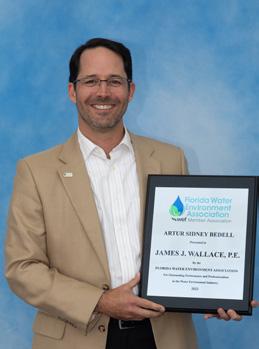
Vice President: Jamey Wallace (FWEA) Jacobs
Treasurer: Rim Bishop (FWPCOA) Seacoast Utility Authority
Secretary: Mish Clark Mish Agency
Moving?
The Post Office will not forward your magazine. Do not count on getting the Journal unless you notify us directly of address changes by the 15th of the month preceding the month of issue. Please do not telephone address changes. Email changes to changes@fwrj.com or mail to Florida Water Resources Journal, 1402 Emerald Lakes Drive, Clermont, FL 34711
Membership Questions
FSAWWA: Casey Cumiskey – 407-979-4806 or fsawwa.casey@gmail.com
50 Stormwater Management Planning: Does it Matter?—Erica Benson
76 What is the Operators’ Initiative and Why is it Important?—Steve Soltau
News Beat
Technical Articles
10 Addressing Per- and Poly-Fluoroalkyl Substances Through Source Water Assessments and Advanced Treatment Using Powdered Activated Carbon, Granular Activated Carbon, and Ion Exchange— Samantha Black, Katie Walker, Gwen WoodsChabane, Pete D’Adamo, and Dell Harney
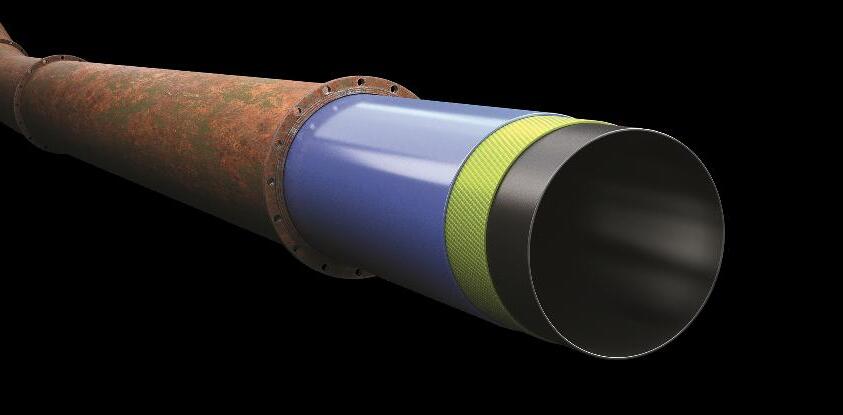
Emerging Renewal Technologies for Pressurized Pipelines—Steve Soldati
Three Ion Exchange Technologies, One Tough Decision for Florida Utilities—Tyler Smith, Chris Reinbold, Vinnie Hart, and Larry Elliott
Let’s Talk Safety: Jackhammer
Reader Profile— Felicity Appel 68 C Factor—Patrick “Murf” Murphy 70 FWEA Chapter Corner: South Chapter Meeting: Miami-Dade Water and Sewer Department Builds for the Future—Melody Gonzalez
72 FSAWWA Speaking Out—Emilie Moore
Departments
Fish Passage Program to Receive Federal Funding
The U.S. Department of the Interior has announced that 40 fish passage projects in 23 states and Puerto Rico will receive a total of nearly $38 million in Fiscal Year 2022 funding from President Biden’s Bipartisan Infrastructure Law.
With a total of $200 million in investments in the National Fish Passage Program over the next five years, the law will bolster efforts to address outdated, unsafe, or obsolete dams, culverts, levees, and other barriers fragmenting rivers and streams in the United States, which will help restore fish passages and aquatic connectivity.
The National Fish Passage Program, facilitated by the U.S. Fish and Wildlife Service, supports aquatic ecosystem restoration projects and restores free-flowing waters, allowing for enhanced fish migration and protecting communities from flooding.
“Across the country, millions of barriers block fish migration and put communities at higher risk of flooding,” said Deb Haaland, department secretary. “President Biden’s Bipartisan Infrastructure Law provides a once-in-a-generation opportunity to invest in our nation’s rivers, streams, and communities and help restore habitat connectivity for aquatic species around the country.”
Several of the projects receiving funding will directly address issues related to climate change and serve disadvantaged communities, while also spanning the U.S. geographically and addressing a wide array of diverse aquatic resource issues.
As part of the announcement, Shannon Estenoz, assistant secretary for fish and
Dam near Albright, W.V., which is among the recipients of the new funding. During the visit, the leaders met with staff and partners to discuss the dam’s removal and the positive impact it will have on neighboring communities. Removing the obsolete dam, built in 1952 on the Cheat River, will help increase public access and recreational opportunities and improve public safety.
Engineering is underway and removal is planned for 2023.
“Aquatic restoration projects are important examples of how naturebased projects can enable ecosystems and communities to be more resilient to climate change,” said Williams. “In addition to providing benefits for fish and aquatic species, the National Fish Passage Program’s work to restore degraded and fragmented aquatic habitats decreases public safety hazards, improves infrastructure resilience, creates
The program has decades of proven experience implementing infrastructure projects, with partners to improve the health of the nation’s waterways, reconnect rivers, and improve climate resilience. The program provides financial, engineering, and planning assistance to communities, tribes, and landowners to help remove barriers and restore rivers for the benefit of fish and people.
Since 1999, the program has worked with over 2,000 local communities, states, tribes, and private landowners to remove or bypass 3,202 barriers to fish passage and reopen access to 57,736 miles of upstream habitat and 193,783 acres of wetland habitat for fish and other animals.
The rivers, streams, and coastal systems of North America once supported vast annual runs of fish, such as Atlantic salmon, American shad, alewife, blueback herring, and American eel. These species—and many others that include some at-risk species— depend on connected streams and highquality habitat to survive. During the past 200 years, many of these populations have
Across coastal Florida, dam removal and stream restoration projects will remove two dams and restore streams on the Apalachicola, Myakka, and Econlockhatchee rivers. The projects will benefit five federally listed mussel species, as well as Gulf sturgeon and the Florida manatee.
For more information about the National Fish Passage Program and the 40 funded projects, visit the Fish Passage Program website at www.fws.gov/program/national-
FWEA FOCUS
CThe Value of FWEA
Sondra W. Lee, P.E. President, FWEA
an you remember where you were when you first learned of FWEA? I first learned of the organization in 2002 and have noticed since then the great value that FWEA has brought me. The first 10 years of my career in engineering were mostly spent on private development projects and stormwater design, never crossing paths with FWEA.
It was shortly after I had joined the City of Tallahassee’s water and sewer engineering team when, one morning, a coworker of mine, Donna Nichols, invited me along to visit some project sites. As noon approached, she turned into the parking lot of a consulting firm and casually said, “I need to stop at this office for a meeting; you can just come in with me.” It turned out to be a steering committee meeting of the Big Bend Chapter, which was planning a technical seminar for the Tallahassee area. I was assigned a small task, which eventually led to getting very involved with the chapter, and that has grown—20 years later—into taking on the role of serving as the president of FWEA.
The Benefits of Involvement
Over the years I have seen the value FWEA brings to our members, communities, and the overall profession. Two specific examples of how
career and personally, are professional growth and connections.
Professional Growth
Part of the mission of FWEA is to provide professional education opportunities. By attending conferences, seminars, and chapter luncheons, members and colleagues enhance their knowledge to help manage our water resources. In addition to these events, those who volunteer also have the opportunity to develop their project management and leadership skills. Running, or serving on, a committee, one will need to be organized, create and follow a schedule, look for and define priorities, and find ways to encourage others on the committee to keep moving with their tasks.
Connections
The other great benefit, or value, from
is a volunteer-driven organization where the volunteer opportunities bring together a wide array of colleagues at meetings and events. Often these are people that I would not have had the chance to interact with if not for FWEA.
There have been many times I have picked up ideas and tips to better manage my work with the City of Tallahassee. There is just something about the synergy of meeting colleagues and sharing information about projects, funding, and staffing, and exchanging ideas while at inperson events (and occasionally during virtual meetings). From what I saw at the Florida Water Resources Conference in April, it appears to me that many of us were ready to connect again.
Take the First Step
These are just a couple of examples of the value I see in being a member of FWEA. The FWEA board of directors will continue to strive to bring value to the membership over the next year, and for years to come.
Be on the lookout for FWEA events taking place throughout the state. I encourage you to offer some assistance at just one event, or to help out with some behind-the-scenes task for your area chapter or on a committee of interest. You can find contact information for chapters and committees from the “Membership” drop down menu on the FWEA website at www.fwea.org. If anything, I hope that you consider attending an event, and invite someone else so they can discover the value that FWEA brings to the water industry. S
FWEA leadership development workshop dinner.
FWEA leadership development workshop planning session.
FWEA chapter event happy hour.
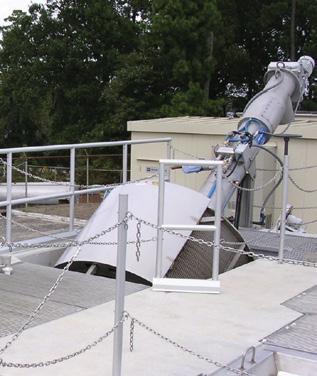
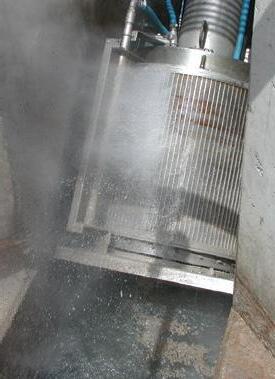
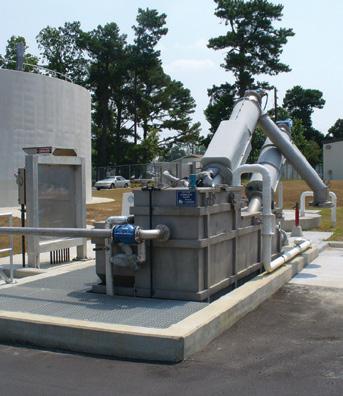
WE TAILOR OUR SCREENING EQUIPMENT TO FIT YOUR NEEDS.
All wastewater treatment plants are not alike. That’s why plant designers prefer our Raptor® line of screening products, the innovative all-in-one units that screen, wash, convey and dewater screenings efficiently, capturing more fine solids and long fibers than other available screens. Raptor® products are adaptable to a wide range of configurations, giving you more choices for better performance in your unique application. They are preferred among plant operators for their simple operation, ease of use, and minimal maintenance. When performance counts, count on the industry leader for more than 90 years—Lakeside Equipment Corporation.
Cleaner Water for a Brighter Future®
Speak to one of our experts at 630.837.5640, email us at sales@lakeside-equipment.com, or visit www.lakeside-equipment.com for more product information.
Operators: Take the CEU Challenge!
Members of the Florida Water and Pollution Control Operators Association (FWPCOA) may earn continuing education units through the CEU Challenge! Answer the questions published on this page, based on the technical articles in this month’s issue. Circle the letter of each correct answer. There is only one correct answer to each question! Answer 80 percent of the questions on any article correctly to earn 0.1 CEU for your license. Retests are available. This month’s editorial theme is Stormwater Management and Emerging Technologies Look above each set of questions to see if it is for water operators (DW), distribution system operators (DS), or wastewater operators (WW). Mail the completed page (or a photocopy) to: Florida Environmental Professionals Training, P.O. Box 33119, Palm Beach Gardens, Fla. 33420-3119. Enclose $15 for each set of questions you choose to answer (make checks payable to FWPCOA). You MUST be an FWPCOA member before you can submit your answers!
EARN CEUS BY ANSWERING
QUESTIONS FROM
JOURNAL ISSUES! Contact FWPCOA at membership@fwpcoa.org or at 561-840-0340. Articles from past issues can be viewed on the Journal website, www.fwrj.com.
Emerging Renewal Technologies for Pressurized Pipelines
Steve Soldati
(Article 1: CEU = 0.DS/DW/WW02015403)
1. Which of the following is not specifically identified as a characteristic of fiber-reinforced polymer pipe?
a. More structurally robust than all other alternatives
b. Flexibility to adapt to unique pipe layouts
c. Well-suited to spot repairs
d. Typically used for larger pipelines
2. Guidance in selecting the best rehabilitation technique can be found in which of the following references?
a. ASTM 563.2 b. AWWA M28
c. ANSI 14006 d. ISO 9001
3. Hose lining
a. does not require the continued support of the existing host pipe.
b. requires larger work zones than all other alternatives discussed.
c. requires long pipe laydown areas.
d. requires no resin curing.
4. The replacement pipe created by the cured-inplace process
a. is a fully structural Class 4 solution.
b. significantly restricts flow capacity.
c. is more disruptive to local activity than most other solutions.
d. is the most expensive approach.
5. Which of the following is the only rehabilitation option that can be used to expand pipeline carrying capacity?
a. Cured-in-place
b. Hose lining
c. Tight-fit high-density polyethylene
d. Fusible polyvinyl chloride horizontal directional drill
Three Ion Exchange Technologies, One Tough Decision for Florida Utilities
Tyler Smith, Chris Reinbold, Vinnie Hart, and Larry Elliott (Article 2: CEU = 0.1DS/DW/WW02015404)
1. Magnetic ion exchange is a fluidized bed process primarily developed to remove
a. hardness. b. dissolved organic carbon.
c. iron. d. alkalinity.
2. Which of the following is a disadvantage of fixed bed ion exchange treatment?
a. Requires a large footprint for larger-capacity treatment systems
b. Media must be regenerated more frequently
c. Requires media that is less tolerant of chlorine in treating fouling
d. Less effective in treating certain anaerobic ground waters
3. Previous suspended ion exchange (SIX) process studies have indicated that contact times up to ____________ will achieve adequate organics removal.
a. 15 minutes b. 30 minutes
c. 1 hour d. 90 minutes
4. Which of the ion exchange treatment processes discussed has the highest sulfate and bicarbonate competition?
a. Fixed bed
b. Magnetic ion exchange (MIEX)
c. SIX
d. It’s the same for MIEX and SIX
5. Resin is separated from the water in the MIEX process by
a. downstream sedimentation tanks.
b. tube settlers or plates at the top of the reactor vessel.
c. a built-in clarifier.
d. cartridge filtration systems.
Addressing Per- and Poly-Fluoroalkyl Substances Through Source Water Assessments and Advanced Treatment Using Powdered Activated Carbon, Granular Activated Carbon, and Ion Exchange
Samantha Black, Katie Walker, Gwen Woods-Chabane, Pete D’Adamo, and Dell Harney (Article 3: CEU = 0.1DS/DW/WW02015405)
1. In powdered activated carbon testing, there was _________ difference in per- and poly-fluoroalkyl substances (PFAS) removal between contact times of 1 minute and 30 minutes.
a. negligible b. modest
c. significant d. zero
2. Which of the following forms of PFAS broke through granular activated carbon (GAC) and ion exchange (IX) columns most quickly?
a. Short-chain b. Intermediate-chain
c. Long-chain d. All broke through simultaneously
3. The U.S. Environmental Protection Agency (EPA) has established a lifetime health advisory level of _______ nanograms per liter for the sum of two PFAS.
a. 30 b. 50
c. 70 d. 90
4. PFAS are persistent in the environment because of the strong chemical bond between _____________ and fluorine atoms.
a. calcium b. magnesium
c. carbon d. sulfide
5. A disadvantage of the city’s existing powdered activated carbon PFAS reduction system is that it
a. does not reduce total organic carbon.
b. does not reduce PFAS to a concentration that is less than the EPA standard.
c. is too expensive and complex to install at full plant scale.
d. increases plant residuals production.
Addressing Per- and Poly-Fluoroalkyl Substances Through Source Water Assessments and Advanced Treatment Using Powdered Activated Carbon, Granular Activated Carbon, and Ion Exchange
Samantha Black, Katie Walker, Gwen Woods-Chabane, Pete D’Adamo, and Dell Harney
Per- and poly-fluoroalkyl substances (PFAS) are manmade fluorinated compounds of emerging concern in the water industry. The PFAS are persistent and stable in the environment due to the strong chemical bond between carbon and fluorine atoms. They have been used largely for their water- and oil-repellent properties in several applications, including consumer products and aqueous film-forming foam (AFFF) to fight petroleum-based fires.
Communities in other countries and across the United States, including the City of Greensboro (city), N.C., have detected PFAS in drinking water supplies, typically at nanograms per liter (ng/L) concentrations. Elevated levels can be associated with facilities that use or manufacture these chemicals, such as airports (both domestic and military) and firefighting training facilities, as well as disposal sites of PFAS-contaminated wastes.
City of Greensboro Mitchell Water Treatment Plant
The city operates the Mitchell Water
Treatment Plant (WTP), a 24-mil-gal-perday (mgd) conventional treatment facility. A schematic of the Mitchell WTP processes is provided in Figure 1. One of the city’s long-term goals is to provide a robust and flexible advanced treatment process capable of treating both emerging and regulated contaminants, and one family of emerging contaminants includes PFAS. The U.S. Environmental Protection Agency (EPA) has established a lifetime health advisory level (LHAL) of 70 ng/L for the sum of two PFAS: perfluorooctanesulfonic acid (PFOS) and perfluorooctanoic acid (PFOA). The PFOS and PFOA have been detected at trace concentrations in the city’s water supply at the Mitchell WTP, along with other PFAS. The LHALs for other PFAS are anticipated in mid-2022 and it’s expected that EPA will publish additional PFAS regulations in the next year.
Source Water Assessment
During sampling, as part of the third Unregulated Contaminant Monitoring Rule
Samantha Black, Ph.D., P.E., is a water treatment process engineer and associate at HDR in West Palm Beach. Katie Walker, P.E., is a drinking water lead and associate at HDR in Raleigh, N.C. Gwen Woods-Chabane, Ph.D., is a drinking water quality lead and senior professional associate at HDR in Portland, Ore. Pete D’Adamo, Ph.D., P.E., is a water treatment technical lead and principal professional associate at HDR in Vienna, Va. Dell Harney is the water supply manager at the City of Greensboro in Greensboro, N.C.
(UCMR) from 2013 to 2015, some of the city’s water samples had combined levels of PFOS and PFOA that exceeded 100 ng/L. These findings led to a two-year watershed investigation to identify hotspots of PFAS contamination in the city’s raw water supply. This two-year study included monthly sampling of 30 sites throughout the city’s watershed, such as lakes that supply raw water to WTPs, streams that discharge into these lakes, ponds near potential
contamination sites, historical fire sites, and groundwater wells. Figure 2 presents a summary of individual PFAS species identified during the study from a small stream near where AFFF has been discharged and where manufacturing used to occur. A majority of the total PFAS concentration is comprised of PFOS, which is found in AFFF and manufacturing.
One of the major benefits of the source water assessment was identifying potential contamination sites and collaborating with stakeholders, such as the local fire department, airport authority, and airport fire department, to reduce AFFF discharge and provide an open line of communication between stakeholders and the city. Since the completion of the source water assessment, PFAS levels detected by the city are well below the health advisory level.
Per- and Poly-Fluoroalkyl Substance Treatment
One of the first steps needed to identify an optimal PFAS treatment process is an evaluation of technologies using site-specific
conditions. Research to date has shown that PFAS treatment effectiveness may vary, depending on the water source, pretreatment processes, and other operational conditions; therefore, a technology that works for one utility may not work for another. Additionally, treatment effectiveness is highly dependent on feed water quality. Bench and pilot testing under site-specific conditions prior to fullscale design of PFAS treatment systems is crucial to determine the most cost-effective treatment process.
Powdered Activated Carbon
In 2018, the city and HDR evaluated the effectiveness of powdered activated carbon (PAC) for PFAS removal in a jar test setting. The purpose of testing PAC was to quickly implement a PFAS mitigation strategy that would lower PFOS and PFOA levels to below EPA’s LHAL. In 2018, the city installed a temporary PAC system to remove PFAS at its Mitchell WTP. The PAC system has demonstrated partial PFAS removal, but it’s messy and associated with operational challenges, including increased
residuals production. The city desires the design and construction of a permanent, fullscale advanced treatment process to provide permanent PFAS removal from its water supply.
Prior to full-scale installation, two PAC types of evaluations during jar testing were used to determine the efficacy of PAC doses and contact times at various PFAS levels. Doses of 10, 20, and 30 milligrams per liter (mg/L), and contact times of one minute (simulating PAC addition at the Mitchell WTP) and 30 minutes (simulating addition at the raw water pump station) were evaluated.
Figure 3 presents results of jar testing evaluating two PAC types (the Watercarb 800 and Watercarb 1000), both manufactured by Standard Purification. At the time of testing, the PFOS+PFOA level was 88 ng/L, which was slightly higher than the LHAL, and there was minimal difference between the two PAC types. The PFAS removal increased as PAC dose increased, but not linearly. Although not presented herein, there was negligible difference between a contact time of one minute and 30 minutes; therefore, the city
Continued on page 12
Figure 2. Per- and Poly-Fluoroalkyl Substances Speciation from a Stream Near Aqueous Film-Forming Foam Discharge Site Within the Vicinity of Historical Manufacturing Activities
Figure 3. Powdered Activated Carbon Jar Testing Results
Figure 4. Full-Scale Powdered Activated Carbon System Results
Figure 5. Total Organic Carbon Results From Granular Activated Carbon Column Effluent
opted to install the system at the Mitchell WTP.
Figure 4 presents results from full-scale PAC use using the Watercarb 800 product at a dose of 20 mg/L. At the time of sampling, the raw water total PFAS level was 34 ng/L and the PFOS+PFOA level was 20 ng/L. The PAC addition resulted in a 42 percent reduction of total PFAS and a 38 percent reduction of PFOS+PFOA.
Rapid Small-Scale Column Testing
Rapid small-scale column testing (RSSCT) was performed to evaluate multiple granular activated carbon (GAC) media and ion exchange (IX) resin, in parallel with controlled laboratory conditions. The RSSCT is a proven, quick, and effective method for evaluating the treatability of PFAS using various GAC media prior to pilot testing and full-scale design. These are continuousflow column tests where reduced GAC or IX particle sizes result in experimental conditions, with shorter empty bed contact
time (EBCT), operation times, and column lengths, compared to pilot- or full-scale contactors. These conditions allow for much faster assessments of GAC and other media performance than equivalent testing with pilot- or full-scale evaluations.
Toward the end of 2021, pilot testing commenced to determine the optimal full-scale treatment technology. The pilot protocol was developed based on results from laboratory bench-scale testing.
Granular Activated Carbon
A suite of water quality parameters was monitored throughout bench-scale GAC testing. For brevity, only total organic carbon (TOC) and PFAS are presented herein.
Figure 5 presents TOC results from the GAC columns. Four GAC media types were evaluated:
S Calgon F400
S Jacobi Aquasorb F23
S Evoqua UC1240LD
S Cabot Norit 400
The average influent TOC level measured in the drums was 1.3 mg/L, and ranged from
1.2 to 1.8 mg/L. The GAC media removed roughly 0.5 mg/L up to about 10 to 15k bed volumes (BVs), but demonstrated little removal by 50k BVs. The Evoqua, Calgon, and Jacobi carbons provided slightly better TOC removal, compared to the Cabot carbon. Figure 6 presents a summary of PFOS+PFOA removal capabilities by the four GAC media. Removal of individual PFAS are provided for each media type in its respective subsection. Generally, the Jacobi Aquasorb F23 provided the best PFOS+PFOA removal relative to the other GAC media tested, although the Calgon F-400 media also provided adequate removal. The Calgon F-400 provided the best TOC removal, compared to the other GAC media.
Figure 7 presents total PFAS removal as a function of BVs processed using the four different GAC media. Similar to the PFOS+PFOA results, the Jacobi and Calgon carbons performed better than the Evoqua and Cabot Norit carbons. The Calgon media provided superior total PFAS removal, compared to the Jacobi media, due to the higher removal of shortchain perfluorobutanoic acid (PFBA) and
Figure 8 and Figure 9 present individual PFAS removal as a function of BVs for the Evoqua UC1240LD and Calgon F-400 media, respectively. As is typical for adsorption column testing, shorter-chain PFAS broke through into column effluent sooner than longer-chain species, and sulfonic acid species were removed more effectively than carboxylic acid counterparts.
As described previously, the Calgon F-400 and Jacobi Aquasorb F23 performed the best with respect to PFAS removal. The F-400 performed best overall (the highest overall removal of the six PFAS), while the Aquasorb F23 demonstrated superior retention for PFOS, making it an ideal GAC if only PFOA and PFOS are of concern for removal. The PFOS and perfluorohexanesulfonic acid (PFHxS), the two PFAS that comprise a majority of the total PFAS concentration in the city’s water supply, broke through the columns slower than alternative PFAS.
Ion Exchange
The IX RSSCTs occurred in parallel to GAC media testing. Similarly to the GAC results, a suite of water quality parameters was monitored throughout bench-scale GAC testing. For brevity, only TOC and PFAS are presented herein.
Figure 10 presents TOC results from the IX columns. The same influent water for the GAC columns was used for the IX columns, with the average influent TOC level measured as 1.3 mg/L and ranging from 1.2 to 1.8 mg/L. The IX resins removed 0.2 to 0.3 mg/L of TOC (up to about 40k BVs) and had minimal removal by 100k BVs. This is likely due to the PFAS selectivity of IX resins. The PFOS+PFOA figures are not presented since they were below detection
limits in almost all IX column effluent samples, even after reaching 100,000 BVs in the columns.
Using RSSCT for IX evaluations is not as refined as RSSCT for GAC studies; therefore, it’s important to interpret the data with caution and remember that RSSCT is used for comparative purposes only, not for fullscale design, and piloting will determine the optimal PFAS treatment options.
Three types of resin were evaluated:
S Calgon CalRes 2301
S Evoqua DOWEX PSR2 Plus
S Purolite PurofinePFA694E
The Calgon and Evoqua resins were evaluated in duplicate columns. Figure 11 presents total PFAS removal as a function of BVs for the five IX columns. It’s important to note that the Y-axis was modified to show 90 to 100 percent removal, since total PFAS removal for each of the resins was relatively high.
In general, the Calgon and Evoqua resins outperformed the Purolite resin, although each of the resins provided greater PFAS removal, compared to GAC media. While IX resin often provides greater PFAS removal than GAC media and requires less-frequent change-outs, it’s important to note that IX resin is more costly than GAC media and provides limited removal of other constituents, such as TOC.
Conclusions and Next Steps
In 2018, PAC presented a good temporary option for the city because it was installed quickly and provided sufficient PFAS reduction; however, PAC has increased residuals loading and is not as robust as other available PFAS treatment options.
Both GAC and IX are good options for the city to consider for full-scale treatment.
The top two best-performing GAC media and IX resin are currently being evaluated at the pilot scale. The IX resin provided better PFAS removal compared to GAC at the bench scale. While full-scale GAC would require morefrequent change-out compared to IX, GAC media is a lower-cost option and provides a secondary benefit of TOC adsorption that IX resin does not, due to resin PFAS selectivity. Short-chain PFAS started to break through GAC and IX columns prior to longchain PFAS as expected, based on industry findings to date. This may be of concern for the city and other utilities if short-chain PFAS are identified in water supplies as part of UCMR 5. Differences were identified between GAC in terms of total PFAS removal, with the Calgon carbon appearing to capture a wider range of PFAS and the Jacobi carbon appearing to target PFOS and PFOA. S
Calgon CalRes 2301 (A)
Purolite Purofine PFA694E
Figure 10. Total Activated Carbon Results from Ion Exchange Column Effluent
Figure 11. Per- and Poly-Fluoroalkyl Substances Removal Using Ion Exchange
Highlights From the 2022 Florida Water Resources Conference
Mish Clark
It was great to connect again at the 2022 Florida Water Resources Conference (FWRC) after a three-year sabbatical due to the pandemic. Sponsored by Florida Section American Water Works Association (FSAWWA), Florida Water Environment Federation (FWEA), and Florida Water and Pollution Control Operators Association (FWPCOA), the conference was held April 24-27 at the Ocean Center in Daytona Beach. The beach area made for easy access to comfortable hotels, quality restaurants, and, of course, the ocean.
this year’s event set several new milestones, with everyone excited to reconnect.
2022 FWRC by the Numbers
Here are some statistics from the conference:
S 2,644 attendees
S 360 exhibitor booths
S 54 sponsors
S Six paid events
S 78 meetings
S Five “Connect Again” networking events
S 113 technical sessions and workshops
S 95 continuing education units (CEUs) and 313 professional development hours (PDHs) awarded
A Multifaceted Conference
including workshops and special-interest presentations, was exceptional and the quality educational papers that were presented once again demonstrate why FWRC is so highly regarded as a premier event in the water/ wastewater business.
Networking events brought to life the many ways that water professionals are growing and thriving in their careers. With the various opportunities and challenges they face on a daily basis, the broad array of technical presentations, roundtables, and symposiums provided many answers for them.
Daytona Beach is one of the major Florida cities that FWRC has on its site rotation, and
The conference technical program,
The exhibit hall in the Ocean Center was completely sold out. There truly was a reason to visit every corner and the spaces in between. In the center of the exhibit hall, all could enjoy watching the various Operations Challenge competitions, where teams of four members competed in this statewide contest.
Each year we try to include activities to make this event as interesting and informative as possible:
Technical Tour: Daytona Beach’s LPGA Facility
A tour of Daytona Beach’s LPGA Facility was held on Sunday and was very engaging and informative. It included the facility’s demonstration testing system, water reclamation facility upgrades, and water treatment plant upgrades.
Operators Showcase
The Operators Showcase, presented by FWPCOA, was an opportunity to review and discuss potable water reuse and the changes in Florida regulations. This year, Dr. Carlyn J. Higgins, assistant engineer with Hazen and
Sawyer, and Mike Darrow, superintendent of utilities operations at Plant City and past president and current Legislative Committee chair of FWPCOA, led the discussion.
Women of Water Forum
This fifth forum, facilitated by Randy Brown, utilities director from Pompano Beach, and Marjorie Craig, P.E., director, environmental utilities department from St. Cloud, allowed women (and men) to have a peer-to-peer exchange of knowledge and an opportunity to share experiences and inspiration.
FSAWWA Water Utility Council Meeting
At the meeting of the Water Utility Council (WUC), its members shared their knowledge, information, and advocacy to improve the quality and supply of drinking water. The FSAWWA WUC mission is to develop action programs to initiate, evaluate, respond, and comment on legislative, regulatory, and other matters directly affecting water utilities in Florida.
Other Events
Other events held at the conference this year included the Florida Select Society of Sanitary Sludge Shovelers (FSSSSS) annual members breakfast and new member induction ceremony, and the FSAWWA regional chairs and volunteers breakfast. Various other association meetings and forums were also held.
Students and Young Professionals: The Future of the Industry
Emphasis was placed on young professionals and university students as we ramped up new activities to maintain their interest and involvement.
Young Professionals Symposium
The symposium, a joint endeavor by FSAWWA and FWEA, presented a roundtable discussion, with guest speakers sharing their career stories.
YP Social
The social, which was an evening event, provided an opportunity for young professionals and others to meet, network, and learn more about the industry.
Student Design Competition
The competition brings the brightest young minds and their wastewater and environmental
designs to the conference. Teams represented these Florida universities:
Wastewater Category
S Florida Gulf Coast University (Kaylei Kambak, Alexis Scheele, Brendan Zwiefel)
S University of South Florida (Lauren Binder, Nicholas Nolan)
Florida Gulf Coast University was the first-place winner in this category!
Environmental Category
S University of South Florida (Vanessa Adame, Anwar Alsharaf, Barbara Martinez, Shelby Rocha, Jada Williams)
S University of Florida (Emily Hetherington,
Elayne Nash, Mattie Nevis, Jackson Newman, Brady Schwabach)
S Florida Gulf Coast University (Nour Abedrabbo, Selena Crespo, Jose Jimenez)
S Florida International University (Karen Gonzalez, Natacha Haces, Jissell Muir)
The first-place winner in this category was University of South Florida!
Each team presented its real-world findings to an assigned problem or task in both environmental and wastewater interests. This competition is intended for both undergraduate and graduate students, typically completing a capstone project.
The winning teams will move on to the national contest at the 2022 Water
Continued on page 16
Continued from page 15
Environment Federation Technical Exhibition and Conference (WEFTEC) in New Orleans in October.
As an added bonus, a resumé writing workshop was held to assist the students in preparing a sharp resumé for future employment consideration.
Student Poster Contest
The poster contest was in full swing Monday afternoon in the rear stage area of the exhibit hall. The winners were:
S First Place: Yan Zhang - University of South Florida
S Second Place: Thanh Lam - Jacobs
Technical Sessions and Workshops: Peers Share Their Expertise
The technical program, loaded with valuable content, was coordinated by Nicole McConnell, P.E., with Kimley-Horn. She serves as conference vice president, and her technical review committee, which is composed of industry experts from a variety of government and privately owned facilities
and agencies, developed the program. The committee members read and graded the submitted abstracts by subject, and the top five in each group were selected for presentation.
Workshops
The eight workshop presentations were:
S Introduction to Stormwater
S Innovation Forum
S Communities Meeting the PFAS Challenge
S Public Utilities Potpourri: Resiliency Funding, Senate Bill 64 Compliance Strategies, Legislative and Regulatory Update, and Interactive Lead and Copper Rule Revisions
S Collections Systems
S Communications
S Top Five Factors to Consider When Choosing a Delivery Method: Client and Contractor Perspective
S Septic System Upgrades
Technical Sessions
Two days of solid technical content included five (sometimes more) concurrent sessions that substantially covered important and timely issues on the following topics:
S Utility management
S Potable water treatment
S Wastewater treatment
S Collection systems
S Stormwater and green infrastructure
S Distribution systems
S Biosolids/resource recovery
S Modeling/geographic information systems (GIS)/computer apps
S Sustainability/water supply
S Nutrient removal
S Reclamation and reuse
Thanks to Our Sponsors
The conference sponsors help to enrich the experience at FWRC. We appreciate their interest in the conference’s vision and are grateful for their support. We encourage all conference attendees to give these sponsors the opportunity to earn their business throughout the year.
Title Sponsor
S Merrell Bros.
Platinum Sponsors
S CHA Consulting Inc.
S Custom Controls Technology Inc.
S Wade Trim
S Vogel Bros. Building Co.
Gold Sponsors
S AECOM Technical Services Inc.
S Atkins Global
S FJ Nugent & Associates Inc.
S GML Coatings
S Grundfos
S Freese and Nichols
S HDR Engineering
S Hydra Services Inc.
S Mott Macdonald
S Wright-Pierce
Silver Sponsors
S Arcadis
S Black & Veatch Corporation
S Custom Controls Technology Inc.
S Gannett Fleming
S Haskell
S Moss Kelley Inc.
S Nanostone Water Inc.
S Synagro Technologies Inc.
S Tetra Tech
S Weston & Sampson
Bronze Sponsors
S Ardurra
S Barge Design Solutions
S Brown & Caldwell
S Carter & VerPlanck
S Commerce Controls
S Hudson Pump & Equipment
S Vaughan Company Inc.
S Wharton-Smith Inc.
S Woolpert
S Xylem Water Solutions
Supporting Sponsors
S CDM Smith
S Flender Corporation
S Florida Aquastore & Utility Construction Inc.
S Flovac
S Fortiline Waterworks
S Gerber Pumps International Inc.
S Guardian Equipment Inc.
S Jacobs
S Jones Edmunds & Associates Inc.
S Kampstrup Water Metering
S Kiewit
S Stantec
S Starnet Technologies
S Sundt Construction Inc.
S Synagro Technologies Inc.
S U.S. Submergent Technologies
S Tom Evans Environmental
S Vega Americas
S VTScada by Trihedral
Networking and Annual Events: Information Sharing and Industry Recognition
Many activities went on at FWRC in addition to the educational forums, technical sessions, and committee meetings.
President’s Reception
To kick off the 2022 FWRC, a president’s reception was held in the exhibit hall. As everyone networked and reconnected, buffets and open bars were enjoyed by all. In addition, the band, Wolfhawk, sponsored by Thermal Processing Systems, helped to set the mood.
Then, to everyone’s surprise, two local animal rescue organizations joined the party, which charged the atmosphere and brought instant smiles to everyone. Thank you to Southeastern Guide Dogs and Halifax Humane Society Inc. for their support.
Awards Luncheons
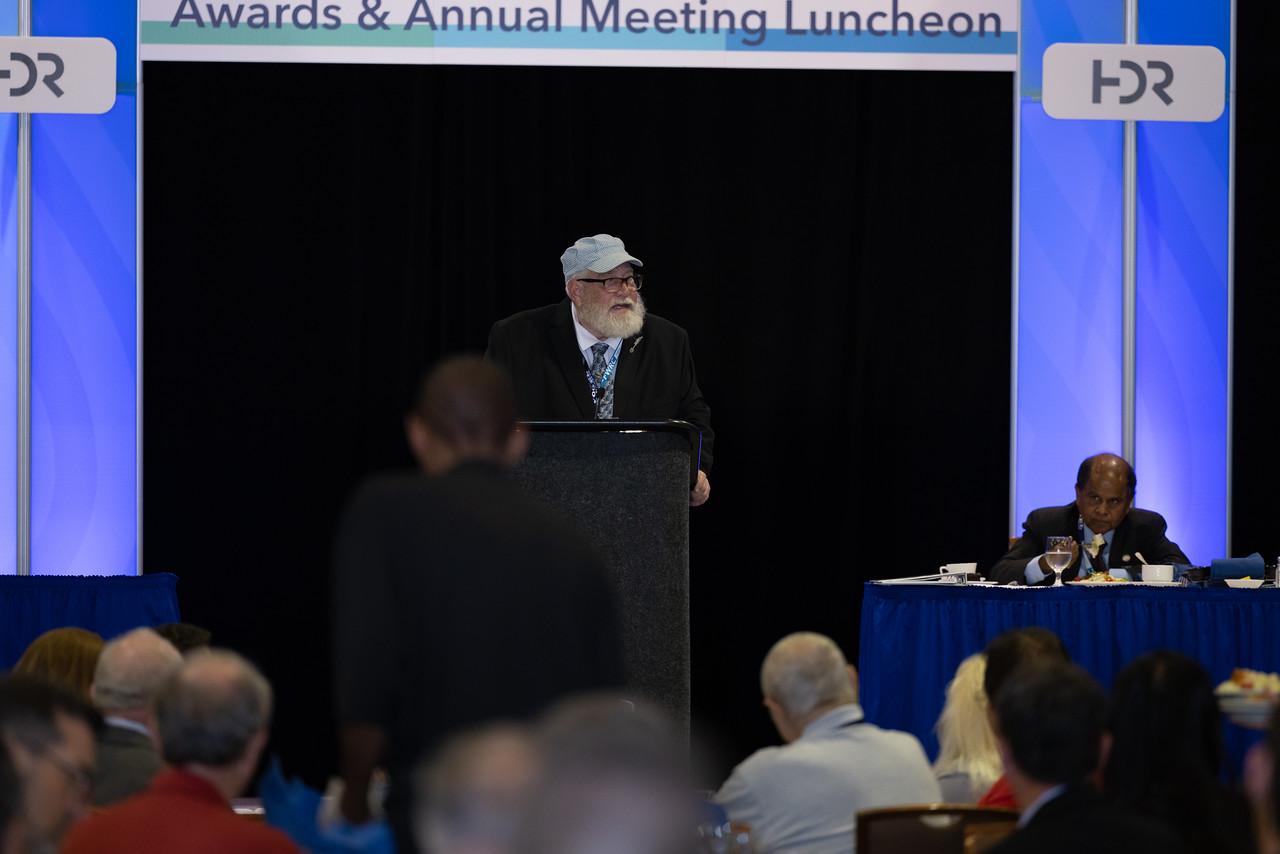
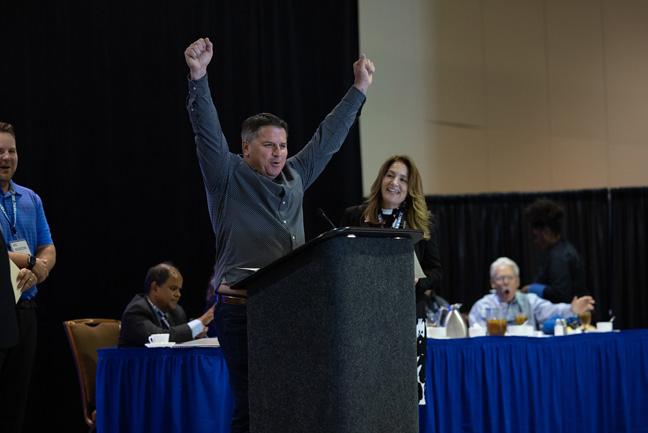
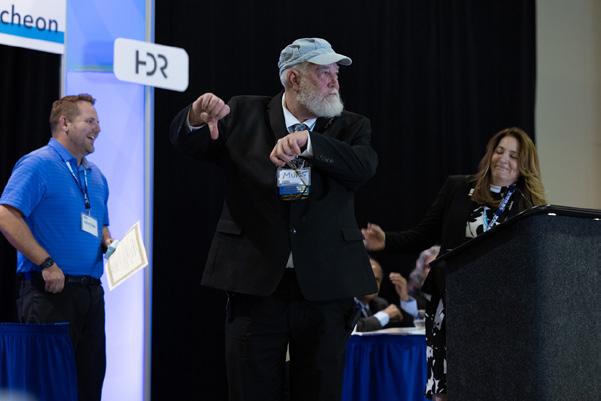
Hundreds of attendees and exhibitors attended the Monday FWRC awards luncheon. Tim Madhanagopal, FWRC president, hosted the proceedings; the board members of FSAWWA, FWEA, FWPCOA, and FWRC were in attendance; and several awards were given out. Also in attendance was Ifetayo Venner, the national representative from WEF and its 20212022 president-elect, and Scott Kelly, P.E., past president of FWRC.
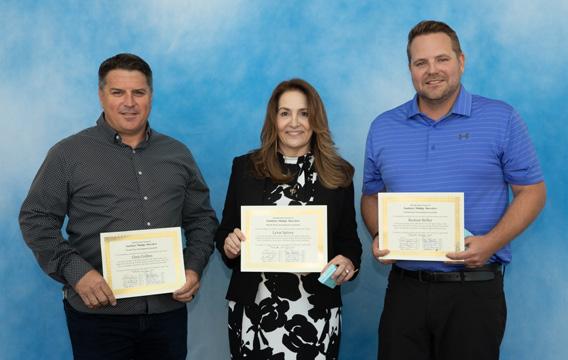
Patrick Murphy hosted the Florida Select Society of Sanitary Sludge Shovelers (FSSSSS) inductions at the Monday lunch. This exclusive
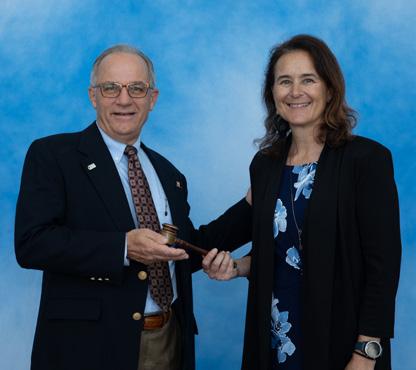
award honors the recipients based on merit for their “outstanding and meritorious service above and beyond the call of duty to the water industry.” This year’s recipients were Chris Collins, Keaton Heller, and Lynn Spivey. Tuesday’s FWEA annual meeting and awards luncheon hosted Ifetayo Venner, the WEF officer in attendance, and included review of the organization’s annual report, election of officers, and passing of the gavel to new FWEA president Sondra Lee, who gave her incoming remarks.
Networking Party
The Monday Night networking party was held at the Hilton, across the street from the Ocean Center. The open bar and live music by Martini Pop got folks on the dance floor as they enjoyed the atmosphere and the delicious desserts.
Contests and Competitions
FSAWWA “Best of the Best” Tasting Drinking Water Competition
This competition had 12 entrants that won the Best Tasting Drinking Water Contests in their FSAWWA regions. Winners from these regional events competed at FWRC. On Tuesday, the municipalities representing the section’s 12 regions entered their drinking water samples for close examination and various testing. The 12 regions included the following: S Region 1 - City of Tallahassee S Region II - JEA
Continued on page 18
Continued from page 17
S Region III - Seminole County
S Region IV - Polk County
S Region V - Bonita Springs Utilities Inc.
S Region VI - Seacoast Utility Authority
S Region VII - Florida Keys Aqueduct Authority
S Region VIII - Martin County Utilities
S Region IX - South Walton Utilities
S Region X - City of Punta Gorda
S Region XI - City of Belleview
S Region XII - City of Lynn Haven
The winner at this year’s contest was Seacoast Utility Authority!
Operations Challenge
The Operations Challenge included teams of four people that competed in five separate events: operations, maintenance, laboratory, safety, and collection systems. Teams competed at a regional level to earn the right to represent Florida at the national competition at WEFTEC.
The teams competing included:
S Polk County Bio-Wizards
S JEA Fecal Matters
S St. Petersburg Dirty Birds
S GRU True Grit
The first-place winner this year was Polk County Bio-Wizards, and JEA Fecal Matters earned the second-place trophy.
Top Ops
The AWWA Top Ops is the “College Bowl” of the water industry. Teams competed against each other in a fast-paced competitive questionand-answer tournament where a moderator asks a broad range of technical questions to the participating teams, and they have a limited time to answer. The winner represented the
Florida Section at this year’s AWWA Annual Conference and Exposition (ACE22) Top Ops competition in San Antonio.
The teams this year were as follows:
S Mono Rays (Vinny Domanico, Kendra Phillips, Jason Adair, Ken Durr, and Michael Avila) from Pasco County Utilities
S The Water Guns (Bill Young, Greg Taylor, Carlyn Higgins, and Mike Darrow)
The Mono Rays was this year’s winner.
Volunteers: The Backbone of the Conference
The FWRC has many moving parts and I would especially like to thank all of our talented speakers, who truly are experts in their fields; staff members of FSAWWA, FWPCOA, and FWEA; all the many people who volunteered their time at registration, as part of the technical review committee, and workshop coordinators; attendees at educational events and committee meetings; and all the other people behind the scenes who make this event so successful.
You are all good stewards of Florida’s clean water environment with your commitment to FWRC.
Save the Date
Let’s get ready for more fun and sun at the 2023 Florida Water Resources Conference, which is scheduled for May 13-17 at Gaylord Palms in Kissimmee. The FWRC strives to be your prevailing source for technical and educational information and we look forward to another great conference next year!
Mish Clark is executive director of the Florida Water Resources Conference.
We thank you for attending the 2022 Florida Water Resources Conference in Daytona Beach. I hope you had a memorable FWRC 2022 and the events were up to your expectations. We hope you and your company or your utility benefitted from the technical sessions, exhibits, field trip, and networking opportunities.
The conference was a great success and set a record in several areas. We hope to see you in May 2023 in Kissimmee as we return to the beautiful Gaylord Palms.
We always appreciate your feedback. We started the planning for FWRC 2023 based on your comments. We are working on improving the conference experience by implementing a new conference management system (CMS) and we invite your sponsorships for this new CMS.
If we can be of help in any way with your participation next year, please do not hesitate to contact us.
Tim Madhanagopal, P.E., F.WEF, F. NSPE
President, Florida Water Resources Conference Inc.
City of Daytona Beach Hosts Tour of Its LPGA Facility
On Sunday, April 24, conference attendees toured the City of Daytona Beach’s LPGA Facility. The facility is the site of the city’s 24-milliongallon-per-day (mgd) Ralph Brennan Water Treatment Plant, as well as the 15-mgd Westside Regional Water Reclamation Facility (WRF).
During the tour, attendees visited the following:
Demonstration Testing System
The city recently completed two years of data gathering on this 200,000-gallon-per-day (gpd) direct potable reuse system. The system includes ultrafiltration, followed by nanofiltration, with
polishing via ultraviolet advanced oxidation process (UVAOP). While the system is currently nonoperational, attendees had the chance to tour the facility, view the equipment setup, and ask questions.
Westside Water Reclamation Facility Upgrades
The city has invested $45 million in the Westside WRF over the past three years. Construction included an eight-cell tertiary deep bed sand filter structure, mechanical equipment, clarified liquid pump station structure, aeration improvements at the five-stage Bardenpho process, return activated sludge/waste activated
sludge (RAS/WAS) pumping stations, two electrical buildings and dewatering feed box, construction of new deep bed sand filters and new dewatering belt filter presses, and miscellaneous demolition and improvements throughout the facility. Attendees were able to tour these improvements and see them in full operation.
Brennan Water Treatment Plant Filter Upgrades
The city is in the process of replacing dual media filters that range from 35 to 45 years old. Attendees toured the project and saw a filter in mid-demonstration and reconstruction.
The Newest Products, Services, and Innovations
The exhibit hall this year included 360 exhibit booths, with company employees and representatives discussing cutting-edge technologies and processes with the attendees. Booths for FSAWWA, FWEA, FWPCOA, and the Florida Water Resources Journal had staff and volunteers available to talk about programs and events from the three organizations and their joint magazine.
The hall was also the site for the evening receptions; prize giveaways; Top Ops, Operations Challenge, and “Best of the Best” Drinking Water Contest competitions; poster session; and some of the awards presentations.
Some of the many activities are pictured here.
WORKSHOPS AND TECHNICAL SESSIONS
Sharing Knowledge, Know-How, and Expertise
Experts in their fields gave presentations on the latest information for water and wastewater.
The eight workshops at the conference covered the topics of stormwater, per- and polyfluoroalkyl substances (PFAS), public communications, public utilities issues (resiliency funding, Senate Bill 64 compliance strategies, legislative and regulatory update, and interactive lead and copper rule revisions), collection systems, factors to consider when choosing a delivery method, and septic system upgrades.
The two-day technical program included sessions on utility management, wastewater treatment, nutrient removal, stormwater and green infrastructure, collection systems, biosolids and resource recovery, potable water treatment, modeling/geographic information systems/computer apps, sustainability and water supply, reclamation and reuse, and distribution systems.
Pictured are some of the workshops and sessions.
Operators Hear Timely Topics for the Water and Wastewater Industry
Operators traveled from across Florida to attend the conference. On April 24, some attended the Operators Showcase to have a beer and discuss current topics in the water utility industry. The showcase is sponsored by the Florida Water and Pollution Control Operators Association (FWPCOA), and this year the discussion was moderated by Ken Enlow, project manager at the Tampa Bay Water Surface Water Treatment Plant.
Higgins Presentation: Potable Water Reuse
Drivers and Types of Potable Reuse
Potable water reuse is being considered in many parts of the United States. There are several drivers for potable water reuse:
S Traditional source water limitations (quantity and/or quality)
S Limited drinking water treatment capacity
S Limited drinking water distribution capacity
S Environmental discharge restrictions
S Limited collection system capacity (onsite reuse)
S Compatibility of reclaimed water with water use application
S Environmental augmentation
There are several types of nonpotable reuse:
S Irrigation
S Cooling
S Boiler feed
S Refineries
The session had two presenters:
S Carlyn Higgins, Ph.D., E.I., assistant engineer II with Hazen and Sawyer, talked about indirect potable reuse, equipment, and operator certification.
S Mike Darrow, superintendent of utility operations at Plant City, gave a rules update.
S Wetland restoration
S Toilet flushing
S Washdown
Groundwater and surface water augmentation are used for indirect potable reuse and finished water augmentation is used for direct potable reuse.
Florida Reuse Projects and Regulations
In Florida, potable water reuse projects are underway at the following cities and utilities, with project status indicated:
S City of Clearwater (operated July 2013 –June 2014)
S Hillsborough County (design phase)
S Tampa Bay Water (2016 – ongoing)
S City of Altamonte Springs (2016 – ongoing)
S JEA (phase I in 2018; phase II began 2019)
S City of Daytona Beach (March 2017 –November 2021)
S City of Tampa (feasibility phase)
S City of Plant City (2022 – ongoing)
Higgins presented the recent timeline for potable reuse regulation:
S 2018 – 2019: Public Reuse Commission holds public meetings.
S 2020: Senate Bill (SB) 712 directs the Florida Department of Environmental Protection (FDEP) to develop rules for all types of water reuse.
S 2020: Later in the year, SB 64 requires elimination of nonbeneficial surface water discharge by 2032.
S 2021: The FDEP issues draft potable reuse rules and revisions to wastewater and drinking water chapters. A pilot is
Dr. Carlyn Higgins
currently required prior to the design and construction of a potable reuse process.
Operator Certification for Potable Reuse
In 2017, the California Urban Water Agency recommended a hybrid licensure approach to allow water and wastewater operators to obtain a license in potable reuse or advanced water treatment.
Two Water Research Foundation projects recommended the following:
S Potable reuse should be added to water and wastewater treatment certification.
S Certification should include regulation,
source water understanding, advanced monitoring, and sampling.
In California, a committee has created an advanced water treatment operations certification.
In Florida, the Potable Reuse Commission, in 2019, stressed that highly trained certified operators are critical to the safe and successful functioning of potable reuse systems. “Endorsements” to existing operator certifications that cover advanced treatment, specific unit process, monitoring, and regulatory compliance should be implemented. Currently, Florida has considered separate
S Enhanced public education and outreach requirements.
S Optimizing corrosion control program.
S Service line inventories and lead service line replacement (LSLR).
Build a Piping Inventory
Start now to build a piping inventory using traditional data sources:
S Building and plumbing records
S City ordinances and state laws
Darrow Presentation: Rules Update
The FWPCOA is a trade organization founded in 1941, although the roots of the organization can be traced back to the 1920s. The association’s members are directly involved or associated with the water utility industry in Florida, including drinking water production, wastewater treatment, water reclamation, biosolids handling, and stormwater management.
U.S.
Environmental Protection Agency: Lead and Copper Rule
Considerations for this rule include:
S Copper requirements are unchanged.
S Maintains current lead action level (AL) 15 µg/l and creates new trigger level (TL) 10 µg/l for the 90th percentile.
S Prioritizes sampling at single-family homes with lead service lines (LSLs).
S Changes sample collection procedures (first and fifth liter samples).
S Requires sampling at schools and childcare facilities.
wastewater facility and public water system operator certifications, and a dual operator certification may be required in the future. There are resources that are available to operators interested in learning more about potable reuse:
S Training modules developed by Water Environmental and Reuse Foundation
S Membrane operator certification modules (MOC) from Southeast Desalting Association (SEDA)
S Direct potable reuse operator training from WateReuse Association
S “Potable Reuse 101” from American Water Works Association
S Maintenance records
S Water quality data
S Health data
All water systems must build an inventory or demonstrate there is no lead by Oct. 16, 2024. Recommendations for every system include:
S Document, document, document.
S Take advantage of ongoing capital improvements and maintenance.
Where should service lines be checked?
Mike Darrow
S Plan to address service lines with “unknown” materials.
Managing
“Unknown”
Service Lines
“Unknown” services are treated as lead when using the inventory to plan replacements.
Recommended Actions for Utilities
S Begin determining and replacing lead services and components.
S Start talking to childcare facilities and schools about lead.
S If you don’t have, or don’t believe you have, LSLs, consider how you’ll prove it.
S Evaluate historic monitoring and collect additional data to determine your risk.
S Optimizing corrosion control treatment (CCT) now could save a lot of headache (and money) in the future.
S Evaluate funding program eligibility and get in the funding queue as early as possible—there will be competition for funds.
S Elevate sampling plan to prevent issues.
Per- and Polyfluoroalkyl Substances
In October 2021, EPA announced its per- and polyfluoroalkyl substances (PFAS) strategic roadmap, laying out a wholeof-agency approach to addressing these chemicals.
The roadmap sets timelines by which EPA plans to take specific actions and commits to bolder new policies to safeguard public health, protect the environment, and hold polluters accountable. The actions described in the PFAS roadmap represent important and meaningful steps to safeguard communities from PFAS contamination. Cumulatively, these actions will build upon one another and lead to more enduring and protective solutions.
The EPA timeline is as follows:
S Proposed national primary drinking water regulations for perfluorooctanoic
acid (PFOA) and perfluorooctane sulfonic acid (PFOS).
S Science Advisory Board submitted a draft report in April 2022.
S A proposed rule is expected to be issued in fall 2022 and a final rule in fall 2023.
S The agency is also evaluating additional PFAS and considering actions to address other groups of PFAS compounds.
Unregulated Contaminant Monitoring Rule
The Safe Drinking Water Act (SDWA) requires that, once every five years, EPA issue a list of unregulated contaminants to be monitored by public water systems (PWS).
The fifth Unregulated Contaminant Monitoring Rule (UCMR 5) was published in December 2021. It requires sample collection for 30 chemical contaminants between 2023 and 2025 using analytical methods developed by EPA and consensus organizations.
This action provides EPA and other interested parties with scientifically valid data on the occurrence of these contaminants in drinking water in the U.S. Consistent with EPA’s PFAS strategic roadmap, UCMR 5 will provide new data that are critically needed to improve the agency’s understanding of the frequency with which 29 PFAS (and lithium) are found in the nation’s drinking water systems and at what levels. These data will ensure science-based decision making and help to prioritize the protection of drinking water in disadvantaged communities.
The sampling for contaminants includes the following actions:
S Surface water must monitor four times in 12 months at three months apart.
S Groundwater systems must monitor two times at five to seven months apart.
S Systems are to update sampling locations by Dec. 31, 2022.
S Sample results must be approved by an operator and reported to the Central Data Exchange (CDX) Safe Drinking Water Accession and Review System (SDWARS).
Florida Department of Environmental Protection Rule Changes
The SB 712 was landmark legislation passed in 2020 to protect Florida’s water resources and includes the following:
S Potable reuse rulemaking (62-610)
S Biosolids rulemaking and provisions (62-640)
S Collection systems rulemaking and provisions (62-604)
S Indian River Lagoon advanced wastewater treatment (AWT) requirement
S Transfer of the regulation of onsite sewage treatment and disposal systems (OSTDS) from the Florida Department of Health (DOH) to FDEP
S FDEP annual sanitary sewer overflows (SSOs) report to the Legislature
Collection Systems
Chapter 62-600, F.A.C., requires the following:
S Collection system flows be routinely reviewed as part of the pipe assessment, repair, and replacement action plan required in the new Rule 62-600.705, F.A.C.
S New provisions added to require facility emergency response plans to include cybersecurity for facilities greater than 100,000 gallons per day (gpd).
S An emergency power outage contingency plan, an annual report for SB 64 facilities, and an annual report on costs for pollution mitigation.
Chapter 62-604, F.A.C. requires the following:
S Key revisions to spill reporting and to the operations and maintenance section that applies to all new and existing collection systems to prevent SSOs.
S Emergency response plans must address cybersecurity, surface water monitoring, and hurricane preparedness/response.
S Owners/operators shall maintain collection systems to minimize infiltration, inflow, leakages, and SSOs.
S Revises State Watch office and public notification for spill reporting to the business portal.
S An annual report on SSOs and public notice websites.
Biosolids
Chapter 62-640, F.A.C. revisions are as follows:
S Revises how loading rates are determined; must determine a phosphorus-based rate and a nitrogenbased rate—cannot exceed either rate.
S Revises groundwater monitoring requirements and establishes surface water monitoring requirements.
S Sites and facilities must comply by June 21, 2023, or sooner, with permit renewal.
S Expect lower land application rates, more acreage needed, and/or shift to Class AA production.
S Ensures consistency with other FDEP rules and governing Florida Statutes.
S Clarifies existing requirements for reuse and Part III land application systems.
S Requires use of a new electronic reporting tool for submittal of annual reuse reports.
Direct Potable Reuse and Indirect Potable Reuse
These processes will require:
S Pretreatment program and enhanced pretreatment and source control for all potable reuse systems.
S Advanced wastewater treatment.
S Direct potable reuse will have similar requirements to surface water systems.
• 10-Log removal Giardia lamblia
• 10-Log removal Cryptosporidium
• 12-Log removal viruses
S Permit modification required for potable reuse pilot projects and full-scale potable reuse systems.
S Full-scale operational demonstration.
S Potable reuse systems deliver an engineering report on the pilot- and fullscale plant proving removal.
S Design average daily flow of at least 0.1 million gallons per day (mgd).
S Full treatment and disinfection requirements.
S Nothing on operator requirements.
S Full engineering report.
S Reliability and staffing requirements.
S Monitoring and reporting requirements.
S Storage requirements.
used for irrigation purposes.
Timing
The timing for the rulemaking is as follows:
S Chapter 62-610, F.A.C.
• Phase I – Effective Aug. 8, 2021
• Phase IIA – Anticipated spring/ summer 2022
S Indirect Potable Reuse and Aquifer Storage and Recovery.
• Phase IIB – Anticipated summer 2023
S Chapter 62-550, F.A.C. – Anticipated summer 2023.
municipality, county, and special district must complete a 20-year needs analysis (one for stormwater, one for wastewater).
S Asset management for those systems will help this requirement.
Enlow reminded the attendees that the Operators Showcase will again be held at the 2023 Florida Water Resources Conference in Kissimmee and that any suggestions for topic ideas for next year should be emailed to Patrick “Murf” Murphy at pmurphy@plantcitygov.com.
Ken Enlow (standing at left) moderates the session.
Darrow (left) and Higgins jointly answer questions.
Darrow makes a point during his presentation.
Forum Celebrates the Accomplishments of Women in the Industry
Acknowledging the importance of, and contributions by, women in the water and wastewater industries, the fifth Women of Water (WOW) forum was presented at the conference on April 25. The facilitators for the session were:
S Marjorie G. Craig, P.E., director, environmental utilities department, City of St, Cloud
S A. Randolph Brown, utilities director, City of Pompano Beach
The two-hour session attracted more than forty people (mostly women, with some men), and the interaction among the panelists, moderators, and audience members—students, those new to the industry, and seasoned professionals— produced a lively and informative discussion. The panelists for the program were:
S Monica Autry Wallis, P.E., operations manager, Destin Water Users Inc.
S Rhonda Harris, P.E., BCEE, PMP, senior owner/advisor, Brown and Caldwell
S Terri Lowery, senior vice president, Jones Edmunds and Associates Inc.
S Suzanne Mechler, P.E., BCEE, client service leader, CDM Smith
S Emilie Moore, P.E., PMP, ENV SP, senior program manager, Black & Veatch
S Lynn Spivey, director of utilities, City of Plant City
Background
Craig and Brown welcomed everyone to the session, which was held in a hollow-square format to help facilitate discussion with the audience. Craig stated that the purpose of the forum is to allow everyone to share their stories about their
In the United States, less than one in five water workers is a woman, according to new research by the World Bank’s Water Global Practice. Women are also underrepresented in technical and managerial positions where, in sampled utilities, on average, only 23 percent of licensed engineers are women. The figure is the same for female managers. Some utilities have no women in technical and managerial positions at all—one in three (32 percent) utilities in the sample have no female engineers and 12 percent of utilities have no female managers.
The industry has a long way to go, but great strides have been made over the last 20 years.
Their Start in the Industry
Craig asked the panelists if they chose the water industry or if it chose them.
S Autry Wallis said that she chose to work in water.
S In college, Mechler didn’t like chemical engineering, so she switched to water.
S Harris was in civil engineering for six years, earned an MBA, and then started in water.
S Moore liked the environmental aspect of water and wanted to “save the world.” She first got involved by joining the Florida Section AWWA.
S Lowery thought that engineers drove trains! She learned that she enjoyed doing things that engineers didn’t (securing project funding, public communication, going to board meetings) and proved herself useful to the industry.
S Spivey fell into the work. She started in electrical engineering and switched to chemical engineering, which led her to water
Finding Success
Craig posed this question to the panelists: What does a woman need to be successful in the industry?
S Women need to be encouraged to speak up about what they want.
S Mentors can give women advice and guidance about their experiences.
S Many younger women enter the industry as consultants and should be encouraged to learn all aspects of the industry to open up new opportunities.
S Find a network, join an association, volunteer on committees.
S Create a viable work/life balance. People have different needs at different stages of their careers.
S Never feel alone or that you have to succeed on your own. There are many people (women and men) who can help you navigate a workplace.
S Look beyond a job description and seek out other projects that might be of interest. This will help others to see your worth.
Brown stated that workers should be willing to take on new tasks, but they should be allowed to fail, as that’s when you learn what to do (and not to do) the next time. When workers feel empowered to try new things, that’s when innovation occurs.
Addressing the Worker Shortage and Retirement Wave
According to the U.S. Environmental Protection Agency, more than half of water industry workers will be eligible to retire by the end of this decade. This massive wave of retirees will leave a large gap of experience and
Monica Autry Wallis Rhonda Harris Terri Lowery
Suzanne Mechler Emilie Moore
Lynn Spivey
customers, and the ability to retain and attract new talent will help to minimize the impact of this worker exodus, building a base of dedicated employees who can grow within organizations.
Brown asked what organizations can do to address the worker shortage and the following was offered by the panelists:
S Companies need to capture the institutional knowledge of its workers before they retire. The ideal is to keep the current employees when new ones are hired to mentor them and pass on their knowledge, but this isn’t always economically feasible.
S Operators have a lot of knowledge that can be captured before they retire.
S Look at the pay structure of other industries and try to match them, or at least offer other benefits and compensation. It’s hard to have competitive salaries when they’re governed by boards of directors and public commissions.
S To attract younger women, use social media outlets to post job openings and tell your company’s story. Younger workers want to make a difference in the world, and working in the water industry can provide meaning to people to provide a public service and address environmental issues, climate change, etc.
S Create more internships for students and those who’ve recently graduated.
S Promote jobs in the water industry at the junior high and high school level.
Preparing for Opportunity
What Women Can Do
Present and future water challenges call for the industry to attract and retain the best talent it can. Craig asked the panelists: How can women work to overcome current barriers, contribute
to a more supportive work environment, and
Realize that a degree doesn’t teach you everything you need to know. You have to be open to learning from superiors and colleagues on the job.
S Have a basic knowledge of financial issues: ratemaking, asset management, and budgeting.
S If you’re an engineer or technical person, learn all you can about communications, management, public relations, human resources, and other nontechnical fields to increase your marketability.
What the Industry Can Do
Ensuring that everyone has safe water to drink and essential wastewater services is a top priority for the industry. How can utilities and other employers attract the workers they need to provide communities with vital water services that protect public health and the environment, while also driving the economy?
S Water has been the “silent service” for too long. Increase public awareness of the industry, which is vital to every aspect of human life.
S Accurately define the specific skills and competencies for a job to help get the right candidates.
S Encourage interaction and communication between engineers and other technical staff, and operators and administrative staff. Understand that everyone is working toward the same goal.
S Increase the pay scale for everyone (the water industry has not kept pace with other industries), but especially for operators.
S Continue a hybrid home/office work schedule, but be ready to address resentments that may exist with employees who have jobs that don’t allow for a work-athome option.
S Realize that women in nontechnical jobs at the company (finance, human resources,
public affairs, information technology) can be good candidates for management and other senior positions.
COVID-19 Changed the Workplace—and the Workforce
Brown stated that COVID-19 has resulted in a rapid transformation of the workplace, and it can be a catalyst to reinvent the future of work, especially for women and younger workers. Employees are giving the following a top priority in their lives:
S Job satisfaction
S Career progress
S Family life
S Overall happiness
It was suggested that employers consider the following to attract and retain workers:
S Consider a 10-hour, four-day work week for employees.
S Introduce flexible employee policies that address sick leave, time off, childcare, and eldercare.
S Offer childcare and transportation subsidies.
S Allow employees to work on projects that may not be in their job descriptions, but that they feel would increase their job satisfaction and lead to promotions.
S Ensure that customers and clients understand the value of the work of employees.
Thanks and On to Next Year!
Craig and Brown thanked the panelists for their participation and the audience for attending. They also asked the attendees to make suggestions, submit questions, or recommend panelists (or volunteer as a panelist) for next year’s forum by emailing Craig at marjorie.craig@stcloud.org.
They look forward to seeing everyone at the next forum, which will be held at the 2023 Florida Water Resources Conference in Kissimmee.
The audience included women and men.
The panelists took questions from the audience
STUDENTS AND YOUNG PROFESSIONALS ACTIVITIES
There were a lot of things for young professionals and university students to learn about, see, and do at the conference.
Student Poster Contest
The poster contest was held Monday afternoon in the rear stage area of the exhibit hall. The winners were:
S First Place: Yan Zhang, University of South Florida
S Second Place: Thanh Lam, Jacobs
Young Professionals Symposium
The symposium, a joint endeavor by FSAWWA and FWEA, presented a roundtable discussion, with guest speakers sharing their career stories.
YP Social
The social, which was an evening event, provided an opportunity for young professionals and others to meet, network, learn more about the industry, and have fun!
Student Design Competition
The Student Design Competition brings the brightest young minds and their water-related designs to the conference, with teams representing several Florida universities. Each team presented its real-world findings to an assigned problem or task in both environmental and wastewater interests. This competition is intended for both undergraduate and graduate students, typically completing a capstone project.
This year, Florida Gulf Coast University was the first-place winner in the wastewater category, and the first-place winner in the environmental category was University of South Florida.
The winning teams move on to the national contest at the 2022 Water Environment Federation Technical Exhibition and Conference (WEFTEC) in New Orleans in October.
A resumé writing workshop was held to assist students in preparing a sharp resumé for future employment consideration, including objectives, education, experience, professional involvement, awards, and skills.
Resumé Writing Workshop
Polk County Bio-Wizards is 2022 Winner!
Polk County Bio-Wizards came in first place in this year’s Operations Challenge, and Fecal Matters, the team from JEA, finished second, a feat it pulled off at the last contest in 2019.
The contest is coordinated by Chris Fasnacht, with City of St. Cloud. Four teams came to Tampa to compete. The other teams in the contest were:
S City of St. Petersburg Dirty Birds
S GRU True Grit
The competition, which was held in the exhibit hall, is a skills-based contest consisting of four timed events and one questionnaire event that showcase the knowledge and expertise of wastewater treatment plant operators. The teams display their proficiency in process control, maintenance, safety, collections, and the laboratory.
The Bio-Wizards came in first in the process
control, maintenance, and laboratory categories, and Fecal Matters won the collections and safety categories.
The process control event uses a computerbased questionnaire where two team members are given certain scenarios to figure out through a supervisory control and data acquisition (SCADA) program, and the other members complete a math and basic knowledge question section.
The laboratory section is an ammonia and alkalinity testing situation, in a simulated format, to determine the operation of an aerobic wastewater system, as well as added questions to know what the demand and usage are.
The maintenance event simulates the maintenance of a lift station where a pump has gone down and a new pump is set up as a bypass.
The teams are to do a simulated inspection of the pump before simulating taking the pump to the
station and hooking it up.
The collections event simulates the team having to replace a section of an 8-inch piece of pipe with a new piece of pipe that has a 4-inch hole cut out for a new sewer lateral. While this is going on, one member of the team is setting up a sampler to take samples.
The safety event simulates a person passing out in a confined space and the team arriving onsite to retrieve the person. Also added is the maintenance of a check valve in replacing the gaskets to it.
The top two teams will now go on to represent Florida at this year’s Operation Challenge at the Water Environment Federation Technical Exhibition and Conference (WEFTEC), which will be held in New Orleans in October.
The contest is looking for sponsors to help finance the travel costs for Florida’s champions to compete at the national level at WEFTEC. If you would like to contribute, please reach out to Brad Hayes at bhayes@woodardcurran.com for sponsorship information.
The next Operations Challenge at FWRC will be held May 2023 in Kissimmee. The competition is open to teams of wastewater treatment operators from any utility in Florida.
For information on entering a team, contact Chris Fasnacht at cfasnacht@stcloud.org.
Chris Fasnacht emcees the contest
The Bio-Wizards team displays its first-place trophy Fecal Matters wins second place.
A “coworker” is rescued from a confined space during the safety event.
The collections event.
The laboratory event.
The process control event.
The maintenance event.
First-Time Relay
Held
at FWRC
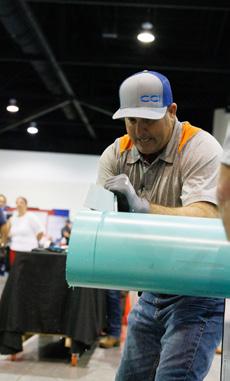
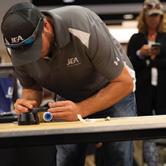
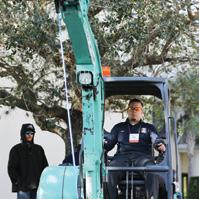
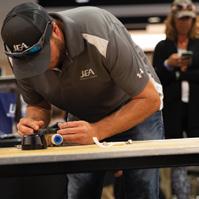
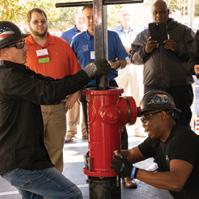
There was a special bonus in the exhibit hall this year. For the first time, a Collections Relay was held, which was under the wing of the Operations Challenge teams. This exhibition had 25 entrants signed up to compete, performing hole saw and pipe cuts timed relays. The winners received Visa gift cards.
This was a huge draw in the hall, and several women signed up to compete in this event.
Mono Rays Wins Top Ops Competition
The Mono Rays from Pasco County Utilities qualified for the national American Water Works Association (AWWA) Top Ops competition by winning the Florida Top Ops, held during the conference.
The teams this year were:
S Mono Rays (Vinny Domanico, Kendra Phillips, Jason Adair, Ken Durr, and Michael Avila) from Pasco County Utilities
S The Water Guns (Bill Young, Greg Taylor, Carlyn Higgins, and Mike Darrow)
Top Ops is a “College Bowl” type event that tests the groups, made up of water treatment and distribution operators or laboratory personnel, on their knowledge of system operations. Teams from FSAWWA regions compete against each other in this fast-paced question-and-answer tournament. The moderator poses a broad range of technical questions and math problems, and the team scoring the most points in the championship round is awarded the winner’s trophy.
Teams were encouraged to promote their team theme and colors throughout the conference. The winning team competed at Top Ops at the American Water Works Association Annual Conference and Exposition (ACE22) in June in San Antonio with other teams from AWWA sections across the United States.
Water utilities across the state are encouraged to enter the next Top Ops, which will be held April 2023 during the Florida Water Resources Conference in Kissimmee. Teams may represent more than one utility. For more details, and to receive the competition rules, contact the Top Ops chair, Thomas Tackman, at (239) 560-4149 or ttackman@watertalent.net.
Also assisting is (left) Nicole Thomas, Tampa Bay Water.
Mono Rays team.
Members of the Water Guns team are (left to right) Bill Young, Greg Taylor, Carlyn Higgins, and Mike Darrow.
Officiating the contest are (left) Andrew Greenbaum, Peace River Manasota Regional Water Supply Authority, and Pat Allman, Odyssey Manufacturing.
The winning Mono Rays team members are (from left to right) Ken Durr, Vinny Domanico, Kendra Phillips, Jason Adair, and Michael Avila.
Seacoast Utility Authority Wins the “Best of the Best” Tap Water Taste Contest!
Seacoast Utility Authority, from Florida Section AWWA (FSAWWA) Region VI, won the statewide Best Tasting Drinking Water Contest held at FWRC This competition had water samples from the contest winners of the 12 FSAWWA regions:
S Region I - City of Tallahassee
S Region II - JEA
S Region III - Seminole County
S Region IV - Polk County
S Region V - Bonita Springs Utilities Inc.
S Region VI - Seacoast Utility Authority
S Region VII - Florida Keys Aqueduct Authority
S Region VIII - Martin County Utilities
S Region IX - South Walton Utilities
S Region X - City of Punta Gorda
S Region XI - City of Belleview
S Region XII - City of Lynn Haven
The contest was emceed by Greg Taylor, senior project manager with Wright-Pierce. Terri Holcomb, with Peace River Manasota Regional Water Supply Authority, welcomed the audience and introduced the three judges:
S Dr. Stephanie Ishii, P.E., Hazen and Sawyer
S Richard Anderson, Peace River Manasota Regional Water Supply Authority
S Ifetayo Venner, P.E., Arcadis
Water samples were labeled with letters A through L to remain anonymous, so the judges didn’t know the identity of the samples.
Judging scores were based on taste, color, clarity, and odor. After the scores were tallied, the state contest winner was announced.
Seacoast Utility Authority is a not-forprofit, governmental regional water, wastewater, and reclaimed water utility that furnishes potable water service to approximately 47,000 households and 2,700 commercial establishments. Its governing board members are appointed by the municipalities where Seacoast provides service, which includes City of Palm Beach Gardens, Village of North Palm Beach, Town of Lake Park, Juno Beach, and unincorporated areas of Palm Beach County. Seacoast’s 30.5-million-gallon-per-day (mgd) nanofiltration/low-pressure reverse osmosis treatment plant has been in operation since May 2014. Approximately 3 mgd of the facility’s nanofiltration concentrate is blended with reclaimed water and recycled as community irrigation water.
Seacoast Utility Authority competed at AWWA Annual Conference and Exposition (ACE22) “Best of the Best” Tap Water Taste Contest that was held in June in San Antonio.
After Seacoast received its traveling trophy, the permanent trophy was given to representatives from Meridian Hills Water System in Tallahassee, the 2019 contest winner.
Water samples ready for judging.
Greg Taylor (center), contest emcee, presents the winning trophy to Seacoast Utility Authority representatives. At left is Brandon Selle, P.E., chief operating officer, and at right is Bob Takahashi, chief water plant operator.
Pictured left is the traveling trophy, and on the right is the permanent trophy.
FWEA Society Inducts New Members for 2022
Three nominees for the Florida Select Society of Sanitary Sludge Shovelers (FSSSSS) became members of the organization after completing a tongue-twisting induction exercise at the conference, held on Monday during the awards luncheon. The chair of the society, Patrick “Murf” Murphy, welcomed the attendees to the ceremony.
The inductees this year were:
S Chris Collins, Manatee County
S Keaton Heller, Hydra Service Inc.
S Lynn Spivey, City of Plant City
Heller was nominated in the vendor or “peddler” category, Collins in the operator category, and Spivey in the engineer category.
These three each took their turn at the podium, and after successfully repeating the name of the society three times (and after several tries!), received their certificates as members of the Class of 2022. The new members also received the coveted Silver Shovel pin, which, according to FSSSSS, must be worn at all times in public.
Each nominee must be a FWEA member in good standing at the time of nomination. The nominees must also be present at the FWRC luncheon to receive the award as dictated by tradition.
Upon successful completion of the induction ceremony, the nominees are:
“Elevated on the official shovel to the highest ridge on the sludge bed, with the title of Florida Select Society of Sanitary Sludge Shoveler, and with all the honors, atmosphere, perquisites, and dignity appertaining thereunto.”
The society, which was founded in 1956 by David B. Lee and has had more than 180 members, annually recognizes wastewater industry professionals for meritorious service above and beyond the call of duty to FWEA.
Patrick “Murf” Murphy emcees the ceremony.
Murf signals that one of the contestants needs another try.
Lynn Spivey has her turn.
Chris Collins signals victory!
The luncheon audience roots for the contestants.
Keaton Heller strides to the podium when hearing his name called.
Members of the head table enjoy the proceedings.
FLORIDA SELECT SOCIETY OF SANITARY SLUDGE SHOVELERS
CHARTER MEMBERS - CLASS 1956
* Founder: David B. Lee
* M. Emory Dawkins
* Pat Flanagan
* John E. Kiker Jr.
* C. E. Richeimer
* K.S. Watson
Shoveler Class of 1957
* Ralph H. Baker
* Bill Bryant
* J. Robert Hoy
* Emil Jensen
Shoveler Class of 1958
* J.J.R. Bristow
* Ralph E. Fuhrman
* Wylie W. Gillespie
* Ellis K. Phelps
* R.E. Simon
Shoveler Class of 1959
* Sidney A. Berkowitz
* Thomas De S Furman
* D. Joe Raye
* John D. Wakefi eld
* Joe C. Woolf
Shoveler Class of 1960
* Clifford M. Courson
* Arthur R. Finney Jr.
* George T. Lohmeyer
Shoveler Class of 1961
* Ray Lawrence
* Robert R. McNary
* Ralph L. Metcalf
* E.C. Shreve Jr.
Shoveler Class of 1962
* Perry A. Cessna
* Fred A. Eldness
* Harry E. Schlenz
Shoveler Class of 1963
Alvin R. Murphy Jr.
Vincent D. Patton
J.A. Shepard
* Sidney W. Wells
Shoveler Class of 1964
* John E. Baber
* J.F. Kapinos
* Donald P. Schlesswohl
* Robert S. Shaw
* Raymond C. Willis
Shoveler Class of 1965
Charles E. Adams
* Fred C. Funnell
* Sam P. Robinson
* Sam Scott
* Joe M. Valdespino
Shoveler Class of 1966
* Arthur D. Castor
Albert Henderson
* Hoyle Knight
Robert S. Wright
Shoveler Class of 1967
* Lou Branding
* K.K. Hufstetler
Shoveler Class of 1969
* William P. Allman
* Hugh Pearch
* James Santarone
* Robert Sinn
* Arthur F. Vondrick
Shoveler Class of 1970
Roderick W. Campbell
* Joseph B. Hanlon
* John B. Miller
* Charles C. Sweglar
Shoveler Class of 1971
* Hardy C. Croom
* L.T. Faulk
Joseph F. Lagnese, Jr.
Shoveler Class of 1972
* J. Floyd Byrd
* B.T. Dean
* Harry W. Gioielli
* S.M. Richard Jr.
Shoveler Class of 1973
Charles L. Meyer
Richard C. Mills
* John D. Parkhurst
George E. Symons
* William C. Timms
Shoveler Class of 1974
James F. Barlow
John A. Dacy
* R.L. Hart
* Victor G. Wagner
Shoveler Class of 1975
* Mac Grossman
* Cecil M. Kent
* Madame Jean Suave
* William P. Simpson
* Horace L. Smith
Shoveler Class of 1976
* John W. Bamble
* George W. Parker Jr.
* Norman Tuckett Jr.
Shoveler Class of 1977
Richard Englebrecht
* George Humphreys
* R.A. Litkenhaus
* J. Edward Singley
* Garrett Sloan
Shoveler Class of 1978
* Arthur Saarinen Jr.
* Felix Janocha
Charles Hogue
* Curtis Stanton
Shoveler Class of 1979
Donald K. Shine
* Geoffrey Scott
Bobby L. Jones
Shoveler Class of 1980
* Ray C. Holman
Terry Knepper
* E. Jack Newbould
* Joseph Papia
Shoveler Class of 1982
* William E. Dunn
* Everett Kinloch
Shoveler Class of 1983
Joan E. Stokes
James Taylor
Shoveler Class of 1984
* Frank D. Hoble
Larry Robinson
Wally Zentner
Shoveler Class of 1985
* James M. McCracken
* William D. Johnson
Shoveler Class of 1986
* George H. Dacy
* Kenneth M. Drury
* Theodore C. Pope
Shoveler Class of 1987
Thomas M. Baber
J.I. Garcia-Bengochea
* Richard Sheldon
Shoveler Class of 1988
Joseph Cheatham
* Robert Driver
David Stewart
Shoveler Class of 1989
Phillip K. Feeney
* Herb Pickle
Samuel R. Willis
Shoveler Class of 1990
Patrick Karney
* Robert Parmelee
H.E. Pruder
Phil Searcy
Shoveler Class of 1991
Sam P. Gutridge Ill
Katherine Kinloch
Shoveler Class of 1992
Donald Holcomb
David Shulmister
* J. Jack Smith
Shoveler Class of 1993
Timothy Brodeur
David Pickard
Frederick Trippensee
Shoveler Class of 1994
Salvatore D’Angelo
Bert Hale
Charles Jacobs
Shoveler Class of 1995
Donald Munksgaard
Charles Logue
* James Baird Jr.
Douglas W. Fredericks
Shoveler Class of 1996
Rim Bishop
Gregory J. Chomic
Thomas Mueller
Shoveler Class of 1998
Charles C. Billias
Michael D. Cliburn
* C. W. “Mickey” Sheffi eld
Shoveler Class of 1999
Robert Bailey
Larry J. Ruffi n
Thomas Lothrop
Shoveler Class of 2000
Jessie L. Carpenter
Juan A. Citarella
Julie L. Karleskint
Shoveler Class of 2001
Luis Aguiar
John Harward
* Grady Sorah
Richard Voorhees
Shoveler Class of 2002
Gary D. Dernlan
Rudolph Fernandez
Authur Saey
* Kenneth Wilson
Shoveler Class of 2003
Christine Ferraro
William Edgar
Kenneth Rearden
Roy Pelletier
Shoveler Class of 2004
Thomas Helgeson
Raymond E. Hanson
Robert Solomon
Shoveler Class of 2005
Scott Kelly
Holly M. Hanson
Douglas Prentis
Shoveler Class of 2006
* Lee Kraft
O.H. “Sonny” Moss
* David York
Shoveler Class of 2007
Kartik Vaith
Mark Cliburn
* Edward James
Shoveler Class of 2008
Chuck Hlavach
Tim Madhanagopal
Jon Meyer
Shoveler Class of 2009
* Albert “Bill” Heller Jr.
Mark McNeal
Donna Kaluzniak
* Donald Maurer
Shoveler Class of 2010
Pamela Holcomb
Thomas King
Christopher Stewart
Shoveler Class of 2011
Walter Barrett
John Giachino
Shoveler Class of 2013
Timothy McVeigh
Darrell Milligan
Paul Pinault
Shoveler Class of 2014
Patrick Allman
* Richard Griswold
Christine Miranda
Shoveler Class of 2015
Gregory Kolb
Frederick Nugent
Jeffrey Poteet
Shoveler Class of 2016
Brad Hayes
Rodney Shupler
Brian Wheeler
Shoveler Class of 2017
Tom Evans
Chris Fasnacht
Sondra Lee
Shoveler Class of 2018
Raymond Bordner
Ron Cavalieri
David Hartwig
* Richard P. Vogh
Shoveler Class of 1968
* Paul D. Haney
* Nick Mastro
* John V. Miner Jr.
* Thomas P. Smith
* David B. Preston
Shoveler Class of 1981
* Robert A. Canham
* George B. Furman
Phil E. Whelchel
Shoveler Class of 1997
* David L. Crowson
Richard W. Fernandez
Joseph Habraken
* J.C. Holley
George Lomax
Shoveler Class of 2012
James Hope
Nabil Muhaisen
Lisa Prieto
Shoveler Class of 2019
Clyde Burgess
Tim Harley
Patrick Murphy
Shoveler Class of 2020
Tina Nixon
Larry Hickey
Mike Darrow
Shoveler Class of 2021
Mike Sweeney
Vaughan Harshman
Jake Rohrich
Shoveler Class of 2022
Chris Collins
Keaton Heller
Lynn Spivey
*Deceased
AWARDS
Each year the Florida Water and Pollution Control Operators Association, Florida Water Environment Association, and Florida Section of the American Water Works Association honor outstanding individuals, utilities, and other organizations for contributions to the state’s water and wastewater industry. The awards were presented at the two lunches held during the conference.
FWEA Awards
Earle B. Phelps Awards
Advanced Wastewater Treatment
Facility First Place
JEA Nassau Regional Water Reclamation Facility
Accepted by Anthony Fedderly.
Advanced Secondary Wastewater Treatment Facility 7 MGD and Greater First Place
City of Cape Coral Southwest Water Reclamation Facility
Accepted by (left to right) Marcus Papp, Matthew Astorino, and Jeff Walter.
Advanced Secondary Wastewater Treatment Facility 7 MGD and Greater Runner-Up
North Port Utilities City of North Port Wastewater Treatment Facility
Polk County Utilities Waverly Wastewater Treatment Facility
Accepted by Doug Lasseter.
Advanced Secondary Wastewater Treatment Facility Less Than 4 MGD Honorable Mention Toho Water Authority Lake Marion Water Reclamation Facility Accepted by Rick Struckmeyer.
David W. York Water Reuse System of the Year Awards
WR3 Reuse Project of the Year
Bonita Springs Utilities Inc.
Public Education Program
Accepted by Andrew Koebel and Jake Hepokoski.
More Than 15 MGD
Hillsborough County Water Resources Dept.
Purple Stingray Reclaimed Water Operations Team
Accepted by Jennifer Kampwerth.
5 to 15 MGD
Lee County Utilities Three Oaks Water Reclamation Facility
Accepted by (left to right) Santino Sinabaldi, Robert Dick, John Hollingsworth, and Darvin Nelson.
Wastewater Collection System Awards
Large
Broward County Water and Wastewater Services
Accepted by Michael Kelly, Clive Haynes, and Marcia Loucraft.
Safety Awards
Class A, First Place Destin Water Users Inc.
George French Water Reclamation Facility
Accepted by (left to right) Chuck Rathke, Logan Law, and Rick Martin.
Class A, Second Place Gainesville Regional Utilities
Accepted by Brett Goodman.
Accepted by Drew Johnson.
Class A, Third Place
Accepted by Chris Howard.
Class B, Second Place
Lee County Utilities Three Oaks Water Reclamation Facility
Accepted by (left to right) Santino Sinabaldi, Robert Dick, John Hollingsworth, and Darvin Nelson.
Class B, Third Place
Toho Water Authority
Lake Marion Water Reclamation Facility Accepted by Rick Struckmeyer.
Class C, First Place Babcock Ranch Water Reclamation Facility Accepted by Nathaniel Mastroeni.
Class C, Third Place Seminole Tribe of Florida Hollywood Wastewater Treatment Plant Accepted by Bassem Sanaallah.
George W. Burke Jr. Facility Safety Award Gainesville Regional Utilities Combined Water Facility Accepted by Brett Goodman.
Biosolids Program Excellence Award
Village of Wellington’s Small Operating Program Accepted by Bryan Gayoso.
Municipal Utility Operational Performance Excellence Award
Palm Beach County Water Utilities Accepted by John Acton. Municipal Utility Operational
Town & County Utilities Accepted by Jon Meyer.
Public Education Awards
Campaign Category
Organization Category
Accepted
Ralph H. Baker Award
Presented to Manasi Parekh.
Young Professional of the Year Award Presented to Tonya Sonier.
Delegate Service Award Presented to Timothy Ware.
Athur Sidney Bedell Award Presented to James J. Wallace.
Albert B. Herndon Award Presented to Glabra Skipp.
L.L. Hedgepeth Award
Presented to Nataly R. Colon Marquez.
Environmental Stewardship Award JEA
Accepted by Ryan Popko.
Water Reuse and Resource Professional of the Year Award
Presented to Hardeep Anand.
Leroy H. Scott Award Presented to George “Kenny” Wise.
City of Ocala Wetland
Recharge Park
by Rusella Bowes-Johnson.
City of North Port Trash It –Pet Waste
Accepted by Coco Hibbitts.
Golden Manhole Awards
Service Awards
FWEA
Welcomes New President With Passing of the Gavel
Ronald Cavalieri (in left photo) accepts a plaque to commemorate his term as the 2021-2022 FWEA president at the organization’s annual meeting and awards luncheon held on April 26 at the conference. In photo at right, Ron presents the gavel to Sondra Lee to begin her term as FWEA president for 2022-2023.
Presented to Bartt Booz. Presented to Lisa Wilson-Davis. Presented to Sondra Lee.
Lifetime Membership Presented to John Richard Voorhes.
Thomas T. Jones Award Presented to Jessica Green.
Presented to Keisha McKinnie. Presented to Nicole Little.
FSAWWA Awards
Water Treatment Plants
Outstanding Class A
Corkscrew Water Treatment Plant (Lee County)
Accepted by Steve Matuska and Juan Quintero.
Most Improved Class A
Village of Wellington
Accepted by Karla Berroteran and Drew Robinson.
Outstanding Class B
Hollywood Reservation Water Treatment Plant
Accepted by Bryan Fogle.
Most Improved Class B
S.K. Keller Water Treatment Plant
Accepted by Michael Wilkes and Noralvys Hancock.
Outstanding Class C
City of Tallahassee City Well 32
Accepted by Sondra Lee.
Most Improved Class C
Malcolm Road Water Supply Facility
Accepted by (left to right) Paul Brown, Julia Siemen, and Marc Cannata.
Drinking Water Treatment Plant Operator
Meritorious Service Award
Presented to Austin Humphreys, Orange County Utilities.
Marvin N.
Award for Outstanding Water Treatment Plant Operator
Presented
Kaden
to Juan Quintero, Lee County Utilities.
FWPCOA Awards
David B. Lee Award
Reclaim
Walt Smyser Website Award
Pam
(center)
the
Presented to Mathew Astorino, City of Cape Coral.
Wastewater
Presented to Charles Nichols Jr., Polk County Northeast Regional Wastewater Treatment Plant.
Smyser
presents
award to (left) Joseph Forte and Steve Juengst with City of Holly Hill.
Richard P. Vogh Award Presented to Katherine Kinloch.
William D. Hatfield Award Presented to James Johnson.
Presented to (left to right) Chris Collins, Lynn Spivey, and Keaton Heller. Water
Presented to Cody Jordan Diehl, Polk County Utilities.
FWEA Florida Select Society of Sanitary Sludge Shovelers
Emerging Renewal Technologies for Pressurized Pipelines
Steve Soldati
Pipelines that carry flows under pressure represent a special set of challenges for water and sewer rehabilitation. Historically, most pressurized pipelines were rehabilitated using open cut construction. Part of the reason for that choice has been a lack of trenchless rehabilitation technologies appropriate for pressurized pipelines. A lack of investment in aging pressure pipe infrastructure, coupled with increasing congestion (both above and below ground) has accelerated development in the trenchless rehabilitation industry.
This article reviews the concept of structural classification for pressure pipe linings as defined by the American Water Works Association (AWWA), and where emerging trenchless renewal technologies fit within the AWWA classification framework.
S Tight-fit high-density polyethylene (HDPE) pipe
S Fusible polyvinyl chloride (Fusible PVC®) pipe
S Hose lining system
Discussed is the engineering, material construction, installation, and cost-effectiveness of each product with the intent to demonstrate the strengths and limitations of each.
The State of Aging Infrastructure
The AWWA recently published its “2020 State of the Water Industry” survey, which identifies critical topics and tracks trends to help raise awareness within the water industry. This survey covers all aspects of the industry, including infrastructure assets, water quality, water resources, and agency staffing. The one
The Cost of Doing Nothing
Asset management 101 says that the longer the wait to address an aging asset, the more expensive it will be to replace, renew, or rehabilitate it. Take roadway pavement for example. Over time, as cars and trucks ride over the pavement, it slowly degrades and develops tiny vertical cracks at the surface. As the vehicle flows continue, those tiny cracks begin to propagate deeper into the pavement thickness. In the early years of these cracks, they are shallower, and it takes only a minimal thickness
Steve Soldati, P.E., is regional sales manager of pressure pipe–east region with Aegion Corp. in Tampa.
Figure 1. Selection of rehabilitation techniques to resolve water quality problems.
Continued from page 44
Figure 2. Selection of rehabilitation techniques to resolve water flow, pressure, and leakage problems.
Figure 3. Selection of rehabilitation techniques to resolve structural problems.
rehabilitation path is critical. Understanding the existing pipe condition and design will set the proper foundation for moving forward with the appropriate trenchless method. The AWWA M28 has assisted in this assessment and the selection process of the right rehabilitation technique using the decision trees, as shown in Figures 1, 2, and 3. Although M28 is geared toward water mains, many of the same principles can be applied to other pressurized pipelines. Many of the aging pressure pipes are in need of a structural solution, so Figure 3 will be the most common guidance for selecting the right rehabilitation method.
Innovative Technologies Using Trenchless Technologies
There are several trenchless technologies available for various pipeline applications, with each technology having its preferred application, given the site parameters, design, and existing pipe layout.
Cured-in-Place Pipe
The CIPP is engineered and manufactured to project specifications and can be designed as an interactive or independent solution to meet pipe rehabilitation goals. This pipe-within-apipe, as shown in Figure 4, has the ability to rehabilitate any pipeline to a fully structural
M28 Class IV solution, such that the existing host pipe can deteriorate away and the owner is left with a brand new pipeline. The CIPP can be installed up to several hundreds of ft at one time and does not hinder the flow capacities of the pipelines. With only two small excavation pits on either end of the installation, the rest of the facility operations above the pipeline will not be disrupted during the rehabilitation process.
The City of West Palm Beach had embarked on one of the largest projects of its kind to rehabilitate a more than 40-year-old prestressed concrete cylinder pipe (PCCP) force main running directly through a golf course, densely populated neighborhoods, and stormwater ponds. A condition assessment concluded that the number of pipes segments with broken wire wraps provided a significant risk of failure.
Traditionally, an open cut or sliplining operation would be the chosen path forward; however, both traditional options were rejected due to the cost and disruption of the open cut replacement and the drastic loss of the slipline. With these project parameters, the best solution was the close-fit CIPP, which provided minimal disruption to the residential neighborhood and golf course, while providing a fully structural M28 Class IV solution that maintained pressure rating and flow capacity.
Hose Lining
The advancement of hose lining systems has made it possible to address leaking or failing joints of pipelines using a slipline installation, which consists of pulling a new smaller pipe within the larger existing pipe, resulting in smaller work zones and smaller equipment for those harder-to-access pipelines. Hose liners are a simple three-part construction consisting of an inner and outer layer, with an internal reinforcing layer that provides the liner its full pressure capacity, as shown in Figure 5.
The hose lining systems are intended to be the M28 Class III solution, such that the new hose will withstand the internal pressures, but rely on the continued support of the existing host pipe from the external forces, such as soil, groundwater, and live loading. Hose lining materials require no resin curing (as with CIPP) and no long pipe laydown areas, similar to PVC or HDPE material, and are fused together to then be pulled into the pipeline during one active slipline pull.
The benefits of using the hose lining system are that it can be installed much quicker than CIPP due to the installation time and the fact that there’s no curing involved. In addition, the equipment is much smaller, so a smaller footprint is required for installation.
unique challenge that involved several thousand ft of fire and storm drain piping that was embedded in the tunnel concrete and had limited access to the pipeline itself. This made it difficult to mobilize the necessary equipment for most rehabilitation
three separate failures that expedited the need to address this pipeline with a structural solution. After review of different options, including open cut replacement, it was determined that a tight-fit HDPE rehabilitation was the best solution to meet the structural and flow capacity
installed using DR 26 and DR 32.5 HDPE pipe, with the longest section topping 1,500 ft. The DR is the ratio of the pipe outer diameter to the pipe minimum wall thickness. The lining system was designed to be slightly larger than the host pipe at 30.05 in. internal diameter.
Figure 9. Fiber-reinforced polymer application inside a pipeline.
Figure 10. Targeted repair schematic.
Figure 8. Fiber reinforcement.
Fiber-Reinforced Polymer Pipe
The FRP pipe is typically for the largerdiameter pipelines (manned entry) when access is extremely limited and/or spot repairs are needed. The other aspect of FRP is for complicated pipe geometry. Other trenchless solutions rely on a more standard pipe profile; however, FRP can be applied to complex pipe geometry with unusual bends, fittings, and other nonstandard type of arrangements. Due to FRP being a hand-applied material, the flexibility to adapt to unique pipe layouts and special features should be considered by the owner or engineer.
The FRP dry material (Figure 8) is saturated with an epoxy that is then placed on the internal diameter of the existing pipe, as shown in Figure 9. The proper scaffolding, access support, and ventilation are set up prior to the installation. As each layer of FRP is applied, it bonds to the other layers that were recently placed.
In the case of a pipeline needing a spot repair or rehabilitation, as shown in Figure 10, FRP can be applied in short segments and does not rely on needing the end of a cut host pipe to be installed.
Why Choose Trenchless Technology?
Pipeline rehabilitation technologies will continue to develop as the industry gains a better understanding of various material properties and their application in the field to meet the needs of clients all around the world in different industries. With a growing population and expansion of other infrastructure, it’s critical to provide more cost-effective and timely solutions to address buried pipelines.
The advancement of material performance and availability of technologies that could provide a more optimal “fit” for a particular problem will give owners and engineers more options to address their aging infrastructure. With the advancement of technology and pipe options available, having the proper guidance and tools will also be equally important, and tackling the aging infrastructure hurdle may not seem as burdensome or impossible.
References
• “2020 State of the Water Industry: A Glass Half Full.” Dawn Flancher, Kathleen Chaballa. Journal AWWA, July 2020.
• AWWA M28, Rehabilitation of Water Mains, Third Edition
• Aegion Corp. (photos). S
IN MEMORIAM
William Palan Allman
1937 – 2022
William Palan Allman, lovingly known as “Bill,” “Daddy,” “Papa, “and “Black Rabbit,” went home to be with Jesus on May 28, 2022, at age 84.
William was born to the late Ernest and Melvina Allman on July 3, 1937, in Kissimmee. He was a fifth-generation Floridian. As a child he loved climbing trees and splashing in puddles with his brother, Albert, and his sister, Jean. These close relationships would carry on through adulthood.
In 1955 William met the love of his life, Barbara. They married on May 1, 1960, in St. Cloud. This was the beginning of 62 years of love and adventures together. Their dedication to each other, along with always placing Jesus at the center of their marriage, carried them through life’s mountains and valleys.
William was a doting father to daughter, Celeste, creating a “daddy’s girl” from the very beginning. He happily became “Papa” to some of Celeste’s closest friends, providing them with the loving father they needed. This title was multiplied when he was promoted to grandpa. His grandchildren and greatgrandchildren were his greatest joys. Not a day went by when William didn’t talk about how much his family meant to him.
He had a longstanding career with the wastewater industry, beginning with the City of Kissimmee in 1955; he then transferred to the City of Orlando in 1960. He studied, worked, and managed all areas of wastewater treatment, obtaining his Class A license in 1962. He would go on to manage several wastewater treatment plants in the area. This included helping to design, build, and manage the Iron Bridge Water Pollution Control Facility, and managing the personnel needed to handle the rapid expansion of the Walt Disney World area. After managing the Iron Bridge facility for 18 years, William retired from the city in 1996 after 36 years of dedicated service. This did not mean he stopped working.
William loved giving back to the industry by creating and teaching courses; designing and proctoring exams in various programs, such as short schools and classes; and serving on the Florida Water Pollution Control Operators Association (FWPCOA) Education Committee. At the time of his homegoing, William maintained the sixtholdest wastewater operating license and the 11th-oldest drinking water license in the state of Florida.
In addition to being a dedicated husband, doting father, and the best “Papa” to his grandchildren and great-grandchildren, William also loved to spend time with extended family and friends. He was always up for a get-together, especially a good southern barbecue, where he often manned the grill. Throughout his life, William held an unwavering faith in God, which he shared with those around him. He was active in his church, teaching Sunday school and serving as a deacon. He loved to serve others and did so with all of his heart. When he did finally slow down you could find him in his easy chair with a good Western on TV and his cat at his feet.
William is survived by his loving wife, Barbara; his daughter, Celeste [Lee] Allison; his sister, Jean Allman; his grandchildren: Tristin[James] Fuller, Stephanie[Karl] Furno, Matthew[Sarah] Fishbaugh, Jackie Allison, and Terra Allison; many great-grandchildren; and a large extended family, with countless friends.
In lieu of flowers, the family requests that donations be made to the following:
• Florida Sheriffs Youth Ranches Inc. at https://www.youthranches.org<https:// www.youthranches.org/> or P.O. Box 2000, Boys Ranch, Fla. 32064
• Boys Town at https://www.boystown. org<https://www.boystown.org/> or 200 Flanagan Blvd., P.O. Box 6000, Boys Town, N.E. 68010-9988 S
Stormwater Management Planning: Does it Matter?
Erica Benson
In the 1990s, the U.S. Environmental Protection Agency (EPA) amended the Clean Water Act to address a growing problem—the lack of proper stormwater management planning.
“Why does stormwater planning matter?” you may be thinking. Well, did you know that in the 1970s two-thirds of the waters in the United States were unsafe for fishing and swimming?
Stormwater runoff was one of the main sources of this pollution, which is why the Clean Water Act requires many municipalities to create a stormwater management plan to ensure that debris, pollutants, and chemicals from storm sewers and construction sites do not find their way to the nation’s waters.
What is a Stormwater Management Plan?
A stormwater management plan helps to reduce pollution and contamination by controlling runoff of rainwater or melted snow.
There are two different kinds of stormwater plans:
S Stormwater Pollution Prevention Plan. This is a temporary plan designed to mitigate any stormwater issues created by a construction project.
S Stormwater Management Plan. This kind of plan is created by a variety of entities, most notably, municipalities that have a municipal separate storm sewer system (MS4), rather than a combined sewer and stormwater system.
This article will primarily focus on stormwater management plans.
Why is it Critical to Manage Stormwater?
Developing the land disrupts nature. This disruption affects stormwater when it limits and impedes the natural flow of water and the ground’s ability to soak it up. Additionally, as this occurs, water runoff becomes contaminated.
As water rolls over any impermeable surfaces (e.g., rooftops, roads, sidewalks, etc.), harsh chemicals in these locations can pollute the water. If and when these chemicals reach local natural waterbodies, they can harm and potentially kill any plants or wildlife nearby.
Furthermore, humans can also end up at risk because these waterbodies can be sources of drinking water. Even the smallest storm can create water runoff problems, which is why managing runoff is essential through a stormwater management plan.
What Are the Main Problems That Stormwater Runoff Can Create?
The top problems created by stormwater runoff include:
Pollution
Pollution occurs when water flows over impervious surfaces and collects the chemicals on top of them. Because developed areas host countless harmful substances, they can cause severe damage if they enter a natural body of water. When this occurs, ecosystems suffer and drinking water is contaminated.
Erosion
Water flows off impervious surfaces and forms new paths. Whenever water moves over land it never has before, it can cause deterioration. This may also be detrimental to both ecosystems and local communities.
Flooding
Stormwater runoff can overflow drainage ditches, sewage systems, and storm drains unless there is proper management in place. This flooding can be inconvenient—if not dangerous.
Turbidity
Even if water finds land that can absorb it, it may increase sedimentation. This is called turbidity, or muddiness, which ruins nearby land.
Infrastructure Damage
All of the issues mentioned (flooding, erosion, pollution, and turbidity) can wreak havoc on the local infrastructure.
What Are the Goals of a Stormwater Management Plan?
The goals of a stormwater management plan include:
S Reducing flood damage (including damage to life and property).
S Minimizing any increase in stormwater runoff from new development.
S Reducing soil erosion from development or construction projects.
S Assuring the adequacy of existing and
proposed culverts, bridges, and other instream structures.
S Maintaining groundwater recharge.
S Preventing an increase in nonpoint pollution.
S Maintaining the integrity of stream channels for their biological functions, as well as for drainage.
S Minimizing pollutants in stormwater runoff from new and existing developments to restore, enhance, and maintain the chemical, physical, and biological integrity of the waters of the state. This protects public health, safeguards fish and aquatic life, and maintains scenic and ecological values, which enhances the domestic, municipal, recreational, industrial, and other uses of water.
S Minimizing pollutants in stormwater runoff from new and existing developments to protect public safety through the proper design and operation of stormwater basins.
How Does Stormwater Runoff Affect Us?
Stormwater runoff is one of the largest remaining major sources of pollutants in our nation’s waters. In fact, according to EPA, it’s estimated that over 40 percent of existing water pollution problems are attributable to nonpoint source pollution.
Who Must Create a Stormwater Management Plan?
Municipalities must apply for a permit under the EPA National Pollutant Discharge Elimination System (NPDES) if they have an MS4. In order to obtain an NPDES permit, the municipality must draft a stormwater management plan.
What’s Included in a Municipality’s Stormwater Management Program and Plan?
The stormwater management plan should outline a program with the following elements:
S Public education and outreach
S Public participation and involvement
S Illicit discharge detection and elimination
S Construction site runoff control
S Postconstruction runoff control
S Pollution prevention and good housekeeping
When these elements are implemented in concert, they are expected to produce a significant reduction of pollutants discharged into receiving waterbodies. In addition, the stormwater management plan for the program should also be clear about the following:
S What needs to happen
S Who needs to do it
S How much they need to do
S Where it’s to be done
S When they need to get it done
How Does a Stormwater Management Plan Affect a Municipality?
As part of a stormwater management program, municipalities will often have regulations on new development. Some developers mistakenly
believe that, because there is already a municipal storm sewer in place, all they need to do is tap into it. These systems, however, can only handle so much, and having an excess of water runoff can lead to flooding or damage to the infrastructure. This means that a municipality may be required to keep as much storm runoff onsite as possible. Fortunately, there are many onsite stormwater control measures, including:
S Bioretention areas/rain gardens
Continued on page 52
Your local R&R experts
• Flow Monitoring
• Smoke Testing
• Manhole Inspections (Level 1 and 2)
• System Capacity Evaluations
• Master Planning and CIP updates
• R&R Design Permitting
• R&R CEI/RPR Services
Mead & Hunt has been serving the Florida wastewater industry since 1968. Some of the services we provide include specialized Repair and Replace (R&R) services for Inflow and Infiltration (I&I) identification and abatement. We know what it takes to get the job done right, and we are here to serve you.
S Constructed wetlands
S Curb and gutter elimination
S Drainage ditches
S Permeable pavements
S Rain barrels and cisterns
S Riparian buffers
S Sand and organic filters
S Vegetated filter strips
S Vegetated swales/dry swales
Which of these systems to implement will ultimately depend on the project and location. The local county or city will have certain requirements, and a project will need to cater to the guidelines provided.
What Are the Pros and Cons of Managing Stormwater Onsite?
Managing surface runoff onsite is largely beneficial, but it does require planning and thought. Here are some pros and cons.
Pros
S Proper drainage of surface runoff
S Ability to recharge groundwater and reuse precipitation water and surface runoff as irrigation or household water
S Treatment of stormwater in a very early stage
S Avoid damage to infrastructure (private properties, streets, etc.)
S Flood prevention
S Can be integrated into the urban landscape and provide green recreational areas
Cons
S Expert planning, implementation, operation, and maintenance required
S A lot of operation and labor required depending on the technique
S Risk of clogged infrastructure caused by high sedimentation rates
How Does a Municipality Fund a Stormwater Management Plan?
Obtaining funding for a stormwater management plan is one of the most crucial steps in the stormwater management process. The EPA notes that finding the lowest-cost funding methods can be challenging for municipalities.
As such, permittees often rely on local revenue bonds or State Revolving Funds for capital to fund combined sewer overflow (i.e., stormwater and sewer) controls.
Generally speaking, there are two categories of funding that municipalities can obtain. The first is capital funding and the other is annual funding.
S Capital Funding. This includes bonds, loans, grants, privatization, and any other capital funding options, like special reserves and assessments.
S Annual Funding. This includes fees, taxes, and miscellaneous funds, like proffers and capacity credits.
How to Get Others Involved
Municipalities often involve the public during the planning process of their stormwater management programs, so organizations can host public meetings to discuss them. In addition, EPA encourages wider community outreach by suggesting a municipality do the following:
S Identify key users and groups
S Establish an advisory committee
S Create a stormwater utility website
S Prepare pamphlets and presentations
S Meet with key user groups and the media
S Distribute information before initial billing
What Type of Reporting and Documentation Will a Municipality be Required to Undertake?
The type of reporting that a municipality does on its stormwater management plan will depend on several factors. At a high level, many municipalities will generate reports on the following items:
S Compliance with the NPDES permit
S The effectiveness of the stormwater management project
S The chemical, physical, and biological impacts to receiving waters resulting from stormwater discharges
S Stormwater discharges
S Sources of specific pollutants
S Long-term trends in receiving water quality
Plans Do Matter!
A stormwater management plan is a detailed document that includes all of a municipality’s efforts to mitigate the impact of stormwater. While time-consuming, these plans can help to drastically reduce the impact of stormwater on the environment and protect local land, wildlife, and residents.
Erika Benson is a land investor and cofounder of Gokce Capital LLC in New York City. S
Test Yourself
What Do You Know About Water and Wastewater Management?
Donna Kaluzniak
1. Per California State University at Sacramento’s “Manage for Success – Effective Utility Leadership Practices” (Manage for Success), when interviewing an applicant for employment, managers should structure the interview so that the candidate is speaking more than half the time by answering what type of questions?
a. Questions about how the candidate spends their personal time.
b. Questions about work experience that elicit a yes or no answer.
c. Questions that are open-ended, dealing with the candidate’s work experience.
d. Questions about a candidate’s family.
2. Per “Manage for Success,” what would be an acceptable pre-employment inquiry or statement during the job interview?
a. Have you ever been arrested?
b. Do you have any physical disabilities?
c. Do you attend religious services on Sundays?
d. What languages do you read, write, or speak fluently?
3. Per “Manage for Success,” what type of management style is defined as, “The manager maintains a nonthreatening, regular presence in employee work areas, personally communicating with the employees on work items of mutual interest and or concern.”
a. Management by Development
b. Management by Communication
c. Management by Expertise
d. Management by Walking Around
4. Per “Manage for Success,” which management assessment program is a voluntary American Water Works Association (AWWA) benchmarking
program to help utilities achieve total quality performance in all areas of their operations?
a. Environmental Management System (EMS)
b. Management Assessment Profile (MAP)
c. QualServe
d. Six Sigma
5. Per “Manage for Success,” decisions can be classified based on their purpose or the level of impact to the organization. What decisions are described as those that set, change, or directly affect the objectives, resources, and policies of the organization, and affect the utility’s mission, vision, and goals?
a. Management control decisions
b. Operational decisions
c. Strategic decisions
d. Transactional decisions
6. Per the Water Effective Utility Management website, the Ten Attributes of Effectively Managed Water Sector Utilities describe desired outcomes that are applicable to all water and wastewater utilities. One of the ten attributes, “Ensures utility leadership and staff work together to anticipate and avoid problems,” would be described as
a. Employee Leadership and Development.
b. Operational Optimization.
c. Operational Resiliency.
d. Infrastructure Stability.
7. Per the Water Effective Utility Management website, there are five keys to management success: Leadership, Strategic Business Planning, Organizational Approaches, Measurement, and
a. Financial Assessment.
b. Employee Recruitment and Retention.
c. Continual Improvement Management Framework.
d. Community Sustainability.
8. Per the Water Effective Utility Management website, there are two general approaches to performance measurement: benchmarking and
a. environmental management systems.
b. internal performance measurement.
c. target completion measurement.
d. statistical quality control.
9. Per “Manage for Success,” the first step in developing managerial technical skills is understanding how and why the facility was designed. Managers must then ensure that it operates the way it was designed by developing a formalized
a. operating protocol (OP).
b. process control program (PCP).
c. troubleshooting guide (TG).
d. standard operating procedure (SOP).
10. Per “Manage for Success,” the selection and scheduling of multi-year physical improvements, such as the phased replacement of wastewater pumping stations, is
a. a capital expenditure.
b. capital improvement planning.
c. part of the operating budget.
d. strategic planning.
Answers on page 86
References used for this quiz:
• Campbell, Dan and Cherniak, Mike. California State University, Sacramento. “Manage for Success – Effective Utility Leadership Practices.” 1st Edition, 2005.
Readers are welcome to submit questions or exercises on water or wastewater treatment plant operations for publication in Test Yourself. Send your question (with the answer) or your exercise (with the solution) by email to: donna@h2owriting.com
CONDITIONING PUMPS
The Vaughan Conditioning Pump is a beast just below the surface. We mounted our submersible Chopper Pump to a portable stand and supercharged it with a high-velocity mixing nozzle. The result is a powerful pump that can be used in multiple applications at a single site. Choose the unmatched reliability of Vaughan.
Aging Well- Protecting Our Infrastructure
The FSAWWA Fall Conference brings together utilities, consultants, manufacturers, regulators, and students. Register and learn from the industry’s best through technical session, workshops, and exhibits. Network with water industry professionals. Over 160 exhibitors will give you first-hand information on the latest developments to help your utility take actions to implement Florida’s future.
Exhibitor Registration: Registration opens June 1, 2022 www.fsawwa.org/2022exhibits
Attendee Registration: Starts August 1, 2022 fsawwa.org/2022fallconference
For more information: fsawwa.org/2022fallconference
Hotel Accommodations: fsawwa.org/2022hotel
Host hotel is Hyatt Regency Grand Cypress
Aging Well - Protecting Our Infrastructure
Looking forward to seeing you at the Hyatt Regency Grand Cypress on November 27 to November 30, 2022
Benefiting Fund
The Roy Likins Scholarship
Technical Sessions
• Cybersecurity
• Asset Management and GIS
• Sanitary Sewer Systems
• Potable Reuse
• PFAS/PFOS
• Emerging Water Quality Issues (UCMR 5 Testing, LCRR, etc.)
• Alternative Water Solutions –No-Surface - Discharge Rule, I Need More Water!
• Solutions for Water Treatment Challenges
• Hydraulic Modeling –Solutions to Increase Knowledge and Address Challenges
• Funding the Utility System
• Workforce planning – Is It Us?
• Water Conservation
Conference Highlights
• BBQ Challenge & Incoming Chair’s Reception
• Operator Events:
Meter Madness
Backhoe Rodeo
Hydrant Hysteria
Tapping Competition
• Young Professionals Events: Luncheon
Water Bowl
Fresh Ideas Poster Session
• Water for People’s Fundraising Events: Exhibitor’s Raffle Fundraiser
Events
Poker Tournament Monday, November 28, 2022 Starts at 9:00 pm
TopGolf Tournament Wednesday, November 30, 2022
8:00 am Shotgun start
CHEER for Meter Madness!
Aging Well- Protecting Our Infrastructure
Exhibit Registration Starts June 1, 2022
Standard Booth @ $900 Includes:
• 8-foot X 10-foot booth space
• One (1) six-foot draped table
• Backdrop
• Side drapery
• Two (2) chairs
• Company sign
• Wastebasket
• Three (3) exhibit staff registrations
• Additional exhibit staff $50/each
Exhibit booth spaces can include heavy equipment, workshops, portable equipment and showrooms. Flammable materials are prohibited. No modifications will be made to the backdrops or sidewalls without approval from the Exhibits Chair.
For additional info on sponsorship levels and benefits, visit: www.fsawwa.org/2022sponsor
Please Note:
All promotional activity other than product demonstrations must be approved by FSAWWA prior to the conference.
Looking forward to seeing you at the Hyatt Regency Grand Cypress on November 27 to November 30, 2022
2022 Water Distribution System Awards
The FSAWWA Water Distribution System Awards are presented to utilities whose outstanding performance during the preceding year deserves special recognition by the section.
The Award Criteria is based upon the following:
Water Quality
Operational Records
Maintenance
Professionalism
Safety
Emergency Prepardness
Cross Connection Control Program
• Must be an AWWA member (Organizational or Individual)
• Actively supports the activities of the FSAWWA
• Demonstrates high standards and integrity
The selection committee is under the Manufacturers/Associates Council.
2021 Winners:
Division 1: Not Awarded
Division 2: South Walton Utility Co., Inc.
Division 3: City of Zephyrhills Utility Department
Division 4: Bonita Springs Utilities, Inc.
Division 5: City of Boca Raton Utility Services Department
Division 6: Broward County Water and Wastewater Services
Division 7: Lee County Utilities Water Distribution
Division 8: Hillsborough County Public Utilities Department
Division 1 = 1 - 5,999
Division 2 = 6,000 - 12,999
Division 3 = 13,000 - 19,999
Division 4 = 20,000 - 29,999
Division 5 = 30,000 - 45,999
Division 6 = 46,000 - 69,999
Division 7 = 70,000 - 129,999
Division 8 = 130,000+
Aging Well- Protecting Our Infrastructure
2022 Competitions
Tuesday & Wednesday, November 29 - 30, 2022
fsawwa.org/2022fallconference
FSAWWA hosts fun and lively competitions between municipalities to find the most skilled person or team in the Meter Madness, Tapping, Hydrant Hysteria, and Back Hoe Rodeo contests. Please join us as a spectator or visit our website to download the application to complete.
Back Hoe Rodeo: Tuesday | 10:00 am - 12:00 pm
Backhoe operators show off their expertise by executing several challenging lifts and drops of various objects in the fastest time.
Tapping Contests: Tuesday | 11:00 am - 2:30 pm
In a contest of skill and dexterity as well as speed, teams of four compete for the fastest time while they perform a quality drill and tap of pipe under available pressure. Penalties are assessed in seconds for infractions of rules such as leaking connections or safety violations. Only two taps are allowed per team.
Ductile Iron Tap: 11:00 am - 12:00 pm Fun Tap: 1:00 - 2:30 pm
Meter Madness: Tuesday | 4:00 - 5:00 pm
Contestants are challenged to put together a completely disassembled meter against the clock. To make the contest more interesting, three to six miscellaneous parts are included in the bucket of meter components. Once the meter is assembled, it must operate correctly and not leak.
Hydrant Hysteria: Wednesday | 9:00 - 11:00 am
Hydrant Hysteria is a fast paced two person competition as to who can assembly a fire hydrant quickly, totally, and accurately. Two or more teams go head to head while assembling the hydrant. All parts will be assembled in proper manner and reassembled hydrant shall be tested by the judges for ability to operate correctly.
LET’S TALK SAFETY
This column addresses safety issues of interest to water and wastewater personnel, and will appear monthly in the magazine. The Journal is also interested in receiving any articles on the subject of safety that it can share with readers in the “Spotlight on Safety” column.
Jackhammer Safety
One of the most powerful tools used in the water utility industry is the jackhammer, which is designed to break asphalt, concrete, and rocks. Without proper training and personal protective equipment (PPE), workers can inflict serious injury to their feet and other parts of the body, as well as injure others nearby, while operating this tool.
Differences in Jackhammer Types
There are two types of jackhammers: the pneumatic drill and the electric drill. While they do the same job, each machine runs differently than the other.
The electric jackhammer is often used for small jobs, such as breaking concrete and making small holes in the ground. This jackhammer is powered by plugging it into an electrical socket. There are various models of electric jackhammers, which come in different watts and amps.
A pneumatic jackhammer is powered by air. A rubber hose connects it to a compressor that pumps air into the jackhammer. The compressor is run by gasoline. This jackhammer is small enough to be portable so it can go to all worksites, but is great for big jobs and construction areas.
Before Operation
Before operating any kind of jackhammer, consider the following precautions:
S Always wear proper PPE, which includes eye protection; long sleeve clothing; sturdy full-length pants; steel-toe boots or shoes; respiratory, head, and hearing protection; and safety gloves.
S Know how to safely operate the supply compressor—especially in emergencies.
S Place the compressor as far as possible from the work area to reduce the level of noise.
S Regularly inspect the jackhammer and other necessary tools for defects or damage.
S Check that components are complete, securely in place (or tightened), and in good condition. Do this before every shift or start of operation.
S Check air hoses for breaks, cracks, and worn or damaged couplings.
S Ensure that the rating of the hose is sufficient for the job intended.
S Inspect the electrical cord for frays, wear, and other signs of damage.
S Inspect the tool’s breaking point. Never use a broken or cracked point.
During Operation
Stay safe when operating a drill by doing the following:
S Sling the electrical cord onto your shoulder when in use to prevent it from accidentally swerving, which can cause electrocution.
S Always use the proper-weight jackhammer for the job. For your back’s sake, try to use a lighter jackhammer as much as possible.
S Always lift the tool jackhammer properly by using your legs. This method helps you avoid back strain or injury.
S Use the proper jackhammer point for the material to be broken: rock point for rocks, spade point for asphalt, chisel point for concrete.
S When moving the jackhammer from place to place during operation, place your hand between the handle and the operating lever.
S Always operate the tool at a slight angle with it leaning back toward you. This way, you prevent the point from getting stuck in the material and the tool from getting out of control.
S Shut off the air supply and relieve pressure from the supply hose before changing tool points. Do the same when leaving the jackhammer unattended.
S Immediately remove defective or malfunctioning jackhammers and other
tools from the worksite until they are properly repaired.
S Barricade the work area as much as possible to keep spectators and untrained personnel from getting exposed to the hazards of jackhammer operations.
S Take breaks often. You should never use a jackhammer for long periods of time; your body needs a break from the constant vibrations and noises.
S Unplug the jackhammer every time you walk away from it—even if it’s only for a few minutes. If someone accidentally turns it back on, there could be serious harm caused to people in the area.
Rules on Silica Dust
The Occupational Safety and Health Administration (OSHA) has proposed rulemaking for respirable crystalline silica, inhalation of which puts workers at risk of silicosis, lung cancer, lung disease, and kidney disease. Exposure to silica dust can occur when cutting, sawing, grinding, drilling, and crushing stone, rock, concrete, brick, block, mortar, and industrial sand (including sand blasting).
Work title and years of service.
I am an engineer and project manager, with a total of seven years of experience in Florida and North Carolina.
What does your job entail?
My job varies from day to day. My duties include everything from design calculations of a digester or treatment basin, to grant applications and administration, to sizing pumps from 5 to 280 horsepower, to attending and presenting at public meetings. Most of my focus is on wastewater
For additional information about silica dust and other hand tool safety, see the OSHA booklet at www.osha.gov.
Jackhammers can be very dangerous if you fail to utilize them properly. You should always take precautions and other significant measurements to prevent injury. As jackhammers are heavy-duty tools, there should be no compromise in their use. S
FWRJ READER PROFILE
treatment and conveyance, but grants and water transmission are also something I work on frequently. I serve a wide range of clients, from small towns to larger cities and counties, and even some industrial and private firms.
What education and training have you had?
I have my bachelor’s degree in chemical engineering from Florida State University and a master’s degree in civil–environmental from the University of Idaho, where I did my research on biological nutrient removal with a focus in biological phosphorous removal. I like to say my master’s degree is in wastewater treatment because that is pretty much all I did at the university.
What do you like best about your job?
The people. Whether it’s my coworkers, clients, or other industry professionals, I like to collaborate to work toward a common goal and to solve a problem.
What professional organizations do you belong to?
I am the Region I chair for FSAWWA and Bid Bend Chapter chair for FWEA.
We have board and sponsorship positions available if any readers are interested in getting involved!
How have the organizations helped your career?
The conferences that these organizations put on every year have helped me make so many great connections in the industry, as well as learning a lot during the technical sessions.
What do you like best about the industry?
I like being in an industry where the people are passionate about what they do. I have yet to meet someone in the wastewater field who thinks wastewater is “just okay.”
What do you do when you’re not working?
When I’m not working, I’m spending as much time as possible outside and next to water with my husband and two children. We also have a mini farm, with dogs, cats, chickens, ducks, a huge vegetable garden, fruit trees, and more flowers than you can count, which certainly keeps things busy. S
Three Ion Exchange Technologies, One Tough Decision for Florida Utilities
Tyler Smith, Chris Reinbold, Vinnie Hart, and Larry Elliott
Over the last decade, the ion exchange (IX) process has increasingly become a technology of interest for the removal of natural organic compounds in Florida source waters. Three IX options for municipal treatment plants include:
S Fixed bed vessel, which is commonly used throughout Florida and the United States.
S Fluidized bed, such as magnetic ion exchange (MIEX), which has seen limited use in Florida and the U.S. (about 12 installations).
S Suspended ion exchange (SIX), which has four installations in Europe and is on the verge of its first U.S. installation in Tampa.
Considering Florida’s variability in source water composition and other site-specific considerations, one IX process does not fit all, and each type of IX should be evaluated, considering, among numerous other factors, a utility’s project goals, facility size, operation and maintenance (O&M) aspects, and costs.
This article dives into the primary differences, similarities, and pros and cons for the three IX options so that Florida utilities can
consider the most optimal solution for their water quality challenges. Case studies from pilot- and full-scale installations across Florida, varying in size, capacity, and water quality characteristics, were considered.
The MIEX is the only patented fluidized bed process (owned by IXOM Watercare Inc.) and uses a magnetized strong base anion exchange resin that is proprietary (the resin and process are both patented). The process was primarily developed to remove dissolved organic carbon (DOC) and the resin’s magnetic properties help facilitate settling (to avoid carryover to downstream processes). The MIEX resin has a mean particle size of 180 to 200 micrometers (µm). The small particle size and macroporous nature increases the available surface area, compared to traditional ion exchange resins.
The MIEX process allows water and IX resin to flow through a contact tank with mixing, in which DOC and other negatively charged ions are exchanged for chloride ions. Figure 1 shows the general process flow of MIEX. Raw water flows upward from the bottom of the fluidized
Tyler Smith is senior project engineer with Carollo Engineers Inc. in Phoenix. Chris Reinbold is a project manager with Carollo Engineers Inc. in Palm Beach. Vinnie Hart is a project manager with Carollo Engineers Inc. in Denver. Larry Elliott was a vice president with Carollo Engineers Inc. in Orlando (deceased).
bed reactor/tank, where it’s contacted with resin. The resin ideally remains in suspension through the use of an agitator operating at low speeds. A series of tube settlers (or plates) at the top of the reactor vessel separate the resin from the water. Treated effluent overflows into collection launders to downstream treatment. The original treatment scheme had two stages (contact, followed by settling) with resin concentrations in the 10 to 15 milliliter (mL)/L range, while the newer “high rate” systems combine resin contact and settling in the same tank, with increased resin concentrations in the range of 200 to 250 mL/L. Virgin resin is added to the process to make up for quantities of resin that may be inadvertently carried downstream or lost to attrition. At any given time, a small portion of the resin is withdrawn from the reactor vessel, regenerated in semibatch configuration, and returned to the reactor for reuse.
The MIEX has multiple full-scale and highrate installations in the U.S.; some of the larger installations include Palm Beach County Water Utilities Dept. (Water Treatment Plant 2; 16.4 mil gal per day [mgd]), Boynton Beach Utilities (20 mgd), and the C.B. Collier Water Treatment Plant in Gadsden, Ala. (24 mgd). Like the other IX technologies discussed, the resin itself has a high affinity for organics to facilitate their removal through ion exchange. In particular, the strong base anion exchange resin is effective at removing hydrophilics, humic substances, building blocks, and low-molecular-weight acids.
For Palm Beach County, its full-scale MIEX process was able to reduce raw water total organic carbon (TOC) from 13 to 4 mg/L. A MIEX pilot study conducted for the City of Tampa showed reduction of TOC from 24 to 9 mg/L. Overall, the process has been proven for organics removal in
Figure 1. Magnetic Ion Exchange General Process Flow Diagram (courtesy of IXOM Watercare Inc.) Continued on page 64
WATER MANAGEMENT. EVERYTHING IS INTERCONNECTED.
Water treatment. Water reuse. Stormwater management. Collection and conveyance. They are not separate. They interact and affect each other every day. In today’s world, holistic water management is not a luxury, it’s a necessity. At Carollo, we ensure water at every stage in the cycle works together to deliver dependable, resilient water supplies for communities like yours. It’s all one water and for nearly 90 years, that’s how we’ve managed it. Interested? Inspired? Now’s your chance to make a splash! Join Carollo and make your mark.
the range from 50 to 70 percent TOC removal for both surface water and groundwater applications. Due to the high loading rate configuration, the hydraulic retention time in the reactor is typically five minutes, and the resin remains in the contactor until it’s pumped to the regeneration system. Also, because of the high loading rate, the resin in the reactor is highly concentrated to achieve desired organics removal, with a typical concentration of 200 mL of resin per liter of water. Since only a portion of the resin is removed for regeneration at any given time, fresh (regenerated) resin makes up about 1 to 2.5 mL per liter of water in the reactor. This means the resin residence time can be up to a thousand times the hydraulic detention time.
The frequency of resin regeneration is quantified by bed volume (BV), which equals the volume of water treated divided by the volume of resin regenerated. Lower BV indicates a higher regeneration frequency. The MIEX process operates between 200 and 1000 BV (depending on source water constituents), where lower BV typically results in higher organics removal (since the resin is being regenerated more frequently).
The resulting salt use in the regeneration process is on the order of 300 to 800 lbs of salt required per mil gal (MG) of water treated. Lower BV treatment requires more salt, compared to higher BV treatment. Waste brine treatment options are offered by IXOM for salt recovery, thereby reducing overall salt consumption and waste brine volume disposal. Brine treatment options have unique challenges that require additional treatment steps and may or may not be viable, depending on the regeneration rate, salt use, and site-specific considerations.
In addition to the significant organics reduction, there are many benefits to the MIEX process, as it’s minimally affected by suspended
solids, low concentrations of sand, or other colloidal particles; thus, it’s ideally suited as a pretreatment process for surface waters prior to conventional treatment. In this type of application, and as with suspended IX, the process provides great benefit as it serves as the primary treatment process responsible for removing organics, which can significantly reduce downstream chemical demand (i.e., coagulants or chlorine), sludge processing, and operating costs. Additionally, the magnetic resin is self-attracting, promoting the formation of large agglomerates that readily settle with hydraulic loading rates (up to 10 gal per minute (gpm)/sq ft).
The proprietary MIEX resin currently offered is manufactured in Australia and shipped to U.S. water plants employing this technology. Although the resin has an affinity for organics removal, it also has an affinity to remove inorganic containments, like sulfate, nitrate, and phosphate. Other utilities, like St. Cloud Utilities and Toho Water (both in Florida), have experienced issues with sulfide/sulfate, as the resin has a tendency to foster sulfide oxidizing bacteria growth and irreversible fouling of the resin. The biological growth decreases the resin’s specific gravity and can cause resin loss out of the reactor. Additionally, any iron present in the raw water must be oxidized before the MIEX reactor, as iron oxidation within the process will likely foul the resin.
Biological fouling has been observed in many full- and pilot-scale applications. A pilot study conducted in Tampa revealed the need to prechlorinate (up to 2 mg/L) the raw water supply prior to MIEX to discourage biological growth on the resin. Additionally, the long resin detention times, coupled with the level of organics loading onto the resin, likely causes the resin to become irreversibly fouled over time due to reduced desorption of organics during regeneration. In
full-scale applications, this is shown by reduced organics removal over time, with mediation occurring through increased virgin resin additions. Fouling of the resin can result in resin loss, resin attrition, and a change in density that, in turn, impairs its ability to remain in suspension and fluidized during steady-state conditions. Further, air entrainment and pumping of resin can result in resin attrition, ultimately leading to loss and increased operating costs for resin replacement. The suspended ion exchange (SIX) process is similar in some aspects to MIEX, but uses a nonproprietary resin in suspension. It flows in a plug flow regime, as opposed to a completely stirred tank reactor (CSTR) vessel. Virtually, any strong base, gelular, anionic exchange resin can be used in the process, given that it has the appropriate settling properties. These resins have similar affinity, selectively, as fixed bed IX and MIEX resins. Figure 2 shows the process flow diagram.
The resin is dosed into the process water (either as a pretreatment or post-treatment option) in low doses (10 to 15 mL/L), which then flows to the contactor (ideally with plug flow configuration). After the contactor, the resin is continuously separated from the flow stream using lamella (plate) settlers. Treated water flows over the plate settlers and is sent to the next treatment process. The collected resin is conveyed to a regeneration tank, where it’s regenerated in a batch process with a salt brine solution and continuously returned to the resin storage tank for reuse. Resin is regenerated after each passage through the approximately 30-minute contactor, thereby eliminating the compounding of resin residence times (via multiple passes) in the reactor and promoting a uniform resin loading.
The SIX treatment process originated from a utility, PWN Technologies in the Netherlands, but is nonproprietary and not patented. There have been many pilot- and bench-scale studies completed on a new SIX® process, including a 10-month pilot study just completed in Tampa. Organics removal through the SIX pilot was similar to fixed bed ion exchange and higher than MIEX, with up to 80 percent removal of TOC. There are currently few full-scale water treatment plants employing this technology in the world, and none currently in the U.S. The PWN Technologies owns and operates a 32-mgd surface water treatment plant in the Netherlands called Andijk III. This particular SIX installation, in operation since March 2014, is utilized to remove turbidity, organics, nitrate, and sulfate before the water is treated with ceramic membranes. In full-scale application, the plug flow regime necessary for the process is achieved through use of multiple and smaller completely mixed reactors (or basins) in series for even distribution of flow and contact time,
Figure 2. Suspended Ion Exchange General Process Flow Diagram
resulting in a maximum feasible train capacity of 10 mgd. Resin is kept in suspension through use of diffused air, as depicted in Figure 3.
In the SIX process, contact time and BV treatment directly influence the size and number of contactors since the resin and water experience the same hydraulic retention time. The BV can range from 20 to 200, depending on the resin dose (5 to 50 mL/L); therefore, the resin is regenerated more frequently than MIEX resin, and 100 percent of the resin that is dosed is regenerated after each cycle in the contactor. Since the resin is not heavily loaded with organics, previous studies have indicated that contact times up to 30 minutes will achieve adequate organics removal. Additionally, short regeneration times are needed and are more effective since the resin is lightly loaded with organics.
For SIX, the hydraulic detention time is equal to the resin detention time. The resin for SIX is subject to the same biological/algal, iron, and sulfide/sulfate foulants as other IX technologies; however, the shorter BV reduces the risk of long-term fouling via bacteria growth and resin blinding. Reduced risk of fouling and the type of resin used for SIX (less susceptible to shearing and abrasion) results in far less resin loss and attrition, compared to MIEX. This also allows for consistently stable adsorption kinetics and consistent high removal of organics long term.
Along with organics, because of the frequent regeneration, the SIX process also reduces bicarbonate (alkalinity). A Tampa pilot study found a reduction of alkalinity varying from 35 to 65 percent, depending on the influent water quality. This could be troublesome for utilities with limited alkalinity in the raw water and could require the addition of alkalinity downstream to avoid adverse impacts on distribution system water quality.
On the other hand, the reduction in alkalinity provides for a more efficient downstream coagulation process as coagulant and pH adjustment chemical demand is reduced. Although organic fouling is reduced in this process, any fouling requires treatment using caustic. Unlike the MIEX resin, the type of resin used for SIX is not chlorine-tolerant. This could require additional infrastructure and chemical use if a utility does not already use caustic.
Because the process operates at lower BV, and resin detention time is the same as the process water hydraulic dentition time, a larger inventory of resin is needed in order to achieve the same organics removal performance, compared to other IX technologies. Theoretically, the SIX process requires more salt solution volume, but at a lower concentration to regenerate since the resin is lightly loaded. In some applications, this results in a lower salt use, compared to other IX technologies; however, the Tampa pilot study
found that the required salt use was three times the salt use, compared to MIEX. This is because the utility desired a finished water TOC target of 2 mg/L, so a conservative salt quantity was used to ensure full regeneration. Actual salt use would be dependent on the source water quality and finished water quality goals of the utility. Further, because of the required contact times and plug flow configuration, the SIX process requires a larger footprint, compared to MIEX.
Fixed bed ion exchange is fundamentally different in its contact mechanism, compared to SIX and MIEX, and typically consists of pressure vessels, complete with an underdrain, gravel, and sand support system, and resin. The resin is fixed within the contact bed and is not fluidized during treatment, nor does it flow with the process water. A general process flow diagram is shown in Figure 4.
Water is fed at the top of the vessel and flows through the resin for treatment. Treated water exits the bottom of the vessel and is conveyed downstream to the next unit treatment process.
Unlike MIEX and SIX, the underdrain contains the resin and requires no additional downstream treatment due to resin carryover. During regeneration, the process water is diverted, and the IX vessel is removed from service. The resin is regenerated in-place, after which the vessel is returned to service. The resin is often fluidized during regeneration, which helps ensure fullsurface-area contact with the salt brine and helps decompact the bed to minimize headloss when placed back into service.
There are many fixed bed IX installations located across the U. S. and internationally, and widely available by competitive manufacturers, with installations in significant excess of MIEX and SIX. Since fixed bed IX occurs in a vertical pressure vessel, the capacity and footprint of each vessel is limited by transport size. Open-top and horizontal vessels have been considered, but not widely implemented. The largest vertical pressure vessels available can process up to about 1.5 to 2 mgd each, with loading rates between 8 and
Continued on page 66
Figure 4. Fixed Bed Ion Exchange General Process Flow Diagram
Figure 3: Cross Sectional Representation of the Suspended Ion Exchange Contact Process
10 gpm/sq ft. Typically, these systems are used postfiltration as a polishing step for organics removal.
The fixed bed IX process requires any strong base anion exchange nonproprietary resin. Like MIEX, competing anions, such as sulfate, can cause reduction in TOC removal if the resin is not regenerated frequently. Because the IX system is often post-treatment, and bicarbonate is an anion, removal of alkalinity can be a significant consideration, and pilot studies have shown sulfate breakthroughs at 600 BV. Fixed bed IX systems typically operate between 1000 and 2000 BV, so it’s regenerated even less frequently than MIEX. Unlike SIX, the resin that is typically used can tolerate a small amount of chlorine if fouling is occurring.
In applications where water is exposed to chlorine and/or to the atmosphere before or within the IX process, oxidation/precipitation of iron and other species can occur and cause fouling of the IX resin. In addition, the presence of oxygen can promote biological growth on the IX resin and reactor (less so with SIX than compared to MIEX). The detrimental issues associated with oxygen are particularly of concern with anerobic groundwater, where the concentrations of highly soluble reduced metals (particularly iron) and aerobically biodegradable compounds are often high, and the associated scaling and biological fouling are also high.
Fixed bed ion exchange technology is
another option for utilities with this type of source water. Due to the enclosed vessel, the fixed bed system does not expose the source water to oxygen, and as such, reduces the biological risk associated with changing the biological growth potential, offering substantial benefit for certain groundwater applications in Florida.
Fixed bed IX may not be a feasible option for larger installations since the vessels are limited to 2 mgd. For example, a 50-mgd facility would require 25 to 30 IX vessels, which can become costly, require a large footprint, and require additional maintenance due to the increase in mechanical equipment and components. It can also be aesthetically unpleasing in high population areas. Additionally, since the resin is regenerated in situ, it’s required to be placed out of service (when in regeneration mode), thus requiring more redundancy than MIEX and SIX. Since the fixed bed IX arrangement is similar to a filter, any particulates must be removed prior to the IX vessel, which may require an additional upstream treatment process.
Table 1 presents a comparison/summary of these three IX technologies. As shown, organics removal is similar to all of the options, but actual organics removal quantities will be site-specific. The fixed bed IX is the most limited in train size, making it impractical for large-scale installations, while the SIX process, ideally suited for larger installations, comes with the largest footprint. The MIEX only regenerates a small portion of the resin inventory at any given time, which results
in its higher propensity for long-term fouling, compared to the other IX options. Capital costs for fixed bed IX are generally higher than MIEX and SIX, but lowest in O&M costs due to the lower salt use and less-frequent resin replacement. There is little available information on the O&M personnel requirements for SIX, and the demonstrated performance is limited to a few full-scale installations. Additionally, bicarbonate addition may be required with SIX, since the alkalinity is reduced due to the lightly loaded resin.
The MIEX has the most resin attrition and loss, and is a proprietary product, thus resulting in the highest O&M cost. Overall, MIEX and SIX are viable options in surface water applications as a pretreatment step, where fixed bed IX, depending on the plant capacity, can be better suited as a polishing step. Fixed bed IX is most beneficial in smaller-scale groundwater application, whereas a SIX and MIEX implementation should consider prior oxidation of iron and minimization of sulfide-reducing bacteria. The SIX and MIEX are more viable in larger-scale installations (more than 30 mgd), while fixed bed IX is more appropriate for smaller water treatment plants. Fixed bed IX may be preferred for utilities that have minimal staff, while SIX and MIEX require more operational oversight. As such, the choice of the most appropriate IX technologies is not one size fits all; the pros and cons of all of them must be weighed, which may vary among different utilities.
Conclusion
The primary differences and similarities among the three IX technologies are presented, and Florida utilities should consider these differences when selecting an anion exchange process for the removal of color and natural organic matter at their water treatment facilities. Any option could be extremely beneficial for existing utilities employing coagulation and wanting to reduce chemical demand and solids loading, looking for an organics removal system polishing step, or looking for a sidestream organics removal option.
Utilities should compare the technologies for their process footprint requirements, organics removal, resin acquisition, resin characteristics, O&M requirements, brine quality and quantity, fouling potential, capital and operating costs, and demonstrated performance (and risks) in the waterworks industry. The selection of the most appropriate IX will vary according to a utility’s needs, plant capacity, raw water quality, available budget, and more; however, common to all considerations should be bench- or pilot-scale testing, prior to full-scale implementation of the selected option.
Table 1. Ion Exchange Technology Comparison Table
FACTOR
Remembering William “Bill” Allman
Patrick “Murf” Murphy President, FWPCOA
illiam “Bill” Allman passed away on May 28, 2022. There have been many heroes in our industry (and still are), but Bill Allman was a superstar among us. His involvement with FWPCOA made an impact on the environment of the state of Florida and advanced the profession of operators. This is just my piece—a very small piece—of a much larger story of an icon and legend who paved the way for some of us in the business now.
Thank you, William “Bill” Edgar, for giving me permission to use this biography for Bill Allman from the CEU Plan website.
Biography of Bill Allman
Career Beginnings
In July 1955, William P. (Bill) Allman, began his wastewater career at the City of Kissimmee Sewage Treatment Plant. He received his Class C wastewater certification in 1956. After years of studying, working, and managing all areas of a wastewater treatment system, Bill received his Class A wastewater license in 1962. Bill maintains the sixth oldest wastewater operating license and the 11th oldest drinking water license in the state of Florida.
From the early 1980s through the mid1990s, he was the plant manager of the Ironbridge Water Pollution Control Facility in Orlando, and was involved in the rapid growth of central Florida. He managed the utility personnel to handle the rapid growth of the Walt Disney World area.
Bill has been recognized statewide—as well as nationally—for his leadership and management courses, his involvement in operator short schools and adult vocational training, and certification exams review. Bill has been a true leader in the wastewater field.
FWPCOA
Bill was a member of FWPCOA for over 60 years! His membership number is 29. He was one of the instructors at the first short school
that I attended. I was desperate to pass the Class C wastewater exam to get a 26 percent increase in pay to the $4.17 an hour that I was making as a trainee. His passion for instructing was palpable. It was obvious that his style of engagement and sharing information with grassroots operators was something he enjoyed, and was darn good at, and it made me want to learn more. I was hungry, and he fed me; he was one of the many great instructors that made an impact on my career and made me want to be involved in the association.
When you have a career and you’re working hard, and even doing a great job, but you never branch out and network with other people to continually learn from them, you do a great disservice to yourself and others. Bill was always very involved with the association. He has been an officer and or committee chair or committee member for many groups in FWPCOA, as well as FWEA and FSAWWA. For FWPCOA he was secretary treasurer in 1968 and 1969, and president in 1971.
Exam Review Committee
In the late 1980s, the Department of Environmental Regulations, before it was changed to the Florida Department of Environmental Protection (FDEP), called for a kick-off meeting to create the State Exam Review Committee. There were at least 30 people there from around the state. Helen Setchfield was the Operator Certification Program (OCP) director at the time. I was a puppy in the room with big-dog legends in the business, which was very overwhelming!
At the time, the licenses were given four times a year at certain locations, and one had to score 75 percent to pass the test. The intent was to meet pre- and post-test cycles (so eight times a year), review the tests before they went out, make changes to the tests for the betterment of the process, vet the questions by documenting where they came from in the manuals, create new test questions, and review operator challenges to questions on the test.
As I remember, after about a year (maybe two), most of the folks that initially showed up had dropped off. For the wastewater exams, it
left Bill Allman, Jeff Dupont, and me, reviewing all four exams (D, C, B, and A). There were four gentlemen on the drinking water side, but I only remember the names of two: Joe Habraken and Grady Sorah. They seemed to be much smarter, and I used to make fun of them and say that the exams must be easy, because the water guys were usually done before lunch, while Bill, Jeff, and I would be there until 4 or 5 p.m. I knew I was wrong when I started taking the water exams 20 years later!
Bill continued to be on the exam review committee until his passing.
This was a treasured time for me, to get to spend those days with two brilliant and dedicated people in the wastewater industry. My admiration and respect for Bill grew immensely during that time period, and after I dropped off, I looked for him whenever I could, at events and meetings, to catch up with him.
Florida Select Society of Sanitary Sludge
Shovelers
This is an FWEA award, which was founded in 1956 by David B. Lee to recognize industry professionals for their outstanding, meritorious service above and beyond the call of duty to the Florida wastewater industry. Bill was inducted in the Class of 1969.
Traditionally, the intent of the annual award is to honor an engineer, an operator, and a “peddler” (vendor) if, in fact, three candidates are deemed to have met the award criteria. One may not join the FSSSSS, but rather is selected on the basis of personal merit, so the ones being inducted deserve this high honor through recognition of long and faithful service to the industry by their peers—something we should all be striving for!
At some point, Bill was pH 7 (the chair for FSSSSS), and became the one to induct new shovelers into the society. His presentations were steeped in tradition; he’d put on a railroad engineer cap, blow a train whistle, and start what is called the “railroading of the new inductees” to honor those dedicated specialists in the industry.
The process begins with a “roast,” which is some story (most likely considered compromising) about the inductee shared with the audience at a lunch at the Florida Water Resources Conference (FWRC). The candidates are then put through the tonguetwisting process of repeating the full name of the society—three times as fast as they can! It’s
an infinitely entertaining and highly memorable process, at least for the ones viewing it.
Earle B. Phelps Award at Florida Water Resources Conference
The City of Plant City won the FWEA Earle B. Phelps first-place award in 2012. The winning organization gets to keep the traveling trophy for a year, and I couldn’t wait to carry it through the exhibit hall at FWRC to show it off. I immediately started looking for what I called the “Three Bill’s Booth.” William "Bill” Edgar, William “Bill” Allman, and William “Bill” Johnson could frequently be found at the CEU Plan booth, or at a table alongside the exhibit hall, reminiscing about the past, talking about the future, and sharing stories of wastewater glory that I could listen to all day.
Awards
His awards are many, including the L.H. Scott Award, William D. Hatfield Award, David B. Lee Award, and honorary life member of FWPCOA. His wife, Barbara; was even given an FWPCOA award in 2006 for her services at the state short schools.
They were a lovely couple, and she supported Bill immensely. They seemed to always be together, even at regional short schools and events. Please keep her and Bill’s family in your prayers.
In Closing
Rim Bishop, another true legend in the industry, shared this about Bill:
“No member has served FWPCOA better or longer than Bill Allman, and none with a dignity and grace that even comes close. He was there for us when no one else could help, never letting Florida's operators down—not once, not for a second. He was a man who lived his faith,
inspiring others in ways that words could never accomplish. There is no replacement for Bill Allman; all we have is his example, and thank God for that.”
I am heartbroken and speechless at Bill’s passing, but will say here that there are a lot of amazing people in our industry—do whatever you can to get to know and learn from them. Become a member of FWPCOA, get yourself out there, and be active. That could be all it takes to put you on the path of making a difference in our industry.
Laurence Hutton, an American essayist, described a meeting between himself and William Makepeace Thackeray, a British novelist, author, and illustrator. In a memoir by Hutton, Thackeray said, “Whatever you are, try to be a good one.”
William “Bill” P. Allman was a good one! Thanks again to Bill Edgar for sharing some photos for me to include here.
FWPCOA 2022 Fall State Short School
The FWPCOA 2022 Fall State Short School will be held Aug. 1-5, 2022, at the Indian River State College in Fort Pierce. Remember, this is when the bulk of the FWPCOA awards are presented, so look at the website, and see which award would be perfect for an individual at your facility. For event details go to www.fwpcoa.org and view the calendar. For all events contact Shirley Reaves at (321) 383-9690 or fwpcoa@ gmail.com, or Darin Bishop at (561) 8400340 or memfwpcoa@gmail.com.
Remember—let’s keep that water clean! S
Bill Allman and Robert McColgan receiving 60-year-plus membership awards from FWPCOA.
Barbara and Bill’s 51st wedding anniversary.
From left to right: Bill Allman, Ed James, and Bill Edgar at Ed’s retirement party from the Florida Department of Environmental Protection, showing off their shovels.
At the 2019 Florida Water Resources Conference, after Patrick Murphy’s induction into FSSSSS (Class of 2019). Left to right are Patrick Murphy, Bill Allman (Class of 1969), William “Bill” Edgar (Class of 2003), and Jamie Hope (Class of 2012).
Welcome to the FWEA Chapter Corner! The Member Relations Committee of the Florida Water EnvironmentvAssociation hosts this article to celebrate the success of recent association chapter activities and inform members of upcoming events. To have information included for your chapter, send details to Melody Gonzalez at gonzalezm@bv.com.
South Chapter Meeting: Miami-Dade Water and Sewer Department Builds for the Future
Chapter holds successful first in-person event of the year
On March 31, 2022, the FWEA South Chapter had the pleasure of hosting its first in-person event of the year at the 94th Aero Squadron Miami. With a full house, our chapter members enjoyed a presentation from Roy Coley, director, and Marisela Aranguiz, deputy director, of the Miami-Dade Water and Sewer Department (WASD), about its capital improvement program and the strategy for “Building for Our Future.”
The evening started with a social networking hour where our members could finally meet and mingle again after a lengthy absence due to COVID-19. It was an exchange of camaraderie that was long overdue. Just before dinner, Layla Llewelyn, the outgoing South Chapter chair, took the
opportunity to introduce the incoming 2022-2023 Steering Committee and Arturo Burbano, the new chapter chair. Layla introduced the WASD speakers prior to their presentations.
Mr. Coley started by explaining his vision for the department after being in his role for nearly a year. He seeks to actively collaborate with the water community to implement the improvements necessary to provide our community with the best quality of service in the most efficient way. It was clear that he has taken the time to understand the needs of employees, consultants, contractors, stakeholders, and partners to develop a comprehensive and inclusive strategy to support WASD project execution during the coming years.
Melody Gonzalez
Layla Llewelyn (right), the outgoing chapter chair, presents plaques to the speakers.
Attendees during the networking hour. Roy Coley, director of Miami-Dade Water and Sewer Department, presents his vision for the department’s future at the chapter meeting.
Next, Ms. Aranguiz covered some of the challenges the department has faced, valuable lessons learned, and achievements and successes over the past few years. She explained that WASD has a critical goal of improving the management of internal and external processes to minimize delays, increase efficiencies, and bring projects
promptly to completion, wherever the community needs them.
After addressing important questions from the audience, each presenter received a recognition plaque for their contribution to FWEA’s mission of promoting a clean and sustainable water environment for our community.
The event was a great success and a celebration of our water and wastewater community coming together again, and we’re looking forward to a very productive year.
Melody Gonzalez, E.I., is the FWEA Member Relationships Committee chair and treasurer/ contact for the FWEA South Florida Chapter. S
Marisela Aranguiz (at the podium in the rear) makes her presentation during the dinner portion of the event.
FWEA members at the event.
Keeping Florida’s Infrastructure
Resilience on the Radar
Emilie Moore, P.E., PMP, ENV SP Chair, FSAWWA
Discussions of resilience are everywhere and Florida is making great strides in providing funding to address flooding and sea level rise resilience. In addition to improving Florida’s resilience to rising waters, resilience funding will improve the condition of Florida’s infrastructure in areas such as, but not limited to, coastal systems, drinking water,
Table 1. Resilient Florida Grant Program Awards for Fiscal Year 2021-22, Sample Projects (source:FDEP)
County Parks and Recreation Broward Hardening Seawalls of Intracoastal at Hollywood North Beach $18,000,000
City of Hollywood Broward Tidal Flooding Mitigation and Shoreline Protection
City of Jacksonville Duval Stormwater Pump Station
Miami-Dade County Miami Dade Water ResetIncreasing the Resiliency of Drinking Water Infrastructure
Miami-Dade County Miami Dade Schenley Park Septic-to-Sewer Conversion
$27,500,000 Village of Islamorada Monroe Islamorada Transmission Main Adaptation
energy, roads, schools, stormwater, transit, and wastewater.
Florida’s Infrastructure Report Card
In the 2021 American Society of Civil Engineers (ASCE) Report Card for America’s Infrastructure, Florida’s grade for 14 infrastructure categories was listed overall as a “C”, which is defined as “mediocre” (ASCE, 2021).
The breakdown in the 14 categories is:
S Aviation (C+)
S Bridges (B)
S Coastal areas (C-)
S Dams (D-)
S Drinking water (C)
S Energy (C+)
S Levees (D+)
S Ports (B)
S Roads (C+)
S Schools (D+)
S Solid waste (B+)
S Stormwater (C-)
S Transit (C)
S Wastewater (C)
Overall, America’s infrastructure received a grade of “C-“ in 2021.
Florida’s Flooding and Sea Level Rise Resilience
Since 2019, Florida has committed more than $1 billion for flooding and sea level rise resilience programs. Last year’s Senate Bill 1954 (Statewide Flooding and Sea Level Rise Resilience) was signed into law on May 12, 2021, and targets a coordinated approach to Florida’s coastal and inland resiliency known as the Resilient Florida Program (Florida Department of Environmental Protection [FDEP], 2022).
The program includes these components:
S Resilient Florida Grants
S Statewide Assessment
S Sea Level Impact Projection (SLIP) Study and Living Shorelines
Pinellas County Utilities Pinellas Mobile Home Park Wastewater $25,000,000 $25,000,000
The Resilient Florida Grant Program (RFGP) awards for Fiscal Year (FY) 2021-22
Continued on page 74
Table 2. 2022-23 Statewide Flooding and Sea Level Rise
Plan, Sample Projects (source:FDEP)
included more that $404 million for 113 projects in 25 Florida counties. A sample of large 2021-22 RFGP awards is listed in Table 1. These projects vary in duration from one to five years.
The FDEP completed the 2022-23 Statewide Flooding and Sea Level Rise Resilience Plan as required by the 2021 resilience law. The 2022-23 plan lists 76 infrastructure projects totaling over $270 million in estimated requested funding over a three-year period.
The types of resiliency projects include:
S Water and wastewater facilities
S Stormwater collection and pumping
S Flood mitigation
S Living shorelines
S Pump stations
S Libraries
S Equipment (generators and valves)
S Seawalls
S Mangrove restoration
S Land restoration
S Roadways
S Buildings
S Public housing
S Land restoration
A sample of large 2022-23 projects is listed in Table 2.
In addition to improving Florida’s flooding and sea level rise resilience, these projects should help improve Florida’s ASCE Infrastructure Report Card ratings.
Funding for the Path Forward
As we navigate the financial roadmaps to bring projects to reality, Florida’s grants programs are available, including:
S Wastewater Grants
S Innovative Technologies Grants
S Biscayne Bay, Springs Coast, and Water Quality Improvement Grants
S FY 2022-23 Resilient Florida – Planning Grants
The portal for grant submittals is located at Grants|Water Quality Dashboard (protectingfloridatogether.gov).
It’s an exciting time in Florida for building our state’s resilience and making sizeable improvements to our aging infrastructure. S
High tide flooding along Sunrise Drive South in St. Petersburg, 2015. (photo: Emilie Moore)
FWPCOA TRAINING CALENDAR
What is The Operators’ Initiative and Why is it Important?
Steve Soltau
Every industry understands that preparing, training, and maintaining a labor force is essential to its success and growth. Now, more than
ever, utilities are struggling to fill treatment plant workforce vacancies and are looking to local high school academies to fuel the drive to train their next generation of workers.
Three years after the first academy began teaching coursework certified by the state of Florida, the Florida Section American Water
Works Association (FSAWWA) recognized this need, and in 2016, established the Operators’ Initiative.
Initiative Goals
The goals of the Operator’s Initiative are to:
S Understand and communicate the need for water utility professionals
S Support the development of new operators
S Develop awareness of opportunities within the water and wastewater industry
The FSAWWA partners with Florida high school academies to provide their students with coursework approved by the Florida Department of Environmental Protection (FDEP) for drinking water and wastewater operator Class C and/or Class D licensing. The students are then eligible to take the operator’s licensure exam at graduation.
Academy Structures
The structures of the academies are as diverse as the students who attend them.
S Lake Brantley High School (Altamonte Springs) - 12th grade students spend their senior year working side by side with licensed operators at the facility to complete the coursework and gain valuable, hands-on experience.
S St. John’s Technical High School (St.
Continued on page 78
Students at the 2021 FSAWWA Fall Conference.
Staying current with technology. Paid summer internships are available.
Award Categories:
2022 Water Conservation Awards for Excellence
This annual awards program of the FSAWWA Water Use Efficiency Division (WUED) recognizes innovative and outstanding achievements in water efficiency throughout Florida.
• Comprehensive Water Conservation Programming
• Program Element- Single Program Highlight
For online application and information, visit : fsawwa.org/2022wcawards
Entries must be submitted by: Monday, October 17, 2022
For additional information, please contact: Keeli Carlton Water Use Efficiency Division (WUED) Chair kcarlton@mywinterhaven.com
Agencies will be awarded one of the following awards: Best in Class or Show of Excellence.
Thank you for your interest in the FSAWWA.
Looking forward to seeing you at the Hyatt Regency Grand Cypress on November 27 to November 30, 2022. Aging Well- Protecting Our Infrastructure
Augustine) - Students’ multi-year coursework focuses on coastal, environmental, and water resources studies.
S Heritage High School (Palm Bay) - Beginning in 10th grade, students focus on an environmental technology track. Those who pass the courses and the operator exam can earn 12 hours of college credit to Florida Gateway College.
S Seminole High School (Seminole) - The academy will be incorporating ArcGIS and Drone technology into its curriculum for water quality research. The high school is partnering with Evans High School in Orlando, thanks in part to an $18,000 grant from AWWA Water Equation.
S A fifth academy, in Orlando, is expected to begin in September 2022.
Academy Goal
The goal of the academies is to provide graduates the knowledge and skills to be workforce-ready.
Given the high number of vacancies at local utilities, it was expected that trained and certified applicants would be quickly hired. A review of FSAWWA records indicates that six academy graduates are employed in the line of work in which they were trained. A total of 64 students passed the Class C exam since 2013 and the Operators’ Initiative anticipated that more of the students would have entered the workforce.
In an effort to increase the number of academy graduates hired by utility organizations, the Operators’ Initiative is assessing how to increase the number of graduates who pass the FDEP examinations and determine the best way to add new schools, while continuing to assist the academies with providing the graduates the knowledge and skills necessary to be interviewed and hired by a local utility.
Understanding Statistics to Increase Academy Success
The Operators’ Initiative has assessed the data associated with exam pass rates for academy graduates from 2013 to 2021. The data indicate that academy graduates have about a 31 percent pass rate, which is 17 percentage points lower than the FDEP’s average rate. The results are summarized in Table 1.
The Operators’ Initiative has worked with dozens of stakeholders within both industries (utilities and education) over the last 10 years. Through surveys and discussions, these professionals have identified the relationships most valuable to a student’s success: local employer involvement, school counselors, classroom and teacher support, utility mentors, and professional associations.
In addition, the Operators’ Initiative asked the academy teachers the following questions to help understand and improve the high-school-toutility employment metrics.
Why is it difficult to raise the pass rate?
S Teachers are not licensed operators and many have not been to a treatment plant.
S The curriculum is difficult to teach and teacher turnover can be challenging.
S Classroom time does not provide sufficient hands-on learning to understand how to apply the curriculum.
S Some students struggle with the rigors of the coursework and lose interest.
S Additional tutoring by experienced operators is lacking.
For those who pass: Are they getting interviews? Why are they not getting hired?
Graduates are young, typically 17 to 19 years old, and struggle with resumés, interviews, transportation, and general life know-how. Employers not directly involved in the academy do not always know about the opportunities recent graduates provide. There are a limited number of treatment plants in the local area and many graduates are not able to relocate out of town.
As the excitement of internships fade and the students focus on coursework, some lose interest and do not apply for interviews.
Hands-on water quality analysis.
Academies focus on workforce development and training.
Field trips and networking.
How can we draw in additional schools?
S Employers promote academies with their local school boards and vocational/technical schools.
S Establish sponsorship for a local academy that includes tutoring, training, and internships.
S Assist with locating teachers who have experience or are licensed in water and wastewater operations.
S Communicate, communicate, communicate; the curriculum is readily available and FSAWWA provides annual monetary support.
Any specific recommendations for improvements?
S Create an academy-only website link with training videos and mentoring opportunities.
S Sponsor a teacher to shadow utility operations staff over the summer.
S Hire retired licensed operators to teach at the local high school.
S Dramatically increase the number of Operators’ Initiative volunteers.
S FSAWWA Water Utility Council volunteers can get involved in supporting the academies.
S Provide AWWA training videos to approved academy instructors free of charge.
S Look outside the treatment plant for vacancies to be filled by graduates, such as backflow, maintenance, and customer service.
S Have a “Signing Day,” like the National Football League, where students can apply for positions and talk to utility personnel.
S Explore other metrics or intangibles:
• Did graduates go into the sciences or engineering?
• Maybe they went to work in a laboratory or in the field.
• Maybe some went on to a university and stayed with water quality.
The Future: Providing Jobs to the Local Economy and Giving Back to the Community
The following are suggestions from the Operators’ Initiative for how it can help move academy graduates toward employment with utilities.
S Budget for short-term, 40-hour summer internships at around $15 an hour.
S Provide new-employee apprenticeships and training programs.
S Obligate to fill entry-level positions on an annual basis.
S Partner with human resources, unions, and risk management departments to set up opportunities associated with local academies and graduates.
S Schedule time for employees to organize tours.
S Prepare lesson plans for teachers.
S Integrate unique training programs with the needs of the local academies.
S Volunteer to tutor a student virtually, mentor a teacher, or be a guest speaker.
S Be a leader in the community.
The options are endless!
Resources
For additional information about the academies and volunteering, visit these links:
S Florida Section American Water Works Association (fsawwa.org)
S https://www.awwa.org/AWWA-Articles/ florida-section-program-preps-highschoolers-for-water-treatment-jobs1
Local utility involvement.
Each school was awarded a banner from FSAWWA to display.
Mentoring and tutoring
Scavenger hunt at FSAWWA Fall Conference.
S Pinellas County high school students soar the skies to analyze water quality. https://youtu. be/q4i4DmBBuWE
S Training Videos - American Water Works Association (awwa.org)
Sources
• Steve Seibert, Florida Humanities, Executive Director.
• Career Academies UK. https://www. careeracademies.org.uk/pages/employers.html.
• How Do the Career Academies in Yadkin Valley Engage Partners. https://libraryofcareer. com/faq/how-do-the-career-academies-inyadkin-valley-engage-partners/.
Steve Soltau is owner/operator of H2OKnowledgePro providing workforce development and process control troubleshooting. He is a 26-year member of FSAWWA, happily serving in many roles as a volunteer. S
NEWS BEAT
Woodard & Curran has hired Kennedy as its new business development leader for the private sector. With nearly 22 years in environmental consulting, she brings to this new role a breadth of experience in people leadership, client service, operations and finance, and corporate governance.
understand their needs and tailoring solutions based on their expertise,” said Kennedy. “I am excited about the depth of expertise Woodard & Curran can bring to our clients and what that means for strategies we can develop in partnership with them.”
She has served in a variety of roles, from project scientist to project manager, client service manager, technical expert, group manager, practice leader, chief operating officer, and board chair, with a proven track record for improving profitability and operational efficiency, while delivering exceptional client service and employee engagement and development.
“What I have enjoyed most in my career is partnering with clients to
Kennedy holds a bachelor’s degree in chemistry from Dartmouth, a master’s degree in toxicology from Massachusetts Institute of Technology, and completed the Kellogg Executive Education Corporate Governance program. Her most recent role focused on clients in the food and beverage industry and transportation sector. Prior to that, she served as a chief operating officer for an industrial business, responsible for project delivery, resource management, business development, client service, technology and innovation, and quality. In a span of three years, she increased the profitability of that business from 6 to 18 percent.
Continued on page 82
Laura Kennedy
Continued from page 81
Said Alyson Watson, Woodard & Curran chief executive officer, “In addition to her technical and operational expertise, Laura’s grasp of the environmental challenges facing the private sector is unmatched. She brings a unique ability to establish successful and creative partnerships with key industrial accounts that will benefit from our integrated services, from concept to operations.”
R
Santa Rosa County has been awarded $499,000 through the U.S. EPA Gulf of Mexico Division. The funding will be used to construct green stormwater infrastructure at the county’s administrative complex, which will be used to demonstrate practices aimed
NEWS BEAT
to address and improve impaired waters within the Pensacola Bay Watershed.
This project seeks to demonstrate the effective design, implementation, and maintenance of green infrastructure, including vegetated bioswales, tree boxes, and permeable surface at the county’s administrative complex in Milton.
Currently, the 8.6-acre site has 90 percent impervious surfaces, per the grant application. The project will add 20 tree boxes and bioswales within existing medians and replace asphalt with around 24,000 square feet of permeable pavement. Additionally, the project will provide 6,000 square feet of rain gardens in a courtyard area and at an existing retention pond.
This effort is in partnership with the University of Florida’s Milton Watershed
Lab, and the University of Florida, Institute of Food and Agricultural Sciences (UF/IFAS) will provide an outreach and education component, with a goal to educate visitors, employees, the building industry, and community leaders about the benefits of green infrastructure practices.
The county’s environmental staff and UF/IFAS extension agents will lead tours for the local community and businesses to learn more about green infrastructure potential. Additionally incentives of free plant vouchers for homeowners will be provided.
“It’s anticipated that as community members observe the changes to the grounds they will gain knowledge about the project, request additional information, and work to incorporate green infrastructure in future county development projects and on homeowner properties,” said Naisy Dolar, county grants manager.
The UF/IFAS will also monitor and collect data on the ability of these projects to reduce pollutant loads entering the Blackwater River.
The project will last three years, from Sept. 1, 2022, to Aug. 31, 2025. S
C L A S S I F I E D S
CLASSIFIED ADVERTISING RATES - Classified ads are $20 per line for a 60 character line (including spaces and punctuation), $60 minimum. The price includes publication in both the magazine and our Web site. Short positions wanted ads are run one time for no charge and are subject to editing. ads@fwrj.com
POSITIONS AVAILABLE
CITY OF WINTER GARDEN –POSITIONS AVAILABLE
The City of Winter Garden is currently accepting applications for the following positions:
Please visit our website at www.cwgdn.com for complete job descriptions and to apply. Applications may be submitted online, in person or faxed to 407-877-2795.
The Florida Keys Aqueduct Authority’s WASTEWATER DIVISION IS GROWING, and we need (2) WWTP Operators with a Florida “C” license or higher. You will perform skilled/technical work involving the operation and maintenance of a wastewater treatment plant. This requires technical knowledge and independent judgment to make treatment process adjustments and perform maintenance on plant equipment, machinery, and related control apparatus in accordance with established standards and procedures. Benefit package is extremely competitive! Location: Duck Key, FL. Must complete on-line application at www.fkaa.com EEO, VPE, ADA
WELCOME TO THE EVERGLADES.
THE ULTIMATE PROVING GROUND FOR THE ULTIMATE PIPE. The Everglades are notorious for corrosive soil conditions, tough on any pipe. Our ductile iron pipe is proven to have exceptional durability and toughness, enough to take whatever punishment South Florida and your community have to offer. Contact us to learn all about our findings. And protect your pipe from whatever lurks beneath your surface.
DUCTILE IRON PIPE FLOW CONTROL
INTERNATIONAL
SPIRALWELD PIPE
STEEL PIPE
Coral Springs Improvement District has multiple positions available
Drinking Water Plant Operator
Applicants must have a valid Class C water treatment license or greater and experience in Reverse Osmosis/Nano Filtration treatment processes preferred however not required. Position requirements include knowledge of methods, tools, and materials used in the controlling, servicing, and minor repairs of all related R.O. water treatment facilities machinery and equipment. Must have a valid Florida driver’s license, satisfactory background check and pass a pre-employment drug screening test.
Salary range for this position is $47,800 - $74,880. Salary to commensurate relative to years of experience and license held in this position.
Wastewater Plant A Operator
Applicants must have a valid Class C Wastewater Treatment license or greater.
Operates sewage treatment, sludge processing, and disposal equipment in a wastewater (sewage) treatment plant to control flow and processing of sewage. This employee is responsible for keeping within permit discharge limits and routinely monitors the flow of wastewater and chemical levels.
Salary range for this position if $47,800 - $74,880. Salary to commensurate relative to years of experience in this position.
Excellent compensation including defined benefit and matching 457 pension plan.
Applications may be obtained by visiting our website at www.csidfl.org/resources/employment.html and fax resume to 954-753-6328, attention Jan Zilmer, Director of Human Resources.
City of Titusville - Multiple Positions Available
Water Reclamation Superintendent, Electronics Technician, Utility Asset Program Manager, Industrial Electrician, Plant Operator Trainee, Field Technician, Maintenance Mechanic. Apply at www.titusville.com
Utilities Director
DeSoto BOCC is seeking qualified applicants for: Utilities Director. Salary Negotiated. Complex supervisory, administrative, and professional work in planning, organizing, and directing environmental, water, sewer, and other utility projects and programs. Accredited 4 year college or university degree in Civil Engineering, Public Administration, or a closely related field. Six years professional civil engineering exp. including 2 years utilities. Certified in water and waste water treatment Class “B” operation or the ability to obtain within 6 months. (EEO and Drug-Free Work Place) Visit www.desotobocc.com for more info.
Water Treatment Plant Operators
The Water Treatment Plant at Village of Wellington is currently accepting applications for a full-time Water Operator. Apply online. Job postings and application are available on our website: https://wellingtonfl.munisselfservice. com/employees/EmploymentOpportunities/JobDetail. aspx?req=20&sreq=5&form=WTO3&desc=OPERATOR III, WATER TREATMENT PLANT
We are located in Palm Beach County, Florida. The Village of Wellington offers great benefits. For further information, call Human Resources at (561) 753-2585.
The Department of Environmental & Engineering Services (DEES) is currently accepting job applications at: https://www.margatefl.com/207/Job-Opportunities
UTILITY DESIGN ENGINEER
Assists in directing the operations of Water and Sewer Department as it relates to engineering and regulatory work; and performs related duties as assigned. Requires a Bachelor’s degree in Civil Engineering or closely related field and 4 years related experience. Possession of an active Engineer In Training (EIT) certification is required. APPLY: Online at www.covb.org and review complete job description. City of Vero Beach, FL 772 978-4900 EOE/DFWP
LOOKING FOR A JOB?
QUALIT Y AT E VERY TURN.
Hartzell Air Movement exceeds the standard in the air movement industry, committed to delivering top-quality, reliable products. And our relationship with our customers, and our knowledgeable, inventive, exible and hardworking employees are the reasons we’ve continued and thrived, right here in the USA, for six generations.
Customers choose Hartzell for our:
• Durability and high performance
• Low cost of ownership
• Leadership in performance testing and certification
• Advanced engineering and manufacturing processes
• Innovative design and manufacturing
• Trusted brand name
Building the highest quality fans in THE HARTZELL DIFFERENCE America for generations!
Experienced Hartzell team to assist you from design to shipping
ISO 9001:2015 Certi cation
AMCA Accredited Laboratory
Complete Fans and Blowers
Centrifugal Wheels
Airfoil Propellers
Test Yourself Answer Key
6. C) Operational
Resiliency.
Editorial Calendar
January ............. Wastewater Treatment
February ........... Water Supply; Alternative Sources
March ................ Energy Efficiency; Environmental Stewardship
April Conservation and Reuse
May ................... Operations and Utilities Management
June .................. Biosolids Management and Bioenergy Production
July .................... Stormwater Management; Emerging Technologies; Florida Water Resources Conference Review
August Disinfection; Water Quality
September ........ Emerging Issues; Water Resources Management
October ............. New Facilities, Expansions, and Upgrades
November ......... Water Treatment
December Distribution and Collection
Technical articles are usually scheduled several months in advance and are due 60 days before the issue month (for example, January 1 for the March issue).
The closing date for display ad and directory card reservations, notices, announcements, upcoming events, and everything else including classified ads, is 30 days before the issue month (for example, September 1 for the October issue).
For further information on submittal requirements, guidelines for writers, advertising rates and conditions, and ad dimensions, as well as the most recent notices, announcements, and classified advertisements, go to www.fwrj.com or call 352-241-6006.
Display Advertiser Index
1. C) Questions that are open-ended, dealing with the candidate’s work experience.
Per “Manage for Success,” Chapter 1. Supervising, Section 1.302 Interviewing, “Attempt to structure the interview so that the candidate is speaking more than half the time. Ask open-ended questions that deal with the candidate’s experience, rather than questions that can be answered with a ‘yes,’ ‘no,’ or other one-word response.”
2. D) What languages do you read, write, or speak fluently?
Per “Manage for Success,” Section 1.302 Interviewing, Table: Acceptable and Unacceptable Pre-Employment Inquiries,
• “Subject – National Origin or Ancestry
• Acceptable Pre-Employment Inquiries
– Language applicant reads, speaks, or writes fluently
• Unacceptable Pre-Employment Inquiries
– Applicant’s nationality, lineage, ancestry, national origin, descent, or parentage.
– Date of arrival in the United States or port of entry, how long a resident. Nationality of applicant’s parents or spouse; maiden name of applicant’s wife or mother.
– Language commonly used by applicant. “What is your mother tongue?” How applicant acquired ability to read, write, or speak a foreign language.”
3. D) Management by Walking Around
Per “Manage for Success,” Chapter 3. Human Relations, Section 3.11 Management Style, “Management by Walking Around. The manager maintains a nonthreatening, regular presence in employee work areas, personally communicating with the employees on work items of mutual interest and or concern.”
4. C) QualServe
Per “Manage for Success,” Chapter 4. Planning and Organizing, Section 4.8 Management Assessment Program, “QualServe is a voluntary American Water Works Association (AWWA) benchmarking program that helps utilities achieve total quality performance in all areas of their operations. The QualServe assessment involves performance evaluations in 15 different areas through the use of a self-assessment questionnaire completed by ALL employees.”
5. C) Strategic decisions
Per “Manage for Success,” Chapter 7. Decision Making, Section 7.1 Decision Levels, “Strategic decisions are those that set, change, or directly affect the objectives, resources, and policies of the organization, and affect the utility’s mission, vision, and goals. Decisions at this level are among the most important responsibilities of a utility manager. Characteristics of strategic decisions include:
• They typically involve relatively complex issues.
• They carry the highest risk.
• Few people are authorized to make decisions at this level.”
Per the Water Effective Utility Management website, Interactive Primer page, “The Ten Attributes of Effectively Managed Water Sector Utilities describe desired outcomes that are applicable to all water and wastewater utilities. . . Operational resiliency ensures utility leadership and staff work together to anticipate and avoid problems. Proactively identifies, assesses, establishes tolerance levels for and effectively manages a full range of business risks (including legal, regulatory, financial, environmental, safety, security, and natural-disaster-related) in a proactive way consistent with industry trends and system reliability goals.”
7. C) Continual Improvement Management Framework.
Per the Water Effective Utility Management website, Interactive Primer page, “The Keys to Management Success are Leadership, Strategic Business Planning, Organizational Approaches, Measurement, and Continual Improvement Management Framework.”
8. B) internal performance measurement.
Per the Water Effective Utility Management website, Interactive Primer page, “There are two general approaches to performance measurement.
• Internal performance measurement. . . involves evaluating current internal utility performance status and trends. It can also include comparison of outcomes or outputs relative to goals, objectives, baseline status, targets, and standards. • Benchmarking. . . is the overt comparison of similar measures or processes across organizations to identify best practices, set improvement targets, and measure progress within or sometimes across sectors. A utility may decide to engage in benchmarking for its own internal purposes or in a coordinated fashion with others.”
9. C) process control program (PCP).
Per “Manage for Success,” Chapter 8. Technical Issues and Regulatory Compliance, Section 8.2 Controlling the Treatment Process, “If the first step in developing managerial technical skills is understanding how and why a facility is designed the way it is, then the next major step is ensuring that it operates the way it was designed to operate. This is achieved by developing and managing a formalized process control program (PCP).
10. B) Capital Improvement Planning (CIP).
Per “Manage for Success,” Chapter 9. Financial Management, Section 9.6 Capital Budgets, “Capital improvement planning (CIP) is the selection and scheduling of multi-year physical improvements. Consider the phased replacement of six wastewater pumping stations part of the CIP program.”