A C CIDE N T R E P OR T IN G
Vital Lessons Learned from our Industry’s Near-misses
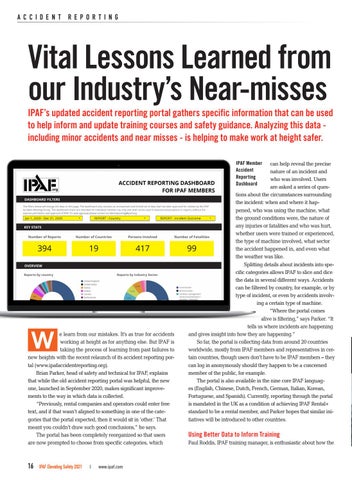
IPAF’s updated accident reporting portal gathers specific information that can be used to help inform and update training courses and safety guidance. Analyzing this data including minor accidents and near misses - is helping to make work at height safer. IPAF Member Accident Reporting Dashboard
W
e learn from our mistakes. It’s as true for accidents working at height as for anything else. But IPAF is taking the process of learning from past failures to new heights with the recent relaunch of its accident reporting portal (www.ipafaccidentreporting.org). Brian Parker, head of safety and technical for IPAF, explains that while the old accident reporting portal was helpful, the new one, launched in September 2020, makes significant improvements to the way in which data is collected. “Previously, rental companies and operators could enter free text, and if that wasn’t aligned to something in one of the categories that the portal expected, then it would sit in ‘other.’ That meant you couldn’t draw such good conclusions,” he says. The portal has been completely reorganized so that users are now prompted to choose from specific categories, which
16
IPAF Elevating Safety 2021
|
www.ipaf.com
can help reveal the precise nature of an incident and who was involved. Users are asked a series of questions about the circumstances surrounding the incident: when and where it happened, who was using the machine, what the ground conditions were, the nature of any injuries or fatalities and who was hurt, whether users were trained or experienced, the type of machine involved, what sector the accident happened in, and even what the weather was like. Splitting details about incidents into specific categories allows IPAF to slice and dice the data in several different ways. Accidents can be filtered by country, for example, or by type of incident, or even by accidents involving a certain type of machine. “Where the portal comes alive is filtering,” says Parker. “It tells us where incidents are happening and gives insight into how they are happening.” So far, the portal is collecting data from around 20 countries worldwide, mostly from IPAF members and representatives in certain countries, though users don’t have to be IPAF members – they can log in anonymously should they happen to be a concerned member of the public, for example. The portal is also available in the nine core IPAF languages (English, Chinese, Dutch, French, German, Italian, Korean, Portuguese, and Spanish). Currently, reporting through the portal is mandated in the UK as a condition of achieving IPAF Rental+ standard to be a rental member, and Parker hopes that similar initiatives will be introduced to other countries.
Using Better Data to Inform Training Paul Roddis, IPAF training manager, is enthusiastic about how the