THE EQUIPMENT THAT HELPED BUILD AN INDUSTRY RENTALS SALES AND SERVICE
SELF-PROPELLED MACHINES
ZERO DOWN
MASTIC MACHINES
FINANCING FOR QUALIFIED BUYERS
Awarded Contract
*Subject to approval
Contract # 050625-TWK
S P R AY M AST E R T R A I L E R S
At effi
Ou pro onl TRUCK MOUNT UNITS
Ca
OIL-JACKETED M E LT E R / A P P L I C AT O R S
ON sealmaster.net | 800-395-7325
LOCATIONS NATIONWIDE
ACON0126_02-7_TOC_BN_BN.indd 2
Booth 101 Feb. 10-12, 2026 New Orleans, LA
Booth C31573 Mar. 3-7, 2026 Las Vegas, NV
12/17/25 9:55 AM
ON EVERY ROAD AND HIGHWAY, THERE ARE THOSE THAT FOLLOW AND THOSE WHO LEAD
K
At Gencor®, we are dedicated to setting the standard in the hot mix industry through innovative, fuelefficient, and low-maintenance designs. Our commitment to customer satisfaction and cost effectiveness allows us to deliver high-quality products that not only meet but exceed industry standards. By prioritizing sustainability, we are not only enhancing our clients success but also contributing to a cleaner environment. Call 407-290-6000 or visit www.gencor.com
ONE COMPANY. ONE SOURCE. ONE SOLUTION.
ACON0126_02-7_TOC_BN_BN.indd 3
INDUSTRIES INC.
12/17/25 9:55 AM
TABLE OF CONTENTS | JANUARY 2026
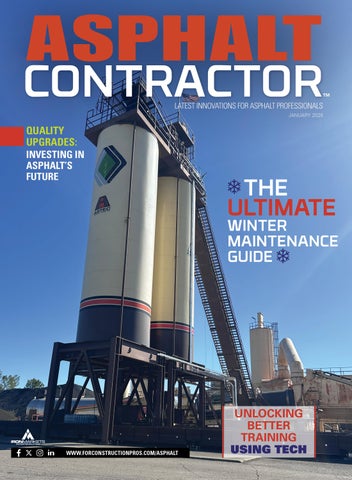
COVER STORY Ahead Of The Curve: Inside KMI’s New Asphalt QC Lab
KMI’s state-of-the-art asphalt quality control lab in Mansfield, OH, shows how investment in testing and design innovation can future-proof production. | 16
TECHNOLOGY MATTERS
JOBSITE INNOVATIONS
12 Apprenticeships to Automation: Inside Construction’s New Tech-Driven Workforce
34 What New Permitting Reforms Could Mean For Road Builders
Construction faces a severe labor shortage, but technology-driven training and industry partnerships are helping attract new workers, modernize apprenticeships and build a stronger workforce pipeline.
SPECIAL REPORT
20 Ultimate Winter Yard Maintenance Pavers, excavators, rollers, and more! We spoke with the manufacturers of all the biggest and most essential pieces of equipment likely sitting in your yard today, and asked how to best keep them in best shape during the off-season.
FACE OF THE INDUSTRY
Washington is inching closer to simplifying the process for everyone.
PRESERVATION & SUSTAINABILITY
38 Asphalt And The Future Of Sustainability Sustainability expectations in road building are shifting again. With federal incentives rolled back and state-level and private-sector requirements increasing, asphalt producers are facing new pressures.
30 Behind The Wheel Of An Asphalt Industry Leader PACER Award winner Anne Chevalier is reshaping asphalt construction.
WWW.FORCONSTRUCTIONPROS.COM/ASPHALT
IN EVERY ISSUE 8 Editor’s Perspective
CONTRACTOR WWW.FORCONSTRUCTIONPROS.COM/ASPHALT WWW.FORCONSTRUCTIONPROS.COM/ASPHALT
42 Last Exit
CONTRACTOR LATEST INNOVATIONS FOR ASPHALT PROFESSIONALS
LATEST INNOVATIONS INNOVATIONS FOR FOR ASPHALT ASPHALT PROFESSIONALS PROFESSIONALS LATEST
ASPHALT ASPHALT
JANUARY 2026 Vol. 40 No.1
CONTRACTOR CONTRACTOR LATEST INNOVATIONS FOR ASPHALT PROFESSIONALS
LATEST INNOVATIONS FOR ASPHALT PROFESSIONALS LATEST INNOVATIONS FOR ASPHALT PROFESSIONALS
Published by IRONMARKETS
Asphalt
Asphalt CONTRACTOR
CONTRACTOR
LATEST INNOVATIONS INNOVATIONS FOR ASPHALT ASPHALT PROFESSIONALS 201 N. Main Street Ste 350, Fort Atkinson, WIFOR 53538 LATEST PROFESSIONALS (800) 538-5544 • WWW.IRON.MARKETS www.ForConstructionPros.com/Asphalt LATEST INNOVATIONS FOR ASPHALT PROFESSIONALS
4
Published and copyrighted 2026 by IRONMARKETS. All rights reserved. No part of this publication may be reproduced or transmitted in any form or by any means, electronic or mechanical, including photocopy, recording or any information storage or retrieval system, without written permission from the publisher. Asphalt Contractor (ISSN 1055-9205, USPS 0020-688): is published ten times per year: January, February/March, April, May, June/July, August, September, October, November, December by IRONMARKETS, 201 N. Main St. Ste 350, Fort Atkinson, Wisconsin 53538. Periodicals postage paid at Fort Atkinson, Wisconsin and additional entry offices. POSTMASTER: Please send change of address to ASPHALT CONTRACTOR, 201 N. Main St. Ste. 350, Fort Atkinson, WI 53538. Printed in the U.S.A. SUBSCRIPTION POLICY: Individual subscriptions are available without charge only in the USA. The Publisher reserves the right to reject nonqualifying subscribers. One-year subscription to nonqualifying individuals: U.S. $45.00, Canada & Mexico $65.00, and $95.00 all other countries (payable in U.S. funds, drawn on U.S. bank). Single copies available (prepaid only) $10.00 each (U.S., Canada & Mexico), $15.00 each (International).
ASPHALT CONTRACTOR JANUARY 2026
ACON0126_02-7_TOC_BN_BN.indd 4
www.ForConstructionPros.com/Asphalt
12/17/25 9:55 AM
s
ON TRACK PERFORMANCE
& Y
ns -
d tor
ng
E
e
With over a century of innovation to its credit, Blaw-Knox® pavers have earned a reputation for quality, durability, and performance unmatched in the industry. Our continued focus on innovation is what drives our product engineering with designs that improve performance while maintaining user-friendly, ergonomic comfort and reliability for the operator. Contact your Blaw-Knox dealer or visit www.blawknox.com for more information. BLAW-KNOX, THE LEGACY LIVES ON.
I
e o
Blaw-Knox Corporation 1280 Superior Avenue Chambersburg, PA 17201 Tel. 717-400-7900 www.blawknox.com
ACON0126_02-7_TOC_BN_BN.indd 5
12/17/25 9:55 AM
DIGITAL CONNECTION www.ForConstructionPros.com/Asphalt
[VIDEO] No Edge Lines Season 3 Premiere! A brand new season of our editor-in-chief getting out in the field is here! This time he faces all new challenges including night-shift work on highways, paving in extreme heat, learning how to grade your base, as well as all the mistakes along the way! Checkout episode 1 of season 3 now! Watch the video at: https://asph.link/bb26slgc
Astec Enters Agreement To Acquire CWMF How will this newly revealed partnership between the plant manufacturers impact the road building and infrastructure marketplace? Read more at: https://asph. link/4l6zcu58
Winter Burnout Risk Index Highlights Pressures Facing Construction, Trade Workers
QBE: Labor Gaps, Higher Costs Shape U.S. Commercial Construction Outlook
Lawsuit: Bobcat Company Files for Patent Infringement Action Against Caterpillar Inc.
A new report ranks burnout risk across 50 job categories for winter 2025, with findings that highlight emotional and physical strain facing construction, trades and labor roles.
QBE North America’s 2025 report is shaping the outlook for 2026, highlighting labor shortages, rising material costs and tariff impacts, with a generally positive 2–3-year forecast for U.S. commercial construction.
The legal actions taken by Bobcat Company include filings focused on 14 patents enabling maneuverability, power, performance and efficiency.
Read more at: https://asph. link/7ivxwdp5
Read more at: https://asph.link/ jcd6tx5u
Read more at: https://asph.link/ cmaoee13
Signup for the Roadbuilding Update, a free bi-monthly newsletter for the most up-to-date DOT, FHWA, asphalt, and other industry news
6
ASPHALT CONTRACTOR JANUARY 2026
ACON0126_02-7_TOC_BN_BN.indd 6
www.ForConstructionPros.com/Asphalt
12/17/25 9:55 AM
N
INTELLIPAC™ MOISTURE SYSTEM
SUSTAINABLE INNOVATION
nt
s ower,
: nk/
e,
NEW IntelliPac™ Moisture System Astec paves the way for sustainable, innovative asphalt plants. The new IntelliPac Moisture System is a revolutionary solution that integrates seamlessly with Astec control systems. This provides unparalleled, real-time visibility into virgin aggregate moisture content. IntelliPac empowers operators to optimize mix design, minimize energy consumption, and reduce environmental impact. With Astec, you get superior asphalt production – better for the environment, better for your business.
TO SEE VIDEO
BUILT TO CONNECT astecindustries.com
ACON0126_02-7_TOC_BN_BN.indd 7
12/17/25 9:55 AM
EDITOR’S PERSPECTIVE Brandon Noel, Editor-in-Chief
4
EDITORIAL
bNoel@iron.markets 234-600-8983
Editor-In-Chief ........................................................... Brandon Noel bnoel@iron.markets
Major Insights From IGNITE 2025
T
he IGNITE Construction Summit will always have an important place in my life, not just as the Editor-in-Chief of Pavement Maintenance, but because it was the first place I started to build my own relationships with people in the industry. For the first few months I was in this job, all the relationships with blacktop workers, owners, and everyone in-between, were ones that I inherited. Ones I was and am still very thankful for! But nothing can replace building relationships of your own, and every year I make new ones that become increasingly important to me (shoutout to Kyle from Bart’s Asphalt!). That’s really the whole vibe of IGNITE. It’s not a trade show. There aren’t any booths or pieces of equipment. That’s what PAVE/X is for! No -- IGNITE is for your sales, management, and ownership who want to learn from some of the best in the industry.
Insight 1: Quality Is Not Enough On the second day, a tag-team teaching duo of Todd Eichholz (A&A Paving) and Justin Lanham (Alpha Paving) absolutely crushed it! They could have doubled their session length and no one would have been upset, because they were dropping serious “process knowledge” on the audience. The biggest moment for me came when they asked the audience how they plan to stand out against their competition. The room held silent as everyone considered, but Eichholz brought down the hammer. He said, “Quality is not enough,” and went on to explain that doing the highest quality work is the STARTING POINT. What will set you apart is what you start doing beyond that.
Insight 2: Make Your Own Metrics
Content Director, Marketing Services ...........Jessica Lombardo jlombardo@iron.markets
Managing Editor ......................................................Allyson Sherrier asherrier@iron.markets
AUDIENCE Audience Development Director ......................... Angela Franks PRODUCTION Senior Production Manager ...................................... Cindy Rusch crusch@iron.markets
Art Director ............................................................... April Van Etten
describing how they achieved their growth. They each represented companies at different stages of their development. Dejah Anderson (Anderson Striping) talked about how they had to first figure out what their metrics were to measure their success. They couldn’t use someone else’s, or they’d risk selling themselves far shorter and failing to celebrate the wins they’d had. Short and sweet version? You can’t know your succeeding until you decide what your success looks like.
Insight 3: When It Comes To Risk, Mitigation Is The Only Defense Josh Ferguson a partner at the law firm Freeman, Matthis and Gary, did a wonderful presentation on the sorts of litigation that construction contractors frequently face. Ninety percent of contractors will face legal action sometime during their careers, and at a steadily increasing rate AND payout for civil litigation settlements. The best way to mitigate this risk? Documentation, documentation, documentation.
Insight 4: Some Things Take More Time Than Others There are always a lot of things that you can be doing to improve your business, your sales, your training, your technology, your machinery, or your company culture. Pick one thing and make it your Q1 target for 2026, and evaluate how the changes are working (or not) at year’s end. And whatever you do, don’t miss out on IGNITE next December! See you on the road!
ADVERTISING/SALES Brand Director ........................................................... Amy Schwandt aschwandt@iron.markets
Brand Manager ..................................................... Megan Perleberg mperleberg@iron.markets
Sales Representative ..................................................Sean Dunphy sdunphy@iron.markets Sales Representative ................................................... Kris Flitcroft kflitcroft@iron.markets IRONMARKETS Chief Executive Officer.................................................. Ron Spink Chief Revenue Officer ............................................Amy Schwandt VP, Finance .......................................................................Greta Teter VP, Operations & IT ....................................................Nick Raether VP, Demand Generation & Education ....................... Jim Bagan Brand Director, Construction, OEM & IRONPROS .....................................................Sean Dunphy Content Director ......................................................Marina Mayer Director, Event Content & Programming........ Jess Lombardo CIRCULATION & SUBSCRIPTIONS 201 N. Main St. Ste. 350, Fort Atkinson, WI 53538 afranks@iron.markets
LIST RENTAL Sr. Account Manager ....................................Bart Piccirillo | Data Axle (518) 339 4511 | bart.piccirillo@infogroup.com
REPRINT SERVICES Brand Manager ..................................................... Megan Perleberg mperleberg@iron.markets | (800) 538-5544 Published and copyrighted 2026 by IRONMARKETS. All rights reserved. No part of this publication may be reproduced or transmitted in any form or by any means, electronic or mechanical, including photocopy, recording, or any information storage or retrieval system, without written permission from the publisher.
@ASPHALTCONTRACTOR @ASPHALTCONTRCTR @ASPHALTCONTRACTOR @ASPHALT-CONTRACTOR-MAGAZINE
Published by IRONMARKETS 201 N. Main St. Ste 350, Fort Atkinson, WI 53538 (800) 538-5544 • WWW.IRON.MARKETS
The first panel was all about scaling, however, the panelists had a diverse set of paths
8 ASPHALT CONTRACTOR JANUARY 2026 ACON0126_08-9_Editor_BN.indd 8
www.ForConstructionPros.com/Asphalt
12/17/25 9:58 AM
2026 Mag
oel
DESIGN, DETAILS, AND DURABILITY.
ets
do
ets
er
ets
ks
ch
ets
en
dt
ets
rg
ets
hy ts
oft ts
nk dt er er an
hy er do
xle
om
rg
44
TS. or al, val er.
CONEXPO-CON/AGG 2026 March 3 - 7, 2026 | Las Vegas, NV
E
I 53538 TS
VISIT BOOTH SV3119 We’ve built our business and reputation through our unparalleled focus on equipment design, durability, and attention to detail. We apply these foundations to our complete range of asphalt plants and asphalt plant equipment. Let us customize to your request - big or small.
10106 Smith Road, Fort Wayne, IN | 260.672.3004 | ALmix.com
2026 Magazine Ad (CONEXPO) - Asphalt Contractor.indd 1 ACON0126_08-9_Editor_BN.indd 9
12/12/25 2:58 PM 12/17/25 9:58 AM
NEW PRODUCTS Cat Footwear Launches Invader Max 8” Boot for Winter Jobsites
TransTech NonNuclear PQI 380+ The PQI 380+ uses Microsoft Windows 10 for smooth operation, easy software upgrades and enhanced user support. IOS, Android application for data transfer and cloud storage, instantly send measurement data. • Streamlined Workflow for Field Operators - reduced time spent on data entry • Connect to a broader ecosystem, seamlessly linking field measurements to OnStation • Data management screen and the ability to disable data logging • Fast, reliable, accurate and repeatable readings in real time
Astec EZR3 Screed The EZR3 Screed represents Astec’s commitment to innovation and excellence in road construction equipment. With its advanced features and user-focused design, it sets a new benchmark for paving efficiency and quality. • Balanced Design: Enhances tractor balance while boosting strength and durability. • Rear-Mount Advantage: Screed and extension plates maintain uniform depth, reducing adjustment. • Enhanced Stability: Supports wider paving widths with minimal deflection for smoother mats. • Optimized Mat Quality: Maintains angle of attack even during fullwidth applications.
10 ASPHALT CONTRACTOR JANUARY 2026 ACON0126_10-11_Products_BN.indd 10
Cat Footwear has added a new model to its Invader Max line — the Invader Max 8” — built for all-season performance and protection on cold-weather jobsites. The insulated and waterproof boot features 400 grams of insulation for warmth, a composite safety toe, and a tiretread–inspired outsole with slip-resistant technology. Additional details include metal hardware and a reinforced toe bumper for durability. Priced at $184.95, the Invader Max 8” is now available at catfootwear.com and select retailers nationwide.
CM Labs Launches Trimble Integration for Excavator Simulator Developed in collaboration with Trimble, the integration combines CM Labs’ soil simulation with Trimble’s machine control capabilities. Trimble Autos automatically adjusts the excavator’s stick and bucket to align precisely with the design surface, helping operators improve accuracy and efficiency while learning proper excavation techniques in a risk-free environment. Operators can choose from multiple pre-installed design files to simulate realworld jobsite conditions and refine their skills across different excavation challenges. The Trimble Autos feature is part of the Trimble Earthworks add-on module and will expand to other CM Labs earthmoving products in future updates. The enhancement builds on CM Labs’ growing library of machine control modules designed to help contractors train operators more efficiently and safely.
Sensera Systems Launches SiteCloud Insights to Deliver AI Jobsite Summaries • Morning Brief: A daily visual overview of the jobsite with notes on conditions, weather, and readiness for work. • Progress Reporting: Automated time-lapse summaries that help teams measure performance and report to management. • Equipment Usage: Real-time tracking of equipment to cut costs. • Safety Reporting: Notifications of potential fall hazards and daily safety summaries.
Trimble Expands Earthworks Grade Control to Towed and Wheeled Scrapers With this update, scraper operators can use Trimble Earthworks for cutting, loading, hauling, dumping and spreading material evenly to grade. The platform provides real-time blade position and design surface data, helping operators know exactly how much to cut or fill while moving high volumes of dirt efficiently over long distances. By automating grade control, Trimble Earthworks helps reduce rework, shorten cycle times and lower project costs.
www.ForConstructionPros.com/Asphalt
12/17/25 9:59 AM
TRUST THE STRENGTH
Tackle the toughest crushing applications with the industry’s highest performing equipment—Eagle Crusher, delivering world-class innovation, year after year. See the E-Plant® at CONEXPO-CON/AGG, just one of many innovative products on display at the Eagle Crusher booth.
TRUST THE STRENGTH OF EAGLE CRUSHER®
800-25-EAGLE www.EagleCrusher.com JOIN US AT BOOTH
C31414
ACON0126_10-11_Products_BN.indd 11
12/17/25 9:59 AM
TECHNOLOGY MATTERS
Apprenticeship to Automation: A New Tech-Driven Workforce Trimble
Technology-driven training and industry partnerships are helping attract new workers.
T
wenty-five years ago, the construction industry was completing takeoffs on paper. Today, jobsites are run from tablets, equipment operators navigate using GPS, and AI identifies issues in massive point clouds in minutes rather than hours. The transformation isn’t just changing how construction gets done — it’s changing who wants to do it. When young people are exposed to modern solutions like robotic total stations or augmented reality, they actually outperform some seasoned journeymen who don’t have the same technology familiarity. Modern construction interfaces are beginning to resemble gaming controls more than traditional heavy equipment, and the digital culture that people grow up in today lends itself toward picking up these technologies quickly. The construction industry has a workforce problem, but perhaps not the one most people think. The challenge isn’t convincing young people to work with their hands — it’s showing them that construction can be a technology career.
12 ASPHALT CONTRACTOR JANUARY 2026 ACON0126_12-15_Tech_BN.indd 12
TECH AS TALENT MAGNET According to numerous estimates, the construction industry will need to attract nearly half a million new workers in 2026 alone. Trimble’s 2025 Geospatial Industry Report found that 69% of professionals are struggling to find qualified workers. The urgency for workers cannot be overstated. A comprehensive workforce analysis by Lightcast labeled construction as facing a metaphorical”Category 5” hurricane, a storm that has already hit the mainland. The report identifies immigration reform and increasing female participation as critical workforce solutions, but technology adoption emerges as the most immediate lever contractors can pull. While policy changes take years, technology investments can transform workforce dynamics within days, weeks or a few months. But here’s what the numbers don’t capture: companies investing in advanced technology are discovering that digital tools can fundamentally reshape workforce dynamics, from operator satisfaction to training timelines to competitive positioning in a brutally tight labor market. Technology’s impact begins with retention. When workers have the best tools and training, they become more engaged and motivated. Manual data entry and repetitive tasks correlate with higher turnover rates. By adopting digital technology, contractors attract higher-level talent and increase retention. It’s simply a more rewarding job when it’s digital. BUILDING THE PIPELINE Building a technology-literate workforce requires collaboration between industry, equipment manufacturers and educational institutions.
For instance, the first Trimble Technology Lab was launched at the University of Massachusetts Amherst in 2015. Since then, the program has expanded to 30-plus labs across 14 countries with roughly 12,000 students. Young people gain hands-on experience with equipment and technology that prepares them for seamless workforce transitions. They don’t just learn the technology — they embrace it in ways that often surpass experienced workers without digital exposure. At Fresno State University — home to the nation’s first four-year, nationally accredited geomatics engineering program — a collaboration between California Surveying& Drafting Supply (CSDS, a Cansel company) and Trimble, has delivered advanced geospatial equipment, enabling the program to align its curriculum with California’s dominant technology standards. This initiative not only enhances hands-on learning but also underscores a shared commitment to perpetuating the land surveying and geospatial industries through education. Access to technology is transforming how students prepare for careers in surveying and geospatial industries. With enrollment approaching 90 students and plans to double that figure in the coming decade, the program serves as a critical talent pipeline for major employers in the area like Caltrans and PG&E. The equipment includes RTK GNSS receivers, robotic total stations, 3D scanners and comprehensive software — ensuring students work with the same technology they’ll encounter at their future employers. The technology enabled impact extends beyond four-year degree programs. Skilled trades organizations are equally aggressive in integrating technology into apprenticeship and certification
www.ForConstructionPros.com/Asphalt
12/17/25 9:59 AM
ACON0126_12-15_Tech_BN.indd 13
12/17/25 9:59 AM
TECHNOLOGY MATTERS
programs — creating clear career pathways that appeal to workers who prefer hands-on learning. Carpenters, electricians, plumbers, sheet metal workers, ironworkers, cement masons, and trade training programs are all incorporating robotic total stations, laser scanning, augmented reality and even 3D modeling into their apprenticeship programs. These technologies not only help attract the next generation of workers, they give everyone an understanding of the tools available and provide upward career mobility to those who embrace them fully. Rather than replacing traditional skills, these digital tools enhance precision and efficiency while making the trades more appealing to tech-savvy younger workers. Heavy equipment operator training has similarly embraced advanced technology. The International Union of Operating Engineers (IUOE) has incorporated Trimble technology — including 3D surface modeling, layout with robotic total stations and GNSS and even semiautonomous machine control systems — into their apprenticeship and upgrade courses across the country. These tools allow operators to work with the same digital workflows they’ll encounter on actual job sites, building proficiency with grade control systems and GPS-guided equipment before operating machinery independently. The skills developed through this technology-integrated training transfer directly to real-world applications, dramatically reducing the learning curve while improving precision and safety outcomes. MULTI-PRONG APPROACH The construction industry’s workforce crisis won’t be solved by a single solution. As major contractors have discovered, the challenge is so acute that companies are turning down multi-billion dollar data center projects because they simply can’t staff them — from laborers and electricians all the way to executives and project managers. Industry collaboration is emerging as a critical component of this multipronged strategy. Organizations are working together in unprecedented ways
14 ASPHALT CONTRACTOR JANUARY 2026 ACON0126_12-15_Tech_BN.indd 14
to develop and implement workforce solutions. The North American Building Trades Union (NABTU), through its subsidiary Trade Women Build Nations, is actively working to recruit and retain women in construction trades. Another NABTU subsidiary, Helmets to Hard Hats, helps transition existing military personnel into construction careers — and has expanded beyond traditional union trades to include executive management tracks. Skills USA, heavily involved in construction trades education, now offers heavy equipment operator competitions in every state, each incorporating surveying and technology components. These competitions serve as recruiting grounds for contractors seeking technology-savvy workers. Association partnerships are equally vital. Organizations like the Associated General Contractors (AGC), Associated Builders and Contractors (ABC), and the Association of Equipment Manufacturers (AEM) are collaborating on workforce development initiatives, pooling resources and expertise to create more effective training programs and career pathways. The efforts extend to breaking down traditional barriers to entry. Women represent one of construction’s largest untapped talent pools. Programs across the country are working to change perceptions and create welcoming environments. Data shows progress: Colorado State University’s construction management program now enrolls 20-25% women, while the Coast Guard Academy’s engineering program has achieved 30-35% female enrollment. The tide is turning as young people recognize that modern construction offers genuine career opportunities. For contractors, this means getting actively involved — not just writing checks. Consistent engagement with educational institutions, teaching classes on a quarterly basis, participating in Skills USA events, and providing internship opportunities all contribute to building the pipeline.
Major contractors are leading by example. Companies are partnering with schools, unions, and trade associations to create clear pathways from education to employment. They’re offering technology training to current employees while simultaneously recruiting from programs that emphasize digital skills. Some are even developing internal training academies that combine traditional craftsmanship with advanced technology competencies.
L
THE PATH FORWARD The evidence is clear: technology adoption isn’t just about productivity or precision — it’s about creating workplaces that attract and retain the talent needed to sustain growth. Companies that recognize this connection are building reputations as employers of choice, developing training systems that compress learning curves, and positioning themselves to pursue projects that competitors cannot handle. Success requires contractors to embrace a comprehensive strategy: • Invest in technology that makes work more engaging and less demanding • Partner with educational institutions, from K-12 through university programs • Collaborate with trade associations and unions on training initiatives • Support programs that expand the talent pool • Commit to consistent, long-term engagement • Create clear career pathways that show progression The contractors who move decisively are building the foundation for tomorrow’s success. In the competition for construction’s scarcest resource — skilled workers — those who invest in people, partnerships, and technology will increasingly win, while those who don’t will struggle to survive. The question is no longer whether to embrace this comprehensive approach, but how quickly firms can implement it. Ian Warner is the Director of Industry Workforce Development & Innovations at Trimble.
E125
www.ForConstructionPros.com/Asphalt
12/17/25 9:59 AM
Weiler M
LEADING THE WAY Weiler Material Transfer Vehicles lead the way with proven innovations to provide the lowest cost per ton of operation.
Variable speed elevator and conveyors meet production requirements while minimizing wear.
Innovative and reliable operator friendly features such as paver hopper management system with distance to paver, storage hopper management and auto chain tensioning.
s
Clam shell doors and full width drop down floors provide unmatched access for cleanout and maintenance.
E1250C
E1650A
The multiple, incremental improvements to the 4th generation of chains, sprockets and augers are retrofittable to all machines and provide increased wear life.
E2850C
E2860C weilerproducts.com
Weiler MTV Ad_Asphalt Contractor.indd 1 ACON0126_12-15_Tech_BN.indd 15
12/12/2025 7:32:43 AM 12/17/25 10:15 AM
PRODUCTION GAINS | By Brandon Noel, Editor-In-Chief
AHEAD OF THE CURVE: Inside KMI’s New Asphalt QC Lab KMI’s state-of-the-art asphalt quality control lab in Mansfield, OH, shows how investment in testing and design innovation can futureproof production.
KMI
A
sphalt is a science just as much as it is a trade. I saw this firsthand when I recently visited the brand-new, state-of-the-art asphalt quality control laboratory built in Mansfield, OH. What drew me to them was a simple question: what motivated them to invest in this new lab? Over the past three years, I’ve had the pleasure of visiting many jobsites and learning how to operate all kinds of machines. Early on, I made it a personal goal to learn everything I could about how to actually do the work that the people in our industry perform day in and day out. For the most part, my focus centered on the laydown crews—the finished product, how the mat gets paved and compacted, and how it gets milled up and recycled. Asphalt plants, where the production happens, remained something
of a blind spot for me—one I am now turning my attention toward correcting. ABOUT THE COMPANY Founded in 1951, Kokosing, Inc. is now a third-generation family-owned group of construction and materials companies operating across a wide range of civil engineering and infrastructure sectors. They pride themselves on being one of the few remaining family-owned construction firms in the Mid-Atlantic region. According to their website, “Kokosing’s primary business lines include
industrial, transportation, pipelines, water and wastewater, marine, and renewable energy. Additionally, aggregates and asphalt material suppliers are part of the Kokosing family of companies.” Their group of companies includes Kokosing Construction Company, Inc, Kokosing Industrial, McGraw Kokosing, Integrity Kokosing, The Olen Corporation, and Kokosing Materials Inc. which was the particular company I visited for this story.
Asphalt Facts: Marshall”Pill” Method The Marshall method is a relatively straightforward, empirical procedure focused on stability and flow values. A typical Marshall laboratory design involves these steps: • Aggregate and Binder Selection: A combination of aggregates that meet gradation and quality requirements are selected, as well as an asphalt binder. The binder, in Marshall design is usually a penetration or viscosity graded AC, though modern implementations may specify a PG binder. • Sample Preparation: Trial batches at different asphalt binder contents are prepared, usually varying by 0.5% increments around an estimated optimum. For each binder content, the aggregates and binder are heated and mixed thoroughly. The hot mix is placed into a 4-inch diameter cylindrical mold to form lab specimens. • Compaction: The specimens are compacted with the Marshall drop hammer. The compaction is specified as a certain number of hammer blows on each side of the specimen commonly 50 blows per side for light/medium traffic, or 75 blows for heavy traffic like highways or airfields. The result is a disk-shaped compacted specimen ~2.5 inches tall.
16 ASPHALT CONTRACTOR JANUARY 2026 ACON0126_16-19_ProductionGains_BN.indd 16
www.ForConstructionPros.com/Asphalt
12/17/25 10:00 AM
• Stability and Flow Testing: After a short conditioning (often in a water bath at 140°F to simulate pavement temperature), each specimen is placed in the Marshall test press where a load is applied to the cylindrical specimen until failure. The Marshall Stability is the max load the specimen can withstand, and the Marshall Flow is the deformation that occurs at the maximum load. These are measured using a calibrated load cell and a dial gauge. The stability indicates the mix’s load-bearing capacity, while flow indicates its plasticity or flexibility. • Density and Voids Analysis: For each pill, the bulk specific gravity (density) is measured and the air void content calculated, as well as, voids in mineral aggregate (VMA), and voids filled with asphalt (VFA). These volumetric properties are computed from the specimen’s mass, volume, and the theoretical maximum specific gravity of the mix. In Marshall design, an optimum binder content is typically chosen to achieve about 4% air voids in the mix. • Optimum Binder Content Selection: The results for the trial binder contents can then be plotted, sometimes using graphs for stability, flow, density, VMA, and air voids versus asphalt content. The binder percentage that yields approximately 4% air voids is selected as the preliminary optimum. At this binder content the mix’s Marshall Stability should exceed the minimum requirement and the flow should be within the specified range. If not, adjustments are made until all criteria are satisfied.
Asphalt Facts: Superpave”Puck” Method The Superpave method is more comprehensive and volumetric-based, incorporating material properties and environmental considerations. Its procedure can be summarized in these steps: • Aggregate Selection and Gradation Design: There are strict aggregate quality requirements. Aggregates must meet consensus properties like coarse aggregate angularity, fine aggregate angularity, flat and elongated particle limits, and sand equivalent for dust content. These ensure the aggregate structure are stable under loads. A target gradation is selected that passes through Superpave-defined control points for the nominal maximum aggregate size. Designers blend multiple aggregate stockpiles to achieve the desired gradation and to meet these criteria. • Binder Selection (PG Grading): Superpave explicitly incorporates climate and traffic variables into the binder selection. Instead of penetration or viscosity grades, it uses Performance Grade (PG) binders characterized by their high and low temperature performance limits. For example, a PG 64-22 means suitable up to 64°C high pavement temp and -22°C low temp. This ensures the asphalt cement resists rutting in hot weather and cracking in cold weather. • Trial Mixes and Compaction: As with Marshall, trial mixes at varying binder contents are prepared. But compaction is done with the Superpave Gyratory Compactor (SGC). The SGC is a specialized press that molds a cylindrical specimen, about 6 inches across, by applying a constant vertical pressure while gyrating the mold at a fixed angle. The mix is compacted to a specified number of gyrations that simulate different stages of pavement life. • Performance Tests: Additional performance tests for rutting, fatigue cracking, and thermal cracking can sometimes be required. Agencies may include the Hamburg wheel-track test to evaluate rutting and moisture susceptibility or the Indirect Tensile Asphalt Cracking Test (IDT) for cracking resistance. Moisture susceptibility must always be evaluated, typically by AASHTO T 283, a tensile strength ratio (TSR) test on conditioned vs. unconditioned specimens. A minimum TSR (often 80% or 85%) is required to ensure the mix withstands water damage. • Volumetric Analysis: Every specimen is evaluated for volumetrics. The bulk specific gravity of the specimen is measured, and with the theoretical maximum specific gravity of the mix, the air void content is calculated. Superpave’s design criterion is to achieve 4% air voids. Along with air voids, the voids in mineral aggregate (VMA) and voids filled with asphalt (VFA) are computed. Superpave has mandatory minimum VMA values to ensure enough binder film thickness for durability, and VFA ranges for each traffic level and aggregate size. [A 12.5mm nominal size mix for heavy traffic might require ≥14% VMA and 65–75% VFA.] These volumetric criteria are critical in Superpave – they ensure the mix isn’t too dense or too voidy. • Select Optimum Binder Content: The binder content that yields 4% air voids is selected as the optimum, provided all other requirements are satisfied. This means at the chosen binder content, the mix has just enough air voids to compact slightly further under traffic but not crush or deform. The designer then double-checks that at this optimum. If any criterion is not met, the mix design must be adjusted. • Documentation and Verification: The final step is similar to Marshall in principle: document the job mix formula (JMF) with all component proportions and lab results. The JMF submission for a Superpave design includes the aggregate gradation, binder grade, optimum binder content, compaction levels, and the resulting volumetric properties at optimum. Many agencies require that a field verification strip or trial batch be produced and tested to ensure the plant can replicate the lab design within tolerances before full production.
www.ForConstructionPros.com/Asphalt
ACON0126_16-19_ProductionGains_BN.indd 17
JANUARY 2026 ASPHALT CONTRACTOR 17
12/17/25 10:00 AM
PRODUCTION GAINS GETTING INTO THE LAB I’ve only ever been inside two previous “labs” for asphalt testing, and both were trailers set up on site at asphalt plants. KMI has multiple “field labs” too, as they call them, which are similar to what I’ve seen before. But their new QC Mix Design Laboratory is massive, clean, and filled with machines I had never seen before—one seemingly tucked into every corner. It almost felt like I was in the Willy Wonka chocolate factory of asphalt. And if that were true, the asphalt chocolatier at KMI would be Matt Anderson, their Quality Control Lab Manager. He started in the asphalt industry in high school, and twenty years later, he’s still here. “I thought this was just a high school job for me,” he told me. “My first job was taking temperature readings at the plant. Then they started training me to do new things, then they paid for me to get state certified, and now, here I am.” Matt follows the same schedule every day. Starting at 6:00 a.m., he pulls the day’s sample mix designs from a large oven and starts making asphalt—literally by hand in a small drum mixer, adding the correct amount of AC and any additional additives called for in the mix design. Working alongside a team of about ten employees with their own roles in the QC department, they focus on two primary responsibilities. The first, and by far the most significant, is testing mix designs for various jobs, many for the Department of Transportation (DOT) or the Federal Aviation Administration (FAA), to ensure that the plant’s output meets the required specifications. That makes up about 95% of their workload, with the remaining 5% being QC tests on on-site samples. All told, they estimate that at least 150 different mix designs go through the lab each season before being sent to the DOT or FAA for final checks and approval. Once the mix designs are properly created, they go through a curing process before being compacted into either a Marshall “pill” or a Superpave “puck,” depending on the project. “Once the designs are finalized and approved, I’ll load them into a mix
18 ASPHALT CONTRACTOR JANUARY 2026 ACON0126_16-19_ProductionGains_BN.indd 18
A data sheet, and the plant manager will run off that,” Matt said. “Everything we create is a job mix formula, or JMF. What they have to use is all predetermined—what parameters they need to hit. We come up with a design here, it goes through its required tests, then it gets sent to the agency, and once it’s approved, we pass it off to the plant.” Everything begins with the QC lab, heads off to the DOT or FAA, returns to the QC lab, and finally gets handed off to the production crew. A QUALITY UPGRADE Many firms this year are taking a measured approach to finances and investments due to economic uncertainty in the industry. But KMI went against the grain, deciding to greatly expand and upgrade their quality control facility and operations. I was curious what drove the decision to expand while others are playing things closer to the chest. KMI
“I think it’s the advancement of balanced mix design (BMD)—just having space for everything,” said Mike Matheny, Director of Quality Control. “Now we have room for things like the Hamburg Wheel Tracker. Balanced mix design, also called performance-based design, has been driving a lot of conversation and change within the industry for years. If you attend any asphalt industry meeting, it’s a frequent topic. The industry advocates for BMD for one major reason: If you want to work with federal agencies and access federal funding, you need to be on board with BMD. Doing so, as KMI has, typically requires investment in new lab equipment and in additional staff training.
Different agencies, however, have clear preferences for one method or another depending on the project and specifications. A modern QC lab must be equipped to meet all of them. The FAA’s standard specifications for airport pavements are based on the Marshall method. They require designing mixes using the Marshall procedure and achieving criteria such as minimum stability values in the lab. For heavy aircraft (gross weight ≥ 60,000 lbs or high tire pressures), the FAA specifies a 75-blow Marshall design targeting a stability of at least ~2,150 lbs and a flow between 10–14 (0.01” units). The agency also mandates field verification test strips using plant-produced mix before full paving can begin. In practice, nearly all FAA-funded asphalt runways and taxiways still use Marshall-designed mixes. State highway agencies, by contrast, have overwhelmingly moved to Superpave for road and highway mix designs. Following FHWA guidance in the 1990s, by the early 2000s most states had adopted Superpave binder specs and mix criteria. Today, if you bid on a DOT paving job, the mix design will almost certainly need to be a Superpave design meeting that state’s adaptation of AASHTO M 323, complete with binder grade requirements, traffic-level criteria, and tests such as Hamburg wheel tracking for high-volume roads. As we turn the corner into the new year, the industry’s landscape is changing, and competition for projects may become increasingly fierce. Those best prepared to meet evolving demands will be positioned to make the most of the federal and state dollars available. While it remains to be seen what the focus will be for the next surface transportation bill, it’s likely that the critical quality standards aren’t going anywhere. Like KMI, the companies making the future-oriented investments into training and equipment to support these higher standards will find their ROI on such investments to be much higher than those who lag behind. Because making these sorts of upgrades and changes, isn’t something that happens overnight.
www.ForConstructionPros.com/Asphalt
12/17/25 10:00 AM
E c in
CL
AT ta de pr ex
W
A JOHN DEERE COMPANY
Experience the industry‘s most comprehensive curriculum, all in one world-class facility. CLOSE TO OUR CUSTOMERS
AT THE WIRTGEN AMERICA CENTER FOR TRAINING AND TECHNOLOGY, we provide an extensive curriculum tailored to the learning needs of technicians, operators, work crews, site managers, service engineers, and service department personnel. From guardrail to guardrail and 20 inches down, our courses cover everything from aggregate production, to paving, compaction, and recycling of road materials. Experience high-quality teaching from industry experts that keeps attendees in step with Wirtgen Group’s cutting edge technology. WIRTGEN AMERICA, INC. · 6030 Dana Way · Antioch, TN 37013 · T: (615) 501-0600
ACON0126_16-19_ProductionGains_BN.indd 19
12/17/25 10:00 AM
SPECIAL REPORT | By Brandon Noel, Editor-In-Chief
Ultimate Winter Equipment
MAINTENANCE GUIDE Your equipment is too large of an investment to risk it breaking down when the busy season is just getting started. Take the time now, and save when it matters most.
F
or many contractors across the northern parts of the country, the winter months are the offseason. The plants are shut down and the big iron is sitting idle in the yard or in a garage for storage. However, it’s not so simple a thing as just parking it in a random spot for a few months, and cranking it back up when the first spring-time jobs come calling. That’s a recipe for disaster. If your operations are shut down it’s time to start thinking about how to properly store, maintenance, and prepare your large capital investments for the coming season.
ASPHALT PAVERS All answers attributed to Thomas Travers, Director Technical Sales, Astec Inc. What are the most critical steps a contractor should take when preparing an asphalt paver for winter storage? Removing all loose asphalt from machine, open extensions, tunnel kits and flow gates and clean both sides of components. Spray down all areas that were cleaned. Check conveyer chains and head shaft and tail shaft for buildup and remove How does cold weather impact the performance or longevity of core systems like hydraulics, augers, conveyors, and screeds? Fill all fluid levels to their fill marks and secure all caps to avoid water intrusion. Cold storage will not affect these systems during storage. Hang the screed from its safety straps to avoid freezing to the ground. How should contractors handle fluids to prevent contamination or gelling in freezing temperatures?
20 ASPHALT CONTRACTOR JANUARY 2026 ACON0126_20-29_SpecialReport_BN_BN.indd 20
Owners manuals will have any additives that the manufacture of said components suggests for long term storage pay close attention to the DEF tank and DEF fluid requirements.
Contractors already monitor telematics to plan their fluid change intervals. It is important to have visibility to this data before storing to order necessary parts and fluids. Are there particular wear parts or components that you recommend replacing or servicing? Manufactures post their intervals for checking wear on all moving parts verify the current hours vs the wear check tables in your manual
What are the most common offseason maintenance mistakes that can lead to costly repairs come spring? Cold start below 0 degrees is very hard on starters and engine components. Make sure battery’s are accessible for possible jumping if needed. Best to plan warmer days for moving machines inside for maintenance. How should operators care for the electrical systems, sensors, and grade-control tech? Remove all sonic sensors, hand held remotes, grade and slope sensors and store indoors for the winter. Also cover seats with heavy garbage bags to protect from the elements. What precautions should be taken with the screed heating elements and control systems? Hang the screed from its safety straps and tilt slightly to avoid water from collecting around elements. How can telematics or machine monitoring help contractors track paver health and schedule proactive maintenance during the winter months?
What’s your ideal inspection or startup checklist? Look for any guests that might have made a home in your machine and clean out appropriately, recheck all fluid levels and connections. This is also a great time to level your screed plates and check all elements for proper heat.
Excavators All answers attributed to Sejong Ko, Product Manager — Large Excavators, Volvo Construction Equipment How do cold temperatures affect the major systems of an excavator? In the hydraulic system, low temperatures cause the oil to thicken and become more viscous. This can increase resistance and put extra stress on the pump and other components, leading to inefficient operation until the oil warms up. For electrical components, the battery is the main concern. Cold environments can cause a battery to lose up to 50% of its cranking power, making it much harder to start the engine.
www.ForConstructionPros.com/Asphalt
12/17/25 10:01 AM
As for the undercarriage, performance suffers when mud or ice gets packed into the tracks or around the rollers. This can cause excessive wear on the tracks and can even lead to frozen rollers that can’t turn freely. What are your best-practice recommendations for preparing an excavator that will sit idle? Winterizing your excavator for off-season storage is crucial for a smooth spring start. Start with a thorough cleaning of the entire machine — especially the undercarriage — to remove any debris. To avoid rust, touch up the machine’s exterior paint and treat exposed parts with an anti-rust agent after properly lubricating all grease points. Check for fluid leaks and component damage and make all necessary repairs. The engine’s glow plugs and air inlet heaters are also critical to inspect before it gets too cold. Next, tend to the fluids. You should change the engine oil and filter and fill the fuel tank to prevent condensation from forming inside the tank, which can lead to gelling or contamination. It’s also a great time to check the coolant concentration with a hydrometer, as the right glycol mix is essential for lowering the freezing point and protecting your engine. Since diesel exhaust fluid (DEF) freezes at 12º F (-11º C), if you’re storing the machine all winter, we recommend draining the DEF tank to avoid potential issues. Store your excavator in a sheltered location (ideally a heated building) to shield it from wind, snow and ice. If you must store it outside, level the ground and apply the parking brake; then cover the engine air intake and exhaust outlet to keep dirt and water out. In extreme cold, remove the battery and store it in a warmer location on a wooden, plastic or rubber surface. Be sure to check on it periodically and trickle-charge it if needed. Regardless of storage location, make sure the battery is fully charged. Its charge and storage temperature are the two biggest factors in how quickly a battery will self-discharge and become susceptible to issues. Whenever possible, start up the excavator once a month and run
www.ForConstructionPros.com/Asphalt
ACON0126_20-29_SpecialReport_BN_BN.indd 21
it at a low idling speed for about an hour. Once it’s at working temperature, test the function cycles (travel, swing and attachments).
What types of fluids, lubricants, or additives do you recommend? Synthetic and multi-grade oils cover a range of temperatures, but if you’re working in conditions below 0º F, you should consider using cold-weather hydraulic and engine oils. Check your excavator’s manual and/or consult your local dealer or OEM to determine whether your machine comes with the appropriate engine oils, greases and hydraulic fluids or whether you should swap to an arctic-grade or low-temperature viscosity in the winter. With fuel, you may want to consider switching to a dedicated winter blend (often No. 1 diesel). This fuel has a lower cold filter plugging point and is much less prone to gelling than No. 2 diesel. If you’re using No. 2 in really low temps (around -20º or -30° F), an anti-gel additive may be necessary. And of course, don’t forget the coolant. Check its concentration to ensure that you’ve got the proper water/glycol mix to prevent freezing — this is absolutely necessary to avoid costly damage. How should contractors approach daily startup and shutdown procedures when working in below-freezing temperatures? Before startup, do a thorough walkaround. Clean the undercarriage and around the swing mechanism, as ice can tear seals. Make sure the rollers are free of debris and can turn easily. If your excavator has an engine preheating function like a block heater, take advantage of it to make startup easier. If you don’t have one and you’re starting up a cold engine, let it warm up for at least 10 minutes before putting it to work. This gives the engine, hydraulic and coolant fluids time to
reach their optimal operating temperatures, ensuring efficient function and preventing undue stress. For shutdown, always refuel at the end of the day. This prevents air space where condensation can form overnight. If your machine is equipped with a delayed engine shutdown feature, use it. This function keeps the engine running briefly after the key is turned off to properly cool the turbocharger, which helps prevent a costly component failure. What are the most common coldweather maintenance mistakes you see contractors make? The most common mistakes we see involve fluids and batteries: • Neglecting fuel and filters: Failing to switch to a winter-grade diesel in extreme cold results in the fuel gelling and clogging the system. And neglecting to drain the water/fuel separator daily when shutting down can lead to freezing and blockages. • Ignoring the battery: Because a battery can lose so much power in freezing temperatures, a contractor might try to crank a weak or lowcharge battery too many times. This can wear down the starting system components or even leave the machine completely stranded. I recommend testing batteries before winter, using a battery warmer, or taking the battery out and storing it on a tender. • Improper use of DEF: DEF freezes at a relatively high temperature, and contractors often fail to properly manage it. Either they’re not waiting long enough for the onboard heater to thaw it out, leading to fault codes and engine derate, or they’re storing it in a non-heated area, leading to its degradation. Can you discuss the importance of battery maintenance and storage? A cold battery’s chemical reactions slow down, significantly reducing its capacity and cranking power and making it much harder for a diesel engine to turn over. If a battery is already weak from a hot summer — which encourages corrosion — the added strain of a cold start can easily kill it. For extended storage, your best bet is to remove the battery entirely and keep it in a temperaturecontrolled environment (ideally on
JANUARY 2026 ASPHALT CONTRACTOR 21
12/17/25 10:01 AM
Meet your high-capacity production needs with ADM’s EX Series counterflow asphalt plants, producing up to 425 TPH and handling up to 50% RAP. Experience even greater service and support now that ADM has joined forces with FAYAT brands including BOMAG, Dynapac, LeeBoy, and Mecalac to bring the pavement life-cycle full-circle, providing turnkey solutions to North American road-building companies for the long haul.
JOIN US AT BOOTH SV2067 260-637-5729 admasphaltplants.com
ACON0126_20-29_SpecialReport_BN_BN.indd 22
12/17/25 10:01 AM
s
ACON0126_20-29_SpecialReport_BN_BN.indd 23
12/17/25 10:01 AM
SPECIAL REPORT a tender to maintain a full charge). If removal isn’t feasible, you should still keep it on a tender and consider using a battery warmer that either slides under or wraps around the battery to help it retain its charge. And, as noted previously, check it periodically and trickle-charge as needed. When you’re ready to start the machine in the spring, inspect the terminals for corrosion, check the electrolyte levels, and confirm the specific gravity. Proper maintenance ensures that the battery has the strength to deliver the high current needed for a cold start and prolongs its overall service life. How should hydraulic hoses, seals, and fittings be inspected and maintained? A thorough inspection of the hydraulic system’s hoses, seals and fittings is important because low temperatures can make rubber components brittle and susceptible to cracking. You should check hoses for signs of wear, cracking or damage from chafing. Look for soft spots or swelling (which indicate internal breakdown) and replace damaged hoses immediately. You may even want to consider switching to arctic-rated hoses. Inspect all fittings and connections for signs of weeping or leaks. While some black rubber O-rings can shrink in the cold and may reseal once they warm up in the spring, it’s essential to look for actual damage before replacing them. Addressing these potential points of failure now prevents leaks and costly downtime when the spring work season begins. What role does proper cleaning and undercarriage care play in preventing corrosion? Cleaning and taking care of the undercarriage is one of the simplest, most effective forms of preventive maintenance possible for an excavator. If soil, clay or other debris is left on the undercarriage, it can increase stress on the components and prevent rollers from turning freely. A roller that can’t turn is quickly worn flat, leading to excessive track and sprocket wear. A good cleaning also removes corrosive elements like salt or abrasive materials that can eat away at
24 ASPHALT CONTRACTOR JANUARY 2026 ACON0126_20-29_SpecialReport_BN_BN.indd 24
components while the machine sits idle. By pressure-washing and scraping off all debris before storage, you minimize wear and significantly reduce the chances of rust and costly undercarriage repairs come spring. Are there best practices for outdoor storage that can still protect equipment from the elements? Indoor storage is ideal for keeping the machine at an optimal temperature, making startup easier and protecting the battery and sensitive components. However, indoor storage isn’t always possible. Here are a few best practices for outdoor storage: • Sheltered location: Park your excavator where it’s shielded from wind and blowing snow. Even a simple three-sided shelter or a tarp covering can help. • Level ground: Position your machine on level ground and engage the parking brake. • Prevent entry: Cover the engine air intake and exhaust outlet to keep dirt, water and potential pests out of the system. • Check fluids: Make sure that the fuel tank is full, the coolant is mixed correctly and the DEF tank is drained before final shutdown. These steps are critical regardless of where the machine is stored. How has telematics or onboard diagnostics changed the way contractors can monitor machine health? Telematics systems like Volvo ActiveCare Direct provide a crucial layer of monitoring for machines even when they’re sitting idle. The most immediate benefit is the ability to track a machine’s precise location and engine start attempts. This is an invaluable security feature during long periods of inactivity. For maintenance, telematics programs relay fault codes directly to a fleet manager. For example, if an operator attempts a cold start and the DEF system isn’t thawed, the system will send an alert. Managers can also monitor battery voltage and machine hours to make sure that service intervals are maintained, even if the excavator is only run occasionally or if a battery is weakening. This proactive data allows you to address small issues like a low
battery charge or a minor sensor fault before they escalate into major repairs that impact your uptime.
ROLLERS Answers attributed to Sven Mayer, Product Development Support Engineer, HAMM. What’s your recommendation for proper cleaning and inspection? Pressure wash the machine, clean radiator packet, clean air filter housing, grease all greasing points, drain water tank + water pipe + water nozzle, fill up fuel tank (help prevent condensation in tank), drain water in fuel filter, check freezing temperature of antifreeze, charge + disconnect battery, park the roller in best case under a cover where it is protected from the elements. How should contractors handle fluids before cold storage? Fill up fuel, check the freezing temperature of antifreeze, fill all fluids to the max except water for spray bars. Are there specific components that are particularly vulnerable? Oil or grease hinges of scraper bars, remove check valve of spray nozzles + opening the pipe to let water drain out. How can contractors ensure the water system remains protected? Drain the tank, drain the pipe, remove check valve of stray nozzles to let it drain out. What are your best practices for maintaining and storing batteries in rollers? Shut off the machine, wait for 10 minutes, disconnect the battery cable, make sure the battery is fully charged, this increases the freezing temperature of the battery itself. Do you recommend any special tire or drum maintenance procedures to prevent flat spots, rust, or degradation during long-term storage? • Make sure tires are filled to the correct tire pressure, store the machine as dry as possible protected from the elements. If this is not possible, drive the drum on some wood blocks to prevent moisture sitting under the drum and rust.
www.ForConstructionPros.com/Asphalt
12/17/25 10:01 AM
r
P"VE/ Booth #501
ACON0126_20-29_SpecialReport_BN_BN.indd 25
12/17/25 10:01 AM
SPECIAL REPORT • For rubber tire rollers, jack up the machine and place on blocks so the tires are not in contact with the ground. This will prevent flat spots in the tires and reduce pressure on the sidewalls.
When bringing a roller out of storage in the spring, what should operators inspect or service first to ensure a smooth return to operation? Check all fluid levels, tire pressure, check if any animals were in the machine (mouse, or birds in exhaust pipe for example), charge the battery, grease the machine if not done before storage, check the air filter housing for animals, put water system back together, fill water system all the way and check for leakages, try out both water pumps if functional, adjust the scrapers. change if worn, check rubber isolators on drum mount for cracks, clean the radiator if not done when storing.
MOTOR GRADERS Answers attributed to Chris Broome, VP of Product Development and Support, LeeBoy What are the key steps contractors should take to prepare a motor grader for winter storage? Preparing a motor grader for cold weather requires careful attention to detail to ensure reliable performance in harsh conditions. Contractors should begin by thoroughly greasing the unit, protecting all moving components from increased wear caused by low temperatures. Applying a moisture inhibitor to cylinder rods and linkages is equally important, as it helps prevent corrosion and freezing that could compromise functionality. Fluids must also be checked to confirm they are rated for the expected cold temperatures, ensuring proper flow and
26 ASPHALT CONTRACTOR JANUARY 2026 ACON0126_20-29_SpecialReport_BN_BN.indd 26
responsiveness even in sub-freezing environments. The battery deserves special focus as well; in cold weather, it works significantly harder to deliver the necessary power. Performing a battery test before winter operation helps confirm that it is in optimal condition and capable of withstanding the demands of the environment. By taking these steps, contractors can reduce the risk of downtime and keep graders operating smoothly throughout the winter season. How does cold weather affect grading performance? Colder temperatures present unique challenges for grading activities. When the ground becomes frozen, penetration is significantly more difficult. Under these conditions, the blade may exhibit a chatter effect during fine grading, which can cause the grade control system to continually adjust in its effort to maintain zero. Proper adjustments to the circle and balde can help minimize this unwanted chattering. In addition, cold weather can reduce hydraulic responsiveness. However, advancements in hydraulic oil technology have greatly improved flow characteristics and operating speeds, helping to mitigate these effects. What’s your recommended cleaning and inspection process before storage? Before storing a motor grader it’s important to thoroughly clean the entire unit. After cleaning inspect the structural integrity of the frames and weld points by looking for cracks or stress marks, motor graders are used in harsh conditions that could put a lot of stress on the frame assembly and cylinder mounting weldments. After the crack inspection check the moldboard and circle drive for slop, adjust as necessary. Lastly be sure to top off all fluids and grease all grease points. How should contractors handle hydraulic fluid, coolant, and fuel systems? When winterizing a motor grader its important to not only ensure the hydraulic fluid, coolant, and fuel tank are properly filled but have the correct fluids for the climate your
unit is being winterized in. Colder regions use different rated fluids to help with freezing or jelling, additives can be used to help with this common issues. To help prevent condensation in fuel systems be sure to top off the tank completely at the end of a shift and before storing the grader. What are the most commonly overlooked maintenance tasks? The most common maintenance issue when placing the grader back into service after properly winterizing it is dead batteries. To help prevent common batteryrelated issues during storage, it is recommended to connect a battery tender to the grader. Maintaining the battery with a tender throughout the storage period ensures proper charge levels, reduces the risk of discharge, and helps extend overall battery life. How can contractors best protect exposed components like cylinders, cutting edges, and linkages from corrosion or moisture damage? Cylinders and linkages are areas that commonly have issues with rust if not properly winterized. The best practice is to use corrosion inhibitor along with covers. I personally prefer to use Boeshield T-9 as a protective coating; however, there are several other high-quality products available that will also perform effectively. When the grader is parked its best not to leave the mold board down with out using blocks, this will help the mold board cutting edge from getting damaged from moisture in the ground. The corrosion inhibitor can be applied to all cutting edges to help damage from rust. In extreme environments it is best to store the grader indoors for best protection. What best practices do you recommend for maintaining electrical systems? Electrical systems can be a problem if not properly maintained for storage. A common mistake during the winterizing process is not drying the electrical system after pressure washing the grader. Use an air gun to carefully dry the electrical system, paying particular attention to plugs and connectors where moisture may accumulate. After drying makes sure there aren’t
www.ForConstructionPros.com/Asphalt
12/17/25 10:01 AM
-
any exposed wire, if there is take proper steps to protect the wiring from the elements and use a little dielectric grease at all connectors to protect from moisture. How can telematics or remote monitoring systems help contractors track grader condition? Telematic or remote monitoring systems are the standard now. These systems help fleet managers not only schedule routine services and track utilization rates but can help inform them if the unit is experiencing faults or problems. This information enables the scheduling manager to allocate equipment to jobsites without the need for onsite inspections. By providing clear visibility into equipment readiness, the manager can determine whether a machine is prepared for its next assignment or requires service, ensuring efficient deployment and minimizing downtime. Monitoring systems are also a huge help for technicians when its time to diagnose the machine giving them a window on how the unit is performing and sometimes leading them directly to the problem. Are there effective outdoor protection strategies for those without facility space? It is always best to store machinery indoors if you can, it helps protect your investment and ensures the unit won’t be damaged from the weather. With that said graders can be stored outside in most conditions if properly winterized, the key is to properly winterize the machine when placing them in outdoor storage. Make sure to re-winterize the unit annually even when the unit wasn’t used that season. What’s your recommended inspection or warm-up checklist to ensure smooth operation? When returning a motor grader into service its best to check all fluids and top off if necessary, ensure the battery is properly charged, and start and operate all function ensuring proper performance. If you winterized the grader before storage the in servicing of the unit should go very smoothly and without complications.
www.ForConstructionPros.com/Asphalt
ACON0126_20-29_SpecialReport_BN_BN.indd 27
Milling Machines Answers attributed to Gregory Gatewood, Product APplication Specialist, Milling & Paving, BOMAG. What are the most important steps a contractor should take before putting a milling machine into storage? • Thorough cleaning of the entire machine, especially the cutter housing, drum area, conveyors, and track frames. • Inspect and repair before storage don’t wait until spring. Address loose fasteners, worn teeth, damaged guards, leaking lines, cracked hoses and faults. • Fluid management - top off fuel (with stabilizer), check coolant freeze protection, and ensure hydraulic oil is clean. • Lubricate all grease fittings and moveable components. Winterize the water system by use of environmentally safe antifreeze, windshield washer fluid or by use of compressed air by blowing out each part of the water system.
• Replace worn teeth - don’t leave worn or broken teeth installed, better start a season with a new set of teeth installed How should contractors approach fuel, hydraulic oil, and coolant management to ensure proper protection? • Fuel - Fill tank completely to prevent condensation; add a stabilizer or winter-grade additive. Drain water separators. • Hydraulic oil - Make sure the oil is clean. If the oil shows contamination, change it before storage. • Coolant - Verify freeze protection rating - typically down to at least -30°F/34°C or appropriate for local climate and verify pH and additive levels. • DEF systems (if applicable) - DEF can freeze at 12°F (-11°C) and below, leave tank half full for storage, when DEF freezes and unfreezes, it will not lose quality. What components or systems are most susceptible to damage if the machine is left idle or exposed? • Hydraulic hoses, seals, and cylinders
• Protect from moisture - dry the machine fully and apply corrosion inhibitors where appropriate.
• Conveyor belts
• Disconnect or maintain batteries properly - (remove, clean, and store on a maintain charger if possible).
• Water spray systems (if not winterized)
How does cold weather affect the performance or longevity of critical systems? • Hydraulics - Cold oil thickens, causing slow response, cavitation, higher wear, and possible pump strain along with seals can also become brittle. • Conveyors - Belts get stiff and can crack, especially if tensioned incorrectly, seals can leak more easily. • Cutting drum - Colder, harder materials are tougher to cut, increasing stress on the milling drum components and can result in cracking of holders, base blocks What’s your best-practice process for cleaning and inspecting the cutter housing, drum, and teeth? • Remove packed material from around end rings, tool-holders, base blocks, ejectors and inside housing. • Inspect tool holders for wear, damage, or looseness.
• Batteries and electrical connectors
• Undercarriage components exposed to moisture How do you recommend contractors handle electrical and control systems? • Disconnect batteries and store on a maintainer if possible. • Inspect connectors and harnesses for signs of wear, corrosion, or rodent activity. • Protect sensors (grade/leveling sensors, sonic sensors, slope sensors) by cleaning and storing them indoors if removable. • Keep moisture out - condensation is a major risk in cold storage. What precautions should be taken with the conveyor belts and chains? • Thorough cleaning to remove millings and dust build-up. • Set tension properly before storage; avoid over-tensioning by following the manufacturers recommendation.
JANUARY 2026 ASPHALT CONTRACTOR 27
12/17/25 10:01 AM
SPECIAL REPORT • Condition belts with OEM-approved belt dressing if needed. • For machines stored outside, cover conveyor systems to block water intrusion. Can you speak to how telematics and machine monitoring can help contractors? • Track engine hours, idle time, fuel usage, and maintenance intervals. • Identify fault codes that need attention before next season. • Monitor battery voltage and machine location during storage. • Generate preventative maintenance schedules for spring startup.
If outdoor storage is necessary: • Cover engine compartments, electronics, conveyors, and operator station with breathable covers. • Protect from rodents (steel wool, traps, and sealed entry points). • Keep the machine out of direct snow load if possible. • Remove batteries if temperatures get extremely low. What’s your recommended checklist or inspection sequence before the machine goes back to work? Before starting the engine: • Inspect all hoses, lines, belts, and electrical connections.
• Compare operator habits or productivity across last season to plan upgrades/training.
• Check fluid levels (engine oil, hydraulic oil, coolant, fuel, DEF).
If outdoor storage is necessary, what protective measures should be taken? Indoor storage is highly recommended - it protects electronics, hydraulics and conveyor belts from drastic temperature changes.
• Inspect drum, holders, and teeth— replace anything worn if missed before storage.
28 ASPHALT CONTRACTOR JANUARY 2026 ACON0126_20-29_SpecialReport_BN_BN.indd 28
• Reinstall batteries& verify voltage.
• Check conveyor belts for tension, cracks, or stiff spots.
• Verify greasing on all lubrication points. • Inspect undercarriage, track tension, and drive motors. After start-up: • Warm up machine to operating temperature. • Check for leaks or abnormal noises. • Cycle all hydraulic system functions – height, steering, travel, conveyors, water systems etc. • Test leveling system, sensors, and control displays. • Confirm proper belt tracking and drum rotation. • Perform a short test cut if conditions allow.
www.ForConstructionPros.com/Asphalt
12/17/25 10:01 AM
Electric Excavators All answers attributed to Lars Arnold, Product Manager Sustainable Power, Volvo Construction Equipment. How does winter storage and maintenance differ for electric or hybrid excavators? While you still need to care for the hydraulics and undercarriage like you would with a diesel machine, the primary concern with electric excavators is maintaining the battery’s health. For storage, we recommend keeping the charge between 20% and 80%. If possible, store and charge electric machines indoors. This prevents the ambient cold from sapping the battery’s energy, which can lead to longer charging times and decreased performance. What special things should contractors do to protect battery packs and electrical systems? The best thing you can do is store the machine indoors. When the
ACON 7x4.875 2025-11-19 OUTLINE.indd 1
www.ForConstructionPros.com/Asphalt
ACON0126_20-29_SpecialReport_BN_BN.indd 29
temperature drops into the low teens or single digits (Fahrenheit), battery performance starts to suffer. Starting the workday with the batteries already at room temperature gives you a significant advantage, as it takes longer for the battery to drop to the ambient outdoor temperature. Avoid charging when temperatures are below freezing unless the machine is specifically equipped with a heating system to manage the temperature. Most modern electric machines, including Volvo models, are equipped with sensors that will prevent charging or operation if temperatures are too low.
Can you describe any built-in features that help electric machines perform reliably in winter? Volvo electric excavators are designed with several internal safeguards to ensure reliability and comfort when the temperature drops. Here are two examples: • Battery protection: The most critical safeguard involves charging and operational sensors. These sensors monitor the temperature of the battery pack and, when the cold gets extreme, will prevent the machine from operating or accepting a charge. • Operator comfort and efficiency: We offer a programmable cab heater option that allows you to choose the days and times you want to get into a pre-warmed and defrosted cab. The best part is that this takes place while the machine is plugged in and charging, so it won’t use any battery power before you start your workday.
11/19/2025 1:12:36 PM
JANUARY 2026 ASPHALT CONTRACTOR 29
12/17/25 10:01 AM
O L
FACE OF THE INDUSTRY | By Allyson Sherrier, Managing Editor
Behind The Wheel Of An Asphalt Industry Leader PACER Award winner Anne Chevalier is reshaping asphalt construction as Rainier Asphalt & Concrete’s lead CDL driver, trainer and respected crew leader. Rainier Asphalt
M
I
n the asphalt world, where timing, precision and teamwork decide the success of a job, Anne Chevalier is the person everyone counts on. As the lead CDL driver for Rainier Asphalt & Concrete, she’s known for seeing three steps ahead, keeping crews moving and stepping in wherever she’s needed — on the road or on the ground. That kind of work ethic and influence earned her recognition as one of our 2025 PACER Award winners in the Women in Construction category. Chevalier has spent nearly 12 years with Rainier, shaping not only how work gets done on the ground but how new drivers enter the field. She trains every CDL driver who joins the company, mentors crews, anticipates needs before they arise and sets a tone of safety, efficiency and shared responsibility. It’s a leadership style rooted not in title, but in action. Her
30 ASPHALT CONTRACTOR JANUARY 2026 ACON0126_30-33_Face_BN.indd 30
peers have taken notice. Chevalier has won Rainier’s “Most Inspirational” award every year since it was created — a recognition voted on by roughly 60 coworkers. A CAREER THAT CAME FULL CIRCLE Chevalier may not have expected to build a long-term career in asphalt, but she did grow up in a family of truck drivers. With her father, brothers and brother-in-law all drivers, she spent the bulk of her childhood riding along and studying how they handled equipment. “I was always amazed at how they could operate equipment,” she said. “Now I’m the one driving the truck, loading equipment and training the new guys coming in. It’s come full circle.” Before joining Rainier, she earned her CDL in 2002 and used it to first drive a school bus. It wasn’t until CEO
Tom Merry walked into the bus barn recruiting summer help that her path shifted. “I was so excited that I could be driving a truck,” she said. “I came from a truck-driving family. It felt right.” That chance encounter became a new chapter — one that carried her from a seasonal role to one of the company’s most trusted leaders. LEADERSHIP BUILT ON ACTION Chevalier’s leadership is grounded in her willingness to step in wherever she’s needed. Her days often involve hauling heavy equipment like milling machines, helping crews in the field or pitching in with sweeping and cleanup. She is constantly scanning ahead on a jobsite, anticipating needs and easing the load on foremen so work moves safely and efficiently.
R
www.ForConstructionPros.com/Asphalt
12/17/25 10:01 AM
road_lifecycle_
ONE BRAND FOR THE LIFE OF THE ROAD
Milling Machines
Asphalt Pavers
Asphalt Rollers
Reclaimers
Distributors
Handheld Compaction
JOIN US AT
Booth #C30932 March 3-7, 2026 Las Vegas, NV www.conexpoconagg.com
ACON0126_30-33_Face_BN.indd 31 road_lifecycle_ad.indd 1
12/17/25 10:01 AM 11/21/2025 3:40:30 PM
FACE OF THE INDUSTRY
Rainier Asphalt
“I’ve excelled because I look forward,” she said. “I keep an eye open to see what needs to happen to make the job run efficiently.” Training has become one of her most influential roles. She teaches new drivers how to operate trucks and load equipment, but also how to approach the work with awareness, patience and respect for its risks. Her emphasis on safety comes directly from years spent watching her father and brothers work — and from understanding how much responsibility sits behind the wheel of a 10-yard dump truck and trailer.
she a willingness to work hard and lend a hand where needed. She believes that remains true for women entering the field today: the expectations are the same for everyone, and opportunity follows those who meet them. “You come onto a job and everyone is already busy. But these people want to teach you. They want to pass this art down.” A few years ago, Chevalier was part of Rainier’s first all-female crew — a moment that she sees not as a milestone for herself, but as a sign of where the industry is heading.
THRIVING IN A MALE-DOMINATED ENVIRONMENT Chevalier has spent more than a decade in asphalt, and while the industry remains male-dominated, she notes that she’s never had an issue feeling accepted. From the start, crews embraced her as
PRIDE IN THE WORK Despite the long days and physical demands, Chevalier still finds joy in the craft of asphalt. She appreciates the problem-solving involved in navigating grades, equipment and project constraints, and she still enjoys the moment when a fresh mat of asphalt is laid — a
LowBoy 35-100 Ton capacities Horizontal hydraulic cylinders moving a link to allow for 35” of vertical travel with the capability to lift the fully loaded deck at 2500 p.s.i. 5-position adjustable fifth wheel height 1-1/2” apitong deck w/ 20”cm spacing. 12” cast swinging/removable extension brackets w/ double hook-on in 1st position +3/-3 adjustable height control in rear air suspension
For multiple axle frame reinforcement is available on most models Bucket trough in rear center of deck Boom well w/ extra low 1st cross member between the tires in rear section. Dropped center rear light panel. Air ride suspension w/55” axle spacing. 18 lash rings on deck and rear Amber L.E.D. Strobes with Battery back-up 3rd Axle air lift Raising & lowering valve. Multiple models and options available. 1333 South Daysville Road Oregon, Illinois 61061 Sales: 815-732-2116 Sales: sales@etnyre.com Parts/Service: 888-586-1899
32 ASPHALT CONTRACTOR JANUARY 2026 ACON0126_30-33_Face_BN.indd 32
www.ForConstructionPros.com/Asphalt
12/17/25 10:01 AM
clean result that reflects hours of coordination and teamwork. She describes the work as both challenging and deeply rewarding — a blend of problem-solving, craftsmanship and camaraderie that keeps her coming back day after day. Her biggest surprise from this career? How much she would enjoy being part of a crew. “Working with men and being on a crew with them is not only possible, it’s truly a fun and supportive environment,” she said. “We learn from each other. We really are like a big family.” ENCOURAGING THE NEXT GENERATION With construction facing labor shortages nationwide, Chevalier wants young people — especially women — to know there’s plenty of room and real opportunity in the trades. “Come in with an open, learning
Rainier Asphalt
mind,” she said. “Ask questions. Take it all in. And if you’re standing around, you’re doing something wrong. There’s always somewhere to help.” She hopes sharing her story encourages others to consider an industry filled with opportunity, stability and pride. “This is such a great industry,” she said. “There are so many opportunities
for both men and women. It’s fulfilling and, in my opinion, just awesome.” For Chevalier, being “Face of the Industry” doesn’t mean being the loudest voice — it means showing up, working hard and lifting others as she goes. And in an industry built on grit and teamwork, that’s exactly the kind of leadership that lasts.
Your Complete Flow Control Solution Dependable, Economical ... the Right Choice
Valve Types Full Port – Standard Port 2-Way Shutoff and 3-Way Diverter Patterns n 1"- 10" Flanged and 1/2"- 4" Threaded n Steam/Hot Oil Jacketed n Transflo Plug n Proportioning Plug n n
Since 1892, Homestead continues to be the most reliable manufacturer of asphalt valves. With cast iron and ductile iron material options, we offer a complete source of valves for any liquid asphalt application. Our full line of hot-jacketed 2-way shutoff & 3-way diverter valves provide a ready solution to meet your flow requirements. Homestead’s cutting-edge actuation design allows you to easily add actuators to your existing Homestead valves, in-line, without modification. Our fully stocked warehouse of valves and actuators offers you security in knowing that the valve you need is only a phone call away.
Valve Materials Cast Iron – to 450° F Ductile Iron – to 650° F n High Temperature Seals n n
Actuator Types Pneumatic Electric Open-Close n Modulating n n n
THE ASPHALT VALVE EXPERTS
®
610-770-1100 asphaltvalves.com Fax: 610-770-1108 sales@homesteadvalve.com
www.ForConstructionPros.com/Asphalt
ACON0126_30-33_Face_BN.indd 33
©2026 Olson Technologies, Inc.
JANUARY 2026 ASPHALT CONTRACTOR 33
12/17/25 10:01 AM
JOBSITE INNOVATIONS | By Brandon Noel, Editor-In-Chief
What New Permitting Reforms Could Mean For Road Builders One of the biggest headaches the asphalt and roadbuilding industry faces on a regular basis is permitting, and Washington is inching closer to simplifying the process for everyone.
W
ashington has been busy reshaping how Clean Water Act permitting works, and for once, the changes appear aimed at reducing headaches rather than adding new ones. That’s really good news, considering that in our 2026 State of the Roadbuilding Industry contractor survey, one of the biggest concerns voiced by contractors was in regards to permitting issues. The Promoting Efficient Review for Modern Infrastructure Today Act (the PERMIT Act, H.R. 3898) and a slate of companion bills introduced by the House Transportation and Infrastructure Committee are designed to
34 ASPHALT CONTRACTOR JANUARY 2026 ACON0126_34-37_Jobsite_BN.indd 34
streamline permitting, shrink review timelines, and provide more certainty for contractors working in and around waterways. If you build roads for a living, this matters. The National Asphalt Pavement Association (NAPA) sent a joint letter with the American Cement Association (ACA), the National Ready Mixed Concrete Association (NRMCA) and the National Stone, Sand& Gravel Association (NSSGA) expressing their support for H.R. 3898 and other supporting bills. A lot of the pain points that slow down highway projects, lane widening, shoulder additions, site improvements, plant expansions, or even routine culvert replacements stem from delays tied to Sections 402 and 404 of the Clean Water Act. These new reforms attempt to tighten the process and clarify what is and isn’t a federal permitting concern. Here’s what contractors need to know. A MORE PREDICTABLE ENVIRONMENT The biggest impact for road builders is the requirement that the U.S.
Army Corps of Engineers maintain nationwide permits (NWPs) for linear infrastructure projects, including road construction, so long as any discharge of dredged or fill material affects less than 3 acres per single and complete project. Previously, NWP 14 has been the workhorse that allowed highways, turn lanes, drainage improvements, and utility relocations to move forward with manageable oversight. Under the PERMIT Act, these permits become significantly more stable. They’ll last up to ten years instead of five, and they’ll be shielded from new, time-consuming ESA and NEPA reviews each time they’re renewed. That means fewer surprises midproject, fewer sudden shifts in permit conditions, and more predictability in your procurement and scheduling cycles. FASTER WETLANDS DECISIONS AND LESS REGULATORY DRIFT One of the most chronic delays in road building comes before a single piece of equipment hits the ground: waiting for a
www.ForConstructionPros.com/Asphalt
12/17/25 10:01 AM
CLEARER RULES FOR STORMWATER COMPLIANCE The bill also clarifies that if a pollutant is covered by a permit, or identified during the application process, the permit holder is considered in compliance for that pollutant as long as they follow the permit terms. For contractors managing stormwater, stockpiles, or process water at asphalt plants, this provides more certainty that compliance will be measured by what is actually written in the permit and not by later reinterpretation. This is a small but meaningful shift that protects contractors from enforcement surprises.
AdobeStock/ W.Scott McGill
jurisdictional determination (JD). Contractors can’t set a construction plan, estimate haul routes, or finalize drainage solutions until they know whether a parcel or ditch qualifies as waters of the United States. The PERMIT Act mandates that the Corps eliminate its existing backlog of permit applications and JDs. That’s an immediate win for firms. The bill also narrows what qualifies as, “navigable waters,” excluding features like situational drainage ditches that only flow after a rain event. If these changes hold, many contractors will see a reduction in which projects require federal review at all. For routine work — shoulder widening, culvert replacement, ditch regrading, or tie-ins at intersections — federal permitting could become the exception rather than the rule. LONGER PERMIT CYCLES FOR PLANTS AND YARDS Another practical change: NPDES permits issued under Section 402 would extend from five years to ten. This matters for asphalt plants, recycling operations, material yards,
www.ForConstructionPros.com/Asphalt
ACON0126_34-37_Jobsite_BN.indd 35
and long-term staging areas, which often face renewal just as new regulatory priorities emerge. Doubling the permit term means fewer administrative resets and more stability for producers who are planning capital investments or expanding their operating footprints. LESS RISK OF AN EPA VETO One of the quieter but more significant changes restricts the EPA’s authority to step in and block a Section 404 permit after it has already been issued. Under the PERMIT Act, the agency’s window for intervention closes the moment the Corps issues the permit. For contractors, that reduces the fear of a surprise reversal that could halt a project that’s already underway. The bill also imposes a firm 60-day statute of limitations for lawsuits against permit approvals, shrinking the litigation window that has derailed many infrastructure projects. This combination of tighter procedural timelines and fewer opportunities for retroactive review reduces risk for both contractors and DOTs planning multi-year programs.
WHAT THIS MEANS FOR YOUR BUSINESS Taken together, these reforms could deliver: • Faster JD and permit turnaround times • More predictable multi-year permitting conditions • Less litigation risk for DOTs and their contractors • Fewer small drainage features triggering federal involvement • Longer-term stability for asphalt plant permitting • Lower administrative overhead for owners and project managers None of this eliminates the need for environmental compliance. It simply tightens a system that, for years, has been plagued by uncertainty and delay. As contractors know better than anyone, clarity equals efficiency. These reforms won’t solve every permitting challenge, but they have the potential to speed up the projects that keep America’s road network functioning. The legislation still needs to clear the Senate, and final implementation details will determine how quickly these changes show up in the field. Contractors who want to dive deeper should review the full text of H.R. 3898 and track state-level interpretations as agencies begin adjusting their practices.
JANUARY 2026 ASPHALT CONTRACTOR 35
12/17/25 10:01 AM
February 10 - February 12, 2026 Ernest N Morial Convention Center | New Orleans, LA
This IMMERSIVE EXPERIENCE is designed to enhance your business through a full three-day schedule.
Er
Our agenda covers fun and engaging networking opportunities, ample time on the show floor to view new products and equipment and over 60+ hours of educational offerings to learn from industry experts. The PAVE/X difference starts with a powerful educational program unlike anything else in the industry. Featuring seven focused tracks—Paving & Compaction, Pavement Preservation, Sweeping, Sealcoating, Technology, Striping, and Business Management—attendees can customize their experience by choosing the sessions that matter most to their goals and needs. Following education, contractors will be able to see equipment in action—and get in on the fun. For the first time ever, we will have a LIVE Roller Rodeo and Striping Competition to give users a chance to learn new equipment and test their skills in an interactive competition with their peers.
N
The live equipment competitions will feature expanded seating, food trucks, and large-screen displays capturing the action in real time, ensuring attendees can fully experience every moment of the competition.
LIV
The final leg to the PAVE/X experience is creating meaningful connections. Over the three-day event, there will be ample opportunity for next-level networking that will create and strengthen the relationships that are vital to the success of business owners working to grow. “We saw a distinct need in the market to evolve what an in-person event could mean to the industry. PAVE/X is a reflection of that. As such, the experience significantly differs from other trade shows and conferences that serve paving and pavement maintenance contractors,” says Amy Schwandt, Chief Revenue Officer, IRONMARKETS.
We hope you can join us in New Orleans on February 10-12, 2026 for an immersive trade show environment you won’t want to miss! Brought to You By:
Previously Known as AC Business Media
ACON0126_34-37_Jobsite_BN.indd 36
12/17/25 10:01 AM
Ernest N Morial Convention Center
New Orleans
Elms Mansion
THE PAVE/X AFTER PARTY
LIVE COMPETITIONS
REGISTER TODAY: PAVEXSHOW.COM ACON0126_34-37_Jobsite_BN.indd 37
12/17/25 10:01 AM
PRESERVATION & SUSTAINABILITY | By Brandon Noel, Editor-In-Chief
ASPHALT UNCERTAINTY: The Future Of Sustainability
Sustainability expectations in road building are shifting again. With federal incentives rolled back and statelevel and privatesector requirements increasing, asphalt producers are facing new pressures.
E
nvironmental policies affect road construction through regulations on emissions, materials, and
38 ASPHALT CONTRACTOR JANUARY 2026 ACON0126_38-41_Pres_BN.indd 38
project approvals. Recently, there have been changes at the federal level, for example: EPA regulatory rollbacks or adjustments in areas like emissions or water (wetlands) protection, which may impact projects. At the same time, some states have adopted stricter environmental standards or sustainability goals for infrastructure. We asked the National Asphalt Pavement Association’s Audrey Copeland (PhD, PE, NAPA President& CEO) about the future of sustainability concerning the asphalt industry and the recent shifts in political focus for infrastructure over the past twelve months, and whether or not the future might look different because of it.
Have recent changes or rollbacks in federal environmental regulations had an impact on road building projects or initiatives (like EPD participation)? Audrey Copeland, NAPA: Originally, IRA provided grants to incentivize decarbonization efforts by supporting the further development of NAPA’s Emerald Eco-Label program and offer rebates to reduce the cost of obtaining asphalt environmental product declarations (EPDs). State DOTs expected to receive funds to promote the adoption of low carbon transportation materials and integrate EPDs into pavement design and construction. However, with the
www.ForConstructionPros.com/Asphalt
12/17/25 10:02 AM
rollback of federal grants for industry – including $10 million allocated to NAPA – and the rescission of DOT funding in all but five states, there is now no federal support to expand EPD capacity in the asphalt sector. As a result, the industry must absorb the costs of generating and maintaining EPDs independently, even as state-level Buy Clean requirements and private-sector decarbonization initiatives continue to drive demand in certain areas for low carbon materials and EPDs. This shift places the responsibility for developing EPDs on the industry, even as private (especially the data center construction sector) and select public markets (about 15 states and various cities) are asking for EPDs. How important is sustainability for the industry now versus the time immediately following the passage of IIJA and IRA? Copeland: The discontinuation of federal renewable energy and EPD-related incentives and tax credits has changed the role of sustainability from compliance to practices that provide producers and contractors a competitive advantage in the market. Activities during the prior administration spurred a strong market signal to pursue decarbonization in the construction materials sector, in turn leading to investments in private industry and legislation at the state level. These private-industry and state-level efforts persist and are continuing to shape procurement practices in the public and private markets. In some states, an EPD is required at different stages of procurement, and in other markets life cycle thinking practices are shaping procurement policy even when EPDs are not being explicitly requested. LEED V5 has a strong emphasis on embodied carbon and having EPDs for construction materials aids in easier qualification. In the data center construction market, owners are strongly signaling the need for EPDs up and down the supply chain. Hence, producing EPDs (such as with Emerald Eco-Label) can provide asphalt producers a competitive advantage during project procurement. Audrey Copeland was appointed National Asphalt Pavement Association (NAPA) President& CEO in 2019. Previously, she served as NAPA’s Vice President of Engineering, Research, and Technology beginning in 2012. She began her career as a highway engineer at the Federal Highway Administration (FHWA) and then went on to be a highway materials research engineer at FHWA’s Turner Fairbank Highway Research Center where she managed asphalt-related research laboratories and projects. Audrey earned a PhD in Civil Engineering from Vanderbilt University in 2007 and Master and Bachelor of Science degrees in Civil& Environmental Engineering from Tennessee Technological University. She is a registered engineer in the Commonwealth of Virginia and the State of Maryland. Audrey lives in Kensington, Maryland, with her husband, Jose Albertini, and their two children.
www.ForConstructionPros.com/Asphalt
ACON0126_38-41_Pres_BN.indd 39
JANUARY 2026 ASPHALT CONTRACTOR 39
12/17/25 10:02 AM
CLASSIFIEDS
PRESERVATION & SUSTAINABILITY
Sustainability efforts emphasize practices such as increased use of recycled and secondary materials along with innovations in production efficiency and use of alternative materials and fuels. All of these efforts help to reduce the cost of project delivery and add to asphalt’s overall competitive advantage. Which sustainability practices or regulations, if any, do you think will survive into the next highway spending bill or other infrastructure legislation effecting road builders? Copeland: Two proven sustainability practices that should be incentivized are use of RAP and warm-mix asphalt. The benefits of these materials and technologies are not limited to sustainability alone; they also reduce the net cost of project delivery, directly translating to more efficient use of public infrastructure investment. In the current market, innovation sits at the intersection of artificial intelligence and sustainability, which seek to create
organizational and resource efficiencies. As neither of these spaces are regulated (or are getting deregulated), they are both turning into value drivers, providing competitive advantage to organizations and industries that embrace them. Viewing sustainability as an innovation and a driver of efficiency, we’re empowered to move away from terms such as ‘low carbon/green’ materials to prevent seeking only the lowest global warming potential at the expense of performance. Instead, we should encourage an assessment of pavement design using a whole life cycle perspective including economic and performance considerations. Similarly, quantifying the thermodynamic accounting of asphalt mix production creates synergies between production efficiency and reduced emissions with potential benefits for plant permitting. NAPA is actively funding research projects in both of these areas to deliver value for producers in making sustainability profitable.
Plant Training
w
Zoom Dates: Feb. 02 - Mar. 13, 2026 Public Classes Available: Jan. 27 - Feb. 27, 2026 Grand Junction, CO Phoenix, AZ Dallas, TX Nashville, TN Orlando, FL
Private Training Available Contact us for more info: carrie@clarencerichard.com 952.939.6000 EzFloWeighing.com
Brought
40 ASPHALT CONTRACTOR JANUARY 2026 ACON0126_38-41_Pres_BN.indd 40
www.ForConstructionPros.com/Asphalt
12/17/25 10:02 AM
S
win $100 Just for wearing your CASE or Gorman-Rupp safety vest at
6
e: 6
ble
West Hall Booth #W40701
m
it pays to stand out It’s easy to win BIG. Pick up your free ANSI-approved safety vest from CASE’s or Gorman–Rupp’s booth and wear it during CONEXPO-CON/AGG. Attendees wearing the vests will be selected at random to win $100 CASH! Supplies are limited.
Central Hall Booth #C20306
CONEXPO-CON/AGG
2026 [March 3-7, Las Vegas, NV]
ACON0126_38-41_Pres_BN.indd 41
BIGSHOW COVERAGE
THE
Brought to you by ForConstructionPros.com and IRONMARKETS. CASE & Gorman-Rupp are the official vest sponsors for this progam
12/17/25 10:02 AM
THE LAST EXIT
Fueling A Squeeze In California As the Benicia refinery shuts down in 2026, it takes nearly half of Northern California’s paving-grade asphalt supply with it.
C
alifornia is on track to lose another major refinery just months after Phillips 66 fully shuttered its Los Angeles-area operations at the end of 2025. Valero’s Benicia plant is now set to end refining by April 2026. Together those two closures wipe out roughly 309,000 barrels per day of capacity, about 18% of the state’s refining base. If you’ve heard about the Benicia closure, odds are it was tied to gasoline prices in the most expensive state in the nation. For asphalt contractors, that’s only half the story. Benicia also supplies close to 45% of the paving asphalt and binder used in Northern California. The last couple of years have already been brutal on costs predictability. Politics, the economy, tariffs, labor shortages, and interest rates can move the goalposts between bid day and paving day. Losing a major refinery just piles on another layer of chaos. As of December 2025, diesel in California averages about $4.92 per gallon (31% above the national average of $3.76), so every extra penny at the pump or the terminal hits the bottom line hard. Built in 1968 on the Carquinez Strait northeast of San Francisco as an Exxon refinery (originally 100,000 bpd), Benicia changed hands several times (Tosco, Ultramar Diamond Shamrock) before Valero acquired it in 2002 and expanded it to its current 145,000 bpd. For decades it was a West Coast workhorse, converting heavy sour crude into high yields of clean diesel and paving-grade asphalt. California’s very strict lowcarbon fuel standards, skyrocketing
42 ASPHALT CONTRACTOR JANUARY 2026 ACON0126_42-44_LastExit_BN.indd 42
carbon-credit costs, and hundreds of millions in required emissions upgrades made continued operation unprofitable. Valero’s own filings state the plant is no longer viable past 2026. In April 2025 the company notified the California Energy Commission it intends to idle, restructure, or cease refining by April 2026 and recorded major impairment charges. In other words: the plant will close. When those barrels stop, Northern California loses its primary binder source and a sizable share of local diesel. Contractors will face both: higher and more volatile binder costs, plus a tighter diesel market that drives up fuel prices. When a plant that has leaned on Benicia for decades suddenly has to find new supply, three things happen fast: • New binder sources have to be qualified, often from out of state or overseas. • Terminals scramble to handle bigger volumes from farther away. • On public jobs, Caltrans labs frequently demand new JMF verification even when the PG grade stays the same.
planer, such as a Wirtgen W 190 operating at full load, can consume 20 to 40 gallons of diesel per hour. Track loaders in the Caterpillar 953–963 size class typically use 10 to 15 gallons per hour, while a standard asphalt paver requires 5 to 10 gallons per hour during placement. When haul trucks are added— often several hundred gallons over the course of a single project—fuel routinely accounts for 10 to 20% of total production and placement costs. At California’s current average diesel price of $4.92 per gallon, a busy crew can easily burn $4,900 to $5,500 per day in equipment fuel alone. A forecasted 30-cent increase adds $300 to $400 daily, or $6,000 to $8,000 over a typical three-week overlay. On a $2 million contract with a 10% target margin, that swing can wipe out 30-40% of expected profit. Most public agency contracts still don’t include diesel price escalation provisions. As a result, any increase in fuel price is absorbed entirely by the contractor, directly reducing profit margins.
ESCALATION STRATEGIES Binder is only 5–6% of the mix by weight, yet it often accounts for half the raw-material cost. When supply tightens and distances grow, binder gets volatile, and producers get nervous about long price holds. That volatility spills over to diesel, too, making traditional 60 or 90 day bid windows risky. Ways to protect yourself: • Shorten bid validity to match what the plant will actually hold (15–30 days is the new normal). • Use index-based escalation clauses for binder and, when owners allow it, for diesel too. A simple EIA diesel index clause can save margins on a six-month overlay.
CONTRACTOR PLAYBOOK You can’t stop a refinery from closing, but you can stop it from blindsiding you. Here’s a six-step playbook: • Talk to your plants every year about binder and fuel supply changes. • Match bid validity to what suppliers will actually honor. • Push escalation clauses l on every job that will let you. • Build extra time into schedules for possible JMF delays. • Give owners clear explanations. Context turns pushback into understanding. • Track diesel prices and look at on-site tanks, route optimization, or bulk purchases when prices dip.
THE BOTTOM LINE Fuel consumption on an asphalt paving project is substantial. A large cold
Ryan Clark is an estimator and project manager with Forticon in the San Francisco Bay Area.
www.ForConstructionPros.com/Asphalt
12/17/25 10:03 AM
RI
ACON0126_42-44_LastExit_BN.indd 43
12/17/25 10:03 AM
SHUTTLE BUGGY® SB-3000
PAVING REVOLUTIONIZED
Roadtec Shuttle Buggy® SB-3000 Astec revolutionized the paving industry with the introduction of the Shuttle Buggy, and now the SB-3000 sets a new standard in material transfer vehicles. Effortless maintenance, unmatched performance, and four steering modes for ultimate agility keep paving seamless. Experience groundbreaking innovation with the patented Ground Crew Control Station for the ultimate user experience and protection. The SB-3000 isn’t a machine, it’s a revolution in material transfer, built on Astec’s legacy of industry firsts.
BUILT TO CONNECT astecindustries.com
ACON0126_42-44_LastExit_BN.indd 44
12/17/25 10:03 AM