Al servicio de la comunidad latinx del condado de Humboldt
Febrero 2016
Vol. 6 Edición 5
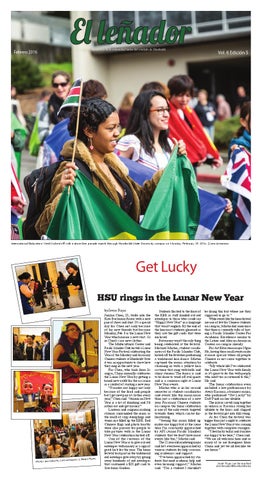
International Education Week kicked off with a drum line parade march through Humboldt State University campus on Monday, February 15. 2016. | Sam Armanino
Get Lucky HSU rings in the Lunar New Year byJavier Rojas
res
m Armanino & Belen Flo
Photos provided by Sa
Junyan Chen, 25, walks into the Kate Buchanan Room with a new pair of shoes and shirt. It’s a special day for Chen not only because of his new threads but because Monday, Feb. 8 is the Lunar New Year which means a new start. Or in Chen’s case new clothes. The Multicultural Center and Pacific Islander Club hosted a Lunar New Year Festival celebrating the Year of the Monkey and for many Chinese students at Humboldt State it was an opportunity to show how they ring in the new year. For Chen, who hails from Jiangsu, China annually celebrates the Lunar New Year by getting a brand new outfit for the occasion as a symbol of starting a new year. “It makes me happy not only because of the food and people but I get new pair of clothes every year,” Chen said. “American New Year is a lot of drinking and I’d rather eat and get money.” Lantern and origami making stations surrounded the room as the smell of crisp dumplings and warm rice filled up the KBR. Red Chinese flags and photo booths were also present for people to take pictures with as the Lunar New Year celebration kicked off. One of the customs of the Lunar New Year is to give out red envelopes with money as a sign of good luck for the year. The lunar festival took part in the traditional red envelope give-away by giving away hundreds of red envelopes that contained a $25 gift card to Szechuan Garden.
Students flocked to the front of the KBR as staff handed out red envelopes to those who could say “Happy New Year” in a language that wasn’t english. By the end of the line most students gleamed as they saw the gift cards that were enclosed. But money wasn’t the only thing being celebrated at the festival. Michael Martin, student coordinator of the Pacific Islander Club, kicked off the festivities performing a traditional lion dance. Martin captured the rooms attention by storming in with a yellow lion costume that rang with bells and shiny streams.The dance is said to be done to ward off evil spirits and is a common sight at Lunar New Year events. Martin who is in his second semester as student coordinator said events like this mean more than just a celebration of a new year. For many Chinese students on campus the lunar celebration is one of the only events targeted towards them which can be disheartening. “Seeing this room filled up makes me happy but at the same time I’m constantly approached by API (Asian Pacific Islander) students that we don’t have more events like this,” Martin said. The 22 year-old marketing major said he’s even been approached by various students for help concerning academics and support. “I’ve been approached by students that need academic help and even housing support,” Martin said. “I’m a student I shouldn’t
be doing this but where are they supposed to go to.” While events like the lunar festival are one of few for Chinese students on campus, Martin did announce that there is currently talks of having a Pacific Islander Center For Academic Excellence similar to the Latino and African-American Centers on campus already. For Art Education major Ngan Ho, having these small events make it more special when all people Chinese or not come together to celebrate. “My whole life I’ve celebrated the Lunar New Year with family so it’s great to do this with people who aren’t too accustomed to this,” Ho said. The lunar celebration even included a live performance by Avery Racoma, a business major, who performed “Get Lucky” by Daft Punk on her ukulele. The joyous crowd sang together in unison as Racoma strung her ukulele to the lyrics and clapped as the festival got into full swing. As for Chen the festival was bigger than just a night to celebrate the Lunar New Year it was coming together with complete strangers. “I feel lucky today and it makes me happy to be here,” Chen said. “We are all welcome here and so many of us are foreigners from China and yet we all feel like we are home.”
Javier Rojas can be reached at el-lenador@humboldt.edu
2
Febrero 2016
Community
This Impacts Us
Editor-in-Chief Javier Rojas
HSU launches campus wide Title IX campaign
by Carmen Peña-Gutierrez One in five college students will experience a form of sexual assault according to the Department of Justice. A campus-wide survey conducted at Humboldt State showed that the same statistic applies. What students not only on HSU grounds but across the nation should know is that we have rights and options when we experience any form sexual assault or discrimination. Title IX is a federal law that has been in existence since 1972 but did not gain much attention until roughly five years ago. Students from across the nation started a movement in response to universities not providing resources or support and failing to create an environment where survivors can pursue their education. Check It peer health educator, Emily Goldstein, thinks this is one of the best outcomes of Title IX. “It’s important for us to know the ways our universities are supposed to legally support us and keep everyone safe,” said Goldstein. Most students know of the law in correlation to equal rights when it comes to college athletics. But, what Title IX also covers is the ability for students of all gender identities to pursue an education without experiencing sexual ha-
rassment, dating violence, stalking and gender-based harassment. If a student experiences harm during their time at HSU, they have rights and options under Title IX law. These rights and options can vary depending on what the survivor wants and needs. This can look like different campus accommodations such as changing residence halls or classes, rescheduling exams, instant access to counseling, transportation and an array of other options. Title IX ensures that survivors have access to 24-hour confidential survivor support. They can also reach out to the Campus Advocate Team that is made up of advocates from the North Coast Rape Crisis Team. Different types of support can come in the form of a supportive hotline these teams can be reached at, one-on-one counseling and assistance during accommodations and reporting processes. Along with having the right to resources, survivors also have the right to file a report. They can either file a campus complaint with the Dean of Students or file a police report, with the option of anonymity. Under Title IX, the university cannot retaliate against students for choosing to file a report and must protect survivors from any retaliation from faculty, staff and other students. Throughout either
Managing/Feature Editor Carmen Peña Gutierrez Opinion Editor Charlotte DeJoya News Editor Estee Trevizio Layout Editor Savanna VandenHeuvel Photo Editor Sam Armanino
Photo provided by Marco Gonzalez
process, Title IX guarantees rights to survivors during an investigation. The survivor has the right to a timely investigation, be notified of updates and advancements of the investigation process, have a campus advocate or lawyer present and/or not go through any mediation process with the perpetrator. Another important thing to note is that all paid faculty, staff, and student leaders are mandated reporters. This means that if a student shares their story with people who are in positions such as professors, CA’s, or peer health educators, they are required to notify the Dean of Students. When this happens, the dean of students will contact the survivor and simply share confidential resources. It is up to the survivor
to continue to talk to the Dean of Students or file a report. Information about mandated reporters is important to know so students know who they can and cannot talk to confidentially. The Sexual Assault Prevention Committee, Check IT, students from the Act To End Sexualized Violence and other student volunteers are launching a Title IX campaign on February 23. Student-centered materials will be available around campus with information regarding to rights and options under Title IX. Follow HSU’s Title IX campaign at Facebook.com/iximpactsus or Instagram.com/iximpactsus Carmen Peña-Gutierrez can be reached at el-lenador@humboldt.edu
Writers Erika Cardenas Monica Ramirez Emily Farjado Hector Azarte Katherine Miron Sarahi Apaez Andrea Curtade Martin Vargas-Bribiesca Jr Poetry Amanda Walker Copy Editor Joanna Quintanilla Writer/Copy Editor Olivia Drake Illustraters Jefferson Posadas Ariana Hendren Aren Fikes Photographers Belen Flores Briana Yah-Diaz Ad Representative Jose Vargas Faculty Advisor Kirby Moss
Hola to Bonjour New course teaches French to Spanish speakers
by Erika Cardenas The French for Spanish Speakers 324 is a new class for those who are either native Spanish speakers or who are fluent in the Spanish language. The level of this class is equivalent, more or less, to about five to six semesters of French grammar, because Spanish tense already exists in the French language according to Humboldt State French Professor Joseph Diémé. “French and Spanish are extremely close, people who speak Spanish have French in them, they just don’t know it,” Diémé said, Although Spanish and French share similarities in grammar, English also plays a part because they share a lot of cognates. Therefore, the more languages one knows, the more bridges one can connect with the language they are learning. Our country does a poor job in terms of encouraging their citizens to learn a new language. Most high schools only require two years of a foreign language, this amount of time is not sufficient in order to communicate fluently in that language. The purpose of language is to communicate and simply express oneself with other people. Communication is key to broaden our perspective on different ideas. The gesture in being able to communicate in someone else’s language is important because it humanizes that person. It tells them that they are making the effort to appreciate their story and their culture. This honors the person’s culture and narrative, according to professor Diémé. In terms of professional reasons, being monolingual makes it more difficult to obtain a job because those who speak more languages are prone to obtain a position as opposed to those who speak one language. “The more languages you speak, the more ready you are for the 21st century,” Diémé said. “Being monolingual equals to being handicapped even within the United States.”
Erika Cardenas can be reached at el-lenador@humboldt.edu
AAUW
(American Association of University Women) HSU AAUW student chapter helps empower women
by Estee Trevizio Since 1881, the American Association of University Women has become one of the nation’s leading organizations promoting equality and education for women and girls. In efforts to promote the AAUW, students here at Humboldt State have begun the process of starting their very own student branch on campus. Erin Sullivan, a faculty member and the club advisor for AAUW started to put on a few events this past semester regarding equal pay between men and women. “We decided that it would be a good idea to start a campus chapter,” Sullivan said. During the event, Sullivan realized the passion in some of her students discussing women’s rights to the local media that attended. Upon seeing this, she wanted to help educate her students about the resources that AAUW offers. The AAUW has a detailed timeline of events that changed the lives of women in the workplace that is featured prominently on their website. Sullivan says this is important because it educates others about the ongoing struggles that women face. “It’s really another way to educate our students, so that they can become leaders of the world,” Sullivan said. According to Sullivan, in order for the campus to become an official member of the AAUW, the membership they need is a college/university partner which means the whole campus has to enter as an entity. The Career and Advising Center agreed to pay for the membership fee out of their budget so that the campus can officially become a part of the student chapter. “There’s so many incredible things that this organization really offers, and I think this is something our students really need.” Sullivan said. In April 2014, the first AAUW event was held on the Humboldt State
campus. The event was carnival themed and included a discussion about “Equal Pay Day” between men and women. Kenya Estrada and Maria Diaz partnered with Sullivan to begin the process of creating a student chapter of the AAUW organization on campus. Estrada, an International Business Major at Humboldt State is currently the treasurer of the AAUW student branch. “One day my hope is to have my own
the president position,” Diaz said. “Also, getting in touch with other students who are in the same position as I am, the fact that they are being oppressed by institutions that portray white supremacy, starts an important discussion.” Diaz says she will host a wage and income inequality event in April about how women and others can negotiate their wage income within their jobs. Her hopes of this event is to not only
“I don’t want AAUW to only be recognized as only a women’s thing. I want it to be recognized as something for both men and women,” business, and one of the things AAUW wants for women is for them to gain the courage and skills to be leaders in the world,” Estrada said. Starting off as a volunteer, Estrada realized this was something she really wanted to become involved with. “I don’t want AAUW to only be recognized as only a women’s thing. I want it to be recognized as something for both men and women,” Estrada said. For Diaz, the chapter president of the organization, the possibilities for this club are endless. “My goal is to change policy and help people who are oppressed advance in institutions, therefore I came to realize that it is important to take place in leadership positions, so I took
educate others, but also see how many students will continue to participate in the discussion since the last event they had in 2014. “My goals as president is to advance specifically women, women of color, and LGBTQ community into taking positions in leadership opportunities and provide them with resources so they will be able to advance in education,” Diaz said. For more information and how to get involved with AAUW, you can visit their website at AAUW.org.
Estee Trevizio can be reached at el-lenador@humboldt.edu
Febrero 2016
3
Campus
Humboldt State Needs You Enrollment and parking increases with no end in sight by Monica Ramirez Humboldt State is home to many types of students and since 2013 it has been given the title: HispanicServing Institution. This is due to the fact that about 30 percent of students come from the Los Angeles area according to the University Enrollment Dashboard through HSU’s Institutional Research and Planning. Every year there is an increase in admitted students, meaning more competition for housing and parking. In just the past year from Fall 2014 to Fall 2015 there has been an increase of about 300 students which has been felt b y
Illustration by Ariana Hendren
some students when registering for classes. Criminology major, Jessica Montoya, said that it was definitely harder to get classes these past two semesters since there are more students and not enough faculty. “I think it’s definitely harder to get classes,” Montoya said. “You’re trying to finish in four years but they make it harder and professors are probably being given more students than they can handle.” Montoya also mentioned not being able to take the next required class in her major, Intro to Social Research.
and about 17,000 people apply. In the past five years there has been an increase of 1,000 students almost every other year which is why students like Montoya have felt the difference. Steven Ladwig, the associate director of admissions, admitted that some students may feel the competition depending on the major. For example, majors like biology, psychology, and business administration have the most students. Ladwig said that the housing director is definitely aware of the student increase and with only about 1,400 beds and limited
choose where to apply based off which is least expensive.” Based off of her past experience as a college access advisor, Diaz explained that it was all focused on applications but once students received acceptance letters in the mail it may not be that easy to attend just any school. “A fully capable student at a great school cannot attend due to not wanting to take out any loans,” Diaz said. However, Ladwig mentioned that the reason for a large amount of Latino and African American students is due to the areas where HSU recruiters live. One lives in
“The university must have to grow by a decent amount to make expansions,” Ladwig said. “We don’t want to build without having the people.” “I was waitlisted for CRIM 382,” Montoya said. “They sent an email later that they would open up a new class but by then everyone already has their schedules planned out which made it harder to readjust it just for that class.” HSU has seen many changes in the last year which has brought plenty of resources like the African American and Latin@ centers on campus. But still many students are asking if the school can continue to welcome more students. According to the Data Center from the Institutional Research & Planning of HSU, there has been large amounts of admitted students. Currently, Humboldt State has about 8,800 students
parking spaces. Despite an increase in students no expansions will be happening this year. “The university must have to grow by a decent amount to make expansions,” Ladwig said. “We don’t want to build without having the people.” Both Ladwig and Araceli Diaz, coordinator of the Latin@ Center for Academic Excellence, admitted that to grab a parking space you definitely have to be on campus at a certain time. “I know that if you get here by 8:30 [a.m.] you can have any [parking] spot,” Ladwig said. Diaz explains how more students of color seem to be attending Humboldt State due to its affordability. “We have one of the lowest tuitions of the CSU campuses,” Diaz said. “Students usually
the LA area and another in the Bay area to reach most of California. According to Ladwig there is no quota to fill on how many Latino or African American students are admitted. He said that the main goal when recruiting is to remind students that Humboldt State is California. The campus is meant to represent California not only by the scenery but also with the people and having resources offered on campus like the LCAE, AACAE, and ITEPP help to show that. “Students are most likely to apply by seeing the resources,” Ladwig said. “We recognize and value your ethnicity.”
Monica Ramirez can be reached at el-lenador@humboldt.edu
A Rekindling Begins The ADPIC Club begins its establishment on campus by Charlotte DeJoya The Multicultural Center is a hub of life and support for anyone who wants to obtain knowledge about different cultures and their traditions. Meeting here, the Asian Desi Pacific Islander Collective
Club is ready to get back on its feet. The ADPIC Club, wasn’t always known by this name, but was initially called the API Club. The Asian Pacific Islander Club was established in 2011, with Humboldt State faculty member Marylyn Paik-Nicely, also known
as Auntie Marylyn, as its advisor. Auntie Marylyn and API students maintained the club’s presence on campus until her retirement in spring 2015. Many students previously involved with the API club have graduated, are inactive in the club or moved out of the area, which caused the club’s disbanding. During the transition of becoming a reestablished club on campus, the club’s name was changed to include students who identify as Desi, or of South Asian descent. According to Humboldt State’s statistical profile, about 400 students are of Asian or Pacific Islander descent. Michael Martin, a fourth-year business student, decided to start up the ADPIC Club last semester because of the lack of resources and places that remind ADPI students of home on campus and in Humboldt County. Martin is Filipino and in his culture, much like others, “family togetherness” is vital to a culture’s continuous influence on people. The ADPIC Club is also in collaboration with the API Support Group. The support group is coordinated by Pio Kim, who is an on-campus counselor. “I want to be an advocate for ADPI students, and find ways to help ADPI students become more successful on campus,” Kim said. The ADPIC Club would be a safe place for anyone who identi-
fies as Asian, Desi and/or Pacific Islander, whether they be Chinese, Indian, Samoan, Laotian, Filipinx or Cambodian. The club would be an environment in which everyone can “affirm each other’s issues,” and stay close to home, whether it’s just a few hours south or across an entire ocean. Sophomore Hannah Kidd, who’s half Japanese, half Hawaiian, hopes the ADPIC will develop “a sense of community among ADPI students and staff members.” The ADPIC Club will also coordinate community events on and off campus. The club previously held community outings, such as celebrating the Lunar New Year Festival and traveling down to the Bay Area for ADPI events. The ADPIC club’s rebirth is still very much under construction; Martin and other students are currently working on a constitution for the club, which would show “what the ADPIC club is and what we want to see in it”. “It’s a group effort,” Martin said during the first ADPIC club meeting. Not only are students working to get the club up and running again, Martin and others are working to establish the ADPICAE, or the Asian Desi Pacific Islander Center for Academic Excellence. Like the Latin@ and AfricanAmerican Centers for Academic Excellence, the ADPICAE would
be a place for anyone to hang out, do homework and find professional and personal resources on campus. ADPIC member Navor Resurreccion said that although it’s a relatively new club on campus, ADPIC will be beneficial to both current and incoming students. “I believe that by having a space for students who identify under the ADPI umbrella will only increase graduation rates as well as bring awareness towards our needs and concerns that are often dismissed and or unacknowledged by the institution,” Resurreccion said about the small population of ADPI students on campus. The people involved with the ADPIC Club’s restart are the catalyst for the growth and blooming of a revitalized group on campus. The goal for the ADPIC Club will be for it to continuously grow and evolve along with HSU and its diverse student body.
Charlotte DeJoya can be reached at el-lenador@humboldt.edu
Febrero 2016
4
Pieces of History Student’s at Humboldt lead Social Justice Summit Traditional African masks in the Art Gallery
by Emily Fajardo
Humboldt State students gathered at the Reese Bullen Art gallery on Feb. 10, not for food or music, but for an exclusive chance to experience historical African art. HSU World Languages and Cultures professor James Gaasch, hosted the African Masks exhibit where about 30 students and community members showed up to the Reese Bullen Gallery. The informational seminar discussed the experience from the perspective of different cultures by interacting with the exhibit itself. The exhibit showcases traditional masks that were used as props in different African ceremonies such as weddings, funerals and other special rituals. These historical artifacts are Gaaschs’ private collection from the countries of Burkina Faso, Côte d’Ivoire and Mali. With this being the first ever African mask exhibition at HSU, it is important for us to understand that this tradition is a big part of African culture . For centuries, African masks have been a representation of a spirit. This spirit is believed to interact with the dancer as they wear the mask, but due to migration into the cities and out of small village tribes, more of this tradition is starting to be forgotten. However, African masks can be found on display in museums and art galleries. “We want to preserve this heritage,” Gaasch said. “This is why we are showing the masks.” A tribe that holds these masks ceremonies is The Dogon tribe. The Dogon is located in the country of Mali in Western Africa and is known for their traditional mask ceremonies. The Dogon
Traditional Dogon tribal mask at the Reese Bullen Gallery at Humboldt State University. | Briana Yah-Diaz believe that the dances create a bridge into the supernatural world in order for their ancestors to cross over into peace and restore order in the universe. An example of a mask being presented at the gallery is the rabbit mask. During the ceremonial dances, the dancer wearing the rabbit mask pretends to run away from a hunter. The dancer acts as a rabbit being hunted by the Dogon people for food. “Certain masks have different powers,” Gaasch said. “In this case the rabbit mask has the power to foresee the future. This to me means cleverness, or agility even.” For freshmen Jackie Santos, the experience of seeing these masks up close and personal was deeper than she could ever imagine. “I found this exhibit very interesting and fulfilling, not just because of the masks
and the deeper meaning behind them, but because I learned about a different culture that wasn’t mine and it caught my attention,” Santos said. “Whether they are made from wood, pottery, copper or bronze, each individual mask has its own meaning.” The exhibit will be on display from Feb. 10 through March 10 in the Reese Bullen Art gallery.
Emily Fajardo can be reached at el-lenador@humboldt.edu
Dueñas/Drake “What would your white ass know about being Mexican?”
by Olivia Rae Dueñas Drake Having a white complexion with a birth certificate that reads “Hispanic” as my ethnicity has been my living experience in a nutshell. Though I am more Italian than anything else, I identify as Latina. The Dueñas side of my upbringing stayed closer to me as I grew up, teaching me about our food and culture with every family visit. My cousins Carlos, Mia and Matthew all had darker skin than I, but not looking alike was never a topic of discussion. Having not made many friends in school, the sense of belonging I felt with my Dueñas family was really important to me growing up. Being a Drake didn’t mean as much, since my dad wasn’t close with his sisters, so I couldn’t be as close with my cousins on his side. When they did get together for every other Christmas, they watched a lot of football while lightheartedly sharing racist jokes about Mexicans, and I never wanted to speak up because I was not there to be a Dueñas. It made me uncomfortable, but as a youth I didn’t think on it too much, as it was just nice to see my family—or what I called my family, anyway. In my Los Angeles high school there were two main social groups: the Armenians and the Latinx. I was forced to be an outcast within these dynamics because I had no connection to the Armenians, and when I tried to “fit in” with the Latinx crowd, they raised their eyebrows and more or less took my interest in them as an admiration, or a joke. “What would your white ass know?” a girl in my Spanish class snapped at me when I expressed my excitement for the upcoming Dia de los Muertos. I opened my mouth to speak but nothing truly defensive made its way past my tongue, because she was only defending the culture that she didn’t know we shared. I wouldn’t want to feel like my own struggles were being mocked by someone else either, even more so when they are someone who
has experienced more privilege than the innate trials that come with having darker skin. Between the ages of 15 and 21 I got even less exposure to the Drake’s; what few times we used to celebrate together dwindled into one occasion every couple of years, and my cousins were far older and living their lives apart from their family. It felt unusual to be so disconnected from my family, but from that perspective I started to believe that it was very normal--as if I had any idea what “normal” was at that age. In the same span of time however, I got an explosion of exposure to much more than just the Dueñas’s. My mother’s mother was one of nine children in the De La Rosa family, and one after another she began to reestablish contact with her dozens of cousins that sprouted from those nine children. Soon the first De La Rosa family reunion took place, and the loose ends within each family started to tie together--the Negrete’s, the Aguiar’s, the O’Donnell’s, the Harrison’s, the De La Rosa’s, and the Dueñas’s all came together to fall in love with each other as the giant family we were born to be. I was no longer the white girl out, I was connected with the culture that accepted me wholeheartedly, and all it took was us coming together. Having Latinx blood means being raised by strong-willed guardians who teach you about the weight of the world, sometimes more by their actions than their words. Our parents’ generation had to face the harshness of a society that treated accepting people of color as a chore. My aunt and uncle were frequently chased home by rocktoting white bullies who wanted the dark kids out of their blind bubble. Those who had first-hand experience with radical racism
raise their children with the hope that their world will be better for them, and as those children grow, they’re taught about the struggles that are attached to having darker skin than a white person. Knowing this, I see why the Latinx at my high school are so defensive over my declaration of ethnicity; I’m graced with keeping my identity on the inside, and it can come off like I’m mocking that very identity when I choose to wear it on my sleeve. It’s a choice for me. But I’m proud of the choice because I too grew to love the feeling of making elaborate meals with three-plus family members in the kitchen, cheering for the 49’ers on Sunday after the morning mass. I love how close the family wants to stay, because our roots have grown so far, and we are lucky to be here together when our grandparents immigrated from Mexico and Peru to allow us this life, so I am proud to wear it on my sleeve every day. Though society is inherently judging books by their covers, and though I struggle to outwardly express my pride in being Latina because of this, I can at least know that I will feel right at home in the fourth official De La Rosa family reunion this June. Because truly, being a Drake doesn’t mean you cannot be a Dueñas, and being a Dueñas doesn’t have to exclude being a Drake. The key here is being one with the culture, and in 2016, we should not be as quick to define a person by the color of their skin. I’m proud to have my lineage, and that, I think, is one of the greatest defining features of being Latinx.
Olivia Rae Dueñas Drake can be reached at el-lenador@humboldt.edu
by Hector Arzate Every spring semester, students and staff members of the MultiCultural Center at Humboldt State organize the Social Justice Summit, a student-run conference that is meant to provide a space for participation in both keynote lectures and workshops oriented towards social justice. The 22nd Annual Social Justice Summit will begin on Friday, March 4th with a workshop for students from 3:00 p.m. to 5:00 p.m. in the Karshner Lounge. For each summit, there is a new theme. This year’s theme is “Theory to Action: At the Heart of Social Justice.” Merien Townsel, a student coordinator of the Social Justice Summit spoke on the development of the theme. “It came upon trying to bring awareness to the widespread issues,” Townsel said. “Often times, the constraints of academia can be frustrating for students because it is easy to theorize in class, but the issues need to be addressed and change must be put into action.” Townsel said students can take action by volunteering for the event through the MultiCultural Center. “Early in the spring semester, students can send in their proposal and have the committee review it and facilitate it themselves at the event,” Townsel said. “The aim of the workshops are to provide a space for like-minded students to take control of the environment.” In the past, workshops have called for more resources for undocumented students in the community, as well as awareness for issues surrounding the environment, institutional racism, sexism
and a wide variety of global issues. The most empowering aspect of the Social Justice Summit workshops is that, like the event itself, they are coordinated by students and facilitated by student volunteers. For students like Jazmin Oceguera, events like this mean getting students’ voices heard about issues that never get brought up. “Students can organize and address what’s happening and feel like our voice actually matters on campus,” Oceguera said. “We have an opportunity to speak up instead of remaining silent. If we don’t, everything seems fine.” Townsel sees the change on this campus and events like the Social Justice Summit have helped with opening discussions about issues involving race and culture. “Being able to sit in a class, with a student who is a lesbian, another who is Jewish and myself, being biracial, and talking about injustice... Times have changed. Eighty years ago, we would not be sitting here,” Townsel said. While changes have started to take place, according to Townsel, there is still more to be done. “Only recently has the world begun to change. It is all about the discourse, the conversation, and laying the groundwork for the future that will moves us forward,” Townsel said. “That’s why the Social Justice Summit matters at Humboldt State.”
Hector Arzate can be reached at el-lenador@humboldt.edu
Febrero 2016
5
Opinion
La Guerra de El Chapo by Martin Vargas-Bribiesca The capture of Joaquin “El Chapo” Guzman Loera marks the third time in 10 years he’s been apprehended by authorities. On Jan. 8, El Chapo was recaptured by Mexican authorities seven months after he escaped from prison. So what’s next? Is Mexico going to be affected? Is he going to be extradited? The reality is that the war on drugs will remain in existence and cartels in Mexico will continue to run how they regularly do. Mexico has been a war zone as well as a playground for cartels for all these years and it looks like it isn’t simmering down anytime soon. El Chapo is just one of many cartel kingpins that have been in control of the drug game but his capture doesn’t do much to the game other than create more competition to reach the top spot. New cartel criminal organizations are forming as older organizations fall. More and more heads of cartels are being arrested but crime still goes on. Why? One person cannot stop this never ending tornado of destruction that is the drug trade/drug war. As long as there are consumers of the drugs being smuggled, there will be suppliers. Consumption being mainly in the U.S., leaves Mexico to the business of supplying the demand. Crime in Mexico hasn’t decreased much when according to Mexico’s central statistic bureau (INEG), 98 percent of 2012’s murders went unsolved. The numbers do not seem to be much different today. The increase in crackdowns from Mexico government officials only fuel the fire. The Merida Initiative funds Mexico’s attempts to eliminate cartels. Since
Illustration by Jefferson Posadas 2008, the U.S. has given 2.8 billion dollars in aid to this so-called war. Mexico uses this money to militarize their police force and the U.S. only benefits from this since all weapons, vehicles, military aircrafts and other means of combat must be purchased from U.S. corporations. El Chapo is merely a figure of
#NotMyAbuela Hillary Clinton markets herself as everyone’s grandmother by Katherine Miron Presidential elections are right around the corner, and Democratic Party member Hillary Clinton finds herself up against Bernie Sanders for the Democratic primary candidacy. Trying to reach more voters, Clinton and her campaign team compiled a list of “7 things Hillary Clinton has in common with your abuela” to attract the Latino demographic. Half of the reasons as to how Clinton was very much like a Latina grandmother were: she reads, gives advice and cares for the well being of her grandchildren. The other half was poking fun as to how Clinton expresses herself to people who “le faltan el respeto.” The list finishes off with a photograph of Puerto Rican musician, Marc Anthony, hugging Hillary. As a Latina, I found myself feeling mocked when I read through Clinton’s list. Was this the best she could do? Does Clinton really think that being a grandmother is the only way she can sway Latino voters, by using her granddaughter as an adorable prop? I think Clinton has run out of ideas, or doesn’t even know how to relate to Latinos; using her own daughter’s offspring seems to be the only trick up her sleeve. This strategic move for Latino votes backfired, causing an uproar on Twitter from the Latino community, who retaliated with the hashtag #NotMyAbuela. Countless tweets were sent to Clinton, directly claiming it was rude to compare herself to their grandmothers, especially when she has lived a significantly privileged life in contrast to the common people. Hillary Clinton grew up in a nice neighborhood in Illinois. I grew up in San Fernando, California, where one cross street divided the rival gangs that terrorized the neighborhood. Her parents ran a successful business.
My parents both worked graveyard shifts and kissed me goodnight as I got ready for school the next morning. Clinton went off to attend Yale Law School. I am lucky enough to attend college today with the help of student loans and financial aid. So who does Clinton think she is comparing herself to the Latino community and who I believe is the most beloved person in a Latino household? My grandmother never graduated from high school and had to support the family she started at a very young age. She immigrated to the United States to build a better life for my generation. Hillary Clinton is not my grandmother. The list compiled was done in poor taste. How could one read it and agree that Clinton is indeed a replica of their grandmother, and therefore should be president? Both the Democratic and Republican candidates should be targeting the Latino voters directly because Latinos currently make up “13% of all eligible voters in 2016,” according to the Center of American Progress. They should be organizing rallies where Latinos can come and hear what their plans are for issues like immigration, health care or minimum wage. Those are the issues minorities are affected by the most, hence why candidates should go out there and promote how they plan to resolve them. Democrats are the party of the people, this is their time to call voters forward to help them make their country better. That being said, claiming to be my abuela is not the way to do it.
Katherine Miron can be reached at el-lenador@humboldt.edu
what the War on Drugs is trying to destroy but the corruption does not lie on the shoulders of a single man. This corruption is systematic and the incarceration of El Chapo will not stop the violence on both sides of the border. As long as the cycle of drug consumption exists, supply and organized crime will continue
from both cartels and the government. El Chapo’s influence does not stop behind bars. Cartels will continue to flourish under his command or he will appoint another version of himself to take the reigns for the time being. However, his capture leaves the position of el consentido open as long as drugs are still being
consumed. El Chapo is el consentido for now but that doesn’t mean he will be forever.
Martin Vargas-bribiesca Jr can be reached at el-lenador@humboldt.edu
Your Vote Matters Latinx millennials are the largest group of eligible voters; will we make this count?
by Sarahi Apaez Election season is upon us. It’s almost impossible to escape the constant bombardment of news about each candidate’s latest comments, plans on policy and forced smiles pouring into our news feeds. Although no candidate is alike they do all have one thing in common, each candidate will be relying heavily on the support from Latinx voters. The Latinx electorate is expected to make up a record 11.9 percent of eligible voters in the U.S. this year. Within that group, young U.S citizen Latinx aged 18 to 35, a majority of whom are born in the U.S., reaching voting age are the biggest source of growth—and will be for the next two decades. Latinx millennials will account for nearly half (44 percent) of the record 27.3 million Latinx eligible voters projected for 2016—a share greater than any other racial or ethnic group of voters, according to a new Pew Research Center analysis of U.S. Census Bureau data. Latinx youth will be the main driver of growth among Latinx eligible voters but it is this group of 18 to 29-year-olds that are the populations least likely to vote. This population is often the most cynical about their vote actually mattering, according to Pew Research Center. In my perspective there is only one wrong vote and that is no vote. Historically Hispanic voters have had the lowest turnout in presidential elections with just 48 percent in 2012, compared with 64 percent for Caucasians and nearly 67 percent for African Americans. The Latinx millennial vote is even lower with just 37.8 percent in 2012. So why is this? Why aren’t more of us voting? Over the past few weeks I have been asking fellow HSU students whether or not they will be voting in this election and I am tired of people telling me that there are good reasons why they’re not voting. “I don’t live in a swing state so my vote is not gonna matter,” said Austin Saldaña. Not only will you as a California voter be tremendously underrepresented in local elections but worst, politicians won’t even consider taking your viewpoints into account. If you’re not voting, no one is hearing your voice. They have no reason to represent you. Although populous Latinx states aren’t key battlegrounds in the 2016 elections, this should not discourage us from voting. If you haven’t registered to vote there is a deadline. You must be registered by May 23 to vote in California and you can even register online. Voting is a way to let your voice to be heard, and it is so empowering. “Politics suck and nothing ever changes,” said Vanessa Martinez. Come on, we can’t let ourselves be cynical and brush off this huge responsibility by saying it’s not worth it because everything is run by a system far beyond our reach. It’s this
kind of mindset that stunts change and perpetuates a disconnect between us and politics. “Elections are controlled by super PACs and special interest groups,” said Lorena Becerra Super PACs get zero votes in the presidential election. Even the richest, most powerful man in America only gets to cast one vote. That’s the same number as you. “No election is ever decided by one vote. Mine won’t matter,” said Ana Maria Diaz. There’s strength in numbers. While one single vote might not matter toward who wins the election, every vote does count toward how politicians perceive their electorate. Politicians know who votes each election, and they are more likely to support initiatives that are popular among groups with the highest voter turnout. For college students to have significant political influence, they must turn out in greater numbers than is traditionally seen. You have a part to play in that. If you are a millennial Latinx student and you don’t mobilize and vote, you could easily be underrepresented. Within the next four years, you may be getting a job, owning or renting your own housing, getting married, starting a family, paying for health care or building a business. The policies you vote for today will have a huge influence on your life after college. Do you really want to leave those decisions up to someone else? Seriously, not voting is like going out to dinner, telling someone to get your order for you and then complaining when you don’t get what you want. In order to change the system we must actively engage in the process that makes our democracy work. Mobilized, Latinx millennials are a powerful political force to be reckoned with.
Sarahi Apaez can be reached at el-lenador@humboldt.edu
Provided by Pew Research Center
Febrero 2016
6
In Memory
Adilene Martínez (Ady), a former writer in El Leñador and HSU alumna, passed away on Tuesday, Feb. 16th. As we grieve her loss, we want to remember her as the powerful womyn she was. Thus, we have chosen to reprint the last article she would write for El Leñador; here it is.
My diploma is Merely a Receipt My parent’s support and their hopes for me to succeed, aren’t culminated by walking a stage
by Adilene Martinez After two years, I am graduating this May. I am very happy to be done, but I won’t be walking for a few reasons. One reason is I don’t have a connection to this whitewashed school - that claims diversity, but doesn’t really do anything about it, a school that dilutes culture, and environmentalism. Another reason is my dad can’t afford to take days off from work, and my mom has a back injury from her job that makes it hard for her to be in one position for too long. In addition, this school’s graduation pledge is laughable at best. I’m not going to pay for Pomp And Circumstance to highlight the end of an overpriced education. It is for these reasons that I won’t be partaking in the graduation ceremonies this May. I’ve thought about what it means to participate in the ceremonies, and I’ve come to the conclusion that my parent’s support, and their hopes for me to succeed, aren’t culminated by walking a stage. My dad works six days a week doing gardening work, and despite that, I know that if
I really wanted to walk, my dad would take off the days from work. For me, to ask that of my dad is to flaunt my privilege of higher education in the face of my family’s economic livelihood; a proper disgrace to the respect I have for my family. My mother suffered an injury while working a factory job; her physical comfort is more important to me than my achievement to bypass factory work by receiving a diploma. Along with graduating, comes the expectation, and the implicit participation, in this university’s graduation pledge. I cannot imagine pledging anything like this: “I pledge to
its own pledge. That is the pledge of HSU. There is a lack of coherence between the image that this institution presents and the discourse of that it actually presents. This university does not support diversity, in fact the university continues to fire professors of color. How does HSU apply their pledge to their university? We have white professors teaching ethnic courses that clearly don’t belong to them, and who don’t have the authorship to speak on them. We have entire departments, like Forestry, Wildlife, Fisheries, on campus founded on Indigenous knowledge, that now charge money
consequences of their jobs, and have been ignored. Why should administrators, who don’t adhere to this university’s pledge, be given credit for the concrete work some of their students do outside of of HSU? My formal education in this university is a mere receipt, and in no way resembles the education I have received from my peers, from the community, from dialogue with professors, organizers, from the knowledge that flows free, and isn’t found in a syllabus. I do not feel like I have a connection to this school, and perhaps it is because I am a transfer and have not been here too long, but I
My formal education in this university is a mere receipt, and in no way resembles the education I have received from my peers, from the community, from dialogue with professors, organizers, from the knowledge that flows free, and isn’t found in a syllabus. explore and take into account the social and environmental consequences of any job I consider and will try to improve these aspects of any organizations for which I work,” when this university, as an institution, does not uphold
to teach appropriated knowledge like silviculture. What active resistance does the University advocate to challenge corporations? We as students have asked and demanded that administrators take into account the social
think it is deeper than that. I have made strong connections with my peers and a few professors, but I just don’t feel a connection to HSU as an institution. I think its policies, and its mission, including the pledge, don’t match.
Furthermore, the narrative that graduation is an accomplishment borne out of our hard work is a narrative that I can’t relate to. I’m here because of the hard work of my family. I’m graduating because of myself or for myself. I’m not here so my education can culminate in receiving a diploma; I’m here to re-appropriate this education after I graduate. This education wasn’t supposed to culminate in a diploma I’d hang; it was meant to prepare me to better serve my community, and economically benefit my family. On the last day of my final, I will drive back to the city where I grew up, and reunite with my comrades that have been fighting food (in)justice, police brutality and gentrification while I have been away finishing my degree. Strengthening our communities, establishing solidarity, and using the privilege of higher education to help my community is how I want to repay my parents for their struggle and support. Graduation or walking the stage shouldn’t be the crowning moment of education; it should be a mere step into a lifetime of re-appropriating education.
Originally printed May 2015
#OscarsSoWhite
by Andrea Curtade “Is it time that people of color recognize how much power--influence--that we have amassed, that we no longer need to ask to be invited anywhere?” This was the question that Jada Pinkett Smith asked millions when she released a video questioning the all white nominations for the top four categories in the 88th Academy Award show for the second year in a row. On Martin Luther King, Jr.’s birthday, the spark was ignited when numerous individuals began to speculate on the representation of people of color in the entertainment industry. The hashtag #OscarsSoWhite became the slogan for boycotting the continuous pattern the award show keeps falling into for more than 20 years. The problem however does not lie simply in the lack of nomination for people of color, but in the industry itself. The numbers are slim when box office movies have strong diverse leads, especially women. For the last two decades only two movies starring people of color have been able to win Best Picture at the Academy Awards, Crash (2004) and 12 Years a Slave (2013), which begs the questions: Will there be change? When will it happen? Even though the video that Pinkett Smith released on MLK’s birthday seems to ask all the right questions, I personally do not believe that it was done with the right intentions. It is no secret that her husband, Will Smith, feels that he has been robbed a nomination for his newest movie Concussion, but his reasoning for boycotting the Oscars seems more like a tantrum, a tantrum
And the Oscar goes to… another white dude
by Amanda Walker
Illustration by Aren Fikes actress Janet Hubert had a clear response to when she said, “People are dying. Our boys are being shot left and right. People are hungry... And you’re talking about some motherfucking actors and Oscars… You are a part of Hollywood. You are a part of the system that is unfair to other actors.” Although there have been successful recognitions for actors of color such as Halle Berry, Denzel Washington, Viola Davis and Lupita Nyong’o, it isn’t enough break down the barriers that constantly keep people of color in the shadows. Boycotting the Oscars is an imperative move that needs to take place in order to change the system. Representations in the media need to be altered and bring power
February 27-28
Folklórico Dance Workshop Saturday: 10 a.m.-12 p.m. | Gist hall 02 Sunday: 1 p.m.-3 p.m. | Humboldt State University KA 202 Description: All community members and students are welcome Mexican folk dance. Learn regional dance from Nuevo León and Veracruz taught by professor horacio Heredia from Allan Hancock college, sponsored by the office of Diversity. No experience is required and we will provide shoes if needed.
to learn footwork and choreography for
Monday, Feb. 29 5 p.m. | BSS 202
Did you grow up speaking Spanish? Pues, join us this summer in Oaxaca! May 23-June 24.
March 3
Chicano! History of the Mexican American Civil Rights Movement Film Screening & Discussion 6-7:30 p.m. | Goodwin Forum Chicano! History of the Mexican-American Civil Rights Movement, tells the story of proud people in search of social justice, respect and a national identity. Spanning over the decade between 1965 and 1975, the documentary examines the social and political activism that was pivotal in uniting
The Learning Child
Mexican-Americans to stand up and be counted as legitimate citizens of the United States.
back to the voices that are constantly disrespected and silenced. In order to achieve this we need to change the perspective of those behind the screen. People of color are more than stereotypical and supporting roles. The fight is not with the Academy Awards, although it is a great place to start. The change needs to come within Hollywood itself, to advocate for equal opportunity that is based on talent and not the color of our skin. Yes, there are more pressing matters, however, if we overlook the small issues such as the Oscars then we lose sight of bringing diversities in all outlets of our lives. Andrea Curtade can be reached at el-lenador@humboldt.edu
Mi Niña! Mi Niña! It will be alright! It takes a while to read and write. English is hard and learning it will take longer, But your spelling has gotten better, And your reading, even stronger. I understand your anxiety, uncertainty and stress, I feel it all at work when I am getting oppressed. But mija, mija, I will not let you fall, Because you were made to overcome all. I brought you on this land so that your dreams will come true, But there will always be challenges to follow them all through. Mi Nina! Mi Nina! It will be alright! It will take a while to read and write. As a smart, bilingual girl, you will go far, Never forget to proud of who you are!
Puentes is one of the volunteer programs that are part of the Y.E.S. House at Humboldt State University. Its goal is to use activities and events to bridge the cultural gap between the Latino community and people who use English as their primary language.
Febr er o/Marz o CALENDARIO | CALENDAR March 1, 2 & 3
18th International Latino Film Festiva 6-10:30 p.m. | Mill Creek Cinema, 1575 Betty Court, McKinleyville. Description: Please join College of the Redwoods and Humboldt State University for the 18th Annual International Latino Film Festival. This year’s theme is Immigration and Globalization in Spain. The keynote speaker is Karim Hauser Askalani, Head of Governance of Casa Arabe. Enjoy a different film each night followed by a panel discussion. Tuesday’s film, Adios Carmen; Wednesday’s film, Wilaya; Thursday’s film, Retorno a Hansala.
Monday-Thursday
Society of Hispanic Professional Engineers Fundraiser: Como lo hace mi abuelita! 9-11 a.m. | In front of Science D Fundraising Objective: This fundraiser will help SHPE members to attend the Regional and National SHPE conferences. These conferences include informational workshops for Graduate Programs as well as networking opportunities for jobs and internships. SHPE mugs w/ hot cocoa: $12 Trash cups w/ hot cocoa: $3 (Disposable cups) Refill: $1.50
February 27
Selma 7 p.m. | JGC Rec Room Come watch the feature film Selma Which chronicles the three-month period in 1965 when civil rights leaders coordinated a campaign to secure equal voting rights in the face of violent opposition.
Sponsored by Housing & Residence Life.
Si desea promocionar su negocio o sus servicios profesionales en El Leñador, por favor contactese con nosotros al (650) 642-6525 o el-lenador@humboldt.edu.