Pro Landscaper is published 12 times per year by Eljays44 Ltd. The 2026 subscription price is £128. Subscription records are maintained at Eljays44 Ltd, BizSpace, Courtwick Lane, Littlehampton, West Sussex, BN17 7TL, UK. Articles and information contained in this publication are the copyright of Eljays44 Ltd and may not be reproduced in any form without the written permission of the publishers. The publishers cannot accept responsibility for loss of, or damage to, uncommissioned photographs or manuscripts.
Whilst every effort has been made to maintain the integrity of our advertisers, we accept no responsibility for any problem, complaints, or subsequent litigation arising from readers’ responses to advertisements in the magazine. We also wish to emphasise that views expressed by editorial contributors are not necessarily those of the publishers. Reproduction of any part of this magazine is strictly forbidden.
Pro Landscaper is proud to be an Accredited Supplier member of BALI
The Association of Professional
Pro Landscaper is proud to be an associate member of the APL
Collection THE
If I were to pick a word to describe 2025, it would be resilient. Not only does it exemplify our industry’s push towards restoring our ecosystems, but it also reflects many of the topical trends we saw over the 12 months – from native planting and climate-resilient design to biodiversity recovery and sustainable water usage.
I think it would be safe to say, we as an industry have withstood our fair share of trials this year, but through them all we have continued to remain steadfast in our commitment to improving the natural world – whether it’s championing the importance of green space and sustainable best practice, or rallying support for our nation’s wildlife – we have remained resilient.
It feels like only yesterday we were getting all of our ducks in a row to prepare for the year ahead, now we’re here again and doing the same for 2026, and I personally have high hopes for us –not just for the industry, but for us here at Pro Landscaper as well.
This year we’ve continued in our own commitment to keep you up to date with the latest industry movements and insights every month.
Amongst the pages of those 12 issues, we also shared with you 36 incredible portfolios, ranging from large-scale public realms to tranquil pockets of biodiversity. We have collated them all here for you to be used as a source of inspiration throughout the months ahead.
So, before we head into 2026 – which may be a certain publication's 15th birthday – let's celebrate the achievements of 2025 together.
Bethany Vann
2025 winners
Continuing to go from strength to strength, the Pro Landscaper Business Awards, in association with Caribbean Blinds, saw its highest number of entries to date. This includes most of our industry’s biggest names alongside other exceptional established businesses, watch-worthy rising stars, and promising newcomers.
At this year’s event – the largest to date for the team – which took place at the Old Billingsgate in London on the 25 April, 19 category winners were announced, as well as our overall Supreme Winner, at a ceremony hosted by gardener and TV show host, Rachel de Thame.
We look forward to celebrating the continued successes of the industry in 2026. Join us again on Friday 24 April 2026 at the Old Billingsgate.
THANK YOU TO OUR CATEGORY PARTNERS
Arboricultural Association approved contractor Gristwood & Toms brings together decades of experience and cutting-edge techniques in arboriculture. The company’s commitment to sustainability is at the core of its arboriculture services, utilising eco-friendly practices to ensure the long-term health and vitality of its green spaces, prioritising environmentally responsible techniques that promote the sustainability of trees in urban and rural settings.
Driven by its core purpose of ‘Creating Better Environments’ and with its highly skilled teams, NT Killingley brings more than 50 years of award-winning experience and a passion for excellence to deliver spaces that transform or enhance the built and natural environment. The company offers the full suite of landscaping solutions that can deliver the simplest to the most complex multi-disciplinary landscaping projects bringing any vision to life, whatever the scope.
DESIGN AND BUILD COMPANY
WRIGHT LANDSCAPES LTD
Operating from its purpose-built nursery in Knutsford, Wright Landscapes combines cutting-edge resources with years of experience to deliver exceptional results. Its Pickmere headquarters feature a state-of-the-art design studio, where clients can review designs, explore materials and samples, and receive expert advice, enabling them to make informed choices for their projects. This personalised, hands-on process creates a truly exceptional customer journey.
EMPLOYER OF THE YEAR NURTURE GROUP
The Nurture Group is a leading provider of grounds maintenance, workplace solutions and green services. Incorporating five wellrespected brands – Nurture Landscapes, Gavin Jones, Tivoli, Gristwood & Toms, and Nurture Pest Control – it provides a ‘one-stop' solution for high-quality, sustainable green services to a diverse client base. Nurture invests heavily in its workforce, from professional development to health and safety training and wellbeing initiatives.
GARDEN DESIGN COMPANY OVER £250,000
THE GARDEN COMPANY LTD
The Garden Company creates places of enduring value through design expertise and landscaping craftmanship. Its work is rich in detail and drawn from over 30 years’ experience. It supports its clients every step of the way, delivering bespoke, handcrafted spaces that they love. Founder and managing director James Scott is a Fellow of the Society of Garden and Landscape Designers (SGLD) and an accredited designer with the British Association of Landscape Industries.
DIVERSITY AND INCLUSION STRATEGY
JOHN O’CONNER (GROUNDS MAINTENANCE) LTD
John O’Conner (Grounds Maintenance) Ltd is a leading grounds maintenance provider. It champions diversity, equity, and inclusion (DEI) through inclusive recruitment, apprenticeships and mentoring. As a Disability Confident Employer and Armed Forces Covenant signatory, it supports underrepresented groups. John O’Conner’s approach fosters innovation, drives business growth, and enhances workforce diversity – setting high grounds maintenance standards.
GARDEN DESIGN COMPANY UNDER £250,000 KAREN TATLOW GARDEN DESIGN
Despite being a part-time, one-person operation, Karen Tatlow Garden Design has delivered projects ranging from RHS show gardens in collaboration with national charities to a £250k residential garden. Tatlow has a deep commitment to the community and creating a positive legacy, aiming to leave a transformative impact. Tatlow takes a personal approach, combining exceptional listening and empathy to create outdoor spaces that reflect her clients' unique aspirations.
GROUNDS MAINTENANCE COMPANY GLENDALE COUNTRYSIDE LTD
Glendale Countryside delivers expert grounds maintenance services for local authorities, government bodies, housing associations, NHS organisations and blue-chip companies. It works in partnership with clients, saving time and money through innovation, efficiencies and proactive account management. Glendale invests in its communities, with sustainability and diversity & inclusion key to all of the teams’ working methods. It invests heavily in its “greatest asset” – its people.
INDUSTRY COLLABORATION
HELMRIG LTD IN COLLABORATION WITH MULTIPLE INDUSTRY SPECIALISTS
Helmrig is a family-run business dedicated to supporting responsible builders of homes and communities. It ensures peace of mind and client satisfaction through maximum value, seamless execution and proactive problem solving. Its approach begins pre-land acquisition and continues through every phase of development. During early 2024, a collaboration led by Helmrig delivered the initial site startup for a major 300-unit housebuilding site in Merseyside for Vistry Group.
LANDSCAPE ARCHITECTURE STUDIO
HARRIS BUGG STUDIO
Harris Bugg Studio is an award-winning landscape design practice with a track record of delivering historic, residential, commercial, botanic and public gardens. Its experience spans a wide range of sectors, sizes and briefs, from masterplanning for a 3,000-acre heritage site to the design of a listed roof terrace garden in central London. Based in London, Scotland, and the West Country, Harris Bugg Studio creates distinctive, high quality and beautifully planted spaces.
LANDSCAPE COMPANY
£1M – £2.5M TURNOVER E WILLIAMS LANDSCAPES LTD
Committed to training the next generation, E Williams Landscapes invests in apprenticeships and continuous professional development. Sustainability is at its core, with ethical sourcing, eco-conscious practices and a focus on biodiversity. It also supports local charities through both fundraising and active participation. Its expert team offers a full suite of services, from design and construction to long-term maintenance, ensuring excellence at every stage.
INVESTMENT/ACQUISITION OF THE YEAR NURTURE GROUP FOR THE ACQUISITION OF TIVOLI GROUP LTD
The acquisition of Tivoli Group is a landmark deal that has reshaped the UK’s landscaping and grounds maintenance industry. Not only is it the Nurture Group’s 50th acquisition but it’s also the company’s largest to date. It has brought Nurture’s combined revenue to more than £245m and its workforce to more than 4,400. This acquisition has had a wider impact, enabling greater economies of scale, allowing for better investment in innovation, training, and green technologies.
LANDSCAPING COMPANY UNDER £1M TURNOVER CONSILIUM HORTUS LTD
Consilium Hortus is a multi-award-winning garden design company specialising in luxury, bespoke outdoor spaces. Despite launching in 2020 during the challenges of the Covid-19 pandemic, it has grown into a respected name with a reputation for excellence and innovation. From elegant planting schemes to high-end features like louvered pergolas and outdoor kitchens, its designs blend creativity, precision, and sustainability.
LANDSCAPE COMPANY
£2.5M – £5M TURNOVER PALMER LANDSCAPES LTD
Guided by a family ethos, Palmer Landscapes prioritises honesty, reliability and a genuine commitment to delivering value on every project. Its strong relationships with employees, local authorities, contractors, and suppliers are the foundation of its reputation for quality and trust. Its steady growth comes from building strong relationships and consistently delivering exactly what its clients need.
LANDSCAPE COMPANY
OVER £5M TURNOVER
WRIGHT LANDSCAPES LTD
Wright Landscapes’ strength lies in its people. Under the leadership of managing director Lee Webster, it fosters an empowering, supportive workplace culture. Webster’s leadership focuses on understanding the individual needs of employees, offering work-life balance, personal support, and professional development. Wright Landscapes continually innovates, striving to set industry benchmarks. It aims to foster collaboration and drive progress.
SUPPLIER AND SERVICE
GREEN-TECH
PROVIDER
Green-tech is one of the UK’s largest suppliers to the landscaping, forestry, and construction sectors. Green-tech supports landscape contractors, architects and specifiers with over 5,000 products and innovative solutions for tree planting, urban greening, ground protection and sustainable landscaping. The company invests heavily in staff development, customer support and industry partnerships, ensuring long-term relationships and outstanding service.
TRADE NURSERY OF THE YEAR
WYEVALE NURSERIES
For nearly a century, it has been at the forefront of UK horticulture, growing exceptional trees, and hardy plants that help shape the nation’s landscapes. As a trusted partner to landscapers, housebuilders and local authorities, it combines heritage with innovation, championing British grown stock for high quality and biosecurity. Its commitment to sustainability drives pioneering production techniques, diverse plant ranges, and outstanding customer service.
NEW COMPANY (UNDER TWO YEARS OLD) NUVO OUTDOOR LIVING LTD
Nuvo Outdoor Living is an outdoor living specialist that focuses on furnishing and finishing gardens. It is passionate about assisting trade and retail customers to create beautiful outdoor living spaces. For local landscapers and garden designers, it has a ‘Designer Lounge’ –an area of its showroom which it encourages businesses to use as an extension to their own process, featuring a comprehensive range of product samples as well as a screen for showcasing designs to clients.
SUSTAINABLE COMPANY OF THE YEAR
TYLER GRANGE
Since becoming a four-day week certified B Corp, in terms of client diversification, sales data shows that Tyler Grange saw a 30% increase in renewable energy projects, including 25 new clients that work in the renewable energy sector. In financial terms, this represented £1m in diversification turnover. Innovative and pioneering are at its forefront – not only leading on major development projects but speaking at many events, as well as delivering its own CPD sessions.
SUPREME
WINNER
GLENDALE COUNTRYSIDE LTD
Judges comments:
“A very strong winner with clear direction and achievements backed up with statistical evidence."
“A comprehensive entry filled with examples of good proactive and personal development, as well as CSR."
“Strong commitment to staff development, with significant investment in training and an impressive retention rate."
PRO LANDSCAPER SUMMER SPECTACULAR
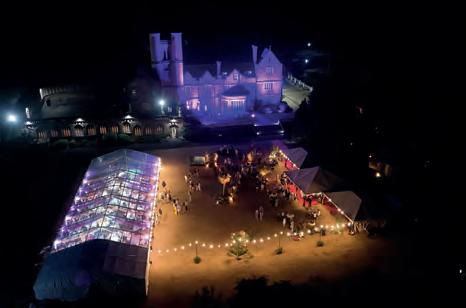
This year marked a major milestone in the evolution of the Pro Landscaper Project Awards – on one of the hottest days of the year, we hosted our inaugural Summer Spectacular at the De Vere Horsley Estate in Surrey.
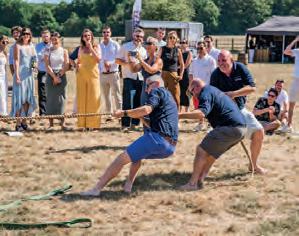
The day kicked off with the Summer Showcase, celebrating 30 years of the Association of Professional Landscapers, in association with Deponti. Bringing together designers, contractors and the supply chain for a whole host of summer games and activities, including a hotly contested tug of war.
We followed this up with the annual Pro Landscaper Project Awards, in association with Hortus Loci Landscapes, hosted by award-winning comedian Thanyia Moore. Projects of all kinds were recognised, from designs enriched with a sustainability ethos, through to major commercial projects shaping our urban landscapes.
Celebrations continued into the night with a Moroccan-themed Summer Party, in association with Landscapeplus. All in all, it was a day of fun in the sun, recognising the extraordinary talent of our industry – in both their professions and on the dance floor.
Congratulations again to this year’s winners! We look forward to what 2026 will bring for this already spectacular event.
BUILD UNDER £50,000 CONTEMPORARY COURTYARD | KIRMAN DESIGN
The clients were looking for a modern design that was in keeping with the property, with two seating areas – one for al fresco dining, and another cosier spot with a firepit. Kirman Design focused on using high-quality products, from the finish of the porcelain paving to the width of the decking.
BUILD £50,000 – £100,000 THE ARCHES | JDS LANDSCAPES IN PARTNERSHIP
With a design from award-winning landscape designer Lynn Cordall already, the client brought JDS Landscapes on board to expand on this. JDS Landscapes stepped outside of its comfort zone and embraced the challenges of the project to deliver what judges called a “very well delivered” garden.
The client wanted the design of her garden to evoke the charm of her homeland, Malta – blending timeless aesthetics with functionality. Formosa Landscapes delivered a front and back Mediterranean-inspired garden that feels intimate, characterful and deeply connected to its surroundings.
COMMUNITY GREEN SPACE UNDER £250,000 THE WATER SAVING GARDEN | CHILTERN GARDEN DESIGN
First appearing at the RHS Chelsea Flower Show in 2024, Chiltern Garden Design designed The Water Saving Garden as a courtyard garden to showcase the importance of and affordable ways to capture, store and re-use rainwater. Since the show, it has been relocated to Iver Environmental Centre.
Stockley Landscape & Design created what judges described as an “impactful transformation”, with this exotic garden inspired by the client’s travels to Vietnam and Cambodia. The new hardscaping works well with the existing features and also ties different areas together seamlessly.
IN PARTNERSHIP WITH IN PARTNERSHIP WITH IN PARTNERSHIP WITH IN PARTNERSHIP WITH IN PARTNERSHIP WITH
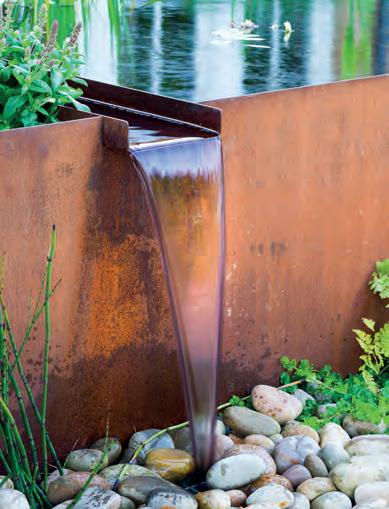
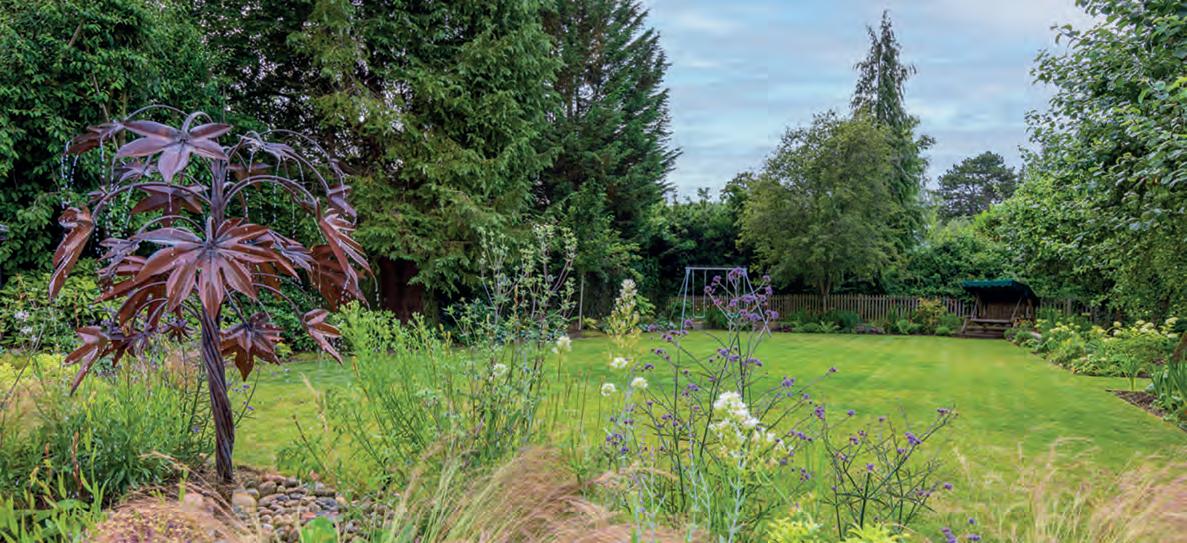
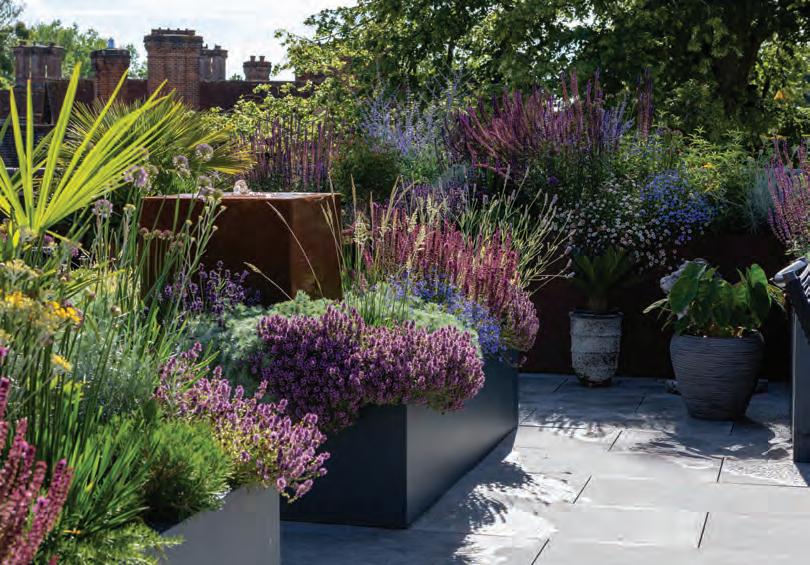
A copper water feature is the centrepiece of this garden, designed by multi-award-winning Rosemary Coldstream Garden Design. The clients wanted a garden that provided enjoyment throughout the year and to bring more wildlife into it through the planting.
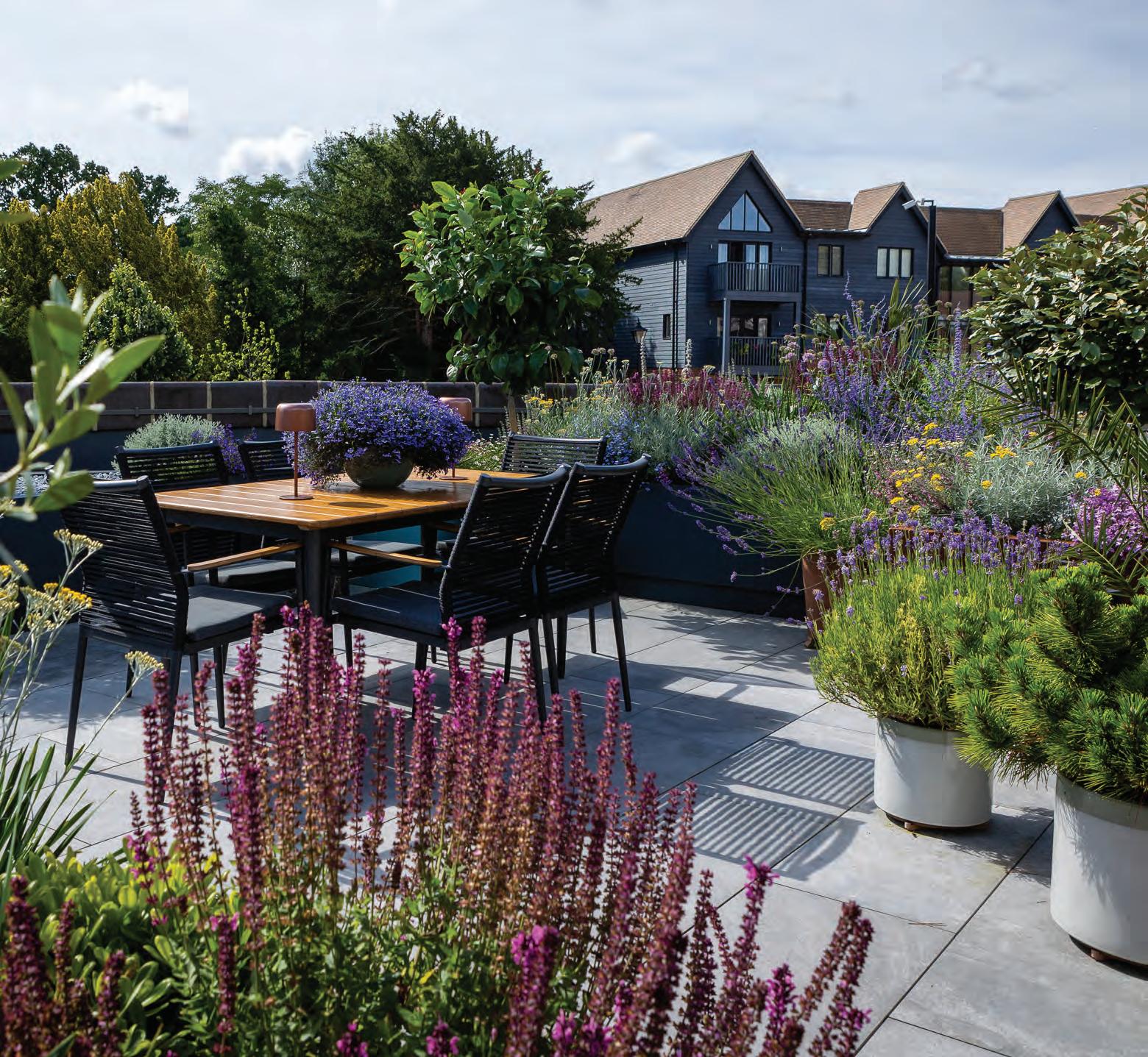
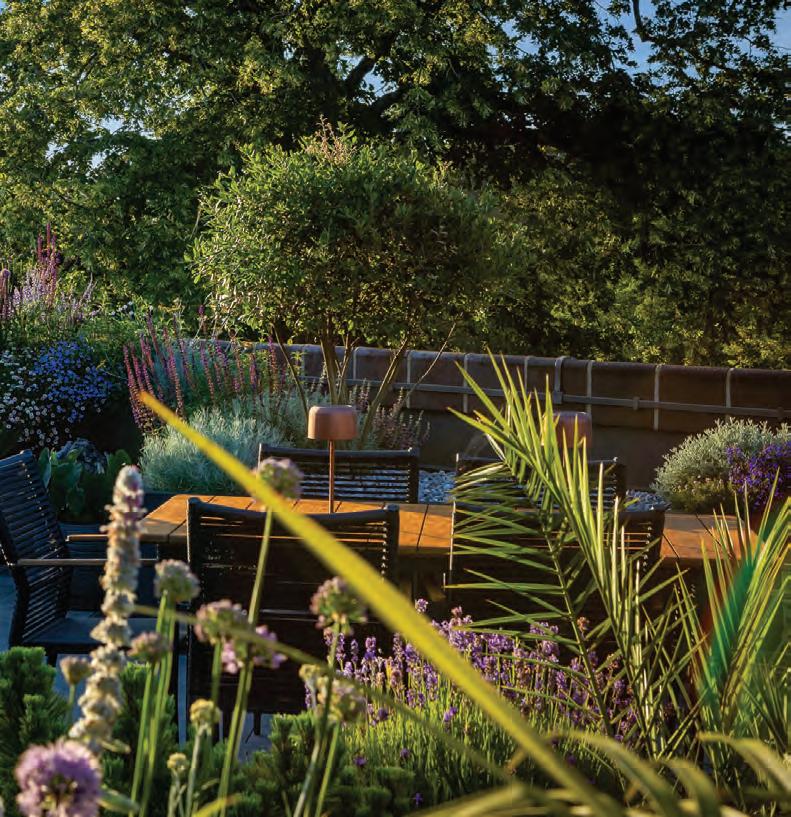
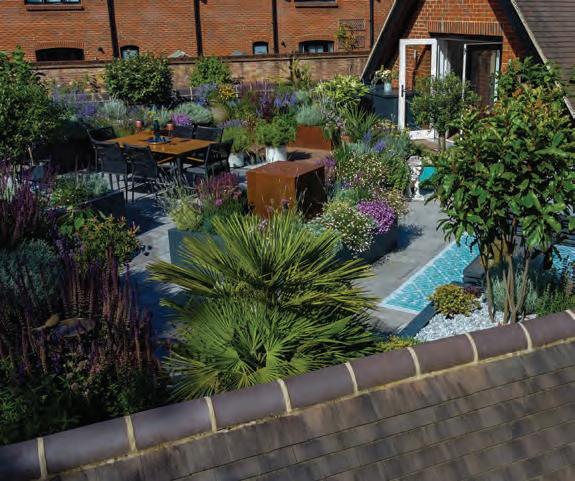
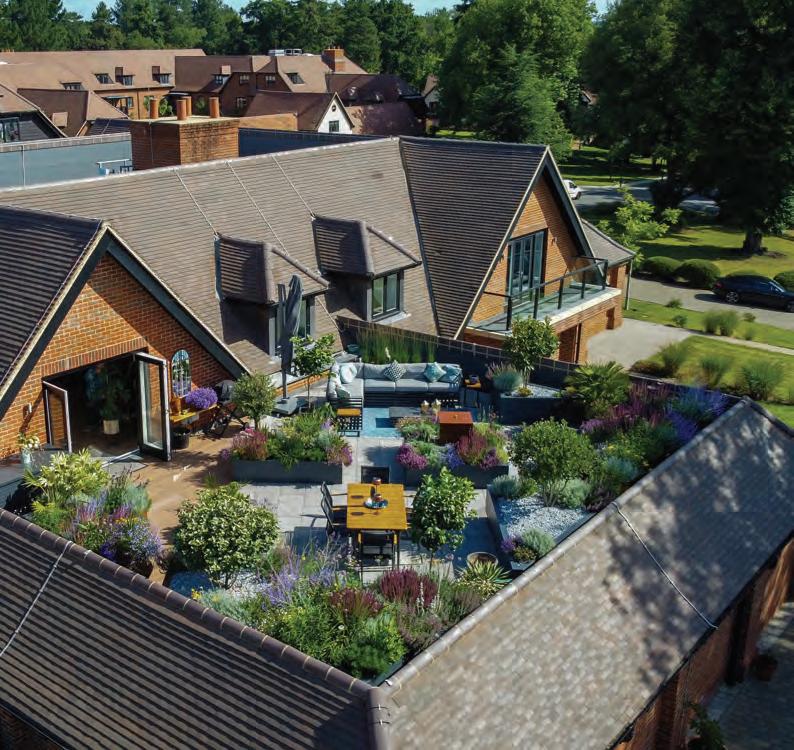
The clients wanted a stylish and functional space offering areas for entertaining, cooking and relaxation, while being adaptable to sun and wind on the exposed penthouse roof terrace. Maïtanne Hunt’s design has various seating areas, a fully equipped kitchen unit, and an abundance of planting.
DESIGN AND BUILD UNDER £50,000 E1 EAST ARBOUR ST | GRDN LANDSCAPE + GARDEN DESIGN
Access to this terraced garden in London proved difficult –but that didn’t stop GRDN from delivering this contemporary outdoor space. It’s a “polished, immersive garden with exceptional detail,” according to judges. “Every design and technical choice is deliberate and beautifully executed."
DESIGN AND BUILD £50,000 – £100,000 LINGFIELD ROAD | TOM HOWARD GARDEN DESIGN & LANDSCAPING LTD
Tom Howard Garden Design & Landscaping was brought in to reimagine the outdoor space with a design that embraced the courtyard’s scale, softened its edges, and transformed it from a cold void into a welcoming, multifunctional outdoor room.
Tom Howard Garden Design & Landscape chose a mix of trees, perennials, shrubs and pollinator-friendly species to bring seasonal interest and biodiversity. For the clients' children, an AstroTurf area was also placed out of sight, whilst being easily accessible from the back door.
HARD LANDSCAPING UNDER £100,000 THE FAMILY PARTY GARDEN | HARRIS GARDEN DESIGN & LANDSCAPING
Being able to host large gatherings was at the heart of this garden, with spaces that prioritise usability and ease of movement. Harris Garden Design & Landscaping provided a flawless indoor-outdoor connection, with clear zones for entertaining and informal children’s play areas.
DESIGN AND BUILD £100,000 – £250,000 MOUNTFIELD HOUSE | TOM HOWARD GARDEN DESIGN & LANDSCAPING LTD IN PARTNERSHIP WITH IN PARTNERSHIP WITH IN PARTNERSHIP WITH IN PARTNERSHIP WITH IN PARTNERSHIP WITH IN PARTNERSHIP WITH
For this project, GRDN designed a rich, layered planting scheme that complements the architecture. Judges praised the “good immersive planting and good use of layering.” Raised beds invite the children to participate in growing, and pollinator-friendly planting enhances biodiversity.
SPECIAL FEATURE UNDER £50,000 SANCTUM POD | KALKSCHMIDT LANDSCAPE & GARDEN DESIGN
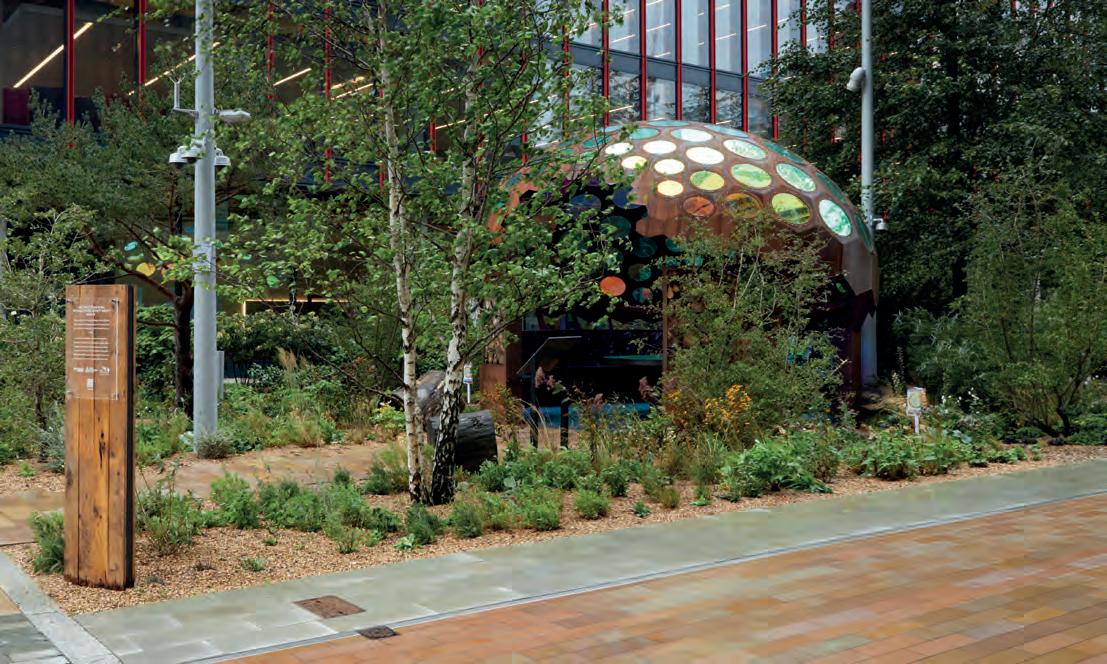
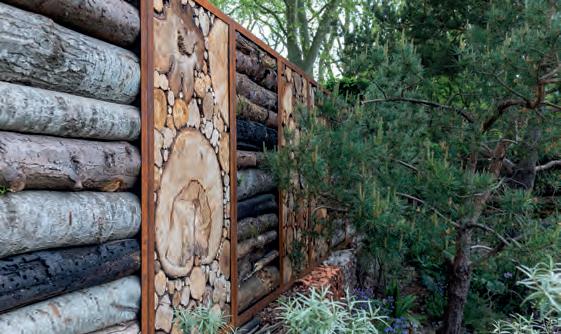
Cocooning arches of sustainably sourced, black charred wood form the Sanctum Pod, a bespoke 3.4m by 3.6m self-standing garden sanctuary designed to whisk employees away from screens. It was first unveiled at the 2024 RHS Chelsea Flower Show, where it won a highly coveted Gold medal.
SPECIAL FEATURE – WATER UNDER £50,000 AQUA EDEN DESIGN STUDIO & WATER GARDEN CENTRE | DU WATERSCAPES
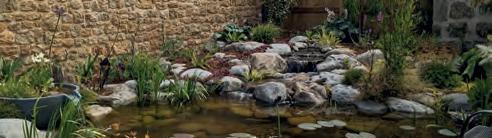
When DU Waterscapes received the keys to its first dedicated design studio, it wanted to create a garden that would inspire clients to fall in love with water gardening. It would act as a showcase as well as an educational hub for Aqua Eden – with every element chosen to embody the principles it teaches.
SUSTAINABLE GARDEN UNDER £50,000 THE MEANWHILE GARDEN | THE BETH CHATTO GARDENS
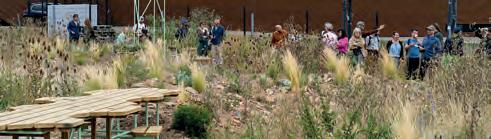
A disused brownfield site in the centre of Colchester has been transformed into this temporary public pocket park. Garden designer Darryl Moore wanted to create a garden as creatively, quickly and cheaply as possible, as a blueprint and inspiration for community groups in other areas. .
2025 WINNERS
Now in its third edition, the Pro Landscaper Sustainability & Biodiversity Awards, in association with Hortus Loci Landscapes, uniquely showcases the immense value that landscapes and our industry is providing as a means to safeguard our nation’s natural environment.
As the need for sustainable best practice rises, so too does our commitment to celebrating the strides being made, evidenced by our introduction of a new category this year geared towards local authorities and councils – reflecting the importance of their partnership within our industry.
Congratulations to all of this year’s winners! We look forward to seeing how each of you continue to bring about positive and lasting change.
THANK YOU TO OUR CATEGORY PARTNERS
ARBORICULTURE COMPANY
BEECHWOOD TREES AND LANDSCAPES LTD
Beechwood Trees and Landscapes Ltd delivers expert tree management. Its carbon reduction roadmap targets net zero by 2030, driven by fleet electrification, circular green waste systems, and climate-resilient procurement.
COMMERCIAL BUILD PROJECT
BRADFORD CITY CENTRE | GAVIN JONES
Gavin Jones’ Bradford City Centre transformation replaced 1.6km of traffic-dominated infrastructure with over three hectares of vibrant, biodiverse parkland, delivering a 24% biodiversity net gain and boosting footfall by 25%.
COMMERCIAL DESIGN PROJECT
PRIORS HALL PARK VILLAGE GREEN | URBAN & CIVIC
Priors Hall Park’s Village Green, delivered by Urban&Civic, transforms a simple parkland into a vibrant community asset where people and nature thrive together. Designed with sustainability, biodiversity, and accessibility at its heart.
GROUNDS MAINTENANCE COMPANY
NURTURE LANDSCAPES LTD
With over 2,700 professionals, 120+ service hubs, and a ESG framework, sustainability is embedded into everything Nurture Landscapes does. It achieved PAS 2060 carbon neutrality and has approved Science Based Targets to cut emissions by 90% by 2040.
LANDSCAPE ARCHITECTURE STUDIO
MACFARLANE + ASSOCIATES
With a focus on sustainability, Macfarlane + Associates provides client-focused design solutions through a highly collaborative approach. It uses its business as a force for good – balancing profit with purpose, with 70% returning clients.
GARDEN DESIGN COMPANY
HARRY HOLDING STUDIO
Harry Holding Studio creates enchanting, sustainable spaces that integrate bold design with ecological planting. Its low-input, long-lasting gardens blend contemporary design with nature to enhance human and environmental wellbeing.
LANDSCAPING COMPANY
QUALITY & SERVICE LTD (Q&S)
Q&S is a privately owned SME, founded in 2000 and rooted in horticultural excellence. The principles of corporate responsibility and sustainability are embedded into every corner of the business.
LOCAL AUTHORITY OR COUNCIL
MAINTENANCE CONTRACT
CHISWICK PARK ENJOY-WORK | NURTURE LANDSCAPES LTD
Chiswick Park Enjoy Work is a 33-acre business destination in the heart of London. Its 12 office buildings surround a central garden with a two-tier lake, waterfall, boardwalk, and event spaces, creating a vibrant, green environment.
SUPPLIER OR SERVICE PROVIDER
Accredited to ISO 9001:2015 and PlanetMark certified, Long Rake Spar embeds environmental responsibility into every stage of its operations, from responsible sourcing and supplier audits to packaging and distribution.
SUSTAINABILITY & BIODIVERSITY LEADER
FISHER | IDVERDE UK
Lucy Fisher’s role demands a balance between commercial performance and environmental responsibility, managing P&Ls in a private equity-backed business. Her approach is bringing commercial credibility and practical sustainability together.
SUSTAINABLE PRODUCT
CITY OF BRADFORD METROPOLITAN DISTRICT COUNCIL THE VIBRANT VERGE | JUB HOLLAND UK LTD
The Vibrant Verge is an innovative, turnkey planting concept developed by JUB Holland – a Dutch family business – that combines sustainably grown flower bulbs with native wildflowers to create biodiverse, low-maintenance verges and borders.
LONG RAKE SPAR
LUCY
Bradford Council’s landscape design and conservation team is leading the way in sustainable placemaking, championing green infrastructure that delivers lasting social, environmental, and climate resilience benefits.
Back in 2015, we recognised that more could be done to celebrate our industry’s younger workforce – the generation that would become its future. So, with that in mind, we launched Pro Landscaper’s 30
Under 30: The Next Generation awards. Over the last 10 years, we have been shining a light on the outstanding successes of those individuals who are paving the way forward for themselves, their companies and the industry.
This year's awards, in association with Green-tech – held at FutureScape – saw that mantel of greatness carried forward with the class of 2025. From award-winning designers to business leaders and directors, this year’s class is brought together by an unwavering determination and passion to bring about positive and lasting change to the industry and natural world.
Though the year has seen the industry withstand its fair share of trials, it is undeniable clear that moving forward, we are in very capable hands.
Congratulations to our class of 2025!
Pro Landscaper team
LAURA DARLOW Logistics team leader, Green-tech Ltd
PHOEBE GANNON Assistant contract manager, Ground Control
SAMMIE STRICKLAND Lead landscape designer, First Light Landscaping
FRASER SHERIDAN Landscaping team leader, The Outdoor Room
SEAN RYAN Gardener, All England Lawn Tennis & Croquet Club
ELENA ROSE Landscape architect, Huskisson Brown Associates
GEORGE MURCH Site manager – natural swimming pool installations, Ellicar
HAMILTON MCNAUGHTON Owner and director, McNaughton’s Landscapes Ltd
JACK MCMAHON Aftercare foreman, Bowles & Wyer Ltd
CAMERON MACFIE Director and lead designer, The Conscious Gardening Co
SAMUEL GALLOWAY Lead designer, Samuel Galloway Studio
JAMES DREWITT Director, CJ Tree Surgeons
From our partner
“Congratulations to this year’s 30 Under 30 winners. Your energy, ideas and ambition are reshaping the future of landscaping. Green-tech is proud to support this initiative, which recognises not just talent but the potential to lead and innovate.
Your
This year’s group reflects the changing face of our industry, from sustainability and technology to design and biodiversity. It is inspiring to see such a wide range of skills and passions driving progress across horticulture, arboriculture and garden design.
Recognition at this stage of your career is powerful. It opens doors, builds networks and sets the tone for what comes next. We are excited to see where your journey takes you.”
KRIS NELLIST MANAGING DIRECTOR, GREEN-TECH
OLLY HEWETSON-BROWN
SOPHIE
PROJECT DETAILS
Project budget
£427k + VAT
Build time
40 weeks
Size of project 1100m2 Awards
BALI National Landscape Awards
2024 – Domestic Garden Construction
Over £250K and Best Submission Pack
Stairwa y to
SERENITY
BLUEFISH LANDSCAPING CONTRACTORS
PRIVATE RESIDENCE IN THE SURREY HILLS
After a sizeable renovation and extension project was carried out on the main house and outbuilding, the clients turned their attention to creating a multi-faceted garden. Working with Taylor Tripp Garden Design, based in Hampshire, to design the space and bespoke landscaping company, Bluefish Landscaping Contractors to carry out the work, the garden was given a new lease on life, one that the clients could make use of year-round.
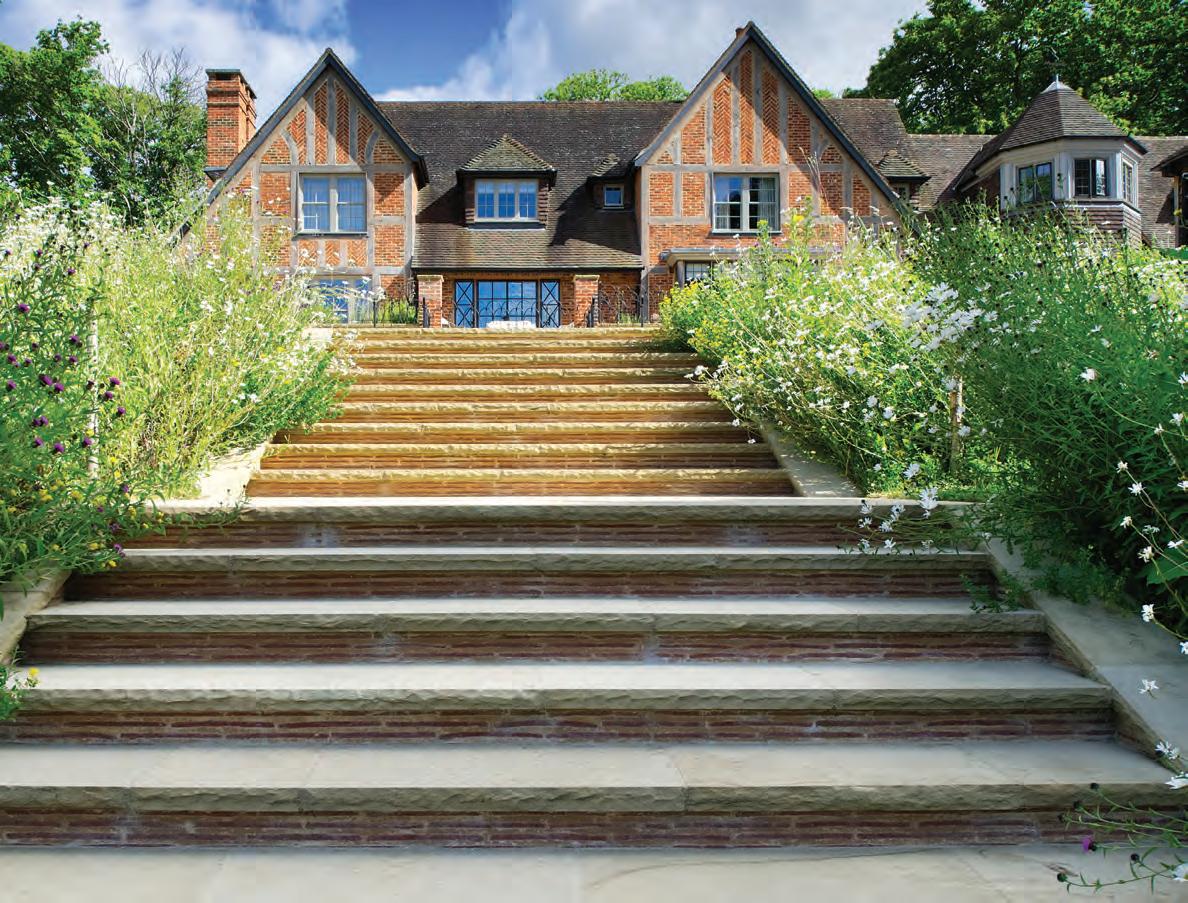
1 Sawn Yorkstone steps with handmade tile creasing risers
Through form, scent, structure, and colour, each area was designed to convey varying atmospheres, while retaining a cohesive flow around the house and outbuildings. The space was designed to be relatively low-maintenance and welcoming through the change of seasons, with emphasis placed on maximising views from within the house and garden, as well as transforming the formal areas near the rear of the house into a more relaxed and romantic space. This included several sheltered seating areas where the clients can enjoy basking in the sun at different times of the day, with subtle lighting installed to enhance evening enjoyment.
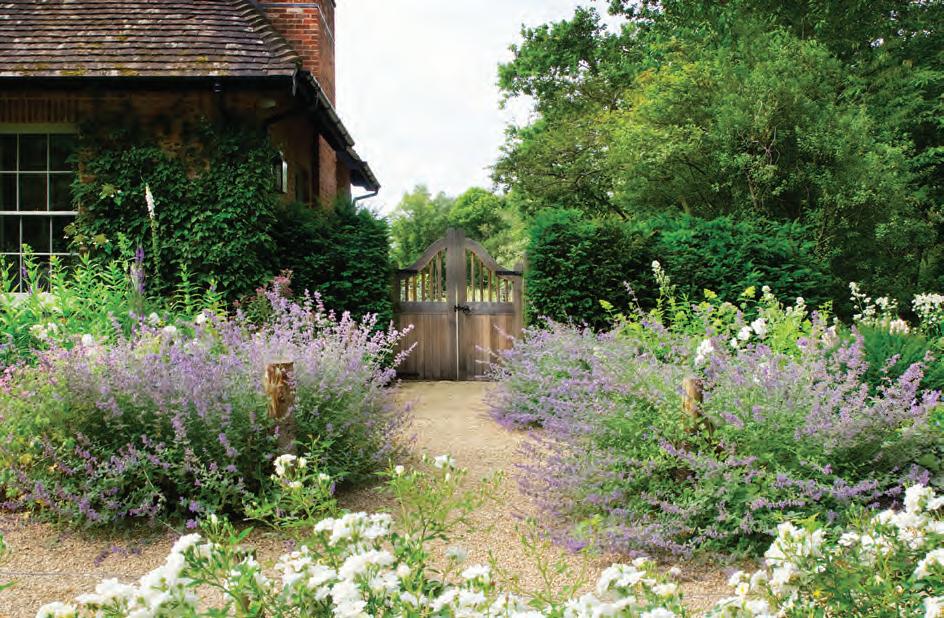
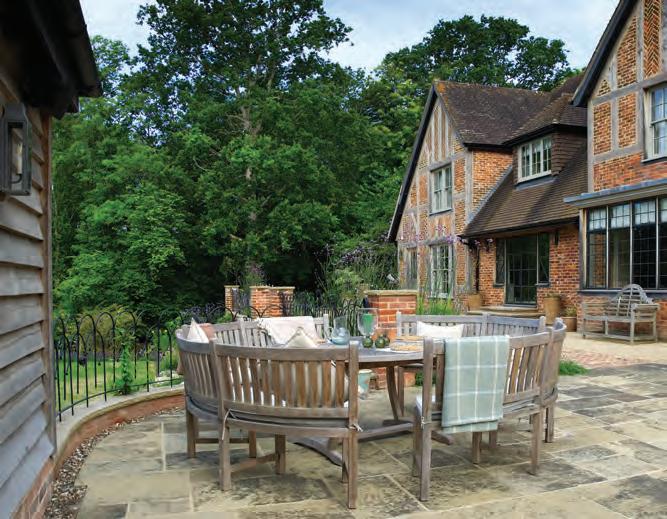
Referred to as the 'drawing room garden', the main terrace space was designed to reflect simplicity and elegance, with a blue and white planting scheme encompassing the hard landscaping features.
Climbing roses were planted to soften the area around the swimming pool building, and running coping steps were incorporated into the bank leading to the pond. The terrace was then enclosed with an ironwork fencing that complements the rural design of the house.
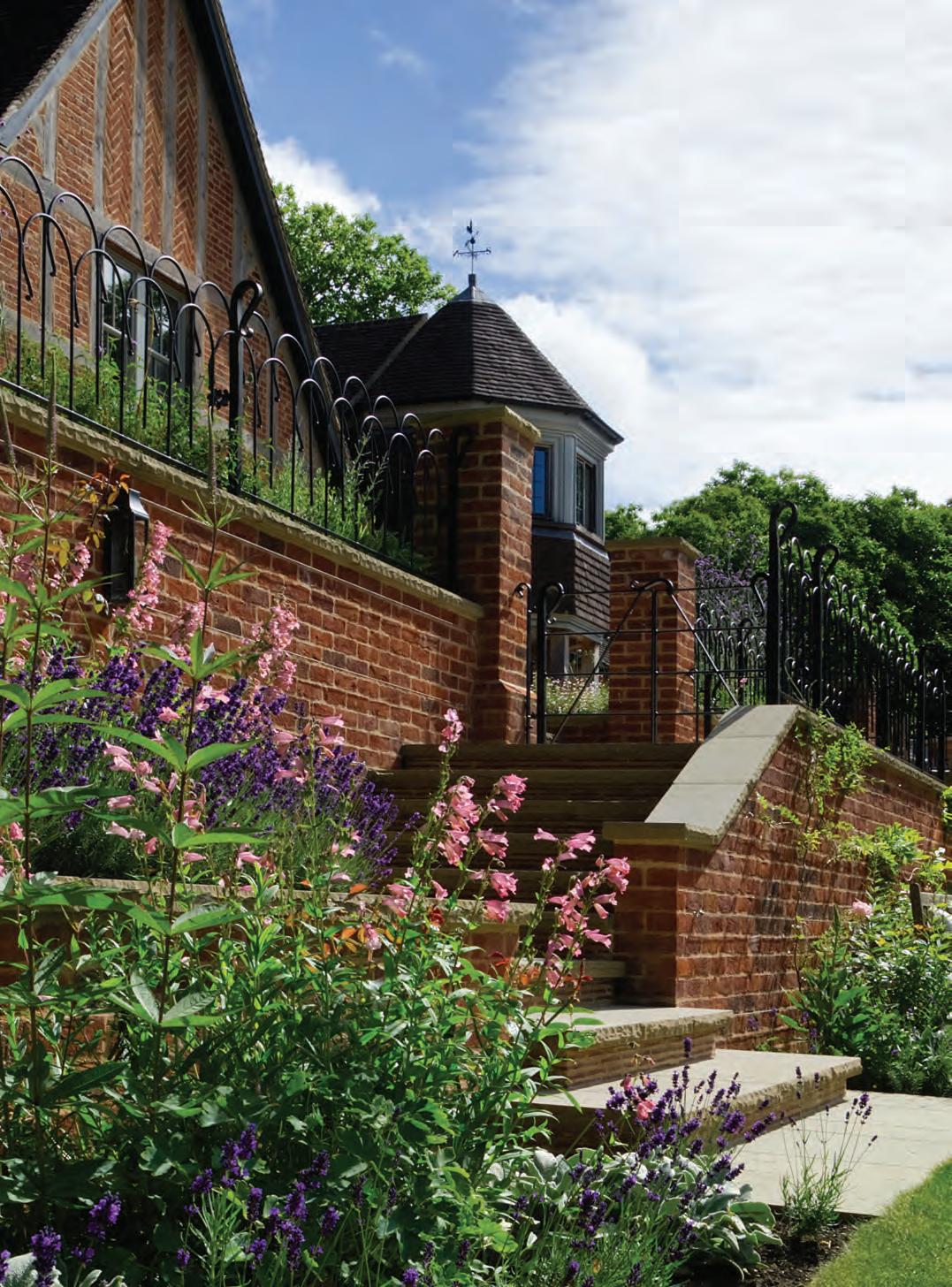
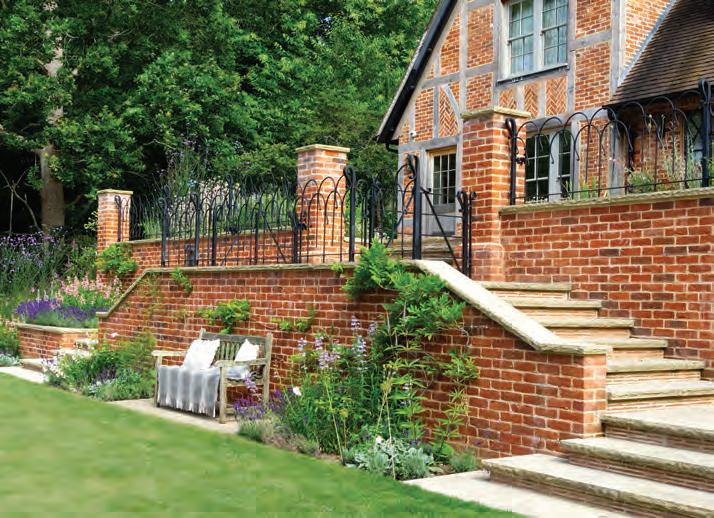
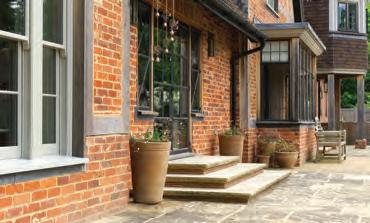
Dual stone staircases were built using a unique mix of English clay bricks and Tudor Tiles to pair with the brickwork
of the house, allowing the transition between the levels of the main lawn area and the terrace to flow seamlessly. The tops of the walls adjacent to the staircases are capped with the same sawn Yorkstone used for the step treads.
As part of the construction of the reinforcing wall which backs onto the terrace, two land drains were installed, both running the full length of the wall, as well as a geotextile membrane down the back of the wall, across the bottom of the excavation and up the face of the bank. Due to the concrete footing of the wall extending out beneath the raised planting beds, no natural drainage for surface water was available. This led to drainage layers being installed at the base, and a geotextile membrane lining to be installed at the bottoms and sides of each bed. All drainage pipe outlets installed were then connected to a new soakaway.
2 Smiths of Bletchington 8mm self-binding gravel path
3 Yorkstone steps enhanced by a running coping stone
4 Double-sided staircase made from handmade clay bricks
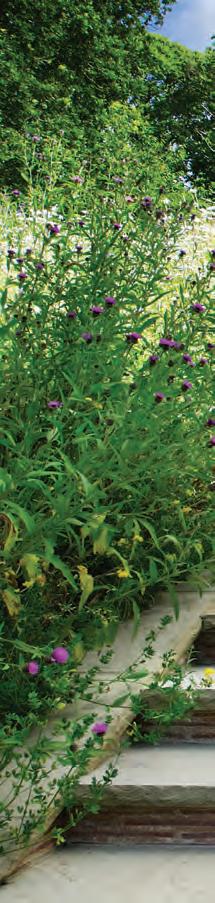
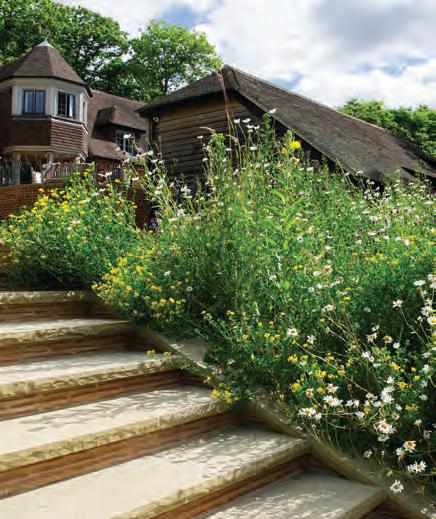
5 Wildflower meadows frame both sides of the stone staircase
During the initial ground clearance for what would become the main lawn area, existing facing brickwork steps and their foundations were removed. However, further excavation revealed buried concrete footings, approximately 14m x 3m in size. A five-ton digger and pecker attachment were used to break up and crush the concrete, adding seven days of work to the project – but in a silver-lining-type turn of events, a large portion of the material was reused in the building of various areas across the project.
Another delay came while setting out the line for the new retaining wall – a large portion of the supporting wall that held up the reinforced concrete slabs of the existing terrace needed to be removed to allow for the new retaining wall to pass through. This meant the project’s structural engineer had to devise a new plan for how the existing slabs would be supported afterwards. New blockwork piers were installed underneath the slabs and the space, then dry-packed to ensure proper support and allow work on the new walls to commence.
A prominent feature of the new landscape is the grand two-metre high brick stairway leading from the main lawn area down to the pond; it consists of 18 risers, divided by a landing and bordered by wildflower banks. Despite the stairwell's large nature, Bluefish Landscaping’s use of English clay and Tudor tile mix brings cohesion and an even flow to the space, softened by a rural planting scheme that reflects the surrounding landscape. Despite the varying heights of the landscape –which proved troublesome during the build – and the challenges faced with the build itself and the mitigating weather conditions, the end result is surely worth it.
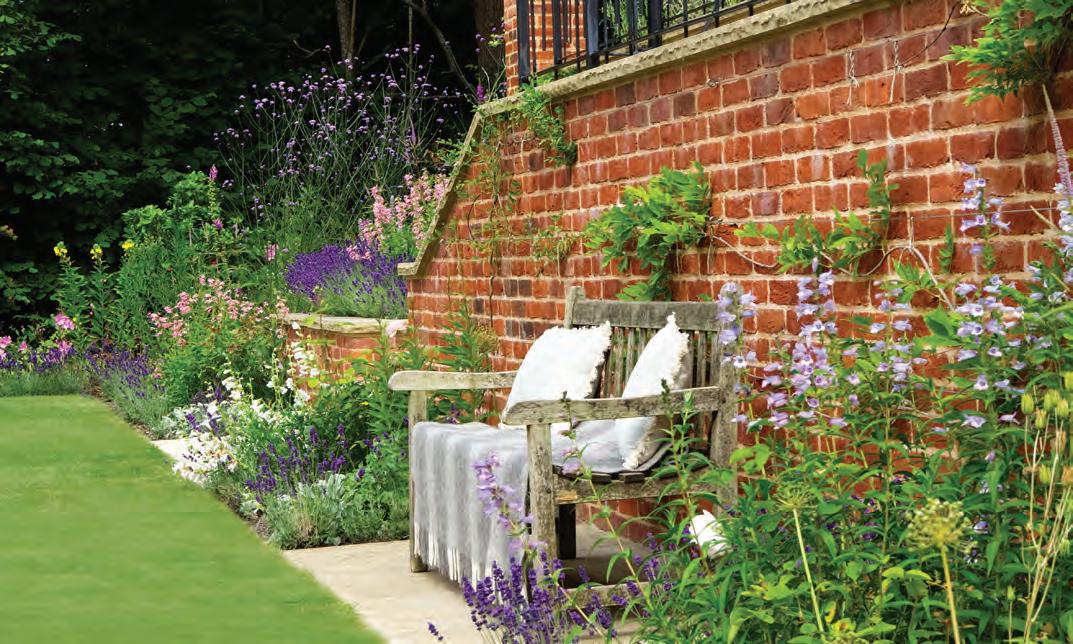
7 Seating area with brick wall backdrop and Wisteria
Bluefish Landscaping Contractors specialises in transforming gardens and country estates through high-quality design, construction, and maintenance. With a passion for creativity and precision, it brings each client’s vision to life, blending exceptional craftsmanship with sustainable practices to create unique outdoor spaces tailored to enhance any property’s beauty and functionality. bluefishlandscapes.co.uk
Garden design Taylor Tripp Landscape Design taylortripp.co.uk
Lighting and electrical Stromtechs Electrical Contractors Ltd stromtechs.com
Stone steps and copings CED Stone Group cedstone.co.uk
Planting and lawn irrigation Raindance Irrigation Limited raindanceirrigation.co.uk
Oak fencing Quercus Fencing quercusfencing.co.uk REFERENCES
CAMBRIDGESHIRE
GARDEN
Along the RIVER OUSE
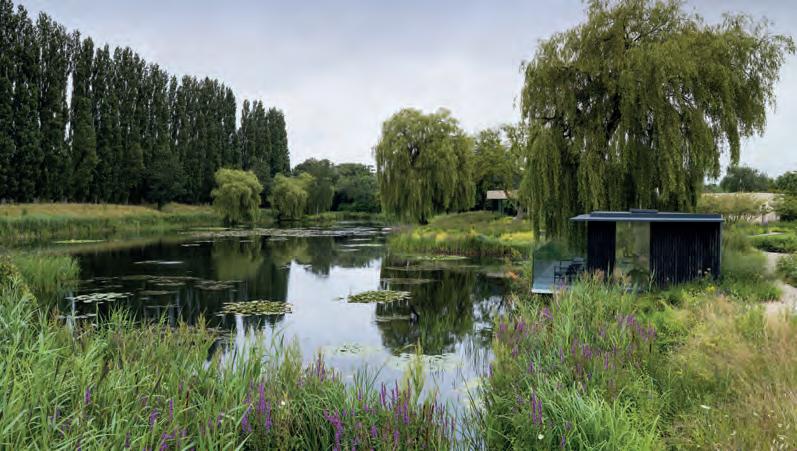
If the fact a third of the site’s land mass is given over to a lake was not enough, the site of this single house plot also resides atop a former quarry – making for a challenging project, but with an end result that’s equal parts contemporary and rustic.
PROJECT DETAILS
After purchasing the six acre site and demolishing its original dwelling, the client – a young family – commissioned a new thermal house to be built atop the previous building’s foundations. Modern garden design company Colm Joseph Gardens were then brought in to design the site’s surrounding landscapes, maximising the view of the adjacent lake. 2024 BALI National Landscape Awards Grand Winner, Bowles & Wyer then set about tendering for the installation of the hard and soft landscaping designed by Colm Joseph Gardens.
Two of the site’s boundaries – the River Great Ouse and a former railway line and associated meadow – form part of the flood defences of the local area and are deemed to be an asset of the local Environment Agency. As building work commenced, the project’s scope expanded to include areas such as the lake, which proved challenging due to its dredged materials and fluctuating water levels. With a high silt content the lake is adorned with mixed ornamental islands and dredged materials, the latter proved too high an
PLANTING
• Molinia caerulea subsp. arundinacea
• Molinia caerulea subsp. caerulea 'Heidezwerg'
• Sesleria autumnalis
• Phlomis russeliana
• Iris 'Perry's Blue' (Sib)
• Phlomis russeliana
• Betonica officinalis 'Hummelo'
• Thuja Occidentalis 'Smaragd'
• Carpinus betulus specimen hedging
expenditure to remove, and thus Bowles and Wyer needed to find another way to achieve the client’s desired effect. The lake's bank edges were cleared and redefined with native plant coir rolls, a floating digger was used to remove the silt from the lake to behind the coir rolls, reshaping the lake. Work was also done to improve the lake’s water quality, ensuring the habitats within and around it were on a net positive end quality result post-build. As the project progressed, issues arose with the house build, resulting in delays and the main contractor withdrawing from the site. Bowles & Wyer, working closely with Colm Joseph on the design, stepped in to carry out direct works for the client, which included an office cantilevered over the lake, a modern detachment from the main garden, accessible through a winding path, and a riverside building beneath this. The clients say seeing the landscaping work coming to fruition gave them the strength to complete the building works.
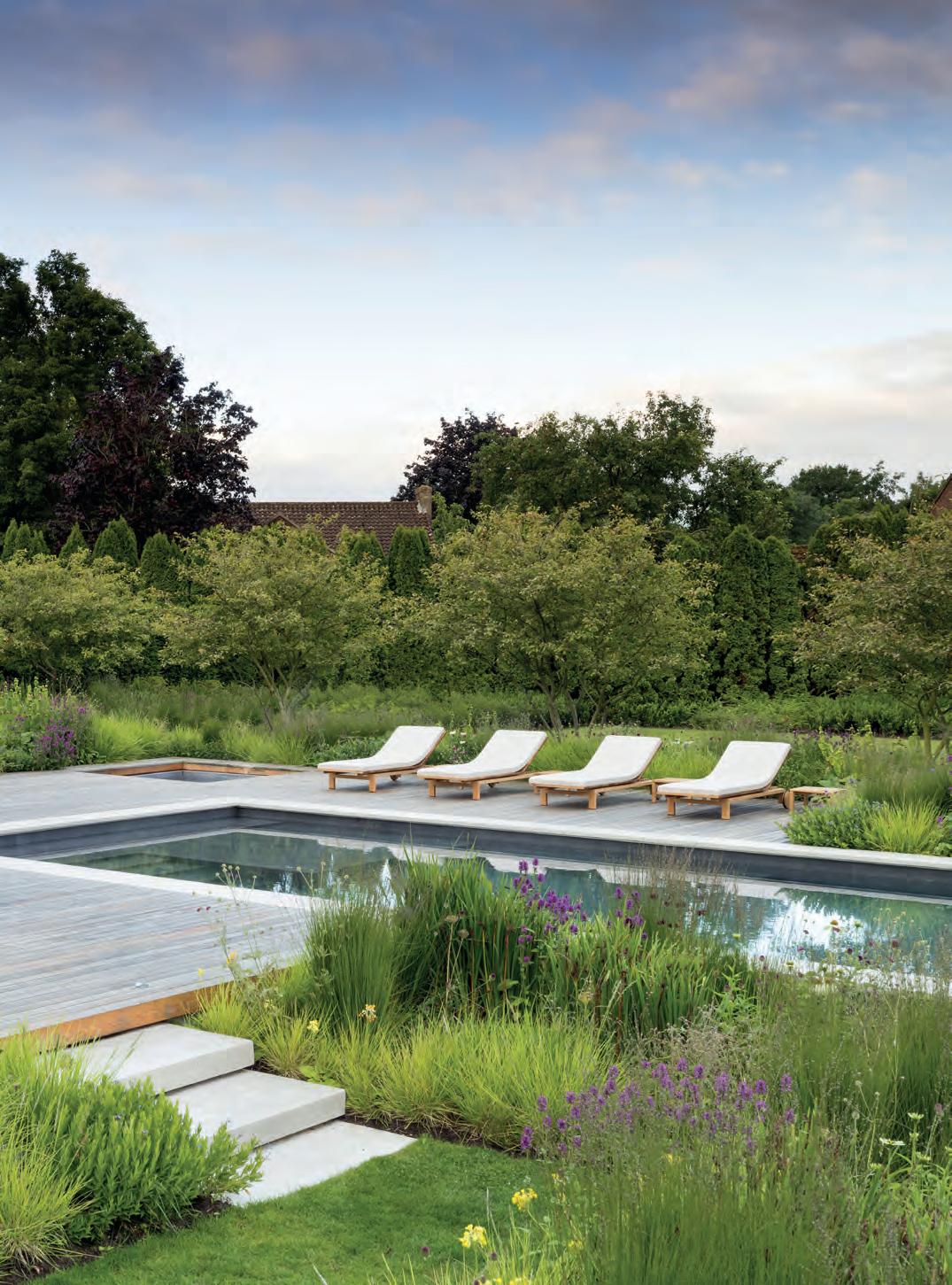
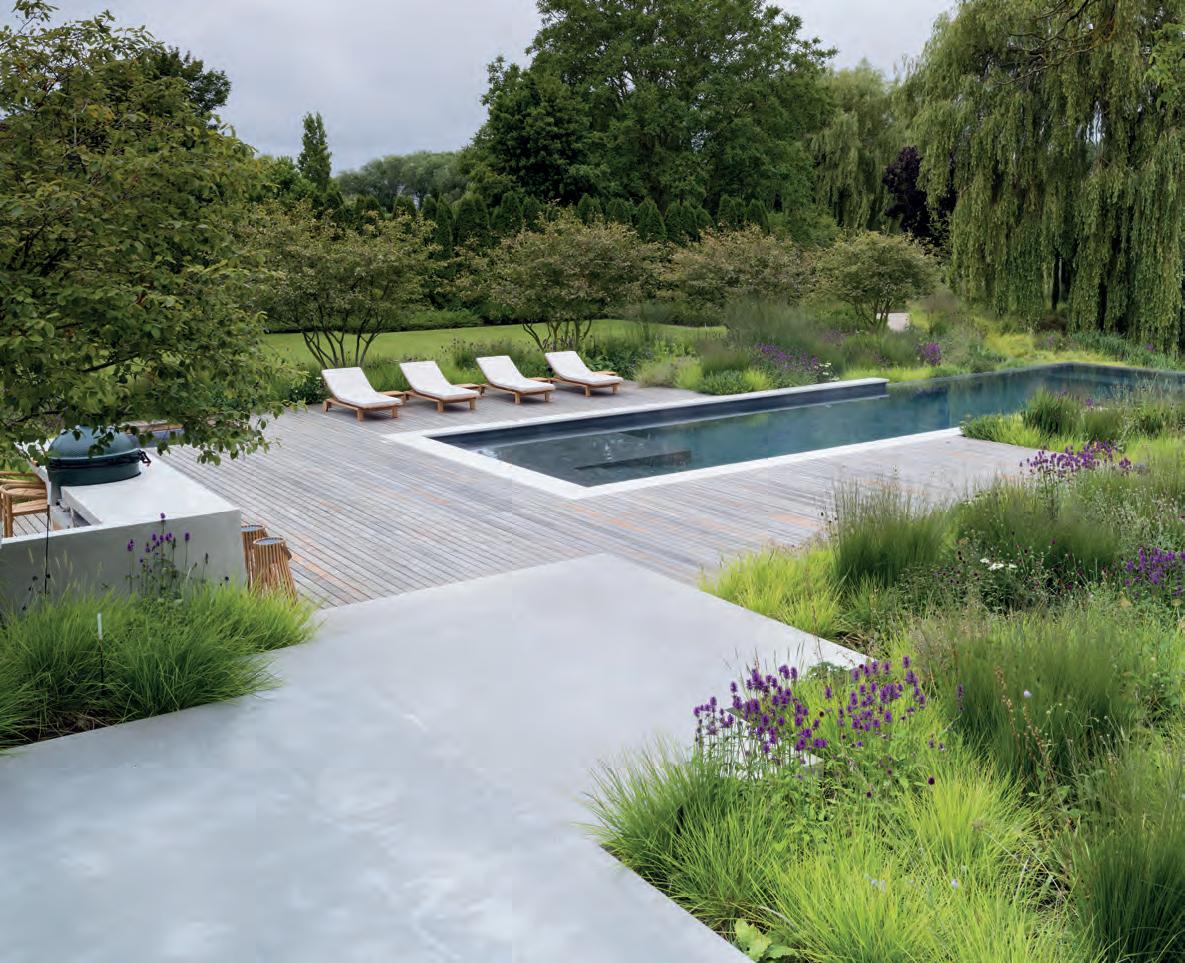
The site’s former life as a quarry meant the area was all unstable made-up ground, requiring a strategy to be put in place for all hard landscape elements, which included extensive use of nine-metre-deep piles interlinked, as well as designed reinforced concrete, steel beams and structural timber to create stable subbases for the pool, jetty, gate, spa terraces and outdoor kitchen area – all of which were added to and enhanced as building works progressed. The pool –installed by Letts Pools – is the focal point of the garden, adding a sense of calm and balance to the rural surroundings.
At the client's request, ‘seamless’ minimal jointed finishes were added to the main terraces and outdoor kitchen area, they also wished to use microcement as the finished surface – which were supplied by Concrete Polishing UK.
The sleek decking and bespoke joinery design – supplied by Alan Hayward Joinery – mimics the aesthetic of the house, all three of which pop out against the greenery, with the encompassing
planting creating a smooth transition to the surrounding area.
Inspired by the historic meadows of the surrounding countryside, the naturalistic planting scheme – designed by Colm Joseph and supplied by Palmstead Nurseries – creates a sympathetic blend to the bordering landscape. Multi-stem trees – supplied by Deepdale Trees – stand tall amongst the array of perennials, drawing the eye upon arrival. The varying heights of the planting create a multi-level flow throughout the garden, working in tandem with the mixed-level paving, bringing cohesion to the design.
Despite the project's challenges and the site’s pre-existing obstacles, the clients now have a space that is both visually appealing and functional, offering a pocket of tranquillity nestled amongst the meadowscape.
Bowles & Wyer design, build and tend landscapes for private individuals, businesses and organisations across the UK and beyond, including public spaces that lift your spirits and gardens that make your heart sing. bowleswyer.co.uk
REFERENCES
Garden designer Colm Joseph Gardens colmjoseph.co.uk
Decking and joinery Alan Hayward Joinery alan-hayward.co.uk
Trees and hedging Deepdale Trees deepdale-trees.co.uk
Swimming pool and spa Letts Pools lettspools.co.uk
Planting Van den Berk Nurseries vdberk.co.uk
Palmstead Nurseries Ltd palmstead.co.uk
Cement finishes Concrete Polishing UK concretepolishing.co.uk
Water feature Studio Ewing andrewewing.co.uk
First-class LANDSCAPE
BLAKEDOWN LANDSCAPES
BRUNEL UNIVERSITY’S CENTRAL CAMPUS
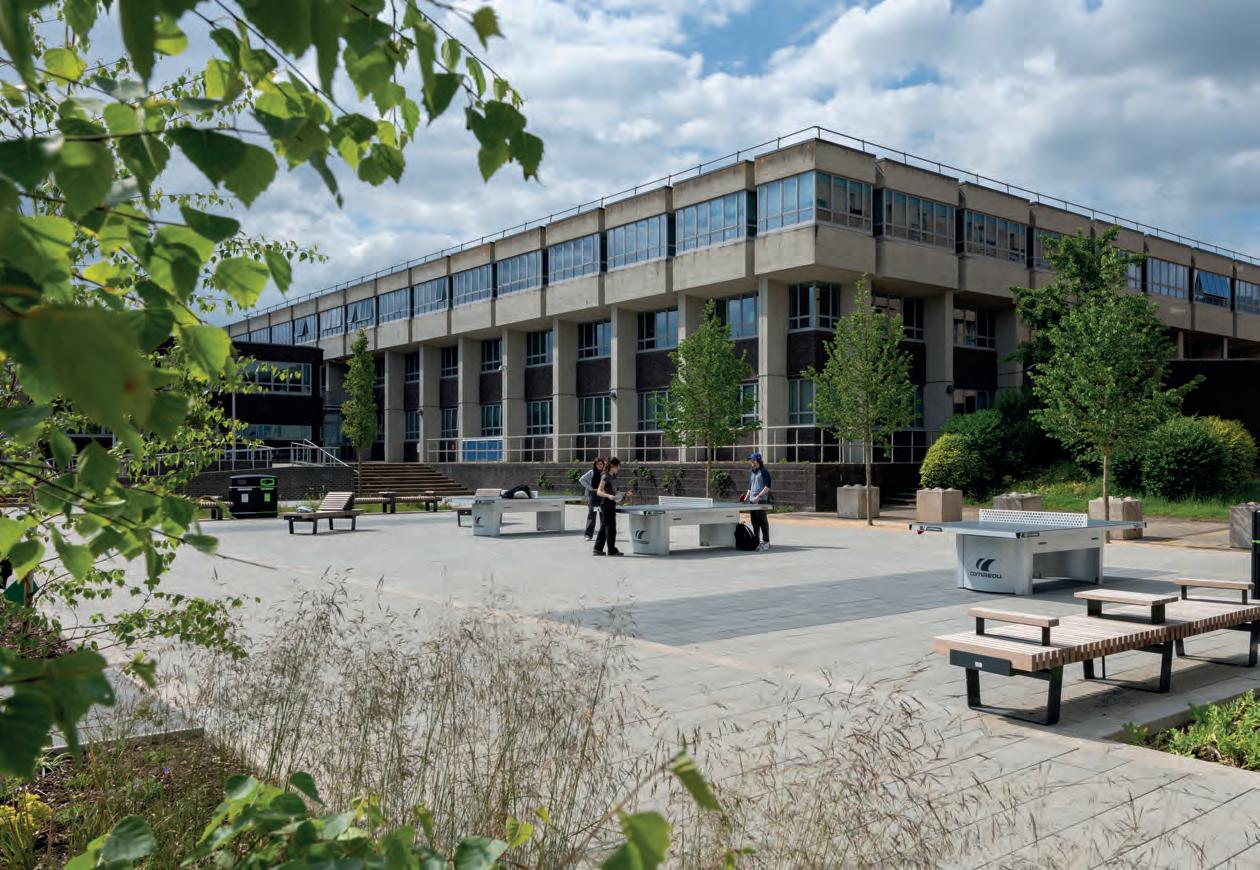
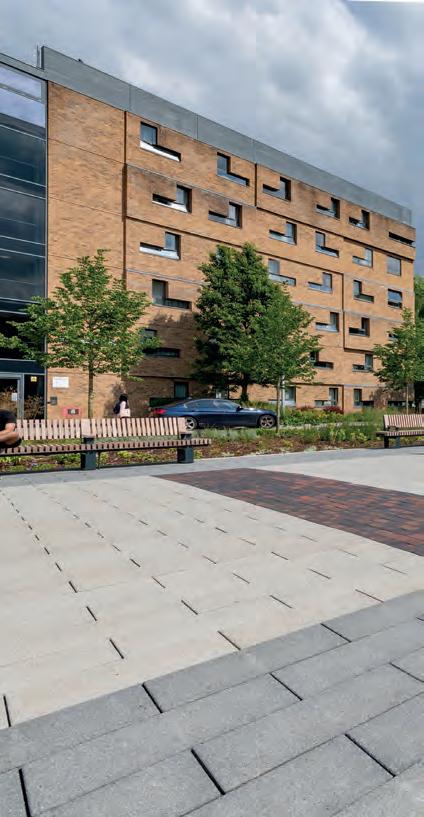
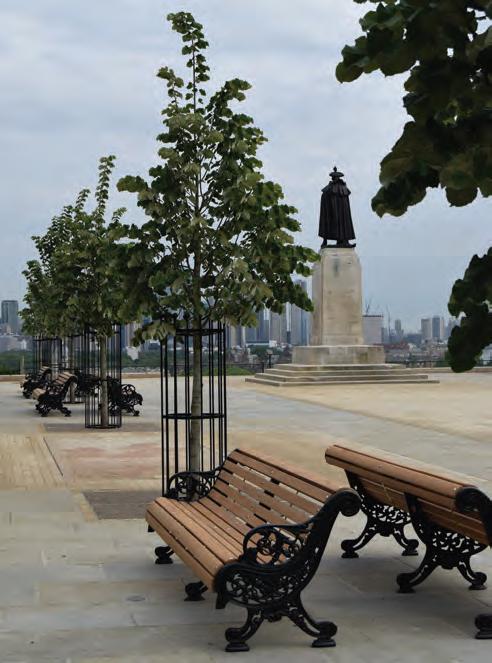
At the heart of Brunel University campus, a previously inaccessible 0.3ha site has been transformed into a multifunctional public space. Delivered by Blakedown Landscapes, the project has created a vibrant hub for recreation, events, and social interaction. With a focus on sustainability and problem-solving, the project demonstrates how thoughtful landscape design can overcome technical and logistical challenges while delivering long-term value.
For four years, the site – formerly home to the John Crank Building that was demolished in 2019 – remained unused and inaccessible. Following demolition, the land was backfilled with granular fill and became overgrown with self-seeded vegetation, creating an unsightly and fragmented area at the core of the campus.
Recognising the potential of this central location, the client brief was to create a high-quality area of public realm that would unify the surrounding buildings and provide a flexible venue for activities ranging from informal sports and social gatherings to marquee-based events such as graduations. At the same time, the design needed to prioritise sustainability by incorporating features to enhance biodiversity, improve access, and balance the relationship between green and built spaces.
Key features
To realise this vision, Blakedown undertook an extensive programme of works. The project began with the clearance of 1,900m3 of construction waste, during which small quantities of asbestos were carefully removed under a watching brief.
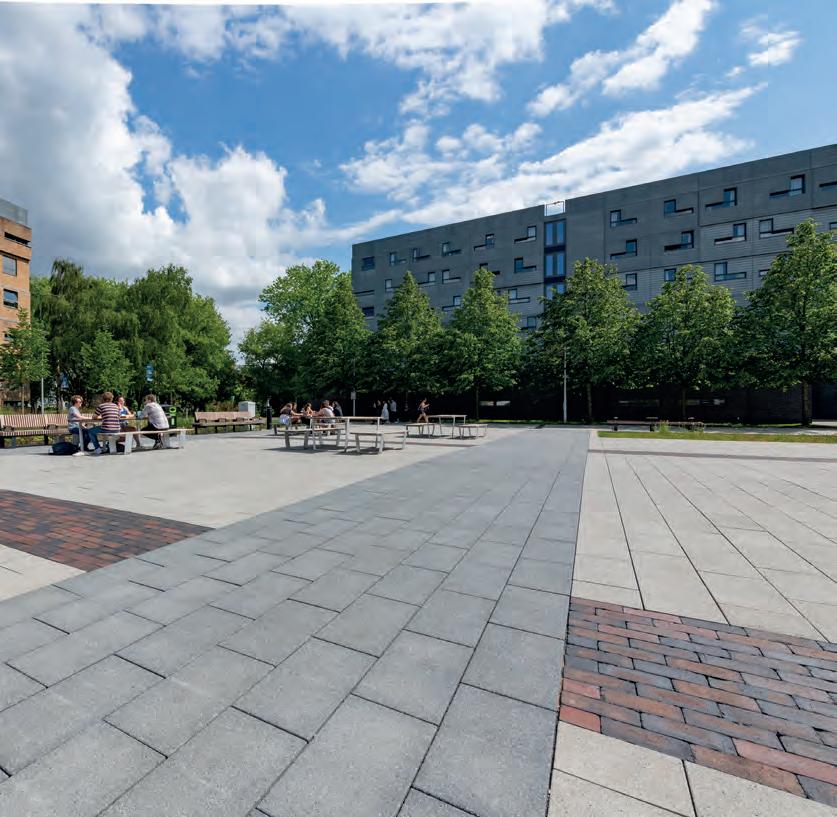
Over 2,000m2 of permeable paving was laid, incorporating a combination of light and dark fleck pavers and Baggeridge Vintage Blue tumbled bricks, arranged in a visually striking pattern. This permeable design is a critical component of the site’s Sustainable Drainage System, which helps to manage surface water by slowing its release into the main drainage network. An accessible ramp was integrated into the existing staircase, using recycled step units from the lower steps to replace the damaged ones.
The creation of a new lawn measuring 30m by 40m formed a larger green space to support events. The existing lawn area was raised by 600mm to align with the top of the eastern steps ensuring level access between the lawn and repaved square.
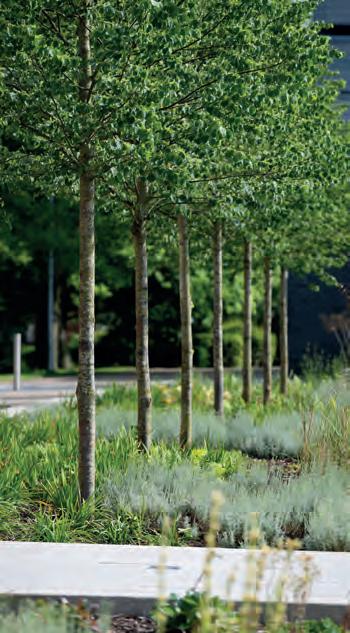
Ecological enhancements were woven throughout the design. Thirty-one new trees, including small-leaved lime and Callery pear 'Chanticleer’, were planted alongside wildflower turf and carefully selected shrubs and perennials. Species such as lavender, verbena, and euphorbia were chosen for their ability to attract pollinators and other wildlife, contributing to the site’s biodiversity. Beneath the tree avenues, Cedec gold self-binding gravel was used to complement the aesthetic of the paved areas.
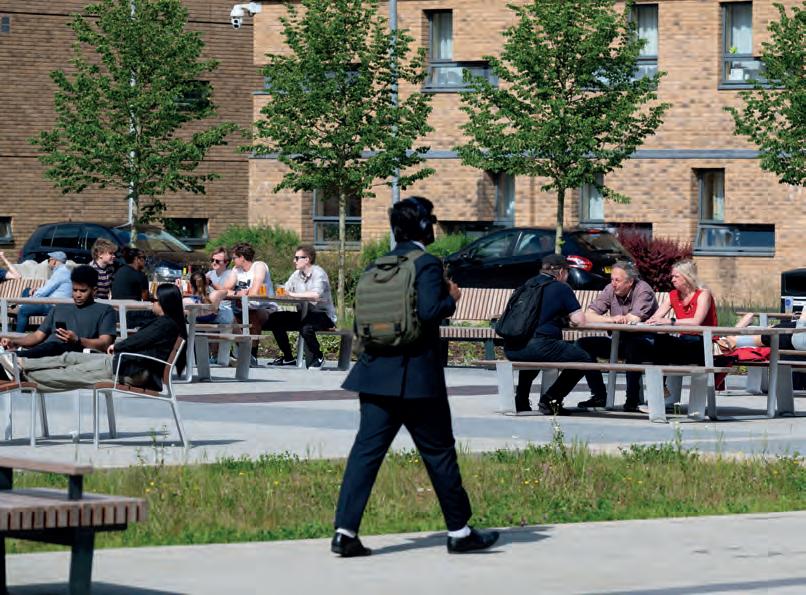
The new public space incorporates features to enhance its usability for students and staff.
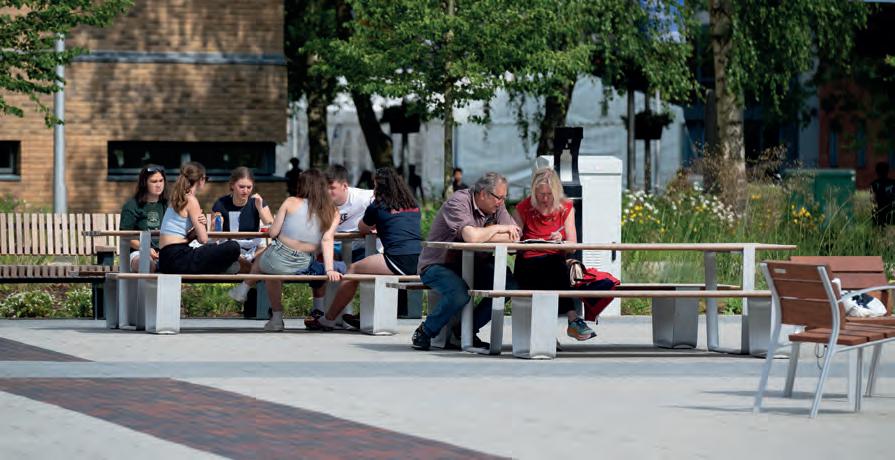
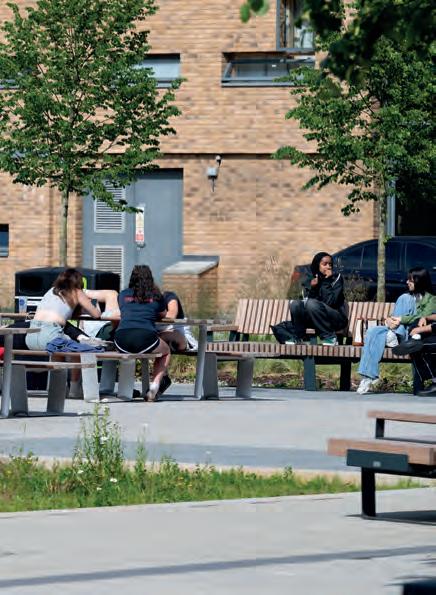
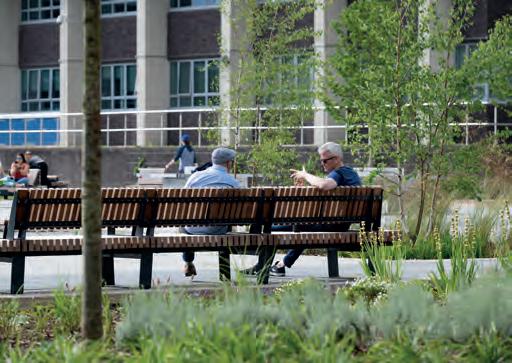
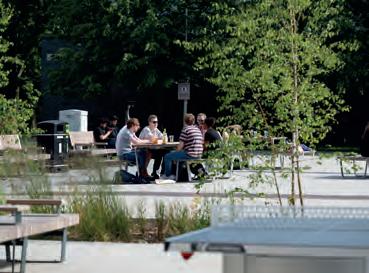
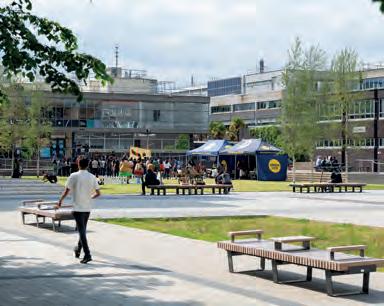
Bespoke timber seating, designed to balance comfort and durability, was installed alongside outdoor table tennis tables and picnic benches. Electrical infrastructure, including data and feeder pillars, ensures that the space is event-ready and adaptable to a range of uses.
Resolving site challenges
The success of this project hinged on addressing several significant challenges, each of which required innovative and collaborative solutions. Logistics posed an immediate hurdle, as the site is located within an active university campus. The movement of large quantities of bulk materials and
machinery had to be carefully managed to avoid disruption to pedestrian traffic. Temporary barriers and an optimised delivery schedule helped mitigate these risks while maintaining progress.
Sustainability and drainage innovation
Sustainability was a cornerstone of the project, particularly in addressing the site’s historical drainage issues. The sustainable design features permeable paving and joints, supported by a deep aggregate base and tanking membrane to cleanse and manage surface water. This approach not only mitigates the risk of flooding but also reduces pressure on the existing drainage network.
In addition to the implemented SuDS system, the site required a robust drainage solution to prevent waterlogging and ensure efficient water management. As part of this strategy, the soil levels in ground-level beds were lowered by 145mm below the surrounding paving to provide a degree of attenuation. The base of these beds was profiled to fall to a land drain.
The lawn area, which had previously suffered from compaction and waterlogging, underwent significant remediation. The compacted subsoil was broken up and replaced with layers of drainage shingle, imported subsoil, and drought-resistant turf. These measures ensure
The underlying clay-based geology added another layer of complexity, particularly during the winter months when poor drainage and heavy rain created muddy and unstable conditions. Blakedown’s team leveraged their expertise to maintain correct levels and manage the wet conditions, ensuring that the groundworks met the required specifications.
The project faced mid-project design changes, with substantial variations introduced after construction had begun. The irrigation system originally planned was replaced with a plantroom-based solution, and significant adjustments to the lighting scheme were required. These changes were incorporated seamlessly thanks to close collaboration with the client and a flexible approach to resource allocation.
that the lawn remains robust and functional throughout the year, even under intensive use.
In an innovative approach, the hard landscape tree pits were installed with underground root cells laid one module deep and four modules wide to create a linear structure. The planted trees also benefited from a ‘RootRain Civic’ irrigation system and permeable matting to further support their long-term viability, contributing to the overall sustainability of the landscape.
3 Great to see the social interactions that the new landscape is promoting
4 Permeable paving and ‘blue’ brick pavers
5 Wildflower Turf
6 Soft landscaping and bespoke seating
Collaboration and best practice
The success of this ambitious regeneration project is a testament to the value of collaboration and adherence to best practice. By working closely with the client and design consultants, Blakedown delivered a complex landscape scheme on time and to a high standard, despite numerous challenges. Technical innovations, such as
optimising soil conditions and integrating advanced drainage solutions, highlight the team’s expertise in tackling demanding projects.
The inclusion of a 12-month maintenance period ensures that the landscape continues to thrive and meet its intended purpose.
The transformation of Brunel University’s central campus into a vibrant and sustainable public space exemplifies the potential of intelligent landscape design. By addressing technical, ecological, and logistical challenges with precision and creativity, the project team has created a space that not only meets immediate functional needs but also contributes to the university’s long-term environmental goals: a landscape that connects people, buildings, and nature, enhancing the campus environment for future generations.
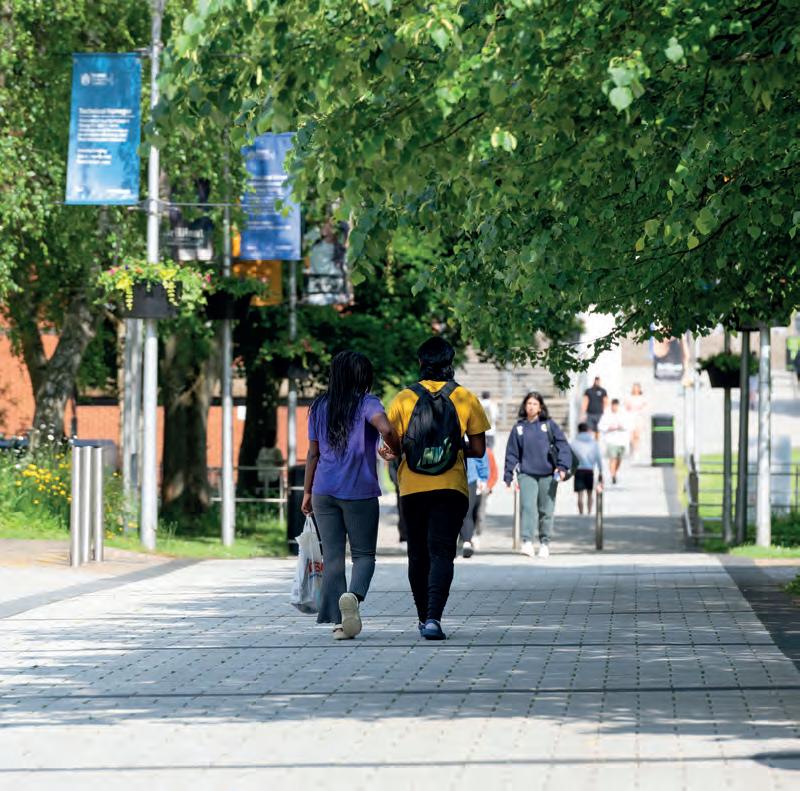
7 Main access route
8 Multifunctional public space at heart of the university
Blakedown Landscapes is an award-winning landscaping and civil engineering specialist delivering high quality projects throughout the UK. With over five decades of experience, its extensive knowledge spans all sectors including local authorities, royal parks, commercial developers, educational facilities and historic park restorations. Its team of highly skilled in-house experts works collaboratively with clients offering best practice advice and innovative value engineering solutions to ensure the optimal outcome for every project. blakedown.co.uk
REFERENCES
Client Brunel University brunel.ac.uk
Landscape architect Ireland Albrecht
Landscape Architects ireland-albrecht.co.uk
Plants and trees Van den Berk Nurseries vdberk.co.uk
Wyevale Nurseries wyevalenurseries.co.uk
Street furniture Furnitubes furnitubes.com
General aggregates Day Group daygroup.co.uk
Permeable paving Charcon Commercial Hard Landscaping aggregate.com
Cedec gravel CED Stone cedstone.co.uk
Spherical OASIS
KARAT LANDSCAPE DESIGN & CONSTRUCTION, DESIGNED BY PETER READER LANDSCAPES
PRIVATE RESIDENCE IN ISLINGTON
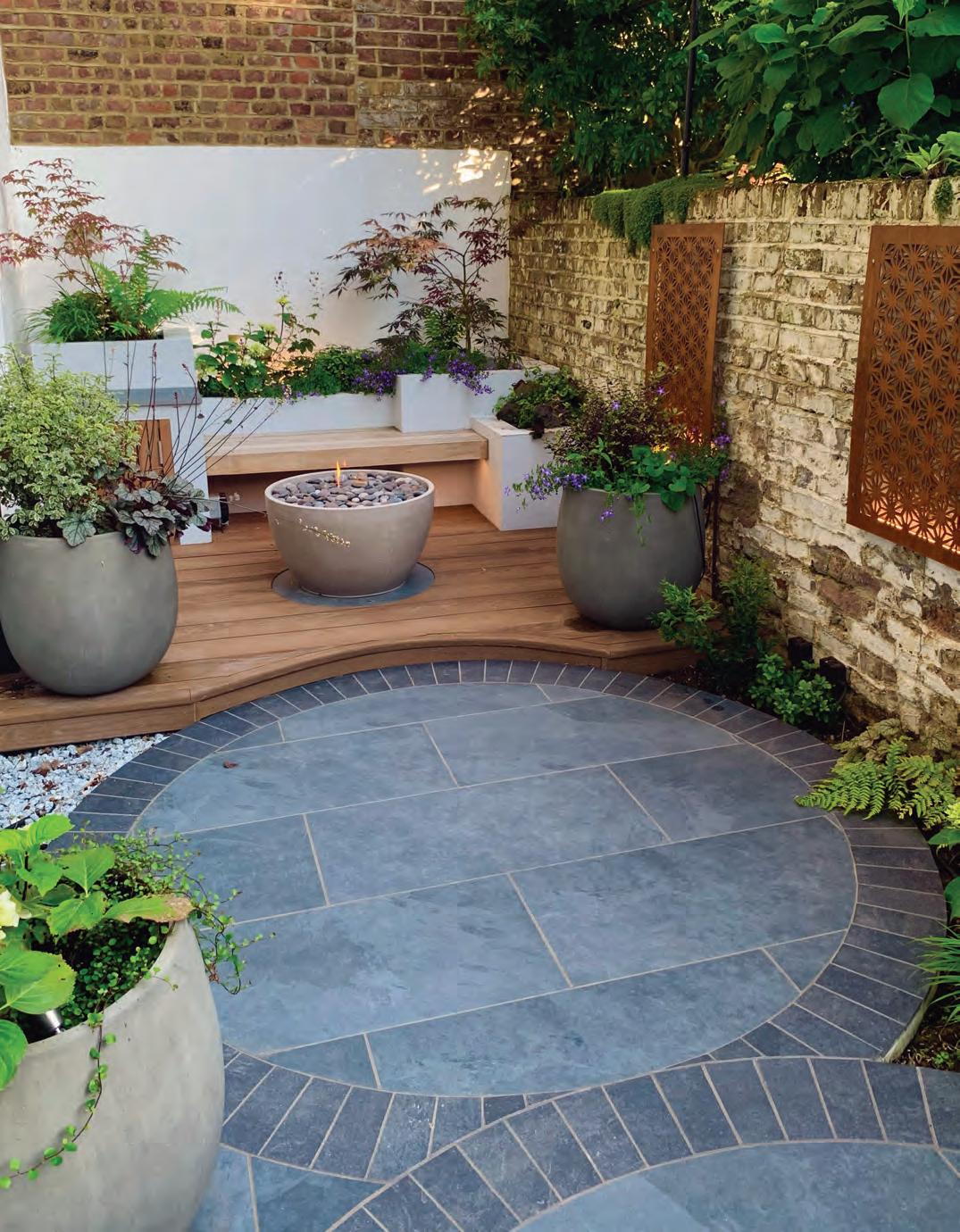
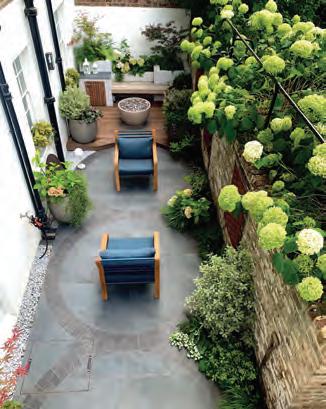
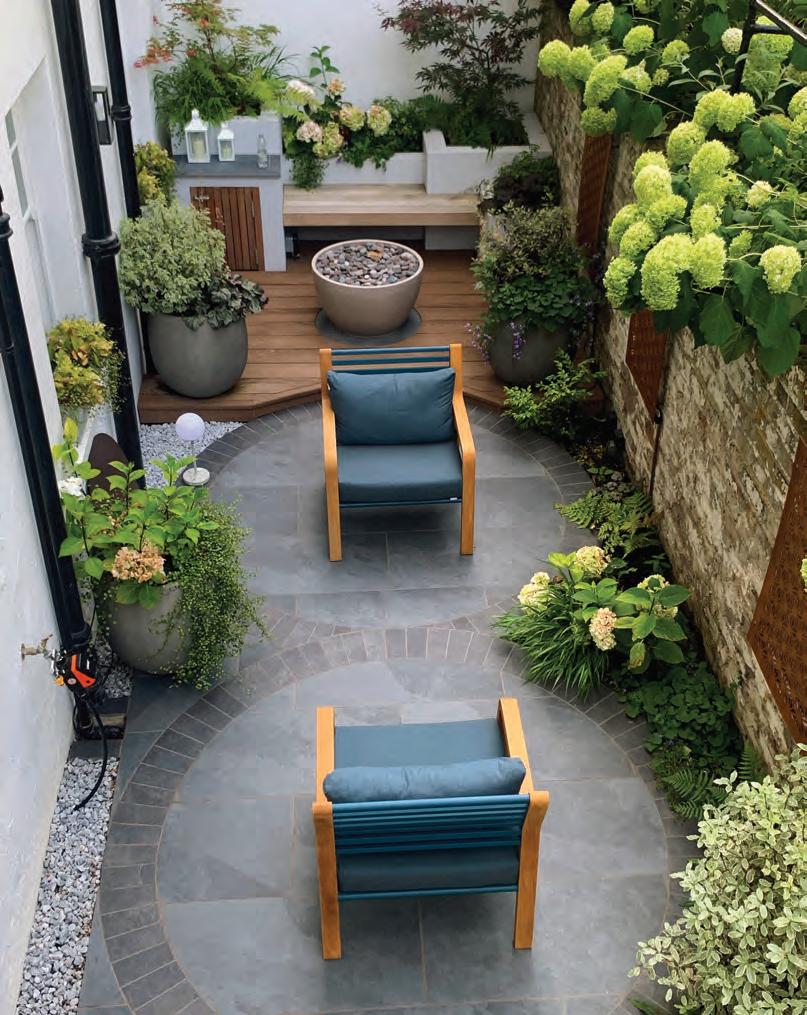
What started as not much more than a desolate urban corridor with a concrete floor and an air of unwelcoming – described by the client as a 'dead space' – is now a contemporary outdoor living space, perfect for relaxing and entertaining.
Designed by award-winning designer, Peter Reader, this urban garden in Central London, is, like many, definitely on the smaller side. However, time and again, it has been shown that size is no obstacle to
creating a functional and thriving space – and this project is no exception. Brought to life by Karat Landscape Design & Build – an acclaimed London-based design and build company – this residential garden is now a larger-than-life urban oasis. By using a circular tile design, complemented with porcelain sett edge detailing; a series of visual boundaries and zones have been created. The design enlarges the space in all directions and creates a consistent structural flow throughout. Every porcelain sett was calibrated on site to achieve
a consistent 5mm joint spacing, requiring 180 setts to be cut along their longest sides. Each one was then meticulously mapped out and placed to ensure the pattern was perfect.
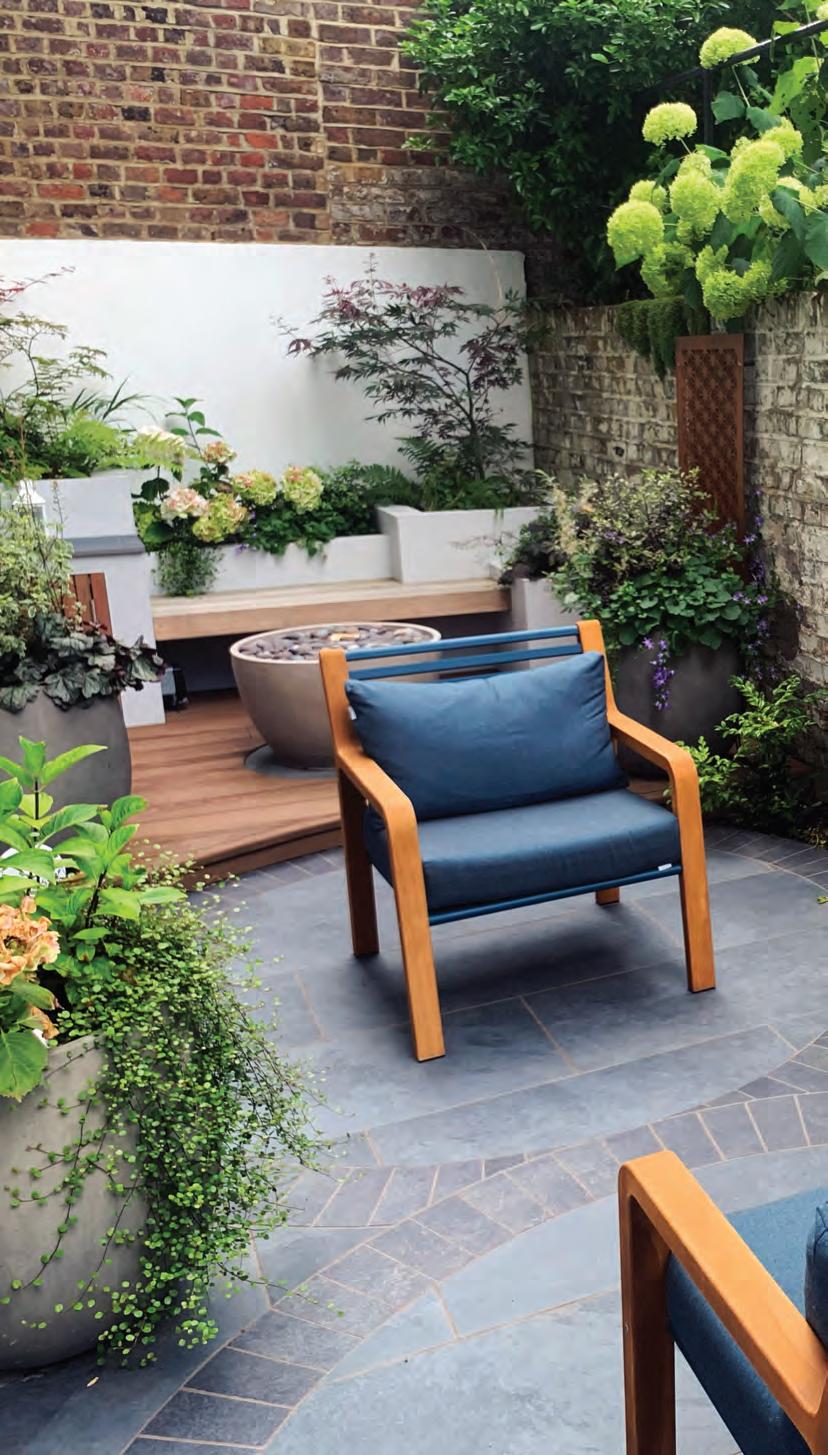
To enhance the feeling of rooms within the small space, a level change was introduced at the far garden end, using a raised composite Millboard deck. This incorporates a cedar bench seating area, set within a backdrop of raised planters. The planters feature structural specimens such as Pittosporum 'Golf Ball', Hydrangea macrophylla ‘Zebra’ and dwarf Japanese acers. Ground cover species like Pachysandra terminalis, ferns, Muehlenbeckia axillaris and Lamium maculatum 'Beacon Silver', complete the picture. The raised design also draws the eye upward along the backing wall, creating an added illusion of depth and space. An additional attraction to the seated area comes in the form of a gas fire pit. Weighing in at approximately 150kg, this was a particularly heavy challenge given the only means of access to the garden was through the stairs in the main property.
Matching planting to the raised seating area, with additions such as Heuchera 'Silver Scrolls', Campanula ‘Stella’ and Brunnera ‘Jack Frost’, borders the wider patio circular tiles, softening and adding greenery along the length of the garden. With limited space available, it can be easy for the garden to feel over encumbered by too much planting, but by the use of spherical and raised planters, the soft landscaping rests at varying heights, diffusing the harder elements and blending the two together
CLIENT FEEDBACK
“Karat Landscapes transformed my small outdoor concrete terrace that I considered “dead space”, into a stunning oasis with highly skilled craftsmanship and excellent project management. I saw first-hand the precision required to achieve the terrace construction elements - in particular the curved interlocking porcelain tiling. The time and expertise Karat put in to get everything exactly right is evident in the quality of the finished tiling, deck and planters.”
PLANTING
• Heuchera 'Silver Scrolls'
• Brunnera macrophylla 'Jack Frost'
• Hydrangea macrophylla 'Zebra’
• Pachysandra terminalis
• Blechnum spicant
• L amium maculatum 'Beacon Silver'
• Acer palmatum 'Sumi-nagashi'
• Muehlenbeckia axillaris
• Pittosporum tenuifolium 'Golf Ball'
• Heuchera villosa 'Palace Purple’
seamlessly to bring the client’s vision of an evergreen city courtyard to life.
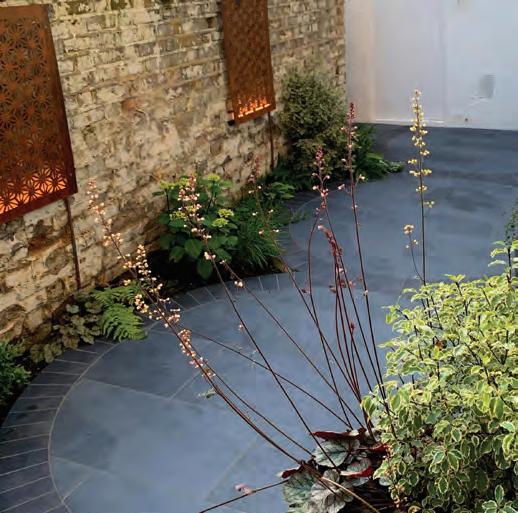
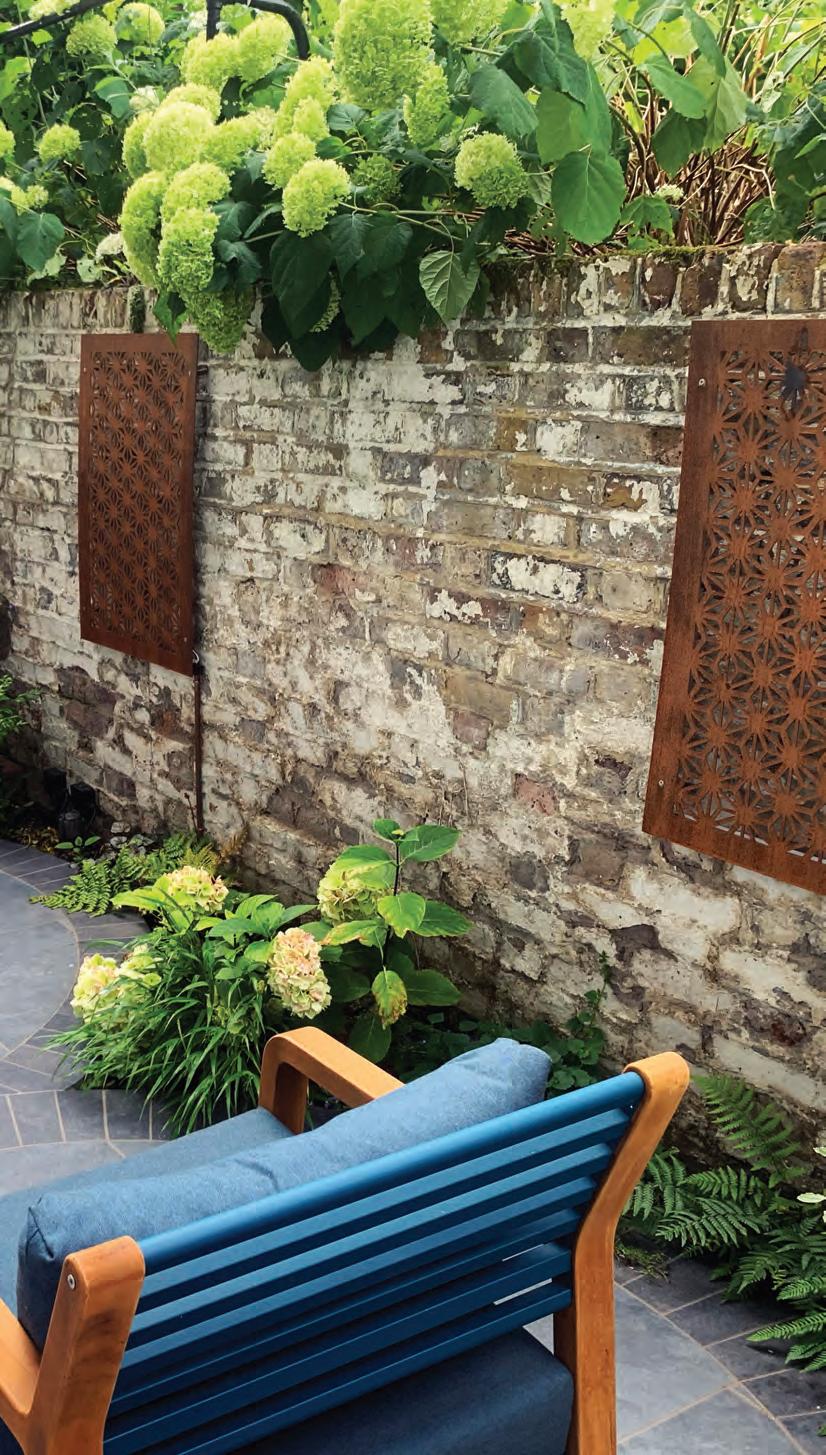
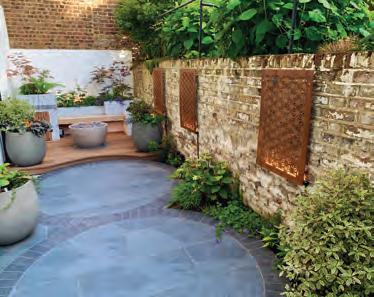
The original old retaining brick wall to the courtyard provided the perfect backdrop for the garden, with the neighbouring garden’s planting creeping through above, adding to the air of privacy and submersion. Sections of the wall did require some restoration, but the atmospheric faded paintwork was intentionally left intact. Finally, the wall has been adorned with three decorative Corten wall panels adding another textural
component, as well as attractive lighting when back-lit. The rusted patina of the panels adds atmosphere to the walls and provides a lovely foil to the planting beneath. Copper piping was used to disguise the lighting cables leading to each of the panels, which Jean-Paul Karat, director of Karat Landscape says is both “aesthetically complementary and practical”.
1 An overview of the garden
2 Backlit corten panels on the old wall
3 Dark porcelain and peripheral setts
4 Circular paving creates visual rooms
The team opted to break ground on the project in the autumn to minimise inconvenience caused to other residents within the building, who use the communal upper garden in summer. As bad luck
would have it, that autumn was a particularly wet one, leading onto an even wetter winter; presenting challenges for a project with intricate tile installation. The team overcame this by mapping out the dimensions of the project, from the tiles to the decking in meticulous detail. Linked to the heavy rain, a focus of the build was also to ensure effective drainage. This was achieved by installing a linear drain between the concrete base and the external finish levels, and by ensuring all manhole chambers and gullies remained easily accessible for maintenance.
The team at Karat Landscape Design & Construction was praised by the client for its professionalism, craftsmanship, and dedication to delivering “outstanding results” – and it’s easy to see why.
ABOUT
Karat Landscapes is at the forefront of garden design, constructing complex schemes in London and the Home Counties to the highest standard. Its garden design is influenced by the fusion between architecture, interior design and research into new outdoor materials including natural stone, porcelain and composite materials. karatlandscapes.com
REFERENCES
Garden design Peter Reader Landscapes readerlandscapes.com
Porcelain tiles London Stone londonstone.co.uk
Corten panels Stark & Greensmith starkandgreensmith.com
Hidden beneath what was once an unassuming and disused area was the potential for a space that could seamlessly blend both functionality and beauty. Formosa Landscapes, a BALIaccredited practice, just had to discover it – and quickly –before the client's daughter turned the area into a venue for her wedding reception.
After completing a recent house extension, the clients turned their attention to the outside – they longed for a garden that would match the aesthetics of their home, but they also needed a multipurpose space to entertain their substantial family.
1 Multiple seating areas seamlessly blending Japanese and Mediterranean influences
PROJECT DETAILS
Project value
£60-£100k
Build time
Four months
Size of project 300m2
The original site lacked a focal point or designated seating area, offering little in the way of entertainment. Additionally, the fence was in disrepair and a brick garage had been relegated to a storage room.
To begin, Formosa Landscapes brought the garden back to a blank canvas, with the exception of two existing mature pine and acacia trees – which were both utilised in the final design, as well as a Cornus kousa var. Chinensis to harmonise the Asian and Mediterranean fusion Formosa Landscapes was looking to achieve. Shade tolerant species, such as ferns and Brunnera macrophylla 'Jack Frost' – supplied by Creepers Nursery – were planted beneath the existing trees, while a selection of dwarf pines were planted to mirror the existing multi-stem pine, and permeable clay paving was installed below the tree to allow for water drainage. Both mature trees now bring in visual draw and offer a multi-level attraction to the garden.
PLANT
LIST
• Olea europaea (F)
• Amelanchier lamarckii
• Brunnera macrophylla 'Jack Frost'
• Cornus kousa var. chinensis
The existing terrace and steps were given an overhaul, as before they offered little to no cohesion to the flow of the garden. Two Corten steel facia structures; a planter and pond – both a bespoke design by Formosa Landscapes and fabricated by EverEdge –
2 Corten steel water reel
3 Japanese rock garden, surrounding multi-stem pine
4 Bespoke Corten steel pond and planter with cloud olive
5 Shou Sugi Ban pergola, table and bench made in-house by Formosa Landscapes
were installed to round off the harsh drop of the terrace, unifying the change in levels. Both the pond and plants surrounding it play a vital role in promoting biodiversity within the garden.
The Shou Sugi Ban method refers to the charring of the wood, then cooling it and cleaning by brushing and washing, and then finishing the wood with oil. One way to achieve this is through the burning of each wood plank with a blow torch, but the more traditional method requires bundling three planks at a time into triangular tubes and lighting the interior.
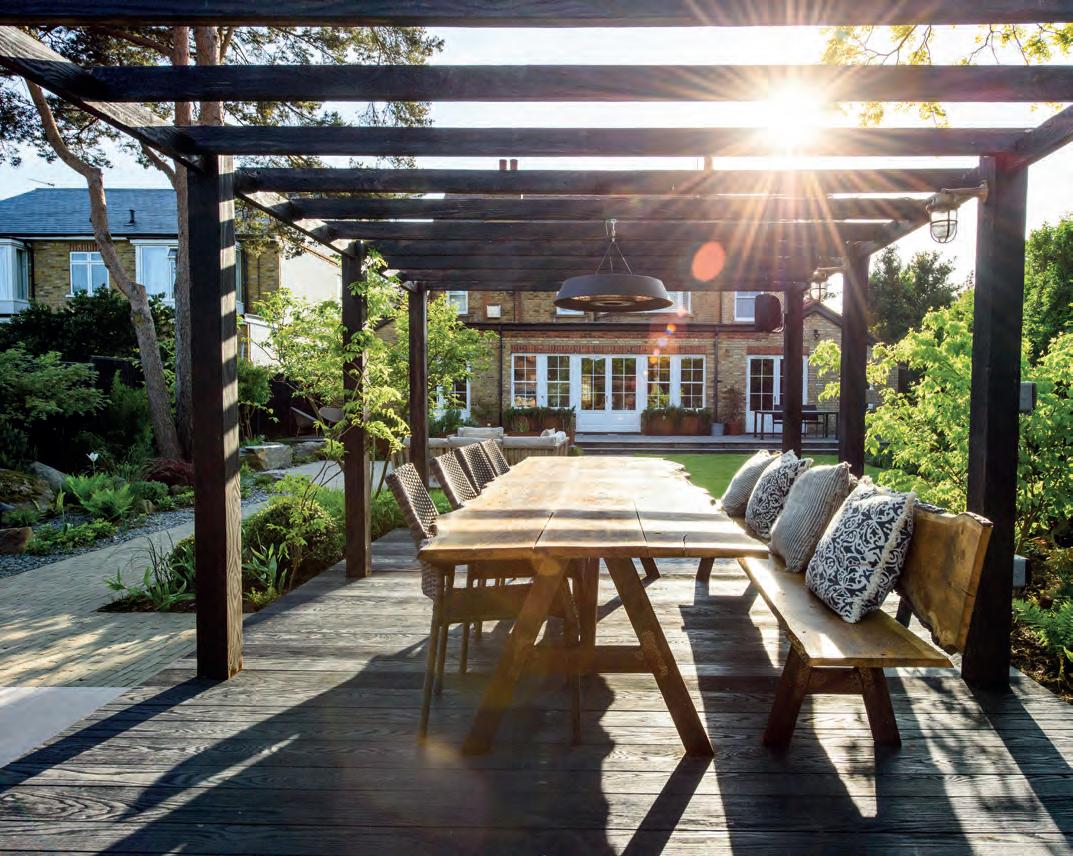
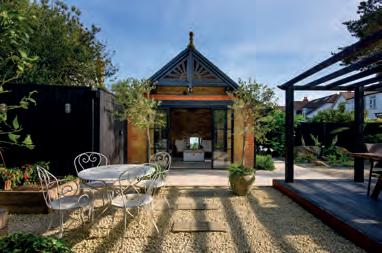
From storage room to indoor entertainment, the garage structure was also left intact but given a new lease on life, as now it houses one of the new seating areas, directly connecting to the new purpose built pergola. One of the main challenges of the build came from wanting to incorporate a charred larch pergola using the Shou-Sugi Ban method, but this proved too costly, leading to Formosa Landscapes taking on the task themselves so as not to compromise on the integrity of the design. This meant undertaking the task of burning the wood out in the open, in the middle of a particularly wet March – a purpose built shelter was erected to carry out the task and the garage was used to allow the planks to dry. The pergola now rests atop a raised decking area – supplied by Millboard – with an outdoor table beneath, offering a view of the back of the house which showcases the symmetry of the house and the garden design, fitting with the client’s brief.
CLIENT FEEDBACK
“The garden continues to evolve and as it becomes more mature, we can see more of the design thinking that went into it. We have several places/zones built into the design and each has its own view and provides a different perspective of the garden. The lighting adds something special, particularly through winter when we could still view the olive tree lit up brightly from inside our house. Overall, I have been blown away with the resultant garden. We are really looking forward to years of enjoyment.”
The hardest challenge posed to the practice, however, came in the form of the water pump used for the water rill. Due to the large proportions of pine needles settling in the vessel, they would be pushed through the pump and cause the nonreturn valve to stay open. To resolve this, a fine mesh was wrapped around the pump to prevent the needles from entering.
The client can now enjoy their garden year-round, and it will always hold a special place in the memories captured at their daughter’s wedding reception.
6 Old garage now converted into beautiful garden room with crittal doors
Corten steel fascia Formosa Landscapes and EverEdge everedge.co.uk
A path running the length of the garden was laid central to the house extension, with multiple intersections to change direction towards each one of the seating areas, creating zones throughout the space that are connected through one central line to bring cohesion.
ABOUT
Formosa Landscapes offer a service that is entirely client-centric. Its focus is in creating the very best experience for you as it becomes your trusted advisor in the design, build and maintenance of your garden. The company’s goal is to surpass your expectations and transcend conventional boundaries, merging the beauty of highend luxury with a deep respect for nature. formosalandscapes.com
Outdoor furniture Formosa Landscapes and Garden Trading gardentrading.co.uk
Decking Millboard millboard.com/en-gb
Boulders CED Stone cedstone.co.uk
Blooming SKIES
CAMLINS
BUILDING DESIGN: EPR ARCHITECTS, DEVELOPER: QUADRANT
OSMO LONDON
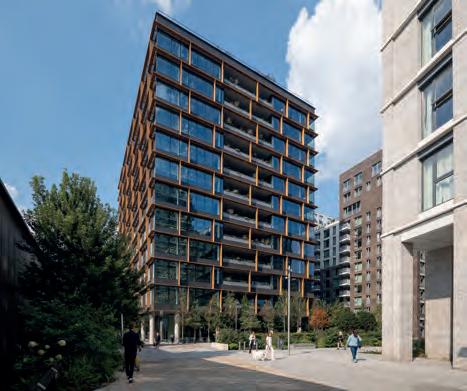
Sitting in the heart of the new Nine Elms linear park – one of London’s emerging neighbourhoods and one of the largest regeneration projects in Europe – OSMO London is a mixeduse, contemporary office building, designed with wellness, sustainability and eco-working in mind.
It is considered one of London’s greenest office buildings, and with good reason. Focusing heavily on biophilic design, you’d be hard-pressed to find an area of this project not encased in planting. Beginning at
PROJECT
DETAILS
Project value
£1.75m
Build time
36 months Size of project
215,000sqft
(total gross internal area)
ground level, the surrounding planting seamlessly extends the existing Nine Elms Park landscape by adhering to the same plant specifications, from species to size, these include Sanguisorba 'Pink Tanna', Polystichum munitum (Western Sword Fern) and Geranium phaeum (Dusky Cranesbill), while the variety of shrubs and trees have been deliberately arranged to create a parkland atmosphere. Positioned adjacent to commercial units on the site, the new green areas are intended to foster a vibrant and welcoming environment for both visitors and the local community.
Moving up to the balcony planting, a mix of species has been used to offer seasonal variation and year-round interest.
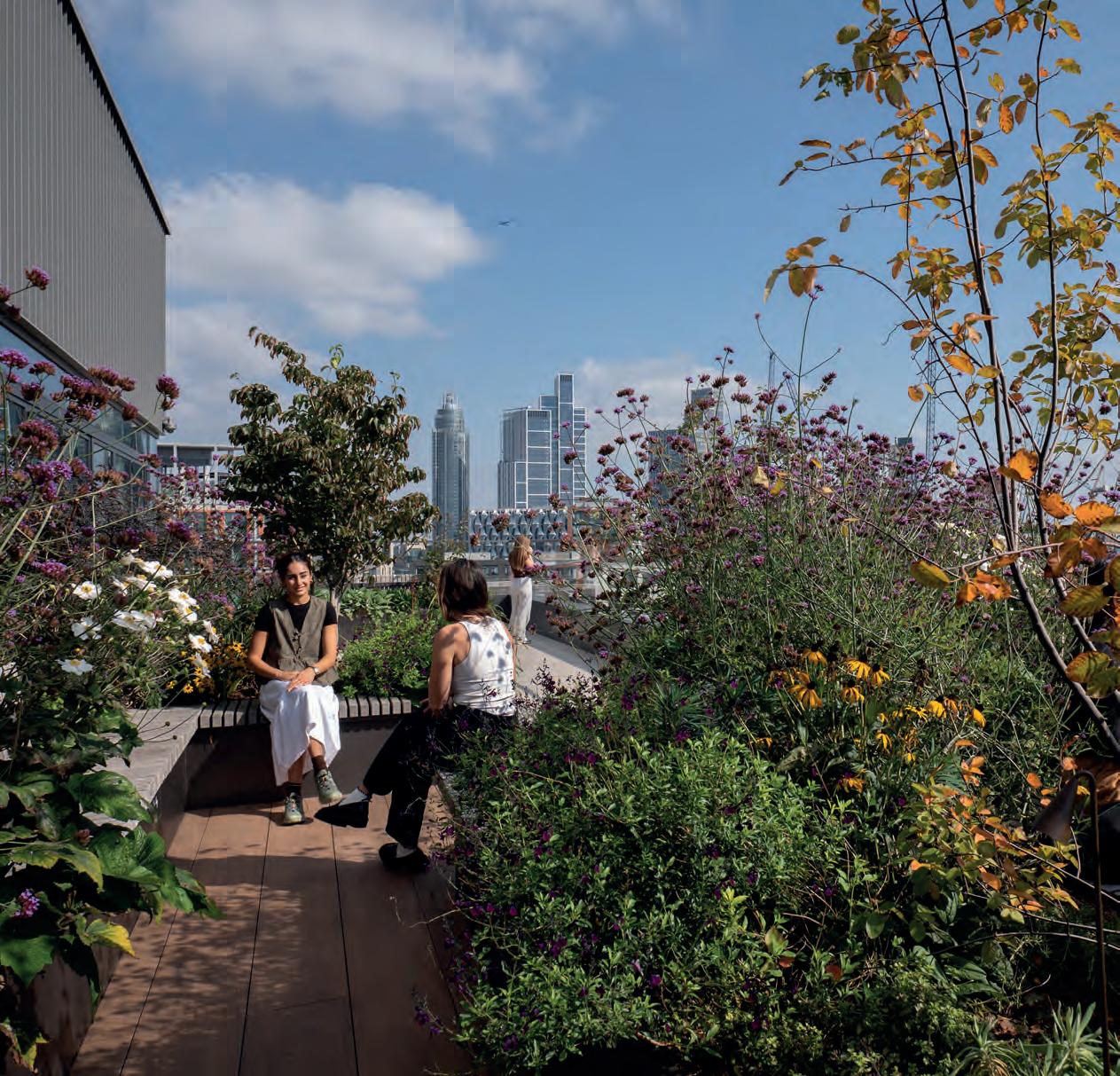
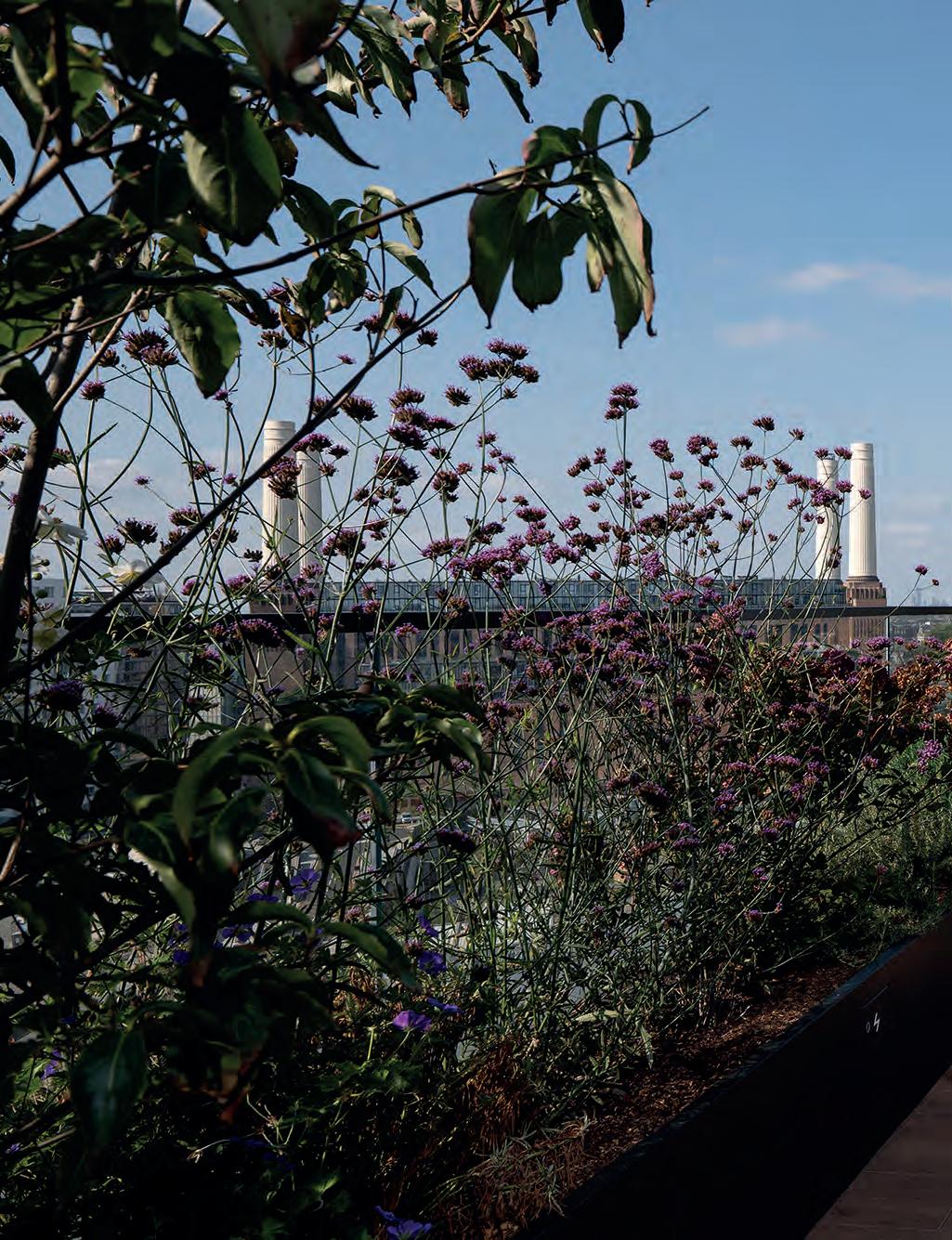
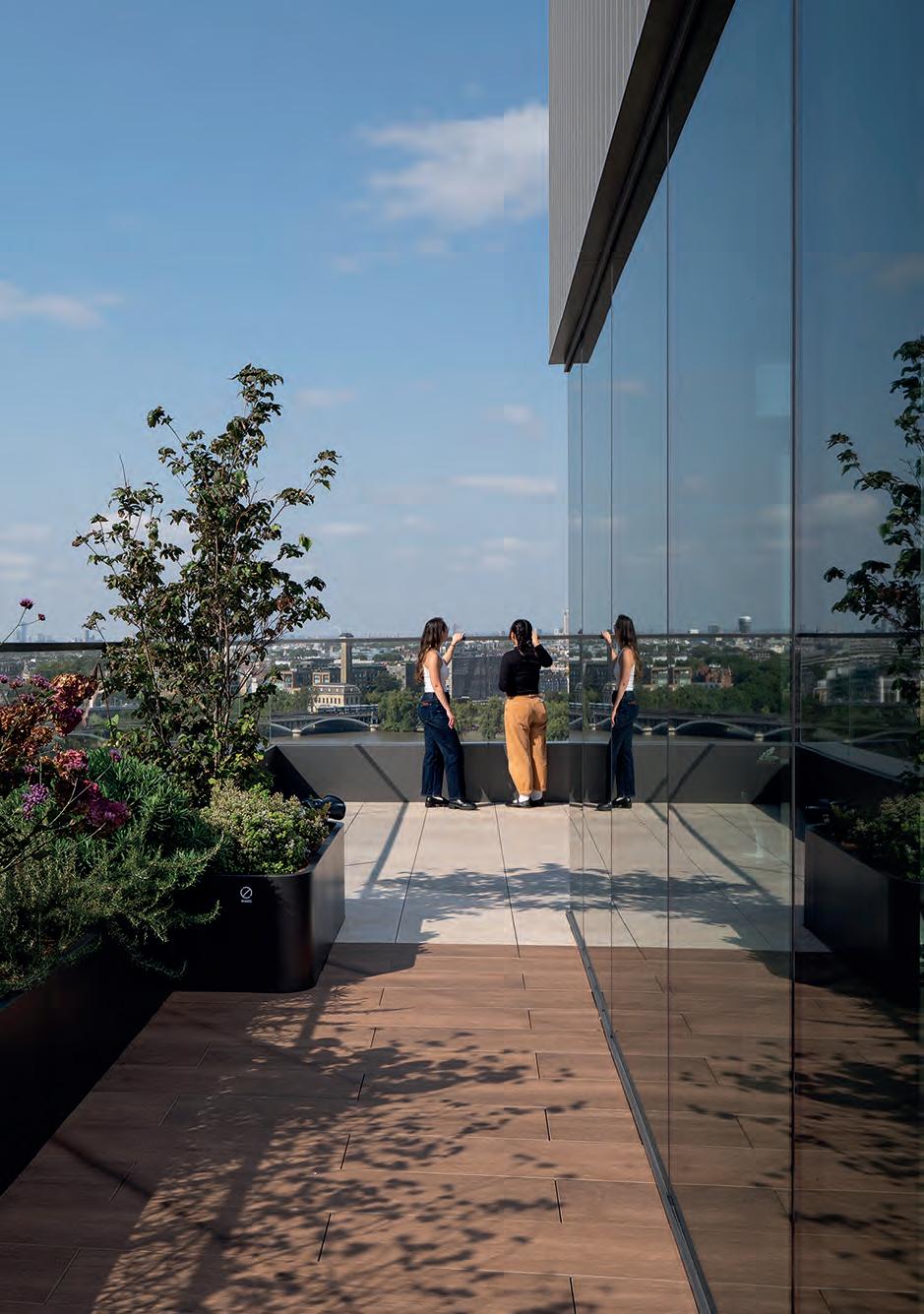
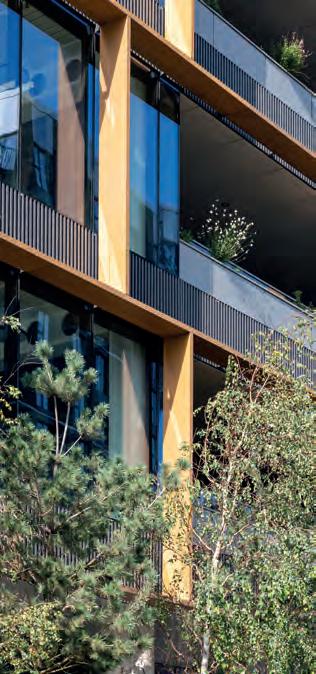
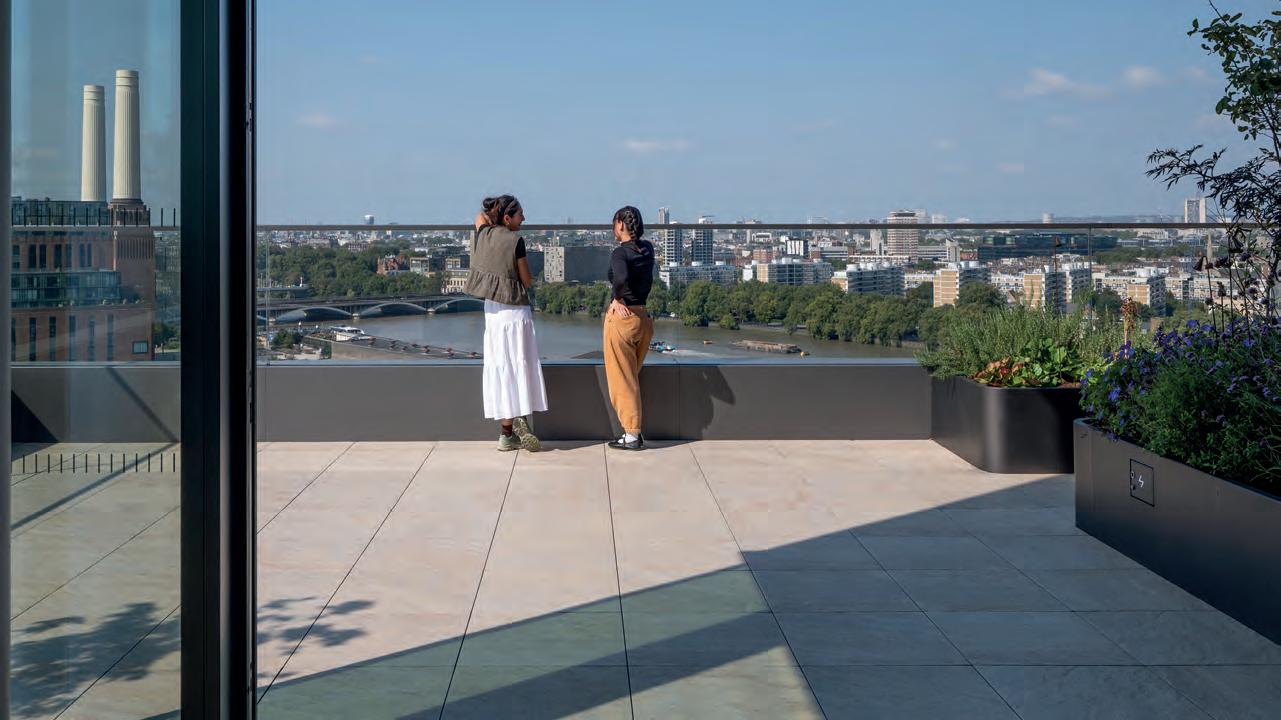
Planters have been integrated into the architectural design of the building to ensure the soft landscaping occupied a prominent position and was a key visual feature of the structure. Camlins says the aim was not only to create a “lush and inviting atmosphere for balcony users” but also to craft a “verdant, dynamic element that spanned the full height of the building, establishing a living façade”. Finally, ascending to the rooftop terrace, you are greeted to panoramic views of London, including the River Thames and Battersea Power Station. The client’s brief for the terrace was clear: it needed to be biodiverse, with a mix of plant species and an informal atmosphere to encourage a natural feel. In order to make the most of the raised, but limited space, the design was structured within a grid layout. Despite utilising this layout to help organise the landscape spatially, it was crucial that the planting was allowed to break the formality of the grid to allow the space to feel organic and inviting. Allowing the plants to be the
PLANTING
• Sanguisorba 'Pink Tanna'
• Polystichum munitum (western sword fern)
• Geranium phaeum (dusky cranesbill)
• Salvia 'Amistad'
• Rosmarinus officinalis 'Prostratus Group'
• Geranium Rozanne ('Gerwat')
• Dryopteris affinis
• Iris 'Butter and Sugar' (Sib)
• Vinca minor f. alba
• L avandula angustifolia 'Hidcote'
Plus many more...
TREE PLANTING
• Carpinus betulus 'Fastigiata'
• Sorbus intermedia
• Tilia cordata
• Amelanchier × grandiflora 'Robin Hill'
• Liquidambar styraciflua
Plus many more.
main focal point meant using minimal hard landscaping, including steel planters, timber benches and porcelain tiles, while also letting the plants gradually soften the hard surfaces as they matured to give the impression of nature reclaiming the space. The roof terrace planting, provided by Robin Tacchi Plants, includes Geranium 'Rozanne' (Gerwat), Rosmarinus officinalis 'Prostratus Group', and Salvia 'Amistad'. Each species chosen for its hardy nature and ability to survive in the higher altitude's harsher environment, as well as for their ability to thrive in both sunny and shaded areas, with a mix of plants chosen to suit each condition.
To secure planning approval, the development was required to meet the mandatory 10% uplift under the biodiversity net gain legislation.
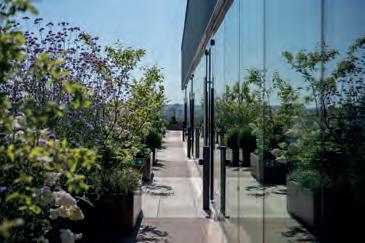
1 The terrace in bloom including Anemone, Rudbeckia and Salvia
2 OSMO London within its Nine Elms Park setting
3 Looking out over Battersea Power Station from the roof terrace
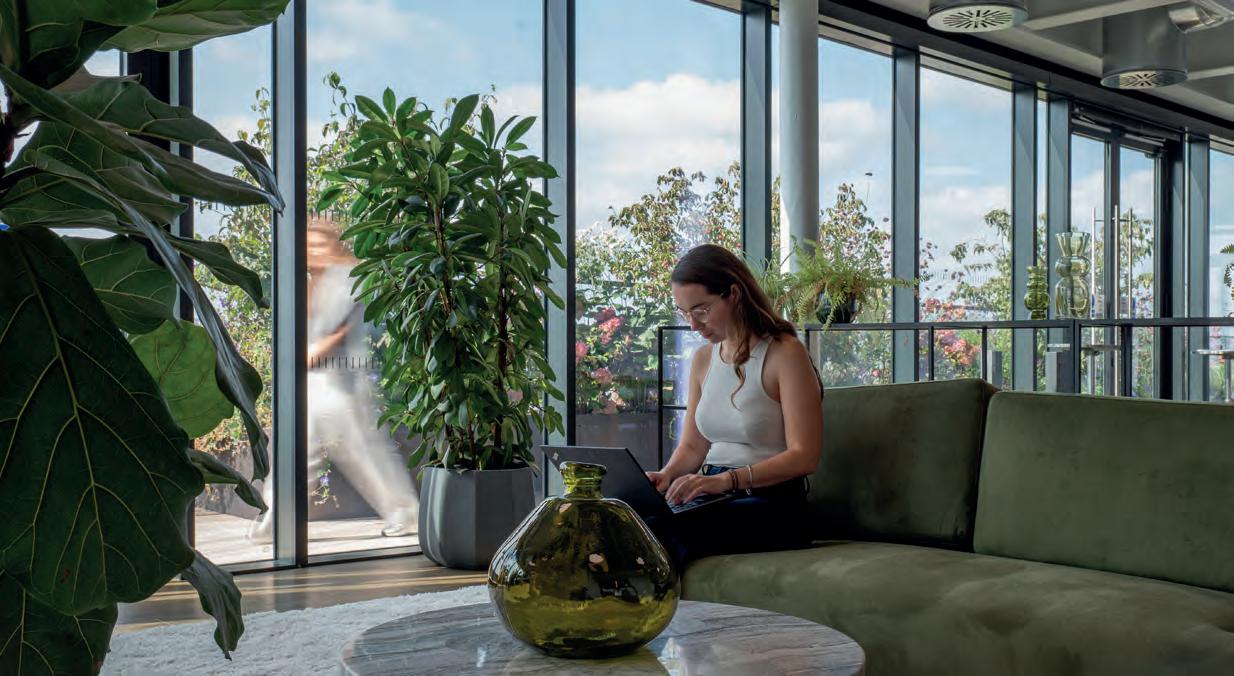
4 The flexible amenity space wrapped in green on top floor, OSMO London
5 Pinus Nigra, Betula Pendula and Amelanchier lamarckii in public realm
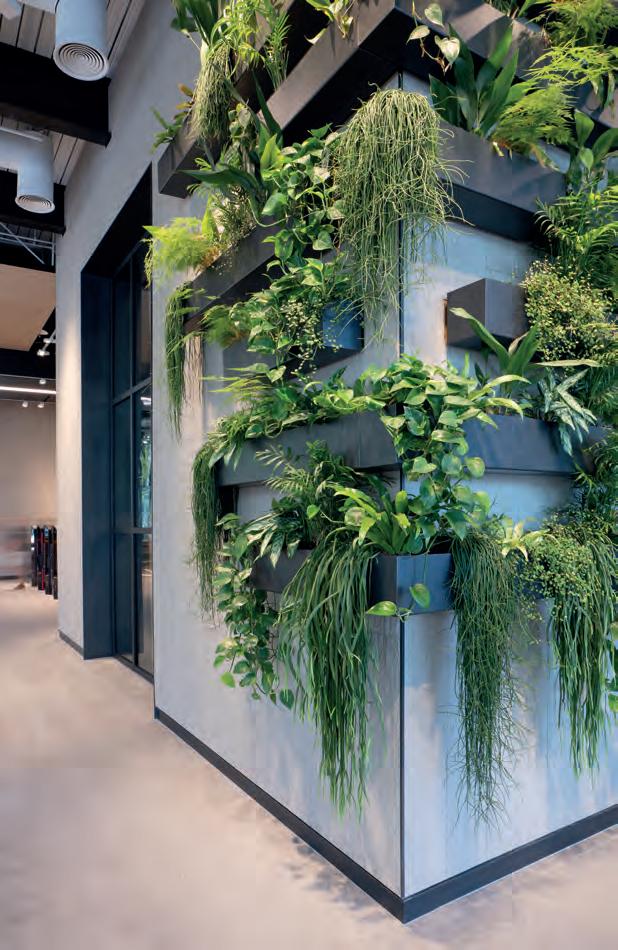
6 The interior planting by Plant Designs
This led to the installation of several new habitats and wildlife-friendly features, such as bee habitats, and bird and bat boxes within the rooftop terrace – allowing both the greenery to flourish and people to connect more freely with nature.
BREEAM ASSESSMENT –SUSTAINABLE BUILDING CERTIFICATION
BREEAM provides a holistic sustainability assessment framework, measuring sustainable value in a series of categories and validating this performance with third-party certification. Categories are assessed on influential factors, including low impact design and carbon emissions reduction, design durability and resilience, ecological value and biodiversity protection. Ratings range from Acceptable (in-use scheme only) to Pass, Good, Very Good, Excellent, to Outstanding. breeam.com
OSMO has also achieved a BREEAM rating of Outstanding, reflecting its exceptional commitment to sustainability. The building is powered by 100% renewably sourced power, achievable through the solar-panelled roof, and has zero in operation CO2 emissions and zero operational waste to landfill. Throughout development, 100% of waste was also diverted from landfills – all of which contributes to its status as one of London’s greenest office buildings. In the client’s brief, it was outlined that the roof terrace should be maximised and should strive to be exceptional. From the wildlife habitat inclusion to the renewable energy facilities and extensive planting, it is safe to say that has been delivered, making OSMO a fitting addition within the journey to make Nine Elms one of London’s greenest districts.
Camlins is a Shrewsbury-based landscape architect with decades of experience designing landscape and public realm projects of national importance. The practice works across all scales and sectors, with projects ranging from the transformation of Ancoats in Manchester to taking a lead role in making Nine Elms one of London’s greenest districts. camlins.com
Architect and principal designer EPR Architects epr.co.uk
Plants (roof level) Robin Tacchi Plants robintacchiplants.com
Trees (roof level)
Lorenz Von Ehren Nursery lve-baumschule.com
SUPPORTING BIODIVERSITY - THE LINDUM WAY
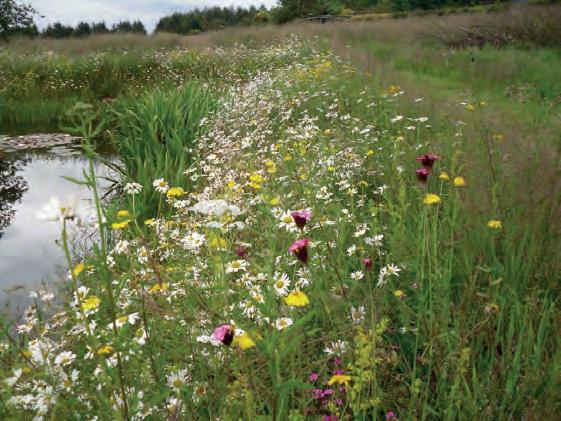
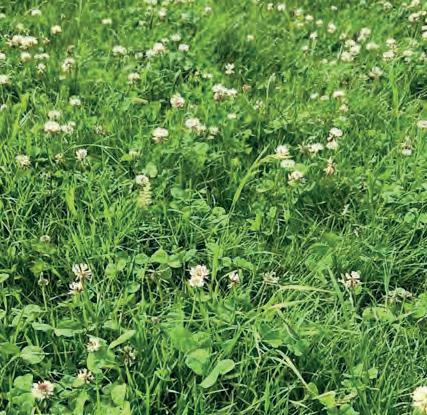
Transform your landscape instantly with our award winning wildflower turf, designed to create a vibrant wildflower meadow or garden area. It features a carefully balanced blend of native wildflowers, herbs, and colourful flowering perennials, all thriving in a moisture-retentive, plastic-free, biodegradable felt. This eco -friendly solution not only enhances the beauty of your outdoor space but also supports local biodiversity. Experience the joy of an instant wildflower area that is both sustainable and visually stunning.
Our Species-Rich Turf is a harmonious blend of wildflowers and grasses, the 80/20 mix is carefully cultivated into a plastic-free, moisture-retentive mat, creating an instant biodiverse haven. This uniqu e turf can be maintained like a traditional lawn with regular mowing, or left to grow naturally to encourage the flourishing of diverse plant species.
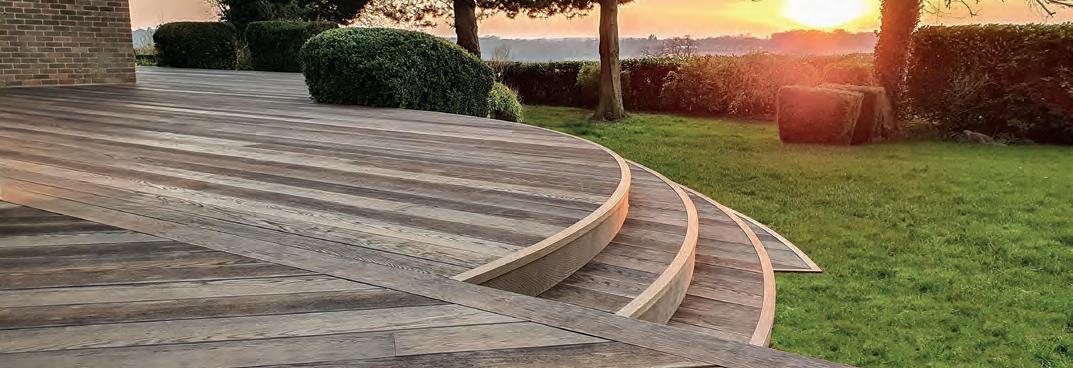
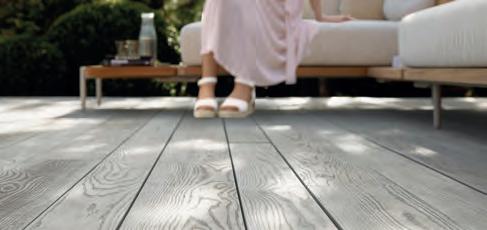
For those who shape the landscapes we live in, every detail tells a story. A curve of decking that draws the eye. A texture that feels right underfoot. A tone that complements the beauty of nature. These are the subtleties that transform an outdoor pace from the everyday to the exceptional – and it’s here that Millboard products make all the difference.
At Millboard, it believes outdoor design is an art form, one that enriches lives by inviting people to step outside and truly enjoy the spaces around them. Its handcrafted decking and cladding collections combine the warmth and character of real wood with the resilience to endure whatever the British weather brings.
The result is beauty that not only inspires at first glance but lasts for decades and invites people to spend time outdoors, together, for years to come.
The beauty of real wood, reinvented
Each Millboard board begins life in a mould taken from carefully selected pieces of the finest real oak. This meticulous process captures the intricate grain etail and organic texture that give products their authentic, timber-like appearance.
The Detail DEFINES A SPACE THAT
Where outdoor design meets lasting beauty
No two boards are ever quite the same – a hallmark of craftsmanship that appeals to designers and customers who appreciate natural variation and depth.
Yet, unlike timber, Millboard products require no sanding, sealing, or staining. They won’t warp, rot, or splinter, ensuring that every project looks as immaculate years later as it did on day one. For landscape architects, garden designers, and contractors alike, it’s the confidence of specifying a product that performs as beautifully as it looks – enabling clients to enjoy outdoor living without the demanding, constant upkeep.
Made in Britain, built for the real world
It’s not simply decking and cladding – it’s the foundation for outdoor living
Proudly designed and manufactured in Britain, every Millboard board reflects a commitment to quality and innovation. Its unique wood-free resin mineral composite is engineered to be highly slip-resistant and exceptionally fade-resistant – proven to stand up to heavy footfall, harsh sunlight, and the inevitable downpour.
Experience the difference
There’s something about Millboard decking and cladding that you have to experience to truly appreciate. The grain beneath your fingertips, the reassuring solidity underfoot, the harmony it brings to a space.
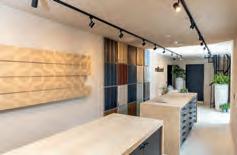
That’s why Millboard offers free samples, giving professionals and clients the opportunity to see, touch and feel the product before they specify. And for a deeper dive into design possibilities, its three Experience Centres across the UK showcase Millboard in full-scale
landscaped settings – the perfect place to explore textures, colours and applications in context.
Because once you’ve experienced Millboard products, you’ll understand it’s not simply decking and cladding – it’s the foundation for outdoor living.
From family gardens to hospitality terraces and public walkways, Millboard products stand up to the elements – and to expectations. It’s this reliability, paired with unmistakable visual appeal, that’s earned the trust of thousands of professionals and delighted customers across the country and the world.
Wherever it’s installed, Millboard products help create spaces people want to linger in – where every detail invites relaxation and connection with the outdoors, from a quiet morning coffee to evenings shared with friends and family.
Designers who demand more Outdoor spaces deserve the same care, quality and creativity as interiors – perhaps even more so. Millboard decking and cladding enables professionals to design without compromise, offering a surface that’s as inspiring to look at as it is to live with.
DISCOVER THE DETAIL THAT DEFINES EVERY SPACE
Visit millboard.com, order a sample, or step into one of our Experience Centres to feel the Millboard difference for yourself.
MEADOW The Secret
HOLLANDGREEN
MEADOW VIEW WILDLIFE GARDEN, OXFORDSHIRE
Imagine stepping out of your back door and into a wildlife meadow straight off the pages of your favourite childhood novel – for this family, it is now a reality, owing to the work of the landscape design team at HollandGreen, which brought the client’s whimsical vision to life, while also fostering a safe haven for the local wildlife.
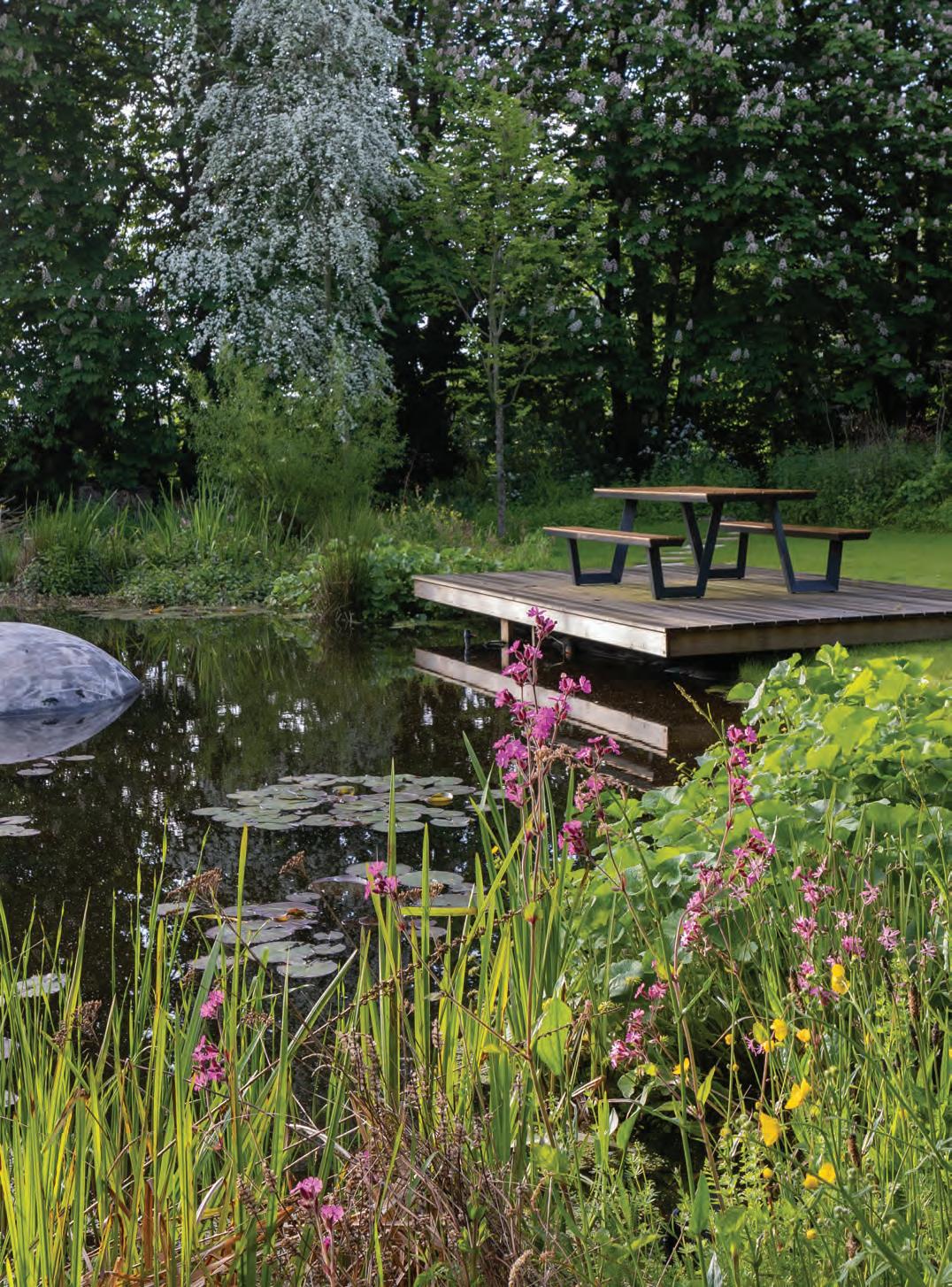
1 The wildlife pond was created from an old clay pit
PROJECT DETAILS
Project value
£200k
Build time 4 months
Size of project 5,700m2 Awards
Pro Landscaper Sustainability & Biodiversity Awards
2023 Domestic Design
Project winner
Tasked with designing a meadow, creating meandering paths through the existing woodland, and transforming an uncovered old clay pit into a natural wildlife pond, HollandGreen adopted a sustainability-led approach from the get-go; collaborating with environmental body, Natural England and a team of ecologists to ensure the end result would not only safeguard the existing habitats, but also enhance them for the local wildlife – which included Great Crested Newts, a protected species in the UK. “Our goal was to work with and enhance the existing site and its ecosystem, conducting extensive research both in-house and with external consultants to understand the site's seasonal cycles. This guided our decision-making, ensuring the garden's design and construction enhanced environmental performance,” says Mark Latchford, director of landscape design at HollandGreen. An in-depth analysis was conducted of the site’s biodiversity, and from there the firm evaluated what systems and materials would be the most sustainable, on top of how to manage the build and planting, while remaining conscious of the established ecosystem. The discovery of the Great Crested Newts on site posed an initial challenge, due to their protected status they required careful handling. To mitigate disturbance and harm, areas of the garden were hand-dug under the supervision of an ecologist, allowing the project to proceed while safeguarding the species.
What was once an overgrown wood is now a beautiful wildlife garden that enriches and contributes to the local ecosystem
PLANTING
• Pinus sylvestris
2 Remnants of an old cottage were incorporated
3 Natural wildlife pond was created from an old clay pit
4 Meandering paths through the woodland
5 Meadow View is a reimagining of a neglected woodland & field
6 The garden is a haven for nature and a tranquil space
7 Wildlife garden that enriches local ecosystem
The site’s greenbelt location also meant all designs and installations were required to be sympathetic to the local landscape. Approval for the work was granted by Natural England, and The Wildlife Trust certified HollandGreen’s ecological processes, with minor adjustments made to the woodland path routes to align with the site's natural setting. Environmental disruption was kept to a minimum when transporting equipment and materials through the aid of a neighbouring farmer, who granted access to the team through his field, as well as protective tracks to prevent damaging the earth beneath.
• Ilex aquifolium
• Fagus sylvatica
Orchard Trees
• Malus domestica 'Elstar'
• Prunus domestica (D/C)
• Pyrus communis (F)
Native hedging
• Cornus sanguinea 'Midwinter Fire'
• Viburnum opulus
• Rubus fruticosus agg.
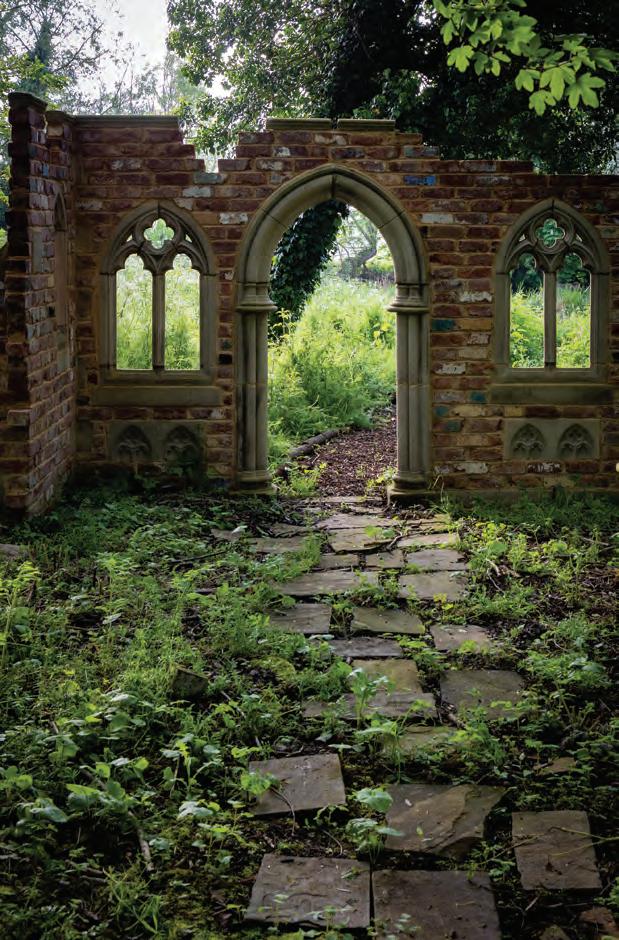
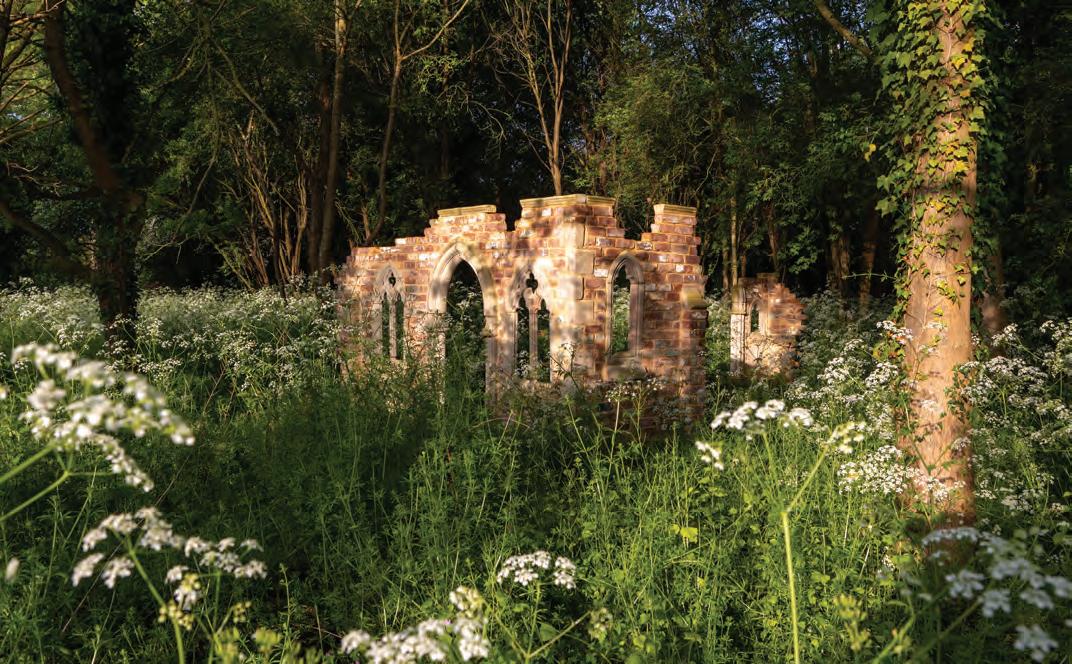
During the project, the team discovered the remnants of an old cottage, which would have been a missed opportunity to exclude from the design: “The ruins were reimagined with a gothic folly, adding a whimsical and magical element to the garden”, says Latchford. Bringing together the meadow’s rewilding and fairytale aesthetic, the ruins are undoubtedly one of the stand-out features of the garden.
To further enhance the site’s biodiversity, excavated material from the pond construction was reused to create hibernacula for reptiles and amphibians, while fallen trees were repurposed into decorative log piles, stumperies, and woodland path edging, enhancing wildlife habitats. The design firm also preserved large areas of cow parsley and nettles to celebrate the garden's natural beauty and biodiversity, using turf cut-offs to create small environments favoured by ants and woodlice.
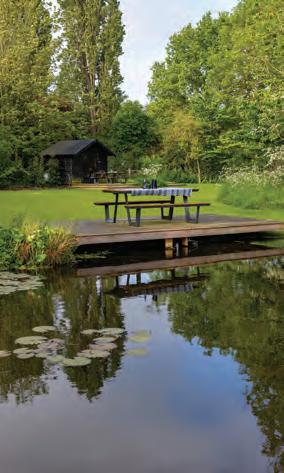
An array of native, evergreen, and deciduous trees were chosen to not only enhance the woodland setting, but also for their wildlife-friendly attributes and suitability to the site’s conditions, in an effort to enhance the woodland setting – adding aesthetic and functional value to the landscape. Multiple seating areas were established on the site to allow the clients to bask in the tranquility of the space HollandGreen created – one of which has been situated atop decking, suspended over the pond, bringing the clients closer to the waterway's naturalistic benefits and beautiful views. The more contemporary elements of the design have either been crafted using wood elements or naturalistic colourings to ensure they blend seamlessly into the established woodland, not only minimising
disturbance to the wildlife, but also ensuring the residents of this whimsical plot are not forced to compromise on the landscape’s established wonder.
“The results are truly a joy. What was once an overgrown wood is now a beautiful wildlife garden
that enriches and contributes to the local ecosystem. The garden has become a haven for nature and a tranquil space for people, with bees, newts, grass snakes, birds, moles, field mice,
butterflies, dragonflies, frogs, bats, and deer all taking residence”, explains Latchford. The clients reached out to HollandGreen to express their gratitude for the project, noting how time seems to slow down in the space, with peacefulness and calm overcoming them. “It’s a garden close to their hearts and to ours”, he adds. From the uncovered ruins and old stone well, to the biodiverse planting and habitat creation, this garden is a fantastical reminder of how people and wildlife can not only co-exist, but also thrive together.
8 Ruins were reimagined into a magical gothic folly
9 Working with the existing site and its ecosystem
HollandGreen is a multidisciplinary design practice comprising architects, interior designers, landscape designers, and project managers. It is renowned for creating beautifully crafted buildings and landscapes, offering a unique, integrated end-to-end service. The practice’s personalised approach ensures each project reflects its clients' distinct needs and tastes, delivering exceptional quality and detail. hollandgreen.co.uk
REFERENCES
Decking Silva Timber Gothic folly Redwood Stone redwoodstone.com
Trees and planting Nederhoff Plants nederhoffplants.nl/en
Pond plants Beaver Plants beaverplants.co.uk
Down the WILDING PATH
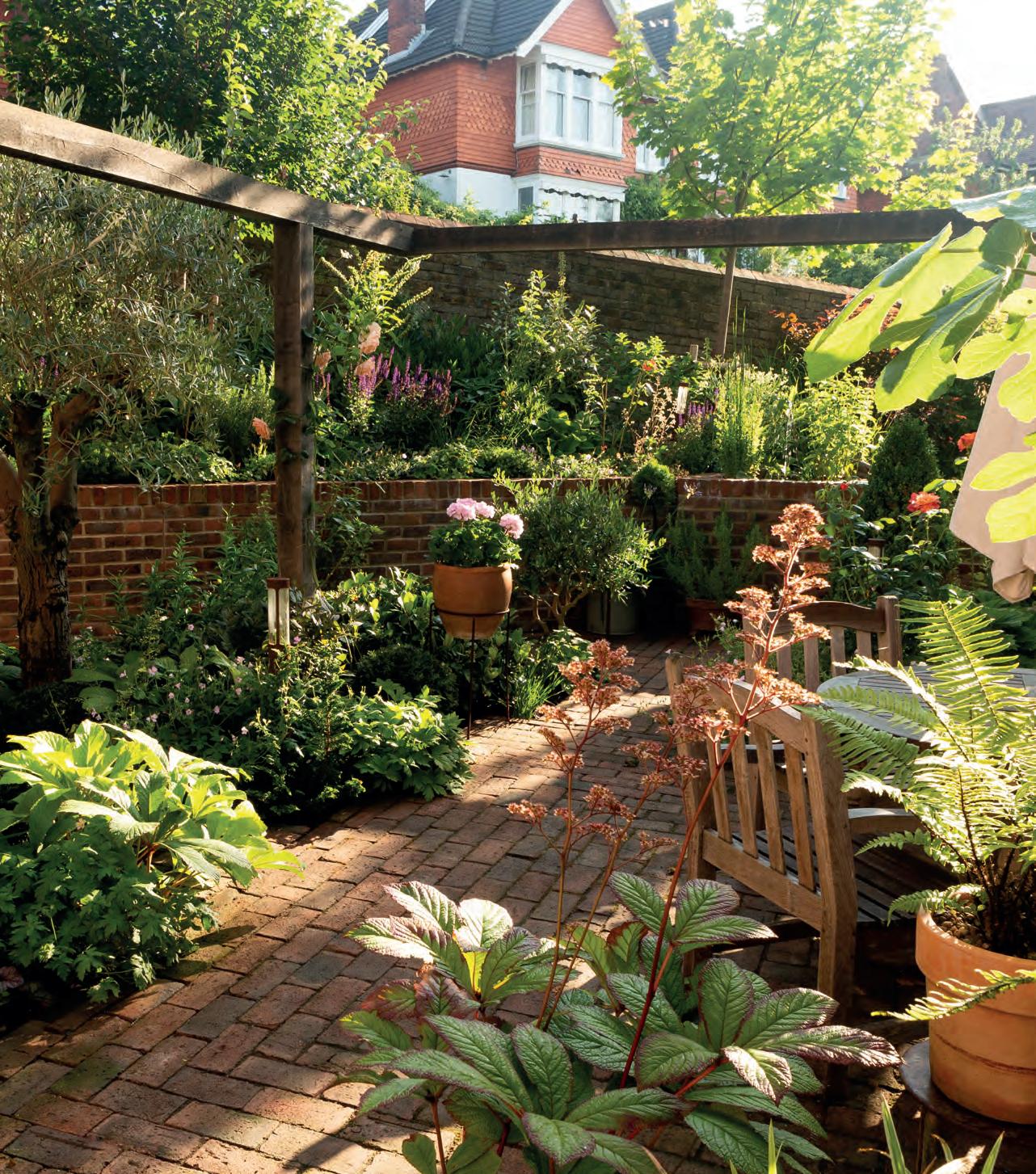
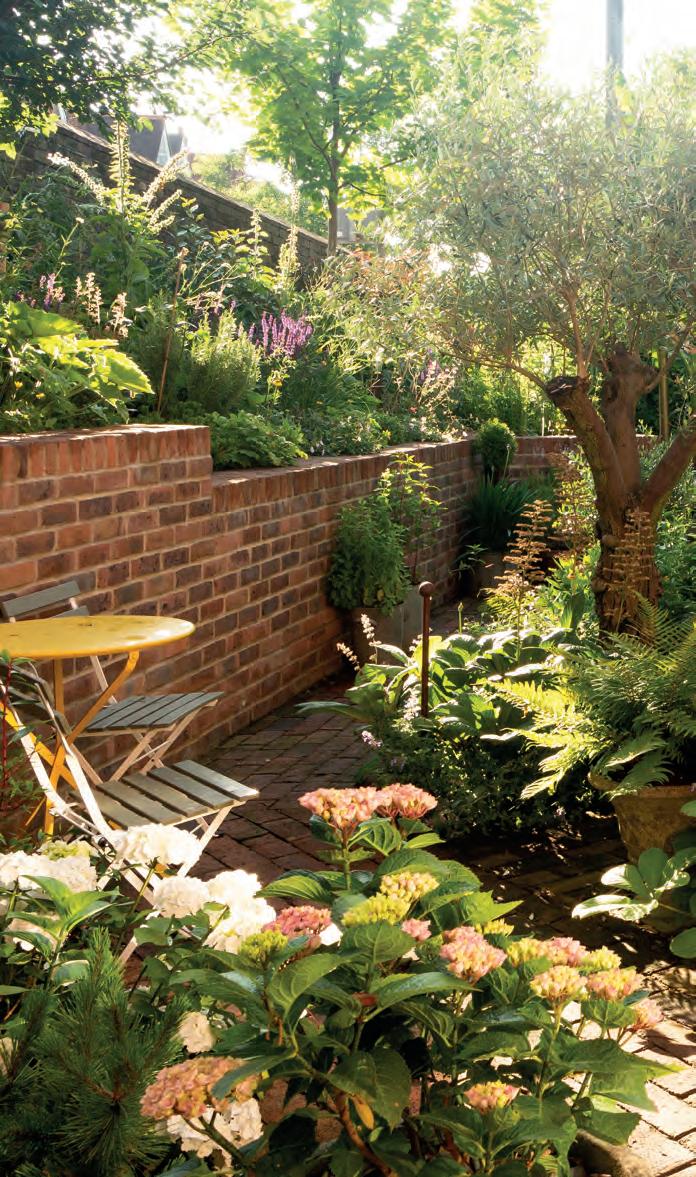
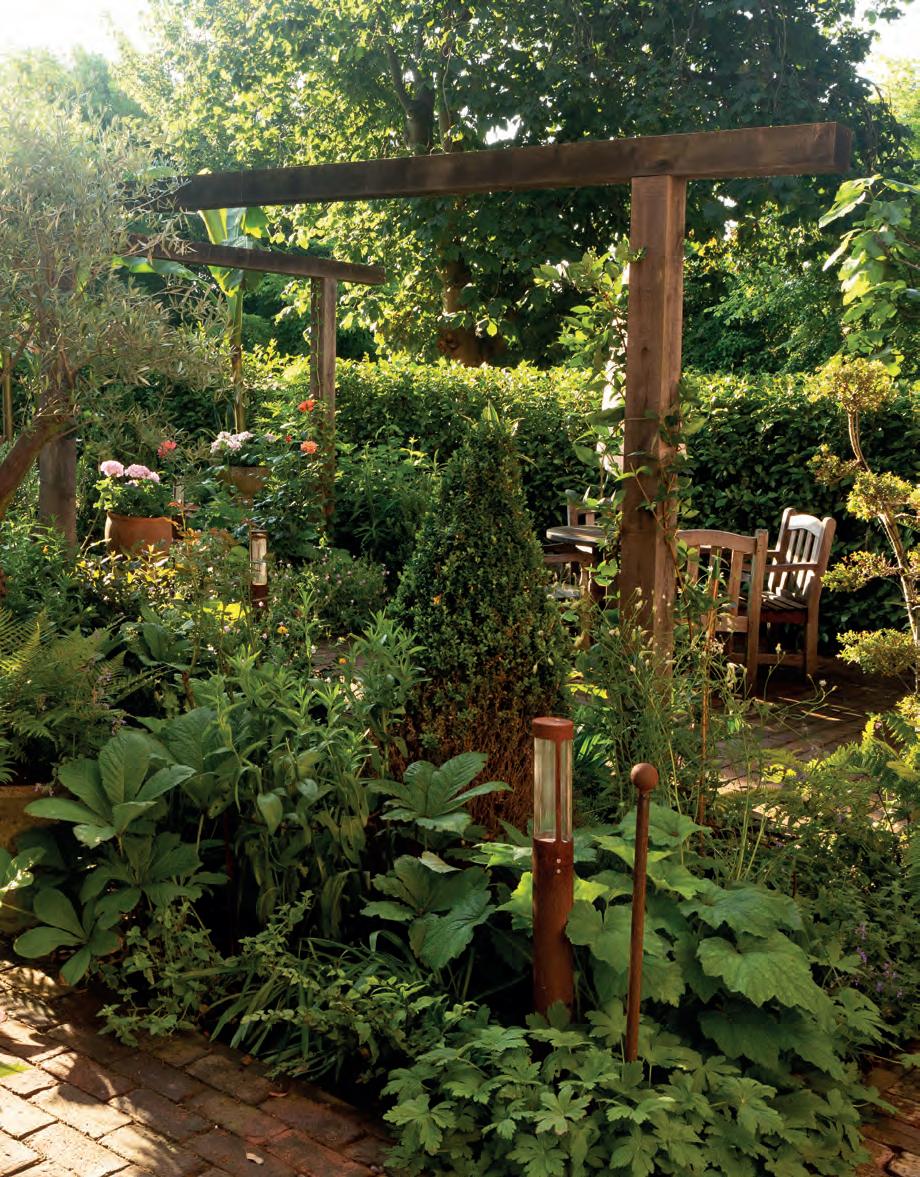
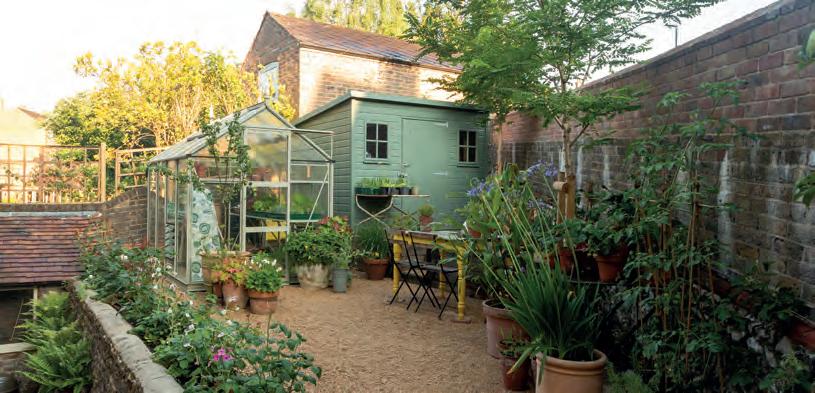
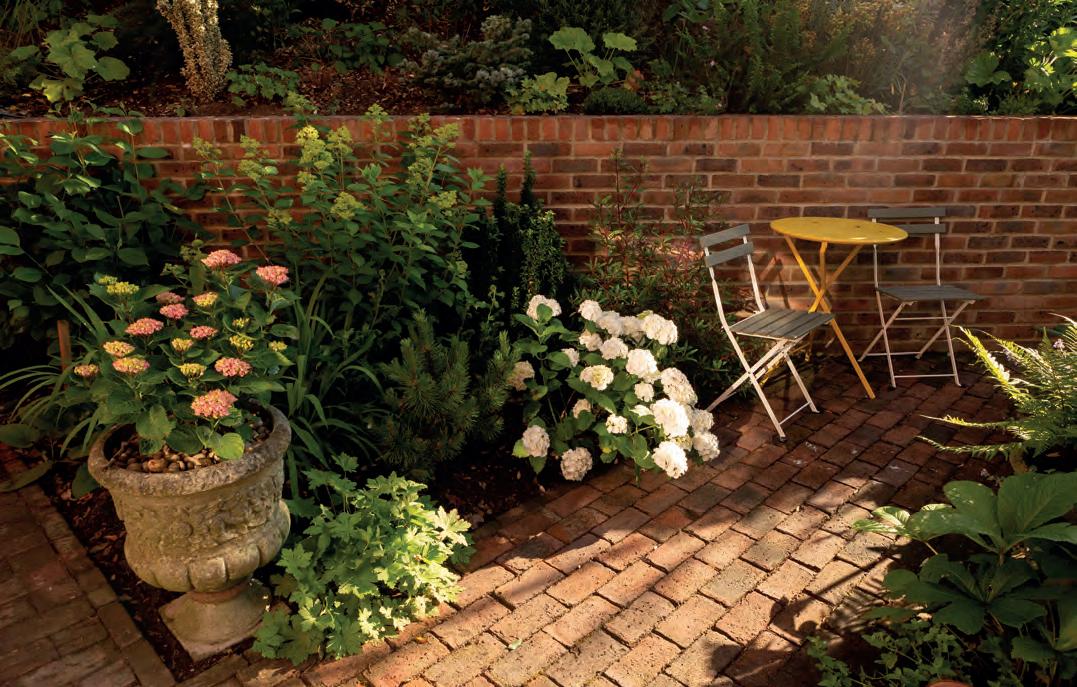
After downsizing to a smaller garden, the clients of this project realised that to get as much of their old garden into the new one they would need to maximise the limited space they had, without hampering its functionality or environmental benefits. The result: a pocket of luscious greenery that not only supports biodiversity, but also the couple’s social calendar.
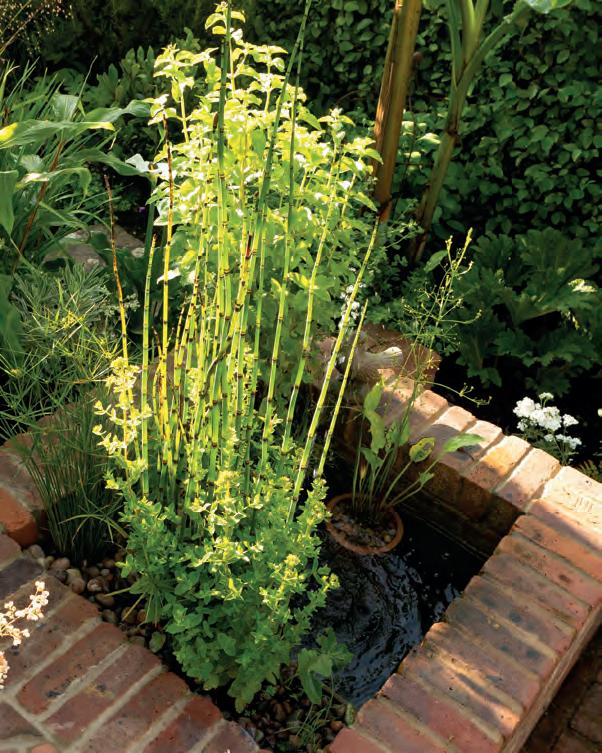
URBAN SANCTUARY
Keen to put their gardening skills to use, the clients worked closely with Nigel Philips, owner of Sussex-based company Nigel Philips Landscape and Garden Design, to design the space – the brief; to incorporate a growing area, space for entertaining up to six people, and a tranquil water feature. Due to the garden’s size and urban location, “texture rather than colour was important”, says Philips, as well as the client’s wish for the space to be adorned with ornaments, including multiple growing pots in varying sizes and materials –from stone to ceramic – that would not only be a focal point of the space but would allow for more greenery to be established throughout.
A gradient of 600mm (about two feet) across the garden was addressed using the cut-and-fill method, allowing the space to be levelled while keeping as much of the soil on site as possible and sustainably redistributing it. However, due to the property’s boundary sitting atop a profile of chalk, which is known for its efficient drainage, the existing soil had a pH of 7.8, putting it in the “slightly alkaline" category, and while various plant species can tolerate slightly alkaline soil, many perform better in a more acidic to neutral pH range, which allows for a more optimal nutrient uptake. Additionally, all borders were mulched heavily with Strulch – a straw-based mulch – to aid in water retention during the growing season. Philips ensured each of the growing beds had easy access from the brick path, which not only optimises the space
The access paths within the garden take many twists and turns to help in disorienting the user and thus helping to disguise the actual size of the garden
The cut-and-fill method refers to the extraction of soil from higher areas of a site. The soil is then redistributed to the lower areas, leveling out the land while minimising the amount of new soil needed, as well as mitigating soil loss.
while keeping soil compaction to a minimum but also allows for the high volume of planting to be contained without losing its naturalistic style – creating an organised rendition of the rewilding style. Philips adds: “The access paths within the garden take many twists and turns to help in disorienting the user and thus helping to disguise the actual size of the garden.”
Brick paving was chosen to ensure the rear garden was cohesive with the front, which eventually became “an integral
PLANTING
Trees
• Acer campestre 'Elsrijk'
• Sorbus pseudohupehensis
• Acer negundo
• Olea europaea (F)
• Musa basjoo
• Magnolia grandiflora
• Pyrus calleryana 'Chanticleer'
Shrubs
• Hydrangea paniculata 'Limelight'
• Hydrangea arborescens 'Annabelle'
• Euphorbia mellifera
• Skimmia japonica
• Pittosporum tobira
• Elaeagnus pungens 'Maculata' (v)
• Physocarpus opulifolius 'Diabolo'
• Salvia rosmarinus (Ro)
Herbaceous perennials
• Euphorbia characias subsp. wulfenii
• Euphorbia amygdaloides var. robbiae
• Dryopteris filix-mas
• Matteuccia struthiopteris
• Hosta 'Frances Williams' (_sieboldiana_) (v)
• L eucanthemum 'Sante'
• Verbena bonariensis
• Echinops ritro L.
• Gunnera manicata Linden ex André
part of the formation of the design structure,” notes Philips.
Much of the main garden, which resides on a lower level to the rest of the space, is primarily shaded by the house and surrounding trees – including an established Tilia × europaea, more commonly known as a lime tree –to work with this Philip’s utilised strong structured leaf shapes through the use of ferns and evergreen species. Much of the garden’s planting is also made up of several species classified by the Royal Horticultural Society (RHS) as ‘RHS Plants for Pollinators,’ including; Skimmia japonica, Elaeagnus pungens 'Maculata' (v),
Salvia rosmarinus (Ro), and several herbaceous perennials; Euphorbia characias subsp. wulfenii, Echinops ritro L., and Verbena bonariensis. To soften the garden’s varying level heights, a hedge of Griselinia littoralis – defined by its potential to reach between four to eight metres in height and ability to grow in chalk-based soil – was planted along the boundary wall.
Chosen by RHS scientists, the list of RHS Plants for Pollinators is made up of various year-round flowering plants that provide nectar and pollen for pollinators. The list was established to tackle the decline in pollinator numbers and to aid gardeners and designers in choosing species that support pollinating insects.
Several cold frames and oak timber raised beds were also installed, with the latter lining the boundary wall, giving the clients optimal space to grow their own produce.
Several seating areas have been established throughout the garden, from two-seaters to fourseaters, allowing the clients to entertain guests in various areas throughout the space, as well as allowing themselves to enjoy the garden at varying times of the day. The timber pergola helped to define the shape of the sitting area.
Now the pair have their own personal pocket of biodiversity, whereby they can continue to hone their gardening skills in a space that remains true to their styles, whilst soaking up the benefits of nature in the company of friends.
ABOUT
Nigel Philips Landscape and Garden design has been trading for over 40 years. The new one-toone service provides clients with a design choice tailored to their garden at a fixed price. Options one and two are for the smaller garden, with option three for the larger garden. All designs are a collaboration with the client and completed within a day.
avid Keegan doesn’t typically take on commercial work.
When the Manchester-based garden designer does, though, it’s where there’s a community-based aspect to it, “where the wider public is going to get to interact with the space” – and the sensory garden at Hollingworth Lake Country Park had this in spades. Rochdale Borough Council had offered its rangers’ previous site to the RSPCA for the charity to open offices and a cafe. So, the rangers were relocated to the adjacent plot of land, where the council also wanted to create a sensory garden for the public.
It approached Keegan to design the new space. He worked with park ranger Adam Clayton throughout the entire process – and is now working on another project with him, to restore a Victorian park in the city centre over the next few years.
Clayton co-ordinates and works with the Green Volunteers, a scheme started by the Rochdale Borough Council in 2007 that enables the community to help care for the park. The volunteers visit Hollingworth Lake Country Park twice a week – which is another reason Keegan was keen to take on the project.
“A lot of the time, with public realm projects, there’s either no budget for maintenance or no forethought for how it’s going to be maintained. But with this one, there’s a team of volunteers who can take the garden forward – to develop it and maintain it so that it can only get better as the years go on.”
When Keegan visited the site for the first time, the prefabricated office had been set up for the rangers and there were a few trees
surrounding the plot, but it was otherwise a blank canvas.
Whilst not a huge plot of land at fewer than 700 m2, Keegan wanted to make it seem bigger by creating a sinuous journey through the garden whilst creating various opportunities for the community to engage in the space and connect to nature through different senses. The rangers’ cabin allowed Keegan the opportunity to create a journey between this and the planting.
As visitors enter the garden, there are separate zones to explore, starting with two areas of wildflowers split by a winding path. This needed to be wide enough and use non-slip materials for wheelchairs to be able to access the garden.
The path leads to Corten steel woven planters where seating has been incorporated to encourage people to sit and enjoy the garden and where flag poles with long flowing ribbons provide the soundtrack.
A metal dome forms the focal point of the garden. The council wanted a structure under which it could run workshops for the local community, and Keegan’s first thought was
to use living willow (Salix) to create this. But the sheer size of the structure would have made this difficult, and so he reached out to an artisan blacksmith sculptor he’d worked with previously, David Freedman, to create one out of metal.
Yorkstone recovered from the site during the groundworks, which had been put to one side, was then used to create the flooring beneath it. The dome is also covered in climbing plants such as honeysuckle, roses and winter jasmine (Jasminum nudiflorum) which, over time, will screen the structure, blending it into the landscape.
There are still willow arches that lead out of the dome which were weaved by Cherry Chong, who now runs her own workshops under the dome. These have been placed over a bark chip path, with a woodland area on one side and an allotment on the other where there are raised beds for growing edible plants that have also been designed with wheelchair users in mind.
This allotment area was meant to be on one flat level; however, as the team started looking into the site, they discovered a large
concrete cover over a manhole. This couldn’t be removed as it was too large, and the inspection chamber lid couldn’t be built on. So, Keegan had to alter the design for this area to make it across two levels.
The entire site had also been used as a dumping ground whilst transforming the RSPCA plot, meaning a lot of rubble and debris had to be cleared and freshly screened soil had to be imported.
Close to the allotment, on the wall of the rangers’ office, is a copper tree
on which people or companies can sponsor a leaf and have it engraved. This is a way of raising money to fund the ongoing planting and maintenance of the garden.
1 Snaking pathways provide interest
2 Woven steel raised beds and inset oak seats
3 Willow arches and steel activity dome
4 Bespoke oak seats inset into raised beds
5 A space friendly to both humans and dogs
6 Bespoke bird bath
The existing planting was carried out by Garden360 UK with the help of the rangers. Fragrant plants such as lavender and rosemary, as well as herbs including mint and thyme, were used. Touch was also considered in the planting scheme, with soft grasses, for instance and Stachys byzantina for its leaves’ fur-like coating.
“One of the things that really gave me a lift when I was up there taking photos one day was overhearing a mother take a piece off one of the herbs, rub it, and tell her son what it was and get him to smell the plants. I thought, ‘that’s exactly what it’s meant to do’. It was seeing the garden in action,” says Keegan.
Native hedging including Crataegus monogyna, Acer campestre, Corylus avellana, Viburnum opulus, Ligustrum vulgare, Rosa canina and Lonicera periclymenum lines the perimeter, benefitting the local wildlife.
There are also bird feeders, bird boxes, bat boxes, insect hotels and other habitats such as wildlife rock piles to encourage biodiversity. “As well as it being a sensory garden for humans, it had to have wildlife front and centre as well.”
Once further funding has been raised, there are plans to add seed dispersal units too. Seeds can be harvested from the surrounding fields, wildflowers and trees for visitors to take and propagate at home and plant in their own gardens.
The garden opened to the public last June but will continue to be adapted and evolved, with something for all the senses to enjoy.
David Keegan is an international, national and regional award-winning garden and landscape designer. His design philosophy centres on a naturalistic planting style. Keegan's garden design projects are located around the UK, in Manchester, Cheshire, Derbyshire, Lancashire and the north-west of England. dkgardendesign.co.uk
REFERENCES
General works Green Volunteers rochdale.gov.uk
Soft landscaper Garden360 UK mygarden360.com
Topsoil Drapers rdraperltd.co.uk
Dome sculpture and bird feeders David Freedman davidfreedman sculpture.com
Living willow arches Cherry Chung cherrychung.com
Oak seating and raised beds Woodblocx woodblocx.co.uk
Metal edging, Corten steel planters Steel Landscaping Co steellandscapingco.co.uk
Wildflowers
Pictorial Meadows pictorialmeadows.co.uk
Plants
Bespoke Garden Elements Ltd
Mulch
Grant Hartley Soil
Bark chippings, stone pathways, Breedon Aggregates Golden Gravel (supply and install)
J A Cryer Excavation & Groundwork Contractors Ltd
INSIDE OUTBringing the
KATERINA KANTALIS
BALHAM COURTYARD
PROJECT DETAILS
From the moment
Katerina Kantalis stepped into her client’s house, the family’s personality and love of colour was obvious. She notes that the family “loved” design and “hated” the colour white – imagine her surprise then, when she opened the bifold doors to find an outdoor space that did not share the same vibrant intricacies nor textual intrigue. With an expansive open kitchen and dining area leading directly to the garden, Kantalis knew from the offset that nothing short of the same personality on display throughout the property would do:
“The aim was to treat the space as an ‘outdoor room’, producing a scheme and palette as if it were an interiors project. Although it’s a small garden, there was so much that we could do.”
Kantalis and the team set about removing everything they didn’t need from the garden, including the existing raised beds, sandstone paving and artificial grass, as well as the seating and slatted fencing to the rear of the space –already established Trachelospermum jasminoides plants and a small garden shed were retained and integrated into the new design. Kantalis notes that it was “essential” to establish a natural yet contemporary aesthetic to ensure a smooth transition from the kitchen and dining area through to the courtyard.
The modernised aesthetic was achieved in part through a two-tiered design – the division of space through different levels helps to elevate the limited space, adding both depth and interest: “This approach created a sense of journey in the small space,” adds Kantalis. She explains that the outdoor seating was positioned on the upper level to “maximise the sunniest area” of the garden, while the lower level served functional needs, accommodating the bifold doors and housing the existing shed. The two terraced zones were treated as individual spaces, both rounded off with two rows of clay bricks cut into triangular points to “create an interesting finish.” A “diverse” range of hard landscaping materials, from the clay bricks to limestone stackers, were chosen for the project to bring in both texture and colour variation – again, taking the approach of an ‘interiors project’, with the limestone stackers laid across in a herringbone pattern, adding depth and intrigue to the limited space – "the flooring was designed to mimic a stylish outdoor rug effect," Kantalis adds.
“Lighting played a pivotal role in enhancing the ambience of this garden. We selected statement lights to make a lasting impression. Instead of conventional options, we chose elegant wall lights that seamlessly integrate into the garden's design, serving as both functional and aesthetic elements.”
Katerina Kantalis
Inspired by the client’s existing decor, Kantalis adopted a bold colour palette of pinks and greens to create a harmonious flow from the interior to the exterior – adding warmth to the space and to distract from the garden’s north-facing position.
After repairing the existing wall to the left-hand side, a new layer of render was added and painted in a warm terracotta tone. The decorative tiles were then brought in to “create interest on the wall” –positioned in the centre of each terraced space, leaving space for wall lights to be added in later.
At the rear of the garden, a new wall was established to create a stronger boundary in the space – a bold forest green colour was chosen to not only echo the kitchen’s palette, but to also cool down the space’s warmer colours – “the green complements the Trachelospermum jasminoides and neighbouring Prunus laurocerasus,” creating a “beautiful backdrop” to the planting scheme. This green is carried through to the short raised beds, as well as the existing shed.
1 Peeking through planting at the cosy seating
2 An overview of the garden
3 From warm terracotta to calming forest green
4 Decorative wall tiles and Cyathea cooperi
5 Structural planting: Crocosmia 'Emily McKenzie'
6 Rudbeckia 'Rudy Mini Yellow Black'
This garden proved that even in a small space, there’s endless potential to create something both natural and contemporary
Kantalis opted for an architectural planting scheme, consisting of primarily shade tolerant species and colourings that unify the space, these include;
• Acer palmatum ‘Summer Gold’, adding height and structure to the space, with its golden colour tone echoing the new pergola.
• Sphaeropteris cooperi, a tree fern that with time will grow and bring in architectural interest, “without being too imposing” –its slender nature makes it optimal for a smaller space.
• Dryopteris erythosora, a striking fern which starts off with copperyred fronds when young and slowly matures to dark green, tying in the colour tones of the garden.
• Crocosmia × crocosmiiflora 'Emily McKenzie', Kantalis notes the client’s love for warm colours made crocosmia the “perfect plant to add to the scheme”, bringing height with its arching stems and bright orange flowers.
• Rudbeckia Rudy Mini Yellow Black (Rudy Mini Series), chosen not only for their pompom variety Rudbeckia with masses of double flowers, but also for their colour scheme.
• Carex testacea, chosen to bring in softness and movement to the scheme, this species of grass offers pendulous clumps of attractive orange-bronze to green foliage which will provide changing seasonal intrigue throughout the year.
• Ligularia dentata 'Pandora', Kantalis says this plant was chosen for a multitude of reasons; it offers something “different” to both the clients and the garden. Its tall-stemmed canopy of orange-yellow daisy-like flowers are suited for shady positions.
• Heucherella 'Tapestry', chosen to complement and offset the Ligularia, this species brings a brightly coloured frontline of foliage to the planting bed.
The aim was to treat the space as an ‘outdoor room’, producing a scheme and palette as if it were an interiors project
Utilising existing and new terracotta pots allowed Kantalis to position them throughout the courtyard to help bring in new planting and a “less intrusive garden layout”. She and the team created a bespoke, curved planting bed low to the ground that provided ample space to plant an Acer – also
commonly known as a maple tree – to balance out the already established planting.
To tie the design together, Kantalis and the team created a bespoke pergola to add a focal point and height to the garden, framing the space and drawing
the eye upward – “it beautifully frames the neighbouring Prunus laurocerasus, so rather than the species being an imposing entity, as it was before, now with the pergola, it feels as if it’s been blended into the background, allowing your eye to be drawn to the pergola and then the courtyard space itself.”
Ultimately, a functional but aesthetic courtyard that remained true to the client’s tastes was created.
“This garden proved that even in a small space, there’s endless potential to create something both natural and contemporary – size doesn’t and shouldn’t limit the impact!”
Limestone stackers Mandarin Stone mandarinstone.com
Decorative tiles Ca’Pietra capietra.com
Lighting Corston Lights corston.com
Furniture John Lewis johnlewis.com
ABOUT
Kantalis’ approach to garden design combines the interplay of subtle curves with geometric patterns. Inspired by Mediterranean landscapes her designs integrate permeable materials and emphasise texture and pattern, incorporating vibrant colours. Kantalis’ preference is for the hard landscape elements in a design to be uncomplicated, utilising clean lines to create fluidity and movement within the garden. katerinakantalis.co.uk
THE GARDEN BEFORE
PROJECT DETAILS
Project
CONSILIUM HORTUS
MAKEOVER Me diterranean
CONTEMPORARY CAMBRIDGE GARDEN 1 Stylish Mediterranean-inspired garden, perfect for relaxation and entertaining 2 Striking sculptural tree in statement planter
The team at Consilium Hortus are no strangers to creating high-end spaces, and this contemporary garden in Cambridge was no exception. The brief called for a multifunctional outdoor space that echoed the modern architecture of the property while maintaining the softer, natural elements of the garden. With a contemporary design already established in the property, Consilium Hortus had the perfect canvas to extend this theme into the garden, creating a cohesive and harmonious flow between the indoor and outdoor environments.
The client desired a garden that would not only serve as a place of beauty but also as a hub for entertainment, dining, cooking, and relaxation. With a design brief that included the creation of several spacious patio areas, which would serve as versatile zones for hosting guests, these patios needed to be large enough to accommodate both intimate family gatherings and larger social events, ensuring flexibility in their use. Pathways were thoughtfully laid out to lead guests naturally from one area to another.
To bring the concept to life, the team developed mood boards that captured the overall aesthetic and ambience of the garden. Consilium Hortus director, Sam Moore, notes how these boards were “instrumental in conveying the desired look and feel”, allowing the client to visualise the finished space, from the materials and planting down to the colours and textures. A key feature requested by the client was the inclusion of a fireplace, which would not only provide warmth during cooler evenings but also act as a striking focal point. “The fireplace was designed to complement the modern aesthetic, incorporating clean lines
PLANTING
• Agapanthus 'Charlotte'PBR
• L avandula
• Calamintha nepeta 'Marvelette Blue'
• Pennisetum advena
• Verbena officinalis
• Salvia officinalis
• Anemanthele lessoniana
• Deschampsia cespitosa
• Pinus sylvestris
• Taxus baccata
• Prunus laurocerasus
and contemporary materials, while also offering a cosy atmosphere that invites conversation and connection,” says Moore. The overall garden layout has been designed to enhance the functionality and visual appeal of the space; “ultimately the goal was to create a garden that offered the clients a space that is as practical as it is visually appealing, perfectly suited to their lifestyle and tastes.”
The client sought to infuse the timeless charm and tranquillity of a Mediterranean landscape, to achieve this vision, a range of plant species was carefully selected to evoke the warm, sun-drenched ambience characteristic of Mediterranean gardens, while
also ensuring that the plants would thrive in the local climate. One of the stand-out features of the planting scheme is the Pinus mugo, a hardy dense pine; its bushy form adds texture and structure to the garden, while its evergreen nature ensures that the garden retains its lush, green appearance year-round, providing a strong visual foundation.
At the heart of the garden also stands a majestic Olea europaea (F), a quintessential symbol of the Mediterranean. “This feature tree not only serves as a striking focal point but also brings an authentic Mediterranean essence to the space,” comments Moore. “Its silvery leaves and gnarled trunk add both
beauty and character, creating a sense of age and permanence that anchors the design.”
To complement the structural elements, Consilium Hortus introduced a variety of flowering plants that contribute to the garden’s colour palette and sensory appeal, including Salvia and Verbena, for their vibrant purple and blue blooms, which bring bursts of colour that attract pollinators, adding life and movement to the space. For ground cover and to enhance the Mediterranean feel, Calamintha was planted – a fragrant herb that releases a pleasant minty aroma when brushed against. Its delicate white flowers further contribute to the garden’s light and airy atmosphere, while also helping to suppress weeds and reduce maintenance.
Ultimately the goal was to create a garden that offered the clients a space that is as practical as it is visually appealing, perfectly suited to their lifestyle and tastes
ensure privacy and create a sense of seclusion; “this evergreen hedge serves to screen the existing fencing, softening the boundaries of the space and enhancing the overall aesthetic. The dense foliage of the Taxus provides an effective barrier, both visually and acoustically, contributing to a peaceful and private retreat.” Moore adds that overall, the planting scheme “successfully captures the essence of a Mediterranean garden, combining beauty, structure, and functionality to create a space that is both inviting and serene”.
3 Private, tranquil garden retreat
4 Natural textures, soft lavender and wooden shed
5 Relaxing entertaining area with view to garden
Mature Taxus hedging was planted around the perimeter of the garden to
6 View of garden and home
7 Tall, textured planters add bold statement
Throughout the project, several periods of heavy rainfall posed a challenge in maintaining the work’s quality as excess moisture can affect everything from stability of the foundations to the handling of materials like soil and concrete. To address this, the team implemented measures to protect the site, including temporary drainage solutions to manage water accumulation. Another obstacle for the team came in the form of accessibility to the garden – with limited entry points to the space posing a challenge. “This restriction meant that every aspect of the project, from the delivery of materials to the movement of machinery, had to be meticulously coordinated.”
Larger materials such as mature trees and paving stones had to be transported in smaller quantities – this with the challenging weather conditions ultimately led to a longer build time. Moore says
despite this, “the experience underscored the importance of adaptability and teamwork, as the success of the project depended on our ability to respond to unforeseen challenges without compromising the client’s vision.”
The garden seen today is the result of a meticulous and collaborative design process that involved close communication and cooperation with the client. “From the initial concepts to the final execution, we worked hand in hand with the client to ensure that their vision was fully realised. It is a testament to the dedication and resilience of everyone involved.”
8 Formal dining area complementing style of home
9 Herringbone brick pattern meets soft lavender
10 Perfect for cosy gatherings and al fresco dining
ABOUT
Consilium Hortus is an Essex-based innovative garden designer team working in East Anglia and London, offering bespoke garden design packages to create stunning gardens that perfectly match the client’s brief and vision. Whether the client needs a design that they wish to implement themselves, or they want a complete garden delivered by the team, Consilium Hortus can help. consiliumhortus.co.uk
REFERENCES
Contractor JPB Landscapes jpblandscapes.co.uk
Paving London Stone londonstone.co.uk
Planting Practical Plants practical-plants.co.uk
Planters Torc Pots torcpots.com
Irrigation Landscapeplus landscapeplus.com
PROJECT DETAILS
Project value
£1.7m
Build time
7 months
Size of project
Approx. 2 acres
Greenwich Park, part of Maritime Greenwich UNESCO World Heritage Site, has long been a place where history, nature, and culture meet. Home to the Prime Meridian Line, the Royal Observatory, and the iconic General Wolfe Statue views, this Grade I Listed landscape is not just a park, it is a living archive of 590 years of heritage. However, as visitor numbers grew and time took its toll, the park began to show the strain. The 17th-century landscape had become eroded, the trees lining its historic avenues were failing, and its infrastructure was under increasing pressure.
Recognising the need for restoration, the four-year, £12m Greenwich Park Revealed project was launched to restore, protect, share, and enhance this historic natural landscape for future generations. The charity, which manages London's eight Royal Parks, has funded the project alongside a grant from the ‘Parks for People’ programme, funded by The National Lottery Heritage Fund and Community Fund, thanks to National Lottery players.
Blakedown Landscapes was entrusted
ROYAL Res t ora t ion
BLAKEDOWN LANDSCAPES
GREENWICH PARK REVEALED
with four critical work packages as part of Phase 2: the Grand Ascent and Parterre Banks, the General Wolfe Public Realm, the Pavilion Café, and Blackheath Gate. Each presented unique challenges, demanding both technical expertise and a respect for the park’s history and ecological significance.
From tender to construction, Blakedown worked closely with the client, The Royal Parks charity, and design team to ensure functionality, providing expertise and guidance that helped the project evolve in response to challenges. Throughout the project, Blakedown collaborated with the client and project team to navigate multiple adjustments to the original design, driven by onsite challenges. By
working together to find effective solutions, it ensured a smooth and efficient construction process, leading to a successful outcome. Supporting and protecting the park's rare habitats was key and involved working closely with The Royal Parks’ ecology experts throughout.
1 The transformed public realm surrounding the
2
General Wolfe Statue
York stone paving, General Wolfe Statue
The Grand Ascent
One of the most ambitious aspects of Blakedown’s scope was the restoration of the Grand Ascent, a feature central to the 17th-century formal landscape. This task required not only an understanding of the historical remnants and their archaeological value but also an innovative approach to modern challenges. Using historic drawings as a blueprint, Blakedown undertook the complex task of re-profiling the slopes, stabilising the banks, and planting a new avenue of trees.
The scale of the earthworks was considerable, requiring over 1,500 dumper loads of soil to be relocated. Preserving the integrity of the site while achieving this was a delicate balancing act.
Additionally, Blakedown collaborated closely with The Royal Parks’ soil scientist to develop a strategy to prevent compaction and maintain soil integrity. This included rotavating the vegetation layer before separating and storing topsoil to ensure it could be respread. This adaptive approach was not only approved by the client’s soil consultant but also proved to be a cost-effective solution, aligning with environmental sustainability
The Parterre Banks
The restoration of the Parterre Banks in the Queen’s Field was another key aspect of the project that required a blend of historical knowledge and technical expertise. Years of heavy foot traffic had eroded the banks, necessitating careful re-definition and restoration. The large cut-and-fill operation required the relocation of around 5,000m3 of earth to reinstate the original form of the banks.
Achieving the correct lines and levels was a precise operation. While modern lasers and GPS technology played a role, Blakedown’s experienced operatives also relied on their trained eyes to ensure a natural, historically accurate finish.
A particularly innovative challenge arose when the original specification stipulated the reuse of 7,000m2 of existing turf for the Parterre Banks. Blakedown recognised that this approach would not achieve the desired outcome, presenting logistical issues with turf
storage and maintenance and in response, proposed an alternative solution: rotavating the seed bed into the topsoil layer and storing it to be respread later. Additionally, Blakedown worked closely with the supplier to develop a unique seed blend that matched the existing turf. This innovative solution not only successfully reused the surface but also saved costs.
General Wolfe Statue public realm
The transformation of the public realm around the Grade II listed General Wolfe statue
required a blend of functionality, aesthetics, and sustainability. A major innovation was the incorporation of a sophisticated attenuation sub-system – permeable paving over a sustainable urban drainage system – beneath the central section of the platform. Blakedown worked closely with the supplier to develop a bespoke jointing mix to accommodate water volumes effectively. The design includes a series of geo cellular crates beneath the surface to create an underground void to detain stormwater effectively.
Additionally, complex hard landscaping was carried out to extend the area in front of the statue - preserving 600m2 of Yorkstone while integrating over 600m2 of new setts and paving to create a seamless blend of old and new. The viewing platform's steps were refurbished to ensure safe access and new retaining and seating walls were constructed from Portland stone finished with Ashlar cladding. To finish, a glass balustrade was added along the platform’s edge, balancing safety with uninterrupted views
Pavilion Café and Blackheath Gate
The Pavilion Café is a popular area within Greenwich Park, and Blakedown’s work here focused on improving the visitor experience. New seating areas, resurfaced pathways, and ornamental planting were introduced to make the space more inviting. Additionally,
power and water services were extended to the northern paved area, ensuring the café could better serve the park’s growing number of visitors
3 The restored Grand Ascent
4 The General Wolfe viewing platform with glass balustrade giving uninterrupted views
5 New lime tree avenues at General Wolfe Statue
6 The Pavilion Café
Meanwhile, Blackheath Gate, a major entrance to the park, was given a refreshed landscape treatment to welcome visitors to the park. Existing hardstanding was removed through hand excavation to protect retained trees, kerbs were realigned, and additional cycle stands were installed to promote sustainable transport. The existing tree lines were extended up to the entrance creating more green space. These
interventions had a significant impact on improving access while reinforcing the grandeur of Blackheath Gate’s entrance.
Innovation and collaboration
Throughout the project, Blakedown faced a range of challenges that required swift responses, technical expertise, and collaboration. For example, the project faced a key challenge when heavy rainfall threatened to
delay progress. The initial stabilisation method for the Grand Ascent via hydroseeding was rendered ineffective by severe soil erosion caused by the intense weather. In response, and recognising the need for a more resilient solution, Blakedown, in discussion with the client, agreed the use of turf instead of hydroseeding. This decision proved successful, providing long-term stability and ensuring the Grand Ascent’s structural integrity for generations. To further reinforce the structure, Geogrid stabilisation and Geotextile Anchors were installed within anchor trenches spanning the top, middle, and bottom sections of the steps.
Other challenges included sourcing the correct ericaceous soil for the Parterre Banks which proved difficult, as many suppliers were unable to meet the required specifications. But through close collaboration with Bury Hill, Blakedown was able to source the perfect soil blend, tailored to the park’s needs.
Taking into account the ecology of the historic landscape was vital and Blakedown worked with The Royal Parks charity’s biodiversity team to ensure the conservation of species ahead of works and ensure no damage to the rare habitat.
Archaeology also played a significant role in the
project, with each excavation area requiring careful monitoring to protect the site’s historical integrity. Blakedown took a proactive approach, working with The Royal Parks’ in-house archaeologist and asking for him to be on-site more frequently than initially planned, which allowed for timely assessments and reduced the need for extensive earth stockpiles. Both ecology and archaeology considerations ensured there was no potential damage to any of the history underneath the landscape.
A lasting legacy
Greenwich Park Revealed is more than a restoration project; it is a commitment to preserving a landscape of historical, cultural, and ecological significance. The successful delivery of these works reflects the expertise, adaptability, and collaborative spirit of everyone involved. By balancing heritage conservation with modern landscape techniques, Blakedown has helped to ensure that Greenwich Park remains an enduring landmark for future generations to enjoy.
7 Perimeter walls – concrete block with steel fixings
8 Top soil handling – Grand Ascent
ABOUT
Blakedown Landscapes is an award-winning landscaping and civil engineering specialist delivering high quality projects throughout the UK. With over five decades of experience, its extensive knowledge spans all sectors including local authorities, royal parks, commercial developers, educational facilities and historic park restorations. Its team of highly skilled in-house experts works collaboratively with clients offering best practice advice and innovative value engineering solutions to ensure the optimal outcome for every project. blakedown.co.uk
REFERENCES
Client and landscape architect The Royal Parks royalparks.org.uk
Bury Hill Landscape Supplies buryhilltopsoil andlogs.co.uk
GEOMETRIC urban living
TOM HOWARD GARDEN DESIGN & LANDSCAPING
ASTONVILLE STREET
PROJECT DETAILS
Size of project 46 m²
Project value
£42,748.13 (excl. VAT)
Build time 5 weeks Awards
Pro Landscaper
Project Awards 2024 Design and Build Under
£50,000 winner
What began as your average small urban garden in a terraced street, offering little inspiration, is now a contemporary outdoor sanctuary designed for entertaining, relaxing, and year-round enjoyment. After completing a striking kitchen extension with bifold doors opening out into the garden, it became clear to the owners that their outdoor space didn’t reflect the same level of personal expression nor functionality as their home. Founder and owner of Tom Howard Garden Design & Landscaping, Tom Howard recalls the most
prominent focal point of the original space being a small shed to the back left of the garden. He and the team were presented with a clear brief to create a low maintenance yet high impact garden that complemented the home’s modern interior design. Priorities for the space included an outdoor kitchen, integrated storage, comfortable seating areas and the creation of different zones to capitalise on the garden’s limited space.
As it was, the garden was seldom used and underwhelming, with the owners were keen to remove the existing patchy lawn and create a space that they could enjoy looking at from the kitchen. To maintain visual continuity to the internal flooring, which was sleek grey tiles, large-format thick stone slabs were laid throughout the space – made from 100% natural materials and fully recyclable. In order to define the intended zones without overwhelming the space, different size slabs were used for the varying areas; small format setts for the upper area, 400x800mm slabs for the main terrace and 1200x600x70mm slabs for the floating steps. Howard says using the same material throughout “helped create an airier feel without cluttering the garden”.
In a small garden details are key,
as everything is very much on display, so it was very important to have a high level of finish on this garden
The floating steps, which Howard says are a “triumph” are intentionally laid off-centre, with planting used to soften the geometry to create the illusion of a larger floating upper terrace, are now a standout feature in the space that allow for an elegant transition between levels.
The existing fencing was kept and painted black to also help create a larger space – “allowing the fences to recede and the planting to pop”, says Howard, who adds that to break the fencing up visually, cladding was added to part of the lower area with vertical mixed width Meranti battens. The fencing is further broken up with bold yellow and black tiles which work as the backsplash for the outdoor kitchen area. Howard says this design choice was made with aesthetic in mind more than anything else.
To continue the ‘floating’ aesthetic, even the lower dining bench was cantilevered from the
raised bed using angle iron, and the BBQ unit’s cupboard doors were also designed to ‘float’. All tiles and cladding have been mitred along the edges, with matching grout colour to the stone used to ensure the lines are hidden; “in a small garden details are key, as everything is very much on display, so it was very important to have a high level of finish on this garden.”
PLANTING
• Geum
• Rudbeckia
• Salvia
• Nepeta
• Geranium
• Malus 'Evereste'
• Pleached Hornbeam
The garden now has two established seating areas; one for dining adjacent to the outdoor kitchen and another for relaxing on the elevated platform towards the back. Both areas' colourways pair with the surrounding space’s palette to avoid pops of colour overwhelming the space. Howard says: “One would expect the garden to feel cluttered with so much happening, but it is the exact opposite – it has a wonderful sense of space that still allows for generous planting areas.”
Upon first glance, it’s hard to imagine this garden belonging to anyone but avid green thumbs. But at the owner's request Howard and the team ensured all planting was low maintenance but high impact. Plant selection was carefully considered to complement the yellow accent of the Bert & May tiles, with yellow Geum and Rudbeckia providing seasonal progression, and Salvia, Nepeta, Geraniums in complementary purple.
The existing apple tree was relocated to the front garden, and replaced with a multi-stem Crab Apple and three pleached Hornbeams to give height and privacy to the space. The garden’s existing sandy loam soil was of good quality and thus excavated and reused for the raised beds, with spent mushroom compost added to support fertilisation and plant growth.
By combining clean architectural lines, a restrained material palette, carefully curated planting, and thoughtful detailing, Howard and the team have been able to create a multifunctional garden that not only looks impressive from inside the house but also offers a versatile and inviting outdoor retreat.
7 The garden in late summer
8 Planting colour palette of yellow, purple and greens
Tom Howard Garden Design is a small, specialist garden design and build company that works mainly in the high-end residential sector. We work closely with our clients to understand their vision, lifestyle, and practical needs. Whether it’s a sanctuary for relaxation, a vibrant botanical paradise, or a dynamic entertainment area, we bring ideas to life with creativity, originality and flair. tomhowardgardens.co.uk
REFERENCES
Paving Schellevis schellevis.nl
Tiles Bert & May bertandmay.com
Drainage ACO aco.co.uk
Plants Creepers creepersnursery.co.uk
JPB Landscapes returned to this client’s garden with a brief to create a raised decking area that would house a hot tub and seating area overlooking the picturesque Essex countryside – as well as a play area for the client’s grandchildren to enjoy, designed by Green Eye Garden Design.
PROJECT DETAILS
Project value
£47,874.63 Exc. VAT Build time 6 weeks Size of project 180m2 Awards
Pro Landscaper
Project Awards 2024 Build Under
£50,000 winner
On the UPWARD SLOPE
COOKS HALL BARN
JPB LANDSCAPES LTD
Due to the garden's natural slope, careful consideration was given to the space’s design to ensure each area flowed together, while also complementing the surrounding landscape. The homeowners were keen to include planting within the raised area, and to add visual intrigue to the existing cladding on the rear of the garage to add a pop of colour; achieved through the installation of a living wall.
Instead of fighting against the slope, a bespoke oak sleeper seating area was installed to work with the natural decline – with additional space for
a new fire pit feature to be added at a later date. It was important to both JPB Landscapes and the clients that the garden have a natural flow, and most importantly not look like a stage propped up in the middle of a countryside garden. So as not to create disparity between each of the varying areas, complementary or similar oak wood tones were used throughout the build, from the children’s play area and its border to the newly laid decking and existing border fence. It was also important to both the owners and JPB Landscapes that all new work blended seamlessly
PLANTING
(MAIN BEDS)
• Anemanthele lessoniana
• Uncinia rubra ‘Everflame’
• Phormium ‘Platts Black’
• Heuchera ‘Plum Pudding’
• Agastache ‘Blue Fortune’
• Pittosporum tenuifolium ‘Tom Thumb’
PLANTING (LIVING WALL)
• Dryopteris erythrosora
• Dryopteris affinis ‘Cristata’
• Carex testacea
• Festuca glauca ‘Elijah Blue’
• Liriope muscari
with the existing garden previously established by JPB Landscapes –achieved through complementary planting and zone creation.
The children’s play area, akin to a pocket-sized playground –complete with its own rubber chippings – was created using natural oak sleeper borders and includes a miniature slide, a swing set, and an aeroplane swing, laid into the garden’s natural slope to create the illusion it is taking off. Due to the low level of rainfall in the area, JPB Landscapes opted for a drought-tolerant planting scheme to minimise
watering requirements, opting for several grass species, from Anemanthele lessoniana to Uncinia rubra Everflame, as well as a range of perennials, including Lavandula stoechas and Thymus 'Silver Queen' (v). The planting mix was chosen for its combined ability to flower throughout much of the year, providing pollen for insects from February through to first frost. The scheme does well to complement the surrounding landscape without being lost in the vast encompassing fields, adding pockets of colour and lush texture throughout the space.
The main challenges faced by the team came in the form of the garden’s slope, which was effectively utilised into varying elements throughout the design, as well as the existing septic tank which the team worked to conceal; with access being created via the decking upon completion of the project.
The land’s location also proved taxing for the team, being based at the end of a narrow private lane, which made arranging supply deliveries
a challenge and a lot of the materials ended up being collected and taken up the road by the team themselves.
Upon its completion the homeowners were “delighted” with the result, saying the “care and dedication the team at JPB Landscapes have shown is fantastic”. Now the space not only provides multiple opportunities for relaxation, but also its very own play area, complete with a slide – what could be better?
ABOUT
JPB Landscapes Ltd. is an award-winning professional landscaping and grounds maintenance company based near Colchester, serving Essex, Suffolk and surrounding areas. With over 10 years of experience, it takes pride in providing a gold standard service to both residential and commercial clients. jpblandscapes.co.uk
REFERENCES
Designer Green Eye Garden Design greeneyegardendesign.co.uk
Timber and Sleepers
Marks Tey Products marksteyproductsessex.co.uk
Millboard decking Collier and Catchpole colliercatchpole.co.uk
Beginning its life as a show garden at Chelsea Flower Show 2023, The Royal Entomological Society (RES) Garden – designed by award-winning garden designer, Tom Massey and built by Landscape Associates – offered an ‘insect’s eye view’ into our nation's gardens; promoting education around biodiversity with its bespoke laboratory and pollinator-friendly planting. The creation of the show garden, as well as its relocation, was funded by grant-giving charity, Project Giving Back.
Relocated at Stratford Cross, East London
PLANTING
• Teucrium fruticans
• Veronicastrum virginicum 'Fascination'
• Scabiosa caucasica 'Perfecta Alba'
• Crataegus monogyna
• Betula pendula
• Nepeta racemosa ‘Walker’s Low’
• Pinus sylvestris
• Buddleja × weyeriana 'Bicolor'
After its time at the hallowed grounds of the Royal Hospital Chelsea, the RES Insect Garden was relocated into the heart of Stratford Cross in East London — a site developed by Lendlease at the gateway to the Queen Elizabeth Olympic Park — where it now provides a peaceful sanctuary for community recreation and learning.
“The design of the garden is inspired by the unexpected beauty and biodiversity found on British brownfield sites that are teeming with climate-resilient plant species and beneficial wildlife”, says the garden’s designer, Tom Massey. With more than 80% of the UK population now living in urban areas, and the continued rise in recognition of the biodiverse capability of brownfield sites, “this made its [the garden's] relocation to one of the country’s best-known brownfield regenerations particularly pertinent.”
Brownfield sites are defined as developed areas of land that were once in use but have since been abandoned. The periodic disturbance of the land combined with the low nutrient soil and man-made materials previously introduced to the site create the early successions of a mosaic habitat, making brownfield sites a ‘hot bed’ of biodiversity –they are known to support some of the rarest insect species in the UK.
RHS Chelsea Flower Show 2023
At the garden’s core is the outdoor laboratory which features a convex roof, fabricated to mimic the hexagonal and iridescent patterns of an insect's eye. Spanning 7m in diameter, this unique centrepiece enables visitors to experience the world from an insect’s point of view. Each of the lab’s features, including the habitat panel walls, are designed to provide habitat and shelter for insects. Now in its permanent home, the garden is a publicly accessible teaching garden, with the laboratory providing long-term opportunities for urban insect study. Not only does the garden support learning, but it also allows visitors to see up close the role insects play in urban environments, enabling them to see and learn about the benefits firsthand. Massey notes that both education and inspiring a new generation of ‘insect scientists’ was a key part of the original brief.
Throughout the garden are a wide variety of insect habitats which demonstrate how discarded materials such as deadwood sculptures, sand and gabions filled with waste materials can be utilised and incorporated into urban spaces. While the planting scheme is inspired by nature typically found on brownfield sites, with a mix of native and non-native species which provide a rich source of food for pollinators and a range of other insects. Some of the plants found in the garden, such as Centaurea nigra (knapweed) and
clovers, which are commonly considered to be weeds are long-flowering and were chosen for their resilient nature; allowing them to withstand the effects of an increasingly unpredictable climate, which are arguably more commonly seen and felt in urban environments. Massey notes that the “planting is biodiverse and designed to support and attract insects while being immersive, climate resilient and providing year-round interest.” To further increase the garden's biodiversity value, a wider variety of species were chosen for the planting scheme, including several tree species; Crataegus monogyna (hawthorn), Betula pendula (silver birch), and Pinus sylvestris (Scots pine), all of which are known to support over 300 insect species, from moths and hoverflies, to bees, beetles, and caterpillars. By creating a haven for insects to thrive, the garden gives visitors and students the opportunity to see many of these insects and more up close.
Alongside the garden's biodiversity, sustainability was another key consideration – not just for its time at RHS Chelsea, but also for its relocation to an urban setting. Throughout the space “recycled, reclaimed and low impact materials are championed”, says Massey. “They aim to give people inspiration to replicate them on a smaller scale.” The garden is mulched with crushed recycled concrete, brick, and shingle to aid in water retention and provide more insect habitats, while the pathway is made from reclaimed pavers.
Designer Tom Massey will be returning to the RHS Chelsea Flower Show this year with fellow designer Je Ahn for their ‘Avanade Intelligent Garden’ – which is to be built by The Outdoor Room. The garden is designed to be a piloting ground for a new innovative AI tool, created to support urban tree growth in the face of a changing and outright challenging climate.
Massey notes that several significant changes were made to the garden upon its
relocation to the Stratford Cross site. During its time at RHS Chelsea, the central structure was sunken, and the paths were laid using rougher materials, while in Stratford the garden is now all one level, and the pathway re-laid to allow for wheelchair access. The RES Insect Garden is now a space for visitors of all ages to explore, allowing them not just to connect and engage with nature, but to learn firsthand the benefits of insects in urban areas.
Based in London, Tom Massey Studio has become synonymous with environmentally conscious gardens that work in harmony with nature and the people they are designed for. Tom’s work has won multiple awards and widespread recognition, as well as medals at garden shows and festivals in the UK and overseas. tommassey.co.uk
After adding a new indoor swimming pool, the owners of this family home turned their attention to the outdoor space which lies between their new pool and kitchen. The original idea was to simply lay patio slabs down while they devised a plan for the rest of the garden, however, the danger came in the space falling victim to becoming a lifeless rectangle of paving with little visual appeal.
PROJECT DETAILS
Project value
Under £100k
Build time 4 months
Size of project 1,000m2
WITH A VIEW A Bloom
CHILTERN GARDEN DESIGN
FAMILY GARDEN, LITTLE CHALFONT
The team at Chiltern Garden Design couldn’t let that happen, with so much potential space to play with. Instead, they suggested transforming the area into a courtyard garden, complete with designated zones for dining and relaxing, as well as a few other visual points of interest to prevent this family's garden from falling into the in-between void. Sandstone pavers were used to define the zones, edged with warm-toned play pavers, adding a year-round touch of warmth. Running down the middle of the rear garden was a row of old orchard trees. Although it may have been tempting to remove the trees entirely to create an open, blank canvas, only one unproductive tree was removed, opening up space for a through path between the main lawn and the meadow. Designer and founder of Chiltern Garden Design, Sam Proctor MSGLD says that the gnarled and characterful trees were “central to retaining a sense of the history of this garden’s former life.” The trees form a substantial spine down the length of the garden,
PLANTING
• Nepeta x faassenii
• Aster x frakartii ‘Mönch’
• Rosa ‘Nye Bevan’
• Nassella tenuissima
• Pittosporum tenuifolium ‘Golf Ball’
• Prunus lusitanica
generously underplanted with perennials and bulbs.
A standout feature in the garden is the new wildflower meadow that was established on one side of the orchard trees leading away from the kitchen doors, enriching the space in biodiversity and connecting the garden with nature for the family to enjoy. A mown path curves through the meadow, leading down to a cosy reading nook, with a trio of freshly planted espaliered pear trees acting as another loose partition between the meadow and the productive garden, which also features new fruit cages for growing strawberries and raspberries, as well as the existing greenhouse which was also retained.
Throughout the courtyard shades of lilac, white and lemon are held together by a strong cast of clipped topiary shapes to create a sense of serenity and provide the perfect relaxation spot. Key plants include Nepeta x faassenii,
Aster x frikartii ‘Mönch’, Rosa ‘Nye Bevan’, Nassella tenuissima, Pittosporum tenuifolium ‘Golf Ball’ and Prunus lusitanica domes. Hot colours, including Helenium ‘Sahin’s Early Flowerer’, Geum ‘Totally Tangerine’, Crocosmia ‘Lucifer’ and Rudbeckia fulgida ‘Little Goldstar’ amongst grasses Anemanthele lessoniana and Calamagrostis brachytricha call from the end of the garden to provide contrast and interest by a curved mini-deck for the existing swing seat. Scented climbers – Wisteria sinensis ‘Prolific’ and Trachelospermum jasminoides – adorn the traditional oak pergola which provides dappled shade over the dining zone, and acts as focal point of the garden, alongside the new copper water feature.
1 Courtyard dining
2 Hot b order by swing seat
3 Red Kite sculpture overlooking meadow
4 Self-watering planters
5 Courtyard with birdbath and zoned paving
6 Copp er water feature and view down the lawn
One challenge became evident after its installation – the supplier had undersized the reservoir, which proved not large enough to catch all of the water dripping from the feature’s plant leaves, resulting in
water being lost. The team enlarged the feature's catchment area by adding a skirt of EPDM, camouflaged with an extended circle of Scottish pebbles, which were already in place hiding the reservoir grid, which served to capture the drops and guide them back towards the reservoir.
Due to the family's commitments in the summer, it was decided that the design would forgo the introduction of irrigation to the cedar planters on the lounging terrace to break up the hard expanse of paving. Instead, the team introduced self-watering cell devices which water the plants at the roots and can be refilled and left for up to four weeks at a time. This method actually saves water, requiring 30% less than if watered from above.
The result is a warm-toned, summer-inspired multifunctional space for all the family to enjoy. The newly established zones add structure to the space, which now, despite its size, has a feeling of comfort and tranquillity, with spaces for the whole family to enjoy.
Chiltern Garden Design is the brainchild of Sam Proctor MSGD, who creates beautiful gardens to suit the needs and lifestyle of her clients. She created her first award-winning show garden in 2024, The Water Saving Garden, at the RHS Chelsea Flower Show, highlighting ways to capture, store and reuse rainwater in domestic gardens. chilterngarden design.com
Harvest smooth sawn natural stone paving London Stone londonstone.co.uk
Mint sandstone setts London Stone londonstone.co.uk
Seville clay pavers –Chelmer Valley London Stone londonstone.co.uk
Composite decking Millboard millboard.com/en-gb
Fruit cage Harrod Horticultural harrodhorticultural.com
Trees Deepdale Trees deepdale-trees.co.uk
Plants Robin Tacchi Plants robintacchiplants.com
THE GARDEN BEFORE
SANCTUARY
ROOFTOP GARDEN
When the client first stepped onto the roof terrace of her new apartment, she was greeted with a vast expanse of wooden decking and not much else. The potential, however, was immediately evident. With an area equivalent to the size of her lounge, kitchen, and dining room combined, this blank canvas offered the perfect opportunity to create an outdoor sanctuary that would both reflect her personal style and expand her living space into the open sky.
She had a clear vision: a place to relax in solitude, entertain friends and family, and enjoy the changing light and seasons. The roof terrace needed to be as functional as it was beautiful with a dining area for six, a lounge space for quiet reflection, and subtle lighting that would make the evenings as inviting as the days. The gentle sound of running water was a must, as was ensuring the garden could be admired from the apartment’s main living area.
Transforming a 100m² rooftop into a sophisticated, weight-conscious garden was no small feat. With a weight limit of 300kg/m² every decision made was informed by this limitation and extreme consideration was taken to ensure the site and finished space remained safe, but also that the client got the desired rooftop terrace in the end. Due to the site's elevated position, a crane was used to lift the bespoke glass reinforced plastic planters onto the terrace, while all other hard and soft landscaping materials and consumables were required to be brought in by hand through the communal building.
From a soulless space void of planting to a now contemporary terrace with 40% of its space dedicated to soft landscaping, the site’s overall ecology and biodiversity value has dramatically
PLANTING
• Elaeagnus
× ebbingei
• Agapanthus Poppin' Purple
• Cistus × purpureus 'Alan Fradd'
• Pinus mugo
• Pittosporum tobira 'Nanum'
• Achillea tomentosa 'Aurea'
• Salvia nemorosa Sensation Rose
• Santolina chamaecyparissus
• Teucrium × lucidrys
• Pennisetum alopecuroides 'Little Bunny'
risen, with a good number of birds and pollinators visiting the space every day, much to the client’s delight. Due to the site’s south-east positioning, the planting scheme was carefully chosen to tolerate the terrace’s extreme micro-climate and associated wind stresses. While lightweight soil substrates were used across all raised planters to reduce soil weight by 60% compared to regular soils; several of the lightweight layers also act as insulators against frost and heat. On average, planting depths were calculated at 150mm of lightweight soil. Selecting trees, shrubs and perennials which would thrive in these growing conditions was quite a challenge. Despite this, a richly diverse planting scheme full of colour, interesting structure, textures and form was achieved and with the aid of a targeted feeding programme.
1 View of the dining terrace
2 View of the water feature
3 Secluded seating area
4 Aerial view looking east
5 Aerial view looking west
All of the site’s original wooden decking tiles were removed and were gifted to a neighbouring property to be reused. In its place a high quality, durable and anti-slip, modular podium system was installed to protect the building’s waterproof
CLIENT FEEDBACK
“Adam and Bryan did an amazing job when designing my 100m2 roof terrace. They were professional, courteous and efficient throughout the process. The design exceeded my expectations in every respect. The greatest hurdle to overcome with designing a roof terrace is to work with considerable weight limitations yet still come up with a pleasing result and make it all look effortless. Adam and Bryan achieved all that and I could not be happier with the results. Working with them on this project was a pleasure.”
membrane, while also creating space for integrated drainage, cabling, and an irrigation system. Careful consideration was also paid on wind loadings at height; screening for privacy had to be natural, as heavy wind conditions ruled out most manmade options. The thoughtful placement of planters and evergreen plants provide both intimacy and shelter, as well as an acoustic barrier to the upward travelling nearby sounds.
The design’s inspiration came from the geometric light pattern cast by the client’s favourite copper light pendant in the living room. The triangular angles have been translated into
the geometry of the different zones within the roof terrace space, with some of the interior colours and materials – particularly the copper –replicated outside to create a seamless narrative between the interior and exterior, which has resulted in a secluded sanctuary enriched by pops of colour and personal detailing, perfect for catching the midday rays to enjoying the night-time breeze with friends.
Adam Vetere is a multi-awardwinning Garden and Landscape Designer, member of the SGLD, APL and BALI, who has been honed from a unique background in horticulture, graphic design training, practical landscaping and business design. He is enthused by his continued passion for plants and sustainable design. adamvetere.co.uk
Irrigation System Landscapeplus landscapeplus.co.uk
Lighting Landscapeplus landscapeplus.co.uk
Plants Premium Plants premiumplants.co.uk
TAKE A DIP
BLUEFISH LANDSCAPES
PRIVATE RESIDENCE IN WEST BYFLEET
OPROJECT DETAILS
Project value £249k Build time 27 weeks Size of project 2,221 m2
- £250k winner
nce perceived as solely for summer leisure, gardens with pools have evolved to offer more than a backdrop for sunbathing and swimming; poolside landscapes are more often now thoughtfully designed to offer visual interest, functionality, and ambiance throughout every season, and this garden, designed by Nettles & Petals Design and built by Bluefish Landscaping Contractors is a striking example of this evolution.
Blending classical structure and contemporary functionality, this well-defined outdoor space incorporates calm ambience through weather earth tone structures, to elegant simplicity through clean and defined zones. A standout feature of this project is the addition of an oak-framed pool house to the rear of the garden. Designed to enhance both functionality and aesthetics, the structure encompasses various amenities, including a changing room, a restroom, a pool plant room, and a versatile lounge/ dining area featuring an open fireplace and space for an outdoor kitchen. This one structure alone provides ample opportunity for year-round engagement and complements the surrounding outdoor furniture and planting seamlessly. Further elevating the space is a bespoke wine rack and kitchen units, built using clay bricks to complement the oak cupboard doors and frames for a timeless appeal, while granite worktops provide stylish practicality.
while maintaining a sense of openness and flow. Overall, the pool design seamlessly integrates built and natural elements, allowing the pool to feel like an organic extension of the garden itself.
Layered planting not only frames the pool area, softening the structure with a mix of textures and green hues, but also works to lead users of the space throughout the different zones. Taller species of shrubs, trees and plants are used to encompass the walkway, tying the space in with the pre-existing landscape
At this garden’s centre is the newly established pool, which harmoniously blends with the surrounding space, creating a serene and cohesive outdoor retreat. The millboard composite decking complements the tones of the pool house, reinforcing a rustic yet refined aesthetic that feels grounded in the landscape. While the contemporary loungers add a luxurious touch; inviting relaxation
and providing ample shading opportunities, whilst creating a feel of naturalistic ambience that breaks up the more modern elements of the design. Both evergreen structures and ornamental grasses were included in the scheme to create a traditional, but neat palette that provides long seasonal interest.
Due to the site’s designation under a tree preservation order, measures were taken to safeguard the existing flora, particularly the mature cedar tree. The Bluefish team put together a comprehensive tree protection zone, established along the property’s perimeter and around the designated tree, supported by the installation of fencing and ground floor mats laid over a bed of bark mulch to ensure minimal disturbance to the area and mitigate any potential damage caused by machinery movement. Upon completion of the project, all trees and their roots were preserved and left undamaged, which managing director, James Fish says: “underscores [the company’s] unwavering commitment to environmental stewardship and responsible landscaping practices.”
During excavation near the rear of the house, the Bluefish team encountered an
unexpected obstacle when they uncovered remnants of an old tree stump that had been cut off just above ground level, and upon further inspection they discovered an extensive lateral root system. Due to the project’s design requirements for that area, it was crucial for the stump to be removed entirely. Significant manpower and the use of heavy machinery was needed to effectively excavate the surrounding ground; a grab lorry was then enlisted to transport the root to a designated recycling facility.
3 Corner steps offer a descent into the pool
4 A soft palette, serene planting scheme
5 Limestone paving with a clay paver detail
6 Oak-framed structure defines outdoor kitchen and dining area
7 Discreet lighting design transforms the space
The pre-existing terrace connected to the rear of the house was intended to remain, with plans for remedial work around the new gym extension. However, once work began to clear the site, it became apparent that a complete overhaul of the zone was needed to achieve a seamless integration with the new extension. To achieve uniformity in the design and address threshold level considerations, the Bluefish team opted to lift and replace the entire paving terrace; installing a new
concrete sub-base and utilising a new paving material – all the useable York paving removed was donated to a local reclamation yard.
As specified by the design team at Nettles & Petals, tumbled edge limestone was laid throughout the space, complemented by clay paver detailing to add visual interest and break up the expanse of terracing. This choice of material
allowed for cohesion between the existing and new areas, tying the space together, while also addressing drainage and safety concerns along the pool bank. The resulting garden marries seamless contemporary stylings with traditional and naturalistic features, creating a cohesive space that offers functionality and tranquility for the family, with the project itself being carried out efficiently and with little to no disturbance to neighbouring residents, the property owners, and the surrounding landscape.
Check out Liz Frost’s, founder of Nettles & Petals Design, top tip for designing a garden with a pool on page 62 of Pro Landscaper July 2025
Pool installation Fowler Swimming Pools fowlerswimmingpools. co.uk
Lighting
DLX Lighting designed-illuminance. co.uk
Topsoil Bury Hill
Landscape Supplies buryhilltopsoilandlogs. co.uk
Bluefish Landscaping Contractors specialises in transforming gardens and country estates through high-quality design, construction, and maintenance. With a passion for creativity and precision, they bring each client’s vision to life, blending exceptional craftsmanship with sustainable practices to create unique outdoor spaces tailored to enhance any property’s beauty and functionality. bluefishlandscapes.co.uk
Linestone paving Quorn Stone mystonefloor.com
Planting
Van Arnhem Nurseries vanarnhem-nursery.co.uk
and a pool THREE GARDENS
THE GARDEN COMPANY
GOLDINGTONS, SARRATT
PROJECT DETAILS
Project value
Over £500k
Build time 18 months
Size of project
20,234.3 sqm Awards
Homes and Gardens 2022
Best Large Garden winner and National Landscape Awards
2020 Domestic Garden Construction winner
As the old saying goes, good things come in threes, and this project by The Garden Company is no exception.
The Hertfordshire-based firm was commissioned to design and build three distinct yet interconnected gardens to enhance the client’s property, while remaining faithful to the home’s history and the surrounding landscape.
The property itself has a rich and varied history, dating back to the mid-1700s and has passed through the hands of families, tenants,
baronets, and several MPs over the years. It also gained a touch of fame as part of the film set for the 1994 romantic comedy, Four Weddings and a Funeral. Fittingly, the project came full circle for the current owner, who first fell in love with the house two decades earlier when he helped to build the walled garden – as an employee of The Garden Company.
As well as undertaking substantial renovation work to restore this Georgian home, complete with a Victorian extension and a five-acre garden in the village of Sarratt, to its former glory and original architectural style, the owners were also keen to incorporate a traditional English country garden, with a contemporary twist to meet modern needs, as managing director, James Scott explains: “This ambitious design and landscaping programme transformed a vast outside space into three outdoor havens, each of which enhanced the elegance of our clients’ stunning home. It was also vitally important to make the most of the property’s beautiful country setting.”
The first of the three schemes was remodelling the existing southern terrace and nearby planting to better integrate it into the surrounding landscape and home. Designed to provide intuitive egress between the house and the walled garden, the space is divided into multiple sanctuary-inspired pockets. Encompassed by planting, the terrace offers views out onto the pond and into the valley. Several sculptures, created by David Harber, were integrated into the design to become focal points amongst the foliage.
Through its remodel, the southern terrace now offers
improved access to the walled garden. Secluded from the surrounding space, the walled garden offered the perfect space for the contemporary entertainment hub. But first, the existing pool building, originally built in the 80s, a visually disconnected terrace, and a dilapidated pool needed to be removed. In their place, a new pool with an air source heat pump was installed, as well as natural rocks from a Yorkshire-based quarry to blend with the existing colour palette and soften the levels. Raised Corten steel planting borders were also established to further define the space and soften the high wall, creating an idyllic modern sanctuary with outdoor seating and dining encased in traditional stylings.
• Roses
• Lavender
• Alliums
• Prunus serrula
• Geums PLANTING
Multi-stem cherry trees (Prunus serrula) were planted to provide visual interest, creating an avenue surrounded by deep swathes of largely herbaceous perennials with statement shrubs to add volume.
In need of an overhaul, the northern garden was redesigned to accommodate functionality and everyday use; such as car parking, while remaining faithful to the rest of the garden. Topiary and a softer planting palette were incorporated to seamlessly
blend the two together. Generous planting borders line the western side, while the existing meadow and orchard have been retained and absorbed into the new design, with additional orchard trees planted to create a grid-like pattern.
“We have worked with a number of different garden designers over the years and what has impressed us most about James and the team was that they listened to how we as a client wanted to use the garden and the types of planting that we liked (and didn’t like) and then used their skill and creativity to meet our needs. At every stage, they provided very clear plans and detailed lists for plants and planting schedules so that we could see what was envisaged. We are delighted with the finished result and the planting looks amazingly mature and well established. We have all round colour and some really super plants. The colour palette used in the borders is stunning and it has provided us with endless hours of pleasure. We would definitely work with James and the team again on future projects.”
Commenting on the three areas, Scott says:
“Along the southern elevation, deep terracing was created that felt more in keeping with the scale of the property. Importantly, this new focal point gave the family sweeping views of the valley during the day and glorious sunsets in the evening. Connecting the new zones of the garden was also a priority, so the terraced area was carefully designed to draw the eye through newly installed gates into the inviting walled garden and pool beyond.”
Throughout each of the gardens, Scott and the team have ensured a good balance between hard and soft landscaping, with materials from the
existing garden re-purposed where possible, including reclaimed Yorkstone, as well as reclaimed bricks to modify the Georgian walls where needed. No soil from the site was taken away but was sorted and graded in a wild garden area to form gentle contours.
Check out James Scott’s top tip for designing a garden with a pool on page 62 of Pro Landscaper July 2025
James Scott founded The Garden Company in Hertfordshire in 1991. Since then, he and his team of designers and landscapers have been bringing clients’ dreams to life with bespoke, handcrafted gardens. Scott is highly committed to sustainable gardens that celebrate nature, and his portfolio includes multiple national award-winning garden transformations. thegardenco.co.uk
REFERENCES
Sawn Yorkstone Rand and Asquith randandasquith.co.uk
Trees and shrubs Rochfords rochfords.net
Portland stone Lovell Stone lovellstonegroup.com
Sculptures David Harber davidharber.co.uk
PARADISE Puglian
URQUHART & HUNT
MASSERIA PISTOLA
Sweeping green arable fields and vineyards line the Canale Di Piero Valley in southern Italy. Olive trees that have stood their ground for centuries are so embedded in the community that everything else is built around them, whilst oak forests at the top of the hills have wild boar running through them. It couldn’t be a more picturesque location for the Giardini Pistola, a nearly four acre garden in Puglia that flows from the masseria –a typical Puglian farmhouse.
PROJECT DETAILS
Project value
Undisclosed Build time 18 months (phase one)
Size of project 11,400m2 Awards SGD Awards 2024 International Commercial or Community Landscapes & Gardens winner
The gardens are made up of six terraces carved into the hillside. When award-winning landscape design studio Urquhart & Hunt first arrived on the site, some of these had already been partially created based on another design. There was a need to work within these boundaries, but it was otherwise a blank canvas – a bare field with a farmhouse and other buildings that were in need of restoration. “It was land alongside the road; it wasn’t really a destination for anyone,” says Petra Ulrik, associate landscape architect.
The client wanted to change this. He asked for each of the rolling terraces to have a different feel, with a different journey of exploration from top to bottom; he didn’t want visitors to walk up and down in a straight line but instead to find their own way through the garden.
The top three terraces formed the first phase of the project and, once these were completed, the gardens opened to the public in June 2020 whilst work on the other three terraces commenced.
“This is partly because the whole project was being implemented during the Covid lockdown, and we couldn’t be there in person to place out the plants, which is something we’d normally do; so, we had to create really precise planting plans for the site team to follow and implement.”
Close-ups of each bed were created using a three metre by three metre grid, and Ulrik praises the site team for bringing them to life.
“You need a certain level of creative license when you’re looking at a planting plan, so it’s down to the site team for creating it the way it is.”
The pandemic wasn’t the only obstacle for the planting, though.
Choosing the plants in the first place proved challenging thanks to the devastation caused by Xylella fastidiosa in this part of Europe.
The bacterial plant pathogen first arrived in Italy on a coffee plant in 2008, and there have since been outbreaks of several sub-species infecting a wide variety of host plants.
“The Italian government has a whole website with guidelines on what plants could be hosting the disease, and as we were in the buffer zone, we were not allowed to use any of these plants to minimise the spread. And that’s a huge list; there are around 95 plants that we couldn’t use, and some of the most iconic Italian plants such as olive trees were on it.”
Ulrik’s colleague Valerie Bond, an associate garden designer, had to undertake painstaking research to create a list of plants that were
not on this list. Not only that, but they also needed to be as native to the locality as possible – drought tolerant for the extreme summer heat, as well as able to withstand cold winters below zero degrees.
“The climatic variation in Puglia is astonishing,” says Adam Hunt, principal and co-founder of Urquhart & Hunt. “We went there one January and were driving to the site with snow chains on our tyres because the snow was coming down so thickly. But in the summer, the temperature is 40 plus degrees.”
Plants were sourced from local nurseries but also from ‘the dry gardening guru’ Olivier Filippi’s renowned nursery, Pépinière Filippi, in France which specialises in drought tolerant plants. Urquhart & Hunt were hoping to avoid irrigation if possible, but a change in mindset around the need for irrigation is arguably still needed in this region, and installing it was a must.
The big win for the planting was the ground itself. “It has this rich, brown colour, and the plants grew so well in it – maybe twice as fast as they would in the UK. That’s probably also to do with the climate, but the soil is really good there too,” says Ulrik. It pops against the local white stone which meanders around the garden, making it look “surreal”. When the garden opened and the client sent drone shots of the garden, Ulrik thought they were CGI images at first.
1 The reflection rill also functions as a child-safe water play area
2 Traditionally restored trullis
3 Pergola walk with climbing edibles
4 Late summer blossoming
The first terrace is almost entirely ornamental grass. “It’s like a labyrinth and everything is moving softly around you. You can be lost and surrounded by these golden grass heads in the autumn, or carpets of bulbs in the spring,” says Ulrik.
Plane trees are the focal points of the next terrace, as the planting style varies from one to the other. To ensure a seamless transition, it starts to blend as you move down, with plants from one mixing in with plants from the next. “It’s an appetiser for what’s to come; we’re merging them.”
On the fourth terrace, the client wanted a water feature that was decorative but also playful, so a shallow water canal runs along it. “It was a great idea in a hot country especially, but it was very much about creating a safe place for children too, so we have to think of ways to avoid any slipping or drowning whilst still making it fun and beautiful.”
The gardens are also a venue for weddings and other events, with the fifth terrace used as the main avenue. It’s more “romantic”, says Hunt, with lots of roses and planting beds filled with aromatic herbs. It’s where there are some of the few permanent seating areas, with retaining stone wall structures that support the level changes being turned into benches. This was a purposeful decision; the client wanted the furniture to be somewhat temporary so that the space could be adapted for different uses. On the final terrace, there’s a maze for children to explore.
The client had been inspired by the gardens of Babylonstoren in South Africa. “He liked the mixture of symmetry, the diversity of the planting, and the playfulness,” says Hunt. “He wanted a garden where you could have a wedding but you could also take a bunch of kids there and they’d have a laugh running through it.
“It’s been really popular; it’s one of those destination places now. It’s so beautiful. The client really had a vision and I think it paid off. We’re very proud of it.”
It’s the first garden to have made Hunt well up when he visited it last summer. “I’ve not had that before on one of our gardens, but I had tears in my eyes. I was really emotional and amazed to see how well it had done.”
“This is a botanical journey as well as a beautiful place to enjoy life, because it's not just a garden where you go in and have a cup of tea; they have stargazing events, and hot air balloons, and workshops to make your own lavender oil, or wine tasting, and tours of the garden – it's very much alive, so I think it's not just a garden, it's hosting something much more,” says Ulrik.
Hunt says it might not have the same impact in the UK, as it’s somewhat unique for a garden of this style in Italy. But no matter where in the world, it would have likely created the same sense of awe as it does in the idyllic Puglian countryside.
Urquhart & Hunt is a landscape design studio dedicated to nature, specialising in contemporary restorations of older gardens and their wider landscapes. It won Best in Show as well as a Gold medal for its debut garden at the RHS Chelsea Flower Show in 2022 – A Rewilding Britain Landscape. urquharthunt.com
PROJECT DETAILS
Lacking soul and purpose, this once self-professed disused and unloved farmyard and factory was unfit for purpose for the needs of the young professionals who live there. Now the space poses as a high-quality modern extension of their home, designed with functionality, entertainment and dining in mind – giving the couple a now-loved split-level outdoor space for hosting and relaxing in.
Modern TRANQUILLITY
RAINE GARDEN DESIGN
WALNUT TREE HOUSE
To elongate the smaller space, the garden has been split into three distinct zones: a raised upper outdoor kitchen area, a lower central seating and relaxation zone, and a narrow lawn encompassed by planting. Though not a new feature of this garden, the curved upper area was extended and connected with extra-wide shallow steps to ensure that, though it does stand above the rest of the garden, it remains connected to the rest of the space. An outdoor kitchen was established and a BBQ added here, where the extra height provides ample countryside views – perfect for entertaining – above fencing – leaving the raised terrace area not only as a stylish alfresco section where meals are enjoyed, but also a welcoming entrance for the outdoors where the family can remain connected to nature.
In the central area of the garden, the bold, modern pergola now sits by the newly fitted open-plan office and hot tub. A physical relationship between the three main features – the hot tub, office and pergola – was devised to ensure a natural flow to the space, with bespoke cedar
joinery providing a warm, homely yet simple feel to the central area. The roofed pergola adds a small seating area perfect for snug, relaxed gatherings following use of the raised BBQ area. The adjoined office area was designed as a doorless feature, again ensuring all parts of the garden feel connected, and a subtle water feature completes the serene seating setting. In the central relaxation area
stands a mature chestnut tree, which posed a potential challenge to the team due to the outstanding tree preservation order and root preservation order. Extreme caution was taken when working in this area to limit potential impact to the root system; this proved difficult due to the site’s farmyard history. High amounts of existing concrete could not be removed – so as to not to disturb the complicated root system
below – meaning all paving laid was done above ground to avoid disturbing the roots, and planning was coordinated with an arboriculture officer to ensure renovations were completed safely. Specific positioning of the hot tub and office room was also required to not disturb this concrete.
Planting was incorporated under the canopy of the chestnut tree, including pleached Carpinus Betula – a native species perfect for growth in well-drained soil exposed to the sun and popular among birds looking to nest. While scented roses encase the seating area and a scented climber was added to the pergola, creating a naturalistic design and offering a sensory experience to be enjoyed by the family and guests alike.
PLANTING
• Carpinus Betula
• Cenolophium denudatum
• Acer palmatum
• Saucer Magnolia
• Trachelospermum jasminoides
• Nepeta racemosa 'Walker's Low'
Beginning in natural drifts, the garden’s additional planting palette is made up of species designed to mimic the surrounding landscape, tying the two spaces together and offering a tasteful but sensitive visual aesthetic to the garden. Evergreen species were chosen for their distinguished shapes and their ability to thrive in the colder months – creating year-round interest. For when the lighter nights come around, the Japanese maple Acer palmatum trees were planted for their striking red autumn foliage and the low maintenance
CLIENT FEEDBACK
“Raine's knowledge of garden design and her way with people are quite extraordinary. Our garden was unloved, lacking soul and not a space we could enjoy as a family. We love entertaining but always felt confined to being inside when we had guests or parties. Raine opened our eyes to the world of garden design and worked with us to design an incredible outdoor space that we are not only immensely proud of but has changed the way we live.”
star jasmine Trachelospermum jasminoides was strategically positioned next to the hot tub for its strong fragrant summer scent.
Another of the client’s requests was for an area to be designed fit for their children to explore and play; this meant creating space for the future installation of a climbing apparatus and trampoline. Strong planting was a key feature to surround this grass area and the rest of the project to create a homely feel. Local flowers, such as herbaceous perennials, are used to affix the works to the local countryside, ensuring wildlife, in particular bees, can roam happily, ultimately creating a viable, sustainable environment. Next to these, the Baltic parsley perennial Cenolophium denudatum, loved by butterflies, provides a refreshing colour blend.
Despite the challenges faced by the team, the result is now a modern, cedar-inspired garden fit for a whole host of purposes and events for all the family and their guests. As well as giving them the space they wanted to engage and connect with the surrounding nature of their homestead.
ABOUT
Raine Garden Design is a comprehensive garden design consultancy to clients seeking a beautiful and functional outside space. It offers a range of services across the southeast including garden design, construction management, and detailed planting. rainegardendesign.co.uk
When Rachel Goozee was approached to develop the front and rear gardens of this new-build property in an ideal spot on the southern seaside, she knew the key to unlocking its potential was ensuring it found its coastal feel by providing warmth and durability. This was also the shared vision of the new owners, whose property was transformed through a mix of new hard landscaping materials to create a gravel garden
Limestone is king here with jura beige slabs mixed with small unit limestone stackers and five stunning Langton limestone boulders, all knitted together with the most wonderful purbeck gravel
adorned with a vibrant drought- and salttolerant planting scheme, creating a seaside haven – not only for themselves but also for the local wildlife.
The physical alterations began with large amounts of permeable Purbeck gravel implemented in both the front and rear gardens, to allow for a sustainable water filtration system for the planting that would follow. In the corner of the rear garden, an old despondent shed was swapped for a contemporary hot tub, protected by a new layer of pleached trees and leafy star jasmine, creating additional canopy cover. Opposite the new hot tub was a small gym, which itself has
had a refresh, with vertical cedar battens installed to replace the existing split slate cladding. Capitalising on the space between the two existing zones, a new seating area and an outdoor kitchen have been established, complete with a new Morso stove.
Limestone boulders surround the entertainment area to divide the space, lined with drought-tolerant shrubs to create an enclosed and biophilic atmosphere for guests. Elsewhere, a copper pipework shower sits neatly on a well-varnished timber panel –creating a complementary blend of vintage and modern styles – an essential installation for those post-sea swims. It hadn’t taken much
for the garden, which previously consisted more simply of a narrow-paved patio and a derelict lawn, to employ that homely feel for the couple.
Not wanting to add new features unnecessarily, Goozee knew exactly how she envisioned the remaining space to create a warm, coastal ambience, as she explains: “We wanted to leave 60% of the overall footprint for planting”. To the rear of the garden, a mix of heavy clay and shingle were used in addition to a new BS soil conditioner; the site’s existing soil was dug and overturned to improve drainage and aeration.
Careful consideration was given to the property's coastal location – most importantly, the replacement of the wind-battered boundary fence with breeze-friendly vertical hit-and-miss panel fencing, not only allowing air current to pass through naturally and mitigate future damage, but also providing a continuation of the new littoral overtones.
Being in close proximity to the beach means strong gusts of wind are never in short supply, making this garden no stranger to excess salt, a fact that influenced the garden's new planting scheme. Alchemilla sericata 'Goldstrike' flows
REAR GARDEN VISUAL
BEFORE: REAR GARDEN
Rachel Goozee
naturally and flourishes in the exposed conditions alongside drifts of salvia and thyme, with summer-seaside colours contrasting in the forms of Lavandula ‘Hidcote’. Oenothera lindheimeri 'Whirling Butterflies' add further pops of colour – its airy, butterfly-like petals provide a scintillating scent which is carried around delightfully by the whirling winds.
While the planting palette was chosen for its droughttolerant nature, it also bolsters the site's sustainability, requiring minimal watering and maintenance. Ground hugging plants sit between the newly-added gravel –their small leaves and long foliage keeping evaporation to a minimum, which can be essential in these conditions.
point of the front garden, brought in to cover the property’s unfavoured looming telephone pole – proved difficult, with the sloped driveway causing some complications. Once manoeuvred into its newly prepared tree pit, two Pinus densifloras were added, as well as evergreen coastal shrubs and radiant Hippophae rhamnoides to match the coastal feel in the back garden and to suppress the constant daytime drum of traffic nearby from beach-dwellers.
1 Hidden and hugged front garden
2 New rear gravel garden in full view
3 Coastal tolerant & wildlife friendly planting
4 Enter the front garden
The front garden, which sees the most sun, posed a new set of challenges. Here, the previous soil was rendered redundant, as the old heavy concrete paving had rid it of the oxygen and nitrogen required for the new plants to thrive. Installing a striking Pinus nigra – the main focal
CLIENT FEEDBACK
“I look out every day now and cannot believe the transformation. We have a garden teeming with life and the local birds, bees and butterflies are all grateful. The feel of the house has completely changed as we are now wrapped in something alive and beautiful. Rachel continues to support us even after the other contractors have long left the site. She helped us to find a qualified gardener, provided a maintenance guide for hard and soft landscaping, and if I have a question, she'll answer. She stops by to see the plants as they establish and has even watered the garden.”
PLANTING
• Pinus nigra
• Elaegnus ‘Quicksilver’
• Pinus densiflora
• Pinus mugos
• Hippophae rhamnoides
• Knautia macedonica
• Verbena bonariensis ‘Lollipop’PBR
• Salvia officinalis ‘Robin Hill’
• Oenothera lindheimeri ‘Whirling Butterflies’
• L avandula angustifolia ‘Hidcote’
• Alchemilla sericata ‘Goldstrike’
• Viburnum × burkwoodii
• Elaeagnus ‘Quicksilver’
• Verbena bonariensis
• Alchemillia mollis
• Briza media
• Nepeta racemosa ‘Walker's Low’
• Er yngium 'Big Blue’ sea holly
BEFORE: FRONT GARDEN
Giant Langton limestone boulders were installed using a digger arm, sitting astutely on large limestone tabs that replaced the tired grey paving and flowed seamlessly into the new Purbeck gravel.“Limestone is king here – with Jura beige slabs mixed with small-unit limestone stackers and five stunning Langton limestone boulders, all knitted together with the most wonderful Purbeck gravel,” says Goozee. Another seating area was also added, hidden away through the new planting, further enhancing the homely atmosphere in this now quieter front garden. Clumps of long-living Knautia macedonica and Verbena bonariensis add extra colour, while their sun-absorbing properties ensure durability. Hippophae rhamnoides 'sea buckthorn' was also planted on the new grass, topping off the seaside feel. Part of regaining this sunny setting in the rear garden involved using local growers and nurseries to supply perennial, sun-loving plants. Viburnum burkwoodii hedges and Elaeagnus ‘Quicksilver’ trees, used to provide privacy around the hot tub, offer
a dreamy backdrop for the new owners. Perennials including Verbena bonariensis and Nepeta racemosa ‘Walker’s Low’ further enamour them to their space. After the project was completed in October –followed by a harsh winter – the owners were delighted to see their new garden not only intact –a concern on the brisk south coast – but teeming with wildlife in the summer, giving them a place to relax, entertain, and engage with nature.
Contractor Timeless Landscap es timelesslandscapes.uk.com
Paving: Jura Beige Limestone Paving London Stone londonstone.co.uk
Stone pavers: Zahra Beige Stackers Washed Sandstone All Green allgreen.uk
Boulders: Langton natural Purbeck All Green allgreen.uk
Gravel: Cotswold pebbles All Green allgreen.uk
Screens: Western Red (Grade A) Cedar P.A.R. Battens Southgate Timber southgatetimber.co.uk
Shrubs and perennials
Rachel Goozee Garden & Planting Design is a full-service garden design consultancy based in Brighton. It offers landscape design, horticultural advice and planting schemes for new and existing gardens; managing its projects from initial consultation, through the design process, construction and plant selection to final care and maintenance plans. rachelgoozee.com
The Plant Company theplantco.co.uk
Architectural Plants architecturalplants.com Garden Sage gardensage.co.uk Barcham Trees barcham.co.uk
Valle y NIGHTS
BESPOKE OUTDOOR SPACES
AQUARINE PROJECT DETAILS
Situated in a rural valley in North Wales, only accessible via a loosely surfaced track on a remote hill, this sloped terraced garden was found in a hazardous state as parts of the site had been left untouched for many years. Now, it is an award-winning garden where functionality meets modernity equipped for the needs of its busy owner.
Though a disadvantage for accessibility, the garden’s location provides a stunning view of the surrounding landscape, offering breath-taking views of the countryside that the team at Bespoke Outdoor Spaces were keen to capitalise on.
After completely clearing the site, a series of terraces were installed to allow for easy access between the varying levels but also to provide varying vantage points of view of the surrounding landscape.
Working with the natural slope and dividing the garden into distinctive zones has elongated the site's useability and mitigated the loss of accessible areas. The chosen hardscape elements have also been selected to complement the new garden with the modern architecture of the existing property.
At the base of the garden is a large open space, illuminated by a series of evenly spaced-out lights, bordering the area, with varying artificial feature plants and green walls throughout the space, the latter of which have also been established throughout other areas of the garden to add pops of colour to the otherwise monochromatic design.
Artificial green walls and feature plants were chosen by the client due to his work commitments and the remote nature of the site, making it hard to access without prior arrangement.
Due to the site’s location, truck and lorry deliveries were impossible, meaning the new cladded outdoor office building – set against the backdrop of an artificial green wall – had to be established using SIP panels and built over ground screw foundations. Completely
furnished, the office has been fitted with bifold doors to allow for natural lighting to shine through. It has also been wired up with mains power for internet access and additional lighting to make it functional all day and year-round for the owner.
Porcelain paving was chosen for the terraces and steps due to its low maintenance nature, while porcelain cladding and the artificial green walls have been used as cladding for the new retaining walls.
Throughout the garden, lighting has been used to create ambiance, improve functionality and ensure safe traversal of the space. Illuminating each step of the main stairwell is a series of embedded lights, while additional lights have been installed along the walkways and edges to ensure safe movement after dark, as well as highlighting the garden’s architectural layout.
1 Upp er terrace fire table and water feature
2 Illuminated porcelain clad steps, allowing access between the garden terraces
3 Insulated garden room on the middle terrace with green wall backdrop
4 Grillo kitchen with mains gas supply for barbecue, hand wash facilities and fridge
5 Stunning aerial view of the completed garden
6 Clever use of light and shade on the steps by night
Spotlights are positioned to accentuate plants and garden beds, particularly at corners and along boundaries, highlighting key features and adding depth to the space. Small, evenly spaced ground lights also line the grass perimeter and wall edges, again emphasising the structure.
While up on the living level, the water feature has also been spotlighted to bring it out against the hardscape, making it a focal point of the area.
Additional uplighting has been used on the green walls and some of the larger potted plants to draw attention to the textures and create a warm and inviting atmosphere.
On the middle terrace, alongside the garden room, is an outdoor kitchen and seating area with ambient lighting, creating a space for entertainment, as well as views of the overarching landscape.
What was once a dilapidated and unsafe space is now an almost zero-maintenance
8 View from lower terrace to top terrace and house 9 Narrow flight of steps formed as an access point
ABOUT
Award winning garden design and construction operating in Liverpool, Merseyside and Cheshire. Bespoke Outdoor Spaces can bring your outdoor living space to life. From design to construction, as well as aftercare and maintenance, it delivers the highest standards of workmanship and service to its clients. bespokeoutdoorspaces.com
REFERENCES
Porcelain paving Landscape World landscapeworld.co.uk
open garden, built for purpose and installed with the possibility for more in the years to come.
Project value
£170k
Build time six months Size of project 990 m2
Awards
BALI 2024 Principal Winner, Community Development Category, BALI 2024 Winner, Roof Garden Category, National Housing Design Awards, 2024: HAPPI Award and Blue Riband Winner, Festival of Place 2025
“The Pineapples” –Healthy Homes Winner, RIBA London Award 2025 and RIBA National Award 2025 , Shortlisted for RIBA Neave Brown Award 2025, Shortlisted for the Stirling Prize 2025
Blooming BONDS
Built on the site of a former care home that had fallen into disrepair, Goddards have delivered the community gardens within a ground floor garden court, fourth floor terrace and lower garden walk within Appleby Blue Almshouse.
Boasting 57 flats, the social housing is intended for people over 65 who want to lead an active life within the inner city. Residents have access to
its biggest indoor community space; the garden room, which hosts events such as Christmas dinner as well as the community kitchen. Residential hallways are located across the building with sociable seating areas, overlooking the streets of Bermondsey, south London. Run by United St Saviour’s charity, the Almshouse combines purpose-built apartments with a space residents enjoy living in.
PLANTING
• Ginkgo trees
• Ferns
• Sedges
• Foxgloves
• Snowdrops
• Aconites
The landscape was envisioned to be a vital part of the Almshouse philosophy connecting the buildings, design and its purpose for the residents’ wellbeing. Tasked to reimagine the historic model of residential care from a retreat in society to a place with direct contact to the surrounding urban and community environment, the garden design features spaces for social interaction, outdoor living, growing, harvesting and cooking.
The landscape establishes a sense of ‘leafiness’ and garden living within an urban environment. Promoting convivial, culinary and collaborative landscape encourages residents to engage with staff, visitors and the local community. Located just a few metres from the building's community garden room, the garden court creates a ‘woodland glade’ with cascading water amongst a grove of ginkgo amongst other seasonal woodland plants, such as ferns, grasses and dogwood. The lower side gardens allow for parking, access and additional nature-flanked walkways guided by low-level lighting.
CLIENT FEEDBACK
“The natural landscape and gardens on all levels look spectacular - the residents feel blessed and very appreciative of the outlook they have from every window and across every open space. Alan and the Goddards team really understand the importance of the gardens to the residents, making sure that the planting is accessible and enjoyable from every aspect. They have worked tirelessly in ensuring every planted element works in foliage, colour and purpose and have supplemented and fine-tuned some of the planting palette. ” Martyn Craddock, CEO, United St Saviours Charity
Located atop the roof terrace, vegetable plants, herbs and fruits are blended with companion planting. Fennel, rosemary and wild strawberry create a sensory interest through their rich aromas. Adapted and enhanced using the residents’ own plants and additional shrubbery, the space becomes a sea of seasonal colour overlooking south London. “We’ve offered guidance and additional plants to help extend the success of the roof garden and vegetable planting,” explains Alan Mitchell, contracts manager at Goddards. He adds that building a strong rapport with residents and management contributed to the success of the end result.
The inclusion of edible planting adds to the culinary and sensory development plans supported by the Appleby Blue community kitchen team and the United St Saviour's charity. Peter Bassett, managing director at Goddards says the soft landscaping was delivered impeccably. He says, “working collaboratively with the designer, the contractor, the charity and, most importantly, the residents, we've been able to deliver Grant Associates' vision in every aspect”. A mild microclimate on the roof terrace enables earlier harvesting and regrowth of certain crops.
Goddards negotiated a delicate lifting, planting and selection process of semi-mature trees to fit with Keith French’s design. The landscape architect from Grant Associates says this meant the project’s delivery process was maintained with “unwavering commitment” to Appleby’s vision and aftercare.
1 View down across the ginkgo treetops
2 Echinacea pallida
3 Blanket of foliage surrounding the community space
4 Height contrast on the green roof
5 Ferns and forest floor flanking the rill
6 Plants chosen for heat resilience and rain shadows
7 Residents relax with views across Victorian rooftops
DESIGNER FEEDBACK
“Realising the landscape works at Appleby Blue Almshouse required sensitivity and seamless coordination with the wider project team. Goddards demonstrated exemplary professionalism throughout the project's complex delivery process and has maintained an unwavering commitment to Appleby Blue’s vision and aftercare.”
Keith French, Landscape Architect, Grant Associates
Mediterranean plant varieties were chosen to build resilience against heat reflected against neighbouring building windows and rain shadows. Its green roof offers height contrast for views down across the ginkgo canopies of the courtyard below. In terms of the maintenance plans for the garden, the Goddards team considered the residents' workable practicality in managing the garden. Introducing seasonal
planting meant that residents can enjoy year-long cultivation. The team also provided RHS handwritten plant labels to establish an additional interest and engagement for the community kitchen team.
Since its completion, the natural landscapes and gardens have given the residents an accessible space to gather for social occasions while appreciating the planting selection.
8 A natural setting for outdoor living
ABOUT
Goddards Landscape Contractors Limited are multi award-winning south-east based soft landscape practitioners, delivering commercial, private estate and domestic landscapes for over 40 years. Experts in supply, planting, large trees and handling, irrigation, turf, maintenance and earthworks at podium and ground levels. goddards-landscape.co.uk
REFERENCES
Contractor JTRE London jtrelondon.co.uk
Designer Keith French, Grant Associates grant-associates.uk.com
Trees
Hillier Nurseries hillier.co.uk
Plants
Greenwood Plants greenwoodplants.co.uk
Specimen Plants
Boningale Nurseries boningale.co.uk
Pas100 Compost and Bark Mulch TMA Bark tmabark.co.uk
Wildflower Mix Emorsgate Seeds wildseed.co.uk
Sundries Toms Tree Ties jtoms.co.uk
Sundries GreenBlue Urban greenblue.com/gb
Sundries Green-tech green-tech.co.uk
Flavours OF ASIA
DK GARDEN DESIGN
TROPICAL STYLE GARDEN, CHORLTON
Having extensively travelled in Southeast Asia, the clients fell in love with the landscape of Indonesia, Thailand and Vietnam specifically. From rolling rice fields to the dense forest, the countries’ planting left a lasting impression on the Manchester homeowners.
After a visit from David Keegan of DK Garden Design, also a frequent traveller to that side of the world, the idea to create a tropical garden with a flavour of Southeast Asia was born.
Based in Chorlton, Manchester, the clients wanted the space to feel like walking through the tropical forests of Asia that could also be used for entertaining and socialising. What was once a worn-out, tired back garden atop an old lawn has been transformed into a series of interconnected platforms, a water feature and a lush haven fit with its own microclimate.“For us, it was a dream project –a blank canvas waiting to be transformed,” clarifies the team at DK Garden Design. From scrapping the oversized
trampoline and digging up the lawn, Keegan wanted to ensure the garden would be as sustainable as possible.
“Lawns are not going to be sustainable anymore, because they won’t be able to cope with the climate changes that we're currently experiencing, never mind what we're going to experience in the future. Where a project allows, I’m in favour of removing lawns and replacing them with wildflower or dense planting for a different approach to open space.”
Everything within the garden’s creation was done organically, as Keegan states: “Wherever possible we favour specifying UK designed and manufactured materials, hence the lights in this project were all sourced from Hudson Lighting. If no UK option is available, our second port of call is Europe, hence the use of Design Board by London Stone for deck platforms, as it's manufactured in Portugal. My point of view is that we should be supporting British design and manufacturers as much as we possibly can.”
Lawns are not going to be sustainable anymore, b ecause they won’t be able to cope with the climate changes that we're currently experiencing, never mind what we're going to experience in the future
Despite initial challenges surrounding the
CLIENT FEEDBACK
“It’s full to bursting with plants, and we love it. It genuinely feels like we could be anywhere in Southeast Asia!”
PLANTING
• Schefflera rhododendrifolia
• Fatsia polycarpa
• Carex scaposa
• Hedychium densiflorum 'assam orange'
• Aucuba japonica 'salicifolia'
• Fatsia polycarpa
• Illicium merrillianum
• Illicium simonsii
• Passiflora 'snow Queen'
possibility of creating conditions ideal for native plants, the garden’s passionflower growing up a palm tree has borne fruit this summer. Even in the northwest of England, the garden has managed to create a heat bank due to its proximity to surrounding buildings.
Some of the more unusual and rare plants in the garden have been grown from seed collected across Asia by Crug Farm, modern day plant hunters based in North Wales, whilst the rest were sourced from its
1 Side entry densely planted & granite stepping stones
2 Aucuba japonica 'Salicifolia'
3 Passiflora 'Snow Queen'
4 Garden room & steps to level access platform
5 View from shade platform to level access platform
6 Bespoke design water feature with bamboo poles
Few of these plants would in reality be found in the same environment but they all blend to create the illusion and aesthetic of a lush tropical style garden
suppliers in Holland, and supplied by Bespoke Garden Elements Ltd. With a varied assortment of planting and extended flowering periods, the plants create a wildlife hotspot attracting a variety of insects, from bees to butterflies, as a means of enhancing biodiversity.“Given the impacts and changes being brought up by climate change, this could be a template for gardens of the future in the UK."
Set in England and relying purely on inspiration from areas in Southeast Asia,“few of these plants would in reality be found in the same environment, but they all blend to create the illusion and aesthetic of a lush tropical style garden,” explains Keegan. Clear on the brief, Keegan tailored the garden’s design to the client’s travels as a form of experimental planting without direct cultural references. Featuring three interconnected platforms, each offers a unique calming effect all set to the soothing background sounds of a bespoke water feature. Designed by
Keegan specifically for this project, the water feature is located opposite the home’s garden room, fitted with a hot tub. This area has been kept open with minimal planting, careful to not obscure the view of the flowing water. The landscaping of each platform comes from Keegan’s own inspiration from his travels
BEFORE
in Southeast Asia. Connected to the back of the house neighbouring the kitchen, the large level access has been designed for entertaining and dining. Through the centre of the garden, stepping stones aim to replicate the feeling of walking through a tropical forest, surrounded by dense planting that has “flourished” since construction, assures Keegan. Abundant in leafy greens and biodiverse flowering climbers, the garden is reminiscent of the memories of Southeast Asia. A sentiment to the clients’ travels, the new social space has been curated to welcome friends, family and a plethora of wildlife.
David Keegan is an international, national and regional awardwinning garden and landscaping designer. His design philosophy centres on a naturalistic planting style. Keegan’s garden projects re located around the UK, in Manchester, Chesire, Derbyshire, Lancashire and the north-west of England. dkgardendesign.co.uk
REFERENCES
Landscaping contractor Garden360 UK mygarden360.com
Platform London Stone Londonstone.co.uk
Granite pavement London Stone Londonstone.co.uk
Planting Crûg Farm Plants crug-farm.co.uk
Planting
Bespoke Garden Elements
Lighting Hudson Lighting Hudsonlighting.co.uk
Soil Tarmac tarmac.com
Furniture Cox&Cox Coxandcox.co.uk
Artichoke monolith A Place in the Garden aplaceinthegarden.co.uk
PROJECT DETAILS
Project value
£250k+
Build time 4.5 months
Awards
APL Awards 2025
Supreme Winner and Project Value over £250,000 Best in Category
To the MOON
LANDSCAPES BY DESIGN
APOLLO
The movie watching experience is ever evolving, with more quirky gimmicks arising to immerse audiences. We long to be absorbed in our viewing, whether it’s watching Jaws (1975, Steven Spielberg) from a rowboat on a lake or walking on a treadmill during The Long Walk (2025, Francis Lawrence), these experiences are anything but ordinary. But what if we told you that you could watch American docudrama Apollo 13 (1995, Ron Howard) on the moon? Okay, maybe not on the moon – but pretty close.
This project by Essex based landscape architecture practice, Landscapes by Design (LBD), adeptly named Apollo, takes the homeowners and their guests on a journey that is out of this world – too easy – with a design that feels plucked out of the night sky itself.
Beginning as what LBD’s Stuart Reid describes as a “bland, boring lawn”, the space has been completely transformed, rebuilt from the ground up. With a brief that allowed for a healthy amount of free rein, the design was left to Paul Newman of DesignScape. Let’s address the elephant, or rather space shuttle, in the room – while the client loved the design, he felt something was missing. He’d come across Apollo – the central shuttle – in Timothy Oulton’s studio in London prior, and upon presenting it to the team, it was a done deal. “I thought it would be a mirrored sculpture at first but when he turned around his iPad, it was a spaceship. I told him I’d buy it the next day, so it would be delivered as soon as possible for us to build the garden around.”
PLANTING
• Betula utilis subsp. Jacquemontii
• Cercis canadensis 'Forest Pansy'
• Dicksonia antarctica
• Phormium 'Platt's Black'
• Pinus densiflora 'Low Glow'
• Prunus serrula
The stainless-steel capsule is built to the same scale as the Apollo 11 Command Module, which was named Columbia and operated as the crew’s living quarters
and control centre during the first crewed lunar landing mission in 1969. But despite what you may think, the replica shuttle isn’t just for awe-inspiring show, much like the astronauts Neil Armstrong, Buzz Aldrin, and Michael Collins, the owner and fellow guests are able to traverse the interior.
Equipped with a plush, padded interior around a central table and chandelier – which creates a cinematic hue of colour as you enter – the shuttle offers a unique space for entertainment set against a xeriscape backdrop, reminiscent of the moon's surface.
Framing the shuttle is a bed of sand-coloured aggregates laid with a white porcelain path guiding guests to the shuttle, with a scattering of bigger focal rocks to mimic a lunar landscape; the majority of the stone used in the project was either mitred or bullnosed, which was all done on site. While thoughtful lighting illuminates the spaceship, casting soft orange hues against the structure’s colder colour.
Beyond the shuttle lies a luxury entertainment space, with a custombuilt-in, weather-resistant seating area which surrounds a contemporary firepit. Employing the use of a cool-tone colour palatte, consisting of a limited range of deep greys, pearly whites and subtle blues to invoke the vastness of space.
APL JUDGES' FEEDBACK
“This project is an example of excellence in both design and construction. It’s a hugely developed scheme, the thought that went into the detail is very impressive, as is the scale of endeavour.
A mm near faultless project.”
Breaking up the space are pockets of structured green which call back to the surrounding soft landscape that encompasses the area, allowing the owner functionality – facilitated as well by the new outdoor bar - while still retaining that softer edge. The seating area is also illuminated by lanterns, adding a touch of romance to the space and creating a cosy and inviting ambience.
Planting includes a cluster of five Betula utilis subsp. Jacquemontii to provide canopy cover over the main planting backdrop, with understory plants chosen to provide a dense mix of structural planting where neatly clipped evergreen domes meet soft wispy grasses and bright green fern fronds provide a dramatic contrast to the Phormium 'Platt's Blacks' and Prunus serrula.
Other notable plants include Pinus densiflora. 'Low Glow' is set within the fire table, as well as Cercis canadensis 'Forest Pansy', and numerous Dicksonia antarctica and ferns for underplanting, together with evergreen climbers to create a green backdrop to the boundary.
Alongside the Apollo shuttle, the other defining feature of this garden is the 10m2 high-definition TV screen overlooking the sunken seating area; giving the owner the perfect setup to watch Hollywood icons Tom Hanks, Kevin Bacon, and Bill Paxton traverse space.
This project, which swooped up the Supreme win at the APL Awards earlier this year, has seen a once barren lawn reinvigorated into a contemporary lunar escape, built with functionality and relaxation at its core, creating a space that’s perfect for entertaining not just your regular guests, but perhaps a crew of astronauts as well.
ABOUT
Landscapes by Design is an Essex based specialist in hard and soft landscaping and design. It provides expertise in creating outdoor living areas and garden rooms to enhance the beauty and functionality of outdoor spaces. The team of multi-skilled professionals work closely with clients to bring their vision and design to life, creating stunning and functional landscapes that enhance the beauty and value of any property. landscapesbydesign.co.uk
REFERENCES
Designer (in collaboration) DesignScape designscape.uk
Porcelain paving London Stone londonstone.co.uk
Rocks around the shuttle CED Stone cedstone.co.uk
Calacatta White Quartzite
Outdoor Bar Worktop Medusa Stone medusastone.co.uk
Planika Gas Fire Stonewoods stonewoods.co.uk
Apollo Landing Shuttle Timothy Oulton timothyoulton.com
AV systems and out TV ESL Systems esl-systems.co.uk
Electrics SSE sse.com
Seating and cushions The Outdoor Cushion Co outdoor-cushion.co.uk
Bar stools, rechargable lamps, Bar trays Fermob fermob.com/en_int
Outdoor bar fridge BeefEater beefeaterbbqeurope.co.uk
Walking throughHISTORY
FEILDEN FOWLES AND J&L GIBBONS
THE URBAN NATURE PROJECT
Around 4.6 billion years ago, Earth formed from the dust and gas surrounding the young Sun. Life appeared relatively early in Earth’s history, with the first simple single-celled organisms emerging over 3.5 billion years ago. For billions of years, life remained microscopic, until multicellular organisms arose, eventually giving rise to complex animals by around 600 million years ago. Much later, modern humans (Homo sapiens) appeared about 300 thousand years ago. Humanity has therefore occupied less than 1% of Earth’s history – a blink
PROJECT DETAILS
Project value
£25m Build time 24 months+ Size of project 20,234 m2 Awards Constructing Excellence SECBE Awards 2025 – Building Project of the Year Over £20m, and People’s Choice Award Winner, International Holcim Awards 2023 – Europe Award Silver
of an eye on the geological timescale – yet in that time, our population has surged to over eight billion as of 2024.
To accommodate the growing population, urban expansion has gradually advanced in parallel, picking up significant speed during the 18th century Industrial Revolution in places like England, with another renewed acceleration in the 1950s – a period marked by massive
rural-to-urban migration in developing countries and the rise of megacities.
Urban expansion has been cited on numerous occasions across various texts as a significant disrupter of biodiversity through damaging and fragmenting natural habitats, altering the ecosystems through pollution, introducing invasive species, and altering local climates.
But the conversation is shifting, our cities are now being positioned as the answer to this decline. Urban rewilding and the creation of new green spaces within cities offer unique opportunities and benefits for reconnecting people with nature, fostering community engagement, and bolstering once depleted habitats.
In response to the increasing pressures of urbanisation and biodiversity loss, the Natural History Museum in London launched the Urban Nature Project – an initiative that sees a previously unused five-acre garden, transformed into a vibrant, accessible ecological haven. The space offers a visual retelling of the natural world’s history and aims to educate visitors on Earth’s timeline and the vital role of biodiversity in urban environments, all within the heart of the city.
DID YOU KNOW?
The Urban Nature Project marks the first complete transformation of the museum’s gardens in its 144-year history.
Co-designed by architect studio Feilden Fowles, landscape architect practice J&L Gibbons, 3D designer Gitta Gschwendtner, and M&E, lighting and acoustic engineers Max Fordham, the project takes inspiration from the Grade-I listed building's original architectural design by Alfred Waterhouse, who arranged the museum with the past (extinct) nature in the east wing and the present (living) nature in the west. The same consideration
has been carried out in the Urban Nature Project’s gardens, which have been divided into two sections – the Nature Discovery Garden, and the Evolution Garden, supported by the Cadogan Charity.
The Evolution Garden
The latter guides visitors through a new Evolution Timeline, supported by the Evolution Education Trust, depicting more than 2.7 billion years of history. From the Precambrian Period through the Cambrian, Ordovician, Silurian, Devonian and Carboniferous periods, all the way to the present, with each metre of pathway from the start of the Cambrian period marking five million years of history told through a timeline of plants, geology, and visual representations of reptiles, birds and mammals.
Accounting for over 85% of the Earth’s geologic time –covering the Hadean, Archean, and Proterozoic eons – the Precambrian Period spans approximately four billion years, making it impossible to fit into the Evolution Gardens’ timeline, unless the team were to start it half a mile down the road in the nearby Harrods shop. Instead, the supereon is represented throughout the new canyon, made partly from the oldest rocks in the UK: Lewisian Gneiss, a metamorphic rock over 2.7 billion years old – it can be found on the Western Isles and the West Coast of Scotland. Lewisian
DID YOU KNOW?
Local school children in North Kensington chose the name Fern.
DID YOU KNOW?
Brass inlays and tactiles can be found throughout the timeline as well, telling the story of the evolution of life on Earth, these include the Tiktaalik roseae, one of the earliest known fish to venture onto land, and human footprint which appear at the end of the timeline.
Gneiss is distinguishable by its distinctive banding where the minerals crystallise out, forming darker and paler bands.
At least 26 rocks are used throughout the canyon and the rest of Evolution Timeline, each one representing a different geological age – all bar two have been sourced from the UK. The youngest rock visible in the Evolution Garden is scoria, a red volcanic rock sourced from Iceland. It marks the Permian-Triassic extinction
– the greatest mass extinction in Earth’s history. During this event, around 90% of marine species and a very large fraction of terrestrial life were lost. Some organisms survived, and over time life recovered and eventually the age of dinosaurs followed.
Speaking of dinosaurs, one of the focal points in the Jurassic Garden is Fern, a near-exact bronze replica of the museum’s beloved Diplodocus (“Dippy”). Fern measures about 22 metres long and about four metres high. It is more anatomically accurate than the original Dippy cast: scans of Dippy’s 292 bones were used, and some errors in posture and alignment – from older reconstructions – have been corrected in Fern’s design. Surrounding Fern is a planting palette made up of species chosen to replicate a nearauthentic Jurassic landscape, including ginkgo biloba, cycads, ferns, and Wollemi pines. The latter are known as “living fossils,” since the genus was thought to have been extinct for around 65 million years until a small population was
DID YOU KNOW?
Fern isn’t the only bronze dinosaur residing in the garden; the Hypsilophodon, found to the side atop a stone platform, is native to the UK, with specimens found on the Isle of Wight. Both bronze sculptures are supported by Kusuma Trust.
DID YOU KNOW?
Translocating the wildlife pond water led to additional plants, not originally found in the pond, to re-seed. Scientists also discovered a previously unrecorded species of stonewort in this process.
discovered in 1994 in Australia’s Blue Mountains. Today, the species Wollemia nobilis is classified as critically endangered. The rest of the Evolution Garden’s planting has been carefully selected to immerse visitors in shifting landscapes through Earth’s geological ages, creating a mosaic of habitats for wildlife to thrive in. Mosses and liverworts (bryophytes) dominate in the Ordovician section. In the Carboniferous period, large tree ferns and other ferns evoke ancient coal-forest environments, using living proxies for now-extinct plants. Later in the timeline, flowering plants appear first in the Cretaceous zone. There is also a dedicated corner representing the Eocene Epoch, when London’s climate was subtropical.
Integrated within the landscaping, two new timber and stone buildings have been established in the gardens, one of which can be found in the Evolution Garden. The new Garden Kitchen offers near floor-to-ceiling views of the surrounding garden, as well as a seasonal menu and bespoke Garden Room, the latter of which accommodates 70 people.
The Nature Discovery Garden
Previously, the museum’s Wildlife Garden – where more than 3,500 species of animal, plant and fungi have been recorded since its establishment in 1995 – the new Nature Discovery Garden provides a space for visitors and museum scientists to identify, monitor and discover more about UK wildlife.
SUSTAINABILITY STATISTICS
• A diesel-free, wastefree construction site with all excess site material recycled
• Locally sourced natural materials, including solid Douglas fir and limestones
• Low embodied carbon building materials meeting RIBA Climate Challenge targets
• Passive design principles for buildings; natural ventilation, excellent thermal and airtightness performance
• A holistic, site-wide water strategy, including rainwater harvesting from buildings and surface water distributed to water plants in the gardens' landscape.
Together with the Evolution Garden, the two gardens have doubled the area of native habitats within the museum’s grounds, while the pond in the Nature Discovery Garden has been increased by 60%, each with the intention of better enhancing biodiversity across the site.
To improve accessibility, the pre-existing pond was relined and excavated to add a sunken pathway wide enough to accommodate two wheelchairs. The pathway brings visitors right to the water's edge, allowing them an up-close look into the wildlife inhabiting the waterscape.
To protect the existing biodiversity inhabiting the pond throughout construction, the original pond water and wildlife were preserved. Scientists and the designer team translocated the pond water, and as much of its sediment, flora, fauna and microbes as possible to storage tanks.
As temporary ponds aren’t widely used at this scale for the translocation of living biodiversity, the team used the opportunity to explore how this method works, monitoring the water and its biodiversity closely throughout the process, where they observed the temporary pond thrive.
8 Evolution Garden
9 Dinosaur footprints
10 The Garden Kitchen at the Natural History Museum
Now, the pond is home to frogs, newts, dragonflies and mandarin ducks and adorned with water lilies, reeds and irises. Adjacent to the Darwin Centre, which opened to the public in 2009 and houses the museum’s most important plant and insect specimen collections, is a newly planted courtyard. With a more modern suburban edge style, the space is laid with a mix of drought-tolerant native and non-native, ornamental and edible species to showcase what our nation’s towns and cities could look like in the future as climate change continues to adjust our ecosystems.
DID YOU KNOW?
Since their reopening in July 2024, the gardens have welcomed over five million visitors
The second new timber and stone building can be found in this area of the gardens; the Nature Activity Centre, supported by Amazon Web Services, is a purpose-built space designed to facilitate learning and training, as well as provide a space for school workshops to be held with three new
outdoor classrooms. Together, the new gardens offer an immersive learning experience, designed to echo the museum’s ethos of conservation and learning. Scientists at the museum are using the space to gather important data through monitoring techniques such as environmental DNA, acoustic recordings, and visual observations fed into a Data Ecosystem developed in collaboration with Amazon Web Services, all of which goes towards safeguarding our nation’s biodiversity for the years to come.
Feilden Fowles is an award-winning, Londonbased architecture studio. Its approach is both academic and hands-on; it enthusiastically engages in contextual research while exploring materiality and craft through large-scale prototypes and models. The team investigate historic and vernacular precedents to inform our response in the present day. feildenfowles.co.uk
ABOUT
J&L Gibbons is an established and visionary landscape architecture studio based in London. The practice is driven by a desire to safeguard the deep ecologies that shape the character of a place. It is dedicated to key practice priorities of design quality, integrated green infrastructure, promoting natural heritage (especially veteran trees), landscape stewardship and community empowerment through sharing knowledge and experience in the landscape. jlg-london.com
Soft landscape contractor Gavin Jones nurture-group.co.uk
Soil scientist Tim O’Hare Associates toha.co.uk
Plant exchange National Trust for Scotland - Brodick Castle nts.org.uk/brodick-castle
Royal Botanic Gardens Kew kew.org
Structural engineer (Diplodocus)
Structure Workshop structureworkshop.co.uk
Artist/fabricators (Diplodocus)
Factum Arte factum-arte.com
Bloom WHERE SEATED
NORDLAND LANDSCAPES
THE
PEACEFUL POCKET GARDEN
PROJECT DETAILS
Project value
£11k (excl. VAT)
Build time
3.5 weeks
Size of project 22 m2
Amongst the busy streets of London, tucked away from the fast-paced hustle of city life, resides a tucked away pocket of tranquillity. Though it may be hard to believe, this now green and vibrant space, was once dominated by a cast concrete patio, with what little lawn was there struggled to establish due to the shady nature of the area.
Awards
APL Awards 2025
Project Value Under £20k Best in Category
Equipped with a brief to create a space with year-round functionality and appeal, whilst remaining faithful to the home’s architecture –designed by J Foster Architects – Nordland Landscapes have revitalised the space, creating what the team adeptly call a ‘peaceful pocket’ garden.
Designed as a continuation of the home, the garden pulls through stylistic impressions and a naturalistic colour palette to create a flowing journey from inside to outside.
Leading out from the kitchen and onto a raised grey polished concrete platform adorned with a collection of planters, the ledge is rounded off with bench made from limestone stackers topped with tropical hardwood to break up the large patio area. The bench lift lid allows for a multi-functional piece, doubling as outdoor seating and storage – a vital inclusion for the limited space available.
PLANTING
• Soleirolia soleirolii
• Dryopteris erythrosora
• Pittosporum tenuifolium
• Clematis armandi
• Acer palmatum 'Atropurpureum' (A)
Both the limestone cladding and paving have been laid using the same bond to create the visual of paving flowing down from the bench, working to elongate the space and open up the area.
Natural stone paving bands lead down the garden, creating a more dispersed path and avoiding the space becoming dominated with hardscape. While the Soleirolia soleirolii, also known as mind-yourown-business – a wide-creeping evergreen perennial softens the sharp paving edges, and as the team at Nordland Landscapes refers to it, is the star of the show.
Secluded at the rear of the garden, the secondary seating area adds a pop of bold colour against the otherwise lush greenery. Clematis 'Apple Blossom’ runs the length of the fence – again providing a softer appearance –and allows for a fresh apple scent to fill the garden in early spring.
Each of the plants that make up the palette have been chosen for their characteristics that add to the aesthetics of the space, while also serving a purpose.
The 2.5m Pittosporum tenuifolium – a large, broadly columnar evergreen shrub – adds privacy from the neighbours without blocking out views of the skyline nor necessary sunlight to peek through. The Acer palmatum 'Atropurpureum' towards the back draws in the eye, acting as a focal point for the space, as its bronze-crimson leaves
work to soften the boldness of the bench. Also encased within the dense planting is a wildlife pond, equipped with flattened edges to the ground and steps to allow local amphibians and wildlife easy access in and out of the pond.
1 The view from the main patio
2 Planting used to soften the hard landscaping
3 Stone, timber and planting creating a complementary colour palette
4 Brightly coloured bench used as a focal point
5 Multiple layers of planting framed by the existing boundary fencing
6 The view from the house
ABOUT
CLIENT RESPONSE TO THE GARDEN WINNING AT THE APL AWARDS
“Congratulations to both of you! We enjoyed the garden a lot last year and I’m looking forward to seeing it grow more as the weather warms up. So, I’m glad the judges agreed with my opinion.”
In transforming a once overpowering patio into a lush and layered sanctuary, Nordland Landscapes has skilfully balanced form and function within a limited urban footprint. Every element, from the material choices to the plant selection, has been carefully considered to create a garden that feels both intentional and effortless. With its spatial planning, year-round interest, and rich sensory experience, this ‘peaceful pocket’ offers not only a place to retreat, but a garden that will continue to grow in beauty and character over time.
Nordland Landscapes is a North London based landscape contractor specialising in landscape and garden design and build. Now in its seventh year Nordland Landscapes is a proud member of the APL and to date has been recognised with 11 industry awards and accreditations. nordlandlandscapes.co.uk
REFERENCES
Designer Gina Taylor, East London Garden Design eastlondongarden.com
Natural Stone Allgreen allgreen.uk
Timber Champion Timber championtimber.com
Planting East London Garden Design eastlondongarden.com
PROJECT DETAILS
Project value
£130k
Build time
3-4 months
Size of project 380m2 Awards
Pro Landscaper
Project Awards
2024 Design £50k –
£100k shortlist
Countryside CHARM
IMAGO GARDENS DESIGN AND LANDSCAPING
FAMILY GARDEN, HERTFORDSHIRE
Nestled amongst the rolling landscapes of Hertfordshire, this garden has been reimagined with the whole family in mind; creating a space that offers both functionality and contemporary design, without sacrificing the natural beauty already present in this classic country garden.
Tasked with creating a useable space for all the family, Imago
Gardens Design and Landscaping has embraced the tiered structure, crafting individual zones that each serve a unique function.
Off the rear of the house at the garden's foremost top levels, are multiple outdoor seating areas, offering views of the entire garden and for the parents of this family to relax and watch over the children as they play on the level below.
PLANTING
• Pittosporum tenuifolium 'Golf Ball'
• Hakonechloa macra
• Dryopteris filix-mas
• Euphorbia
• Stipa calamagrostis
Imago Gardens expanded on the existing decking and created an additional lower patio area to accommodate more outdoor seating and extend the usabability of the space without compromising the size of the established lawn.
Adorning the stone steps away from the patio area are white tiered raised planters, which showcase a mixture of Pittosporum balls, Euphorbia species, Hebe and ornamental grasses such as Stipa and Molinia
The near symmetrical styling on either side of the steps adds a contemporary touch to the zone, while the naturalistic colourways tie the beds in with the surrounding garden – with the white of the planters working as a divide to avoid the foliage becoming or appearing overwhelming as it descends.
BLENDED VISION
“At every stage of the project, we kept our clients' requirements at the forefront, carefully blending their vision with a design that captures the timeless, natural feel of classic country gardens. We’re thrilled with the result, which reflects both the clients' wishes and our commitment to harmony and elegance in every detail.”
Imago Gardens Design and Landscaping
Mirrored planting extends along the length of the garden, with the slender border beds filled with identical species for a cohesive look. Most of the existing spontaneous plant growth was preserved, with the team adding additional decorative grasses in between to enhance the natural feel and create multi-height pops of interest.
Occupying a large percentage of the space is the family lawn, which was kept near to its original size so as not to encroach on the family’s makeshift football field.
Running the length of the garden, connecting the two patios is a pathway of clay pavers bordered by 10mm of gravel for a seamless flow through the space.
At the clients' request, the fence bordering the walkway was kept lower than the opposite side, ensuring that chats over the fence with their elderly neighbours could continue and that sense of community remained intact.
Residing at the rear of the garden is the newly established summerhouse, complete with cool brown cladding and bi-fold doors; adding a touch of modernity to the space.
1 Tiered garden showcasing the distinct levels of the design
2 Rear garden seating area with clay pavers linking the pathway
3 Layered terraces beautifully framing the clients’ property
4 Detail view highlighting the precision of the central staircase
5 Raised beds and planting elegantly softening the retaining walls
As with all the hard landscaping established in the garden, the team opted for use of only natural materials for the summerhouse patio; using rustic clay pavers that soften the modern architecture of the building.
A newly established outdoor seating area in a rattan style sits below a new natural wood pergola that has been adorned with climbing species to create a natural embrace of planting amongst the otherwise more contemporary zone.
Now the family of this country home can enjoy a garden that meets each of their needs, from peaceful evenings spent with a cup of tea beneath the stars to energetic kickabouts on the lawn in the afternoon.
7 Capturing garden’s connection to the surrounding landscape
8 Seating area and bespoke timber pergola centred around a multi-stem tree
REFERENCES
Composite decking London Stone londonstone.co.uk
Clay pavers London Stone londonstone.co.uk
Gravel Allgreen allgreen.uk
Plants Farnham Common Nurseries fcn.co.uk
ABOUT
Imago Gardens Design and Landscaping is a Londonbased garden design and build company specialising in creating beautiful, functional outdoor spaces. With a focus on innovative design and sustainable landscaping, the company aims to transform gardens into unique retreats tailored to each client’s vision. imagogardens.co.uk
Circular REVISIONS
ASA LANDSCAPE ARCHITECTS
RECYCLED GARDEN
PROJECT DETAILS
Project value
Over £27k
Build time
Approx. 1-2 weeks
Size of project 225m2
Awards
Pro Landscaper
Project Awards 2024
Sustainable Garden
Under £50k Highly Commended
Nestled within a quiet area of Milton Park in Oxfordshire, the Recycled Garden has been inspired and guided by John Little of the Grass Roof Co to create a biodiverse, sustainable space rich in native planting. Adjacent to a lagoon which forms part of a wider attenuation system across the science, technology and business park, the area was once a walkway in a neglected corner of the park.
ASA Landscape Architects was appointed by CBRE to provide a new design for an existing lagoon area as part of a landscape improvement strategy for Milton Park. From the beginning, the new landscape looked to consider the impact of its materials, baking in biodiversity and climate-resilience from the outset by utilising recycled construction waste from concept to completion.
Advised by Little, ASA sought the advocate’s sustainable construction and planting methods for the first of its kind to be created at Milton Park.
Designed to replicate a brownfield site, the garden uses recycled materials to demonstrate that it is possible to create successful, well-designed spaces that are environmentally conscious and cost-effective. Recognised as incredibly biodiverse places and supporters of wildflowers and animals, brownfield sites are often seen as wasteland, but the project transforms the space into a destination for workers and residents
to enjoy a moment of calm and connection with nature.
ASA Landscape Architects explains that it "had hoped to create an attractive, biodiverse place, without the carbon footprint of a more traditional approach,” by recreating some of the same diversity of habitats that contribute to the success of brownfield sites.
A palette that once featured non-native shrubs unattractive to invertebrates has been transformed into a habitat haven, using interweaving sand and soil
PLANTING
• Knautia arvensis
• Malva moschata
• Pimpinella major
• Origanum vulgare
• Thymus polytrichus
• Dianthus carthusianorum
We had hoped to create an attractive, biodiverse place, without the carbon footprint of a more traditional approach
piles, drilled reclaimed wooden posts, re-used bricks, stones and reclaimed gravel. “Everything in this garden works in harmony with the surroundings, from the planting to the materials chosen,” says the landscape architects. By reusing onsite construction waste as a planting substrate, it eliminated the need for imported topsoil whilst supporting diverse wildflower communities and their cultivars which are usually found on chalk downland. This also prevents fast growing species from dominating, therefore the space is able to support a higher plant diversity across the site.
Not only were the plants chosen to support invertebrates such as larval food and pollinator plants, but also for their aesthetic qualities. The native field scabious produces lilac pincushion heads from summer into autumn on tall wiry stems, having an airy, see-through quality, similar to that of Verbena bonariensis
Umbellifers such as Achillea, Daucus carota and Foeniculum vulgare provide large saucer-shaped heads for pollinators at statuesque heights, giving an intimate, secret garden ambiance.
A host to bee posts made from recycled oak beams and utilised
CLIENT FEEDBACK
"Our innovation community is shaped by green spaces that work hard for both people and nature. Creating biodiverse landscapes isn’t just about meeting sustainability targets – it’s about giving our occupiers places to connect with colleagues and enjoy the benefits of being outdoors. Projects like this transform underused areas into vibrant natural habitats, reflecting our commitment to the environment and our net zero ambitions. By working in partnership, MEPC, ASA, CBRE, AWB and Nurture have delivered a fantastic space that enhances biodiversity, supports environmental performance and is genuinely enjoyed."
Marcus Cain –head of facilities management, Milton Park
industrial ground fittings; their construction aims to reduce ongoing maintenance and increase their longevity whilst providing a nesting site for solitary bees. Within just a few weeks of implementation, bees were
1 Bench to enjoy the lagoon views
2 Bee posts to rear of gabion bench
3 Native herbs through gravel and gratin
4 Metal grating route, recycled garden
5 Bee nesting in reclaimed timber post
seen investigating the space, drawn in by both the planting and bee posts, and fungi began taking hold within certain drilled holes.
Everything in this garden works in harmony with the surroundings, from the planting to the materials chosen
In keeping with the project’s effort to minimise its carbon footprint, demolition waste from 0.6 miles away was recycled and used as dry construction. On top of this, gabion stones were also locally sourced, utilising local contractors to build the garden.
Overall, the installation is a great example of sustainable landscape design using recycled materials to integrate structure whilst creating a lush biodiverse haven. The ongoing maintenance and carbon inputs are greatly reduced due to the substrates and materials used, benefiting the area and the planet for years to come.
Arising from the success of the Recycled Garden, ASA looks to replicate the design principles used across the scheme.
6 Gabion habitat planters, bench and planting
7 Metal grating pathway supporting planting and access
Established for over 30 years, ASA draws together the extensive experience and diverse backgrounds of its staff to provide practical and innovative solutions; creating places that offer genuine value and meaning, creating landscapes where people want to be. As it has grown, it has also expanded its services to meet its clients’ needs; from the planning stages to landscape design, construction, and ongoing landscape management. Working across a range of industries, it has an extensive experience of business/science parks and commercial landscapes. asalandscapearchitects.co.uk
Building Services info@awbsltd.co.uk Soft landscape contractor Nurture nurture-group.co.uk REFERENCES
EDEN A Vibrant
STUART CHARLES TOWNER SPECTRE
Ablank canvas, laid mainly to grass with a steep patch of poorly planted foliage – made up for by the sweeping views of the rolling fields of Winchester Golf Course. That is what designer Stuart Charles Towner began with, before transforming this residential garden into an award-winning, family-friendly and vibrant space. Towner was entrusted with preserving the picturesque views of the surrounding landscape, while introducing structure that unifies the various areas of the garden and balances the prominence of the large bank by giving equal emphasis to all parts of the space.
PROJECT DETAILS
£65,000-£80,000
By introducing a wider variety of plants, Towner was able to create a soft landscaping scheme across the garden’s multiple levels that brought structural depth to the space, while still softening the boundary lines of the garden and increasing the site’s biodiversity.
“The bold structural feature plants and blocks of clipped topiary form the backbone of the garden”, says Towner, giving much needed height, shade and textural contrast to an overlaid planting scheme that is softer, grass and shrub based, echoing its surroundings, helping to bring the wider landscape into the garden.
The garden’s palette now offers pops of purple, yellow and white hues amongst a lush sea of greenery that frame the different zones.
PLANTING
• Rhus typhina
• Amelanchier lamarckii
• Digitalis ferruginea
• Sesleria autumnalis
• Phlomis russeliana
One such space is the main entertaining space off the back of the kitchen terrace, which was raised to bring it in line with the internal floor and create a seamless flow from inside to outside, and reduce the need for excavation and export of soil off-site.
Gently framed by industrial steel beams adorned with climbing plants, the terrace has been designed to create a sense of enclosure and privacy and is equipped with light wood and slick black metal toned outdoor seating, tying the pieces together with the planting palette and wire framing.
Off to one side, a smaller, more intimate space has been added, created in part with the connecting pathway and grants access to the side gate. The secondary terrace houses
a matching dining area, framed by lower, linear planting that gives way to the wider view.
Descending from the side terrace are a set of new feature steps – framed again by hues of purple and white – that grant year-round access to the side gate, as well as helping to soften the gradient of the nearby bank and break it up.
1 Looking across the feature steps
2 Achillea moonshine & Salvia x sylvestris ‘Mainacht'
3 Dining terrace looking west across the steps
4 Framed views from the main terrace
5 View of garden and borrowed landscape
6 Pots, planting and stepping stones
7 Ariel view of the dining terrace and steps
The large level lawn has been retained as a space for the client’s children to play and enjoy outdoor activities. Its open character provides a visual counterpoint to the more densely planted garden beds surrounding it, ensuring both functionality and balance within the overall design.
Tucked away at the rear of the garden, secluded by planting and only accessible via a bark mulch path, is a quiet, cosy corner for the clients to enjoy. Adding to the serenity is
convenient in-built seating and additional space given over for a fire pit.
From a blank canvas, this award-winning garden is now alive with harmonious colours and comforting character, offering flexible entertaining spaces for the whole family to enjoy.
Stuart Charles Towner MSGLD is a freelance multi-award-winning garden designer and consultant living in the UK. His designs are a meeting point of the old and the new, using traditional materials with a contemporary and modern eye for the creation of spaces that sit in perfect harmony with their surroundings. stuartcharlestowner.co.uk
REFERENCES
Contractor
Landscapes 4 Living landscapes4living.co.uk
Porcelain paving London Stone londonstone.co.uk
Steps Schellevis schellevis.nl
Plants
Provender Nurseries provendernurseries.co.uk
PROJECT DETAILS
Project value
£140k
Build time
5 months
Size of project 1,000m2 Awards
APL Awards
2026 Designer
Over £75k Finalist
Timeless ELEGANCE
CHILTERN GARDEN DESIGN
STABLE HOUSE
Overlooking the picturesque rolling landscape of the Chiltern Hills sits Stable House, a former stable block that had been lovingly remodelled on the inside to make it into a beautiful family home. However, the outside space was untouched and falling short of its potential. The architect who was brought in to design a new garden building – intended for use as a golf simulation room – recommended Chiltern Garden Design, who eagerly took on the challenge of breathing new life into the front and rear garden spaces. Mindful of the house’s history and setting, Chiltern Garden Design proposed a total redesign to transform the spaces whilst keeping a sense of heritage.
The existing front garden, was unusually the main garden space, and the clients were keen to use it for entertaining. Yet it was far from living up to the standards of the stylish interior when
designer Sam Proctor first visited. It comprised a mossy lawn, a scrappy sloping bank, and a low box hedge which wrapped around the dining area, preventing access onto the lawn, unless the owners and their visitors were willing to jump over it.
The shallow rear garden, enclosed with fencing, was an awkward shape. It housed an unused seating area set across a patchy lawn, and formed the main view from the kitchen and dining room windows. But as Proctor notes, there was “so much untapped potential waiting to be realised.”
Her design involved the excavation of the existing bank, opening up space for a larger,
DESIGNER FEEDBACK
“This was the first time that Chiltern Garden Design and Castle Landscapes collaborated on a landscaping project. The teams really worked well together, gelling to such an extent that we have gone on to collaborate on four more major project installations designed by us, with more in the works, not to mention working together successfully to build our design at the Chelsea Flower Show in 2024.”
Sam
Proctor,
Founder of Chiltern Garden Design
more expansive lawn, more commensurate with the house’s prestigious façade. The new retaining wall, faced with vintage Corten-effect cladding, has gradually faded into the landscape as planting soften its edges from both above and below. A trio of feature multistem Cornus kousa var chinensis trees draw the eye to the far end of the garden from the French doors of the living room and the dining terrace, with seasonal interest in spring and autumn in particular from long lasting blossom –actually bracts – and vivid autumn colour.
A new planting scheme was designed to enhance the entertaining spaces, create a warm welcome by the front door, and add vibrancy in the front garden. A range of perennials in vibrant
shades of yellow, orange, purple and red mix with ornamental grasses and shrubs to create a zingy combination adding energy to the space. In contrast, the rear garden’s planting scheme was designed to feel more intimate, calming and sensual, with whites, silvers and soft pinks as the main elements of the colour scheme, with plenty of scent and seasonality.
As the front garden would be hosting the outdoor dining and main lounging spaces, as well as the main lawn and outdoor kitchen, privacy was a key consideration. This was achieved through establishing new yew hedging, and additional established climbers including Trachelospermum jasminoides to run the length of the existing planting rail, keeping the garden’s sense of history, whilst screening views to the lane and the driveway. A trio of plum-coloured Acer palmatum set the stage dramatically along the west side of the garden, offset by looser naturalistic planting in fiery shades of yellow, orange, red and purple, softened by grasses. Further planting beds set into the hardscape enhance the main seating areas, creating an elegant contrast between smooth paving and loose, colourful planting.
PLANTING
• Cornus kousa var. chinensis
• Acer palmatum 'Atropurpureum'
• Geum ‘Totally Tangerine’
• Rudbeckia ‘Goldsturm’
• Helenium ‘Sahin’s Early Flowerer’
• Oenothera lindheimeri ‘Whirling Butterflies’
• Paeonia lactiflora ‘Duchesse de Nemours’
• Hydrangea paniculate ‘Limelight’
• Phlx paniculate ‘David’
• Thalictrum ‘Splendide White’
CLIENT FEEDBACK
“Both our gardens were bland, nondescript and had no character. Sam very quickly offered us designs with everything and more than we asked for. The exact detail involved in the numerous drawings and the entire process thereafter ensured that the contractor (who Sam sourced for us) has given us the highest standard of workmanship. The plants and trees are stunning, we have a garden in bloom, and every week another pop of colour appears!”
Approaching the front door, there’s a moment of anticipation and intrigue as you pass between sections of tall yew hedge, before the garden opens up to you, with the path to the front door sweetened in winter with the scent of Hamamelis Elegant sawn paving edged in clay pavers work to establish different zones – from the dining and lounging spaces, to the newly installed bespoke outdoor kitchen nestled under the pergola, with a herringbone path leading the eye down the garden.
Just in front of the new garden building sits a small decking area, acting as an additional seating area offering views back towards the house. Though entirely modern, its composite deck material blends effortlessly with the beams of the planting rail – an original feature that Proctor was keen to retain.
1 Clay paver herringbone path
2 Lounging space in lush vibrant planting
3 Spring planting sparkles in reds and purples
4 Stepping stones to built-in bench at the rear
5 Heleniums and fennel soften the outdoor dining area in summer
The enlarged formal lawn is edged with topiary yew cushions, connecting it to the property's historic character while bold borders of vibrant perennials and grasses bring it up to date.
Whilst the works were already underway, the client asked for a last-minute addition to be considered – they had bought an old zinc tank and asked if the team could create a water feature using it. Proctor selected a Victorian style water pump for circulation, and now the feature adds a further sensory dimension, setting the stage for relaxation and entertainment.
The new back garden arrangement is intended to be a private space for family use, as well as to create attractive views from the kitchen and dining room windows, drawing the owners outside to enjoy it.
To help the rear fences "disappear", they were painted green, then adorned with a variety of scented climbers. The planting palette was limited to whites ageing to soft pinks, with green and silvery green foliage to create a calming, restful scheme with a classically elegant atmosphere. Gone is the bleak and featureless seating area boxed in by blank fences, replaced instead by a bespoke built-in-bench and classic western red cedar horizontal screening.
Proctor intentionally included a tall timber planter set immediately behind the bench, so that the direct view from the dining room window is softened with a range of evergreen and white seasonal planting, off-setting the hard materials of the paving, timber bench seat and slatted screening.
Many of the existing plants were retained, with
some remaining in their original positions, while others were relocated to tie in with the new species established. The whole garden has also been equipped with both lighting and irrigation systems, ensuring the owners can enjoy the garden year-round and after dusk, while also minimising maintenance.
This former bland and featureless space has now been transformed into a pair of contrasting vibrant and tranquil gardens, complementing the classic style of the interiors. The gardens entice you into them for relaxation and entertainment all year round, giving the owners quality outdoor spaces that reflect the site's history and echo the beauty of its surroundings.
Enhanced grain antique oak composite decking Millboard millboard.com
Vintage steel premium design clad London Stone londonstone.co.uk
Pergola Dunster House dunsterhouse.co.uk
Cora rope dining and lounging furniture Kettler kettler.co.uk
Lighting Landscapeplus landscapeplus.com
Trees Barcham barcham.co.uk
Deepdale Trees deepdale-trees.co.uk
Chiltern Garden Design was founded by Sam Proctor MSGLD MAPL, working in and around the Chiltern Hills. Proctor created her first show garden, The Water Saving Garden, at RHS Chelsea 2024, whose relocation to the Iver Environment Centre won the Best Community Garden Award at the Pro Landscaper Project Awards 2025. chilterngardendesign.com
Tasked with transforming a neglected corner of the playground once used as a ball court, David Keegan was introduced to Broadfield Primary School in Rochdale after completing a sensory garden nearby with the local council. In similar spirit, Keegan was asked to create a sensory garden that combines play with education, sustainability and enjoyment. And with that, he jumped into the rabbit hole. In memory of the school’s late art teacher, who had a soft spot for all things Lewis Carroll’s Alice in Wonderland, the garden was designed to be a direct tribute to the literary classic. Donning the Mad Hatter’s top hat, the Cheshire Cat and enlarged Queen of Hearts playing cards, the space provides a sensory-rich space for children to explore.
PROJECT DETAILS
Build time
1 month – 6 weeks
Size of project 680m2
PLANTING –HERBS
• Allium schoenoprasum
• Origanum vulgare
‘Aureum’
• Rosmarinus officinalis
• Salvia officinalis
• Thymus pulegiodes
‘Aureus’
Intentionally oversized, the exaggerated playful features evoke a “sense of awe and fantasy central to the inspiration,” explains Keegan. Created in collaboration with an artisan blacksmith, David Freedman, the bespoke steel elements were manufactured according to the design concepts. In the same breath, chainsaw sculptor Mick Burns carved the wooden toadstools and iconic white rabbit, bringing Keegan’s vision to life.
“The most important thing for me was to remember what it’s like to be a child with
a sense of wonder and adventure,” says Keegan in reflection of the Wonderland’s design process. Appealing to the ‘curious and curiouser’ world, the oversized top hat could be fit for a Queen with an extraordinarily large head; or a sensory-rich space for a small child. Over time as the garden becomes more established, its climbers will grow to cover the entire metal structure, creating a fantastical hideaway for children to immerse themselves in.
The most important thing for me was to remember what it’s like to be a child with a sense of wonder and adventure
Much like the rabbit hole, the garden provides endless opportunities. Navigated by winding pathways, children can find a graffiti mural of Alice and the Mad Hatter having tea, fit with their very own table. Created by The Mural Artists, the mural transforms an existing shed into a vibrant centrepiece.
Boasting an educative backlight, the garden also features an adjoining allotment intended to encourage interactive planting to give children and staff an opportunity to see the journey from seed to plant. Planted with herbs
CLIENT FEEDBACK
“We approached David to design us a very special sensory garden following the passing of one of our teachers who taught art across our school. We wanted a space for the children where they could notice, wonder and create, which were three words she would always encourage the children to use in their art lessons with her. We chose the theme of Alice in Wonderland because this encapsulates the space where she taught her art lessons – a Wonderland which provides children with endless possibilities and encouraged their imaginations to run free. Now our garden provides a space where her legacy continues to thrive and the children have a very special garden where they all love spending their time with a White Rabbit, a Cheshire Cat and all the other things you would hope to find in Wonderland.”
Mrs R Dardis, headteacher at Broadfield Primary Academy
PLANTING –GRASSES
• Carex flava
• Carex morowii
‘Variegata’
• Fargesia
‘Red Dragon’
• Hakonechloa
marca ‘Aureola’
• Imperata cylindrica
‘Red Baron’
such as Allium schoenoprasum (chives), Origanum vulgare ‘Aureum’ (golden oregano) and Rosmarinus officinalis (rosemary).
With Rochdale’s 19th century town hall and original clock tower as a backdrop, Keegan has softened the security fencing with chestnut palling, framing the external landscape. Surrounded by raised beds planted with shrubs and perennials, the garden also features wildflowers as a means of increasing the local biodiversity.
1 Sensory Trumpet Tunnel with sensory pathway
2 Gate, sugar cube planters with Clematis montana
3 Top hat with climbers and kids' entry arch
4 Shed with Alice mural and table with duck legs
5 White Rabbit chainsaw carving by Mick Burns
6 Now which way should I go?
7 Time just melts away when you’re in the garden
8 This way to the tea party
9 CNC playing cards in galvanised steel
This is an opportunity to create something magical with an interactive element where children can enjoy the learning process
When building of the garden commenced in the summer holidays last year, a challenge arose, as Keegan explains:
“When Garden360 were doing the prep work for the planting, they discovered that the existing soil wasn’t very good.” To overcome this, the team had
to dig the soil out and replace it with enrichment, as well as conducting air spading on existing trees.
Adorned with a circular seating area, the space has been designed to facilitate outdoor classes, activities and reading groups surrounded by Alice and her friends. “I wanted to combine play with education using the magic of Alice in Wonderland,” Keegan adds.
PLANTING – PERENNIALS
• Epimedium ‘Amber Queen’PBR
• Lamium maculatum ‘White Nancy’
• Heuchera ‘Paris’
• Brunnera macrophylla ‘Jack Frost’
• Pachycandra terminalis ‘Green Sheen’
“This is an opportunity to create something magical with an interactive element where children can enjoy the learning process.” When creating the ‘trumpet tunnel’, Keegan envisioned a barefoot-friendly space that provides a tactile, playful experience. Another ‘fantastically’ large feature, the tunnel has been built as a sensory element for children to wander through as it narrows near the end.
From rainwater butts, timed irrigation and reclaimed copper kettles, the garden hosts a sustainable quality. Forming a water feature, solar panels connect the kettles with collected rainwater – just another aspect of sensory exploration.
Designed by David Keegan to evoke exploration with whimsical elements, the central focus of the garden stands to honour the school’s late art teacher. Already a host to playtime and classwork, this ‘muchier’ garden gives children a chance to explore the wonders of nature.
10 Teacup to foreground planted up with sedums
11 Teapot and sugar cube planters with reading circle
Toadstools and White Rabbit Mick Burns chainsawsculpture.co.uk
Mural
The Mural Artists themuralartists.com
ABOUT
David Keegan is an international, national and regional award-winning garden and landscaping designer. His design philosophy centres on a naturalistic planting style. Keegan’s garden projects re located around the UK, in Manchester, Chesire, Derbyshire, Lancashire and the north-west of England. dkgardendesign.co.uk
DIRECTORY
AA&J Plants aetjplants.fr
ACO aco.co.uk
Acorn MK Nurseries acorn-mk-nurseries.co.uk
Alan Hayward Joinery alan-hayward.co.uk
All Green allgreen.uk
Architectural Plants architecturalplants.com
B
Barcham Trees barcham.co.uk
Beaver Plants b eaverplants.co.uk
BeefEater beefeaterbbqeurope.co.uk
Bert & May b ertandmay.com
Boningale Nurseries b oningale.co.uk
Broxap broxap.com
Burdens burdens.co.uk
Bury Hill Landscape Supplies buryhilltopsoilandlogs.co.uk