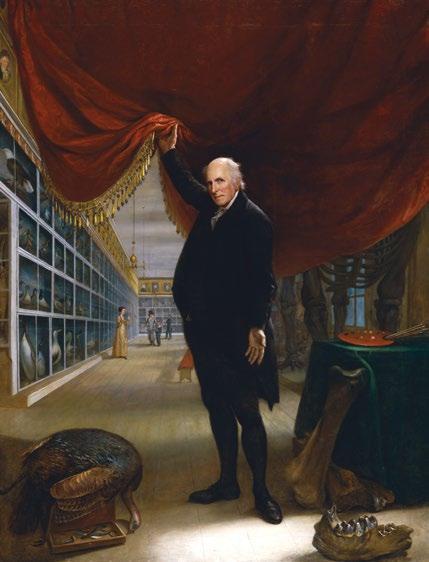
GREAT MINDS TEACHER EDITION WIT & WISDOM® 7 GRADE MODULE 4 FEVER

Great Minds® is the creator of Eureka Math® , Wit & Wisdom® , Alexandria Plan™, and PhD Science®
Published by Great Minds PBC greatminds.org
© 2023 Great Minds PBC. All rights reserved. No part of this work may be reproduced or used in any form or by any means—graphic, electronic, or mechanical, including photocopying or information storage and retrieval systems—without written permission from the copyright holder. Where expressly indicated, teachers may copy pages solely for use by students in their classrooms.
Printed in the USA A-Print
Module Summary 2 Essential Question 3
Suggested Student Understandings 3 Texts 3
Module Learning Goals 4 Module in Context............................................................................................................................... ........................ 6 Standards ............................................................................................................................... ....................................... 7 Major Assessments 9 Module Map 11
Focusing Question: Lessons 1–12
In what context did the yellow fever epidemic of 1793 emerge?
Lesson 1 ............................................................................................................................... ............................................... 23
n TEXT: Fever 1793, Laurie Halse Anderson ¢ Vocabulary Deep Dive: Academic Vocabulary: Crisis Lesson 2 ............................................................................................................................... .............................................. 39
n TEXT: Fever 1793, Laurie Halse Anderson
¢ Style and Conventions Deep Dive: Examine Coordinate Adjectives
Lesson 3 57
n TEXTS: An American Plague, Jim Murphy • Fever 1793, Laurie Halse Anderson ¢ Vocabulary Deep Dive: Content Vocabulary: Words for Understanding Philadelphia in 1793 Lesson 4 69
n TEXTS: Fever 1793, Laurie Halse Anderson • An American Plague, Jim Murphy ¢ Vocabulary Deep Dive: Content Vocabulary: Words That Describe Smell Lesson 5 83
n TEXTS: Fever 1793, Laurie Halse Anderson • An American Plague, Jim Murphy ¢ Style and Conventions Deep Dive: Examine Coordinate and Compound Adjectives
Lesson 6 ............................................................................................................................... .............................................. 97
n TEXTS: An American Plague, Jim Murphy • Fever 1793, Laurie Halse Anderson ¢ Style and Conventions Deep Dive: Experiment with Coordinate and Compound Adjectives
Lesson 7 105
n TEXT: Fever 1793, Laurie Halse Anderson
¢ Vocabulary Deep Dive: Academic Vocabulary: ques, quer, quir, quis Lesson 8 115
n TEXTS: Fever 1793, Laurie Halse Anderson • An American Plague, Jim Murphy • “The Yellow Fever Epidemic in Philadelphia, 1793,” Harvard University Open Collections Program • “Yellow Fever: Symptoms and Treatment,” Centers for Disease Control and Prevention
¢ Vocabulary Deep Dive: Academic Vocabulary: cred Lesson 9 ............................................................................................................................... ............................................ 129
n TEXTS: Fever 1793, Laurie Halse Anderson • An American Plague, Jim Murphy • The Artist in His Museum, Charles Willson Peale
¢ Style and Conventions Deep Dive: Execute Skill with Compound and Coordinate Adjectives Lesson 10 143
n TEXTS: The Artist in His Museum, Charles Willson Peale • The Long Room, Interior of Front Room in Peale’s Museum, Charles Willson Peale • An American Plague, Jim Murphy • Fever 1793, Laurie Halse Anderson
¢ Vocabulary Deep Dive: Content Vocabulary: Words in Art and Literature
Lesson 11 159
n TEXTS: All Module Texts Lesson 12 165
n TEXTS: All Module Texts
¢ Vocabulary Deep Dive: Explore Figurative Language
Focusing Question: Lessons 13–22
What were the effects of the unfolding crisis on Philadelphia and its citizens?
Lesson 13 ............................................................................................................................... .......................................... 177
n TEXTS: Fever 1793, Laurie Halse Anderson • “2014 Three Minute Thesis Winning Presentation,” Emily Johnston
¢ Vocabulary Deep Dive: Content Vocabulary: Skirmish, battle, war Lesson 14 191
n TEXTS: Fever 1793, Laurie Halse Anderson • “Yellow Fever,” U.S. National Library of Medicine • “2014 Three Minute Thesis Winning Presentation,” Emily Johnston
¢ Vocabulary Deep Dive: Explore Figurative Language: Similes
Lesson 15 ............................................................................................................................... ......................................... 205
n TEXTS: Fever 1793, Laurie Halse Anderson • An American Plague, Jim Murphy
¢ Vocabulary Deep Dive: Academic Vocabulary: –ence, –ent
Lesson 16 ............................................................................................................................... .......................................... 221
n TEXTS: Fever 1793, Laurie Halse Anderson • An American Plague, Jim Murphy
¢ Vocabulary Deep Dive: Academic Vocabulary: Heroic Words
Lesson 17 233
n TEXTS: Fever 1793, Laurie Halse Anderson • An American Plague, Jim Murphy • Philadelphia: The Great Experiment, History Making Productions
¢ Vocabulary Deep Dive: Academic Vocabulary: plac
Lesson 18 245
n TEXTS: An American Plague, Jim Murphy • “Q & A,” Jim Murphy • “2014 Three Minute Thesis Winning Presentation,” Emily Johnston
¢ Style and Conventions Deep Dive: Examine Formal and Informal Speech
Lesson 19 ............................................................................................................................... ......................................... 255
n TEXTS: Fever 1793, Laurie Halse Anderson • “2014 Three Minute Thesis Winning Presentation,” Emily Johnston
¢ Style and Conventions Deep Dive: Experiment with Formal and Informal Speech
Lesson 20 265
n TEXTS: All Module Texts
¢ Style and Conventions Deep Dive: Execute with Formal and Informal Speech
Lesson 21............................................................................................................................... ........................................... 275
n TEXTS: All Module Texts
¢ Vocabulary Deep Dive: Vocabulary Assessment
Lesson 22 ............................................................................................................................... ......................................... 283
n TEXTS: All Module Texts
What
Lesson 23 289
n TEXTS: Fever 1793, Laurie Halse Anderson • An American Plague, Jim Murphy
¢ Vocabulary Deep Dive: Academic Vocabulary: Calamity, mournful, melancholy
Lesson 24 301
n TEXTS: Fever 1793, Laurie Halse Anderson • An American Plague, Jim Murphy • Philadelphia: The Great Experiment, History Making Productions
¢ Vocabulary Deep Dive: Academic Vocabulary: Battalion
Lesson 25 309
n TEXTS: An American Plague, Jim Murphy • Fever 1793, Laurie Halse Anderson • “Invictus,” William Ernest Henley • “Invictus” (video), Morgan Freeman
¢ Style and Conventions Deep Dive: Examine Citation Punctuation
Lesson 26 319
n TEXTS: An American Plague, Jim Murphy • Fever 1793, Laurie Halse Anderson
¢ Style and Conventions Deep Dive: Experiment with Citation Punctuation
did the crisis reveal about Philadelphia’s citizens and society?
Lesson 27 329
n TEXTS: An American Plague, Jim Murphy • Fever 1793, Laurie Halse Anderson
¢ Style and Conventions Deep Dive: Execute Citation Punctuation Lesson 28 339
n TEXTS: Fever 1793, Laurie Halse Anderson • An American Plague, Jim Murphy
¢ Vocabulary Deep Dive: Academic Vocabulary: Fetid Lesson 29 347
n TEXTS: The Artist in His Museum, Charles Willson Peale • Fever 1793, Laurie Halse Anderson • An American Plague, Jim Murphy
¢ Vocabulary Deep Dive: Content Vocabulary: Illness Words Lesson 30 ............................................................................................................................... ........................................ 357
n TEXTS: An American Plague, Jim Murphy • Fever 1793, Laurie Halse Anderson
¢ Vocabulary Deep Dive: Content Vocabulary: Vilify, vilest Lesson 31 367
n TEXTS: An American Plague, Jim Murphy • Fever 1793, Laurie Halse Anderson
¢ Style and Conventions Deep Dive: Examine and Experiment with Strong Verbs Lesson 32 377
n TEXTS: An American Plague, Jim Murphy • Fever 1793, Laurie Halse Anderson
¢ Style and Conventions Deep Dive: Execute Strong Verbs
How did people respond to the crisis?
Lesson 33 ............................................................................................................................... ......................................... 385
n TEXTS: An American Plague, Jim Murphy • Fever 1793, Laurie Halse Anderson ¢ Vocabulary Deep Dive: Vocabulary Assessment Lesson 34 393
n TEXT: An American Plague, Jim Murphy Lesson 35 399
n TEXT: An American Plague, Jim Murphy Lesson 36 405
n TEXT: An American Plague, Jim Murphy Lesson 37 411
n TEXT: An American Plague, Jim Murphy
¢
Style and Conventions Deep Dive: Excel: Peer Edit
What is the story of the year?
Lesson
n TEXTS: All Modules 1–4 Texts ¢ Vocabulary Deep Dive: Vocabulary Review
Appendix A: Text Complexity............................................................................................................................... ..... 425
Appendix B: Vocabulary ............................................................................................................................... ............... 429
Appendix C: Answer Keys, Rubrics, and Sample Responses 439
Appendix D: Volume of Reading 461
Appendix E: Works Cited 463
How could the city have changed so much? Yellow fever was wrestling the life out of Philadelphia, infecting the cobblestones, the trees, the nature of the people. Was I living through another nightmare?
—Laurie Halse AndersonHow do people respond to a crisis? What factors contribute to an individual’s response? How can these responses affect a city, citizens, and government?
Students investigate these questions by traveling back to one of the pivotal crises in American history: the yellow fever epidemic of 1793. As crises often do, this epidemic illuminated and altered realities of power, prejudice, and human fortitude, sparking transformation on both micro and macro levels. Study of this early American plague offers insight into the challenges crises can present to a society and a window into the many decisions, both small and large, that people must make to respond.
Fittingly, the module features deeply researched fictional and informational accounts. They spotlight disparate responses to the fever and spur students’ own research, uncovering patterns of human behavior driven by fear, compassion, an impulse to understand the unknown, and the human drive to survive and thrive.
In An American Plague, Jim Murphy develops content knowledge through a vividly detailed factual account of the epidemic. Students are immersed in eighteenth-century Philadelphia. They learn about medical practices that increased death rates, the young government’s panicked decision to adjourn, and the heroism of individuals like the Free African Society volunteers. Laurie Halse Anderson’s Fever 1793 intensifies the module’s historical immersion by fostering emotional investment. Readers of this novel experience the epidemic through the point of view of Mattie, a fourteen-year-old girl whose motivation must shift from avoiding chores to survival. Concurrent study of these texts cultivates meaningful understanding of the ways individuals can alleviate and exacerbate a crisis’s effects and of how writers of history and historical fiction use research to imbue their works with depth and truth.
By the time students encounter the End-of-Module (EOM) Task research essay, they are prepared to analyze and evaluate the ways Philadelphians responded to the epidemic, deepening their exploration of how times of crisis can affect citizens and society.
A single cause can have a wide range of effects. There are patterns of human behavior that can emerge in the midst of a crisis, driven by factors such as fear, compassion, an impulse to understand the unknown, and the will to survive. While each individual has the power to determine their own response to a crisis, social factors such as gender, race, and class can influence an individual’s experience of a crisis. Scientific knowledge is essential to effectively addressing medical crises. A crisis can serve as a catalyst for positive change in individuals, society, and medicine.
“Q & A,” Jim Murphy (http://witeng.link/0407)
“The Yellow Fever Epidemic in Philadelphia, 1793,” Harvard University Library Open Collections Program (http://witeng.link/0386)
“Yellow Fever,” U.S. National Library of Medicine (http://witeng.link/0399)
“Yellow Fever: Symptoms and Treatment,” Centers for Disease Control and Prevention (http://witeng.link/0387)
Philadelphia: The Great Experiment, History Making Productions (http://witeng.link/0412)
The Long Room, Interior of Front Room in Peale’s Museum, Charles Willson Peale (http://witeng.link/0391)
“Invictus,” William Ernest Henley (http://witeng.link/0413)
“2014 Three Minute Thesis Winning Presentation,” Emily Johnston (http://witeng.link/0398)
“Invictus” video reading, Morgan Freeman (http://witeng.link/0414)
Describe aspects of late eighteenth-century Philadelphian life, including living conditions, political structures, and social norms. Explain how the epidemic affected and was affected by these factors.
Explain how eighteenth-century medical practices and lack of scientific understanding contributed to the epidemic’s spread and deleterious effects, as well as how the epidemic provided an opportunity to deepen scientific understanding.
Analyze the impact that individuals had on the development of the crisis and the reciprocal impact that the crisis had on these individuals.
Describe the roles of race, gender, and social class in early American society, and analyze how these factors influenced individuals’ experiences of the crisis. Understand the purposes, benefits, and process of academic research.
Analyze how Mattie’s identity develops as she confronts the conflicts created by Fever 1793’s crisis setting (RL.7.2, RL.7.3).
Compare and contrast Anderson’s portrayal of the crisis with Murphy’s portrayal as a means of understanding how Anderson uses history in Fever 1793 (RL.7.9).
Analyze the impact of word choice and other devices, such as eyewitness accounts and primary documents, on establishing different perspectives on the crisis (RI.7.4).
Analyze how text structure can help develop ideas about yellow fever (RI.7.5).
Compare and contrast multiple informational texts about the crisis and determine each author’s point of view (RI.7.6, RI.7.9).
Form focused research questions and draw on several sources to answer them (W.7.7).
Effectively search for and select accurate and credible research sources (W.7.8).
Quote or paraphrase the data and conclusions of others, following a standard format for citation (W.7.8).
Clearly communicate research findings in an organized, appropriately detailed research essay (W.7.2, W.7.4).
Use technology to produce and publish writing and link to and cite sources (W.7.6).
Effectively communicate ideas in academic presentations and discussions about the yellow fever crisis, including multimedia components and visual displays to clarify claims and findings (SL.7.4, SL.7.5).
Listen to understand speakers’ insights, acknowledging new information and modifying views when appropriate (SL.7.1.d).
Analyze the main ideas and supporting details in diverse media and formats, and explain how the ideas clarify the crisis (SL.7.2).
Identify the function and correct punctuation of coordinate adjectives, and use them accurately and purposefully in writing (L.7.2.a).
Use common, grade-appropriate Greek or Latin affixes and roots as clues to the meaning of a word (L.7.4.b).
Consult general and specialized reference materials, both print and digital, to find the pronunciation of a word or determine or clarify its precise meaning or its part of speech (L.7.4.c).
Verify the preliminary determination of the meaning of a word or phrase (L.7.4.d).
Distinguish among the connotations (associations) of words with similar denotations (L.7.5.c).
Knowledge: Throughout the year, students explore the roles of individuals in society, analyzing how one’s societal context can influence experience and identity and vice versa. Module 1 introduced the concept of identity through stories of the rigidly hierarchical Middle Ages. Module 2 depicted individuals’ experiences during World War II. In Module 3, students analyzed the power of authority, words, and media to influence individuals’ thoughts and actions. Module 4 thrusts students into another survival context, an early American epidemic, prompting larger societal questions of how individuals respond to crisis, how crisis can affect individuals, and how a crisis can reveal inequalities or failures of humanity as well as people’s fortitude and generosity.
Reading: Students deepen the skills they developed in prior modules for analytical reading by examining literary and informational texts. Previous modules’ literary analyses focused heavily on tracing themes of identity development and coming of age. In Module 4, students require less scaffolding as they analyze the growth of Fever 1793’s young protagonist. Students also extend their skills by analyzing a novel and an informational text concurrently, comparing and contrasting their portrayals of the yellow fever to deepen understanding of both the crisis and author’s craft.
Writing: In Module 1, students gained narrative writing skills, and in Modules 2 and 3, students gained skills in using evidence and elaboration to support informative and argumentative writing. Here students expand their informative writing skills, particularly as they embark on the research process and generate research essays.
Speaking and Listening: Students participate in three Socratic Seminars, focusing on effectively expressing their ideas and listening to understand classmates’ insights. Additionally, students apply their skills to a new task that builds on their study of orators’ delivery techniques in Module 3: a research presentation.
RL.7.2 Determine a theme or central idea of a text and analyze its development over the course of the text; provide an objective summary of the text.
RL.7.3 Analyze how particular elements of a story or drama interact (e.g., how setting shapes the characters or plot).
RL.7.9 Compare and contrast a fictional portrayal of a time, place, or character and a historical account of the same period as a means of understanding how authors of fiction use or alter history.
RI.7.4 Determine the meaning of words and phrases as they are used in a text, including figurative, connotative, and technical meanings; analyze the impact of a specific word choice on meaning and tone.
RI.7.5 Analyze the structure an author uses to organize a text, including how the major sections contribute to the whole and to the development of the ideas.
RI.7.6 Determine an author’s point of view or purpose in a text and analyze how the author distinguishes their position from that of others.
RI.7.9 Analyze how two or more authors writing about the same topic shape their presentations of key information by emphasizing different evidence or advancing different interpretations of facts.
W.7.2 Write informative/explanatory texts to examine a topic and convey ideas, concepts, and information through the selection, organization, and analysis of relevant content.
W.7.4 Produce clear and coherent writing in which the development, organization, and style are appropriate to task, purpose, and audience. (Grade-specific expectations for writing types are defined in standards 1–3 above.)
W.7.6 Use technology, including the Internet, to produce and publish writing and link to and cite sources as well as to interact and collaborate with others, including linking to and citing sources.
W.7.7 Conduct short research projects to answer a question, drawing on several sources and generating additional related, focused questions for further research and investigation.
W.7.8 Gather relevant information from multiple print and digital sources, using search terms effectively; assess the credibility and accuracy of each source; and quote or paraphrase the data and conclusions of others while avoiding plagiarism and following a standard format for citation.
L.7.2.a Use a comma to separate coordinate adjectives (e.g., It was a fascinating, enjoyable movie but not He wore an old[,] green shirt).
L.7.4.b Use common, grade-appropriate Greek or Latin affixes and roots as clues to the meaning of a word (e.g., belligerent, bellicose, rebel).
L.7.4.c Consult general and specialized reference materials (e.g., dictionaries, glossaries, thesauruses), both print and digital, to find the pronunciation of a word or determine or clarify its precise meaning or its part of speech.
L.7.4.d Verify the preliminary determination of the meaning of a word or phrase (e.g., by checking the inferred meaning in context or in a dictionary).
L.7.5.c Distinguish among the connotations (associations) of words with similar denotations (definitions) (e.g., refined, respectful, polite, diplomatic, condescending).
SL.7.1.d Acknowledge new information expressed by others and, when warranted, modify their own views.
SL.7.2 Analyze the main ideas and supporting details presented in diverse media and formats (e.g., visually, quantitatively, orally) and explain how the ideas clarify a topic, text, or issue under study.
SL.7.4 Present claims and findings, emphasizing salient points in a focused, coherent manner with pertinent descriptions, facts, details, and examples; use appropriate eye contact, adequate volume, and clear pronunciation.
SL.7.5 Include multimedia components and visual displays in presentations to clarify claims and findings and emphasize salient points.
RL.7.10
By the end of the year, read and comprehend literature, including stories, dramas, and poems, in the grades 6–8 text-complexity band proficiently, with scaffolding as needed at the high end of the range.
RI.7.10 By the end of the year, read and comprehend literary nonfiction in the grades 6–8 text-complexity band proficiently, with scaffolding as needed at the high end of the range.
L.7.6 Acquire and use accurately grade-appropriate general academic and domain-specific words and phrases; gather vocabulary knowledge when considering a word or phrase important to comprehension or expression.
1. Complete a graphic organizer and short responses to compare and contrast Fever 1793 with An American Plague and your own research.
2. Deliver a five-minute presentation explaining an effect of the crisis, using examples from one or both core texts.
3. Using evidence from An American Plague, write a short essay explaining one thing that Philadelphians learned about their society or government as a result of the crisis.
Engage in and reflect on the research process. Synthesize and cite information from multiple sources. Demonstrate understanding of the epidemic’s context.
Demonstrate understanding of how responses to the crisis affected people in different ways. Cite evidence from multiple texts, including An American Plague
Generate informative writing. Demonstrate understanding of what the crisis revealed about Philadelphia.
Demonstrate understanding of how the epidemic affected particular segments of society.
RL.7.1, RL.7.9, RI.7.1, W.7.7, W.7.9, W.7.10
RI.7.1, RI.7.3, SL.7.4, SL.7.5, SL.7.6
RI.7.1, RI.7.2, W.7.2, W.7.4, W.7.9
1. Read chapter 7 of Fever 1793. Then answer multiple-choice and short-response questions to analyze theme, story elements, and word choice.
2. Read Jim Murphy’s interview. Then answer multiple-choice and short-response questions to analyze the text’s structure, determine the author’s point of view, and analyze how he distinguishes his position from that of others.
3. View the documentary segment on the Free African Society. Then write a paragraph analyzing how the documentary’s portrayal of the FAS differs from Murphy’s.
Analyze the context of the crisis. Analyze responses to the crisis.
Analyze how the setting shapes events and characters, specifically the roles of class and gender in 1793 and in the unfolding crisis.
Analyze the structure of an informational text. Analyze Murphy’s perspective on the research process.
RL.7.1, RL.7.2, RL.7.3, RL.7.4, L.7.4.b, L.7.5.c, W.7.10
RI.7.1, RI.7.4, RI.7.5, RI.7.6, W.7.10, L.7.4.c, L.7.4.d
Generate informative writing. Integrate facts from An American Plague. Demonstrate understanding of the Free African Society’s role in the crisis.
RI.7.1, RI.7.9, W.7.10, SL.7.2
1. Evaluate Dr. Benjamin Rush’s role in the crisis. Evaluate medical responses to the crisis.
Integrate research from An American Plague and online sources.
2. In the role of eighteenth-century Philadelphians holding a post-crisis town hall meeting, reflect on the epidemic’s effects and on changes the city should make to prepare for future epidemics.
RI.7.1, RI.7.3, SL.7.1, SL.7.6, L.7.6
Formulate opinions about responses to the crisis.
Analyze what the crisis revealed about power and social divisions in eighteenth-century Philadelphia.
Integrate evidence from An American Plague.
3. Analyze the story of the year. Reflect on themes and central ideas from all four modules, including the central ideas discussed in Module 4’s EOM Task.
SL.7.1, SL.7.6, L.7.6
RL.7.1, RL.7.2, RI.7.1, RI.7.2, SL.7.1, SL.7.6
Write a research essay explaining two or three ways that members of a selected group of Philadelphians responded to the yellow fever crisis. Evaluate whether these responses were helpful, harmful, or both.
Introduce the topic and state the thesis.
Explain two to three responses to the crisis.
Develop each response by synthesizing the content of your chosen sources.
Explain whether these responses were helpful, harmful, or both, including and elaborating on relevant, accurate, and sufficient evidence.
Include headings or graphics to aid comprehension.
Cite sources consistently and correctly.
Provide a conclusion that supports the essay.
Use words, phrases, and clauses to make transitions, connect ideas, and to show how ideas are related to each other.
Maintain a formal style featuring precise language and domain-specific vocabulary.
RI.7.1, RI.7.3, W.7.2, W.7.4, W.7.5, W.7.6, W.7.8, W.7.9, L.7.2.a
Demonstrate understanding of academic, text-critical, and domain-specific words, phrases, and/or word parts.
Acquire and use grade-appropriate academic terms.
L.7.4.b
Acquire and use domain-specific or text-critical words essential for communication about the module’s topic.
L.7.6
* While not considered Major Assessments in Wit & Wisdom, Vocabulary Assessments are listed here for your convenience. Please find details on Checks for Understanding (CFUs) within each lesson.
Focusing Question 1: In what context did the yellow fever epidemic of 1793 emerge?
1 Fever 1793 Wonder
What do I notice and wonder about Fever 1793?
2 Fever 1793 Organize
What is happening in Fever 1793?
Examine
Why is using coordinate adjectives separated by commas important?
3 An American Plague Fever 1793 Organize
What is happening in An American Plague and in Fever 1793?
4 Fever 1793
An American Plague
Organize
What is happening in An American Plague and in Fever 1793?
Experiment
How do choosing a research topic and formulating a research question work?
Formulate questions and observations about Fever 1793 (RL.7.1). Understand the connotation and denotation of the word crisis (L.7.5.c).
Describe the protagonist of Fever 1793, explaining how the setting and other characters shape her identity (RL.7.3).
Examine and identify coordinate adjectives in context (L.7.2.a).
Compare and contrast how Murphy and Anderson use historical details and research in their writing about the yellow fever epidemic (RL.7.9).
Employ varied strategies to define content-specific words (L.7.4.a, L.7.4.b, L.7.4.c, L.7.5.b).
Analyze how the setting of Fever 1793 shapes the character of Mattie (RL.7.3, W.7.10)
Compare and contrast how Murphy and Anderson use historical details and research in their writing about the yellow fever epidemic (RL.7.9).
Identify a topic and generate a focused question for further research (W.7.7).
Deepen understanding of words describing smell by considering and defining multiple related words (L.7.4.c, L.7.5.b).
5 Fever 1793
An American Plague
Reveal
What does a deeper exploration of character reveal about society and social class in Fever 1793?
Experiment
How does using search terms to investigate a research question work? Examine
Why are coordinate adjectives separated by commas and compound adjectives punctuated with hyphens important?
Summarize the key developments in Fever 1793, chapter 6 (RL.7.2).
Analyze how Anderson develops ideas about societal divisions through the interplay among the characters, plot, and setting (RL.7.3).
Use search terms to identify sources relevant to investigating focused research questions on a topic related to the module’s content and texts (W.7.7, W.7.8).
Examine coordinate and compound adjectives and their punctuation, and consider their effect in a text (L.7.2.a).
6 NR An American Plague Fever 1793
Reveal
What does a deeper exploration of character, plot, and setting in Fever 1793 reveal?
Experiment
How does using and correctly punctuating coordinate and compound adjectives work?
Read the next chapter of a novel, and demonstrate comprehension by summarizing the text, analyzing its themes, analyzing the interactions among characters, plot, and setting, and considering relevant words with similar denotations and different connotations (RL.7.1, RL.7.2, RL.7.3, RL.7.4, L.7.4.b, L.7.5.c, W.7.10).
Describe characters, scenes, and settings from Fever 1793 using correctly punctuated coordinate and compound adjectives (L.7.2.a).
7 Fever 1793 Reveal
What does a deeper exploration of character, plot, and setting in chapters 8 and 9 of Fever 1793 reveal?
Examine the changes in the main character resulting from her circumstances and the events developing around her (RL.7.3).
Use the roots ques, quer, quir, quis to define and use related words (L.7.4.b).
Focusing Question 1: In what context did the yellow fever epidemic of 1793 emerge? Lesson Text(s) Content Framing Question Craft Question(s) Learning Goals8 Fever 1793
An American Plague
“The Yellow Fever Epidemic in Philadelphia, 1793”
“Yellow Fever: Symptoms and Treatment”
9 Fever 1793
An American Plague
The Artist in His Museum
Reveal
What does a deeper exploration of the characters’ actions and reactions reveal in Fever 1793?
Examine
Why is using multiple credible, accurate sources important?
Assess the credibility and accuracy of sources (W.7.8).
Use the root cred to define and use related words (L.7.4.b).
10 The Artist in His Museum
The Long Room, Interior of Front Room in Peale’s Museum
An American Plague Fever 1793
Reveal
What does a deeper exploration of historical fact and detail reveal in An American Plague, chapter 3?
Execute
How do I use credible, accurate sources in investigating a research question?
Execute
How do I use and correctly punctuate coordinate and compound adjectives to add description in informational writing?
Determine the meaning of words and phrases used in An American Plague, and analyze their impact (RI.7.4).
Determine the author’s purpose, based on an analysis of content and craft (RI.7.6).
Compare and contrast how Murphy and Anderson use historical details and research (RL.7.9).
Execute skill in using and correctly punctuating compound and coordinate adjectives (L.7.2.a).
Reveal
What does a deeper exploration of Charles Willson Peale’s selfportrait reveal?
Experiment
How does note-taking work?
Analyze and respond in writing to a portrait (SL.7.2, W.7.10).
Use varied strategies to define words used in art and literature (L.7.4, L.7.5.b).
11 All Module Texts Know
How do various sources build my knowledge to answer my research question?
Identify and take notes on relevant information from multiple, credible print and digital sources (W.7.8).
Focusing Question 1: In what context did the yellow fever epidemic of 1793 emerge? Lesson Text(s) Content Framing Question Craft Question(s) Learning GoalsFocusing Question 1: In what context did the yellow fever epidemic of 1793 emerge?
Lesson Text(s) Content Framing Question Craft Question(s) Learning Goals
12 FQT All Module Texts Know
How do the module’s texts build my knowledge of the context (geographical, historical, and societal) of the yellow fever epidemic of 1793?
Compare and contrast the historical basis of a fictional account with an informational account (RL.7.1, RL.7.9, RI.7.1, W.7.7, W.7.9, W.7.10).
Demonstrate understanding of figurative language (L.7.5).
Focusing Question 2: What were the effects of the unfolding crisis on Philadelphia and its citizens?
Lesson Text(s) Content Framing Question Craft Question(s) Learning Goals
13 Fever 1793
“2014 Three Minute Thesis Winning Presentation”
Reveal
What does a deeper exploration of Mattie’s characterization and responses to problems reveal in chapters 11 and 12 of Fever 1793?
14 Fever 1793
“Yellow Fever”
“2014 Three Minute Thesis Winning Presentation”
Reveal
What does a deeper exploration of scientific information about yellow fever reveal in the texts?
Examine
Why are delivery techniques important in an oral presentation?
Analyze how Mattie and her relationship with her grandfather change as a result of the crisis (RL.7.3).
Understand the connotations and denotations of the words skirmish, battle, and war and their impact in Fever 1793 (L.7.5.c).
Experiment
How does delivering a presentation work?
Determine the meaning of technical and medical terms in a scientific article, and analyze how the article’s structure affects the development of its main ideas (RI.7.4, RI.7.5).
Present findings about an aspect of yellow fever, emphasizing salient points and using effective presentation techniques (SL.7.4).
Interpret and analyze similes in Fever 1793 (L.7.5.a).
15 Fever 1793
An American Plague
Reveal
What does a deeper exploration of text structure and visuals reveal in An American Plague and the thesis presentation?
Examine Why are visuals important? Experiment How do visuals work?
Determine the meaning of words and phrases used in chapter 4 of An American Plague, and analyze how the chapter’s structure contributes to the development of its central idea(s) (RI.7.4, RI.7.5).
Design an effective visual for a presentation about chapter 4 (SL.7.5).
Apply understanding of the suffixes –ence and –ent to define words (L.7.4.b).
16 Fever 1793
An American Plague
Reveal
What does a deeper exploration of individuals’ roles reveal in Fever 1793 and An American Plague?
Examine Why are direct quotations, paraphrasing, and summarizing important in research papers and presentations?
Determine the meaning of words and phrases used to describe individuals in chapter 7 of An American Plague, and analyze how the chapter’s structure impacts the development of its central ideas (RI.7.4, RI.7.5).
Explain Murphy’s perspective on key individuals from the volunteer committee (RI.7.6).
Deepen understanding of adjectives used to describe heroic figures from the crisis (L.7.4).
17 Fever 1793
An American Plague Philadelphia: The Great Experiment
Reveal
What does a deeper exploration of the crisis’s effects on people and their relationships reveal in these texts?
Experiment
How do direct quotations, paraphrasing, and summarizing work in research papers and presentations?
Analyze the central idea and supporting details Philadelphia: The Great Experiment presents about Stephen Girard (RI.7.2, RI.7.6, SL.7.2).
Compare and contrast the differing perspectives and accounts of Murphy and the filmmakers on Stephen Girard (RI.7.6, RI.7.9).
Use the root word plac to predict the meaning of words and confirm predictions using a dictionary (L.7.4.b, L.7.4.d).
Focusing Question 2: What were the effects of the unfolding crisis on Philadelphia and its citizens? Lesson Text(s) Content Framing Question Craft Question(s) Learning Goals18 NR An American Plague “Q & A”
“2014 Three Minute Thesis Winning Presentation”
Reveal
What does a deeper exploration of the research process reveal in Murphy’s texts?
Examine
Why is using multiple sources to verify factual information important? Examine
Why is using formal speech in an academic presentation important?
19 Fever 1793
“2014 Three Minute Thesis Winning Presentation”
Reveal
What does a deeper exploration of literary techniques reveal in chapters 18 and 19 of Fever 1793?
Experiment
How does using formal speech in an academic presentation work?
Determine and confirm the meaning of words and phrases in the article, analyze the article’s structure, determine the author’s point of view, and analyze how he distinguishes his position from that of others (RI.7.1, RI.7.2, RI.7.4, RI.7.5, RI.7.6, W.7.10, L.7.4.c, L.7.4.d).
Analyze the impact of formal versus informal language in a presentation (L.7.3.a).
Analyze how characters, setting, and plot interact in a key scene from Fever 1793 and what that interaction reveals about Mattie, Grandfather, or the effects of the crisis (RL.7.2, RL.7.3).
Identify elements of formal language needed for a presentation (L.7.3.a).
20 FQT All Module Texts Know
How do these texts build my knowledge of how the epidemic affected Philadelphians?
Execute
How do I use my presentation skills to plan a presentation about one of the crisis’s effects?
Execute
How do I use my knowledge of formal speech to plan how I will deliver my presentation?
Identify and organize the most salient points for a presentation about a chosen effect, and generate ideas for supporting visuals (SL.7.4, SL.7.5).
Apply strategies for using formal language to the Focusing Question Task presentations (L.7.3.a).
Focusing Question 2: What were the effects of the unfolding crisis on Philadelphia and its citizens? Lesson Text(s) Content Framing Question Craft Question(s) Learning Goals21 FQT VOC
All Module Texts Know
How do these texts build my knowledge of how the epidemic affected Philadelphians?
Execute
How do I use my presentation skills to plan a presentation about one of the crisis’s effects? Execute
How do I use my presentation skills to share about the crisis’s effects?
Present findings about an effect of the yellow fever crisis, emphasizing salient points; including relevant descriptions, facts, details, and examples; using appropriate presentation skills; and supporting the presentation with multimedia components and visual displays (RI.7.1, RI.7.3, SL.7.4, SL.7.5, SL.7.6).
Analyze a research presentation’s main ideas and supporting details, and explain how that presentation clarifies understanding of an effect of the crisis (SL.7.2).
Demonstrate understanding of grade-level vocabulary and of how to use affixes and roots as clues to the meaning of words or phrases (L.7.4.b, L.7.6).
22 FQT All Module Texts Know
How do these texts build my knowledge of how the epidemic affected Philadelphians?
Execute
How do I use my presentation skills to share about the crisis’s effects?
Present findings about an effect of the yellow fever crisis, emphasizing salient points; including relevant descriptions, facts, details, and examples; using appropriate presentation skills; and supporting the presentation with multimedia components and visual displays (RI.7.1, RI.7.3, SL.7.4, SL.7.5, SL.7.6).
Analyze a research presentation’s main ideas and supporting details, and explain how that presentation clarifies understanding of an effect of the crisis (SL.7.2).
Focusing Question 2: What were the effects of the unfolding crisis on Philadelphia and its citizens? Lesson Text(s) Content Framing Question Craft Question(s) Learning Goals23 Fever 1793
An American Plague
Reveal
What does a deeper exploration of the subject of morale reveal in Fever 1793 and An American Plague?
Examine
Why is synthesizing evidence important?
Synthesize evidence from Fever 1793 and An American Plague to describe the epidemic’s effects on Philadelphia’s ability to function and on the city’s morale (RI.7.3, W.7.10).
Understand the words calamity, mournful, and melancholy by exploring their context in An American Plague (L.7.4.a).
24
NR Fever 1793
An American Plague Philadelphia: The Great Experiment
Reveal
What does a deeper exploration of the Free African Society reveal in Fever 1793, An American Plague, and Philadelphia: The Great Experiment?
25 An American Plague Fever 1793
“Invictus” William Ernest Henley
“Invictus” (video) reading, Morgan Freeman
26 An American Plague Fever 1793
Reveal
What does a deeper exploration of characterization reveal in Fever 1793 and “Invictus”?
Examine
Why is the structure of a research paper important?
Examine
Why is correctly punctuating citations important?
Compare and contrast the Free African Society’s depiction in An American Plague and in the documentary clip (RI.7.1, RI.7.9, W.7.2, W.7.4, W.7.9, SL.7.2).
Analyze Murphy’s use of the word battalion to describe the Free African Society by exploring context, reference materials, and its Latin root (L.7.4).
Compare “Invictus” and Fever 1793 to analyze how crisis can reveal character (RL.7.2, RL.7.4).
Explain how to punctuate citations (L.4.2.b*, W.7.8).
Reveal
What does a deeper exploration of Dr. Rush’s role reveal in Fever 1793 and An American Plague?
Experiment
How does conducting and synthesizing research work? Experiment How does punctuating citations work?
Evaluate Dr. Rush’s role in the epidemic based on research (RI.7.3, W.7.7).
Correctly punctuate and cite quotations in a creative writing piece (L.4.2.b*, L.7.2, W.7.8).
Focusing Question 3: What did the crisis reveal about Philadelphia’s citizens and society? Lesson Text(s) Content Framing Question Craft Question(s) Learning Goals27 SS An American Plague
Fever 1793
Distill
What was Dr. Rush’s role in the epidemic?
Execute
How can I effectively explain my ideas in a Socratic Seminar?
Experiment
How does synthesizing quoted and paraphrased information in a research paragraph work?
Execute
How can I use correct citation punctuation in a research paragraph?
Engage in a collaborative conversation about Dr. Rush’s role in the crisis, drawing on evidence, posing questions, responding to others, and using formal English as appropriate (RI.7.3, SL.7.1, SL.7.6, L.7.6).
Use quoted and paraphrased information from multiple sources to analyze and evaluate Dr. Rush’s role in the crisis (RI.7.3, W.7.2, W.7.7, W.7.8).
Edit a research paragraph to ensure correct citation punctuation (L.4.2.b*, W.7.8).
28 Fever 1793
An American Plague
Reveal
What does a deeper exploration of point of view reveal in Fever 1793?
Experiment
How do introductions and conclusions work?
Analyze how Anderson develops characters’ points of view to portray the epidemic’s differing effects (RL.7.3, RL.7.6).
Introduce and conclude a research paragraph describing Dr. Rush’s role in the crisis (RI.7.3, W.7.2.a, W.7.2.f).
Deepen understanding of the word fetid by distinguishing between its connotation and those of other smell words (L.7.5.c).
29 The Artist in His Museum
Fever 1793
An American Plague
Distill
What are the essential meanings of Fever 1793 and The Artist in His Museum?
Analyze a theme from Fever 1793 (RL.7.2). Distinguish among the connotations of illness words from the core texts (L.7.5.c).
Focusing Question 3: What did the crisis reveal about Philadelphia’s citizens and society? Lesson Text(s) Content Framing Question Craft Question(s) Learning Goals30 An American Plague Fever 1793
Distill
What are the central ideas of An American Plague?
Examine
Why is formatting important? Experiment
How does formatting work?
Identify common attitudes toward government leaders, the lower class, and the Black community in the epidemic’s aftermath, and analyze what these revealed about power and social divisions in eighteenth-century Philadelphia (RI.7.1, RI.7.3, RI.7.5).
Craft headings that aid comprehension of the crisis’s aftermath (W.7.2.a).
Deepen understanding of the words vilify and vilest using Latin roots and reference materials (L.7.4.a, L.7.4.b, L.7.4.c, L.7.4.d).
31 SS An American Plague Fever 1793
Know
How do these texts build my knowledge of what the crisis revealed about Philadelphia’s citizens and society?
Excel
How can I improve my speaking and listening skills? Examine
Why are strong verbs important? Experiment
How do strong verbs work?
Engage in a collaborative conversation about what the crisis revealed about power and social divisions in eighteenthcentury Philadelphia, drawing on evidence, posing questions, responding to others, and using formal English as appropriate (SL.7.1, SL.7.6, L.7.6).
Use strong verbs to ensure precise, concise language (L.7.3.a).
Focusing Question 3: What did the crisis reveal about Philadelphia’s citizens and society? Lesson Text(s) Content Framing Question Craft Question(s) Learning GoalsLesson Text(s) Content Framing Question Craft Question(s) Learning Goals
32
FQT An American Plague Fever 1793
Know
How does An American Plague build my knowledge of what the crisis revealed about Philadelphia’s citizens and society?
Execute
How can I use elements of strong informative writing in my short essay?
Execute
How can I use strong verbs in my Focusing Question Task response?
Write a short essay explaining one thing that Philadelphians learned about their society or government after the crisis (RI.7.1, RI.7.2, W.7.2, W.7.4, W.7.9).
Revise Focusing Question Task 3, using strong verbs to ensure precise, concise language (L.7.3.a).
Lesson Text(s) Content Framing Question Craft Question(s) Learning Goals
33
EOM VOC
An American Plague Fever 1793
Know
How does An American Plague build my knowledge of individuals’ responses to the crisis?
Execute
How can I use details from An American Plague in my research essay?
Using An American Plague, research and evaluate how members of a particular group responded to the crisis (RI.7.1, RI.7.3, W.7.8).
Demonstrate understanding of grade-level vocabulary and of how to use affixes and roots as clues to the meaning of words or phrases (L.7.4.b, L.7.6).
34
EOM An American Plague Know
How do online sources build my knowledge of individuals’ responses to the crisis?
Execute
How can I use online sources in my research essay?
35
EOM An American Plague Know
How do these texts build my knowledge of individuals’ responses to the crisis?
Execute
How can I organize and draft my research essay?
36
Execute
Research and evaluate how members of a particular group responded to the crisis, using technology to cite sources and collaborate with others (RI.7.1, RI.7.3, W.7.6, W.7.8).
Draft an essay that synthesizes research to discuss and evaluate responses to the crisis (RI.7.1, RI.7.3, W.7.2, W.7.4, W.7.6, W.7.8, W.7.9, L.7.2.a).
EOM
How do these texts build my knowledge of individuals’ responses to the crisis?
How can I use the elements of strong informative writing in my research essay?
Finish drafting an essay that synthesizes research to discuss and evaluate responses to the crisis (RI.7.1, RI.7.3, W.7.2, W.7.4, W.7.6, W.7.8, W.7.9, L.7.2.a).
Focusing Question 4: How did people respond to the crisis?
Lesson Text(s) Content Framing Question Craft Question(s) Learning Goals
37 An American Plague Know
How do these texts build my knowledge of how times of crisis can affect citizens and society?
Excel
How can I improve my research essay? Excel
How do I improve style and conventions in my research essay?
Provide and receive feedback to revise EOM Task essays to meet criteria for success (W.7.5).
Demonstrate use of precise and concise language, purposeful varied sentence structures, and a style appropriate for informative writing (L.7.1.b, L.7.2.a, L.7.2.b, L.7.3.a, L.7.6, W.7.5).
Focusing Question 5: What is the story of the year?
Lesson Text(s) Content Framing Question Craft Question(s) Learning Goals
38 SS All Module 1–4 Texts Know
How do this year’s texts build my knowledge?
Engage in a collaborative conversation about the year’s themes, drawing on evidence, posing questions, responding to others, and using formal English as appropriate (RL.7.2, RI.7.2, SL.7.1, SL.7.6).
Review and deepen understanding of words, phrases, and morphemes learned throughout all four modules (L.7.6).
33 34 2 1 3 5 6 7 15 26 11 19 30 9 17 28 13 24 21 32 8 16 27 12 23 20 31 10 18 29 14 25 22 4 35 36 37 38 WIT & WISDOM®
FOCUSING QUESTION: LESSONS 1–12
TEXT G7 M4 Lesson 1 © 2023 Great Minds PBC
Welcome (4 min.)
Launch (8 min.) Learn (58 min.)
Notice and Wonder (46 min.)
Identify Research Questions (12 min.)
Land (3 min.)
Answer the Content Framing Question
Wrap (2 min.)
Assign the Volume of Reading
Vocabulary Deep Dive: Academic Vocabulary: Crisis (15 min.)
The full text of ELA Standards can be found in the Module Overview.
Reading RL.7.1
Writing W.7.7, W.7.8
Speaking and Listening SL.7.1, SL.7.2
Language L.7.5.c
MATERIALS
Handout 1A: Research Overview Chart paper
Six large cards or pieces of cardstock paper
Formulate questions and observations about Fever 1793 (RL.7.1).
Complete a Notice and Wonder T-Chart.
Understand the connotation and denotation of the word crisis (L.7.5.c).
Distinguish among words with similar denotations to crisis, and describe an appropriate context in which to use the word crisis
How can times of crisis affect citizens and society?
FOCUSING QUESTION: Lessons 1–12
In what context did the yellow fever epidemic of 1793 emerge?
CONTENT FRAMING QUESTION: Lesson 1
Wonder: What do I notice and wonder about Fever 1793?
Lesson 1 begins Module 4’s exploration of a society in crisis: Philadelphia during the yellow fever epidemic of 1793. Students begin the module’s core literary text, Fever 1793, noticing and wondering as the author introduces the setting, the protagonist, Mattie, and other important characters, and sets the plot events into motion with the shocking death of Polly at the end of chapter 2. This lesson also begins Module 4’s focus on the research process, as students begin to identify topics and questions for possible investigation.
4 MIN.
Instruct pairs to Think–Pair–Share, and ask: “What challenge or challenges has a character faced in one of the books we have read this year? How did the character respond?”
8 MIN.
Post the Essential Question, Focusing Question, and Content Framing Question.
Invite students to share responses to the Welcome questions and then connect these ideas to the Module’s Essential Question: “How can times of crisis affect citizens and society?”
Ask: “Did the challenge that the character faced rise to the level of a crisis? Explain why or why not.”
The Deep Dive for this lesson provides an opportunity for a deeper exploration of the word crisis. At this point in the lesson, make sure students understand its meaning.
If students are unfamiliar with the word, provide the following definition.
crisis (n.) A time of serious difficulty or danger.
A period or situation of instability or upheaval, for a society or an individual.
The moment when a disease or fever turns better or worse.
emergency, disaster, catastrophe
If the challenge that the character faced was not a crisis, challenge students to identify another real-life person or fictional character who faced a crisis. Ask: “How did that crisis affect the people involved?”
Tell students that in this module, they will reflect on the Essential Question using one specific historical crisis as their focus of study. Preview that in this lesson, they will read the opening chapters of Fever 1793 and begin to discover the setting of the crisis
58 MIN.
46 MIN.
Ask students to examine the front cover of Fever 1793, and ask: “What do you notice and wonder about the front cover?”
n The girl’s eye is yellow. It looks like something is very wrong.
n The title is Fever 1793. I wonder if it takes place in 1793.
n The review says, “The plot rages like the epidemic itself.” I don’t know what an epidemic is.
n The book won an award. I hope that means it will be good!
Instruct students to create a Notice and Wonder T-Chart in their Response Journal. Explain that as they listen to the text read aloud, they should follow along in their texts and consider what they notice and wonder.
At pause points in the Read Aloud, students identify and record key details and questions about the book.
Read the first page, stopping after “… there’s work to be done” (1).
After giving students time to record, ask: “What did you notice and wonder?”
n The chapter starts with a date. I think that is when the story begins: August 16th, 1793.
n The chapter opens with a quotation about the city of Philadelphia. I think this is where the story is going to take place—in Philadelphia.
n I noticed that they live above a coffeehouse. I thought people only drank tea in the olden days.
n I wonder who Polly is.
Read the next page, ending with: “No balloon trips for me” (2). Pause for students to note what they noticed and wondered. Ask: “What did you notice and wonder in this part?”
n It seems like the girl’s relationship with her mom is not easy.
n I’m still not sure who Polly is. Is it her sister?
n I wonder what war the mother lived through.
n It sounds like the girl is not a perfect, hard worker like her mother. She wants to lie in bed and daydream.
n Why does the author keep mentioning the mosquitoes?
n I wonder what Blanchard’s giant yellow balloon was. Did they have hot-air balloons then?
As students share their questions, address or have students address those necessary for students to understand the text, such as those about a vocabulary word. However, let students know that the book will address many of their questions, and they will have a chance to research to find out more, so it is fine for them to keep wondering about some of them.
Read page 3. Give students time to record what they notice and wonder. Instruct them to Think–Pair–Share, and ask: “What did you notice in this section?”
n We are learning a lot about the girl, Matilda. She does not think her mom appreciates her. She is growing—she hits her head, and her clothes are too small. She does not seem too worried about how she looks. She decides not to clean up in the washbasin.
Continue reading to the end of the chapter. After students have had time to record, ask what they noticed in this last section of the chapter.
n Now we know who Polly is—she is a servant.
n And the balloon must have been a hot-air balloon.
n There are a lot of details to show this is taking place a long time ago. The streets are filled with horses and carriages. A pig is running in the streets.
n Matilda is not scared of things. She picks up the mouse and throws it out the window. She wants to get away.
Then ask students about any questions the text raised.
n There were some words I didn’t know, like teemed, anvil, and wharves
n What does a blacksmith do?
n When Matilda looks out, she sees the State House “where the Congress met” (4). I thought Congress met in Washington, DC. Did Philadelphia used to be the capital?
n She says that Nathaniel Benson did not laugh at her. I wonder who he is.
n I wonder if Matilda is a real person from history.
If students have not yet brought it up, ask: “What did you notice about the way the story is being told? How is it similar to or different from other books we have read?”
n Matilda is telling the story herself, from the first-person point of view.
n This is a little bit like Castle Diary because it is told in the first person.
n It also seems a little like The Midwife’s Apprentice because it is about a girl and it takes place a long time ago. I think it is historical fiction.
Now, tell students that you will read all of chapter 2 aloud while they follow along and continue to notice and wonder.
Read aloud the chapter while students follow along. (Allow about ten minutes for this ReadAloud. Or, play aloud from an audiobook version of the novel.)
Because of the volume of reading in this module and the amount of class Read Alouds, you may want to use an audiobook version of the core texts to share with your students. Audiobooks can be helpful as models of strong, fluent oral reading and can help students engage in the text’s ideas or story.
As you read, clarify potentially challenging vocabulary by reading the word or phrase as you encounter it, briefly defining it in context, rereading the word or phrase, and continuing on. For example, explain that the word grippe on page 6, which the mother defines as “a sleeping sickness,” is a word people of the time used to describe a mild virus or flu.
Then, ask students in small groups to choose one of the following questions to discuss. Be sure that at least one group chooses each question.
What did you notice and wonder about the narrator of the story and her family?
What did you notice and wonder about what it was like to be a girl or a woman in 1793?
What did you notice and wonder about the way Anderson develops the plot in this chapter?
What did you notice and wonder about what it was like to be an African American in Philadelphia in 1793?
What did you notice and wonder about the city of Philadelphia and its citizens?
If students seem to be struggling, offer hints like the following:
Draw a conclusion from the narrator’s daydreams on page 12.
Notice the quotation that opens the chapter. Think about what the statement, “a coffeehouse was a respectable business for a widow” (7), means.
Contrast the family’s discussion on page 10 of where Polly might be with the chapter’s conclusion on page 13.
Reread pages 8—9 about Eliza.
Think about who Washington was and why he might live there.
After about five minutes of small-group discussion, come together as a whole group for each group to share their findings with their classmates.
Provide time for students to add notes to their Notice and Wonder T-Charts.
12 MIN.
Tell students that as they continue reading Fever 1793 and learning more about the developing crisis, they will also build skills in research.
Ask: “What kinds of historical details does Anderson include in chapters 1 and 2, and what do those details suggest about the kind of research she probably did in order to write Fever 1793?”
n She describes what Mattie was wearing, so she must have researched clothes from the time. Maybe she looked at old paintings.
n She starts the chapters with quotations, so she must have read books written at that time.
n The author describes the city of Philadelphia. She must have visited the city, or at least studied maps to know the layout of the streets and rivers and the buildings.
n She must have read a lot of history books so that she could imagine life at that time—with a pig running in the streets, a blacksmith, the horses in the streets.
Invite volunteers to share what they know about the process used for the kind of research that Anderson engaged in (that is, source-based research, looking at primary and secondary visuals and texts, rather than scientific or experimental research).
n You start by identifying a topic for your research or asking a question you want to answer.
n Then you look for information about your topic or to answer your question.
n To research, you might look in the library or search online for sources. If you were doing science research, you would set up an experiment.
n Then you have to evaluate what you find. Is it true? This is just like how you would redo your experiment to double check that it worked.
n Once you have your sources, you take notes.
n You might go back and look for more sources if you still have questions.
n Then you write a paper or present what you learned.
Distribute Handout 1A. Create and display an anchor chart (on chart paper or using available technology) to provide an overview for students, as in Section 1 of the handout.
Step 1: Identify a topic, and ask a research question.
Step 2: Seek information to answer the question.
Step 3: Evaluate sources.
Step 4: Read and take notes.
Step 5: Synthesize the research findings.
Step 6: Integrate and credit sources.
Step 7: Share the research.
An anchor chart provides a shared resource for reference. Keep this anchor chart posted throughout the module to help students keep the big picture in mind as they learn skills involved in research. Additional anchor charts will be used in the module to capture the characteristics of specific elements of research (such as research questions) and to record ideas for research topics and questions. Determine a system that will work for you to record and keep these anchor charts for display throughout the module.
Incorporating students’ earlier comments, briefly review the steps of research. Clarify that although the handout uses the word steps and lists those in order, research is not linear. Researchers do not always go through steps in order but may instead go back and forth as needed.
Provide a minute or two for students to make any additional notes to the handout, or ask clarifying questions. Tell students that they will continue using this handout throughout this module but will do so gradually, learning about one or two steps at a time.
Having students take notes on the handout throughout the lessons will help them solidify their understanding of skills involved in research and give them a meaningful opportunity to practice note-taking. However, if students struggle with note-taking or time is limited, consider making a new version of each section of Handout 1A with the notes filled in from the class discussion and creation of class charts. Make copies for students to keep.
Explain that although research is not always done in sequential steps, research typically begins with asking a question or questions about which the researcher is curious or interested. Tell students that in this lesson, they will start this way.
Ask students to go back to their Notice and Wonder T-Charts and think about which questions will likely be answered as they continue reading, which questions can be answered by asking a friend or checking in a dictionary, and which questions can most likely only be answered through outside research.
Invite students to share ideas as a whole group.
n Questions that might be answered by the book have to do with the characters and the story. For instance, I want to find out what happened to Polly.
n Questions about words might be something I would ask a friend or check a dictionary. I wasn’t sure what an apothecary was.
n Research questions might have to do with Philadelphia or the time period of the book.
Organize students into small groups, and ask them to brainstorm and list more questions in the last category—those about ideas, people, places, or events in chapters 1 and 2 that might be interesting to investigate through research.
Provide time, at least five minutes, for the group to generate multiple ideas of research topics and questions based on what they read in chapters 1 and 2.
If students need help getting started, model one or more examples for the whole group. Encourage students to look back at their Notice and Wonder T-Charts for the questions they asked while reading.
Come back together as a whole group and share ideas.
n The first chapter is named, “August 16th, 1793.” What was happening on this day in 1793?
n The opening quotation for chapter 1 talks about the city of Philadelphia. What was Philadelphia like in 1793?
n Mother talks about “the War” on page 2. What war was it? Who fought in the war? Where and why was the war fought? Page 7 calls it “the War for Independence.”
n Matilda daydreams about “Blanchard’s giant yellow balloon” on page 2. Who was Blanchard? What was the balloon?
n On page 4, Matilda looks out at the rooftop of the State House “where the Congress met.” I thought Congress met in Washington, DC. Why was Congress meeting in Philadelphia? Page 7 says President Washington’s house was there, too.
n The girl’s family owns a coffeehouse. I thought people drank tea in the olden days and coffee shops became popular more recently. Were coffeehouses popular a long time ago in the United States?
n If I were a scientist, I might want to find out why people were getting sick close to the river.
n Eliza was a free Black woman. Chapter 2 says, “Philadelphia was the best city for freed slaves or freeborn Africans” (8). Did they have slavery in Philadelphia? What was life like for free Black citizens then?
As students share, create and display a Research Topics and Questions Anchor Chart (on chart paper or using available technology) that can be displayed, refined, and added to in future lessons. For example:
Topic Research Question
Philadelphia, 1793 What was Philadelphia like in 1793? What were people’s lives like?
The United States Capital When and why was the United States capital in Philadelphia?
Cook’s Coffeehouse Were coffeehouses common and important in the United States in the 1700s?
The Epidemic Why was yellow fever more likely to spread near water?
African Americans in Early America Was there slavery in early Philadelphia? What was life like for free Black citizens?
NOTE
In the next lesson students will learn in more detail what constitutes a strong research question. At this point, record students’ questions without worrying about whether they may be too broad or unanswerable. Do point out the distinction between the Research Topic and the Research Question. Research might be conducted about the topic of African American experience in colonial America, but a research question is more focused: “What was life like for free Black citizens in Philadelphia in the 1790s?” A topic can be more general while a research question should point the researcher in a more focused direction.
3 MIN.
Have students think about their understanding of the word crisis. Then ask students to complete an Exit Ticket in response to this question: “What is one detail from chapter 1 or 2 that seems to foreshadow a coming crisis?”
Wrap2 MIN.
Distribute and review the list of additional texts from Appendix D: Volume of Reading and the Volume of Reading Reflection Questions. Explain that the list contains books with further information about topics discussed in the module. Tell students that they should consider the reflection questions as they independently read any additional texts and respond to them when they finish a text.
TEACHER NOTE
Students may complete the reflections in their Knowledge Journal, or submit them directly. The questions can also be used as discussion questions for a book club or other small-group activity. See the Implementation Guide for a further explanation of Volume of Reading, as well as various ways of using the Volume of Reading Reflection Questions.
For homework, students write in their Response Journal about a crisis, one that happened in the past or more recently in their lifetime. Students answer the question: “What made this event a crisis?”
If students have access to technology, they can search for information or a news report about a crisis and share this with their description of the crisis.
Students use a T-chart to record what they notice and wonder as they read the opening chapters of Fever 1793 (RL.7.1). Check for the following success criteria:
Identifies important ideas and details in the text.
Recognizes and articulates misunderstandings, questions, or ambiguities in the text.
If students struggle with noticing key details or asking questions, give them additional time to reflect and work with partners or small groups. Also consider providing prompts, such as:
What do you notice about ?
What do you wonder about ?
What words or sentences stand out?
Which descriptions or ideas seem important? Why?
Which words or sentences are confusing to you?
Time: 15 min.
Text: None
Vocabulary Learning Goal: Understand the connotation and denotation of the word crisis (L.7.5.c).
TEACHER NOTE
Vocabulary Deep Dives 20 and 32 provide direct vocabulary assessment tools and corresponding directions. To best meet students’ language needs, consider using these tools to pre-assess students at the start of this module. Do not share results with students, but use the data to inform and differentiate your vocabulary instruction. At the close of the module, reassess students using the same tools to determine their growth against the baseline data.
Explain that this lesson will help students develop a strong and precise understanding of the word crisis to ensure that their writing and discussions about the yellow fever crisis are clear and purposeful as they explore the Essential Question, Focusing Question, and texts.
Ask: “In what kinds of situations have you heard people use the word crisis?” Invite students to generate phrases that use the word crisis.
n A mid-life crisis.
n A financial crisis.
n A personal crisis.
n A medical crisis.
n The water crisis.
n A mental health crisis.
n A hair crisis.
Invite volunteers who share to describe a situation in which their phrase might be used. For example, the Great Depression was a financial crisis for the United States. A drought in California could create a water crisis.
Using students’ examples if possible, explain that people sometimes use the word crisis in an exaggerated way. As needed, explain that this usage may also be called hyperbole, which describes “exaggerated statements that are used for emphasis or humor.” Explain that students should be alert to such usages of the word crisis. Discuss several examples, such as:
“I was so embarrassed; I could have died!”
“If I get home after curfew, my dad is going to kill me!”
“I love that place; I’ve been there a billion times.”
Tell students that in this Deep Dive, in order to understand the meaning and usage of crisis, they will explore the connotations of words related to crisis and then will think about situations in which to use each of the words appropriately.
If students are also familiar with the word crisis as used in the English language arts to describe the conflict’s turning point, or the moment when the conflict must be resolved, consider having students include this literary definition in their list of literary terms or their Vocabulary Journal.
Share with students that the origin of the word crisis is from the Greek word krisis, meaning “decision.”
Ask a student to remind the class of the definitions of crisis from their Vocabulary Journal.
n A time of serious difficulty or danger.
n A period or situation of instability or upheaval, for a society or an individual.
n The moment when a disease or fever turns better or worse.
Ask: “How do these definitions of crisis relate to a point of decision?”
n They all describe a turning point, when something could get better or something could get worse, and people have to make decisions or judgments in response to those turning points and to try to steer events in a positive direction, rather than for the worse.
Display the following words and their definitions.
1. Predicament: an unpleasant or embarrassing situation.
2. Emergency: a dangerous situation that requires immediate action.
3. Disaster: a sudden event that brings severe damage or loss of life.
4. Tragedy: an event that causes great suffering and sorrow.
5. Situation: a set of circumstances or condition one finds oneself in; a sudden problem.
6. Crossroad: a point where a decision must be made.
Then, display the following sentences, each with a blank for a missing word:
At the beginning of chapter 1, Mattie oversleeps and finds herself in the of her mother having to nag her to wake up and get to work.
When the cat is about to eat a mouse on Mattie’s mother’s quilt, this could be described as a
When her father fell off the ladder and died, and Mattie’s family had to find a way to support themselves, that must have been an for them.
A great flood is a natural that can quickly and unexpectedly damage people’s houses and put their lives at risk.
The news that Polly has died must seem to be a true for Mattie.
In many novels, there comes a in which the main character must make an important decision.
Ask: “Which of the words best completes each sentence?” With student input, add the appropriate words to the display.
Ask students to generate additional example sentences for each word in which the word is used as hyperbole. For example: “The party was a total disaster; no one came, and the music was terrible.”
Write each of the words on a card, in large font, visible to the whole group. Then, have the group consider all six words and rank them in order from least to most terrible, discussing the rationale for the ordering. (You might ask six students to hold the cards, one card each, and line up in the order to enhance the visual of the ranking.)
Students list the words in order of their class ranking and then decide where to place the word crisis within that ranking. Then, students complete an Exit Ticket:
Describe why they ranked crisis in the order in which they ranked it.
Use crisis in a sentence, with context to show the connotation of the word.
33 34 2 1 3 5 6 7 15 26 11 19 30 9 17 28 13 24 21 32 8 16 27 12 23 20 31 10 18 29 14 25 22 4 35 36 37 38 WIT & WISDOM®
FOCUSING QUESTION: LESSONS 1–12
TEXT G7 M4 Lesson 2 © 2023 Great Minds PBC
Welcome (4 min.)
Launch (1 min.)
Learn (65 min.)
Organize Ideas (10 min.)
Analyze the Characters (20 min.)
Explore Causes and Responses (20 min.)
Identify Research Questions (15 min.)
Land (4 min.)
Answer the Content Framing Question
Wrap (1 min.)
Assign Homework
Style and Conventions Deep Dive: Examine Coordinate Adjectives (15 min.)
The full text of ELA Standards can be found in the Module Overview.
RL.7.1, RL.7.3
Writing
W.7.7, W.7.8, W.7.10
Speaking and Listening
SL.7.1, SL.7.2
Language L.7.2.a
Handout 2A: Character Analysis
One bean, marble, or other small object
Handout 1A: Research Overview
Research Overview Anchor Chart
Research Topics and Questions Anchor Chart
Handout 2B: Fluency Homework (optional)
Chart paper
Describe the protagonist of Fever 1793, explaining how the setting and other characters shape her identity (RL.7.3).
Respond to the Land prompt.
Examine and identify coordinate adjectives in context (L.7.2.a).
Write an Exit Ticket identifying coordinate adjectives in an example and explaining their purpose.
FOCUSING QUESTION: Lessons 1–12
In what context did the yellow fever epidemic of 1793 emerge?
CONTENT FRAMING QUESTION: Lesson 2
Organize: What is happening in Fever 1793?
Students delve more deeply into the story of Mattie and the 1793 yellow fever epidemic in Philadelphia, building content knowledge about the historical characters, setting, and events. Students also begin to develop the basic skills they will need to begin a research project. Students first consider the Focusing Question and organize their ideas about the social, political, and economic conditions in Philadelphia during the beginning of the epidemic. Then, they closely consider the character of Mattie and the causes and effects of the emerging epidemic. To close the lesson, students build their knowledge of the characteristics of effective research questions.
4 MIN.
Instruct students to Think–Pair–Share, and ask: “What crisis did you write about or research in the previous lesson’s Exit Ticket? Why did you categorize this as a crisis?”
1 MIN.
Post the Focusing Question and Content Framing Question.
Ask a volunteer to read aloud the Focusing Question.
NOTE
The word context is a significant academic word with many applications across disciplines. Students, who will likely be most familiar with the word as it relates to figuring out what words mean as they read, will gradually develop a deeper understanding of its broader meaning through the lessons in this Focusing Question series, beginning with this lesson.
If needed, help students understand the word emerge by providing synonyms as you read the Focusing Question: “In what context did the yellow fever epidemic of 1793 emerge, or arise or develop?”
Explain that in this lesson students will begin to deepen their understanding of the context for the epidemic—the time, place, and situation from which it arose.
Learn65 MIN.
ORGANIZE IDEAS 10 MIN.
Explain that students will begin by exploring what they have already learned about the context of Fever 1793.
Ask: “From reading chapters 1 and 2, what do we know so far about the time of the story, or the events occurring at this time in history, the historical context?”
n We know from the title of the book that it is 1793.
n The War for Independence, also known as the Revolutionary War, has ended, because Mattie says that her “father had built our home and business after the War for Independence ended in 1783” (Anderson 7).
n When she looks out her window, Mattie sees the State House where Congress meets. So maybe Philadelphia is the capital?
n Mattie says that her family’s “business improved when President Washington’s house was built two blocks away” (7). So we know that George Washington is the president and lives nearby in Philadelphia.
If students lack a bigger picture view of history, consider displaying a timeline with key dates and events to provide a stronger context for Fever 1793.
For example, use a timeline like the following to place the time frame for the novel in context with the time periods students have studied in previous modules.
The Canterbury Tales is published. The American Revolutionary War is fought against Great Britain.
World War II is fought; Japanese Internment camps (like those in Farewell to Manzanar) are set up in the United States.
Animal Farm is published.
Tobias Burgess writes his Castle Diary.
1285 1775-1783 1945 1939-1945
1300 1400 1500 1600 1700 1800 1900 2000
1470s 1793
Fever 1793 takes place.
Ned Begay, from Code Talker, works as a Navajo code talker in the war.
Ask: “What do we know from chapters 1 and 2 about the place of the story—its geographical context?”
n We know from the title and from when Mattie looks out the window and calls it “My city, Philadelphia” (4) that the story takes place in Philadelphia.
n Philadelphia is on the water. Mattie thinks that her “favorite place was the waterfront,” and she promises herself “a secret visit” (4) there later in the day.
n The weather is hot and humid. Mattie calls it “Another long, hot, boring, wretched August day” (1–2).
n There are a lot of mosquitoes. Mattie wakes up with one “whining” in her ear and then is bitten by one.
Ask: “What do we learn from chapters 1 and 2 about Philadelphia’s citizens and social structure (especially in terms of its organization or hierarchy)—the societal context?”
n We know that Mattie’s family owns a coffeehouse and that this is a “respectable” business for her mother to run.
n Eliza is a free Black person and says that “Philadelphia was the best city for freed slaves or freeborn Africans” (8).
n Girls do not have a lot of freedom. Mattie has to stay home and help even though she wants to walk outside around the city and dreams of becoming a business woman.
Remind students of the Focusing Question. Point out that while the word context can mean “the word or words around another word that help to show the meaning of that word,” in the Focusing Question, context refers to all of the kinds of geographical, historical, and societal circumstances and conditions, such as those that students just discussed, in which the yellow fever crisis emerged in Philadelphia in 1793.
Then provide the following definition for students to add to their Vocabulary Journal.
context (n.) The circumstances or conditions in which an event occurs and through which the event can be understood.
situation, background, conditions
20 MIN.
Tell students that in chapter 3, they will learn more about Mattie and her mother. Read chapter 3 aloud as students follow along. Ask students to annotate what they notice and wonder, and pay particularly close attention to details that develop the characters.
Pause as needed to define unknown vocabulary or clarify if students have trouble understanding. For example, if students do not understand the reference to a “cradle friend” on page 14, clarify that this means they were friends since they were babies in cradles. Or explain that on page 16, when mother says Mattie must tell her if she feels “peckish,” that means ill.
Distribute Handout 2A, and ask small groups to discuss and complete the handout.
If students have difficulty getting started with Handout 2A, display specific quotations and ask what they reveal about: Mattie? Mother? Their relationship?
“She laid her hand on my forehead. Her fingers were rough but cool, and smelled faintly of lavender. I wanted to lay my head on her shoulder, but that would have been awkward” (15).
“‘She was my friend! You must allow me. Why are you so horrid?’
As soon as the angry words were out of my mouth, I knew I had gone too far. ‘Matilda!’ Mother rose from her chair. ‘You are forbidden to speak to me in that tone! Apologize at once’” (17).
“Back then Mother smiled at me with her eyes and her laughter and her gentle hands. But no longer. Life was a battle, and Mother a tired and bitter captain. The captain I had to obey” (17).
After students complete the handout, invite groups to share their responses and insights.
n Mattie—When Mattie thinks it would have been awkward to put her head on her mother’s shoulder, you can tell she feels uncomfortable. She wants her mother to care for her, but she does not want to seem like she needs it.
n Mother—You can tell that Mother wants to care for Mattie. Her fingers are rough because she works so hard, but if they smell of lavender, that may mean she still is trying to take some pleasure in life for Mattie’s sake. She also may be trying to soften her fingers to offer Mattie a softer touch than she sometimes does.
n Their Relationship—When Mattie thinks it would have been awkward to put her head on her mother’s shoulder, you can tell they don’t have an easy relationship.
20 MIN.
Tell students that before reading chapter 4, they are going to play a game called “Nice to Meet You.” Explain the rules of the game. Tell students that they should imagine they are characters living in Philadelphia in 1793 and should introduce themselves to as many others in the class as they can until time is called, using polite manners and shaking hands when they meet. Explain that during the game, someone might pass a small object to them while shaking hands. If that occurs, they should then discreetly pass it to the very next person they greet.
Invite all students to stand and begin. Participate in the game yourself, and pass a small object such as a bean or marble to the first person you greet.
After a few minutes, stop the game and call for volunteers to raise their hands if they have been “infected” by the small object. Explain that at the start, you were the only one who had the germ. Have students note how fast it spread in a short time. Tell students that another name for the “Nice to Meet You” game is actually “The Germ Game.”
Tell students that today we know that many illnesses and diseases are caused by microscopic, or tiny, germs, but that in 1793, people did not know as much about how disease was spread. Challenge students to think about the different ideas about the spread of disease as they read chapter 4.
To more closely mirror how germs are passed, consider coating your hand with glitter, then participating in the greeting, and not telling students anything in advance about the possibility of receiving the glitter. Students can then tell from their hands if they have been “infected.”
The issue of disease and the ways it is spread present an excellent opportunity for a cross-curricular science study on microscopic germs—bacteria and viruses—that cause illness and disease.
Ask: “What does chapter 3 reveal about the illness in Fever 1793?”
n It happened quickly. Polly got sick, and then she died.
n It can be dangerous for even a young, healthy, strong person like Polly.
n An old man across the street was also rumored to be sick.
Instruct students to make a T-chart in their Response Journal, labeling the left column Suggested Causes for the Disease and the right column How to Respond to the Disease.
Read chapter 4 aloud as students follow along. Ask them to take notes about what they notice and wonder more generally, and specifically note in their T-chart what they learn about causes and responses to the disease.
“It’s that heap of rotting coffee beans on Ball’s Wharf … It’s the source of a deadly miasma, a foul stench” (19).
But the lawyer says “no one dies from a bad smell” (20).
Some are “sending their wives and children up to the country, to healthful air and cool breezes” (21).
The clerk says he has “heard stories of the fever among the Santo Domingan refugees” (20).
But the doctor says “It is not just the refugees” (20).
The doctor says “There may well be a disease in the air again. Yellow fever” (20).
Grandfather says his establishment is safe because it is “far away from the river, away from the smells, filth, and disease” (21). Does he mean that the disease is caused by bad smells and dirt and the river?
If time allows, make an explicit connection between beliefs and treatment about the emerging fever in Fever 1793 and the discussion of medieval medicine in Module 1. Ask: “What do you remember from Module 1 and medieval beliefs about what caused illness and disease and how illness and disease were best treated?” Incorporate student responses and their reading so far to emphasize that in many ways, medicine in the 1790s was not so different from medicine in the Middle Ages.
15 MIN.
Display the Research Overview Anchor Chart, as well as the Research Topics and Questions Anchor Chart created in Lesson 1.
Topic Research Question
Philadelphia, 1793
What was Philadelphia like in 1793?
The United States Capital When and why was the United States capital in Philadelphia?
Cook’s Coffeehouse Were coffeehouses common and important in the United States in the 1700s?
The Epidemic Why was yellow fever more likely to spread near water?
African Americans in Early America Was there slavery in early Philadelphia? What was life like for free Black citizens?
Tell students that in this lesson, they will delve more deeply into what makes a strong research question.
Highlight the distinction between the Research Topic and the Research Question. A topic is a word or phrase that describes the subject of a text. Topics related to the module texts might include Philadelphia in 1793, the yellow fever epidemic, or African Americans in colonial America. Research questions are more focused, as described below.
Explain that a research question is a specific kind of question usually asked in an academic setting. Illustrate the difference between a research question and nonresearch question using examples from the chart. For example, point out that some questions, such as whether there was slavery in
early Philadelphia, have a simple answer that can be quickly found through a check at the library or an internet search. However, a question asking what life was like in Philadelphia in 1793 is a bigger or more complex question that would require more extensive research and analysis.
If time allows, briefly discuss different kinds of research. Ask: “What kinds of questions might scientists ask? What kinds of questions might historians ask?” Point out that a scientist might do research that requires a scientific experiment. In history, a researcher might ask a question that can be answered with library research. Tell students they will be posing research questions that can be answered by looking at sources, not setting up an experiment.
Display the following two questions:
Was Philadelphia the first city to ever face a fever outbreak like this?
What makes fever outbreaks have different effects in different places?
Model how you might evaluate the strength of each as a research question. Explain that the first is not a research question because it is simple and closed; it only asks about one fact, and once that fact is discovered, there is nothing more to discover. The second one is a research question because it is more open-ended and complex, potentially leading to many interesting areas of information to discover.
Display the following questions:
1. How many people died from the fever in Philadelphia in 1793?
2. Did bad coffee cause the disease?
3. Was Mattie Cook a real person?
4. When will the next epidemic of fever happen in the United States?
5. At what other times and in what places have diseases broken out?
Instruct students to Think–Pair–Share, and ask: “Are these good research questions? Why or why not?”
n The first one is not because it is just asking about one fact. Once you find out the number, you answered the question.
n The second one is not a good question for research because it is obvious. Everyone today should know bad coffee did not cause the fever! It also can just be answered with another fact about what actually does cause the disease.
n The third one is just a yes or no question. That would not be interesting for research.
n I don’t think we could answer the fourth question. Does anyone know that?
n The fifth question seems too big. There are probably so many times and places that have had other outbreaks of disease. That would probably take a book to write and you still might not describe them all.
Referencing students’ ideas, create and display an anchor chart (on chart paper or using available technology) listing the qualities of a good research question.
The list might be something like the following:
Characteristics of an Effective Research Question
Interesting—Investigate a topic that interests you!
Not too broad, not too specific—Ask a precise question.
Open-ended—Start with question words like How? What? Why?
TEACHER NOTE Keep this Research Question Characteristics Anchor Chart for display in later lessons.
As time allows, display and have students evaluate additional examples, such as:
How many people died from yellow fever in 2015? (Too narrow. The answer can be found and reported as a single number.)
What diseases did people have in the early United States? What are the effects of disease? What can we do to stop diseases? (Too broad.)
What conditions helped the spread of yellow fever in Philadelphia in the 1700s? (Better. Not too broad or too narrow.)
Refer back to Handout 1A, and ask students to take out their handouts. Ask students to turn to Section 2, Step 1. Tell students that they will not yet be identifying their own research questions, but they may want to take notes about the characteristics of a strong research question so that they can refer to these notes when they do identify a question.
Provide a few minutes for note-taking on the handout.
Explain that researchers can and should revise research questions once they get into the process of research but that they strive to start with as strong a question as possible to get their research off to a good start.
Direct students’ attention back to the questions for investigation that they generated in the previous lesson.
Instruct pairs to join with another pair to discuss the following: “What research questions can we add to our class list after reading chapters 3 and 4?” Invite groups to share ideas.
n What are the causes of yellow fever?
n How are germs for diseases spread?
n How is yellow fever treated?
n How did scientists first find out how diseases were spread?
n Were coffeehouses popular in early Philadelphia?
n What were people’s lives like in Philadelphia in the olden days?
Then, add to the class’s Research Topics and Questions Anchor Chart.
Topic Research Question
Philadelphia, 1793
What was Philadelphia like in 1793? What were people’s lives like?
The United States Capital When and why was the United States capital in Philadelphia?
Cook’s Coffeehouse Were coffeehouses common and important in the United States in the 1700s?
The Epidemic
Why was yellow fever more likely to spread near water?
African Americans in Early America Was there slavery in early Philadelphia? What was life like for free Black citizens?
Yellow Fever What are the causes of yellow fever?
How is yellow fever treated?
Infectious Diseases How are germs for diseases spread?
How did scientists first find out how diseases are spread?
Choose one student question, and model how to revise it to make it more precise and searchable. For example, display this question:
What were people’s lives like in Philadelphia in the olden days?
Ask for volunteers to suggest how this could be made more specific.
n Instead of “people’s lives,” we could look at one group, like free Black citizens or girls and women.
n Instead of just “lives,” we could look at their lives at home, like what kinds of chores Mattie would have had to do.
n We could use a more exact date. We could change “olden days” to “the end of the 1700s” or “the 1790s.”
Tell students that they will be identifying a research question for investigation in a later lesson.
As students define their own research questions, it may be helpful to post a set of evaluative questions, such as:
Am I interested in the question?
Is my question too narrow or too broad? (This depends on the time for research, the available resources, and the purpose and task/assignment for research.)
Is my question open-ended? (That is, is it not a “yes/no” question? Does it have a single, “right” answer?)
4 MIN.
Students choose three words to describe Mattie and then answer the following questions about her:
What effect do Mattie’s relationships with her mother, grandfather, and Eliza seem to have on her identity?
How do the time and place where she lives affect Mattie’s life?
n Mattie is independent and restless, but she is also practical.
n When she thinks about her mom being a “perfect girl” as a child, Mattie thinks, “Good children were seen and not heard. How utterly unlike me” (2). She thinks about how she and Nathaniel had talked about how she wanted to “slip free of the ropes that held me” (4–5). But even though she does not want to, she recognizes when her family needs help and responds by taking care of the accounts from the coffeehouse and she washes, sweeps, and dusts, now that Polly is not there to help.
n She is close to her mother but also feels constrained by her. Her grandfather is proud of her and wants her to be strong. Eliza is her friend and gives her emotional strength.
n Because she is a girl in the 1790s, Mattie has to help her mother and has to help in the kitchen. She wants to be out in the world more, but she does not have a lot of freedom.
1 MIN.
Students complete the prompt in the Land section to reflect on the character of Mattie and to analyze how the characters around her and the time and place in which she lives shape her (RL.7.3). Check for the following success criteria:
Lists three words that accurately describe Mattie (with ample text evidence to explain these word choices).
Explains how the key people in her life shape Mattie’s character.
Analyzes how the time and place in which she lives impact her identity.
If students struggle with character analysis, take time before moving ahead in the novel to provide more support. Invite students to note details about Mattie’s physical appearance and her personality. Point out key details, dialogue, and actions that build her character. Pose prompting questions like the following:
What does she say?
What does she think?
What does she do?
What do others say about her?
How does the author describe her?
If students struggle to connect her character with other elements of the story—other characters, the setting, and so on—pose prompting questions like the following:
How would Mattie’s life and situation be different if she lived today?
How would Mattie’s life be different if her father had not died?
What does life seem to be like for a girl or a woman in the 1790s in Philadelphia?
Time: 15 min.
Text: Fever 1793, Laurie Halse Anderson, Chapters 1–4
Style and Conventions Learning Goal: Examine and identify coordinate adjectives in context (L.7.2.a).
STYLE AND CONVENTIONS CRAFT QUESTION: Lesson 2
Examine: Why is using coordinate adjectives separated by commas important?
Post the Style and Conventions Craft Question.
Display the following sentences from or about Fever 1793:
“I’d float back to sleep, drifting like Blanchard’s giant yellow balloon” (2).
Eliza made Mattie a bowl of warm, sweet oatmeal.
“The sound of the blacksmith’s hammer on his anvil reminded me of Polly, our tardy serving girl” (4).
Mattie tried to sneak a taste of Eliza’s dark, bitter coffee.
“Some poor soul dies of a fever every August” (21).
Ask: “What do you notice about the underlined words in these sentences?”
n
They are all adjectives that describe nouns.
n
In every case, there is more than one adjective in a row.
n
Some of the adjectives have a comma between them, and some do not. I think we may have learned a rule about that before.
Learn
TEACHER NOTE
Several Module 1 Deep Dives addressed the punctuation of coordinate adjectives, but because this module’s texts use adjectives so well and illustratively, this module revisits and expands students’ understanding of different types of adjectives: coordinate, cumulative, and compound. Modify this lesson as needed if students do not need a refresher on what these adjectives are and how they are punctuated.
Display the following definitions:
Coordinate: equal in importance or order.
Cumulative: becoming bigger or more important by adding on to what came before.
Ask: “Based on the first definition, what do you think coordinate adjectives are?”
n Adjectives that are equal and both describe the word in the same amount.
n Adjectives that can have the same order. Neither one is more important.
Then ask: “Based on the second definition, what do you think cumulative adjectives are?”
n Adjectives that build on the one or ones that come before them.
n Adjectives that are connected to each other in a certain order.
Tell students that the word coordinate has different meanings in different subject areas and that it can be a noun, a verb, or an adjective. Provide the following definitions for students to add to their Vocabulary Journal.
coordinate (n., v., adj.) A group of numbers used to show the position of a point or lines (in mathematics, n.).
To bring different elements or pieces together into an organized system (v.).
to organize, to unite, to arrange (v.)
Equal in importance or order (adj.). equal, equivalent (adj.)
Ask pairs to use the definitions to discuss how to classify the examples from the Launch. Have students share responses, guiding them to label the examples as follows:
“I’d float back to sleep, drifting like Blanchard’s giant yellow balloon” (2).
Eliza made Mattie a bowl of warm, sweet oatmeal.
“The sound of the blacksmith’s hammer on his anvil reminded me of Polly, our tardy serving girl” (4).
Mattie tried to sneak a taste of Eliza’s dark, bitter coffee.
“Some poor soul dies of a fever every August” (21).
cumulative coordinate cumulative coordinate cumulative
Ask students to share their ideas for how to classify words, using the examples to explain their thinking.
n Coordinate adjectives are equal, so they can be used in either order. We tried to reverse the order, and the only ones that worked were the second, “warm, sweet oatmeal” or “sweet, warm oatmeal” and the fourth, “dark, bitter coffee” or “bitter, dark coffee.”
n We did something similar. You can’t say, “Polly, our serving tardy girl.” It doesn’t make sense.
n We looked at punctuation. The coordinate adjectives had a comma between them. The comma shows that you can reverse the order of the adjectives.
n We checked to see if you could put the word and between them. It worked for 2 and 4 but not the rest.
n In the last example, they are definitely not equal and have to be in order. You can’t say, “Poor some soul dies of fever every August.”
Ask a volunteer to point out how coordinate adjectives are punctuated, clarifying as needed, that they are punctuated with a comma.
Provide some additional examples:
Mattie’s washbasin was full of smelly, cloudy water.
Polly had been a strong, healthy girl.
Mother was a tired, bitter captain.
The men disagree about whether the fever can be cured by fresh, cool air.
Quickly, have students either switch the order of the adjectives or insert and between them. Ask students to stop if any of the sentences do not sound right when read aloud with the order reversed or and inserted between the adjectives.
Help students see that because all can be reversed or written with and, they are all examples of coordinate adjectives.
Display the following chart, and ask students to use it to analyze what these examples show about why authors like Anderson use coordinate adjectives:
Mattie’s washbasin was full of water that smelled yucky and was not transparent.
Mattie’s washbasin was full of smelly, cloudy water.
Polly had been a strong girl who was also healthy. Polly had been a strong, healthy girl.
Mother frequently seemed tired, and she also seemed to feel resentment toward the world.
The men disagree about whether the fever can be cured by air.
Mother was a tired, bitter captain.
The men disagree about whether the fever can be cured by fresh, cool air.
n The first examples help make the sentences more concise and less wordy. The writing is easier to follow.
n The last example describes more precisely what kind of air the men are talking about.
n The adjectives give the writing a certain rhythm.
n Authors use them because they can give a lot of description in a quick and powerful way.
Tell students that as they continue reading the core texts for this module, they will see how the authors set the stage and describe the characters using coordinate and other types of adjectives. Tell students that they will also experiment with using these adjectives in their own writing.
Display the following text from Fever 1793: “It was going to be another hot August day. Another long, hot August day. Another long, hot, boring, wretched August day” (2).
Students complete an Exit Ticket to do the following: Identify what type of adjectives the underlined adjectives are and how they know. Describe what purpose these adjectives serve in the text.
Students may point out that this example contains both cumulative and coordinate adjectives. The phrase “August day” functions together; the order would not make sense reversed and with and, as in if the author wrote “A long and August and hot day.” On the other hand, the other adjectives are coordinate: “long, hot, boring, wretched.”
33 34 2 1 3 5 6 7 15 26 11 19 30 9 17 28 13 24 21 32 8 16 27 12 23 20 31 10 18 29 14 25 22 4 35 36 37 38 WIT & WISDOM®
FOCUSING QUESTION: LESSONS 1–12
TEXTS G7 M4 Lesson 3 © 2023 Great Minds PBC
Welcome (5 min.)
Launch (3 min.)
Learn (60 min.)
Explore a New Text (20 min.)
Organize Ideas to Analyze Text (20 min.)
Compare Fiction and Nonfiction (20 min.)
Land (5 min.)
Answer the Content Framing Question
Wrap (2 min.)
Assign Homework
Vocabulary Deep Dive: Content Vocabulary: Words for Understanding Philadelphia in 1793 (15 min.)
The full text of ELA Standards can be found in the Module Overview.
RL.7.1, RL.7.2, RL.7.9, RI.7.1, RI.7.2, RI.7.5, RI.7.6
Writing
W.7.10
Speaking and Listening
SL.7.1, SL.7.2
Language
L.7.4.a, L.7.4.b, L.7.4.c, L.7.5.b L.7.4
Six pieces of colored cardstock or large paper
Handout 3A: Historical Details in Fiction and Nonfiction
Handout 2B: Fluency Homework (optional)
Handout 3B: Content-Specific Words
Compare and contrast how Murphy and Anderson use historical details and research in their writing about the yellow fever epidemic (RL.7.9).
Begin to complete Handout 3A, entering at least two comparisons.
Employ varied strategies to define content-specific words (L.7.4.a, L.7.4.b, L.7.4.c, L.7.5.b).
Define a content-specific word related to a specific category connected to one context of Philadelphia’s 1793 yellow fever outbreak.
FOCUSING QUESTION: Lessons 1–12
In what context did the yellow fever epidemic of 1793 emerge?
CONTENT FRAMING QUESTION: Lesson 3
Organize: What is happening in An American Plague and in Fever 1793?
In Lesson 3, students begin an informational account of the fever: Jim Murphy’s An American Plague. Murphy’s exceptional skill at narrating history like an on-the-edge-of-your-seat thriller is sure to engage students in “the true and terrifying tale.” In this lesson, students first encounter the text, then organize their responses to chapter 1, and finally consider how Anderson employs many of the same historical facts to enrich her fictional account. This close analysis of the research basis for both books sets the stage for the module’s focus on students’ engagement in the research process.
5 MIN.
In their Response Journal, students summarize chapters 1–4 of Fever 1793, highlighting the main characters, setting, and plot events that have set the story in motion.
Scaffold
Consider providing sentence frames like the following for students who struggle.
Fever 1793 tells the story of a girl named who can be described as . She and her family live in and own and run their own . Her father has died, and Mattie and her mother have a relationship that is . By the end of chapter 4, it seems that a crisis is coming to the city. This coming crisis is
3MIN.
Post the Focusing Question and Content Framing Question.
Invite a volunteer to share their summary. Call on other students to add key ideas and details to flesh out the summary as needed.
Tell students that they will read and organize their ideas about an informational account of the epidemic and then will consider what historical details Anderson employs to bring her fictional story to life.
60 MIN.
A NEW TEXT 20 MIN.
Display the following words and their definitions.
Word Meaning epidemic (n.) A rapid and widespread occurrence of disease. fever (n.) A body temperature that is higher than normal; a disease in which a high temperature is a central symptom. grippe (n.) A virus or flu. illness (n.) Sickness or poor health. influenza (n.) A respiratory infection, often referred to as flu plague (n.) A disease that spreads rapidly with a high death rate.
Ask students to form six groups and discuss the meanings of the illness words quickly within each group.
Then distribute one of the pieces of card stock or large paper to each group. Have groups send one representative to the front of the room, holding the card. Together, groups determine how to order their representatives in terms of the severity of their words. Then invite students to explain the whole-class ranking.
n We put illness, fever, grippe, influenza, epidemic, and plague in that order. An illness could be minor, like a cold. A fever might be more serious. Grippe and influenza seemed close to each other and to illness and fever, so we put them next. An epidemic spreads, but maybe it could just be an epidemic of something not-too-serious. A plague has a high death rate. The plague in the Middle Ages killed lots of people!
TEACHER NOTE
If possible, post the cards in the order students ranked them. If posting is not possible, save the cards in order for use in Lesson 15.
Build excitement for the nonfiction text by explaining that students will now read a factual, historical account of the yellow fever epidemic.
Instruct students to examine the front and back cover of their copy of An American Plague. Then ask them to flip through the pages leading up to chapter 1. Pose the question: “What do you notice and wonder?”
n The cover says that it is the “true” story of the plague.
n The title on the cover is almost like the headlines we talked about and wrote in the module about the World War II code talker. He’s trying to make you curious to read more by saying this is “the true and terrifying story.”
n The inside has a map of Philadelphia and the back cover has a painting of someone who looks like he is getting a shot. There is a picture of a page from a directory. I wonder who these people are.
n The first chapter starts with a quotation, just like Fever 1793. I think the first chapter is going to be about the same time the first chapters of Fever 1793 are about because the quotation says that the fever had just “crept in among us” (1).
Read chapter 1 aloud while students follow along in their texts.
Multilingual learners and students reading below grade level will benefit from modeling how to understand new vocabulary as you read aloud. Research suggests that Read Alouds themselves lead to vocabulary acquisition, in part through incidental word learning as students encounter new words in a complex text. Adults can also mediate this word learning by defining words in context and paraphrasing when students would benefit from further explication.
Ask students to take notes in a Notice and Wonder T-Chart in their Response Journal or by annotating or using sticky notes in their texts.
Stop at the top of page 3, at the end of the paragraph, with the words “of the whole neighborhood.”
Ask: “What has Murphy described so far?”
n The setting. It is hot and humid and stinky. He says that the sun came up “bright, hot, and unrelenting” (1). Just like in Fever 1793, he mentions the mosquitoes: “swarms of insects droned in the heavy, humid air” (1).
n Philadelphia smells awful! Street corners have deep, open sewers. Murphy says they “were particularly ripe this year” (1). A shipment of coffee is rotting by the water. Murphy says that the coffee smelled so bad it “could be smelled over a quarter mile away” (3).
n He is describing the same stinky coffee that they talk about in Fever 1793.
Read to page 4, stopping at “It was the French problem that was most on his mind these days.”
Ask: “What did you notice and wonder?”
n Philadelphia is a major, busy city. Murphy writes that it is “the largest city in North America” (3).
n There are a lot of rich and poor people. Murphy describes the mansion the Washingtons just moved into, and he describes “well-dressed men and women out for a stroll, servants and slaves hurrying from one chore to the next” (3).
n The book mentions “slaves.” I thought that Black citizens were free in Philadelphia then. I thought that Fever 1793 was saying that in the part about Eliza.
n Again, the smell! The market stinks, too, with “roasting meats, strong cheeses, days-old sheep and cow guts, dried blood, and horse manure” (3).
n I wonder why Philadelphia was the capital? When did Washington, DC, become the capital?
Read to the top of page 6, stopping at the end of the first paragraph, with “… the French Revolution.”
Ask: “What was the conflict between the United States and the French?”
n France had helped the United States win their Revolutionary War against Great Britain.
n Now that France has had its own revolution, it wants the United States to help.
n The United States is worried that it does not have the resources to fight against most of the countries in Europe.
n So the United States is trying to stay neutral, but a lot of people think it should help France.
Read to the end of the chapter, and ask: “What did you notice and wonder?”
n Lots of people are sitting in bars and coffeehouses talking about politics and gossiping. It sounds like Mattie’s coffeehouse in Fever 1793!
n The author is making this suspenseful. People are feeling uneasy. The last sentence is especially scary: “No one knew that a killer was already moving through their streets with them, an invisible stalker that would go house to house until it had touched everyone, rich or poor, in some terrible way” (9).
n People do not know what causes disease. Some people think pigeons cause disease. Dr. Rush thought the heat and drought were causing people to fall ill. The Reverend thought people were upsetting God with their bad behavior.
n At first people weren’t worried because the first people who died do not sound like important or wealthy people. It seems like the author is saying that because they lived in a bad part of town, people didn’t pay attention. He describes that bad “things happened along this street all the time” (9).
Discuss the last paragraph of the chapter. Ask: “Chapter 1 is titled, ‘No One Noticed.’ At what point do you think people will notice that this fever is not a common illness, but instead is a plague or an epidemic?”
Tell students that they will work in small groups to organize ideas about Murphy’s first chapter.
Display the following questions for student discussion.
What do you notice and wonder about Murphy’s style?
What kind of language does he use?
What are some examples of figurative and sensory language he uses? Why does he use this type of language?
What kinds of narrative or story elements or techniques does he use? Why?
How does he include historical facts in his writing?
What do you notice and wonder about Murphy’s organization and structure?
What purpose does the quotation that opens chapter 1 serve?
How is the chapter organized? (By cause and effect? By compare and contrast? In chronological order?)
How do the pictures, maps, and charts help him develop his topic and ideas?
What is Murphy’s purpose in chapter 1?
What is the main idea?
What do you think he wants readers to understand?
What points of view does he communicate in the chapter?
Tell students that they will have about five minutes to discuss each topic—style, organization and structure, and purpose. Keep time, and tell students when it is time for them to move to the next topic.
To wrap up, give the class five minutes to share findings as a whole group, being sure to connect their ideas to specific examples and quotations from the text itself.
Ask: “Even though Murphy’s text is informational, how is his style like that of a fiction writer?”
n He writes really descriptively. He uses lots of adjectives and sensory language. He sets the scene the way someone telling a story would.
n He uses foreshadowing to make readers curious about what is coming next. His writing is suspenseful.
n The chapter ends with a cliffhanger. You want to turn the page to find out what is going to happen next.
Ask: “What did you notice about how he structures and organizes the text?”
n He uses pictures and maps and old documents to help readers picture the time and place.
n He really slowly builds up to the disease. At first, he is just setting the scene, describing Philadelphia and the people who lived there. Then on the last pages of the chapter, he tells that people have started dying—but at that point they don’t know an epidemic is beginning.
n The chapter ends with a cliffhanger. You want to turn the page to find out what is going to happen next.
Ask: “How would you describe Murphy’s central idea, purpose, and perspective after reading chapter 1?”
n The main idea seems to be that life was going on as usual in this busy city and no one realized that an epidemic was emerging.
n His purpose seems to be to set the stage to tell the story of the coming plague.
n The way he describes the out-of-the-way alley where the first victims died seems like he is saying that maybe if more important people had died first, Philadelphians would have paid more attention.
Point out to students that both authors of the texts they are reading conducted a tremendous amount of research to create their texts.
Inform students that they will examine how novelists use facts to bring their fiction to life by comparing and contrasting the module’s two core texts. Highlight any connections that students may have already made during discussion of chapter 1 of An American Plague
Distribute and review Handout 3A. Emphasize that fiction writers incorporate research details into their stories using narrative techniques—characterization, descriptions of the setting, dialogue, and so on.
Students add ideas to Handout 3A.
The number of facts students find may vary. Make sure they realize that they will return to Handout 3A throughout the module, and so should be entering at least two comparisons now, but will not complete the whole chart at this time.
Students reading below grade level may benefit from a more structured activity that breaks the larger task down into more manageable chunks. Distribute a version of Handout 3A with specific facts from An American Plague already entered. For example:
1. Philadelphia in the summer of 1793 was “hot” and swampy, and “swarms of insects droned in the heavy, humid air” (1).
2. “The sloop Amelia from Santo Domingo had anchored with a cargo of coffee, which had spoiled during the voyage. The bad coffee was dumped on Ball’s Wharf, where it putrefied in the sun and sent out a powerful odor that could be smelled over a quarter mile away” (2–3).
3. George and Martha Washington were living in Philadelphia in a mansion close to the market and “Philadelphia was the temporary capital of the young nation and the center of its federal government” (4).
Define unknown words for students, such as droned (hummed), putrefied (rotted), and federal (central), to ensure comprehension.
Then, ask students to be text detectives and find each of these facts portrayed in Fever 1793.
Organize students into groups of four, and have students count off from one to four. Have each student reread the corresponding chapter in Fever 1793 and note specific details from that chapter. Have the ones, twos, threes, and fours meet in groups to share their findings before returning to their original groups to share ideas, chapter by chapter.
If time allows, challenge students to use the map in the opening pages of An American Plague, to go back through chapters 1 through 4 of Fever 1793 to map locations that Anderson describes. This activity can benefit visual learners, students reading below grade level for whom the map will provide a clearer visual connection between the portrayal of the setting in the two texts, and students who are ready to move beyond the provided text comprehension and analysis activities of this lesson. This activity will also provide a concrete visual for students to see one of the ways in which Anderson grounds her text in historical fact.
Land5 MIN.
Students complete a 3–2–1 Exit Ticket listing the following: Three facts they learned about Philadelphia in the 1790s. Two facts that Anderson uses in her fictional story, Fever 1793. One question they still have.
2 MIN.
Students read chapter 5 of Fever 1793, recording observations, questions, and unfamiliar vocabulary through annotation or a T-chart in their Response Journal.
(Optional) Assign Day 2 of Handout 2B to any students reading below grade level who might benefit from additional fluency practice.
Students complete Handout 3A to compare and contrast a fictional portrayal with a historical account of the same period (RL.7.9). Check for the following success criteria: Identifies three historical facts or details from Murphy. Compares each with how Anderson portrays the fact or detail in Fever 1793.
The Differentiation, Alternate Activity, and Extension suggestions provide different opportunities for meeting the needs of students in need of greater support or ready to move ahead with comparing the way that historical fact is developed and portrayed in fiction and in the informational texts. The core texts in this module seem as if they were written to be paired, compared, and analyzed in this way! Because students will return to this activity as they continue reading both core texts, do not worry too much if they need additional reinforcement of this skill and understanding.
Time: 15 min.
Text: An American Plague, Jim Murphy, Chapter 1
Vocabulary Learning Goal: Employ varied strategies to define content-specific words (L.7.4.a, L.7.4.b, L.7.4.c, L.7.5.b).
Ask students to share the strategies they have learned to define unknown words.
n I look at the words around the word to see if I can make a guess.
n Sometimes the word sounds or looks like another word I know.
n I try to figure out if I know what any of the parts of the word mean and use those to help me figure it out.
n You can always look in the dictionary to confirm your prediction for a word or find the definition.
TEACHER NOTE Guide students, as needed, to name all key strategies.
Tell students that in this Deep Dive, they will use these different meaning-making strategies to define words they have encountered while reading about the yellow fever outbreak.
Distribute Handout 3B. Organize the class into groups of five, and assign each group to a category:
Business and Trade Words.
Community and Society Words. Politics and Government Words. Weather and Environment Words.
(More than one student group can be assigned to the same category.)
Students in each group choose one word and use their varied meaning-making strategies to define their chosen word.
Invite students to share the definitions of their individual words within their groups, and briefly describe which word-meaning strategy (context, word analysis, or the dictionary) was most useful to defining the word and why.
As students within each group share, have them record their findings on Handout 3B.
Choose one student to record ideas from all groups onto one master copy, or cut and paste to create a master copy, and make copies of that exemplar for all students to keep as a reference as they read the module texts.
Ask: “What does your group’s set of words, taken as a whole, show about the context of the emerging epidemic?” Instruct groups to discuss and organize their ideas so they can make a brief presentation to their classmates.
Ask groups to make brief presentations, describing what their category, and the words within that category, reveal about the business, community, politics, or weather context of the emerging yellow fever crisis.
QUESTION: LESSONS 1–12
In what context did the yellow fever epidemic of 1793 emerge?
Fever 1793, Laurie Halse Anderson, Chapter 5 An American Plague, Jim Murphy, Chapter 2
Welcome (4 min.)
Launch (5 min.)
Learn (60 min.)
Analyze a Character (15 min.)
Analyze Text (20 min.)
Compare Fiction and Nonfiction (10 min.)
Experiment with Research Questions (15 min.)
Land (5 min.)
Answer the Content Framing Question
Wrap (1 min.)
Assign Homework
Vocabulary Deep Dive: Content
Vocabulary: Words That Describe Smell (15 min.)
The full text of ELA Standards can be found in the Module Overview.
RL.7.1, RL.7.2, RL.7.3, RL.7.9, RI.7.1, RI.7.3, RI.7.6
Writing
W.7.7, W.7.10
Speaking and Listening
SL.7.1, SL.7.2
Language
L.7.4.c, L.7.5.b
Handout 3A: Historical Details in Fiction and Nonfiction
Handout 1A: Research Overview
Research Overview Anchor Chart
Research Topics and Questions Anchor Chart
Research Question Characteristics Anchor Chart
Handout 2B: Fluency Homework (optional)
Analyze how the setting of Fever 1793 shapes the character of Mattie (RL.7.3, W.7.10)
Describe how Mattie is constrained by the ideals of the time and place in which she lives.
Compare and contrast how Murphy and Anderson use historical details and research in their writing about the yellow fever epidemic (RL.7.9)
Add additional facts to Handout 3A.
Identify a topic and generate a focused question for further research (W.7.7)
Compose and refine a research question on a self-selected, text-based topic for investigation.
Deepen understanding of words describing smell by considering and defining multiple related words (L.7.4.c, L.7.5.b)
Consult a reference source to precisely define two of the words, and use the words in writing about Philadelphia at the time of the fever’s outbreak.
FOCUSING QUESTION: Lessons 1–12
In what context did the yellow fever epidemic of 1793 emerge?
CONTENT FRAMING QUESTION: Lesson 4
Organize: What is happening in An American Plague and in Fever 1793?
CRAFT QUESTION: Lesson 4
Experiment: How do choosing a research topic and formulating a research question work?
Students reflect on Fever 1793, chapter 5, specifically on Mattie’s desire for independence and the conflict she experiences with the constraints and expectations of her society. In An American Plague, students experience a graphic depiction of the effects of the growing epidemic. Synthesizing across texts, students consider the historical research reflected in both authors’ work and then use this as a jumping-off point for identifying a topic of their own for research.
4 MIN.
Display the elements of an effective summary discussed in previous modules. An effective summary should have the following characteristics:
Capture the central ideas.
List only the most important details. (In a summary of a literary text, usually these are key characters and important plot events.)
Restate the text briefly.
Tell, not analyze or critique.
Be written in the student’s own words.
Instruct students to summarize chapter 5 of Fever 1793 by choosing one of the following formats:
1. A paragraph summary.
2. A one- or two-line summary.
3. A brief social media message (staying under 140 characters).
5 MIN.
Post the Focusing Question and Content Framing Question.
Instruct students to rate their summaries using the elements of an effective summary.
Invite a volunteer to share their summary.
Tell students that they will continue to learn about the emerging crisis in today’s lesson.
60 MIN.
ANALYZE A CHARACTER 15 MIN.
Whole Group
Ask: “What do we learn about the fever in chapter 5?”
n The fever is getting worse. Sixty-four people have died.
n Mattie’s mother wants to send her to the fresh air in the country.
n The church bells ring every time someone dies. When Mattie is at the market, a twenty-one-year-old dies.
Ask: “What do we learn about Mattie in chapter 5?”
n We learn she has been working hard after Polly died and she wants to get out of the house.
n She is having a conflict with her mother. Her mother wants her to go to a farm to get away from the fever; she wants to stay in the city.
n Her grandfather is on her side. They seem to have a special connection.
n Mattie has a crush on Nathaniel Benson.
Display the quotation from the opening of chapter 5: “A low voice and soft address are the common indications of a well-bred woman” (Anderson 24).
Clarify that the meaning of the word address in this context is “speech.”
Remind students that an epigraph is “the quotation at the beginning of a book or chapter authors use to set a tone or establish a theme for the book or chapter.” Remind students that they have encountered epigraphs in previous modules, for example, when they read Farewell to Manzanar.
Instruct students to Think–Pair–Share, and ask: “Why do you think Anderson chose this quotation, or epigraph, to open chapter 5?”
Invite students to first generate ideas about what the expectations were for girls’ behavior in 1793. Ask: “How did people think girls should act?” Suggest that students use the quotation and the words and behaviors of Mattie’s mother and Mattie’s own interaction with Nathaniel for ideas.
Then, tell students to compare these expectations to Mattie’s own behavior, ideas, and dreams or goals. Ask: “How does Mattie act and want to act?”
Finally, pose the question: “How do Mattie’s character and behaviors come into conflict with the expectations for how she is supposed to be and act?”
In their Response Journal, students describe how Mattie is constrained by the expectations for girls in the time in which she lives and how this conflict impacts her relationships with her mother and with Nathaniel.
Ask: “How does this epigraph, the quotation that opens chapter 5, affect your understanding of the chapter?”
Guide students to understand that the purpose of an epigraph is to focus readers on an important idea or theme in the text. Encourage students to reflect on the epigraphs when they read each chapter.
Ask students to open An American Plague to the first page of chapter 2 and read the chapter title and epigraph.
Ask: “What has changed from chapter 1?”
n In chapter 1, “no one noticed.” Now, more people are sick and dying. People are definitely noticing.
Reach chapter 2 aloud. Stop after the paragraph that ends at the top of page 15 (with the words “resembled mosquito bites”), and ask: “What are the symptoms of this terrifying disease?”
n Patients turn pale yellow.
n They vomit and have high fevers.
n The “sickness began with chills, headache, and a painful aching in the back, arms, and legs. A high fever developed, accompanied by constipation” (13). Then, “the fever shot up again. The skin and eyeballs turned yellow” (13–14).
n The patient starts bleeding everywhere and vomiting and becomes “depressed, confused, and delirious” (14).
NOTE Review with students, as needed, ways for determining the meaning of key vocabulary and the resources available for doing so.
Continue reading to the bottom of page 16, stopping at, “He only hoped it wouldn’t be too late.” Ask: “What do people think might be causing the disease?”
n One of the doctors thinks it is the “repulsive smell in the air” (15).
n Rush sees the mosquito bites. Murphy might be giving us a hint that mosquitoes are causing the fever, but none of the doctors seems to think so.
n None of them think it is caused by bacteria or viruses. They believe in Greek humors. It seems like the Middle Ages.
n Rush identifies the sickness as yellow fever, but the others don’t believe him (or don’t want to believe him)!
Read to the end of the chapter, and ask: “How are people responding to the disease?”
n The book says that “both the mayor and the governor wanted to confront and contain the disease as quickly as possible” (18). The mayor orders workers to clean the city. The governor wonders if he should leave.
n People are starting to get scared.
n Rush is convinced that he is right.
Tell students that they will see a lot more of two of the characters in this chapter: Dr. Rush and Mayor Clarkson. Ask students to generate words and phrases to describe each man, and display these for whole-class consideration.
Dr. Rush is:
n A well-educated doctor.
n Well-respected. n Energetic and hard-working.
n “Passionate and outspoken” (12).
n Opinionated.
Mayor Clarkson is:
n Concerned; he wants to let the citizens know that the disease is in the city.
n Ready to take action to stop the epidemic. He orders the streets to be cleaned to improve the smell.
If time allows, encourage students to analyze the visuals that Murphy includes in chapter 2. Ask: “How do these support the ideas in the chapter?”
Students take out Handout 3A and add to their charts one more fact from Murphy that is portrayed by Anderson in Fever 1793.
Invite students to share, and provide time for students to add to their chart as needed.
15 MIN.
Display the Craft Question: How do choosing a research topic and formulating a research question work?
Remind students of how much research went into Murphy’s and Anderson’s books and point out that formulating a strong research question can help researchers focus their research—to find the answers to their questions.
Referring to the Research Overview Anchor Chart, remind students that researchers often begin by asking a research question.
Ask: “What do you think Jim Murphy’s research question was when he set out to write An American Plague?”
n What happened in the yellow fever epidemic of 1793 in Philadelphia?
n How can I make the story of the yellow fever epidemic of 1793 interesting and engaging?
n Who were the individuals and groups affected by the yellow fever epidemic of 1793?
Point out that in writing a book, he might have had more than one question, and he might have asked many smaller questions along the way! Tell students that in this module, they will do their own research and today will experiment with choosing a topic and crafting their own questions.
Display the Research Topics and Questions Anchor Chart from Lessons 1 and 2.
Philadelphia, 1793
What was Philadelphia like in 1793? What were people’s lives like?
The United States Capital When and why was the United States capital in Philadelphia?
Cook’s Coffeehouse Were coffeehouses common and important in the United States in the 1700s?
The Epidemic Why was yellow fever more likely to spread near water?
African Americans in Early America Was there slavery in early Philadelphia? What was life like for free Black citizens?
Yellow Fever What are the causes of yellow fever?
How is yellow fever treated?
Infectious Diseases
How are germs for diseases spread?
How did scientists first find out how diseases are spread?
Invite students to share any new ideas about potential research topics from the reading and discussion in Lessons 3 and 4.
n Dr. Rush might be interesting. Maybe a question like: “Who was Dr. Benjamin Rush, and what role did he have in the yellow fever epidemic in 1793?”
n Maybe Mayor Clarkson would be interesting. We could ask: “How did the mayor lead the city of Philadelphia through the epidemic of 1793?”
n Their ideas about medicine were so unhelpful! A question like, “What was the state of medical knowledge in the United States in the 1700s?” might be interesting. I didn’t know that they still believed that disease could be caused by smells and that your humors had to be in balance.
Add any new ideas to the Anchor Chart. For example:
Dr. Rush
Mayor Clarkson
Medicine
Who was Dr. Benjamin Rush, and what role did he have in the yellow fever epidemic of 1793?
How did the mayor lead the city of Philadelphia through the epidemic of 1793?
What was the state of medical knowledge in the United States in the 1700s?
Instruct students to reflect on their reading and the ideas on the chart and choose a topic they are interested in investigating.
Ask: “What is a person, place, event, or idea that you want to know more about?”
Students compose a research question on a self-selected topic for investigation.
To help students craft a strong question and evaluate the strength of their research questions, review and elaborate upon the characteristics of effective research questions. Pose examples of not-so-strong questions and invite students to critique them:
What was early America like? (Too broad.)
What is one way yellow fever is spread? (Too specific.)
How many free Black citizens lived in Philadelphia? (Not open-ended.)
Suggest to students that they brainstorm multiple questions on a topic of interest and then work with their groups to narrow down to one focused question.
Organize students into groups. Display the Research Question Characteristics Anchor Chart generated in Lesson 2, and instruct students to share and critique their questions with their small groups using these criteria.
A good research question should be:
Clear and easy to understand.
Interesting—investigate a topic that interests you!
Focused: not too broad, not too specific—ask a precise question.
Open-ended—start with question words like How? What? Why?
As students craft their own research questions, it may be helpful to post a set of evaluative questions, such as:
Am I interested in the question?
Is my question too narrow or too broad? (This depends on the time for research, the available resources, and the purpose and task/assignment for research.)
Is my question open-ended? (That is, is it not a “yes/no” question? Does it have a single, “right” answer?)
Remind students to refer to any notes they took on research questions in Handout 1A.
Students revise and submit their research questions.
Work with students to refine and revise research questions that do not meet the established guidelines. If many students still appear to struggle with writing an effective question, devote more time to this topic in the next lesson, using student questions to highlight key points.
Ask students to take out Handout 1A and record their questions on the research question page of Section 2, Step 1 for easy reference.
Lessons 1–12 call for students to record their research questions, search terms, source information, and other research information on Handout 1A so that students can easily locate all information. However, if preferred, consider designating a portion of students’ Response Journals or having each student use a separate Research Journal to keep track of research, both in this arc and for the EOM Task.
Tell students that another quality of a strong research question is that it is actually researchable! In future lessons, students will discuss the steps of the research process and will investigate sources to answer their questions.
Invite students to respond to the ideas in the lesson visually or through text. Explain that they may use a picture, other visual, or a graphic organizer to show some of the ideas that they have learned while reading the core texts.
Students might create an illustration of a patient with yellow fever, of Philadelphia, or of a character or historical figure; a concept map with the words “Yellow Fever Epidemic of 1793” in the center and then additional words, facts, and ideas in spokes around it; a bulleted list or outline of facts; a timeline of the sequence of the unfolding epidemic; or another response. Any visual is appropriate, as long as students can explain the connection with ideas in the core texts.
Students read chapter 6 of Fever 1793, recording observations, questions, and unfamiliar vocabulary through annotation or a T-chart in their Response Journal.
(Optional) Assign Day 3 of Handout 2B to any students reading below grade level who might benefit from additional fluency practice.
Students identify topics and craft research questions for independent research (W.7.7). Check for the following success criteria:
Drafts a research question that is:
p Clear and easy to understand.
p Focused (not too broad or too specific).
p Open-ended to allow for investigation.
Provide specific feedback to students to help them focus on a research question that will be engaging, focused, and researchable.
Time: 15 min.
Texts: An American Plague, Jim Murphy, Chapters 1—2; Fever 1793, Laurie Halse Anderson, Chapters 1–5
Vocabulary Learning Goal: Deepen understanding of words describing smell by considering and defining multiple related words (L.7.4.c, L.7.5.b).
Ask students to think of a time when they smelled something really terrible! Tell students to imagine the smell in their mind, and then jot as many words in one minute as they can to describe the smell—without naming the source of the smell.
Pair students, and have each read their words to see if the other can guess the source of the smell.
Invite volunteers to share their experience and words, and discuss how challenging it can be to accurately describe a sensory experience—a taste, a smell, a sound, or a feeling.
Point out to students that this is something that both Anderson and Murphy do well—use sensory language to communicate experiences to the reader. Tell students that in this Deep Dive, they will go on a hunt for these authors’ stinky words.
Organize students into four groups, and assign each group one of the following sections of text:
Group 1: Fever 1793, page 3, pages 10–11, page 15, pages 19–20.
Group 2: Fever 1793, chapter 5.
Group 3: An American Plague, chapter 1.
Group 4: An American Plague, chapter 2.
Within their groups, instruct students to each choose a page of text on which to try to locate any words or phrases that describe smell. Reassure students that not every page of the chapters necessarily has a word. Instruct students to record the words they find in their Response Journal.
If this is too broad an activity for student success, draw students’ attention to the specific pages or quotations, and ask them to identify the “smell” words.
Group 1:
n “[T]he facecloth smelled like old cheese” (Anderson 3).
n “[N]utmeg and cinnamon perfumed the air” (10–11).
n “[H]er fingers were rough but cool, and smelled faintly of lavender” (15).
n “It’s the source of a deadly miasma, a foul stench, indeed” (19).
n “There are noxious fumes all around the district” (20).
n “It creates an awful stench, yes, but no one dies from a bad smell” (20).
Group 2:
n “[W]here the air smelled cleaner” (Anderson 24).
n “[S]tirring fragrant stews” (27).
n “Paris would smell like a lemon peel, far away and wonderful” (29).
Group 3:
n “[E]verything decayed and sent up noxious bubbles to foul the air” (Murphy 2).
n The coffee “sent out a powerful odor that could be smelled over a quarter mile away” (3).
n “[T]he coffee stank” (3).
n “[T]he stench” (3).
n “[T]he market’s own ripe blend of odors” (3).
Group 4:
n “[T]he repulsive smell” (Murphy 15).
n “[P]utrid-smelling air” (15).
n “[S]tench” and “odor” (16).
Invite students to share the results of their investigation. From the students’ lists, generate a class list for display of words directly related to smell: Perfumed Smelled Miasma.
Stench Noxious Fragrant.
Odor Stank Putrid.
TEACHER NOTE Save this list of words, as students will revisit them in Deep Dive 28.
Ask students to categorize them as positive words, neutral words, or negative words.
Perfumed. Fragrant
Smelled Miasma Stench. Noxious. Odor Stank. Ripe. Putrid.
Ask: “What do you notice about the categorization of words from our texts? What do you think this shows about the situation and setting they describe?”
Provide time for students to conclude that many more of the words are negative than positive; the texts describe a stinky situation!
Students use a resource, such as a print dictionary or online dictionary, to precisely define two of the “smell” words and then use the two words to describe Philadelphia’s smell and explain how smell factored into people’s theories about what was causing the sickness during the early days of the crisis.
If time allows, invite students to again imagine the smell they remembered in the Launch activity. Have students describe the smell, using words from this Deep Dive.
FOCUSING QUESTION: LESSONS 1–12
In what context did the yellow fever epidemic of 1793 emerge?
33 34 2 1 3 5 6 7 15 26 11 19 30 9 17 28 13 24 21 32 8 16 27 12 23 20 31 10 18 29 14 25 22 4 35 36 37 38 WIT & WISDOM®
Fever 1793, Laurie Halse Anderson, Chapters 1–6
TEXTS G7 M4 Lesson 5 © 2023 Great Minds PBC
Welcome (5 min.)
Launch (4 min.)
Learn (60 min.)
Summarize the Reading (10 min.)
Analyze Interactions of Character, Plot, and Setting (25 min.)
Experiment with Search Terms (25 min.)
Land (5 min.)
Answer the Content Framing Question
Wrap (1 min.)
Assign Homework
Style and Conventions Deep Dive: Examine Coordinate and Compound Adjectives (15 min.)
The full text of ELA Standards can be found in the Module Overview.
RL.7.1, RL.7.2, RL.7.3, RI.7.1
Writing
W.7.7, W.7.8
Speaking and Listening
SL.7.1, SL.7.2
Language
L.7.2.a
MATERIALS
Chart paper
Handout 1A: Research Overview
Research Overview Anchor Chart
Research Topics and Questions Anchor Chart
Computers with internet access
Handout 2B: Fluency Homework (optional)
Handout 5A: Different Types of Adjectives
Summarize the key developments in Fever 1793, chapter 6 (RL.7.2)
Write a brief summary of the text.
Analyze how Anderson develops ideas about societal divisions through the interplay among the characters, plot, and setting (RL.7.3)
Write about one character and what that character’s thoughts, actions, and interactions reveal about Philadelphian society in 1793.
Use search terms to identify sources relevant to investigating focused research questions on a topic related to the module’s content and texts (W.7.7, W.7.8)
Identify a source relevant for investigating a stated research question, and explain why the site is helpful to answering the research question.
Examine coordinate and compound adjectives and their punctuation and consider their effect in a text (L.7.2.a)
Label two examples as either coordinate or compound, and describe their impact in the texts.
FOCUSING QUESTION: Lessons 1–12
In what context did the yellow fever epidemic of 1793 emerge?
CONTENT FRAMING QUESTION: Lesson 5
Reveal: What does a deeper exploration of character reveal about society and social class in Fever 1793?
CRAFT QUESTION: Lesson 5
Experiment: How does using search terms to investigate a research question work?
Students reflect on the intersections of character, plot, and setting in Fever 1793 and what they reveal about social class at the turn of the century in Philadelphia. Students continue to focus ideas for research, and consider keywords and search terms they can use for further investigation.
Welcome5 MIN.
Display the following question for students to address in their Response Journal: “What different divisions in society have we seen in the books we have read throughout this year?”
If needed for students writing below grade level or multilingual learners, provide sentence frames to guide this Response Journal entry:
In Module 1, in books like The Midwife’s Apprentice and Castle Diary, we learned that in the Middle Ages society was divided by
In Module 2, in books like Code Talker and Farewell to Manzanar, we saw that during World War II, people were treated differently because of their .
In Module 3, in Animal Farm, we saw that the different animals were treated differently based on .
n We read about class divisions during the Middle Ages in The Midwife’s Apprentice. People were born to be either a knight or a peasant.
n Tobias Burgess had a lot more freedom than the girls in the castle.
n In Code Talker, people’s race and cultures made them different. People were treated differently based on their language and culture.
n
In Farewell to Manzanar, people were divided based on where they were from or what their ethnic group was.
n The animals in Animal Farm were divided by the type of animal and by what they did—the pigs who ruled the farm or the animals who worked on the farm.
4 MIN.
Post the Focusing Question and Content Framing Question.
Invite students to share their responses to the Welcome activity, and record different societal divisions as students share.
Tell students that they will reflect on the character developments, plot events, and descriptions of the historical time period in chapter 6, including the social divisions present in Philadelphia in 1793, and then will examine the sources the authors of both books investigated.
60 MIN.
SUMMARIZE THE READING 10 MIN.
Individuals
Display and remind students that an effective summary should:
Capture the central ideas.
List only the most important details. (In a summary of a literary text, usually these are key characters and important plot events.)
Restate the text briefly.
Tell, not analyze or critique.
Be written in the student’s own words.
Ask students to imagine that they are writing a brief summary for a website that provides chapter summaries of popular books.
In their Response Journal, individual students summarize chapter 6: “August 30th, 1793.”
Invite a volunteer to share their summary, and ask other students to add any key details or plot events as needed.
Ensure that all students understand the disagreements between Mattie, Grandfather, and Mother about the future of the coffeehouse and the invitation to the Ogilvies’s.
Return students’ attention to the categories they generated during the Welcome task.
Point out that, just as in the texts they read in earlier modules, the introductory chapters of Fever 1793 reveal numerous divisions in early Philadelphia’s society through descriptions of characters, dialogue between characters, and other plot developments.
Tell students that in this lesson, they will spend some time considering these divisions, and how Anderson reveals them, by considering the following questions as a whole group.
1. We know that Nathaniel Benson is a painter’s apprentice for a man named Peale; what do we know about what other characters think of him?
n Mattie likes him. She thinks he is kind and seems to understand some of her dreams to do more with her life.
n Mother does not approve. She thinks, “He wasn’t suitable … Had no future, was a scamp, possibly even a scoundrel” (30).
n Grandfather says, “Better he should express himself into a better apprenticeship. He’ll come of nothing dabbling in Peale’s paint pots” (35).
2. What does the way that the other characters think about Nathaniel Benson show about societal divisions in Philadelphia in 1793?
n What Mother and Grandfather think and say about him shows the social class divisions in Philadelphia. They think he is not good enough to be a suitor to Mattie.
n This also shows something about male and female divisions. Mattie needs the right, respectable husband with money to make her future more secure.
n All the people from the market were gossiping about Mattie and Nathaniel. It seems as if they were watching her at the market to make sure she behaved well. That shows something about how girls were treated and thought of then.
3. What does the Ogilvies’s invitation to tea—and the Cooks’s discussion and actions in response to it—show about Philadelphian society in 1793?
n Mattie and her mother are so worried about getting ready and what to wear that it seems they do not feel good enough or fancy enough for the Ogilvies. This seems to show the social class divisions again; the Ogilvies must be members of the upper class.
n Mattie’s mother says, “The last thing this family needs is another miserable spinster” (44). She seems to be saying that without a husband, Mattie won’t be able to live a good life. This shows the divisions
between men and women. But actually, Mother, Mattie, and Eliza seem to be doing fairly well running the coffeehouse, so maybe being married is not the only way for a woman to live at that time. But they do have to work hard.
Individual students select one character and describe in their Response Journal how Anderson characterizes them and what this characterization reveals about Philadelphia’s society (and specifically its societal divisions) in 1793. (This could be one of the characters discussed in this lesson or another character from the novel.)
Display the Craft Question: How does using search terms to investigate a research question work?
Referring to the Research Overview Anchor Chart, remind students of where they are in the process—that they have worked on Step 1: identifying a research question. Explain that in this lesson, they will focus on Step 2: finding information.
If students are already skilled with using search terms with search engines, you may prefer to devote some of this lesson time to students finding sources to support their research question.
Many schools and communities may have access to specific academic search engines and community or educational library search tools. If your school uses a specific tool, consider devoting some of this lesson to working with that tool directly. Or, partner with your school librarian for additional resources and activities to build students’ skills.
Remind students that, as they have noticed when comparing the historical facts in the fictional and nonfiction accounts of the epidemic, both Anderson and Murphy based their work on historical facts.
Instruct students to Think–Pair–Share, and ask: “What kinds of sources did Anderson and Murphy consult to learn about the history of the epidemic?”
If students are unsure, point them to specific sections and elements of the texts, such as Murphy’s use of maps, charts, and other illustrations (the sources of which are cited below each visual), Anderson’s Acknowledgements page, or Murphy’s Sources.
Ask: “How do authors and researchers locate these sources?”
n They might search on a computer.
n They might ask a librarian.
n They might look in the library for books.
n They might check out the sources used in a book about the same topic.
n They might visit historical locations or sites.
n It looks like Murphy may have visited some museums.
n You can contact other experts to ask them questions.
Ask students to take out Handout 1A and turn to Section 2, Step 2 and review Tips for Identifying Sources. Invite students to take any notes to add to or clarify these tips.
Tell students that in the same way that it is helpful to focus the topic and question for investigation, maintaining a focus while searching will help students find useful sources. Tell students that in this lesson, they will explore using search terms for online searches.
Instruct students to turn to their computers and open a search engine.
If students do not have access to one-to-one computing or to internetconnected computers in the classroom, conduct the lesson via a shared classroom computer with projection capacity.
As needed, explain that search tool programs search for and locate sites that match keywords a user enters; because the tool will search based on the words that users enter, it is important to choose words carefully.
Ask: “If you wanted to know more about the fever epidemic in Philadelphia in 1793, what kind of search results would you get if you typed in the words fever 1793 to a search engine?” Have students try this suggestion.
n You see some ads for the book. You can buy it on different websites.
n Some of the sites are reviews for the book.
n Some of the sites look like they are about the book.
Ask: “Do any of the sites look like they provide information about the epidemic itself—not the book?”
Help students recognize that by searching with these terms, in this order, the search engine immediately looks for the book—not the historical epidemic.
Ask: “What are some other ways you could search for this topic?” Guide students to understand that one simple fix might be to reorder the words. Instruct students to search again, this time using 1793 fever as their search words.
Use this example to reinforce the idea that every word matters and that order matters, too.
Connect the search terms used for internet searches to those used for looking in an index of a book. If students are not familiar with using a book’s index, take a moment here to turn students’ attention to the index at the back of Murphy’s text. Display a research question, such as “What was Philadelphia like in 1793?” and then ask students to brainstorm a search term that they could use to find information on that topic. Challenge students to try to find the term, for example, Philadelphia, as quickly as they can in the index. Invite a volunteer to share what information the book appears to have about the topic. Tell students that checking the index first when they are doing research can help them to see whether a book will be useful to answer their question. Point out the similarity between a book’s index and an internet search engine.
Display the Research Topics and Questions Anchor Chart. For example, at this point, the chart might look something like this:
Topic Research Question
Philadelphia, 1793
What was Philadelphia like in 1793? What were people’s lives like?
The United States Capital When and why was the United States capital in Philadelphia?
Cook’s Coffeehouse Were coffeehouses common and important in the United States in the 1700s?
The Epidemic Why was yellow fever more likely to spread near water?
African Americans in Early America Was there slavery in early Philadelphia? What was life like for free Black citizens?
Yellow Fever What are the causes of yellow fever? How is yellow fever treated?
Infectious Diseases How are germs for diseases spread? How did scientists first find out how diseases are spread?
Dr. Rush
Mayor Clarkson
Who was Dr. Benjamin Rush, and what role did he have in the yellow fever epidemic of 1793?
How did the mayor lead the city of Philadelphia through the epidemic of 1793?
Medicine What was the state of medical knowledge in the United States in the 1700s?
Using this chart, challenge students to identify search terms to find sources to answer specific research questions. Work through more examples as a class, analyzing what kinds of results each combination of search terms provides.
For example, searching for the “United States capital” results in sites on Washington, DC. Searching for “When and why was Philadelphia the capital of the United States?” provides sources on the time when Philadelphia served as the capital. Model for students how searching with the whole question versus searching only by key terms results in the same findings.
Share with students that internet searches are one of the rare instances where correct grammar, spelling, and capitalization are not particularly important, except when a misspelled word looks like a different search term entirely. Tell students that they do not need to use common words like a, an, or the in their searches, unless the words are part of a quotation or title.
Model some specific search situations for students. For example:
When you want a definition for a term, you can search for “define” + the term.
When you want images, you can add the word images to your search.
When you want to search for a phrase (instead of a word), use quotation marks around the phrase.
When you want information on a specific topic, be specific in your word choice (for example, type yellow fever instead of disease or epidemic).
When you want to search a specific site, go to that site and use their internal search engine, usually marked with the magnifying glass symbol.
Encourage students to experiment with different searches on their own.
Collaboratively establish guidelines for effective search terms, and have students take notes on those in Section 2, Step 2 of Handout 1A:
n Keep it simple. Limit to a few words.
n Use specific words. (For example fever is more specific than disease, but yellow fever is more specific than fever.)
n Think about the order of the words. Instruct students to turn to their Research Questions, noted in Step 1 of Handout 1A. Have students identify specific search terms using their own research questions.
Provide time for students to try their search terms, stopping at the search results rather than clicking to enter any sites.
Invite several students to share their search terms and how effective they were at leading to possible sources.
Work one-on-one with students having difficulty to ensure they are isolating the most important words from their research questions to use as search terms. Encourage them to take notes to systematically track which key terms they have used to search and in what order and combinations.
Ask students to use the results of their individual searches to identify one source that looks promising for investigating their topic. Instruct students to turn to Handout 1A. In Handout 1A, Section 2, Step 2, in the space for Lesson 5 search activity notes, ask students to:
Write the selected research question.
List the search terms used.
Identify the selected site (by name and web address or source).
Explain why this site seems helpful to answering the research question.
Students complete their Handout 1A entries.
When they finish, instruct students to add notes about searching for sources in Handout 1A and to continue researching and record more possible sites, adding them to Handout 1A to keep the list in one place.
5 MIN.
As an Exit Ticket, ask students to generate ideas for further research based on the discussion about Philadelphia’s society in the late 1700s. Students can submit their ideas either as a topic for further investigation or in the form of a research question to be answered. Direct students to then list two key terms that could be used to search for sources on the topic or to answer the question.
Wrap1 MIN.
(Optional) Assign Day 4 of Handout 2B to any students reading below grade level who might benefit from additional fluency practice.
Students identify a source that will be relevant for investigating their identified research questions (W.7.7, W.7.8) and list it in Handout 1A. Check for the following success criteria:
States the research question.
Identifies search terms that clearly and logically connect to the research question.
Identifies a relevant site.
Provides a logical explanation for why the site will be helpful to answering the research question.
If students struggle with identifying a relevant source, reassure them that finding relevant sources is not always easy; sometimes, research questions need to be adjusted so that the student has identified a question that is researchable, given the sources available.
Time: 15 min.
Texts: An American Plague, Jim Murphy, Chapters 1–2; Fever 1793, Laurie Halse Anderson, Chapters 1–6
Style and Conventions Learning Goal: Examine coordinate and compound adjectives and their punctuation and consider their effect in a text (L.7.2.a).
STYLE AND CONVENTIONS CRAFT QUESTION: Lesson 5
Examine: Why are coordinate adjectives separated by commas and compound adjectives punctuated with hyphens important?
Standard L.7.2.a is fairly limited in scope, addressing only the punctuation of coordinate adjectives. The lessons in this module intentionally teach more than the standard requires to give students a fuller context for understanding coordinate adjectives and their punctuation. The lessons address comparable types of adjectives, cumulative and compound, including their purposes and their punctuation.
Post the Style and Conventions Craft Question.
Distribute Handout 5A
Read the handout’s examples aloud, pausing after each to ask for a show of hands of whether it is an example of coordinate adjectives and giving time for students to make note of the type on their handouts.
Use the examples to review that coordinate adjectives are those that are parallel in importance, are separated by a comma, and can be written in either order to modify the same noun and to remind students that coordinate adjectives can also be separated by the word and
Ask: “What do you notice about how the adjectives that are not coordinate adjectives are punctuated?”
n They are connected with a hyphen.
Tell students that these are examples of compound adjectives.
Display the following definitions for students.
Word Meaning Synonyms
compound (n., v., adj.) A blend or mixture of two different things (n.). To make something worse by adding to it (v.). Made of different elements or parts (adj.).
Ask: “How does this definition connect to compound adjectives?”
n Compound adjectives blend together to make one adjective.
Ask: “Why do you think these kinds of adjectives need a hyphen?”
blend (n.) worsen (v.) combine, blend (adj.)
n The hyphen connects them to show that the two adjectives connect together to describe the noun.
Provide time for students to note which sentences on the handout include examples of compound adjectives and to make any notes to help them remember the difference and the punctuation rules.
Tell students that to know when to add a hyphen, they should determine whether:
The two adjectives would not make sense with and placed between them (the hard-working doctor, not the hard and working doctor).
The first word modifies the second word before the noun, instead of modifying the noun (for example, in “high-pitched whirring” the pitch was high—not the whirring).
The two adjectives refer to a time period or an age (“days-old” guts, “ten-year-old boy”).
Display examples of some of the sentences from the handout, with and without the adjectives. Ask students to describe the impact of the adjectives.
Mosquitoes’ “high-pitched whirring was particularly loud” (1).
“[T]he market’s own ripe blend of odors—of roasting meats, strong cheeses, days-old sheep and cow guts, dried blood, and horse manure—tended to overwhelm all others” (3).
Mosquitoes’ whirring was particularly loud.
The market’s own ripe blend of odors— of roasting meats, strong cheeses, sheep and cow guts, dried blood, and horse manure—tended to overwhelm all others.
“Washington spent the day at home in a small, stuffy office” (4).
“Pro-French sympathies were further heightened” (5).
“One of the many narrow, forgotten alleys of Philadelphia” (8).
“[C]ity, state, and federal governments went about their business” (9).
Washington spent the day at home in an office.
Sympathies were further heightened.
One of the many alleys of Philadelphia.
Governments went about their business.
Ask students to sum up: “What function do the coordinate and compound adjectives serve?”
n They set the scene.
n They describe the people and place and the disease.
n They add extra details for readers.
The previous lesson on coordinate adjectives also introduced students to cumulative adjectives. To reinforce that knowledge, display the following examples from chapters 1 and 2 of An American Plague
“Dead fish and gooey vegetable matter were exposed and rotted” (1).
“Benjamin Rush … lived three long blocks from Ball’s Wharf” (3).
“[T]he sudden influx of 2,100 French refugees, who were fleeing a fierce slave rebellion in Santo Domingo” (5).
“[T]he disease they now confronted was the dreaded yellow fever” (15).
“Any one of these could cause violent physical suffering and death” (16).
Challenge students to name the type of adjectives in these phrases or sentences, and explain why they are not punctuated with either a comma or a hyphen.
Students complete the Exit Ticket at the bottom of the handout.
If time allows, invite volunteers to share their responses.
FOCUSING QUESTION: LESSONS 1–12
In what context did the yellow fever epidemic of 1793 emerge?
33 34 2 1 3 5 6 7 15 26 11 19 30 9 17 28 13 24 21 32 8 16 27 12 23 20 31 10 18 29 14 25 22 4 35 36 37 38 WIT & WISDOM®
TEXTS G7 M4 Lesson 6 © 2023 Great Minds PBC
Welcome (5 min.)
Launch (4 min.)
Learn (60 min.)
Complete the New-Read Assessment (40 min.)
Dramatize a Scene (20 min.)
Land (5 min.)
Answer the Content Framing Question
Wrap (1 min.)
Assign Homework Style and Conventions
Deep Dive: Experiment with Coordinate and Compound Adjectives (15 min.)
The full text of ELA Standards can be found in the Module Overview.
RL.7.1, RL.7.2, RL.7.3, RL.7.4
Writing W.7.10
Speaking and Listening SL.7.1
Language
L.7.4.b, L.7.5.c L.7.2.a
MATERIALS
Assessment 6A: New-Read Assessment 1
Handout 2B: Fluency Homework (optional)
Handout 6A: Coordinate and Compound Adjectives
Read the next chapter of a novel and demonstrate comprehension by summarizing the text, analyzing its themes, analyzing the interactions among characters, plot, and setting, and considering relevant words with similar denotations and different connotations (RL.7.1, RL.7.2, RL.7.3, RL.7.4, L.7.4.b, L.7.5.c, W.7.10)
Complete the New-Read Assessment.
Describe characters, scenes, and settings from Fever 1793 using correctly punctuated coordinate and compound adjectives (L.7.2.a)
Craft three original descriptions of characters, scenes, and settings from Fever 1793 using correctly punctuated coordinate and compound adjectives.
FOCUSING QUESTION: Lessons 1–12
In what context did the yellow fever epidemic of 1793 emerge?
CONTENT FRAMING QUESTION: Lesson 6
Reveal: What does a deeper exploration of character, plot, and setting in Fever 1793 reveal?
Students apply their understanding of the subject, plot, characters, and setting of Fever 1793 to a New-Read Assessment on chapter 7. Then, to ensure that students understand the humor, preposterousness, irony, and drama of the scene, students bring the chapter’s tea party scene to life using either a Tableau or a Readers’ Theater.
Welcome5 MIN.
Instruct students to turn to page 46 and read the epigraph that opens chapter 7:
“Wit is the most dangerous talent you can possess. It must be guarded with great discretion and good-nature, otherwise it will create you many enemies.”
—John Gregory A Father’s Legacy to his Daughters, 1774
Display a definition for the word wit: “keen intelligence or quick humor.”
Instruct students to write in their Response Journal in response to this question: “What does this quotation, and the fact that it was directed to girls only (as shown by the title of the book where it first appeared), reveal about the society in which Mattie lives?”
4 MIN.
Post the Focusing Question and Content Framing Question.
Invite students to share their responses to the Welcome task, and connect their responses to the ideas about societal divisions from the earlier lesson.
n I think from this quotation you can infer that boys and girls were treated differently. I doubt this father would have written this advice to his sons! He probably wanted them to be intelligent. Mattie must not be like other girls in her society. She is independent and does not seem so
n worried about being discreet or seeming good-natured. I’m not sure I see how her intelligence would be dangerous, though!
Tell students that they will take a New-Read Assessment on chapter 7 of Fever 1793 and then act out the scene.
60 MIN.
40 MIN.
Individuals Distribute Assessment 6A
Instruct students to look closely at the task and decide what they need to do for success. Although it is up to students to decide how many times they reread, the Organize stage is especially important for orientation to the text and task. Engaging in the appropriate stages of reading and using appropriate accompanying routines, without teacher cues, shows how well the student has internalized the value of deep comprehension for assessment success.
Students complete the New-Read Assessment.
20 MIN.
Tell students that they will now have the chance to respond to the chapter with either a Tableau or a Readers’ Theater performance. Remind students of each by either displaying the following text or sharing it aloud with the class.
In a Tableau, students freeze in a pose that shows a snapshot from the story. Students strike the pose without moving or gesturing to create a scene as if they are live actors frozen in a painting. If they choose, they can select a narrator to narrate the scene to the viewers.
In a Readers’ Theater, students turn the text into a script and perform a scene as if they are actors in a play or film.
Visual learners may benefit from “dramatizing” the scene through an illustration, cartoon, or other graphic representation of the characters, setting, and events.
Organize students into groups of five, and remind them of the chapter 7 characters and pet:
Pernilla Ogilvie. Lucille Cook. Matilda Cook. Colette Ogilvie. Jeannine Ogilvie. The tiny dog.
Provide time for groups to plan their creative responses and to practice their Readers’ Theater scenes or Tableaux.
As time allows, invite groups to share with another group or with the whole group.
If needed, guide students to see that in addition to the horror of the fever reaching the party, this scene is also full of humor. Ask: “What did you find most humorous in this scene at the Ogilvies?”
n When the maid answers the door, she is faced with Mother’s backside.
n Mattie came to the party for the cakes, but the snobby daughter keeps passing them away from her— and Mattie cannot reach because her dress is too tight.
n Mother’s desperate attempts to secure a marriage match for Mattie are humorous.
n Mrs. Ogilvie thinks the disease is only affecting the poor by the river—when her own daughter is actually ill, right then and there.
Remind students that the word irony refers to an event that is the opposite of what one expects or to a literary technique where a character’s words have greater meaning to the audience than to the character themself. Discuss as a group what in chapter 7 is an example of irony.
5 MIN.
Display the following prompt:
In the Reflection section of your Knowledge Journal, write about how the New-Read Assessment helped you to think about the characters, setting, and plot of Fever 1793. What new insights did you have after completing the New-Read Assessment?
Wrap1 MIN.
Students read chapters 8 and 9 of Fever 1793, recording observations, questions, and unfamiliar vocabulary through annotation or a T-chart in their Response Journal.
(Optional) Assign Day 5 of Handout 2B to any students working below grade level who might benefit from additional fluency practice.
Students complete the New-Read Assessment, demonstrating their ability to analyze themes; summarize texts; analyze the interactions between plot, character, and setting; and distinguish among words with similar denotations and different connotations (RL.7.1, RL.7.2, RL.7.3, L.7.5.c, W.7.10). Refer to the answer key in Appendix C for assessment.
Identify common strengths and weaknesses, and review the troublesome questions with the whole group or small groups as appropriate.
Time: 15 min.
Texts: An American Plague, Jim Murphy, chapters 1–2; Fever 1793, Laurie Halse Anderson, chapters 1–7
Style and Conventions Learning Goal: Describe characters, scenes, and settings from Fever 1793 using correctly punctuated coordinate and compound adjectives (L.7.2.a).
STYLE AND CONVENTIONS CRAFT QUESTION: Lesson 6
Experiment: How does using and correctly punctuating coordinate and compound adjectives work?
Post the Style and Conventions Craft Question.
Remind students that all adjectives serve the purpose of describing.
In addition, coordinate and compound adjectives serve other specific purposes.
Display these examples:
For once, my answer that showed how short my temper was did not rile her.
Why not just hang a signboard around my neck: AVAILABLE DAUGHTER WHO HAS A MOUTH THAT PRODUCES FOUL LANGUAGE.
“For once, my short-tempered answer did not rile her” (Anderson 43).
“Why not just hang a signboard around my neck: AVAILABLE FOUL-MOUTHED DAUGHTER” (51).
Ask: “What purposes do the compound adjectives serve in these examples?”
n They express a lot without as many words.
n They make the sentences more concise.
n They shorten the sentences—and make them clearer.
Mrs. Ogilvie thought that trade was a profession for her son, Edward.
Even when Colette complained of feeling ill, her mother ignored the signs written on her face.
Mrs. Ogilvie thought that trade was an unsuitable, inappropriate profession for her son, Edward.
Even when Colette complained of feeling ill, her mother ignored the signs written on her flushed, feverish face.
Ask: “What do the coordinate adjectives accomplish in these examples?”
n They add more words in these examples, but also helpful detail.
n They help readers understand just how snobby Mrs. Ogilvie is or how Colette looked before she fainted.
Coordinate adjectives can either shorten sentences (by combining ideas) or lengthen sentences (by adding detail). For example, “Mrs. Ogilvie thought that trade was a profession that was unsuitable for her son” can be rewritten as “Mrs. Ogilvie thought that trade was an unsuitable profession for her son.”
You may want to elaborate on these distinct purposes more in this sequence of Deep Dives.
Tell students that in this Deep Dive, they will experiment with using these kinds of adjectives in their own descriptions.
Distributed Handout 6A. Ask students to fill in the blanks or replace the underlined portions of the sentences with either coordinate or compound adjectives.
Invite students to share their adjectives and read aloud from their completed sentences.
Discuss the function of the coordinate or compound adjectives in the sentences.
On the second page of Handout 6A, students craft three original descriptions of characters, the setting of the Ogilvies’s tea party, or both from chapter 7 of Fever 1793 using correctly punctuated coordinate and compound adjectives (with at least one example of each).
If time allows, invite volunteers to share their responses.
33 34 2 1 3 5 6 7 15 26 11 19 30 9 17 28 13 24 21 32 8 16 27 12 23 20 31 10 18 29 14 25 22 4 35 36 37 38 WIT & WISDOM®
FOCUSING QUESTION: LESSONS 1–12
TEXT G7 M4 Lesson 7 © 2023 Great Minds PBC
Welcome (5 min.)
Launch (4 min.)
Learn (55 min.)
Organize and Analyze Facts (35 min.)
Examine the Main Character (20 min.)
Land (10 min.)
Answer the Content Framing Question
Wrap (1 min.)
Assign Homework
Vocabulary Deep Dive: Academic Vocabulary: ques, quer, quir, quis (15 min.)
The full text of ELA Standards can be found in the Module Overview.
Reading
RL.7.1, RL.7.2, RL.7.3
Writing
W.7.1, W.7.10
Speaking and Listening
SL.7.1
Language
L.7.5.a L.7.4.b
Handout 7A: Yellow Fever Epidemic Details
Examine the changes in the main character resulting from her circumstances and the events developing around her (RL.7.3)
Write a paragraph about how Mattie has changed, particularly as a result of the developments in chapters 8 and 9.
Use the roots ques, quer, quir, quis to define and use related words (L.7.4.b)
Apply the understanding of the root to new words and to writing about the epidemic in Philadelphia in 1793.
FOCUSING QUESTION: Lessons 1–12
In what context did the yellow fever epidemic of 1793 emerge?
CONTENT FRAMING QUESTION: Lesson 7
Reveal: What does a deeper exploration of character, plot, and setting in chapters 8 and 9 of Fever 1793 reveal?
Students continue to organize the facts of the epidemic and to examine the research and historical facts upon which Anderson has based her work of fiction. They analyze the main character to gain insights into how the crisis influences the development of one individual’s identity as the growing plague affects those around her.
5 MIN.
Display the epigraph to chapter 8:
“[I] smelled the breath of death for the first time since all this hardship began, [and] was scared.”
—Diary of J. Henry C. Helmuth Philadelphia, 1793
Instruct pairs to discuss the following: “How might this epigraph foreshadow what is to come in chapters 8 and 9?”
Scaffold
Display, as needed, a reminder that when authors foreshadow, they give hints or warnings about a future event.
4 MIN.
Post the Focusing Question and Content Framing Question.
As a whole group, share out students’ responses to the Welcome task.
n At first, people did not realize that the dangerous fever was spreading, or they thought, like Mrs. Ogilvie, that the fever would not touch them, but now the fever is spreading everywhere. Fear and panic are going to spread, too.
Invite students to imagine how Mattie is feeling at this point in the story. Has she smelled “the breath of death” and felt scared? Invite students to imagine how the students at their school would respond if a fever epidemic were to strike.
Ask: “How would you feel? What would you do?”
Tell students that they will have a chance to explore the shocking developments in chapters 8 and 9 together in this lesson.
55 MIN. ORGANIZE AND ANALYZE FACTS 35 MIN.
Invite volunteers to summarize the events and developments in chapters 8 and 9 as you list them for display. Be sure that students identify the key events and developments in the two chapters:
The plague is quickly spreading.
The wealthy families are leaving the city; fewer customers are coming to the coffeehouse.
Eliza and Grandfather disagree: she thinks that trouble is ahead; he thinks that the trouble will soon pass.
Eliza leaves to attend a meeting of the Free African Society.
Grandfather and Mattie go to the print shop and discuss the epidemic.
On their return, they see Mattie’s mother being carried on a cart: she has been stricken with the fever.
Mr. Rowley comes to treat Mother and says she does not have the fever.
Overnight, though, alone at home with Mattie, Mother grows increasingly ill.
To understand the class distinctions magnified by the crisis, students must recognize that the wealthy families are leaving the city. Similarly, highlighting Eliza’s attendance at the Free African Society meeting is useful because the society will play an important role in responding to the epidemic. The doctor’s response to the disease—and his critique of Dr. Rush—is similarly important; different ideas of proper medical treatment will remain a subject of debate throughout the crisis.
Display the eleven items from the mayor’s orders “On Advice from the College of Physicians” (Anderson 58), and read them slowly, one by one, pausing to ask students whether, given what they now know of medicine and disease, the recommendation seems as if it:
Might help those who are sick and stop the spread of the fever.
Would not be helpful.
May or may not help.
Discuss the differences between ideas about medicine in the 1790s and what is known today about illness and disease.
Remind students that in chapters 8 and 9, Anderson provides many details about the yellow fever epidemic: its progress in the city, people’s attempts to respond, the symptoms of the disease, and doctors’ treatments of patients.
Distribute Handout 7A. Instruct small groups to review chapters 8 and 9 and complete the handout with details from the two chapters.
Invite groups to share their responses to the different sections of the handout. For example:
n The spread of the epidemic: The epigraph for chapter 8 really shows about the plague spreading. He wrote in his journal that he “smelled the breath of death for the first time since all this hardship began, [and] was scared.”
n People’s reactions and responses: Those who could get out, did; “Many of the wealthy families were fleeing” (54).
n The symptoms of the disease: Mattie was worried enough when her mother was just sleeping during the day, but then she started shivering, her eyes were streaked with yellow, and she vomited blood.
n How doctors (and others) treated patients: So many doctors were busy treating patients that the man who came to treat Mattie’s mother said he had experience, but he was dirty, he had been drinking, and his only suggestion was to bathe her—and then he asked for money! EXAMINE
Conduct a Whip Around, asking students to quickly identify a moment that has a strong emotional impact on Mattie in chapters 8 and 9.
Instruct students to make a T-chart on a clean page in their Response Journal:
Mattie before the Fever
Mattie after the Fever
Remind students that when we first met Mattie in chapter 1, she had slept late and her mother was waking her so she could get to work—and Mattie was not happy! Tell students that the girl they first met has already changed. Challenge students to be detectives and find examples of those changes throughout the text, and particularly in chapters 8 and 9.
Provide time for small groups to add words, images, sentences, or textual quotations to their T-chart to communicate the changes they see in Mattie.
If students need help getting started, model one change. For example, before, Mattie did not want to help with chores. She did not want to leave town and go out to the Ludingtons’ in the country. Now, she is reconsidering: “The Ludingtons’ were sounding better … They would make me work in the fields and feed me bread and water. But I wouldn’t get sick” (61).
As time allows, invite students to share their responses.
10 MIN.
In their Response Journal, students write to reflect on the question of how Mattie has changed since the events of the first chapter, and how the time in which she lives and the events around her have caused these changes. Offer a choice for how students respond: an informational paragraph explaining how and why Mattie has changed, a diary entry in the first-person point of view reflecting on her changes and their causes, or a letter from Mattie to a friend (like Polly, wishing she were still alive to talk to her, or Nathaniel).
If time allows, invite volunteers to share their paragraphs, and discuss students’ different insights.
Students read chapter 10 of Fever 1793, recording observations, questions, and unfamiliar vocabulary through annotation or a T-chart in their Response Journal.
Students make inferences about Mattie from Fever 1793 and analyze the interactions between the character, plot, and setting (RL.7.3). Check for the following success criteria:
Correctly identifies a growing sense of responsibility in Mattie or ability to do things on her own. (She is no longer lazily sleeping while her mother has to ask her to work!)
Connects this to her being left alone with her sick mother and having to assume the role of a caregiver.
If students struggle to make inferences and recognize character developments in Mattie, direct them to specific sections of the text or events or details that reveal her changes. For example, point to the scene when Mattie helps bathe her mother and thinks that “daughters aren’t supposed to bathe their mothers” (66). Another useful scene is when she calls for Eliza in the night when her mother is ill but then realizes she is alone. Or, set up a Before/After Chart and list quotations, details, and descriptions of Mattie in the beginning and Mattie now, and ask students to analyze the significance.
Time: 15 min.
Text: Fever 1793, Laurie Halse Anderson, Chapters 8–9
Vocabulary Learning Goal: Use the roots ques, quer, quir, quis to define and use related words (L.7.4.b).
Display this sentence from Fever 1793: “The day after our ill-fated tea party, Mother sent a note to the Ogilvies inquiring about Colette’s health, but received no response” (54).
Ask: “What synonym could you substitute for the underlined word?”
n Asking.
Ask: “Why do you think the Ogilvies would not reply to Mother’s inquiry?”
n They must have left town to be in the fresh air in the country.
n Maybe they locked their house up so the fever would not spread.
n They might think they are too good to respond to Mother!
Call on a volunteer to name the root of the words inquiring and inquiry. Tell students that in this Deep Dive, they will delve more deeply into this root word, quir
Display the following sentences.
Mattie is inquisitive and is curious about the world around her.
In this module, you will engage in the process of inquiry
A doctor today might ask patients to fill out a questionnaire about their health.
Dr. Rush is on a quest to get others to agree with his diagnosis and beliefs about how to treat yellow fever.
Mother has one request of Mattie at the end of chapter 9, which is actually less of a request and more of a demand—for her to “go away!”
Ask students to identify what the underlined words have in common. Share that the roots ques, quer, quir, quis all come from the same Latin verb.
Ask a volunteer to predict the verb’s meaning, and then reveal that the Latin verb quaerere means “to ask” or “to seek.” Then provide the following definition for students to add to their Vocabulary Journal in the Morphology section.
ques, quer, quir, quis (root) Ask; seek.
Instruct small groups to generate definitions for the five words inquisitive, inquiry, questionnaire, quest, and request.
Then, ask volunteers from different groups to share definitions to ensure whole-group understanding of all words.
n Inquisitive: curious.
n Inquiry: research; investigation.
n Questionnaire: a set of questions.
n Quest: a search; a mission.
n Request: a polite way of asking for something; a plea.
TEACHER NOTE If students miss this nuance, explain to students that usually the word request connotes a question asked very politely or formally.
Now, ask students to plan a performance of each of the words so that classmates can guess them. Emphasize that in the performance, students should not use the word itself, as in the game of charades.
Ask groups to choose different words and plan how to act out one of the five words as a group.
If students have trouble getting started, model an example for them, such as by pretending to be an inquisitive child and asking a parent a lot of questions.
Invite groups to perform the words for their classmates, while their classmates guess each word.
Display additional words from the same root family: questionable, query, acquire. Instruct students to choose one of the words for the Land activity.
Students (1) define the word and (2) use the word in an original sentence related to an idea in the module’s texts or to the yellow fever epidemic in Philadelphia in 1793.
If time allows, invite volunteers to share their responses.
QUESTION: LESSONS 1–12
In what context did the yellow fever epidemic of 1793 emerge?
Fever 1793, Laurie Halse Anderson, Chapter 10 and Acknowledgements
An American Plague, Jim Murphy, Sources
“The Yellow Fever Epidemic in Philadelphia, 1793,” Harvard University Library Open Collections Program (http://witeng.link/0386)
“Yellow Fever: Symptoms and Treatment,” Centers for Disease Control and Prevention (CDC) (http://witeng.link/0387)
AGENDA
Welcome (5 min.)
Launch (2 min.)
Learn (58 min.)
Analyze Character Developments (18 min.)
Examine Sources (40 min.)
Land (9 min.)
Answer the Content Framing Question
Wrap (1 min.)
Assign Homework
Vocabulary Deep Dive: Academic Vocabulary: cred (15 min.)
The full text of ELA Standards can be found in the Module Overview.
Reading
RL.7.1, RL.7.3, RI.7.9
Writing
W.7.1, W.7.7, W.7.8, W.7.10
Speaking and Listening SL.7.1
Language L.7.4.b
Handout 8A: Chapter 10 Character Details
Research Overview Anchor Chart
Research Topics and Questions Anchor Chart
Handout 1A: Research Overview
Handout 8B: Credible vs. Noncredible Sources
Handout 8C: Words with the Root cred
Computer with internet access
Assess the credibility and accuracy of sources (W.7.8).
Rate possible sources’ credibility, provide a rationale, and then explain how the source could be used for research.
Use the root cred to define and use related words (L.7.4.b).
Apply understanding of the root cred to complete different sentences or prompts using words with the root (L.7.4.b).
FOCUSING QUESTION: Lessons 1–12
In what context did the yellow fever epidemic of 1793 emerge?
CONTENT FRAMING QUESTION: Lesson 8
Reveal: What does a deeper exploration of the characters’ actions and reactions reveal in Fever 1793?
CRAFT QUESTION: Lesson 8
Examine: Why is using multiple credible, accurate sources important?
Students discuss the novel so far, up to Mattie’s unpredicted departure from her home and city, and take this opportunity to reflect on what the characters’ responses to the epidemic reveal. Students examine both Fever 1793 and An American Plague to evaluate the authors’ use of research sources—an activity that also serves to model the importance of referencing multiple credible and accurate research sources. Building knowledge and content-area skills in these ways prepares students for their research throughout the module and their performance on the EOM Task.
5 MIN.
Display the epigraph to chapter 10:
“The patient is to be placed in a large empty tub, and two buckets full of water, of the temperature 75 or 80 degrees Fahrenheit’s thermometer … are to be thrown on him.”
—Dr. Adam Kuhn Philadelphia, 1793Ask small groups to discuss: “What does this quotation show about medical treatments in the 1790s?”
2 MIN.
Post the Focusing Question and Content Framing Question.
Invite groups to share one idea or response with the whole group.
n It sounds like the same kind of medical care that people were getting back in the Middle Ages—although at least then the midwife knew about herbs and ways to actually help patients.
n Doctors do not always know how to help people today, but they would never throw buckets of water at someone! If someone was sick with a fever, that would feel so terrible.
n It seems as if scientists and doctors have learned a lot about disease and medical care in the past 200 years.
Then ask: “What do the Cooks learn from Dr. Kerr’s visit in chapter 10?”
Tell students that they will discuss chapter 10, and continue to develop their skills and knowledge of research.
58 MIN.
Explain that chapter 10 finds many of the characters in Fever 1793 at a crossroads, and instruct small groups to complete Handout 8A to reflect on their responses to that crossroads and the plot developments.
18 MIN.
If students need help getting started, model one response for them.
Grandfather
He changes his mind; he decides to leave the city with Mattie.
He dresses like an army captain for the journey.
He decides to go along with Mother’s and the doctor’s advice because the epidemic is worse and he wants to protect Mattie.
He dresses like a soldier to show he will fight this disease as if he were in a battle with it.
As small groups complete the chart, invite them to discuss the following TDQs.
n He is a fighter. He sees the disease as an enemy. He is dressed “in his regimental jacket” and has “his sword buckled onto his belt” (77). He salutes Mattie, saying, “‘Captain William Farnsworth Cook, Pennsylvania Fifth Regiment, here to escort you beyond the lines of the dread and terrible enemy, Yellow Fever” (77).
n He can admit when he is wrong—if he is doing it for Mattie. He kept saying he would never leave the city, but when the time came to protect Mattie, he chose to leave. When the doctor suggests leaving, he acknowledges, “Lucille has been wanting her out of town” (73). When it is a matter of caring for Mattie, he does not hesitate: “We want to keep you safe, lass” (74), he says, before he goes to find a coach to take them out of the city.
n She is on a roller coaster of emotions!
n She is shocked that her mother has the fever. She thinks that “It made no sense” (71). But she probably sort of knew when she saw how badly her mother was doing in the night.
n She is scared by the bleeding and her mother’s symptoms, but she tries to stay strong. She flinches and her stomach turns over, but she “clenched her jaw and stood firm” (72).
n She is angry that others are deciding her future for her and refuses and resists. She stamps her foot and shouts that they can’t send her away.
n She wipes her eyes and is probably crying because she is sad and worried to leave her mother. She says, “Why can’t Mother come with me? Wouldn’t it be better for her in the country air?” (73).
n The author does not really show how Mattie feels when she sees the painting and reads Nathaniel’s note, but the description of the painting suggests she would feel happy and shows a lot about how she sees it. The flowers are “delicate” and “carefully painted” and “looked alive” (75). She must be glad to know that while she was thinking of him, he was also thinking of her and took the time and attention to paint her such a picture.
n She is sad to leave Eliza and feels so grateful to her. She hugs her hard, saying, “Thank you, Eliza. Thank you for everything. You’ve done so much …” (76). Then, she gets choked up and can’t speak any more.
n She probably feels nervous about what might come next, especially since the way she left home was so “unpredicted” (77) and the people she is going to are “strangers” (74).
3. Choose a scene that evokes a strong reader reaction and consider what techniques Anderson uses to make the scene so powerful.
n When the doctor bleeds Mother, the reader can really picture the scene.
n Anderson uses sensory details. The doctor’s lancet “glinted in the sunlight” (72). The blood from Mother’s arm “poured into the basin” (72).
n She shows instead of telling. It is like the snapshots we did earlier in the year, but we also know Mattie’s thoughts because she is telling the story. Still, she does not say, “I tried to be strong.” Instead, Anderson shows us that Mattie tried to be strong when she describes, “My stomach turned over, but I clenched my jaw and stood firm” (72).
n She uses precise words. She writes glinted and not gleamed, shined, or sparkled. Glint sounds harder, like a flash of light instead of a twinkle. I’ve heard people describe someone as having “a glint in his eye,” and that was not a good thing. It means something a little bad.
4. What do the developments in chapter 10 show about Eliza and her character?
n She is strong and determined. Mattie describes, “Her face was grim and set in a way I had never seen before” (74). Usually she can convince Eliza of things, but now Mattie realizes, “No amount of cajoling would change her mind” (74).
n She cares about Mattie. She tucks her hair into her cap and hugs her hard. She says Mattie is like “ ‘kin’ ” to her (74)
n She is hard-working. She promises she will take care of things while Mattie is gone.
40 MIN.
Display the Craft Question: Why is using multiple credible, accurate sources important?
Read aloud the first and last paragraphs of Murphy’s Acknowledgements, on pages 155 and 156 of An American Plague. Ask students to share what the ideas in these paragraphs show about Murphy’s purpose for writing and the depth of his research, before continuing with the following questions and activities.
Referring to the Research Overview Anchor Chart, remind students that once researchers have identified their question and looked for information on their topics and questions, they must evaluate their sources (Step 3).
Steps 2 and 3 are inextricably linked, as finding and evaluating sources occurs in tandem, and demonstrate why the research process is not linear. Clarify the connection between these steps, as needed, throughout the process.
Ask: “When an author writes about historical facts and research, why is accuracy important?”
n Because anyone who reads it might think it is true.
n People might use the text to base their ideas on.
n We want to be able to depend on books and research articles for facts and know that what we are reading is truth.
n History is supposed to be about facts, not opinions, rumors, or things that did not happen.
Ask: “What kinds of sources do you think Murphy and Anderson used in researching the history of the yellow fever epidemic in Philadelphia in 1793?”
Instruct small groups to turn to and skim the Acknowledgements page at the end of Fever 1793 and the Sources section of An American Plague, which begins on page 141.
Ask groups to discuss: “What do you notice and wonder about the sources they used?”
n They read old documents from the time period groups like the Historical Society of Pennsylvania kept.
n They talked to people who are experts about the topic, the place, and the time period.
n They read other books and articles written about the subject.
n They had experts on the topic-double check the accuracy of their facts.
n They went to the locations they described.
If time allows, discuss the distinction between primary sources and secondary sources, and connect this to what Murphy calls “Firsthand Accounts.” Display some of the primary sources available on the Historical Society of Pennsylvania’s or the Library of Congress’s websites and discuss the benefits and drawbacks of using these kinds of sources.
Ask groups to discuss the following, and then share out as a whole group: “What do you already know about how to identify whether a research source is credible?”
If needed, remind students that the word credibility is used to describe a source that can be trusted and believed. The Deep Dive for this lesson explores the root cred further for students to deepen their understanding of the concept of credibility.
n You can check who is writing it. Both Anderson and Murphy have written other books. You could read more about them and check if their books are well thought of and reviewed.
n You could read more than one article or book or website about the topic. If a lot of trustworthy people cite the same ideas, they are more likely to be accurate. For example, both Fever 1793 and An American Plague include many of the same facts and details.
n Ask yourself what sources the author uses. Does the book or article or website seem like it was well researched? Both Murphy and Anderson thank specific people who are historians or professors or work in areas related to the topic.
n You should consider what organization it comes from.
TEACHER NOTEIf students will likely not yet have ideas about how to assess the credibility of a source, start with a scenario to which they can relate. Ask: “If a friend tells you a story, how do you know if it is true?” Their answers might include that the friend is trustworthy, the friend usually tells the truth, another friend told the same story, and so on. Tell students that in the same way that they might assess whether a friend’s story is true, they will want to critically evaluate the source of information they find when researching.
Then, explain that sources are similar. Some books and websites present accurate information, but some may have information that is either not true or that cannot be verified as true. Explain that when students research, they need to find sources that are in the former category.
Briefly highlight several questions to ask in evaluating sources: Who is the author?
What is their purpose for writing? What sources do they cite?
Does the content in the source line up with facts from other credible sources?
Remind students of the search results that they generated for their research questions in Lesson 5. Display an online search, and point out the sites that are marked as ads, the web addresses, the titles, and the displayed excerpts from the sites themselves.
Research suggests that even digital natives lack critical skills in evaluating the information they find online. Be explicit with students about the dangers of unreliable sources on the internet. Devote extra time as needed to helping students distinguish real news from fake stories made to look like news or sponsored content from advertisers, and to evaluating the trustworthiness of sources.
Briefly explore what students know about web addresses and domains.
Tell students that the word domain means “an area of land controlled by a ruler or government or an area of knowledge.” In computers, a domain is “a section of the internet with related sites.” Every website has a domain suffix.
Discuss some common domain suffixes and what they indicate:
.com (for companies or commercial sites).
.org (for different kinds of organizations).
.edu (from educational sites).
.gov (from government sites).
Share that as a general rule, readers can depend on .edu and .gov sites to be more accurate and reliable than .org or .com sites. Ask students to suggest why that might be.
n Companies might be trying to sell you something.
n It probably depends on the organization. They might have a certain perspective that you might not realize just by looking.
n Educational sites probably want to teach people accurate information to help their students or teachers.
n The government has access to a lot of data and is supposed to be an official source for a lot of information. The information provided is supposed to be for the public good, not to sell something or convince someone.
Point out, however, that this rule of thumb is just a starting point. Students should always look beyond the domain suffix to the author, publisher, and content. Pages that end with .edu might be from an individual student or teacher, and some .edu sites might more carefully review content for accuracy than others.
Provide two examples for students. Display the following:
“The Yellow Fever Epidemic in Philadelphia, 1793,” Harvard University Library Open Collections Program (http://witeng.link/0386).
“Yellow Fever: Symptoms and Treatment,” Centers for Disease Control and Prevention (CDC) (http://witeng.link/0387).
Instruct small groups to view the websites and discuss:
What kind of information might a government want to put out about yellow fever?
What kind of information might you find on a site from an educational institution?
How does this information differ?
Which would be most helpful to you if you were researching the yellow fever epidemic of 1793?
Tell students that they will now have a chance to practice examining some additional print and digital sources themselves. Distribute Handout 8B.
Groups discuss each source, rate it (probably credible, might be credible, or not credible), provide a rationale, and then explain how the source could be used for research.
If students have little prior experience with researching or evaluating sources or struggle with the handout, consider working through several examples as a class, using a Think Aloud strategy to model as needed.
Students will return to their discussion of and practice with evaluating the credibility of sources in Lesson 9.
9 MIN.
Ask students to choose one character and represent that character’s significance in the novel and in the crisis either visually or through text with a cartoon strip, a picture with a caption, an identity web organizer, or an informative paragraph.
1 MIN.
Students read An American Plague, the beginning of chapter 3, pages 21–23, ending with the following sentence: “A few—a very few—chose to stay because they felt a sense of duty to their city and its trapped inhabitants.”
After students read this section of text, ask them to make a quick entry in their Response Journal, describing the following:
How do pages 21–23 in An American Plague reflect what is happening in Fever 1793?
In what ways do these pages add to your knowledge of the epidemic?
Students examine the credibility of sources described in Handout 8B (W.7.8). Check for the following success criteria:
Provides an appropriate and supported rating for each source.
Provides a logical explanation for how the site will be helpful to answering the research question.
Research indicates that many students struggle to assess the credibility of sources. All students will likely benefit from additional practice with analyzing credibility. Lesson 9 will provide additional practice, as well as ideas for what to check when checking the credibility of a source:
Look at the Domain Name (for internet sources): Check the domain name first. Does it seem credible?
Look at the Author: Who is the author, and are they an expert on the subject?
Consider the Publisher: Who published the source, or what site is it from?
Check the Date: How current is the source? (Or is it a primary source from someone with firsthand knowledge?)
Review the Source’s Sources: Does the source include a list of references? Does the information appear to be well researched?
Verify the Facts: Do the facts line up with what you have learned from other sources?
Infer the Purpose: Why did the author write the piece? Are they trying to present unbiased, factual information? Or is the language emotional or biased or overly persuasive?
Continue to reinforce these ideas with students, and add additional lesson time as needed.
Time: 15 min.
Text: None
Vocabulary Learning Goal: Use the root cred to define and use related words (L.7.4.b).
Display this root: cred.
Ask volunteers to generate a list of words with the root cred; display responses. n Credit. n Incredible. n Credo. n Credit card. n Credentials. n Street cred.
TEACHER NOTE
You may want to point out the two pronunciations of this root, as in credit and credo.
Ask students to think about what the root cred could mean based on these words and their meanings. Invite volunteers to share their ideas.
Reveal that the root cred comes from the Latin verb creder, which means “to believe.” Then provide the following definition for students to add to their Vocabulary Journal in the Morphology section.
Word Part Meaning cred (root) believe
Remind students that their knowledge of morphemes, along with context clues, can help them determine the meanings of unknown words.
Model for students how to use an understanding of word parts to define a word.
Display the word credible.
Point out that the word is made up of the root cred and the suffix –ible.
Tell students that by knowing that –ible means “able to be,” they can figure out the meaning of credible: believe + able to be = “able to be believed.”
Invite students to work together to define another word based on its word parts.
Display the word credulous, and the suffix –ulous with its definition: “likely to do; always doing.”
Ask: “If I were to say that Mattie is not the credulous type, what do I mean by the word credulous?”
If students need additional support, display a sentence using the word in context, such as: Mattie is not the credulous type; she tends not to believe what she is told, and, instead, likes to make up her own mind.
n Being always ready to believe something.
n Too trusting; gullible.
n Not questioning.
Be sure students recognize that credulous does not just mean that the person is likely to believe; it means that a person is too likely to believe.
You may want to point out the limitations of using morphemes to decode words. A strict “translation” does not always result in the exact definition.
Tell students they will now have a chance to apply their skills with word parts to some new words with the root cred. Distribute Handout 8C. Instruct students to complete PART 1 of the handout.
Provide time for all students to confirm their predicted definitions with a dictionary definition of each word and then to make any needed revisions on the handout.
Then, invite students to share their responses.
Students answer the questions or complete the sentences in PART 2 of Handout 8C.
If time allows, invite volunteers to share their responses.
Tell students to be on the lookout! When they see words with the root cred, they will know that the word has something to do with belief.
FOCUSING QUESTION: LESSONS 1–12
In what context did the yellow fever epidemic of 1793 emerge?
26
28
16 27 12 23 20 31 10 18 29 14 25 22
24 21 32
35 36 37 38 Fever 1793, Laurie Halse Anderson, Chapters 1–10 An American Plague, Jim Murphy, Chapter 3 The Artist in His Museum, Charles Willson Peale (http://witeng.link/0389)
30
Welcome (4 min.)
Launch (4 min.)
Learn (64 min.)
Read and Reflect on New Text (30 min.)
Compare Fiction and Nonfiction (10 min.)
Execute Source Analysis (24 min.)
Land (2 min.)
Answer the Content Framing Question
Wrap (1 min.)
Discuss Homework
Style and Conventions Deep Dive: Execute Skill with Compound and Coordinate Adjectives (15 min.)
The full text of ELA Standards can be found in the Module Overview.
RL.7.1, RL.7.9, RI.7.1, RI.7.4, RI.7.5, RI.7.6
W.7.1, W.7.7, W.7.8, W.7.10
Speaking and Listening
SL.7.1, SL.7.2
L.7.2.a
Handout 3A: Historical Details in Fiction and Nonfiction
Computers with internet access
Sticky notes
Chart paper
Handout 1A: Research Overview
Research Overview Anchor Chart
Handout 9A: Coordinate and Compound Adjectives
Determine the meaning of words and phrases used in An American Plague, and analyze their impact (RI.7.4).
Identify a word from chapter 3, and either define it and use it in context or explain how it impacts Murphy’s style and content.
Determine the author’s purpose and perspective, based on an analysis of content and craft (RI.7.6).
Identify and record one statement of Murphy’s purpose and one of his perspective on writing about the yellow fever epidemic.
Compare and contrast how Murphy and Anderson use historical details and research (RL.7.9).
Add additional historical details and examples to Handout 3A.
Execute skill in using and correctly punctuating compound and coordinate adjectives (L.7.2.a).
Write three sentences, using correctly punctuated coordinate or compound adjectives (at least one of each type), to describe a person, place, or idea from chapter 3 of An American Plague.
FOCUSING QUESTION: Lessons 1–12
In what context did the yellow fever epidemic of 1793 emerge?
CONTENT FRAMING QUESTION: Lesson 9
Reveal: What does a deeper exploration of historical fact and detail reveal in An American Plague, chapter 3?
CRAFT QUESTION: Lesson 9
Execute: How do I use credible, accurate sources in investigating a research question?
Students read and discuss An American Plague, chapter 3, analyzing and evaluating Murphy’s content and craft and considering the overlaps of historical detail between the novel and this informational text. The growing crisis is beginning to reflect rifts in Philadelphia’s society, which students will consider more deeply throughout the module and in the EOM Task. Then, students return to the research process, continuing to develop knowledge of and skill with evaluating sources for their credibility.
4 MIN.
Display the painting, The Artist in His Museum, by Charles Willson Peale (http://witeng.link/0389). (Students will likely recognize the painting as the one that appears on the cover of the student book.)
Without providing information about the painting or offering the title or the artist’s name, ask students to spend four minutes observing and jotting what they notice and wonder about the painting.
4 MIN.
Post the Focusing Question and Content Framing Question.
Conduct a Whip Around for students to share one observation or question about the painting.
n I notice a man pulling back a large red velvet curtain. It looks like he is on a stage.
n The curtain looks fancy, made of velvet and with gold trim.
n The woman in the back is wearing a long dress, and the man is wearing tights. I wonder if this is how they dressed in Philadelphia during the time of the fever.
n The man is standing in front of a long hall with what looks like display cases on shelves lining the walls.
n There is a strange animal in the front left of the painting. What is it? Is it alive?
n There are large bones, partly hidden by the curtain.
n What is on the table?
n What are the tools on the ground used for?
n Is this some kind of museum?
n What does this have to do with the yellow fever?
Tell students that they will learn more about the painting and the painter in both this and the next lesson, and that they will also finish and discuss chapter 3 of An American Plague.
64 MIN.
30 MIN.
Ask students to take out their Response Journal homework entry and discuss in small groups what they saw reflected of Fever 1793 in the first pages of chapter 3 of An American Plague, and what new knowledge they gained of Philadelphia’s epidemic.
Invite groups to share insights with the whole group.
n People are leaving the city to flee from the fever—just like Mattie and her grandfather are doing.
n Some are ordering their servants to stay behind and guard the house. Eliza is staying behind to care for Mother.
n More and more people are falling ill. We saw that in Fever 1793, too.
n The book mentions Dr. Rush. So does Fever 1793 Ask: “What do you notice about how the structure of Murphy’s text parallels, or is like, Anderson’s structure in Fever 1793?”
n Both are organized in chronological order.
n The chapters start with dates in both books.
n Both books use epigraphs to start each chapter.
Continue the chapter by reading aloud, starting on page 23, with the line “One of those who stayed …” and continuing to the top of page 25, “… even though he knew it would mean breaking the law.”
Instruct students to jot unfamiliar words or especially interesting word choices as they listen and follow along; tell them you will return to these words at the end of the chapter.
Ask: “What does it show about his character that the mayor chose to stay? Why was he breaking the law?”
n He seems admirable and responsible. He took his job seriously.
n He was breaking the law because he was not actually supposed to do anything—but he realized he had to!
Invite students to reflect in their Response Journal about what they would have done if they were in the place of one of these historical figures or the fictional characters.
Continue reading aloud, starting on page 25 with, “One of the first things he did …” and continuing to the top of page 27, ending with “… A cure for the disease.”
Ask: “What results from the meetings of the College of Physicians?”
n The doctors are divided on two sides. On one side is Dr. Rush, who thinks that they are facing yellow fever and should clean the streets and try to remove the bad smell. On the other side is Dr. Currie, who thinks that it is not yellow fever and that they should quarantine the sick.
n The doctors come up with their list of recommendations. This sounds like the same list that we read about in Fever 1793!
n One important result that does not happen is that the doctors still do not come up with a cure for the disease.
Continue reading aloud starting on page 27, with “When the list was published …” and reading to the end of the chapter.
Instruct students to take notes as you read about the wide range of responses to the plague, and remind them to continue to note any unfamiliar or interesting word choices.
At the end of the chapter, ask: “What did you learn about the different responses to the disease?”
n People are panicking. They are leaving the city if they can.
n People are wearing clothes soaked in vinegar and burning tobacco or garlic, thinking those might prevent the disease.
n They are walking in the middle of the street and trying to stay away from other people.
n Businesses are closing.
n People are lighting fires to try to dry out the air and get rid of the smell.
n They think that shooting guns will help clean the air.
n Dr. Duffield suggests putting dirt around the room, taking warm baths, and breathing in black pepper.
If no students point this out, ask students if they recognize Charles Willson Peale, who is described on page 29 and pictured on page 30, and who shuts himself, his family, and his servants into his large house. Ask: “You’ve encountered this same man in two different places. Who can name those two places and share what they know about this man?” Be sure students recognize that this is the same Master Peale to whom Nathaniel Benson is apprenticed and who is pictured in the painting they examined at the opening of class. You may want to display the painting so students see the resemblance between this self-portrait and the portrait Murphy includes in his book. Tell students they will have the chance to explore this interesting figure further in the next lesson.
Ask: “What do these remedies show you about the state of medicine compared to the medical practices we saw in our first module when we looked at the Middle Ages, hundreds of years earlier?”
n It really has not changed!
n In Fever 1793, the mother is bled just like in the Middle Ages.
n Murphy says, “The science of medicine at the end of the eighteenth century still relied a great deal on ancient myths and folk remedies” (31).
n We’ve learned a lot more about health and medicine today.
Ask: “What is the state of the city at the end of this chapter?”
n Things are not good.
n So many people are dying.
n Those that are not dying are leaving.
n It is going to be like a ghost town soon.
Ask students to review their lists of unknown or interesting words from chapter 3.
Students choose one of their unknown or interesting words or phrases from chapter 3, and, in their Vocabulary Journal, do one of the following:
If the word was previously unknown, predict its meaning based on context, word parts, or other vocabulary-learning strategies and use it in context.
If the word is interesting, tell why it is interesting, and analyze the impact of the word(s) on Murphy’s style and meaning.
Then, ask: “Murphy continues in chapter 3 to engage readers with his story of the epidemic. What choices does he make about word choice and style that help to keep readers interested?”
n He uses a lot of story techniques. He describes characters so we can picture them, like the difficult choice the mayor had to make.
n He uses a lot of adjectives to describe. For example, he describes Philadelphia’s air as “stagnant, foulsmelling air” (25).
n He ends the chapter on a sort of cliffhanger, so you want to hear more. The last sentence is suspenseful and scary: the silence “was too much like the eternal silence of the grave” (33).
Remind students that when writers sit down to write, they have a lot of choices—about what content to include, how to order their content, and how to write. Tell students that by looking at the final text, we can try to gain insights into the author and their choices.
Instruct students to Think–Pair–Share, and ask: “In the Acknowledgements, Murphy writes that he got the idea to write An American Plague when he read another book about the epidemic and was struck ‘not just because of the depth of the scholarship, but because Powell brought the time alive in a powerful and emotional way’ (155). What do you think this quotation shows about:
Murphy’s purpose for writing his book? Murphy’s purpose for writing in the style in which he writes?
Murphy’s perspective about history and what the experience of learning history should be?”
In their Response Journal, students record one statement of Murphy’s purpose and one statement on his perspective on writing about the yellow fever epidemic.
Students take out Handout 3A and add to their charts one or more facts from Murphy that Anderson portrays in Fever 1793.
Invite students to share, and provide time for students to add to their charts as needed.
24 MIN.
Display the Craft Question: How do I use credible, accurate sources in investigating a research question?
Referring to the Research Overview Anchor Chart, remind students that they have so far worked on the first three steps of the process and today will continue working with Step 3.
Ask small groups to skim pages 21–23 of An American Plague, and look for examples of sources that Murphy references or quotes, marking them with sticky notes or flagging their findings in some other way.
n He uses the words of Matthew Carey, a printer and publisher.
n He quotes from Elizabeth Drinker’s diary.
n He quotes from a letter from Judge William Lewis to Dr. Rush.
Point out that all these are primary sources, or sources written at or around the time of the fever. Ask: “What other kinds of sources might you find about the fever?”
Help students see that other sources will be secondary sources, written later, about the fever.
Instruct small groups to brainstorm a list of questions to use when examining sources to evaluate credibility.
Come together as a whole group to create a class list of such questions. Record ideas on a class anchor chart, and have students record in Section 2, Step 3 of Handout 1A. These can vary but should include the following ideas:
How to Check the Credibility of a Source:
Look at the Domain Name (for internet sources): Check the domain name first. Does it seem credible?
Look at the Author: Who is the author, and are they an expert on the subject?
Consider the Publisher: Who published the source, or what site is it from?
Check the Date: How current is the source? (Or is it a primary source from someone with firsthand knowledge?)
Review the Source’s Sources: Does the source include a list of references? Does the information appear to be well –researched?
Verify the Facts: Do the facts line up with what you have learned from other sources?
Infer the Purpose: Why did the author write the piece? Are they trying to present unbiased, factual information? Or is the language emotional or biased or overly persuasive?
Remind students that thinking about sources’ credibility will be useful to them in many settings in addition to this module’s research. Explain, for example, that students should evaluate their sources when they engage in research in other classes, as well as when they find information on the internet, get information through social media, or read other publications to find information about current events or topics of interest.
Discuss specific examples and possible exceptions to these guidelines.
For example, ask: “What if an internet source on your topic is an individual person’s blog?”
n You probably should check the person’s credentials or experience to see if they are qualified to write with authority on the topic.
n You should also see what the purpose of their blog is. It might be an opinion blog, and not one that is necessarily designed to convey information.
Ask: “What if that person is a historian with expertise on your topic?” (This is a different case! See Anderson’s Acknowledgements, page 252, for an example.)
For example, ask: “What if the source about yellow fever is a source published at the time of the epidemic? What if you were looking for medical information? What if you were looking for details about the effects of and reactions to the epidemic?”
n You probably should not trust medical information. They did not really understand disease back then!
n But if you wanted to know firsthand what it was like, an old document from the 1700s might be a good source.
Many students may want to use Wikipedia as a source. Explain that while some information there may be accurate, offer a good source for an initial introduction to a topic, and lead to more credible sources, students should exercise caution in using Wikipedia. Tell students that Wikipedia is made up of contributions from anyone who wants to post material; the contributors are not vetted. These contributors might be experts with trustworthy knowledge of the topic—or they may not be. So, researchers beware!
Instruct students to refer to their chosen research questions (recorded in Handout 1A, Section 2, Step 1) and their previous search terms (Handout 1A, Section 2, Step 2) and search again for sources.
Suggest to students that they can note these sources in Handout 1A, Section 2, Step 2, to keep track of sources they have identified. (Or, they may want to create an electronic file so they can copy and paste URLs with bibliographic information into a single document and keep track of electronic sources that way.)
Provide time for students to skim some of these sources to make an estimation of their credibility.
Ask students to select one source they think seems more credible and one that seems less credible, and note both in the space in Handout 1A, Section 2, Step 3, explaining what makes them each more or less credible.
2 MIN.
Students participate in a Whip Around to share one new fact, idea, or vocabulary term they learned in today’s lesson.
1 MIN.
Inform students that there is no homework for this lesson.
Students use a quotation from the Acknowledgements page to spur an analysis of Murphy’s content and craft to determine his purpose for writing An American Plague (RI.7.6). Check for the following success criteria:
Identifies a purpose that goes beyond a simple statement true of any informational text (“to inform”) and instead identifies a purpose specific to Murphy, such as “To engage readers in a compelling true story from American history.”
Identifies a perspective that would be true of any author writing about the yellow fever epidemic (“He thinks the epidemic was bad”) and identifies a perspective that is specific to Murphy, such as, “He thinks that people should understand the facts of the epidemic but learn them in an engaging way, like an exciting adventure story.”
If students struggle with determining Murphy’s purpose and perspective, a series of guiding questions can help them connect his content and craft with his purpose and perspective. Ask questions such as:
What central ideas does Murphy want the reader to understand from reading An American Plague?
What does his choice of words and his descriptive, engaging style show about how he wants his readers to read his book?
What does his long list of sources show about how he feels about research?
What does the Acknowledgements page show that he admired in another writer’s work— and may have wanted to imitate in his own book?
How does Murphy’s choice of facts and details influence how readers think about his topic?
Time: 15 min.
Texts: All module texts
Style and Conventions Learning Goal: Execute skill in using and correctly punctuating compound and coordinate adjectives (L.7.2.a).
STYLE AND CONVENTIONS CRAFT QUESTION: Lesson 9
Execute: How do I use and correctly punctuate coordinate and compound adjectives to add description in informational writing?
Launch
Post the Style and Conventions Craft Question.
Display the following two sentences:
The Dr. Rush had strong beliefs on many subjects.
The disease left victims and fear in its path.
Instruct students to Think–Pair–Share and fill in the blanks in the sentences, using a compound adjective for one sentence and a pair of coordinate adjectives for the other sentence.
Provide a word bank for students to select from, such as passionate, outspoken, fast-moving, fast-spreading, tireless, intense, energetic, hard-working, violent, serious, deadly, flu-like, incurable, and forty-seven-year-old, and have students fill in the blanks and identify their choices as either compound or coordinate.
Invite volunteers to share their responses, and review the two types of adjectives and their correct punctuation.
Direct students to read each sentence, add punctuation, and name the types of adjectives used.
Instruct pairs to discuss the purpose the adjectives serve in each sentence.
Remind students that if they can insert and in between the adjectives, they are coordinate adjectives and need a comma. If the two adjectives do not work with and and need to be put together to make a single idea, they are compound adjectives and need a hyphen.
The yellow fever spread quickly in Philadelphia because of the hot, humid weather and the narrow, crowded streets.
coordinate The adjectives describe the weather and the streets. Having two adjectives gives more description than just one. It also emphasizes the details. Spreading them out across the sentence might have made them have less impact.
Her mother was like a tired, bitter captain whom Mattie had to obey. coordinate
When Mattie went to the market, she bought some sweet-tasting lemons that left a bitter-sweet, long-lasting taste in her mouth.
Mattie had to wear an old-fashioned dress to tea.
When Eliza looked at her with a stony-faced expression, Mattie realized she would not be able to convince her that she should stay.
Grandfather dressed as a soldier to show that he would protect Mattie from the dreaded, terrible enemy, Yellow Fever.
The adjectives describe Mattie’s mother. She is not just tired. She is also unhappy.
coordinate and compound These adjectives give a lot of description in a few words. They describe the taste of the lemons.
compound
These compound adjectives tell that her dress is out of style without using so many words.
compound
coordinate
Instead of saying that the expression on her face was like a stone, writing “stonyfaced” describes the same thing with fewer words.
These adjectives emphasize the horror of the fever—and Grandfather’s heroism.
If students have trouble articulating a purpose to the adjectives, display the following sentences, which either show the words without adjectives or show the sentences with extra words that a set of compound adjectives could replace. Ask students to compare these sentences with those on the handout and reflect on the differences.
The yellow fever spread quickly in Philadelphia because of the weather and the streets
Her mother was like a captain who Mattie had to obey.
When Mattie went to the market, she bought some lemons that left a taste that was both bitter and sweet and that lasted a long time in her mouth.
Mattie had to wear a dress that had been in style a long time ago to tea.
When Eliza looked at her with an expression on her face that was like a stone, Mattie realized she would not be able to convince her that she should stay.
Grandfather dressed as a soldier to show that he would protect Mattie from the enemy, Yellow Fever.
Ask students to reflect on the ideas in chapter 3 of Murphy’s An American Plague. Challenge students to identify two or three people, places, or ideas that can be described with compound or coordinate adjectives.
Students write three sentences, using correctly punctuated coordinate or compound adjectives (at least one of each type), to describe a person, place, or idea from chapter 3 of An American Plague.
If time allows, invite volunteers to share their responses.
FOCUSING QUESTION: LESSONS 1–12
In what context did the yellow fever epidemic of 1793 emerge?
The Artist in His Museum, Charles Willson Peale (http://witeng.link/0389)
The Long Room, Interior of Front Room in Peale’s Museum, Charles Willson Peale (http://witeng.link/0391)
An American Plague, Jim Murphy, Chapters 1–3 Fever 1793, Laurie Halse Anderson, Chapters 1–10
Welcome (5 min.)
Launch (4 min.)
Learn (60 min.)
Analyze the Portrait (40 min.)
Take Research Notes (20 min.)
Land (5 min.)
Answer the Content Framing Question
Wrap (1 min.)
Discuss Homework
Vocabulary Deep Dive: Content
Vocabulary: Words in Art and Literature (15 min.)
The full text of ELA Standards can be found in the Module Overview.
RL.7.1
Writing W.7.10
Speaking and Listening SL.7.1, SL.7.2
Language
L.7.4, L.7.5.b
Printed copies of The Long Room, Interior of Front Room in Peale’s Museum (http://witeng.link/0391)
Research Overview Anchor Chart
Handout 1A: Research Overview
Analyze and respond in writing to a portrait (SL.7.2, W.7.10).
Write a Response Journal entry reflecting on what they learned through their analysis of Peale’s self-portrait.
Use varied strategies to define words used in art and literature (L.7.4, L.7.5.b).
Choose one word and analyze its words parts, predict its meaning, compare that meaning to a dictionary definition, and use the word in a sentence related to the module’s content or themes.
FOCUSING QUESTION: Lessons 1–12
In what context did the yellow fever epidemic of 1793 emerge?
CONTENT FRAMING QUESTION: Lesson 10
Reveal: What does a deeper exploration of Charles Willson Peale’s self-portrait reveal?
CRAFT QUESTION: Lesson 10
Experiment: How does note-taking work?
Charles Willson Peale painted The Artist in His Museum in Philadelphia after the yellow fever epidemic had passed. Students, who may have been curious about this painter who shut himself and his family away to survive the crisis, will enjoy analyzing Peale’s intriguing self-portrait, painted at age 81, in which he invites viewers to enter his museum. Then, students experience a brief demonstration of the research process with the artist Charles Willson Peale as the subject for investigation. The lesson offers students insights into portraiture, the ways that people reveal and conceal themselves, and the life story of this fascinating historical figure, as well as offering the chance for students to analyze the techniques of visual artists.
Charles Willson Peale (1741–1827) was best known for his portraits of leaders of the American Revolution, but he was much more than a portraitist. The head of a family of artists, he fought as an officer in the Continental Army and was an inventor, naturalist, writer, and the founder of the first museum in the United States. Peale’s American Museum showcased specimens of different species of birds, along with the skeleton of a mastodon, which Peale himself had taken part in exhuming. His self-portrait, The Artist in His Museum, was painted in 1822, in oil on canvas.
5 MIN.
Display the painting, The Artist in His Museum, by Charles Willson Peale (http://witeng.link/0389).
Explain that the painting is of Charles Willson Peale—but do not yet reveal the title of the work.
Ask students to create a three-column chart on a clean page in their Response Journal and label the whole chart: Charles Willson Peale. In the first column, have them list all the details they can recall from Fever 1793, in the second, those from An American Plague, and in the third, their own observations of the man depicted by his self-portrait, The Artist in His Museum.
If students need additional support, guide them to review page 75 in Fever 1793 and pages 29 and 30 in An American Plague.
4 MIN.
Post the Focusing Question and Content Framing Question.
Invite students to share their facts and details, and then ask: “How might you describe Peale?”
Tell students that they will learn more about this work of art and this fascinating historical figure through an examination of his self-portrait.
60 MIN.
THE PORTRAIT 40 MIN.
Draw students’ attention to the painting again, and ask: “How would you describe the man’s expression and pose? What do his stance and gestures seem to indicate?”
n He looks us straight in the eye. He looks serious.
n He holds up the curtain, but only enough to show part of what is behind it.
n His palm is stretched out to the viewer, as if he is motioning us to enter the room.
n He has one foot coming toward the viewer, like he might step out of the painting.
n He seems like he wants to invite us in—and make us curious about what is behind the curtain—all at the same time.
Ask: “What other objects and figures do you notice, both in the background and the foreground of the painting?”
TEACHER NOTE
Clarify, as needed, students’ understanding of the words background and foreground. For example, consider that foreground means “the part of a picture, scene, or view that is in the front or closest to the viewer,” possibly connecting this word to words like forehead or forearm that share the prefix fore–
n The giant bones in the front might be part of the skeleton that we can see just behind the curtain.
n There are people walking in the long hall behind the curtain. They look as if they are studying the objects on the shelves.
n The walls seem lined with cases that have birds or other animals inside of them.
n The animal in the front might be a bird. It looks like it is bending forward, but it might not be alive.
TEACHER NOTE
Students may not identify the object on the table as an artist’s palette. If needed, explain that a palette is the word used to describe “the board that artists use to hold and mix paints.” Students may also not be able to determine what some of the objects are just through observation. As needed, share that the animal in the front is a wild turkey that Peale is preparing for taxidermy and that the box of tools in front of the turkey is used for taxidermy.
Ask: “What do you notice about the setting of the painting?”
n There are display cases with animals in rows. It looks like a museum, maybe a natural history museum.
n There are paintings on top of the display cases.
n An American Plague said that Peale was a “collector of natural history objects” (29) and that he had a large house. Is this his house?
Tell students that the painting shows Peale’s museum of natural wonders, which he first set up in his house around the time of the yellow fever epidemic. Later, he moved the museum, establishing a more formal gallery space in Independence Hall—previously the State House. Remind students that in chapter 1 of Fever 1793, Mattie leans out the window, looks toward the waterfront, and sees “the rooftop of the State House, where the Congress met” (4). Little did she know that this would be Nathaniel Benson’s Mr. Peale’s museum one day!
Visitors to Philadelphia can still see the room that housed Peale’s museum, one of the earliest museums in the United States. The room, now called the Long Gallery, can be toured when visiting Independence Hall in Philadelphia.
Students may be interested to learn that Independence Hall is also where the Declaration of Independence and the United States Constitution were debated and signed.
In addition, students can see images of the room as it appeared during Peale’s lifetime by studying his watercolor painting of the room, The Long Room, Interior of Front Room in Peale’s Museum (http://witeng.link/0391).
The National Park Service now runs the building as a public historical monument. The gallery as it appears today can be seen in this image (http://witeng.link/0394).
Ask students if they know what this kind of painting, which shows a close-up image of a person, is called.
Guide students to name the painting as a portrait, and explain that this is a self-portrait because the artist painted himself.
Then provide the following definition for students to add to their Vocabulary Journal.
Word Meaning Synonyms
portrait (n.) A work of art representing a specific person. painting, picture, drawing, likeness, portrayal
The Deep Dive for this lesson delves deeper into words related to visual and verbal portraits: portray, depict, represent, and sketch, and provides a chance for students to visually or verbally show one of the characters they have encountered in the core texts.
Remind students that Peale made deliberate choices about how to represent himself in this painting, both in terms of what he depicts and how.
Instruct students to Think–Pair–Share, and ask: “What important aspects of his life did Charles Willson Peale seem to want to show in his self-portrait?”
Tell students that now that you have reflected on what Peale includes in this painting, you will spend some time discussing how he communicates ideas in this work.
Remind students of some of the elements of art discussed in previous modules.
Line: a long mark that makes shapes or leads viewers’ eyes to certain areas.
Color: also called the palette, color differentiates lines, shapes, forms, and space in a work of art.
Value: how light or dark a color looks. White is the lightest value, and black is the darkest.
Balance: when textures, colors, forms, and shapes appear to be evenly weighted throughout an artwork.
Movement: directs the viewer’s eye by lines, contrasting shapes, and colors in art.
Emphasis: the use of colors, textures, and shapes to direct the viewer’s attention.
Scale: the relationship of size between a part and a whole and also of one object in relation to another object.
Space: the areas around, between, or within shapes or forms in a work of art.
Add a new term to the list: perspective. (Students may remember the word from a Deep Dive in Module 1, where it was defined as “the way things are seen from a particular point of view.”) Tell them that in art, the word has a specific meaning. Perspective is the technique artists use to show threedimensional objects on a two-dimensional surface in a realistic-looking way; it is how artists give the idea of space and depth, even when they are working on a flat surface.
Ask: “How does Peale convey a sense of depth or perspective in this painting?”
n The figures and shapes in the front are much larger than those in the back of the long room. Peale creates a sense of depth with the size of the different objects.
n At first we focus on Peale, but the long, horizontal lines draw our eyes back to the end of the hall. It is like we are walking down the hallway ourselves. The lines in the painting make the room seem threedimensional or like you could walk right into it.
Tell students that the lines in the painting are especially interesting! Peale has used a mathematical system called one-point perspective.
Tell students that this technique will be easier to see on a different painting that Peale painted of the same room, the artist’s watercolor of The Long Room, Interior of Front Room in Peale’s Museum (http://witeng.link/0391).
Distribute copies of the picture. Invite students to trace the parallel lines along the top of the ceiling at the end of the room, extending them beyond the far wall in the painting.
Ask: “What happens to the lines?”
n They meet together.
n They end up in a point at the far end of the hall.
Explain that one-point perspective gives the illusion of a three-dimensional space on a twodimensional surface. Encourage students to imagine what they would see if they were standing between two railroad tracks looking into the distance—the tracks would seem to meet at some point far off on the horizon. If time allows, encourage students to sketch their own images of a road or a long hallway and see how the lines appear to meet at a single vanishing point in the distance.
If time allows, invite students to spend more time with the image of The Long Room, and compare it to the depiction of the same gallery in Peale’s self-portrait.
Ask: “How does Peale use value, or the contrast between light and dark, in his self-portrait?”
n The gallery itself is light and bright. It looks open and inviting. You want to enter.
n Bright areas on the floor make it seem as if there are windows lining the wall of the room.
n Peale’s black clothes and the dark red curtain seem to create a sense of mystery. The dark colors seem to make the scene more mysterious—and the viewer more curious.
Ask: “Where is Peale’s emphasis in the painting? How does scale contribute to this emphasis? How do lines contribute?”
n He wants you to focus on him. He has painted himself large and in the front of the painting. In terms of scale, he is much larger than the other figures in the painting.
n The lines draw your eye back into the room so you see the man but also the long gallery wall.
n But the curtain also draws your attention to everything behind him and at his feet. He seems to want to emphasize his museum and all of the interesting objects.
Students may also be interested to know the size of the monumental work. At 263.5 centimeters by 202.9 centimeters, the painting is life-size, standing more than eight-and-a-half feet tall and six-and-a-half feet wide.
Ask: “What purpose does the curtain serve in Peale’s painting?”
n It makes the painting seem as if it is a stage and we are invited to the show.
n It creates mystery since we can only see part of what is behind it—and what is behind it looks impressive.
n Because Peale lifts the curtain, he is inviting us in, but he is covering up the important stuff, so we will definitely want to come in.
Ask: “From his expression, his pose, and the way he depicts the setting, what can we tell about Peale or his character by this self-portrait?”
n He looks serious and thoughtful. He is an impressive figure in the front of the painting.
n He has a curious twinkle in his eye. I think he wants the viewer to think of him as curious and intelligent.
n He shows himself surrounded by many of the objects that interest him and were important to him— taxidermy supplies, animal specimens, an artist’s palette, the bones. He wants to show that he has a scientific mind and values the study of the natural world.
n The strong lines in the painting make the room seem long and impressive. I think he wants to show what an important person he is for creating a museum like this one.
n He was a showman and an entrepreneur who wanted to draw visitors to his museum. He shows the viewer part of the museum to pique their interest, but not all of it, so they will come in and see for themselves.
Tell students that art can often depict larger societal ideas or ways of looking at the world.
Remind students of the painting, Joachim among the Shepherds, that they studied in Module 1. That painting was done at the beginning of the Renaissance, when art was shifting to a more lifelike style. The new (at the time) style of the painting illustrated a larger, societal rebirth of intellect and art.
Ask: “Look at the painting again, and think of the interests of the man who painted it. What ways of American thinking in the late 1700s and early 1800s does this painting seem to represent?”
n People might have been becoming more interested in learning about the natural world, instead of just depending on superstitions and old ideas.
n The museum shows people are interested in and value scientific learning and studying the natural world. All of the specimens shown there are all organized clearly and visibly on the shelves.
n Even though the United States is a new country, people are interested in setting up museums. It shows that art and culture are important to Americans.
n The United States set up a new democracy and people had rights. Having a museum that was open to the public made learning about the natural world available to all the people.
ScaffoldRemind students that during this module, they have discussed how new the United States was at the time of the fever epidemic. The responses to the epidemic reveal how at a crossroads the state of knowledge was at that time, between clinging to old, almost medieval ways of thinking and advancing to new scientific discoveries.
20 MIN.
Display the Craft Question: How does note-taking work?
Tell students that after viewing the portrait, they might be curious to learn more about the artist and that they will learn about taking notes as they do so. Referring to the Research Overview Anchor Chart, explain that in this lesson, they will briefly review the steps they have been discussing, Steps 1–3, and then discuss a new step: note-taking.
Remind students that the steps are not linear and can be messy, as researchers sometimes have to go back and revise their questions or find new sources.
Invite students to imagine the class is researching Charles Willson Peale. Model and display a research question you might ask, such as: “Who was Charles Willson Peale, and what were his interests and accomplishments?”
Model for students how you might proceed in investigating this question.
Point out that first, you might look in the index of An American Plague. There, you would see that Peale is mentioned on pages 29 and 30—the two pages they just read in chapter 3.
Then, direct students to the appendix in Fever 1793 and the section on the Peales: “The Amazing Peale Family” (246).
Read these three paragraphs aloud, as students follow along. Tell students that the mastodon bones mentioned are the same ones featured in his self-portrait; in 1800, Peale had helped to excavate these bones of an extinct animal similar to an elephant.
Ask: “What additional information did these paragraphs offer about Peale?”
n He was a famous portrait painter.
n He had seventeen children.
n His children also were named after artists and became artists. That explains why they were called “the First Family of American Art” (246).
n His son painted a portrait of George Washington, which now hangs in the Smithsonian.
Tell students that when they are researching, they should take notes about new information they have learned that is specific to that source.
Tell students that notes can be taken in different ways, but some general rules apply.
Display the following versions of a note:
Option 1: His many children also were named after artists, and many of them became artists themselves. That interesting detail explains why the family was called “the First Family of American Art” (246).
Option 2: Appendix: “The Amazing Peale Family” (Anderson 246): children named after artists, became artists, “First Family of American Art.”
Option 3: Artist children; American art family.
Ask: “Which version is most effective? Why?”
n The second one includes the most important ideas.
n It also includes the information about where the note came from. That way you could find the source again if you had questions and you could reference it if you quoted this in your paper.
n
It gets to the important ideas, without including extra information. But it also has enough information that you can remember exactly what is important.
Discuss the characteristics of the effective note, and the less effective notes. Together generate a class list of tips for taking effective notes when doing research. This list might include the following:
Record where the note comes from (the source, author, and page number).
Paraphrase briefly in your own words.
Use quotation marks and copy carefully for direct quotations.
Write briefly; no need for complete sentences.
Do not note things you already know.
As you discuss, have students record ideas on Handout 1A, Section 2, Step 4.
From their work with summary throughout the year, students will be familiar with this term. They may be less familiar, however, with paraphrasing. As needed, provide definitions for students.
Summary: a brief statement of a text’s main ideas (written in your own words).
Paraphrase: a rewording of someone else’s words.
Direction quotation: the use of a writer’s or speaker’s exact words.
Ask pairs to exchange their notes on note-taking and make suggestions for additions or revisions as needed.
Ask a volunteer to define the word plagiarism. Use that definition to reinforce that plagiarism occurs when a student or researcher takes another person’s work and represents it as their own. Emphasize that using someone else’s ideas or words without quoting or citing the source is wrong and that students who do so will be guilty of academic misconduct. Remind students that using quotation marks identifies direct quotations. Tell students that they will discuss documenting sources later in this module, but, for now, they should be sure that their notes accurately distinguish summaries, paraphrasing, and direct quotations, and cite the sources of words and ideas.
Discuss different note-taking strategies. For example:
Students can take notes on note cards, writing individual facts on individual cards so that the cards can be easily organized and categorized into subtopics when note-taking is complete. On each card, students should include a header with the main idea of the note, the research source, and concise source notes and quotations if applicable.
Students can take notes on paper, organized by key ideas. In this method, students may want to create a loose outline of subtopics and then create a sheet for each subtopic. Then, students can list information (notes, comments, or quotations) related to each subtopic, noting the source for each idea. (To streamline, students may want to create a separate sheet of sources, and identify each with a separate number or letter so they can identify sources easily on their note sheets with just a single letter or number.)
Students can follow an established note-taking system, such as Cornell Notes. With Cornell Notes, students divide a sheet of paper into four sections. Across the top of the page, students write the source. Students divide the body of the page into two columns, noting key ideas on the left and details on the right. Across the bottom of the page, students provide a summary.
Students can take notes digitally, using a note-taking tool or their own system.
Explain that whatever the system, students should be sure to always note the source and clearly identify relevant quotations with the source and page number to avoid plagiarism. Remind students that they should also stay focused, avoiding taking notes on interesting but irrelevant information.
Encourage students to be consistent, using the same type of note cards, paper, or structure to facilitate organizing their notes later. If students are taking notes on paper, suggest that students only write on one side of each note card or paper to ease later sorting, categorizing, and organizing of notes.
TEACHER NOTE If your school or district uses a specific note-taking approach, take this opportunity to teach or review this method with students.
As time permits, have students return to their own research questions and identified sources, and take notes. They can use the space in Handout 1A, Section 2, Step 4, or use note cards or another system.
TEACHER NOTE
Now that you have introduced the appendix to students in this activity, encourage them to begin their own note-taking by first reviewing the appendix (Anderson 244–251) to determine if any of the information is relevant to answering their own research questions.
Students write in their Response Journal to complete the following sentence frame: “Before analyzing this painting, I did not realize that .”
Inform students that there is no homework for this lesson.
Students reflect on what they learned from analyzing Peale’s self-portrait (SL.7.2). Check that students connect their analysis and learning with specific detail about the work.
If students struggle with a meaningful response to the art analysis, provide additional opportunity for art study. Some of Peale’s other paintings, that of the excavation of the mastodon or his portrait of George Washington, can provide interesting opportunities for students to delve more deeply into the works of this fascinating historical figure. Or, encourage students to analyze some of Murphy’s visuals using the art terms discussed in this lesson.
Time: 15 min.
Texts: All module texts
Vocabulary Learning Goal: Use varied strategies to define words used in art and literature (L.7.4, L.7.5.b).
Ask: “How are art and literature alike?”
n Authors and painters both need to be creative.
n When people talk about “the arts,” both arts and literature are part of that.
n Both can show a character, a setting, or an event.
n They both might develop a theme.
n They both might mean more than just what you see or what the words mean. You can understand more about both if you look more deeply.
n A painting or a book might try to show something about what it means to be human.
Tell students that many of the words we use overlap when we talk about art or literature.
Instruct students to Think–Pair–Share, and ask: “What might these words mean in visual art and in writing: background and expression?”
Display these terms: Background. Expression.
Extension
Invite students to reflect further on the comparison between art and literature by asking questions such as: “What can art do that literature cannot? What can literature do that art cannot?”
Tell students that in this Deep Dive, they will explore a few specific words that have to do with how visual artists and authors show character.
Display the following phrase: “Show, Don’t Tell.”
Ask: “When have you heard people use this phrase?”
n Teachers say this sometimes to give feedback if your story did not come alive and needs more details.
n For example, if I wrote, “She was really angry,” someone reading my paper might say I should show how she was angry. I could write something like, “She slammed down her phone and said she’d never speak to him again.”
Tell students that many of the words we use to describe how authors show their characters are the same words we use to describe how painters show their subjects.
For example, remind students that the painting by Charles Willson Peale is a portrait. Ask: “What would the word portrait mean in the context of writing?”
n A written description of a person, instead of a picture of a person.
Display the words depict, represent, portray, and sketch.
Small groups choose one of the words and complete the following tasks:
Analyze its word parts.
Predict its meaning.
Compare that meaning to a dictionary definition.
Use the word in a sentence related to the module’s topics and themes.
n Portray comes from a French word that means “to paint or to depict.” It is related to the word portrait
n The word portray means “to depict, describe, or sketch someone or something.”
n In Fever 1793, the author portrays Mattie as independent and curious about the world around her.
Then, have groups create a word map or visual diagram to show what they have learned about the word. Provide time for the class to share and discuss one example for each word.
After sharing, discuss as a whole group how the words are related, how they are different, and whether all can be used as synonyms.
Ask: “Choose one of the words: depict, represent, portray, or sketch. Imagine that you have been asked to visually or verbally depict, represent, portray, or sketch yourself or another real-life person or fictional character. What would you want to show?”
n You’d want to be sure to show what the person looks like.
n You also want to show their personality or what they are like. You should show who the person is.
n You might also show their mood, feeling, or expression at a specific moment in time.
Students verbally or visually depict, represent, portray, or sketch a character they have encountered in the module’s texts.
If time allows, invite volunteers to share, explaining both (1) how their text or drawing is a depiction, representation, portrayal, or sketch and (2) what they chose to show about the character.
QUESTION: LESSONS 1–12 In what context did the yellow fever epidemic of 1793 emerge?
Welcome (3 min.)
Launch (2 min.)
Learn (55 min.)
Engage in the Research Process (55 min.)
Land (10 min.)
Answer the Content Framing Question
Wrap (5 min.)
Assign Homework
The full text of ELA Standards can be found in the Module Overview.
RL.7.1, RI.7.1
W.7.7, W.7.8, W.7.10
MATERIALS
Research Overview Anchor Chart
Handout 1A: Research Overview
Research Topics and Questions Chart
Computers with internet access
Identify and take notes on relevant information from multiple, credible print and digital sources (W.7.8).
Find relevant and credible print and digital sources on an individual research question, identify key information within those, take concise notes on that information, and record source information.
FOCUSING QUESTION: Lessons 1–12
In what context did the yellow fever epidemic of 1793 emerge?
CONTENT FRAMING QUESTION: Lesson 11
Know: How do various sources build my knowledge to answer my research question?
Lesson 11 gives students a chance to reflect on and employ what they have learned so far about the research process—a process they will continue to follow throughout the module.
3 MIN.
Instruct students to Think–Pair–Share, and ask: “Why is research important?”
n It builds knowledge.
n It gives students skills to find out information on their own.
n Research is a tool that can prove lies and uncover the truth.
n Knowing how to research might be important for a job. Companies have to research about their products. Scientists have to research to understand how things work or whether chemicals are safe.
n You might use research all the time in your daily life to find out more about a political candidate or to figure out what product to buy.
Prompt students to think of jobs that might use research or daily-life activities that involve research.
2 MIN.
Post the Focusing Question and Content Framing Question.
Referring to the Research Overview Anchor Chart, tell students that today’s lesson will be devoted to Steps 1 to 4 of the research process and they will have the chance to delve more deeply into their research topics and questions.
Instruct students to refer back to Handout 1A. (Remind students that the steps of research can be messy, as researchers sometimes have to go back and revise their questions or find additional sources to fill in information gaps or to replace less credible sources.)
Tell students that in this first part of the module, they are building their skills with research—they are not necessarily going to complete the process all the way to the end to produce a formal research paper.
Remind students that the focus in these lessons has been Steps 1 to 4—identifying research questions, locating information, evaluating sources, and note-taking.
For now, set the goal for students that they should find as much relevant, credible information as they can from a variety of sources to answer their research questions.
Also, suggest to students that they think about and identify what new information they are finding that Anderson and Murphy have not addressed in the core texts.
Tell students, too, that in the next lesson, they will reflect on their research findings by completing one of the following two activities:
Write an informative paragraph describing your research findings, and offer one (or more) facts that Anderson did not include in Fever 1793, but could have.
Write a scene or a description that could be added to Fever 1793 that Anderson could use in her novel to reflect the findings of your research.
Explain that organizing their notes and research findings in a clear, logical way will be helpful.
By now, students should already have identified their research questions and identified some sources. If students have access to one-to-one computing, they can continue searching online for relevant, credible sources, and take notes from those sources. In classrooms without one-to-one computing, it may be helpful to identify and copy or otherwise provide some sources for student use within the classroom.
Students engage in the research process by:
Being able to articulate a focused research question.
Seeking relevant information to answer their research questions, including using appropriate, focused key search terms.
Evaluating sources, using criteria to assess the credibility of those.
Taking concise notes and clearly identifying sources to avoid plagiarism.
Land10 MIN.
In their Knowledge Journal, in the Knowledge of Skills section, students respond to the following questions:
What is the research process?
Why is it important to find credible sources?
Why is it important to acknowledge sources?
What are two research skills you have developed in these lessons?
Wrap5 MIN.
Remind students that in the next lesson, they will reflect on their research findings by completing one of the following two activities:
Write an informative paragraph describing your research findings, and offer one (or more) facts that Anderson did not include in Fever 1793, but could have.
Write a scene or a description that could be added to Fever 1793, that Anderson could use in her novel to reflect the findings of your research.
Encourage students to brainstorm ideas for either an informational response or a creative response to their research findings.
Students engage in the research process (W.7.7, W.7.8). Check for the following success criteria:
Clearly identifies a research question.
Seeks relevant information to answer the question, including by using appropriate, focused key search terms.
Evaluates sources using criteria to assess the credibility of sources.
Takes concise notes and identifies sources, avoiding plagiarism.
If students struggle with the research process, group students with similar research questions so they can identify resources, evaluate resources, assess for relevancy, and take notes together. Or, determine five possible research questions with sources that you have already identified and give students the choice of a topic and question to research.
If students are ready to continue researching more independently, provide opportunities for additional research.
*Note that there is no Deep Dive in this lesson. Use any additional time to support practice of the vocabulary and/or style and conventions skills introduced in the module.
QUESTION: LESSONS 1–12 In what context did the yellow fever epidemic of 1793 emerge?
Welcome (5 min.)
Launch (2 min.)
Learn (60 min.)
Complete the Focusing Question Task (30 min.)
Share Research (30 min.)
Land (7 min.)
Reflect on Research
Wrap (1 min.)
Assign Homework
Vocabulary Deep Dive: Explore Figurative Language (15 min.)
The full text of ELA Standards can be found in the Module Overview.
RL.7.1, RL.7.9, RI.7.1
Writing
W.7.7, W.7.9, W.7.10
Language
L.7.5
Compare and contrast the historical basis of a fictional account with an informational account (RL.7.1, RL.7.9, RI.7.1, W.7.7, W.7.9, W.7.10)
Complete Focusing Question Task 1.
Demonstrate understanding of figurative language (L.7.5)
Assessment 12A: Focusing Question Task 1
Cards for Deep Dive
Explain how Murphy’s and Anderson’s use of figurative language helps readers better understand the yellow fever epidemic in Philadelphia in 1793.
FOCUSING QUESTION: Lessons 1–12
In what context did the yellow fever epidemic of 1793 emerge?
CONTENT FRAMING QUESTION: Lesson 12
Know: How do the module’s texts build my knowledge of the context (geographical, historical, and societal) of the yellow fever epidemic of 1793?
By this point in the module, students are fully immersed in the yellow fever epidemic of Philadelphia in 1793, as Anderson describes in Fever 1793 and Murphy meticulously reports upon in An American Plague. While the two texts share a foundation in historical fact, it is essential that students recognize that Anderson can interpret the historical account in her work of historical fiction in order to better develop compelling characters and tell her engaging story. The Focusing Question Task provides the opportunity for students to demonstrate this understanding of how authors of historical fiction use and alter the facts to create their compelling narratives. Lesson 12 also gives students a chance to share their findings from the research process.
5 MIN.
Instruct students to Think–Pair–Share, and ask: “What is one fact you have learned about each context (geographical, historical, societal) of the yellow fever epidemic in Philadelphia in 1793?”
2 MIN.
Post the Focusing Question and Content Framing Question.
Tell students that they will have the opportunity to reflect on what they have learned so far in the module in today’s lesson.
60 MIN.
30 MIN.
Individuals
Tell students that this task will give them the chance to show what they have learned so far about the history of the yellow fever epidemic of 1793 and about research.
Distribute Assessment 12A.
Students complete Focusing Question Task 1.
Scaffold
In addition to using the books as a resource for this task, students should be encouraged to reference Handout 3A.
You may also want to discuss the role that fiction can play in research collection about a historical event. Make sure students recognize that fiction can captivate readers and provide an emotional insight into an experience, but that historical fiction must be read critically and evaluated for its accuracy and significance. On its own, it does not serve as a source of factual information.
Individuals
30 MIN.
Tell students that now that they have had a chance to analyze how Anderson uses, or alters, historical facts in her novel, Fever 1793, they can reflect on what additional historical facts or ideas they have learned through their own research and supplemental texts.
Instruct students to Think–Pair–Share, and ask: “What in your own research or other readings is not reflected in Anderson’s account?”
Then, tell students to choose one of the following prompts for response in their Response Journal:
Write an informative paragraph describing your research findings, and offer one (or more) facts that Anderson did not include in Fever 1793 but could have. Write a scene or a description that could be added to Fever 1793 that Anderson could use in her novel to reflect the findings of your research.
7 MIN.
Remind students of the paired discussion from the Welcome task about the geographical, historical, and societal context of the 1793 fever epidemic in Philadelphia.
Ask students to write in their Response Journal in response to the Focusing Question: In what context did the yellow fever epidemic of 1793 emerge?
As they do so, instruct students to also consider these additional follow-up questions: “How did this context make it easier for the fever to become an epidemic? What are two things people could have done at the time that could have slowed the epidemic’s emergence?”
Students read chapters 11 and 12 of Fever 1793, recording observations, questions, and unfamiliar vocabulary through annotation or a T-chart in their Response Journal.
Students complete Focusing Question Task 1, comparing and contrasting the fictional account with the history, and considering how their own research could contribute to their knowledge (RL.7.1, RL.7.9, RI.7.1, W.7.7, W.7.9, W.7.10). Use the sample response in Appendix C to support assessment.
If students struggle with the task, continue to draw their attention to the parallels between the two books as students continue to read both core texts throughout the module. The research that Anderson has done is evidence in her novel. Students should be able to continue to identify where the historical record is reflected in Anderson’s work—and what liberties she has taken in creating her work of fiction.
If students are ready to move beyond this task, point out that Anderson acknowledges the work of a historian, Bob Arneback, in her Acknowledgements on page 252. He, in turn, responds—by posting “A Historian’s View of Anderson’s Fever 1793” on his website (http://witeng.link/0397).
Advanced readers may be curious to read how his detailed analysis reveals historical accuracies and inaccuracies in her account. (Be sure to point out to students that this is appropriate and in no way lessens the value of Anderson’s novel. Writers of historical fiction do not have 100% historical accuracy as a primary purpose in writing; the facts operate in the service of the story.)
Time: 15 min.
Texts: All Module Texts
Vocabulary Learning Goal: Demonstrate understanding of figurative language (L.7.5).
TEACHER NOTE
Before the start of this lesson, duplicate and cut enough of the cards at the end of this Deep Dive so each student will have one card. If you have more students than you have cards, duplicate some pairs.
Give each student a card. Explain that at least one other student in the class has a match—and that students should circulate to find a match. Warn students that there may be more than one match to their card; they should land with the first partner they find.
If needed, post a list of possible matches, to help guide students’ search: Simile. Metaphor. Sensory Language: Sight. Sensory Language: Sound. Sensory Language: Smell. Personification. Hyperbole. Idiom.
Euphemisms for died
If needed, display the following definitions.
Simile: compares two things using the words like or as
Metaphor: describes one thing as another thing but does not use the words like or as to compare them.
Sensory Language: the use of details from the five senses to add interest to writing and help readers visualize the scene.
Personification: attributing human characteristics to nonhuman things.
Hyperbole: an exaggerated statement made for effect.
Idiom: a commonly used expression whose meaning does not relate to the literal meaning of its words.
Euphemism: the substitution of a mild or inoffensive word or expression for one that is harsh or offensive.
If time allows, conduct another round of the matching game, and see if students can find new partners with a different type of match (such as sensory language instead of simile).
Instruct pairs to form a small group with one or two other pairs that share the same category of figurative language.
In their groups, students share their examples, infer their meaning, and discuss the impact of the figurative language in Anderson’s and Murphy’s text.
Invite groups to share their most interesting examples with the whole group, and then ask: “Why do authors use figurative language?”
In their Response Journal, students answer the following question: “How have Murphy’s and Anderson’s use of figurative language developed your understanding of the yellow fever epidemic in Philadelphia in 1793?”
“I advise you to hire a wagon as soon as possible … They’re scarce as hen’s teeth” (Anderson 74).
“If I was going to work as hard as a mule, it might as well be for my own benefit” (Anderson 12).
Mayor Clarkson knew that “If he scampered off like the rest, it would be like a father abandoning his family” (Murphy 25).
“We have no cause to run out of the city like children scared by a ghost” (Anderson 66).
“Mattie, you are like kin to me” (Anderson 74).
“She lay under the faded bedding like a rag doll losing its stuffing” (Anderson 67).
“Mother stitched my dress as fast as she could, her needle flashing in and out of the fabric like a bumblebee darting through flowers” (Anderson 43).
“She was breathing as fast and heavy as a runaway horse” (Anderson 69).
“You make it sound like I’m one of Mrs. Epler’s chickens, ready for market” (Anderson 43).
“[Pernilla Ogilvie] sailed across the room like a man-of-war … Her overpowdered hair left a trail behind her that settled like smoke on the carpet” (Anderson 47).
“Outside the sky was turning pale gold” (Anderson 70).
“Life was a battle, and Mother a tired and bitter captain. The captain I had to obey” (Anderson 17).
“Jeannine unfolded a silk fan and waved it, blowing a cloud of curls off her forehead” (Anderson 50).
“Her hair a wild collection of snakes on the pillow” (Anderson 67).
“It was a painting, a vase full of delicate flowers, bright blue, lavender, and red carefully painted on a scrap of wood” (Anderson 75).
“Mother slept, her skin the color of an old weathered barn” (Anderson 70).
“She … left, the back door closing behind her with the sharp sound of a musket shot” (Anderson 10).
“They heard the church bells tolling, tolling, tolling—and they ran” (Murphy 22).
“I woke to the sound of a mosquito whining in my left ear and my mother screeching in the right” (Anderson 1).
“The howling wind and pounding rain made a frightful noise, and yet through it all a single, chilling sound could still be heard—the awful tolling of the church bells” (Murphy 19).
“A church bell struck ten times and I shivered. The coffeehouse was filled with shadows and dark noises” (Anderson 67).
“The great silence that followed did little to comfort those left behind. It was too much like the eternal silence of the grave” (Murphy 33).
“Paris would smell like a lemon peel, far away and wonderful” (Anderson 29).
“The bad coffee was dumped on Ball’s Wharf, where it putrefied in the sun and sent out a powerful odor that could be smelled over a quarter mile away” (Murphy 3).
“Mrs. Richard Parkinson expired on August 7” (Murphy 9).
“Other residents at Denny’s would follow this sailor to the grave” (Murphy 9).
“It happened quickly. Polly sewed by candlelight after dinner. Her mother repeated that over and over, ‘she sewed by candlelight after dinner.’ And then she collapsed” (Anderson 12—13).
“[A] Mr. Moore fell into a stupor and passed away” (Murphy 9).
“I could have stayed in the kitchen for an eternity” (Anderson 11).
“Mother had been a perfect girl. Her family was wealthy then, but that didn’t stop her from stitching entire quilts before breakfast, or spinning miles of wool before tea” (Anderson 2).
“I curtsied slightly, conscious of the few threads barely holding me together” (Anderson 48).
“Everyone, simply everyone, has rushed out to their country retreats … The rest of society has vanished!” (Anderson 50).
“Mother’s family had washed their hands of her when she ran off to marry a carpenter” (Anderson 8).
“I thought you were going to sleep the day away” (Anderson 8).
“Must you be so gloomy, woman? You see darkness in every corner” (Anderson 26).
“Grandfather said I was a Daughter of Liberty, a real American girl. I could steer my own ship” (Anderson 12).
“No one knew that a killer was already moving through their streets with them, an invisible stalker that would go house to house until it had touched everyone, rich or poor, in some terrible way” (Murphy 9).
“Captain William Farnsworth Cook, Pennsylvania Fifth Regiment, here to escort you beyond the lines of the dread and terrible enemy, Yellow Fever” (Anderson 77).
“[T]he malignant fever, crept in among us” (Murphy 1).
“I’m going to climb the church tower and cut the tongues out of those bells myself” (Anderson 55).
If students have difficulty matching based on their examples only, duplicate label cards like the following so that pairs can match an example with a label.
Simile
Euphemism for died
Sensory Language: Sight Idiom
Sensory Language: Sound Personification
Sensory Language: Smell
FOCUSING QUESTION: LESSONS 13–22
effects of the unfolding crisis
Philadelphia
its citizens?
1793, Laurie Halse Anderson, Chapters 11–12
Three Minute Thesis Winning Presentation,” Emily Johnston
)
Welcome (5 min.)
Launch (4 min.)
Learn (60 min.)
Analyze Character Actions (25 min.)
Analyze Character Development (20 min.)
Examine Delivery Techniques (15 min.)
Land (5 min.)
Answer the Content Framing Question
Wrap (1 min.)
Assign Homework
Vocabulary Deep Dive: Content
Vocabulary: Skirmish, battle, war (15 min.)
The full text of ELA Standards can be found in the Module Overview.
RL.7.1, RL.7.2, RL.7.3, RL.7.4, RL.7.6
Writing W.7.10
Speaking and Listening
SL.7.1, SL.7.2
Language L.7.5.c
MATERIALS
Handout 13A: Analysis of Mattie Research Overview Anchor Chart
Handout 1A: Research Overview
Handout 13B: Fluency Homework (optional)
Index cards
Analyze how Mattie and her relationship with her grandfather change as a result of the crisis (RL.7.3).
Complete Handout 13A.
Understand the connotations and denotations of the words skirmish, battle, and war and their impact in Fever 1793 (L.7.5.c).
Complete an Exit Ticket explaining what the target words reveal about Grandfather’s view of the crisis.
FOCUSING QUESTION: Lessons 13–22
What were the effects of the unfolding crisis on Philadelphia and its citizens?
CONTENT FRAMING QUESTION: Lesson 13
Reveal: What does a deeper exploration of Mattie’s characterization and responses to problems reveal in chapters 11 and 12 of Fever 1793?
CRAFT QUESTION: Lesson 13
Examine: Why are delivery techniques important in an oral presentation?
In chapters 11 and 12, Mattie faces one of the novel’s first turning points. As she does so, students begin to explore the many effects of the crisis and how people respond to its worsening in a range of ways from callous to heroic. They analyze how Mattie’s own responses, including her brave efforts to care for her grandfather and herself after they are abandoned on their journey, reveal her growth as she discovers previously unknown inner strength and capabilities. Students also continue their exploration of the research process as they examine one way researchers share their results—through formal presentations.
5 MIN.
Have pairs share their responses to the Focusing Question Task, discussing in detail how Anderson incorporates historical information but also changes or embellishes history to write a compelling story.
4 MIN.
Post the Focusing Question and Content Framing Question.
Ask students what they think the word unfolding means in the context of the Focusing Question. Then ask: “What have the texts already shown about the effects of the crisis?”
Invite a few students to share some highlights from their Welcome task discussion about how Anderson used historical details to convey the unfolding crisis.
Explain that, in this lesson, students will continue to see how Anderson weaves history and fiction as they explore the worsening crisis in chapters 11 and 12. Explain that a formal presentation is another way to share the results of research. Let students know that this lesson will begin their exploration of how to plan and deliver a research presentation.
60 MIN.
Have groups of seven discuss the key events of chapters 11 and 12 and the meaning of any unknown words.
Call on students to summarize the two chapters.
Remind students of their earlier ranking of the words epidemic, fever, grippe, illness, and plague. Direct students’ attention to Grandfather’s use of the word grippe on page 82: “I’m fine, child. I can wait until we get to the farm. I seem to have contracted a summer grippe.” Ask: “What is the effect of Grandfather using this word instead of one of the others?”
Invite students to share some of the other vocabulary they discussed in small groups. If students do not raise it on their own, make sure they understand that the word skirmish means “a quick and often spontaneous fight in a war.” Explain that students will explore this word in more detail in the lesson’s Deep Dive.
Explain that to fully appreciate the events of chapter 11, students will read selected dialogue from that chapter aloud within their small groups. Instruct each group to decide quickly who will take the following roles: Mattie.
Grandfather.
Farmer.
Farmer’s wife.
First man.
Second man/Leader of the group.
The doctor.
Have students silently read through the dialogue on pages 81–83, focusing on the lines for their assigned characters. Then, instruct small groups to perform the complete dialogue. Explain that students can either skip the parts of the text that are not dialogue or have one student narrate those parts. Encourage students to read their parts fluently and expressively so everyone can grasp the scene’s emotional intensity.
Ask: “Even though the story is told through Mattie’s point of view, Anderson still shows the reader some of the other characters’ perspectives. How does she do this?”
Then have students do a Quick Write from the point of view of their assigned character about the events of chapter 11. Explain that students should choose one of the following structures for their Quick Write:
A letter from the assigned character to another character in the dialogue.
A diary entry.
A letter to a reporter or historian writing about the epidemic.
Clarify as needed that students may be creative and add details but should base their writing on the text.
Explain that students will take a closer look at what the events of chapters 11 and 12 reveal about how the crisis is affecting Mattie.
Distribute Handout 13A. Have students work on the graphic organizer in pairs but respond to the question that follows the organizer individually.
Students complete Handout 13A.
20 MIN.
Model or work through one or two examples of evidence collaboratively. For example:
What Mattie thinks. “Crying wouldn’t help anything” (84).
What Mattie does. She finds a source for water by looking for willow trees.
Mattie feels like crying but is exercising self-control because she knows she has to do something.
She is calm enough to stop and think before acting. She thinks about what they need, which is water and food. Then, rather than just wandering off to look for water, she uses what she knows and is able to find it quickly, saving her energy for other problems.
Invite students to share their responses to the question on the bottom of the handout. Encourage students to refer to the evidence they collected as they share. If students do not specifically mention the change in Mattie’s relationship with her grandfather, ask students to compare the grandfather’s review of her “soldier lessons” at the beginning of chapter 11 and his statement at the end of chapter 12, “‘Whatever you say, Captain’” (87).
Ask: “How does Anderson’s decision to write the novel from Mattie’s first-person point of view affect your understanding of the crisis and people’s responses to it?”
n It helps us really understand what it felt like to be turned away from a town and left on the side of the road.
n We sympathize with Mattie and see how resourceful she had to be.
n We understand more about Mattie’s perspective than that of other characters.
Chapters 11 and 12 are rich with figurative language such as the following:
“I waved away a mosquito that buzzed in my ear” (78).
“The rhythmic turning of the wagon wheels, the hum of insects in the barley fields along the road, and the beat of Grandfather’s heart blended into a lullaby” (80).
“Cicadas and crickets sang farewell to the sun slipping toward the west” (87).
“We sat in the cooling quiet as the stars crept out from the mantle of night” (87).
“‘We must form our battle plans, both for this skirmish and the rest of the war’” (87).
Challenge students to find examples of such language, identify the type, and then analyze what each example reveals about Mattie.
Display the Craft Question: Why are delivery techniques important in an oral presentation?
Explain that most often when people do research, they want to share their findings with others. Referring to the Research Overview Anchor Chart, tell students that this is often the final step of a research project.
Throughout this arc, students will focus on presentation skills. Given the time needed to learn these skills, however, students will use the module texts as sources, rather than doing additional research, for these presentations. Many of the skills students learn throughout the arc, including integrating effective visuals and incorporating sources, apply to writing research papers and will be helpful on the EOM Task.
Illustrate this by pointing out that Anderson conducted research to write a historical fiction novel while Murphy did his research to present his account of the epidemic. Explain that other researchers have different purposes and that academic researchers often do their research to add to a body of knowledge about a topic. Tell students that as a result, they might publish a paper in a journal or make a presentation to colleagues.
Tell students that in this series of lessons they will focus on the latter technique. Explain that in this lesson, they will watch a presentation several times, beginning with a first viewing in which they should consider what they notice and wonder about the presentation.
Play the “2014 Three Minute Thesis Winning Presentation” (http://witeng.link/0398).
Ask students to share some of their observations and questions.
n She’s making a presentation about mosquitoes spreading disease. I’ve noticed that Fever 1793 talks about mosquitoes a lot, so I have been thinking they spread yellow fever.
n What is a drop bear?
n She’s presenting scientific information, but she’s made it funny. The audience laughs.
n Her research is looking at which insects in certain areas have a high rate of disease, and then she is trying to figure out what these areas have in common.
n She is trying to use research tools that do not cost very much because she wants other people to be able to use her techniques, and many areas with problems with mosquito-related diseases do not have much money.
n I wonder why she does not tell what she discovered about what the areas have in common. She told a lot about her research question and the way she did it, but I wanted to find out more about the results.
If students seem to have difficulty understanding the presentation or making accurate observations about it, consider playing it again and having students focus on these content questions as they observe:
What is Ms. Johnston’s research question?
What evidence is she collecting?
How is she collecting it?
What is she hoping to find out?
What is she excited about?
Clarify understanding as needed. For example, explain the speaker’s joke at the outset by telling students that a “drop bear” is “a fictionalized animal from Australian folklore who is featured in tall tales as a vicious version of a koala bear.”
Ask: “How is the speaker’s purpose different from the speeches we watched in Module 3 or the speeches Squealer gave in Animal Farm?”
n She is trying to give information, not necessarily inspire people or persuade them, as many of the speakers we heard or read in Module 3 were.
n She is trying to share her research process. While people may like it and copy it, she is not necessarily trying to convince them to change their minds or behavior.
n She is relying more on facts and less on emotion than many of the speakers in Module 3.
If students struggle to identify the difference in purposes, display the following speech delivered by Squealer in chapter III of Animal Farm
“Comrades!” he cried. “You do not imagine, I hope, that we pigs are doing this in a spirit of selfishness and privilege? Many of us actually dislike milk and apples. I dislike them myself. Our sole object in taking these things is to preserve our health. Milk and apples (this has been proved by Science, comrades) contain substances absolutely necessary to the well-being of a pig. We pigs are brainworkers. The whole management and organisation of this farm depend on us. Day and night we are watching over your welfare. It is for your sake that we drink that milk and eat those apples. Do you know what would happen if we pigs failed in our duty? Jones would come back! Yes, Jones would come back! Surely comrades,” cried Squealer almost pleadingly, skipping from side to side and whisking his tail, “surely there is no one among you who wants to see Jones come back?” (Orwell 36–37).
Have students think about how Squealer’s purpose was different from that of the speaker in the thesis presentation. Also consider replaying excerpts of John F. Kennedy’s inaugural speech (http://witeng.link/0290) and comparing the intent of that speech with that of the presentation.
Explain to students that this time as they watch, they should take notes on Handout 1A, Section 2, Step 7 about the techniques the speaker uses that make her presentation effective.
Invite students to share their observations.
n She smiles a lot and makes eye contact with the audience. She is engaging!
n She starts out in an interesting way by saying she came to Australia to study “the deadliest animal in the world.”
n She uses humor.
n She talks directly to the audience, using phrases like, “You might not think ….”
n She uses a map with just a few notes and pictures on it to give an idea of what she is talking about.
TEACHER NOTE
The goal for this lesson is for students to understand what a formal presentation is and why it is important for speakers to be engaging and informative. Students will delve more deeply into how to present in the next lesson. Accordingly, for this lesson, it is acceptable if students do not share every possible technique the speaker in the video uses.
Land5 MIN.
Have students return to the Response Journal entry from Lesson 2 in which they chose three words to describe Mattie. Ask them to evaluate whether the same three words apply now. If so, they should briefly write why in their Response Journal, and if not, they should offer different words and explain why they chose those.
1 MIN.
Students read chapter 13 of Fever 1793, recording observations, questions, and unfamiliar vocabulary through annotation or a T-chart in their Response Journal.
(Optional) Assign Day 1 of Handout 13B to any students reading below grade level who might benefit from additional fluency practice.
Students complete Handout 13A to analyze the evidence showing how Mattie and her relationship with her grandfather are changing as a result of the crisis and her grandfather’s incapacity (RL.7.3). Check for the following success criteria:
Lists at least one example each of what Mattie thinks, does, or says in chapters 11 and 12, and what another character says about her.
Explains what each example shows.
Analyzes how Mattie is changing and how her relationship with her grandfather also changes as a result, incorporating the evidence as needed.
If students are ready for an additional challenge, consider having them write parts of the chapter from the grandfather’s perspective, including details about what he thinks, says, or does. Have students choose one of these excerpts to focus their writing on:
Pages 82–83: Mattie and Grandfather are thrown from the wagon.
Page 83: expound upon what Grandfather means and does when he says, “And I shall look after mine … I shall look after mine.”
Page 84: the opening of the chapter.
Page 86: when Mattie returns with water and raspberries.
Page 87: the ending of the chapter beginning with Grandfather’s statement that, “I am concerned for your future.”
Encourage students to think, as they write, about how the grandfather’s relationship with Mattie is changing and how he might think or feel about this change.
Time: 15 min.
Text: Fever 1793, Laurie Halse Anderson, Chapter 12
Vocabulary Learning Goal: Understand the connotations and denotations of the words skirmish, battle, and war and their impact in Fever 1793 (L.7.5.c).
Display the following excerpt from chapter 12: “‘I am concerned for your future,’ he said. ‘We must form our battle plans both for this skirmish and the rest of the war’” (87).
Remind students that the denotation of skirmish is “a quick and often spontaneous fight in a war.” Ask: “What is Grandfather referring to as a ‘skirmish’ and what as ‘the rest of the war’?” Guide students to see that the “skirmish” is his and Mattie’s battle to overcome their current predicament, being stuck on the side of the road, and the “rest of the war” refers to their fight against the epidemic.
Explain that students will now explore the connotations of these words.
ScaffoldRemind students, as needed, that the denotation may not fully capture a word’s meaning, so it can be helpful to think of a word’s connotation Remind them that the word connotation refers to a word’s shades of meaning or the feelings, thoughts, or subtler ideas the word suggests.
Instruct students to Think–Pair–Share, and ask: “What does this paragraph suggest about the connotations of the words skirmish, battle, and war?”
n It suggests that a skirmish is not as serious as a war.
n Grandfather implies that they can get past this situation if they have a good plan but will still have big problems. It makes it seem that a skirmish is just a tiny part of a war.
n It is hard to tell much about the connotations of battle in this passage.
n It makes it seem that it’s hard to fight a war but easier to fight a skirmish.
Explain that to deepen their understanding of the connotations of these words, students will consider their shades of meaning in relation to other words.
Display these words:
Clash. Battle. Struggle. Fight. War. Skirmish.
If students lack familiarity with the way these words are commonly used, provide them context through sentences like the following:
Mattie and her mother engage in a clash of wills when they disagree about whether she can go to Polly’s funeral.
The mayor of Philadelphia chooses to stay to help in the battle against yellow fever.
When the farmer decides to kick Grandfather and her out of the wagon, Mattie realizes it would be pointless to try to struggle with him.
Jim Murphy describes Catherine LeMaigre’s fight against the disease that killed her.
The doctors did not have the knowledge to fight an all-out war against the disease.
Mattie’s and Grandfather’s being left on the side of the road was just one skirmish in a long conflict.
Place students in groups of six, and give six note cards to each group. Instruct students to write one of the words on each of the note cards. Explain that students should discuss and then rank the words from the least to most intense and be ready to defend their lineups to their classmates. Encourage students to use reference materials as needed.
If students struggle, ask them to choose two of the six words at a time and provide a specific context for them to compare those two words. For example, ask: “Which would last longer or have more deadly consequences for the participants?” Also consider supporting student understanding through references to events in Module 2’s text, Code Talker
Invite groups to share their sequence and reasoning. For example, students might place the words in this sequence:
n A clash seems the least intense and might just be an argument or dispute. A struggle seems more intense, as it involves at least some pushing and shoving. A fight is more intense than that because usually it involves a little more physical contact than pushing and shoving and would last a little longer. Skirmish is bigger than a fight because it is kind of like a battle, but it should go before battle because it seems like it is a subset of that word. We thought war is the most intense because a war lasts a long time and involves many deaths on both sides.
Students’ answers will vary and should be acceptable as long as they are able to defend their ranking based on the words’ definitions and usage and their explanations demonstrate a strong understanding of the target words for the Deep Dive.
Students respond to the following Exit Ticket: “What do the words skirmish, battle, and war reveal about Grandfather’s view of the crisis?”
Check students’ Exit Ticket response to ensure that they understand the symbolism of Grandfather’s use of these words—that he sees yellow fever as an enemy that they must fight, that he recognizes that there will be casualties and setbacks in the war against the fever, and that countering the epidemic will take careful planning and strategizing. If students seem to be missing these deeper meanings, consider revisiting Grandfather’s use of the words at the beginning of the next core lesson.
Have students engage in a scavenger hunt to look for references to war in the novel. Then ask: “Why does Anderson make so many allusions to war?”
What were the effects of the unfolding crisis on Philadelphia and its citizens?
Fever 1793, Laurie Halse Anderson, Chapter 13
“Yellow Fever,” U.S. National Library of Medicine (http://witeng.link/0399)
Welcome (4 min.)
Launch (2 min.)
Learn (65 min.)
Identify Key Details (10 min.)
Analyze Structure (25 min.)
Compare and Contrast Fictional and Informational Texts (15 min.)
Experiment with Presentations (15 min.)
Land (3 min.)
Answer the Content Framing Question
Wrap (1 min.)
Assign Homework
Vocabulary Deep Dive: Explore Figurative Language: Similes (15 min.)
The full text of ELA Standards can be found in the Module Overview.
RL.7.1, RL.7.2, RL.7.9, RI.7.1, RI.7.2, RI.7.4, RI.7.5
Writing
W.7.1, W.7.10
Speaking and Listening
SL.7.1, SL.7.2, SL.7.4
Language
L.7.5.a
Handout 14A: “Yellow Fever” Article Summary
Research Overview Anchor Chart
Chart paper
Handout 1A: Research Overview
Handout 13B: Fluency Homework (optional)
Handout 14B: Simile Interpretation
Determine the meaning of technical and medical terms in a scientific article and analyze how the article’s structure affects the development of its main ideas (RI.7.4, RI.7.5).
Complete Handout 14A. Present findings about an aspect of yellow fever, emphasizing salient points and using effective presentation techniques (SL.7.4).
Deliver a one-minute presentation to a partner.
Interpret and analyze similes in Fever 1793 (L.7.5.a).
Complete Handout 14B.
FOCUSING QUESTION: Lessons 13–22
What were the effects of the unfolding crisis on Philadelphia and its citizens?
CONTENT FRAMING QUESTION: Lesson 14
Reveal: What does a deeper exploration of scientific information about yellow fever reveal in the texts?
CRAFT QUESTION: Lesson 14
Experiment: How does delivering a presentation work?
The onset of Mattie’s bout with yellow fever brings an opportunity for students to investigate the differences between how Anderson presents the symptoms as a writer of fiction and how a medical website presents those symptoms clinically. Students also analyze the structure of the online article, looking at how the structure and organization contribute to the article’s meaning. Students end the lesson by putting what they have learned about presentations to use, making a short presentation about one aspect of yellow fever.
4 MIN.
Post the epigraph for chapter 13, the quotation from Dr. Benjamin Rush: “American ladies require a peculiar mode of education.” Ask pairs to discuss why Anderson might have chosen this epigraph based on the events of chapter 13.
2 MIN.
Post the Focusing Question and Content Framing Question.
Ask a few students to share their ideas from the Welcome task.
n Anderson might have wanted to show a contrast between what people of the time thought about girls and what they were capable of and what girls actually could do in a crisis. Girls were taught to be prim and proper and do primarily household tasks, but in chapter 13, Mattie is learning to survive outdoors and doing very physical tasks, like trying to catch fish.
n Anderson might be highlighting how Mattie is changing. Earlier in the book, Mattie speculates that her mother “wanted sons. Instead she got a backward, lazy girl” (89), but her determination to find food for Grandfather is not stupid or lazy.
n The quote shows the difference between life before and after the crisis. Before the crisis Mattie and her mother were fretting because Mattie didn’t have the right kind of dress to wear to the Ogilvies’s tea party, but now that the crisis has hit, she uses part of her dress to catch a fish. The crisis has made the prior views about education for girls and boys seem outdated.
Explain that in this lesson, students will learn more about yellow fever and compare that factual information with what Anderson describes in chapter 13.
MIN.
10 MIN.
Have a student briefly summarize the major events of chapter 13. Discuss vocabulary students identified. If no student raises them, make sure students understand the meaning of words related to Mattie’s clothing, especially shift and petticoat.
Then instruct students to make the following T-chart in their Response Journal:
Grandfather Mattie
Instruct them to look through chapter 13 and record any evidence of the kinds of symptoms Grandfather and Mattie experience. Invite students to share the symptoms they identify with the whole class. As students share, record their ideas on a whole-class chart, and encourage students to add ideas to their individual charts as needed.
Heart beating fast (88).
Nose red (92).
Throat raspy (92).
Feels cold (92).
Exhausted and weak (92).
Parched throat (88).
Head is hot even though feet are in cold water (91).
Coughing (93).
Walking but “fighting to keep” her “eyes from closing” (94).
Breathing heavily (94).
Hears “voices whispering” (94).
Feels like she is “sliding backwards” (94).
Teeth chattering but hot outside (95).
Passes out (95).
Explain that as they read an informational article about yellow fever, students will learn more about yellow fever and focus on how authors of informational text use structure to convey and emphasize information.
Have students read “Yellow Fever” (http://witeng.link/0399) silently and independently.
Ask: “What did you notice about how this article is organized, and how did that organization help you as a reader?”
Instruct students to form groups of five for a Jigsaw activity. Within each group, have students count off to five, with each number representing one of the following sections from the article:
1. Causes.
2. Symptoms.
3. Exams and Tests; Treatment.
4. Outlook (Prognosis); Possible Complications.
5. When to Contact a Medical Professional; Prevention; Alternative Names.
Distribute Handout 14A. Briefly review with students, as needed, ways for determining or confirming the meaning of key vocabulary and the resources available for doing so.
Have students work with students from other groups who had the same assigned section(s) to complete their portion of Handout 14A.
Have students return to their original groups and share the information they gathered in their expert groups. Explain that as each student shares, group members should take notes on the appropriate sections of 14A. Also tell students that after all groups members have shared, the small group should collaborate in completing the last row of the chart, analyzing the article as a whole.
Groups complete Handout 14A.
Invite groups to share their summaries.
Ask: “What did you discover about the meaning of the word delirium?”
Have students compare the evidence from their T-charts about the symptoms Grandfather and Mattie experience in Fever 1793 with the yellow fever symptoms from the MedlinePlus article. Ask: “What do you notice about the similarities and differences between the two?”
n The article says that one of the symptoms is delirium. Our group looked that word up and discovered that it means “a confused mental state because of illness.” What Mattie describes at the end of the chapter makes it seem as if she may be suffering from delirium.
n Both Grandfather and Mattie seem to have symptoms of a fever. That is obviously one of the symptoms of yellow fever.
n There are many yellow fever symptoms, such as nausea and vomiting, bleeding, and seizures, that Grandfather and Mattie do not seem to be experiencing.
Instruct students to Think–Pair–Share, and ask: “The article explains that mosquitoes transmit the yellow fever virus. What have you noticed about mosquitoes in Fever 1793?”
Then have students write a short argument paragraph in response to the following prompt:
Imagine that in modern times, scientists at the Centers for Disease Control and Prevention are worried about a yellow fever outbreak and are trying to decide the most effective way to encourage citizens to be vaccinated against the disease. One way they are considering presenting information is to use informational text like that from the article we read. They are also considering using fictionalized but true-to-life accounts like that in Fever 1793. They also might consider using a combination of texts. Make a claim about which texts would give citizens the best understanding of what the disease is like, and support that claim with reasons and evidence from this lesson’s texts.
TEACHER NOTE If time is limited, consider having students simply outline the argument, including the claim followed by bulleted reasons and evidence.
Display and have students identify which of the following claims they made by raising their hands at the appropriate time.
Claim 1: Factual information is the best way to convince citizens to get vaccinated against the dangerous disease.
Claim 2: Fictional accounts are the best way to convince citizens to get vaccinated against the dangerous disease.
Claim 3: Using both factual information and fictional accounts is the best way to convince citizens to get vaccinated against the dangerous disease.
Invite students to find someone who made a different claim from theirs and discuss their arguments.
Extension
Have students compare the information about the symptoms of yellow fever that Murphy presents in chapter 2 of An American Plague with that from the article. Then have them evaluate the impact of Murphy’s presentation of these symptoms with that of the article and the novel.
Extension
Have students analyze the MedlinePlus article to assess its credibility as a source.
Whole Group
15 MIN.
Display the Craft Question: How does delivering a presentation work?
Also display the speaking goal for this module: speak to explain. Let students know that while there are many ways to meet this goal, they will focus on doing so through presentations. Referring to the Research Overview Anchor Chart, remind students that a presentation is one way researchers share their research results.
Display the following class Anchor Chart:
Effective Presentation Techniques
Vocal Techniques Physical Techniques Techniques for Engaging the Audience
Content-Related Techniques
Have students return to the notes they took on Handout 1A on the presentation they viewed during the prior lesson and share ideas for each category as you record those.
Vocal Techniques Physical Techniques Techniques for Engaging the Audience
Changes her volume.
Uses a clear voice.
Pauses effectively.
Has an animated, excited tone.
Makes eye contact with audience.
Does not use notes so appears to be talking to, rather than at, audience.
Uses hands to emphasize key points.
Uses humor.
Speaks directly to the audience (“You might think ...)
Connects with audience, for example by talking about drop bear.
Begins with a “hook”: studied the “deadliest animal in the world.”
Content-Related Techniques
Shares her research question to focus the presentation.
Uses a strong visual with key words, map, and photos.
Play the video again, challenging students to notice additional techniques. Invite students to share, and add new ideas to the chart.
Ask: “What inferences can you make about the kind of preparation the speaker did?”
n She must have written an outline of her whole presentation because it was very organized.
n She must have practiced because she did not even have to use notes but did not stumble or stutter at all.
n She made the visual and must have thought a great deal about it, as it is very detailed and interesting.
Give students a few minutes to add notes about presentation techniques on Handout 1A.
Explain that students will now practice using effective presentation techniques as they plan and present a short presentation to a partner. Display and explain these directions:
Choose one aspect of yellow fever that interests you. Plan a one-minute presentation about it.
Use evidence from the texts.
Make sure your presentation has an introduction, body, and conclusion.
Use as many of the techniques from the Effective Presentation Techniques Anchor Chart as you can.
Include a visual (optional).
Partners deliver one-minute presentations on a yellow fever topic of their choice.
Circulate as students present, noting techniques they use effectively and ones they struggle with. Make note of any that you want to revisit in future lessons with the whole class.
Invite students to point out which of the techniques from the Anchor Chart they noticed partners using effectively.
Land3 MIN.
Have students write an Exit Ticket in which they predict whether Grandfather or Mattie is suffering from yellow fever and the reasons for their prediction.
1 MIN.
Students read chapter 14 of Fever 1793, recording observations, questions, and unfamiliar vocabulary through annotation or a T-chart in their Response Journal.
(Optional) Assign Day 2 of Handout 13B to any students reading below grade level who might benefit from additional fluency practice.
Handout 14A gives students the opportunity to apply their understanding of how writers of informational text organize their text and use structures such as sections, headings, and subheadings to aid in that organization (RI.7.5). The MedlinePlus article also gives students the chance to demonstrate their ability to understand technical and content-area vocabulary while reading an informational article (RI.7.4). Check for the following success criteria:
Identifies and determines the meaning of at least two critical words for each section.
Appropriately summarizes the main idea for each section.
Includes at least two details to support each main idea.
Accurately summarizes the article by taking the information from each section.
If students struggle with identifying or defining vocabulary, identifying the main idea or supporting details of each section, or summarizing the article based on the information from each section, consider doing a similar task with another informational text, such as chapter 4 of An American Plague to be read in the next lesson. Read the text one section at a time, and model how to think about the importance of understanding key words, how to step back and look at the key ideas the author presents in the section, and how to think about which details support that idea. Gradually release the responsibility to students to make this analysis. Then, at the end of the text, work with students to see that although each section contains its own key idea(s), authors of informational text use these individual sections to convey one or more broader central ideas.
Time: 15 min.
Text: Fever 1793, Laurie Halse Anderson, Chapter 13
Vocabulary Learning Goal: Interpret and analyze similes in Fever 1793 (L.7.5.a).
Display the following sentence from the opening to chapter 13: “I laid my hand on Grandfather’s chest. His heart beat like a battle drum” (88).
Students might be interested to learn that into the nineteenth century, armies would recruit boys to serve as drummers on the battlefield. Different drumbeats represented different orders for the fighting soldiers.
Instruct students to Think–Pair–Share, and ask: “What is the effect of Mattie comparing Grandfather’s heartbeat to that of a battle drum?”
n This is another example of a comparison with a battle.
n It reminds the reader that Grandfather sees their situation as a battle to survive.
n It is sensory language that helps the reader feel what Mattie feels. Almost immediately, I could picture her hand on his chest, feeling his steady heartbeat.
n It provides an idea of what Mattie is going through. She is worried about how sick Grandfather is and how they will survive. Laying her hand on his chest and feeling a steady heartbeat must make her feel like he is well enough to be left for a few minutes.
Remind students that when a writer compares one thing to another using the words like or as, as Anderson does in this example, it is a type of figurative language known as a simile. Incorporating students’ responses, reinforce that writers use similes to create vivid images in readers’ minds, to help readers put themselves in the shoes of characters, and to foster deeper meaning, such as to show what a character’s point of view is.
Explain that in this lesson, students will analyze more similes from chapter 13 and consider their impact. Distribute Handout 14B, and have pairs complete it.
If students need additional support with the handout, collaboratively work through the first example:
What two things are being compared? What does the comparison show?
What does the simile show about Mattie’s point of view?
1. “Why couldn’t I have acted strong and calm like Eliza instead of blubbering like a baby?
I disgusted Mother. She knew I was weak” (89).
Eliza to strength and calmness.
Her crying to that of a baby’s.
Mattie admires Eliza and wishes she had more of her positive qualities.
Mattie is disgusted with herself and puts herself down by comparing herself to a baby.
Mattie does not want to be in this situation and thinks that if she had behaved more bravely when her mother was sick, she would not have been sent away.
Pairs complete Handout 14B.
Invite students to share their responses. Ask: “What does your work on the handout demonstrate about why similes can be powerful tools?”
n They are powerful because they can convey what characters are thinking in a concise and interesting way.
n They can convey deep information about characters or a scene in just a few words.
n They can be very beautiful to read and think about.
Assign small groups earlier chapters, have them search for similes in those, and work together to interpret those.
Have students use similes to show their own thinking about the chapter and their ability to use figurative language. Have students create their own, or provide some for them to complete, such as:
Grandfather was sleeping like a . The water in the stream was as as .
The fish slid out of Mattie’s hands like a Mattie found the parrot King George to be as as a Mattie was as hungry as a .
What were the effects of the unfolding crisis on Philadelphia and its citizens? Fever 1793, Laurie Halse Anderson, Chapter 14 An American Plague, Jim Murphy, Chapter 4
AGENDA
Welcome (5 min.)
Launch (5 min.)
Learn (62 min.)
Discuss Anderson’s Depiction (9 min.)
Analyze Murphy’s Structure (35 min.)
Examine and Experiment with Visuals (18 min.)
Land (2 min.)
Answer the Content Framing Question
Wrap (1 min.)
Assign Homework
Vocabulary Deep Dive: Academic
Vocabulary: –ence, –ent (15 min.)
The full text of ELA Standards can be found in the Module Overview.
Reading
RI.7.2, RI.7.4, RI.7.5
Speaking and Listening
SL.7.1, SL.7.2, SL.7.5
Language
L.7.4.b
One piece of cardstock, colored, or large paper, with the word pestilence written on it
Chart paper
Handout 15A: Comparison of Presentation Visuals
Handout 1A: Research Overview
Handout 15B: Sample Presentation Plan
Handout 13B: Fluency Homework (optional)
Sticky notes
Determine the meaning of words and phrases used in chapter 4 of An American Plague, and analyze how the chapter’s structure contributes to the development of its central idea(s) (RI.7.4, RI.7.5).
Describe Murphy’s organization of chapter 4, how one section contributes to the whole, and define a key word that contributes to the meaning of the section.
Design an effective visual for a presentation about chapter 4 (SL.7.5).
Create a visual to enhance the presentation plan on Handout 15B.
Apply understanding of the suffixes –ence and –ent to define words (L.7.4.b).
Predict the meaning of negligent and negligence, confirm the definitions using a dictionary, and use each word in a sentence about the events of An American Plague or Fever 1793
FOCUSING QUESTION: Lessons 13–22
What were the effects of the unfolding crisis on Philadelphia and its citizens?
CONTENT FRAMING QUESTION: Lesson 15
Reveal: What does a deeper exploration of text structure and visuals reveal in An American Plague and the thesis presentation?
CRAFT QUESTIONS: Lesson 15
Examine: Why are visuals important?
Experiment: How do visuals work?
Chapter 14 in Fever 1793 and chapter 4 in An American Plague convey the multitude of challenges the rapidly growing epidemic brought to Philadelphia and how the government struggled to keep up with those challenges. Students again explore the relationship between structure and meaning in informational text as they analyze sections of chapter 4 devoted to inadequate government responses to the crisis and then reconvene to understand the meaning of the chapter as a whole. The lesson ends with students revisiting chapter 4’s content while learning more about presentations—how to use visuals effectively.
5 MIN.
As students enter, assign each a number from one to three. Have students find someone with the same number and discuss the topic assigned for it:
Look through your notes or annotations from homework, and discuss with your partner what you noticed and wondered in chapter 14 about the following:
1. Mattie and her experience at the hospital.
2. What the hospital was like versus what Mattie had heard about it.
3. Stephen Girard.
Revisit the text as needed to make additional observations or to answer each other’s questions.
If students struggle, consider posting page numbers for each item:
Mattie and her experience at the hospital pages 98–100; 102–103
What the hospital was like versus what Mattie had heard about it pages 101–102
Stephen Girard page 102
5 MIN.
Post the Focusing Question and Content Framing Question.
Ask students what they discovered about the predictions they made in the last lesson about whether Grandfather and Mattie had yellow fever. Briefly discuss how the novel’s discussion of symptoms compared with the article students read in the last lesson.
Ask: “What did you notice about the effects of the crisis on Philadelphia or its citizens as you read chapter 14?”
Explain that in this lesson students will learn more about these effects as they return to An American Plague.
62 MIN.
Have a student summarize chapter 14.
Then have representatives from each numbered topic (one to three) share what they noticed and wondered about their assigned topic in the Welcome task. Encourage students to add notes to their Response Journal as others share.
Let students know that in this lesson and the next, they will read excerpts from An American Plague about Bush Hill. Ask: “Based on what you read in chapter 14 of Fever 1793, what are some questions you hope Murphy answers?”
n What was the hospital really like?
n Did patients all stay in the same room and see other people die?
n How many people died?
n Were nightmares part of having yellow fever?
Chart students’ questions to revisit later in this lesson.
35 MIN.
Display a list of the government leaders and bodies mentioned so far in An American Plague: Governor. Mayor. Legislature. Congress. President Washington.
Ask: “What area or group of people were each of these bodies or individuals responsible for governing?” Guide students to see that the president and Congress governed the nation as a whole, the legislature and the governor the state of Pennsylvania, and the mayor the city of Philadelphia.
Ask: “What other concerns might a federal official like the president or a member of Congress have faced in addition to the yellow fever crisis? What about state officials?” Help students recognize that federal and state leaders had foreign crises and other obligations to address and had a broader constituency than just Philadelphia.
Encourage students to keep this understanding in mind as they discuss chapter 4. Explain that as you read the chapter aloud, students should record what they notice and wonder, either through annotating or recording their observations and questions on a T-chart.
Read chapter 4, pausing periodically to let students annotate or record.
As you read, clarify potentially challenging vocabulary by reading the word or phrase as you encounter it, briefly defining it in context, rereading the word or phrase, and continuing on. For example, address these words in chapter 4:
Wharves (37): waterfront structures for loading and unloading cargo from ships.
Indigent (37): poor.
Paupers (38): poor people.
Putrefaction (39): process of rotting or decaying.
Direct students’ attention to the word pestilence on page 39. Display its definition:
pestilence (n.) A deadly illness or disease.
Show the card with the word pestilence on the front and the definition on the back. Remind students of their earlier ranking of the words epidemic, fever, illness, plague, and grippe. Ask them to decide where pestilence should be placed on this continuum, based on this definition and Murphy’s use of the word.
Have pairs share their most interesting observations and questions, addressing questions as possible. Ask students to share with the whole group what most struck them in chapter 4.
n I couldn’t believe most of the government just left.
n It was horrible that “[t]he bodies of the indigent dead were carted to the potter’s field and dumped, but no gravediggers were there to bury them” (37).
n He made it all so real, like when he said, “The sick lay in the stiflingly hot building unattended, calling out for water, moaning pitifully, and vomiting on themselves” (39).
Then ask: “What did you notice about how Murphy organized this chapter?”
n He did not use any headings but it was still organized.
n He tells the story of what happened mostly in the order that it happened.
n He addressed different problems the city faced as the epidemic got worse.
n He told it like a story, but it was a factual story of how the epidemic caused problems but the government did not deal with those very well.
n He started out by talking about the state government meeting, so you think they are going to do something, but then they don’t. Once the problem is handed over to the mayor, Murphy lists all the different problems—too many people are poor, too many people are sick, the farmers stop bringing food to the city, they need a place to care for the sick, and on and on. By listing all these problems one after another, Murphy really helps you see how bad things are!
n Murphy puts people’s words and descriptions from the time throughout the chapter so you can see how they described it.
n He always seems to start the chapters with an epigraph to give an idea about what the chapter is going to be about, and then he ends with a cliffhanger ending—so you want to read the next chapter. He does not just list facts!
Build on students’ responses to explain that Murphy generally organized the chapter chronologically and also by category, according to different problems that the crisis engendered.
Ask: “What problems did you notice Murphy describing in chapter 4?”
As students share, post their ideas:
n Many in the government are leaving or not doing their jobs.
n Many people have been left in poverty and without food because the people with money have left.
n Many people are dying.
n Many people are sick and need help, but there is not a good hospital or other place to care for them. Guide students to name the major problems in the chapter. Let students know they will spend some time exploring these problems and will have time afterward to address any remaining questions.
Place students in small groups, and assign each small group one of the problems students named. (Note that some groups may have the same problem.) Give each small group a piece of chart paper. Ask them to organize their chart as follows:
Details Murphy describes about the problem.
The implications of the problem for the city and its citizens.
Key words and phrases related to the problem.
Then have them post the charts, putting charts from groups that had the same problem together. Have students engage in a silent Gallery Walk, paying close attention to whether any key details were omitted and whether they have any remaining questions about chapter 4.
Have students return to their seats and address remaining questions.
Return to the chart of questions students generated from chapter 14 of Fever 1793. Have students identify which questions Murphy answered and which remain.
Instruct students to Think–Pair–Share, and ask: “Although Murphy addressed multiple problems in the various sections of his chapter, what unifying or central ideas emerge? How does Murphy use these various sections about each problem to develop these ideas?”
n Murphy shows that the problems were overwhelming and developing quickly. He develops this idea by taking us through problem by problem in great detail, and by the end of the chapter, you feel sort of overwhelmed about everything that needed to be done.
n One idea is that citizens needed a great deal of help as the crisis unfolded, and at first, there seemed to be no one to give that help. He shows this by using graphic details like the woman giving birth with her dead husband and children next to her.
n The epigraph at the beginning of the chapter provides one central idea–that the government, or most of it, abandoned its citizens when they needed them.
In their Response Journal, students (1) describe how Murphy structures chapter 4, (2) tell how their section develops a central idea in chapter 4, and (3) choose and define one word that Murphy uses to describe the problem.
Display the Craft Questions: Why are visuals important? How do visuals work?
18 MIN.
Explain that students will explore the role of visuals in texts and presentations. Direct students’ attention, one at a time, to the following visuals from An American Plague:
Map on page 18.
Newspaper excerpt on page 10.
Paintings on pages 13 and 14.
Painting on page 43.
For each, ask: “Why might Murphy have included this visual?”
n The map helps you picture Philadelphia. He also is using it to show how many people lived near the Delaware River.
n The newspaper helps the reader understand that this actually happened. It also helps us know what life was like then and what people read and were interested in.
n The paintings on pages 13 and 14 help bring to life how yellow fever got worse and worse. Seeing the stale black blood coming out of his mouth and staining his sheets helps the reader know how terrible it was to have yellow fever.
n The painting on page 43 brings to life what happened. A person is just lying on the street! You can read about that, and it seems bad, but seeing it helps you understand how horrible the situation was!
If needed, follow up by asking: “What do the visuals do that words could not?”
Then ask: “Which of these visuals would also be useful in a presentation? Which would not be? Why?”
n The map would not be that useful. It would be pretty hard for an audience to see much because it is so detailed.
n The newspaper would not be that helpful in a presentation. People could not read parts of it like you can in the book, and it would be very hard to see.

n The paintings would be great for a presentation. People could see them from far away, and just as they do in the book, they could bring a presenter’s words to life.
Explain that presenters often use visuals for many of the same reasons students offered for why Murphy does, such as to engage the audience or to convey information that text alone cannot. Then tell students that in addition, presenters sometimes use visuals to help the audience understand the key points of a presentation or to see how the presentation is organized so that it will be easier to follow.
Distribute Handout 15A, explaining that it contains visuals a person might use in presenting information about chapter 4. Direct students’ attention to the first slide in the Do column. Ask: “How would this slide help the audience?” Then have students compare it to its two counterparts in the Don’t columns, and ask: “Why is the one in the Do column more effective at helping the audience than the ones in the Don’t columns?”
Repeat the process for the next two rows.
Then ask: “Based on the handout, our discussion of the examples from Murphy’s text, and the presentation we watched in the last lesson, what are some Dos and Don’ts for creating and using visuals in presentations?”


Collaborate with students to make a Dos and Don’ts Anchor Chart. Have students take notes on the chart provided on Handout 1A, Section 2, Step 7.
Create visuals to add to your presentation.
Use text sparingly. Only write key words or phrases.
Use graphics only if they help make a point.
Create visuals that are easy for audience members to see and understand from far away.
Check your work carefully, and spell correctly.
Let the visual be the presentation.
Overload the visual with too many words or lengthy text.
Use distracting or pointless graphics.
Create visuals that are overwhelming or require a great deal of thinking for viewers to figure out.
Use a dark background with light text.
Have errors, like spelling mistakes, on your visuals.
If students need additional support describing the elements of an effective visual, consider presenting more contrasting examples.
Distribute Handout 15B. Explain that this handout contains a plan for a presentation around a key idea in Murphy’s text—the problematic response of government officials to the crisis. Tell students that they should imagine they are giving that presentation and experiment with creating a visual that could enhance the presentation.
Students create a rough version of a visual on paper or digitally to enhance the presentation on Handout 15B.
SL.7.5 calls for students to include “multimedia components and visual displays” in their presentations. The format for these components and visual displays is left to the discretion of the teacher, depending on availability of technology and internet access. Set additional parameters and make adjustments to this lesson as needed. For example, if students will be using a slide presentation, consider addressing such elements as font type, size, color, or acceptable sources for images.
Have pairs share their visuals, offering each other feedback on how well they did in adhering to the Dos and Don’ts.
As time permits, share several examples with the whole class, using them to reinforce prior teaching.
Have students use the planning guide to plan another short presentation based on Murphy’s chapter along with an accompanying visual or visuals.
2 MIN.
Have pairs briefly discuss the following questions:
How do Mattie’s and Grandfather’s experiences with the fever compare to what Murphy describes in chapter 4?
What might account for the difference?
As time permits, invite several students to share their ideas with the whole group.
Wrap1 MIN.
Students read chapter 15 of Fever 1793, recording observations, questions, and unfamiliar vocabulary through annotation or a T-chart in their Response Journal.
(Optional) Assign Day 3 of Handout 13B to any students reading below grade level who might benefit from additional fluency practice.
Creating an effective visual is a key aspect of using visual displays in presentations (SL.7.5). Check for the following success criteria:
The visual includes only essential text.
Images chosen would add to audience understanding and interest.
The visual is neat, organized, and easy to understand at a glance.
If students struggle with creating an effective visual, break down the task. Begin by having them consider the following questions:
Which points on Handout 15B might be most difficult for the audience to grasp?
Which points on Handout 15B are most essential for the audience to grasp?
If you were giving the presentation, what would you want the audience to remember most?
Then encourage students to use their responses to those questions to think about what text or visuals would be helpful.
Time: 15 min.
Text: An American Plague, Jim Murphy, Chapter 4
Vocabulary Learning Goal: Apply understanding of the suffixes –ence and –ent to define words (L.7.4.b).
Display the following sentences from or about the text:
“The bodies of the indigent dead were carted to the potter’s field and dumped, but no gravediggers were there to bury them” (37).
Mayor Clarkson was concerned about the effects of the growing indigence of the city’s remaining residents.
“Ricketts’ was located in a quiet residential area many blocks away from the docks where the pestilence had first struck” (39).
They did not know what it was, but it was clear a pestilent problem had hit Philadelphia.
Ask: “What parts of speech are pestilent and indigent? What about pestilence and indigence? How do you know?”
n I think pestilent and indigent are both adjectives. Pestilent describes the word disease, and indigent describes the word dead.
n Pestilence and indigence are both nouns because they are things.
n It seems as if the ones ending in –ent are adjectives and the words ending in –ence are nouns related to the adjectives.
Explain that in this lesson, students will explore more deeply the suffixes common to these words, ent and –ence.
Display the following information about the words from the Launch:
Root Word Adjective Noun
indi = to lack or want indigent = poor or needy indigence = poverty
pesti = plague pestilent = likely to cause death or disease pestilence = a deadly illness or disease
Then ask: “Based on the sentences from the Launch and this information, what do you think the suffix –ent means? What about –ence?” Have students write predictions in their Vocabulary Journal.
Display the following, and ask students to use what they know about these words to again think about what the suffixes might mean:
Root Word Adjective Noun
Group 1 obey obedient obedience
Group 2 excel excellent excellence
Group 3 differ different difference
If students struggle, assign pairs one group of words and have them try to define each word in their group and use each in a sentence. Call on students to share their definitions and sentences.
Then instruct students to Think–Pair–Share, and ask: “What do you think –ent and –ence mean?”
Have students revise their predictions.
Provide the following definition for students to add to the Morphology section of their Vocabulary Journal.
–ent (suffix) Having the state or quality of.
–ence (suffix) State of; quality of; condition of.
Have students compare these definitions to their predictions, correcting any misunderstandings.
Present the following word groups and definitions, and have pairs try to figure out the meaning of the last two words in each group using the given root word definition and the suffix definitions.
Group 1 persist = continue trying to meet a goal despite difficulties or challenges persistent persistence
reverent reverence G7 M4 Lesson 15 WIT & WISDOM® 218
For students who may need more of a challenge, consider using words that may be unfamiliar or words with prefixes. For example:
Group 1 belli = war ger = to carry belligerent belligerence
Group 2 ab = from hor = shudder abhorrent abhorrence
Have pairs confirm their predictions using a dictionary.
Display the following:
Root Word Adjective Noun
neglect = to fail to properly care for someone or something negligent negligence
In their Vocabulary Journal, students:
Predict the meanings of negligent and negligence.
Confirm the definitions using a dictionary.
Use each in a sentence about the events of An American Plague or Fever 1793, writing each sentence on a sticky note.
As students finish, have them post their sentences at the front of the room and read others’ sticky notes. As time permits, ask students which sentences were especially powerful, and why.
Let students know that they will encounter the word negligence in the epigraph to chapter 15, which they will read for homework. Encourage them to look back at their work in this lesson as they read the epigraph.
What were the effects of the unfolding crisis on Philadelphia and its citizens? Fever 1793, Laurie Halse Anderson, Chapter 15 An American Plague, Jim Murphy, Chapters 4 and 7
Launch (2 min.)
Learn (64 min.)
Read and Reflect on New Text (14 min.)
Analyze Text Structure and Meaning (25 min.)
Compare and Contrast Fictional and Informational Texts (15 min.)
Examine Using Sources (10 min.)
Land (3 min.)
Answer the Content Framing Question Wrap (1 min.)
Assign Homework
Vocabulary Deep Dive: Academic Vocabulary: Heroic Words (15 min.)
The full text of ELA Standards can be found in the Module Overview.
RL.7.1, RL.7.2, RL.7.9, RI.7.1, RI.7.2, RI.7.4, RI.7.5, RI.7.6
Writing W.7.1
Speaking and Listening SL.7.1, SL.7.2
Language L.7.4
MATERIALS
Handout 16A: Impact of Individuals Handout 3A: Historical Details in Fiction and Nonfiction
Sticky notes for annotating Handout 13B: Fluency Homework (optional)
Determine the meaning of words and phrases used to describe individuals in chapter 7 of An American Plague, and analyze how the chapter’s structure impacts the development of its central ideas (RI.7.4, RI.7.5).
Complete Handout 16A.
Explain Murphy’s perspective on key individuals from the volunteer committee (RI.7.6).
Complete an Exit Ticket.
Deepen understanding of adjectives used to describe heroic figures from the crisis (L.7.4).
Explain in a Vocabulary Journal why one of the target words applies to an individual from chapter 7, using the word’s definition and textual evidence.
FOCUSING QUESTION: Lessons 13–22
What were the effects of the unfolding crisis on Philadelphia and its citizens?
CONTENT FRAMING QUESTION: Lesson 16
Reveal: What does a deeper exploration of individuals’ roles reveal in Fever 1793 and An American Plague?
CRAFT QUESTION: Lesson 16
Examine: Why are direct quotations, paraphrasing, and summarizing important in research papers and presentations?
In An American Plague’s moving chapter 7, students experience Murphy’s perspective on how several talented and heroic individuals stepped in to alleviate the suffering and numerous problems the epidemic caused. Students continue to explore the structure of informational text as they do so, looking at how each individual is addressed in separate sections of the chapter before returning to the chapter as a whole, thinking about how Murphy uses the individual stories to reveal a larger truth about the crisis.
5 MIN.
Post the following directions for students:
1. Reread the “sorrows” about the epidemic Mattie overhears and describes on pages 105–106 of chapter 15.
2. Analyze which of these are based on actual events as described in An American Plague, chapter 4.
3. Take notes on your findings in your Response Journal.
2 MIN.
Post the Focusing Question and Content Framing Question.
Explain that before returning to the events in chapter 15, students will discover in chapter 7 of An American Plague that some in Philadelphia’s government and some prominent civic leaders did try to step in to alleviate suffering.
Explain that as you read chapter 7 of An American Plague aloud, students should record what they notice and wonder, either through annotating their text or recording their observations and questions on a T-chart. Additionally, ask students to pay attention to how Murphy organizes the information in this chapter.
TEACHER NOTE
Note and share with students as needed that chapters from An American Plague will not always be read sequentially but instead will be read in an order that best corresponds to the events depicted in Fever 1793.
Read chapter 7, pausing periodically to let students annotate or record.
As you read, clarify potentially challenging vocabulary by reading the word or phrase as you encounter it, briefly defining it in context, rereading the word or phrase, and continuing on. For example, address these words in chapter 7:
Formidable (69): strong and powerful enough to be challenging to oppose.
Enterprising (69): being able to do new or challenging tasks.
Wafting (69): moving through the air, as a smell does.
TEACHER NOTE
Ingenuity (69): a talent or skill at solving complex problems or inventing things.
Delegation (71): a group of people sent on a mission or to complete a duty for others.
Indomitable (72): hard to defeat or discourage.
Steely (72): very determined.
Handbill (77): a small announcement or advertisement handed out to people.
Also note that this lesson’s Deep Dive will address many of the adjectives such as steely and indomitable that Murphy uses in describing the civic leaders who sought to alleviate the crisis.
Have pairs share the observations they consider most important and any questions. Encourage students to address each other’s questions with reference to the text. Then invite students to share their key observations with the whole group.
Then ask: “What did you notice about how Murphy organized this chapter?”
n He begins by describing the continuing problems and how many solutions had failed.
n He then talks about how a committee formed to address and work on the problems.
n Then he addresses several individuals, in order, who helped solve the problems.
Incorporating students’ ideas from their discussion about chapter 7’s organization, explain that Murphy organizes most of this chapter through sections devoted to specific individuals or groups of people and their responses to the epidemic. Tell students that in the next activity, they will analyze Murphy’s depiction of those individuals and groups.
Distribute Handout 16A. Model the procedure for completing the graphic organizer using the volunteer committee as an example. Begin by rereading the paragraphs about the committee on pages 68 and 69. Collaborate with students to fill in the first row of the handout.
Volunteer Committee (68–69)
Who
(What information does Murphy provide about these people?)
Clarkson was a member.
Originally twenty-six members.
Reduced to twelve because of illness and death.
Not rich—from the “middle walks of life.”
(What were the responses of these people to the crisis?)
“Seized control of government” (68).
Borrowed money to pay for medicine, coffins, doctors, nurses, and gravediggers.
Personally responsible for debt.
Helped provide food.
Made sure sick taken to Bush Hill.
Ensured dead properly buried. Catalogued houses boarded up. Cleaned up homes.
(How does Murphy portray them? Cite two specific examples and explain the meaning of each.)
Example 1: Courageous; Murphy explains that they took out debt even though they were from the “middle walks of life,” meaning they were not rich.
Example 2: Took “drastic and illegal” steps by taking over the government, but Murphy says it was “necessary.”
Within groups of five, have students count off to five and assign each member one of the sections from Handout 16A. Have students work with students from other groups with the same assigned section(s) to complete their portion of Handout 16A. Clarify that students should determine the meaning of unfamiliar or challenging vocabulary in their sections.
Have students return to their original groups and share the information they gathered in their expert groups. Explain that as each student shares, group members should take notes on the appropriate sections of Handout 16A.
Tell students that after all groups members have shared, the small group should collaborate to (1) write one sentence to state a central idea of the chapter as a whole and (2) briefly write about how Murphy uses the sections on each individual to develop this central idea.
Students complete Handout 16A.
As time permits, invite groups to share their central idea statements and some of the ways Murphy depicts the individuals in the chapter.
Invite several students to share their responses to the Welcome task. Then have several students summarize chapter 15 of Fever 1793
MIN.
Then explore Mattie’s own experience with the committee’s efforts by discussing the following TDQs as a whole group:
1. Based on what you learned in Murphy’s chapter 7, at what stage of Bush Hill’s progress do you think Mattie probably visits, and why?
n The date on Murphy’s chapter 7 is September 14, while the date on chapter 14 of Fever 1793 is September 12–20, and the date on chapter 15 is September 22, 1793. So, Mattie must have visited after they began improving Bush Hill.
n On pages 101–102, Mrs. Flagg says, “This here Bush Hill is not the same Bush Hill of last week. Mr. Stephen Girard, Lord bless his name, has taken over and turned this into a right proper hospital.” So, that shows Mattie is in the hospital after Girard and Helm began to make it more organized.
n Mattie is treated well at the hospital. She is treated with kindness by Mrs. Flagg, has her own bed to sleep in, is visited by a doctor, and is given good food. All that evidence shows she visits after the committee, and, more specifically Girard and Helm, takes over.
2. What does Mattie’s
with the “frowning clerk” reveal?
n It shows that although, as Murphy describes, the city was more on top of problems, like how to deal with orphans, they did not always do so kindly. Mattie says, “The clerk did not look pleased that I had a living relative” (110–111). That was a pretty sad statement!
n Their exchange, especially once her grandfather joins it, shows the strong bond between Mattie and her grandfather. For example, Grandfather says to the clerk, “No kin of mine goes to an orphan house, not as long as I have breath in my body. Your recommendation is insulting” (111).
n It shows how desperate many were to make beds available at the hospital for sick patients. As soon as Mattie feels better, the clerk is ready to get her out of the hospital.
As time permits, have pairs add two more entries to Handout 3A based on chapter 7 of An American Plague and chapters 14–15 of Fever 1793. Invite students to share.
10 MIN.
Display the Craft Question: Why are direct quotations, paraphrasing, and summarizing important in research papers and presentations?
Remind students that when doing informative or argument writing, they often referred to or used information from sources. Explain that in this lesson, they will think more explicitly about how to incorporate such information in presentations or research writing.
Explain that one way to do so is to quote the sources themselves. Display the following paragraph from chapter 7 of An American Plague:
Inevitably, as Matthew Carey realized, the fear in Philadelphia began to excite “the terror of the inhabitants of all neighboring states.” In New Jersey the cities of Trenton and Lamberton resolved that “a total stop should be put to the landing of all persons from Philadelphia.” The city of Winchester, Virginia, ordered “a guard at every avenue of the town leading from the Potomac, to stop all suspected persons, packages, etc., coming from Philadelphia” (76–77).
Point out that Murphy chose not to use in-text citations for the quotations he uses at the point of the quotation and instead cites sources at the end of his book. Invite students to consider why he might have made this decision. For example, students might speculate that he wanted the story to move at a fast pace or to read more like a story than a denser informational text. Provide an example to show how he might have cited the source:
Inevitably, Matthew Carey noted in his account of the fever (1793), the fear in Philadelphia began to excite “the terror of the inhabitants of all neighboring states.”
Ask: “Why might Murphy have wanted to use these three direct quotations in this paragraph?”
n Using direct quotes shows the exact words of people at the time, and they demonstrate how much people from other places feared people from Philadelphia and how badly they treated them.
n He might have used these direct quotes to show exactly how each place tried to stop Philadelphians.
n By using direct quotes, he makes what he says more believable.
Then ask: “Why doesn’t Murphy use direct quotations in every paragraph of the book?”
n It might be annoying and hard for the reader to read so many quotes.
n Having too many quotes would make the story less smooth and interesting.
n It would be hard for him to have his own voice if he was always using the words of other people.
Explain that for all the reasons students gave, authors often use two other techniques—paraphrasing and summarizing—to share what others have said or found about a topic.
Display the following paragraph, explaining that it paraphrases the sources Murphy quotes:
Inevitably, as Matthew Carey realized, the fear in Philadelphia began to spread to those living in nearby states. In New Jersey, the cities of Trenton and Lamberton resolved that they would prohibit anyone from Philadelphia from entering. The city of Winchester, Virginia, ordered that a guard be placed at every street in the town coming from the Potomac River to stop any person or package suspected to come from Philadelphia.
Ask: “What do you know or notice from this paragraph about what paraphrasing means?”
n Paraphrasing means putting it in your own words.
n In these examples, the new statements deliver the same meaning as the quotes but are worded very differently.
n If you just change a few words, it still could be considered plagiarizing.
Incorporating students’ responses, emphasize what students learned earlier in the module—that plagiarism is a serious problem students should avoid, and paraphrasing requires substantial rewriting, not merely superficial changes to someone else’s quotations.
Then briefly discuss when paraphrasing might be helpful.
Finally, show how summarizing sources would look:
Inevitably, as Matthew Carey realized, the fear in Philadelphia began to spread to those living in nearby states. Due to the fear of the disease, many cities took action to keep people and packages from Philadelphia out.
Ask: “When might it be helpful to summarize rather than quote or paraphrase resources in a research paper or presentation?”
n When you want to give a general idea of what happened but not get into specific details.
n It can be helpful to summarize when you have a great deal of information to cover and the part you are summarizing is not as important as other things where you might want to use direct quotes or paraphrasing.
n You might want to summarize when many sources have the same information. Rather than quoting or paraphrasing all of them, you might just want to summarize what they have in common.
Have students look for other examples of direct quotation, paraphrasing, and summarizing from chapter 7. Then have students analyze why Murphy might have made these choices to quote, paraphrase, or summarize.
Land3 MIN.
Students write an Exit Ticket in which they respond to the following prompt.
Which of the following best describes Murphy’s perspective on the volunteer committee and its members?
A. He views them as power-hungry people who seized control in a moment of crisis.
B. He sees them as complex individuals with both positive and negative attributes.
C. He views them as heroes whose actions helped to prevent further suffering.
D. He views them neutrally, neither approving nor disapproving of their actions.
Write one to two sentences to explain why you chose your answer.
Students read chapters 16 and 17 of Fever 1793, recording observations, questions, and unfamiliar vocabulary through annotation or a T-chart in their Response Journal.
(Optional) Assign Day 4 of Handout 13B to any students reading below grade level who might benefit from additional fluency practice.
The Exit Ticket provides students an opportunity to practice a key assessment skill, answering multiple-choice questions, but more importantly, to consider how all authors, even those of informational text, bring a perspective or point of view to bear on their writing (RI.7.6). Check for the following success criteria:
Chooses the correct answer (C).
Supports that answer with evidence and reasons from the text.
If students struggle to understand Murphy’s perspective, take some additional time in the next lesson to emphasize this by having them revisit chapter 7 before watching the documentary and analyze the kind of information he presents about each of the individuals or groups discussed in chapter 7. Have students categorize the information about each as favorable or unfavorable. Then have them reflect on what the results reveal about Murphy’s perspective.
Time: 15 min.
Text: An American Plague, Jim Murphy, Chapter 7
Vocabulary Learning Goal: Deepen understanding of adjectives used to describe heroic figures from the crisis (L.7.4).
Display the following sentences from chapter 7:
“Out of a committee of supremely enterprising and resourceful members, one managed to outshine the rest in the range of activities he assumed. His name was Israel Israel, a reserved forty-seven-year-old tavern keeper and merchant” (69).
“Helm was a humble man who brought to Bush Hill three enduring qualities—an established work ethic, an endless supply of kindness, and an indomitable spiritual courage” (72).
“Girard brought along a calm personality, a steely determination, and an unerring sense of organization” (72).
“Once again, a dedicated individual came to the rescue. On September 16 a thirty-nine-yearold doctor and recent arrival to the city volunteered. His name was Jean Devèze” (74).
Ask students to identify the part of speech shared by the underlined words (adjective). Then ask: “Without knowing the exact meaning of each word, what can you tell about their connotations?”
n They all seem very positive. Murphy seems to admire these men and uses these words to show that.
n They all seem to imply these people are exceptional or heroic.
n Murphy is showing that they managed to turn around an almost impossible situation, and through these words, he is trying to say that it was their heroic qualities that allowed them to do that.
Have students make the following chart in their Vocabulary Journal: Word
Context clues
Morphological clues Predicted meaning Dictionary meaning Sketch or visual to remember the word
Display the following words:
Enterprising. Resourceful. Indomitable. Steely. Unerring. Dedicated.
Within groups of six, have students divide up the words, with each completing the chart for their chosen word.
Have groups choose one word and briefly plan how to act it out nonverbally for the rest of the class. Call on groups to perform and then have classmates guess which word they chose, explaining how they knew and making reference to the word’s meaning as they do so.
Have small groups share results and see what relationships they discover among their words. As time permits, invite students to share as a whole group.
Both enterprising and resourceful have to do with facing difficulties or challenges. Indomitable and steely go together because they both deal with being firm and strong. Unerring is connected to indomitable and steely. We found out that unerring has to do with always being right. Being impossible to defeat and firm like steel also seem to mean you will always be correct.
Students choose a heroic individual from chapter 7 and explain in their Vocabulary Journal why their chosen word applies to that individual, using the word’s definition and textual evidence.
FOCUSING QUESTION: LESSONS 13–22
What were the effects of the unfolding crisis on Philadelphia and its citizens?
Fever 1793, Laurie Halse Anderson, Chapters 16–17 An American Plague, Jim Murphy, Chapter 7 Philadelphia: The Great Experiment, History Making Productions, 2:12–End (http://witeng.link/0404)
Welcome (4 min.)
Launch (4 min.)
Learn (62 min.)
Explore a Film’s Perspective (25 min.)
Analyze Character, Plot, and Setting (25 min.)
Experiment with Using Sources (12 min.)
Land (4 min.)
Answer the Content Framing Question Wrap (1 min.)
Assign Homework
Vocabulary Deep Dive: Academic
Vocabulary: plac (15 min.)
The full text of ELA Standards can be found in the Module Overview.
RL.7.1, RL.7.2, RL.7.3, RI.7.1, RI.7.3, RI.7.6, RI.7.9
Writing
W.7.2
Speaking and Listening
SL.7.1, SL.7.2, SL.7.4
Language
L.7.4.b, L.7.4.d
Handout 16A: Impact of Individuals
Handout 17A: Girard’s Film Depiction
Index cards (three per student)
Handout 1A: Research Overview
Handout 13B: Fluency Homework (optional)
Analyze the central idea and supporting details Philadelphia: The Great Experiment presents about Stephen Girard (RI.7.2, RI.7.6, SL.7.2).
Complete Handout 17A.
Compare and contrast the differing perspectives and accounts of Murphy and the filmmakers on Stephen Girard (RI.7.6, RI.7.9).
Write a paragraph comparing and contrasting the differing perspectives and accounts of Stephen Girard.
Use the root word plac to predict the meaning of words and confirm predictions using a dictionary (L.7.4.b, L.7.4.d).
Predict the meaning of the word placate, using morphology and context, and then verify prediction using a dictionary.
FOCUSING QUESTION: Lessons 13–22
What were the effects of the unfolding crisis on Philadelphia and its citizens?
CONTENT FRAMING QUESTION: Lesson 17
Reveal: What does a deeper exploration of the crisis’s effects on people and their relationships reveal in these texts?
CRAFT QUESTION: Lesson 17
Experiment: How do direct quotations, paraphrasing, and summarizing work in research papers and presentations?
Students continue exploring the effects of and responses to the crisis, first by returning to one of the leaders instrumental in Philadelphia’s efforts to mitigate the consequences of the crisis— Stephen Girard. After watching a documentary excerpt about Girard, students compare the film’s more nuanced perspective, that Girard was a heroic but imperfect figure, with Murphy’s presentation in chapter 4 Students return to the novel and their work with presentations, making a short presentation about how, upon returning home from Bush Hill, Mattie and her relationship with Grandfather continue to change as a result of the crisis.
Have students create and add ideas to the following T-chart in their Response Journal about the results of the leaders’ efforts, using evidence from chapters 16–17 of Fever 1793: Positive Effects Problems That Persisted Despite Leaders’ Efforts
4 MIN.
Post the Focusing Question and Content Framing Question.
Have students share their responses to the Welcome task.
n One positive is that because of the improved conditions and treatment at Bush Hill, many people like Mattie recovered from the fever.
n There was a place for orphans to go, and there were people like Mrs. Bowles who genuinely seem to care for them.
n There were problems with dealing with the dead bodies. On pages 118–119, a family just throws a dead body out the window. It was horrifying. Also the dead are still being buried with no coffins or ceremony.
n There is also crime. When Grandfather and Mattie return to their house, it has been ransacked.
Then ask: “What does Fever 1793 show about the success of the efforts to respond to the yellow fever crisis?”
n It shows that although they were making progress in addressing the problems, there was still a lot of room to improve.
n The evidence shows how many problems there were and how complicated it was. There were sick people, dying people, children who became orphans because of the crisis, a lack of food … so many problems.
n It seems as if there needed to be more leaders like the ones Murphy described in chapter 7. Many were doing their best, but there didn’t seem to be enough people to help.
TEACHER NOTE
Comparing the two portrayals of Girard helps students see that even when presenting an informational topic, researchers take a perspective on that topic— and select what evidence to present accordingly. Build on this experience, if possible, during future research lessons, to show that while students should not ignore important evidence that might contradict some of their conclusions, they cannot include all evidence and should make judgments about what to include based on their own perspective of a topic.
Distribute Handout 17A. Explain that students will watch a documentary segment about one of the individuals Murphy portrayed, Stephen Girard.
Have students briefly revisit their notes about Girard on Handout 16A. Ask: “How does Murphy depict Girard?”
n He presented him as very heroic.
n He uses very complimentary language: “calm personality, steely determination, and an unerring sense of organization” (72).
n He showed him as capable, compassionate, and selfless.
Tell students that as they watch, they should take notes on Handout 17A of details the filmmakers use to depict Girard.
If students need to review note-taking, reread the paragraph about Girard on the top of page 73, and display the following versions of notes about the paragraph:
Girard had to make sure the mansion was cleaned from top to bottom, had to figure out how to organize rooms, had to make sure nurses were assigned to each room and hallway, and had to station a doorkeeper at the entrance.
To organize the hospital, Girard had to make sure: the mansion was cleaned, hospital was organized, and nurses and a doorkeeper were assigned.
Girard: cleaning the mansion, organizing the sections, assigning nurses and doorkeepers.
Girard: cleaning, organizing, assigning.
Ask students to identify the most effective note and explain why each version is effective or ineffective.
Show the film beginning at minute 2:12 to its ending (http://witeng.link/0404).
Invite pairs to discuss the notes they took, identifying which details are most significant.
Students complete Handout 17A by placing a star next to the key details and summarizing the central idea of the film excerpt.
Call on a few students to share their one-sentence summary of how the film depicted Girard.
n It presented him as someone who did many great things for Philadelphia but who also was not perfect.
n The filmmakers showed that he was human because his life was full of actions, both positive and negative.
n The filmmakers presented him mainly in a favorable light, as someone who gave his time and money to help others, but they also showed that he had flaws demonstrated by his decisions to have his wife committed to an asylum and exclude women and Black people from his school.
Ask: “How does the film’s depiction of Girard compare to Murphy’s?” Guide students as needed to see that while they both portray Girard as having done much to benefit others, the film’s depiction is more nuanced than Murphy’s, describing Girard as a complex individual with both heroic qualities and flaws.
Explain that students should now compare the perspectives on Girard of the filmmakers and Murphy by writing a brief paragraph in their Response Journal that includes the following:
A topic sentence comparing how each author depicts Girard.
One or two examples explaining how Murphy depicts Girard.
One or two examples explaining how the film depicts Girard.
A concluding sentence.
Students write their paragraphs.
Scaffold
Consider providing sentence frames to support students writing below grade level:
While Murphy shows Girard as , the filmmakers depict Girard as For example, Murphy says that Girard . He also describes Girard as The film, on the other hand, shows that Girard . However, it also reveals that Girard . The filmmaker’s depiction of Girard is more (or less ) than Murphy’s.
Have one volunteer summarize the events of chapter 16 from Fever 1793 and another those of chapter 17. Have students look through their annotations or T-charts of observations and questions, and ask: “What were some of the most powerful or striking moments for you as a reader in these two chapters?”
n It was very powerful when they were driving home and the streets were so empty. It made the reality of the epidemic and what it did to the city come alive.
n I was struck by how it must have felt when they walked in, and their house was such a mess.
n A small moment that was very powerful for me was when Mattie said to herself on page 127, “I wanted to take a nap. Why couldn’t someone else come to clean up the mess and fetch the water?” She realizes that there is no one else. It’s like she is the grown-up now.
Distribute three index cards to each student. Explain that on the top of each index card, students should summarize one moment or scene from chapter 16 or 17 that shows how:
1. The crisis is continuing to cause Mattie to change and grow.
2. Mattie’s relationship with her grandfather is changing.
3. The crisis is affecting other Philadelphians and their relationships in addition to Mattie and her grandfather.
Have students consider what techniques Anderson uses to make the moments they chose so powerful and record those techniques on each card, brainstorming and listing techniques, such as dialogue, a thoughtshot, a snapshot, figurative language, or a description of a scene or action, as needed.
Next, have students choose one quotation from the text that best illustrates each moment they chose and write that in the middle of the card, including a correct page citation.
Then on the back of the card, have students paraphrase the quotation they chose.
Explain to students that they will share their ideas and gain new insight from others through a Swap Meet. Tell students that as they participate in the Swap Meet, they should strive to meet the listening goal for this module: listening to understand. Ask: “What do you need to do to listen to understand?”
n It means you really have to concentrate on what the person is saying.
n It means that you have to try to make sense of it by seeing what they are saying and how that fits with what you thought.
n To listen to understand, you have to be open to the other person’s ideas even if they are different from your own.
Post and explain the directions for the Swap Meet:
On the signal, stand and find a partner.
Each partner should share one of their cards.
As your partner shares, focus on listening to understand. If called upon, you should be ready to share and explain your partner’s example.
If you have additional time before the signal to stop, share another card.
After the first round, call on several students to share their partner’s thinking. Conduct as many rounds as time allows so students are exposed to several different ideas.
Post, or have students post, their index cards on charts corresponding to the three topics (“How Mattie Is Changing,” “How Mattie’s Relationship with Grandfather Is Changing,” and “How Other Philadelphians or Their Relationships Are Changing”). Make blank index cards available to students, and as they read more of Fever 1793, have them add ideas to the charts.
Have students return to their seats. Ask: “What is one thing Mattie has discovered about herself as a result of the crisis?”
Display the Craft Question: How do direct quotations, paraphrasing, and summarizing work in research papers and presentations?
Remind students of their discussion in the prior lesson about techniques for incorporating sources in research essays and presentations and why authors or presenters might use one versus another. Have them turn to Handout 1A, Section 1, Step 6, and briefly explain what quoting, paraphrasing, and summarizing are. Invite a few students to share definitions, clarifying understanding as needed.
Explain that in this lesson, students will experiment with incorporating sources. Students will make a one-minute presentation about one of these topics:
How the crisis is continuing to cause Mattie to change and grow.
How Mattie’s relationship with her grandfather is changing.
How the crisis is affecting other Philadelphians and their relationships in addition to Mattie and her grandfather.
Specify that students should incorporate at least two different examples from the text in their presentation, deciding whether each will be a summary, a paraphrase, or a direct quotation.
Give students about five minutes to plan their presentations. Then have them present to partners. Encourage partners to discuss their choices about how to present information from the text, why they made those choices, and how effective they were.
Explain that sometimes placing a quotation from text on a visual can enhance a presentation. Tell students that if they use this technique in future presentations, they need to cite the source for the quotation on the visual, just as they would in a research essay.
Land4 MIN.
Display and have students respond to the following question in their Response Journal: What is one new insight you have about how the crisis is changing people or their relationships as a result of either a conversation you had with someone else during the Swap Meet or listening to your partner’s one-minute presentation?
1 MIN.
(Optional) Assign Day 5 of Handout 13B to any students reading below grade level who might benefit from additional fluency practice.
The CFU paragraph assesses understanding of the differing perspectives and accounts on Stephen Girard as depicted in the film and Murphy’s text, giving students an understanding that even authors of informational text bring a certain perspective to bear on their work and do not always represent the same people or events in the same way (RI.7.6, RI.7.9). Check for the following success criteria:
Recognizes that Murphy portrays Girard in a completely favorable light while the filmmakers present a more nuanced perspective.
Includes at least two specific examples from each text.
If students struggle with recognizing the different perspectives of the two texts, consider having them reread Murphy’s description of Girard on pages 72–74 and completing the following T-chart:
Favorable Descriptions or Details about Girard Unfavorable Descriptions or Details about Girard
Then have students watch the film clip again and complete the same chart as they watch.
Have them discuss the differences between their charts and then rewrite their paragraphs.
For students who are ready for further challenge, consider having students research other individuals Murphy discusses in glowing terms and read other historians’ accounts of those individuals.
Time: 15 min.
Text: Fever 1793, Laurie Halse Anderson, Chapters 16–17
Vocabulary Learning Goal: Use the root word plac to predict the meaning of words and confirm predictions using a dictionary (L.7.4.b, L.7.4.d).
Display the following sentences:
“‘It is good you have each other,’ said Mrs. Bowles in the same placid voice” (Anderson 116).
With no wind and few people outside of their houses, the air in Philadelphia seemed eerily placid.
Eliza had such a placid approach to life that it was rare to see her flustered or upset.
Ask: “Based on these examples, what do you think the word placid means?”
Have students check their predictions using a dictionary.
Explain that the word placid contains the root word plac, which comes from the Latin word placidus meaning “pleasing” or “gentle” and the Latin verb placere meaning “to please ” Provide the following definition for students to add to the Morphology Section of their Vocabulary Journal.
Word Part Meaning plac (root) Calm, please.
Have students briefly sketch a visual to help them remember the root word. Invite a few students to share their sketches.
Divide the class in half. Assign students in the first half the word implacable and those in the second half the word complacent. Have students in each half work with a partner to predict their assigned word’s meaning in their Vocabulary Journal using the Outside-In strategy. Provide the following sentences for the Outside context:
The state legislators were implacable and could not be convinced to come back to Philadelphia.
As the fever progressed, the citizens of Philadelphia developed an implacable fear of death and each other.
Many grew complacent with the horrible state of affairs in the city, believing there was nothing they could do to improve the treatment of the sick or the poor.
The Ogilvies were complacent about yellow fever when they believed it would affect only the poor and not them.
If students struggle, encourage them to think of words they could substitute in place of the underlined words. Or collaborate to complete the activity as a whole class.
Invite students to share their predictions.
n We think implacable means “not being able to be persuaded.” We know that the prefix im– means “not” and the suffix –able means “able to.” So, with plac, the word seems to mean “not able to be calmed.” But in the sentences, its meaning seems slightly different, more like “not able to be persuaded or changed.”
n We predicted that complacent means “comfortable with.” We remembered that com– means “with” and –ent means “having a condition or state of.” So, technically, the word means “having the state of being pleased with something.” We shortened that to “comfortable with.” That definition actually works when we substitute it for complacent in each sentence.
Have students confirm their predictions using a dictionary.
Land Post the following information for students to use as a reference:
The suffix –ate means “to make, cause, or do.”
Examples of sentences with the word placate:
p After saying her mother was horrid, Mattie tried to placate her by working as hard as she could in the coffeehouse.
p Committee members tried to placate angry citizens by helping establish better hospital conditions.
Students use the Outside-In strategy to predict the meaning of the word placate, explaining their thinking in their Vocabulary Journal, and then verifying their prediction using a dictionary.
What were the effects of the unfolding crisis on Philadelphia and its citizens? An American Plague, Jim Murphy, Sources “Q & A,” Jim Murphy (http://witeng.link/0407) “2014 Three Minute Thesis Winning Presentation,” Emily Johnston (http://witeng.link/0398)
Welcome (5 min.)
Launch (2 min.)
Learn (62 min.)
Complete the New-Read Assessment (42 min.)
Reflect on the Article (10 min.)
Examine Using Multiple Sources (10 min.)
Land (5 min.)
Generate Additional Questions Wrap (1 min.)
Assign Homework Style and Conventions Deep Dive: Examine Formal and Informal Speech (15 min.)
The full text of ELA Standards can be found in the Module Overview.
RI.7.1, RI.7.2, RI.7.4, RI.7.5, RI.7.6
Writing W.7.10
Speaking and Listening SL.7.1
Language L.7.4.c, L.7.4.d L.7.3.a
MATERIALS
Assessment 18A: New-Read Assessment 2
Chalk Talk Charts
Handout 18A: Fluency Homework
Determine and confirm the meaning of words and phrases in the article, analyze the article’s structure, determine the author’s point of view, and analyze how he distinguishes his position from that of others (RI.7.1, RI.7.2, RI.7.4, RI.7.5, RI.7.6, W.7.10, L.7.4.c, L.7.4.d).
Complete the New-Read Assessment (Assessment 18A).
Analyze the impact of formal versus informal language in a presentation (L.7.3.a).
Reflect in a Response Journal on the effect the differences in the styles of two presentations would have on how the audience views and learns from the presentation.
FOCUSING QUESTION: Lessons 13–22
What were the effects of the unfolding crisis on Philadelphia and its citizens?
CONTENT FRAMING QUESTION: Lesson 18
Reveal: What does a deeper exploration of the research process reveal in Murphy’s texts?
CRAFT QUESTION: Lesson 18
Examine: Why is using multiple sources to verify factual information important?
Students demonstrate what they have learned about determining the meaning of vocabulary, analyzing text structure, and considering the perspective of informational texts as they complete a New-Read Assessment of a question-and-answer article. The article presents students with an engaging account of how Murphy came to develop his skills with research and writing and his interest in “cataclysmic” events like the yellow fever epidemic. Students deepen understanding of Murphy’s work, and they also examine a key aspect of what makes Murphy’s work so successful— using multiple sources for information.
5 MIN.
Post the following directions for students: Reread the first paragraph of the Sources section of An American Plague. Review the rest of the section. See what new things you notice. Take notes in your Response Journal.
2 MIN.
Post the Focusing Question and Content Framing Question.
Invite a few students to share some observations of Murphy’s description of his sources. Explain that in this lesson, they will find out more about Murphy and his work as they read a question-and-answer article, complete a New-Read Assessment of it, and discuss it.
62 MIN.
TEACHER NOTE
Prior to the lesson post three charts with the following written at the top:
1. Murphy says he likes to find “interesting and sometimes bizarre details” to include in his books. What are some examples of those he includes in An American Plague?
2. Murphy says that he uses “voices” to make his books come alive. What are some examples of how he does that in An American Plague?
3. Murphy says he wants his “nonfiction to be as exciting and readable as any novel.” How does he make An American Plague exciting to readers?
Explain that students will read an article in which Jim Murphy answers questions about himself and then complete a NewRead Assessment about the article. Explain that once they submit their assessments, they may silently, and with care not to disturb those who are not yet finished, participate in a Chalk Talk using the posted charts.
Distribute Assessment 18A.
He was not a particularly strong
until his seventh-grade teacher inspired him. b. He had a pretty uneventful life growing up. c. Growing up, he loved sports and history. d. He was an avid reader, and his seventh-grade teacher helped him become a better one.
2. What does Murphy mean by the phrase “catches my fancy” when he says that since seventh grade, he has been reading “books about any subject that catches my fancy”?
a. He reads books that are the most complicated he can find.
b. He looks for books that interest him or make him curious.
c. He reads books with particularly decorative or elaborate covers.
d. He reads books that he thinks will be at or above his reading level.
3. Which of the following best describes the idea Murphy conveys in his answer to the question, “Did you know you wanted to be a writer when you were growing up?” a. He did not know he wanted to be a writer until high school.
b. He always knew he wanted to be writer and began first by writing comic books, then by writing poems and short stories, then by editing other people’s books, and finally by writing his own.
c. He always wanted to write comic books, but then he changed his mind and wrote historical fiction. d. He did not know he wanted to be a writer when he was growing up; it was only when he was an adult that he did.
4. What is the meaning of the word decent as Murphy uses it in this sentence, “It may take a year or two to do the research and another year to do a decent first draft”?
a. Containing no inappropriate language.
b. Of a reasonably high quality.
Assessment 18A WIT WISDOM © Great Minds PBC Page of 3
Instruct students to look closely at the task and decide what they need to do for success. Although it is up to students to decide how many times they reread, the Organize stage is especially important for orientation to the text and task. Engaging in the appropriate stages of reading and using appropriate accompanying routines, without teacher cues, shows how well the student has internalized the value of deep comprehension for assessment success.
Students independently read the article and complete the New-Read Assessment.
G7 G7 M4 Lesson 18 WIT & WISDOM® 248
MIN.
Give students about five minutes to read what others have written on the charts and add their own ideas.
Ask: “Besides the topics on the charts for the Chalk Talk, what else stood out as the most important information you learned about Murphy from the Q & A, and why?”
n I was surprised he said he was not a good student until seventh grade. His book makes him seem so smart that I figured he was always a good student.
n He said that he often likes to include kids in his books, but I haven’t noticed much evidence of that in An American Plague. It makes me want to be on the lookout for children in the next parts we read.
n It surprised and amazed me that it can take a year or two to do the research. That seems so long!
10 MIN.
Display the Craft Question: Why is using multiple sources to verify factual information important?
Instruct students to Think–Pair–Share, and ask: “In the Q & A, Murphy says that it often takes him one or two years to do his research, and in An American Plague, he lists pages of sources he used to write the book. How does using so many sources help make An American Plague a strong informational book?”
n By having so many sources, Murphy is able to make his book interesting. He has found so many different and interesting facts to make history come alive, as he says in the article that he likes to do.
n Having multiple sources makes readers trust that what he is saying is accurate. If he just cited one source for each fact, we might wonder, “But what if that source is wrong?”
n By having so many sources, he is able to cover the topic thoroughly. It seems as if he really did find out everything there was to know about the epidemic.
Remind students that in a prior lesson, they read Murphy’s account of Stephen Girard and then watched the documentary about him. Instruct students to Think–Pair–Share, and ask: “In this instance, what was the effect of our reading more than one source, and how would that help us and our audience if we were writing a research paper or doing a presentation about Stephen Girard?”
n If we just went with what we learned from Murphy, we would not have had much information about anything about Girard except how he was involved during the crisis.
n Murphy portrayed Girard in a kind of one-sided way, and the film showed more aspects of him. If we just cited Murphy, we would be misleading in a way.
n The film only told the big picture of Girard’s involvement with the fever epidemic. Murphy went into much more detail about what he did. It gave a more complete picture of that part of his life.
Share a meme with the popular statement, “I read it on the internet, so it must be true.” Ask students what connections they can draw between this meme and the importance of citing multiple sources.
As discussed previously, research shows that students have difficulty assessing the reliability and credibility of internet content. Point out to students that finding a “fact” stated by multiple sources does not necessarily prove that it is true. The proliferation of fake news sites and social media postings make it more challenging—and more important—than ever to critically evaluate content and its sources.
Land5 MIN.
Have students work in pairs to list questions they would ask Jim Murphy if they could interview him.
Invite several students to share their questions.
1 MIN.
Students read chapter 18 of Fever 1793, recording observations, questions, and unfamiliar vocabulary through annotation or a T-chart in their Response Journal.
(Optional) Assign Day 1 of Handout 18A to any students reading below grade level who might benefit from additional fluency practice.
The New-Read Assessment assesses students’ ability to analyze the structure used to organize informational text, including how the major sections of the article contribute to the development of the overall piece and to determine the author’s perspective, and analyze how he distinguishes his position from that of others (RI.7.5, RI.7.6, W.7.10). It also gives students an opportunity to show that they can determine the meaning of words and phrases as used in informational text and analyze the impact of a specific word choice, as well as use reference materials to find or confirm a preliminary determination of word meaning (RI.7.2, RI.7.4, L.7.4.c, L.7.4.d). Use the sample response in Appendix C to assess student responses.
Identify common strengths and weaknesses in students’ responses. Address those by reviewing challenging questions with the whole group or small groups and using upcoming lessons to reinforce skills as appropriate.
Time: 15 min.
Text: “2014 Three Minute Thesis Winning Presentation,” Emily Johnston (http://witeng.link/0398)
Style and Conventions Learning Goal: Analyze the impact of formal versus informal language in a presentation (L.7.3.a).
STYLE AND CONVENTIONS CRAFT QUESTION: Lesson 18
Examine: Why is using formal speech in an academic presentation important?
Post the Style and Conventions Craft Question.
Display the following greetings:
Hey, what’s up?
Good morning, it is great to see you!
Hello, my name is
Hi, how are things?
Good afternoon, it is a pleasure to be here.
Instruct students to Think–Pair–Share, and ask: “In what situations might each be appropriate?”
Explain that in this Deep Dive students will consider why it is important to use a more formal style in an academic presentation than they would use in everyday conversations.
Tell students that to consider this question, they will compare two versions of the thesis presentation they previously viewed. Explain that you will play the introduction to the “2014 Three Minute Thesis Winning Presentation” and that, as students watch, they should focus on the speaker’s speaking style. Play the presentation (http://witeng.link/0398), stopping at 1:00. Ask students to jot what they notice about the speaker’s style in their Response Journal.
Then, read the following paragraph, explaining to students that it is a different introduction to the presentation. Have students see what they notice about its style:
Me and my team came to Australia to study the most awesome, deadliest, and totally cool animal in the whole world. Man, you Australian dudes might think I was talkin’ about the drop bear. But, that’s not what I wanna talk about. Nope. The animal I studied is super tiny but goes around the world spreading deadly diseases, and we gotta stop it, it’s so deadly. Yep, you got it—it’s the mosquito. Those bugs go around spreading germs that cause people to get sick. And those sicknesses kill a huge amount of people like every year. So, um, that’s why I came to Australia. Just so you know, the Australian mosquito spreads a germ called the Ross River virus, but they don’t just do it the same everywhere. They spread it more in some places than other places. So that’s what I’ve been wondering about. Why do these guys spread the virus more in some spots than other ones? What’s up with that?
Consider adapting or revising the examples used in this and the next two Deep Dives to fit the particular language needs and challenges of your students. Also throughout the Deep Dives, emphasize as needed that while formal, Standard English is used for presentations, essays, and discussions in academic settings, in other settings, such as friendly conversations and creative writing, less formal or different forms of English are fine and appropriate.
Give students a few minutes to jot in their Response Journal ideas about how the two presentations differ in style. Then have them share their ideas in small groups. Invite students to share ideas with the whole group.
n The first presentation was so much more precise. She used specific terms like “malaria” and “dengue fever,” but in the second, you just called it “sicknesses.”
n In the second one, you used slang or conversational words like “huge,” “likely,” “awesome,” and “totally.” She did not have any of that in hers.
n In the first one, she seemed to have really planned what to say so that each sentence built on the one before, but in the second, you were more rambling.
Have students briefly discuss how the first speaker managed to make her presentation engaging despite using formal and academic language.
During this Deep Dive series, look for opportunities to emphasize that the need to use formal language should not translate into boring presentations. Presenters still need to use a variety of techniques to engage their audiences while also using formal language.
Students reflect in their Response Journal on this question: “What effect might these differences in style have on how the audience views and learns from the presentation?”
Invite students to share some of their Response Journal entries.
n If the style is too informal, it might make the audience doubt the presenter because it might sound as if the presenter is not very academic.
n If the presenter uses a great deal of slang or imprecise vocabulary, the audience might not have a clear enough idea of what the person is talking about.
n It was harder to listen and focus on the second presentation. It was not as smooth, and I had to work more to figure out what the speaker was talking about. So, the audience probably would learn less from it.
What were the effects of the unfolding crisis on Philadelphia and its citizens?
“2014 Three Minute Thesis Winning Presentation,” Emily Johnston (http://witeng.link/0398)
Welcome (5 min.)
Launch (5 min.)
Learn (60 min.)
Encounter and Explore Text (20 min.)
Analyze Text (30 min.)
Perform Tableaux (10 min.)
Land (4 min.)
Answer the Content Framing Question
Wrap (1 min.)
Assign Homework
Style and Conventions Deep Dive: Experiment with Formal and Informal Speech (15 min.)
The full text of ELA Standards can be found in the Module Overview.
Reading
RL.7.1, RL.7.2, RL.7.3
Speaking and Listening
SL.7.1, SL.7.2
Language L.7.3.a
Handout 19A: Tableau Planning Sheet
Handout 18A: Fluency Homework (optional)
Handout 19B: Informal vs. Formal Language
Analyze how characters, setting, and plot interact in a key scene from Fever 1793 and what that interaction reveals about Mattie, Grandfather, or the effects of the crisis (RL.7.2, RL.7.3).
Complete Handout 19A.
Identify elements of formal language needed for a presentation (L.7.3.a).
In pairs, complete Section 1 of Handout 19B.
FOCUSING QUESTION: Lessons 13–22
What were the effects of the unfolding crisis on Philadelphia and its citizens?
CONTENT FRAMING QUESTION: Lesson 19
Reveal: What does a deeper exploration of literary techniques reveal in chapters 18 and 19 of Fever 1793?
Chapter 19 brings students to a critical and tragic turning point—the death of Mattie’s grandfather after his and Mattie’s terrifying encounter with two intruders. Students closely study the scenes leading up to this tragedy and examine the techniques Anderson uses to evoke drama and emotion as they work in groups to create Tableaux. Students’ work on these Tableaux prepares them to fully appreciate the devastating effects of the crisis, a necessary understanding for success with Focusing Question Task 2 and the EOM Task.
5 MIN.
Have students respond to the following prompt in their Response Journal:
One effect of many crises is that people lose their sense of humor and ability to experience joy or fun. Based on what you read in chapter 18 of Fever 1793, is this true for Mattie and her grandfather? Why or why not?
5 MIN.
Post the Focusing Question and Content Framing Question.
Have students share their responses to the Welcome task.
n Even though no one is there to hear it, Mattie cracks a joke to her mother when she promises not to wear the mother’s dress to go fishing or climb trees. She also seems to feel joy when she takes a bath and is in the garden in her shift.
n It was not true of them. The grandfather cracks several jokes, like when he says, “I’ll have a dozen eggs, a loaf of bread, and basket of plums, please,” even though he knows they do not have much food.
n Mattie seems to experience great joy when she finds potatoes. She even does a potato dance. It is almost as if the crisis has given them more joy because they appreciate things like potatoes more than they did before.
Then ask: “What factors in Grandfather’s and Mattie’s situation might have helped them hold onto their senses of humor and joy that might be missing in the lives of other Philadelphians of the time?”
n They still have each other. Some families have lost everyone, or some children have no parents anymore.
n They survived the fever. It seems to have made them appreciate things more, like the pleasure of a bath or being outside and feeling healthy.
n They know they have money and enough to survive for now. According to Murphy, some other people do not have that much or might be on the verge of starving.
60 MIN.
Call on a student to briefly summarize chapter 18. Instruct students to Think–Pair–Share, and ask: “What were the most important moments in chapter 18, and what did those moments reveal about Mattie, her grandfather, their relationship, or the crisis?”
n The bath seemed really important. It’s hard to imagine going through what she went through without a bath, and the author really slowed it down, using the snapshot technique we have discussed, to show how special it was.
n When Mattie puts on her mother’s dress, it feels very symbolic, like she became an adult at that point.
n Mattie seems to be the one in charge and making the decisions. She decides to take a bath, orders Grandfather to take one too, makes the breakfast, sweeps and cleans, and then finds more food.
Explain that you will now read chapter 19 aloud as students follow along and either annotate or take notes on a T-chart in their Response Journal.
When you reach that point in the text, pause, and tell students that they may briefly write or draw in their Response Journal about their reactions to or feelings about Grandfather’s death. Invite them, if they feel comfortable, to share their writing, drawing, or reactions or feelings with a partner. Invite students who are willing to share their reactions with the class to do so.
Remind students of the word juxtaposition they learned in Module 3, and briefly discuss what it means. Ask: “What is the effect of the juxtaposition of the joy and happiness of chapter 18 with the tragic events of chapter 19? What does this juxtaposition show about the crisis?”
n It shows that the crisis took people by surprise. One day they were happy and feeling like the worst was behind them, and then, Grandfather was dead.
n It shows that happiness was brief during the crisis. They were happy for about a day, but then it was gone.
n It shows how the crisis led Philadelphia to be deserted, so criminals were free to roam more and take people’s happiness.
Then ask: “What techniques did Anderson use to build reader suspense and engagement in this chapter?”
n Dialogue.
n Action.
n Snapshots and pacing—she slowed things down a great deal at different times and then sped them up at others.
n Thoughtshots—she let us know what Mattie was thinking several times.
n Sensory language. When she said, “Two bony hands curled around my shoulders like the claws of a panther and yanked me backward,” I almost could feel the hands.
n Detailed description of the scene. It was easy to visualize the window, the room, etc.
If necessary, review techniques from prior modules, including sensory details, description, dialogue, figurative language, pacing, thoughtshots, and snapshots.
If students are not yet familiar with the term, introduce the word onomatopoeia to them, and use several examples from the chapter, such as smack and thump on page 143, to illustrate the meaning of this term.
TEXT 30 MIN.
Explain that within groups of four, students will plan Tableaux based on chapter 19.
Display the following scenes from chapter 19, and ask each group to select one:
Scene 1: The burglars taking the chess pieces, as Mattie watches (140–141).
Scene 2: The tall burglar brandishing the sword as Mattie screams, “No!” (141–142).
Scene 3: The burglars catching Mattie by the shoulder and pulling her backward (142).
Scene 4: Grandfather standing in the doorway and confronting the burglars (144).
Scene 5: Grandfather shooting the gun or what happens right afterward (145).
Scene 6: Mattie chasing the burglars out of the house with the sword (146).
Scene 7: Mattie holding Grandfather as he passes away (146–147).
To ensure each group chooses a different scene, consider labeling slips of paper with the scene choices and having each group draw its scene at random.
If acting out these dramatic, emotional scenes will be too upsetting for students, consider another creative response, such as having them rewrite a scene from another character’s point of view or expanding a scene with a snapshot or thoughtshot. Or, have students analyze the chapter more closely by looking at its structure, such as with a cause-and-effect map of the events, or at the author’s techniques.
Distribute Handout 19A
Model the Tableau planning process, displaying the following quote from Grandfather’s farewell to Mattie’s nurse: “‘I’ve got a girl to care for, and,’ he lifted Mrs. Flagg’s hand to his lips, ‘a lady I’ve promised to take to the ball one day’” (112). Have a volunteer embody Grandfather. Ask students to explain how the volunteer would pose, and what would go in each section of Handout 19A.
Groups of four complete Handout 19A.
Give groups time to rehearse their chosen scene.
Consider providing the option of inserting motion into the Tableau, turning the activity into a Moving Tableau. For example, in the Moving Tableau, one actor might lift the hand while the actor playing Mrs. Flagg demonstrates changing facial expressions.
Also consider allowing groups to choose a narrator outside of the Tableau to narrate the scene for the viewers.
Pair groups, and have each group perform their scene for the other group in their pair.
Invite one student to shout, “Freeze!” to commence the performances. Actors hold their Tableaux for thirty seconds. In their Response Journal, observers note what they see and whom they think each actor is portraying.
After each of the two performances, have the students in each performance group read their caption and discuss their Tableau thought process with the group that observed them.
Invite a particularly strong group to perform their Tableau for the class.
Debrief by asking students what the various Tableaux revealed about Mattie, Grandfather, or the crisis.
Extension
Consider having students write a letter from Mattie to her mother, reflecting on the events since they last saw each other. Encourage students to make sure their letters reflect how Mattie is changed, whether she would tell her mother of Grandfather’s death, and what requests, if any, she would make of her mother.
4 MIN.
Have students write in their Response Journal about what one of the Tableaux they watched revealed about Mattie, her grandfather, or the effects of the crisis.
1 MIN.
(Optional) Assign Day 2 of Handout 18A to any students reading below grade level who might benefit from additional fluency practice.
Handout 19A assesses how skillfully students can analyze and make connections among the characters, plot, and setting of the novel (RL.7.3). Specifically, it assesses students’ understanding of what the nighttime intrusion shows about Mattie, her grandfather, or more generally, the effects of the crisis. Check each handout for the following success criteria:
Accurately represents a scene from the text. Identifies a quotation that is significant enough to serve as a caption. Explains what the quotation reveals about what the chosen scene demonstrates about Mattie, Grandfather, or the effects of the crisis.
To challenge students, consider having them rewrite their scene or several scenes from the perspective of Grandfather or one of the two intruders. Encourage students to consider how Anderson conveys Mattie’s emotions and try to do the same with their scene, use some of the same techniques they discovered in Anderson’s work, and create similar suspense.
Time: 15 min.
Text: “2014 Three Minute Thesis Winning Presentation,” Emily Johnston (http://witeng.link/0398)
Style and Conventions Learning Goal: Identify elements of formal language needed for a presentation (L.7.3.a).
STYLE AND CONVENTIONS CRAFT QUESTION: Lesson 19
Experiment: How does using formal speech in an academic presentation work?
Launch
Post the Style and Conventions Craft Question.
Briefly remind students of the discussion they had in the last Deep Dive about why using a formal style appropriate to an academic setting is important when delivering presentations.
Display and explain the following directions:
Look back at your Response Journal notes about the two presentations.
Reflect on the differences between the two and some of the problems with the second.
Think about your own speaking experiences and style.
Consider what will be challenging for you about using a formal style in a presentation.
Talk in small groups about those potential challenges.
Invite students to share some of their challenges.
n I use the word like all the time. I noticed the same thing in the second presentation yesterday.
n I think it will be hard for me not to use totally and awesome.
n My grandmother says I need to work on my grammar, and I noticed that was a problem with the second presentation yesterday.
Explain to students that in this Deep Dive they will think more about common challenges in using formal English that might arise in presentations and how to avoid those.
Distribute Handout 19B. Explain that the first column in the table in Section 1 contains general categories of commonly made errors. If needed, briefly explain each category.
Invite students to complete the first section by working with a partner to identify examples of each type of error using the examples on the handout or their own experiences.
Pairs complete Section 1 of Handout 19B.
Page of
Example with Informal Style: Me and my team came to Australia to study the most awesome, deadliest, and totally cool animal in the whole world. Man, you Australian dudes might think was talkin’ about the drop bear. But, that’s not what wanna talk about. Nope. The animal studied is super tiny but goes around the world spreading deadly diseases, and we gotta stop it, it’s so deadly. Yep, you got it—it’s the mosquito. Those bugs go around spreading germs that cause people to get sick. And those sicknesses kill a huge amount of people like every year. So, um, that’s why I came to Australia. Just so you know, the Australian mosquito spreads a germ called the Ross River virus, but they don’t just do it the same everywhere. They spread it more in some places than other places. So that’s what I’ve been wondering about. Why do these guys spread the virus more in some spots than other ones? What’s up with that?
Invite a few students to share some of the errors they identified.
n One example of a grammar error we found was, “Me and my team.” It should be “My team and I.”
n There were several examples of failure to enunciate like “wanna” instead of “want to” and “gotta” instead of “got to.” “Got to” is also a problem because it’s kind of informal.
n The last sentence, “What’s up with that?” is something you might say in conversation but not in a formal presentation.
If time allows, consider discussing some reasons for these common errors. For example, explain that people often use delaying expressions or meaningless words such as like, well, and um, to give themselves time to think of what to say next. Sometimes people want to engage listeners by using rhetorical questions like “You know?” or “You know what I mean.” Sometimes when speakers worry they have not been precise, they correct or qualify themselves with phrases like I mean or kind of or pretty much. In informal speech, speed might be a goal, and speakers might use contractions such as wanna or what’s up to reach that goal.
Ask students to return to the question they began with in the Launch—their own challenges with formal speaking—and use Handout 19B to identify additional types of errors they may struggle with in formal presentations. Have students record those in the first column of the table in Section 2 of Handout 19B.
Tell students that they will return to this handout in the next Deep Dive and record ideas in the second column of the table in Section 2 during that lesson.
Welcome (4 min.)
Launch (2 min.)
Learn (64 min.)
Identify Effects (15 min.)
Gather Evidence (25 min.)
Plan Presentations (24 min.)
Land (4 min.)
Answer the Content Framing Question
Wrap (1 min.)
Assign Homework
Style and Conventions Deep Dive: Execute with Formal and Informal Speech (15 min.)
The full text of ELA Standards can be found in the Module Overview.
RL.7.1, RI.7.1
Speaking and Listening
SL.7.1, SL.7.4, SL.7.5
Language
L.7.3.a
Assessment 20A: Focusing Question Task 2
Effective Presentation Techniques Anchor Chart from Lesson 14
Dos and Don’ts Anchor Chart from Lesson 15
Handout 20A: Presentation Planning Tool
Handout 18A: Fluency Homework (optional)
Handout 19B: Informal vs. Formal Language
Identify and organize the most salient points for a presentation about a chosen effect, and generate ideas for supporting visuals (SL.7.4, SL.7.5).
Record ideas on Handout 20A.
Apply strategies for using formal language to the Focusing Question Task presentations (L.7.3.a).
Complete an Exit Ticket about one key error to be avoided in the presentation and the plan for avoiding it.
FOCUSING QUESTION: Lessons 13–22
What were the effects of the unfolding crisis on Philadelphia and its citizens?
CONTENT FRAMING QUESTION: Lesson 20
Know: How do these texts build my knowledge of how the epidemic affected Philadelphians?
CRAFT QUESTION: Lesson 20
Execute: How do I use my presentation skills to plan a presentation about one of the crisis’s effects?
The dramatic climax of chapter 19 presents a turning point in the novel and a good time for students to pause and assess what they have learned about the impact of the crisis on Philadelphia. Students work in small groups to plan a presentation about one effect of the crisis. Their work, both as presenters and listeners, is essential for success on the EOM Task, as it will help them fully understand the implications of the crisis and why so many leaders needed to but struggled to respond in careful, caring ways.
4 MIN.
Have students brainstorm and make a bulleted list in their Response Journal of the effects of the yellow fever epidemic. Launch 2 MIN.
Post the Focusing Question and Content Framing Question.
Display the definition of crisis from Lesson 1:
Word Meaning Synonyms
crisis (n.) A time of serious difficulty or danger.
A period or situation of instability or upheaval, for a society or an individual.
The moment when a disease or fever turns better or worse.
emergency, disaster, catastrophe
Ask: “Given your list of effects, why does the yellow fever outbreak of 1793 qualify as a crisis?”
Invite students to share some of the effects of the crisis they recorded in the Welcome task. As students share, display their ideas:
Many people were very sick and needed help.
Many died.
Some people like Mattie grew up quickly.
People fled.
Philadelphians stayed indoors.
Fear and distrust grew.
Many decided to help others, like those at Bush Hill Hospital.
Many people were not doing their usual jobs.
Many in the government either left or stopped coming to work.
To encourage a divergent and wide-ranging list of effects, accept all plausible responses without commenting upon their merit. Similarly, discourage students from disparaging or judging others’ responses. Having a broad range of possible effects of the crisis will lead to more engagement by groups as they choose and plan presentations and to a better viewing experience so that not all presentations are the same.
Then explain that in the next few lessons, small groups will gather evidence and plan and give presentations about one of these effects from the crisis.
Distribute Assessment 20A, and use it to explain the parameters for the presentation project. Emphasize that groups should divide the presentation so that each person presents for roughly the same amount of time. Also clarify that each student needs to use at least one visual during their segment of the presentation. Stress that the audience is fellow classmates who will benefit from each group’s analysis of one of the effects. Finally, highlight that although the Focusing Question Task allows students to use some examples from Fever 1793, they should do so with an understanding that the text is fictional, clarifying this for their audience as needed
Name Date Class
Assessment 20A: Focusing Question Task 2
Purpose: This task provides the opportunity to demonstrate your understanding of how the yellow fever epidemic affected Philadelphia and Philadelphians. It also allows you to demonstrate your presentation skills.
Introduction: Fever 1793 and An American Plague show that for Philadelphians living through the yellow fever epidemic, no part of life was unchanged. What were some of the effects of the crisis? How did the crisis lead to those effects?
Task: In a small group, choose one effect from the class chart. For your teacher and classmates, prepare a brief presentation (five minutes) explaining:
1. The full nature and extent of the effect you chose (what it actually looked like for Philadelphia or its citizens), including specific examples from one or both texts.
2. The cause-and-effect relationship (how did the crisis lead to the effect you chose?). Support your presentation with evidence from either or both of the core texts: An American Plague, Jim Murphy Fever 1793, Laurie Halse Anderson Divide the presentation so that each group member presents for an equal part of the time and uses at least one visual.
Checklist for Success: Include the following items in your presentation: A clearly stated effect of the crisis. The most important points about the cause and nature of that effect by including useful descriptions, facts, details, and examples from the relevant text(s).
Organized, focused, and clear, and smooth transitions between each of your group members’ parts. Multimedia or visual displays to support your ideas. Using the techniques of an effective oral delivery to engage your audience.
© Great Minds PBC Page of
Consider briefly discussing why it might be useful to include examples from the novel, guiding students to see that Anderson’s realistic characters and powerful storytelling could provide moving examples to illustrate some of the crisis’s effects.
Support groups as needed in delegating responsibilities at each stage of planning. Be clear about the time provided and the goals for groups during each activity time. Suggest that students assign specific tasks to each member, and restate those assignments and roles so that all members share understanding, responsibility, and accountability to the success of the presentation.
25 MIN.
Assign students to groups of four. Post and explain the initial steps of the process:
Choose one of the posted effects.
Decide how to divide up the work of gathering evidence, where to record it, and how to organize it.
Gather evidence about the effect from the two texts, Fever 1793 and An American Plague.
Give students time to gather evidence.
Display the Craft Question: How do I use my presentation skills to plan a presentation about one of the crisis’s effects?
Display the Effective Presentation Techniques Anchor Chart from Lesson 14 and the Dos and Don’ts Anchor Chart from Lesson 15. Review them and the checklist for success on Assessment 20A.
Distribute Handout 20A. Explain that students may use the tool to aid planning but they should not necessarily complete the steps in order. Suggest that they might first consider the evidence they gathered and what big question or central idea will unify their presentation. Then have them think out the important ideas that would answer that question or lead to that central idea and then think through each of those and the order they will present them. Also clarify, as needed, that once the group has planned the entire presentation, each student will need to further plan their own segment of it, as well as the supporting visuals. Then the group will need to practice several times in this lesson or the next.
Groups use Handout 20A to begin planning their presentations.
If groups need additional structure in approaching the task, consider assigning roles to each student within the group, such as timekeeper (to structure and remind students of how much time has elapsed or is left), tiebreaker (to make decisions in case of disagreement), production manager (to set goals for each work period and make sure each student is meeting those), and alarm setter (to decide when and if the group is having too much difficulty and needs teacher assistance).
Alternatively, consider laying out specific goals for students to accomplish in each work period. For example, post the following for this period of time:
Agree on a few important ideas to be covered in the presentation. Decide what a unifying or central idea will be. Agree on an order for the presentation.
Assign roles. Have each student begin planning their segment of the presentation.
4 MIN.
Have students reflect on the following question in their Response Journal: “What are some of the main ideas your group chose to present about your chosen effect of the crisis, and why are these ideas important?”
Wrap1 MIN.
(Optional) Assign Day 3 of Handout 18A to any students reading below grade level who might benefit from additional fluency practice.
Examining each group’s planning guide gives you a chance to assess their ability to plan a presentation effectively, including choosing the most salient points and relevant evidence for that presentation (SL.7.4). Check for the following success criteria:
Identifies several important ideas related to the effect they have chosen.
Includes several key details for each main idea.
Ties the important ideas to a bigger question or statement of a central idea.
Lists ideas for an effective introduction and conclusion to the presentation.
Take note of any groups who are struggling. Look for those whose plans show little progress, those who appear to have had difficulty identifying related and important ideas, those who have too much information, or those whose planning seems to lack depth or richness. Plan to meet with those groups early during the next lesson so they can use the planning time allotted in that lesson effectively.
Time: 15 min.
Text: None
Style and Conventions Learning Goal: Apply strategies for using formal language to the Focusing Question Task presentations (L.7.3.a).
STYLE AND CONVENTIONS CRAFT QUESTION: Lesson 20
Execute: How do I use my knowledge of formal speech to plan how I will deliver my presentation?
Launch
Post the Style and Conventions Craft Question.
Have pairs locate Handout 19B from the last lesson. Have pairs share some of the errors they listed on the handout and brainstorm strategies for addressing those. Have students record any ideas that might be helpful to them in the second column of the table in Section 2.
G7 M4 Handout 19B WIT & WISDOM Page of
Invite students to share some of their strategies with the whole class.
n For the problem of using vague words, we thought it would be helpful to brainstorm precise words ahead of a presentation and write those on cards.
n We thought you could replace words like awesome or sweet with more precise and academic words like significant, important, or groundbreaking.
© Great Minds PBC G7 M4 Lesson 20 WIT & WISDOM® 272
a million people a year, making them the deadliest animal in the world. Now in Australia the most common mosquito borne disease is Ross River virus, and it occurs at high rates in some areas but not others. My question is why. What is it about certain areas that makes them breed disease? Johnston, Emily. “2014 Three Minute Thesis winning presentation by Emily Johnston.” YouTube uploaded by University of South Australia, 18 Sept. 2014. Accessed 6 Dec. 2016. Example with Informal Style: Me and my team came to Australia to study the most awesome, deadliest, and totally cool animal in the whole world. Man, you Australian dudes might think was talkin’ about the drop bear. But, that’s not what wanna talk about. Nope. The animal I studied is super tiny but goes around the world spreading deadly diseases, and we gotta stop it, it’s so deadly. Yep, you got it—it’s the mosquito. Those bugs go around spreading germs that cause people to get sick. And those sicknesses kill a huge amount of people like every year. So, um, that’s why I came to Australia. Just so you know, the Australian mosquito spreads a germ called the Ross River virus, but they don’t just do it the same everywhere. They spread it more in some places than other places. So that’s what I’ve been wondering about. Why do these guys spread the virus more in some spots than other ones? What’s up with that? © 2023 Great Minds PBC
n For the words with no meaning like um, we thought you could replace those by pausing or pretending to look at your notes.
If, after allowing ample wait time, students are struggling, consider sharing some ideas, such as:
If a speaker needs additional think time to remember what they planned to say next, they might provide an orientation phrase or restate a point, such as, “So, as I stated previously …” or “That is to say …” or “So now you can see that ….”
Instead of saying, “You know?” to connect with the audience, students might use eye contact or gestures, change their pitch or volume, or use formal language like “You may already be aware that ….”
If speakers realize they are talking too fast, they can take breaths, pause, avoid contractions, or articulate words more clearly.
Incorporating students’ ideas, begin to make a chart of strategies for using formal language in presentations. Add other ideas as needed:
Plan and practice key phrases and questions ahead of time.
Write out key vocabulary or sentence starters on cards or your notes.
Don’t be afraid to pause and think about what you will say next.
Stop and briefly correct mistakes or imprecise language.
Plan transitional phrases that you can use if you need to “buy” time (“And so” or “Thus” instead of “um”).
Restate key ideas to reinforce them in your audience’s mind (“That is to say” or “To restate”).
Instruct small groups to continue planning their presentations, planning the language they will use for key presentation sections and how they will avoid common language errors or lapses into informal, conversational English.
Students complete an Exit Ticket in response to the following question: “What is one key error you hope to avoid in your presentation, and how will you do so?”
AGENDA
Welcome (5 min.)
Launch (3 min.)
Learn (62 min.)
Plan and Practice Presentations (45 min.)
Deliver Presentations (17 min.)
Land (4 min.)
Answer the Content Framing Question
Wrap (1 min.)
Assign Homework
Vocabulary Deep Dive: Vocabulary Assessment (15 min.)
The full text of ELA Standards can be found in the Module Overview.
RI.7.1, RI.7.3
Speaking and Listening
SL.7.1, SL.7.2, SL.7.4, SL.7.5, SL.7.6
Language
L.7.4.b, L.7.6
Assessment 20A: Focusing Question Task 2
Handout 20A: Presentation Planning Tool
Effective Presentation Techniques Anchor Chart from Lesson 14
Dos and Don’ts Anchor Chart from Lesson 15
Handout 18A: Fluency Homework (optional)
Assessment 21A: Vocabulary Assessment 1
Present findings about an effect of the yellow fever crisis, emphasizing salient points; including relevant descriptions, facts, details, and examples; using appropriate presentation skills; and supporting the presentation with multimedia components and visual displays (RI.7.1, RI.7.3, SL.7.4, SL.7.5, SL.7.6).
Deliver Focusing Question Task 2 presentations.
Analyze a research presentation’s main ideas and supporting details, and explain how that presentation clarifies understanding of an effect of the crisis (SL.7.2).
Write a Response Journal entry summarizing one group’s presentation, identifying their techniques, and explaining how the presentation clarifies understanding.
Demonstrate understanding of grade-level vocabulary and of how to use affixes and roots as clues to the meaning of words or phrases (L.7.4.b, L.7.6).
Complete Assessment 21A.
FOCUSING QUESTION: Lessons 13–22
What were the effects of the unfolding crisis on Philadelphia and its citizens?
CONTENT FRAMING QUESTION: Lesson 21
Know: How do these texts build my knowledge of how the epidemic affected Philadelphians?
CRAFT QUESTIONS: Lesson 21
Execute: How do I use my presentation skills to plan a presentation about one of the crisis’s effects?
Execute: How do I use my presentation skills to share about the crisis’s effects?
Students finalize their presentations and supporting visuals, and some groups present. As they do so, their classmates focus on the module’s listening goal: listening to understand. By presenting and listening to others present, students cement their understanding of the issue raised by the Focusing Question: the deep and wide-ranging impacts the crisis had on Philadelphia and its citizens.
5 MIN.
Have students talk in their small groups about this question: “What tools can you use to remember your key points when you present?”
3 MIN.
Post the Focusing Question and Content Framing Question.
Have students share some of their ideas from the Welcome task.
n In the past I have used note cards with just a few key words on each.
n I am going to use my visuals to help me remember my key points.
n I plan to use symbols to help me remember my key points.
n I am going to memorize my opening couple of lines and then use a page of notes for the rest.
Depending on student experience and knowledge, consider beginning the Learn section of this lesson with some direct teaching on using note cards, visual maps, and other techniques for remembering presentation content.
62 MIN.
45 MIN.
Display the Craft Question: How do I use my presentation skills to plan a presentation about one of the crisis’s effects?
Remind students of the Techniques for an Effective Presentation Anchor Chart from Lesson 14, the Dos and Don’ts Anchor Chart from Lesson 15, and the checklist for success on Assessment 20A. Have small groups briefly discuss which items their current plan meets or exceeds and which may need more attention.
Ask: “What strategies has your group discussed for engaging the audience?”
n We plan on using some humor in our introduction and in the body as well.
n We are using questions and then pausing briefly to have the audience think about their initial responses to those.
Name Date Class
Assessment 20A: Focusing Question Task 2
Purpose: This task provides the opportunity to demonstrate your understanding of how the yellow fever epidemic affected Philadelphia and Philadelphians. It also allows you to demonstrate your presentation skills.
Introduction: Fever 1793 and An American Plague show that for Philadelphians living through the yellow fever epidemic, no part of life was unchanged. What were some of the effects of the crisis? How did the crisis lead to those effects?
Task: In a small group, choose one effect from the class chart. For your teacher and classmates, prepare a brief presentation (five minutes) explaining:
1. The full nature and extent of the effect you chose (what it actually looked like for Philadelphia or its citizens), including specific examples from one or both texts.
2. The cause-and-effect relationship (how did the crisis lead to the effect you chose?). Support your presentation with evidence from either or both of the core texts: An American Plague, Jim Murphy Fever 1793, Laurie Halse Anderson
Divide the presentation so that each group member presents for an equal part of the time and uses at least one visual.
Checklist for Success: Include the following items in your presentation: A clearly stated effect of the crisis. The most important points about the cause and nature of that effect by including useful descriptions, facts, details, and examples from the relevant text(s). Organized, focused, and clear, and smooth transitions between each of your group members’ parts. Multimedia or visual displays to support your ideas. Using the techniques of an effective oral delivery to engage your audience.
© Great Minds PBC
n We are using a strategy like the one the speaker we watched used, saying, “You might think ….”
n We have talked a lot about making sure we sound interested and enthused about our topic.
n We are going to use our visuals to spark interest and curiosity in our audience.
Give groups time to plan their presentations.
With about fifteen minutes of planning time remaining, alert groups that if they have not already done so, they should begin practicing the delivery of their presentations.
TEACHER NOTE While groups are practicing their presentations, select and check in with two to three groups who seem ready to present during this lesson.
Display the Craft Question: How do I use my presentation skills to share about the crisis’s effects?
Remind students of the listening goal for this module: listen to understand. Briefly review their ideas for how to meet this goal as others present.
Explain that as other groups present, students should take notes in their Response Journal about:
The content of the presentation: the main ideas and the supporting details.
Any new information or ideas developed as a result of the presentation.
The delivery of the presentation, including what the presenters did well and a suggestion for improvement. Encourage students to use the ideas from the anchor charts as well as the checklist for success from Assessment 20A.
Explain that later in the lesson students will use these notes to write about one of the presentations.
Tell students that after a group presents, the audience will give them feedback. Ask: “What makes feedback helpful?”
n You should be specific. For example, instead of saying, “That was great,” you should point out something they did well, like, “You used humor in several places, which made it very engaging and fun to listen to.”
n If you have something negative to say, you should try to explain how they could improve. For example, you could say, “I was really interested in your presentation, but you spoke too softly for me to hear.”
n Try to balance the positive with the negative. If a group already has received several negative comments, maybe try to share a positive so they do not get overwhelmed.
If no student mentions it, encourage observers to tie their feedback to the criteria for success from the checklist on Assessment 20A.
If students need more support with giving helpful feedback, have them evaluate examples (and nonexamples) and classify each as helpful or not:
Praise Examples:
Example 1: That was an awesome presentation—I loved it!
Example 2: Your visuals were so helpful. That graphic really helped me understand what you were saying about all the problems that resulted when people left the city.
Suggestion Examples:
Example 1: I liked your presentation, but it was a little too dull.
Example 2: I enjoyed your presentation, especially the graphic of the mounting death toll, but I had a hard time figuring out what the point of some of the details were. It might help to be clearer about the big picture.
Groups make their presentations.
After each presentation, pause for students to finish taking notes.
Then, as the next presenting group is getting ready to present, invite students to share with the presenting group that just finished:
Feedback about what the group did well.
Insights they gained about the crisis from listening to the presentation.
One or two suggestions (total) for improvements the group might make for future presentations. Explain that students should choose one group’s presentation and analyze it in their Response Journal. The analysis should summarize the following:
The presentation’s main ideas and supporting details.
Effective presentation or visual techniques the presenters used.
How the presentation clarified understanding of an effect of the crisis.
In their Response Journal, students analyze the presentation.
4 MIN.
Have students discuss one of the following in their small groups:
(For groups who have presented) What advice would you offer to those who have not yet made their presentations?
(For groups who are yet to present) What might you want to adjust or change in your plan or practice based on what you noticed in others’ presentations?
As time permits, have students share ideas.
Wrap1 MIN.
(Optional) Assign Day 4 of Handout 18A to any students reading below grade level who might benefit from additional fluency practice.
Focusing Question Task 2 assesses students’ ability to make presentations and support those through multimedia or video components (RI.7.1, RI.7.3, SL.7.4, SL.7.5, SL.7.6). Check for the success criteria listed on Assessment 20A, and refer to the exemplar in Appendix C.
Using the success criteria on Assessment 20A, identify specific areas in which individual students struggled and areas in which many students had difficulty. If needed, provide additional opportunities for students to practice needed skills in mini-presentations throughout the remainder of the module.
Time: 15 min.
Texts: All Module Texts
Vocabulary Learning Goal: Demonstrate understanding of grade-level vocabulary and of how to use affixes and roots as clues to the meaning of words or phrases (L.7.4.b, L.7.6).
Tell students that they will take the first Vocabulary Assessment to measure their understanding of content and academic vocabulary
Point out that some items address the meaning of morphemes (word parts) and that in those instances the morpheme is in boldface type. Explain that for these items, students should define only the morpheme, not the whole word.
Distribute Assessment 21A, and review the directions with students.
Students complete Assessment 21A.
Help with pronunciation and spelling as needed.
Collect the assessments. Ask students which terms they found difficult, and discuss the correct answers to those as a class.
Evaluate assessment results to see which module words need to be reviewed or retaught. Also remember to focus only on whether the written definitions demonstrate students’ understanding of the words, not writing skills or conventions. See Appendix C for a sample answer key.
Welcome (4 min.)
Launch (2 min.)
Learn (64 min.)
Deliver Presentations (44 min.)
Reflect on Knowledge (20 min.)
Land (3 min.)
Answer the Content Framing Question
Wrap (2 min.)
Assign Homework
The full text of ELA Standards can be found in the Module Overview.
RI.7.1, RI.7.3
SL.7.1, SL.7.2, SL.7.4, SL.7.5, SL.7.6
Present findings about an effect of the yellow fever crisis, emphasizing salient points; including relevant descriptions, facts, details, and examples; using appropriate presentation skills; and supporting the presentation with multimedia components and visual displays (RI.7.1, RI.7.3, SL.7.4, SL.7.5, SL.7.6).
Assessment 20A: Focusing Question Task 2
Effective Presentation Techniques Anchor Chart from Lesson 14
Dos and Don’ts Anchor Chart from Lesson 15
Handout 20A: Presentation Planning Tool
Handout 18A: Fluency Homework (optional)
Deliver Focusing Question Task 2 presentations.
Analyze a research presentation’s main ideas and supporting details, and explain how that presentation clarifies understanding of an effect of the crisis (SL.7.2).
Write a Response Journal entry summarizing one group’s presentation, identifying its techniques, and explaining how the presentation clarifies understanding.
FOCUSING QUESTION: Lessons 13–22
What were the effects of the unfolding crisis on Philadelphia and its citizens?
CONTENT FRAMING QUESTION: Lesson 22
Know: How do these texts build my knowledge of how the epidemic affected Philadelphians?
CRAFT QUESTION: Lesson 22
Execute: How do I use my presentation skills to share about the crisis’s effects?
Students continue giving presentations about the crisis’s effects. When all groups have finished, students pause and reflect in their Knowledge Journal about what they have learned so far, both about the epidemic and about making presentations.
4 MIN.
Display the following quotation:
“A recent survey of Top Five Fears places public speaking alongside ‘identity theft’ and ‘mass shootings.’ In the 1980s, it competed with ‘nuclear destruction.’ In the 1970s, ‘shark attack.’”
—John Capecci and Timothy Cage, Living Proof: Telling Your Story to Make a Difference
Have students reflect in their Response Journal about why people might have such a fear of public speaking and how they have or plan to deal with anxiety in their own presentations.
2 MIN.
Post the Focusing Question and Content Framing Question.
Have students share some of their ideas from the Welcome task. Explain that one reason it is important for students to practice public speaking in their presentations is that the more practice and preparation they have in this area, the more comfortable they will become.
Explain that today students will continue with presentations and then reflect on their learning in their Knowledge Journal. Reassure students that they will return to the module texts in the next lesson.
64 MIN.
DELIVER PRESENTATIONS 44 MIN.
Display the Craft Question: How do I use my presentation skills to share about the crisis’s effects?
Remind students of the listening goal for this module: listen to understand. Ask: “What strategies did you use during the last lesson to meet this goal?”
n Taking notes helped me make sure I was meeting this goal.
n I tried to focus on what each person said and briefly summarize it to make sure I understood.
n I concentrated very hard and tried not to get distracted.
n I tried to tie what they were saying to my own memory of the books we read.
Remind students that as other groups present, students should take notes in their Response Journal about the following and be ready later in the lesson to write about one presentation:
The content of the presentation: the main ideas and the supporting details.
Any new information or ideas developed as a result of the presentation.
The delivery of the presentation, including what the presenters did well and a suggestion for improvement. Encourage students to use the ideas from the anchor charts as well as the checklist for success from Assessment 20A.
Groups make their presentations.
After each presentation, pause for students to finish taking notes.
Then, as the next presenting group is getting ready to present, invite students to share with the presenting group that just finished:
Feedback about what the group did well.
Insights they gained about the crisis from listening to the presentation.
One or two suggestions (total) for improvements the group might make for future presentations.
When all groups have finished their presentations, explain that students should again choose one group’s presentation and analyze it in their Response Journal. Remind students that the analysis should summarize:
The presentation’s main ideas and supporting details.
Effective presentation or visual techniques the presenters used.
How the presentation clarified understanding of an effect of the crisis.
In their Response Journal, students analyze the presentation.
Have students turn to the Knowledge of Skills section of their Knowledge Journal. Encourage them to think about what they have learned about making presentations, and ask them to record ideas in this section of the Knowledge Journal. To spark student thinking and engagement, encourage students to choose one of these structures for their reflection and recording of ideas:
A top ten list.
A letter to yourself about the presentation, what went well, and why, as well as what you might improve, to use as a pick-me-up when you need a reminder of your success.
A letter to next year’s students with tips for planning and giving presentations.
Invite students to share their writing.
Then have students turn to the Knowledge of Ideas section of their Knowledge Journal, and ask them to write about what they have learned about the yellow fever crisis of 1793. Present several ideas for them to use to structure their ideas:
A visual representation of their learning, such as a picture, comic strip, or diagram or graphic.
A poem.
A newspaper article dated September 27, 1793 (the day after the date in chapter 19 of Fever 1793).
An advice column entitled “What to Do/What Not to Do in a Crisis.”
A bulleted list.
As time permits, have pairs share their writing.
3 MIN.
Have students turn to the Reflection section of their Knowledge Journal and write an open reflection about their thoughts or questions about any topic of interest to them related to the module.
Wrap2 MIN.
Remind students of the list of books in Appendix D: Volume of Reading, and point out a few titles that students who are especially enjoying Fever 1793 or An American Plague might also enjoy.
Tell students to read chapter 20 of Fever 1793, recording observations, questions, and unfamiliar vocabulary through annotation or a T-chart in their Response Journal.
(Optional) Assign Day 5 of Handout 18A to any students reading below grade level who might benefit from additional fluency practice.
Focusing Question Task 2 assesses students’ ability to make presentations and support those through multimedia components (RI.7.1, RI.7.3, SL.7.4, SL.7.5, SL.7.6). Check for the success criteria listed on Assessment 20A, and refer to the exemplar in Appendix C.
Using the success criteria on Assessment 20A, identify specific areas in which individual students struggled and areas in which many students had difficulty. If needed, provide additional opportunities for students to practice needed skills in mini-presentations throughout the remainder of the module.
* Note that there is no Deep Dive in this lesson. Use any additional time to support practice of the vocabulary and/or style and conventions skills introduced in the module.
What did the crisis reveal about Philadelphia’s citizens and society?
Fever 1793, Laurie Halse Anderson, Chapter 20 An American Plague, Jim Murphy, Chapter 8
Welcome (5 min.)
Launch (5 min.)
Learn (58 min.)
Analyze the Novel’s Depiction (15 min.)
Read and Annotate Murphy’s Depiction (20 min.)
Examine Evidence Synthesis (23 min.)
Land (5 min.)
Answer the Content Framing Question Wrap (2 min.)
Assign Homework
Vocabulary Deep Dive: Academic Vocabulary: Calamity, mournful, melancholy (15 min.)
The full text of ELA Standards can be found in the Module Overview.
RL.7.1, RL.7.4, RL.7.9, RI.7.1, RI.7.3
Writing
W.7.10
Speaking and Listening SL.7.1
Language L.7.4.a
MATERIALS
Chart paper
Research Overview Anchor Chart Handout 1A: Research Overview
Synthesize evidence from Fever 1793 and An American Plague to describe the epidemic’s effects on Philadelphia’s ability to function and on the city’s morale (RI.7.3, W.7.10).
Create a traveler’s guide using evidence from both texts to describe the epidemic’s effects on the city’s ability to function and on the city’s morale.
Understand the words calamity, mournful, and melancholy by exploring their context in An American Plague (L.7.4.a).
Submit an Exit Ticket explaining how the words calamity, mournful, and melancholy support a central idea in chapter 8 of An American Plague.
FOCUSING QUESTION: Lessons 23–32
What did the crisis reveal about Philadelphia’s citizens and society?
CONTENT FRAMING QUESTION: Lesson 23
Reveal: What does a deeper exploration of the subject of morale reveal in Fever 1793 and An American Plague?
CRAFT QUESTION: Lesson 23
Examine: Why is synthesizing evidence important?
Focusing Question 3 asks what the crisis revealed about Philadelphia’s citizens and society. Students begin building this knowledge by exploring the city’s ability to function and its morale in the thick of the epidemic. To investigate, students gather information from corresponding chapters in Fever 1793 and An American Plague, compare and contrast these depictions, and synthesize evidence through Graffiti Wall and traveler’s guide responses. Synthesizing information in response to a question is a crucial research skill for the EOM Task.
5 MIN.
Ask students to read the epigraphs for chapter 20 of Fever 1793 and chapter 8 of An American Plague. Have students describe the similarities and differences between them in their Response Journal.
5 MIN.
Post the Focusing Question and Content Framing Question.
Ask: “What is the difference between citizens and society?” Guide students to understand that society refers to the body of people living in a community while citizens are individuals who make up a society.
Ask students to define the word morale. If necessary, provide an example with context clues such as, “Despite all she had been through, Mattie’s morale was high after she took a bath, cleaned up the mess, and found food.”
Display the definition. As time permits, have students add it to their Vocabulary Journal.
morale (n.) One’s mental condition, as indicated by level of enthusiasm or confidence. attitude, mood, disposition
Have pairs discuss their Welcome responses, and then ask a few students to share with the whole group.
n Both epigraphs are examples of personification that describe an effect of the fever.
n Both personify death and create a gloomy, ominous mood.
n The novel’s epigraph foreshadows a gloomy, death-filled chapter characterized by low morale. Murphy’s chapter will probably be similarly gloomy.
Have small groups briefly discuss their homework annotations. Then ask a student to summarize chapter 20 of Fever 1793.
Have pairs complete the following TDQs to analyze the fever’s impact on Philadelphia’s ability to function and morale in Fever 1793.
1. On page 157, Mattie discusses her city with Mr. Brown. What does Brown reveal?
n Mr. Brown explains Philadelphia’s newspaper problem. His is the only newspaper that hasn’t closed, and there’s only enough paper to print information essential to the crisis, such as physicians’ notices. This problem reveals that the city is not working.
n He says his newspaper is “the only method of communication left in the city” (157). This lack of communication emphasizes how disconnected people are from each other.
n Mr. Brown provides numbers: forty thousand people lived in Philadelphia, but twenty thousand have fled.
n Mr. Brown says, “I wish I could flee myself.” This reveals that not everyone had the option of leaving the city. Mattie also doesn’t have the option to flee.
n He explains that people are beginning to starve because few farmers come to town, and the ones who do raise prices. This reveals how the crisis disproportionately affects the lower class.
Ask students what they have learned from the texts about the role of the press in helping Philadelphians stay informed during the epidemic and why it was so essential. Then, have students compare that to how people would stay informed if an epidemic were to occur today. As needed, guide students to understand that without modern technology, including telephones, email, or social media, Philadelphians had few options to learn news. Also explore, however, how the many modes of communication available today might lead to different problems, such as misinformation.
2. On page 159, Mattie has a conflict with a woman with a cane. What does this conflict reveal?
n The woman shrieks, “Stay away from me!” despite Mattie’s peaceful demeanor. This illustrates what Mr. Brown said about people being disconnected from one another. This also shows that this woman is afraid of the fever to the point that she’s become irrational.
n Her violence toward Mattie shows that fear can bring out the worst in people.
n The mood becomes bleaker after this interaction as Mattie runs away and thinks, “Thousands dead. I saw Grandfather’s empty eyes ... No hope” (160).
3. What is the impact of the word captain on page 161?
n This is repetition because Grandfather called Mattie “captain” when she cared for him and took charge while they were stranded.
n Here, Mattie says she needs to “captain herself” after thinking negative thoughts about death and hopelessness. She says Grandfather would not want to see her “acting so spineless” (161). She uses the word captain to motivate herself to channel inner strength despite being in bleak, dysfunctional Philadelphia.
n This shows it is possible for individuals to be empowered even in bleak, seemingly hopeless situations.
n This shows Mattie’s resilience. Also, because “captain” comes from Grandfather, it shows how her relationship with him continues to sustain her even though he has died.
Have a few students share responses.
READ AND ANNOTATE
DEPICTION 20 MIN.
Ask students to independently read chapter 8 of An American Plague, annotating what they notice and wonder about the epidemic’s effects on Philadelphia’s ability to function and morale.
Have the same pairs discuss their annotations.
Extension
Instruct pairs to create a Venn diagram comparing and contrasting Anderson’s and Murphy’s depictions of Philadelphia’s ability to function and morale. This addresses standard RL.7.9, helping students understand how authors of fiction use history.
Display the Craft Question: Why is synthesizing evidence important?
Explain that small groups will create a five-minute Graffiti Wall that uses evidence from Fever 1793’s chapter 20 and An American Plague’s chapter 8 to more fully respond to the question: “What were the epidemic’s effects on Philadelphia’s ability to function and morale?”
Have groups communicate their insights from the lesson’s chapters by covering a sheet of chart paper with a combination of quotes, symbols, words, sentences, and drawings. Remind students that each Graffiti Wall should be text-based and should clearly respond to the question.
Specify that each group must record at least:
Three cited quotations from each text.
Three drawings or symbols that represent an aspect of the text that responds to the question.
Three sentences that represent insights into the texts.
Three important words.
After finishing, have each group compare their Graffiti Wall to another group’s.
Have groups take their Response Journal on a quick Gallery Walk to study other groups’ Graffiti Walls and write notes on patterns they observe.
Referring to their Graffiti Walls for inspiration and evidence, small groups create a traveler’s guide offering advice and information about what to expect for travelers who must visit epidemic-stricken Philadelphia. The guide should include:
Descriptions of the city’s ability to function and its morale.
Evidence from Fever 1793 and An American Plague.
Advice for travelers.
A text-based illustration.
TEACHER NOTE To save time and scaffold group work, consider having each student in each group take responsibility for one of the four aspects of the guide.
Deepen the activity by having students first explore travel guide websites. Also consider having students choose between different purposes. For example, students might choose to create a guide helping travelers decide whether to visit, warning tourists to stay away, or to promote tourism by persuading tourists to visit (a darkly humorous guide).
Have each group share with another group.
Point out that to create the traveler’s guide, students used a skill that they have previously used in writing: integrating evidence from multiple places. Explain that another name for this skill is synthesizing information.
Provide the following definition for students to add to their Vocabulary Journal.
Word Meaning Synonyms
synthesize (v.) To bring separate things together to form a whole. blend
Referring to the Research Overview Anchor Chart, explain that once researchers have identified a research question, found multiple credible sources to answer it, and taken careful and concise notes, they need to synthesize that information.
Have students turn to Handout 1A, Section 2, Step 5, and read the summary of what it means to synthesize research findings.
Ask: “What are some other times during this or earlier modules when you have had to synthesize information?”
n We synthesized information when we did informative writing in Module 2. For example, we had to do that to write about Ned Begay or Jeanne Wakatsuki.
n We brought lots of information together to write arguments in Module 3. We gathered evidence from more than one source, analyzed it to decide on a claim, and then decided which evidence to use to support the claim.
Then, have small groups briefly reflect on what synthesizing information involves and take notes on Handout 1A.
n To synthesize, you need to combine your sources in your own way.
n You have to look back over your notes or the texts you read.
n You might need to organize the information. In Module 3, we gathered evidence about whether language was more powerful when used to uplift or to control.
n You need to think about the big ideas the information reveals.
n You probably need to start by being clear about your research question, topic, or thesis. Otherwise, you might put together a random group of facts and ideas.
n You probably need to look at your sources carefully to see how they agree, how they disagree, and which ones offer new ideas.
n You might need to figure out which perspectives you agree with. The Girard video showed a different perspective on him. If you were writing about Girard, you might have to decide whether to show him in a glowing way like Murphy.
n If you have synthesized well, you should not just have a list of summaries of different sources. Instead, you should make connections to show what ideas are important to your research question.
Have a few students share.
If students struggle to understand synthesis, consider offering a metaphor. For example, have them reflect on the difference between placing all the ingredients for cookies in a bowl and actually mixing those ingredients and baking them to make cookies. Then explain that synthesizing research is more like making the cookies. Rather than just listing information, a researcher needs to skillfully combine what she has found into a research essay or presentation.
Explain that to synthesize two sources that present differing perspectives, it can be helpful to be explicit about one’s own perspective. For example, a researcher might write the following about Girard: “While some view him in entirely positive ways, as Murphy does, others recognize his flaws in addition to his heroic qualities. As we saw in the video, Girard had both positive and negative traits and actions. Luckily for the city of Philadelphia, the epidemic brought out the best in him.”
5 MIN.
Returning to the epigraph from either the novel’s chapter 20 or Murphy’s chapter 8 to use as a personification model, have students write one or two sentences that personify the fever as it is depicted in this lesson’s reading.
For students who need more support with applying their understanding of personification, provide a sentence frame: The fever through Philadelphia. The result was
(verb)
Also consider offering a Word Bank: raged, screamed, clamored, swept, muscled.
For students who may benefit from more freedom, offer the option to express the epidemic’s impact by personifying something other than the fever. For example, students might personify the city, the government, or the gravestones.
Have students conduct a Whip Around to share their responses.
Students read chapter 21 of Fever 1793, recording observations, questions, and unfamiliar vocabulary through annotation or a T-chart in their Response Journal.
Students create a traveler’s guide, expressing their analysis of how the epidemic affected Philadelphia and its citizens (RI.7.3). Check for the following success criteria:
Describes the epidemic’s effects on Philadelphia’s ability to function and the morale of its citizens.
Synthesizes evidence from Fever 1793 and An American Plague.
Includes a text-based illustration.
If some students struggle, consider offering more structure by providing a handout with spaces for adding a description of the city’s ability to function, its morale, evidence from each text, and an illustration.
Time: 15 min.
Text: An American Plague, Jim Murphy, Chapter 8
Vocabulary Learning Goal: Understand the words calamity, mournful, and melancholy by exploring their context in An American Plague (L.7.4.a).
Launch
Display the following quotations from An American Plague.
Of the epidemic, Reverend Helmuth wrote, “after such a merry, sinful summer … by the just judgment of God, a most mournful autumn followed” (80).
Dr. Rush wrote, “Not a ray of alleviation of the present calamity breaks in our city … All is a thick and melancholy gloom” (82).
Have small groups predict and jot definitions for the words mournful, calamity, and melancholy, based on context, in their Vocabulary Journal. Then have a few students share.
Learn
Provide the following definitions for students to add to their Vocabulary Journal.
mournful (adj.)
Extremely sad or filled with grief. gloomy, sorrowful, woeful calamity (n.) An event of extreme destruction or harm. disaster, catastrophe
melancholy (adj.) Characterized by sad, gloomy feelings. depressing, forlorn, gloomy
Ask: “What are the similarities and differences among these words?”
Instruct small groups to write short skits in their Response Journal that use these three words in the dialogue and show their meaning. Students can decide who the characters are, but the setting must be Philadelphia during the yellow fever epidemic of 1793.
Provide more structure by assigning particular conflicts to act out, such as an altercation between two thieves robbing the same house or a conversation between two friends deciding whether to flee the city.
Have each small group get out of their seats and perform for another small group, enunciating their dialogue loudly. Time permitting, ask a group to perform for the class.
Students submit an Exit Ticket in response to the following: “How do the words mournful, calamity, and melancholy support a central idea in chapter 8 of An American Plague?”
QUESTION: LESSONS 23–32
What did the crisis reveal about Philadelphia’s citizens and society?
Fever 1793, Laurie Halse Anderson, Chapter 21 An American Plague, Jim Murphy, Chapter 5
Philadelphia: The Great Experiment, History Making Productions, 11:37–14:37 (http://witeng.link/0412)
Welcome (5 min.)
Launch (5 min.)
Learn (57 min.)
Explore Murphy’s Depiction (27 min.)
Complete the New-Read Assessment (30 min.)
Land (5 min.)
Answer the Content Framing Question
Wrap (3 min.)
Assign Homework
Vocabulary Deep Dive: Academic Vocabulary: Battalion (15 min.)
The full text of ELA Standards can be found in the Module Overview.
RL.7.1, RL.7.2, RI.7.1, RI.7.9
W.7.2, W.7.4, W.7.9
SL.7.1, SL.7.2
Language
L.7.4
Handout 24A: Free African Society Notes
Compare and contrast the Free African Society’s depiction in An American Plague and in the documentary clip (RI.7.1, RI.7.9, W.7.2, W.7.4, W.7.9, SL.7.2).
Complete the New-Read Assessment.
Analyze Murphy’s use of the word battalion to describe the Free African Society by exploring context, reference materials, and its Latin root (L.7.4).
Submit an Exit Ticket explaining how Murphy’s use of the word battalion supports a central idea about the FAS.
Assessment 24A: New-Read Assessment 3
FOCUSING QUESTION: Lessons 23–32
What did the crisis reveal about Philadelphia’s citizens and society?
CONTENT FRAMING QUESTION: Lesson 24
Reveal: What does a deeper exploration of the Free African Society reveal in Fever 1793, An American Plague and Philadelphia: The Great Experiment?
Through analysis of An American Plague and a film depiction, students learn about the status of Black citizens in eighteenth-century Philadelphia, as well as the instrumental role of the Free African Society (FAS) in the epidemic. Students analyze two depictions of this heroic group of volunteers through a New-Read Assessment.
5 MIN.
Have small groups summarize Fever 1793’s chapter 21 and discuss what they noticed and wondered for homework.
5 MIN.
Post the Focusing Question and Content Framing Question.
Have small groups list inferences about the Free African Society in their Response Journal based on chapter 21 of Fever 1793.
Ask a student to summarize the reading and have a few students share their inferences.
n A neighbor tells Mattie, “You might try Reverend Allen’s group” (164), when she needs to find help for newly orphaned Nell. The Free African Society might help children in the crisis. Their leader might be Reverend Allen.
n On page 167, a man refers to the two members of the Free African Society as “saints” and “angels.” The group probably does extremely important, generous work.
n The man says the Free African Society members have other homes to visit, so they might travel from home to home helping sick people.
n The two members deliver rolls, so they might also provide food.
n Eliza is a caring and brave character, so it makes sense that she would want to join a group that helps others survive the crisis.
57 MIN.
Ask students to read chapter 5 of An American Plague and annotate what they notice and wonder, especially about the Free African Society. Then have small groups share.
Distribute Handout 24A. Remind students how important it is to write concise, useful notes.
If students need to review note-taking, display the following versions of a note:
Historians say 20,000 people abandoned Philadelphia during the epidemic. 20,000 fled the city. 20,000 people. 20,000.
Ask students to identify the most effective note and explain why each version is effective or ineffective.
Have small groups complete Handout 24A by having each member take responsibility for one handout column. Then have members share information to fill out the entire handout and collaborate to analyze Murphy’s depiction.
Use a Jigsaw activity to complete the handout, allowing students to leave their seats to collaborate with others, become “experts” of their text section, and return to their original group to share new knowledge.
Debrief by asking the whole group to discuss Murphy’s depiction of the FAS. Guide students to understand that Murphy depicts a purely selfless motivation for the FAS’s volunteering.
Distribute Assessment 24A. Explain that for the New-Read Assessment, students will view a film clip, analyze its main ideas about the FAS, and write a paragraph contrasting Murphy’s depiction of the FAS with the filmmaker’s depiction. Explain that because this is an assessment, students must not speak to one another about the film clip.
Screen the film, beginning at minute 11:37 and going through minute 14:37. For the first viewing, advise students to simply focus on understanding the clip, and for the second viewing, ask students to take notes on the assessment handout. Remind students that the segment is brief, so notes must be concise.
Consider pausing the documentary to provide more think time for processing and annotating. Additionally, consider screening the segment a third time.
Students complete Assessment 24A.
Offer a word bank of compare/contrast transition words for the paragraph-writing section, such as similarly, on the other hand, and alternatively
5 MIN.
Ask small groups to discuss: “Based on your New-Read observations, what did the crisis reveal about the status of Philadelphia’s Black citizens?”
Students read chapters 22–23 of Fever 1793, recording observations, questions, and unfamiliar vocabulary through annotation or a T-chart in their Response Journal.
Students complete the New-Read Assessment, comparing and contrasting the Free African Society’s depiction in An American Plague and the documentary clip (RI.7.1, RI.7.9, W.7.2, W.7.4, W.7.9, SL.7.2).
For assessment guidance, refer to Appendix C. Note-taking skills and understanding of the Free African Society’s role are both important to the EOM Task, so take note of what students struggle with for future lessons. If many students do not understand the FAS’s role, begin the next lesson by discussing students’ Handout 24A responses in more detail, having students clarify their answers as needed, and then revisiting the film segment with the whole group. You might also assign a creative writing exercise in which students refer to details from the film and Murphy’s text to write a realistic journal entry from the point of view of Reverend Allen or an FAS volunteer.
Time: 15 min.
Text: An American Plague, Jim Murphy, Chapter 5
Vocabulary Learning Goal: Analyze Murphy’s use of the word battalion to describe the Free African Society by exploring context, reference materials, and its Latin root. (L.7.4)
Display this quotation about the Free African Society from An American Plague: “The battalion of heroes ventured out into the stricken city without fail” (Murphy 55).
Ask the whole group: “Based on this context, what might battalion mean?”
n The FAS was made up of many heroes, so it makes sense for battalion to mean “large group.”
n The group is persistent because they go out into the epidemic without fail, so maybe it refers to a group that is determined or hard-working.
Display the following list: Battalion. Battle. Embattle. Debate. Combat. Batter. Baseball bat. Unabated.
Ask small groups to briefly discuss what they notice about the words and then have a few students share out with the class.
n The words seem to suggest conflict.
n Many suggest fighting or hitting.
n They make me think about wanting to beat an opponent.
n The word bat is present in all these words. That must be the root.
n Maybe bat means “conflict, hit, or win.”
Explain that the Latin word battuo means “to beat ” With the whole group, collaboratively draft a quick definition for the word battalion based on its context and root.
Then ask small groups to use reference materials to find a precise definition for battalion. Have them record a revised definition in their Vocabulary Journal based on their findings, along with the definition for the Latin root.
battuo (Latin root) To beat.
battalion (n.) A large, organized group of soldiers or people who act together.
array, army, host, legion
Instruct small groups to create one to four sentences for a flyer the FAS might have used to recruit new volunteers to fight the epidemic. The sentences for the flyer should use the word battalion.
Ask students to discuss whether they think the flyer would recruit volunteers more or less effectively if it featured the word group in place of battalion.
Time permitting, have students create the remainder of the flyer, including illustrations. Have each group share with another group. Time permitting, have small groups Whip Around to share their battalion sentences.
Small groups submit an Exit Ticket in response to the following: “Based on your work today, how does Murphy’s use of the word battalion support a central idea about the FAS?”
QUESTION: LESSONS 23–32
What did the crisis reveal about Philadelphia’s citizens and society?
An American Plague, Jim Murphy
Fever 1793, Laurie Halse Anderson, Chapters 22–23
“Invictus,” William Ernest Henley (http://witeng.link/0413)
“Invictus” video reading, Morgan Freeman (http://witeng.link/0414)
AGENDA
Welcome (5 min.)
Launch (3 min.) Learn (59 min.)
Analyze Characters (15 min.) Analyze the Poem’s Speaker (24 min.)
Examine Research Essay Structure (20 min.)
Land (5 min.)
Answer the Content Framing Question
Wrap (3 min.)
Assign Homework
Style and Conventions Deep Dive: Examine Citation Punctuation (15 min.)
The full text of ELA Standards can be found in the Module Overview.
Reading
RL.7.1, RL.7.2, RL.7.4
Writing W.7.8, W.7.10
Speaking and Listening SL.7.1
Language L.4.2.b*
Handout 25A: “Invictus” Analysis
Research Overview Anchor Chart
Handout 1A: Research Overview
Handout 25B: Research Essay Model
Handout 25C: Fluency Homework (optional)
Compare “Invictus” and Fever 1793 to analyze how crisis can reveal character (RL.7.2, RL.7.4).
Complete Handout 25A.
Explain how to punctuate citations (L.4.2.b*, W.7.8).
Submit an Exit Ticket explaining why a particular quotation is punctuated correctly.
FOCUSING QUESTION: Lessons 23–32
What did the crisis reveal about Philadelphia’s citizens and society?
CONTENT FRAMING QUESTION: Lesson 25
Reveal: What does a deeper exploration of characterization reveal in Fever 1793 and “Invictus”?
CRAFT QUESTION: Lesson 25
Examine: Why is the structure of a research paper important?
Students analyze how various characters in Fever 1793 reveal information about the epidemic’s effects on different segments of society. One pattern students should detect is the inspiring resilience revealed in particular characters across groups. To more deeply understand Anderson’s themes of human fortitude, students explore “Invictus,” an iconic poem with a distinctively empowered speaker. To conclude, students examine a model research essay similar to a response to their EOM Task.
5 MIN.
Display the following directions:
1. Reflect on what you learned about identifying search terms.
2. Determine a key word for finding information on orphans like Nell.
3. Use Murphy’s index to find information.
4. Take notes on key details in your Response Journal.
3 MIN.
Post the Focusing Question and Content Framing Question.
Ask a few students to share what they found in response to the Welcome task.
n I used the keyword orphan, and I read on page 69 of An American Plague that many children were orphaned as a result of the epidemic.
n Israel Israel and two others began providing food, shelter, and support for orphans.
n The city opened a new institution to care for the orphans. They rented a house.
n One of the committees was the Orphan Committee. As a result of the epidemic, the number of orphans they cared for increased until it reached 192.
59 MIN.
15 MIN.
Have pairs summarize Fever 1793’s chapters 22–23 and discuss what they noticed and wondered.
Then have students Think–Pair–Share to discuss the following TDQs, deepening understanding of what analysis of the novel’s various characters reveals. Have a brief whole-group discussion after pairs discuss each question.
1. How does Eliza react when the children wet the bed on page 178? What does this moment reveal?
n Eliza laughs. The crisis doesn’t erase her good-natured personality. This shows that Eliza is strong and positive enough to find humor and joy in crisis.
n Eliza asks Mattie to wash all the bedding after the incident. This shows she realizes Mattie has changed into a helpful friend to count on in the crisis. This contrasts with the novel’s beginning, when Eliza cared for the lazier, more childish Mattie.
n Eliza says, “Babies are the same, no matter what color” (178). This reveals that despite the different statuses and experiences of Philadelphians, in essence, people are the same.
2. Based on Mattie and Nell’s experience at the orphan house on pages 183 and 184, what can you infer about the epidemic’s effect on children?
n The house is so full, there is no room for Nell. This shows that a huge number of children became orphans. Mrs. Bowles explains, “This house is just bursting with children right now” (184).
n Mattie describes the “crying children, who all needed to blow their noses” (184). This shows that children are particularly vulnerable during a crisis. They can’t even blow their own noses.
n The children are not adequately cared for; the manager of the orphanage was at a meeting with the mayor asking for “more space and more money to feed the little ones” (184).
n They do not appear content; the orphans are crying, wanting to be held, and pushing other children (184).
3. Based on Eliza’s description of what happened to the Ogilvie family on page 186, how were upper-class people affected by the crisis?
n Colette gets the fever, showing that wealthy people were also vulnerable. Eliza says they “spend money, fuss and holler. Nothing helps” (186). This shows that money couldn’t solve this illness.
n The Ogilvie family travels to Delaware and moves into a relative’s house there. A lower-class family might not have the opportunity to leave, so this shows wealthy people were less vulnerable than the poor. They had options.
Explain that invictus is Latin for the word unconquerable.
Have students listen to Morgan Freeman’s reading of “Invictus” as they read along (http://witeng.link/0414). Then ask them to independently record what they notice and wonder about the poem’s speaker using annotations or a Notice and Wonder T-Chart.
Have pairs discuss their observations and questions, and then ask a few students to share with the whole group.
n The speaker seems to be in a terrible situation—maybe a crisis. He mentions “this place of wrath and tears.” This suggests that there is anger and sadness.
n There are many moments when the speaker emphasizes that he will stay strong despite a difficult situation, just like Eliza, Mattie, and even Nell. For example, he mentions his “unconquerable soul” and that he will remain unafraid.
n He uses figurative language and vocabulary.
n He calls himself “captain” just like Mattie becomes “captain” when she takes charge in the yellow fever crisis.
n What are “bludgeonings”?
n What does “My head is bloody, but unbowed” mean?
Distribute Handout 25A and tell students to refer to its Word Bank and vocabulary definitions as they complete it.
Pairs complete Handout 25A, analyzing the poem’s speaker and making a connection to a Fever 1793 character
Ask a few students to share their responses to question three.
n The poem’s resilient speaker says, “I am captain of my soul,” even though he’s in a bleak situation. Mattie is similarly characterized because in addition to being called “captain” repeatedly, she is strong and disciplined in the crisis. For example, when she begins to have second thoughts about taking Nell to the orphanage, she says, “I told myself sternly, I’m doing the right thing, no matter how much it hurts” (183).
n Eliza is most similar to the speaker because they are both unfailingly strong and brave in crisis. The speaker says that the menace “finds and shall find me unafraid.” Eliza is unafraid and tells Mattie, “You must be strong and have faith” (177).
Have students view the video, which features a series of images. This viewing would support visual learners or spark a discussion about how imagery develops mood and theme.
Several online videos depict Morgan Freeman discussing “Invictus” and reciting the poem from memory, something he learned in school. Show one of these videos to build excitement about the poem, and compare the video to the written text to foster engagement and reinforce skills related to RL.7.7.
Also consider having students memorize and perform the poem.
Display the Craft Question: Why is the structure of a research paper important?
Referring to the Research Overview Anchor Chart, explain that in addition to presentations, another way to share research results is by writing a research essay. Tell students that they will write such a research essay for the EOM Task.
Distribute Handout 25B, and explain that this is a model research essay, similar to what students will write for the EOM Task.
Instruct students to independently read and annotate the essay to identify what they notice about its structure.
Have small groups list research essay structure characteristics on Handout 1A in Section 2, Step 7, in the section for Lesson 25 notes on characteristics of a research essay. Then have small groups share ideas with the whole group, encouraging students to add new ideas to their lists as needed.
n Starts with a hook, introduces the topic and states the thesis (HIT).
n Uses topic sentences, evidence, and elaboration (To-SEEC).
n Each paragraph synthesizes evidence from more than one source.
n Includes headings that help organize ideas.
n Cites sources consistently in the essay and the works cited page.
n Provides a conclusion just like an informative essay.
If students struggle, ask questions such as the following.
How does the essay begin?
Where is the thesis?
How does each body paragraph begin? What else does it include?
What do you notice about how the essay ends?
If students do not notice, emphasize that a research essay is a type of informative essay. It employs the same structure students used in Module 2.
TEACHER NOTE
If students do not point out that each paragraph uses evidence from more than one source, guide them to see that the model does so. Remind students of the word synthesis and guide students to see how each paragraph synthesizes evidence. Synthesizing information from multiple sources is an EOM Task requirement.
5 MIN.
Have small groups submit an Exit Ticket in response to the following: “Based on your exploration of characterization, name two things the epidemic revealed about Philadelphia’s citizens or society.”
3 MIN.
Students read chapters 24 and 25 of Fever 1793, recording observations, questions, and unfamiliar vocabulary through annotation or a T-chart in their Response Journal.
(Optional) Assign Day 1 of Handout 25C to any students reading below grade level who might benefit from additional fluency practice.
Students complete Handout 25A, summarizing each stanza of “Invictus,” analyzing figurative language, and connecting the poem to Fever 1793 (RL.7.2, RL.7.4). Check for the following success criteria:
Accurately summarizes each “Invictus” stanza. Makes one or two relevant, text-based inferences about the poem’s speaker.
Logically explains which Fever 1793 character is most similar to the poem’s speaker using evidence from both texts.
Group students working below grade level, and collaborate with them to interpret the poem. Begin modeling by underlining: “Out of the night that covers me, / Black as the pit from pole to pole.” Explain that the word night might not be literal, and ask for figurative meanings. Ask the group to identify the poetic technique used in this line and interpret it in their own words. Then have pairs interpret the next stanza.
Time: 15 min.
Texts: An American Plague, Jim Murphy; Fever 1793, Laurie Halse Anderson, Chapters 22–23
Style and Conventions Learning Goal: Explain how to punctuate citations (L.4.2.b*, W.7.8).
STYLE AND CONVENTIONS CRAFT QUESTION: Lesson 25
Examine: Why is correctly punctuating citations important?
Post the Style and Conventions Craft Question.
Students build on the knowledge of how to punctuate quotations that they began developing in Grade 4. Here, they focus on how to punctuate citations, practicing an essential aspect of research writing. Modify the Deep Dive lesson as needed if students need a more comprehensive review of punctuating quotations, using examples from Handout 25B.
Have students take out Handout 25B and underline one or two sentences that include citations.
Ask students why correctly citing is important.
Ask small groups to list what they notice about how the author of the model includes and punctuates citations.
Based on what students notice, collaboratively create a class list of citation rules, and have students record each item on Handout 1A, Section 2, Step 6.
n Cite quotations and paraphrased information.
n The citation should be placed after the quotation marks but before the period.
n Citation should include the author’s last name and page number in parentheses.
n When the author’s name is already in the sentence, the parentheses should just have the page number.
n If there’s no page number, just cite the author’s last name. Add that if the information comes from a website with no author name, students should write the name of the website in parentheses to cite it.
Consider creating a Citation Anchor Chart that students can easily refer to as they write.
If some students still struggle with quotation integration, consider introducing the concept of the “quotation sandwich.” Students can visualize the introductory phrase or clause as the bun, the quotation as their favorite sandwich filling, the citation as the bottom bun, and the punctuation marks as condiments. Consider providing graphic organizers based on this idea or instructing students to create their own organizers with quotation information and sandwich drawings.
Students independently submit an Exit Ticket in response to the following multiple-choice question and short-response prompt.
1. Which of the following is correctly punctuated?
a. As Mattie walks Nell to the orphan house, she tells herself, “I’m doing the right thing, no matter how much it hurts (Anderson 183)”.
b. As Mattie walks Nell to the orphan house, she tells herself, “I’m doing the right thing, no matter how much it hurts.” (Anderson 183)
c. As Mattie walks Nell to the orphan house, she tells herself, “I’m doing the right thing, no matter how much it hurts” (Anderson 183).
2. Explain why your choice is the correct response.
Have small groups discuss responses, and then discuss with the whole group.
*In alignment with the CCSS, students continually return to previously introduced skills and knowledge for additional learning and reinforcement as they progress and encounter increasingly sophisticated tasks. Accordingly, this lesson contains instruction for a standard from an earlier grade level in an effort to reinforce and extend students’ learning.
QUESTION: LESSONS 23–32 What did the crisis reveal about Philadelphia’s citizens and society?
An American Plague, Jim Murphy, Chapter 6
Fever 1793, Laurie Halse Anderson, Chapters 24–25
Welcome (5 min.)
Launch (5 min.)
Learn (59 min.)
Analyze Medical Responses in Fever 1793 (15 min.)
Analyze Murphy’s Depiction (20 min.)
Conduct and Synthesize Research (24 min.)
Land (5 min.)
Answer the Content Framing Question
Wrap (1 min.)
Assign Homework
Style and Conventions Deep Dive: Experiment with Citation Punctuation (15 min.)
The full text of ELA Standards can be found in the Module Overview.
RL.7.1, RL.7.2, RL.7.4, RL.7.9, RI.7.1, RI.7.3, RI.7.6, RI.7.9
W.7.7, W.7.8, W.7.10
Speaking and Listening SL.7.1
Language
L.4.2.b*, L.7.2
Handout 1A: Research Overview
Computers with internet access
Handout 25C: Fluency Homework (optional)
Evaluate Dr. Rush’s role in the epidemic based on research (RI.7.3, W.7.7).
After conducting and evaluating research, draft a thesis statement describing Dr. Rush’s role.
Correctly punctuate and cite quotations in a creative writing piece (L.4.2.b*, L.7.2, W.7.8).
Write a letter in response to Mattie’s critique of Rush, attending to correct citation punctuation.
FOCUSING QUESTION: Lessons 23–32
What did the crisis reveal about Philadelphia’s citizens and society?
CONTENT FRAMING QUESTION: Lesson 26
Reveal: What does a deeper exploration of Dr. Rush’s role reveal in Fever 1793 and An American Plague?
CRAFT QUESTION: Lesson 26
Experiment: How does conducting and synthesizing research work?
Few people are more difficult to evaluate than Dr. Benjamin Rush, whose commitment to helping others was as exceptional as his inadvertent killing of patients. After examining Rush’s depictions in Fever 1793 and An American Plague, students research and evaluate this influential figure and form a thesis statement for the next lesson’s Socratic Seminar. Through this process, students gain insight into eighteenth-century Philadelphia’s medical community and practice EOM Task research skills.
Display the following:
5 MIN.
1. Read this quotation from page 194 of Fever 1793: “He’s a scurrilous dog, that man,” she muttered. “Why do you say that? He seemed friendly enough. And he has the medicine you needed.”
2. In your Response Journal, explain what scurrilous might mean.
3. Based on page 194, explain in your Response Journal what evidence supports Eliza’s claim that Mr. Barrett is a scurrilous dog.
5 MIN.
Post the Focusing Question and Content Framing Question. Explain that this lesson focuses on medical responses to the epidemic, with a particular focus on Dr. Rush.
Have pairs share their responses to the Welcome task and then ask a few students to share with the group.
n Mattie is surprised to hear Mr. Barrett referred to as “scurrilous,” because, to her, he seems friendly. Scurrilous must mean the opposite of friendly—“offensive and vile.”
n Eliza considers him scurrilous because he raises medicine prices to take advantage of the sick. She says, “if he really cared, he would charge decent prices instead of robbing the sick” (205).
n Eliza is angry enough to call him a name because medicine is extremely important in an epidemic, and Barrett takes advantage of people’s desperation to survive.
Provide the following definition for students to add to their Vocabulary Journal.
Word Meaning scurrilous (adj.) Vulgar or abusive.
59 MIN.
15 MIN.
Have small groups summarize Fever 1793’s chapters 24 and 25 and discuss what they noticed and wondered.
Then have small groups Chalk Talk to discuss the following TDQs focused on deepening understanding of medical responses to the crisis in the novel. To facilitate the Chalk Talk, have students silently communicate by writing responses on three sheets of paper—one for each question.
1. Reread chapter 24’s epigraph about Black volunteers’ medical response to the crisis. What does this example of Anderson using a historical document reveal about the status of Black citizens during the epidemic?
n According to Allen and Jones, “the black people were looked to.” People usually “look to” people they respect and trust, so this shows Black citizens were gaining status as a result of their medical work.
n Allen and Jones state, “We then offered our services in the public papers.” This shows it was well known that Black Philadelphians contributed essential medical services like removing the dead bodies and procuring nurses (192). They were gaining recognition because their work was so valuable.
n Allen and Jones were real historical leaders of the Free African Society, so Anderson includes this quotation as she foreshadows Eliza as an example of an FAS nurse and a very empowered character.
2. How does Eliza respond when her patient pays her on page 196, and what does this reveal about Eliza’s work as a nurse?
n Eliza refuses the money, despite doing difficult nursing work like washing and dressing the sisters. This shows she is generous and heroic.
n Eliza puts the coins back in a “shabby” purse (197). This shows that the Gundy sisters may be poor, and that Eliza is a nurse who is caring enough to recognize they need money more than she does.
n Murphy mentioned that many FAS nurses refused to take money, so Anderson may have based Eliza’s characterization partly on this historic detail.
3. On page 205, how does Anderson characterize Dr. Rush?
n Eliza considers bleeding the children because Dr. Rush recommends it. She says, “he was bled himself when he was ill” (205). This suggests Rush was confident about his methods and that his confidence was persuasive.
n Anderson portrays Rush as a harmful doctor, whose methods were deadly. Anderson conveys this through Mattie, who argues, “Think of all the patients … who died after the doctors bled them … don’t do it” (205).
n Anderson uses Mattie as an example of a fever victim who survived because she did not experience Rush’s methods. Mattie says, “They didn’t bleed me and I’m alive” (205).
n Anderson portrays Rush as ignorant by contrasting his experience with the French doctors’ experience. Mattie explains, “Rush has seen two or three epidemics in his life. The French doctors … treat yellow fever every year” (205).
Invite students to share Chalk Talk insights with the whole group.
20 MIN.
Students read chapter 6 of An American Plague and annotate to determine Murphy’s point of view on Rush.
Instruct students to Think—Pair—Share, and ask: “How does Murphy characterize Rush, and how does this compare to Anderson’s portrayal?”
n Murphy offers a more sympathetic portrayal of Rush than Anderson because even though he acknowledges that Rush had faulty scientific beliefs, he also emphasizes that Rush worked tirelessly to help others.
n Anderson uses historical information mentioned in Murphy’s text. For example, Mattie mentions Rush’s conflicts with French doctors and controversial methods.
n Murphy characterizes Rush as a famous, confident, complex, hard-working person who did harm but also stayed in the city to help when he probably could have left. He also offered comfort and hope to those who trusted him.
n Murphy shows that Rush was one of the leading scientific thinkers of his time, but we now know that he had mistaken beliefs about the human body.
24 MIN.
Display the Craft Question: How does conducting and synthesizing research work?
Display the following research question: What was Dr. Rush’s role in the crisis?
Referring to Steps 1—5 on the Research Overview Anchor Chart, explain that students will conduct and synthesize research to respond to the research question.
Ask students to take out Handout 1A and look back at the notes on choosing search terms, finding and evaluating sources, and taking notes.
Instruct pairs to research the displayed question by taking notes from An American Plague and at least one online source. Have them record details pertinent to evaluating Rush on a T-chart, dividing positive and negative attributes in their Response Journal. Explain that in the next lesson, students will discuss and write about their research, so they should be sure to identify their sources by listing the author or website in parentheses after each detail.
Display your computer screen and review steps of the research process, such as formulating key words or selecting reliable sources, as needed. Refer to the Research Overview Anchor Chart to help students understand the big picture of the research process:
1. Identify a topic, and ask a research question.
2. Seek information to answer the question.
3. Evaluate sources.
4. Read and take notes.
5. Synthesize the research findings. 6. Incorporate and credit sources. 7. Share the research.
Tell students that they will now synthesize the information. Remind students of their discussion about how synthesizing information involves reading over the evidence collected and then determining the key ideas that the evidence supports. To synthesize this lesson’s research, have pairs evaluate the information they gathered and consider questions like the following:
In what ways was Rush a hero?
In what ways was Rush a villain?
How can he best be described?
Based on their research, pairs form a thesis that takes a clear position describing Rush’s controversial role in the crisis.
Students may use the following sentence frame:
Although Dr. Rush , his role in the crisis was because .
If students struggle with synthesizing, consider sharing Anderson’s two paragraphs about Dr. Rush in the Appendix to Fever 1793 on page 249 and discussing how she synthesizes differing views and information on Dr. Rush.
5 MIN.
Have small groups discuss the following: “What did the crisis reveal about Philadelphia’s medical community?”
Wrap1 MIN.
Students may choose to gather additional evidence for their T-chart in preparation for the next lesson’s Socratic Seminar on Dr. Rush’s role.
(Optional) Assign Day 2 of Handout 25C to any students reading below grade level who might benefit from additional fluency practice.
Students draft a research-based thesis statement describing Dr. Rush’s influence on the epidemic (RI.7.3, W.7.7). Check for the following success criteria: Clearly asserts Dr. Rush’s role in the epidemic. Takes into account research from multiple sources.
If some students struggle, determine whether the struggle is with thesis statement or with understanding the complexity of Dr. Rush’s role. As needed, conduct a Think Aloud in which you evaluate evidence, discuss it with students, draw a conclusion, and describe Rush’s role using the sentence frame provided.
Although Dr. Rush’s methods were flawed, his role in the crisis was heroic because he dedicated himself to saving lives and provided hope to Philadelphians
Time: 15 min.
Texts: An American Plague, Jim Murphy, Chapter 6; Fever 1793, Laurie Halse Anderson, Chapters 24–25
Style and Conventions Learning Goal: Correctly punctuate and cite quotations in a creative writing piece (L.4.2.b*, L.7.2, W.7.8).
STYLE AND CONVENTIONS CRAFT QUESTION: Lesson 26
Experiment: How does punctuating citations work?
Post the Style and Conventions Craft Question.
Have students turn to Handout 1A to review their list of citation rules. Explain that in this lesson, students should refer to these lists to ensure they punctuate citations properly. Then ask a few students to share what they think the most important or challenging rules are.
Scaffold
Display a cited quotation with a punctuation error, and collaborate to correct it.
Explain that students will practice punctuating citations by completing a creative writing exercise that immerses them in the epidemic’s heated medical debate.
Mattie sides with the French doctors against Rush, saying, “[T]hey treat yellow fever every year. Surely their experience is more valuable” (Anderson 205).
Respond to Mattie’s controversial statement using either letter-writing prompt A or B. In your short letter, correctly cite at least one piece of evidence from chapter 6 of An American Plague.
A. Write to Mattie from Dr. Jean Deveze’s point of view. Use evidence to thank her for her support and confirm that from Deveze’s point of view, Rush is indeed a terrible doctor.
B. Write to Mattie from the point of view of Julia, Dr. Rush’s wife. Use evidence to defend Rush.
Review the concept of first-person point of view, and provide optional sentence stems.
Dear Mattie, Thank you for your support! My rival, Dr. Rush, is indeed a ...
Dear Mattie, As the wife of Dr. Rush, I must say that I …
Additionally, provide a sentence frame for integrating quotations.
According to Mr. Murphy, .
Let students know that they can use their Dr. Rush T-Charts from the core lesson as a reference. As needed, encourage students to imagine that Julia or Deveze had access to Murphy’s text.
Pairs write a letter in response to Mattie’s critique of Rush, attending to correct citation punctuation.
Have each pair share with another pair and evaluate whether quotations are cited and punctuated correctly.
Display a response and collaboratively evaluate quotation citation and punctuation.
* This lesson includes instruction for a standard from an earlier grade level.
QUESTION: LESSONS 23–32 What did the crisis reveal about Philadelphia’s citizens and society?
Welcome (5 min.)
Launch (5 min.)
Learn (57 min.)
Participate in a Socratic Seminar (32 min.)
Experiment with Quoted and Paraphrased Information (25 min.)
Land (5 min.)
Answer the Content Framing Question
Wrap (3 min.)
Assign Homework
Style and Conventions
Deep Dive: Execute Citation Punctuation (15 min.)
The full text of ELA Standards can be found in the Module Overview.
RL.7.1, RI.7.1, RI.7.3
Writing
W.7.2, W.7.7, W.7.8
Speaking and Listening
SL.7.1, SL.7.6
Language L.7.6 L.4.2.b*
Handout 27A: Speaking and Listening Goal-Setting and SelfAssessment
Research Overview Anchor Chart
Handout 1A: Research Overview
Handout 25B: Research Essay Model
Handout 25C: Fluency Homework (optional)
Engage in a collaborative conversation about Dr. Rush’s role in the crisis, drawing on evidence, posing questions, responding to others, and using formal English as appropriate (RI.7.3, SL.7.1, SL.7.6, L.7.6).
Participate in a Socratic Seminar.
Use quoted and paraphrased information from multiple sources to analyze and evaluate Dr. Rush’s role in the crisis (RI.7.3, W.7.2, W.7.7, W.7.8).
Write a paragraph describing Dr. Rush’s role, synthesizing information from An American Plague and online research.
Edit a research paragraph to ensure correct citation punctuation (L.4.2.b*, W.7.8).
Give and implement feedback based on citation punctuation in a research paragraph.
FOCUSING QUESTION: Lessons 23–32
What did the crisis reveal about Philadelphia’s citizens and society?
CONTENT FRAMING QUESTION: Lesson 27
Distill: What was Dr. Rush’s role in the epidemic?
CRAFT QUESTIONS: Lesson 27
Execute: How can I effectively explain my ideas in a Socratic Seminar?
Experiment: How does synthesizing quoted and paraphrased information in a research paragraph work?
Students use their research from the last lesson to explore what the crisis revealed about Philadelphia’s medical community, with a focus on the controversial Dr. Benjamin Rush. A Socratic Seminar serves as the students’ platform for expressing ideas. Following the seminar, students practice quoting and paraphrasing information in research paragraphs.
Welcome5 MIN.
Display the Socratic Seminar question: Considering what you know of the time period, was Dr. Rush a good doctor?
Remind students that they researched Rush’s role in the last lesson, and have them take out their thesis and evidence T-chart in their Response Journal from that lesson.
Have pairs discuss the question using their theses and research.
5 MIN.
Post the Focusing Question and Content Framing Question.
Have students review Handout 27A and write their goals in the space provided.
Learn 57 MIN.
PARTICIPATE IN A SOCRATIC SEMINAR 32 MIN.
Display the Craft Question: How can I effectively explain my ideas in a Socratic Seminar?
Briefly remind students that their presentation experience will help them explain aloud in the Socratic Seminar. Also remind them of the listening goal: listen to understand.
Remind students to use words from their Vocabulary Journal whenever possible.
Scaffold
Display useful vocabulary words for students to use throughout the discussion.
Explain that during the Socratic Seminar, when they cite details from online sources to support their contributions, students should attribute those to their sources. Provide an example of how a student might do so: “As I found out from looking at a website for the Historical Society of Pennsylvania, .”
Students form a circle and discuss the question for the Socratic Seminar: Considering what you know of the time period, was Dr. Rush a good doctor?
During the seminar, encourage students to cite evidence, pose questions that elicit elaboration, and connect their ideas to others’ ideas.
Ask follow-up questions as needed:
How did Rush influence the crisis positively? How did he influence it negatively?
Did he do more harm than good, or did he do more good than harm?
What did the crisis reveal about the medical community?
What did the crisis reveal about medical and scientific understanding?
What role did Free African Society nurses play?
What role did the French doctors play?
In the debate between the French doctors and Rush, which side might you have taken? Why?
Which members of the medical community could be called heroic?
Record and display students’ ideas.
To track participation during the Socratic Seminar, you may wish to use the following system to take notes on who:
* P (posed questions).
* R (responded to questions).
* O (made relevant observations).
* L (demonstrated effective listening).
* F (used formal language).
* V (used vocabulary).
If so, consider having students do the job of recording and displaying key ideas during the seminar.
Ask students to identify what the class did well during the discussion and how they can improve.
Have students complete Handout 27A, assessing their performance and setting a new goal for the next seminar.
For more information on the Socratic Seminar routine used in this lesson, see the Wit & Wisdom Implementation Guide (http://witeng.link/IG)
Display the Craft Question: How does synthesizing quoted and paraphrased information in a research paragraph work?
Explain that now that students have developed their thinking in the Socratic Seminar, they will write a research paragraph in response to the question: How should we describe Dr. Rush’s role in the crisis?
In addition to helping students deepen their thinking about the epidemic, this task provides an opportunity to practice synthesizing and citing quoted and paraphrased information before the EOM Task.
Referring to the Research Overview Anchor Chart, remind students that it is essential to accurately credit sources when sharing research.
Ask students to refer to their notes from Handout 1A, Section 2, Step 6, to share some of the most important tips for citing quoted and paraphrased information.
Emphasize that it is essential to cite sources to avoid plagiarism, whether the information is quoted or paraphrased using the student’s words. Students should understand that when citing, they should include the author’s last name and page number, just the last name if there is no page number, and if the information comes from a website with no author name, students should write the name of the website.
For reference, display the following example of paraphrased information from the model: Since the entire city’s population was only 51,000, almost half of Philadelphia ran away in the face of the yellow fever epidemic (Murphy 3).
With the whole group, collaboratively write a sentence that paraphrases the following quotation: “There were still over 200 blacks being kept as slaves” (Murphy 48).
n When the crisis emerged, there were more than 200 Black residents of Philadelphia who were enslaved (Murphy 48).
If students need more practice integrating quotations, collaboratively write a sentence that integrates the quotation above.
n Murphy explains that in Philadelphia at the time, there were “over 200 blacks being kept as slaves” (48).
n During the yellow fever epidemic of 1793, Philadelphia had “over 200 blacks being kept as slaves” (Murphy 48).
Consider collaborating to integrate and cite examples from students’ research. Also consider providing the following quotation examples and having students Think–Pair–Share to discuss which is most effective:
Murphy explains that in Philadelphia at the time, there were “over 200 blacks being kept as slaves” (48).
Murphy says, “over 200 blacks being kept as slaves” (48).
Students use the last lesson’s research and thesis draft along with this lesson’s Socratic Seminar insight to write a paragraph that describes Dr. Rush’s role in the crisis.
Consider providing sentence stems to scaffold research integration.
Murphy states, . According to Murphy, In his letter to Julia, Rush insisted that . Also consider reviewing the To-SEEC paragraph structure and asking students to refer to To-SEEC handouts.
TEACHER NOTE Explain, as needed, that students may revise their theses in light of new insights from the Socratic Seminar.
5 MIN.
Have pairs share their paragraphs, and ask a student to share with the whole group.
3 MIN.
Students read chapter 26 of Fever 1793, recording observations, questions, and unfamiliar vocabulary through annotation or a T-chart in their Response Journal.
(Optional) Assign Day 3 of Handout 25C to any students reading below grade level who might benefit from additional fluency practice.
Students write a paragraph analyzing Dr. Rush’s role, synthesizing information from An American Plague and online research (RI.7.3, W.7.2, W.7.7, W.7.8). Check for the following success criteria:
Clearly describes Dr. Rush’s role in the epidemic. Integrates and properly cites relevant research. Uses organized paragraph structure (such as To-SEEC).
Determine which areas of the research or writing process students struggle with, and follow up with modeling and practice to prepare students for the EOM Task. Consider creating a paragraph plagued by common problems and collaborating with the whole group to evaluate it. Then have students peer- or self-evaluate and revise.
Time: 15 min.
Texts: An American Plague, Jim Murphy; Fever 1793, Laurie Halse Anderson
Style and Conventions Learning Goal: Edit a research paragraph to ensure correct citation punctuation (L.4.2.b*, W.7.8).
STYLE AND CONVENTIONS CRAFT QUESTION: Lesson 27
Execute: How can I use correct citation punctuation in a research paragraph?
Post the Style and Conventions Craft Question.
Display the following incorrectly punctuated and cited quotation: According to Murphy the fever, “would go from house to house until it had touched everyone, rich or poor, in some terrible way (Murphy, page 9)
Ask students to identify the errors in the quotation and write it correctly in their Response Journal.
Have a student come up and make corrections.
n
According to Murphy, the fever “would go from house to house until it had touched everyone, rich or poor, in some terrible way” (9).
Consider displaying and collaboratively editing a writing piece to ensure correct citation punctuation.
Instruct students to swap their research paragraphs from the core lesson with classmates other than the ones who read their paragraphs in the core lesson.
Pairs read one another’s paragraphs, provide feedback based on citation punctuation, swap back, and edit.
Ask: “How confident do you feel about your understanding of citation punctuation?”
Tell students that one corner of the room signifies extreme confidence and the opposite corner signifies total lack of confidence. Have students rate their understanding by traveling to the part of the room that matches their understanding. Ask for questions and solicit responses from more confident students.
338 * This lesson includes instruction in a standard from an earlier grade level.
QUESTION: LESSONS 23–32 What did the crisis reveal about Philadelphia’s citizens and society?
Fever 1793, Laurie Halse Anderson, Chapter 26
Welcome (5 min.)
Launch (5 min.)
Learn (57 min.)
Explore Point of View (37 min.)
Experiment with Introductions and Conclusions (20 min.)
Land (6 min.)
Answer the Content Framing Question
Wrap (2 min.)
Assign Homework Vocabulary Deep Dive: Academic Vocabulary: Fetid (15 min.)
The full text of ELA Standards can be found in the Module Overview.
RL.7.1, RL.7.3, RL.7.6, RI.7.1, RI.7.3
W.7.2.a, W.7.2.f
Speaking and Listening SL.7.1
Language L.7.5.c
MATERIALS
Handout 28A: Character Analysis Handout 25B: Research Essay Model
Handout 25C: Fluency Homework (optional)
Analyze how Anderson develops characters’ points of view to portray the epidemic’s differing effects (RL.7.3, RL.7.6).
Complete Handout 28A.
Introduce and conclude a research paragraph describing Dr. Rush’s role in the crisis (RI.7.3, W.7.2.a, W.7.2.f).
Write an introduction and conclusion for the research paragraph from the last lesson.
Deepen understanding of the word fetid by distinguishing between its connotation and those of other smell words (L.7.5.c).
Create a list ranking fetid and three other smell words from most to least extreme. Create a simile expressing the severity of each word.
FOCUSING QUESTION: Lessons 23–32
What did the crisis reveal about Philadelphia’s citizens and society?
CONTENT FRAMING QUESTION: Lesson 28
Reveal: What does a deeper exploration of point of view reveal in Fever 1793?
CRAFT QUESTION: Lesson 28
Experiment: How do introductions and conclusions work?
As the epidemic subsides in Fever 1793, students select a character whose point of view they would like to explore. First, students build understanding of the factors that influence people’s experience of the epidemic. Then, students adopt their character’s perspective on the crisis. Writing a letter from their character to another character, students focus on how the epidemic affected different groups and deepen their thinking about what the crisis revealed. Then students build their research essay writing skills by adding introductions and conclusions to the last lesson’s research paragraphs.
5 MIN.
Have small groups discuss what they noticed and wondered about how the characters were affected by the crisis based on the events of chapter 26 of Fever 1793.
5 MIN.
Post the Focusing Question and Content Framing Question.
Ask one student to summarize chapter 26. Have a few students share their insights from the Welcome task.
Distribute Handout 28A.
Explain that students will use the handout to deepen their understanding of a character in chapter 26 and then write creative letters from the point of view of that character.
Model character analysis using neighbor Mrs. Henning as an example. Read aloud her section on page 218. Then, have the whole group collaboratively complete Handout 28A using that example. Use a Think Aloud like the following to model a response for the third question if needed.
Mattie describes her clothes as plain, so the “absurd” feathered hat Mrs. Henning wears is striking. Also, Mrs. Henning was able to travel outside the city during the crisis. This information, plus her fancy clothing, suggests she is wealthy. I’m going to record social class as a factor that influences this character’s experience. It’s why she comes home unaffected and happy—she had the resources to flee the fever.
Explain that factors that influence people’s lifestyles and experiences, such as Mrs. Henning’s wealth, can be referred to as social factors.
Have the whole group brainstorm a list of social factors that affected individuals’ experiences of the crisis. Record and display responses, and have students copy the list in their Response Journal:
n Race.
n Age.
n Class/Money.
n Status/Power.
n Gender.
n Occupation.
If students struggle to identify social factors, remind them of their analysis of the epidemic’s societal context earlier in the module. Ask: “What groups of people were living in Philadelphia at the time? How did the fever affect individuals from each group?” To save time, you might also simply provide a list of social factors instead of having students generate the list.
Pairs select a character featured in chapter 26 and complete Handout 28A.
Then explain that students will write a letter from their selected character to another character in Fever 1793 or a historical figure from Murphy’s text. Students should do the following:
Write from the point of view of the character during chapter 26.
Demonstrate insight into a factor that influenced the character’s crisis experience.
Include details from the text.
Feel free to illustrate the letter with quick drawings if they feel their character might do so.
Invite pairs to discuss what they plan to write in the creative letter, and then have them write independently.
Have small groups share. Invite a few students to read their letters to the whole group.
Consider providing a letter template or sentence frame to students writing below grade level and students who are unfamiliar with letter-writing format.
Consider asking students to compare letters, the primary mode of communication in Mattie’s time, with the modes of communication most used today. Consider allowing students to stretch their imaginations and write as if their character could use a modern communication format such as text, email, phone call, or social media.
Debrief by asking the whole group: “What does your character’s experience of the crisis reveal about Philadelphia’s citizens, society, or government?”
Display the Craft Question: How do introductions and conclusions work?
Explain that students will return to their study of another important character, Dr. Rush, and that they will write introductions and conclusions to the last lesson’s research paragraph about him.
Remind students that they have written many introductions and conclusions throughout the year, and tell them that because a research essay is a type of informative essay, they can use the same type of introduction and conclusion they already learned to use for informative writing. Ask students to review for the class what should be included in an informative introduction and conclusion, referring to the model on Handout 25B as needed.
Students independently write introductions and conclusions for their research paragraphs from the last lesson.
Land6 MIN.
Have pairs share their introductions and conclusions.
Then ask the whole group what their character’s point of view reveals about Philadelphia’s citizens or society.
Wrap2 MIN.
Students read chapters 27 and 28 of Fever 1793, recording observations, questions, and unfamiliar vocabulary through annotation or a T-chart in their Response Journal.
(Optional) Assign Day 4 of Handout 25C to any students reading below grade level who might benefit from additional fluency practice.
Students write an introduction and conclusion for the research paragraph from the last lesson describing Dr. Rush’s role in the crisis (RI.7.3, W.7.2.a, W.7.2.f). Check for the following success criteria:
Introduction includes a hook, introduction, and thesis.
Conclusion reinforces the thesis, reflecting on its significance.
If students need more support, review the informative essay paragraph structures and identify each component of Handout 25B’s introduction and conclusion. Students writing below grade level in particular can benefit from highlighting each component using colored pencils.
Time: 15 min.
Texts: Fever 1793, Laurie Halse Anderson, Chapter 26; An American Plague, Jim Murphy Vocabulary Learning Goal: Deepen understanding of the word fetid by distinguishing between its connotations and those of other smell words (L.7.5.c).
Display the following: “The fetid stench that had hung over the city for weeks was gone, replaced with brittle, pure air” (Anderson 210).
Instruct students to Think–Pair–Share, and ask: “Based on its context, what does the word fetid mean?”
Then provide the following definition for students to add to their Vocabulary Journal.
fetid (adj.)
A strong, terrible smell. acrid, foul, stinking
Remind students of their work with smell words in Deep Dive 4. Display a list of smell words from that Deep Dive, for example: Perfumed. Smelled. Miasma. Stench.
Noxious. Fragrant. Odor. Stank. Ripe. Fragrant. Putrid.
If time permits, have students look through the texts for additional smell-related words in the chapters of the texts read since Deep Dive 4. Add some of these words to the class list.
Explain that students will continue developing their understanding of these smell words and the word fetid by exploring connotations
Pairs create a list ranking fetid and three other smell words from the list from most to least extreme in their Vocabulary Journal. For each word, students create a simile expressing the severity of the word.
n Fragrant like orange trees.
n Smelly like a fancy cheese.
n Stinking like a rotten egg.
n Fetid like the streets of fever-stricken Philadelphia.
Model how to create an example of a simile, and provide sentence frames. like a as a .
(smell word) (smell word)
Have students Mix and Mingle to share their lists and similes. Then ask a few students to share with the whole group.
To debrief, ask: “What are the connotations of the word fetid?”
If time is scarce, simply have each pair share with one another.
Have students to return to their creative letters from the core lesson. Instruct them to add a postscript note to their letters that includes the word fetid.
Ask students to explain what a postscript note might be, and add a sentence stem. P.S. I almost forgot! I also think that
TEXTS
The Artist in His Museum, Charles Willson Peale (http://witeng.link/0440) Fever 1793, Laurie Halse Anderson, Chapters 27–Epilogue An American Plague, Jim Murphy WIT & WISDOM®
AGENDA
Welcome (7 min.)
Launch (7 min.)
Learn (53 min.)
Analyze Positive and Negative Outcomes (25 min.)
Analyze Character and Theme (28 min.)
Land (5 min.)
Answer the Content Framing Question
Wrap (3 min.)
Assign Homework
Vocabulary Deep Dive: Content Vocabulary: Illness Words (15 min.)
The full text of ELA Standards can be found in the Module Overview.
RL.7.1, RL.7.2
Writing W.7.10
Speaking and Listening SL.7.1
Language L.7.5.c
Blank paper for Mattie’s portrait
Handout 25C: Fluency Homework (optional)
Handout 29A: Illness Words
Analyze a theme from Fever 1793 (RL.7.2).
Sketch Mattie’s portrait, and explain how the portrait conveys a theme from the novel.
Distinguish among the connotations of illness words from the core texts (L.7.5.c).
Explain whether three alternate book titles using different illness words would be suitable for Fever 1793 based on their connotations.
FOCUSING QUESTION: Lessons 23–32
What did the crisis reveal about Philadelphia’s citizens and society?
CONTENT FRAMING QUESTION: Lesson 29
Distill: What are the essential meanings of Fever 1793 and The Artist in His Museum?
Students finish Fever 1793 and analyze the numerous positive and negative changes that the crisis caused. Students also revisit Peale’s portrait, The Artist in His Museum. To deepen understanding of the curtain device in Peale’s painting, Mattie’s character, and the novel’s themes, students create and analyze Peale-inspired portraits of Mattie. After this analysis, students distill the essential meaning of both Fever 1793 and The Artist in His Museum.
7 MIN.
Display The Artist in His Museum (http://witeng.link/0440) for reference.
Post the following directions.
Sketch a quick self-portrait in your Response Journal incorporating a curtain into your composition.
To help you sketch, think about these questions:
p What would you choose to reveal, and what might you hide?
p How would you represent your life’s accomplishments so far?
7 MIN.
Post the Focusing Question and Content Framing Question. Explain that students will finish Fever 1793 and complete an activity that will help them analyze its themes and make connections to Peale’s portrait.
Have students share their self-portraits and the thinking behind them in small groups.
Then instruct students to Think–Pair–Share, and ask: “Based on what you know about Peale from Fever 1793, An American Plague, and the portrait, how does Peale’s experience of the crisis compare to Mattie’s?”
n Peale lived in a mansion big enough to house a museum—the portrait just shows part of one room, but we can tell it’s large and well stocked. He was able to stay secure there while Mattie has to wander.
n The portrait shows many specimens, and Nathaniel says Peale and his family ate them during the fever. This shows that he was lucky knowing he could eat, while Mattie struggles to feed herself and her grandfather before she finds Eliza. This is an example of how the upper class had privileges.
n Eating specimens sounds horrible. This shows that Peale struggled during the crisis just like Mattie.
n Peale had a large family—maybe some of the people in the portrait are family members. Mattie also had a support network of friends and family to help one another get through the crisis.
n Nathaniel says Peale has good humor that helped everyone endure the crisis. Mattie also found happiness with her family and friends—she and Grandfather joked often.
MIN.
25 MIN.
Have small groups discuss what they noticed and wondered about the crisis’s results as they read chapters 27 and 28 for homework.
Have a few students share their most important observations and questions with the whole group, and then ask a student for a brief oral summary.
Ask students to pay particular attention to the changes that resulted from the crisis as they hear the end of the novel. Read aloud until the end as students read along.
Have students a create T-chart in their Response Journal, divided into positive and negative changes from the crisis. Instruct small groups to discuss and record these effects.
Have a few students share positive changes with the whole group.
n Mattie gets to run the coffeehouse and put her ideas, such as free samples, into action.
n Eliza is now Mattie’s business partner.
n Mattie’s family accepts Nathaniel.
n Mattie has become independent and empowered in many ways, from running the coffee house to serving herself sugar every morning instead of relying on sugar gifts from Eliza and Grandfather.
n Mattie adopts Nell into her family.
Then ask for negative changes.
n Mattie and Eliza have both lost family.
n Mattie’s once energetic mother is now frail. When she says she needs to take a nap, Mattie blinks back tears.
n Nell’s whole family is gone.
n Mattie says that she and her city have mostly moved on from the crisis, but during early mornings, she feels as if there are “ghosts nearby, memories of the weeks of fear” (243).
Ask and have students discuss in small groups: “Based on the crisis’s effects, what themes does the novel convey?”
Then have a few students share.
n Crisis can spark positive change.
n Challenges can help people grow.
n It is important to channel inner strength and help others, even in tough times.
n It is possible to move on from crisis, but changes can be permanent.
n A crisis can change people, but it doesn’t need to change their good humor.
n Support from family and friends can help a person endure challenges.
If students struggle to identify themes, consider providing subjects and asking what readers can learn about them from reading the novel. For example, ask: “Many of you mentioned that Mattie has grown up as a result of the crisis. What message or idea does Mattie’s story give to readers about growing up?”
Individuals
Display Peale’s portrait again.
Explain that students will demonstrate their understanding of Mattie’s character, the novel’s themes, and the curtain device Peale used by creating a portrait of Mattie that also uses the curtain device.
Prompt students to explore the meaning of the word device by making a connection to literary devices. Explain that the curtain device is an artistic device used in works of art to create mystery and curiosity. Consider viewing other examples as a class, such as Jan Vermeer’s The Art of Painting, Raphael’s Sistine Madonna, and Rembrandt’s Holy Family with Curtain
Ask small groups to brainstorm ideas about what might be behind and in front of Mattie’s curtain.
Students independently sketch Mattie’s portrait using the curtain device and text-based details. In their Response Journal, students do the following:
1. Explain two of the choices made about what to include in the portrait and support each with textual evidence.
2. Explain what the portrait reveals about Mattie’s character.
3. Explain how the portrait supports a theme in the novel.
Have students develop their portraits using large sheets of paper and colored pencils, pastels, or markers. To promote interdisciplinary learning and deep content understanding, also consider collaborating with another teacher to have students develop either their Mattie portraits or their self-portraits from the Welcome task in art class.
Conduct a quick Gallery Walk, and ask students what they noticed about their classmates’ choices about what to reveal and what to hide in their portraits.
5 MIN.
Pairs submit an Exit Ticket in response to the following: “What is the essential meaning of Fever 1793? What is the essential meaning of The Artist in His Museum?”
3 MIN.
Students read chapter 10 of An American Plague and annotate to identify what they notice and wonder.
(Optional) Assign Day 5 of Handout 25C to any students reading below grade level who might benefit from additional fluency practice.
This module skips chapter 9 of An American Plague. Consider having students read this section to learn more about changes in government, the medical community, and city life.
Students sketch Mattie’s portrait and write explanations for how the portrait conveys a theme from the novel (RL.7.2). Check for the following success criteria:
Uses the curtain device to thoughtfully depict aspects of Mattie’s story.
Analyzes a theme using relevant textual evidence.
Assess students’ understanding of the novel’s themes, and clarify understanding as needed in the next lesson. For students who struggle to express understanding through this CFU, provide a handout that includes a space for the drawing, spaces to answer each question about the drawing, and spaces for textual evidence.
Time: 15 min.
Text: Fever 1793, Laurie Halse Anderson
Vocabulary Learning Goal: Distinguish among the connotations of illness words from the core texts (L.7.5.c).
Display and remind students of the illness words that they have been comparing and ranking as they read both texts.
n Epidemic.
n Fever.
n Illness.
n Plague.
n Grippe.
n Pestilence.
Distribute Handout 29A. Instruct students to refer to it as they consider their prior ranking and whether they agree with it or want to change any ordering of the words and then decide where to place the new words listed on the handout, sickness and disease
“For on that Saturday a young French sailor rooming at Richard Denny’s boarding house, over on North Water Street, was desperately ill with a fever” (Murphy 7). “Summer fevers were common visitors to all American cities in the eighteenth century, and therefore not headline news” (Murphy 9).
illness (n.) Sickness or poor health. “Putting the name yellow fever to the illness was not to be done lightly” (Murphy 15).
influenza (n.) A respiratory infection, often referred to as flu. “[Dr. Rush’s] concern focused on a series of illnesses that had struck his patients throughout the year—the mumps in January, jaw and mouth infections in February, scarlet fever in March, followed by influenza in July” (Murphy 6).
grippe (n.) A virus or flu. “’I’m fine, child. can wait until we get to the farm. seem to have contracted a summer grippe’” (Anderson 82).
pestilence (n.) A deadly illness or disease. “Ricketts’ was located in a quiet residential area many blocks away from the docks where the pestilence had first struck” (Murphy 39).
“I tell you, William, men who stood unafraid before British cannon run in fear from this foul pestilence” (Anderson 60).
plague (n.) A disease that spreads rapidly with a high death rate. “Rush had, in short, announced that Philadelphia was in the grip of a deadly, unstoppable plague” (Murphy 16).
sickness (n.) Illness or poor health. “The sickness began with chills, headache, and a painful aching in the back, arms, and legs” (Murphy 13).
© Great Minds PBC Page of
Emphasize that the connotations of book titles are important because titles shape readers’ impressions and expectations of stories.
Then ask pairs to continue to refer to Handout 29A as they experiment with three alternate titles for Fever 1793, substituting the word fever with different illness words.
Students briefly explain whether each title would be suitable for the novel based on its connotations and draw a simple illustration for each potential book cover.
Have pairs share with another pair, and then have a few students share with the whole group.
Ask: “Given the meanings of the words we have studied and the events of the book, do you think fever was the best choice for the novel title? Why or why not?”
In a future lesson, after students finish the book, have them similarly come up with three alternate titles for An American Plague, evaluating how well suited each is to encapsulating the central ideas of the book, and evaluating whether plague was the best choice for the title.
QUESTION: LESSONS 23–32 What did the crisis reveal about Philadelphia’s citizens and society?
An American Plague, Jim Murphy, Chapter 10
Fever 1793, Laurie Halse Anderson
AGENDA
Welcome (5 min.)
Launch (5 min.)
Learn (59 min.)
Analyze the Fever’s Aftermath (39 min.)
Experiment with Formatting (20 min.)
Land (5 min.)
Reflect on Central Ideas
Wrap (1 min.)
Discuss Homework
Vocabulary Deep Dive: Content
Vocabulary: Vilify, vilest (15 min.)
The full text of ELA Standards can be found in the Module Overview.
RI.7.1, RI.7.2, RI.7.3, RI.7.5
Writing W.7.2.a
Speaking and Listening SL.7.1
Language L.7.4.a, L.7.4.b, L.7.4.c, L.7.4.d
Handout 30A: Aftermath Analysis
Research Overview Anchor Chart
Handout 1A: Research Overview
Identify common attitudes toward government leaders, the lower class, and the Black community in the epidemic’s aftermath, and analyze what these revealed about power and social divisions in eighteenth-century Philadelphia (RI.7.1, RI.7.3, RI.7.5).
Complete Handout 30A. Craft headings that aid comprehension of the crisis’s aftermath (W.7.2.a).
Craft three to five headings to add to chapter 10 and explain how they could aid comprehension of Murphy’s information.
Deepen understanding of the words vilify and vilest using Latin roots and reference materials (L.7.4.a, L.7.4.b, L.7.4.c, L.7.4.d).
Revise drafted definitions of vilify and vile after determining precise definitions from reference materials.
FOCUSING QUESTION: Lessons 23–32
What did the crisis reveal about Philadelphia’s citizens and society?
CONTENT FRAMING QUESTION: Lesson 30
Distill: What are the central ideas of An American Plague?
CRAFT QUESTIONS: Lesson 30
Examine: Why is formatting important?
Experiment: How does formatting work?
In this lesson’s reading of An American Plague, students learn about common attitudes toward social groups that surfaced in the epidemic’s aftermath. Students advance this exploration by analyzing what these effects reveal about power and social divisions in eighteenth-century Philadelphia. This analysis leads to meaningful historical understanding as well as valuable preparation for the next lesson’s Socratic Seminar. Then, to develop their research essay-writing skills, students experiment with formatting, graphics, and multimedia.
5 MIN.
Have pairs discuss the following prompt and jot key ideas in their Response Journal:
Based on the texts, consider how different groups of people experienced the crisis and what these experiences reveal about power in eighteenth-century Philadelphia. Identify what power each of the following groups had during the crisis and what power they did not have: upper class, lower class, women, children, black citizens, government leaders, and doctors.
TEACHER NOTE
Clarify as needed that this list does not represent all groups present in Philadelphia during the crisis and that there was often overlap between groups. For example, there were many people who were both upper class and women.
5 MIN.
Post the Focusing Question and Content Framing Question.
Have a few students share their ideas from the Welcome task with the whole group.
n The upper class had power because they had more opportunities to flee and didn’t have to worry as much when businesses raised the prices of food and medicine. However, money couldn’t keep anyone completely safe from the fever, which Anderson shows through the Ogilvies.
n It was hard for the lower class to afford food, doctors, and travel, so they were vulnerable to the fever. However, people didn’t need money to volunteer and make a difference, which Murphy shows through his anecdote about the brave servant girl. You also didn’t need money to make a difference as a Free African Society volunteer.
n Black citizens had less power because there were still more than 200 slaves. But, the FAS volunteers did powerful, amazing work helping the city.
n Women had less power than men because all the government leaders were men. However, they could be powerful because they could be business owners like Mattie and Eliza, they could run orphan houses, or they could do important work as nurses at places like Bush Hill.
n Children were vulnerable based on Murphy’s and Anderson’s information about orphans like Nell. If their parents died, children were helpless. The orphanages became overcrowded, sometimes leading to the orphans’ neglect. However, Mattie takes on huge responsibilities, showing that kids can be powerful, too.
n Government leaders and doctors both made important decisions that affected many people’s lives. However, even Dr. Rush got the fever and most government leaders stopped doing their jobs in the crisis.
Have pairs discuss what they noticed and wondered as they read the first half of An American Plague’s chapter 10 for homework. Then have a few students share their most important observations and questions about chapter 10.
Ask students to independently read the second half of chapter 10, starting on page 113. Instruct them to annotate to identify information about how people viewed various groups of Philadelphians in the epidemic’s aftermath.
Instruct students to Think–Pair–Share, and ask: “What types of attitudes toward various groups did people have in the epidemic’s aftermath?”
n Committee members received both praise and criticism. People wrote letters to the newspaper condemning the members for “seizing power so arrogantly” (113).
n It seems like some looked down on the lower class. When Israel Israel won an election, Benjamin R. Morgan denounced the results and said it was because “the fever had driven the respectable inhabitants out of town” (114). He implied that citizens without money were not respectable.
n The FAS was praised by people such as the mayor, but they were unfairly criticized by people like the writer Mathew Carey.
Distribute Handout 30A. Explain that the term power relations refers to the division of power between groups of people.
In a Think Aloud, model the procedure for Handout 30A using an example not listed on this lesson’s handout: the upper class.
One thing that happened in the epidemic’s aftermath is that wealthy citizens who had fled Philadelphia began returning. According to page 103, some who had fled felt embarrassed and wanted to forget that the crisis had occurred. I’m going to jot that in the first column. Now, what does this reveal about power relations? Well, wealthy citizens had an opportunity that many poor citizens didn’t have. They had the power to flee the crisis, making it easier to avoid thinking about it. Poor citizens did not have the option to pretend the crisis hadn’t happened because most had been powerless to escape its devastating effects. This reveals a power imbalance—the upper class had more power over their experience of the crisis.
Pairs complete Handout 30A. Have students share their responses in small groups and add details to their handouts as needed.
20 MIN.
Display the Craft Question: Why is formatting important?
Ask the whole group: “What is formatting?”
n Formatting refers to the text’s structure—how it’s arranged for readers with features like headings, images, and paragraphs.
Referring to step seven on the Research Overview Anchor Chart, explain that when sharing research, it is important to attend to formatting. Tell students that for their EOM Task research essay, they will need to include headings or graphics to aid comprehension. This lesson segment will prepare them for this.
Instruct small groups to again skim Fever 1793’s Appendix and An American Plague’s Sources section in the back of each book. Have them jot notes in Handout 1A, Section 2, Step 7, about what they notice about how the formatting guides readers.
n Both Anderson and Murphy use headings in these sections.
n The headings are concise, bold, and set apart from the rest of the text, so it’s easy to read them and understand how ideas are organized.
n The headings tell the reader what topic they’re about to learn more about, so the ideas are very clear.
n The headings are short. They don’t include detail. However, they’re precise enough to tell us what the section is about.
Display the Craft Question: How does formatting work?
Point out that Murphy does not use headings outside the Sources section.
Small groups identify three to five places to add headings in chapter 10. In their Response Journal, they craft these headings and explain why they would aid comprehension.
Invite a few students to share.
Then instruct students to Think–Pair–Share, and ask: “Why might Murphy have decided to leave out headings, and why might they be useful for our research writing?”
n Without headings, Murphy’s book seems more like an exciting story than a serious research project. It makes sense that he didn’t use them.
n The headings make the text easier to comprehend. If the reader’s goal is to learn as much about the topic as possible, then headings would be helpful.
n Our goal is to inform, so headings can help us communicate ideas clearly.
5 MIN.
Now that students have concluded their reading of An American Plague, prompt them to reflect on the book by submitting the following Exit Ticket: “What are the central ideas of An American Plague?”
1 MIN.
Inform students that there is no homework for this lesson.
Students craft headings to add to chapter 10 and explain how these headings aid comprehension of Murphy’s information (W.7.2.a). Check for the following success criteria:
Headings succinctly convey the topic of the text section.
Headings are properly formatted.
Students clearly explain how the headings aid comprehension.
On the EOM Task, students are required to use headings to aid comprehension, so it is important to take note of their ability to do so at this point. If students struggle, in the next lesson, display a variety of student-generated headings and collaboratively evaluate them. Then have students return to the headings they wrote for this lesson and revise them as needed.
Time: 15 min.
Text: An American Plague, Jim Murphy, Chapter 10
Vocabulary Learning Goal: Deepen understanding of the words vilify and vilest using Latin roots and reference materials (L.7.4.a, L.7.4.b, L.7.4.c, L.7.4.d).
Display these words, and ask pairs to discuss what they notice about them:
Vilify.
Vilest.
Revile.
Have students share with the whole group.
n They all use vil.
n They all sound unpleasant.
n I wonder if the words villain and evil use the same root.
Tell students that the Latin root vil comes from the word vilis, which means “mean, cheap, or low.”
Although villain seems to fit nicely into this list, it actually comes from a different Latin word, villanus, which means “farmhand.” Students may be interested to learn that the meaning evolved due to classist stereotypes.
Instruct students to independently write the Latin word vilis in the middle of a blank sheet of paper and then decorate the page with artwork that represents the root’s meaning.
Before students create their vilis artwork, invite them to brainstorm what they might draw to represent the Latin root in small groups.
Have students share in small groups.
Then have students independently draft definitions in their Vocabulary Journal for the words vilify and vile based on their root and their context in the following sentences.
According to Murphy, Carey went “out of his way to vilify one segment of the population: the black volunteers” (117).
Although Black nurses had bravely acted to help others during the fever, Carey wrote that the opportunity to raise prices “was eagerly seized by some of the vilest of blacks” (117).
Consider pointing out that Carey interpreted events through the perspective of attitudes which, although common in his day, would be offensive in the present.
Have students share in small groups.
Students find precise definitions of vilify and vile using reference materials, revise their definition drafts as needed, and record these definitions in their Vocabulary Journal.
QUESTION: LESSONS 23–32 What did the crisis reveal about Philadelphia’s citizens and society?
Welcome (5 min.)
Launch (5 min.)
Learn (59 min.)
Participate in a Socratic Seminar (42 min.)
Express Knowledge (17 min.)
Land (5 min.)
Answer the Content Framing Question
Wrap (1 min.)
Discuss Homework
Style and Conventions Deep Dive: Examine and Experiment with Strong Verbs (15 min.)
The full text of ELA Standards can be found in the Module Overview.
RL.7.1, RI.7.1, RI.7.3
Writing W.7.10
Speaking and Listening SL.7.1, SL.7.6
Language L.7.6 L.7.3.a
Handout 28A: Character Analysis
Handout 30A: Aftermath Analysis
Handout 31A: Speaking and Listening Goal-Setting and SelfAssessment
Chart paper or large sheets of paper
Engage in a collaborative conversation about what the crisis revealed about power and social divisions in eighteenth-century Philadelphia, drawing on evidence, posing questions, responding to others, and using formal English as appropriate (SL.7.1, SL.7.6, L.7.6).
Participate in a Socratic Seminar.
Use strong verbs to ensure precise, concise language (L.7.3.a).
Create sentences using strong verbs.
FOCUSING QUESTION: Lessons 23–32
What did the crisis reveal about Philadelphia’s citizens and society?
CONTENT FRAMING QUESTION: Lesson 31
Know: How do these texts build my knowledge of what the crisis revealed about Philadelphia’s citizens and society?
CRAFT QUESTION: Lesson 31
Excel: How can I improve my speaking and listening skills?
Students continue exploring power and social divisions revealed by the crisis. By participating in a Socratic Seminar, students synthesize information to gain new insights into eighteenthcentury Philadelphia and the nature of crisis, while preparing for the next lesson’s Focusing Question 3 Task.
5 MIN.
Have students independently respond to the following questions in their Response Journal: “As a result of the crisis, what changes took place in relation to power? Did anyone gain new power? How? Did anyone lose power? How?”
Tell students that they can use the last lesson’s Welcome task notes, which identified what power each group did and did not have, as a starting point.
5 MIN.
Post the Focusing Question and Content Framing Question.
Remind students of the speaking goal of explaining aloud and the listening goal of listening to understand.
Have students take out Handout 28A and Handout 30A. Explain that students can refer to these two key handouts during the Socratic Seminar.
Have students review Handout 31A and write their goals in the space provided.
Remind students to use words from their Vocabulary Journal whenever possible.
Ask students to think carefully about and acknowledge the new information their classmates contribute during the seminar.
Earlier in the year, students should have learned sentence frames for contributing to academic discussions. Consider reminding students of or displaying additional frames appropriate for helping students acknowledge information.
When said , it made me think about made the point that . I’d like to build on that idea.
Let’s return to idea that
59 MIN.
Display the question for the Socratic Seminar: Pretend you are eighteenth-century Philadelphians holding a post-crisis town hall meeting in order to reflect on the epidemic’s effects and on changes the city should make to prepare for future epidemics. What should be changed about the city or the society?
Build background knowledge by discussing what students know about town hall meetings. If students lack sufficient understanding, consider providing brief information about what they are or showing a video of a town hall meeting. Also consider comparing them to other structures with which students might be more familiar such as student government or class meetings.
Consider deepening the idea that students are embodying eighteenth-century Philadelphians in a town hall meeting. Have them prepare to get into character by researching how people spoke and dressed, and then have them act accordingly with props or costumes. They might even embody specific people from Fever 1793 or An American Plague.
First instruct small groups to explore with a Chalk Talk, silently discussing the question by writing responses and follow-up questions on communal sheets of paper. Remind students to use evidence from the texts to support their ideas.
Use the board to conduct a Chalk Talk with the whole group.
Also consider scaffolding the Socratic Seminar by having students complete a graphic organizer in which they identify effects, record evidence, and justify ideas for changes they believe the city should make.
Display useful vocabulary words for students to use throughout the discussion.
Students form a circle and discuss the question for the Socratic Seminar: Pretend you are eighteenth-century Philadelphians holding a post-crisis town hall meeting in order to reflect on the epidemic’s effects and on changes the city should make to prepare for future epidemics. What should be changed about the city or the society?
During the Socratic Seminar, encourage students to cite evidence, pose questions that elicit elaboration, and connect their ideas to others’ ideas.
Ask follow-up questions as needed:
In what ways did people from different groups experience the crisis similarly?
In what ways did the crisis affect people from different groups differently?
What did it mean to have power in society?
Who gained power as a result of the crisis? Who lost power?
Is it inevitable that in a crisis those with more power and resources fare better than those without?
Remember the concept of hierarchy from our medieval studies. What did the crisis reveal about hierarchy in eighteenth-century Philadelphia?
Record and display students’ ideas.
To track participation during the Socratic Seminar, you may wish to use the following system to take notes on who:
* P (posed questions).
* R (responded to questions).
* O (made relevant observations).
* L (demonstrated effective listening).
* F (used formal language).
* V (used vocabulary).
If so, consider having students do the job of recording and displaying key ideas during the Socratic Seminar.
Ask students to identify what the class did well during the discussion and how they can improve.
Have students complete Handout 31A, assessing their performance and setting a new goal for the next seminar.
For more information on the Socratic Seminar routine used in this lesson, see the Wit & Wisdom Implementation Guide (http://witeng.link/IG).
Ask students to take out their Knowledge Journal, turn to the Reflect section, and write a oneparagraph seminar reflection in response to the following: “Write a Knowledge Journal entry from the perspective of an eighteenth-century Philadelphian reflecting on the town hall meeting. The entry should mention what the crisis revealed about the city and what should change before the next epidemic.”
Scaffold
Invite pairs to discuss what they plan to write.
Ask students to submit an Exit Ticket in response to the following: “Write an example of new information a classmate expressed in the Socratic Seminar. Explain how it either changed or supported one of your ideas.”
Scaffold
Provide a sentence frame: Before the seminar, I thought . Now I think
1 MIN.
Inform students that there is no homework for this lesson.
Students participate in a Socratic Seminar, developing their speaking and listening skills (SL.7.1, SL.7.6, L.7.6). Assess progress by referring to Handout 31A, your own notes, and the speaking and listening rubric in Appendix C.
Set additional speaking and listening goals according to students’ needs. Consider meeting with struggling individuals and collaboratively strategize to help them set and achieve appropriate goals.
Time: 15 min.
Texts: An American Plague, Jim Murphy; Fever 1793, Laurie Halse Anderson
Style and Conventions Learning Goal: Use strong verbs to ensure precise, concise language (L.7.3.a).
STYLE AND CONVENTIONS CRAFT QUESTIONS: Lesson 31
Examine: Why are strong verbs important?
Experiment: How do strong verbs work?
Launch
Post the Style and Conventions Craft Questions.
Display the following, showing sentences that Anderson wrote and sentences that are slightly modified.
Anderson: “The smell of mincemeat pie floated in from the kitchen” (138).
Other: The smell of mincemeat pie came in from the kitchen.
Anderson: “Silas scrambled off the blanket” (138). Other: Silas got off the blanket.
Anderson: “Two bony hands curled around my shoulders” (142). Other: Two bony hands were around my shoulders.
Anderson: “The tall man leapt to the side” (145).
Other: The tall man moved energetically to the side.
Have students independently list what they notice about these revisions in their Response Journal.
Learn
Have pairs share. Guide students to understand that all the sentences from Anderson are more precise because they use stronger verbs.
Ask: “What is a strong verb?”
Create a T-chart with examples from each category.
Then discuss with the whole group how each revision makes the sentence more concise and/or precise.
n The first example uses the verb floated instead of a more generic verb, which helps us visualize Mattie’s dream clearly.
n The second example uses the verb scrambled, helping us visualize the cat’s actions and showing that he’s startled. Saying the cat got off the blanket doesn’t show how the cat feels and doesn’t convey a clear picture of how he’s moving.
n The third example uses the verb curled, which is more descriptive than the verb were.
n The fourth example uses a strong verb instead of the weak verb and adverb combination, making the sentence more concise.
Incorporating students’ responses, chart guidelines for using strong verbs and have students add them to their Response Journal.
n Replace vague verbs like came with precise verbs like floated.
n Instead of adverbs, use a strong verb.
n Instead of the verb to be (is, are, was, were), use a strong verb.
You may need to clarify that while these are excellent guidelines for ensuring precision and concision, writers can use adverbs and the verb to be according to their thoughtful judgment.
Review the verb to be. Also have students find more examples of strong verbs in the texts.
With the whole group, display and collaboratively revise the following: Stephen Girard was the manager of Bush Hill. He quickly went to the hospital to be with fever victims.
Students write several sentences using strong verbs in their Response Journal.
Provide sentence frames:
At dinner, Mattie . Nell during the entire walk home.
Have students conduct a Whip Around to share.
An American Plague, Jim Murphy
QUESTION: LESSONS 23–32 What did the crisis reveal about Philadelphia’s citizens and society?
Welcome (5 min.)
Launch (5 min.)
Learn (54 min.)
Organize Ideas (20 min.)
Complete Focusing Question Task 3 (34 min.)
Land (10 min.)
Answer the Content Framing Question
Wrap (1 min.)
Discuss Homework
Style and Conventions
Deep Dive: Execute Strong Verbs (15 min.)
The full text of ELA Standards can be found in the Module Overview.
Reading
RI.7.1, RI.7.2
Writing W.7.2, W.7.4, W.7.5, W.7.9
Speaking and Listening
SL.7.1
Language L.7.3.a
MATERIALS
Handout 32A: Focusing Question Task 3 Organizer
Assessment 32A: Focusing Question Task 3
Write a short essay explaining one thing that Philadelphians learned about their society or government after the crisis (RI.7.1, RI.7.2, W.7.2, W.7.4, W.7.9).
Complete Assessment 32A.
Revise Focusing Question Task 3, using strong verbs to ensure precise, concise language (L.7.3.a).
Revise Focusing Question Task 3 using strong verbs to ensure precise, concise writing.
FOCUSING QUESTION: Lessons 23–32
What did the crisis reveal about Philadelphia’s citizens and society?
CONTENT FRAMING QUESTION: Lesson 32
Know: How does An American Plague build my knowledge of what the crisis revealed about Philadelphia’s citizens and society?
CRAFT QUESTION: Lesson 32
Execute: How can I use elements of strong informative writing in my short essay?
Students complete Focusing Question Task 3, a short informative essay about what the crisis revealed. In this process, students build on the last lesson’s Socratic Seminar and toward the content understanding and writing skills required for EOM Task success.
5 MIN.
Have small groups share their Knowledge Journal entries from the last lesson.
5 MIN.
Post the Focusing Question and Content Framing Question.
Invite a few students to share their entries with the whole group.
Consider offering the option of responding to the prompt using fictional Philadelphians from Fever 1793 as examples. Simply ensure students understand that while the novel is rife with historical details, Mattie’s story is fictional.
Land10 MIN.
Have pairs share their short essays and provide feedback using the criteria listed in the Checklist for Success section of Assessment 32A.
1 MIN.
Inform students that there is no homework for this lesson.
Students complete Focusing Question Task 3, writing a short essay explaining one thing that Philadelphians learned about their society or government after the crisis (RI.7.1, RI.7.2, W.7.2, W.7.4, W.7.9). Evaluate by referring to the sample response and informative writing rubric in Appendix C.
It is important that students understand central ideas about the epidemic, and it is also important that students skillfully generate informative writing to succeed on the EOM Task. Group students who struggle, and collaborate to analyze a model. Then have them revise their responses.
Time: 15 min.
Texts: An American Plague, Jim Murphy; Fever 1793, Laurie Halse Anderson
Style and Conventions Learning Goal: Revise Focusing Question Task 3, using strong verbs to ensure precise, concise language (L.7.3.a).
STYLE AND CONVENTIONS CRAFT QUESTION: Lesson 32
Execute: How can I use strong verbs in my Focusing Question Task response?
Post the Style and Conventions Craft Question.
For reference, display the strong and weak verb examples students discussed in the last Deep Dive.
Anderson: “The smell of mincemeat pie floated in from the kitchen” (138). Other: The smell of mincemeat pie came in from the kitchen.
Anderson: “Silas scrambled off the blanket” (138). Other: Silas got off the blanket.
Anderson: “Two bony hands curled around my shoulders” (142). Other: Two bony hands were around my shoulders.
Anderson: “The tall man leapt to the side” (145). Other: The tall man moved energetically to the side.
Ask students to turn to the last lesson’s notes on using strong verbs to ensure precise, concise writing. Then have them use strong verbs to revise the following in their Response Journal: Mattie is enthusiastically going to Peale’s house.
Have a few students share.
n Mattie skips to Peale’s house.
Have pairs swap Focusing Question Task responses and underline weak verbs.
Before students swap, clarify the feedback and revision processes by displaying a writing piece and collaboratively revising it with the whole group.
To provide more structure, have students underline 1) adverbs, 2) forms of the verb to be, and 3) vague verbs.
As needed, review adverbs and the verb to be. It is likely that students will need to be reminded that the words very and really are adverbs that in most cases should be cut for the sake of precision and concision.
Ask pairs to discuss feedback and ideas for revision.
Students independently revise their responses, using strong verbs to ensure precise, concise writing.
Welcome (5 min.)
Launch (5 min.)
Learn (54 min.)
Conduct Research (54 min.)
Land (10 min.)
Answer the Content Framing Question
Wrap (1 min.)
Discuss Homework
Vocabulary Deep Dive: Vocabulary Assessment (15 min.)
The full text of ELA Standards can be found in the Module Overview.
RI.7.1, RI.7.3
Writing W.7.5, W.7.8
Speaking and Listening SL.7.1
Language L.7.4.b, L.7.6
Research Overview Anchor Chart
Handout 1A: Research Overview
Assessment 33A: End-of-Module Task
Handout 33A: End-of-Module Task Evidence
Assessment 33B: Vocabulary Assessment 2
Using An American Plague, research and evaluate how members of a particular group responded to the crisis (RI.7.1, RI.7.3, W.7.8).
Complete Handout 33A. Demonstrate understanding of grade-level vocabulary and of how to use affixes and roots as clues to the meaning of words or phrases (L.7.4.b, L.7.6).
Complete Assessment 33B.
FOCUSING QUESTION: Lessons 33–37
How did people respond to the crisis?
CONTENT FRAMING QUESTION: Lesson 33
Know: How does An American Plague build my knowledge of individuals’ responses to the crisis?
CRAFT QUESTION: Lesson 33
Execute: How can I use details from An American Plague in my research essay?
Students begin the EOM Task, an essay that requires them to research responses to the crisis using An American Plague and texts they discover online. For this first day of research, students use Murphy’s index to find material, and they implement their note-taking skills to record information. This process lays the foundation for evaluating their findings and organizing a writing piece.
5 MIN.
In their Response Journal, have pairs list all the ways people responded to the crisis throughout the module’s reading.
5 MIN.
Post the Focusing Question and Content Framing Question.
Have pairs join with other pairs and discuss the patterns of behavior they identified, adding to their lists as needed. Then ask a few students to share with the whole group.
n People fled the city. Murphy discussed all the people who fled—especially wealthy people and even the government. Even Mattie tried to flee.
n Both fictional and real people showed strong character and heroic qualities. For example, Stephen Girard, the Free African Society volunteers, and Eliza all dedicated themselves to helping others survive the crisis.
n People tried to take advantage of others and profit from the crisis. There were thieves and business owners who raised the price of medicine.
n People showed fear and cruelty. For example, a woman hits Mattie with a cane.
n Doctors dedicated themselves to improving their understanding of science and medicine.
54 MIN.
CONDUCT RESEARCH 54 MIN.
Referring to the Research Overview Anchor Chart, briefly review the research process, and explain that for the EOM Task, students will have a chance to show what they learned. Encourage them to use their Handout 1A notes about each step of the research process as a reference throughout the EOM Task process.
Consider providing a more extensive review. Have small groups discuss what they consider to be most and least challenging about each step described on Handout 1A, and then discuss the process with the whole group.
Distribute Assessment 33A and Handout 33A.
Read Assessment 33A aloud, and ask for questions.
The websites for Jim Murphy and Laurie Halse Anderson both feature FAQ interviews in which they discuss their research processes. Consider having students reread Murphy’s and explore Anderson’s to gain a sense of the hard work and excitement of the authors for the research process.
Invite small groups to discuss topics. Then have each student choose a focus topic.
Clarify that students should synthesize evidence from An American Plague and at least two online sources in their essays. Explain that in this lesson, students will gather information from An American Plague, and in the next lesson, students will research using online sources.
Consider offering flexibility about source requirements in the essay. For example, require that students gather evidence from at least two online sources as they research, but let them know that if one of those sources contains sufficient information for their essay, it is fine to use just that source in addition to Murphy.
Remind students to cite all evidence.
Remind students that note-taking should be concise, accurate, and plagiarism-free. To record information, students should either use quotations or paraphrase. If needed, ask a student to remind the class what paraphrasing is, and provide the following example to illustrate it.
Quotation: “While Philadelphia had approximately 3,000 free blacks, there were still over 200 blacks being kept as slaves” (Murphy 48).
Paraphrased: There were 3,000 free Black citizens but more than 200 slaves (Murphy 48)
Then instruct students to Think–Pair–Share and paraphrase the following: “As more and more children turned up, the Orphan Committee’s burden increased in scope until it was caring for 192 children” (Murphy 69).
Students use An American Plague’s index to gather information, recording that information on Handout 33A.
Remind students as needed that to use an index effectively, they should identify different key search terms, the same way they would for an internet search. Given that the time it takes students to find and take notes on information will vary, also consider providing additional lesson time for students to complete their research of the Murphy text.
Have students share key findings with a partner.
10 MIN.
Instruct students to submit an Exit Ticket in response to the following: “Based on your research, choose the response to the crisis that you think was the most helpful or most harmful, and explain why it had the greatest impact.”
Wrap1 MIN.
Inform students that there is no homework for this lesson.
Students complete Handout 33A, researching and evaluating how members of a particular group responded to the crisis (RI.7.1, RI.7.3, W.7.8). Check for the following success criteria:
Takes concise, clear notes on how members of the selected group responded.
Identifies and correctly cites supporting quotations.
Takes concise, clear notes on whether each action was helpful, harmful, or both.
The success of each student’s EOM Task research essay depends on their ability to take effective research notes. If students struggle, begin the next lesson by having students evaluate various examples of notes. Then have students Think–Pair–Share to paraphrase a piece of information before having students continue taking research notes independently.
Time: 15 min.
Texts: Fever 1793, Laurie Halse Anderson; An American Plague, Jim Murphy
Vocabulary Learning Goal: Demonstrate understanding of grade-level vocabulary and of how to use affixes and roots as clues to the meaning of words or phrases (L.7.4.b, L.7.6).
Tell students that they will take the second Vocabulary Assessment to measure their understanding of content and academic vocabulary.
Point out that some items address the meaning of morphemes (word parts) and that in those instances the morpheme is in boldface type. Explain that for these items, students should define only the morpheme, not the whole word.
Distribute Assessment 33B, and review the directions with students.
Students complete Assessment 33B.
Help with pronunciation and spelling as needed.
Collect the assessments. Ask students which terms they found difficult, and discuss the correct answers to those as a class.
Evaluate assessment results to see which module words need to be reviewed or retaught. Also remember to focus only on whether the written definitions demonstrate students’ understanding of the words, not writing skills or conventions. See Appendix C for a sample answer key.
Welcome (5 min.)
Launch (5 min.)
Learn (59 min.)
Research a Topic (59 min.)
Land (5 min.)
Answer the Content Framing Question
Wrap (1 min.)
Discuss Homework
The full text of ELA Standards can be found in the Module Overview.
RI.7.1, RI.7.3
W.7.5, W.7.6, W.7.8
Speaking and Listening SL.7.1
Assessment 33A: End-of-Module Task
Handout 34A: End-of-Module Task Evidence
Handout 34B: Works Cited Guide
Computers with internet access
Research Overview Anchor Chart
Handout 1A: Research Overview
Research and evaluate how members of a particular group responded to the crisis, using technology to cite sources and collaborate with others (RI.7.1, RI.7.3, W.7.6, W.7.8).
Complete Handout 34A, using digital sources shared in a small group.
FOCUSING QUESTION: Lessons 33–37
How did people respond to the crisis?
CONTENT FRAMING QUESTION: Lesson 34
Know: How do online sources build my knowledge of individuals’ responses to the crisis?
CRAFT QUESTION: Lesson 34
Execute: How can I use online sources in my research essay?
Students continue gathering information to use in their research essays, in this lesson, searching online. Students apply their understanding of the stages of research, and they collaborate to share sources. Students then evaluate their information to form a working thesis that demonstrates insight into how people responded to the crisis.
5 MIN.
Have small groups with the same essay topic discuss additional questions they formulated while researching in the last lesson, and collaborate to formulate a few more.
Consider displaying a model of an initial research question and a set of additional research questions.
Initial research question: How did members of Philadelphia’s upper class respond to the crisis?
Additional questions: How did Stephen Girard respond to the crisis?
What was Stephen Girard’s impact on Bush Hill?
How did Israel Israel respond to the crisis?
What was Israel Israel’s impact on the city?
Why did citizens flee the city, and where did they go?
What were the effects of fleeing?
5 MIN.
Post the Focusing Question and Content Framing Question.
Explain that in this lesson, students will research their topic online. Tell students that while they should primarily focus on researching texts, they should also remember that the final essay should include headings or graphics to aid comprehension. Explain that if they would like to include graphics, they can spend some time researching them in this lesson.
Ask for a few examples of the types of graphics that could aid comprehension in their essays.
n Maps of the city that could help readers see where particular events took place or where certain people lived.
n Charts or tables providing information about deaths or fleeing.
n Images that help readers visualize the setting or various responses to the crisis.
59 MIN.
59 MIN.
Explain that for their EOM Task response, students are expected to include a Works Cited page, and they should keep track of source information as they research. Review Handout 34B to clarify citing guidelines, and ask for questions.
Explain that when students find useful sources, they should add the link and accompanying citation to a collaborative digital Works Cited document shared within their small group. Tell them that to cite correctly, they can refer to Handout 34B and they can also use an online tool such as Easy Bib (http://witeng.link/0441).
Model aspects of the research process as needed by displaying your computer screen. Show students how to set up a collaborative works cited document using a document-sharing site such as Google Drive. Show students how to use a tool such as Easy Bib to determine how to cite a useful source and how to add the citation to the shared document.
Have small groups with the same topic set up their collaborative works cited document using a site such as Google Drive.
Students research, collaborating to share sources on a digital shared document and recording information on Handout 34A.
Model other aspects of the research process based on students’ needs. For example, review how to identify focused key words to search and how to distinguish between reliable and unreliable sources.
To aid modeling, refer to the Research Overview Anchor Chart and Handout 1A.
TEACHER NOTE
The time it takes students to research online will vary. Consider providing additional lesson time for students to complete their research as needed.
Land5 MIN.
Remind students that in a previous lesson, they synthesized research to create theses about Dr. Rush. Explain that they will now synthesize their EOM Task research and create working theses.
Ask a student what the term working thesis could mean. Guide students to see that a working thesis is one that will eventually be revised and refined.
Then ask students to independently evaluate their notes and form working theses for their drafts.
Provide a sentence frame: During the crisis, members of responded by and . These responses were (helpful/harmful) because
Small groups share working theses.
Wrap1 MIN.
Inform students that there is no homework for this lesson.
Students complete Handout 34A, using technology to research responses to the crisis, cite sources, and collaborate (RI.7.1, RI.7.3, W.7.6, W.7.8). Check for the following success criteria:
Takes concise, clear notes on how members of the selected group responded.
Identifies and correctly cites supporting quotations.
Takes concise, clear notes on whether each action was helpful, harmful, or both.
Uses credible, accurate sources.
Determine which aspects of the research process students struggle with, and provide minilessons for the whole group or a small group, depending on students’ needs. Some students may struggle to efficiently read multiple sources in the time provided. For these students, consider modeling how to skim for key words or assess the usefulness of sources based on their titles.
*Note that there is no Deep Dive in this lesson. Use additional time to support practice of the vocabulary and/or style and conventions skills introduced in the module.
AGENDA
Welcome (5 min.)
Launch (5 min.)
Learn (59 min.)
Organize and Draft (59 min.)
Land (5 min.)
Answer the Content Framing Question
Wrap (1 min.)
Discuss Homework
The full text of ELA Standards can be found in the Module Overview.
RI.7.1, RI.7.3
Writing
W.7.2, W.7.4, W.7.6, W.7.8, W.7.9
Speaking and Listening SL.7.1
Language L.7.2.a
MATERIALS
Assessment 33A: End-of-Module Task
Handout 33A: End-of-Module Task Evidence
Handout 34A: End-of-Module Task Evidence
Handout 25B: Research Essay Model
Computers with internet access
Draft an essay that synthesizes research to discuss and evaluate responses to the crisis (RI.7.1, RI.7.3, W.7.2, W.7.4, W.7.6, W.7.8, W.7.9, L.7.2.a).
Type EOM Task drafts.
FOCUSING QUESTION: Lessons 33–37
How did people respond to the crisis?
CONTENT FRAMING QUESTION: Lesson 35
Know: How do these texts build my knowledge of individuals’ responses to the crisis?
CRAFT QUESTION: Lesson 35
Execute: How can I organize and draft my research essay?
Students build on the previous lesson by categorizing their research notes to determine the content of their EOM Task essay. Then, they draft their essay.
5 MIN.
Have students independently brainstorm engaging hooks for their essay topic in their Response Journal. Encourage them, as needed, to try several ideas.
Display options for approaches to hooks. For example, students can use descriptive details to describe an aspect of the crisis, figurative language such as simile, a striking statement, or a thought-provoking question. Emphasize that this is a place for students to implement creative writing skills.
5 MIN.
Post the Focusing Question and Content Framing Question. Explain that in this lesson, students will organize their essay and begin drafting.
Have students conduct a Whip Around to share their favorite hooks. Give students time to take notes on other ideas for their hook.
Ask for questions about writing the essay.
Have students review their notes and working theses and then categorize their information. Explain that below the theses they wrote in their Response Journal, students should write two to three actions that members of their selected group took in response to the crisis. Model how to do this using an example.
If my topic is the upper class, one way members of this group responded was by donating resources and time to help others, like Stephen Girard did. Another action upper-class citizens took was fleeing.
When students finish this task, explain that each response students identified in their Response Journal can represent the topic of one or two body paragraphs of information. Therefore, the Response Journal page containing the working thesis and responses can serve as an organization plan.
Have small groups discuss their organization plans and talk through what they plan to write.
Tell students that this lesson’s goal should be to draft the introduction and body paragraphs about one of their responses and that they will continue to draft in the next lesson.
Students begin drafting their essay.
Scaffold
Display useful vocabulary words students can include in their draft.
Land5 MIN.
Students submit an Exit Ticket that describes which aspect of the essay is most difficult and which they feel most confident about.
Inform students that there is no homework for this lesson.
Students draft their essays, synthesizing research to discuss and evaluate responses to the crisis (RI.7.1, RI.7.3, W.7.2, W.7.4, W.7.6, W.7.8, W.7.9, L.7.2.a).
For students who need more support to effectively organize and draft the essay, consider providing templates. Also remind students that they can refer to the model essay on Handout 25B for guidance.
*Note that there is no Deep Dive in this lesson. Use additional time to support practice of the vocabulary and/or style and conventions skills introduced in the module.
AGENDA
Welcome (5 min.)
Launch (5 min.)
Learn (59 min.)
Draft Essays (59 min.)
Land (5 min.)
Answer the Content Framing Question
Wrap (1 min.)
Discuss Homework
The full text of ELA Standards can be found in the Module Overview.
RI.7.1, RI.7.3
Writing
W.7.2, W.7.4, W.7.6, W.7.8, W.7.9
Speaking and Listening SL.7.1
Language L.7.2.a
Assessment 33A: End-of-Module Task
Handout 33A: End-of-Module Task Evidence
Handout 34A: End-of-Module Task Evidence
Handout 34B: Works Cited Guide
Handout 25B: Research Essay Model
Computers with internet access
Finish drafting an essay that synthesizes research to discuss and evaluate responses to the crisis (RI.7.1, RI.7.3, W.7.2, W.7.4, W.7.6, W.7.8, W.7.9, L.7.2.a).
Draft EOM Task response.
FOCUSING QUESTION: Lessons 33–37
How did people respond to the crisis?
CONTENT FRAMING QUESTION: Lesson 36
Know: How do these texts build my knowledge of individuals’ responses to the crisis?
CRAFT QUESTION: Lesson 36
Execute: How can I use the elements of strong informative writing in my research essay?
Applying the content and craft knowledge gained throughout this module, students finish drafting their EOM Task research essay. Students should develop twenty-first-century skills by typing their drafts.
5 MIN.
Have pairs share what they have written so far, give each other feedback, and talk through what they plan to write in the rest of their essay. Also have students discuss how they are using headings or graphics.
5 MIN.
Post the Focusing Question and Content Framing Question. Explain that in this lesson, students will finish drafting.
Ask students what questions they have about their essay or the process. Review common areas of confusion based on questions and the last lesson’s Exit Ticket.
DRAFT ESSAYS 59 MIN.
Individuals
Display the Craft Question: How can I use the elements of strong informative writing in my research essay?
G7 M4 Handout 25B WIT & WISDOM
Students complete their drafts.
Scaffold
Display useful vocabulary words students can use in their drafts.
population was only 51,000 (Murphy 3), almost half of Philadelphia ran away in the face of the yellow fever epidemic, proving that escaping was what anyone who had the resources did. Polak gives the example of Matthew Carey, who wrote journals discussing his commitment to stay in the city. However, even he “did abandon his fellow citizens for a time” because the fever was so dangerous. Likewise, government leaders fled to their country homes. The senators and representatives realized how vulnerable they were on the day they gathered to reassure citizens, and arrived at the state house to find Joseph Frye, the doorkeeper, dead. Murphy explains that Frye “had breathed the same air they were breathing now” (36). Congress adjourned even though © Great Minds PBC G7 M4 Lesson 36 WIT & WISDOM®
Page of 3
Inform students that there is no homework for this lesson.
Students finish drafting their essays, synthesizing research to discuss and evaluate responses to the crisis (RI.7.1, RI.7.3, W.7.2, W.7.4, W.7.6, W.7.8, W.7.9, L.7.2.a).
Assess drafts to determine strengths and weaknesses. In the next lesson, which is devoted to revision, consider conducting a mini-lesson focused on collaboratively evaluating a piece of writing characterized by the issues students struggle with. Also consider grouping students based on their opportunities for growth, and have them focus on these areas as they revise.
*Note that there is no Deep Dive in this lesson. Use additional time to support practice of the vocabulary and/or style and conventions skills introduced in the module.
Welcome (5 min.)
Launch (10 min.)
Learn (51 min.)
Provide Feedback (25 min.)
Improve the Essay (26 min.)
Land (8 min.)
Answer the Content Framing Question
Wrap (1 min.)
Discuss Homework
Style and Conventions Deep Dive: Excel: Peer Edit (15 min.)
The full text of ELA Standards can be found in the Module Overview.
RI.7.1, RI.7.3
Writing
W.7.2, W.7.4, W.7.5, W.7.6
Speaking and Listening
SL.7.1
Language
L.7.2.a
L.7.1.b, L.7.2.a, L.7.2.b, L.7.3.a, L.7.6
Provide and receive feedback to revise EOM Task essays to meet criteria for success (W.7.5).
Provide peer feedback using Handout 37A.
Revise EOM Task essay.
Demonstrate use of precise and concise language, purposeful varied sentence structures, and a style appropriate for informative writing (L.7.1.b, L.7.2.a, L.7.2.b, L.7.3.a, L.7.6, W.7.5).
Handout 37A: Research Essay Checklist
Computers with internet access
Revise EOM Task essays, using Handout 37A to attend to style and conventions.
FOCUSING QUESTION: Lessons 33–37
How did people respond to the crisis?
CONTENT FRAMING QUESTION: Lesson 37
Know: How do these texts build my knowledge of how times of crisis can affect citizens and society?
CRAFT QUESTION: Lesson 37
Excel: How do I improve my research essay?
Students use peer feedback and self-evaluation to revise their EOM Task essay, demonstrating their knowledge of the yellow fever crisis’s impact through the strongest possible research essays.
5 MIN.
Distribute Handout 37A. Have students mark a star next to each criterion on which they would especially like to receive feedback from a peer reviewer. Explain that they will ask their peer reviewer to pay close attention to these items.
10 MIN.
Post the Focusing Question and Content Framing Question.
Instruct students to evaluate their own draft using the first three sections of the checklist.
51 MIN.
Display the Craft Question: How do I improve my research essay?
Explain that students should evaluate their partner’s essay using the first three sections of Handout 37A. They should then elaborate on one piece of praise and one suggestion. Inform students that you will collect and assess the handout to ensure the feedback is thoughtful and constructive.
TEACHER NOTE Students will peer edit using the Style and Conventions sections of Handout 37A during the Deep Dive.
Ask pairs to swap papers and briefly discuss elements they would like their peer reviewer to focus on.
Students read their partner’s essay and evaluate them using the first three sections of Handout 37A.
When they finish evaluating, have pairs discuss their feedback and plans for revision.
26 MIN.
Students type up their revisions, taking into account feedback from Handout 37A.
As time permits, have students meet with additional partners to give, receive, and apply feedback.
8 MIN.
Have students respond to the following in the appropriate sections of their Knowledge Journal.
1. What are the most important things you learned about how times of crisis can affect citizens and society?
2. What are the most important things you learned about research?
3. How does this module connect with your life?
Wrap1 MIN.
Inform students that there is no homework for this lesson.
Students use Handout 37A to provide and receive feedback for revision (W.7.5). Check for the following success criteria:
Accurately evaluates the draft based on the checklist criteria.
Writes an example of specific praise and a constructive suggestion.
If students need more support to use the checklist effectively, consider asking pairs to first collaboratively evaluate an anonymous essay using the checklist. Then discuss the evaluation with the whole group before students provide peer feedback independently.
To evaluate the research essays, refer to the rubric and annotated sample response in Appendix C.
Time: 15 min.
Text: An American Plague, Jim Murphy
Style and Conventions Learning Goal: Demonstrate use of precise and concise language, purposeful varied sentence structures, and a style appropriate for informative writing (L.7.1.b, L.7.2.a, L.7.2.b, L.7.3.a, L.7.6, W.7.5).
STYLE AND CONVENTIONS CRAFT QUESTION: Lesson 37
Excel: How do I improve my research essay?
Post the Style and Conventions Craft Question.
Have students take out Handout 37A. Ask if students have questions about the Style and Conventions sections.
Ask students to evaluate their own essay using the Style and Conventions sections on Handout 37A.
Tell pairs to again swap essays.
Have students use the checklist to provide feedback to their partners, annotating the essay as needed.
Display one student’s writing and, with the student’s permission, collaboratively edit it with the whole class before students work independently.
Instruct students to return their partner’s paper. Tell them to review their partner’s annotations and make changes as needed. Emphasize that students should only make the changes that they understand and agree with.
Students revise their EOM Task response based on peer feedback and the language criteria.
Welcome (7 min.)
Launch (10 min.)
Learn (52 min.)
Participate in a Socratic Seminar (42 min.)
Express Knowledge (10 min.)
Land (5 min.)
Answer the Content Framing Question
Wrap (1 min.)
Discuss Homework
Vocabulary Deep Dive: Vocabulary Review (15 min.)
The full text of ELA Standards can be found in the Module Overview.
RL.7.1, RL.7.2, RI.7.1, RI.7.2
Writing W.7.10
Speaking and Listening
SL.7.1, SL.7.6
Language L.7.6
Handout 38A: Speaking and Listening Goal-Setting and Self-Assessment
Engage in a collaborative conversation about the year’s themes, drawing on evidence, posing questions, responding to others, and using formal English as appropriate (RL.7.2, RI.7.2, SL.7.1, SL.7.6).
Participate in a Socratic Seminar.
Review and deepen understanding of words, phrases, and morphemes learned throughout all four modules (L.7.6).
Write a vocabulary-rich dialogue, underlining vocabulary words from any of the four modules.
FOCUSING QUESTION: Lesson 38
What is the story of the year?
CONTENT FRAMING QUESTION: Lesson 38
Know: How do this year’s texts build my knowledge?
After a year spent exploring the lives of individuals leading disparate lives in disparate societies, students reflect on the threads that weave these stories together. Students begin by creating top ten lists, jogging their memory of the core texts’ significance. They then synthesize their learning, reflecting on relationships between individuals and societies, by completing a Chalk Talk, Socratic Seminar, and journaling.
7 MIN.
Display a list of the core texts from all four modules, and have small groups list the top ten moments from the texts in their Response Journal. Castle Diary.
The Canterbury Tales. The Midwife’s Apprentice. Code Talker.
Farewell to Manzanar. Animal Farm. Fever 1793.
An American Plague.
Scaffold
To encourage students to reflect on works of art during this lesson, display one, a few, or all of the art pieces studied throughout this year.
TEACHER NOTE
This activity’s goal is to spark thinking and remembering of the texts, so it is fine if students don’t quite reach ten moments in this time frame.
10 MIN.
Post the Focusing Question and Content Framing Question.
Have groups Mix and Mingle to share their lists with other groups.
Then ask a few groups to share some of their moments, how they decided on their list, what was challenging about the activity, and whether there were moments students loved that didn’t make the list.
52 MIN.
42 MIN.
Display the first question for the Socratic Seminar: Are these texts more about identity, society, or confronting challenges?
Conduct a Chalk Talk among small groups or with the whole class to respond to the question, silently discussing it by writing responses and follow-up questions on communal sheets of paper. Remind students to use examples from the texts to support their ideas.
Have students review Handout 38A and write their goals in the space provided.
Remind students to use words from their Vocabulary Journal whenever possible.
Scaffold
Display useful vocabulary words for students to use throughout the discussion.
Students form a circle and discuss the first question for the Socratic Seminar: Are these texts more about identity, society, or confronting challenges?
During the Socratic Seminar, encourage students to cite evidence, pose questions that elicit elaboration, and connect their ideas to others’ ideas.
Ask follow-up questions as needed:
What is identity?
What types of societies do the texts depict, and how do they influence people’s identities?
What is more powerful in shaping identity: negative experiences or positive experiences?
Which text builds knowledge of the world of ideas most powerfully?
If you had to switch lives with someone from one of the texts for one week, who would it be? How might the experience affect you?
Who do you want to be, and what type of society would you like to live in?
Record and display students’ ideas.
To track participation during the Socratic Seminar, you may wish to use the following system to take notes on who:
* P (posed questions).
* R (responded to questions).
* O (made relevant observations).
* L (demonstrated effective listening).
* F (used formal language).
* V (used vocabulary).
If so, consider having students do the job of recording and displaying key ideas during the seminar.
Ask students to identify what the class did well during the discussion and how they can improve.
Have students complete Handout 38A, assessing their performance and setting a new goal for next year.
For more information on the Socratic Seminar routine used in this lesson, see the Wit & Wisdom Implementation Guide (http://witeng.link/IG).
Have students respond to the following in the Knowledge of Ideas section of their Knowledge Journal: “How do this year’s texts build my knowledge?”
Provide a menu of options students can choose from to respond to this prompt. For example, students might choose between creating a poem, Exploded Moment, dialogue, art piece, comic strip, Graffiti Wall, bulleted list, song, or informative paragraph.
Consider scaffolding the response by having students select a particular topic to focus on. For example, students might express how the texts build knowledge of identity, society, or confronting challenges.
Have students turn the classroom into a Living Museum to communicate the texts’ knowledge. Have each student actor become a character from a text and have classmates “animate” them to hear facts and ideas.
5 MIN.
Have students conduct a Whip Around to share one or two sentences from their Knowledge Journal entries.
1 MIN.
Inform students that there is no homework for this lesson.
Students participate in a Socratic Seminar, demonstrating their understanding of the year’s themes (RL.7.2, RI.7.2).
Use students’ Socratic Seminar discussion to inform your reflection on the school year. What insights surprised you, and what did you expect? Reflect on your practice by asking yourself what worked, what you would like to alter, and what you would like to build on next year.
Time: 15 min.
Texts: All Modules 1–4 Texts
Vocabulary Learning Goal: Review and deepen understanding of words, phrases, and morphemes learned throughout all four modules (L.7.6).
Tell students they will play a vocabulary review game that will allow them to use their imaginations. Ask pairs to reflect on all the different settings they encountered in texts from all four modules and identify one setting they find interesting.
Display a few options.
A medieval castle. The road to Canterbury in the Middle Ages.
A battle ship in the South Pacific during World War II.
Manzanar Internment Camp. Animal Farm.
Philadelphia during the epidemic.
Tell students to imagine that the classroom is the setting they identified. Have them find a partner who picked a similar setting, take their Vocabulary Journal, and stroll with that person around the room while discussing subjects that are appropriate to the imagined setting. As they converse, they should use as many Vocabulary Journal words as possible.
Before students begin, have them peruse their Vocabulary Journal and list words they can use as they stroll.
After seven minutes, pairs return to their seats and write as much of the vocabulary-rich conversation as they can remember, underlining vocabulary words.
To provide more structure, have students embody particular characters from one of the module texts.
To deepen exploration of this module’s content, consider asking students to embody Eliza and Mattie walking through Philadelphia at the height of the fever.
Instruct students to Think–Pair–Share, and ask: “What is one of your favorite words from this year, and why?”
When students share, ask if they were able to fit their favorite words into this Deep Dive’s vocabulary review game, and if so, how.
Great Minds® carefully selects content-rich, complex module texts. Module texts, especially the core texts, must be appropriately challenging so that students develop their literacy skills and progress toward meeting Anchor Standard for Reading 10 by year’s end. Great Minds evaluates each core module text using quantitative and qualitative text-complexity criteria outlined in both Appendix A of the Common Core State Standards (CCSS) (http://witeng.link/0483) and the updated supplement (http://witeng.link/0093).
This Appendix provides text-complexity details for each core text in order of appearance in the module. The analysis supports teachers and administrators in understanding the texts’ richness and complexity, and the module’s knowledge building and goals. Alongside the Family Tip Sheets, this information can also support conversations with families about texts.
Core module texts:
Title and Author Fever 1793, Laurie Halse Anderson
Description of Text In the heat of the summer of 1793 in Philadelphia, Mattie Cook is concerned mostly with the buzzing mosquitoes, trying to avoid her chores and escape to the market, and making time to daydream of the future. Little does she know that a yellow fever epidemic has already begun. As the disease spreads, and panic with it, Mattie Cook, a teenage girl whose family operates a coffeehouse close to the river where the epidemic is centered, finds that she and her family will never be the same.
Complexity Ratings Quantitative: 580L Qualitative:
Meaning/Purpose: The text chronicles one character’s journey as a means to understand the impact of the epidemic. Central ideas and themes include human responses to crises; the will to survive; a society divided by race, class, and gender; personal growth in adversity; and the effect limited scientific knowledge had on the severity of the epidemic.
Structure: The structure is straightforward and chronological, following the progression of the epidemic. The character Mattie provides first-person narration. Each chapter begins with a primary-source epigraph that sets the central idea or theme for the chapter.
Language: Anderson uses mostly literal language and an accessible, conversational style. The novel has some figurative language and at least one instance of symbolism. The syntax may be unfamiliar because of arcane language, colloquialisms, and historical references.
Knowledge Demands: The story explores themes with varying levels of complexity. The themes involving personal growth are likely familiar to students by Module 4; they will find parallels between the protagonist in this novel and those in other coming-of-age novels read over the year. Similarly, students have seen the societal divisions by race, class, and gender revealed in different ways in novels such as The Midwife’s Apprentice and Code Talker as well as the memoir Farewell to Manzanar. Other themes, such as the incapacity of the new government to adequately respond, may be less familiar. Allusions to historic events and individuals are contextualized and do not interfere with comprehension. Knowledge of the Revolutionary War and early American government and geography will facilitate comprehension.
Students analyze aspects of setting, character, and plot as they work to understand the social and historical context that underpins Fever 1793. When the book is read alongside An American Plague, students practice applying historical knowledge to this literary account of a historical period.
Building on work from previous modules applying historical knowledge to historical fiction, Fever 1793 provides students with an opportunity to apply their skills from throughout Grade 7 to a highly accessible text. The Lexile level is relatively low for this grade level, allowing students to engage more independently as readers and, ultimately, researchers.
Title and Author An American Plague: The True and Terrifying Story of the Yellow Fever Epidemic of 1793, Jim Murphy
Description of Text Published in 2003 and awarded the Newbery Honor in 2004, An American Plague details the 1793 yellow fever epidemic in Philadelphia, the new capital of the new nation. Murphy skillfully brings the story of the epidemic to life, weaving in primary sources and using narrative techniques to make this work of historical nonfiction an edge-of-your-seat thriller. The political, social, historical, and geographical contexts of the crisis are described so that readers understand how an outbreak of disease became a public-health disaster.
Complexity Ratings Quantitative: 1130L Qualitative: Meaning/Purpose: Murphy’s purpose is straightforward: to examine the context, causes, events, and effects of the 1793 yellow fever epidemic in Philadelphia. Murphy clearly intends to make history come to life for students as it would in any compelling account, so he employs narrative techniques and elements to tell the story of the crisis. Murphy connects the crisis to events contemporary to the book’s publication, prior to 2020, but students do not read those chapters as part of their work in Module 4.
Structure: While the structure is generally chronological, Murphy includes so much detail about the broader political issues, societal divisions, and key historical figures that students may at times lose track of the sequence of the disaster. Throughout, excerpts and images from primary-source documents, maps, and illustrations reveal key individuals and events and provide details about the context of the crisis. As in the novel Fever 1793, this work employs primary-source epigraphs to open each chapter and to focus on a particular aspect of the epidemic.
Language: Murphy uses engaging, storylike elements and language as well as sensory and figurative description. He also employs ample complex, and at times archaic, content-specific and academic language to convey the history of the epidemic.
Knowledge Demands: A lack of historical knowledge of the founding of the United States and the Revolutionary and Colonial periods could present a challenge for middle-school readers; readers who persevere will build knowledge of the period. The engaging presentation is likely to motivate readers and encourage further study and research.
Students read An American Plague in tandem with Fever 1793 They synthesize understanding of both Murphy’s text and Anderson’s novel as they consider how historical research is used in each book. Students use this understanding of historical research to conduct their own research projects.
Building on work from previous modules applying historical knowledge to historical fiction, An American Plague provides students with an opportunity to apply knowledge about yellow fever to the literary narrative Fever 1793. While the Lexile level is relatively high compared to Anderson’s novel, the two texts complement one another as students build their understanding of this compelling historical period.
Wit & Wisdom focuses on teaching and learning words from texts. Students develop an awareness of how words are built, how they function within sentences, and how word choice affects meaning and reveals an author’s purpose.
The purpose of vocabulary study in Wit & Wisdom is to achieve the following three key student outcomes:
Improve comprehension of complex texts.
Increase students’ knowledge of words and word parts (including affixes, Latin or Greek roots, etc.).
Increase students’ ability to solve for unknown words on their own.
In order to achieve these outcomes, vocabulary study in Wit & Wisdom emphasizes the following three categories of vocabulary words:
Content-Specific Vocabulary: Necessary for understanding a central idea of the domain-specific text and/or module topic.
Academic Vocabulary: “High-priority” words that can be used across disciplines and are likely to be encountered in other texts. Often abstract and with multiple meanings, these words are unlikely to be known by students with limited vocabularies.
Text-Critical Vocabulary: Words and phrases that are essential to students’ understanding of a particular text or excerpt.
Vocabulary study in Wit & Wisdom will occur within the following types of instruction:
Core 75-minute daily lessons: Vocabulary study that is essential to understanding the text at hand. Instructional strategies are explicitly introduced and practiced during vocabulary instruction and put into practice during a reading of a text.
Vocabulary Deep Dives: Vocabulary instruction and practice that advances students’ knowledge of high-value words and word-solving strategies, focusing on aspects such as abstract or multiple meanings, connotation, relationships across words, and morphology.
Vocabulary learning is assessed indirectly through application, and directly through two-question assessments (Grades K–2) and sentence assessments (Grades 3–8).
Indirect Assessment: Students are expected to use and incorporate words from the following list into their academic discourse, through speaking and listening (during Socratic Seminars) and writing (during formal writing tasks, such as the EOM Task).
Direct Assessment: Students’ word knowledge will also be evaluated directly, through definition assessments. Assessment words are selected because of their importance to the module’s content as well as their relevance and transferability to other texts and subject areas. Teachers should make this list of assessed words available to students. (Lists of assessment words can also be broken down into smaller word banks for ease of use.)
The following is a list of all words taught and practiced in the module. Those that are assessed, directly or indirectly, are indicated.
Fever 1793, Laurie Halse Anderson
Lesson Word ContentSpecific Academic Text Critical Teaching Strategy Assessment
3, 15, 29 grippe
Teacher-provided definition; word line 13, 13 DD skirmish
Teacher-provided definition; apply understanding
17 DD placid
Direct Assessment in Deep Dive 21
Direct Assessment in Deep Dive 21 26 scurrilous
Use context to infer word meaning, and then verify through a dictionary; morphology
Use context to infer word meaning, and then verify through teacher-provided definition
Direct Assessment in Deep Dive 33 28 DD fetid
Use context to infer word meaning, and then verify through teacherprovided definition; apply understanding
An American Plague, Jim Murphy
Direct Assessment in Deep Dive 33
Lesson Word ContentSpecific Academic Text Critical Teaching Strategy Assessment
3, 15, 29 plague
Teacher-provided definition; word line Direct Assessment in Deep Dive 21
Morphology; teacherprovided definition 15, 15 DD pestilence
15 DD indigence
Morphology; teacherprovided definition Direct Assessment in Deep Dive 21
16 DD indomitable
Use context and morphology to infer meaning and then verify through a dictionary; apply understanding
16 DD enterprising
Use context and morphology to infer meaning and then verify through a dictionary; apply understanding
Direct Assessment in Deep Dive 21
16 DD resourceful
16 DD unerring
16 DD steely
16 DD dedicated
23 DD mournful
23 DD calamity
23 DD melancholy
Use context and morphology to infer meaning and then verify through a dictionary; apply understanding
Use context and morphology to infer meaning and then verify through a dictionary; apply understanding
Use context and morphology to infer meaning and then verify through a dictionary; apply understanding
Use context and morphology to infer meaning and then verify through a dictionary; apply understanding
Use context to infer word meaning, and then verify through teacherprovided definition; apply understanding
Use context to infer word meaning, and then verify through teacherprovided definition; apply understanding
Use context to infer word meaning, and then verify through teacherprovided definition; apply understanding
Direct Assessment in Deep Dive 33
Direct Assessment in Deep Dive 33
Direct Assessment in Deep Dive 33
Lesson Word ContentSpecific Academic Text Critical Teaching Strategy Assessment 24 DD battalion
Use context and morphology to infer word meaning, and then verify through teacherprovided definition; apply understanding
Direct Assessment in Deep Dive 33 30 DD vilify
Use context and morphology to infer word meaning and then verify through a dictionary
Direct Assessment in Deep Dive 33 30 DD vilest
Use context and morphology to infer word meaning and then verify through a dictionary
Lesson Word ContentSpecific Academic Text Critical
Teaching Strategy Assessment 1, 1 DD crisis
Apply understanding Direct Assessment in Deep Dive 21 2 context Direct Assessment in Deep Dive 21 3, 15, 29 DD epidemic
Teacher-provided definition; apply understanding
Direct Assessment in Deep Dive 33 10 perspective
Teacher-provided definition; apply understanding
Direct Assessment in Deep Dive 21 10 DD depict
Use morphology to infer meaning and then verify through a dictionary; apply understanding 10 DD represent
Use morphology to infer meaning and then verify through a dictionary; apply understanding
10 DD portray
10 DD sketch
23 morale
Use morphology to infer meaning and then verify through a dictionary; apply understanding
Use morphology to infer meaning and then verify through a dictionary; apply understanding
Use prior knowledge or context to infer meaning and then verify through teacherprovided definition; apply understanding
24 synthesize
Teacher-provided definition; apply understanding
Direct Assessment in Deep Dive 33
Direct Assessment in Deep Dive 33
Understanding vocabulary and building background knowledge are essential for students’ comprehension of complex text. Wit & Wisdom students study topics for an extended period of time, building background knowledge. However, students may need additional support with unfamiliar vocabulary as they access complex text.
The words listed here may pose a challenge to student comprehension. Provide definitions or a glossary for these challenging words so that students will comprehend complex text. Use a free resource such as Wordsmyth (http://witeng.link/glossary) to generate glossaries for students.
Fever 1793, Laurie Halse Anderson
Chapter 1 droned (2)
teemed (4)
dispose (5)
Chapter 2
merchants (7)
wages (9)
specialties (10)
drought (11)
Chapter 3 robust (15)
Chapter 4 instill (19) miasma (19) stench (19) noxious (20)
Chapter 5 fervent (24) loitering (27) assailant (30) impudence (31)
Chapter 6 condolences (35) hordes (37) windfall (37) expansion (38) quarantine (38) idleness (42) conceded (42)
Chapter 7 dilemma (49) tedious (50)
Chapter 8 purify (54) issued (57) squall (57) moderation (58) respite (60) vehemently (61)
Chapter 9 remedies (66) taut (67) Chapter 10 imposter (71) purge (72) peril (73) cajoling (74) Chapter 11 indulgence (79) odiferous (80) Chapter 12 inhumane (84) tauntingly (84) timothy grass (84) recuperate (86) cherub (86) mantle (87)
Chapter 13 shift (88) blubbering (89) petticoat (90) flint (92) tinder (92) embers (93) crocheting (93) doilies (93) anvils (94)
Chapter 14 billowed (97) scabbard (97)
orderlies (98)
reeking (98)
melodious (100)
slovenly (102)
Chapter 15 negligence (105) piecemeal (105)
destitute (106)
famished (107)
jaundiced (107)
impudence (111)
expire (112)
dissolved (112)
Chapter 16
inclined (115)
placid (116)
abate (116)
trustees (117)
dowry (117)
scullery (117)
Chapter 17
bodice (122)
helter-skelter (122)
stays (123)
salvage (124)
mite (124)
invalid (125)
strongbox (125)
yowl (126)
varmints (128)
Chapter 18
malady (130) sprite (131)
urchin (134)
blustered (135) Chapter 19 trifling (140) brandish (142) haint (143) sprawling (145) scuttled (146)
Chapter 20 disputing (150) recruiting (150) inventory (156) tethered (156) flee (157)
Chapter 21 hoisted (164) cooed (168)
Chapter 22 tensed (170) peered (171) mimicked (172) mahogany (172) harrumphed (172) bustle (173)
Chapter 23 banished (178) famously (179)
scuffed (182) turncoat (183) idling (187) imp (187) prohibited (190)
Chapter 24 apothecary (194) casks (194) dawdling (195) anguish (198) Chapter 25 withered (201) dwindling (205) Chapter 26 fermenting (209) burlap (209) lumbered (210) molasses (211) balderdash (213) rapscallions (213) wager (213) bellowing (215) course (216) specimens (217) arsenic (217)
Chapter 27 gaunt (219) feign (220) bounty (221) dowry (223) countered (225) gravely (225) Chapter 28 exhibits (228) cabinet (233) Chapter 29 unaided (235) Epilogue devoutly (240) providence (240) crockery (243)
Chapter 1 unrelenting (1)
routinely (2)
putrefied (3) inhabitants (3)
vendors (3)
capitulation (4)
formidable (5)
neutrality (5)
oppression (5)
sympathies (5)
influx (5) escalated (5) compel (6) influenza (6)
stupor (9)
Chapter 2
bile (11)
esteemed (12)
bilious (12)
delirious (14) microscopic (15)
mortality (15)
Chapter 3 scavengers (22) prestigious (25) stagnant (25) droves (27) exodus (27) ventured (29) contracted (29) eternal (33)
Chapter 4 desolation (35) salutary (35) depleted (35) unease (36) unsettled (36) allay (36) hastily (36) inquietude (36) wharves (37) paupers (38) putrefaction (39) dispel (40) vengeance (42) disarray (42) hazarding (42)
Chapter 5 droves (47) destitute (47) immunity (48) bidding (51) acclaim (53) loathsome (54)
Chapter 6 stoutest (57) countenance (57) Samaritan (58) purges (59) scrupulousness (61) scourge (62) malicious (62) inquietude (63) condemned (65)
Chapter 7 turmoil (67) drastic (68) wafting (69) ingenuity (69) delegation (71) daunting (73) handbill (77) malignant (77)
Chapter 8 unmerciful (79) populace (79) congregation (80) succumbed (80) shunned (80) preying (82) blighted (84) landlord (84) evictions (84)
Chapter 10 fugitives (104) sedulously (112) multitude (112) unremitting (115) exertions (115) tumult (115) plunder (115) prosperous (115) pious (115) censure (117) extortion (118) reproach (121) rebuke (121) exhort (121) judicious (121) unassailable (122) concession (122)
Assessment 6A: New-Read Assessment 1 Answer Key
Assessment 12A: Focusing Question Task 1 Sample Response
Assessment 18A: New-Read Assessment 2 Answer Key
Assessment 20A: Focusing Question Task 2 Sample Response
Assessment 21A: Vocabulary Assessment 1 Answer Key
Assessment 24A: New-Read Assessment 3 Answer Key
Lessons 27, 31, 38: Speaking and Listening Rubric
Assessment 32A: Focusing Question Task 3 Sample Response
Assessment 33A: EOM Task Annotated Sample Response
Assessment 33B: Vocabulary Assessment 2 Answer Key
Grade 7 Informative/Explanatory Writing Rubric
Answers should briefly and accurately summarize chapter 7 (RL.7.2, W.7.10).
Mattie and Mother are invited to tea at the Ogilvies’s where they sit in the drawing room to chat with Pernilla and her daughters, Colette and Jeannine. Mattie tries to eat the treats she had been looking forward to, but her dress is too tight. Meanwhile, her mother, embarrassed by her own dress, still tries to inquire about the Ogilvie sons—awkwardly trying to lay the stage for a future suitor for her daughter. Just as Mattie loses her temper, Colette collapses and Mother declares she has the fever!
Multiple-Choice Answers
Relevant Standards 2. c 3. a 4. d
2. L.7.4.b 3. RL.7.3 4. RL.7.3
Answers should rank and defend ranking of words based on their connotations and should demonstrate an understanding of the connotation of one of the words (RL.7.4, L.7.5.c).
From most insulting to most respectable: grog shop, tavern, coffeehouse, business or trade
While a grog shop and a coffeehouse both sell drinks to customers, one is a respectable business while the other is not. When the Ogilvies really want to insult Mattie, they call the coffeehouse a grog shop. A grog shop makes Mattie think of a place serving whiskey to fighting criminals.
Answers should demonstrate an understanding that due to the expectations in Philadelphia in 1793, Mattie’s mother is determined to find her a good husband (RL.7.1, RL.7.3, W.7.10).
In Philadelphia in 1793, the clearest way for Mattie to have a good life is to find a good husband. Mother seems to regret her own loss of fortune and wants a different future for Mattie. For these reasons, Mother is trying to help Mattie find a wealthy husband. She is so determined that she is willing to take Mattie to the tea even though they do not actually seem to like the Ogilvies or want to go. She also keeps asking about the Ogilvie son even when they are talking about something else and even though one of the daughters seems to be mocking her and Mattie is embarrassed.
Answers should include two examples that support the theme of mothers wanting a better life for their children (RL.7.1, RL.7.2, W.7.10).
Anderson develops this theme by showing how both through her words and actions, Mother is determined to help Mattie find a good husband. Mother tries to straighten Mattie’s dress and clean off her cheek before they go into the Ogilvies’s house. She says: “I want the best for you” (46). When they go into the house, Mother asks repeatedly about Mrs. Ogilvie’s sons; she hopes that one will be a good match for Mattie. When the daughters insult them, Mother stands up to them, saying that her customers “mind their manners far better than you” (53).
Texts: Fever 1793, Laurie Halse Anderson; An American Plague, Jim Murphy
Focusing Question: In what context did the yellow fever epidemic of 1793 emerge?
Prompt: Complete the graphic organizer, and answer the questions to compare and contrast Anderson’s account with facts from Murphy and your own research.
Sample Response: Historical Facts Included in Fever 1793 Confirmation in An American Plague or Other Sources (Be sure to cite your sources!)
Anderson’s description of Philadelphia when Mattie looks out from the rooftop—“The rooftop of the State House, where the Congress met, was visible, but the August haze and dust from the street made it impossible to see farther than that. On a clear day, I could see the masts of the ships tied up at the wharves on the Delaware River” (4).
Master Peale the painter—even though Nathaniel Benson is not a real-life person, Master Peale is: “Master Peale is closing up the house with his family and assistants inside. To protect us from the fever. We have water from the well and food stored” (75).
The descriptions of the yellow fever and its treatment—Mattie’s mother vomits blood and black fluid. Her first “doctor” is not a real doctor. The second wants to bleed her.
Murphy’s book starts with a similar description of the Delaware River and all of the boats with their cargo. He describes how Philadelphia was the temporary capital of the United States.
Charles Willson Peale painted The Artist in His Museum. Murphy says that he “shut himself, his wife Betsy, and six of his children inside his large museum-residence” (29) and kept the door locked from visitors. He does not say, but they probably had servants with them.
The symptoms seem like what Murphy describes (13–14) and what the online article “Yellow Fever: Symptoms and Treatment” describes. The doctors who disagree are real, too. Murphy wrote that a lot of doctors “felt that the disorder must be one of the other common fevers that often struck during warm weather” (16). He even mentions “autumnal fever.” And then when the other doctor tells Mattie to go to the country, that is the same as Dr. Rush’s advice to “Fly from it!” (21).
To what extent do you find Anderson’s novel to be a faithful portrayal of what happened during the epidemic? In what ways, if any, does she add or alter the historical record to write her fictional narrative? (Write a few sentences in response, and use specific examples.)
n A lot of her facts seem accurate. She obviously did a lot of research! Her details about what people wore, what they ate, and what they did seem true. She describes the snobby Ogilvies leaving the city, and Murphy describes how the rich people who could leave did. She describes how people were starting to panic about the disease, and Murphy describes that, too, as the disease spread. To make her story more interesting, Anderson adds characters who are not real-life characters. For example, Nathaniel Benson is a romantic interest for Mattie. The painter he worked for is real, but it does not seem as if Nathaniel Benson was a real-life person.
What other, related research questions might you ask to further your research and investigate the epidemic that Anderson describes in Fever 1793? (Write at least one new research question you could investigate.)
n What happened to the people who stayed in Philadelphia during the epidemic?
n What were the lives of free Black citizens, like the character of Eliza, like in Philadelphia at that time?
1. a 2. b 3. d 4. b 5. c
Relevant Standards
2. RI.7.2
3. RI.7.4 4. RI.7.2 4. RI.7.4 5. RI.7.2
Answers should include a precise dictionary definition of the word inherently (L.7.4.c).
“Existing as a permanent or inseparable element.”
PART A
Answers should explain a prediction about what cataclysmic means as Murphy uses it in his response to the last question.
It might mean “terrible and startling.” Explosions and killer germs are terrible things. Murphy mentions that cataclysmic events startled people.
PART B
Answers should include a dictionary definition of cataclysmic and an explanation of whether the prediction was correct.
“A violent and momentous event.” My definition was close. The dictionary definition specifies that the event is “momentous and violent,” which is more precise than saying an event is terrible.
8A. Answers should describe the article’s structure (RI.7.5).
The article is organized into questions for Murphy and Murphy’s answers underneath each question. The questions are written in bold and the answers are paragraphs. The questions ask about Murphy’s writing and discuss it chronologically. The first questions are about his childhood, the next questions are about what he writes currently, and the final question asks about his next books.
8B. Answers should describe a central idea about Murphy that the article develops (RI.7.2).
The article develops the idea that Murphy has had a long journey of writing exciting history books. The content is fascinating to him, and kids who read his books can see how exciting history can be, too.
8C. Answers should explain how the major sections of the article help develop the central idea about Murphy (RI.7.5).
The major sections chronologically describe Murphy’s life as a writer, so readers can clearly see that he has spent many years feeling interested in history and writing about it. Based on each section, Murphy clearly loves the content of his history books. In the final sections, he even connects with the reader, inviting us to read his stories of amazing events. He tells us to “hold on tight,” showing that the way he writes history is wild!
Answer Keys, Rubrics,
Answers should explain Murphy’s perspective on how to write informational texts and how he distinguishes his perspective from others (RI.7.6).
According to Murphy, it’s important to include the voices of people from history by using firsthand accounts. He says this makes history come alive. He says firsthand accounts “not only shed light on those events, but also help us better understand who we are today,” showing how important he believes they are for helping readers learn. He also says that although “many historians focus exclusively on the important adults involved,” kids are important to history, too, and should be present in stories.
Texts:
An American Plague, Jim Murphy
Fever 1793, Laurie Halse Anderson
Focusing Question: What were the effects of the unfolding crisis on Philadelphia and its citizens?
Prompt: In a small group, choose one effect from the class chart. For your teacher and classmates, prepare a brief presentation (five minutes) explaining:
1. The full nature and extent of the effect you chose (what it actually looked like for Philadelphia or its citizens), including specific examples from one or both texts.
2. The cause-and-effect relationship (how did the crisis lead to the effect you chose?).
Checklist for Success: Include the following items in your presentation:
1. A clearly stated effect of the crisis.
2. The most important points about the cause and nature of that effect by including useful descriptions, facts, details, and examples from the relevant text(s).
3. Organized, focused, and clear, and smoothly transition between each of your group member’s parts.
4. Multimedia or visual displays to support your ideas.
5. Using the techniques of an effective oral delivery, engage your audience.
Sample Response: Note: This sample response only addresses certain aspects of the criteria for success—those addressing content, organization, and visuals (1, 2, part of 3, and 4). Students’ clarity of delivery, transitions between group members’ parts (3) and oral delivery techniques (5) cannot be modeled here. Visuals will vary considerably, depending upon the technology used, so those included are simply examples of what a student might include.
Empty Streets “[I]t was night in the middle of the day . . . No one was about; businesses were closed and houses shuttered” (Anderson 118). Introduction
• Philadelphia transformed almost overnight— from busy and loud to empty and quiet.
• Effects: Many essential jobs not done. People had to fend for themselves. Criminals roamed about more freely.
Before the Fever
• Streets were crowded with people.
• Many fled the indoors for outdoors.
• The city was noisy.
• Its gathering places were full.
Presentation Title: Empty Streets
Hook: “It was night in the middle of the day … No one was about; businesses were closed and houses shuttered” (Anderson 118).
Introducing the Topic: As Anderson eloquently describes, once the fever hit, Philadelphia was transformed almost overnight from a busy, active city with crowded streets and businesses to a virtual ghost town.
Introduction:
Thesis: With so many fleeing or choosing to stay indoors, many essential jobs went undone, people had to fend for themselves, and criminals roamed about more freely.
Key Ideas: Philadelphia was a busy place before the fever set in:
o Streets crowded with people of all types: wealthy “out for a stroll,” businessmen doing their work, and “servants and slaves hurrying from one chore to the next” (Murphy 3).
o It was cooler outdoors than in, so anyone who didn’t have to be indoors, was out and about (3).
o It was a noisy place: “wagons clattered” (3), “vendors [were] calling their wares” (3), and “markets and shops hummed with activity” (9).
o “[T]he city’s taverns, beer gardens, and coffeehouses—all 176 of them—were teeming with activity that Saturday” (6).
Body:
The city quickly became deserted:
o Because the city was so crowded, rumors and worries about the fever spread quickly (18).
City Becomes Deserted
• Rumors and worries spread quickly.
• Many fled. • Those who stayed remained indoors if possible.
• It was very quiet.
o According to historians, as many as 20,000 of the city’s 51,000 citizens left the city. Murphy says that included a wide variety of people, such as shop owners, carpenters, government officials, lawyers, ministers, nurses, and bankers (21).
o Of those who stayed, most people played it safe and stayed indoors (28–29).
o It was quiet. Murphy says that after Clarkson ordered that the city stop shooting the cannon every time someone died, “The great silence that followed did little to comfort those left behind” (33).
o As Anderson describes in Fever 1793 , the result was startling—what a few weeks before had been a busy, noisy place was soon virtually deserted. (Although Anderson’s text is fictional, Murphy supports this information.)
The empty streets had real and often dire consequences for those who stayed:
o Many people did not show up to do their jobs:
Effect # 1: Essential Jobs Not Done
• Fewer night watchmen.
• Few street cleaners. • Store and market owners closed shop.
• No one to manage incoming ships and passengers.
• No gravediggers.
• No one to care for the sick. • No ministers to perform services for the dead.
Twenty-three watchmen were supposed to patrol the city’s streets every night,” but within a week, only a few were doing so (Murphy 21–22).
No one, before the Committee took over, was cleaning the streets (22). Stores and markets were closed, so there was nowhere to buy basic necessities (27). No one was stopping ships from docking or passengers from getting off (37). No gravediggers were available to bury the increasing number of dead people (37).
Initially there was no one to care for the sick. “Seven sick persons were scooped up from the streets and deposited at Ricketts’. The only trouble was that no one could be found to care for them” (39).
No ministers were there to hold church services for the dead (Anderson 119).
• Often had to take care of their sick or die alone or with little help.
• Many did not have enough to eat.
• They could not properly bury or say goodbye to those who died.
• No ministers to perform services for the dead.
Effect # 3:
• Without the watchmen or even ordinary people about, they had more freedom.
• Criminals twice broke into Mattie’s house.
Empty, quiet streets Many services provided
o People had to fend for themselves.
They often had to take care of their sick or die alone or with little help. Murphy tells a horrifying story of a woman giving birth while her dead husband and children lay nearby. She had no one to help her until she called for a passerby to come in and assist her (Murphy 41–42).
Many did not have enough to eat. Food was not coming in, there was no regular market, and even the food that did come was very expensive (Murphy 38). Anderson illustrates this in her fictional account, as Mattie and Grandfather had to scavenge for food on their own, looking for what was left in their garden (Anderson 127–128; 133–135).
They could not properly bury or say goodbye to those who died. Some left their dead in the streets (Murphy 41; Anderson 118). There were no funerals, proper coffins, or enough graves (Murphy 37–40; Anderson 119).
o Criminals were able to roam about more freely.
Without the watchmen or even ordinary people about, they had more freedom.
Criminals twice broke into Mattie’s house. The first time they stole things. The second time they came to steal and ultimately caused Grandfather’s death.
The fever transformed Philadelphia from a busy city to an empty, deserted place. People fled or were not doing their ordinary jobs, leaving those that stayed to take care of themselves and face the fever, death, and criminals with little help from others.
People on their own G7 M4 Appendix C: Answer Keys, Rubrics, and Sample Responses WIT & WISDOM® 448
Not much being done People could get what they needed © 2023 Great Minds PBC
Conclusion:
Rubrics,
1. skirmish: a quick and often spontaneous fight.
2. cred: believe.
3. plague: a disease that spreads rapidly with a high death rate.
4. perspective: a technique artists use to show three-dimensional objects on a two-dimensional surface in a realistic way.
5. context: circumstances or conditions in which an event occurs and through which the event can be understood.
6. crisis: a time of serious difficulty or danger; emergency; disaster; catastrophe.
7. ques: ask, seek.
8. –ent: having the state or quality of.
9. enterprising: being able to do new or challenging tasks.
10. pestilence: a deadly illness or disease.
11. plac: calm; please.
12. portrait: a work of art representing a specific person.
Notes on Allen’s background:
Purchased freedom.
Preacher.
Established businesses.
Started FAS and other institutions.
Worked to empower Black community.
Notes on the slave revolt in Haiti:
Time for equality.
Warning to whites who opposed progress.
Hope.
Inspired Allen.
Notes on the Free African Society’s connection to Rush:
Supported Allen’s church.
Abolitionist.
Allen and Rush close friends.
Rush asks Allen to organize volunteers.
Rush believes Black people are immune.
Allen knows they’re not, but volunteering strengthens case for equality.
Answers should describe the film’s main idea about the FAS leaders (SL.7.2).
Allen and Jones were accomplished and important leaders who worked to empower Philadelphia’s Black community.
Answers should identify two supporting details that the film uses to shape its depiction of the FAS (SL.7.2).
Allen established multiple institutions, such as the FAS, that aimed to empower the Black community.
One reason Allen organized volunteers was to strengthen the case for equality.
Answers should explain how the film clarifies understanding of the FAS (SL.7.2).
The film shows that the FAS volunteers were not only heroic for helping fever victims, but they were also heroic for working toward racial equality.
Answers should analyze how the film’s portrayal of the FAS differs from Murphy’s (RI.7.9).
Murphy and the film both portray the FAS’s important and heroic role in the crisis, but Murphy emphasizes the leaders’ selflessness and the film emphasizes their goal of racial equality. When Murphy discusses the FAS leaders’ motivation to organize volunteers, he uses a quotation from Allen and Jones, saying, “it was our duty to do all the good we could to our fellow mortals” (Murphy 50). Like Murphy, the film shows that the volunteers made brave, generous sacrifices, but unlike Murphy, it also emphasizes that another thing that made them heroic was their commitment to racial equality. Unlike Murphy, the film states that Allen and Jones were aware that Black citizens weren’t immune to the fever. They organized volunteers anyway because, according to the film, they believed providing such a heroic service would strengthen the case for equality.
1 (Does not yet meet expectations)
Does not yet pose questions. Does not yet respond to questions. Does not request more information. Does not connect information. Does not yet present information connected to the topic of study.
Poses clarifying questions. Responds to clarifying questions. Sometimes requests more information. Sometimes connects information. Interprets information and connects it to the topic of study.
2 (Partially meets expectations)
3 (Meets expectations)
Speaking and Listening Rubric (Lessons 27, 31, and 38) Grade 7—Speaking and Listening Grade-Level Rubric 4 (Exceeds expectations)
Poses questions that elicit elaboration. Responds to questions with relevant observations. Requests more information to clear up confusion. Organizes relevant and related information. Analyzes information and connects it to the topic of discussion.
Poses probing questions that elicit elaboration. Responds to questions with relevant and coherent observations and ideas. Requests elaboration to further understanding. Organizes relevant and related information to strong effect. Effectively analyzes information and connects it to the topic of discussion.
Structure
Does not yet present claims. Does not prepare for discussions. Does not yet use logic. Does not yet respond to others’ reasoning. Does not yet acknowledge new ideas. G7 M4 Appendix C: Answer Keys, Rubrics, and Sample Responses WIT & WISDOM® 452 This page may be reproduced for classroom use only.
Presents claims and findings using pertinent descriptions, facts, and details. Prepares in advance for discussions. Responds with some attention to logic. Responds to others’ reasoning. Acknowledges new ideas. © 2023 Great Minds PBC
Development
1 (Does not yet meet expectations)
2 (Partially meets expectations)
3 (Meets expectations)
Uses multimedia components to add detail to spoken descriptions. Chooses strong words to express ideas and feelings clearly. Adapts inflection, tone, and nonverbal expression to audience and purpose. Varies formality of speech to context.
7—Speaking and Listening Grade-Level Rubric 4 (Exceeds expectations)
Uses multimedia components to strengthen spoken descriptions. Chooses precise and meaningful words to express ideas and feelings clearly. Optimally adapts inflection, tone, and nonverbal expression to audience and purpose. Effectively varies formality of speech to context.
Style
Does not use multimedia components. Word choice doesn’t yet enhance expression. Does not yet use inflection. Does not yet speak formally. Does not yet adapt inflection, tone, or nonverbal expression to audience or purpose. G7 M4 Appendix C: Answer Keys, Rubrics, and Sample Responses WIT & WISDOM® 453 This page may be reproduced for classroom use only.
Text: An American Plague, Jim Murphy
Focusing Question: What did the crisis reveal about Philadelphia’s citizens and society?
Prompt: Write a short essay explaining one thing that Philadelphians learned about their society as a result of the crisis.
Sample Response:
Anyone believing that size equates strength would do well to remember the power of the yellow fever germ. In 1793, this microscopic invader infected Philadelphia, changing citizens’ lives and revealing truths about their society. While most changes were negative, one positive thing was that many people learned that Philadelphia’s Black citizens were extremely valuable members of the community.
The heroic actions of the Free African Society during the epidemic proved that Black Philadelphians did not deserve to be treated like second-class citizens. While others fled the city and the fever, the Free African Society sent out “approximately 300 blacks, and … there were far more black nurses (both male and female) than white nurses” (Murphy 53). The volunteers even worked for free when victims couldn’t pay. As a result of their work, one white citizen, Isaac Heston, wrote a letter saying “I don’t know what the people would do” (Murphy 55) without Philadelphia’s Black community. Their contributions were essential to the city’s survival of the epidemic.
In addition to revealing that Black citizens deserved higher status, the crisis also revealed that Black and White citizens were not naturally as different from each other as people assumed. Initially, it was a common belief that Black citizens would be immune to the yellow fever. However, in this epidemic, Philadelphians learned that “blacks had suffered the fever to the same degree as whites” (Murphy 120). In eighteenth-century society, Black citizens were treated differently and experienced the crisis differently, but the fever also revealed that these differences were not innate. All people were equally vulnerable and equally capable of becoming heroes.
Unfortunately, some people vilified the Free African Society, showing that severe inequality still existed in their society. However, as a result of the crisis and the brave, generous sacrifices of the Free African Society volunteers, many people learned that Philadelphia’s black community deserved respect and equality. They made steps toward equality.
Imagine waking up in your city and noticing a pool of black vomit has stained your clothes. Imagine sick neighbors lying in your street. Imagine a city where farmers are so afraid to enter that citizens starve because food is scarce and expensive. Now, imagine being able to escape this city. That’s what most wealthy citizens did during Philadelphia’s yellow fever epidemic of 1793, though there were also wealthy heroes who stayed to help. Wealthy people experienced the epidemic differently because their resources gave them options. Most of the upper class responded by fleeing, which allowed them to survive, but resulted in some harmful effects on the city. Still, some wealthy citizens stayed behind and helped others.
Most wealthy people fled Philadelphia. This response helped wealthy families because it was the only way to ensure their children and loved ones could survive. In fact, “20,000 people abandoned the city during the fever” (Murphy 23). Since the entire city’s population was only 51,000 (Murphy 3), almost half of Philadelphia ran away in the face of the yellow fever epidemic, proving that escaping was what anyone who had the resources did. Polak gives the example of Mathew Carey, who wrote journals discussing his commitment to stay in the city. However, even he “did abandon his fellow citizens for a time” because the fever was so dangerous. Likewise, government leaders fled to their country homes. The senators and representatives realized how vulnerable they were on the day they gathered to reassure citizens, and arrived at the state house to find Joseph Frye, the doorkeeper, dead. Murphy explains that Frye “had breathed the same air they were breathing now” (36). Congress adjourned even though problems resulted when the government essentially shut down. This example shows how typical it was for people to protect themselves and flee if they had the resources to do so.
When upper-class citizens fled, they left behind poverty and suffering, worsening the problems in Philadelphia. Their flight was harmful even though it may have been necessary for survival. Murphy explains, “as well-off citizens closed their businesses and fled the city, they left behind thousands of individuals without any sort of income” (38). Citizens left behind in poverty lacked money for basic goods, food, and medical care. Polak’s article emphasizes the suffering of these poor citizens. She states that the wealthy people who fled “left their more steadfast colleagues and the poor to fend for themselves.” Her contrast reveals a critical tone because she compares people who fled to “more steadfast” citizens. Polak also uses an eyewitness account to show that at the epidemic’s beginning, when wealthy citizens first fled, the Bush Hill hospital was “a great human slaughterhouse.” This description shows the horror and dysfunction that occurred when so many of the citizens with resources abandoned Philadelphia.
W.7.2.a: The thesis introduces a topic clearly, previewing what is to follow (members of the upper class responded by both fleeing and serving, and the upper-class response was both harmful and helpful). The headings aid comprehension.
W.7.2.b: The topic is developed with relevant evidence in each paragraph.
W.7.2.d: The essay uses precise language and domain-specific vocabulary.
On the other hand, some wealthy people stayed in the city and used their resources to help others. Mayor Clarkson led the city when the rest of the government fled, Israel Israel formed committees to aid the poor, and Stephen Girard transformed Bush Hill into a functioning hospital. Girard was considered “America’s most powerful banker” when he undertook managing Bush Hill (DiMeo). A Philadelphian writer named Banneker stated that managing the hospital “seemed like an immediate sacrifice to the lives of the undertakers” (Polak). Girard was heroic for dedicating his resources to managing the hospital instead of escaping as so many of his neighbors chose to do. Murphy uses the testimony of an eyewitness who saw a victim vomit on Girard, “and Girard just comforted him” (Murphy 74). This emphasizes Girard’s helpful response. “Bush Hill became a pocket of calm and hope” (Murphy 76) as a result of Girard’s hard work, which makes Girard an excellent example of how some members of the upper class responded to the epidemic by helping others.
Most of the upper class fled the fever, but some wealthy people used their resources to stay behind to help other citizens access medical care and survive. Escaping had both helpful and harmful effects on the city. It was the only way wealthy citizens could protect themselves and their families. If wealthy people had not fled, a much higher percentage of Philadelphia’s population might have died. However, when they fled, poverty increased and the most vulnerable citizens were left to suffer. It was fortunate that some wealthy people stayed to help others. Based on both Murphy and Polak’s texts, wealthy people had more opportunities and were less affected by crisis. In a crisis, most people are afraid, some take advantage of the sick, and some, like Stephen Girard, dedicate themselves to the greater good. It’s important to understand the variety of options for responding to a crisis, because if Hurricane Katrina or the Ebola virus are any indication, there will always be another one to face.
DiMeo, Mike. “Stephen Girard.” Ushistory.org. Independence Hall Association. Accessed 6 Dec. 2016.
Murphy, Jim. An American Plague: The True and Terrifying Story of the Yellow Fever Epidemic of 1793. New York: Clarion Books, 2003.
Polak, Katherine. “Perspectives on Epidemic: The Yellow Fever in 1793 Philadelphia.” Constructing the Past, vol. 5, issue 1, article 9, 2004.
W.7.2.c: Appropriate transitions create cohesion and clarify the relationships among ideas and concepts.
W.7.2.e: The language is formal, using precise words and avoiding vernacular.
W.7.2.f: The conclusion flows from and supports the information presented in the essay.
Content Knowledge: This essay demonstrates an understanding of how the yellow fever epidemic affected segments of society differently. Knowledge of multiple responses to crisis is developed through numerous relevant examples. Evaluation of harmful and helpful aspect of this group’s response is also featured clearly.
1. fetid: having a strong, terrible smell; foul; stinking.
2. vilify: to make someone out to be a terrible person; to speak harshly about someone.
3. epidemic: a rapid and widespread occurrence of disease.
4. melancholy: characterized by a sad, gloomy feeling.
5. morale: one’s mental condition as indicated by level of enthusiasm or confidence.
6. scurrilous: vulgar or abusive.
7. battalion: a large, organized group of soldiers or people who act together.
8. mournful: extremely sad or filled with grief.
9. calamity: an event of extreme destruction or harm.
10. synthesize: to bring separate things together to form a whole.
1 (Does not yet meet expectations)
2 (Partially meets expectations)
Does not respond to prompt; off-topic. Piece lacks focus on topic. Does not introduce topic. Ideas are disorganized. Does not provide a conclusion. Does not use transitions to connect ideas.
Responds to some elements of prompt. Often departs from focus on topic. Introduces topic in an incomplete or unclear way. Organizes ideas inconsistently. Provides a conclusion that is incomplete or may not follow from the focus. Inconsistently uses transitions to connect ideas.
3 (Meets expectations)
4 (Exceeds expectations)
Responds to all elements of prompt. Maintains focus on topic throughout piece with occasional minor departures. Introduces topic clearly, previewing what is to follow. Organizes ideas clearly and effectively. Provides a conclusion that follows from and supports the focus. Uses appropriate transitions to create cohesion and clarify relationships.
Responds thoroughly to all elements of prompt. Maintains focus on topic throughout piece. Introduces topic clearly and thoroughly, previewing what is to follow. Organizes ideas clearly and effectively. Provides a strong conclusion that follows from, supports, and expands on the focus. Uses appropriate transitions to create cohesion and clarify relationships.
Structure
Develops topic with sufficient, relevant evidence from text(s). Elaborates upon evidence with accurate analysis.
Develops topic with relevant and sufficient evidence from texts(s). Elaborates upon evidence thoroughly with accurate, insightful analysis.
Does not use relevant evidence from text(s). Does not elaborate upon evidence. G7 M4 Appendix C: Answer Keys, Rubrics, and Sample Responses WIT & WISDOM® 458 This page may be reproduced for classroom use only.
Style
Sentence patterns are basic and repetitive. Uses limited vocabulary inappropriate to the content. Language is imprecise and lacks concision, often wordy or redundant. Uses an inappropriately informal style. Writing is inappropriate to audience.
Varies sentence patterns occasionally for clarity or interest. Uses general vocabulary with a few domain-specific words. Language is occasionally precise and may be unnecessarily wordy. Attempts to use a formal style but with many lapses. Writing is somewhat appropriate to audience.
Varies sentence patterns for clarity and interest. Uses domain-specific vocabulary. Mostly expresses ideas precisely and concisely. Establishes a formal style, with occasional minor lapses. Writing is appropriate to audience.
Varies sentence patterns for clarity, interest, emphasis and style.
Uses precise language and domain-specific vocabulary. Consistently expresses ideas precisely and concisely. Establishes and maintains a consistent, formal, and engaging style. Writing shows exceptional awareness and skill in addressing audience’s needs.
Does not show command of grammar, mechanics, spelling, and usage; errors significantly interfere with overall meaning and writing is difficult to follow.
Shows inconsistent command of grammar, mechanics, spelling, and usage; some errors interfere with meaning.
Shows consistent command of grammar, mechanics, spelling, and usage; occasional errors do not significantly interfere with meaning.
Shows strong command of grammar, mechanics, spelling, and usage; errors are minor and few.
Students may select from these recommended titles that support the module content or themes. These texts can be used as part of small-group instruction or as part of an independent and/or choice reading program. Volume of Reading Reflection Questions can be found in the back of the Student Edition document.
Lexile measures are listed with each title.
(960L) Oh Rats! The Story of Rats and People, Albert Marrin (980L) Terrible Typhoid Mary: A True Story of the Deadliest Cook in America, Susan Campbell Bartoletti (1190L) When Plague Strikes: The Black Death, Smallpox, AIDS, James Cross Giblin (1200L) Invincible Microbe: Tuberculosis and the Never-Ending Search for a Cure, Jim Murphy (N/A) Rats: Observations on the History & Habitat of the City’s Most Unwanted Inhabitants, Robert Sullivan
Novel (660L) The Great Trouble: A Mystery of London, the Blue Death, and a Boy Called Eel, Deborah Hopkinson
Anderson, Laurie Halse. Fever 1793. Simon & Schuster, 2000.
Arnebeck, Bob. “A Historian’s View of Anderson’s Fever 1793.” Bob Arnebeck’s Web Pages and Blogs Accessed 6 Dec. 2016.
DiMeo, Mike. “Stephen Girard.” Ushistory.org. Independence Hall Association. Accessed 6 Dec. 2016.
EasyBib. Chegg, 2001–2016. Accessed 6 Dec. 2016.
“Fever: 1793–Citizen Girard.” YouTube, uploaded by Philadelphia: The Great Experiment, 29 Mar. 2012. Accessed 6 Dec. 2016.
“Fever (1793–1820)—Philadelphia: The Great Experiment.” YouTube, uploaded by Philadelphia: The Great Experiment, 6 Apr. 2012. Accessed 6 Dec. 2016.
Google Drive. Google. Accessed 6 Dec. 2016.
Henley, William Ernest. “Invictus.” Poetry Foundation. Accessed 6 Dec. 2016.
“Invictus—The Poem.” YouTube, uploaded by MrCangrejero, 23 Feb. 2010. Accessed 6 Dec. 2016.
Johnston, Emily. “2014 Three Minute Thesis winning presentation by Emily Johnston.” YouTube, uploaded by University of South Australia, 18 Sept. 2014. Accessed 6 Dec. 2016.
Murphy, Jim. An American Plague. Houghton Mifflin Harcourt, 2003.
Peale, Charles Willson. The Artist in His Museum. 1822. Philadelphia Museum of Art, Philadelphia. Wikimedia Commons, Wikimedia Foundation, uploaded by Cobalty~commonswiki, 3 Jun. 2005, Accessed 6 Dec. 2016.
Peale, Charles Willson. The Long Room, Interior of Front Room in Peale’s Museum. 1822. Detroit Institute of Arts, Detroit. Detroit Institute of Arts. Accessed 6 Dec. 2016.
Photograph of the Gallery Room, Independence Hall. National Park Service, United States Department of the Interior. Accessed 6 Dec. 2016.
Polak, Katherine. “Perspectives on Epidemic: The Yellow Fever in 1793 Philadelphia.” Constructing the Past, vol. 5, issue 1, article 9, 2004.
“Q&A.” Jim Murphy, 2016. Accessed 6 Dec. 2016.
“Yellow Fever.” MedlinePlus, United States National Library of Medicine, National Institutes of Health, United States Department of Health and Human Services, 1 Nov. 2016. Accessed 6 Dec. 2016.
“The Yellow Fever Epidemic in Philadelphia, 1793.” Contagion: Historical Views of Diseases and Epidemics, Harvard University Library Open Collections Program, The President and Fellows of Harvard College. Accessed 6 Dec. 2016.
“Yellow Fever: Symptoms and Treatment.” Centers for Disease Control and Prevention, United States Department of Health and Human Services, 13 Aug. 2015. Accessed 6 Dec. 2016.
Great Minds® has made every effort to obtain permission for the reprinting of all copyrighted material. If any owner of copyrighted material is not acknowledged herein, please contact Great Minds® for proper acknowledgment in all future editions and reprints of this module.
All material from the Common Core State Standards for English Language Arts & Literacy in History/Social Studies, Science, and Technical Subjects © Copyright 2010 National Governors Association Center for Best Practices and Council of Chief State School Officers. All rights reserved.
All images are used under license from Shutterstock.com unless otherwise noted.
For updated credit information, please visit http://witeng.link/credits
The following writers, editors, reviewers, and support staff contributed to the development of this curriculum.
Karen Aleo, Elizabeth Bailey, Ashley Bessicks, Sarah Brenner, Ann Brigham, Catherine Cafferty, Sheila ByrdCarmichael, Lauren Chapalee, Emily Climer, Rebecca Cohen, Elaine Collins, Julia Dantchev, Beverly Davis, Shana Dinner de Vaca, Kristy Ellis, Moira Clarkin Evans, Marty Gephart, Mamie Goodson, Nora Graham, Lindsay Griffith, Lorraine Griffith, Christina Gonzalez, Emily Gula, Brenna Haffner, Joanna Hawkins, Elizabeth Haydel, Sarah Henchey, Trish Huerster, Ashley Hymel, Carol Jago, Mica Jochim, Jennifer Johnson, Mason Judy, Sara Judy, Lior Klirs, Shelly Knupp, Liana Krissoff, Sarah Kushner, Suzanne Lauchaire, Diana Leddy, David Liben, Farren Liben, Brittany Lowe, Whitney Lyle, Stephanie Kane-Mainier, Liz Manolis, Jennifer Marin, Audrey Mastroleo, Maya Marquez, Susannah Maynard, Cathy McGath, Emily McKean, Andrea Minich, Rebecca Moore, Lynne Munson, Carol Paiva, Michelle Palmieri, Tricia Parker, Marya Myers Parr, Meredith Phillips, Eden Plantz, Shilpa Raman, Rachel Rooney, Jennifer Ruppel, Julie Sawyer-Wood, Nicole Shivers, Danielle Shylit, Rachel Stack, Amelia Swabb, Vicki Taylor, Melissa Thomson, Lindsay Tomlinson, Tsianina Tovar, Sarah Turnage, Melissa Vail, Keenan Walsh, Michelle Warner, Julia Wasson, Katie Waters, Sarah Webb, Lynn Welch, Yvonne Guerrero Welch, Amy Wierzbicki, Margaret Wilson, Sarah Woodard, Lynn Woods, and Rachel Zindler
We are grateful for the many educators, writers, and subject-matter experts who made this program possible.
David Abel, Robin Agurkis, Sarah Ambrose, Rebeca Barroso, Julianne Barto, Amy Benjamin, Andrew Biemiller, Charlotte Boucher, Adam Cardais, Eric Carey, Jessica Carloni, Dawn Cavalieri, Janine Cody, Tequila Cornelious, David Cummings, Matt Davis, Thomas Easterling, Jeanette Edelstein, Sandra Engleman, Charles Fischer, Kath Gibbs, Natalie Goldstein, Laurie Gonsoulin, Dennis Hamel, Kristen Hayes, Steve Hettleman, Cara Hoppe, Libby Howard, Gail Kearns, Lisa King, Sarah Kopec, Andrew Krepp, Shannon Last, Ted MacInnis, Christina Martire, Alisha McCarthy, Cindy Medici, Brian Methe, Ivonne Mercado, Patricia Mickelberry, Jane Miller, Cathy Newton, Turi Nilsson, Julie Norris, Tara O’Hare, Galemarie Ola, Tamara Otto, Christine Palmtag, Dave Powers, Jeff Robinson, Karen Rollhauser, Tonya Romayne, Emmet Rosenfeld, Mike Russoniello, Deborah Samley, Casey Schultz, Renee Simpson, Rebecca Sklepovich, Kim Taylor, Tracy Vigliotti, Charmaine Whitman, Glenda Wisenburn-Burke, and Howard Yaffe
The following early adopters provided invaluable insight and guidance for Wit & Wisdom:
Bourbonnais School District 53 • Bourbonnais, IL
Coney Island Prep Middle School • Brooklyn, NY
Gate City Charter School for the Arts • Merrimack, NH
Hebrew Academy for Special Children • Brooklyn, NY
Paris Independent Schools • Paris, KY
Saydel Community School District • Saydel, IA
Strive Collegiate Academy • Nashville, TN
Valiente College Preparatory Charter School • South Gate, CA
Voyageur Academy • Detroit, MI
Design Direction provided by Alton Creative, Inc.
Project management support, production design and copyediting services provided by ScribeConcepts.com
Copyediting services provided by Fine Lines Editing
Product management support provided by Sandhill Consulting