A CHANGING LEGAL LANDSCAPE FOR IMMIGRATION: Impacts on Immigrant Workers and Businesses
BY DANIELLE BEACH-OSWALD, ESQ. AND ALICE N. BARRETT, ESQ.
Attitudes and laws in the U.S. reflect a longstanding conflict of feelings about immigrants— the country’s diversity and reliance on the innovative spirit, dynamism, and hard work of immigrant communities has lain in contrast with hostility to change and new people, often manifesting as xenophobia and exploitation marked by race and class.
After 9/11, the nativist, anti-immigrant strain in American society gained power and control, using the need for national security to persuade the U.S. public to turn against our history of hard-working immigrants who helped build this country. The needs of the business community also went ignored, and by 2025, measures previously considered horrifying are now accepted by many, as nativist politics have gained dominance in the federal government.
A virtual halt to unauthorized border crossings, plus stepped-up deportations and a souring climate for foreigners, means net immigration this year could be negative for the first time in decades, some experts predict. . . That has a short-run benefit, as Powell alluded to. It means slumping labor demand won’t necessarily push up the unemployment rate, which at 4.2% is historically low. But in the long run, it could limit the economy’s potential growth and generate larger budget deficits.
Wall Street Journal, August 24, 2025.1
Current measures being imposed present heightened legal risks, particularly for low-income, working-class immigrants and employers relying

on their labor. The immigrant and business communities are litigating and advocating to retain protections, as well as an increase in worker visas, but these are long-term efforts amidst rapid changes in immediately applicable immigration laws. Individualized legal support for working-class immigrant clients, as well as risk assessments and law enforcement encounter plans for employers, are more critical than ever to combat the attacks these communities are facing.
Specific Legal Actions Targeting Working Class Immigrants and Their Employers
Immigration law is changing very rapidly. We highlight here three critical aspects that crystallize the ongoing targeting of working-class immigrants: the revocation of immigration enforcement priorities; the termination of temporary lawful statuses that provide work authorization; and the increased scrutiny placed on employer verification practices, including worksite raids.
REVOCATION OF ENFORCEMENT PRIORITIES
Undocumented workers have provided essential services to U.S. society and, historically, were tacitly allowed to continue working in large numbers. Memoranda issued by the Secretary of the U.S. Department of Homeland Security (DHS) prioritized only those with violent criminal records and recent border arrivals for detention and deportation. Recently, the government has shifted to zero tolerance, leading to efforts to deport anyone undocumented. Even programs previously designed to protect certain undocumented individuals willing to come forward and support
1 Kiernan, Paul. "How a Historic Immigration Drop Is Changing the Job Market." Wall Street Journal, August 24, 2025. https://www.wsj.com.

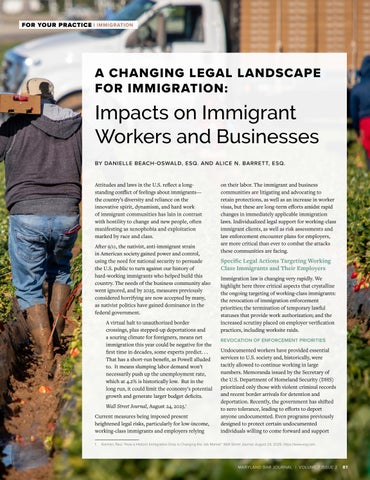
authorities in uncovering abuse are now being weaponized. As an example, the issuance of Notices to Appear in Immigration Court (NTAs) has become increasingly common among bluecollar workers who sought deferred action against employer retaliation after reporting violations to labor agencies. Recent increases in raids targeting workplaces—such as D.C. restaurants and Maryland Home Depot locations—serve as stark reminders of this heightened enforcement climate. Patrolling of immigrant neighborhoods has increased, as have arrests of unlucky “collateral” immigrants not initially targeted for arrest. Pursuant to the Supreme Court’s interim ruling in Noem v. Vasquez Perdomo, in Los Angeles, even suspicion of a lack of documentation based on someone’s ethnicity, location, apparent job, and foreign language or accent may be sufficient for ICE agents to stop, interrogate, and consider community members for detention. These actions and policies normalize racial profiling, creating a chilling effect on low-wage immigrant workers, documented and undocumented alike. All over the country, workers fear coming to work in the fields, resulting in rotting crops due to a lack of workers to harvest them.
EFFORTS TO END TEMPORARY FORMS OF LEGAL STATUS
The landscape of temporary lawful status is also shifting, impacting immigrant workers holding employment authorization.
The landscape of temporary lawful status is also shifting, impacting immigrant workers holding employment authorization. While temporary forms of humanitarian status that include work authorization are being terminated, the number of temporary work-specific visas remains stagnant. These trends place hundreds of thousands of existing immigrant workers and
their families in harm’s way, close the door to potential new immigrant workers, and threaten the survival of countless U.S. employers.
Short-term, renewable humanitarian relief such as Temporary Protected Status (TPS) and humanitarian parole have until now provided some flexibility to our rigid, limited system of categories for immigrants, allowing status and temporary work permits for people from countries facing crises or natural disasters. Under the current administration, such temporary status is being systematically terminated despite ongoing strife in countries of origin.
For instance, TPS has recently ended for Cameroonians, Afghans, Nepalis, Hondurans, Nicaraguans, and the administration is pursuing termination for Venezuelans. Individuals previously allowed into the country through humanitarian parole, a process also providing work authorization, are now targets for expedited removal without an opportunity for a hearing. This shift impacts thousands seeking refuge and whisks breadwinners away from their families and communities.
In addition to providing a lifeline for many, temporary humanitarian work visas enabled immigrants to lawfully fill low-income jobs as medical support workers, nurse aides, restaurant workers, construction workers, and farm workers. Now, as workers are losing documentation, the lack of dairy workers threatens to shut down the dairy industry. Meanwhile, an increase in temporary work visas, such as the H2B, H1B, and H2A, has never materialized, due to opposition in Congress. This stagnation strains work sites reliant on low-income labor, especially as travel bans persist, and impacts countries traditionally providing workers.
For example, the crab industry in Maryland is heavily dependent on H2B workers from Mexico, who are highly skilled at their seasonal work as crab pickers. If there are not enough

crab pickers, a large portion of the Maryland economy is threatened, involving tourism, restaurants, watermen, and the seafood industry. This sector’s survival depends on the federal government increasing the allotment of H2B visas.
INCREASED EMPLOYER VERIFICATION AND WORKSITE RAIDS
The U.S. government is relying more stringently on employer verification systems. Employers have always had to provide proof of work authorization, including documents such as I-94 forms, Employment Authorization Documents (EADs), and other specialized immigrant documents. However, audits and verification procedures were historically limited. Because DHS resources were focused on public safety, online verification of worker status through E-Verify remained mandatory only for federal contractors and larger employers on a state-by-state basis. In 2025, an increase in worksite raids has been coupled with an uptick in I-9 audits and congressional advocacy to expand E-Verify, requiring more meticulous employer verification at a time when temporary work authorization is upended.
As E-Verify becomes a standard requirement for more employers, incorrect notices or misclassifications can be detrimental—not only to employees but also to businesses facing legal challenges and economic risks. Furthermore, the I-9 process, with its own complexities and challenges, adds to employers’ responsibilities and the potential for legal scrutiny.
In addition to verifying work authorization at the time of hire, employers in blue-collar worker industries, such as hospitality, food production, and construction, have to brace for DHS raids of their worksites. Such raids are highly disruptive and send a chilling effect throughout supply chains as business owners and workers face aggressive, increasingly militarized confrontations. On September 4, 2025, ICE engaged in the largest worksite raid of this nation’s history at a Hyundai car manufacturing plant in Georgia. Photographs show workers being lined up for shackling at the plant. Similarly, videos
As E-Verify becomes a standard requirement for more employers, incorrect notices or misclassifications can be detrimental—not only to employees but also to businesses facing legal challenges and economic risks.
being shared by bystanders of arrests, such as those of day laborers around Home Depot stores in Maryland, show armed arrests by multiple masked agents, often pinning down and handcuffing unarmed civilians who do not appear to be resisting. Several immigrant community members have also reported injuries by ICE agents to local hotlines.
Legal Challenges and Advocacy to Protect Immigrant Workers and Businesses
In response to ever-more restrictive measures, immigrants and businesses have taken to the streets, the courts, and the halls of Congress to demand protection and advocate for increased immigrant work protections. Despite initial successes, these long-term battles remain to be seen through.
Immigrant rights organizations have filed numerous federal lawsuits challenging recent TPS and parole terminations and seeking to restore these forms of status for impacted non-citizens. Examples include CASA v. Noem and NTPSA v. Noem, cases challenging terminations of TPS for Cameroon, Afghanistan, and Venezuela. Recently, NTPSA v. Noem resulted in a Summary Judgment District Court ruling that restored TPS for Venezuela, and CASA v. Noem managed to delay the termination of TPS for Afghanistan through a Circuit Court emergency motion. While the pause was short-lived, it provided a critical number of additional days in which Afghan TPS-holders could remain in safety. Both cases are proceeding on the merits in the Ninth and Fourth Circuits, with the courts acknowledging significant chances of long-term success. Meanwhile, CHIRLA v. Noem resulted in a D.C. Circuit Court ruling protecting those who entered on humanitarian parole against targeting for expedited removal.
The U.S. Chamber of Congress has continued its advocacy to increase the H2A and H2B worker caps and for comprehensive immigration reform legislation, such as the Dignity Act of 2025, providing pathways to lawful status for undocumented workers. While these initiatives fall short of the universal pathways to citizenship that hardworking

As enforcement priorities shift, temporary statuses dwindle, and verification practices tighten, it is paramount that workers and employers alike understand and be prepared to respond.
immigrants deserve, they demonstrate ongoing, concerted efforts by the business community to enable immigrant workers to continue strengthening the U.S. economy.
Being Prepared and Responding
In this shifting and demanding environment, it is essential for both employers and workers to understand their rights and responsibilities. Workers must be educated about their rights to seek legal remedies against wage theft and employment discrimination, regardless of immigration status, as well as their constitutional rights to remain silent and refuse warrantless entry into private spaces. Meanwhile, employers should adopt best practices to adhere to I-9 policies, prepare for E-Verify audits, and implement proactive strategies to avoid legal pitfalls.
Employers should also navigate state-issued guidance on DHS enforcement carefully to avoid immigration raids without judicial warrants, while not obstructing any enforcement actions. It is critical that employers have clear policies in place designating point-persons to speak to law enforcement and review warrants, and that they train all staff to avoid exposing their businesses to unnecessary risk. An informed workplace creates a safer environment for immigrant workers and protects against potential legal violations.
Immigrant workers currently in the United States should seek prompt legal consultations with immigration attorneys to assess the status of their work authorizations. Those with expiring short-term status should explore if they qualify for longerterm status, such as asylum or familybased adjustment.
Simultaneously, continued broader-scale advocacy is instrumental for immigrant workers, employers, and the legal community. Immigrants can explore joining membership-based organizations such as CASA and engage in lawsuits and grassroots campaigns that seek to advocate for their well-being. Employers can present their needs to Congressional representatives, insisting they look at business needs for immigrant workers clearly and realistically, and take appropriate action. Attorneys can sign on to congressional advocacy initiatives by the American Immigration Lawyers’ Association (AILA), the Maryland State Bar Association (MSBA) Immigration Section, and others, while also taking cases pro bono during this great time of need.
The landscape of immigration law continues to evolve, presenting significant challenges for immigrant workers and the businesses that employ them. As enforcement priorities shift, temporary statuses dwindle, and verification practices tighten, it is paramount that workers and employers alike understand and be prepared to respond. Legal professionals must advocate for fair practices while helping clients navigate this increasingly complex legal framework. These are incredibly challenging times for immigrant workers, employers, and their attorneys, but the resourcefulness and resilience that have helped these communities thrive continue to strengthen our resolve to protect constitutional rights and livelihoods.


Danielle Beach-Oswald is the owner and managing partner of Beach-Oswald Immigration Law Associates, a multilingual law firm located in Washington, DC, that handles all types of immigration and visa needs.
Alice N. Barrett is the supervising immigration attorney at CASA, a national member-led organization building power and improving the quality of life in working-class Black, Latino/a/e, Afro-descendent, Indigenous, and Immigrant communities.