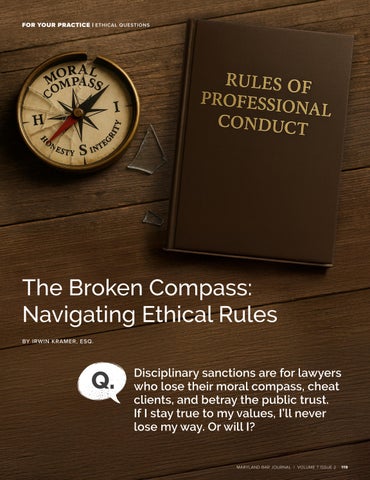
The Broken Compass: Navigating Ethical Rules
BY IRWIN KRAMER, ESQ.

Q.
Disciplinary sanctions are for lawyers who lose their moral compass, cheat clients, and betray the public trust. If I stay true to my values, I’ll never lose my way. Or will I?

A. The road to discipline is often paved with good intentions.
Honesty, morality, and decency are indispensable in the practice of law. But if they were enough, the Rules of Professional Conduct could be replaced with the Ten Commandments.
As decent, law-abiding people, lawyers often assume that a strong moral compass is all that’s needed to navigate ethical waters. Yet these are not the Rules of Moral Conduct, the Rules of Righteous Conduct, or the Rules of Common Decency. Some restrictions even run contrary to our instincts and common sense.
Like the rules of evidence or procedure, ethics rules form a technical code— detailed, demanding, and often counterintuitive. Time and again, lawyers with no intent to harm clients or cut corners have been sanctioned for relying on instincts rather than rules.
Their compasses pointed north, while their careers and licenses went south.
As lawyers, most of us are better at morality than math. We leave accounting to the accountants. We serve clients, not spreadsheets. Busy with our legal problems, we have little time to balance our own checkbooks—much less maintain meticulous ledgers of trust activity. But if we act honestly and never touch what isn’t ours, we should be fine anyway, right?
Wrong. You may never mean to steal. But without proper accounting, it’s alarmingly easy to lose track of the funds we hold for others.
Skip monthly reconciliations, and you won’t notice when a client fails to cash a refund check for her unused retainer or another disbursement. As these funds linger in the account, we hold client money long after it should have been returned. And the same neglect hurts us, too. Forget to withdraw earned fees, and we commingle our funds with those of our clients.
Common sense and good intentions won’t balance a trust account. Without the monthly reconciliations and detailed ledgers required by the Rules, we may harm clients we never meant to harm— and deprive ourselves of fees we earned but left buried in the trust account.
If it’s public, it can’t be confidential.
If we provide good service and achieve excellent results for our clients, it makes sense to let others know.
A multimillion-dollar civil verdict or a criminal acquittal read aloud in court may seem like fair game for firm websites, press releases, or social media posts. After all, these are matters of public record. They don’t constitute “confidential” information, so why not showcase our success? And really, what’s the harm in publicizing what everyone could already learn from a docket sheet or newspaper article?
Maybe none. But the Rules of Professional Conduct don’t require harm. They require confidentiality.
I’d never steal from a client, so I’m fine.
Much like Moses, our legal ethics teachers told us not to steal. What they didn’t teach us—at least not in detail—were the technical requirements of managing client money and reconciling trust accounts.
Honesty isn’t enough. Without the meticulous records required by Rule 1.15, even the most moral lawyer may be sanctioned for “unethical” conduct.
Sometimes, doing the “right thing” takes more than a moral compass. It requires a calculator as well.
Rule 1.6(a) provides that all information relating to the representation is confidential, regardless of its source. That means even publicly available information, even facts shouted from the bench or printed in the paper, cannot be publicized without the client’s informed consent.
Your client may cheer a multimillion-dollar win, but cringe at the thought of neighbors reading about her payday on your website. A criminal client may thank you for the acquittal, but not for broadcasting the sordid details on social media.
In short, Rule 1.6 protects not only secrets and privileged communications, but all information tied to the representation. Common sense may suggest that information can’t be “public” and “confidential” at once. The Rules say otherwise.

My client can’t afford rent or groceries, so I’ll cover them until the case settles.
Traveling Beyond the Compass
Advising lawyers “to be honest at all events,” Abraham Lincoln warned that “if, in your own judgment, you cannot be an honest lawyer, resolve to be honest without being a lawyer.” 2 Honest Abe’s advice remains timeless, though incomplete in today’s practice.
Few instincts feel more noble than helping a client in crisis. Imagine a woman disabled in an accident, out of work, struggling to make ends meet while her lawsuit drags on. Compassionate lawyers may generously open their wallets to keep her family afloat until justice is done.
But what feels moral may still be unethical. In Maryland and many other states, lawyers can be sanctioned for such altruistic gestures. Rule 1.8(e) flatly prohibits financial assistance to clients in connection with pending or contemplated litigation. With narrow exceptions for court costs and litigation expenses, the rule bars everything else. Groceries? Rent? Medical bills? Off-limits.
Out of concern that lawyers may exert too much influence over indebted clients, Maryland’s rule recasts altruistic conduct as “unethical.” Rejecting Maryland’s approach, the District of Columbia expressly allows lawyers to provide “financial assistance which is reasonably necessary to permit the client to institute or maintain the litigation.”1
Many would argue that the D.C. rule is more humane, while Maryland’s punishes lawyers for acts of generosity. How ironic that an act of kindness becomes, under our ethics code, an act of misconduct.
This disconnect underscores the danger of navigating by moral compass alone. The Rules of Professional Conduct impose limits that may seem unfair or illogical. Yet regardless of their moral justification, violations remain every bit as “unethical.”
While honesty is the hallmark of our profession, the Rules of Professional Conduct demand more. Morality, decency, and even compassion can mislead us when they clash with rules that are technical and often counterintuitive.
We should not discard our moral compass, but the compass alone is not enough. To steer clear of discipline, our direction must follow the directives of rules that may diverge from our own values. Our compass may point one way; the Rules can mandate another.
In the end, discipline is rarely reserved for deliberate schemers who abandoned their moral compass along with their clients. Quite often, it ensnares good lawyers who thought honesty would protect them, trusted their intuition, or mistook compassion for compliance. Common sense and worthy motives won’t keep us on course. Only a close reading of the rules, and acceptance of our professional limitations, can keep us from hitting a dead end.

Irwin R. Kramer advises lawyers and law firms throughout Maryland and the District of Columbia. Drawing on decades of law firm management experience, he consults with lawyers on ethical challenges that demand more than a moral compass. He also publishes a regular blog on legal ethics at https://attorneygrievances.com.