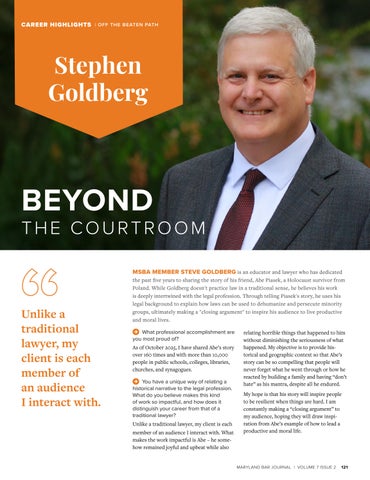
Stephen Goldberg

“
Unlike a traditional lawyer, my client is each member of an audience I interact with.
MSBA
MEMBER STEVE GOLDBERG is an educator and lawyer who has dedicated the past five years to sharing the story of his friend, Abe Piasek, a Holocaust survivor from Poland. While Goldberg doesn't practice law in a traditional sense, he believes his work is deeply intertwined with the legal profession. Through telling Piasek's story, he uses his legal background to explain how laws can be used to dehumanize and persecute minority groups, ultimately making a "closing argument" to inspire his audience to live productive and moral lives.
What professional accomplishment are you most proud of?
As of October 2025, I have shared Abe’s story over 160 times and with more than 10,000 people in public schools, colleges, libraries, churches, and synagogues.
You have a unique way of relating a historical narrative to the legal profession. What do you believe makes this kind of work so impactful, and how does it distinguish your career from that of a traditional lawyer?
Unlike a traditional lawyer, my client is each member of an audience I interact with. What makes the work impactful is Abe – he somehow remained joyful and upbeat while also
relating horrible things that happened to him without diminishing the seriousness of what happened. My objective is to provide historical and geographic context so that Abe’s story can be so compelling that people will never forget what he went through or how he reacted by building a family and having “don’t hate” as his mantra, despite all he endured. My hope is that his story will inspire people to be resilient when things are hard. I am constantly making a “closing argument” to my audience, hoping they will draw inspiration from Abe’s example of how to lead a productive and moral life.

“
Unlike a traditional lawyer, my client is each member of an audience I interact with.
MSBA MEMBER STEVE GOLDBERG is an educator and lawyer who has dedicated the past five years to sharing the story of his friend, Abe Piasek, a Holocaust survivor from Poland. While Goldberg doesn't practice law in a traditional sense, he believes his work is deeply intertwined with the legal profession. Through telling Piasek's story, he uses his legal background to explain how laws can be used to dehumanize and persecute minority groups, ultimately making a "closing argument" to inspire his audience to live productive and moral lives.
What professional accomplishment are you most proud of?
As of October 2025, I have shared Abe’s story over 160 times and with more than 10,000 people in public schools, colleges, libraries, churches, and synagogues.
You have a unique way of relating a historical narrative to the legal profession. What do you believe makes this kind of work so impactful, and how does it distinguish your career from that of a traditional lawyer?
Unlike a traditional lawyer, my client is each member of an audience I interact with. What makes the work impactful is Abe – he somehow remained joyful and upbeat while also
relating horrible things that happened to him without diminishing the seriousness of what happened. My objective is to provide historical and geographic context so that Abe’s story can be so compelling that people will never forget what he went through or how he reacted by building a family and having “don’t hate” as his mantra, despite all he endured. My hope is that his story will inspire people to be resilient when things are hard. I am constantly making a “closing argument” to my audience, hoping they will draw inspiration from Abe’s example of how to lead a productive and moral life.

The work lawyers do matters—our laws should reflect the values we hold dear—such as due process, fundamental fairness, and respect for human rights.
Can you explain how Piasek’s experiences have influenced your own professional compass and purpose as a legal professional?
Abe’s story is a cautionary tale about what can happen when laws and the force of the state are used to lessen and dehumanize a minority group.
Everything Hitler and the Nazis did was “legal.” The 1935 Nuremberg Laws defined who was a Jew and stripped citizenship from all German Jews. Once that protection was gone, further dehumanizing laws and policies followed.
Roger Taney was a Maryland lawyer who became Attorney General of Maryland, then U.S. Attorney General under President Andrew Jackson. In 1836, Jackson nominated Taney as Chief Justice of the U.S. Supreme Court, a position he held for nearly 30 years (until his death in 1864). In that role, Taney authored Dred Scott v. Sandford (1857), which stated that African Americans could not be U.S. Citizens.
The Nuremberg Laws that stripped Jews of their citizenship rights in Germany have uncomfortably close connections with the Dred Scott decision. The work lawyers do matters – our laws should reflect the values we hold dear – such as due process, fundamental fairness, and respect for human rights.
How do you believe telling Piasek's story and reflecting on its legal implications can serve as a "touchstone" for current law students and practicing attorneys in Maryland?
While researching aspects of Abe’s story in Germany this summer, I visited the Jewish Museum of Berlin, where I saw a massive display that featured thousands of laws and decrees hanging from the ceiling. These laws, enacted from 1933 to 1945, took away the rights of Jews and other vulnerable minority
groups, such as Jehovah’s Witnesses and homosexuals. Those unjust laws defined a minority group as “other.”
In Nazi Germany, Jews were prohibited from being doctors, from riding on streetcars, and from taking money out of the country, if they were even able to secure visas to other countries. The German lawyers modeled their laws on the Jim Crow laws in the US at the time –laws sanctioned by Plessy v. Ferguson (1896) and its pernicious doctrine of “separate but equal.” German lawyers also wrote the contracts that paid for the ovens at Auschwitz. Lawyers need a moral compass and need to be able to stand up and say “no” to certain policies and transactions.
Piasek's charge to you was simple: "Keep telling my story". How has this mission transformed your understanding of a lawyer's duty and the importance of using your voice to advocate for justice and human rights, especially in today's climate? There’s a famous quote from Shakespeare: “First thing we do, let’s kill all the lawyers!” But that quote is taken out of context to make it seem like Shakespeare is against lawyers; he’s not.
The character who says that line in Henry VI, Part 2 (1591) is an anarchist who realizes that in order to destroy a society, you need to get rid of the lawyers because they are the ones who stand up for justice and human rights.
The Universal Declaration of Human Rights (1948) was a response to World War II and the Holocaust. Maryland lawyers – and lawyers everywhere – should know the history of the Holocaust and draw inspiration from it. Abe’s story makes the Holocaust concrete by showing its impact on a young person and his family. It serves as a cautionary tale about the most extreme outcomes when laws and the force of the state are used to lessen and dehumanize a minority group.