A JOURNEY TO IMMIGRATION ADVOCACY
DAVID SECOR
Benach Pitney Reilly LLP
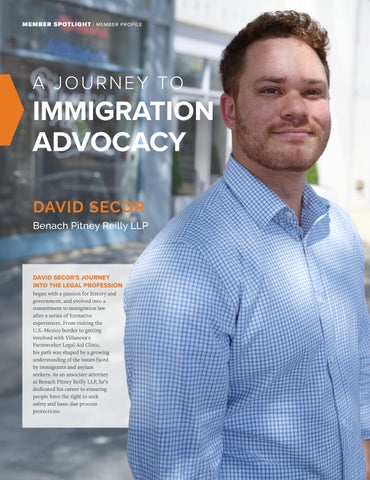
DAVID SECOR'S JOURNEY INTO THE LEGAL PROFESSION began with a passion for history and government, and evolved into a commitment to immigration law after a series of formative experiences. From visiting the U.S.-Mexico border to getting involved with Villanova's Farmworker Legal Aid Clinic, his path was shaped by a growing understanding of the issues faced by immigrants and asylum seekers. As an associate attorney at Benach Pitney Reilly LLP, he’s dedicated his career to ensuring people have the right to seek safety and basic due process protections.
Photo courtesy of Travis Marshall Photography
Why did you enter the legal profession?
I entered the legal profession and decided to become an immigration attorney for a combination of seemingly very different reasons.
My first semester at Villanova Law School was during the 2016 election, which certainly had some major effects on my thinking of what areas I wanted to concentrate in. The following year, I got involved with Villanova’s Farmworker Legal Aid Clinic and had my first experiences representing clients before the Immigration Court. Seeing ICE raids in the community at that time and learning more about how the Immigration Court system worked, I became increasingly interested in pursuing a career in immigration law. Coming from a family with Haitian roots as well, I felt and related to these issues on a personal level – but I also cared strongly about immigrants having the right to seek safety and have basic due process protections. Suddenly, I was back in DC as a third-year law student interning with the National Immigrant Justice Center, and after passing the bar later that year, I took my first job as an immigration attorney.
stone in our stone jar, which we use to symbolize our wins. But I also really enjoy the process of preparing with clients and helping them to feel empowered and self-assured to share their story with either the immigration officer or the immigration judge.
What are some accomplishments you've achieved during your career?
I try to keep a running list of those wins, because every single one involved such unique circumstances or specific legal issues. It’s often a major team effort too, involving the client, their family members or friends, sometimes an expert witness on a client’s country conditions or specific health concerns, in addition to our own staff working to assemble and present their claim in the most compelling way. In our practice, we also often see cases that have been affected for years by clerical mistakes, years of bureaucratic delays, ineffective assistance of counsel, or other problems outside the client’s control. Sorting through all those issues with a client and presenting a plan for how best to move forward to achieve their specific goals often feels like an accomplishment on its own.
Seeing ICE raids in the community at that time and learning more about how the Immigration Court system worked, I became increasingly interested in pursuing a career in immigration law.
Tell us a little bit about your current role.
As an associate attorney with Benach Pitney Reilly LLP, I primarily handle removal defense, humanitarian, and familybased immigration cases. Each case is very different. Part of my caseload involves asylum-based cases, either affirmative cases with the Asylum Office or defensive cases before the Immigration Courts. A lot of this work can involve assembling evidence with the client on how best to present their fears of persecution in their country, which often means multiple meetings to prepare a good declaration, possibly referring for a mental health evaluation, researching country conditions, and then figuring out the most effective ways of presenting their claim, especially if there are any legal issues.
What is your fondest memory of your legal career so far? Of course, there are the big moments when a client’s application for relief or protection is finally granted, or they are able to be reunited with their family after being detained or otherwise separated in the immigration process, for which it’s both an incredible honor and also extremely humbling. At our firm, we love to ask clients to share their wins with our whole team by coming into the office, sharing any words (if they want), and then dropping a
What are some of the challenges you face in your current role?
So much of this role is trying to set a client’s expectations and prepare them for the worst of all outcomes if an application is denied or a loved one is detained by ICE or forced to leave the United States. I always try to give people as much information as I can, so that they do not feel like they are in the dark. Of course, this particular administration’s hostility toward immigrants and aggressive tactics to arrest and detain more and more people, sometimes without justification or out of step with how immigration law has been practiced and enforced for decades, makes advising people trying to navigate this system extremely difficult. We just try our best to make sure our clients know their rights, what the law provides, and what we expect while knowing all the practical risks in their particular situation, too, and have all the same information we do.
How has the MSBA helped you in your legal career?
I try to stay up to date, to the extent that I can, with the resources provided through the Ethic Hotline and opinions, as well as the Health and Wellness resources provided online. However, I’m looking forward to more involvement too!