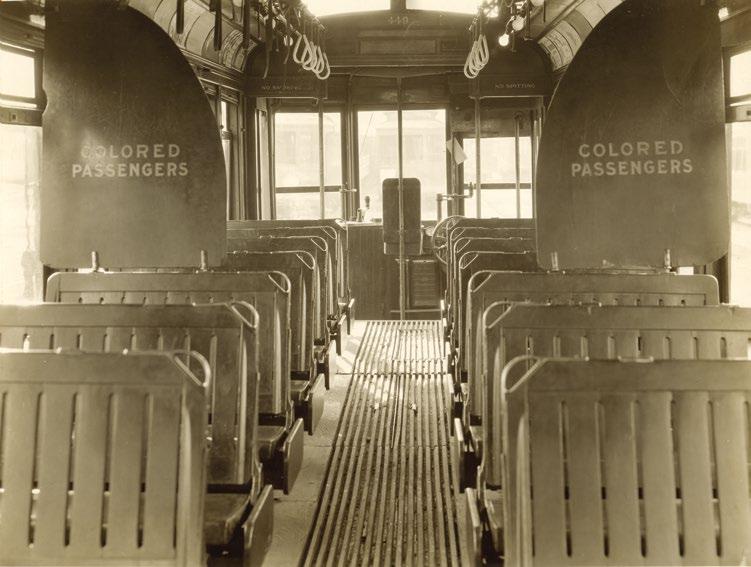
GREAT MINDS TEACHER EDITION WIT & WISDOM® 8 GRADE MODULE 4 TEENS AS CHANGE AGENTS

Great Minds® is the creator of Eureka Math® , Wit & Wisdom® , Alexandria Plan™, and PhD Science®
Published by Great Minds PBC greatminds.org
© 2023 Great Minds PBC. All rights reserved. No part of this work may be reproduced or used in any form or by any means—graphic, electronic, or mechanical, including photocopying or information storage and retrieval systems—without written permission from the copyright holder. Where expressly indicated, teachers may copy pages solely for use by students in their classrooms.
Printed in the USA A-Print
979-8-88588-793-9
Module Summary 2 Essential Question 3
Suggested Student Understandings 3 Texts 3 Module Learning Goals 4 Module in Context............................................................................................................................... ........................ 6 Standards ............................................................................................................................... ....................................... 7 Major Assessments 9 Module Map 10
Focusing Question: Lessons 1–9 What motivated Claudette Colvin?
Lesson 1 ............................................................................................................................... ....................................... 23
n TEXT: Claudette Colvin: Twice Toward Justice, Phillip Hoose ¢ Style and Conventions Deep Dive: Examine Verbals
Lesson 2 39
n TEXT: Claudette Colvin: Twice Toward Justice, Phillip Hoose ¢ Style and Conventions Deep Dive: Experiment with Verbals Lesson 3 51
n TEXTS: Claudette Colvin: Twice Toward Justice, Phillip Hoose • “The Racial Dot Map,” Dustin A. Cable ¢ Vocabulary Deep Dive: Explore Content Vocabulary: Exasperated, emboldened, degrading Lesson 4 67
n TEXT: Claudette Colvin: Twice Toward Justice, Phillip Hoose
¢ Style and Conventions Deep Dive: Examine Past and Present Participles Lesson 5 83
n TEXT: Claudette Colvin: Twice Toward Justice, Phillip Hoose, ¢ Vocabulary Deep Dive: Explore Content Vocabulary: Rebellion, revolution Lesson 6 95
n TEXTS: Claudette Colvin: Twice Toward Justice, Phillip Hoose • “Claudette Colvin: The Original Rosa Parks,” Great Big Story
¢ Vocabulary Deep Dive: Explore Academic Vocabulary: Justifiable, jus-, justice
Lesson 7 109
n TEXT: Claudette Colvin: Twice Toward Justice, Phillip Hoose
¢ Style and Conventions Deep Dive: Experiment with Past and Present Participles Lesson 8 121
n TEXTS: Claudette Colvin: Twice Toward Justice, Phillip Hoose • “Claudette Colvin: The Original Rosa Parks,” Great Big Story • Letter from Rosa Parks to Myles Horton ¢ Style and Conventions Deep Dive: Execute Participles Lesson 9 ............................................................................................................................... ..................................... 133
n TEXTS: Claudette Colvin: Twice Toward Justice, Phillip Hoose • “Claudette Colvin: The Original Rosa Parks,” Great Big Story • “The Racial Dot Map,” Dustin A. Cable
What role did Claudette Colvin and others play in the Civil Rights Movement?
Lesson 10 143
n TEXT: Claudette Colvin: Twice Toward Justice, Phillip Hoose ¢ Vocabulary Deep Dive: Explore Academic Vocabulary: Conviction Lesson 11 ............................................................................................................................... .................................... 155
n TEXT: Claudette Colvin: Twice Toward Justice, Phillip Hoose ¢ Vocabulary Deep Dive: Explore Academic Vocabulary: Persuasion, coercion Lesson 12 169
n TEXT: The Address to the First Montgomery Improvement Association Mass Meeting, Martin Luther King Jr. Lesson 13 175
n TEXT: Claudette Colvin: Twice Toward Justice, Phillip Hoose ¢ Style and Conventions Deep Dive: Examine Infinitives Lesson 14 191
n TEXT: Claudette Colvin: Twice Toward Justice, Phillip Hoose ¢ Style and Conventions Deep Dive: Experiment with Infinitives Lesson 15 ............................................................................................................................... ................................. 205
n TEXT: Claudette Colvin: Twice Toward Justice, Phillip Hoose ¢ Vocabulary Deep Dive: Explore Content Vocabulary: Ignited Lesson 16 217
n TEXT: Claudette Colvin: Twice Toward Justice, Phillip Hoose ¢ Style and Conventions Deep Dive: Execute Infinitives
What strategies do people use to effect social change?
Lesson 17............................................................................................................................... .................................... 227
n TEXTS: “Social Media Sparked, Accelerated Egypt’s Revolutionary Fire,” Sam Gustin • “How the Arab Spring Engulfed the Middle East and Changed the World,” Michael Safi et al. • Ladder for Booker T. Washington, Martin Puryear
¢ Vocabulary Deep Dive: Explore Academic Vocabulary: mit, transmit
Lesson 18 239
n TEXT: “Social Media Sparked, Accelerated Egypt’s Revolutionary Fire,” Sam Gustin
Lesson 19 249
n TEXTS: “Small Change,” Malcolm Gladwell • Ladder for Booker T. Washington, Martin Puryear
¢ Vocabulary Deep Dive: Explore Content Vocabulary: Radicalized
Lesson 20 263
n TEXTS: “Small Change,” Malcolm Gladwell • Ladder for Booker T. Washington, Martin Puryear
¢ Vocabulary Deep Dive: Explore Academic Vocabulary: Consciousness, diffusion
Lesson 21 277
n TEXT: “Small Change,” Malcolm Gladwell
¢ Style and Conventions Deep Dive: Examine Gerunds
Lesson 22 285
n TEXTS: “Small Change,” Malcolm Gladwell • “Social Media Sparked, Accelerated Egypt’s Revolutionary Fire,” Sam Gustin • Ladder for Booker T. Washington, Martin Puryear
¢ Style and Conventions Deep Dive: Experiment with Gerunds
Lesson 23 ............................................................................................................................... .................................. 295
n TEXTS: “Small Change,” Malcolm Gladwell • “Social Media Sparked, Accelerated Egypt’s Revolutionary Fire,” Sam Gustin
¢ Style and Conventions Deep Dive: Execute Gerunds
Lesson 24 303
n TEXTS: All Module Texts, Student Self-Generated Texts
¢ Style and Conventions Deep Dive: Execute Verbals Focusing Question: Lessons 25–32 How
Lesson 25 ............................................................................................................................... .................................... 311
n TEXTS: Student Self-Generated Texts
¢ Style and Conventions Deep Dive: Experiment with Verb Voices to Achieve a Particular Effect
Lesson 26 321
n TEXTS: Student Self-Generated Texts
¢ Style and Conventions Deep Dive: Execute Verb Voices to Achieve a Particular Effect
Lesson 27 329
n TEXTS: Student Self-Generated Texts
¢ Style and Conventions Deep Dive: Excel at Using Verb Voices to Achieve a Particular Effect Lesson 28 337
n TEXTS: Student Self-Generated Texts
¢ Vocabulary Deep Dive: Vocabulary Assessment 1 Lesson 29 345
n TEXTS: Student Self-Generated Texts
¢ Vocabulary Deep Dive: Vocabulary Assessment 2 Lesson 30 ............................................................................................................................... ................................. 353
n TEXTS: Student Self-Generated Texts
¢ Style and Conventions Deep Dive: Experiment with Verb Moods to Achieve a Particular Effect Lesson 31 363
n TEXTS: Student Self-Generated Texts
¢ Style and Conventions Deep Dive: Execute Verb Moods to Achieve a Particular Effect Lesson 32 371
n TEXTS: Student Self-Generated Texts
¢ Style and Conventions Deep Dive: Excel at Using Verb Moods to Achieve a Particular Effect
Focusing Question: Lesson 33 What is the story of the year? Lesson 33
We all spoke for ourselves.
—Claudette ColvinWhat does it mean to stand up for what you believe in rather than to stand by and observe without acting? What motivates people to create social change, and how do they accomplish their goals? The inspirational story of Claudette Colvin provides an often-overlooked example of a young woman taking a stand against injustice under incredibly challenging circumstances. Students explore Claudette Colvin actions, agency, language, and ultimately, her role in the Civil Rights Movement and use Claudette Colvin story as an example of the possibilities for change agents in a variety of circumstances, and around a variety of social issues.
This module engages the idea that social change is rarely a linear, straightforward process, but, more often, a combination of circumstance and opportunity, spontaneous and highly strategic action, personal agency and collective action. This study highlights the key actions of major historical figures in the Civil Rights Movement while also elevating the story of a lesser-known, but no less important, change agent. This module’s questions prompt students to examine social issues in their own communities and the world at large as they gain a deeper understanding of the challenges that people overcome to achieve meaningful change. Social change is the ideal topic to engage students in independent research as they work to identify a teen change agent and present their findings through writing and a multimedia presentation.
Phillip Hoose’s Claudette Colvin: Twice Toward Justice illuminates and re-evaluates the contributions different people made to the Civil Rights Movement. Students consider Claudette Colvin’s contributions to the Civil Rights Movement in relation to a broader range of historical events, actors, and ideas. Reading of this core text also launches deeper historical exploration of the Civil Rights Movements, with students gaining insight into the strategic choices of its leadership, and deepening their understanding of the network of actions and strategies that challenged segregation in the mid-1950s. In a broader sense, students gain knowledge of how social change occurs through the development of a series of strategies, actions, and responses performed by different people with different roles. This understanding provides an illuminating context for students’ research on a teen change agent’s actions and impact.
Strategies for effective social change are put into a contemporary context through an examination of two articles that discuss social media as a strategy for social change. First, students read “Social Media Sparked, Accelerated Egypt’s Revolutionary Fire,” a short article that discusses the role of social media in spreading revolutionary ideas during the Arab Spring. Then, students read Malcolm Gladwell’s masterful “Small Change,” which argues against the more popular view that social media is and can be an effective strategy, instead presenting an argument for highly organized, strategic activism.
For their End-of-Module (EOM) Task, students present the research they have been engaged in throughout the module. Students write an informative essay based on their research before, turning that informative essay into a multimedia presentation and presenting their findings to a wider audience. Students end Grade 8 empowered to understand, analyze, and write about complex texts, do research, and present that research. They also feel empowered to look for opportunities to make real change in their lives and communities.
Social change occurs through a series of strategies, actions, and responses performed by different people with different roles.
Challenging injustice is never easy and often includes overcoming obstacles, facing conflict, or meeting with resistance.
Change agents can be motivated by personal, social, or historical circumstances, and challenges to injustice can be enacted by anyone who is motivated to stand up for what they believe.
Ladder for Booker T. Washington, Martin Puryear (http://witeng.link/0525)
Photograph of Alabama historical marker for Rosa Parks and the Montgomery bus boycott (http://witeng.link/0520)
Photograph of the sit-in in Greensboro, NC., Fine Arts America (http://witeng.link/0530)
“Claudette Colvin: The Original Rosa Parks,” Great Big Story (http://witeng.link/0508)
The Address to the First Montgomery Improvement Association Mass Meeting, Martin Luther King Jr. (http://witeng.link/0521)
“The Racial Dot Map,” Dustin A. Cable (http://witeng.link/0498)
“Civil Rights Timeline,” Kids Laws (http://witeng.link/0519)
“How the Arab Spring Engulfed the Middle East and Changed the World,” Michael Safi et al. (http://witeng.link/0524)
Letter from Rosa Parks to Myles Horton, Wisconsin Historical Society (http://witeng.link/0518)
Explain and re-evaluate the contributions different people made to the Civil Rights Movement, especially Claudette Colvin.
Analyze Claudette Colvin’s contributions to the Civil Rights Movement in relation to a broader range of historical events, actors, and ideas. Define what it means to challenge injustice in the context of specific historical, social, and individual circumstances.
Identify diverse strategies to effect social change.
Apply an understanding of an individual’s motivations and strategies for creating social change to the development of an original research project focused on a teen change agent.
Identify and analyze the structure of a paragraph, including the role of particular sentences in developing and refining a key concept (RI.8.1, RI.8.5).
Determine an author’s point of view or purpose, and explain how the author acknowledges and responds to conflicting evidence or viewpoints (RI.8.1, RI.8.6).
Analyze and assess the purpose, motives, and credibility of information presented in diverse media (RI.8.1, RI.8.7, W.8.8, SL.8.2).
Analyze two or more texts’ presentation of conflicting information on the same topic, and identify where the texts disagree on matters of fact or interpretation (RI.8.1, RI.8.9).
Write an informative research essay that synthesizes evidence from multiple texts, integrates multimedia information and formats, and uses technology to present and publish findings (W.8.2, W.8.6, SL.8.5).
Develop the focus of an informative research essay and presentation by selecting, synthesizing, and editing information and evidence from multiple individually-researched texts (W.8.2.b, W.8.7, W.8.8).
Strengthen claims and audience interest by integrating diverse media and formats in writing and oral presentations (W.8.2.a, W.8.2.b, W.8.6, W.8.8, SL.8.4, SL.8.5).
Conduct short research projects to answer a question, including self-generated questions, using search terms effectively, and gathering information from multiple print and digital sources (W.8.7, W.8.8).
Assess sources for credibility and accuracy, identifying gaps in knowledge, and generating new questions for additional research (W.8.7, W.8.8).
Deepen understanding of incorporating evidence effectively by making strategic decisions about when to quote and paraphrase, while avoiding plagiarism and formatting correctly (W.8.8).
Orally analyze and assess the purpose, social, commercial, or political motives, and credibility of information presented in diverse media (RI.8.7, W.8.8, SL.8.2).
Present research findings succinctly, focusing on essential information and ideas (SL.8.4).
Present research using multimedia, appropriate eye contact, adequate volume, and clear pronunciation (SL.8.4, SL.8.5).
Explain the function of verbals in general, use verbals in writing, and explain their functions in particular sentences (L.8.1.a).
In speaking and writing, use verbs in the active or passive voice and in the conditional and subjunctive mood to achieve particular effects (L.8.3.a).
Use context clues to determine the meaning or the word and verify its definition in the dictionary (L.8.4.a, L.8.4.d).
Determine and use the relationship between words to better understand each word (L.8.5.b).
Knowledge: In their final module of middle school, Grade 8 students revisit their earlier examination of personal agency to consider how it can develop in the face of injustice. Students primarily develop this knowledge through the examination of a historical example of one teen’s compelling motivations and actions, as well as the complicated aftermath of her actions. Deepening their knowledge of the workings of the Civil Rights Movement, students explore the social and historical values that supported segregation and the individual and collective values that challenged it. Students consider how social change is complex and challenging, even within the social movement itself. This module allows students to extend an understanding of the power of individual agency to consider its contribution to overcoming social conflict. And they return to an examination of the power of language to explore how it operates in tandem with action to effect meaningful, lasting social change.
Reading: Students extend their critical and close-reading skills by working with a book-length informative text, as well as with several short informational articles and supplementary sources in different mediums: speeches, interactive web media, videos, and advertisements. While reading Phillip Hoose’s Claudette Colvin: Twice Toward Justice, students examine the key concepts of justice, injustice, and social change during the Civil Rights Movement while also analyzing how Hoose’s interpretation of Claudette Colvin’s role in these events reveals his purpose in writing this text. Students then apply their understanding of author’s purpose and interpretation to an analysis of two articles that disagree on the topic of social media as a strategy for social change.
Writing: In this final module, students engage in independent research about a social issue and a teen change agent of their choice. Students are first introduced to new research skills as a whole class before practicing and executing those skills independently. The focus of this instruction includes assessing relevance and credibility of sources, including how to assess credibility of sources found online and the synthesis of evidence from multiple sources. Students also work with sources in various mediums, which extends their reading skills around different mediums. Finally, students apply their established understanding of informative writing by applying their informative writing skills to a research essay.
Speaking and Listening: Speaking and Listening goals dovetail seamlessly with the research work. Students refine their research and writing by presenting their findings succinctly and effectively with a multimedia presentation. Students build to this presentation through analysis of independently researched sources, including assessing their credibility and relevance to students’ own research projects. They then practice summarizing their own or another’s purpose in a succinct and engaging way. Thus, they extend summary skills developed in Modules 1-3 by making strategic choices about presenting summative information that develops audience understanding of the topic and adds interest.
RI.8.5 Analyze in detail the structure of a specific paragraph in a text, including the role of particular sentences in developing and refining a key concept.
RI.8.6 Determine an author’s point of view or purpose in a text and analyze how the author acknowledges and responds to conflicting evidence or viewpoints.
RI.8.7 Evaluate the advantages and disadvantages of using different mediums (e.g., print or digital text, video, multimedia) to present a particular topic or idea.
RI.8.9 Analyze a case in which two or more texts provide conflicting information on the same topic and identify where the texts disagree on matters of fact or interpretation.
W.8.2 Write informative/explanatory texts to examine a topic and convey ideas, concepts, and information through the selection, organization, and analysis of relevant content.
W.8.4 Produce clear and coherent writing in which the development, organization, and style are appropriate to task, purpose, and audience.
W.8.6 Use technology, including the Internet, to produce and publish writing and present the relationships among information and ideas efficiently as well as to interact and collaborate with others.
W.8.7 Conduct short research projects to answer a question (including a self-generated question), drawing on several sources and generating additional related, focused questions that allow for multiple avenues of exploration.
W.8.8 Gather relevant information from multiple print and digital sources, using search terms effectively; assess the credibility and accuracy of each source; and quote or paraphrase the data and conclusions of others while avoiding plagiarism and following a standard format for citation.
SL.8.2 Analyze the purpose of information presented in diverse media and formats (e.g., visually, quantitatively, orally) and evaluate the motives (e.g., social, commercial, political) behind its presentation.
SL.8.4 Present claims and findings, emphasizing salient points in a focused, coherent manner with relevant evidence, sound valid reasoning, and well-chosen details; use appropriate eye contact, adequate volume, and clear pronunciation.
SL.8.5 Integrate multimedia and visual displays into presentations to clarify information, strengthen claims and evidence, and add interest.
L.8.1.a Explain the function of verbals (gerunds, participles, infinitives) in general and their function in particular sentences.
L.8.3.a Use verbs in the active and passive voice and in the conditional and subjunctive mood to achieve particular effects (e.g., emphasizing the actor or the action; expressing uncertainty or describing a state contrary to fact).
L.8.4.a Use context (e.g., the overall meaning of a sentence or paragraph; a word’s position or function in a sentence) as a clue to the meaning of a word or phrase.
L.8.4.d Verify the preliminary determination of the meaning of a word or phrase (e.g., by checking the inferred meaning in context or in a dictionary).
L.8.5.b Use the relationship between particular words to better understand each of the words.
RL.8.10 By the end of the year, read and comprehend literature, including stories, dramas, and poems, at the high end of grades 6–8 text-complexity band independently and proficiently.
RI.8.10 By the end of the year, read and comprehend literary nonfiction at the high end of the grades 6–8 text-complexity band independently and proficiently.
L.8.6 Acquire and use accurately grade-appropriate general academic and domain-specific words and phrases; gather vocabulary knowledge when considering a word or phrase important to comprehension or expression.
1. Write an informative, professional letter making a case for the inclusion of two different artifacts in various mediums in an exhibit about Claudette Colvin’s motivations for creating change.
2. Write a two-paragraph annotated bibliography entry that explains Phillip Hoose’s purpose in writing about Claudette Colvin and how he acknowledges and responds to conflicting viewpoints.
3. Complete a graphic organizer, and write an informative paragraph in order to explain how two arguments about social media as a strategy for social change disagree on matters of fact and interpretation.
Analyze the advantages and disadvantages of different mediums.
Use formal style and tone to present information.
Assess an author’s purpose and motivations in writing a text.
Cite correctly, using MLA format.
Apply an understanding of strategies for social change.
Identify where two texts on the same topic disagree on matters of fact and interpretation.
RI.8.1, RI.8.7, W.8.2, W.8.4, W.8.9, L.8.1.a
RI.8.1, RI.8.2, RI.8.6, W.8.2, W.8.8, L.8.1.a
RI.8.1, RI.8.3, RI.8.9, W.8.2, W.8.8, W.8.9, L.8.1.a
1. Read a speech by Martin Luther King Jr. Respond to multiple-choice questions, and then, using evidence from the text, write an informative/ explanatory paragraph about how King’s speech develops a sense of justice.
2. Read a closing example of weaktie activism in a Malcolm Gladwell article. Respond to multiple-choice questions, and then, using evidence from the text, write an informative/ explanatory paragraph about how this example develops Gladwell’s claims about social media as a strategy for social change.
Express understanding of major figures in the Civil Rights Movement.
Apply understanding of advantages of different mediums.
RI.8.1, RI.8.2, RI.8.3, RI.8.4, W.8.2.a, W.8.2.b, W.8.2.c, W.8.2.f, L.8.4.c, L.8.5.b
Demonstrate an understanding of strategies for social change.
Analyze a specific paragraph and how that paragraph develops central ideas in “Small Change.”
RI.8.1, RI.8.2, RI.8.3, RI.8.4, RI.8.5, W.8.10, L.8.4.a
Write an informative/explanatory essay to present research about a teen change agent that uses specific strategies to effect social change. Then, translate that essay into a multimedia presentation to present findings to a wider audience.
Draw on a minimum of three sources, including one nonprint source.
Synthesize evidence, using paraphrasing and quoting. Use active and passive verb moods to emphasize an actor or an action. Cite correctly.
Incorporate multimedia that adds interest and develops audience understanding of your topic.
Refine a written portion of an essay, and show an understanding of the shift in task from writing to presentation.
Provide succinct explanations in writing and orally. Use the conditional or subjunctive verb moods to express uncertainty or describe a state contrary to fact.
RI.8.1, W.8.2, W.8.4, W.8.5, W.8.7, W.8.6, W.8.8, SL.8.4, SL.8.5, L.8.4.b, L.8.6
Demonstrate understanding of academic, text-critical, and domainspecific words, phrases, and/or word parts.
Acquire and use grade-appropriate academic terms. Acquire and use domain-specific or text-critical words essential for communication about the module’s topic.
L.8.4.b L.8.6
RI.8.5, W.8.10).
Identify criteria for a research question (W.8.7).
Explain the function of verbals (L.8.1.a).
2 Claudette Colvin: Twice Toward Justice
Organize What’s happening in chapter 1?
Experiment
How does asking research questions work?
Experiment
How do verbals work?
Express an understanding of the legal and social rules that governed life under Jim Crow (RI.8.1).
Apply understanding of research questions to generate a question about Claudette Colvin (RI.8.1, W.8.7).
3 Claudette Colvin: Twice Toward Justice
“The Racial Dot Map”
Reveal
What does a deeper exploration of segregation reveal?
Experiment
How does asking research questions work?
Examine
Why is it important to present findings succinctly?
Sort verbals by functions (L.8.1.a).
Analyze the impact of segregation on Claudette’s community through synthesizing information from sources in multiple mediums (RI.8.1, RI.8.2, RI.8.7).
Revise a research question in order to increase specificity (W.8.7, W.8.8).
Use context clues to infer the meanings of exasperated, emboldened, and degrading, and verify definitions in a dictionary (L.8.4.a, L.8.4.d).
4 Claudette Colvin: Twice Toward Justice
Reveal
What does a deeper exploration of injustice reveal?
Execute
How do I ask a research question for a short research project?
Examine
Why are past and present participles important?
Explain the circumstances that contributed to Claudette Colvin’s motivation to create change (RI.8.1, RI.8.2, RI.8.3, W.8.10).
Differentiate between past and present participles and explain their functions (L.8.1.a).
Text(s)
5 Claudette Colvin: Twice Toward Justice
Distill
What is the central idea of chapter 4?
Experiment
How do I present findings succinctly?
Analyze how Claudette’s stand against injustice develops a central idea in Claudette Colvin: Twice Toward Justice (RI.8.1, RI.8.2, W.8.2).
Determine and use the relationship between Rebellion and Revolution to better understand each word (L.8.5.b).
6 Claudette Colvin: Twice Toward Justice
“Claudette Colvin: The Original Rosa Parks”
Reveal
What does a deeper exploration of Claudette Colvin’s story in different mediums reveal?
Examine
Why is it important to assess sources? Examine
Why is is it important to listen for purpose?
7 Claudette Colvin: Twice Toward Justice
Reveal
What does a deeper exploration of responses to Claudette’s actions reveal?
Experiment
How does assessing sources work? Experiment
How do past and present participles work?
Analyze first person accounts of Claudette’s stand against injustice as presented in different mediums (RI.8.1, RI.8.2, RI.8.7, W.8.10).
Use the relationship between justifiable, jus, and justice to better understand each word (L8.4.b, L.8.5.b).
Analyze how conflicting responses to Claudette’s actions reveal a complicated, growing sense of injustice in Montgomery (RI.8.1, RI.8.2, RI.8.3, W.8.10).
Use past and present participles and explain the function of participles in sentences (L.8.1.a).
8 FQT Claudette Colvin: Twice Toward Justice
“Claudette Colvin: The Original Rosa Parks”
Letter from Rosa Parks to Myles Horton
Know
How do texts in different mediums build my knowledge?
Execute
How do I use past and present participles in a Focusing Question Task?
Explain the advantages and disadvantages of two different mediums in conveying Claudette Colvin’s motivations to create change (RI.8.1, RI.8.7, W.8.2, W.8.4, W.8.9, L.8.1.a).
Use participles and participial phrases and explain their functions in sentences (L.8.1.a).
Text(s) Content Framing Question Craft Question(s) Learning Goals
9 SS Claudette Colvin: Twice Toward Justice “Claudette Colvin: The Original Rosa Parks”
“The Racial Dot Map”
Know
How do texts in different mediums build my knowledge?
Execute
How do I express findings succinctly in a Socratic Seminar?
Demonstrate an understanding of the advantages and disadvantages of different mediums in conveying Claudette’s motivations through collaborative conversation with peers (RI.8.1, RI.8.7, SL.8.1, SL.8.2, SL.8.6).
Collaboratively publish an online multimedia slideshow of artifacts with placards that explain Claudette Colvin’s motivations to create change (W.8.6, SL.8.5).
Text(s) Content Framing Question Craft Question(s) Learning Goals
10 Claudette Colvin: Twice Toward Justice
Organize What’s happening in chapter 6?
Examine
Why is research important?
Summarize effects of events in Montgomery on Claudette Colvin and her community (RI.8.1, RI.8.2, W.8.10).
Consider the multiple meanings of conviction, and determine the definition that best applies in the context of the text (L.8.4.a, L.8.4.d).
11 Claudette Colvin: Twice Toward Justice
Reveal
What does a deeper exploration of Rosa Parks’s story reveal?
Execute
How do I ask a research question to begin a research project?
Analyze how a comparison of Claudette Colvin and Rosa Parks reveals Phillip Hoose’s purpose in writing
Claudette Colvin: Twice Toward Justice (RI.8.1, RI.8.6, W.8.10).
Pose a research question about a meaningful social issue (W.8.7).
Determine and use the relationship between persuasion and coercion to better understand each word (L.8.5.b).
12 NR The Address to the First Montgomery Improvement Association Mass Meeting
Reveal
What does a deeper exploration of justice reveal?
13 Claudette Colvin: Twice Toward Justice
Organize
What’s happening in chapter 8?
Experiment
How does finding and assessing sources work? Examine
Why are infinitives important?
Apply an understanding of justice and agency to a new text through independent reading and analysis (RI.8.1, RI.8.2, RI.8.3, RI.8.4, W.8.2.a, W.8.2.b, W.8.2.c, W.8.2.f, L.8.4.c, L.8.5.b).
Explain the actions and ideas that led to the federal lawsuit challenging segregation on buses (RI.8.1, RI.8.2, RI.8.3, RI.8.4, L.8.4.a, L.8.4.c, W.8.10).
Differentiate between infinitives and prepositional phrases, and explain the function of an infinitive (L.8.1.a).
14 Claudette Colvin: Twice Toward Justice
Reveal
What does a deeper exploration of the Browder v. Gayle court case reveal?
Experiment
How does listening for purpose work? Experiment
How do infinitives work?
Identify a speaker’s purpose and motives (SL.8.2).
Analyze how the participation of plaintiffs in Browder v. Gayle develops a sense of agency within the Civil Rights Movement (RI.8.1, RI.8.2, RI.8.3, W.8.10).
15 Claudette Colvin: Twice Toward Justice
Distill
What is the central idea of Claudette Colvin: Twice Toward Justice?
Experiment
How do paraphrasing and quoting work?
Execute
How do I find and assess sources in a research project?
Identify infinitives, and explain their roles in sentences (L.8.1.a).
Analyze Claudette Colvin’s historical importance and legacy (RI.8.1, RI.8.2, RI.8.6, W.8.10).
Evaluate decisions about paraphrasing or direct quoting (W.8.8).
Assess an independently researched text for credibility and use in a research project (W.8.7, W.8.8, SL.8.2).
Use context clues to determine the meanings of ignited, verify the definition in the dictionary, and analyze the words’ significance to the text (L.8.4.a, L.8.4.d, L.8.5.c).
Focusing Question 2: What role did Claudette Colvin and others play in the Civil Rights Movement?Text(s) Content Framing Question Craft Question(s) Learning Goals
16
FQT Claudette Colvin: Twice Toward Justice
Know
How does Claudette Colvin: Twice Toward Justice build my knowledge?
Execute
How do I paraphrase and quote in a Focusing Question Task?
Excel
How do I improve asking questions for a research project?
Execute
How do I use infinitives in a Focusing Question Task?
Analyze Phillip Hoose’s purpose in Claudette Colvin: Twice Toward Justice, including how he responds to conflicting viewpoints (RI.8.1, RI.8.2, RI.8.6, W.8.2, W.8.8, L.8.1.a).
Refine a self-generated research question based on peer feedback and a developing understanding of a topic (W.8.5, W.8.7).
Use infinitives in Focusing Question Task 2, and explain the function of infinitives in particular sentences (L.8.1.a).
Text(s)
17 “Social Media Sparked, Accelerated Egypt’s Revolutionary Fire”
“How the Arab Spring Engulfed the Middle East and Changed the World”
Ladder for Booker T. Washington
Organize
What is happening in “Social Media Sparked, Accelerated Egypt’s Revolutionary Fire”?
Explain the roles of social media in promoting change during the Arab Spring (RI.8.2, RI.8.4).
Use knowledge of the root mit and context clues to determine the meaning of transmit, and verify definitions in the dictionary (L.8.4.a, L.8.4.b, L.8.4.d).
18 “Social Media Sparked, Accelerated Egypt’s Revolutionary Fire”
Reveal
What does a deeper exploration of strategies for social change reveal?
Excel
How do I improve paraphrasing and quoting in a research project?
Analyze how the analogy of social media as an accelerant for social change reveals Gustin’s purpose in writing “Social Media Sparked, Accelerated Egypt’s Revolutionary Fire” (RI.8.1, RI.8.6, L.8.5.a, W.8.10).
Use framing to improve paraphrasing and quoting in informative writing, and demonstrate credibility and relevance of sources (W.8.8).
19 “Small Change”
Ladder for Booker T. Washington
Organize
What’s happening in “Small Change”?
20 “Small Change”
Ladder for Booker T. Washington
Reveal
What does a deeper exploration of strategies for social change reveal?
Examine
Why is synthesizing evidence important?
Describe Malcolm Gladwell’s point of view on social media as a strategy for creating social change (RI.8.6, W.8.10).
Use context clues to infer the meaning of the word radicalized, verify its meaning in the dictionary, and use the word in context (L.8.4.a, L.8.4.d).
Explain Gladwell’s critique of other analogies about strategies for social change (RI.8.1, RI.8.3, W.8.10).
Analyze how Gladwell’s purpose is revealed through his central analogy about strategies for social change (RI.8.1, RI.8.6, W.8.10, L.8.5.a).
Use context clues to determine the meanings of consciousness and diffusion, and verify definitions in the dictionary (L.8.4.a, L.8.4.d).
Text(s)
21 NR “Small Change” Distill
What is the central idea of “Small Change”?
Experiment
How does synthesizing evidence work?
Examine
Why are gerunds important?
Apply an understanding of strategies for social change to a new text through independent reading and analysis (RI.8.1, RI.8.2, RI.8.3, RI.8.4, RI.8.5, W.8.10, L.8.4.a).
Practice strategies for synthesizing information from sources using a model essay (W.8.8).
Explain the role of gerunds, and identify gerunds in sentences (L.8.1.a).
22 “Small Change”
“Social Media Sparked, Accelerated Egypt’s Revolutionary Fire”
Ladder for Booker T. Washington
Distill
What are the central ideas about strategies for creating social change in two informational articles?
Execute
How do I synthesize evidence for a research project?
Experiment
How do gerunds work?
23
FQT “Small Change”
“Social Media Sparked, Accelerated Egypt’s Revolutionary Fire”
Know
How do articles about strategies for creating social change build my knowledge?
Execute
How do I use gerunds in a Focusing Question Task?
Apply an understanding of strategies for social change to explain Gladwell and Gustin’s central ideas (RI.8.1, RI.8.2, L.8.5.a).
Synthesize evidence from independently researched sources (W.8.8).
Explain the function of gerunds in sentences (L.8.1.a).
Apply an understanding of strategies for social change in order to analyze two conflicting arguments, including where the articles disagree on matters of fact and interpretation (RI.8.1, RI.8.3, RI.8.9, W.8.2, W.8.8, W.8.9, L.8.1.a).
Use gerunds in Focusing Question Task 3, and, explain their functions in various sentences (L.8.1.a).
Text(s) Content Framing Question Craft Question(s) Learning Goals
24 SS All Module Texts Know
How do module texts build my knowledge?
Execute
How do I assess sources in a Socratic Seminar?
Execute
How do I present findings succinctly in a Socratic Seminar?
Execute
How do I show my knowledge of verbals?
Synthesize an understanding of social change from a variety of sources in order to express an understanding of how people create justice (RI.8.1, RI.8.2, SL.8.1, SL.8.2, SL.8.4, SL.8.6).
Identify verbals, and explain their functions in sentences (L.8.1.a).
Text(s) Content Framing Question Craft Question(s) Learning Goals
25 Student selfgenerated texts Know
How do research sources build my knowledge of teen change agents?
Execute
How do I identify remaining questions in a research project?
Experiment
How do the active and passive verb voices affect meaning?
Evaluate self-generated research material to determine outstanding questions and needs (W.8.7, W.8.8).
Determine and evaluate the effects of the active and passive verb voices (L.8.3.a).
26 EOM VOC
Student selfgenerated texts Know
How do research sources build my knowledge of teen change agents?
Execute
How do I synthesize evidence in an End-ofModule Task?
Execute
How do I use the active and passive verb voice to achieve particular effects in an End-of-Module Task?
Establish an essay outline drawing on multiple sources to synthesize evidence (W.8.2, W.8.8).
Use verb voices to achieve particular effects (L.8.3.a).
27
EOM VOC
Student selfgenerated texts Know
How do research sources build my knowledge of teen change agents?
Excel
How do I improve my synthesis of evidence?
Excel
How do I improve my use of verb voices to achieve particular effects in an Endof-Module Task?
28
Student selfgenerated texts Know How do research sources build my knowledge of teen change agents?
Examine
Why is developing the focus of my essay for presentation important?
Finalize informative research essay responding to peer and teacher review (W.8.2, W.8.4, W.8.5, W.8.7, W.8.8, W.8.9.b, SL.8.1, L.8.1.c).
Revise writing verb voices to achieve particular effects (L.8.3.a).
Identify key points and wellchosen details to transition from a written product to a presentation (W.8.2, W.8.4, SL.8.4).
Demonstrate acquisition of grade-appropriate academic and domain-specific words (L.8.4.b, L.8.6).
29
Student selfgenerated texts Know How do research sources build my knowledge of teen change agents?
Experiment
How does developing the focus of my essay for presentation work?
30
Student selfgenerated texts Know
How do research sources build my knowledge of teen change agents?
Execute
How do I develop the focus of my essay for presentation in an End-ofModule Task?
Experiment
How do the subjunctive and conditional verb moods affect meaning?
Establish a presentation outline using multimedia (SL.8.4, SL.8.5).
Demonstrate acquisition of grade-appropriate academic and domain-specific words (L.8.4.b, L.8.6).
Create a multimedia presentation using multiple sources, emphasizing key points, and adding interest to research (SL.8.4, SL.8.5).
Determine and evaluate the use of the subjunctive and conditional verb moods to achieve particular effects (L.8.3.a).
Text(s) Content Framing Question Craft Question(s) Learning Goals
31 Student selfgenerated texts Know
How do research sources build my knowledge of teen change agents?
Excel
How do I improve the focus of my presentation?
Execute
How do I use the subjunctive and conditional verb moods to achieve particular effects in an Endof-Module Task?
Finalize a multimedia presentation, incorporating peer and teacher feedback (W.8.5, SL.8.4, SL.8.5).
Use the subjunctive and conditional verb moods to achieve particular effects (L.8.3.a).
32 Student selfgenerated texts Know How do research sources build my knowledge of teen change agents?
Excel
How do I improve my use of the subjunctive and conditional verb moods to achieve particular effects in an End-of-Module Task?
Present research based on a self-generated question using multiple sources and multimedia (W.8.6, SL.8.4, SL.8.5).
Revise visual displays to use verb moods to achieve particular effects (L.8.3.a).
Text(s) Content Framing Question Craft Question(s) Learning Goals
33 All Module 1-4 Core Texts
All Module 1-4 Art
Know How do this year’s texts build my knowledge?
Integrate an understanding of ideas, concepts, and knowledge from across this and preceding modules.
Welcome (5 min.)
Brainstorm Responses
Launch (10 min.)
Learn (55 min.)
Examine Epigraphs (10 min.)
Read to Understand Claudette Colvin (30 min.)
Discuss Research Questions (15 min.)
Land (4 min.)
Answer the Content Framing Question
Wrap (1 min.)
Assign Homework
Style and Conventions Deep Dive: Examine Verbals (15 min.)
The full text of ELA Standards can be found in the Module Overview.
RI.8.1, RI.8.4, RI.8.5
W.8.7, W.8.10
Language
Explain the role of epigraphs in developing understanding of Claudette Colvin: Twice Toward Justice (RI.8.1, RI.8.5, W.8.10).
Write one to two sentences that explain how the opening and chapter 1 epigraphs help build understanding of the core text.
L.8.4.b, L.8.5.b L.8.1.a
MATERIALS
Identify criteria for a research question (W.8.7).
Chart paper Handout 1A: Verbals
Collaboratively generate a Research Question Criteria Anchor Chart.
Explain the function of verbals (L.8.1.a).
Create a subtitle for verbals that conveys something about their importance.
FOCUSING QUESTION: Lessons 1–9
What motivated Claudette Colvin?
CONTENT FRAMING QUESTION: Lesson 1
Wonder: What do I notice and wonder about Claudette Colvin: Twice Toward Justice?
CRAFT QUESTION: Lesson 1
Examine: Why is asking research questions important?
In this first lesson of the final module of Grade 8, students launch their investigative, researchfocused work about teen change agents by beginning their study of the core text: Claudette Colvin: Twice Toward Justice. This informational book focuses on Claudette Colvin’s role in the Civil Rights Movement. As a teenager, she was both the first Black citizen to refuse to give up her seat on a bus to a White passenger and a key witness in the case of Browder v. Gayle, which ended bus segregation in Montgomery, Alabama. Students examine the core text as an example of an extended research project and advance their work with the core text by establishing criteria for questions that present effective opportunities for research. It is key that the questions students ask in Module 4 allow for multifaceted research investigations. To embark on their independent research projects, students pose an initial question and then generate additional avenues of exploration as they gain more knowledge about teens, social change, and the social issues that matter to them.
Students write three or four responses to the following question: “What are some of the ways that people try to make the world a better place?”
10 MIN.
Post the Essential Question, Focusing Question, and Content Framing Question.
Have a volunteer read the Essential Question aloud: “How do people effect social change?”
Ask students to identify the part of speech of the word effect in this Essential Question.
n Effect is being used as a verb.
Tell students that effect as a verb means “to cause a result, or bring about a solution.”
Ask: “What kind of change is the Essential Question suggesting?”
n The Essential Question is suggesting change that happens on a large scale, within communities or at the level of society. This is change that affects a large number of people, not just one or two people.
n The Essential Question is suggesting change that contributes to improving or solving problems that affect a large number of people; change that makes the world a better place for many people.
Have students identify one to two of their Welcome responses that they participate in themselves or that they could imagine other teens participating in.
Have a student read the module title: Teens as Change Agents.
Ask: “Why might it be valuable to consider how teens create change?”
n We often learn about adults who created change, but considering how teens created change is valuable because they might be overlooked.
n Teens are kids the same age as I am; it is valuable to consider how someone like me can create change so that I can imagine creating change myself.
n Teens often have a different perspective on the world than adults do, so it might be valuable to study the ideas teens have about how to create change.
n Teens are the future, so it is valuable to explore their priorities for creating the world they will live in as adults.
Provide the following definitions for students to add to the New Words section of their Vocabulary Journal.
motivation (n.) The reason or cause that prompts someone to do something.
The condition of being excited or passionate about what you are doing.
inspiration, incentive enthusiasm, drive
Ask: “Reflect on your responses in relation to these definitions: what do you think motivates people to take these actions?”
Lead a brief discussion of responses.
Tell students that in this module, they examine the Essential Question through studying a nonfiction book, Claudette Colvin: Twice Toward Justice, and conducting independent research about the topic. In this first Focusing Question sequence, they begin their examination of a teenage girl who created change and explore her motivations for doing so.
Learn55 MIN.
Whole Group
10 MIN.
Distribute copies of Claudette Colvin: Twice Toward Justice.
Direct students to the opening epigraph, and read it aloud:
“Injustice anywhere is a threat to justice everywhere.” —Dr. Martin Luther King Jr.
Instruct students to underline a word in the epigraph that relates to the idea of change, and then conduct a choral read in which students join in only for their underlined word.
Instruct students to share their choice with a partner, including why they choose that word.
n I chose the word injustice because Dr. King is talking about creating change by fighting against unfairness and cruelty.
n I chose the word justice because Dr. King is talking about a need to create positive change in the way people are treated.
n I chose the word everywhere because Dr. King is expressing a need for change for everyone, not just a few people.
Point out to students that this quote from Dr. King employs parallel structure, that the grammatical structure of “injustice anywhere” is repeated with “justice everywhere.”
Students will have multiple opportunities in this module to practice and discuss the skills outlined in RI.8.5. If they are not already familiar with parallel structure, it is a helpful grammatical structure for students to draw on when studying specific, key sentences in other module texts. Additionally, this kind of observation cues students to notice structure and patterning at the sentence level and connect that pattern to the larger idea in the text. Consider having students record this example of parallel structure in their Response Journal.
Direct students to the epigraph for chapter 1:
“I swear to the Lord / I still can’t see / Why Democracy means / Everybody but me.” —Langston Hughes
Ask: “How does this quote from Langston Hughes help you better understand what Martin Luther King Jr. means by injustice?”
n Langston Hughes’s quote helps me understand that when MLK Dr. King uses the word injustice he means not giving a certain group of people the same rights and freedoms as another group of people.
Have students write a definition of injustice in their Vocabulary Journal.
Ask: “What do you think this text will be about based on these two epigraphs?”
n This text will be about a fight against injustice and recognizing that everyone deserves fair and equal treatment.
n This text will be about a fight for justice and fair equal treatment for all people.
n The text will be about someone, or some group, experiencing injustice in a democracy that promises justice.
Students record predictions in their Response Journal.
Instruct students to quickly flip through the whole text, and ask: “What text features do you notice in Claudette Colvin: Twice Toward Justice?”
n I notice the table of contents is divided into two parts, which connects to the title’s use of “Twice.”
n I notice photographs of people, places, and things from the time period. Their captions provide more information about Claudette or the period.
n I notice the text boxes that go deeper into discussion of key historical events or concepts in the text, like “Jim Crow” (4).
n I notice the “Afterword” (120–124), which includes an interview between Claudette Colvin and Phillip Hoose, the two narrators of the book.
n I notice the “Bibliography” (125–128), which lists “the most helpful” (125) sources Phillip Hoose used to write this book and organizes them by type: books, articles, and websites.
n I notice the “Notes” (129–138) section, which begins with additional information about interviews that Hoose conducted, and then lists the “sources of quoted materials” for each chapter (129).
n I notice the “Picture Credits” (141–142), which provides information about the sources for the photographs in the text.
n I notice the “Index” (143–150), which provides an alphabetical list of keywords and page numbers for where a reader can find information in the text related to the keyword.
Tell students that as they begin reading, they should return to text features to support their understanding of the text and the source material for the photos, quotes, facts and objects represented in the book.
Read aloud the first paragraph of Claudette Colvin: Twice Toward Justice from “Claudette Colvin: I was about four years old” to “I should never touch a white person again” (3).
Ask: “What do you notice and wonder about Claudette’s opening story?”
n I notice the injustice—Claudette is punished even though she did not do anything wrong.
n I notice the intense emotions in this story—Claudette is humiliated and confused, the boys are cruel, and her mother and the White lady seem resigned.
n I notice that the opening of the chapter is told from the first person point of view, which immediately draws the reader into the story.
n I wonder why the White boy was not punished and what made the boys act so cruelly.
n I wonder why Claudette’s mother felt she had to slap Claudette and what the exchange between her mother and the White lady means.
n I wonder who Claudette Colvin is and why there is a whole book about her.
Then, read from “If, like Claudette Colvin, you grew up Black in central Alabama” (3) to “or swim together in the same pool” (4).
Instruct students to Stop and Jot, and ask: “What do you notice and wonder about life during Jim Crow?”
Now direct students’ attention to the text box “Who Was Jim Crow?” at the bottom of page 4. Read the box aloud and ask: “How does this text box develop the information presented in the main text?”
n This text box gives more specific information about Jim Crow and an explanation of where the term came from.
Tell students that segregation means “legal, forced separation of people or communities based on race.” Have students record the definition of segregation in their Vocabulary Journal.
Tell students they will work to understand Jim Crow and segregation more deeply in subsequent lessons.
Read the remainder of chapter 1. Pause on each page to allow students look at the images, and pause on page 8 to allow students to read the text box “Montgomery: Transportation Pioneer” silently to themselves.
Instruct students to create a Notice and Wonder T-Chart in their Response Journal.
n I notice that the chapter develops the ideas about injustice from the two epigraphs by explaining, “Montgomery had its own rules and traditions,” meaning that the rules for riding the bus in Montgomery were unique and riding the bus was especially “humiliating” in Montgomery (5). This develops the idea of injustice as being something that separates people and gives one group more rights than another.
n I notice what happened when Black passengers questioned the injustice of segregation, for example when Hilliard Brooks is killed for asking for his dime back on the bus and a judge says his death is “justifiable homicide” (9), which develops the idea of injustice by showing how real the threat could be for Black Americans living under Jim Crow.
n I notice that the majority of the first chapter is written in third person, whereas the first paragraph was written in first person. The text uses multiple points of view to express what life was like in Montgomery. The two viewpoints bring together an up-close and personal experience with larger moments in American history, like the Brown v. Board of Education of Topeka Supreme Court case.
n I notice how the author conveys the feeling of what it was like to be on the bus by using effective figurative and descriptive language and details, like “[black passengers] jostled for balance even as the aisle became jammed” (5) and “packed together inside a small tube” (8). This has the effect of making me feel like I can see and sense part of what that experience was like.
n I wonder why the bus drivers were allowed to ignore the law about empty seats and were so cruel to Black passengers.
n I wonder why things were so different in Montgomery than they were in New Jersey, which is shown through the example of Edwina Johnson (8).
n I wonder how these laws and injustices were changed, considering the “overwhelming” (9) impact of Jim Crow and how challenging it must have been to stand up to those police and judges.
n I wonder how much Claudette’s story will be told in relationship to larger events in American history.
Ask: “What do you notice and wonder about Claudette Colvin: Twice Toward Justice?”Direct students back to the final paragraph of chapter 1, from “One such student” to “social movements in U.S. history” and ask: “What do you notice and wonder about Claudette Colvin?”
n I notice that Claudette was only “fifteen” (9) when she created change.
n I notice that Claudette’s action that created change takes place on the bus, which is significant since the bus is so important to life in Montgomery.
n I notice that the description of Claudette makes her sound like a normal teenager, not particularly bold—she is “slim” and “bespectacled” (9), and this description doesn’t necessarily make her sound like someone who is about to change U.S. history forever.
n I wonder what Claudette did to create change.
n I wonder why Claudette chose to create change.
n
I wonder how people reacted to the actions she took.
n
I wonder how Claudette’s actions changed U.S. history and how they changed her life.
Have students return to their observations about the epigraphs from earlier in the lesson.
Ask: “Now that you’ve read the opening of the book, what do you notice about the purpose of an epigraph? What role does it play in building your understanding of the text so far?”
Students write one to two sentences about the role of the epigraph in building their understanding of Claudette Colvin: Twice Toward Justice.
Whole Group
Display the Craft Question:
15 MIN.
Examine: Why is asking research questions important?
Tell students that in this module—the last of the year!—they will conduct a research project in which they pose a question about a topic and independently research sources to explore their question. Before students begin this investigation, they need to understand what defines a researchable question.
Ask: “What does researchable mean?”
n Researchable combines the two words research and able, so researchable probably means “a question that has the ability to be researched.”
Display the following questions:
How old was Claudette Colvin in 1955?
How did segregation affect teens in the 1950s?
Have students Think–Pair–Share and ask: “Which of these questions is researchable? Which is not? Why and why not?”
n The first question is not researchable; it is a straightforward question with a single answer. Once you find out Claudette’s age, then the question is answered.
n The second question is researchable because it is a big question that can lead to a lot of kinds of research and it is focused on a certain population (teens) and a certain time period (the 1950s).
Explain that while a simple question like the one about Claudette’s age might be literally researchable (i.e., you can technically use research to find the answer) that does not make it a strong, researchable question. An effective researchable question allows for multiple avenues of exploration—it does not have one easy answer.
Establish a class anchor chart: Research Question Criteria.
Add the first criterion:
Allows for multiple approaches.
Display the following questions:
What was life in Alabama during the 20th century like?
What was life like for Black people between the ages of 12 and 13 in Montgomery on Nov. 10, 1955?
Ask: “How do these two questions help you identify other criteria that would make an effective research question?”
n A researchable question should be the right size—not so narrow that you can not answer it like the question about Black people between the ages of 12 and 13—but not so general that you don’t know where to start, like the question about Alabama in the 20th century.
n A researchable question should show some knowledge of a topic. Both these questions are asking “What was life in Alabama like?” and while this question could be answered through research, it does not contain any specific knowledge or avenue of investigation. It would need to develop through research in order to open new avenues of exploration.
n A researchable question should be a topic that has existing resources or data—it’s hard to do research on a topic that no one has written about or studied yet!
Record criteria on the Research Question Criteria Anchor Chart.
It may be helpful to clarify the difference between original research and the kind of research students do in this module. In the case of original research, scholars often do pose questions that no one else has investigated yet. However, when students are conducting research, they will require sources to draw on, which necessitates existing texts around their question.
MIN.
Wonder: What do I notice and wonder about Claudette Colvin: Twice Toward Justice?
Students share one noticing and one wondering with a partner.
Wrap1 MIN.
Students reread chapter 1 from Claudette Colvin: Twice Toward Justice and annotate for facts about life during Jim Crow. Additionally, students look up a definition of “justifiable” (9).
Students explain the role of the opening epigraph and the chapter 1 epigraph in developing their understanding of Claudette Colvin: Twice Toward Justice (RI.8.1, RI.8.5, W.8.10). Given that this is the fourth module of the year, expectations for students’ observations should be higher than in previous modules. Check for the following success criteria:
Connects the epigraph to an initial understanding of the content of the core text.
Expresses an initial understanding of the concepts of justice and injustice.
If students have difficulty making connections between the epigraphs and the core text, consider spending additional time with the text features, or framing the Check for Understanding (CFU) by asking students to consider what is unjust about the story that opens the text.
Time: 15 min.
Text: Claudette Colvin: Twice Toward Justice, Phillip Hoose, Chapter 1
Style and Conventions Learning Goal: Explain the function of verbals (L.8.1.a).
STYLE AND CONVENTIONS CRAFT QUESTION: Lesson 1
Examine: Why are verbals important?
Verbals Refresher L.8.1.a
Verbals are verb forms that act as another part of speech—for example, as adjectives, nouns, or adverbs.
Participles function as adjectives. Past participles are typically formed by adding –ed to the end of a verb, although there are some exceptions (e.g., chosen or burnt), and present participles are typically formed by adding –ing to the end of a verb. They usually appear next to the word they modify.
EXAMPLES:
She looked out at the faces of her excited students.
Rising early each day, he enjoyed a cup of coffee and time to read the newspaper.
He eagerly waited for the doctor to arrive, encouraged by his test results.
Infinitives function as nouns, adjectives, or adverbs. Infinitives are formed by placing to in front of a present tense verb. When functioning as adjectives, the infinitives answer the following questions: What kind? Which? When functioning as adverbs, infinitives tell readers why something happened or why someone did something.
EXAMPLES:
To read is one of life’s greatest pleasures. (noun, subject)
She refuses to read his essay. (noun, direct object)
He left to pick up his cousin from the airport. (adverb)
I brought that dessert to share with the whole group. (adjective)
Gerunds function as nouns and end in –ing. Gerunds can function in all the ways that nouns can function: subject, direct object, indirect object, predicate nominative, or object of the preposition.
EXAMPLES:
Swimming is her true passion. (subject)
She prefers reading to talking with others. (direct object)
Have students stand and play a brief round of Simon Says.
Give students basic commands: Rub your head, jump on one foot, and be quiet.
Be sure to include at least one command that starts with be, to prompt student thinking in the following discussion.
If students aren’t familiar with the game, briefly review the rules: Only complete actions that are preceded with “Simon says.” If a student completes an action without hearing “Simon says,” they sit out the round.
Ask: “What type of word did all of those commands start with?”
n All of the commands started with actions you wanted us to complete.
n The commands started with different verbs.
n The word be is a verb too, even though it isn’t an action. So, all of the commands started with verbs.
Remind students that verbs are action words and tell us what different nouns do or are. Verbs can make us walk, talk, and jump for joy. In fact, verbs are so active that they sometimes change their parts of speech or, in other words, they change the way they function in a sentence!
Ask: “What do verbs do in a sentence? Why are they important in a sentence?”
n They tell us what someone or something does or is.
n You have to have a verb to have a complete sentence.
Tell students they just described the function, or role, of a verb. They are about to discover the functions of something called verbals
Distribute Handout 1A.
Tell students that verbals are verb forms that function as different parts of speech, like a noun, adjective, or adverb.
Read the directions on Handout 1A aloud to students, emphasizing the questions they should consider.
In this module, several Deep Dives are dedicated to teaching verbals. This first lesson offers a low-stakes inquiry into the topic; the remaining lessons will go into greater detail. This lesson also allows students a way to practice solving for the function of a word. The goal of this lesson is not to test students’ knowledge of the parts of speech but to get them to investigate why certain words are important in a sentence. For instance, a student may be able to say that unemployed describes Black men but not be able to supply the term adjective. For this lesson’s purposes, supplying the term isn’t necessary. However, if students come from a background where they are familiar with these grammatical terms and simply need a brief refresher, provide the following scaffold:
Nouns are people, places, things, or ideas. They can be the subject of the sentence, a direct or indirect object, an object of a preposition, or even a predicate nominative. Some are common and some are proper.
Adjectives modify nouns. They often come before the words they modify. They answer certain questions: Which one? How many? What kind?
Adverbs modify verbs, adjectives, or adverbs. They usually end in –ly and answer the following questions: How? When? Why? Where? To what extent?
Have small groups answer the questions for the first sentence and share their responses.
n To separate and to keep provide information about Jim Crow’s job. They answer the question “What?” These are names of actions. Jobs are usually things, so they are nouns.
n To separate and to keep tell us the kinds of jobs Jim Crow did. They are adjectives.
Explain that the underlined words are not actually functioning as actions or as verbs even though, at first glance, they may look like them.
Explain that to separate and to keep are acting as nouns because they rename, or substitute for, job, which is a noun.
Reiterate that these words are all verbals and that verbals are verb forms that function as different parts of speech, like nouns, adjectives, or adverbs.
Have students work in small groups to complete Handout 1A and share responses and the thinking that allowed them to arrive at their responses.
n The Black men were employed, so employed sounds like an action or verb. But, employed gives us information about which Black men. It’s describing Black men, so it’s an adjective.
n At first, it looks like riding describes bus. So, it must be an adjective. But it answers the question “What?” So, riding is a thing. It names an action, not the completing of the action. Also, it is the subject of the sentence, so it must be a noun.
n Confirm that employed acts as an adjective to describe Black men, and riding is a noun. Riding is the name of the action; no one is riding. Here, it acts as the subject of the sentence because it is what the sentence is all about.
Instruct students to Think–Pair–Share, and ask: “Why are verbals important to sentences?”
n If we know how a word is functioning, then that shows we fully understand the sentence. For example, without riding, the third sentence wouldn’t be complete. It wouldn’t have a subject!
n Since verbals act as nouns, adjectives, and adverbs, they give us very important information, like who is doing something and how they did it. They also give us descriptive details. Without the word employed, the sentence’s meaning changes.
Direct students’ attention to the title, Claudette Colvin: Twice Toward Justice. Explain that that second half of the title is a subtitle, which tells us something important about the topic of the book.
Using the following stem, and Hoose’s title as a model, students create a subtitle for verbals that conveys something about their importance.
Verbals:
Welcome (5 min.)
Activate Prior Knowledge Launch (10 min.)
Learn (55 min.)
Examine Jim Crow Laws (10 min.)
Explore Social and Legal Aspects of Jim Crow Laws (30 min.)
Pose Research Questions (15 min.)
Land (4 min.)
Answer the Content Framing Question
Wrap (1 min.) Assign Homework
Style and Conventions Deep Dive: Experiment with Verbals (15 min.)
The full text of ELA Standards can be found in the Module Overview.
Reading
RI.8.1, RI.8.4
Writing W.8.7, W.8.10
Language
L.8.4.c L.8.1.a
MATERIALS
Handout 2A: Verbals Sort
Express an understanding of the legal and social rules that governed life under Jim Crow (RI.8.1).
Draw a diagram that represents the legal and social rules that governed riding the bus in Jim Crow era Montgomery.
Apply understanding of research questions to generate a question about Claudette Colvin (RI.8.1, W.8.7).
Pose a question using evidence from Claudette Colvin: Twice Toward Justice
Sort verbals by functions (L.8.1.a).
Sort verbals on Handout 2A by functions.
FOCUSING QUESTION: Lessons 1–9
What motivated Claudette Colvin?
CONTENT FRAMING QUESTION: Lesson 2
Organize: What’s happening in chapter 1?
CRAFT QUESTION: Lesson 2
Experiment: How does asking research questions work?
In order for students to understand what motivated Claudette Colvin to create change, students need a firm grasp on the social and political contexts of Jim Crow in Montgomery, Alabama. What made the buses such a contentious point in Montgomery was the subtle mixing of norms and laws to create a confusing, oppressive, degrading situation for Black citizens. Students also examine Hoose’s text boxes and specific instances of language to understand the emotional impact and background of Jim Crow. By drawing a diagram and citing the laws and norms that governed life in this context, students create a multidimensional view of the issues Claudette Colvin faced. This deep, nuanced understanding is crucial for students to thoughtfully respond to Focusing Question Task 1. Students apply their developing understanding of the social and political context of the text with the qualities of effective research questions. By practicing these skills, students will be able to formulate a question to guide their research later in the module.
10 MIN.
Have students share their responses.
n Claudette Colvin says that Black people were not allowed to touch White people.
n Black and White people couldn’t eat or play together.
n Black and White people did not attend the same churches and couldn’t even play in the same parks!
n The author writes that Black and White people were “forbidden” (4) to marry one another, play on the same team, and use the same swimming pool.
n The first four rows of the city buses were reserved for White passengers only.
n Bus drivers could make Black passengers give up their seats if a White passenger needed one.
Ask: “How are the social norms of Jim Crow distinct from other social norms you have studied?”
n We discussed social norms related to gender, but these are based on race.
n Unlike social norms about gender, these social norms are actually inscribed into law.
n Gender social norms disempowered women, but these social norms about race also seek to separate two groups of people entirely.
Have a student read the Focusing Question.
Ask: “Why might it be important to understand Jim Crow in our study of Claudette Colvin?”
n The cruelty and unfairness of Jim Crow could provide important motivators to Claudette Colvin.
n We have to fully understand the problems that people were facing before we can understand the ways people tried to solve them.
n We need to know the social norms and laws of the time to understand people’s, especially Claudette Colvin’s, desire to change them.
Post the Focusing Question and Content Framing Question.
Tell students that in this lesson, they will examine how Jim Crow affected Claudette and her community.
55 MIN.
Direct students to the text box on page 4, “Who Was Jim Crow?”
1. How does a character from a minstrel show represent “the whole system” of laws and rules that governed life during segregation?
n The Jim Crow character represents ridicule and mockery of African Americans by White Americans.
n The song “Jump Jim Crow” is supposed to have been stolen from a Black singer by a White singer. The character in the minstrel show represents how the system of laws came out of a time when White Americans thought that they could control, mock, and take things away from Black Americans.
n The purpose of the Jim Crow character was to belittle and dehumanize Black Americans; Jim Crow laws and customs treated Black Americans with the same disdain, so the character’s name captures the feelings many White Americans felt toward Black Americans, which became validated and perpetuated by the law.
Ask: “How does gaining a deeper understanding of where this term came from develop your understanding of what the system of Jim Crow was like?”
n At first, I thought these laws were used to divide the races, but now I see that they were also meant to mock and ridicule Black Americans. Jim Crow wasn’t just about keeping people separate; it was about laughing at Black Americans’ suffering. Jim Crow was even worse than I thought.
n I’m surprised that the term Jim Crow came from a form of entertainment. That seems to imply that White Americans thought very little of Black Americans as human beings.
n The fact that the song was stolen from a Black artist by a White one captures the essence of the laws and customs: Black Americans were repeatedly exploited by White Americans.
Have students Think–Pair–Share, and state an understanding of Jim Crow in their own words.
TEACHER NOTE
Use this Think–Pair–Share to quickly assess students’ understanding of Jim Crow and correct any misapprehensions before moving on. This concept is crucial for students’ understanding of the events in the book and is a potentially challenging one for students to grasp.
Tell students they will now explore the system of Jim Crow in more depth, examining all the different ways Jim Crow affected life in Montgomery, Alabama.
1. Have students share their homework annotations.
n Hoose writes, “Jim Crow’s job was not only to separate the races but to keep blacks poor” (4).
n Hoose says that Jim Crow controlled Black people’s lives from “womb to tomb” (3).
n In the Jim Crow south, there were “laws, signs, partitions, arrows, ordinances, unequal opportunities, rules, insults, threats, and customs—often backed up by violence” (4).
n I annotated that Jim Crow prevented “blacks and whites from learning together, playing or eating meals together, working or riding buses together ... throwing a ball back and forth in the same park” (4).
n I annotated that Black and White Americans were “forbidden to play sports on the same team, marry one another, or swim together in the same pool” (4).
n In Montgomery, “the first four rows of seats, which held ten passengers were reserved for White passengers only” (5).
n Apparently, Black passengers had to “surrender their seats in the middle and rear of the bus to newly boarding White passengers” (7).
n Jim Crow was a legal system that affected what Black Americans could legally do. It made certain activities, like marrying a White person (4) illegal for Black Americans. However, it also made the legal system biased against Black Americans—for example, Ms. Worthy is charged with “disorderly conduct” (9) even though the bus driver attacked her!
n Jim Crow affected schools and education, it kept Black and White students out of the same schools (4).
n Jim Crow affected the economic life of many Black Americans. Many Black citizens of Montgomery lived in poverty, since “the average Black worker made about half as much money as the average white” (4).
n Jim Crow was a social system that affected people’s social lives and relationships. Jim Crow kept Black Americans separate from White Americans and prevented them from doing most basic activities together, things like “learning together, playing or eating meals together” (4).
n Jim Crow created the conditions for “violence” (4) against Black Americans because the system legalized “insults, threats, and customs” (4) that promoted fear and ignorance about the Black community.
3. What does the phrase “womb to tomb” (3) express about the effect of Jim Crow on the lives of Black Americans in central Alabama during the 1940s and 1950s?
n The phrase “womb to tomb” (3) shows that Jim Crow controlled every aspect of Black American’s lives, from their birth to their death, and everything in between.
4. Why is Jim Crow like a “web” (4)?
n Jim Crow was like a “web” (4) because it was carefully constructed to trap Black people and keep them oppressed.
n Jim Crow made it difficult to distinguish a law from a social custom; these laws and customs were all tangled together.
Read from “But everything about riding a bus was humiliating” to “an English professor at Alabama State College at the time” (5–7), annotating for rules of the city buses.
Have students draw a three-column chart in their Response Journal, and label the columns with the following: Rules of the Bus, How was the rule enforced? and Was it a law or social norm?
Explain that laws are supported by the legal system of a country, whereas customs or norms can be enforced by one or more people through social pressure or even violence. Breaking a law can result in arrest or jail time, but breaking a custom or norm doesn’t have a specific consequence.
Students complete the chart, using evidence from pages 5–7.
Rules of the Bus
“Unless the entire white section was empty, blacks alone had to get off the bus and reenter through the rear door” (5).
“The first four rows, which held ten passengers, were reserved for white passengers only” (5).
How was the rule enforced? Was it a law or social norm?
It seems like the bus drivers were in charge of enforcing this rule since some of them drove off before all of the Black passengers were back on the bus.
This seems like a custom since the consequence is being left at the bus stop, which is inconvenient but not serious.
The bus drivers also enforced this rule because drivers had to keep checking to see who was sitting where. Also, the author says that, “every driver understood … that his main job … was to enforce the Jim Crow rules” (7).
The author calls these “rules and traditions” (5). I think this may be a custom, too.
“If the ten white seats in front were filled, the driver ordered black passengers to surrender their seats in the middle and rear of the bus to the newly boarding white passengers” (7).
The bus driver issues this order as well.
This can’t be a law because there is a law saying no one had to give up their seat unless another was available. However, Hoose writes that, “Montgomery’s city ordinances gave them [bus driver] police power ... to enforce Jim Crow rules” (7). Maybe the bus drivers wouldn’t get in trouble for breaking the law.
There was an ordinance in 1900 that said “that no rider had to give up a seat unless another was available” (7).
An ordinance is a city law, so it must be a part of the law.
This is an ordinance, so it must be a law.
Lead a brief discussion of the rules students identified in the text.
Have students read from page 8–9 and review their definition of justifiable from their homework.
Ask: “Why is the bus so important to understanding Jim Crow?”
n Most Black citizens had to ride the bus, so they were forced to endure the cruel Jim Crow rules.
n The norms and laws of the bus captured the frustrating, absurd, and even violent situations that arose from Jim Crow.
n The bus was the site of violence against Black people by White people; Jim Crow made White people feel justified in hurting, or even murdering, Black people like in the case of “Hilliard Brooks” (9).
n The norms and laws for the bus were so senseless that they especially bothered Black citizens and became a place of resistance to Jim Crow.
n The bus demonstrates how the laws and socially enforced “traditions” (5) merged to oppress Black citizens.
Have students turn to page 34 and quickly examine the diagram of the city bus.
Using their notes and annotations, instruct students to create a diagram of the bus that shows all the different ways Jim Crow affected people’s movement, actions, and experience riding the bus. Students should use labels to show who is being affected and arrows to show how people were allowed to move around the bus.
Students draw and label a diagram of a bus and use labels and arrows to show how Jim Crow affected life in Montgomery.
Whole Group
Display the Craft Question:
15 MIN.
Experiment: How does asking research questions work?
Explain that before students begin developing their own research questions, they will quickly examine Claudette Colvin: Twice Toward Justice as a model of a large-scale research project.
Remind students of their work with text features in the previous lesson.
Since Claudette Colvin: Twice Toward Justice is relatively easier to read than Shakespeare, students may overlook the value of text features in developing their understanding. Hoose’s text can serve as a powerful example of an extended research project, and text features reveal details about his sources, synthesis of evidence, and avenues for further exploration.
Ask: “How can text features help you understand this book as a research project?”
n These text features show the amount and variety of sources Hoose used to research Claudette Colvin: Twice Toward Justice.
n The text features show that Hoose examined this question from a variety of perspectives and used many sources to inform his observations.
n The text features show how much research is necessary to write a book about just one person, let alone a whole movement or time period!
Ask: “What research questions do you think Hoose might have asked himself in writing this book?”
n Who was Claudette Colvin, and what was she like?
n What effect did Claudette Colvin have on the Civil Rights movement?
n How did Jim Crow affect life in the south during the 1950s?
n How did a young woman like Claudette Colvin manage to create change?
Have students review their Notice and Wonder T-Chart from the previous lesson and then pose a research question based on their initial observations and questions.
Students compose a research question about Claudette Colvin: Twice Toward Justice
Land4 MIN.
Organize: What’s happening in chapter 1?
Pairs share their diagrams that show the rules of Jim Crow.
1 MIN.
Students read chapter 2 of Claudette Colvin: Twice Toward Justice
NOTE
This text is accessible enough for students to begin reading independently for homework. There is no specific annotation or task attached to this reading assignment so students have the opportunity to read for the purpose of developing their own encounter with and understanding of the text, rather than read to respond to an assigned task. In later lessons, annotation and other tasks will accompany homework reading.
Consider providing students with a glossary based on the Words to Know list in Appendix B: Vocabulary in order to support independent reading.
Students express an understanding of the legal and social rules that governed life under Jim Crow (RI.8.1). The most important understanding to look for is students identifying the legal and social restrictions maintained by Jim Crow. Check for the following success criteria:
Provides an accurate account of the legal and social rules outlined in the text.
Uses visuals to depict the relationship between legal and social rules governing the bus in the Jim Crow south.
If students still have difficulty distinguishing between social norms and laws, or ordinances, draw a T-chart on the board, labeling one side Social Norms and the other Laws. Ask students to consolidate their work from the chart in the lesson to very clearly separate their annotations into one of these two categories. Additionally, if students struggle with identifying a focus for their research questions, have students narrow their options by circling two or three interesting topics and then choose one topic for their research question.
Time: 15 min.
Text: Claudette Colvin: Twice Toward Justice, Phillip Hoose, Chapter 1
Style and Conventions Learning Goal: Sort verbals by functions (L.8.1.a).
STYLE AND CONVENTIONS CRAFT QUESTION: Lesson 2
Experiment: How do verbals work?
Post the following chart:
1. “In the summer of 1949, sixteen-year-old Edwina Johnson and her brother Marshall, one year younger, had come down from New Jersey to visit relatives in Montgomery” (8).
2. “The white judges, the intimidating police, the insulting drivers, and the crushing weight of all the years of custom and law were simply overwhelming” (9).
3. “Jim Crow kept blacks and whites from learning together, playing or eating together ...” (4)
a. Tells the reader why someone did something or why something happened; gives information about the action
b. Represents an idea or action; answers the questions what or who
c. Describes a person, place, thing, or idea; tells the reader what kind or which one.
Tell students that the underlined words in the left column are verbals. Have them match each verbal in the left column to the correct function in the right column.
n “To visit” tells us why the children “had come.” Letter a belongs with sentence one n “Crushing” tells us what kind of weight. Letter c belongs with sentence two.
n “Learning” is an action, but it isn’t acting as an action there. Instead, the word tells us what Black and White Americans were kept from doing. Letter b belongs with sentence three
Tell students that the three functions in the right hand column are also definitions of three parts of speech: nouns, adjectives, and adverbs. Instruct students to match the part of speech with the function.
n Letter a is an adverb. An adverb describes a verb, adjective, or another adverb.
n Letter b is a noun. A noun is a person, place, or thing.
n Letter c is an adjective. It describes a noun.
If students have difficulty matching the part of speech to its function, remind students of these parts of speech by providing sample sentences to show the functions of these words.
Distribute Handout 2A.
Tell students to complete PART 1 by recording each of the functions from the right column in the chart above next to the corresponding part of speech on the handout.
Have pairs write three sentences that use the word stand as a noun, an adjective, and an adverb.
Using stand as an adverb may be difficult for students since they have not yet learned that infinitives require the word to before the verb. Nonetheless, let students experiment with these functions. If pairs cannot come up with all three functions after several minutes, move on to the whole class sharing to see if at least one group accomplished the challenge. This exercise is intended to allow students to experiment with how to use the word to achieve the function without focusing on the technical rules of the verbals just yet. If students don’t come up with all three examples, share the corresponding example below.
n For stand as a noun: Standing on the bus was common for Black citizens.
n For stand an adjective; it describes passengers: The standing passengers became tired after long days.
n For stand as an adverb: He went to stand at the back of the bus. In this sentence stand tells us why “he went,” so it’s an adverb.
Students sort the verbals on Handout 2A into three columns labeled Nouns, Adjectives, and Adverbs.
LESSONS 1–9 What motivated Claudette Colvin? Claudette Colvin: Twice Toward Justice, Phillip Hoose, Chapter 2 “The Racial Dot Map,” Dustin A. Cable (http://witeng.link/0498)
Welcome (5 min.)
Annotate for Evidence Launch (5 min.) Learn (60 min.)
Read to Understand the Situation (20 min.)
Compare Information about Segregation (25 min.)
Pose and Refine Questions (15 min.) Land (4 min.)
Answer the Content Framing Question Wrap (1 min.)
Assign Homework
Vocabulary Deep Dive: Explore Content Vocabulary: Exasperated, emboldened, degrading (15 min.)
The full text of ELA Standards can be found in the Module Overview.
RI.8.1, RI.8.2, RI.8.3, RI.8.7
Writing
W.8.7, W.8.8
Speaking and Listening SL.8.2
Language L.8.4.a, L.8.4.d
Analyze the impact of segregation on Claudette’s community through synthesizing information from sources in multiple mediums (RI.8.1, RI.8.2, RI.8.7).
Draw a map of Montgomery according to Claudette’s account of life during segregation.
Revise a research question in order to increase specificity (W.8.7, W.8.8).
Refine the question posed in Lesson 2 to account for developing understanding of context and time period.
Use context clues to infer the meanings of exasperated, emboldened, and degrading, and verify definitions in a dictionary.
Complete a 3–2–1 Exit Ticket.
FOCUSING QUESTION: Lessons 1–9
What motivated Claudette Colvin?
CONTENT FRAMING QUESTION: Lesson 3
Reveal: What does a deeper exploration of segregation reveal?
CRAFT QUESTIONS: Lesson 3
Experiment: How does asking research questions work?
Examine: Why is it important to present findings succinctly?
An understanding of segregation is essential to students’ understanding of the circumstances that motivated Claudette Colvin to create social change. In this lesson, students spend time analyzing the Jim Crow south from a variety of perspectives, considering social, historical, personal, and political circumstances that affected Claudette and her community. In addition to examining these circumstances from different perspectives, students consider, recall, and extend their work with the power of storytelling from Module 1, by analyzing the Jim Crow south from both quantitative and qualitative angles. They combine these two mediums to visually express their understanding of segregation’s physical and emotional impact on Claudette’s community. Students also begin to practice posing thoughtful and researchable questions about segregation laws in the 1950s.
5 MIN.
Students review pages 11–19 and annotate for evidence that helps them respond to the research question they posed in Lesson 2.
5 MIN.
Post the Focusing Question and Content Framing Question. Encourage students to share specific examples from their annotations, and ask: “How does evidence in chapter 2 help you answer your research question?”
n Evidence in chapter 2 helps answer biographical questions about Claudette Colvin because it gives more information about who she is and where she grew up.
p There is information about how she grew up with her “great-aunt Mary Ann Colvin and [her] great-uncle, Q. P. Colvin” (11).
p There is information about her sisters, including her sister “Delphine” (11) who also lived with her.
p There is also information about her personality—Claudette was “smart” and “inquisitive” (12).
n Evidence in chapter 2 helps answer a question about the story Claudette told at the beginning of the text because it gives more context for her relationship with the White community.
p Claudette says, “you had to be very careful around [white people]” (14), and that White adults would give her and her family “little nicknames to dominate us” (14).
p Also, White people had very different habits and customs than Claudette did. In particular, she notices that White people “serve God on Sunday in less than an hour” (15), while she goes to church all day on Sunday (14).
n Evidence in chapter 2 helps answer questions about the experience of living as a Black person in Montgomery, Alabama, because it gives more specific examples about day-to-day life.
p Black people had a very separate experience from White people—they had their own “main street” (17), and when they went into “white stores” (17) they were treated very poorly. Even something as simple as going to the dentist was complicated and challenging for Claudette because of the way White people treated Black people.
n Evidence in chapter 2 helps answer questions about tensions that existed between the Black and White communities because there is more explanation of people’s feelings about and responses to segregation.
p Even though her family loved Hank Williams, Claudette’s mom “wouldn’t let [her] go” to Hank Williams’s funeral “because the funeral was segregated” (16).
Tell students that in this lesson, they will develop this process of asking and investigating questions as they continue their work with the core text, Claudette Colvin: Twice Toward Justice.
20 MIN.
Groups review chapter 2 and annotate for the stories Claudette Colvin tells about segregation and about her family.
n
p Claudette Colvin remembers that she’d notice that the White churchgoers were finished with their service in forty-five minutes, which was much less than Black churchgoers who were there from “noon until dark” (14). Claudette wondered, “How could anyone serve God on Sunday in less than an hour?” (14).
p
Hank Williams was a famous country singer who starred in the Grand Ole Opry (16). Even though his wife invited the Black community to the funeral, it was segregated (16).
p Claudette recalls that there was a “main street for black people” (17) on Monroe Street.
p Even though Black people could shop in White stores, Claudette remembers, “they wouldn’t let us try anything on” (17).
p Claudette Colvin’s mother had to “trace the shape of our feet on a brown paper bag” (17) so they could buy shoes that fit.
p Black women had to wear stockings on their heads because Whites said their hair was “greasy” (17). Also, a salesperson wouldn’t let Claudette buy the hat she really wanted, so Claudette said she didn’t want the other hat because her “ears don’t stick out like” (17) the salesperson’s.
p Her optometrist rescheduled her appointment for the end of the day because “he knew no white patient would ever sit in a chair that he’d seen a black sit in” (17).
p The Black community wasn’t allowed in the nice, White-only park: “If you tried to play ball or even sit down on the benches the police would run you out” (17).
p Roy Rogers had to cancel one of his two shows in town, and he cancelled the show for Blacks. Claudette recalls, “That was the South” (18).
n Family:
p Claudette Colvin lived in a small country town called Pine Level with her great-aunt and great-uncle. Her sister eventually lived there, and they had a dog, two horses, chickens, cows, and pigs (11).
p She moved around freely from her home to her neighbors’ houses and was very close to her mother’s friends, especially Baby Tell (12).
p Claudette recalls that they had a school that was a “one-room white wooden building with red trim,” and there was a “potbellied stove in the middle” of the room (13).
p Her parents inherited a house in Montgomery and moved into an “extremely close-knit community where people knew and looked out for one another” (15).
p On Sunday mornings, Claudette would sit on the floor next to Daddy Q. P. while he read her the “funnies” (16).
p She liked to listen to Mr. Chameleon and Grand Ole Opry on the radio (16).
p Hoose also writes that Claudette liked to spend time at the King Hill Recreation center, “where she learned to crochet” (18).
p Her sister, Delphine, died of polio when Claudette was about to begin high school at Booker T. Washington (19).
Groups discuss the following questions, recording observations in their Response Journal. Lead a brief whole-group discussion for students to share their observations.
1. What effect does segregation have on Claudette Colvin?
n Segregation makes Claudette “very angry” (17) but also causes her to question why things have to be this way. Claudette is constantly standing up to this injustice in small ways, like insulting the hat salesperson.
n Claudette refuses to accept segregation and pushes back against it even at a young age.
2. How do Claudette’s family and community affect the way she sees the world?
n Claudette’s family and community empower her to ask questions about the world. She “wondered about everything” (12) and asked questions in school, church, and at home.
n Claudette is happy at home, “where people look out for one another” (15). When this happiness is challenged or altered by the humiliation of segregation, she pushes back.
n The death of Claudette’s sister, Delphine, also causes her to “question everything” (19), and though this event is tragic, it shows how close Claudette was to her sister and how much she loves her family.
Remind students of their work with Nikki Giovanni’s spoken-word poem “Nikki Rosa” in Module 1. Read or display the following lines from Giovanni’s poem: “they’ll / probably talk about my hard childhood / and never understand that / all the while I was quite happy”
Ask: “How do these lines from ‘Nikki Rosa’ relate to Claudette’s life in Montgomery?”
n In “Nikki Rosa” the speaker is talking about how people looked down or misunderstood her childhood based on their incorrect assumptions about her community and way of life, simply because she is Black.
n This relates to chapter 2, where Hoose writes that King Hill was considered “depressed and dangerous” (15) by other people in the city, presumably because they were Black. However, Claudette and her family “found [King Hill] to be an extremely close-knit community” (16), and Claudette describes fond memories of her time living there.
Ask: “How do your annotations and ‘Nikki Rosa’ help you understand what’s happening in chapter 2?”
n “Nikki Rosa” helps me understand how Claudette lives in two different, and conflicting, worlds. The first is her comfortable, safe, and “close knit” (15) family, community, and neighborhood. The other is the unjust, segregated world she encounters when she goes out shopping, to school, the movies, or any number of places.
n Claudette is not only misunderstood when she goes out, where she is mistreated because of her skin color, but she is misunderstood at home, too. People in Montgomery assume she is poor or unhappy because of where she lives, even though she is very happy.
Direct students to the second full paragraph on page 14. Tell students to listen as you read the paragraph aloud and choose one word from the paragraph that best sums up the importance of this paragraph in shaping their understanding of the relationship between White and Black citizens in the Jim Crow south.
Call on students, and highlight significant word choices as the opportunities arise.
n I chose the word careful (14) because even though Claudette knew White people, she couldn’t relax or feel free around them. It also implies that there could be scary repercussions if she didn’t follow those norms.
n I chose the word names (14). This word is important in this paragraph because Claudette reveals that White people didn’t even have to learn Black people’s names. They didn’t show them that basic respect. Black people were considered less than human and were reminded of that status in even basic conversations.
n I chose the word dominate (14) because White people used names to dominate Black people. For instance, the doctor denies Claudette a unique identity by calling her a made-up word. White people didn’t use “Mr.” or “Miss” to show basic respect to Black adults. It was a subtle reminder that Whites were on top of the social order.
n I chose the word thing (14) because Black citizens were treated like things, not people, by being denied their names by their White peers.
n Coot (14) seems like the most important word. It is also the title of the chapter. I think Hoose chose this as the title because this paragraph shows just how deep the prejudice went. A name is a basic indication of your identity, and a White adult felt he had the power to rename Claudette a made-up word.
Instruct students to Think–Pair–Share, and ask: “How does this paragraph compare to the story that opens Claudette Colvin: Twice Toward Justice?”
n In both of these incidences, Claudette is treated as sub-human. She isn’t considered good enough to touch a White person, and she isn’t considered important enough to be called by her name.
n When Claudette touches the White boy, her mother slaps her. In the paragraph on page 14, Claudette said that she had to be “careful.” It seems like in both instances, if Claudette didn’t follow a rule, she’d face serious, maybe even violent, consequences.
n These two examples show how pervasive segregation really was because basic things we take for granted like touching someone else or using “Mr.” or “Miss” at the wrong time could get you in very serious trouble.
Ask students to consider the significance of the chapter title, “Coot,” and what it reveals about racial segregation.
Students record observations in their Response Journal.
COMPARE INFORMATION ABOUT SEGREGATION 25 MIN.
Ask: “What have you learned about segregation from reading Claudette’s account of her experience?”
n Claudette’s account helped me learn how unspoken a lot of the rules and traditions around segregation were—many of the worst experiences of segregation had more to do with the way people treated Claudette than they did with the laws themselves.
n Claudette’s account helped me learn how segregation must have felt—frustrating, confusing, humiliating, and infuriating. Segregation created a huge number of negative emotions and turmoil in the Black community.
n Claudette’s account helped me learn about how common and unnoticed a lot of segregation was—it was part of Claudette’s everyday life and, unfortunately, accepted or at least overlooked by a large number of people.
Tell students that now that they have learned about segregation through Claudette’s eyes, they will look at other ways to present information on the same topic.
Display “The Racial Dot Map” (http://witeng.link/0498), and allow students a few minutes to silently observe the map. Have students record their first impressions, noticings, and wonderings about the map.
Then, click on “Add Map Labels,” and have students assist in locating Montgomery, Alabama, on the map and zoom in on the town.
TEACHER NOTE Claudette’s neighborhood of King Hill is, roughly, located between Federal Drive and North Ripley Street, North of Madison Avenue.
Direct students to the key on the right side of the web page, and ask: “How can you use the key to understand the different colored dots on the map?”
n I know that one dot equals one person.
n The key tells me what each color dot represents. Each dot represents a different race.
Click on “What am I looking at …?” and have students silently read the section “The Map” and record information about where this information came from, who created this map, who published it, and the method used to create the map.
n This information came from the 2010 United States Census Summary File 1, which came from the National Historical Geographic Information System.
n The map was created by Dustin Cable, who was a demographic researcher at the University of Virginia’s Weldon Cooper Center for Public Service.
n Each dot represents one person residing in the U.S., color coded by the person’s race.
n The data is based on a census block, which is about the size of an urban city block.
n This map shows us population density and racial diversity of every city of the United States.
Ask: “What do these dots tell you about Montgomery in 2010?”
n Black and White citizens live in separate neighborhoods.
n Montgomery may not be legally segregated but socially segregated in some ways.
Ask: “How can this chart help you understand segregation in Montgomery in the 1950s?”
n This chart helps me understand the way segregation affected the layout of the city of Montgomery, Alabama. This includes where people lived and how physically separated White people and Black people were. Though some neighborhoods are better integrated in 2010, there is still clear neighborhood-byneighborhood segregation in Montgomery.
n Many White people in Montgomery in the 1950s would have never had to encounter a Black person unless they went out of their way to do so, and Black residents of Montgomery were kept isolated, almost as if they lived in a little city within the larger city of Montgomery. From this map, it seems like that might still be true in many neighborhoods, even in 2010.
Ask: “What doesn’t this chart show you about life in Montgomery?”
n This chart doesn’t show me who lives in these neighborhoods or how they feel about segregation.
n The chart doesn’t show how segregation affects public places like movie theaters, stores, and schools.
n The chart doesn’t show economic status or living conditions. There is no way to tell which neighborhoods are safer or friendlier than any other.
Students Stop and Jot in response to the following question: “How would you compare the type of information about segregation presented in this map with that presented in Claudette’s personal account?”
n Both sources convey information about segregation in Montgomery.
n The information on the map is less personally or emotionally engaging than Claudette’s experiences. It generalizes segregation into data and puts that data on a map. However, the information on the chart helps me understand what’s happening on a larger scale.
n The stories Claudette tells helps me understand the problems and emotions associated with segregation and gives me a better sense of what it felt like to live under Jim Crow. However, Claudette’s stories are personal and do not give me the kind of large-scale information that the map does.
Using “The Racial Dot Map” and their annotations and responses to questions about Claudette’s stories of segregation, students draw “A Map of Montgomery According to Claudette.”
Individuals
Display the Craft Question: Experiment: How does asking research questions work?
Have students return to page 12, and read from “People always said I was smart” to “He seemed proud of me for saying that.”
Ask: “How did Claudette arrive at her questions about the world?”
n Claudette formed questions because of things she learned from her mother.
n Claudette formed questions because of things she learned in school and Sunday school.
n Claudette formed questions because of things she observed in her personal experience.
Tell students that Claudette began to ask more probing questions the more she learned about the world. They will adopt this model as they begin to ask more specific and complex questions as they learn more about Claudette.
Have students Think–Pair–Share and ask: “What do you now understand about the time period that Claudette lived in that you did not understand in Lesson 2?”
n I understand how extensive segregation was. Segregation affected Claudette everywhere she went, from her neighborhood to school to the public bus.
n I understand how segregation shaped the layout, or geography, of cities. People were physically separated because of their skin color.
n I understand how segregation made Claudette and other Black people feel—angry, powerless, and humiliated.
n I understand that Black people had fewer opportunities because of segregation. Their options for everything from jobs to health care were limited.
Share the Speaking Goal with students: Express Findings Succinctly.
Display the second Craft Question:
Examine: Why is it important to express findings succinctly?
Tell students that succinct means “to express something in a short, efficient, and clear way.”
Ask: “Why might it be important to express your developing knowledge about Claudette succinctly?”
n It is important to express myself succinctly because if I said everything I knew about Claudette, it would take far too long.
n It is important to express myself succinctly in order to focus on the most important and strongest evidence.
n It is important to express myself succinctly because it forces me to consider that I understand what I mean before I speak.
Explain that as students gain more knowledge about a topic, they will be able to pose better, more specific questions. Sometimes knowing more about a topic means having more questions, not just having more answers!
Display the following question, introduced in Lesson 2:
How did segregation affect teens in the 1950s?
Have students underline the keywords in this question.
n “Segregation.”
n “Teens.”
n “1950s.”
Tell students that one way to think about revising or refining a research question is by generating additional related keywords and phrases. Changing keywords can make a question broader, more specific, or change the focus of a question!
With each of the following words, have pairs identify synonyms or a phrase that would make the question more specific. Provide an example if needed.
n “Segregation.”
p Separation based on race.
p Segregation in schools.
p Segregation in public spaces.
p Neighborhood segregation. n “Teens.”
p Black teens.
p White teens.
p Students. n “1950s”
p The time of Jim Crow.
p The year 1955.
Have students Think–Pair–Share, and ask: “What are some other ways you could make this question more specific?”
n Add a particular location to focus the question. For example, “How did neighborhood segregation in Montgomery, Alabama, affect Black teens?”
n Name a specific focus for what is being affected by segregation. For example, “How did school segregation affect students’ education in the 1950s?”)
Instruct students to return to the question they posed in Lesson 2 and revise their research question in order to increase specificity.
Students revise their question and record the revision in their Response Journal.
Reveal: What does a deeper exploration of segregation reveal?
Pairs share their revised research questions.
Students read pages 21–23 in Claudette Colvin: Twice Toward Justice from “Claudette left her house” to “emulate white girls” and annotate for evidence about Claudette’s sense of herself.
Students analyze the impact of segregation on Claudette’s community through synthesizing information from both qualitative and quantitative sources (RI.8.1, RI.8.2, RI.8.7). By creating a map of Claudette’s recollections, students must synthesize their understanding of both the quantitative information presented in Claudette’s stories and also the qualitative information represented on the Racial Dot Map. Check for the following success criteria:
Depicts locations from Claudette Colvin: Twice Toward Justice on a map (e.g., the hat shop, the movie theater, Claudette’s school).
Represents segregation at the locations depicted on their map (e.g., showing both the “main street for black people” and the “white stores” downtown (17).
If students have trouble visualizing Claudette Colvin’s description of Montgomery, consider allowing students to summarize Claudette Colvin’s description first. Selecting annotations and rephrasing them can provide students with an opportunity to focus on and clarify the literal meaning instead of focusing on the broader significance first.
Time: 15 min.
Text: Claudette Colvin: Twice Toward Justice, Phillip Hoose, Chapters 1–2
Vocabulary Learning Goal: Use context clues to infer the meanings of exasperated, emboldened, and degrading, and verify definitions in a dictionary (L.8.4.a, L.8.4.d).
Have students turn to page 6 of Claudette Colvin: Twice Toward Justice. Tell students to study the photograph and record everything they see in their Response Journal.
Instruct students to Think–Pair–Share, and ask: “Looking at your observations, what educated guesses can you make about where this picture is taken and what the people in it are doing or feeling?”
n The sign reads “To the Colored Waiting Room.” Usually, doctors’ offices have waiting rooms. Maybe this picture is taken at a doctor’s office.
n The people in the picture are dressed nicely: the little boy is in a suit, and the older boy behind him is wearing a tie. The men walking through the door are wearing hats, and the two women are also wearing hats. This must be a public place. But if there’s a waiting area, they could be traveling or waiting for a bus.
n It looks like there is a trash can by the door and that the door leads outside. If there is a waiting area, it could be a bus station.
n One man and the woman closest to the camera are carrying wrapped packages. That makes me think they are bringing things home with them.
n Several men are looking into the camera and have suspicious expressions. Perhaps they don’t trust the person taking the picture or aren’t happy being photographed.
Ask: “What do we call educated guesses based on observations or clues?”
n Inferences.
Explain that people make inferences all the time and that they have been making inferences about texts in the last three modules. In this lesson, they will make inferences about unknown words using context clues—a skill they have already practiced. Then, they will check their inferences using a dictionary to record the correct meanings of the words.
Direct students to the third paragraph on page 8 of Claudette Colvin: Twice Toward Justice. Tell students they will use context clues to define exasperated. Let them know that exasperated gives readers important information about why the event described on page 8 played out the way it did in the summer of 1949.
Allow students time to reread the paragraph and identify context clues that help them solve for the meaning of exasperated
n The word is used to describe the driver who has asked the Johnsons to move twice. He might be feeling irritated or mad.
n The author writes that the driver asked them to move twice “but” the kids didn’t move. The word but shows a contrast between what the driver wants and what occurs. I think the driver then might be feeling stumped or angry.
n The driver radioed the police to remove the Johnsons, so he might be feeling frustrated or powerless.
Have students look up exasperated in a dictionary and compare their inferences with the dictionary’s definition.
Provide the following definition for students to add to the New Words sections of their Vocabulary Journal.
Word Meaning Synonyms exasperated (adj.) Annoyed or highly irritated. infuriated
Tell students that the vocabulary word exasperated, like the other vocabulary they are learning in this lesson, demonstrates how the people in the book feel, think, and behave.
Another word that reveals how people in the book feel, think, and behave is emboldened. Have students work in pairs to solve for the meaning of emboldened in the third paragraph of page 9. Tell students to verify their predicted meaning in a dictionary.
Provide the following definitions for students to add to the New Words sections of their Vocabulary Journal.
Word Meaning Synonyms
embolden (v.) To strengthen the resolve or encourage. encourage, strengthen
Tell students that they are going to explore one more word that explains how those living through the Civil Rights Movement felt, thought, and behaved in response to segregation and Jim Crow. Direct students to degrading in the third paragraph on page 17.
Students complete a 3–2–1 Exit Ticket: three synonyms for degrading, two context clues, and one inferred definition of degrading
After students complete the Exit Ticket, provide the following definition for students to add to the New Words sections of their Vocabulary Journal.
degrading (adj.) Causing a loss of self-respect; humiliating. demeaning
If time remains, facilitate a brief discussion with students around the following question: Which word from this lesson best captures Claudette Colvin’s feelings at this point in the book? Why?”
Claudette Colvin: Twice Toward Justice, Phillip Hoose, Chapter 3
“Models Can’t Take Chances,” Ebony (http://witeng.link/0503)
“Bring new beauty to hard-to-manage hair with Lustrasilk,” Ebony (http://witeng.link/0503)
Welcome (5 min.)
Activate Prior Knowledge Launch (9 min.)
Learn (55 min.)
Examine Advertisements (15 min.)
Analyze Injustices (30 min.)
Conduct Research to Extend Knowledge (10 min.)
Land (5 min.)
Answer the Content Framing Question
Wrap (1 min.)
Assign Homework
Style and Conventions Deep Dive: Examine Past and Present Participles (15 min.)
The full text of ELA Standards can be found in the Module Overview.
RI.8.1, RI.8.2, RI.8.3, RI.8.4
Writing W.8.7, W.8.10
Speaking and Listening SL.8.2
Language L.8.4.a L.8.1.a
MATERIALS
Handout 4A: Verbals
Explain the circumstances that contributed to Claudette Colvin’s motivation to create change (RI.8.1, RI.8.2, RI.8.3, W.8.10).
Write a four- to fivesentence paragraph that explains how Claudette’s experiences with injustice lead to a transformation.
Differentiate between past and present participles and explain their functions (L.8.1.a).
Identify participles and label as past or present.
FOCUSING QUESTION: Lessons 1–9
What motivated Claudette Colvin?
CONTENT FRAMING QUESTION: Lesson 4
Reveal: What does a deeper exploration of injustice reveal?
CRAFT QUESTION: Lesson 4
Execute: How do I ask a research question for a short research project?
In this lesson, students analyze the social and ideological injustices during the time of segregation in the 1950s and their effects. A prominent result of segregation during this time was the perpetuation of self-hatred in the African American community. Students analyze this effect in Claudette Colvin: Twice Toward Justice and primary source documents—advertisements from Ebony magazine in the 1950s. This work sets students up to go into a deeper analysis of Claudette’s motivations to take a stand against injustice in the following lesson. Students work with self-generated questions in their craft, and miniresearch also lays the foundation for their analysis of visual art later in the module.
TEACHER NOTE
Before you begin reading the new section of chapter 3 in class, it may be helpful to speak candidly about the troubling nature of many aspects of history and social relationships. Students have been examining the social, political, and historical mandates and effects of Jim Crow. In this chapter, they continue this examination, but the focus emphasizes the atmosphere of violence and fear Jim Crow produces and maintains. In chapter 3, Claudette identifies her own fear around the threat of White men’s sexual violence against Black women, and the discussion of Jeremiah Reeves’s trial exemplifies how Black men were demonized around charges of sexual violence against White women. In later chapters, Hoose quotes racial slurs used at the time and is explicit about Claudette’s treatment at the hands of the police after she is arrested.
Consider framing this discussion with an acknowledgement that some of this material can be upsetting and challenging. Encourage students not to avoid this material but to use their examination as an opportunity to discuss processes for social change. Remind students that it’s important to acknowledge difficult periods and events in our history and culture because that’s how we can identify problems and, ultimately, change things for the better. We can get closer to creating meaningful social change by discussing and working through what happened and staying aware of our responses and the challenges this content poses.
5 MIN.
Have partners review their notes from Module 1 and brainstorm in response to the following question: “What have you learned about what defines and shapes a ‘a sense of self’?”
Pairs jot responses in their Response Journal.
9 MIN.
Have pairs share their responses.
n A “sense of self” is how a person defines themself.
n A “sense of self” is what a person believes about themself. It is not what other people think of them.”
n A “sense of self” is my image or view of myself. It’s my personal identity.
n We learned that several factors can shape a person’s “sense of self.”
n A person’s emotions and physical attributes can shape their sense of self.
n A person’s interests, hobbies, and talents can shape their sense of self.
n Relationships with other people, like family members or peers, can shape their sense of self.
n A person’s role in a larger group, like being a big sister, can shape their sense of self.
n A person’s dreams, goals, or purpose in life can shape their sense of self.
n A person’s values can shape their sense of self.
n Events that happen to someone can shape their sense of self.
Ask: “How does Claudette describe her sense of self and that of other Black students?”
n Claudette’s sense of self at Booker T. Washington High was brought down because of her classmate’s insults, and she was at the “bottom of the social heap” (22). Claudette says other students called her and other students with curly hair and dark skin “nappy-headed” and the “N”-word (22).
n Claudette describes her sense of self as being very “emotional” because of Delphine’s death and she would often cry (22).
n Claudette says the students had a sense of self that “seemed to hate” who they were (22).
n Claudette says that students “put down [their] hair texture and skin color all the time” (22), which shows they had a negative sense of self about their physical attributes.
Post the Focusing Question and Content Framing Question.
Tell students that in this lesson, they examine how injustice shaped Claudette’s sense of self and that of her peers. They will consider the relationship between these injustices and Claudette Colvin’s motivations.
55 MIN.
15 MIN.
Ask: “According to your homework reading (pages 21–23), what defines a ‘sense of self’ for Claudette Colvin and some of her classmates?”
n Claudette defines sense of self by her intelligence and willingness to work hard at school and “put her mind on her studies” (21).
n Students at Booker T. Washington High define their sense of self by whether they were working-class or middle-class.
n Students at Booker T. Washington High define their sense of self by physical attributes like “light skin and straight hair” (22).
n Claudette defines her sense of self through her community, King Hill.
n Claudette defines her sense of self from events like the death of her sister Delphine, which was very hard for Claudette (22).
n Claudette says the students at Booker T. Washington High defined their sense of self by putting each other down and insulting each other if their hair was too curly or their skin was too dark (22).
n Claudette says her female classmates defined their sense of self by trying to be like White girls (23).
Pairs examine the advertisements for Dixie Peach hair pomade and Lustrasilk on pages 98 and 103 of Ebony Magazine, 1960 (http://witeng.link/0503).
Ask pairs to jot responses to these questions:
“What hair problems do the advertised products claim to fix? Who are the intended customers for these products? How do you know?”
n The first product, “Dixie Peach,” claims to make hair more “soft, lustrous, and inviting to touch” and also give silky qualities like the models in the picture.
n This suggests “Dixie Peach” is fixing the problem of hair that is rough.
n The second product, “Lustrasilk,” claims it will “straighten super-curly hair.”
n The ad claims that Lustrasilk will “bring beauty to hard-to-manage hair.”
n The words in the “Dixie Peach” ad consist of advice by a director at a modeling agency for “colored women.”
n The image in the “Lustrasilk” ad portrays a Black woman in a professional role, as a secretary.
n Both advertisements show that these products are intended for African American women.
Explain that the ads appeared in a 1960 issue of Ebony magazine.
Have one or more students look up the definition of the word ebony and share the definition with the class.
Ask: “Using this definition, what can you infer about Ebony magazine?”
Guide students to the understanding that Ebony magazine is designed for a Black readership.
Inform students that John H. Johnson, an African American journalist and publisher living in Chicago, founded Ebony magazine in 1945. The magazine achieved nationwide circulation and had over 1.8 million readers by the beginning of the twenty-first century.
TEACHER NOTE
Ebony magazine is archived on Google Books. Although these ads come from an issue published in 1960, they are representative of the larger period.
Have students Think–Pair–Share, and ask: “What is the implied message that these ads are selling to Black women?”
n In the “Dixie Peach” ad, the implied message is that Black women need to be sure their hair is “smooth” all the time. Otherwise, they are taking a chance that they won’t be noticed or look “perfect.”
n In the “Lustrasilk” ad, the implied message to Black women is that their hair needs to be “fixed” to look professional.
Have students turn to the beginning of chapter 3 of Claudette Colvin: Twice Toward Justice
Have students compare the ads to the images of hair products on page 20, and ask: “What messages do these products and ads sell to Black women?
n The ads and products suggest to African American women that being beautiful means having hair that is straight and soft and not rough.
n The ads and products send a message that Black women are not “naturally” beautiful. They need to fix their features so they look more like White women.
Have students Think–Pair–Share, and ask: “What do the ads and products promote as the values that shape, or should shape, a Black woman’s sense of self?”
n They suggest that the values of White beauty should shape an African American woman’s “sense of self.” She cannot be beautiful or successful if she does not emulate White attributes.
n
These ads and products promote values that identify Whiteness as superior to Blackness.
n These values sound like those of Jim Crow.
Have students recall their reading of The Crossover in Module 1, and ask: “How does Josh’s perception of his hair compare to what Claudette describes?”
Josh takes pride in his hair. He names famous rappers that have dreadlocks. Most of all, he is proud because his father had dreadlocks.
By comparison, Claudette describes how Black students “put down” their hair and looks. Girls tried to make their hair smooth and straight to “emulate the white girls” (23).
Ask: “What does this comparison help you understand about historical circumstances?”
During the time that Claudette grew up, there were strong negative ideas about African American beauty. Black girls, especially, were taught that light skin and flowing wavy hair were most valuable. Everywhere she looks, Claudette sees images that promote White attributes as desirable. This results in Black people hating themselves.
During the time that Josh is growing up, there is more acceptance of a range of physical attributes and physical looks. Josh has role models and public figures who take pride in their natural looks.
Have students review their responses to the Welcome task, and ask: “How did the injustice of Jim Crow connect to Claudette and her peers’ sense of self?”
n The injustice of Jim Crow created a feeling of self-hatred among the Black students at Booker T. Washington High; it damaged their sense of self.
n The injustice of Jim Crow made Black students feel that they needed to be more like White students in order to be beautiful; it created a false sense that they were inadequate.
The class, or individual students, may want to conduct research on the significance of Black hair in history and culture. For background information, see timelines on history of Black hair on these websites:
“Black Hair History” Timeline (http://witeng.link/0504).
“A Definitive Timeline of the Black Hair Journey: 8 Historic Moments to Remember” (http://witeng.link/0505).
“A Brief History of Black Hair, Politics, and Discrimination” (http://witeng.link/0968).
30 MIN.
Explain that in the remaining portion of chapter 3, there are shocking events that students explore in order to gain an understanding of the injustices of the time and Claudette’s response to these events.
Read aloud the next section of the chapter from “Tragedy struck once again” (23) to “Claudette Colvin was one of those teens” (24).
The next section (pages 23–26) describes the arrest and sentencing of Jeremiah Reeves, Claudette’s classmate, as well as rape, focusing on the racial injustices around both. The content may be difficult and/or prompt strong responses in students. For this reason, individual questions take students through the material slowly, allowing the teacher to guide the class in response and understanding.
Instruct groups to discuss the following questions and record their notes from the discussion in their Response Journal. Facilitate a brief whole group discussion after each question to ensure student understanding.
1. Who is Jeremiah Reeves, and what happens with him?
n Jeremiah Reeves is a sixteen-year-old student, a classmate of Claudette’s, who is accused of raping a White woman (23).
n He confesses, and then the charges against him expand to claim that he had raped six other women after breaking into their homes (23).
n Most Black citizens are convinced that Jeremiah is innocent and “the police had forced him to confess” (23), including a young pastor named Martin Luther King Jr.
n An all-White jury sentences him to “death in the electric chair” (23) after a brief trial.
Assign small groups the following categories: Black citizens in Alabama, Claudette’s classmates, and Claudette herself, and ask: “How does Jeremiah’s trial affect the people in your category?”
n Black citizens in Alabama:
p Jeremiah’s trial upsets and unifies Black citizens of Alabama, “[brings] blacks throughout Alabama to a boiling point” (23).
p Most Black citizens believe Jeremiah is innocent and that the death penalty sentence is too extreme because no White man “would have been convicted at all” (23), even if it was proven that a White man actually committed the same crime against a Black woman.
n Claudette’s classmates:
p Jeremiah is a “popular senior” (23), and the feeling that he is the victim of injustice, especially when he turned himself in, hits close to home.
p The police blamed Jeremiah for six other break-ins without evidence (23).
p The verdict “radicalized” Jeremiah’s classmates (23) and is the first time many of the students “acted to address injustices” (24).
n Claudette herself:
p The arrest and trial broaden Claudette’s perspective. She moves from “personal difficulties to the injustices blacks faced everywhere” (24). Claudette wants to become involved in the struggle against injustice.
p Claudette becomes a change agent: writing letters, attending rallies, and collecting money for Jeremiah’s “legal defense” (24).
p Claudette is empowered, like other teens, for “the first time” (24) to take action against the current state of affairs in Montgomery.
Continue reading aloud pages 24–26, from “Jeremiah Reeves’s arrest was the turning point of my life” (24) to “Now all hope was gone” (26), which describes Claudette’s recollections and the appeal of Jeremiah Reeves’s case (24–26).
2. What is the meaning of turning point in the sentence “Jeremiah Reeves’s arrest was the turning point of my life” (24)?
n Claudette knows and admires Jeremiah Reeves. His arrest changes things drastically. It is the first time she “really started thinking about prejudice and racism” (24).
n The arrest brings the racial conflict of Jim Crow into Claudette’s life in a new way. The incident changes her. It makes her angry.
n Claudette learns about the NAACP, formed in 1909 to protect the rights of Black people. She begins to realize there are legal ways to fight Jim Crow and racial injustice.
n Claudette seems to become more determined to identify and fight racial justice.
Confirm the definition of turning point and instruct students to write the definition in their Vocabulary Journal.
turning point (n.) A point in time when something that brings a big change happens.
3. What is the importance of the word hypocrisy in the paragraph on page 25?
n Hypocrisy is when people say one thing but do another.
n In this case, Claudette feels there is hypocrisy committed by the White legal system: “When a white man raped a black girl … no one would ever believe her” (25). But now that a young Black man allegedly raped a White woman, he receives the death penalty.
n Claudette expresses that the law is unjust. This incident makes Claudette turn from a focus on her own personal problems (especially the death of her sister) to focus on “injustices blacks faced everywhere” and “prejudice and racism” (24).
n This situation touches Claudette at a deeply personal level and makes her realize that she cannot ignore how strongly Jim Crow affects her life: “That changed me. That put a lot of anger in me. I stayed angry about Jeremiah Reeves for a long time” (26).
Students write the definition of hypocrisy in their Vocabulary Journal.
hypocrisy (n.) Talking about or stating a belief in ideas, values, or truths when in reality, a person does not believe in these things. insincerity
Finish reading aloud pages 26–29, from “Many at school wept for their classmate …” (26) to “When my moment came, I was ready” (29), which describes Claudette’s favorite teacher, Miss Nesbitt, Claudette’s education, and her growing desire for justice.
4. How does Miss Nesbitt’s class change Claudette’s perspective?
n Miss Nesbitt’s class allows Claudette to focus her anger about the Jeremiah Reeves case into something productive. The class “gave her the confidence to transform her anger into action” (26).
n Claudette reads a range of texts in Miss Nesbitt’s class that express the laws and the values of the United States, from the Constitution to Patrick Henry’s “Give me liberty or give me death” speech (26–27). Claudette learns these ideas are values of all Americans and “applied to our own situation” (27).
n Claudette learns that Black citizens in the United States had a history before slavery, “our story didn’t begin by being captured and chained and thrown onto a boat” (27).
n The class motivates Claudette to learn from White textbooks when she was babysitting. Claudette reads the Lincoln-Douglas debates and realized the “economic basis for slavery” (27).
n Miss Nesbitt challenges Claudette and her classmates’ assumptions about race and the world, prompting discussions about integration and what it would mean to study with White students (27).
n Miss Nesbitt instills pride in Claudette, saying, “There’s no such thing as ‘good hair’—hair is just hair … Same with skin color.’” Miss Nesbitt “wanted us to love whatever color we were” (28).
5. Claudette recalls, “Little by little, I began to form a mission for myself” (28). What does Claudette’s mission reveal?
n Claudette’s mission reveals that she has a desire to seek justice for the Black community and “liberate [her] people” (28), like Harriet Tubman, one of the Black heroes she had learned about from Miss Nesbitt.
n Claudette’s mission reveals that she wants to use her intelligence and skills in school to become a lawyer and fight against injustice. Claudette plans to get out of Alabama for college because Alabama State College “didn’t teach you how to get your freedom” (28).
n Claudette’s mission reveals that she does not want to dwell on the self-hatred that captured so many people in her community, like discussing “‘good hair’” or “‘good skin’” (29), and instead to turn the discussion to their situation. Claudette says she could not stand “adults complaining about how badly they were treated and not doing anything about it” (29).
Have groups briefly summarize Claudette’s experience with injustice in chapter 3.
n Claudette starts high school but is looked down upon because of her hair and dark skin color.
n Claudette begins to participate in the fight to help Jeremiah Reeves, who is wrongly convicted of a crime.
n Claudette is angry when others are sad about Jeremiah’s final death sentence.
n Claudette gets a new teacher, Miss Nesbitt, and starts to learn about her rights and take pride in her sense of self.
n Claudette forms a mission for herself to fight against injustice and plans to become a lawyer.
Reintroduce the word transformation, which means “a significant change in the form, structure, character, or nature of something or someone.”
TEACHER NOTE Students were introduced to transformation in Module 2 Lesson 22, during their analysis of the end of All Quiet on the Western Front.
In their Response Journal, students individually write a four- to five-sentence paragraph that explains how Claudette’s experiences with injustice lead to a transformation.
Explain that, now that students have analyzed Claudette’s experience, they will briefly discuss how the text boxes in chapter 3 contribute to their understanding of injustice at the time.
Assign groups one text box from chapter 3: “The NAACP” (23) or “Brown v. Board of Education of Topeka” (29).
Students reread their assigned text boxes and record the results of their discussion in their Response Journal.
10 MIN.
Display the Craft Question: Execute: How do I ask a research question for a short research project?
Direct students to page 22 of Claudette Colvin: Twice Toward Justice, and ask: “What is the name of Claudette’s high school?”
n Claudette’s high school is Booker T. Washington High.
Explain that whenever we read a complex text, there are often references to people, events, and ideas that are not discussed in detail. In this case, the text provides a reference to the name of Claudette’s school, but does not provide additional information about the person for whom the school is named.
Have groups brainstorm a list of questions about Booker T. Washington.
TEACHER NOTE If students are familiar with Booker T. Washington, encourage them to develop more robust and specific questions about his life and work.
Direct students back to the Research Question Criteria Anchor Chart.
Groups review their questions and assess which are suitable for further research.
Have each student choose a question to conduct research.
If students need additional time to complete this stage of the research task, identify the appropriate time for them to finish. For example, assign the rest of the task for homework or study hall, or coordinate with a colleague teaching a related subject to follow up in the colleague’s class. Pause Points can provide another opportunity for extended student work time.
Consider having students share possibilities.
n What was Booker T. Washington’s role in American history?
n What is the relationship between Booker T. Washington and education?
n Why is Booker T. Washington an important figure in African American communities?
Tell students they will share their findings in the following lesson.
5 MIN.
Reveal: What does a deeper exploration of the injustice reveal?
Students share one insight from their group analysis of the text boxes, noting how information about the NAACP or Brown v. Board of Education of Topeka contributes to their understanding of injustice at the time.
Students read chapter 4, pages 31–37, of Claudette Colvin: Twice Toward Justice and annotate for significant events.
Students conduct a short investigation into their question about Booker T. Washington and prepare to share their findings in the following lesson.
Students explain the circumstances that contributed to Claudette Colvin’s motivation to create change (RI.8.1, RI.8.2, RI.8.3, W.8.10). This work builds on students’ work in the previous lesson by examining how the broader political and social conditions under Jim Crow specifically motivated Claudette to take action. Check for the following success criteria:
Identifies the Jeremiah Reeves case as a turning point in Claudette’s life.
Explains how the injustices in this chapter—disparity of educational resources, valuing Whiteness over Blackness, and the Jeremiah Reeves case—motivated Claudette to create change.
If students have difficulty identifying Claudette’s transformation in chapter 3, consider creating a more detailed timeline of the events in this chapter as a whole class, identifying evidence from each section. This will help students to clearly identify the relationship between Claudette’s experiences and the injustices at the time and the process of transformation.
Time: 15 min.
Text: Claudette Colvin: Twice Toward Justice, Phillip Hoose, Chapters 1–3
Style and Conventions Learning Goal: Differentiate between past and present participles and explain their functions (L.8.1.a).
STYLE AND CONVENTIONS CRAFT QUESTION: Lesson 4
Examine: Why are past and present participles important?
Launch Post:
“Claudette left her house on the first day of high school determined to put her mind on her studies” (21).
“How could adults complain at home about the insulting way they were treated at work and then put on a happy face for white employers?” (26)
Have students work in pairs to determine the function of the two underlined verbals.
n “Determined” describes Claudette. This verbal must be an adjective.
n “Insulting” tells us what kind of way Black adults were treated by their White employers. This verbal must be an adjective, too.
Distribute Handout 4A.
Reveal that verbals that function as adjectives are called participles. Remind students that adjectives describe nouns and give us additional details like what kind, which one, and how many. Have students write participles in the blank at the top of the first column on Handout 4A.
Post:
“The exasperated driver radioed police, who were waiting at the next stop to arrest them” (8).
“They said it in such a degrading way” (17).
Remind students that they studied the meanings of these verbals in a previous lesson.
Ask: “Looking at these two examples of verbals and the two from the start of this lesson, what do you notice about the form participles take?”
n It looks like some participles end with –ed
n There are also some participles that end with –ing
Tell students that there are two kinds of participles. Past participles typically end in –ed, and present participles end in –ing. Have students write this information on Handout 4A as well.
NOTE
Some past participles do not end in –ed but take an entirely different form. If students are familiar with irregular verbs, note that these verbs’ past participle forms are different. Students can look up swim in the dictionary to see that its past participle is swum. Other words like burnt and stolen end in –t or –en in their past participle forms. The goal here is not to test students’ knowledge of verb conjugation but to demonstrate that participles give readers information about nouns, so providing this instruction is not necessary unless it organically arises in the lesson.
Post:
“The exasperated driver radioed police, who were waiting at the next stop to arrest them” (8).
The Johnsons exasperated the driver, who radioed police; the police were waiting at the next stop to arrest them.
Tell students that in the second sentence, exasperated is used as a verb. Instruct students to Think–Pair–Share, and ask: “Why might the author have chosen to use exasperated as a past participle instead of a verb here?”
n The first sentence is shorter, more concise.
n The past participle allows the author show how the driver’s emotion relates to his actions. He called the police because he was exasperated. The second sentence doesn’t make that connection as clearly.
Explain that participles give readers additional details and help make the relationship between ideas clear.
Land Post:
“Jeremiah Reeves’s arrest was the turning point of my life” (24).
Students identify the participles, determine if it’s a past or present participle, and explain its function.
Have students add examples of past and present participles in the first column of Handout 4A.
Welcome (5 min.)
Activate Prior Knowledge Launch (5 min.)
Learn (60 min.)
Examine Claudette’s First Stand (25 min.)
Analyze Conflicting Accounts (15 min.)
Write to Express a Central Idea (10 min.)
Present Findings Succinctly (10 min.)
Land (4 min.)
Answer the Content Framing Question
Wrap (1 min.)
Assign Homework
Vocabulary Deep Dive: Explore
Content Vocabulary: Rebellion, revolution (15 min.)
The full text of ELA Standards can be found in the Module Overview.
RI.8.1, RI.8.2, RI.8.3, RI.8.4, RI.8.9*
Writing W.8.2
Speaking and Listening SL.8.2 Language L.8.5.b L.8.5.b
Analyze how Claudette’s stand against injustice develops a central idea in Claudette Colvin: Twice Toward Justice (RI.8.1, RI.8.2, W.8.2).
Write a paragraph that explains how Claudette’s arrest develops a central idea that has been building throughout the text thus far.
Determine and use the relationship between rebellion and revolution to better understand each word (L.8.5.b).
Handout 5A: Fluency Homework Chart paper
Use words rebellion and revolution to write a two or three sentence summary.
While RI.8.9 requires students to evaluate conflicting information in two or more texts; in this lesson students are practicing the skills associated with RI.8.9, using sources Hoose brings into his text. While the information is from more than one text, they are contained within one.
FOCUSING QUESTION: Lessons 1–9
What motivated Claudette Colvin?
CONTENT FRAMING QUESTION: Lesson 5
Distill: What is the central idea of chapter 4?
CRAFT QUESTION: Lesson 5
Experiment: How do I present findings succinctly?
In this lesson, students read Claudette Colvin’s account of her first stand against injustice, when she refused to give up her seat on a segregated bus. Students analyze and discuss specific text evidence while considering previous events of the book thus far, in order to better understand what motivated Claudette to take this bold stand. Students also examine a police report from the time. By comparing the differences between Claudette’s account on the bus with the police report, students analyze the context of Claudette’s situation and the realities of segregation laws. This work prepares students for their first Focusing Question Task because it requires them to trace the development of Claudette’s story and consider the relationship between her experiences and her motivations.
5 MIN.
Display the following sentence: “Claudette Colvin is a change agent.”
Students discuss with partners what they think this means.
5 MIN.
Have students return to their definitions of agency from Module 3 in their Vocabulary Journal. Ask: “How does the idea of agency help you understand what it means to call Claudette a change agent?”
n Agency means “the ability of a person to act or make choices in a given situation.” This helps me understand Claudette as a change agent because she acted in a way that used the most decisionmaking power she had in her situation.
n Knowing the definition of agency helps me understand that Claudette had the ability and understanding to make a decision on the bus in order to create change.
Ask: “Why might it be important to discuss agency when analyzing ideas about injustice?”
n Thinking about agency when analyzing situations of injustice is important because it is necessary to consider how much power an individual might have to make their own decisions.
n Thinking about agency when analyzing situations of injustice helps to show what individuals are trying to achieve when they speak out or act against injustice.
n Thinking about agency when analyzing situations of injustice is important because agency is an important part of individual rights and freedoms.
Post the Focusing Question and Content Framing Question.
Tell students that in this lesson, they will analyze Claudette Colvin’s first stand against injustice and consider how her actions develop a central idea in Claudette Colvin: Twice Toward Justice
60 MIN.
Groups share the annotations they completed for homework and collaboratively generate a timeline of the events of March 2, 1955.
n Day of the events: Wednesday, March 2, 1955 (31).
n Claudette gets out of school early and gets on the bus with her classmates (31).
n The bus fills up and a White woman expects Claudette to give up her seat (32).
n The bus driver tells Claudette “‘You got to get up!’” but she stays in her seat (32).
n Transit police get on the bus and order Claudette to move. She stays seated and silent, and the transit police leave because they cannot make an arrest (34).
n The bus stops at Bibb and Commerce streets, and two policemen get on (34).
n The police arrest Claudette and carry her off the bus while she shouts, “‘It’s my constitutional right!’” (35).
n The police take Claudette to the city jail, for adults, and put her in a cell without a phone call (36).
n Claudette’s mother and pastor, Reverend H. H. Johnson, bail Claudette out of jail and bring her home (36–37).
Instruct pairs to discuss the following questions and record their notes from discussion in their Response Journal. Facilitate a brief whole-group discussion after each question to ensure student understanding.
Have students return to their notes from chapter 1 of Claudette Colvin: Twice Toward Justice. Direct students to page 7, and read: “It also didn’t matter that the city bus law—or ordinance, as city laws are called—had said since 1900 that no rider had to give up a seat unless another was available.”
1. Why was Claudette within her “rights” to stay seated?
n Claudette was within her rights because there were “three empty seats” in her row (32), and the White woman could have sat in one of those seats. The White woman “wouldn’t sit down” because she did not want to sit in the same aisle as Claudette, but this does not mean Claudette had to give up her seat.
Tell students they will now participate in a Fishbowl, building an understanding of Claudette Colvin’s motivations to create change and the topic of segregation.
To prepare for the discussion, students read the following quotes and questions and write their thoughts about how each develops a central idea in the text thus far.
“I hadn’t planned it out, but my decision was built on a lifetime of nasty experiences” (32).
p How has Claudette’s action been developing up to this point? What motivates Claudette to make the decision to stay in her seat?
“That was the whole point of the segregation rules—it was all symbolic—blacks had to be behind whites” (32).
p How was Claudette’s stand a response to the “symbolic” (32) aspects of segregation?
Divide the class into two groups.
Have the first group arrange themselves in a circle inside the Fishbowl. Then have the second group arrange themselves around their peers outside of the Fishbowl.
TEACHER NOTE
Depending on the size of your class and students’ needs, consider creating two Fishbowls that will occur simultaneously so more students have an opportunity to participate effectively as speakers and listeners. Additionally, give students specific assignments of which speakers’ claims to evaluate so listeners respond to all speakers.
Conduct the Fishbowl by having students in the Fishbowl share and discuss their work.
After the speakers discuss their understanding of the quotes and central ideas, have listeners share their observations and questions.
Provide students with the following definitions to add to their Vocabulary Journal.
rebellion (n.) A resistance against authority, such as a government, or against what is considered confining.
revolution (n.) A massive change in beliefs and approaches to doing things, or the transformation that is a result of a major upheaval.
uprising, disobedience
transformation, radical alteration
Display the following quotes:
“
Rebellion was on my mind that day” (32).
“And I think you just brought the revolution to Montgomery” (37).
2. How do Claudette’s actions develop from rebellion to revolution?
n
Claudette’s actions develop from rebellion to revolution because her stand on the bus was a personal resistance to the segregation laws that could be used to inspire or motivate a bigger change. Reverend Johnson tells Claudette she “brought the revolution to Montgomery” (37), which shows that her personal actions could be the start of a bigger change in beliefs about what is right and just.
Tell students that they will now work to extend their understanding of Claudette’s stand against injustice by examining conflicting accounts: Claudette’s personal account and the police report written at the time of her arrest.
Groups read from “One of them said to the driver” to “like I had never prayed before” (34–36).
Direct students to page 35 of Claudette Colvin: Twice Toward Justice. Instruct students to create a T-chart in their Response Journal titled Claudette’s Stand Against Injustice. Have students label one side Claudette’s Account and the other Police Report.
Groups read aloud the police report and record factual differences between the report and Claudette’s account of the arrest.
The police grabbed Claudette and pulled her off the bus (35).
Claudette was “limp” like a baby (35) and she did not resist arrest.
Claudette may have accidently scratched one of the police officers because she had long nails (35).
Claudette did not fight back (35).
The police told Claudette she was under arrest.
Claudette struggled off the bus.
Claudette kicked and scratched the police officers.
Claudette kicked one of the officers in the stomach.
n The injustice of Jim Crow means that the White police officers can say whatever makes them look good because they are part of the system of power.
n The police could lie because the system of Jim Crow gives White citizens more credibility than Black citizens. Claudette mentions this difference when she talks about the case of Jeremiah Reeves. Black girls were vulnerable, and if they were attacked by a White man, “it was just his word against hers” (25) and no one would believe the victim.
4. How does this injustice create fear in Claudette’s community?
n The injustice of Jim Crow creates fear in Claudette’s community because it is a system that relies on power and fear. Claudette mentions that she was lucky not to be attacked, or worse, by the police (37).
n The injustice of Jim Crow creates fear because it allows for violence against the Black community like “lynchings and cross burnings” (37).
5. What is the effect of the overall differences between these two accounts?
n The differences between the accounts shows the confidence of the police officers during the time of Jim Crow. They could write their own interpretations without any fear of being contradicted.
n The difference between the two accounts emphasizes Claudette’s struggle. If she had a much different story than the police, then she would have had a harder time getting White citizens to believe her story.
n The difference between the two stories illuminates the difference of credibility between the two sources. The police have a much different story than Claudette, which makes them seem like much better officers. In Claudette’s version, they were violent and mean. In their version, it was Claudette who was violent and mean. But because of Jim Crow, the police have a greater ability to do one thing and say another.
WRITE TO EXPRESS A CENTRAL IDEA 10 MIN.
Have students review their notes and annotations from this lesson.
Instruct students to write a paragraph in response to the following question: “How do Claudette’s actions on the bus develop a central idea about injustice that has been building throughout the first four chapters of Claudette Colvin: Twice Toward Justice?”
Students write a paragraph that explains how Claudette’s first stand against injustice develops a central idea that has been building throughout the text thus far.
3. How does the injustice of the system of Jim Crow enable police to lie about what happened?
Have students take out their findings on Booker T. Washington.
Ask: “How did studying a historical figure like Booker T. Washington help you better understand what motivated Claudette Colvin?”
n Researching Booker T. Washington illustrates that Claudette was motivated and inspired by the example of strong African American political figures.
n Studying Booker T. Washington helped me understand how the history of the African American community’s struggle with segregation laws encouraged and motivated Claudette.
Display the Craft Question:
Experiment: How do I present findings succinctly?
Have students write their findings about Booker T. Washington in a single sentence, and then have pairs share their sentences.
Encourage students to choose only the most important things they learned about Booker T. Washington to share with their partner.
Ask: “How did the requirement to present your findings in a single sentence effect what you were able to share?”
n The requirement to present in a single sentence made me think very carefully about what information I wanted to include.
n The requirement to present in a single sentence made me think about what my partner might already know so I could choose the information that might be new or more interesting for them to learn.
n The requirement to present in a single sentence made me look very closely at my information to make sure I was only choosing the most important findings to share.
Tell students they will return to these findings later in the module and continue to practice presenting findings succinctly in subsequent lessons.
Students will return to their research on Booker T. Washington in Lesson 22 when they consider the meaning of Martin Puryear’s sculpture Ladder for Booker T. Washington. It is essential that students do not learn the sculpture’s title until Lesson 22, after they have had the opportunity to examine the sculpture’s properties and elements on their own terms.
4 MIN.
Distill: What is the central idea of chapter 4?
Pairs discuss the following question: “How was Claudette Colvin’s action on the bus an example of her agency?”
1 MIN.
Students reread chapter 4 and annotate for portions of text that are narrated by Claudette and those that are narrated by Phillip Hoose.
Distribute Handout 5A.
Students begin a fluent read of chapter 4, page 32, of Claudette Colvin: Twice Toward Justice from “Rebellion was on my mind that day” to “but my decision was built on a lifetime of nasty experiences.”
black? Right then, decided wasn’t gonna take it anymore.
Students analyze how Claudette’s stand against injustice develops a central idea in Claudette Colvin: Twice Toward Justice (RI.8.1, RI.8.2, W.8.2). Students have read about Claudette’s experience as a child and teenager growing up in the South during segregation. In this lesson, students consider the development of a central idea over the course of the text thus far, for example, the different forces that motivated Claudette to take a stand against injustice. Check for the following success criteria:
Identifies how events and circumstances in Claudette’s life motivated her to stand up against injustice.
Incorporates an understanding of evidence from the first four chapters of Claudette Colvin: Twice Toward Justice.
Traces the development of the central idea over the course of the text thus far.
If students have difficulty articulating a central idea that has been developing over the course of the text, consider facilitating a brief review of students’ understanding of the text and highlighting instances that would be considered “nasty experiences” (32) Claudette faced. What’s key in this section is that students can identify that Claudette moved from a new awareness about these experiences and this motivated her to take a stand on the bus.
Time: 15 min.
Text: Claudette Colvin: Twice Toward Justice, Phillip Hoose, Chapter 4
Vocabulary Learning Goal: Determine and use the relationship between rebellion and revolution to better understand each word (L.8.5.b).
Have students revisit the definitions of rebellion and revolution in their Vocabulary Journal.
Post:
It appears that both Claudette Colvin’s and Mary Louise Parker’s acts of were dismissed by Civil Rights leaders because the girls were teenagers. a. rebellion b. revolution
Have pairs determine which word best completes the sentence.
Conduct a vote to determine which answer students selected.
Have students explain their choices.
n I chose rebellion because the word means “resistance to authority.” Both young women resisted authority by refusing to listen to police officers when their constitutional rights were violated.
n I chose the word revolution because it means a “massive change in beliefs.” Their actions represented very different perspectives on the treatment of Black citizens.
Break students into small groups, and distribute chart paper. Tell students they should draw an image that represents the relationship between the two words.
Ask: “What are some kinds of relationships words might have with one another?”
n Words can be synonyms or antonyms.
n One word can be a cause and another its effect.
n Words could be examples of a bigger idea, or one word could be a concept and the other an example or even nonexample.
n One word could be a general category, and the other could be a subcategory.
As students work, call students’ attention to the words change and transformation in the definition of revolution. Rebellions can be small, individual acts against authority, but revolution implies something sweeping and major. Often, small acts of rebellion can lead to a larger revolution. Students’ images should indicate that they recognize the different scales of these two words.
Display students’ chart paper, and conduct a Gallery Walk.
n One group drew a picture of someone staying seated on a bus for rebellion and then drew the words Jim Crow with a large X across the name for revolution. This group showed me that rebellions can result in a major change in beliefs or daily routines.
n I liked how one group drew individual raindrops forming a large lake. They labeled the raindrops rebellion and the lake revolution. I could see that the rebellion is a building block of revolution.
n One group drew Black hands holding signs for the word rebellion and then drew Black and White hands grasping one another for revolution. These images showed me that the words are similar, but perhaps revolution means not just disobeying authority but changing it entirely.
Students use the words rebellion and revolution to write a two- to three-sentence summary of Claudette’s actions and desires in Chapter 6.
Return to the multiple choice question from the Launch. Ask students to answer this question again, and poll students.
Confirm that rebellion is the best answer, and ask a student to explain why.
n Claudette and Mary Louise both stood up to the police and the law in general. Therefore, their acts were acts of rebellion. They resisted the people in power!
n Even though their acts represented a change in thinking, they were not acts of revolution. Revolution means “massive changes.” This was a specific issue: segregation on a bus. These rebellious acts would cause people to question “separate but equal” in general and cause a race revolution eventually.
LESSONS 1–9 What motivated Claudette
Claudette Colvin: Twice Toward Justice, Phillip Hoose, Chapter 4 “Claudette Colvin: The Original Rosa Parks,” Great Big Story (http://witeng.link/0508)
Welcome (5 min.)
Examine a Photograph
Launch (5 min.)
Learn (60 min.)
Discuss Claudette’s Story (20 min.)
Analyze Claudette’s Story in Different Mediums (30 min.)
Examine Assessing Sources (10 min.)
Land (4 min.)
Answer the Content Framing Question
Wrap (1 min.)
Assign Homework Vocabulary Deep Dive: Explore Academic Vocabulary: Justifiable, jus, justice (15 min.)
The full text of ELA Standards can be found in the Module Overview.
RI.8.1, RI.8.2, RI.8.4, RI.8.7
Writing W.8.10
Speaking and Listening SL.8.2
Language L.8.5.b L.8.4.b, L.8.5.b
Handout 6A: Evaluation of Mediums
Analyze first-person accounts of Claudette’s stand against injustice as presented in different mediums (RI.8.1, RI.8.2, RI.8.7, W.8.10).
Complete a written response that explains the crucial role of Claudette’s voice and version of the events in chapter 4 because of the racial biases of authorities of the time.
Use the relationship between justifiable, jus, and justice to better understand each word (L.8.4.b, L.8.5.b).
Summarize Claudette’s arrest in two sentences, using justice and justifiable: one from the police’s perspective and one from Claudette’s.
FOCUSING QUESTION: Lessons 1–9
What motivated Claudette Colvin?
CONTENT FRAMING QUESTION: Lesson 6
Reveal: What does a deeper exploration of Claudette Colvin’s story in different mediums reveal?
CRAFT QUESTIONS: Lesson 6
Examine: Why is it important to assess sources?
Examine: Why is it important to listen for purpose?
Students spend a second lesson analyzing Claudette’s pivotal action on the bus. In this lesson, students hone in on Claudette’s specific use of silence and legal language during her first stand against injustice and watch a video where Claudette recounts her experience. By focusing on Claudette’s language, students transition into a nuanced analysis of the specific reasons for Claudette’s actions: the unconstitutional nature of segregation laws. Students explore Claudette’s story in a video and evaluate the strengths and limitations of different mediums in their treatment of Claudette’s story. This work prepares students for their work in the first Focusing Question Task, where they must decide the two most effective mediums for an exhibit about Claudette.
Students examine the photograph on page 30 of Claudette Colvin: Twice Toward Justice and respond in writing to the following question: “How does this photograph develop your understanding of what it was like to ride the bus in the era of segregation?”
5 MIN.
Facilitate a brief discussion of responses.
n The photo shows the physical separation between White and Black passengers.
n The photo shows the larger number of Black passengers compared to White passengers.
n The photo develops the idea that White passengers needed Black passengers to be behind them, even if their section is much emptier.
Ask: “What doesn’t this photograph tell you about riding the bus during segregation?”
n The photograph does not provide details about the people on the bus, who they are, and why they are riding the bus that day.
n The photograph doesn’t provide information about how the Black passengers feel about standing even though there are seats available.
n The photograph doesn’t provide information about the passenger’s opinion about the segregation laws.
Post the Focusing Question and Content Framing Question.
Tell students that medium means the way information or ideas are communicated, for example, print text is one medium, and photography is another medium.
Ask: “Why might it be important to examine Claudette’s story in different mediums?”
n It might be important because there could be different kinds of information about Claudette’s story highlighted in different mediums.
n It might be important because there could be ways of telling Claudette’s story that are more captivating to different audiences.
n It might be important to use different mediums to tell Claudette’s story in order to reach as many people as possible.
Tell students that in this lesson, they will consider why it matters to hear and read Claudette’s account of what happened to her and how different mediums can convey different information and ideas about life during segregation.
Have students review their homework annotations, and ask: “How much of this chapter is in Claudette’s voice, and how much is narrated by the author?”
n There is more text in Claudette’s voice than is narrated by Hoose. Claudette has approximately four pages, and Hoose narrates approximately three pages.
Ask: “Why do you think Phillip Hoose chose for so much of chapter 4 to be in Claudette’s own voice?”
n Hoose wants to give the reader new details about Claudette’s story on the bus that may not have been reproduced in other books.
n Hoose wants the most detailed account of the incident on the bus possible, and only Claudette can provide this information.
n Hoose wants Claudette to tell her own story, the way she remembers it happening, and does not want any interference with her memories.
Instruct pairs to discuss the following questions and record their notes from discussion in their Response Journal. Facilitate a brief whole-group discussion after each question to ensure student understanding.
Have pairs read the chapter title aloud: “It’s My Constitutional Right!” Ask students to locate the source of the title in chapter 4.
n The title comes from Claudette—this is what she said when she was being pulled off the bus. Claudette remembers, “I kept saying it over and over” (34) in response to the police officers and the bus driver.
1. What is significant about Claudette’s particular choice of the phrase “constitutional right” (34)? What kind of language is she using?
n Claudette’s words show she is educated. She knows her “constitutional right” (34) because she learned about the Constitution in Miss Nesbitt’s class, “[Miss Nesbitt] taught the Constitution” (26).
n Claudette is using legal language. She is referencing her rights as an American citizen under the Constitution and acknowledges that she understands the legal implications and that she “challenged the bus law” (37). This connects to her desire to be a lawyer and “get freedom” (28) for her people through legal means.
2. What is the effect of Claudette’s precise choice of language in the unfolding of events on the bus?
n Claudette’s precise choice of language during the events on the bus shows her control and ability to articulate the exact reason she refused to give up her seat: she had a “constitutional right” (34) to sit in that seat on the bus.
n Claudette’s precise choice of language on the bus shows her focus and attention on one goal: standing up for her rights as an American citizen against the segregation law. Claudette could have said mean or “profane things” (35) to the bus driver or insulted the police as they spoke to her, but instead, Claudette focuses precise language about her rights.
Direct students to the final paragraph on page 32.
3. What is the effect of Claudette’s silence in this moment?
n Claudette’s silence shows that she understands the role of the bus driver. He is not allowed to arrest Claudette and cannot make her move so she doesn’t waste her words on him.
n Claudette’s silence shows she is not trying to fight with the bus driver. Instead, Claudette is challenging the segregation laws that make the bus driver think he has power over her.
Ask: “What difference would it have made if Claudette remained silent throughout these events?”
n If Claudette had not spoken, the police may have assumed she was unaware of the segregation laws on the bus and they were arresting her because of a misunderstanding rather than a stand against injustice.
n If Claudette had remained silent, then it would not have been clear she “stood up for [her community’s] rights” (37). By making the issue about her constitutional rights, Claudette made it clear that her actions were part of a larger issue.
Tell students that they will now work to extend their understanding of Claudette’s words and actions by examining her story in a different medium: video.
MIN.
Explain that up to this point, students have analyzed the importance of Claudette Colvin’s personal account in print text, but they have not yet heard her speak in her own voice. Now students will watch and discuss a video of Claudette telling the story of her arrest and what motivated her to take action.
Share with students the module Listening Goal: Listen for purpose.
Display the second Craft Question:
Examine: Why is it important to listen for purpose?
Have a student restate the Content Framing Question.
Ask: “Why might it be important to listen to Claudette Colvin’s first person account?”
n Listening to Claudette Colvin’s account might provide more information about how she felt, and feels, about the incident on the bus.
n Looking at Claudette may give more insight about her motivations because of her body language.
n There may be new details or emotional insights from watching and hearing Claudette tell her story.
Explain that students will consider not only how this video presents new information or develops their understanding, but also how the medium of video contributes to their understanding.
Instruct students to watch the video once, absorbing the content.
Play “Claudette Colvin: The Original Rosa Parks,” 00:00–02:29 (http://witeng.link/0508).
Have students Stop and Jot their first reactions, and ask: “How does the video convey the story of the events on the bus? How does it convey Claudette Colvin’s motivations for taking action?”
n The video conveys the events on the bus by letting Claudette retell the events with different shots of her doing various activities.
n The video conveys the historical importance of the events on the bus and mentions that the events happened before Rosa Parks took her stand against injustice.
n The video conveys the whole-bus reaction to Claudette’s refusal to give up her seat.
n The video conveys Claudette’s historical inspirations for taking action, like Harriet Tubman. Emotions at the time: some fear but mostly anger.
n The video conveys Claudette’s motivations for unity and taking a stand because of her anger about the injustice.
Distribute Handout 6A.
Review Handout 6A, and read aloud the Criterion Statement, and Rating and Rationale columns, addressing any questions.
Tell students that in order to analyze how the video helps develop their understanding of Claudette’s stand against injustice, they will work to assess the advantages and disadvantages of video as a medium.
Play “Claudette Colvin: The Original Rosa Parks” for a second time.
As they watch, students complete the video medium portion of Handout 6A.
Then, instruct students to concentrate on Claudette’s language and its impact, noting one key sentence or phrase that she uses to describe her experience.
Play “Claudette Colvin: The Original Rosa Parks,” for a third time.
Have students share the phrase or sentence they identified.
n “I was glued to the seat.”
n “This is my time to take a stand for justice.”
n “It’s my constitutional right so I’m not going to move.”
n “I was [ … ] angry at the white passengers.”
n “I just wanted people to come together, to unify to fight [ … ] segregation.”
Lead a brief whole class discussion of the video as a medium, and ask: “What are the advantages of watching and listening to Claudette tell her story?”
n Claudette’s body language communicates her emotions and her tone of voice is engaging as she retells the circumstances of her story.
n Watching and listening to Claudette helps me connect with her story because I can see how much it meant to her to take a stand against injustice.
n Watching and listening to Claudette gave me a better appreciation of her struggle because she shared her fears and anger in her words, tone of voice, and body language.
Direct students to the second part of Handout 6A.
Groups review pages 34–36 of Claudette Colvin: Twice Toward Justice, from “One of them said to the driver,” to “prayed like I had never prayed before.”
Students complete the second portion of Handout 6A.
Lead a brief group discussion, and ask: “What was the strongest category for each medium? How does the key sentence or phrase you identified in the video compare with the print text?”
Encourage students to draw on the observations they made on Handout 6A to support their responses.
Display the first Craft Question:
10 MIN.
Examine: Why is it important to assess sources?
Tell students that to assess means to determine the qualities and significance of something.
Ask: “Why might it be important to assess sources in a research project?”
n It is important to assess a source to determine if it is relevant to the topic of research.
n It is important to think about a source’s role in research and whether it adds valuable information to my understanding of the topic.
n It is important to determine if a source is an authority and can speak to a topic with significant understanding.
Tell students that a good first step in assessing is to gather all known information about your source, before you begin trying to determine its significance.
Have students return to the photograph they examined in the Welcome task.
Ask: “What do you know about this photograph? Where is it from?”
n According to the caption, this photograph is from a city bus in Birmingham, Alabama (30).
n According to the photo credits, the photograph is from the Birmingham Public Library Department of Archives and Manuscripts (141).
n The photograph is of a crowded bus during segregation because the Black and White passengers are separated.
Ask: “Why is this photograph significant to your understanding of Claudette Colvin: Twice Toward Justice?
n This photo is significant to my understanding of Claudette Colvin: Twice Toward Justice because it provides an accurate depiction of separation between races on the bus.
n The photo is significant because it is the same type of bus Claudette would have been riding when she took her stand against injustice.
n The photo is significant because it is a different medium from the print text and provides another window into the time of segregation in the 1950s.
Tell students that when they encounter new sources, they should remember to assess what they know about that source before trying to determine whether it is significant to their research. Students will have practice with this skill in subsequent lessons.
Land4 MIN.
Reveal: What does a deeper exploration of Claudette Colvin’s story in different mediums reveal?
Pairs discuss the following question: “How does reading and hearing Claudette’s story in her own voice affect your understanding of the issues and events in the book?”
Students read chapter 5, pages 39–49, of Claudette Colvin: Twice Toward Justice and annotate for responses from the community to Claudette’s stand against injustice.
Students practice their fluency homework.
Students analyze first person accounts of Claudette’s stand against injustice as presented in different mediums (RI.8.1, RI.8.2, RI.8.7, W.8.10). By completing Handout 6A, students are critically analyzing video and print text mediums in order to consider how each brings audience into Claudette’s story. Through the categories and rating their responses, students are also considering how their preference for a certain medium affects their understanding of Claudette’s story. Check for the following success criteria:
Identifies the strengths of each medium in telling Claudette’s story.
Acknowledges the limitations of a medium through ratings and rationale.
If students have difficulty assessing each medium, consider allowing students to pair up for their analysis of the video on Handout 6A. Students should still rate each category independently, but if they are discussing their thoughts with a partner, it will help as an effective scaffold as they compare and assess mediums in this activity.
Time: 15 min.
Text: Claudette Colvin: Twice Toward Justice, Phillip Hoose, Chapters 1–4
Vocabulary Learning Goal: Use the relationship between justifiable, jus, and justice to better understand each word (L.8.4.b, L.8.5.b).
Have students review the definition of justifiable in their Vocabulary Journal. Then instruct students to work in pairs to write a new sentence summarizing the events of Chapter 4 of Claudette Colvin: Twice Toward Justice using the word justifiable
n The police felt it was justifiable to arrest Claudette to maintain order.
n Claudette decided that if a situation was unfair and violated the rights of citizens, it was justifiable to try to change that situation.
n It was not justifiable to ask Claudette to give up her seat on the bus.
n White citizens thought it was justifiable to treat Black citizens poorly.
Clarify understanding of justifiable if needed, and tell students that they will explore the meaning and use of justifiable
Call students’ attention to the title of the text, specifically the word justice. Explain that justifiable and justice both share the root, jus
Provide the following definition for students to add to the Morpheme sections of their Vocabulary Journal.
Word Meaning Example jus Right, law. just
Provide the following definitions for students to add to the New Words sections of their Vocabulary Journal.
justice (n.)
1. Fairness, equality, or moral righteousness. fairness, goodness
2. The fulfillment of the law. judgment
Have students examine the definitions of justice and justifiable, and ask: “How do these words both capture the meaning of the root jus?”
n Since justifiable means “able to be explained or supported,” the action most likely is right or legal.
n Justice directly includes the idea of rightness and lawfulness. If justice wins, then it’s likely the right side that prevailed.
Ask students to turn to the last sentence of the first full paragraph on page 29. Have students determine which definition of justice best fits the context of the sentence.
n The first definition about “equality and fairness” best fits because Claudette is tired of Black people being treated unfairly.
n The sentences prior to this one talk about Claudette’s passion for the law, so perhaps the second definition about the “fulfillment of the law” fits best.
Explain that both definitions can fit in this context, since Claudette believes both in the equality of races and in the legality of her action.
Direct students back to the last sentence of the first full paragraph on page 9. Instruct students to Think–Pair–Share, and ask: “Does the definition of justifiable work within the context of the sentence?”
n Yes. It works because the police officers could explain or support their decision to shoot Brooks.
n Yes. The definition fits because the police officers explained that they acted within the law.
n No. That isn’t a good explanation! It isn’t right to kill someone because they resisted arrest.
Have students Think–Pair–Share, and ask: “Would Brooks or Claudette Colvin say that justice had been served in this case? Why or why not?”
n No. Brooks wanted his dime back because he no longer wished to ride the bus. He felt he had the right to get it back. I don’t think he’d say his death was morally right.
n No. Claudette Colvin noticed how unfairly Black passengers were treated. It was Brooks’s word against a White police officer, so the situation wasn’t fair or right.
Instruct students to Think–Pair–Share, and ask: “What does this example tell us about the relationship between the words justice and justifiable?”
n Something can be justifiable, but not work toward justice. For example, the police might have been able to explain and support their decision to shoot Brooks, but it wasn’t the right thing to do.
n It seems like a person’s point of view can affect how they see what is justifiable and what is justice. The police think it’s fair and right to enforce segregation, but the Black citizens say it’s not good or just.
Students summarize Claudette’s arrest in two sentences: one from the perspective of Claudette, and one from the perspective of the arresting police officer. They must use justice and justifiable in their summaries.
Welcome (5 min.)
Define Vocabulary
Launch (5 min.) Learn (60 min.)
Analyze Conflicting Responses (15 min.)
Analyze Implications of Claudette’s Actions (30 min.)
Experiment with Assessing Sources (15 min.)
Land (4 min.)
Answer the Content Framing Question Wrap (1 min.)
Assign Homework
Style and Conventions Deep Dive: Experiment with Past and Present Participles (15 min.)
The full text of ELA Standards can be found in the Module Overview.
RI.8.1, RI.8.2, RI.8.3, RI.8.4, RI.8.6, RI.8.7
Writing W.8.10
Speaking and Listening SL.8.1
Language L.8.4.a L.8.1.a
MATERIALS Chart paper
Analyze how conflicting responses to Claudette’s actions reveal a complicated, growing sense of injustice in Montgomery (RI.8.1, RI.8.2, RI.8.3, W.8.10).
Write three or four sentences analyzing the implications of Claudette’s choice to plead not guilty at her trial.
Use past and present participles, and explain the function of participles in sentences (L.8.1.a).
Combine two sentences, using a past or present participle, underline the participle, and draw an arrow to the word it modifies.
FOCUSING QUESTION: Lessons 1–9
What motivated Claudette Colvin?
CONTENT FRAMING QUESTION: Lesson 7
Reveal: What does a deeper exploration of responses to Claudette’s actions reveal?
CRAFT QUESTION: Lesson 7
Experiment: How does assessing sources work?
A major aim of Phillip Hoose’s book is to uncover the circumstances that lead to Claudette being overlooked in history. Chapter 5 provides valuable context for the reasons people underestimated or turned away from Claudette at the time, as well as outlining actions taken by powerful members of her community, like Fred Gray, E. D. Nixon, and Jo Ann Robinson. By understanding the various conflicting perspectives, students gain a deeper understanding of Claudette’s circumstances and continue their work with the author’s purpose and the way a source can build understanding of a topic. This work is essential for students’ success on the Focusing Question Task in the following lesson.
5 MIN.
Direct students to the following phrase: “Opinion at Booker T. Washington was sharply divided” (42).
Students write a definition of the word opinion.
5 MIN.
Students share their definitions.
n Opinion means “a belief that does not have to be based in facts.”
n Opinion means “a personal perspective or viewpoint.”
n Opinion means “a judgment that is not completely certain.”
Ask: “What is the difference between an opinion and knowledge?”
n An opinion doesn’t have to be based in facts; anyone can have an opinion even if they don’t fully understand the situation. Knowledge is based in evidence and deep understanding.
n An opinion doesn’t have to be certain, and an opinion can change very easily. Knowledge is usually not changed like an opinion, only deepened or developed over time.
Post the Focusing Question and Content Framing Question.
In this lesson, students examine the different, sometimes conflicting, opinions about Claudette Colvin and her actions on the bus.
15 MIN.
Instruct pairs to create a T-chart using their homework annotations, with one side labeled Positive Responses and the other Negative Responses.
n Claudette’s actions made some people feel like they should take similar action, like the letter that is sent to her from California (39).
n Immediately everyone was talking about Claudette “at bus corners and by their lockers” (39).
n Jo Ann Robinson “admire[d]” (39) Claudette because she had taken similar action a few years before.
n Rosa Parks was surprised that Claudette was just a “little girl” (45).
n Fred Gray was excited to take on Claudette’s court case (46).
n Before her court case, some people “rallied” (47) around Claudette.
n Some “‘Mothers expressed concern’” (39) about Claudette’s actions and letting their own children ride the bus.
n Some people thought Claudette “[made] things harder for everyone” (42).
n Others thought she “should go up North” (42) and leave Montgomery.
n Some people were “embarrassed” (42) because Claudette had taken action that they had not yet taken.
n After her court case, “more and more students seemed to turn against [her]” (49).
n After her court case, people accused Claudette of being too “emotional” (49).
1. Why were there negative reactions to Claudette’s stand against injustice?
n At Booker T. Washington High, some students believed Claudette was “making things harder for everyone” (42) because she was standing up to Jim Crow.
n Claudette says some teachers and adults were “embarrassed” (42) because they were too afraid to take action against Jim Crow. Claudette was a young girl, and this made adults feel ashamed because although Claudette was not physically powerful, she showed integrity in the face of danger and oppression.
n People were afraid of possible violence against the Black community because of Claudette’s actions. Since Jim Crow was such a harsh system, the potential “hazards” (47) that could come into the Black community were a very real threat.
2. How did adults in Claudette’s community take positive action in response to her stand against injustice?
n Reverend Johnson “led the congregation in prayer” (42) for Claudette, and praised her actions as brave and powerful.
n E. D. Nixon, a well-connected man in Claudette’s community, helped her find a lawyer to pursue her case because it was a “good civil rights case” (42).
n “A committee of black leaders” including Martin Luther King Jr. gathered to “obtain justice” (44) for Claudette.
n Jo Ann Robinson also participated in the committee and felt “hopeful” that Claudette would be treated fairly by the legal system (44).
n Rosa Parks helped Claudette get involved with the NAACP (44).
n Fred Gray, Claudette’s young lawyer, “leaped at the chance” (46) to represent Claudette in court.
Students write the definition of integrity in their Vocabulary Journal.
integrity (n.) Quality of being honest or having strong morals. honesty, honor, fair
3. How did the positive reactions speak to Claudette Colvin’s integrity?
n The positive comments, particularly the quote from the letter, speak to Claudette’s integrity because they acknowledge that Claudette’s actions took strength and courage (39).
n Jo Ann Robinson’s positive reaction reinforces Claudette’s integrity because she was well aware of the danger involved in standing up to bus drivers (41).
Ask: “Why do you think there were so many different responses to Claudette’s actions?”
n No one had ever done something like Claudette had done; people did not know how to react because her actions were so bold.
n Jim Crow was oppressive and affected everything about people’s lives, challenging a system like that is complicated because it puts people’s lives at risk. The action Claudette took was potentially dangerous, even though it was the right thing to do.
n People didn’t have all the facts about what happened, so gossip and misinformation made it hard for people to react to Claudette’s actual actions instead of what they heard second-hand.
Tell students they will now examine a major result of Claudette’s actions in more detail: her trial.
30 MIN.
Tell students that implication means “the suggested conclusion or result of something.”
Hang four pieces of chart paper around the room, labeled Bus Boycott, Segregation Law, Life in Montgomery, Claudette’s Future.
Tell students they will now participate in a Chalk Talk to analyze the implications of Claudette’s actions on these different issues. Working in groups, students respond to the following question at each Chalk Talk station: “What are the implications of Claudette’s actions on this issue?”
Students circulate to each of the four stations, responding to, challenging, or adding to thinking that other groups have posed.
After students have participated in the Chalk Talk, pose the following questions for students to discuss in their groups.
4. What does it mean that Claudette’s arrest had removed the veneer between White and Black citizens of Montgomery? What does veneer mean in this context?
n Veneer is a coating over the surface of something. Strip the veneer means to remove something from the surface, like a coating, or the shallow niceness of these meetings, and reveal what’s underneath.
n The talks before Claudette are described as “pleasant enough but unproductive” (41) and “polite” (42); after Claudette took her stand, people were upset and stopped being all right with “polite” but ineffective conversations.
5. What made Claudette and her case uniquely suited to challenge Jim Crow?
n Claudette was suited to challenge Jim Crow because her family supported her and they were “brave and self-reliant” (47). If the case against Jim Crow was to be successful, Claudette needed courage and could not back down from her case.
n Claudette’s case was unique because she was the only person who pleaded “not guilty to breaking segregation laws” (46). This meant that the legality of the segregation laws themselves could be attacked in court.
Students write three or four sentences in response to the following question: “Why does it matter that Claudette pleaded not guilty at her trial?”
Display the Craft Question:
Experiment: How does assessing sources work?
Remind students of their discussion of assessing sources in the previous lesson.
Post the following definitions:
The term primary source means “a direct or firsthand account that provides unaltered information.”
The term secondary source means “an account that interprets, describes, analyzes, or summarizes information from primary sources.”
Ask: “Is Hoose’s book Claudette Colvin: Twice Toward Justice a secondary or primary source?”
Poll students, and ask students to explain their choices.
n Overall, the book is a secondary source because it is written after Claudette took action, and it is involved in describing, analyzing, and summarizing her actions and the circumstances that surrounded her.
n However, Hoose uses lots of primary sources to support his descriptions, analysis, and summary, including Claudette’s own first-person account of the events. The book is like a collage of various primary and secondary sources.
As in the case of Claudette, there can be a variety of sources and opinions about any topic or issue. Have students briefly review their notes and consider the various types of sources and mediums they have encountered in Hoose’s book and in the module thus far.
Have a student read aloud the Content Framing Question, and ask: “Where have you encountered primary sources so far in this module?”
n The hair advertisement on page 20 of Claudette Colvin: Twice Toward Justice.
n The advertisements from Ebony magazine in Lesson 3.
n Jeremiah Reeves’s poetry on page 24 of Claudette Colvin: Twice Toward Justice.
n The police report from Claudette’s arrest on page 35 of Claudette Colvin: Twice Toward Justice.
Read aloud the newspaper article from the Alabama Journal on page 50.
Ask: “What information does Phillip Hoose include about this article?”
n Hoose includes the source of this article; it is from the “Alabama Journal.”
n Hoose includes the date of this article, it was written at the time of Claudette’s trial on “March 19, 1955.”
Display the following word for students to add to the New Words section of their Vocabulary Journal: Word Meaning
bias (n.) Preference for one thing over another, or against one thing rather than another, usually considered unfair. prejudice, favoritism
Ask: “How can you assess the bias of this newspaper article?”
n Because of the language the article uses to describe Claudette, we can assume that it was published in a White newspaper.
n This article is influenced by the bias of Jim Crow, showing a preference for White people over Black people.
n This article quotes from the police report and does not represent Claudette’s side of the story; this shows a bias against Claudette.
Ask: “Why do you think Hoose included this source in his book? How does the newspaper article build your understanding of responses to Claudette Colvin’s actions?”
n By including the newspaper articles as a primary source, the book reveals the difference between views of segregation at the time and now. Claudette was considered a common criminal because she broke a law that would seem very uncommon to a reader today.
Explain that as students begin their own research, they will need to take care when assessing sources and any possible bias those sources might contain.
Land4 MIN.
Reveal: What does a deeper exploration of responses to Claudette’s actions reveal?
Students submit an Exit Ticket in response to the following question: “How did Claudette display a sense of agency before and after her trial?”
1 MIN.
Students review notes and annotations in preparation for their first Focusing Question Task.
Additionally, students continue to practice their fluency homework.
Students analyze how conflicting responses to Claudette’s actions reveal a complicated, growing sense of injustice in Montgomery (RI.8.1, RI.8.2, RI.8.3, W.8.10). The goal for this lesson is for students to understand what made Claudette’s situation different from previous incidences and to understand the implications of standing up to injustice at the time. Check for the following success criteria:
Identifies the growing unrest in Montgomery and the danger of standing up to Jim Crow.
Elaborates on the qualities that made Claudette’s situation well suited to take to trial.
If students have difficulty explaining Claudette’s situation and the growing sense of injustice, consider making a Word Wall about the emotional descriptors of the implications of Claudette’s actions before the Chalk Talk. It is crucial for students to identify how the reactions of the community in Montgomery are motivated by anger at segregation and also fears of violent repercussion for upsetting the status quo at the time.
Time: 15 min.
Text: Claudette Colvin: Twice Toward Justice, Phillip Hoose, Chapter 5
Style and Conventions Learning Goal: Use past and present participles, and explain the function of participles in sentences (L.8.1.a).
STYLE AND CONVENTIONS CRAFT QUESTION: Lesson 7
Experiment: How do past and present participles work?
Launch Post:
“Employed as a railroad sleeping car porter, Nixon worked tirelessly throughout his life to advance the rights of black people” (43).
Instruct students to Think–Pair–Share, and ask: “What is the participle in this sentence, and what is its function?”
n The past participle is “employed.”
n “Employed” describes Nixon.
Reveal that “employed” (43) is a past participle that describes Nixon. Tell students that “employed as a railroad sleeping car porter” (43) is called a participial phrase. That means the other words after “employed” give similar information.
Have students note that when a participle or participial phrase begins a sentence, they place a comma after it.
Learn Post:
The railroad employed Nixon as a sleeping car porter.
Nixon worked tirelessly throughout his life to advance the rights of Black people.
Have students read the original sentence from the text and the two new sentences aloud to a partner.
Ask: “How are the two new sentences similar to and different from the original sentence from the text?”
n We get the same information about Nixon: he was a sleeping car porter and worked to advance the rights of Black people.
n The past participle lets the author combine the two sentences though, which makes it seem like the two ideas are related.
n In the sentence from the book, the author expressed the same ideas in fewer words.
n The past participle shows that Nixon must have been a very hard worker because he had a demanding job but still managed to devote his life to getting Black citizens equal rights.
n The sentence from the book is concise and avoids repeating Nixon’s name.
Remind students of their observation in the previous lesson about participles: Participles give readers more detail and show relationships among ideas. Readers see just how hard working E. D. Nixon was because of the past participle.
Post:
Miss Nesbitt inspired Claudette. Claudette grew in confidence during tenth and eleventh grade.
Have students work in pairs to combine the two sentences using a past or present participle.
n Inspired by Miss Nesbitt, Claudette grew in confidence during tenth and eleventh grade.
n Claudette grew in confidence during tenth and eleventh grade, inspired by Miss Nesbitt.
n Inspiring Claudette, Miss Nesbitt helped Claudette grow in confidence during tenth and eleventh grade.
TEACHER
NOTE
Without getting into the intricacies of misplaced and dangling modifiers, encourage students to place participles near the words they modify. As student pairs share their examples, consider posting them and noting the proper punctuation as well. The goal of this lesson is not to teach this punctuation rule; however, often the comma’s placement comes naturally because of the rhythm of the sentence.
Ask: “How does the participle change the meaning of the original sentence?”
n The participle shows that Claudette grew in confidence because of Ms. Nesbitt.
n Using a participle shows Ms. Nesbitt’s impact and the result of her inspiration on Claudette. Note also that using the participle to describe Claudette eliminates the need to use her name twice back-to-back, making the writing less repetitive.
Land Post:
The way Black citizens were always pushed around frustrated Claudette. Claudette decided not to give up her seat on the bus for a White passenger.
Students combine the two sentences, using a past or present participle. Students underline the participle and draw an arrow to the word it describes.
LESSONS 1–9 What motivated Claudette
Claudette Colvin: Twice Toward Justice, Phillip Hoose, Chapters 1–5 “Claudette Colvin: The Original Rosa Parks,” Great Big Story (http://witeng.link/0508) Letter from Rosa Parks to Myles Horton (http://witeng.link/0518)
Welcome (5 min.)
Brainstorm Purpose of a Letter
Launch (5 min.)
Learn (60 min.)
Collect Evidence (25 min.)
Create: Focusing Question Task (35 min.)
Land (4 min.)
Answer the Content Framing Question
Wrap (1 min.)
Assign Homework
Style and Conventions Deep Dive: Execute Participles (15 min.)
The full text of ELA Standards can be found in the Module Overview.
Reading
RI.8.1, RI.8.7
Writing W.8.2, W.8.4, W.8.9
Speaking and Listening SL.8.2
Language L.8.1.a
MATERIALS
Assessment 8A: Focusing Question Task 1
Handout 6A: Evaluation of Mediums
Explain the advantages and disadvantages of two different mediums in conveying Claudette Colvin’s motivations to create change (RI.8.1, RI.8.7, W.8.2, W.8.4, W.8.9, L.8.1.a).
Complete Assessment 8A.
Use participles and participial phrases, and explain their functions in sentences (L.8.1.a).
Underline participles in Focusing Question Task 1, and identify participles’ functions.
FOCUSING QUESTION: Lessons 1–9
What motivated Claudette Colvin?
CONTENT FRAMING QUESTION: Lesson 8
Know: How do texts in different mediums build my knowledge?
Students complete the first Focusing Question Task, analyzing how texts in different mediums build their knowledge. To begin, students collaborate to explain the advantages of the medium they believe is most effective in conveying Claudette Colvin’s motivation to create change. To prepare students to compose their Focusing Question Task in the form of a business letter, students examine the components of a formal letter written by Rosa Parks. Before composing this letter, students choose a method for collecting evidence, demonstrating independence in selecting a method appropriate for the task and their learning style. Students then complete Focusing Question Task 1 by considering the role of different mediums in building understanding of Claudette Colvin’s motivations for creating change. This analysis prepares them for their EOM task, in which they will assess the purpose of including different types of sources to present a topic, and their Socratic Seminar in the following lesson.
Students find a partner and brainstorm responses to the following question: “On page 39 of Claudette Colvin: Twice Toward Justice, Claudette receives a letter from a man in California she has never met. On page 41, Jo Ann Robinson writes a letter to the mayor of Montgomery about the bus rules. What are different purposes for writing a letter?”
5 MIN.
Have pairs share their responses.
n Writing a letter can offer support.
n Writing a letter can tell a story.
n Writing a letter can communicate anger or frustration.
n Writing a letter can inform someone of new information.
n Writing a letter can introduce you to a person you don’t know.
n Writing a letter can suggest social changes.
Post the Focusing Question and Content Framing Question.
Explain that in this lesson, students will complete their first Focusing Question Task, composing a letter that explains Claudette’s motivations, using different mediums.
60 MIN.
25 MIN.
The writing about an artifact prepares students for a group project in the next lesson. Depending on class size, you may want to assign additional artifacts.
Display a letter written by Rosa Parks to Myles Horton (http://witeng.link/0518).
Read the letter aloud.
Tell students that Myles Horton founded the Highland Folk School, which was a social justice and leadership training school in Tennessee. Rosa Parks attended this school before her incident on the bus.
Explain that students’ proposals will be written as a formal letter, and therefore, must include some essential components of this form. Instruct pairs to reread the letter and use a highlighter to indicate the different parts of the letter that seem the most important.
Pairs reread the letter, indicating discrete and important components.
Have pairs review their highlighted sections and come up with a name for each one. Then, facilitate a whole group discussion of students’ names for each section.
Distribute and review Assessment 8A.
Direct pairs’ attention to the first paragraph of Rosa Parks’s letter to Myles Horton, and ask: “Did Rosa Parks introduce herself? Why or why not?”
n No. She doesn’t introduce herself. Because she is writing to someone she knows, there is no need to do so.
n Parks knows Horton, so she doesn’t introduce herself, but she does state her purpose for writing.
n This letter is a response to another letter, so we can assume Parks’s recipient knows her.
Instruct students to Think–Pair–Share, and ask: “How could you introduce yourself to your fellow board members of the Wit & Wisdom Museum?”
A pair of photographs: “We Cater To White Trade Only” photo (Hoose 5) and “A Birmingham, Alabama, city bus” (Hoose 30). § Video: “Claudette Colvin: The Original Rosa Parks.” Task Write a three-paragraph formal business letter for an audience of your colleagues. In the first paragraph, explain the advantages and disadvantages of Hoose’s book, as a print text, in contributing to museum visitors’ understanding of what motivated Claudette Colvin to create change. In the second paragraph, explain the advantages and disadvantages of your second source, and its medium, in contributing to museum visitors’ understanding of what motivated Claudette Colvin to create change. Conclude with a third paragraph that summarizes why these two pieces, taken together, are strong
n As some of you know, my name is Erica Lopez. I serve on the board of the Wit & Wisdom Museum.
n I am Jeffrey Winston, and it’s my honor to serve with you on the board of the Wit & Wisdom Museum.
n My name is Soo Jung Kim, and I am writing to my fellow board Members of the Wit & Wisdom Museum to make suggestions for the upcoming Claudette Colvin Exhibit.
Explain that their introduction and indication of purpose can simply be one or two sentences at the beginning of the letter.
Reread aloud the second through fifth body paragraphs. Explain that these paragraphs serve as the body of the letter. These paragraphs provide the information Parks wants to convey to her audience. Finally, ask: “What is the purpose of the closing statement?”
n She wants to send her greetings not only to Mr. Horton but also to the entire staff. She is showing that she cares about that community.
n Parks ends on a positive note.
Tell students it is important to conclude on a positive note with a formal closing statement. Collaborate to generate and post examples, such as: “I look forward to hearing from you,” “I appreciate your thoughtful consideration,” or “Thank you for your time and attention.”
Direct students’ attention to the sign off. Have pairs Think–Pair–Share and ask: “What are other examples of sign offs?” Chart examples.
n Sincerely.
n Yours truly. n Best. n Best Wishes. n Best of Luck. n Warmest Regards. n Faithfully. n Love.
Remind students that their sign off should be appropriate for their audience.
TEACHER NOTE
Display the examples of formal closings and sign offs so students may refer to them when they write their Focusing Question Task.
Inform students that addresses are also part of a formal business letter.
Explain that business letters are often written on stationery with a preprinted letterhead that states the return address of the business. Share an example as needed.
Have students look at Parks’s letter. Explain that when a writer is not using stationery with a preprinted letterhead, the return address typically appears in the top right corner above the mailing address.
Have students refer to Assessment 8A. Instruct them to set up their formal letter by using the information on the assignment sheet to write the sender’s and recipient’s addresses at the top.
Read aloud the Checklist for Success portion of Assessment 8A.
Emphasize points two through five: they must be able to identify what motivated Claudette Colvin, determine what traits of the medium show Claudette’s motivation, describe advantages and disadvantages of the two mediums, and be able to counter the disadvantages of the mediums.
Instruct students to Think–Pair–Share, and ask: “What kind of evidence could you provide to show the advantages and disadvantages of these mediums in identifying Colvin’s motivations?”
Chart responses.
n We might focus on the form as well as the content. For example, instead of talking about specific lines in the text, we could focus on the types of information that the book provides, such as historical facts and a personal account of the events.
n We could cite specific lines of the text if we think those particular words can only be presented in that medium.
n We could explain the ways the mediums convey information. For instance, with the video, we could describe the impact of hearing Claudette’s voice and seeing the images of the people on segregated buses.
n We could describe what is unique about each medium and then explain how that unique quality builds an understanding of Claudette’s motivations for action.
n We could mention specific things that the mediums don’t include. For example, a disadvantage could be that the image doesn’t provide sufficient background information.
Remind students of their work with various mediums throughout this Focusing Question arc.
Have students choose their second medium for Focusing Question Task 1. Instruct students to turn to a partner and complete the following statement aloud to their partners: I chose as my second medium because and
Explain that this statement provides a focus for their evidence collection. Have students take out Handout 6A, and encourage them to use the criteria on Handout 6A to guide their evidence collection.
Students design their evidence collection organizer for Focusing Question Task 1 based on the criteria for success.
Have several students share their choices.
n I drew two T-charts, one for each medium. I labeled the left column Advantages and the right column Disadvantages.
n I made two Mind Maps, one for each medium. I wrote down Claudette Colvin’s motivation in the center of each one. Then I made circles stemming from it for writing the advantages and disadvantages.
n I drew two boxes, one for each medium. I’ll label advantages with a check and disadvantages with a negative sign.
n I added another column to the charts on Handout 6A. The last column is labeled Evidence.
Tell students they may stay with their original selection, or choose one of their classmates’ designs.
Students complete the evidence collection organizer.
Instruct students to circle two disadvantages of each medium and jot one or two brief reasons the medium should still be included, despite these disadvantages.
The writing about an artifact prepares students for a group project in the next lesson. Depending on class size, you may want to assign additional artifacts.
Allow students time to review Assessment 8A and address any questions.
Students independently complete Focusing Question Task 1.
Land4 MIN.
Know: How do texts in different mediums build my knowledge?
Match students with a partner who chose a different medium for their second choice. Pairs read the sections of their letter about their chosen medium aloud to one another.
If it’s not possible to pair students in this way, allow students with the same mediums to work together. It is likely that they will differ on at least one advantage or disadvantage of the medium.
Students prepare for the Socratic Seminar by reviewing the two mediums they wrote about in their Focusing Question Task 1.
In addition, divide students into groups, assigning each group one of the following artifacts from Claudette Colvin: Twice Toward Justice: the movie ticket stub (16); the image of assorted hair products (20); Jeremiah Reeves’s poems (24); the bus diagram (34), or the police report (35). Students write one way their assigned artifact conveys information about Claudette Colvin’s motivation for creating social change.
TEACHER NOTE
The writing about an artifact prepares students for a group project in the next lesson. Depending on class size, you may want to assign additional artifacts.
Students explain the advantages and disadvantages of two different mediums in conveying Claudette Colvin’s motivations to create change (RI.8.1, RI.8.7, W.8.2, W.8.4, W.8.9, L.8.1.a). Refer to Appendix C for an exemplar student response. Check for the following success criteria: Describes the advantages and disadvantages of print text and another medium. Demonstrates an understanding of Claudette Colvin’s motivations for creating change. Explains why each medium is worth including despite its potential disadvantages.
If students were unable to complete their evidence collection, consider providing a structure for students to work with the different mediums. Adding onto Handout 6A will most explicitly connect to work in this Focusing Question and give students an opportunity to review their work. Additionally, if students have difficulty with the format of a formal letter, consider providing sentence frames or a structured outline of a letter in order to focus students’ work on the content of their Focusing Question Task.
Group students with similar needs, and plan small group support for these skills to set students up for success with their next Focusing Question Task.
Time: 15 min.
Texts: Claudette Colvin: Twice Toward Justice, Phillip Hoose; “Claudette Colvin: The Original Rosa Parks,” Great Big Story (http://witeng.link/0508); student-generated responses to Focusing Question Task 1
Style and Conventions Learning Goal: Use participles and participial phrases, and explain their functions in sentences (L.8.1.a).
Lesson 8
Execute: How do I use past participles and present participles in a Focusing Question Task?
Prior to the lesson, make index cards using the following table. Each student should get an index card with one cell printed on it. Repeat sentences as needed; however, make sure to provide all four elements in each row. If there are not enough students to provide a complete sentence, including punctuation, assign those students a different task. For example, create cards that say Editor to indicate that these students will assist their classmates and check their work.
Distribute index cards to students. Students Mix and Mingle to find students with other index cards that can join with them to form complete sentences that express a cohesive idea.
Once students find their groups, tell them to stand in the order of their sentences and display their sentences to the rest of the class.
. she absentmindedly sat down in one of the ten front seats G8 M4 Lesson 8 WIT & WISDOM® 130
, , . © 2023 Great Minds PBC
Read sentences aloud with punctuation.
Students may place the participial phrases at the start or end of the sentences. However, if students put the participial phrase at the start of the first sentence or at the end of the second sentence, have students place the participial phrases in the opposite places and read the sentences aloud. Note that the sentences are much clearer when the participles are close to the words they describe. Also, ensure that students use commas to separate the participial phrase from the sentence.
Tell students to take out their Focusing Question Task 1. Have students reread their Focusing Question Task 1 to determine if there are any sentences that could be combined using a participle to strengthen the relationship between ideas or if there are opportunities to add greater detail using a participle. If so, students write or revise these sentences.
Have students then underline all the participles in their Focusing Question Task 1.
On their own Focusing Question Task 1, students draw an arrow from each participle to the margin. Then in the margin, they write the function (i.e., what word the participle describes) of the participle.
Welcome (5 min.)
Examine an Artifact
Launch (5 min.)
Learn (60 min.)
Write to Learn for Socratic Seminar (10 min.)
Participate in a Socratic Seminar (20 min.)
Create a Multimedia Exhibit (20 min.)
Express Knowledge (10 min.)
Land (4 min.)
Answer the Content Framing Question
Wrap (1 min.)
Assign Homework
The full text of ELA Standards can be found in the Module Overview.
RI.8.1, RI.8.7
W.8.6, W.8.10
SL.8.1, SL.8.2, SL.8.5, SL.8.6
Handout 9A: Multimedia Exhibit Checklist
Demonstrate an understanding of the advantages and disadvantages of different mediums in conveying Claudette’s motivations through collaborative conversation with peers (RI.8.1, RI.8.7, SL.8.1, SL.8.2, SL.8.6).
Participate in a Socratic Seminar.
Collaboratively publish an online multimedia slideshow of artifacts with placards that explain Claudette Colvin’s motivations to create change (W.8.6, SL.8.5).
Create an online multimedia exhibit with peers.
FOCUSING QUESTION: Lessons 1–9
What motivated Claudette Colvin?
CONTENT FRAMING QUESTION: Lesson 9
Know: How do texts in different mediums build my knowledge?
CRAFT QUESTION: Lesson 9
Execute: How do I express findings succinctly in a Socratic Seminar?
Students extend their understanding of Claudette Colvin’s motivations for creating change through participation in a Socratic Seminar. Students engage their knowledge of Claudette’s motivations from across various mediums, including video, print text, and quantitative data. This work is essential to students’ work in the EOM Task, where they must work with sources in a variety of mediums to research their own teen change agent. After the Socratic Seminar, students work in groups to curate an artifact for an exhibit on Claudette Colvin. Students apply their developing understanding of the importance of different mediums in order to create a diverse exhibit aimed at presenting a well-rounded, complex view of Claudette Colvin’s motivations for creating change. This work prepares students to transition into the next Focusing Question sequence, in which they further study Claudette’s actions in the context of the growing Civil Rights Movement.
Students find a partner and discuss following questions: “Refer to the newspaper article on page 50 of Claudette Colvin: Twice Toward Justice. What reactions would you have to the inclusion of this artifact in an exhibit about Claudette? Why might a curator include something like this newspaper article?”
5 MIN.
Have students share their responses from the discussion.
n I would have a negative reaction to this artifact because it conflicts with Claudette’s account of the arrest.
n I would have a positive reaction to the inclusion of this artifact because it is a primary source that gives a picture of the historical and social context of the 1950s.
n A curator might want museum-goers to get a descriptive and short account of Claudette’s trial.
n A curator might want to show conflicting viewpoints about Claudette’s arrest because the artifact contradicts Claudette’s account of the events.
n A curator might want to include historical documents in order to give more credibility to the exhibit.
Post the Focusing Question and Content Framing Question.
Tell students that in this lesson they will act as curators, first discussing and then creating a gallery to show what motivated Claudette Colvin to create change.
60 MIN.
Have students generate responses to the following Socratic Seminar question in preparation for their discussion. Explain that the goal of this prewriting is for students to organize their thinking around the topic they will discuss; therefore, they may use phrases, bullet points, or full sentences to write their response.
The seminar revolves around the following question:
Why did Claudette Colvin refuse to give up her seat on the bus?
Remind students that a response can take several forms. Read aloud and/or post the following types of responses. Ask students to add other types of responses. Agreement. Disagreement. Elaboration. Question. Similar idea, different medium.
If students need more specificity to further their thinking now, or during the seminar, consider posing one or more of the following questions:
Who or what was the biggest influence on Claudette’s idea of justice?
How did Claudette’s experience at high school change her perspective?
How did Claudette’s integrity influence her refusal to give up her seat?
Students prepare for discussion by responding to the question in their Response Journal, identifying at least three specific pieces of evidence to support their ideas and refer to during the discussion.
Display the Craft Question: Execute: How do I express findings succinctly in a Socratic Seminar?
Ask: “Why is it important to be succinct during a Socratic Seminar?”
n It is important to be succinct so I am easily understood.
n It is important to be succinct so I don’t take too much time.
n It is important to be succinct so everyone has a chance to share in the seminar.
n It is important to be succinct so I clearly connect my logic and reasoning to my evidence.
Invite a student to begin the Socratic Seminar. After the first student shares, prompt a student with a different opinion to respond.
During the discussion, prompt students, as necessary, to cite evidence and connect their ideas to those of others.
Students participate in a Socratic Seminar to debate Claudette Colvin’s motivation to create change.
Tell students they will extend their understanding of the importance of different mediums in presenting information and building knowledge. Explain that the class will create and publish an exhibit of artifacts to add to the collection on Claudette Colvin at the Wit & Wisdom Museum.
Divide students into small groups, based on the artifact from Claudette Colvin: Twice Toward Justice they wrote about for their homework assignment:
Movie ticket stub (16).
Assorted hair products (20).
Jeremiah Reeves’s poems (24).
The diagram of the bus (34).
The police report (35).
Distribute an image of each group’s assigned artifact.
Tell each group that they are charged with providing information about their artifact’s definition, context, and value, which they will write on a placard to accompany their artifact.
Provide a definition of placard, such as “a small poster or sign put on public display.” Explain that a placard is like a caption but with more elaboration.
Display the following exemplar of a placard for the Alabama Journal newspaper article on page 50 of Claudette Colvin: Twice Toward Justice:
This newspaper article from the Alabama Journal was published on March 19, 1955, the day after Claudette’s hearing for her refusal to give up her seat. The article describes the courtroom, outlines the charges brought against Claudette, the ruling of Judge Hill, includes Fred Gray’s decision to appeal, and provides direct quotes from the hearing. This article is an example of the information many citizens of Montgomery would have had about Claudette’s actions at the time. Additionally, the article illustrates the normative nature of the segregation laws in Alabama in 1955. This artifact demonstrates that Claudette’s actions were a rebellion against the dominant system of racial segregation at the time because she was found guilty of violating segregation laws by Judge Hill.
Ask: “What information does the placard provide about the newspaper article?”
n The placard provides the date and historical context of the article, the day after Claudette’s hearing.
n By stating the date of publication, the placard is also showing that this is a primary document of the time.
n The placard gives a brief summary of the content of the newspaper article.
n The placard explains that the newspaper article would have played a role in shaping opinions and understanding of Claudette’s actions.
Ask: “How does this placard contribute to your understanding of Claudette’s motivations?”
n The placard explains that Claudette’s actions were radical because she was found guilty by Judge Hill.
n The placard explains the normal nature of segregation laws, which contributes to an understanding of Claudette’s motivation to rebel against the system of segregation.
This newspaper article will be the first artifact in students’ multimedia exhibition.
Instruct groups to use the following questions to guide the composition of their placard: What is this artifact? What context can you provide for this artifact? How does this artifact add to your understanding of Claudette Colvin’s motivations? Groups compose a placard for their artifact.
After groups complete their placards, distribute Handout 9A.
Instruct students to self-assess their placards to make sure they meet the requirements for the published exhibition.
Then, the whole class collaborates to publish the collection of artifacts and placards as a multimedia exhibit.
TEACHER
NOTE
The class can publish the exhibit in a variety of ways. If possible, allow each group to collaborate on electronic devices to produce their placards. This may require advance booking of a computer lab. Several free websites, such as Google Slides and Padlet, allow students to work simultaneously on the same project. Encourage the class to write an introduction and share the exhibit with other classes and their families. If electronic devices are not available, consider giving students pieces of chart paper or poster board and displaying the exhibit in the hallway or another public area of the school.
EXPRESS KNOWLEDGE 10 MIN.
Have students turn to the Reflections section of their Knowledge Journal, and write a response to the following questions: “How does your examination of these artifacts illuminate the power of everyday objects to build your knowledge of injustice? What places might you look in your everyday world for such artifacts?”
4 MIN.
Know: How do texts in different mediums build my knowledge?
Groups share their Knowledge Journal entries.
Wrap1 MIN.
If necessary, students finish their placards for homework. Students also continue their fluency homework.
Students read chapter 6 of Claudette Colvin: Twice Toward Justice and annotate for major events.
Students collaboratively publish an online multimedia slideshow of artifacts with placards that explain Claudette Colvin’s motivations to create change (RI.8.1, RI.8.7, SL.8.1, SL.8.2, SL.8.6). Through this collaborative publishing, students are demonstrating an understanding of Claudette’s motivations and the use of various mediums for the specific purpose of illuminating this historical event. Students are also being required to consider a wider audience, by checking the quality of their work before publishing it online. Check for the following success criteria:
Provides a historical, social, cultural, or political context for the artifact.
Explains how the artifact contributes to understanding Claudette’s motivations.
If students have difficulty with explaining their artifact’s role in illuminating Claudette’s motivations, consider briefly summarizing the context and role of each artifact as a whole group before students write their placards. It is important for students to note that each artifact has a role in the book and that role can inform how students treat the artifact in their exhibition. Students may also be required to provide background information about the artifact, assuming their audience won’t have access to Claudette Colvin: Twice Toward Justice.
*Note that there is no Deep Dive in this lesson. Use any additional time to support practice of the vocabulary, style and conventions and/or research skills introduced in the module.
Welcome (5 min.)
Participate in a Gallery Walk
Launch (5 min.)
Learn (60 min.)
Read to Understand Events that Affect Claudette Colvin (15 min.)
Examine the Development of the Civil Rights Movement (20 min.)
Examine a Research Project (25 min.)
Land (4 min.)
Answer the Content Framing Question Wrap (1 min.)
Assign Homework
Vocabulary Deep Dive: Explore Academic Vocabulary: Conviction (15 min.)
The full text of ELA Standards can be found in the Module Overview.
RI.8.1, RI.8.2, RI.8.3, RI.8.4
Writing
W.8.2, W.8.7, W.8.8, W.8.10
Speaking and Listening SL.8.2
Language
L.8.4.a, L.8.4.b, L.8.5.b L.8.4.a, L.8.4.d
Assessment 25A: End-of-Module Task
Handout 10B: Model Research Essay
Handout 10A: Research Process Packet
Handout 10C: Multiple-Meanings Chart
Summarize effects of events in Montgomery on Claudette and her community (RI.8.1, RI.8.2, W.8.10).
Choose either Mary Louise Smith’s story or Emmett Till’s story, and write a paragraph to explain how this story helps show what is happening in Montgomery.
Consider the multiple meanings of conviction, and determine the definition that best applies in the context of the text (L.8.4.a, L.8.4.d).
Determine the definition that applies to the text, and identify a context clue.
FOCUSING QUESTION: Lessons 10–16
What role did Claudette Colvin and others play in the Civil Rights Movement?
CONTENT FRAMING QUESTION: Lesson 10
Organize: What’s happening in chapter 6?
CRAFT QUESTION: Lesson 10
Examine: Why is research important?
Students demonstrate their understanding of the events in Claudette Colvin: Twice Toward Justice and their effect on Claudette and her community. By examining various opinions about Claudette and other events in Montgomery at the time, students are able to have a better grasp on the social context and reasons for the divide between Claudette and the leaders of the Civil Rights Movement. This work also sets students up to analyze other sources from the same time period in this Focusing Question sequence. Students engage with a model essay, which will serve as an example for their own research papers in the EOM Task in this module.
5 MIN.
Students participate in a gallery walk of the multimedia exhibit they created in the previous lesson.
5 MIN.
Ask: “How does the exhibit help you understand Claudette’s motivations for creating change?”
n The exhibit reinforces what we have been reading about in the book, showing how Claudette felt motivated by the injustice she saw all around her.
n The exhibit gives me new perspectives to consider Claudette’s motivations to create change because they help me envision her day-to-day life.
n The exhibit makes me feel frustrated at the injustice, which helps me better imagine what it might have been like for Claudette to live through that injustice. It helps me see how this injustice inspired her to create change to achieve justice!
Ask: “How does the exhibit give you a sense of how other people who lived at the same time as Claudette may have been motivated to create change?”
n The exhibit includes objects that lots of people would have interacted with every day, like the movie ticket and hair products. These everyday objects help me understand that lots of people lived under the same laws and social conditions as Claudette.
n The exhibit includes photographs with several people in them, which helps me understand the number of people affected by Jim Crow. People were living with unjust treatment every day.
Post the Focusing Question and Content Framing Question.
Post a brief definition of social movement: “a group action or organized activities of a group that strive toward a common goal around social change.”
Tell students that in this Focusing Question sequence, they will continue to read and analyze Claudette Colvin: Twice Toward Justice, but now they will begin to examine her actions in a larger context. They examine how Claudette fits into the bigger picture of the social movement of her time: the Civil Rights Movement.
60 MIN.
Have students share their homework annotations.
n Claudette’s guilty verdict is in the newspaper (51).
n The NAACP helps Claudette appeal her case (53).
n The judge “dropped two of the three charges against Claudette” (54).
15 MIN.
n Claudette chooses not to straighten her hair—“‘I won’t straighten my hair until they straighten out this mess’” (55).
n Claudette starts attending NAACP meetings (56).
n Claudette “lost contact with all the adult black leaders except Rosa Parks” (58).
n Emmett Till is murdered, and the men who did it are not charged (59).
n Mary Louise Smith is arrested and “branded ‘unfit’” (60) to be the face of the movement.
Direct students to the “Appealing a Legal Decision” text box on page 53.
Have students use the information in the “Appealing a Legal Decision” text box to draw a hierarchy of the court system in their Response Journal.
Ask: “What do you think appeals means in this context?”
n The text states that an appeal is a “second chance” in the court system, so an appeal probably means asking a higher court to look at your case again so you have a second chance to have a judge hear your case.
Students verify the definition of appeals using a dictionary, then record the definition under the diagram they drew in their Response Journal.
Have students draw a three-column chart in their Response Journal, labeled Incident, Impact, Effect.
Assign groups one of the major events having to do with Claudette from chapter 6:
Claudette’s guilty verdict.
Claudette’s appeal.
Claudette’s decision not to straighten her hair.
Claudette attends NAACP meetings.
Tell students they will analyze the events having to do with Mary Louise Smith and Emmett Till as a whole group.
Groups complete the Incident, Impact, Effect Chart for their assigned event.
Lead a whole group discussion of group charts, and then ask:
1. What is the overall effect of these events on Claudette?”
n Claudette was lonely and frustrated because many people thought she was “crazy” or “mental” or was just bored with her story (57). Claudette did not have many people she could identify with after all these difficult events.
Have students turn to the following quote on page 54:
“It was easier to see the ‘bus girl’ as a troublemaker than as a pioneer.”
Instruct students to underline troublemaker and pioneer and ask:
2. How do these two words help you understand what’s happening with Claudette Colvin?
n These two words demonstrate the various opinions about Claudette. Some people believed she was a troublemaker, too “emotional” and “feisty” (52) to be a figurehead of the bus boycott. The word pioneer refers to her courage and bravery; it recognizes she took action when the adults did not.
Students record observations in their Response Journal.
Have a student restate the Focusing Question: “How did Claudette Colvin and others contribute to the Civil Rights Movement?”
Tell students that now that they have examined what’s happening with Claudette, they will turn their attention to what is happening with others in chapter 6 and consider how the Civil Rights Movement is developing as a whole.
First, students will examine what’s happening with an adult leader in the Civil Rights Movement.
Direct students to the following quotes on page 52:
“I had to be sure that I had somebody I could win with”—E. D. Nixon (52). “Opinions differed where Claudette was concerned”—Jo Ann Robinson (52). “The inaction of the city and bus officials after the Colvin case would make it necessary for them … to meet another committee, infinitely more determined”—Martin Luther King Jr. (54).
Display the following question: “What is happening with the adult leaders of the Civil Rights Movement?”
n The adult leaders of the Civil Rights Movement have various opinions about Claudette’s role.
n Some of the adult leaders of the Civil Rights Movement believe Claudette is not the right person to be the figurehead of their actions.
n Claudette was not a figure that could inspire unity between all the adult leaders of the Civil Rights Movement.
Now, students will examine what’s happening with other teens in Claudette’s community during the summer of 1955.
Direct students to the text box “Emmett Till” on page 59.
Have students underline the following words:
Grotesquely. Savagery.
Chilling.
3. How do these three words help you understand how these events affected the Black community in Montgomery?
n These three words are strong descriptions of fear and violence, which shows how deeply Emmett Till’s murder terrified the Black community.
n These three words also show how much anger and violence was directed at the Black community at this time.
Remind students of their work with bias in Focusing Question 1, and ask:
4. How does the precise word allegedly help you understand the role of bias in Emmett Till’s story?
n Allegedly means something that people say happened but may or may not have happened.
n The “all-white jury” did not send anyone to jail for Emmett Till’s murder, and the alleged story about his whistling at a store clerk shows that the jury was biased against Emmett Till. The White store clerk could have claimed that Emmett Till did or said anything.
n What actually happened was that Emmett Till was murdered; there is nothing alleged about that fact. Now, direct students back to page 58 and read from “On October 21, a second teenager” to “branded ‘unfit’ to serve as the public face of a mass bus protest” on page 60, and ask:
5. How does Mary Louise Smith’s story compare with Claudette Colvin’s actions on the bus?
n Same: Mary Louise Smith’s situation was similar to Claudette’s because she refused to give up her seat when the bus driver told her to move (58), she acted based on knowledge from school, she was a teenage girl and was arrested by the police (59), and people in her community gossiped about her (60).
n Different: The circumstances of Mary Louise Smith’s bus ride were different than Claudette’s—she was already frustrated because she didn’t receive her wage from her employer (58), she swore at the bus driver (58), her case received no newspaper coverage, her court case was settled quickly (60), and even fewer people knew what happened in her case than in Claudette’s.
6. Why was Mary Louise Smith also deemed ‘unfit’ to lead the Civil Rights Movement?
n The leaders of the Black community could not plan a “legal challenge” (60) with Mary Louise Smith’s case because it was settled too quickly and quietly in court.
n After Mary Louise Smith’s case received more publicity, people spread rumors that she had an alcoholic father and came from a “squalid shack” (60). These rumors were untrue but made Mary Louise Smith seem like another bad choice for a leader.
n Even though there were rumors, there still doesn’t appear to be a strong reason why the Black leaders did not pursue Mary Louise Smith. Their actions imply that they just did not want a teenager leading the Civil Rights Movement.
Students choose either Mary Louise Smith or Emmett Till and write a paragraph in response to the corresponding question:
How does Mary Louise Smith’s story help you understand what’s happening with Claudette Colvin and the Civil Rights Movement?
How does Emmett Till’s story help you understand what’s happening with Claudette Colvin and the Civil Rights Movement?
Students write a paragraph about the event of their choice.
Display and distribute Assessment 25A, Handout 10A, and Handout 10B.
Review Assessment 25A, and allow time for any questions.
Name Date Class
Assessment 25A: End-of-Module Task How do teens effect social change?
Purpose The purpose of this End-of-Module Task is for you to compile your independent research on a teen who responds to an important issue, synthesize that research into a written product, and then transform that writing into an effective multimedia presentation.
Introduction There is growing international interest in the social issues that matter to teens and the actions they take in response to those issues. Teen activism is on the rise, and the academic community is paying attention! As a cutting-edge researcher in this area, you have been invited to write about a teen activist and then present the highlights of your findings with a multimedia presentation at the first annual Teens as Change Agents Academic Conference.
Task PART 1 Use the research you have collected throughout the module to write a five- to seven-paragraph explanatory essay that describes how a teen (or teen group) has responded to an important social issue. Explain the social issue and why it matters to teens and their communities. Then explain the motivations for your teen’s actions, followed by an explanation of the strategies and goals of their actions. Write for an academic audience that cares about teens and social change. Draw on at least three sources, including one nonprint source.
Checklist for Success: Include the following items in your response: An introductory paragraph with a thesis statement. A body paragraph that explains your issue and its importance to teens. One or two additional body paragraphs that introduce a teen, and explain the circumstances that motivated your teen to effect social change. One or two body paragraphs in which you explain the teen’s response to this issue, describing their specific strategies. A concluding paragraph that explains what your teen hopes to accomplish. Incorporation of a minimum of three sources, including one nonprint source. Page of
Tell students that in this module, they will be working toward their EOM Task throughout their study of the module’s core and supplementary texts, conducting the research that will become the basis of their essay and multimedia presentation.
Review Handout 10A, and allow time for any questions.
Tell students that because research is a process, they will record their notes, findings, revisions, and developments in this packet.
Then, read Handout 10B, and have students identify the issue that this essay is focused on and underline the sentence that best exemplifies that focus.
n “A bully can use technology to attack their peers over and over again any time of the day with terrible consequences.”
n “Victims of cyberbullying have no safe spaces and can be abused no matter how hard they try to get away from the harassment.”
n “Cyberbullying is abuse that uses technology in general to cause another person emotional harm” (Kidshealth.org 1).
Name Date Class
Handout 10A: Research Process Packet Directions: Use this packet to track your research process and collect sources, evidence, and notes as you research and plan for your End-of-Module Task.
an
Name Date Class
Handout
classified as cyber-harassment or cyberstalking. One mean message or post is not usually considered cyberbullying; rather, cyberbullying is a pattern of repeated harm Kidshealth.org 6). A review of several studies by researchers at the University of Alberta put the number of teens targeted by cyberbullies close to twenty-five percent (Pappas 4).
Troublingly, multiple sources confirm that teens are reluctant to tell their parents about this bullying. In addition, as teens grow older, their parents know less and less about their children’s online activity (Pappas 12–14; “Teens and Cyberbullying” 6). Sources agree that teens who experience cyberbullying are more likely to be depressed or think about suicide (Pappas 5; Kidshealth.org 2).
Cyberbullying is easy to accomplish; therefore, safeguards are necessary in order to stop cyberbullies. Kids Health notes that many schools have rules against cyberbullying. They also have consequences: bullies can be suspended or asked to leave sports teams Kidshealth.org 3). However, these punishments still do not stop bullies at the source of the abuse. The bullies need to be asked to make better decisions in the moment of
Sixteen-year-old
Ask: “How does this research essay connect to the idea of social change?”
n Trisha Prabhu is creating social change by standing up to bullies.
Then, direct students to the Works Cited page of Handout 10B.
Ask: “What do you notice about the sources used in this research project?”
n I notice this research essay uses five different sources.
n I notice the sources are in different mediums—four print texts and one video.
n I notice the sources are from different kinds of publications—a newspaper, an organization, and a social media outlet.
n I notice that all the titles include the term “cyberbullying”—this shows that all the sources are focused on the same topic and are specific to the focus of the essay.
Ask: “What research questions do you think the author of this essay asked before starting this project?”
n How does cyberbullying affect teens?
n What is the effect of cyberbullying on teens?
n What are the consequences of cyberbullying on teens?
n How have teens responded to cyberbullying?
Students record one of the research questions that may have launched the model research essay at the top of Handout 10B so they have both the title and the research question at the top of the model essay.
Organize: What’s happening in chapter 6?
Students discuss the following question with a partner: “Why do you think Hoose titled this chapter ‘Crazy Times’?”
Students continue to practice their fluency passage in preparation for a performance in the following lesson.
Students read chapter 7 in Claudette Colvin: Twice Toward Justice and define the word boycott, which first appears on page 64, either by using context clues or a reference source.
Students summarize effects of events in Montgomery on Claudette and her community (RI.8.1, RI.8.2, W.8.10). The two different events and their effects show the tension and fear present in the Black community in Montgomery after Claudette’s trial. These situations are critical for students to understand the social context at the time and pressures on the leaders of the Civil Rights Movement. Check for the following success criteria:
Demonstrates an understanding of the case of Emmett Till or Mary Louise Smith. Identifies the relationship between either Emmett Till’s or Mary Louise Smith’s case with the effects on the Black community in Montgomery.
If students have difficulty summarizing Emmett Till or Mary Louise Smith’s story, consider discussing one of these instances as a whole group and making visual connections between different emotions in the community and one of these stories. While students should be engaging in this analysis independently, it is crucial for them to understand why these events motivated the Civil Rights leaders to continue searching for a particular person they felt could be accepted by everyone in order to lead the bus boycott.
Time: 15 min.
Text: Claudette Colvin: Twice Toward Justice, Phillip Hoose, page 51
Vocabulary Learning Goal: Consider the multiple meanings of conviction, and determine the definition that best applies in the context of the text (L.8.4.a, L.8.4.d).
Instruct students to write a sentence using the word right.
Have students Mix and Mingle, sharing their sentences. Tell students to go to one side of the room if they used the definition of right that means “in accordance with what is morally good” and to go to the other side of the room if they used the definition of right that refers to the direction.
Instruct students to take stock of where their classmates are positioned in the classroom.
Ask: “Could you tell what definition of the word your classmates were using? If so, how?”
Call on volunteers.
n I could tell based on the other parts of the sentence.
n I used the context of the sentence to figure it out.
n I’m so used to using this word, I didn’t have to think about it. I just knew.
Remind students that when they encounter words with multiple meanings, context clues are the key to determining the correct definitions.
Learn
Distribute Handout 10C. Have pairs complete the MultipleMeanings Chart for the word conviction. Ask students to consult a dictionary to determine the different meanings of conviction.
Circulate as students work, especially to monitor their sample sentences. There are very subtle variations in the meaning of conviction, and students may require additional support to capture the meanings in sentences.
Have students check their work by providing the following definitions for students, but students may simply add Handout 10C to their Vocabulary Journal instead of copying the definitions.
conviction (n.)
The action of finding someone guilty of a crime.
The position of being found guilty.
A strongly guarded belief.
The feeling of being sure that what you believe or say is true.
judgment punishment belief certainty
Allow students to correct their Multiple-Meanings Charts as needed.
Call students’ attention to the last definition. Instruct students to Think–Pair–Share, and ask: “This last definition is a bit different from the other three since it describes a feeling that is harder to identify or describe. How does this last definition relate to the other definitions?”
n Feeling that what you believe or say is true relates to a “strongly guarded belief” because someone might have confidence in that belief.
n If you find someone guilty of a crime, then you must believe your opinion of the person’s guilt.
n A person who is found guilty might still be sure of their innocence. Just because someone is sure about something doesn’t make it true.
Tell students that readers see this definition written as “with conviction.” For example, “Claudette spoke with conviction about the fight for justice.”
Direct students to the word conviction in paragraph 1 on page 51.
Students complete an Exit Ticket in which they determine which meaning of conviction applies on page 51. They also provide one context clue that assisted them in determining its meaning.
Tell students that a reader might become confused about which definition of conviction is intended on page 51. This is because, while a court convicted Claudette, she herself has convictions. Therefore, both meanings of conviction are important in understanding Claudette Colvin: Twice Toward Justice. Have students write one sentence for each meaning that focuses on the events, people, or ideas in the book.
QUESTION: LESSONS 10–16 What role
Claudette Colvin and others play in the Civil Rights Movement? Claudette Colvin: Twice Toward Justice, Phillip Hoose, Chapter 7 “Civil Rights Timeline,” Laws (http://witeng.link/0519) Photograph of Alabama historical marker for Rosa Parks and the Montgomery bus boycott (http://witeng.link/0520)
Welcome (5 min.)
Examine a Timeline Launch (5 min.) Learn (60 min.)
Examine the Montgomery Bus Boycott (10 min.) Analyze Rosa Parks’s Story (15 min.)
Perform a Fluent Reading (10 min.)
Begin a Research Project (25 min.)
Land (4 min.)
Answer the Content Framing Question
Wrap (1 min.)
Assign Homework
Vocabulary Deep Dive: Explore Academic Vocabulary: Persuasion, coercion (15 min.)
The full text of ELA Standards can be found in the Module Overview.
Reading RI.8.1, RI.8.3, RI.8.6
Writing W.8.10
Speaking and Listening SL.8.2
Language L.8.5.b L.8.5.b
Handout 5A: Fluency Homework
Handout 10A: Research Process Packet
Handout 10B: Model Research Essay
Handout 11A: Fluency Homework
Chart paper
Analyze how a comparison of Claudette Colvin and Rosa Parks reveals Phillip Hoose’s purpose in writing Claudette Colvin: Twice Toward Justice (RI.8.1, RI.8.6, W.8.10).
Write a three or four sentence explanation of how Hoose’s comparison of the two women’s experiences reveals the author’s purpose in writing a book about Claudette Colvin.
Pose a research question about a meaningful social issue (W.8.7).
Compose a question about an issue of importance and record it on Handout 10A.
Determine and use the relationship between persuasion and coercion to better understand each word (L.8.5.b).
Explain what the two words reveal about the speaker’s purpose.
FOCUSING QUESTION: Lessons 10–16
What role did Claudette Colvin and others play in the Civil Rights Movement?
CONTENT FRAMING QUESTION: Lesson 11
Reveal: What does a deeper exploration of Rosa Parks’s story reveal?
CRAFT QUESTION: Lesson 11
Execute: How do I ask a research question to begin a research project?
In this lesson, students analyze the formal start of the Montgomery Bus Boycott and the wellknown historical episode of Rosa Parks’s refusal to give up her seat on a crowded bus. Students compare the circumstances of Parks’s arrest and views about her character with Claudette Colvin. The work with Rosa Parks’s story engages students with Hoose’s explicit purpose in writing Claudette Colvin: Twice Toward Justice. Students consider Claudette’s motivations for social change in the craft sequence before they begin to learn a foundational skill of research: developing research questions. This work sets students up for their research in the rest of the module and their work in the EOM Task.
5 MIN.
Students scan a displayed timeline of the Civil Rights Movement from 1950–1959 (http://witeng.link/0519).
In their Response Journal, students respond in writing to the following prompt:
• Record one reason a timeline is more effective than a narrative, like the core text, to learn about the events of the Civil Rights Movement.
• Record one reason a narrative is more effective than a timeline to learn about the events of the Civil Rights Movement.
5 MIN.
Have students share responses.
n A timeline is more effective because it’s easier to read. The information about events is listed in a straightforward and chronological order.
n The timeline gives you an overview of the key events so you have an understanding of what happened in the time period.
n The book is more effective because it shows more than just the events that happened. It provides a detailed explanation of how and why those events happened.
n The book allows readers to see how people and events are related to one another. The timeline doesn’t make that clear.
n The book presents facts and firsthand accounts, which makes it more interesting for readers.
Guide students to the understanding that each format has benefits and drawbacks. The formats in which people choose to present their research affect their audiences’ understanding of the topic.
Post the Focusing Question and Content Framing Question.
Ask: “How would your understanding of the Civil Rights Movement be different if you only had the timeline and not the book to examine?”
n The timeline presents objective facts but doesn’t even mention Claudette Colvin! If we only had the timeline, we would not know she existed, let alone that she was a major change agent in the Civil Rights Movement.
n The timeline gives a sense of the overall events but does not provide viewpoints, images, and contexts that give a more thorough look at the Civil Rights Movement.
n The timeline gives names of the people involved in the Civil Rights Movement but does not give us any information about who they are, or what their motivations were.
Explain that students will extend their thinking about this question by focusing on another important change agent from the Civil Rights Movement: Rosa Parks.
MIN.
Tell students that before looking more carefully at the story of Rosa Parks, they will extend their knowledge of social movements by describing the key points of the bus boycott, a pivotal event in the Civil Rights Movement.
Have students share the definition of the word boycott from their homework and provide an example from chapter 7.
n A boycott is a refusal to buy or use something as a form of protest.
n Jo Ann Robinson asked all Black people to participate in a bus boycott, refusing to ride the bus, to protest the arrest and trial of another Black woman who refused to give her seat on the bus to a White person (63).
Distribute chart paper and markers to groups.
Groups create the following chart on their paper:
Montgomery Bus Boycott, 1955–1956
Somebody: Key people involved Wanted: What people wanted to achieve
But: The conflict (what gets in the way)
So: The response and results (if known)
Groups are to complete the first three columns of the chart, then compare charts and correct any misunderstandings. Tell students they will consider the So column and discuss the results and aftermath of these events in Lesson 13.
Montgomery Bus Boycott, 1955–1956
Somebody: Key people involved Wanted: What people wanted to achieve
Jo Ann Robinson
E. D. Nixon
To show the unity of the community by avoiding the bus.
But: The conflict (what gets in the way)
So: The response and results (if known)
Rosa Parks
To express anger at the system of segregation (70).
People thought that Dr. King would be “driven out of Montgomery” (70).
The White community would not give in to the boycott.
Now have groups reread the following quotation by Dr. Martin Luther King Jr.:
“Not only are we using the tools of persuasion—but we’ve got to use the tools of coercion” (Hoose 69).
Provide the following definitions for students to add to the New Words sections of their Vocabulary Journal.
persuasion (n.) The ability to convince someone to do something. inducement coercion (n.) The act of persuading someone through the use of threats or force. compulsion
Instruct groups to brainstorm, and ask: “How does Martin Luther King Jr.’s precise choice of words strengthen the argument for a bus boycott?”
n Persuasion seems like a subtle thing, like maybe using a solid argument, but coercion is more serious and direct. He’s trying to show people that they have to threaten to stop riding the buses to show how serious they are.
n Persuasion seems like you need an audience that will be open to your ideas. When Dr. King says people must use the “tools of coercion,” he’s saying it’s not enough to ask; people have to act.
n I think the tools of persuasion might be like the meetings with bus companies and leaders, but the tools of coercion are the boycotts and the carpool system because they threaten to cost White leaders money.
Tell students they will explore these words and ideas further in the Deep Dive.
Display Alabama’s historical marker for Rosa Parks (http://witeng.link/0520), and allow students to read the text from both sides:
Remind students of their work with the Civil Rights timeline.
Have students Think–Pair–Share, and ask: “How does this summary of the events of the bus boycott compare to Phillip Hoose’s retelling?”
n Both the sign and the book mention Rosa Parks, E. D. Nixon, Martin Luther King Jr., and Fred Gray. They agree that these people are key players in the boycott.
n The sign identifies something called the MIA that was involved in the bus boycott. I don’t think we’ve learned about this yet. But, all of the dates are the same.
n The sign has a lot more information about Rosa Parks than Hoose’s book does. The sign includes information about her birthday, original name, and what happened to her after the boycott.
n The sign does not even mention Claudette Colvin. There is no evidence that Claudette had already done what Rosa Parks did!
Explain that students will investigate what the author’s comparison of Rosa Parks’s and Claudette Colvin’s experiences reveals about his purpose for writing his book.
Have students draw a Venn diagram in their Response Journal and label the first circle Claudette Colvin and the second circle Rosa Parks. Have them label the overlapping section Similarities.
Instruct pairs to record Hoose’s presentation of the differences and similarities in Colvin’s and Parks’s experiences.
Pairs complete the Venn diagram.
Then, ask: “How does your Venn diagram help you understand the comparison between Claudette Colvin and Rosa Parks?”
n Both women refused to give up their seats and were arrested.
n The police were rude to Claudette Colvin; they called her names. Rosa Parks’s police officers were more respectful and were only doing their jobs.
n The police pulled Claudette Colvin off the bus; her belongings scattered everywhere! Rosa Parks was escorted off and allowed to hold her things.
n Claudette Colvin was handcuffed through a window and harassed on the ride to the police station, but Rosa Parks was not.
n Claudette Colvin was locked in jail and not given a phone call, but Rosa Parks was given a phone call and released quickly.
n Rosa Parks was greeted with hundreds of cheering supporters, but Claudette left jail with just her family.
n People thought Claudette was emotional and unpredictable because she was a teenager, but people saw Rosa Parks as respectable and level-headed.
n Claudette Colvin took her stand several months earlier than Rosa Parks.
Remind students of their work with the development of the Civil Rights Movement in the previous lesson, and ask: “What made Rosa Parks the ‘right’ person to be the face of the Civil Rights Movement?”
n Rosa Parks walked calmly off the bus, and there was no struggle with the police officers (64).
n Rosa Parks was an adult who was “widely known” (65) in the community.
n Rosa Parks was married and had a good job.
n Rosa Parks was well-liked and known as “level-headed” (65) in the community.
n Rosa Parks “bridged classes” (65) and was comfortable and accepted in many different social settings.
Ask: “How does understanding why Parks was the face of the Civil Rights Movement help you understand why Claudette Colvin was not?”
n Rosa Parks had a much different position in her community than Claudette Colvin. Understanding Parks’s job and her position in the community helps me understand why Claudette was not chosen to be the face of the Civil Rights Movement because Claudette was less established and well-known. Rosa Parks was an older activist and worker who was not accused of striking police officers and was trusted by leaders of the Civil Rights Movement. It would have been much harder to spread rumors about Rosa Parks than Claudette Colvin, and it was easier for the community to unify behind Rosa Parks.
Students write three or four sentences in response to the following question: “How does studying Rosa Parks’s story help you understand Hoose’s purpose in writing Claudette Colvin: Twice Toward Justice?”
Students write three or four sentences analyzing how Parks’s story reveals Hoose’s purpose.
Students take out Handout 5A and read aloud their paragraph from page 32 in Claudette Colvin: Twice Toward Justice, demonstrating mastery of fluent reading skills, including appropriate pace, tone, expression, emotion, and attention to words and punctuation.
Students self-assess their growth as fluent readers and submit Handout 5A.
25 MIN.
Have students take out Handout 10A and Handout 10B. Have students Think–Pair–Share and ask: “What social issues is Claudette concerned with?”
n Jim Crow and other unjust laws based on race.
there is
Fluency Homework
for
an app
ReThink
The goal of ReThink is to make the internet a safe place for everyone and help teens make more responsible choices that will put an end to cyberbullying.
Cyberbullying is a common experience for teens who have access to technology. Cyberbullying is defined as abuse that uses technology to cause another person emotional harm Kidshealth.org 1). This includes using social media sites such as Facebook (Pappas 6). Cyberbullying is specific to teens, according to Kids Health, a nonprofit website dedicated to the health of young people. If adults are involved in the same activity, it is classified as cyber-harassment or cyberstalking. One mean message or post is not usually considered cyberbullying; rather, cyberbullying is a pattern of repeated harm Kidshealth.org 6). A review of several studies by researchers at the University of Alberta put the number of teens targeted by cyberbullies close to twenty-five percent (Pappas 4). Troublingly, multiple sources confirm that teens are reluctant to tell their parents about this bullying. In addition, as teens grow older, their parents know less and less about their children’s online activity (Pappas 12–14; “Teens and Cyberbullying” 6). Sources agree that teens who experience cyberbullying are more likely to be depressed or think about suicide (Pappas 5; Kidshealth.org 2).
Cyberbullying is easy to accomplish; therefore, safeguards are necessary in order to stop cyberbullies. Kids Health notes that many schools have rules against cyberbullying. They also have consequences: bullies can be suspended or asked to leave sports teams Kidshealth.org 3). However, these punishments still do not stop bullies at the source of the abuse. The bullies need to be asked to make better decisions in the moment of posting or writing, and this is what makes the work of teen change agent Trisha Prabhu so important and exciting.
Sixteen-year-old Trisha Prabhu was inspired to become a change agent in the fight against cyberbullying after reading about the suicide of twelve-year-old Rebecca Sedwick, who was cyberbullied for over a year and a half (“15-Year-Old’s ‘ReThink’” 10; Harvey). In an interview with talk show host Steve Harvey, Trisha says that Sedwick’s tragic death motivated her to become an “upstander and not a bystander” (qtd. Harvey). Trisha recognized that cyberbullies who use technology to harass others threaten public spaces that should be safe for everyone. The daughter of two computer scientists, Trisha learned how to write computer code at age ten, so it is no surprise that she turned to technology for a solution to cyberbullying (“15-Year-Old’s ‘ReThink’” 9).
Trisha became an “upstander” against cyberbullying by developing an app called ReThink. The teen “app-tivist” eloquently explains
n Education, and the quality of education Black students receive. The lack of educational resources and opportunities for Black students.
n The way White people mistreat Black people, especially the violence against Black people.
n The way people in her own community put each other or themselves down.
n Self-image and social hierarchies, like the way Black girls were judged and judged themselves by their appearances, things like the texture of their hair and color and tone of their skin.
Ask: “What makes these issues social?”
n These issues are social because they deal with systems and laws that affect the way people live.
n These issues are social because they deal with how people treat other people.
n These issues are social because they affect how a person understands their sense of self and who they are in a society.
Remind students of their work with broad categories in Module 2. Have students sort Claudette’s concerns into broad categories. Provide an example if needed.
Students may identify categories such as Racial Injustice, Body Image, Unjust Laws, Segregation, Unequal Opportunities, and Community Development.
Highlight a key big-picture issue from this list, and then write that issue in the center of the board and draw a circle around it. Using their knowledge from the text, students contribute to a Mind Map of words, associations, and information that are connected to that key issue.
Remind students of their discussion of the size of a research question, that it should neither be too general or too specific. Ask students to identify keywords from the Mind Map that are general. Then, ask students to identify words that are specific.
Finally, use the social issue and student-generated keywords to collaboratively generate a sample research question based on Claudette’s concerns. Display the question, and ask: “Why might it matter to ask questions about social issues?”
n Questions help lead us to a deeper understanding of an issue.
n Asking questions can reveal things we don’t know and where we need to do further investigation.
n Asking questions can increase our curiosity and lead us to new topics of interest.
n Asking questions can help lead us to possible solutions for the issues that matter.
n Asking questions can challenge assumptions or long-standing beliefs or traditions that are going unquestioned. TEACHER NOTE
It is likely that you could generate multiple variations of a question based on the same issue. Encourage students to notice the possibilities for avenues of exploration based on a single issue or topic. There is no one “right” question, but there are questions that allow for research and investigation and those that do not. For example:
“Is segregation good or bad?” is not a good research question for several reasons—it is based on a false premise and it does not allow for multiple avenues of exploration.
“How did segregation work?” is not a good research question because it is so vague.
“How did segregation affect public education for Black students in the South?” is a good research question because it is specific but large enough to yield results in a research investigation, and it allows for multiple avenues of exploration.
Referencing the displayed work with Claudette’s issues and concerns, ask: “How can you use what you’ve learned from the core text to generate questions about social issues that you care about?”
n Claudette asked questions about injustice she saw in her everyday life, so I could look at injustice in my everyday life to ask questions.
n Claudette asked questions about things that bothered her and used those questions to spark change. I could look to the situations that are bothersome in my own life and, instead of being annoyed by them, I can start to ask questions about them.
n Claudette saw injustice happening to her community and within her community. I could look to the issues and situations that matter to the people around me and ask questions about what is happening in their lives.
Tell students they will now work to generate questions about social issues that they care about in their own lives.
Display the following sentence starters:
When I look at the problems facing people around me, I wonder why … When I notice the challenges that others face, I want to change …
When I look at the world around me, I care about …
When I look at my community, I wish that …
Encourage students to brainstorm several responses using these sentence starters, generating multiple options. Emphasize that good research questions rarely exist in isolation but are interconnected with other questions, issues, and concerns.
Instruct students to review the Research Question Criteria Anchor Chart, and ask students to identify social issues from their list that could be used to draft an effective research question.
Have students choose one social issue and complete Identify an Issue on Handout 10A.
Then, students respond to the question on Handout 10A: “What makes this issue social?”
Finally, students use their Mind Map and response to the question to draft an initial research question and record it in Record a Research Question on Handout 10A.
Students draft a research question and record it on Handout 10A.
Though this question asking takes place in the Execute stage of craft instruction, the question that students generate in this lesson will, and should, change and develop as they work through the research process. For this reason, the “final product” of this activity may look different from other Execute final products. The instruction around question asking in this module emphasizes that good research questions are not static.
At this stage, students may benefit from exploring more than one potential issue for their research in order to have additional options should a first choice not yield much research. As students delve deeper in the research process, it will be increasingly difficult for them to change issues, but at this stage, there is a measure of flexibility as students explore the beginning of their EOM Task research project.
Use this point as an opportunity to check student questions and identify students who may need feedback or further discussion before they arrive at a question that will work for this EOM Task.
Students draft a second Mind Map and research question in case their first choice does not yield much research.
Reveal: What does a deeper exploration of Rosa Parks’s story reveal?
Students write an Exit Ticket in response to the following question: “If Phillip Hoose could add a sentence to the Alabama historical marker, what would it be?”
Distribute Handout 11A, and assign fluent read.
Students read from “Mass meetings continued” to “dedication, generosity, and hope” (73–74) from Claudette Colvin: Twice Toward Justice
Students brainstorm keywords based on the research question they composed in this lesson and record their keywords in Handout 10A.
thousands of maids and yard men and clerks and students around Montgomery’s far-flung neighborhoods every day. And it was entirely voluntary—it ran on dedication, generosity, and hope.” Hoose, Phillip. Claudette Colvin: Twice Toward Justice 2009. Farrer Straus Giroux, 2011, pp. 73–74.
Students analyze how a comparison of Claudette Colvin and Rosa Parks reveals Hoose’s purpose in writing Claudette Colvin: Twice Toward Justice (RI.8.1, RI.8.6, W.8.10). The main takeaway from this lesson is for students to recognize why Rosa Parks was picked over Claudette Colvin as the face of the Civil Rights Movement. This decision contributes to Hoose’s purpose for writing the book: to reveal a gap in history and to champion a teenager who wasn’t given credit. Check for the following success criteria:
Identifies Hoose’s purpose: to give Claudette Colvin a voice and show readers how she fits into the events of the Civil Rights Movement.
Connects how perspectives about Rosa Parks and Claudette Colvin at the time played a role in the history of the Civil Rights Movement.
Explains how Rosa Parks’s story illuminates the reasons Claudette did not play a bigger role in the Civil Rights Movement.
If students have difficulty identifying Hoose’s purpose, spend more time discussing the plaque about the Montgomery bus boycott and creating an explicit connection between the figures and their prominence in the community at the time compared with Claudette Colvin. Additionally, consider making a Word Wall with descriptions that people at the time used to describe Rosa Parks and another for Claudette Colvin. Then direct students to identify how Claudette describes herself and her story. It may also be helpful to provide students with the scope of historical documents about Rosa Parks to give them a sense of her prominence in history compared with Claudette to further illuminate Hoose’s purpose for writing this book.
Time: 15 min.
Text: Claudette Colvin: Twice Toward Justice, Phillip Hoose, Chapter 7
Vocabulary Learning Goal: Determine and use the relationship between persuasion and coercion to better understand each word (L.8.5.b).
Have students close their eyes. Reread the last paragraph on page 34 and the first paragraph on page 35, asking students to visualize the scene.
Have students revisit the definitions of persuasion and coercion generated in Lesson 11. Instruct students to Think–Pair–Share, and ask: “According to evidence provided in Claudette Colvin: Twice Toward Justice, did the police officers use the power of persuasion or coercion to get Claudette Colvin off of the bus?”
n The police used the power of coercion because they threatened and intimidated her by calling her a “thing” and yelling at her to get up (34).
n They used coercion because they didn’t actually convince Claudette to leave the bus at all! Claudette recalls, “One cop grabbed one of my hands and his partner grabbed the other and they pulled me straight out of my seat ... One of them kicked me” (35). They used violence to get her to move.
Tell students that based on Claudette Colvin’s recounting of the event, the police used coercion to remove her from the bus.
Learn
Post:
1. Fred Gray produces three compelling pieces of evidence at trial. (judge)
2. Black citizens refuse to use the buses. (bus company employees)
Have students consider whether persuasion or coercion seems most appropriate to describe the response of the person or people in parentheses at the end of these scenarios.
Call on students.
n The judge might feel curious or even doubtful about the other side of the case. If the evidence is compelling, that means it’s convincing, so the judge would be persuaded into taking Fred Gray’s side. Persuasion applies here.
n The bus company employees might think this is coercion, since it could affect their jobs. If no one rides the bus, the drivers could lose their jobs and not be able to support their families.
Explain that the second scenario is an example of coercion as well.
Instruct students to Think–Pair–Share, and ask: “If persuasion and coercion both convince someone to do something, then how are these terms different?”
n With persuasion, people don’t feel scared or worried. They probably find an idea interesting or impactful and decide to change their minds.
n With coercion, people feel worried, scared, or even angry because they are being threatened in some way.
n You could use the word persuasion in place of coercion but not vice versa because coercion always implies a threat or use of force.
Tell students that not all examples of coercion involve a physical threat; in the bus example, the employees could lose their jobs, so the threat is financial.
Instruct pairs to draft an example of persuasion and one of coercion. Then, have pairs share their scenarios with another pair. Pairs guess which scenario is which.
n Our scenario for persuasion was a commercial asking for donations that shows pictures of sick, impoverished children. These commercials appeal to people’s emotions to convince them to send money.
n We said that a speech or presentation could be an example of persuasion because the speaker could use facts and emotional appeals to convince his audience to agree with him.
n We said we could persuade our parents to let us do something by being very responsible and helpful around the house. We’d be showing our parents why they could trust us.
n We said an example of coercion would be blackmailing someone. For instance, if you knew a friend cheated on a project, you could threaten to tell the teacher unless your friend did something for you.
n We said coercion could be something like a strike. If workers don’t come to work, then the company cannot make money. It’s a threat to the financial health of the company.
n Coercion could be holding someone at gunpoint. You are threatening to use physical force against them!
Have students reread Martin Luther King Jr.’s statement on page 69: “Not only are we using the tools of persuasion—but we’ve got to use the tools of coercion.”
Students explain what the use of these two words in this statement reveal about the purpose of Martin Luther King Jr.’s speech.
QUESTION: LESSONS 10—16 What role did Claudette Colvin and others play in the Civil Rights Movement?
The Address to the First Montgomery Improvement Association Mass Meeting, Martin Luther King Jr. (http://witeng.link/0521)
Welcome (5 min.)
Brainstorm Role of Others Launch (5 min.)
Learn (60 min.)
Complete a New-Read Assessment (45 min.)
Discuss the Civil Rights Movement (15 min.)
Land (4 min.)
Answer the Content Framing Question
Wrap (1 min.)
Assign Homework
The full text of ELA Standards can be found in the Module Overview.
RI.8.1, RI.8.2, RI.8.3, RI.8.4
W.8.2.a, W.8.2.b, W.8.2.c, W.8.2.f, W.8.10
Speaking and Listening
SL.8.2
Language
L.8.4.c, L.8.5.b
Assessment 12A: New-Read Assessment 1
Apply an understanding of justice and agency to a new text through independent reading and analysis (RI.8.1, RI.8.2, RI.8.3, RI.8.4, W.8.2.a, W.8.2.b, W.8.2.c, W.8.2.f, L.8.4.c, L.8.5.b).
Complete Assessment 12A.
FOCUSING QUESTION: Lessons 10–16
What role did Claudette Colvin and others play in the Civil Rights Movement?
CONTENT FRAMING QUESTION: Lesson 12
Reveal: What does a deeper exploration of justice reveal?
Students complete their first New-Read Assessment, exploring the deep and abiding desire for justice in the Civil Rights Movement through independent analysis of Dr. Martin Luther King Jr.’s first address to the Montgomery Improvement Association. After reading, students listen to this historic speech and reflect on Dr. King’s words of inspiration and motivation and how this address reveals the role of agency and the connection between justice and love. This work with a primary source document helps widen students’ perspective on the Civil Rights Movement and deepen their understanding of the feelings of the African American community during this historical period.
5 MIN.
Students find a partner and brainstorm responses to the following question: “Why is it important to consider the role of others in the Civil Rights Movement?”
5 MIN.
Facilitate a brief discussion of student brainstorming.
n Considering the role of others broadens my perspective about the Civil Rights Movement.
n Considering the role of others gives an accurate understanding of the historical and social context during the Civil Rights Movement.
n Considering the role of others is important because there were many people involved in the Civil Rights Movement.
Post the Focusing Question and Content Framing Question.
Tell students that in this lesson, they will analyze this new text: Martin Luther King Jr.’s first address to the Montgomery Improvement Association.
Distribute Assessment 12A: New-Read Assessment 1.
Instruct students to look closely at the task and decide what they need to do for success. Although it is up to students to decide how many times they reread, the Organize stage is especially important for orientation to the text and task. Engaging in the appropriate stages of reading and using appropriate accompanying routines, without teacher cues, shows how well the student has internalized the value of deep comprehension for assessment success.
Students complete Assessment 12A.
15 MIN.
Play the recording of The Address to the First Montgomery Improvement Association Mass Meeting by Martin Luther King Jr. (http://witeng.link/0521).
Ask: “What did the atmosphere sound like when Martin Luther King Jr. gave this speech?”
n It is very quiet, and his pacing is slow and steady at first. However, the atmosphere becomes louder as he gains momentum.
n People in the crowd shout “Yes,” and “All right” to show their agreement. There is loud agreement and cheering toward the end.
n Though people were clearly listening attentively, they interjected their agreement. There was obviously unity of purpose there.
Remind students of their work with various mediums and how each medium provides a unique insight into the historical context of the time or a piece of the whole story. Instruct students to consider how this speech provides another aspect of Claudette Colvin’s story and that of the entire Civil Rights Movement.
Ask: “How does listening to Dr. King’s speech help you better understand the Civil Rights Movement as a whole?”
n Listening to Dr. King’s speech helps me understand the energy and intense motivations of change agents in the Civil Rights Movement.
n Listening to Dr. King’s speech demonstrates the shared understanding in the Civil Rights Movement that Jim Crow and segregation laws were unconstitutional and unjust.
n Listening to Dr. King’s speech helps me understand the reasons for nonviolent protests during the Civil Rights Movement.
Ask: “How does Dr. King’s speech convey a sense of agency within the Civil Rights Movement?”
n Dr. King tells the audience that they have the power to stop their “oppression” (paragraph 5) and through nonviolent protests they can claim their rights.
n Dr. King tells the audience that in America, they have the freedom and the ability to organize and protest to get the justice they deserve (paragraph 7). By reminding the audience of their freedom, Dr. King is also pointing to their agency and ability to be change agents together.
n Dr. King tells the audience they can decide how they will act to achieve justice and should not follow the example of groups that use hate. They do not have to resort to violence or intimidation (paragraph 7). Instead, the audience has the agency to protest in a just and civil manner.
Ask: “How does Dr. King’s speech deepen your understanding of justice?”
n Dr. King’s speech deepens my understanding of the immediate need for justice in Montgomery. He refers to the audience’s tiredness and despair from all the oppression under Jim Crow (paragraph 5). Justice will give the African American citizens peace, rest, and, most importantly, the dignity they deserve as people.
n Dr. King’s speech deepens my understanding of justice because his speech connects love and justice. Dr. King says “[s]tanding beside love is always justice” (paragraph 11). Love is something everyone knows and desires and by stating that love and justice are connected, Dr. King shows that justice is also a powerful and universal idea.
n Dr. King ends the speech by saying the Civil Rights Movement will rewrite the future and change history (paragraph 12). This shows the daring and courageous nature of justice and its importance in our society because when the Civil Rights Movement achieves justice it will be a victory that will never be forgotten.
4 MIN.
Reveal: What does a deeper exploration of justice reveal?
Remind students of their work from the beginning of the module with the epigraph for Part One: “Injustice anywhere is a threat to justice everywhere.”—Dr. Martin Luther King Jr.
Have students complete a Quick Write in their Response Journal in response to the following question: “How has studying Dr. King’s speech developed your understanding of why Phillip Hoose chose this quote for the epigraph?”
Wrap1 MIN.
Students read chapter 8 from Claudette Colvin: Twice Toward Justice. In their Response Journal, students briefly describe what it means to have a “second chance.”
Students apply an understanding of justice and agency through independent reading and analysis of Martin Luther King Jr.’s Address to the First Montgomery Improvement Association (RI.8.1, RI.8.2, RI.8.3, RI.8.4, W.8.2.a, W.8.2.b, W.8.2.c, W.8.2.f, L.8.4.c, L.8.5.b). This assessment not only provides students with additional opportunities to apply their conceptual knowledge but builds valuable content knowledge. Students gain deeper understanding and further exposure to Dr. King’s unparalleled oration and his role in furthering the Civil Rights Movement. Refer to Appendix C for the answer key and success criteria.
If students have difficulty independently reading Dr. King’s address, consider playing the speech as students read the text. Additionally, consider reviewing the genre of a speech or address in order to clarify features of the text, like the call and response in brackets or the pauses and rereading pages 67–69 of Claudette Colvin: Twice Toward Justice to remind students of the purpose and context of Dr. King’s address.
*Note that there is no Deep Dive in this lesson. Use any additional time to support practice of the vocabulary, style and conventions and/or research skills introduced in the module.
Welcome (4 min.)
Activate Prior Knowledge Launch (5 min.) Learn (60 min.)
Examine the Boycott and Its Impact (20 min.)
Explain the Origins of the Federal Lawsuit (20 min.)
Experiment with Finding and Assessing Sources (20 min.)
Land (5 min.)
Answer the Content Framing Question Wrap (1 min.)
Assign Homework
Style and Conventions Deep Dive: Examine Infinitives (15 min)
The full text of ELA Standards can be found in the Module Overview.
RI. 8.1, RI.8.2, RI.8.3, RI.8.4
W. 8.8, W.8.10
Speaking and Listening SL.8.1, SL.8.2
Language
L.8.4.a, L.8.4.c L.8.1.a
Handout 13A: Bus Boycott Events and Impact
Handout 10A: Research Process Packet
Handout 10B: Model Research Essay
Handout 2A: Verbals Sort
Handout 4A: Verbals
Explain the actions and ideas that led to the federal lawsuit challenging segregation on buses (RI.8.1, RI.8.2, RI.8.3, RI.8.4, L.8.4.a, L.8.4.c, W.8.10).
Using keywords from chapter 8, write three or four sentences explaining why and how the leaders of the Montgomery Improvement Association changed their approach to challenging segregated buses.
Differentiate between infinitives and prepositional phrases, and explain the function of an infinitive (L.8.1.a).
Identify an infinitive in a sentence and explain its function.
FOCUSING QUESTION: Lessons 10–16
What role did Claudette Colvin and others play in the Civil Rights Movement?
CONTENT FRAMING QUESTION: Lesson 13
Organize: What’s happening in chapter 8?
CRAFT QUESTION: Lesson 13
Experiment: How does finding and assessing sources work?
In the next two lessons, students consider Claudette Colvin’s contributions to the Civil Rights Movement in relation to a broader range of historical events, actors, and ideas. They build their understanding of the network of actions and strategies that challenge segregation in the mid-1950s. Ultimately, they learn how the Montgomery Improvement Association’s commitment to a “second front” leads to Claudette’s “second chance.” In a broader sense, students gain knowledge of how social change occurs through the development of a series of strategies, actions, and responses performed by different people with different roles. This understanding provides an illuminating context for students’ research on a teen change agent’s actions and their impact. Students continue their independent research projects by identifying and assessing a source for relevance and credibility to their project.
Post the following title and question: All Quiet on the Western Front. Recall your learning from Module 2: In this novel and in World War I, what is a front?
Pairs brainstorm and jot responses in their Response Journal.
5 MIN.
Pairs share definitions of front.
n In All Quiet on the Western Front and during World War I, the front means the battle front.
n In World War I, the front, like the Western Front, was the most dangerous place to be. Soldiers came face-to-face with the enemy.
Post the Focusing Question and Content Framing Question.
Post the title of chapter 8: “Second Front, Second Chance.”
Ask, “What do you think a ‘second front’ is, and what does ‘second front’ refer to in chapter 8?”
If needed, refer students to the last sentence on page 81, which finishes on page 82.
n A “second front” means “a second battle.”
n In chapter 8, the “second front” is the federal lawsuit Fred Gray brings to argue that segregated seating on buses is unconstitutional.
n This means that the federal lawsuit is a second battle in the fight against segregation on buses.
Ask: “What is first front in chapter 8?”
If needed, refer students to the photograph on page 72 and the first few sentences of chapter 8.
n The first front is the bus boycott because it’s the first battle in the fight against segregation.
Remind students that up to this point in their reading of Claudette Colvin: Twice Toward Justice, they have focused on Claudette Colvin’s motivations for creating social change and her role as an individual. Now they will consider some of the larger battles fought by many people, including Claudette.
60 MIN.
20 MIN.
Tell students that to understand the importance of the second front, they first need to understand the first front, the bus boycott.
Post the following on the board:
Montgomery Bus Boycott, 1955–1956.
Explain that the Black protesters chose the bus boycott as a particular strategy to effect social change. Have students turn to the last line on page 73.
1. How does Hoose define the Black protesters’ strategy?
n Hoose writes that the Black protesters were “determined to apply economic pressure peacefully” (73). Have students rephrase Hoose’s definition in their own words.
n This means the Black protesters used the bus boycott as a nonviolent way to affect the city’s economy. If Black citizens stopped riding the buses, the city would lose a lot of money, and that would pressure them to end segregation on the buses.
Divide students into groups of four, and distribute Handout 13A.
Have small-group members count off from 1 to 4, and instruct students to form a new group with other students who have the same number. Have those new groups answer the question on Handout 13A that corresponds to their number.
Students participate in a Jigsaw, following the directions on Handout 13A.
Then, students return to their original small groups and share their information.
Conduct a brief discussion of responses to Handout 13A to ensure comprehension.
2. Who organized the boycott, and what specific actions did they organize?
n The leaders of the Black community created a “new organization” (74) to run the bus boycott: the Montgomery Improvement Association (MIA).
n The group of Black leaders nominated newcomer Martin Luther King Jr. as president in order to “avoid friction” (74) among established local Black leaders.
n The MIA designed the carpool to replace the bus transportation and had to pay for its operation, including “more than thirty station wagons” (74).
n The MIA organized mass meetings to collect money and “keep spirits up” (74).
3. What kinds of details and plans had to come together for the boycott to succeed?
n Leaders of the Montgomery Improvement Association had to figure out locations for “pick up stations” (74) for pick-ups and drop-offs that would accommodate the most people.
n Volunteers had to be willing to “lend their vehicles” (75) to the MIA to pick up and drop off workers near their jobs.
n People had to seek donations to pay for gas and maintain the volunteers’ vehicles (75).
n Thousands of workers who participated in the boycott simply “walked miles” (75) to work each day.
n People had to get up in the “predawn darkness” (75) and be willing to spend more time getting to and from work.
4. How did the Colvin family participate in the boycott?
n The Colvin family “stayed off the bus” (77).
n Claudette’s father used their savings to buy a used Plymouth to help Claudette’s mother get around.
n Claudette’s “family duties” increased during the boycott because her mother was out late helping to “drive people places” (78).
n Claudette’s family went to the mass meetings and heard Dr. King speak (79).
5. What happened in Montgomery as a result of the boycott?
n The City Lines bus company lost “$3,200 a day” (79). They also had to lay off workers and cancel bus routes (79).
n Police “crack[ed] down” on drivers, and they even arrested Dr. King for going thirty-miles-an-hour in a twenty-five-mile speed zone (79).
n Many Black participants in the protest were threatened or had their property attacked. Dr. King and E. D. Nixon had explosives thrown at their houses and police “scattered acid” on Jo Ann Robinson’s car (79–80).
n The negotiations between the protestors and city leaders did not produce any results (81). Have small groups brainstorm a response to Question 5 on Handout 13A: “To what degree did the Black protesters succeed in their goal to create social change by using the bus boycott ‘to apply economic pressure peacefully’ (73)?”
n Black protesters were peaceful in their actions, but violence happened when others, including people dressed as police, threatened them and attacked their property.
n The boycott had a huge negative economic impact on the bus companies; they were losing “$3,200 a day” (79).
n Black protesters banded together, supporting each other and holding out for justice. But “negotiations stalled” (81), and there was no end or change in sight.
Finally, students return to the Somebody–Wanted–But–So chart they began in Lesson 11, and complete the So column based on their Jigsaw.
Tell students they will now examine how and why the “second front,” the federal lawsuit, came about.
Define the following terms:
Class-action suit: a lawsuit representing a group of people who share a common claim against another.
Plaintiff: the person who begins a lawsuit against someone else. A plaintiff makes a claim against another.
Defendant: the person or organization who is accused in a lawsuit or court of law.
Have students turn to page 81.
Tell students that as you read aloud the section of chapter 8 that explains the origins of the federal lawsuit, they should annotate for reasons people thought the federal lawsuit would be an effective second front in the fight against segregation on buses.
Instruct students to Think–Pair–Share, and ask: “What requirements are necessary to create a quality school?” Discourage silly responses like “limits on homework.”
Read aloud the text box on page 82, and discuss the legal term “separate but equal.”
Pose the following questions to guide discussion:
What did school funding reveal about ‘separate but equal’?
Why did Fred Gray think this Supreme Court ruling would support his lawsuit against segregation on buses?
Consider having students generate research questions about the information in the text box. Have students choose a question to research and share their findings in the next lesson.
Read aloud page 81 through the page break on page 83.
Have students review their annotations, and ask:
6. Why did MIA leaders think a federal court case would be an effective second front to challenge segregation?
n The second front was necessary because it didn’t look like the boycott was going to force White citizens to “ever give up control” (81).
n Gray thought that the Supreme Court’s ruling in Brown v. Board of Education that “segregated schools were unconstitutional” (81) would apply to buses.
n Gray and other lawyers did not think they could win the fight only “playing defense” (81). They wanted to bring a class-action suit with Black bus riders as the plaintiffs who would bring the lawsuit.
n The lawyers thought they might receive justice in a federal court, rather than from officials from the state of Alabama or city of Montgomery.
n Gray thought he could find courageous people to testify as plaintiffs. He needed people with “a good story to tell” and who would stand up to White lawyers and judges.
n Gray spent time finding strong plaintiffs. He selected five women who were angry about their experiences being “bullied and insulted and cheated on buses” (83).
n Gray chose Claudette Colvin right from the start because she had already been “tested by fire” (83). He had confidence in her.
Have students turn to page 81 and reread the following sentence, underlining the words politely, modest, and obliterate:
“Instead of politely asking for modest reforms in seating patterns and more courteous behavior from the drivers, why not try to obliterate the segregation laws in court?” (81).
Individuals use context and reference materials to define the underlined words and record them in their Vocabulary Journal.
Then, using these words, students write in response to the following question: “How did the MIA leaders change their approach to fighting segregated buses? Why did they think this change was necessary?”
Students write three or four sentences explaining how the MIA leaders changed their approach to fighting segregated buses, and why they thought this change was necessary.
Instruct students to review their homework response defining second chance. Have students Think–Pair–Share, and ask:
7. In what ways was this lawsuit Claudette’s ”second chance?”
n A second chance is a chance to do the same thing differently. Claudette has another chance to tell her story. She says the lawsuit “was a chance for me to speak out” (84).
n A second chance means having a chance to correct a wrong. Claudette gets a second chance to find justice. The first time she was punished for her actions; this time she can make a difference legally.
n This is a second chance because over a year has passed since Claudette was arrested. It looked like nothing would happen for her, especially when the focus shifts to Rosa Parks. When Fred Gray asks Claudette to testify, she’s back in the fight!
n This is a second chance because Claudette can again contribute her individual actions to challenge segregation. But this time, she can be part of a bigger group of people, not on her own.
Tell students that now that they have assessed Claudette’s second chance, they will turn their attention to their independent research, and the assessment of independently researched sources.
Have students take out Handout 10A and review the “Find Sources” section.
Have students take out Handout 10B. Have students restate the research questions that may have launched this model investigation. Highlight a strong response, and then have students volunteer several keywords based on this question.
How have teens responded to cyberbullying?
Keywords:
n Online harassment. n Internet bullying. n Bullies. n Victims. n Social media. n Students.
Cyberbullying is a common experience for teens who have access to technology. Cyberbullying is defined as abuse that uses technology to cause another person emotional harm (Kidshealth.org 1). This includes using social media sites such as Facebook (Pappas 6). Cyberbullying is specific to teens, according to Kids Health, a nonprofit website dedicated to the health of young people. If adults are involved in the same activity, it is classified as cyber-harassment or cyberstalking. One mean message or post is not usually considered cyberbullying; rather, cyberbullying is a pattern of repeated harm Kidshealth.org 6). A review of several studies by researchers at the University of Alberta put the number of teens targeted by cyberbullies close to twenty-five percent (Pappas 4). Troublingly, multiple sources confirm that teens are reluctant to tell their parents about this bullying. In addition, as teens grow older, their parents know less and less about their children’s online activity (Pappas 12–14; “Teens and Cyberbullying” 6). Sources agree that teens who experience cyberbullying are more likely to be depressed or think about suicide (Pappas 5; Kidshealth.org 2).
Cyberbullying is easy to accomplish; therefore, safeguards are necessary in order to stop cyberbullies. Kids Health notes that many schools have rules against cyberbullying. They also have consequences: bullies can be suspended or asked to leave sports teams Kidshealth.org 3). However, these punishments still do not stop bullies at the source of the abuse. The bullies need to be asked to make better decisions in the moment of posting or writing, and this is what makes the work of teen change agent Trisha Prabhu so important and exciting.
Sixteen-year-old Trisha Prabhu was inspired to become a change agent in the fight against cyberbullying after reading about the suicide of twelve-year-old Rebecca Sedwick, who was cyberbullied for over a year and a half (“15-Year-Old’s ‘ReThink’” 10; Harvey). In an interview with talk show host Steve Harvey, Trisha says that Sedwick’s tragic death motivated her to become an “upstander and not a bystander” (qtd. Harvey). Trisha recognized that cyberbullies who use technology to harass others threaten public spaces that should be safe for everyone. The daughter of two computer scientists, Trisha learned how to write computer code at age ten, so it is no surprise that she turned to technology for a solution to cyberbullying (“15-Year-Old’s ‘ReThink’” 9).
Trisha became an “upstander” against cyberbullying by developing an app called ReThink. The teen “app-tivist” eloquently explains that ReThink is “the first proactive app to stop cyberbullying before it happens” (Harvey). ReThink works by analyzing text and asking the teen if they really want to post their message. Ultimately, the goal of the app is to get teens to be more thoughtful and responsible with their online activity (“15-Year-Old’s ‘ReThink’” 3–8; Harvey).
Perform an initial internet search, using student-generated keywords. Using the questions in “Find Sources,” have students volunteer responses about the number and quantity of sources found and the effectiveness of various keywords.
Perform several initial searches, using both highly specific and extremely general keywords, in order to model a variety of returns in a search engine like Google Scholar. The goal of this activity is for students to realize the power of keyword terms and the importance of assessing sources while you search in order to uncover truly useful and credible sources on the internet.
Remind students of their work with assessing sources earlier in the module. Tell students that they will discuss assessing individual sources in more detail in a moment, but first, they will discuss how to quickly assess as they search.
Ask: “Based on an initial search, why might it be important to assess sources while you search?”
n To decide if I want to keep investigating a particular source.
n To be efficient with my searching time.
n To only spend time on sources that are worthwhile.
n To make smart decisions about what information to pay attention to.
Ask: “How might you quickly assess sources while you are searching?”
n I can check who published the information. I can check if it is a well-known and trusted publication.
n I can check possible motives of the publisher. I can check if they have any specific perspective or possible bias.
n I can check the source of the information that is included in the source. For example, if an article is quoting academic research, I can check who conducted that research.
Highlight a strong source from one of your sources. Tell students they will now examine how to assess a single source in greater detail.
Have students review the Assess Sources section of Handout 10A.
Ask: “Why is it important to assess the sources you find?”
n It is important to assess sources to decide whether to move forward with those sources. It helps me invest my time in only the strongest sources.
n It is important to assess sources to begin to examine what information this source provides and whether it meets my research needs.
n It is important to assess sources to see whether they are relevant to my research and connect to other sources.
n It is important to assess sources to decide whether a source is credible and if I can trust the information presented there.
Explain to students that when searching on the internet, they should look for websites that end in “.org,” or “.gov”—often government agencies or public organizations will have stronger vetting practices for the material they publish. Similarly, students should look to known news organizations and publications for material. While not a perfect system, often a known publication will have stronger requirements of the material it publishes. If during research students want to draw on an article that
is not from a clearly trustworthy source, they should be prepared to do additional research in order to verify that publication’s authenticity.
Students conduct an independent search. Remind students to log their research session in the Find Sources section of Handout 10A.
TEACHER NOTE Students may need additional time and support to identify a source to assess. Consider booking time in a computer lab or allowing students independent time to conduct research outside of class.
Land5 MIN.
Organize: What’s happening in chapter 8?
Display the cover of the book, and point to the subtitle: Twice Toward Justice. Explain that subtitles are used to add information about the topic in the title.
Drawing on what they learned in chapter 8, students write two or three sentences in which they imagine that they are Phillip Hoose and must write an email to the book publisher justifying the use of the subtitle “Twice Toward Justice” for the book titled Claudette Colvin.
1 MIN.
Students read chapter 9 and practice their fluency passage.
Students explain the actions and ideas that led to the federal lawsuit challenging segregation on buses (RI.8.1, RI.8.2, RI.8.3, RI.8.4, L.8.4.a, L.8.4.c, W.8.10). The goal in this lesson is for students to have an understanding of the mechanisms of the Montgomery bus boycott, the results of these events, and decision to pursue another court case: Browder v. Gayle. Check for the following success criteria:
Includes a specific reason why the MIA needed to change their tactics to fight segregation.
Creates a connection between the events of the bus boycott and the decision to pursue a different legal course of action.
If students have difficulty explaining the Montgomery Improvement Association’s course of action, consider creating a cause-and-effect chart of the bus boycott as a whole class. Directing student attention to the barriers erected against the MIA will help illuminate the importance of the decision to start another court case. This will also help give students a strong foundation for the reason, even if some of the legal language or terminology is difficult to understand.
Time: 15 min.
Text: Claudette Colvin: Twice Toward Justice, Phillip Hoose, Chapter 7
Style and Conventions Learning Goal: Differentiate between infinitives and prepositional phrases, and explain the function of an infinitive (L.8.1.a).
STYLE AND CONVENTIONS CRAFT QUESTION: Lesson 13
Examine: Why are infinitives important?
Launch Post: “When Mrs. Parks walked out of the dim courthouse into the cool, bright morning, she was surprised to find several hundred cheering supporters waiting for her” (64).
Instruct students to Think–Pair–Share, and ask: “What is the function or role of the underlined verbal in this sentence?”
n “To find” tells us why Rosa Parks was surprised.
n The verbal tells us what surprised Rosa Parks.
Have students take out Handout 2A and review the definitions of the parts of speech.
Ask: “What is the part of speech of this verbal?”
n “To find” must be an adverb because it tells us why something happened—why Rosa Parks was surprised.
n The verbal could be giving more information about “surprised.” “Surprised” describes Rosa Parks, which makes it an adjective. If “to find” describes “surprised,” that would make it an adverb because it describes an adjective.
Tell students that “to find” describes “surprised,” telling us why. That makes this verbal function as an adverb. Verbals that function as adverbs are called infinitives.
Students take out Handout 4A. Have students record infinitives at the top of the second column on Handout 4A.
Explain that infinitives can also function as nouns and adjectives.
Post: “Here’s how it worked: a maid needing to get across town to her White employer’s home would walk to the morning station nearest her home and wait for a ride” (75).
Tell students that the underlined verbal is another example of an infinitive.
Ask: “What do you notice about the form infinitives take?”
n Infinitives start with the word to
n An infinitive is to plus a verb.
n The verb is in the present tense.
Explain that infinitives are formed by placing to in front of a present tense verb, like to swim, to run, or to eat. Instruct students to record this information on Handout 4A.
There are other forms of infinitives. For example, sometimes the to is omitted in an infinitive and sometimes there are modifiers between to and the present tense verbs. The goal is to allow students to find examples of infinitives and explain their functions. These other forms of infinitives occur less frequently and, therefore, are not a focus of instruction. If students are well versed in syntactical and grammatical terms, pursue this exploration over the course of the Deep Dives dedicated to infinitives at your own discretion.
Have students underline the other occurrences of to and the words immediately following them. Allow students to work in pairs to answer the following question: Why are these not infinitives?
n “To her” doesn’t include a present tense verb, so it cannot be an infinitive.
n “To the morning” also doesn’t include a present tense verb; therefore, it cannot be an example of an infinitive.
Remind students that to can also function as a preposition and that prepositions are followed by nouns or pronouns.
Ask: “How can we tell the difference between a prepositional phrase and an infinitive?”
n If to is followed by a present tense verb, it’s an infinitive.
n If to is followed by a noun or pronoun, it’s a prepositional phrase.
Explain that prepositions are followed by nouns or pronouns, whereas infinitives are followed by present tense verbs.
Direct students’ attention back to the first sentence that they examined in the lesson. Instruct students to Think–Pair–Share, and ask: “Why is the infinitive ‘to find’ (64) important to the sentence?”
n “To find” tells us why she was surprised. Also, the word find indicates that it was a discovery. The word reinforces that she didn’t expect to see people supporting her.
n The author wants to tell us she was surprised but also tell us that she saw something that made her surprised. The infinitive allows the author to use “surprised” as the verb but still tell us the action that surprised her.
Reveal that infinitives provide readers with more information about why things happen and even refine other descriptions. They will explore more of its functions in the later lessons.
Land Post: “I wanted to be part of the bus boycott even if I couldn’t be a leader” (71).
Students write the infinitive and explain how it functions in the sentence.
The infinitive is “to be” and it tells readers what Claudette wanted. Some students may be able to note that it is a noun; however, they do not need to use that term to successfully complete the Checks for Understanding.
Welcome (5 min.)
Sketch the Setting Launch (5 min.)
Learn (60 min.)
Establish Context for a Court Case (12 min.)
Develop Character Sketches (20 min.)
Participate in a Readers’ Theater (15 min.)
Analyze Development of Responses to Segregation (13 min.)
Land (4 min.)
Answer the Content Framing Question
Wrap (1 min.)
Assign Homework
Style and Conventions Deep Dive: Experiment with Infinitives (15 min.)
The full text of ELA Standards can be found in the Module Overview.
RI. 8.1, RI.8.2, RI.8.3, RI.8.4, RI.8.5
Writing W.8.10
Speaking and Listening
SL.8.1, SL.8.2
Language L.8.1.a
Chart paper
Handout 14A: Readers’ Theater: Browder v. Gayle
Handout 14B: Infinitives
Handout 4A: Verbals
Identify a speaker’s purpose and motives (SL.8.2).
Complete a T-chart listing purposes of defendant’s and plaintiff’s remarks as discerned in Readers’ Theater of Browder v. Gayle trial.
Analyze how the participation of plaintiffs in Browder v. Gayle develops a sense of agency within the Civil Rights Movement (RI.8.1, RI.8.2, RI.8.3, W.8.10).
Write two or three sentences explaining how Black plaintiffs’ responses to Walter Knabe’s questioning did or did not show a sense of agency.
Identify infinitives, and explain their roles in sentences (L.8.1.a).
Identify infinitives, explain their roles in sentences, and determine their parts of speech.
FOCUSING QUESTION: Lessons 10–16
What role did Claudette Colvin and others play in the Civil Rights Movement?
CONTENT FRAMING QUESTION: Lesson 14
Reveal: What does a deeper exploration of the Browder v. Gayle court case reveal?
CRAFT QUESTION: Lesson 14
Experiment: How does listening for purpose work?
In this lesson, students begin their reading of Part 2 of Claudette Colvin: Twice Toward Justice. They consider why Hoose chose to establish a new section of this book at this point in the story by examining in depth the details of the Browder v. Gayle case, the context for its development, and the motives and strategies of its range of participants. After discussing specific historical and legal circumstances that led to the lawsuit, students collaboratively develop character sketches for the main players in the court case. As they recreate the trial with a Readers’ Theater, they listen for the purpose of different participants’ remarks, in order to identify their strategies and motives. Students then synthesize their understanding of the lawyers’ approaches to the lawsuit, and assess how the Black plaintiffs’ responses convey a sense of agency. Over the course of the lesson, students build their knowledge of the complexities as well as the historical and legal importance of Browder v. Gayle. They gain understanding of how this case, even before its ruling, began to change the relationships of Black and White citizens, tracing the development of perceptions of and responses to segregation by White city leaders and Black plaintiffs.
5 MIN.
Provide chart paper for small groups. Each small group draws a sketch of the federal courthouse where Browder v. Gayle was tried using information from page 94 of chapter 9. Groups label their sketches with the name of the court case and the trial date.
Groups consider the following question as they create their sketches:
Where do the defendants sit? The plaintiffs? The judges? The spectators? The media?
Where do the U.S. and Alabama flags hang?
Where do the witnesses testify?
What other physical details should be in the courtroom?
5 MIN.
Tell groups they will return to their sketches later in the lesson.
Post the Focusing Question and Content Framing Question.
Ask: “How does chapter 9 connect these two questions?”
n Chapter 9 explains the roles a number of people played in the Browder v. Gayle court case.
n The chapter explains why this court case was a major event in the Civil Rights Movement.
Have students turn to page 87, the title page for Part Two of Claudette Colvin: Twice Toward Justice. Read the two epigraphs.
Explain that Hoose establishes a new section of the book entitled “Playing for Keeps” to cover the court case. Explain that in the next several lessons, they will examine why the court case marks a new section.
Post the following question: “With all of the boycotts, sit-ins, and marches, what was it about this court case that ‘changed relationships of blacks and whites in America and the world’ (87)?”
Tell students in this lesson, they will explore this question, in part by recreating the trial.
Tell students before they examine the trial in detail, they will establish a larger context that will help them understand the unique importance of the court case. Explain that establishing a context means identifying surrounding circumstances that illuminate the trial’s importance.
Have pairs brainstorm responses to each of the following questions before sharing responses with the whole group.
Read aloud page 92, from “On February 21” to “to achieve justice.”
1. What difference does Hoose identify between the lawsuit on February 21st and Browder v. Gayle?
n The February 21st lawsuit was issued by a grand jury to one hundred MIA leaders who were arrested for their roles in the boycott, including Dr. King, Rosa Parks, and Colvin’s lawyer, Fred Gray. The charges originated from an obscure—and unconstitutional—1921 law prohibiting boycotts (92).
n In Browder v. Gayle, the MIA leaders brought the lawsuit against the city; it was not “brought against them” and could also result in a victory for the bus boycott (92).
Read aloud the bottom of page 92 to the top of page 93, from “The crowd” to “at last.”
2. How does Hoose describe the Black citizens’ attitude toward the trial? How does the setting of the lawsuit contribute to this attitude?
n Hoose describes an attitude of hope toward Browder v. Gayle and feelings of pride and happiness in the Black citizens (92).
n E. D. Nixon says the Black citizens “felt protected” at the federal courthouse and this contributes to an attitude of hope (93). Federal courts had finally overturned Plessy v. Ferguson with Brown v. Topeka, and this ruling made Jim Crow laws illegal. State courts in the South, on the other hand, were doing all they could to maintain segregation.
n The boycott was bringing “their lawsuit” (92, italics in original) to court. They could have hope in Browder v. Gayle because they had a chance to achieve victory after their long struggle or “their day in court at last” (93).
Explain that now that students have established the uniqueness of the case and the importance of its setting, they need to identify the specific complaint brought by the plaintiffs.
Have students turn to page 94 and read aloud the following sentence: “The crowd sat back down and listened as Justice Rives read out the plaintiffs’ complaint, namely that laws and ordinances requiring segregated seating on public buses violated the equal rights provision of the Fourteenth Amendment of the U.S. Constitution” (94).
3. Using the text insert on page 90, how would you paraphrase the quoted section of the Fourteenth Amendment?
n No State can make a law that takes away the rights of citizens and takes away their ability to live, be free, and own property. A State must also protect everyone equally under the law and give all citizens access to the law.
4. How do laws that require segregated seating on public buses violate this section of the Fourteenth Amendment?
n Laws that required segregated seating took away the freedom of Black citizens to sit where they wanted on the bus.
n Laws that required segregated seating gave more rights to White citizens and less to Black citizens.
n Laws that required segregated seating meant that Black and White citizens were treated differently under the law.
Explain that up to this point, Hoose has structured the text by alternating passages of exposition with transcriptions of Claudette Colvin’s first person perspective.
Have students skim pages 96–100, and ask: “What do you notice about the structure of the court scene?”
n The courtroom scene includes exposition, but it does not include sections from Claudette’s first-person perspective.
n The section includes a lot of dialogue, especially between Claudette Colvin and the lawyers.
Ask: “How does this structure develop your understanding of the purpose of this scene?”
n The dialogue does not rely on Claudette Colvin’s personal memories of the trial. Instead, it recreates the scene with dialogue from all the players.
n This dialogue sounds like a transcript of the trial, which gives the reader a sense of what actually happened. The dialogue makes it seem as though the reader is in the room.
n This structure emphasizes historical accuracy. By including details of the questioning of the witnesses, readers understand different individuals’ roles and contributions.
n This transcript of dialogue also shows the pressure the Black witnesses were under. They had to be courageous in speaking the truth.
Tell students they will examine these roles more deeply by recreating the scene and performing a Readers’ Theater that represents the main players.
Distribute Handout 14A.
Assign each group one of the following individuals:
Aurelia Browder.
Mary Louise Smith.
Fred Gray.
Walter Knabe.
Judge Johnson.
Judge Rives.
Claudette Colvin.
Detailed information about the judges, and their ruling, is not described until chapter 10. Therefore, consider assigning only Judge Johnson for the Readers’ Theater and providing a brief summary of Judge Rives’s role.
Small groups complete Handout 14A.
Display the Craft Question: Experiment: How does listening for purpose work?
Have small groups display their courtroom sketches.
Instruct students who will not be performing to use the sketches to organize the classroom as the courtroom, positioning each key player in their correct place.
Post the following terms on the board:
Plaintiffs: Black citizens filing the complaint.
Defendant: the city of Montgomery, Alabama.
Explain that part of Hoose’s purpose in chapter 9 is to describe the strategies used by the defendant and the plaintiffs to make their cases. Tell them that the lawyers ask particular questions to prompt witnesses to focus on specific topics or information. Both the defendant and plaintiffs speak with a particular purpose, or motive.
Tell students that as the Readers’ Theater is performed, they need to listen carefully for the purpose of the defendant’s questioning and the purpose of the plaintiffs’ responses, recording information about each in a T-chart.
Students create a T-chart, labeling the left column Defendant and the right column Plaintiffs. Students record the purpose, or motives, of remarks spoken by the defendant and plaintiffs during the Readers’ Theater, jotting notes in the appropriate column.
Direct students to perform the Readers’ Theater, with representatives from each group reading their character sketches.
Have a student read aloud the following sentence from page 91:
“Segregationists singled out Reverend Martin Luther King Jr., branding him a ‘troublemaker,’ an ‘outsider’ who had come from Atlanta to stir up local blacks” (91).
Have students review their listening observations from the Readers’ Theater.
Instruct students to Think–Pair–Share, and ask: “How does the defendant’s questioning develop this idea about Reverend Martin Luther King Jr.?”
n Walter Knabe’s question to Aurelia Browder tried to make it sound like she and other boycotters were “nothing but puppets” (95) of Dr. King. This develops the idea that Dr. King controlled the boycotters and they were not acting of their free will.
n Knabe asked Susie McDonald if the boycotters were under “the spell of Dr. King” (95), further suggesting he had full power and control over the boycotters.
n Knabe tries to get Mary Louise Smith to say that Dr. King “had bewitched” (95) all the boycotters, but she says that everyone in the boycott chose to act of their own will (96).
Have students turn to page 82 in chapter 8. Remind them that this section describes Fred Gray’s thought process in selecting the plaintiffs for the lawsuit. In other words, it reveals his strategy in preparing his case.
Read the last paragraph on page 82, and post the following sentence: “Fred Gray knew well that all their lives Black people had been taught to defer to whites” (82).
Remind students of their work with the concept of agency.
Have students Think–Pair–Share, and ask: “How does the idea of agency relate to this sentence about Fred Gray’s trial preparation?”
n When a person has agency, it means they exert power, control, or choice over their actions.
n Fred Gray knows that Jim Crow and segregation have denied Black people their agency. They have always been taught to “defer to whites.”
n Fred Gray is concerned that the plaintiffs in the trial may not have the courage, or agency, to stand up to the White citizens at the trial.
Tell students they have discussed Fred Gray’s and Walter Knabe’s strategies for presenting their cases during the trial. Now they will explain the outcomes of those strategies by considering the plaintiffs’ remarks.
Ask: “How did the Black plaintiffs’ responses to Walter Knabe’s questioning show, or not show, their agency?”
Students individually write a two- to three-sentence response to the question.
Reveal: What does a deeper exploration of the Browder v. Gayle court case reveal?
Turn students’ attention to the question posted at the start of the lesson: “With all of the boycotts, sitins, and marches, what was it about this court case that ‘changed relationships of blacks and whites in America and the world’ (87)?”
Explain that even though students do not know the outcome of the lawsuit, they have evidence to begin to answer this question.
Have small groups brainstorm two ways Browder v. Gayle has begun to change relationships among Blacks and Whites.
n Browder v. Gayle was a federal case that Black citizens brought against the White city management.
n The civil-action lawsuit spoke for all Black citizens’ experiences, not that of only one individual. Claudette says she “stood up for my people” (101).
n The lawsuit insisted that the Constitution protects Black people’s rights and insisted on upholding the 14th Amendment.
n Black plaintiffs refused to defer to White citizens in power, even under the pressure of questioning in court.
n The lawsuit provided the opportunity for Black plaintiffs to tell their stories and to establish themselves as speaking for themselves, not speaking what someone else wants.
Students read chapter 10 and practice their fluency reading.
Students analyze how the participation of plaintiffs in Browder v. Gayle developed a sense of agency within the Civil Rights Movement (RI.8.1, RI.8.2, RI.8.3, W.8.10). Understanding that the plaintiffs, especially Claudette Colvin, told their own stories and owned their experiences, rather than having them be defined by Whites is crucial in this lesson. The plaintiffs’ completely rebuffed the ideas that King was an outsider who came in and led them to do things, and that they were satisfied with the ways things were before the boycott (96). Check for the following success criteria:
Shows an understanding of concept of agency.
Explains that Black plaintiffs’ unwillingness to defer to Knabe’s perception of the situation shows their agency.
States that the trial extends the concept of agency to Black citizens as a group.
If students have difficulty identifying how agency develops in this portion of text, consider spending more time developing character sketches and unpacking the Readers’ Theater. Having students clearly identify what is at stake for both sides will help illuminate the development of agency from the Civil Rights Movement. Additionally, consider spending time discussing the importance of choice in Browder v. Gayle and explicitly comparing and contrasting the federal and state court rulings.
Time: 15 min.
Text: Claudette Colvin: Twice Toward Justice, Phillip Hoose, Chapters 8–9 Style and Conventions Learning Goal: Identify infinitives and explain their roles in sentences (L.8.1.a).
AND CONVENTIONS CRAFT QUESTION: Lesson 14 Experiment: How do infinitives work?
Distribute Handout 14B. Have students work in pairs, and assign each pair one of the sentences to complete in PART 1. Have pairs share responses with the whole group.
n In sentence one, there are two infinitives: “to take” and “to do.” “To take” tells the reader what Fred Gray doesn’t mean to do. It’s naming an action, but it isn’t completing the action. “To do” tells us what kind of courage.
n In the second sentence, the infinitive is “to change.” This infinitive tells us what kind of love.
n In sentence three, the infinitive is “to remain.” “To remain” tell readers why they shut down bus routes.
Have students take out Handout 4A.
Have students review the definitions of the parts of speech. Ask pairs to determine the part of speech of the infinitive(s) in their sentences.
n “To take” is a noun, and “to do” is an adjective. “To take” tells us what; it’s a thing. “To do” tells us the kind of courage, so it describes a noun.
n “To change” is an adjective because it describes the noun, love.
n “To remain” is an adverb because it tells us why they did something, so it describes a verb.
Elaborate on responses by explaining the following:
“To take” functions as a noun because it answers the question “what;” it is a thing.
“To do” is an adjective since it describes courage, telling us what kind of courage.
“To change” is likewise an adjective because it tells us what kind of love.
“To remain” tells us why the bus routes were “shut down.” Because it describes an action, it’s an adverb.
Divide students into three groups. Assign each group one of the three parts of speech listed on Handout 14B. Have groups complete the first two rows for their part of speech, using Handout 4A and the sample sentences from this lesson and the previous lesson.
What questions does it answer? What kind? Which? Why? What? Who?
Where can I find one in a sentence?
Infinitives acting as adjectives tend to follow the words they modify, which are nouns. (e.g., “love to change the world”).
Infinitives acting as adverbs come after the verb or adjective that they describe (e.g., “shut down several buses to remain”).
Infinitives acting as nouns often come after the verb to tell us “What/who + verb?” (e.g., “mean to take”).
Ask: “If infinitives acting as adverbs and nouns both usually follow verbs in a sentence, how can you tell adverbs and nouns apart?”
n They give us different information. Adverbs tell us why something happened; nouns tell us what. For example, “Fred Gray didn’t mean what?” The answer is “to take.”
n You can tell the difference by focusing on the question that the infinitive answers.
Tell students to write in the third row on Handout 14B the tips that they articulated: infinitives following a verb that act as an adverb tell us why and infinitives acting as a noun tell us what.
“Family members made enormous sacrifices and sometimes hobbled home with barely enough energy to eat supper” (76).
“He told me to write the name and number of anyone who called to threaten his life so that he could return the call and receive the threat in the morning when he wakes up and is fresh” (91).
Students take out a piece of paper and create three columns. In the first column, students write any infinitives they find in the two sentences. In the second column, they explain the function of each infinitive. In the third column, they write the part of speech: noun, adjective, or adverb.
In the first sentence, the infinitive is “to eat,” and it tells us which kind of energy; therefore, it is an adjective. In the second sentence, “to write” is an infinitive telling the reader what he told her to do. It is a noun. “To threaten” is also an infinitive that tells us why the person called. That makes “to threaten” an adverb.
AGENDA
Welcome (5 min.)
Analyze a Quote
Launch (5 min.)
Learn (60 min.)
Examine the Court’s Ruling (10 min.)
Analyze Facts and Interpretation (20 min.)
Experiment with Paraphrasing and Quoting Evidence (15 min.)
Assess Sources in Research (15 min.)
Land (4 min.)
Answer the Content Framing Question
Wrap (1 min.)
Assign Homework
Vocabulary Deep Dive: Explore
Content Vocabulary: Ignited (15 min.)
The full text of ELA Standards can be found in the Module Overview.
RI.8.1, RI.8.2, RI.8.3, RI.8.6
Writing W.8.8, W.8.10
Speaking and Listening
SL.8.1
Language
L.8.4.a, L.8.5.b
L.8.4.a, L.8.4.d, L.8.5.c
Analyze Claudette Colvin’s historical importance and legacy (RI.8.1, RI.8.2, RI.8.6, W.8.10).
Write three or four sentences explaining how Hoose’s purpose and central idea is to redefine Claudette’s historical legacy.
Evaluate decisions about paraphrasing or direct quoting (W.8.8).
Handout 15A: Paraphrase and Quotation Analysis
Handout 10A: Research Process Packet
Complete Handout 15A. Assess an independently researched text for credibility and use in a research project (W.8.7, W.8.8, SL.8.2).
Record a source assessment in Handout 10A.
Use context clues to determine the meanings of ignited, verify the definition in the dictionary, and analyze the word’s significance to the text (L.8.4.a, L.8.4.d, L.8.5.c).
Respond to a prompt about the word’s relationship to the author’s purpose.
FOCUSING QUESTION: Lessons 10–16
What role did Claudette Colvin and others play in the Civil Rights Movement?
CONTENT FRAMING QUESTION: Lesson 15
Distill: What is the central idea of Claudette Colvin: Twice Toward Justice?
CRAFT QUESTIONS: Lesson 15
Experiment: How does paraphrasing and quoting work?
Execute: How do I find and assess sources in a research project?
Students complete their reading of Claudette Colvin: Twice Toward Justice. Students are introduced to the terms legacy and historical importance and consider how these concepts relate to Hoose’s purpose in writing the book and conflicting viewpoints about Claudette. This analysis directly supports students’ work in the Focusing Question Task. In tandem with instruction around effective quoting and paraphrasing, students begin their evidence collection for the second Focusing Question Task in the following lesson. The content and craft dovetail as students move from analysis of the text to consideration of Hoose’s choice to either paraphrase or use direct quotations. Students examine and practice a skill essential to developing research projects: being intentional about the choice of paraphrase or quote to present information.
Students read the following sentence from the “Author’s Note”:
“More than any other story I know, Claudette Colvin’s life story shows how history is made up of objective facts and personal truths, braided together” (119).
Pairs discuss the following question: “What can you infer about Hoose’s purpose in writing this book from his claim about history?”
5 MIN.
Have students share their responses.
n Hoose’s purpose is to show that the history of Claudette’s involvement in the Civil Rights Movement needs more personal truths woven into the objective facts.
n Hoose’s purpose is to show that objective facts have been affected by incorrect personal truths about Claudette’s involvement in the Civil Rights Movement.
n Hoose’s purpose is to show that objective facts and personal truths need to work together to give an accurate picture of Claudette’s involvement in the Civil Rights Movement.
Post the Focusing Question and Content Framing Question.
Provide students with the following definitions to add to their Vocabulary Journal.
legacy (n.) A gift from the past; something handed down from the past to the future.
historical importance (n.) The significance of a person’s actions in the events of the past.
Ask: “What is the relationship between these two terms?”
n Both terms refer to something from the past.
heritage, inheritance
n Each term refers to something from the past that is remembered today.
n Each term could refer to the impact of past events on present events.
Ask: “How do these two terms relate to the ideas of ‘objective facts’ and ‘personal truths’?”
n These terms relate to the ideas of objective facts and personal truths we remember and carry from the past.
n The term legacy could be used about objective facts and personal truths that are particular to an individual or family, and not necessarily to everyone.
n The term historical importance suggests that objective facts and personal truths are widely known and agreed upon to be true by most people.
Explain that in this lesson, students will complete their reading of Claudette Colvin: Twice Toward Justice and consider the facts and the truths of Claudette’s actions in history, including how Hoose’s purpose in writing the book connects with Claudette’s legacy and historical importance.
60 MIN.
Have students return to chapter 10 of Claudette Colvin: Twice Toward Justice. Discuss the following questions, and instruct students to record notes in their Response Journal.
1. How did Judge Johnson’s ruling affect the city of Montgomery?
n The bus boycott continued despite Judge Johnson’s ruling that the segregation laws were unconstitutional (104). They would have to wait until the “city’s appeal” (104) reached the Supreme Court in order for the boycott to end.
n After Judge Johnson’s ruling, the violence in Montgomery increased. Someone threw dynamite at the Graetz home and there were lots of death threats and hate mail (107–108).
n After Judge Johnson’s ruling, the city officials of Montgomery took more drastic measures about the boycott, like sentencing Dr. King to a year in prison (106) and asking the state court to “ban the car pool” (107).
2. What happened to Claudette after Browder v. Gayle?
n Claudette’s life did not change after the court case. She was “kicked out of school” and had to take care of her baby Raymond (104).
n She struggled to survive and was “worn out” by raising her child at such a young age (105).
n Claudette struggled with making enough money after the trial (105).
n Claudette was “shunned” by the boycott leaders after the trial (105).
n Claudette felt happy after the ruling but was confused about how to survive in the world (106).
n Claudette had a difficult time keeping a job and “got fired” because of her refusal to give up her seat (111).
n Claudette received a “few words of praise” from Dr. King for her participation in the court case (111).
Direct students to the photograph on page 108.
3. What is the significance of Claudette’s absence in this photo? How does this relate to her legacy?
n Claudette’s absence in this photo shows that she was not a part of the main contributors to the bus boycott.
n Claudette’s role in the bus boycott is not acknowledged in this photo, and this means that her legacy could easily be forgotten.
Instruct pairs to read the Epilogue of Claudette Colvin: Twice Toward Justice, pages 113–116.
Have students return to their response from the Welcome task, and pose the following question:
4. How does Hoose present Claudette’s legacy and historical importance in the Epilogue?
n Hoose presents Claudette’s legacy as important to remember because she made the first call for justice that started the bus boycott (116).
n Hoose presents Claudette’s historical importance as forgotten and misunderstood (114). Even objective facts about Claudette, like her “thirteen-month pregnancy,” were completely wrong (115).
Acknowledge that while it can be difficult to distinguish between facts and interpretation in historical accounts, one difference between a legacy and the idea of historical importance is that a legacy is the way someone is remembered for what they did, and historical importance has more to do with the facts of what they did.
Have students create a T-chart in their Response Journal and label one side Historical Importance/ Facts and the other Legacy/Interpretation.
Have students reread the Epilogue and record evidence of the facts of Claudette’s historical importance and evidence of Hoose’s interpretation of those facts.
Pairs reread the Epilogue and complete their T-chart.
n “Decade by decade, she watched Rosa Parks’s fame grow” (114).
n “Browder v. Gayle, overshadowed by the more famous school case, Brown v. Board of Education Topeka” (114).
n “Many accounts said that Claudette was pregnant at the time she was arrested” (115).
n “Claudette kept up with the civil rights movement … but stayed on the sidelines” (114).
n “[S]he wondered if anyone back home even remembered her arrest and testimony” (114).
n “The names of the four women who took down the bus segregation laws seemed to have been lost forever” (114).
n
“Claudette was usually presented as a feisty immature teenager” (115).
Have pairs share their T-chart, and lead a brief whole-class discussion.
Then, ask: “How does Hoose’s interpretation of Claudette’s legacy develop a central idea of Claudette Colvin: Twice Toward Justice?”
Students write three or four sentences explaining how Hoose’s interpretation redefines Claudette’s historical legacy.
Tell students that in the following lesson, they will examine other interpretations of these events, including how other interpretations do or do not account for Claudette’s legacy.
Display the first Craft Question:
Experiment: How do paraphrasing and quoting work?
Explain that, as researchers, students will need to make choices about how they present their evidence from sources in their writing. As Phillip Hoose shows, writing an informational text requires a balance of summary, paraphrases, and quotations.
Distribute Handout 15A.
Direct students to the first example of a paraphrase and quote on Handout 15A, and complete the first row as a whole group.
Ask: “What is the purpose of the paraphrase and quotation?”
n The paraphrase directly explains the effect of the Jeremiah Reeves case on Claudette in a straightforward manner.
n The quotation shows the magnitude of the Jeremiah Reeves case in Claudette’s life and pinpoints the case as a a significant moment in her life.
Ask: “Would a paraphrase or a quote be more effective to convey the effect of Reeves’s case effect on Claudette? Why?”
n The quotation would be more effective because it shows the impact on Claudette’s life. It has strong and unforgettable language that comes straight from Claudette. The paraphrase provides the same information, but it doesn’t make such a bold claim that the case was a “turning point” in Claudette’s life.
Ask: “When is it useful to paraphrase evidence rather than use a quotation?”
n It is useful to paraphrase when writing for an audience that may not have as much background knowledge about the topic and may require less technical information that captures a similar idea.
n It is useful to paraphrase when a quotation does not contain original or unforgettable language.
Ask: “What is the most important consideration when paraphrasing?”
n When paraphrasing, a writer must capture the author’s idea without distorting the meaning to suit their own needs.
n When paraphrasing, a writer must check their paraphrase against the original to ensure there has not been any unintentional plagiarism.
n When paraphrasing, an author must change both the language, diction, and syntax of the original text.
n When paraphrasing, a writer must cite a paraphrase the same way they would cite a quotation.
Pairs complete Handout 15A, evaluating paraphrases and direct quotes.
TEACHER
Handout 15A is also an evidence collection scaffold for students, including a range of evidence from the Claudette Colvin: Twice Toward Justice. This evidence prepares students for their second Focusing Question Task in the following lesson. If time is limited, students may also complete the handout for homework.
Individuals
15 MIN.
Display the second Craft Question: Execute: How do I find and assess sources in a research project?
Have students take out Handout 10A and review the Assess Sources section.
Students conduct independent research, and identify a source to assess. Remind students to log their research session in the Find Sources section of Handout 10A.
Students may need additional time and support to identify a source to assess. Consider booking time in a computer lab or allowing students independent time to conduct research outside of class.
Using the Assess Sources section of Handout 10A, students assess the source they identified.
Students record their source assessment in the planning packet Assess Sources section.
4 MIN.
Distill: What is the central idea of Claudette Colvin: Twice Toward Justice?
Pairs discuss the following question and complete an Exit Ticket: “Why did Phillip Hoose end his book the way he did?”
Wrap1 MIN.
Students review their notes in preparation for their second Focusing Question Task in the following lesson.
Students continue their fluency homework.
Students analyze Claudette Colvin’s historical importance and legacy (RI.8.1, RI.8.2, RI.8.9, W.8.10). This goal in this lesson is for students to recognize the difference between Claudette’s personal contribution and the way that it has been remembered in history. This supports students’ understanding for their work with author’s purpose and conflicting viewpoints in the Focusing Question Task. Check for the following success criteria:
Identifies why Hoose had to redefine Claudette’s historical importance.
Recognizes how Hoose uses the epilogue to convey his perspective about Claudette’s important legacy in the Civil Rights Movement.
If students have difficulty analyzing Claudette’s historical importance and legacy, consider spending more time with examples of these terms, paying particular attention to the difference between the scope of a legacy and its relationship to historical importance. The legacy of one’s contribution to their family does not usually achieve historical importance, but Claudette’s contribution extended into a big and important historical movement.
Time: 15 min.
Text: Claudette Colvin: Twice Toward Justice, Phillip Hoose, Chapter 10
Vocabulary Learning Goal: Use context clues to determine the meanings of ignited, verify the definition in the dictionary, and analyze the word’s significance to the text (L.8.4.a, L.8.4.d, L.8.5.c).
Launch Post:
“With that, the bus protest ignited by Claudette’s arrest twenty-one months earlier came to an end” (109).
Instruct students to work in pairs to determine the meaning of ignited based on context clues.
n Ignited must mean “started.” The word end at the end of the sentence means that Claudette’s arrest must have been the start.
n Ignited might mean “brought to life” or “prompted” because Claudette’s arrest stirred the adults to action.
Have students verify their definition in the dictionary.
Learn
Provide the following definition for students to add to the New Words sections of their Vocabulary Journal.
ignite (v.)
To cause a fire or start burning. kindle, excite
Instruct students to Think–Pair–Share, and ask: “Does the definition of the word fit into the context of the sentence? Why or why not?”
n Yes. The bus protest was like a fire because it spread quickly and changed life in Montgomery.
n Yes. Ignited means “to cause,” and Claudette’s arrest did cause the protest.
n No. Claudette didn’t start a fire.
Explain that the author uses ignited here figuratively, though the word has come to simply indicate a beginning of something, not necessarily a fire. The connection to fire shows readers that it was the start of something powerful and exciting.
Have students examine the use of ignited in the fourth paragraph on page 119 and determine whether the definition fits this context.
n Yes. He is basically saying the same thing. Rosa Parks is known for starting this massive movement.
n Yes. The word is still being used to indicate the start of something big.
Land Post:
Considering that Rosa Parks is often credited with starting the bus protest as Hoose points out in the Epilogue, how does Hoose’s use of the word ignited on page 109 demonstrate his purpose for writing the book?
Students write an Exit Ticket in response to the question.
Welcome (5 min.)
Perform a Web Search Launch (5 min.)
Learn (60 min.)
Collect Evidence (20 min.)
Create: Complete Focusing Question Task 2 (25 min.)
Refine a Research Question (15 min.)
Land (4 min.)
Answer the Content Framing Question
Wrap (1 min.)
Assign Homework
Style and Conventions Deep Dive: Execute Infinitives (15 min.)
The full text of ELA Standards can be found in the Module Overview.
RI.8.1, RI.8.2, RI.8.6.
Writing
W.8.2, W.8.5, W.8.7, W.8.8, W.8.9
Speaking and Listening
SL.8.1
Language L.8.1.a L.8.1.a
Assessment 16A: Focusing Question Task 2
Handout 15A: Paraphrase and Quote Analysis
Handout 10A: Research Process Packet
Analyze Phillip Hoose’s purpose in Claudette Colvin: Twice Toward Justice, including how he responds to different viewpoints (RI.8.1, RI.8.2, RI.8.6, W.8.2, W.8.8, W.8.9, L.8.1.a).
Complete Assessment 16A. Refine a self-generated research question based on peer feedback and a developing understanding of a topic (W.8.5, W.8.7).
Record a revised research question in Handout 10A.
Use infinitives in Focusing Question Task 2, and explain the function of infinitives in particular sentences (L.8.1.a).
Use infinitives and explain their functions.
FOCUSING QUESTION: Lessons 10–16
What role did Claudette Colvin and others play in the Civil Rights Movement?
CONTENT FRAMING QUESTION: Lesson 16
Know: How does Claudette Colvin: Twice Toward Justice build my knowledge?
CRAFT QUESTION: Lesson 16
Execute: How do I paraphrase and quote in a Focusing Question Task?
Excel: How do I improve asking questions for a research project?
Now that they have completed their reading of Claudette Colvin: Twice Toward Justice, students apply their knowledge of Claudette and the Civil Rights Movement to understand Phillip Hoose’s purpose in writing this book. To express this understanding, students write an annotated bibliography entry, which not only reinforces their work with MLA citations but encourages students to consider where Hoose’s text fits into a larger conversation about the facts and interpretation of the Civil Rights Movement. Ultimately, students consider how these various interpretations affect Claudette’s legacy and examine Phillip Hoose’s work to extend and amplify that legacy through his text. This work supports students’ work with their own independent research and their EOM Task presentation in which they will place a spotlight on that teen’s work to effect social change.
5 MIN.
Students perform two web searches for the following people:
Claudette Colvin.
Rosa Parks.
Students record observations about the number of sources found for each search.
TEACHER NOTE
This Welcome task requires students have independent access to technology. Depending on the needs of your classroom, consider projecting the two searches side-by-side for the whole class and have students silently observe the search and record what they notice.
5 MIN.
Have students share their observations, and ask: “What did you notice about the number of results from both searches?”
n There are over 37 million results for sources about Rosa Parks.
n There are about 263,000 results for sources about Claudette Colvin.
n There are a lot more resources about Rosa Parks.
Ask: “Based on these results, what can you infer about Hoose’s decision to write a book about Claudette Colvin?”
n Hoose is adding a resource for learning about Claudette because she is not as well-known as Rosa Parks.
n Hoose believes that Claudette Colvin made a valuable contribution to the Civil Rights Movement and she deserves more attention for her courage.
n Claudette Colvin and Rosa Parks have not received the same level of attention, and this could have motivated Hoose to write a book about Claudette.
Post the Focusing Question and Content Framing Question.
Explain that in this lesson, students will explain Hoose’s purpose in writing Claudette Colvin: Twice Toward Justice and the author’s response to different interpretations of the events that lead to the end of segregation as they complete their second Focusing Question Task.
60 MIN. COLLECT EVIDENCE 20 MIN.
Have students return to their T-chart from the previous lesson. Then direct students back to the “Civil Rights Timeline” (http://witeng.link/0519) and historical marker (http://witeng.link/0520) they examined in Lesson 11.
Ask: “How does Hoose’s interpretation compare to interpretations represented on the timeline and the historical marker?”
n Hoose’s interpretation emphasizes Claudette’s role in the beginning of the Civil Rights Movement and her participation in the trials as key to the outcome of Browder v. Gayle. These other interpretations do not emphasize Claudette; they don’t even mention her!
n Hoose’s interpretation puts Claudette alongside figures like Rosa Parks and Martin Luther King Jr. These other interpretations emphasize Rosa Parks and Martin Luther King Jr. without mentioning Claudette.
Have students record one difference in interpretation on their T-chart. Tell students that in this Focusing Question Task, they will consider how Hoose acknowledges and responds to these different interpretations.
Distribute Assessment 16A, and address any questions.
Explain that the purpose of an annotated bibliography is to provide information about a source and its contents.
Direct students to the first entry of Hoose’s bibliography on page 125 of Claudette Colvin: Twice Toward Justice, and ask: “What information does this citation provide about the book?”
n The author’s name: Taylor Branch.
n The title of the book: Parting the Waters: America in the King Years, 1954–63.
n The city and the publisher of the book: New York: Simon & Schuster.
n The book’s year of publication: 1988.
Have students turn to page 126 and read the entry for Jo Ann Robinson’s book.
Ask: “How does this entry compare with the first?”
n This entry includes a sentence about the content of Robinson’s book.
n This entry includes Hoose’s opinion about Robinson’s book.
Tell students that although they will be writing about the contents of the book in their annotated bibliographies, they will not be sharing their opinion about the text.
Review the MLA Citation section of Handout 10A, and address any questions about how to write an MLA style citation.
Display the first Craft Question:
Execute: How do I paraphrase and quote in a Focusing Question Task?
Tell students that as they collect evidence for this task, they should consider whether to quote or paraphrase that evidence, taking into account which is a more effective choice for their purposes. Name
Students use their notes, annotations, and texts to collect evidence using the format of their choice in their Response Journal. Students use Handout 15A to guide decisions about quoting or paraphrasing.
TEACHER NOTE
3. Paraphrase “A swarm of adjectives began to buzz around Claudette Colvin, words like ‘emotional’ and ‘uncontrollable’ and ‘profane’ and ‘feisty’” (52). Page 1 of 2
Students may use the evidence on Handout 15A in their Focusing Question Task.
CREATE: COMPLETE FOCUSING QUESTION TASK 2 25 MIN.
Students complete Assessment 16A.
REFINE A RESEARCH QUESTION 15 MIN.
Display the second Craft Question:
Excel: How do I improve asking questions for a research project?
Have students take out Handout 10A.
Remind students of their work refining research questions about Claudette Colvin.
Ask students to consider: “What new knowledge do I have about my issue? How can this new knowledge help me refine my original question?”
Pairs share the research question they drafted in Lesson 10, their independently researched source, and their developing knowledge with a partner.
Display the following questions to guide peer discussion:
What is the most relevant evidence you’ve found?
Have you fully answered your question yet?
What else do you want to know?
Using peer feedback, students refine their original question, then record revised question in Handout 10A, under Record a Research Question.
4 MIN.
Know: How does Claudette Colvin: Twice Toward Justice build my knowledge?
Students respond to the following question in the Reflections section of their Knowledge Journal: “What was the most significant understanding you learned from reading Claudette Colvin: Twice Toward Justice?”
1 MIN.
Students continue to practice their fluency homework.
Students analyze Hoose’s purpose in Claudette Colvin: Twice Toward Justice, including how he responds to different viewpoints (RI.8.1, RI.8.2, RI.8.6, W.8.2, W.8.8, W.8.9, L.8.1.a). This Focusing Question Task requires students to demonstrate a comprehensive understanding of Claudette Colvin: Twice Toward Justice and articulate Hoose’s purpose in writing the book: to give Claudette a voice and inform a wide audience about her role in the Civil Rights Movement that has been overlooked in historical accounts of the movement. Check for the success criteria listed on Assessment 16A and refer to Appendix C for an exemplar student response.
If students have difficulty writing their annotated bibliography, consider leading a collaborative whole-group discussion about Hoose’s purpose and creating a brief timeline of major events in each chapter to support students’ understanding of the whole text.
Time: 15 min.
Texts: Claudette Colvin: Twice Toward Justice, Phillip Hoose; student-generated responses to Focusing Question Task 2
Style and Conventions Learning Goal: Use infinitives in Focusing Question Task 2, and explain the function of infinitives in particular sentences (L.8.1.a).
STYLE AND CONVENTIONS CRAFT QUESTION: Lesson 16
Execute: How do I use infinitives in a Focusing Question Task?
Post:
“The decision, which took all of ten minutes to make, was announced on June 19, 1956” (103).
Have students work in pairs to identify the infinitive and explain its function.
n The infinitive is “to make.” It describes minutes, telling us about the decision.
n The infinitive describes minutes. Minutes are things, so “to make” must be an adjective since it describes a noun.
TEACHER
NOTE
If students are confused about why “to make” doesn’t describe “decision,” explain that without “minutes” the infinitive would not make sense as a description of the decision. For example, “The decision, which took to make, was announced on June 19, 1956” (103). In fact, the clause (“which took all of ten minutes to make”) is set off in commas to show that it is an unnecessary description of “decision” that interrupts the sentence. The words within that clause are separate from the main part of the sentence.
Post:
The judges made the decision in ten minutes and announced it on June 19, 1956.
Instruct students to Think–Pair–Share, and ask: “How is the second sentence similar to and different from the sentence from the original text?”
n In the original sentence, “which took all of ten minutes to make” emphasizes that it was a quick, easy decision. The information interrupts the sentence—like a side comment. The second sentence also tells the reader it took ten minutes, but it’s stated directly as another fact about the case. The reader can assume that it was a quick decision, but that idea isn’t as clear.
n Using “make” as an adjective infinitive emphasizes the decision in the first sentence. In the second sentence, made is used as a verb, and the emphasis is on the judges because they made the decision.
Explain that infinitives frequently appear in writing since they serve a variety of purposes. They can help writers express the purpose of something. For example, “He hoped to inspire others to stand up for justice, too.” Of course, infinitives can also provide additional details to make writing more specific.
Tell students that they will examine Focusing Question Task 2 to discover when and how they used infinitives.
Have students underline infinitives in their Focusing Quesstion Task 2.
Students label the function (i.e., what information the word provides or what it describes) and part of speech of each underlined infinitive in the margin of their Focusing Question Task 2.
“Social Media Sparked, Accelerated Egypt’s Revolutionary Fire,” Sam Gustin (http://witeng.link/0523)
“How the Arab Spring Engulfed the Middle East and Changed the World,” Michael Safi et al. (http://witeng.link/0524) Ladder for Booker T. Washington, Martin Puryear
Welcome (5 min.)
Identify Strategies Launch (5 min.)
Learn (60 min.)
Observe a Sculpture (10 min.)
Read an Article about Social Media (10 min.)
Research the Arab Spring (10 min.)
Summarize Key Ideas (15 min.)
Explain Relationships among Key Vocabulary (15 min.)
Land (4 min.)
Answer the Content Framing Question
Wrap (1 min.)
Assign Homework
Vocabulary Deep Dive: Explore
Academic Vocabulary: mit, transmit (15 min.)
The full text of ELA Standards can be found in the Module Overview.
RI.8.1, RI.8.2, RI.8.3, RI.8.4
W.8.7, W.8.10
Speaking
SL.8.1, SL.8.2
Language
L.8.4.a, L.8.4.b, L.8.5.b L.8.4.a, L.8.4.b, L.8.4.d
Sticky notes
Explain the roles of social media in promoting change during the Arab Spring (RI.8.2, RI.8.4).
Create and explain a Relationship Map with key vocabulary words related to social media influencing change.
Use knowledge of the root mit and context clues to determine the meaning of transmit, and verify definitions in the dictionary (L.8.4.a, L.8.4.b, L.8.4.d).
Define transmit and identify synonyms.
FOCUSING QUESTION: Lessons 17–24
What strategies do people use to effect social change?
CONTENT FRAMING QUESTION: Lesson 17
Organize: What is happening in “Social Media Sparked, Accelerated Egypt’s Revolutionary Fire”?
Now that students have learned about individual change agent’s roles in the Civil Rights Movement, they begin exploring contemporary change agents’ strategies for creating social change. In the last two Focusing Question sequences, students learned that Phillip Hoose’s purpose in writing Claudette Colvin: Twice Toward Justice was to illuminate and re-evaluate the contributions different people made to the Civil Rights Movement. In this Focusing Question sequence, students will understand how contemporary change agents create social change by looking at two authors’ divergent views on the strategies people employ to create change. In this lesson, they organize the key ideas of “Social Media Sparked, Accelerated Egypt’s Revolutionary Fire,” which presents the first analysis about the effect of social media on social change. They begin the lesson by engaging in their first observation of the module’s artwork, Ladder for Booker T. Washington by Martin Puryear. This piece offers students the opportunity to consider a new medium in Grade 8: sculpture.
Post the following definitions for students to add to the New Words section of their Vocabulary Journal:
Word Meaning
Synonyms strategy (n.) A thorough plan. A method or approach.
action plan, policy technique, tactic
Instruct students to Stop and Jot, and ask: “What strategies for social change did members of the Civil Rights Movement use in Claudette Colvin: Twice Toward Justice?”
5 MIN.
Have students share their responses:
n Individual actions that defied segregation, like Claudette’s refusal to change seats on the bus.
n A group boycott of Montgomery city buses.
n Mass meetings.
n Federal lawsuit.
Post the Focusing Question.
Have a student restate the Essential Question: “How do people effect social change?”
Ask: “How do you think these two questions are related?”
n Strategies are specific ways that people can effect social change.
n There are many ways that people effect social change, so strategies refer to the methods or approaches people take to effect social change.
Post the Content Framing Question.
Ask: “What strategy do you think this article will discuss?”
n Social media could be a strategy for social change.
Remind students that Hoose’s purpose in writing Claudette Colvin: Twice Toward Justice was to re-evaluate the contributions different people made to the Civil Rights Movement. In this Focusing Question sequence, students will understand how contemporary change agents create social change by looking at two authors’ analyses of particular strategies people employ to create that change.
60 MIN.
OBSERVE A SCULPTURE 10 MIN.
Tell students that before their first introduction to a new article, they will engage in their first observation of a piece of art.
Display a photograph of the sculpture Ladder for Booker T. Washington (http://witeng.link/0525) without revealing the title or artist’s name.
Students silently view the photograph of the sculpture.
Ask: “What do you notice and wonder about this object?”
n It looks like a ladder, but it’s not the same as ladders we might use at home or that people use at work. A person couldn’t use this ladder.
n This ladder looks more like a decoration. It is very tall, and it comes to a small point at the top. The rungs are curved and probably slippery. The sides are curved as well.
n Because the ladder is so long, I wonder if each side is made from one piece of wood.
n There are shadows of the ladder on the wall and floor. The shadows on the floor help you realize that the ladder doesn’t touch the ground.
n The ladder floats. It is not touching the ground. A real ladder has to be anchored to something so it doesn’t move when you climb it.
n This floating ladder reminds me of Marc Chagall’s painting The Birthday, which depicted two people floating in the air. We know people can’t really float in the air. But the painting was portraying a feeling and an idea. It showed that when you are in love, it’s like floating in air. Maybe this ladder is similar. It’s meant to represent a feeling or idea, not reality.
n The ladder looks like it’s in a concrete room. There is an opening at the top. It looks like the ladder is reaching up into the sky.
n Where is this ladder? Is it in a museum? Would anyone try to use it in real life?
Tell students they will return to this sculpture in a later lesson.
READ AN ARTICLE ABOUT SOCIAL MEDIA 10 MIN.
Have students number the paragraphs of “Social Media Sparked, Accelerated Egypt’s Revolutionary Fire.”
Read the article aloud while students follow along in their copy of the text. Pause between paragraphs for students to briefly annotate what they notice and wonder about the article.
If needed, provide students with written definitions of key vocabulary that they cannot determine from context. (See suggested Words to Know in Appendix B.)
Display “How the Arab Spring Engulfed the Middle East and Changed the World” (http://witeng. link/0524). Tell students they will briefly practice their research skills with this timeline to understand the basic context of “Social Media Sparked, Accelerated Egypt’s Revolutionary Fire.”
Remind them of how they examined the context for specific events in Claudette Colvin: Twice Toward Justice. They analyzed the ways the historical and social context of Jim Crow, as well as Claudette’s personal situation, motivated her action of refusing to move on the bus. They also examined the historical and legal contexts that led MIA leaders to develop the federal lawsuit Browder v. Gayle.
Emphasize that researching for context is an important skill for both reading and independent research.
Display the research question: “What is the Arab Spring?”
Have students Think–Pair–Share about the related test-dependent questions (TDQs) below, or discuss them as a whole group.
Students read the three introductory paragraphs.
1. Based on the introduction, what do you know about the Arab Spring?
n I think it was a year of revolutions in the Middle East. It sounds like people wanted democracy.
n It started with a protest in Tunisia, then spread to other Middle Eastern countries.
Quickly scroll to the end of the timeline using the timeline slider to show the timeline’s organization.
2. Based on the timeline’s structure, what do you know about the Arab Spring?
n In 2011, there were a lot of political events in all these Middle Eastern countries. The timeline shows events in eighteen countries!
n It looks like some countries had concentrated periods of activity. Lots of events happened in Egypt in February.
Draw students’ attention to the “regime change” icon in the key. Scroll from the beginning to the end of the timeline again, with students looking for regime changes on the timeline. When students see an icon, hover over it to highlight the country band and display details about the regime change event.
3. Based on the “regime change” icon, what do you know about the Arab Spring?
n Tunisia had the first regime change in the Arab Spring. It happened less than a month after the protest in December 2010.
n Egypt’s regime also changed when President Mubarak stepped down. I think that was the result of the Egyptian revolution the article describes.
n Most other countries did not have regime change during the Arab Spring.
Have students return to the research question: “What is the Arab Spring?”
Students record one response to that research question in their Response Journal, based on their work with the timeline.
Provide additional background information on the Egyptian Revolution to help students interpret the Gustin article. For example, the following website provides a clear, comprehensive overview: (http://witeng.link/0526).
SUMMARIZE
15 MIN.
Explain that students will return to “Social Media Sparked, Accelerated Egypt’s Revolutionary Fire” and explore its key ideas by dividing the article into sections, choosing how to group related paragraphs. Sections can vary, as long as they group paragraphs logically.
Students annotate by drawing brackets around each section.
In their Response Journal, students write a one- or two-sentence summary of each section.
n Paragraphs 1–5: Dissatisfaction started the revolution, but social media sped it up.
n Paragraphs 6–8: Different platforms played different roles. Facebook helped organize protesters, while Twitter and YouTube got the word out.
n Paragraphs 9–19: Technology is a powerful tool for supporting pro-democracy movements.
Students will have the opportunity to distill Gustin’s central idea in a later lesson as they work to compare Gustin’s argument with another article that disagrees on fact and interpretation of these events. At this point, students should demonstrate a basic understanding of Gustin’s idea but need not fully distill the central idea of the article.
Pairs share and compare their summaries. If students do not accurately state the article’s key ideas, ask scaffolding TDQs like the following questions. Choose questions that clarify needed understandings.
n Unfair government caused the revolution. Paragraph 1 describes “violent repression,” which means people were forced to do things they didn’t want to, and “despotic rule,” which means the government was taking too much power.
n People fought against the government because they were angry about the state of the country. In paragraph 3, Gustin talks about “people who are frustrated with the status quo.”
n Social media didn’t cause the Egyptian revolution, but it helped it move more quickly and further along. Paragraph 2 describes how social media sped up the process of revolution.
n Different types of social media played different roles. Rafat Ali contrasts Twitter and Facebook. Facebook helped Egyptian change agents coordinate with each other, while Twitter carried their message around the world.
3. Explain Wael Ghonim’s statement from paragraph 16: “If you want to liberate a country, give them the internet.”
n Ghonim means that social media can help people get democracy in oppressive countries. That happened in Egypt, and it could happen in other countries like Iran, according to paragraph 13.
n It sounds like the internet also helped people get freedom in Tunisia. Paragraphs 8–9 talk about similar events in Tunisia and Egypt, and the timeline showed regime change in both countries.
15 MIN.
Explain that students will deepen their understanding of the role of social media in the Arab Spring by expressing relationships among important vocabulary words.
Display the following words and paragraph numbers:
Repression (paragraphs 1, 11).
(paragraphs 1, 7).
Organize (paragraphs 2, 3, 6, 9).
Amplification (paragraph 7).
Students form groups of four. Each student chooses one word so each group addresses all four words. Using context from the article and morphological knowledge, each student writes a definition and example sentence for the selected word. Then students share their definition and example with the small group.
Display the question, “How can social media help effect change?” Explain that students will create a Relationship Map to represent some of the article’s key ideas about that question.
Add revolution to the displayed list of words. Students write all five words on separate sticky notes. To create a Relationship Map, each student writes social media in the middle of a paper and places the other words around it, drawing lines between words to indicate relationships relevant to how social media helps effect change.
Students share their Relationship Map with a peer, explaining the connections on the map.
n People in Egypt were angry about the government’s repression, so they started a revolution. Social media helped the revolution make change in Egypt.
n Social media helped amplify the revolutionaries’ messages. People around the world learned about the repression in Egypt and the revolution to change it.
n Social media accelerated the revolution by helping protesters organize their actions. Change came more quickly because of social media.
Extension
Have students use their Relationship Maps to draft a summary of the whole article and share it with a peer.
Land4 MIN.
Organize: What is happening in “Social Media Sparked, Accelerated Egypt’s Revolutionary Fire”?
Pairs write a new headline for Gustin’s article, using at least one vocabulary word from this lesson.
Students continue to practice their fluency homework, in preparation for the fluent reading in the following lesson.
Students reread “Social Media Sparked, Accelerated Egypt’s Revolutionary Fire.”
Students create a Relationship Map that explains roles of social media in promoting change during the Arab Spring (RI.8.2, RI.8.4). This work prepares them to contrast Gustin’s point of view on social media to facilitate social change with Gladwell’s contrasting view. Check for the following success criteria:
Uses vocabulary words from the article to accurately explain some of its key ideas.
Explains relationships among vocabulary words using relevant details from the article.
States relationships that implicitly or explicitly relate to social media’s effect on change.
If students do not state the article’s key ideas about social media’s effect on change, provide additional support for understanding the article such as reading simple articles or viewing videos about the Egyptian revolution and collaboratively paraphrasing each paragraph or section of “Social Media Sparked, Accelerated Egypt’s Revolutionary Fire.” If students demonstrate understanding of the article but cannot concisely state its key ideas, provide them with relevant sentence frames such as the following: “Change agents started a revolution in Egypt because ,” “Facebook helped change agents ,” and “Twitter helped change agents .”
Time: 15 min.
Text: “Social Media Sparked, Accelerated Egypt’s Revolutionary Fire,” Sam Gustin, paragraph 2
Vocabulary Learning Goal: Use knowledge of the root mit and context clues to determine the meaning of transmit, and verify definitions in the dictionary (L.8.4.a, L.8.4.b, L.8.4.d).
Ask students what words they know that use mit as a root, and write their responses on the board. Possible responses include:
n Commit.
n Admit.
n Submit.
n Commitment.
n Permit. n Omit.
In small groups, have students infer the meaning of the root based on what they know of the generated words. If students are struggling, allow them to use dictionaries to define the root.
n Some of the terms with mit in them are formal: commit, permit, submit, admit, omit. They sound like words that relate to government or a legal court.
n Admit and submit have to do with something or someone coming in or being turned in or accepted. Maybe mit refers to entry or acceptance.
n The root mit might refer to official actions and procedures.
Provide the following definition for students to add to the Morphemes section of their Vocabulary Journal.
mit Send.
admit, submit, permit
Have students find the sentence with transmit in paragraph 2 of “Social Media Sparked, Accelerated Egypt’s Revolutionary Fire.”
Have students define transmit using the Outside-In strategy.
n The article mentions, “social media like Facebook and Twitter.” Social media is used by people to communicate with each other over a distance, and people use Facebook and Twitter to stay in touch with friends who live far away. Maybe transmit is also about communicating, especially communicating with people over a distance.
n The article mentions that the people in the revolution could, “transmit their message to the world and galvanize international support.” The “message” is something that is being communicated: information, “to the world,” and “international” indicate that that information is being spread around all over the world. Transmit might mean to spread information around.
n We know the root mit means “send.” Transmit probably relates to sending something.
n Trans– is a prefix we recognize from words like transportation and transfer. These words also have to do with sending something, like sending people or things from one place to another, and with movement. Transmit probably refers to moving or sending.
Students complete an Exit Ticket in which they define transmit in their own words and identify a synonym of the word.
Have students look up transmit in the dictionary and add it and to the New Words section of the Vocabulary Journal.
transmit (v.)
To send from one point to another.
To communicate.
dispatch broadcast pass G8 M4 Lesson 17 WIT & WISDOM® 238
FOCUSING QUESTION: LESSONS 17-24
“Social Media Sparked, Accelerated Egypt’s Revolutionary Fire,” Sam Gustin (http://witeng.link/0523) “About,” Wired (http://witeng.link/0527)
Welcome (5 min.)
Examine a Quote Launch (10 min.)
Learn (55 min.)
Explore an Author’s Purpose (10 min.)
Analyze an Analogy (20 min.)
Excel at Paraphrasing and Quoting (15 min.)
Perform a Fluent Reading (10 min.)
Land (4 min.)
Answer the Content Framing Question
Wrap (1 min.)
Assign Homework
The full text of ELA Standards can be found in the Module Overview.
RI.8.1, RI.8.2, RI.8.4, RI.8.6
W.8.7, W.8.8, W.8.10
Speaking and Listening
SL.8.2
Language L.8.5
MATERIALS
Handout 11A: Fluency Homework
Analyze how the analogy of social media as an accelerant for social change reveals Gustin’s purpose in writing “Social Media Sparked, Accelerated Egypt’s Revolutionary Fire” (RI.8.1, RI.8.6, L.8.5.a, W.8.10).
Write two or three sentences analyzing how Gustin’s analogy of social media as a spark reveals his purpose.
Use framing to improve paraphrasing and quoting in informative writing, and demonstrate credibility and relevance of sources (W.8.8).
Write a sentence using evidence from an independently researched source, including information about source relevance and credibility.
FOCUSING QUESTION: Lessons 17–24
What strategies do people use to effect social change?
CONTENT FRAMING QUESTION: Lesson 18
Reveal: What does a deeper exploration of strategies for social change reveal?
CRAFT QUESTION: Lesson 18
Excel: How do I improve paraphrasing and quoting in a research project?
Students analyze Sam Gustin’s use of the analogy of social media’s role in social change to illuminate his purpose in “Social Media Sparked, Accelerated Egypt’s Revolutionary Fire.” Students draw on their understanding of motives and bias for the particular publisher of the article, Wired, in order to better orient them to Gustin’s purpose: to discuss the positive role of social media in social change movements. Students extend their thinking around the author’s purpose by considering his use of objective facts and interpretations. This work sets students up for their third Focusing Question Task, where they delineate and compare Gustin and Gladwell’s articles, and consider the significance of conflicting perspectives about the use of social media in social change movements.
Display the following quote from Claudette Colvin: Twice Toward Justice:
“Claudette had lit the fuse to a powder keg of protest, but her rebellion had caught black Montgomery by surprise” (65).
Students identify the metaphor in this quote and discuss with a partner what they think that metaphor means.
10 MIN.
Students share explanations of the metaphor.
Remind students of their work with analogies from Module 3.
Ask: “How would you restate the metaphor as an analogy?”
n Claudette’s Actions on the Bus : Lighting a Fuse.
Ask: “Why might it be important to think of this quote as making Claudette’s actions analogous to lighting a fuse rather than thinking of this quote as a descriptive metaphor?”
n By making the actions analogous to the lighting of a fuse, it creates an argument about the impact of Claudette’s actions.
n A metaphor can help us gain deeper understanding of her actions, but the analogy helps support Hoose’s argument that Claudette’s actions were really the beginning of the Montgomery Bus Boycott.
Post the Focusing Question and Content Framing Question.
Ask: “How does the analogy you just explained suggest something about Claudette’s strategy?”
n Claudette’s strategy was an obvious, clear sign that compelled others to act. Her defiant actions on the bus caught everyone’s attention, and suddenly, there was a flurry of activity.
n Claudette’s strategy was the single, seemingly small beginning of a big action. Lighting a fuse creates a fairly small fire, but the implication of lighting a fuse is that an explosion will follow. Claudette’s single action led to widespread strategies like the bus boycott and the trials.
Tell students that in this lesson, they will continue to analyze “Social Media Sparked, Accelerated Egypt’s Revolutionary Fire,” examining the analogy that is central to that article, and considering how that analogy helps shape their understanding of social media as a strategy for social change.
Explain that students will deepen their understanding of the role of social media in the Arab Spring by exploring Gustin’s purpose in writing the article.
Remind students of their work with motives and bias from earlier in the article, and ask students to identify the publication source of Gustin’s article.
n Wired Magazine published Gustin’s article.
Display Wired’s “About” statement (http://witeng.link/0527), and ask: “What might Wired’s motivations be for publishing an article about social media? What implicit bias might they have?”
n Wired probably has a positive bias toward social media and technology because that is its main subject.
n Wired’s motivations are to show how technology and social media provide “breakthroughs” and “new ways of thinking,” which does not suggest their impact is positive.
Ask: “How does examining the publication that published Gustin’s article help you understand his purpose?”
n Gustin’s purpose is to explain how social media helped people effect positive change in the Arab Spring. He wants to highlight how social media helped transform Egypt and played a major part in starting and speeding up a democratic revolution (1).
20 MIN.
Have students return to their vocabulary work from the previous lesson.
Direct students to the title of “Social Media Sparked, Accelerated Egypt’s Revolutionary Fire,” and ask students to identify the analogy in Gustin’s title.
n Social Media : Spark.
n Social Media : Accelerant.
Ask: “What are the connotations of spark and accelerant?”
n The connotation of spark is something that is small. The connotation of accelerant is something that grows quickly.
n Paired together, they suggest that a small action can grow quickly.
Ask: “What do these connotations imply about social media and social change?”
n This implies that small contributions on social media can motivate a big social change.
Tell students that during the American Revolution, pamphlets were short, often anonymous, texts that were published and sold and used to spread ideas and information. A very famous pamphlet Common Sense was thought to have been one of the accelerants of the American Revolution.
n Meinrath’s observation relates to Gustin’s analogy because it acknowledges that social media is a way for people to “organize” and “coordinate protest” (3) in such a way that facilitates social change. Social media is not the reason people achieve social change, but it is the primary method they can communicate their frustration and organize to create social change.
n Gustin says of social media that “these tools did speed up the process by helping to organize the revolutionaries” (2), showing that like a fire quickly grows and spreads, social media helped the process of revolution quickly grow and spread.
n Gustin quotes Ali regarding Facebook that “[i]t acts like an accelerant to conditions which already exist in the country” (7). It makes you think of a fire, which quickly accelerates in its spread.
n Gustin quotes Ali that “[o]ne of the things that social media does is transmission of hope across these countries” (8), such as Tunisia and Egypt. This shows that social media can spread ideas widely, jumping from one location to another, like a fire spreads in a forest or town, leaping from tree to tree or house to house.
Individuals write two or three sentences analyzing how Gustin’s analogy of social media as spark reveals his purpose.
Instruct students to Think–Pair–Share and ask: “Is this claim based on fact or interpretation?”
n This is a claim based on interpretation. Gustin only asks the opinions of social media experts. There are not a lot of objective facts to suggest the level of social media’s role as an accelerant of social change.
n This is a claim based on facts. Gustin consults some prominent experts and interviews military experts, like a former CIA director who would know explicit details about social media’s involvement in social change movements.
n This article is based on fact and interpretation. Gustin connects historical facts about pamphlets in the American Revolution to social media’s role in Egypt. While Gustin cites the interpretation of experts, it is likely they know more information than he provides in the article as far as the exact impact of social media on these movements.
Students record observations in their Response Journal.
Whole Group
Display the Craft Question:
15 MIN.
Excel: How do I improve paraphrasing and quoting in a research project?
1. How does Sascha Meinrath’s observation about ‘pamphlets’ relate to Gustin’s analogy about social media?”
2. What evidence does Gustin cite to support his claim that social media activism is analogous to a fire?
Direct students to the following examples from Gustin’s article:
n “‘In the same way that pamphlets didn’t cause the American Revolution, social media didn’t cause the Egyptian revolution,’ said Sascha Meinrath, director of the New American Foundation’s Open Technology Initiative” (3).
n “Rafat Ali, a social media expert and founder of PaidContent, said Facebook and Twitter play different roles in the uprising” (6).
Remind students of their work assessing sources, determining relevance and credibility.
Ask: “What do you know about the sources that Gustin is paraphrasing and quoting? How can you tell if they are relevant or credible?”
n In the example of quoting, we know that “Sascha Meinrath” is the “director” of a part of an organization called “the New American Foundation” and that he runs the “Open Technology Initiative” there. This shows that he is knowledgeable about social media and technology and that he is probably a credible source.
n In the example of paraphrasing, we know that Rafat Ali is a “social media expert,” which means he knows a lot about social media, so his observation seems to be relevant to the topic. Rafat Ali also started his own business, “PaidContent.” While I don’t know anything about this business, it helps lend some credibility to his observations.
n In both examples, we know the name of the person being quoted or paraphrased, what they do for work, and that they work in some way with technology or social media.
Tell students that including this kind of information about a sources’ relevance and credibility is called framing.
Tell students that a frame generally includes:
n A source’s name.
Evidence of their relevance and credibility.
A signaling phrase (e.g., observed, said, claimed).
Their observation (either paraphrased or quoted).
Ask: “Why might it improve your paraphrase or quote to include this information?”
n A frame provides context for my quotes and paraphrase.
n A frame might provide more detailed information than my citations about where my quotes and paraphrase are drawn from.
n A frame helps my reader feel confident that my quotes and paraphrase are from credible sources.
n A frame makes it clear to my reader that my quotes and paraphrase are drawn from a variety of sources.
Students identify the rest of Gustin’s sources from “Social Media Sparked, Accelerated Egypt’s Revolutionary Fire” and use the framing information to search for these sources and verify their credibility and relevance.
Now, have students take out their independently researched sources.
Students choose a quote or draft a paraphrase from one of their sources, using a sentence stem to frame the observation, and provide information about who the source is, their relevance, and their credibility.
Students take out Handout 11A and individually read aloud the assigned paragraphs from pages 73 and 74 in Claudette Colvin: Twice Toward Justice, demonstrating mastery of fluent reading skills, including appropriate pace, tone, expression, emotion, and attention to words and punctuation.
Students self-assess their growth as fluent readers and submit Handout 11A.
4 MIN.
Reveal: What does a deeper exploration of strategies for social change reveal?
Pairs discuss what most helped them understand Gustin’s point of view toward social media: exploring his publication or examining his sources.
1 MIN.
Students choose one source from “Social Media Sparked, Accelerated Egypt’s Revolutionary Fire” to investigate further.
Students analyze how the analogy of social media as an accelerant for social change reveals Gustin’s purpose in writing “Social Media Sparked, Accelerated Egypt’s Revolutionary Fire” (RI.8.1, RI.8.6, L.8.5.a, W.8.10). The goal is for students to recognize the role of Gustin’s analogy as central to his purpose about the positive results of using social media to facilitate social change. Check for the following success criteria:
Identifies Gustin’s positive focus on social media as an accelerant of social change.
Connects Gustin’s analogy about fire to his purpose.
Explains the positive qualities of Gustin’s analogy.
If students have difficulty articulating Gustin’s purpose and its connection to his analogy, consider revisiting students’ previous work with figurative language and metaphor, particularly from Module 1, where students worked with poetry to achieve a particular effect with language. It may be helpful to have students brainstorm other descriptors and change the title of the article to see how using different language would alter the purpose of the article. For instance, if the analogy was a “drop in the sea of social change,” social media’s role would be minimized rather than emphasized.
*Note that there is no Deep Dive in this lesson. Use any additional time to support practice of the vocabulary, style and conventions and/ or research skills introduced in the module.
“Small Change,” Malcolm Gladwell, paragraphs 1–9 (http://witeng.link/0528) Ladder for Booker T. Washington, Martin Puryear (http://witeng.link/0525) Photograph of the sit-in in Greensboro, NC., Fine Arts America (http://witeng.link/0530)
Welcome (5 min.)
Examine a Photograph Launch (5 min.)
Learn (60 min.)
Read an Article about Activism (15 min.)
Research Lunch Counter Sit-Ins (15 min.)
Summarize Key Ideas (15 min.)
Analyze Author’s Point of View (15 min.)
Examine a Sculpture (15 min.)
Land (4 min.)
Answer the Content Framing Question
Wrap (1 min.)
Assign Homework
Vocabulary Deep Dive: Explore
Content Vocabulary: Radicalized (15 min.)
The full text of ELA Standards can be found in the Module Overview.
RI.8.1, RI.8.2, RI.8.4, RI.8.5, RI.8.6
Writing
W.8.7, W.8.10
Speaking and Listening
SL.8.1, SL.8.2
Language
L.8.4.a L.8.4.a, L.8.4.d
Handout 19A: Fluency Homework
Two colors of highlighters
Measuring tape or yardstick
String
Describe Malcolm Gladwell’s point of view on social media as a strategy for creating social change (RI.8.6, W.8.10).
Write one sentence stating Gladwell’s point of view.
Use context clues to infer the meaning of radicalized, verify its meaning in a dictionary, and use the word in context (L.8.4.a, L.8.4.d).
Draft a sentence using radicalized.
FOCUSING QUESTION: Lessons 17–24
What strategies do people use to effect social change?
CONTENT FRAMING QUESTION: Lesson 19
Organize: What’s happening in “Small Change”?
Students begin reading “Small Change,” an article that contrasts with Gustin’s point of view in “Social Media Sparked, Accelerated Egypt’s Revolutionary Fire.” Students identify the key ideas presented in the first nine paragraphs of this complex article, then identify Gladwell’s point of view on social media as a change-making strategy. They identify evidence within the article for an opposing viewpoint, which develops foundational understanding for Focusing Question Task 3, in which they will compare the Gladwell and Gustin articles. Students also continue their examination of the sculpture by Martin Puryear, considering the sculpture’s shape and form, and how they affect the viewer’s perception of the object. In this way, they begin to consider the artistic perspective, examining the sculpture in relation to qualities of representational and abstract art.
5 MIN.
Display the following photograph: http://witeng.link/0530
Tell students that this photograph shows a sit-in at a lunch counter in Greensboro, North Carolina in 1960.
Students write response to the following question: “Based on your knowledge of this time period and this photograph, what do you know about lunch counter sit-ins?”
5 MIN.
Have students share responses.
n African American people sat at the counter. It looks like no White people sat at the counter.
n Some White people, including police officers and someone with a camera, stood and watched the protesters.
n There is a coffee cup on the counter but not in front of any of the Black protesters.
n In the photograph, the activists look like they’re sitting still and not talking to anyone.
Post the Focusing Question and Content Framing Question.
Ask: “How might this sit-in relate to your discussion of social media as a strategy for social change?”
n This sit-in might be an example of a face-to-face strategy for social change organized by protesters to draw attention to their cause without social media.
n This sit-in might be an example of an unplanned strategy for social change that was used before more effective organization was possible using social media.
n This sit-in might be an example of an effective strategy for social change that did not rely on social media.
In this lesson, students will read a second article about social media as a strategy for social change and consider how social media has or has not changed the strategies people use to effect social change.
60 MIN.
READ AN ARTICLE ABOUT ACTIVISM 15 MIN.
Whole Group
Have students number the paragraphs of “Small Change.”
Read paragraphs 1–9 aloud, while students follow along on their copy. Pause between paragraphs for students to briefly annotate what they notice and wonder about the article.
If needed, provide students with written definitions of key vocabulary, which they cannot determine from context. (See suggested Words to Know in Appendix B.)
SUMMARIZE
15 MIN.
Tell students that now that they understand some of the context and strategies Gladwell describes, they will explore the key ideas of paragraphs 1–9 by dividing them into sections, choosing how to group related paragraphs.
Students annotate by drawing brackets around each section.
In their Response Journal, students write a one- or two-sentence summary of each section.
n Paragraphs 1–4: Black students sat at the “whites only” lunch counter to protest segregation.
n Paragraphs 5–6: More and more people protested through sit-ins in Greensboro and other Southern cities.
n Paragraph 7: Many people claim that social media has made a big difference in activism.
n Paragraphs 8–9: Social media is not as important to activism as many claim.
Have students return to their responses to the Welcome task.
Students read and annotate paragraphs 5 and 6 of “Small Change” for descriptions of the sit-in.
1. Based on paragraphs 5 and 6, what do you know about lunch counter sit-ins?
n Some protesters did their homework while they sat at the counter (5).
n The protesters wore suits and ties (5).
n People came and threw fireworks at the protest (5).
n The sit-ins spread, and eventually, thousands of people participated (6).
n The sit-ins spread to many Southern states, all the way to Texas (6).
Tell students that now that they understand the basic context of Gladwell’s article, they will examine his point of view on social media as a strategy for social change.
Draw students’ attention to the second sentence of paragraph 7: “The new tools of social media have reinvented social activism.” Tell students they will analyze Gladwell’s position on this claim.
Acknowledge that Gladwell’s sources present varying views on the claim. Students consider TDQ 2, highlighting quotations and facts that support the claim in one color and evidence that contradicts the claim in another color.
2. Which quotations and facts support the claim, “The new tools of social media have reinvented social activism”? Which quotations and facts contradict that claim?
n Evidence that supports the claim (paragraph 7):
p People called protests in Moldova the “Twitter Revolution.”
p The State Department asked Twitter to postpone maintenance and keep running during protests in Tehran.
p “Without Twitter the people of Iran would not have felt empowered and confident to stand up for freedom and democracy” (Mark Pfeifle).
p “You are the best hope for us all” (James K. Glassman, addressing cyber activists).
p Sites like Facebook “give the U.S. a significant competitive advantage over terrorists” (James K. Glassman).
n Evidence that contradicts the claim (paragraphs 8–9):
p Few people in Moldova have Twitter accounts.
p Most people tweeting about Iranian protests were outside the country.
p “Simply put: There was no Twitter Revolution inside Iran” (Golnaz Esfandiari).
p “The marvels of communication technology in the present have produced a false consciousness about the past—even a sense that communication has no history, or had nothing of importance to consider before the days of television and the Internet” (Robert Darnton).
Students consider TDQ 3, annotating supporting evidence and discussing their responses in pairs.
3. Does Gladwell agree or disagree with the claim, “The new tools of social media have reinvented social activism”? Cite sentences that support your responses.
n Gladwell disagrees. In paragraph 8, he says, “these are strong, puzzling claims.” He thinks the claims about social media don’t make sense.
n Gladwell asks, “Why does it matter who is eating whose lunch on the Internet? Are people who log on to their Facebook page really the best hope for us all?” in paragraph 8. It sounds like he doesn’t believe the claims about the internet and Facebook.
n In paragraph 9, Gladwell claims, “we seem to have forgotten what activism is” in the “outsized enthusiasm for social media.” He is saying there is much more to activism than social media.
Have students review their paragraph summaries from earlier in the lesson. Then, pairs discuss the following question:
4. How does the structure of the first nine paragraphs relate to the claim, “we seem to have forgotten what activism is” (9)?
n Gladwell puts the argument he disagrees with first before presenting his own claim.
n Gladwell introduces the success and size of the Greensboro sit-in, “seventy-thousand students” (paragraph 6) before introducing arguments about the importance of social media in social change movements. This weakens the opposing claim before he presents his own.
n Gladwell also supplies evidence to support his own claim, such as Twitter’s lack of impact in Moldova (paragraph 8), before introducing this claim. This makes it seem as if Gladwell’s claim is the logical conclusion to the conversation before he even begins to elaborate on his evidence.
Instruct students to write a one-sentence response, and ask: “What is Gladwell’s point of view on social media as a strategy for creating social change?”
Tell students that in the following lessons, they will finish reading the article and understand Gladwell’s claim in more depth.
Display a photograph of the sculpture Ladder for Booker T. Washington (http://witeng.link/0525) without revealing the title or artist’s name.
Students silently observe the object.
TEACHER NOTE
Consider showing multiple images of the sculpture so students can see closeups of the rungs not touching the floor and so they can get an idea of its 36-foot length. This website includes several images of the sculpture: http://witeng.link/0531.
Post the ladder’s dimensions:
36 feet tall.
Almost two-feet wide at the bottom.
Just over an inch wide at the top.
Ask: “What might it feel like to try to climb this ladder?”
n It would be very difficult. The ladder isn’t touching the ground, it’s long and curvy, and it becomes very narrow at the top.
n Following the curves of the ladder might be fun. The rungs would feel smooth under your hand. You would have a close view of the wood.
n It reminds me of equipment an acrobat or aerialist might use. The ladder would probably sway with weight on it.
Have students use a measuring tape or yardsticks to show of the length of the piece.
Then, have the class calculate the ratio of the length of the ladder and its width at the bottom.
n 36 2 = x 1
n The ratio of the length to the width at bottom is 18 to 1.
Have students simulate the proportions of the ladder by using string to trace a ladder that is 18 feet tall, 1 foot wide at the bottom, and ½ inch at the top.
Have students relook at the photograph, with the ladder in its vertical position, and ask: “How could the shape of the sculpture affect a viewer’s perception?”
n The proportions, especially with the narrow top, make it look as though the top is very far away to have narrowed so much.
n The ladder would appear to be even taller than 36 feet.
n Before the rungs get too far up, they become too narrow to hold a foot. The sculptor must not have wanted people to actually climb or use this piece as a ladder.
Now display a photograph of a factory-made ladder.
Have students Think–Pair–Share, and ask: “What words would you use to describe a factory-made ladder?”
n Useful. n Straight and parallel. n Sturdy. n Strong. n Practical.
Have students Think–Pair–Share, and ask: “What words would you use to describe the sculpture of a ladder?”
n Delicate. n Mysterious. n Useless.
n Disproportionate. n Unbalanced.
n Imaginative. n Wandering. n Fragile. n Ethereal.
Ask students how they think the sculptor made the object.
n The sides curve exactly parallel to each other. I think the sides of the ladder were made from one long piece of wood, split in half.
n The rungs are carved and joined into the sides.
Explain that the sculptor made the object by hand from a sapling, a young tree, near the sculptor’s property. Tell students that the sculptor’s name is Martin Puryear and that he is a contemporary artist, born in 1941.
Ask: “Why might some people still make things by hand that could be made by machines or factories?”
n You can make something exactly the way you want.
n No one else will have one that is exactly the same.
n When you make something by hand, it is a form of individual expression. You can be creative.
n You can use your imagination and original ideas.
n You don’t make something based on what other people think it should be.
n You have pride and satisfaction in creating something beautiful.
n You have pride in being self-reliant.
n You can keep alive traditions and knowledge for how to make things. Sometimes these are part of a family heritage.
n You can create a personal connection to the object and to other people.
Extension
Especially if students have the opportunity to continue the study of the sculpture in their art or industrial arts class, extend the exploration of how the sculpture was made. A video with the artist gives a glimpse into the studio, and the idea of creating art from simple or found materials might be interesting and inspiring (http://witeng.link/0532).
Have students recall their examination of the painting Soldiers Playing Cards by Fernand Léger in Module 2. Remind them that this painting represented an example of Cubism, which is a form of abstract art.
Provide the following definitions: representational art means “art that depicts objects as they appear in real life.” Abstract art means “art that doesn’t attempt to represent things as they appear in reality.” Ask: “Would you consider this ladder to be representational or abstract? Why?”
TEACHER NOTE Accept a variety of responses.
n We can clearly see the object is a ladder, so it’s representational.
n The ladder can’t be climbed, and it’s not meant to be useful, so it has elements of abstraction.
Have students recall their observations about this sculpture and Marc Chagall’s painting The Birthday, and ask: “What might this connection suggest about the sculpture’s relationship to representational or abstract art?”
n The bottom of this ladder floats in the air, which is similar to the way Chagall depicted two people floating in the air painting The Birthday.
n We know people can’t really float in the air, so that painting was not representational.
n The painting was portraying a feeling and an idea. It showed that when you are in love, it’s like floating in air. Maybe this ladder is similar. It’s meant to represent a feeling or idea, not reality. So, it is more abstract than representational.
Tell students they will continue their examination of this sculpture in the next lesson.
4 MIN.
Organize: What’s happening in “Small Change”?
Have students return to their responses about the lunch counter sit-in and discuss the following question with a partner: “How does the example of a lunch counter sit-in relate to Gladwell’s point of view about social media as a strategy for social change?”
1 MIN.
Students reread paragraphs 1–9 in “Small Change.”
Students write a one-sentence description of Gladwell’s point of view on social media as a strategy for creating social change (RI.8.6, W.8.10). Check for the following success criteria:
Mentions both social media and some form of social change.
Identifies that Gladwell downplays the importance of social media in creating change (e.g., social media is not that important for activism; social change can happen without social media.)
If students need more support to understand Gladwell’s point of view, review paragraphs one through nine by collaboratively paraphrasing key sentences and/or summarizing each paragraph. Provide definitions for text-critical vocabulary words such as grandiosity and consciousness. After discussing each paragraph, students can revise the section summaries they wrote in this lesson.
Time: 15 min.
Texts: “Small Change,” Malcolm Gladwell, paragraph 6; Claudette Colvin: Twice Toward Justice, Phillip Hoose, Chapter 3
Vocabulary Learning Goal: Use context clues to infer the meaning of radicalized, verify its meaning in a dictionary, and use the word in context (L.8.4.a, L.8.4.d).
Have a student read paragraph 6 of the article aloud. Ask students to cite words from the paragraph that they think are particularly important to the idea of social change. Challenge students to explain how each word is relevant to the idea of effecting social change.
n Sit-ins. A technique that many people use to protest and create change.
n Spread. Social change happens when ideas and actions spread from person to person, place to place, and group to group.
n Joined. As people join a group, the group can make a difference.
n Crossed. Messages for change can cross lines: lines in space or lines between groups of people.
n Protest. A technique that many people use to effect change.
n Student. Students often participate in creating social change, and social change is often about education.
n Fever. The message of social change can spread like a fever.
Have students look at the word radicalized in paragraph 6. Have the class predict its meaning based on context clues.
n The article says, “Thousands were arrested and untold thousands more radicalized” (6). The sentence links the words arrested and radicalized. Maybe radicalized is an effect of the arrests.
n After the sentence that contains the word radicalized, the article says that, “events in the early sixties became a civil-rights war.” This creates a tie between the words war and radicalized. However, the Civil Rights Movement was not a war fought between countries with weapons, like World War I. It was about equality and rights. Radicalized could describe people who want social change.
n The sentence before it says that thousands of students were radicalized, and the sentence following the word says that civil rights war “engulfed the South.” Radicalized could mean something that becomes widespread. The author also quotes a student protester: “It was like a fever. Everyone wanted to go.” This might mean that being radicalized is like a fever—something that’s swift and catching.
Have students turn to the first sentence of the last full paragraph on page 23 of Claudette Colvin: Twice Toward Justice. Students work with a partner to determine if their observations about radicalized in the article apply to its use in the book as well.
n The word is used similarly. Hoose writes that “the verdict radicalized many students” (23). In the article, arrests radicalized students. Radicalized seems to be caused by something people think is unfair.
n Hoose’s use of the word also implies that it’s something catching since many students were radicalized after the verdict. In Gustin’s article, he also shows that being radicalized spreads quickly, since “thousands more radicalized” after the arrest.
Have students look up the definition in the dictionary, and record the definition in the New Words sections of their Vocabulary Journal.
radicalize (v.) Cause (someone) to become an advocate of far-reaching, sometimes extreme, political or social change.
Tell students to return to the word radicalized in paragraph 6 of “Small Changes.”
Instruct students to Think–Pair–Share, and ask: “How does your knowledge of the exact definition of radicalize change your understanding of the sentence?”
n Now we know the extent of the impact the arrests had. Radicalized is a strong word, since it means that someone wants far-reaching or even extreme change. If the arrests had that effect on students, then it was a very powerful, important issue.
n It strengthens our understanding of the cause-and-effect relationship between the arrests and generating more protesters.
Students draft a sentence about Claudette Colvin using the word radicalize
QUESTION: LESSONS 1-6 What strategies do people use to effect social change? “Small Change,” Malcolm Gladwell, paragraphs 10-28 (http://witeng.link/0528) Ladder for Booker T. Washington, Martin Puryear (http://witeng.link/0525)
AGENDA
Welcome (5 min.)
Brainstorm Connections
Launch (5 min.)
Learn (60 min.)
Read to Understand Distinctions (20 min.)
Analyze an Analogy (15 min.) Discuss Synthesis of Evidence (10 min.)
Analyze a Sculpture (15 min.)
Land (4 min.)
Answer the Content Framing Question
Wrap (1 min.)
Assign Homework
Vocabulary Deep Dive: Explore Academic Vocabulary: Consciousness, diffusion (15 min.)
The full text of ELA Standards can be found in the Module Overview.
Reading RI.8.1, RI.8.3, RI.8.4, RI.8.5, RI.8.6, RI.8.9
Writing W.8.10
Speaking and Listening SL.8.2
Language L.8.5.a L.8.4.a, L.8.4.d
MATERIALS
Handout 10A: Research Process Packet
Two colors of highlighters
Explain Gladwell’s critique of other analogies about strategies for social change (RI.8.1, RI.8.3, W.8.10).
Respond in writing to TDQ 1.
Analyze how Gladwell’s purpose is revealed through his central analogy about strategies for social change (RI.8.1, RI.8.6, W.8.10, L.8.5.a).
Write two or three sentences that explain how the analogy of a military operation reveals Gladwell’s purpose in writing about social media as a strategy for social change.
Use context clues to determine the meanings of consciousness and diffusion, and verify definitions in a dictionary (L.8.4.a, L.8.4.d).
Use words in a sentence to explain one of the author’s points.
FOCUSING QUESTION: Lessons 17–24
What strategies do people use to effect social change?
CONTENT FRAMING QUESTION: Lesson 20
Reveal: What does a deeper exploration of strategies for social change reveal?
CRAFT QUESTION: Lesson 20
Examine: Why is synthesizing evidence important?
In this lesson, students continue to read Malcolm Gladwell’s article “Small Change,” analyzing structure and Gladwell’s use of analogy to underscore the importance of organization and strategy necessary for significant social change movements. A central claim in Gladwell’s article is that significant social change movements happen when there are strong-ties between change agents and social media does not produce these ties. Students continue their work with analogous language as they trace the development of the analogies of fever and military campaign in the article and analyze how the analogy of a military campaign develops Gladwell’s purpose. This analysis directly supports student success in their third Focusing Question Task because students will be required to delineate and compare Gladwell and Gustin’s different claims about social media’s role in social change movements.
Display the following quotations:
“The revolution will not be televised” – Gil Scott Heron, 1970.
“… the revolution will not be tweeted” – Malcolm Gladwell, 2010.
In their Response Journal, students answer the following questions:
How are these two quotes similar and different? What can you infer about their relationship?
5 MIN.
Students share their responses.
n Both quotes are talking about revolution.
n Both quotes are referencing common technology of their time.
n Both quotes are about how the revolution will happen without technology.
Post the Focusing Question and Content Framing Question.
Explain that in this lesson students will analyze Gladwell’s argument about social media in order to deepen their understanding of effective strategies for social change.
60 MIN.
20 MIN.
Tell students that a distinction is a contrast between two similar things, a comparison that highlights their differences.
Groups read paragraphs 10–28 and annotate for distinctions Gladwell makes in “Small Change.”
n “‘Strong-tie’” activism (12) and “weak tie” activism (15).
n “High-risk activism” (16) and low risk activism (18).
n “Motivation” and “participation” (19).
n
“Traditional activism” and “social media” activism (22).
Have students draw a T-chart in their Response Journal and label one side Network Activism and the other Strategic Activism.
Students identify examples of each kind of activism in the article. Then, students record the characteristics of each of these types of activism in their T-chart.
n “[B]uilt around weak ties” (15).
n Acquaintances are our “greatest source of new information” (16).
n Innovation and collaboration (16).
n Doing something that is easy, and low-risk (18).
n “[E]ffective at increasing participation” (19).
n Motivates actions that do not require “real sacrifice” (19).
n Decisions are made in a group “by consensus” (22).
n Able to easily adapt in low-risk situations (23).
n “[C]onflict and error” are common because no one is in charge (24).
n Patterns of conflict that gets worked out over time (28).
Students write in response to the following question.
1.
n “[A]ttacks deeply rooted problems” (11).
n “‘[S]trong tie’ phenomenon” (12).
n Groups of “critical friends” (13).
n Built around close relationships (14). n “[C]onfront socially entrenched norms” (18).
n Motivates actions that require sacrifice (19).
n Organizes and gains momentum through “movement centers” (20).
n Requires “precision and discipline” and an organization of roles (21).
n Has a “central authority” (22).
n Has “clear lines of authority” for decision making and executing tasks (24).
n Works “strategically” with an organized plan (27).
n Key parts are “discipline and strategy” (28).
n Gladwell distinguishes between the two different types of strategies by stating that strategic activism is effective for social change because “discipline and strategy” (28) can achieve goals that are difficult and can put people in danger. Networks offer weak ties that can engage in low-risk activities but not anything that requires “real sacrifice” (19). The two different strategies cannot accomplish the same kind of goals.
n The overall effect of Gladwell’s comparison is that network activism is not as effective at creating large-scale social change as strategic activism.
Then, have students Think–Pair–Share an understanding of strong-tie activism in their own words.
2. What does the “pattern” (13) that Gladwell identifies reveal about his definition of strong-tie activism?
n According to Gladwell, activism is action that “challenges the status quo” and “attacks deeply rooted problems” (11). He most values activism that engages in “high-risk” (16) activities and involves a large amount of participation and personal risk.
n According to Gladwell, effective strategies for social change depend on relationships.
n According to Gladwell, effective strategies for social change can follow an observable pattern; we can understand and maybe predict how it will spread.
n According to Gladwell, effective strategies for social change can spread regardless of social media because of real human relationships.
How does Gladwell distinguish between network activism and strategic activism? What is the overall effect of these distinctions?
Tell students that now that they have identified and discussed how Gladwell distinguishes between his own point of view about social change and other points of view, they will analyze the way he analogizes strategies in his article.
Direct students to the following analogies:
“It was like a fever. Everyone wanted to go” (6).
“The civil rights movement was more like a military campaign than like a contagion” (20).
Using two different colored highlighters, students annotate for evidence that develops each of the two analogies.
n Evidence that develops the analogy of the fever: p “[S]it-ins had spread to Winston-Salem, twenty-five miles away, and Durham, fifty miles away” (6).
p “By the end of the month, there were sit-ins throughout the South, as far west as Texas” (6).
p “Eventually, nearly twenty-five thousand new people were registered in the bone-marrow database” (17).
p “[E]normously resilient and adaptable” (23).
n Evidence that develops the analogy of the military campaign:
p “[H]e was flanked by his roommate and two good friends from high school” (14).
p “Possible locations for activism were scouted” (20).
p “Plans were drawn up” (20).
p “[M]ounted with precision and discipline” (21).
p “They seldom betrayed their comrades in arms” (26).
p “[W]eapons of choice for the civil-rights movement” (28).
n Gladwell first presents the idea that the sit-in spread “like a fever” (6) because it was quick and widespread. As the article continues, he develops this analogy by discussing an example of a successful social media campaign to get one person a bone marrow transplant that got “twenty-five thousand new people” to register as donors (17). Word and action spreads quickly on social media to lots of people even if it starts with one person, like a virus.
n Gladwell makes the fever analogy more complicated from paragraphs 20–28 because he states that “the civil-rights movement was more like a military campaign than like a contagion” (20). The movement of social change becomes more organized and planned rather than wild and spreading out without direction.
3. How does Gladwell’s use of fever as analogy for activism develop in the article?
4. Why, according to Gladwell, is fever an insufficient analogy for effective strategies for social change?
n Gladwell believes the fever analogy is incorrect, particularly in the case of Greensboro, because the movement spread to places where there were already “dedicated and trained activists” (20). The sitins did not spread everywhere, as a fever might, but to places that were organized and also planned to protest.
Have students return to the quote they discussed in the previous lesson: “we seem to have forgotten what activism is” (9).
Ask: “How does the analogy of a military operation support Gladwell’s claims about strategies for social change?”
Students write two or three sentences that explain how the analogy of a military operation reveals what Gladwell believes that activism is.
Whole Group
Display the Craft Question:
Examine: Why is synthesizing evidence important?
Tell students that synthesis is a noun that means “a combination of many ideas to form a single whole.”
Ask: “How would you define synthesize, the verb form of this word?”
n Because synthesis is a combination of many things to form one thing, then synthesize is probably the act of combining those things.
Remind students of their work with the module Speaking Goal: Express Findings Succinctly, and ask: “How does the module Speaking Goal connect to the skill of synthesizing evidence?”
n Being succinct is about only presenting the most important information in an efficient way. Synthesizing is about combining things into one, so synthesizing will help me be more succinct while also using all my sources.
Have students take out Handout 10A and their independently researched sources. Ask: “Why might it be important to synthesize evidence from your sources in order to write a research essay?”
n It is important to synthesize evidence to show relationships among the evidence in my sources.
n It is important to synthesize evidence to make my research project succinct and understandable—I have more information in my sources than I can represent in my project!
n It is important to synthesize evidence to show that I have read and understand my sources deeply.
Tell students they will practice synthesizing notes and evidence from their sources in later lessons.
15 MIN.
Display a photograph of the sculpture Ladder for Booker T. Washington (http://witeng.link/0525) without revealing the title or artist’s name.
Students silently observe the object.
Post the following terms: perspective, line, form, texture.
Tell students they will examine these elements and their effects.
Have pairs brainstorm about the following questions, jotting notes in their Response Journal. Have pairs share responses with the whole group before moving to the next.
Encourage students to imagine they are in the room with the sculpture, examining it up close.
5. Imagine touching this sculpture. How might it feel?
n I think it would feel smooth. Sometimes factory-produced, or mass-produced, items like ladders are rough and have splinters, but this seems more carefully constructed.
n This ladder looks perfectly smooth and polished, which would make it slippery to climb but also nice to touch.
6. How might the texture affect our ideas about the piece?
n The perfect finish makes the piece look like fine furniture rather than something you’d keep in the garage to get covered with paint spills. This ladder is much too precious to get banged up and dirty.
n The perfect finish and polish draws my attention to the beauty of the craftsmanship.
Remind students of their previous discussions of the dimensions and positioning of the object in space. They examined the proportions of the ladder’s length and width and considered the fact that it doesn’t touch the floor.
Now they examine dimensions and positioning by examining perspective, line, and form.
7. Forced perspective is the use of illusion to make an object appear farther away than it actually is. How did Puryear force the perspective in this work?
n The sculptor narrowed the distance between the two sides of the ladder as it gets higher. That makes the ladder appear even taller than thirty-six feet.
n The top of the ladder is so narrow that it makes it seem very far away.
n The ladder appears to go on and on, almost forever.
Remind students of their examination of line in paintings in previous modules. Tell them that lines can refer to the marks an artist makes on a piece of paper, as in the paintings they have examined. Line can also refer to three-dimensional lines in a sculpture. Lines can be organic or geometric, straight or curved.
8. How has the sculptor used line in this work?
n The sides of the ladder mirror each other. They are curvy and follow the organic lines and natural curves of a tree. If this is one continuous piece of wood, the sculptor needed to split this delicate tree trunk without breaking it, and the lines remind us of the delicacy of that work.
n Straight rungs connect the two sides, but each rung has a curved shape that would make it dangerous to use as a step. The rungs also match each other and attach to the ladder at regular intervals.
n The lines draw the eye upward to the top of the sculpture and the light coming from the ceiling. Tell students they will examine the sculpture in relation to its surroundings. Encourage them to imagine they are in the room with the sculpture able to walk around it, to look up and around.
9. Examine the form of this three-dimensional object. What does a closer examination of this sculpture’s form in it space reveal?
n The ladder’s form includes sides and rungs. These elements are in common with a utilitarian ladder.
n This ladder has more empty space than solid matter. It appears light. It floats. Even if it were anchored solidly to the ground, it would still appear airy and insubstantial.
Tell students they can continue their examination of this object in space by considering its installation. Explain that installation describes the way a work of art is placed in a location such as a gallery, museum, or public park.
10. This work has been wired into place three feet above the ground rather than attached to a wall or the floor. How does the installation affect whether viewers see it as an object of use or of beauty?
n Because the ladder starts three feet above the ground, and becomes so narrow, it would be difficult to use. It doesn’t function as a ladder. It’s the idea of a ladder. We recognize its form, but we couldn’t climb it.
n All the empty space around the ladder emphasizes its delicacy and beauty. It seems like only an angel or ghost could climb it, not a person.
n The room is very sparse. There are gray walls and an opening at the top. The installation emphasizes the effects of light. There are shadows on the floor and walls and light at the open top. This installation emphasizes the contrast between shadow and light, heavy and light, solid walls and open top.
Tell students that in a subsequent lesson, they will synthesize their examination of these elements to consider the meaning of the sculpture.
Land4 MIN.
Reveal: What does a deeper exploration of strategies for social change reveal?
Students return to their responses from the Welcome task and discuss the following question with a partner: “How does Gladwell’s point of view relate to the article’s tagline, ‘Why the revolution will not be tweeted’?”
Students continue to practice their fluency homework.
Students analyze how Gladwell’s purpose is revealed through his central analogy about strategies for social change (RI.8.1, RI.8.6, W.8.10, L.8.5.a). The goal in this lesson is for students to realize that Gladwell’s distinction between “network activism” and “strategic activism” is one of organization and strong bonds between change agents. Gladwell’s use of a military campaign underscores this difference and reveals his purpose of dispelling the notion that social change movements are changed by social media. Check for the following success criteria:
Identifies Gladwell’s purpose in the article: to explain that significant social change happens when change agents participate in “strategic activism.”
Explains how the analogy of a military campaign strengthens his claim that organization and planning are necessary to make sustained social change.
If students have difficulty analyzing Gladwell’s purpose and his use of analogy, it may be helpful to lead the whole group in the Read for Distinctions activity in order to give students a firm understanding of the differences Gladwell makes between “network activism” and “strategic activism.” Additionally, consider spending more time discussing the strength of motivation, drawing on students’ own experience using social media versus participating in an activity with close friends.
Time: 15 min.
Text: “Small Change,” Malcolm Gladwell, paragraphs 9 and 16
Vocabulary Learning Goal: Use context clues to determine the meanings of consciousness and diffusion, and verify definitions in a dictionary (L.8.4.a, L.8.4.d).
Instruct students to work in pairs to use context clues to define consciousness in paragraph 9.
n The sentence says that there is a “false consciousness about the past.” It’s probably an “idea” about the past.
n After the word, there are dashes that could be defining the word: “a sense that communication has no history.” Maybe consciousness means “sense.”
n I have seen the word conscious before, and I think it means “to be aware or awake.” Maybe consciousness means awareness.
Instruct pairs to look up the word in a dictionary and compare their definitions.
Provide students with the following definition to add to New Words section of their Vocabulary Journal.
Word Meaning Synonyms consciousness (n.) A state of being aware.
The general thoughts and sentiments of a group of people. feeling perception
Ask: “Which definition of the word fits into the context of the sentence in paragraph 9?”
n The second definition fits because it’s a “consciousness of the past,” so that most likely refers to thoughts or feelings about the past.”
n In the article, consciousness is described by the word false. “A state of being aware” can’t really be false, but a thought or feeling can be.
Tell students to work individually to solve for the meaning of diffusion in paragraph 16.
n I thought that the phrases “distant connections” and “diffusion of innovation” were good clues. If you diffuse something over distant connections, maybe it means “spreading.”
n It also says “matching up buyers and sellers” in the same sentence, so the diffusion of technology brings people together among other things. Maybe a diffusion is a connection.
Have students look up diffusion in a dictionary.
Provide students with the following definition to add to New Words section of their Vocabulary Journal.
Word Meaning
Synonyms
diffusion (n.) The large-scale dispersion of something. spread, dispersion
Students use the words consciousness and diffusion in a sentence to explain one of Gladwell’s points about technology and social change.
FOCUSING QUESTION: LESSONS 17-24 What strategies do people use to effect social change? “Small Change,” Malcolm Gladwell, paragraphs 29-33 (http://witeng.link/0528)
Welcome (5 min.)
Identify Connotations
Launch (5 min.)
Learn (60 min.)
New-Read Assessment 2 (40 min.)
Discuss Strategies for Social Change (10 min.)
Experiment with Synthesis of Evidence (10 min.)
Land (4 min.)
Answer the Content Framing Question
Wrap (1 min.)
Assign Homework
Style and Conventions Deep Dive: Examine Gerunds (15 min.)
The full text of ELA Standards can be found in the Module Overview.
RI.8.1, RI.8.2, RI.8.3, RI.8.4, RI.8.5
Writing W.8.8
Language
L.8.4.a, L.8.5.b, L.8.5.c L.8.1.a
MATERIALS
Assessment 21A: New-Read Assessment 2
Handout 10A: Research Process Packet
Handout 10B: Model Research Essay
Handout 2A: Verbals Sort
Handout 4A: Verbals
Apply an understanding of strategies for social change to a new text through independent reading and analysis (RI.8.1, RI.8.2, RI.8.3, RI.8.4, RI.8.5, W.8.10, L.8.4.a).
Complete Assessment 21A.
Practice strategies for synthesizing information from sources using a model essay (W.8.8).
Annotate the model research essay to demonstrate an understanding of synthesis.
Explain the role of gerunds, and identify gerunds in sentences (L.8.1.a).
Complete an Exit Ticket identifying the gerunds in the sentence and define gerunds in their own words.
FOCUSING QUESTION: Lessons 17–24
What strategies do people use to effect social change?
CONTENT FRAMING QUESTION: Lesson 21
Distill: What is the central idea of “Small Change”?
CRAFT QUESTION: Lesson 21
Experiment: How does synthesizing evidence work?
Students complete their second New-Read Assessment, reading and analyzing Malcolm Gladwell’s closing example of social media as a strategy for social change and considering how a central idea in “Small Change” develops throughout the article. This independent work with Gladwell’s final example in the article draws on students’ analysis from the previous lesson as they consider how the article continues to illuminate the limitations of social media as a strategy for social change. After completing their work with Gladwell’s article, students practice strategies for synthesis in their own writing, a skill students must demonstrate in their EOM Tasks at the end of this module.
5 MIN.
Students discuss the following with a partner: “What are the connotations of the title ‘Small Change’?”
5 MIN.
Have several students share their responses.
n A limited development or difference, as in “not much has changed.”
n A small amount of coin money, like a handful of pennies.
Post the Focusing Question and Content Framing Question.
Explain that in this lesson, students will complete their second New-Read Assessment, reading and analyzing Malcolm Gladwell’s closing example of social media as a strategy for social change and considering how a central idea in “Small Change” develops throughout the article.
58 MIN.
NEW-READ ASSESSMENT 2 40 MIN.
Distribute Assessment 21A: New-Read Assessment 2.
Instruct students to look closely at the task and decide what they need to do for success. Although it is up to students to decide how many times they reread, the Organize stage is especially important for orientation to the text and task. Engaging in the appropriate stages of reading and using appropriate accompanying routines, without teacher cues, shows how well the student has internalized the value of deep comprehension for assessment success.
Students complete Assessment 21A: New-Read Assessment 2.
DISCUSS STRATEGIES FOR SOCIAL CHANGE 10 MIN.
Examine the following quotes:
“Social networks are effective at increasing participation—by lessening the level of motivation that participation requires” (19).
“[Social media] makes it easier for activists to express themselves and harder for that expression to have any impact” (32).
Instruct groups to read the quotes aloud, then discuss the following question: “How does Gladwell’s central idea about social media as a strategy for social change develop from the first quote to the second?”
n In the first quote, Gladwell explains that social media is effective at increasing participation of change agents but decreases their willingness to do as much to achieve social change.
n In the second quote, social media goes from being something that increases participation and decreases motivation to a form of communication that actually damages and decreases the effectiveness of expressions for social change.
Have students take out Handout 10A and Handout 10B.
Remind students of their discussion about the importance of synthesis. Have students review Synthesize Evidence in Handout 10A. Assign a different color to each source in Handout 10B. Using different colored highlighters, students annotate Handout 10B.
Handout 10A: Research Process Packet
Name Date Class
Directions: Use this packet to track your research process and collect sources, evidence, and notes as you research and plan for your End-of-Module Task. Identify an Issue: Use the space to draw a Mind Map around a social issue of your choice. Then, respond in writing to the question. What makes this issue social? Page of 8
Handout 10B: Model Research Essay
Name Date Class
App-tivism: A Smart Solution for Cyberbullying Teens today can be bullied with no way to escape. Bullies can use technology to attack their peers over and over again any time of the day, with terrible consequences. This type of bullying is called cyberbullying Victims of cyberbullying have no safe spaces and can be abused no matter how hard they try to get away from the harassment. Thankfully, there is hope for teens today. After learning about the damage of cyberbullying, teen change agent Trisha Prabhu created an app called ReThink to help teens make better choices when they use technology. The goal of ReThink is to make the internet a safe place for everyone and help teens make more responsible choices that will put an end to cyberbullying.
Cyberbullying is a common experience for teens who have access to technology. Cyberbullying is defined as abuse that uses technology to cause another person emotional harm (Kidshealth.org 1). This includes using social media sites such as Facebook (Pappas 6). Cyberbullying is specific to teens, according to Kids Health, a nonprofit website dedicated to the health of young people. If adults are involved in the same activity, it is classified as cyber-harassment or cyberstalking. One mean message or post is not usually considered cyberbullying; rather, cyberbullying is a pattern of repeated harm Kidshealth.org 6). A review of several studies by researchers at the University of Alberta put the number of teens targeted by cyberbullies close to twenty-five percent (Pappas 4). Troublingly, multiple sources confirm that teens are reluctant to tell their parents about this bullying. In addition, as teens grow older, their parents know less and less about their children’s online activity (Pappas 12–14; “Teens and Cyberbullying” 6). Sources agree that teens who experience cyberbullying are more likely to be depressed or think about suicide (Pappas 5; Kidshealth.org 2).
Cyberbullying is easy to accomplish; therefore, safeguards are necessary in order to stop cyberbullies. Kids Health notes that many schools have rules against cyberbullying. They also have consequences: bullies can be suspended or asked to leave sports teams Kidshealth.org 3). However, these punishments still do not stop bullies at the source of the abuse. The bullies need to be asked to make better decisions in the moment of posting or writing, and this is what makes the work of teen change agent Trisha Prabhu so important and exciting.
Sixteen-year-old Trisha Prabhu was inspired to become a change agent in the fight against cyberbullying after reading about the suicide of twelve-year-old Rebecca Sedwick, who was cyberbullied for over a year and a half (“15-Year-Old’s ‘ReThink’” 10; Harvey). In an interview with talk show host Steve Harvey, Trisha says that Sedwick’s tragic death motivated her to become an “upstander and not a bystander” (qtd. Harvey). Trisha recognized that cyberbullies who use technology to harass others threaten public spaces that should be safe for everyone. The daughter of two computer scientists, Trisha learned how to write computer code at age ten, so it is no surprise that she turned to technology for a solution to cyberbullying (“15-Year-Old’s ‘ReThink’” 9).
Trisha became an “upstander” against cyberbullying by developing an app called ReThink. The teen “app-tivist” eloquently explains that ReThink is “the first proactive app to stop cyberbullying before it happens” (Harvey). ReThink works by analyzing text and asking the teen if they really want to post their message. Ultimately, the goal of the app is to get teens to be more thoughtful and responsible with their online activity (“15-Year-Old’s ‘ReThink’” 3–8; Harvey). Page of 2
Ask: “What do you notice about synthesis in the model essay?”
n The model essay uses synthesis to strengthen information about the effects of cyberbullying, such as depression and suicide.
n The model essay uses synthesis to summarize information about Trisha Prabhu.
n The model essay uses synthesis to present Trisha’s ultimate goal as a change agent.
Ask: “What makes the synthesis in the model research essay effective?”
n The model essay uses synthesis to strengthen information about the effects of cyberbullying, such as depression and suicide. This information seems more credible because it comes from multiple sources.
n The synthesis is effective because it combines information from different sources to make a clear summative statement about Trisha’s motivations.
n The synthesis is effective because it explains what Trisha hopes to accomplish, and this shows her motivations are consistent across a variety of sources.
Tell students that they will use the Synthesize Evidence section to guide their evidence collection for their independent research project in the following lesson.
4 MIN.
Distill: What is the central idea of “Small Change”?
Students reflect on their knowledge of Claudette Colvin and discuss with a partner: “How might Gladwell characterize Claudette Colvin’s strategies for social change?”
1 MIN.
Students continue to practice their fluency homework.
Students review “Small Change” and “Social Media Sparked, Accelerated Egypt’s Revolutionary Fire” and prepare to discuss both articles in the following lesson.
Students apply an understanding of strategies for social change to a new text through independent reading and analysis (RI.8.1, RI.8.2, RI.8.3, RI.8.4, RI.8.5, W.8.10, L.8.4.a). The goal in this lesson is for students to apply their understanding of Gladwell’s article and consider how his final example strengthens his argument that social media is not an effective strategy for significant social change. Refer to Appendix C for the answer key and success criteria.
If students have difficulty with this final portion of Gladwell’s article, consider reviewing and charting analysis from the previous lesson, about Gladwell’s purpose and claims, in order to orient students before they engage independently with the text. Additionally, review key terms such as weak ties and strong ties, and have these definitions available for students to see as they complete their New-Read Assessment.
Time: 15 min.
Text: “Small Change,” Malcolm Gladwell
Style and Conventions Learning Goal: Explain the role of gerunds, and identify gerunds in sentences (L.8.1.a).
STYLE AND CONVENTIONS CRAFT QUESTION: Lesson 21
Examine: Why are gerunds important?
Launch Post:
“In other words, Facebook activism succeeds not by motivating people to make a real sacrifice but by motivating them to do the things that people do when they are not motivated enough to make a real sacrifice” (Gladwell).
Have students take out Handout 2A.
Ask students to examine the two underlined words and decide what their function is in the sentence. Using the definitions of nouns, adjectives, and adverbs on Handout 2A, students decide which part of speech applies to the underlined words.
Label three parts of the room for the three parts of speech. Have students stand in the part of the room designated for their choice. Tell students to discuss their decisions within their small groups.
Allow a spokesperson from each group to explain.
n Motivating tells us something Facebook activism can do. If it’s a thing, that means it’s acting as a noun.
n Motivating describes “people” and “them.” Because it’s describing people, it might be an adjective.
n Motivating tells us why Facebook activism succeeds. It’s an adverb.
Explain that motivating, in both instances, names an action—something Facebook action may do. Because it is naming something, it acts as a noun.
Have students take out Handout 4A.
Tell students that a verbal that acts as a noun, like motivating, is called a gerund. Students write gerund in the blank at the top of the third column.
Post:
According to Gladwell, using social media as a tool for activism fosters “weak tie connections.”
Instruct students to Think–Pair–Share, and ask: “How does the underlined word function in this sentence?”
n Using is the name of an action that does something: “using fosters.”
n Since it is a name of something, it must be a noun.
n “Using social media” is what the sentence is about.
Explain that using also names an action and is a gerund. Instruct students to Think–Pair–Share, and ask: “What do you notice about the forms gerunds take?”
n Gerunds contain a verb.
n Gerunds end in –ing.
Emphasize that gerunds name actions but are not functioning actions themselves. For example, “Swimming is my favorite sport,” uses a form of the verb swim, but no one swims in that sentence. Whereas in the sentence, I swim daily, I completes the action swim
If students are familiar with the functions of nouns, engage students in an exploration of the specific roles these gerunds take. For instance, in the first sentence motivating specifically functions as objects of the preposition by. In the second sentence, using is the subject. Denoting these specific functions is not required, however, so if students do not have this background knowledge, simply focus on their function as nouns.
Land Post:
“Facebook is a tool for efficiently managing your acquaintances, for keeping up with the people you would not otherwise be able to stay in touch with” (Gladwell).
Students complete an Exit Ticket in which they identify the gerunds in the sentence and define gerunds in their own words.
“Small Change,” Malcolm Gladwell (http://witeng.link/0528)
“Social Media Sparked, Accelerated Egypt’s Revolutionary Fire,” Sam Gustin (http://witeng.link/0523)
Ladder for Booker T. Washington, Martin Puryear (http://witeng.link/0525)
Welcome (5 min.)
Compose Dialogue Launch (5 min.)
Learn (60 min.)
Perform a Fluent Reading (10 min.)
Analyze Ideas about Activism (20 min.)
Synthesize Evidence (15 min.)
Analyze the Meaning of a Sculpture (15 min.)
Land (4 min.)
Answer the Content Framing Question
Wrap (1 min.)
Assign Homework
Style and Conventions Deep Dive: Experiment with Gerunds (15 min.)
The full text of ELA Standards can be found in the Module Overview.
RI.8.1, RI.8.2
Writing
W.8.8, W.8.10
Speaking and Listening SL.8.1
Language L.8.5.a L.8.1.a
Apply an understanding of strategies for social change to explain Gladwell and Gustin’s central ideas (RI.8.1, RI.8.2, L.8.5.a).
Write an analogy for activism.
Synthesize evidence from independently researched sources (W.8.8).
Complete “Synthesize Evidence” in Handout 10A.
Explain the function of gerunds in sentences (L.8.1.a).
Handout 10A: Research Process Packet
Handout 19A: Fluency Homework
Write a sentence that uses organizing as a gerund and explain the function.
FOCUSING QUESTION: Lessons 17–24
What strategies do people use to effect social change?
CONTENT FRAMING QUESTION: Lesson 22
Distill: What are the central ideas about strategies for creating social change in two informational articles?
CRAFT QUESTION: Lesson 22
Execute: How do I synthesize evidence for a research project?
Now that students have read and analyzed both “Small Change” and “Social Media Sparked, Accelerated Egypt’s Revolutionary Fire,” they will work to compare these two arguments. Focusing specifically on the two main analogies in these articles, students work to construct an analogy that represents their understanding of effective strategies for social change. This distillation is an essential scaffold for students’ work with the Focusing Question Task in the following lesson. For their independent research, students continue their work synthesizing evidence by working to synthesize their own independently researched sources. This work prepares students for their EOM Task, which will require students to making connections across sources as they write and present their research. Finally, students continue their examination of the sculpture Ladder for Booker T. Washington, considering the relationship between the title and the object and its meaning.
Divide the class into two groups; assign half Sam Gustin and half Malcolm Gladwell.
Students write a line of dialogue in response to the following question: “What would your assigned author say to the other author after reading his article?”
5 MIN.
Students find a partner who wrote from the perspective of the opposite author, and deliver their lines of dialogue.
Ask: “How does imagining a conversation between Gustin and Gladwell help you understand their arguments?”
n Imagining a conversation between the authors helps me clarify their main ideas about social media and social change.
n Imagining a conversation between the authors helps me to see where they disagree.
n Imagining a conversation between the authors helps me think about whether there are similarities between their positions.
Post the Focusing Question and Content Framing Question.
In this lesson, students will work to understand ideas about strategies for social change in the two articles they have been analyzing in this Focusing Question sequence.
60 MIN.
MIN.
Students take out Handout 19A and individually read aloud paragraph 7 from “Small Change” to their small groups, demonstrating mastery of fluent reading skills, including appropriate pace, tone, expression, emotion, and attention to words and punctuation.
Students self-assess their growth as fluent readers and submit Handout 19A.
Divide students into two groups, based on the analogies students have studied so far in Focusing Question 3:
Strategies for Social Change: Fire.
Strategies for Social Change: Military Campaign.
Students participate in a Fishbowl, in response to the following question:
“How does each analogy develop central ideas about strategies for social change?”
As students listen, they should record notes about the analogy being discussed.
Direct students to the following quote from paragraph 7 of “Small Change”: “Where activists were once defined by their causes, they are now defined by their tools.”
After both groups have had an opportunity to discuss, individuals Stop and Jot in response to the following question: “Which is more important in creating social change—the cause or the strategy?”
Have students review their notes and the two articles.
Display the following sentence stem:
Effective strategies for social change are like because they , , and .
Instruct students to complete the sentence stem and write a new analogy for effective strategies for social change, either using one of the above analogies as a framework or coming up with their own analogy.
Students write their own analogy for effective strategies for social change.
Extension
Have students illustrate their analogy and display these illustrations around the classroom.
Display the Craft Question:
Execute: How do I synthesize evidence for a research project?
Have students take out Handout 10A and their independently researched sources.
Students complete Synthesize Evidence in Handout 10A.
15 MIN.
Whole Group
Display a photograph of the sculpture Ladder for Booker T. Washington (http://witeng.link/0525) without revealing the title.
Students silently observe the object.
Consider showing multiple images of the sculpture so students can see closeups of the rungs not touching the floor and so they can get an idea of its 36-foot length. This website includes several images of the sculpture: (http://witeng.link/0531).
Have students Think–Pair–Share and ask: “What are some expressions we use about ladders and climbing? Think about what ladders might symbolize.”
n Climbing the ladder to success.
n The ladder to the stars.
n Getting to the top.
n “We are climbing Jacob’s Ladder” (Spiritual used in Civil Rights marches).
Share the title and year of the sculpture: Ladder for Booker T. Washington, 1996.
Have students Think–Pair–Share, and ask: “What is the significance of the word for in the title?”
n The word for suggests that the ladder is some kind of tribute or is dedicated to Booker T. Washington’s legacy.
Have students refer to the research they did on Booker T. Washington earlier in the module.
Have students jot notes in their Response Journal, and ask: “How might the title relate to the object?”
n During slavery and afterward, not all African Americans started at a place where it would be easy to climb a ladder to success. The gap between the bottom rung and the floor shows how hard it could be to access the ladder to success. You have to pull yourself up on your own.
n The title of Washington’s autobiography, Up From Slavery, refers to the idea of a climb from difficult beginnings to a better life. A ladder could make that climb easier.
n The ladder represents how difficult the ascent from slavery was for Washington and other African Americans, then and now.
n The title might also suggest that African Americans have a long climb to recover from the conditions of slavery.
n The light at the top of the ladder might suggest that the climb up from being enslaved leads to the light. However, the top seems very far away, and it’s very narrow. The forced perspective suggests how unattainable it might be.
n The ladder leads to the light, suggesting the possibility of success. Or that the journey leads heavenward.
Ask: “How might the craftsmanship of the object relate to Booker T. Washington’s ideas?”
n Washington believed that African Americans could advance in life and support themselves through manual labor, like carpentry, woodworking, or building. He valued this kind of work.
Have students Think–Pair–Share, and ask: “How does your examination of this sculpture resonate with your learning from other texts in this module?”
n This sculpture conveys ideas about the difficulty of getting to the top or climbing upward. This reminds me of the struggles undertaken by Claudette Colvin and others during the Civil Rights Movement. They had to make their way when the path, or ladder, seemed difficult to access and the destination seemed very far away.
n This sculpture conveys ideas about how social change happens. Progress can be difficult and take a long time.
n Progress for African Americans and others fighting injustice has been slow and complex and hasn’t gone in a straight line.
n Our perspective on a situation is very important and can seem to change reality. Claudette Colvin’s perspective was that she had constitutional rights and that belief was her motivation to change reality.
Have students jot notes in their Response Journal, and ask: “What have you learned about sculpture?”
n Sculptors can use traditional materials and methods to express new ideas.
n Sculptures can combine representation and abstraction.
n A sculpture’s perspective and form is part of its meaning.
n Sculptures can be tributes to historical figures and their legacies or comment on history.
n Objects can have identities in themselves and be symbols or metaphors for ideas or other things.
4 MIN.
Distill: What are the central ideas about strategies for creating social change in two informational articles?
Students write an Exit Ticket in response to the following question: “How has your understanding of strategies for social change developed through analyzing analogies?”
Wrap1 MIN.
Students review their notes and annotations in preparation for the Focusing Question Task in the following lesson.
Apply an understanding of strategies for social change to explain Gladwell and Gustin’s central ideas (RI.8.1, RI.8.2, L.8.5.a). Through discussion and the subsequent analogies, students should demonstrate an understanding of the articles’ arguments about the role of social media in social change movements. Check for the following success criteria:
Identifies elements of effective strategies for social change from the articles, such as getting a large number of people involved in a social change movement.
Creates a clear connection between the analogy and strategy for social change.
If students have difficulty coming up with an analogy, consider revisiting their work with figurative language and the role of comparisons in clarifying ideas. Additionally, have students generate analogies for familiar concepts before applying their understanding of comparisons to the Gustin and Gladwell articles.
Time: 15 min.
Text: “Social Media Sparked, Accelerated Egypt’s Revolutionary Fire,” Sam Gustin
Style and Conventions Learning Goal: Explain the function of gerunds in sentences (L.8.1.a).
STYLE AND CONVENTIONS CRAFT QUESTION: Lesson 22
Experiment: How do gerunds work?
Launch Post:
“Rafat Ali, a social media expert and founder of PaidContent, said Facebook and Twitter played different roles in the uprising” (Gustin).
Which of the following answers explains the functions of the underlined word?
a. Uprising describes the word roles. It is an adjective and present participle.
b. Uprising describes the word roles. It is an adjective and gerund.
c. Uprising is the name of an event. It is noun and a present participle.
d. Uprising is the name of an event. It is noun and a gerund.
Read aloud each answer option, and have students stand to indicate their answers.
Explain that answer d is correct. “The uprising” is a specific event. Since it names a thing, it is a noun and a gerund.
Learn Post:
1. My brother attends dancing lessons every Tuesday night.
2. She gets her exercise by dancing every day.
Have students identify the sentence in which dancing acts as a noun, or gerund.
n Dancing is a gerund in the second sentence.
n In the second sentence, dancing is the name of the action she does to exercise. It tells us what her exercise is, so it is a noun.
Ask students to explain the function of dancing in the first sentence.
n In the first sentence, dancing tells us what kind of lessons.
n Dancing describes lessons, so it is an adjective. It is called a present participle.
Instruct students to Think–Pair–Share, and ask: “Since both present participles and gerunds end in –ing, how can we tell them apart?”
n When the –ing word comes before a noun, like dancing lessons, it is most likely describing the noun that follows. Then, it is most likely a present participle.
n Gerunds sometimes start a sentence and tell us what the sentence is about. Also, they sometimes follow prepositions like by.
Tell students that often present participles appear before the thing, or noun, they describe; gerunds, on the other hand, do not appear with nouns. Gerunds appear before the verb in a sentence to tell readers what the sentence is about. They can also follow verbs and prepositions to tell us more information, like what someone did or where someone went.
Students write a sentence that summarizes Gustin’s argument and uses organizing as a gerund. Then they explain the word’s function in their sentences.
“Small Change,” Malcolm Gladwell (http://witeng.link/0528) “Social Media Sparked, Accelerated Egypt’s Revolutionary Fire,” Sam Gustin (http://witeng.link/0523)
Welcome (5 min.)
Activate Prior Knowledge
Launch (5 min.)
Learn (60 min.)
Collect Evidence (15 min.)
Create: Focusing Question Task 3 (35 min.)
Express Knowledge (10 min.)
Land (4 min.)
Answer the Content Framing Question
Wrap (1 min.)
Assign Homework
Style and Conventions Deep Dive: Execute Gerunds (15 min.)
The full text of ELA Standards can be found in the Module Overview.
RI.8.1, RI.8.2, RI.8.3, RI.8.8, RI.8.9
W.8.2, W.8.8, W.8.9, W.8.10
L.8.1.a L.8.1.a
MATERIALS
Assessment 23A: Focusing Question Task 3
Handout 23A: Fluency Homework
Apply an understanding of strategies for social change in order to analyze two conflicting arguments, including where the articles disagree on matters of fact and interpretation (RI.8.1, RI.8.3, RI.8.9, W.8.2, W.8.8, W.8.9, L.8.1.a).
Complete Assessment 23A.
Use gerunds in Focusing Question Task 3, and explain their functions in various sentences (L.8.1.a).
Use gerunds and explain their functions.
FOCUSING QUESTION: Lessons 17–24
What strategies do people use to effect social change?
CONTENT FRAMING QUESTION: Lesson 23
Know: How do articles about strategies for creating social change build my knowledge?
Students complete Focusing Question Task 3 in this lesson. Employing their understanding of argumentative writing from Module 3, students delineate Sam Gustin’s and Malcolm Gladwell’s arguments about social media’s role in social change movements. Students independently create a CREE-A outline for both articles to identify their major claims and key evidence before explaining where the authors disagree on matters of fact and interpretation. Students explain why this conversation is significant to social change strategies. This task engages critical thinking and synthesis skills necessary for students as they research and assess their sources.
5 MIN.
Students return to their responses to the Welcome task in Lesson 1 and expand or revise their original responses.
5 MIN.
Ask students to stand if they made a significant revision or expansion to their ideas.
Call on several standing students.
n I originally wrote about how people organize and participate in fundraisers or donation drives, but now I spent time writing about how people can make the world a better place by boycotting something that is unjust.
n At first, I thought mostly about how some people are kind to strangers. I wrote about how I see people give money to the homeless or hold doors. I was thinking on a much smaller scale. Now I wrote about the ways people organize large groups to protest injustice in the world.
n In my first response, I wrote about community service projects, like building houses for the homeless or people who create aqueducts in communities without water. However, I realize now that we can create a better world using the legal system too—not just charity work.
n When I responded to this question in the first lesson, I mainly thought about making the world a better place by providing for people who do not have the basic things they need to live or by ending major conflicts. I never thought about the less obvious problems in our world, like the way people treat others or minorities or women. But now I see to make the world a better place, we have to address these everyday issues we’ve learned to ignore.
n I now think to make the world a better place you have to take a stand and be brave, not just be kind and helpful.
Post the Focusing Question and Content Framing Question. Tell students that in this lesson, they will explore two other perspectives on how to make the world a better place.
Distribute Assessment 23A: Focusing Question Task 3.
Allow time for any clarifying questions.
Tell students they will prepare for writing by collecting evidence.
Remind students of their work with the CREE-A mnemonic in Module 3. Have students draw two CREE-A graphic organizers in their Response Journal, one for Gladwell and one for Gustin.
Students complete two CREE-A outlines for each article.
After students have completed the CREE-A outlines for “Small Change” and “Social Media Sparked, Accelerated Egypt’s Revolutionary Fire,” display the following questions:
Where do these two authors disagree about facts?
Where are they interpreting these strategies in different ways?
Have students annotate their CREE-A outlines to identify places where the authors disagree and label them either F for facts or I for interpretation.
Circulate to ensure student understanding and monitor students’ choices around how to collect and organize evidence.
CREATE: FOCUSING QUESTION TASK 3 35 MIN.
Instruct students to organize their notes, texts, and evidence and begin writing their Focusing Question Task.
Students complete Focusing Question Task 3.
10 MIN.
In the Ideas section of their Knowledge Journal, students draft an informal argument in the style of a social media platform of their choice, taking either Gustin or Gladwell’s position.
Land4 MIN.
Know: How do articles about strategies for creating social change build my knowledge?
Using thumbs-up for Gustin and thumbs-down for Gladwell, students indicate which argument they most agree with.
1 MIN.
Students review their notes and annotations in preparation for the Socratic Seminar in the following lesson.
Distribute Handout 23A.
For the final fluent reading of this module, students will choose a paragraph from one of their EOM task source texts. The paragraph that students choose must be central to their research focus.
In addition to performing a fluent reading of their chosen paragraph, students will first deliver a declamation: a short summary of their rational for choosing the passage.
Consider reviewing students’ chosen paragraphs to ensure that students have made an appropriate choice in terms of content, length, and rigor.
Students delineate the speakers’ arguments and use their paraphrasing and quoting skills to cite specific claims, reasons, and evidence from each article. Students also determine how the authors disagree and what these points of disagreement illuminate about the topic in general (RI.8.1, RI.8.2, RI.8.3, RI.8.8, RI.8.9, W.8.2, W.8.8).
Check for the following success criteria:
Demonstrates understanding of the authors’ arguments. Provides accurate, relevant support from the texts. Quotes, paraphrases, and cites the texts correctly. Identifies points of disagreement. Explains how these disagreements further a conversation about activism. Uses and identifies gerunds.
See Appendix C for additional criteria for success.
If students have difficulty delineating the speakers’ arguments, have students write a brief one-sentence summary next to each body paragraph in the articles. Doing so can help students break down the article in manageable pieces. Also, consider providing sentence stems to help students express their developing understanding (e.g., Malcolm Gladwell believes because of , , and .) Also, to help students distinguish between fact and interpretation, provide one example from the articles to prompt student thinking.
Time: 15 min.
Texts: “Small Change,” Malcolm Gladwell; “Social Media Sparked, Accelerated Egypt’s Revolutionary Fire,” Sam Gustin; student-generated responses to Focusing Question Task 3
Style and Conventions Learning Goal: Use gerunds in Focusing Question Task 3, and explain their functions in various sentences (L.8.1.a).
Execute: How do I use gerunds in a Focusing Question Task?
Post:
1. “It doesn’t mean spending a summer being chased by armed men in pickup trucks” (Gladwell).
2. It doesn’t mean you spend a summer being chased by armed men in pickup trucks.
Have students find the gerund in the sentences above and be prepared to explain its function.
n The gerund is “spending.”
n The gerund tells us what “it doesn’t mean.” It’s naming an action, so it is a noun.
Instruct students to Think–Pair–Share, and ask: “How is the new sentence similar and different to the one from the article?”
n The new sentence uses the pronoun “you” and “spend” becomes a verb or action.
n In the first sentence, “spending” is the focus, but in the new sentence, “you” gets more emphasis. Explain that both sentences are correct. Writers use gerunds all the time without consciously deciding to do so. Gerunds provide a way for authors to name and describe actions, making them the focus of the sentence.
Have students revisit their Focusing Question Task 3 and underline all of the gerunds.
Students review the gerund(s) they underlined in Focusing Question Task 3 and write the function of each underlined gerund in the margins.
Welcome (5 min.)
Revisit a Definition Launch (5 min.)
Learn (60 min.)
Write to Learn for a Socratic Seminar (10 min.)
Participate in a Socratic Seminar (35 min.)
Express Knowledge (15 min.)
Land (4 min.)
Answer the Content Framing Question
Wrap (1 min.)
Assign Homework
Style and Conventions Deep Dive: Execute Verbals (15 min)
The full text of ELA Standards can be found in the Module Overview.
RI.8.1, RI.8.2, RI.8.4, RI.8.6, RI.8.9
Writing W.8.10
Speaking
SL.8.1, SL.8.2, SL.8.4, SL.8.6
Language L.8.1.a
MATERIALS
Handout 2A: Verbals Sort Handout 4A: Verbals Handout 24A: Verbals Analysis
Synthesize an understanding of social change from a variety of sources in order to express an understanding of how people create justice (RI.8.1, RI.8.2, SL.8.1, SL.8.2, SL.8.4, SL.8.6).
Participate in a Socratic Seminar.
Identify verbals, and explain their functions in sentences (L.8.1.a).
Complete Handout 24A.
FOCUSING QUESTION: Lessons 17–24
What strategies do people use to effect social change?
CONTENT FRAMING QUESTION: Lesson 24
Know: How do module texts build my knowledge?
CRAFT QUESTIONS: Lesson 24
Execute: How do I assess sources in a Socratic Seminar?
Execute: How do I present findings succinctly in a Socratic Seminar?
This Socratic Seminar is not only the culminating Socratic Seminar of Module 4 but the final seminar of Grade 8. Students have the opportunity to apply their understanding of key concepts from this module in a new way—through examining the concept of justice in their own independently researched sources. This analysis encourages students to bring what they’ve learned about justice in relation to the Civil Rights Movement and apply it to other struggles and situations. Then, students express their understanding of justice from the core and supplementary texts that they read and analyzed in this module. This work prepares students for the EOM Task in the following lessons by requiring a critical, independent analysis of multiple sources and a demonstration of a critical engagement with the key concepts of justice, injustice, social change, and the strategies that help people to effect that change.
Students return to the definition of justice recorded in their Vocabulary Journal, and revise that definition based on their current understanding.
5 MIN.
Post the Focusing Question and Content Framing Question.
Ask: “How has your understanding of justice developed since the beginning of this module?”
n Justice is a universal idea.
n Justice gives people dignity and feelings of pride.
n Justice is connected to love.
n Justice is not always given; sometimes a person has to struggle and fight for justice.
n Achieving justice can be a slow and painful process, but is worth the cost.
n Justice is a primary motivator for social change movements.
Tell students that in this final lesson before the EOM Task sequence, they will synthesize their overall understanding of strategies, social change and justice, considering how the study of module texts, as well as their own independent research, has shaped their understanding. Learn 60 MIN.
WRITE TO LEARN FOR A SOCRATIC SEMINAR 10 MIN.
Individuals
Tell students that in this Socratic Seminar, they will draw on their own independent research to support their responses.
Display the first Craft Question: Execute: How do I assess sources in a Socratic Seminar?
Tell students that as they draw evidence from their independently researched texts, they should also consider what they know about that text, its source, and its author, in order to support the credibility and relevance of that text to the discussion.
The seminar revolves around the following question:
What have you learned about justice from your research?
Provide the following sentence stems to support student prewriting:
My research helped me understand that justice is
The injustice that came out of my research is , and studying that injustice helped me learn about justice.
My research didn’t focus on justice and injustice; instead, I learned about
Students prepare for discussion by responding to the question in their Response Journal, identifying at least one example from their own research to support their ideas and refer to during the discussion.
Circulate to gain a sense of differing opinions and preliminary responses.
Whole Group
35 MIN.
Display the second Craft Question: Execute: How do I present findings succinctly in a Socratic Seminar?
During the Socratic Seminar, students should take care to explain their independently researched sources succinctly but with enough information and context that their peers understand why that source is reliable and relevant to the discussion.
Students participate in a Socratic Seminar.
EXPRESS KNOWLEDGE 15 MIN.
Students choose one of the module texts and write about how that text developed their understanding of justice in the Ideas section of their Knowledge Journal.
4 MIN.
Know: How do module texts build my knowledge?
Students submit an Exit Ticket in response to the following question: “How did your peers’ independently researched examples help build your understanding of justice?”
Wrap1 MIN.
Students collect and review their research, Handout 10A, and notes and annotations in preparation to begin the final stage of the EOM Task in the following lesson.
Students synthesize an understanding of social change from a variety of sources in order to express an understanding of how people create justice (RI.8.1, RI.8.2, SL.8.1, SL.8.2, SL.8.4, SL.8.6). Refer to the Speaking and Listening Rubric in Appendix C for criteria of a discussion that effectively meets the Speaking and Listening criteria. During this Socratic Seminar, check for the following success criteria:
Demonstrates an understanding of justice and how it applies to their source.
Makes connections between their research article and module texts.
If students have difficulty identifying connections between ideas of justice in the module and their sources, consider spending more time with the sentence stems and using them as a tool for discussion between student pairs before they engage in their individual writing. Additionally, consider modeling this analysis with a source from Handout 10B in order to give students a further frame of reference for their own articles.
Time: 15 min.
Text: Claudette Colvin: Twice Toward Justice, Phillip Hoose
Style and Conventions Learning Goal: Identify verbals, and explain their functions in sentences (L.8.1.a).
STYLE AND CONVENTIONS CRAFT QUESTION: Lesson 24
Execute: How do I show my knowledge of verbals?
Launch Display:
1. Claudette Colvin wanted to fight for justice.
2. Testifying in court was one way Claudette fought the degrading segregation laws.
3. Before the trial, Claudette prepared to make sure she could give a clear, compelling account of the events.
Have pairs identify the verbals and their functions in these sentences.
n In the first sentence, to fight tells us what Claudette wanted. It is an infinitive and functions as a noun.
n Testifying is the focus of the sentence; it names an action. It is a gerund and noun. Degrading tells us the kinds of laws. It is an adjective, past participle.
n To make tells us why Claudette prepared. It is an infinitive acting as an adverb. Compelling describes account. It is a present participle, which means it is an adjective.
Tell students that they will demonstrate the understanding of verbals in this lesson.
AGENDA
Welcome (5 min.)
Review Prior Observations
Launch (10 min.)
Learn (55 min.)
Examine the EOM Task (15 min.)
Identify Remaining Research Questions (40 min.)
Land (4 min.)
Answer the Content Framing Question
Wrap (1 min.)
Assign Homework
Style and Conventions Deep Dive: Experiment with Verb Voices to Achieve a Particular Effect (15 min.)
The full text of ELA Standards can be found in the Module Overview.
W.8.2.d, W.8.7, W.8.8
L.8.3.a
MATERIALS
Assessment 25A: End-of-Module Task
Handout 25A: Informative/ Explanatory Writing Checklist
Handout 10A: Research Process Packet
Evaluate self-generated research material to determine outstanding questions and needs (W.8.7, W.8.8).
Complete a selfassessment in Handout 10A.
Determine and evaluate the effects of the active and passive verb voices (L.8.3.a).
Identify verb voices in sentences and explain in what context that verb voice would be most useful for expressing that idea.
FOCUSING QUESTION: Lessons 25–33
How do teens effect social change?
CONTENT FRAMING QUESTION: Lesson 25
Know: How do research sources build my knowledge of teen change agents?
CRAFT QUESTION: Lesson 25
Execute: How do I identify remaining questions in a research project?
In this first lesson focused on the EOM Task, students examine the assignment. Using the research they have been collecting and analyzing throughout the module, students will write about and present their findings. First, students will write an explanatory essay. Then, students will work to transform that essay into a multimedia presentation. In this lesson, students have the opportunity to pause and evaluate their independent research thus far, in order to identify gaps in their research or outstanding needs. This reflection and self-assessment allows students to actively demonstrate the iterative nature of the research process. This work encourages students to keep questioning their own understanding and recognize the importance of robust research questions and strong, credible sources.
5 MIN.
Students review their previous observations to the following question from Lesson 1: “Why is it valuable to consider how teens create change?”
10 MIN.
Post the Essential Question, Focusing Question, and Content Framing Question.
Ask: “How has your understanding of the value of teen change agents changed over the course of this module?”
n Often, teens have been overlooked, like Claudette Colvin, but they can be important change agents who should be studied and remembered.
n After studying the way teens effect social change, it is easier to imagine creating change myself. The change agents we have studied in the module all overcame big obstacles, and that inspires me to address my own challenges and create positive change.
n Teens have a unique perspective, and their ideas about how to make the world a better place might be overlooked by adults. A change agent like Trisha Prabhu wants to stop cyberbullying, which is a big issue for teens, but no adults have tried to address this issue.
Tell students that in this EOM Task, they continue to pursue their independent research and build their understanding of the importance of the ways teens effect social change. Eventually, the class will host an academic conference, presenting their research in a multimedia format based on informative essays that focus on individual teen change agents and their work to effect social change.
55 MIN.
Display the Craft Question:
Execute: How do I identify remaining questions in a research project?
Have students take out Handout 10A.
Students use the self-assessment checklist in Handout 10A to self assess any remaining needs for research.
In any remaining time, students conduct any necessary research in response to their identified needs.
TEACHER NOTE
Use this time to monitor student progress and identify any students who have significant outstanding needs. Students must be prepared to begin crafting their EOM Task essay and presentation by Lesson 26, so use this as a checkpoint for students who are ready to move forward and an opportunity to create a plan for success with students who have significant outstanding needs.
Consider placing students in small groups in order to collaboratively discuss and review their research and outstanding needs.
4 MIN.
Know: How do research sources build my knowledge of teen change agents?
Students write their favorite thing they have learned about teen change agents in the Reflections section of their Knowledge Journal.
1 MIN.
Students continue to practice their fluency homework. Analyze Context
Students evaluate their self-generated research material to determine outstanding questions and needs (W.8.7, W.8.8). The self-assessment demonstrates students’ understanding of both their research and the requirements of the assignment. Check for the following success criteria:
Answers the questions honestly.
Revises or proceeds with the assignment as indicated in the directions.
The self-assessment is straightforward. However, the last three questions on the selfassessment ask students to evaluate their understanding of the topics. Some students might answer “yes” to the question yet be unable to articulate an explanation. If a student has been struggling to complete the research and synthesize, ask the student to briefly summarize an explanation in response to each question to ensure understanding.
Time: 15 min.
Text: Claudette Colvin: Twice Toward Justice, Phillip Hoose
Style and Conventions Learning Goal: Determine and evaluate the effects of the active and passive verb voices (L.8.3.a).
STYLE AND CONVENTIONS CRAFT QUESTION: Lesson 25
Experiment: How do the active and passive verb moods affect meaning?
Launch
Display:
1. “We destroyed them [segregation signs]” (Hoose 116).
2. The degrading signs were destroyed.
Instruct students to Think–Pair–Share, and ask: “How are these two sentences different?”
n In the first sentence, the reader knows who destroyed the segregation signs.
n In the second sentence, we know the signs are destroyed but not who destroyed them. Remind students that in Module 2, they studied active and passive verb voices. Have students determine which of the two sentences is written in active verb voice.
n The first sentence is in the active verb voice because the subject of the sentence, “we,” completes the action.
n In the second sentence, something just happens to the signs. The signs are the subject, but they don’t actively do anything.
Remind students that active voice means that the subject of the sentence completes the action; however, the passive verb voice does not. The passive verb voice often uses a form of the verb to be and the preposition by to indicate who completed the action.
Tell students one easy way to decide if a sentence is written in passive verb voice is to add “by zombies” to the end of the sentence. If the sentence makes sense, then it’s in passive verb voice! Have a student read the second sentence aloud, adding “by zombies” at the end.
Remind students that they have already practiced using active and passive voice in Module 2. Now they will build their understanding of why and when they use each verb voice.
Post:
The segregation laws were challenged in 1956. The legal team was led by Fred Gray. Claudette Colvin was questioned last. The case was won!
Have a student read the short paragraph aloud. Have students determine the verb voice of the sentences, using the “by zombies” trick to help them.
n All these sentences are written in the passive verb voice.
Instruct students to work in pairs to rewrite the sentences in the active verb voice.
n Black citizens challenged the segregation laws in 1956. Fred Gray led the legal team. He questioned Claudette Colvin last. They won the case!
Students may not know who the subject should be for the first sentence. This provides an opportunity to point out that sometimes writers don’t know who specifically did something; rather, they just know that the event happened. In this case, passive voice is necessary because there isn’t a clear actor or subject.
Instruct students to Think–Pair–Share, and ask: “Which paragraph is clearer?”
n The paragraph written in active voice is clearer. We know who does what.
n The passive voice paragraph sounds awkward. It doesn’t sound like the way people talk, and it uses was and were too much.
Explain that students should use active voice in their writing. However, there are times when they may have to use passive voice. Remind students of an example from Module 2: Paul might have used the passive verb voice to describe the death of the French soldier in the trench because he didn’t want to acknowledge that he killed another man. The passive verb voice allows him to describe the action without declaring his part in it.
Have students Think–Pair–Share, and ask: “When else might we have to use the passive verb voice?”
n Writers can use passive voice to emphasize the importance of the action more than the actor.
n Writers use the passive voice when they don’t know who the subject is.
n Writers can use passive voice to keep the action anonymous (e.g., “It was said that …”).
Emphasize again that active voice is the more direct way to express ideas. Passive voice is often less concise. Writers and readers tend to prefer active voice since it is clearer and more concise. It is also more concrete. But there are instances when passive voice is appropriate. For instance, it allows writers to state an action when the actor is unknown.
Direct students’ attention to Assessment 25A.
Call on students to read Task PART 1.
Instruct students to Think–Pair–Share, and ask: “When might you have to use the passive verb voice in the End-of-Module Task?”
n We may not know the actors for certain events in the historical and politician contexts, so we may have to use passive voice.
n When we write about the activists’ strategies, we may use passive voice occasionally if we want to emphasize the importance of the strategy in effecting social change.
Land
Display:
1. The police dragged Claudette Colvin off the bus.
2. Claudette Colvin was dragged off the bus.
Students label the verb voice for each sentence and explain in what context that verb voice would be most useful for expressing that idea.
Welcome (5 min.)
Activate Prior Knowledge Launch (10 min.)
Learn (55 min.)
Draft an Outline Land (4 min.)
Answer the Content Framing Question
Wrap (1 min.)
Assign Homework
Style and Conventions Deep Dive: Execute Verb Voices to Achieve a Particular Effect (15 min.)
The full text of ELA Standards can be found in the Module Overview.
W.8.2, W.8.8
Language L.8.3.a
Handout 10A: Research Process Packet
Establish an essay outline drawing on multiple sources to synthesize evidence (W.8.2, W.8.8).
Complete an outline for an explanatory essay that synthesizes multiple pieces of evidence.
Use verb voices to achieve particular effects (L.8.3.a).
Complete an Exit Ticket, explaining choices of verb voice in two sentences.
FOCUSING QUESTION: Lessons 25–32
How do teens effect social change?
CONTENT FRAMING QUESTION: Lesson 26
Know: How do research sources build my knowledge of teen change agents?
CRAFT QUESTION: Lesson 26
Execute: How do I synthesize evidence in an End-of-Module Task?
In this second lesson focused on the EOM Task, students prepare outlines for their explanatory essays. Students have completed their research and synthesized parts of their evidence in preparation for drafting their essays. Students have been provided with a series of questions to assist them in drafting their outlines. They must determine what information from their research is most relevant and create cohesive, clear approaches to their explanatory essays. This assignment is the first time students are synthesizing multiple sources, so students must refer to the work they’ve already completed and use the resources they’ve been given to create their outlines. In addition, students have the opportunity to consider the significance of their teen change agent in this lesson before they draft their conclusion paragraphs. Articulating their change agent’s significance allows student to respond to the Essential Question.
Each student finds a partner and discusses the following question: “Why is outlining an effective strategy in writing?”
10 MIN.
Students share their responses.
n Writing an outline helps me to organize my ideas.
n Writing an outline allows me to see if my ideas work together. I can decide if I have enough support and if I should move topics to different parts of the essay.
n When I write an outline, I get even more ideas for my essay. Sometimes, I see my support for a paragraph and realize that I can add more.
n Writing an outline lets me write my paper with confidence. I know my main point and how I am going to prove it.
Post the Focusing Question and Content Framing Question.
Remind students that outlining is a strategy for writing that they have employed previously. In this lesson students will develop their work with outlining by working to synthesize evidence from their sources to support their thinking and research.
55 MIN.
DRAFT AN OUTLINE 55 MIN.
Individuals
Have students take out Handout 10A.
Students draft an outline for their informational essay using their independently researched sources, notes and annotations in Handout 10A.
If students complete their outlines within the time allotted, students can begin drafting their informational essays during the lesson.
Depending on the makeup of your class, it may be helpful for students to work in pairs or small groups to discuss and receive feedback on their plan before beginning to draft.
Land4 MIN.
ANSWER THE CONTENT FRAMING QUESTION
Know: How do research sources build my knowledge of teen change agents?
Students share their outline with a peer. Students highlight an effective instance of synthesis in their partner’s outline.
1 MIN.
Students draft their informative essay using their outline.
Students establish an essay outline, enumerating their main points and synthesizing evidence from multiple sources to support those points (W.8.2, W.8.8). Students’ outlines should show thorough knowledge of their topics and a variety of reliable sources. The outlines should show students’ abilities to synthesize information from several sources to create a cohesive response to the guiding questions for the essay paragraphs. Check for the following success criteria:
Synthesizes information from sources to develop cohesive paragraphs.
Provides accurate, relevant information from sources.
Demonstrates thorough knowledge of the topic.
Paraphrases, quotes, and correctly cites sources.
Students have completed preparation for the essay throughout the module. If a student has difficulty completing the outline, suggest that the student return to the Assess Sources and Synthesize Evidence pages of Handout 10A and color-code information for each paragraph of the outline. This will allow students to first identify relevant information for each paragraph before considering how to incorporate the multiple sources into a single paragraph.
Time: 15 min.
Text: Student-generated responses, EOM Tasks
Style and Conventions Learning Goal: Use verb voices to achieve particular effects (L.8.3.a).
STYLE AND CONVENTIONS CRAFT QUESTION: Lesson 26
Execute: How do I use the active and passive verb voice to achieve particular effects in an Endof-Module Task?
Instruct students to review their outlines and determine if there are any events in which the actor or subject of the action is unknown. Have students circle these instances, and remind them that they may use passive verb voice there.
Have students review their essay outlines, and choose a paragraph to start drafting. Instruct students to draft at least two or three sentences of this paragraph, making intentional choices about verb voice.
Remind students that most of their writing should be in the active voice.
Students complete an Exit Ticket in which they explain their choices of verb voice in two of their sentences.
Welcome (5 min.)
Identify a Need Launch (5 min.)
Learn (60 min.)
Participate in Peer Review (30 min.)
Draft a Revision Plan (10 min.)
Finalize an Informative Essay (20 min.)
Land (4 min.)
Answer the Content Framing Question
Wrap (1 min.)
Assign Homework
Style and Conventions Deep Dive: Excel at Using Verb Voices to Achieve a Particular Effect (15 min.)
The full text of ELA Standards can be found in the Module Overview.
W.8.2, W.8.4, W.8.5, W.8.7, W.8.8, W.8.9.b
Speaking
SL.8.1
Language L.8.1.c L.8.1.a
Finalize informative research essay responding to peer and teacher review (W.8.2, W.8.4, W.8.5, W.8.7, W.8.8, W.8.9.b, SL.8.1, L.8.1c).
Using peer and teacher feedback, students complete their final drafts of the EOM Task research essay.
Revise writing to use verb voices to achieve particular effects (L.8.3.a).
Revise EOM Task research essay.
FOCUSING QUESTION: Lessons 25–32
How do teens effect social change?
CONTENT FRAMING QUESTION: Lesson 27
Know: How do research sources build my knowledge of teen change agents?
CRAFT QUESTION: Lesson 27
Excel: How do I improve my synthesis of evidence?
In this lesson, students evaluate their own work and the work of a peer. Students evaluate their own essay to generate questions to guide their peer’s review. Developing these questions for their peers helps students become capable of revising on their own. If they can formulate questions for the review of their work, then they are aware of the strengths and areas of growth in their writing. After the peer review, students create a plan for revision and then revise their essay to produce the final draft. Students have practiced various revision strategies in prior modules and are expected to incorporate their peer’s feedback independently.
5 MIN.
Students draft one question they would like their peer to respond to during peer review.
5 MIN.
Post the Focusing Question and Content Framing Question.
Ask: “Why is it important to evaluate your own needs before participating in a peer review?”
n I can ask my peer for specific feedback if I know I need help in a certain area.
n My evaluation of my own essay could give me some good ideas for helping my peer.
n It’s important for me to know the strengths and weaknesses of my essay, too. I can’t just rely on my peer’s feedback.
In this lesson, students participate in a peer review of their informational essay drafts, then create a plan for revision.
60 MIN.
Display the Craft Question:
Execute: How do I improve my synthesis of evidence?
Explain that students will participate in a peer review.
Students participate in a peer review, responding to their peer’s self-generated question as well as evaluating the effective use of synthesis in their peer’s draft.
As a scaffold to identifying synthesis in their peer’s draft, consider having students color code each source in their peer’s paper, then annotate the draft with those colors. This provides a visual aid for students to see where they are effectively synthesizing and where they may be relying too heavily on a single source.
Have students return their peer’s draft with their response to their peer’s question and any notes or comments about the use of synthesis in the draft.
Using peer and teacher feedback, students create a plan for revision.
20 MIN.
Using their peer feedback and revision plans, students work to finalize their informative research essays.
TEACHER NOTE Any finalization work students do not complete in this class can be completed for homework.
4 MIN.
Know: How do research sources build my knowledge of teen change agents?
Students review the need they identified in the Welcome task and write an Exit Ticket that indicates if their peer responded to that need.
Wrap1 MIN.
Students complete any outstanding work to finalize their essays.
Students continue to practice their fluency homework.
Students finalize their informative research essays, responding to peer and teacher review (W.8.2, W.8.4, W.8.5, W.8.7, W.8.8, W.8.9.b, SL.8.1, L.8.1.c). Students’ essays explore an important social issue and how a teen change agent has responded to that issue. Students also explain the teen change agent’s motivations, strategies, and goals. They conclude by sharing what the teen change agent hopes to accomplish and why their work matters. Check for the following success criteria:
Demonstrates thorough understanding of the topic.
Synthesizes multiple sources to respond to the task.
Provides accurate, relevant information from multiple sources.
Organizes ideas into cohesive paragraphs.
Paraphrases, quotes, and cites sources accurately.
If students have difficulty revising their work to produce a final draft, allow students to share their revision plans with their peers. Their peers can provide useful feedback and suggestions for revision. Also, direct students to the Criteria for Success on Handout 25A and encourage students to self-assess based on these criteria.
Time: 15 min.
Text: Student-generated responses, EOM Task
Style and Conventions Learning Goal: Revise writing verb voices to achieve particular effects (L.8.3.a).
STYLE AND CONVENTIONS CRAFT QUESTION: Lesson 27
Excel: How do I improve my use of verb voices to achieve particular effects in an End-of-Module Task?
Launch Post:
1. Organizing protests, canvassing neighborhoods with signs, and gaining media attention were all orchestrated by a thirteen-year-old girl.
2. A thirteen-year-old girl orchestrated organizing protests, canvassing neighborhoods with signs, and gaining media attention.
Have students read the two sentences silently. Instruct students to Think–Pair–Share, and ask: “How are these two sentences different?”
n The first sentence is written in passive voice, and the second sentence is written in active voice.
n The first sentence places greater emphasis on the things that the girl did. Then, at the end of the sentence readers get the surprise that it was all done by a young teen.
n The second sentence emphasizes the teen and her age more than her actions.
Ask: “Which sentence is more effective, and why?”
n I prefer the first sentence because it lists her impressive actions first and gives them more attention.
n I prefer the second sentence because it gives greater emphasis to the teen.
n I prefer the second sentence because it is in active voice, so the subject completes the actions.
Remind students that there are times when the passive voice can allow authors to emphasize actions instead of the actors, or the subjects. By placing the action at the start of the sentence, it draws the readers’ attention. Again though, this strategy should be used sparingly.
Post:
1. Does the author mostly use the active verb voice?
2. Does the author use passive voice appropriately? If not, place a star at the start of sentences when the passive voice is not needed.
Tell students that they will conduct a peer review with these questions in mind and they will respond to these questions at the bottom of the last page of their partner’s paper.
Have students conduct a peer review.
If students need additional practice working with active and passive voice, considering charting some students’ passive voice sentences. Students can suggest various ways to revise the sentences.
Tell students to review their peers’ annotations and comments.
Students revise their EOM Task.
If time allows, have students share a useful piece of peer feedback in small groups.
AGENDA
Welcome (5 min.)
Activate Prior Knowledge Launch (5 min.)
Learn (60 min.)
Discuss Transition from Writing to Presenting (15 min.)
Examine a Presentation Checklist (10 min.)
Identify Key Points in Informative Writing (35 min.)
Land (4 min.)
Answer the Content Framing Question
Wrap (1 min.)
Assign Homework
Vocabulary Deep Dive: Vocabulary Assessment 1 (15 min.)
The full text of ELA Standards can be found in the Module Overview.
W.8.2, W.8.4
Speaking and Listening SL.8.4
Language L.8.4.a, L.8.6
Identify key points and wellchosen details to transition from a written product to a presentation (W.8.2, W.8.4, SL.8.4).
Annotate a self-generated informational essay.
Demonstrate acquisition of grade-appropriate academic and domain-specific words (L.8.4.b, L.8.6).
Assessment 25A: End-of-Module Task
Handout 28A: Multimedia Presentation Checklist
Assessment 28A: Vocabulary Assessment 1
Complete Assessment 28A.
FOCUSING QUESTION: Lessons 25–32
How do teens effect social change?
CONTENT FRAMING QUESTION: Lesson 28
Know: How do research sources build my knowledge of teen change agents?
CRAFT QUESTION: Lesson 28
Examine: Why is developing the focus of my essay for presentation important?
Now that students have expressed their research through writing, revising, and finalizing an informative essay, they can begin to transition to creating their multimedia presentation. In this lesson, students examine the presentation checklist and discuss how and why they need to consider the ways in which they refine their written work to create a compelling presentation. The order of production in the EOM Task, from written product to multimedia presentation, foregrounds student work with the content of their research before students pivot to considering the rhetorical techniques and modes of revision that can help turn their information into an effective presentation.
5 MIN.
Students brainstorm a list of all the mediums they have encountered in this module.
5 MIN.
Have students share their responses.
n A book.
n A map illustrating statistical data.
n Photographs and photos of objects.
n A video.
n An audio recording.
n An interactive timeline.
Ask: “How has examining information in different mediums added to your understanding?”
n Examining information in different mediums has added to my understanding by offering various perspectives to approach topics in the module. Depending on which medium I was studying, I was able to ask a new question or find a new approach to the topic.
n Examining information in different mediums has added to my understanding by engaging my interest in different ways. I have been emotionally and intellectually invested, and different mediums affect me in different ways.
Ask: “Does each medium emphasize the same information?”
n No, different mediums emphasize different pieces of the knowledge puzzle. For example, the map emphasized statistical data based on where people lived, and the interactive timeline emphasized events and the order in which they occurred.
Post the Focusing Question and Content Framing Question.
Tell students that in this lesson, they will begin to transition from their written product to their multimedia presentation, reading and annotating their own work to identify key points to emphasize in their final product.
60 MIN.
Display the Craft Question:
Examine: Why is developing the focus of my essay for presentation important?
Have students take out Assessment 25A. Name Assessment 25A: End-of-Module Task How do teens effect social change? Purpose The purpose of this End-of-Module Task is for you to compile your independent research on a teen who responds to an important issue, synthesize that research into a written product, and then transform that writing into an effective multimedia presentation. Introduction There is growing international interest in the social issues that matter to teens and the actions they take in response to those issues. Teen activism is on the rise, and the academic community is paying attention! As a cutting-edge researcher in this area, you have been invited to write about a teen activist and then present the highlights of your findings with a multimedia presentation at the first annual Teens as Change Agents Academic Conference. Task PART 1 Use the research you have collected throughout the module to write a five- to seven-paragraph explanatory essay that describes how a teen (or teen group) has responded to an important social issue. Explain the social issue and why it matters to teens and their communities. Then explain the motivations for your teen’s actions, followed by an explanation of the strategies and goals of their actions. Write for an academic audience that cares about teens and social change. Draw on at least three sources, including one nonprint source. Checklist for Success: Include the following items in your response: An introductory paragraph with a thesis statement. A body paragraph that explains your issue and its importance to teens. One or two additional body paragraphs that introduce a teen, and explain the circumstances that motivated your teen to effect social change. One or two body paragraphs in which you explain the teen’s response to this issue, describing their specific strategies. A concluding paragraph that explains what your teen hopes to accomplish. Incorporation of a minimum of three sources, including one nonprint source.
Tell students that as they transition their informative essay from a written product into a multimedia presentation, they need to consider how to refine their research and information to meet the criteria for success for presenting research.
Read and review PART 2, and ask: “What criteria do you need to consider as you transition from writing your essay to creating your multimedia presentation?”
n Adding multimedia to add interest and develop understanding.
n Refinement of my informative essay.
n Succinct presentation of information about my social issue and teen change agent.
Ask students to consider the relationship of their audience to each of these two products: the written informative essay and the multimedia presentation.
Ask: “What kinds of refinements can you make to your essay to create an effective multimedia presentation?”
n I can refine my informative essay by keeping only the most essential information for my presentation.
n I can be more succinct in what information I choose to present or how I choose to present it.
n I can add multimedia elements that develop understanding of my issue and teen change agent in different ways.
n I can choose the most interesting or evocative quotes and information to present to my audience to increase their interest in my research.
Distribute Handout 28A.
Review the checklist with students, and allow time for any questions.
WRITING 35 MIN.
Tell students they will now read and annotate their own informative essay, identifying key points for inclusion in their multimedia presentation.
Display the following list to guide student annotations:
What is the most essential information my audience needs to know?
Who are the people, places, and things that provide context for my social issue and teen change agent?
What direct quotes can I use to highlight a key idea?
What information could I represent through photo, video, graph, map, or other multimedia element?
Students identify key information in their informative essay. Land 4 MIN.
Know: How do research sources build my knowledge of teen change agents?
Students set a personal goal for their research project as they move from essay to presentation.
1 MIN.
Students continue to practice their fluency.
Students complete any annotations and gather materials necessary to begin creating their presentation in the following lesson.
Students identify key points and well-chosen details in their informative essays to begin to transition from a written product to a multimedia presentation (W.8.2, W.8.4, SL.8.4). Check for the following success criteria:
Demonstrates an understanding that a multimedia presentation requires a different approach than an informative essay.
Identifies key information in their informative essay.
If students have difficulty identifying and refining key information in their essay, consider having them annotate their paper with a partner. Students can swap essays and annotate for what they, as a reader, see as essential to understanding the research. Then, pairs can discuss their annotations.
Alternatively, the whole class can work to annotate Handout 10B before students work independently on their own essay.
Time: 15 min.
Text: N/A Vocabulary Learning Goal: Demonstrate acquisition of grade-appropriate academic and domain-specific words (L.8.4.b, L.8.6).
Distribute Assessment 28A.
You will now take the first vocabulary assessment. All the words on the assessment have been discussed in class. This handout is not a test of your reading, writing, or spelling ability. Its purpose is to measure your understanding of the words we studied. If you need me to pronounce a word for you or you need help with spelling, raise your hand.
For each sentence, consider the word in bold and the context around it. Write a definition for the word. It doesn’t have to be in complete sentences or spelled perfectly. I won’t be grading your writing skills or punctuation, just whether you can prove, through your definition, that you know what each word means.
The words for this unit have been split into two tests; you’ll take half now and half in the next lesson.
Students create accurate definitions for vocabulary words in context.
Welcome (5 min.)
Reflect on Process Launch (5 min.) Learn (60 min.)
Identify Multimedia Component (30 min.)
Outline a Multimedia Presentation (30 min.)
Land (4 min.)
Answer the Content Framing Question
Wrap (1 min.)
Assign Homework
Vocabulary Deep Dive: Vocabulary Assessment 2 (15 min.)
The full text of ELA Standards can be found in the Module Overview.
SL.8.4, SL.8.5
Language
L.8.4.a, L.8.6
MATERIALS
Assessment 29A: Vocabulary Assessment 2
Establish a presentation outline using multimedia (SL.8.4, SL.8.5).
Begin to translate research and an informational essay into a multimedia presentation.
Demonstrate acquisition of grade-appropriate academic and domain-specific words (L.8.4.a, L.8.6).
Students complete Assessment 29A.
FOCUSING QUESTION: Lessons 25–32
How do teens effect social change?
CONTENT FRAMING QUESTION: Lesson 29
Know: How do research sources build my knowledge of teen change agents?
CRAFT QUESTION: Lesson 29
Experiment: How does developing the focus of my essay for presentation work?
In this lesson, students take their research, informative essay, and understanding of the multimedia presentation and apply that understanding to identify a multimedia component to include. Since students will have a variety of options for multimedia inclusion, they first discuss with a partner what multimedia element would be most effective for their presentation, then work to create an outline for their multimedia presentation. In the next lesson, students will use this outline to draft their presentation.
5 MIN.
Pairs discuss the following question: “How did reading your essay to develop it into a presentation compare to reading your essay to revise for a final draft?”
5 MIN.
Have several pairs share their responses.
n Since I was reading my essay to think about how to translate it into a different form, I was trying to notice only what information was most important. Usually when I read my own writing, I am trying to pay attention to all the elements, but this process was more about isolating key points.
n Since I was reading my essay to think about how to translate it into a different form, I was paying more attention to key words and phrases than I usually do when I read my own work. Usually when I read my own writing, I am looking at complete sentences to make sure they work, but for this refinement, I was focusing on precise words.
Post the Focusing Question and Content Framing Question.
Tell students that in this lesson, they will identify the multimedia components of their multimedia presentation and create an outline for their presentation. Learn 60 MIN.
IDENTIFY MULTIMEDIA COMPONENT 30 MIN.
Have students review the list of different mediums from this module that they identified in the previous lesson.
Ask: “What criteria does a multimedia component need to meet to be effective to include in your presentation?”
n A multimedia component needs to be relevant to my social issue and teen change agent.
n A multimedia component needs to be engaging for my audience.
n A multimedia component needs to add a new perspective or approach to my issue and change agent; it shouldn’t simply repeat the same information but add something new.
Have students Stop and Jot multimedia options that might be effective to include in their presentation.
Encourage students to identify technology-based multimedia, but also consider multimedia components that do not require technology, like dioramas, illustrations, and objects.
Then, pairs share their lists and discuss the following question: “Which kind of multimedia element would be most effective for your presentation?”
Individual students use their list and discussion to identify a multimedia component for their presentation.
Some students may need additional time to identify a multimedia component for inclusion in their presentation. Students can complete their search outside of class time, if needed.
Display the Craft Question:
Experiment: How does developing the focus of my essay for presentation work?
Have students take out their annotated informative essays from the previous lesson.
Ask: “How might you use these annotations to create an outline for your presentation?”
n I could cut apart my draft and rearrange the annotated sections to create a rough plan for my poster.
n I could write an outline using my annotations as a guideline.
n I could sketch an illustration of what I want my presentation to look like.
Using the method of their choice, each student creates a plan for a multimedia presentation.
Land 4 MIN.
Know: How do research sources build my knowledge of teen change agents?
Each student shares their outline with a peer.
1 MIN.
Students continue to practice their fluency homework.
Students establish an outline for their multimedia presentation (SL.8.4, SL.8.5). Note that though students are doing outline work in this lesson, they have shifted from creating a written product to creating a presentation. Check for the following success criteria:
Chooses a multimedia element to include in their presentation.
Drafts an outline or plan for their presentation.
If students have difficulty choosing a multimedia element to include in their presentation, consider holding consultations with students to help them identify a multimedia component that is relevant and adds interest to their presentation.
Time: 15 min. Text: N/A Vocabulary Learning Goal: Demonstrate acquisition of grade-appropriate academic and domainspecific words (L.8.4.a, L.8.6). Distribute Assessment 29A.
You will now take the second vocabulary assessment. All the words on the assessment have been discussed in class. This handout is not a test of your reading, writing, or spelling ability. Its purpose is to measure your understanding of the words we studied. If you need me to pronounce a word for you or you need help with spelling, raise your hand.
For each sentence, consider the word in bold and the context around it. Write a definition for the word. It doesn’t have to be in complete sentences or spelled perfectly. I won’t be grading your writing skills or punctuation, just whether you can prove, through your definition, that you know what each word means.
Students create accurate definitions for vocabulary words in context.
Welcome (5 min.)
Brainstorm an Adjective Launch (5 min.)
Learn (60 min.)
Create: Multimedia Presentation (60 min.)
Land (4 min.)
Answer the Content Framing Question
Wrap (1 min.)
Assign Homework
Style and Conventions Deep Dive: Experiment with Verb Moods to Achieve a Particular Effect (15 min.)
The full text of ELA Standards can be found in the Module Overview.
SL.8.4, SL.8.5
Language
L.8.3.a
MATERIALS
Assessment 25A: End-of-Module Task
Create a multimedia presentation using multiple sources, emphasizing key points, and adding interest to research (SL.8.4, SL.8.5).
Draft a multimedia presentation based on independent research.
Determine and evaluate the use of the subjunctive and conditional verb moods to achieve particular effects (L.8.3.a).
Stop and Jot one sentence using either the subjunctive and conditional verb mood.
FOCUSING QUESTION: Lessons 25–32
How do teens effect social change?
CONTENT FRAMING QUESTION: Lesson 30
Know: How do research sources build my knowledge of teen change agents?
CRAFT QUESTION: Lesson 30
Execute: How do I develop the focus of my essay for presentation in an End-of-Module Task?
In this lesson, students draft their multimedia presentation in preparation for completing PART 2 of the EOM Task. Although students have studied and evaluated the effects of various multimedia mediums, this is the first time students are creating their own multimedia presentation. Since consolidating their knowledge of mediums and their presentation topics is a complex endeavor, students complete this task in class. Students have already articulated the important information about their teen change agents in their informative essays, so this lesson focuses on students’ ability to determine what information is relevant to this new purpose and audience. By the end of this lesson, students should have a complete multimedia presentation.
5 MIN.
Students write an adjective that characterizes their multimedia presentation.
5 MIN.
Have students share their responses, and record them on the board.
n Dynamic. n Thoughtful. n Powerful. n Inspiring.
Post the Focusing Question and Content Framing Question.
Tell students that as they work to create their multimedia presentation in this lesson, they should return to these adjectives to inspire and guide their thinking around producing the presentation.
60 MIN.
CREATE: MULTIMEDIA PRESENTATION 60 MIN.
Whole Group
Display the Craft Question:
Execute: How do I develop the focus of my essay for presentation in an End-of-Module Task?
Tell students that they will create their multimedia presentation in this lesson.
Remind students of the saying, “Less is more.” Ask: “How might this saying be true in terms of our multimedia presentations?”
Call on students.
n If we include too much information in our multimedia presentation, our audience won’t be listening to what we have to say.
n Sometimes one or two ideas or words can send a bigger message than lots of sentences.
n Looking at one powerful image or video can be more effective than seeing numerous average images or videos.
n We need to think carefully about what we want to include in our multimedia presentations so we don’t overload our audience with too much information.
Have students review the Checklist for Success for PART 2 of Assessment 25A.
Direct students’ attention to the three bullet points following the second to last criterion, which detail what students need to explain in their presentation.
Remind students that their explanations of these topics should be succinct, or concise. Since their multimedia presentation will be a way to emphasize key information and engage their audience, they should avoid overloading their presentation with information and, instead, provide the audience with focal points for understanding to enhance what they plan to say.
Assessment 25A: End-of-Module Task
Name Date Class
How do teens effect social change?
Purpose The purpose of this End-of-Module Task is for you to compile your independent research on a teen who responds to an important issue, synthesize that research into a written product, and then transform that writing into an effective multimedia presentation.
Introduction There is growing international interest in the social issues that matter to teens and the actions they take in response to those issues. Teen activism is on the rise, and the academic community is paying attention! As a cutting-edge researcher in this area, you have been invited to write about a teen activist and then present the highlights of your findings with a multimedia presentation at the first annual Teens as Change Agents Academic Conference.
Task PART Use the research you have collected throughout the module to write a five- to seven-paragraph explanatory essay that describes how a teen (or teen group) has responded to an important social issue. Explain the social issue and why it matters to teens and their communities. Then explain the motivations for your teen’s actions, followed by an explanation of the strategies and goals of their actions. Write for an academic audience that cares about teens and social change. Draw on at least three sources, including one nonprint source.
Checklist for Success: Include the following items in your response: An introductory paragraph with a thesis statement. A body paragraph that explains your issue and its importance to teens. One or two additional body paragraphs that introduce a teen, and explain the circumstances that motivated your teen to effect social change. One or two body paragraphs in which you explain the teen’s response to this issue, describing their specific strategies.
Have students Stop and Jot on Assessment 25A, next to these three bullets, one or two words that capture the most important ideas they want to convey for each of the three topics.
Tell students to use these ideas as guides to determine what to include in their multimedia presentation.
Students draft their multimedia presentation.
4 MIN.
Know: How do research sources build my knowledge of teen change agents?
Each student shares one success and one challenge in drafting their presentation with a partner.
Students continue to practice their fluency homework.
Students apply their knowledge of effective multimedia presentations to create their own multimedia presentation about teen change agents (SL.8.4, SL.8.5). Their multimedia presentation should generate interest in their topics and aid in developing the audience’s understanding. Check multimedia presentation for the following success criteria: Generates interest in the topic. Presents relevant, accurate details about the topic. Enhances the audience’s understanding of the topic with well-chosen resources. Demonstrates appropriate use of language, style, and conventions.
Students may be tempted to include portions of their essay verbatim in their multimedia presentation. Divert students from this practice by asking them to highlight interesting facts, statistics, or quotations in their essay and use a few of these features in their multimedia presentation instead. Also, as students draft, consider sharing a few effective examples with the class as model works-in-progress. If students seem to be overly concerned with the features of the medium and not the organization of their ideas, consider having students draft and sketch their ideas with paper and pencil first—away from the medium of the final product.
Time: 15 min.
Texts: Claudette Colvin: Twice Toward Justice, Phillip Hoose; “Small Change,” Malcolm Gladwell; Student-generated responses, EOM Task
Style and Conventions Learning Goal: Determine and evaluate the use of the subjunctive and conditional verb moods to achieve particular effects (L.8.3.a).
STYLE AND CONVENTIONS CRAFT QUESTION: Lesson 30
Experiment: How do the subjunctive and conditional verb moods affect meaning?
Post the following terms:
Verb Moods
Indicative. Imperative. Interrogative. Conditional. Subjunctive.
Divide students in small groups, and assign each group a verb mood. Have the groups develop a basic definition and examples.
n The indicative mood is for stating facts and opinions. For example, “Claudette Colvin helped fight for justice.”
n The imperative verb mood expresses a command or wish. They start with the verb. For example, “Take a stand against injustice.”
n The interrogative verb mood is used to express a question. “Why did Claudette Colvin fight for justice?”
n The conditional verb mood lets writers express an idea that is conditional, or dependent, on something else. It uses a form of would, could, or might. For example, “If it doesn’t rain, I could go to the park.”
n The subjunctive verb mood expresses something that is contrary to reality—something completely hypothetical that probably would never happen. It usually occurs in a clause that starts with if and uses the verb were. For example, “If I were Claudette Colvin, I would have been too scared to fight back.”
Students studied the conditional and subjunctive verb moods in Module 3. However, they are complicated terms. If it seems unlikely students will be able to recall this level of detail, provide students with the definition and have them come up with examples.
“If every entry in Wikipedia were to be erased tomorrow, the content would swiftly be restored, because that’s what happens when a network of thousands spontaneously devote their time to a task” (Gladwell).
Instruct students to Think–Pair–Share, and ask: “What verb moods does the author use in this sentence?”
n At the start of the sentence that starts with If, the author uses the subjunctive verb mood. It’s very unlikely that everything in Wikipedia would be erased. It’s exploring an unlikely situation, and it uses the verb were.
n “The content would be swiftly restored” is in the conditional verb mood. It’s dependent on the condition that comes before it and uses would
n Happens and devotes seem to be in the indicative verb moods because they just express the author’s opinion.
Tell students that they use all the verb moods all the time, whether speaking or writing. Have students reflect silently for a moment, and ask: “How do you use the conditional and subjunctive verb moods in speaking and writing?”
n I use the conditional verb to show how things are related to one another—almost like cause-andeffect. For instance, “If I finish my homework, I might go to the movies.”
n I use the conditional verb mood to explain my decisions or thinking: “If the essay is due Friday, I would start writing on Tuesday to give myself enough time.”
n I use the subjunctive verb mood to give advice or put myself in someone else’s shoes: “If I were you, I wouldn’t do that.”
n The subjunctive verb mood lets me imagine what could happen if the unthinkable happens. I can explore unrealistic situations! “If I were in charge of the school, I’d abolish homework.”
Explain that the conditional and subjunctive verb moods give writers the ability to express their ideas more clearly. The conditional verb mood can show uncertainty and also the writer’s impression of relationships among people, events, and ideas. The subjunctive verb mood lets authors express ideas that are contrary to reality and, therefore, explore hypothetical situations.
Direct students’ attention back to Assessment 25A. Call on students to read Task PART 2.
Instruct students to Think–Pair–Share, and ask: “How might you use the conditional and subjunctive verb moods in your End-of-Module Tasks?”
n We have to offer one to two strategies teens could use to respond to the issue. We could use the conditional verb mood there to explain possible actions teens could take depending on certain conditions. We can show some uncertainty because we are offering several possible suggestions.
n When we explain certain strategies teens could use to respond to the issue, we may even use the subjunctive mood, like we are offering advice: “If I were these teens ....”
n We also make a statement about why the issue is important to teens. We could express that idea through a conditional relationship, too. For instance, “If pollution levels continue to rise at their current rate, teens might face health concerns we’ve never encountered.”
n We could use the subjunctive verb mood in the reflective statement to explore a hypothetical situation: “If pollution were stopped, teens could live healthier, longer lives.”
Have students refer back to the multimedia pieces that they’ve selected for their multimedia presentation.
Students Stop and Jot one sentence about the potential impacts their multimedia pieces can have on their audience, using either the subjunctive or conditional verb mood.
Welcome (5 min.)
Discuss Peer Review Launch (5 min.)
Learn (60 min.)
Participate in a Peer Review (30 min.)
Perform a Fluent Reading (30 min.)
Land (4 min.)
Answer the Content Framing Question
Wrap (1 min.)
Assign Homework
Style and Conventions Deep Dive: Execute Verb Moods to Achieve a Particular Effect (15 min.)
The full text of ELA Standards can be found in the Module Overview.
Writing W.8.5
Speaking and Listening SL.8.4, SL.8.5
Language L.8.3.a
MATERIALS
Handout 23A: Fluency Homework
Sticky notes
Finalize a multimedia presentation, incorporating peer and teacher feedback (W.8.5, SL.8.4, SL.8.5).
Complete a final draft of a multimedia presentation.
Use the subjunctive and conditional verb moods to achieve particular effects (L.8.3.a).
Complete an Exit Ticket and identify the use of the conditional or subjunctive verb mood and explain the choice.
FOCUSING QUESTION: Lessons 25–32
How do teens effect social change?
CONTENT FRAMING QUESTION: Lesson 31
Know: How do research sources build my knowledge of teen change agents?
CRAFT QUESTION: Lesson 31
Excel: How do I improve the focus of my presentation?
In this lesson, students present their research in a practice academic conference for their peers and classmates. Then, students finalize their multimedia presentation using peer and teacher feedback. This not only provides an opportunity for peer review but also allows students to practice their presentation and feel comfortable delivering their research to an audience. Additionally, students complete their final fluent reading of Grade 8, which serves as a rich opportunity for metacognitive reflection on their learning process.
5 MIN.
Students find a partner and discuss the following question: “How would you peer review for something that is not a written product?”
5 MIN.
Have a few pairs share their responses.
n I would peer review in a similar way, considering how my peers’ work develops my understanding as a reader or observer.
n I would consider more of the visual or multimedia elements and think about the way the presentation appears visually, similar to the way I comment on precise words and phrases in a written product.
n I would consider what the multimedia presentation communicates to me as an observer and what questions still remain after I have finished examining it.
Post the Focusing Question and Content Framing Question.
Tell students that in this lesson, they will work to finalize their multimedia presentation by participating in peer review.
60 MIN.
Whole Group
Display the Craft Question:
30 MIN.
Excel: How do I improve the focus of my presentation?
Students participate in a Gallery Walk of peer multimedia presentations. Using sticky notes, students provide feedback and comments on their peers’ presentation.
Display the following questions to guide peer feedback:
Do you have enough information from the presentation to understand the social issue and the teen change agents who are responding to it?
Does the multimedia element add something new to the presentation?
As an audience member, does the multimedia element engage you?
What questions do you still have about this social issue or teen change agent?
What is the most effective element of your peers’ multimedia presentation?
Then, have students review their peers’ feedback and create a plan for finalizing their presentation.
Set a goal of visiting each student presentation and providing feedback. It may also be helpful for students to hear comments about the class’s overall “conference,” for example if many students are dealing with the same themes, or if there are recurring aesthetic elements that make the entire conference feel cohesive. Encourage students to notice where their peer’s presentation complement their own.
Students record their plans for finalizing their presentation.
Students work to finalize their presentation.
Each students takes out Handout 23A and individually reads aloud the independently chosen paragraph, followed by an explanatory declamation.
Students should demonstrate mastery of fluent reading skills, including appropriate pace, tone, expression, emotion, and attention to words and punctuation.
TEACHER NOTE
This activity has more time than is typically allotted to fluent reading since this fluent reading is based on student choice and includes students’ declamations. This performance can also serve as practice and support for students who are nervous about presenting their research to a wider audience. This fluent reading is also a cause for celebration and encouragement—students have reached the culmination of Grade 8!
4 MIN.
Know: How do research sources build my knowledge of teen change agents?
Students respond to the following question in the Reflections section of their Knowledge Journal: “Why is it important to show your thinking?”
If students need an example of showing their thinking, point out that the declamation they just delivered for their fluent reading was an example of showing how and why they identified a particular passage. They are showing the class the way they thought about the declamation assignment!
Wrap1 MIN.
Students implement their plans for finalization and prepare for their presentation in the following lesson.
In this lesson, students complete a final draft of their multimedia presentation, in preparation for sharing their research with a larger audience in the following lesson (W.8.2, W.8.5, SL.8.4, SL.8.5). Check for the following success criteria:
Articulates and begins to implement a plan for finalizing their presentation. Provides constructive, thoughtful feedback to their peer.
If students have difficulty providing feedback to their peer, consider reframing the displayed questions as sentence stems for students to complete during peer review.
Time: 15 min.
Text: Student-generated response, EOM Task
Style and Conventions Learning Goal: Use the subjunctive and conditional verb moods to achieve particular effects (L.8.3.a).
STYLE AND CONVENTIONS CRAFT QUESTION: Lesson 31
Execute: How do I use the subjunctive and conditional verb moods to achieve particular effects in an End-of-Module Task?
Launch
Display:
More teens need to become change agents. The world would respect teens more.
Have students combine the two sentences into one sentence that uses both the subjunctive and conditional verb moods.
n If more teens were change agents, the world would respect teens more.
Instruct students to Think–Pair–Share, and ask: “How do these sentences differ?”
n The original sentence pair doesn’t necessarily show a relationship between ideas.
n The second sentence sets up a condition that could be met for teens to become more respected. There is a clear relationship between the ideas.
n The first sentence pair expresses the idea like a call to action, whereas the new sentence expresses a belief or suggestion.
Remind students that one of the success criteria for their multimedia presentation is to use an example of the conditional and subjunctive verb moods to express uncertainty or a situation contrary to the fact.
Allow students to continue creating their multimedia presentation, focusing on two instances when it makes sense to use conditional and subjunctive verb moods.
Students complete an Exit Ticket in which they write one of the sentences for their multimedia presentation that uses the conditional or subjunctive verb mood and a one-sentence rationale about the choice of verb mood.
Welcome (5 min.)
Begin an Academic Conference Launch (5 min.)
Learn (60 min.)
Participate in an Academic Conference (60 min.)
Land (4 min.)
Answer the Content Framing Question
Wrap (1 min.)
Assign Homework
Style and Conventions Deep Dive: Excel Using Verb Moods to Achieve a Particular Effect (15 min.)
The full text of ELA Standards can be found in the Module Overview.
W.8.6
Speaking and Listening SL.8.4, SL.8.5
Language L.8.3.a
Present research based on a self-generated question using multiple sources and multimedia (W.8.6, SL.8.4, SL.8.5).
Participate in an academic conference, publishing research for a broad audience.
Revise visual displays to use verb moods to achieve particular effects (L.8.3.a).
Revise EOM Task multimedia presentation.
FOCUSING QUESTION: Lessons 25–32
How do teens effect social change?
CONTENT FRAMING QUESTION: Lesson 32
Know: How do research sources build my knowledge of teen change agents?
In this penultimate lesson of Grade 8, students proudly deliver their multimedia presentation about teen change agents. This lesson is a culmination and celebration of the inquiry and research students performed. Students’ presentations show their insight into the Essential Question and make students themselves change agents by raising awareness of important issues and the people who are looking to solve them. This project is a result of the skills and knowledge students acquired throughout all of the modules this year.
5 MIN.
Students welcome visitors to the Teens as Change Agents Academic Conference.
Launch 5 MIN.
Post the Focusing Question and Content Framing Question.
Tell students and visitors that this lesson is the culmination of students’ hard work researching, reading, writing, synthesizing, and translating that writing into a multimedia presentation.
60 MIN.
60 MIN.
Students participate in the Teens as Change Agents Academic Conference, presenting their research to peers, family, friends, and other students.
4 MIN.
Know: How do research sources build my knowledge of teen change agents?
Students return to the goals they set for themselves in Lesson 28 and reflect on the experience of presenting their research in the Reflections section of their Knowledge Journal.
1 MIN.
Students review their Grade 8 Knowledge Journal in preparation for the following lesson.
Students deliver multimedia presentations that incorporate multimedia effectively and provide a clear, succinct rendering of their explanatory essays (W.8.6, SL.8.4, SL.8.5). Check for the following success criteria:
Demonstrates thorough understanding of the topic.
Provides relevant, concise explanations.
Uses multimedia to engage the audience and develop audience understanding.
If students are hesitant to present their multimedia presentations, allow them to present their work in groups so they can gain confidence from their peers.
Time: 15 min.
Text: Student-generated responses, EOM Task
Style and Conventions Learning Goal: Revise visual displays to use verb moods to achieve particular effects (L.8.3.a).
STYLE AND CONVENTIONS CRAFT QUESTION: Lesson 32
Excel: How do I improve my use of the subjunctive and conditional verb moods to achieve particular effects in an End-of-Module Task?
Have students complete a self-evaluation in their Response Journal of their multimedia presentation using the Checklist for Success on Assessment 25A.
Have students share strengths of their multimedia presentation.
n I’m very proud of the way I clearly communicated why the issue is important to teens.
n I think I came up with very creative ways for teens to respond to the issue.
n My multimedia component is interesting and informative!
Tell students that they will review their multimedia presentation for use of the conditional and subjunctive verb moods.
Post:
1. Where does the writer use conditional and subjunctive moods? Are these instances clear, or is there a clearer way to convey the ideas?
2. Are there places the writer can more clearly convey their ideas with subjunctive mood?
Have students share their multimedia presentation with a peer. Tell students they will orally report on these questions to their peer.
Students revise their multimedia presentation based on their peer’s feedback.
Welcome (5 min.)
Apply Understanding of a Quotation
Launch (5 min.)
Learn (60 min.)
Express Knowledge (30 min.)
Design a Knowledge Journal Cover (15 min.)
Participate in a Gallery Walk (15 min.)
Land (4 min.)
Answer the Content Framing Question
Wrap (1 min.)
The full text of ELA Standards can be found in the Module Overview.
RI.8.1
W.8.6, W.8.7, W.8.8, W.8.10
Speaking
SL.8.1, SL.8.2, SL.8.6
Integrate an understanding of ideas, concepts, and knowledge from across this and preceding modules.
Collaboratively create a Graffiti Wall that expresses the story of the year.
Chart paper
Art supplies
FOCUSING QUESTION: Lesson 33
What is the story of the year?
CONTENT FRAMING QUESTION: Lesson 33
Know: How do this year’s texts build my knowledge?
In this final lesson of the Grade 8, students reflect on the learning they’ve done throughout the year. Students reflect and generate key understandings from modules, elaborating and brainstorming new connections among the concepts they have read about and analyzed. Students collaboratively express summative understanding by creating a class Graffiti Wall and then individually express their own summative understanding by creating a cover for their Knowledge Journal. Throughout the lesson, students creatively express and celebrate their learning while also practicing key skills developed over the course of the year: applying understanding of a concept to new situations, synthesizing many ideas and distilling them into a new summative idea, and generating questions that further learning.
5 MIN.
Post the titles of the core texts from Modules 1–4:
The Crossover
All Quiet on the Western Front
A Midsummer Night’s Dream
Claudette Colvin: Twice Toward Justice
Post the following quotation from Module 1:
“If there is any absolute assumption in the back of my thoughts tonight, it is this: We are what we imagine. Our very existence consists in our imagination of ourselves. Our best destiny is to imagine, at least, completely, who and what, and that we are. The greatest tragedy that can befall us is to go unimagined.”
—N. Scott Momaday, “The Man Made of Words”
In the Reflections section of their Knowledge Journal, students write about how the quotation applies to one of the core texts they studied over the course of the year in Grade 8.
5 MIN.
Tell students that in this lesson, they will reflect on all the learning they have accomplished throughout the last four modules.
Post the Focusing Question and Content Framing Question.
Have one or more students read them aloud.
Tell students they will synthesize their learning from the year to create a story that represents that learning.
60 MIN.
EXPRESS KNOWLEDGE 30 MIN.
Whole Group
Ask: “What was the Essential Question we began with in Module 1?”
n “What is the power of storytelling?”
Have students reflect on the quotation from the Welcome task, and ask: “How does this quotation and Momaday’s claim in this text connect to this Essential Question?”
If needed, prompt them to reflect on the title of the text, “Man Made of Words.”
n It is essential for each of us to imagine who we are, rather than be defined by others, and we imagine ourselves through language and stories.
n Imagining ourselves through words and stories is what makes us human. It is essential to humanity.
Post and remind students of this key understanding from Module 1:
Storytelling is a personal, social, and cultural form of expression that we use to make sense of ourselves and the world.
Tell them their task is to consider how the stories they have studied, fictional as well as non-fictional, engage with this understanding.
Post the following two questions:
What did the stories in each module reveal about how we imagine who we are and make sense of ourselves and the world?
If we synthesize these understandings, what story can we tell about how this year’s learning has helped us imagine ourselves and make sense of ourselves and the world?
Tell students they will begin to address these questions by generating as many ideas as they can about their learning this year.
Begin a Word Wall by posting the following key words and concepts on the board: Imagination. Sense of self. Agency. Disempowerment. Humanity. Transformation. Storytelling. Love. Fate. Social change.
Ask students to contribute any additional key words or concepts they have examined this year.
Organize students into small groups, and distribute two pieces of chart paper to each group.
Each group writes the words onto the first piece of chart paper.
Group members brainstorm connections between the ideas, using arrows or lines to create connections, adding words or thoughts, and generating at least one question that connects with additional words.
Tell students to draft questions they might like to debate in a Socratic Seminar. Consider providing one or two examples of effective questions, such as the following:
Can storytelling, like a novel, be a method for creating social change? How do language and imagination work to create a sense of self?
Next, have group members share their responses to the Welcome task. Have small groups collaboratively respond to the Welcome task for any texts not addressed by individual group members.
Tell students they will now create a Graffiti Wall on their second piece of chart paper that captures their understanding of the story of the year with a combination of symbols, illustrations, words and phrases, questions, and significant quotations.
Small groups review their Word Wall and Welcome task responses and create their Graffiti Wall.
15 MIN.
Students view artwork and book covers from all Grade 8 visual art and core texts.
Tell students they have now completed their Grade 8 Knowledge Journal, except for one final addition.
Have students review their notes and reflections, then ask: “How would you illustrate the story of the year?”
Students design covers for their Grade 8 Knowledge Journal.
Whole Group
15 MIN.
Students participate in a Gallery Walk of the Graffiti Walls and Knowledge Journal covers. Facilitate a brief discussion of observations.
Land4 MIN.
Know: How do this year’s texts build my knowledge?
Each student writes one brief sentence of advice for next year’s Grade 8 students, completing the following sentence stem by using at least one keyword from this lesson:
Be prepared to learn how .
Conduct a Whip Around of responses.
1 MIN.
Congratulate students on their successful completion of Grade 8!
Students integrate an understanding of ideas, concepts, and knowledge from across this and preceding modules. This lesson provides metacognitive opportunities for students to examine their own thinking, as well as a moment of reflection and pride for students to examine what they have accomplished in Grade 8. This practice of reflection and summation is a powerful skill for students to carry into their academic practice in high school.
Consider having students reflect on their experience learning with Wit & Wisdom:
What was your biggest challenge?
How did you overcome these challenges?
Consider having students set goals for the summer to help them transition into their first year of high school.
Also, consider using this opportunity to reflect on your own experience teaching Wit & Wisdom:
What worked well?
What were you surprised by?
What do you want to build on for next year?
*Note that there is no Deep Dive in this lesson. Use any additional time to finish class work or celebrate.
Great Minds® carefully selects content-rich, complex module texts. Module texts, especially the core texts, must be appropriately challenging so students develop their literacy skills and progress toward meeting Anchor Standard for Reading 10 by year’s end. Great Minds evaluates each core module text using quantitative and qualitative criteria outlined in both the Common Core State Standards (CCSS) (http://witeng.link/0483) and the updated CCSS Appendix A guidance on text complexity (http://witeng.link/0093).
This Appendix provides text-complexity details for each core text in order of appearance in the module. The analysis supports teachers and administrators in understanding the texts’ richness and complexity and the module’s knowledge building and goals. Alongside the Family Tip Sheets, this information can also support conversations with families about texts.
Core module texts:
Title and Author Claudette Colvin: Twice Toward Justice, Phillip Hoose
Description of Text A Newbery Honor Book, this compelling account tells the story of Claudette Colvin, who was arrested as a teenager for refusing to give up her seat on a segregated bus in Montgomery, Alabama. The incident happened nine months before Rosa Parks made her well-known stand. This text offers a complex, nuanced picture of injustice during the civil rights movement and affords a compelling way for students to think rigorously about what it means to take a stand for justice.
Complexity Ratings Quantitative: 1170L
Qualitative:
Meaning/Purpose: The story of Colvin is straightforward, and the meaning of the text is explicitly connected to the struggle for justice in the civil rights movement and Colvin’s role in the Montgomery bus boycott.
Structure: Hoose structures his account of Colvin’s story linearly. The text is divided between narration and direct transcripts of interviews with Colvin. Text features, such as photos and text boxes, provide additional background information.
Language: The language is grade appropriate and accessible, except for specific legal language and terms. The few instances of sensitive language are addressed in context within the text and as the language arises in the lessons.
Knowledge Demands: The book is engaging and accessible. The text offers frequent asides and rich text features that are designed to build content knowledge of key issues of the time. Even so, some additional background knowledge may be needed regarding the civil rights movement and its major figures.
Students will likely be engaged and motivated to read this account of one young person who took action to promote social change. The opportunity to engage in research on a teenage change agent offers students an application for their growing knowledge; the module’s work supports students in building and executing specific research skills. Students who have experienced injustice firsthand may find resonance with this text and the module’s topic; teachers will want to consider their school context and students’ backgrounds.
Grade 8 students are of an appropriate age to consider the complexities and challenges of social change. The book and module topic also provide an excellent opportunity for students to build historical knowledge of the US civil rights movement. This work continues students’ ongoing work, which started in the early grades of Wit & Wisdom®, to explore human rights and resilience and the development of personal agency in the face of injustice. Hoose’s historical account of Colvin is an inspirational story of individual action that resulted in meaningful, lasting social change.
Wit & Wisdom focuses on teaching and learning words from texts. Students develop an awareness of how words are built, how they function within sentences, and how word choice affects meaning and reveals an author’s purpose.
The purpose of vocabulary study in Wit & Wisdom is to achieve the following three key student outcomes:
Improve comprehension of complex texts.
Increase students’ knowledge of words and word parts (including affixes, Latin or Greek roots, etc.).
Increase students’ ability to solve for unknown words on their own.
In order to achieve these outcomes, vocabulary study in Wit & Wisdom emphasizes the following three categories of vocabulary words:
Content Specific Vocabulary: Necessary for understanding a central idea of the domain-specific text and/or module topic).
Academic Vocabulary: “High-priority” words that can be used across disciplines and are likely to be encountered in other texts. Often abstract and with multiple meanings, these words are unlikely to be known by students with limited vocabularies.
Text-Critical Vocabulary: Words and phrases that are essential to students’ understanding of a particular text or excerpt.
Vocabulary study in Wit & Wisdom will occur within the following types of instruction:
Core 75-min. daily lessons: Vocabulary study that is essential to understanding the text at-hand. Instructional strategies are explicitly introduced and practiced during vocabulary instruction and put into practice during a reading of a text.
Vocabulary Deep Dives: Vocabulary instruction and practice that advances students’ knowledge of high-value words and word-solving strategies, focusing on aspects such as abstract or multiple meanings, connotation, relationships across words, and morphology.
Vocabulary learning is assessed indirectly through application and directly through two-question assessments (Kindergarten–Grade 2) and sentence assessments (Grades 3–8).
Indirect Assessment: Students are expected to use and incorporate words from the following list into their academic discourse, through speaking and listening (during Socratic Seminars) and writing (during formal writing tasks, such as the EOM Task).
Direct Assessment: Students’ word knowledge will also be evaluated directly through definition assessments. Assessment words are selected because of their importance to the module’s content as well as their relevance and transferability to other texts and subject areas. Teachers should make this list of assessed words available to students. (List of assessment words can also be broken down into smaller word banks for ease of use.)
Vocabulary
The following is a complete list of all words taught and practiced in the module. Those that are assessed, directly or indirectly, are indicated.
Lesson Word
Content-
Use context clues to infer word meaning
1, 6DD, 24 justice
Consider word relationships; apply understanding
Lesson 24 Socratic Seminar, Direct Assessment in Deep Dive 29 1 segregation
Teacher-provided definition 1, 6DD justifiable
Consider word relationships; apply understanding
Direct Assessment in Deep Dive 28 2 dominate
Use context clues to infer word meaning 3DD exasperated
Use context clues to infer word meaning Direct Assessment in Deep Dive 28 3DD emboldened
Use context clues to infer word meaning Direct Assessment in Deep Dive 29 3DD degrading
Use context clues to infer word meaning; apply understanding
Direct Assessment in Deep Dive 28 4 turning point TDQ
Teacher-provided definition; apply understanding 5, 5DD rebellion
Direct Assessment in Deep Dive 28
Claudette Colvin: Twice Toward Justice, Phillip HooseConsider word relationships; apply understanding
Direct Assessment in Deep Dive 29
meaning
Teacher-provided definition; consider word relationship; apply understanding
Assessment
Dive
13 class-action suit Teacher-provided definition 13 plaintiff Teacher-provided definition 13 defendant Teacher-provided definition
Direct Assessment in Deep Dive 29
Direct Assessment in Deep Dive 29 G8 M4 Appendix B: Vocabulary WIT & WISDOM® 389
13 politely
Use context clues to infer word meaning; apply understanding 13 modest
Use context clues to infer word meaning; apply understanding 13 obliterate
Use context clues to infer word meaning; apply understanding
15DD ignited
19DD radicalized
Use context clues to infer word meaning; apply understanding
Use context clues to infer word meaning; apply understanding
Direct Assessment in Deep Dive 29
Direct Assessment in Deep Dive 29
New-Read 1 12 person
Define word using dictionary; consider word relationship; apply understanding
Define word using dictionary; consider word relationship; apply understanding
New-Read 1 12 education
Use context clues to infer word meaning; apply understanding
Use context clues to infer word meaning; apply understanding
New-Read 1
New-Read 1 12 legislation
Define word using dictionary; relationship mapping
The First Address to the Montgomery Improvement Association, Martin Luther King Jr. Lesson Word17, 18 accelerant
Define word using dictionary; relationship mapping; consider connotations; apply understanding
17 organize
Define word using dictionary; relationship mapping
17 amplification
Define word using dictionary; relationship mapping
17 revolution Relationship mapping
17DD transmit
Use knowledge of morphemes and context clues to infer word meaning
18 sparked Consider connotations; apply understanding
Direct Assessment in Deep Dive 28
Lesson
19DD radicalized
20DD consciousness
20DD diffusion
21 trivial
21 viva la revolución
Use context clues to infer word meaning; apply understanding
Use context clues to infer word meaning; apply understanding
Use context clues to infer word meaning; apply understanding
Direct Assessment in Deep Dive 29
Direct Assessment in Deep Dive 29
Direct Assessment in Deep Dive 28
TDQ, context New-Read 2
New-Read 2 G8 M4 Appendix B: Vocabulary WIT & WISDOM® 391
Teacher-provided definition; apply understanding
Teacher-provided definition; apply understanding
Teacher-provided definition
Teacher-provided definition
Teacher-provided definition
Teacher-provided definition; apply understanding
Teacher-provided definition
Teacher-provided definition
Teacher-provided definition; apply understanding
Teacher-provided definition
Teacher-provided definition; apply understanding
Teacher-provided definition; apply understanding
Teacher-provided definition; apply understanding 19 representational art
Teacher-provided definition; apply understanding 19 abstract art
Teacher-provided definition; apply understanding 20 perspective TDQ 20 line TDQ 20 form TDQ 20 texture TDQ 20 forced perspective
Teacher-provided definition; TDQ 20 installation
Teacher-provided definition; apply understanding 20 distinction
Teacher-provided definition; apply understanding 20 synthesize Consider word relationship
Understanding vocabulary and building background knowledge are essential for students’ comprehension of complex text. Wit & Wisdom students study topics for an extended period of time, building background knowledge. However, students may need additional support with unfamiliar vocabulary as they access complex text.
The words listed here may pose a challenge to student comprehension. Provide definitions or a glossary for these challenging words so that students will comprehend complex text. Use a free resource such as Wordsmyth (http://witeng.link/glossary) to generate glossaries for students.
Chapter 2 deliverance, page 19 Chapter 3 languish, page 24 immersion, page 29
Chapter 5 reforms, page 41 brazen, page 42 conceded, page 44 rallied, page 47 prominent, page 47 acquitted, page 47
Chapter 6 shrewdly, page 54
Chapter 9 indicted, page 92 sustained, page 99
Chapter 10 abridge, page 103
Epilogue commemoration, page 115
Claudette Colvin: Twice Toward Justice, Phillip Hoosedemocracy, para. 1
paralysis, para. 2
oblivion, para. 2
dimensions, para. 2
legal authority, para. 3
integrity, para. 4
advocating, para. 6
incarcerated, para. 7
totalitarian, para. 7
regime, para. 7
lynched, para. 7
utopian, para. 8
righteousness, para. 8
capitalistic, para. 9
disinherited, para. 9
deliberations, para. 10
calculation, para. 10
legislation, para. 11
“Social Media Sparked, Accelerated Egypt’s Revolutionary Fire,” Sam Gustin despotic, para. 1
kindling, para. 1
galvanize, para. 2
truism, para. 4
regime, para. 4
potent, para. 5
catalyzing, para. 12
upheaval, para. 15
“Small Change,” Malcolm Gladwell
upended, para. 7
Communist, para. 7
evangelism, para. 8
The First Address to the Montgomery Improvement Association, Martin Luther King Jr.revanchism, para. 8
cadre, para. 8
grandiosity, para. 9
solipsist, para. 9
ostentatiously, para. 10
epithets, para. 10
sentinel, para. 11
status quo, para. 11
ideological, para. 12
fervor, para. 12
apprised, para. 12
determinant, para. 13
flanked, para. 14
sociologist, para. 16
acute, para. 17
myelogenous leukemia, para. 17 entrepreneur, para. 17
bone-marrow, para. 17
scouted, para. 20 briefed, para. 20
indiscriminately, para. 20
establishment, para. 21
demarcated, para. 21
hierarchical, para. 22
consensus, para. 22
autonomy, para. 25
vulnerable, para. 25
infiltrated, para. 26
dissipated, para. 26
systemic, para. 27
morale, para. 27
conceded, para. 27
deviates, para. 28
provocation, para. 28
legitimacy, para. 28
persevere, para. 32
Assessment 8A: Focusing Question Task 1 Sample Response
Assessment 12A: New-Read Assessment 1 Answer Key
Assessment 16A: Focusing Question Task 2 Sample Response
Assessment 21A: New-Read Assessment 2 Answer Key
Assessment 23A: Focusing Question Task 3 Sample Response
Assessment 25A: End-of-Module Task Annotated Sample Response
Assessment 28A: Vocabulary Assessment 1 Answer Key
Assessment 29A: Vocabulary Assessment 2 Answer Key
Grade 8 Research Presentation Rubric
Socratic Seminar Tracking Sheet
Grade 8 Speaking and Listening Rubric
EOM Task Writing Rubric
Texts: Claudette Colvin: Twice Toward Justice, Phillip Hoose; “Claudette Colvin: The Original Rosa Parks,” Great Big Story.
Focusing Question: What motivated Claudette Colvin?
Prompt: Write a three-paragraph formal business letter for an audience of your colleagues. In the first paragraph, explain the advantages and disadvantages of Hoose’s book, as a print text, in contributing to museum visitors’ understanding of what motivated Claudette Colvin to create change. In the second paragraph, explain the advantages and disadvantages of your second source, and its medium, in contributing to museum visitors’ understanding of what motivated Claudette Colvin to create change. Conclude with a third paragraph that summarizes why these two pieces taken together are strong choices for inclusion in an exhibit on Claudette Colvin. Include all the necessary elements of the business letter form in your proposal, use formal language, and address your letter to:
Board of the Wit & Wisdom Museum
67 A Street Washington, DC 88878
Paula Bell 23 Detering Road Athena, GA 55561
Board of the Wit & Wisdom Museum 67 A Street Washington, DC 88878
Dear Esteemed Board Members, My name is Paula Bell, and I have had the pleasure of serving on the selection committee for the Wit & Wisdom Museum for three years. After reviewing media for the upcoming exhibit on civil rights change agent Claudette Colvin, I have reached some conclusions I would like to share with you. The use of Phillip Hoose’s book Claudette Colvin: Twice Toward Justice in the exhibit has definite advantages. First, Hoose has compiled a detailed account of Claudette’s life in Montgomery and extensive information on her role in the Civil Rights Movement. He presents a sequence of facts about racial segregation and Claudette’s biography, and he provides several examples of how “Jim Crow’s job was not only to separate the races but to keep blacks poor” (Hoose 4). Second, the book includes Claudette Colvin’s first-person account, which adds a layer of authority and insight. We learn about how Claudette always asked questions about why the world was the way it was. And Claudette shares memories of the negative and positive influences, like her schooling. Her inquisitiveness and education motivated her actions. A disadvantage of using this book is the medium of the print text itself. Not everyone enjoys reading text, and museum visitors might skip over the reading in favor of a more immediately engaging medium. The disadvantages of using print text can be balanced with including another medium. The exhibit would greatly benefit from showing the video “Claudette Colvin: The Original Rosa Parks.” This video shows Claudette Colvin in modern times, and she vividly recounts her story on the bus in Montgomery. Claudette talks about the hands of Harriet Tubman and Sojourner Truth holding her in her seat. These two women inspired Claudette to take a stand for justice, a detail that is missing from the Hoose text. Hearing Claudette’s voice, museum visitors will be moved by her experience and will get as close as they can to meeting this brave woman without traveling to New York. However, the video does not share the full extent of Claudette’s experience on the bus and some of the truly horrifying moments of her story as she is dragged off the bus by police and thrown in jail without a phone call. In conclusion, there are advantages and disadvantages to using print text and video in this exhibit. But I believe the strengths of both outweigh their weaknesses. In particular, the combination of print and video will provide depth of information and engaging audio and visual elements. When used together, these mediums will give visitors insights into the historical and personal motivations that caused this brave American hero to act and create social change.
Regards,
Paula Bell1. B
2. citizen: a person belonging to a specific nation; person: human being 3. A 4. D 5. D 6. A 7. E 8. C 9. D 10. C 11. B 12. D 13. B
Sample Response: 14.
Answers will vary, but should identify the historical burden of oppression living under Jim Crow, Rosa Park’s unjust treatment, or the constitutional rights of African Americans.
Martin Luther King Jr.’s speech to the Montgomery Improvement Association engages the listeners’ sense of justice because he voices the history of the African American community in Montgomery before focusing on the immediate unjust treatment of Rosa Parks. First, King reminds the audience that their problems under Jim Crow have existed for “endless years” (paragraph 2). Then King explains that Rosa Parks, “one of Montgomery’s finest citizens” (paragraph 3) was removed from a city bus without just cause. Furthermore, King tells his audience that the bus laws and city ordinances “ha[ve] never been totally clarified” (paragraph 2). By acknowledging the history of oppression and the recent injustice of Rosa Parks, King engages the audience’s sense of justice.
1. RI.8.1, RI.8.2
2. L.8.4.d
3. L.8.5.b
4. RI.8.1, RI.8.2
5. RI.8.1, RI.8.2
6. RI.8.1, RI.8.2
7. RI.8.1, RI.8.2, RI.8.3
8. RI.8.1, RI.8.2, RI.8.3
9. RI.8.1, RI.8.2
10. L.8.5.b
11. RI.8.1, RI.8.4
12. RI.8.1, RI.8.3, RI.8.4
13. RI.8.1, RI.8.2
RI.8.1, RI.8.2, W.8.2
Text: Claudette Colvin: Twice Toward Justice, Phillip Hoose
Focusing Question: What role did Claudette Colvin and others play in the Civil Rights Movement?
Prompt: Using the format of an annotated bibliography, write a two-paragraph entry for Claudette Colvin: Twice Toward Justice. Write for an academic audience that is aware of the events in Montgomery in 1955 and 1956 and wants more insight about Claudette Colvin. First, write a bibliographic citation for this print text. Underneath it, write your two paragraphs. In your first paragraph, summarize Phillip Hoose’s purpose in writing this text in two or three sentences, and summarize the main points of the text in two or three sentences. Conclude your paragraph with a statement that explains how Hoose uses particular types of sources in his book to develop his purpose. In the second paragraph, explain the text’s contribution to our understanding of Claudette Colvin’s role in the Civil Rights Movement by explaining how Hoose acknowledges and responds to conflicting viewpoints toward Colvin.
Hoose, Phillip. Claudette Colvin: Twice Toward Justice. 2009. Farrer Straus Giroux, 2011.
n The purpose of Hoose’s book is to inform readers about African American change agent Claudette Colvin because the pivotal role this teenager played in the Civil Rights Movement has been overlooked in history. Hoose provides a detailed account that reveals Colvin’s personal bravery and major contributions to social change. He describes central Alabama in the 1940s and 1950s, a time of Jim Crow laws and deep racial segregation, to show what motivated Claudette Colvin to act. Claudette Colvin refused to give up her seat on a bus to a White woman, which was illegal. She had a significant impact on desegregation by being the first citizen to plead not guilty to breaking a segregation law. Hoose explains how Claudette Colvin was a “‘star witness’” (Hoose 100) in the case of Browder v. Gayle, which ruled that discrimination on buses violated the Fourteenth Amendment. Hoose’s book sheds light on Claudette Colvin’s largely unacknowledged role in the Civil Rights Movement by providing detailed research and includes long oral transcripts from interviews that give Claudette Colvin a voice.
n The book contributes to an understanding of Claudette Colvin’s role in the Civil Rights Movement by acknowledging and responding to conflicting viewpoints about her at the time. Hoose acknowledges several different negative viewpoints about Claudette. First, the social change groups in Montgomery decided not to protest the decision in Claudette’s first trial. The reason is that some considered Claudette to be too young, “‘feisty’” and lacking of the social standing to support a sustained movement (Hoose 52). The community also judged Claudette harshly for her early pregnancy. Colvin says: “[W]hat I did know is they all turned their backs on me, especially after I got pregnant” (Hoose 67). Hoose responds to these views of Claudette by giving her a significant voice in the book and also acknowledging outside sources about her significant role in the Movement. Hoose cites Claudette’s lawyer, Fred Gray, who stated that Claudette, “‘gave all of us the moral courage to do what we did’” (qtd. Hoose 65). Hoose helps the reader understand the controversy surrounding Claudette by providing these conflicting viewpoints. This conflict shows why Claudette has not received as much recognition as Rosa Parks for her actions.
1. A
2. Evan emails Sasha She replies Evan sets up a webpage People start paying attention Sasha’s boyfriend’s webpage is found The news starts paying attention the police list the phone as “lost” people pressure the police into changing it to “stolen” Sasha is arrested the phone is recovered 3. C 4. B 5. C 6. A 7. B 8. B 9. D
1. RI.8.2
2. RI.8.1, RI.8.2, RI.8.5
3. RI.8.2, RI.8.6
4. RI.8.1, RI.8.2, RI.8.5, RI.8.6
5. RI.8.1, RI.8.4, L.8.5.a 6. RI.8.4, L.8.5.b
7. RI.8.2, RI.8.3, RI.8.6
8. RI.8.1, RI.8.2, RI.8.5, RI.8.6
9. RI.8.3, RI.8.5
Texts: “Social Media Sparked, Accelerated Egypt’s Political Fire,” Sam Gustin; “Small Change,” Malcolm Gladwell
Focusing Question: What strategies do people use to effect social change?
Prompt: Using a graphic organizer, delineate the claim, reasons, and key evidence of each of the two articles. Then, write a summative paragraph that explains where the articles disagree on matters of fact and interpretation. Finally, write a brief statement explaining how this discussion contributes to an overall understanding of strategies that people use to effect social change. In other words, how can looking at the very specific conversation around social media build our larger understanding of the qualities of effective strategies for social change?
Use the following texts:
“Social Media Sparked, Accelerated Egypt’s Political Fire,” Sam Gustin (http://witeng.link/0523).
“Small Change,” Malcolm Gladwell (http://witeng.link/0528).
Claim: Social media supported and helped facilitate a democratic revolution in Egypt.
Reasons:
1. Social media is an efficient way for change agents to organize.
2. Social media provides the means for social change by operating outside government control.
Key Evidence:
1. “Social media have become the pamphlets of the 21st century, a way that people who are frustrated with the status quo can organize themselves and coordinate protest, and in the case of Egypt, revolution” (paragraph 3).
2. “[R]egimes in Tunisia and Egypt had underestimated the power of technology to organize activists and drive the movement” (paragraph 9).
3. “If you want to liberate a country, give them the internet” (paragraph 16).
Claim: Social media is not an effective tool for significant social change.
Reasons:
1. Social media maintains weak ties not strong bonds between people.
2. Social media is a network not a hierarchical organization.
Key Evidence:
1. “The platforms of social media are built around weak ties. Twitter is a way of following (or being followed by) people you may never have met” (paragraph 15).
2. “That’s the only way you can get someone you don’t really know to do something on your behalf. You can get thousands of people to sign up for a donor registry, because doing so is pretty easy” (paragraph 18).
3. “[N]etworks aren’t controlled by a single central authority. Decisions are made through consensus, and the ties that bind people to the group are loose” (paragraph 22).
Where do these articles disagree on fact or interpretation?
These articles agree that social media is a tool for social change. However, they disagree on their interpretations of the importance and effect of social media in social change movements. Sam Gustin explains that social media was an important tool for change agents to accomplish their goals during social change in Egypt. Gustin cites former CIA director James Woolsey, who believes that the United States should be helping protect Twitter and Facebook servers in Iran to bolster democratic movements in those countries (paragraph 14). However, “Small Change” suggests that the bonds between change agents are not made through social media. Social media is a tool for maintaining a network of connections, but the ties between people in these networks is weak because they only interact online. Malcolm Gladwell points out that during the Civil Rights Movement in Greensboro, the students involved were close friends with one another; two of the students were friends from high school and even roommates with one another (paragraph 14). Both articles discuss methods of social change but disagree on how people connect to create social change.
How does this discussion contribute to an overall understanding of strategies that people use to effect social change?
This discussion is important because it highlights the effectiveness of social media within social change movements. People need others to join their movement to create social change. Change agents who have no one involved in their movement will not succeed. Therefore, strategies around increasing involvement in social change movements is key to their success.
Teens today can be bullied with no way to escape. A bully can use technology to attack their peers over and over again any time of the day with terrible consequences. This type of bullying is called cyberbullying. Victims of cyberbullying have no safe spaces and can be abused no matter how hard they try to get away from the harassment. Thankfully, there is hope for teens today. After learning about the damage of cyberbullying, teen change agent Trisha Prabhu created an app called ReThink to help teens make better choices when they use technology. The goal of ReThink is to make the internet a safe place for everyone and help teens make more responsible choices that will put an end to cyberbullying.
Cyberbullying is a common experience for teens who have access to technology. Cyberbullying is defined as abuse that uses technology to cause another person emotional harm (Kidshealth.org 1). This includes using social media sites such as Facebook (Pappas 6). Cyberbullying is specific to teens, according to Kids Health, a nonprofit website dedicated to the health of young people. If adults are involved in the same activity, it is classified as cyber-harassment or cyberstalking. One mean message or post is not usually considered cyberbullying; rather, cyberbullying is a pattern of repeated harm (Kidshealth.org 6). A review of several studies by researchers at the University of Alberta put the number of teens targeted by cyberbullies close to twenty-five percent (Pappas 4). Troublingly, multiple sources confirm teens are reluctant to tell their parents about this bullying. In addition, as teens grow older, their parents know less and less about their children’s online activity (Pappas 12-14; “Teens and Cyberbullying” 6). Sources agree that teens who experience cyberbullying are more likely to be depressed or think about suicide (Pappas 5; Kidshealth.org 2).
Cyberbullying is easy to accomplish; therefore, safeguards are necessary in order to stop cyberbullies. Kids Health notes that many schools have rules against cyberbullying. They also have consequences: bullies can be suspended or asked to leave sports teams (Kidshealth.org 3). However, these punishments still do not stop bullies at the source of the abuse. The bullies need to be asked to make better decisions in the moment of posting or writing, and this is what makes the work of teen change agent Trisha Prabhu so important and exciting.
Sixteen-year-old Trisha Prabhu was inspired to become a change agent in the fight against cyberbullying after reading about the suicide of twelve-year-old Rebecca Sedwick, who was cyberbullied for over a year and a half (“15-Year-Old’s ‘ReThink’” 10; Harvey). In an interview with talk show host Steve Harvey, Trisha says that Sedwick’s tragic death motivated her to become an “upstander and not a bystander” (qtd. Harvey). Trisha recognized that cyberbullies who use technology to harass others threaten public spaces that should be safe for everyone. The daughter of two computer scientists, Trisha learned how to write computer code at age ten, so it is no surprise that she turned to technology for a solution to cyberbullying (“15-Year-Old’s ‘ReThink’” 9).
Trisha became an “upstander” against cyberbullying by developing an app called ReThink. The teen “app-tivist” eloquently explains that ReThink is “the first proactive app to stop cyberbullying before it happens” (Harvey). ReThink works by analyzing text and asking the teen if they really want to post their message. Ultimately, the goal of the app is to get teens to be more thoughtful and responsible with their online activity (“15-Year-Old’s ‘ReThink’” 3-8; Harvey). Before developing her app, Trisha researched the brain and discovered that the part of the brain that “regulates impulse control is not fully developed in teenagers” (“15-Year-Old’s ‘ReThink’” 11). This means that teens do not always think about the consequences of their actions. Therefore, ReThink aims to be an added layer of control for teens. Studies show that Trisha’s method works: ReThink was ninety-threepercent effective at stopping teens from sending and posting harmful messages (Harvey). Trisha is using her intelligence and technological skills to make a big difference online. (continued)
W.8.2.a, W.8.2.b
W.8.2.c, W.8.2.d, W.8.2.e
W.8.2.f
In conclusion, ReThink is able to make real changes to the way teenagers use social media. But curbing cyberbullying is not the only benefit of the app. Trisha explains that many teenagers are excited about ReThink because they feel like their parents are giving them “trust and respecting them” (Harvey). The teen change agent’s goal for ReThink is to keep the application free and accessible across a wide range of platforms, such as smartphones and computers with different operating systems (Harvey). Trisha’s goal is to make the internet a safe place for everyone (“15-YearOld’s ‘ReThink’” 19) and, in doing so, try to put an end to depression and tragic events that happen as a result of cyberbullying.
“15-Year-Old’s ‘Re-Think’ App Aims to Prevent Cyberbullying.” ABC News, ABC News Internet Ventures, 26 Aug. 2015, witeng.link/0565. Accessed 6 Dec. 2016.
Harvey, Steve. “New App to Stop Cyberbullying.” YouTube, uploaded by Steve Harvey, 29 Feb. 2016, witeng.link/0567. Accessed 6 Dec. 2016.
Hirsch, Larissa, reviewer. “Cyberbullying.” KidsHealth, The Nemours Foundation, June 2014, witeng. link/0566. Accessed 6 Dec. 2016.
National Crime Prevention Council. “Teens and Cyberbullying: Executive Summary of a Report on Research Conducted for National Crime Prevention Council.” National Crime Prevention Council, 28 Feb. 2007, witeng.link/0568. Accessed 6 Dec. 2016.
Pappas, Stephanie. “Social Media Cyber Bullying Linked to Teen Depression.” Scientific American, Springer Nature, 23 June 2015, witeng.link/0564. Accessed 12 October 2016.
Rubrics,
Directions: Under each sentence, write a brief definition of the bolded word.
Definitions do not need to be in complete sentences. Instead, define words with a synonym or brief explanation. For example, if the sample sentence is “The scientist tried to find out which medicines would be helpful,” either of the following responses would be correct:
Sample response 1: researcher.
Sample response 2: a person who measures when patients get better from medicine.
1. She feels exasperated. (Answer: highly irritated or annoyed)
2. Her actions were entirely justifiable. (Answer: able to be explained or supported)
3. There was a rebellion in that country. * (Answer: resistance to authority)
4. The trial resulted in his conviction. (Answer: the action of finding someone guilty of a crime)
5. Do not make such degrading remarks. (Answer: humiliating or causing a loss of self-respect)
6. Social media enhances the diffusion of ideas. (Answer: the large scale dispersion of something)
7. He will transmit the message. (Answer: send)
8. The old man suffered many injustices. (Answer: right, law)
* From Words Worth Teaching, by Andrew Biemiller (SRA/McGraw-Hill 2009).
Directions: Under each sentence, write a brief definition of the bolded word.
Definitions do not need to be in complete sentences. Instead, define words with a synonym or brief explanation. For example, if the sample sentence is “The scientist tried to find out which medicines would be helpful,” either of the following responses would be correct:
Sample response 1: researcher.
Sample response 2: a person who measures when patients get better from medicine.
1. Citizens were emboldened by the court’s decision. (Answer: to strengthen the resolve or encourage)
2. Computers created a revolution. * (Answer: a massive change in beliefs)
3. The officer resorted to coercion. (Answer: the act of persuading someone through using threats or force)
4. His speeches radicalized the youth. (Answer: to cause someone to become an advocate of farreaching political change)
5. She lacks any consciousness of others’ feelings. (Answer: the general thoughts or sentiments of a group of people)
6. Persuasion takes many forms. (Answer: the ability to convince someone to do something)
7. Proceed without my intervention. (Answer: to come into a situation to change the outcome)
8. Her comments ignited an argument in the group. (Answer: to start a fire, or burning)
9. The crowd thought justice had been served. (Answer: fairness or the fulfillment of the law)
* From Words Worth Teaching, by Andrew Biemiller (SRA/McGraw-Hill 2009).
4 (Exceeds expectations) 3 (Meets expectations) 2 (Partially meets expectations) 1 (Does not yet meet expectations)
Responds thoroughly to all elements of prompt.
Maintains focus on topic throughout presentation.
Introduces topic clearly and thoroughly, previewing what is to follow.
Organizes ideas clearly and effectively into broader categories.
Clearly identifies two or three other ways that teens could respond to this issue.
Provides reflective statement that strongly explains why this is a personally significant issue.
Uses appropriate and varied transitions to create cohesion and clarify relationships.
Develops topic with relevant, sufficient, well-chosen evidence from the essay.
Refines evidence from the essay thoroughly, maintaining accurate, insightful analysis.
Responds to all elements of prompt.
Maintains focus on topic throughout presentation with occasional minor departures.
Introduces topic clearly, previewing what is to follow.
Organizes ideas clearly and effectively.
Identifies two or three other ways that teens could respond to this issue.
Provides reflective statement about why this is a personally significant issue.
Uses appropriate transitions to create cohesion and clarify relationships.
Responds to some elements of prompt.
Often departs from focus on topic.
Introduces topic in an incomplete or unclear way.
Organizes ideas inconsistently.
Identifies one or two other ways that teens could respond to this issue.
Provides a reflective statement that is incomplete or may not explain why this is a personally significant issue.
Inconsistently uses transitions to connect ideas.
Does not respond to prompt; off-topic.
Presentation lacks focus on topic.
Does not introduce topic.
Ideas are disorganized.
Does not identify two or three other ways that teens could respond to this issue.
Does not provide a reflective statement about why this is a personally significant issue.
Does not use transitions to connect ideas.
Develops topic with sufficient, relevant evidence from the essay.
Refines evidence from the essay maintaining accurate analysis.
Develops topic with insufficient relevant evidence from the essay.
Does not use relevant evidence from the essay.
Refines evidence from the essay vaguely or superficially.
Does not refine evidence from the essay.
4 (Exceeds expectations) 3 (Meets expectations) 2 (Partially meets expectations) 1 (Does not yet meet expectations)
Incorporates multimedia components to strengthen claims and add interest to the presentation.
Consistently expresses ideas precisely and concisely.
Establishes and maintains a consistent, formal, and engaging style.
Presentation shows exceptional awareness and skill in addressing audience’s needs.
Shows strong command of grammar, mechanics, spelling, and usage; errors are minor and few.
Incorporates multimedia components to add detail to claims and interest to the presentation.
Mostly expresses ideas precisely and concisely.
Establishes a formal style, with occasional minor lapses.
Presentation is appropriate to audience.
Incorporates multimedia components in the presentation with some attention to claims and interest.
Language is occasionally precise and may be unnecessarily wordy.
Attempts to use a formal style but with many lapses.
Presentation is somewhat appropriate to audience.
Does not incorporate multimedia components.
Language is imprecise and lacks concision, often wordy or redundant.
Uses an inappropriately informal style.
Presentation is inappropriate to audience.
Shows strong command of the conditional and subjunctive verb moods to express uncertainty or describe a state contrary to fact.
Expresses clearly with effective volume.
Speaks in coherent and complex sentences.
Paces speech dynamically for meaning.
Uses effective eye contact.
Pronounces words clearly and accurately.
Shows consistent command of grammar, mechanics, spelling, and usage; occasional errors do not significantly interfere with meaning.
Shows consistent command of the conditional and subjunctive verb moods to express uncertainty or describe a state contrary to fact.
Speaks audibly and clearly.
Speaks in coherent sentences.
Speaks at an understandable pace.
Uses appropriate eye contact.
Pronounces words clearly.
Shows inconsistent command of grammar, mechanics, spelling, and usage; some errors interfere with meaning. Shows inconsistent command of the conditional and subjunctive verb moods to express uncertainty or describe a state contrary to fact. Speaks audibly or clearly.
Speaks in complete sentences.
Sometimes speaks at an understandable pace.
Occasionally makes eye contact.
Occasionally pronounces words clearly.
Does not show command of grammar, mechanics, spelling, and usage; errors significantly interfere with overall meaning and presentation is difficult to follow.
Does not show command of the conditional and subjunctive verb moods to express uncertainty or describe a state contrary to fact.
Does not yet speak audibly or clearly.
Does not yet speak in complete sentences.
Speaks too fast or too slow.
Does not yet make eye contact.
Rarely, if ever, pronounces words clearly.
Speaking Name Builds on Previous Speaker Faces Speaker Cites Text Speaks Once or More Uses Complete Sentences Relevant Initiates Idea Elaborates Insightful Respectful
Grade 8—Speaking and Listening Rubric 4 (Exceeds expectations) 3 (Meets expectations) 2 (Partially meets expectations) 1 (Does not yet meet expectations)
Poses probing questions that connect the ideas of several speakers.
Adeptly responds to questions and comments with relevant evidence.
Organizes relevant and related well-chosen details to strong effect.
Effectively analyzes the purpose of information presented.
Coherently and effectively presents claims and findings emphasizing salient points.
Prepares thoroughly in advance for discussions and draws extensively on evidence from that preparation.
Logically and strategically orders contributions.
Effectively and strategically evaluates the soundness and validity of others’ reasoning.
Effectively reflects on and modifies own views in response to new, stronger ideas.
Effectively analyzes the motives behind presentations.
Poses questions that connect the ideas of several speakers.
Responds to questions and comments with relevant evidence.
Organizes relevant and related well-chosen details.
Analyzes the purpose of information presented.
Poses questions. Responds to questions with relevant observations. Sometimes connects relevant information. Analyzes information and connects it to the topic of study.
Does not yet pose questions. Does not yet respond to questions. Does not connect relevant information. Does not yet analyze information connected to the topic of study.
Coherently presents claims and findings emphasizing salient points.
Prepares in advance for discussions and draws on evidence from that preparation.
Logically orders contributions.
Evaluates the soundness and validity of others’ reasoning.
Modifies own views in response to new, stronger ideas.
Analyzes the motives behind presentations.
Presents claims and findings using pertinent descriptions, facts, and details.
Prepares in advance for discussions. Responds with some attention to logic. Responds to others’ reasoning.
Acknowledges new ideas.
Acknowledges the motives behind presentations.
Does not yet present claims.
Does not prepare for discussions.
Does not yet use logic. Does not yet respond to other’s reasoning.
Does not yet acknowledge new ideas.
Does not yet acknowledge the motives behind presentations.
4 (Exceeds expectations) 3 (Meets expectations) 2 (Partially meets expectations)
Uses multimedia components to strengthen and add interest to spoken descriptions.
Chooses precise and meaningful words to express ideas and feelings clearly.
Optimally adapts inflection, tone, and nonverbal expression to audience and purpose.
Effectively varies formality of speech to context.
Expresses clearly with effective volume.
Speaks in coherent and complex sentences.
Paces speech dynamically for meaning.
Uses effective eye contact.
Pronounces words clearly and accurately.
Uses multimedia components to add detail and interest to spoken descriptions.
Chooses strong words to express ideas and feelings clearly.
Adapts inflection, tone, and nonverbal expression to audience and purpose.
Varies formality of speech to context.
Uses multimedia components when speaking.
1 (Does not yet meet expectations)
Does not use multimedia components.
Chooses words to express ideas and feelings.
Word choice doesn’t yet enhance expression.
Adapts inflection, tone, or nonverbal expression to audience or purpose.
Speaks formally in academic conversations.
Does not yet use inflection.
Does not yet speak formally.
Does not yet adapt inflection, tone, or nonverbal expression to audience or purpose.
Speaks audibly and clearly.
Speaks in coherent sentences.
Speaks at an understandable pace.
Uses appropriate eye contact.
Pronounces words clearly.
Speaks audibly or clearly.
Does not yet speak audibly or clearly.
Speaks in complete sentences.
Sometimes speaks at an understandable pace.
Occasionally makes eye contact.
Occasionally pronounces words clearly.
Does not yet speak in complete sentences.
Speaks too fast or too slow.
Does not yet make eye contact.
Rarely, if ever, pronounces words clearly.
4 (Exceeds expectations) 3 (Meets expectations) 2 (Partially meets expectations)
Comments effectively balance questions and statements contribute significantly to discussion.
Upholds rules for collegial discussions for self and others and carries out defined individual roles.
Sets specific and effective goals and deadlines.
Builds and elaborates on others’ comments and contributes positively to a collaborative group process.
Agrees and disagrees respectfully and strategically, using knowledge of common categories of disagreements.
Routinely and adeptly identifies and refocuses irrelevant and off-topic discussion.
Comments balance questions and statements that contribute to discussion.
Follows rules for collegial discussions and defines individual. roles.
Sets goals and deadlines.
Builds and elaborates on others’ comments.
Agrees and disagrees respectfully and strategically.
Identifies and refocuses irrelevant and off-topic discussion.
Contributes both questions and statements in conversations.
1 (Does not yet meet expectations)
Does not yet contribute both questions and statements in conversations.
Follows rules for collegial discussions or defines individual roles.
Sets goals or deadlines.
Links comments to comments of others.
Agrees and disagrees respectfully.
Follows few, if any, agreed-upon rules for conversations.
Does not yet set goals or deadlines.
Does not yet link comments to comments of others.
Acknowledges when the discussion is off topic.
Does not yet indicate agreement or disagreement.
Does not yet acknowledge when the discussion is off topic.
4 (Exceeds expectations) 3 (Meets expectations) 2 (Partially meets expectations)
Facial expressions and body language demonstrate curiosity.
Attends in a structured conversation for as long as needed.
Eye contact and body language demonstrate attention.
Attends in a structured conversation for at least 30 minutes.
Tracks speakers.
1 (Does not yet meet expectations)
Sometimes track speakers.
Listens actively and cues the speaker with gestures and facial expressions.
Reflects and paraphrases strategically to consider multiple perspectives.
Cues the speaker with gestures and/or facial expressions.
Reflects and paraphrases to consider multiple perspectives.
Attends in a structured conversation for at least 20 minutes.
Sometimes gives the speaker cues.
Attends in a structured conversation for less than 20 minutes.
Does not yet give the speaker cues.
Reflects or paraphrases to consider multiple perspectives.
Does not yet reflects or paraphrases to consider multiple perspectives.
4 (Exceeds expectations) 3 (Meets expectations) 2 (Partially meets expectations) 1 (Does not yet meet expectations)
Responds thoroughly to all elements of prompt.
Maintains focus on topic throughout piece.
Structure
Introduces topic clearly and thoroughly, previewing what is to follow.
Responds to all elements of prompt.
Maintains focus on topic throughout piece with occasional minor departures.
Introduces topic clearly, previewing what is to follow.
Organizes ideas clearly and effectively into broader categories.
Provides a strong conclusion that follows from, supports, and expands on the focus.
Uses appropriate and varied transitions to create cohesion and clarify relationships.
Organizes ideas clearly and effectively.
Provides a conclusion that follows from and supports the focus.
Uses appropriate transitions to create cohesion and clarify relationships.
Develops topic with relevant, sufficient, well-chosen evidence from text(s).
Develops topic with sufficient relevant evidence from text(s).
Elaborates upon evidence thoroughly with accurate, insightful analysis.
Elaborates upon evidence with accurate analysis.
Responds to some elements of prompt.
Often departs from focus on topic.
Introduces topic in an incomplete or unclear way.
Organizes ideas inconsistently.
Provides a conclusion that is incomplete or may not follow from the focus.
Inconsistently uses transitions to connect ideas.
Does not respond to prompt; off-topic.
Piece lacks focus on topic.
Does not introduce topic.
Ideas are disorganized.
Does not provide a conclusion.
Does not use transitions to connect ideas.
Develops topic with insufficient relevant evidence from text(s). Elaborates upon evidence vaguely or superficially.
Does not use relevant evidence from text(s).
Does not elaborate upon evidence.
4 (Exceeds expectations) 3 (Meets expectations) 2 (Partially meets expectations)
Varies sentence patterns for clarity, interest, emphasis and style.
Varies sentence patterns for clarity and interest.
Uses precise language and domain-specific vocabulary.
Consistently expresses ideas precisely and concisely.
Establishes and maintains a consistent, formal, and engaging style.
Uses domain-specific vocabulary.
Mostly expresses ideas precisely and concisely.
Establishes a formal style, with occasional minor lapses.
Writing is appropriate to audience.
Writing shows exceptional awareness and skill in addressing audience’s needs.
Shows strong command of grammar, mechanics, spelling, and usage; errors are minor and few.
Shows consistent command of grammar, mechanics, spelling, and usage; occasional errors do not significantly interfere with meaning.
Varies sentence patterns occasionally for clarity or interest.
1 (Does not yet meet expectations)
Sentence patterns are basic and repetitive.
Uses general vocabulary with a few domain-specific words.
Uses limited vocabulary inappropriate to the content.
Language is occasionally precise and may be unnecessarily wordy.
Language is imprecise and lacks concision, often wordy or redundant.
Attempts to use a formal style but with many lapses.
Uses an inappropriately informal style.
Writing is inappropriate to audience.
Writing is somewhat appropriate to audience.
Shows inconsistent command of grammar, mechanics, spelling, and usage; some errors interfere with meaning.
Does not show command of grammar, mechanics, spelling, and usage; errors significantly interfere with overall meaning and writing is difficult to follow.
Students may select from these recommended titles that support the module content or themes. These texts can be used as part of small-group instruction or as part of an independent and/or choice reading program. Volume of Reading Reflection Questions can be found in the back of the Student Edition document.
Lexile measures are listed with each title.
(910L) The Boy Who Harnessed the Wind, William Kamkwamba
(780L) Turning 15 on the Road to Freedom: My Story of the 1965 Selma Voting Rights March, Elspeth Leacock, Susan Buckley, and Lynda Blackmon Lowery
(1040L) A Friend Called Anne, Jacqueline van Maarsen
(380L) Persepolis: The Story of a Childhood, Marjane Satrapi Historical Accounts
(760L) Freedom’s Children: Young Civil Rights Activists Tell Their Own Stories, Ellen Levine
(950L) We Were There, Too!: Young People in U.S. History, Phillip Hoose*
(970L) The Boys Who Challenged Hitler: Knud Peterson and the Churchill Club, Phillip Hoose
(1000L) The Boys in the Boat: Nine Americans and Their Epic Quest for Gold at the 1936 Berlin Olympics (Young Readers Edition), Daniel James Brown
(1020L) We’ve Got a Job: The 1963 Birmingham Children’s March, Cynthia Levinson
(1110L) Freedom Walkers: The Story of the Montgomery Bus Boycott, Russell Freedman
(1130L) Be a Changemaker: How to Start Something that Matters, Laurie Ann Thompson Memoirs
(640L) Zlata’s Diary: A Child’s Life in Wartime Sarajevo, Zlata Filipovic
(830L) I Am Malala: The Girl Who Stood Up for Education and Was Shot by the Taliban, Malala Yousafzai and Patricia McCormick
(1080L) Anne Frank: The Diary of a Young Girl, Anne Frank Novels
(670L) Ashes of Roses, MJ Auch*
(790L) Wonder, R.J. Palacio
(890L) The Mysterious Benedict Society, Trenton Lee Stewart
(900L) Endangered, Eliot Schrefer
(790L) Uprising, Margaret Peterson Haddiz*
*This title is currently out of print.
Alabama Historical Association. “Rosa Parks and the Montgomery Bus Boycott.” 2015. Montgomery, Alabama. Waymarking, Groundspeak, uploaded by muddawber, 5 Dec. 2015. Accessed 6 Dec. 2016.
Baumann, Nick and Siddhartha Mahanta. “What’s Happening in Egypt Explained.” Mother Jones, Mother Jones and the Foundation for National Progress, 23 Feb. 2011. Accessed 5 Dec. 2016.
Blight, Garry, et al. “Arab Spring: An Interactive Timeline of Middle East Protests.” The Guardian, Guardian News and Media Limited, 5 Jan. 2012. Accessed 6 Dec. 2016.
Cable, Dustin A. “The Racial Dot Map.” Demographics Research Group, Wheldon Cooper Center for Public Service, University of Virginia, Jul. 2013. Accessed 6 Dec. 2016.
“Claudette Colvin: The Original Rosa Parks.” YouTube, uploaded by Great Big Story, 18 Apr. 2016. Accessed 6 Dec. 2016.
“Civil Rights Timeline.” Kids Laws, Laws.com. Accessed 6 Dec. 2016.
“Coca-Cola and Teen Change Agents #MakeItHappy for the Big Game.” YouTube, uploaded by CocaCola, 29 Jan. 2015. Accessed 6 Dec. 2016.
“Discovering Our Roots: Do I Hate My Hair?” Thirsty Roots. Accessed 6 Dec. 2016.
Dixie Peach. “Models Can’t Take Chances” advertisement for Dixie Peach hair dressing pomade. Ebony, Johnson Publishing, Jan. 1960, p. 98. Google Books. Accessed 6 Dec. 2016.
Editors of Encyclopædia Britannica. “Ebony: American Magazine.” Encyclopædia Britannica Online, Encyclopædia Britannica, 29 Sept. 2010. Accessed 6 Dec. 2016.
“15-Year-Old’s ‘Re-Think’ App Aims to Prevent Cyberbullying.” ABC News, ABC News Internet Ventures, 26 Aug. 2015. Accessed 6 Dec. 2016.
Gladwell, Malcolm. “Small Change.” The New Yorker, Condé Nast, 4 Oct. 2010. Accessed 6 Dec. 2016.
Gustin, Sam. “Social Media Sparked, Accelerated Egypt’s Revolutionary Fire.” Wired, Condé Nast, 11 Feb. 2011. Accessed 6 Dec. 2016.
Harvey, Steve. “New App to Stop Cyberbullying.” YouTube, uploaded by Steve Harvey, 29 Feb. 2016. Accessed 6 Dec. 2016.
Hill, W.E. My Wife and Mother-in-Law. 6 Nov. 1915. Library of Congress, United States Congress. Accessed 6 Dec. 2016.
Hirsch, Larissa, reviewer. “Cyberbullying.” KidsHealth, The Nemours Foundation, June 2014. Accessed 6 Dec. 2016.
Hoose, Phillip. Claudette Colvin: Twice Toward Justice. 2009. Farrer Straus Giroux, 2011.
King, Martin Luther, Jr. “Address to the first Montgomery Improvement Association (MIA) Mass Meeting.” 5 Dec. 1955, Holt Street Baptist Church, Montgomery, Alabama. Martin Luther King Jr. and the Global Freedom Struggle, The Martin Luther King, Jr. Research and Education Institute, Stanford University. Accessed 6 Dec. 2016.
“‘Ladder for Booker T. Washington’ (1996): Martin Puryear.” Art21. Accessed 5 Dec. 2016. “Letter from Parks to Myles Horton.” The Rebellious Life of Mrs. Rosa Parks, The Alliance for Networking Visual Culture, written by Jeanne Theoharis. Accessed 6 Dec. 2016.
Lustrasilk Corp. “Bring new beauty to hard-to-manage hair with Lustrasilk” advertisement for Lustrasilk home permanent hair culture. Ebony, Johnson Publishing, Jan. 1960, p. 103. Google Books. Accessed 6 Dec. 2016.
Manley, Sasha. “Black Hair History: 2013: 1950s & 1960s.” The Natural High, 2013. Accessed 6 Dec. 2016.
National Crime Prevention Council. “Teens and Cyberbullying: Executive Summary of a Report on Research Conducted for National Crime Prevention Council.” National Crime Prevention Council, 28 Feb. 2007. Accessed 6 Dec. 2016.
Pappas, Stephanie. “Social Media Cyber Bullying Linked to Teen Depression.” Scientific American, Springer Nature, 23 June 2015. Accessed 12 October 2016.
Parks, Rosa. Letter from Rosa Parks to Mr. Myles Horton. Written on 25 Feb. 1956. Wisconsin Historical Society, image ID: 80948. Accessed 6 Dec. 2016.
Photograph of the sit-in in Greensboro, NC. Fine Art America. Accessed 6 Dec. 2016.
Puryear, Martin. Ladder for Booker T. Washington. 1996. Modern Art Museum of Fort Worth. “20b: Martin Puryear, Ladder for Booker T. Washington, 1996,” Picturing America: Teachers Resource Book, National Endowment for the Humanities, 2008. Accessed 6 Dec. 2016.
“Time.” Art in the Twenty-First Century, created by Susan Sollins and Susan Dowling, season 2, Art21, 17 Sept. 2003. Art21. Accessed 5 Dec. 2016.
Wired Staff. “Press Center: About.” Wired, Condé Nast, 29 July 2010. Accessed 5 Dec. 2016.
Yood, James W. “Martin Puryear: American Sculptor.” Encyclopædia Britannica Online, Encyclopædia Britannica, 3 May 2016. Accessed 6 Dec. 2016.
Great Minds® has made every effort to obtain permission for the reprinting of all copyrighted material. If any owner of copyrighted material is not acknowledged herein, please contact Great Minds® for proper acknowledgment in all future editions and reprints of this module.
All material from the Common Core State Standards for English Language Arts & Literacy in History/Social Studies, Science, and Technical Subjects © Copyright 2010 National Governors Association Center for Best Practices and Council of Chief State School Officers. All rights reserved.
All images are used under license from Shutterstock.com unless otherwise noted.
For updated credit information, please visit http://witeng.link/credits.
The following writers, editors, reviewers, and support staff contributed to the development of this curriculum.
Karen Aleo, Elizabeth Bailey, Ashley Bessicks, Sarah Brenner, Ann Brigham, Catherine Cafferty, Sheila ByrdCarmichael, Lauren Chapalee, Emily Climer, Rebecca Cohen, Elaine Collins, Julia Dantchev, Beverly Davis, Shana Dinner de Vaca, Kristy Ellis, Moira Clarkin Evans, Marty Gephart, Mamie Goodson, Nora Graham, Lindsay Griffith, Lorraine Griffith, Christina Gonzalez, Emily Gula, Brenna Haffner, Joanna Hawkins, Elizabeth Haydel, Sarah Henchey, Trish Huerster, Ashley Hymel, Carol Jago, Mica Jochim, Jennifer Johnson, Mason Judy, Sara Judy, Lior Klirs, Shelly Knupp, Liana Krissoff, Sarah Kushner, Suzanne Lauchaire, Diana Leddy, David Liben, Farren Liben, Brittany Lowe, Whitney Lyle, Stephanie Kane-Mainier, Liz Manolis, Jennifer Marin, Audrey Mastroleo, Maya Marquez, Susannah Maynard, Cathy McGath, Emily McKean, Andrea Minich, Rebecca Moore, Lynne Munson, Carol Paiva, Michelle Palmieri, Tricia Parker, Marya Myers Parr, Meredith Phillips, Eden Plantz, Shilpa Raman, Rachel Rooney, Jennifer Ruppel, Julie Sawyer-Wood, Nicole Shivers, Danielle Shylit, Rachel Stack, Amelia Swabb, Vicki Taylor, Melissa Thomson, Lindsay Tomlinson, Tsianina Tovar, Sarah Turnage, Melissa Vail, Keenan Walsh, Michelle Warner, Julia Wasson, Katie Waters, Sarah Webb, Lynn Welch, Yvonne Guerrero Welch, Amy Wierzbicki, Margaret Wilson, Sarah Woodard, Lynn Woods, and Rachel Zindler
We are grateful for the many educators, writers, and subject-matter experts who made this program possible.
David Abel, Robin Agurkis, Sarah Ambrose, Rebeca Barroso, Julianne Barto, Amy Benjamin, Andrew Biemiller, Charlotte Boucher, Adam Cardais, Eric Carey, Jessica Carloni, Dawn Cavalieri, Janine Cody, Tequila Cornelious, David Cummings, Matt Davis, Thomas Easterling, Jeanette Edelstein, Sandra Engleman, Charles Fischer, Kath Gibbs, Natalie Goldstein, Laurie Gonsoulin, Dennis Hamel, Kristen Hayes, Steve Hettleman, Cara Hoppe, Libby Howard, Gail Kearns, Lisa King, Sarah Kopec, Andrew Krepp, Shannon Last, Ted MacInnis, Christina Martire, Alisha McCarthy, Cindy Medici, Brian Methe, Ivonne Mercado, Patricia Mickelberry, Jane Miller, Cathy Newton, Turi Nilsson, Julie Norris, Tara O’Hare, Galemarie Ola, Tamara Otto, Christine Palmtag, Dave Powers, Jeff Robinson, Karen Rollhauser, Tonya Romayne, Emmet Rosenfeld, Mike Russoniello, Deborah Samley, Casey Schultz, Renee Simpson, Rebecca Sklepovich, Kim Taylor, Tracy Vigliotti, Charmaine Whitman, Glenda Wisenburn-Burke, and Howard Yaffe
The following early adopters provided invaluable insight and guidance for Wit & Wisdom:
Bourbonnais School District 53 • Bourbonnais, IL
Coney Island Prep Middle School • Brooklyn, NY
Gate City Charter School for the Arts • Merrimack, NH
Hebrew Academy for Special Children • Brooklyn, NY
Paris Independent Schools • Paris, KY
Saydel Community School District • Saydel, IA
Strive Collegiate Academy • Nashville, TN
Valiente College Preparatory Charter School • South Gate, CA
Voyageur Academy • Detroit, MI
Design Direction provided by Alton Creative, Inc.
Project management support, production design and copyediting services provided by ScribeConcepts.com
Copyediting services provided by Fine Lines Editing
Product management support provided by Sandhill Consulting