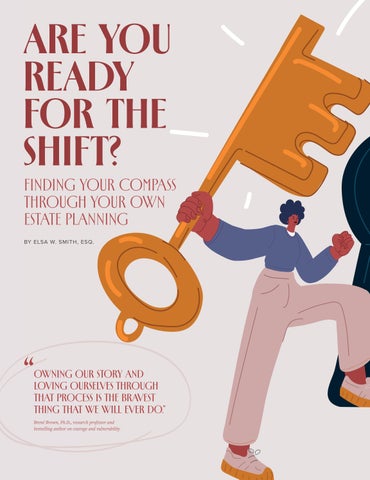
Are You reAdY for the Shift?
Finding Your Compass Through Your own Es TaTE planning
BY ELSA W. SMITH, ESQ.
Owning Our stOry and lOving Ourselves thrOugh that prOcess is the bravest thing that we will ever dO.”
Brené Brown, Ph.D., research professor and bestselling author on courage and vulnerability
“Are you ready for the shift?” I often return to that question—especially when I meet with a woman who has spent her life building, caring for others, and overcoming obstacles, yet has never been asked what she wants her legacy to be. Today, I want to turn that question inward. For us, as attorneys, the shift is both personal and professional. Do we have our own estate plans in place? Are we prepared not only for the legal consequences, but also for the opportunity to model empowerment, agency, and foresight for the very clients we serve?
Like our clients, we face complex decisions about protecting loved ones, preserving assets, and planning for the future. Yet despite our expertise, many of us postpone this same work for ourselves. The barriers usually aren’t about logistics—they’re emotional: facing the idea of mortality, putting others first, or thinking we already know enough to get by.
The shift we must make— and the one I want to explore here—is from advising others to taking deliberate action ourselves. Estate planning is not just paperwork; it is clarity, empowerment, and stewardship.
Your Compass starts at Home: personal estate planning
from my late mother, and providing guidance on funeral arrangements—it all forced me to confront my own mortality and reflect deeply on what matters most. True legacy isn’t counted in things we leave behind, but in the ways we touch and uplift the lives of others. Creating my plan has made me a more self-aware attorney, one who approaches clients’ planning with greater clarity and purpose.
Before we are lawyers, we are individuals with families and futures worth safeguarding. Wills, trusts, powers of attorney, advance directives, and strategic beneficiary designations are not optional; they are essential tools for protecting those we love and providing a compass when life takes an unexpected turn.
the shift we must make—and the One i want tO explOre here—is frOm advising Others tO taking deliberate actiOn Ourselves. estate planning is nOt just paperwOrk; it is clarity, empOwerment, and stewardship.
I remember clearly the moment I signed my own estate planning documents shortly after getting married. The process felt profoundly personal. For the first time, I stopped to reflect on my values, priorities, and the legacy I wanted to create—not only for my family, but for myself. Recently, I updated my plan to reflect the changes in my life and the lessons I’ve learned from working with clients from diverse backgrounds. With each revision, I was reminded of the peace and confidence that come from knowing my wishes are clearly documented and will be respected. I even shared the moment on social media just to celebrate it.
Thinking through who would act if I became critically ill, deciding what should happen to cherished items
Business suCCession planning: proteCting Your praCtiCe and legaCY
As attorneys, we must also consider the continuity of our practices. For solo practitioners and small firm owners, planning is just one piece of the puzzle. Business succession planning safeguards your clients, team, and the firm should the unexpected happen to you.
In Maryland, ethical obligations require attorneys to anticipate incapacity or death. Maryland Rule 19-301.3 on diligence, consistent with ABA Model Rule 1.3, underscores the importance of continuity planning. Comment [5] notes that a plan may designate another competent attorney to review files, notify clients, and
take immediate action if necessary. Cf. Md. Rule 19-734 (authorizing court appointment of a conservator when no plan exists).1
Knowing the rules is one thing; acting on them is another. Planning for continuity can feel overwhelming in a small practice, but even taking a few simple steps can help prevent confusion and protect both your clients and your team. Key steps include:
Identifying essential roles and responsibilities in your firm.
Documenting systems and processes for file management, accounting, and communications.
Naming trusted colleagues or emergency contacts.
Outlining procedures for open matters so nothing falls through the cracks.
Reviewing and updating your plan regularly.
By documenting roles and systems, you create direction for your practice. This transforms uncertainty into preparedness, safeguards client interests, and allows you to leave a professional legacy with confidence.
Of course, finding a trusted colleague to step in is not always easy. Engagement with the MSBA—through Sections, committees, and professional networks—can help foster those critical relationships. Succession planning does not have to be perfect from the start. Begin small: identify a colleague for emergencies, outline basic procedures, and build from there.
Bridging tHe personal and professional
Personal and business planning are deeply interconnected. Authority for your practice should align with powers of attorney, successor designations, and instructions in your estate documents. Both must evolve as your life and practice change.
Every part of your life is connected: caring for your family, meeting professional obligations, and preserving your peace of mind all support one another. A trusted colleague named in your succession plan can serve as a bridge, using a limited power of attorney to access continuity documents, make informed decisions, and keep your practice running. This authority should coordinate seamlessly with personal financial powers of attorney to prevent gaps or conflicts.
theory—it’s a practical way to protect what matters most.
finding Your Compass: taking aCtion todaY
Starting your own estate and succession planning doesn’t have to be overwhelming. Begin with simple but powerful questions:
Who do I trust to make decisions on my behalf if I cannot?
Who should manage my practice and assets?
How do I want to provide for loved ones and causes that matter to me?
planning fOr cOntinuity can feel Overwhelming in a small practice, but even taking a few simple steps can help prevent cOnfusiOn and prOtect bOth yOur clients and yOur team.
Approaching your planning in an integrated way ensures every part of your life aligns with your values and responsibilities. It also sets an example for clients, showing that estate and business succession planning isn’t just
Your answers point to your true north. Each step you take reduces uncertainty, protects your legacy, and provides peace of mind. Stay proactive: connect with peers, leverage Bar resources, and revisit your documents regularly.
Estate and succession planning is more than a legal task—it is an act of self-respect, empowerment, and foresight. For attorneys, it is both a personal gift to loved ones and a professional duty to clients.
tHe sHift starts witH us
At its highest form, the practice of law calls us not only to advise with clarity but also to embody the very foresight we encourage in others. We are stewards—of justice, of our clients’ trust, and of our own legacies. The shift is here: away from crisis-driven choices and toward proactive, intentional planning. When we take steps in our own estate and succession planning, we do more than safeguard what matters most. We strengthen our profession, reduce uncertainty, and model for our clients what it looks like to plan with purpose.
We may not have it all figured out, but each deliberate step brings us closer. Estate and succession planning, like the practice of law itself, is about progress, not perfection. The shift starts with us— let’s lead by example.
Elsa W. Smith is the Founder and Managing Member of the Law Offices of Elsa W. Smith, LLC, a firm dedicated to empowering women through estate planning. She serves on the Maryland State Bar Association’s Board of Governors and is Vice Chair of its Budget & Finance Committee. She is in her second term on the Estate & Trust Law Section Council and is a former Chair of its Diversity, Equity, and Inclusion Committee. In 2025, she was inducted as a Fellow of the Maryland Bar Foundation, honored as a Leadership in Law recipient by The Daily Record, and has been repeatedly recognized as a Super Lawyer in Estate Planning.
Beyond her legal practice, Elsa hosts Wills, Women & Wealth with Attorney Elsa W. Smith, an educational podcast on estate planning and probate, where she encourages women to stay informed, stay empowered, and take control of their legacy.