A Profile in Justice and Leadership

Harris sees PJC's 40th anniversary as a unique opportunity to engage in a strategic visioning process that will not only continue its work in providing high-quality legal services, particularly in housing, workplace, and education justice, but also strengthen its advocacy and legislative platforms.
DR. KHALILAH HARRIS'S JOURNEY is a testament to the power of unwavering purpose. From her early work as an education justice advocate to her leadership roles within the Obama and Biden administrations, and now as the Executive Director of the Public Justice Center (PJC) and a newly appointed commissioner on the Maryland Access to Justice Commission, her career has been defined by a singular mission: to ensure that "the law can work for everyone." Her perspective on how to achieve this goal and the key access to justice challenges facing Maryland are central to her vision for both the PJC and her role on the Commission.
A Brooklyn native who has called Baltimore home for over 30 years, Harris began her career at Community Law in Action. There, she honed her passion for education justice, helping to establish the Baltimore Freedom Academy, a high school focused on law-related education, youth justice, and community voice. She spent a decade at the Freedom Academy, where she not only taught students about their constitutional rights, but also advocated to help them understand "how they are a part of society and not outside of society." She led advocacy efforts that contributed to the creation of Baltimore's 21st Century Schools initiative, securing critical funding for new school buildings.
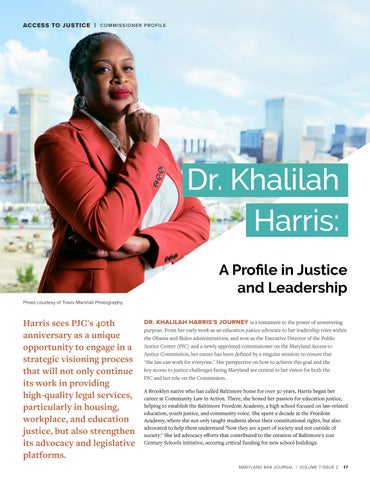
Photo courtesy of Travis Marshall Photography
Dr. Khalilah Harris:
A Profile in Justice and Leadership

Harris sees PJC's 40th anniversary as a unique opportunity to engage in a strategic visioning process that will not only continue its work in providing high-quality legal services, particularly in housing, workplace, and education justice, but also strengthen its advocacy and legislative platforms.
DR. KHALILAH HARRIS'S JOURNEY is a testament to the power of unwavering purpose. From her early work as an education justice advocate to her leadership roles within the Obama and Biden administrations, and now as the Executive Director of the Public Justice Center (PJC) and a newly appointed commissioner on the Maryland Access to Justice Commission, her career has been defined by a singular mission: to ensure that "the law can work for everyone." Her perspective on how to achieve this goal and the key access to justice challenges facing Maryland are central to her vision for both the PJC and her role on the Commission.
A Brooklyn native who has called Baltimore home for over 30 years, Harris began her career at Community Law in Action. There, she honed her passion for education justice, helping to establish the Baltimore Freedom Academy, a high school focused on law-related education, youth justice, and community voice. She spent a decade at the Freedom Academy, where she not only taught students about their constitutional rights, but also advocated to help them understand "how they are a part of society and not outside of society." She led advocacy efforts that contributed to the creation of Baltimore's 21st Century Schools initiative, securing critical funding for new school buildings.
Photo courtesy of Travis Marshall Photography
A Career of Policy and Public Service
Driven by a desire to understand the systemic roots of injustice, Harris then pursued a doctorate in education leadership and organizational development from the University of Pennsylvania. The impetus for this, she explains, was realizing that while she was "building the plane while I fly," there was something she was "missing that I'm not seeing at this very grassroots and local level." Her academic pursuits quickly led to a role in the Obama administration, where she served as Deputy Director of the White House Initiative on Educational Excellence for African Americans. Her work in the federal government continued with a promotion to the U.S. Office of Personnel Management, where she spearheaded diversity, equity, and inclusion initiatives for the nation's largest employer. She was instrumental in organizing the first-ever White House Summit on Diversity, Inclusion, and Government, bringing together leaders from tech and philanthropy to address equitable access to federal careers, particularly in the national security space.
Her commitment to workforce justice led her to Opportunity at Work, an organization born from an Obama administration initiative that sought to create pathways to tech careers for non-traditionally credentialed individuals. She later returned to policy work as managing director of the K-12 education policy portfolio at the Center for American Progress, where she developed a racial equity framework and focused her research on Black leadership in education and reducing the "school to prison pipeline and school to confinement pipeline for particularly girls of color." She also explored the concept of reparations in education, advocating for a holistic, statewide approach to school funding, rather than relying on "zip code and community lines as the way you fund schools."
Her return to federal service came with the Biden administration, where she served as chief of staff at OPM, before transitioning to the Center for Policing Equity to focus on public safety and reimagining what it can look like.
Leading the Public Justice Center
Now at the helm of the PJC, Harris is bringing her vast experience back to Baltimore. She sees PJC's 40th anniversary as a unique opportunity to engage in a strategic visioning process that will not only continue its work in providing high-quality legal services, particularly in housing, workplace, and education justice, but also strengthen its advocacy and legislative platforms. She aims to ensure that "people understand what PJC's legislative platform is" and that the organization leads on issues that create a more just and democratic society. She believes this period of disruption presents a chance to "plant a pole in the ground" and establish policies that should have existed all along, moving beyond simply "going back to what we had."
Harris is keen on addressing the root causes of civil injustices, not just the symptoms. She highlights the need to unpack the factors behind startling statistics, such as the finding that Black women in Baltimore City are 296% more likely to be evicted than white men. By focusing on upstream issues, she believes the legal system can prevent people from ending up in crisis, so "we're not constantly working towards addressing the reactions to those issues."
She is a firm believer in making the law accessible to everyone.
Harris sees the primary challenge to access to justice in Maryland as the prioritization of "wealth and capitalism" over the needs of everyday people. She believes that even in a "blue state," people "seem to stop at their own children," and there is a great need to see neighbors as "humans and not as liabilities." She notes that people have "been working around the edges" and "compromising for many, many years on things that should be hair-on-fire issues."
She is a firm believer in making the law accessible to everyone. She advocates for a robust communication strategy that translates complex legal information into an easily digestible format, empowering people with the knowledge of their rights. She also sees great potential in new legal service delivery models, such as tiered systems that utilize non-attorneys and technology to bridge the justice gap, providing essential information before a crisis occurs. This kind of tiered system, she says, "could [help] people think about how the system should be working for them."
Her passion for this work stems from a deep-seated belief that "education is an access point for freedom and liberation." She states, "as long as it's withheld and withheld at even a base level of quality from children, we will continue to find ourselves in a situation where people are unknowing about what their rights are." Harris's work with the PJC and the Maryland Access to Justice Commission is a continuation of this lifelong fight to help the law serve as a tool for underserved communities, not a barrier.
Mentorship and Finding Joy
Harris carries a deep appreciation for the mentors who encouraged her "not to dim my light and not to silence my voice." She pays this advice forward by encouraging young attorneys to use their fresh perspectives and unique energy to challenge the status quo and push for a more just society. "We certainly are all intelligent people and we know what we know," she says, "but their unique perspectives on the ways that the world is changing...is deeply critical." She encourages them to "just keep going and not try to conform or compromise because time is of the essence."
A proponent of self-care and work-life balance, Harris models this by implementing personal boundaries, such as not taking meetings on Fridays or before 10 a.m. She believes that true self-care is not a "band-aid" but a practice of being fully present, whether at work or at home. She challenges the notion that one's job is their identity, emphasizing that "work is not your identity. It is something that you do." She believes that "if your work goes away, it can't be that you're nobody. And the fact is that you're not."
When she's not leading the PJC or serving on various commissions, Harris enjoys spending time with her three daughters, whom she lovingly describes as "a special number." Her "hidden talent" is napping, but she also finds joy in her sorority, Alpha Kappa Alpha, and is a self-professed "sci-fi and Afrofuturism junkie." She finds that these genres allow her to "just imagine what is possible," a philosophy that clearly informs her life's work.