MSBA Maryland Bar Journal: Volume 7, Issue 2

Page 1


MSBA Files Amicus Brief in Support of Federal Judges, Presiding Judge Dismisses Case How

Maryland Explores Tiered Legal Services to Expand Access to Justice

How to Evaluate Non-Economic Damages Using Science

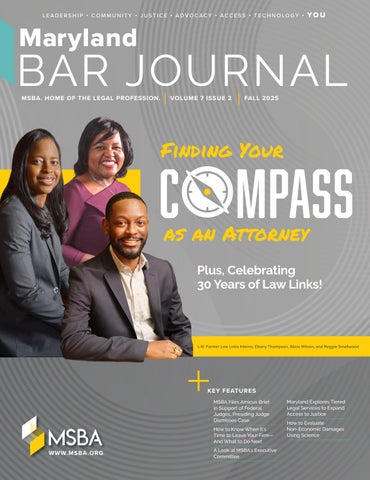
L-R: Former Law Links Interns; Ebony Thompson, Alicia Wilson, and Reggie Smallwood

Trusted by 50,000 professionals, LawPay is a simple, secure solution that allows you to easily accept credit and eCheck payments online, in person, or through your favorite practice management tools.

President's Message

ABA Meeting and BOG Kickoff 7 MSBA Welcomes the 2026 Leadership Academy Fellows

8 100% Law Firms

9 2025-2026 Sustaining Members

10 Paul Sandler Receives First MSBA Lifetime Achievement Award for Excellence in Continuing Legal Education

24 MSBA Files Amicus Brief in Support of Federal Judges, Presiding Judge Dismisses Case

26 A Look at MSBA's Executive Committee

36 Book Review: Attorneys in the Baseball Hall of Fame

48 Celebrating 30 Years of the Law Links Internship

127 Staff Profile: Katie Flynn

128 Executive Director's Message: The AI Imperative: Why Maryland Lawyers Must Lead, Not Follow

38 Frank Gorman

104 Steven Kappen

122 Stephen Goldberg

14 Confronting the Justice Gap: Maryland's Access to Justice Commission Convenes for Strategic Retreat

18 Commissioner Profile: Dr. Khalilah Harris

33 Maryland Explores Tiered Legal Services to Expand Access to Justice

56 Samantha Dos Santos

Eccleston and Wolf 70 Abraham F. Carpio

David Secor 124 In Memoriam: Steven Allen

125 In Memoriam: Gill Cochran 126 In Memoriam: Howard Janet

24 MSBA Files Amicus Brief in Support of Federal Judges, Presiding Judge Dismisses Case

Publication Date: Fall 2025

Published quarterly by the Maryland State Bar Association, Inc.

520 W. Fayette St. Baltimore, Maryland 21201

Telephone: (410) 685-7878 (800) 492-1964 Website: www.msba.org

Executive Director: Anna Sholl

Chief Content Officer: Patricia Stockland

Managing Editor: Colleen Aracri

Advertising Sales: Association Media Group

Subscriptions: MSBA Members receive the digital edition of the Maryland Bar Journal as part of their annual membership. In addition, MSBA Members can opt to receive paper copies of the Maryland Bar Journal for an annual subscription cost of $10.

POSTMASTER: Send address change to THE MARYLAND BAR JOURNAL

520 W. Fayette St. Baltimore, MD 21201

The Maryland Bar Journal welcomes articles on topics of interest to Maryland attorneys. Proposed articles can be submitted through the MSBA website at msba.org/content-portal

Advertising: Advertising rates will be furnished upon request. All advertising is subject to approval by the Editorial Advisory Board.

Association Media Group 901 34th Avenue North, Suite 7064 St. Petersburg, FL 33734

Chad Slager Operations and Technology cslager@associationmediagroup.com

Member Content Committee

Corinne M. Pouliquen, Esq., Co-Chair Jessica Markham, Esq., Co-Chair

MSBA Officers (2025-2026)

President: Marisa Trasatti

President Elect: Natasha Dartigue

Secretary: Randolph Stuart Sergent

Treasurer: Natasha Marina Nazareth

Photography: Profile photographs provided by Travis Marshall Photography unless otherwise noted.

All writing submitted to the Maryland Bar Journal must be wholly original to the Author, not generated in whole or in part by generative artificial intelligence tools, and reflect the Author’s own independent analysis and judgment. The use of AI-assisted tools limited to grammar, spelling, or formatting is permitted, provided they do not contribute substantive content.

Statements or opinions expressed herein are those of the authors and do not necessarily reflect those of the Maryland State Bar Association, its officers, Board of Governors, the Editorial Board or staff. Publishing an advertisement does not imply endorsement of any product or service offered.

MEMBER CONTENT COMMITTEE (2025-26 BAR YEAR)

Natasha Nazareth, Emeritus Chair
Jessica Markham, Co-Chair
Corinne M. Pouliquen, Co-Chair
Rima Kikani, Vice Chair
Donald Quinn, Vice Chair
Mark Dimenna
Jessica Duvall
Travys Harvey
Hillary Evans
Julie Hopkins
Ben Rupert Lynette Kleiza
Dave Sidhu Eric Steiner
Andrea Solan
Anna Sholl, Executive Director
Reena Shah
Andrea Terry
Colleen Aracri
Sahmra Stevenson

FINDING YOUR COMPASS AS A LAWYER

100 At the Crossroad

106 Are You Ready for the Shift? Finding Your Compass Through Your Own Estate Planning

110 Finding True Satisfaction in Your Legal Career: More Than Just Winning Cases

116 Navigating Solo Practice After Big Law

HEALTH AND WELLNESS

11 Leading with Hope: Marissa B. Joelson and Kate Hanlon Sinclair Head Up MSBA's Lawyer Assistance Program

FOR YOUR PRACTICE

20 How to Make Pro Bono Work Cool Again in a Post-COVID Era

41 When Does a 12-Year Statute of Limitations Apply to a Loan Document in Maryland?

45 The Intersection Between Employment Claims and Attorney Disciplinary Liability

62 The Mold Matrix: How Courts Untangle Health Claims, Housing Codes, and Landlord Defenses

67 Holding the Line: Maryland’s Federal Accountability Unit and the Fight Against Unlawful Federal Actions

73 The Impact of Credit Report Errors on Renters' Rights and Housing Access

76 How to Evaluate Non-Economic Damages Using Science

80 Maryland Probate Fees and Commissions— A Practitioner’s Guide to the Basics

87 A Changing Legal Landscape for Immigration: Impacts on Immigrant Workers and Businesses

92 Bankruptcy Dog

96 How to Know When It’s Time to Leave Your Firm—And What to Do Next

119 The Broken Compass: Navigating Ethical Rules

It is with genuine enthusiasm that I share with you the launch of the Maryland State Bar Association’s new strategic planning initiative— a process that will shape the direction of the Association for the next five years and, we hope, establish a durable framework that will carry us well beyond that horizon. This plan is not merely an exercise in organizational housekeeping. Rather, it is an intentional effort to define and deliver concrete initiatives that will (1) ensure we remain indispensable to our existing members, (2) attract new members from across the profession, and (3) reinforce the MSBA’s position as the premier provider of continuing legal education in Maryland.

Building on Our Foundation

This work builds upon the strong foundation laid by the 2019 Strategic Plan, which articulated the MSBA’s core values—values that continue to resonate deeply within our profession:

• The MSBA is a home for all legal professionals.

• We are the voice of the legal profession.

• We provide significant value to our members.

MSBA’s New Strategic Planning Initiative

• We maintain accessibility to the services we offer.

• We advance access to justice.

• We are committed to innovation.

These values act as our North Star. They define not only who we are but also who we aspire to be as stewards of this profession and as advocates for the rule of law in Maryland.

Scope of the New Plan

The FY26 Strategic Planning Taskforce— co-chaired by me and Erek Barron, Esquire, of Mintz Levin, and facilitated by Steve Manekin, CPA, of Vallit Advisors— will focus its work on four principal areas of inquiry:

Membership Recruitment & Retention: Developing initiatives targeted toward large law firms, in-house counsel, law students, and young lawyers. Our aim is to expand the breadth of our membership while ensuring the loyalty and engagement of our core constituencies.

Intellectual Property/Content: Evaluating the scope and quality of our CLE offerings, publications, and professional content to ensure they meet the rapidly evolving needs of our members. This includes preparing for the potential adoption of minimum CLE in Maryland, positioning MSBA as the unquestioned leader in delivering required education.

Advocacy & Support: Refining our legislative and policy initiatives, both in Annapolis and through our various task forces. In particular, we intend to weave access to justice considerations into all aspects of our advocacy work, strengthening the Bar’s voice on issues essential to the equitable administration of justice.

Governance & Finance: Reviewing our governance structure and financial processes to ensure that both are aligned with the priorities identified in the strategic plan and that they provide a sound foundation for the MSBA’s long-term sustainability.

Methodology and Timeline

This is a data-driven and deliberate process. The Taskforce will rely on our PODs, each beginning with a rigorous SWOT analysis (Strengths, Weaknesses, Opportunities, Threats) and informed by relevant data. The work of the PODs will culminate in a set of recommendations submitted to the Taskforce for evaluation and integration.

The timeline is as follows:

• October 2025–February 2026: PODs convene approximately every four weeks.

• March 2, 2026: POD reports due for Taskforce review.

• March 2026: Half-day retreat for Taskforce integration and refinement.

• April 15, 2026: Final Taskforce recommendations submitted to the Board.

• May 8, 2026: Adoption of the strategic plan by the MSBA Board at its Spring Retreat.

A Call to Engagement

This moment is both exciting and consequential. We stand at the intersection of continuity and change—charged with preserving the best of our traditions while positioning the MSBA to meet the needs of a modern profession and society. The plan that emerges from this process will not simply be a document; it will serve as a guide for how we collectively strengthen our profession, safeguard justice, and deliver value to every Maryland lawyer.

I invite each of you—judges, practitioners, academics, and public service lawyers alike—to watch this process closely, to contribute your perspectives where appropriate, and to share in the responsibility of shaping our collective future. I am confident that, together, we will craft a strategic plan that not only charts the MSBA’s next five years but fortifies the legal profession in Maryland for generations to come.

ABA Meeting and BOG Kickoff

From advancing the legal profession at the national level to charting the association's course for the year, the MSBA is dedicated to leadership, professional excellence, and service to the Maryland legal community.

MSBA’s Board of Governors held their first meeting of the year at MSBA President Marisa Trasatti’s home in Fallston, MD.

MSBA’s delegation representing at the ABA Annual Meeting in Toronto, ON, Canada.

MSBA Welcomes the 2026 Leadership Academy Fellows!

The program, founded in 1996, was built on the vision of creating new pathways for lawyers from all backgrounds to find a sense of belonging within the MSBA and the broader legal community.

MSBA welcomes the newest cohort of the Leadership Academy, the Class of 2025-26. The opening ceremony, held on August 20, 2025, at Blackwall Barn and Lodge in Columbia, celebrated the 13 distinguished lawyers embarking on this transformative journey.

The Leadership Academy’s Mission

The MSBA Leadership Academy is a cornerstone of MSBA’s mission to help good lawyers become great leaders. The program, founded in 1996, was built on the vision of creating new pathways for lawyers from all backgrounds to find a sense of belonging within the MSBA and the broader legal community.

Over the next 12 months, this new class will embark on a transformative journey, sharpening their skills in vital areas like public speaking, media relations, and effective meeting management. They will also apply their new leadership skills to a public service project, directly benefiting the community.

MSBA

LAW FIRMS

100% OF THE LAWYERS at these Maryland law firms and branch offices renewed their MSBA memberships for the 2025-26 Bar year. MSBA is grateful for their commitment to MSBA’s leadership in the legal profession, Annapolis advocacy, and increasing access to justice in Maryland and beyond.

The firms listed here are 100% Law Firms as of November 1, 2025, when this issue went into production. Firms joining this list after that date will appear in the next issue, which will publish in March 2026. The 100% Law Firm program is available to Maryland law firms or branch offices with ten or more attorneys. For more details please contact MSBA Director of Membership, Bob Bershad, at bob@msba.org or 443.703.3011.

SUSTAINING MEMBERS

Prof. Michael Bakhama Nusinov Smith, LLP

Joan Bondareff Blank Rome LLP

Benjamin Boscolo ChasenBoscolo Injury Lawyers

Katherine Howard Regional Management, Inc.

Howard Janet* Janet, Janet & Suggs, LLC

Jacob Ross Keith

William Kiniry III DLA Piper LLP (US)

David Lacki Lacki & Company LLC

Natasha Nazareth Nazareth Bonifacino Law Benefit LLC

Lilah Rosenblum Lichtman & Rosenblum PLLC

David Wildberger

Meredith, Wildberger & Brennan, P.C.

Sean Woolums College Living LLC

As the leading voice for Maryland’s legal community, MSBA is dedicated to advocating for the legal profession, providing comprehensive services and resources for our members, and championing the core values of a just and ethical legal system.

Sustaining members of the MSBA play a vital role in upholding and advancing our mission. Their support aids MSBA's efforts in promoting professionalism, fostering diversity in the legal profession, expanding access to justice, encouraging service to the public, and upholding respect for the rule of law. By investing in the MSBA, sustaining members directly contribute to the ongoing development and strength of the Maryland legal profession.

To become a Sustaining Member, please select this option when you renew your MSBA Membership. Thank you.

Paul Sandler Receives First MSBA Lifetime Achievement Award for Excellence in Continuing Legal Education

ON SEPTEMBER 10, the Maryland State Bar Association recognized Paul Mark Sandler for his more than 50-year career of practicing law as a zealous advocate, while teaching a generation of young lawyers how to litigate with civility and professionalism.

Sandler was the inaugural recipient of the MSBA's new Paul Mark Sandler Lifetime Achievement Award for Excellence in CLE.

MSBA will give the award annually to a Maryland lawyer dedicated to advancing attorney competence and professional development.

Sandler is a distinguished litigator who was Of Counsel at the Baltimore law firm Shapiro, Sher, Guinot & Sandler, P.A.. He has a national reputation for representing clients successfully in Maryland and other parts of the United States. He authored several books, including The Fine Art of Trial Advocacy: A Young Lawyer's Resource for Success He also co-authored a number of bestselling legal treatises, such as Pleading Causes of Action in Maryland, Model Witness Examinations, and The Winning Argument. He is also a monthly columnist for The Maryland Daily Record

More than 60 members of the Maryland bench and bar gathered to honor Sandler and share their experience learning from and working with Sandler on multiple projects, whether it was one of the dozen legal treatises he's co-authored or the many trial skills workshops he's presented for young lawyers.

MSBA President Marisa Trasatti, Esq., welcomed attendees, after which Joel I. Sher, Esq. from Shapiro Sher introduced Sandler.

MSBA will give the award annually to a Maryland lawyer dedicated to advancing attorney competence and professional development.

Chief Judge John Morrissey, Jim Archibald, Esq., Andy Levy, Esq., and Steve Klepper, Esq. then spoke in tribute to Sandler, before the Hon. Andrea Leahy of the Appellate Court of Maryland, who is also Chair of the MSBA Litigation Section, and Marisa Trasatti, Esq. presented the award to Sandler.

Going forward, the award will recognize Maryland organizations and individuals who create and provide effective, high-quality, and innovative CLE programs, publications, and opportunities. It will also support entities that aim to improve the practice of law for Maryland lawyers and their clients through CLE programs, publications, and services. It will also encourage CLE providers, faculty, authors, and content creators to become catalysts for innovation and demonstrate exemplary CLE best practices and approaches.

The sponsors for the event were Kramon & Graham and Shapiro Sher.

Leading with Hope:

Marissa B. Joelson and Kate Hanlon Sinclair

Head Up MSBA's Lawyer Assistance Program

THE LAWYER ASSISTANCE PROGRAM (LAP) provides free, confidential assistance to all Maryland lawyers, judges, law school students, and support staff by offering assessment, referral, short-term counseling, and continued support to ensure long-term success.

Marissa B. Joelson and Kate Hanlon Sinclair, the first female Chair and ViceChair of the Lawyer Assistance Program (LAP), exemplify how the program is a vital resource for legal professionals. Their personal and professional journeys highlight the immense pressures of the legal field and demonstrate the importance of confidential support and community.

As the new LAP Chair, Joelson brings a deep understanding of the pressures faced by legal professionals. Joelson, the head of the Medical Malpractice Department at Peter Angelos Law, believes that the adversarial nature of litigation creates an environment where a lawyer's success is often measured by whether they “won.”

This constant need to "win," she says, is "why the legal profession ranks so high

in mental health crises, substance abuse, and suicide." She believes this pressure can cause feelings of "inadequacy and self-doubt" in new attorneys and can even trigger mental health issues in those who previously had none.

Joelson views the LAP as a vital support system that creates a ripple effect of positivity. When lawyers "team up to support one another," she says, it can make a big difference for them and their families, employers, coworkers, and clients. She believes that by sharing how they've overcome challenges, lawyers can give others "hope, an example to follow, as well as advice as to how they were able to improve their thinking, behaviors, or decision making." Joelson also stresses the importance of simply being "cordial and pleasant," noting that "Being a fierce advocate and amicable opponent at the same time is key."

As Chair, Joelson is determined to grow LAP's reach. Her primary goal is to ensure every member of the legal community knows that LAP is "first and foremost— confidential." She wants to ensure no one risks their license or position before asking for help. Joelson wants

By sharing how they've overcome challenges, lawyers can give others "hope, an example to follow, as well as advice as to how they were able to improve their thinking, behaviors, or decision making."

every lawyer to know that "insecurity, self-doubt, burnout, anxiety, and other uncomfortable feelings are common." She welcomes anyone to contact LAP so they can provide confidential support, guidance, or even financial assistance to cover the cost of treatment. Her ultimate message is one of hope: "No one needs to lose what we all worked so hard to achieve."

Sinclair, who works as counsel at Silverman Thompson Slutkin & White, draws on her own experiences with anxiety and depression to inform her work as Vice-Chair of LAP. She openly shared that she "struggled with anxiety and depression for many of my younger years, well into the early years of my legal practice," and found help through successful treatment.

Sinclair believes that LAP benefits the profession not only by providing direct assistance like "assessment, referral for treatment, or short-term counseling" but also by educating lawyers about the "elevated risks of substance abuse and mental illness." Her experience as a "virtual, freelance attorney" has taught her the importance of work-life balance, and she hopes that her role as a primary caregiver for her two children while practicing law will encourage others to seek arrangements that help them "balance my personal and professional lives." She has learned that she is "not alone in many of the areas where I struggle," and that "hiding my struggles does not eliminate them."

For Sinclair, LAP is more than a service; it's a tool for education and community. She recognizes that the legal profession's demands, high stakes, tight deadlines, and mountains of documents create a "cumulative pressure exclusive to the law." She believes LAP directly benefits lawyers by providing help and by fostering a more self-aware legal community. Sinclair's commitment to self-care and mental health, in addition to her volunteer work with her children's schools, has taught her that she is not alone in her struggles. "I have learned that I am not alone in many of the areas where

I struggle, as a mom, a daughter, wife, or lawyer," she says. "I have also learned that hiding my struggles does not eliminate them." Her experience and perspective emphasize LAP’s role in normalizing conversations around mental wellness and providing a space for lawyers to get the help they need.

A Historic Partnership for the Legal Assistance Program

Joelson’s and Sinclair’s appointment marks the first time a female duo has led LAP. This milestone and their work with Director Lisa Caplan, LCSW-C, create a powerful all-female leadership team. They hope this appointment sends a message of progress and demonstrates that the legal profession is becoming more inclusive and supportive of diverse experiences. Sinclair shared that "one of the most exciting things about this milestone was the lack of surprise within the committee that we now have an all-female leadership slate. The reception I have received from our committee has been warm, welcoming, and supportive."

Both women are determined to leverage their professional and personal backgrounds to grow the program and reach a wider audience. They want every member of the Maryland legal community, from law students to seasoned judges, to know that help is available.

Confronting the Justice Gap: Maryland's Access to Justice Commission Convenes for Strategic Retreat

The Commission's Mandate

The Maryland Access to Justice Commission exists to break down barriers in the civil justice system to make it accessible, equitable and fair for all Marylanders, not just those who can afford it. Established to address the profound disparity between those who can secure legal representation and those who cannot, the Commission serves as both architect and advocate for systemic reforms that extend the reach of justice beyond the privileged few.

The Commission's work operates at the intersection of policy, practice, and principle. It convenes stakeholders across the legal ecosystem—judges, attorneys, legislators, community advocates, members of the bar and academia, and directly impacted individuals— to identify structural impediments to justice and craft solutions that are both pragmatic and transformative. In a state where civil

IN AN ERA WHEN THE INTEGRITY of civil justice systems faces unprecedented strain, the Maryland Access to Justice Commission has emerged as an essential bulwark against the forces of inequity that threaten to undermine the promise of equal protection under law. The Commission's recent board retreat represents not merely an administrative gathering, but a crucial deliberation on the future of legal accessibility in Maryland and the nation at large.

The retreat aimed to educate, empower, and energize commissioners while reconnecting them to the Commission's mission of making Maryland's civil justice system accessible, equitable, and fair for all residents.

legal needs vastly exceed available resources, the Commission functions as the strategic conscience of Maryland's justice system, ensuring that access remains not an aspiration but an actionable commitment.

A Gathering of Consequence

The Commission recently convened its Board of Commissioners for an in-person retreat, creating deliberate space for these appointed leaders to engage deeply with the precarious state of access to justice in Maryland and across the country. This was not a perfunctory assembly but an intensive examination of the challenges that continue to marginalize vulnerable populations from the legal system meant to protect them.

The retreat aimed to educate, empower, and energize commissioners while reconnecting them to the Commission's mission of making Maryland's civil justice system accessible, equitable, and fair for all residents.

Ward Coe, long-time chairman of the Commission, welcomed Commissioners, reminded them of the stakes to Marylanders when they do not receive legal help, and concluded by informing Commissioners of

NEARLY

40 % OF MARYLAND HOUSEHOLDS

(approximately 880,000 households)

CANNOT MEET BASIC NEEDS,

let alone afford legal representation.

his desire to step down as the Chair of the Commission. As the Commission works to find the best way to lead during these uncertain times, the loss of Ward's stalwart leadership, unflagging commitment, and unimpeachable guidance will be an additional challenge for the Commission to contend with as it will seek over the next few months to identify a new Chair.

Reena Shah, Executive Director of the Maryland Access to Justice Commission (A2JC) focused on the theme "Confronting Another A2J Crisis Together."

Shah presented stark statistics highlighting the civil justice gap in Maryland:

Nearly 40% of Maryland households (approximately 880,000 households) cannot meet basic needs, let alone afford legal representation

75% of low-income residents face at least one civil legal issue annually

While over 1.2 million Marylanders qualify for Maryland Legal Services Corporation (MLSC) services, only about 20% receive help

In 2024, MLSC grantees assisted approximately 191,000 people, leaving roughly 759,000 low-income Marylanders without legal assistance

Shah emphasized that the A2JC, an independent entity powered by the Maryland State Bar Association (MSBA), does not provide direct legal representation. Rather than providing direct legal services, the Commission:

UNITES leaders across sectors

ELEVATES awareness about civil justice barriers

DRIVES systemic reforms and innovations

DELIVERS measurable results for vulnerable Marylanders

The Commission comprises 35 members with fixed and rotating seats, including representatives from legal services organizations, law firms, corporate counsel, legislators, nonlegal stakeholders, and the Governor's office.

Shah outlined the Commission's strategic plan built on four pillars: Coalitions, Advocacy, Reform, and Equity. Notable FY2025 accomplishments included:

Successfully advocating for passage of SB154, securing an additional year of $14 million in funding for the Access to Counsel in Evictions law

Tracking over 100 bills related to civil legal aid

Coordinating 15 weekly Advocacy Committee meetings

Publishing reports on access to counsel in evictions and innovations in tiered legal services

Shah highlighted ongoing projects across multiple committees focusing on civil legal aid funding, the impacts of federal policy changes, legal technology and AI for self-represented litigants, and fundraising to increase organizational capacity.

The retreat featured two keynote addresses that framed the Commission's mandate within both jurisprudential and economic contexts.

Keynotes from Key State Leaders Chief Justice Matthew J. Fader of the Supreme Court of Maryland delivered a comprehensive address structured around four critical dimensions of judicial engagement with the access crisis. He articulated his vision of the Judiciary's role in addressing access to justice. He outlined innovations the Judiciary is considering to lower procedural barriers and expand meaningful access for self-represented litigants. With particular urgency, Chief Justice Fader identified the unique access to justice challenges the Judiciary faces under the current climate, challenges that cannot await incremental response. Finally, he was open to exploring pathways for deeper engagement and partnership between the Judiciary and the Commission, recognizing that systemic challenges would benefit from collaborative solutions.

Comptroller Brooke E. Lierman, Maryland's first woman independently elected to a constitutional office, delivered a State of the State address on Maryland's economy, illuminating the fiscal landscape within which access-to-justice initiatives must operate and the economic consequences when legal systems fail vulnerable populations. Together, these addresses established the essential framework: access to justice is simultaneously a legal imperative, an economic necessity, and a measure of Maryland's commitment to equitable governance.

WHILE OVER

1.2 MILLION MARYLANDERS qualify for Maryland Legal Services Corporation (MLSC) services, ONLY ABOUT 20% RECEIVE HELP

Innovative Solutions to the Crisis

Angela Tripp, Program Officer for Technology at the Legal Services Corporation, delivered a forward-looking presentation on artificial intelligence's transformative potential for civil legal services. Drawing from survey data of over 450 legal aid organizations collected in April 2025, Tripp demonstrated that AI adoption in the access-to-justice sector is no longer theoretical—it is actively reshaping how legal services organizations operate and serve clients.

The Landscape of Crisis

The Civil Justice Crisis

Michelle Daugherty Siri, Executive Director of the Maryland Legal Services Corporation— the state's largest funder of civil legal aid— provided Commissioners with a briefing on the current status of funding, revealing the fiscal constraints within which legal services organizations must operate and the widening gap between available resources and documented need. The testimony painted a sobering portrait: millions of Marylanders navigate consequential legal matters— evictions, custody disputes, consumer fraud, domestic violence protections—without legal representation, often because they earn too much to qualify for legal aid but far too little to afford private counsel. This "justice gap" leaves individuals vulnerable to outcomes determined not by the merits of their cases but by their capacity to navigate byzantine procedural requirements without professional guidance. Siri shared that MLSC projected a decline in funds due to expected drops in federal interest rates, cuts in LSC funding and cuts to other federally funded block grant programs. She indicated that MLSC would provide One-Time Rescue Grants, capped at $50,000, which would not cover the losses to civil legal aid organizations, but would serve as some emergency assistance, during this challenging budgetary period.

The Commission also convened a distinguished panel of national experts whose work defines

the contemporary access-to-justice landscape.

Radhika Singh, Vice President of Civil Legal Services and Strategic Policy Initiatives at the National Legal Aid & Defender Association (NLADA), delivered what may have been the retreat's most sobering presentation: a systematic examination of the multiple threats facing civil legal services and civil legal aid funding. Among the most consequential challenges she identified was a proposed Department of Education rule that would limit the types of non-profit organizations qualifying as employers for the Public Service Loan Forgiveness program—a change with potentially devastating implications for legal aid organizations' ability to recruit and retain attorneys. The proposed restriction threatens to undermine one of the few incentives that enables legal services organizations to compete with private sector compensation, potentially exacerbating the already acute shortage of civil legal aid attorneys serving low-income communities.

The Maryland Access to Justice Commission had moved with deliberate urgency, convening an open meeting to inform the access-tojustice community about the implications of the proposed Public Service Loan Forgiveness restrictions. The Commission encouraged individuals and organizations throughout Maryland to submit formal comments opposing the rule change, recognizing that federal policy decisions carry direct consequences for Maryland's capacity to staff its legal aid infrastructure.

Tripp showcased concrete implementations across multiple dimensions of legal aid work. She presented examples of AI applications in internal operations, legal research, and client communication, as well as direct consumerfacing tools that extend legal assistance beyond traditional service delivery models. Among the most compelling examples: the Legal Aid Society of Middle Tennessee and the Cumberlands' human-AI powered expungement form automation tool, which dramatically reduces the time required to prepare complex paperwork; Missouri's AI-driven triage system for legal aid intake, developed by Lemma Legal and Suffolk Law Lit Lab, which efficiently matches tenants with appropriate legal resources; and British Columbia's Beagle+ Legal Self-Help Chatbot, which provides accessible legal information directly to individuals navigating legal issues without representation.

Tripp also highlighted Maryland Legal Aid's own innovations, including MlaGPT—an in-house AI solution with robust privacy safeguards—and AI-assisted tools for intake referrals, brief drafting, and housing ledger review. These examples illustrated how legal services organizations can harness AI to amplify limited resources without compromising attorney judgment or client confidentiality.

Critically, Tripp emphasized that technological efficiency must never supersede the prioritization of justice. She outlined essential ethical considerations: the necessity of human review to ensure accuracy, stringent confidentiality protections, competency requirements for understanding AI tools' limitations, appropriate disclosure practices, and even consideration of technology's environmental costs. Her presentation underscored that responsible AI adoption requires clear policy guidelines,

comprehensive training protocols, and ongoing monitoring—principles that distinguish transformative innovation from reckless implementation.

James J. Sandman, President Emeritus of the Legal Services Corporation and Chair of IAALS' Executive Committee, brought decades of leadership perspective on the structural challenges confronting civil legal aid nationwide.

Sandman highlighted that the United States ranks 115th out of 140 countries on civil justice accessibility and affordability, and dead last (43rd) among wealthy nations. He indicated that in over 75% of state civil cases, at least one party lacks legal representation. The Legal Services Corporation reported that 92% of low-income people's civil legal needs received inadequate or no assistance in 2022—up 6 percentage points since 2017, despite a 31% funding increase. He argues the system has failed to adapt to a fundamental shift: it remains lawyer-centric despite operating in a world where most parties are unrepresented. Meanwhile, lawyers have shifted focus from individuals (who provided 54.2% of law firm revenue in 1973) to businesses (individuals now represent only 25.4% of revenue as of 2017).

Sandman frames this as fundamentally a market failure: "The market for legal services, though highly regulated, is catastrophically dysfunctional. Year after year, the market is unable to produce a supply of legal assistance that comes anywhere close to meeting demand. State governments have granted lawyers a monopoly over service provision, yet the suppliers consistently leave tens of millions of people without any service at all. This is bad regulation."

At the retreat, he encouraged Commissioners to focus on supply-side market-based solutions to increase the number of professionals who can assist with meeting the demand for civil legal services, including through the following:

Community Justice Workers:

He advocates for allowing community-based workers to be upskilled to provide legal advice and representation in narrow and high-need areas of law.

Legal Practitioners:

He advocates implementing changes like licensing competent, well-trained allied professionals to provide services currently restricted to lawyers, noting that Utah, Arizona, Oregon, Minnesota, and New Hampshire have already adopted such programs, but ensuring that these practitioners meet the access to justice gap.

(The Commission is currently working on the Innovations in Tiered Legal Services Task Force, which is a partnership between the Maryland Judiciary, Maryland State Bar Association, and Maryland Access to Justice Commission.)

The retreat examined how economic pressures, inadequate funding for civil legal services, systemic complexity, and technological barriers conspire to create what experts describe as a two-tiered justice system. For those with means, the law offers protection and recourse. For those without, it often presents an impenetrable labyrinth.

For those with means, the law offers protection and recourse.
For those without, it often presents an impenetrable labyrinth.

Toward Systemic Solutions

The Commission's work, as evidenced by this retreat, refuses the easy comfort of incremental adjustments. Instead, Commissioners grappled with fundamental questions: How can technology expand access without deepening digital divides? What institutional reforms might streamline processes for self-represented litigants? How can Maryland leverage innovative funding mechanisms to support civil legal aid? What role should the bar, the bench, and the legislature play in guaranteeing meaningful access?

IN OVER 75 %

OF STATE CIVIL CASES, at least one party

LACKS LEGAL REPRESENTATION

These are not abstract inquiries. They translate directly into whether a single parent facing eviction can remain housed, whether a survivor of domestic violence can secure a protective order, or whether an elderly resident can prevent financial exploitation. The Commission recognizes that access to justice is not ancillary to human flourishing— it is foundational.

The Path Forward

As the retreat concluded, the Commissioners left with renewed understanding of both the urgency and complexity of their charge. The conversations initiated during this convening will inform strategic priorities for the Commission and also empower each Commissioner to become an active ambassador to become a solution partner in the face of another access to justice crisis.

The Maryland Access to Justice Commission operates with the understanding that a justice system that serves only those who can afford it is no justice system at all. It is, instead, a mechanism of privilege maintenance—one fundamentally at odds with democratic principles and constitutional promises. The Commission's recent retreat represents a recommitment to the arduous, essential work of making those promises real for all Marylanders, regardless of their economic circumstances.

In the months ahead, the Commission will continue to serve as convener, catalyst, and conscience for Maryland's civil justice system. The insights gained and relationships strengthened during this retreat will prove instrumental in confronting the justice gap— not with platitudes, but with policy; not with resignation, but with resolve.

Dr. Khalilah Harris:

A Profile in Justice and Leadership

Harris sees PJC's 40th anniversary as a unique opportunity to engage in a strategic visioning process that will not only continue its work in providing high-quality legal services, particularly in housing, workplace, and education justice, but also strengthen its advocacy and legislative platforms.

DR. KHALILAH HARRIS'S JOURNEY is a testament to the power of unwavering purpose. From her early work as an education justice advocate to her leadership roles within the Obama and Biden administrations, and now as the Executive Director of the Public Justice Center (PJC) and a newly appointed commissioner on the Maryland Access to Justice Commission, her career has been defined by a singular mission: to ensure that "the law can work for everyone." Her perspective on how to achieve this goal and the key access to justice challenges facing Maryland are central to her vision for both the PJC and her role on the Commission.

A Brooklyn native who has called Baltimore home for over 30 years, Harris began her career at Community Law in Action. There, she honed her passion for education justice, helping to establish the Baltimore Freedom Academy, a high school focused on law-related education, youth justice, and community voice. She spent a decade at the Freedom Academy, where she not only taught students about their constitutional rights, but also advocated to help them understand "how they are a part of society and not outside of society." She led advocacy efforts that contributed to the creation of Baltimore's 21st Century Schools initiative, securing critical funding for new school buildings.

Photo courtesy of Travis Marshall Photography

A Career of Policy and Public Service

Driven by a desire to understand the systemic roots of injustice, Harris then pursued a doctorate in education leadership and organizational development from the University of Pennsylvania. The impetus for this, she explains, was realizing that while she was "building the plane while I fly," there was something she was "missing that I'm not seeing at this very grassroots and local level." Her academic pursuits quickly led to a role in the Obama administration, where she served as Deputy Director of the White House Initiative on Educational Excellence for African Americans. Her work in the federal government continued with a promotion to the U.S. Office of Personnel Management, where she spearheaded diversity, equity, and inclusion initiatives for the nation's largest employer. She was instrumental in organizing the first-ever White House Summit on Diversity, Inclusion, and Government, bringing together leaders from tech and philanthropy to address equitable access to federal careers, particularly in the national security space.

Her commitment to workforce justice led her to Opportunity at Work, an organization born from an Obama administration initiative that sought to create pathways to tech careers for non-traditionally credentialed individuals. She later returned to policy work as managing director of the K-12 education policy portfolio at the Center for American Progress, where she developed a racial equity framework and focused her research on Black leadership in education and reducing the "school to prison pipeline and school to confinement pipeline for particularly girls of color." She also explored the concept of reparations in education, advocating for a holistic, statewide approach to school funding, rather than relying on "zip code and community lines as the way you fund schools."

Her return to federal service came with the Biden administration, where she served as chief of staff at OPM, before transitioning to the Center for Policing Equity to focus on public safety and reimagining what it can look like.

Leading the Public Justice Center

Now at the helm of the PJC, Harris is bringing her vast experience back to Baltimore. She sees PJC's 40th anniversary as a unique opportunity to engage in a strategic visioning process that will not only continue its work in providing high-quality legal services, particularly in housing, workplace, and education justice, but also strengthen its advocacy and legislative platforms. She aims to ensure that "people understand what PJC's legislative platform is" and that the organization leads on issues that create a more just and democratic society. She believes this period of disruption presents a chance to "plant a pole in the ground" and establish policies that should have existed all along, moving beyond simply "going back to what we had."

Harris is keen on addressing the root causes of civil injustices, not just the symptoms. She highlights the need to unpack the factors behind startling statistics, such as the finding that Black women in Baltimore City are 296% more likely to be evicted than white men. By focusing on upstream issues, she believes the legal system can prevent people from ending up in crisis, so "we're not constantly working towards addressing the reactions to those issues."

She is a firm believer in making the law accessible to everyone.

Harris sees the primary challenge to access to justice in Maryland as the prioritization of "wealth and capitalism" over the needs of everyday people. She believes that even in a "blue state," people "seem to stop at their own children," and there is a great need to see neighbors as "humans and not as liabilities." She notes that people have "been working around the edges" and "compromising for many, many years on things that should be hair-on-fire issues."

She is a firm believer in making the law accessible to everyone. She advocates for a robust communication strategy that translates complex legal information into an easily digestible format, empowering people with the knowledge of their rights. She also sees great potential in new legal service delivery models, such as tiered systems that utilize non-attorneys and technology to bridge the justice gap, providing essential information before a crisis occurs. This kind of tiered system, she says, "could [help] people think about how the system should be working for them."

Her passion for this work stems from a deep-seated belief that "education is an access point for freedom and liberation." She states, "as long as it's withheld and withheld at even a base level of quality from children, we will continue to find ourselves in a situation where people are unknowing about what their rights are." Harris's work with the PJC and the Maryland Access to Justice Commission is a continuation of this lifelong fight to help the law serve as a tool for underserved communities, not a barrier.

Mentorship and Finding Joy

Harris carries a deep appreciation for the mentors who encouraged her "not to dim my light and not to silence my voice." She pays this advice forward by encouraging young attorneys to use their fresh perspectives and unique energy to challenge the status quo and push for a more just society. "We certainly are all intelligent people and we know what we know," she says, "but their unique perspectives on the ways that the world is changing...is deeply critical." She encourages them to "just keep going and not try to conform or compromise because time is of the essence."

A proponent of self-care and work-life balance, Harris models this by implementing personal boundaries, such as not taking meetings on Fridays or before 10 a.m. She believes that true self-care is not a "band-aid" but a practice of being fully present, whether at work or at home. She challenges the notion that one's job is their identity, emphasizing that "work is not your identity. It is something that you do." She believes that "if your work goes away, it can't be that you're nobody. And the fact is that you're not."

When she's not leading the PJC or serving on various commissions, Harris enjoys spending time with her three daughters, whom she lovingly describes as "a special number." Her "hidden talent" is napping, but she also finds joy in her sorority, Alpha Kappa Alpha, and is a self-professed "sci-fi and Afrofuturism junkie." She finds that these genres allow her to "just imagine what is possible," a philosophy that clearly informs her life's work.

How to Make Pro Bono Work

Cool Again in a Post-COVID Era

Maryland is one of 10 states that requires licensed attorneys to report their annual pro bono hours,1 yet there remains the urgent need to close the “‘Justice Gap,’ the difference between the civil legal needs of impoverished Americans and the resources available to meet those needs.”2 Recent “[s]tudies have shown that more than 70% of low-income American households experience at least one civil legal dispute in a given year.”3 In its latest available report, the Administrative Office of the Courts (AOC) shows nearly 40% of lawyers licensed to practice in Maryland provided some pro bono services across the state in the 2023 fiscal year.4 However, the Justice Gap is still widening.5 Furthermore, the “COVID-19 pandemic has deepened this crisis of justice.”6 Convincing Maryland attorneys that they have a moral obligation to provide pro bono services is not the answer to closing the Justice Gap.7 Instead, there needs to be a way to make pro bono work the cool thing to do.

THE HISTORY OF PRO BONO WORK IN MARYLAND

Organized pro bono work began in Maryland in 1911 with the establishment of the Maryland Legal Aid Bureau (LAB).8 LAB served the city of Baltimore until the addition of federal funds eventually allowed the organization to expand into other Maryland counties.9 In 1969, Piper and Marbury, a Baltimore-based law firm, “became one of the first private law firms in the nation to open a branch office devoted exclusively to

providing high-quality legal services to low-income persons.”10 The firm eventually closed that office but helped establish “the Legal Services Clinic at the University of Maryland School of Law in 1976.”11

1 Pro Bono Reporting, A.B.A., https://www.americanbar.org/groups/probono_public_service/policy/arguments/ (last updated May 23, 2024). California will require mandatory pro bono reporting starting in 2026. Id. See also Md. Code Ann., Md. Rules § 19-503 (West 2023).

2 David W. Lannetti & Jennifer L. Eaton, Sparking a Movement: A Coordinated, Bottom-Up Approach to Increase Voluntary Pro Bono Service and Mend the Justice Gap, 25 Rich. Pub. Int. L. Rev. 1, 2 (2022).

3 Id. at 16.

4 Administrative Office of the Courts, Current Status of Pro Bono Service Among Maryland Lawyers 1 (Oct. 2024) [hereinafter AOC].

5 See Lannetti & Eaton, supra note 2, at 2.

6 Maryland Attorney General Brian E. Frosh’s COVID-19 Access to Justice Task Force, Confronting the COVID-19 Access to Justice Crisis 6 (Jan. 2021) [hereinafter Task Force].

7 See Lannetti & Eaton, supra note 2, at 3.

8 Robert J. Rhudy, Maryland Legal Services Corporation: Promoting Equal Access to Justice, 7 Md. L.J. Race, Relig., Gender & Class 267, 268 (2007).,

9 Id. at 269 (explaining federal funding began in 1966 with multiple locations in other counties by 1971).

10 Id. at 271.

11 Id.

Convincing Maryland attorneys that they have a moral obligation to provide pro bono services is not the answer to closing the Justice Gap. Instead, there needs to be a way to make pro bono work the cool thing to do.

By the mid-1980s, Maryland was booming with pro bono and public interest services including the Office of the Public Defender (established in 1972), Maryland Volunteer Lawyers Service (MVLS) (established in 1981), the Maryland Disability Law Center (MDLC) (established in 1977 as the Maryland Advocacy Unit for the Developmentally Disabled) and clinics in both the University of Maryland Law School and the University of Baltimore Law School.12

As a result of drastically reduced federal funding, “in 1982, the Maryland General Assembly created the Maryland Legal Services Corporation (MLSC) with support from state and local bar associations, legal services and government leaders, and numerous advocacy organizations.”13 MLSC became, and still remains, the “largest funding source for civil legal aid to lower-income persons in the state.”14

While “substantial progress has notably expanded and improved Maryland’s system for providing legal aid and access to justice for low-income people in civil matters,”15 there are still “many people with legal needs [who] remain unserved.”16

PRO BONO IN THE TIMES OF COVID

When the COVID-19 pandemic hit Maryland, it “rocked the civil legal aid system as MLSC was experiencing the worst revenue shortage in its history.”17 While access to funding decreased, “legal aid and legal support services organizations [were] seeing increased demand for help with issues such as unaffordable medical bills, domestic violence, child custody, benefits denial, consumer debt, and an anticipated flood of evictions and foreclosures.”18 With the decline of funding came the need for more pro bono attorneys. However, in “the fiscal year ending June

30, 2020, which included almost three months of the pandemic impact, the number of pro bono hours reported by MLSC grantees declined by 17 percent from the previous year, and the number of attorneys providing free legal services declined by 14 percent.”19 The need for pro bono attorneys was greater than ever, and the pro bono numbers were lower than ever. As a result, “civil legal aid entities overcame resource, logistical, and technological challenges to continue serving low-income Marylanders . . . .”20 The lingering effects of COVID-19 can still be felt in communities throughout Maryland and in the struggle to regain volunteer attorneys.21

CONCLUSION: HOW

TO MAKE PRO BONO WORK COOL AGAIN

Maryland attorneys, “in the full-time practice of law should aspire to render at least 50 hours per year of pro bono publico legal service,”22 but there are several reasons why those 50 hours are often not met.23 The top three listed reasons preventing pro bono work by full-time attorneys are (3) personal or family medical issues, (2) no experience in relevant practice areas, and (1) lack of time.24 Not surprisingly, the top three listed incentives to engage in pro bono legal work are (3) a compelling client or cause, (2) substantive training in relevant practice areas, and (1) limited time commitment.25 However, there is ample pro bono work available across Maryland that provides substantive training and has limited time commitments.26 If the incentives are there, and the reasons preventing pro bono work are being adequately addressed, then maybe the answer is for pro bono service providers to figure out how to make pro bono work cool again in a post-COVID era.27

12 See id. at 271-72.

13 Id. at 273.

14 Id. at 284.

15 Id. at 293.

16 Id. at 283.

17 Task Force, supra note 6, at 23.

18 Id.

19 Id. at 24.

20 Id. at 25.

21 See generally Task Force, supra note 6, at 6, 24-25. See also AOC, supra note 4, at 14.

22 Md. Code Ann., Md. Rules § 19-503 (West 2023).

23 See AOC, supra note 4, at 33.

24 Id.

25 Id. at 46.

26 Statewide Opportunities, PBRC, https://probonomd.org/statewide-opportunities/ (last updated 2025).

27 See id.

Maryland attorneys, “in the fulltime practice of law should aspire to render at least 50 hours per year of pro bono publico legal service,” but there are several reasons why those 50 hours are often not met.

Court McCracken of Galaxy Digital has some ideas, including what is referred to as gamification.28 McCracken asserts that “adding game-elements to activities that are typically not game-related” can help nonprofits increase volunteer engagement.29 Nonprofits can use elements of gamification “to inform people about their cause, boost donations, change behavior, and encourage repeat engagement.”30

In other words, make it fun by creating a system of points and having volunteers “exchange their points for t-shirts, prizes, or other organizational swag.”31 If “[w]hat is missing is the spark to ignite collaboration of individual efforts in a post-pandemic world, which has highlighted the access-to-justice crisis,”32 then maybe gamification can be that spark to make pro bono cool again.

28 Court McCracken, How to Gamify Volunteerism and Increase Engagement, Galaxy Digital, https://www.galaxydigital.com/blog/how-to-gamify-volunteerismand-increase-engagement#:~:text=Additional%20Resources-,What%20is%20gamification?,and%20the%20Starbucks%20Rewards%20program. (last updated April 23, 2024).

29 Id.

30 Id.

31 Id.

32 Lannetti & Eaton, supra note 2, at 3.

Becca Odelius is a former middle school English teacher turned licensed attorney. She currently works as the Volunteer Manager for the Pro Bono Resource Center of Maryland (PBRC). Her passions include reading, writing, and creating comedy standup routines she will never perform. When not encouraging others to participate in pro bono work, you’ll find her on the pickleball courts or hanging out with her 16-month-old granddaughter, Naomi.

WE’RE SEEKING PUBLIC DEFENDERS COMMITTED TO DEFENDING THE DIGNITY OF PEOPLE CAUGHT IN A DISEMPOWERING LEGAL SYSTEM.

At the King County Department of Public Defense (DPD), we’re working to transform the work of public defense into a sustainable career.

In July 2025, DPD began implementing the first phase of an innovative case-weight credit model. Felony cases are assigned 1 to 8 credits based on seriousness, with a first-year cap of 110 credits. This is just the starting point of a phased reduction process to give attorneys the time and capacity to provide more effective representation. This model is grounded in the WSBA Caseload Standards (rev. Sept. 2024), which draw from the landmark 2023 National Public Defense Workload Study.

A diverse and dynamic legal practice spanning adult criminal, juvenile, dependency, and involuntary commitment courts Defend Constitutional Rights

County DPD, you’ll

Holistic representation, including skilled, in-house mitigation specialists and investigators

Criminal and dependency caseload limits

Robust funding for expert witnesses

Ongoing training and development

Salary range: $103,272 - $163,621

Comprehensive medical benefits

Strong union workplace

Well-funded and secure pension

Supportive and inclusive workplace

CONSIDERING RELOCATING TO THE PROGRESSIVE PACIFIC NORTHWEST?

Join a mission-driven, forward-thinking community

Generous leave to help support work-life balance

Incorporating modern advances in technology to support defense teams

DPD is committed to high hiring standards. Candidates should have at least two years of experience in criminal practice, civil litigation, or a judicial clerkship. The strongest candidates will have completed jury trials through verdict.

MSBA Files Amicus Brief in Support of Federal Judges, Presiding Judge Dismisses Case

MSBA CONTINUES TO LEAD THE LEGAL PROFESSION IN SUPPORTING AN INDEPENDENT JUDICIARY AND RESPECT FOR THE RULE OF LAW.

ON JULY 31, 2025, MSBA filed an amicus brief in U.S. v. Russell, an unprecedented case involving the government’s challenge to the legality of the U.S. District Court for the District of Maryland’s Standing Order (Standing Order) of a 48-hour stay on deportations of migrants challenging their removal. The government claimed that the Standing Order was overreaching and undermined the executive branch’s authority. In its suit challenging the Standing Order, the U.S. Department of Justice (DOJ) sued every Maryland federal district court judge, certain retired judges, the Clerk of the Court, and the Court itself.

On August 26, 2025, a federal judge dismissed the lawsuit on the grounds of justiciability, immunity, and lack of a cause of action.

MSBA’s amicus brief argued that the DOJ’s challenge against the court that issued the Standing Order will “undoubtedly compromise the adversarial process, overload judicial resources, and drastically alter attorneys’ competing professional obligations to zealously advocate on behalf of clients, to fulfill their obligations as officers

of the court, and to advance the rule of law and the administration of justice.” The brief detailed how the government’s lawsuit is the improper mechanism to challenge the Standing Order and how access to justice for individuals directly impacted by it is limited, as the lawsuit is against sitting judges rather than an appellate challenge involving the habeas petitioners.

U.S. District Judge Thomas Cullen of Virginia, specially assigned to the case, agreed, writing that filing a direct lawsuit against the judges was not the appropriate path to challenge the order. His ruling noted that judges are immune from such lawsuits and the administration lacked legal standing to sue. The ruling did not reach the merits of the challenge (whether Chief Judge Russell had authority to issue the standing order), finding the challenge had to be brought via other procedurally established routes, like a direct appeal in an individual case.

Judge Cullen wrote that to allow the case to proceed “would run counter to overwhelming precedent, depart from longstanding constitutional tradition, and offend the rule of law.”

The MSBA thanks the attorneys, law firms, and legal organizations who signed the brief, which, MSBA President Marisa A. Trasatti noted, "demonstrates the widespread support within the Maryland legal community for judicial independence and the rule of law." She added, "The MSBA will continue to serve as the voice of the profession on core advocacy principles that affect our entire industry of over 40,000 attorneys and judges across the state."

183 attorneys and 39 law firms and organizations signed on to the brief, including:

Brown, Goldstein & Levy, LLP

CASA, Inc.

Gallagher Evelius & Jones LLP

Goodell, DeVries, Leech & Dann, LLP

Gordon Feinblatt LLC

Maryland Access to Justice Commission

Miller, Miller & Canby

Public Justice Center, Inc.

Rosenberg Martin Greenberg, LLP

MSBA thanks Kramon & Graham, Illiff

Meredith Wildberger & Brennan, Miller Miller and Canby, and the following attorneys for drafting the brief:

Diane E. Feuerherd

Andrew Jay Graham

Steven M. Klepper

Lydia E. Lawless

Kathleen Howard Meredith

James P. Ulwick

LEARN MORE

Read MSBA's Amicus brief here and the Motion for Leave to File the Brief HERE.

The brief detailed how the government’s lawsuit is the improper mechanism to challenge the Standing Order and how access to justice for individuals directly impacted by it is limited, as the lawsuit is against sitting judges rather than an appellate challenge involving the habeas petitioners.

A Look at MSBA's Executive Committee

THE MSBA’S MISSION, which is to provide valuable member services and content, promote professionalism, diversity, access to justice, and respect for the rule of law, is the guiding principle for leadership at every level. The Board of Governors, the Executive Committee, and the Section and Committee Chairs collaborate to make the strategic decisions that bring this mission to life.

The Executive Committee plays a vital role in managing the business and affairs of the MSBA. It's a select group of Governors with the authority to act on behalf of the larger Board of Governors between meetings, to ensure the MSBA remains steadfast in its mission to effectively represent Maryland's lawyers and provide a rewarding and valuable membership experience.

THE EXECUTIVE COMMITTEE SELECTION PROCESS

The Executive Committee includes the MSBA’s President, President-Elect, Secretary, and Treasurer. The Chair of the Young Lawyers Section also holds a permanent spot on the committee.

The MSBA President appoints the remaining five members of the Committee from the Board of Governors. They include two Section Governors and three other Governors who are not officers. The appointed members serve one-year terms. The President can reappoint them as long as they remain members of the Board.

EXECUTIVE COMMITTEE MEMBERS

Currently, the Executive Committee is chaired by President Marisa A. Trasatti. Interestingly, Trasatti wears two hats as a private firm partner and in-house counsel. In the organization’s 129-year history, she is MSBA’s first full-time General Counsel/President. Specifically, Marisa serves as Sciton, Inc.’s General Counsel/Vice-President of Legal and also holds a part-time Partner position with Bowman and Brooke, LLP’s Baltimore Office, which she helped launch with her team in September 2024. Trasatti is a seasoned trial attorney with over 25 years of experience specializing in litigation defense for high-profile clients in life sciences, product liability, and toxic tort. She has been

The Executive Committee plays a vital role in managing the business and affairs of the MSBA. It's a select group of Governors with the authority to act on behalf of the larger Board of Governors between meetings, to ensure the MSBA remains steadfast in its mission to effectively represent Maryland's lawyers and provide a rewarding and valuable membership experience.

recognized with multiple awards for her legal work and has served on the boards and/or as president of several legal organizations, including Maryland Defense Counsel, CLM Maryland, and the Federation of Defense & Corporate Counsel. Trasatti was the subject of a member profile in the Maryland Bar Journal: Volume 2, Issue 1, which you can read here: https://tinyurl.com/bdebahuw.

MSBA Treasurer Natasha Marina Nazareth co-founded Maryland's first Certified B Corporation law firm. She is a corporate, business, employment, and education law attorney focusing on serving purpose-driven organizations. A Fulbright Scholar, she is also a senior mediator and has been recognized with a Lifetime Achievement Award from the American Bar Association. Nazareth was the subject of a member profile in the Maryland Bar Journal: Volume 6, Issue 3, which you can read here: https://tinyurl.com/43mw2fh2.

MSBA Secretary Randolph Stuart Sergent is the Executive Vice President, General Counsel, and Corporate Secretary for CareFirst BlueCross BlueShield. He oversees the company's legal, public policy, government affairs, and compliance divisions and serves as the Chair of the Maryland Health Care Commission. Sergent was the subject of a member profile in the Maryland Bar Journal: Volume 6, Issue 2, which you can read here: https:// tinyurl.com/3vspdmbj.

Emily Ruth Greene, who represents the Young Lawyers Section as its Chair, has a background in legislative affairs and public policy, with a focus on government and international relations. Her career includes roles as a Congressional Affairs Specialist and legislative positions in the office of Congressman Jim Jordan. Greene was the subject of a member profile in the Maryland Bar Journal: Volume 3, Issue 3, which you can read here: https://tinyurl. com/4pb7mmdz.

Penny L. Somer-Greif, an appointed member representing the Business Law section, is Counsel at Lucosky Brookman LLP. She is an expert in securities and corporate law, advising clients on public and private securities offerings and regulatory compliance. Her career includes experience at the U.S. Securities and Exchange Commission and other prominent law firms. Somer-Greif was the subject of a member profile in the Maryland Bar Journal: Volume 4, Issue 2, which you can read here: https://tinyurl. com/2uactup3.

MEET SOME OF THE EXECUTIVE COMMITTEE MEMBERS:

MSBA PRESIDENT-ELECT NATASHA DARTIGUE is Maryland’s State Public Defender. She has held several leadership positions in the MSBA, including serving as the MSBA Secretary in 2024-2025, Executive Committee Member at large from 2022-2023, Board of Governors member from 2022-2023 and as the Budget and Finance committee Co-Vice Chair from 2024-2025.

Why did you enter the legal profession?

My original plan, having majored in biology as an undergraduate, was to attend medical school. Although I enjoyed research, I quickly concluded genetics work was not my life calling. I pivoted and went to law school. After graduation from Howard University School of Law, I clerked for Baltimore City Circuit Court Judge Roger Brown. My clerkship experience showed me the impact I could have in serving vulnerable populations and ultimately led me to dedicate my career to public defense.

Tell us a little bit about your current role.

As the Maryland State Public Defender, I serve as the chief executive officer with comprehensive managerial responsibilities spanning budget oversight, policy development, and personnel administration. The agency comprises approximately 1100 employees, which includes attorneys and staff across 52 offices. I work collaboratively MOPD statewide management and external criminal justice stakeholders to identify pertinent criminal justice issues and develop solutions for clients and their communities.

What are some of the challenges you face in your current role?

I confront multiple complex challenges as Maryland State Public Defender, ranging from resource constraints to systemic criminal justice issues. The most pressing challenge involves budget management and staffing shortages amid overwhelming caseloads. I continue to push for substantial staff boosts even as the state faces budget deficits.

What is the best piece of advice you have received from someone in the legal profession?

Feel the fear and do it anyway.

What makes you unique in your profession?

My uniqueness stems from being a trailblazing leader, and daughter of Haitian immigrants. I am the first Black person to serve as Maryland Public Defender. My background allows me to bring fresh perspectives on criminal justice work and serve as a symbol of possibility for underrepresented communities in the legal profession.

Tell us a little about your biggest project or passion project related to your professional career right now.

I am deeply committed to several initiatives that represent the evolution of public defense beyond traditional case-by-case representation. The two projects I will highlight are the Maryland Equitable Justice Collaborative (MEJC) and the MOPD Innocence Project Clinic at Carey Law.

Maryland Equitable Justice Collaborative (MEJC) - Partnership between the Office of the Public and the Office of the Attorney General working together to address systemic inequities that have led to mass incarceration in Maryland.

MOPD Innocence Project Clinic (MOPD IPC) at Carey Law – MOPD IPC is now located at both Maryland law schools, thereby doubling the number of individuals served. Through this clinic, we not only work to exonerate the innocent but also identify systemic failures that lead to wrongful convictions in the first place, including prosecutorial misconduct, faulty forensic evidence, and eyewitness misidentification. These projects embody my belief that public defense should be proactive rather than reactive. The MEJC partnership allows unprecedented collaboration with community stakeholders on shared equity concerns, while the MOPD IPC ensures we are learning from our system's worst failures to prevent future wrongful convictions. Both initiatives multiply impact beyond individual cases. Every protocol or new law we develop, every systemic flaw we identify, every student we train creates ripple effects that protect countless future Marylanders. The ultimate vision is simple but revolutionary: a legal system where we actively prevent the conditions that lead to incarceration and wrongful convictions rather than just responding after the damage is done.

How has the MSBA helped you in your legal career?

MSBA has enhanced my legal career by: a) providing continuing education opportunities that kept me current on evolving legal strategies; b) offering networking platforms that elevated my visibility within the legal community; c) creating opportunities for thought leadership through speaking engagements and committee work; and d) connecting me with attorneys and legal professionals working outside of criminal law.

SAMANTHA P. RODIER, AN APPOINTED MEMBER of the Executive Committee representing the Family Law Section, is the Managing Partner of Rodier Family Law, P.A. She was a MSBA Leadership Academy Fellow in 2015-2016, and was a member of the Family Law Section Council for over 10 years, serving as the Chair in 2023-2024.

What is your fondest memory of your legal career so far?

All the wonderful people—my partners, our fabulous support staff, my co-workers in prior years, all of the family law section council members that served during my time there, my fellow WBA Board and Chapter members, my Leadership Academy cohort fellows, my family law and bar association colleagues, Courthouse staff and members of the Judiciary—that I have encountered and worked with throughout the years. My experiences within the legal community, and my service to that community over the years, has been the secret ingredient that elevates the practice of law from a tough job to a rewarding profession.

What professional accomplishment are you most proud of?

My proudest professional accomplishments to date are being accepted as a Fellow in the American Academy of Matrimonial Lawyers and serving as the Chair of the MSBA Family Law Section Council as well as President of the Women’s Bar Association of Maryland.

What are the best skills you bring to your legal career?

As family law is client-centered, I feel like I possess the soft-skills that are required to be successful in this area of practice. If you have emotional intelligence, can relate to people from many walks of life, communicate well, and adapt easily, then you can help more people more effectively. I strive to be my authentic self in all of my interactions with others. I am always prepared. When appropriate, I am not afraid to use creativity to solve problems. I generally believe that common sense should prevail over conflict and that people deserve grace—everyone is doing the best they can despite their circumstances. I am an eternal optimist; beyond every misstep is an opportunity for achievement. These traits, or beliefs—perhaps my perspective—which I consider skills, have greatly enhanced my effectiveness as a family law attorney.

My experiences within the legal community, and my service to that community over the years, has been the secret ingredient that elevates the practice of law from a tough job to a rewarding profession.

What does a day at work look like for you?

My day varies significantly based on whether I am meeting with clients, appearing in court, participating in settlement negotiations, or hunkering down in the office to prepare cases or tackle operational projects. Other days I am out of the office attending or assisting with CLE planning for Family Law Section, attending meetings, events, and/or conferences relating to my roles with the MSBA, AAML, as Immediate Past President of the Women’s Bar Association, or as a member of the District 4 Judicial Selections Committee or the Harford Community College Foundation Board. Most evenings, if I am not obligated in some manner to these various organizations which I serve, I am typically rushing off somewhere to attend my children’s sporting events!

What are your goals for yourself in this role?

Continuous study of the law is non-negotiable at our firm; I look forward to always building my legal knowledge and skills in order to provide the highest quality services to our clients. On the business side, I look forward to growing my managerial/operational skills with the goal of ensuring a rewarding professional experience for everyone employed at our firm. We would also like to see our firm add attorneys in order to better meet the high demand for legal services in Harford County and have set goals to start seeking out the right people to bring on to the team in the near future.

How has the MSBA helped you in your legal career?

Joining the Family Law Section Council as the Young Lawyer Representative over 10 years ago was a game-changer in my careertrajectory. Through Section Council I formed relationships with colleagues and mentors in other counties that would not likely have developed organically due to the location of my practice. I believe that I became a better lawyer, more fully engaged in the purpose of what we do and gained a broader perspective on the practice and profession as a result of these relationships. Along with the friendships formed, I have also had incredible opportunities to be directly involved in the legislative process and related efforts of the Section to pass or defeat significant family law legislation over the past decade.

at-large member of the Executive Committee, is a Hearing Examiner for the District of Columbia Department of Motor Vehicles, Adjudication Services.

Why did you enter the legal profession?

I entered the legal profession driven by a deep passion for public service. I wanted to use the law as a mechanism to advocate for others and make a meaningful difference in my community.

What is the best piece of advice you have received from someone in the legal profession?

The most transformative advice came from my Leadership Academy Mentor, Gary Norman, a blind attorney who taught me to reframe adversity as opportunity. I struggled for years with the bar exam and during that time discovered I had a learning disability at the age of 30. Even after finally passing, I was very nervous and anxious when in a room full of other attorneys. Gary encouraged me to use my story of adversity as a focal point—to demonstrate that with passion and dedication, you can not only overcome struggles but excel in this profession. His words fundamentally changed how I viewed my challenges and inspired my advocacy work today.

What makes you unique in your profession?

My journey through the legal profession has been marked by unexpected challenges that became my greatest strengths. My bar exam struggles, could have ended my legal career before it even started. Instead, it opened my eyes to the silent struggles many law students and attorneys face. This lived experience gives me unique insight into the barriers facing both law students and lawyers with disabilities and positions me to advocate authentically for systemic change in how our profession supports those who learn and work differently.

Tell us about your biggest passion project:

For the past two years, I've organized an annual law school program featuring panels of speakers who discuss mental health and accommodations with law students. This program addresses three critical areas: seeking accommodations in law school, navigating the bar exam accommodation process, and understanding disability rights within the legal profession.

This project is deeply important to me because I know firsthand how isolating it feels to struggle in silence. When I discovered my learning disability, I felt alone and uncertain about my future in law. I wish I'd had access to the kind of honest, informed discussion this program provides.

My goal is to expand this initiative beyond a single annual event. Through my role on the MSBA Executive Committee, I'm working to establish panels and presentations throughout Maryland, reaching not just law students but practicing attorneys who may be quietly struggling with their own disabilities. I want every lawyer in Maryland to know that having a disability doesn't limit your potential—it can become your greatest asset in serving others.

Tell us a little bit about your current role.

I serve as a Hearing Examiner for the DC Department of Motor Vehicles, essentially functioning as a traffic court judge for a large metropolitan city. In this role, I preside over administrative hearings involving traffic violations; specifically regarding parking and moving violations. I'm responsible for reviewing evidence, applying relevant statutes and regulations, and issuing written decisions that are both legally sound and fair. The position requires balancing efficiency with thoroughness, as I manage a substantial caseload while ensuring each case receives proper attention and due process.

I want every lawyer in Maryland to know that having a disability doesn't limit your potential—it can become your greatest asset in serving others.

WM. CARL ISLER, AN APPOINTED at-large member of the Executive Committee, holds the position of Compliance and Enforcement Program Counsel at Legal Services Corporation. He has been involved with MSBA his entire career, serving on multiple committees, including Young Lawyers, Membership, Strategic Planning, Board of Governors, and the Executive Committee.

Why did you enter the legal profession?

I wanted to help people, and growing up, I recognized and realized the impact attorneys and the law had on people and the community. It led me to a career in public service and government agencies.

What is the best piece of advice you have received from someone in the legal profession?

Thoroughly prepare, research, review the rules and be kind to everyone in every single case you handle, not to ensure success but to establish your reputation as a good attorney. Maryland’s legal community is not big, and your reputation, whether good or bad, will precede you. Find mentors and build a network; you are not in this profession alone, and it's good to have resources for advice, sounding boards, and collaboration.

How has the MSBA helped you in your legal career?

It allowed me to get my foot in the door in this profession. I was sworn in as a Maryland attorney on February 6, 2020, two weeks later my son was born, and then three weeks later, the COVID lockdown started. I spent over a year as a Maryland attorney, and I did not personally know a single other attorney in this state. Joining the MSBA allowed me to not only network but also rediscover my joy of community involvement and leadership.

Who is someone you admire, and why?

My father, Richard E. Shermanski, Sr. While I am a first generation attorney, as a kid watching my father going to work everyday, as the owner of his own restaurant, and later working for the federal government running the food and beverage department of an Army Depot, helped me to establish and pursue my own professional ambitions.

What is your fondest memory of your legal career so far?

Welcoming new attorneys at their swearing ceremony at the Supreme Court of Maryland, and then teaching those same attorneys in the Maryland Professionalism course. It was so exciting and rewarding, and I enjoyed it every time. It allowed me to reminisce on the beginning of my legal career and share advice and lessons I had learned in my career.

Tell us a little bit about your current role.

Legal Services Corporation receives funding from the U.S. Congress to grant to legal offices across the United States and its territories to provide civil legal aid to low-income people. My role is to ensure that the grant recipients are in compliance with the federal regulations for using the granted funds. I often train legal aid offices on the regulations, helping them develop policies and procedures to

ensure compliance, and conducting onsite reviews to ensure that all the regulations are being adhered to.

What are some of the challenges you face in your current role?

There simply is not enough funding to meet the growing need for legal assistance across the country. LSC grant recipients are unable to provide assistance to everyone seeking their help due to limited resources. Thankfully, there are attorneys who volunteer and take cases pro bono and other organizations that can provide some resources.

Describe a memorable MSBA event or product that has had an impact on you personally or professionally.

MSBA held a Continuing Legal Education course; I cannot recall the name of it, but it was for new attorneys. It was an allday course that walked you through how to litigate cases and provided forms, case precedents, and document templates. I kept and referred to the materials and information from that course for a long while when I first began in litigation.

How do you spend your free time?

In my spare time, I love to be with family and friends, travel, and play golf. My goal is to play in all 50 states.

Do you volunteer?

I thoroughly enjoy giving back to the community, whether through volunteering at a food bank, mentoring young people, participating in fundraising events and efforts, and donating resources. I love my local community in Prince George’s County and the greater Maryland community, and I want them to thrive. I feel like everyone can help and should give back in some way to improve and strengthen their communities.

AN APPOINTED MEMBER

Jeremy S. Scholtes is Office Managing Principal at Miles & Stockbridge’s Frederick office. He specializes in government contracting and commercial litigation.

What is the best piece of advice you have received from someone in the legal profession?

While visiting a client with my supervising attorney early in my career, the client told my boss: “Your job isn’t to tell me no, it is to legally and ethically get me to yes.” This was in the context of combat military operations, but the concept remains with me 15 years later and in my civilian practice. It is easy to point out all of the reasons something won’t work, but my job as a counselor and advisor is not to make the decision. Rather, my job is to provide my client with the most complete and timely analysis of risk and to present viable options, so that my client can make an informed decision.

What are some accomplishments you've achieved during your career?

Find mentors and build a network; you are not in this profession alone, and it's good to have resources for advice, sounding boards, and collaboration.

From 2010 to 2012, I served as a prosecutor at Joint Base LewisMcChord, WA, on a high-profile trial team investigating a rogue infantry squad. The squad had committed brutal murders and other crimes against Afghan civilians during its 2009–2010 deployment, and our team was assigned the demanding task of preparing these cases. As the junior prosecutor, basically just out of law school, I gained an immense amount of experience in case preparation and trial strategy, learning from exceptionally talented colleagues. In numerous cases, I was first or second chair counsel, working to secure justice for the victims and their grieving families. The squad’s actions were a stain on our military, but our team's diligent efforts demonstrated a commitment to accountability and affirmed the rule of law to both the public and the Afghan people.

What makes you unique in your profession?

Before joining Miles & Stockbridge P.C. in June 2014, I was an active-duty U.S. Army infantry officer and then a lawyer in the Judge

Rather, my job is to provide my client with the most complete and timely analysis of risk and to present viable options, so that my client can make an informed decision. “

Advocate General (JAG) Corps from 2001 through 2014. I first served as a platoon leader in 25th Infantry Division (Hawaii) and then as a platoon leader, assistant operations officer, and rear detachment commander in 3d Battalion, 75th Ranger Regiment (Ft. Benning, GA). I was then selected for the Funded Legal Education Program (FLEP), which is a program the Army uses to send 10-15 line officers to law school each year, each of whom subsequently return and serve in the JAG Corps for six years. It is a great way for the JAG Corps to have practitioners in the ranks who have conducted military operations in the field. I attended the University of Maryland School of Law and then served as an operational law attorney, prosecutor, rule of law attorney, regulatory law and ethics advisor, and labor and employment counselor, all at various times at Joint Base Lewis-McChord, WA, Camp Red Cloud, South Korea, and Ft. Meade, MD. From 2014 until retiring as a Lieutenant Colonel in 2022, I also served in the Army Reserve as an operations officer for a legal detachment in Gaithersburg, MD, then a defense appellate attorney at Ft. Belvoir, VA, and finally an adjunct professor in National Security Law and associate dean at The Judge Advocate General Legal Center and School in Charlottesville, VA.

How has the MSBA helped you in your legal career?

In 2013, while I was a MSBA Leadership Academy participant, I was also starting my transition from the Army JAGC to the private sector. I was attending the Bar President’s Conference, sharing with other attendees that I was job hunting, and two people I met started a series of connections for me that led to two job offers a couple of months later, one of which I accepted. This in-person MSBA event created the environment for me to build a meaningful network of colleagues, mentors, and advocates. The two lawyers I met, Ian Bartman and Harry Storm, graciously introduced me to Danny O’Connor, Tom Lynch, and Lauri Cleary. My 11 years with Miles & Stockbridge P.C. started with these people who invested in me and believed in me.

How do you spend your free time?

My free time is almost 100% committed to time with my wife and three kids. Much like my parents did for me, I want my kids to see and feel that they are loved without boundary and have all of the support and backing to prepare to be good human beings. In the slivers of time that I have for just me, I love to run, hike, volunteer, and travel.

Photos courtesy of Travis Marshall Photography, with the exception of Emily Ruth Greene and Samantha P. Rodier which were self-submitted.

Maryland Explores Tiered Legal Services to Expand Access to Justice

THE AMERICAN BAR ASSOCIATION ASSERTS that all individuals should be guaranteed a right to legal counsel in civil matters where physical liberty is at stake and in matters related to “basic human needs,” including shelter, sustenance, safety, health, and child custody. Regardless, at least one party lacks legal representation in about 75% of the 20 million civil cases filed in U.S. state courts each year. This includes approximately 461,000 cases annually in Maryland.

Maryland is exploring innovative solutions through its Innovations in Tiered Legal Services Task Force, including modernizing its unauthorized practice of law (UPL) rules.

In most instances, unrepresented parties do not have the means to hire an attorney. This is not surprising, given that roughly 40% of Marylanders cannot afford basic necessities, let alone an attorney at market rates. This includes 10% of households living below the Federal Poverty Level and another 29% below the ALICE (Asset Limited, Income Constrained, Employed) threshold.

While Maryland has some limited provisions for legal counsel in certain civil cases, it falls far short of meeting national standards. Unfortunately, a lack of representation often results in devastating outcomes, such as the loss of a home or parental rights. It also perpetuates inequities for marginalized communities and erodes public trust in the justice system.

To close this gap in access to justice, Maryland is exploring innovative solutions through its Innovations in Tiered Legal Services Task Force, including modernizing its unauthorized practice of law (UPL) rules to allow for new tiers of legal professionals and legal technologies. The Task Force, a high-level partnership between the Maryland Judiciary, Maryland State Bar Association, and the Maryland Access to Justice Commission, studies the nationwide movement in expanding access to civil legal services through regulatory reform.

Despite Maryland’s expanding civil right to counsel and limited use of non-lawyer civil legal assistance and representation, a vast unmet legal need persists among Maryland’s ALICE and FPL populations.

Current Use of Non-Lawyer Assistance in Maryland

Non-lawyer legal assistance providers, also known as allied legal professionals (ALPs), are an effective and affordable solution already in use in some areas. The Institute for the Advancement of the American Legal System (IAALS) notes that ALPs provide highquality legal services at about half the cost of attorneys.

Maryland permits non-lawyer assistance and representation in limited state and federal proceedings.

State Matters and Proceedings

Maryland has carved out exceptions to its UPL statutes, allowing non-lawyers to assist in specific matters before various state courts and agencies. For instance, in Maryland District Courts, non-lawyer representation is permitted for small business claims, county employee grievance procedures, common ownership community disputes, and by insurance company staff counsel.

Crucially, non-lawyers can also represent landlords in eviction cases and, under specific conditions, tenants. This has yielded successful outcomes, as demonstrated by a recent case in which a Maryland Legal Aid Senior Case-Handling Paralegal represented a tenant facing eviction in court, resulting in rescission of the notice and establishing a safety plan.

Non-lawyer representation is also allowed

in the Maryland Tax Court, where a partner or corporate officer may represent their respective business. Furthermore, nonlawyer agents can represent claimants or employers at the Maryland Department of Labor, though claimant representatives cannot charge a fee; a case example highlights a Legal Aid paralegal who successfully appealed a denial of unemployment benefits, securing all backpay for the client.

Non-attorneys, such as union representatives who are knowledgeable about the process, can also represent State employees in grievance and disciplinary appeals at the Maryland Department of Budget and Management.

The Maryland Office of Administrative Hearings (OAH), an independent office with administrative law judges, allows nonlawyer representation in a wide range of administrative appeals. Additionally, the federal Individuals with Disabilities Education Act (IDEA) permits non-attorney advocates to assist parents in special education matters. Sarah Parsons, a Senior Case-Handling Paralegal with Maryland Legal Aid, emphasizes that in rural, economically depressed areas, these advocates are often the only resource available and that much of the required knowledge is not taught in law school or tested on the bar exam.

Federal Matters and Proceedings

Non-lawyers are also already authorized to assist in several federal legal and administrative matters in Maryland. These include proceedings before the U.S. Department of the Treasury (IRS), where nonlawyer Enrolled Agents and Certified Public Accountants (CPAs) can represent taxpayers. These professionals pass rigorous exams and are held to continuing education standards.

The U.S. Department of Veterans Affairs

(VA) allows VA-accredited non-lawyer representatives for veterans' service organizations (VSOs) and Claims Agents to provide free representation for benefits claims. Similarly, in the U.S. Social Security Administration (SSA), non-attorney representatives (EDPNAs) can advise and assist claimants and are eligible to receive direct payment for their services. They must have a bachelor's degree or equivalent experience, pass an exam, and complete continuing education. Case examples show Legal Aid paralegals successfully representing clients in disability claims, securing favorable decisions, and obtaining essential benefits.

Furthermore, the BIA Recognition and Accreditation Program in the U.S. Department of Justice (DOJ) authorizes non-lawyers to represent immigrants in proceedings before Immigration Courts and the Board of Immigration Appeals. These BIA-accredited representatives must be affiliated with a recognized non-profit organization, meet character and fitness requirements, and demonstrate knowledge of immigration law. This pathway is crucial for serving low-income clients and combating notario fraud, where unqualified individuals pose as legal experts.

Recently, a BIA-accredited representative successfully secured bond for a detained client, allowing him to reunite with his family. Many BIA representatives are bilingual and share cultural experiences with their clients, which fosters trust and improves communication. They also free up attorneys to handle more complex cases.

Expanding Civil Access Through Tiered Legal Services

Despite Maryland’s expanding civil right to counsel and limited use of non-lawyer civil legal assistance and representation, a vast unmet legal need persists among Maryland’s ALICE and FPL populations.

An emerging movement, led by state supreme courts, is creating new tiers within the legal profession that enable allied legal professionals and legal technologies to help people who both qualify for civil legal aid and those who may just be over the threshold for free legal services, but nonetheless cannot afford an attorney at market rate. Tiered

legal services refer to a system where legal services are made available at different levels of experience, cost, and complexity based on factors like the nature of the legal issue or the type of assistance needed. There is ample research and empirical evidence that non-lawyer providers, trained in specific areas of law and legal process, are competent, effective, and can help people solve their legal problems.1

One such tier is Legal Practitioners (LPs), licensed, non-lawyer providers that can offer legal services in specific high-need areas of civil law that attorneys do not currently serve. Like Nurse Practitioners in medicine, LPs would be required to meet rigorous educational and training standards, pass exams, and adhere to ethical and other professional obligations, similar to attorneys. They would serve the ALICE population, who are ineligible for legal aid but cannot afford an attorney, and seven states have already authorized LP programs.

Another tier consists of "frontline helpers" known as Community Justice Workers (CJWs), who are cross-trained to provide essential legal help under the supervision of a lawyer, usually from a civil legal aid organization. CJWs are envisioned to be professionals who are already serving the community, but in a field other than law. For example, Community Health Workers, who are immersed in the community, could be trained to help the clients they already serve with filing out a Medicaid application and learn to give legal advice on this very limited topic. CJWs would typically not charge fees and would serve communities where lawyers are scarce.

The ABA has recently urged states to adopt CJW programs, recognizing that lawyers alone cannot solve all legal problems. Further, the Conference of Chief Justices and the Conference of State Court Administrators adopted a resolution to encourage states to examine whether authorized justice practitioners could be beneficial in expanding access to legal representation.

Finally, legal technologies, such as artificial intelligence (AI), can create efficiencies in repeatable tasks like client intake, form

completion, and providing legal information. Further, access to justice-minded technology companies are also developing direct-to-consumer Turbo Tax-like tools to help consumers navigate complex laws for a flat fee. These companies may be allowed to serve exponentially more people if they could provide legal advice. Current UPL rules hinder innovation in this area, and modernizing these rules would facilitate the development of new tools to assist unrepresented individuals. The AI Policy Consortium on Law and Courts recently released a policy paper on how to modernize UPL to allow for technology to meet consumers’ civil legal needs at an unprecedented scale.

Conclusion

Ultimately, the significant gap in access to justice in Maryland continues to cause devastating consequences for hundreds of thousands of unrepresented individuals each year. While the state has made some progress by allowing limited nonlawyer assistance in certain proceedings, this is not nearly enough to meet the overwhelming demand for affordable legal services. Maryland can build a more equitable legal system by exploring innovative solutions, such as modernizing UPL rules and creating new tiers of legal professionals like Legal Practitioners and Community Justice Workers. These allied

legal professionals, alongside new legal technologies, offer a powerful and proven pathway to ensure that all Maylanders, regardless of their income, have access to the legal assistance they need to protect their homes, families, and livelihoods. Studying these reforms and recommending solutions that fit the specific needs of Maryland is the charge of the Innovations in Tiered Legal Services Task Force. Nationwide, these reforms and innovations are fast becoming an essential toolset in fulfilling the promise of equal justice under the law.

Maryland can build a more equitable legal system by exploring innovative solutions, such as modernizing UPL rules and creating new tiers of legal professionals like Legal Practitioners and Community Justice Workers.

Attorneys in the Baseball Hall of Fame

Hon. Louis H. Schiff and Robert M. Jarvis, eds.

The National Baseball Hall of Fame is a hallowed and exclusive place. Of the tens of thousands who have played, managed, coached, owned, umpired, broadcast, or otherwise contributed to America’s Pastime,1 only 351 have been elected to membership.2 And it’s not just about on-field performance. Both the Baseball Writers’ Association of America,3 which elects former players, or the Eras Committee,4 which elects some former players and all of the non-players, consider “integrity, sportsmanship, character and contributions” alongside the candidate’s record—a character and fitness component that mirrors, in a way, the requirements for admission to the Bar.5

So it’s extremely rare for a person to have a baseball career worthy of the Hall and qualify as a lawyer. Indeed, there are only 11 such people, and the aptly titled Attorneys in the Baseball Hall of Fame anthology, edited by retired Florida Judge Louis Schiff and Nova Southeastern Law Professor Robert Jarvis, offers insightful biographical essays about each.6 Their baseball contributions took many forms, and on balance, those involved in leadership and ownership roles garnered more controversy. Judge Kenesaw Mountain Landis was the first Commissioner

of Baseball, elected by the owners in 1920. He was meant to clean up baseball after the Chicago Black Sox scandal of 1919, but faced his own ethical challenges and refused to resign his seat on the federal bench for nearly two years after assuming the Commissioner’s role. Happy Chandler succeeded Judge Landis as Commissioner after serving as lieutenant governor and governor of Kentucky and United States Senator, then was elected again as governor before running for President in 1960. Bowie Kuhn, a “terrible athlete,” was a partner at a Wall Street firm that represented baseball clubs, then elected as the fifth Commissioner at age 42. Larry McPhail was also a lawyer first,

1 Baseball Reference lists 23,600 major leaguer players as of September 11, 2025. See Baseball Reference, https://www.baseballreference.com/ (last visited September 11, 2025.

2 “The Hall of Fame is comprised of 351 elected members. Included are 278 former major league players, as well as 40 executives/ pioneers, 23 managers and 10 umpires.” See National Baseball Hall of Fame website, https://baseballhall.org/hall-of-fame (last visited August 31, 2025)

3 Voting “shall be based upon the player’s record, playing ability, integrity, sportsmanship, character and contributions to the team(s) on which the player played.” Rule 5, Baseball Hall of Fame Election Rules, https://baseballhall.org/hall-of-fame/election-rules/ bbwaa-rules (last visited August 31, 2025).

4 Voting “shall be based upon the individual’s record, ability, integrity, sportsmanship, character and contribution to the game.” Baseball Hall of Fame Election Rules, https://baseballhall.org/hall-of-fame/election-rules/era-committees (last visited August 31, 2025).

5 This explains why players responsible for some of the greatest on-field accomplishments haven’t been elected. In addition, “[a]ny player on Baseball’s ineligible list shall not be an eligible candidate,” a list that until recently included Pete Rose and Shoeless Joe Jackson. See also Rule 3.E, Baseball Hall of Fame Election Rules, https://baseballhall.org/hall-of-fame/election-rules/bbwaa-rules (last visited August 31, 2025).

6 The individual essays are authored by an impressive array of law professors and law librarians in addition to Judge Schiff and Professor Jarvis.

It’s extremely rare for a person to have a baseball career worthy of the Hall and qualify as a lawyer.

then a businessperson, then an executive with three different teams (he retired to a horse farm in Harford County and owned the Laurel Park racetrack before an incident that led to his removal). Walter O’Malley was a lawyer who represented the Brooklyn Dodgers, then bought them, and then, much to my father’s chagrin, moved them to Los Angeles in 1957. Branch Rickey forfeited his eligibility to play college baseball by playing on a semi-pro team, but coached the baseball team at the University of Michigan while in law school and in private practice before embarking on a four-decade career as a transformational baseball executive. Perhaps not surprisingly, these men overlapped and intersected: Rickey recommended McPhail for the Reds’ job, then both, and then-Commissioner Chandler and O’Malley all played roles (not all supportive) in the integration of baseball in 1947. Not all were beloved, then or after, but their legal training and experience influenced their contributions.

Most recently, Tony LaRussa went to law school toward the end of his 16-season (mostly minor league) playing career, passed the Florida bar exam, was affiliated with a Sarasota law firm, and went into the Hall as the third-winningest manager of all time.

These historical sketches bring to life the professional versatility of our law degrees. Even so, the combination of a Hall-worthy on-field career and a law degree seems even more unlikely now than it was in the past (and it was pretty unlikely then). Top baseball players frequently begin their careers directly from high school or before graduating from college, and anyone good enough after college to play well in the major leagues will be long removed from their studies— and, in today’s game, will have made plenty of money. Major leaguers no longer need off-season jobs and devote the winter to fitness and improvement rather than schooling.

The combination of a Hall-worthy on-field career and a law degree seems even more unlikely now than it was in the past (and it was pretty unlikely then).

Others had primarily on-field roles, and history has tended to view them more positively. Hughie Jennings played 12 seasons with four different teams, coached in the minor leagues while attending law school at Cornell (he never graduated, but passed the Maryland bar exam), then managed the Detroit Tigers and New York Giants for 15 years and practiced law in the off-season. Gentleman Jim O’Rourke played 13 years, completed Yale Law School (without a college degree) while playing for another eight, then settled into private practice and civic life in Connecticut. Miller Huggins was a solid majorleague player who became player-manager of the Cincinnati Reds and managed the first New York Yankees’ dynasty, including the “Murderers’ Row” team of 1927; he entered law school at the University of Cincinnati without a college degree and played on the baseball team, passed the bar exam, but never practiced. John Montgomery Ward was a Hallworthy pitcher who earned law and philosophy degrees from Columbia, wrote extensively for magazines and newspapers, founded the upstart Players League in 1890, then played and managed five more seasons before practicing law in New York City (and serving briefly as part-owner and president of the Boston Braves and Brooklyn Tip-Tops of the Federal League).

And almost nobody goes to law school anymore without a college degree or qualifies for the bar exam without a Juris Doctor. There undoubtedly are future Hall of Fame lawyers among the executive ranks—Theo Epstein comes first to mind—but tomorrow’s Hughie Jennings, Miller Huggins, or Gentleman Jim O’Rourkes is hard to picture. I hope I’m wrong.

The Honorable Douglas R. M. Nazarian has served on the Appellate Court of Maryland since January 2013. He joined the Court after five years at the Maryland Public Service Commission and 15 years as a litigator in law firms in Washington and Baltimore. He is a graduate of Yale College and Duke Law School and clerked for Judge James B. Loken of the U.S. Court of Appeals for the Eighth Circuit. He serves as a Senior Adjunct Professor and Member of the Board of Visitors at the University of Maryland Francis King Carey School of Law.

Frank Gorman

GORMAN

“The trial was about Lincoln’s assassination history, specifically whether Lincoln’s assassin escaped justice because of a conspiracy with Vice President Andrew Johnson, as claimed in the 1907 book, “The Escape and Suicide of John Wilkes Booth.”

Photo courtesy of Travis Marshall Photography

A LAWYER CONFRONTING BAD HISTORY

FRANK GORMAN, LAWYER, LITIGATOR, author, husband, father, and grandfather, has practiced law since 1969. Gorman wrote Confronting Bad History: How a Lost Cause and Fraudulent Book Caused the John Wilkes Booth Exhumation Trial, recounting his experience at trial representing Green Mount Cemetery, challenging the exhumation of this historical figure.

What are some accomplishments you've achieved during your career?

I was fortunate to begin my legal career in 1969 as a law clerk to Judge Roszel Thomsen, then Chief Judge of the U.S. District Court for the District of Maryland. After the clerkship, I joined Semes Bowen & Semmes, a high-quality law firm in Baltimore, where I practiced law with top-notch attorneys. In 1995, David Williams and I founded Gorman & Williams. I retired from the firm in 2020 and have been Of Counsel to the firm since that time. My law practice has been interesting and diverse. During my active practice years, my primary areas of legal practice were maritime law litigation/ trials (1970-1980) and then IP litigation/trials and other business and commercial litigation/ trials (1981-2020).

In 2005, I was honored to receive the Lee A. Caplan Pro Bono Award from the Pro Bono Resource Center of Maryland. Today, I help at the JustAdvice Project at the The University of Maryland Francis King Carey School of Law. I served as the past chairman of the Intellectual Property Subcommittee of the MSBA.

For 30 years, I was an adjunct professor at the University of Baltimore Law School. I also taught International Trade Law every summer in Taiwan for 12 years, and at the University of Baltimore for several semesters.

I volunteered for Bill Clinton’s presidential campaign, serving as Maryland General Counsel for his campaign, and went on to become General Counsel to the Maryland Democratic Party.

Describe a memorable MSBA event or product that had an impact on you personally or professionally.

My wife, Pat, and I have memories from 1984-86 when I served on the Board of Governors of the MSBA. It expanded my appreciation of the good lawyers in counties outside the Baltimore/Washington DC area, and we enjoyed days in Ocean City on the beach, at the annual meeting.

What originally motivated you to write a book concerning the trial that decided whether John Wilkes Booth was exhumed, and what made you feel it was a story that needed to be told?

In 1994, I was asked by Bill Trimble to represent and defend Green Mount Cemetery in a Petition filed by petitioners who wanted to exhume the body of John Wilkes Booth. As I read the Petition, I realized this was a case about history, real history, and that I would never be offered a case like this again, and I agreed to represent the cemetery. This began a lasting friendship with Bill Trimble and the most interesting case of my career.

The trial was about Lincoln’s assassination history, specifically whether Lincoln’s assassin escaped justice because of a conspiracy with Vice President Andrew Johnson, as claimed in the 1907 book, The Escape and Suicide of John Wilkes Booth. The effort to exhume is a real fact; perhaps it could be said that this exhumation trial was the last actual event in the full history of the assassination.

Three years after the trial and appeal were over, and because all the documents in six banker’s boxes were paper in 1995, I had to decide whether to dispose of the files. I decided not to dispose of the files; instead, I decided to use the files to write a book about the trial.

What surprised you most during your research, and how did those discoveries shape or change the direction of your book, if any? At first, in 2018-19, the book was shaping up to be about the trial and some brief history to set the stage. Then George Floyd was murdered on May 20, 2020. Subsequently, I saw repeated references to the Lost Cause and white supremacy, with which I had only superficial knowledge. I broadened the scope of the book—what about the author of The Escape and Suicide of John Wilkes Booth? Who was he? What is the Lost Cause and its development?

What did white supremacy mean in 1907, and what does it mean today? Why did the author write a book that witnesses in 1995 labelled “fraud” and totally unreliable? What were his motives? Does this story affect Black Americans?

I took a road trip through Mississippi and Tennessee; researched extensively at the Library of Congress and Georgetown Lauinger Library (including the Swaim Collection about the 1907 book and its author); at Oakland University that has the Frederick L. Black collection; and at Harvard University School of Education (which has a huge collection of school textbooks going back 150-200 years). I researched and learned a lot about history before, during, and after the Civil War, the Lost Cause, Jim Crow state laws, Black Codes, white supremacy, and lots more!

The result of all my research is that Confronting Bad History is about our history’s most infamous villain and debunks the conspiracy stories that Lincoln's assassin escaped justice and that Vice President Andrew Johnson was a conspirator in the assassination. Confronting Bad History gives voice to the 1995 Baltimore trial and confirms that Booth met his fate at Garrett Farm on April 26, 1865.

Who do you hope will read this book, and what do you want contemporary readers to understand or take away from these historical events?

Three broad categories: (1) All persons interested in the Civil War, the assassination of President Lincoln, Booth, Reconstruction, conspiracy theories in history, and the Lost Cause, as well as the general American public which includes history buffs, historians, academic scholars teaching and writing about interested in U.S. history, (2) lawyers, trial attorneys, law school professors teaching litigation skills, and (3) forensic medical professionals, like medical examiners, anthropologists, and DNA professionals who are interested in human remains and the human genome.

When Does a 12-Year Statute of Limitations Apply to a Loan Document in Maryland?

THE MARYLAND CODE PROVIDES THAT CIVIL ACTIONS, including actions based on written contracts or negotiable instruments, have a three-year statute of limitations. However, under special circumstances, the statute can be extended to 12 years, which can have significant consequences that lenders and borrowers might consider when drafting loan documents. This article explores situations in which the longer statute of limitations applies to promissory notes and other loan documents, and what factors courts have considered in determining which statute of limitations applies.

THREE-YEAR STATUTE OF LIMITATIONS

The Maryland Code states generally that:

A civil action shall be filed within three years from the date it accrues unless another provision of the Code provides a different period of time within which an action shall be commenced.1

In Evans v. Benefit Fin. I, Inc., 2 the court noted that in Maryland, three years is the default statute of limitations for civil actions unless another provision applies. The plaintiff sued her mortgage lender, asserting breach of contract and fraudulent misrepresentation3 and the lender asserted that a three-year statute of limitations applied.4

The plaintiff attached to her complaint the loan agreement, which, the court noted, did “not appear to contain a seal.”5 However, the deed of trust was notarized and sealed in multiple places, thereby potentially qualifying as a specialty contract under Maryland law (12-year statute of limitations).6

The Evans court did not rule on which statute of limitations applied but noted that, based on the allegations in the complaint, a 12-year statute of limitations might apply.7

In Cain v. Midland Funding, LLC, the Supreme Court of Maryland held that, as previously made clear, the default statute of limitations for civil actions at law in Maryland is three years, unless another provision of the Code expressly provides for an alternative limitations period. The court rejected the plaintiff’s assertion that a 12-year statute of limitations applied, alleging that this was a “specialty action” based upon a judgment and held that the default three-year statute of limitations applied.8

TWELVE-YEAR STATUTE OF LIMITATIONS

The statute provides that:

(a) An action on one of the following specialties shall be filed within 12 years after the cause of action accrues, or within 12 years from the date of death of the last to die of the principal debtor or creditor, whichever is sooner: (1) Promissory note or other instrument under seal; (2) Bond except a public officer’s bond; (3) Judgment; (4) Recognizance; (5) Contract under seal; or (6) Any other specialty.9

I. Defining a “Specialty” or an “Other Specialty” under Cts. & Jud. Proc. 5-102

While a “specialty” is not defined by the Maryland Code, the U.S. District Court of the District of Maryland has stated that a specialty is “a well-known term of the common law which Maryland and elsewhere by judicial decision denotes a legal instrument under seal.”10 In Master Fin., Inc. v. Crowder, the Supreme Court of Maryland identified a “workable general principle for determining when a statutory action falls within Cts. & Jud. Proc. § 5-102(a)(6).”11

An action will constitute an “other specialty” if:

(1) the duty, obligation, prohibition, or right sought to be enforced is created or imposed solely by the statute, or a related statute, and does not otherwise exist as a matter of common law; (2) the remedy pursued in the action is authorized solely by the statute, or a

1 Md. Code, Cts & Jud. Proc. Section 5-101.

2 2015 LEXIS 15032 *7 (D. Md. Feb. 9, 2015).

3 Id. at *5

4 Id. at *5-6.

5 Id. at *8.

6 Id. at *8-9.

7 Id. at *9.

8 Id. at 785. See also Rouse-Teachers Props. v. Maryland Cas. Co., 358 Md. 575, 750 A.2d 1281, 1282 (2000) (if corporate seal is impressed on agreement it will remain simple contract unless either body of contract itself indicates that parties intended to establish agreement under seal, or sufficient extrinsic evidence, in nature of ‘how and when and under what circumstances corporate seal was affixed,’ establishes parties’ desire to create a specialty)

9 Md. Code, Cts & Jud. Proc. Section 5-102(a)(5).

10 Columbia Ass’n v. Poteet, 199 Md. App. 537, 549, 23 A.3d 308, 315 (2011) (quoting General Petroleum Corp. v. Seaboard Terminals Corp., 19 F.Supp. 882, 883-84 (D. Md. 1937)).

11 Master Fin., Inc. v. Crowder, 409 Md. 51, 70, 972 A.2d 864 (2009).

related statute, and does not otherwise exist under the common law; and (3) if the action is one for civil damages or recompense in the nature of civil damages, those damages are liquidated, fixed, or by applying clear statutory criteria, are readily ascertainable.12

II. To Receive the Benefit of the Twelve-Year Statute of Limitations, the Cause of Action Must be “On” the Specialty

To determine whether a 12-year statute of limitations applies, there are two questions to consider: (i) is it a specialty contract, and (ii) is the cause of action “on” the specialty contract, both of which must be answered in the affirmative.13 In Evans, the court concluded that the loan agreement was not under seal, but, because the deed of trust was under seal, that instrument might qualify as a specialty contract.14 The court did not need to determine which statute of limitations applied because it dismissed all claims for failure to state a claim upon which relief could be granted.15

In Wellington Co. Profit Sharing Plan & Tr. v. Shakiba, the Maryland Court of Special Appeals determined whether a suit a lender filed against a borrower to recover on a loan was time-barred where such payment obligation was evidenced by a deed of trust executed under seal and a promissory note that was not executed under seal.16 In the lower court, the defendant argued

12 Id.

13 Evans v. Benefit Fin., Inc., 2015 LEXIS 15032 at *8.

14 Id.

To determine whether a 12-year statute of limitations applies, there are two questions to consider: (i) is it a specialty contract, and (ii) is the cause of action “on” the specialty contract, both of which must be answered in the affirmative.13

that because recovery of payment was an action on the promissory note, and the note was not executed under seal, the three-year statute of limitations applied.17 The plaintiff argued that because the action was brought on both the note and the deed of trust, and both instruments were specialties, the 12-year statute of limitations applied.18 The trial court agreed with the plaintiff, finding that the action was brought on the note and the threeyear statute of limitations applied.19 However, in the Maryland Court of Special Appeals, the appellant argued that when a deed of trust contains a covenant to pay, an action for recovery of debt may be brought specifically on the deed of trust.20 The appellee countered that a deed of trust is merely a security instrument, and not an independent contract on which a lender may sue.21 Thus, the appellee argued that because the action was not “on” the deed of trust, the lender could not benefit from the 12-year statute of limitations.22 The Maryland Court of Appeals determined that a note and deed of trust are “separate, enforceable contracts” and the lender “was entitled to seek repayment under” the deed of trust because the deed of trust contained a covenant to pay.23

III. For an Individual, the Inclusion of the Word “Seal” is Sufficient to Make an Instrument Under Seal. However, for a Corporation, More is Required.

In Pac. Mortg. & Inv. Grp. v. Horn,24, the appellant argued that the contract was not under seal because the word “seal” was pre-printed on the contract. The Maryland Court of Special Appeals disagreed, holding that “the inclusion of the word ‘seal’ in a pre-printed form executed by an individual is sufficient to

15 Id. at *18. See also Scher v. Altomare, 278 Md. 440, 365 A.2d 41 (1976) (reversing lower court and holding that twelve-year statute of limitations period applied).

16 180 Md. App. 576, 952 A.2d 328 (2008).

17 Id. at 586.

18 Id.

19 Id. at 586-87.

20 Id. at 588-89.

21 Id. at 589-90.

22 Id. at 590-91.

23 Id. at 592-600.

24 100 Md. App. 311, 641 A.2d 913 (1994).

Maryland law “requires more than the mere affixing of the corporate seal to transfer a would-be simple contract into one under seal.”31

make the instrument one under seal.”25 The court noted that the fact that one party placed the word ‘seal’ on the instrument did not make it any less the seal of the other party, whose signature appeared next to the word ‘seal.’26

The court did indicate that if there was evidence indicating that the party placing their signature next to a seal did not intend for the instrument to be under seal, then the instrument would not be under seal.” 27 However, as there was no evidence to provide that the appellee did not intend that the instrument be under seal, the court held that the 12-year statute of limitations applies.28

In Gildenhorn v. Columbia Real Estate Title Ins. Co., the Supreme Court of Maryland discussed the historical significance of a corporate seal on a contract in determining that the seal alone is insufficient to transform a contract into a specialty.29 The court stated,

In the early law it was held that a corporation could not contract except under its corporate seal . . . Today, in the absence of charter or statute to the contrary, a corporation may bind itself by a writing not under seal to the same extent as an individual.30

Maryland law “requires more than the mere affixing of the corporate seal to transfer a would-be simple contract into one under seal.”31 Rather, “if a corporate seal is impressed on an agreement it will remain a simple contract unless either the body of the contract itself indicates that the parties intended to establish an agreement under seal, or sufficient extrinsic evidence... establishes that the parties desired to create a specialty.”32 The court held that the addition of the following testimonium clause, along with the printed name of the corporation, and the president’s and secretary’s facsimile signatures with the corporate seal printed over the signatures, was sufficient to indicate the parties’ intent that the contract be under seal:

IN WITNESS WHEREOF, Columbia Real Estate Title Insurance Company has caused its corporate name and seal to be hereunto affixed by its duly authorized officers.33

25 Id. at 322 (quoting Warfield v. Baltimore & Electric Co., 307 Md. 142, 143).

26 Id.

27 Id. (internal citations omitted).

28 Id.

29 Gildenhorn v. Columbia Real Estate Title Ins. Co., 271 Md. 387, 317 A.2d 868 (1974).

30 Id. at 398 (internal citations omitted).

31 Federalsburg v. Allied Contractors, Inc., 275 Md. 151, 155, 338 A.2d 275, 279 (1975).

32 Id. at 155-56.

33 Gildenhorn, 271 Md. at 390.

34 199 Md. App. 537, 551-52, 23 A.3d 308 (2011).

35 Id. at 552.

Similarly, in Columbia Ass’n v. Poteet, the Maryland Court of Special Appeals confirmed while the “mere affixation” of a corporate seal did not necessarily make the contract at issue a specialty, a recital “directly above the signatories’ names, stating ‘IN WITNESS WHEREOF the parties hereto have set their hands and respective seals as of the day and year first above written’ is conclusive evidence of an intent to create a sealed instrument.”34 Thus for a corporation, testimonium clauses, or “formal recitals such as ‘signed and sealed’ and ‘witness my hand and seal’ in the body of an instrument” make the instrument under seal that are afforded the 12-year statute of limitations.35

Conclusion

The Maryland statutes and applicable case law make it clear that civil actions typically have a three-year statute of limitations. However, under special circumstances, the statute of limitations can be extended to 12 years, which can have significant consequences that lenders and borrowers should consider when drafting loan documents. Considering the case law set forth above, parties might want to exercise caution when signing documents that state the document is under seal. For borrowers, under seal could extend the statute of limitations under which they could be sued to 12 years. Conversely, for lenders, signing a document under seal could result in a longer period during which borrowers could assert claims under the document at issue.

Michael Lichtenstein is a shareholder in the Litigation and Corporate Department and co-chair of the Bankruptcy and Creditors' Rights Group at Shulman Rogers, who practices in the areas of workouts, bankruptcy litigation and commercial litigation.

Rebekah Paradis is an Associate in the Bankruptcy and Creditor’s Rights Practice at Shulman Rogers. Clients look to her for support with matters including bankruptcy, confessed judgments, breach of contract actions and judgment recovery. She has experience in all aspects of bankruptcy and corporate restructuring, including asset dispositions and bankruptcy litigation, as well as out-of-court restructurings and receivership cases.

The Intersection Between Employment Claims and Attorney Disciplinary Liability

1 See https://www.eeoc.gov/newsroom/eeoc-and-justice-department-warn-against-unlawful-dei-related-discrimination; https://www.eeoc.gov/wysk/what-you-should-know-about-dei-related-discrimination-work.

WITH AN INFLUX OF employment claims involving lawyers and law firms, understanding the potential exposures associated with the modern practice of law is critical to identifying and managing risks. In addition to civil and sometimes criminal liability, various Rules of Professional Conduct can be implicated when lawyers engage in employment misconduct, including discrimination, retaliation, and sexual harassment.

Recently, the media has bombarded nationwide news outlets with coverage of the Trump Administration’s Executive Orders targeting diversity, equity, and inclusion (“DEI”) programs in the public and private sectors. Agencies tasked with enforcing laws against unlawful employment practices, including the Equal Employment Opportunity Commission (“EEOC”) and Department of Justice (“DOJ”), have undertaken calculated measures targeted at law firms to end “illegal DEI initiatives,

policies, and programs.”1 The EEOC, for example, issued letters to several “big” law firms seeking extensive information and data concerning “potentially unlawful DEI practices at law firms.”2 The expansive scope of these investigative efforts, the resulting negative publicity, the potential loss of security clearances, and other factors caused some of these law firms to voluntarily resolve matters with the EEOC, without admission of liability, to avoid an extended dispute.”3 Others, as well as interested related parties, are gearing up for, or are already enthralled in, heated litigation.4

While the news covers these issues involving law firms on a macro-level, presumably to appeal to a broader audience, a number of attorneys are unaware that there are specific Rules of Professional Conduct that relate to employmentbased claims. Specifically:

It is professional misconduct for an attorney to … knowingly manifest by words or conduct when acting in a professional capacity bias or prejudice based upon race, sex, religion,

employees in connection with employment decisions, including hiring, promotion, termination, etc. With the aggressive initiatives of the EEOC and DOJ addressing DEI-related programs at law firms, there are potential ethical implications for attorneys ultimately deemed to have “unlawfully discriminated,” even if the attorneys genuinely believed such programs were implemented for what they considered to be a noble purpose (e.g., to address inequalities and create more inclusive workplaces). Thus, it is imperative for law firms to assess their current policies and practices, as well as the manner in which they have marketed themselves on social media, in job advertisements, and in publications, so as to address the potential for, and ramifications of, being scrutinized by agencies such as the EEOC or DOJ.6

And the concerns are not limited to DEI-related issues. Studies continue to reflect that issues of racial and gender bias, as well as sexual harassment, remain pervasive in the legal profession.7 For example, in 2018, the International Bar Association (“IBA”) conducted an expansive global survey

A number of attorneys are unaware that there are specific Rules of Professional Conduct that relate to employment-based claims.

national origin, disability, age, sexual orientation or socioeconomic status when such action is prejudicial to the administration of justice, provided, however, that legitimate advocacy is not a violation of this section[.]5

To date, there has been little discussion from the news media, or otherwise, on the nature and extent of potential consequences for attorneys deemed to have discriminated against prospective, current, or even former

of the legal profession and determined “that bullying and sexual harassment are ongoing, chronically underreported and prevalent in every area of the profession.”8

All of these issues pose a threat of exposure to attorneys and decision-makers at law firms, not just from a monetary and reputational perspective, but also from an ethical standpoint. An adverse finding or judgment against an individual attorney in a discrimination or harassment case could very well be considered “Misconduct” in violation of Maryland Rule of Professional Conduct 8.4, quoted in part,

2 See https://www.eeoc.gov/newsroom/eeoc-acting-chair-andrea-lucas-sends-letters-20-law-firms-requesting-information-about-dei.

3 https://www.eeoc.gov/newsroom/eeoc-settlement-four-biglaw-firms-disavow-dei-and-affirm-their-commitment-merit-based; see https://www.abajournal.com/news/article/ law-students-sue-eeoc-over-investigative-letters-sent-to-20biglaw-firms.

4 See, e.g., Perkins Coie LLP v. U.S. Department of Justice, et al., United States District Court for the District of Columbia, Case No. 1:25-cv-00716; see also https://www. abajournal.com/news/article/law-students-sue-eeoc-over-investigative-letters-sent-to-20biglaw-firms (describing a separate lawsuit filed by three law students “asking a federal court to order the Equal Employment Opportunity Commission to withdraw investigative letters sent to 20 BigLaw firms and to return and delete information that it gathered from them.”).

5 Maryland Rules of Professional Conduct, Md. Rule 19-308.4(e).

6 See https://www.eeoc.gov/wysk/what-you-should-know-about-dei-related-discrimination-work.

7 See Interrupting Bias in the Legal Profession Report, You Can’t Change What You Can’t See: Interrupting Racial and Gender Bias in the Legal Profession (https://www. americanbar.org/content/dam/aba/administrative/women/biasinterrupters-executivesummary.pdf). © 2018 American Bar Association and Minority Corporate Counsel Association.

8 https://www.americanbar.org/news/abanews/publications/youraba/2019/july-2019/study-reveals-_chronic-legal-workplace-harassment--young-lawyers/; see https://www. ibanet.org/bullying-and-sexual-harassment.

9 See also Md. Rule 19-308.4 cmt. 3 (“Sexual misconduct or sexual harassment involving colleagues, clients, or co-workers may violate section (d) or (e) of this Rule. This could occur, for example, where coercion or undue influence is used to obtain sexual favor in exploitation of these relationships.”).

supra 9 In addition, partners, board members, supervisors, members of management and executive committees, and others with managerial authority within a law firm could be culpable.

While the Maryland Rules of Professional Conduct (“MRPC”) generally do not impose disciplinary liability on an attorney for the conduct of another partner, associate, or subordinate,10 there is a duty imposed upon attorneys with managerial authority in a law firm to “make reasonable efforts to ensure that the firm has in effect measures giving reasonable assurance that all attorneys in the firm conform to the [MRPC].”11 Thus, an attorney is responsible for another attorney’s violation of the MRPC if:

(1) the attorney orders or, with knowledge of the specific conduct, ratifies the conduct involved; or

(2) the attorney is a partner or has comparable managerial authority in the law firm in which the other attorney practices, or has direct supervisory authority over the other attorney, and knows of the conduct at a time when its consequences can be avoided or mitigated but fails to take reasonable remedial action.12

For example, in an employment case involving alleged sexual harassment, the victim(s) may pursue employmentbased claims against the employer law firm, and depending on the circumstances, may also attempt to pursue an ethics complaint against the individual bad actor and attorneys at the law firm with managerial authority.13 This context is not necessarily limited to overt acts of ratification or failures to remediate; rather, such “vicarious disciplinary liability” could also be predicated upon a failure to establish and implement reasonable policies.14

In accordance with these principles, it is conceivable that a law firm that does not have policies in place for employees to report complaints of harassment or discrimination, a procedure for investigating such complaints, and/or a disciplinary policy is at risk of violating the MRPC.

The following hypothetical situation highlights the potential ethical violations on the part of partners and supervising attorneys at a law firm: a newly hired associate is being sexually harassed by a partner, who has a known history within the firm for making sexually explicit

comments and jokes, physically touching staff, etc. If the other partners or supervisors at the law firm know of this history and propensity to engage in inappropriate behavior, but fail to take appropriate remedial action, including enforcing reasonable policies and procedures to redress the same, the law firm and its attorneys with managerial authority face potentially significant repercussions, not only in the form of a civil employment lawsuit, but also potential disciplinary action.

To guard against these risks, there are a number of preventative measures that lawyers, especially those with managerial authority, should consider implementing at their law firms. First, significant effort should be undertaken to create an ethical atmosphere,15 including establishing legitimate internal policies and procedures, scheduling regular training sessions on employment-related topics, updating company manuals and handbooks, and empowering employees to earnestly report issues and problems, without fear of retaliation. Second, before making employment decisions involving a delicate situation or employee, consult a third-party resource, whether it be outside counsel, an employment hotline, or an outsourced human resources representative. Finally, law firms should consult with an experienced professional insurance broker to ensure they have the appropriate coverages in place, including both Lawyers Professional Liability (“LPL”) and Employment Practices Liability (“EPL”) insurance, to ensure that the law firm and its constituents are sufficiently protected.

10 See, e.g., Md. Rule 19-305.1 cmts. 7 & 8.

11 Id. at Md. Rule 19-305.1(a).

Steve Cornelius is a Maryland attorney who has spent his entire career at Eccleston and Wolf, and presently serves as the firm’s President and Managing Principal. Steve’s litigation practice focuses on the defense of lawyers, health care professionals, directors and officers, and employment matters, including advising and representing law firms in employment-related issues and disputes.

Jeff Torrelli is an Account Executive who has been working with HUB International for the past 25 years. His primary focus is working with law firms, providing Professional Liability, Employment Practices Liability, Management/ Directors & Officers Liability, and Cyber Liability Coverage.

CELEBRATING 30 YEARS of the Law Links Internship

This year marks the 30th anniversary of the Law Links internship, which places high school juniors and seniors in law firms and law-related agencies.

The Law Links Internship, a seven-week paid summer program, is a cornerstone of Maryland Youth & the Law's (MYLaw) efforts to empower Baltimore City public high school students. This year marks the 30th anniversary of the Law Links internship, which places high school juniors and seniors in law firms and law-related agencies. The internship is more than just a summer job, though; it’s a powerful vehicle for change that demonstrates the transformative power of exposure.

History of Law Links

The Law Links internship began in 1994, at the "behest of the MSBA president." According to Shelley Brown, MYLaw's executive director, two MSBA leaders, Denny Belman and Paul Beckman, were inspired after seeing a similar program in St. Louis and said, "This program is amazing. We need to replicate it here in Baltimore."

The program's primary goal from the beginning has been to "create professional and meaningful work opportunities for Baltimore City Public High School students who might not otherwise have that kind of opportunity." Brown says the program was designed to bridge the gap for students who "might be in and out of the city every single day, maybe walking by these law firms, but have no real idea of what's going on inside."

The Law Links internship program had incredible support in its first year, and was able to place 55 interns with firms and legal services providers throughout the city. There was one year in the mid-1990s when funding was unavailable, but the program started back up in 1996 and has been running ever since. Its success in Baltimore City even led to its expansion into Prince George's and Howard counties, and it collaborated with a similar program on the lower Eastern Shore.

The program's primary goal from the beginning has been to "create professional and meaningful work opportunities for Baltimore City Public High School students who might not otherwise have that kind of opportunity."

Structure of the Law Links Internship

To be selected for the program, students must be rising juniors and seniors who attend a Baltimore City public high school and reside in the city. The application process is competitive and requires a typed letter of interest, a transcript, a school attendance record, three letters of recommendation, and a completed application form.

Interns work full-time, Monday through Friday, earning minimum wage, which is currently $15 an hour. This allows them to earn almost $4,000 over the course of the summer.

To kick off the program, Law Links interns attend Law & Leadership Institute, a 50-hour educational seminar held at the University of Maryland Francis King Carey School of Law. The program's curriculum is based on Stephen Covey's Seven Habits of Highly Effective People, and imparts lessons on topics like effective time management and communication. The orientation culminates in a kickoff luncheon with supervisors from the Law Links workplaces.

Law Links holds Law and Leadership Institute sessions with the interns every Wednesday as well, during which interns meet with guest speakers, including former interns, and go on field trips to locations like the federal district courthouse. These meetings not only allow Law Links to facilitate the interns’ professional growth, but they also give the interns the opportunity to discuss any issues or concerns they may have.

A unique aspect of Law Links is its provision of professional attire from either Ann Taylor or Joseph A. Banks, and any necessary alterations at no cost to the students. This removes financial barriers and ensures every student is dressed appropriately for a professional setting. Brown explained that wearing the suits helps interns elevate themselves by "looking the part" and "feeling the part."

The Law Links program has been around long enough that people in the community now recognize interns by their attire. Many former interns have shared how they looked professional and were treated accordingly when they wore their suits. Because of this, Brown says it's "probably something we will never not do."

The Transformational Impact of Law Links

Brown considers Law Links to be "our most transformational program," noting that it has "changed a lot of lives for the good". She says that even for those who don't go into law, they take "a lot of things from the program." Many of the Law Links interns are on track to be the first high school graduates in their families, and they don’t necessarily have the support network to understand the professional world. The program exposes students to the working world and helps them develop essential soft skills like networking, teamwork, and communication, which are vital in many professions but are not taught in schools. It also teaches them practical skills such as navigating public

transportation to get to work on time. For many participants, the program is their first exposure to a professional environment and a chance to build a valuable network.

Brown noted that some people say that the kids who come into Law Links would have been successful no matter what. To that, she replies, “Maybe that's true. But I think that the people who come into Law Links have a certain level of motivation and they find opportunities in Law Links that they wouldn't have found elsewhere, and I think that combination is really powerful.”

Law Links’ Dedicated Supporters

The Law Links program relies on and thrives with the sustained support of dedicated Maryland attorneys and law firms, whose long-term commitment is vital to its mission of empowering Baltimore City youth. This support, spanning decades, provides not only financial backing and professional opportunities but also mentorship that helps shape the next generation of legal and community leaders.

Gordon Feinblatt

Gordon Feinblatt is the only law firm that has participated in the Law Links program every year for 30 years. The firm looks forward to working with the interns annually, sharing, “it gives us the opportunity to introduce them to law firm practice, connect them with attorneys for one-onone conversations, and give them a clearer picture of how a firm operates is rewarding for us as well as for them. Most of all, we value playing a part in helping them move closer to their goals.”

The firm's mentors and attorneys play a big role in making the internship meaningful. They’re always eager to meet with the interns, share their own law journeys, and listen to the interns’ interests. That encouragement and support

helps the interns see what’s possible and motivates them to keep moving forward on their path.

The firm believes “the Law Links program is valuable not just for the interns, but for everyone in the firm.” To them, “it’s a privilege to be part of their growth—helping them gain professional skills and confidence while also learning from their fresh perspectives. There’s a real sense of joy in supporting them as they take steps toward their goals, and that experience is rewarding for the firm as well.”

Chief Judge George L. Russell III

The Honorable George L. Russell III, Chief Judge of the U.S. District Court for the District of Maryland, has been a supporter of Law Links since his time as a Circuit Court judge. He participates in the program's speaker series and arranges field trips for interns to his courtroom to observe live legal proceedings.

Judge Russell shared, “throughout the course of my career, I have always enjoyed inspiring young people to pursue their dreams. The Law links program provides an opportunity to support Baltimore youth in the pursuit of those dreams.” To him, “[t]hese young men and women are the

future and with so many suffering from a lack of positive influences I feel obligated to provide positive guidance as they navigate their academic challenges.”

To help students envision themselves in legal roles, Judge Russell has a hallmark tradition of having interns who aspire to be a judge try on his robe for a photo. He tells them to "own their dreams" and helps "create a clear vision." His law clerks also provide interns with advice on preparing for law school and successful legal careers. He finds it rewarding to meet with the students, as he believes he has "made a difference in their lives and provided some focus in the pursuit of their dreams."

Challenges and Future Opportunities

Law Links faces ongoing challenges, primarily in securing consistent funding and recruiting enough work sites. The program has historically been reliant on grants and donations from foundations and law firms, which can be inconsistent. Brown says her biggest goal is to have "established funding for law links every year. So it's not a mad dash and scramble every single year to figure out how we're going to fund this thing."

Judge Russell expressed gratitude for the program, noting, “I am rewarded every time I meet with the students because I believe I have made a difference in their lives and provided some focus in the pursuit of their dreams.” He believes, “it is our obligation to give back for the purpose of helping and inspiring, hard-working young people who, in some instances, are much less fortunate.”

Barry Gogel

Barry Gogel, a long-serving member of the MYLaw Board and the Law Links committee, shared he is motivated to participate in the program for selfish reasons, because "nothing makes [him] feel happier than knowing that [he] can help another person on their journey in life." He believes Law Links is a "life-changing program" that closes the "opportunity gap that exists in Baltimore City and in our society."

For Gogel, the most rewarding part of working with interns is having lunch with them to discuss their "future dreams and ambitions." To him, the most valuable insight an intern gains is learning that the professional world is "open to them, regardless of where they come from."

Gogel believes that every attorney should be proud to be part of a profession that produced such a program, and that the rewards for participating lawyers, firms, and the entire profession are "immeasurable." He wishes that every profession had similar opportunities for young, deserving people who otherwise would not have them.

The shift to hybrid work models following the COVID-19 pandemic has also made it more difficult for firms to host interns, as they may not have enough in-house staff to provide adequate supervision. Despite these challenges, MYLaw remains committed to finding creative solutions, such as having law firms sponsor interns at non-profits or city agencies that need extra help. Brown says that if someone wants to support the program, "we will find a way." The organization is also focused on expanding its alumni network through the Young Leaders Board to gather more data on post-program outcomes and strengthen community ties.

To support the Law Links program, individuals and organizations can get involved in several ways. Law firms, law-related nonprofits, and city agencies can hire a Law Links intern for 2026 or sponsor an intern at a nonprofit legal organization for $3,900. They can also make a general monetary donation to the internship. Another way to contribute is by having a staff member serve as a speaker for the Law & Leadership Institute (LLI). Interested parties can complete a form with their contact information and indicate their desired method of support, which can be found at this link: https://www.mylaw.org/law-links-worksites. The program relies on these various forms of support and "couldn't do it without them."

If you participated in a MYLaw program or would like to support MYLaw, please reach out via https://www.mylaw.org/contact or shelley@mylaw.org

Meet Some of Law Links' Former Interns

The Law Links internship has had a significant impact on nearly 950 students over its 30-year history. Several alumni have gone on to achieve notable success:

Shea Player

Player was a Law Links intern in 2016. During her internship, she worked in the Johns Hopkins Health System Legal Department. She attended Dickinson College, where she was Student Body President, and graduated with a degree in Chemistry. Player is currently pursuing her medical degree at Stanford. She regularly supports Law Links through its speaker series.

What is the most valuable lesson you learned during your internship?

The value of networking and self-advocacy. Many of the opportunities I had, both during Law Links and in my time after, grew out of relationships I began cultivating during my time in Law Links.

How has the Law Links experience continued to impact your life since completing the internship?

The most significant ways Law Links has continued to impact my life are through the mentors I met and the skills I gained during the program. I still connect with many of these mentors regularly, and they continue to support me in meaningful ways. When I began medical school last year, my journey started with the White Coat Ceremony. This milestone was made even more special because many of the people who attended on my behalf were mentors I first met through Law Links or another MyLaw program.

In what ways did the Law Links program influence your decision to pursue your current career path? Law Links was my introduction to both the legal and medical fields. My placement at the Johns Hopkins Health System Legal Department exposed me equally to medicine and law, sparking my interest in their intersections. This curiosity deepened

when I took a course in biomedical ethics, which exposed me to the application of autonomy and justice in the field of medicine. Although I entered college as a chemistry major with plans to attend law school, my additional medical experiences (resulting from a Law Links connection!) inspired me to pivot toward medicine. I am now a second-year medical student at Stanford University School of Medicine with a scholarly concentration in biomedical ethics and medical humanities.

Why would you recommend that Law Firms participate in the MyLaw Law Links internship?

I would recommend that law firms participate in the Law Links program because it provides Baltimore City students with a truly rare opportunity for access, exposure, and professional development. For most students, Law Links is their first experience in a professional legal environment, where they not only gain practical skills but also build relationships with mentors who can guide them for years to come. Law firms have the chance to make a lasting impact on the trajectory of students’ lives, while also investing in the future of the legal profession by fostering a more diverse, prepared, and community-rooted pipeline of the future leaders of Baltimore City.

Reggie Smallwood

Smallwood was a Law Links intern in 2011. He graduated magna cum laude from Morgan State University and earned his J.D. magna cum laude from the University of Baltimore School of Law, where he was a Fannie Angelos Program scholar and staff editor of the University of Baltimore Law Review. Presently, Smallwood is currently an associate with Miles & Stockbridge. He supports Law Links through its speaker series, works on the Law Links committee, and is the supervisor of Law Links interns at Miles and Stockbridge.

What would you like people to know about the Law Links program?

It provides high school students with opportunities that most people don’t get until law school or even later in their careers – whether it was meeting judges, interacting with attorneys, or simply seeing the legal system up close. That kind of early access was invaluable because it not only gave me a clear sense of what a legal career could look like, but it also built my confidence and drive to pursue it. The program really opens doors and plants seeds that can shape your entire trajectory.

What aspects of the Law Links internship do you think were most effective?

The professional development training was extremely impactful. Being placed in a legal setting as a high school student meant learning how to navigate professional spaces, interact with people older and more experienced than me, and build confidence in environments that could otherwise feel intimidating. Those lessons became the same skills I continue to rely on as a new attorney.

Why would you recommend that Law Firms participate in the MyLaw Law Links internship?

Although office culture has shifted post-COVID, law firms still have so much to offer students—whether it’s exposure to real legal work, mentorship, or even the discipline of dressing professionally and reporting to a workplace each day. Participating in the program is also a meaningful way for firms to give back to the community while helping shape the next generation of lawyers.

Can you recall a specific moment or lesson from your Law Links internship that still resonates with you today?

During my Law Links internship, my cohort had the pleasure of visiting Judge George L. Russell, III while he was serving on the Circuit Court of Baltimore City. He shared inspiring words of wisdom, and I even had the chance to wear his robe and take a picture with him. Fast forward a few years later, I was a second-year law student and had the privilege of interning for him as a judge on the U.S. District Court for the District of Maryland. It was truly a full-circle moment that continues to resonate with me today.

Ebony Thompson

Thompson was a Law Links intern in 1995. Thompson obtained Bachelor of Arts degree in Economics from Brown University and a Master of Business Administration from American Intercontinental University before graduating magna cum laude from University of Baltimore School of Law. During law school, she served as the Associate Technology Editor for the University of Baltimore Law Review and emerged as the Overall Winner of the Moot Court Competition. Currently, Thompson is City Solicitor for Baltimore City; she is the first woman and first openly gay City Solicitor in the 294-year history of the city.

What is the most valuable lesson you learned during your internship?

The most valuable lesson I learned during my internship was that the law is not just about statutes and cases—it’s about people. At the Baltimore City Department of Law, I saw firsthand how legal work directly affects families,

neighborhoods, and the very future of our city. That realization—that law can be a tool for justice and transformation—has stayed with me throughout my career. It guided me years later when we held opioid manufacturers and distributors accountable for nearly $600 million in settlements and awards to help the 30,000 plus Baltimoreans still struggling with opioid use disorder, and when we secured a $62 million jury verdict against a gun dealer flooding our streets with ghost guns.

How has the Law Links experience continued to impact your life since completing the internship?

The impact has been immeasurable. Law Links gave me my first look inside the City’s Law Department. Today, I have the privilege of leading that same Department. Every major case I take on—the opioid settlements, the historic ghost gun verdict, our work to hold those responsible for the Key Bridge collapse accountable, and even introducing blockchain to combat redlining and vacant housing—stems from the foundation Law Links built for me. It’s the ultimate full-circle moment.

How did the Law Links program prepare you for future academic or professional endeavors?

It gave me confidence in spaces where I didn’t always see people who looked like me. Learning to navigate a professional legal environment at 16 prepared me for the rigor of law school, for trial work, and ultimately for leadership. It taught me that even when challenges seem overwhelming—like taking on billion-dollar opioid corporations or standing up to reckless gun dealers—you can rise to meet the moment.

Why would you recommend that Law Firms participate in the MyLaw Law Links internship?

Because it changes lives—plain and simple. When law firms or government offices invest in a Law Links intern, they’re not just filling a summer slot—they’re planting seeds for the future of the profession. I am living proof. That one internship grew into a career where I’ve been able to help bring nearly $600 million back to Baltimore by holding opioid distributors and manufacturers accountable, secure justice against illegal gun dealers, and pioneer new ways to build equity in housing. Firms that participate are investing in the next generation of leaders.

Alicia Wilson

Wilson was a Law Links intern in 1998. She is a graduate of the University of Maryland Baltimore County and the University of Maryland Francis King Carey School of Law. Wilson is currently the Vice President for Civic Engagement and Opportunity at Johns Hopkins University. Previously, she was a partner at Gordon Feinblatt, the first African-American partner in the firm’s 60-year history. She supports Law Links through its speaker series as well as mentoring many of its interns.

What is the most valuable lesson you learned during the internship?

My internship was my first time working, and it really set the framework for how I showed up for work for the rest of my career.

The Law and Leadership Academy that accompanies your internship teaches you all the soft skills that you need as you go into your internship for the summer, and so much of that was just critically important because it set the foundation for my work ethic and also for how I engage in a professional setting.

How much would you say that the law links internship impacted your decisions regarding your career? 100%. It was the turning point in helping me to realize that law and advocacy was going to be a part of my life's work and my mission. Getting exposed to law links really helped me to appreciate that the law was a really powerful vehicle to effectuate change in my community. And that the people they had around us really helped instill in me a belief that it was possible for me to achieve my dreams. So I felt like I can go to law school, I can become an attorney, I can have audacious expectations of myself because these people also believe in me.

Is there anybody from the Law Links internship that you still keep in contact with?

Tons. Paul Caiola, he was an attorney at Gallagher Evelius & Jones LLP, and was one of the people that I would go and see when I was 15 years old. Ken Walden, who was my supervisor and now leads a health rights organization in Chicago. One of my mentors, Ava Lias-Booker, who's at McGuire Woods. She was someone I met during my law links internship. They were all people that would engage with us and I kept in contact with.

If there was one thing that you can convey to people about the law links program, what would it be?

The Law Links program really demonstrates the power of exposure. You strive for excellence when you get exposed to excellence.

I didn't know what a lawyer did, but being able to actually work in a law firm at 15 helps you to be exposed to all of the different facets of the law and the way that it could shape you as a professional.

In addition, I think that it's really critically important that your first job be one that teaches you things that you can carry forth in the rest of your career. It really shaped who I am. It's why every year I go talk to the interns on their first day of work, and I mentor a lot of the interns who come out of the program.

Angel Yates

Yates was a Law Links intern in 2011. She obtained a BS from Hampton University, an MS from University of Baltimore, and is pursuing her PhD at Walden University. Presently, Yates is a field supervisor in the Division of Parole and Probation for the State of Maryland. She supports Law Links through our speaker series as well as through her work on our Young Leaders’ Board.

What was your experience with the Law Links program like?

The experience to actually work in a professional setting, be around attorneys and judges, get their insight at such a young age was a powerful experience. It allows you to shape and learn what questions to ask when you're in front of these people, to really get their insight. It’s a judgment-free zone as well.

What would you say is the most valuable lesson you took away from being a Law Links intern?

We went through a lesson about deposits and asking people for things and how to build professional relationships. You're going to deposit positive things into the relationship, so when it's time for you to ask for a withdrawal, such as a letter of recommendation, you built this relationship with somebody for them to feel comfortable enough to do that for you. I think that goes a long way and just sending a follow-up email to check on someone or making sure you understood something.

In what ways did working as a LawLink intern influence your decision to pursue the career you're now pursuing?

I think Law Links set me on a great track because I met a lot of judges and prosecutors throughout the program that I can still stay in contact with till today. I also think it prepared me for a professional environment, learning how to have an elevator speech, knowing how to send an email, and knowing people's titles.

What would you most like Maryland attorneys to know about the Law Links program?

I would like them to support it for one, whether they choose to participate as a guest speaker, whether they choose to host an intern. I think it's an amazing opportunity to allow young teenagers the chance to understand law because they are so impressionable. So the only way that we can shape how people look at the legal system is to be a part of the programs that are shaping these young minds on being a part of the legal system without being arrested.

Portrait photos courtesy of Travis Marshall Photography, with the exception of Shea Player which was self-submitted.

MAKING HER MARK IN

PERSONAL

INJURY LAW

Plaxen Adler Muncy, P.A.

I think making Partner at any firm is something to be proud of, but it carries extra weight when you genuinely respect and admire the colleagues that elevated you to Partner.

Photo courtesy of Travis Marshall Photography
SAMANTHA DOS SANTOS

Dos

Santos credits MSBA for facilitating connections across practice areas, sharing "MSBA has given me a home in the legal profession that allows me to connect with attorneys in different practice areas."

SAMANTHA DOS SANTOS, a Partner at Plaxen Adler Muncy, P.A., has quickly distinguished herself in personal injury law. Dos Santos, who joined the firm in 2019, has achieved notable success in her relatively short career, including securing a $2 million verdict for a client tased at a grocery store for wearing a mask during the COVID-19 pandemic.

Her proudest professional accomplishment, however, is her elevation to Partner at Plaxen Adler Muncy, P.A., at age 30. She shared, “I think making Partner at any firm is something to be proud of, but it carries extra weight when you genuinely respect and admire the colleagues that elevated you to Partner.” She noted that her three partners, Bruce Plaxen, David Muncy, and Joshua Plaxen, have given her the opportunity to be successful and taught her many lessons about practicing law.

Dos Santos’s successes can be attributed, in part, to strategic career choices: "The best advice I have ever received was to chase the right experiences," she explained. This guided her decision to pursue a judicial clerkship in the Circuit Court for Baltimore City after law school, to ensure she had experience in the courtroom before joining private practice. Dos Santos continued to prioritize strategic experience by joining Plaxen Adler Muncy, P.A. She chose a smaller firm so that she could quickly gain experience and have unfettered access to the firm’s partners so that she could learn from them.

Dos Santos’s practice primarily focuses on cases involving motor vehicle collisions, premises liability, and sexual abuse. In addition to managing her caseload, Dos Santos drafts complex pleadings for the firm, including complaints, special discovery requests, deposition notices, and dispositive motions. The writing component of her role allows her to be involved in nearly every complex litigation case in the office, which, as she noted, is “something that I really enjoy.”

Although Dos Santos enjoys her practice, particularly “being creative and advancing arguments that get my clients one step closer to justice in their cases,” it is not without its challenges. She shared, "I face the same challenge each and every day when I speak to insurance adjusters that are dismissive of my clients’ experiences and injuries. I have to choose to focus on the merits of each case rather than be distracted or deterred by nonsensical arguments made by insurance adjusters."

While many attorneys strive to maintain a work-life balance, Dos Santos takes a pragmatic approach: "I’ve never been interested in the term 'balance' because most days in this profession are unbalanced. When I am in trial or preparing for hearings or depositions,

my time and energy are going to be focused on my performance. Otherwise, my time and energy are going to be focused on ensuring my pre-litigation cases are moving at the right pace. I can also direct my attention to my responsibility with MSBA and business development, generally, to ensure that my role in the profession is never stagnant and always developing."

Dos Santos has been involved with MSBA throughout her career, including being a member of the Leadership Academy (20212022), Leadership Academy Committee (2022-Present), and Board of Governors (2024-2026). She credits MSBA for facilitating connections across practice areas, sharing "MSBA has given me a home in the legal profession that allows me to connect with attorneys in different practice areas. When you practice personal injury, it can be easy to spend the vast majority of your time conversing with others who practice Personal Injury. My MSBA involvement keeps me engaged with the profession as a whole and allows me to have a pulse on the practice of law throughout the state of Maryland."

She found her time with the Leadership Academy to be particularly rewarding, noting, "[p]rior to Leadership Academy, I wasn’t sure how I was going to fit into MSBA. Oftentimes, when you attend Bar events, it feels that everyone already has a relationship somehow. I was hoping to build relationships with other members of MSBA, and Leadership Academy was a fantastic way to do so and familiarize myself with the organization."

She also highlighted the lasting value of Leadership Academy relationships, sharing, "the relationships built during MSBA Leadership Academy are everlasting. Our cohort (2021-2022) continues to have an active group chat where we send each other referrals, and we continue to celebrate our successes."

Dos Santos's decision to join MSBA's Board of Governors was motivated by her positive Leadership Academy experience and the desire to offer her perspective: "After being a part of the Leadership Academy and serving on the Committee for a few years after my Fellow year, I was hoping to take on an additional leadership role with MSBA. I believed that my experiences in the profession were unique, and I could offer a different perspective to the Board of Governors."

Looking ahead, Dos Santos hopes to expand the reach of Plaxen Adler Muncy, P.A. throughout the state of Maryland. With her strategic approach to her career and dedication to both her clients and the broader legal profession, it is clear her future will be bright.

A FIRM FOCUSED ON DEVELOPING AND TRAINING LITIGATORS

ECCLESTON AND WOLF

ECCLESTON AND WOLF is a law firm based in Baltimore that focuses on professional liability defense, insurance law, and general civil litigation. The firm is well known for representing professionals, businesses, and insurance carriers across a wide range of legal matters in the region.

When did the firm start, and what were the primary areas of practice?

Eccleston and Wolf is the successor to the Baltimore law firm of Eccleston and Seidler, founded in 1969. For over 40 years, the firm has developed its reputation and is known for its representation of attorneys in legal

malpractice claims, as well as bar complaints pending before the Attorney Grievance Commission. It also handles the defense of all professional malpractice claims, employer-side employment matters, and the defense of significant personal injury cases, including wrongful death cases.

Photo courtesy of Travis Marshall Photography
Gregg E. Viola
Stephen M. Cornelius
Eric M. Rigatuso
Daniel R. Hodges

How have you expanded the firm and your practice over the past few years?

For the past several years, the firm’s attorneys have been open-minded and adaptive in (a) their hiring practices, seeking out established, experienced attorneys, as well as training new lawyers, and (b) handling a wide array of cases to meet the evolving litigation demands of individuals and entities in Maryland. In addition to representing lawyers and law firms, Eccleston and Wolf also defends almost all licensed professionals, such as health care providers, accountants, real estate agents, architects, and

and implements policies to effectively govern and run the law firm, deference is given to experienced principal attorneys to manage their respective teams. This has fostered a collaborative team environment at the firm, while at the same time, enabled experienced litigators to maintain their individualized, successful approaches to practicing law.

How do your lawyers keep up with emerging and evolving legal issues, and why do you think this is important?

To keep up with legal trends, we regularly engage our attorneys by circulating and discussing legal

For the past several years, the firm’s attorneys have been open-minded and adaptive in (a) their hiring practices, seeking out established, experienced attorneys, as well as training new lawyers.

engineers. Eccleston and Wolf also handle cases in a multitude of other practice areas, including employment matters, homeowners’ association and community organization disputes, and defense of significant personal injury cases, such as wrongful death cases.

What is on the horizon for Eccleston & Wolf?

We are committed to growth—on a firmwide and individual basis. Eccleston and Wolf has a long tradition of training new lawyers, usually right out of law school or a judicial clerkship, in handling civil litigation from start to finish. Our focus is on training and developing litigators. We are looking to grow the firm by bringing in experienced lateral attorneys and training the next generation of attorneys.

Who is your target client?

Primarily lawyers and other licensed professionals. Attorneys in Maryland, D.C., and Virginia facing such claims have been and remain the firm’s target client.

What sets Eccleston and Wolf apart from other firms?

Eccleston and Wolf has a unique balance of “lifers” who have been practicing at the firm for decades and young attorneys who share a common desire for defending clients, learning the law, and honing litigation skills. This combination brings a unique energy to the firm.

How would you describe your firm's culture?

Professionally relaxed. While the firm’s management team oversees the day-to-day operation of the firm

developments, hosting in-house continuing education luncheons, and providing risk management seminars to law firms and businesses in the surrounding community. With respect to the latter, attorneys at Eccleston and Wolf are regularly asked to provide risk management programs focused on attorney ethics, the impact of recent developments in the law, and best practices. This requires presenting attorneys to research and stay abreast of changes in the law and the Maryland Rules of Professional Conduct.

In your opinion, what are some of the ways the legal profession has changed over the past few years?

The digitization of the legal profession, such as e-discovery and the implementation of AI, has had a profound impact on the modern practice of law. The rapidly changing and significant advances in technology demand a steep learning curve for attorneys to competently represent clients. This can prove quite difficult for more seasoned attorneys who did not grow up with complex computer systems, social media, and online databases.

What skills do you think lawyers and law firms should have in the AI age?

Discernment. It is easy and dangerous for attorneys to simply accept the answer or information generated by AI, without exercising the appropriate level of diligence to ensure the accuracy of the responsive material. We have already seen litigation and attorney discipline arise out of the easy/dangerous

approach to blindly accepting the results of AI-generated work product. So, in this AI age, it seems that attorneys and law firms must be committed to practicing discernment and independently verifying the accuracy of AI-generated material.

What do you see as the top three challenges your clients will face in the next 10 years? What are the practice areas that you think will be implicated because of this?

(1) Successfully and ethically utilizing AI for the benefit of clients; (2) security of clients’ digital information; and (3) attracting and cultivating talent. Among other practice areas, attorney ethics and professional responsibility will be implicated because of these challenges.

What do you see as the practice areas that will experience the most growth in the future?

We expect cases involving cybersecurity and data privacy breaches to continue to

increase in frequency. The upward trend of these claims is driven by the casual and sometimes reckless use of computers and online repositories for storing and protecting sensitive information and data. We have seen significant ransomware attacks in the news, some involving attorneys and law firms. As a means of proactively addressing these issues, companies and clients are insisting on certain minimum safeguards and cybersecurity measures to be in place.

What do you see as the legal challenges Maryland will face in the next few years?

Grappling with the responsible use of Generative AI. Although it is not unique to Maryland, the rise of ethical issues concerning the use of AI poses a significant challenge to practicing attorneys. In response, having checks and balances, policies, and proper oversight in place for the use of AI is essential. With the seemingly unavoidable use of AI to more efficiently,

Although it is not unique to Maryland, the rise of ethical issues concerning the use of AI poses a significant challenge to practicing attorneys.

and at times, more effectively, represent clients, law firms and lawyers must responsibly harness this technology.

The Mold Matrix:

HOW COURTS UNTANGLE HEALTH CLAIMS, HOUSING CODES, AND LANDLORD DEFENSES

THE WORLD HEALTH ORGANIZATION reported in 2014 that approximately 7 million people died in 2012 from household and ambient air pollution; more recent WHO fact sheets cite about 6.7 million premature deaths annually. For attorneys representing landlords or tenants in mold litigation, understanding the interplay between health claims, housing codes, and legal defenses is essential. Mold litigation in Maryland sits at the intersection of property law, environmental science, and medicine, and it is vital to know the legal framework and recent developments affecting mold claims.

Tenant Remedies in Maryland District Court: Rent Escrow as a First Step Maryland tenants facing hazardous conditions like mold can seek relief through district court remedies, most notably rent escrow (Real

Property Article §§ 8-211 and 8-212).1 Tenants may file a Complaint for Rent Escrow (Form DCCV-083) to compel repairs or terminate a lease. Courts may order rent reductions, repairs via third-party administrators, or lease termination if landlords fail to address “serious and substantial” health threats. The 2024 Tenant Safety Act clarified that severe mold conditions qualify under the “serious and substantial threat” standard, even though the statute does not list mold by name. However, tenants must continue paying rent into escrow until resolution.

These remedies address habitability issues but do not preclude claims for personal injury or property damage. Tenants may still pursue separate actions under breach of lease, constructive eviction, and/or the Maryland Consumer Protection Act.2 For example, while rent escrow may secure remediation, compensation for respiratory illness requires a personal injury claim.

Courts may order rent reductions, repairs via third-party administrators, or lease termination if landlords fail to address "serious and substantial" health threats.

Legal Theories and Causes of Action

Negligence claims form the core of mold litigation. Under § 8-211(e), landlords must maintain rental properties in habitable condition.3 In Richwind Joint Venture 4 v. Brunson, 335 Md. 661 (1994), the Court held landlords responsible for known hazards.4 Brooks v. Lewin Realty III, Inc., 378 Md. 70 (2003), later held that prior notice is not required for negligence stemming from statutory violations in a case involving lead paint violations of the Baltimore City Housing Code.5

Tenants are also protected by an implied warranty of habitability, which covers health-related conditions. Persistent mold or moisture problems may constitute a breach of contract. In severe cases, tenants may claim constructive eviction, asserting that mold rendered the premises uninhabitable. To prevail, they must show substantial interference, prompt vacating, and that the interference was persistent or permanent.

The Maryland Consumer Protection Act prohibits deceptive practices like concealing mold during lease negotiations. Violations may result in actual damages or $500 (whichever is greater), with the possibility of up to treble damages for willful violations, and potential award of attorneys’ fees.6

(2013) (“Chesson II”), where the court rejected Dr. Shoemaker’s “Repetitive Exposure Protocol” as lacking general acceptance in the relevant scientific community.7

However, this evidentiary landscape changed dramatically in 2020 when the Supreme Court of Maryland decided Rochkind v. Stevenson, which overruled the Frye-Reed jurisprudence and adopted the Daubert standard. The court acknowledged its “jurisprudential drift” toward Daubert principles and formally embraced them, stating: “The time has now come to plot a new course, overruling our Frye-Reed jurisprudence and finding Daubert factors persuasive, with regard to the analysis of expert testimony.”8 This shift means that the precedential value of Chesson II is now significantly diminished.

Since Rochkind, Maryland courts now apply Daubert principles through Rule 5-702, with the Supreme Court specifying that “a trial court may apply some, all, or none of the factors depending on the particular expert testimony at issue.”9 This framework provides trial courts with greater flexibility in analyzing the reliability of expert testimony, shifting from the rigid “general acceptance” test to a more nuanced analysis.

While Chesson II excluded Dr. Shoemaker's specific "Repetitive Exposure Protocol" based largely on scientific literature from 2007 and earlier, it notably carved out an exception, stating: 'respiratory illnesses identified with mold exposure . . . are not included in the spate of symptoms before us.1

Evolution of Scientific Evidence Standards in Maryland Maryland historically followed the Frye-Reed standard for evaluating scientific evidence, which excluded certain moldrelated expert testimony. This approach was exemplified in the multi-year litigation involving Dr. Ritchie Shoemaker’s methodology. In Montgomery Mut. Ins. Co. v. Chesson, 399 Md. 314 (2007) (“Chesson I”), the Supreme Court of Maryland addressed whether expert testimony on mold exposure required a FryeReed hearing and remanded the case. After proceedings in the lower courts, the case eventually returned to the Supreme Court of Maryland in Chesson v. Montgomery Mut. Ins. Co., 434 Md. 346

3 Md. Code Ann., Real Property Art., § 8-211(e).

4 Richwind Joint Venture 4 v. Brunson, 335 Md. 661 (1994).

5 Brooks v. Lewin Realty III, Inc., 378 Md. 70 (2003).

6 Md. Code Ann., Com. Law § 13-301, et seq.

8 Rochkind v. Stevenson, 471 Md. 1, 28 (2020).

9 Id. at 37.

10 Id. at n16.

11 Chesson II, 434 Md., 351, n3.

Mold-Related Expert Testimony After Rochkind Importantly, the Rochkind court explicitly stated that just because “a court has accepted testimony before, it shall not be accepted again, ‘rejecting the type of ‘consistency’ that would categorically exclude mold-related expert testimony based on older precedent.”10 This change is particularly significant for mold litigation. While Chesson II excluded Dr. Shoemaker’s specific “Repetitive Exposure Protocol” based largely on scientific literature from 2007 and earlier, it notably carved out an exception, stating: ‘respiratory illnesses identified with mold exposure . . . are not included in the spate of symptoms before us.’11

7 Montgomery Mut. Ins. Co. v. Chesson, 399 Md. 314 (2007); Chesson v. Montgomery Mut. Ins. Co., 434 Md. 346 (2013).

The Appellate Court of Maryland in Chesson II had previously clarified that “it is well settled that exposure to water-damaged buildings can [affect] respiratory issues.”12

It is also worth noting that Chesson II was a workers’ compensation case where, significantly, Dr. Shoemaker admitted on cross-examination that he performed no mold testing of the buildings to determine the level of mold exposure.13 The court expressly stated that looking at the level of mold exposure was “essential.”14 This presents a critical factual distinction from most residential mold cases, where environmental testing is typically conducted.

ailments, allergic reactions, and asthmatic symptoms—all of which may present as either acute or chronic health conditions. Recent technological advances have expanded the toolbox available to plaintiffs. Utilizing DNA analysis to detect mold species in dust samples and polymerase chain reaction (PCR) techniques can offer precise identification of mold species. These tools, while often reflective of past exposure, may support a current diagnosis when interpreted by a certified inspector.

Importantly, Maryland law does not require plaintiffs to meet an overly stringent scientific standard to prove causation in civil cases.

Under the current Daubert/Rochkind standard, plaintiffs’ experts in mold litigation commonly rely on a range of methodologies, including:

• Environmental reviews and mold sampling;

• Clinical history linking exposure to symptoms;

• Blood tests (e.g., IgG/IgE antibodies, HLA genetic markers, and inflammatory indicators);

• Observations of symptom resolution after relocation;

• Peer-reviewed literature and diagnostic criteria from professional bodies.

This multifaceted approach aligns with Maryland courts’ evolving application of Rule 5-702, particularly following the adoption of Daubert principles in Rochkind v. Stevenson, which allows trial courts greater flexibility in evaluating expert testimony methodologies. While Chesson excluded one novel protocol, it did not categorically bar mold causation testimony grounded in recognized science.

Emerging Scientific Methods in Mold Litigation

Following Chesson, Dr. Shoemaker refined his work and developed the “Shoemaker Protocol” for diagnosing chronic inflammatory response syndrome (CIRS), incorporating genetic susceptibility research. Although not yet embraced by Maryland courts, his evolving methodology may gain future judicial consideration, particularly as scientific consensus grows.

In the meantime, according to both the National Institutes of Health (NIH) and Environmental Protection Agency (EPA), evidence clearly shows that mold exposure can cause respiratory

Similarly, urine mycotoxin testing (e.g., for ochratoxins or trichothecenes) is gaining recognition, despite limited use in standard clinical settings. Although still emerging, such tests are increasingly cited to support mold-related claims in litigation.

Environmental–Biologic Match

A particularly compelling causation tool is the finding of the same mycotoxin both in the building environment and in the occupant’s urine. The environmental sample shows the toxin is present at the property; the biologic sample shows it entered the body. While not itself proof of disease, this correspondence strengthens the causal link between exposure and injury.15

Importantly, Maryland law does not require plaintiffs to meet an overly stringent scientific standard to prove causation in civil cases. Instead, they may satisfy the preponderance of evidence burden through a combination of medical testimony, environmental assessments, and evidence of housing code violations. Advanced testing can certainly bolster a claim, but it is not necessary to meet the legal standard.

This practical approach was the topic at the Safe Housing Collaborative Workshop: Mold Law 101, held last October in Austin, Texas. The argument was made that the most effective cases often feature two key players: a certified mold inspector and the client’s primary care physician (PCP). Practitioners should ensure their clients provide certified mold inspection results to their PCPs, as this documentation can significantly aid physicians in their differential diagnosis process, allowing them to more confidently connect respiratory symptoms to mold exposure when considering the patient’s history, symptoms, and environmental factors.

This accessible combination of certified mold inspection documentation and informed medical assessment remains

12 Montgomery Mutual Insurance Co. v. Chesson, 206 Md.App., 569, n10 (2012), aff’d, 434 Md. 346 (2013).

13 Id. at 366.

14 Id. at 374-78.

15 Straus, D.C.,

central to establishing causation in most residential mold cases, even without cutting-edge science.

The practical effect of Rochkind in mold cases cannot be overstated. Courts now task themselves with analyzing the reliability of the particular testimony presented rather than categorically excluding entire methodologies based on precedent. This means that even if an expert employs methods similar to those previously rejected under Frye-Reed, their testimony may now be admissible if the court finds it reliable under the more flexible Daubert analysis. Practitioners should be prepared to argue the reliability of their expert’s specific methodologies rather than simply citing or distinguishing from Chesson

Update: Maryland’s New Tenant Mold Protection Law (2025) Maryland has passed a major new law—the Tenant Mold Protection Act (SB 856)—that went into effect on July 1, 2025.16 Landlords must provide a state- or EPA-approved mold pamphlet at lease signing and obtain the tenant’s written acknowledgment; thereafter, the pamphlet is provided on request rather than automatically at renewal.

Once a tenant, occupant, or code official gives written notice of suspected mold, the landlord has 15 days to conduct an assessment. If mold is found, remediation must be completed within 45 days after the assessment—or within a reasonable time if 45 days is not feasible—with clear communication to occupants and coordinated access throughout.

Baseline duties include promptly fixing leaks, maintaining ventilation and humidity control, and complying with local housing codes. Tenants should send dated written notice and keep photos or video; landlords should calendar the 15- and 45-day deadlines, use qualified assessors and remediators, address the moisture source, and keep thorough records (acknowledgments, inspection reports, scopes, invoices, completion confirmations). Those records will drive outcomes in rent-escrow, habitability, and consumer claims.

Housing Codes as Enforcement Tools

Maryland has not yet adopted statewide mold standards, but the Tenant Mold Protection Act (SB 856) now imposes a 15/45-day process for assessment and remediation and directs MDE to issue uniform regulations by June 1, 2027.

Until those regulations take effect, local housing codes remain the practical enforcement tools: For example, Baltimore County

16 2024 Md. Laws, ch. 539 (SB 856) (Tenant Mold Protection Act), eff. July 1, 2025; MDE regs due June 1, 2027).

17 Poffenberger v. Risser, 290 Md. 631 (1981).

18 Georgia-Pacific Corp. v. Benjamin, 394 Md. 59, 89 (2006).

19 Georgia-Pacific, 394 Md. at 90.

Code § 35-5-209(a) and Baltimore City Building, Fire, and Related Codes (2024) § 307 require sanitary conditions and abatement of health hazards.

Even without mold-specific language, inspectors’ reports noting “biological growth,” leaks, dampness, or inadequate ventilation can substantiate violations and support remediation orders, rentescrow, and habitability claims. Inspectors need not be moldcertified; their documented observations of moisture sources and ventilation defects are often sufficient.

Landlord Defenses and Tenant Responsibilities

Common landlord defenses include contributory negligence and assumption of risk. Landlords may argue that tenants failed to report leaks or maintain proper ventilation. Tenants often counter with documented repair requests, communications, or inspection reports.

Statute-of-limitations defenses also arise. Under Maryland’s discovery rule, a two-pronged test determines when a claim accrues. The first prong assesses whether a plaintiff has actual notice − either express or implied − sufficient to prompt a reasonable person to investigate the existence of an injury.17

The second prong requires that a diligent inquiry would reveal the causal connection between the injury and wrongdoing, fixing the accrual date when both injury and cause would have been known by sufficient investigation.18

This is a fact-specific inquiry that must be applied on a caseby-case basis; whether limitations apply ultimately depends on particular circumstances.19

Conclusion

Mold litigation in Maryland continues to evolve under Rochkind, the Chesson litigation, and new statutory duties under SB 856. The combined use of environmental sampling and biologic testing is emerging as a particularly compelling way to demonstrate exposure causation. Practitioners must stay abreast of changes to effectively advocate for clients amid shifting evidentiary standards and growing regulatory attention. As courts and lawmakers clarify responsibilities and remedies, the legal framework around mold exposure continues to mature.

Christopher L. Beard, Esq., is an Annapolis attorney focusing on premises liability, negligence law, and mold exposure litigation.

Kramon & Graham Marks Its 50th Year With Rockville Expansion

We’re pleased to announce the opening of our new office in downtown Rockville at 11 North Washington Street.

The Rockville office will be anchored by Firm Principal Lydia E. Lawless and Isabelle Raquin, Steve Mercer, and retired Montgomery County Circuit Court Judge Gary Bair, who joined K&G on September 29, 2025. Our Rockville attorneys are not only exceptionally talented and well-respected, they have deep connections to the Montgomery County community, which will be of great benefit to our clients.

Consistently recognized as one of Maryland’s leading law firms, Kramon & Graham provides insurance, litigation, real estate, and transactional services to clients both locally and across the country.

Kramon & Graham, P.A.
Lydia E. Lawless Isabelle Raquin
Steve Mercer
Hon. Gary Bair

HOLDING THE LINE: Maryland’s Federal Accountability Unit and the Fight Against Unlawful Federal Actions

In an era marked by sharp divisions between the states and the federal government, the Maryland Office of the Attorney General (OAG), with the support of the Maryland General Assembly and the Governor, created an essential mechanism for protecting Maryland’s laws, funding, and programs: the Federal Accountability Unit (FAU). Established in the wake of escalating federal actions that threaten Maryland’s legal and policy interests as well as the civil rights of Marylanders, particularly since the beginning of the Trump administration’s second term, the FAU stands as a coordinated, impact-driven legal force. Its mission is straightforward: to monitor, challenge, and reverse unlawful federal actions that affect Maryland and its residents. This mission reflects Attorney General Anthony Brown’s commitment to ensuring that Maryland is prepared to respond swiftly and effectively to federal actions. This article explores how the FAU was formed and operates, as well as the pivotal cases it has undertaken thus far, outlining its role in safeguarding Maryland’s rights and shaping the state’s legal response to federal overreach.

Origins and Purpose of the FAU

The FAU was born of necessity. When the first Trump administration began implementing sweeping federal changes in early 2017, Maryland, like many other states, found itself confronting a flood of legally questionable executive actions and agency decisions. Recognizing that these challenges required a dedicated, coordinated response, the Maryland General Assembly passed the

Maryland Defense Act, empowering the Attorney General to initiate or join lawsuits against the federal government to protect state interests. Throughout the first Trump administration, the OAG utilized this authority to join a myriad of lawsuits challenging its actions, albeit with limited resources.

Attorney General Brown became the driving force in spearheading the creation of the Federal Accountability Unit and ensuring its mission was squarely focused on defending Maryland’s most pressing legal and policy priorities.
In addition to bringing legal actions, the Maryland OAG has recognized that individuals impacted by these federal actions needed urgent access to legal resources.

With the advent of Trump’s second term, Attorney General Brown recognized that the OAG would need more resources to combat what was shaping up to be an even more aggressive push to expand presidential power and encroach even further on states’ legal and policy interests, critical funding streams, and civil rights. As such, Attorney General Brown became the driving force in spearheading the creation of the Federal Accountability Unit and ensuring its mission was squarely focused on defending Maryland’s most pressing legal and policy priorities. The FAU, initially known as the Federal Litigation Unit, was later renamed to better reflect its expanded mission to include not only bringing lawsuits challenging federal government actions but also addressing federal regulatory matters and, more generally, providing OAG guidance on legal issues generated by federal actions and overreach.

The unit’s core mission is twofold: to act decisively when Maryland’s rights or resources are threatened by the federal government, and to do so in a manner that is transparent to the public.

Structure and Strategic Coordination

The FAU is comprised of several litigation attorneys and a paralegal, with professional backgrounds in both the public and private sectors spanning from the U.S. Department of Justice and the White House Counsel’s Office to state and city government. The unit operates in close collaboration with other OAG divisions and OAG counsel to various State Agencies that bring deep subjectmatter expertise to complex cases. This collaborative structure was deliberately designed under Attorney General Brown’s leadership to ensure that the FAU could draw on the full depth of expertise within the Office while maintaining a sharp litigation focus. These divisions and client agencies are essential partners, helping to identify potential legal violations, develop factual records and declarations, and craft effective arguments.

The FAU’s portfolio can be understood through three main functions. First, the unit leads or co-leads litigation, amicus briefs, and comment letters challenging unlawful federal actions with other state attorneys general offices throughout the country. Second, the FAU offers support and joins lawsuits led by other

State attorneys general’s offices to ensure that Maryland’s interests are protected. Lastly, the unit plays an advisory role, assessing legal risks, providing internal analysis, and advising on Maryland’s position in relation to potential or active federal litigation and rulemaking. The FAU works closely with the Opinions Division of the OAG on matters relating to the relationship with the federal government and its obligations, and with the Office of the Solicitor General on matters that are on appeal.

In addition to bringing legal actions, the Maryland OAG has recognized that individuals impacted by these federal actions needed urgent access to legal resources. To answer this call, OAG created a Federal Actions Response page on its website that includes vital “know your rights” information as well as links to legal aid providers, hotlines, advocacy organizations, and community service groups supporting areas such as human rights, immigration assistance, and federal worker relief. These publicly accessible materials drawn from both OAG and trusted partners offer Marylanders direct pathways to legal guidance, emergency support, and community-based assistance in response to federal actions.

Litigation Focus: Priorities and Case Examples

As of the end of August of this year, the FAU has been involved in over 36 federal lawsuits since the start of the Trump administration’s second term, taking the lead or co-lead role in five complaints. Although the work is ongoing, and litigation is fluid, the cases brought reflect Maryland’s priority areas such as healthcare access, protection of vulnerable populations, safeguarding public benefits, defending environmental standards, and ensuring the lawful administration of federal programs and funding streams. The unit receives information from client agencies and coalition partners in other states that highlights harms to the state and its residents from the federal government’s actions. This information is used to determine OAG’s specific priority areas and reflects a deliberate balancing of Maryland’s needs with the practical limits of resources. The state’s participation in multi-state coalitions was designed to amplify OAG’s impact while ensuring efforts remain strategic and

The FAU’s impact is amplified through collaboration with a nationwide network of state AG offices.

sustainable. Taking these inputs into account and guided by the best interests of the State and the entities involved, the Attorney General determines when litigation is necessary.

Healthcare and civil rights litigation have been a central focus. In Massachusetts v. Trump, Maryland joined a coalition challenging an Executive Order and related memoranda aimed at chilling the provision of gender-affirming care to minors.1 In California v. HHS, Maryland contested a provision in the federal spending bill targeting Planned Parenthood, defending access to reproductive healthcare for millions of low-income Americans.2 Other cases, such as challenges to DHS’s sharing of Medicaid and personal health data with immigration authorities, reflect the Attorney General’s commitment to protecting both privacy and access to healthcare.3

Another major area of litigation involves federal attempts to restrict or condition public benefits. In New York v. DOJ, Maryland and other states challenged the revocation of exemptions allowing noncitizens to access community programs.4 In California v. USDA, the coalition opposed the demand for states to turn over sensitive data of SNAP recipients.5 These cases underscore the FAU’s role in defending not only individual rights but also the integrity of stateadministered benefit programs.

Education and workforce development programs have also been under sustained attack, prompting swift FAU action. Maryland coled the AmeriCorps dismantlement case, resulting in a preliminary injunction restoring numerous terminated AmeriCorps programs and mandating public input before program termination.6 In other cases, Maryland joined efforts to challenge freezes on billions in education funding, cuts to children’s mental health programs, and terminations of grants designed to address teacher shortages.7 These interventions are aimed at protecting integral programs. Environmental cases range from challenging the Trump administration’s halt on wind energy approvals to contesting the misuse of FEMA’s Building Resilient Infrastructure and Communities (BRIC) funds.8 These suits not only defend Maryland’s environmental commitments but also protect funding critical to climate resilience projects.

In New Jersey v. Bondi, Maryland co-led a challenge to the federal government’s settlement returning thousands of forced-reset triggers to the public, devices the ATF had previously treated as illegal machine guns.9 While the preliminary injunction was withdrawn after concessions from the federal defendants, the case remains a clear example of Maryland’s willingness to act decisively in defense of public safety.

Multistate Collaboration and Legal Strategy

The FAU’s impact is amplified through collaboration with a nationwide network of state AG offices. Maryland frequently coordinates with other state attorneys general’s offices on legal strategy. Beyond litigation, the FAU participates in comment letters that influence federal policymaking and build strong administrative records that can be leveraged in future court challenges. The unit also engages in amicus work, such as co-leading briefs in CREW v. OMB on federal budget transparency and PFLAG v. Trump on gender-affirming care, that works to shape the legal landscape even when Maryland is not a direct party to the case.10

Conclusion

The FAU’s record since the start of the Trump administration’s second term reflects both its agility and its resolve. By combining targeted litigation, strategic partnerships, and deep collaboration across state agencies, the unit has positioned Maryland as a leading voice in defending the rule of law against unlawful federal actions. Whether restoring critical education funds, safeguarding healthcare access, or protecting environmental resources, the FAU’s work has had tangible impacts for Marylanders. In doing so, it has demonstrated that a small, focused team, when empowered with the right authority and collaborative support, and driven by a clear mission, can hold the line against federal overreach and ensure that Maryland’s laws, values, and residents remain protected.

1 Commonwealth of Massachusetts v. Trump, No. 1:25-cv-12162 (D. Mass. Aug. 1, 2025).

2 State of California v. U.S. Dep’t of Health & Hum. Servs., No. 1:25-cv-12118 (D. Mass. July 29, 2025).

3 State of California v. U.S. Dep’t of Health & Hum. Serv., No. 3:25-cv-05536 (N.D. Cal. July 1, 2025).

4 State of New York v. U.S. Dep’t of Justice, No. 1:25-cv-00345 (D.R.I. July 21, 2025).

5 State of California v. U.S. Dep’t of Agric., No. 3:25-cv-06310 (N.D. Cal. July 28, 2025).

6 State of Maryland v. Corp. for Nat’l & Cmty. Serv., No. 1:25-cv-01363 (D. Md. Apr. 29, 2025).

Mehek Singh is a second-year law student at American University Washington College of Law and a staff member of the Administrative Law Review, as well as a member of the South Asian Law Students Association. She is interested in working in government and regulatory compliance, as well as litigation practice. She is a Baltimore native and graduated from Colgate University in 2024 with a degree in international relations.

7 See State of California v. McMahon, No. 1:25-cv-00329 (D.R.I. July 14, 2025) (challenging the Dept. of Education and Office of Management and Budget for freezing $6 billion in education funding)

8 State of Washington v. Fed. Emergency Mgmt. Agency, No. 1:25-cv-12006 (D. Mass. July 16, 2025).

9 State of New Jersey v. Bondi, No. 1:25-cv-01807 (D. Md. June 9, 2025).

10 See Citizens for Responsibility and Ethics in Washington v. Office of Management and Budget, No. 1:25-cv-01051 (D.C. Cir. April 8, 2025) (amicus brief supporting greater transparency in federal budget decision-making and emphasizing the harms to states and the public from withholding critical records); PFLAG, Inc. v. Donald J. Trump, No. 8:25-cv-00337 (D. Md. Feb. 4, 2025) (amicus brief addressing the impact of the challenged federal actions on LGBTQ+ individuals and families).

A STEADFAST ADVOCATE AND AUTHOR

Carpio Law Firm, LLC

ABRAHAM F. CARPIO
Photo courtesy of Travis Marshall Photography
Carpio recently shared his expertise with the Maryland legal community by authoring Maryland Postconviction Law: A Comprehensive Guide .

legal books on family and immigration law, which I am working on at the moment.

Tell us a little bit about your current role. Generally, I mostly practice criminal law.

What does a day at work look like for you?

My firm handles multiple court appearances. I travel all over Maryland.

What is one thing you would change about your current role if you could? What are your goals for yourself in this role?

My goal is to become a law professor.

How do you adapt your practice to changes in the law and technology?

I’m constantly reading caselaw and up-to-date blogs.

FOR 25 YEARS, Abraham F. Carpio, Esq., owner of Carpio Law Firm, LLC, has been a steadfast advocate for clients across Maryland. His firm, located in Hyattsville, Maryland, provides comprehensive legal services across a range of practice areas, including immigration, criminal, traffic, and civil law. Carpio recently shared his expertise with the Maryland legal community by authoring Maryland Postconviction Law: A Comprehensive Guide. This first-of-itskind publication tackles a critical but complicated area of criminal law. Looking ahead, Carpio would like to expand his body of work to other areas and educate future lawyers in the classroom.

Read on to learn more about Carpio’s career and goals.

What is the best piece of advice you have received from someone in the legal profession? Fight the just cause always.

What is your fondest memory of your legal career so far?

My legal clerkship with Judge Straussberg and Judge Garvey.

What are some accomplishments you've achieved during your career?

Writing the first book on post conviction law in Maryland, meeting amazing colleagues, and making sure I could help people the best I can.

Tell us a little about your biggest project or passion project related to your career.

Writing Maryland Postconviction Law It's important to me because this is something I'm passionate about, and I want others to learn from this book. My goal is to publish other

How do you stay informed and educate yourself about the latest shifts in legislation and legal precedents?

I read the Bar Journal and the ABA publications.

In what ways has the rapid evolution of information access and dissemination affected your work, and what steps do you take to ensure accuracy and reliability? Artificial intelligence presents a huge opportunity, but one has to be mindful not to abuse it.

How are you observing the integration of AI tools within your specific legal practice area?

Tremendously. I am working on an AI software in-house currently that I figure will hit academia soon to teach trial skills.

How do you feel AI will affect access to justice for the general public?

It will open doors to a lot of disenfranchised and poor litigants.

Describe a memorable MSBA event or product that has had an impact on you personally or professionally. When the MSBA decided to publish my book, they changed my life professionally for the better, my practice changed enormously.

Who is someone you admire, and why?

My grandfather, Vicente Carpio, for being a phenomenal and brilliant lawyer.

Name three words that describe you. Caring, Kind, and Dependable.

The Impact of Credit Report Errors on Renters' Rights and Housing Access

The Rise of Credit Considerations in Housing Decisions

Most consumers know that they have a credit score, a score calculated based on information collected and reported on their credit reports. The most well-known credit reporting companies are the “big three”—Experian, TransUnion, and Equifax. However, there are hundreds of other credit reporting agencies, or CRAs, operating today, some of which specialize in employment and housing. Housing CRAs are increasingly on the rise, as more rental payment histories, or tradelines, are being reported and eviction data becomes more readily available.

This is an alarming trend in a state like Maryland, which unfortunately boasts one of the highest eviction filing rates in the United States.1 One of the many problems with the high eviction filing rate in Maryland is that landlords are increasingly reliant on credit and rental history to make housing decisions. A negative rental or credit history can be a significant barrier to housing, preventing a tenant from obtaining housing altogether, requiring a tenant to find a co-signer, or causing an increase in the amount of a security deposit.2 Landlords routinely refuse to rent to prospective tenants if their credit or rental history reports show any past late rental payments or eviction filings, even if the tenants’ current financial situation has changed.

1 In 2018, the Maryland’s eviction filing rate was 69.6%, compared with the national average of 8%. Evictionlab.org.

2 Thanks to a recent law change, the maximum amount a landlord can charge for a security deposit in Maryland is one months’ rent versus two months’ rent. Md. Code Ann., Real Prop. § 8-203.

According to a recent report by the Urban Institute, 90% of landlords use some sort of screening process, which typically includes an evaluation of the applicants’ eviction history, rental history, and credit scores.

There are also systemic barriers to relying on credit history. According to Chi Chi Wu, senior attorney at the National Consumer Law Center, “the use of credit history in tenant screening disproportionately harms vulnerable communities, including Black and Latino renters. Our nation’s long history of racial discrimination—redlining, Jim Crow, and more—shows up in credit scores, and their use by landlords can perpetuate racial disparities.”

Because Maryland courts are flooded every day with eviction filings, the likelihood of inaccuracies is significantly increased. Many large property management companies use rent court agents, who do not have to be attorneys. These agents rely on a list of names in a spreadsheet and often do not review tenant ledgers or leases before filing a failure to pay rent action against tenants. Tenants typically only receive a few days’ notice of their hearing date and may not be able to take off from work or arrange childcare, so that even if they dispute the amount owed, they are not able to appear in court to mount a defense.

3 15 U.S.C. § 1681, et seq.,

4 131 F.4th 241 (4th Cir. 2025).

5 Id. at 246.

6 Id. at 246-47.

7 Id. at 247.

8 Id. at 248.

9 Id.

The Fair Credit Reporting Act

The Fair Credit Reporting Act (FCRA)3 is a federal law providing consumers with a remedy when errors appear on their credit reports. Enacted to ensure the accuracy of credit reports, it entitles consumers to periodic free copies of reports, outlines dispute procedures, places limits on reporting, and provides a private cause of action for consumers, among other protections.

The facts in a recent Fourth Circuit opinion highlight the barriers to housing that a consumer faces when a relatively “small” inaccuracy is reported on a tenant’s credit report. The United States Court of Appeals for the Fourth Circuit in Roberts v. Carter-Young, Inc. recently rendered an opinion in a landlord/tenant case clarifying the standard under the Fair Credit Reporting Act regarding the duty of a creditor to conduct a reasonable investigation of a disputed debt.4 After she moved from the property, the tenant received a bill from her landlord seeking alleged damages to the property in the amount of $791.14.5 When the tenant did not pay, the landlord sent the tenant’s account to a collection agency, which then reported the debt on the tenant’s credit report.6 The tenant disputed it with the three major credit bureaus, but it remained on her report, and she could not secure housing.7 She filed suit against the collection agency, alleging that it had failed to conduct a reasonable investigation of her disputes.8 The district court dismissed the case, finding that the dispute involved a legal question rather than a factual inaccuracy.9 The Fourth Circuit reversed, finding that to state a claim under the FCRA, “a consumer must allege facts that, if true,

One way that consumers can protect themselves from errors is to protect against identity theft by freezing their credit.

indicate an inaccuracy or incompleteness in their credit report that is objectively and readily verifiable.”10 This is a positive decision for consumers because it reinforces the requirement for furnishers of credit information and credit reporting agencies to ensure the accuracy and verifiability of information, ultimately promoting greater accountability and protection for individuals.

Challenging Inaccuracies

One way that consumers can protect themselves from errors is to protect against identity theft by freezing their credit. In Maryland, there is no cost to freeze one’s credit, and it is a fairly simple process, although each of the three major credit bureaus must be contacted individually.11 It is also important to freeze the credit of any minors or incapacitated adults in one’s household, as their credit is a frequent target of identity theft.

Frequent monitoring is also another strategy to stave off mistakes and fraud. Following the COVID-19 pandemic, all three major bureaus allow consumers to review their reports for free once a week. The best source is www.annualcreditreport.com, which is a website directed by federal law to provide credit reports.

If there are any errors, a consumer can dispute them by sending a letter by certified mail to the credit reporting agency reporting the error, as well as the company providing the inaccurate information. The Consumer Financial Protection Bureau currently maintains sample letters. Supporting documentation should also be submitted. For example, if there is an error in a landlord/tenant situation, a tenant may want to submit a copy of her lease, her tenant ledger, photographs, or correspondence with her landlord. It is important to

keep copies of all letters that are sent. Consumer lawyers who handle credit reporting cases may be able to assist consumers in this process as well.

Conclusion

Credit report errors pose a significant and often underrecognized threat to renters’ rights and housing access. Inaccurate information on a credit report can lead to unjust denials of rental applications, inflated security deposits, or discriminatory treatment, disproportionately affecting low-income individuals and marginalized communities. Despite existing protections under the Fair Credit Reporting Act, many renters remain unaware of their rights or face systemic barriers in correcting errors. To ensure equal access to rental opportunities, stronger enforcement of credit reporting regulations, continued reform in the eviction process, and increased public education on renters’ rights are essential. Legal reform and policy advocacy must prioritize these areas to close the gap between legal protections and real-world outcomes in the housing market.

Chelsea Ortega is a partner at the law firm of Santoni, Vocci & Ortega, LLC in Baltimore County, Maryland. Chelsea’s practice primarily focuses on issues involving tenants and consumers’ rights. She is a member of the Maryland Volunteer Lawyers Service Board of Directors and the Maryland Legal Aid Board of Directors. Chelsea also serves as the Maryland State Chair for the National Association of Consumer Advocates, a community of more than 1,500 attorneys fighting for consumer justice.

How to Evaluate Non-Economic Damages Using Science

IMAGINE A CLIENT whose life has been upended by a traumatic event, leaving them emotionally shattered. How can we ensure their suffering is fairly represented in court? Traditional methods of assessing non-economic damages are inconsistent and subjective, undermining the pursuit of justice.

The Quality-Adjusted Life Year (QALY) metric offers a scientifically validated, quantifiable measure that can enhance the accuracy and credibility of legal claims. This article explores the profound impact of non-economic damages such as mental anguish on individuals, the limitations of conventional evaluation methods, and the transformative potential of QALY in legal practice. By adopting this objective tool, lawyers can better advocate for their clients, ensuring fair compensation and fostering trust in the judicial system.

The Hidden Toll: Unpacking Mental Anguish and Emotional Distress

Mental anguish and emotional distress encompass intense emotional experiences that profoundly impact an individual’s well-being. These experiences can manifest as deep sadness, grief, anger, anxiety, and panic attacks.

Cognitive components include negative thoughts, rumination, and difficulty concentrating, which can impair the ability to function in daily life.1

Physical symptoms highlight the profound connection between mind and body. Individuals may experience headaches, muscle tension, sleep disturbances, fatigue,

1 Jain, Priyanshi. “Emotional Distress and Claim in Law of Torts.”, No. 1 Int’l JL Mgmt. & Human. 6 (2023): 669.

and gastrointestinal issues. These physical manifestations compound the suffering and significantly diminish the quality of life.

The pervasive effects extend to personal relationships and professional life. Relationships may become strained, and individuals might withdraw socially, reducing their support network. Job performance often suffers due to decreased concentration and increased absenteeism, jeopardizing career prospects. Overall, the quality of life is markedly diminished, with reduced pleasure and satisfaction.

Why Evaluating Emotional Anguish Matters for Lawyers

Accurately evaluating emotional anguish is essential for ensuring justice and fair compensation in various legal cases. Emotional distress can profoundly impact an individual’s quality of life, yet its intangible nature makes it challenging to quantify.

The Quality-Adjusted Life Year (QALY) metric offers a scientifically validated, quantifiable measure that can enhance the accuracy and credibility of legal claims.

In discrimination cases, victims often suffer severe emotional distress due to harassment and unfair treatment, leading to anxiety, depression, and social withdrawal. Accurately evaluating and demonstrating this distress is vital for securing fair compensation and addressing the wrongs they have endured.

In personal injury claims, plaintiffs frequently experience significant emotional trauma alongside physical injuries. For example, a person injured in a car accident may develop anxiety or post-traumatic stress disorder (PTSD). Presenting a comprehensive evaluation that includes both physical and emotional damages ensures clients receive compensation reflecting the full extent of their suffering.

Wrongful death cases involve profound grief and emotional distress for surviving family members. Accurately assessing and conveying their emotional suffering is essential for claims related to emotional distress and loss of companionship.

In medical malpractice, victims often face significant emotional distress from misdiagnoses or negligent care, leading to long-term psychological impacts like depression and anxiety. Evaluating these emotional consequences is critical for ensuring comprehensive compensation.

For both plaintiffs’ and defense attorneys, effectively assessing and presenting evidence of emotional anguish is crucial in advocating for their clients and achieving equitable outcomes. Effectively contesting or contextualizing these claims with a thorough evaluation can

2 Merjian, Armen H. “Nothing” Garden Variety” About It: Manifest Error and

help mitigate excessive compensation demands and ensure a balanced outcome.2 The ability to evaluate emotional anguish is indispensable for all lawyers, enhancing legal advocacy standards and contributing to a fairer legal system.

The Flaws of Traditional Subjective Evaluation Methods

Assessing mental anguish in legal cases poses significant challenges due to the lack of standardized methods. Traditional subjective evaluations are inconsistent and vary widely among practitioners, leading to disparities in assessments. These evaluations often lack a robust scientific foundation, relying instead on the clinician’s interpretation of the individual’s selfreported symptoms, which can be influenced by various biases.3

Criteria used to assess distress can differ significantly between cases and practitioners, undermining credibility and potentially resulting in unjust outcomes. Subjective evaluations often depend on the rhetorical skills of lawyers and clinicians to persuade judges and juries, which can result in decisions based more on persuasive arguments than on objective evidence.

Introducing QALY: A Game-Changer for Legal Cases

The Quality-Adjusted Life Year (QALY) is a metric that combines both the quantity and quality of life into a single measure. One QALY equates to one year of life in perfect health. The formula is: QALY = Length of life × Quality of life. Developed in the 1960s by health economists, QALY has been adopted in public health and health economics for policy-making and resource allocation, providing a standardized approach to evaluating health outcomes.

Gross Devaluation
Assessment of Emotional Distress Damages.” Syracuse L. Rev. 70 (2020): 689.
Tsipursky, G. (2019). Never Go With Your Gut: How Pioneering Leaders Make the Best Decisions and Avoid Business Disasters (Avoid Terrible Advice, Cognitive Biases, and Poor Decisions). Red Wheel/Weiser.

In the United States, the standard value is $125,000 per QALY, based on the average life valued at $10 million and a life expectancy of 80 years.

Applying QALY to Emotional Anguish

Peer-reviewed studies have quantified the impact of depression on QALY. For instance, a 2017 study published in Health and Quality of Life Outcomes examined data from adults aged 65 and older.4 The severity of depression was measured using PHQ-9 scores, categorizing depression as none/minimal, mild, moderate, and moderately severe/ severe.

The results showed significant QALY loss correlating with depression severity:

NONE/MINIMAL DEPRESSION: 14.0 QALY

MILD DEPRESSION: 7.8 QALY

MODERATE DEPRESSION: 4.7 QALY

MODERATELY SEVERE/SEVERE DEPRESSION:

3.3 QALY

Major depressive disorder led to a loss of 8.3 QALY (a 65% reduction), highlighting the profound impact of emotional distress on quality of life. Every year of major depressive disorder results in a loss of 0.65 QALY, translating to $81,250 per year. Such objective measurements provide clear evidence to support claims for compensation due to emotional distress.

4

QALY in Legal Cases

Using QALY in legal cases provides objective evidence for legal compensation, demonstrating both clinical importance and statistical significance. It helps lawyers support claims for emotional distress damages by offering an objective measure for mental and emotional harm. Applying QALY enhances the credibility and defensibility of cases, providing a robust foundation for legal arguments.

The Daubert standard, a legal precedent for expert witness testimony, assesses the reliability and relevance of such testimony. QALY meets these criteria:

TESTABILITY:

QALY is a testable metric in health economics.

PEER REVIEW:

Extensively reviewed in scientific literature.

ERROR RATES:

Standardized methods minimize error rates.

STANDARDS:

Established guidelines exist for its calculation.

ACCEPTANCE:

Broadly accepted in health economics.

Case Study: Using QALY by Plaintiff’s Attorneys

Jane Doe suffered medical malpractice, leading to major depressive disorder. Her legal team brought in an expert witness to assess the impact of her emotional distress using QALY. The expert testified that her quality of life had been reduced by 65% per year due to depression, resulting in a 0.65 QALY reduction annually. Over seven years, this amounted to 4.55 QALY. Including the expected recovery period, the total QALY loss was 9.1.

Using the standard value of $125,000 per QALY, Jane’s legal team requested $1,137,500 in compensation for emotional distress. The court awarded her $1,100,000 in addition to damages for physical harm. This case highlights how the comprehensive use of QALY to quantify emotional distress can enhance credibility in legal cases, providing a standardized, objective metric.

Case Study: Using QALY by Defense Attorneys

John Doe, an employee in the police department, sued the city for discrimination over a two-year period, leading to major depressive disorder. The city brought in an expert witness to quantify the impact of his depression using QALY. The expert testified that the maximum QALY loss during the discrimination period was 1.3 QALY, with an additional 1.3 QALY during recovery, totaling 2.6 QALY.

Using the standard value, the maximum possible compensation based on QALY amounted to $325,000. The city argued for lower compensation based on this objective analysis and eventually paid $250,000, significantly less than previous similar cases. This outcome demonstrated the power of QALY as a tool in legal evaluations, allowing for precise and objective assessments.

Presenting QALY in Court: Strategies for Success

Presenting QALY in court requires a clear and methodical approach:

DEFINE QALY: Explain its significance, emphasizing how it combines quality and quantity of life.

RELATE QALY TO CASE DETAILS:

Use real-life examples to illustrate key points.

USE VISUAL AIDS: Charts and graphs can effectively depict QALY loss, making data accessible.

SIMPLIFY COMPLEX EVALUATIONS:

Avoid medical jargon and explain calculations step by step.

ENHANCE CREDIBILITY: Present QALY as an objective, quantifiable measure, contrasting it with subjective assessments.

DEMONSTRATE SCIENTIFIC RIGOR:

Reference supporting studies and explain methodologies, highlighting reliability.

By providing a scientifically validated, objective measure, QALY enhances the precision and credibility of assessments, revolutionizing how these complex issues are addressed in court.

Expert witnesses play a crucial role in articulating the scientific basis of QALY, reinforcing its validity as a robust tool for legal evaluations.

Conclusion: Leading the Way to Fairer Legal Settlements

The integration of the QALY metric in legal cases represents a significant advancement in the evaluation of non-economic damages such as mental anguish and emotional distress. By providing a scientifically validated, objective measure, QALY enhances the precision and credibility of assessments, revolutionizing how these complex issues are addressed in court. This tool supports stronger, more defensible cases and ensures fairer outcomes. For lawyers, mastering the use of QALY can be transformative, enabling them to advocate more effectively for their clients and contribute to a more just legal system.

Dr. Gleb Tsipursky wrote seven best-selling books, including the global best-sellers Never Go With Your Gut: How Pioneering Leaders Make the Best Decisions and Avoid Business Disasters (Career Press, 2019) and The Blindspots Between Us: How to Overcome Unconscious Cognitive Bias and Build Better Relationships (New Harbinger, 2020). Dr. Gleb spent over 15 years in academia as a behavioral scientist, with 8 years as a lecturer at UNC-Chapel Hill and 7 years as a professor at Ohio State. He earned his PhD in the History of Behavioral Science at the University of North Carolina at Chapel Hill in 2011, his M.A. at Harvard University in 2004, and his B.A. at New York University in 2002.

Maryland Probate Fees and Commissions—A Practitioner’s Guide to the Basics

IN MARYLAND, PROBATE ASSETS may be used to pay fees to attorneys and commissions to personal representatives for their services to an estate. When counseling clients and administering estates, practitioners are guided by Title 7 of Maryland’s Estates and Trusts Code, Title 6 of the Maryland Rules, and the Rules of Professional Conduct. For decades, the judiciary has steadily authored binding authority analyzing the intersection of these authorities, and in 1973, our highest court developed six factors to consider when determining the amount of fees and commissions to be paid from a probate estate.

While well-settled authorities set forth clear guidance regarding how and when personal representatives and attorneys may be compensated, legal professionals often conflate the rules governing the payment of commissions (which are clearly capped) with the rules governing the payment of fees (which are governed by a reasonableness standard). This article provides a basic overview of codes, rules, and leading cases governing the payment of fees and commissions from Maryland probate estates.

While well-settled authorities set forth clear guidance regarding how and when personal representatives and attorneys may be compensated, legal professionals often conflate the rules governing the payment of commissions (which are clearly capped) with the rules governing the payment of fees (which are governed by a reasonableness standard).

1

Personal representatives and attorneys are both entitled to reasonable compensation.1 In a simple estate where there is only a personal representative, calculating commissions is a straightforward process set forth by the legislature. “Unless the will provides a larger measure of compensation, on petition filed in reasonable detail by the personal representative or special administrator, the court may allow the commissions it considers appropriate.”2 Appropriate commissions may not exceed the statutory cap set forth by 7-601(b)(2). Specifically, where the property subject to administration is over $20,000, the maximum

2

The General Rule:

allowable commission is “$1,800 plus 3.6% of the excess over $20,000.”3 It is an abuse of discretion for the court to award commissions that exceed the 7-601(b)(2) calculation.

While “commissions allowed [to] a personal representative and the fee allowed [to] his counsel should be considered together by the orphans’ court,”4 where an attorney is retained to represent the estate, “compensation shall be fair and reasonable in the light of all the circumstances to be considered in fixing the fee of an attorney.”5 Importantly, an attorney has no right to estate funds until funds are both earned and approved by the court.6 “On the filing of a petition in reasonable detail by the personal representative or the attorney, the court may allow a counsel fee to an attorney employed by the personal representative for legal services.”7

There is a “benefit to the estate requirement” that is firmly embedded in 7-602. 8 Indeed, the estate should compensate counsel for routine estate administration services and for advising the personal representatives in addition to extraordinary work, such as preparation of federal estate tax returns or litigation because these things benefit the estate. However, the estate should not compensate counsel (in addition to the personal representative) for performing routine work of executors or administrators such as opening a bank account, procuring appraisals, or corresponding with creditors.9 To allow otherwise would result in estates paying the cost of administrative tasks twice, first through the personal representative’s commission and then to the attorney.10 In other words, if the personal representative delegates administrative work to counsel, counsel should be paid for doing the work routinely performed by the personal representative, and commissions due to the personal representative should be reduced.

Litigation Fees:

Where legal work extends beyond routine estate administration, the personal representative is entitled to reimbursement of expenses and disbursements regardless of the outcome of the proceeding.11 While the ‘benefit to the estate’ requirement is firmly embedded in 7-602, 12 the application of 7-603, which governs the payment of litigation expenses, omits that requirement.13 Instead, “[a] personal representative

3 § 7-601(b)(2).

4 Wolfe v. Turner, 267 Md. 646, 657-58 (1973).

5 § 7-602(b)(2).

[] who defends or prosecutes a proceeding in good faith and with just cause shall be entitled to receive necessary expenses and disbursements from the estate regardless of the outcome of the proceeding.”14 “The amount of compensation or attorney’s fees consented to by all interested persons is presumed to be reasonable” when awarding fees pursuant to 7-603.15

Elective Share Cases:

In addition to compensation provided for in Subtitle 6, specifically the maximum commission formula within 7-601(b) (2), “a personal representative is entitled to reasonable commissions or attorney’s fees, as determined by the court, in connection with an election by a surviving spouse to take an elective share[].”16 Presumably, reasonable commissions or fees may be determined in light of the value of the augmented estate where a surviving spouse elects against a will.

Payment of Fees and Commissions by Court Order:

The payment of fees and commissions from the probate estate is generally subject to court approval.17 To obtain court approval for fees and commissions, a petition for the same must comply with Md. R. 6-416. Specifically, the petition for fees and commissions “shall be verified and shall state: (a) the amount of all fees or commissions previously allowed; (b) the amount

While the ‘benefit to the estate’ requirement is firmly embedded in 7-602, the application of 7-603, which governs the payment of litigation expenses, omits that requirement.

of fees or commissions that the petitioner reasonably estimates will be requested in the future; (c) the amount of fees or commissions currently requested; (d) the basis for the current request in reasonable detail; and (e) that the notice required [] has been given.”18 In addition to these five factors, courts

6 See Att’y Grievance Com’n of Maryland v. Owrutsky, 322 Md. 334 (1991)(three-year suspension imposed for careless handling of an estate and withdrawal of funds without prior court approval). See also, Beyer v. Morgan State Univ.,

7 § 7-602(b)(1).

8 Id. at 667 (2006)(citing Piper Rudnick v. Hartz, 386 Md. 201, 227 (2005)(analyzing and distinguishing 7-602 and 7-603)).

9 Riddleberger v. Goeller, 263 Md. 57-58 (1971).

10 Id.; Wolfe v Turner, 267 Md. at 658.

11 § 7-603

12 § 7-602

13 Banashak v. Wittstadt, 167 Md. App. 627, 667 (2006)(citing Piper Rudnick v. Hartz, 386 Md. 201, 227 (2005)(analyzing and distinguishing 7-602 and 7-603)).

14 § 7-603(a).

15 § 7-603(b)(2).

16 § 7-603(b)(1).

17 Md. R. 6-416.

18 Md. R. 6-416(a)(1).

Payment of commissions and fees may be made without court approval if certain conditions exist as set forth in 7-604.

traditionally consider the solvency of an estate in determining whether a petition for fees is reasonable. While not required, most petitions include a statement indicating that the estate is solvent. It is good practice to attach an executed engagement letter and time sheets as exhibits to a petition for fees and commissions.

In addition to being verified, a petition for attorney’s fees and/or personal representative’s commissions shall be accompanied by notice in the form prescribed by Md. R. 6-416(3).

Exceptions to Petition Requirement:

Payment of commissions and fees may be made without court approval if certain conditions exist as set forth in 7-604. Specifically, a personal representative does not need to petition the court if: (1) the creditors of all open claims, if any, and all interested persons consent in writing; (2) the combined sum of the payments of commissions and fees do not exceed the amount provided for in 7-601; and (3) the signed written consent form states the amounts of the payments and is filed with the register of wills.19

Alternatively, a petition is not required for fees paid to an attorney representing the estate in litigation under a contingency fee agreement signed by the decedent or the current personal representative if: (1) the fee does not exceed the terms of the contingency fee agreement; (2) a copy of the contingency fee agreement is on file with the register of wills; and (3) “the attorney files a statement with each account stating that the scope of the representation by the attorney does not extend to administration of the estate.”20 If these requirements are not met, the contingency fee may still be paid upon court approval.

Determining Reasonableness of Fees:

While the jurisdiction of our probate court is special and limited, orphans’ courts exercise broad discretion and must consider multiple interconnecting factors when deciding the reasonableness of fees sought. While Wolfe v. Turner clearly sets forth the standard elements to be considered when determining reasonableness of fees, probate judges must also consider Maryland’s Professional Code of Conduct.

Undisturbed for over 50 years, Wright v. Nuttle holds that the orphans’ court shall consider both counsel fees and commissions together to determine what is fair and reasonable.21 However, “the appropriateness of a counsel fee cannot be determined by simple arithmetic. This is an area where adherence to standards, and not reliance on mere numbers, must be the controlling factor.”22 In determining the reasonableness of fees requested by counsel to the personal representative, the court considers six factors: (1) the amount involved; (2) the character and extent of services; (3) the time employed; (4) the importance of the question; (5) the benefit to the estate, and (6) the customary charges for similar services.23

If the court shall allow a counsel fee to one or more attorneys, it shall take into consideration in making its determination what would be a fair and reasonable total charge for the cost of administering the estate [], and it shall not allow aggregate compensation in excess of that figure.”24

Finally, the Rules of Professional Conduct governing fees apply to the determination of reasonableness of attorney’s fees requested from an estate.25 Rule 1.5 of the Rules of Professional Conduct identifies eight nonexclusive factors for the court’s

19 § 7-604; see also Md. R. 6-416(b)(2).

20 § 7-604(2)(i)-(iv); see also Md. R. 6-416(b).

21 Id. at 701.

22 Banashak v. Wittstadt, 167 Md. App. 627, 661 (2006)(quoting Wolfe v. Turner, 267 Md. 646, 658-59 (1973)).

23 Wolfe v. Turner, 267 Md. 646, 653 (1973).

24 § 7-602(c).

25 Castruccio v. Castruccio, 247 Md. App. 1.; see also Md. R. 19-301.5.

consideration: (1) the time and labor required, the novelty and difficulty of the questions involved, and the skill requisite to perform the legal service properly; (2) the likelihood, if apparent to the client, that the acceptance of the particular employment will preclude other employment of the lawyer; (3) the fee customarily charged in the locality for similar legal services; (4) the amount involved and the results obtained; (5) the time limitations imposed by the client or by the circumstances; (6) the nature and length of the professional relationship with the client; (7) the experience, reputation, and ability of the lawyer or lawyers performing the services; and (8) whether the fee is fixed or contingent.26 Importantly, the orphans’ court may not adjust attorney’s fees without first giving the estate an opportunity to address the court’s concerns.27

26 Md. R. 19-301.5; Est. of Castruccio v. Castruccio, 247 Md. App. 1 (2020).

27 Id.

Conclusion:

The orphans’ court has exclusive jurisdiction over commissions and fees, balancing statutory limits with discretion to determine reasonableness in light of many factors. While commissions are strictly capped by statute, the orphans’ court is vested with tremendous discretion when deciding a properly filed petition for fees.

Ms. Fitch is a partner at Whiteford, Taylor and Preston where she co-chair’s the firm’s regional estates and trusts practice. She served as an associate judge of the Orphans’ Court for Howard County from 2018-2022.

andau, McGee & Glickman, distinguished family law f ir m proudly epresenting clients ross Maryland with grity, experience, and dedication

A JOURNEY TO IMMIGRATION ADVOCACY

DAVID SECOR

Benach Pitney Reilly LLP

DAVID SECOR'S JOURNEY INTO THE LEGAL PROFESSION began with a passion for history and government, and evolved into a commitment to immigration law after a series of formative experiences. From visiting the U.S.-Mexico border to getting involved with Villanova's Farmworker Legal Aid Clinic, his path was shaped by a growing understanding of the issues faced by immigrants and asylum seekers. As an associate attorney at Benach Pitney Reilly LLP, he’s dedicated his career to ensuring people have the right to seek safety and basic due process protections.

Photo courtesy of Travis Marshall Photography

Why did you enter the legal profession?

I entered the legal profession and decided to become an immigration attorney for a combination of seemingly very different reasons.

My first semester at Villanova Law School was during the 2016 election, which certainly had some major effects on my thinking of what areas I wanted to concentrate in. The following year, I got involved with Villanova’s Farmworker Legal Aid Clinic and had my first experiences representing clients before the Immigration Court. Seeing ICE raids in the community at that time and learning more about how the Immigration Court system worked, I became increasingly interested in pursuing a career in immigration law. Coming from a family with Haitian roots as well, I felt and related to these issues on a personal level – but I also cared strongly about immigrants having the right to seek safety and have basic due process protections. Suddenly, I was back in DC as a third-year law student interning with the National Immigrant Justice Center, and after passing the bar later that year, I took my first job as an immigration attorney.

stone in our stone jar, which we use to symbolize our wins. But I also really enjoy the process of preparing with clients and helping them to feel empowered and self-assured to share their story with either the immigration officer or the immigration judge.

What are some accomplishments you've achieved during your career?

I try to keep a running list of those wins, because every single one involved such unique circumstances or specific legal issues. It’s often a major team effort too, involving the client, their family members or friends, sometimes an expert witness on a client’s country conditions or specific health concerns, in addition to our own staff working to assemble and present their claim in the most compelling way. In our practice, we also often see cases that have been affected for years by clerical mistakes, years of bureaucratic delays, ineffective assistance of counsel, or other problems outside the client’s control. Sorting through all those issues with a client and presenting a plan for how best to move forward to achieve their specific goals often feels like an accomplishment on its own.

Seeing ICE raids in the community at that time and learning more about how the Immigration Court system worked, I became increasingly interested in pursuing a career in immigration law.

Tell us a little bit about your current role.

As an associate attorney with Benach Pitney Reilly LLP, I primarily handle removal defense, humanitarian, and familybased immigration cases. Each case is very different. Part of my caseload involves asylum-based cases, either affirmative cases with the Asylum Office or defensive cases before the Immigration Courts. A lot of this work can involve assembling evidence with the client on how best to present their fears of persecution in their country, which often means multiple meetings to prepare a good declaration, possibly referring for a mental health evaluation, researching country conditions, and then figuring out the most effective ways of presenting their claim, especially if there are any legal issues.

What is your fondest memory of your legal career so far? Of course, there are the big moments when a client’s application for relief or protection is finally granted, or they are able to be reunited with their family after being detained or otherwise separated in the immigration process, for which it’s both an incredible honor and also extremely humbling. At our firm, we love to ask clients to share their wins with our whole team by coming into the office, sharing any words (if they want), and then dropping a

What are some of the challenges you face in your current role?

So much of this role is trying to set a client’s expectations and prepare them for the worst of all outcomes if an application is denied or a loved one is detained by ICE or forced to leave the United States. I always try to give people as much information as I can, so that they do not feel like they are in the dark. Of course, this particular administration’s hostility toward immigrants and aggressive tactics to arrest and detain more and more people, sometimes without justification or out of step with how immigration law has been practiced and enforced for decades, makes advising people trying to navigate this system extremely difficult. We just try our best to make sure our clients know their rights, what the law provides, and what we expect while knowing all the practical risks in their particular situation, too, and have all the same information we do.

How has the MSBA helped you in your legal career?

I try to stay up to date, to the extent that I can, with the resources provided through the Ethic Hotline and opinions, as well as the Health and Wellness resources provided online. However, I’m looking forward to more involvement too!

A CHANGING LEGAL LANDSCAPE FOR IMMIGRATION: Impacts on Immigrant Workers and Businesses

Attitudes and laws in the U.S. reflect a longstanding conflict of feelings about immigrants— the country’s diversity and reliance on the innovative spirit, dynamism, and hard work of immigrant communities has lain in contrast with hostility to change and new people, often manifesting as xenophobia and exploitation marked by race and class.

After 9/11, the nativist, anti-immigrant strain in American society gained power and control, using the need for national security to persuade the U.S. public to turn against our history of hard-working immigrants who helped build this country. The needs of the business community also went ignored, and by 2025, measures previously considered horrifying are now accepted by many, as nativist politics have gained dominance in the federal government.

A virtual halt to unauthorized border crossings, plus stepped-up deportations and a souring climate for foreigners, means net immigration this year could be negative for the first time in decades, some experts predict. . . That has a short-run benefit, as Powell alluded to. It means slumping labor demand won’t necessarily push up the unemployment rate, which at 4.2% is historically low. But in the long run, it could limit the economy’s potential growth and generate larger budget deficits.

Wall Street Journal, August 24, 2025.1

Current measures being imposed present heightened legal risks, particularly for low-income, working-class immigrants and employers relying

on their labor. The immigrant and business communities are litigating and advocating to retain protections, as well as an increase in worker visas, but these are long-term efforts amidst rapid changes in immediately applicable immigration laws. Individualized legal support for working-class immigrant clients, as well as risk assessments and law enforcement encounter plans for employers, are more critical than ever to combat the attacks these communities are facing.

Specific Legal Actions Targeting Working Class Immigrants and Their Employers

Immigration law is changing very rapidly. We highlight here three critical aspects that crystallize the ongoing targeting of working-class immigrants: the revocation of immigration enforcement priorities; the termination of temporary lawful statuses that provide work authorization; and the increased scrutiny placed on employer verification practices, including worksite raids.

REVOCATION OF ENFORCEMENT PRIORITIES

Undocumented workers have provided essential services to U.S. society and, historically, were tacitly allowed to continue working in large numbers. Memoranda issued by the Secretary of the U.S. Department of Homeland Security (DHS) prioritized only those with violent criminal records and recent border arrivals for detention and deportation. Recently, the government has shifted to zero tolerance, leading to efforts to deport anyone undocumented. Even programs previously designed to protect certain undocumented individuals willing to come forward and support

1 Kiernan, Paul. "How a Historic Immigration Drop Is Changing the Job Market." Wall Street Journal, August 24, 2025. https://www.wsj.com.

authorities in uncovering abuse are now being weaponized. As an example, the issuance of Notices to Appear in Immigration Court (NTAs) has become increasingly common among bluecollar workers who sought deferred action against employer retaliation after reporting violations to labor agencies. Recent increases in raids targeting workplaces—such as D.C. restaurants and Maryland Home Depot locations—serve as stark reminders of this heightened enforcement climate. Patrolling of immigrant neighborhoods has increased, as have arrests of unlucky “collateral” immigrants not initially targeted for arrest. Pursuant to the Supreme Court’s interim ruling in Noem v. Vasquez Perdomo, in Los Angeles, even suspicion of a lack of documentation based on someone’s ethnicity, location, apparent job, and foreign language or accent may be sufficient for ICE agents to stop, interrogate, and consider community members for detention. These actions and policies normalize racial profiling, creating a chilling effect on low-wage immigrant workers, documented and undocumented alike. All over the country, workers fear coming to work in the fields, resulting in rotting crops due to a lack of workers to harvest them.

EFFORTS TO END TEMPORARY FORMS OF LEGAL STATUS

The landscape of temporary lawful status is also shifting, impacting immigrant workers holding employment authorization.

The landscape of temporary lawful status is also shifting, impacting immigrant workers holding employment authorization. While temporary forms of humanitarian status that include work authorization are being terminated, the number of temporary work-specific visas remains stagnant. These trends place hundreds of thousands of existing immigrant workers and

their families in harm’s way, close the door to potential new immigrant workers, and threaten the survival of countless U.S. employers.

Short-term, renewable humanitarian relief such as Temporary Protected Status (TPS) and humanitarian parole have until now provided some flexibility to our rigid, limited system of categories for immigrants, allowing status and temporary work permits for people from countries facing crises or natural disasters. Under the current administration, such temporary status is being systematically terminated despite ongoing strife in countries of origin.

For instance, TPS has recently ended for Cameroonians, Afghans, Nepalis, Hondurans, Nicaraguans, and the administration is pursuing termination for Venezuelans. Individuals previously allowed into the country through humanitarian parole, a process also providing work authorization, are now targets for expedited removal without an opportunity for a hearing. This shift impacts thousands seeking refuge and whisks breadwinners away from their families and communities.

In addition to providing a lifeline for many, temporary humanitarian work visas enabled immigrants to lawfully fill low-income jobs as medical support workers, nurse aides, restaurant workers, construction workers, and farm workers. Now, as workers are losing documentation, the lack of dairy workers threatens to shut down the dairy industry. Meanwhile, an increase in temporary work visas, such as the H2B, H1B, and H2A, has never materialized, due to opposition in Congress. This stagnation strains work sites reliant on low-income labor, especially as travel bans persist, and impacts countries traditionally providing workers.

For example, the crab industry in Maryland is heavily dependent on H2B workers from Mexico, who are highly skilled at their seasonal work as crab pickers. If there are not enough

crab pickers, a large portion of the Maryland economy is threatened, involving tourism, restaurants, watermen, and the seafood industry. This sector’s survival depends on the federal government increasing the allotment of H2B visas.

INCREASED EMPLOYER VERIFICATION AND WORKSITE RAIDS

The U.S. government is relying more stringently on employer verification systems. Employers have always had to provide proof of work authorization, including documents such as I-94 forms, Employment Authorization Documents (EADs), and other specialized immigrant documents. However, audits and verification procedures were historically limited. Because DHS resources were focused on public safety, online verification of worker status through E-Verify remained mandatory only for federal contractors and larger employers on a state-by-state basis. In 2025, an increase in worksite raids has been coupled with an uptick in I-9 audits and congressional advocacy to expand E-Verify, requiring more meticulous employer verification at a time when temporary work authorization is upended.

As E-Verify becomes a standard requirement for more employers, incorrect notices or misclassifications can be detrimental—not only to employees but also to businesses facing legal challenges and economic risks. Furthermore, the I-9 process, with its own complexities and challenges, adds to employers’ responsibilities and the potential for legal scrutiny.

In addition to verifying work authorization at the time of hire, employers in blue-collar worker industries, such as hospitality, food production, and construction, have to brace for DHS raids of their worksites. Such raids are highly disruptive and send a chilling effect throughout supply chains as business owners and workers face aggressive, increasingly militarized confrontations. On September 4, 2025, ICE engaged in the largest worksite raid of this nation’s history at a Hyundai car manufacturing plant in Georgia. Photographs show workers being lined up for shackling at the plant. Similarly, videos

As E-Verify becomes a standard requirement for more employers, incorrect notices or misclassifications can be detrimental—not only to employees but also to businesses facing legal challenges and economic risks.

being shared by bystanders of arrests, such as those of day laborers around Home Depot stores in Maryland, show armed arrests by multiple masked agents, often pinning down and handcuffing unarmed civilians who do not appear to be resisting. Several immigrant community members have also reported injuries by ICE agents to local hotlines.

Legal Challenges and Advocacy to Protect Immigrant Workers and Businesses

In response to ever-more restrictive measures, immigrants and businesses have taken to the streets, the courts, and the halls of Congress to demand protection and advocate for increased immigrant work protections. Despite initial successes, these long-term battles remain to be seen through.

Immigrant rights organizations have filed numerous federal lawsuits challenging recent TPS and parole terminations and seeking to restore these forms of status for impacted non-citizens. Examples include CASA v. Noem and NTPSA v. Noem, cases challenging terminations of TPS for Cameroon, Afghanistan, and Venezuela. Recently, NTPSA v. Noem resulted in a Summary Judgment District Court ruling that restored TPS for Venezuela, and CASA v. Noem managed to delay the termination of TPS for Afghanistan through a Circuit Court emergency motion. While the pause was short-lived, it provided a critical number of additional days in which Afghan TPS-holders could remain in safety. Both cases are proceeding on the merits in the Ninth and Fourth Circuits, with the courts acknowledging significant chances of long-term success. Meanwhile, CHIRLA v. Noem resulted in a D.C. Circuit Court ruling protecting those who entered on humanitarian parole against targeting for expedited removal.

The U.S. Chamber of Congress has continued its advocacy to increase the H2A and H2B worker caps and for comprehensive immigration reform legislation, such as the Dignity Act of 2025, providing pathways to lawful status for undocumented workers. While these initiatives fall short of the universal pathways to citizenship that hardworking

As enforcement priorities shift, temporary statuses dwindle, and verification practices tighten, it is paramount that workers and employers alike understand and be prepared to respond.

immigrants deserve, they demonstrate ongoing, concerted efforts by the business community to enable immigrant workers to continue strengthening the U.S. economy.

Being Prepared and Responding

In this shifting and demanding environment, it is essential for both employers and workers to understand their rights and responsibilities. Workers must be educated about their rights to seek legal remedies against wage theft and employment discrimination, regardless of immigration status, as well as their constitutional rights to remain silent and refuse warrantless entry into private spaces. Meanwhile, employers should adopt best practices to adhere to I-9 policies, prepare for E-Verify audits, and implement proactive strategies to avoid legal pitfalls.

Employers should also navigate state-issued guidance on DHS enforcement carefully to avoid immigration raids without judicial warrants, while not obstructing any enforcement actions. It is critical that employers have clear policies in place designating point-persons to speak to law enforcement and review warrants, and that they train all staff to avoid exposing their businesses to unnecessary risk. An informed workplace creates a safer environment for immigrant workers and protects against potential legal violations.

Immigrant workers currently in the United States should seek prompt legal consultations with immigration attorneys to assess the status of their work authorizations. Those with expiring short-term status should explore if they qualify for longerterm status, such as asylum or familybased adjustment.

Simultaneously, continued broader-scale advocacy is instrumental for immigrant workers, employers, and the legal community. Immigrants can explore joining membership-based organizations such as CASA and engage in lawsuits and grassroots campaigns that seek to advocate for their well-being. Employers can present their needs to Congressional representatives, insisting they look at business needs for immigrant workers clearly and realistically, and take appropriate action. Attorneys can sign on to congressional advocacy initiatives by the American Immigration Lawyers’ Association (AILA), the Maryland State Bar Association (MSBA) Immigration Section, and others, while also taking cases pro bono during this great time of need.

The landscape of immigration law continues to evolve, presenting significant challenges for immigrant workers and the businesses that employ them. As enforcement priorities shift, temporary statuses dwindle, and verification practices tighten, it is paramount that workers and employers alike understand and be prepared to respond. Legal professionals must advocate for fair practices while helping clients navigate this increasingly complex legal framework. These are incredibly challenging times for immigrant workers, employers, and their attorneys, but the resourcefulness and resilience that have helped these communities thrive continue to strengthen our resolve to protect constitutional rights and livelihoods.

Danielle Beach-Oswald is the owner and managing partner of Beach-Oswald Immigration Law Associates, a multilingual law firm located in Washington, DC, that handles all types of immigration and visa needs.

Alice N. Barrett is the supervising immigration attorney at CASA, a national member-led organization building power and improving the quality of life in working-class Black, Latino/a/e, Afro-descendent, Indigenous, and Immigrant communities.

Bankruptcy Dog

I ONCE HAD A SOFT COATED WHEATEN

TERRIER named Rocky. As in Balboa. At my wife’s insistence, Rocky came to work with us every day. At first, I was opposed to this. After all, wouldn’t that be unprofessional at best? Not to mention that clients frankly might not want to go to a law firm that was staffed in part by a dog. The foregoing notwithstanding, in simple words, I was flat wrong.

As is typical with many debtors, I had an appointment with a husband and wife whose home was scheduled for foreclosure in about two days, or less. We met and discussed various options, including bankruptcy. As always, the prospective clients were nervous. Their home was situated on land that had been in the family for many years. The husband had built the house. We met in the conference room. Rocky wandered in and out of that conference room, as dogs will do. Ultimately, he situated himself on the floor extremely close to the prospective clients. He lay there as still as a statue, taking long, measured breaths. He stayed there for the remainder of the consultation. Every now and then, the wife would look down at Rocky, then glance away. Rocky appeared to be minding his own business, totally unaware of the wife’s glances. That, of course, is not true. If he really was minding his own business, he would not have been in that conference room.

In any event, I was retained by the clients and we prepared an emergency bankruptcy filing. The petition would be filed that evening. During this phase of the meeting, Rocky stood up and more or less snuggled against the wife. The wife did not seem to mind. She began to pet Rocky. Slowly and steadily, her nervousness disappeared. No doubt, this was due to the clients’ decision to file for bankruptcy to save their home. But it was also due to Rocky. As the wife petted Rocky, you could just see her anxiety disappearing with each stroke. By the time the clients left, I realized, as usual, that I would be performing a valuable service by filing a bankruptcy petition, which would save their home. However, after noticing how calm the clients had become and how the wife had continued petting Rocky’s soft mane, it became abundantly clear to me that Rocky had performed a more valuable service than I had.

All I did was save their house. Rocky, on the other hand, saved their souls. So much for a defined view of professionalism after all. If what

on many occasions thereafter, is not professionalism, then I do not know what professionalism is. In the bankruptcy context, Rocky played an intricate role in not only calming the clients but also enabling them to actually think about their situation and how to handle it, with some of my advice thrown in.

Since that time, Rocky continuously and consistently endeared himself to many of the clients or visitors to my firm, even those clients or visitors who looked somewhat askance as they entered the office and saw a dog. To this day, I have not seen a client yet who wasn’t actually a little happier that Rocky was here with them during what are always difficult times.

Therefore, it is my belief that Rocky greatly aided in the administration of the bankruptcy system by his uncanny ability to enable the participants thereof to put things in perspective so as, perhaps, to more clearly be able to work toward resolving the issues with which they are confronted.

Rocky had been diagnosed with Addison’s Disease at three years old. I used to think that President Kennedy had been in good company in that regard. The maintenance man at our building used to tell me that the Addison’s would not take Rocky since he still had too much work left to do here. That man was right. But seven years later, after many clients and soothed nerves, Rocky was diagnosed with renal failure. That proved to be a battle we could not win.

On September 18, 2012, the final night of Rosh Hashanah, Rocky was taken home in a private sanctuary located at the VCA Emergency Clinic in Gaithersburg, Maryland. About an hour before, Rocky was surrounded by friends and our grandchildren who came to say goodbye.

To look at Rocky, you would never have known anything was wrong with him. He was so excited to be with everyone there. A few hours before that, I had called a person who had been our trusted obedience trainer for the last 10 years. I wanted to know more about whether or not we were making the right decision. Was there anything else we could do? She advised that it is better to be one day early than one day late. That was our answer.

At the sanctuary, it was me, my wife, our son, and Rocky. We stayed with him for quite a while before the doctor came in. But it was not long enough. He lay his head on my wife’s lap. It could not have been done in a more humane manner. As anyone who has been through this knows, to say that we were crushed is an understatement. We were comforted only by the fact that we knew that Rocky was no longer suffering. In a selfish way, which is most likely more akin to human behavior than to dog behavior, we were able to see how he had suffered for some time before we had made that difficult decision—we could not admit that then. Suddenly, it was clear. I once had a Soft Coated Wheaten Terrier named Rocky. As in Balboa.

A New Chance Develops

The story does not end here. We could not let it.

On October 1, 2012, a litter of Soft Coated Wheaten Terriers was born just outside of Rochester, New York. We were told that the litter was from a lineage of champions and had been very carefully bred. On December 2, 2012, we drove up there to get our new Wheaten. He was one of the runts of the litter, weighing 5.2 pounds. My wife named him “Our Beautiful Golden Boy Chancellor” or “Chance” for short. We had forgotten what it was like to have a puppy. He has put us through our tasks. What he has done, without doubt, has become an inalienable part of the family. I have reminded myself many times over the last eight months that he is a Wheaten and, therefore, he already is a great dog. We just have to get him there. However, if he weren’t as cute as he is, he would be dead. But that’s another story.

I thought Chance was not a good name, but again, I was flat wrong about that as well. Chance lives up to his name. In the first few months that we had him, I saw him represent a new chance and

All I did was save their house. Rocky, on the other hand, saved their souls.

a new hope (1) for a neighbor who recently had a miscarriage, (2) for another neighbor whose dog had died of diabetes almost contemporaneously with Rocky, (3) for a three year old boy whose dog had just been run over by a car, and, (4) for my cousin, who recently lost his two Wheatens and who was both Rocky’s vet and Chance’s vet. For my cousin and for us, Chance is the fourth Tayman Wheaten, and the smartest one of all.

Interestingly, Rocky and Chance are definitely two different dogs, although they are the same breed. Their respective temperaments are nearly opposite. But in terms of their ability to endear themselves to people in need, they are the same. I have seen Chance serve the same functions in the office as Rocky. And how he loves that conference room. And the people who go in there. Just like Rocky, he minds their business and helps them mind their business as well. When they need to be comforted, he has an inner sense that guides him to them for that purpose. And he is not even a year old. And when he is not doing that, he bounces off the walls. I assume that will stop one day. However, Wheatens are known to be puppies for life. So it may not. Either way, it will not matter to me.

I know that Chance will not follow in Rocky’s pawprints. He cannot do that. Nor will he ever have to do that. He will develop his own pawprints as he is now doing. But like Rocky, he will be a driving force of endearment to my potential clients and to any person who will have the good fortune to meet him. I have already seen this happening. After all, he is a Soft Coated Wheaten Terrier. And so, the story continues.1

Bud Stephen Tayman is the principal of the law firm of Bud Stephen Tayman, P.A., Germantown, Maryland. He received his undergraduate degree in Philosophy from the University of Florida in 1974 and his law degree from the Washington College of Law, American University, in 1983. Tayman’s practice focuses virtually exclusively on bankruptcy law.

a Lawyer

FINDING YOUR COMPASS as

How to Know When It’s Time to Leave Your Firm—And What to Do Next

Lawyers are trained to evaluate and assess. Often that analysis extends beyond client matters to a more personal question: is this still the right job for me? It is a common question, though rarely discussed openly. Staying with one employer can provide stability and growth when the fit is right. But remaining in place out of fear, habit, or inertia can stall refining your abilities and diminish satisfaction. For lawyers who care about both professional success and personal well-being, regularly reflecting on career direction is essential. Recognizing when it may be time to move on, and knowing how to navigate that process, can reshape a lawyer’s trajectory and directly impact overall fulfillment.

RECOGNIZE THE SIGNS IT MAY BE TIME TO MOVE ON

Even the most accomplished lawyers can outgrow a role. The challenge is spotting the difference between temporary frustration and deeper signs that your workplace is no longer the right match. Paying attention to these signals can help you act with clarity rather than waiting until circumstances force your hand.

Before deciding whether to make a move, pause to evaluate where you are now. Honest reflection helps reveal whether your current role is truly serving you.

SUBTLE RED FLAGS

Physical Indicators: Consistent low energy, a pit in your stomach anytime your boss calls, Sunday Scaries that last all week. When stress from work begins to take a toll on your health.

No Vision for the Future: At any given time, you should be able to articulate your development plan. What is the roadmap for continued honing of your craft, access to new opportunities, and pathways to leadership positions? It is not enough for you to be alone in this vision. Is it shared by the people empowered to help you execute?

Misaligned Values & Priorities: When an organization’s values or priorities conflict with your own, progress feels forced and unsustainable. This tension drains energy, limits growth, and makes it nearly impossible to thrive.

Pride in Where You Work: Feeling hesitant or uncomfortable representing your employer often shows that the organization no longer reflects the professional standards, culture, or impact that you value. When pride in your affiliation fades, it can limit your confidence, influence, and sense of purpose, signaling that it may be time to move to a workplace that matches your priorities.

STRUCTURAL ISSUES

No Opportunities for Advancement: If your workplace offers no avenue for gaining experience, whether through advancement, new responsibilities, or skill or business development, it signals that your future there is capped. Staying too long in that environment risks stagnation.

Comp Out of Step with Value and/or Market: When compensation does not reflect your contributions or falls below market, it is a clear sign of misalignment. Over time, that gap limits both your financial potential and your sense of being valued.

Limited Flexibility or Support for Work-Life Integration: Sustained success requires balance, not burnout. When an organization offers little flexibility or support for having a life outside of the office, it signals that your well-being is not a priority, and long-term satisfaction is nearly impossible.

CULTURAL COMPATIBILITY

When the Environment Is Not a Fit: When your work style or team dynamics clash with your organization’s, every day can feel draining, and even strong performance may go unrecognized. Conversely, when you are in an environment that matches up with how you work best, you can collaborate effectively, contribute fully, and move forward with energy and satisfaction.

Lack of Role Models/Mentors: The absence of mentors or role models who reflect the path you aspire to can limit your ability to learn, evolve, and navigate advancement. Eventually, this lack of guidance and sponsorship can stall your advancement, and a different environment may better support your professional goals.

CLARIFY WHAT YOU WANT NEXT

SELF-ASSESSMENT: LOOKING BACKWARD

Before deciding whether to make a move, pause to evaluate where you are now. Honest reflection helps reveal whether your current role is truly serving you.

Ask yourself:

Do I feel engaged and challenged by my day-to-day work?

Am I acquiring valuable skills that will serve me over the long term?

Do I see a realistic road to advancement here?

Are there mentors or role models whose careers reflect where I hope to go?

Do I feel like a valued contributor within my team or more like a replaceable cog?

If I remain here for another year, will I likely be in a stronger professional position?

Self-assessment gives you a clear picture of whether your current position is helping or hindering your progress. But clarity only comes full circle when you look forward as well, defining what you want your next chapter to look like. This transforms reflection into direction, helping you identify the kind of work, environment, and growth opportunities that will keep your career on course.

At every stage of your career, it is worth asking whether your work and environment still align with your compass and support your long-term goals.

ENVISIONING YOUR FUTURE

Once you have clarified where you stand, shift focus to what you want next. This forward-looking process is about defining your compass so you can pursue opportunities with intention. Consider:

What type of work energized me most? Trial work, deal-making, counseling, or something else?

What kind of environment allows me to thrive? Collaborative teams, independent projects, or mission-driven work?

What level of flexibility, balance, or lifestyle support do I need in my next role?

What kinds of growth experiences (leadership, business development, technical depth, etc.) would move me closer to my long-term goals?

What reputation or culture do I want to be associated with when I introduce myself as part of an organization?

ACTION STEPS

Making a career move does not have to feel overwhelming. By breaking the process into manageable steps, you can explore new possibilities while keeping control of your timing and options.

RESEARCH & NETWORKING

Identify target firms/organizations aligned with your goals and practice focus

Track lateral moves, practice group expansions, and emerging areas of law

Leverage alumni, colleagues, and events for insights on culture, opportunities, and market trends

TIMING CONSIDERATIONS

Align outreach with hiring cycles and firm expansion periods

Factor in local licensing requirements and timelines that could affect start dates

Give yourself time to carefully evaluate multiple opportunities before deciding

Consider personal milestones or commitments (family matters, major cases, etc.) when planning your move

ENGAGING A RECRUITER

Choose a recruiter with a nuanced understanding of your practice area and geographic market.

Share goals, constraints, and flexibility openly

Prepare a polished resume, writing sample, representative matters list, and/or references as appropriate—a recruiter can help with this

Use the recruiter as a confidential advisor and resource for market intelligence

While fears about change are natural, they should not outweigh the importance of direction. At every stage of your career, it is worth asking whether your work and environment still align with your compass and support your long-term goals. Finding that compass is not about having every answer. It is about asking the right questions and being honest about what you uncover. Whether you choose to progress where you are or chart a new course, the clarity gained through this process ensures your career is guided by intention rather than inaction.

Courtney Schaefer is a D.C.-based Senior Consultant with Beacon Hill Legal. She is a Penn Law and Duke University graduate who draws on her almost two decades of experience as a litigator in government and private practice to connect highly qualified attorneys in all practice areas with corporations and large, mid-sized, and boutique law firms throughout the MidAtlantic and Southeast.

At the Crossroad

Following My Internal Compass

For the past 15 years, my professional life has focused primarily on criminal defense and domestic violence protective orders. Many days, I entered the courtroom carrying the weight of people’s fears, anger, and hope. I stood beside clients at their lowest points—when they were accused, when they were frightened, when they were misunderstood by a system that can be both complex and unforgiving. It was never just about statutes, rules, or sentencing guidelines. It was about humanity, fairness, and the belief that every person deserves to be heard. I carried the work home with me.

Criminal defense work has a way of shaping one’s outlook in ways that reach far beyond the courthouse. It is gritty, unvarnished, and deeply human. It teaches you to see the cracks in the system, but also the resilience in people. It shows you how lives can pivot on a single decision, a fleeting moment, or the steady hand of counsel who refuses to give up. And perhaps most importantly, it instills in you a heightened awareness of justice—not as an abstract principle, but as a lived experience that touches every corner of society.

That journey has marked me indelibly. But as I enter the next stage of my career, I find myself reflecting not only on what I have learned, but also on what my internal compass is urging me to do next. The urge to transition into environmental law grows stronger by the day. This urge of my internal compass had turned into a calling.

As I enter the next stage of my career, I find myself reflecting not only on what I have learned, but also on what my internal compass is urging me to do next.
Major career transitions are not merely logistical they are deeply internal. For lawyers, we often define ourselves by our professional roles, so the decision to step off a familiar path can feel almost like stepping into the unknown without a map.

The Known Path

There is comfort in the familiar. For many lawyers, once we have carved a niche, the profession rewards us for staying put. We build reputations, networks, and practices that are sustained by doing what we already know. There is security in it: steady referrals, established expertise, and the recognition that comes from long-term service in a particular field.

For me, that known path was criminal defense and domestic violence. I knew the rhythms of arraignments, the tactics of crossexamination, and the unspoken expectations of the courtroom. I could anticipate the arguments of opposing counsel and the concerns of the bench. Over time, that familiarity became second nature.

But there is also a risk in the known path: it can dull the inner voice that once drew us to the law in the first place. When professional identity becomes synonymous with the familiar, it is easy to confuse momentum with purpose. You continue moving forward, but not always in the direction that aligns with your deepest values. People change—the plans and career goals of our 20s and 30s change along with us. This has certainly been true for me.

Listening to the Internal Compass

About two years ago, I began to sense that quiet inner nudge becoming a stronger force. It has become a call to shift my focus to where my passions and values are most deeply rooted – environmental law. I’ve always found peace in nature, and I feel compelled to spend the rest of my career protecting it.

The law is truly vast. Each of us finds meaning in different corners of it. For me,

my internal compass began to point toward environmental law and the legal frameworks that govern how we interact with the natural world. It is a field as urgent as it is expansive, one that touches public health, economics, and intergenerational equity.

Making a pivot of this magnitude after a decade and a half in practice is no small undertaking. It requires humility to become a student again, courage to step into rooms where your name carries little weight, and openness to embrace the uncertainty of change. But it also offers the chance to align the skills honed through years of advocacy—persuasion, analysis, problemsolving—with the issues that resonate most deeply within me. It also requires sacrifice. As I work towards making the connections and achieving the professional development necessary to make this transition, I’ll inevitably spend less time with my family and have to decline personal and professional invitations. I’ll also likely have to turn away potential clients as I balance education, professional development, and my cases.

The Internal Journey of Change

Major career transitions are not merely logistical—they are deeply internal. For lawyers, we often define ourselves by our professional roles, so the decision to step off a familiar path can feel almost like stepping into the unknown without a map. Some days, there are doubts: Am I leaving behind too much? Will I regret walking away from what I know best? There are also fears—the fear of being seen as less accomplished in a new field, of losing the professional community you have built, of taking risks when the safer option is to stay the course. But, as Dr. Susan David said so eloquently: “Discomfort is the price of admission to a meaningful life.”1

1 David, Susan, Emotional Agility: Get Unstuck, Embrace Change, and Thrive in Work and Life (New York: Avery, 2016).

Through such a transition, there is also a feeling of liberation; the chance to rediscover why I chose a career in law in the first place. There is opportunity to grow not just as a professional, but as a person. And the reward of listening to that inner compass and realizing it has been guiding you faithfully all along.

The process is not unlike advising a client making a consequential plea decision: you lay out the risks, weigh the options, and ultimately recognize that only the client can decide the path forward. In our own careers, we become that client. Only we can decide whether to follow the charted course or heed the internal compass.

Lessons Learned from Criminal Defense

What gives me confidence in following this new direction are the very lessons I learned in criminal defense.

Resilience in adversity. Standing beside clients when the odds were stacked against them taught me that hope is not naïve—it is essential.

The power of advocacy. The ability to tell someone’s story persuasively is transferable to any field of law, whether defending liberty or defending the environment.

Perspective. Criminal defense teaches that every case, every statute, every courtroom decision has human consequences. That same perspective is needed in energy and environmental law, where the impacts of policy decisions are cross-generational.

In other words, my 15 years in criminal law were not an ending—they were preparation for what comes next.

The law is truly vast. Each of us finds meaning in different corners of it.

The Internal Compass vs. the Map

Most of us will face some version of this choice at some point: Do I continue along the familiar path, or do I take the risk of following my internal compass when I don’t know where it will lead? There is no universal answer. For some, the known path brings deep fulfillment, and that is enough. For others, the pull of a different direction becomes too strong to ignore.

What matters most is whether the choice is authentic. As attorneys, we ask our clients to trust us with their lives, their businesses, and their families. We owe it to ourselves to extend the same trust inward—to believe that our own instincts are worthy of being followed.

Conclusion

Fifteen years into practice, I find myself at a crossroads. Criminal defense shaped me, challenged me, and gave me a professional identity I will always carry with pride. But my internal compass points toward a new horizon, one that aligns with my passion for environmental preservation for the natural wonders that never cease to amaze me.

The transition is daunting, but it is also invigorating. And perhaps that is the broader lesson: that our careers in the law are not linear. They are journeys shaped as much by internal guidance as by external opportunity. As lawyers, we are trained to look outward—to precedent, to statutes, to rules. But sometimes the most important guidance comes from within. Listening to that voice and having the courage to follow it may be the most meaningful professional decision any of us can make.

Attorney Morgan Leigh is an experienced litigator who works with clients in criminal, domestic violence, and administrative matters in Maryland and the District of Columbia state and federal courts. Leigh began her career as an assistant public defender in Montgomery County, MD. After her time as a public defender, she took her experience into private practice, where she handled retained cases and courtappointed cases as a solo practitioner on the Criminal Justice Act (CJA) panel. She is currently enrolled part-time in Georgetown Law’s Environment and Energy Law LL.M. program while maintaining her solo law practice.

Steven Kappen

MARYLAND VOLUNTEER LAWYERS SERVICE

WORKING TO BUILD AND STABILIZE COMMUNITIES

STEVEN KAPPEN’S DEEP-SEATED desire to help others and a recognition that the law can be a powerful tool for social good have shaped his legal career. As the Tangled Title Project Manager at the Maryland Volunteer Lawyers Service (MVLS), Kappen isn't just practicing law; he's actively working to build and stabilize communities, one family home at a time. His journey is a testament to how personal values can align with a professional calling, turning a career into a mission. Read on to learn more about Kappen and his work with MVLS.

Tell us a little bit about your current role. I currently manage the Tangled Title Project at the Maryland Volunteer Lawyers Service. My staff and our intrepid volunteers help low-income Marylanders build intergenerational wealth through estate planning and probate services. On any given day, I am troubleshooting volunteer cases, helping my own clients, doing community outreach, or advocating for positive change in my issue areas. Our program has four dedicated staff members and dozens of volunteers helping clients in the community.

What professional accomplishment are you most proud of?

In the Tangled Title program, one of our core goals is to reunite families with clear title. It restores ownership, agency, and autonomy for them. Recently, I was able to help my client, an older adult, get clear title that will help them access critical home repairs. They hadn’t had their name on the house since the ‘80s. There’s just nothing like it, knowing that their home will be warmer this winter. It’s an example of what we do every day, but it is so rewarding to help someone with basic shelter and also improve their finances in such a positive way.

Tell us a little about your biggest project or passion project related to your professional career right now. Right now, we are laser-focused on growing our volunteer base for our estates program. Probate is complex and multidisciplinary, and because of that, so many Marylanders are stuck without representation.

With probate, we often help resolve a legal issue that will help unlock additional resources for a client to help themselves. Many homes get stuck with unclear title due to an unprobated estate. There are way more homes than I or my staff can handle. But I believe passionately that there are enough attorneys, and we could move the needle with more hands on board. Tangled title is a huge issue in Maryland. Since it affects the ability for a homeowner to keep and stay in their home, the issue affects housing stability, intergenerational wealth, and aging in place.

Our big goal this year is to grow the base of volunteers we have for this program. The only way we can get this thing to the next level is with the help of more volunteers, learning, and becoming mentors and helpers for the group. We’d love to get to 100 volunteers in our program this year.

Right now, we are laser-focused on growing our volunteer base for our estates program. Probate is complex and multidisciplinary, and because of that, so many Marylanders are stuck without representation.

How has MSBA helped you in your legal career?

Our legal community is vibrant and extremely fun! I’m not originally from Maryland, so MSBA has been critical for connecting and making me feel at home in our incredible community. I have met friends and mentors, and I have learned a ton from the programming and education MSBA provides. MSBA helped me actually feel at home in Maryland, and has helped me to continue to cultivate my network and professional development.

What advice do you have for other attorneys seeking to find their own legal compass and make an impact in the public service sector?

Attorneys have a deep responsibility, both with their expertise and the fact that we *are* the legal profession. If there are systems we do not like, we are simultaneously the gears and the engineers to fix them. Everyone should look to their expertise and dig in or use their time to volunteer with one of the many incredible pro bono organizations in Maryland. If any attorneys are searching for their compass, I encourage them to take some time to center and find silence. In a moment of true silence and focus, what speaks to you? What do you want to use your time to work on? There is always a way to make a difference, and there are always people out there doing the work.

What causes are you passionate about?

I am passionate about equity. One of the most important things we can give each other is a fair shot to be our best. Economics and education—we should invest in each other as much as possible. Injustice abounds, but we put the tools in everyone’s hands to address these issues and leverage their empathy when everyone is on an equal playing field.

Photo courtesy of Travis Marshall Photography

Are You reAdY for the Shift?

Finding Your Compass Through Your own Es TaTE planning

Owning Our stOry and lOving Ourselves thrOugh that prOcess is the bravest thing that we will ever dO.”

“Are you ready for the shift?” I often return to that question—especially when I meet with a woman who has spent her life building, caring for others, and overcoming obstacles, yet has never been asked what she wants her legacy to be. Today, I want to turn that question inward. For us, as attorneys, the shift is both personal and professional. Do we have our own estate plans in place? Are we prepared not only for the legal consequences, but also for the opportunity to model empowerment, agency, and foresight for the very clients we serve?

Like our clients, we face complex decisions about protecting loved ones, preserving assets, and planning for the future. Yet despite our expertise, many of us postpone this same work for ourselves. The barriers usually aren’t about logistics—they’re emotional: facing the idea of mortality, putting others first, or thinking we already know enough to get by.

The shift we must make— and the one I want to explore here—is from advising others to taking deliberate action ourselves. Estate planning is not just paperwork; it is clarity, empowerment, and stewardship.

Your Compass starts at Home: personal estate planning

from my late mother, and providing guidance on funeral arrangements—it all forced me to confront my own mortality and reflect deeply on what matters most. True legacy isn’t counted in things we leave behind, but in the ways we touch and uplift the lives of others. Creating my plan has made me a more self-aware attorney, one who approaches clients’ planning with greater clarity and purpose.

Before we are lawyers, we are individuals with families and futures worth safeguarding. Wills, trusts, powers of attorney, advance directives, and strategic beneficiary designations are not optional; they are essential tools for protecting those we love and providing a compass when life takes an unexpected turn.

the shift we must make—and the One i want tO explOre here—is frOm advising Others tO taking deliberate actiOn Ourselves. estate planning is nOt just paperwOrk; it is clarity, empOwerment, and stewardship.

I remember clearly the moment I signed my own estate planning documents shortly after getting married. The process felt profoundly personal. For the first time, I stopped to reflect on my values, priorities, and the legacy I wanted to create—not only for my family, but for myself. Recently, I updated my plan to reflect the changes in my life and the lessons I’ve learned from working with clients from diverse backgrounds. With each revision, I was reminded of the peace and confidence that come from knowing my wishes are clearly documented and will be respected. I even shared the moment on social media just to celebrate it.

Thinking through who would act if I became critically ill, deciding what should happen to cherished items

Business suCCession planning: proteCting Your praCtiCe and legaCY

As attorneys, we must also consider the continuity of our practices. For solo practitioners and small firm owners, planning is just one piece of the puzzle. Business succession planning safeguards your clients, team, and the firm should the unexpected happen to you.

In Maryland, ethical obligations require attorneys to anticipate incapacity or death. Maryland Rule 19-301.3 on diligence, consistent with ABA Model Rule 1.3, underscores the importance of continuity planning. Comment [5] notes that a plan may designate another competent attorney to review files, notify clients, and

take immediate action if necessary. Cf. Md. Rule 19-734 (authorizing court appointment of a conservator when no plan exists).1

Knowing the rules is one thing; acting on them is another. Planning for continuity can feel overwhelming in a small practice, but even taking a few simple steps can help prevent confusion and protect both your clients and your team. Key steps include:

Identifying essential roles and responsibilities in your firm.

Documenting systems and processes for file management, accounting, and communications.

Naming trusted colleagues or emergency contacts.

Outlining procedures for open matters so nothing falls through the cracks.

Reviewing and updating your plan regularly.

By documenting roles and systems, you create direction for your practice. This transforms uncertainty into preparedness, safeguards client interests, and allows you to leave a professional legacy with confidence.

Of course, finding a trusted colleague to step in is not always easy. Engagement with the MSBA—through Sections, committees, and professional networks—can help foster those critical relationships. Succession planning does not have to be perfect from the start. Begin small: identify a colleague for emergencies, outline basic procedures, and build from there.

Bridging tHe personal and professional

Personal and business planning are deeply interconnected. Authority for your practice should align with powers of attorney, successor designations, and instructions in your estate documents. Both must evolve as your life and practice change.

Every part of your life is connected: caring for your family, meeting professional obligations, and preserving your peace of mind all support one another. A trusted colleague named in your succession plan can serve as a bridge, using a limited power of attorney to access continuity documents, make informed decisions, and keep your practice running. This authority should coordinate seamlessly with personal financial powers of attorney to prevent gaps or conflicts.

theory—it’s a practical way to protect what matters most.

finding Your Compass: taking aCtion todaY

Starting your own estate and succession planning doesn’t have to be overwhelming. Begin with simple but powerful questions:

Who do I trust to make decisions on my behalf if I cannot?

Who should manage my practice and assets?

How do I want to provide for loved ones and causes that matter to me?

planning fOr cOntinuity can feel Overwhelming in a small practice, but even taking a few simple steps can help prevent cOnfusiOn and prOtect bOth yOur clients and yOur team.

Approaching your planning in an integrated way ensures every part of your life aligns with your values and responsibilities. It also sets an example for clients, showing that estate and business succession planning isn’t just

Your answers point to your true north. Each step you take reduces uncertainty, protects your legacy, and provides peace of mind. Stay proactive: connect with peers, leverage Bar resources, and revisit your documents regularly.

Estate and succession planning is more than a legal task—it is an act of self-respect, empowerment, and foresight. For attorneys, it is both a personal gift to loved ones and a professional duty to clients.

tHe sHift starts witH us

At its highest form, the practice of law calls us not only to advise with clarity but also to embody the very foresight we encourage in others. We are stewards—of justice, of our clients’ trust, and of our own legacies. The shift is here: away from crisis-driven choices and toward proactive, intentional planning. When we take steps in our own estate and succession planning, we do more than safeguard what matters most. We strengthen our profession, reduce uncertainty, and model for our clients what it looks like to plan with purpose.

We may not have it all figured out, but each deliberate step brings us closer. Estate and succession planning, like the practice of law itself, is about progress, not perfection. The shift starts with us— let’s lead by example.

Elsa W. Smith is the Founder and Managing Member of the Law Offices of Elsa W. Smith, LLC, a firm dedicated to empowering women through estate planning. She serves on the Maryland State Bar Association’s Board of Governors and is Vice Chair of its Budget & Finance Committee. She is in her second term on the Estate & Trust Law Section Council and is a former Chair of its Diversity, Equity, and Inclusion Committee. In 2025, she was inducted as a Fellow of the Maryland Bar Foundation, honored as a Leadership in Law recipient by The Daily Record, and has been repeatedly recognized as a Super Lawyer in Estate Planning.

Beyond her legal practice, Elsa hosts Wills, Women & Wealth with Attorney Elsa W. Smith, an educational podcast on estate planning and probate, where she encourages women to stay informed, stay empowered, and take control of their legacy.

FINDING TRUE SATISFACTION IN YOUR LEGAL CAREER More Than Just Winning Cases

THE COURTROOM FELL SILENT as the jury foreman announced the verdict. After an intense battle where a company's vast resources dramatically outmatched those of my client and me, we secured not only a substantial verdict but also punitive damages. The company president was later fired. This case should have been the pinnacle of professional satisfaction—a classic David versus Goliath victory. Yet, despite this win and others throughout my 40+ years as a trial lawyer, I discovered that true legal career satisfaction cannot be measured solely by courtroom victories.

Our profession faces a well-being crisis that speaks volumes about our collective struggle to find fulfillment. Many accomplished attorneys achieve everything they thought they wanted—prestigious positions, significant cases, financial success—only to wonder why these achievements feel hollow. I've witnessed this pattern repeatedly in my journey and while coaching other lawyers.

This article explores how to find genuine satisfaction in your legal career by redefining success beyond case outcomes and billable hours. Drawing on my decades of experience as a trial lawyer, managing partner, author, and lawyer coach, I will share practical

strategies that have helped me and other attorneys transform their relationship with legal practice. The following is a roadmap for finding sustainable fulfillment in a profession that prioritizes external achievements over internal well-being.

The Foundation: Redefining Success in Law

To build a more satisfying legal career, we must first question the traditional metrics of success that dominate our profession.

The Billable Hour Trap

The billable hour model has dominated law firm culture for generations, creating a system where your value is measured in six-minute increments. This approach to legal work incentivizes quantity over quality and efficiency. The psychological impact is profound—attorneys view their time solely through the lens of economic value rather than human experience. Working more hours does not necessarily equate to greater career fulfillment. Early in my career at a small firm after my judicial clerkship, I discovered that autonomy and meaningful work created far more satisfaction than the prestige and higher billables I might have found at a large firm. That decision, which I initially regretted, ultimately gave me the freedom to develop as a trial lawyer quickly and represent clients in cases I found personally meaningful. The lesson was clear: sometimes, the path to greater fulfillment requires challenging conventional wisdom about what constitutes "success" in law.

Personal Values Alignment

Our profession faces a wellbeing crisis that speaks volumes about our collective struggle to find fulfillment.

When your legal work aligns with your core values, satisfaction naturally follows. Identify what truly matters to you: Is it helping vulnerable clients? Intellectual challenges? Financial security? Work-life balance? Each lawyer's values differ, and there's no universal "right answer." Ultimately, redefining success means creating your metrics based on what brings meaning to your practice, not what impresses others at cocktail parties.

Understanding Your "Why"

Beneath the daily demands of legal practice lies a deeper question that many lawyers lose sight of: Why did you choose this path in the first place? Reconnecting with your fundamental motivation is essential for sustainable satisfaction.

Reconnecting With Your Original Motivation

Most lawyers enter the profession with genuine aspirations beyond financial gain. You may want to fight injustice, support business growth, protect intellectual property, or help families through difficult transitions. Over time, these motivations can become overshadowed by deadlines, challenging clients, and administrative tasks.

Take time to reflect on what initially drew you to law. Periodically revisiting this original motivation, particularly during challenging periods, provides renewed energy and perspective. Consider writing your "why" somewhere visible in your office as a daily reminder of the deeper purpose behind your work. Reconnecting with your original motivation isn't merely a nostalgic reflection— it's a practical tool for reigniting passion in your daily practice.

Identifying What Truly Matters

I still doubted myself after winning a series of cases representing trucking companies. This perfectionism stemmed from childhood experiences of being bullied for my weight and appearance. Despite academic and professional success, I struggled with self-doubt throughout much of my career.

This typical pattern among lawyers— achieving external success while feeling internally unfulfilled—reflects a disconnect between what society tells lawyers to value and what creates lasting satisfaction. Through my coaching work with attorneys, I have observed that those who define success by internal metrics—personal growth, meaningful relationships, and work they find interesting—consistently report greater well-being than their colleagues who focus primarily on external markers, such as status, income, and win rates. Understanding your personal "why” creates a

When your legal work aligns with your core values, satisfaction naturally follows. Identify what truly matters to you: Is it helping vulnerable clients? Intellectual challenges? Financial security? Work-life balance?

compass that guides decisions large and small throughout your career, leading to a practice that genuinely reflects your deepest values rather than borrowed definitions of success.

Breaking Free from Common Mindset Traps

The legal profession cultivates specific mindsets that, while sometimes useful for practice, can become psychological prisons, limiting satisfaction and effectiveness. Identifying and addressing these thought patterns is crucial for lasting fulfillment.

Perfectionism vs. Excellence

Perfectionism remains one of the most destructive forces in legal practice. It's not about doing excellent work—it's about an exhausting, never-ending quest to be flawless. For lawyers, this manifests as obsessing over every word in every document, second-guessing strategic decisions, or lying awake replaying court appearances in their minds.

Perfectionism correlates strongly with procrastination, anxiety, and reduced productivity. In my career, I spent years chasing perfect results—graduating at the top of my class in high school, college, and law school—only to discover that achieving perfection didn't bring ideal happiness. The shift from perfectionism to excellence involves focusing on consistent, high-quality work while acknowledging that perfection is neither attainable nor necessary. This mental shift doesn't lower standards; it enables greater creativity, risk-taking, and ultimately, more innovative legal solutions.

OvErcoming Imposter Syndrome

Even after achieving successful outcomes, many accomplished lawyers still feel like frauds waiting to be exposed. This impostor syndrome affects attorneys at all experience levels and can be particularly debilitating in high-stakes legal environments.

Overcoming impostor syndrome requires specific tools rather than waiting for feelings to change. Start by maintaining a "success inventory"—a document where you record achievements, positive feedback, and challenging situations you've handled effectively. When doubts arise, review this evidence objectively. Practice cognitive reframing by challenging thoughts like "I got lucky" with alternative perspectives, such as "I prepared thoroughly and executed effectively." Develop a personal narrative that acknowledges both your strengths and areas for growth without diminishing your accomplishments. Finally, normalize these feelings by discussing them with trusted colleagues—you'll often discover that the most accomplished attorneys have experienced similar doubts. These concrete practices can transform persistent feelings of inadequacy into a more balanced self-assessment based on actual evidence rather than fear.

The Always-Available Mentality

The expectation of 24/7 availability has intensified with the rise of smartphones and remote work capabilities. Many lawyers must respond instantly to every email and call, regardless of timing or urgency. This constant accessibility erodes boundaries between professional and personal life.

Setting expectations with clients and colleagues about response times is not unprofessional— it's essential for a sustainable practice. I implemented communication policies that protected evening and weekend time while meeting client needs. The surprise was that clients rarely objected to reasonable boundaries when communicated upfront. Breaking free from these common mental traps requires awareness and deliberate practice, but the resulting liberation creates space for a more sustainable and fulfilling approach to legal work.

Building a Practice That Serves You

True satisfaction emerges when your practice serves your life vision rather than consuming it. This requires intentional design rather than simply responding to whatever demands arise.

Creating Protective Boundaries

Effective boundaries protect your most valuable resources: time, energy, and attention. Implementing practical systems, such as dedicated email checking times, clear client communication policies, and technology-free periods, can transform your daily experience.

My boundary-setting journey involved learning to say no to cases outside my areas of interest and establishing clear working hours. These boundaries initially felt uncomfortable, but they ultimately increased my professional satisfaction and the quality of my client service. With more precise boundaries, I delivered better work during my designated working hours. Start with one boundary that would most improve your quality of life—

perhaps not checking email before 9 am or after 7 pm—and gradually build from there.

Strategic Client Selection

Not every potential client deserves your representation. This realization was transformative in my practice. Working with clients whose values, communication styles, and expectations align with yours dramatically increases satisfaction while reducing stress. Develop a client assessment process that evaluates fit beyond legal issues and ability to pay. Consider creating a written checklist of your ideal client attributes and red flags. After difficult client interactions, update this document to refine your selection criteria. While turning away paying clients may seem counterintuitive, the emotional and time costs of misaligned client relationships far outweigh the financial benefits.

Financial Models That Support Wellbeing

Rethinking your financial approach can transform your relationship with practice. Consider alternatives to the traditional billable hour, such as flat fees, subscription models, value-based billing, or hybrid approaches.

These alternative models often better align the interests of lawyers and clients while reducing the constant pressure to account for every six-minute increment. They can also provide more predictable income, reducing financial stress that undermines satisfaction. Building a practice that truly serves you requires examining each aspect of your work through the lens of personal values and well-being rather than simply following professional conventions.

This typical pattern among lawyers—achieving external success while feeling internally unfulfilled—reflects a disconnect between what society tells lawyers to value and what creates lasting satisfaction.

Delegation and Team Development

Many lawyers, particularly those with perfectionist tendencies, struggle to delegate effectively. Building and trusting a support team—whether it consists of junior attorneys, paralegals, legal assistants, and service providers—is essential for sustainable practice growth.

Start by identifying tasks that don't require your specific expertise or license. Document your processes, invest time in proper training, and resist the urge to micromanage. The initial investment in delegation pays exponential returns in reclaimed time and reduced stress.

The Power of Connection

The myth of the lone-wolf lawyer has done tremendous damage to our profession's well-being. Meaningful connection with others provides both emotional support and practical benefits that enhance satisfaction and effectiveness.

Meaningful Professional Relationships

Isolation represents one of the hidden dangers of the legal profession. Solo practitioners and lawyers in competitive firm environments often lack supportive colleagues with whom they can openly discuss challenges.

My experience with isolation began early in my career, when I was tasked with handling complex cases independently. The weight of sole responsibility created unnecessary stress that affected my well-being and effectiveness. Later, developing genuine connections with select colleagues—those I could trust with both vulnerabilities and victories—transformed my experience of practice. These relationships provided emotional support and practical knowledge sharing that improved my legal work.

Mentoring Relationships

Both receiving and providing mentorship create tremendous satisfaction. My experience mentoring young attorneys has proven to be as rewarding as my most significant case victories. The opportunity to help others avoid pitfalls and accelerate their development supports the values that initially drew many of us to the law. The perspective gained from both mentoring and being mentored helps combat the tunnel vision that can grow in isolated practice.

Creating Support Networks

Building a professional network focused on mutual support rather than merely referral generation creates tremendous value. This might include formal groups, informal circles of trusted colleagues, bar association committees, or regular mastermind meetings with non-competing attorneys.

When I co-counseled with my law school classmate on a complex mold damage case, our complementary approaches yielded results neither of us could have achieved alone. This collaboration reminded me that the right professional relationships combat isolation and dramatically improve outcomes, while also making practice more enjoyable.

The legal profession often celebrates independence and self-sufficiency. Still, the most satisfied lawyers I know have built networks of genuine connections supporting their personal well-being and professional excellence.

Practical Implementation Steps

Theory without action creates little change. The following practical implementation strategies can help convert insights into daily experience.

The legal profession cultivates specific mindsets that, while sometimes useful for practice, can become psychological prisons, limiting satisfaction and effectiveness. Identifying and addressing these thought patterns is crucial for lasting fulfillment.

Daily Satisfaction Practices

Small daily actions accumulate to transform your experience. Consider implementing:

A brief morning reflection on your "why" before beginning work

Midday mindfulness breaks to reset mental focus

End-of-day acknowledgment of meaningful contributions (not just tasks completed)

Regular expression of gratitude to colleagues, staff, and supportive family members

In my practice, I eventually developed a five-minute morning ritual of reviewing my core values and setting intentions for the day. This simple practice helped maintain focus on what truly mattered amid the daily challenges and demands. Start with just one small practice that resonates with you, implement it consistently for three weeks, and then evaluate its impact before adding others.

Weekly Review and Planning

Dedicating 30-60 minutes weekly to intentional review and planning dramatically increases satisfaction by creating a sense of control and purpose. This practice helps identify emerging patterns that either enhance or diminish fulfillment before they become entrenched.

Questions worth exploring in these reviews include:

What work energized me this week?

What drained me?

Which relationships supported my success?

What boundaries need strengthening?

What one change would most improve next week?

Consider scheduling this review time as a non-negotiable appointment with yourself, preferably on Friday afternoon or Sunday evening, before the new week begins.

Monthly Progress Assessment

A monthly assessment enables the measurement of progress toward meaningful objectives, extending beyond traditional metrics such as billable hours or case outcomes. Consider evaluating factors like knowledge growth, relationship development, and alignment between daily activities and core values. Create a simple template to track your personal satisfaction metrics and rate each area on a 1-10 scale monthly, noting patterns and setting intentions for improvement in areas that score low.

Gary Miles, a seasoned law practitioner for over four decades, has dedicated his career to litigation and, more recently, family law. His true passion lies in helping lawyers solve their problems and guiding them toward liberation from the hurdles that hold them back.

Navigating Solo Practice After Big Law

There’s a certain comfort in Big Law— prestige, structure, unlimited resources, and the weight of an established name behind your work. But for many lawyers, myself included, that comfort eventually gives way to a deeper question: What does it look like to build something of your own?

The journey from Big Law to solo practice is both challenging and deeply rewarding. It demands that you think like a lawyer, but also like a strategist, a brand architect, and a business owner. It’s not just about going out on your own—it’s about stepping into a new level of professional ownership.

With my firm’s recent opening, I reflect on what it has taken to chart that course. From my early days working in the D.C. Superior Court through the

attorneys’ wrists, making the idea of building something independently feel daunting or impractical. But what those handcuffs also do is obscure the reality that the longer you wait to leave, the harder it becomes to build a practice that reflects your own values and vision. On October 1, 2025, The Rosewood Firm opened its doors in Washington, D.C. and Maryland, focusing on family law, criminal defense, and general commercial litigation— with plans to expand into Virginia in 2026.

Before law school, and throughout my time as a student, I worked in the D.C. Superior Court. Those years gave me a front-row seat to courtroom dynamics and the administration of justice—long before I took on the role of advocate myself. After graduating in 2019, I entered practice during the height of the COVID-19 pandemic, which created a uniquely challenging and instructive start to my legal career. Since then, I’ve practiced in Big Law, handling complex litigation across state and federal courts. While I found fulfillment in many of

The journey from Big Law to solo practice is both challenging and deeply rewarding. It demands that you think like a lawyer, but also like a strategist, a brand architect, and a business owner.

unique challenges of launching a legal career during the pandemic, and into years of practice at several top international firms, each chapter has shaped the lawyer and founder I am today. With Rosewood, I’m bringing that experience full circle—building a practice rooted in high-level litigation, intentional strategy, and direct, meaningful client service.

Leaving Big Law to launch a solo practice is not a leap into the unknown, but rather a deliberate recalibration of professional direction. For me, this step is about taking the skills, training, and experiences I gained as a Big Law associate and refining them into a practice that reflects both strategic discipline and personal ownership. We’ve all heard the nightmare stories of the so-called “golden handcuffs”—the prestige, pay, and perceived security of Big Law that can quietly tighten around

those matters, I was especially drawn to the cases that allowed me to work directly with clients, take ownership of strategy, and remain closely tied to the argument and outcome.

Big Law provided an invaluable foundation. I was fortunate to work on trial teams across the country in both state and federal courts, handling matters ranging from civil rights voting litigation to complex products liability defense. That experience sharpened my litigation skills and taught me how to navigate high-stakes, complex environments where millions of dollars were at issue. Yet, it also became clear that building a practice of my own would require a broader set of competencies—particularly those tied to entrepreneurship, business development, and leadership.

Running your own practice means approaching every decision with a dual mindset: lawyer and business owner.

Running your own practice means approaching every decision with a dual mindset: lawyer and business owner. Strategic planning, once primarily focused on case strategy, must now also consider client expectations, jurisdictional nuances, reputational risks, and the longterm sustainability of the firm. Pricing requires careful analysis because revenue depends entirely on the work you perform and collect. There is no safety net salary; being candid with clients about pricing, timelines, and realistic outcomes is essential. Avoiding the sunk cost fallacy is equally important—both for clients and for the lawyer—to ensure resources are allocated effectively.

Client communication takes on a heightened role. Delivering excellent legal work is only one part of the equation. Communicating clearly about value, limitations, and expectations ensures trust and transparency, which in turn strengthens relationships. In many ways, sales becomes part of the practice: articulating not just what you do, but why it matters and how it serves the client’s goals.

Continuous learning also shifts in purpose. Continuing Legal Education (CLE) is no longer a box to check; it becomes a strategic investment in staying competitive and sharpening both legal and business skills. The MSBA’s Passport Membership is particularly valuable, offering access to a broad range of resources at a fraction of the cost of piecemeal CLE programs.

Equally important is marketing. Transitioning from Big Law means starting from near invisibility, which requires clarity about your niche and intentionality about your message. For me, that niche is delivering high-touch, concierge-style service—providing the caliber of representation clients expect from Big Law but with the accessibility of a boutique firm. Marketing must be diversified and data-driven: family and criminal cases benefit from tools like Google Ads, while commercial litigation referrals are built through word-ofmouth, professional networks, and being present in the right rooms. The key is to test, track, and pivot quickly when strategies don’t deliver results.

Operational infrastructure forms the backbone of the practice. The systems you choose—from case management software to billing platforms—must serve both immediate needs and long-term scalability. It is far better to invest in tools and processes that can grow with

the firm than to rely on temporary fixes that will need to be replaced later. Delegation strategies must also be developed early, ensuring that when growth comes, the support systems are ready.

This recalibration has not only refined my business acumen but has also made me a stronger advocate for clients, particularly in commercial litigation. Experiencing firsthand the challenges of building and running a business provides a deeper understanding of the pressures clients face, allowing me to counsel with both legal precision and business awareness. Leadership, autonomy, and long-term vision are no longer abstract concepts; they are daily realities that shape my practice and my professional growth.

As Rosewood begins its journey this fall, my focus is on offering clients a combination of strategic insight, personal attention, and high-quality representation. For colleagues, I welcome opportunities to collaborate, exchange referrals, and build a community rooted in excellence and integrity. Finding your compass as a lawyer is not about sentimentality—it is about aligning your skills, values, and vision to chart a path forward with confidence and clarity.

Meaghan Mixon is the founder and managing attorney of The Rosewood Firm, a boutique litigation practice launching in October 2025. She previously practiced at several leading international law firms after beginning her legal career in the D.C. Superior Court, where she worked for the Honorable Yvonne M. Williams in chambers for more than seven years, before and during law school. Meaghan’s practice focuses on family law, criminal defense, and general commercial litigation. Meaghan can be reached at meaghan@rosewoodfirm.com or 202.961.8315.

The Broken Compass: Navigating Ethical Rules

Q.

Disciplinary sanctions are for lawyers who lose their moral compass, cheat clients, and betray the public trust. If I stay true to my values, I’ll never lose my way. Or will I?

A. The road to discipline is often paved with good intentions.

Honesty, morality, and decency are indispensable in the practice of law. But if they were enough, the Rules of Professional Conduct could be replaced with the Ten Commandments.

As decent, law-abiding people, lawyers often assume that a strong moral compass is all that’s needed to navigate ethical waters. Yet these are not the Rules of Moral Conduct, the Rules of Righteous Conduct, or the Rules of Common Decency. Some restrictions even run contrary to our instincts and common sense.

Like the rules of evidence or procedure, ethics rules form a technical code— detailed, demanding, and often counterintuitive. Time and again, lawyers with no intent to harm clients or cut corners have been sanctioned for relying on instincts rather than rules.

Their compasses pointed north, while their careers and licenses went south.

As lawyers, most of us are better at morality than math. We leave accounting to the accountants. We serve clients, not spreadsheets. Busy with our legal problems, we have little time to balance our own checkbooks—much less maintain meticulous ledgers of trust activity. But if we act honestly and never touch what isn’t ours, we should be fine anyway, right?

Wrong. You may never mean to steal. But without proper accounting, it’s alarmingly easy to lose track of the funds we hold for others.

Skip monthly reconciliations, and you won’t notice when a client fails to cash a refund check for her unused retainer or another disbursement. As these funds linger in the account, we hold client money long after it should have been returned. And the same neglect hurts us, too. Forget to withdraw earned fees, and we commingle our funds with those of our clients.

Common sense and good intentions won’t balance a trust account. Without the monthly reconciliations and detailed ledgers required by the Rules, we may harm clients we never meant to harm— and deprive ourselves of fees we earned but left buried in the trust account.

If it’s public, it can’t be confidential.

If we provide good service and achieve excellent results for our clients, it makes sense to let others know.

A multimillion-dollar civil verdict or a criminal acquittal read aloud in court may seem like fair game for firm websites, press releases, or social media posts. After all, these are matters of public record. They don’t constitute “confidential” information, so why not showcase our success? And really, what’s the harm in publicizing what everyone could already learn from a docket sheet or newspaper article?

Maybe none. But the Rules of Professional Conduct don’t require harm. They require confidentiality.

I’d never steal from a client, so I’m fine.

Much like Moses, our legal ethics teachers told us not to steal. What they didn’t teach us—at least not in detail—were the technical requirements of managing client money and reconciling trust accounts.

Honesty isn’t enough. Without the meticulous records required by Rule 1.15, even the most moral lawyer may be sanctioned for “unethical” conduct.

Sometimes, doing the “right thing” takes more than a moral compass. It requires a calculator as well.

Rule 1.6(a) provides that all information relating to the representation is confidential, regardless of its source. That means even publicly available information, even facts shouted from the bench or printed in the paper, cannot be publicized without the client’s informed consent.

Your client may cheer a multimillion-dollar win, but cringe at the thought of neighbors reading about her payday on your website. A criminal client may thank you for the acquittal, but not for broadcasting the sordid details on social media.

In short, Rule 1.6 protects not only secrets and privileged communications, but all information tied to the representation. Common sense may suggest that information can’t be “public” and “confidential” at once. The Rules say otherwise.

My client can’t afford rent or groceries, so I’ll cover them until the case settles.

Traveling Beyond the Compass

Advising lawyers “to be honest at all events,” Abraham Lincoln warned that “if, in your own judgment, you cannot be an honest lawyer, resolve to be honest without being a lawyer.” 2 Honest Abe’s advice remains timeless, though incomplete in today’s practice.

Few instincts feel more noble than helping a client in crisis. Imagine a woman disabled in an accident, out of work, struggling to make ends meet while her lawsuit drags on. Compassionate lawyers may generously open their wallets to keep her family afloat until justice is done.

But what feels moral may still be unethical. In Maryland and many other states, lawyers can be sanctioned for such altruistic gestures. Rule 1.8(e) flatly prohibits financial assistance to clients in connection with pending or contemplated litigation. With narrow exceptions for court costs and litigation expenses, the rule bars everything else. Groceries? Rent? Medical bills? Off-limits.

Out of concern that lawyers may exert too much influence over indebted clients, Maryland’s rule recasts altruistic conduct as “unethical.” Rejecting Maryland’s approach, the District of Columbia expressly allows lawyers to provide “financial assistance which is reasonably necessary to permit the client to institute or maintain the litigation.”1

Many would argue that the D.C. rule is more humane, while Maryland’s punishes lawyers for acts of generosity. How ironic that an act of kindness becomes, under our ethics code, an act of misconduct.

This disconnect underscores the danger of navigating by moral compass alone. The Rules of Professional Conduct impose limits that may seem unfair or illogical. Yet regardless of their moral justification, violations remain every bit as “unethical.”

While honesty is the hallmark of our profession, the Rules of Professional Conduct demand more. Morality, decency, and even compassion can mislead us when they clash with rules that are technical and often counterintuitive.

We should not discard our moral compass, but the compass alone is not enough. To steer clear of discipline, our direction must follow the directives of rules that may diverge from our own values. Our compass may point one way; the Rules can mandate another.

In the end, discipline is rarely reserved for deliberate schemers who abandoned their moral compass along with their clients. Quite often, it ensnares good lawyers who thought honesty would protect them, trusted their intuition, or mistook compassion for compliance. Common sense and worthy motives won’t keep us on course. Only a close reading of the rules, and acceptance of our professional limitations, can keep us from hitting a dead end.

Irwin R. Kramer advises lawyers and law firms throughout Maryland and the District of Columbia. Drawing on decades of law firm management experience, he consults with lawyers on ethical challenges that demand more than a moral compass. He also publishes a regular blog on legal ethics at https://attorneygrievances.com.

Stephen Goldberg

BEYOND THE COURTROOM

Unlike a traditional lawyer, my client is each member of an audience I interact with.

MSBA MEMBER STEVE GOLDBERG is an educator and lawyer who has dedicated the past five years to sharing the story of his friend, Abe Piasek, a Holocaust survivor from Poland. While Goldberg doesn't practice law in a traditional sense, he believes his work is deeply intertwined with the legal profession. Through telling Piasek's story, he uses his legal background to explain how laws can be used to dehumanize and persecute minority groups, ultimately making a "closing argument" to inspire his audience to live productive and moral lives.

What professional accomplishment are you most proud of?

As of October 2025, I have shared Abe’s story over 160 times and with more than 10,000 people in public schools, colleges, libraries, churches, and synagogues.

You have a unique way of relating a historical narrative to the legal profession. What do you believe makes this kind of work so impactful, and how does it distinguish your career from that of a traditional lawyer?

Unlike a traditional lawyer, my client is each member of an audience I interact with. What makes the work impactful is Abe – he somehow remained joyful and upbeat while also

relating horrible things that happened to him without diminishing the seriousness of what happened. My objective is to provide historical and geographic context so that Abe’s story can be so compelling that people will never forget what he went through or how he reacted by building a family and having “don’t hate” as his mantra, despite all he endured. My hope is that his story will inspire people to be resilient when things are hard. I am constantly making a “closing argument” to my audience, hoping they will draw inspiration from Abe’s example of how to lead a productive and moral life.

The work lawyers do matters—our laws should reflect the values we hold dear—such as due process, fundamental fairness, and respect for human rights.

Can you explain how Piasek’s experiences have influenced your own professional compass and purpose as a legal professional?

Abe’s story is a cautionary tale about what can happen when laws and the force of the state are used to lessen and dehumanize a minority group.

Everything Hitler and the Nazis did was “legal.” The 1935 Nuremberg Laws defined who was a Jew and stripped citizenship from all German Jews. Once that protection was gone, further dehumanizing laws and policies followed.

Roger Taney was a Maryland lawyer who became Attorney General of Maryland, then U.S. Attorney General under President Andrew Jackson. In 1836, Jackson nominated Taney as Chief Justice of the U.S. Supreme Court, a position he held for nearly 30 years (until his death in 1864). In that role, Taney authored Dred Scott v. Sandford (1857), which stated that African Americans could not be U.S. Citizens.

The Nuremberg Laws that stripped Jews of their citizenship rights in Germany have uncomfortably close connections with the Dred Scott decision. The work lawyers do matters – our laws should reflect the values we hold dear – such as due process, fundamental fairness, and respect for human rights.

How do you believe telling Piasek's story and reflecting on its legal implications can serve as a "touchstone" for current law students and practicing attorneys in Maryland?

While researching aspects of Abe’s story in Germany this summer, I visited the Jewish Museum of Berlin, where I saw a massive display that featured thousands of laws and decrees hanging from the ceiling. These laws, enacted from 1933 to 1945, took away the rights of Jews and other vulnerable minority

groups, such as Jehovah’s Witnesses and homosexuals. Those unjust laws defined a minority group as “other.”

In Nazi Germany, Jews were prohibited from being doctors, from riding on streetcars, and from taking money out of the country, if they were even able to secure visas to other countries. The German lawyers modeled their laws on the Jim Crow laws in the US at the time –laws sanctioned by Plessy v. Ferguson (1896) and its pernicious doctrine of “separate but equal.” German lawyers also wrote the contracts that paid for the ovens at Auschwitz. Lawyers need a moral compass and need to be able to stand up and say “no” to certain policies and transactions.

Piasek's charge to you was simple: "Keep telling my story". How has this mission transformed your understanding of a lawyer's duty and the importance of using your voice to advocate for justice and human rights, especially in today's climate? There’s a famous quote from Shakespeare: “First thing we do, let’s kill all the lawyers!” But that quote is taken out of context to make it seem like Shakespeare is against lawyers; he’s not.

The character who says that line in Henry VI, Part 2 (1591) is an anarchist who realizes that in order to destroy a society, you need to get rid of the lawyers because they are the ones who stand up for justice and human rights.

The Universal Declaration of Human Rights (1948) was a response to World War II and the Holocaust. Maryland lawyers – and lawyers everywhere – should know the history of the Holocaust and draw inspiration from it. Abe’s story makes the Holocaust concrete by showing its impact on a young person and his family. It serves as a cautionary tale about the most extreme outcomes when laws and the force of the state are used to lessen and dehumanize a minority group.

Remembering Steven Allen

MSBA REMEMBERS Steven A. Allen, a prominent litigator and dedicated mentor, who passed away on July 18, 2025, at the age of 76. A legal giant to his colleagues, Allen was widely known as a tenacious and fierce advocate for his clients.

Allen's distinguished career spanned nearly five decades. He graduated magna cum laude from the University of Baltimore School of Law in 1975, where he served as Notes and Comments Editor of the Law Review. Following law school, he clerked for Judge William J. O'Donnell on the Maryland Court of Appeals before serving as an Assistant U.S. Attorney in the District of Maryland from 1980 to 1985.

In 1994, Allen joined Pessin Katz Law, P.A. (PK Law), where he was a member and later Of Counsel for close to 30 years. He was consistently recognized as one of Maryland's top attorneys, earning accolades such as "Best Lawyers in America" and "Super Lawyers" for his expertise in commercial litigation, professional liability, and criminal defense. His most notable honor was his induction as a Fellow in the American College of Trial Lawyers, a recognition bestowed upon less than one percent of lawyers nationwide.

Beyond his litigation practice, Allen was a legal commentator for Fox 45 News and a professor at his alma mater, the University of Baltimore School of Law. His partners and colleagues at PK Law remember him as a brilliant lawyer with a tremendous strategic mind who demanded excellence from himself and others. He was a dedicated mentor to many of the firm's litigation associates, sharing his wisdom and helping them become better lawyers.

Allen also gave generously of his time to the community, serving on the boards of the Maryland Juvenile Diabetes Foundation and the Maryland Cystic Fibrosis Association. He was an avid golfer and a devoted family man who found his greatest joys through his wife, Kendall, his daughter, Jamieson, and his friends. He is survived by his beloved wife, Kendall Allen; his loving daughter, Jamieson Elizabeth Allen; and his caring brother, Douglas Allen. He was preceded in death by his parents, Martin and Jeannette Allen.

Steven Allen will be remembered for his warmth, humor, and unwavering dedication to others.

Remembering Gill Cochran

WITH GREAT SORROW, MSBA notes the passing of Gill Cochran, a distinguished trial attorney and former Annapolis Ward 1 alderman. Cochran died on July 19, 2025, at the age of 83. His career was defined by his fearless advocacy, unwavering integrity, and a deep commitment to justice and helping others, particularly those struggling with addiction.

Born in Baltimore on April 4, 1942, Cochran was raised with a strong sense of civic duty. He attended the Calvert School and the Groton School before graduating from Yale University. Following college, he served in the U.S. Army during the Vietnam War, where his heroic and meritorious service earned him the Bronze Star.

After returning from Vietnam, Cochran pursued his legal education at the University of Maryland School of Law. He earned his degree in 1970 and founded the law office of Gill Cochran in downtown Annapolis. Over the next several decades, he became one of Maryland’s most respected criminal defense and personal injury attorneys. In 2016, his firm became Cochran & Chhabra, LLC, a testament to his dedication to mentoring the next generation of lawyers.

Beyond his legal practice, Cochran was a man of public service and personal passion. He served as an alderman for Ward 1 in Annapolis, bringing the same fairness and passion to local government as he did to the courtroom. A central part of his life was his over 40 years of sobriety. He was a revered figure in the recovery community, often using his legal work to influence and support clients facing their own battles with alcohol and drugs.

Cochran’s other passions included sailing on the Chesapeake Bay and his daily running routine. In 1977, he founded the "6:06 am running group," which continues to this day, with members fondly remembering him by his nickname, "Leader, Sir." A final act of service, in keeping with his values, was donating his remains to science. He will later be interred at Arlington National Cemetery in honor of his service to his country and community.

Gill Cochran is survived by his wife, Eileen Cochran; his daughters, Jean Batty and Nina Davis; and his son, G. Andrew Cochran, as well as many grandchildren. He will be remembered with deep respect and gratitude for his contributions to the legal profession, his community, and the countless lives he touched.

Remembering Howard Janet

MSBA MOURNS the passing of Howard A. Janet, a dedicated and respected attorney who passed away on September 18, 2025, at the age of 70. A sustaining member of the MSBA, Janet was a Baltimore native who practiced law for nearly 50 years.

Janet was a graduate of Woodlawn High School, the University of Maryland, and the University of Baltimore School of Law, where he earned his Juris Doctor cum laude in 1978.

As the managing principal of Janet, Janet & Suggs LLC, Janet’s legal career was marked by a tireless commitment to advocating for victims of medical malpractice, sexual abuse, and other personal injuries. His firm secured over $3 billion in verdicts and settlements for its clients. He was widely recognized as one of the nation’s preeminent medical malpractice attorneys, especially for his work representing children who developed cerebral palsy from preventable birth injuries. More than 30,000 families consulted with him on potential cerebral palsy cases. His notable achievements in this area included twice breaking the record in Minnesota for the largest birth injury award from a jury, and securing a verdict in Washington, D.C., that more than doubled the previous highest jury award in a medical malpractice action.

His efforts also extended to fighting for survivors of sexual abuse, holding powerful institutions accountable for enabling predators. His high-profile cases included securing a $842.4 million sexual abuse class action settlement against the University of Southern California and a $190 million settlement against Johns Hopkins Hospital. A confidential settlement was also reached on behalf of a victim in the Sandusky/Penn

Janet's professional excellence was consistently recognized throughout his career. He received the Maryland Association for Justice 2015 "Trial Lawyer of the Year" award and has been recognized by The Best Lawyers in America since 2008.

Outside of his legal practice, he was known for his philanthropic work and community involvement. In 2010, he helped found the Cerebral Palsy Family Network, which provides vital resources to families of children with cerebral palsy. He also served as chairman of the Israel Bonds Men's Division and as a board member for The Associated: Jewish Federation

Howard A. Janet will be remembered for his courage, his generosity, and his unwavering dedication to his clients and his community.

Katie Flynn SOCIAL MEDIA AND EMAIL SPECIALIST

AS MSBA’S SOCIAL MEDIA AND EMAIL SPECIALIST, Katie Flynn is the creative force behind the emails members receive each day. Since she joined MSBA over two years ago, Katie has also managed the organization's social media, crafting and executing a strategy designed to keep everyone connected. You can learn more about Katie and her work at MSBA below.

Tell us a little about yourself.

I’m a New Jersey native (yes, that means I’ve only pumped gas twice in my life) who now lives in Anne Arundel County. I love to create, craft, and tell stories.

Tell us a little about your career. Any highlights?

I started my career working part-time as a car rental sales agent, and also soliciting donations on behalf of the development office at my university while completing my undergraduate studies. Over the past 10 years, I’ve held a variety of sales and marketing roles at small start-ups and professional organizations, in addition to a cottage bakery stint.

What did you do before you joined MSBA?

Prior to joining the MSBA team, I had a cottage bakery business selling at the farmers' market circuit. While I naturally loved the baked goods, my favorite part was growing a hyperlocal online community via social media marketing and collaborating with other small business owners in the area.

Working in the marketing department gives me a frontrow seat to all of the awesome programs, publications, events, and initiatives that MSBA is working on.

Tell us about your role at MSBA.

You know those emails you get every day from your favorite state bar association? I designed them! I also handle our social media strategy and execution.

What's your favorite part of your job?

Connecting members with the resources that will help them in their career paths! Working in the marketing department gives me a front-row seat to all of the awesome programs, publications, events, and initiatives that MSBA is working on. I love to curate information and spread the news about opportunities to learn, grow professionally, and get involved.

What is an interesting fact about you that we wouldn’t find on your resume?

I am a community theatre veteran! I’ve been in Shakespeare plays, musicals, who-dunnits, and even once did a play reading off-off-off Broadway. My favorite roles have been portraying Celia in As You Like It and Myrtle Mae in Harvey.

What do you do to de-stress or unwind?

I’ve recently picked up sourdough bread making, and it is a blast!

The AI Imperative: WHY MARYLAND LAWYERS MUST LEAD, NOT FOLLOW

Artificial intelligence is no longer a futuristic concept only discussed in academic circles. It is here, and it is already a "fundamental game-changer" (as one of our recent MSBA articles noted) for the practice of law. From automating document review and enhancing legal research to summarizing depositions and even drafting initial pleadings, AI is rapidly growing from a novelty to a necessity. As AI use becomes more prevalent, it is important to recognize its duality: it is both a "legal minefield" and a revolutionary tool.

We have all seen the cautionary headlines from around the country (and here in Maryland), of lawyers sanctioned for citing "hallucinated" or fictitious cases generated by AI. Such incidents represent more than embarrassing missteps; they are grave breaches of attorneys’ core professional duties.

The rise of AI directly implicates our ethical obligations of competence, diligence, confidentiality, and supervision. Using these tools without understanding their limitations is not an option.

To focus only on the potential risks of using AI, though, would be to miss out on its potential. When harnessed correctly, AI offers the potential to revolutionize legal practice. It can streamline workflows, reduce costs for clients, and allow attorneys to focus on the high-value strategic work that humans do best. Tools are already emerging that assist with case preparation and discovery in ways that can level the playing field and improve access to justice.

The question, therefore, is not if you will engage with AI, but how you will do so competently, ethically, and effectively.

The question, therefore, is not if you will engage with AI, but how you will do so competently, ethically, and effectively.

Waiting to see what happens with regard to AI is not a strategy; it's a liability. As leaders in the legal profession, Maryland attorneys must be at the forefront of this change, shaping its implementation and upholding our ethical and professional standards.

This is where your bar association is essential.

The MSBA is committed to being your indispensable partner in navigating this new frontier. We are not shying away from this complex topic. Instead, we are actively curating the very knowledge you need. We already offer our members numerous AI resources, including primers on "AI Agents" and analyses of "Generative AI Policies for Law Firms," as well as "An Overview of Ethical Considerations for Attorney Use of Generative Artificial Intelligence Technologies" and the "Basic AI Concepts for Lawyers."

I urge you to engage with these resources. I encourage you to participate in our upcoming CLEs and discussions on this topic. Your competence is your responsibility, but your education is our mission.

This is a moment of transformation. Let us embrace it with the gravity and diligence our profession demands. Use the MSBA as your guide, your resource, and your community to ensure that the Maryland legal profession continues to lead with integrity and excellence.

Issuu converts static files into: digital portfolios, online yearbooks, online catalogs, digital photo albums and more. Sign up and create your flipbook.