Technology & news for radio decision makers

![]()


Vol. 49 No. 25 | December 3 2025 www.radioworld.com
FOLLOW US
www.twitter.com/radioworld_news
www.facebook.com/RadioWorldMagazine www.linkedin.com/company/radio-world-futureplc
CONTENT
Managing Director, Content & Editor in Chief Paul J. McLane, paul.mclane@futurenet.com, 845-414-6105
Assistant Editor & SmartBrief Editor Elle Kehres, elle.kehres@futurenet.com
Content Producer Nick Langan, nicholas.langan@futurenet.com
Technical Advisors W.C. “Cris” Alexander, Thomas R. McGinley, Doug Irwin
Contributors: David Bialik, John Bisset, Edwin Bukont, James Careless, Ken Deutsch, Mark Durenberger, Charles Fitch, Donna Halper, Alan Jurison, Paul Kaminski, John Kean, Larry Langford, Mark Lapidus, Michael LeClair, Frank McCoy, Jim Peck, Mark Persons, Stephen M. Poole, James O’Neal, T. Carter Ross, John Schneider, Gregg Skall, Dan Slentz, Dennis Sloatman, Randy Stine, Tom Vernon, Jennifer Waits, Steve Walker, Chris Wygal
Production Manager Nicole Schilling
Senior Design Director Lisa McIntosh
Senior Art Editor Will Shum
ADVERTISING SALES
Senior Business Director & Publisher, Radio World John Casey, john.casey@futurenet.com, 845-678-3839 Advertising EMEA Raffaella Calabrese, raffaella.calabrese@futurenet.com, +39-320-891-1938
SUBSCRIBER CUSTOMER SERVICE
To subscribe, change your address, or check on your current account status, go to www.radioworld.com and click on Subscribe, email futureplc@computerfulfillment.com, call 888-266-5828, or write P.O. Box 1051, Lowell, MA 01853.
LICENSING/REPRINTS/PERMISSIONS
Radio World is available for licensing. Contact the Licensing team to discuss partnership opportunities. Head of Print Licensing Rachel Shaw licensing@futurenet.com MANAGEMENT
SVP, MD, B2B Amanda Darman-Allen
VP, Global Head of Content, B2B Carmel King MD, Content, Broadcast Tech Paul J. McLane
Global Head of Sales, Future B2B Tom Sikes Managing VP of Sales, B2B Tech Adam Goldstein VP, Global Head of Strategy & Ops, B2B Allison Markert VP, Product & Marketing, B2B Andrew Buchholz Head of Production US & UK Mark Constance Head of Design, B2B Nicole Cobban

Future US LLC, 130 West 42nd Street, 7th Floor, New York, NY 10036
All contents ©Future US, Inc. or published under licence. All rights reserved. No part of this magazine may be used, stored, transmitted or reproduced in any way without the prior written permission of the publisher. Future Publishing Limited (company number 02008885) is registered in England and Wales. Registered office: Quay House, The Ambury, Bath BA1 1UA. All information contained in this publication is for information only and is, as far as we are aware, correct at the time of going to press. Future cannot accept any responsibility for errors or inaccuracies in such information. You are advised to contact manufacturers and retailers directly with regard to the price of products/services referred to in this publication. Apps and websites mentioned in this publication are not under our control. We are not responsible for their contents or any other changes or updates to them. This magazine is fully independent and not affiliated in any way with the companies mentioned herein.
If you submit material to us, you warrant that you own the material and/ or have the necessary rights/permissions to supply the material and you automatically grant Future and its licensees a licence to publish your submission in whole or in part in any/all issues and/or editions of publications, in any format published worldwide and on associated websites, social media channels and associated products. Any material you submit is sent at your own risk and, although every care is taken, neither Future n or its employees, agents, subcontractors or licensees shall be liable for loss or damage. We assume all unsolicited material is for publication unless otherwise stated, and reserve the right to edit, amend, adapt all submissions.
Radio World (ISSN: 0274-8541) is published bi-weekly by Future US, Inc., 130 West 42nd Street, 7th Floor, New York, NY 10036. Phone: (978) 667-0352. Periodicals postage rates are paid at New York, NY and additional mailing offices. POSTMASTER: Send address changes to Radio World, PO Box 1051, Lowell, MA 01853.
are

Paul McLane Editor in Chief
Ireceived a press release recently from College Broadcasters Inc. providing a wrapup of its National Student Media Convention in Denver. Among other things it told me that CBI had presented Daniel Schumacher of Texas State University with its “Dave Black Excellence in Advising Award” in recognition of his dedication and service to student electronic media.
The state of radio as seen by students is a topic of keen interest to me, so I asked Radio World’s Nick Langan to reach out to Schumacher, who is general manager and faculty advisor for student-run 89.9 KTSW(FM). He told Nick that the station, staffed exclusively by students, has approximately 210 volunteers, led by a 14-member student executive board.
“Are there challenges? Yes,” he said. “But we’re all just chugging away at our media operations, working on increasing student interest.”
KTSW is a Class C3 16 kW FM licensed to San Marcos, between San Antonio and Austin. Schumacher said the FM still matters, along with streaming and on-demand content posted to SoundCloud and Spotify.
“In particular, the radio audience is there for our sports broadcasts,” he said. KTSW airs or produces broadcasts for Texas State University and San Marcos High School athletics.
Today’s young adults, he said, have discovered an appreciation for music popular in the 1970s and ’80s.
But Schumacher said that when he surveyed students at KTSW and in the classroom, approximately 20–25% say they listen to traditional radio, sometimes less.

Industry publisher Jerry Del Colliano, himself a professor, has written about the “mom influence” factor, saying Gen Z’ers will gravitate toward stations their mother will listen to while shuttling them from place to place in the car.
Dan Schumacher agrees. “We participate in Vinylthon every year, and I’ve heard the DJs make references to ‘hearing this record from my mom,’” he said.

The station’s music programming typically includes an eclectic mix of what it describes as college rock. But KTSW airs specialty shows and an afternoon program, “Other Side Drive.” In a blend of old and new, he’s workshopping late-night request blocks with dedications and shout-outs. Students also produce weekly newscasts.
He said the station is working to “create programming and materials that will resonate with audiences who are turned off by algorithms. …I’ve always said that we’re Spotify with a personality.”
Read Nick’s article at radioworld.com, search keyword Schumacher.
The Corporation for Public Broadcasting said it reached a settlement with National Public Radio in the lawsuit NPR had filed to block CPB’s award of interconnection funding to Public Media Infrastructure.
“Under the agreement, NPR agreed to drop all of its claims objecting to CPB’s award to PMI,” CPB said in November.
“CPB’s funding award to PMI is now being implemented, reaffirming CPB’s authority under the Public Broadcasting Act to steward federal funds and select the providers that best serve the entire public media system. The settlement negotiations were unanimously approved by the CPB Board of Directors.”
The Public Radio Satellite System, a satellite network operated by NPR that distributes programming to public stations, will also receive funding from CPB to support its satellite distribution operations, “along with opportunities to enhance its services to better meet station and audience needs.”
CPB said the funding awarded to PMI will modernize public radio content distribution and support the development and implementation of new digital and terrestrial delivery technologies.
PMI was created by American Public Media Group, the National Federation of Community Broadcasters, New York Public Radio, Public Radio Exchange (PRX) and the Station Resource Group.
Operations at CPB are winding down after its federal funding was revoked. About 30 staffers were continuing to work this fall to finalize remaining grants. That was expected to end in January.


Writer

Randy J. Stine

There is one sure way to catch the attention of radio broadcasters: Just mention changes to the dashboards of new vehicles.
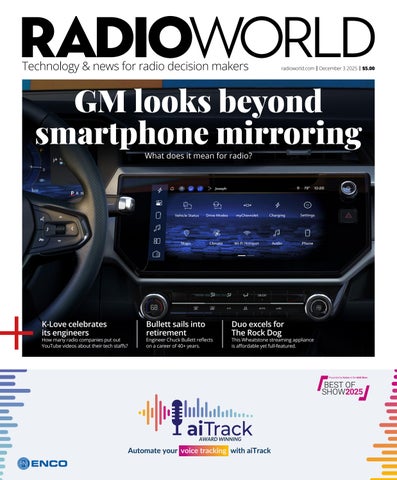
A plan by General Motors to eventually move beyond phone projection systems — namely Apple CarPlay and Android Auto — in all vehicles has left broadcasters wondering what the auto industry’s next move might be.
The company’s decision to move to a proprietary platform run by GM and its tech partners will likely trigger even more changes in the in-vehicle infotainment space.
GM CEO Mary Barra confirmed the plans in a podcast interview with The Verge’s Nilay Patel in October. Apple iPhone and Android smartphone users won’t be able to use those instruments to sync with the dashboard in new GM vehicles, including gas-powered ones, possibly as soon as the 2028 model year.
GM has confirmed it will begin rolling out its own centralized computing system in some electric vehicles, beginning with the Cadillac Escalade IQ in 2028.
The automaker’s new infotainment system, based on Google’s Android Automotive OS, is expected to lay the groundwork for a more unified user experience, allow the automaker to gain access to vehicle and customer data and possibly open new revenue streams.
Tesla and Rivian also have bypassed phone apps in their vehicles.
Big GM’s plan could prove risky for broadcasters, and one major radio group has gone on the record to say it will be bad for the business.
Nic Anderson, VP of government affairs for Salem Media, wrote in the online newsletter Townhall that the move by GM to do away with third-party apps like CarPlay and Android Auto is a way to control what vehicle occupants hear.
For generations, he says, the car radio has been the great equalizer — free, local and open to all — delivering news, weather alerts and community updates instantly, no subscription or data plan required.
“But as vehicles become software platforms, automakers are rewriting the rules. They’re no longer just selling cars; they’re building digital ecosystems,” he wrote.
Anderson, who also serves as vice president of public policy for the National Religious Broadcasters, concluded:
“By removing AM/FM radio and blocking third-party apps like CarPlay and Android Auto, they funnel drivers into closed environments where they alone decide what content is available. This isn’t about innovation. It’s about revenue and control.”
Typically, when platforms consolidate, Anderson said, control over content distribution increases. Algorithms replace editorial judgment. Subscription tiers determine access. Content that doesn’t serve corporate interests
C’mon, Elon!
In related news, Tesla’s 2026 entrylevel Model Y Standard and Model 3 Standard trims will not come with either AM or FM radio. See https://tinyurl. com/rw-tesla.
Gemini embedded, similar to what the automaker uses in most of its electrified models, Barra said on the Decoder podcast.
Why did GM pull smartphone projection from EVs first?
Barra said: “When you look at the fact that we have over 40 models across our portfolio, you don’t just do this and they all update. As we move forward with each new vehicle and major new vehicle launch, I think you’re going to see us consistent on that. We made a decision to prioritize our EV vehicles during this timeframe, and as we go forward, we’ll continue across the portfolio.”
As to a decision on whether gas cars will indeed lose phone projection, Barra said, “As we get to a major rollout, I think that’s the right expectation.”
In an email to Radio World, a GM spokesperson emphasized that the proposed changes do not affect any existing vehicles and that Apple CarPlay and Android Auto remain in GM vehicles for now.
In addition, GM would not confirm any specific timeline for the changes Barra spoke of on the podcast.
“App-based, iconcentric interactions in the car are suboptimal for automakers, and whenever a driver is projecting their smartphone into the dash the carmaker has no idea what they are doing.
can become deprioritized or in the worst cases, excluded entirely, he said.
“Tesla’s FM removal isn’t an isolated decision. GM’s CarPlay elimination isn’t a technical preference. These are coordinated moves toward a future where your dashboard operates like your smartphone; except you can’t choose a different car as easily as you can switch apps,” he wrote in his post.
Terrestrial radio has long faced increased competition in the dashboard and ceded much of its dominance, but some observers say radio is now facing an increasingly unlevel playing field. The overwhelming presence of the internet is placing added pressure on OTA radio’s future in the car.
Instead of smartphone projection, GM will use an independent Google-based system with builtin Google Maps, Assistant and voice controls with
The spokesperson said, “As we advance toward our centralized computing platform, we’ll gradually move to a better, more deeply integrated experience — a direction the broader industry is taking as vehicles become more software-defined. This will happen over time, not overnight. We value our collaboration with Apple and Google and remain focused on delivering experiences customers love.”
GM’s next-gen centralized computing platform “supports AM/FM radio capability,” the spokesperson confirmed.
Broadcast industry observer Jerry Del Colliano, publisher of Inside Music Media, says GM’s move to retain AM/FM tuners, at least for now, is a short-term win for radio.
“The broader context of GM’s infotainment strategy heavily favors streaming, making radio a declining afterthought rather than a core feature,” Del Colliano wrote in his newsletter.
He speculated that GM could face consumer backlash following the decision about smartphones. He cited a 2023 GM Authority poll that showed 88% of surveyed buyers said the lack of CarPlay/Android Auto would be a “dealbreaker” when shopping for a new car.
Electronics industry analyst Roger Lanctot, founder of StrategiaNow, said this is a risk GM is willing to take.
Lanctot says it makes sense for GM and others car manufacturers to have some kind of control over in-vehicle application interactions.
“App-based, icon-centric interactions in the car are sub-optimal for automakers, and whenever a driver is projecting their smartphone into the dash the carmaker has no idea what they are doing,” he said.
That reality interferes with “creating safe, contextually intelligent in-cabin experiences” for drivers, he said. “It makes sense for car makers to have some kind of control over in-vehicle application interactions.”

Lanctot says for broadcast radio, the “fragmented content consumption experience in the car” is a challenge to overcome.
Industry observer and “futurologist” James Cridland says the removal of Apple CarPlay and Android Auto in GM cars is a “significant loss” for broadcasters who have invested significantly in developing apps, which offers a
“
There is a real concern that a closed software ecosystem could allow automakers to package essential features behind a subscription.
We asked David Layer, vice president, advanced engineering at the National Association of Broadcasters, about developments in the automotive space.
Why is GM’s change to a centralized platform important to the radio industry?
David Layer: Automakers want more data and the ability to manage the entire invehicle experience. A centralized platform means the automaker controls the interface, data and user experience more directly. That makes it even more important that radio is not pushed behind layers of menus, not implemented in an inferior fashion compared to other audio services, and not replaced by subscription streaming services.
How do these developments affect the relationship between broadcast radio and major tech companies in the car?
Layer: Automakers are increasingly acting like tech platforms — controlling content access, data rights and monetization of consumers’ data. That means broadcasters have to navigate relationships not only
range of content, and not just live audio, but on-demand content as well.
Once GM removes CarPlay and Android Auto from its vehicles, he says broadcasters will be “entirely reliant” on GM providing the best user experience, and giving the prominence radio deserves in the dashboard.
“It shouldn’t be forgotten that GM only cares about selling cars. They don’t care about the radio business,” Cridland said. In addition, much will depend on what GM uses for an app store in its proprietary infotainment system.
“If it’s their own app store, as would seem likely, then there’s nothing to stop GM from only wanting to carry, say, Audacy’s app and not iHeart’s. Or, for GM to massively promote Audacy in return for advertising, and to hide iHeart in page 3 [of the menu],” Cridland said.
The North American Broadcasters Association wrote in a statement to Radio World: “The beauty of free, over-the-air radio is that there are no paywalls or other gatekeepers standing in the way of broadcast content, which is why we think this option is important, regardless of what other information platforms car companies employ. We feel that GM must make access to AM and FM radio in the car as frictionless as possible.”
with Silicon Valley companies, but with the automakers themselves.
The car of the future should enhance radio listening, not replace it with gatekeeper models. Broadcasters were the original in-vehicle entertainment system. We want to preserve that history while working with automakers and tech partners to innovate — improving metadata, audio quality, personalization and emergency capabilities.
Could GM’s move ultimately allow automakers to charge a subscription fee for access to broadcast radio? Does NAB think that is possible?
Layer: There is a real concern that a closed software ecosystem could allow automakers to package essential features behind a subscription. Consumers have already seen subscription charges for heated seats and safety alerts. We believe broadcast radio should never fall into that category.
Is there an update on NAB PILOT’s Android Automotive initiative? Does the fact that GM is adopting Android

Automotive better position radio in dashboards?
Layer: NAB PILOT began early work on Android Automotive because we recognized that embedded systems would drive the next phase of dashboard development. We have been working with broadcasters, tech companies and automakers on standardized ways to deliver metadata, album art, emergency alerts and interactive experiences directly to the vehicle. That work positions radio to be a prominent feature in these platforms rather than an afterthought.


John Bisset CPBE
The author is in his 35th year of writing Workbench. He handles western U.S. radio sales for the Telos Alliance and is a past recipient of the SBE’s Educator of the Year Award.

Send your tips Workbench submissions are encouraged and qualify for SBE recertification credit. Email johnpbisset@ gmail.com.
Above K-Love Field Engineer David Pelz in a still from the YouTube video.
Below
Engineers working in the field at a transmitter site.
Too often broadcast engineers seem to operate in the background; yet we have crucial responsibilities. So much depends on us: studios, remotes, the transmitter system, the list goes on.
Kudos to K-Love, part of Educational Media Foundation, for releasing a well-produced 11-minute video that seeks to raise the profile of their engineering staff.
The video, titled “Boots on the Ground: The Engineers Behind the Signal,” was posted on YouTube and played during an internal meeting for all team members.
It provides insights into what broadcast engineers do. It includes remarks from other employees expressing gratitude for technical staff — for their dedication and analytical skills, for working alone so often, for spending

a lot of time away from their families, and for their role in supporting K-Love’s Christian mission.
“Vice President of Engineering Kevin Cecil wanted to tell the story of the engineering team and how their dedication makes an impact on our ministry,” said Communications Director Rhonda Roberts.
This was a collaborative effort between the engineering and marketing departments.
“The goal was to show our in-office team members and listeners the great work our field engineers do every day, out in the elements, all over the country. They keep our signals going strong and K-Love and Air1 would not be possible without them.”
The video was featured in a recent edition of your daily Radio World SmartBrief email newsletter (if you don’t get that, sign up for free at radioworld.com, click Subscribe).
But if you haven’t seen it, go to YouTube and search “Meet the Engineers of K-Love.”
As one of the interviewees says in the opening scene, “It takes a special person to be an engineer.”
Scott Dorsey worked in radio in Atlanta as a kid before getting an EE degree and going on to build instrumentation systems. Nowadays he describes himself as an old grouchy guy who yells a lot at conferences!


“The friend used it in the studio and the control room, and the RFI problems went away. Bill says that at both locations, you could measure almost no resistance from any place to any other place. ”

Scott is a big fan of conductive paints, which we discussed here in October. He says it’s great for EMF shielding, for instance when you have plastic or wooden cases that need internal shielding. He recalls that in the 1980s you’d see silver or copper spray paint coating the plastic case of microcomputers and terminals.

Scott points out that available paints vary from a high-conductivity silvercharged product from W.R. Grace to barbeque grill black paint from Ace Hardware. The latter product uses graphite as a pigment and provides
a surprisingly good shield at an affordable price while maintaining higher resistivity.
A useful tool to have in your kit.
San Francisco’s Bill Ruck recalls when Sutro Tower planned to host a cable TV head-end, getting their feeds from the TV stations with a coupler in the transmission line, but the site manager was concerned about direct RF pickup from the transmitting antennas.
The manager discovered a copper conductive paint by Spraylat and bought enough to cover the walls, floor and ceiling of the room the cable company would use.
Bill measured the RF levels before and after painting. He found that the paint reduced the RF by more than 40 dB in low-band TV, FM and high-band TV.
Years later, a friend of Bill’s was experiencing RFI problems at his new home studio. The house was at the top of Sausalito, Calif., about a half mile from a site with four FM stations. Bill told his friend about the Spraylat paint but warned him that it was expensive.
The friend used it in the studio and the control room, and the RFI problems went away. Bill says that at both locations, you could measure almost no resistance from any place to any other place. The paint works.
Let me know if you have experience with Spraylat paint, if it’s even still available. Based on what we find on the internet, PPG purchased some of Spraylat Corp.’s assets in 2012, and there’s also a company called Spraylat International in the U.K. that makes products under the brand name Protectapeel.

Writer Todd Dixon Chief Engineer for Alabama Crawford Broadcasting Co.

With the end of support for Windows 10 in the rearview mirror, I thought I’d spend a moment talking about what it means for everyone who is still on the operating system and about Windows update anomalies in general.
It is estimated that 40% of PCs still run Windows 10, and those users are going to have to go somewhere in order to keep their computers running current security patches and licensing. As I write, Apple has seen a 14% increase year to year in their sales, and Linux, which in most cases is not sold by a company but is more driven by the user community, is seeing a real uptick in usage as people are looking for alternatives.
The problem, as I see it, is that Microsoft has pivoted their default login to their operating system as needing their cloud services and internet.
I’m sure you have seen this while setting up the latest Windows 11 systems. You cannot easily create a local
administrative account or a limited account without really jumping through hoops to do it.
During the initial install, you basically must have no internet available to the machine and do some command line work in order to have the system skip their “Out of the Box Experience” (OOBE, for short) to be able to create an account that is local to the computer.
Computer geeks have understood for a long time that the Microsoft Windows End User License Agreement (EULA) basically says that even though you paid nearly $200 for the license, you don’t “officially” own the software. This allows them to push security updates (as well as unnecessary ones) to your computer without your permission.
It’s also why after each of those updates you have to go back into the installed apps and remove Xbox, Skype, Teams and yet another Office installer (about 300 MB of space) if you don’t use or want them, even if you have removed them previously.
One way that I know Satan does exist is the fact that Microsoft Windows has a stranglehold on the PC operating system market. Of course, they aren’t the only software company that employs this type of behavior. Adobe went to a licensing structure several years ago instead of allowing you to buy their product outright and use it until it didn’t serve your needs any longer.
It’s been a trend for a while that you rent a service from companies and don’t really own anything. But when we put our logins, data and services in the cloud, what happens when the company that is “too big to fail” actually does? Maybe the failure won’t be financial (although it could be), but it could well be an infrastructure failure, as with a recent Amazon 15-hour DNS issue. Or a cloud company may send out a notice that a cost-benefit analysis indicates that the service a company requires to run its business is no longer going to be supported.

Above
I’ve seen a general trend — in trade articles and among people I follow — suggesting that a number of companies now are being more strategic about what they do and don’t push to their cloud providers.
Interestingly, the price for hard drive storage has plummeted. A quick look at Newegg, an online computer hardware store, shows that a 28 TB enterprise hard drive is priced at $529. That is a little under $19 per terabyte of storage. Yet paying for and using that same amount of online storage has increased.
You would think that the two lines would track together. I’m not saying that there should be a 1:1 ratio or that there isn’t value in what the cloud service companies provide with all of their hardware and support staff, but I am saying that the 8 to 12 percent increase year over year for equivalent service is forcing some companies to evaluate just how useful the cloud is to their organizations.
I know you may be thinking, “Wow, I knew Todd was a little crazy and that he is also an open-source guy, but I didn’t know that he harbored this much resentment toward the computer establishment.”
The genesis of this article stemmed from something basic. In the past month, I’ve had several people ask me to look at their computer because the keyboard was acting weird and they couldn’t do anything meaningful as a result.
It turns out that in every case, the settings for the delay in repeating characters on their keyboards had been maxed out on the sliders that control those rates. What?
Obviously, if they had done it, these users would have known where to look to fix it, but they hadn’t done it; they had received an update on their computers.
It doesn’t help that Microsoft has been making it harder and harder to get to its Control Panel to handle settings
like this. All of them were at the point of thinking their laptops were broken, but it turned out that a setting had been changed during an update.
If this happened to three people in my limited sphere, how many other people experienced it?
This isn’t a call to circle the wagons. At the end of the day, I know the reality of the computer world we live in, and we all have to make friends with Microsoft and other companies and get along in order to make our markets work. But Microsoft is moving slowly toward heat death. Apple is continually upgrading its software, forcing its hardware into obsolescence. The only operating system I’ve ever worked with that gives me some peace in all these areas is Linux.
Both keyboard rate control sliders had been maxed out after an update.
Do you have an older computer around that Windows has passed by? Linux will work on it. Do you need a Network Attached Storage service on your local network? There are several Linux options that are easy to manage and will work on older hardware.
I’ve basically been using Fedora Linux for 20 years, and it has never broken on me whether by update or the file system itself. It just works. I could probably set it up for my 80-year-old mother and she’d have no issues navigating it.
In fact, as soon as I wrote those words about Linux, my blood pressure started to go back down and everything in my computer world seems more normal again.
This article originally appeared in Crawford Broadcasting’s “Local Oscillator” newsletter.
Comment on this or any story. Email radioworld@futurenet. com with “Letter to the Editor” in the subject field.
“In the past month, I’ve had several people ask me to take a look at their computer because the keyboard was acting weird and they couldn’t do anything meaningful because it was acting so erratically.

Writer Dan Slentz

“The Rock Dog” puts this affordable tool to work
When WDOG(LP) “The Rock Dog” decided to start streaming, I researched how we might do it and became convinced that a separate streaming appliance would be the most reliable, self-contained solution.
The Wheatstream Duo, intended for one- or twochannel applications, appeared to be the product for the job.
The company calls Duo a tool “for every broadcaster, podcaster or content streamer who has ever wanted a professional audio streaming appliance but couldn’t afford it.”
Wheatstone’s streaming appliances have been on the market for some time and are used in many stations, but their price put them out of reach for this small LPFM in New Philadelphia, Ohio. When the company introduced the Wheatstream Duo for under $2,000, I called up and ordered one of the first units off the production line. (My unit was Serial #004, and I’m told that 001 to 003 were factory test units.)
The physical box has an uncomplicated 1RU form factor. There isn’t much on the face, while the rear offers the expected audio and network I/Os.
Yet Wheatstream Duo has everything I need for my LPFM: two channels (four output streams each!), along with
full processing designed specifically for streaming, including BS.1770 loudness control.
The web-based HTML5 GUI is fully loaded and well designed. I had been using a desktop PC; being able to switch over to a Linux streaming appliance that I can put in the rack gave us a lot more stability and reliability.
Setup was relatively easy. As with other processors that provide a lot of “hooks” for control, it was helpful to take a processing preset and slowly modify it over a few days, to allow my ears to get accustomed to each change before tweaking further.
After I had the Duo online I asked the team at Wheatstone to see what they thought of my stream.
Jeff Keith, Wheatstone’s senior algorithm and product development engineer, took notes, then expressed a concern that the measured stream loudness didn’t match Duo’s set target LUFS loudness level. Using test software he measured our stream loudness at 6 dB too low.
This concerned him, and Jeff made a trip to the radio station to ensure it wasn’t an issue with the Wheatstream Duo. Back in the lab he did additional testing; he even temporarily sent our stream from his lab. He found the problem: Our stream distributor Cirrus Streaming had set their stream player’s default playback level to –6 dB, exactly what we’d been measuring.


So I sent an email to Cirrus tech support to request they remove the “volume control” on the player and/or fix it at 0 dB. They made the change, the loudness problem was resolved, and our stream’s loudness level now perfectly matches Wheatstream Duo’s LUFS setting.
Wheatstone’s support was impressive. (I jokingly asked if each new Wheatstream Duo came with its own Jeff Keith.)
They’ve built it on a rock-solid Linux system, so no need to worry about Microsoft or Apple running patches, updates or fixes, or about viruses or ransomware by others.
As far as bumps, I found the interface between our BSI Simian automation metadata and Cir.St running through the Wheatstream Duo to be tricky to set up, so we simply ported direct from Simian to the Cir.St servers. I saw no advantage to doing otherwise; it all worked perfectly.
If you get a Duo, remember your audio interfacing cables if you are AES or analog with traditional connectors. In
future I’d recommend that the factory include RJ45-to-XLR adapters.
I’ve found the Wheatstream Duo an incredible stream appliance at a cost-effective price. You can hear the Duo in action on the stream of www.wdog1059.com


Writer Nick Langan
The author profiled engineer Dave Skalish in a recent issue.
Engineer concludes a career of almost five decades spanning AM DAs and Metallica’s studio
The life of a radio combo man is less regimented than you might think.
Perhaps that’s the secret ingredient behind the multitalented Chuck Bullett, who recently announced his retirement after almost five decades as a radio engineer, voiceover artist and even a go-to sound master for members of Metallica.
His wife Lisa recently consulted Google and offered her prognosis for what fuels her husband: attention deficit disorder. “She’s probably not wrong,” he surmised.
Or maybe it’s the scent of Maine’s pine trees. That’s where Bullett, 65, was born and where he plans to spend the lion’s share of his retirement years.
He grew up in Brunswick, part of the central Maine area that included the towns of Topsham and Bath that have proved fertile for radio talent.
Bullett’s grandfather, Charles Sr., outfitted the family living room with a console radio that had both mediumwave and shortwave coverage.
The radio’s sound, Bullett recalled, was immaculate. “I was hooked,” he said.
On the air from Maine’s midcoast
Brunswick High School, which Bullett attended, had a 10-watt FM station, 91.9 WBHS. Its special radio advisors included Dale Arnold, the now retired play-by-play man for the Boston Bruins and WEEI host.
Arnold and his colleague Bruce Biette connected Bullett with Bob and Ginny Pappas, who owned WKXA(AM/FM) in Brunswick. They were in need of weekend sign-off operators.


At age 14, there was Bullett, spinning the hits that mattered in the summer of 1975 from 6 p.m. to sunset. He’d also take transmitter readings and perform power calculations.
“I was doing real radio,” he said. How’d he pull that off when the legal working age was 15?


“I had a beard, a mature and developed voice and a Third Class Operator FCC permit.”
His father, Charles Jr., would come out at midnight to pick up the intrepid radio teenager and his bicycle from the WKXA studio, situated in an unlit, rural part of Brunswick.
Bullett would move on to Bath’s WJTO(AM) and WIGY(FM), hosting weekend shifts, running promotions and “whatever else they’d let me do.”
At 16, when 105.9 WIGY’s Gates FM20H3 transmitter would suffer a plate overload and go off the air, Bullett was the one who drove to reset the overloads and breakers.
The three-phase power service was not very solid and the site did not have a generator. “There were a lot of teachable moments from such excursions in those days,” he said.
After a year attending the University of Maine while juggling a 40-hour a week workload at WLBZ(AM) in Bangor, Bullett went full throttle for a chase at a broadcast radio career.
His next stop was WGAN(AM/FM) in Portland, owned by the Guy Gannett family. Its sister outlets were CBS affiliate WGAN(TV) Channel 13 and the Portland Press Herald newspaper.
For Bullett, making it to the largest city in the state allowed him to sharpen his multi-faceted skillset.
John Hussey, WGAN’s chief engineer at the time, caught Bullett in the act of cleaning cart machine pinch rollers one day between his talk sets.
“He’d introduce me to the likes of Bill Suffa, Gary Cavell, Ron Rackley and Richard Mertz. It was a remarkable time,” Bullett said.
“I’ve never really been happy unless I was juggling three to five tasking items at once. ”
Above
The University of Maine’s Amateur Radio Club in 1979. Bullett is third from left.
the curtain at the Metallica Club Recording Studios in San Rafael, Calif., in 2016.


Above
After Hussey departed, Bullett was WGAN’s chief for 15 years. He’d still be heard on-air too, but when WGAN began leaning into syndicated offerings, Bullett began exploring production.
“I never had a problem voicing a spec-spot for the sales department from notes on a napkin,” he said.
I’ve seen the future
In the late ‘90s, streaming would become the rage, and there was much intrigue over it being “the next big thing.”
A company called BroadcastAmerica.com set up shop in Portland, Me., a startup that had the same fervor, according to Bullett, as Mark Cuban’s Broadcast.com in Dallas-Fort Worth.
“I was attracted to a radio engineering opening they had like a mosquito to a flame,” Bullett said.
The company was streaming both radio and TV before anyone really knew what it meant. Most consumers were still using dial-up modems for connectivity at the time.
The venture ended in bankruptcy. “Consumer technology just wasn’t ready,” he said.
At that point, Bullett’s family had grown to four children. In need of an opportunity, Citadel had an opening to handle servicing its multiple stations in Maine and New Hampshire, which included 94.9 WHOM(FM) atop Mount Washington’s 6,300-foot summit.
“My solution was to go back to linear media and what I knew,” he said.
During Bullett’s time with Citadel, WHOM’s tower caught fire and burned down to the ground on a February afternoon in 2003. Investigators determined the fire started in the station’s generator house and quickly spread.
That experience, Bullett said, led to his “three layers of redundancy” approach, which he and host Kirk Harnack discussed on a recent episode of the podcast “This Week in Radio Tech.”
But the five years of travel and handling 14 stations across the two New England states had taken its toll. Bullett’s family life and marriage suffered.
He opted for a studio integration position in Orlando with brothers Larry and Erick Lamoray. Among their clients

Below
Bullett and his wife Lisa aboard the “Chartmaker,” their 58-foot Hatteras Motor Yacht, on San Francisco Bay. He describes the boat as their happy place.
for studio packages was the team formerly known as the Washington Redskins and its Red Zebra radio group.
Bullett would sign on to work as Red Zebra’s director of technology, building out the team’s new radio network, as well as placing a number of its stations in new facilities, bringing noted D.C.-area engineer Tom Shedlick onboard.
But with the on the field product of the football team struggling, owner Daniel Snyder deemed the radio division expendable.
“One day most of the managers, some airstaff and myself were escorted to the door,” Bullett said.
In 2007, Cumulus purchased Susquehanna Broadcasting. VP of Engineering Gary Kline needed a chief engineer in the San Francisco Bay Area. Kline and Cumulus’ leadership team met with Bullett, who was still in D.C.
“I couldn’t get the airplane tickets to San Francisco in my hands fast enough,” he said.
Cumulus’ San Francisco stations at the time included KNBR(AM) and KTCT(AM), along with rockers KFOG(FM) and KSAN(FM).
Automation at the time for the four-station group was crashing daily, Bullett said, and some time, love and care was necessary. Bullett later oversaw the consolidation of KGO(AM) and KSFO(AM) into the group.
Meanwhile, the combo man was alive and well in him, too. He’d end up gaining voiceover work for several premium car dealerships across the Bay Area.
“You never really lose it,” he said.
Bullett also took full advantage of the locally accessible maritime waters. An avid sailor, he is a credentialed U.S. Coast Guard Merchant Captain and he’d work the waters of the San Francisco Bay while also holding a volunteer leadership position in a nonprofit yacht club.

He found the time to moonlight to engineer Bob Coburn’s syndicated “RockLine” show, which featured Bay Area staples like Bonnie Raitt, Carlos Santana and Huey Lewis.
ISDN lines were magic to folks not familiar with radio.
“We had a bank of them, and great studios, which gave Coburn in Los Angeles and his producers in New York the confidence we could get their guests on air,” Bullett said.
Soon Metallica, with their recording studios based in San Francisco, would call for help when they wanted to drop a new album.
Bullett happened to have a pair of his own Telos Zephyrs, and as a result, he’d spend time helping Metallica’s team by taking over recording consoles and reconfiguring rooms for mix-minus and front of house, plugging them right into his remote case.
In 2008, one of Bullet’s memorable moments was coaching Dave Grohl and Taylor Hawkins of the Foo Fighters to conduct an interview with Metallica’s members in front of a live studio audience.
Grohl and Hawkins idolized Metallica.
“We crammed about 125 superfans into the studios and turned it into a live space,” Bullett recalled.
It was an intense four days of planning and work that was conducted in secrecy until the day of the event.
The “Death Magnetic” two-hour show would be delivered via satellite to some 500 stations nationwide.
Francisco shuffle
Bullett moved to CBS Radio in San Francisco in 2012 to help fill a void left by the passing of his friend Phil Lerza, a Bay Area engineering legend.
In 2019, Bullett would leave what became Entercom to join Bonneville’s San Francisco stations for its director of technology role. The company was embarking on a buildout involving 20 studios.
COVID-19 hit, and Bullett described it as a rough time for everyone involved. All of the staff, except engineering, was working from home.
But the studio move — without the remote airstaff — would be completed.
He handled the director of technology role from the beginning of 2021 until the end of August 2025, when he officially retired.
The way life should be Bullett is returning to where it all started for him, back across the Piscataquis River Bridge back into Maine.
In addition to being closer to his children and grandchildren, it offers prime access to some of his hobbies, including, of course, sailing.
Bullett and his wife purchased their year-round home in Portland; they also own property in Austin, Texas, which they can head to during the height of a Maine winter.
Readers, he suggested, should search out Bullett (W1AEK) on the amateur radio bands, as he hopes to engage with the hobby more fully.
Maybe a slower pace for Bullett’s life is overdue. But in an era where side hustles are the rage, how did he manage to


Mark
Lapidus is a veteran multi-platform media and marketing executive.

Without risk, there’s no reward
I’m a fan of on-air surprises that make audiences fall in love with radio all over again
Boring!
It’s the word no programmer wants to hear in a focus group. The perfect, same-sounding DJs and predictable playlists dominate the airwaves. The result? Professional — but forgettable — radio.
Without risk, there’s no reward. That’s why I’m a fan of on-air surprises that make audiences fall in love with radio all over again. Once you start playing in the “surprise sandbox,” you’ll see creativity spread across your team. This is the secret ingredient that makes great stations legendary.
DJ plays guitar or sings, let them do it on-air occasionally. When listeners see talent as human — not just voices — they connect more deeply.
The Full Album Experience — Play a classic album straight through, dead air and all, right in the middle of the day. No pre-promotion — just drop it. The surprise itself becomes the story, and social chatter will follow.
Above NPR’s “Tiny Desk Concerts” reliably provide the “wow factor.” Shown is the performance set.
Behind the Curtain — Listeners love transparency. If you’ve got a brave GM or PD, host a surprise Q&A at random times. Let fans ask about playlists, contests or local news coverage. It builds trust — and curiosity. Bonus: Invite participants to join your Listener Board for future research or music testing.
Legends Are Legends for a Reason — Every market has icons who’ve retired or moved on. Bring them back for a surprise shift or guest week. Nostalgia drives loyalty, and even ex-competitors can add charm. When you’ve cycled through the legends, feature local influencers, chefs, teachers or first responders as guest hosts.

Let Personality Shine — Encourage 60-second karaoke moments or brief live performances by your hosts. If a
Community Voices — Set up a mic at a local hotspot and invite people to request songs or comment on local topics. If short-staffed, crowdsource voice notes from listeners. Authentic voices create instant engagement.
Unexpected Remotes — Skip the mall broadcast. Go live from a farmers’ market, comic book shop, a convenience store or a laundromat. Raw energy equals real connection.
Format Rule-Breaking — Give hosts a weekly “free play” block to choose off-format songs, behind-the-scenes stories or favorite deep cuts. When you briefly explain them on-air, it feels meaningful.
The Time Machine — Take listeners to a specific month and year with music, jingles, commercials, even news clips. Nostalgia delivers emotional connection like nothing else.
Dare to be unpredictable. That’s how legends are born.
Anew Radio World ebook explores the topic of “Radio Operations on a Budget.” This is an excerpt.
Geary Morrill, CPBE, AMD, DRB, CBNE, is vice president of the Society of Broadcast Engineers and chair of its Education Committee. He has been intimately involved with radio broadcasting as an owner/operator, air talent, sales representative and broadcast engineer.
“Individual markets in a region will have unique needs, and be in different positions fiscally,” he said. “The trick is to address both when formulating a plan.”
He notes that outside factors often come into play.

“For instance, with transmitters, challenges in raw material supply chains have greatly increased the price of power tubes, while their useful service life seems to be decreasing,” he said.
“In many instances, rebuilt ‘finals’ had been employed as a budgetary consideration. Now, timelines stretch into months for some types; and warranties that had been based on ‘hours in service’ are shifting to ‘time since delivery regardless of use.’ These factors accelerate the timeline for solid-state conversion, yet it’s difficult to amortize such acquisitions when revenues don’t support ROI.”
In such circumstances, he said, seasoned engineers who can troubleshoot to the component level become invaluable, often extending the useful life of large assets. But he notes that many experienced engineers are aging out of the workforce each year.
“With the daytime operation being non-directional as well, it eliminated the expense of maintaining a directional array. And since the majority of nighttime listening was already occurring on the translator, it was a logical decision.”
Another area of interest in this ebook has been keeping the cost of tower leasing under control.
“When an initial asset sale on vertical real estate takes place, the initial objective is often a cash infusion to the seller,” Morrill said.
“In order to maximize that price, there is typically an initial term with lease payments advantageous to the purchaser, and a master lease agreement encumbering all properties in the asset agreement.
“In subsequent terms, negotiations to bring lease payments in line with comparable structures in a geographic area may be successfully achieved, with variable length agreements for different subgroups in the original purchase agreement. Attention needs to be paid to windows of opportunity specified in the original agreement to do so, otherwise an automatic renewal may occur limiting or eliminating

We asked if Morrill has heard of stations changing signal patterns to help contain power costs.
“I know of at least one instance when this was the case. A nighttime directional AM station with an FM translator chose to file for non-directional nighttime operation,” he said.

When it comes to choosing between hiring a fulltime engineer or using a contractor, Morrill says the most important factors are the vintage of equipment and the revenue generated by the market.
“Typically, a contract arrangement will involve a retainer that includes a set number of hours weekly or monthly at the facilities. In a situation with more mature facilities, the budgeted hours can be consumed quite quickly. Market management will tend to plan on the retainer hours being sufficient.”
Another factor is whether backup transmission facilities are present. If not, and if the tolerance for downtime is minimal, Morrill says a full-time engineer will provide the best chance of minimizing it.
Zeno Media announced that it is offering its streaming and podcast customers HTTP Live Streaming (HLS) support.
The protocol allows streams and podcasts to be offered as small, time-sliced segments, improving start times and adapting audio quality to each listener’s connection.

The segment-level request data HLS offers can also provide a clearer picture of consumption and completion patterns of streams and podcasts, the company said.
HLS also allows for more modern ad options, which it said supports more precise mid-roll opportunities and server-side insertion paths.
Zeno Media said that it also expects to offer video streaming services for its partners and publishers in the first quarter of 2026.
Info: https://zeno.fm


Marketron is using 11:11 Systems for a cloud-based migration of its services.
11:11 Systems is a cloud services provider that has approximately 50 facilities, including data centers in North America, Europe, Asia and Australia. Marketron manages around $7 billion in annual U.S. ad revenue for about 7,000 media organizations including radio.
Marketron said it faced mounting expenses from legacy infrastructure that required hardware refreshes. A case study published by 11:11 Systems said Marketron incurred expenditures of $300,000 every three to four years for the refreshes, as well as logistics tied to remote data centers.
Marketron said that major cloud platforms were costly and incompatible with its software architecture.
According to 11:11, Marketron said the move has brought stability to its platforms, resulted in fewer outages and removed the company’s hardware management troubles. It has also adopted 11:11 Systems’ backup solution for Microsoft 365 and its Object Storage for AWS.
Info: https://1111systems.com


I especially like the ones from James O’Neal. His recent story about the VOA museum was very interesting. I hope to see more in the future. Thank you.
David Crist
There are times I fit the category of “Old Man Yells at Cloud.” But Ira Wilner’s letter in the Sept. 24 issue takes the cake.
Here’s a guy lamenting how people with SDRs have it easier than he did and how SDRs therefore are somehow damaging the hobby.
He misses the point that maybe if DXing were a little easier, it would invite more new blood in. The term “damaging” is even disputable, because “easier” doesn’t necessarily equate to “easy,” yet he refers to
challenging sources of QRM), and you have what used to require racks of equipment in an average field station.
Ok, so an RTL-SDR is nowhere near the specs of a WatkinsJohnson, I get that. The average RTL-SDR has a sufficiently high noise floor to make it questionable as a traditional high-quality DX machine. But you’re also paying around $50 for a device vs. $50,000 (I’m just throwing out a number for a good, used, rack-mounted Watkins-Johnson and some signal
The technology itself isn’t even new. Software-defined and zero-IF radios in general have been in technological advancement for decades. Today’s SDRs just make these capabilities a lot more accessible and interesting to the novice, bringing in younger people to the magic of radio. And
The radio listening hobby has been in a slow death march since the turn of the millennium. With streaming so accessible and prevalent, I asked myself at one point if members of Generation Beta would even know what a radio is. Interest among young people in radio has been in a
That is, until the recent influx of cheap Chinese portables and SDRs. Couple this with kids seeing what can be done on social media and they are now becoming engaged again, not just with AM broadcast DXing but with all facets of the hobby.
As these devices become more capable and accessible, the chances drastically increase that radio will survive. Denigrating those people by calling them lazy instead of encouraging them with new technology is damaging the hobby.
Mark J. Fine


The tools may be different, but the basic capabilities a general listener has in his or her toolbox are now a miniature equivalent to what professional SIGINTers have had for decades: full spectrum displays with waterfalls, wideband recording capabilities and 1.7 MHz of instantaneous
Put a half-decent low-noise/high-gain antenna (and maybe some preselection filtering) as well as some isolation from computer noise (and other
In the nice article about Trans World Radio Bonaire in the Aug. 13 issue (“A Visit to Shine 800 AM”), I fear that Mark Persons may have unintentionally misinterpreted Jim Moser’s comment about parasitic elements in directional arrays. Arrays with parasitic elements are actually not all that uncommon.
There are two types of parasitic elements in AM directional arrays: those with towers that are simply grounded, and those that have a suitable impedance “passive” load.
A grounded parasitic does have the load produced by the loss in the tower itself and the ground connection, but those are normally very low resistance values.
Arrays with parasitic towers that are just grounded are rare because there is no control over the current magnitude and phase. Before moment method analysis techniques began to be commonly used, predicting those values could be troublesome.
In one that I designed (a 2 megawatt, four-element array), my colleague Ron Rackley was just unsure enough about the MM model that he convinced me to have us specify that the top of the parasitic towers be constructed in 10foot sections so we could remove them if needed to get the right performance, although when it was built our measurements showed that we did not have to.
I think it is this type of parasitic array to which Jim was referring.
Arrays with parasitic towers that are loaded with a resistance, a reactance or a combination are not uncommon. A few arrays with very low power resistive and/or reactance loaded parasitic towers were in operation in the U.S. before the commission eliminated the discrete transmitter power output rules, but they have become more common since then. The FCC now allows the transmitter output power to include both the radiated power and the power terminated in a resistive load on the parasitic tower, thanks to an application Ron prepared shortly after the rule change.

Above The TWR transmitter site on Bonaire.
This is a particularly useful technique for some linear arrays with high RSS/RMS ratios since it increases stability. It’s useful in some others as well. For example, Jim Moser and our office used the technique in a recent installation, and we’ve used it for both new designs and repair projects. And this technique has been employed in quite a few high-power arrays outside the western hemisphere, as Jim stated.
Ben Dawson Hatfield & Dawson Consulting Electrical Engineers Seattle
Mark Persons’ article about Shine 800 AM recalls the summer evening I caught PJB under the headphones on a Sony SRF-A100 AM stereo radio forced into the MagnavoxMotorola-Harris mode. That superb and now long-defunct little portable radio does not need to see a stereo pilot to decode phase-dependent AM stereo.
PJB, CKLW and WLAD were all coming in at about equal strength here in Wilton, Conn. Because their frequencies differed by fractions of a cycle, the radio decoded the constantly shifting phase differences.
Imagine yourself under the headphones as the nucleus of a lithium atom, atomic number 3. Swirling around your
head in orbit are the three electrons. That is the effect created by the phase-dependent AM stereo decoder. Under headphones, it creates an image in three dimensions of the three stations orbiting around in your head in psychoacoustic space.
This makes it possible to follow and copy any one of the stations by anticipating and focusing on its location in space exclusion of the others at any given instant.
It’s a wild and crazy but interesting effect that could be used to enhance an AM DXer’s ability to pick out and highlight one given station in a jumble of several.
Thanks, John Bisset, for sharing my tip about using dog nail clippers to strip wire in the Aug. 13 issue. My 15 minutes of fame have arrived! Where are the groupies?
I have enjoyed Radio World for many years. It is an eclectic publication ranging from programming to operations to technical. And as a ham and old SWL, I really enjoy the international features such as the story in the same issue about Shine 800 AM. All within one set of covers!
Jim Potter, K3NSW

