


BY CHELSEA ORTEGA, ESQ.
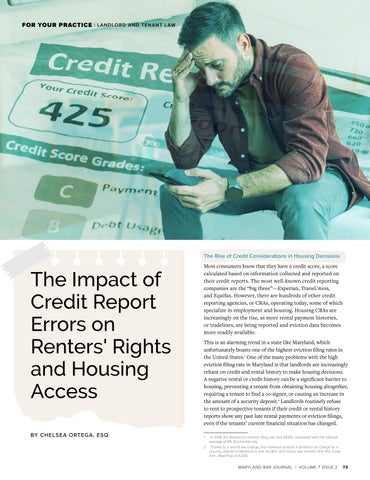
Most consumers know that they have a credit score, a score calculated based on information collected and reported on their credit reports. The most well-known credit reporting companies are the “big three”—Experian, TransUnion, and Equifax. However, there are hundreds of other credit reporting agencies, or CRAs, operating today, some of which specialize in employment and housing. Housing CRAs are increasingly on the rise, as more rental payment histories, or tradelines, are being reported and eviction data becomes more readily available.
This is an alarming trend in a state like Maryland, which unfortunately boasts one of the highest eviction filing rates in the United States.1 One of the many problems with the high eviction filing rate in Maryland is that landlords are increasingly reliant on credit and rental history to make housing decisions. A negative rental or credit history can be a significant barrier to housing, preventing a tenant from obtaining housing altogether, requiring a tenant to find a co-signer, or causing an increase in the amount of a security deposit.2 Landlords routinely refuse to rent to prospective tenants if their credit or rental history reports show any past late rental payments or eviction filings, even if the tenants’ current financial situation has changed.
1 In 2018, the Maryland’s eviction filing rate was 69.6%, compared with the national average of 8%. Evictionlab.org.
2 Thanks to a recent law change, the maximum amount a landlord can charge for a security deposit in Maryland is one months’ rent versus two months’ rent. Md. Code Ann., Real Prop. § 8-203.
According to a recent report by the Urban Institute, 90% of landlords use some sort of screening process, which typically includes an evaluation of the applicants’ eviction history, rental history, and credit scores.
There are also systemic barriers to relying on credit history. According to Chi Chi Wu, senior attorney at the National Consumer Law Center, “the use of credit history in tenant screening disproportionately harms vulnerable communities, including Black and Latino renters. Our nation’s long history of racial discrimination—redlining, Jim Crow, and more—shows up in credit scores, and their use by landlords can perpetuate racial disparities.”
Because Maryland courts are flooded every day with eviction filings, the likelihood of inaccuracies is significantly increased. Many large property management companies use rent court agents, who do not have to be attorneys. These agents rely on a list of names in a spreadsheet and often do not review tenant ledgers or leases before filing a failure to pay rent action against tenants. Tenants typically only receive a few days’ notice of their hearing date and may not be able to take off from work or arrange childcare, so that even if they dispute the amount owed, they are not able to appear in court to mount a defense.
3 15 U.S.C. § 1681, et seq.,
4 131 F.4th 241 (4th Cir. 2025).
5 Id. at 246.
6 Id. at 246-47.
7 Id. at 247.
8 Id. at 248.
9 Id.
The Fair Credit Reporting Act (FCRA)3 is a federal law providing consumers with a remedy when errors appear on their credit reports. Enacted to ensure the accuracy of credit reports, it entitles consumers to periodic free copies of reports, outlines dispute procedures, places limits on reporting, and provides a private cause of action for consumers, among other protections.
The facts in a recent Fourth Circuit opinion highlight the barriers to housing that a consumer faces when a relatively “small” inaccuracy is reported on a tenant’s credit report. The United States Court of Appeals for the Fourth Circuit in Roberts v. Carter-Young, Inc. recently rendered an opinion in a landlord/tenant case clarifying the standard under the Fair Credit Reporting Act regarding the duty of a creditor to conduct a reasonable investigation of a disputed debt.4 After she moved from the property, the tenant received a bill from her landlord seeking alleged damages to the property in the amount of $791.14.5 When the tenant did not pay, the landlord sent the tenant’s account to a collection agency, which then reported the debt on the tenant’s credit report.6 The tenant disputed it with the three major credit bureaus, but it remained on her report, and she could not secure housing.7 She filed suit against the collection agency, alleging that it had failed to conduct a reasonable investigation of her disputes.8 The district court dismissed the case, finding that the dispute involved a legal question rather than a factual inaccuracy.9 The Fourth Circuit reversed, finding that to state a claim under the FCRA, “a consumer must allege facts that, if true,
One way that consumers can protect themselves from errors is to protect against identity theft by freezing their credit.

indicate an inaccuracy or incompleteness in their credit report that is objectively and readily verifiable.”10 This is a positive decision for consumers because it reinforces the requirement for furnishers of credit information and credit reporting agencies to ensure the accuracy and verifiability of information, ultimately promoting greater accountability and protection for individuals.
One way that consumers can protect themselves from errors is to protect against identity theft by freezing their credit. In Maryland, there is no cost to freeze one’s credit, and it is a fairly simple process, although each of the three major credit bureaus must be contacted individually.11 It is also important to freeze the credit of any minors or incapacitated adults in one’s household, as their credit is a frequent target of identity theft.
Frequent monitoring is also another strategy to stave off mistakes and fraud. Following the COVID-19 pandemic, all three major bureaus allow consumers to review their reports for free once a week. The best source is www.annualcreditreport.com, which is a website directed by federal law to provide credit reports.
If there are any errors, a consumer can dispute them by sending a letter by certified mail to the credit reporting agency reporting the error, as well as the company providing the inaccurate information. The Consumer Financial Protection Bureau currently maintains sample letters. Supporting documentation should also be submitted. For example, if there is an error in a landlord/tenant situation, a tenant may want to submit a copy of her lease, her tenant ledger, photographs, or correspondence with her landlord. It is important to
keep copies of all letters that are sent. Consumer lawyers who handle credit reporting cases may be able to assist consumers in this process as well.
Credit report errors pose a significant and often underrecognized threat to renters’ rights and housing access. Inaccurate information on a credit report can lead to unjust denials of rental applications, inflated security deposits, or discriminatory treatment, disproportionately affecting low-income individuals and marginalized communities. Despite existing protections under the Fair Credit Reporting Act, many renters remain unaware of their rights or face systemic barriers in correcting errors. To ensure equal access to rental opportunities, stronger enforcement of credit reporting regulations, continued reform in the eviction process, and increased public education on renters’ rights are essential. Legal reform and policy advocacy must prioritize these areas to close the gap between legal protections and real-world outcomes in the housing market.

Chelsea Ortega is a partner at the law firm of Santoni, Vocci & Ortega, LLC in Baltimore County, Maryland. Chelsea’s practice primarily focuses on issues involving tenants and consumers’ rights. She is a member of the Maryland Volunteer Lawyers Service Board of Directors and the Maryland Legal Aid Board of Directors. Chelsea also serves as the Maryland State Chair for the National Association of Consumer Advocates, a community of more than 1,500 attorneys fighting for consumer justice.