A LAWYER CONFRONTING BAD HISTORY
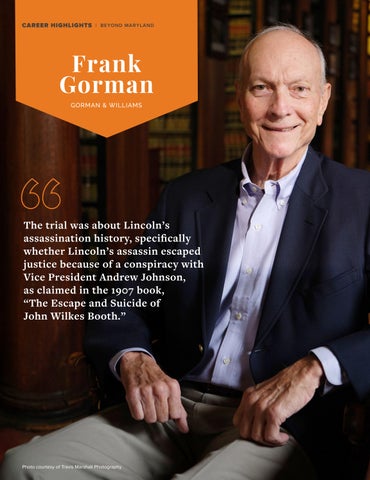
FRANK GORMAN, LAWYER, LITIGATOR, author, husband, father, and grandfather, has practiced law since 1969. Gorman wrote Confronting Bad History: How a Lost Cause and Fraudulent Book Caused the John Wilkes Booth Exhumation Trial, recounting his experience at trial representing Green Mount Cemetery, challenging the exhumation of this historical figure.
What are some accomplishments you've achieved during your career?
I was fortunate to begin my legal career in 1969 as a law clerk to Judge Roszel Thomsen, then Chief Judge of the U.S. District Court for the District of Maryland. After the clerkship, I joined Semes Bowen & Semmes, a high-quality law firm in Baltimore, where I practiced law with top-notch attorneys. In 1995, David Williams and I founded Gorman & Williams. I retired from the firm in 2020 and have been Of Counsel to the firm since that time. My law practice has been interesting and diverse. During my active practice years, my primary areas of legal practice were maritime law litigation/ trials (1970-1980) and then IP litigation/trials and other business and commercial litigation/ trials (1981-2020).
In 2005, I was honored to receive the Lee A. Caplan Pro Bono Award from the Pro Bono Resource Center of Maryland. Today, I help at the JustAdvice Project at the The University of Maryland Francis King Carey School of Law. I served as the past chairman of the Intellectual Property Subcommittee of the MSBA.
For 30 years, I was an adjunct professor at the University of Baltimore Law School. I also taught International Trade Law every summer in Taiwan for 12 years, and at the University of Baltimore for several semesters.
I volunteered for Bill Clinton’s presidential campaign, serving as Maryland General Counsel for his campaign, and went on to become General Counsel to the Maryland Democratic Party.
Describe a memorable MSBA event or product that had an impact on you personally or professionally.
My wife, Pat, and I have memories from 1984-86 when I served on the Board of Governors of the MSBA. It expanded my appreciation of the good lawyers in counties outside the Baltimore/Washington DC area, and we enjoyed days in Ocean City on the beach, at the annual meeting.
What originally motivated you to write a book concerning the trial that decided whether John Wilkes Booth was exhumed, and what made you feel it was a story that needed to be told?
In 1994, I was asked by Bill Trimble to represent and defend Green Mount Cemetery in a Petition filed by petitioners who wanted to exhume the body of John Wilkes Booth. As I read the Petition, I realized this was a case about history, real history, and that I would never be offered a case like this again, and I agreed to represent the cemetery. This began a lasting friendship with Bill Trimble and the most interesting case of my career.
The trial was about Lincoln’s assassination history, specifically whether Lincoln’s assassin escaped justice because of a conspiracy with Vice President Andrew Johnson, as claimed in the 1907 book, The Escape and Suicide of John Wilkes Booth. The effort to exhume is a real fact; perhaps it could be said that this exhumation trial was the last actual event in the full history of the assassination.
Three years after the trial and appeal were over, and because all the documents in six banker’s boxes were paper in 1995, I had to decide whether to dispose of the files. I decided not to dispose of the files; instead, I decided to use the files to write a book about the trial.
What surprised you most during your research, and how did those discoveries shape or change the direction of your book, if any? At first, in 2018-19, the book was shaping up to be about the trial and some brief history to set the stage. Then George Floyd was murdered on May 20, 2020. Subsequently, I saw repeated references to the Lost Cause and white supremacy, with which I had only superficial knowledge. I broadened the scope of the book—what about the author of The Escape and Suicide of John Wilkes Booth? Who was he? What is the Lost Cause and its development?
What did white supremacy mean in 1907, and what does it mean today? Why did the author write a book that witnesses in 1995 labelled “fraud” and totally unreliable? What were his motives? Does this story affect Black Americans?
I took a road trip through Mississippi and Tennessee; researched extensively at the Library of Congress and Georgetown Lauinger Library (including the Swaim Collection about the 1907 book and its author); at Oakland University that has the Frederick L. Black collection; and at Harvard University School of Education (which has a huge collection of school textbooks going back 150-200 years). I researched and learned a lot about history before, during, and after the Civil War, the Lost Cause, Jim Crow state laws, Black Codes, white supremacy, and lots more!
The result of all my research is that Confronting Bad History is about our history’s most infamous villain and debunks the conspiracy stories that Lincoln's assassin escaped justice and that Vice President Andrew Johnson was a conspirator in the assassination. Confronting Bad History gives voice to the 1995 Baltimore trial and confirms that Booth met his fate at Garrett Farm on April 26, 1865.
Who do you hope will read this book, and what do you want contemporary readers to understand or take away from these historical events?
Three broad categories: (1) All persons interested in the Civil War, the assassination of President Lincoln, Booth, Reconstruction, conspiracy theories in history, and the Lost Cause, as well as the general American public which includes history buffs, historians, academic scholars teaching and writing about interested in U.S. history, (2) lawyers, trial attorneys, law school professors teaching litigation skills, and (3) forensic medical professionals, like medical examiners, anthropologists, and DNA professionals who are interested in human remains and the human genome.