GREAT MINDS TEACHER EDITION WIT & WISDOM® K GRADE MODULE 3 AMERICA, THEN AND NOW
Great Minds® is the creator of Eureka Math® , Wit & Wisdom® , Alexandria Plan™, and PhD Science® .
Published by Great Minds PBC greatminds.org
© 2023 Great Minds PBC. All rights reserved. No part of this work may be reproduced or used in any form or by any means—graphic, electronic, or mechanical, including photocopying or information storage and retrieval systems—without written permission from the copyright holder. Where expressly indicated, teachers may copy pages solely for use by students in their classrooms.
Printed in the USA A-Print
979-8-88588-704-5
Module Summary 2 Module at a Glance 3 Texts 3 Module Learning Goals 4 Module in Context 5 Standards ............................................................................................................................... ....................................... 7 Major Assessments............................................................................................................................... ....................... 8 Module Map 10
Focusing Question: Lessons 1–6 How was Cynthia Rylant’s life different from your life? Lesson 1 ............................................................................................................................... ....................................... 21
n TEXTS: All Module Texts ¢ Vocabulary Deep Dive: Part 1: Finding Meaning with the –ed Ending Lesson 2 35
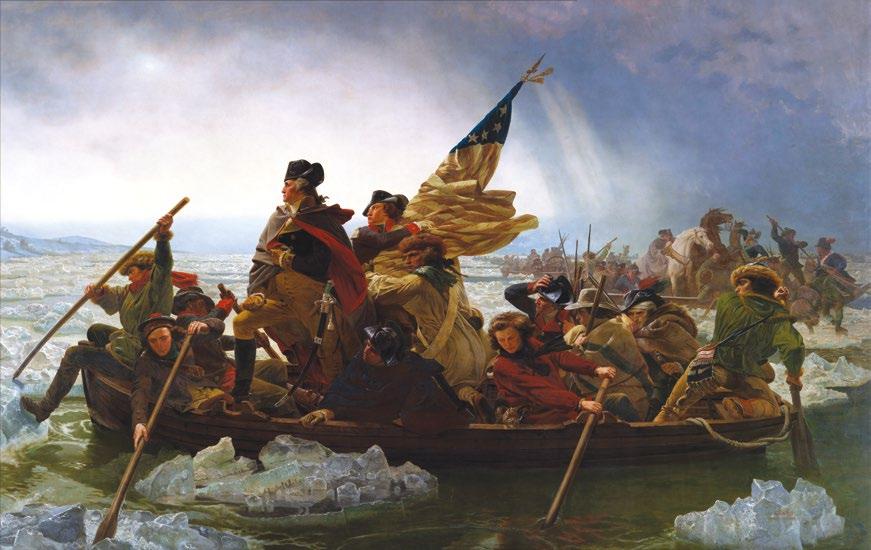
n TEXTS: Old Hand Water Pump, Judson McCranie • When I Was Young in the Mountains, Cynthia Rylant; Illustrations, Diane Goode • Washington Crossing the Delaware, Emanuel Leutze • “Now We Are Six,” A. A. Milne ¢ Vocabulary Deep Dive: Exploring Adjectives with Opposites Lesson 3 51
n TEXTS: “Now We Are Six,” A. A. Milne • When I Was Young in the Mountains, Cynthia Rylant; Illustrations, Diane Goode • Washington Crossing the Delaware, Emanuel Leutze
¢ Vocabulary Deep Dive: Exploring Verbs with Opposites: Stopped, fill, awoke, leave Lesson 4 65
n TEXTS: “Now We Are Six,” A. A. Milne • When I Was Young in the Mountains, Cynthia Rylant; Illustrations, Diane Goode
¢ Style and Conventions Deep Dive: Examine Capitalizing the Word I Lesson 5 83
n TEXTS: “Now We Are Six,” A. A. Milne • When I Was Young in the Mountains, Cynthia Rylant; Illustrations, Diane Goode
¢ Style and Conventions Deep Dive: Experiment with Capitalizing the Word I Lesson 6 95
n TEXTS: “Now We Are Six,” A. A. Milne • When I Was Young in the Mountains, Cynthia Rylant; Illustrations, Diane Goode
¢ Vocabulary Deep Dive: Part 2: Finding Meaning with the –ed Ending
Question: Lessons 7–11
How has life at home and at school changed in America?
Lesson 7 ............................................................................................................................... .................................... 109
n TEXTS: Home Then and Now, Robin Nelson • “You’re a Grand Old Flag,” George M. Cohan
¢ Style and Conventions Deep Dive: Examine Capitalizing the First Word in a Sentence
Lesson 8 121
n TEXTS: “You’re a Grand Old Flag,” George M. Cohan• School Then and Now, Robin Nelson • Home Then and Now, Robin Nelson
¢ Vocabulary Deep Dive: Concept Sort: Home and school
Lesson 9 137
n TEXTS: “You’re a Grand Old Flag,” George M. Cohan • “Betsy Ross and the American Flag: Flag Picture Gallery,” Independence Hall Association • Home Then and Now, Robin Nelson
¢ Style and Conventions Deep Dive: Experiment with Capitalizing the First Word in a Sentence
Lesson 10 151
n TEXTS: “You’re a Grand Old Flag,” George M. Cohan • Home Then and Now, Robin Nelson • School Then and Now, Robin Nelson
¢ Vocabulary Deep Dive: Using a Glossary and Making Connections
Lesson 11 165
n TEXTS: “You’re a Grand Old Flag,” George M. Cohan • Home Then and Now, Robin Nelson • School Then and Now, Robin Nelson
¢ Style and Conventions Deep Dive: Execute Capitalizing the First Word in a Sentence
Focusing Question: Lessons 12–17
What changes does the Little House see in her neighborhood?
Lesson 12 177
n TEXT: The Little House, Virginia Lee Burton
¢ Vocabulary Deep Dive: Exploring Verbs with Opposites: Built, rise, grow, cover
Lesson 13 189
n TEXT: The Little House, Virginia Lee Burton
¢ Style and Conventions Deep Dive: Examine Using Nouns and Verbs
Lesson 14 205
n TEXT: The Little House, Virginia Lee Burton
¢ Vocabulary Deep Dive: Shades of Meaning: Grow, swell, burst
Lesson 15 219
n TEXTS: The Little House, Virginia Lee Burton • Washington Crossing the Delaware, Emanuel Leutze
¢ Style and Conventions Deep Dive: Experiment with Using Nouns and Verbs
Lesson 16 233
n TEXTS: The Little House, Virginia Lee Burton • Washington Crossing the Delaware, Emanuel Leutze
¢ Vocabulary Deep Dive: Vocabulary Assessment 1
Lesson 17 245
n TEXTS: “Then & Now: The Stunning Speed of Urban Development,” S. A. Rogers • The Little House, Virginia Lee Burton • Washington Crossing the Delaware, Emanuel Leutze
¢ Style and Conventions Deep Dive: Execute Using Nouns and Verbs
How have transportation and communication changed in America?
Lesson 18 259
n TEXTS: Transportation Then and Now, Robin Nelson • Communication Then and Now, Robin Nelson • “Engine on the Track,” Gayle’s Preschool Rainbow
¢ Style and Conventions Deep Dive: Examine Using End Punctuation
Lesson 19 275
n TEXTS: “Engine on the Track,” Gayle’s Preschool Rainbow • Transportation Then and Now, Robin Nelson • Communication Then and Now, Robin Nelson
¢ Vocabulary Deep Dive: Concept Sort: Transportation and communication
Lesson 20 ............................................................................................................................... .................................. 291
n TEXTS: “Engine on the Track,” Gayle’s Preschool Rainbow • Transportation Then and Now, Robin Nelson • Communication Then and Now, Robin Nelson
¢ Style and Conventions Deep Dive: Experiment with Using End Punctuation
Lesson 21 309
n TEXTS: “Engine on the Track,” Gayle’s Preschool Rainbow • Communication Then and Now, Robin Nelson • Transportation Then and Now, Robin Nelson
¢ Vocabulary Deep Dive: Multiple-Meaning Words: Ship and race
How did Benjamin Franklin’s inventions make life in America easier?
Lesson 22 323
n TEXTS: Now & Ben: The Modern Inventions of Benjamin Franklin, Gene Barretta • “This Land Is Your Land,” Woody Guthrie
¢ Vocabulary Deep Dive: Shades of Meaning: Invented, created, designed
Lesson 23 335
n TEXTS: “This Land is Your Land,” Woody Guthrie • Now & Ben: The Modern Inventions of Benjamin Franklin, Gene Barretta
• “Sounds of a Glass Armonica,” Toronto Star
¢ Style and Conventions Deep Dive: Examine Using Plural Nouns
Lesson 24 ............................................................................................................................... .................................. 353
n TEXTS: “This Land is Your Land,” Woody Guthrie • Now & Ben: The Modern Inventions of Benjamin Franklin, Gene Barretta
¢ Vocabulary Deep Dive: Making Connections to Ben Franklin’s Jobs
Lesson 25 367
n TEXTS: “This Land is Your Land,” Woody Guthrie • Now & Ben: The Modern Inventions of Benjamin Franklin, Gene Barretta
¢ Style and Conventions Deep Dive: Experiment with Using Plural Nouns
Lesson 26 381
n TEXTS: “This Land is Your Land,” Woody Guthrie • Now & Ben: The Modern Inventions of Benjamin Franklin, Gene Barretta
¢ Style and Conventions Deep Dive: Execute Using Plural Nouns
Lesson 27 393
n TEXTS: All Module Texts • “This Land is Your Land,” Woody Guthrie
¢ Vocabulary Deep Dive: Finding Meaning with the Ending –ful
Lesson 28 407
n TEXTS: All Module Texts • “This Land is Your Land,” Woody Guthrie
¢ Vocabulary Deep Dive: Vocabulary Assessment 2
Lesson 29 419
n TEXTS: All Module Texts • “This Land is Your Land,” Woody Guthrie
¢ Style and Conventions Deep Dive: Excel at Informational Writing
Lesson 30 431
n TEXTS: All Module Texts • “This Land is Your Land,” Woody Guthrie
¢ Style and Conventions Deep Dive: Excel at Informational Writing
Appendix A: Text Complexity 443
Appendix B: Vocabulary 449
Appendix C: Answer Keys, Rubrics, and Sample Responses 459
Appendix D: Volume of Reading 475
Appendix E: Works Cited 477
How has life in America changed over time?
“Change is the law of life. And those who look only to the past or present are certain to miss the future.”
—John F. Kennedy, Address in the Assembly Hall at the Paulskirche in Frankfurt, June 25, 1963
People seek to fill basic needs: for shelter, for learning, for ways to communicate information and ideas, and for the ability to move from place to place. While needs may not change over time, the ways that people meet their needs do change, as new inventions and innovations take hold. In this module, students study a group of informational texts united in theme and structure: change in America.
A journey through changes in school, home life, transportation, and communication illuminate the scope and timeline of change in America. Students first focus on a narrative about home, When I Was Young in the Mountains. This informative story forms a bridge from the narratives studied in Module 2. Students consider how author Cynthia Rylant’s Appalachian childhood warmly depicts details they likely recognize from their own experiences, such as love of cocoa and swimming, despite some probable key differences (snakes! outhouses!). Students then dig into a series of informative books with a shared structure, Home Then and Now and School Then and Now, to study these aspects of life in the past and present. Through text and photos they see how their grandparents and even parents had very different experiences with home and school from their own. The poignant side of change plays out in the fictional The Little House, where a personified house reacts to change in her neighborhood, for better and for worse. Students return to the Then and Now series to study transportation and communication. Students end by studying the original American powerhouse of ideas, Benjamin Franklin, in the insouciant and informative Now & Ben: The Modern Inventions of Benjamin Franklin.
Students pick out topics and details in written texts and pay attention to these texts’ features, or the way they are composed, in preparation for writing their own informative pieces. In their art study for the module, Emanuel Leutze’s Washington Crossing the Delaware gives students a chance to apply their habits of mind, noticing and wondering about the painting and using it as a springboard for a lesson about composition, or the attention the artist pays to what goes where.
In the End-of-Module (EOM) Task, students choose an aspect of life in America. They create a poster and write an evidence-based informative paragraph to convey the “then” and “now” of home life, school life, transportation, or communication. The poster and paragraph shine a light on the content knowledge gained through the module’s study of nonfiction texts, answering the Essential Question to which all of the other questions in this module have led: how has life in America changed over time?
How has life in America changed over time?
Authors of informational texts teach us information about real life through their books.
Informational texts have main topics supported by key details that tell readers more about a topic.
Life at home and life at school in America have changed over time.
Modes of transportation and communication in America have changed over time.
Inventions make life easier and help people do things in new ways.
Communication Then and Now, Robin Nelson
Home Then and Now, Robin Nelson
Now & Ben: The Modern Inventions of Benjamin Franklin, Gene Barretta
School Then and Now, Robin Nelson
Transportation Then and Now, Robin Nelson
When I Was Young in the Mountains, Cynthia Rylant
The Little House, Virginia Lee Burton
Washington Crossing the Delaware (1851), Emanuel Leutze (http://witeng.link/0205)
“Betsy Ross and the American Flag: Flag Picture Gallery,” Independence Hall Association (http://witeng.link/0224)
Old Hand Water Pump, Judson McCranie (http://witeng.link/0204)
“Then & Now: The Stunning Speed of Urban Development,” S. A. Rogers (http://witeng.link/0262)
“Now We Are Six,” A. A. Milne (http://witeng.link/0203)
“Engine on the Track,” Gayle’s Preschool Rainbow (http://witeng.link/0263)
“This Land Is Your Land,” Woody Guthrie (http://witeng.link/0267)
“You’re a Grand Old Flag,” George M. Cohan (http://witeng.link/0213)
“Sounds of a Glass Armonica,” Toronto Star (http://witeng.link/0268)
“About Cynthia Rylant,” Cynthia Rylant (http://witeng.link/0206)
Understand the difference between the past and the present.
Identify how aspects of life in America—specifically, home life, school life, transportation, and communication—have changed.
Describe key details about how the topics of home, school, transportation, and communication have changed over time.
Understand how a main topic or topic statement is supported by key details.
Identify the main topic of the text, and retell the key details that support that main topic. (RI.K.2)
Understand and describe the connection between two pieces of information in a text. (RI.K.3)
Identify the author and illustrator in a text, and describe their roles in communicating information in a text. (RI.K.6)
Use a combination of drawing, dictating, and writing to respond to a prompt and supply information about a topic. (W.K.2)
Engage in shared research and writing projects by exploring texts on the same topic. (W.K.7)
Collect evidence from the texts, and use it to support responses to a prompt. (W.K.8)
Ask and answer questions to clarify information. (SL.K.3)
Use drawings to provide additional detail when speaking. (SL.K.5)
Produce and expand sentences using frequently occurring nouns and verbs, including regular plural nouns. (L.K.1.b, L.K.1.c, L.K.1.f)
Capitalize the word I in a sentence. (L.K.2.a)
Spell words phonetically, drawing on sound-letter relationships. (L.K.2.d)
Knowledge: In this third module of Kindergarten, students embark on an exploration of America past and present, using both fictional and informational texts. Informational texts provide the backbone of this module, allowing students to identify changes over time. Students use words and illustrations from the texts to gather factual information and make connections between the changes. They conduct research around the topics of changes to home life, school life, transportation, and communication in America. And they identify the main topic and key details in each text to support their understanding of how an informational text is structured, and how it communicates information to a reader—informing and inspiring their own informative writing.
Reading: In Module 2, students engaged in a rich, question-based approach to reading, forming a strong habit of unlocking meaning from texts and considering the type of texts they are studying. While they continue this observation and questioning routine during the first read of each text, the focus of Module 3 is to launch students’ understanding of an informational text’s structure and how key details, contained in the words and illustrations, support a text’s main topic. Students engage with these informational texts through text-dependent questions (TDQs), annotating and charting details in the text. They then use these charts to make connections between pieces of information in the text, building their understanding of the relationship between details. These skills continue to provide a solid foundation for the year ahead as students gradually work toward independence and mastery.
Writing: The primary writing focus of this module is text-based informative writing. Students hone explanatory writing skills by getting familiar with the structure of an informational text. They learn through the TopIC writing model how to begin with a topic statement and support that topic statement with information from the text. This knowledge helps them to develop the skills necessary to writing their own informative pieces. Students continue producing and expanding sentences using details from the text. They use phonetic spelling and frequently occurring nouns and verbs to craft their sentences, relying less on sentence frames and more on their own ability to produce a sentence. Because early Kindergarten students’ writing development varies widely, students build toward independence from where they are, engaging in productive struggle without frustration. Throughout this module, students have frequent opportunities to write, draw, and dictate, including brief responses in their Response Journal; recording evidence to post on class charts; and building collaborative books. In the EOM Task, students draw on their work with the TopIC writing model to create their own informative posters, detailing how a topic has changed over time in America.
Speaking and Listening: Students have frequent opportunities to develop speaking and listening skills in settings, including whole group, small group, and pairs. During discussions about the texts, students practice sharing ideas in a group setting. Students learn the importance of asking and answering questions while engaging in conversations about a text to demonstrate their ability to listen to their peers and reflect upon their discussion. Students hone their listening skills as they learn to listen for order to help them sequence events from the past and the present. They also add drawings to their EOM Task posters to provide additional detail during their presentations. Students engage in conversations about the texts both in class discussions and in Socratic Seminars. These opportunities give students a chance to build their knowledge of the content and support their ideas with textual evidence while responding to classmates thoughtfully and respectfully.
RI.K.2 With prompting and support, identify the main topic and retell key details of a text.
RI.K.3 With prompting and support, describe the connection between two individuals, events, ideas, or pieces of information in a text.
RI.K.6 Name the author and illustrator of a text and define the role of each in presenting the ideas or information in a text.
W.K.2 Use a combination of drawing, dictating, and writing to compose informative/explanatory texts in which they name what they are writing about and supply some information about the topic.
W.K.7 Participate in shared research and writing projects (e.g., explore a number of books by a favorite author and express opinions about them).
W.K.8 With guidance and support from adults, recall information from experiences or gather information from provided sources to answer a question.
L.K.1.b Use frequently occurring nouns and verbs.
L.K.1.c Form regular plural nouns orally by adding /s/ or /es/ (e.g., dog, dogs; wish, wishes).
L.K.2.a Capitalize the first word in a sentence and the pronoun I
SL.K.3 Ask and answer questions in order to seek help, get information, or clarify something that is not understood.
SL.K.5 Add drawings or other visual displays to descriptions as desired to provide additional detail.
Reading
RL.K.10 Actively engage in group reading activities with purpose and understanding.
RI.K.10 Actively engage in group reading activities with purpose and understanding.
L.K.6 Use words and phrases acquired through conversations, reading and being read to, and responding to texts.
1. Write two sentences to compare Cynthia Rylant’s childhood experiences from When I Was Young in the Mountains with your own experiences.
2. Write an informative paragraph describing how school in America has changed over time, based on the text School Then and Now
3. Write an informative paragraph describing changes the Little House character sees in her neighborhood in the text The Little House
4. Write an informative letter to George Washington to describe how transportation or communication has changed in America over time.
5. As a group, use information from the text Now & Ben to write a book that describes how Benjamin Franklin’s inventions are used in America today.
Demonstrate an understanding that things can change over time.
Organize a response by comparing the past with the present.
Develop an informative sentence by completing a sentence frame.
RI.K.1, W.K.2, W.K.8, L.K.2.a, L.K.2.d
Demonstrate an understanding of the informative paragraph structure.
Demonstrate an understanding of how pieces of information in the text are connected (e.g., how information about the past is related to information about the present).
Develop sentences using phonetic spelling.
RI.K.3, W.K.2, W.K.8, L.K.1.f, L.K.2.d
Develop a response based on textual evidence.
Develop detail sentences to support a topic statement. Develop sentences using phonetic spelling and frequently occurring nouns and verbs.
RL.K.1, W.K.2, W.K.8, L.K.1.b, L.K.1.f, L.K.2.d
Organize a response by stating a topic and details to support that topic.
Select key details about the topic, connecting information about the past to information about the present.
RI.K.3, W.K.2, L.K.1.b, L.K.1.f, L.K.2.b, L.K.2.d
Develop a topic statement through collaboration with the class.
Create and add drawings to informative writing to provide additional details about the topic.
RI.K.3, W.K.2, L.K.1.b, L.K.1.f, L.K.2.d, SL.K.5
1. After listening to a Read Aloud of When I Was Young in the Mountains, identify the author and illustrator in the text, and describe their roles in communicating ideas in the story.
2. After listening to a Read Aloud of Communication Then and Now, identify the main topic and key details in the text.
Demonstrate an understanding of the role authors and illustrators play in creating a text.
RI.K.6
Demonstrate an ability to identify the main topic and key details in a text.
Demonstrate an understanding of how the key details support the main topic.
Use textual evidence to answer questions.
RI.K.2
1. Describe the changes the Little House character saw happening in her neighborhood in The Little House and discuss how she felt about the changes.
Demonstrate an understanding of how cities change and grow over time.
Express thoughts and ideas about the text through the presentation of a completed task.
SL.K.1, SL.K.3, RL.K.1, L.K.1.d
2. In preparation for the EOM Task, use drawings to support and enhance a group conversation about module texts.
Demonstrate understanding of how asking questions can provide more information about a topic.
Use textual evidence to respond to questions.
Use class research to gather and share information about how life in America has changed over time.
Demonstrate an understanding of how drawings can support and enhance written information.
SL.K.5, RI.K.1, RI.K.3
Choosing from one of the following topics—changes at home, changes at school, changes in transportation, or changes in communication—create an informative poster to explain how the topic has changed in America over time. Present your poster to the class, using drawings to provide additional detail.
Use the TopIC writing model to structure the informative paragraph.
Choose details from the past and present to demonstrate a change in the topic over time.
Add drawings to support each sentence.
Present your poster to the class, using your drawings to provide additional details.
RI.K.3, W.K.2, W.K.7, W.K.8, L.K.1.b, L.K.1.c, L.K.1.f, L.K.2.d, SL.K.5
Demonstrate understanding of how to use nouns and verbs and form plural nouns.
Demonstrate understanding of academic, text-critical, and domainspecific words, phrases, and/or word parts.
Acquire and use grade-appropriate academic terms.
L.K.6
Acquire and use domain-specific or text-critical words essential for communication about the module’s topic.
*While not considered Major Assessments in Wit & Wisdom, Vocabulary Assessments are listed here for your convenience. Please find details on Checks for Understanding (CFUs) within each lesson.
Focusing Question 1: How was Cynthia Rylant’s life different from your life?
LESSON TEXT(S) CONTENT FRAMING QUESTION CRAFT QUESTION(S)
1 All Module Texts Wonder
What do I notice and wonder about School Then and Now?
2 NR “Old Hand Water Pump”
When I Was Young in the Mountains
Washington Crossing the Delaware “Now We Are Six”
Wonder
What do I notice and wonder about When I Was Young in the Mountains?
3 “Now We Are Six”
When I Was Young in the Mountains
Washington Crossing the Delaware
Organize
What is happening in When I Was Young in the Mountains?
Examine
Why do people write about the past?
Use a variety of question words to ask questions about School Then and Now. (RI.K.1, L.K.1.d)
Represent learning through writing and drawing. (W.K.10*)
Use the meaning of the ending –ed as a clue to figure out the meaning of an unknown word. (L.K.4.b)
Use a variety of question words to ask questions about When I Was Young in the Mountains. (RI.K.1, L.K.1.d)
Identify the author and illustrator of When I Was Young in the Mountains and their roles in presenting information in the text. (RI.K.6)
Demonstrate understanding of the adjectives young, clean, and dark by identifying their opposites. (L.K.5.b)
Use repeated language to identify the main topic and key details in When I Was Young in the Mountains. (RI.K.2)
Demonstrate understanding of the verbs stopped, fill, awoke, and leave by acting out their opposites. (L.K.5.b)
4 “Now We Are Six”
When I Was Young in the Mountains
Reveal
What does a deeper exploration of the illustrations reveal about Cynthia Rylant’s past in When I Was Young in the Mountains?
Experiment
How do I write about my past?
Examine
Why is it important to capitalize the word I?
Use key details in When I Was Young in the Mountains to collect evidence for the Focusing Question Task. (RI.K.2)
Describe a special memory from the past. (W.K.8, L.K.1.f, L.K.2.d)
Use full-body movement to act out the capitalization of the word I in a sentence. (L.K.2.a)
5 FQT “Now We Are Six”
When I Was Young in the Mountains
Distill
What is the essential meaning of When I Was Young in the Mountains?
Execute
How do I write about the past in my Focusing Question Task?
Experiment
How does capitalizing the word I work?
Use words and illustrations to determine the essential meaning of When I Was Young in the Mountains (RI.K.2, RI.K.7)
Use textual evidence from When I Was Young in the Mountains to compare the way Cynthia Rylant lived to the way you live. (RI.K.1, W.K.2, W.K.8, L.K.2.a, L.K.2.d)
Capitalize the word I in a given sentence. (L.K.2.a)
6
FQT “Now We Are Six”
When I Was Young in the Mountains
Know
How does When I Was Young in the Mountains build my knowledge of life in the past?
Execute
How do I capitalize the word I in my Focusing Question Task?
Use personal evidence to compare your life to Cynthia Rylant’s in When I Was Young in the Mountains. (RI.K.1, W.K.2, W.K.8, L.K.2.a, L.K.2.d)
Use knowledge of the ending –ed as a clue to figure out the meaning of action words from the text. (L.K.4.b)
Focusing Question 1: How was Cynthia Rylant’s life different from your life?7 Home Then and Now
“You’re a Grand Old Flag”
Wonder
What do I notice and wonder about Home Then and Now?
Examine
Why is it important to ask questions to learn more about a topic? Experiment
How do I ask questions to learn more about a topic? Examine
Why is capitalizing the first word in a sentence important?
Ask and answer questions about the words and pictures in Home Then and Now. (RI.K.1, SL.K.3, L.K.1.d)
Capitalize the first word of a given sentence. (L.K.2.a)
8 “You’re a Grand Old Flag”
School Then and Now
Home Then and Now
Organize
What is happening in School Then and Now?
Examine
Why do authors create informative texts?
With prompting and support, identify the main topic and key details for School Then and Now (RI.K.2)
Sort examples from nonfiction text to demonstrate understanding of the terms home and school (L.K.5.a)
9 “You’re a Grand Old Flag”
“Betsy Ross and the American Flag: Flag Picture Gallery”
Home Then and Now
Organize
What is happening in Home Then and Now?
Experiment
How do I create a piece of informative writing? Experiment
How does capitalizing the first word in a sentence work?
With prompting and support, identify the main topic and key details for Home Then and Now (RI.K.2)
Using the TopIC writing model, create an informative writing piece about how life at home has changed over time. (RI.K.2, W.K.2, W.K.8)
Capitalize the first word of a verbally shared sentence. (L.K.2.a)
10 FQT
“You’re a Grand Old Flag”
Home Then and Now School Then and Now
Reveal
What does a deeper exploration of text features reveal in Home Then and Now and School Then and Now?
Execute
How do I use informative writing in my Focusing Question Task?
Describe the connection between related photographs in a text. (RI.K.1, RI.K.3, RI.K.7)
Use informative writing to describe how school has changed in America over time. (R.I.K.3, W.K.2, W.K.8, L.K.1.f)
Identify real-life connections to bold words in an informational text. (L.K.5.c)
11 FQT
“You’re a Grand Old Flag”
Home Then and Now School Then and Now
Know
How do Home Then and Now and School Then and Now build my knowledge of change in America?
Execute
How do I use informative writing in my Focusing Question Task?
Execute
How do I capitalize the first word in the sentence?
Express understanding of how School Then and Now and Home Then and Now build knowledge of change in America. (RI.K.1, RI.K.3)
Use informative writing to create a paragraph about how school has changed in America. (RI.K.3, W.K.2, W.K.8, L.K.1.f, L.K.2.d)
Capitalize the first word of a sentence. (L.K.2.a)
12
What do I notice and wonder about The Little House?
13
What is happening in The Little House?
Examine
Why is a topic statement important? Examine
Why is it important to use nouns and verbs?
Use a variety of question words to ask and answer questions about The Little House. (RL.K.1, L.K.1.d)
Apply vocabulary from the text in context. (W.K.10*, L.K.1.f, L.K.2.d, L.K.5.c)
Demonstrate understanding of the action words built, rise, grow, and cover by acting out their opposites. (L.K.5.b)
Identify the setting of The Little House and describe how it changes throughout the story. (RL.K.2, RL.K.3)
Use examples of nouns and verbs from the text to make a sentence. (L.K.1.b)
14
What is happening in The Little House?
Experiment
How do I write a topic statement?
Retell the story The Little House, including key details. (RL.K.2)
Collaborate to create a topic statement for an informative paragraph. (W.K.2, L.K.1.f)
Distinguish shades of meaning among grow, swell, and burst by acting out their meanings. (L.K.5.d)
Focusing Question 3: What changes does the Little House see in her neighborhood?15 The Little House Washington Crossing the Delaware
Reveal
What does a deeper exploration of the illustrations reveal in The Little House?
Experiment
How do I support a topic statement? Experiment
How do you use nouns and verbs?
Analyze the Little House’s responses to the changes around her using illustrations and details from the text. (RL.K.1, RL.K.7)
Identify evidence within the text that supports the topic statement. (W.K.2, W.K.8, L.K.1.f)
16 VOC FQT
The Little House Washington Crossing the Delaware
Distill
What is the essential meaning of The Little House?
Execute
How do I support the topic statement in my Focusing Question Task?
Create sentences using illustrations of nouns and verbs. (L.K.1.b)
Use the text and illustrations to determine the essential meaning of The Little House. (RL.K.1, RL.K.2)
Use informative writing to describe changes the Little House character sees in her neighborhood. (RL.K.1, W.K.2, W.K.8, L.K.1.b, L.K.1.f, L.K.2.d)
Demonstrate understanding of gradelevel vocabulary. (L.K.6)
17 FQT SS
“Then & Now: The Stunning Speed of Urban Development”
The Little House Washington Crossing the Delaware
Know
How does The Little House build my knowledge of change over time?
Execute
How do I support the topic statement in my Focusing Question Task?
Execute
How do I ask and answer questions in a Socratic Seminar?
Execute
How do I use nouns and verbs in my writing?
Use informative writing to describe changes the Little House character sees in her neighborhood. (RL.K.1, W.K.2, W.K.8, L.K.1.b, L.K.1.f, L.K.2.d)
Ask and answer questions about The Little House during a group discussion. (RL.K.1, SL.K.1, SL.K.3, L.K.1.d)
Create a silly story using frequently occurring nouns and verbs. (L.K.1.b)
Focusing Question 3: What changes does the Little House see in her neighborhood?18 Transportation Then and Now
Communication Then and Now
“Engine on the Track”
Wonder
What do I notice and wonder about Transportation Then and Now and Communication Then and Now?
Examine
Why is listening for order important? Examine
Why is using end punctuation important?
19 NR “Engine on the Track”
Transportation Then and Now
Communication Then and Now
Organize
What is happening in Transportation Then and Now and in Communication Then and Now?
Experiment
How do I listen for order? Examine
Why is it important to write a conclusion sentence?
Use a variety of question words to ask and answer questions about the words and pictures in Transportation Then and Now. (RI.K.1, SL.K.3, L.K.1.d)
Recognize and name a period, question mark, and exclamation point in isolation. (L.K.2.b)
Identify the main topic and retell key details in Communication Then and Now. (RI.K.1, RI.K.2)
Examine the importance of writing a conclusion sentence in an informative paragraph. (W.K.2)
Sort examples from nonfiction text to demonstrate understanding of the terms transportation and communication. (L.K.5.a)
20 “Engine on the Track”
Transportation Then and Now
Communication Then and Now
Reveal
What does a deeper exploration of the text features reveal in Transportation Then and Now and Communication Then and Now?
Experiment
How do I write a conclusion sentence?
Experiment
How does using end punctuation work?
Describe the connection between related photographs in a text. (RI.K.1, RI.K.3, RI.K.7)
Using frequently occurring nouns and verbs, verbally produce detail sentences to support a topic sentence. (RI.K.3, W.K.2, L.K.1.b, L.K.1.f)
Identify the correct end punctuation to use given oral sentences. (L.K.2.b)
21 FQT “Engine on the Track”
Transportation Then and Now Communication Then and Now
Know How do Transportation Then and Now and Communication Then and Now build my knowledge of change in America?
Execute
How do I use informative writing in my Focusing Question Task?
Express understanding of how Transportation Then and Now and Communication Then and Now build knowledge of change in America. (RI.K.1, RI.K.3)
Produce and expand detail sentences to support a topic sentence. (RI.K.3, W.K.2, L.K.1.b, L.K.1.f, L.K.2.b, L.K.2.d)
Demonstrate new meanings for familiar words by applying the words accurately in a sentence. (L.K.4.a)
LESSON TEXT(S) CONTENT FRAMING QUESTION CRAFT QUESTION(S) LEARNING GOALS
22 Now & Ben: The Modern Inventions of Benjamin Franklin
“This Land Is Your Land”
Wonder What do I notice and wonder about Now & Ben?
23 “This Land Is Your Land”
Now & Ben: The Modern Inventions of Benjamin Franklin
“Sounds of a Glass Armonica”
Organize
What is happening in Now & Ben?
Examine
Why is it important to add drawings to informative writing?
Ask and answer questions about the words and pictures in Now & Ben (RI.K.1, SL.K.3, L.K.1.d)
Distinguish shades of meaning among invented, created, and designed by acting out their meanings. (L.K.5.d)
Identify the main topic and key details in Now & Ben. (RI.K.2)
Examine how illustrations add more detail to informative writing. (W.K.2, SL.K.5)
Form plural nouns orally by responding chorally to a given prompt. (L.K.1.c)
24 “This Land Is Your Land”
Now & Ben: The Modern Inventions of Benjamin Franklin
Reveal
What does a deeper exploration of the words and illustrations reveal in Now & Ben?
Experiment
How do I add drawings to my informative writing?
Use the words and illustrations in Now & Ben to learn more about Benjamin Franklin’s inventions and their use. (RI.K.7)
Use drawings to add more detail to informative writing. (W.K.2, SL.K.5)
Demonstrate meaning of inventor, writer, musician, and traveler by identifying real-life connections. (L.K.5.c)
25
FQT “This Land Is Your Land”
Now & Ben: The Modern Inventions of Benjamin Franklin
Distill
What is the essential meaning of Now & Ben?
Execute
How do I use drawings to add details to my Focusing Question Task?
Experiment
How do we make plural words?
Use the words and illustrations in the text to determine the essential meaning of Now & Ben (RI.K.1, RI.K.7)
Describe how Benjamin Franklin’s inventions are used in America today using informative writing. (RI.K.3, W.K.2, W.K.8, L.K.1.b, L.K.1.f, L.K.2.d)
Form plural nouns orally by adding /s/ or /es/ to a given word. (L.K.1.c)
26
FQT “This Land Is Your Land”
Now & Ben: The Modern Inventions of Benjamin Franklin
Know
How does Now & Ben build my knowledge?
Execute
How do I use drawings to add details to my Focusing Question Task?
Execute
How do I use plural words when I speak?
Express understanding of how Now & Ben builds knowledge of change in America. (RI.K.1, RI.K.3)
Use informative writing to describe how Benjamin Franklin’s inventions are used in America today. (RI.K.3, W.K.2, W.K.8, L.K.1.b, L.K.1.f, L.K.2.d)
Form plural nouns correctly in sentences by adding /s/ or /es/. (L.K.1.c)
Focusing Question 5: How did Benjamin Franklin’s inventions make life in America easier?27
How do Module 3 texts build my knowledge of how America has changed over time?
Execute
How do I explain my evidence with drawings in my EOM Task?
Use drawings to support and enhance a group conversation. (RI.K.1, RI.K.3, SL.K.5)
Use the meaning of the ending –ful as a clue to figure out the meaning of an unknown word. (L.K.4.b)
How do Module 3 texts build my knowledge of how America has changed over time?
Execute
How do I execute my EOM Task?
Express understanding of how life in America has changed over time. (RI.K.3, W.K.2, W.K.7, W.K.8, L.K.1.b, L.K.1.f, L.K.2.d)
Demonstrate understanding of gradelevel vocabulary. (L.K.6)
29
Execute
How do Module 3 texts build my knowledge of how America has changed over time?
How do I execute my EOM Task? Excel
How do I improve my informative writing?
30
How do Module 3 texts build my knowledge of how America has changed over time?
Execute
How do I use drawings to help explain my EOM Task? Excel
How do I improve my informative writing?
Express understanding of how life in America has changed over time. (RI.K.3, W.K.2, W.K.7, W.K.8, L.K.1.b, L.K.1.f, L.K.2.d)
With support, evaluate writing and use sentences to share reflections. (L.K.1.f)
Express understanding of how life in America has changed over time. (RI.K.3, SL.K.5, L.K.1.b, L.K.1.c)
With support, evaluate writing and use sentences to share reflections. (L.K.1.f)
*In alignment with the CCSS, W.10 formally begins in Grade 3. However, Grades K–2 students write routinely for a variety of time frames, tasks, purposes, and audiences. As a result, this lesson contains instruction related to W.10 in an effort to familiarize students with a range of writing.
Welcome (10 min.)
Share Observations
Launch (5 min.)
Learn (55 min.)
Listen Actively and Record Observations (18 min.)
Share Questions (12 min.)
Take a Gallery Walk of the Module Texts (20 min.)
Practice Fluency (5 min.)
Land (4 min.)
Answer the Content Framing Question
Wrap (1 min.)
Assign Homework
Vocabulary Deep Dive: Part 1: Finding Meaning with the –ed Ending (15 min.)
The full text of ELA Standards can be found in the Module Overview.
RI.K.1, RL.K.5
Writing W.K.10*
Speaking
SL.K.1.a, SL.K.2
Language
L.K.1.d L.K.4.b
Question Cubes (created in Module 2)
Chart paper for Wonder Chart for School Then and Now
Genre Recording Sheets (see lesson for details; retain for future lessons)
Repeated Language Chart (see lesson for details; retain for future lessons)
Use a variety of question words to ask questions about School Then and Now (RI.K.1, L.K.1.d).
Use words from the Question Cube to ask questions about the text.
Represent learning through writing and drawing (W.K.10*).
Record text-based observations about School Then and Now in Response Journals.
Use the meaning of the ending –ed as a clue to figure out the meaning of an unknown word (L.K.4.b).
Use text and word clues to determine the meaning of a new word.
*In alignment with the CCSS, W.K.10 formally begins in Grade 3. However, Grades K–2 students write routinely to a variety of time frames, tasks, purposes, and audiences. This lesson contains instruction related to W.K.10 in an effort to familiarize students with a range of writing.
How has life in America changed over time?
FOCUSING QUESTION: Lessons 1–6
How was Cynthia Rylant’s life different from your life?
CONTENT FRAMING QUESTION: Lesson 1
Wonder: What do I notice and wonder about School Then and Now?
The informational text School Then and Now introduces students to a key concept of Module 3: how things change over time. This text illustrates a complex concept in an accessible way by offering an opportunity for students to connect details they see changing in the text to what they see in their own classrooms. Students continue observing and generating questions. In addition, they exercise genre knowledge by making predictions about Module 3 texts during a Gallery Walk.
10 MIN.
TEACHER NOTE
This module challenges students to think about change over time, supporting them as they develop the concepts of past and present. Students read School Then and Now as an introduction both to the topic and to the Essential Question. After the launch of the module, they read the personal narrative When I Was Young in the Mountains to build an understanding of the past. Students return to explore School Then and Now more deeply in Lesson 8.
Display the front cover of School Then and Now and explain that the photograph shows a picture of a real classroom. Ask: “What do you notice about this picture?” Have volunteers respond.
Instruct students to Think–Pair–Share, and ask: “When do you think this photograph may have been taken? What from the photo makes you think that?” Use Equity Sticks to call on students to respond.
n It’s from a long time ago because the picture doesn’t have color.
n I think it’s from a long time ago because their clothes look old.
n It’s from a long time ago because we don’t have chairs like that today.
Confirm that the photograph shows a classroom from long ago. Read aloud the title of the text, and explain that students will be going on a new adventure in this module. They will be traveling back in time to see how things have changed throughout the years! In this first book, students will explore what school used to be like and how it has changed.
Explain that classrooms today are actually similar to the classroom in the photograph, although they may look different. Ask: “What items or details do you see in the cover photograph?” Have volunteers respond.
Invite students to go on a brief scavenger hunt around the classroom. Students walk around the room and touch or point to items that are similar to, but not quite the same, as things they see in the photo.
Model how to make this connection before releasing students. For example, point to the drawings above the chalkboard on page 3 and then to a poster or posted drawing in your classroom.
Several students share their findings. Discuss how what we use in the classroom today is different from what they see in the picture. Remind students that this module will be about how things, including details about school, change over time.
5 MIN.
Post and read aloud the Essential Question, pointing to each word as you say it. As you read the word changed, model a Nonverbal Signal by holding out one hand, palm facing up, and then turning it over so your palm faces the floor. As you read the word time, model a Nonverbal Signal by tapping your index finger on the wrist of your opposite arm, as if you were tapping a watch.
Students Echo Read the Essential Question using the Nonverbal Signals for changed and time. Remind students that the Essential Question is the big question they will be trying to answer over the next several months.
TEACHER NOTE Leave the Essential Question posted for reference throughout the module.
Point to the front cover of School Then and Now and explain that students will begin their work in this module by reading this book. Ask: “What will our job be today as we read School Then and Now for the first time?” Have volunteers respond.
n Our job is to notice things about the book.
n We will talk about what we notice.
n Our job is to ask questions about the book.
ScaffoldUse student responses to confirm that during this lesson they will notice and wonder about School Then and Now. Post and read aloud the Content Framing Question.
55 MIN.
18 MIN.
Display the front cover of School Then and Now as you read aloud the title and author’s name. Ask: “What does ‘then and now’ tell you that the book might be about?” Have volunteers respond.
*Read the book aloud with minimal interruptions. Students sit in “listening position” and focus their eyes and ears on you as you read.
TEACHER NOTE
Consider projecting the pages of the book in front of the class on a document camera. The pages are small and may not easily be seen from where students sit. If your classroom does not have a way to project the book, organize students’ seats in a way that will allow them to better view the pages.
Ask: “Now that we have read the book, why do you think the title says ‘then and now’? What makes you say that?” Have volunteers respond.
n Because it tells what school was like in old days, back then.
n It means the book also tells how school is now.
n I say that because the book shows old pictures and new pictures of school.
Instruct students to Think–Pair–Share, and ask: “What did you notice about the text?” Use Equity Sticks to call on students to respond.
Explain that another word people use to talk about life a long time ago is the past. Use the text to provide context for this concept. For example:
The black-and-white photographs show us what school used to be like, in the past
* This icon indicates an opportunity to practice Speaking and Listening skills.
Display one of the black-and-white photographs from the text. Instruct students to take turns verbally completing the sentence frame: In the past, Model an example such as, “In the past, children walked a long way to school.”
Add past to the Word Wall as a module word.
Ask: “Why do readers reread books?” Have volunteers respond.
Reinforce that reading a book again helps readers to better understand the text; they notice things they did not see at first. Explain that students will read the text again and will think about new things they notice.
Read School Then and Now aloud a second time. Divide the text into manageable chunks by stopping at the following pages for students to share new things they notice.
Page 5.
Page 7.
Page 15.
Page 17.
Place a few copies of School Then and Now strategically so that students can access the text, and distribute Response Journals to students.
Students write a sentence to share one thing they noticed about School Then and Now. Encourage students to use the sounds and words they know in their writing. Afterward, they add a drawing of their observation.
Depending on class need, you may choose to provide the familiar sentence frame I notice ____. to help students structure responses. The frame can be provided verbally, written on the board for reference, or prewritten into Response Journals.
Consider providing time for students to verbally rehearse their sentences with a partner before writing.
12 MIN.
Remind students that sharing what we notice about a book helps us think about the text, and ask: “What else helps us think about the text the first time we read a book?” Have volunteers respond. Reinforce that students ask questions about a text after they make observations.
Divide students into small groups, providing a Question Cube and a copy of the text for each group. Students take turns rolling the Question Cube and using the question word that lands on top to wonder about the text.
As needed, substitute Question Cubes for another questioning routine to best meet the needs of your students.
Circulate as groups discuss. Support them in reading the question words as needed, calling attention to key letters and sounds. Encourage them to return to the text to develop their questions. Listen in on their questions. Choose four to six student-generated questions to record on sticky notes, labeling with students’ initials.
Small groups of students take turns rolling the Question Cube and asking questions about School Then and Now
Post a blank Wonder Chart for School Then and Now. Add students’ questions.
Working with one question at a time, students Echo Read the question and Think–Pair–Share about details they remember from the text. Pairs use the following Nonverbal Signals to indicate whether they are able to answer the question:
Thumbs-up: we remember the answer from the text.
Thumbs-sideways: we remember part of the answer from the text.
Thumbs-down: we don’t remember the answer.
Call on pairs to share their thinking. Return to the text to confirm and clarify students’ thinking. Move sticky notes along the progression to indicate the extent to which each question has been answered.
n What is the big pot with a pipe going into it (page 3)?
n Why did students write with chalk?
n How long ago was this?
n Why did schools only have one room?
Tell students that they will return to School Then and Now in future lessons, so they should keep these questions in mind.
SAMPLE WONDER CHART FOR SCHOOL THEN AND NOWMost foundational skills programs will include many, if not all, question words on high-frequency word lists.
Students have been using question words to generate and answer questions since Module 1. Consider drawing on one or more familiar Questioning Routines (Question Corners or Question Cubes) when designing activities for reading question words.
Remind students of the Gallery Walk they did at the beginning of the previous module. Explain that they will use the same procedure to preview Module 3 books.
Reinforce the expectations of the Gallery Walk:
Groups of students rotate through six stations around the classroom.
At each station, they explore the book by looking at its front cover, illustrations, and back cover.
Students then write their initials (or the first letter of their name) on the recording sheet to indicate whether they think the book is a storybook or an informational text.
Use Equity Sticks to choose students to help you model the procedure for School Then and Now
Each station should contain four or five copies of a module text and a recording sheet similar to the one that follows to capture student ideas about genre. Retain and use recording sheets throughout the module. Add images to column headings to support understanding and independence.
Students will be asked to revisit identifications throughout the module as they learn more about the distinctions between storybooks and informational texts. Additionally, students will be formally assessed on their genre knowledge in Module 4.
Storybook
Informational
Release groups of students to each station to explore the module texts. After ninety seconds, signal for students to record their ideas about the text’s genre, then rotate to the next station. Continue rotations until students have explored all the books.
Have students retell the procedure at least two times before assigning them to a station.
Instruct students to Think–Pair–Share, and ask: “What are some details, or things, that are the same about the books you looked at?” Have volunteers respond.
n I saw lots of things that looked old.
n There were pictures of real people.
n I saw houses.
Reinforce responses that highlight the idea of the past. Explain that students will be learning about the way many things have changed over time.
Explain to students that over the course of the module they will revisit these recording sheets to see whether their predictions were correct. Emphasize that while the front cover, back cover, and illustrations can tell a lot about a text, the best way to truly identify the text type is by reading it.
TEACHER NOTE As you add texts to each column, consider pairing them with images or smaller versions of the front covers. This will allow students to easily reference the recording sheet independently.
Instruct students to Mix and Mingle, and ask: “Which module book are you most excited about reading? Why?”
Explain that, in addition to reading many texts about how things have changed or the past, students will also practice their fluency with texts about change.
Tell students that as they explore how things have changed over time, they will also be thinking about how they themselves have changed over time. Instruct students to Think–Pair–Share, and ask: “Think about yourself as a baby. What is one way you are different now from when you were a baby?” Use Equity Sticks to call on a few students to respond.
Explain that this week’s fluency passage is a poem about growing up. Display the Repeated Language Chart, and read aloud the title and the first two lines of “Now We Are Six,” tracking the words with your finger.
Poem: “Now We Are Six” by A. A. Milne
When I was one,
I had just begun.
Ask: “What does ‘I had just begun’ mean?” Have volunteers respond.

n It means you just started.
n You were just one year old, so you just started living.
Introduce the Nonverbal Signal for one by holding up one index finger. Students Echo Read the first two lines of the poem several times, using the Nonverbal Signal for one. Point to each word as students read it.
4 MIN.
Students Echo Read the Content Framing Question. Ask: “What did we do today to answer this question?” Have volunteers respond.
n We listened to the words.
n We wrote down what we noticed.
n We used a Question Cube.
n We talked about our questions.
Using the “author’s chair,” invite several students to share their Response Journal entries about School Then and Now with the class.
Continue the home-reading routine. Use this time in each lesson to remind students of expectations. Once this routine is in place, distribute and review the Volume of Reading Reflection Questions. Explain that students should consider these questions as they read independently and respond to them when they finish a text.
Students may respond in the Reflections section of their Knowledge Journal, or submit them directly. The questions can also be used as discussion questions for a book club or other small-group activity. See the Implementation Guide for a further explanation of Volume of Reading, as well as various ways of using the reflection.
Students utilize Question Cubes to generate questions about School Then and Now. This questioning tool supports students in developing the habit of “wondering” as they read a text. (RL.K.1, L.K.1.d) Each student does the following:
Generates text-based questions.
Correctly uses the question word presented on the Question Cube.
If students struggle to generate questions, focus on one question word, such as what or why Work with small groups and go through the text together, one page spread at a time. Support students in generating one question per page spread.
Time: 15 min.
Text: School Then and Now, Robin Nelson
Vocabulary Learning Goal: Use the meaning of the ending –ed as a clue to figure out the meaning of an unknown word. (L.K.4.b)
TEACHER NOTE
Verb tense is a complicated concept for young learners. This lesson and Deep Dive Lesson 6 teach the significance of the morpheme –ed and do not explore the nuances of irregular verbs or complex tenses. Therefore, be careful to use only simple past-tense verb examples throughout these lessons. For example, only use past-tense verbs that are made by adding –ed at the end, such as walk/walked or play/played and avoid irregular verbs, such as run/ran or stand/stood. Lessons concerning the irregular verb tense typically occur in Grade 2.
Remind students that they have learned many ways to find the meanings of new words. Ask: “How can you figure out the meaning of a new word in a book?” Provide prompts as needed. Have volunteers respond.
n I can look at the illustrations.
n I can look at the other words around the new word.
n I can use parts of the words.
Reinforce relevant strategies and explain that readers need many ways to figure out new or unknown vocabulary words. Tell students that they are going to learn a new word part that will help them to understand new words in this module, as well as in other books they read.
TEACHER NOTE
Using your understanding of student knowledge, consider reviewing the meaning of action word by providing the definition or giving an example if necessary.
Remind students that during today’s lesson, they learned about the word past. Ask: “What does ‘it happened in the past’ mean?” Have volunteers respond.
n It happened long ago.
Use responses to emphasize that past references activities that happened long ago or before now.
Explain that there is a word part that means “happened in the past” when it is added to the end of action words. Write –ed on the board.
Post and read aloud the following sentence frames: Now, we . In the past, we . Students Echo Read the sentence frames.
Explain that the students are going to practice adding –ed to action words to change the meaning from “now” to “in the past” by reading the sentence frames with movement. Model how to change an action verb by adding –ed. As you read the first sentence, fill in the blank with a simple action word as you mimic the matching action. Stop doing the action, and pause briefly. Read the second sentence and fill in the blank by adding –ed to the action word. For example, “Now, we walk. (Pause) In the past, we walked. Students Echo Read the sentences and mimic the actions for each, staying at their place. Repeat this activity using the following action words. Use Equity Sticks to choose students to act as the model for each action word:
Jump. Kick. March. Twist. Dance.
Instruct students to Think–Pair–Share, and ask: “When action words have –ed at the end, when did they happen?” Have volunteers respond.
n They happened in the past.
Remind students that understanding the meaning of one part of a word, such as the ending –ed, can help them determine the meaning of a new word in the book.
Organize students into pairs, and distribute a copy of the text to each pair. Students open to page 3 as you display the text and read aloud, emphasizing the word changed. Write the word on the board.
Instruct students to work with their partner to figure out the meaning of the word changed
Model how to use the –ed ending, the illustrations, and the other words around changed to figure out the meaning of the word. Reinforce that –ed shows that it “happened in the past.” Emphasize and explain the phrase over time, and point out that the photos look very different.
Students Think–Pair–Share with their partners to use these clues to determine the meaning of changed. Circulate to provide support and ensure understanding. Ask: “What do you think changed means?”
n It must have happened in the past.
n It probably takes a lot of time.
n It could mean that things are different.
Choose two pairs to share their thinking with the whole group. Use their responses to reinforce the correct meaning of changed as “became different.” Write the definition on the board.
Invite students to make the Nonverbal Signal for changed learned during today’s lesson as they Echo Read the word and definition from the board.
Students will find the meaning of additional vocabulary words using the ending –ed in Deep Dive Lesson 6.
Old Hand Water Pump, Judson McCranie (http://witeng.link/0204) When I Was Young in the Mountains, Cynthia Rylant; Illustrations, Diane Goode Washington Crossing the Delaware, Emanuel Leutze (http://witeng.link/0205)
“Now We Are Six,” A. A. Milne (http://witeng.link/0203)
Welcome (3 min.)
Understand the Essential Question
Launch (7 min.)
Learn (58 min.)
Listen Actively and Share Observations (15 min.)
Share Questions (15 min.)
Engage in New-Read Assessment 1 (15 min.)
Examine a Painting (8 min.)
Practice Fluency (5 min.)
Land (6 min.)
Answer the Content Framing Question
Wrap (1 min.)
Assign Homework
Vocabulary Deep Dive: Exploring Adjectives with Opposites (15 min.)
The full text of ELA Standards can be found in the Module Overview.
RI.K.1, RI.K.6, RL.K.1, RL.K.4, RL.K.5
SL.K.1.a, SL.K.2
Language
L.K.1.d, L.K.5.c L.K.5.b
MATERIALS
Handout 2A: Picture Hunt
Map of the world
Question Cubes
Chart paper for Wonder Chart for When I Was Young in the Mountains
Repeated Language Chart
Genre Recording Sheet for When I Was Young in the Mountains (created in Lesson 1)
Use a variety of question words to ask questions about When I Was Young in the Mountains (RI.K.1, L.K.1.d).
Use the Question Cube to ask questions about the text.
Identify the author and illustrator of When I Was Young in the Mountains and their roles in presenting information in the text (RI.K.6).
Complete New-Read Assessment 1. Demonstrate understanding of the adjectives young, clean, and dark by identifying their opposites (L.K.5.b).
Respond chorally with the correct opposite of a given word.
FOCUSING QUESTION: Lessons 1–6
How was Cynthia Rylant’s life different from your life?
CONTENT FRAMING QUESTION: Lesson 2
Wonder: What do I notice and wonder about When I Was Young in the Mountains?
In this lesson, the class reads When I Was Young in the Mountains for the first time, engaging with a new type of text—the informational narrative. This experience forms a bridge between the texts read in Module 2 and those to come in Module 3 as students are able to look at this informational text through a narrative lens, and are prompted to notice and wonder about the author’s life. Students also engage in a New-Read Assessment in which they identify the author and illustrator and the role of each in communicating information in the text. In addition, students continue to hone their observation and questioning skills through a visual art study of Leutze’s Washington Crossing the Delaware
Post and read aloud the Essential Question, pointing to each word as you say it.
Ask: “What is America, or the United States of America? Have you heard of this place before?” Have volunteers respond.
n America is where we live.
n It is the country we live in.
n Our school and houses are here.
Display a map of the world, and point to the United States. Use responses to reinforce that America, or the United States of America, is the country in which students live. While they may have been born in a different country or may travel to another country, America is the place they call home right now.
Point to the map of the United States, and ask: “What do you notice about this map? What do you notice about the United States of America?” Have volunteers respond.
Remind students that over the course of this module they will learn many things about America and how the country has changed over time.
Reread the Essential Question, introducing a Nonverbal Signal for America, such as a salute or holding a hand over your heart.
Students Echo Read the Essential Question using the Nonverbal Signals for America, changed, and time. Remind students that the Essential Question is the big question they will be trying to answer over the next several months.
7 MIN.
Access the link for the “Old Hand Water Pump,” and display the image in front of the class (http://witeng.link/0204). Do not identify the object. Students share what they notice and wonder about this object now, and the class will revisit it later in the lesson.
Instruct students to Think–Pair–Share, and ask: “What do you notice about this object? Do you think this object is from a long time ago, or now?” Use Equity Sticks to call on students to share their observations.
n I notice it is outside in the ground.
n There is a big pipe.
n I think it is old because I notice it’s really dirty.
n I think it’s old because it doesn’t look shiny and new.
n It is outside all alone so I think it is old.
Instruct students to Mix and Mingle, and ask: “What do you wonder about this object?” Use Equity Sticks to call on three to four students to share their questions. Remind students that they will return to this object later in the lesson.
Post and read aloud the Content Framing Question. Explain to students that in this lesson they will encounter a new text, When I Was Young in the Mountains, and begin their exploration of “America, Then and Now.”
Remind students that when they first see a text it is helpful to share what they notice and wonder. Listening to one another’s ideas can help them think about the text in new ways.
Students may have varying home life experiences. Note that many of the differences highlighted in the book are due to changes over time but may also be dependent on where one lives. Consider discussing that the changes to home life are not universal; there are still many in this country that use a water pump, go to a one-room school, use an outhouse, or use a woodstove.
Display the front cover of When I Was Young in the Mountains. Read the author’s name and the illustrator’s name aloud. Turn through a few of the pages, allowing students to see the illustrations created by Diane Goode.
Ask: “Which question word do you recognize in the title?” Have volunteers respond. Continue: “What does the word when tell us? When do you think this book takes place?”
n I hear “when.”
n The word when tells us what time it happens.
n I think the book is talking about a long time ago.
n I think the book happened when she was little.
Read the book aloud with minimal interruptions. Students sit in “listening position” during the Read Aloud, focusing their eyes and ears on you as you read.
Ask: “Now that we have read the book, when do you think this book takes place? Is the author talking about now, or about the past? What makes you say that?” Have volunteers respond.
n I think it is talking about when she was little.
n She says “when I was young” a lot, so I don’t think it is now.
n The pictures don’t look like now—they don’t look like my house.
Instruct students to Think–Pair–Share, and ask: “What did you notice about the text?” Use Equity Sticks to call on students to respond.
Tell students that good books have a lot for readers to explore and are worth reading more than once. Explain that students will read the text again and will think about new things they notice.
Divide the class into pairs, and distribute copies of the text. If needed, remind students of the rules and responsibilities of Partner Reading.
Consider writing small page numbers in When I Was Young in the Mountains. Page 1 begins with “When I was young in the mountains, Grandfather came home in the evening.”
Read the text a second time, stopping at the following pages for students to share new things they notice. Use Equity Sticks to call on several students to share what they notice at each stopping point.
Page 6. Page 12.
On page 12 ask: “What do you notice about the object in the illustration? Have you seen something like this before?” Have volunteers respond.
Display the image of the “Old Hand Water Pump” in front of the class next to the illustration to reinforce that these two objects are the same. Identify the object as a hand water pump, and explain that it is used for pumping water from a well. Tell students that today, many people rely on faucets in their kitchen or bathroom to get hot or cold water with no effort. But before pipes existed to bring water into people’s homes, they relied on pumps like the one in the picture to get water for drinking, cooking, and washing.
Continue reading through the text, stopping at the following pages for students to share new things they notice. Use Equity Sticks to call on students to share what they notice at each stopping point.
Page 18.
The end.
Extension
If time allows, consider having students record one thing they noticed from the text in their Response Journal. Students write one sentence using the frame I notice ____. Depending on student ability, provide them with a frame, or prompt them to write the sentence out themselves.
Ask: “What else helps us think about the text the first time we read a book?” Have volunteers respond. Confirm that asking questions is another way to help readers think about the text.
Divide students into pairs, and provide a Question Cube and a copy of the text for each pair. Students take turns rolling the Question Cube and using the question word that lands on top to wonder about the text.
Circulate as pairs discuss. Support them as needed in reading the question words, calling attention to key letters and sounds. Encourage pairs to return to the text to develop their questions, and listen in on questions. Choose four to six student-generated questions to record on sticky notes, labeling them with students’ initials.
Pairs take turns rolling the Question Cube and asking questions about When I Was Young in the Mountains.
Post a blank Wonder Chart for When I Was Young in the Mountains. Add students’ questions.
Working with one question at a time, students Echo Read the question and Think–Pair–Share about details they remember from the text. Pairs use the following Nonverbal Signals to indicate whether they are able to answer the question:
Thumbs-up: we remember the answer from the text.
Thumbs-sideways: we remember part of the answer from the text.
Thumbs-down: we don’t remember the answer.
Call on pairs to share their thinking. Return to the text to confirm and clarify students’ thinking. Move sticky notes along the progression to indicate the extent to which each question has been answered.
Questions ? Answers in Progress Complete Answers
n What is a johnny-house?
n Why was her grandma crying?
n When was this?
n Where do they buy things?
n How did they get the water inside?
Read the title of the text aloud to the class. Point to the I in the title. Ask: “Who is this text about? Who is the I referring to?” Have volunteers respond.
n I think it is a little girl.
n They don’t say her name. Maybe it is the author.
Allow students to speculate without confirming or correcting their responses. Encourage them to continue to think about the answer to this question.
Divide the class into pairs, and distribute Handout 2A. Tell students that they will be going on a picture scavenger hunt through the text. Explain the procedure for the picture hunt: Pairs look through their text to try to match pictures on the handout to a picture in the text. If they find a match, they circle the object on their handout.
Name: Handout 2A: Picture Hunt


& WISDOM Page of
To practice with identifying the initial or final sounds of words, use the pictures from Handout 2A. For example, call out a picture from the worksheet, and ask volunteers to identify the initial or final letter sound they hear. Cue students to reference related classroom artifacts as part of their identification process.
While pairs work on the picture hunt, pull aside one student at a time to ask some questions about the author and illustrator of When I Was Young in the Mountains for a New-Read Assessment.

New-Read Assessment 1 requires students to identify the author and illustrator of the literary nonfiction text When I Was Young in the Mountains. Students have already been assessed on this standard’s literary complement (RL.K.6) in Module 1. As needed, use the scaffold activity below to support students in mastering this standard.
Students individually answer questions about the author and illustrator of When I Was Young in the Mountains.
Call students over one at a time. Show students the front cover of When I Was Young in the Mountains. Let students know you will ask them a few questions about the author and illustrator of this text.
Read aloud “by Cynthia Rylant” while pointing to the words on the cover. Ask: “Why is Cynthia Rylant’s name on the front cover of this book? What work did she do?”
Read aloud “Illustrated by Diane Goode” while pointing to the words on the cover. Ask: “Why is Diane Goode’s name on the front cover of this book? What work did she do?”
GK M3 Handout 2A WIT GK M3 Lesson 2 WIT & WISDOM® 42
Before this assessment, consider reviewing the roles of authors and illustrators with texts from the classroom library. During the assessment, as needed, prompt students with questions such as the following:
Is Cynthia Rylant/Diane Goode the author or illustrator?
What part of the book did Cynthia Rylant/Diane Goode work on?
Use a form similar to the one below to track students’ identifications. Develop a coding system to mark students’ progress toward the standard.
RI.K.6: Name the author and illustrator of a text and define the role of each in presenting the ideas or information in a text.
Text: When I Was Young in the Mountains
Date:
Student Name Author/Role Illustrator/Role
Date Achieved
Whole Group
8 MIN.
TEACHER NOTE
Washington Crossing the Delaware was created by Leutze, a German painter who had lived as a child in the United States. Though Leutze painted many historical subjects, this painting stood apart; people paid admission and stood in line to view it. The scene of Washington crossing the Delaware River, heading to a turning point in the Revolution, was meant to inspire Leutze’s German countrymen in what would be their own unsuccessful anti-monarchy revolution of 1848. The immediate popularity of this massive and exciting painting led Congress to commission Leutze to paint another large-scale historical painting to hang in the Capitol stairwell.
To promote close observation, do not relay background information about this painting to students at this point. Rather, let them develop and share their own observations and questions. Students revisit the painting over the course of the module and learn more about its history.
Remind students that artists create stories with pictures, and that with careful consideration students can learn to “read” paintings as they will learn to read books. Students will view and read a painting
over the course of the module, as they practice the skills of asking themselves questions and paying attention to details to find answers.
Display Washington Crossing the Delaware (http://witeng.link/0205) in front of the class without telling students the title.
Students consider the painting silently for thirty seconds, holding questions and comments.
Ask: “What do you see in this painting?” Have volunteers respond.
n There are a lot of people in boats.
n Some people are rowing. One person is holding a flag.
n They have funny clothes on.
n There is ice in the water.
n I see the American flag all tangled up.
Instruct students to Think–Pair–Share, and ask: “What do you notice?” Have volunteers respond.
n I notice that the people look cold.
n I notice there are horses in one of the boats.
n They look like they are working hard.
n The boat seems too small for that many people.
n There is nowhere to go inside on the boat.
Ask: “What do you notice about the clothing on the people in the painting?” Have volunteers respond.
n They are all different.
n They are all wearing hats.
n They don’t look like our clothes.
n The man in the middle is wearing a cape.
Ask: “How is the clothing similar to things you wear? How is it different?” Have volunteers respond.
n The man in the middle has a cape. We only wear that for pretend!
n They have funny hats on.
n Our hats are like baseball hats.
n I see lots of buttons. My jacket has zippers.
Instruct students to Think–Pair–Share, and ask: “What do you wonder about this painting?” Use Equity Sticks to call on four to six students to share their questions.
n Where are they going?
n Why are they paddling across frozen water?
n Will the boat tip over?
n Is that George Washington?
n Is this from now or long ago?
If time allows, consider creating a Wonder Chart for Washington Crossing the Delaware and revisiting the chart over the course of the module.
Explain to students that they will have time to view and discuss the painting in the next lesson. Just like they read a text many times to deepen their understanding, they will do the same with this painting, discovering more about it over the course of the module.
Remind students that as they explore how America has changed over time, they will also be thinking about how they have changed over time.
Display the Repeated Language Chart, with the next two lines of the poem added. Read the first four lines of the poem.
Poem: “Now We Are Six” by A. A. Milne
When I was one, I had just begun.
When I was two, I was nearly new.
Ask: “What does nearly mean?” Have volunteers respond.
n It means “not yet.”
n I think it’s like almost.
Use student responses to reinforce that nearly means “close to something” or “almost.”
Ask: “How are you ‘nearly new’ when you are two?” Have volunteers respond.
n You are growing up a little bit.
n You aren’t a baby, but you are still little.
n You are getting bigger.
Introduce the Nonverbal Signal for two by holding up two fingers. Students Echo Read the first four lines of the poem several times, using the Nonverbal Signal for one and two. Point to each word as students read it.
Land6 MIN.
Students Echo Read the Content Framing Question. Ask: “What did you notice about the characters in When I Was Young in the Mountains? Who is the story about?” Have volunteers respond.
n They are a family.
n The story is about a little girl.
n It is about a little girl who lived in the mountains.
Read the title and the words by Cynthia Rylant from the front cover. Reinforce that this story is about Rylant’s life growing up in the mountains: this is a true story about real people.
Display the Genre Recording Sheet for When I Was Young in the Mountains that students created in Lesson 1. Ask: “Now that we have identified the author and read the text, have your ideas changed? Do you think it is an informational text or a storybook?” Students hold out their palms as if they were reading a book if they think the text is a storybook; they place a finger on their temple if they think it is an informational text. Use Equity Sticks to call on two students to share their thinking.
Use responses to reinforce that while this text tells a story, When I Was Young in the Mountains is an informational text because it tells readers more information about Rylant, who is a real person.
Post and read aloud the Focusing Question. Explain to students that over the next few lessons they will look closely at Rylant’s life growing up in the mountains. They will look at things that she did and think about how her life was different from their own.
Continue the classroom home-reading routine.
Students identify the author and illustrator in the text and describe the role each plays in communicating information to the reader. (RI.K.6) Each student does the following:
Identifies the author and describes her role.
Identifies the illustrator and describes her role.
If students struggle to identify the author and illustrator in the text as well as their roles, consider revisiting the definitions of author and illustrator as discussed in Module 1. Remind students that authors use words to share their ideas or stories, while illustrators communicate ideas and stories through the creation of pictures. If needed, revisit the New-Read Assessment from Module 1 Lesson 16 where students completed this task with a narrative text.
Time: 15 min.
Text: When I Was Young in the Mountains, Cynthia Rylant; Illustrations, Diane Goode
Vocabulary Learning Goal: Demonstrate understanding of the adjectives young, clean, and dark by identifying their opposites. (L.K.5.b)
Remind students that one way to learn the meanings of words is to explore opposites, or words that are as different as possible.
Explain that Rylant uses a lot of opposite-describing words to tell her story. These describing words help the reader to understand what it felt and looked like when she was growing up in the mountains.
Post the cover of the text, and remind students that during today’s lesson, they noticed that the story took place a long time ago. Ask: “What is the opposite of a ‘long time ago’?” Students respond chorally: n Now!
Explain that students are going to find more opposites in the book to help them learn the meanings of some of the describing words the author uses in the story.
Organize students into pairs or triads, and distribute a text to each group.
Address the whole class. Post and read aloud the title of the text, emphasizing the word young. Explain that the author is telling a story from when she was young.
Ask: “What does young mean?” Have volunteers respond. Use student responses to reinforce the meaning of young as “the early part of one’s life.”
Ask: “What is the opposite of young?” Have volunteers respond. n Old.
Ask: “How might you know someone is young?” Have volunteers respond.
Ask: “How might you know someone is old?” Have volunteers respond.
Students work in their pairs or triads to find a character in the book that is the opposite of young Use Equity Sticks to call on groups to share their findings.
n Grandfather.
n Grandmother.
n Mr. Crawford (pages 9–10).
n Mrs. Crawford (pages 9–10).
Address the whole class. Post and read aloud page 1 of the text, emphasizing the word clean. Ask: “What is the opposite of clean?” Have volunteers respond.
n Dirty.
Students work in their pairs or triads to find a character, item, or setting in the book that is the opposite of clean. Use Equity Sticks to call on groups to share their findings.
n Grandfather (page 1).
n The swimming hole (page 7).
n The clothing of many characters.
Address the whole class. Post and read aloud page 7 of the text, emphasizing the word dark. Ask: “What is the opposite of dark?” Have volunteers respond.
n Light or bright.
Students work in their pairs or triads to find an item or setting in the book that is the opposite of dark. Use Equity Sticks to call on groups to share their findings.
n The lamp (page 4).
n The candle (page 6).
n Mr. Crawford’s shop (pages 9–10).
n The sun (page 12).
n The baptism (page 18).
n The stars (pages 23–24).
TEACHER NOTE
Depending on the use of the word dark, the opposite can be identified as either bright or light. Given the example on page 7, either response would be acceptable and indicate an understanding of the word dark.
Collect texts, and reorganize the class into one large group.
Congratulate students on finding opposites in the text. Explain that students should now be able to tell the opposites of a number of words. Tell students you will call out a word at a time, and they will name its opposite.
Students chorally respond with the opposites of the following words: old clean dark dirty young
TEACHER NOTE As students respond, record the opposite pairs on chart paper. Keep the chart for possible reference during subsequent writing tasks.
Instruct students to Think–Pair–Share, and give an example of something or someone from the story that is young. Choose pairs to share their thinking.
QUESTION: LESSONS 1–6 How was Cynthia Rylant’s life different from your life?
“Now We Are Six,” A. A. Milne (http://witeng.link/0203) When I Was Young in the Mountains, Cynthia Rylant; Illustrations, Diane Goode Washington Crossing the Delaware, Emanuel Leutze (http://witeng.link/0205) “About Cynthia Rylant,” Cynthia Rylant (http://witeng.link/0206)
AGENDA
Welcome (5 min.)
Practice Fluency Launch (5 min.)
Learn (60 min.)
Identify the Main Topic (15 min.)
Record the Key Details (15 min.)
Act Out a Painting (15 min.)
Examine Writing About the Past (15 min.)
Land (4 min.)
Answer the Content Framing Question
Wrap (1 min.)
Assign Homework
Vocabulary Deep Dive: Exploring Verbs with Opposites: Stopped, fill, awoke, leave (15 min.)
The full text of ELA Standards can be found in the Module Overview.
Reading
RI.K.1, RI.K.2, RL.K.1
Speaking and Listening
SL.K.1, SL.K.2
Language L.K.5.b
Repeated Language Chart
Chart paper for When I Was Young in the Mountains Key Details Chart
Large sticky notes
Use repeated language to identify the main topic and key details in When I Was Young in the Mountains (RI.K.2).
Record key details on large sticky notes.
Demonstrate understanding of the verbs stopped, fill, awoke, and leave by acting out their opposites (L.K.5.b).
Mix and Mingle acting out opposites.
FOCUSING QUESTION: Lessons 1–6
How was Cynthia Rylant’s life different from your life?
CONTENT FRAMING QUESTION: Lesson 3
Organize: What is happening in When I Was Young in the Mountains?
CRAFT QUESTION: Lesson 3
Examine: Why do people write about the past?
In this lesson, students pay attention to repeated language to identify the text’s main topic. Students then use the illustrations to identify key details, helping them to answer the Content Framing Question. Students continue their exploration of Washington Crossing the Delaware by creating a Tableau. Finally, students use their analysis of the text and painting to examine the importance of writing about the past. The class engages in a discussion to determine why people write about the past and how it helps readers learn.
5 MIN.
Display the Repeated Language Chart, with the next two lines of the poem added. Read the first six lines of the poem aloud to the class.
Poem: “Now We Are Six” by A. A. Milne
When I was one, I had just begun.
When I was two, I was nearly new.
When I was three, I was hardly me.
Define hardly for the class as “almost not at all.” Explain that the author is saying that when he was three, he didn’t feel big and grown up yet; he was hardly, or almost not at all, the person he is now at six.
Ask: “Do you remember being three? If so, what were you like?” Have volunteers respond.
Introduce the Nonverbal Signal for three by holding up three fingers. Students Echo Read the first six lines of the poem several times, using the Nonverbal Signals for one, two, and three. Point to each word as students read it.
5 MIN.
Point to the Repeated Language Chart, and ask: “We are seeing a pattern in this poem. What do you think will come next in the poem? What makes you think that?” Have volunteers respond.
n I think he is going to talk about being four.
n He always says “when I was.”
n The numbers go in order.
Ask: “What is it called when we hear a word or phrase said over and over again?” Have volunteers respond.
n It repeats.
Use student responses to reinforce that authors often use repeated language to convey important details to the reader.
Post and read aloud the Focusing Question. Ask: “To answer the Focusing Question, we need to learn more about Cynthia Rylant’s life. How can we do that?” Have volunteers respond.
n We can read about her.
n We can look in the book.
Post and read aloud the Content Framing Question. Students Echo Read the question. Explain to students that in this lesson they will be looking closely at the repeated language in the text to help answer this question and learn more about Rylant’s childhood in the mountains.
Explain to students that in this lesson they will answer the Content Framing Question to learn more about Rylant’s childhood. They will do this by identifying the main topic and key details in the text. Call on student volunteers to remind the class what a main topic is and what key details are in the text.
n The main topic is what the book is mostly about.
n The key details are the little things that help us know the main topic.
n The pictures and words can have key details for us.
n The key details are the little pieces, and the main topic is the big thing.
Use student responses to reinforce the definitions of main topic and key details. Then reinforce that in this lesson they will use repeated language to help identify the text’s main topic.
Ask students to sit together on the carpet in front of you, and direct students to look at the copy of the text in your hands. Explain that as you read the text aloud, they will listen closely to the repeated words or phrases in the text. If they hear a repeated phrase, students reach their arms high above their heads, making a triangle with their hands, as if they were a tall mountain.
Read the text aloud. Emphasize the phrase when I was young in the mountains to help students identify the repeated phrase. Students stand and stretch up like a mountain each time they hear the repeated phrase. Instruct students to sit down after each page.
Ask: “What phrase did the author repeat?” Have volunteers respond.
n She keeps saying “when I was young in the mountains.”
Instruct students to Think–Pair–Share, and ask: “How does this repeated phrase help us understand
what the main topic is? What is the main topic of this text?” Use Equity Sticks to call on students to answer.
n It is about when she was young in the mountains.
n It helps us remember what the story is about.
n The main topic is being young in the mountains.
n The main topic is what her life was like there.
Display a large sheet of chart paper in front of the class. Label this chart “When I Was Young in the Mountains Key Details Chart.” Write “When I was young in the mountains” in the center of the paper.
Point to this phrase and read it aloud. Then point to each word and have students repeat it. Pause to review familiar words that students may already be able to read, such as when, I, was, in, and the. Then repeat the phrase chorally, pointing to each word as you read.
Reinforce that this is the main topic of the text. They will now work with partners to collect the key details that help them understand this main topic.
TEACHER NOTE As students respond, record the opposite pairs on chart paper. Keep the chart for possible reference during subsequent writing tasks.
Create this chart before the lesson, using the sample web on the following page.
15 MIN.
Ask: “Why is it important to find key details to support our main topic? How does this help us answer our Content Framing Question?” Have volunteers respond.
n Key details tell us more about the topic.
n They tell us important information.
n They help us because we can talk about what happened.
Ask: “What type of details will help us understand what life was like for Cynthia Rylant when she was young in the mountains?” Have volunteers respond.
n We could talk about what she did there.
n We could talk about what she was eating.
n A key detail could be where she went to school.
Distribute copies of the text to pairs. Give each pair two large sticky notes and markers.
Explain to students that now they will go back through the text to look for key details that support the main topic—examples from the text that tell readers more about what Rylant’s life was like when she was young in the mountains.
Students will have just listened to the text read aloud. If needed, reread the text as they follow along in partner copies to allow students a closer look at the text before recording key details.
Students look through the text with a partner. Pairs draw two details on the large sticky notes provided and add a word or phrase to describe what they have chosen. Students label their drawings. Encourage students to look closely at the illustrations to guide their answers.
Use Equity Sticks to call on pairs to share their key details. Place students’ sticky notes around the main topic written in the center of the chart to create a weblike diagram. Group similar answers together. See the example below.
(Drawing of a swimming hole)
(Drawing of a baptism in a lake)
When I was young in the mountains
(Drawing of a girl using a water pump)
(Drawing of kids with a snake)
(Drawing of a girl shelling)
(Drawing of a girl buying milk)
When I Was Young in the Mountains provides opportunities for students to practice reading previously taught highfrequency words. (Consult your foundational skills program to identify a list of possible words.)
Do the following to facilitate this learning: Display a large version of a sentence with one or more high-frequency words.
Read aloud the sentence slowly, pointing to each word. Ask students to find known high-frequency words (also called sight words, trick words, etc.). Annotate each word students find, and reinforce it with a routine from the foundational skills program.
Read aloud the sentence again, with students joining in on known words.
Display Washington Crossing the Delaware in front of the class. Remind students of how they noticed and wondered about the painting in the previous lesson. Explain that in this lesson they will look closely at the painting to understand the story the painter was telling with his artwork.
Refer back to the Word Wall, and locate the words foreground and background. Call on student volunteers to explain each of these terms.
n Foreground is close up. It is the front of the picture.
n Background is what’s going on behind the front. It is kind of far away in the picture.
Students consider the painting silently for thirty seconds. Instruct students to Think–Pair–Share, and ask: “What is happening in the foreground? What is happening in the background?” Use Equity Sticks to call on students to answer.
Foreground:
n I see ice in the river.
n I see people leaning over the side.
n I see people standing in the boat too.
Background:
n I see a storm in the back.
n I see horses standing in the boat.
n One person is falling out!
n There are a lot of boats in the background.
If time allows, instead of posing these questions, consider asking students to record a detail from the foreground and background in their Response Journal.
Ask: “Who do you think is the leader in this picture? What makes you say that?” Have volunteers respond.
n I think the man standing up is the leader.
n I can tell because he is in the middle.
n He is the only person not working in the boat.
n He looks ahead, like he knows where he is going.
n He is also the tallest thing in the painting other than the flag.
Introduce the term pose. Explain to students that a pose is how a person is sitting or standing in a work of art. Looking at how someone is posing in a picture helps understand what is happening in the painting. Add pose to the Word Wall as a yearlong word.
Students stand up and do a Tableau to show the pose of the leader. Ask: “How does it feel to stand like him? How might it feel to stand up in that boat?”
n I feel strong.
n I feel powerful.
n I feel like people will follow me and do what I tell them.
n It might be hard to stand like this in a boat full of people.
Ask: “How many people are in the boat in the front? What are they doing?” Have volunteers respond.
n There are twelve people.
n Some are rowing.
n Some are sitting under blankets. They look cold.
n Two are holding up a flag.
n One man stands up, holding his cape across his chest.
Ask: “Of course the painting is not moving itself, but the artist wants us to think certain things are moving. What looks like it’s moving in the painting? What looks still?”
n The water and ice are moving.
n The flag is moving—it is tangled from the wind.
n The people are rowing.
n The horses are rearing.
n The man in the middle seems to be standing still.
n The land in the distance is not moving.
Divide the class into small groups of five to six. Groups each create a Moving Tableau of the boat in the front of the painting.
There are twelve people in the boat but only five to six per group. Choose which members of the boat students will be acting out. Students may need assistance determining which student represents each person in the boat. Consider assigning roles.
Ask: “What is happening in this painting?” Have volunteers respond.
n They are trying to get to the other side.
n They look like they are working hard to get there.
n They are going to do something important. The leader looks serious.
Instruct students to Think–Pair–Share, and ask: “Would you like to be in this boat? Why or why not?”
Use Equity Sticks to call on students to share.
Explain to students that they will continue to work with this painting as they explore the past and how different texts can teach about the past.
Students will return to work more deeply with this painting in Lesson 15. Instruction on the artwork is spread out over the course of the module to allow for authentic connection between the content of the painting and the reading and writing skills students are developing. For example, students will discuss the painting’s composition in conjunction with their analysis of the illustrations and composition of The Little House in Lesson 15.
Post and read aloud the Craft Question: Why do people write about the past?
Ask: “What is ‘the past’?” Have volunteers respond.
n It means something that happened a long time ago.
n It isn’t right now; it is before.
n It is when we were really little.
Access Rylant’s website (http://witeng.link/0206) and read the following excerpt from her “About Cynthia” section: “I grew up in a large coal-mining family in West Virginia. I loved school and my bike and twirling a baton. I had a happy, peaceful life in the mountains.”
Explain that Rylant used her real life to tell this story. She wanted her readers to know what her life was like because she was very happy.
Ask: “Have you ever seen a picture of yourself as a baby? Why do you think your family keeps these pictures?” Have volunteers respond.
n My mom thinks I was cute.
n We can use them to remember.
n I think they keep them to know what I looked like.
n I don’t remember it so they help me know what happened.
Use responses to reinforce that people take pictures and keep old photos to remember an event or a time in their life and share those moments with people who were not there or do not remember. Just like people take pictures or create family histories, people can also write about the past to help share their memories with others.
Turn to pages 5–6 in When I Was Young in the Mountains. Read the first sentence on page 5 aloud. Define johnny-house as “an outdoor toilet.” It did not flush like toilets now. Instead, what’s inside goes straight down into the ground.
Ask: “Have you ever heard of a johnny-house before? What did this part of the text teach you about life in the past in the mountains?” Have volunteers respond.
n They go to the bathroom outside.
n They don’t have a bathroom in their house.
n They can’t flush the toilet.
Explain that reading about the past can help us understand what life used to be like and how things have changed. Instruct students to Think–Pair–Share, and ask: “What else can texts teach us about the past? Use the two texts we have looked at for this module to guide your thinking.” If needed, provide copies of the texts for students to briefly look through. Use Equity Sticks to call on students to answer.
n We can learn about schools.
n We can learn about living in the mountains.
n We can learn about living in a different place.
n We learn about things that are different than ours.
n We learn about how things look different now.
Instruct students to Think–Pair–Share, and ask: “Why do people write about the past? Why is it so important?” Use Equity Sticks to call on students to answer.
n It teaches us about the past.
n It is good to learn about how things were different.
n People write about the past so they can teach people later.
n People want their stories told the way they want to remember them.
n It is important to write about it so that you can share your stories and people remember.
Students Echo Read the Content Framing Question. Ask: “What did you do to answer this question? What is happening in When I Was Young in the Mountains?” Have volunteers respond.
n We found the main topic.
n The words repeated and we stood up.
n Then we looked at the pictures for details.
n She is telling us about when she was little.
n She lives in the mountains and uses a water pump.
n She likes it there.
Instruct students to Mix and Mingle, and ask: “What is one thing that happens in When I Was Young in the Mountains that has happened in your life too? What is one thing that is different?” Have volunteers respond.
Continue the classroom home-reading routine.
Students identify the main topic and key details in When I Was Young in the Mountains. (RI.K.2) Each student does the following:
Records one key detail from the text on a sticky note.
If students struggle to identify key details in the text, consider rereading select portions of the text to add context to the illustrations. This will help students understand the illustrations if there are items in the picture with which they are not familiar.
Time: 15 min.
Text: When I Was Young in the Mountains, Cynthia Rylant; Illustrations, Diane Goode
Vocabulary Learning Goal: Demonstrate understanding of the verbs stopped, fill, awoke, and leave by acting out their opposites. (L.K.5.b)
Remind students that they found opposite-describing words in the previous Deep Dive. Finding opposites is a good way for readers to show they understand the meaning of words.
Explain that today students are going to find opposite action words that the author uses to tell her story. Instruct students to Think–Pair–Share, and ask: “What are action words?” Have volunteers respond.
n Words that tell what someone or something does.
n Movement words.
Remind students that the author uses interesting action words to help the reader see what happened when she was young in the mountains.
It is considered best practice to teach vocabulary words as they appear in the text. However, as students are exploring the past tense throughout this module, this Deep Dive provides an additional opportunity for students to build on this knowledge by studying both the present and the past tense of these terms. Use your knowledge of your students to determine if a brief review of –ed and the past tense would be warranted before this part of the lesson.
Explain to students that they will now listen closely for action words as you read the following phrases from the story. Create a chart on the board to record student responses.
Students stand when they hear an action word. Call on one standing student to state the action word they hear in the text and act out its meaning. Record the word under the correct tense and ask a different student to identify the alternate, past or present. Call on an additional standing student to identify and act out the opposite of the word. Record the opposite of the verb in the same tense as it appears in the text. Complete this activity for each word as you read the phrases from the story below:
Page 9: “on our way home, we stopped at Mr. Crawford’s” (opposite: started).
Page 11: “to fill round tin tubs for our baths” (opposite: empty).
Page 20: “and awoke to cowbells outside our windows” (opposite: slept).
Page 21: “if it did not leave” (opposite: stay).
Stop and fill are regular verbs and provide an additional opportunity to practice simple past tense by adding –ed. Awoke and leave are irregular verbs and identifying their present and past tenses may be more difficult for students. It is important to use these verbs, as they are appropriate vocabulary words for students to learn and they have clear, exact opposites. Use your knowledge of students’ understanding of past-tense verbs to provide prompting and gentle correction as needed.
After identifying the action word and opposite in each phrase, ask: “What movement could help us understand the meanings of these words?” Have volunteers respond. Use student responses to add picture cues to the chart.
Once all opposites have been identified, read each set of words aloud. Students Echo Read each set. Invite students to act out each word as you read together.
Instruct students to Mix and Mingle. As you call out “action,” students find a partner. Read a pair of opposite action words from the board. One student takes a turn acting out one word from the pair. The other student acts out the opposite. Repeat for all opposite pairs. Circulate to provide support and to ensure the accurate portrayal of opposites.
“Now We Are Six,” A. A. Milne (http://witeng.link/0203)
When I Was Young in the Mountains, Cynthia Rylant; Illustrations, Diane Goode
Welcome (5 min.)
Practice Fluency
Launch (8 min.)
Learn (58 min.)
Analyze the Illustrations (25 min.)
Collect Evidence (18 min.)
Experiment with Writing about the Past (15 min.)
Land (3 min.)
Answer the Content Framing Question
Wrap (1 min.)
Assign Homework
Style and Conventions Deep Dive: Examine Capitalizing the Word I (15 min.)
The full text of ELA Standards can be found in the Module Overview.
RI.K.1, RI.K.2, RI.K.4, RI.K.7
W.K.8
Speaking
SL.K.1.a, SL.K.2
Language
L.K.1.f, L.K.2.d, L.K.5.c L.K.2.a
Repeated Language Chart
Large map of the United States
Chart paper for Evidence Organizer Chart for When I Was Young in the Mountains
When I Was Young in the Mountains Key Details Chart
Large sticky notes
Use key details in When I Was Young in the Mountains to collect evidence for the Focusing Question Task (RI.K.2).
Make a Nonverbal Signal to signal a piece of evidence for the Focusing Question Task.
Describe a special memory from the past (W.K.8, L.K.1.f, L.K.2.d).
Write about a special memory in a Response Journal entry.
Use full-body movement to act out the capitalization of the word I in a sentence (L.K.2.a).
Use a Nonverbal Signal for capital I in a verbal sentence.
FOCUSING QUESTION: Lessons 1–6
How was Cynthia Rylant’s life different from your life?
CONTENT FRAMING QUESTION: Lesson 4
Reveal: What does a deeper exploration of the illustrations reveal about Cynthia Rylant’s past in When I Was Young in the Mountains?
CRAFT QUESTION: Lesson 4
Experiment: How do I write about my past?
In this lesson, students look closely at how illustrations in the text support the understanding of new words and ideas. They use illustrations and words to define new vocabulary, as well as items from the past that may not be familiar. They also use the illustrations to further understand the author’s childhood. Students collect evidence by referring to the illustrations as well as the Key Details Chart created in the previous lesson. Finally, students experiment with writing about personal experiences by practicing how to think back to earlier memories and using the word I
5 MIN.
Display the Repeated Language Chart with the next four lines of the poem added. Read the first ten lines of the poem aloud to the class.
Poem: “Now We Are Six” by A. A. Milne
When I was one, I had just begun. When I was two, I was nearly new. When I was three, I was hardly me. When I was four, I was not much more.
When I was five, I was just alive.
Reread lines 7 and 8, and ask: “What do you think the author means when he says he was ‘not much more’?” Have volunteers respond.
n He is getting older, but just a little.
n He was just a little more than three. Use student responses to confirm that growing up and getting bigger happens slowly, a little bit at a time.
Introduce the Nonverbal Signals for four and five by holding up four and five fingers. Students Echo Read the first ten lines of the poem several times, using the Nonverbal Signals for one, two, three, four, and five. Point to each word as students read it.
8 MIN.
Read the title of the text aloud to the class. Ask: “What are mountains? What do you know about mountains?” Have volunteers respond.
n They are big hills that go up to the sky.
n You can ski on them and hike them.
n They look really big.
Display a large map of the United States in front of the class. Locate Cool Ridge, West Virginia, on the map, and place a pin in that location. Explain that Cool Ridge, West Virginia, is a town in the mountains where Rylant lived with her grandparents and spent much of her childhood.
Ask students where they live. Locate the school and town on the map of the United States. Ask: “Do you live close by? Do you live in the mountains? How do you know?” Have volunteers respond.
Choose relevant locations on the map to practice with syllabification. For example, as students identify places of significance on the map (e.g., Cool Ridge, West Virginia), ask them to count, pronounce, blend, or segment the syllables they hear in these words.
Distribute copies of the text to pairs. Prompt students to turn to pages 7–8 and look closely at the picture.
Instruct students to Think–Pair–Share, and ask: “What do you notice about the setting in this illustration? How does this illustration help us understand what the mountains looked like to Cynthia Rylant?” Use Equity Sticks to call on students to answer.
n I see lots of trees.
n You can see really far.
n There are some big hills in the background.
n The trees look tall.
n There is a big swimming hole.
n It’s dug into the ground.
n I don’t see buildings or houses.
n I don’t see roads.
Use responses to reinforce characteristics of the mountains.
Provide additional background information by displaying photographs of mountains from West Virginia. Conduct an Internet search for images of mountains in West Virginia to locate photographs.
Post and read aloud the Content Framing Question, emphasizing the part before the title of the text.
Explain to students that the illustrations can teach them a lot about life in the mountains, especially about things they might not be familiar with in their own lives. Explain that in this lesson, students will use the illustrations to learn more about Rylant’s childhood in the mountains as well as collect evidence for the Focusing Question Task.
Post and read aloud the Focusing Question. Students Echo Read the question. Explain that to understand more about Rylant’s life, students need to understand the words they are reading.
Prompt students to turn to pages 5–6 with their partner. Ask: “What did we learn about a johnnyhouse that we did not know before? How did the words and pictures help you learn more about a johnny-house? What did this teach us about Cynthia Rylant’s life in the mountains in the past?” Have volunteers respond.
n A johnny-house is a bathroom.
n The bathroom was outside.
n They didn’t have a bathroom inside so they had to go outside at night.
Ask: “Do we have johnny-houses now?” Have volunteers respond.
Add johnny-house to the Word Wall as a module word.
Use student responses to reinforce that over time, things can change. Some things from the past look very different today because people change the way they do things over time.
Explain that now students will look closely at a few pages in the text and use the words and illustrations to define and understand key vocabulary words. This will help them better understand life in the mountains and how it is different from their own.
Prompt students to turn to pages 7–8. Read the text on page 7 aloud. Instruct students to Think–Pair–Share about the following question. Use Equity Sticks to call on students to answer.
1 What is a swimming hole? What do we learn about this swimming hole from the words and pictures?
n It is muddy and dark.
n There were snakes!
n It is on top of the mountain.
n There are lots of trees and plants around it.
n A swimming hole is a hole in the ground. It doesn’t have walls like a pool.
Ask: “How does knowing what a swimming hole is help us understand life in the mountains in the past?” Have volunteers respond.
n We learn they didn’t have swimming pools.
n They have to swim where it is muddy and there are snakes.
n That is where they went swimming for fun.
n They look like they are having fun.
Use student responses to reinforce the definition of swimming hole. Add swimming hole to the Word Wall as a module word.
Consider posing the following set of questions to encourage students to think about how their life compares to Rylant’s:
Do you swim in a swimming hole? If not, where do you go swimming?
How is a swimming hole different from a swimming pool?
Would you like to go swimming in a swimming hole?
Prompt students to turn to pages 11–12. Read the text on page 11 aloud. If needed, briefly model a pumping motion, and define pumping for the class.
Instruct students to Think–Pair–Share about the following question. Use Equity Sticks to call on students to answer.
2 What is a well? What do we learn about a well from the words and pictures?
n You have to pump water from it.
n The well is at the bottom of the hill.
n That is where they get water to take a bath.
Add well to the Word Wall as a module word.
Define and explore the word pump. Ask: “What does it mean to pump your legs on the swing?” Reinforce that pumping means “moving something back and forth, or up and down.” Ask students to move their arms in a pumping motion, up and down, like they are pumping water from the well. Explain that the water is sucked up through a pipe because of the pumping motion.
Ask: “How does knowing what a well is help us understand life in the mountains in the past?” Have volunteers respond.
n We learn they didn’t have water inside.
n They needed to get the water outside at the well.
n They didn’t have a bathtub.
n They couldn’t turn on the water in their house.
n I don’t think they had water in their house.
Display the illustration of the tin tubs on page 13 to demonstrate that they did not have bathtubs, but instead needed to fill these tubs with water from the well.
Reinforce that the illustrations provide details that will help better understand how mountain life looked in the past.
Explain to students that in preparation for collecting evidence for their Focusing Question Task, they will continue looking closely at the illustrations to learn more about life in the mountains in the past.
Divide the class into pairs. Explain that students will now look through the text with their partner to understand more about Rylant’s life in the mountains.
Students Think–Pair–Share about the following questions. Give pairs two minutes to turn through the pages of the text after asking each question. Use Equity Sticks to call on students to answer.
3 What do the illustrations tell us about how people dressed? Use the text to support your answer.
n The girls are all wearing dresses.
n The boys are in pants with straps. I think they are overalls.
n They don’t wear many colors.
n They all look the same.
n They don’t have pictures on their clothes.
Turn to pages 3–4 and 5–6.
4 What do these illustrations tell us about how they got light at night in the mountains?
n Grandmother is using a candle.
n She doesn’t have a light on.
n They don’t have flashlights or lights.
n They don’t have light to turn on.
n They have to use fire.
If students have difficulty recognizing the flame in the illustration on page 4, turn to the small illustration on the dedication page in the text and display the lantern from that page as well.
Use student responses to reinforce that they did not have electricity in the mountains, so they needed to use candles to light their houses.
Consider following the same process for pages 1–2. The illustration does not lend itself easily to determining what a coal mine was like or the effects the mine had on one’s clothes and skin. Search the Internet for images of a coal miner’s hat or uniform, as well as some photographs of a coal mine and its workers covered in dust. This will provide students with a more concrete understanding of this topic.
Reread the Focusing Question. Students Echo Read the question.
Ask: “What type of information will we need to answer this question?” Have volunteers respond.
n We can talk about Cynthia Rylant’s life.
n We can talk about what she did in the mountains.
n We can talk about things she used.
n We might need to talk about our lives and how they are different too.
If needed, display Assessment 5A to highlight the sentence frames for the Focusing Question Task. This might help students understand what information they may need to complete the frame. This will be formally addressed in Lesson 5.
Reinforce that to answer the Focusing Question, students will need to collect information about Rylant’s life when she was young in the mountains as well as information about their own lives.
Ask: “When did we discuss details about Cynthia Rylant’s life in the mountains? Where did we record these details?” Have volunteers respond.
n We talked about it yesterday.
n We talked about it in the main topic and details.
n We put the details on our Key Details Chart.
Remind students that the key details they recorded in the previous lesson can be used as evidence to support their answers for the Focusing Question. These details tell readers more about the topic: Rylant’s childhood in the mountains.
Display a blank Evidence Organizer Chart for When I Was Young in the Mountains similar to the example further in this lesson. Read the headings at the top of both columns. Explain that in the lefthand column, students will include textual evidence about what life was like when Rylant was young in the mountains.
TEACHER NOTE Prepare this organizer before the lesson: this will allow for an easy transition between the parts of this lesson.
What was Cynthia Rylant’s life like when she was young in the mountains?
Display the When I Was Young in the Mountains Key Details Chart created in the previous lesson. Ask: “How did we find key details in the text?” Have volunteers respond.
n We looked at the pictures.
n We listened to the words and found things in the pictures.
n The pictures helped us think about the words.
Explain to students that now they will revisit this chart to determine whether these details can help them answer the prompt.
Read aloud the key details recorded on the chart, one at a time. Students make a Nonverbal Signal, such as pointing to the side of their head, when they hear a piece of information that can help them answer this prompt. Move each detail indicated by students from the When I Was Young in the Mountains Key Details Chart to the left-hand column of the Evidence Organizer Chart.
Distribute copies of the text to pairs. Instruct pairs to turn through the pages of the text to find additional details about Rylant’s life. When pairs find an additional detail, they point to the page in the text and hold their finger there. Use Equity Sticks to call on pairs to share their additional details from the text. Draw and label these details on a sticky note, and add them to the Evidence Organizer Chart.
Returning to the text will help the class collect more evidence about what Rylant’s life was like in the past. If working solely from the Key Details Chart collects a significant amount of evidence, then there is no need to return to the text.
Read the title of the right-hand column on the Evidence Organizer Chart.
What do we do today that is different from Cynthia Rylant’s life in the mountains?
Explain to students that now they will think about each piece of evidence on the organizer and how that evidence looks in their own lives. Model this by reading the first piece of evidence on the organizer and asking yourself questions about how that might look in your own life. For example:
She swam in a swimming hole.’ Hmm, I don’t swim in a swimming hole. I do like to go swimming though. I swim in a swimming pool instead.
Record this personal evidence on a sticky note, and add it to the right-hand column. Explain that now students will think about a piece of evidence in small groups, and how it looks today.
Divide the class into small groups of three to four. Give each student a large sticky note. Circulate around the room, and assign each group a piece of evidence from the text from the “When I Was Young in the Mountains” column on the Evidence Organizer Chart. Instruct groups to discuss the following questions: Do you do this in your life? If not, what do you do differently?
Students discuss the questions and then draw and label their personal evidence on the sticky notes provided. Circulate around the room and provide support where needed.
Call on each group to share its personal evidence. Group similar answers together, and add them to the “Today” column of the Evidence Organizer Chart.
TEACHER NOTE
Use the following Evidence Organizer Chart as an example for format and contents. Expect your students’ unique context to impact the answers they generate.
When I Was Young in the Mountains Today swimming hole water from a well pump bath in a tin tub baptisms in swimming hole sits on porch swing
pool water from a sink water from a bottle bathtub shower sit on couch snake at the zoo
TEACHER NOTE
Consider adding images to each piece of evidence on the Evidence Organizer Chart. This will help students access the information independently if they do not recognize the drawings on the organizer.
Post and read aloud the Craft Question: How do I write about my past?
Ask: “Why is it important to write about the past?” Have volunteers respond.
n It teaches us about the past.
n It is good to learn about how things were different.
n You can share your stories.
Instruct students to Think–Pair–Share, and ask: “What clues in the book help us know that this book is about Cynthia Rylant?” Use Equity Sticks to call on students to answer.
n It says it’s by her on the front cover.
n They don’t tell us anyone else’s name.
n She says I a lot.
Use responses to highlight the word I in the title. Read the title aloud, emphasizing I as you read. Explain to students that the word I lets readers know who the sentence is about. It shows the reader that the author, or writer of the sentence, is talking about him or herself.
Model verbally stating two sentences, one about yourself, and one using another’s name. For example:
Jimmy went to the store. I went to the movies.
Ask: “Which sentence was about me, the speaker? How do you know if I didn’t say my name?” Have volunteers respond.
n You went to the movies.
n You said I.
n I means you were taking about you.
Reinforce that using the word I in a sentence shows readers that the sentence is about yourself.
If needed, create a version of the Who, Did What, When sentence organizer from Module 2 Lesson 4. Insert the word I in place of who to create a new organizer (i.e., I Did What? When?)
Remind students that Rylant wrote about things she saw and experienced while she was young in the mountains. She is writing this when she is older. She is remembering what she saw when she was young in the mountains.
Ask: “When someone is writing about the past, are they writing about something that is happening right now? Why or why not?” Have volunteers respond.
n It is about something that happened before.
n It didn’t happen today. Maybe it happened yesterday.
n It is something that happened a long time ago, like when they were little.
Explain that one way to remember an experience is to create a picture, or movie, in one’s mind. Instruct students to close their eyes and create a picture in their minds of an important event from their own past.
What is an important event you remember from your past?
Prompt students to think about one of the following situations: something they did with a grandparent or special adult in their life, something they did last summer, or a special holiday memory. Students turn to a partner and share the memory that they were thinking about.
TEACHER NOTE
The purpose of this lesson is to allow students to practice writing about their own personal experiences, focusing primarily on the past. This concept may take a variety of forms for different students. For some, the past might be the day prior, while for others it might be months prior. Support students in whatever time frame they seem comfortable.
Students record this memory in their Response Journal. They draw a picture and write one sentence explaining what they are doing in this memory. Encourage students to use all the letter sounds they know to spell their words. Remind students to use the word I so that a reader knows who this memory is about.
Students engage in a variety of writing opportunities over the course of Module 3. Their work with CCSS L.K.1.f and L.K.2.d in Modules 1 and 2 laid a foundation for producing and expanding sentences with phonetically spelled words. While there is no formal instruction on these skills in Module 3, these standards appear in the lessons as indicators to reinforce these standards and skills as needed to support student development with producing and expanding sentences through writing.
Use Equity Sticks to call on three students to share their sentences.
Ask: “How did you write about your past?” Have volunteers respond.
n I used the word I.
n I thought about something I did before.
n I made a picture in my mind first.
Students Echo Read the Content Framing Question. Ask: “How did we use the illustrations in this lesson?” Have volunteers respond.
n We looked for evidence in the pictures.
n We used them to know new words.
n We used them to know what her life is like.
Instruct students to Think–Pair–Share, and ask: “When you write about your own past, how will you use illustrations in your writing?” Use Equity Sticks to call on students to answer.
n The pictures will show what is happening.
n The pictures will show people what we mean when we use some words.
n They weren’t there, so we can show someone what it looks like.
1 MIN.
Continue the classroom home-reading routine.
Students use the key details in When I Was Young in the Mountains to collect evidence for the Focusing Question Task. (RI.K.2) Each student does the following:
Makes a Nonverbal Signal when they hear a piece of evidence read from the When I Was Young in the Mountains Key Details Chart.
Draws one piece of personal evidence to demonstrate the differences between their lives and the author’s.
If students struggle to make connections between the key details in the text and the evidence for the Focusing Question Task, consider revisiting the Key Details Chart as a class. Choose a key detail and ask: “How does this detail help us know more about Cynthia Rylant’s life? Can I use this key detail to answer the Focusing Question?” If students struggle to compare their own experiences to Rylant’s, go through each key detail as a class and ask if they do the same in their own lives. For example, “Do you go to school where you go to church? Do you get water from a well outside? Do you take a bath in a tin tub?”
Time: 15 min.
Text: When I Was Young in the Mountains, Cynthia Rylant; Illustrations, Diane Goode
Style and Conventions Learning Goal: Use full-body movement to act out the capitalization of the word I in a sentence. (L.K.2.a)
STYLE AND CONVENTIONS CRAFT QUESTION: Lesson 4 Examine: Why is it important to capitalize the word I?
This arc uses the terms capitalize and capital letter to reflect the language used in the standard. However, if students are more familiar with the term uppercase, please use this language instead.
Post and read aloud the Style and Conventions Craft Question.
Remind students that during today’s lesson, they learned about the word “I.” Ask: “When an author uses I, who is the sentence about?” Have volunteers respond.
n It is about the author.
n It is about the person talking.
n The person who is writing.
Explain that the word I has a special rule. Students are going to explore sentences from the text to figure out the rule.
Organize students into pairs, and distribute texts. Remind students that Rylant wrote the story about herself, so she uses the word I a lot in the text.
Students work together to explore the text and find a page or example where the author writes the word I. Give students several minutes for exploration. Use Equity Sticks to call on two pairs to share where they found the word I. Use student responses to write two examples of sentences from the text with the word I.
Ask: “What do you notice about the word I? Have volunteers respond.
n It is a word all by itself.
n It is always capital when it’s by itself.
n It means the author is telling about herself or himself.
Use student responses to emphasize that the special rule of the word I is that it is always written with a capital I. Reinforce that this rule is only true when I is a word, or written by itself, and not as part of a bigger word. Explain that a lowercase i by itself does not mean anything and that if it is lowercased, it needs to be part of a bigger word.
Model making a Nonverbal Signal for capital I with your body, such as by standing up straight with toes pointing outward and one arm placed horizontally across your head. Students mimic this motion as they share a memory.
Students take out their Response Journal and turn to the page they completed during today’s lesson. Explain that students should read the sentence they wrote to ensure they started it with the word I. Use Equity Sticks to call on each student to stand and share their memory sentence. Students should make the Nonverbal Signal for capital I as they read the word I in their sentence.
Direct students back to the posted Craft Question. Instruct students to Think–Pair–Share, and ask: “Why is it important to capitalize the word I? Have volunteers respond.
n Because that is the special rule of the word I
n So readers know that I is supposed to be by itself.
n So readers know who the story is about.
Ask: “Why did you need to capitalize the I in your sentence?” Have volunteers respond.
n Because I was telling a story about myself.
n So you know it is about me
n Because a little i doesn’t tell anything.
“Now We Are Six,” A. A. Milne (http://witeng.link/0203)
When I Was Young in the Mountains, Cynthia Rylant; Illustrations, Diane Goode
Welcome (9 min.)
Practice Fluency Launch (4 min.)
Learn (58 min.)
Determine the Essential Meaning (15 min.)
Collect Evidence (15 min.)
Execute Focusing Question Task 1 (28 min.)
Land (3 min.)
Answer the Content Framing Question
Wrap (1 min.)
Assign Homework Style and Conventions
Deep Dive: Experiment with Capitalizing the Word I (15 min.)
The full text of ELA Standards can be found in the Module Overview.
RI.K.1, RI.K.2, RI.K.4, RI.K.7
W.K.2, W.K.8
Speaking and Listening
SL.K.1.a, SL.K.2
Language
L.K.2.a, L.K.2.d L.K.2.a
MATERIALS
Assessment 5A: Focusing Question Task 1
Repeated Language Chart
Evidence Organizer Chart for When I Was Young in the Mountains
Large sticky notes
Use words and illustrations to determine the essential meaning of When I Was Young in the Mountains (RI.K.2, RI.K.7).
Annotate one illustration in the text.
Use textual evidence from When I Was Young in the Mountains to compare the way Cynthia Rylant lived to the way you live (RI.K.1, W.K.2, W.K.8, L.K.2.a, L.K.2.d).
Begin Focusing Question Task 1.
Capitalize the word I in a given sentence (L.K.2.a).
Complete a sentence prompt with the pronoun I and an original idea.
FOCUSING QUESTION: Lessons 1–6
How was Cynthia Rylant’s life different from your life?
CONTENT FRAMING QUESTION: Lesson 1
Distill: What is the essential meaning of When I Was Young in the Mountains?
In this lesson, students determine the essential meaning of When I Was Young in the Mountains by reflecting upon the words and illustrations. To understand characters’ emotions and how the author felt about growing up in the mountains, they examine the facial expressions of the characters in the book. Students use this understanding to reflect upon their own lives. Finally, students begin work on the Focusing Question Task by verbally rehearsing and writing answers to complete the first sentence frame, using textual evidence about Rylant’s life.
9 MIN.
Display the Repeated Language Chart with the last four lines of the poem added. Read the whole poem aloud to the class.
Poem: “Now We Are Six” by A. A. Milne
When I was one, I had just begun. When I was two, I was nearly new. When I was three, I was hardly me. When I was four, I was not much more. When I was five, I was just alive. But now I am six, I’m as clever as clever. So I think I’ll be six Now and forever.
Define clever for the class as “being quick to learn something.” Ask: “Why do you think the author thinks he is clever now?” Have volunteers respond.
n He is big now.
n Now that he is six he can learn lots of things.
n He is bigger and smarter.
Ask: “Can you stay six forever? Why not?” Have volunteers respond.
n No, you get bigger every year.
n You have a birthday, and then you get older.
n You can’t stay six because you get bigger.
Ask: “Would you want to stay six forever? Why or why not?” Have volunteers respond.
n No, because when I am ten, I will be really big.
n When you get bigger you can do more stuff.
n I want to be big like my dad.
n I like six because you get to play outside.
n I like six because we don’t have homework.
Display the Knowledge Journal in front of the class. Remind students of all the new things that they have learned since the start of the year. Explain that every day they are learning new things and building onto this list. As they get older, they will learn so many new things!
Introduce the Nonverbal Signal for six by holding up one hand and then one finger on the other hand. Students Echo Read the poem several times, using the Nonverbal Signals. Point to each word as students say it.
4 MIN.
Display the front cover of When I Was Young in the Mountains. Instruct students to Think–Pair–Share, and ask: “Why do you think Cynthia Rylant wanted to write this book?” Use Equity Sticks to call on students to answer.
n She wanted to tell her story.
n She thinks people should know about it.
n She wants us to learn about the mountains.
n She wants us to know life is different.
Post and read aloud the Content Framing Question. Students Echo Read the question. Explain that in this lesson, they will use the words and illustrations in the text to understand what Rylant might have thought about her life growing up in the mountains and why she may have wanted to tell this story.
58 MIN.
INTERPRET THE ESSENTIAL MEANING 15 MIN.
Whole Group
Ask: “Is your life similar to or different from Cynthia Rylant’s? How so?” Have volunteers respond. Instruct students to Think–Pair–Share, and ask: “Would you like to grow up like Cynthia Rylant did in the mountains? Why or why not?” Use Equity Sticks to call on students to answer.
Explain that since Rylant is not here in the classroom, they will not be able to ask her about how she felt growing up in the mountains. Ask: “How can we find out how she felt?” Have volunteers respond.
n We can listen to her words.
n We can look at her face in the pictures.
n Maybe we can tell by the pictures.
Ask the following questions to steer the conversation:
How can you tell if someone is happy or sad?
How do people move their bodies to show if they are happy or sad?
Can you strike a pose to demonstrate happy? Can you strike a pose to demonstrate sad?
Explain that now students will read through the text as a class and think about how Rylant felt about growing up in the mountains. Encourage students to pay close attention to the words Rylant uses as well as to the illustrations.
Distribute a copy to each pair and prompt students to get into Partner Reading position. Read the text with minimal interruptions. Students follow along in their copies.
Ask: “What does enough mean? What does Cynthia Rylant mean when she says her life in the mountains ‘was always enough’?” Have volunteers respond.
n It means you don’t want more.
n It means you have all you need.
n I think she means she liked it.
n She didn’t want anything else.
Remind students of the word content from the previous module. Call on a volunteer to describe being content for the class.
n It means you are not greedy, but happy with what you have.
Explain to students that when you are content, you feel that you have enough of something. You do not need anything more. You are happy with what you have.
Instruct students to turn back through the text and Think–Pair–Share about the following questions: “What kind of expression does she have on her face in the illustrations? What does that tell us about how she felt about these experiences?” Use Equity Sticks to call on students to answer.
n She was happy.
n She was content because she is smiling.
n Everyone seems happy in the pictures.
n She liked growing up in the mountains.
Ask: “What is the essential meaning of this text? What is Cynthia Rylant telling us through the words and illustrations about her life? Cite examples from the text.” Have volunteers respond.
n On the last page she is smiling. She wants us to know she liked it there.
n It was enough.
n She was happy growing up in the mountains.
n The essential meaning is that she was happy growing up there.
Give each student a sticky note. Students turn through the text and place their sticky note on an illustration to annotate the picture in which the little girl looks the happiest. Use Equity Sticks to call on three to five students to share their choices.
To practice with onsets and rimes, use select words from When I Was Young in the Mountains to practice blending and segmenting.
Do the following to facilitate this learning:
Read aloud each word, one at a time.
Have students segment the onset and rime for the word.
Post and read the rime.
Ask students to generate additional words with the same rime by changing the onset sound.
Record responses in a list format.
Repeat for each word.
Have students Choral Read the list of words for each rime by blending onsets and rimes together.
Possible words to use include top (page 1), night (page 5), hill (page 11), black (page 13), stuck (page 17), snake (page 20), sat (page 23), and swing (page 23).
Remind students of their answers earlier in the lesson to a question about whether they would like to grow up like Rylant did, in the mountains.
Explain that people grow up in many different places and in many different ways. No one way is better or worse than another.
Ask: “Do you like growing up in [insert city name or town]? Why or why not?” Have volunteers respond.
Use student responses to reinforce that just like Rylant, everyone has particular experiences and memories, some of which make them happy to remember and tell about. Emphasize that these memories can be from home, school, or elsewhere.
Students take out their Response Journal. Instruct students to Think–Pair–Share, and ask: “What is something you love to do at home, school, or another place? What is something you did when you were younger that was lots of fun?” Pairs discuss their answers to these questions and share a happy memory with their partner.
Students draw and label this memory in their Response Journal. If time allows, consider asking a few students to share their memories with the class.
If time allows or if students are capable of more writing, encourage them to write a sentence about what is happening in their drawing.
Focusing Question Task 1 requires students to write about Rylant’s experiences as well as their own. The craft instruction in this lesson focuses on the first part of this task. Use discretion as to whether to introduce the second part of the task in today’s lesson.
Reread the Focusing Question aloud. Introduce the Focusing Question Task. Compare what Rylant remembers doing when she was young to what you do now.
Students complete one sentence frame to write about what Rylant did when she was young.
Students complete one sentence frame to write about what they do today that is different.
Students use evidence from the text in their response.
Students draw illustrations to support their sentences.
Explain that they will begin the Focusing Question Task by first discussing Rylant’s past. Show Assessment 5A, and introduce the first sentence frame. Post and read the frame: When Cynthia Rylant was young in the , she .
Point to the first blank space. Explain that this is where students write the setting of her story to answer the question: “Where did she grow up?”
Point to the second blank space in the frame, and explain that this is where students will write their textual evidence.
GK M3 Assessment 5A WIT & WISDOM
Assessment 5A: Focusing Question Task 1 Directions: Complete the sentence frames, and add drawings to illustrate your sentences. © Great Minds PBC GK M3 Lesson 5 WIT & WISDOM® 90
If students are able, consider not using the sentence frame but allowing students to craft the sentence themselves. Cover up the sentence frame on Assessment 5A or give students a blank sheet of paper.
Post and read aloud the Craft Question: How do I write about the past in my Focusing Question Task?
Display the Evidence Organizer Chart for When I Was Young in the Mountains, and ask: “Where can we find information to complete this frame? Whose past will we be writing about?” Have volunteers respond.
n We need to talk about the author.
n We need the textual evidence from When I Was Young in the Mountains.
n We will talk about what she did growing up in the mountains.
Use student responses to reinforce that in this lesson, students will complete the first frame on Assessment 5A by using textual evidence to describe Rylant’s past.
Ask: “How do we prepare to write our sentences? What can we do to make sure we have all the information?” Have volunteers respond.
n We can practice saying it.
n We can use a sentence organizer.
n We can point to the blank spaces and say it first.
Divide the class into pairs. Students verbally rehearse their sentences, using the sentence frame provided, three times. Encourage pairs to approach the Evidence Organizer Chart if needed. Students use textual evidence to verbally complete the frame.
Distribute Assessment 5A. Students begin work on the Focusing Question Task by completing the first sentence frame. Students create an illustration to accompany their sentences.
Students Echo Read the Content Framing Question. Ask: “How did we use the illustrations in When I Was Young in the Mountains to help us understand the essential meaning?” Have volunteers respond.
n We looked at her face.
n She was smiling in all the pictures.
n She was happy to live there.
Instruct students to Mix and Mingle, and ask: “What is your favorite thing Cynthia Rylant did while she was growing up in the mountains? What is something she did that you would like to do too?” Use Equity Sticks to call on three to four students to share their answers.
Continue the classroom home-reading routine.
Students express understanding of what Rylant’s life was like in the past in When I Was Young in the Mountains. (RI.K.1, W.K.2, W.K.8, L.K.2.a, L.K.2.d) Each student does the following: Completes one sentence frame to write about what Rylant did when she was young. Uses evidence from the text in their response. Draws illustrations to support their sentence. Spells words phonetically.
If students have difficulty writing their sentences, provide support by revisiting the Evidence Organizer Chart and having students practice their sentence verbally a few times. Remind students of the “who, does what” structure of a sentence. Encourage students to approach the Evidence Organizer Chart and copy the words into their sentence. If the Evidence Organizer Chart is too overwhelming, allow students to revisit specific pages in the text.
Group students with similar needs, and plan small-group support for these skills to set students up for success with their Focusing Question Task.
Time: 15 min.
Text: When I Was Young in the Mountains, Cynthia Rylant; Illustrations, Diane Goode
Style and Conventions Learning Goal: Capitalize the word I in a given sentence. (L.K.2.a)
STYLE AND CONVENTIONS CRAFT QUESTION: Lesson 5
Experiment: How does capitalizing the word I work?
Post and read aloud the Style and Conventions Craft Question.
Remind students that they have been learning about the word I. Ask: “What is the rule about using a capital I?” Have volunteers respond.
n I needs to be capital when it is a word by itself.
n I is capital when the author is telling about himself or herself.
Explain that students will practice writing sentences with the word I to prepare for their Focusing Question Task.
Post and read aloud page 26 of the text. Ask: “Who is the author writing about? How do you know?” Have volunteers respond.
n She is writing about herself.
n She starts her sentences with a capital I.
Explain that the author is telling the reader that she never wanted to visit new places. Tell students to think about a place they never want to go visit. Write the sentence frame never want to go to
. Students Echo Read the frame.
Students copy the sentence frame into their Response Journal, filling in the first blank with the word I and the second blank with their idea. After writing the sentence, students draw a picture to illustrate their idea. Circulate to provide support and to ensure that students are beginning the sentence with a capital I
When all students are finished, use Equity Sticks to call on them to share their journal entries with the class. Encourage students to make the Nonverbal Signal for capital I as they read the word I in their sentence.
Instruct students to Think–Pair–Share, and ask: “When do you use a capital I in your writing?” Have volunteers respond.
n When I am telling about myself, I need to use a capital I
n When I is a word by itself, it needs to be capitalized.
“Now We Are Six,” A. A. Milne (http://witeng.link/0203)
When I Was Young in the Mountains, Cynthia Rylant; Illustrations, Diane Goode
Welcome (10 min.)
Practice Fluency Launch (3 min.)
Learn (58 min.)
Express Understanding and Record Knowledge (15 min.)
Add to Finding Beautiful Graffiti Wall (15 min.)
Execute Focusing Question Task 1 (28 min.)
Land (3 min.)
Answer the Content Framing Question Wrap (1 min.)
Assign Homework
Vocabulary Deep Dive: Part 2: Finding Meaning with the –ed Ending (15 min.)
The full text of ELA Standards can be found in the Module Overview.
RI.K.1
W.K.2, W.K.8
Speaking
SL.K.1.a, SL.K.2
Language
L.K.2.a, L.K.2.d L.K.4.b
Assessment 5A: Focusing Question Task 1
Repeated Language Chart
Evidence Organizer Chart for When I Was Young in the Mountains
Index cards
Use personal evidence to compare your life to Cynthia Rylant’s in When I Was Young in the Mountains (RI.K.1, W.K.2, W.K.8, L.K.2.a, L.K.2.d).
Complete Focusing Question Task 1.
Use knowledge of the ending –ed as a clue to figure out the meaning of action words from the text (L.K.4.b).
Use the meaning of the ending –ed, the illustrations, and other words nearby to create an action that demonstrates the definition of an unknown word.
FOCUSING QUESTION: Lessons 1–6
How was Cynthia Rylant’s life different from your life?
CONTENT FRAMING QUESTION: Lesson 1
Know: How does When I Was Young in the Mountains build my knowledge of life in the past?
CRAFT QUESTION: Lesson 6
Execute: How do I capitalize the word I in my Focusing Question Task?
Students express understanding of how their own lives compare to the author’s in When I Was Young in the Mountains by completing the Focusing Question Task. They revisit the Knowledge Journal to reflect upon how they have changed over time by acquiring new knowledge and skills. They use the Finding Beautiful Graffiti Wall to further reflect upon Rylant’s life, allowing them ultimately to compare it to their own.
Welcome10 MIN.
Display the Repeated Language Chart. Explain that today students will perform this poem in small groups. Remind students to use their strong voices to make sure they can be heard.
Divide the class into small groups of six. Give groups one minute to practice the poem themselves.
Groups Choral Read the Repeated Language Chart, using their hand gestures, one group at a time. Encourage students to read with excitement and confidence.
Film students performing “Now We Are Six.” Find time to watch the video and call on students to give one compliment about the performance and one thing they would do differently. Students give a self-assessment using a thumbs-up, thumbs-sideways, or a thumbs-down as to whether they used a strong voice.
To practice with rhyming words, use the poem “Now We Are Six” to identify and generate rhymes.
Do the following to facilitate this learning:
Reread the poem, pausing at the end of each stanza.
Call on a student volunteer to identify the rhyming words.
Students Mix and Mingle to share additional words that rhyme with those from the poem.
4 MIN.
Post and read the Focusing Question and the Content Framing Question. Students Echo Read the questions.
Display a large map of the United States, or a specific state, in front of the class. Put a pin in the town or city of your classroom. Call on a volunteer to name the location. Explain that in this lesson, students will be reflecting upon their experiences growing up there. Each student will complete the Focusing Question Task with a personal piece of evidence that helps demonstrate how their life is different from Rylant’s.
Ask: “What is your favorite thing about living in [location]? What do you love to do?” Have volunteers respond.
TEACHER NOTE
If students in your class recently moved to your town or city, invite them to share about the location in which they used to live. Mark these locations on the class map.
58 MIN.
MIN.
Refer back to the Repeated Language Chart. Instruct students to Think–Pair–Share, and ask: “Have you changed since when you were one, or two, or three? If so, how?” Use Equity Sticks to call on students to answer.
n I am way bigger now.
n I got taller and I got a haircut.
n I can run really fast now.
n I can climb really high.
n I know my letters and can read.
n I can write some letters too.
Use responses to reinforce that students have gone through many different changes since they were born. Their bodies are bigger, they can do more things, and they have learned a lot.
Display the Knowledge Journal. Ask: “Did our Knowledge Journal look like this at the start of the year?” Have volunteers respond.
Use responses to remind students of all they have learned since their first day of school. Revisit the previous entries as a class. Volunteers list some of the skills and knowledge they have acquired since the start of the year.
Hold up a copy of the text. Read the title aloud. Explain that life has changed a lot since Rylant was young in the mountains: just as students have grown and changed, other things around them have changed over time as well.
Instruct students to Think–Pair–Share, and ask: “Why do we record important learning and skills in our Knowledge Journal?” Call on several students to respond.
Use responses to emphasize that thinking about the knowledge and skills students gain with each text is an important part of learning.
Point to the left side of the Knowledge Journal. Students Choral Read the title at the top of the column.
Instruct students to Think–Pair–Share, and ask: “What important knowledge did you learn from the lessons on When I Was Young in the Mountains?” Encourage students to reference the Evidence Organizer Chart as a guide.
Use Equity Sticks to call on pairs to share responses. After each response, students jump up high if they believe the response is important learning and sit down on the ground if they disagree or are unsure.
Use votes to choose several refined responses to record in the Knowledge Journal.
Point to the right side of the Knowledge Journal. Students Choral Read the title at the top of the column.
Instruct students to Think–Pair–Share, and ask: “What did you learn to do as a writer? What did you learn to do as a reader?”
Repeat the process detailed above to engage students in a class vote, and record refined responses.

What I Know What I Can Do
I know that people write about the past to share stories.
I can capitalize the letter I
I know that life in the mountains was very different.
I can write about my past.
I know our life is really different.
Remind students another tool that helps them keep track of their learning is the Word Wall. Revisit the words added to the Word Wall since the start of When I Was Young in the Mountains. Students Echo Read the words. Choose three to five words to highlight based on your knowledge of students’ vocabulary, and call on volunteers to use these words in context.
15 MIN.
Reference the Finding Beautiful Graffiti Wall created in Module 1, Lesson 15. Ask: “What things have we put on the Finding Beautiful Graffiti Wall?” Have volunteers respond.

Explain that in this lesson they will use the text to reflect upon the beautiful things in Rylant’s life.

Distribute copies of the text to pairs. Instruct students to Think–Pair–Share, and ask: “What is something you think is beautiful from Cynthia Rylant’s life? What is something you think you would enjoy from her life in the mountains?”
Students discuss one thing they think is beautiful from Rylant’s life in the mountains. Students record their idea on the Finding Beautiful Graffiti Wall (either directly or via sticky note).
Use Equity Sticks to call on three to five students to share what they added to the wall.
If time allows, consider allowing students to add one thing they find beautiful about their own lives. This will allow them to reflect upon their own personal experiences in preparation for the second half of the Focusing Question Task.
Reread the Focusing Question aloud. Reintroduce the Focusing Question Task.
Compare what Rylant remembers doing when she was young to what you do now.
Students complete one sentence frame to write about what Rylant did when she was young.
Students complete one sentence frame to write about what they do today that is different.
Students use evidence from the text in their responses.
Students draw illustrations to support their sentences.
Students capitalize the word I in their responses.
Explain that in this lesson, students will complete the Focusing Question Task by focusing on what they do now that is different from what Rylant did. They will be comparing their lives to Rylant’s and describing how they are different.
Ask: “How will a reader know our sentence is about us and not about Cynthia Rylant?” Have volunteers respond.
n We could say our name.
n We can use the word I.
n We can talk only about ourselves.
Introduce the second sentence frame from Assessment 5A. Post and read the frame:
Now am young in ; .
Name: GK M3 Lesson 6 WIT & WISDOM®
Model inserting your own name into the first blank space to complete the sentence without using the word I. For example, Now Ms. Smith is young in Virginia; she goes to a fair every summer.
Assessment 5A: Focusing Question Task 1 Directions: Complete the sentence frames, and add drawings to illustrate your sentences. ©
When Cynthia Rylant was young in the she
make sure they knew I was talking about myself?” Have volunteers respond.
n It sounds funny when you say your name.
n You need to say I.
Write your response on the board in front of the class, but do not capitalize the word I. Point to the word I. Ask: “What do you notice about this letter? What word am I trying to write?” Have volunteers respond.
n It’s an I. Ask: “Why do I need to make this a capital I? How does that change what it means?” Have volunteers respond.
n You have to make it big so people know you mean it’s about you.
n When you say I and it’s big, they know you are talking about yourself.
n If it is small, maybe they will think you just forgot another letter.
Use student responses that capitalizing the word I to write about oneself helps readers know that the sentence is about you. If the letter is lowercased, a reader might think that the word is incomplete.
Post and read aloud the Craft Question: How do I capitalize the word I in my Focusing Question Task?
Display the second page of Assessment 5A. Read the sentence frame aloud. Instruct students to Think–Pair–Share, and ask: “Where could I use the capital I in this sentence?” Use Equity Sticks to call on students to answer.
n You can use it in the first spot.
n Then you will need it again to tell what you did at the end.
Use student responses to reinforce the different parts of the sentence frame.
Point to the first blank space. Explain that this is where they will write who the sentence is about.
Point to the second blank space. Explain that this is where students write the setting of their lives to answer the question: “Where do you live?”
Point to the third blank space in the frame and explain that this is where students will write about their lives now and what they do that is different from Rylant.
Display the Evidence Organizer Chart for When I Was Young in the Mountains, and ask: “Where can we find information to complete this frame? When will we be writing about?” Have volunteers respond.
n We need to talk about us.
n We need to talk about what we do now.
n We talk about what we do now that is different.
Use student responses to reinforce that in this lesson, students will write a sentence about themselves and what they do now that is different. Students approach the Evidence Organizer Chart and locate evidence about what they do now that is different.
Reread the evidence recorded in the “Today” column on the Evidence Organizer Chart. Explain to students that they will be using evidence from this column to complete their sentence about themselves.
Divide the class into pairs. Students verbally rehearse their sentence using the sentence frame provided.
Distribute the second page of Assessment 5A. Students finish work on the Focusing Question Task by completing the sentence frame. Students capitalize the word I in their sentences and complete the rest of the response with evidence from the “Today” column. Each student creates an illustration to accompany their sentence.
Students Echo Read the Content Framing Question.
Instruct students to Think–Pair–Share, and ask: “What did you learn about the past that you did not know before? What else about the past are you curious to learn about?” Use Equity Sticks to call on students to share.
Continue the classroom home-reading routine.
Students express understanding of how their lives compare to Rylant’s life in the past in When I Was Young in the Mountains. (RI.K.1, W.K.2, W.K.8, L.K.2.a, L.K.2.d) Each student does the following: Completes a sentence frame to write about their own experience. Uses evidence about what they do now that is different from Rylant to complete the frame. Capitalizes the word I in the sentence. Spells words phonetically.
If students have difficulty writing their sentences, provide support by revisiting the Evidence Organizer Chart and having students practice their sentence verbally. Support students by helping them find the evidence in the “Today” column on the organizer. If students struggle to craft their sentence, ask questions such as “What do you do now that is different from Cynthia Rylant? Do you go swimming in a swimming hole?”
Group students with similar needs, and plan small-group support for these skills to set students up for success with their Focusing Question Task.
Time: 15 min.
Text: When I Was Young in the Mountains, Cynthia Rylant; Illustrations, Diane Goode
Vocabulary Learning Goal: Use knowledge of the ending –ed as a clue to figure out the meanings of action words from the text. (L.K.4.b)
Post the –ed ending. Remind students that they learned the meaning of the ending –ed in a previous Deep Dive.
Ask: “What does the ending –ed mean?” Have volunteers respond.
n It means something happened in the past.
n It changes an action word to show it happened before now.
Explain that students are going to use the –ed ending as a clue to find the meanings of a few vocabulary words from the text.
Learn
Post and read aloud page 23 of the text. Explain that the author uses many interesting action words to tell about spending time on the porch in the evenings. Students will work together to find the meanings of these words.
Reread the first sentence, emphasizing the word sharpened. Write sharpened on the board. Ask: “What word part do you already know? What clues does it give us?” Have volunteers respond.
n We know the ending –ed.
n It tells us that it is an action word.
n It tells us that it happened in the past.
TEACHER NOTE
Some students may answer that they recognize the root word sharp. This is a helpful clue in figuring out the meaning of the word and should be encouraged. However, continue to prompt students to identify the –ed ending, as that is the focus of the standard and significant as well.
Model how to use the meaning of the ending –ed, the illustration, and other words around sharpened to figure out the meaning of the word. Reinforce that since the word ends with –ed it must be an action word that happened in the past. Point out that the items being sharpened are pencils and that Grandfather is holding a small knife in the illustration. Ask: “What do you think sharpened means, using all these clues?” Have volunteers respond.
n It is an action word that happened in the past, not now.
n It could mean he cut pencils.
n It could mean he made the pencils pointy or sharp.
Use student responses to determine that sharpened means “made sharp or pointy.” Write the definition next to sharpened. Invite students to mimic Grandfather’s action from the story as they Echo Read the word and definition.
Post and read aloud the following vocabulary words: braided, sparkled, and whistled. Students Echo Read the words.
Before instruction, write these vocabulary words on index cards.
Prepare an equal number of each word and enough so that groups of four students will each receive one. Multiple groups will be working on the same vocabulary word.
Organize the class into small groups of four. Distribute a text and vocabulary index card to each group.
Students work together to find the meaning of the action word on the card. Remind students to look at the illustrations, think about the other words, and use the meaning of –ed to help them figure out the vocabulary word on their index card. Groups create an action to demonstrate understanding of the word’s meaning. Use Equity Sticks to call on each small group to describe the word’s meaning and demonstrate a matching action.
Use each group’s responses to develop the following definitions for each word. Record these definitions next to the vocabulary word.
Braided: formed with three or more parts woven together.
Sparkled: made small flashes of light.
Whistled: made a high, loud sound.
Have students Echo Read each word and definition. Invite them to act out each vocabulary word as they read.
Provide additional practice with the –ed ending by creating separate action word and –ed cards. Distribute equal numbers of cards with action words and –ed to the class. Students Mix and Mingle to create the past-tense vocabulary words. Together they read the word and put it in a sentence.
Instruct students to Think–Pair–Share, and ask: “When did these action words happen? How do you know?” Have volunteers respond.
n They happened in the past.
n We know because they all end with –ed
Welcome (4 min.)
Explore the Focusing Question Launch (4 min.)
Learn (63 min.)
Listen Actively and Share Observations about a Text (15 min.)
Examine the Importance of Asking and Answering Questions (15 min.)
Experiment with Asking and Answering Questions (25 min.)
Practice Fluency (8 min.)
Land (3 min.)
Answer the Content Framing Question
Wrap (1 min.)
Assign Homework
Style and Conventions Deep Dive: Examine Capitalizing the First Word in a Sentence (15 min.)
The full text of ELA Standards can be found in the Module Overview.
RI.K.1, RL.K.4, RL.K.5
SL.K.1, SL.K.2, SL.K.3
Language
L.K.1.d, L.K.5.c L.K.2.a
MATERIALS
Wonder Chart for School Then and Now (created in Lesson 1)
Question Corners signs
Chart paper for Wonder Chart for Home Then and Now
Repeated Language Chart
Genre Recording Sheets for Home Then and Now and School Then and Now (created in Lesson 1)
Ask and answer questions about the words and pictures in Home Then and Now (RI.K.1, SL.K.3, L.K.1.d).
Contribute questions and answers to a class Wonder Chart.
Capitalize the first word of a given sentence (L.K.2.a).
Use “air writing” to capitalize the first word of a given sentence.
FOCUSING QUESTION: Lessons 7–11
How has life at home and at school changed in America?
CONTENT FRAMING QUESTION: Lesson 7
Wonder: What do I notice and wonder about Home Then and Now?
CRAFT QUESTIONS: Lesson 7
Examine: Why is it important to ask questions to learn more about a topic?
Experiment: How do I ask questions to learn more about a topic?
In this lesson, the class begins a parallel study of Robin Nelson’s texts Home Then and Now and School Then and Now. Students explore how life has changed at home as they read the book Home Then and Now for the first time, sharing what they notice about the text during their first and second reads. Finally, they examine the importance of asking and answering questions about a text before beginning their questioning routine.
4 MIN.
Display the Wonder Chart for School Then and Now from Lesson 1 while holding up a copy of the text.
Display and read aloud the Focusing Question, pointing to each word as you say it.
Ask: “What is the difference between home and school? How are those places different?” Have volunteers respond.
n Home is where we live with our families.
n School is where we go to learn.
n Our friends are at school.
n Our families are at home.
n We eat dinner there.
n School is where we read books and write.
Instruct students to Think–Pair–Share, and ask: “What does change mean? What happens to something when it changes?” Use Equity Sticks to call on students to share.
n It looks different.
n Change means “to be different when time passes.”
n It doesn’t stay the same.
n It looks one way then it changes and is different.
n We change because we get bigger.
Use student responses to reinforce the meaning of change. Add change to the Word Wall as a yearlong word.
Explain to students that throughout the module they will look closely at how different things have changed in America. They will begin by looking at two texts, Home Then and Now and School Then and Now, and understanding how these two places changed over time.
4 MIN.
Remind students that when they first see a text, it is helpful to share what they notice and wonder. Listening to one another’s ideas can help them think about the text in new ways.
Instruct students to Mix and Mingle, and ask: “What is your favorite thing to do at school? What is your favorite thing to do at home?”
Explain to students that they will look closely at the text Home Then and Now and explore what they notice and wonder about the text.
63 MIN.
Display the front cover of Home Then and Now, reading the author’s name and title.
Ask: “What does this book remind you of?” Have volunteers respond.
n It looks like the schoolbook, but it has a lady cooking on the front.
15 MIN.
Reinforce that Home Then and Now is similar to School Then and Now, but it is on a different topic. Explain that students will now read the text as a class and share what they notice about the text. This will help them get to see the ways in which these books are the same, and to understand the differences.
Read the book aloud with minimal interruptions. Students sit in “listening position” during the Read Aloud, focusing their eyes and ears on you as you read.
Instruct students to Think–Pair–Share, and ask: “What did you notice about the text?” Use Equity Sticks to call on students to respond.
Remind students that good books have a lot for readers to explore and are worth reading more than once. Explain that students will read the text again and will think about new things they notice.
Divide the class into small groups, and distribute copies of the text. Prompt students to follow along with their group as you read the text again. Instruct students to Think–Pair–Share about new things they notice in the text. Use Equity Sticks to call on students to share.
If time allows, consider having students record one thing they noticed from the text in their Response Journal. Students write one sentence using the frame I notice . Depending on student ability, provide them with a frame, or prompt them to write the sentence out themselves.
Ask: “What else helps us think about the text the first time we read a book?” Have volunteers respond. Confirm that asking questions is another way to help readers think about the text.
Post and read aloud the first Craft Question: Why is it important to ask questions to learn more about a topic?
Ask: “Why do you think we use Question Cubes or Question Corners to ask questions? Why don’t we just use one question word?” Have volunteers respond.
n So we can ask different questions.
n If we use the same question, then we will get the same kind of answers.
Use student responses to reinforce that asking different types of questions helps readers learn about different parts of the story. For example:
If we only asked questions about the “who” in a text, we would just learn about the characters or people in the text. If we only asked questions about the “where,” then we would only learn about the setting of where the text takes place. Asking different kinds of questions—who, what, when, where, why, how—helps us learn many different things from a text.
Instruct students to Think–Pair–Share, and ask: “Why do we ask questions? What are we hoping to do by asking a question?” Have volunteers respond.
n We want to learn something.
n We want to better understand the book.
n We want somebody to help us find the answer.
n We want to find the answer.
Use student responses to reinforce that readers ask questions about a text to learn more from it. They ask questions because they want to find answers. These answers will build their knowledge.
Consider referring back to the Knowledge Journal and pointing to some key content knowledge and skills students built during the first arc of this module. Explain to students that they ask and answer questions every lesson when they work with the Content Framing and Craft Questions.
Ask: “What if we never found answers to the questions we ask?” Have volunteers respond.
n Then we wouldn’t learn more.
n Answering the questions helps us understand.
Ask: “What are some ways we can find answers to our questions?” Have volunteers respond.
n We can use our books.
n We can look at the pictures.
n We can listen to the words.
n Maybe we have to look it up on the computer.
Explain that there are many different ways to find answers to questions. A great place to start is with the text itself.
25 MIN.
Post and read aloud the second Craft Question: How do I ask questions to learn more about a topic?
Explain that now students will practice asking questions about the text by circling through Question Corners. They will circle through each corner to use each of the question words with their group.
Divide students into small groups, and assign each group a starting question word and location. Give a copy of the text to each group.
Groups rotate through each Question Corner and generate questions about the text. Give groups two to three minutes with each question word.
Groups stop at their last Question Corner. Circulate and ask each group to share one question it generated using that question word. Add these questions to the Wonder Chart for Home Then and Now
Scaffold
Circulate as groups work with each question word. Support struggling students by modeling questions.
Students use the text to answer some of their questions. They continue to answer these questions while diving deeper into the text. Model choosing one group’s questions and returning to the text to answer the question.
Working with one question at a time, students Echo Read the question and Think–Pair–Share about details they remember from the text. Pairs use the following Nonverbal Signals to indicate whether they are able to answer the question:
Thumbs-up: we remember the answer from the text.
Thumbs-sideways: we remember part of the answer from the text.
Thumbs-down: we don’t remember the answer.
Call on pairs to share their thinking. Return to the text to confirm and clarify students’ thinking. Move sticky notes along the progression to indicate the extent to which each question has been answered.
As time allows, try to answer some of the students’ questions. Consider revisiting this chart as you progress through the text to reinforce the importance of answering questions and how a text can provide answers.
TEACHER NOTEQuestions
? Answers in Progress
n Where does electricity come from?
n How does an icebox work?
n What are chores?
n When did the kids go to school?
n Who does the chores?
n Why did they use oil lamps?
Whole Group
Complete Answers
Display an image of the American flag. Ask: “Do you know what this is?” Have volunteers respond.
Reinforce that this is the American flag, or the flag that is a symbol for our country. Define symbol as “an object that is meant to represent or stand for something.” Explain that when someone shows an American flag, they are celebrating America. People show flags to show that they are proud of their country.
Explain that for their fluency work, students will be learning a song about the American flag. It is a song that celebrates the flag because it is a special symbol of America.
Display the Repeated Language Chart with the first two lines of the song included.
Song: “You’re a Grand Old Flag” by George M. Cohan
You’re a grand old flag,
You’re a high-flying flag,
Read aloud the first two lines of the song.
Ask: “What do you think grand means? Have you heard this word before?” Have volunteers respond.
n I think it means “big.”
n My aunt has a grand piano.
n My grandma is my mom’s mother.
n I think it means “special.”
Use student responses to reinforce that grand means “very important” and often “something that is big in size.”
Ask: “What do you think high-flying means? Think about both parts of that word and what they mean to help you.” Have volunteers respond.
n It means it can fly in the sky.
n It means that it is really, really high.
n It’s not low on the ground.
Read the first two lines of the song aloud again. Students Echo Read the first two lines using the agreed-upon gestures.
TEACHER NOTE
Consider adding hand gestures for each line. This will help students remember the lines of the song and reinforce vocabulary through movement. Consider the following suggestions:
“You’re a grand old flag”: hold both arms out wide to show grand.
“You’re a high-flying flag”: stretch both arms high above your head.
Students Echo Read the Content Framing Question.
Display the Genre Recording Sheet for Home Then and Now and School Then and Now that students created in Lesson 1. Ask: “Now that we have identified the author and read the text, have your ideas changed? Do you think these are informational texts or storybooks?” Students hold out their palms as if they were reading a book if they think the texts are storybooks. They place a finger on their temple if they think they are informational texts. Use Equity Sticks to call on two students to share their thinking.
Continue the classroom home-reading routine.
Students identify the value of asking and answering a variety of questions for different purposes. (RI.K.1, SL.K.3, L.K.1.d) Each student does the following: Shares one thing they notice about the text.
Asks a question using the designed question word at each corner in the Question Corners. Makes a Nonverbal Signal to express if they remember the answer in the text. Looks back at the text to find possible answers to their questions.
If students struggle to use a variety of question words, provide support by modeling how to use the various question words. First, begin with simple questions about their everyday life, such as “What did you have for breakfast? Who sat next to you on the bus this morning? Where do you sit in the classroom? When do you brush your teeth? How did you get to school today?” Then model using these question words with the text itself. Generating questions is a skill students will continue to work on throughout the year. Understanding the type of questions to ask will help them succeed at this task.
Time: 15 min.
Text: Home Now and Then, Robin Nelson
Style and Conventions Learning Goal: Capitalize the first word of a given sentence. (L.K.2.a)
STYLE AND CONVENTIONS CRAFT QUESTION: Lesson 7
Examine: Why is capitalizing the first word in a sentence important?
Post the read aloud the Style and Conventions Craft Question.
Remind students that they have learned a lot about sentences. Instruct students to Think–Pair–Share, and ask: “What is a sentence?” Have volunteers respond.
n It is a thought or an idea.
n It tells who did what.
Explain that when authors write sentences, they need to follow important rules. Students are going to examine sentences to determine the important rule about how to begin a sentence.
This arc requires students to be able to distinguish between, as well as write, capital and lowercase letters. If students need additional work with this skill, use vocabulary words from the texts to practice. Call out each letter from a vocabulary word. Using materials from the foundational skills program, have students write both cases of each letter as you say them. Choose vocabulary words that contain letters that will be most useful for your students as they build this skill.
Organize students into pairs, and distribute texts. Explain that in this text, each page has one complete sentence on it. Students work with their partner to find a sentence from the text. Allow students to explore the text for two minutes. Use Equity Sticks to call on three pairs to share the sentence or page number found from the text. Record the sentences on the board.
Address the whole class, and direct students’ attention to the beginning of each sentence. Ask: “What do you notice about the first word of each sentence?” Have volunteers respond.
n They start with a capital letter.
Ask: “What do you notice about the other letters in each first word?” Have volunteers respond.
n They are lowercased.
Due to the pattern of the text, student responses may start with the same word. Consider calling on additional pairs or creating additional examples from the text that begin with a different word so students can more easily notice the capitalizing rule.
Use student responses to emphasize that the first word in a sentence always starts with a capital letter and that the other letters are lowercased. Explain that authors follow this rule so that readers will know when they are starting to tell a new thought or idea.
Students use air writing to capitalize the first word of a given sentence. Post three sentences from the text, one at a time, written with all lowercase letters. Students indicate which letter needs to be capitalized by “writing” the capital letter in the air with their pointer finger and saying the letter name aloud.
TEACHER NOTE To maximize instructional time, the sentences may be written onto sentence strips ahead of time.
Direct students’ attention back to the Style and Conventions Craft Question. Instruct students to Think–Pair–Share, and ask: “Why is capitalizing the first word of a sentence important?” Have volunteers respond.
n It is an important rule to follow.
n It helps the reader know it is a new idea or thought.
How has life at home and at school changed in America? “You’re a Grand Old Flag,” George M. Cohan (http://witeng.link/0213)
Then and Now, Robin Nelson
Then and Now, Robin Nelson
Welcome (5 min.)
Practice Fluency Launch (3 min.)
Learn (62 min.)
Identify the Main Topic (17 min.) Record the Key Details (15 min.)
Examine Informative Writing (15 min.)
Introduce the TopIC Writing Model (15 min.)
Land (4 min.)
Answer the Content Framing Question Wrap (1 min.)
Assign Homework
Vocabulary Deep Dive: Concept Sort: Home and school (15 min.)
The full text of ELA Standards can be found in the Module Overview.
RI.K.1, RI.K.2, RL.K.4
Writing W.K.2
Speaking and Listening SL.K.1, SL.K.2
Language L.K.5.c L.K.5.a
Handout 8A: Home and School Sort
TopIC Sandwich Anchor Chart
Repeated Language Chart
Chart paper for School Key Details Chart
Large sticky notes
With prompting and support, identify the main topic and key details for School Then and Now (RI.K.2).
Use Nonverbal Signals to indicate a match between the main topic and key detail.
Sort examples from a nonfiction text to demonstrate understanding of the terms home and school
Sort pictures into correct categories.
FOCUSING QUESTION: Lessons 7–11
How has life at home and at school changed in America?
CONTENT FRAMING QUESTION: Lesson 8
Organize: What is happening in School Then and Now?
CRAFT QUESTION: Lesson 8
Examine: Why do authors create informative texts?
In this lesson, students return to School Then and Now (first read in Lesson 1) to build on the skill of identifying the main topic and key details. Students use the understanding gained from identifying these details to help them examine the importance of informative writing. This will prepare them for the Focusing Question Tasks and EOM Task. Finally, they continue their informative writing study as they explore the TopIC model: a tool to support informative writing throughout this module.
5 MIN.
Display the Repeated Language Chart with the next line of the song added. Read aloud the first three lines.
Repeated Language
Song: “You’re a Grand Old Flag” by George M. Cohan You’re a grand old flag, You’re a high-flying flag, And forever in peace may you wave.
Read the third line of the song aloud. Ask: “What does it mean to wave? Does the flag have hands? Where have you seen a flag moving like a wave?” Have volunteers respond.
n It doesn’t wave its hands; it moves back and forth.
n The wind makes it move in the air.
n I see it on the pole outside school.
Reinforce that the flag does not fly around the sky like an airplane, but it is often attached to a pole. It ripples back and forth, like a hand waving, when the wind blows.
Read the third line again, emphasizing the word forever as you read. Ask: “What does forever mean? What do you think this line of the song is telling us?” Have volunteers respond.
n It should wave forever.
n They want it to be around for a long time.
Use student responses to reinforce that this line expresses a wish that the flag will wave for a very long time—in peace. Define peace as “a time when there is calm, when there is no war.” Explain that the line is a wish that the flag will be around forever and that life will be peaceful for the people in our country.
Consider adding hand gestures for the next line added. This will help students remember the lines of the song and reinforce vocabulary through movement. Consider the following suggestions:
“And forever in peace may you wave”: wave arms back and forth above your head.
Read aloud the first three lines of the song. Students Echo Read the first three lines using the agreedupon gestures.
3 MIN.
Read aloud the Focusing Question and the Content Framing Question. Remind students that they have learned a number of ways to determine what is happening in a text. Ask: “What are some ways we have answered this question before?” Have volunteers respond.
n We have looked at the words and pictures.
n We have looked at lines that are said over and over.
Display and read aloud a few relevant entries from the Knowledge Journal before asking students to respond to the above question.
Explain that today students will return to School Then and Now and learn a new way to explain what is happening in an informational text.
Learn62 MIN.
IDENTIFY THE MAIN TOPIC 17 MIN.
Remind students that informational texts, like When I Was Young in the Mountains, Home Then and Now, and School Then and Now, have main topics and key details. Instruct students to Think–Pair–Share, and ask: “What is a main topic? What are key details?” Use Equity Sticks to call on students to answer.
n The main topic is what the book is mostly about.
n The key details are the little things that help us know the main topic.
n The pictures and words can have key details for us.
n The key details are the little pieces, and the main topic is the big thing.
Circulate and choose two pairs to share their thinking with the class. Reinforce the definitions of main topic and key details, and remind students that knowing this information helps readers better understand what the author is informing, or trying to teach, them about.
Explain that, in this lesson, you will show students how to use the words and illustrations in School Then and Now to find the main topic and key details.
Project the text or arrange students into small groups to share copies of the text as you reread School Then and Now. When you come to the end of the text, restate the Content Framing Question and display a blank T-chart labeled “School Key Details Chart.” See the sample chart further in this lesson.
Explain to students that now you will look back through the text and do a Think Aloud, thinking about the question “What are these pages about?” and sharing your thoughts out loud. Model turning through pages 4–5 and sharing your thoughts aloud. For example:
Hmm, I see on pages 4–5 that there are kids walking to school in one picture, but then there is a school bus in the other. I wonder if there are kids on that bus. I think they are taking the bus to school. I think these pages are showing us that a long time ago kids had to walk to school, but now they can take a bus. I see how things are different now.
Continue turning through the text, stopping on each page spread to allow students to Think–Pair–Share about the following question: “What are these pages about?” Use Equity Sticks to call on students to share their thoughts aloud.
Instruct students to Think–Pair–Share about the following questions: “What do you think this text is about? What are we learning about in this text?” Use Equity Sticks to call on students to share their thinking out loud with the class.
n I see that a long time ago there were a lot of kids in a school.
n We have a lot of kids in our class, but not like that.
n I think the book is telling us how things are different.
n I think it tells us what it used to be like and then how it’s not like that anymore.
Use student responses to support the class in recognizing the main topic of the text. Explain that the main topic, or what this text is about, is school and the changes over time. Synthesize student responses to create a sentence about the main topic: School in America has changed over time.
Write the main topic at the top of the School Key Details Chart.
Explain to students that now that they have identified the main topic of the text, they need to find the key details, which are important because they help readers understand the main topic. Key details provide more information about the main topic.
Ask: “Where can we look in the text to help us find more information about our main topic or about how schools in America have changed over time?” Have volunteers respond.
n We can use the pictures.
n We can use the words.
Students have worked with key details in the previous module as well as with When I Was Young in the Mountains. Students may need support during their first time identifying key details in an informational text with this structure. As they become familiar with the way this series of texts is structured, they can work toward independence at this task.
Point to the two columns on the School Key Details Chart. Read aloud the title at the top of the lefthand column. Explain that in this column, students will record details about what school was like in the past. Repeat for the right-hand column, where students will record details about what school looks like now, or how it has changed.
Divide the class into small groups to allow students to share the text. Prompt students to follow along in the text and listen for key details or information that will tell them more about how school has changed over time.
TEACHER NOTE Consider using a document camera to project the pages of the book as well.
Read the text aloud. Students make a Nonverbal Signal, such as pointing to their ears, when they hear a key detail. Stop on each page spread and call on students who signal to share the detail they hear.
Use student responses to reinforce the key details on that page spread. Synthesize student responses, and record each detail from “long ago” and “now” on the School Key Details Chart.
Ask: “What do these pages tell us about what school looked like long ago? What do these pages tell us about what school looks like now? What in the text makes you think so?”
A focus standard for this module is RI.K.3. When recording details for the informational texts, organize the chart where corresponding details—such as “walked to school” and “take buses”—are positioned directly across from one another. This will be helpful in Lesson 10 when students make connections between pieces of information in the text.
Main topic: School in America has changed over time.
different ages
shared desks
slates
chalk
Now
take buses
one room GK M3 Lesson 8 WIT & WISDOM®
lots of rooms
same age
one desk
notebooks
pencils
Consider adding images to each detail on the School Key Details Chart. This will help students access the information independently if they do not recognize the words on the organizer.
Ask: “What do we learn from all these details? Why do you think it is important to learn these key details?” Have volunteers respond.
n We learn about school.
n We learn how it changed.
n The details give us more information.
n The details tell us about the changes.
Explain to students that in addition to reading many informational texts in this module, they will also be doing their own informational writing, usually called informative writing. Define informative writing as “writing that tells readers facts, or true information about a topic.”
Post and read aloud the Craft Question: Why do authors create informative texts?
Underline the word informative, and ask: “What other words do we know that look or sound like informative?” Have volunteers respond.
Reinforce that informative looks and sounds a lot like information. Ask: “What is information? How do we get it?” Have volunteers respond.
Reinforce that information is “knowledge, things we know, or facts about a topic.” Acknowledge that information can come from many places, including home and school; however, reading informational texts is a great way to get information.
Ask: “Is the Three Little Pigs an informational text, or is it a story? How do you know?” Have volunteers respond.
n It is a story.
n It has characters.
n Pigs can’t really talk! It’s pretend.
Instruct students to Think–Pair–Share, and ask: “How do you know if something is an informational text?” Use Equity Sticks to call on students to answer.
n It tells us about something real.
n We learn about a topic.
n It has a main topic and details.
n It has real-life pictures, so we know it is true.
n It doesn’t have characters or animals.
n It has real people in the book.
Display Home Then and Now, instruct students to Think–Pair–Share, and ask: “How do we know this book is an informational text?” Circulate as students discuss; as needed, distribute a few copies of the text for students to reference.
n It teaches us about home.
n It’s about real things.
n It’s set up like the other book.
n It has old pictures in it.
Use student responses to reinforce the difference between informational texts and narrative texts.
Ask: “Why do we read informational texts?” Have volunteers respond.
n We read them to learn about something.
n We can read about things we’re interested in.
n They teach us about a topic.
n We read them to learn new things.
n We read them to know something about real life.
Divide the class into pairs, and distribute a copy of either School Then and Now or Home Then and Now to each pair. Instruct students to Think–Pair–Share, and ask: “What information are we learning about through reading this text?” Use Equity Sticks to call on two pairs who have copies of School Then and Now and two pairs who have copies of Home Then and Now
n We learn about school.
n We learn about school over time and how it changed.
n We learn about home.
n We learn about what homes look like.
Use student responses to reinforce that they are reading these texts to learn more about these topics. Explain to students that the authors use informative writing to create these texts to convey information to their readers.
Ask: “We understand why it is important to read an informational text, but why do we write about the texts we read?” Have volunteers respond.
n We can tell people what we learn.
n We can write about what we know.
n We can tell someone about the topic.
Ask: “How did you write about When I Was Young in the Mountains? Did you use informative writing?” Have volunteers respond.
Use student responses to reinforce that informative writing teaches readers about a topic. Explain that they use informative writing when they write about the texts they read and show what they learn about a topic.
Explain that today students will learn more about how informative writing works so that they can write their own informative paragraphs.
TEACHER NOTE
Consider creating a large class version of the TopIC Sandwich Anchor Chart. This will help students reference the different parts easily and will provide a visual reminder.
Ask: “How do you make a sandwich? What do you do first?” Have volunteers respond.
n I get the bread.
n Then I put something in the sandwich.
n Then you have to put the bread together.
Explain to students that just like they have an order to making a sandwich, writers have a specific order to how they put together their informative paragraphs.
Define paragraph as “a collection of sentences or thoughts put together in a special order to convey information.”
Students do not need to grasp the concept of a paragraph or sentence. The purpose of introducing the format of informative writing is to help students remember the essential elements of a clear paragraph. This will help them organize their thoughts and present them in a clear way.
Ask: “What does this remind you of?” Volunteers chorally answer, “A sandwich!”
Explain that an informative paragraph is like a sandwich. It has a topic statement, which is like the top slice of bread. Point to the T at the top of the model. Model making the letter sound for /t/ and reinforcing how the T corresponds to the topic statement. Students Echo Read the letter sound for /t/ and “topic statement.”
Explain that the topic statement is what tells readers what you are writing about. It helps readers know what they will be reading in your paragraph.
Ask: “What do you like to put in your sandwiches?” Have volunteers respond. Explain that in the middle of the sandwich is the good stuff. The middle has detailed information about the topic.

Define information as “details about something.” In this case, the information will be about the topic statement. The middle is what makes the paragraph interesting. Information is the key details of a text, like the ones they found earlier in the lesson. Point to the I on the chart. Model making the letter sound for /i/ and reinforcing how the I corresponds to information. Students Echo Read the letter sound for /i/ and “information.”
Explain that the informative writing, or paragraph, ends with the conclusion. The conclusion is the ending. This is like the bottom slice of bread; it closes the sandwich. Point to the C on the chart. Model making the letter sound for /c/ and reinforcing how the C corresponds to the conclusion. Students Echo Read the letter sound for /c/ and “conclusion.”
Ask: “Why does a sandwich need a piece of bread on top and a piece of bread on the bottom?” Have volunteers respond.
n It holds it together.
n If you don’t do that, it will all fall out!
Explain that the topic statement and conclusion state the topic, which holds all of the good stuff together.
Hold up a copy of School Then and Now. Read page 3 aloud. Ask: “What does this sentence tell us? What part of the sandwich could this be?” Have volunteers respond.
Display the TopIC Sandwich Anchor Chart in front of the class. Topic Statement Conclusion Information: facts and detailsn I think it’s the bread.
n It is the main topic.
n It tells us what the book is about.
n It’s the topic statement, so it’s the top bread.
Use student responses to reinforce that in this text, the author tells readers the topic statement at the start of the book. This is how readers know what the book will be about.
Read pages 4–7. Ask: “What do these pages tell us? Are these topic statements, or do they tell us more information about our topic? What part of the sandwich would these be?” Have volunteers respond.
n It is the information.
n It is the middle of the sandwich.
n It tells us about our topic.
Use student responses to reinforce that these pages are examples of the details or information that readers learn about the topic. Point to the I in the middle of the sandwich and make the letter sound aloud to reinforce the letter sounds at the beginning of “information.”
Explain to students that they will continue to learn more about informative paragraphs and how to write them over the course of the module.
4 MIN.
Reread the Content Framing Question and the Craft Question. Instruct students to Think–Pair–Share, and ask: “How did we answer our Content Framing Question today?” Have volunteers respond.
Instruct students to Think–Pair–Share, and ask: “How do you think identifying the main topic and key details will help us with our informative writing?” Use Equity Sticks to call on students to share.
n The main topic is like the top of the sandwich.
n They help us know what to put in the sandwich.
n The details go in the middle.
1 MIN.
Continue the classroom home-reading routine.
Students identify the main topic and key details in School Then and Now. (RI.K.2) Each student does the following:
Makes a Nonverbal Signal to identify a key detail in the text.
If students struggle to identify key details in the text, encourage them to use the pictures to provide visual context.
Time: 15 min.
Texts: Home Then and Now, Robin Nelson; School Then and Now, Robin Nelson
Vocabulary Learning Goal: Sort examples from a nonfiction text to demonstrate understanding of the terms home and school. (L.K.5.a)
Display the cover of Home Then and Now and School Then and Now. Ask: “What have these informational texts taught us about?” Have volunteers respond.
n One taught us about homes now and long ago.
n One taught us about schools now and long ago.
Explain that students are going to sort items from the text to develop a better understanding of the terms home and school.
Organize the class into pairs, and distribute an equal number of each text to the groups. Half the groups will have Home Then and Now, and the other half will have School Then and Now. As you distribute, ensure the groups each know the title of their text.
Remind students that a home is “the place where people live” and that a school is “the place where people learn.”
Instruct pairs to explore the illustrations in their text to find examples of things you may find in a home or a school.
Address the whole class. Ask: “What things do you find in a home?” Call on students who are working with Home Then and Now to share their ideas.
n Lamps.
n Iceboxes.
n Refrigerators.
n Stoves.
n Outhouses.
n Bathrooms.
n Bathtubs.
n Washing machines.
n Cleaning supplies.
Ask: “What things do you find in a school?” Call on students who are working with School Then and Now to share their ideas.


n Rooms. n Desks. n Slates. n Notebooks. n Chalk. n Pencils. n Classes. n Teachers. n Students.

Collect the texts, and explain that students are going to complete a sorting activity.
Distribute Handout 8A. Read and have students Echo Read the directions. Students cut out the pictures at the bottom of the page and paste each picture into the correct column to show if it belongs in a home or a school.
Name: Handout 8A: Home and School Sort Directions: Cut out the pictures at the bottom. Glue items from home in the Home column. Glue items from school in the School column.
TEACHER NOTE As cutting and pasting can often be time consuming, it may be beneficial to cut out the pictures for students ahead of time.
If time allows, use Equity Sticks to call on students to explain the correct placement of each picture.
How has life at home and at school changed in America?
“You’re a Grand Old Flag,” George M. Cohan (http://witeng.link/0213)
“Betsy Ross and the American Flag: Flag Picture Gallery,” Independence Hall Association (http://witeng.link/0224)
Home Then and Now, Robin Nelson
Welcome (10 min.)
Practice Fluency
Launch (3 min.)
Learn (59 min.)
Identify the Main Topic (15 min.)
Annotate and Record Key Details (16 min.)
Experiment with Informative Writing (28 min.)
Land (2 min.)
Answer the Content Framing Question
Wrap (1 min.)
Assign Homework Style and Conventions
Deep Dive: Experiment with Capitalizing the First Word in a Sentence (15 min.)
The full text of ELA Standards can be found in the Module Overview.
RI.K.1, RI.K.2, RL.K.4
W.K.2, W.K.8
Speaking and Listening
SL.K.1, SL.K.2
Language
L.K.2.a
MATERIALS
Repeated Language Chart
Chart paper for Home Key Details Chart
Large sticky notes
Index cards
With prompting and support, identify the main topic and key details for Home Then and Now (RI.K.2).
Use Nonverbal Signals to indicate a match between the main topic and key details.
Using the TopIC writing model, create an informative writing piece about how life at home has changed over time (RI.K.2, W.K.2, W.K.8).
Collaboratively write an informative paragraph.
Capitalize the first word of a verbally shared sentence (L.K.2.a).
Mix and Mingle to share sentences and “air write” initial capital letters.
FOCUSING QUESTION: Lessons 7–11
How has life at home and at school changed in America?
CONTENT FRAMING QUESTION: Lesson 9
Organize: What is happening in Home Then and Now?
CRAFT QUESTION: Lesson 9
Experiment: How do I create a piece of informative writing?
In this lesson, students revisit Home Then and Now and build on previous work identifying the main topic and key details. Small groups annotate key details, moving students toward independence in this skill. The class continues their study of informative writing, writing an informative paragraph using the TopIC writing model and Home Then and Now as guides.
Display the Repeated Language Chart with the next two lines of the song added. Read the first five lines aloud.
Song: “You’re a Grand Old Flag” by George M. Cohan You’re a grand old flag, You’re a high-flying flag, And forever in peace may you wave. You’re the emblem of The land I love,
Point to the word emblem. Remind students that in Lesson 7 they discussed that the flag is a symbol of America. Explain that emblem is another word for symbol. The writer of the song was saying that the flag was the emblem, or symbol, of the land that he loved.
Read the fourth and fifth lines aloud again. Ask: “What do these lines tell us? What is the flag an emblem, or symbol, of?” Have volunteers respond.
n It’s a symbol of the land they love.
n They really love America.
n It is a symbol of America.
Use student responses to reinforce that this song is celebrating America and its flag. The song is about the flag and how much the author loves America.
Access the link for the “Betsy Ross and the American Flag: Flag Picture Gallery” (http://witeng.link/0224). Display the Betsy Ross flag in front of the class. Locate an image or real flag of the current American flag. Instruct students to Think–Pair–Share, and ask: “What do you notice about these two flags? What is the same, and what is different?” Use Equity Sticks to call on students to answer.
n They both have white and red stripes.
n They have stars.
n One has stars in a circle.
n One flag has a lot more stars.
Explain that the Betsy Ross flag was the first flag for America. It was made by a lady named Betsy Ross. She sewed the first American flag and presented it to George Washington the year the country officially became a country.
Explain that the Betsy Ross flag has thirteen stars and thirteen stripes. These represent the first thirteen states that began the country.
Point to the current American flag. Reinforce that this flag has fifty stars because there are fifty states that make up the United States of America. But there are still only thirteen stripes to remind people of our country’s history. Ask: “Which state do you live in?” Have volunteers respond. Explain that one star on the flag represents their state.
Ask students to choose what star they would like to have represent them and explain why they chose that star.
Explain that the American flag has changed over time. It has changed as more states have been added to the country as America grew to what it is today. Just like the country was changing, the flag changed, too, because it is a symbol of the country.
Continue to show students different American flags from the course of history. Allow them to put the flags in order based on the number of stars in the top-left corner.
Read the first five lines of the song aloud again. Create a hand gesture for the fourth and fifth lines. Students Echo Read the first five lines using the hand gestures.
Consider adding hand gestures for the new line. This will help students remember the lines of the song, and it reinforces vocabulary through movement. Consider the following suggestion:
“You’re the emblem of / the land I love”: make a heart shape with your two hands and place them over your heart.
3 MIN.
Read aloud the Focusing Question and the Content Framing Question. Ask: “How did we answer this question in the previous lesson with School Then and Now?” Have volunteers respond.
n We found the topic.
n We looked at the pictures and found the details.
n We made a big chart to keep track.
Explain that today students will return to Home Then and Now and practice this new way to describe what is happening in an informational text.
62 MIN.
15 MIN.
Remind students that informational texts, such as When I Was Young in the Mountains, Home Then and Now, and School Then and Now, have main topics and key details.
Call on a volunteer to define main topic and key details.
n The main topic is what it’s about.
n The details tell us more about the topic.
Explain that, in this lesson, students will practice using the words and illustrations in Home Then and Now to find the main topic and key details.
Divide the class into small groups to share copies of the text. Read the text aloud. When you come to the end of the text, restate the Content Framing Question and display a blank T-chart labeled “Home Key Details Chart.”
Explain to students that they will now look back through the text in small groups to identify the main topic of the text.
If needed, refer to the Think Aloud from Lesson 8 and create a similar one to help students see how one would look through the text for clues that will help them identify the main topic.
Instruct groups to discuss the following questions: “What do you think this text is about? What are we learning about in this text?” Use Equity Sticks to call on students to share their thinking with the class.
n I see things that are in a house.
n We are learning about what is inside a home.
n But, we also see things that aren’t there anymore.
n I think it is about how things are different now.
If groups have trouble conducting a discussion around the question, consider having students Think–Pair–Share instead. This will allow them to discuss in a smaller setting and not have to navigate taking turns speaking.
Use student responses to support the class in recognizing the main topic of the text. Synthesize student responses to create a sentence about the main topic: Home in America has changed over time.
Write the main topic at the top of the Home Key Details Chart.
Explain to students that now that they have identified the main topic of the text, they need to find the key details. Remind students that key details are important because they help readers understand the main topic. Key details provide more information about the main topic.
Ask: “What part of the text can we use to help us find these key details?” Have volunteers respond.
n We can use the pictures.
n We can use the words.
TEACHER NOTE
While students have some familiarity with this process of identifying the main topic and key details from the previous lesson, this is only their second encounter with this type of text. If students require further support with these concepts, consider identifying the key details as a whole group, as in Lesson 8.
Point to the two columns on the Home Key Details Chart. Read aloud the title at the top of the lefthand column. Explain that in this column, students will record details about what home was like in the past. Repeat with the right-hand column, explaining its purpose.
Divide the class into small groups to allow students to share the text. Prompt students to follow along as you read, listening for key details or information that will tell them more about how school has changed over time. Explain that after the Read Aloud, groups will use sticky notes to annotate three details in the text.
TEACHER NOTE Consider using a document camera to project the pages of the book.
Read the text aloud. Afterward, groups discuss the following questions: “What are the key details in the text? What information tells us more about how home has changed over time?” Groups place a sticky note on three pages to annotate where they see or hear key details in the text.
Call on groups to share the key details they annotated, referring to specific words or images in the text. Synthesize student responses, and record each detail from “long ago” and “now” on the Home Key Details Chart.
Reread pages 16–17. Ask: “Is this a detail that supports the main topic? Does it tell us about how homes have changed?” Have volunteers respond.
n They are still doing jobs.
n No, because they are still doing chores.
n It doesn’t support the main topic.
n I think it does because they are doing different chores.
Confirm that the words in the text tell readers that there is not a change in home life because children are still doing chores, but the illustrations show readers that the types of chores have changed.
Ask: “How are the chores that the children are doing different?” Have volunteers respond.
If students have difficulty doing this as a group, read through the text and stop on each page spread. Ask: “What do these pages tell us about what home looked like long ago? What do these pages tell us about what home looks like now? What in the text makes you think so?” Groups discuss these questions about the page spread in front of them. Use Equity Sticks to call on groups to share their answers, and record them on the Home Key Details Chart.
A focus standard for this module is RI.K.3. When recording details for the informational texts, organize the chart so corresponding details are positioned directly across from one another. This will be helpful in Lesson 11 when students make connections between pieces of information in the text. In addition, adding images can make note-taking more interactive. Students can approach the chart and add the images themselves.
Main topic: Home in America changed over time.
Long Ago oil lamps
iceboxes
wood-burning stoves
outhouses
small tin tubs
washboards
kids did chores
TEACHER NOTE
Now
lights/electricity
refrigerators
electric or gas stoves
toilets
bigger bathtubs
washing machines
different chores
Add images to each detail on the Home Key Details Chart. This will help students access the information independently if they do not recognize the words on the organizer.
Ask: “What do we learn from these details? Why do you think it is important to pay attention to them?” Have volunteers respond.
n We learn about home.
n We learn how it changed.
n The details give us more information.
n The details tell us about the changes.
Ask: “Why is it important to identify the main topic and key details in a text?” Have volunteers respond.
n So we know what is happening.
n It helps us understand the text.
n We learn about a topic.
Use student responses to reinforce that identifying the main topic and key details in a text is important because it helps readers understand what is happening in the text so that they can learn about a topic and dive deeper into a text.
Remind students that it also helps them with their writing: when they have more information about a topic, they can share that knowledge with others. Explain that in this lesson, students will be writing an informative paragraph together as a class about what they have learned from the text Home Then and Now
Post and read aloud the Craft Question: How do I create a piece of informative writing?
As a class, students create an informative piece of writing using the TopIC writing model to structure their paragraph. Students use the Home Key Details Chart to inform their sentence.
Extension
Reactivate knowledge about the importance and purpose of informative writing.
Display the TopIC Sandwich Anchor Chart in front of the class.
Point to the T and “topic statement” at the top of the chart. Ask: “What is the top of our TopIC Sandwich? What part of the informative paragraph tells our readers what the paragraph will be about?” Have volunteers respond.
n It’s the topic statement.
Use student responses to reinforce that the topic statement begins the informative paragraph; it tells the reader what the paragraph will be about.
Ask: “Where did we record the main topic of the text?” Have volunteers respond.
Refer back to the Home Key Details Chart. A volunteer states the main topic of Home Then and Now. Explain that the main topic of the text can also be the topic statement for their paragraph: it helps readers understand what the paragraph will be about.
Write the topic statement on the board or on a large sheet of chart paper in front of the class.
Consider creating a large version of the TopIC Sandwich and recording the sentences written in this lesson in their appropriate section on the Sandwich. This will help reinforce the structure of an informative paragraph.
Point to the I and “information” in the middle of the chart. Ask: “What is the middle of our TopIC Sandwich? How do we support our topic statement?” Have volunteers respond.
n We give information about our topic.
Ask: “Where can we find information about our topic? Where can we find key details to support our topic?” Have volunteers respond.
n We can use the Key Details Chart.
Remind students that they looked closely at the text in this lesson and found key details that will support their topic. Refer back to the Home Key Details Chart. Read the label at the top of each column. Explain that in order for a reader to understand how things have changed, it is important to use details from “long ago” and from “now.”
Ask: “What is a detail from the text that tells us about home long ago?” Use Equity Sticks to call on one student to choose a key detail from the “Long Ago” column on the Home Key Details Chart. Encourage students to use the following sentence frame: Long ago, .
Use student responses to reinforce that this detail supports the topic statement because it tells the reader what home looked like long ago. Record students’ responses under the topic statement sentence.
Ask: “What is a detail from the text that tells us about home now?” Use Equity Sticks to call on one student to choose a key detail from the “Now” column on the Home Key Details Chart. Encourage students to use the following sentence frame: Now .
Use student responses to reinforce that this detail supports the topic statement because it tells the reader what home looks like now, ultimately showing how things have changed. Record students’ responses under the first detail sentence.
If students struggle to find evidence from the chart, model this for them using the first piece of evidence from the “Long Ago” column.
Point to the C and “conclusion” at the bottom of the chart. Ask: “What is at the bottom of our TopIC Sandwich? How do we close our paragraph?” Have volunteers respond.
n We need a conclusion.
Reinforce that the informative paragraph needs to end with a conclusion statement. The conclusion statement helps readers know that the paragraph is ending. Ask: “When you eat a sandwich, do you
have two different types of bread, or do you usually use the same bread on both sides?” Have volunteers respond.
Use student responses to reinforce that the bottom piece of bread, or the conclusion, is just like the topic sentence. Writers often say their topic sentence in a different way to end the paragraph. Model creating a conclusion sentence using the topic statement as a guide.
Record the conclusion sentence under the detail sentences. Read the full paragraph out loud, pointing to each word and encouraging students to read with you where they are able.
Sample informative paragraph:
Home in America has changed over time. Long ago, people used outhouses. Now people use bathrooms. That is how home in America has changed.
Instruct students to Think–Pair–Share, and ask: “How did the TopIC Sandwich help us write our paragraph? How did the Home Key Details Chart help us write our paragraph?” Use Equity Sticks to call on students to answer.
n The TopIC Sandwich told us where our sentences go.
n We knew what comes first and then second.
n The chart helped us with the topic statement.
n The chart helped us because we had the details there.
n We could look at the chart to write the sentences.
Students choose one detail sentence to write and illustrate in their Response Journal.
Reread the Content Framing Question and the Craft Question. Instruct students to Mix and Mingle, and ask: “How did our Content Framing Question and our Craft Question work together today? How does reading informational texts help us with our informative writing?” Use Equity Sticks to call on students to answer.
1 MIN.
Continue the classroom home-reading routine.
Students identify the main topic and key details in Home Then and Now. (RI.K.2) Each student does the following:
Annotates a key detail in the text.
If students struggle to identify key details in the text, consider using the pictures to provide visual context for concepts and vocabulary students are not familiar with. If students have difficulty annotating key details with peers, work with small groups and provide additional support as you work through the text, one page spread at a time.
Time: 15 min.
Text: Home Then and Now, Robin Nelson
Style and Conventions Learning Goal: Capitalize the first word of a verbally shared sentence. (L.K.2.a)
STYLE AND CONVENTIONS CRAFT QUESTION: Lesson 9
Experiment: How does capitalizing the first word in a sentence work?
Launch
TEACHER NOTE
As you encourage deeper understanding of this capitalization rule, some students may indicate a beginning understanding of capitalizing proper nouns. If this topic comes up naturally, offer an explanation that is appropriate for your students and explain that they will learn more capitalization rules as they get older. There are standards addressing the capitalization of various proper nouns in Grades 1, 2, and 3.
Post and read aloud the Style and Conventions Craft Question.
Remind students that they have been learning the special rule about the beginning of sentences. Instruct students to Think–Pair–Share, and ask: “What is the rule about how to start sentences?” Have volunteers respond.
Use student responses to reinforce that the special rule about the start of sentences is that the first word always starts with a capital letter.
Explain that students are going to practice using this rule.
Learn
Ask: “Why do authors capitalize the first word in a sentence?” Have volunteers respond.
n It is an important rule to follow.
n It helps the reader know it is a new idea or thought.
Use student responses to reinforce that authors capitalize the first word in a sentence to let the reader know that they are telling a new thought or idea.
Instruct students to listen closely for the beginning of each new sentence. Reinforce that students will be listening for a new thought or idea. Read the first four pages from School Then and Now. Pause briefly between each sentence. Students stand when they hear a word that should be capitalized and sit for words that are written with all lowercase letters.
To support students with auditory processing difficulties, consider using a Nonverbal Signal during pauses to indicate that a new sentence is beginning. For example, place your hand at the side of your head and flick up your pointer finger to indicate that a new idea is being shared.
Congratulate students on correctly identifying the words that should be capitalized from the text. Explain that they will practice using the rule in their own sentences.
Remind students that they have learned how to create sentences by telling two key pieces of information—“who, does what.” Post and read the phrase: “Who does what?” Students Echo Read the phrase.
Distribute an index card and pencil to each student. Display the picture on page 17 of the text. Ask: “What is the girl doing in this picture?” Students write a sentence on the index card to answer the question.
Encourage students to write their sentence on the index card using all the sounds they know or by using a foundational skills resource.
Instruct students to Mix and Mingle. Students take turns sharing their sentence. As they share, they indicate which word should be capitalized by air writing the correct capital letter. Circulate to ensure students are air writing the initial letter of the first word of their sentence.
Instruct students to Think–Pair–Share, and ask: “When do authors need to capitalize a word in a sentence?” Have volunteers respond.
n When the word is the first in a sentence.
n When they are starting to tell a new thought or idea.
How has life at home and at school changed in America? “You’re a Grand Old Flag,” George M. Cohan (http://witeng.link/0213) Home Then and Now, Robin Nelson School Then and Now, Robin Nelson
AGENDA
Welcome (5 min.)
Practice Fluency Launch (4 min.) Learn (62 min.)
Analyze Text Features in Home Then and Now (14 min.)
Analyze Text Features in School Then and Now (23 min.)
Verbally Rehearse for Focusing Question Task 2 (25 min.)
Land (3 min.)
Answer the Content Framing Question Wrap (1 min.)
Assign Homework
Vocabulary Deep Dive: Using a Glossary and Making Connections (15 min.)
The full text of ELA Standards can be found in the Module Overview.
RI.K.1, RI.K.3, RI.K.4, RI.K.7, RL.K.4
Writing
W.K.2, W.K.8
Speaking and Listening
SL.K.1, SL.K.2, SL.K.3 Language
L.K.5.c
MATERIALS
Assessment 10A: Focusing Question Task 2
TopIC Sandwich Anchor Chart
Repeated Language Chart
School Key Details Chart
Sticky notes
Sentence strips
Describe the connection between related photographs in a text (RI.K.1, RI.K.3, RI.K.7).
Identify connections between photographs in School Then and Now which show details about school long ago and school now.
Use informative writing to describe how school has changed in America over time (R.I.K.3, W.K.2, W.K.8, L.K.1.f).
Verbally rehearse Focusing Question Task 2.
Identify real-life connections to bold words in an informational text (L.K.5.c).
Mix and Mingle, sharing real-life connections by answering prompts.
FOCUSING QUESTION: Lessons 7–11
How has life at home and at school changed in America?
CONTENT FRAMING QUESTION: Lesson 10
Reveal: What does a deeper exploration of text features reveal in Home Then and Now and School Then and Now?
CRAFT QUESTION: Lesson 10
Execute: How do I use informative writing in my Focusing Question Task?
In this lesson, students explore informational text features included in Home Then and Now and School Then and Now. They examine how photographs, bold print, and glossaries can help readers better understand a text. Students select information and verbally practice detail sentences for their informative paragraphs about School Then and Now.
5 MIN.
Display the Repeated Language Chart with the next line of the song added. Read the lines aloud.
Song: “You’re a Grand Old Flag” by George M. Cohan You’re a grand old flag, You’re a high-flying flag, And forever in peace may you wave. You’re the emblem of The land I love, The home of the free and the brave.
Read the sixth line of the song aloud. Ask: “What might ‘home of the free’ mean? What does it mean for a person to be free?” Have volunteers respond.
n It means that you can go where you want.
n You can do what you want too.
n No one is telling you what to do.
Explain that people often say the United States is the home of the free because the people in our country are free to make their own rules and laws. We are also free to pick the leaders of our country. Instead of having someone in charge tell everyone what to do, we are free to make our own choices, free to practice the religion of our choice, and free to talk and write about what we want.
Explain that when voting, in order for something to win, it needs to have the most votes, not all the votes. Practice with voting on something simple in the classroom, such as what color marker to use to write on the Key Details Chart. Explain that whatever has the most votes will be the marker you will use. Reinforce that this is how rules are made in our country.
Emphasize that this freedom is something that many people, including George Washington, fought bravely for. The flag is a symbol of the United States and of our freedom.
Students Echo Read the last line of the song. If the class is using hand gestures, work together to create motions for the last line.
Have students Choral Read all the lines on the chart several times, making the accompanying hand gestures.
Consider the following gestures for the last line:
“The home of the free and the brave”: cross both arms close to your chest and then open up your arms to show free
4 MIN.
Display the front cover of an informational text and a storybook, such as Home Then and Now and The Three Billy Goats Gruff. Ask: “Which book is an informational text?” Students point to the informational text.
Instruct students to Think–Pair–Share, and ask: “What do you often see in an informational text that you don’t see in a storybook?” Call on several students to respond. If needed, flip through the pages of both texts to prompt student thinking.
n I see real photos.
n There are extra pages in the back with pictures and photos.
n There are drawings of real things.
Use student responses to explain that informational texts often use photographs and maps to share information. These special ways of sharing information are called text features. Students repeat the phrase text features.
Explain that informational texts often use text features to draw a reader’s attention to something important. In addition to things like photos, they can be chunks of words that are called out in a little frame, or headings that can tell a reader what they are about to read about, or a little dictionary in the back of the book to define difficult words.
Display and read aloud the Content Framing Question. Tell students that today they will explore text features in both books to help them better understand the information in the texts.
62 MIN.
Explain that students will start by taking a closer look at the text features in Home Then and Now. They will think about how the text features add to their understanding of how home has changed over time.
Use a document camera to project pages 2–3 for the class. Ask: “What kind of pictures are on these pages? How were these pictures made?” Have volunteers respond.
n They are photos.
n The pictures are real photographs.
n They were taken with a camera.
If a document camera is not available in your classroom, divide students into small groups. Distribute a copy of the text to each group for better visibility of the text features.
Explain that photographs are a text feature, or a special way of sharing information. They help readers understand the text by showing what something looks like in real life.
Read pages 2–3 aloud. Direct students to look at the photograph on page 3. Ask: “Have you seen a home like this in real life?” Have volunteers respond.
Explain that this photograph gives us a better understanding of how real homes looked in the past. Without a photograph, it might be hard to imagine what a house looked like in the past.
Tell students that looking at both photographs together can help readers better understand how homes have changed over time. Model this by pointing out a difference between the home on page 2 and the home on page 3. For example, say:
In the photograph showing what homes look like today, I see a garage. But I don’t see a garage in the photograph showing a home from the past. Maybe one way homes have changed is that now they have garages.
Assign each student a partner. Direct students to compare the photograph on page 2 with the photograph on page 3. Partners take turns sharing differences they notice between the homes. Invite several students to share their observations.
Turn to pages 8–9 and read the text aloud. Ask: “What kind of stoves did people use long ago? What kind do they use now?” Have volunteers respond.
n Long ago, they used wood-burning stoves.
n Now they use gas stoves.
Explain that wood-burning stoves got hot enough to cook food and keep people warm by burning wood. Today we use electricity or gas to make stoves hot.
Ask: “How does seeing a photograph of a wood-burning stove help you better understand the text?” Use Equity Sticks to call on students to respond.
n I can understand what the stove looked like.
n It helps me get a picture of the stove in my head.
Reinforce that photographs are text features that help readers understand the text by showing more information and details.
Direct students to look closely at the photographs on pages 8–9. Students work with a partner to compare the “long ago” photograph on page 8 with the “now” photograph on page 9. Partners take turns sharing differences they notice between the stoves and kitchens. Invite several students to share their observations with the whole group.
Explain that this understanding of text features will help students analyze School Then and Now in preparation for the Focusing Question Task.
Explain that students will use School Then and Now to take a closer look at more text features. Turn to page 16 and use a document camera to project the page for the class. Direct students to look at the words at the bottom of the page as you read the page aloud. Ask: “Do you see one word on this page that looks different from the other words? How is it different?” Invite a student to approach the document camera and point to the word that is different. (arithmetic)
Read the word aloud, and explain that the word arithmetic is different because it is in bold print. When a word is bold, it looks thicker and darker than the other words around it. Authors use the text feature of bold print when they want to point out an important word or a new word.
Ask: “Who has ever heard of arithmetic?” Students give a thumbs-up or thumbs-down to indicate their response. Affirm that the word arithmetic is likely a new word for many people reading the text.
Explain that the author included a text feature to help readers understand the new and important words that are bolded in the text. Display the glossary on page 22. Point to the word glossary at the top of the page, and tell students that a glossary tells readers the meanings of new and important words in the text. Point out that a glossary is usually found at the end of a book. Students repeat the word glossary two times.
Ask: “Can you find the word and illustration for arithmetic on the glossary page?” Invite a student to approach the document camera and point to the word arithmetic. Ask: “How did you know where to find the word on the page?”
n I saw the same picture that was on the page with the word.
n I looked at the first letter of the word and it was an a, like in the word arithmetic Highlight that the illustration next to the word in the glossary is the same as the illustration on page 16 of the text. Point out the format of the glossary—the bold word followed by the meaning of the word.
Read the definition of arithmetic aloud. Go back to page 16 and reread the text aloud. Ask: “How does knowing the meaning of arithmetic help you to better understand the text? What do you understand better now?” Have volunteers respond.
n Now I know that long ago, students learned about math.
n I understand what arithmetic means now. It means math!
n Now I understand the picture better. The kids are doing arithmetic.
Divide the class into small groups, and distribute a copy of School Then and Now and sticky notes to each group. Small groups look through the book for other bold words. When they find a bold word, they mark that page with a sticky note.
Call on a student to share a page where their group found a bold word. Ask all groups to turn to the page in the text where the selected bold word is found. Read aloud the bold word and the text on the page. Students then turn to the glossary and point to the selected word on the glossary page. Read the definition aloud and return to the page in the text containing the word. Ask: “How does knowing the meaning of [selected bold word] help you better understand the text? What do you understand better now?” Have volunteers respond.
As time permits, repeat the process above for other bold words in the text.
Emphasize that students used text features to better understand the text. They will now complete their School Key Details Chart by connecting the “long ago” information to the “now” information. Ask: “How did we do this earlier in the lesson? What text feature did we use?” Have volunteers respond.
n We used the photographs.
Remind students that you will read a “long ago” page from the text aloud. With their group, they will find the corresponding “now” page in the text and point to it.
Read page 4 aloud, holding the book toward yourself. Instruct groups to turn through their text and locate the page, using the pictures as a guide. Ask: “Using the pictures as a guide, how do children get to school now instead of walking many miles?” Use Equity Sticks to call on students to share their answers.
n They take a bus instead.
Draw an arrow connecting the two pieces of information on the School Key Details Chart. For example, draw an arrow between “walked to school” and “take buses.”
Repeat this sequence for the following pages:
Page 6. Page 8. Page 10. Page 12. Page 14. Page 16.
Main topic: School in America has changed over time.
Long Ago
Now take buses lots of rooms same age one desk notebooks pencils GK M3 Lesson 10 WIT & WISDOM®
Instruct students to Think–Pair–Share, and ask: “What did you learn about how school has changed over time from connecting the “long ago” information to the “now” information?” Use Equity Sticks to call on students to answer.
n I learned that students use pencils instead of chalk.
n I learned that schools are bigger now than they used to be.
n I learned that kids used to walk a lot farther to school than they do now.
Explain that students will use the connections between information in their Focusing Question Task. Display and read aloud the Focusing Question.
Tell students that the informative writing for their Focusing Question Task will focus on changes to
American life in school over time.
Remind students of the paragraph the class created about how homes have changed over time in the previous lesson. They will follow the same format to create an informative paragraph about schools for their Focusing Question Task. Students will use textual evidence from School Then and Now to write an informative paragraph describing how schools have changed in America over time.
Display and read aloud the Craft Question: How do I use informative writing in my Focusing Question Task?
Ask: “What model have we used to help us organize our informative writing?” Have volunteers respond.
Confirm that students have used the TopIC Sandwich model, and display the TopIC Sandwich Anchor Chart. Remind students that this model helps them to create writing that tells information about a topic.
Point to the topic statement portion of the TopIC Sandwich Anchor Chart, and ask: “What should we write first? What tells our readers what the paragraph will be about?” Students chorally respond.
n The topic statement!
Refer back to the School Key Details Chart. Call on a volunteer to state the main topic of School Then and Now. Remind students that the main topic of the text can also be the topic statement for their paragraph. It helps readers understand what the paragraph will be about.
Write the topic statement on a sentence strip: school in America has changed over time. Place the sentence strip next to the Topic Statement section on the TopIC Sandwich Anchor Chart.
Distribute the first page of Assessment 10A. Point to the lines at the top of the box and explain that this is where students will record the topic statement. Reinforce that it is at the top of the box, much like the topic statement is at the top of the TopIC Sandwich. Give students a few minutes to copy down the topic statement onto their page.
What does the text School Then and Now tell us about how school has changed in America? Name:
Point to the Information portion of the TopIC Sandwich Anchor Chart, and ask: “What should we write next? What is the ‘good stuff’ that goes in the middle of our paragraph?” Students chorally respond.
n The information!
Explain that each student will decide which information to use for their paragraph to create a “sandwich” with a flavor all its own.
Ask: “Where can we find information about our topic? Where can we find key details to support our topic?” Have volunteers respond.
n We can use the Key Details Chart. Remind students that they looked closely at the connections between the information in the text today. Refer back to the School Key Details Chart. Remind students that in order for a reader to understand how things have changed, it is important to include details both from “long ago” and from “now.”
Model how to use the details from the School Key Details Chart to verbally create detail sentences. To model the partner activity that follows, take a step back when you share the “long ago” detail and a step forward when you share the “now” detail. For example, say:
I want to write about how traveling to school has changed. First, I need to use the “long ago” detail. I could say, “Long ago, kids walked very far to school.” Next, I need to use the “now” detail that is connected to my first detail. I could say, “Now kids take buses to school.”
Explain that students will prepare for their Focusing Question Task by verbally practicing their detail sentences. Provide time for students to examine the chart to select the information they want to include in their paragraph.
Divide the class into pairs. Students stand up to rehearse their detail sentences, using the School Key Details Chart as a guide. One partner takes a step back and shares their “long ago” detail, then takes a step forward and shares their “now” detail while the other partner listens. Then partners switch roles. Repeat the activity several times for additional verbal rehearsal.
Display and read aloud the Content Framing Question. Ask: “What text features did we find in our informational books about home and school?” Have volunteers respond.
Instruct students to Think–Pair–Share, and ask: “How can photographs help us better understand an informational text? How can the glossary help us?” Call on several students to respond.
1 MIN.
Continue the classroom home-reading routine.
Students uses the text features in School Then and Now to learn more about the topic and how things have changed over time. (RI.K.1, RI.K.3, RI.K.7) Each student does the following: Locates a bold word in the text. Uses the illustrations to identify two pieces of information that are connected in the text. Describes the connection between two details in the text.
If students struggle to understand the connection between the details in the text, consider heavily supporting this task by going through the text one page spread at a time. Students may have difficulty because many of these details are not common in daily life. Use the words and pictures in the text to help students fully understand the details, and provide outside information where needed.
Time: 15 min.
Text: Home Then and Now, Robin Nelson
Vocabulary Learning Goal: Identify real-life connections to bold words in an informational text. (L.K.5.c)
Remind students that they learned how to use the text features of bold words and a glossary during today’s lesson. Ask: “Why do authors use the text feature of bold print?” Have volunteers respond.
n To show that a word is new.
n To show that a word is important.
Ask: “What does the glossary text feature tell readers?”
n It tells the meanings of new and important words.
n It has pictures of new and important words. Explain that students are going to use these text features to find the meanings of new and important words from Home Then and Now. Then they will show understanding of these words by making real-life connections.
As in the core lesson, students find bold words in the text and find the meanings in the glossary. Divide the class into small groups, and distribute a copy of Home Then and Now and sticky notes to each group. Small groups look through the book for other bold words. When they find a bold word, they mark that page with a sticky note.
Call on a student to share a page where their group found a bold word. Ask all groups to turn to the page in the text where the selected bold word is found. Read aloud the bold word and the text on the page. Write the word on the board.
Students then turn to the glossary and point to the selected word on the glossary page. Read the definition aloud, and draw a picture to illustrate the definition next to each word. Repeat for all bold words in the text: shelter, electricity, iceboxes, outhouses, and washboards
Instruct students to Mix and Mingle. Students identify a real-life connection to each word. Prompt students for each bold word with the following:
What type of shelter do you live in?
Name an item in your home that uses electricity.
Name something you might find in an icebox long ago.
Long ago, what did people do in an outhouse?
Long ago, what would someone clean with a washboard?
Ask: “How did you find new and important words in the text?” Have volunteers respond.
n We found words that were darker and thicker than the other words.
n We looked for words that were bold.
Ask: “What text feature helped you find the meanings of these words?” Students respond chorally.
n The glossary!
How has life at home and at school changed in America? “You’re a Grand Old Flag,” George M. Cohan (http://witeng.link/0213) Home Then and Now, Robin Nelson School Then and Now, Robin Nelson
Welcome (7 min.)
Perform Fluency Launch (3 min.)
Learn (61 min.)
Express Understanding and Record Knowledge (16 min.)
Execute Focusing Question Task 2 (35 min.)
Identify Connections between Information (10 min.)
Land (3 min.)
Answer the Content Framing Question
Wrap (1 min.)
Assign Homework Style and Conventions Deep Dive: Execute Capitalizing the First Word in a Sentence (15 min.)
The full text of ELA Standards can be found in the Module Overview.
RI.K.1, RI.K.3
W.K.2, W.K.8
SL.K.1, SL.K.2, SL.K.3
Language
L.K.1.f, L.K.2.d L.K.2.a
MATERIALS
Assessment 10A: Focusing Question Task 2
TopIC Sandwich Anchor Chart
Repeated Language Chart Knowledge Journal School Key Details Chart
Home Key Details Chart
Express understanding of how School Then and Now and Home Then and Now build knowledge of change in America (RI.K.1, RI.K.3).
Add to the class Knowledge Journal.
Use informative writing to create a paragraph about how school has changed in America (RI.K.3, W.K.2, W.K.8, L.K.1.f, L.K.2.d).
Complete Focusing Question Task 2.
Capitalize the first word in a sentence (L.K.2.a).
Write a sentence starting with a capital letter in Response Journals.
FOCUSING QUESTION: Lessons 7–11
How has life at home and at school changed in America?
CONTENT FRAMING QUESTION: Lesson 11
Know: How do School Then and Now and Home Then and Now build my knowledge of change in America?
CRAFT QUESTION: Lesson 11
Execute: How do I use informative writing in my Focusing Question Task?
In this lesson, students express their understanding of how life at home and at school have changed over time. Students use both words and illustrations from texts they have read to reflect upon how these changes have affected life in America. They add knowledge and skills gained from reading to the Knowledge Journal. In addition, students complete their Focusing Question Task, writing an informative paragraph to detail the changes in schools over time.
Lessons 7–11 contain no instruction for the Distill stage due to the difficulty of discerning the essential meanings of these texts, and the focus of instruction in Module 3.
In School Then and Now and Home Then and Now, knowledge growth comes primarily from identifying the main topic and key details in the text. Understanding the structure—and the function of the structure—of informational texts is a key skill of this module, as students develop skills with focus standards RI.K.2 and RI.K.3.
7 MIN.
Display the Repeated Language Chart with the complete song. Read through the whole song, using the agreed-upon hand gestures or movements. Students Echo Read the song.
Divide the class into five small groups. Explain that now students will demonstrate their ability to fluently read the song with their groups. Give groups one minute to practice.
Call each group up to the front of the room one at a time to perform the song for the class.
3 MIN.
Post and read aloud the Content Framing Question.
Ask: “What does it mean to change? How do things change?” Have volunteers respond.
n It means to be different.
n It means to grow up and get bigger.
n You can change your clothes too.
n It means that things aren’t the same.
Use student responses to reinforce that change means that something or someone was one way, and now they are different.
If needed, use real-life examples such as getting a haircut, growing taller, changing one’s clothes, having a new baby in the family, etc.
Explain that in this lesson, students will complete their work with Home Then and Now and School Then and Now by sharing what they have learned about change to home and school life in America from reading these texts. Learn 61 MIN.
16 MIN.
Explain to students that looking back through texts together will help them answer their Content Framing Question.
Read aloud pages 10–11 in Home Then and Now. Ask: “What does this text tell us about how bathrooms have changed in America?” Have volunteers respond.
n Now people have bathrooms inside the house.
n Now we use toilets.
n Long ago, they had to go to the bathroom in a house outside.
Use student responses to reinforce that bathrooms have been around for a long time, but they are different now from how they were in the past. Now, they have pipes that bring water in and out of the toilet; toilets can flush to keep homes cleaner.
Read aloud pages 6–7 in School Then and Now. Ask: “What does this tell us about how schools have changed in America?” Have volunteers respond.
n Now schools are really big.
n Long ago, they only had one room.
n Now we have a room for art, and my sister is in another class.
Use student responses to reinforce that school has changed a lot over time. Some have gotten bigger because there are more students and a need for bigger space.
Ask: “How do we keep track of how much has changed? Where can we record all the new things we have learned?” Have volunteers respond.
n We can use the Knowledge Journal!
Display the Knowledge Journal. Point to the left side of the Knowledge Journal. Students Choral Read the title at the top of the column.
Instruct students to Think–Pair–Share, and ask: “What important knowledge did you learn from our lessons on Home Then and Now and School Then and Now?” Encourage students to reference the Key Details Charts as a guide.
Use Equity Sticks to call on pairs to share responses. After each response, students jump up high if they believe the response is important learning and sit down on the ground if they disagree or are unsure.
Use votes to choose several refined responses to record in the Knowledge Journal.
Point to the right side of the Knowledge Journal. Students Choral Read the title at the top of the column.
Instruct students to Think–Pair–Share, and ask: “What did you learn to do as a writer? What did you learn to do as a reader?”
Repeat the process detailed above to engage students in a class vote, and record refined responses.

I know that things in houses have changed.
I can use a TopIC Sandwich for my writing.

I know that schools have changed.
I can start my sentence with a capital letter.
I know that we have a lot of things to help us now.
Remind students that another tool that helps them keep track of their learning is the Word Wall. Revisit the words added to the Word Wall since the start of Home Then and Now and School Then and Now. Students Echo Read the words. Choose three to five words to highlight based on your knowledge of students’ vocabulary, and call on volunteers to use these words in context.
Display the School Key Details Chart in front of the class. Ask: “Why did we draw these arrows on the chart? What do these arrows tell us?” Volunteer respond.
n They tell us what details go together.
n They show us the changes.
n They show us what it looked like before and what it looks like now.
n They remind us that the details are connected.
Explain to students that these arrows will help them find information for their Focusing Question Task. Reintroduce the Focusing Question Task.
Explain that students will be writing an informative paragraph about how school has changed over time. They will use the TopIC writing model to structure their paragraph. Display the TopIC Sandwich Anchor Chart. Call on volunteers to name the different parts of the sandwich.
Ask: “What part of our paragraph can we find on the School Key Details Chart?” Have volunteers respond.
n We can find the information.
n It has the information about our topic.
n The information to help our topic statement.
Introduce the Focusing Question Task criteria for success:
Students use the TopIC Sandwich to write an informative paragraph about how school has changed over time.
Students choose information from “long ago” and “now” from the same detail in the text.
Students write words using all the sounds that they know.
Students draw pictures to support their sentences.
If needed, review the different parts of the TopIC Sandwich and confirm what students need to include in their writing.
Distribute Assessment 10A. Introduce the different parts of the assessment to explain where students place their answers.
Page 1: students write their first detail sentence on the lines at the bottom of the page; they draw a picture to support their detail sentence in the large box in the center of the page.
Page 2: students write their second detail sentence on the lines at the bottom of the page; they draw a picture to support their detail sentence in the large box in the center of the page.
Name:
Assessment 10A: Focusing Question Task 2
Directions: On the lines provided at the top of the box on this page, write the topic statement. In the space below that, write your first detail sentence and create an illustration. Complete page 2 with your second detail sentence and illustration.
Point to and read aloud the conclusion statement posted at the bottom of Assessment 10A. Ask: “What part of our TopIC Sandwich is this?” Have volunteers respond. Reinforce that this is the conclusion statement that closes their informative paragraph.
Whole Group
TEACHER NOTE
The purpose of this exercise is to give students additional practice working with standard RI.K.3. This repeated practice, which continues with the texts Transportation Then and Now and Communication Then and Now, will prepare them for Focusing Question Task 4, Focusing Question Task 5, and the EOM Task, where they will be writing informative paragraphs that detail connections between pieces of information in the text.
Ask: “How did making connections between the information on the School Key Details Chart help you with your informative writing?” Have volunteers respond.
n We could see what information connected.
n We could match the long ago with the now.
n It helped us with our detail sentences.
n It helped us track the change.
Display the Home Key Details Chart. Explain that to prepare them for future Focusing Question Tasks, students will practice connecting details from the “Long Ago” column with the “Now” column. They will complete this chart by drawing arrows between two similar pieces of information. They will use the photographs to help them do this.
Divide the class into small groups, and distribute a copy of the text to each group. Explain that you
will read a “long ago” page from the text aloud. With their group, they will find the corresponding “now” page in the text and point to it.
Read page 4 aloud, holding the book toward yourself. Instruct groups to turn through their text and locate the page, using the pictures as a guide. Ask: “Using the pictures as a guide, what do people use for light in their homes now instead of using oil lamps?” Use Equity Sticks to call on students to share their answers.
n They use electric lamps instead.
Draw an arrow connecting the two pieces of information on the Home Key Details Chart. For example, draw an arrow between “oil lamps” and “electric lamps.”
Repeat this sequence for the following pages:
Page 6. Page 8. Page 10. Page 12. Page 14. Page 16.
SAMPLE HOME KEY DETAILS CHART
Main topic: Home in America changed over time.
Long Ago oil lamps
iceboxes
wood-burning stoves
outhouses
small tin tubs
washboards
kids did chores
Now lights/electricity refrigerators
electric or gas stoves
toilets bigger bathtubs
washing machines different chores
Instruct students to Think–Pair–Share, and ask: “Why is it important to make these connections? Why can’t we just say ‘long ago families used oil lamps’ but ‘now we use refrigerators’?” Use Equity Sticks to call on students to answer.
n It is confusing.
n They are using different information.
n They are talking about different kinds of things.
Use student responses to reinforce that connecting the “long ago” information to the “now” information helps them support their topic statements when writing their informative paragraphs.
Land3 MIN.
Students Echo Read the Content Framing Question. Instruct students to Mix and Mingle, and ask: “What do you think about the changes that have been made to home and school? What are some other things about homes that you would change? What are some other things about schools that you would change?” Use Equity Sticks to call on three to four students to share their answers.
n I think the changes are good.
n I wish we didn’t have to do chores still.
n Maybe we can do more reading.
n Maybe we can make a machine that would clean our room.
n Maybe we can use a computer more at school.
Continue the classroom home-reading routine.
Students express understanding of how school life changed over time in America. (RI.K.3, W.K.2, W.K.8, L.K.1.f, L.K.2.d) Each student does the following: Writes an informative paragraph about how school life changed over time.
Uses the TopIC writing model to structure the paragraph.
Collaboratively writes a topic statement with the class.
Writes one sentence using textual evidence to describe school in the past.
Writes one sentence using textual evidence to describe school now. Chooses information from “long ago” and “now” from the same detail in the text. Spells words phonetically to craft their sentences. Draws pictures to support their sentences.
If students have difficulty writing their sentences, provide support by revisiting the Key Details Charts and having students practice their sentence verbally. Students practice one sentence at a time, then write the sentence down. If needed, provide students with a sentence frame to help them craft their sentence.
Group students with similar needs, and plan small-group support for these skills to set students up for success with their Focusing Question Task.
Time: 15 min.
Texts: Home Then and Now, Robin Nelson; School Then and Now, Robin Nelson
Style and Conventions Learning Goal: Capitalize the first word of a sentence. (L.K.2.a)
STYLE AND CONVENTIONS CRAFT QUESTION: Lesson 11
Execute: How do I capitalize the first word in a sentence?
TEACHER
NOTE
The Learning Goal of this lesson is for students to apply the skill of starting written sentences with a capital letter. It is developmentally appropriate for Kindergarten students to understand and apply this rule to their writing. However, as many Kindergarten students are not yet writing all lowercase letters, this lesson may be modified to ensure that the Learning Goal has been met. For example, if students write an entire sentence in capital letters, confirm understanding by asking them to identify which letter should be capitalized to follow the rule.
Post and read aloud the Style and Conventions Craft Question.
Ask: “Why do authors capitalize the first word of a sentence?”
n Because it is the rule about how to start sentences.
n Because it lets the reader know they are starting a new thought or idea.
Explain that students are going to write a sentence and start it correctly by capitalizing the first letter.
Organize students into pairs. Distribute completed Assessment 10A back to students. Instruct students to share their Focusing Question Task 2 response with their partner. As they show and read their assessment, the listening partner gives a thumbs-up sign when they hear a word that should be capitalized. The sharing partner gives a thumbs-up sign if they started the word with a capital letter. After they finish with the entire response, partners switch roles. Circulate to provide support as needed.
Reconvene the class into a whole group, and collect Assessment 10A. Explain that students are going to practice applying the rule by writing a new sentence.
Instruct students to take out their Response Journals. Explain that students should draw a picture and write a sentence telling about their school. Emphasize that students should follow the rule about starting a sentence. Allow adequate time for students to complete their work. Circulate to ensure that students capitalize the first word of the sentence.
Use Equity Sticks to call on students to share their work and to tell which word they capitalized. Prompt students to explain why they capitalized the first word of their sentence.
Welcome (6 min.)
Explore Vocabulary Launch (4 min.) Learn (58 min.)
Listen Actively and Share Observations (28 min.)
Share Questions (15 min.)
Use Vocabulary While Writing (15 min.)
Land (6 min.)
Answer the Content Framing Question
Wrap (1 min.)
Assign Homework Vocabulary Deep Dive: Exploring Verbs with Opposites: Built, rise, grow, cover (15 min.)
The full text of ELA Standards can be found in the Module Overview.
RL.K.1, RL.K.3, RL.K.4, RL.K.5
W.K.10*
Speaking and Listening
SL.K.1.a, SL.K.2
Language
L.K.1.d, L.K.1.f, L.K.2.d, L.K.5.a, L.K.5.c L.K.5.b
MATERIALS
Question Cubes
Chart paper for Wonder Chart for The Little House
Genre Recording Sheet for The Little House (from Lesson 1)
Use a variety of question words to ask and answer questions about The Little House (RL.K.1, L.K.1.d).
Use words from the Question Cube to ask questions about the text.
Apply vocabulary from the text in context (W.K.10*, L.K.1.f, L.K.2.d, L.K.5.c).
Use new vocabulary words accurately in a Response Journal entry.
Demonstrate understanding of the action words built, rise, grow, and cover by acting out their opposites (L.K.5.b).
Play “Simon Says” by acting out opposites.
*In alignment with the CCSS, W.K.10 formally begins in Grade 3. However, Grades K–2 students write routinely for a variety of time frames, tasks, purposes, and audiences. As a result, this lesson contains instruction related to W.K.10 in an effort to familiarize students with a range of writing.
FOCUSING QUESTION: Lessons 12–17
What changes does the Little House see in her neighborhood?
CONTENT FRAMING QUESTION: Lesson 12
Wonder: What do I notice and wonder about The Little House?
In this lesson, students are introduced to the literary text The Little House. Before reading, students explore the concepts of city and country to build background knowledge. Later in the lesson, they apply the knowledge by identifying the city and countryside settings within the text and talking and writing about their own neighborhoods. Students continue to observe and question when they encounter a new text. Their observations and questions provide a solid base upon which to build as they explore the deeper meaning of the text in subsequent lessons.
6 MIN.
Display two images: one showing a city scene, another showing a country scene. Instruct students to examine the images, and ask: “What are some differences in these two pictures?” Have volunteers respond.
TEACHER NOTE
Consider using pages 23–24 from Last Stop on Market Street for the city scene and The Cornell Farm (http://witeng.link.0065) for the country scene. Alternatively, conduct an Internet search for images of “city” and “country” to display for students.
Explain that the images show different types of places where people live. Point to the city image and explain that the picture shows a city, a large town where many people live and work. Point to the country image and explain that the picture shows the country, an open area outside big towns and cities where not as many people live.
Place city and country on the Word Wall as module words. Tell students that they will practice using the words city and country. Explain that you will name an
item and they will decide if that item is usually found in the city or country. Students respond by chorally saying either “city” or “country” and pointing to the associated image. For example, if the item is a cow, students would say “country” while pointing to the image of a country scene.
Students practice using the vocabulary words as you name items such as farm, horse, skyscraper, traffic, grassy field, and apartment building.
4 MIN.
Explain that students will continue to think about life in the city and the country as they read The Little House.
Display the front cover of The Little House and read aloud the title and author name. Ask: “What do you notice about the title and picture on the front cover?” Have volunteers respond.
Read aloud the Focusing Question. Students Echo Read the question. Remind students that they will be thinking about the answer to this Focusing Question for several days as they read and explore The Little House.
Read aloud the Content Framing Question. Emphasize that as students read The Little House for the first time, they will notice and wonder about the text.
58 MIN.
28 MIN.
Display the illustrations inside the front cover of The Little House and provide time for students to examine the pictures. Instruct students to Mix and Mingle, and ask: “What do you think this story will be about? What makes you say that?”
As students complete the Mix and Mingle routine, ask them to join you in the whole-group gathering area to read The Little House. Invite several students to share their predictions about the text.
Read The Little House with minimal interruptions.
Ask: “What is a character in a story? Who are the characters in a story? What do they do?” Have volunteers respond.
n They are the people.
n Maybe they can be animals too.
n They are who the story is about.
n They act out the story.
n Things happen to them, and they do things.
Use responses to reinforce that the characters in a story are who the story is about. Call on volunteers to name some of the characters of the stories they have read over the course of the year.
Ask: “Are all our characters people or animals? Can they be things that are not alive, like letters?” Have volunteers respond.
Use responses to reinforce that characters in a story do not have to be alive, like a person or animal, but can be things that are not alive, like the letters in Chicka Chicka Boom Boom. A character is a person, animal, or thing that the story is about.
Ask: “Who is the main character in this story?” Use Equity Sticks to call on a student to respond.
n It’s the Little House.
Confirm that the Little House is the main character by pointing out the words Her story on the front cover.
Ask: “What settings did you see in the story? Where does the story take place?” Have volunteers respond.
n It started in the country.
n The setting changes around her!
n The House was also in the city.
n She went back to the country at the end.
Scaffold
For additional support, ask: “Where was the Little House at the beginning of the story? In the middle of the story? At the end?” Display illustrations from the book as needed.
Distribute copies of the text to pairs of students. Instruct students to share what they notice about the text with their partner. Remind students to use one voice at a time as they take turns sharing their observations. Students use the sentence frame I notice and point to the relevant illustration in the text to share observations.
Tell pairs to pick one of their observations about the setting from their discussion. Student pairs turn to the page in their copy of The Little House that shows their observation about the setting. They hold their book up, displaying their chosen page spread for the class. Ask several pairs to share their observation.
Reference the Content Framing Question, and ask: “Now that we shared what we noticed about The Little House, what will we do next to help us think about the text?” Have volunteers respond. Reinforce that asking questions to wonder about a book is another way to help readers think about the text.
Divide students into small groups, providing a Question Cube and a copy of the text for each group.
Small groups of students take turns rolling the Question Cube and asking questions about The Little House
Circulate as groups discuss. Support them in reading the question words as needed, calling attention to key letters and sounds. Listen in on their questions, and encourage them to return to the text to develop them. Choose four to six student-generated questions to record on sticky notes, labeling them with students’ initials.
Post a blank Wonder Chart for The Little House. Add students’ questions.
Working with one question at a time, students Echo Read the question and Think–Pair–Share about details they remember from the text. Pairs use the following Nonverbal Signals to indicate whether they are able to answer the question:
Thumbs-up: we remember the answer from the text.
Thumbs-sideways: we remember part of the answer from the text.
Thumbs-down: we don’t remember the answer.
Call on pairs to share their thinking. Return to the text to confirm and clarify students’ thinking. Move sticky notes along the progression to indicate the extent to which each question has been answered.
Questions ?
n What is an elevated train?
n Why is there smoke in the sky when the Little House is in the city?
n How did the Little House get to the city?
n Who built the Little House?
n When was the Little House built?
Answers in Progress
Complete Answers
Remind students that The Little House takes place in both the city and the country. Display page 7, and ask: “Is the Little House in the city or the country in this picture? How do you know?” Have volunteers respond.
n It’s in the country because I can see farms around.
n The country because there is a lot of grass.
n The Little House is in the country because there aren’t many buildings.
Ask student pairs to look through their copies of the text to find an illustration that shows the Little House in the city. Invite several pairs to show the illustration they found and share their thinking.
Explain that students will now think about the type of location in which they live. Instruct students to Think–Pair–Share, and ask: “Do you live in the city or the country? How do you know?” Select several students to share with the class.
Distribute Response Journals. Students write and illustrate an entry to respond to the following prompt.
Do you live in the city or the country?
Ask: “What details can you include in your drawing to help readers understand where you live? What details would show you live in the city? What details would show you live in the country?” Have volunteers respond. Encourage students to include these details in their drawings to provide more information about where they live.
Students respond to the prompt in their Response Journal. Encourage students to repeat their sentence quietly to themselves four times before writing. Students create an illustration to accompany their sentence.
If students have trouble crafting their sentence, provide them verbally with the frame I live in the . At this point in the year, students may be familiar with these sight words and will not need a written frame.
As time permits, invite several students to share their Response Journal entries with the whole class.
Students Echo Read the Content Framing Question. Ask: “What did you notice about the pictures in The Little House? How are they different from the pictures in Home Then and Now and School Then and Now?” Have volunteers respond.
n The pictures in The Little House are drawings.
n The pictures in Home Then and Now and School Then and Now are different because they are photographs.
n The pictures in The Little House are pretend, but the photographs in Home Then and Now are real.
Display the Genre Recording Sheet for The Little House that students created in Lesson 1. Explain that the drawings in The Little House provide clues about the type of book it is.
Ask: “Now that we have read the text and seen the illustrations, have your ideas changed? Do you think it is an informational text or a storybook?” Students hold out their palms as if they were reading a book if they think the text is a storybook. They place a finger on their temple if they think it is an informational text. Use Equity Sticks to call on two students to share their thinking.
Use student responses to reinforce that The Little House is a storybook, with story elements such as characters and settings.
1 MIN.
Continue the classroom home-reading routine.
Students utilize Question Cubes to generate questions about The Little House. This questioning tool supports students in developing the habit of “wondering” as they read a text. (RL.K.1, L.K.1.d) Each student does the following:
Generates text-based questions.
Correctly uses the question word presented on the Question Cube.
If students struggle to generate text-based questions, work with small groups to focus on one page spread at a time. Ask students to share something they notice about the page spread. Then have them ask a question about the detail they cited.
Time: 15 min.
Text: The Little House, Virginia Lee Burton
Vocabulary Learning Goal: Demonstrate understanding of the action words built, rise, grow, and cover by acting out their opposites. (L.K.5.b)
Display a copy of the text. Explain that Virginia Lee Burton uses a lot of interesting words to tell the story The Little House. Instruct students to Think–Pair–Share, and ask: “Why do authors use interesting words to tell stories?” Have volunteers respond.
n They want us to be able to understand their ideas.
n They want us to like the story.
n Interesting words help us imagine better.
n Interesting words help us make a movie of the story in our mind.
Explain that it is important for students to know the meanings of interesting words so that they can understand and enjoy The Little House. Students are going to use clues from the text and opposites to discover the meanings of interesting action words used by Burton in The Little House.
As in Deep Dive Lesson 3, students should define the words as they appear in the text but should be exposed to both tenses of the verb. The standards address correct use of verb tense beginning in Grade 1, but exposure in Kindergarten is developmentally appropriate.
Create the following chart on the board.
Present Past Meaning Opposite Meaning build built rise rose grow grew cover covered
Explain that students should listen closely as you read parts of the story. Together, they will use the illustrations, the other words in the sentence, and their previous knowledge to figure out the meaning of each word.
Post and read aloud the following selections from the text for each word. Direct students’ attention to the appropriate vocabulary word for each selection:
Page 1: “She was a pretty Little House and she was strong and well built.”
Page 2: “She watched the sun rise in the morning.”
Page 4: “In the nights she watched the moon grow from a thin new moon to a full moon.”
Page 8: “She sat in the sun and watched the trees cover themselves with leaves.”
After each selection, use student responses to complete the chart.
Present Past Meaning Opposite Meaning build built To make something new by joining together parts.
tear down To break apart or destroy. rise rose To move up. fall To move down. grow grew To become larger. shrink To become smaller. cover covered To be spread over or on top of. uncover To remove a cover from.
Scaffold
Include drawings to illustrate the definition of each word in the “Meaning” column of the chart.
Explain that students are going to play a new version of the game “Simon Says” using opposites. Review the original rules of “Simon Says” to ensure understanding. Alter the rules by explaining that when “Simon” gives a direction, students must act out the opposite of the word instead to stay in the game. Use Equity Sticks to choose the first “Simon.” Play using the action words from the chart. Repeat as needed to ensure understanding from all students.
AGENDA
Welcome (6 min.)
Practice Fluency
Launch (4 min.)
Learn (57 min.)
Identify Key Details (25 min.)
Act Out Key Details (12 min.)
Examine the Importance of Topic Statements (20 min.)
Land (7 min.)
Answer the Content Framing Question
Wrap (1 min.)
Assign Homework
Style and Conventions Deep Dive: Examine Using Nouns and Verbs (15 min.)
The full text of ELA Standards can be found in the Module Overview.
RL.K.2, RL.K.3, RL.K.4, RL.K.7
Writing W.K.2
Speaking and Listening
SL.K.1, SL.K.2
Language L.K.1.b
TopIC Sandwich Anchor Chart
Repeated Language Chart (see lesson for details; retain for future lessons)
Chart paper for Changes the Little House Saw Chart (retain for future lessons)
Index cards
Identify the setting of The Little House, and describe how it changes throughout the story (RL.K.3).
Think–Pair–Share about changes the Little House sees happening in her neighborhood.
Use examples of nouns and verbs from the text to make a sentence (L.K.1.b).
Use examples from the text to verbally make a new sentence.
FOCUSING QUESTION: Lessons 12–17
What changes does the Little House see in her neighborhood?
CONTENT FRAMING QUESTION: Lesson 13
Organize: What is happening in The Little House?
CRAFT QUESTION: Lesson 13
Examine: Why is a topic statement important?
In this lesson, students read The Little House for the second time. To build a strong understanding of what is happening in this rich text, they take a closer look at the changes happening in the Little House’s neighborhood. Students describe the initial setting of the story and identify how it changes in the first half of the book. (In the next lesson, students consider the changes that happen in the second half.) Students explore the purpose of a topic statement, solidifying their understanding of informative writing.
6 MIN.
Explain to students that their fluency work for The Little House is a passage from the text. Read aloud page 2 of The Little House to provide context for the fluency passage.
Tell students they will be working with the last sentence from page 2. Display the Repeated Language Chart with the line from page 2, “Day followed day.” Read the line aloud two times, tracking the words with your finger.
Text: The Little House by Virginia Lee Burton
Day followed day,
Display the illustration on pages 2–3 of The Little House. Ask: “What does it mean to follow?
n It means to go behind.
n It means you walk behind someone.
n You go after them.
Use responses to confirm that when something follows, it means that it “comes after or behind something else.”
Ask: “What does ‘day followed day’ mean?”
n It means that another day came after a day.
n It means that after one day is done, another day happens.
n It means that days keep on going.
n When one day finishes, another day starts.
Use responses to confirm that “day followed day” tells readers that time is passing. Reference the illustration on pages 2–3, and ask: “How does the illustration also show us that time is passing?”
n The sun is going across the sky.
n It looks like the sun is rising and setting.
n At first the sun is awake, and then it is asleep. It’s going through a day.
Students Echo Read the line on the Repeated Language Chart two times. Instruct them to read it for the first time in a cheerful, morning voice. Then tell them to read it in a quiet, nighttime voice. Track the words as students read.
4 MIN.
Read aloud the Content Framing Question. Explain that after reading, noticing, and wondering about The Little House in the previous lesson, students are now ready to read more closely and think about what is happening in the text.
Display the illustrations from inside the front and back covers of The Little House. Ask: “How do these illustrations show us what happens in the story?” Have volunteers respond.
n At the beginning, there are lots of trees around the Little House.
n Then it shows buildings coming up next to the Little House.
n First, people were riding horses. Then, they used cars.
Invite students to take a moment to think about how transportation changes during the book. Then ask them to travel around the room to mirror the progression of transportation in the illustrations. Students start moving as if they are riding on a horse. Next, students pretend they are riding in a
carriage pulled by a horse. Then, students pretend they are traveling in a car as they make their way to the whole-group gathering area.
57 MIN.
IDENTIFY KEY DETAILS 25 MIN.
Distribute copies of The Little House to pairs of students. If needed, remind students of the expectations for Partner Reading.
Instruct students to flip through the text and put their finger on an illustration of the most important character in the story. Select a student to share the character they selected and confirm that the Little House is the main character.
Read page 1 aloud as students follow along in their copies of the text. Ask the following TDQ, and have volunteers respond.
1 What words did you hear that described the Little House?
n I heard pretty.
n It said she was “well built.”
n The words said she was strong.
Scaffold
Reread page 1 and instruct students to make a Nonverbal Signal, such as gently pulling on their earlobes, when they hear a word that describes the Little House.
Use responses to emphasize that the Little House was well built and made to last for a very long time.
Read page 2 aloud. Instruct students to Think–Pair–Share, and ask: “What does the Little House see around her on this page?” Call on several students to respond.
n She sees grass and trees.
n She sees a farm.
n She sees the sun rise and set.
n She sees the country.
Emphasize that these details are part of the initial setting of the story. Display a blank Changes the Little House Saw Chart (see the example further in this lesson). Record details that the Little House sees around her at the beginning of the story in the first box of the chart. Include drawings and labels to support students in reading the information on the chart.
TEACHER NOTE To streamline referencing the Changes the Little House Saw Chart, this will be referred to in the module as the Changes Chart.
Explain that as students read the story, they will keep track of the changes the Little House sees happening around her. Set a purpose for reading by telling students to think about the changes the Little House sees happening as they continue to read the text. When you read an important, unfamiliar word in the text, stop and briefly define the word and provide an example sentence. Then reread the text’s sentence without interruption and continue the Read Aloud. See “Words to Know” in Appendix B for suggested words.
Read page 4 aloud, and ask the following TDQ. Use Equity Sticks to call on students to respond.
2 Does the Little House live near the city? How do you know?
n No, because it said the city was “way off.”
n No, she can’t see the city but she can see the city lights.
n She doesn’t live near the city. I know because the city lights are far away.
Read pages 6–13 aloud. Ask: “What changes are happening around the Little House?” Have volunteers respond.
n The seasons are changing.
n The nights are longer in winter.
n The colors of the leaves changed from green to orange.
n The children were swimming, then they went to school.
Consider defining difficult vocabulary that will enhance student understanding. Some suggestions are swell, burst, blossom, and brook
Add “changing seasons” to the first box on the Changes Chart.
Consider allowing students to record these details themselves with drawing and labeling. This will enhance student engagement and allow them to practice their writing skills.
After reading the pages that follow, students Think–Pair–Share to identify the changes the Little House sees in her neighborhood over time. Use Equity Sticks to call on students to share their answers.
Read page 14 aloud. Ask: “What do you think a horseless carriage means? What is a horse? What does the ending –less tell us? What could the horseless carriage be in this picture?” Have volunteers respond. Use student responses to confirm that a horseless carriage is a car.
Instruct students to Think–Pair–Share, and ask: “What changes does the Little House see happening around her?”
n She sees cars.
n She sees a steam shovel and trucks.
n A road is being built.
Record student responses in the second box on the Changes Chart.
In Lessons 13 and 14, students will be identifying the physical changes to the setting, while in Lesson 15, students will explore the changes in the Little House’s emotions as her neighborhood changes. Consider reserving conversations about how the Little House feels about these changes until Lesson 15.
Read page 16 aloud, and ask students what changes the Little House sees happening. Add responses to the second box on the Changes Chart.
Read page 18 aloud, and repeat the questioning procedure. Record student responses in the third box on the Changes Chart.
Changes the Little House Saw Chart 1 2 3
grass
trees
farm
sun
the country
changing seasons
cars
trucks
a road
gas stations
more houses
more roads
more houses
bigger houses
apartments
schools
stores
Direct students to look at the illustration on page 19, and ask: “How did the setting of the story change? Is the Little House still in the country?” Use Equity Sticks to call on students to respond.
n The Little House is in the city now.
n The setting changed from the country to the city.
n Read aloud page 20 to confirm that the setting of the story has changed from the country to the city.
Tell students that in the next lesson, they will think about the changes the Little House sees happening in the second half of the book.
To practice identifying short vowel sounds, use key words from the text to support building this skill. As you read key words, students identify the vowel sound they hear and the common spelling for the sound. Display and read the words from the following pages:
Page 2: hill (/i/).
Page 8: red (/e/). Page 14: truck (/u/). Page 18: lots (/o/). Page 31: sad (/a/).
Likewise, the following key words can be used to help students identify long vowel sounds and common spellings: Page 2: same (/a_e/). Page 14: road (/oa/). Page 16: new (/ew/). Page 28: side (/i_e/). Page 37: green (/ee/).
Remind students that acting out key details of a story can help readers better understand what is happening in the text. Explain that students will act out the changes the Little House sees happening in the first half of The Little House to help them better understand the story.
Select one student to take on the role of the Little House. Instruct the student to stand at the front of the classroom or in another spot with ample space.
Reference the first box on the Changes Chart, and ask: “What was the setting like at the beginning of the story? What did the Little House see around her?” As volunteers respond, invite them to join the scene and act out details from the story. For example, students might take on the role of a horse, cow, or farmer.
Point to the second box on the Changes Chart, and ask: “What happened next? What changes did the Little House see happening in her neighborhood?” As volunteers respond, invite students to participate in the scene and take on roles such as cars, trucks, and houses. Instruct students acting in roles no longer relevant to the scene to return to their seats (e.g., students playing the role of a farm animal).
Repeat the procedure with details from the third box on the Changes Chart.
Instruct students to Mix and Mingle, and ask: “What is something new you noticed about the story from acting out the details from the text?”
Display and read aloud the Craft Question: Why is a topic statement important? Students Echo Read the question.
Highlight the words topic statement in the Craft Question. Remind students of the work they did using a topic statement in their informative writing in previous lessons. Instruct students to Think–Pair–Share, and ask: “What do you already know about topic statements?”
n Topic statements are sentences.
n They are part of the writing sandwich!
n They come at the beginning of a paragraph.
n They tell what you are writing about.
Display the TopIC Sandwich Anchor Chart. Use student responses to emphasize that authors create topic statements to tell readers what they are writing about. Invite students to look at the chart and point to the part of the sandwich that represents a topic statement. Emphasize the placement of a topic statement at the beginning, or top, of an informative paragraph.
Explain to students that they will build their skills as writers by focusing on the topic statement of informative paragraphs during the next few lessons.
Tell students that they will investigate the importance of a topic sentence with a word activity. Using Equity Sticks, distribute index cards with the following words written on them to five students (one card per student): ham, turkey, fish, cheese, and chicken. Write each word in an easily visible place as each student reads the word on their card aloud.
TEACHER NOTE
Create the word cards before the lesson for ease of management. Pair each word with an image to support students in reading the cards.
Ask: “What are these words telling us about? How do you know?” Have volunteers respond.
n They are different kinds of food.
n They are things that we can eat.
n I know because they are food, and we eat food.
Write and read aloud the label “Types of sandwiches” at the top of the list. Ask: “What are these words telling us about? How do you know?” Have volunteers respond.
n They’re telling us about kinds of sandwiches.
n I can tell because it’s written on the top of the list.
n I know because all the words tell different sandwiches people can eat.
n I know because it says “types of sandwiches.”
Ask: “Was it easier to understand the list of words when you knew the topic? Why?” Have volunteers respond.
Emphasize that the topic made it easier for students to understand what the words were telling them. If they had not known the topic, they might have just thought that this was a list of foods someone wanted to eat for dinner!
Explain that topic statements do the same thing for informative writing. They get readers ready to hear about a topic and learn something specific by telling readers what they are writing about. If an informative paragraph doesn’t have a topic statement, it can be confusing to readers, who might not understand what the author is talking about.
Display and read aloud the following topic statement. Students Echo Read the statement.
The Little House saw many things in the country.
Explain that the sentence is a topic statement for an informative paragraph. Ask: “What will this paragraph be about? What will the author give us details about? How do you know?” Use Equity Sticks to call on students to respond.
n It will be about what the Little House saw in the country.
n The author will give us details about what the Little House saw in the country.
n The topic statement tells us what the paragraph will be about.
Tell students that they will read the whole paragraph to see if their predictions are correct. Display and read aloud the following informative paragraph.
Write this paragraph on a large version of a sandwich, with the different parts of the sentence written in the corresponding sections of the sandwich. For example, the topic statement is written in the top piece of bread. This will help students associate specific sentences with the different parts of the TopIC Sandwich model.
The Little House saw many things in the country. She saw the sun rise and set. She saw green grass. She saw trees and farms. Those are some things the Little House saw in the country.
ScaffoldAsk: “Were your predictions correct? Did the author give details about what the Little House saw in the country?” Students display a thumbs-up (yes), thumbs-down (no), or thumbs-sideways (unsure) to indicate their response. Confirm that the information in the paragraph provided details about what the Little House saw in the country.
Direct students to stand up and point to the topic statement in the paragraph. Ask one student to approach the board and highlight or underline the topic statement. Point to the topic statement portion on the TopIC Sandwich to emphasize that in this model, the topic statement comes first, to help readers get ready for the details.
Read aloud the Content Framing Question.
Student pairs take turns retelling what happens in the first half of The Little House using the Changes Chart and copies of the text as references. One student retells the story while the other listens, then students switch roles.
Ask: “How did the Little House end up in the city?” Use Equity Sticks to call on students to respond.
n The city was built around her.
n The city kept getting bigger and bigger.
n The city got closer and closer until the Little House was in it.
Continue the classroom home-reading routine.
Students identify the changes in the setting of The Little House by noting what the Little House sees happening in her neighborhood. (RL.K.3) Each student does the following: Describes the setting. Identifies changes the Little House sees happening around her.
If students have difficulty identifying changes to the setting, have them compare illustrations from the text side by side. For example, use two copies of the text and open one to the illustration on page 7 and the other to page 17. Ask students to identify the differences they see in the two illustrations. Use their observations to support them in noticing what has changed.
Time: 15 min.
Text: The Little House, Virginia Lee Burton
Style and Conventions Learning Goal: Use examples of nouns and verbs from the text to make a sentence. (L.K.1.b)
STYLE AND CONVENTIONS CRAFT QUESTION: Lesson 13 Examine: Why is it important to use nouns and verbs?
Post and read aloud the Style and Conventions Craft Question.
Remind students that in Modules 1 and 2, they learned how to speak and write a sentence by answering the questions “who did what?” Explain that they are now going to look closer at the different parts of these sentences to better understand why including the “who” and the “does what” in the sentence are important.
Ask: “What type of information do we include when we answer ‘who’?” Have volunteers respond.
n That is who our sentence is about.
n It is what the sentence is about.
Explain that the “who” in the sentence is called the noun, or the part of the sentence that tells us who or what our sentence is about.
Ask: “What type of information do we include when we answer ‘does what’?” Have volunteers respond.
n That is what the who is doing.
n We can say what the person is doing.
Explain that the “does what” in the sentence is called the verb, or the part of the sentence that tells us about what is happening or what the noun is doing.
Students do not need to internalize the definitions for noun and verb. Continue using the “who, does what” format instead of introducing the terms noun and verb if you feel that is more accessible for your students.
Post pages 36–37 of the text. Point to the illustration and say the sentence “The Little House moved back to the country.” Ask: “Who did what in that sentence?” Have volunteers respond.
n The Little House is the “who.”
n She moved is the does “what.”
Confirm students’ answers, and reinforce the different parts of the sentence. Explain that now students will go back and use the illustrations as a guide to help them create mores sentences with nouns and verbs.
Draw a T-chart on the board. Label one side “Who?” and the other side “Does What?”
Use the example above to record nouns and verbs in the correct column on the T-chart. Add drawings.
Who? Does What? the Little House moved
TEACHER NOTE
Depending on the needs of your students, consider adding the words Noun and Verb to the column headings of the T-chart.
Explain that Burton used a lot of words to create her story. She didn’t just use pictures, but instead used nouns and verbs, or the “who, does what” to tell her story. Explain that students will learn to do this in their own writing as well.
Organize the class into pairs, and distribute texts. Explain that students will work together to find additional examples of “who, does what” from the illustrations in the text.
Prompt students to turn to pages 12–13 and look at the illustration. Ask: “What if I just write “children” to describe what is happening in this picture? Does that give my reader enough information? What could I add to give more information about the children?” Have volunteers respond.
n They are ice skating.
n They are building a snowman.
n They are playing in the snow.
Add “children” to the “Who” column of the sentence organizer and “built a snowman” to the “Does What” column. Include drawings to support student understanding.
Confirm that using verbs to describe what the children are doing gives a reader much more information about what is happening in this picture.
Prompt students to turn to pages 14–15 and look at the illustration. On the sentence organizer, write “are digging” in the “Does What” column. Ask: “What can we add to give this more information?” Have volunteers respond. Confirm responses by adding “men” to the “Who” column.
Write “dumping rocks” in the “Does What?” column. Ask: “What can we add to give this more information?” Have volunteers respond. Confirm responses by adding “trucks” to the “Who?” column.
Ask: “How did including the nouns, or the “who,” complete our sentences?” Have volunteers respond.
n It gives more information.
n It told us who the sentence was about.
Confirm that using nouns to tell who the sentence is about gives a reader more information about what is happening.
Extension
Prompt students to turn to pages 38–39. Ask: “What is happening in this picture? Create a sentence telling us “who, does what” from this picture.” Use Equity Sticks to call on students to share their answers. Record their answers on the sentence organizer, dividing their words into the appropriate columns.
Instruct students to Think–Pair–Share, and ask: “What do you notice about the ‘Who’ examples? Are they all people or characters?” Have volunteers respond.
n Some are people but not all of them.
n Some are things.
n Some are trucks.
Use student responses to emphasize that the “Who” part of a sentence can be a person or thing. If needed, prompt students to help them draw this conclusion.
Direct students’ attention to the “Does What” column of the chart. Instruct students to Think–Pair–Share, and ask: “What do you notice about the ‘Does What’ examples?” Have volunteers respond.
n They are all action words.
n They are things you can do or say.
Use student responses to emphasize that the “does what” part of a sentence is an action word. If needed, prompt students to help them draw this conclusion.
Reinforce that Burton used both nouns and verbs to tell the story. She made the story more exciting and added a lot of ideas by using both types of words. Explain that students will use nouns and verbs to write interesting sentences too.
Have students Echo Read each column of the T-chart. Students choose an example from each column to verbally make a new sentence. Use Equity Sticks to call on students to share their sentence.
Ask: “Why is using nouns and verbs, or telling ‘who, does what’ important?” Have volunteers respond.
n Because you can share more information.
n Because it makes a story more exciting.
Welcome (5 min.)
Practice Fluency Launch (2 min.)
Learn (63 min.)
Identify Key Details (25 min.)
Retell The Little House (15 min.)
Experiment with Writing a Topic Statement (23 min.)
Land (4 min.)
Answer the Content Framing Question
Wrap (1 min.) Assign Homework
Vocabulary Deep Dive: Shades of Meaning: Grow, swell, burst (15 min.)
The full text of ELA Standards can be found in the Module Overview.
RL.K.2, RL.K.3
Writing W.K.2
Speaking and Listening
SL.K.1, SL.K.2
Language L.K.1.f L.K.5.d
Handout 14A: Little House Cutout
TopIC Sandwich Anchor Chart
Repeated Language Chart
Changes the Little House Saw Chart (started in Lesson 13)
Manipulatives for demonstrating key details (see lesson for details)
Sentence strips
Retell the story The Little House, including key details (RL.K.2).
Use manipulatives to demonstrate the changes the Little House sees happening throughout the story.
Collaborate to create a topic statement for an informative paragraph (W.K.2, L.K.1.f).
Think–Pair–Share about a topic statement for the Focusing Question Task.
Distinguish shades of meaning among grow, swell, and burst by acting out their meanings (L.K.5.d).
Mix and Mingle to act out and say a given word.
FOCUSING QUESTION: Lessons 12–17
What changes does the Little House see in her neighborhood?
CONTENT FRAMING QUESTION: Lesson 14
Organize: What is happening in The Little House?
CRAFT QUESTION: Lesson 14
Experiment: How do I write a topic statement?
Students continue their second read of The Little House, describing changes in the setting in the second half of the text. They demonstrate understanding of what happens in the text by retelling the story using manipulatives. In addition, students collaboratively create a topic statement for their Focusing Question Task.
Display the Repeated Language Chart, with the next two lines of text added. Read the text aloud, tracking the words with your finger. Students Echo Read the lines on the chart twice.
Text: The Little House by Virginia Lee Burton Day followed day, each one a little different from the one before …
Highlight the comma at the end of the first line, and ask: “What do marks in a text mean?” Have volunteers respond.
n They tell us to slow down or stop.
n They can show that someone is excited too.
Ask: “What does this mark tell us?” Have volunteers respond.
n We should take a breath.
n It means we should pause.
Confirm that this mark is called a comma. Commas are a special signal for readers, telling them to pause before continuing with their read.
Demonstrate the importance of pausing at the comma by modeling a non-example. Cover the comma and read the lines on the chart without pausing. Ask: “What did you notice about how the words sounded without pausing?” Have volunteers respond.
n It sounded funny!
n It was too fast.
n It was hard to understand.
Emphasize that when speakers pause for commas, it helps listeners understand what they are saying, which makes reading or listening less confusing and more fun.
Invite students to Echo Read the chart once without pausing for the comma and then with the pause to feel and hear the difference.
2 MIN.
Read aloud the Content Framing Question. Ask: “What do you notice about today’s Content Framing Question?” Have volunteers respond.
Confirm that this lesson’s Content Framing Question is the same as the one in the previous lesson. Remind students that they discussed what happened in the first half of the text in the previous lesson. Today they will continue to think about changes the Little House sees in her neighborhood as they finish reading the story.
In this lesson and the previous lesson, students identify the physical changes to the setting, while in Lesson 15, students will explore the changes to the Little House’s emotions as her neighborhood changes. Consider reserving conversations about how the Little House feels about these changes until Lesson 15.
Display the Changes Chart. Ask: “What was the setting at the beginning of the story? Look at the timeline to help you answer.” Confirm that in the beginning of the story, the setting was a quiet hill in the country. By the middle of the book, the setting was quite different. It had changed into a crowded, busy city.
Showcase the changes to the setting of The Little House by displaying the illustrations on page 3 and page 19.
Instruct students to Think–Pair–Share, and ask: “Did the setting change from the country to the city all at once? Or did it happen more slowly, over time? How do you know?” Call on several students to share their thinking.
n It happened slowly.
n It took time, because they had to build a road first.
n It happened slowly, because first there was one house. Then there were a few more, and then even more houses.
Distribute copies of the text to pairs of students. Read aloud page 22 while students follow along in their copies of the text. Ask: “What changes does the Little House notice happening around her on this page?” Direct students to place a finger on something in the illustration that the Little House is seeing for the first time. Use Equity Sticks to call on students to share their responses.
n She sees trolley cars.
n There are more buildings that are taller.
Record details that the Little House sees changing around her in the fourth box on the Changes Chart. Include drawings to support students in reading the information on the chart.
Read page 24 aloud. If needed, define elevated train as “a train that travels on tracks raised above the street.”
Instruct students to Think–Pair–Share, and ask: “What changes does the Little House see happening around her? What does she hear?” Call on several students to share their responses.
n She sees an elevated train.
n There are even more buildings.
n She sees smoke in the sky.
n There are more people.
n The house hears loud noises.
Add new details that the Little House sees changing around her to the fourth box on the Changes Chart.
Reread the last two sentences on page 24, and ask: “What is different now about the changing of the seasons? Why might all the seasons seem ‘about the same’?” Have volunteers respond.
n The house can’t tell what season it is anymore.
n Maybe they seem the same because she can’t see the sky. The air is smoky.
n The tall buildings and trains are in her way. She can’t see anything.
Read pages 26–28 aloud. Ask: “What changes does the Little House see happening around her now?” Have volunteers respond.
n She sees apartment houses getting torn down.
n She sees steam shovels digging in the ground.
n There are skyscrapers being built.
Record responses in the fifth box on the Changes Chart.
Read pages 30–31 aloud. Ask: “What words did you hear that describe the house now? How is that different from the description at the beginning of the story?” Have volunteers respond.
n I heard shabby.
n It said her paint was cracked and dirty.
n Her windows were broken.
n I heard that she was sad.
n She used to be pretty and happy. Now she’s the opposite.
Read aloud the remainder of the text. Instruct students to Think–Pair–Share, and ask: “What does the Little House see around her at the end of the story?” Use Equity Sticks to call on several students to share their responses.
n She sees grass and trees.
n She sees the sun, moon, and stars.
n She sees the seasons changing.
n She sees the country.
Record responses in the sixth box on the Changes Chart.
grass
trees
farm
cars
a road
sun
the country
changing seasons
gas stations
apartments schools stores 4 5 6 trolley
more people
skyscrapers grass trees
changing seasons
TEACHER NOTE Create the Changes Chart in one continuous, horizontal line so students can have a visual of time moving forward.
RETELL THE LITTLE HOUSE 15 MIN.
Divide the class into pairs. Explain that students will use manipulatives to help them retell the story The Little House.
Name: Handout 14A: Little House Cutout Directions: Cut out the picture below. Fold as shown by the light gray lines to create your own Little House.
Minds PBC
Model how to use manipulatives to demonstrate what happens in the text. Follow the sequence on the Changes Chart to reinforce retelling the details in order. For example, place the house by itself in the center of a desk and say:
At the beginning of the story, the Little House saw grassy fields and farms. There weren’t roads or big buildings. She was in the country.
Add blocks to create more houses and a road, and add them to the scene.
Then a road was created, and more houses were built. But the city still seemed far away.
Instruct students to use their house and building objects to demonstrate what happens at the beginning, middle, and end of The Little House. Partners take turns retelling the story and manipulating their building materials to show the changes that the Little House sees happening in the order that they happen in the text. Students use textual evidence from the Changes Chart and the text to inform their retelling.
23 MIN.
Instruct students to Think–Pair–Share, and ask: “Why do we need a topic statement in our informative writing?” Call on several students to respond.
n So people will know what we are going to write about.
n To help readers get ready.
Confirm that a topic statement tells readers what the paragraph will be about. Tell students that in this lesson they will think about how to write a topic statement.
Display and read aloud the Craft Question: How do I write a topic statement?
Explain that you have an informative paragraph that is missing something. Ask students to listen carefully and see if they can identify what the paragraph is missing.
Reread, prompting as needed to support students in recognizing that the paragraph is missing the topic statement. Point to the appropriate parts of the TopIC Sandwich Anchor Chart, as you confirm that the paragraph does contain information and details. It also has a conclusion. But it needs a topic statement.
Invite students to pretend they are eating a sandwich to show they are ready to help find a topic statement for the paragraph.
Display and read aloud the following sentences. Students Echo Read the sentences.
Note that these sentences are text inspired, not text based. Students will be working with the information in the Changes Chart during their Focusing Question Task. The purpose of this portion of the lesson is to reinforce the purpose of a topic statement.
More roads are made. More houses are made too. This is how cities grow over time.
TEACHER NOTE Consider recording these on a large sheet of chart paper, with room left at the top to add a topic statement.
Underline the first two sentences in one color, and identify them as the detail sentences. Underline the last sentence in a different color, and identify it as the conclusion sentence.
Remind students that the detail sentences give more information about the topic. Reread the detail sentences, and ask: “What is the topic of these sentences? What are these details telling us about?” Have volunteers respond.
n The topic is about cities growing.
n The details are telling us how cities grow.
Use responses to confirm that the paragraph is giving information about how cities grow over time. Ask: “What should our topic statement be about?” Have volunteers respond.
n It should be about cities growing over time.
n It should get readers ready to hear about how cities grow.
Explain that you have two different sentences for students to consider using as the topic statement for the paragraph. Display and read aloud the following sentences, written on sentence strips. Students Echo Read the sentences.
There are many cities.
Cities grow over time.
TEACHER NOTE Prepare the sentence strips before to the lesson to save time during instruction.
Instruct students to Think–Pair–Share, and ask: “Which sentence would be a good topic statement for our paragraph? Why?” Use Equity Sticks to call on students to share their thinking.
n We should use, “Cities grow over time.”
n Because it tells the topic.
n Because it gets readers ready to read about how cities grow.
Confirm that the best choice for a topic statement is, “Cities grow over time.” Explain that while it may be true that there are many cities, that does not tell the topic of the paragraph. The details and conclusion are telling readers how cities grow. Place the sentence strip with the topic statement at the beginning of the paragraph. Read the completed paragraph aloud.
Explain that students will practice creating a topic statement by working together to write a topic statement for their Focusing Question Task.
Display and read aloud the Focusing Question: What changes does the Little House see in her neighborhood?
Introduce the Focusing Question Task. Tell students that they will write an informative paragraph to describe the changes the Little House saw in her neighborhood. Their paragraphs will have a topic statement, details, and a conclusion.
Reference the TopIC Sandwich while describing the different parts of the paragraph.
Explain that to write the topic statement for the Focusing Question Task, students first need to think about the topic. Instruct students to Mix and Mingle, and ask: “What is the topic of our paragraph? What will we tell readers about to answer our Focusing Question?” Use Equity Sticks to call on students to share their ideas.
n We will tell readers how her neighborhood changed.
n We’ll tell readers the changes the Little House saw in her neighborhood.
If students suggest a broader topic, such as “the Little House,” affirm that they are thinking about part of the topic. Use probing questions to elicit responses that are more specific. For example, ask: “What about the Little House are we going to tell readers?”
Display and read aloud the sentence frame for the topic statement: The Little House
Instruct students to Think–Pair–Share, and ask: “What can be our topic statement to give readers a clue about what the paragraph tells them?” Call on several students to respond.
n The Little House saw her neighborhood changing.
n The Little House saw many changes happen in her neighborhood.
Use votes to select a class topic statement, and record it. This will become the topic statement for each student’s Focusing Question Task.
Sample Topic Statement: The Little House saw her neighborhood change.
4 MIN.
Read aloud the Content Framing Question. Reference the Changes Chart, and ask: “What is the same about the beginning and end of the story?” Have volunteers respond.
n The house is in the country at the beginning and the end.
n She sees the seasons changing.
n They’re the same because the Little House is happy.
Instruct students to Think–Pair–Share, and ask: “Did the Little House go back to the same place she was at the beginning? Why or why not?” Call on several students to share their thinking.
n Yes, she was back in the country.
n No, she moved away from her hill to somewhere new.
Continue the classroom home-reading routine.
Students use manipulatives to retell the story The Little House by demonstrating the changes the Little House sees happening throughout the story. (RL.K.2) Each student does the following: Shares details about the beginning of the story. Tells the changes the house sees happening around her throughout the story. Manipulates objects to demonstrate the retelling.
If students have difficulty retelling the story, encourage them to use a copy of the text. In small groups, students turn through the pages of the book and retell the story, one page spread at a time. Have students in the group take turns retelling each page spread. Consider putting yourself in the rotation to model an exemplar retelling of a page spread.
Time: 15 min.
Text: The Little House, Virginia Lee Burton
Vocabulary Learning Goal: Distinguish shades of meaning among grow, swell, and burst by acting out their meanings. (L.K.5.d)
Remind students that they learned the vocabulary word grow in the Deep Dive Lesson 12. Ask: “What does grow mean?” Have volunteers respond.
n It means “to become larger.”
Ask: “What are some things that grow?” Have volunteers respond.
n Children.
n Animals.
n Trees.
n Flowers.
n Grass.
Reinforce that grow is an action word. It tells what these things do.
Model a body movement for grow, such as kneeling down and standing up slowly, as you say “grow.” Students mimic the movement and say “grow.”
Explain that students are going to listen carefully for words in The Little House that mean something similar to grow. Students should think about things that grow to help them notice the words.
Post and read aloud page 6 of the text. Emphasize swell and burst as you read aloud. Instruct students to Think–Pair–Share, and ask: “Did you notice words that mean something like grow?” Have volunteers respond.
n Swell.
n Burst.
Record swell and burst on the board.
Direct students’ attention to swell. Reread the phrase: She watched the buds on the trees swell, and point out that buds are baby flowers. Instruct students to Think–Pair–Share, and ask: “What do you think swell means?” Have volunteers respond.
n It means the baby flowers got bigger.
n The buds got fat and round.
Use students’ responses to develop the definition for swell as “to become larger than normal.” Write the definition next to the word. Model a body movement for swell, such as extending arms out and over your head as if making a large balloon. Instruct students to mimic the movement as they say “swell.”
Direct students’ attention to burst on the board. Reread the phrase: And the apple trees burst into blossom, and point out that a blossom is another word for flower. Instruct students to Think–Pair–Share, and ask: “What do you think burst means?” Have volunteers respond.
n It means the blossoms grow quickly.
n The buds open up and become flowers.
n Flowers exploded onto the tree.
Use student responses to develop the definition for burst as “to break open quickly.” Write the definition on the board. Model a body movement for burst, such as placing your hands over your head with arms bowed outward and then quickly bringing your arms apart and wiggling your fingers as if imitating a balloon exploding open. Instruct students to mimic the movement as they say “burst.”
Students Mix and Mingle. As you call out grow, swell, or burst, students say the word and show the matching body movement to a classmate. Repeat three times for each word.
Direct students’ attention to the word swell and its definition on the board. Have students Echo Read. Point out that swell is an action word and answers “Does what?” Ask: “Who, or what, swells?” Have volunteers respond. Prompt students if needed.
n Buds or baby flowers.
n Balloons.
n A hurt body part.
n A sponge.
Direct students’ attention to the word burst and its definition on the board. Have students Echo Read. Point out that burst is also an action word and answers “Did what?” Ask: “Who, or what, bursts?” Have volunteers respond.
n Apple trees.
n Blossoms or flowers.
n Balloons.
n Fireworks.
n Bubbles.
Welcome (5 min.)
Practice Fluency Launch (3 min.) Learn (61 min.)
Analyze the Composition of a Painting (18 min.)
Analyze Words and Illustrations (25 min.)
Experiment with Supporting a Topic Statement (18 min.) Land (5 min.)
Answer the Content Framing Question Wrap (1 min.)
Assign Homework
Style and Conventions Deep Dive: Experiment with Using Nouns and Verbs (15 min.)
The full text of ELA Standards can be found in the Module Overview.
RL.K.1, RL.K.3, RL.K.7
W.K.2, W.K.8
Speaking and Listening
SL.K.1.a, SL.K.2
Language L.K.1.f L.K.1.b
TopIC Sandwich Anchor Chart
Repeated Language Chart
Precut shapes (see lesson for details)
Changes the Little House Saw Chart
Sticky notes
Beach balls
Index cards
Analyze the Little House’s responses to the changes around her using illustrations and details from the text (RL.K.1, RL.K.7).
Think–Pair–Share about what the Little House’s expressions tell readers about her feelings.
Identify evidence within the text that supports the topic statement (W.K.2, W.K.8, L.K.1.f).
Use text evidence to verbally create detail sentences about changes the Little House saw in her neighborhood.
Create sentences using illustrations of nouns and verbs (L.K.1.b).
Mix and Mingle to create new sentences by matching “who” and “did what.”
FOCUSING QUESTION: Lessons 12–17
What changes does the Little House see in her neighborhood?
CONTENT FRAMING QUESTION: Lesson 15
Reveal: What does a deeper exploration of the illustrations reveal in The Little House?
CRAFT QUESTION: Lesson 15
Experiment: How do I support a topic statement?
Students explore composition as they return to their visual art study of Washington Crossing the Delaware. After considering the painting, students extend learning about composition by exploring the illustrations in The Little House. Students also examine the illustrations of The Little House for clues about the house’s emotions, and how they change as her neighborhood changes. Finally, students develop informative writing skills as they practice creating detail sentences to support a topic statement.
Display the Repeated Language Chart with the last two lines of text added. Read the text aloud two times, tracking the words with your finger.
Text: The Little House by Virginia Lee Burton Day followed day, each one a little different from the one before …
but the Little House stayed just the same.
Ask: “What does the text say is changing? How do you know?” Have volunteers respond.
n The days are changing.
n It says each day is “a little different” from the one before.
Ask: “What does the text say is staying the same?” Have volunteers respond.
n The Little House is staying the same.
Remind students to use their strong voice when they read aloud. Students Echo Read the full sentence on the chart two times using a strong voice.
3 MIN.
Post and read aloud the Content Framing Question, highlighting the words deeper exploration Students Echo Read the question.
Explain that since students have read The Little House several times and have thought about what is happening in the story, they are now ready for a deeper exploration of the text. Instruct students to think about the Content Framing Question, and ask: “What will we explore more deeply in the text today?” Have volunteers respond.
n The illustrations.
n We’ll look at the pictures.
Emphasize that today students will take a deeper look at the illustrations to see what they reveal about the story.
Explain that before students take a deeper look at the illustrations in The Little House, they will return to the module artwork to take a deeper look at the painting. Display Washington Crossing the Delaware (http://witeng.link/0205).
TEACHER NOTE
At this point, background information about the painting will be helpful for students. Explain that the painting is called Washington Crossing the Delaware and it depicts a very important event in our country’s history. It tells the story of when George Washington led his soldiers across the Delaware River in a surprise attack on their enemies at the time, the British. Washington and his army rowed across the river during a heavy snowstorm late on Christmas night. The battle was an important one for Washington’s army to win because the war was not going well for them at that point. When they arrived early the next morning, they attacked their enemies, who were still tired from celebrating Christmas the day before, and won the battle.
Tell students that in this lesson they will explore the composition of the painting. Define composition as “the way an artist organizes the lines, colors, shapes, textures, and space in a work of art.” Provide an example, such as:
When the artist decided to paint the flag in the middle of this painting, he was making a decision about the composition of the painting, or what would go where, and how. He organized the shapes and space in his artwork.
Ask students to repeat the word composition two times, and place it on the Word Wall as a yearlong word.
Explain that to better understand the concept of composition, students will create compositions of their own. Distribute three identical precut shapes to each student, along with glue and a blank piece of paper. For example, give each student a red square, a blue circle, and a yellow triangle.
Instruct students to compose the shapes, or create their compositions, by gluing their shapes onto the paper. Students organize their shapes on the paper in any way they choose.
Direct students to display their compositions on their desks or in another easily visible location. Students engage in a Gallery Walk to look at the compositions created by the class. As students
observe one another’s artwork, ask them to notice what is the same and what is different in the compositions.
After the Gallery Walk, ask: “What is the same about the compositions of each picture? What is different?”
n The compositions have the same shapes.
n They have the same colors.
n They are different because the shapes are in different places.
n Some compositions have the shapes spread out, and some have them squished together.
Emphasize that artists think about the composition of their artwork when they make choices about organizing elements such as colors, shapes, and space. Looking at the composition of paintings can help us to understand the story the painting is telling, or how the artist is choosing to tell it.
Direct students to examine Washington Crossing the Delaware, and ask: “What lines and shapes do you see in this painting?” Have volunteers respond.
n I see long lines in the oars.
n The flag looks sort of like a triangle.
n The shape of the land is like a long, skinny triangle.
n The whole boat, filled with people, looks like a big triangle.
Instruct students to Think–Pair–Share, and ask: “How did the artist organize the people and other things in the painting to create his composition?” Call on several students to respond.
n There’s a man standing in the middle. I think he’s the leader.
n He put the boat in the middle of the painting.
n He put the flag in the middle of the painting too.
n There are chunks of ice around the boats.
Ask: “Thinking about the composition of the painting, which person do you think is George Washington? Why do you think that?” Have volunteers respond.
n I think he’s the man standing in the middle of the painting.
n I think he’s in the middle because he’s the most important.
n He looks like the leader because he’s standing by himself.
Confirm that the man in the center of the painting is George Washington. Emphasize that when the painter created his composition with George Washington in the center, it helped to tell the story of how the important leader led the army into battle.
Extend the idea of comparing “then” and “now” to artwork. Compare the portrait of Washington crossing the Delaware to a painting or photograph of the current United States president. Ask: “What is similar about these portraits? What is different?”
Explain that the composition, or the way things are organized in the illustrations in The Little House, also shows us something about the story. Instruct students to pay attention to the composition of the illustrations by noticing where Burton decided to place the picture of the house.
Display The Little House, and flip through the pages quickly, almost like a flip-book. Ask: “What did you notice about the placement of the Little House? What part of the page was the Little House drawn on?”
n I noticed the Little House was always in the same spot.
n The Little House was drawn in the center of almost every page!
n Other parts of the illustrations changed, but the house was the same.
Instruct students to Think–Pair–Share, and ask: “When you see the Little House in the center of almost every illustration, what might that tell you about the character of the Little House?” Call on several students to respond.
n The whole book is about the Little House.
n Maybe it tells us that the Little House is important.
n The author tells us through the pictures how the Little House always stays the same.
Use student responses to emphasize that the Little House is the most important character in the story and that she stays the same, even though the neighborhood around her goes through many changes. Ask: “Where does the author tell us in words that the Little House stays the same?” Have volunteers respond. Confirm that the sentence in this week’s fluency passage talks about the Little House staying the same.
Distribute copies of the text to student pairs.
Explain that Burton made the character of the Little House seem like a person in the story. Instruct students to turn to page 2 and look closely at the drawing of the house. Ask: “What do you notice about the drawing of the house that makes it seem like a person?” Use Equity Sticks to call on students to respond.
n The doormat is curved so it looks like she has a mouth.
n It looks like she’s smiling!
n The curtains in the windows make it look like she has eyes.
n It seems like she is looking around.
n I think the door looks like a nose.
Explain that another way the author made the Little House seem like a person was to give the house feelings. Ask: “What does her expression on page 2 tell you about the way she might be feeling? What makes you think that?” Have volunteers respond.
n I think she’s happy.
n The smile makes her look happy.
n Her eyes look like happy eyes too.
Read aloud the first sentence on page 2 to confirm that the Little House was happy at the beginning of the story. Invite a student to draw a smiley face on a sticky note and attach it to the first box on the Changes Chart. Label the sticky note with the word happy.
Explain that students will look through the illustrations and reread sections of the text to explore how the Little House’s expression and feelings change throughout the story.
Direct students to look at the illustrations on the following pages. Read each page spread aloud as students follow along with a partner in their copies of the text. Instruct students to Think–Pair–Share, and ask: “How does the Little House feel now? What in the words and illustrations makes you think so?” Use Equity Sticks to call on students to respond.
Pages 14–15 (surprised; place sticky note in the second box on the Changes Chart).
Pages 19–21 (unsure; place sticky note in the third box).
Pages 26–27 (sad; place sticky note in the fourth box).
Pages 30–31 (very sad and lonely; place sticky note in the fifth box).
Pages 38–39 (happy; place sticky note in the sixth box).
For each page spread, confirm the emotions of the Little House. Continue to add sticky notes to the Changes Chart to represent the Little House’s emotions.
Instruct students to Mix and Mingle, and ask: “How do the feelings of the Little House change as her neighborhood changes?” Call on several students to share with the class.
n She’s happy in the country, but she’s sad in the city.
n When the city gets bigger, the Little House gets sadder.
n At the beginning and the end, she’s happy because she’s in the country.
This discussion about the Little House’s emotions helps prepare students for the Socratic Seminar in Lesson 17. Gauge whether students understand the change in the Little House’s emotions and how it corresponds to the changes in her surroundings. If students have difficulty making this connection, revisit this topic by referring back to specific sentences in the text.
Explain to students that they will now use this knowledge of the changes the Little House saw to practice creating detail sentences to support a topic statement.
Post and read aloud the Craft Question: How do I support a topic statement?
Underline the word support, and ask: “What does support mean?” Have volunteers respond.
n I think it’s like helping.
n It’s like when you hold something so it stays up.
Confirm that support can mean “to hold something up, or to give help.” Provide an example in context, such as:
The chart stand supports the chart. It helps to hold it up.
Reread the Craft Question. Explain that a topic statement also needs support. It needs details to support and explain it by telling more information about the topic.
Display the TopIC Sandwich Anchor Chart. Ask: “Which part of an informative paragraph supports the topic statement?” Students respond by pointing to the information section of the TopIC Sandwich.
Ask: “In this picture, what holds up the top piece of bread in a sandwich?” Have volunteers respond.
Confirm that the information section supports the topic statement by giving details about the topic.
Explain that today students will think about how to support the topic statement they created in the last lesson. Project or display the topic statement for the Focusing Question Task, created by the class in the previous lesson. Students Echo Read the topic statement.
Instruct students to Think–Pair–Share, and ask: “How can we support our topic statement? What do we need to write next?” Use Equity Sticks to call on students to respond.
n We can support it with details.
n We can add more information.
n Next, we need to write about the changes the Little House saw.
Ask: “Where can we find details about the changes the Little House saw in her neighborhood? Where did we record key details from the text?” Have volunteers respond.
n We could look in the book.
n We could use the Changes Chart.
Explain that students will use the Changes Chart to help them remember details about the changes the Little House saw in her neighborhood. Emphasize that the details need to support the topic
statement by describing the changes.
Model how to use the Changes Chart to create a detail sentence. For example, say:
One detail I see on the chart is that the Little House saw more cars. So my detail sentence could be, “She saw more cars driving by.” That is a detail sentence because it describes a change the Little House saw.
Instruct students to Think–Pair–Share, and ask: “What detail sentence can you create from the details on the chart?” Have volunteers respond.
Explain that students will continue to practice making detail sentences in small groups. Divide students into small groups, and give each group a beach ball. One student holds the ball and shares a detail sentence to support the topic statement. They then pass the ball to another student, and that student shares a detail sentence. Groups continue to pass the ball and create detail sentences. Encourage students to reference the Changes Chart for textual evidence. Circulate and offer support as needed.
Land5 MIN.
Read aloud the Content Framing Question.
Instruct students to Think–Pair–Share, and ask: “What did our deeper exploration of the illustrations reveal to you about The Little House? How did the words and illustrations work together to help you understand how the Little House felt about these changes?” Use Equity Sticks to call on students to respond.
n The house is like a person in the story.
n You can see expressions on the Little House’s “face.”
n The Little House had feelings.
n The house’s feelings changed during the story.
n The Little House felt sad living in the city but happy in the country.
n The words told us how she feels.
n The pictures showed us the changes, and we could see her face.
Emphasize that looking at the illustrations more deeply helps readers better understand the text.
Display several illustrations from the text. Students demonstrate what the Little House was feeling at that point in the story by matching their own expression to the Little House’s. For example, use the illustrations on pages 9, 23, 31, and 39.
1 MIN.
Continue the classroom home-reading routine.
Students analyze the words and illustrations to gain a deeper understanding of the changes the Little House experienced. (RL.K.7) Each student does the following:
Uses the words and illustrations to identify the Little House’s feelings.
If students have difficulty identifying the Little House’s feelings, provide support by focusing on select portions of each page spread. Read only the sentences that explain the Little House’s emotions, then highlight the facial expression on the Little House in the illustration. Ask questions such as “What words do you hear in the text that describe a feeling? How does the shape of the front stairs on the Little House show us more information?” Encourage students to act out the Little House’s facial expression to enhance their understanding of her emotions.
Time: 15 min.
Text: The Little House, Virginia Lee Burton
Style and Conventions Learning Goal: Create sentences using illustrations of nouns and verbs. (L.K.1.b)
STYLE AND CONVENTIONS CRAFT QUESTION: Lesson 15
Experiment: How do you use nouns and verbs?
Post and read aloud the Style and Conventions Craft Question.
Remind students that they have been learning about using nouns, or the “who,” and verbs, or the “does what,” to create a sentence. Instruct students to Think–Pair–Share, and ask: “Why is it important to use nouns and verbs?” Have volunteers respond.
n So we can share more information.
n Because it makes stories more interesting.
Post the cover of the text. Remind students that they explored the illustrations of The Little House to develop a deeper meaning of the text. They learned that the Little House had many different feelings about her changing setting by reading the words and looking at the pictures.
Explain that students are going to practice using nouns and verbs by creating sentences and drawing illustrations to tell “who” and “does what.” Then students will use these nouns and verbs to make new sentences with their classmates.
Reinforce that a sentence tells two key pieces of information: “who” and “does what.” Instruct students to think of a sentence about something that happens in The Little House, using the “who, does what” structure. Students use The Little House as a resource for ideas.
Distribute two index cards and a pencil to each student. Students draw a simple illustration of the “who” from their sentence on one index card and an illustration of “does what” on the other. Allow students two minutes to complete each card.
Students Mix and Mingle to create new sentences using nouns and verbs. As you call out
“Sentence Switcheroo!” students find a partner. The partners create two new sentences by matching one partner’s “who” illustration with the other partner’s “does what” illustration, and vice versa. Repeat for several turns.
Ask: “How did you make your sentences?” Have volunteers respond.
n We mixed up our “who” and “does what” ideas.
n We used a “who” and matched it to a “does what.”
n We put the “who” and the “does what” together.
Ask: “Can you make a sentence using only two nouns, or ‘who’ words? Why or why not?” Have volunteers respond.
n It doesn’t make sense.
n Then you don’t have a “does what.”
n You need to say what they do.
Ask: “What did you notice about the sentences you made?”
n They were more interesting.
n They were funny!
n They told about a lot of different things.
Welcome (5 min.)
Practice Fluency
Launch (3 min.)
Learn (61 min.)
Interpret the Essential Meaning of a Painting (11 min.)
Determine the Essential Meaning of a Text (30 min.)
Execute Focusing Question Task 3 (20 min.)
Land (5 min.)
Answer the Content Framing Question Wrap (1 min.)
Assign Homework
Vocabulary Deep Dive: Vocabulary Assessment 1 (15 min.)
The full text of ELA Standards can be found in the Module Overview.
RL.K.1, RL.K.2, RL.K.7
W.K.2, W.K.8
Speaking
SL.K.1, SL.K.2
Language
L.K.1.b, L.K.1.f, L.K.2.d L.K.6
MATERIALS
Assessment 16A: Focusing Question Task 3
Assessment 16B: Vocabulary Assessment 1
TopIC Sandwich Anchor Chart
Repeated Language Chart
Changes the Little House Saw Chart
Use the text and illustrations to determine the essential meaning of The Little House (RL.K.1, RL.K.2).
Think–Pair–Share about the essential meaning of the text.
Use informative writing to describe changes the Little House character sees in her neighborhood (RL.K.1, W.K.2, W.K.8, L.K.1.b, L.K.1.f, L.K.2.d).
Begin Focusing Question Task 3.
Demonstrate understanding of grade-level vocabulary (L.K.6).
Complete Vocabulary Assessment 1.
FOCUSING QUESTION: Lessons 12–17
What changes does the Little House see in her neighborhood?
CONTENT FRAMING QUESTION: Lesson 16
Distill: What is the essential meaning of The Little House?
CRAFT QUESTION: Lesson 16
Execute: How do I support the topic statement in my Focusing Question Task?
Students explore deeper layers of meaning within Washington Crossing the Delaware and The Little House by discussing the essential meanings of the artwork and the text. Building on the work students have done in previous lessons, this develops a strong understanding of what is happening in both the painting and the book. Identifying the changes to the Little House’s neighborhood, and the corresponding changes to her emotions, has prepared students for this discussion. In addition, students begin writing an informative paragraph about changes the Little House sees in her neighborhood for Focusing Question Task 3. They add a detail sentence to support the topic statement created collaboratively in Lesson 14.
5 MIN.
Display the Repeated Language Chart. Students Echo Read the lines on the chart, making sure to pause at the comma.
Invite a student to track the words on the chart as the class Echo Reads.
Explain that students will perform the passage for one another in the next lesson. Separate the class into small groups, each in a distinct area of the classroom. Groups practice reading the passage together. Encourage students to use strong, clear voices.
3 MIN.
Display the front cover of The Little House. Remind students that over the past few lessons, they have explored the text in different ways. They started by noticing interesting things and asking good questions. Then they thought about what was happening in the text and looked more deeply at the illustrations.
Tell students to think about the Content Framing Questions they answer with each text. Ask: “What will we think about next with The Little House?” Have volunteers respond.
n We’ll think about the important message of the story.
n We will think about what the author is trying to tell us.
n We’ll find out what the story means.
Use student responses to introduce the Content Framing Question. Students Echo Read the Content Framing Question.
Emphasize that when good readers read a book, they often go through these types of stages as they think about a text. Even adults!
61 MIN.
11 MIN.
Explain that people can go through the same stages to read artwork that they do to read books. Students have noticed and wondered about Washington Crossing the Delaware, thought about what is happening in the painting, and have taken a deeper look at its composition. They are now ready to think about its essential meaning.
As students learn to read the painting, reinforce that reading takes place from left to right, top to bottom. Prompt students to explore the painting in this manner to make their observations.
Display Washington Crossing the Delaware (http://witeng.link/0205).
Provide some background information about the painter of Washington Crossing the Delaware, Leutze. Explain that Leutze was born in Germany but spent many years in the United States. Use a map to highlight and compare the locations of Germany and the United States.
Explain that the actual painting is extremely large at twelve feet high and twenty-one feet wide. For real-life context, explain that the painting is as long as a school bus and taller than a basketball hoop.
Extension
Display this image to help convey the painting’s scale (http://witeng.link/0261)
Ask: “How might it feel to stand in front of an enormous painting like this?” Have volunteers respond.
n I would feel small.
n I would feel scared.
n I would feel like I was in the painting.
n I would feel proud to be an American.
Ask: “When this painting was first displayed in a gallery it was very popular. Thousands of people paid to see it. Why do you think it was so popular?” Have volunteers respond.
n It showed an important event in history.
n It was so big that people were excited to see it.
n It was an interesting story to see.
Tell students that Leutze lived a long time ago, but he was not alive at the same time as George Washington. Leutze did not actually see the event in Washington Crossing the Delaware; he painted it many years after the event happened.
Instruct students to Think–Pair–Share, and ask: “Why do you think people paint pictures of important events in America’s past?” Use Equity Sticks to call on students to respond.
n Because they couldn’t take photos of them.
n Because they wanted to remember times when they won battles.
n Because it makes people feel proud of their country.
Instruct students to Mix and Mingle, and ask: “When you look at this painting, how does it make you feel about George Washington and the United States of America?”
Tell students that they will continue thinking about essential meanings as they turn their focus to The Little House
Distribute copies of The Little House to pairs.
Reference the Changes Chart, and remind students that the setting of The Little House changes over time. Ask pairs to look through the book to find an illustration that shows life in the past. Students
hold up the book, open to the page spread showing their selected illustration. Ask: “How do you know the illustration is showing us life in the past?” Use Equity Sticks to call on students to respond.
Written in 1942, all of the illustrations in The Little House can be said to show life in the past. Confirm all reasonable responses to the question above. The purpose of the question is to support students in recognizing and naming visual cues that suggest a text is set in the past.
Display the illustration on page 9 of the text. Ask: “What kind of vehicles are people using at the beginning of the story? Why aren’t there roads or cars here?” Have volunteers respond.
n People are using horses.
n I see carriages.
n There aren’t cars because they hadn’t been invented yet.
Read the following pages aloud, and ask the associated TDQs. Use Equity Sticks to call on students to answer.
Page 14.
1 Things start to change around the Little House. What is changing? Who is making the changes? How do you know?
n It says that trucks came and dumped stones.
n I see people driving the trucks.
n People are making the changes. Because they are building a road.
Display the illustrations on pages 17 and 19. Ask: “What do you notice about the colors in the illustrations? How are they different? Why are they different?” Have volunteers respond.
n One has a lot of green.
n The green is all the grass around her.
n The other has lots of brown.
n The brown is because of the buildings.
n There isn’t more grass because they built the buildings.
Pages 18–21.
2 What is life like for the Little House in the city? How do you know?
n It’s loud.
n There are bright lights.
n The Little House is crowded by the tall buildings.
n She was alone because no one wanted to live in her.
Pages 30–31.
3 Look at the illustration of the Little House. How does she look different from the buildings around her?
n She is small, and the buildings are huge.
n The Little House looks old and broken. The buildings look clean and new.
n Her windows are dark, but the buildings have bright lights.
4 Why didn’t the Little House like living in the city? What makes you think that?
n She didn’t like it because no one lived in her or took care of her in the city.
n I heard the words say she didn’t like it because she was lonely.
n She missed the country. I know because it says she dreamed about it.
n She wanted to see the moon and stars, but she couldn’t in the city.
Pages 32–37.
5 What helped the Little House to feel happy again?
n Seeing the green grass.
n Hearing the birds.
n Moving back to the country.
Extension
6 How did the Little House get back to the country?
n A woman saw the house and remembered it used to be her grandma’s house.
n The girl thought the house should be in the country.
n People helped lift up the house and put it on a truck.
n The truck took it to the country.
Instruct students to Think–Pair–Share, and ask: “What is the essential meaning of this story? What important message do you think the author is telling us?” Call on several students to respond.
n Neighborhoods change as cities grow.
n Growing, changing cities can crowd out the countryside.
n Life in the country is more beautiful and peaceful than life in the city.
Instruct students to Think–Pair–Share, and ask: “The Little House was happiest when she lived in the country. What about you? Would you rather live in the city or in the country? Why?” Use Equity Sticks to call on students to respond.
Identify one spot in the room as “country” and another place as “city.” Direct students to get up and move to the designated spot to show in which type of neighborhood they would rather live. Ask: “Do more people in our class want to live in the city or the country?” Students chorally respond. Use
Equity Sticks to call on at least two students from each section to explain why they chose the city or the country.
Consider inviting grandparents or other older adults into the classroom to share their experiences with neighborhoods changing over time.
The collaboratively written topic statement should be recorded on Assessment 16A before this lesson. Depending on the needs of your class, students can write the topic statement onto their own handouts or they can attach a strip of paper, preprinted with the topic statement.
Display and read aloud the Focusing Question. Remind students that all the reading and thinking they have done about The Little House has helped them get ready to answer this question. Today they will start writing their responses to the Focusing Question.
Introduce the Focusing Question Task and the criteria for success. Students write an informative paragraph describing changes the Little House character sees in her neighborhood.
Students use the TopIC writing model to structure their paragraph.
Students use nouns and verbs to produce a sentence with a “who, does what” structure.
Students include drawings to support their sentences.
Student details are text based.
If students need more guidance on structuring their paragraph, provide more information about how each sentence will be crafted. For example:
Students collaborate with the class to develop a shared topic statement.
Students write two detail sentences to describe changes to the neighborhood.
Students include the provided conclusion sentence.
Display a copy of Assessment 16A, and explain how to use the handout to organize the paragraph and drawings.
Write or attach the topic statement on the lines provided at the top.
Write the first detail sentence, and create an illustration in the second box.
Write the second detail sentence, and create an illustration in the large box on the second page.
Remind students that they have already created a topic statement for their informative writing. Point to the topic statement written or attached to the top line. Students Echo Read the topic statement. Point to the conclusion sentence at the bottom of page 2. Students Echo Read the sentence.
Name: Assessment 16A: Focusing Question Task 3 Directions: On the lines provided at the top of the box on this page, write the topic statement. In the space below that, write your first detail sentence and create an illustration. Complete page 2 with your second detail sentence and illustration.
Page 1 of 2
Display the TopIC Sandwich Anchor Chart, and explain that students have completed the topic statement and the conclusion sentence for their paragraph. Display and read aloud the Craft Question: How do I support the topic statement in my Focusing Question Task?
Ask: “What does your sandwich still need? How can you support the topic statement?” Use Equity Sticks to call on students to respond.
n It needs the details in the middle.
n We can use details for support.
Confirm that students need to support the topic statement by writing detail sentences. Explain that they will write one detail sentence today and one in the next lesson.
Remind students of the work they did in the previous lesson with verbally creating detail sentences. Ask: “Where can you look to find details about what changes the Little House sees?” Have volunteers respond.
n We can look in the book.
n We can look at the chart.
Display the Changes Chart. Instruct students to Think–Pair–Share, and ask: “Which boxes on this chart have details about the changes the Little House sees in her neighborhood? Which boxes don’t have details about the changes?” Call on several students to respond.
n I see details in box 2!
n There are details in the boxes in the middle.
n The first box doesn’t have changes. It tells what it was like at the beginning, before anything changed.
n The last box has details about her new neighborhood.
Emphasize that students should use details in boxes 2–5 because those are the boxes that contain details about the changes the Little House sees happening in her neighborhood. If needed, cover
the first and last boxes on the chart to support students in referencing the correct details. Provide copies of the text for students to use as a resource.
Ask: “How do you create your sentences? How do you know where to put certain information?” Have volunteers respond.
n You need to say “who, does what.”
n You need nouns and verbs.
n You say who the sentence is about.
n You say what happens.
Remind students that using nouns and verbs helps writers share more information in their sentences.
Instruct students to Think–Pair–Share, and ask: “Which detail will you write about first for your Focusing Question Task? What will your detail sentence say?” Students share their detail with a partner and verbally rehearse the sentence they will write.
Students begin Focusing Question Task 3 by writing their first detail sentence to support the topic statement. Remind students to produce their sentences using nouns and verbs and spell words using all the letter sounds they know. After writing the sentence, students create a drawing to illustrate the detail.
5 MIN.
Read aloud the Content Framing Question.
Ask: “What is the essential meaning of The Little House?” Use Equity Sticks to call on students to respond.
n Neighborhoods change as cities grow.
n Growing, changing cities can crowd out the countryside.
n Life in the country is more beautiful and peaceful than life in the city.
Display the Wonder Chart for The Little House. Explain that students may have found more answers to their questions now that they have learned more about the text.
Revisit questions on the chart, and move sticky notes along the progression as appropriate. If time permits, allow students to share new questions they have about the text. Add new questions to the Wonder Chart.
Continue the classroom home-reading routine.
Students use the words and illustrations to determine the essential meaning of The Little House. (RL.K.1) Each student does the following:
Responds to questions using the words and illustrations as a guide.
If students have difficulty determining the essential meaning of The Little House through rereading the select pages, refer back to the Changes Chart to highlight the changes in the Little House’s feelings and how they correlate to the changes in their surroundings. This will provide students with visual cues of the progression over time.
Time: 15 min.
Texts: All Module Texts
Vocabulary Learning Goal: Demonstrate understanding of grade-level vocabulary. (L.K.6)
Remind students of how they completed the Vocabulary Assessments in Modules 1 and 2. Explain that they will do a similar activity to demonstrate understanding of key words from this module.
TEACHER NOTE As it has been a while since students took previous assessments, they may benefit from a visual or additional dialogue to cue their memories.
Distribute Assessment 16B and pencils (as needed).
Remind students that you will read a question aloud that contains the word listed beside the smiley face. If students think the answer to the question is “yes,” they draw a circle around the smiley face. If they think the answer is “no,” they draw a circle around the frowning face.
Use the teacher-facing version (with key) to administer the assessment. Begin by completing the example together.
Read each question twice before students fill in answers, always reading the focus word before reading the question. Circulate to ensure students follow directions and mark the correct question. Give oral cues as necessary to help students locate the proper row where they should be marking answers.
Students complete Vocabulary Assessment 1.
Congratulate students on all their hard work! Explain that they will do this type of assessment once more during the module.
LESSONS 12–17 What changes does the Little House see in her neighborhood?
“Then & Now: The Stunning Speed of Urban Development,” S. A. Rogers
The Little House, Virginia Lee Burton
Washington Crossing the Delaware, Emanuel Leutze
AGENDA
Welcome (7 min.) Fluency Performance
Launch (9 min.)
Learn (53 min.)
Execute Focusing Question Task 3 (23 min.)
Participate in a Socratic Seminar (20 min.)
Record Knowledge (10 min.)
Land (5 min.)
Answer the Content Framing Question
Wrap (1 min.)
Assign Homework Style and Conventions Deep Dive: Execute Using Nouns and Verbs (15 min.)
The full text of ELA Standards can be found in the Module Overview.
RL.K.1
Writing
W.K.2, W.K.8
Speaking and Listening SL.K.1, SL.K.3
Language
L.K.1.b, L.K.1.d, L.K.1.f, L.K.2.d L.K.1.b
Assessment 16A: Focusing Question Task 3
Handout 17A: Question Cards
Handout 17B: Who, Does What Words
Repeated Language Chart
Changes Chart
Speaking and Listening Anchor Chart
Knowledge Journal
Use informative writing to describe changes the Little House character sees in her neighborhood (RL.K.1, W.K.2, W.K.8, L.K.1.b, L.K.1.f, L.K.2.d).
Complete Focusing Question Task 3.
Ask and answer questions about The Little House during a group discussion (RL.K.1, SL.K.1, SL.K.3, L.K.1.d).
Participate in a Socratic Seminar about The Little House
Create a silly story using frequently occurring nouns and verbs (L.K.1.b).
Fill in the blanks with nouns and verbs to create a story.
FOCUSING QUESTION: Lessons 12–17
What changes does the Little House see in her neighborhood?
CONTENT FRAMING QUESTION: Lesson 17
Know: How does The Little House build my knowledge of change over time?
CRAFT QUESTIONS: Lesson 17
Execute: How do I support the topic statement in my Focusing Question Task?
Execute: How do I ask and answer questions in a Socratic Seminar?
Students complete Focusing Question Task 3, demonstrating understanding of how to use details to support a topic statement in an informative writing piece. They present their completed Focusing Question Tasks to peers and apply the questioning skills they have been developing during a Socratic Seminar. In addition, students reflect on their learning and add to the class Knowledge Journal.
7 MIN.
Display the Repeated Language Chart. Explain that students will conclude their hard work with this passage with a performance.
The class conducts a rehearsal by Choral Reading the Repeated Language Chart.
Small groups take turns performing the sentences from the Repeated Language Chart for their peers.
9 MIN.
Remind students that The Little House is a storybook. Ask: “Did the story in The Little House really happen, or is it made-up? How do you know?” Have volunteers respond.
Explain that even though the story told in The Little House is made-up, cities in the real world have changed over time in ways that are similar to the story.
Display photographs showing the way real cities have changed over time from the online article “Then & Now: The Stunning Speed of Urban Development” (http://witeng.link/0262). Ask: “What do you notice about the way this city has changed? Have we read about changes similar to these?” Have volunteers respond.
TEACHER NOTE This web page contains many advertisements. Consider focusing in on just the pictures on the website to limit students’ exposure to the ads.
Tell students that today they will think about what they learned from exploring The Little House. Display and read aloud the Content Framing Question. Have students Echo Read the question.
53 MIN.
Individuals
Explain that working on the Focusing Question Task is one way students will think about what they have learned from The Little House
Display and read aloud the first Craft Question: How do I support the topic statement in my Focusing Question Task?
Instruct students to Think–Pair–Share, and ask: “Think about the writing you did yesterday for the Focusing Question Task. How did you support the topic statement?” Use Equity Sticks to call on students to respond.
n I wrote about the changes the Little House saw.
n I used details.
n I looked on the Changes Chart for details.
Remind students of the criteria for the Focusing Question Task. Have students write an informative paragraph describing changes the Little House character sees in her neighborhood.
Students use the TopIC Sandwich writing model to structure their paragraph.
Students use nouns and verbs to produce sentences with a “who, does what” structure.
Students include drawings to support their sentences.
Students’ details are text-based.
If students need more guidance on structuring their paragraph, provide more information about how each sentence will be crafted. For example: Students collaborate with the class to develop a shared topic statement.
Students write two detail sentences to describe changes to the neighborhood. Students include the provided conclusion sentence.
Display the topic statement created by the class. Have students Choral Read the topic statement. Explain to students that they will complete their Focusing Question Task today by writing and illustrating one more detail sentence to support the topic statement.
Remind students that the conclusion sentence is already complete. Display Assessment 16A, and read the conclusion sentence. Have students Echo Read the conclusion.
Distribute Assessment 16A to partners. Have pairs take turns reading their first detail sentence to each other and sharing their illustrations.
Name: Assessment 16A: Focusing Question Task 3
Directions: On the lines provided at the top of the box on this page, write the topic statement. In the space below that, write your first detail sentence and create an illustration. Complete page 2 with your second detail sentence and illustration. ©
Page of 2
If students are ready, consider asking partners to read the topic statement and conclusion sentence to each other as well.
Display the Changes Chart, and remind students to use it as a reference for remembering what changes the Little House saw in her neighborhood. Instruct students to Think–Pair–Share, and ask: “Which detail will you write about next for your Focusing Question Task? What will your detail sentence say?” Remind students to use a different piece of evidence than they wrote about in the previous lesson. Encourage students to use different and interesting words as they craft their sentence to share more information with their readers. Students share their detail with their partner and verbally rehearse the sentence they will write.
Students complete Focusing Question Task 3 by writing their second detail sentence to support the topic statement. Encourage students to write their words using all the letter sounds they know.
20 MIN.
Direct students to keep their completed Focusing Question Tasks with them. Explain that they will be sharing their work with one another today during a Socratic Seminar.
Display and read aloud the Speaking and Listening Anchor Chart. Remind students that they will practice using these skills during the discussion.
Ask: “What makes a Socratic Seminar a special kind of discussion?” Have volunteers respond.
n We get to be the boss!
n We talk and listen to each other.
n We learn from each other instead of from the teacher.
Refer to the guidelines on the Speaking and Listening Anchor Chart, and reinforce that these skills will help the class be successful with the day’s discussion.
When I Listen, I
When I Speak, I
Use active listening.

Listen with my senses. Use one voice at a time. Have conversations. Speak with a strong voice. Ask and answer questions.
Display and read aloud the second Craft Question: How do I ask and answer questions in a Socratic Seminar?


Ask: “What are ways that we actively listen? How can we show that we are actively listening?” Have volunteers respond.

n We think about what someone said.
n We talk about what someone said.
? GK M3 Lesson 17 WIT & WISDOM® 250
n We can look at our friends when they talk.
n We shouldn’t wiggle and talk when they are talking.
n We listen with our senses and then talk about it.
Ask: “Why do we ask questions?” Have volunteers respond.
n We do it to learn more.
n We can ask questions to find more information.
Ask: “Why do we answer questions?” Have volunteers respond.
n If we answer the questions then we learn more.
n If we don’t answer them we won’t ever know what happens.
n Answering questions teaches us things.
Explain that during today’s discussion, students will use their completed Focusing Question Tasks, along with Question Cards, to ask and answer questions during the seminar. This will help them learn more about their peers’ writing. Students will take turns sharing their informative paragraph with the group. After sharing, each student will respond to a question from another student in the group.
Introduce the Question Cards from Handout 17A. Model how to use them, along with talking chips, to aid in the discussion.
Sit in a semicircle with several volunteers. Each person has one talking chip and one Question Card in front of them.
When students are ready to share, they pick up their chip.
They present their completed Focusing Question Task to the group by reading the paragraph and showing the illustrations. After sharing, the student places the chip in the middle of the circle.
A different student in the group picks up the Question Card and asks the speaker the question on the card (How did the Little House feel about the changes?).
Name: Handout 17A: Question Cards Directions: Use one card to ask a peer a question during a group discussion.
did the Little House feel about the changes?
After asking the question, the student places the Question Card in the middle of the circle while listening to the speaker’s response.
Consider creating smaller discussion groups than in previous Socratic Seminars due to the time it will take for students to present their Focusing Question Tasks. If possible, divide students into groups of three or four.
Encourage students to use a few key words from the Word Wall in their discussions.
Groups of three or four form circles around the room to share their paragraphs and respond to questions. Display the Changes Chart, and provide each group with one copy of the text to reference as needed.
During the seminar, small groups of students share their completed Focusing Question Tasks to begin a conversation about The Little House. Students continue the conversation by asking and answering questions about the text. Groups use the structure of the talking chips and Question Cards to follow agreed-upon rules. Some key points may include:
n The Little House didn’t like the changes happening to her neighborhood.
n The Little House was sad that the country changed to the city.
n The Little House felt lonely, and she missed the country.
Circulate to record anecdotal notes on the Socratic Seminar Speaking and Listening Rubric (see Appendix C).
Reread the Speaking Goal from the Speaking and Listening Anchor Chart. Students use Nonverbal Signals (thumbs-up, thumbs-middle, thumbs-down) to signal their self-assessment of how well they asked and answered questions. Use anecdotal notes to share notable discussions from the small groups.
Affirm that students have learned a lot during their exploration of The Little House and Washington Crossing the Delaware. They have learned from the text, from the art, and from one another. Explain that students will think about what they learned and will record their new learning in the class Knowledge Journal.
Display the Knowledge Journal. Point to the left side of the Knowledge Journal. Have students Choral Read the title at the top of the column.
Ask: “What kind of learning do we record on this side of the chart?”
n Something we learned from the book.
n Something we learned from the painting.
n We think about what was important.
n We write down what we want to remember.
Emphasize that the What I Know column is used to record important learning from the text and painting. Instruct students to Think–Pair–Share, and ask: “What important knowledge did you learn from our lessons on The Little House?”
Use Equity Sticks to call on pairs to share responses. After each response, students consider whether that piece of learning is something important that they want to remember and include in the Knowledge Journal. They indicate a level of agreement by holding up anywhere from one to five fingers, with one finger showing the lowest level of agreement and five fingers showing the highest level of agreement.
Use votes to choose several refined responses to record in the Knowledge Journal.
Display Washington Crossing the Delaware (http://witeng.link/0205). Instruct students to Think–Pair–Share, and ask: “What important knowledge did you learn from our lessons on Washington Crossing the Delaware?” Repeat the previous questioning process to engage students in a class vote, and record refined responses.
Point to the right side of the Knowledge Journal. Have students Choral Read the title at the top of the column.
Ask: “What kind of learning do we record on this side of the chart?”
n Something we learned how to do.
n We think about what new writing we learned.
n We write down what we can do now.
Instruct students to Think–Pair–Share, and ask: “What did you learn to do as a writer? What did you learn to do as a reader?”
Repeat the process previously detailed to engage students in a class vote, and record refined responses.
I know that things in houses have changed.

I know that schools have changed.
I know that we have a lot of things to help us now.
I can write details about a topic statement.

details a
I can think about the essential meanings of artworks and texts.
I can use nouns and verbs to write sentences.
Remind students that another tool that helps them keep track of their learning is the Word Wall. Revisit the words added to the Word Wall since the start of The Little House. Have students Echo Read the words. Choose three to five words to highlight based on your knowledge of students’ vocabulary, and call on volunteers to use these words in context.
5 MIN.

Students take out their completed Focusing Question Task. Instruct students to share their complete paragraph with a partner. Students ask one question about their partner’s paragraph or drawing; students answer one question about their own paragraph or drawing.
Encourage partners to share one compliment about their partner’s sentences or drawing.
Post and read aloud the Content Framing Question. Ask: “What did we learn from reading this text? How did this text help us learn more about change over time?” Have volunteers respond.
1 MIN.
Continue the classroom home-reading routine.
Students write an informative paragraph to express understanding of how the Little House’s neighborhood changed over time (RL.K.1, W.K.2, W.K.8, L.K.1.b, L.K.1.f, L.K.2.d). Students:
Use the TopIC writing model to structure the paragraph.
Write two sentences to describe changes to the Little House’s neighborhood.
Use text-based details.
Include drawings to support their sentences.
Use nouns and verbs to produce their sentences.
Spell words phonetically.
If students have difficulty producing their detail sentences, consider the root of the problem. Are they having difficulty understanding how detail sentences support a topic statement? If so, revisit the TopIC Sandwich and provide examples of how certain details support a specific topic statement. Are they having difficulty locating text-based details? If so, revisit the Changes Chart and help students locate information. Then, allow extra time to verbally rehearse these sentences one at a time. Are they having difficulty using different and interesting words to craft their sentences? If so, use a sentence organizer to break down the different parts of the sentence. Encourage students to use the Word Wall or the text for inspiration as they detail “who, does what” in their sentence.
Group students with similar needs, and plan small-group support for these skills to set students up for success with their Focusing Question Task.
Time: 15 min.
Text: The Little House, Virginia Lee Burton
Style and Conventions Learning Goal: Create a silly story using frequently occurring nouns and verbs. (L.K.1.b)
STYLE AND CONVENTIONS CRAFT QUESTION: Lesson 17 Execute: How do I use nouns and verbs in my writing?
Post and read aloud the Style and Conventions Craft Question.
Remind students that they have been creating sentences using nouns and verbs, or words that tell “who, does what.” Instruct students to Think–Pair–Share, and ask: “How can you make sentences that are interesting and that make sense to others?” Have volunteers respond.
n By using a lot of different words.
n By saying “who, does what.”
n We make it interesting by giving more information. Explain that students are continuing to practice this skill.
Reinforce that the “who” part of a sentence, or a noun, can be a person or thing. Draw a large T-chart on the board. Label the left column “Who.”
Distribute copies of the text to pairs to share. Ask: “What are some of examples in the text that tell ‘who’?” Instruct students to turn through the pages of the text and use the illustrations as a guide. Call on several students, and record responses in the Who column.
Reinforce that the “does what” part of a sentence is a verb, or action word. Label the right column of the T-chart with “Does What.” Ask: “What are some action words that tell ‘does what’?” Instruct students to use the illustrations as a guide. Call on several students, and record responses in the Does What column.
TEACHER NOTE If your students are ready, consider adding the words Noun and Verb to the column headings of the T-chart.
Explain that students are going to use nouns and verbs to write silly stories with a partner. Organize students into pairs, and distribute Handout 17B. Have students Echo Read the directions at the top.
Students work together to write a “who” or “does what” example next to each number. Encourage students to use the list of examples recorded on the board, as needed.
As students work, write the following story on the board, leaving blanks with numbers as noted:
Name: Handout 17B: Who, Does What Words Directions: Write a person or thing example in each “Who” box. Write an action word example in each “Does What” box.
1. Who: 2. Does What: 3. Who:
Does What:
Who:
The Little 1 sees a lot of changes. First, she 2 in the country. Soon, more 3 move in nearby. Then, trucks 4 more roads and buildings. The 5 turned into a city. That is how her neighborhood changed.
Use Equity Sticks to call on pairs to share their responses as you read aloud the story. Students insert their responses for each number to create a new, silly story.
Extension
If students are ready, encourage them to read the story aloud independently inserting their answers for each number to create the story.
Instruct students to Think–Pair–Share, and ask: “How did you write a silly story?” Have volunteers respond.
n I added different words. n I used interesting words.
n I added who.
n I added what they do too.
n I used funny words.
Transportation Then and Now, Robin Nelson
Communication Then and Now, Robin Nelson “Engine on the Track,” Gayle’s Preschool Rainbow (http://witeng.link/0263)
Welcome (10 min.)
Understand Key Vocabulary
Launch (5 min.)
Learn (56 min.)
Listen Actively and Share Observations about Transportation Then and Now (12 min.)
Share Questions about Transportation Then and Now (8 min.)
Examine Listening for Order (10 min.)
Listen Actively and Record Observations and Questions about Communication Then and Now (18 min.)
Practice Fluency (8 min.)
Land (3 min.)
Answer the Content Framing Question
Wrap (1 min.)
Assign Homework
Style and Conventions Deep Dive: Examine Using End Punctuation (15 min.)
The full text of ELA Standards can be found in the Module Overview.
RI.K.1, RI.K.4, RI.K.7, RL.K.5
Writing W.K.2
Speaking and Listening
SL.K.1, SL.K.2, SL.K.3
Language L.K.1.d L.K.2.b
MATERIALS
Handout 18A: Question Grab Bag Cards
Speaking and Listening Anchor Chart
Repeated Language Chart
Genre Recording Sheet for Transportation Then and Now
Question Grab Bags
Chart paper
Use a variety of question words to ask and answer questions about the words and pictures in Transportation Then and Now (RI.K.1, SL.K.3, L.K.1.d).
Use words from the Question Grab Bag to ask questions about the text.
Recognize and name a period, question mark, and exclamation point in isolation (L.K.2.b).
Sky Write and identify end punctuation symbols using a poster as a visual reference.
FOCUSING QUESTION: Lessons 18–21
How have transportation and communication changed in America?
CONTENT FRAMING QUESTION: Lesson 18
Wonder: What do I notice and wonder about Transportation Then and Now and Communication Then and Now?
CRAFT QUESTION: Lesson 18
Examine: Why is listening for order important?
In this lesson, students begin their exploration of two informational texts—Transportation Then and Now and Communication Then and Now—whose structures mimic previous texts used in the module. This familiarity allows students greater independence. They begin by sharing what they notice and wonder about the new texts. Students define key content vocabulary that will add to their understanding of the topic. In addition, students examine the importance of listening to the order in which things are said to further understand change over time.
10 MIN.
Display the front cover of Transportation Then and Now as you read aloud the title and author’s name. Ask: “Looking at the cover, what do you think transportation means?” Have volunteers respond.
n I think it’s about a family driving around.
n I know it’s the way we move.
n Maybe it is about how a car changes.
n I think it means driving in a city.
Use student answers to reinforce that transportation is a word which describes all of the ways people move from place to place.
Instruct students to Think–Pair–Share, and ask: “What do you notice about the pictures in the book that can tell us something about what the word transportation must mean?” Have volunteers respond.
n I think it means cars
n I think it means to go somewhere in a boat or plane or car.
n I think it means to move around.
n It is about cars and boats and planes and rocket ships.
Read page 2 aloud to confirm that transportation is a word that describes all of the ways that people move from one place to another. Transportation includes driving in cars, riding scooters, taking boats, and flying in the air. These vehicles or machines are all different types of transportation, and there are other ways of transportation too. Add transportation to the Word Wall as a module word.
Display the front cover of Communication Then and Now as you read aloud the title and author’s name. Ask: “From looking at the cover, what do you think communication means?” Have volunteers respond.
n I think it’s about music.
n The boy has headphones. He is listening to something.
n I think it means to listen.
Read page 2 aloud. Ask: “How do you share your thoughts with your friends and family?” Have volunteers respond.
Use student responses to reinforce that there are many ways to share ideas and information. Turn briefly through the pages to show the different ways people are sharing ideas and information. Explain to students that communication describes all of the different ways people communicate, or share their thoughts, stories, ideas, and questions with one another.
Add communication to the Word Wall.
5 MIN.
Ask: “Do these books look familiar? Where have we seen books similar to Transportation Then and Now and Communication Then and Now? How are they similar?” Have volunteers respond.
n They look like Home Then and Now and School Then and Now.
n They all have the words Then and Now.
n They have lots of pictures. Some are old and some are new.
Post and read aloud the Focusing Question. Have students Echo Read the question. Ask: “How can these texts help us answer this question?” Have volunteers respond.
n We can use the pictures to see the changes.
n The words tell us about the old things.
n We can see what it used to look like and what it looks like now.
Use responses to reinforce that over the next few lessons, students will be looking closely at these two texts to help them answer the Focusing Question.
Post and read aloud the Content Framing Question. Explain to students that to begin their exploration of these texts, they first need to notice and wonder to become more familiar with these texts.
Learn56 MIN.
LISTEN ACTIVELY AND SHARE OBSERVATIONS ABOUT TRANSPORTATION THEN AND NOW 12 MIN.
Display the front cover of Transportation Then and Now as you read aloud the title and author’s name. Ask: “How did the front cover help us to learn about what this text might be about?” Have volunteers respond.
Read the book aloud with minimal interruptions. Have students sit in listening position and focus their eyes and ears on you as you read.
TEACHER NOTE
Consider using a document camera to project the pages of the books: the pages are small and might not be easily seen from where students are sitting. If your classroom does not have a way to project the book, organize classroom seats in a way that will allow students to better see the pages.
Instruct students to Think–Pair–Share, and ask: “What did you notice about the text?” Use Equity Sticks to call on students to respond.
Ask: “When the text says ‘long ago,’ what does it mean? Does it mean that it was yesterday? Last year? What in the text makes you think that?” Have volunteers respond.
n I think it means lots and lots of years ago.
n It is way before my mom was born.
n It isn’t yesterday, it’s a lot of years.
n The pictures don’t have color.
n We don’t have wagons like that anymore.
Use student responses to reinforce that long ago is similar to the past discussed in a previous lesson. Long ago is a time many, many years ago.
Display one of the black-and-white photographs from the text. Instruct students to take turns verbally completing the sentence frame: Long ago, Model an example, such as, “Long ago, people used horses instead of cars.”
Remind students that good readers reread books: when they read a text for a second time, they often notice something they missed the first time around. Explain that students will read the text again and will think about new things they notice.
Read Transportation Then and Now aloud a second time. Use Equity Sticks to call on students to share new things they noticed during the second read.
Divide the text into manageable chunks by stopping at the following pages for students to share new things they notice.


Page 5. Page 11. Page 17.

Explain that sharing what we notice about a book helps us think about it more deeply. Ask: “What else helps us think about the text the first time we read a book?” Have volunteers respond. Reinforce that students ask questions about a text after they make observations.
Explain to students that in this lesson, they will try a new questioning routine called Question Grab Bag. Hold up an empty bag or container. Hold up Question Cards from Handout 18A, one at time, in front of the class. As you hold up each card, have students Choral Read the question word on the card. Then place each card into the bag.


Model closing your eyes and reaching into the bag to pull out a Question Card. Read the word on the card aloud. Model forming a question about the text using the question word on the card.
Each small group receives a bag containing six question cards and the text. Students take turns pulling a card out of the bag and using the word on the card to generate a question about the text.
If needed, substitute a different questioning routine to best meet the needs of your students.
Small groups of students take turns pulling a Question Card from the Question Grab Bag and asking a question about Transportation Then and Now using the word on the card.
Circulate, supporting students in reading the question words as needed, and calling attention to key letters and sounds. Encourage students to return to the text to develop their questions. Listen in on their questions. Choose four to six student-generated questions to record on sticky notes, labeling with students’ initials.
Post a blank Wonder Chart for Transportation Then and Now. Add students’ questions.
Working with one question at a time, have students Echo Read the question and Think–Pair–Share about details they remember from the text. Pairs use the following Nonverbal Signals to indicate whether they are able to answer the question:
Thumbs-up: We remember the answer from the text.
Thumbs-middle: We remember part of the answer from the text.
Thumbs-down: We don’t remember the answer.
Call on pairs to share their thinking. Return to the text to confirm and clarify students’ thinking. Move sticky notes along the progression to indicate the extent to which each question has been answered.
Wonder Chart for Transportation Then and Now
Wonders for Transportation Then and Now
Questions
?
n Why did they change the cars?
n How did they get the plane to fly?
n What is a wagon?
n Why does the boat have big sails?
Answers in Progress
Complete Answers
Tell students that they will return to Transportation Then and Now in future lessons, so they should keep these questions in mind.
Explain to students that they will now take a step a back from the text and think about their listening skills. Ask: “What senses do you use to notice things in the text and ask questions?” Have volunteers respond.
n We look at the pictures.
n Sometimes I hear the words and wonder about those.
n I listen to the words and look at the pictures.
Confirm that one of their greatest learning tools is their ears. Ask: “How do you know what we are going to do with a text in a lesson?” Have volunteers respond.
n We listen to the instructions.
Confirm that listening is an important part of each lesson and interaction with a text. Without listening, students may not know what they are supposed to pay attention to in the text.
Post and read aloud the Craft Question: Why is it important to listen for order?
Ask: “What is order? What does it mean to put something in order?” Have volunteers respond.
n It means it goes a certain way.
n It means you line it up together.
n You have to put it in its spot, like one, two, three.
Use responses to reinforce that putting something in order means to put it in a special sequence or place.
Activate prior knowledge by asking students to remember back to sequencing events in Module 2 while reading The Three Billy Goats Gruff. Ask: “Why did we put events of a story in order? How did that help us follow a story or write about a story?” Have volunteers respond.
n Events have a special order so we know what happens in the story.
n Things have to happen a special way or else it is confusing.
n You can’t have the resolution before the problem!
Instruct students to Think–Pair–Share, and ask: “We know why it is important to put events in order, but why do you think it is important to listen to the events in order when listening to a story?” Use Equity Sticks to call on students to answer.
n We need to listen so we know the story.
n If we don’t listen to the events then it might be confusing.
n We might miss something important.
Use responses to confirm that when listening to a story, it is important to listen to the order of the
events because that is how a reader understands the story. Explain that this is also a skill they can use in real life.
Encourage students to think back to reading School Then and Now and Home Then and Now. Ask: “How did that text put information in order? How did listening to the order of the details help us understand the main topic?” Have volunteers respond.
n The words said “long ago” and “now.”
n The “long ago” was first and the “now” came second.
n The order helped because then we knew how things changed.
Instruct students to Think–Pair–Share, and ask: “Why do you think it is important to listen to the order in which things are said?” Use Equity Sticks to call on students to answer.
n It helps us find the main topic.
n It helps us understand directions.
n It helps us understand how things change over time.
Use responses to reinforce that listening for order is important because it helps one understand the events. Events in stories and real life have an order. It is important to listen to them because they can teach you about that topic.
Display the Speaking and Listening Anchor Chart. Add “Listen for order” to the When I Listen, I column. Have students Choral Read this skill three times.
When I listen, I
When I speak, I When I Listen, I When I Speak, I
Listen with my senses.
Use active listening. Listen for order.


Listen with my senses. Use one voice at a time. Have conversations. Speak with a strong voice. Ask and answer questions.
active Listen for Speak with a strong voice.
?
Explain that as students continue to explore Transportation Then and Now and Communication Then and Now, they will practice this skill. It will help them learn more about their topic because they can listen for details in order.
Communication Then and Now is used for a New-Read Assessment in Lesson 19. Therefore, instruction on this text is limited until students have completed the assessment, providing valuable data to inform your teaching. Allow this lesson to be a “teaser” to build excitement for the next lesson’s work with it.
Explain that sometimes readers write and draw about their thoughts before sharing with others. This allows them to plan what they want to share.
Explain that students will practice recording their thinking today in preparation for sharing with a classmate in the next lesson. Display the front cover of Communication Then and Now as you read aloud the title and author’s name.
Read the book aloud with minimal interruptions. Students sit in listening position and focus their eyes and ears on you as you read.
Consider using a document camera to project the pages of the books: the pages are small and might not be easily seen from where students are sitting. If your classroom does not have a way to project the book, organize classroom seats in a way that will allow students to better see the pages.
Explain that students will record what they noticed and wondered in their Response Journals.
Place a few copies of Communication Then and Now strategically so that students can access the text, and distribute Response Journals to students.
Explain that students are going to draw something they noticed in the book.
Ask: “What do we do after we notice?” Have volunteers respond.
Reinforce that readers also think about questions they have. Explain that today students will write a question about the text in their Response Journals.
Students draw one thing they noticed in Communication Then and Now and write one question they have about the text. Students record both their drawing and their question in their Response Journals. Encourage students to use the sounds and words they know as they write their question.
Explain that in addition to reading about transportation, students will also practice their fluency with a rhyme about one form of transportation—the train.
Display the picture on page 10 of Transportation Then and Now. Ask: “What do you notice about this train? How is it different from the train on page 11?” Have volunteers respond.
n The first one has smoke coming out.
n The first one has lots of different parts. The new train is smooth.
n The old train has lots of cars.
Use student responses to reinforce that trains, old and new, are made up of different cars. These cars can carry people or things. They connect together at the front and back and are pulled by the engine.
Display the Repeated Language Chart with the first two lines of the rhyme included.
Rhyme: “Engine on the Track”
Here is the engine on the track, Here is the coal car, just in back.
Point to the front of the train on page 10. Explain to students that this is the engine. It is the front car that pulls the rest of the train.
Point to the second car of the train on page 10. Explain to students that this is the coal car. The engine of this train needs to burn coal to move forward. Just like a fireplace burns firewood to keep the fire going, the engine needs to burn coal to keep the train going. People take coal from the coal car and scoop it into the engine.
Consider finding additional images or a video of the engine and coal car to reinforce this concept. You may also attach these as small images next to each line of the rhyme to pair the train car with an image.
Hold up your right hand in front of you with your palm facing out. Read the first line of the rhyme. As you read, point to your thumb. Have students Echo Read the first line as they point to their own thumbs. Point to each word as students Echo Read it.
Read the second line of the rhyme. As you read, point to your pointer finger. Have students Echo Read the second line as they point to their own pointer fingers. Point to each word as students Echo Read it.
3 MIN.
Have students Echo Read the Content Framing Question. Ask: “What did you notice about the different forms of transportation?” Have volunteers respond.
Display the Genre Recording Sheet for Transportation Then and Now that students created in Lesson 1. Ask: “Now that we have identified the author and read the text, have your ideas changed? Do you think this book is an informational text or a storybook?” Students hold out their palms as if they were reading a book if they think the text is a storybook. They place a finger on their temple if they think it is an informational text. Use Equity Sticks to call on two students to share their thinking.
Wrap1 MIN.
Continue the classroom home-reading routine.
Analyze Context and Alignment
Students utilize the Question Grab Bag to generate questions about Transportation Then and Now and Communication Then and Now (RL.K.1, L.K.1.d). Students: Generate text-based questions.
Correctly use the question word pulled from the Question Grab Bag.
If students struggle to generate text-based questions, work with small groups to focus on one page spread at a time. Ask students to share something they notice about the page spread. Then have them ask a question about the detail they noticed. If students struggle with the new questioning routine, use a familiar routine with which they are more comfortable.
Time: 15 min.
Text: Transportation Then and Now, Robin Nelson
Style and Conventions Learning Goal: Recognize and name a period, question mark, and exclamation point in isolation. (L.K.2.b)
STYLE AND CONVENTIONS CRAFT QUESTION: Lesson 18
Examine: Why is using end punctuation important?
Post and read aloud the Style and Conventions Craft Question.
Remind students that they have been learning important rules for writing sentences.
Ask: “What is the important rule about starting sentences?” Have volunteers respond.
n The first word starts with a capital letter.
Explain that students are going to examine sentences today to discover the important rule about how to end sentences.
Write this sentence from page 2 of the text on the board: “Transportation has changed over time.” Have students Echo Read the sentence. Ask: “What do you notice about the end of the sentence?” Have volunteers respond.
n It ends with a dot.
Explain that the dot is called a period, and it is a symbol that tells the reader that a sentence is finished. It also lets the reader know what type of sentence it is. A period means it is a tellinginformation sentence. Model Sky Writing a period, such as thrusting your pointer finger forward as if making a dot in the air. Have students mimic this motion. Verbally, give another example of a sentence that tells information and would end with a period.
Emphasize that a period is the most often used symbol to end sentences. Explain that there are two other symbols used to end sentences. These symbols also tell the reader that a sentence is finished. They are special because they let the reader know that a sentence is doing something different than telling information.
On the board, rewrite the sentence from page 2 as a question: “Has transportation changed over time?” Have students Echo Read the question. Ask: “What do you notice about the end of this sentence?”
n It ends with a squiggle and a dot.
Point to the question mark at the end of the sentence, and ask students to give a thumbs-up sign if they recognize the symbol and a thumbs-down sign if they do not. Tell students that it is called a question mark. Instruct students to Sky Write the symbol while saying “question mark.”
Point out that the name of the symbol is a clue that lets us know what type of sentence it ends. Read the sentence aloud again. Ask: “Using the name as a clue, what type of sentence does a question mark end?” Have volunteers respond.
n It ends an asking sentence, or question.
Verbally, give another example of a sentence that asks a question and would end with a question mark.
On the board, rewrite the sentence from page 2 as an exclamation: “Transportation has changed over time!” Have students Echo Read the sentence. Ask: “What do you notice about the end of this sentence?”
n It ends with a line and a dot.
Point to the exclamation point at the end of the sentence, and ask students to give a thumbs-up sign if they recognize the symbol and a thumbs-down sign if they do not. Tell students that it is called an exclamation point. Instruct students to Sky Write the symbol while saying “exclamation point.”
Point out that the name of the symbol is a clue that lets us know what type of sentence it ends. Read the sentence aloud again, using a loud voice with expression. Ask: “Using the name as a clue, what type of sentence does an exclamation point end?” Have volunteers respond.
n It ends a loud, exciting sentence.
Verbally give another example of a loud, exciting sentence that would end with an exclamation point.
TEACHER NOTE
To maximize instructional time, prepare a poster of each ending punctuation symbol. Draw a large period, question mark, and exclamation point on a blank piece of paper.
Display an ending punctuation poster. Have students Sky Write and call out the name of the symbol. Repeat for each symbol several times. When students call out the name of the symbol for the first time, write the name above the symbol.
Later, add the type of sentence each punctuation mark ends on the corresponding poster.
Instruct students to Think–Pair–Share, and ask: “Why is it important to use end punctuation?” Have volunteers respond.
n It helps us know when a sentence is finished.
n It tells us what type of sentence it is.
“Engine on the Track,” Gayle’s Preschool Rainbow (http://witeng.link/0263)
Transportation Then and Now, Robin Nelson
Communication Then and Now, Robin Nelson
AGENDA
Welcome (10 min.)
Practice Fluency Launch (2 min.)
Learn (56 min.)
Identify the Main Topic and Key Details (15 min.)
Engage in New-Read Assessment 2 (16 min.)
Experiment with Listening for Order (15 min.)
Examine the Importance of Writing a Conclusion Sentence (10 min.)
Land (6 min.)
Answer the Content Framing Question
Wrap (1 min.)
Assign Homework
Vocabulary Deep Dive: Concept Sort: Transportation and communication (15 min.)
The full text of ELA Standards can be found in the Module Overview.
RI.K.1, RI.K.2
W.K.2
Speaking and Listening
SL.K.1, SL.K.2, SL.K.3
Language
L.K.5.a
MATERIALS
Assessment 19A: New-Read Assessment 2
Handout 19A: Transportation and Communication Sort
Repeated Language Chart
Speaking and Listening Anchor Chart
TopIC Sandwich Anchor Chart
Genre Recording Sheet for Communication Then and Now
Chart paper
Sticky notes
Identify the main topic and retell key details in Communication Then and Now (RI.K.1, RI.K.2).
Complete New-Read Assessment 2.
Examine the importance of writing a conclusion sentence in an informative paragraph (W.K.2).
Think–Pair–Share about the importance of a conclusion sentence.
Sort examples from a nonfiction text to demonstrate understanding of the terms transportation and communication (L.K.5.a).
Sort picture examples into correct categories.
FOCUSING QUESTION: Lessons 18–21
How have transportation and communication changed in America?
CONTENT FRAMING QUESTION: Lesson 19
Organize: What is happening in Transportation Then and Now and in Communication Then and Now?
CRAFT QUESTIONS: Lesson 19
Experiment: How do I listen for order?
Examine: Why is it important to write a conclusion sentence?
Students continue to build an understanding of how things change over time through their exploration of Transportation Then and Now and Communication Then and Now. In this lesson, students consider the main topic and key details of both texts. They begin by identifying these text components as a group with Transportation Then and Now and create a T-chart as a class. Students demonstrate independence with this skill by engaging in New-Read Assessment 2, identifying the main topic and a few key details in Communication Then and Now. They practice their listening skill of listening for order and create a class chart of these details. Finally, students end the lesson by examining the last part of the TopIC writing model—the conclusion sentence. Students analyze its purpose and place in an informative paragraph.
Rhyme: “Engine on the Track”
Here is the engine on the track,
Here is the coal car, just in back.
Here is the box car to carry the freight
Here is the mail car. Don’t be late.
Read the next two lines aloud, pointing to each word as you read. Have students Echo Read the added lines.
Define the word freight for the class as “any item or thing being carried.” Ask: “What are these two lines telling us about trains? What did people use them for?” Have volunteers respond.
n They carried things.
n They carried mail too.
n It isn’t just for people.
Use student responses to reinforce that trains are not only used to transport or carry people from one place to another but also to carry things.
Consider searching the Internet to locate photos of trains carrying various types of goods. Use these images to highlight that trains carry many different types of things for people.
Ask: “Have you ever seen a train carrying something other than people? What was it carrying?” Have volunteers respond.
Hold up your right hand in front of you with your palm facing out. Read aloud the first two lines of the poem, pointing to the thumb for the first line and the pointer finger for the second line. Have students Echo Read the first two lines, pointing to the corresponding finger.
Read aloud the third line of the rhyme. As you read, point to your middle finger. Have students Echo Read the third line as they point to their own middle finger. Point to each word as students Echo Read it.
Read aloud the fourth line of the rhyme. As you read, point to your ring finger. Have students Echo Read the fourth line as they point to their own ring finger. Point to each word as students Echo Read it.
Have students Echo Read the first four lines of the rhyme as a class, pointing to the corresponding finger for each line.
Consider placing a small image of a boxcar and a mail car next to the corresponding lines of the rhyme to reinforce the different cars of the train.
2 MIN.
Instruct students to Think–Pair–Share, and ask: “Why do you think people used trains to carry things? Why didn’t they just fly them in an airplane or drive them?” Use Equity Sticks to call on students to answer.
n Maybe the things are too heavy.
n Maybe they didn’t have an airplane yet.
n I think the train can go really fast.
n I think the train gets the stuff there faster.
Post and read aloud the Content Framing Question. Explain that in this lesson, students will work together to look closely at Transportation Then and Now and identify the main topic and key details of the text. This will then help them to identify the main topic and key details of Communication Then and Now independently during the New-Read Assessment.
56 MIN.
Ask: “Why is identifying the main topic and key details important? How does it help us understand a text?” Have volunteers respond.
n It tells us what is happening in the book.
n We can learn what the book is about.
n We make sure we know all the different parts.
Explain that now students will read through Transportation Then and Now as a class. Then, they will use the text to identify the main topic and key details in small groups.
Distribute a copy of the text to each of the six groups. Instruct groups to follow along in their own copies of the text. Prompt students to listen closely for the main topic of this text.
To support recognizing the sight word the, practice using the text Transportation Then and Now. Distribute the text to pairs of students, and instruct them to find the word the in the text. Students can mark the word with small sticky notes or count and report how many they find.
Read the text aloud. Display a large sheet of chart paper with a blank T-chart similar to that used for Home Then and Now and School Then and Now. Label the chart “Transportation Key Details Chart.”
1 What is the main topic of Transportation Then and Now? What in the text makes you think that?
n The main topic is transportation.
n The main topic is how it changed.
n The book shows old and new pictures.
n It talks about long ago and now. It is about the changes.
Use responses to synthesize a main topic for the class. For example:
The main topic is “transportation in America has changed over time.”
Write this main topic at the top of the Transportation Key Details Chart.
Explain to students that they will now record key details from the text to help them understand and support this main topic. Point to the left column, and read aloud the heading. Point to the right column, and read aloud the heading. Remind students that the text helps readers understand how things have changed by organizing the text into two sections, so they will do the same with their Key Details Chart.
Give each group four sticky notes. Explain that as you read, they will place a sticky note when they hear a pair of key details that they would like to add to the chart about how transportation has changed. Read through the text, pausing to explain and clarify as students mark evidence.
Revisit the Home and School Key Details Charts made in previous lessons. This will remind students of how the charts are organized.
Groups place one sticky note on four different page spreads to identify key details in the text. Use Equity Sticks to call on each group to share its key details. Record these details on the Transportation Key Details Chart.
ScaffoldIf students struggle to identify the key details, consider rereading the text and stopping at each page spread to identify and record the details. This will remind them of the structure of the text and how the details connect to one another.
details, consider the and stopping page spread to identify details. This will them of the of the and the TEACHER NOTE
While recording these details, be sure to organize the chart in a way similar to the sample shown. Line up the long ago details directly across from the now details. This will be helpful when connecting two details in the text in the next lesson as students explore standard RI.K.3. In addition, consider pairing each detail with an image to allow students to access this chart independently.
Main topic: Transportation in America has changed over time.
Long Ago wagons streetcars boats to new places trains on the track the first car airplanes no rocket ships
Now trucks subway boats for vacation trains go fast lots of cars high-flying airplanes spaceships
Instruct students to Think–Pair–Share, and ask: “What do these details tell us about transportation? Why does focusing on these details help us to answer our Focusing Question?” Use Equity Sticks to call on students to answer.
n The details are about changes.
n The details tell us about how things are different now.
n The details tell us how we have things that are the same, but they look different.
n Boats and trains are faster now.
n We know how things change over time.
If needed, reread the Focusing Question to support students in responding to the previous questions.
Use New-Read Assessments as an opportunity to reinforce the importance of orienting oneself to a text. Give students an independent, brief routine to support them in identifying the informational main idea and key details of the New-Read Assessment text. For example, you might encourage them to use their finger to point to each key detail as you read an informational text aloud for the second time. Remember to give young students sufficient time to answer questions and struggle productively with a NewRead Assessment text.
Display Home Then and Now, School Then and Now, and Transportation Then and Now in front of the class. Explain to students that they have worked closely with these informational texts over the course of this module to learn how to identify the main topic and key details. Now it is time for students to try this task on their own.
Explain that they will now complete a New-Read Assessment and identify the main topic and key details of Communication Then and Now on their own. Introduce the New-Read Assessment criteria.
Students listen to a Read Aloud of Communication Then and Now.
Students identify and record the main topic.
Students identify and sort the key details.
Display a copy of Assessment 19A. Point to the labels at the top of the two columns on page 1. Ask: “Do you recognize these labels? How have we been sorting the key details in the text?” Have volunteers respond. Confirm that the two columns are divided into “Long Ago” and “Now.” Explain that students will use the images on page 2 to identify the key details from the text. Then, they will sort these details into the two columns, basing their decisions on whether the key detail tells them about communication long ago or now.
Explain the different parts of the assessment.
Students write the main topic on the lines provided at the top of the page.
Students cut out images of the key details and sort them according to long ago and now based on what they hear in the text.
Distribute a copy of the text to each small group. Read the text aloud. Allow groups to follow along in the text as it is read. Distribute Assessment 19A.
Students complete Assessment 19A.
Ask: “When completing your New-Read Assessment, how did you know which were the key details in Communication Then and Now?” Have volunteers respond.
n We remembered what the words said.
n I thought about what communication was.
n I remembered the pictures.
n I saw some of the pictures in the text.
Post and read aloud the first Craft Question: How do I listen for order?
Display the Speaking and Listening Anchor Chart, and point to the skill “listen for order.” Ask: “Why is it important to listen for order when listening to a story or informational text?” Have volunteers respond.
n It helps us know what is happening.
n We can hear the events in order.
n It helps us learn more about a topic.
Display a blank Communication Key Details Chart in front of the class. Explain that in this lesson, students will practice this skill of listening for order as they record the key details for Communication Then and Now.
Use Equity Sticks to call on students to share the main topic they recorded on Assessment 19A. Write the main topic at the top of the Communication Key Details Chart.
Explain to students that now they will listen for order to record the details from the text to help them to understand and support this main topic. Reread the headings at the top of each column and remind students that each key detail in the text is made up of two parts—one part describes communication long ago, and the other describes what it is like now. Explain that as you read through the text, when students hear a key detail about long ago, they will take a step backward; when students hear a key detail about now, they will take a step forward.
Instruct the class to stand up in an open space in the room, preferably a large carpeted area or space with enough room to move. Read through the text one page spread at a time. As you read, students move their bodies by stepping forward or backward to indicate they have listened to the order of the details in the text. Use Equity Sticks to call on students to share the long ago key detail and the now key detail. Record these details onto sticky notes and add them to the appropriate column on the Communication Key Details Chart.
If students struggle to identify the key details, consider rereading the text and stopping at each page spread to identify and record the details. This will remind them of the structure of the text and how the details connect to one another. consider spread to identify and of how details connect one
Be sure to line up details from long ago with the corresponding details from now. This will help students to create connections between the information in the next lesson.
Main topic: Communication in America has changed over time.
Long Ago pictures write books telegraph write letters some people read newspapers radio pony express
Now words type books phone write emails lots of people read newspapers TV computer
TEACHER NOTE Consider pairing each key detail with an image. This will allow students to independently reference the evidence on the chart.
Instruct students to Think–Pair–Share, and ask: “How did you know when to step forward and when to step backward when you were listening for the order?” Have volunteers respond.
n I stepped back when I heard long ago. n I stepped forward when I heard now.
n I listened to the words for the hint.
Use responses to reinforce that authors often use words to hint to readers when things happen in a certain order. Confirm that the author uses long ago and now to help readers keep track of the order of the details.
If time allows, generate a short list of words that might also indicate order within a story or informational text. Examples may include first, second, last, before, after, then, later, and so on.
Display the TopIC Sandwich Anchor Chart in front of the class. Ask: “What are the different parts of the model that we have learned about so far? What does Top stand for? What does the I stand for?” Have volunteers respond.
Ask: “Why do we begin an informative paragraph with a topic sentence? What is the job of the topic sentence?” Have volunteers respond.
n It starts the paragraph.
n It tells what our paragraph is about.
n The reader knows what we will write about.
Use responses to reinforce that writers use a topic sentence to begin their informative paragraphs because it introduces readers to the topic and lets them know what the paragraph will be about.
Point to the letter C at the bottom of the TopIC Sandwich. Remind students that the C stands for conclusion. Define conclusion as “the end of a paragraph or story.”
Post and read aloud the Craft Question: Why is it important to write a conclusion sentence?
Ask: “Why do we put a period at the end of a sentence?” Have volunteers respond.
n It shows that it is over.
n It means the sentence ends.
n A period is the end of a sentence.
Use responses to reinforce that, just as writers end their sentences with periods to show readers they are done with a sentence, writers similarly end their paragraphs with a conclusion sentence, to show readers they are done with a paragraph.
Post and read aloud the informative paragraph created by the class about Home Then and Now.
Home in America has changed over time.
Long ago, people used outhouses.
Now people use bathrooms.
Ask: “If we ended our paragraph there, how does that sound? What might the reader think if we were to leave the paragraph open like that?” Have volunteers respond.
n It doesn’t sound over.
n They might think we have more to say.
n They won’t know that we are done.
Reread the paragraph about Home Then and Now, and include the conclusion sentence previously created by the class: “That is how home in America has changed.”
Instruct students to Think–Pair–Share, and ask: “Why is it important to include a conclusion sentence? How does it help our reader?” Use Equity Sticks to call on students to answer.
n It shows that the paragraph is over.
n It shows that we are done writing.
n It helps the reader understand that our topic is done.
Have students Echo Read the Content Framing Question.
Ask: “What did you learn about transportation and communication from the main topic and key details of the texts?” Have volunteers respond.
Instruct students to Mix and Mingle, and ask: “What type of transportation do you want to try the most? Where would you take it?”
Display the Genre Recording Sheet for Communication Then and Now that students created in Lesson 1. Ask: “Now that we have identified the author and read the text, have your ideas changed? Do you think this book is an informational text or a storybook?” Students hold out their palms as if they were reading a book if they think the text is a storybook. They place a finger on their temple if they think it is an informational text. Use Equity Sticks to call on two students to share their thinking.
1 MIN.
Continue the classroom home-reading routine. Analyze
Students identify the main topic and key details in Communication Then and Now (RI.K.2). Students:
Identify and record the main topic.
Identify and sort key details from the text.
If students struggle to identify the main topic and key details, consider the root of the problem: are they struggling to understand the relationship between the main topic and key details? If so, consider asking the following focused questions to identify the bigger concept of the main topic and then work down to smaller key details: “What is this book about? What do we learn from reading this text? How does this text tell us about how communication has changed? What is different?”
If students struggle to locate examples of the key details in the text, focus their attention on one page spread, such as pages 10–11. This shows a clear and tangible example of the way communication has changed.
Time: 15 min.
Texts: Transportation Then and Now, Robin Nelson; Communication Then and Now, Robin Nelson
Vocabulary Learning Goal: Sort examples from a nonfiction text to demonstrate understanding of the terms transportation and communication. (L.K.5.a)
Display the covers of Transportation Then and Now and Communication Then and Now. Ask: “What have these informational texts taught us about?” Have volunteers respond.
n One taught us about transportation.
n One taught us about communication.
Explain that students are going to sort items from the text to develop a better understanding of the terms transportation and communication
Organize class into pairs, and distribute an equal number of each text to the groups. Half the groups will have Transportation Then and Now and the other half will have Communication Then and Now. As you distribute, ensure each group knows the title of its text.
Remind students that transportation means “the way people move from one place to another” and that communication means “the way people share different thoughts, stories, ideas and questions with one another.”
Instruct pairs to explore the illustrations in their text to find examples of transportation or communication.
Address the whole class. Ask: “What is a type of transportation?” Call on students who are working with Transportation Then and Now to share their ideas.
n Horses.
n Wagons.
n Trucks.
n Streetcars.
n Subways.
n Ships. n Trains.
n Cars. n Airplanes. n Spaceships.
Ask: “What is a type of communication?” Call on students who are working with Communication Then and Now to share their ideas.


n Pictures. n Words. n Books. n Newspapers. n Telegraph. n Telephone. n Letters. n Emails. n Radio. n Television. n Ponies. n Computers.

Collect the texts, and explain that students are going to complete a sorting activity.
Distribute Handout 19A. Have students Echo Read the directions on the top. Students cut out the pictures at the bottom of the page and paste each picture in the correct column to show if it is a type of transportation or communication.
Use Equity Sticks to call on students to explain correct placement of each picture. If there is a disagreement, have students explain their thinking.

Name: Handout 19A: Transportation and Communication Sort Directions: Cut out the pictures at the bottom. Glue communication items in the Communication column. Glue transportation items in the Transportation column. Communication Transportation

“Engine on the Track,” Gayle’s Preschool Rainbow (http://witeng.link/0263)
Transportation Then and Now, Robin Nelson
Communication Then and Now, Robin Nelson
Welcome (5 min.)
Practice Fluency Launch (3 min.)
Learn (60 min.)
Analyze the Text Features in Transportation Then and Now (15 min.)
Analyze the Text Features in Communication Then and Now (15 min.)
Verbally Rehearse for the Focusing Question Task (20 min.)
Experiment with Writing a Conclusion Sentence (10 min.)
Land (3 min.)
Answer the Content Framing Question
Wrap (1 min.)
Assign Homework
Style and Conventions Deep Dive: Experiment with Using End Punctuation (15 min.)
The full text of ELA Standards can be found in the Module Overview.
RI.K.1, RI.K.3, RI.K.4, RI.K.7
Writing
Speaking and Listening
SL.K.1, SL.K.2, SL.K.3 Language
L.K.1.b, L.K.1.f
L.K.2.b MATERIALS
Describe the connection between related photographs in a text (RI.K.1, RI.K.3, RI.K.7).
Identify connections between photographs in Communication Then and Now which show details about communication long ago and communication now.
Using frequently occurring nouns and verbs, verbally produce detail sentences to support a topic sentence (RI.K.3, W.K.2, L.K.1.b, L.K.1.f).
Verbally rehearse detail sentences for the Focusing Question Task.
Identify the correct end punctuation to use given oral sentences (L.K.2.b).
Play End Punctuation Bingo.
FOCUSING QUESTION: Lessons 18–21
How have transportation and communication changed in America?
CONTENT FRAMING QUESTION: Lesson 20
Reveal: What does a deeper exploration of the text features reveal in Transportation Then and Now and Communication Then and Now?
CRAFT QUESTION: Lesson 20
Experiment: How do I write a conclusion sentence?
In this lesson, students analyze text features in the targeted informational texts to understand challenging vocabulary and concepts, as well as to help them make connections between pieces of information. The analysis supports students in creating and verbally rehearsing two sentences about how things have changed over time for their Focusing Question Task. In addition, the class experiments with crafting a collaborative conclusion sentence to complete their informative paragraph.
5 MIN.
Display the Repeated Language Chart with the last two lines of the rhyme added.
Rhyme: “Engine on the Track”
Here is the engine on the track,
Here is the coal car, just in back.
Here is the box car to carry the freight
Here is the mail car. Don’t be late.
Way back here at the end of the train.
Rides the caboose through the sun and rain.
Read the last two lines aloud, pointing to each word as you read. Have students Echo Read the added lines.
Ask: “What do you think a caboose is? What clues do you hear in the rhyme to help you know where the caboose is on the train?” Have volunteers respond. Confirm that the caboose is the last train car on the train. It is meant to carry the workers who help keep the train running and look after the freight.
Extension
Consider having students stand up and form a long train. Assign students to the engine and the caboose, and allow them to find these places on their own. As the train moves around the classroom, call out new students to become the new engine and caboose and allow them to find their new place on their own.
Hold up your right hand in front of you with your palm facing out. Read the first four lines aloud, pointing to the corresponding finger on your hand. Have students Echo Read the first four lines and repeat these actions.
Point to your little finger, and reread the last two lines of the rhyme. Have students Echo Read the last two lines while pointing to their little finger.
3 MIN.
Ask: “Why do you think a train has so many different cars that do different things?” Have volunteers respond.
n They need a lot of help.
n The cars do different things.
n They each have a different job.
Post and read aloud the Content Framing Question.
Explain to students that just like a train has different parts, an informational text can have different parts. These parts are called text features. Text features are the different parts of a book that work together to communicate information to the reader, such as the pictures and the words, and the different sections throughout, which help a reader better understand information.
Display the front cover of Transportation Then and Now in front of the class. Ask: “How does the front cover give us clues to let us know what the text is about?” Have volunteers respond.
n I see a car on the front.
n A car is how people get around. It’s transportation.
n The book is about cars and other ways to get around.
Reinforce that the front cover of a text is a text feature. It is a part of the text that the author uses to communicate information. Explain that students will look closely at these different text features during this lesson, going back through Transportation Then and Now to look more closely at the different text features. They will think about how the text features help them to better understand transportation and how it has changed.
63 MIN.
15 MIN.
Give each small group one copy of the text. Prompt groups to turn to pages 6–7 in the text. Use a document camera to zoom in close on these pages and project them in front of the class. Read the pages aloud. Instruct groups to discuss the following TDQ. Use Equity Sticks to call on students to share their answers.
1 How does the text help us to understand what a streetcar is? Use details from the illustration and words to support your answer.
n It looks like a truck on the road.
n The words say it goes through the city.
n It’s like a train that goes on the street, not the track.
Ask: “What do you notice about the words streetcar on page 6 and subway on page 7? How are they different?” Have volunteers respond.
n They are darker.
Ask: “Why are these words darker or bold? What does this tell us about these words?” Have volunteers respond.
n It means they are in the back of the book.
n They are important words to know.
n You can find them in the glossary.
Prompt students to turn to the glossary on page 22. Call on a volunteer to point to the image of the streetcar. Read this definition aloud. Call on a volunteer to point to the image of the subway. Read this definition aloud.
Ask: “What information does the glossary give us about streetcars and subways?” Have volunteers respond.
n The streetcars carry people on top of the streets.
n The subways are under the ground.
Use student responses to reinforce that the glossary gave them more information about the changes in transportation. Just by looking at the pictures, they might not have been able to understand that a streetcar is only above the ground while a subway train is underground. Long ago, people used streetcars. Now, they use subways.
2 How do the pictures in the text help us to understand which information is about long ago and which information is about now? Use examples from the text.
n They look different.
n Some are black and white and gray.
n Some are colorful.
n The old airplane is gray, but the new one is big and flying over the ocean.
Reinforce that the author uses old black-and-white photographs for the long ago information and color photos for the now. This helps readers keep track of the different details.
Display the Transportation Key Details Chart. Explain that to prepare for their Focusing Question Task, students will need to connect the details from the Long Ago column with details from the Now column. This will help support their answers of how transportation has changed.
They will complete this chart by drawing arrows between two similar pieces of information. They will use the illustrations to help them do this.
Explain to students that you will read a page from the text aloud. With their group, they will find that page in the text and point to it.
Read page 4 aloud, holding the book toward yourself. Instruct groups to turn through their text and locate the page, using the pictures as a guide. Ask: “Using the pictures as a guide, what do people do now instead of using wagons?” Use Equity Sticks to call on students to share their answers.
n They use trucks instead.
Draw an arrow connecting the two pieces of information on the Transportation Key Details Chart. For example, draw an arrow between wagons and trucks.
Repeat this sequence for the following pages: Page 6. Page 8. Page 10. Page 12. Page 14. Page 16. TEACHER NOTE
Another way to create this chart is by color-coding the connecting information, instead of using an arrow. For example, place a blue sticky note next to wagons and a blue sticky note next to trucks. This might help students locate information based on the color, rather than tracking the two sides of the arrow.
Main topic: Transportation in America has changed over time.
Long Ago
wagons
streetcars
boats to new places
trains on the track the first car
airplanes no rocket ships
Now trucks subway boats for vacation trains go fast lots of cars high-flying airplanes spaceships
TEACHER NOTE Consider pairing each key detail with an image. This will allow students to independently reference the evidence on the chart.
Instruct students to Think–Pair–Share, and ask: “Why is it important to make these connections? Why can’t we just say ‘long ago trains went on a track’ and ‘now airplanes fly really high’?” Use Equity Sticks to call on students to answer.
n It is confusing.
n They are using different information.
n They are talking about different kinds of transportation.
n Maybe they had airplanes when they had trains too.
Use student responses to reinforce that connecting the long ago information to the now information will help them when they are writing their Focusing Question Task, which they will learn about later in the lesson.
15 MIN.
Explain to students that they will now use the text features in Communication Then and Now to learn more about how communication, or the sharing of information, has changed over time.
Keep students in their small groups to look at the text. Distribute a copy of the text to each group. Prompt groups to turn to pages 8–9. Read the pages aloud. Ask: “What does the word tapped tell us
about how the telegraph is used? Can you tap with your voice?” Have volunteers respond.
n He has to use his hands.
n You tap with your hands.
n You have to tap the machine with your hands.
Turn to the glossary on page 22, and read the definition for telegraph aloud. Explain to students that a telegraph was a machine that people used to send messages to one another, using something called Morse Code. Explain that Morse Code was a special way of communicating. Each letter of the alphabet was assigned its own sequence of taps. One person would tap out the letters of each word using a button that would then send an electrical current through a wire. Then, a person on the other side of the wire would listen to the taps and figure out the message.
Refer back to the pictures on pages 8–9. Use Equity Sticks to call on students to answer the following TDQ.
3 How do the pictures on these pages help us to understand how communication has changed?
n The boy is on the phone.
n The man isn’t talking on the phone.
n The man uses his hands to tap messages.
n Now we can use our voices.
Turn to pages 16–17, and read them aloud. Prompt groups to follow along in their text.
4 How do the actions of the people in these pictures show us how communication has changed? Use examples from the text to support your answer.
n The man is riding a horse to carry letters.
n The lady is sitting at a computer.
n She is typing an email. You don’t send that through the mail.
n You don’t need a horse to take mail anymore.
Use student responses to reinforce that long ago, mail was carried from one place to another by horse because they did not have computers. Now, most people use computers to send emails quickly. While the pony express could take days, weeks, or months to get there, emails only take one second.
To support recognizing the sight word to, practice using the text Communication Then and Now. Distribute the text to pairs of students, and instruct them to find the word to in the text. Students can mark the word with small sticky notes or count and report how many they find.
Explain that now students will complete their Communication Key Details Chart by connecting the long ago information to the now information. Ask: “How did we do this earlier in the lesson?
What text feature did we use?” Have volunteers respond.
n We used the pictures.
Display the Communication Key Details Chart. Explain that now students will complete this connections chart in small groups. Assign each group one detail from the Long Ago column on the Communication Key Details Chart. Groups locate the detail from long ago in the text. Instruct groups to discuss: “What information from now does this detail connect to?” Groups locate the connecting piece of information in their texts by pointing to the picture of now.
Read each piece of information from the Long Ago column aloud. Ask the group assigned this piece of information to show the page they chose in the text that connects to this piece of information. Ask one member of each group to approach the Communication Key Details Chart. Students point to their assigned detail in the Long Ago column, then point to its corresponding detail in the Now column. As students locate the pair, draw a line on the Communication Key Details Chart between the two pieces of information.
Sample Communication Key Details Chart
Communication Key Details Chart
Main topic: Communication in America has changed over time.
Long Ago
pictures
write books
telegraph
write letters
some people read newspapers
radio
pony express
Now
words
type books
phone
write emails
lots of people read newspapers
TEACHER NOTE Consider pairing each key detail with an image. This will allow students to independently reference the evidence on the chart.
Instruct students to Think–Pair–Share, and ask: “What did you learn about communication by connecting the information from long ago to now?” Use Equity Sticks to call on students to answer.
n I learned that people can get mail faster now.
n I learned that people can type letters instead of writing them.
n I learned that you can write words now, not just pictures.
Explain that later in this lesson, students will use these connections to rehearse their Focusing Question Task.
Explain to students that they will now use these charts to practice their responses to the Focusing Question Task. Ask: “Did George Washington live long ago, or is he alive now?” Have volunteers respond.
Explain that for their task, students will be writing a letter to George Washington to tell him about how much transportation and communication have changed since he was alive. They can choose the topic that they want to tell George Washington about.
Students might ask how he will get his letter, since he is not alive. Explain that it is meant to be pretend, as if we could send letters back to someone who lived a long time ago.
Introduce the Focusing Question Task criteria for success.
Students use the TopIC Sandwich writing module to structure their letter.
Students choose information from long ago and now from the same detail in the text.
Students use nouns and verbs to produce sentences with a “who, does what” structure.
If students need more guidance on structuring their paragraph, provide more information about how each sentence will be crafted. For example:
Students complete a topic statement to identify their topic.
Students write two detail sentences to support their topic statement.
Students complete a conclusion sentence by restating their topic.
On a large sheet of chart paper in front of the class, recreate Assessment 21A, leaving space in the middle to insert informational sentences. Display the TopIC Sandwich Anchor Chart next to the chart paper with the large version of Assessment 21A.
Read the first two lines of the letter without filling in the blank space. Model thinking aloud about the two topics and choosing one to write about. For example:
What do I want to write about? I think George Washington will be so surprised to see how much both topics have changed. I am going to choose communication because I think he will find that interesting.
On the sample response chart paper, write “communication” in the blank space provided to complete the sentence frame. Read the complete first two sentences aloud. Have students Echo Read the sentences.
Dear George Washington, You would be surprised to see how communication has changed in America.
Point to the TopIC Sandwich. Ask: “What is my topic statement? What will my letter be about?” Have volunteers respond.
n It’s about communication.
Ask: “What comes next in our informative paragraph?” Have volunteers respond. Point to the I on the TopIC Sandwich as a reference.
n We need the details.
n The information about our topic comes next.
n We need to talk about our topic.
Direct students’ attention to the Communication Key Details Chart and the Transportation Key Details Chart. Explain that students will use these charts as a guide to craft their sentences. Ask: “What chart do I need to use for my topic?” Have volunteers respond.
Model choosing two pieces of information from the Communication Key Details Chart. Choose one from the Long Ago column and one from the Now column, emphasizing that you are choosing two pieces of connected information. For example:
I want to tell George Washington about how people used to listen to the radio to hear the news. If that is what people did long ago, what do they do now? I can follow the arrow to see that this information connects to TV.
Quickly write your sentences on the sample response chart in front of the class.
Ask: “If I want to talk about how people used the radio to listen to the news long ago, why can’t my second sentence be about how, long ago, people wrote stories using pictures?” Have volunteers respond.
n That tells him about two things in the past.
n You need to tell him about something now.
Ask: “Why can’t my second sentence be about people writing emails?” Have volunteers respond.
n That’s about writing letters.
n You need to talk about how people listen to the news now.
n They write emails instead of letters, not the news.
Use student responses to reinforce that when they are choosing their information for their sentences, they should use information from long ago that is the same detail as now. This will help their readers understand how that topic and detail have changed.
Pairs choose a topic and rehearse their detail sentences. Encourage students to use the Key Details Charts to find pieces of information to support their sentences. Students take a step backward when stating their long ago sentence and take a step forward when stating their now sentence. Encourage partners to listen to the order of their peers’ evidence to ensure they are stating details from long ago and now.
After students rehearse their sentences, come back together as a class, and redirect students’ attention to the sample response on the large sheet of chart paper. Read the sample response aloud:
Dear George Washington, You would be surprised to see how communication has changed in America. Long ago, people listened to news on the radio. Now, people watch the news on TV.
Point to the TopIC Sandwich. Ask: “Do we have all parts of the informative paragraph? What is our topic statement? What is our information?” Have volunteers respond. As students respond, write the letter T next to the first sentence and write the letter I next to the next two sentences.
Ask: “What part of the informative paragraph are we missing? What does the C stand for?” Have volunteers respond.
n We are missing the conclusion.
n We need to end the paragraph with the conclusion sentence.
Use student responses to reinforce that students need to end their paragraph and letter with a
conclusion statement so that George Washington will know that the letter is done.
Explain that, just like they begin their paragraph with a topic statement, they need to end their paragraph with a conclusion sentence that is about their topic.
Ask: “Why would it sound strange if we ended our letter with a sentence about how school has changed? Or a sentence about how the Little House’s neighborhood changed?” Have volunteers respond.
n That is not what our letter is about.
n Our letter is about communication.
n Or: Our letter is about transportation.
n It might be confusing.
If students struggle with this concept, consider modeling a conclusion sentence that is not about the topic. For example, “School has changed over time.” Ask students to reflect on why that sentence does not fit with the topic.
Explain that the conclusion sentence needs to restate in different words what your topic is. Ask: “What is the topic of my letter?” Have volunteers respond.
Ask: “How can we say my topic statement again in different words?” Have volunteers respond.
Synthesize student responses to suggest a conclusion sentence: Wow—communication has really changed!
Record this sentence on the sample response chart. Have students Echo Read the complete letter.
Extension
Reinforce that this is not going to be the same conclusion sentence for everyone. Demonstrate how to substitute transportation into the sentence to create a conclusion sentence for those writing about transportation.
3 MIN.
Have students Echo Read the Content Framing Question. Ask: “How did the text features help you to understand how these topics changed over time? What if you did not have these text features?” Have volunteers respond.
n The pictures helped us see the differences.
n The glossary helped us learn tricky words.
n We could use the pictures to understand the different things.
n The pictures and the words told us about things we didn’t know.
Wrap1 MIN.
Continue the classroom home-reading routine.
Students use the text features in Communication Then and Now to learn more about communication and how it has changed over time (RL.K.1, RI.K.3). Students:
Identify two pieces of information that are connected in the text.
Describe the connection between two details in the text.
If students struggle to understand the connection between the details in the text, consider heavily supporting this task by going through the text one page spread at a time. Students may have difficulty because many of these details are not common in daily life. Use the words and pictures in the text to help students fully understand the details, and provide outside information where needed.
Time: 15 min.
Texts: Transportation Then and Now, Robin Nelson; Communication Then and Now, Robin Nelson
Style and Conventions Learning Goal: Identify the correct end punctuation to use given oral sentences. (L.K.2.b)
STYLE AND CONVENTIONS CRAFT QUESTION: Lesson 20 Experiment: How does using end punctuation work?
Post and read aloud the Style and Conventions Craft Question.
Instruct students to Think–Pair–Share, and ask: “Why do authors use end punctuation?” Have volunteers respond.
n So readers know when a sentence is finished.
n To tell readers what type of sentence it is.
Explain that students are going to practice using end punctuation correctly.
Remind students that there are three symbols used to end a sentence: a period, a question mark, and an exclamation point. Draw each symbol on the board. Reinforce that the different end punctuation symbols tell what type of sentence it is.
Post and read aloud the period example from page 2 of Communication Then and Now, leaving off the end punctuation mark: “Communication is sharing ideas and news”. Have students Echo Read the sentence. Ask: “What punctuation mark does a telling-information sentence end with?” Have students respond chorally as they Sky Write the symbol.
Post and read aloud the derived question mark example, with correct intonation, from page 10 of Communication Then and Now, leaving off the end punctuation mark: “What did people write long ago”. Have students Echo Read the question. Ask: “What punctuation mark does an asking sentence end with?” Have students respond chorally as they Sky Write the symbol.
Post and read aloud the derived exclamation mark sentence, with correct intonation, from page 11 of Communication Then and Now, leaving off the end punctuation mark: “Now, people write emails on a computer”. Have students Echo Read the sentence. Ask: “What punctuation mark does a loud, exciting sentence end with?” Have students respond chorally as they Sky Write the symbol.
Students play End Punctuation Bingo. Distribute Handout 20A. Read the following sentences, emphasizing the correct intonation based on the end punctuation. Students color one box with the correct end punctuation symbol on their Bingo board. All students win when the entire board is colored.
Trains move along the track. How fast do trains go now? The pony express took news across the country. Now, the Internet carries news across the world! When did planes first fly? Now, planes go high and far! Long ago, how did people copy books? People use a printing press.
Transportation carries people from one place to another.
Ask: “How do authors end sentences?”
n With an end punctuation mark.
n With a period.
n With a question mark.
n With an exclamation point.
Ask: “How do authors know which end punctuation symbol to use?”
n It depends on the type of sentence it is.
n They use a period for a telling-information sentence.
n They use a question mark for an asking sentence.
n They use an exclamation point for a loud, exciting sentence.
20A: End Punctuation Bingo
“Engine on the Track,” Gayle’s Preschool Rainbow (http://witeng.link/0263)
Communication Then and Now, Robin Nelson
Transportation Then and Now, Robin Nelson
Welcome (5 min.)
Perform Fluency Launch (5 min.)
Learn (60 min.)
Express Understanding (10 min.)
Record Knowledge (15 min.)
Execute Focusing Question Task 4 (30 min.)
Execute Using End Punctuation (5 min.)
Land (4 min.)
Answer the Content Framing Question Wrap (1 min.)
Assign Homework
Vocabulary Deep Dive: Multiple
Meaning Words: Ship and race (15 min.)
The full text of ELA Standards can be found in the Module Overview.
RI.K.1, RI.K.3
Writing W.K.2, W.K.8
Speaking and Listening
SL.K.1.a, SL.K.2, SL.K.3
Language
L.K.1.b, L.K.1.f, L.K.2.b, L.K.2.d
Express understanding of how Transportation Then and Now and Communication Then and Now build knowledge of change in America (RI.K.1, RI.K.3).
Add to the class Knowledge Journal.
Produce and expand detail sentences to support a topic sentence (RI.K.3, W.K.2, L.K.1.b, L.K.1.f, L.K.2.b, L.K.2.d).
Complete Focusing Question Task 4.
Assessment 21A: Focusing Question Task 4
Repeated Language Chart
Transportation Key Details Chart
Communication Key Details Chart
TopIC Sandwich Anchor Chart
Knowledge Journal
Demonstrate new meanings for familiar words by applying the words accurately in a sentence (L.K.4.a).
Mix and Mingle, sharing sentences using words accurately.
FOCUSING QUESTION: Lessons 18–21
How have transportation and communication changed in America?
CONTENT FRAMING QUESTION: Lesson 21
Know: How do Transportation Then and Now and Communication Then and Now build my knowledge of change in America?
CRAFT QUESTION: Lesson 21
Execute: How do I use informative writing in my Focusing Question Task?
In this lesson, students express knowledge about how transportation and communication have changed over time. They reflect upon these changes and how they affect life in America. They think about the knowledge and skills they have gained from reading these texts and add to the class Knowledge Journal. In addition, students complete their Focusing Question Task by writing a letter to George Washington, detailing these changes to him.
Lessons 18–21 contain no instruction for the Distill Stage due to the difficulty of discerning the essential meanings of these texts and the focus of instruction in Module 3.
In Transportation Then and Now and Communication Then and Now, knowledge growth comes primarily from identifying the main topic and key details in the text. Understanding the structure—and the function of the structure—of informational texts is a key skill of this module, as students develop skills with focus standards RI.K.2 and RI.K.3.
Display the Repeated Language Chart with the complete rhyme. Read through the whole poem, pointing to the corresponding finger for each line. Have students Echo Read the rhyme, pointing to each corresponding finger.
Divide the class into five small groups. Explain that now students will demonstrate their ability to fluently read the rhyme with their groups. Give groups one minute to practice.
Call each group up to the front of the room one at a time to perform the rhyme for the class. Encourage students not performing to silently follow along with the rhyme by pointing to the corresponding fingers.
If students feel comfortable with the rhyme, allow them to act out the rhyme as if their group is the train. Students choose which train car they are going to be and stand in that order as they perform the rhyme.
5 MIN.
Post and read aloud the Content Framing Question.
Ask: “What does change mean?” Have volunteers respond.
n It means that things are different.
n It means that things don’t stay the same.
n They are one way, but now they are another way.
Instruct students to Think–Pair–Share, and ask: “Do you think change is good, or bad, or both? Why?” Use Equity Sticks to call on students to answer.
Explain that in this lesson, students will complete their work with Transportation Then and Now and Communication Then and Now by expressing what they have learned about change in America from reading these texts.
60 MIN.
EXPRESS UNDERSTANDING 10 MIN.
Explain that students will look back briefly through the texts as a class to help them understand how these texts help them to answer their Content Framing Question.
Read pages 10–11 in Transportation Then and Now aloud. Instruct students to Think–Pair–Share, and
ask: “What does this text tell us about how trains have changed in America? What is the same, and what is different?” Use Equity Sticks to call on students to share their answers.
n Long ago, they did have trains but they were not fast.
n They both were on the tracks.
n But the now train is faster.
Extension
Compare the verbs moved and race on these pages. Ask: “What does it mean to race? How do these words help us understand how the trains move differently?”
Use student responses to reinforce that they had trains long ago just as they do now, but the trains now are different. They are faster.
Read pages 16–17 in Communication Then and Now aloud. Instruct students to Think–Pair–Share, and ask: “What does this tell us about how the way people send mail has changed in America? What is the same, and what is different?” Use Equity Sticks to call on students to answer.
n They used to write letters and mail.
n Now people write emails.
n They are still writing things down instead of saying them.
Scaffold
Ask: “Are they using their voices to communicate? What are they doing to communicate their words and thoughts?”
Use student responses to reinforce that people still were using writing to communicate, but just in different ways. Explain that people write emails now because it is a faster way to communicate. Instead of waiting for the pony express to bring the mail, they can send a “letter” on the computer.
Instruct students to Think–Pair–Share, and ask: “Why do you think these changes were made in America? Why do you think people needed or wanted a fast train? Why do you think people needed or wanted a faster way to send mail?” Use Equity Sticks to call on students to answer.
n If the train goes faster, you get there faster.
n Maybe they needed to get to work in a hurry.
n It helps to get places faster.
n Maybe they have important things to say and need it to hurry.
n The pony took too long, and people needed their mail.
n They made the changes to help people.
n They made the changes because they needed them.
Use student responses to reinforce that people change things for different reasons every day. Sometimes people want to make things faster or easier, sometimes they want to use new technology or materials, and sometimes people are trying to save money. People like to try new things!
Ask: “How do we keep track of how much has changed? Where can we record all the new things we have learned?” Have volunteers respond.
n We can use the Knowledge Journal!
Display the Knowledge Journal. Point to the left side of the Knowledge Journal. Have students Choral Read the title at the top of the column.
Instruct students to Think–Pair–Share, and ask: “What important knowledge did you learn from our lessons on Communication Then and Now and Transportation Then and Now?” Encourage students to reference the Key Details Charts as a guide.
Use Equity Sticks to call on pairs to share responses. After each response, students vote with their body. Students jump up high if they believe the response is important learning and stay seated if they disagree or are unsure.
Use votes to choose several refined responses to record in the Knowledge Journal.
Point to the right side of the Knowledge Journal. Have students Choral Read the title at the top of the column.
Instruct students to Think–Pair–Share, and ask: “What did you learn to do as a writer? What did you learn to do as a reader?”
Repeat the process to engage students in a class vote and record refined responses.
I know that things in transportation have changed.
I can write a whole informative paragraph.
I know that the ways people communicate have changed.


I can connect two details in the text.
I can write a conclusion sentence.
I can put a period at the end of my sentence.
I know our lives are really different.
Remind students that another tool that helps them keep track of their learning is the Word Wall. Revisit the words added to the Word Wall since the start of Transportation Then and Now and Communication Then and Now. Have students Echo Read the words. Choose three to five words to highlight based on your knowledge of students’ vocabulary, and call on volunteers to use these words in context.
Display the Transportation Key Details Chart and the Communication Key Details Chart in front of the class. Ask: “Why did we draw these arrows on the chart? What do these arrows tell us?” Have volunteers respond.
n They tell us what details go together.
n They show us the changes.
n They show us what it looked like before and what it looks like now.
n They remind us that the details are connected.
Explain to students that these arrows will help them find information for their Focusing Question Task. Reintroduce the Focusing Question Task.
Explain they will be writing a letter to George Washington to tell him about how much communication or transportation has changed since he was alive. They can choose the topic that they want to tell George Washington about. Their letter will be written like an informative paragraph
using the TopIC writing model. Display the TopIC Sandwich Anchor Chart. Call on volunteers to name the different parts of the sandwich.
Ask: “What part of our letter or paragraph can we find on the Key Details Charts?” Have volunteers respond.
n We can find the information.
n It has the information about our topic.
Reintroduce the Focusing Question Task criteria for success.
Students choose a topic to write about: transportation or communication. Students use the TopIC Sandwich writing model to structure their letter.
Students choose information from long ago and now from the same detail in the text.
Students use nouns and verbs to produce sentences with a “who, does what” structure.
Students complete a conclusion sentence by restating their topic.
If students need more guidance on structuring their paragraph, provide more information about how each sentence will be crafted. For example: Students complete a topic statement to identify their topic. Students write two detail sentences to support their topic statement. Students complete a conclusion sentence by restating their topic.
Distribute Assessment 21A. Introduce the different parts of the assessment to explain where students place their answers.
In the first blank space, students write the name of their topic to complete their topic statement sentence frame.
On the blank lines, students write their detail sentences.
In the blank box, students draw pictures to support their sentences.
In the second blank space, students rewrite the name of their topic to complete their conclusion sentence frame.
After the word from, students write their names.
Name: Dear George Washington, You would be surprised to see how has changed in America.
Students complete Focusing Question Task 4. Page of
GK M3 Assessment 21A WIT & WISDOM GK M3 Lesson 21 WIT & WISDOM® 316
Instruct students to take out their completed Assessment 21A. Ask: “How do we end an informative paragraph? How does our reader know we are finished?” Have volunteers respond.
n We write a conclusion sentence.
Ask: “How do we make sure readers know our sentences are complete?” Have volunteers respond.
n We use a period at the end.
Explain that now students will look back over their writing to ensure they have included a period at the end of each sentence. This will help readers know when the sentence ends and another one begins.
Have students review their writing and add periods to their sentences as needed.
Have students Echo Read the Content Framing Question. Instruct students to Mix and Mingle, and ask: “What do you think about the changes that have been made to transportation and communication? What are some other things about transportation that you would change? What are some other things about communication that you would change?” Use Equity sticks to call on three to four students to share their answers.
n I think the changes are good.
n Maybe soon we will type and write with just our minds. Robots can do it for us.
n Maybe we can use our voices to write instead of our hands.
Continue the classroom home-reading routine.
Students express understanding of how transportation and communication have changed over time in America by writing a letter to George Washington using the TopIC Sandwich writing model as a guide (RL.K.3, W.K.2, L.K.1.b, L.K.1.f, L.K.2.b, L.K.2.d). Students:
Structure their letter using the TopIC writing model.
Choose a topic to write about: transportation or communication.
Complete a topic statement to identify their topic.
Write one sentence using textual evidence to describe their topic in the past.
Write one sentence using textual evidence to describe the same topic today.
Choose information from long ago and now from the same detail in the text.
Use nouns and verbs to produce their sentences.
Spell words phonetically.
End their sentences with a period.
Complete a conclusion sentence by restating their topic.
If students have difficulty writing their sentences, consider the root of the problem. Are they having difficulty finding key details for their sentences? If so, provide support by revisiting the Key Details Charts and having students practice their sentence verbally. Students practice one sentence at a time, then write the sentence down. If needed, provide students with a sentence frame to help them craft their sentence. Are they struggling to produce and expand their sentences using frequently occurring nouns and verbs? If so, work with students to generate a list of words they could use to describe the key details in the text.
Group students with similar needs, and plan small-group support for these skills to set students up for success with their Focusing Question Task.
Time: 15 min.
Text: Transportation Then and Now, Robin Nelson
Vocabulary Learning Goal: Demonstrate new meanings for familiar words by applying the words accurately in a sentence. (L.K.4.a)
Display the cover of Transportation Now and Then. Ask: “What have we learned from this informational text?”
n We learned about types of transportation, now and long ago.
n We learned about things that carry people.
n We learned about how people move around.
Explain that students are going to discover new meanings from some movement words from Transportation Then and Now
Post the following words:
Ship.
Race.
Point to and read aloud ship. Display and read aloud pages 8–9 of the text. Ask: “What is a ship?” Have volunteers respond.
n It goes on water.
n It carries people.
n It is a type of transportation.
n It is a big boat.
Use student responses to draw a picture of a ship next to the word on the board, and write the definition “a large boat” under the picture.
ship a large boat
Explain that this meaning of ship tells the “who” part of a sentence and is a thing. There is another meaning of ship that tells the “did what” part of a sentence and is an action word.
Display page 5 of the text, and say: “Trucks ship things from city to city.” Instruct students to Think–Pair–Share, and ask: “What does ship mean in this sentence?” Have volunteers respond.
n It means that trucks carry things.
n It means something gets moved by a truck.
n Someone sent things on a truck.
Use student responses to add another picture and drawing next to the word ship. Draw a picture of this meaning of ship, and write the definition “to send” below the picture.
ship a large boat to send
Use Equity Sticks to call on two students to share a sentence using each meaning of the word ship.
Point to and read aloud race. Ask: “What do you already know about the word race?”
n It is when you run really fast.
n You try to cross the finish line first.
n The tortoise won the race with the hare.
n We have races during recess.
Use student responses to draw a picture of a race next to the word on the board, and write the definition “a contest to see who is fastest” under the picture.
race a contest to see who is fastest
Explain that this meaning of race tells the “who” part of a sentence and is a thing. There is another meaning of race that tells the “did what” part of a sentence and is an action word.
Display and read aloud page 11 of the text. Instruct students to Think–Pair–Share, and ask: “What does race mean in this sentence?” Have volunteers respond.
n It means the train goes really fast.
Use student responses to add another picture and drawing next to the word race. Draw a picture of this meaning of race, and write the definition “to move at a very fast speed” below the picture.
race a contest to see who is fastest to move at a very fast speed
Use Equity Sticks to call on two students to share a sentence using each meaning of the word race.
Explain that students are going to create sentences using both meanings of each word.
Students Mix and Mingle. As you call out a word and point to one of its definitions, students share a sentence using the word correctly. Circulate to provide support and to ensure correct usage of each word.
Use Equity Sticks to call on students to act out a movement for each meaning of the word ship Students say ship as they mimic each movement.
Use Equity Sticks to call on students to act out a movement for each meaning of the word race. Students say race as they mimic each movement.
AGENDA
Welcome (5 min.)
Understand the Focusing Question Launch (6 min.)
Learn (53 min.)
Listen Actively and Share Observations (32 min.)
Share Questions (15 min.)
Practice Fluency (6 min.)
Land (10 min.)
Answer the Content Framing Question
Wrap (1 min.)
Assign Homework
Vocabulary Deep Dive: Shades of Meaning: Invented, created, designed (15 min.)
The full text of ELA Standards can be found in the Module Overview.
Reading
RI.K.1, RL.K.5
Speaking and Listening
SL.K.1.a, SL.K.2, SL.K.3
Language
L.K.1.d, L.K.2.d L.K.5.d
MATERIALS
Repeated Language Chart
Genre Recording Sheet for Now & Ben
Question Grab Bags Chart paper
Ask and answer questions about the words and pictures in Now & Ben (RI.K.1, SL.K.3, L.K.1.d).
Contribute questions and answers to a class Wonder Chart.
Distinguish shades of meaning among invented, created, and designed by acting out their meanings (L.K.5.d).
Mix and Mingle, acting out each word.
FOCUSING QUESTION: Lessons 22 26
How did Benjamin Franklin’s inventions make life in America easier?
CONTENT FRAMING QUESTION: Lesson 22
Wonder: What do I notice and wonder about Now & Ben?
In this lesson, students read the informational text Now & Ben for the first time. The format of the informational Then and Now books have prepared students to engage with this more complex text, which contrasts Franklin’s inventions with the same objects today. After reading the book, students work together to share observations and ask questions about the text.
Ask: “What do you already know about inventions? What is an invention?” Have volunteers respond. Use responses to explain that an invention is something that is made for the first time. Provide an example such as:
In the past, people used horses to travel from place to place. Then, a car was made for the first time. Cars also helped people get from place to place, but in a different way. Cars were a new invention.
Place invention on the Word Wall as a module word.
Explain that inventions are often created because someone sees a problem they want to solve, often to make life easier or better in some way. For example, horses get tired, and if you’re riding a horse, you and the horse can both get rained on, which might bother both you and the horse. The invention of the car made it faster, easier, and more comfortable for people to travel from place to place.
Explain that someone who sees a problem they want to solve, and then invents the solution, is called an inventor. Tell students that they will be learning about the inventions of one of America’s most famous inventors: Benjamin Franklin.
Display and read aloud the Focusing Question. Have students Echo Read the question. Remind students that they will be thinking about the answer to this Focusing Question over the next several lessons.
6 MIN.
Display the front cover of Now & Ben, and read the title, subtitle, and author’s name aloud. Explain that the illustration on the front cover shows Benjamin Franklin. Instruct students to Think–Pair–Share, and ask: “Based on the cover, when do you think Benjamin Franklin lived? What makes you say that?”
n I think he lived a long time ago.
n His clothes don’t look like what we wear today.
Ask: “Do you think Benjamin Franklin lived in the past? Why or why not?”
Confirm that Benjamin Franklin lived 300 years ago, at approximately the same time as George Washington lived.
Instruct students to Think–Pair–Share, and ask: “What other clues do you see in the illustration on the front cover that let you know it is showing the past?” Call on several students to respond.
Display and read aloud the Content Framing Question. Ask: “What do you do when you notice and wonder about a text? What will your job be today?” Have volunteers respond.
n I talk about something interesting I saw in the pictures.
n I share something I heard in the words.
n I ask questions about the text.
TEACHER NOTE Consider writing small page numbers in Now & Ben. Page 1 is the illustration showing Benjamin Franklin’s wife, daughter, and sons.
Display the interior title page of Now & Ben, and ask students to examine the illustrations. Instruct students to Mix and Mingle, and ask: “What do you think this book might be about? What makes you say that?”
As students complete the Mix and Mingle routine, ask them to join you in the whole group gathering area to read Now & Ben. Invite several students to share their predictions about the text.
Read the book aloud with minimal interruptions. Remind students to sit in listening position and focus their eyes and ears on you as you read.
Read the book aloud with minimal interruptions, through page 18. Explain to students that an interlude is a break or rest. The text is saying that right now there is a break in the text. Access the link “Sounds of a Glass Armonica” (http://witeng.link/0268) and play the music aloud. Encourage students to stand up and move their bodies to the music for one to two minutes. Explain to students that this is a long text, and sometimes readers and listeners need a break!
Instruct students to Think–Pair–Share, and ask: “What did you notice about the text?” Use Equity Sticks to call on students to respond.
Display pages 13–14, and point out the words Now and Ben. Ask: “What did you notice about the order of the ‘Now’ and ‘Ben’ pages?” Have volunteers respond.
n It was like a pattern.
n It was the opposite of the other books.
n First, the author told us what the invention looks like now.
n Then he told us what it looked like in Ben’s time.
Hold up a copy of Home Then and Now and read the title aloud. Ask: “What words do you hear in this title that you hear in the other text title? What words are different?” Have volunteers respond.
n I hear now in both.
n One says Ben, though.
n The other says then.
Ask: “What word does Ben rhyme with? What clue does this give you about what the book is about?” Have volunteers respond.
n It is about now, like the other books.
n Maybe it is also about Ben.
n I think it’s about when Ben lived.
n Ben rhymes with then.
n I think Ben and then are the same time. They are long ago.
Confirm that most of the pages in the text follow the pattern of a “Now” page, followed by a “Ben” page. It is similar to the Then and Now informational texts, but instead of using then, the text uses Ben. Ask: “What does the author show us through this pattern?” Have volunteers respond.
n He shows us that we still use Benjamin Franklin’s inventions today.
n He shows us how much of life today Ben Franklin affected.
n He shows us how the inventions looked in the past.
n We can see how the inventions changed over time.
Ask students to stand up if they can name one of Benjamin Franklin’s inventions that they use in their lives today. Invite several students who are standing to share the invention they are thinking about.
Distribute copies of the text to pairs of students. Instruct students to look through the book and share what they notice about the text with their partner. Have students point to the relevant illustration in the text to share their observations using the sentence frame: I notice .
Distribute Response Journals. Have students write a sentence to share one thing they noticed about Now & Ben. Encourage students to use the sounds and words they know as they write their responses. After writing, they add a drawing of their observation.
15 MIN.
Explain to students that they will now use Question Grab Bags to generate questions about the text. Distribute a Question Grab Bag and a copy of the text to each small group. Revisit the procedure for the Question Grab Bag routine if needed.
Small groups of students take turns taking a question word card from the Question Grab Bag and asking a question about Now & Ben using the question word on the card.
Circulate to support groups in reading the question words as needed, calling attention to key letters and sounds. Encourage them to return to the text to develop their questions, and listen in on questions. Choose four to six student-generated questions to record on sticky notes, labeling with students’ initials.
Students are likely to have many questions about the rich and complex vocabulary in Now & Ben. Consider using additional resources such as videos or images to support learning.
Post a blank Wonder Chart for Now & Ben. Read aloud each question, and add the questions to the Wonder Chart.
Working with one question at a time, have students Echo Read the question and Think–Pair–Share about details they remember from the text. Pairs use the following Nonverbal Signals to indicate whether they are able to answer the question:
Thumbs-up: We remember the answer from the text.
Thumbs-middle: We remember part of the answer from the text.
Thumbs-down: We don’t remember the answer.
Call on pairs to share their thinking. Return to the text to confirm and clarify students’ thinking. Move sticky notes along the progression to indicate the extent to which each question has been answered.
Wonders for Now & Ben Questions ?
n What are bifocals?
n How did Benjamin Franklin get ideas for his inventions?
n What does the armonica sound like?
n Where did Benjamin Franklin live?
n When did Benjamin Franklin live?
Answers in Progress Complete Answers
Now & Ben contains many unfamiliar words and concepts that may be difficult for students. They may have a lot of questions at this time. It is all right to leave some questions unanswered for now. Explain that students will revisit the text many times over the next few lessons to help clarify some of these questions and enhance their understanding.
Explain that students will now practice the fluency passage that accompanies Now & Ben.
Display the Repeated Language Chart with the first line of the song included. Read aloud the title and first line of the song, tracking the words with your finger.
Have students Echo Read the line two times.
Song: “This Land Is Your Land” by Woody Guthrie
This land is your land, this land is my land
Ask: “What land might this song be talking about?” Have volunteers respond.
Explain that the land in this song is the United States, and it is talking about our country. Work with the class to develop hand gestures to go along with the first line of text. For example, reach one arm out in front of your body, palm facing up, to signify “your land.” Bring your arm in and touch your palm to your chest to signify “my land.”
Students practice the hand gestures as they Choral Read the line several times.
Ask students to locate the symbol in the first line that signals speakers to pause. Confirm that the comma tells speakers to briefly pause their speaking.
Read aloud the Content Framing Question. Ask: “What did you notice about Benjamin Franklin’s inventions?” Have volunteers respond.
n They were helpful for people.
n We still use a lot of the inventions today.
n There were so many different kinds of inventions!
Display a classroom object such as a clock or a document camera. Ask: “What is this invention used for? How does this invention help people?” Have volunteers respond.
Reinforce how Benjamin Franklin’s inventions have made life easier for many, many people.
Display the Genre Recording Sheet for Now & Ben that students created in Lesson 1.
Ask: “Now that we have read the text and seen the illustrations, have your ideas changed? Do you think it is an informational text or a storybook? How do you know?” Students hold out their palms as if they were reading a book if they think the text is a storybook. They place a finger on their temple if they think it is an informational text. Use Equity Sticks to call on two students to share their thinking.
Use student responses to reinforce that Now & Ben is an informational text about real inventions created by a real person.
TEACHER NOTE
Students may be confused by the cartoon-style illustrations and that much of the content discusses things from long ago. Reinforce that one categorizes a book by its purpose, not what it looks like. The purpose of this text is to teach them more about Benjamin Franklin, a real person in history, and his inventions.
Continue the classroom home-reading routine.
Students utilize the Question Grab Bag to generate questions about Now & Ben (RI.K.1, L.K.1.d). Students: Generate text-based questions. Correctly use the question word pulled from the Question Grab Bag.
If students struggle to generate text-based questions, work with small groups of students to focus on selected page spreads. Ask students to share something they notice about the page spread. Then have them ask a question about the detail they noticed. Utilize a Question Grab Bag or Question Cube to support students in asking questions with a variety of question words.
Time: 15 min.
Text: Now & Ben: The Modern Inventions of Benjamin Franklin, Gene Barretta
Vocabulary Learning Goal: Distinguish shades of meaning among invented, created, and designed by acting out their meanings. (L.K.5.d)
Display the cover of Now & Ben. Remind students that Ben Franklin was known for making many great inventions.
Instruct students to Think–Pair–Share, and ask: “What are inventions?” Have volunteers respond.
Use student responses to reinforce that inventions are things that are made for the first time.
Explain that students are going to learn new, interesting action words that explain how Ben Franklin made his inventions.
Display and read aloud the first sentence of page 18, emphasizing the word invented. Write invented on the board. Ask: “What word does invented sound like?” Have students respond chorally.
n Inventions!
Explain that students can use what they know about the word invention to figure out the meaning of invented. Reinforce that they know that an invention is something made for the first time, and ask: “What could invented mean?” Have volunteers respond.
n It means to make something new.
n It means to make something for the first time.
Use student responses to develop the definition for invented as “to make something that has never been made before.” Write the definition next to the word on the board. Use Equity Sticks to call on a student to create an action for the word invented. For example, students may put their fist under their chin as if they were thinking, followed by pretending to build something by placing their fists on top of each other. Invite the class to mimic the action as they say the word invented aloud.
Display and read aloud the first sentence of page 3, emphasizing the word created. Write created on the board. Explain that created is similar to invented. Ask: “What do you think created means?” Have volunteers respond.
Use student responses to develop the definition of created as “to make something new using your imagination.” Write the definition next to the word on the board. Use Equity Sticks to call on a student to create an action for the word created. For example, students can pretend to do something creative, such as painting a picture or forming a sculpture from clay. Encourage an action that is distinct from the action for invented. Invite the class to mimic the action as they say the word created aloud.
Display and read aloud the first sentence of page 8, emphasizing the word designed. Write designed on the board. Explain that designed is similar to invented, but is also a little different. Ask: “What do you think designed means?” Have volunteers respond.
Use student responses to develop the definition of designed as “to draw plans to show how something will be made.” Use Equity Sticks to call on a student to create an action for designed. For example, students can pretend to draw a plan by Sky Writing on their opposite hand. Encourage an action that is distinct from both the actions for invented and created. Invite the class to mimic the action as they say the word designed aloud.
Students Mix and Mingle. As you call out invented, designed, and created, students do the appropriate action and repeat the word to a classmate. Repeat the exercise, calling out each word at least three times.
Instruct students to Think–Pair–Share, and ask: “How are the words invented, created, and designed alike?” Have volunteers respond.
n They all mean to make something new.
n Ben Franklin did all of them! A lot!
Land Is Your Land,” Woody Guthrie (http://witeng.link/0267)
Now & Ben: The Modern Inventions of Benjamin Franklin, Gene Barretta “Sounds of a Glass Armonica,” Toronto Star (http://witeng.link/0268)
Welcome (5 min.)
Practice Fluency Launch (10 min.)
Learn (56 min.)
Identify the Main Topic (10 min.)
Identify the Key Details (20 min.)
Record the Main Topic and Key Details (15 min.)
Examine the Importance of Adding Drawings to Informative Writing (11 min.)
Land (3 min.)
Answer the Content Framing Question
Wrap (1 min.)
Assign Homework
Style and Conventions Deep Dive: Examine Using Plural Nouns (15 min.)
The full text of ELA Standards can be found in the Module Overview.
RI.K.1, RI.K.2, RI.K.3, RI.K.4
W.K.2
Identify the main topic and key details in Now & Ben (RI.K.2).
Think–Pair–Share about the main topic in the text.
Examine how illustrations add more detail to informative writing (W.K.2, SL.K.5).
SL.K.1.a, SL.K.2, SL.K.5
Speaking and Listening
Language L.K.1.c
MATERIALS
Repeated Language Chart
Speaking and Listening Anchor Chart
Map of the United States Chart paper
Draw one invention from the text.
Form plural nouns orally by responding chorally to a given prompt (L.K.1.c).
Chorally describe items using singular and plural correctly.
FOCUSING QUESTION: Lessons 22–26
How did Benjamin Franklin’s inventions make life in America easier?
CONTENT FRAMING QUESTION: Lesson 23
Organize: What is happening in Now & Ben?
CRAFT QUESTION: Lesson 23
Examine: Why is it important to add drawings to informative writing?
In this lesson, students read the informational text Now & Ben and work together to identify the text’s main topic. They use the illustrations and words to find key details to support the main topic. Students use this knowledge of key details to create a list of inventions from specific page spreads in the text, which they will use in the next lesson to begin evidence collection for the Focusing Question Task. Finally, students examine the importance of using drawings in informative writing.
5 MIN.
Display the Repeated Language Chart with the second line of the song added. Read the second line aloud, tracking the words with your finger.
Have students Echo Read the line two times.
Song: “This Land Is Your Land” by Woody Guthrie
This land is your land, this land is my land
From California to the New York island;
Display a large map of the United States in front of the class. Locate California on one side of the map and Manhattan on the other side, labeling each for students.
If students are familiar with these locations, call on volunteers to approach the map and locate them themselves.
Ask: “What do you notice about these two places? Are they close together or far apart?” Have volunteers respond.
n They are far apart.
n They aren’t close.
n They are on other sides.
n They both touch the water.
Use responses to reinforce that these two places are all the way across the country from each other. The author of this song is using these two places to show how big the United States is. He is saying that this land is so big, it extends all the way to the oceans on both sides. Stretch out your arms wide to emphasize the concept of extension or spreading across the country.
Work with the class to develop hand gestures to go along with the second line of text. For example, reach one arm out to the side for “from California,” then, reach the other arm out to the other side for “to the New York island.”
Students practice the hand gestures as they Choral Read the line several times.
Extension
Ask students to locate their own location or school on the map in relation to California and New York.
10 MIN.
Ask: “Is Now & Ben an informational text or a storybook?” Have volunteers respond.
Use responses to reinforce that Now & Ben is an informational text because it gives information about a real person in history: Benjamin Franklin.
Provide brief background information about Benjamin Franklin. For example: Benjamin Franklin was a man who lived in America before it was even a country yet. He lived during the time of George Washington, and they both helped form this country. He lived in Philadelphia. He is called one of the Founding Fathers of the United States because he helped make many of the decisions that started our country.
He also was an important man because of all his inventions. He read a lot of books and did research to learn about different topics. He built his knowledge and was able to think of new inventions from all that he learned.
Locate images of Benjamin Franklin from the Internet to allow students to get a better picture of him. Emphasize that he lived a long time ago, before there were cameras, so people painted pictures of him to show what he looked like. In addition, locate Philadelphia on the large map of the United States so students can get a sense of where it is in relation to where they live, as well as in relation to the locations from the earlier fluency song.
Post and read aloud the Content Framing Question. Explain that in this lesson, students will identify the main topic and key details in the text to help them learn more about Benjamin Franklin and his inventions.
10 MIN.
Ask: “How did we find the main topic of the other informational texts in this module? Does the main topic usually come at the beginning or the end of a text?” Have volunteers respond.
n We listened to the words.
n Sometimes the pictures helped us too.
n The words would tell you.
n It was in the beginning.
Use responses to reinforce that in the texts students have read this module, the authors stated the main topic in the beginning of each text. This helps readers know to prepare to listen for key details that support that main topic.
Distribute copies of the text to pairs to help students get a closer look at the text. Explain that now students will read through a few pages of the text to identify the main topic.
Explain that this text has a lot of challenging words in it, so students will need to use the illustrations to help them identify the main topic of the text. Read aloud the pages listed, with pairs following along in their shared copies of the text. After each page spread listed, instruct students to Think–Pair–Share about the following questions. Use Equity Sticks to call on students to answer.
Read aloud pages 1–2.
1 How does this illustration help show us what this book might be about?
n The book is about Benjamin Franklin.
n The book is about when he lived a long time ago.
n The book is about how he is important.
Ask the following questions to enhance the depth of student responses:
Look at Benjamin Franklin. How does this illustration help us know that he is important?
What do you notice about the flag in the picture? Is that the American flag from a long time ago, or is it our American flag now?
Does this illustration show us the past or now? How do you know?
Ask: “How do the words on this page help us understand what this text will be about?” Have volunteers respond.
n They say his inventions.
n It says we think about his inventions.
Ask: “What is an invention?” Have volunteers respond.
Read aloud pages 3–4.
2 How does this illustration help show us what this book might be about?
n The picture still shows Benjamin Franklin.
n I see the new flag, so this is about now.
n The book is about his inventions now.
Ask the following questions to enhance the depth of student responses:
Is there a person you see on both pages? What does that tell us about who this text is about?
What do you notice about the flag in the picture? Is that the American flag from a long time ago, or is it our American flag now?
Does this illustration show us the past or now? How do you know?
Ask: “What does it mean to create something? How do the words on this page help us understand what this text will be about?” Have volunteers respond.
n It means to make something.
n It means to think of something and make it.
n He made things that we use today.
Instruct students to Think–Pair–Share, and ask: “What is the main topic of this text?” Use Equity Sticks to call on students to answer.
n The main topic is Benjamin Franklin.
n The main topic is his inventions.
n The main topic is his inventions and that they are still here.
Use responses to synthesize the main topic of the text: people still use Benjamin Franklin’s inventions today.
Due to the complexity of Now & Ben, instruction will focus on selections from the text. These pages were chosen because of how they clearly highlight the purpose of the inventions. This will help students understand why the invention was created and why it is still used today.
NOTE
When you read an important, unfamiliar word in the text, stop and briefly define the word, and provide an example sentence. Then reread the sentence without interruption, and continue on with the Read Aloud. See Words to Know in Appendix B for suggested words.
Explain to students that they will now go back through the text to identify the key details that support this main topic.
Ask: “How have we recognized key details in the other informational texts in this module? What has helped us find these key details?” Have volunteers respond.
n We used the pictures.
n We could listen to the words.
n Sometimes the words repeated.
n In the small books it kept saying long ago and now.
Use responses to reinforce that in the informational texts that students have read in this module, the texts often use repeated language to help readers find the key details.
Ask: “What was the repeated phrase in When I Was Young in the Mountains? What were the repeated words in the Then and Now texts?” Have volunteers respond.
n It kept saying “when I was young in the mountains.”
n They repeated the title so we could listen to what she did.
n The Then and Now books said long ago and now
Explain that in this text, the author also uses repeated language to help readers find the key details.
Display pages 13–14. Ask: “What do you notice about the pages of this text? How do you know which information is about now and which information is from when Ben lived?” Have volunteers respond.
n It says now and Ben.
n Ben is from a long time ago. They mean when he made it.
n One picture looks like now, and one looks like a long time ago.
Use responses to highlight that the structure of the text helps readers sort the details into two groups. Point to the blue Now and the brown Ben. Explain that some information is about now and some information is about Ben or back when he lived. The author organized the text this way so that readers could see the inventions in two different times.
To practice manipulating sounds in words, use the name Ben. Distribute letter manipulatives from the foundational skills program, or provide students with a dry-erase board and marker. Instruct students to begin by writing the word Ben. Students can substitute letters for the beginning, medial, or ending sound or add letters to the end to make new words. For example, students can substitute the b with a t to make ten or substitute the n with a t to make bet. Other suggestions include men, den, hen, bin, bun, bed, beg, bent, and bend
Ask: “What do you notice about the word Ben? What word does it rhyme with that means “a long time ago”? Have volunteers respond.
n It rhymes with then.
n It is supposed to mean ‘‘then.”
n They mean back then when he lived.
Reinforce that one way to know if something is from a long time ago is to look for Ben!
Restate the main topic of Now & Ben. Explain to students that they will now go back through specific pages in the text and identify the key details by pointing to details from the past and details from now. This will help them see how Ben’s inventions are still around today.
Read aloud the following page spreads. Prompt pairs to follow along in their copies of the text. After each page spread, instruct students to Think–Pair–Share about the following TDQs. Use Equity Sticks to call on students to answer.
Consider defining challenging words, such as those listed, as students work through each corresponding TDQ.
Pages 7–8: bifocal and lens.
Pages 13–14: device.
Pages 25–26: odometer, measure, distance, and postal routes
Pages 27–28: sanitation
Read aloud pages 7–8.
3 What details do the words and illustrations tell us about Benjamin Franklin’s invention?
n He didn’t like having two glasses.
n People still use them to look at paper and then at the man.
n He used them to look at a picture and then a lady.
n He made them for himself but now other people use them.
Explain to students that sometimes a person has trouble seeing things that are both far away and close. Before bifocals, many people had two different pairs of glasses; one for seeing close up, and one for seeing far away. They would have to switch them.
Read aloud pages 13–14.
4 What details do the words and illustrations tell us about Benjamin Franklin’s invention?
n He made a really long arm.
n He used it to get books off a high shelf.
n Now people use them in the grocery store.
n It grabs things really high up.
Ask: “What does it mean to reach? What does out of reach mean?”
Read aloud the top portion of pages 15–16.
5 What details do the words and illustrations tell us about Benjamin Franklin’s invention?
n He made these when he was little.
n He made flippers to help him swim in the water.
n People use them now under the water.
n People use them to swim fast now.
Read aloud pages 25–26.
6 What details do the words and illustrations tell us about Benjamin Franklin’s invention?
n He made something to go in cars.
n He used it to measure how far.
n Now people use it in cars to measure.
Explain that an odometer helps people see how far they have traveled. It helps them to learn the distance between two places.
Read aloud pages 27–28.
Ask: “What does a library do? What does a hospital do? What does a post office do? What does a fire department do? What does a sanitation department do? Why are these things important?” Have volunteers respond.
7 What details do the words and illustrations tell us about Benjamin Franklin’s invention?
n He helped make a city.
n He didn’t have a garbage truck, so he helped make one.
n Now we have a lot of places in our city to help us.
Use responses to reinforce that Benjamin Franklin helped start these places in his own city. While he did not invent these things himself, he knew that they needed a sanitation department, a fire department, and a hospital to stay healthy and safe. He also knew that a city needed a library and a post office to help people learn and communicate with one another. He helped create these services in Philadelphia and demonstrated how important they are. Many cities saw how important these things are and started them as well.
Extension
Ask: “What is a community? What does organize mean?” Define these as a class to help students understand the text.
Explain to students that they are learning a lot about Benjamin Franklin’s inventions through reading this text. Remind students that one way to keep track of all that they are learning is to record the main topic and key details onto a Key Details Chart. This will help them find information and textual evidence for their Focusing Question Task.
Display a blank Now & Ben Key Details Chart in front of the class. Explain that now the class will look at specific pages in the text to identify and record the main topic and key details from the text.
TEACHER NOTE Cover the third column on the chart. Students will use this column in the next lesson, but for now it might be a distraction.
Point to and read aloud the labels “Long Ago” and “Now.” Explain that in this lesson they will use the words and illustrations to create a list of inventions from long ago and now.
Read the following page spreads aloud. For each page spread, instruct students to stand up when they hear the name of the invention. Call on students who stand up to share the name of the invention.
Pages 7–8. Pages 13–14. Pages 15–16. Pages 25–26.
Pages 27–28.
Write down the name of each invention in the left column on the Key Details Chart.
Make sure to leave space between each row of inventions. In Lesson 24, students will be adding to the third column on the Key Details Chart and will need more space. Leaving room between the rows will ensure that each row aligns within the columns.
After students identify an invention, instruct one student to place a finger on the invention in the illustration during Ben’s time and their partner to place a finger on the invention in the illustration to show what it looks like now. Ask: “What does the invention look like now? Do people still use it today?” Have volunteers respond. Write down the name of each invention in the middle column on the Key Details Chart.
TEACHER NOTE
Having pairs point to the invention in the past and the invention in the present day helps them practice making connections between items in the text. This helps them build toward independence with RI.K.3. In the next lesson, students will describe the connection between these two items or ideas in the text.
Sample Now & Ben Key Details Chart
Now & Ben Key Details Chart
Main topic: Long Ago/Ben n bifocals n Long Arm n flippers n odometer n city services
Now n bifocals n Long Arm n flippers n odometer n city services
(Cover for now)
Ask: “What do you notice about this chart? What do you notice about the information in the Long Ago and Now columns?” Have volunteers respond.
n They are the same.
Ask: “What does this tell us about Benjamin Franklin’s inventions?” Have volunteers respond.
n They haven’t changed.
n People still use them today.
Instruct students to Think–Pair–Share, and ask: “So, what is the main topic? What does this chart show us? What can we write in the main topic box at the top of the chart?” Have volunteers respond.
n The main topic is his inventions.
n The main topic is that they stayed the same.
n The main topic is that we still use them today.
Synthesize responses, and write the main topic at the top of the Key Details Chart: People still use Benjamin Franklin’s inventions today.
Remind students that they have read many informational texts this module. Explain that authors use many different ways of communicating information to their readers.
Ask: “What have you noticed about the illustrations or pictures in each text? Are they all photographs? Are they all drawings?” Have volunteers respond.
n The small texts are pictures.
n When I Was Young in the Mountains has drawings.
n Now & Ben has drawings too.
Use responses to reinforce that illustrators use different methods to communicate their ideas. They can use real-life pictures, or they can use drawings.
Explain that Benjamin Franklin lived in a time when photographs like we see today, or in the Then and Now texts, did not exist.
Read aloud the first sentence on page 18, but do not show students the illustration. Ask: “What is a glass armonica? Have you ever seen one before?” Have volunteers respond.
Explain to students that a glass armonica is a musical instrument invented by Benjamin Franklin. It exists today but is very hard to find because no one plays it anymore.
Read aloud the second sentence on page 18 without showing the illustration. Give students a blank sheet of paper and ask them to quickly draw what they think the armonica looks like based on the words that they heard. Reread the second sentence on page 18 as needed.
Instruct students to share their drawing with a partner. Ask: “Does your partner’s drawing look the same? How is it different?” Have volunteers respond.
Use student responses to reinforce that when readers listen to the words in a text, they might think about them differently. The picture they create in their minds can be different.
Display the illustration from pages 17–18. Explain the small diagram on page 18. Ask: “How does seeing this picture of the armonica help you see what it looks like? How does it help you understand how it works?” Have volunteers respond.
n We can see what it really looks like.
n We see that the bowls go in a line.
n I see that there is a foot pedal too.
n It kind of looks like a piano because you sit there.
Post and read aloud the Craft Question: Why is it important to add drawings to informative writing?
Instruct students to Think–Pair–Share about the Craft Question. Use Equity Sticks to call on students to answer.
n It helps because we know what things look like.
n Sometimes there aren’t pictures so we need to draw it.
n It is important because it shows us what the words mean.
Display the Speaking and Listening Anchor Chart. Add, “Use drawings to add detail” to the When I Speak, I column.
When I Listen, I Listen with my senses. Use one voice at a time. Have conversations. Speak with a strong voice. Ask and answer questions. Use drawings to add detail.
When I Speak, I
Use active listening.
3 MIN.
Read aloud the Content Framing Question. Ask: “How did we answer this question? What did this teach us about Benjamin Franklin’s inventions?” Have volunteers respond.
n We talked about the main topic and key details.
n We learned the names of different inventions.
n We learned that we use the inventions now too.
Access the link and play the video “Sounds of a Glass Armonica” for the class to give students an active visual of Benjamin Franklin’s invention (http://witeng.link/0268).
Wrap1 MIN.
Continue the classroom home-reading routine.
Context and Alignment
Students identify the main topic and key details in Now & Ben (RI.K.2). Students: Collaboratively identify the main topic.
Respond to TDQs about the key details.
Use the illustrations and words to guide their answers.
If students struggle to identify the key details in the text, heavily scaffold by focusing on one page spread at a time. Because of difficult vocabulary, paraphrasing might be helpful. Focus students’ attention on the pictures to support understanding. This will help students see how Benjamin Franklin used the invention in the past, as well as how it is used today, thus supporting the main topic of the text.
Time: 15 min.
Text: Now & Ben: The Modern Inventions of Benjamin Franklin, Gene Barretta
Style and Conventions Learning Goal: Form plural nouns orally by responding chorally to a given prompt. (L.K.1.c)
STYLE AND CONVENTIONS CRAFT QUESTION: Lesson 23 Examine: Why is it important to use plural words?
TEACHER NOTE
Kindergarten students typically use plural nouns correctly in their speech, as this skill comes about naturally as part of expressive language development. The purpose of this standard is to provide background and explanation about making plurals so students are able to apply this understanding when learning the rules for making regular and irregular plural nouns in subsequent grades.
Post and read aloud the Style and Conventions Craft Question.
Explain that plural words are words that mean more than one. Remind students that in the previous module, they learned how to make a word mean more than one by adding an ending to the word.
Display and read aloud page 2 of the text, emphasizing the word inventions. Ask: “What ending tells the reader that Ben Franklin invented more than one thing?” Have volunteers respond.
Use student responses to reinforce that adding –s shows that there is more than one invention made by Ben.
Explain that students are going to listen for more plural words.
Students Mix and Mingle as you call out inventions from the story. If there is just one invention, they should give a classmate a high one by gently tapping index fingers. If there is more than one, they should give a classmate a high five by gently tapping their hands together.
Lenses.
Long Arm.
Flippers. Armonicas.
Odometers. Library.
Hospitals.
Post offices.
Fire department.
Instruct students to Think–Pair–Share, and ask: “How did you know when there was more than one?” Have volunteers respond.
n I heard the /s/ sound at the end of the word.
n I heard the /es/ sound at the end of the word.
Emphasize that the /s/ and /es/ sounds are the clue that tells us that there is more than one. Point out that most students have learned to add this sound automatically when they talk, but now they know the rule and what it means when they add this sound to their words.
TEACHER NOTE
To maximize instructional time and to help with classroom management, gather several items from your classroom and put them in a bin or basket before the lesson. If your students would benefit from an additional movement activity, they may gather the items independently during the activity instead. Ensure that all items follow regular plural patterns.
Point out that many things in the classroom were invented too. Explain that students will practice making plural words using items in the classroom.
Arrange class into a large circle. Model making a plural word using a pencil as an example. Hold up the pencil, and say: “One pencil, many pencils.”
Use Equity Sticks to call on a student to come choose an item. They hold up the item, and the class chorally responds by saying “One , many ,” inserting the singular and plural word correctly. Repeat several times, to ensure that all students are participating and adding /s/ or /es/ correctly.
Direct students’ attention back to the Craft Question. Ask: “Why is it important to use plural words?” Have volunteers respond.
n So our sentences make sense.
n Because I am telling about more than one thing.
n Because then my words sound right.
Welcome (5 min.)
Practice Fluency Launch (2 min.)
Learn (64 min.)
Analyze the Words and Illustrations (25 min.)
Collect Evidence for the Focusing Question Task (12 min.)
Experiment with Adding Drawings to Informative Writing (27 min.)
Land (3 min.)
Answer the Content Framing Question
Wrap (1 min.)
Assign Homework
Vocabulary Deep Dive: Making Connections to Ben Franklin’s Jobs (15 min.)
The full text of ELA Standards can be found in the Module Overview.
RI.K.1, RI.K.2, RI.K.7
W.K.2, W.K.8
SL.K.1, SL.K.2, SL.K.5
Language
L.K.1.f L.K.5.c
MATERIALS
Repeated Language Chart
Now & Ben Key Details Chart
Sticky notes
Use the words and illustrations in Now & Ben to learn more about Benjamin Franklin’s inventions and their use (RI.K.7).
Think–Pair–Share about the illustrations.
Use drawings to add more detail to informative writing (W.K.2, SL.K.5).
Complete a drawing for the Now & Ben Key Details Chart.
Demonstrate the meanings of inventor, writer, musician, and traveler by identifying real-life connections (L.K.5.c).
Mix and Mingle to share a real-life connection.
FOCUSING QUESTION: Lessons 22–26
How did Benjamin Franklin’s inventions make life in America easier?
CONTENT FRAMING QUESTION: Lesson 24
Reveal: What does a deeper exploration of the words and illustrations reveal in Now & Ben?
CRAFT QUESTION: Lesson 24
Experiment: How do I add drawings to my informative writing?
In this lesson, students rely heavily on the illustrations in the text to gain a greater understanding of Benjamin Franklin’s inventions. Working with select illustrations from the text, students respond to questions about why Benjamin Franklin created a given invention. Students also use these questions to reflect upon the Focusing Question and collect evidence for the Focusing Question Task. Finally, students complete their evidence collection by experimenting with adding drawings to their informative writing, ultimately making their writing clearer.
5 MIN.
Display the Repeated Language Chart with the third line of the song added. Read the third line aloud, tracking the words with your finger.
Have students Echo Read the line two times.
Song: “This Land Is Your Land” by Woody Guthrie
This land is your land, this land is my land
From California to the New York island;
From the red wood forest, to the Gulf Stream waters
Explain to students that the “red wood forest” is on one side of the country, and the “Gulf Stream waters” are on the opposite side. Ask: “Why do you think the author keeps talking about things across the country?” Have volunteers respond.
n He wants to say it’s about the whole country.
n Maybe he wants to show how big it is.
n I think it’s because he is talking about everywhere in the country.
Use student responses to reinforce that this song is using these two places to show how big the United States is.
Work with the class to develop hand gestures to go along with the third line of text. For example, standing up and growing tall like a tree for “from the red wood forest,” then moving your hands in an undulating waving motion for “the Gulf Stream waters.”
Students practice the hand gestures as they Choral Read the line several times.
Have students Choral Read the first three lines using the agreed-upon hand gestures several times.
2 MIN.
Display the illustration on the title page. Ask: “Which picture is from now, and which picture is from long ago? How do you know?” Have volunteers respond.
n There are really tall buildings on one page.
n The other page has small buildings, like the city didn’t grow yet.
n I see Ben!
n The boats look really old in one picture.
n I see a helicopter in the other.
Use responses to reinforce that illustrations often give readers more information, helping them to make predictions and to figure out unknown words.
Post and read aloud the Content Framing Question. Explain that in this lesson, students use the illustrations in the text to help them learn more about Benjamin Franklin’s inventions, and collect evidence for the Focusing Question Task.
25 MIN.
Explain to students that they will now use the words and illustrations in the text to help them learn more about the inventions listed on their Key Details Chart. They will respond to questions to help better understand why Benjamin Franklin created these inventions. This will help them to answer their Focusing Question and understand why these inventions are still around today.
Post the Now & Ben Key Details Chart in front of the class. Reread each item on the chart, starting with the item in the Long Ago column and then reading the item in the Now column directly across from it, allowing students to hear the repetition in each row. Have students Echo Read each invention recorded on the chart.
Ask: “What was the main topic we recorded on the chart?” Have volunteers respond.
n People still use Ben Franklin’s inventions today.
Ask: “How is the information on this chart different from our other charts? What did you notice when we reread the chart aloud?” Have volunteers respond.
n Things don’t change.
n The inventions are the same now as long ago.
n This chart is not about change.
TEACHER NOTE
Use this discussion to reinforce that the information collected from this text does not highlight changes in America, but in fact the opposite. Many of Benjamin Franklin’s inventions have stayed the same over time because they were such good ideas and helped people.
Instruct students to Think–Pair–Share, and ask: “Why do you think we still use his inventions today?” Use Equity Sticks to call on students to answer.
n They are good for people.
n They help people.
n They make things easier.
Synthesize responses to reinforce that people still use Benjamin Franklin’s inventions because they are helpful. They make life easier and help people every day. Add “because they are so helpful” to the main topic at the top of the chart.
Post and read aloud the Focusing Question: How did Benjamin Franklin’s inventions make life in America easier?
Ask: “What does easy mean? If something makes life easier, does it help us or hurt us?” Have volunteers respond.
Use student responses to reinforce that many of Benjamin Franklin’s inventions were created to help himself and those around him. He was making life easier with these inventions. Ask: “How does the Long Arm help people, or make life easier?” Have volunteers respond.
n We can reach things that are high.
Uncover the third column on the Key Details Chart. Read the label at the top. Explain to students that they will now go back through the text as a class and use the words and illustrations to help them understand how these inventions help people.
Students will not be adding to this third column at this point in the lesson. Students will be drawing and taking notes later in the lesson to complete this chart.
Distribute copies of the text to pairs. Explain that they will now go back through selections of the text and Think–Pair–Share about the following questions.
Students Think–Pair–Share about the following questions. Students use the words and the illustrations to help form their answers. Use Equity Sticks to call on students to answer.
Read aloud pages 7–8.
Instruct students to Think–Pair–Share, and ask: “How does this invention help us? How does it make life easier?” Have volunteers respond.
n Now people only carry one pair of glasses.
n We can see all over.
n We can see a lot more.
Read aloud pages 13–14.
Instruct students to Think–Pair–Share, and ask: “How does this invention help us? How does this invention make life easier?” Have volunteers respond.
n Now people can get things at the grocery store.
n I think you can reach lots of things.
n It is easier because now we can reach really high.
Read aloud the top text on pages 15–16.
Instruct students to Think–Pair–Share, and ask: “How does this invention help us? How does this invention make life easier?” Have volunteers respond.
n Now people can swim really fast.
n We can swim underwater.
n It is easier because we can swim better.
Read aloud pages 25–26.
Instruct students to Think–Pair–Share, and ask: “How does this invention help us? How does this invention make life easier?” Have volunteers respond.
n Now people can see how far they go.
n Cars can measure things.
Read aloud pages 27–28.
Instruct students to Think–Pair–Share, and ask: “How does this invention help us? How does this invention make life easier?” Have volunteers respond.
n Now people can stay safe.
n He helped make these things to help cities.
n It is easier because now people can get books at the library really fast.
n People can get mail.
n People can get healthy.
Use student responses to reinforce that Benjamin Franklin’s inventions were designed a long time ago to help change life when he lived. Sometimes, great ideas do not change much over time; people still use a lot of his inventions, or versions of his inventions, today, because they were such good ideas that made life easier!
Distribute copies of the text to pairs. Explain that with their partner, students will craft a sentence about how the invention makes life easier, or helps people, today.
Assign each pair one invention from the Key Details Chart. Prompt them to find the invention in their copies of the text.
Instruct students to Think–Pair–Share, and ask: “How does this invention make life easier?”
Pairs discuss their response and write an informative sentence in their Response Journals. For each invention, use Equity Sticks to call on a pair to share their answer.
Writing a perfectly crafted sentence is not the purpose of this exercise; rather, the purpose is to verbally process evidence. Eventually, students will use these informative sentences as a guide to create a drawing to accompany their informative sentence. This builds toward the standard SL.K.5, which encourages students to add visual displays to provide additional detail. If students struggle to write their sentence in their Response Journals, encourage them to do more verbal practice of their complete thought. They will have a chance to create a drawing later in the lesson that will support them in expressing their evidence.
Model how to create an informative sentence using the illustrations on pages 25 26 as a guide. For example: This is the odometer. I see that Benjamin Franklin is driving a cart when he was postmaster general. He used the odometer to track his trips. I see on the “Now” page that this is being used by a man driving a school bus. I see kids in the mirror. I will make my sentence about how he uses the odometer: The odometer measures how far people drive.
Instruct pairs to keep their Response Journals open, as they will be using them later in the lesson.
Ask: “Why is it helpful to include drawings in informative writing?” Have volunteers respond.
n It helps us know what things look like.
n Sometimes words are not enough.
n Sometimes we need pictures to help support our words.
Post and read aloud the Craft Question: How do I add drawings to my informative writing?
27 MIN.
Explain to students that today they will complete the evidence collection for the Focusing Question Task by creating a drawing to complete the Key Details Chart. They will use the text as a guide. Distribute a large sticky note to pairs.
Ask pairs to look at the sentence recorded in their Response Journals earlier in the lesson. Instruct
pairs to look closely at the illustration for their invention in the text.
Pairs create a drawing on the large sticky note provided to accompany their informative sentence. Students do not add the label at this time.
Assign each area of the classroom one invention from the Key Details Chart. Students go to the area assigned to the invention they wrote about in their Response Journals. For each invention, pairs present their drawing and their sentences aloud to the class. Encourage pairs to use a clear speaking voice and to show their drawing as they read their sentence.
Vote as a class for the drawing that will be put on the Key Details Chart. Add the chosen drawing to the right column of the Key Details Chart.
TEACHER NOTE Align the drawings directly across from the invention listed in the left column. This will allow students to easily reference the evidence.
Circulate around the room until a drawing is recorded for each invention.
Instruct groups to discuss the following question: “How does this invention help people?” Ask students in the group to help you decide which word or phrase from their sentences to record next to the picture. Record a short phrase on each sticky note to pair with the drawing.
Allow students to record the short phrase or label the drawings on the Key Details Chart. Encourage them to use only a few words, not a whole sentence, emphasizing that using shorter phrases or sentences will help them to access the chart independently and easily later on.
Main topic: People still use Ben Franklin’s inventions today because they are so helpful.
Long Ago/Ben n bifocals n Long Arm n flippers n odometer n city services
Now n bifocals n Long Arm n flippers n odometer n city services
n easier to see (drawing of someone wearing glasses, looking at a newspaper, and looking across the street)
n can reach things (drawing of someone using the Long Arm to grab cereal at the grocery store)
n can swim faster (drawing of someone swimming with flippers on their feet)
n can see how far we went (drawing of a man driving a truck with an odometer in front)
n get mail, taken care of when sick, and so on (drawing of a garbage truck driving in a city, picking up garbage)
TEACHER NOTE
Consider placing the pictures not used on the Key Details Chart on a separate bulletin board or display area and titling it “Other Great Pictures.” This will build the confidence of students whose drawings were not used and allow them to see their own work displayed before the class.
Read aloud the Content Framing Question. Ask: “This is a very tricky text. How did the illustrations help us to understand the inventions? How will they help us with our Focusing Question Task?” Have volunteers respond.
Sample Now & Ben Key Details Chartn They showed us what things look like now.
n The pictures show us what things are like in real life.
n We can use these to write about inventions.
n We can make pictures to help show people what we mean.
Instruct students to Think–Pair–Share, and ask: “What invention do you like the best? Why?”
1 MIN.
Continue the classroom home-reading routine. Analyze Context
Students use the illustrations in Now & Ben to collect evidence for the Focusing Question Task (RI.K.1, RI.K.7, L.K.1.f, SL.K.5). Students:
Think–Pair–Share about the words and illustrations.
Write an informative sentence about one invention with a partner.
Use a drawing to add detail to their sentence.
Present their drawing and sentence to the class.
If students struggle to write an informative sentence for the Key Details Chart, allow them to verbally express their sentence, then create a drawing and add informative labels. This reinforces the importance of adding drawings as well as provides support for those who are not confident in their writing.
Time: 15 min.
Text: Now & Ben: The Modern Inventions of Benjamin Franklin, Gene Barretta Vocabulary Learning Goal: Demonstrate the meanings of inventor, writer, musician, and traveler by identifying real-life connections. (L.K.5.c)
Display the cover of the text, and direct students’ attention to the cobblestones on which Ben Franklin is standing. Ask: “What do you notice about the stones on the cover?” Have volunteers respond.
n Some of them have words on them.
Read the words on the cobblestones aloud. Ask: “What do you think these words are telling us about Ben Franklin?” Have volunteers respond.
Use student responses to reinforce that the words describe the many jobs Ben Franklin had during his life. Emphasize that it is amazing that Ben did so many things. Explain that students are going to learn more about some of these jobs.
Remind students that they have learned how to use word parts to figure out the meanings of new words. Explain that they are going to look at the main part, or root, of some of these words to find their meanings. Write the following words on the board, with the root word underlined: inventor writer musician traveler
Point to inventor, and read it aloud. Ask: “What word part do you recognize?” Have the class respond chorally.
n Invent!
Reinforce that invention and invented have the same main part, or root: invent. Model how you can use your knowledge of the main part, or root, to determine the meaning of inventor. For example, you might say:
“Since invent means ‘to make something never made before,’ an inventor could be a person who does that. An inventor must be ‘someone who makes new things.”’
If students agree with your thinking, they should give a thumbs-up sign. If they disagree, they may give a thumbs-down. Prompt these students for more information to see what clarification needs to be made.
Have students Echo Read the remaining words on the board. Explain that students will work together in groups to find the meanings of these words. Remind students that all these words describe Ben Franklin’s jobs.
Distribute one text to each of the six small groups. Assign each group one of the remaining vocabulary words. Two groups will be working to find the meaning of the same word. Instruct groups to work together to figure out the meaning of their word. Remind students to look at the main part, or root, of the word as a clue. Students may also find it helpful to look at the illustrations in the text to get clues. Allow students three minutes to figure out the meaning of their word.
Direct students’ attention to the word writer on the board. Reinforce that the root word is write. Call on groups assigned this word to share their thinking about the definition. Use their responses to determine that a writer is someone who writes books or stories. Record the definition next to the word on the board.
Direct students’ attention to the word musician on the board. Have a student share the root word. Call on groups assigned this word to share their thinking about the definition. Use their responses to determine that a musician is someone who sings or plays music. Record the definition next to the word on the board.
Direct students’ attention to the word traveler on the board. Have a student share the root word. Call on groups assigned this word to share their thinking about the definition. Use their responses to determine that a traveler is someone who goes on trips often. Record the definition next to the word on the board.
To practice identifying letter names and sounds, use the words that describe Ben Franklin’s jobs. Write the job titles from the cover of the text on individual index cards. Distribute an index card to pairs of students. As you call out letters from the alphabet, students circle the matching letter if it is in their word. The first group to circle all its letters wins!
Reconvene the class into one whole group. Explain that now that students know the meanings of these words, they are going to make real-life connections to each word. They know that Ben was all of these things, but so are they!
Provide the sentence frame: I was a when . Explain that as you call out a vocabulary word, students will use the sentence frame to tell when they did each of these jobs as well. Model with a personal example, such as by saying “I was a writer when I wrote a letter to my mom.”
Instruct students to Mix and Mingle. As you call out each vocabulary word, they use the given sentence frame to share a real-life example for that word. Circulate to ensure that students are able to provide appropriate connections.
Welcome (5 min.)
Perform Fluency Launch (7 min.)
Learn (57 min.)
Determine the Essential Meaning (20 min.)
Engage in an Essential Meaning Scavenger Hunt (15 min.)
Execute Focusing Question Task 5 (22 min.)
Land (5 min.)
Answer the Content Framing Question
Wrap (1 min.)
Assign Homework
Style and Conventions Deep Dive: Experiment with Using Plural Nouns (15 min.)
The full text of ELA Standards can be found in the Module Overview.
RI.K.1, RI.K.2, RI.K.3, RI.K.4, RI.K.7
Writing
W.K.2, W.K.8
Speaking and Listening
SL.K.1, SL.K.2, SL.K.5
Language
L.K.1.b, L.K.1.f, L.K.2.d L.K.1.c
Handout 25A: Invention Cards
Assessment 25A: Focusing Question Task 5
Repeated Language Chart
TopIC Sandwich Anchor Chart
Now & Ben Key Details Chart
Index cards
Use the words and illustrations in the text to determine the essential meaning of Now & Ben (RI.K.1, RI.K.2).
Think–Pair–Share about the essential meaning of the text.
Describe how Benjamin Franklin’s inventions are used in America today using informative writing (RI.K.3, W.K.2, W.K.8, L.K.1.b, L.K.1.f, L.K.2.d).
Begin Focusing Question Task 5.
Form plural nouns orally by adding /s/ or /es/ to a given word (L.K.1.c).
Change a given word to plural by adding /s/ or /es/.
FOCUSING QUESTION: Lessons 22–26
How did Benjamin Franklin’s inventions make life in America easier?
CONTENT FRAMING QUESTION: Lesson 25
Distill: What is the essential meaning of Now & Ben?
CRAFT QUESTION: Lesson 25
Execute: How do I use drawings to add details to my Focusing Question Task?
Students practice looking for deeper layers of meaning in a text as they think about the essential meaning of Now & Ben. They respond to TDQs about the text and consider how the illustrations contribute to the essential meaning. Students work together in small groups to begin creating an informational book about Benjamin Franklin’s inventions for their Focusing Question Task.
5 MIN.
Display the Repeated Language Chart with the fourth line of the song included. Read aloud the fourth line of the song, tracking the words with your finger.
Song: “This Land Is Your Land” by Woody Guthrie
This land is your land, this land is my land
From California to the New York island;
From the red wood forest, to the Gulf Stream waters
This land was made for you and me.
Work with the class to develop hand gestures to go along with the fourth line of text. For example, use your pointer finger to point away from yourself to indicate “you.” Point toward yourself to indicate “me.”
Students practice the hand gestures as they Echo Read the line several times.
Extension
Invite a student to use a pointer and track the words on the chart as the class Choral Reads.
If needed, review the hand gestures for the first three lines of the song. Have students Choral Read the entire song two times.
Remind students that the “land” in the song is the United States of America. Explain that all across our country there are many beautiful sights to see, like the forests and water mentioned in the song. Instruct students to Think–Pair–Share, and ask: “What is something beautiful you have seen in America?” Use Equity Sticks to call on students to respond.
7 MIN.
Display the front cover of Now & Ben. Point to the subtitle as you read it aloud. Ask: “What does modern mean?” Have volunteers respond.
Use student responses to explain that something is modern if it has to do with the present time, instead of long ago in the past. Provide an example for context, such as:
People today use modern refrigerators instead of old iceboxes.
Students practice using the word modern to support vocabulary acquisition. Display a page spread from one of the Then and Now books used earlier in the module. For example, show pages 4–5 from Transportation Then and Now. Ask students to identify which object is modern, using the sentence frame: is/are modern. Repeat with additional page spreads as time permits.
Ask: “Why might Benjamin Franklin’s inventions be called modern inventions?” Have volunteers respond.
n They might be modern because they aren’t that old.
n Maybe they are modern because we still use them today.
Explain that today students will think more about Benjamin Franklin’s modern inventions as they look for the important messages in the text.
Display and read aloud the Content Framing Question. Have students Echo Read the question.
Instruct students to Mix and Mingle, and ask: “What is one invention that Benjamin Franklin created that you use, or that you have seen someone else use?”
57 MIN.
As students complete the Mix and Mingle routine, ask them to join you in the whole group gathering area to read and discuss the essential meaning of Now & Ben.
Read the text aloud, stopping at the following pages to ask the following TDQs.
Page 4.
1 How do the words and illustrations show that Benjamin Franklin created modern inventions?
n The words tell us his inventions are still around today.
n The picture shows our world today, like it’s modern.
n I see Benjamin Franklin’s inventions in the picture.
Page 6.
2 What does this page show us that Benjamin Franklin created? How do you know?
n He made a cartoon.
n He created a cartoon for a newspaper.
n I heard the words say “cartoon.”
n I see a newspaper with a cartoon in the pictures.
Page 10.
3 We know Benjamin Franklin was an inventor. What other job does this page tell us he did?
n He was also a scientist.
n He did experiments with electricity.
Extension
Ask: “How do we use electricity today? What are some ways the illustration shows us that electricity is used today?”
Page 16.
4 The text says Benjamin Franklin charted the Gulf Stream during “eight voyages across the Atlantic Ocean.”
What might voyages mean? What from the book makes you think that?
n I think it means trips, because he was going on a trip across the ocean.
n I think it means he traveled, because I heard it in the words.
n Maybe it has to do with a boat, because I see a boat and water in the picture.
Extension
5 The text says that Benjamin Franklin’s most important work was creating documents. What is a document? What clues in the illustrations on pages 29–30 help you know that?
n I think a document is paper, because I see the kids in the picture holding a long sheet of paper.
n Maybe it’s something Ben wrote. I see him writing in the picture.
Confirm that Benjamin Franklin is remembered for the important ideas he helped write into documents. These documents helped get America started when it was a brand-new country, and they are still important to us today.
Page 32.
Instruct students to Think–Pair–Share, and ask: “The author says it is remarkable, or amazing, that Benjamin Franklin could do so much during his life. He also says that Franklin ‘helped to form the modern world.’ What is the essential meaning of Now & Ben? What important messages do we learn from this text?”
n Benjamin Franklin made a lot of things that help us.
n Benjamin Franklin was an amazing inventor.
n Benjamin Franklin did many important things in his life.
n Benjamin Franklin’s inventions and work helped create our world today.
n Benjamin Franklin’s inventions helped people in the past and still helps us today.
Scaffold
Encourage students to reference the Now & Ben Key Details Chart for guidance. Point to the main topic written at the top of the Key Details Chart, and ask a student to read it aloud.
Confirm the essential meanings and important messages students can learn from the text.
15 MIN.
Distribute copies of the text to pairs of students. Direct students to examine the cobblestones on the front cover. Ask: “What do you notice about the stones Benjamin Franklin is standing on in the picture?” Have volunteers respond.
n There are words on some of the stones.
Read aloud the words on the cobblestones, and ask: “What are these words telling us? How do they help share the essential meaning of the text?” Have volunteers respond.
n They are telling us about Benjamin Franklin.
n They are telling us all the things Benjamin Franklin did in his life.
Confirm that the words on the stones tell of the many different roles, or jobs, Benjamin Franklin had during his life. It’s amazing that one man could do so many amazing things!
Explain that students will go on a scavenger hunt to find illustrations in the text that show Benjamin Franklin in each role. Explain the procedure for the scavenger hunt. Call out one of Benjamin Franklin’s roles from the cobblestones. Student pairs look for an illustration showing Franklin in that role. When students locate a corresponding illustration, they shout out, “Ben Franklin!” The pair shows the class the page they found and explain how the illustration shows Benjamin Franklin engaging in that role.
Consider using the following roles for the scavenger hunt: Scientist (pages 8–9). Cartoonist (pages 5–6). Inventor (pages will vary). Traveler (pages 15–16). Writer (pages 29–30). Musician (pages 17–18).
Scaffold
If needed, briefly define these roles and what each job entails for students.
Explain to students that while they have learned many things about Benjamin Franklin, they will now focus their writing on the following question:
How do people use Benjamin Franklin’s inventions now?
Tell students that today they will start their Focusing Question Task. Display and read aloud the Focusing Question.
Explain that students will work together in small groups to create a book sharing what they have learned about Benjamin Franklin and his inventions. They will use informative writing to create
their book. Reference the TopIC Sandwich Anchor Chart, and explain that the book will follow the familiar TopIC model.
Ask: “What should we write first in our book? What will help readers understand what the book is about?” Have volunteers respond.
n We should start with a topic statement.
n A topic statement will help readers know what our book will be about.
Ask: “What is the main topic of Now & Ben? What is this book about?” Have volunteers respond.
n It is about his inventions.
n The main topic is his inventions and how we use them now.
n The main topic is people still use his inventions today because they help us.
Use the main topic to write a topic statement. For example, “Benjamin Franklin invented things we still use today.” Write this topic statement on the board.
Ask: “Have these inventions changed? Does our Now & Ben Key Details Chart track the changes?” Have volunteers respond.
n No, they stay the same.
Ask: “What does this tell us about change in America?” Have volunteers respond.
n Sometimes things don’t change.
n Not everything changes.
n Some things stay the same.
Use responses to reinforce that while students have learned a lot about change in this module, they also learned from reading Now & Ben that some things do not change over time. Synthesize this understanding, and add a sentence before the topic statement. For example, “Some things don’t change.” Write this sentence on the board before the topic statement to add to student understanding.
Explain that the topic statement will be written on the first page of their group book.
Instruct students to Think–Pair–Share, and ask: “Think about the main topic of Now & Ben. How could we use the main topic to create a topic statement? What should our topic statement say?” Use student responses to create a topic statement for the group book.
Ask: “What should come after the topic statement in our book? How can we support the topic statement?” Have volunteers respond.
n Next, we need information.
n We can use details to support the topic statement.
n We could write about the inventions Benjamin Franklin created.
Confirm that the next part of the book will contain information about Benjamin Franklin’s inventions and how they are still used today. Explain that students use the Now & Ben Key Details Chart to help them write details about Benjamin Franklin’s inventions.
Divide the class into groups of five. Give each group a bag with the Invention Cards from Handout 25A. Each student in the group picks one Invention Card out of the bag. Students will write detail sentences about the invention they picked out of the bag.
Distribute Assessment 25A to each student. Explain the criteria for the written portion of the Focusing Question Task.
Each group will work together to create one book.
The first page of the book will include the topic statement created by the class.
Name: Handout 25A: Invention Cards Directions: Cut out the cards and place them in a bag. Reach into the bag and pick one card. Use the selected invention for your Focusing Question Task. bifocals long arm


Each student writes one sentence that names the chosen invention.
Each student uses textual evidence to write one sentence describing what the invention looks like now, or how people use the invention now.


Each student uses nouns and verbs to produce a sentence with a “who, does what” structure.
Point out the lines on page 1 of Assessment 25A where students will write their sentence naming their chosen invention. Point out the lines on page 2 where students will write their sentence describing what the invention looks like now, or how people use the invention now.
Ask: “Besides the words in your detail sentences, what else can you include to give readers more information about Benjamin Franklin’s inventions?” Have volunteers respond.
Name: Assessment 25A: Focusing Question Task 5 Directions: Write your first detail sentence and create a drawing in the box on page 1. Complete page 2 with your second detail sentence and drawing.
Ask: “What else can you include in your book to help readers understand what Benjamin Franklin’s inventions looked like?”
Use responses to introduce the Craft Question. Display and read aloud the Craft Question: How do I use drawings to add details to my Focusing Question Task?
Remind students that including a drawing is a helpful way to add details and support to informative writing. Ask: “What resource can you use to help you add drawings to your Focusing Question
Task?” Have volunteers respond.
n We can use the book!
n We can use the pictures on the evidence organizer too.
Point to the boxes on Assessment 25A where students will create their drawing to support their sentence.
Model how to use the Now & Ben Key Details Chart to create detail sentences. To model the group activity that follows, stand in one place when you state the invention Benjamin Franklin invented long ago, and take a step to the side when you share how the invention is used now. For example, say:
First, I need to tell readers what Benjamin Franklin invented in the past. I could say, “Long ago, Benjamin Franklin invented bifocals.” Next, I need to tell readers how we still use that invention today. I could say, “Now, bifocals help us see near and far.”
Incorporating this movement into the verbal rehearsal will reinforce the concept that these inventions are still used today. In previous lessons, students were moving forward and backward to demonstrate change. In this lesson, moving side to side will enhance understanding that there is no change and they are still on the same level.
Ask: “What did you notice about my movements? How were they different from other movement we have used during our verbal rehearsals?” Have volunteers respond.
n You didn’t go forward or back.
n You went to the side.
Use responses to confirm that you moved from side to side to demonstrate that the invention did not change over time. It stays the same because people found it so helpful.
Provide time for preparation by asking students to think about their detail sentences and to whisper the sentences to themselves. Then, groups verbally rehearse the sentences aloud with one another, one student at a time.
Students begin Focusing Question Task 5. Circulate and provide support as needed.
NOTE
You will notice that there are not pages in Assessment 25A for the topic statement and conclusion. Because the class writes these sentences, they may vary from the previous example. Provide groups with a blank sheet of paper for both the topic statement and the conclusion. Assign a student from each group to copy these sentences down on the cover page, or provide groups with the sentences written on strips of paper that they can copy or paste onto the blank sheets of paper. Then, if time allows, groups create a drawing to support the sentences.
Read aloud the Content Framing Question. Instruct students to Think–Pair–Share, and ask: “What did you learn about the essential meaning of Now & Ben?” Call on several students to respond.
Ask: “If you could create an invention to make life easier, what would you invent?” Provide time for students to think about their responses. Students share responses with the Mix and Mingle routine.
Continue the classroom home-reading routine.
Students contribute to a group book that describes how Benjamin Franklin’s inventions are used in America today (RI.K.3, W.K.2, W.K.8, L.K.1.b, L.K.1.f, L.K.2.d). Students:
Collaborate with the class to write a topic statement for their group book.
Select one invention that was created by Benjamin Franklin.
Write one sentence that names their chosen invention.
Write one sentence using textual evidence to describe what the invention looks like now, or how people use the invention now.
Create drawings to add details to their writing.
Use nouns and verbs to produce their sentences.
Spell words phonetically.
Include a conclusion page in their group book (provided).
If students have difficulty writing their sentences, provide support by revisiting the Now & Ben Key Details Chart and having students practice their sentence verbally. Students practice one sentence at a time, then write the sentence down. If needed, provide students with a sentence frame to help them craft their sentence. If students have difficulty with creating detailed drawings, help them locate their chosen invention on the visual timeline in the front of the book. Students can use the simple and clear illustrations on the timeline as a guide for creating their own drawings.
Group students with similar needs, and plan small-group support for these skills to set students up for success with their Focusing Question Task.
Time: 15 min.
Text: Now & Ben: The Modern Inventions of Benjamin Franklin, Gene Barretta
Style and Conventions Learning Goal: Form plural nouns orally by adding /s/ or /es/ to a given word. (L.K.1.c)
STYLE AND CONVENTIONS CRAFT QUESTION: Lesson 25
Experiment: How do we make plural words?
Post and read aloud the Style and Conventions Craft Question.
Instruct students to Think–Pair–Share, and ask: “What does plural mean?” Have volunteers respond.
n That there is more than one.
n That we add /s/ or /es/ to the end of the word.
Use student responses to reinforce that they are learning how to add /s/ and /es/ to make words mean “more than one.”
Explain that students will practice making plural words by adding /s/ and /es/.
Remind students that they have been learning how to notice illustrations to get more information.
Display pages 1–2 of the text. Ask: “What is there only one of in this illustration?” Have volunteers respond.
n Ben Franklin.
n A flag.
n A horse.
n A lamp.
n A cat.
Ask: “What is there more than one of in this illustration?” Have volunteers respond.
n Buildings. n Rocks. n Windows.
n Family members.
Reinforce that students added an /s/ or /es/ sound to most of the words to show there was more than one.
Distribute a copy of the text to pairs. Instruct students to explore the illustrations in the text to find more than one of something. Call on pairs to share their findings. For each response that includes a regular plural noun, record it in its singular form on an index card. Place the index cards in a bin or basket. Collect texts from the class.
Instruct students to Mix and Mingle. Choose an index card, and call out the singular form of the student-generated example from the text. Students share the plural form of the word with a classmate. Repeat for all index cards.
Return the index cards to the box or bin. Reconvene the class into one whole group.
Use Equity Sticks to call on students to choose an index card from the bag or bin. The student reads the word on the card, with support as needed. The student changes the word to plural by adding the /s/ or /es/ sound. Encourage students to make an S with their body as they say the plural of the word.
Direct students’ attention back to the Craft Question. Ask: “How did you make plural words? How did you show a word meant more than one?” Have volunteers respond.
n We added /s/ or /es/ to the end.
Welcome (7 min.)
Perform Fluency Launch (5 min.)
Learn (52 min.)
Record Knowledge (15 min.)
Execute Focusing Question Task 5 (27 min.)
Compare Illustrations (10 min.)
Land (10 min.)
Answer the Content Framing Question Wrap (1 min.)
Assign Homework
Style and Conventions Deep Dive: Execute Using Plural Nouns (15 min.)
The full text of ELA Standards can be found in the Module Overview.
RI.K.1, RI.K.3, RI.K.7
W.K.2, W.K.8
Express understanding of how Now & Ben builds knowledge of change in America (RI.K.1, RI.K.3).
Add to the class Knowledge Journal.
Speaking and Listening
SL.K.1.a, SL.K.2, SL.K.5
Language
L.K.1.b, L.K.1.f, L.K.2.d L.K.1.c
Assessment 25A: Focusing Question Task 5
Handout 26A: Plural Word Cards
Repeated Language Chart
TopIC Sandwich Anchor Chart
Now & Ben Key Details Chart
Knowledge Journal
Sticky notes
Use informative writing to describe how Benjamin Franklin’s inventions are used in America today (RI.K.3, W.K.2, W.K.8, L.K.1.b, L.K.1.f, L.K.2.d).
Complete Focusing Question Task 5.
Form plural nouns correctly in sentences by adding /s/ or /es/ (L.K.1.c).
Tell about completed work using singular and plural forms correctly.
FOCUSING QUESTION: Lessons 22 26
How did Benjamin Franklin’s inventions make life in America easier?
CONTENT FRAMING QUESTION: Lesson 26
Know: How does Now & Ben build my knowledge?
CRAFT QUESTION: Lesson 26
Execute: How do I use drawings to add details to my Focusing Question Task?
In this lesson, students reflect on learning to add to the class Knowledge Journal. They complete Focusing Question Task 5, demonstrating understanding of how to use drawings to add details to a piece of informative writing. In addition, students compare illustrations from Now & Ben as they look for representations of Benjamin Franklin’s inventions as they are used today, and how they might be used in the future.
7 MIN.
Display the Repeated Language Chart with the complete song. Read through the whole song, using the hand gestures or movements. Have students Echo Read the song.
Explain that now students will demonstrate their ability to fluently read the song. Allow the five small groups one minute to practice.
Call groups to the front of the room one at a time to perform the song.
TEACHER NOTE
Retain the Repeated Language Chart for Lessons 27–30. Students will be adding the second verse of this song during these lessons and performing the first two verses together.
5 MIN.
Find an image showing Benjamin Franklin on a one hundred dollar bill, and display it for the class.
Explain that the image shows what an American one hundred dollar bill looks like. Ask: “Do you recognize the face on this one hundred dollar bill? Who is it?” Have volunteers respond.
If needed, prompt student responses by displaying the front cover of Now & Ben next to the image of the one hundred dollar bill.
Confirm that the person in the image is Benjamin Franklin. Explain that it is a great honor for someone to have their picture printed on a country’s money. It shows that the person was very important to that country, as Franklin was very important to the United States.
Instruct students to Think–Pair–Share, and ask: “Think about what you have learned about Benjamin Franklin. Why might his picture be on the one hundred dollar bill?” Call on several students to respond.
n His inventions helped our country.
n We still use his ideas.
n Ben Franklin was an amazing American.
n He is important to our country.
Tell students that throughout the lesson, they will continue to think about what they learned from their exploration of Now & Ben. Display and read aloud the Content Framing Question. Have students Echo Read the question.
52 MIN.
RECORD KNOWLEDGE 15 MIN.
Distribute copies of Now & Ben to pairs of students. Reference the words on the cobblestones on the front cover of the text, and remind students that those words describe the many different roles Benjamin Franklin had. Reactivate student knowledge from the previous lesson by reading some of the labels aloud.
Instruct students to Think–Pair–Share, and ask: “Benjamin Franklin was an incredible person who invented many things to help America. What is one thing he invented that seems really amazing to you? What makes it amazing?” Partners look through the book and share between themselves an illustration showing something that amazes them that Benjamin Franklin invented. Call on several students to share with the whole class.
Display the Knowledge Journal. Ask: “Where do we write down important things we learned from our texts?” Students respond by pointing to the left side of the Knowledge Journal. Have students Echo Read the title at the top of the column.
Instruct students to Think–Pair–Share, and ask: “What important knowledge did you learn from our lessons on Now & Ben?”
Use Equity Sticks to call on pairs to share responses. After each response, students consider whether that piece of learning is something important that they want to remember and include in the Knowledge Journal. They indicate a level of agreement by holding up anywhere from one to five fingers, with one finger showing the lowest level of agreement and five fingers showing the highest.
Use votes to choose several refined responses to record in the Knowledge Journal.
Ask: “Where do we write down important things we learned how to do?” Students respond by pointing to the right side of the Knowledge Journal. Have students Echo Read the title at the top of the column.
Instruct students to Think–Pair–Share, and ask: “What did you learn to do as a writer? What did you learn to do as a reader?”

Repeat the process to engage students in a class vote and record refined responses.
What I Know
What I Can Do
Benjamin Franklin created many inventions.

Inventions help make life easier or better.
We still use many of Benjamin Franklin’s inventions.
I can create drawings to add detail to my writing.
I can share my research with others.
Remind students that another tool to help them keep track of their learning is the Word Wall.
As time permits, revisit some of the words added to the Word Wall since the start of the module.
Have students Echo Read the words. Choose three to five words to highlight based on your knowledge of students’ vocabulary; call on volunteers to use these words in context.
Explain that students will continue to think about their learning as they complete the Focusing Question Task.
Display and read aloud the Craft Question: How do I use drawings to add details to my Focusing Question Task?
Instruct students to Think–Pair–Share, and ask: “Think about the writing you did yesterday to start the Focusing Question Task. How did your drawings add details to your writing?” Use Equity Sticks to call on students to respond.
n I drew a picture of what Benjamin Franklin’s flippers looked like.
n I showed details about what bifocals look like.
Remind students of the criteria for the written portion of the Focusing Question Task.
Each group will work together to create one book.
The first page of the book will include the topic statement created by the class.
Each student writes one sentence, which identifies a chosen invention.
Each student uses textual evidence to write one sentence describing what the invention looks like now, or how people use the invention now.
Each student uses nouns and verbs to produce a sentence with a “who, does what” structure.
Each student includes drawings to add details to their writing.
See Appendix C for a full listing of the criteria for the Focusing Question Task.
Reference the TopIC Sandwich Anchor Chart, and remind students that their book will follow the informational writing model. Display the topic statement created by the class in the previous lesson. Have students Echo Read the topic statement. Remind students that the topic statement will be the first page of their group book, and the conclusion will be the last page of their book.
Ask: “What does a conclusion statement do? How does it help our paragraph?” Have volunteers respond.
n It ends the paragraph.
n It says the topic again.
n It’s how people know that the paragraph is over.
Provide students with the following conclusion statement: Benjamin Franklin’s inventions still help us today. Write the conclusion statement on the board.
You will notice that there are not pages in Assessment 25A for the conclusion. Provide groups with a blank sheet of paper for the conclusion. Assign a student from each group to copy this sentence down on the blank page, or provide groups with the sentence written on strips of paper that they can copy or paste onto the blank sheet of paper. Then, if time allows, groups create a drawing to support the sentence.
Explain to students that they will complete their Focusing Question Task today by writing and illustrating their detail sentences to support the topic statement.
Divide the class into its assigned groups, and distribute Assessment 25A and copies of the text. Display the Now & Ben Key Details Chart, and remind students to use it as a reference.
Students complete Focusing Question Task 5 by writing and illustrating detail sentences for an informative group book.
When students finish writing their detail pages, compile each group’s pages into one book. Attach a cover page with a title for the book, and have group members write their names on the front. As time permits, invite groups to share their completed books with the class.
25A:
Question Task
10 MIN.
Remind students that Gene Barretta also used drawings to add information and details to his writing in Now & Ben. Explain that students will look closely for details in two drawings from the text.
Distribute two copies of the text to small groups of four along with eight sticky notes. Instruct groups to open one text to pages 3–4 and the second text to pages 31–32.
NOTE
If possible, the eight sticky notes should be in four colors, with two sticky notes per color. This will help students keep track of the images in the text.
Direct students to examine the drawings on pages 3–4 as you read the text aloud. Ask: “What time period does this page show? Is it showing life in the past or modern life today? How do you know?” Have volunteers respond.
n It’s showing life today.
n I see a car, so I know it’s not long ago.
n Everyone looks like they are wearing modern clothes, except for Benjamin Franklin.
Instruct students to turn to pages 31–32 and examine the drawings as you read the text aloud. Ask: “What time period does this page show? How do you know?” Have volunteers respond.
n It’s showing the future.
n I heard it in the words.
n I see a car that looks like a spaceship.
Ask: “What do you notice that is the same about these two illustrations?” Have volunteers respond.
n They are showing the same places, just at different times.
Explain that Benjamin Franklin’s inventions can be found in both illustrations. The illustrations on pages 3–4 show how we use Franklin’s inventions today, while the illustrations on pages 31–32 imagine what his inventions might look like in the future. Provide an example, such as the man using the Long Arm to fix the library sign.
Instruct students to annotate the two page spreads to identify Franklin’s inventions in the present and future scenes. Students use one color of sticky note to annotate the invention on pages 3–4 and use the same color of sticky note to annotate the invention in the future. Groups use the four pairs of sticky notes to identify four different inventions. Use Equity Sticks to call on several students to share what they have annotated.
Emphasize that just as life in America has changed from Benjamin Franklin’s times to today, it will continue to change in the future.
10 MIN.
Ask: “When you try something for the first time, do you do it perfectly?” Have volunteers respond.
n I have to try and try again.
n It takes time.
n We don’t always get it right away.
Explain that Benjamin Franklin was not always successful either. It took him a very long time and many different tries to get his inventions right, and sometimes he learned that they didn’t work at all!
Acknowledge that no one likes to make mistakes or to fail. But Benjamin Franklin is remembered for saying that mistakes and failure are just part of the process when you try something new.
Ask: “Even though Benjamin Franklin made mistakes, what did he learn? Do you think he gave up and stopped trying to invent things? How do you know?” Have volunteers respond.
n No, he tried over and over again.
n He didn’t give up.
n He learned to try again.
n He learned to try something new.
n He didn’t stop because we have a lot of inventions today.
Confirm that Benjamin Franklin kept going and kept trying. He did not let mistakes make him sad and keep him from trying again. Because of this, we have many inventions today!
Read aloud the Content Framing Question.
Instruct students to Think–Pair–Share, and ask: “What did you learn about Benjamin Franklin and his inventions that you did not know before? What questions do you still have?” Use Equity Sticks to call on students to share.
Continue the classroom home-reading routine.
Students contribute to a group book that describes how Benjamin Franklin’s inventions are used in America today (RI.K.3, W.K.2, W.K.8, L.K.1.b, L.K.1.f, L.K.2.d). Students: Collaborate with the class to write a topic statement for their group book.
Select one invention created by Benjamin Franklin.
Write one sentence which names their chosen invention.
Write one sentence using textual evidence to describe what the invention looks like now, or how people use the invention now.
Create drawings to add details to their writing.
Use nouns and verbs to produce their sentences.
Spell words phonetically.
Include a conclusion page in their group book (provided).
If students continue to have difficulty writing their sentences, consider the root of the problem. Do students have difficulty locating details for their sentences? If so, provide support by revisiting the Key Details Chart and having students practice their sentence verbally. If needed, provide students with a sentence frame to help them craft their sentence. Do students have difficulty adding drawings to support their sentences? If so, help them locate their chosen invention on the visual timeline in the front of the book. Students can use the simple and clear illustrations on the timeline as a guide for creating their own drawings.
Group students with similar needs, and plan small-group support for these skills to set students up for success with their Focusing Question Task.
Time: 15 min.
Text: Now & Ben: The Modern Inventions of Benjamin Franklin, Gene Barretta
Style and Conventions Learning Goal: Form plural nouns correctly in sentences by adding /s/ or /es/. (L.K.1.c)
STYLE AND CONVENTIONS CRAFT QUESTION: Lesson 26
Execute: How do I use plural words when I speak?
Post and read aloud the Style and Conventions Craft Question.
Remind students that they are learning how to make words mean more than one, or plural
Post and have students Echo Read the following sentence frame: Ben Franklin created many Students fill in the blank chorally.
n Inventions!
Ask: “Why is it inventions instead of invention?” Have volunteers respond.
n Because he created more than one invention.
Explain that students are going to use plural words in sentences to describe things verbally.
Using the illustrations, model saying a sentence with a plural word. Display pages 27–28 of the text and describe the scene. For example, say, “Ben Franklin organized lots of city services.” Emphasize the plural word in your sentence.
Explain that students are going to use illustrations to practice saying a sentence using a plural word.
To maximize instructional time, cut out the Plural Word Cards from Handout 26A before the lesson.
Organize students into their assigned groups for their Focusing Question Task. Distribute a set of Plural Word Cards from Handout 26A to each group. Groups sit in a circle and place the cards facedown in the center. Students take turns choosing a card and describing the picture using the plural form correctly in a sentence. Circulate to provide support as needed.

Collect the Plural Word Cards, and distribute completed Focusing Question Task 5 to each group.
Explain that each student will share a sentence about the group’s book. Allow groups two minutes to look through their completed book to get an idea about what to share.
Name: Handout 26A: Plural Words Cards


Directions: Cut along the dotted line to form a set of cards. Use the illustrations to say a sentence using a plural word.


Use Equity Sticks to call on students to share their sentence about the finished Focusing Question Task 5 book. Record data that each student shares for the correct use of singular and plural forms. If students do not use the plural form in their sentence, provide a prompt to elicit the use of a plural word. For example, ask how many of something is related to their invention.
Direct students’ attention to the Craft Question, and ask: “How did you use plural words when you spoke?” Have volunteers respond.
n I added an /s/ or /es/ sound.
n I told about something that was more than one.
Welcome (8 min.)
Sort the Module Texts Launch (5 min.)
Learn (58 min.)
Take a Gallery Walk of the Module Texts and Artifacts (12 min.)
Introduce the EOM Task (6 min.)
Participate in a Socratic Seminar (25 min.)
Complete the EOM Task Evidence Organizer Chart (10 min.)
Practice Fluency (5 min.)
Land (3 min.)
Answer the Content Framing Question
Wrap (1 min.)
Assign Homework
Vocabulary Deep Dive: Finding Meaning with the Ending –ful (15 min.)
The full text of ELA Standards can be found in the Module Overview.
RI.K.1, RI.K.3, RL.K.4, RL.K.5
W.K.8
Speaking and Listening
SL.K.1, SL.K.5
Language L.K.5.c L.K.4.b
MATERIALS
Handout 27A: End-of-Module Task Evidence Organizer
Key Details Charts
Speaking and Listening Anchor Chart
Repeated Language Chart
Use drawings to support and enhance a group conversation (RI.K.1, RI.K.3, SL.K.5).
Participate in a Socratic Seminar about the EOM Task.
Use the meaning of the ending ful as a clue to figure out the meaning of an unknown word (L.K.4.b).
Think Pair Share to find the meaning of a new word.
FOCUSING QUESTION: Lessons 27 30
How has life in America changed over time?
CONTENT FRAMING QUESTION: Lesson 27
Know: How do Module 3 texts build my knowledge of how America has changed over time?
CRAFT QUESTION: Lesson 27
Execute: How do I explain my evidence with drawings in my End-of-Module Task?
In this lesson, students come full circle from the Gallery Walk at the beginning of the module as they sort Module 3 texts according to genre. They launch the EOM Task by selecting and organizing textual evidence. During a Socratic Seminar, students practice the Speaking and Listening Goal of adding drawings as additional details to their presentations, which will prepare them for presenting their EOM Task posters in Lesson 30.
Welcome8 MIN.
Congratulate students on all the texts they have read this module! Remind students of the Gallery Walk they did at the beginning of the module to explore Module 3 books and to predict the text type of each book. Explain that students will revisit the question of the text type of Module 3 books with a rich knowledge now that they have read, considered, and discussed each text.
Give small groups one copy of each text from Module 3. Groups divide the books into two piles: one for storybooks and one for informational texts.
Ask: “What are the informational texts we read during this module?” Use Equity Sticks to call on students to respond.
n We read When I Was Young in the Mountains.
n Home Then and Now is an informational text.
n So are the texts on transportation, communication, and school. Ask: “What are the storybooks we read during this module?” Use Equity Sticks to call on a student to respond.
n We read The Little House.
Confirm responses. If needed, reinforce that while When I Was Young in the Mountains looks like a storybook, it is an informational text because it gives readers more information about a real person’s, Cynthia Rylant’s, life.
Ask: “Did all the texts in this module have the same topic? What are the different topics?” Have volunteers respond.
n They were different. Only some were the same.
n One of the topics was about home.
n The other was about school.
n We also learned about transportation and communication.
n They all told about life long ago and life now.
Emphasize that each text in the module provided information to help students answer the Essential Question.
5 MIN.
Post and read aloud the Essential Question (this lesson’s new Focusing Question). Have students Echo Read the Essential Question and perform the associated hand motions described in Lessons 1 and 2.
Instruct students to Think–Pair–Share, and ask: “What do you know about Essential Questions?”
Call on several students to respond.
n Essential Questions are important questions.
n The Essential Question helps us learn from the texts.
n It tells us what the texts are all about.
n It helps us know what to look for in the module.
Reinforce that Essential Questions are big, important questions that guide all of the learning over the course of a module. Explain that since students are at the end of Module 3, they will spend the next four lessons using the knowledge they have gained to answer the Essential Question.
Post and read aloud the Content Framing Question. Have students Echo Read the Content Framing Question. Explain that in this lesson, students will think about this question as they participate in a Socratic Seminar.
TEACHER NOTE
Before the lesson, organize the EOM Task materials by creating four distinct areas in the classroom. Assign each area one of the following topics: changes at home, changes at school, changes in transportation, and changes in communication. Display each corresponding Key Details Chart as well as a few copies of each associated text in the correct area. Leave the classroom configured like this until students have completed the EOM Task.
This two-part EOM Task may initially overwhelm students. Use your judgment when choosing how and when to share the success criteria (listed further in this lesson) with students.
MIN.
Explain to students that they will engage in a Gallery Walk of the charts and organizers from this module to reflect upon all the knowledge they have gained about each topic.
Students stand up and choose one area or topic to start with. Students rotate through each area, spending about two minutes on each topic. Instruct students to Mix and Mingle as they rotate through the areas, and ask the following questions:
What have you learned from this text?
Why do you think America has changed so much over time?
After students have rotated through each area, come back together as a class and call on two volunteers to share their answers to the previous questions.
TEACHER NOTE
Consider setting a timer to notify students when to switch to the next area.
Instruct students to Think–Pair–Share, and ask: “What was your favorite topic we learned about in this module? Why?” Use Equity Sticks to call on students to respond.
Explain to students that over the next few lessons they will use the Key Details Charts as a guide when answering the Essential Question and completing the EOM Task.
Redirect students’ attention to the Essential Question, and reread it aloud. Have students Choral Read the question. Introduce the EOM Task.
Explain to students that they will answer the Essential Question in two parts. In Part A, they will be creating a poster about how life in America has changed over time.
They will choose one of the following topics to write about: changes at home, changes at school, changes in transportation, and changes in communication. (Reference the four stations around the room as you repeat the topics.)
They will state their topic by titling their poster with their topic.
They will use the TopIC Sandwich to structure their informative paragraph about their topic.
Allow students who are ready for additional enrichment to select information from two topics. For example, such students could include information about changes both at home and at school on their poster. Provide support during the writing process to help them create a topic statement and poster title which is broad enough to incorporate two topics.
In Part B, they will be presenting their poster to the class to demonstrate their speaking and listening skills as well as their language skills.
They will present their sentences in TopIC order.
They will use nouns and verbs to produce their sentences verbally.
They will reference their drawings to provide additional details about the topic while presenting to the class.
This presentation provides an opportunity to assess students’ speaking and listening skills (SL.K.5) as well as their language skills (L.K.1.b and L.K.1.c). As they present, pay close attention to the words they use to assess their ability to use frequently occurring nouns and verbs as well as their ability to accurately form plural nouns by adding the –s or –es ending to words. A rubric and scaffolding questions can be found in Lesson 30.
Explain to students that you will be there to support them as they complete both parts of this task. Consider creating a visual checklist to support students in achieving the listed criteria.
Ask: “How will readers know things have changed? What information can we use to help readers see
these changes?” Have volunteers respond.
n We can use details about long ago and now.
n We can talk about both now and then.
Use student responses to reinforce that when writing sentences to support their topic statement, students need to use information from both the Long Ago column and the Now column to show the change over time.
Ask: “Why it is important to connect the information we choose from the Long Ago column to the information we choose from the Now column?” Have volunteers respond.
n It needs to be about the same thing.
n It is confusing if they are not about the same thing.
n We need to show how it changed.
n If we don’t connect them, we can’t do that.
Use student responses to reinforce that to show how America has changed, students need to choose information that is connected. This is how readers can see how one thing changed into another over time. Reinforce that students can follow the arrows on each Key Details Chart to help them track a specific thing for that topic.
ScaffoldModel choosing evidence from the Long Ago and the Now column that is connected. Then, model choosing evidence that is not connected.
Explain to students that they will now begin to prepare for and plan their EOM Task by engaging in a Socratic Seminar. They will choose one topic they want to write about and discuss the evidence they want to use. Reference the four stations around the room as students repeat the topics.
Display and read aloud the Speaking and Listening Anchor Chart. Remind students that a Socratic Seminar is a great place to use these goals because students are leading the discussion themselves. It is important to practice good listening and speaking skills during a Socratic Seminar because students are learning from each other.
Point to the Speaking Goal to “use drawings to add detail” as you read it aloud. Remind students of their work with this goal during the Now & Ben lessons. Explain that students will focus on this goal during this Socratic Seminar.
Write the Socratic Seminar Opening Question on the board: How did in America change over time?
Read the question aloud. Explain that students will complete this question frame by inserting their topic. Encourage students to approach the Key Details Charts as they think quietly about this question. Instruct students to choose a topic and two pieces of information, one from long ago and one from now, to discuss with their groups. Model this action for the class as needed.
Groups of three or four form circles around the room in places where they can see the Key Details Charts. Students take turns stating their topic and citing two pieces of evidence to support how that topic has changed over time.
After each student has shared, distribute Handout 27A. Introduce the different parts of the handout. Point to the boxes on the left side of the handout and explain that this is where students will put information from long ago. Point to the boxes on the right side of the handout and explain that this is where students will place the connecting information from now.
Name: Handout 27A: End-of-Module Task Evidence Organizer
Directions: Draw and label the evidence you will use for your End-of-Module Task. Long Ago Now ©
Students will only be completing the first half of this handout in this sitting. They will complete the bottom half of the handout after the Socratic Seminar.
Read aloud the Craft Question: How do I explain my evidence with drawings in my End-of-Module Task?
Explain to students that they will now use drawing and labeling to complete the top half of this handout. They will use these drawings to present their topic and information again to their groups and reflect upon how using their own drawings helped them talk about their evidence.
Students complete the first half of Handout 27A. Encourage students to refer to the charts to help them cite textual evidence. Give students seven to ten minutes to complete their drawings.
Reread the Opening Question for the Socratic Seminar.
Students sit with their groups again and use their drawings on Handout 27A to verbally state their topic as well as two pieces of evidence to support how their topic has changed over time.
After each student has shared, instruct groups to discuss the following questions: “How did having a drawing help you explain your evidence? Was it easier to understand your classmates’ evidence when
you could see their drawings?” Use Equity Sticks to call on students.
n It helped because I could see what they were talking about.
n It helped me explain my evidence because I could show my drawing.
n I could understand my classmates better.
Circulate and record anecdotal notes on the Socratic Seminar Speaking and Listening Rubric (see Appendix C).
Reread the Speaking Goal from the Speaking and Listening Anchor Chart. Students use Nonverbal Signals (thumbs-up, thumbs-middle, thumbs-down) to self-assess the answer to the following question: “Did you use drawings to help explain your evidence?”
Use anecdotal notes to share notable discussions from the small groups.
Students take out Handout 27A. Explain that they will be writing four detail sentences in their EOM Task: two sentences about their topic long ago and two sentences about their topic now. Students will now complete this handout by recording another piece of evidence about how their topic has changed.
Encourage students to approach the Key Details Charts to find their evidence. Students complete the bottom half of Handout 27A.
Explain that students will be working on fluency with the second verse of “This Land Is Your Land.” As needed, define verse as “a section of a song.”
Display the Repeated Language Chart for “This Land Is Your Land,” with the first line of the second verse included. Read the line aloud, tracking the words with your finger.
Have students Echo Read the line two times.
Song: “This Land Is Your Land” by Woody Guthrie
As I was walking that ribbon of highway,
Ask: “What is a highway?” Have volunteers respond. Confirm that a highway is a road. Acknowledge that the word usually refers to a large, busy road. Explain that in this case, the highway is probably a smaller road, since the writer says he is “walking” on the highway.
Instruct students to Think–Pair–Share, and ask: “What might ‘ribbon of highway’ mean? How could a highway be like a ribbon?” Call on several students to respond.
n Maybe the highway is curving, like a ribbon.
n A ribbon can be long, like a highway.
Extension
Conduct an Internet search for ribbon twirling. Display an image or video to demonstrate how a ribbon can twirl in a way that looks like a winding road.
Work with the class to develop motions to go along with the first line of text. For example, walk in place to represent walking the highway.
Have students practice the motions as they Choral Read the line several times.
Read the Content Framing Question aloud.
Instruct students to Mix and Mingle, and ask: “What topic will you write about for your End-ofModule Task? Why did you choose it?”
1 MIN.
Continue the classroom home-reading routine.
Students engage in small-group Socratic Seminars about the Essential Question (RI.K.1, RI.K.3, SL.K.5). Students: Contribute to the discussion. Support their answer with textual evidence. Draw their evidence. Use their drawings to explain their evidence.
See Appendix C for Lesson 27: Socratic Seminar Speaking and Listening Rubric.
Review anecdotal notes from the seminar, and sort areas of concern into three categories: Socratic Seminar procedures, citation of textual evidence, and other. If students struggled with the Socratic Seminar procedures, work with a small group while they are engaged in a similar task, and provide real-time coaching to support procedural understanding.
If students struggled with citing textual evidence, pull them into a small group and review the Use Textual Evidence Writing Anchor Chart. Model using the steps on the chart to find textual evidence. Provide feedback as students practice finding their own textual evidence.
Group students with similar needs, and plan small-group support for these skills to set students up for success with their next Socratic Seminar.
–ful
Time: 15 min.
Text: Now & Ben: The Modern Inventions of Benjamin Franklin, Gene Barretta
Vocabulary Learning Goal: Use the meaning of the ending –ful as a clue to figure out the meaning of an unknown word. (L.K.4.b)
Launch
Ask: “How does your belly feel when you eat too much food?” Have volunteers respond.
n It feels full.
Use student responses to emphasize that when they eat a lot their bellies are full. Instruct students to pat their bellies and say “full.” Explain that –ful is also a word ending that means “full of”—just like bellies are full of food, words can be full of things too. Reinforce that full means “having as much as possible.”
Tell students that they are going to learn the meanings of new words that describe Ben Franklin using the word ending –ful.
Learn
TEACHER NOTE
To maximize instructional time, consider writing the sentences used in the lesson on sentence strips ahead of time.
Display and read aloud the top section on page 22. Emphasize the word useful, and write it on the board. Explain that students are going to use meanings of use and –ful as clues to figure out the meaning of the word. Remind students that they can also use the other words around useful as clues as well.
Ask: “What does use mean? What does the word ending –ful mean?” Have volunteers respond.
Use student responses to model how to use the root word use and the ending –ful together, along with the other words in the sentence, to determine that useful means “full of or having lots of use.” Write the definition next to useful
Write the following sentence on the board: “Many of Ben Franklin’s inventions are helpful.” Have students Echo Read the sentence. Emphasize the word helpful, and underline it on the board.
Instruct students to Think–Pair–Share to determine the meaning of the word helpful. Remind students to think about the meaning of help and the word ending –ful as clues to figure out the meaning. Circulate to provide support and ensure understanding.
Choose three pairs to share their thinking. Use student responses to develop the definition of helpful as “full of help” or “makes things easier.” Write the definition on the board.
Ask: “What is something useful?” Have volunteers respond.
n Pencils are useful.
n Ben’s inventions are useful.
n Lots of different tools can be useful too!
Ask: “What is something that is helpful?” Have volunteers respond.
n It is helpful when I do my chores.
n The Long Arm is helpful in reaching things.
n Bifocals are helpful for seeing.
Welcome (5 min.)
Practice Fluency Launch (5 min.)
Learn (61 min.)
Celebrate and Review the Knowledge Journal (15 min.)
Verbally Rehearse Sentences for the EOM Task (11 min.)
Begin the EOM Task (35 min.)
Land (3 min.)
Add to the EOM Task Poster
Wrap (1 min.)
Assign Homework
Vocabulary Deep Dive: Vocabulary Assessment 2 (15 min.)
The full text of ELA Standards can be found in the Module Overview.
RI.K.1, RI.K.3, RL.K.4
Writing
W.K.2, W.K.7, W.K.8
SL.K.1, SL.K.5
Language
L.K.1.b, L.K.1.f, L.K.2.d L.K.6
Handout 27A: End-of-Module Task Evidence Organizer
Assessment 28A: End-of-Module Task
Assessment 28B: Vocabulary Assessment 2
Repeated Language Chart
Key Details Charts
Speaking and Listening Anchor Chart
TopIC Sandwich Anchor Chart
Poster board
Express understanding of how life in America has changed over time (RI.K.3, W.K.2, W.K.7, W.K.8, L.K.1.b, L.K.1.f, L.K.2.d).
Begin the EOM Task.
Demonstrate understanding of grade-level vocabulary (L.K.6).
Complete the Vocabulary Assessment 2.
FOCUSING QUESTION: Lessons 27 30
How has life in America changed over time?
CONTENT FRAMING QUESTION: Lesson 28
Know: How do Module 3 texts build my knowledge of how America has changed over time?
CRAFT QUESTION: Lesson 28
Execute: How do I execute my End-of-Module Task?
In this lesson, students express understanding of the concept of change. They use the class Knowledge Journal to review knowledge and skills gained during Module 3 and then record their personal change over time with a Response Journal entry. Students practice the skill of listening for order to help their peers verbally rehearse for the EOM Task. Finally, students begin their writing for the EOM Task to express understanding of how life in America has changed over time.
5 MIN.
Display the Repeated Language Chart with the second line of the second verse included. Read aloud the second line of the verse, tracking the words with your finger.
Have students Echo Read the line two times.
Song: “This Land Is Your Land” by Woody Guthrie
As I was walking that ribbon of highway, I saw above me that endless skyway:
Ask: “What do you think the writer means when he says he saw above him an ‘endless skyway’? What does endless mean? What could a skyway be?” Have volunteers respond. Encourage students to break the words apart into two parts: end and –less. If needed, write the words on the board in two parts.
n It doesn’t have an end.
n It goes forever.
n Skyway is like a highway in the sky.
n Maybe they mean the sky.
n The sky goes on forever!
Use responses to reinforce that the author is trying to tell readers that the sky looks like it never ends. For someone who lives in California and for someone who lives across the country or even across the world, the sky is the same sky! There is no beginning and no end.
Work with the class to develop hand gestures to go along with the second line of text. For example, point up to the sky, then reach your arms above you and make an arc with your arms to represent “endless skyway.”
Have students practice the hand gestures while Choral Reading the lines several times.
If it is a nice day outside, take students outside to show them the sky. Stand on one side of the school and ask students what they see. Then, take students to the other side of school. Ask: “Does the sky look the same, or is it different?”
5 MIN.
Post and read aloud the Essential Question. Have students Echo Read the Essential Question and perform the associated hand motions described in Lessons 1 and 2.
Instruct students to Think–Pair–Share, and ask: “How has reading informational texts helped you to build knowledge?” Use Equity Sticks to call on students to answer.
Ask: “You have read informational texts and written informative pieces. How does writing your own informative pieces help you to build knowledge? How does writing informative pieces help you to share knowledge?” Have volunteers respond.
n Writing things down helps us tell other people what we’ve learned.
n Other people can learn too.
n It builds knowledge because we can organize it, like a sandwich.
n When we organize our knowledge, we know what we want to say.
n We know what the topic is and what the details are.
Use responses to reinforce that writing is an important tool for sharing knowledge. Writing down what you have learned allows you to share your learning with someone else, especially someone who may not have read these books.
Refer to the Essential Question. Remind students that for the EOM Task, students will create an informative poster about how America has changed over time to teach someone about this topic.
Ask: “Can you think of someone who hasn’t read these texts? Who will you share your learning with?” Have volunteers respond.
61 MIN.
15 MIN.
Display the Knowledge Journal. Call on volunteers to approach the Knowledge Journal and point out one thing they have learned in this module. Encourage students to think about how much they have learned, and invite them to do a victory dance to celebrate their learning.
Refer to the Knowledge Journal. Point to the What I Know column, and read the title and each Module 3 phrase aloud. Instruct students to Think–Pair–Share, and ask: “What was the most important idea you learned during this module? What made it important?” Use Equity Sticks to call on students to respond.
Point to the What I Can Do column, and read the title and each Module 3 skill aloud. Instruct students to Think–Pair–Share, and ask: “What skill did you learn during this module that makes you proudest?” Use Equity Sticks to call on students to respond.
Distribute Response Journals. Students record and illustrate the skill learned from Module 3 that makes them proudest using the sentence frame: I can .
11 MIN.
Explain that in this lesson, students will begin their work on the EOM Task. Reintroduce the EOM Task as you reference the four stations around the room.
Students will create a poster about how life in America has changed over time.
They will choose one of the following topics to write about: changes at home, changes at school, changes in transportation, or changes in communication.
They will state their topic by creating a title for their poster.
They will use the TopIC Sandwich model to structure their informative writing about their topic.
Scaffold
Display the TopIC Sandwich Anchor Chart. Review the different parts of the TopIC Sandwich, calling on volunteers to explain what information will go in each section.
Remind students that when writing sentences to support their topic statement, they need to use information from both the Long Ago column and the Now column of the Key Details Chart to show the change over time.
Explain that before students begin writing, they will use their notes to verbally rehearse their sentences for the EOM Task. This will help them remember their sentences when they sit down to write them.
Display the Speaking and Listening Anchor Chart. Point to and read aloud the skill “I listen for order.” Ask: “What does it mean to listen for order? How have we used this skill in this module?” Have volunteers respond.
n It means to listen for something that is first and second.
n It means to listen for long ago and now.
n We listened for what happened long ago and what we do now.
n We listened for how things change.
Reinforce that it is important to listen for order because it helps one keep track of events.
Students take out their completed Handout 27A. Explain that with a partner, they will verbally rehearse their sentences for the EOM Task. They will recite their evidence from long ago and from now, detailing how their topic has changed over time.
Ask: “How can we move our bodies to show long ago? How can we move our bodies to show now?” Have volunteers respond.
n We can step back for long ago.
n We can jump forward to show we are talking about now.
Divide the class into pairs. Students stand up to rehearse their detail sentences. One partner takes a step back and shares their detail from long ago, then takes a step forward and shares their detail from now while the other partner listens. Partners give a Nonverbal Signal, such as a thumbs-up or thumbs-down, to confirm if their peer used information from long ago first,
and now second. Then partners switch roles. Encourage students to look at the notes they created to help them remember the information they want to include. Repeat the activity several times for additional verbal rehearsal.
Reinforce that it is important to give the long ago information first, so that readers can understand how things were in the past before they changed. Remind students to use nouns and verbs to produce sentences with a “who, does what” structure.
Students use Handout 27A to verbally rehearse their first detail sentences for the EOM Task. Partners make a Nonverbal Signal to confirm listening for order.
Once each pair has shared the first set of detail sentences on their topic, they repeat the process with the next set of detail sentences about their topic.
Display a blank poster board in front of the class. Explain to students that after writing their sentences down and creating their drawings on separate sheets of paper, they will paste them onto this poster board. This board will help them to organize their information and make it easier for readers to understand the topic.
Before they can begin their writing, they will need to create a title for their poster. Ask: “Why do you think a book has a title?” Have volunteers respond.
Use responses to reinforce that a title helps readers know what they are about to read. Explain that it is not a complete sentence like a topic statement; instead, it is a word or phrase that describes what they are writing about.
Hold up one of the small informational texts used in the module. Have students Choral Read the title. Ask: “What do you notice about this title? How does this title tell us what this text is about?”
Instruct students to Think–Pair–Share, and ask: “What is your poster going to be about? What title could you put at the top of the poster to help readers know before they start reading what this poster is about?” Call on several students to respond.
n It is about changes in America.
n It is about how America used to look and what it looks like now.
Use student responses to generate titles for student posters based on the topic. For example: Changes at Home, Changes at School, Changes in Transportation, and Changes in Communication.
Students verbally rehearse their poster titles with a partner. Distribute sheets of poster board. Give students five minutes to write their title at the top of their poster.
Have students Echo Read the Essential Question. Distribute sheets of the first three pages of Assessment 28A. Introduce the different parts of the assessment, and explain where students will record their responses and drawings. Students follow along as you describe each section.
n Page 1: Students write their topic statement.
n Page 2: Students write one detail sentence about their topic long ago on the lines at the bottom and include a drawing in the large box to support their sentence.
n Page 3: Students write one detail sentence about their topic now on the lines at the bottom and include a drawing in the large box to support their sentence.
Name:
Assessment 28A: End-of-Module Task
Directions: Write your topic statement, detail sentences, and conclusion on the following pages. Create drawings in the boxes provided to illustrate your detail sentences. © Great Minds PBC
Promote creativity by allowing students to select the paper and design for the EOM Task. For example, students could use craft paper or construction paper in place of the handouts from Assessment 28A. They could also use stickers, images, and photographs to enhance their poster design.
Display the TopIC Sandwich Anchor Chart, and point to the top of the TopIC Sandwich. Ask: “What part of the sandwich comes first? What is the first sentence we need to write?” Have volunteers respond.
n We need a topic statement.
n We need to say what our paragraph will be about.
Confirm that students need to create a topic statement before they can write down their detail sentences that they outlined on Handout 27A. Instruct students to Think–Pair–Share, and ask: “What is the topic of your paragraph? What will your paragraph be about?” Students verbally rehearse a topic statement for their EOM Task.
Students begin work on their EOM Task. Students complete pages 1–3 of Assessment 28A. Circulate and provide support as needed.
Students use scissors and glue to cut out their drawings and sentences from pages 1–3 of Assessment 28A, then organize them on their poster.
Encourage students to place the topic statement at the top of their poster, much like it is in the TopIC Sandwich. Students may organize their detail sentences horizontally or vertically. Scaffold this process to help students organize their visual so that it is easy to understand which information from long ago corresponds with the information from now.
Continue the classroom home-reading routine.
Students express understanding of how life in America has changed over time by beginning their work with the EOM Task (RI.K.1, RI.K.3, W.K.2, W.K.7, W.K.8, L.K.1.b, L.K.1.f, L.K.2.d).
Students:
Create a title for the poster.
Write a topic statement for their informative paragraph.
Write two detail sentences to support their topic statement.
Use nouns and verbs to produce their sentences.
Spell words phonetically.
See Appendix C for a sample student response.
If students have difficulty crafting their topic statement or detail sentences, consider the root of the problem.
Do students not understand the difference between a topic statement and an information sentence? If so, revisit the TopIC Sandwich Anchor Chart and explain how the various sentences are different and work together to create a paragraph.
Do students struggle with finding textual evidence from long ago that connects to now? Consider revisiting the Key Details Chart for the chosen topic and looking specifically at the different columns and textual evidence.
Do students struggle with the mechanics of writing a sentence? Consider providing students with a sentence frame or providing extra time to verbally rehearse and write the sentences one at a time.
Group students with similar needs, and plan small-group support for these skills to set students up for success with their EOM Task.
Time: 15 min. Text: All Module Texts Vocabulary Learning Goal: Demonstrate understanding of grade-level vocabulary. (L.K.6)
Remind students that they have already completed a Vocabulary Assessment. Explain that they will take the last Vocabulary Assessment for this module to show their understanding of some additional key words.
Distribute Assessment 28B and pencils (as needed).
Remind students that you will read a question aloud that contains the word listed beside the smiley face. If students think the answer to the question is yes, they should draw a circle around the smiley face. If they think the answer is no, they should draw a circle around the frowning face.
Use the teacher-facing version (with key) located in Appendix C to administer the assessment.
Be sure to always read the focus word before reading the question. Read each question twice before students fill out their answers. Circulate as students work, ensuring that they are following directions and are on the correct question. Provide oral cues as necessary to help students locate the proper row and where to mark their answers.
Students complete the Vocabulary Assessment.
Congratulate students on all their hard work!
Name: Assessment 28B: Vocabulary Assessment 2 Directions: Choose Yes or No to answer each question. Yes Yes
1. transportation 2. communication 3. invention 4. created
5. modern 6. useful
Yes Yes Yes Yes
No No No No
No No
Page of
Welcome (5 min.)
Practice Fluency Launch (5 min.)
Learn (61 min.)
Review the EOM Task (7 min.)
Verbally Rehearse Sentences for the EOM Task (11 min.)
Complete the EOM Task (43 min.)
Land (3 min.)
Add to the EOM Task Poster
Wrap (1 min.)
Assign Homework
Style and Conventions Deep Dive: Excel at Informational Writing (15 min.)
The full text of ELA Standards can be found in the Module Overview.
RI.K.1, RI.K.3
W.K.2, W.K.7, W.K.8
SL.K.1, SL.K.5
Language
L.K.1.b, L.K.1.f, L.K.2.d L.K.1.f
Handout 27A: End-of-Module Task Evidence Organizer
Assessment 28A: End-of-Module Task
Handout 29A: Informative Poster Checklist
Repeated Language Chart
TopIC Sandwich Anchor Chart
Key Details Charts
Speaking and Listening Anchor Chart
Poster board
Express understanding of how life in America has changed over time (RI.K.3, W.K.2, W.K.7, W.K.8, L.K.1.b, L.K.1.f, L.K.2.d).
Complete the EOM Task.
With support, evaluate writing and use sentences to share reflections (LK.1.f).
Engage in a self-assessment.
FOCUSING QUESTION: Lessons 27 30
How has life in America changed over time?
CONTENT FRAMING QUESTION: Lesson 29
Know: How do Module 3 texts build my knowledge of how America has changed over time?
CRAFT QUESTION: Lesson 29
Execute: How do I execute my End-of-Module Task?
In this lesson, students complete the written portion of the EOM Task, writing and illustrating the remaining two detail sentences that support their topic statement. Students continue to practice the skill of listening for order to help their peers verbally rehearse for the EOM Task. Students also use full-body engagement to solidify their use of evidence from both long ago and now.
5 MIN.
Display the Repeated Language Chart with the third line of the second verse included. Read aloud the third line of the verse, tracking the words with your finger. Have students Echo Read the line two times.
Song: “This Land Is Your Land” by Woody Guthrie
As I was walking that ribbon of highway, I saw above me that endless skyway:
I saw below me that golden valley:
Ask: “When something is golden, what does that make you think? What can you picture in your mind?” Have volunteers respond.
n It is really sparkly.
n It is shiny.
n It’s special.
n I can picture a king and queen.
Use student responses to reinforce that the writer uses specific words to help the reader picture something shining and sparkly, something special. Explain that a valley is a low stretch of land that sits in between several mountains.
Try to find images on the Internet of stretches of land that are either covered with wheat, or stretches of land that are shining in the sun, to help students picture what a “golden valley” looks like.
Work with the class to develop hand gestures to go along with the third line of text. For example, extend arms to the ground and wave them back and forth to represent “below me that golden valley.”
Students practice the hand gestures as they Choral Read the first three lines several times.
5 MIN.
Post and read aloud the Essential Question. Have students Choral Read the question. Ask: “Did America only change in one way? Why did we learn about so many different topics over the course of this module?” Have volunteers respond.
n It changed in lots of ways.
n We learned a lot of topics to teach us about different changes.
n We needed to learn about different topics to know how much it changed.
Instruct students to Think–Pair–Share, and ask: “What did you write about in your End-of-Module Task in the previous lesson?” Use Equity Sticks to call on students to respond.
Explain to students that in this lesson, they will complete their EOM Task by writing their last two detail sentences and the conclusion sentence.
Reintroduce the EOM Task, referencing the four stations in the room as well as relevant classroom artifacts to support students’ understanding of the task.
Remind students that they are creating a poster about how life in America has changed over time.
Display the TopIC Sandwich Anchor Chart, and ask: “What portions of our informative paragraph, or TopIC Sandwich, did you write in the previous lesson?” Have volunteers respond.
Ask: “What do you need to write today to complete the informative paragraph?” Have volunteers respond.
n We will write two more sentences.
n We will write one sentence about long ago and one about now.
n But, they will be different than the ones yesterday.
n We also need a conclusion to close our paragraph.
Use responses to reinforce that in this lesson, students will write their next two detail sentences about their topic. These sentences will contain different information than those written in the previous lesson.
Ask: “Why is it important to use different information than what you wrote about yesterday?” Have volunteers respond.
n We need to show other changes.
n We can’t use the same, because it would be confusing.
n If we give more examples, then we can teach people more.
Confirm that providing a second set of examples to support their topic statement will be helpful because they are providing additional evidence about how life in America has changed over time.
Explain that before students begin writing, they will verbally rehearse their last detail sentences for the EOM Task. This will help them to remember their sentences when they sit down to write them.
Display the Speaking and Listening Anchor Chart. Point to and read aloud the skill “I listen for order.” Remind students that they can support their partners by listening to the order of their evidence. This will help them to keep track of their events and ensure they are representing information from long ago and now.
Divide the class into pairs. Students take out their completed Handout 27A.
Name: Handout 27A: End-of-Module Task Evidence Organizer
If students are confused over which section of Handout 27A to reference, consider using sticky notes to cover up the information they wrote about in the previous lesson.
Students stand up to rehearse their detail sentences. One partner takes a step back and shares their long ago detail, then takes a step forward and shares their now detail while the other partner listens. Partners give a Nonverbal Signal, such as a thumbs-up or thumbs-down, to confirm if their peer used information from long ago first, and now second. Then partners switch roles. Repeat the activity several times for additional verbal rehearsal.
Reinforce that it is important to give the long ago information first, so that readers can understand how things were in the past before they changed. Remind students to use nouns and verbs to create their sentences.
Students use Handout 27A to verbally rehearse their second detail sentences for the EOM Task. Partners make a Nonverbal Signal to confirm listening for order.
Distribute copies of the next two pages of Assessment 28A. Introduce the different parts of the assessment, and explain where students will record their responses and drawings. Have students follow along as you describe each section.
Page 4: Students write one detail sentence about their topic long ago on the lines at the bottom and include a drawing in the large box to support their sentence.
Page 5: Students write one detail sentence about their topic now on the lines at the bottom and include a drawing in the large box to support their sentence.
Name: Assessment 28A: End-of-Module Task
Directions: Write your topic statement, detail sentences, and conclusion on the following pages. Create drawings in the boxes provided to illustrate your detail sentences.
Page of
Promote creativity by allowing students to select the paper and design for the EOM Task. For example, students could use craft paper or construction paper in place of the handouts from Assessment 28A. They can also use stickers, images, and photographs to enhance their poster design.
Students complete work on their EOM Task. Students complete pages 4–5 on Assessment 28A.
Come back together as a class. Reference the TopIC Sandwich, and point to the C at the bottom. Ask: “How do we end our TopIC Sandwich? How can we create a conclusion sentence?” Have volunteers respond.
n We need a conclusion.
n It is like the topic statement but is different.
n We change our topic statement.
n It’s like the top piece of bread but different.
Use responses to reinforce that the conclusion sentence is often very similar to the topic statement. It closes an informative paragraph by telling readers what they just read. Ask: “What are all our details about? What are we writing about in our End-of-Module Task?” Have volunteers respond.
n We are talking about changes.
n We are talking about changes in America over time.
Call on volunteers to suggest a conclusion statement. Synthesize student responses to create a class conclusion sentence. For example: “This is how America changed.”
Write the conclusion sentence on the board in front of the class. Distribute page 6 of Assessment 28A. Students copy the conclusion sentence on the page provided.
If students are ready, they may write a conclusion sentence that is more specific to their topic. For example, “This is how school in America has changed.”
Land3 MIN.
Students use scissors and glue to cut out their drawing and sentences from pages 4–6 of Assessment 28A and organize them on their poster.
Encourage students to place the conclusion at the bottom of their poster, much like it is in the TopIC Sandwich. Students may organize their detail sentences horizontally or vertically. Scaffold this process to help students organize their visual so that it is easy to understand which information from long ago corresponds with the information from now.
1 MIN.
Continue the classroom home-reading routine.
Students express understanding of how life in America has changed over time by continuing their work with the EOM Task (RI.K.1, RI.K.3, W.K.2, W.K.7, W.K.8, L.K.1.b, L.K.1.f, L.K.2.d). Students:
Write two additional detail sentences to support their topic statement.
Use nouns and verbs to produce their sentences.
Spell words phonetically.
Collaboratively create a conclusion sentence.
See Appendix C for a sample student response.
If students have difficulty crafting detail sentences, look for the root of the problem.
Do students struggle with finding textual evidence from long ago that connects to now? Consider revisiting the Key Details Chart for the chosen topic and looking specifically at the different columns and evidence.
Do students struggle to find new evidence for their sentences? Consider covering up the evidence they have already written about on the Key Details Chart and supporting them in locating new information.
Do students struggle with the mechanics of writing a sentence? Consider providing students with a sentence frame or providing extra time to verbally rehearse and write the sentences one at a time.
Group students with similar needs, and plan small-group support for these skills to set students up for success with their EOM Task.
Time: 15 min.
Text: Student-generated informational posters
Style and Conventions Learning Goal: With support, evaluate writing and use sentences to share reflections. (L.K.1.f)
STYLE AND CONVENTIONS CRAFT QUESTION: Lesson 29 Excel: How do I improve my informative writing?
Editing completed work is a highly sophisticated skill. The editing checklist being taught in this and the next Deep Dive is meant to serve as an introduction. Use your knowledge of your students to determine how much support to provide while completing these lessons.
Congratulate students on everything they have learned about writing during this module. Explain that they will look back at their EOM Task and think about how they made their poster.
Post and read aloud the Style and Conventions Craft Question.
Explain that writers use checklists as tools to be sure they have fully responded to a prompt. Distribute Handout 29A.
Remind students that they used checklists to improve their writing in Modules 1 and 2. Ask: “What is a checklist? What do we use them for?” Have volunteers respond.
Reinforce that checklists are tools to help us remember important things. Some people use checklists to make to-do lists; some people use checklists to make a grocery list. Share that authors use checklists to make sure they have included all the important parts in their informational posters.
Name: Handout 29A: Informative Poster Checklist Directions: Choose Yes or Not Yet to answer each question.
Reading Comprehension Self Peer Teacher I chose information about “long ago” and “now” from the same detail in the text.
Structure Self Peer Teacher I wrote a title for my poster.
I wrote a topic statement.
I wrote two details about my topic “long ago.”
I wrote two details about my topic “now.”
Direct students’ attention to the self-evaluation column. Explain that this is the column they will be using in this lesson.
Lightly shade the self-evaluation column.
Remove the peer evaluation column to avoid confusion.
Ask students to use their completed poster from the EOM Task. Explain that students will be using the checklist to check the work they have completed thus far.
Direct students’ attention to the Reading Comprehension and Structure sections. Explain that they will be using these criteria to check their work. Use the following steps to support students in evaluating their work:
1 Have students Echo Read each criteria.
2 Prompt students with concrete questions related to each criteria to help them reflect.
3 Circulate as students look for the criteria, offering support as needed.
4 Instruct students to circle the Yes smiley face if they were able to point to that part of their writing or circle the Not Yet neutral face if they are unsure about whether they included that element.
Repeat for the criteria in the Reading Comprehension and Structure sections.
Remind students that authors write in sentences. Ask: “What are the parts of a sentence?” Have volunteers respond.
n Who, did what.
Remind students that authors can add more information to their writing. Ask: “What can we add to give more information?”
n Pictures.
n We can add more words.
Instruct students to Think–Pair–Share, and ask: “Think very carefully about your writing. What was something you felt you did well?”
Remind students to start their sentences with I and then describe something they did in their writing. Encourage them to look back at their checklists.
Students use sentences to describe what they did well in their EOM Task.
Students may complete the EOM Task at different rates. If students are not ready to use this checklist with their own writing, use this opportunity to allow students to familiarize themselves with the different sections of the checklist and the criteria listed in each section. Students can reflect on their work verbally and think about things they did well. Circulate and provide support where needed.
Ask: “What tool did we use to check our writing today?” Have volunteers respond.
Reinforce that authors use checklists to be sure they have included all the important parts in their informational writing. Explain that students will continue checking their writing with this checklist in the next Deep Dive.
AGENDA
Welcome (5 min.)
Practice Fluency Launch (5 min.)
Learn (59 min.)
Present the EOM Task Poster (39 min.)
Add to the Finding Beautiful Graffiti Wall (10 min.)
Perform Fluency (10 min.)
Land (5 min.)
Reflect on the Module Wrap (1 min.)
Assign Homework
Style and Conventions Deep Dive: Excel at Informational Writing (15 min.)
The full text of ELA Standards can be found in the Module Overview.
RI.K.1, RI.K.3
Speaking and Listening
SL.K.1, SL.K.5
Language
L.K.1.b, L.K.1.c L.K.1.f
Handout 29A: Informative Poster Checklist
Repeated Language Chart
Speaking and Listening Anchor Chart
Express understanding of how life in America has changed over time (RI.K.1, RI.K.3, SL.K.5, L.K.1.b, L.K.1.c)...
Present the EOM Task.
With support, evaluate writing and use sentences to share reflections (L.K.1.f).
Reflect on the EOM Task.
FOCUSING QUESTION: Lessons 27 30
How has life in America changed over time?
CONTENT FRAMING QUESTION: Lesson 30
Know: How do Module 3 texts build my knowledge of how America has changed over time?
CRAFT QUESTION: Lesson 30
Execute: How do I use drawings to help explain my End-of-Module Task?
In this lesson, students apply their speaking and listening skills by presenting their EOM Task to the class. Students read their informative poster, referring to their illustrations to support their sentences and practicing their language skills. This reinforces how visual aids can help add more detail to informative writing and speaking. Students reflect upon their knowledge about America and add to the Finding Beautiful Graffiti Wall. Finally, students perform their fluency work as a class to demonstrate their ability to read fluently as well as project their voice.
5 MIN.
Display the Repeated Language Chart with the last line of the second verse included. Read aloud the fourth line of the verse, tracking the words with your finger.
Have students Echo Read the line two times.
Song: “This Land Is Your Land” by Woody Guthrie
As I was walking that ribbon of highway, I saw above me that endless skyway:
I saw below me that golden valley:
This land was made for you and me.
Use the hand gestures agreed upon for this line in the previous work with the song.
Students practice the hand gestures as they Choral Read the four lines several times.
Extension
If students seem confident and at ease with the second verse, consider putting both together and having students practice the first two verses of the song.
5 MIN.
Instruct students to Mix and Mingle, and ask: “What was your favorite thing that you learned from this module? What information do you think is important to share with others?” Use Equity Sticks to call on three to four students to share their answers.
Ask: “Why did we read so many different texts this module? Why didn’t we just read one text?” Have volunteers respond.
n There was a lot to learn about.
n If you only read one book, you won’t learn all the other things.
n We need different books to teach us about different things.
Reinforce that learners often read many different texts to learn about a topic because each text provides its own special information. While some texts might have information that is the same, they also each offer something new.
Explain that in this lesson, students will share their posters with their class. Just as they read many different texts over the course of the module, it is important to listen to the different informative pieces written by their peers. They might learn something new!
Before this lesson, arrange each poster around the room. Allow for enough space between posters for students to stand in front of it and present it to the class.
Explain to students that they will now complete Part B of the EOM Task. They will present their posters aloud to their classmates. This will be a chance for them to show all the great work they did, as well as demonstrate their speaking skills and language abilities. Briefly reintroduce the criteria for success. Students give themselves a pat on the back when they hear something they included in their poster.
Students present their sentences in TopIC order.
Students accurately use nouns and verbs to produce their sentences verbally.
Students use regular plural nouns by adding –s or –es to their nouns.
Students reference their drawings to provide additional detail about the topic while presenting to the class.
Display the Speaking and Listening Anchor Chart. Review the important skills that will help them with presenting, such as using a strong voice and listening with their senses.
Point to a student’s poster, and ask: “Why did we include drawings on our posters?” Have volunteers respond.
n Drawings help us show what we mean.
n Drawings help our readers picture what we are writing about.
n Drawings help us know what our sentences say.
Post and read aloud the Craft Question: How do I use drawings to help explain my End-of-Module Task?
Explain to students that they will present their posters to the class. As they present, they will reference their drawings to help their classmates understand what their sentences are about.
This presentation is a chance for students to demonstrate mastery of SL.K.5 as well as L.K.1.b and L.K.1.c. They will use a visual aid, such as their drawings, to add detail to their spoken words. If needed, model how to reference a drawing as you read the sentence. Listen to the way students structure their sentences and the words that they use. If students do not naturally use plural nouns in their presentation, ask the followup question: “What did you add to your poster to give more detail?”
Encourage them to answer in a complete thought or sentence. A correct response would be:
n I used drawings.
Ask: “How should you read your sentences? Should your sentences be read in a specific order?” Have volunteers respond.
n They need to be read in order.
n They need to be read like the TopIC Sandwich.
n We read our topic statement, then our details, then our conclusion.
Confirm that students will read their sentences aloud in the order of the TopIC Sandwich.
Students present their posters to the class by reading their informative paragraphs and using the drawings to enhance understanding.
Use a form similar to the one shown to track students’ language and speaking skills. Develop a coding system to mark students’ progress toward the standard.
Student Name Presents sentences in TopIC order. (W.K.2)
Uses frequently occurring nouns and verbs when speaking. (L.K.1.b)
Uses plural nouns accurately when speaking. (L.K.1.c)
References drawings to provide additional detail to sentences. (SL.K.5)
If presenting to the whole class becomes difficult to manage, consider breaking students up into small groups and having them present in their groups. Or, consider having groups of students present throughout the day.
Instruct students to Think–Pair–Share, and ask: “What is something you learned about America that you did not know before?” Use Equity Sticks to call on students to answer. Encourage students to think about the texts, the module artifacts, as well as the fluency work.
Instruct students to Think–Pair–Share, and ask: “What is something beautiful that you learned about America? What is something that is important that you think you should share?” Instead of sharing aloud, students approach the Finding Beautiful Graffiti Wall and draw their answers on the wall.
Display the Repeated Language Chart. Explain to students that they will now perform their fluency work as a whole class. Just like America is one united country, they will be united as they perform their song.
Students perform the second stanza of “This Land Is Your Land” as a class, incorporating the agreedupon dance movements.
Consider creating an audio or visual recording of the performance to share with other classrooms or to send to students’ families. This is a great way to share their learning with others.
Land5 MIN.
Read aloud the Essential Question.
Ask: “Think about the changes to America you have explored during this module. Do you think that the changes were good or bad?” Designate one side of the room as good, and the opposite side as bad. Students respond by walking to the side of the room that reflects their thinking. Students who are unsure, or who think the changes were both good and bad, may stand in the center of the room.
Instruct students to Think–Pair–Share, and ask: “What makes you think the changes were good/bad? Use examples from the text to support your answer.” Call on several students to share their thinking with the class.
Instruct students to Mix and Mingle, and ask: What information will you share with your families? What do you hope to learn about America in the future?
Is there another place you hope to learn about?
Explain to students that in the next module, they will be exploring other places around the world, in addition to America.
1 MIN.
Continue the classroom home-reading routine.
Students express understanding of how life in America has changed over time by presenting their EOM Task (RI.K.1, RI.K.3, L.K.1.b, L.K.1.c, SL.K.5). Students:
Read their informative paragraph in TopIC Sandwich order.
Reference at least one drawing to enhance understanding of their sentence.
Speak using nouns and verbs to produce their sentences.
Form plural nouns by adding the –s or –es ending to nouns.
See Appendix C for a sample student response.
If students have difficulty presenting their informative paragraph, consider the root of the problem.
Do students have difficulty presenting their sentences in order? If so, consider providing support by reading the sentences aloud with students. Read some parts of the poster while students read other parts.
Do students have difficulty using nouns and verbs to produce their sentences? If so, consider providing a sentence organizer which students can reference as they say their sentences.
Do students use a plural noun in their presentation? If not, use questioning to elicit a response using a plural noun. For example, ask: “What did you add to your poster to give more detail?”
Group students with similar needs, and plan small-group support for these skills to set students up for success with their EOM Task.
Time: 15 min.
Text: Student-generated posters
Style and Conventions Learning Goal: With support, evaluate writing and use sentences to share reflections. (L.K.1.f)
STYLE AND CONVENTIONS CRAFT QUESTION: Lesson 30 Excel: How do I improve my informative writing?
Distribute partially completed Handout 29A from the previous Deep Dive. Ask: “What did we use this checklist for?” Have volunteers respond. Reinforce that a checklist is a tool that authors use to make sure they have included all the important parts in their informational writing.
Post and read aloud the Style and Conventions Craft Question.
Explain that students will repeat the same process from the previous Deep Dive to check their writing.
Distribute completed Assessment 28A. Instruct students to place their finger on the self-evaluation column on Handout 29A.
Explain that students will reflect on their writing using the remaining criteria. Repeat the previous steps for supporting students in evaluating their work.
1 Have students Echo Read each criteria.
2 Prompt students with concrete questions related to each criteria to help them reflect.
Name:
3 Circulate as students look for the criteria, offering support as needed.
4 Instruct students to circle the Yes smiley face if they were able to point to that part of their writing or circle the Not Yet neutral face if they are unsure about whether they included that element.
Repeat the process for all remaining items. If needed, review the criteria discussed in the previous lesson.
TEACHER NOTE
Use your knowledge of students’ abilities to determine how in-depth you would like to go with peer evaluations. If you feel your students need more practice with self-evaluation, you may consider holding off on this activity. If time allows and students are ready, you may wish to extend this activity to include even more criteria items.
Explain that authors ask other authors to evaluate their work as well. This way they get even more information about how to improve their writing.
Organize students into pairs. Instruct students to exchange completed assessments. Students will look at their classmate’s informational poster and give a compliment based on one checklist criterion. Circulate, providing support and prompting as needed.
Use Equity Sticks to call on students to share reflections. Students use sentences to describe what a classmate did well on their EOM Task.
Congratulate students on all of the wonderful reading and writing they have done during this module. Explain that they will continue to improve the skills they have gained in Module 4—and they will learn many more things about reading, writing, and the world around them!
Great Minds® carefully selects content-rich, complex module texts. Module texts, especially the core texts, must be appropriately challenging so that students develop their literacy skills and progress toward meeting Anchor Standard for Reading 10 by year’s end. Great Minds evaluates each core module text using quantitative and qualitative criteria outlined in both the Common Core State Standards (CCSS) (http://witeng.link/0483) and the updated CCSS Appendix A guidance on text complexity (http://witeng.link/0093).
This Appendix provides text complexity details for each core text in order of appearance in the module. The analysis supports teachers and administrators in understanding the texts’ richness and complexity and the module’s knowledge building and goals. Alongside the Family Tip Sheets, this information can also support conversations with families about texts.
For ideas to support multilingual learners, see the Wit & Wisdom® Multilingual Learner Resource.
Core module texts: Title and Author School Then and Now, Robin Nelson
Description of Text This informational text compares photographs of a school in the past with a more contemporary view of a school.
Complexity Ratings
Quantitative: N/A
Qualitative:
Meaning/Purpose: Text matched to photos illuminates how schools have changed in the United States.
Structure: The book’s structure is conventional for a low-complexity informational text. The structure, color scheme, and theme appear in four books in this module. A one-to-one ratio of photos to statements supports meaning. In addition to the main text and graphics, there is a timeline, a list of facts, and a glossary.
Language: Each of Nelson’s books uses Tier 1 and Tier 2 words, along with a few low-frequency words.
Knowledge Demands: Every young student will have some knowledge of school, and school in the past is clearly explained through simple text and photos. No prior knowledge is necessary.
Rationale for Placement
Students identify the main topic and key details in this informational text. They examine text features, including how photographs, bold print, and glossaries support readers. Informational text structures and features may be new concepts for Kindergarten students; they will develop skill with these structures and features with the other Robin Nelson texts included in the module.
This text orients students through a familiar, shared context: the classroom. The text introduces a way for students to think about historical change in the United States and prepares them to discuss Cynthia Rylant’s When I Was Young in the Mountains
Description of Text This informational narrative describes the author’s childhood in Appalachia, calling attention to changes in the way lives are led over time and showing that simple pleasures are often the best.
Complexity Ratings Quantitative: AD780L
Qualitative:
Meaning/Purpose: The purpose of this memoir-style remembrance geared toward children is to prompt them to consider what they remember from their own childhood and what they will remember in the future. The text illustrates how even though some things change, many feelings associated with summer, home, nature, and family remain consistent across time.
Structure: The structure is that of an illustrated memoir with information about the author’s life. The author frequently begins sentences with “When I was young in the mountains,” helping the readers to understand what the author is saying, and ultimately, the meaning of her story.
Language: Repeated language grounds readers of and listeners to the story. Illustrations reinforce the storyline.
Knowledge Demands: The text describes a childhood in the mountains. No prior knowledge is required to understand this text despite the description of some unusual experiences.
Rationale for Placement
Students pay attention to repeated language to identify the text’s main topic and use illustrations to identify key details. Students also use illustrations to define new vocabulary. Because work with this text requires students to draw evidence to compare their own lives to Cynthia Rylant’s experiences, care must be taken to consider students’ personal contexts.
When I Was Young in the Mountains forms a bridge between the Module 2 texts and those to come in Module 3 as students look at this informational text through a narrative lens and are prompted to notice and wonder about the author’s life.
Description of Text This informational text compares photographs of past home life in the United States with those of present home life.
Complexity Ratings
Quantitative: N/A
Qualitative:
Meaning/Purpose: Text matched to photos illuminates how home life has changed in the United States.
Structure: The book’s structure is conventional for a low-complexity informational text. The structure, color scheme, and theme appear in four books in this module. A one-to-one ratio of photos to statements supports meaning. In addition to the main text and graphics, there is a timeline, a list of facts, and a glossary.
Language: The book uses Tier 1 and Tier 2 words, along with a few lowfrequency words.
Knowledge Demands: Any young reader will have some knowledge of current home life, and life in the past is clearly explained through simple text and photos. No prior knowledge is necessary.
Rationale for Placement
Students identify the main topic and key details in this informational text—skills they continue to develop in this module. Students continue to build understanding of text features by examining how photographs, bold print, and glossaries support readers.
This text provides students with another way to think about change over time in the United States and prepares them to discuss the idea of home in The Little House
Description of Text Winner of the prestigious Caldecott Medal in 1943, this story follows the life of a little house nestled in the countryside. Modernization and urban growth threaten the house’s tranquil, predictable life.
Complexity Ratings
Quantitative: AD610L
Qualitative:
Meaning/Purpose: Students make some inferences about how the house/author feels. Illustrations help them with that process.
Structure: The narrative structure is appropriate for a Read Aloud. The narrative voice is consistent, and events proceed chronologically. The story personifies the little house, which may seem confusing to some students.
Language: The narrative language is familiar, but some text-critical vocabulary words require support. The book has sections in which figurative language and word choice will need explanation.
Knowledge Demands: The story takes place in both a rural and an urban setting. Some vocabulary, settings, and concepts of change will not be familiar to some students.
Students apply module learning to identify the city and countryside settings in the text and to speak and write about their own neighborhoods. Because work with this text requires students to draw evidence from their own lives, care must be taken to consider students’ personal contexts. Students also explore how setting and emotions change over the course of the text.
At this point in the module, students are deepening their understanding of change. This text provides students with an interesting perspective on the growth and modernization of cities and how one character’s experience of an event can greatly differ from that of another.
Description of Text This informational text compares photographs of earlier modes of transportation with those of present ways to travel, highlighting changes over time.
Complexity
Quantitative: N/A
Qualitative:
Meaning/Purpose: Text matched to photos illuminates how transportation has changed in the United States.
Structure: The book’s structure is conventional for a low-complexity informational text. The structure, color scheme, and theme appear in four books in this module. A one-to-one ratio of photos to statements supports meaning. In addition to the main text and graphics, there is a timeline, a list of facts, and a glossary.
Language: The book uses Tier 1 and Tier 2 words, along with a few lowfrequency words.
Knowledge Demands: Any young reader will have some knowledge of transportation, and modes of transportation from the past are clearly explained through simple text and photos. No prior knowledge is necessary.
Students consider changes in transportation and communication by comparing two of Robin Nelson’s texts. Students identify each text’s main topic and key details and make connections between the texts to draw conclusions.
Rationale for Placement The structure of Transportation Then and Now follows that of previous module texts, allowing students to access this text with great independence and to work with more challenging vocabulary in context.
Description of Text This informational text compares photographs of the way people once communicated with photographs of more current styles of communication.
Complexity Ratings
Quantitative: N/A
Qualitative:
Meaning/Purpose: Text matched to photos illuminates how communication has changed in the United States.
Structure: The book’s structure is conventional for a low-complexity informational text. The structure, color scheme, and theme appear in four books in this module. A one-to-one ratio of photos to statements supports meaning. In addition to the main text and graphics, there is a timeline, a list of facts, and a glossary.
Language: The book uses Tier 1 and Tier 2 words, along with a few lowfrequency words.
Knowledge Demands: Any young reader will have some knowledge of the ways people communicate, and communication techniques in the past are clearly explained through simple text and photos. No prior knowledge is necessary.
Students consider changes in transportation and in communication by comparing two of Robin Nelson’s texts. Students identify each text’s main topic and key details and make connections between the texts to draw conclusions.
The structure of Communication Then and Now follows that of previous module texts, allowing students to access this text with great independence and to work with more challenging vocabulary in context.
Description of Text This text offers a fun approach to the history of inventions, exploring how Ben Franklin’s ideas in early America continue to have an enormous impact today.
Complexity Ratings Quantitative: 640L
Qualitative:
Meaning/Purpose: The story is straightforward and appropriate for the grade level, and will inspire wonder and delight. There are some sections in which further explanation might be helpful for students to gain a full understanding of the text.
Structure: The structure is straightforward and grade-level appropriate for a Read Aloud. At times the text and illustrations leap across the page, but readers can nevertheless follow along without confusion.
Language: The language is standard, but there are text-critical vocabulary words that need to be defined during the Read Aloud to help students understand what the text is describing.
Knowledge Demands: Students do not need a deep knowledge of early American history to understand the text. The book enables students to use their own lives to make sense of the past.
Students identify key details and work with select illustrations to gain a greater understanding of Franklin’s inventions. The format of the informational Then and Now books prepares students to engage with this more complex text, which contrasts Franklin’s inventions with the same objects today.
Rationale for Placement
This more complex text offers students further opportunity to think about how life has changed in the United States in an historically specific context. The illustrations combined with accessible language engage students in picturing life during Ben Franklin’s era (“Ben”) and how his contributions continue to thrive in the “Now.”
Wit & Wisdom focuses on teaching and learning words from texts. Students develop an awareness of how words are built, how they function within sentences, and how word choice affects meaning and reveals an author’s purpose.
The purpose of vocabulary study in Wit & Wisdom is to achieve the following three key student outcomes:
Improve comprehension of complex texts.
Increase students’ knowledge of words and word parts (including affixes, Latin or Greek roots, etc.).
Increase students’ ability to solve for unknown words on their own.
To achieve these outcomes, vocabulary study in Wit & Wisdom emphasizes the following three categories of vocabulary words:
Content Vocabulary: Necessary for understanding a central idea of the domain-specific text and/or module topic.
Academic Vocabulary: High-priority words that can be used across disciplines and are likely to be encountered in other texts. Often abstract and with multiple meanings, these words are unlikely to be known by students with limited vocabularies.
Text-Critical Vocabulary: Words and phrases that are essential to students’ understanding of a particular text or excerpt.
Vocabulary study in Wit & Wisdom will occur within the following types of instruction:
Core 75-minute daily lessons: Vocabulary study that is essential to understanding the text at hand. Instructional strategies are explicitly introduced and practiced during vocabulary instruction and put into practice during a reading of a text.
Vocabulary Deep Dives: Vocabulary instruction and practice that advances students’ knowledge of high-value words and word-solving strategies, focusing on aspects such as abstract or multiple meanings, connotation, relationships across words, and morphology.
Vocabulary learning is assessed indirectly through application and directly through two-question assessments (Kindergarten–Grade 2) and sentence assessments (Grades 3–8).
Indirect Assessment: Students are expected to use and incorporate words from the following list into their academic discourse, through speaking and listening (during Socratic Seminars) and writing (during formal writing tasks, such as the EOM Task).
Direct Assessment: Students’ word knowledge will also be evaluated directly through definition assessments. Assessment words are selected because of their importance to the module’s content as well as their relevance and transferability to other texts and subject areas. Teachers should make this list of assessed words available to students. (The list of assessment words can also be broken down into smaller word banks for ease of use.)
The following is a complete list of all words taught and practiced in the module. Those that are assessed, directly or indirectly, are indicated.
When I Was Young in the Mountains, Cynthia Rylant
2 DD clean
2 DD dark
DD stopped Act out Relate to opposite
Vocabulary Assessment Deep Dive 16
swimming hole
pumping
well
Vocabulary Assessment Deep Dive 16
8 DD school
10 arithmetic
© 2023 Great Minds PBC GK M3 Appendix B: Vocabulary WIT & WISDOM® 451
engine
tapped
Teacher-provided definition Textual evidence Real-life connections
Vocabulary Assessment Deep Dive 28
22 DD invented
Student-generated definition Act out shades of meaning © 2023 Great Minds PBC
Student-generated definition Act out shades of meaning
Textual evidence: Illustrations
Student-generated definition TDQ
Student-generated definition Textual evidence Real-life connections
Student-generated definition Textual evidence Real-life connections
Student-generated definition Textual evidence Real-life connections
Vocabulary Assessment Deep Dive 28
voyages
DD helpful
© 2023 Great Minds PBC GK M3 Appendix B: Vocabulary WIT & WISDOM® 455
Understanding vocabulary and building background knowledge are essential for students’ comprehension of complex text. Wit & Wisdom students study topics for an extended period of time, building background knowledge. However, students may need additional support with unfamiliar vocabulary as they access complex text.
The words listed here may pose a challenge to student comprehension. Provide definitions or a glossary for these challenging words so that students will comprehend complex text. Use a free resource such as Wordsmyth (http://witeng.link/wordsmyth) to generate glossaries for students.
When I Was Young in the Mountains, Cynthia Rylant pinto beans (3) okra (3) pasture (7, 16) shivering (13) congregation (16) baptisms (16) dusk (20) threaten (20) draped (21)
School Then and Now, Robin Nelson miles (4) slates (12) chalk (14) science (17) social studies (17)
Home Then and Now, Robin Nelson oil (4) stoves (8, 9) chores (16)
The Little House, Virginia Lee Burton distance (4) curious (4, 40) wondered (4) brook (6)
frost (10) surveyors (14) surveyed (14) automobiles (16) divided (18) tenement (18, 28) subway (26) stories (28) crookedly (31) shabby (31, 32) jacked (34) cellar (37) foundation (38)
Transportation Then and Now, Robin Nelson country (4) tracks (10) dreamed (16)
Communication Then and Now, Robin Nelson copied (6) printing press (7) messages (8) newspapers (12, 13) pony express (16) Internet (17)
Now & Ben: The Modern Inventions of Benjamin Franklin, Gene Barretta originated (2) future (3) cartoon (6) bifocals (7, 8) lens (7) electricity (9, 10)
lightning (9, 10, 11, 12)
discovered (10) prevents (12) gadget (13) device (14) flippers (15) advantage (15) benefits (15) measured (16, 26) charted (16) publicized (16) promoter (16) armonica (18) composed (18) efficient (19) primitive (20) combination (22) distance (25) postal routes (26) library (27) hospital (27) post office (27) fire department (27) sanitation (27) establishments (28) organize (28) accomplishments (29) documents (29) pivotal (30) remarkable (30) contributions (31)
Lesson 2: New-Read Assessment 1 Answer Key
Lesson 6: Focusing Question Task 1 Sample Response
Lesson 11: Focusing Question Task 2 Sample Response
Lesson 16: Vocabulary Assessment 1 Answer Key
Lesson 17: Focusing Question Task 3 Sample Response
Lesson 17: Socratic Seminar Speaking and Listening Rubric
Lesson 19: New-Read Assessment 2 Answer Key
Lesson 21: Focusing Question Task 4 Sample Response
Lesson 26: Focusing Question Task 5 Sample Response
Lesson 27: Socratic Seminar Speaking and Listening Rubric
Lesson 28: Vocabulary Assessment 2 Answer Key
Lesson 29: EOM Task Annotated Sample Response
Lesson 29: Informative/Explanatory Writing Rubric
Lesson 30: EOM Task Presentation Rubric
Rubrics,
Bold text represents text provided by teacher.
Quotation marks represent text written by students.
Italics represent dictation or implied meaning of phonetically written text.
Bold italics represent text collaboratively created by the class. ( ) represents student drawing.
Task: Students verbally identify the author and illustrator of When I Was Young in the Mountains and define the role each had in presenting the information in the text. (RI.K.6)
RI.K.6: Name the author and illustrator of a text and define the role of each in presenting the ideas or information in a text.
Text: When I Was Young in the Mountains
Date Achieved Student Name Author/Role Illustrator/Role
Success criteria: To achieve the standard, students must verbally identify the author (Cynthia Rylant) and the illustrator (Diane Goode) of When I Was Young in the Mountains. They must also define the role each had in presenting the information in the text. For example, students must name Cynthia Rylant as the author and verbally state that she wrote the words in the book.
Text: When I Was Young in the Mountains, Cynthia Rylant; Illustrations, Diane Goode
Focusing Question: How was Cynthia Rylant’s life different from your life?
Prompt: Compare what Cynthia Rylant remembers doing when she was young to what you do now. (RI.K.1, W.K.2, W.K.8, L.K.2.a, L.K.2.d)
After reading When I Was Young in the Mountains, students compare Cynthia Rylant’s experiences to their own.
Students complete one sentence frame to write about what Cynthia Rylant did when she was young.
Students complete one sentence frame to write about what they do today that is different.
Students use evidence from the text in their response.
Students draw illustrations to support their sentences.
Students capitalize the word I in their response.
n When Cynthia was young in the “mowtins”, she “sims in the simin hol.” When Cynthia was young in the mountains, she swims (swam) in the swimming hole.
n (Text-based drawing of Cynthia Rylant swimming in a swimming hole, surrounded by trees, and with a snake in the water.)
n Now I am young in “new york, I sim in the pul.” Now I am young in New York, I swim in the pool.
n (Drawing of student swimming in a swimming pool.)
Text: School Then and Now, Robin Nelson
Focusing Question: How has life at home and at school changed in America?
Prompt: What does the text School Then and Now tell us about how school has changed in America? (RI.K.3, W.K.2, W.K.8, L.K.1.f, L.K.2.d)
After reading School Then and Now, students write an informative paragraph describing how life at school has changed over time in America. The topic statement for the paragraph is created collaboratively, and the conclusion sentence is provided.
Students use the TopIC writing model to structure their paragraphs.
Students collaborate to write a topic statement with the class.
Students use textual evidence to write one sentence describing a detail about school in the past.
Students use textual evidence to write one sentence describing how that detail has changed over time.
Students choose information for long ago and now from the same detail in the text.
Students include drawings to support their sentences.
Students spell words phonetically.
n School in America has changed over time.
n “Lon a go ppol us chak.” Long ago people used chalk. (Drawing of students writing with chalk.)
n “Now ppol us pensils.” Now people use pencils. (Drawing of students using pencils to write.)
n That is how school in America has changed.
Example: Clean: Is clean the opposite of dirty? (yes)
1. Young: Are children young? (yes)
2. Enough: Is one cookie enough for our whole class? (no)
3. Changed: Have I changed my clothes today? (no)
4. School: Do you go to school to learn? (yes)
5. Home: Do you live in your home? (yes)
6. Enough: Does our classroom have enough pencils for everyone? (yes)
7. Young: Are grandparents young? (no)
8. Grow: Does a crayon grow? (no)
9. Changed: Have you changed since you were a baby? (yes)
10. Grow: Do plants and flowers grow? (yes)
11. School: Do you go to bed at school? (no)
12. Home: Do you shop in your home? (no)
Text: The Little House, Virginia Lee Burton
Focusing Question: What changes does the Little House see in her neighborhood?
Prompt: What changes does the Little House see happening in her neighborhood? (RL.K.1, W.K.2, W.K.8, L.K.1.b, L.K.1.f, L.K.2.d)
After reading The Little House, students write an informative paragraph describing changes the Little House character sees in her neighborhood. The topic statement for the paragraph is created collaboratively, and the conclusion sentence is provided.
Students use the TopIC writing model to structure their paragraphs.
Students collaborate with the class to develop a shared topic statement.
Students write two sentences to describe changes to the neighborhood.
Students include drawings to support their sentences.
Students’ details are text-based.
Students use nouns and verbs to produce their sentences.
Students spell words phonetically.
Students include the provided conclusion sentence.
n
The Little House saw her neighborhood changing.
n “Big truks mad nu rods.” Big trucks made new roads. (Drawing of the Little House surrounded by trucks digging and building roads through the countryside.)
n “Der wer tall bildins.” There were tall buildings. (Drawing of the Little House with tall buildings around her.)
n That is how her neighborhood changed.
Speaking and Listening
Kindergarten
1 (Does not yet meet expectations)
Does not ask questions Does not answer questions
2 (Partially meets expectations)
Does not yet speak audibly and clearly
Asks questions sometimes Answers questions sometimes
Does not speak in conversations Follows few, if any, agreed-upon rules for conversations
Speaks audibly or clearly
3 (Meets expectations)
Asks clarifying questions Answers clarifying questions
Speaks in conversations Follows some agreed-upon rules for conversations
Rarely, if ever, tracks speakers Doesn’t remember what is heard
Sometimes tracks speakers Can recognize what is heard
Speaks audibly and clearly
4 (Exceeds expectations)
Asks clarifying and probing questions Answers clarifying and probing questions
Expresses clearly with effective volume
Structure
Conventions
Speaks in conversations through multiple exchanges Follows most agreed-upon rules for conversations
Alternates speaking and listening in conversations through multiple exchanges Follows all agreed-upon rules for conversations
Process
Tracks speakers with eyes Can repeat back what is heard
Eye contact and body language demonstrates attention Can repeat back what is heard in sequence from memory
Task: Students identify and record the main topic of Communication Then and Now. They cut and paste images representing key details from the text into a chart, sorting information into details representing the past (long ago) and present (now). (RI.K.2)
Text: Communication Then and Now
Main topic: “comuniksn has changd.” Communication has changed.
This column should include the following images: Hieroglyphics. Pony express. Listening to the radio. Coal-burning train.
This column should include the following images: Written words: color, fish Using a computer for email. Watching TV. Electric stove.
Texts: Communication Then and Now, Robin Nelson
Transportation Then and Now, Robin Nelson
Focusing Question: How have transportation and communication changed in America?
Prompt: What do the texts Transportation Then and Now and Communication Then and Now tell us about how life has changed in America? (RI.K.3, W.K.2, L.K.1.b, L.K.1.f, L.K.2.b, L.K.2.d)
After reading Transportation Then and Now and Communication Then and Now, students write an informative letter to George Washington to describe how transportation or communication has changed in America over time.
Students use the TopIC writing model within the body of the letter.
Students complete a topic statement to identify their topic, choosing from communication or transportation.
Students write one sentence using textual evidence to describe a detail about their topic in the past.
Students write one sentence using textual evidence to describe the same topic today.
Students choose information for long ago and now from the same detail in the text.
Students complete a sentence frame to create a conclusion sentence.
Students use nouns and verbs to produce their sentences.
Students spell words phonetically.
Students end their sentences with a period.
n Dear George Washington, You would be surprised to see how “transportation” has changed in America. “Lon a go pepl rod horses.” Long ago people rode horses. “Now pepl drif cars.” Now people drive cars.
Wow! “Transportation” has really changed.
From, [student name]
Text: Now & Ben: The Modern Inventions of Benjamin Franklin, Gene Barretta
Focusing Question: How did Benjamin Franklin’s inventions make life in America easier?
Prompt: How do people use Benjamin Franklin’s inventions now? (RI.K.3, W.K.2, L.K.1.b, L.K.1.f, L.K.2.d, SL.K.5)
After reading Now & Ben, students write a group book that describes how Benjamin Franklin’s inventions are used in America today.
Students collaborate to write a topic statement for their group book.
Each group member selects an invention that was created by Benjamin Franklin.
Students write one sentence that names their chosen invention.
Students write one sentence using textual evidence to describe what the invention looks like now, or how people use the invention now.
Students create drawings to add details to their sentences.
Students use nouns and verbs to produce their sentences.
Students spell words phonetically.
Students include a conclusion page in their group book (provided by the teacher).
First page of group book:
n Some things don’t change. Benjamin Franklin invented things we still use today.
Student pages:
n “Ben infentd a lon arm.” Ben invented a Long Arm. (Drawing of Ben Franklin’s Long Arm invention.)
n “Now we can rech hi thins.” Now we can reach high things. (Drawing of a person using a Long Arm to grab an item off a high shelf.)
Conclusion page:
n Benjamin Franklin’s inventions still help us today.
1. Transportation: Is a telephone a type of transportation? (no)
2. Communication: Is a telephone a type of communication? (yes)
3. Invention: Are bifocals an invention made by Ben Franklin? (yes)
4. Created: Was the moon created by Ben Franklin? (no)
5. Modern: Is an icebox a modern item? (no)
6. Useful: Are computers useful? (yes)
7. Invention: Is a tree an invention? (no)
8. Created: Was the armonica created by Ben Franklin? (yes)
9. Communication: Is a train a type of communication? (no)
10. Transportation: Is a train a type of transportation? (yes)
11. Useful: Is a broken toy useful? (no)
12. Modern: Is a cell phone a modern item? (yes)
Essential Question: How has life in America changed over time?
Prompt: How has life changed in America?
Part A
Students choose a topic discussed during the module and create an informative poster to explain how that topic has changed over time. (RI.K.3, W.K.2, W.K.7, W.K.8, L.K.1.b, L.K.1.f, L.K.2.d)
Students choose one of the following topics to write about: changes at home, changes at school, changes in transportation, or changes in communication.
Students state their topic by creating a title for their poster.
Students use the TopIC Sandwich writing model to structure their informative writing about their topic.
Students write four detail sentences, choosing information from long ago and now.
Students use nouns and verbs to produce their sentences.
Students spell words phonetically.
“chang in comunikasn.” Changes in Communication. “comunikasn changd in amrika.” Communication changed in America.
“Lon a go ppol mad piktur stores.” Long ago people made picture stories.
(Drawing of someone drawing pictures.)
“Lon a go ppol rot leders.” Long ago people wrote letters. (Drawing of someone writing.)
“Now de rit werds.” Now they write words. (Drawing of someone writing a story.)
“Now de rit e mals.” Now they write emails. (Drawing of someone typing at a computer.)
This is how America changed.
RI.K.3 The response demonstrates an understanding of the connection between pieces of information in a module text. It contrasts details from the past (e.g., “Long ago people made picture stories.”) with details from the present (e.g., “Now they write words.”).
W.K.2 The poster contains informative writing and drawing that names a topic (e.g., the poster is titled “Changes in Communication”) and supplies information about the topic (e.g., the detail sentences and supportive drawings).
Rubrics,
W.K.7 The poster includes information that addresses the question: How has America changed over time? Details and information presented in the response have been gathered over the course of the module through shared class research.
W.K.8 Information for the poster is gathered from textual evidence previously recorded on class charts (e.g., from the Communication Key Details Chart).
L.K.1.b Sentences include frequently occurring nouns and verbs (e.g., write, made, letters, stories).
L.K.1.f The poster includes student-created sentences that communicate information about their topic.
L.K.2.d Sentences include phonetically spelled words.
SL.K.5 The student references drawings on the poster to provide additional details while presenting to the class.
1 (Does not yet meet expectations)
Using a combination of drawing, dictating, and writing: Does not respond to prompt; off-topic Does not supply information about topic; topic is unclear
2 (Partially meets expectations)
Using a combination of drawing, dictating, and writing: Responds to some elements of prompt Information about topic is supplied; topic is apparent but not explicitly stated
With guidance and support such as collaborative planning: Does not supply evidence
With guidance and support such as collaborative planning: Supplies general evidence that may not come from text or may not be factually accurate Evidence may not consistently relate to topic
The following only applies when using students’ own writing: Does not show command of endof-grade-level language standards for conventional written English, including mechanics, usage, and spelling; errors significantly interfere with overall meaning and writing is difficult to follow
The following only applies when using students’ own writing: Shows partial command of endof-grade-level language standards for conventional written English, including mechanics, usage, and spelling; errors interfere with meaning and some main points are not intelligible to reader
3 (Meets expectations)
4 (Exceeds expectations)
Using a combination of drawing, dictating, and writing: Responds to all elements of prompt Names general topic Supplies one additional piece of information about the topic after naming the topic
Using a combination of drawing, dictating, and writing: Responds thoroughly to all elements of prompt Names specific topic Supplies two additional pieces of information about the topic after naming the topic
Structure
With guidance and support such as collaborative planning: Supplies one piece of evidence from text Evidence provided relates to topic
With guidance and support such as collaborative planning: Supplies two pieces of evidence from text(s) Evidence provided develops topic
Development
The following only applies when using students’ own writing: Shows general command of end-of-grade-level language standards for conventional written English, including mechanics, usage, and spelling; some errors interfere with meaning
The following only applies when using students’ own writing: Shows consistent command of end-of-grade-level language standards for conventional written English, including mechanics, usage, and spelling; occasional errors may interfere with meaning but main points are intelligible to reader
Essential Question: How has life in America changed over time?
Prompt: How has life changed in America?
Students present their poster to the class. (SL.K.5, L.K.1.b, L.K.1.c)
Students present their sentences in TopIC order.
Students accurately use nouns and verbs to produce their sentences verbally.
Students use regular plural nouns by adding the –s or –es ending to nouns.
Students reference their drawings to provide additional details about the topic while presenting to the class.
Student Name Presents sentences in TopIC order. (W.K.2) Uses frequently occurring nouns and verbs when speaking. (L.K.1.b)
Uses plural nouns accurately when speaking. (L.K.1.c)
References drawings to provide additional details to sentences. (SL.K.5)
Success criteria: To achieve success, students must present their posters in TopIC order, directly referencing their drawings to provide additional details. While presenting, students accurately produce sentences using nouns and verbs, including forming regular plural nouns by adding the –s or –es ending to the end of words.
Students may select from these recommended titles that support the module content or themes. These texts can be used as part of small-group instruction or as part of an independent and/or choice reading program. Volume of Reading Reflection Questions can be found in the back of the Student Edition document.
Lexile measures are listed below when available. The Lexile code AD (Adult Directed) refers to a book that is usually read aloud to a child and includes difficult language or text elements. A text labeled with NC (Non-Conforming) Lexile indicates a developmentally appropriate text that is better suited for high-ability readers. A text labeled with NP (Non-Prose) Lexile indicates a book with more than fifty percent non-standard or non-conforming prose that cannot be measured using the Lexile measurement.
(AD720L) Here Come the Girl Scouts! The Amazing All-True Story of Juliette “Daisy” Gordon Low and Her Great Adventure, Shana Corey* (1030L) I Have a Dream, Dr. Martin Luther King Jr. and Kadir Nelson (N/A) Edward Hopper Paints His World, Robert Burleigh*
(590L) If You Lived in Colonial Times, Ann McGovern* (640L) Benjamin Franklin, Wil Mara (890L) The House That George Built, Suzanne Slade* (NC1050L) Electric Ben: The Amazing Life and Times of Benjamin Franklin, Robert Byrd
Picture
(580L) The White House, Lisa M. Herrington* (NC580L) The American Flag, Lisa M. Herrington (AD810L) The Secret Subway, Shana Corey
(AD860L) When Washington Crossed the Delaware: A Wintertime Story for Young Patriots, Lynne Cheney* (900L) Mr. Ferris and His Wheel, Kathryn Gibbs Davis (NP) Maybelle the Cable Car, Virginia Lee Burton
(N/A) This Is New York, Miroslav Sasek
(N/A) This Is Washington, D.C., Miroslav Sasek
(N/A) Brick by Brick, Charles R. Smith Jr.
*This title is currently out of print.
Barretta, Gene. Now & Ben: The Modern Inventions of Benjamin Franklin. 2006. Henry Holt & Company, 2008.
“Betsy Ross and the American Flag: Flag Picture Gallery.” ushistory.org, Independence Hall Association, Web. Accessed 15 Sept. 2016.
Burton, Virginia Lee. The Little House. 1942. Houghton Mifflin Harcourt, 2002.
Cohan, George M. “You’re a Grand Old Flag.” ScoutSongs.com, Chakra Sites, Web. Accessed 15 Sept. 2016.
“Engine on the Track.” Preschool Rhymes for Transportation Themes, Gayle’s Preschool Rainbow, Web. Accessed 15 Sept. 2016.
Guthrie, Woody. “This Land Is Your Land.” Woody Guthrie, Woody Guthrie Publications, Web. Accessed 15 Sept. 2016.
Leutze, Emanuel. Washington Crossing the Delaware. 1851. The Metropolitan Museum of Art, New York. The Met, Web. Accessed 15 Sept. 2016.
McCranie, Judson. Photograph of old hand water pump. 4 Oct. 2015. Wikimedia Commons, Wikimedia Foundation, 8 Oct. 2015, Web. Accessed 15 Sept. 2016.
Milne, A. A. “Now We Are Six.” Family Friend Poems, Web. Accessed 15 Sept. 2016.
Nelson, Robin. Communication Then and Now. Lerner Publishing Group, 2003.
Nelson, Robin. Home Then and Now. Lerner Publishing Group, 2003.
Nelson, Robin. School Then and Now. Lerner Publishing Group, 2003.
Nelson, Robin. Transportation Then and Now. Lerner Publishing Group, 2003.
Rogers, S. A. “Then & Now: The Stunning Speed of Urban Development.” Web Urbanist, Webist Media, Web. Accessed 15 Sept. 2016.
Rylant, Cynthia. “About Cynthia Rylant.” The Official Website of Cynthia Rylant, Web. Accessed 15 Sept. 2016.
Rylant, Cynthia. When I Was Young in the Mountains. Illustrated by Diane Goode, 1982. Dutton Children’s Books, 1985.
“Sounds of a Glass Armonica.” YouTube, uploaded by Toronto Star, 9 Apr. 2013, Web. Accessed 15 Sept. 2016.
Great Minds® has made every effort to obtain permission for the reprinting of all copyrighted material. If any owner of copyrighted material is not acknowledged herein, please contact Great Minds® for proper acknowledgment in all future editions and reprints of this module.
All images are used under license from Shutterstock.com unless otherwise noted.
Lessons 2–5, pp. 45, 54, 68, 86: “The End” from NOW WE ARE SIX by A. A. Milne. Copyright 1927 by E. P. Dutton, renewed © 1955 by A. A. Milne. Used by permission of Dutton Children’s Books, an imprint of Penguin Young Readers Group, a division of Penguin Random House LLC.
All material from the Common Core State Standards for English Language Arts & Literacy in History/Social Studies, Science, and Technical Subjects © Copyright 2010 National Governors Association Center for Best Practices and Council of Chief State School Officers. All rights reserved.
For updated credit information, please visit http://witeng.link/credits
The following writers, editors, reviewers, and support staff contributed to the development of this curriculum.
Karen Aleo, Elizabeth Bailey, Ashley Bessicks, Sarah Brenner, Ann Brigham, Catherine Cafferty, Sheila Byrd-Carmichael, Lauren Chapalee, Emily Climer, Rebecca Cohen, Elaine Collins, Julia Dantchev, Beverly Davis, Shana Dinner de Vaca, Kristy Ellis, Moira Clarkin Evans, Marty Gephart, Mamie Goodson, Nora Graham, Lindsay Griffith, Lorraine Griffith, Christina Gonzalez, Emily Gula, Brenna Haffner, Joanna Hawkins, Elizabeth Haydel, Sarah Henchey, Trish Huerster, Ashley Hymel, Carol Jago, Mica Jochim, Jennifer Johnson, Mason Judy, Sara Judy, Lior Klirs, Shelly Knupp, Liana Krissoff, Sarah Kushner, Suzanne Lauchaire, Diana Leddy, David Liben, Farren Liben, Brittany Lowe, Whitney Lyle, Stephanie Kane-Mainier, Liz Manolis, Jennifer Marin, Audrey Mastroleo, Maya Marquez, Susannah Maynard, Cathy McGath, Emily McKean, Andrea Minich, Rebecca Moore, Lynne Munson, Carol Paiva, Michelle Palmieri, Tricia Parker, Marya Myers Parr, Meredith Phillips, Eden Plantz, Shilpa Raman, Rachel Rooney, Jennifer Ruppel, Julie Sawyer-Wood, Nicole Shivers, Danielle Shylit, Rachel Stack, Amelia Swabb, Vicki Taylor, Melissa Thomson, Lindsay Tomlinson, Tsianina Tovar, Sarah Turnage, Melissa Vail, Keenan Walsh, Michelle Warner, Julia Wasson, Katie Waters, Sarah Webb, Lynn Welch, Yvonne Guerrero Welch, Amy Wierzbicki, Margaret Wilson, Sarah Woodard, Lynn Woods, and Rachel Zindler
We are grateful for the many educators, writers, and subject-matter experts who made this program possible.
David Abel, Robin Agurkis, Sarah Ambrose, Rebeca Barroso, Julianne Barto, Amy Benjamin, Andrew Biemiller, Charlotte Boucher, Adam Cardais, Eric Carey, Jessica Carloni, Dawn Cavalieri, Janine Cody, Tequila Cornelious, David Cummings, Matt Davis, Thomas Easterling, Jeanette Edelstein, Sandra Engleman, Charles Fischer, Kath Gibbs, Natalie Goldstein, Laurie Gonsoulin, Dennis Hamel, Kristen Hayes, Steve Hettleman, Cara Hoppe, Libby Howard, Gail Kearns, Lisa King, Sarah Kopec, Andrew Krepp, Shannon Last, Ted MacInnis, Christina Martire, Alisha McCarthy, Cindy Medici, Brian Methe, Ivonne Mercado, Patricia Mickelberry, Jane Miller, Cathy Newton, Turi Nilsson, Julie Norris, Tara O’Hare, Galemarie Ola, Tamara Otto, Christine Palmtag, Dave Powers, Jeff Robinson, Karen Rollhauser, Tonya Romayne, Emmet Rosenfeld, Mike Russoniello, Deborah Samley, Casey Schultz, Renee Simpson, Rebecca Sklepovich, Kim Taylor, Tracy Vigliotti, Charmaine Whitman, Glenda Wisenburn-Burke, and Howard Yaffe
The following early adopters provided invaluable insight and guidance for Wit & Wisdom:
Bourbonnais School District 53 • Bourbonnais, IL
Coney Island Prep Middle School • Brooklyn, NY
Gate City Charter School for the Arts • Merrimack, NH
Hebrew Academy for Special Children • Brooklyn, NY
Paris Independent Schools • Paris, KY
Saydel Community School District • Saydel, IA
Strive Collegiate Academy • Nashville, TN
Valiente College Preparatory Charter School • South Gate, CA
Voyageur Academy • Detroit, MI
Design Direction provided by Alton Creative, Inc.
Project management support, production design and copyediting services provided by ScribeConcepts.com
Copyediting services provided by Fine Lines Editing
Product management support provided by Sandhill Consulting