06 Congratulations to Dr Neo Kok Beng on his appointment as Nominated Member of Parliament (NMP)! Office Bearers of the 17th IES/IStructE Joint Committee announced
07 Railway Innovation Seminar 2026: A hub for engineering excellence
08 Introductory Cybersecurity Course for Engineers
NEWS & EVENTS
09 LTA awards civil contract for design and construction of a new station and viaduct on existing North-South Line
10 Steady construction demand in 2026 as Singapore steps up support for built environment firms
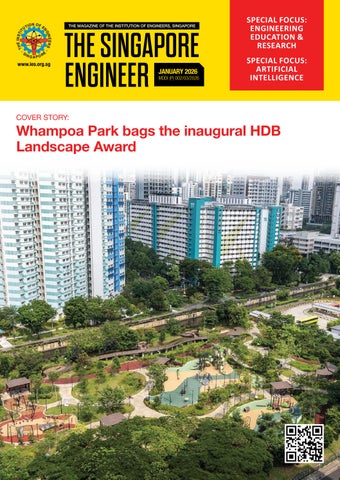
12 Whampoa Park bags the inaugural HDB Landscape Award
SPECIAL FOCUS: ARTIFICIAL
20 Bentley Systems advances infrastructure AI with new applications and industry collaboration
22 Hong Kong Techathon+ 10th Anniversary Finale and Inaugural GUIN Forum successfully held
STRUCTURAL AWARDS 2025
24 Australian engineering excellence secures global accolade
WORKPLACE SAFETY & HEALTH
32 Singapore’s WSH performance in 1H 2025 reflects continued progress
RAILWAY & TRANSPORTATION ENGINEERING
34 The human factor in MRT night works
PROJECT APPLICATION
36 Rapid progress in a five-day cycle with award-winning solution
38 New crane impresses in single-family home project in Germany
PRODUCTS & SOLUTIONS
39 A complete digital package for asphalt construction and earthworks
40 Caterpillar adds joystick option to the new next generation Cat 140 motor grader
The Singapore Engineer is published monthly by The Institution of Engineers, Singapore (IES). The publication is distributed free-of-charge to IES members and affiliates. Views expressed in this publication do not necessarily reflect those of the Editor or IES. All rights reserved. No part of this magazine shall be reproduced, mechanically or electronically, without the prior consent of IES. Whilst every care is taken to ensure accuracy of the content at press time, IES will not be liable for any discrepancies. Unsolicited contributions are welcome but their inclusion in the magazine is at the discretion of the Editor. www.ies.org.sg
Congratulations to Dr Neo Kok Beng on his appointment as Nominated Member of Parliament (NMP)!
The Institution of Engineers, Singapore (IES) extends our warmest congratulations to Dr Neo Kok Beng on his appointment as a Nominated Member of Parliament (NMP).
Dr Neo, Founder and Chief Executive of NEO Aeronautics, was sworn in at the first sitting of Parliament in 2026.
Dr Neo is a Fellow and a former Vice President of IES. He also serves on the IES-INCA Board of Advisors
and played a key role in the launch of the Young Engineers Leadership Programme (YELP) in collaboration with NTUC in 2014, supporting the development of future engineering leaders.
IES is confident that Dr Neo’s engineering expertise, professional experience and dedication to service will contribute meaningfully to raising the profiles of engineers in Singapore. We wish him every success in this important role.
Dr Neo Kok Beng
Office Bearers of the 17th IES/IStructE Joint Committee announced
In 1988, the Institution of Engineers, Singapore (IES) and the Institution of Structural Engineers (IStructE - UK) agreed to set up the IES/IStructE Joint Singapore Structural Division/ Joint Committee, through a Memorandum of Understanding (MoU), to promote the development of a closer working relationship to the mutual benefit of the members of both institutions and to unify and strengthen representation of structural engineers internationally.
A co-operation agreement between the organisations was signed later in 2007 to consolidate what had transpired since the formation of the Joint Committee.
The IES-IStructE Joint Committee comprises diverse representatives of the built environment, including from construction companies, professional consulting firms, specialist firms, institutions and the academia to government agencies.
The Institution of Engineers, Singapore (IES) / Institution of Structural Engineers (IStructE) Joint Committee is pleased to announce the Office Bearers of
the 17th Joint Committee, who will lead the Joint Committee through the term from 1 January 2026 to 31 December 2027.
The elected IES/IStructE Joint Committee is currently headed by the 8th Chairperson Er. Dr Tran Chi Trung, and the Office Bearers of the IES-IStructE Joint Committee for the term 2026 to 2027 are:
Chairperson: Er. Dr Tran Chi Trung - Building and Construction Authority
Vice-Chairman: A/Prof Pang Sze Dai - National University of Singapore
Honorary Secretary: Er. Reve Chin Jen Yee - Jacobs Engineering Group
Honorary Treasurer: Er. Ms Jeslin Quek - FYFE Asia Pte Ltd
Assistant Honorary Secretary: Er. Ms Sharron Ng - ECAS Consultants Pte Ltd
Singapore (IES) was formally established in July 1966 as the national society of engineers in Singapore. IES is the premier engineering institution in Singapore and is called upon by the Government to provide feedback on professional engineering matters.
IES is well represented among the faculty members of the major engineering institutions of higher learning in Singapore, and maintains close links with professional organisations of engineers regionally and throughout the world.
The Institution of Structural Engineers
The Institution of Structural Engineers (IStructE) dates back to 1908 and is now the world’s largest membership organisation dedicated to the art and science of structural engineering. It has over 29,000 members working in 138 countries around the world. The Institution provides a voice for its members, promoting their contribution to society.
Railway Innovation Seminar 2026: A hub for engineering excellence
Connecting the rail industry is about more than just laying tracks – it is about moving the conversation forward.
On January 22 and 23, The Institution of Engineers, Singapore (IES) was proud to co-host the Railway Innovation Seminar 2026 alongside the Institution of Railway Signal Engineers (IRSE) at the Singapore Institute of Technology Punggol Campus.
It was an energising two days of deep dives into the technologies and strategies defining the next generation of transport.
Driving the future of rail
The discussions centred on three critical pillars:
• Innovation: Embracing cuttingedge tech to enhance efficiency
• Safety: Strengthening the systems to protect every passenger
• Sustainability: Ensuring the rail ecosystem remains green and resilient
From theory to the track
A standout moment of the seminar was the technical visit to SMRT Trains’ Bishan Depot. Getting a ‘behind-the-scenes’ look at live railway operations and safety systems reminds us all why the work we do in the lab and office matters so much on the ground.
A massive thank you to our speakers, industry partners, and every delegate who joined us. Your insights are what keep this industry moving at full speed!
On January 22 and 23, The Institution of Engineers, Singapore (IES) was proud to co-host the Railway Innovation Seminar 2026 alongside the Institution of Railway Signal Engineers (IRSE) at the Singapore Institute of Technology Punggol Campus.
Standout moment of the seminar was the technical visit to SMRT Trains’ Bishan Depot.
Introductory Cybersecurity Course for Engineers
Focusing on Basic Foundations, Risk Management and Engineering Perspectives
Organised by IES Academy – the premier continuing education arm of IES, dedicated to advancing knowledge and professional competencies of the engineering community.
WHY THIS COURSE?
In today’s digital age, engineering projects increasingly depend on complex digital and interconnected systems. While this reliance enhances efficiency and capability, it also exposes critical infrastructure and engineering systems to growing cybersecurity risks that can affect operations, safety and overall project outcomes.
This course equips engineers with the essential knowledge and practical skills to safeguard engineering systems by bridging the gap between traditional engineering practices and modern cybersecurity requirements. Delivered in a classroom-based format, the course combines interactive discussions, real-world examples and case studies, to provide engineers with a strong foundational understanding of cybersecurity principles.
Objectives
• Understand the fundamental principles of cybersecurity, industry lingo and terminology.
• Learn the basics of a cybersecurity risk assessment.
• Explore emerging engineeringdriven methodologies (Cyber-Informed Engineering, Consequences-Based CyberInformed Engineering, and Security PHA) to enhance cybersecurity resilience.
Expected Outcomes
By the end of the course, participants will:
• Have a solid grasp of cybersecurity principles and risk management basics.
• Be equipped to assess and mitigate cybersecurity risks in engineering systems.
• Understand how engineering disciplines can influence cybersecurity strategies and design secure systems.
Prerequisite
• Basic familiarity with engineering principles and system design.
• No prior cybersecurity experience required.
Target Audience
• Professional Engineers expanding their skillset to include cybersecurity.
• Professionals interested in bridging the gap between engineering and cybersecurity.
• Engineers responsible for safeguarding operational technology (OT) systems.
In an era where digital threats directly impact engineering projects, this course provides the essential foundation for engineering professionals to safeguard systems and enhance operational resilience.
For more information and course registration, scan the QR code below:
The ‘Introductory Cybersecurity Course for Engineers’ imparts essential knowledge and practical skills to safeguard engineering systems.
LTA awards civil contract for design and construction of a new station and viaduct on existing North-South Line
The Land Transport Authority (LTA) has awarded the civil contract for the design and construction of the new North-South Line (NSL) NS3A station and viaduct to Obayashi Corporation at a contract value of around SGD 281 million.
Construction works for the NS3A station and viaduct are expected to start in the first half of 2026, and passenger service for the station is targeted to commence in 2034. Obayashi Corporation has an established track record in infrastructure projects which include rail stations and tunnels, both locally and abroad. The company is currently also involved in Cross Island Line Phase 2 projects, under a Joint Venture with Shanghai Tunnel Engineering Co (Singapore) Pte Ltd, for the design and construction of Turf City Station and Tunnels, as well as the design and construction of Bored Tunnels between Fairways Drive and Sin Ming Walk.
Located between Choa Chu Kang and Bukit Gombak stations on the North-South Line, NS3A station will be the third MRT station to be built on an existing elevated rail line, after Canberra station (North-South Line) and Dover station (East-West Line).
When completed, it will serve existing and future residential developments in Keat Hong Estate, Bukit Batok West, Pavilion Park Estate and Brickland District in Tengah Town. It will also serve existing educational institutions in the vicinity, such as ITE College West, Swiss Cottage Secondary School and St. Anthony’s Primary School, by providing more direct access to the rail network.
Engineering highlights Significant engineering works are required for the addition of the
new NS3A station to the existing rail network. These include:
• A new viaduct that will be built to facilitate the staged diversion of train services from existing viaducts. This will allow modification works to be carried out safely on the existing rail infrastructure and systems, while still maintaining NSL train operations during the period of construction.
• New crossover tracks to be laid between existing tracks and new tracks, and the creation of a new siding which can be used in the
event of train faults, thus improving service recovery and resiliency along this stretch of the NSL.
• Installation of a temporary protection enclosure over some stretches of the tracks during construction, as well as the carrying out of some works at night after train operation hours, to ensure the safety of commuters.
During construction, LTA and the appointed contractor will engage residents and relevant stakeholders, and provide regular updates on the progress of the works.
Artist’s impressions of the NS3A station.
Steady construction demand in 2026 as Singapore steps up support for built environment firms
Singapore’s Built Environment sector is set to maintain its momentum in 2026, with the Building and Construction Authority (BCA) projecting total construction demand to remain steady at SGD 47 to 53 billion in nominal terms for 2026, similar to 2025. At the Building and Construction Authority (BCA) and Real Estate Developers’ Association of Singapore (REDAS) Built Environment and Real Estate Prospects Seminar 2026, held recently, Minister for National Development, Mr Chee Hong Tat, announced new support for the Built Environment (BE) firms to improve productivity and streamlined regulations to help firms save time, cost and manpower.
Construction demand outlook remains resilient
The sustained construction demand expected in 2026 is supported by the expected awarding of additional construction packages for Changi Terminal 5 (T5) Development and for Marina Bay Sands Integrated Resort (MBS IR2) expansion, New Tengah General & Community Hospital, Downtown Line 2 Extension and Thomson-East Coast Line Extension.
Preliminary actual construction demand for 2025
As at end-2025, preliminary actual construction demand reached SGD 50.5 billion in nominal terms, within BCA’s earlier forecast of SGD 47 billion to SGD 53 billion. The continued uptrend was mainly attributed to institutional and housing projects.
Forecast for 2027 to 2030
Over the medium-term, construction demand is projected to reach an average of between
SGD 39 billion and SGD 46 billion per year from 2027 to 2030. Besides the Changi T5 development and HDB’s BuildTo-Order construction, mediumterm construction demand is anticipated to be supported by a strong pipeline of various large developments such as the redevelopment of NUH at Kent Ridge, various Junior Colleges and the development of the new Singapore University of Social Sciences (SUSS) City Campus. While medium-term construction demand outlook appears positive, project schedules may still change due to unforeseen global economic risks. As the Changi T5 development is a one-off project, industry demand could moderate following its completion, potentially reverting to pre-COVID levels.
Construction output
Based on the contracts awarded in the past few years and the continued strong construction demand forecast for 2026, total construction output in nominal terms is projected to increase to between SGD 43 billion and SGD 46 billion in 2026. The average projected output at SGD 44.5 billion in 2026 will be around 7% higher than the preliminary estimate of about SGD 41.7 billion in 2025.
Unlocking greater productivity through transformation
The Productivity Solutions Grant (PSG) has played a vital role in driving industry transformation in the Built Environment (BE) sector. It has supported more than 1,100 BE firms, since 2020, in adopting digital solutions to improve productivity.
From 1 April 2026, the PSG will be enhanced to help SMEs build more advanced capabilities to achieve higher productivity. The new PSG tranche will:
• Expand support to advanced equipment such as robotic and automation, that can achieve up to 50% manpower savings for each construction trade activity.
• Include more pre-approved digital solutions in focus areas such as digital contract management and coordinated regulatory approvals, further supporting SMEs in advancing their digital capabilities.
• Raise grant caps to support longer-term adoption of both digital solutions and advanced equipment, enabling SMEs to make more substantial and sustained productivity investments. SMEs that benefitted from previous PSG tranches are allowed to apply again.
However, each firm may not apply for the same solution more than once (including any solutions supported under the previous PSG tranche for the Built Environment).
Improving productivity through strengthening project delivery
To support the sector in delivering increasingly complex projects more effectively, BCA has been promoting collaborative contracting, with more than 20 ongoing and upcoming pilot projects across both public and private sectors.
For public sector projects, this takes the form of Option Module clauses under the Public Sector Standard of Conditions of Contract. Early feedback from pilot projects, including the Ministry of Health’s Punggol Field Nursing Home, found that the stronger collaborations amongst project parties have improved project delivery and helped achieve project completion ahead of schedule.
More information on the Option Module under the Public Sector Standard of Conditions of Contract (PSSCOC) is available at https:// www1.bca.gov.sg/procurement/ post-tender-stage/public-sector-
standardconditions-of-contractpsscoc
For more complex and / or private sector projects, BCA has supported the adoption of NEC4, an internationally recognised collaborative contract form, adapted for Singapore. Recently, JTC awarded the first NEC4 target cost contract for infrastructure works at Jurong Innovation District’s CleanTech Park to Eng Lam Contractors, allowing project parties to share cost savings or overruns when they occur.
This collaborative approach has also been extended to the Facilities Management (FM) sector. In November 2025, BCA awarded the first NEC4 Facilities Management Contract (FMC) in Asia to C & W Services (S) Pte Ltd for the BCA Braddell Campus. This sets a new benchmark on how FM services are procured and managed.
Additionally, BCA is partnering with the Project Management Institute (PMI) to launch an enhanced Project Management competency framework, in the second half of 2026, to keep pace with the evolving needs of the industry.
The enhanced framework will strengthen the existing accreditation scheme by the Society of Project Managers, to provide project managers with more structured training and credentials that are recognised both locally and internationally. Firms will also benefit from project managers who can deliver safer and better quality projects on schedule and within budget.
Beyond contracts and frameworks, a strong culture is a critical enabler of effective collaboration. To-date, a total of 47 progressive firms have committed to the Built Environment Culture for Appreciation, Respect and Empathy (BE CARE) Charter. The charter spells out best practices that stakeholders may undertake to promote well-being and cultivate good working relationships.
GuocoLand, for example, has adopted the BE CARE Charter in
its Springleaf Residence project, yielding good outcomes. Going forward, GuocoLand will be adopting the charter for more of its upcoming projects and will be introducing a rewards programme in 2026 to recognise consultants that exhibit strong collaboration and deliver quality projects.
Fostering a pro-enterprise environment
The Government is working with industry to cut red tape, support innovation and help businesses save time and costs. Recent initiatives include CORENET X’s streamlined plan fee computation, improvements to the Temporary Occupation Licence process for show flat sites, enhancements to the CONQUAS framework for private residential developments and strengthened regulations to better protect prospective homeowners.
In addition to the above, BCA is streamlining processes to further reduce administrative burden on firms. The validity of the Public Sector Panels of Consultants (PSPC) listings will be extended from one to three years for applications submitted from 1 June 2026, reducing renewal frequency and administrative burden. This gives firms greater certainty to plan their manpower, make longer-term investments and develop their professional practice further.
Looking ahead
Mr Kelvin Wong, Chief Executive Officer, BCA, said, “The sustained project pipeline gives our industry a solid foundation to build on. We are creating an environment where firms can invest in better ways of doing business, whether that is through new technology, better collaboration or upskilling their teams. At the end of the day, companies that can deliver quality projects efficiently while taking care of their people will be the ones that thrive. The measures that BCA has put in place are designed to help firms work smarter and achieve success.”
Whampoa Park bags the inaugural HDB Landscape Award
Tampines GreenGem and Harmony Village @ Bukit Batok among those recognised for design and construction excellence at HDB Awards 2025.
A total of 36 projects were conferred the HDB Awards, in recognition of their excellence in design, engineering and construction, in public housing. Additionally, three projects were presented the Construction Resilience Recognition for demonstrating resilience in completing pandemic-delayed projects.
Minister for National Development, Mr Chee Hong Tat gave out the awards to the teams behind the projects at this year’s HDB Awards ceremony on 23 September 2025.
Among the winning projects is Whampoa Park which received the first ever HDB Landscape Award. Given to outstanding landscape projects in HDB towns, the new Landscape Award reflects HDB’s
commitment to creating greener and more comfortable living environments for residents while addressing challenges such as
climate change.
HDB’s Chief Executive Officer, Mr Tan Meng Dui, said, “The Landscape Award recognises
Innovative playground equipment at Whampoa Park encourages family bonding. Image: HDB.
Once an underutilised field, Whampoa Park is now a vibrant green heart for the neighbourhood. Image: HDB.
the efforts of our industry partners in creating quality and sustainable living environments for Singaporeans. These winning landscape projects show how well-designed green spaces can enhance the health and wellbeing of our residents, while contributing to greater biodiversity and thermal comfort in our living environment.”
“I congratulate all winners of the HDB Awards. Their achievements reflect the dedication of our industry partners in working alongside HDB to deliver excellence in design, engineering, and construction to meet Singaporeans’ housing needs,” he added.
WINNERS OF THE HDB LANDSCAPE AWARD
Whampoa Park, Bidadari Park & Bidadari Hillock Park, and the common green at Waterfront II @ Northshore, were the winners of the HDB Landscape Award.
Whampoa Park
Nestled between Whampoa Road and Sungei Whampoa, the 1.3-hectare Whampoa Park shows how thoughtful landscape design can transform an underutilised field into a vibrant and inclusive community space. Designed by AGA Architects Pte Ltd and Surbana Jurong Consultants Pte Ltd, the park seamlessly integrates new recreational spaces with the site’s natural features.
The park was shaped with inputs from 950 Whampoa residents, via online surveys and ideation workshops facilitated by community volunteers. One key outcome was Whampoa’s first pet park, where pet owners can take their pets for a run or simply to enjoy the open space. The park also features a lawn space to accommodate community activities such as picnics and movie screenings, as well as disc golf – a popular sport amongst residents.
Completed in 2023, the park offers several zones for active living, catering to different fitness levels and park users. Fitness enthusiasts
can challenge themselves at the Ninja Challenge Course – an obstacle course-style fitness station, while others can work out at the more conventional fitness area featuring dedicated fitness stations arranged as a sequential workout trail.
Wellness benches with builtin exercise attachments like bike pedals are placed throughout the park, making fitness accessible to everyone. There is also a 400 m jogging track with rubberised flooring that contrasts with the granolithic walking paths, to encourage safer sharing of spaces. The park’s playgrounds cater to children of different age groups and are popular with children from the
nearby preschools. Features such as a parent-child swing and an arc see-saw offer plenty of fun for the whole family.
In addition to the active zones, Whampoa Park also offers spaces that promote mental well-being. A therapeutic garden, with gentle earth mounds and natural boulders set amidst lush greenery, creates a quiet, contemplative space. Comfortable seating areas and shelters within the garden provide ample opportunities for residents to rest and enjoy the restorative effects of nature.
Fragrant and edible plants such as Pandan (Pandanus amaryllifolius), Mugwort (Artemisia vulgaris), and Orange Jasmine
Existing mature trees and original rock formations found within the Whampoa Park project site, before its transformation. Image: Surbana Jurong.
Whampoa Park’s 400 m jogging track was elevated to preserve the root systems of the mature trees, which have been retained and integrated into the park’s design. Image: HDB.
(Murraya paniculata) are planted at various heights, inviting visitors to touch and smell the greenery. These plants also attract birds and butterflies, thus enhancing the park’s biodiversity.
In developing Whampoa Park, careful consideration was given to preserving its natural heritage. For example, original rock formations have been creatively repurposed as distinctive landscape features such as garden accents, seating and wayfinding elements.
Twelve existing mature trees have
also been retained and integrated into the park’s design. The park’s 400 m jogging track is elevated and aligned to protect the extensive root systems of these trees. The expansive canopy of the retained trees provides shade and enhances the experience of park users.
Bidadari Park & Bidadari Hillock Park
The 13 hectare Bidadari Park, designed by CPG Consultants Pte Ltd and Henning Larsen Pte Ltd, offers visitors various recreational
experiences through features like the Adventure Playwoods playground and 500 m Woodland Experiential Trail.
Those seeking to relax can do so at the picturesque Alkaff Lake which also serves as a stormwater retention pond to capture excess rainwater. The park’s diverse landscapes from woodlands to grasslands and marshes, including a preserved rain tree in the middle of the lake, create conducive habitats for biodiversity to thrive.
Linked by a land bridge from Bidadari Park, the adjacent 1 hectare Bidadari Hillock Park was designed around a popular rest stop for migratory birds. In consultation with National Parks Board (NParks) and nature groups, the HDB design team preserved more than 15 existing trees, including large Saga and Tembusu trees that offer conducive nesting spots for birds, and added over 300 new trees and 7,500 shrubs to create new bird habitats.
The park is planned with dense vegetation at the centre and pathways around the edges, allowing residents to enjoy nature walks and observe migratory birds without disturbing sensitive habitats.
Bidadari Hillock Park was designed around a rest stop for migratory birds. Image: HDB.
Whampoa Park incorporates Active, Beautiful, Clean Waters (ABC Waters) design features, such as this rain garden that purifies surface runoff before it enters the nearby Sungei Whampoa. Image: HDB.
Waterfront II @ Northshore
The final winner of the Landscape Award is the common green at Waterfront II @ Northshore, along the Punggol Northshore waterfront. Designed by HDB’s Building & Research Institute and Landscape Design Office, the site was a former scrubland which has now been transformed into a welcoming green space, incorporating ecological features such as rain gardens, bioswales and an ecological pond that also acts to manage stormwater runoff.
A key highlight is the canopy walk that runs alongside a bird sanctuary. This walkway offers residents a close-up view of the tree canopies, while leading them towards the coastal edge for a panoramic view of the sea. Residents can also enjoy a variety of play areas, fitness facilities and gathering spaces for outdoor recreational activities.
WINNERS OF THE HDB DESIGN AWARD AND HDB CONSTRUCTION AWARD
Among the other award-winning
projects are Tampines GreenGem and Harmony Village @ Bukit Batok, which received recognition in both the HDB Design Award and HDB Construction Award categories.
Tampines GreenGem
Comprising 2-room Flexi, 3-, 4-, and 5-room flats across 13 residential blocks, Tampines GreenGem is the first Build-To-Order (BTO) project completed in the new Tampines South cluster. Designed by HDB’s Building & Research Institute and constructed by Welltech Construction Pte Ltd, the development includes a variety of amenities such as a supermarket, shops, an eating house and a preschool.
A key feature is the elevated gardens above the carpark, which are interconnected to form a vast expanse of green spaces for residents to enjoy. Covering a total of 1.4 hectares, they include green courtyards with play areas, fitness stations, walking trails and an amphitheatre.
A linear park connector running
the length of the development along Bedok Reservoir Road seamlessly links Tampines Town with Bedok Reservoir Park. Using advanced wind-flow and solar modelling technologies, the residential blocks have been strategically oriented to minimise exposure to the intense western sun, while façade elements including canopies and fins reduce solar heat gain, for a cooler environment.
Welltech Construction tackled the complex challenge of constructing the development’s carpark with the elevated gardens, by carefully planning and dividing the work into 15 smaller zones to ensure construction safety and efficiency.
The company also implemented robust digital systems and controls, such as using QR code technology to track precast components during fabrication and installation. This innovative approach significantly improved delivery coordination and boosted construction productivity.
Tampines GreenGem thoughtfully integrates greenery and community spaces. Image: HDB.
Harmony Village @ Bukit Batok
Singapore’s first Community Care Apartments (CCA) are located within Harmony Village @ Bukit Batok which integrates senior-friendly housing with care services to support seniors to age independently within the community. Designed by AGA Architects Pte Ltd, the development comprises 169 units in a 15 storey residential block, integrated with a hawker centre, activity centre and communal facilities, on a tight 0.6 hectare site.
Through excellent project management, the contractor, Qingjian International (South Pacific) Group Development Co Pte Ltd, overcame tight timelines and complex project requirements, allowing more construction
works to be carried out concurrently, without comprising safety. Innovative construction methods were also adopted to enhance efficiency and improve productivity. This included using an aluminium system formwork and converting key elements to precast components to remove the need for external scaffolding.
CONSTRUCTION RESILIENCE RECOGNITION
Punggol Point Cove
Punggol Point Cove, one of the last pandemic-delayed BTO projects to be completed at the beginning of 2025, is one of three projects that received the Construction Resilience Recognition. Located along New Punggol
Road, the project consists of 1,179 flats across six residential blocks. Amidst the extensive delays caused by the pandemic, Qingjian International (South Pacific) Group Development Co Pte Ltd and Surbana Jurong Consultants Pte Ltd exhibited remarkable resilience and adaptability in overcoming the challenging site conditions. By managing tight project timelines and maintaining consistent supply chains, they were able to keep the project delays under control, while maintaining safety and quality. Today, Punggol Point Cove stands as a landmark, with a unique wave-like façade reflecting the project’s proximity to the sea and the area’s history as a fishing village.
Harmony Village @ Bukit Batok was complex to construct, with residential units, communal facilities for seniors and a hawker centre integrated in a single development. Image: HDB.
WINNERS OF HDB AWARDS 2025
DESIGN AWARD
Category Consultant
Completed
Housing
Rejuvenation
INNOVATIVE DESIGN AWARD
Project
Building & Research Institute (HDB) Tampines GreenGem
P&T Consultants Pte Ltd
Surbana Jurong Consultants Pte Ltd
LG Architects & Associates LLP
Clementi NorthArc
Punggol Point Cove
Neighbourhood Renewal Programme at Tampines Avenue 9 / Street 43 / Street 45
Category Consultant Project
To-be-Built
Housing
ADDP Architects LLP
Mixed Development Kyoob Architects Pte Ltd
CERTIFICATE
OF MERIT (DESIGN)
Category Consultant
Completed
Housing AGA Architects Pte Ltd
Crawford Heights
Tanglin Halt Courtyard
Project
Rejuvenation
To-be-Built
Housing
Harmony Village @ Bukit Batok
Building & Research Institute (HDB) Tampines GreenGlen & GreenCrest
Kyoob Architects Pte Ltd
Tan + Tsakonas Architects LLP
Plantation Grove
Remaking Our Heartland at Toa Payoh N5 Neighbourhood Centre at Lorong 8 Toa Payoh
ADDP Architects LLP
Tanjong Rhu Riverfront l & ll
Building & Research Institute (HDB) Bayshore Vista & Bayshore Palms
LANDSCAPE AWARD
Category Consultant
Completed
Park
Nature Park
AGA Architects Pte Ltd and Surbana
Jurong Consultants Pte Ltd
Building & Research Institute (HDB) and Landscape Design Office (HDB)
CPG Consultants Pte Ltd and Henning
Larsen Pte Ltd
CERTIFICATE OF MERIT (LANDSCAPE)
Category Consultant
To-be-Built
Park
CONSTRUCTION AWARD
P&T Consultants Pte Ltd and Site
Concepts International Pte Ltd
Category Contractor
Completed
Housing
Upgrading
China Construction (South Pacific)
Development Co Pte Ltd
Expand Construction Pte Ltd
Jia Yi Construction Pte Ltd
Kwan Yong Construction Pte Ltd
Newcon Builders Pte Ltd
Qingjian International (South Pacific)
Group Development Co Pte Ltd
Teambuild Engineering & Construction Pte Ltd
Welltech Construction Pte Ltd
SCT Construction Pte Ltd
Welltech Construction Pte Ltd
CERTIFICATE OF MERIT (CONSTRUCTION)
Category Contractor
Completed
Housing
Upgrading
Kian Hiap Construction Pte Ltd
Wee Hur Construction Pte Ltd
CES Engineering & Construction Pte Ltd
Project
Whampoa Park
Waterfront II @ Northshore Common Green 2
Bidadari Park (Hillock)
Bidadari Park
Project
Chencharu Hills Park
Project
Plantation Village
Punggol Point Crown
Woodleigh Hillside
Kempas Residences
Plantation Acres
Harmony Village @ Bukit Batok
Garden Court @ Tengah
Tampines GreenGem
Design and Build of Upgrading Projects for G32K
Design and Build of Upgrading Projects for G29P
Project
Tampines GreenGlade
MacPherson Blossom
Design and Build of Upgrading Projects for G29G
ENGINEERING AWARD (CONSTRUCTION)
Category Contractor
Completed
Infrastructure
Chye Joo Construction Pte Ltd
INNOVATIVE ENGINEERING AWARD (DESIGN)
Category Consultant
To-be-Built
Building Building & Research Institute (HDB)
LSW Consulting Engineers Pte Ltd
CERTIFICATE OF MERIT – ENGINEERING (DESIGN)
Category Consultant
Completed
Building
To-be-Built
Building
Infrastructure
Surbana Jurong Consultants Pte Ltd
KTP Consultants Pte Ltd
ECAS Consultants Pte Ltd
CONSTRUCTION RESILIENCE RECOGNITION
Project Contractor
Punggol Point Cove
Construction of Roads, Trunk Sewers and Common Services Duct in Tengah Town (Phase 2)
Construction of Roads, Trunk Sewers, Common Services Duct and Road-related Facilities in Tengah Town (Phase 3)
Qingjian International (South Pacific)
Group Development Co Pte Lt
Precise Development Pte Ltd
Project
Construction of Sentul Crescent Extension and Bridge over Punggol Waterway
Project
Bayshore Palms
Stirling Horizon
Project
Punggol Point Cove
Tanglin Halt Courtyard
Proposed Infrastructure Works at Ang Mo Kio Neighbourhood 8
Lead Consultant
Surbana Jurong Consultants Pte Ltd
Shuan Huat Tractor Services Pte Ltd
Surbana Jurong Consultants Pte Ltd
Bentley Systems advances infrastructure AI with new applications and industry collaboration
Trustworthy AI to shape the future of infrastructure.
Bentley Systems Incorporated, the infrastructure engineering software company, recently unveiled new infrastructure AI capabilities at its Year in Infrastructure conference. Bentley also announced an Infrastructure AI co-innovation initiative, inviting engineering firms and asset owners to collaborate on the next generation of AI workflows.
“AI is poised to transform infrastructure. At Bentley, our vision is for AI to empower infrastructure engineers – not replace them. Trustworthy AI, built on infrastructure context, can improve engineering productivity and transform workflows across project and asset lifecycles,” said Bentley CEO Nicholas Cumins.
AI use expanding across infrastructure
Each year, Bentley honours leading infrastructure organisations with the Going Digital Awards, recognising excellence in project delivery and asset performance through digital innovation. In 2025, nearly one-third of award submissions – and almost half of finalists – incorporated AI into their projects.
This aligns with the findings from a global survey of infrastructure professionals released at the conference. Conducted by Bentley in collaboration with law firm Pinsent Masons, engineering firm Mott MacDonald and consultancy Turner & Townsend, the survey found that about half of respondents are either piloting AI or have already implemented it, with plans to scale its use across their organisations. Key focus areas include boosting design and engineering productivity and automating documentation processes.
“The greatest challenge to delivering better and more resilient infrastructure is engineering capacity. The reality is, there simply are not enough engineers in the world to do all the work that needs to be done. AI promises a step change in productivity that can help close this capacity gap,” said Cumins.
AI rolled out across Bentley product portfolio
At the 2024 conference, conference, Bentley introduced OpenSite+ for civil site design, the first in a series of new AIpowered applications. Bentley also unveiled additional next generation applications for substation design and construction management, that accelerate the adoption of AI across project delivery.
“We have been creating a new generation of infrastructure applications built on digital twins, powered by AI, and fully connected to Bentley Infrastructure Cloud. They show what is possible when AI is built for real infrastructure workflows and tailored to the needs of engineers,” said Francois Valois, Senior Vice President, Bentley Open Applications.
Featuring Bentley Copilot, a context-aware AI assistant that guides users through workflows, surfaces relevant documents and can make changes to models, the new generation of data-centric applications include:
• Site design: OpenSite+, the first engineering application leveraging generative AI for civil site design, is now in limited availability. It delivers projects up to 10 times faster without sacrificing accuracy.
“OpenSite+ is going to open a lot of doors for us to move faster, get better answers, and really be
better engineers,” said Brianne Belschner, Model-Based Design Lead, VHB which contributed to the development of OpenSite+ through an early access program.
• Substation design: OpenUtilities Substation+ is a new application that brings digital twin and AI-powered capabilities to substation design. In rethinking how substations can be designed collaboratively, it helps solve one of the biggest sources of frustration for designers, by allowing multiple users to work at the same time in the same model, reducing errors and rework during construction. OpenUtilities Substation+ has been made available in November 2025, through an early access program.
• Construction management: SYNCHRO+, part of Bentley Infrastructure Cloud, is a nextgeneration, AI-powered construction application that redefines traditional 4D modelling. By shifting to a data-centric workflow, SYNCHRO+ streamlines construction planning and coordination. It integrates Cesium for rich geospatial context, and leverages AI to explore construction sequences with greater depth, speed and actionable insights. SYNCHRO+ has been made available for early access in December 2025.
AI enhancements are coming to Bentley’s existing engineering applications as well, starting with OpenRoads Designer and OpenRail Designer for model-based road and rail design. A new AI agent that automates one of the most time-consuming aspects of design – the annotating of drawings – has been made generally available in November 2025. Bentley Copilot will be integrated into both products in early 2026.
JedoxAI: Turning Complexity into Confident Decisions
How can finance and operations teams make smarter, faster decisions in a world overloaded with data? JedoxAI, the AI engine within the Jedox Enterprise Performance Management (EPM) platform, is designed to tackle exactly that challenge and help organizations turn complexity into clarity.
Leveraging machine learning, natural language processing, and generative AI, JedoxAI automates forecasting and scenario planning. It identifies patterns in historical and real-time data, anticipates trends, and allows teams to test what-if scenarios, so decisions are confident, not guesswork.
Unlike black-box AI tools, JedoxAI provides explainable predictions. Every recommendation is traceable, ensuring transparency, compliance, and trust, which is critical for both finance and engineering teams managing high-stakes projects.
JedoxAI also makes data exploration simple. Instead of asking, “Which projects performed best last quarter?”, users can now ask practical, business-critical questions such as:
“How is the Singapore Business Unit performing this month versus last month versus budget, and what are the key drivers?”
With JedoxAI, the answer appears instantly in an interactive, easy-to-understand format, giving leaders immediate insight into variance drivers, opportunities, and risks. No coding, no waiting for reports, just real-time clarity.
Hosted on Microsoft Azure and leveraging Azure OpenAI Service, JedoxAI ensures enterprise-grade security and integrates seamlessly with ERP, CRM, and BI systems. This creates a single, reliable source of truth for planning, analytics, and performance management.
Organizations using JedoxAI report faster planning cycles, more accurate forecasts, and greater agility. Strategic collaborations with partners such as MNG Solutions further enhance its capabilities, combining advanced AI with deep industry expertise to deliver tailored solutions.
With AI simplifying complexity and boosting decision confidence, one question remains: Are you ready for the next era of intelligent planning? Discover how JedoxAI can transform your data, your decisions, and your organization’s future.
Hong Kong Techathon+ 10th Anniversary Finale and Inaugural GUIN Forum successfully held
Bringing together local and overseas innovation talents and leaders to deepen cross-border, cross-campus collaboration.
Hong Kong Science and Technology Parks Corporation (HKSTP), together with 15 local tertiary institutions, marked a major milestone as Hong Kong Techathon+, the city's largest international intercollegiate innovation and technology (I&T) annual event, celebrated its 10th anniversary.
The Hong Kong Techathon+ Finale was successfully held recently at Hong Kong Science Park. The team ‘Cresento’, from The Hong Kong University of Science and Technology, won the Gold Award in the category of Trusted AI and Data Science under the Local Track (Open Group) as well as the Best Presentation Award, as voted by the audience.
In parallel, the Global University Innovation Network (GUIN), jointly established by HKSTP and its 15 local tertiary institution partners, convened its inaugural forum. The forum brought together GUIN member representatives and academic I&T leaders for in-depth exchanges on innovation and entrepreneurship ecosystem development, further strengthening Hong Kong’s position as an international I&T and talent hub.
Record-high international participation
This year’s Techathon+ attracted enthusiastic participation from both local and overseas universities, Approximately 1,900 participants formed over 470 teams. Notably, 215 overseas teams joined, underscoring the event’s growing international appeal.
Following rigorous selection, 172 teams advanced to the finale, including 122 local teams and 50 overseas teams – from Australia,
Brazil, Chinese Mainland, Japan, Kazakhstan, Malaysia, Portugal, Singapore, the Republic of Korea, Taiwan, the UK, and the US.
A ‘soft-landing’ platform for entrepreneurship Hong Kong Techathon+ is more than a university innovation competition. Over the past decade, the platform has engaged over 9,000 participants, nurturing innovative talents and supporting the growth of startups.
Non-local teams also participated in a four-day immersive programme, featuring I&T ecosystem seminars, mentorship, investor matching, visits at Hong Kong Science Park, and tours to Chinese Mainland I&T bases, helping participants explore market expansion opportunities across the Greater Bay Area.
HKSTP also invites selected high-potential finalist teams and winners to join its Ideation Programme, offering up to HKD 100,000 in seed funding (along with support aligned with participating universities’ startup programmes), free co-working spaces, access to advanced technology resources and professional mentorship. Through HKSTP’s incubation and industry networks, teams are supported from prototype development to sustainable startups operations –scaling progressively and building international impact.
Amazon Web Services (AWS) was the exclusive Technology Enabler for the 10th Edition of Hong Kong Techathon+, providing participating startups with access to leading cloud and Artificial Intelligence technologies and platforms. Through this collaboration, AWS offered competing teams technology
resources in generative AI and machine learning, professional technical support and workshops, to accelerate innovation and drive Hong Kong’s development as an international I&T hub.
Deepening global university innovation collaboration
The first Global University Innovation Network (GUIN) Forum was successfully held on 23 January at Hong Kong Science Park, bringing together GUIN member institution representatives and I&T experts. The forum focused on three key areas:
• Exploring strategies for university-industry technology transfer collaboration to achieve win-win innovation outcomes.
• Examining the Greater Bay Area as a hub for international innovation collaboration, including opportunities for research commercialisation and cross-border partnership.
• Strengthening global collaboration networks through actionable pathways.
Speakers included Dr Tony Raven, former CEO of Cambridge Enterprise; Professor Poh Kam Wong, Emeritus Professor at National University of Singapore; and Dr Alwin Wong, Chair of the Association of Technology Transfer Professionals (ATTP).
Co-founded last year by HKSTP and 15 local tertiary institution partners, with support from multiple overseas institutions and partners, GUIN aims to bring together leading minds to advance international collaboration in innovation and entrepreneurship, reinforcing Hong Kong's role as a global talent and innovation hub.
IES CHARTERED ENGINEERING BOARD
The Chartered Engineering Registry aims to provide professional recognition to qualified Engineers, Technologists and Technicians across all sectors.
Being registered as a Chartered Engineering Professional will be an external validation of your experience, expertise and practising competence; and is a quality mark to differentiate your professional standing in the following sectors of engineering:
Australian engineering excellence secures global accolade
Sydney’s new Central Station Metro wins the 2025 Supreme Award for structural engineering excellence.
The Institution of Structural Engineers (IStructE) announced the winners of the Structural Awards 2025, at an awards ceremony held on 14 November 2025, in London, UK.
The Structural Awards are a global celebration of the most remarkable achievements in structural engineering.
In a hotly contested year, Sydney’s new Central Station Metro secured the 2025 Supreme Award for Structural Engineering Excellence with the collaborative team Aurecon and GHD Joint Venture recognised for their exemplary and thoughtful structural planning and technical leadership of this major project.
A landmark in Australia’s continuing story of structural engineering excellence, this major addition to Sydney’s underground metro system integrates a new station and pedestrian tunnels beneath Australia’s busiest rail terminal.
What really set this apart from other similar projects was the structural design which shaped the overall outcome, improving accessibility, reducing embodied carbon, and enhancing sightlines, safety and wayfinding. Taking a closer look, the ingenious topdown construction method and reimagining of the reference design really showed how structural engineers can lead high-impact infrastructure from below ground and upwards.
Assessed across four key pillars – Planet, People, Process, and Profession – this year’s Supreme Award winner reflects IStructE’s evolving focus on the environmental and societal role of structural engineers. Particularly, the judges singled out the ambition
of the design and complexity of the work undertaken, exemplifying thoughtful structural planning and clear technical leadership.
In addition to the Supreme Award, 10 other projects, from the 34 strong shortlist, were recognised for their significant contributions to structural engineering, showcasing specific excellence, including innovation and social impact. High levels of sustainability were also regarded as a standout criterion, celebrating those projects which demonstrated the integration of environmentally friendly solutions, with a particular focus on reducing embodied carbon in construction.
The winning firms represent some of the best-known names and emerging players in global structural engineering. Included are firms such as Curtins, Aurecon and GHD Joint Venture (AGJV), Structure Workshop, Latéral, Fast + Epp Structural Engineers, schlaich bergermann partner (sbp), Arcplus Institute of Shanghai Architectural Design & Research Co Ltd, Atelier One, Arup, Webb Yates Engineers and R V Anderson Associates.
This diverse mix not only showcases a wide variety of exceptional contributions to the field, but also how rich and vibrant the world’s structural engineering community is.
Commenting on this year’s winners, Professor John Orr, Chair of the Judging Panel and Chartered Member of the IStructE, said, “In an incredibly high-calibre playing field, Sydney’s Central Station Metro clinched a very well-deserved victory.”
“My fellow judges and I could not help but be impressed by the way the engineers refined and improved the project’s reference design and
how they introduced a fiendishly clever top-down sequence to meet demanding programme constraints. With reusability and demountability also carefully considered, the overall structure demonstrated how intelligent problem-solving can shape construction and achieve long-term value,” he added.
“Yet again, this year’s awards also recognised a wealth of other inspiring projects, all characterised by their intelligent use of materials, circular design principles and low-carbon construction. Our judging framework, focused on key attributes, highlights how structural engineers are driving innovation towards a safer, more sustainable built environment,” Professor Orr said.
WINNERS OF STRUCTURAL AWARDS 2025
Supreme Award for Structural Engineering Excellence
Award for exceptional ingenuity and technical excellence delivered in a live, high-risk environment through engineering leadership
Winner: Central Station Metro Location: Sydney, Australia
Structural Designer: Aurecon and GHD Joint Venture (AGJV)
Client: Laing O’Rourke
Key Attributes: Process
Project description
This major addition to Sydney’s underground metro system integrates a new station and pedestrian tunnels beneath Australia’s busiest rail terminal. The structural design shaped the overall outcome, improving
accessibility, reducing embodied carbon, and enhancing sightlines, safety and wayfinding. A topdown construction method and reimagining of the reference design show how structural engineers can lead high-impact infrastructure from below ground and upwards.
Judge’s comments
A complex and ambitious project that exemplifies thoughtful structural planning and clear technical leadership. The engineers refined and improved the reference design, introducing a clever top-down sequence to meet demanding programme constraints. With reusability and demountability carefully considered, the structure demonstrates how intelligent problem-solving can shape construction and achieve long-term value.
Award for structural ingenuity showcasing the creativity of the profession
Winner: Fern the Diplodocus
Location: London, UK
Structural Designer: Structure Workshop
Client: The Natural History Museum
Key Attributes: Profession
Project description
Fern the Diplodocus is the world’s first, post-tensioned bronze dinosaur. At 25 m long, the life-size sculpture is completely freestanding, with no supports beneath its cantilevered neck or tail – a first for a dinosaur display. Achieving this required highly collaborative engineering and fabrication, solving complex structural challenges through elegant, often nature-inspired solutions. The result is both technically groundbreaking and visually seamless. Designed to
be seen by millions, this project brings structural engineering into the public imagination and inspires curiosity across generations.
Judge’s comments
A technically challenging and beautifully executed project that demonstrates the versatility of structural engineering. The team resolved complex post-tensioning and geometric challenges with care and intelligence, creating a form that engages the public and reinforces the profession’s role in shaping imaginative, visible work.
Central Station Metro. Image: Aurecon GHD Joint Venture (AGJV), 2025.
Fern the Diplodocus. Image: The Trustees of the Natural History Museum, London, 2025.
STRUCTURAL AWARDS 2025
Award for a commitment to natural, renewable materials and community engagement
Winner: The Heathland School welfare centre
Location: Hounslow, UK
Structural Designer: Webb Yates Engineers
Client: London Borough of Hounslow
Key Attributes: Planet, People
Project description
This new facility provides dedicated space for students with special educational needs at a school in Hounslow. Sustainability guided the brief from the outset, resulting in a low-carbon scheme built with recycled and natural materials including recycled tyres in the foundations, timber piles and loadbearing straw bale walls. A timber mezzanine houses plant equipment, while a cantilevered canopy shelters the accessible entrance ramp.
Judge’s comments
A thoughtful and quietly bold project that explores the structural potential of natural materials in an educational setting. Using straw bale construction with care and
clarity, the team delivered a space shaped by environmental intent and community engagement. A small but ambitious project that reflects a strong commitment to low-carbon design and inclusive practice.
Award for an outstanding, peoplecentric example of advancing the industry’s response to RAAC remediation
Winner: Airedale General Hospital RAAC remediation programme
Location: Yorkshire, UK
Structural Designer: Curtins
Client: Airedale General Hospital
(AGH) Solutions
Key Attributes: People, Profession
Project description
The project achieved the remediation of one of the UK’s largest Reinforced Autoclaved Aerated Concrete (RAAC) affected hospital estates, while keeping it fully operational. The project team focused on minimising risk exposure and avoiding catastrophic failure, all within a live clinical environment. The project combines structural expertise with clear communication, digital tools and ongoing public safety.
The Heathland School welfare centre. Image: Agnese Sanvito, 2025.
Airedale General Hospital RAAC remediation programme. Image: Curtins, 2025.
Judge’s comments
A quietly exceptional project that puts communication, care and professional responsibility at the forefront of structural engineering. Delivered in a fully occupied hospital, the work sets a clear benchmark for RAAC remediation, combining technical leadership with people-focused decision-making. Through open dialogue, smart digital tools and a calm response to risk, the team helped shape a new standard for critical infrastructure remediation.
Award for outstanding collaboration and delivery on a complex infrastructure project in the pursuit of sustainable energy
Winner: Toronto Western Hospital
Noventa Energy transfer station
Location: Toronto, Canada
Structural Designer: R V Anderson
Associates
Client: Noventa Energy Partners
Key Attributes: People
Project description
One of the world’s largest wastewater energy transfer systems, this project will deliver low-carbon heating and cooling to Toronto Western Hospital for the next 30 years. The engineers undertook complex retrofitting, deep excavation and live tunnel connections, all within a constrained urban hospital site. With minimal visual impact, it achieves massive energy savings and carbon reductions through smart, resilient infrastructure.
Judge’s comments
A technically complex and quietly impactful project that stands out for its thoughtful collaboration and effective knowledge-sharing across disciplines. The team successfully delivered a challenging energy system in a constrained hospital environment, demonstrating the vital role of structural engineering in the transition to clean energy. A replicable and meaningful achievement.
Award for regenerative design using indigenous knowledge, materials and construction techniques for maximum social impact
Winner: Tekαkαpimək Contact Station
Location: Maine, USA
Structural Designer: Atelier One
Client: Friends of Katahdin Woods & Waters, Elliotsville Foundation
Key Attributes: Planet, People
Project description
This off-grid timber visitor centre in Maine’s Katahdin Woods and Waters National Monument draws from indigenous knowledge and uses local materials throughout. Built with community collaboration, the structure blends furniture,
architecture and climate response into a cohesive, regenerative public space – setting a new bar for sustainable civic design. All Wabanaki Cultural Knowledge and Intellectual Property shared within this project is owned by the Wabanaki Nations.
Judge’s comments
A bold and principled project that places indigenous knowledge, local materials and community leadership at the heart of structural design. The team stayed true to a clear regenerative vision, resulting in a structure shaped by social purpose and environmental care. It is a compelling example of how engineering can respond to local context with humility, integrity and lasting impact.
Toronto Western Hospital Noventa Energy transfer station. Image: R V Anderson Associates, 2025.
Spanning the Oder River between Germany and Poland, this elegant network arch bridge reuses existing piers and introduces shaped transitions that blend structure and form. It is the first known railway bridge to incorporate carbon-fibrereinforced elements for structural performance. Light, efficient and beautifully detailed, the bridge is a landmark in cross-border infrastructure and engineering precision.
Judge’s comments
An elegant and efficiently delivered network arch bridge that reflects a thoughtful and disciplined design process. Reusing existing piers and introducing carbon-fibre tension members, the structure achieves lightness, clarity and beautifully resolved
proportions. It is a seamless integration of architecture and engineering, made possible through careful detailing and confident material choices.
Award for showcasing in largescale city-centre retrofits
The retrofit of a 1980s brutalist building in Covent Garden. By retaining 80% of the existing structure and adding 65,000 ft2 of premium space, the design
balances carbon, cost and architectural value. Structural knowledge of the original design enabled safe, efficient upgrades, improving both performance and public-facing urban integration.
Judge’s comments
A clear and accomplished example of large-scale retrofit, that demonstrates the value of structural engineering in city-centre transformation. Combining elegant structural interventions with well-planned temporary works, the team kept the buildings safe and serviceable while significantly improving their urban presence. The project sets a strong precedent for retrofit-led renewal, balancing technical care with sustainable ambition.
Oder Railroad Bridge. Image: wilfried-dechau.de, 2025.
The Acre. Image: Arup, 2025.
Award for elegant detailing, and an intelligent and striking use of mass timber
Winner: La Pêche Town Hall
Location: Quebec, Canada
Structural Designer: Latéral
Client: Municipality of La Pêche
Key Attributes: Profession
Project description
A public building designed to Passivhaus standards, using cross laminated timber for the striking long-span, saw-toothed roof. Nearly every component, from structure
to insulation and finishes is woodbased, achieving a low carbon footprint, in line with Canada’s 2050 goals. It is a bold civic project that combines elegant engineering with environmental leadership in the public sector.
Judge’s comments
An elegant and efficient mass timber structure that demonstrates how structural engineering can shape both performance and architectural identity. The folded-plate, cross laminated timber roof is a standout feature – technically refined, visually
expressive and central to the building’s low-carbon, high-comfort ambitions. This is a confident example of how structural clarity can define civic architecture.
Award for cross-academia-industry innovation, elevating composite mass timber to inspire future building designers
Winner: Limberlost Place
Location: Ontario, Canada
Structural Designer: Fast + Epp
Structural Engineers
Client: George Brown College
Key Attributes: People, Process, Profession
Project description
Limberlost Place is Ontario’s first tall timber institutional building. Designed for George Brown College, the 10-storey structure uses an innovative, beamless hybrid system of mass timber and concrete. It showcases structural clarity, integrated M&E design and high environmental performance. As a pioneering project in the timber movement, it sets a benchmark for educational spaces that teach through structure.
La Pêche Town Hall. Image: Latéral, 2025.
Limberlost Place. Image: Salina Kassam, 2025.
Judge’s comments
A thoughtfully designed and beautifully executed hybrid structure that brings together mass timber and concrete with technical clarity and environmental intent. The engineers developed and rigorously tested a bespoke shear connection system, enabling an elegant and efficient structural solution. As an educational building, it showcases the best of structural engineering while creating an inspiring space for future generations.
Award for imaginative structural intervention combining new and old to dramatic effect
Winner: Shanghai Greenhouse project
Location: Shanghai, China
Structural Designer: Arcplus Institute of Shanghai Architectural Design & Research Co Ltd
Client: Shanghai Expo Culture Park Construction Management Co Ltd
Key Attributes: Process
Project description
Set in the Shanghai Expo Culture Park, this project reimagines existing industrial steel trusses as the frame for an elegant new aluminium structure. Combining a cable-net and polygonal grid system, the design achieves transparency and structural lightness on an ambitious scale. The result is a striking fusion of old and new.
Judge’s comments
An imaginative and technically intricate reuse project that brings new life to an old industrial steel frame. By inserting a lightweight cable-net greenhouse within the existing structure, the team created a bold juxtaposition of old and new. The result is both visually striking and structurally inventive, a confident blend of adaptive reuse, expressive engineering and thoughtful design.
The Structural Awards
For over 50 years, the Structural Awards have showcased the world's most cutting-edge engineering achievements. All entries are judged on four key ‘attributes’:
• Planet: The holistic environmental impact of the entries.
• People: Their adoption of principles such as collaborative design and procurement, how they add community value and their positive impact on end users and wider society.
• Process: The technical achievement and the role of innovation in achieving a successful outcome.
• Profession: How the project/ project team has inspired others, raised standards of design and enhanced the reputation of the global structural engineering community.
Shanghai Greenhouse project. Shanghai Greenhouse project. Image: Arcplus Institute of Shanghai Architectural Design & Research Co Ltd, 2025.
Singapore’s WSH performance in 1H 2025 reflects continued progress
The major injury rate was at an all-time low.
Singapore’s Workplace Safety and Health (WSH) performance in 1H 2025 reflects continued progress to make Singapore workplaces among the safest in the world. The annualised workplace fatal injury rate per 100,000 workers was 0.92, compared to 1.0 in 1H 2024.
The annualised major injury rate per 100,000 workers fell to an all-time low (excluding 2020 where projects were disrupted due to COVID-19) of 15.5, from 16.6 in 1H 2024, continuing the downward trend in recent years. Strong commitment from all stakeholders is key to sustaining these improvements.
Beyond addressing workplace safety risks, the Ministry of Manpower (MOM) has updated the Occupational Disease list with effect from 1 December 2025. The revised list will strengthen protection for workers and provide clearer guidance for employers by aligning reporting and compensation requirements under the WSH and Work Injury Compensation Acts.
Sectoral safety performance
Improvements have been observed in both Manufacturing and Construction, the sectors that are the top contributors to fatal and major injuries.
The Manufacturing sector saw progress, with the number of fatal and major injuries declining from 65 in 1H 2024 to 55 in 1H 2025. In particular, the metalworking industry saw a marked 29% reduction in fatal and major injuries in 1H 2025, compared to the same period in 2024.
Tighter machinery safety requirements likely contributed to this decline.
The Construction sector’s
annualised fatal and major injury rate per 100,000 workers also fell from 30.6 (81 injuries) in 1H 2024 to 28.2 (76 injuries) in 1H 2025. Regular / larger-scale worksites recorded fewer injuries (27 injuries as compared to 31 injuries in 1H 2024).
For smaller-scale construction works, there were 46 injuries in 1H 2025, comparable to 47 in 1H 2024. Smaller-scale works include Addition & Alteration works and Renovations.
The improvement may be attributed to stronger enforcement, a sector-wide safety time-out in November 2024, and stricter safety requirements for public-sector projects, which were introduced in April 2024.
Across sectors, vehicular incidents and falls from height were the leading causes of fatalities, while slips, trips and falls remained the top cause of major injuries.
Enforcement efforts to sustain progress
MOM conducted more than 3,000 workplace safety inspections in 1H 2025 across high-risk industries. Areas of focus included vehicular safety; preventing slips, trips and falls; machinery safety; and safe working at height. Close to 7,000 breaches were detected, with errant companies receiving over SGD 1.5 million in composition fines and 28 stop work orders. These enforcement actions reiterate the need for companies to strengthen WSH, and thereby prioritise the safety and health of their workers.
Updated occupational diseases list Occupational diseases (OD), while less visible than accidents, can have significant impact on workers’
quality of life.
The 1H 2025 annualised OD rate remained stable at 25.2 per 100,000 workers (465 cases), which is comparable to 25.6 (468 cases) in 1H 2024.
The top contributors in 1H 2025 were noise-induced deafness (60% of cases), work-related musculoskeletal disorders (26%), and occupational skin diseases (10%). Increased awareness of OD through MOM’s engagement and enforcement efforts have contributed to improved detection and management of OD in recent years.
To strengthen protection for workers and improve clarity for employers, MOM has updated and aligned the OD lists, under the WSH Act (WSHA) and the Work Injury Compensation Act (WICA), based on the latest medical evidence and international practice.
From 1 December 2025, the same list of 38 ODs has become reportable under WSHA and compensable under WICA. Key changes include the coverage of work-related musculoskeletal disorders beyond those affecting the upper limbs, and broader recognition of occupational infectious diseases for workers in high-risk settings.
Shared responsibility for safer and healthier workplaces
The improvements in WSH performance, together with the expanded OD coverage, mark important progress in protecting workers from both work injuries and occupational health risks. MOM will continue working closely with unions, employers and industry partners, to sustain the momentum and press on towards a culture of WSH excellence.
SINGAPORE’S WORKPLACE SAFETY AND HEALTH PERFORMANCE IN FIRST HALF OF 2025 SHOWED SUSTAINED PROGRESS FROM 2024
Sustained improvements reflect collective efforts of workers, employers and industry to prioritise safety and health to prevent injuries.
FATAL INJURY RATE
1H 2025: 0.92 1H 2024: 1.0 (per 100,000 workers)
MAJOR INJURY RATE
1H 2025: 15.5
1H 2024: 16.6 (per 100,000 workers)
Continued improvements in Construction, Manufacturing and Transportation & Storage
&
1H–January to June
Source: Workplace Safety and Health Report, (January-June) 2025
The human factor in MRT night works
by Daniel Woods, Project Director, Metro Transit Solutions (Singapore)
Skills, fatigue and leadership in an age of renewal.
Singapore’s MRT network has rightly earned a reputation for reliability, safety and engineering excellence. Much of this success is visible to the public through new lines, modern stations and steadily improving performance indicators. Less visible, however, is the work that takes place when the city sleeps. Night engineering works remain the backbone of inspection, maintenance and renewal activities across the network.
As Singapore’s older MRT lines move deeper into a phase of sustained renewal, the human factors associated with night work deserve closer attention. While systems, assets and technologies are often the focus of renewal discussions, it is people, who ultimately plan, supervise and execute these works under demanding conditions.
It is also important to recognise that Singapore has already undertaken significant midlife upgrades across the North South and East West Lines, including major renewals of signalling systems, sleepers and conductor rails. These programmes have strengthened system resilience and extended asset life.
As these technical upgrades mature, attention increasingly turns to how renewal activities are planned, staffed and executed, over long periods. In this context, human factors become as critical as engineering solutions.
Drawing on experience across regulation, delivery and leadership roles, this article reflects on fatigue, competence and workforce planning, as critical success factors for night engineering works.
Fatigue and the reality of limited time
Night possessions are defined by short access windows, high expectations and limited tolerance for disruption. In practice, tiredness is one of the most significant human risk factors during these works. Short working windows place sustained pressure on teams to sequence activities precisely and make effective use of limited time, leaving little margin for recovery when delays occur.
Fatigue does not always present itself as obvious exhaustion. It more often appears as reduced attention to detail, slower decisionmaking and a growing willingness to accept marginal outcomes. Over extended periods, particularly where night works are repeated week after week, these effects accumulate quietly.
In competitive markets, productivity pressure can exacerbate this risk. Planned volumes may not
always reflect what is realistically achievable within a given possession, especially during the early stages of a work programme. When expectations remain fixed while conditions change, fatigue becomes not just a personal issue, but a systemic one.
Planning, productivity and the daynight interface
One early indicator that fatigue or inefficiency is affecting night works is when the expected output is consistently not achieved. This is particularly noticeable where night activities are closely coordinated with day shift teams.
Information transfer between night shift site teams and day shift office-based planners is critical, yet it is often underestimated.
Incomplete handovers, unclear feedback or delayed reporting can result in planning assumptions being repeated without adjustment. Over time, this disconnect widens
Engineers reviewing drawings during night-time works within an underground rail environment. Image: Daniel Woods.
Mr Daniel Woods
the gap between planned productivity and actual delivery.
Effective planning for night works should not be static.
Anticipated volumes must be reviewed regularly, refined through feedback and adjusted, as routines stabilise. Only once a process has been properly embedded should productivity targets be increased or costs optimised. Attempting to force efficiency too early often has the opposite effect.
Safety under pressure
Under time pressure, safety risks can emerge in subtle ways. This may include shortcuts in lifting practices, use of incorrect equipment or deviations from approved methodologies. These behaviours are rarely deliberate acts of negligence. More often, they are symptoms of fatigue, urgency or misplaced confidence that a task will be completed without consequence.
It is important to approach this subject professionally. The objective is not to suggest that unsafe practices are widespread, but to recognise that the conditions of night work increase the likelihood of human error.
Acknowledging this reality allows organisations to design controls, supervision and schedules, that better reflect human limitations.
Experience, judgement and decision-making at night
Engineers are well trained to follow procedures, processes and method statements. These frameworks are essential for safety and consistency. However, night works seldom proceed exactly as planned.
Unexpected problems arise.
Equipment fail. Access is delayed. Interfaces do not align. Time is lost quickly. In these moments, the most critical factor is not the existence of procedures, but the presence of sound judgement.
Experienced engineers are able to distinguish between what must not change and what can be adapted safely. This capability is developed through exposure to real situations,
understanding consequences and learning from past decisions. It cannot be replicated through training alone.
Less experienced engineers may struggle when plans unravel. Some may hesitate, waiting for instruction that does not arrive in time. Others may improvise without fully understanding the risk. Both responses increase the likelihood of error. For night works, competence must therefore be understood not just as possession of technical knowledge, but also as decisionmaking ability under pressure.
Leadership, staffing and organisational choices
Organisations that manage night works effectively tend to make deliberate staffing and leadership choices. This often includes employing sufficient personnel to allow for proper rest and rotation, as well as appointing experienced managers who are capable of leading teams through complex and time-critical situations.
One consistent lesson across projects is that tenure alone does not equate to leadership capability. Longevity within an organisation does not automatically mean an individual is suited to manage teams or carry senior responsibility. Effective leadership requires competence, credibility and the ability to make difficult decisions in real time.
Strong organisations recognise this and resist the temptation to rely on familiarity or past associations when appointing
managers. Instead, they focus on placing the right people in the right roles, particularly during high risk activities such as night works.
Practical lessons for MRT renewals
As Singapore’s MRT network enters a prolonged period of asset renewal, several lessons on human factors stand out.
Planning must be realistic and responsive, allowing productivity to evolve rather than be forced. Fatigue should be treated as a predictable risk, not an individual weakness. Competence should be defined by judgement and experience, not just by qualifications or years of service. Leadership roles should be filled by those with the technical understanding and authority to guide teams when conditions change.
Above all, experienced leaders must be empowered to take charge of renewal programmes, bringing insight, engineering knowledge and practical understanding to the challenges of night work.
Closing reflections
The success of MRT renewals will not be determined solely by materials, designs or technologies. It will depend just as much on the people who work through the night to maintain and renew the system. By recognising human limitations, valuing experience and planning with realism, Singapore can continue to uphold its reputation for rail excellence, not only through what is built, but also through how it is renewed.
Tunnel inspection works in Shah Alam, Malaysia. Image: Daniel Woods.
Rapid progress in a five-day cycle with award-winning solution
The innovative VCT Composite Track ensures swift construction progress.
The HŽ-2 overpass in Križevci, Croatia, is part of the DC 10 motorway which connects Sveta Helena near Zagreb with the Hungarian border at Gola. The overpass spans the new M201 railway line, the Glogovnica River and roads 21 and 24. The overpass is a steel composite bridge with a total length of 502 m, of which the steel composite section measures 489 m.
The carriageway slab is being constructed using the in-situ concrete method and is the first project in Croatia to utilise PERI’s VARIOKIT VCT Composite Track. To ensure that the bridge could be constructed quickly and costeffectively, a combination of steel and concrete was chosen.
The steel section of the loadbearing bridge section consists of two 2 m high I-shaped main beams. The main longitudinal and cross girders are made of welded steel sheets of varying thicknesses.
The bridge is divided into 13 bridge spans and the carriageway slab was constructed in 52 concreting sections, each approximately 10 m long. The superstructure is 11.70 m wide to provide sufficient space for traffic. The thickness of the concrete slab varies from 22 cm to 35 cm, for ideal weight optimisation.
The VARIOKIT VCT Composite Track makes its début
The VARIOKIT VCT Composite Track won the Innovation Award at bauma 2025 in the ‘construction’ category, and its benefits are clearly evident in this project.
This allows the carriageway slab to be manufactured without having to deal with the problematic block dowel effect of the formwork carriage supports that are
The HŽ-2 overpass in Križevci is an important element in establishing an uninterrupted link between Zagreb and the Hungarian border.
As the VCT Composite Track is moved beneath the superstructure and does not require any supports or carriageway penetrations, work can be carried out above without any hindrances. This simplifies and speeds up processes.
The VARIOKIT VCT Composite Track, a solution for steel composite bridges that won the bauma Innovation Award 2025, is making its début in Croatia.
usually welded in place. Similarly, the VARIOKIT VCT Composite Track does not necessitate any penetrations in the carriageway slab.
This eliminates the need for subsequent sealing of the throughholes, significantly increasing the quality and service life of the carriageway slab and contributing to sustainable bridge construction.
Other local factors also make the composite track the ideal solution. Since only telescopic loaders and a mobile crane are available on the construction site, the hydraulically controlled movement of the composite track is an ideal feature.
Once it is mounted on the steel beam, the composite track can be moved forwards or backwards into the relevant concreting sections without the aid of construction machinery.
What is more, tasks such as installing steel reinforcement or concreting the carriageway slab can be carried out without any obstacles and with free access from above, which significantly speeds up and simplifies the process.
By using the VCT Composite Track, it was possible to achieve a concreting cycle of just five days for standard sections with a length of 10 m. With these short cycle times, it is possible to meet or even beat the tight one-year bridge construction deadline.
Conventional challenges are on the decline
The composite track also provides a smart solution to other challenges that arise when constructing in-situ concrete carriageway slabs for steel composite bridges. The hydraulic drive with direction change function enables the composite track to be used to perfection for the classic back-step method. It is possible to simply pass beneath sections that have already been concreted, in order to reach the next concreting section.
“VCT makes our work so much easier and faster in situations like this. These issues simply do not exist any more. With VCT, you need
not worry about height differences or obstacles. You can just continue working uninterrupted,” says Talha Kaymak, Site Manager at KAMGRAD d.o.o., the company responsible for constructing the overpass.
PERI has assigned a supervisor to assist with the construction work on site, and the construction site team has received comprehensive training on how to use the composite track.
PERI’s solution is complemented by additional components from the compatible VARIOKIT Engineering Construction Kit. A total of around 60 tonnes of PERI materials are in use on site.
The HŽ-2 overpass is a prime example of innovative solutions in modern bridge construction. It is the embodiment of efficient resource use and outstanding engineering, paving the way for long-lasting and sustainable infrastructure.
Contractor KAMGRAD d.o.o.
Zagreb, Croatia
Field Service PERI Croatia
The VCT Composite Track runs beneath the superstructure and does not require any formwork carriage supports, which results in a higher quality of carriageway slab and simplifies and expedites construction processes. This is also made possible by a hydraulic drive.
The composite track is quick and easy to operate and move. Obstructions are simply passed over.
New crane impresses in single-family home project in Germany
The compact fast-erecting crane delivers precise performance in confined spaces, fast assembly and advanced assistance systems.
For the construction of a modern residential property with underground garage at Lake Tegernsee, Germany, the construction company Peter Karg is relying on the latest lifting technology from Liebherr. The new Liebherr 43 K serves as the only crane on site and handles all lifting operations, from positioning basement walls and lifting formwork elements to transporting materials for masonry work and the roof structure.
Compact, powerful and intelligent
The 43 K is part of the new K series and combines intelligent assistance systems with impressive performance. With a maximum lifting capacity of 4,000 kg, a 35 m radius and a hook height of over 30 m, it offers flexibility on restricted sites. Thanks to its modular design, the crane can be assembled quickly and adapted to changing requirements – a decisive advantage on plots with limited space.
Liebherr’s new assistance systems such as Sway Control Plus, Guided Hook, Vertical Line Finder and Positioning Pilot ensure precision in lifting and positioning. Equipped with the latest generation of Liebherr assistance systems, the 43 K provides intelligent features that simplify, accelerate and enhance the safety of crane operation.
The Positioning Pilot enables the crane operator to approach recurring load positions in a partially automated and virtually sway-free manner. This feature was particularly beneficial when placing the heavy precast sandwich basement walls.
“With the assistance systems we were able to position the precast elements with millimetre precision. The electronic wind release function
and the fast, straightforward assembly also fully convinced us,” said Peter Karg, owner of the construction company.
In addition, Sway Control provides automatic oscillation damping, ensuring stable lifts even in confined spaces or in disruptive wind conditions. The Vertical Line Finder automatically aligns the rope vertically above the load’s attachment point, preventing side pull and increasing safety on site. Meanwhile, the Guided Hook system makes it easier to guide loads precisely, allowing the hook to be moved effortlessly by a person on the ground.
These systems are supported by a battery-powered IMU sensor integrated into the hook, which continuously records movement data and operates without the need for battery replacement. Together, the assistance systems significantly reduce control effort and contribute to shorter cycle times, noticeable productivity gains and substantial
relief for the crane operator.
Improved technology
The new-generation 43 K represents a major technological advancement over its predecessor, the 34 K. For the first time, the fast-erecting crane can be operated exclusively in the efficient two-fall mode, eliminating the need for time-consuming reeving. The result is increased hoisting and working speeds across the board.
To ensure maximum precision, efficiency and safety, the 43 K is also equipped with Liebherr’s latest assistance systems – a major advantage over the previous 34 K.
“The new systems on the 43 K make our work so much easier. The crane runs smoothly, is extremely precise to control and was ready for use in no time,” said Mr Karg.
Projects like this demonstrate that the new Liebherr 43 K offers a combination of performance, compactness and cutting-edge technology.
The new Liebherr 43 K is being used in the construction of a residential home with an underground garage in Rottach-Egern, Germany.
A complete digital package for asphalt construction and earthworks
In 2026, roller manufacturer Hamm is offering an extensive assortment of innovative digital solutions to simplify and automate compaction in road construction and earthworks, opening up a new dimension of efficiency, quality and process reliability.
At the heart of this assortment are the products Smart Compact Pro, Smart Compact for earthworks, Track Assist and WPT Compacting. The latest developments also elevate construction site safety.
Smart Compact Pro
With Smart Compact Pro, Hamm is said to have become the first manufacturer in the world to integrate real-time density into the automated compaction process. The new technology is expected to increase the quality of asphalt compaction and the service life of roads, while simultaneously lowering the costs of road construction and renovation.
Smart Compact Pro also ensures that compaction targets are achieved with precision, reducing the likelihood of additional expenditure as well as reducing the work involved in removing drill cores. With the help of the new Realtime Density Scan sensor, the density is still precisely calculated in real time, even for static compaction, Also, the system is easily calibrated using a conventional measuring probe.
The first deployment of the system on a construction site was met with positive feedback, with Josef Hebel GmbH from Memmingen putting the Smart Compact Pro to the test by paving 21,000 m2 of asphalt surface course.
Smart Compact for earthworks
Another new addition is the HC 130i C VA compactors. These expand the existing product family of compactors with a VA drum (HC
200i C VA and HC 250i C VA) and also feature Smart Compact. By virtue of variable amplitude and a newly developed compaction measurement system, this technology allows compactors to achieve automated compaction to a set target value in MN/m2.
The new models offer not only reliable and homogeneous compaction, but also help to make building projects more costeffective, by reducing the number of double passes and lowering diesel consumption. The direct adjustment of the amplitude also effectively prevents jump operation and over-compaction, at the same time as protecting the machine and its operator from mechanical loads. Also, it makes the VA drum an energy-efficient system.
Track Assist
The new Track Assist app for Android offers drivers an improved driving experience for asphalt construction and earthworks. It provides information on important compaction parameters, such as double passes, real-time density, temperature limits, changes in compaction value, reversing points or the proportion of jump
operation. In the next stage of development, Track Assist is expected to become a full-fledged assistance system that allows operators to compare compaction targets with actual results.
WPT Compacting
In combination with Track Assist, Hamm presents the Wirtgen Group Performance Tracker Compacting. WPT Compacting facilitates monitoring, documentation and analysis as well as reporting both during and after compaction. The process data captured, using WPT Compacting, which includes the new real-time density measurements with Smart Compact Pro, are transferred to the central construction site and fleet management tool from Wirtgen Group, the John Deere Operations Center, for accurate analysis and visualisation in a variety of views. Another feature is machine communication both between rollers and between rollers and pavers.
Collision prevention
Hamm is also turning to digital solutions to increase safety on construction sites and minimise the risk of accidents.
The new HAMM HC 250i C VA compactor.
PRODUCTS & SOLUTIONS
Caterpillar adds joystick option to the new next generation Cat 140 motor grader
Caterpillar has announced the addition of a joystick option to the new next generation Cat 140 motor graders. Customers globally will now have the option of choosing either joystick (JOY) or lever/ steering wheel (LVR) controls for the new 140. Available in early 2026, the new model features all the hallmarks of the next generation design – efficiency, productivity, operator comfort and increased uptime.
Caterpillar’s easy-to-learn joystick controls reduce hand and arm movements, compared to the lever and steering configuration, which can help reduce operator fatigue for improved productivity. The ergonomical three-axis joysticks place transmission, up/down gear shifting and machine direction control in the left joystick, while the right controls drawbar, circle and moldboard functions, along with electronic throttle control and manual differential lock/unlock.
Cat joystick motor graders boast industry-exclusive follow steer which allows the front wheels to follow joystick input. Joystick control, combined with the 140’s new 9-forward-speed transmission with finish gear, provides smooth operation in final passes and curbs.
Key to safety and efficiency, good visibility to the operating area is offered by the next generation cab design, featuring angled doors, tapered engine closure and sloped rear window, to make it easy to see the moldboard, tyres and behind the motor grader. Its standard
ADVERTISERS’ INDEX
rearview camera enhances the operator’s view to the machine’s rear, with the feed displayed on the 10 in (254 mm) touchscreen monitor.
Optional integrated smart cameras and a bird’s-eye view of the in-cab display, along with Cat Detect-People Detection to alert the operator when someone enters the grader’s hazard zone, provide a comprehensive view of the machine and task at hand, for increased jobsite safety.
The in-cab display also provides operators with access to a host of expanded next generation technology offerings. A machineintegrated grade control system, the new 140 can be shipped Cat Grade 3D Ready to help operators cut to grade faster with more accuracy, efficiency and
productivity.
Automatic blade control reduces operator input and the number of passes required to complete the job, saving time and money. With Position Sensing Shift Cylinder (PSC), E-fence avoidance and two IMU sensors to simplify mastless upgrades, Cat Cross Slope Assist enables the operator to manually control one moldboard end, while the system controls the other.
The new 140 also provides improved balance of powerto-weight ratio with good fuel economy.
The motor grader’s design and reliability can help lower operating costs and fuel consumption. Grouped centralised service points and extended synchronised service intervals save on daily maintenance time.
A joystick option has been added to the new next generation Cat 140 motor grader.