THE MAGAZINE OF THE INSTITUTION OF ENGINEERS, SINGAPORE
www.ies.org.sg
THE SINGAPORE ENGINEER
SPECIAL FOCUS: SUSTAINABLE ENGINEERING
NOVEMBER 2025 MDDI (P) 002/03/2025
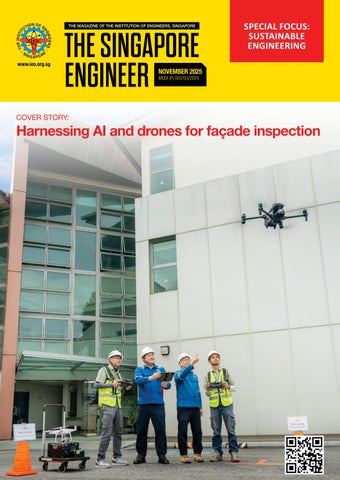
COVER STORY:
Harnessing AI and drones for façade inspection
Know what your building needs —and how to provide it. Ventilation
Indoor Air Quality Amber warning: CO2 levels are rising in your open-plan office.
VENTILATION
INDOOR AIR QUALITY
Red alarm: Ventilation airflow is low in zone 3.
Outdoor air temperature (DAT > RAT).
High discharge air temperature (DAT > RAT).
Indoor Air Quality - Procedure
Ventilation - Procedure
Discharge air temperature rise ACTION: Inspect filter through equipmen and replace clogged. (DAT >ifRAT).
Discharge air temperature rise ACTION: In 2equipmen hours, verify through damper position. Force to (DAT > RAT). minimum open if required.
Verify that the return air temperature sensor is in Auto.
Verify that the return air temperature sensor is in Auto.
Check the outdoor air temperature sensor.
Check the outdoor air temperature sensor.
Verify that the outdoor air temperature sensor input is in Auto.
Verify that the outdoor air temperature sensor input is in Auto.
2ND FLOOR LIGHTS
Lighting Status normal: Every zone is illuminated as scheduled, with energy use within expected ranges. No action needed. High discharge air temperature (DAT > RAT). Discharge air temperature rise through equipmen (DAT > RAT).
What if you and your building spoke the same language? With integrated fault detection and diagnostics (IFDD) from Reliable Controls, you can. Our IFDD solution helps your building communicate clearly—so you can identify issues early, respond faster, and optimize performance with confidence. Guided by experience, grounded in care: Learn how Reliable Controls and IFDD can help you succeed. reliablecontrols.com/IFDD
IES CHARTERED ENGINEERING BOARD
The Chartered Engineering Registry aims to provide professional recognition to qualified Engineers, Technologists and Technicians across all sectors. Being registered as a Chartered Engineering Professional will be an external validation of your experience, expertise and practising competence; and is a quality mark to differentiate your professional standing in the following sectors of engineering: Aerospace
Built Environment
Chemical & Energy
Environment & Water
Engineering Project Management
Infrastructure
Railway & Transportation
Renewable Energy
Sustainability
Systems
cebsg.org ies.org.sg
CONTENTS IES UPDATE 04 IES kicks off 60th Anniversary journey at 59th Annual Dinner 07 Spreading awareness of our vibrant standards community to Young Professionals IES and partners host festive event for CPAS 08 60 metres down: an exclusive tour of Singapore’s critical UCT Network A decade of engineering leaders: celebrating the AELP Class of 2025
04
09 IES/ACES M&E Networking Night 2025 fosters connection and collaboration Great response to the first TSE Connect!
NEWS & EVENTS 10 Obayashi celebrates 60 years in Singapore 12 Fourteen projects awarded under the first Applied Research grant call for Coastal Protection
12
14 Organisations recognised for Workplace Safety, Health and Environmental Excellence
COVER STORY 15 Harnessing AI and drones for façade inspection
15
President Er. Chan Ewe Jin Chief Editor T Bhaskaran t_b_n8@yahoo.com
02
THE SINGAPORE ENGINEER November 2025
Publications Manager Desmond Teo desmond@iesnet.org.sg Editorial Panel Ms Jasmine Foo Dr Chandra Segaran Dr Ang Keng Been Dr Aaron Sham Mr Jaime Vega Bautista Jr
Media Representative Trevor Teh TSE@mnc-link.com
Design & layout by 2EZ Asia Pte Ltd Cover designed by Irin Kuah Cover image by NovaPeak Pte Ltd Published by The Institution of Engineers, Singapore 70 Bukit Tinggi Road, Singapore 289758 Tel: 6469 5000 I Fax: 6467 1108 Printed in Singapore
www.ies.org.sg
FACADE ENGINEERING 18 Optimising manpower and time in facade engineering
SPECIAL FOCUS: SUSTAINABLE ENGINEERING 22 Kingspan joins forces with Meranti Green Steel to accelerate green steel adoption
18
SUSTAINABLE CONSTRUCTION 26 Holcim Foundation Awards 2025 Grand Prize Winners unveiled in Venice
RAILWAY & TRANSPORTATION ENGINEERING 32 The hidden challenge of slab track renewals within Singapore MRT’s ageing tunnels
26
DIGITALISATION 34 Winners of Bentley Systems’ 2025 Going Digital Awards honoured
PROJECT APPLICATION 36 Reference project in Germany for serial 3D-printed housing construction 38 Lifting of 100 t steel plates onto a new bridge
PRODUCTS & SOLUTIONS 40 The new Cat 980 GC wheel loader is defined by high performance and low costs
38
The Singapore Engineer is published monthly by The Institution of Engineers, Singapore (IES). The publication is distributed free-of-charge to IES members and affiliates. Views expressed in this publication do not necessarily reflect those of the Editor or IES. All rights reserved. No part of this magazine shall be reproduced, mechanically or electronically, without the prior consent of IES. Whilst every care is taken to ensure accuracy of the content at press time, IES will not be liable for any discrepancies. Unsolicited contributions are welcome but their inclusion in the magazine is at the discretion of the Editor.
THE SINGAPORE ENGINEER November 2025
03
IES UPDATE
IES kicks off 60th Anniversary journey at 59th Annual Dinner
IES President Er. Chan Ewe Jin addressing the attendees.
The Guest-of-Honour, Minister Chan Chun Sing delivering his speech.
IES60 App enables members and non-members to stay connected with IES’s events, news and exclusive member features, on one platform.
Minister Chan Chun Sing shaking hands with IES President Er. Chan Ewe Jin during the launch of the IES60 mobile app.
The Institution of Engineers, Singapore (IES) celebrated its 59th Annual Dinner on 3 November 2025, with the theme ‘Engineering Our Singapore Together’, spotlighting the vital role of engineers in shaping a sustainable and innovative future for the nation. The event was graced by Guest-of-Honour Mr Chan Chun Sing, Coordinating Minister for Public Services and Minister for Defence, with over 1,100 guests from government, industry and academia in attendance. 04
THE SINGAPORE ENGINEER November 2025
As Singapore commemorates SG60 this year, IES also marked the start of its own 60th anniversary journey, reaffirming its commitment to nation-building through innovation, professional excellence and partnerships, that will carry Singapore into the next decade of growth. Minister Chan witnessed the unveiling of two key initiatives that signal a new era of digitalisation and recognition for the profession: • Launch of the new IES60 App – Singapore’s first institutional app with full Customer Relationship Management (CRM) integration, designed to provide seamless engagement for members and non-members through features such as membership management, Continuing Professional
Development (CPD) tracking and event registration.
The IES–SG60 Commemorative Booklet is a special publication chronicling six decades of engineering milestones that powered Singapore’s growth.
IES UPDATE
• Unveiling of the IES–SG60 Commemorative Booklet – a special publication chronicling six decades of engineering milestones that powered Singapore’s growth, celebrating the ingenuity, resilience and vision of the nation’s engineers. “Engineering has always been at the heart of Singapore’s progress. As we approach IES60, we renew our resolve to empower engineers to build a greener, smarter and more resilient Singapore. These milestones mark not just our embrace of digital transformation, but also our tribute to the engineers who built Singapore’s foundations and continue to shape its sustainable future,” said Er. Chan Ewe Jin, President of IES.
HONOURING DISTINGUISHED ENGINEERING LEADERS AND PARTNERS
During the dinner, IES paid tribute to visionary engineering leaders whose contributions have shaped Singapore’s infrastructure, economy and society. Their achievements exemplify the innovation, resilience and leadership that continue to drive the nation forward. IES LIFETIME ENGINEERING ACHIEVEMENT AWARD 2025 Professor Lim Siong Guan was honoured with the IES Lifetime Engineering Achievement Award 2025, in celebration of his extraordinary influence and inspirational leadership over a distinguished 50-year public service career.
Professor Lim Siong Guan was honoured with the IES Lifetime Engineering Achievement Award 2025.
Mr Desmond Tan, Senior Minister of State in the Prime Minister’s Office and Deputy Secretary-General of NTUC, was conferred the title of IES Honorary Fellow.
Group photo of IES Lifetime Engineering Achievement Award recipient Prof Lim Siong Guan (second from right) with Minister Chan Chun Sing (right), IES President Er. Chan Ewe Jin (second from left) and Er. Joseph Goh, IES Vice President and Deputy Chairman of IES Awards Committee.
Group photo of IES Honorary Fellow title recipient Senior Minister of State (PMO), Mr Desmond Tan (second from right) with Minister Chan Chun Sing (second from left), IES President Er. Chan Ewe Jin (right) and Er. Joseph Goh, IES Vice President and Deputy Chairman of IES Awards Committee.
CONFERMENT OF THE TITLE OF IES HONORARY FELLOW Mr Desmond Tan, Senior Minister of State in the Prime Minister’s Office and Deputy Secretary-General of NTUC, was conferred the title of IES Honorary Fellow for his steadfast advocacy of engineers at IES and Singapore’s nation-building. IES OUTSTANDING PARTNER AWARD 2025 Enterprise Singapore (EnterpriseSG) clinched the IES Outstanding Partner Award 2025 for its significant
Enterprise Singapore (EnterpriseSG) clinched the IES Outstanding Partner Award 2025.
contributions to IES and for making a profound impact on the practice of engineering in Singapore.
Presentation of tokens of appreciation to Minister Chan Chun Sing by IES President Er. Chan Ewe Jin. THE SINGAPORE ENGINEER November 2025
05
IES UPDATE
INSPIRING THE NEXT GENERATION OF ENGINEERS Minister Chan also presented the IES Prestigious Engineering Achievement Awards 2025 which recognise projects that exemplify outstanding engineering innovation and significantly enhance Singapore’s development and quality of life. Emerging out of a rigorous evaluation of 32 submissions, seven projects were declared this year’s winners. WINNERS OF IES PRESTIGIOUS ENGINEERING ACHIEVEMENT AWARDS 2025 Applied Research and Development • Land Transport Authority – LargeScale Fire Tests to Validate Electric Bus Safety in Singapore Engineering Project • Housing & Development Board – Innovative Building Maintenance Solutions: CRR and Microwave Scanning Technology • China Communications Construction Company Ltd and One Smart Engineering Pte Ltd – Construction of Viaduct and Tunnels for Rapid Transit System (RTS) Link • Land Transport Authority – Thomson East-Coast Line Stage 4 – Engineering Sustainability and Excellence in Singapore's Rail Corridor • Defence Science and Technology Agency – SAFTI CITY – The SAF's Next Generation Smart Training Facility
Technology Innovation • Land Transport Authority – Smart and Energy Efficient Street Lighting System with Remote Control and Monitoring System (RCMS) • A*STAR Institute for Infocom Research – Autonomous Collaborative Patrolling Robots The IES Sustainability Awards 2025 were also conferred, to honour forward-looking initiatives that promote sustainable practices and environmental stewardship through engineering excellence. A total of four winners clinched the awards from a total of 11 project submissions. WINNERS OF IES SUSTAINABILITY AWARDS 2025 Promising Start-ups for Sustainability • CRecTech Pte Ltd – Catalytic Innovation Enabling Affordable Green Bio-methanol Innovative Solutions for Sustainability • National University of Singapore
THE SINGAPORE ENGINEER November 2025
BIRTHING A NEW ERA OF STUDENT SCHOLARSHIPS
In line with its mission to nurture the next generation of engineering talent, IES presented its inaugural student scholarship awards to six recipients. These awards underscore the institution’s commitment to supporting promising young engineers in their academic pursuits and professional growth, ensuring a strong and sustainable talent pipeline for Singapore’s future. IES also presented the IES–Yayasan Mendaki Scholarship 2025 to two tertiary Malay/Muslim engineering students with outstanding academic performance.
Recipients of the IES–Yayasan Mendaki Scholarship 2025.
Group photo of the winners of the IES Scholarship Awards 2025. 06
– SHINE: Self-healing actuatable electroluminescent fibre for sustainable interactive technologies • Samwoh Corporation Pte Ltd – Effective Use of Sedimentary Rock from Jurong Rock Caverns in Structural Concrete for Building Construction • Nanosun Pte Ltd – nanobubble Catalytic Oxidation System (n-COS)
IES UPDATE
Spreading awareness of our vibrant standards community to Young Professionals The Institution of Engineers, Singapore – Standards Development Organisation’s (IES-SDO) recent Young Professionals Standards Bootcamp 2025, held on 6 November 2025, welcomed close to 50 early-career professionals from across 27 organisations in Singapore. Participants had the opportunity to gain first-hand experience into what it is like participating in a working group, by commenting on draft standards and exchanging opinions to improve on them. We were also grateful to have our standards partners, Mr Darren Lim, Dr Richard Kwok, Prof Marcelo H Ang Jr and Assoc Prof Darren Chian, to provide the young professionals with insights on areas such as: • The importance of establishing standards within the building and construction industry. • How standards are crucial in governing and guiding the vast variance of mobility in the transportation industry. • The actual journey of being a young professional starting out as an observer in a working group to being a full member.
The bootcamp welcomed close to 50 early-career professionals from across 27 organisations in Singapore.
Participants gained first-hand experience into what it is like participating in a working group.
Dr Richard Kwok sharing his insights.
IES and partners host festive event for CPAS During this season of giving, IES once again joined hands with our partners, Singapore Airlines, Malaysia Singapore Vintage Car Register (MSVCR) and the aerospace community, to bring festive cheer to the children of the Cerebral Palsy Alliance Singapore (CPAS). Hosted by The Tanglin Club for the fourth year running, on 11 November, the annual Christmas Party saw more than 150 guests, including 53 children, 40 caregivers and 20 CPAS teachers and staff, come together for an evening of joy
and celebration. Capping off the celebration was a heartwarming vintage car convoy, where 36 classic cars cruised down Orchard Road, for the children to take in the dazzling Christmas lights
- a truly magical ride filled with smiles and laughter. IES is delighted to support this meaningful event by contributing to the meals and goodie bags for the children.
Here is to engineering joy and compassion, one Christmas at a time! THE SINGAPORE ENGINEER November 2025
07
IES UPDATE
60 metres down: an exclusive tour of Singapore’s critical UCT Network
The IES Energy Technical Committee organised the landmark visit to SP Group’s Underground Cable Tunnel (UCT) Network.
Sixteen IES members were granted exclusive access to SP Group’s Underground Cable Tunnel (UCT) Network, on 12 November. The IES Energy
Technical Committee organised the landmark visit. As the first visitors ever to enter this critical national infrastructure, the group explored the 6 m
diameter tunnels located 60 m underground – gaining a unique insight into Singapore’s high voltage transmission cables highway.
A decade of engineering leaders: celebrating the AELP Class of 2025 IES Academy, in collaboration with NTUC PME, proudly celebrated the graduation of the participants of the Advanced Engineers Leadership Programme (AELP) 2025, on 13 November. This milestone event marked the successful 10th run of the flagship programme, which is dedicated to developing the next generation of engineering leaders. The ceremony was graced by IES President, Er. Chan Ewe Jin, as the Guest-of-Honour. Designed to empower midlevel engineers, the AELP equips participants with the critical leadership competencies and future-ready skills needed to thrive in a rapidly evolving industry. Through a comprehensive curriculum, featuring masterclasses, collaborative group projects and immersive learning journeys, the programme bridges the gap between technological expertise and strategic management. This immersive experience has 08
THE SINGAPORE ENGINEER November 2025
prepared the graduates to step into greater responsibilities and lead with confidence in their respective sectors. We extend our warmest congratulations to the AELP 2025 graduates and our sincere gratitude to the trainers, mentors and judges,
whose dedication was instrumental to the programme’s success. Together with our partners, IES Academy remains steadfast in its mission to advance the engineering profession and cultivate leaders who will shape the future of Singapore's industry.
The ceremony was graced by IES President, Er. Chan Ewe Jin (left), as the Guest-of-Honour. IES Deputy President, Mr Mervyn Sirisena (right), also spoke at the event.
The graduation ceremony marked the successful 10th run of the flagship programme.
IES UPDATE
IES/ACES M&E Networking Night 2025 fosters connection and collaboration
The mechanical and electrical (M&E) community came together for an evening of connection and collaboration. The evening also featured insightful presentations and critical industry updates by distinguished speakers.
The IES/ACES M&E RE/RTO Networking Night 2025, held on 18 November, at the Lifelong Learning Institute, was a resounding success. The event saw an excellent turnout, uniting the mechanical and electrical (M&E) community for an evening of connection and collaboration. IES/ACES M&E Networking Night 2025 served as a dynamic platform for Registered Engineers (REs), Registered Technical Officers (RTOs), engineers, consultants and
industry leaders, to network, share insights and discuss the future of the profession. The evening featured insightful presentations and critical industry updates, fostering meaningful engagement among all attendees. We extend our sincere gratitude to our distinguished speakers for sharing their expertise: • Mr Collin Lau Boon Seng (Daikin Singapore) • Mr Rahul Dev (Daikin Holdings
Singapore) • Er. Ho See Fong (HY M&E Consultancy Services) A special note of thanks to our event sponsor, Daikin, for their generous support and partnership, which was instrumental in bringing this event to life. Finally, we thank every participant who joined us and contributed to the vibrant discussions. Your presence made the evening a memorable success!
Great response to the first TSE Connect! What an incredible evening on 21 November at the inaugural The Singapore Engineer (TSE) Connect networking session! We were thrilled to see our amazing advertisers, partners and stakeholders come together to Converge, Connect and Collaborate. The energy at the venue, HUONE
Singapore, was fantastic, filled with great conversations, delicious food and a truly relaxed vibe. A massive thank you to everyone who joined us and made the night such a resounding success! We are also deeply grateful to our sponsors, whose generous support made this event possible:
• Our Gold Sponsors: BYD and Mitsubishi Electric • Our Venue Sponsor: HUONE Singapore Here is to strengthening our community and building on the connections made at the event. We cannot wait to see what we achieve together, next!
A massive thank you to everyone who joined us at TSE Connect. We are also deeply grateful to our sponsors. THE SINGAPORE ENGINEER November 2025
09
NEWS & EVENTS
Obayashi celebrates 60 years in Singapore Year 2025 marks Obayashi’s 60th anniversary in Singapore, a milestone that coincides with the nation’s SG60 celebration. To commemorate this occasion, Obayashi participated in BEX Asia 2025, the Built Environment Expo, which was held in Singapore, from 3 to 5 September 2025, as a highlight of the International Built Environment Week (IBEW) 2025 themed ‘Today’s Professional, Tomorrow’s Expert’. Obayashi participated in IBEW 2025’s Expert Series as both a theatre sponsor and an exhibitor. Mr Patrick Chia, Director at Obayashi Singapore, delivered a speech on Building Information Modelling (BIM) and Dr Ayako Kameda, Executive Officer at Obayashi Corporation, shared the company’s vision of building a sustainable future. This represents Obayashi’s contributions to growing expert knowledge and sharing best practices with the industry. Journey in Singapore Obayashi’s journey in Singapore began in 1965 – the same year the nation gained its independence. That very year, Obayashi took on the ambitious East Coast Reclamation Project, a major development along Singapore’s coastline to reclaim 1,114 hectares, primarily for commercial and residential use. Since then, Obayashi has been actively contributing to Singapore’s skyline, with landmark projects to grow the company in tandem with the nation’s development. Such projects include DBS Tower II, PWC Building, Ocean Financial Centre, One Raffles Quay, and DUO – a special mixed-use development by Malaysia and Singapore’s investment companies in a joint venture. Obayashi received the Building and Construction Authority’s (BCA) Company of the Year Award in 2024. 10
THE SINGAPORE ENGINEER November 2025
Obayashi participated in IBEW 2025’s Expert Series as both a theatre sponsor and an exhibitor.
The company’s top management visiting the exhibition booth.
Dr Ayako Kameda, Executive Officer at Obayashi Corporation, sharing the company’s vision of building a sustainable future.
Commitment to Singapore’s construction sector Obayashi’s commitment to Singapore remains strong. Currently undertaking major projects, such as Eastern General
Hospital at Bedok, Changi Airport Terminal 5’s substructure and data centre developments, the company is dedicated to building Singapore’s future infrastructure. With Singapore’s projected strong
NEWS & EVENTS
construction demand in the years ahead, Obayashi is confident of being able to contribute to the nation’s continued growth. Development of human resources Obayashi continues to invest extensively in developing human capital. As part of this initiative, the company was joined by trade partners and subcontractors in an effort to raise SGD 1.5 million. The amount raised would support students in their studies at Singapore’s universities, through scholarships and bursaries which were presented at Obayashi’s anniversary dinner. Investing in advanced technologies Obayashi has consistently deployed the latest construction technologies to improve productivity, reduce inefficiencies and enhance worker safety. Some examples include BIM modelling and the use of photogrammetry software, combined with images taken from a drone camera, to generate precise point cloud data and models. This system helps to track, monitor and verify site progress more efficiently. To take the next step of future-proofing the company’s business, Obayashi has also set up a Construction-Tech Lab at BCA’s Braddell Campus, to advance technology development by researching and developing solutions that address the challenges faced in the construction sector – reducing reliance on workers through robotic adoption; creating robot-friendly work sites and helping robots to understand their surroundings, to further optimise processes; and developing 3D printed joints for automated construction. These developments were presented at the first Obayashi Vision Showcase outside of Japan, themed ‘Obayashi SG60 Vision’. The exhibition demonstrated the company’s commitment to sharing knowledge, and inspiring and attracting young talent to join the built environment sector, to build Singapore’s next chapter.
GeoDrop – a bucket soil adhesion prevention material.
Application of 3D printing in construction.
The Loop50 Concept – a circular, timber-based town that aims to create a symbiotic relationship between forests and cities. Visitors learn more about Obayashi’s advanced technologies and vision.
Mr Kelvin Wong, Chief Executive Officer of BCA, said, “Congratulations to Obayashi Singapore on reaching this remarkable 60-year milestone. Obayashi has consistently demonstrated leadership in adopting innovative technologies,
such as with their photogrammetry software and Construction-Tech Lab, to set a benchmark for excellence in Singapore’s BE sector. BCA looks forward to partner Obayashi in the years to come to push for industry excellence for Singapore’s built environment sector.” THE SINGAPORE ENGINEER November 2025
11
NEWS & EVENTS
Fourteen projects awarded under the first Applied Research grant call for Coastal Protection PUB, Singapore’s National Water Agency has awarded 14 projects under the Coastal Protection and Flood Management Research Programme’s (CFRP) first Applied Research grant call, worth a total of SGD 22 million. This was announced by Ms Goh Hanyan, Senior Parliamentary Secretary for the Ministry of Sustainability and the Environment and the Ministry of Culture, Community and Youth, at the Coastal Protection and Flood Resilience Institute (CFI) Singapore’s 2nd Annual Symposium. PUB launched the SGD 125 million Coastal Protection and Flood Management Research Programme (CFRP) in March 2023 to support climate adaptation efforts. CFRP consists of three key pillars – CFI Singapore, Applied Research and Living Lab. The Applied Research grant call, launched at the Singapore International Water Week 2024, is part of PUB’s efforts to promote research collaboration with industry partners as well as cross-sector knowledge transfer for coastal protection and flood management. PUB received a total of 47 proposals for the grant call, with two-thirds of the proposals involving collaboration between Institutes of Higher Learning (IHLs) and industry players. The proposals were evaluated, based on several criteria such as practical applications within Singapore's context, level of innovation, ideas to monetise and retain value in Singapore, as well as alignment to national policy such as the Singapore Green Plan 2030. The CFRP’s Applied Research grant aims to tap on solutions from adjacent sectors and the industry for coastal protection and flood management applications, focusing on solutions with higher technology 12
THE SINGAPORE ENGINEER November 2025
Lightweight low-carbon concrete using cold-bonded aggregate. Image: Pan-United Corporation.
readiness and potential for nearterm adoption. The 14 projects span five focus areas, each with the aim to identify and plug the current knowledge gaps in coastal protection and flood management in Singapore’s context. These solutions include coastal protection measures that utilise recycled waste, and the development of monitoring technologies for coastal protection structures. The five focus areas are: • Sustainable Materials for Coastal Protection Infrastructure • Smart Structural Health Monitoring (SHM) System for Coastal Infrastructure • Comprehensive Decision Matrix for Adaptive Coastal Protection Planning • Innovative Engineering Solutions for Coastal Protection and Flood Management • Innovative Monitoring Techniques for Sediment Transport Sustainable Materials for Coastal Protection Infrastructure One of the projects is led by PanUnited Concrete, a subsidiary of Pan-United Corporation, which is a global leader in low-carbon concrete technologies. Working in partnership with the Nanyang Technological University, Singapore
(NTU Singapore), Pan-United aims to develop lightweight low-carbon concrete, using cold-bonded aggregate produced from waste materials and injected with industrial waste carbon dioxide. It could be used to retrofit existing coastal protection measures or in new coastal protection measures to achieve greater adaptability due to its lightweight property. This novel approach demonstrates how coastal resilience can be enhanced while advancing resource circularity. Smart Structural Health Monitoring (SHM) System for Coastal Infrastructure Another project addresses a fundamental challenge in how coastal structures can be effectively inspected periodically as they age. Current structural health monitoring relies on manual inspections which are labour-intensive and limited by accessibility and safety issues. The National University of Singapore (NUS) is partnering BeeX and Delta Marine Consultants to revolutionise this process. BeeX is a homegrown Small and Medium Enterprise (SME) that has a track record of developing autonomous underwater inspection capabilities. The project team will
NEWS & EVENTS
BeeX’s flagship Hovering Autonomous Underwater Vehicle (HAUV), A.IKANBILIS, used for underwater inspections Images: BeeX.
combine autonomous robots with underwater Non-Destructive Testing techniques to deliver more accurate and efficient underwater structural inspections, thereby improving the protection of Singapore’s coastal infrastructure. This enables more sustainable inspection practices in the longer run, which also enhances safety. Innovative Engineering Solutions for Coastal Protection and Flood Management This project aims to attenuate wave energy while creating a natural environment to support marine biodiversity. It also upcycles food waste shells as partial substitutes for conventional rock armours and utilises waste materials such as good earth soil and marine clay. The Technology Centre for Offshore and Marine, Singapore (TCOMS) is leading the project, with partners Surbana Jurong (SJ Group) and Tropical Marine Science Institute (TMSI), leveraging on their deep understanding of the coastal environment, as well as TCOMS’ advanced cyber-physical modelling capabilities and SJ Group’s proven expertise in executing complex coastal engineering projects. Following the completion of these Applied Research projects, the solutions could transition to CFRP’s Living Lab programme, for additional pilot testing and potential commercialisation.
Conceptual illustration of a submerged bund with biogenic shell-filled grids. Image: SJ Group.
Ms Hazel Khoo, PUB’s Director of Coastal Protection, said, “The award of these Applied Research projects represents a significant milestone for PUB in advancing our R&D journey for coastal protection and flood management in Singapore.” “By working together with the industry and academia, we are not only developing innovative solutions against sea level rise but also advancing knowledge and skillsets of our partners to eventually adopt solutions that are adaptive, sustainable and costeffective for actual implementation. We look forward to successful proof-of-concepts that will contribute to address Singapore’s coastal protection and flood management challenges,” Ms Khoo added. CFI Singapore making good progress Launched in September 2023 under
the CFRP, CFI Singapore is the Centre of Excellence which conducts fundamental research, builds local capabilities, and helps PUB to determine the focus areas for Applied Research and Living Lab. The Institute and its partners have made good progress on 17 research projects, ranging from coastal modelling and forecasting capabilities to innovative engineering and hybrid solutions. CFI Singapore has also trained over 90 researchers and students todate, nurturing the next generation of coastal protection and flood management specialists. Research and development play a critical role in building Singapore’s capability to address challenges from rising sea levels and climate change. PUB will look to commence the next tranche of core research projects with CFI Singapore and kickstart test-bedding of solutions under the CFRP’s Living Lab, in 2026. THE SINGAPORE ENGINEER November 2025
13
NEWS & EVENTS
Organisations recognised for Workplace Safety, Health and Environmental Excellence Fifty-one organisations were recognised by the Land Transport Authority (LTA) for their outstanding workplace safety, health and environmental management practices, at the 27th Annual Safety, Health and Environmental Awards Convention (ASAC), held on 16 September 2025, at Singapore Expo Max Atria. Themed ‘Owning and Leading Safety Together’, the event emphasised the importance of collective ownership and leadership to improve workplace safety and health (WSH), while safeguarding the health and safety of the workers. The top award, the LTA Contractors Champion Shield, was awarded to Hwa Seng Builder Pte Ltd for its work on the design and construction of JW5 Station and Viaduct for Jurong Region Line. In total, 80 awards were presented, nine more than last year. Continued emphasis on innovation and environmental management initiatives LTA and its industry partners all play an important role in fostering a strong safety culture and supporting the well-being of all workers. LTA is also committed to improving WSH through innovation and environmental management, by adopting new, safer, more productive and sustainable technology. Guthrie Engineering (S) Pte Ltd was awarded the Construction Safety Innovation Award for its solution that integrates Design for Manufacturing and Assembly (DfMA) technology and a helical elevator system to transport and install Mechanical & Electrical (M&E) modules on-site. This system eliminates the need for workers to work at height during ducting and piping installation, reducing their exposure to work-at-height safety hazards. 14
THE SINGAPORE ENGINEER November 2025
China Civil Engineering – China Railway 11 – Wai Fong Consortium was also awarded the Construction Safety Innovation Award, for the use of an automated launching gantry for the construction of the North-South Corridor (NSC) viaduct. The implementation of the 360° auto-rotating rigger system offers significant safety enhancements through two key features. First, it removes the need for workers to attach taglines and manually control the 125 t viaduct segments during launching. Instead of requiring eight riggers, one operator can now control and rotate viaduct segments from a distance, minimising the risks from working at height. Second, the launching gantry is now automated, cutting manpower requirements by more than half. The new remotecontrolled motorised system also helps to eliminate the risk of hand injuries and gives the operator a wider field of vision to monitor operations. In addition, advanced sensors can automatically trigger brakes at preset limits to prevent the launching gantry from overshooting
beyond the intended path. Samsung C&T Corporation received the Environmental Sustainability Innovation Award for implementing retractable enclosures as temporary covers for tunnel launching shafts. These enclosures can be remotely operated to cover tunnel shaft openings during inclement weather. Besides providing shelter for workers, the enclosures also prevent rainwater accumulation in underground work areas.
DfMA Module (M&E) installation using a Helical Elevator by Guthrie Engineering (S) Pte Ltd.
Automated launching gantry for NSC viaduct by China Civil Engineeering – China Railway 11 – Wai Fong Consortium.
COVER STORY
Harnessing AI and drones for facade inspection by Er. David Ng, Prof Er. Victor Ong and Ms Kong Kee, One Smart Engineering Pte Ltd and Mr Eugene Choy, NovaPeak Pte Ltd Ensuring safety and compliance with BCA regulations.
Er. David Ng
Prof Er. Victor Ong
INTRODUCTION Singapore’s urban landscape is a testament to its status as a modern city. At the same time, with numerous high-rise buildings and complex infrastructure, ensuring the safety and integrity of these structures has become a top priority. One critical aspect of building maintenance is facade inspection which involves examining the exterior of buildings for defects, damage or deterioration. Traditional methods of facade inspection can be time-consuming
Ms Kong Kee
and costly, and can pose safety risks to inspectors. However, with the advent of Artificial Intelligence (AI) and drone technology, building owners and maintenance teams can now harness these innovative solutions to ensure compliance of the facade inspection with Building and Construction Authority (BCA) regulations. BCA requires periodic façade inspections for buildings to ensure their safety and structural integrity. The following is a summary of the requirements which are also shown
Mr Eugene Choy
in Figure 1: • Implementation of Mandatory Periodic Inspection Scheme: All buildings, except certain exempted buildings like landed properties and certain private dormitories, are required to undergo periodic façade inspections, every 10 years, if a building less than 10 years old, and every seven years, if a building is 10 years old or older. • Appointment of Competent Person: The inspection must be conducted by a Competent Person (CP) registered with BCA. • Inspection Scope: The inspection
Figure 1: Summary of BCA requirements for periodic facade inspection on buildings. Image: One Smart Engineering Pte Ltd. THE SINGAPORE ENGINEER November 2025
15
COVER STORY
should cover all façade components, including windows, claddings and other external elements. • Reports and Rectification: The CP is required to submit a report detailing the findings and recommending repairs or maintenance works. Building owners are required to rectify any defects or issues identified during the inspection. The goal of this scheme is to prevent potential hazards and ensure the safety of building occupants and the public. Building owners and developers are advised to engage qualified professionals and follow BCA’s guidelines, to ensure compliance. THE CHALLENGES OF TRADITIONAL FAÇADE INSPECTION Traditional façade inspection methods often rely on visual checks performed through rope access, gondola systems or manual photography. These methods can be labour-intensive, require extensive scaffolding and pose safety risks to inspectors. Moreover, these methods may not be effective in detecting hidden defects or damage, which can lead to costly repairs or even accidents. Figure 2 shows labour-intensive façade inspection, with a worker physically performing the inspection.
AI-POWERED DRONE INSPECTION The integration of AI and drone technology represents a fundamental shift in how façade inspections are conducted. Drones equipped with high-resolution cameras and advanced sensors can capture detailed images of building exteriors, safely. These images are analysed by AI algorithms trained to detect cracks, corrosion, material spalling and surface anomalies, with remarkable accuracy. Figure 3 shows engineers in action, using a drone to assist in building façade inspection. The benefits of using drones to conduct building façade inspections are substantial and include: Improved Safety: Drones eliminate the need for inspectors to work at
height, reducing the risk. Increased Efficiency: AI-powered drone inspections are faster and require fewer resources than conventional methods, enabling larger portfolios to be inspected within shorter time-frames. Enhanced Accuracy and Reliability: AI models are continually refined, using extensive visual datasets gathered from real-world projects. This allows them to detect subtle defects and patterns that may escape human observation. Over time, this self-improving process ensures higher reliability and consistency of results. COMPLIANCE WITH BCA REGULATIONS Since the PFI regulations took effect in January 2023, enforcement has intensified, following multiple
Figure 2: Labour-intensive, physical façade inspection. Images: One Smart Engineering Pte Ltd.
Figure 3: Engineers in action, using a drone to assist in building façade inspection. Images: One Smart Engineering Pte Ltd. 16
THE SINGAPORE ENGINEER November 2025
COVER STORY
incidents of falling façade elements. On average, around 30 cases are reported annually, with some property owners and managing agents being fined or issued warnings for lapses in façade maintenance. These developments reinforce the fact that compliance with Technical Reference 78 is not merely procedural but essential for public safety. AI-powered drone inspections support CPs in meeting these regulatory requirements with precision. The technology also complements the professional judgement of engineers and architects, providing them with comprehensive data that strengthens the validity of inspection findings and enhances accountability. A CASE STUDY A leading property management firm in Singapore recently implemented AI-powered drone inspection across several residential and commercial buildings. By deploying drones for full façade coverage and using AI algorithms to detect and classify defects, the firm achieved a more than 50% reduction in inspection time and a reduction in cost, compared to manual methods. In this workflow, data collected by drones was processed through NovaPeak’s LiveInspect.AI platform which supports multi-user collaboration, defect tagging and compliance reporting, under TR 78. This example demonstrates how digital collaboration between inspection technology and engineering management systems can deliver measurable efficiency gains, without compromising regulatory compliance. THE ROAD AHEAD Harnessing AI and drone technology for façade inspection represents a decisive advancement for Singapore’s building maintenance sector. It aligns national safety regulations with the Smart Nation vision, by transforming inspection practices into data-driven, verifiable
Figure 4: Utilising LiveInspect.AI for defects detection and generation of reports. Image: NovaPeak Pte Ltd.
Figure 5: Continuous AI learning via Liveinspect.AI unified smart periodic façade inspection platforms. Image: NovaPeak Pte Ltd.
and predictive processes. Through AI analytics and automated documentation, façade inspections can now deliver not only compliance but also continuous assurance of building health and safety. As more engineering consultancies adopt AI solutions, the reliability of these systems will continue to improve, through ongoing data learning and validation. This synergy between human expertise and intelligent automation will redefine how structural integrity is managed – setting new benchmarks for efficiency, transparency and accountability, in the built environment. RECOMMENDATIONS FOR BUILDING OWNERS Our recommendations and
conclusions are, as follows: • Adopt AI-Powered Drone Inspection: Consider harnessing AIpowered drone inspection for your façade inspection needs. • Ensure Compliance: Ensure compliance with BCA regulations, by conducting regular façade inspections with accredited Drone Service Providers. • Invest in Training: Invest in training your maintenance team to work with AI-powered drone inspection technology. By embracing AI-powered drone inspection of building facades, building owners and maintenance teams can ensure the safety and integrity of their buildings, while also reducing costs and improving efficiency. THE SINGAPORE ENGINEER November 2025
17
FAÇADE ENGINEERING
Optimising manpower and time in facade engineering by Mathieu Meur, Director, DP Façade The latest developments are transforming the way building envelopes are designed, engineered and constructed.
Mr Mathieu Meur
In recent months, we have seen numerous exciting developments in the field of façade engineering, that are assisting professionals significantly. Automated ETTV calculations and carbon assessment Calculating Envelope Thermal Transfer Value (ETTV) or, for residential projects, Residential Envelope Transmittance Value (RETV) is one of the most tedious, error‑prone tasks in façade design. Traditionally this requires manually measuring façade areas from drawings or models created by Building Information Modelling (BIM), deriving U‑values and glazing performance for each assembly, and transcribing multiple lookup coefficients into spreadsheets. The process can consume several weeks of an engineer’s time, delaying design decisions and blocking the wider project team until results are available. NimbleFaçade, developed by Spatial Intelligence for Design (SID) in collaboration with DP Façade, automates this workflow. The tool ingests IFC models – compatible with CorenetX submissions that already include façade geometry and room ventilation schemas – and extracts the required data in the cloud. It then computes ETTV/RETV and produces submission‑ready forms that the responsible QP can review and submit to the authority. By removing manual measurement and data entry, NimbleFaçade typically reduces processing time by 80% to 90%. Tasks that took three to four weeks on large projects can be completed in a few 18
THE SINGAPORE ENGINEER November 2025
NimbleFaçade computes ETTV/RETV and produces submission‑ready documentation in a short time.
hours, excluding QP verification. The platform also includes a curated library of hundreds of real glass performance datasets from regional suppliers, enabling designers to select manufacturers’ actual products rather than approximate values that are often incorrect or impossible to achieve. In addition, NimbleFaçade can estimate embodied carbon for façade assemblies using its material library of equivalent carbon values, providing early lifecycle insight alongside thermal compliance outputs. Parametric BIM documentation Parametric BIM documentation is closing the gap between conceptual façade ideas and fully coordinated
construction deliverables. Instead of producing static 2D drawings that must be repeatedly updated as design decisions evolve, engineers and façade consultants now build rule-driven BIM objects and templates that automatically adapt to dimensional, structural and performance constraints. A parametric approach enables the following: • Rapid iteration: a single change to a control parameter (mullion spacing, panel module, thermal break depth, support point locations) propagates through the model, instantly updating design intent or shop drawings, schedules and bill-of-materials. • Consistency and coordination: embedded rules enforce clear
FAÇADE ENGINEERING
relationships between façade systems, structure and MEP penetrations, reducing errors at handover and on site. • Performance-driven detailing: parametrically linked thermal, structural and water-tightness criteria allow the model to flag noncompliant assemblies and suggest alternatives before costly rework. • Fabrication-ready outputs: CAMfriendly geometry (nested panels, CNC/robot paths, punch and fold lines) can be exported directly from the BIM model, shortening lead times and reducing transposition errors. Implementation of best practices involves creating a modular object library for recurrent elements (glazing units, spandrels, fixed louvres) with editable parameters and material options, as well as using federated models and clash avoidance rules to ensure façade components do not conflict with internal structure or services. Automating documentation flows allows designers to link BIM schedules to procurement and fabrication systems so that any approved design variant instantly produces updated material lists and production files, greatly improving coordination and efficiency. However, it is essential to maintain versioned rule-sets and validation scripts so that team members can consistently reproduce decisions and audit compliance with local codes and performance targets. All in all, the impact of this approach is significant. Parametric documentation reduces coordination cycles, lowers fabrication errors and allows design teams to evaluate multiple façade options quickly for cost, performance and constructability – turning what used to be weeks of manual drafting into a matter of hours for each iteration. CFD wind pressure simulations Contemporary building codes and prescriptive charts are often inadequate for assessing wind pressures on non‑standard geometries, particularly for slender
CFD can be used to generate detailed pressure maps around building facades.
forms, overhanging elements and free‑spanning façade features whose flow separation and vortex interactions deviate from canonical shapes. Wind‑tunnel testing has long been the reference method for such complex cases, but mounting, instrumenting and measuring pressures on thin or cantilevered components can be technically
difficult, time‑consuming and costly, and some dynamic local effects are hard to capture at model scale. High‑fidelity computational fluid dynamics (CFD) offers a practical alternative for early and iterative assessment. Modern, specialised CFD packages can rapidly simulate three‑dimensional, turbulent wind flows around bespoke façades, THE SINGAPORE ENGINEER November 2025
19
FAÇADE ENGINEERING
identify local suction and high pressure zones, and generate detailed pressure maps across panels and mullions. Best‑in‑class tools export pressure time‑histories or surface load fields directly into structural analysis programs (FEA/BIM workflows), enabling loads to be applied to curtain wall elements or primary structure, without manual reformatting, and reducing cycle time between aerodynamic insight and structural checking. Although many authorities and codes still require validated physical wind‑tunnel reports for final design approvals, integrated CFD can be used from early stages of the design process to provide robust preliminary loads, to explore design variations, and to focus targeted wind‑tunnel testing where it matters most. When combined with sensitivity studies and validation against limited wind‑tunnel or field data, CFD can materially de‑risk façade design and shorten delivery timelines while awaiting formal experimental certification. AI rendering, rapid prototyping and 3D metal printing Visualisation and physical prototyping have accelerated dramatically, thanks to advances in AI-driven rendering, inexpensive rapid prototyping and additive manufacturing for metal components. Generative and physically based renderers now produce photorealistic façade studies from BIM geometry in minutes, including useful previews of solar exposure, daylighting and glare. This speed lets stakeholders assess aesthetic and performance trade-offs early in the process, without the time and cost of full-scale mock-ups, shortening decision timelines and reducing Requests For Information (RFIs) during construction. At the same time, desktop computer numerically controlled (CNC), stereolithography (SLA) and fused deposition modelling (FDM) printers enable quick, low-cost production of scaled 20
THE SINGAPORE ENGINEER November 2025
3D printed aluminium nodes. The process of 3D metal printing is most economical for low-volume, high-complexity parts.
models and detail mock-ups. These tangible pieces allow designers and fabricators to evaluate module junctions, gaskets and drainage strategies in hand, accelerating the design–test–refine loop and revealing practical issues that purely digital reviews can miss. For bespoke metal components, additive manufacturing methods such as selective laser melting (SLM) and binder-jetting open new possibilities. 3D metal printing can deliver complex, topologyoptimised connectors, bespoke brackets and integrated drainage parts that would be prohibitively expensive or impossible with traditional casting or machining. These printed parts can combine multiple functions – structural load paths, thermal breaks and concealed fixings – into fewer parts with improved reliability and
performance. The combined effect of faster visuals, quick physical mock-ups and on-demand metal parts is tangible. Teams reach stakeholder consensus more quickly, produce higher-fidelity prototypes for performance testing, and shorten lead times for bespoke items. However, the technology is not a universal replacement for conventional fabrication. 3D metal printing is most economical for lowvolume, high-complexity parts, and additively manufactured components must undergo structural testing and corrosion-protection verification before use in façades. To integrate these methods successfully, teams should ensure exported BIM geometry includes tolerances and surface-finish specifications compatible with additive processes, and reserve
FAÇADE ENGINEERING
printing for parts where the design benefits justify the cost. Inspection drones and robots Condition assessment and maintenance of façades are critical for safety and asset longevity. Recent years have seen an increasing trend in the use of aerial drone surveys for façade inspections. On the other hand, inspecting the cavities between the cladding and structure has until now remained largely a manual affair, often involving teams of rope access technicians and the removal of large numbers of cladding panels to have access to brackets, runners and anchors. Drones are rapidly becoming commonplace for façade inspections. Their speed, range and sensor payloads (high-resolution cameras, thermal imagers, LiDAR) make them ideal for broad condition surveys, thermal mapping and post-event assessments with minimal disruption. They are especially useful for tall or hardto-access façades, and their data – photogrammetry, orthomosaics and georeferenced imagery – feeds directly into asset-management systems and digital twins for trend analysis and triage. Robots capable of inspecting the cavities between the façade and the building structure remain rare or non‑existent due to significant technical and operational challenges – confinedspace navigation, variable cavity geometries, anchorage and access, power and communications, possible obstacles within cladding cavities, and reliable sensor integration for non-destructive testing. These difficulties make cavity inspection robots complex to design, costly to build and hard to deploy at scale. That said, a pioneering robotics team has made notable progress over the past few months. Working closely with BCA and DP Façade, they have developed a practical, efficient and cost‑effective solution aimed at these exact challenges. The key focus areas include a
compact, modular platform that can adapt to varying cavity widths and surface conditions, hybrid locomotion strategies and adaptable support systems to traverse irregular cavities. Lightweight tethered power and communications systems are implemented to overcome battery and signal limits in enclosed spaces, especially when inspecting metal cladding cavities. Inspectors are able to leverage AI-assisted defect detection to prioritise areas for manual intervention and reduce inspection time. Integrated sensor suites (borescopes, ultrasonic probes, high-resolution imaging, thermal probes) for detailed NDT and joint assessment are partially implemented, while others are planned to be deployed in the next phase of design. The use of drones for initial rapid surveys and thermal mapping from a distance is now widely adopted to identify likely problem zones. Where drone data indicates potential internal issues (hidden water ingress, delamination, or anchor anomalies), a targeted cavity inspection using the emerging robotic solutions or controlled intrusive inspection is preferable over the current widespread deployment of rope access technician teams. Drone and robot data can then be integrated into a shared digital-twin platform so successive inspections build a longitudinal condition record and inform maintenance prioritisation. Wider adoption of cavityinspection robots will depend on continued field trials, demonstrated reductions in inspection time and cost, and proven reliability across diverse façade systems. The collaboration between robotics firms, BCA and DP Façade is accelerating that validation cycle, and practical, scalable robotic cavity inspections look increasingly achievable within the next few months. Conclusion Façade engineering is rapidly
AI-generated illustrations of an inspection robot. The actual design is pending patent/ copyright registration.
evolving as digital workflows, automation and new manufacturing methods intersect. • Tools like NimbleFaçade accelerate compliance tasks that once took weeks. • Parametric BIM workflows compress coordination and fabrication loops. • AI rendering and additive manufacturing let teams iterate design and produce complex bespoke parts quickly. • Combined drone-robot inspection strategies improve safety and maintenance efficiency. Together these developments are making façades smarter, safer and more sustainable – while shifting the role of the façade engineer from draughtsperson to systems integrator and data-driven problem-solver. THE SINGAPORE ENGINEER November 2025
21
SPECIAL FOCUS: SUSTAINABLE ENGINEERING
Kingspan joins forces with Meranti Green Steel to accelerate green steel adoption Encouraging the increased use of environment-friendly raw materials. Kingspan, a global leader in high-performance insulation and building envelope solutions, has announced the signing of a Memorandum of Understanding (MoU) with Meranti Green Steel, a Singapore-headquartered company constructing what is set to be Southeast Asia’s first major green steel plant. The collaboration marks another significant step forward in Kingspan’s strategy to procure lower carbon and green steel at scale, driven by its group-wide Planet Passionate environmental sustainability programme. Through the programme, Kingspan aims to enhance the environmental performance of its product portfolio by reducing emissions across its manufacturing sites and reducing the carbon intensity of its key raw materials, including steel. By partnering with Meranti Green Steel, Kingspan also aims to help accelerate the availability of green steel within the Asia Pacific (APAC) region. Demand for green steel is showing strong promise in this region, with the APAC green steel market forecast to grow faster than other markets, from 2024-2034 [1]. Meranti Green Steel will support these ambitions by supplying Kingspan with green steel for its operations in the APAC region. This will be facilitated via Meranti Green Steel’s new plant on Thailand’s east coast, which is on track to break ground at the end of 2026 and be commissioned by the end of 2029. Meranti Green Steel’s products will be manufactured from scrap and hot briquetted iron (HBI) produced using a mix of green hydrogen and natural gas, at its Oman plant, and processed in electric arc furnaces (EAFs) in Thailand. 22
THE SINGAPORE ENGINEER November 2025
Over the next four to five years, Meranti Green Steel aims to increase its use of renewable energy in Thailand to 100%, through direct Power Purchase Agreements and third-party access to the Thai national grid or dedicated power lines from its plant in Rayong. Letters of Intent have also been signed with several private green power suppliers in Thailand, with a total proposed capacity of 1.7 GW solar, wind and hydro power. The company aims to reduce the carbon intensity of steel by up to 90% by 2045, compared to steel produced using conventional CO2intensive production methods – from approximately 2,300 kg CO2e per tonne of steel [2] to as low as 200 kg - 650 kg CO2e per tonne of steel. Through the partnership, Meranti Green Steel plans to deliver 7 million to 8 million tonnes per annum (Mtpa) of green steel, through a network of strategic hubs across Thailand and Oman, with potential future expansion into Indonesia, Western Australia and further locations within the APAC region. On the collaboration, Mark Broderick, Procurement Director at Kingspan Group, said, “Decarbonisation cannot happen in isolation – it requires a global approach and meaningful collaboration with industry partners. To play our part, we are increasing our use of raw materials with reduced environmental impacts, to deploy across our operations and product lines worldwide, driven by our Planet Passionate programme.” “With our LEED Platinum certified Phu My facility in Vietnam and now the signing of this MoU, we are
making real progress in the Asia Pacific region, where the potential for impact is immense. We are looking forward to working with the Meranti Green Steel team – partnerships like these are essential to our mission of accelerating a net zero emissions built environment, with people and planet at its heart,” he added. Harold Quek, VP of Business Development at Meranti Green Steel, said, “This collaboration with Kingspan reflects the shared urgency to accelerate the transition towards lower carbon building materials in the Asia Pacific. At Meranti, our vision is not only to supply green steel at scale, but to support the region’s Bio Circular Green economy model and its wider ESG goals.” “By combining Kingspan’s leadership in sustainable building solutions with our commitment to deliver high grade, low emission steel, we are taking a significant step forward in building a resilient, future ready industrial ecosystem that creates impact far beyond steelmaking,” he added. Kingspan’s Phu My facility is located in the Ba Ria-Vung Tau province of Vietnam and supplies insulated panels for architectural, industrial and controlledenvironment applications, such as cold storage, clean rooms and food manufacturing, across the wider Asian region. In March 2025, Kingspan announced the facility has been accredited with the LEED Platinum certification. References [1] https://www.towardschemand materials.com/insights/green-steelmarket [2] https://worldsteel.org/about-steel/ facts/steelfacts/#wider-sustainability
Advertorial
5
REASONS TO MONITOR YOUR
INDOOR AIR QUALITY
According to the World Green Building Council, we spend 90 percent of our time indoors. Given that statistic, it’s clear the quality of the air we breathe in buildings can dramatically impact our health and well-being. At Reliable Controls we believe sustainable buildings are a key component to reducing the health and environmental impacts of indoor and outdoor air pollution.
1 Improve comfort and productivity.
Volatile organic compounds (VOCs) form a large group of chemicals commonly found in indoor air. According to Health Canada, exposures to VOCs may affect your health, depending on which VOCs are present, the levels present, and how long you're exposed.
In addition, while you can’t yet monitor the presence of a virus like COVID-19 in the air, you can measure a number of factors that affect the risk of viral transmission: temperature, humidity, and CO2. These air-quality measures are also linked to workplace well-being and productivity, so the better the air in your building, the better your occupants are likely to feel—and perform.
2
Save energy. Excessive ventilation wastes energy. Ideally, a building’s ventilation system provides just the right amount of air. Many ventilation systems, especially older ones, are based on constant air volume, which means they always operate at full capacity. By converting to a variable air volume system, you can optimize your energy efficiency with demand-controlled ventilation. The EPA found that a ventilation upgrade from constant air volume to variable air volume can achieve annual energy savings of 10 to 21 percent. Beyond that, with air-quality sensors, you have access to real-time data that informs when and where to efficiently deploy air filtration and temperature control.
3 Identify trends.
Integrating IAQ sensing technology into your building automation system means you can collect building data that helps you perform preventative maintenance and avoid system failures. By tracking pollutant levels continuously over time, for example, you can easily identify where and when to address changes in air-quality parameters. Long-term trends are almost impossible to detect with periodic spot sampling, which provides only a snapshot of data points at a particular time.
4
Spot problems.
5
Earn building certifications.
Most people know IAQ sensors can warn building managers about safety issues like smoke or carbon monoxide. Did you know they can also tell you how much particulate matter is in the air? Or how many harmful volatile organic compounds are circulating in your space? IAQ data can help you determine where to focus cleaning, when to service equipment, when to change filters, and when to increase or decrease ventilation.
IAQ monitoring is essential to achieving healthy building certifications like LEED and WELL. Around the world, certification programs set minimum IAQ standards to protect occupant well-being, preserve ventilation system performance, and uphold comfort in both mechanically and naturally ventilated spaces.
reliablecontrols.com/IAQ 24
THE SINGAPORE ENGINEER November 2025
Better indoor air quality with Reliable Controls
24/7
TEMPERATURE HUMIDITY
Trusted worldwide
You can depend on Canadian-made technologies from Reliable Controls to easily monitor the indoor air quality in your facilities. Learn more reliablecontrols.com/IAQ
THE SINGAPORE ENGINEER November 2025
25
SUSTAINABLE CONSTRUCTION
Holcim Foundation Awards 2025 Grand Prize Winners unveiled in Venice Five projects across five regions were recognised for exemplary sustainable and regenerative design. The Holcim Foundation for Sustainable Construction recently announced the five regional Grand Prize winners for its 2025 Awards, championing groundbreaking sustainable design projects across the Asia Pacific, Europe, Latin America, Middle East & Africa and North America. The five Grand Prize winners were celebrated alongside 15 Holcim Foundation Awards regional winners, who together share a prize pool of USD 1 million. Celebrated as a prestigious event in Venice, the ceremony was attended by members of the winning teams, distinguished jury members, global design media, as well as experts in architecture, engineering and urban development. The Awards are among the world’s most significant honours in sustainable architecture, and the Grand Prize-winning projects (all in the development stage, at the time of entry) exemplify Holcim Foundation’s goals of Uplifting Places, Healthy Planet, Thriving Communities and Viable Economics. “This year’s Grand Prize winners turn constraint into capability. They reuse, regenerate and invite people in, showcasing resourceful design solutions that city planners and local communities alike can adopt for a better tomorrow,” said Laura Viscovich, Executive Director of the Holcim Foundation, who hosted the event.
GRAND PRIZE WINNERS • ASIA PACIFIC Old Dhaka Central Jail Conservation, Dhaka, Bangladesh (FORM.3 ARCHITECTS) • EUROPE Art-Tek Tulltorja, Pristina, Kosovo 26
THE SINGAPORE ENGINEER November 2025
(RAFI SEGAL A+U, OFFICE OF URBAN DRAFTERS, ORG PERMANENT MODERNITY, STUDIO REV) • LATIN AMERICA Schools for Flood-Prone Areas, Porto Alegre, Brazil (ANDRADE MORETTIN ARQUITETOS ASSOCIADOS, SAUERMARTINS) • MIDDLE EAST & AFRICA Qalandiya: the Green Historic Maze, Qalandiya, Palestinian Territories (RIWAQ – CENTRE FOR ARCHITECTURAL CONSERVATION) • NORTH AMERICA Moakley Park, Boston, MA, United States (STOSS LANDSCAPE URBANISM) For their outstanding contributions to sustainable construction, each of the 20 winning projects received USD 40,000 from the Holcim Foundation. Each of the five Grand Prize winners received an additional USD 40,000. The 2025 Holcim Awards Grand Prize winners exemplify a growing global movement to design with, rather than against, communities and ecosystems. From high-tech material circularity to vernacular restoration, each winner presents a hopeful blueprint for building in a more resilient and inclusive manner. As the Holcim Foundation’s Venice ceremony affirmed, sustainable design and construction have truly come of age – and these five visionary projects are leading the way. THE HOLCIM FOUNDATION The Holcim Foundation for Sustainable Construction is an independent non-profit organisation whose mission is to support people who are change accelerators for
sustainable construction. In addition to its flagship Awards programme, the foundation partners with academics and industry-leading practitioners to create educational opportunities and organises events to facilitate the exchange of ideas and best practices. The Holcim Foundation believes that a number of interdependent goals and principles for sustainable construction must be understood, mainstreamed and implemented to succeed in building a better world. Holcim Foundation’s definition of Sustainable Design and Construction Breakthrough ideas and solutions are needed to accelerate the construction industry’s transformation at speed and scale. These innovative solutions must be transferable to the entire sector, to drive further impact. Furthermore, all sustainable building and infrastructure projects must address four interdependent goals with equal conviction: • Healthy Planet: Structures that minimise resource use, avoid emissions and embed solutions to repair ecosystems and restore biodiversity. • Viable Economics: Financial planning that combines short-term project feasibility with long term circular value creation. • Thriving Communities: Inclusive and affordable living environments that cultivate equity, health and well-being. • Uplifting Places: Beautiful and spatially relevant structures that work in unison with the local context and culture. All images by the Holcim Foundation
All imag Holcim F
SUSTAINABLE CONSTRUCTION
WINNERS OF THE 2025 HOLCIM FOUNDATION AWARDS
Old Dhaka Central Jail Conservation, Dhaka, Bangladesh.
• ASIA PACIFIC Grand Prize Winner Old Dhaka Central Jail Conservation, Dhaka, Bangladesh (FORM.3 ARCHITECTS) Regional Prize Winners Gelephu Mindfulness City, Gelephu, Bhutan (BIG – BJARKE INGELS GROUP) Healing Through Design, Bengaluru, India (THE AGAMI PROJECT / A THRESHOLD) Pingshan River Blueway Landscape, Shenzhen, China (SASAKI ASSOCIATES INC)
Gelephu Mindfulness City, Gelephu, Bhutan.
ges by the Foundation
Pingshan River Blueway Landscape, Shenzhen, China.
Healing Through Design, Bengaluru, India.
THE SINGAPORE ENGINEER November 2025
27
SUSTAINABLE CONSTRUCTION
WINNERS OF THE 2025 HOLCIM FOUNDATION AWARDS
Art-Tek Tulltorja, Pristina, Kosovo.
• EUROPE Grand Prize Winner Art-Tek Tulltorja, Pristina, Kosovo (RAFI SEGAL A+U, OFFICE OF URBAN DRAFTERS, ORG PERMANENT MODERNITY, STUDIO REV) Regional Prize Winners School in Gaüses, Girona, Spain (TED'A ARQUITECTES) The Crafts College, Herning, Denmark (DORTE MANDRUP) The Southern River Parks, Madrid, Spain (ALDAYJOVER ARCHITECTURE AND LANDSCAPE) The Crafts College, Herning, Denmark.
School in Gaüses, Girona, Spain. 28
THE SINGAPORE ENGINEER November 2025
The Southern River Parks, Madrid, Spain.
SUSTAINABLE CONSTRUCTION
WINNERS OF THE 2025 HOLCIM FOUNDATION AWARDS
Schools for Flood-Prone Areas, Porto Alegre, Brazil.
• LATIN AMERICA Grand Prize Winner Schools for Flood-Prone Areas, Porto Alegre, Brazil (ANDRADE MORETTIN ARQUITETOS ASSOCIADOS, SAUERMARTINS) Regional Prize Winners Barrio Chacarita Alta Housing, Asunción, Paraguay (MOS ARCHITECTS & ADAMO FAIDEN) Return of the Lost Gardens, Medellín, Colombia (CONNATURAL) Sesc Parque Dom Pedro II, São Paulo, Brazil (UNA ARQUITETOS) Return of the Lost Gardens, Medellín, Colombia.
Barrio Chacarita Alta Housing, Asunción, Paraguay.
Sesc Parque Dom Pedro II, São Paulo, Brazil. THE SINGAPORE ENGINEER November 2025
29
SUSTAINABLE CONSTRUCTION
WINNERS OF THE 2025 HOLCIM FOUNDATION AWARDS
Qalandiya: the Green Historic Maze, Qalandiya, Palestinian Territories.
• MIDDLE EAST & AFRICA Grand Prize Winner Qalandiya: the Green Historic Maze, Qalandiya, Palestinian Territories (RIWAQ – CENTRE FOR ARCHITECTURAL CONSERVATION) Regional Prize Winners Brookside Secondary School, Asaba, Nigeria (STUDIO CONTRA) Waldorf School, Nairobi, Kenya (URKO SÁNCHEZ ARCHITECTS) Zando Central Market, Kinshasa, Democratic Republic of the Congo (THINK TANK ARCHITECTURE)
Waldorf School, Nairobi, Kenya. 30
THE SINGAPORE ENGINEER November 2025
Brookside Secondary School, Asaba, Nigeria.
Zando Central Market, Kinshasa, Democratic Republic of the Congo.
SUSTAINABLE CONSTRUCTION
WINNERS OF THE 2025 HOLCIM FOUNDATION AWARDS
Moakley Park, Boston, MA, United States.
• NORTH AMERICA Grand Prize Winner Moakley Park, Boston, MA, United States (STOSS LANDSCAPE URBANISM) Regional Prize Winners Buffalo Crossing Visitor Centre, Winnipeg, MB, Canada (STANTEC ARCHITECTURE) Lawson Centre for Sustainability, Toronto, ON, Canada (MECANOO ARCHITECTEN) Portland Intl Main Terminal, Portland, OR, United States (ZGF)
Buffalo Crossing Visitor Centre, Winnipeg, MB, Canada.
Lawson Centre for Sustainability, Toronto, ON, Canada.
Portland Intl Main Terminal, Portland, OR, United States. THE SINGAPORE ENGINEER November 2025
31
RAILWAY & TRANSPORTATION ENGINEERING
The hidden challenge of slab track renewals within Singapore MRT’s ageing tunnels by Daniel Woods, Project Director, Metro Transit Solutions (Singapore)
Mr Daniel Woods
The degradation of structures underground need to be addressed. THE QUIET PULSE BENEATH THE CITY Singapore’s North-South and EastWest MRT lines have been the city’s transport backbone for over three decades. These early networks, constructed with the best practices of their time, have served millions daily with commendable reliability. But as any rail professional will tell you, infrastructure longevity is not just about uptime today – it is about what lies beneath tomorrow. Singapore’s next great railway challenge may well unfold out of sight – it could be in the tunnel slabs below. Experience from track renewals in older underground networks, such as Liverpool in the UK, has shown how even the best slab track systems eventually show their age. As the North-South and East-West lines push past 30 years, Singapore’s engineers must begin preparing for the complex, resource-intensive process of renewing slab track systems deep underground. THE FINITE LIFESPAN OF SLAB TRACK SYSTEMS Slab track systems were introduced to replace traditional ballasted track in tunnels, offering greater longterm stability, reduced maintenance and improved ride quality. These systems – whether precast modular slabs or cast-in-situ systems, as used in various global metro networks – were an engineering evolution for underground railways. But even robust concrete systems face wear. Environmental stressors, repeated load cycles and minor imperfections can lead to cracking, delamination and debonding. 32
THE SINGAPORE ENGINEER November 2025
Water ingress exacerbates this, potentially compromising rebar and substructures over time. LESSONS FROM THE LIVERPOOL UNDERGROUND During the Merseyrail renewals in Liverpool UK, project teams were responsible for coordinating slab track replacement works within historic tunnels dating back to the 19th century. They encountered numerous constraints – tight working clearances, full line closures and legacy interfaces between cast-iron tunnel linings and modern concrete trackbeds. A combination of 3D laser scanning, digital rehearsals and modular delivery systems was employed to plan interventions. These tools enabled the project team to navigate historic cast-iron tunnel linings, coordinate with heritage constraints and deliver renewals, while keeping closure periods tightly controlled for passengers. CHALLENGES BENEATH THE SURFACE Singapore’s MRT tunnels present a unique mix of engineering constraints. Unlike surface renewals, tunnel-based renewals face a series of interlinked challenges: • Confined working spaces limit the size and quantity of machinery, materials and on-the-ground staff. • Tight engineering windows, typically just a few hours each night, restrict productivity and require extreme precision. • Ventilation, drainage and fire
systems must remain operational or protected, even during heavy construction activity. • Passenger impact and service continuity necessitate minimal disruption, requiring either short closures or sectional shutdowns. Similar strategies to those employed in UK renewals – but undoubtably more sophisticated – will be required here. WHAT GLOBAL PRACTICE TELLS US Looking overseas, several practices have emerged, that are likely to benefit Singapore’s situation: • Use of embedded sensors in slab systems for early detection of voids and differential movement. • Precast modular slab panels, allowing rapid installation with minimum curing time. • Dedicated tunnel logistics plans, including custom-built machinery and interim storage within work zones. • Lifecycle modelling, integrating engineering data with predictive maintenance triggers to optimise renewal schedules. In essence, renewals can no longer be purely reactive – they must be data-driven and logistically orchestrated well in advance. GLOBAL CASE STUDIES IN SLAB TRACK RENEWAL One notable example is the Tokyo Metro Marunouchi Line, where engineers carried out overnight slab track replacements using precast panels and vacuum lifting equipment. Working within 4-hour engineering blocks, teams
RAILWAY & TRANSPORTATION ENGINEERING
were able to complete 50 m sections per night. This approach maintained train operations, safeguarded tunnel ventilation, and demonstrated how modular methods can turn what would normally require week-long closures into overnight works. Similarly, the Munich U-Bahn’s predictive void detection programme integrates slabembedded sensors with a central analytics platform. By detecting anomalies months before surface cracks appear, engineers could schedule short, targeted closures, often resolving issues in just two nights instead of the multi-week disruptions typical of reactive renewals.
Rhomberg Sersa, Ballastless Track Systems S&C UK.
A PRAGMATIC ROADMAP Informed by global experience and current best practice, the following steps are proposed to future-proof Singapore’s underground slab track systems: Comprehensive condition surveys Use ground-penetrating radar, ultrasonic mapping and stressdetection sensors to assess the health of existing slab sections across tunnel zones. Targeted pilot works Implement small-scale renewals in limited sections – to trial renewal techniques, logistics and staff movement. Sensor-driven monitoring Install embedded monitoring systems to track live slab performance and detect early warning signs of debonding, cracking or voiding. Strategic possession planning Collaborate closely with LTA, operators and contractors to develop phased renewal schedules that align with train operation windows and passenger patterns. Technical knowledge development Empower local engineers through IES Technical Committees, sharing of international best practices, and
Newly constructed single-bore segmental tunnel, Shah Alam Line, Selangor, Malaysia. Image: Daniel Woods.
guided site visits – such as those to the Cross Island Line or similar ongoing projects. LOOKING AHEAD Singapore has a well-earned reputation for rail excellence, built upon careful planning, risk management and innovation. But as infrastructure matures, new challenges emerge – not dramatic failures, but the slow, silent degradation of structures deep underground. With major expansion works underway, such as the Cross Island Line and the Jurong Region Line, Singapore’s engineering focus must also shift to lifecycle renewal. By embedding slab track renewal planning into existing asset management strategies, and by sharing lessons across IES Technical Committees, the nation can ensure its oldest lines maintain the same world-class performance standards as its newest. This is a conversation that
Installation of precast modular slab panels during a tunnel track renewal project. Such methods allow rapid replacement within tight engineering windows. Image: PORR Bau GmbH.
must begin now – before legacy systems become critical liabilities. Continued collaboration among IES committees, local engineers and international partners will be key to shaping this future dialogue. THE SINGAPORE ENGINEER November 2025
33
DIGITALISATION
Winners of Bentley Systems’ 2025 Going Digital Awards honoured They were announced during the company’s Year In Infrastructure Conference 2025. Bentley Systems, Incorporated, the infrastructure engineering software company, recently announced the winners of the 2025 Going Digital Awards. The annual awards honour the extraordinary work of infrastructure professionals and their innovative use of Bentley software to improve the way infrastructure is designed, built and operated. This year, nearly 250 projects were nominated by organisations in 47 countries. Winners were selected by a panel of independent judges during Bentley’s Year in Infrastructure Conference 2025, held on 15 and 16 October 2025, in Amsterdam, The Netherlands. “Congratulations to this year’s Going Digital Award winners. These groundbreaking projects demonstrate how leading infrastructure engineering and construction companies, together with innovative owneroperators, are harnessing digital advancements – from connected data to AI –to transform project delivery and elevate asset performance. Your achievements are setting the standard for resilience, sustainability, and impact across infrastructure sectors,” said Chris Bradshaw, Chief Sustainability and Education Officer, Bentley Systems. 2025 GOING DIGITAL AWARDS WINNERS The awards were presented across 12 categories. Bridges and Tunnels • Italferr SpA (Italy) – Leveraging Digital Technologies for Improved Infrastructure Management Cities, Campuses, and Facilities • Voyants Solutions Private Ltd 34
THE SINGAPORE ENGINEER November 2025
Bentley Systems announced the winners of the 2025 Going Digital Awards on 16 October 2025. Image: Bentley Systems.
(India) – Preparation of Masterplan, Detailed Design and Project Management of Atal Puram Township, Agra, India Construction • Deloitte and Vale (Brazil) – SYNCHRO 4D Powering the World’s First Iron Ore Briquetting Plant Energy Production • Baosteel Engineering & Technology Group Co Ltd (China) – Digital Intelligent Construction Project for a Steel Plant Based on Bentley Technology Geospatial and Reality Modeling • Al Madinah Region Development Authority (MDA) (Saudi Arabia) – Manarah Urban Data Platform Project Delivery • Egis (France) – Canal Seine Nord Europe Rail and Transit • PT Kereta Api Indonesia (Persero) (Indonesia) – Smart Infrastructure by KAI & AssetWise Linear Analytics Roads and Highways • Jabatan Kerja Raya Sarawak (JKRS) (Malaysia) – Sarawak Sabah Link Road Phase 2
Structural Engineering • AVS Engineers | ISID Architect, Nikhil Mahashur and Associates, Structural Engineer – Siddharth Sharma (India) – Fairmont Udaipur Palace Subsurface Modeling and Analysis • Fervo Energy (United States) – Cape Station Transmission and Distribution • China Energy Engineering Group Guangxi Electric Power Design Institute Co Ltd (China) – Application of GIS+BIM Digital Intelligence Technology to the Entire Lifecycle of China Southern Power Grid’s Guangxi Nanning 500kV Power Transmission and Transformation Project Water and Wastewater • PT Wika Tirta Jaya Jatiluhur (WTJJ) (Indonesia) – SPAM Regional Jatiluhur I: Transforming Water for a Better Tomorrow FOUNDERS’ HONORS During the event, Bentley also recognised 18 projects with Founders’ Honors. Chosen individually by Bentley’s founders, Founders’ Honors are presented to a small number of exemplary
DIGITALISATION
projects, individuals, and organisations that reflect the company’s mission of advancing the world’s infrastructure for better quality of life. The 2025 Founders’ Honors recipients • AECOM (United Kingdom) – Old Oak Common Great Western Railway Station Rail Systems • Ansys RF Channel Modeler for NASA Lunar Mission Planning (The Moon) – NASA Lunar Mission Planning for Ground Subscribers on the Moon • Aquawolf (United States) – From Fire Zones to Storms: A Case for Efficient and Smart Pole Modeling • Arcadis (Australia) – Coffs Harbour bypass • Aurecon (New Zealand) – Digitizing Urban Ground: Transforming Subsurface Engineering • citiME Consultancy LLC (United Arab Emirates) – Micromobility Modeling in Abu Dhabi’s Strategic Transport Model • DC Water (United States) – From Blueprint to Reality: DC Water’s Digital Twin Implementation • DPR Construction (United States)– Building with Care: Lean 4D Planning for Children’s Hospital • Environmental Systems Lab, Cornell University (United States) – Energy Atlas: A Digital Twin for
Decarbonizing Ithaca’s Building Stock • Forte and Tablada Inc (United States) – 17th Street Canal Pump Station Digital Twin • Geoambiente S/A (Brazil) – High-Resolution Modeling for Groundwater Remediation Using Leapfrog • Kaunas University of Technology (KTU) (Lithuania) – Digital Twin for Buildings Operational Carbon Evaluation • Leviatan Group (Romania) – Optimized 4D Planning for Military Educational Campus • Ormat Technologies Inc (Dominica) – Roseau Valley Geothermal Project • PowerChina Henan Electric Power Survey & Design Institute Co Ltd (China) – Substation Flood Risks Assessment, Monitoring, and Early Warning System • PT Hutama Karya (Indonesia) – Trans Papua Road – MamberamoElelim section • PT Pertamina Geothermal Energy (Indonesia) – Lumut Balai Unit-3 • Shanghai Investigation, Design & Research Institute Co Ltd (China) – Digital Innovation in the Full Lifecycle of Offshore Wind Power
award that recognises a pioneering Going Digital Award project that went beyond technical excellence and economic value to deliver exceptional and measurable environmental and social impact. All Bentley-Envision submissions were reviewed by the Institute for Sustainable Infrastructure (ISI), the nonprofit organisation that develops and manages the Envision sustainable infrastructure framework, in partnership with Bentley’s Sustainability team.
BENTLEY-ENVISION AWARD FOR SUSTAINABLE INFRASTRUCTURE The Bentley-Envision Award for Sustainable Infrastructure is an
The Educator of the Year Award recipient • Irfaan Peerun, Griffith University, Australia
The Bentley-Envision Award recipient • GeoStruXer (Saudi Arabia) – Seismic Rehabilitation of Creeping Ground using Sustainable Micropiled PTRaft EDUCATOR OF THE YEAR AWARD The Bentley Systems’ Educator of the Year Award honours an academic professional who has made outstanding contributions to infrastructure education. Selected by a panel of independent judges, the winner is recognised for innovative teaching methods, impactful student engagement and the integration of cuttingedge engineering software and technology into the curriculum.
Aquawolf receives Bentley Systems’ 2025 Founders’ Honors Aquawolf received the Founders’ Honors at Bentley Systems’ 2025 Going Digital Awards in Infrastructure, for the project ‘From Fire Zones to Storms: A Case for Efficient and Smart Pole Modeling’. This recognition celebrates Aquawolf’s transformative approach to utility pole assessment and modelling, which combines advanced digital capture with engineering-grade analysis.
The Aquawolf team integrated Looq AI’s photogrammetric 3D capture technology with Bentley PLS-CADD, creating an end-toend workflow that significantly enhances accuracy, efficiency and cost-effectiveness. Key outcomes of the project include: • Reduction in modelling time by more than 60%. • Improved structural analysis using high-fidelity, survey-grade
3D data. • Elimination of unnecessary pole replacements flagged by legacy tools. • Delivery of higher-quality engineering analysis without additional costs. As a result, utilities are able to make faster, better-informed decisions while optimising project costs and supporting grid resilience.
THE SINGAPORE ENGINEER November 2025
35
PROJECT APPLICATION
Reference project in Germany for serial 3D-printed housing construction The advantages offered by this construction method include greater speed of construction, lower costs, scalability and a reduced carbon footprint. DREIHAUS is a novelty in 3D residential building printing and a milestone that sets new standards – in terms of speed, cost-effectiveness and, thanks to the use of Carbon Captured NetZero cement for the first time in Germany, also in terms of the CO₂ footprint. With Germany’s leading experts in 3D construction printing, PERI 3D Construction, KorteHoffmann Gebäudedruck and Heidelberg Materials, as well as SSV Architekten, builder Hans-Jörg Kraus is expected to complete the project in less than 12 months, from building application to completion. Walls created in record time PERI 3D Construction is using its holistic 3D contruction printing system in Heidelberg and is carrying out the 3D printing work on the three apartment buildings, with a team of two to three people. “The 3D printer automatically follows the pre-planned paths and prints one square metre of wall in about five minutes. This is how the walls of the largest apartment building were constructed in just 26 working days,” explained Dr Fabian Meyer-Brötz, Managing Director of PERI 3D Construction. For the leading provider of 3D printing solutions, the significance of the 3D printing project lies not only in the technology used, but rather in what is being printed. “DREIHAUS combines everything we have learned in our seventeen 3D printing projects to-date. This involves both well-thoughtout floor plans, optimised for 3D printing, and the sensible integration of 3D printing into the entire construction process. 36
THE SINGAPORE ENGINEER November 2025
Each DREIHAUS is divided into two segments. While one half is being printed, the ceiling is already being concreted in the other. This allows the multi-family houses to rise quickly. Image: PERI 3D Construction.
Compared to conventional construction methods, DREIHAUS is completed 30% faster and 10% more cost-effectively. These figures are to be demonstrated in practice, with this project, and the corresponding data will be published upon project completion. Image: PERI 3D Construction.
Each DREIHAUS is divided into two segments. While one half is being printed, the ceiling is already being concreted in the other. This allows the apartment buildings to grow rapidly in height,” he added. Affordable housing for Germany “Compared to conventional construction methods, DREIHAUS can be completed 30% faster and 10% more cost-effectively. We want to prove these figures in practice,
with this project and will publish the relevant data once the project is complete. Today, DREIHAUS can be implemented as often as desired by any construction company that wants to get started with 3D concrete printing,” continued Dr Meyer-Brötz. “This opens up a new avenue for serial construction, directly on the construction site. Only with standardisation, efficiency and reproducibility can we meet the
PROJECT APPLICATION
demand for affordable housing in Germany. And with DREIHAUS, residential construction from the 3D printer is going into series production,” he added. Going into series production “As part of the PERI Group, we see 3D concrete printing as a key technology for the next generation of construction. With the DREIHAUS project, we are demonstrating how residential buildings can be constructed faster, more efficiently and to a high standard of quality. For PERI, DREIHAUS is not just another project step, but a symbolic milestone. It shows that serial 3D housing construction in the German market is not just a vision for the future, but can be implemented immediately,” said Christian Schwörer, CEO, PERI Group. Fully planned building concept “At Korte-Hoffmann Gebäudedruck, we are proud to have developed a concept together with our partners, that makes affordable, sustainable, and architecturally high-quality living space possible in the shortest possible time. What makes DREIHAUS unique is its fully planned, scalable building concept for a three-storey apartment building, optimised for 3D printing and available in three sizes, S, M, and L, with six to 12 residential units ranging from 46 to 89 square metres. It is 30% faster to complete and 10% cheaper than a conventional apartment building,” said Waldemar Korte and Alexander Hoffmann of Korte-Hoffmann Gebäudedruck. “However, our vision does not end with planning. From 2026, we at Korte-Hoffmann Gebäudedruck will be involved in the realisation of DREIHAUS projects as property developers ourselves. This is the next crucial step for us. We are taking responsibility not only for the architecture and planning, but also for the creation of urgently needed living space”, the representatives from Waldemar Korte and Alexander Hoffmann of Korte-Hoffmann Gebäudedruck added.
The unique feature of DREIHAUS is its fully planned, 3D-printing-optimised and scalable building concept for a three-storey apartment building. Image: PERI 3D Construction.
In early summer 2026, the buildings will be ready for commercial residential use. Image (rendering): Korte-Hoffmann Gebäudedruck and PERI 3D Construction.
“Especially for the KRAUSGRUPPE, we then worked with KorteHoffmann Gebäudedruck in a consortium to adapt a few details of the DREIHAUS Basic to the client’s wishes,” added Jan van der VeldenVolkmann from SSV Architekten. Significant CO₂ reduction in building materials As an expert in 3D concrete printing and decarbonisation of the built environment, Heidelberg Materials is providing high-tech materials with significantly reduced CO₂ emissions for the DREIHAUS project. The first two houses will be built using evoBuild 3D printing, using a binder that already enables a significant reduction in CO₂, compared to traditional Portland cement. 3D printing with carbon captured net-zero cement For the third house, the partners are going one step further. For the first time in Germany, evoZero from Heidelberg Materials is being used as
a binder. It is said to be the world's first net-zero cement based on carbon capture and storage (CCS). The CO₂ reduction in evoZero is achieved through the use of innovative CO₂ capture technology at the Heidelberg Materials plant in Norway, where the captured CO₂ is permanently stored in the seabed. Stringent mechanisms ensure that every ton of captured CO₂ is accurately and only once credited to evoZero’s CO₂ footprint. “With the German premiere of evoZero, the world’s first net-zero cement made from CO₂ capture and storage, we are heralding a new era of sustainable construction in Heidelberg. I am particularly pleased that we can demonstrate how closely innovation and sustainability are linked at Heidelberg Materials, as part of DREIHAUS,” said Dr Dominik von Achten, CEO of Heidelberg Materials. The buildings are expected to be ready for occupancy in early summer 2026. THE SINGAPORE ENGINEER November 2025
37
PROJECT APPLICATION
Lifting of 100 t steel plates onto a new bridge Modern crane technology enables operations in confined spaces. High above the Neckar valley, in Germany, an impressive project is currently under construction. As part of the new Horb bypass, the Karlsruhe Regional Council is building a 667 m long and around 65 m high bridge which will carry the B32 federal road over the Neckar in future. Two Liebherr cranes from Wiesbauer GmbH & Co KG – an LR 1700-1.0 crawler crane and an LTM 1650-8.1 mobile crane – were used to install solid steel plates on the underside of the two carriageway spans. The demanding lifts required not only the highest precision, but also a high degree of planning and experience. The bridge over the Neckar Valley is designed as an ‘extra-dosed’ bridge – a modern type of construction that combines elements of a cable-stayed and prestressed concrete bridge. They are characterised by their comparatively low pylons. The Horb bridge is also characterised by slender concrete footbridges which give the bridge a graceful appearance. To ensure that these can still absorb the high bending loads, continuous steel plates are installed on the underside of the carriageways, which are firmly connected to the concrete using thousands of headed dowel pins. However, these ‘sheets’ are by no means thin. With thicknesses of between 7 cm and 14 cm and lengths of up to 157 m, these are solid steel plates. Heavy loads at lofty heights Instead of welding the individual short plates onto the bridge – which would have blocked construction for weeks – they were welded into long steel plates on the ground in parallel with the other construction work, so 38
THE SINGAPORE ENGINEER November 2025
Wiesbauer used two Liebherr cranes to lift reinforcing plates onto the carriageway of the Horb high bridge at a height of 65 m.
that they could then be lifted as a whole. However, this increased the weight per element to up to 70 t. To prevent the sheets from bending during lifting, they were attached to a lattice crossbeam. Including lifting gear, this resulted in loads of 85 t and 102 t, which had to be lifted from the valley onto the bridge being built at a height of 65 m. For this work, Wiesbauer used the LR 1700-1.0 with a 132 m main boom, 12 m fixed jib and up to 375 t of ballast, and the LTM 1650-8.1 with Y-guying, 155 t of ballast, 16 m telescopic extension and 38.5 m luffing jib. The LR 1700-1.0 was set up approximately in the centre of the valley, directly in front of the bridge section where the heavier steel plates had to be mounted. This enabled the crane to cope with these loads on its own. For the positions further south, a
To prevent the sheets from bending during lifting, they were attached to a lattice crossbeam.
PROJECT APPLICATION
Without the Liebherr innovations, VarioTray and V-Frame, the job would not have been possible.
tandem lift was necessary due to the larger radius, with the crawler crane working with the LTM 16508.1. The LR 1700-1.0 first placed the 85 t load in an accessible position on the bridge, from where the two cranes jointly slewed it to its final position and set it down with millimetre precision. Precise technology and millimetreprecise coordination The combination of VarioTray and V-Frame made the LR 1700-1.0 a decisive tool in the cramped operating conditions. The ballast radius could be continuously adjusted between 13 m and 21 m, depending on the radius. With a small radius, even the small pallet of the VarioTray with 100 t of ballast was sufficient in some cases. “Without VarioTray and V-Frame, the job would not have been possible in this form. During the lift, we had to constantly adjust the ballast radius, in order to maintain the exact balance,” said crane operator Ralf Paladey. The lift placed the highest demands on the control system and the interaction between the two
Narrow serpentines and cramped conditions were a challenge for the team and for the cranes.
machines. During the tandem lift, the working radius of the crawler crane reached up to 96 m. Cramped conditions and logistical challenges The assembly of the cranes also required logistical finesse. The location was in a narrow valley – the Neckar to the north and a railway line to the south. An alternative set-up was ruled out. All the components had to be reloaded onto 8-axle low-loaders, in order to safely negotiate the winding roads to the crane site in the valley. “Even the assembly was precision work. When installing the luffing jib, we had just one metre of space to the end of the path,” said Ralf Hofmann, driver of the LTM 1650-8.1. Positioning closer to the bridge was impossible – the projecting edge only left about 1 m of clearance at the lift. Wiesbauer had calculated various options, including the use of a more powerful crawler crane. “Our LR 11000 could have handled the load from the stand alone, but the ballast radius would have required slewing over the
river – and that was not possible,” said Project Manager, Jochen Wiesbauer. A larger mobile crane was also considered, as the LTM 1650-8.1 was working at its limit. However, the dimensions of the 9-axle LTM 1750-9.1 did not allow it to travel down into the valley. Planning with system and experience The deployment was planned, using the Liebherr tool LICCON deployment planner and a CAD system to precisely simulate all movements and loads. Nevertheless, some of the work was left to experience – especially when fine-tuning the cranes in tandem operation. “Experience is essential here. Not everything can be calculated in advance. It is crucial to have the right sense of proportion when picking up the load and positioning the ballast pallet,” said crane operator Tim Moll. After several days of intensive work, all four plates were securely mounted – a success that combined precision, technology and teamwork. THE SINGAPORE ENGINEER November 2025
39
PRODUCTS & SOLUTIONS
The new Cat 980 GC wheel loader is defined by high performance and low costs The new heavy-duty Cat 980 GC wheel loader offers low fuel consumption with an on-demand fan, load-sensing hydraulics, intuitive controls and Performance Series buckets. Easy to own and simple to operate, the new wheel loader is an economical solution for a broad range of applications. Adding to the full line of Cat medium wheel loader choices, the new 980 GC is powered by the Cat C13 engine. The engine’s Cat Clean Emissions Module works in the background without impacting production. The EIMS, Auto Engine Idle Shutdown, variable speed fan and load sensing hydraulics combine to ensure low fuel consumption and sound levels on the machine. Its field-proven automatic planetary powershift transmission delivers high reliability and long service life. Four forward/reverse speeds reach a maximum 39.8 km/h (24.7 mph) speed to quickly move about the site, and the well-known Electronic Clutch Pressure Control (ECPC) shifting system provides smooth, efficient gear changes under all operating conditions. The available ride control improves operating smoothness over rough terrain while ensuring good material retention and increasing efficiency, and the optional limited slip differential axle increases traction in poor underfoot conditions. With a bucket capacity range of 4.3 m3-5.8 m3 (5.75 yd3-7.5 yd3), easy-to-load Cat Performance Series buckets use a system-based approach to balance bucket shape with the machine’s lift and tilt
The Cat 980 GC wheel loader has a wide range of applications.
capacity, weight and linkage. The bucket design improves material retention and reduces dig time, with build options that include general purpose, flat floor, heavy duty rock, coal and light material, to meet any application. Field proven, the Cat Z-bar loader linkage with cast crossmember and tilt-lever provides strong digging efficiency and high breakout forces for superior production capabilities. Load-sensing hydraulics produce flow and pressure for the implement only when needed, improving machine productivity and resulting in low fuel consumption. The new 980 GC can be equipped with the Cat Fusion quick coupler and controls, and combined with optional third-function hydraulics, the coupler allows the use of a wide variety of work tools. Cat VisionLink, standard for the new 980 GC, allows fleet managers to track critical loader operating parameters like machine location, hours, fuel usage, diagnostic codes and idle time, to improve productivity and lower operating costs. Providing a comfortable working
environment throughout the shift, the 980 GC’s spacious cab design features easy, intuitive controls and good visibility. The complete user interface is designed as an intuitive system, allowing the operator to monitor machine health. Pilotoperated hydraulic controls deliver low-effort, comfortable operation and include a remote transmission kick-down switch for operating comfort. Keeping safety in mind, ladders are standard on both machine sides, providing easy access to the cab from the left-hand side and to service points from the righthand side. Extended windows with wide, flat, and distortion-free front windshield combined with rearview mirrors with spot mirrors offer clear visibility to the jobsite. A rearview camera is standard and a windshield guard option is available. Air conditioning with louvred vents allows the operator to direct airflow for optimum cooling, while the comfort cloth mechanical suspension seat features adjustable armrests, headrest and multiple variations for superior comfort.
ADVERTISERS’ INDEX IES Academy ––––––––––––––––––––––––––––––– –––––––––––––––––––––––––––––– Inside Back Cover IES Chartered Engineer –––––––– Page Facing Inside Front Cover IES Membership –––––––––––––––––––––––––––––––– Page 23 40
THE SINGAPORE ENGINEER November 2025
IES-INCA –––––––––––––––––––––––––––––––– Outside Back Cover Reliable Controls ––––––––––––––––––– Inside Front Cover and (Singapore Support Office) Pages 24 & 25