






The Chartered Engineering Registry aims to provide professional recognition to qualified Engineers, Technologists and Technicians across all sectors.
Being registered as a Chartered Engineering Professional will be an external validation of your experience, expertise and practising competence; and is a quality mark to differentiate your professional standing in the following sectors of engineering:











05 IES hosts Tianjin Federation of Industry and Commerce delegation to foster cross-border collaboration A proud moment for Singapore!
06 Celebrating 70 years of excellence in civil engineering: Partnerships charting the future of the built environment sector
08 World Engineers Summit 2025 spotlights Smart Sustainable Cities with new special sessions and a global line-up
10 Forging regional ties: IES leads Singapore at CAFEO 43
12 FUJIFILM Business Innovation Singapore launches strategic partnerships to spearhead AI-driven digital transformation
14 GE Vernova and YTL PowerSeraya commence postcombustion carbon capture feasibility study
15 Advancing innovation through research excellence and global collaboration
16 Industrial cleaning technology trade fair exceeds expectations
18 HDB unveils masterplan for Berlayar Estate


22 Powering sustainable digital growth
President Er. Chan Ewe Jin Chief Editor T Bhaskaran t_b_n8@yahoo.com
Publications Manager Desmond Teo desmond@iesnet.org.sg Editorial Panel
Ms Jasmine Foo
Dr Chandra Segaran
Dr Ang Keng Been
Dr Aaron Sham
Mr Jaime Vega Bautista Jr


25 From spark to sentience in the new industrial age
28 AI in construction and engineering
29 Artificial Intelligence (AI) in Construction Strategic Intelligence Report 2025
30 The benefits of AI-powered Enterprise Asset Management
32 Winning in the Industrial AI Era
35 The shared intelligence approach to preventing physical harm
36 Why cybersecurity must be the foundation of the semiconductor industry
37 Ping Identity survey reveals Singaporeans most worried globally about deepfakes
38 Protecting cultural assets at the Berlin State Library
39 Uninterrupted precision threading in steel
40 The BG100 Speedgate receives Red Dot Award


The Singapore Engineer is published monthly by The Institution of Engineers, Singapore (IES). The publication is distributed free-of-charge to IES members and affiliates. Views expressed in this publication do not necessarily reflect those of the Editor or IES. All rights reserved. No part of this magazine shall be reproduced, mechanically or electronically, without the prior consent of IES. Whilst every care is taken to ensure accuracy of the content at press time, IES will not be liable for any discrepancies. Unsolicited contributions are welcome but their inclusion in the magazine is at the discretion of the Editor.
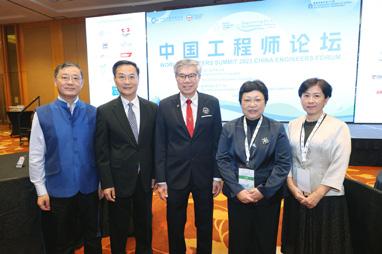
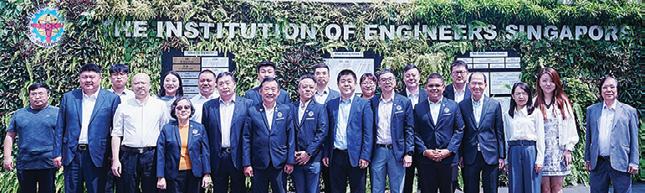
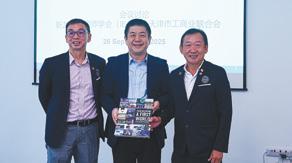
The Institution of Engineers, Singapore (IES) was pleased to host a delegation led by Mr Lou Jie, Chairman of the Tianjin Federation of Industry and Commerce, on Friday, 26 September. The visiting group comprised dynamic young entrepreneurs and representatives of new start-ups from a diverse range of sectors, including manufacturing, technology, construction and recycling.
The Tianjin delegation was welcomed by an IES delegation led by Honorary Secretary Er. Simon Lee and Vice President for Professional Development A/Prof Lim Kok Hwa, alongside representatives from the IES Council and International Outreach Committee (IOC).
The primary objective of the meeting was to explore concrete collaboration opportunities between the two organisations. Discussions focused on facilitating partnerships between Singaporean and Chinese companies and
exploring joint ventures into each other’s markets.
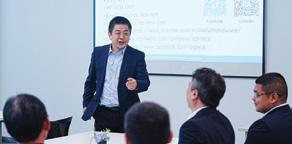
During the session, Dr Aaron Sham and Mr Chow Kok Wah presented an overview of IES, detailing its core functions and the impactful work of the Incubator & Accelerator (INCA) programme. In

This historic milestone celebrates not only his lifelong dedication to engineering excellence, but also the growing global influence of Singapore’s engineering community.
Er. Dr Tan’s leadership will amplify Singapore’s voice on the world stage,
turn, the Tianjin representatives introduced their respective companies, showcasing innovative products and services.
The dialogue marked a significant step forward in strengthening economic ties between Singapore and Tianjin.

promote sustainable engineering practices and inspire the next generation of global engineers.
IES is proud to stand with him on this remarkable journey, as it continues to champion engineering excellence worldwide.
For seven decades, the Department of Civil and Environmental Engineering (CEE) in the College of Design and Engineering at the National University of Singapore has played a pivotal role in Singapore’s transformation and contributed to advancements in global engineering.
To commemorate this significant milestone, CEE organised the 70th Anniversary Symposium 2025 on 10 October 2025, in partnership with the Professional Engineers Board (PEB) and the Institution of Engineers, Singapore (IES).
Held at the Sands Expo and Convention Centre, Marina Bay Sands, the event brought together partners from the government and industry sectors, as well as students from primary and secondary schools, pre-university institutions and polytechnics.
Comprising three components –the symposium, an exhibition and a student fair – the event provided a unique platform where academia, government and industry came together to share perspectives and innovative solutions, explore collaborative approaches and excite young talents who will shape the future of the built environment sector.
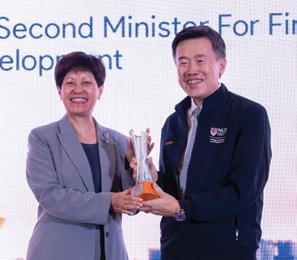
Guest-of-Honour Ms Indranee Rajah, Minister in the Prime Minister’s Office and Second Minister for Finance and National Development, said, “As we face challenges like climate change and resource scarcity, the role of civil and environmental engineers has never been more critical – or more exciting.”
Highlighting that built environment professionals “shape how we live, work, and play” and their work “creates the infrastructure that connects

Office and Second Minister for Finance and National Development; Prof Heng Chye Kiang, Deputy Dean (Research & Innovation), CDE, NUS; and Er. Lim Peng Hong, President, Professional Engineers Board (PEB).
communities, and the solutions that protect our environment”, Ms Rajah discussed the various efforts to uplift the built environment sector. Professor Teo Kie Leong, Dean of the College of Design and Engineering at NUS, expressed his appreciation to CEE’s partners for their unstinting support.
“Together, we have nurtured talent, advanced innovation and shaped Singapore’s built environment into one we can all take pride in,” he said.
“Singapore has been our living laboratory and our shared mission – to engineer a safe, sustainable, and resilient home for generations to come. Today’s symposium reflects that mission and our direction forward,” said Professor Richard Liew, Head of CEE.
He added that CEE remained committed to three key thrusts, namely, education, research and engagement, over the next decade.
The symposium featured speakers from key agencies in Singapore’s
built environment sector, namely, Building and Construction Authority (BCA); Housing & Development Board (HDB); PUB, Singapore’s National Water Agency; Home Team Science and Technology Agency (HTX); Land Transport Authority (LTA); Urban Redevelopment Authority (URA); and JTC Corporation (JTC).
They shared information on important milestones achieved, addressed the current challenges facing the industry, and outlined strategies to build a more resilient and sustainable future for Singapore.
The concluding session of the symposium featured academic and industry leaders discussing the innovative strategies and collaborative approaches necessary for the sector to advance and succeed in an increasingly complex and evolving environment.
As part of his symposium lecture, Associate Professor Raymond Ong from CEE outlined the research directions that will help tackle current and future challenges. His focus was on sustainability and green technologies, robotics and automation, as well as intelligent sensing and autonomy within the built environment. Additionally, he emphasised the importance of developing industry capabilities in the context of an ageing infrastructure and an ageing society.
INNOVATION COMES ALIVE
An interesting highlight of the event was an exhibition featuring key innovations that have shaped Singapore today and will drive the nation’s progress into the future. Among the exhibits were:
• Green cement and 3D printing (CEE)
This technology pushes the limit of the recycling percentage in cement, relying solely on local waste. This innovation not only reduces the carbon footprint of the built environment and wastes destined for Semakau but also reflects CEE’s strong commitment to advancing green and sustainable technologies.
• Periodic inspection and defect detection of coastal infrastructure using autonomous underwater vehicles (CEE, BeeX and Delta Marine Consultants)
A groundbreaking approach to enhance the monitoring and protection of Singapore’s coastal infrastructure is the deployment of advanced Hovering Autonomous Underwater Vehicles (HAUVs) to conduct precise and thorough inspections of submerged structures, reducing reliance on human divers and lowering
inspection costs. This innovative solution aims to set a new standard for coastal protection, ensuring the long-term safety and resilience of Singapore's shores.
• Centre for Resource Circularity and Resilience (CEE)
A series of low-carbon cement, carbon-mineralised aggregates and aggregates developed from 100% local wastes could be used to address the waste and resource challenges of Singapore. These innovations offer sustainable pathways to upcycle large volumes of excavated marine clay from upcoming megaprojects, turning what was once waste into highvalue construction resources.
• First on-site 3D printed concrete building (CEE and Woh Hup)
The Norwood Grand Project, located at Champions Way, is Woh Hup’s first on-site 3D concrete printing project in Singapore approved by BCA. CEE researchers contributed their expertise in materials engineering and structural performance, ensuring adherence to local standards while integrating cutting-edge technology.
TALENTS THROUGH FUN AND PLAY
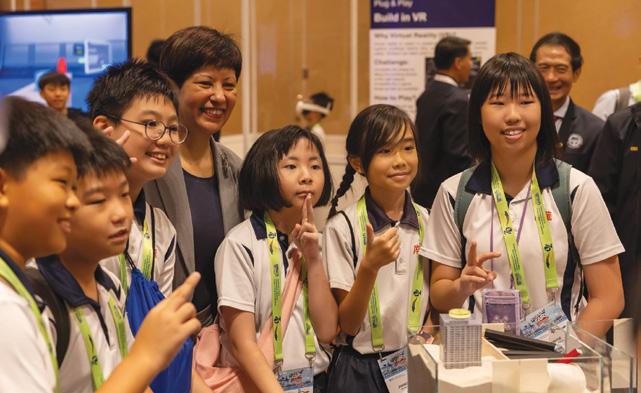
Close to 300 students from around 30 primary and secondary schools, pre-university institutions and
polytechnics participated in the student fair which was designed to immerse students in the world of engineering. These students had the opportunity to engage in a variety of hands-on activities, dynamic interactive demonstrations and connect with engineers as well as young professionals. These experiences were tailored to spark curiosity and enthusiasm, encouraging students to explore the principles of engineering in action, while discovering how these concepts apply to real-world situations, from desalination to tunnelling to protecting Singapore’s shores.
IES’ long-standing partnership with NUS includes initiatives such as:
• IES–NUS Student Chapter – nurturing future engineers through mentorship and industry exposure.
• Global Engineers Leadership Programme (GELP) – equipping senior engineers for executive leadership roles.
• YC Wong–IES Research Fund – a SGD 300,000 contribution supporting postgraduate research for a safer and more sustainable built environment.
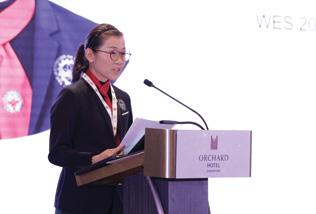
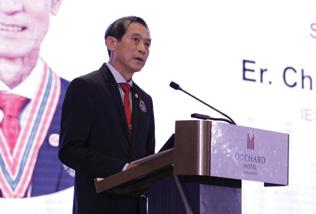
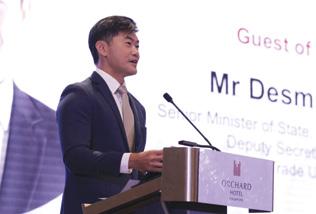
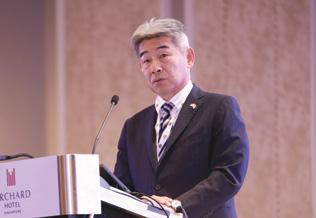
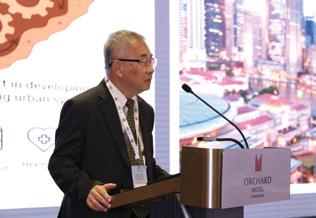
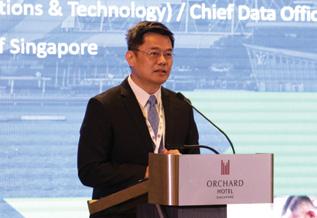
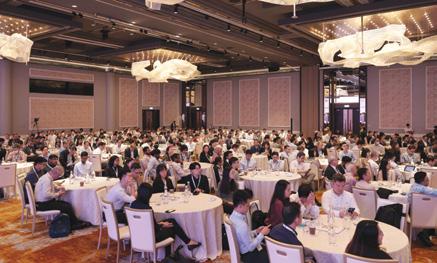
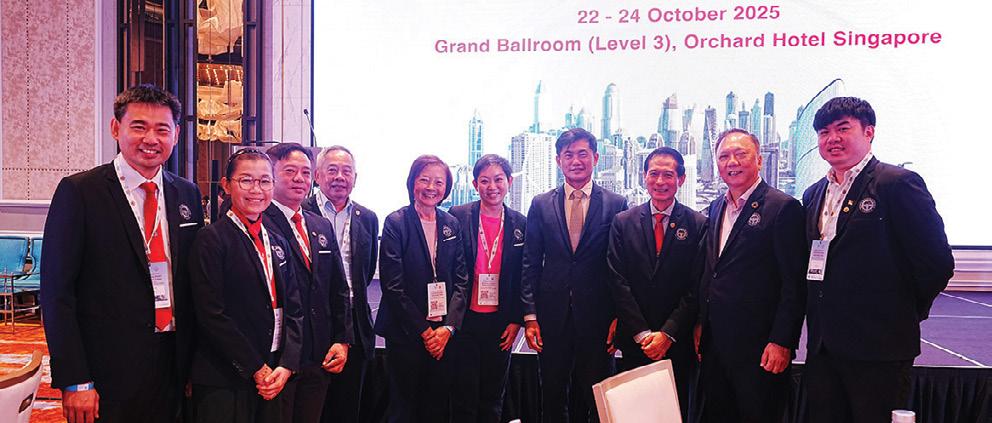
The World Engineers Summit (WES) 2025 was held, from 22 to 24 October 2025, at Orchard Hotel Singapore. The event brought together almost 600 global leaders, policymakers, academics and industry professionals, to drive solutions for climate-resilient, intelligent and inclusive cities.
The opening ceremony was graced by Guest-of-Honour Mr Desmond Tan, Senior Minister of State, Prime Minister’s Office and Deputy Secretary-General, National Trades Union Congress.
Organised by the Institution of Engineers, Singapore (IES), the biennial summit is now in its
seventh edition since 2013 and has grown into one of the world’s leading platforms for knowledgesharing and collaboration in engineering.
Themed ‘Shaping Tomorrow: Engineering Smart Sustainable Cities’, WES 2025 came at a pivotal moment as the global climate crisis intensifies. Earlier this year, Singapore submitted its updated national emission reduction targets to the United Nations, underscoring the urgent need for innovation and collaboration.
The summit spotlighted how engineers are reimagining cities to be more resilient, inclusive
and sustainable, while harnessing advanced technologies to improve the quality of life.
A new highlight at WES 2025 was the addition of three Special Sessions, providing deep dives into emerging areas such as Systems Engineering, Asset Management and Vision Zero, for safer and more sustainable urban futures.
Delegates also heard from the following five distinguished plenary speakers, on the morning of the first day:
• His Excellency Hiroshi Ishikawa, Ambassador Extraordinary and Plenipotentiary of Japan to Singapore
• Mr Thomas Ardian Siregar, Deputy Chief of Mission, Embassy of the Republic of Indonesia in Singapore
• Mr Richard Lim, Deputy Chairman, Land Transport Authority and Immediate Past Chairman of the Energy Market Authority
• Mr David Foo, Deputy Chief Executive (Operations & Technology) & Chief Data Officer of the Maritime and Port Authority of Singapore
• Professor Liu Bin, Deputy President (Research and Technology) and Tan Chin Tuan Centennial Professor at the National University of Singapore
The programme included four technical tracks covering technological solutions for a climate-resilient and greener future, urban mobility innovations for sustainable cities, designing for sustainability in green building practices, and future-proofing engineers through educational technology and skills development. Delegates also had the opportunity, to take part in technical site visits, on the third day of the summit, to the Punggol Digital District and the SingSpring Desalination Plant – two landmark projects showcasing how innovation and sustainability are applied in practice.
With the involvement of the
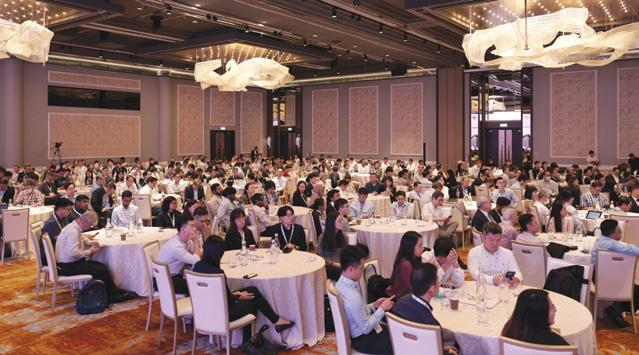
World Federation of Engineering Organizations (WFEO), the ASEAN Federation of Engineering Organisations (AFEO) and the Federation of Engineering Institutions of Asia and the Pacific (FEIAP), along with delegates representing more than 10 countries including Singapore, Malaysia, Japan, South Korea, China, India, Nepal, the United Kingdom, Spain, the Netherlands and Australia, WES 2025 became a global stage for the exchange of ideas and solutions.
“The climate crisis is the defining challenge of our time, demanding urgent action and collective resolve. Engineers are at the heart of this transformation, designing
solutions that make cities more resilient, inclusive and sustainable. WES 2025 provides the platform for our profession to contribute ideas, share expertise and build partnerships that will help societies meet these global challenges headon,” said Er. Chan Ewe Jin, President of IES.
“This year’s programme is one of our most comprehensive yet, with plenary sessions, four technical tracks and three new Special Sessions. Delegates can expect fresh insights, practical solutions and opportunities to collaborate across borders,” said Ms Jasmine Foo, Chair of WES 2025 Organising Committee.
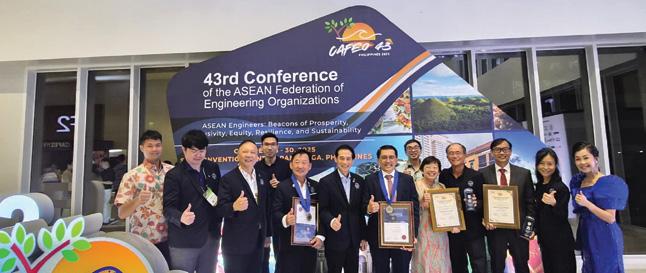
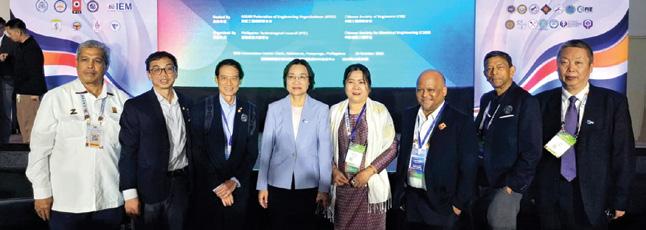
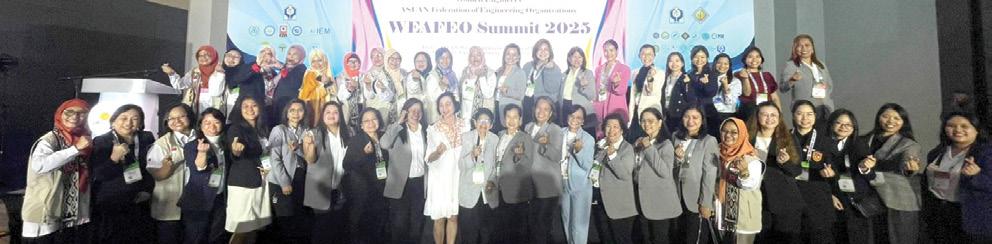
IES is pleased to have sent a Singapore delegation of over 20 representatives, led by President Er. Chan Ewe Jin, Deputy President Mr Mervyn Sirisena and Honorary Secretary Er. Simon Lee, to attend the 43rd Conference of the ASEAN Federation of Engineering Organisations (CAFEO 43) in SMX Convention Center Clark, Pampanga, Philippines, from 27 to 30 October 2025.
The delegation attended various engineering work group meetings and also participated in the ChinaASEAN Engineers Forum that was co-organised with the Chinese Society of Engineers (CSE) on Day 2 of the programme.
IES was also extremely honoured to witness the following:
• Housing & Development Board (HDB) and Land Transport Authority (LTA) winning the ASEAN Outstanding Engineering Achievement Award –Group Category.
• The conferment of the title ‘AFEO Honorary Fellow’ on Er. Simon Lee, Er. David Ng, Er. Teo Tiong Yong, Dr Victor Sim and Er. Tan Yoong Heng.
• The conferment of the title ‘AFEO Honorary Member’ on Er. Winston Ho and A/Prof Poh Leong Hien.
Mr Jason Harrison, General Manager – Solutions Hub at Daikin Holdings also represented Singapore by delivering a keynote speech in the thematic session ‘Sustainable and Intelligent Cities’.


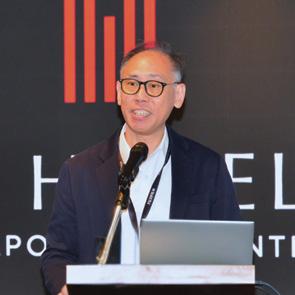
FUJIFILM Business Innovation Singapore recently signed Memorandums of Understanding (MoUs) with three strategic partners, namely, Trusted Hub, Bizmann System and ReN3, to deliver end-to-end digital transformation solutions, from data management and process automation to Artificial Intelligence (AI)-powered insights and content management. These partnerships are expected to support transformation efforts across 1,000 companies over the next three years.
As FUJIFILM Business Innovation Singapore commemorates its 60th anniversary this year, the occasion is made even more meaningful, by aligning with the nation’s SG60 celebrations and marking six decades of progress and innovation.
The MoUs signal a doubling down on the company’s commitment to empower businesses with cuttingedge technologies, particularly AI, process optimisation and intelligent outsourcing.
These partnerships will unlock new possibilities for applying AI, automation and data intelligence to address complex business challenges, from streamlining critical operations to transforming customer experiences.
By integrating advanced technologies with deep industry expertise, FUJIFILM Business Innovation Singapore aims to help organisations not only accelerate their digital transformation but also equip them with the tools and expertise needed to thrive in an increasingly AI-driven economy.
“AI, automation and data are reshaping how businesses operate, from small and medium-sized enterprises to large corporations. As organisations navigate rapid digital change, our mission is to be their trusted transformation
partner,” said Mr Wee Tee Hsien, CEO of FUJIFILM Business Innovation Singapore.
“These partnerships mark a significant step in our journey to deliver secure, scalable and AIready solutions that drive digital maturity. As we celebrate our 60th anniversary together with Singapore, these collaborations reflect our ongoing commitment to fostering innovation and resilience across industries,” he added.
Digital data factory for AI and regulatory compliance
Singapore companies must keep proper accounting and related records, as mandated by Singapore’s Companies Act, whether in paper or digital formats. The launch of Trusted Hub’s Trusted DataVerse, Singapore’s first legally-compliant large-scale data factory and data warehouse, marks a major leap forward in how organisations capture, store and utilise both digitised paper records and borndigital data.
Original paper records can be digitised into legally admissible electronic originals, under Singapore’s Evidence Act, making them usable in court, while reducing storage costs and allowing recycling.
Many industries still rely on processes that do not meet the strict legal standards for audits or court proceedings, leaving them vulnerable to compliance and business risks.
Trusted DataVerse addresses this gap by ensuring every document captured is legally admissible, which helps to strengthen compliance, streamline audit and record keeping, and enhance operational integrity. Beyond compliance, the platform lays the groundwork for AI readiness by
digitising and structuring paperbased and born-digital data into secure and accessible records. This accelerates data retrieval, improves workflow efficiency, reduces risk exposure and enriches digital content with detailed classification and labelling for AI training, testing and large language model (LLM) inferences.
“Together with FUJIFILM Business Innovation Singapore, we are helping businesses turn their content into a strategic asset –secure, structured and AI-ready,” said Mr Bryan Wong, CEO of Trusted Hub.
“With the exponential growth of data, companies need scalable, legally compliant and AI-ready solutions, especially for industries with stringent data compliance, high documentation volumes, and a strong push for digital transformation, including banking, financial services, insurance, healthcare, legal and government sectors,” he added.
Digitising business and operational processes
The partnership with Bizmann System aims to help SMEs embrace and drive digital transformation, enabling them to innovate and scale, by tapping into Bizmann System’s vast expertise in business process consulting and software development, combined with FUJIFILM Business Innovation
Singapore’s strengths in workflow digitisation and managed services. Together, it will offer fully integrated, cloud-based solutions that digitise and optimise workflows across eProcurement, supply chain and finance automation. By replacing manual processes and outdated legacy systems, the collaboration enables organisations to achieve real-time
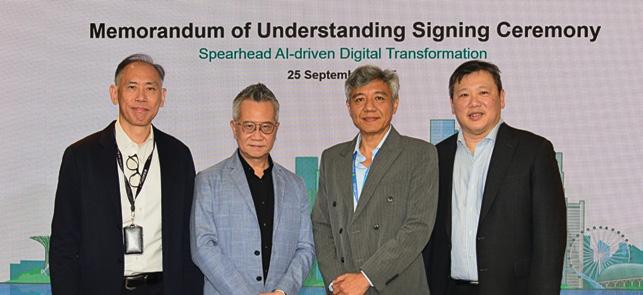
inventory tracking, faster approvals and stronger operational control, which are key factors for agility and quality in these dynamic industries.
“Our collaboration with FUJIFILM Business Innovation Singapore is a pivotal step in helping SMEs transform for the digital age,” said Mr Ken Loke, CEO of Bizmann System.
“By combining deep expertise and innovative technology, we enable organisations to scale with confidence, overcome evolving challenges and set new standards for efficiency and customer experience in an increasingly competitive landscape,” he added.
“Collaborating with FUJIFILM Business Innovation Singapore and Bizmann System helped us digitise our procurement and supply chain processes, with cloud-based solutions tailored to our needs.
The real-time order tracking and automated approvals have improved our operational control and responsiveness, enabling us to optimise costs and manage our business more effectively in a highly competitive market,” said Mr Denville Wee, Chief Financial Officer of Imperial Treasure Restaurant Group.
Intelligent content management
The partnership with ReN3 delivers agentic AI solutions for intelligent content management, through a seamless end-to-end platform, from data ingestion to actionable business insights. Designed to enhance collaboration between
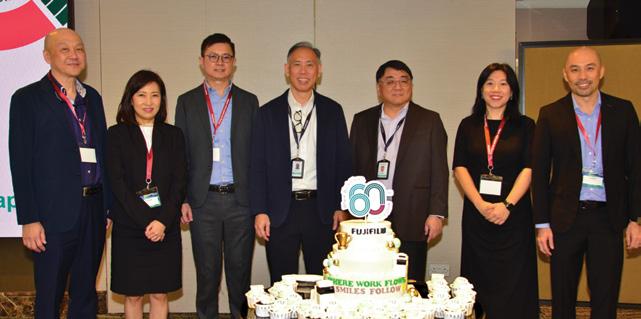
humans and AI assistants, the platform drives significant productivity gains while maintaining the highest standards of accuracy, security and compliance.
Built on an enterprise-ready framework, ReN3’s solution reduces AI implementation risks from 40% to under 10%, enabling organisations to realise measurable returns on investment within six months. By combining intelligent automation with human-in-theloop oversight, this collaboration empowers businesses to confidently accelerate their digital transformation journeys.
“Partnering with FUJIFILM Business Innovation Singapore combines our AI expertise with their strong industry knowledge and market presence. Together, we are setting a new standard for intelligent content management, helping businesses boost productivity and innovate,” said Mr Dennis Sze, Chief Revenue Officer of ReN3.
“As organisations navigate increasingly complex digital landscapes and hybrid workforces, we are excited to drive meaningful impact across industries and are committed to driving impactful, safe and strategic AI adoption for sustainable growth,” he added.
FUJIFILM
Singapore
As a pioneer in document solutions for almost 60 years, FUJIFILM Business Innovation Singapore has a deep understanding of how businesses operate. Its mission is to empower organisations to work efficiently and effectively in the digital age. As a one-stop provider, it offers customers a comprehensive suite of digital transformation solutions and services, along with multifunction and production printers, to manage data, automate workflows, leverage data intelligence and build exceptional customer experiences.

GE Vernova Inc and YTL PowerSeraya Pte Limited (YTLPS) recently announced the collaboration of the two companies on a feasibility study to analyse the lowering of carbon emissions of YTLPS’ H-Class Combined Cycle Gas Turbine (CCGT) plant on Jurong Island, Singapore.
Following the launch of a Power Sector Carbon Capture and Storage Grant Call by Singapore’s Energy Market Authority (EMA), in October 2024, which invited the power industry to explore potential carbon capture solutions as part of Singapore’s energy transition towards a low-carbon future, the EMA has selected five projects.
YTLPS’ Post-Combustion Carbon Capture Study proposal was among the projects selected to receive co-funding. The study is focused on retrofitting YTLPS’ H-Class CCGT with technology capable of capturing at least 90% of the plant’s carbon dioxide (CO2) emissions.
In the study, with its proven expertise, GE Vernova will focus on the seamless integration of the H-Class CCGT plant with post-combustion carbon capture technology, supported by three key technical solutions:
• Exhaust Gas Recirculation (EGR)
• Steam integration
• Controls integration
In comparison to traditional bolton post-combustion carbon capture solutions, GE Vernova’s proposed, advanced system integration with EGR technology allows a gas power plant with post-combustion carbon capture solutions to operate more efficiently and cost-effectively, which reduces overall plant size, overall CAPEX and OPEX, whilst also boosting overall integrated plant performance.
“We are enthusiastic that EMA awarded our 600 MW H-Class Combined Cycle Power Plant to study the integration of postcombustion carbon capture. Our participation in the GE Vernova-led study underscores our dedication to accelerating advanced solutions to potentially retrofit our power plant to achieve net zero emission, a vital step towards producing more sustainable energy for Singapore and our communities,” said John Ng, CEO of YTLPS.
“GE Vernova’s first-of-its-kind carbon capture assessment in Singapore proposes significant enhancements aimed at improving the proposed carbon capture process and reducing its impact on the power plants’ output, performance and costs,” said
Ramesh Singaram, President & CEO of GE Vernova's Gas Power business in the Asia Pacific region.
“GE Vernova will lead the fullscale integration of the study with the ultimate goal of lowering the net carbon emissions of the power plant. We remain committed to supporting the advancement of the region’s energy goals, working alongside carbon capture players to support YTL PowerSeraya’s decarbonisation efforts,” he added.
The announcement for the post-combustion carbon capture study was made on the sidelines of Singapore International Energy Week 2025. This recent milestone follows other significant announcements for GE Vernova.
This includes its selection for the innovative Net Zero Teesside (NZT) Power project in the UK, expected to be the world’s first gas-fired plant integrated with a carbon capture plant at commercial scale, and the order for GE Vernova’s combined cycle equipment to power YTLPS’ CCGT on Jurong Island, Singapore. The plant is expected to be powered by a 9HA.01 gas turbine, an STF-A650 steam turbine, a W88 generator and a triple pressure with reheat Heat Recovery Steam Generator (HRSG).

The Faculty of Engineering at The Chinese University of Hong Kong (CUHK) continues to strengthen its position in global engineering education and research, with notable achievements across multiple engineering disciplines including Computer Science, Information Engineering, Electronic Engineering, Biomedical Engineering, Mechanical and Automation Engineering, Systems Engineering and Engineering Management.
Recent rankings highlight the faculty’s research excellence, including being ranked 7th in both Artificial Intelligence and Computer Science (US News & World Report 2025–2026), 19th in Data Science & Artificial Intelligence and 27th in Computer Science & Information Systems (QS World University Rankings by Subject 2025).
Research impact and innovation
The faculty’s commitment to innovation is demonstrated through nine impactful research projects awarded funding in the first two rounds of Hong Kong Government's Research, Academic and Industry Sectors One-plus Scheme (RAISe+ Scheme).
The projects cover a diverse range of innovative areas, from advanced engineering and biomedical engineering to materials science, demonstrating a high level of technology which enables the translation of research outcomes into product developments:
• Accessible Surgical Robotic System led by Prof Samuel Au, Department of Mechanical and Automation Engineering
• Development of Personalised Advanced Therapeutic Products (ATPs) - Engineered Osteochondral Tissue (eOCT) for cartilage regeneration therapy led by Prof Barbara Chan, School of Biomedical Sciences and Department of Biomedical Engineering
• Evolving Interventional Endoscopy – An Endoluminal Robotic Platform for Early-Stage Cancer Resection and Defect Closure led by Prof Ka-wai Kwok, Department of Mechanical and Automation Engineering
• 3D Vision-Driven Robots led by Prof Yun-hui Liu, Department of Mechanical and Automation Engineering
• Low-Cost and Intrinsically-Safe Polysulfide Redox Flow Batteries for Long-Duration Energy Storage led by Prof Yi-chun Lu, Department of Mechanical and Automation Engineering
• Silicon Photonic Integrated Circuits for Sensing and Optical Interconnects led by Prof Hon-ki Tsang, Department of Electronic Engineering
• Intelligent Laser Sensing System for the Energy Industry led by Prof Wei Ren, Department of Mechanical and Automation Engineering
• Network Coding for Next
Generation Networks led by Prof Raymond Yeung, Department of Information Engineering
• Intelligent Wearable Sensing Technologies for Eldercare and Prevention of Cardiovascular Diseases led by Prof Ni Zhao, Department of Electronic Engineering.
In addition, the faculty’s researchers have also established multiple start-ups and spin-off companies, based on their research findings. At present, the faculty has successfully seeded two unicorns – SenseTime and Cornerstone Robotics – both of which are valued over USD 1 billion.
The Faculty of Engineering at CUHK provides one of the world’s premier research environments with access to over 80 specialised laboratories. With a strong emphasis on interdisciplinary learning, the faculty encourages students to explore a diverse range of subjects in their studies and research, equipping them with both a solid foundation and the flexibility needed for career development.
Consistently ranked among the top 100 engineering schools globally, the CUHK Faculty of Engineering remains committed to offering an inspiring environment that empowers future engineering leaders to pursue knowledge and drive innovations at the frontier of modern technology.
The 21st parts2clean exhibition, which took place at the Stuttgart Exhibition Center, Germany, from 7 to 9 October 2025, featured a wide range products and solutions presented by 165 exhibiting companies from 16 countries. The exhibits covered all areas of the industrial cleaning technology sector.
The three days of the parts2clean exhibition showed that there is a demand for the solutions on display. In spite of the currently challenging market conditions, the event attracted more than 3,200 trade visitors from 44 countries.
“Compared to the 2023 event, the 21st edition of the Leading Trade Fair for Industrial Parts and Surface Cleaning not only chalked up a growing number of exhibiting companies and a net exhibition area of 4,600 m2, but also a small increase in visitor numbers,” said Mr Ramtin Randjbar-Moshtaghin, Project Director at Deutsche Messe AG, organisers of parts2clean.
The share of visitors from outside Germany was around 25%. The nations most represented after Germany were Switzerland, Austria, Türkiye, and the Netherlands.
“For us, as the organiser of parts2clean, however, the bare facts and figures are less important than whether the exhibiting companies were satisfied,” added Mr Randjbar-Moshtaghin.
Mr Samuel Wolf, Managing Director of cleaning system manufacturer, vapic GmbH, confirmed his satisfaction with the exhibition. He said, “By the end of the second day of the trade fair, we had already established more contacts than during the entire 2023 show. The visitors came to the trade fair with specific tasks and projects. In some cases, they had even brought along drawings of the parts to be cleaned, so that we could get straight down to developing solutions. The very high
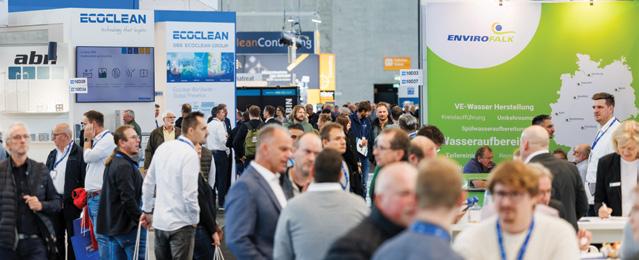

number of new contacts – around 80% – is also pleasing.”
The quality of the discussions and contacts at parts2clean 2025 reflected the high proportion of trade visitors, at 99%. The visitor survey revealed that around 90% of visitors are involved in operational investment decisions. Upcoming investment projects were the main reason for visiting, for more than 31% of trade visitors. This resulted in real enquiries even during the trade fair.
As Mr Rien van Sliedregt, Commercial Director at the Dutch company, Esselent Solutions, said, “We were exhibiting at parts2clean for the 18th time, and were actually expecting fewer visitors at
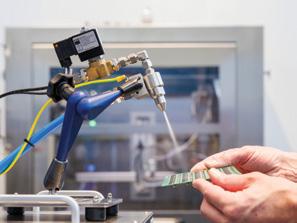
Innovations that were presented include CO2 snow jet dry cleaning, which are becoming increasingly important, for example, in the electronics manufacturing chain.
the trade fair due to the economic situation. However, the opposite was the case. We had more visitors at our stand than in 2023, including a lot of highly promising new contacts. We received requests for quotations during the trade fair, for the first time.”
“Discussions and enquiries often focused on optimising processes and finding ways to save costs –for example, by extending bath service lives. Our expertise is an important factor for visitors, because experienced employees are reaching their pension age in many companies, taking their knowledge and skills with them into retirement. We will undoubtedly be exhibiting again at parts2clean 2027,” he added.
Mr Martin Dreher, Head of Strategic Marketing at acp systems GmbH, also reported highly intensive discussions about upcoming projects with visitors from the electronics, optical, aerospace, microtechnology and semiconductor industries, for example.
“parts2clean is definitely one of the most important trade fairs for us and it has fully met our expectations this year. We will continue to be present here in the future,” he said.
The exhibits at this year's parts2clean also showed that automation, digitalisation and AI can also contribute to greater process reliability, efficiency and resource savings, in industrial parts cleaning.
“In addition to four new or further developed systems for solvent- and water-based cleaning, we presented innovative, partly AI-supported solutions for automated process monitoring and control from our broad portfolio, at parts2clean.
The visitors’ interest and feedback on these developments, from general industry and various hightech sectors, were excellent,” said Mr Oliver Pelz, Director Sales at Ecoclean GmbH.
Information exchange, trend scouting, networking, and cooperation – these have also been among the focal points at parts2clean 2025.
“Some aspects of our participation in the trade fair involve networking with the industry, exchanging ideas with partners, and scouting for the latest trends. That is why it is essential to be present at parts2clean, because this is where you meet all the relevant suppliers from the various sectors,” said Ms
Juliane Schulze, Managing Director of SITA Messtechnik GmbH.
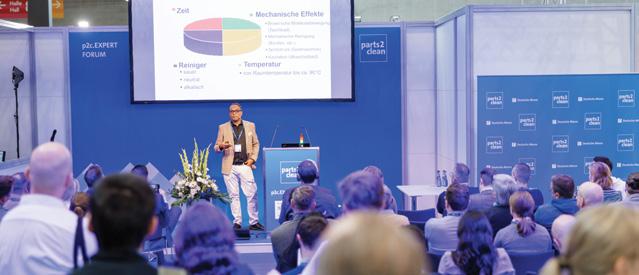
Even greater demand for knowledge than before Additionally, the bilingual p2c. EXPERTFORUM attracted a record number of participants.
The bilingual p2c.EXPERTFORUM, open to attendees at the trade fair, free of charge, has always been one of the magnets attracting visitors to the leading international trade fair.
“Demand for expertise in industrial parts and surface cleaning has never been higher than during this year,” said Mr Ramtin Randjbar-Moshtaghin.
“The presentations by experts from the scientific, research and industrial communities were offered with simultaneous interpreting (from German to English and from English to German) and generated a total footfall of 3,060 from trade fair visitors aiming to establish or deepen their knowledge of parts cleaning,” he added.
The record attendance shows that there is a great need for information ranging from the basics of classic parts cleaning to
ultra-fine cleaning and high-purity applications.
“And the p2c.EXPERTFORUM offers companies a training and education resource for their employees that is unparalleled in terms of value for money,” added Ms Juliane Schulze.
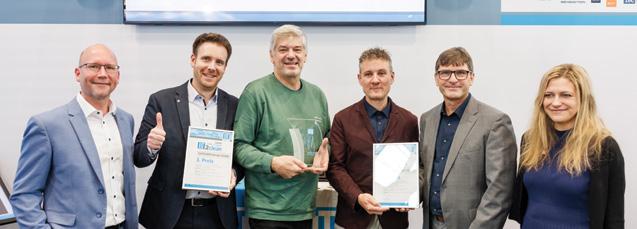
The presentation of the 4th FiT2clean Innovation Award proved to be a highlight of the last day of the trade fair. This year, BO-INNO GmbH won the Innovation Award of the Industrial Parts Cleaning Association (FiT) with a smart data tracker that records and stores key process parameters in real time. Nägele Mechanik GmbH and SAFECHEM Europe GmbH took second and third places, respectively.
The award is presented annually by FiT for innovative solutions and outstanding achievements in response to current challenges in industrial parts cleaning.
The next parts2clean will take place from October 5 to 7, 2027 at the Stuttgart Exhibition Center.
The new estate will provide more housing options for Singaporeans along the Greater Southern Waterfront.
Minister for National Development, Mr Chee Hong Tat unveiled the masterplan for Berlayar estate at the HDB Awards Ceremony on 23 September 2025. Located at the site of the former Keppel Club, the new estate marks the start of the transformation of the Greater Southern Waterfront.
Following detailed planning studies, Berlayar estate will offer about 7,000 public housing units, up from the previously announced 6,000 units. This will increase the total housing yield of the estate to approximately 10,000 homes, including about 3,000 private housing units.
These plans are part of a broader strategy to enhance the geographical distribution of public housing and cater to the evolving aspirations and diverse needs of
Singaporeans, including young families who wish to live near their parents for mutual care and support.
The first Build-To-Order (BTO) project, Berlayar Residences, was scheduled for launch in October 2025, offering 870 2-room Flexi, 3-room, and 4-room flats. There will also be 200 public rental flats within the project.
HDB will progressively launch the rest of the projects in the coming years.
The 48-hectare site has been earmarked for residential use in URA’s Master Plan since 2014. The name ‘Berlayar’ (which means ‘sailing’ in Malay) draws inspiration
from the area’s landmarks and maritime heritage.
Of particular significance is the granite outcrop ‘Batu Berlayar’ (‘sailing rock’ in Malay) which once served as a navigational marker at Keppel Harbour’s western entrance. Today, the name ‘Berlayar' is still used in landmarks in the area, such as Berlayar Beacon, Tanjung Berlayar and Berlayar Creek.
Given the scale of the site and its proximity to several nature areas, such as the Labrador Nature Reserve, Berlayar Creek and Southern Ridges (which includes Mount Faber Park, Telok Blangah Hill Park and Kent Ridge Park), HDB worked closely with the Urban Redevelopment Authority (URA) and National Parks Board (NParks) to conduct an Environmental Impact Assessment (EIA), to better


understand the existing biodiversity of the area and guide development.
The agencies also held several rounds of engagements with different stakeholders such as nature groups, to gather their feedback and suggestions on the proposed plans. These suggestions have been incorporated into the plans for Berlayar, where feasible.
Berlayar estate, planned as an extension of Bukit Merah town, will offer future residents the experience of harbourfront living close to nature.
Distinctive waterfront homes set amidst lush greenery
Drawing inspiration from the sloping hills of Bukit Merah, the BTO projects in Berlayar estate will be designed with staggered heights to form a distinctive terracing skyline along Singapore’s southern coast. The blocks will be oriented to provide more residents with scenic

views of the Southern Ridges and the coast, from their units.
To enrich the unique identity and natural heritage of the estate, the BTO developments will adopt a
white and blue colour palette that mirrors their waterfront setting. Motifs of fauna species found in the area will also be incorporated into the design of the developments.
For example, at Berlayar Residences, the first BTO project, motifs of the long-winged tomb bat, mangrove horseshoe crab and smooth coated otter, will be featured in its community living rooms and wayfinding signages. The playgrounds will also be themed after the area’s flora and fauna, with designs inspired by the smooth-coated otters and their natural habitats in Berlayar Creek and the nearby mangrove forest.
A wide range of green spaces and amenities
Residents of Berlayar estate will enjoy ample greenery, with up to 10 hectares, or 20% of the site area, set aside for green spaces. This is equivalent to about 18 football fields.
Four green corridors, ranging from 30 m to 60 m wide, will weave through the estate, offering green respite and recreational areas for residents, and facilitating ecological connectivity between the Southern Ridges and Labrador Nature Reserve. These green corridors will feature a planting palette that includes biodiversity-attracting species to create conducive habitats for fauna to thrive.
The alignment and design of the green corridors have been refined to take on board the recommendations from the EIA as well as feedback and suggestions from nature groups, which focused on enhancing avian connectivity through Berlayar estate. For example:
• Central Corridor, originally planned to range from 10 m to 50 m in width, has been widened to 60 m, to enhance ecological connectivity and facilitate habitat creation. Forming part of a new park for residents, it will be the largest of the green corridors, stretching from Telok Blangah Road in the north to Berlayar Creek in the south. This corridor will serve as the key green space for the neighbourhood, weaving together community spaces and natural habitats.
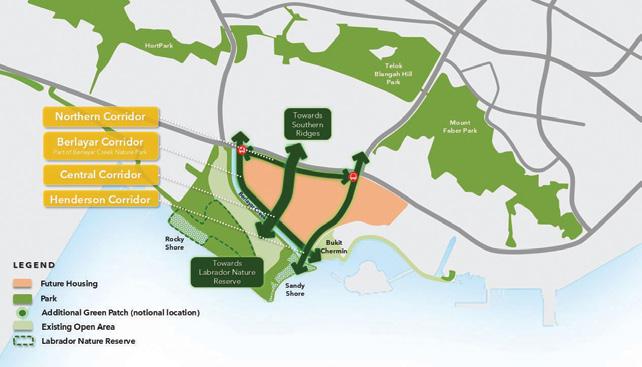


• Henderson Corridor has been realigned to lead birds towards the forest at Bukit Chermin and Labrador Nature Reserve, and away from existing high-rise developments.
• The Berlayar Corridor along the edge of Berlayar Creek will buffer the mangrove habitat there from the new developments. Berlayar Corridor will also form a part of the upcoming Berlayar Creek Nature Park.
• At the north-western corner of the site, where the Northern Corridor and Berlayar Corridor meet, a hill knoll with several mature trees serves as an important resting and landing point for birds flying over the West Coast Highway from the Southern Ridges. It will be retained and integrated as part of the future park spaces.
Beyond green spaces, residents will also enjoy a vibrant mix of amenities within walking distance of their homes. This includes preschools, supermarkets, eating houses, shops and clinics. More amenities will also be available at the nearby Telok Blangah estate, including the
existing Telok Blangah Community Club as well as a new food centre and market which will be completed by 2027.
Within each BTO project, there will be a range of recreational facilities, such as playgrounds for children of different age groups, and fitness corners to promote active living among residents. These facilities encourage community bonding while promoting health and well-being.
precincts
Residents will benefit from Berlayar’s central location and connectivity. Most homes will be within a 10-minute walk from Labrador Park or Telok Blangah MRT station, allowing residents to travel conveniently within and beyond Bukit Merah town.
Gazetted as a car-lite estate, Berlayar is designed to prioritise spaces for public facilities and greenery. The estate will also feature well-connected walking and cycling networks that provide residents with convenient access to public transport nodes, amenities and lush green spaces.
Smart and sustainable features within the estate
Berlayar estate will be developed with sustainable design strategies to create a green and comfortable living environment for residents. The blocks will be painted with cool coatings and arranged in the northsouth direction where possible, to reduce urban heat and enhance residents’ comfort.
Environmental simulations on wind flow, temperature, solar irradiance and sun-shadow analysis will be conducted to optimise the orientation of blocks for natural ventilation, identify ideal shaded locations for playgrounds and guide the placement of greenery in hotspots to mitigate urban heat gain.
In addition, all the BTO developments will feature smart lighting systems and Active, Beautiful, Clean Waters (ABC Waters) design features, including rain gardens and bioswales, to improve stormwater management and enhance the urban ecosystem.

Mr Jimmy Yam, Vice President and General Manager, East Asia, Eaton, highlights some of the challenges in the energy sector and the initiatives being taken to ensure energy system flexibility, sustainability and resilience.
The Singapore Engineer (TSE): Is Southeast Asia’s energy transition happening fast enough, and how are countries balancing growing power demands, especially for Artificial Intelligence (AI), alongside sustainability goals?
Mr Jimmy Yam (JY): Southeast Asia faces significant hurdles in its transition to clean energy. The region’s energy demand is expected to more than double by 2050, driven by rising incomes, rapid urbanisation and growing reliance on energyintensive needs such as air conditioning. The rise of AI is adding further pressure – a single AI query consumes nearly 10 times more electricity than a standard search. While Southeast Asian countries are working to balance growing energy demands and sustainability goals, progress is uneven. Vietnam, for instance, is aggressively expanding its wind, solar and biopower capacity but faces grid stability issues, particularly during drier months. Meanwhile, Indonesia, a major coal producer, has pledged to phase down fossil fuels, but continues to face hurdles in scaling up affordable, clean alternatives. That said, there are encouraging signs. Cross-border initiatives like the ASEAN Power Grid will enable countries to pool renewable energy resources and strengthen grid resilience.
At the same time, technological advancements in energy storage, smart grids and power management are enabling businesses and governments to use electricity more efficiently. The region is moving in the right direction – and collaboration between governments, utilities and private-sector innovators will be critical to achieving sustainable growth.
TSE: Why did the power outages in Europe and Bali happen, what are the lessons learnt, and how can we mitigate their effects if they were to happen here?
JY: Power outages can happen for many reasons, from large-scale grid failures to isolated infrastructure issues. In Europe, the outages were a result of a series of small grid failures across an interconnected network, while the power outage in Bali was a more localised event caused by subsea cable disruptions. Though isolated events, they are a timely reminder that our power networks, no matter how robust, are never completely fail-safe. This also applies to Singapore, especially as the country looks to integrate more renewable energy sources, which presents potential challenges for grid stability.
Most businesses and organisations in Singapore should already have an emergency and backup power strategy in place. However, not all backup and uninterruptible power supply (UPS) systems offer the same level of protection.
Especially when mission-critical applications and sensitive equipment are involved, organisations should not hesitate to invest in more advanced power protection solutions that go beyond the basics. Unexpected power events may be rare, but the right power protection systems will go a long way in helping to minimise downtime and reduce the costs of disruption.
TSE: What are the unique complexities of navigating energy infrastructure across markets, and how can global companies adapt?
JY: Even in Southeast Asia, expectations around power

reliability vary greatly. For example, Singapore benefits from one of the most reliable grids globally, while other markets may face frequent blackouts or unstable connections, on a regular basis. Compliance frameworks and energy efficiency mandates also differ, requiring companies to adapt to a patchwork of regulatory standards.
A strong understanding of local energy requirements is key, regardless of where the new facility is being built. From contractors and engineering firms to the facility management teams overseeing day-to-day operations, it is important to find partners and teams who will ensure that your power network and infrastructure are reliable, safe and resilient in the long run. Compliance with international safety standards alongside local codes can help provide peace of mind.
Lastly, designing power infrastructure with sustainability in mind enables companies to scale renewable integration – ensuring compatibility with grid-interactive systems, supporting demandresponse, and maintaining longterm cost and operational stability, as countries embrace the energy transition.
TSE: What is the future direction for energy grids and, specifically, what are the initiatives being taken to increase their ability to support renewable resources?
JY: The future of Southeast Asia’s energy grids has to be defined by digitalisation, flexibility and interconnectivity. To make a cleaner energy system a reality, enterprises and countries must invest in more resilient grid infrastructure – to better support decentralised and
renewable sources, increase storage capacity and guard against disruptions. Grids can no longer be thought of as a centralised system for one-way energy flow, they have to evolve into two-way platforms that integrate distributed and renewable energy resources.
We are already seeing some businesses integrate renewable energy into their operations on a global scale. Huge enterprises like Google and Apple are committing towards running their operations with carbon-free electricity by 2030 and expanding their clean energy commitments throughout their global supply chain.
At home, the government is investing heavily into developing a Future Grid Capabilities Roadmap – enhancing grid resilience and reliability, through various projects, including the harnessing of distributed energy resources.
Across the region, the ASEAN Power Grid made headway in its progress, with the announcement of a new subsea cable between Singapore and Indonesia, as well as targeted investments into developing cross-border power infrastructure.
Amidst these developments, data centres continue to remain key players in driving the energy transition forward. With their significant energy consumption, it is critical that greener data centres become the standard for a more sustainable future. Beyond new cooling technologies and smart management to improve reliability and efficiency, data centres can become active participants in stabilising the grid.
Particularly as these facilities become more intelligent due to the integration of AI and machine learning, there is potential for them to double up as distributed energy resources in a decentralised energy grid. Data centres will not only manage their own energy needs and optimise energy efficiency, they will also be able to contribute excess energy back to the grid, supporting local communities and reducing reliance on centralised
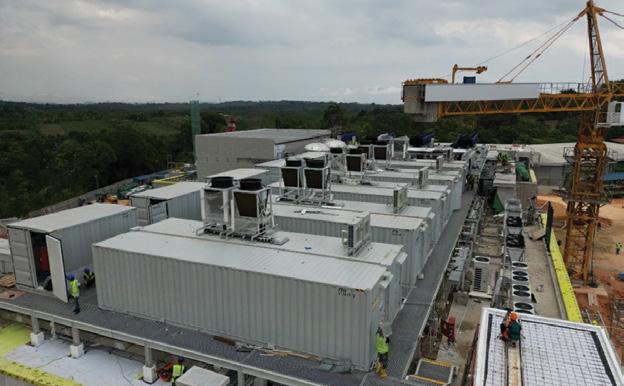
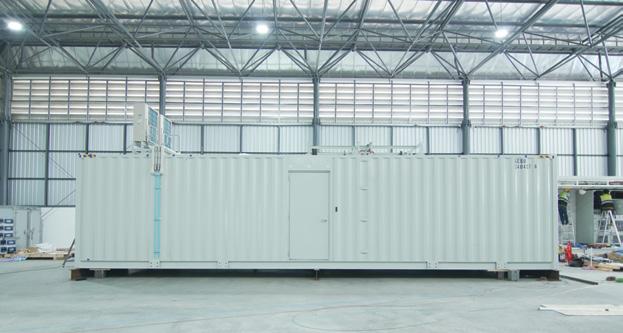
power sources.
TSE: What are the key sustainability and/or energy trends that you foresee gaining traction in the region, and how is Eaton positioned to help power businesses and data centres amidst this evolving power landscape?
JY: One of the major shifts we see in the region is around energy storage. While lithium-ion batteries have long been the standard, nickel-zinc batteries are now emerging as a viable alternative. Adoption is steadily growing in automobiles, UPS solutions and data centres, with the nickel-zinc battery market projected to grow by over 24.4%, from 2024 to 2030, driven by their significant advantages in power density,
operating temperature range, cycle life and environmental friendliness. At Eaton, we have been working with key technology partners and customers to test the commercial viability of nickel-zinc technology, to support the development of sustainable and resilient power infrastructure.
Grid interconnectivity across the region will also continue to be another key focus, as renewable energy integration accelerates. The ASEAN Power Grid, for example, aims to connect countries rich in renewable sources with demand centres, making for a diverse and decentralised energy market. To this end, Singapore is already importing low-carbon electricity from countries like Australia, Cambodia, Indonesia and Vietnam, and exploring multiple ways of
collaboration to lay the groundwork for an interconnected regional grid. Solutions like Eaton’s EnergyAware UPS, help businesses and data centres achieve cost savings while deploying renewable energy and contributing to grid stability. Beyond energy storage and the development of the grid, Eaton
continues to actively participate in the research and development of innovative technologies to help decarbonise energy-intensive industries. For instance, we are involved in the Sustainable Tropical Data Centre Testbed (STDCT) in Singapore, a national-level research platform to develop energy-
Intelligent power management company, Eaton. recently announced the delivery of a new reference architecture designed to accelerate the adoption of 800 VDC power in Artificial Intelligence (AI) data centres. Eaton’s new design, built in support of the 800 VDC architecture announced by NVIDIA, leverages Eaton’s innovative power management technology to protect and optimise high-density computing infrastructure and serves as a critical milestone in Eaton’s gridto-chip strategy for meeting the increasing energy demands of AI data centres.
Data centre energy load growth, driven by increasingly demanding AI workloads, continues to expand beyond the limits of existing data centre capabilities. NVIDIA is working with leading power, silicon and data centre partners to pioneer the adoption of 800 VDC and help unlock new levels of scalability and energy optimisation in AI factories.
These next-generation systems, which feature power distribution integrated with energy storage, are uniquely positioned to handle the power demands of modern AI factories, delivering megawatt-scale rack power safely, efficiently and with minimal material and infrastructure costs.
Eaton’s reference design incorporates the company’s solutions with NVIDIA AI infrastructure. Eaton products
efficient cooling technologies tailored for hot and humid environments.
These efforts underscore our commitment to supporting our customers with solutions that are both sustainable and resilient, especially as the energy landscape in the region continues to evolve.

featured in the design include supercapacitors for fast-cycle power backup, power distribution technology through busbar included in the ORV3 design, a hot aisle containment system to support busway and cable trays within the application, DC connectors and more.
“The introduction of 800 VDC architectures is a transformative advancement for data centre innovation that will enable new possibilities in AI computing. We are proud to deepen our collaboration with NVIDIA with the introduction of this new reference design, a major step in our grid-to-chip strategy, as we help accelerate the transition to the AI factory of the future,” said J P Buzzell, Vice President and Data Centre Chief Architect at Eaton. Eaton’s grid-to-chip strategy is a comprehensive approach to providing intelligent solutions for the full AI data centre power chain, including power distribution, backup power and digital technologies. Other recent
advancements in Eaton’s strategy include its collaboration with Siemens Energy to support fast construction of modular data centres with integrated on-site power generation, as well as its new edge-based solution to detect and proactively mitigate AI power bursting in data centres.
“Streamlined 800 VDC architectures enable AI infrastructure to meet rising workload demands while maximising energy efficiency. NVIDIA’s collaboration with innovators like Eaton is paving the way for high-density computing environments built for the AI industrial age,” said Dion Harris, Senior Director, HPC, Cloud and AI Infrastructure at NVIDIA.
Eaton is an intelligent power management company dedicated to protecting the environment and improving the quality of life. The company makes products for the data centre, utility, industrial, commercial, machine building, residential, aerospace and mobility markets.
by Chris Hazlewood, Mitsubishi Electric
Exploring the dynamic evolution of automotive manufacturing.
In 1834, an early electric motor quietly signalled the beginning of an energy transformation. But commercialisation took time – it would be nearly 50 years before the motor evolved into something useful and scalable. Around the same period, Carl Benz’s early automobile designs began moving into low-volume production. And while it may not have resembled today’s mass manufacturing, it marked a crucial pivot in personal mobility.
1834: Electric motor
1888: Early electric vehicle 1913: Ford assembly line
2000s: IoT & cloud in manufacturing
2020s: Acceleration of EVs
The spiral of innovation
From the start, the automobile and its manufacturing methods have evolved in a spiral – each innovation in vehicle design driving new production technologies and each advance in manufacturing unlocking new possibilities in mobility.
Fast-forward to the 21st century, and we are seeing the re-emergence of the electric car in its second age – this time, layered with sensors, software and Artificial Intelligence (AI).
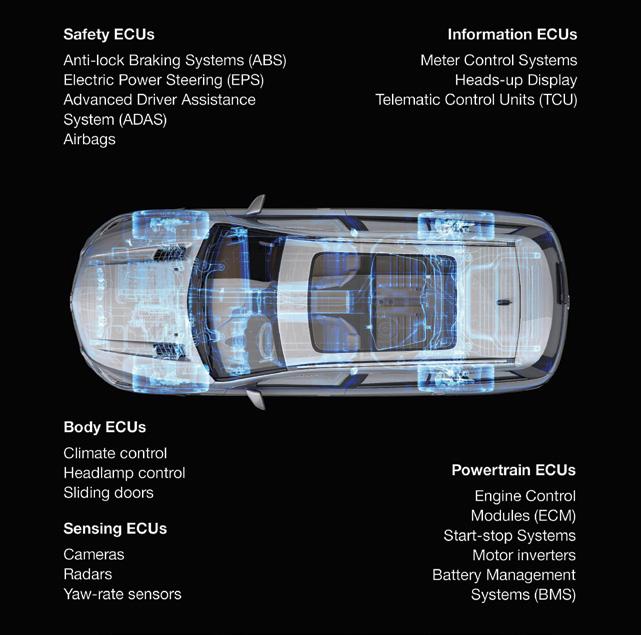
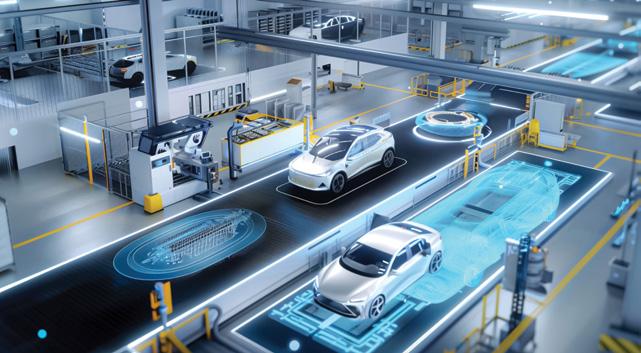
Today, a modern vehicle is often called a ‘smartphone on wheels’. High-end models may contain close to 1,000 ECUs (Electronic Control Units) and up to 3,000 semiconductors – controlling everything from in-cabin climate to ADAS braking systems. As the car evolved into a digital machine that continues to improve its
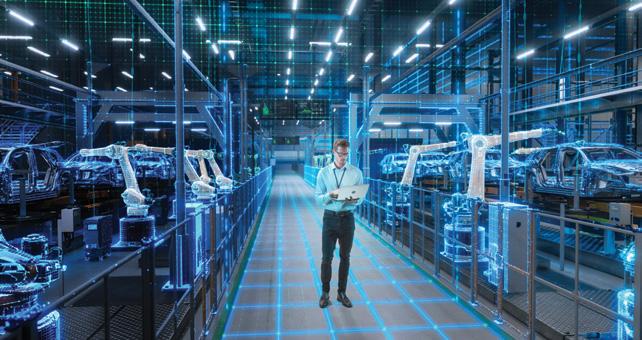
performance even after being sold, the factory that builds it had to evolve too.
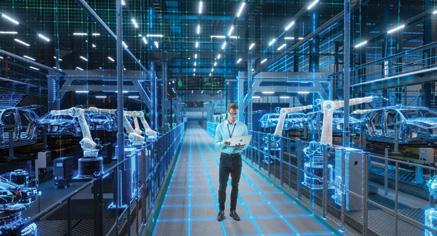
Behind every high-tech vehicle is a manufacturing system undergoing its own transformation. The Fourth Industrial Revolution brought us cyber-physical systems, IoT sensors and cloud-connected machinery. But now, the Fifth Industrial Revolution is beginning to emerge – defined by Agentic AI: intelligent systems that do not just analyse data but make decisions, configure themselves and collaborate autonomously across networks.
In this new paradigm, AI does not just flag faults – it prevents them. Machines equipped with learning capabilities detect abnormal vibration patterns, thermal changes or power fluctuations, and adjust their operation in real time. They trigger service protocols automatically and adapt, to avoid downtime. This is the shift from descriptive to prescriptive and self-organising manufacturing.
While cloud platforms have transformed enterprise visibility, many of the most valuable predictive insights are now being made directly on the factory floor.
Modern AI-driven platforms allow engineers and maintenance teams to perform sophisticated data analysis without needing programming expertise. Edgelevel systems monitor servo drives, robots and inverters –learning their behaviour over time, identifying anomalies and preventing faults before they impact production.
These technologies also protect sensitive factory data by keeping it within the local network, ensuring security and real-time responsiveness. In some cases, the devices themselves have gained onboard AI capabilities –enabling them to diagnose issues independently. For example, robots can now predict joint wear and servo systems can detect problems in connected mechanical components such as belts, gears or ball screws – alerting operators in
advance of serious failures.
As one automation expert put it, “We have taken capabilities that traditionally required data scientists and made them accessible to the people who know the machines best.”
Complexity multiplied
The challenge is no longer just about preventing machine failures
– it is about managing exponential complexity. Automotive manufacturers must now produce fossil fuel, hybrid, and electric vehicles, often with overlapping production lines. The ultimate goal? A single, adaptable line capable of handling all variants seamlessly. And regardless of the drivetrain, today’s vehicles are increasingly electronic. That means more
wiring, more software and tighter integration across components.
Production systems must adapt in real time – not just to changes in design, but to the way demand shifts across regions. This calls for a flexible, layered maintenance strategy, combining predictive, preventive and corrective methods, in a unified approach.
Looking beyond the factory walls
As Mobility as a Service (MaaS) gains momentum, vehicle uptime becomes an economic imperative. Fleets of autonomous or electric vehicles must be monitored, feature updates automatically shared or enabled after purchase, and vehicles maintained and repaired predictively – just like the factories that build them. The tools developed for smart production lines are now migrating downstream, enabling lifecycle management for the vehicles themselves.
And with global platforms scaling across dozens of sites, coordination becomes key. Solutions must work not only at the component level, but also across regions, languages and infrastructure differences.
Intelligent systems with measurable impact
Case studies are a great place to learn as they show what is possible, for example:
• Global manufacturers have implemented diagnostic systems that detect potential failures in robot joints weeks in advance – triggering service workflows automatically.
• Condition-based Asset Management programs span multiple countries, requiring only hours to deploy at each new site.
• Real-time SCADA systems help tyre manufacturers like Continental AG reduce overheads, protect data and streamline operations across 18 plants worldwide.
However, in each case, intelligent automation is not just a technical upgrade – it is a business continuity strategy.
McKinsey has noted that industrial automation is approaching a tipping point, where maturity, affordability and necessity converge. But what separates leaders from laggards is no longer just technology – it is the ability to scale intelligence across the entire value chain.
In modern automotive manufacturing, achieving carbon neutrality across the entire supply chain is an essential requirement. The future factory will not just follow a program. It will follow intent. Self-organising systems powered by Agentic AI will dynamically reconfigure operations in response to goals, constraints and real-world feedback. That is the promise of the Fifth Industrial Revolution.
Even as automotive manufacturers navigate the complexity of multidrivetrain production and softwaredefined vehicles, many of the foundations for this transition have already been laid – quietly, steadily – over the past two decades of digital transformation.
The shift from physical to digital vehicle models has enabled virtual testing, faster iteration and more efficient early-stage development. Co-design with suppliers using 3D CAD data has become standard, allowing engineering decisions to be made earlier and more collaboratively. Modular and platform-based vehicle architectures have emerged in response to rising model diversity, helping balance product differentiation with production efficiency.
Meanwhile, traceability technologies, from advanced barcode tracking to digital twins, are helping manufacturers ensure quality and compliance across increasingly complex assemblies. These same systems are now being extended to support zero-emission manufacturing goals, where every gram of material and kilowatthour of energy is monitored and
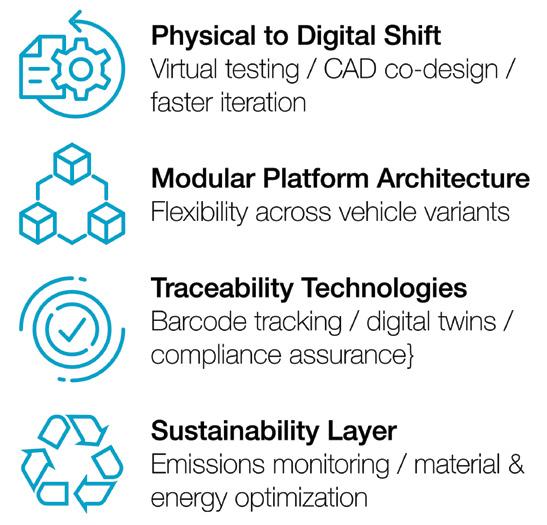
The shift from physical to digital vehicle models has enabled virtual testing, faster iteration and more efficient early-stage development.
optimised.
But as the industry pivots to EVs, new layers of challenge appear.
Battery supply chains, thermal systems, power electronics and vehicle safety standards all require new manufacturing expertise. Workforce training must evolve in parallel, preparing teams to handle high-voltage systems and sensor-heavy platforms. Production lines must flex to accommodate variations in range, charging and region-specific regulatory features – all the while keeping costs competitive.
In this environment, intelligent systems become more than just enablers of efficiency – they are strategic assets. They help manage complexity, enable faster decisionmaking and ensure continuity across a globally distributed network. Most importantly, they provide manufacturers with the readiness to adapt – not just to electrification, but to whatever comes next.
Mitsubishi Electric Corporation
With more than 100 years of experience in providing
reliable, high quality products, Mitsubishi Electric Corporation is a recognised world leader in the manufacture, marketing and sales of electrical and electronic equipment used in information processing and communications, space development and satellite communications, consumer electronics, industrial technology, energy, transportation and buildings.
Mitsubishi Electric Factory Automation Business Group
Offering a vast range of automation and processing technologies, including controllers, drive products, power distribution and control products, electrical discharge machines, electron beam machines, laser processing machines, computerised numerical controllers and industrial robots, the group helps bring higher productivity and quality to the factory floor.
In addition, its extensive service networks around the globe provide direct communication and comprehensive support to customers.
by Vitaly Berezka, Regional Head at PlanRadar
Giving builders in Singapore and ASEAN ‘new eyes’.
Singapore has long been at the forefront of construction digitalisation, from the adoption of Building Information Modelling (BIM) to integrated delivery models. As the Building and Construction Authority (BCA) pilots digital inspections, the next stage is bringing Artificial Intelligence (AI) directly to worksites. The opportunity extends beyond Singapore, with the potential to transform construction across ASEAN.
ASEAN’s construction boom and the productivity gap
Construction remains a key driver of development in Southeast Asia. The region’s construction market is valued at about USD 538.5 billion in 2024 and is projected to grow at 6.2% annually through 2028. The wider Asia Pacific market is worth USD 5.69 trillion this year and could reach USD 8.64 trillion by 2030. Despite the strong growth, productivity has not kept pace. McKinsey reports that global construction labour productivity has risen by only 1% annually over the past two decades, compared with 2.8% across all industries and 3.6% in manufacturing, specifically. In ASEAN, inefficiencies are compounded by manual workflows, fragmented data systems and heavy reliance on physical inspections. The region’s sustainability targets add further pressure. Buildings already account for roughly a quarter of ASEAN’s final energy use and energy-related CO₂ emissions, making smarter and more efficient construction a climate priority.
AI at the worksite frontline
It is one thing to talk about AI in abstract terms. It is another thing to deploy ‘eyes’ on the site. Machine vision technology enables
continuous visual monitoring of construction sites. Using 360° imaging, LiDAR scanning and automated defect detection, these tools track progress, identify issues and document work in real time.
Platforms such as PlanRadar’s SiteView combine 360° image capture with AI-based defect detection and task tracking. This allows teams to reduce rework, make faster decisions and maintain clear traceability. Supervisors and regulators can also verify compliance remotely, relying on accurate imagery and AI-flagged deviations.
Singapore as ASEAN testbed for virtual TOP inspections
Singapore’s BCA is already exploring virtual TOP (Temporary Occupation Permit) inspections, supported by 360° capture tools and site management platforms, where regulators can review lighting, fire safety, finishes and more, from remote, high-fidelity visual data. With tools like SiteView, regulators could retrieve change histories, inspect compliance logs, and reverse-trace tasks – potentially collapsing the inspection cycle, by weeks. For Singapore, this means lowered costs and improved efficiency. For ASEAN, it offers a replicable model.
If adopted regionally, this means that a regulator in Kuala Lumpur, Jakarta or Manila could remotely verify finishing details, structural elements or façade compliance, thereby eliminating repetitive site visits and reducing logistics overhead.
Why Generative AI is not yet the hero
Generative AI (like large language models) captures ‘imaginations’,

Vitaly Berezka
but construction demands precision. Hallucinations, ambiguous outputs and data ‘invention’ are intolerable in structural engineering, safety or compliance contexts.
Moreover, valuable construction data is buried in legacy BIM systems, Common Data Environments (CDEs) and fragmented silos. Without rigorous domain grounding (e.g. mappings to ISO 19650), industry constraints and human supervision, Generative AI remains a complement, not a substitute.
Recent research in construction shows that generative architectures must be augmented with retrievalaugmented methods and domain filters, to reduce error rates.
Thus, the safe path is hybrid – let AI help with document summarisation, query answering, annotation, but defer final engineering judgments to human experts.
A strategic roadmap for ASEAN AI adoption
In the short term, construction teams can apply machine vision for defect detection, progress tracking and safety monitoring. This reduces rework, accelerates work cycles and improves site safety. Over the medium term, predictive analytics for scheduling, cost and risk management, as well as AI-assisted BIM reviews, can lower the likelihood of overruns and enable early identification of issues.
In the long term, embedding AI copilots in BIM and digital twin systems, combined with automated regulatory inspections, offers the potential for scalable automation, improved insights and more efficient regulation.
Collaboration across regulators, developers, technology vendors
and research institutions will be critical. BCA’s guidebooks on virtual inspections, accreditation of drone and AI inspection tools, and promotion of common data standards, provide a strong foundation.
Training is equally important. Engineers and site managers must understand how to interpret and act on AI outputs, while regulatory frameworks need to evolve to support responsible algorithmic decision-making.
From scale up to delivering smarter projects
AI in construction is delivering measurable improvements. It reduces rework, speeds inspections, enhances oversight and improves project delivery. For Singapore and its ASEAN neighbours, these tools contribute to lower costs, greater compliance and reduced carbon emissions.
With billions of dollars invested in regional infrastructure and housing, the difference between
conventional workflows and AIenabled ones is significant. AI does not replace engineers. It enhances their capabilities, giving them new ways to oversee and manage projects. In ASEAN, these tools could reshape the way the region builds.
PlanRadar is a leading platform for digital documentation, communication and reporting, in construction, facility management and real estate projects.
The global market for Artificial Intelligence (AI) in Construction was estimated at USD 2.4 billion in 2024 and is projected to reach USD 12.1 billion by 2030, growing at a CAGR of 31.0% from 2024 to 2030. This report provides an in-depth analysis of market trends, drivers and forecasts, thereby helping to make informed business decisions.
Artificial Intelligence is revolutionising the construction industry, introducing advanced automation, predictive analytics and precision management, that are fundamentally changing how projects are planned, executed and maintained.
AI is employed in construction operations to streamline project management, automate repetitive tasks and enhance on-site safety.
One primary application is in project planning and scheduling, where AI algorithms analyse historical project data to create realistic timelines and anticipate potential delays, enabling better resource allocation and cost control.
The growth in AI in construction market is driven by several factors, including advancements in digital technology, the demand for efficiency and sustainability and evolving industry regulations. One of the primary drivers
is the rapid development of AI technology, which has lowered costs and made these tools more accessible to construction firms of all sizes. The increasing adoption of cloud computing and edge processing allows construction sites to leverage real-time data analysis, supporting advanced AI applications on-site, without requiring extensive infrastructure investments.
Another key factor is the industry’s need to address labour shortages and rising labour costs. AI-driven robotics and automation help fill this gap by performing tasks that are labour-intensive, allowing firms to complete projects faster and with fewer resources.
The growing focus on sustainability in construction, driven by regulatory requirements and consumer demand for environmentally friendly practices, is also propelling AI adoption. AI-powered design tools, energy-efficient material recommendations and predictive maintenance of building systems align with these goals.
Additionally, heightened health and safety regulations are pushing companies to adopt AI for proactive safety management, as AI-based monitoring can improve compliance with evolving
standards.
The report, which covers the forecast period 2024 to 2030, includes the following:
• Comprehensive Market Data: Independent analysis of annual sales and market forecasts in USD million, from 2024 to 2030.
• In-Depth Regional Analysis: Detailed insights into key markets, including the United States, China, Japan, Canada, Europe, Asia-Pacific, Latin America, Middle East and Africa.
• Company Profiles: Coverage of players such as Alice Technologies, Askporter, Assignar, Aurora Computer Services, Autodesk and more.
• Segments: Components, Solutions, Services; Stages: PreConstruction, Construction-Stage, Post-Construction; Application: Project Management, Asset Management, Risk Management, Others; End-Use: Heavy Construction, Residential, Public Infrastructure, Others.
• Geographic Regions/Countries: United States, Canada, Japan, China, Europe (France, Germany, Italy, United Kingdom and Rest of Europe), Asia-Pacific, Rest of the World.
by Jeff Sharp, Principal Industry Consultant, Hexagon Asset Lifecycle Intelligence Division
Unlocking asset intelligence across the lifecycle.
A topic increasingly shaping the future of engineering and maintenance is how Artificial Intelligence (AI), when applied effectively, can transform industrial processes and Asset Management.
At Hexagon, we explore the intersection of AI and Enterprise Asset Management (EAM) and how this convergence is helping engineers solve persistent challenges across the asset lifecycle.
In Singapore and Southeast Asia, engineers and technicians work in environments that demand precision, resilience and efficiency. Whether managing transport infrastructure, utilities and industrial facilities, the ability to maintain asset performance while reducing costs and downtime is critical. Yet many organisations still struggle to realise the full value of their digital transformation efforts. The problem is not a lack of data, it is a lack of connected, contextualised intelligence.
Why data alone is not enough
In our recent ‘Digital Thread’ report, Hexagon surveyed 400 industry leaders. More than half reported that their digitalisation initiatives had not delivered the expected return on investment. A key reason was poor data integration. Data surrounds engineers and technicians, but much of it remains siloed across systems, departments and formats. Maintenance logs, design documents, sensor readings and shift reports often exist in isolation, making it difficult to form a complete picture of asset health.
This fragmentation leads to reactive maintenance strategies, where problems are addressed only after they occur. The consequences are familiar –unplanned downtime, inflated maintenance costs and missed opportunities for optimisation. In high-value environments such as manufacturing and infrastructure, these inefficiencies can quickly escalate into significant operational risks.
To move from reactive to predictive Asset Management, engineers and technicians need more than just access to data. They need contextualised intelligence. At Hexagon, we address this through our Digital Backbone, a unified data infrastructure that connects and contextualises information across the asset lifecycle.
The Digital Backbone ingests data from multiple sources, including legacy systems, thirdparty platforms and real-time sensors. It applies domainspecific models to structure that information. This creates a persistent digital thread that evolves with the asset, enabling engineers and technicians to make informed decisions at every stage, from design to operations and maintenance.
This foundation is what allows AI to be truly effective. It is not enough for AI to generate an answer. we must understand how it arrived there, what data it used and whether we can trust it. In assetintensive industries, accuracy and traceability are non-negotiable.

One of the most exciting developments in our work is the use of AI as a force multiplier within EAM systems. Rather than replacing personnel, AI augments their capabilities, automating routine tasks and surfacing insights that would be difficult or timeconsuming to uncover manually.
The Hexagon EAM platform, combined with the Hexagon APM (Asset Performance Management) solution, enables embedded AI features to support predictive maintenance, anomaly detection and asset performance optimisation. Engineers can use AI to identify patterns in equipment behaviour, anticipate failures before they happen and schedule interventions that minimise disruption.
This shift from reactive to predictive Asset Management is particularly relevant in Singapore, where infrastructure systems, from MRT networks to water treatment facilities, must operate with high efficiency. AI-powered EAM enables engineers to extend asset life, reduce downtime and optimise resource allocation.
Making intelligence accessible through conversational AI
Another innovation we have introduced is Hexagon Alix, a conversational interface that allows engineers and technicians to interact with the Hexagon EAM system, using natural language. Instead of navigating complex menus or writing code, users can ask questions such as “What is the failure history of Pump 101?”
Hexagon Alix acts similarly to an ‘AI intern’, providing guidance, generating scripts and offering regulatory advice. As the technology matures, it will evolve into more advanced roles, moving to a sort of ‘AI engineer’ capable of cross-domain analysis and to an ‘AI principal engineer’ able to identify novel solutions and strategic opportunities.
This approach is particularly valuable in Southeast Asia, where engineering teams often have diverse skill sets and varying levels of digital maturity. By simplifying access to advanced analytics, conversational AI helps bridge the gap and ensures that insights are available to all users, not just data specialists.
Root cause analysis with AI agents in Hexagon EAM
One of the most powerful applications of AI in Hexagon EAM is root cause analysis. Traditionally, investigating equipment failures meant manually collecting data from multiple systems – a slow and error-prone process.
Hexagon’s embedded Root Cause Analysis (RCA) system, instead, uses AI agents specialised in different data domains. One reviews maintenance records, another
analyses shift logs, while others interpret engineering diagrams and time-series data. Working together, they produce a validated report identifying the root cause and recommending corrective actions.
This capability is critical in industries where downtime can cost hundreds of thousands of dollars per hour. By improving speed and accuracy, AI-driven root cause analysis enhances asset reliability and supports continuous improvement.
Singapore’s Smart Nation initiative and emphasis on digital infrastructure make it an ideal environment for AI-enhanced EAM.
The city-state’s engineering sector is characterised by highvalue assets, complex systems and a strong focus on operational excellence.
Solutions such as Hexagon’s Digital Backbone and Hexagon EAM align closely with these priorities.
Across Southeast Asia, where infrastructure development is accelerating, AI-powered EAM offers a way to build resilience into new projects from the outset. By embedding intelligence into the
Hexagon’s Asset Lifecycle Intelligence division provides cutting-edge digital solutions that optimise the design, construction, operation and maintenance of industrial assets. By integrating data and processes across the asset lifecycle, Hexagon empowers organisations to make smarter decisions, improve safety, reduce costs and enhance operational efficiency.
HxGN EAM
HxGN EAM is an Enterprise Asset Management solution designed
to extend asset lifecycles and improve productivity. It offers capabilities such as work order management, asset master data, inventory control, mobile access and enterprise integration. With a cloud-native foundation and advanced analytics, it helps organisations make strategic decisions that increase safety and profitability.
HxGN APM
HxGN optimises asset strategies, detects emerging failure risks in real time and drives proactive
asset lifecycle, organisations can future-proof their operations and adapt more readily to changing demands.
Moreover, the region’s engineering workforce is evolving. As younger professionals enter the field and digital tools become more prevalent, there is a growing need for systems that are intuitive, scalable and capable of supporting diverse user needs. Combining deep industry expertise with cutting-edge AI, our approach provides a practical pathway for this transformation.
AI-powered EAM is not just a technological shift but a strategic imperative for engineering organisations in Singapore and Southeast Asia. By unifying data, contextualising insights and empowering engineers with intelligent tools, we can redefine what is possible in Asset Management.
As we continue to invest in infrastructure, sustainability and digital innovation, the ability to manage assets intelligently will be a key differentiator. The future of Asset Management is not just digital, it is intelligent, contextual and collaborative.
risk mitigation that directly enhance return on capital employed.
HxGN Alix
HxGN Alix is an AI-powered assistant specifically designed to unlock greater insights and faster access to information, for heavy asset industries and industrial enterprises.
HxGN Alix empowers enterprises to enhance operational efficiency, safety and resilience, through real-time data insights and predictive analytics.
by Fox Chen, Analyst and Bob Gill, General Manager, Southeast Asia, ARC Advisory Group
A high-powered event featured expert speakers and real-world case studies.
On 7 August 2025, ARC Advisory Group in Singapore brought together close to 200 industry leaders, technology providers, automation end users and innovators, at the Marriott Tang Plaza Hotel, for the second ARC Industry Leadership Forum Singapore.
With this year’s theme of ‘Winning in the Industrial AI Era’, the full-day event featured 22 expert speakers and 14 presentations with real-world case studies.
The four forum sessions explored the following key themes shaping the future of technology enabled manufacturing:
• Future Automation: Open, Standardised, Software-Defined
• Industrial 5G: Connecting the Smart Factory
• Artificial Intelligence for Industry
• 21st-Century Operations: Smart, Secure and Sustainable
The sessions included speaker presentations, expert panel discussions and audience Q&As. An accompanying exhibition showcase allowed attendees to see and explore much of the technology described on stage, as well as interact and network with sponsors and fellow delegates.
After an entertaining stage performance featuring several robots from Hong Kong service robot innovator, Robocore, the Keynote Address from Chandran Nair, CEO of Universal Vapor Jet Corporation (UVJC), a veteran in industrial automation and advanced manufacturing, traced the progression from early machinery to today’s intelligent operations, emphasising that
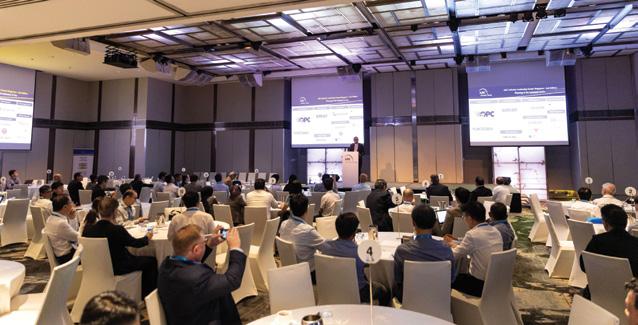
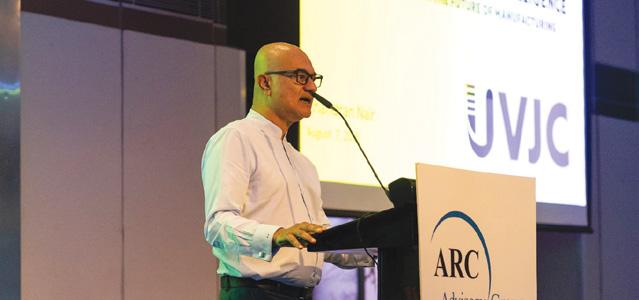
success in the AI era requires more than tools – it demands resilience, openness and human-centred collaboration.
Mr Nair said, “While AI may change how factories are, work or will operate, the real transformation is still cultural. For now, cultural is very much based on us, humans. Will people trust working alongside robots?”
He also heralded the emerging fifth industrial revolution (Industry 5.0) as human-centric, sustainability-driven and rooted in closer connections between
technology and people.
Future Automation
Data is the lifeblood of the Industrial AI era, and the Future Automation session highlighted how its flow, quality and accessibility are central to success.
From Brazil, Octavio Paschoal, Electronic Intelligence Agent at Nova Smar, showed how AI can complement O-PAS (Open Process Automation Standard), enabling smarter, data-driven control in industrial automation.
Meanwhile, a little closer to
home, from Malaysia, Megat Shamsul Arif of Trisystems Engineering shared how his team is applying IEC 61499 and Universal Automation technology to upgrade offshore control systems, with the goal of making them more efficient, handling more data with less bandwidth and increasing robustness.
William Tanuwijaya, Technical Liaison at OPC Hub ASEAN, introduced the OPC Foundation Cloud Initiative, demonstrating how OPC UA can accelerate IT and cloud interoperability; support AI analytics, industrial data spaces, digital product passports, industrial metaverse and digital twin applications; and provide standardised, secure, regulationcompliant cloud architectures.
The subsequent panel discussion included Ravi Jagasia, Americas Representative of UniversalAutomation.org; Sharul A-Rashid, Chair (Elect) of ISA Asia Pacific; David Chia, Head of OPC Foundation ASEAN Hub; and Sujit John, Head of Regional System Marketing at Yokogawa Engineering Asia.
The Industrial 5G session featured four speakers, highlighting how advanced connectivity is transforming factories, autonomous systems and robotics. Setting the stage for the subsequent presentations and discussions, Terence Wong, Head of APAC 5G Industry & IoT at industry body GSMA, provided a valuable overview of the 5G landscape in Asia Pacific and demonstrated how 5G creates value across industries, by describing regional deployment case studies.
Mohamed Firdaus, Senior Director of Enterprise Group at Singtel, offered the service provider perspective, explaining how private 5G networks in industrial and manufacturing settings leverage network slicing and the 700 MHz spectrum to deliver secure, reliable connectivity for smart factory operations.
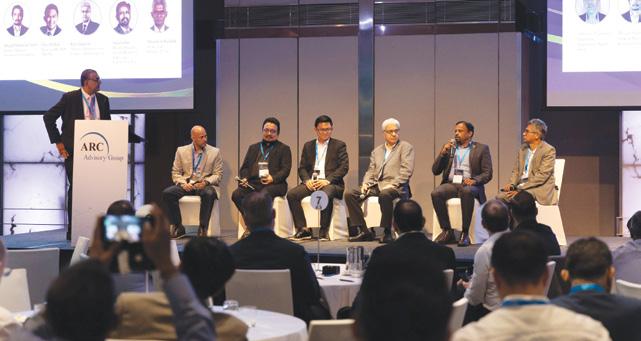
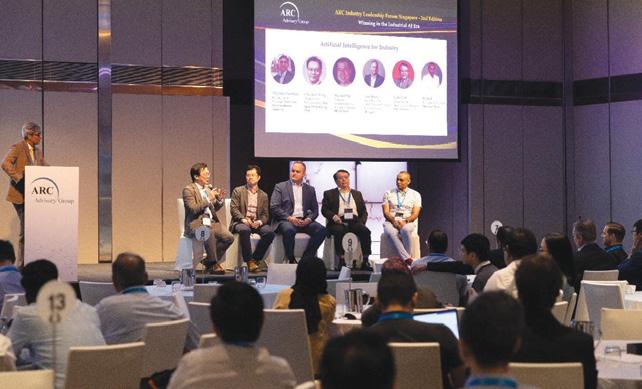
Ethan Kuch shared how ST Engineering uses 5G to connect multiple manufacturing sites, enabling AI-driven automation and scaling real-time operational intelligence across its plant network. And then finally, Roy Lim, CEO of Robocore, discussed the adoption of 5G-powered robotics, the value it brings and its deployment across industries.
Artificial Intelligence for Industry
Artificial Intelligence was a recurring theme throughout the forum, shaping discussions on open architecture, interoperability, connectivity and future operations.
The ‘Artificial Intelligence for Industry’ session featured perspectives from industry associations, technology suppliers and end-users, highlighting different approaches to adoption. Oliver Tian, Director and Founder of Oliver Tian Associates, which is affiliated with several industry associations, including the Asia Pacific Assistive Robotics Association, set the tone for the discussion. Focusing on the industrial space, he addressed key issues with AI, underscored that AI is here to stay, and encouraged organisations to embrace it, learn with it, and leverage AI
technologies to maximise impact.
“Don’t struggle to be smarter than AI – be smarter with AI”, he said.
Chai Kah-Ming, Head of Smart Manufacturing at Yokogawa Engineering Asia, then shared on challenges in deploying AI solutions and the importance of selecting the right tools, and presented case studies showing how Yokogawa creates value for customers through AI.
Michael Ng, Principal Instrumentation & Control Engineer and Mohd Azlan Shah Abd Rahim, Staff Engineer Instrument & Control, at PETRONAS, provided an end-user perspective, highlighting cybersecurity considerations in AIenabled operations.
In the fourth presentation in this session, Tom Kurtz, Vice President of EAM Portfolio Strategy & Enablement at Hexagon, explained why a digital backbone is foundational for AI and how Hexagon’s AI strategy leverages it to structure and enrich data, enhance decision-making and make insights accessible across the asset lifecycle.
The track concluded with a panel discussion featuring additional experts, Colin Koh, Senior Business Development Manager at LKH Precicon, and Milind, Senior AI Scientist at Mercedes-Benz, who shared diverse perspectives across industries and organisations.
The 21st-Century Operations session explored how emerging technologies are reshaping industrial operations, focusing on robotics, cybersecurity and the transformation of operations through AI.
Matthias Gronstedt, Managing Director at German drone innovator HHLA Sky, shared insights on autonomous operations and the automation of high-risk labour tasks to improve safety and efficiency.
AJ Eserjose, Regional Director of OT-ISAC, highlighted why traditional threat reports often fall short in OT environments and used the UNC3886 case (a China-linked
threat group recently reported to have targeted Singapore’s critical infrastructure) to show the importance of turning intelligence into actionable defence.
To end the day, Vikram Kalkat, Director of Strategic Services at ARC Advisory Group, presented a consulting case study on how ARC guided an oil & gas industry enduser in advancing their automation maturity and preparing for AI adoption.
With strong participation and robust discussions, the ARC Industry Leadership Forum Singapore 2025 showcased the emerging future of AI, highlighting the changes and capabilities needed to unlock its full potential.
Across these interactions, a recurring theme emerged – success in the Industrial AI era depends as much on leadership, organisational readiness and strategic foresight as on technical innovation. Human and cultural factors also play a pivotal role in the successful deployment of AI.
The forum emphasised the strategic role of AI and its vast potential for value creation, the importance of interoperability and open standards for data flow and multi-vendor integration, and the necessity of connectivity for handling high-volume data as AI takes physical form in robotics.
It also underscored the critical importance of cybersecurity in enabling safe AI adoption and operational resilience. Collectively, these insights set the stage for continued exploration of industrial automation and operational readiness, as the community looks ahead to the ARC Industry Leadership Forum Singapore 2026.
ARC Advisory Group provides technology research, advisory and consulting services to industrial automation and software suppliers as well as to end-user companies in the manufacturing, infrastructure and energy sectors.
ARC Advisory Group’s research reveals that the process instrumentation space is undergoing a dynamic phase of growth and transformation, spurred by rising demand for precision and efficiency across a variety of applications.
It is evident that AI and digitalisation initiatives have emerged as the fulcrum of all businesses.
“The demand for sensors and instrumentation with greater capabilities is growing, to manage processes with increased energy efficiency, safety and compliance to stringent environmental regulations. New software applications and embedded sensor intelligence are also becoming available to interpret the data from sensors and convert it into actionable information,” said Allen Avery, Senior Analyst and key author of ARC’s Total Instrumentation Expenditures for Process Industries Market Research.
“This will enable a prompt response to potential problems, and better insight for improved decision-making. Stricter safety and environmental regulations may require more sophisticated monitoring and control, which can increase the demand for advanced temperature transmitters. Expansion in key industries such as oil and gas, chemicals, and power generation will further increase demand for process instrumentation,” he added.
Ensuring cyber-physical safety.
Cyber attacks on Operational Technology (OT) systems pose a unique challenge for engineers. Digital intrusions can escalate into real-world consequences –equipment damage, environmental harm or even loss of life. For civil, mechanical and safety engineers, whose mandate is reliability and protection, this makes OT security not merely an IT issue but a core engineering competency.
The OT/ICS incident response gap
A persistent vulnerability in the cyber-physical nexus is the gap in incident response (IR). Traditional OT/ICS IR often struggles with the following:
• Siloed Knowledge – IT teams emphasise data confidentiality, while Operations and Engineering teams prioritise system availability and safety. Misaligned priorities delay decisive action.
• Lack of OT Context – Cyber alerts often lack the engineering perspective needed to assess physical risk, e.g. which process is compromised, or whether a Safety Instrumented System (SIS) is linked to a targeted PLC.
These gaps hinder timely, coordinated responses when safety is on the line.
OT-ISAC’s collaborative efforts and shared intelligence for safety
The Operational Technology Information Sharing and Analysis Center (OT-ISAC) helps close these gaps by enabling secure intelligence sharing among asset owners, vendors and government partners. This information sharing goes beyond malware signatures – it details adversary tactics that deliberately target OT environments’ safety layers.
Crucially, OT-ISAC transforms

intelligence into action, through collaborative efforts within its community. Members, from the energy sector to transportation and other critical infrastructures, participate in joint OT/ICS incident response exercises.
These exercises simulate sophisticated adversarial techniques, such as compromising a Basic Process Control System (BPCS) to trigger a hazardous condition (e.g. overpressure) while simultaneously disabling SIS or Emergency Shutdown (ESD) logic. By running these scenarios together, engineers, operators and business leaders gain firsthand experience in recognising cyber-physical escalation and applying engineering judgement to mitigate risk.
The greatest value of OT-ISAC membership lies in translating intelligence into practice through cross-functional response drills. Engineers play a central role in the following:
• Scenario Creation – Engineering and Operations teams design realistic injects, ensuring simulated
attacks reflect the plant’s actual safety-critical processes.
• Integrated Execution – Exercises engage technical staff, business units and senior management together. Engineers and operators coordinate with the Security Incident Commander to perform the following:
– Safely shut down processes when cyber indicators show escalation.
– Physically validate control integrity before systems are restored.
By embedding engineering expertise into both scenario design and execution, organisations ensure that OT/ICS incident response is not only about stopping attackers, but also about protecting lives and physical assets.
For engineers, the message is clear. In today’s hyper-connected world, cyber defence is safety defence. Through OT-ISAC’s information sharing model – and community-wide collaboration across sectors – the engineering community is better equipped to prevent digital threats from becoming physical disasters.

by Takanori Nishiyama, SVP APAC and Japan Country Manager, Keeper Security
The challenges and solutions are discussed.
The semiconductor supply chain is deeply interconnected, making it an appealing target for cybercriminals.
Attackers aim not only to steal intellectual property but also to disrupt operations that can ripple across global industries. Recent high-profile breaches have shown how damaging these incidents can be, leading to operational downtime, reputational harm and broader economic instability.
Governments can play a role in creating a trusted semiconductor sector. For example, the Japanese administration is linking cybersecurity compliance to government subsidies, signalling that strong security is nonnegotiable. This encourages manufacturers to see cybersecurity as a strategic asset – critical to innovation, business continuity and competitive advantage.
Meeting these expectations will require far more than basic firewalls and antivirus tools.
Semiconductor companies need a comprehensive approach built on zero-trust principles, strict access controls, identity verification and real-time monitoring. Cybersecurity must be embedded in daily operations to ensure resilience and readiness across the semiconductor supply chain.
As threats involving credential theft, privilege escalation, and lateral movement increase, maintaining control over sensitive accounts and privileged access is vital.
Semiconductor operations
face uniquely high risks. A single compromised credential can expose proprietary chip designs, disrupt manufacturing workflows or compromise national interests. Keeper addresses these risks through a zero-trust, zeroknowledge security platform that includes Privileged Access Management (KeeperPAM) and enterprise password management. KeeperPAM gives organisations clear visibility into who has access to what. Companies can enforce least-privilege policies, grant access only when needed, and monitor sessions in real time. AI-powered insights help detect and respond to suspicious activity early, while automation reduces human error and minimises the risk of excessive or stale privileges, especially when managing contractors or third-party vendors.
Meanwhile, Keeper’s enterprise password management ensures employees and contractors manage credentials securely through encrypted vaults. Passwords are generated, stored and autofilled with phishing-resistant protections, preventing reuse and stopping attackers from exploiting poor password hygiene. Every activity is logged and auditable, supporting compliance and breach response readiness.
With Keeper’s zero-knowledge encryption, only the end user can access their stored data –even Keeper has no access to it. Everything is encrypted and decrypted locally at the device level. This architecture drastically limits the blast radius of any
potential breach and aligns with relevant cybersecurity regulations, such as those from the Japanese Ministry of Economy, Trade and Industry (METI), the National Center of Incident Readiness and Strategy for Cybersecurity (NISC), and the Act on the Protection of Personal Information (APPI).
Keeper’s platform also secures non-human identities, including API keys, Secure Shell (SSH) credentials and DevOps secrets. Whether protecting access to Electronic Design Automation (EDA) tools, managing remote workforces, or segmenting Operational Technology (OT) and Information Technology (IT) environments, Keeper enables flexible, policy-driven control without exposing sensitive credentials.
Designed to integrate seamlessly with enterprise systems, including Active Directory, Single Sign-On (SSO), multi-factor authentication (MFA), SIEM tools and IT service management workflows, Keeper deploys quickly and scales efficiently. It is an ideal fit for semiconductor companies operating across hybrid cloud and on-premises infrastructure, particularly as they embrace smart manufacturing and Industry 4.0 transformation.
As Asia advances its semiconductor capacity with support from both regional policies and international alliances, Keeper enables organisations to shift from reactive, fragmented security practices to a proactive, unified approach centred on digital resilience.
With only 13% very confident in spotting scams, Singaporeans demand stronger security and AI regulation.
Ping Identity, a leader in securing digital identities for the world’s largest enterprises, released its global 2025 Consumer Survey revealing that Singaporeans are more concerned about deepfake impersonations (39%) and Artificial Intelligence (AI) voice cloning (33%) than any other country.
The report found that 85% of Singaporeans now use AI, up from 41% globally a year ago, while a mere 12% have ‘full trust’ in the organisations that manage their identity data. Trust is eroding quickly, with a majority reporting more concern about personal data security than they felt five years ago, paired with growing demand for stronger authentication and tighter government regulation.
“Consumer confidence in brands is eroding as we enter a ‘trust nothing’ era fuelled by AIenabled fraud. The rising concern among Singaporeans for deepfake impersonations and AI voice cloning highlight the urgent need for stronger and more user-friendly identity verification methods as AI adoption grows,” said Jasie Fon, Regional Vice President of Asia at Ping Identity.
“Brands must prioritise adopting advanced authentication solutions such as biometrics to enhance the consumer trust. In doing so, organisations can safeguard identities and rebuild confidence in digital interactions amid an evolving threat landscape,” she added.
GLOBAL CONSUMER FINDINGS
AI adoption soars but security concerns loom larger than ever
• 68% now use AI personally (up from 41% in 2024), with even
higher adoption (85%) in Singapore.
• 75% say they are more concerned about personal data security than five years ago and concerns are even higher in Singapore (85%).
• 39% cite AI-driven phishing as the modern scam that concerns them most, while Singaporeans are most concerned with deepfakes.
Citizens crave AI safeguards but feel left in the dark
• 73% believe government regulation of AI to protect their identity data is important.
• However, 52% say they do not feel sufficiently informed or protected from scams, by guidance from safety organisations or government institutions, suggesting more need for education.
• Only 23% feel very confident in their ability to determine whether something is legitimate or a scam. In Singapore, that confidence is even lower, at a mere 13%.
Biometrics top the wishlist to improve trust, security and experience
• 34% report biometric authentication and 33% cite multifactor authentication as the top features that would increase their trust in online brands.
• Financial fraud (25%) and account take-over (21%) were the most common scams experienced, many of which may have been prevented through biometrics.
• Reflecting this, the leading change people want in the login experience is more biometrics (21%).
Methodology
This random double-opt-in survey,
commissioned by Ping Identity, was conducted by market research company Talker Research, whose team members are members of the Market Research Society (MRS) and the European Society for Opinion and Marketing Research (ESOMAR). Talker Research interviewed 10,500 consumers across the US (2,000), UK (2,000), France (1,000), Germany (1,000), Australia (1,000), Singapore (1,000), India (500), Indonesia (500), Netherlands (500), Sweden (500) and the UAE (500). Year over year comparisons were based on Ping Identity’s 2024 Consumer Survey.
Earlier this year, Ping Identity announced that it has launched on AWS Singapore. The ability to run workloads and securely store content in Singapore enables Ping Identity to provide localised, highperformance identity and access management (IAM) solutions to businesses across the Asia-Pacific region and further support its growing local customer base with even lower latency. This strategic move benefits mid-sized and large enterprises, in sectors such as Tech and Hospitality, Retail and e-commerce, Healthcare and Life Sciences, Midmarket Financial Services, and Manufacturing and Energy.
The project also helped to reduce costs and emissions.
Siemens Smart Infrastructure has implemented smart building technology at the ‘House Potsdamer Strasse’ of the ‘Staatsbibliothek zu Berlin’ (Berlin State Library), Germany and, since then, it has continued with its services to enhance sustainability and energy efficiency at the site. The project ensures a constant indoor climate at the library to preserve its valuable cultural assets even better.
The contract is an extension of a larger decarbonisation programme with the German Federal Government, which already saw seven cultural properties, including museums, galleries and libraries, retrofitted by Siemens, since 2007. The contract supports the national climate protection programme to reduce CO2 emissions of government-owned assets by 65%, by 2030, compared to 1990 levels.
The extension of the programme for the Berlin State Library includes energy consumption analysis and reduction planning as well as technology implementation, operations and services. To help the library reach its decarbonisation targets, Siemens deployed advanced building technology.
This includes the company’s comprehensive building automation system, Desigo, room operator units, sensors and detectors, as well as a cloud-based energy and asset management platform, powered by Siemens’ digital building platform, Building X.
In addition, Siemens ensures optimised process control through Heating, Ventilation and Air Conditioning (HVAC) products, including flexible supply air control and a connection to district cooling with a total output of 2.5 megawatts. Furthermore, 5,300 LED lights have been installed.

“The Berlin State Library has a rich history spanning more than 360 years. To preserve its valuable, high-diversity assets even better, it requires consistent environmental parameters. Siemens is delighted to supply the technology that enables it to sustain these conditions, while also reducing energy consumption by 52%,” said Constantin Ginet, Executive Vice President, Sustainability, Siemens Smart Infrastructure Buildings.
“The latest contract, focused on services, builds on the success of the initial phase of the project. With guaranteed energy cost savings fully financing all project costs, this cooperation serves as a blueprint for reaching sustainability targets for millions of cultural facilities around the globe.”
“Siemens’ holistic approach, deep expertise and innovative financing model make it a perfect match to help us – and the national programme – to achieve substantial energy savings and sustainability improvements, while still maintaining the optimal conditions required to safeguard our priceless cultural heritage through continuous monitoring,”
Reinhard Altenhöner, Deputy General Director at Staatsbibliothek zu Berlin, added.
Since 2007, Siemens has supported seven of Berlin’s cultural institutions to achieve remarkable sustainability results, including an outcome of nearly EUR 25 m gross energy savings, and eliminating around 3,745 tons of annual CO2 emissions.
With the completion of the tech implementation at the eighth facility, the Berlin State Library, the collaboration has generated a total of around EUR 45 m in gross energy savings and eliminated around 11,745 tons of annual CO2 emissions, while continuing with constant energy monitoring and data-based advisory services for all eight buildings.
Building X is a digital building platform that supports customers in digitalising, managing and optimising their building operations – paving the way for sustainable, autonomous and profitable assets. It is part of Siemens Xcelerator, an open digital business platform that enables customers to accelerate their digital transformation easier, faster and at scale.
Siemens Smart Infrastructure
Siemens Smart Infrastructure (SI) addresses the challenges of urbanisation and climate change, by connecting energy systems, buildings and industries.
Sandvik Coromant, a global leader in metal cutting tools and manufacturing solutions, has introduced its CoroTap 100 tool with -PM geometry, a new family of optimised straight flute cut taps for ISO P materials.
Engineered with a highperformance chip-breaking design, the new iteration of the tapping tool drastically reduces production interruptions and eliminates the need for manual chip removal. The result is a safer production environment and a more stable machining process with continuous, reliable output and minimal manual intervention.
Effective chip evacuation is critical, especially in blind holes. CoroTap 100 with -PM geometry is optimised for internal coolant delivery, ensuring clean chip removal and a high-quality finish. For through holes, external coolant via collets or nozzles is recommended for optimal
performance.
“By integrating precise chip management with high-quality threading, we are helping manufacturers maintain steady production with minimal operator input. The chip breaker chamfer may seem like a subtle feature, but its effect is substantial. Applying it to just two flutes allows for efficient chip separation while preserving the accuracy and finish of the thread,” said Cory Carpenter, Global Product & Digital Application Specialist at Sandvik Coromant.
“Coolant is not just a support function, it is crucial in precision threading. With the right flow, pressure and concentration, we can prevent chip recutting and maintain a clean, efficient process,” he added.
The CoroTap 100 tap range is available in a comprehensive selection of geometries tailored for ISO P, K, N and H materials. The

assortment includes straight flute taps, spiral point taps, spiral flute taps, and forming taps – offering manufacturers the right solution for every threading challenge.
Sandvik Coromant
Together with customers and partners, Sandvik Coromant works towards a sustainable future, supplying tooling solutions to the world’s engineering industries. Over eight decades of hands-on experience have given the company a wealth of knowledge in metalcutting and machining.
This expertise transforms challenges into opportunities for innovation, collaboration and progressive solutions. Sandvik Coromant aims to create positive change by promoting sustainability, efficiency and growth, to shape a future where innovation thrives. The company is part of global industrial engineering group, Sandvik.
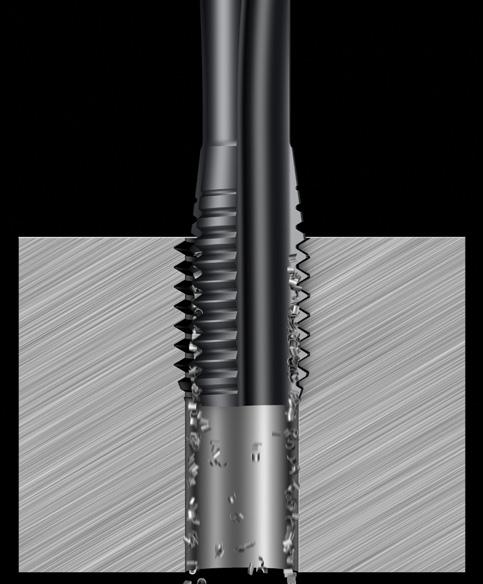
HID, a worldwide leader in trusted identity and biometric solutions, and ASSA ABLOY, a global leader in access solutions, have announced that their self-boarding biometric eGate – the BG100 Speedgate – has received a Red Dot Award: Product Design 2025, in the interior design elements category.
The BG100 Speedgate is a nextgeneration solution that seamlessly integrates the HID Facepod and document reader with ASSA ABLOY’s Speedgate – redefining the passenger journey through airports with a faster, more secure and frictionless experience.
At the core of the BG100 Speedgate is the HID Facepod, an all-in-one facial recognition solution featuring an advanced camera system and algorithms, intuitive multi-touch screens and smart LED guidance.
Together, this solution streamlines critical airport touchpoints – from pre-security checks and VIP lounge access to boarding and immigration – delivering a secure, frictionless and touchless experience for travellers. Recognised for its clean design and advanced biometric capabilities, the solution met the Red Dot jury’s high standards for functionality, useability and innovation.
“We are proud to be recognised with a Red Dot Award for a solution that reflects HID’s dedication to serving the aviation and travel industry. This award underscores our leadership in biometrics and facial recognition technologies and highlights our commitment to delivering secure, intuitive and best-in-class identity verification experiences for travellers around the world,” said Mr Vito Fabbrizio,

Vice President Product Management and Innovation, Biometric Identity Technologies, HID.
Boasting an ultra-modular design, the BG100 Speedgate is simple to install and is available in a range of colours and sizes to complement any airport environment. Built for high-traffic areas, it integrates advanced security features like anti-tailgating, piggybacking and wrong-way passage.
Reflecting both companies’ shared commitment to innovation, the BG100 embodies the ‘Moving by Design’ approach, combining motion, emotion and technology, to deliver a secure, streamlined passenger experience.
“It is incredibly exciting to see our joint innovation recognised on a global stage. This award is a testament to the power of collaboration and our shared commitment to shaping the future of travel. Together, we are delivering cutting-edge solutions that enhance security, elevate the passenger experience and make travel safer and more intuitive,” said Mr Robert Zimmerman, Head of Business
Vertical Airports, ASSA ABLOY.
The Red Dot Award: Product Design is a prestigious design competition, worldwide. Since 1955, it has recognised products that stand out for their exceptionally high-design quality. In 2025, the independent Red Dot Jury consisted of experts from 21 countries, including designers, professors, journalists and consultants from various disciplines. Entries were submitted from over 60 countries and were carefully reviewed and discussed by the jurors.
ASSA ABLOY
ASSA ABLOY is a global leader in access solutions, with leading positions in areas such as efficient door openings, trusted identities and entrance automation.
HID’s trusted identity solutions give people convenient access to physical and digital places, and connect things that can be identified, verified and tracked digitally. HID is an ASSA ABLOY Group brand.