

INVESTMENT OUTLOOK



EQUITIES: TRADE NEGOTIATIONS THE STORY FOR FOURTH QUARTER
The broad equity market was flat in the third quarter despite increasing signs of economic slowdown and continued investor unease regarding the trade conflict between Washington and Beijing. Interest rates continued to fall during the quarter and this, combined with the optimism of many investors that a trade deal will eventually be reached, was enough to keep stock indices relatively unchanged.
The MSCI All Country World Index returned 0.1% during the third quarter, while the S&P 500 was up 1.7%. Emerging market stocks, which tend to be the most vulnerable to trade tensions, were down 4.2% during the third quarter as measured by the MSCI Emerging Market Index. Stocks are still up considerably this year, with the MSCI All Country World Index and S&P 500 returning 16.7% and 20.6%, respectively, year-to-date through September.
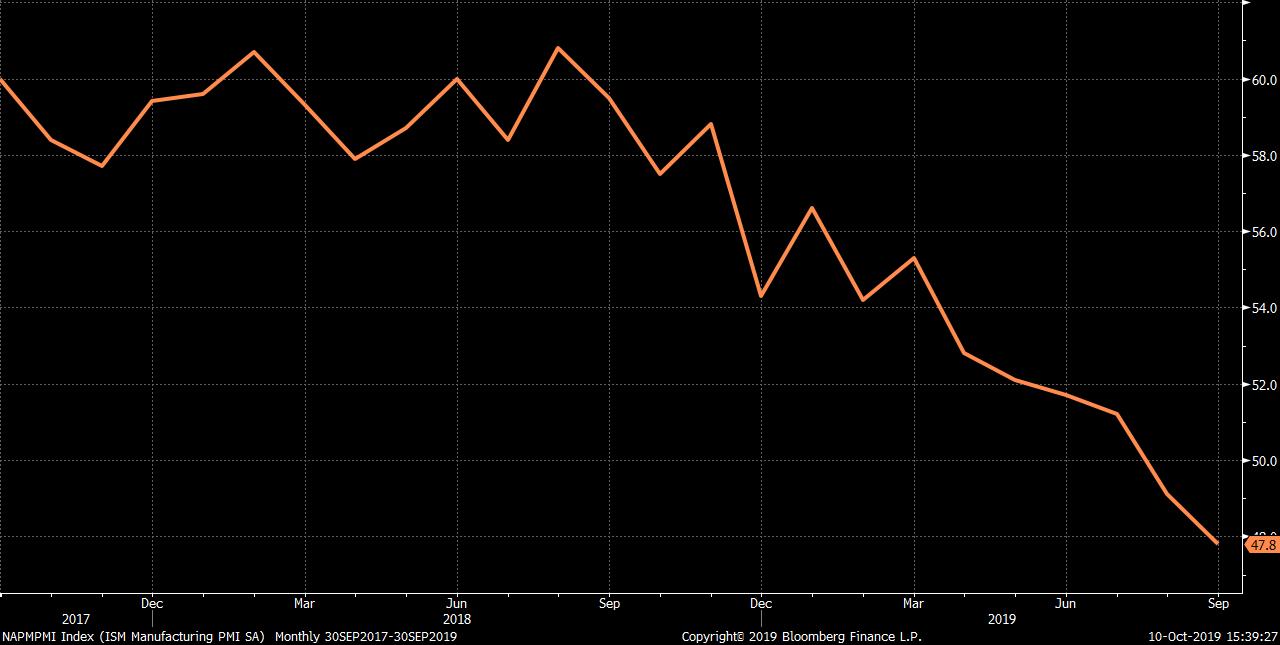
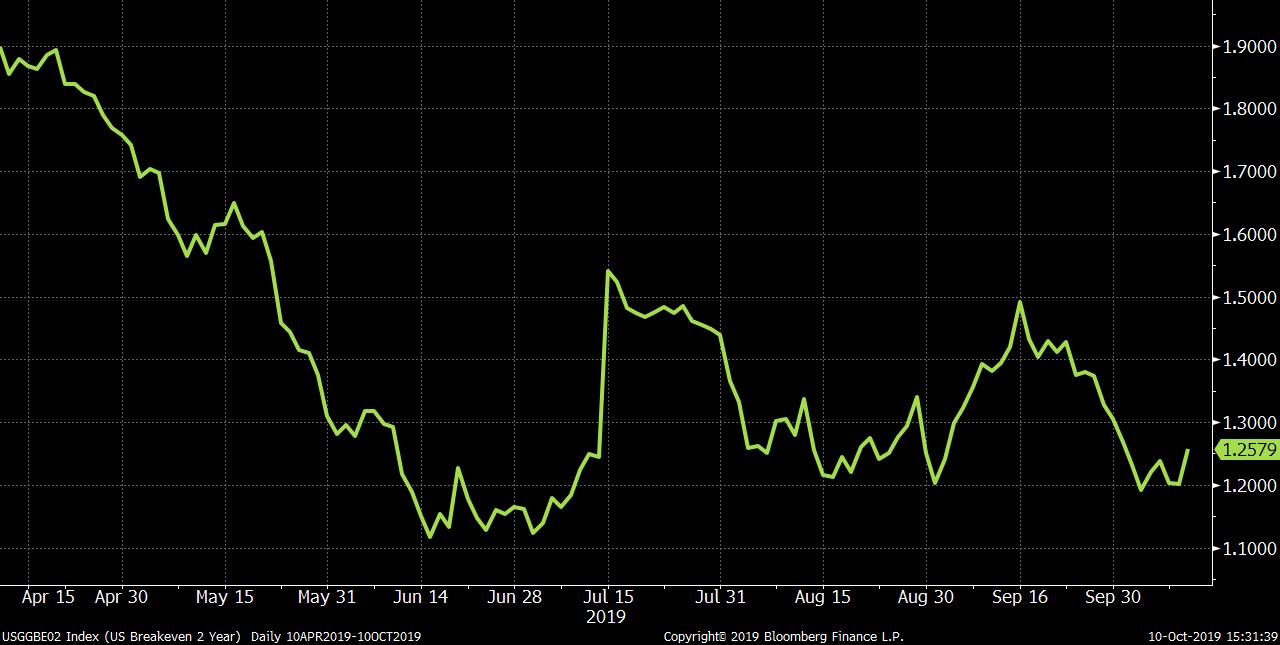
The global economy is slowing. U.S. GDP growth has slipped to 2.3%, with growth in Europe and major emerging market economies China and India also declining. Housing price increases in the U.S. have moderated considerably this year, with the Case Shiller Home Price Index up just 2.0% year-over-year in July, its slowest pace in seven years and down from 6.3% a year earlier. In another sign of potential trouble ahead, recent data show that the U.S. manufacturing sector has slowed significantly and is currently contracting. Additionally, inflation breakeven rates in the U.S. (what investors expect inflation to be in the future) are down in the last six months, with the 2-year breakeven rate at 1.26%. A figure this low is
usually a sign of considerable investor pessimism regarding economic growth prospects in the near term. The labor market continues to be a bright spot in the U.S. economy, with the unemployment rate at a historic low of 3.7%. Many investors fear, however, that this figure is a lagging indicator of the direction of economic growth. The bond market appears to share this view, with the yield on 10year Treasury bonds falling from 3.08% one year ago to 1.74% today.
Economic data have led to a somewhat dour mood among investors in recent weeks, but it’s important to keep in mind that resolution to trade tensions has the potential to dramatically change the
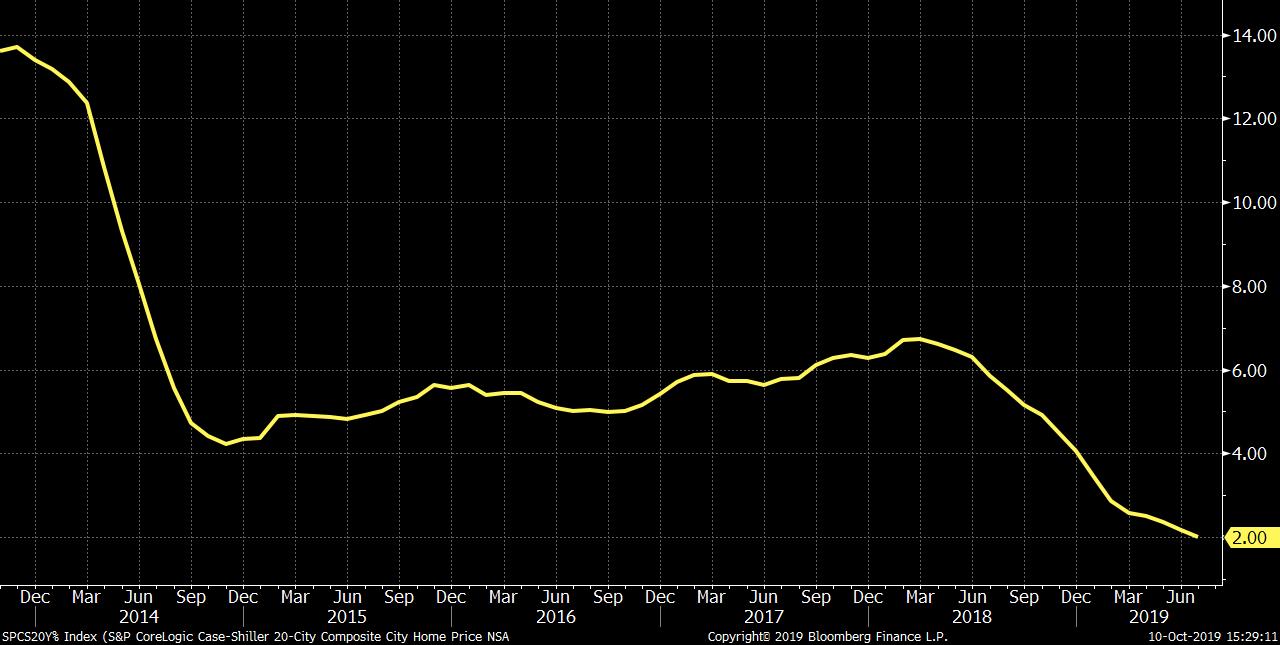
S&P/Case-Shiller US National Home Price Index
Source: Bloomberg
ISM Manufacturing PMI
- A figure below 50 indicates contraction
short-term outlook for equities. Most investors view the trade conflict between Washington and Beijing as significantly negative for stocks (we share this view), so a lasting resolution would likely buoy equity prices considerably in the near term. A deal can’t be ruled out, as China’s leadership keeps its intentions well hidden and the political environment in the U.S. has entered a period of increased uncertainty. It’s likely the case, however, that with each passing week China’s leaders will see more advantage in delaying serious discussions toward a long-term deal until after next year’s elections in the U.S. Consequently, trade tensions are likely to continue weighing on stocks.
Source: Bloomberg
2-Year US Breakeven Inflation Rate
Source: Bloomberg
FIXED INCOME: SECURITY SELECTION KEY WITH RATE OUTLOOK MURKY
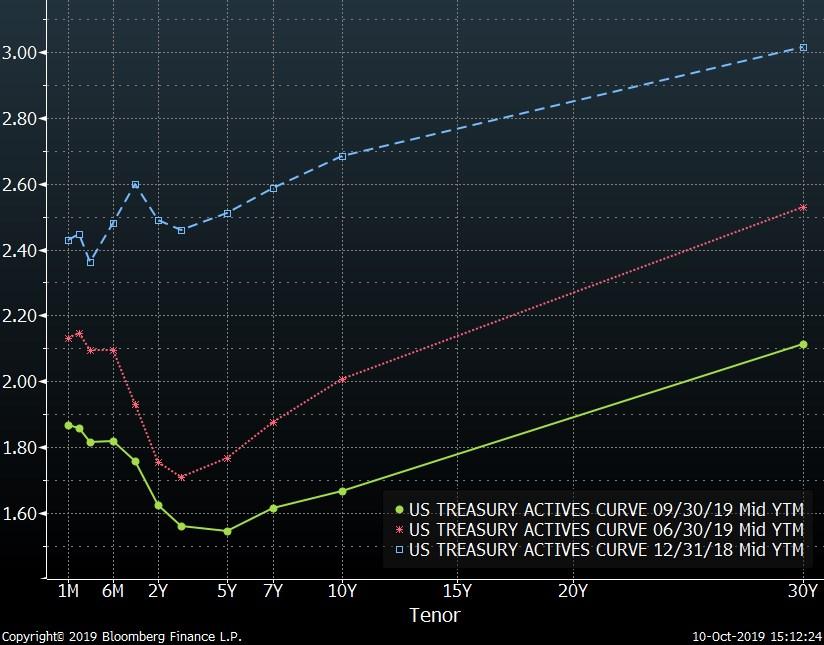
Interest rates fell again in the third quarter, with the yield curve flattening slightly after the Federal Reserve (Fed) lowered the fed funds rate in July and again in September. Interest rates have fallen significantly this year, with the 10-year Treasury yield down from 2.78% in January to 1.67% at the end
of September, as the trade conflict remains unresolved and economic growth has slowed. Federal Reserve policymakers have been resistant to lower interest rates for most of this year, though consistently weaker economic data, falling inflation breakeven rates, and bond market expectations
for cuts have forced their hand. In spite of continued reluctance among Fed policymakers to cut rates, the bond market is hankering for – and predicting – more cuts this year (bond investors see an 80% probability of at least one additional rate cut this year, and a 25% probability of two cuts).
We’re forecasting that the Fed will hold rates steady during the upcoming October meeting, with a 25 basis point cut occurring in December. Such a course of action would be consistent with chair Jerome Powell’s balanced management of FOMC opinion.
The fed funds rate cut in September lowered the very short end of the U.S. Treasury yield curve significantly, but steepening was limited by significant declines in the 5-10 year area of the curve. We view this as evidence that bond investors have become more confident in their prediction of a recession occurring in the next 12-18 months.
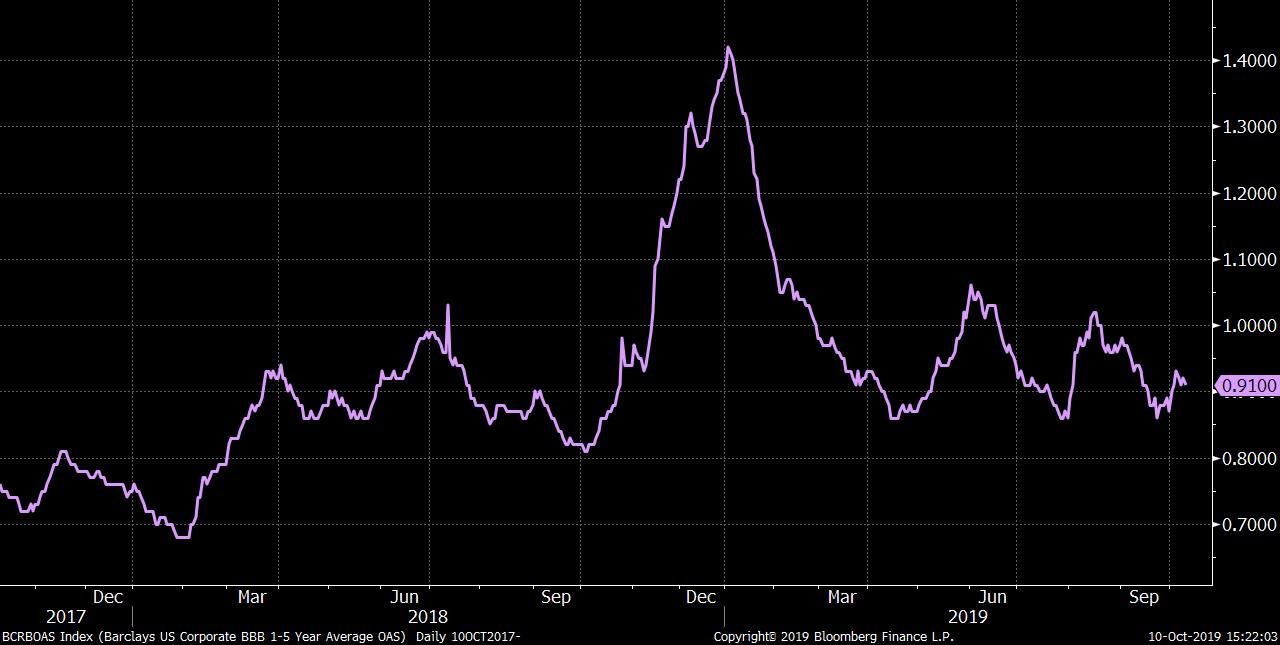
Corporate spreads remain tight, as investor pessimism regarding near-term economic growth prospects has not yet reached the credit markets. Spreads of lower rated investment-grade corporates were close to unchanged during the
third quarter and remain very tight by historical standards. We remain conservative with our corporate bond positioning, emphasizing highly rated companies and very liquid securities. The yield advantage today of such corporates versus Treasury bonds is only moderate, but exposure here offers us the possibility of easily repositioning to lower rated corporates (though still investment grade), if and when credit spreads widen significantly. The credit cycle appears to be quite extended, and we have prepared to take advantage of a change in market dynamics.
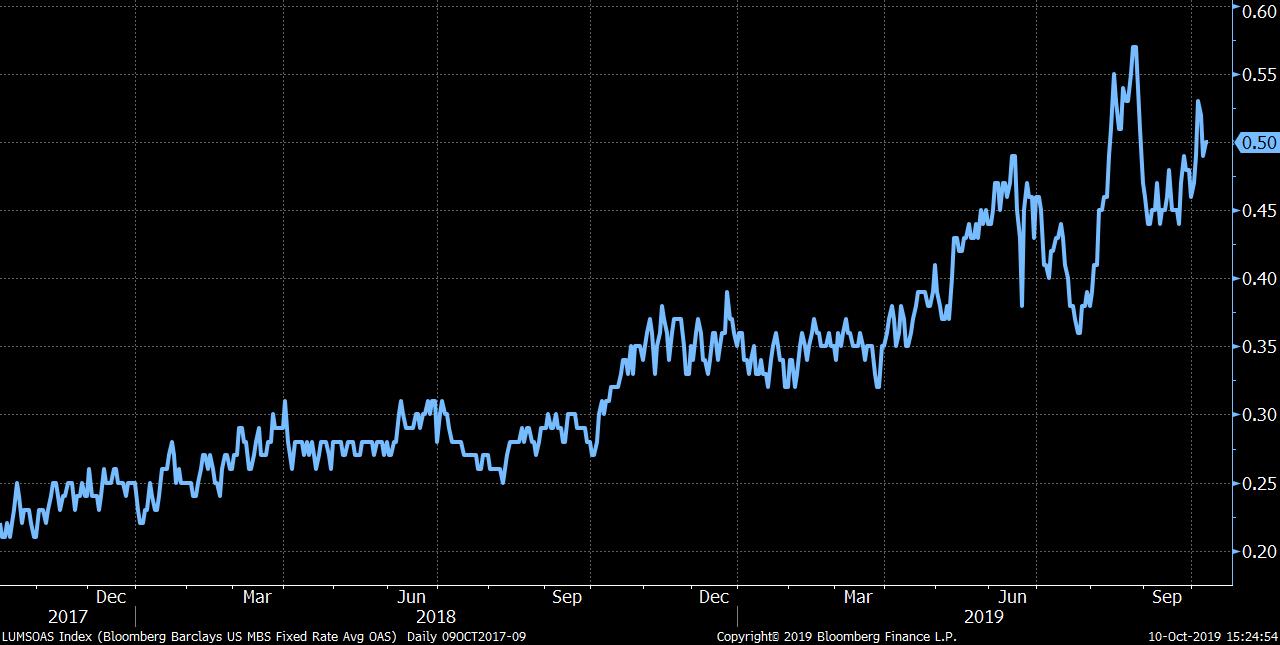
Agency mortgage-backed security option-adjusted spreads have widened this year, concurrent with falling interest rates. 3.5% coupon securities have seen the most spread widening, with prepayment incentive increased significantly for their underlying mortgages. There has been notable spread widening with 3.0% coupon securities as well. Given the market dynamics of the previous months and the yields available today, we see value in agency MBS with security selection (including underlying servicer exposure, geographical breakdown of underlying
Source: Bloomberg
US Treasury Yield Curve
mortgages, and borrower credit risk) receiving close attention in our analysis.
Source: Bloomberg
Source: Bloomberg
Given the uncertainty regarding the direction of interest rates (the outcome of trade negotiations is uncertain, as is the severity of any coming economic slowdown), we are maintaining the duration of our fixed income portfolios close to their respective benchmarks. We see relative value in agency MBS, while carefully controlling credit risk by holding only highly rated corporates and, in some cases, lowering corporate exposure. With our MBS positioning, we are overweight conventionals though slightly up in coupon, resulting in duration and convexity characteristics close to respective benchmarks. Given the dynamics today, increased volatility in the fixed income markets during the fourth quarter would not come as much surprise. We stand ready for such a scenario.
BrandonFitzpatrick,CFA

THIS PUBLICATION IS FOR INFORMATIONAL PURPOSES ONLY. THIS PUBLICATION IS IN NO WAY A SOLICITATION OR OFFER TO SELL SECURITIES OR INVESTMENT ADVISORY SERVICES, EXCEPT WHERE APPLICABLE, IN STATES WHERE DB FITZPATRICK IS REGISTERED OR WHERE AN EXEMPTION OR EXCLUSION FROM SUCH REGISTRATION EXISTS.
INFORMATION THROUGHOUT THIS PUBLICATION, WHETHER STOCK QUOTES, CHARTS, ARTICLES, OR ANY OTHER STATEMENT OR STATEMENTS REGARDING MARKET OR OTHER FINANCIAL INFORMATION, IS OBTAINED FROM SOURCES WHICH WE AND OUR SUPPLIERS BELIEVE RELIABLE, BUT WE DO NOT WARRANT OR GUARANTEE THE TIMELINESS OR ACCURACY OF THIS INFORMATION. BLOOMBERG FINANCE L.P. IS THE SOURCE UTILIZED FOR GRAPHS THROUGHOUT THIS PUBLICATION. THE GRAPHS ARE USED WITH PERMISSION OF BLOOMBERG FINANCE L.P. NEITHER WE NOR OUR INFORMATION PROVIDERS SHALL BE LIABLE FOR ANY ERRORS OR INACCURACIES, REGARDLESS OF CAUSE, OR THE LACK OF TIMELINESS OF, OR FOR ANY DELAY OR INTERRUPTION IN THE TRANSMISSION THEREOF TO THE USER. THERE ARE NO WARRANTIES, EXPRESSED OR IMPLIED, AS TO ACCURACY, COMPLETENESS, OR RESULTS OBTAINED FROM ANY INFORMATION CONTAINED IN THIS PUBLICATION.
NOTHING IN THIS PUBLICATION SHOULD BE INTERPRETED TO STATE OR IMPLY THAT PAST RESULTS ARE AN INDICATION OF FUTURE PERFORMANCE.