2016 IN REVIEW
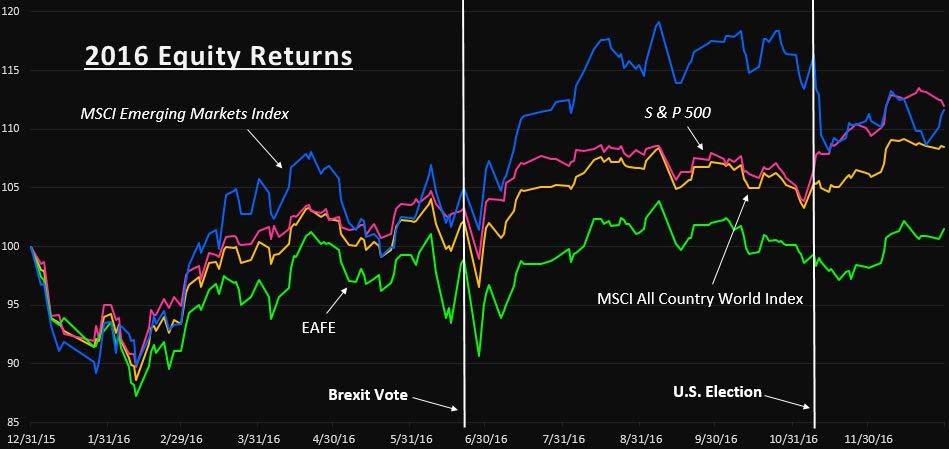
The end of 2016 provided a new twist, with Donald Trump winning the U.S. presidential election in a major upset. Many predicted that a Trump victory would be disastrous for equities, but stocks held up in the days after the election and continued rising through year‐end. Investors are betting that a fiscal stimulus bill has a good chance of getting
through Congress and that it will have a positive impact on economic growth. At the same time the market is skeptical that Trump will be able to institute the protectionist trade policies he promoted on the campaign trail, and this skepticism has allowed the bull market in equities to continue.
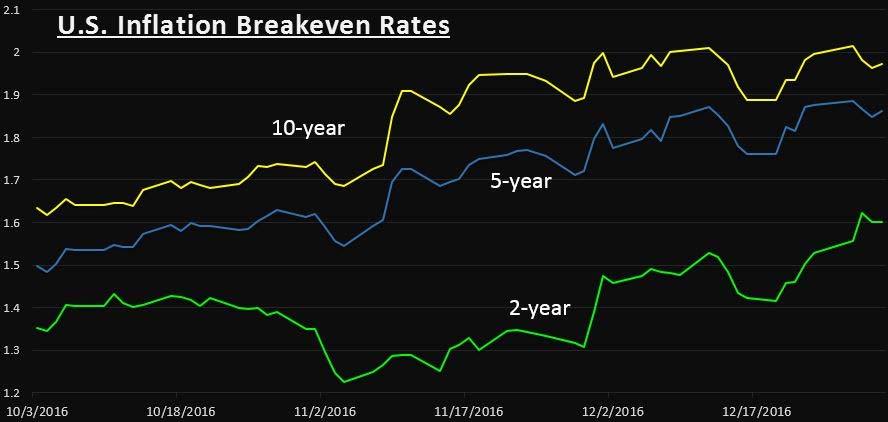
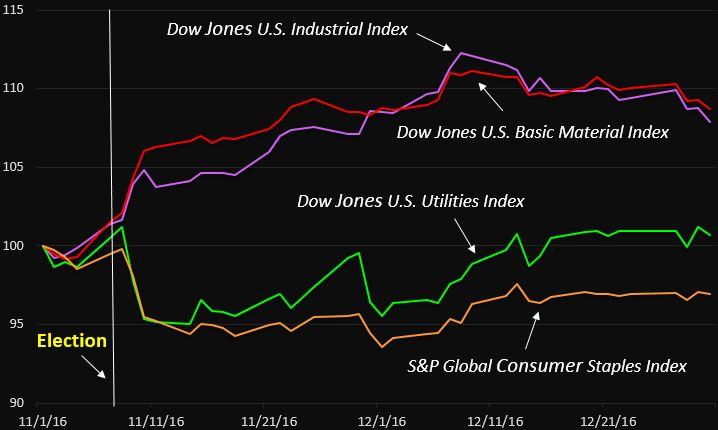
The market has taken an optimistic view of the new political reality in the U.S., with interest rates up sharply since the election, inflation breakeven rates also higher, and cyclical equity sectors such as industrials and materials up significantly as well. Higher interest rates have been tough on bond market indices and equity sectors more correlated with bonds, such as consumer staples and utilities.
BONDS ARE ATTRACTIVE AFTER BIG MOVE
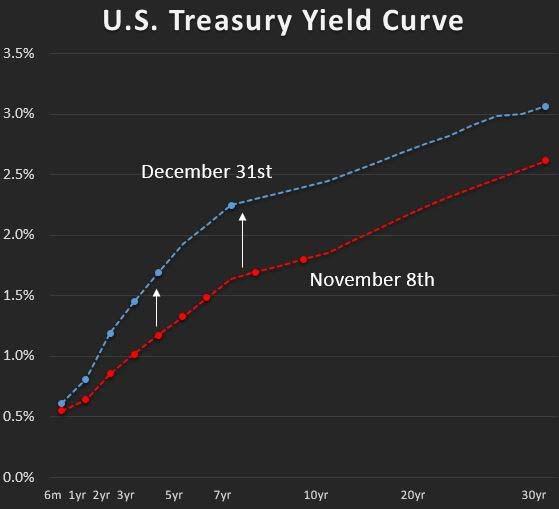
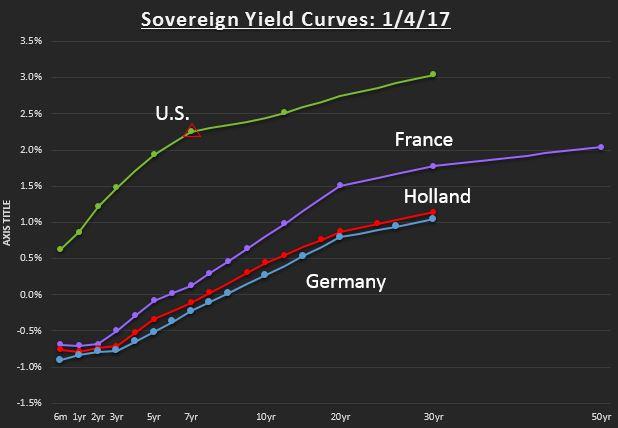
The move in the fixed income market since the U.S. election in November has been dramatic, with the yield of the 10‐year Treasury bond climbing from 1.86% on November 8th to 2.45% at the end of December. The yield curve has steepened considerably. The principal driver of this bond sell‐off has been the expectation that increased government spending on infrastructure projects will spur economic growth in the U.S. There are good reasons to believe that the bond market has moved too far, too fast, however. The first is that it is not clear what kind of spending bill President‐elect Trump will be able to get Congress to approve. Trump will almost certainly face opposition from many in his own party who have campaigned for years on the virtues of fiscal austerity. The ultimate political compromise might produce a disappointing result for investors.
The second reason for optimism regarding bonds is the fact that the European Central Bank has promised to continue its bond buying program
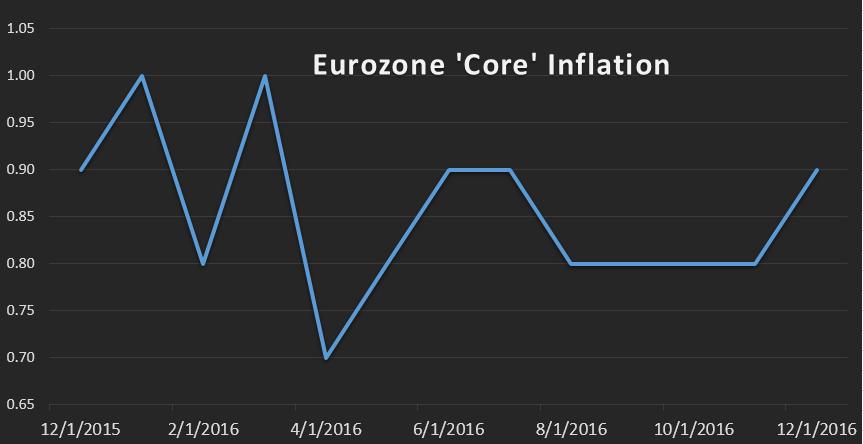
through all of 2017 (though monthly purchases are set to fall from €80 billion per month to €60 billion in April). Economic growth in Europe remains below 2.0% and inflation is subdued. ‘Core’ inflation (ex‐food and energy) has risen recently but is still below 1.0%, and significantly below ECB policymakers’ 2.0% target. Quantitative easing is keeping bond yields in Europe very low: 10‐year sovereign bond yields in Germany, Holland, and France are 0.26%, 0.41%, and 0.77%, respectively, significantly beneath the 2.40% a 10‐year Treasury offers today. The low yield environment in Europe is likely to continue, at least through mid‐2017, and this should provide a tether for yields in the U.S.
Finally, there will be a presidential election in France in April and parliamentary elections in Germany later in the year, both of which represent significant risks for the financial markets. The Brexit vote and Donald Trump’s victory show that the populist threat in the developed world is real, and that the status quo of economic integration and open markets is under severe threat. If populist politicians prevail in either France or Germany, it is very likely that safe ‐haven assets will rally considerably
and risky assets will suffer.
Given these dynamics, Treasuries and agency mortgage‐backed securities are especially attractive today, and we expect them to recover after their recent underperformance. Corporate
spreads have continued to tighten recently and there is less relative value in credit.
Additionally, the stock market appears somewhat extended as 2017 begins. The S&P 500 is currently trading at 17.4x
expected 2017 earnings. This is somewhat high by historical standards and harder to justify on a relative valuation basis given the recent increase in bond yields. The earnings yield of the S&P 500 (using 2017 earnings) is 5.75% vs. the yield of a 10‐year
Treasury which is 2.40%. The difference between these two yields (a higher figure argues for relative value in stocks) has shrunk significantly during the last eight weeks.
POLITICS WILL DOMINATE IN 2017
Given the seismic shifts taking place in Washington and their importance for the financial markets, we must make some predictions regarding political dynamics and policy outcomes in the U.S. The first issue is President‐elect Trump’s proposed $1 trillion infrastructure program. Despite opposition from some Republican elected officials, it is likely that a significant figure (in the hundreds of billions of dollars) will be approved by Congress and new infrastructure projects implemented. This spending will provide a needed spark for the real economy, though it’s likely that the financial markets will be disappointed with the ultimate figure agreed to, which will be far below $1 trillion. This prediction argues against risky assets, which have risen in anticipation of a bigger number, and in favor of safe‐havens.
The second issue is Donald Trump’s promised trade restrictions, which, if implemented, would be extremely deleterious for economic growth and would almost certainly lead to higher inflation. They would also be decidedly negative for both the stock and bond markets. Some had predicted that Trump would soften his rhetoric regarding trade after he won the election. He has not done so and
it seems likely that he’ll push forward on the issue. Resistance to protectionism in Congress is likely to be fierce, however, and the broader business community has yet to begin fighting back in force (this is sure to happen soon). There will be a significant political tussle in the months ahead, but in the end we don’t expect the president‐elect to achieve significant restrictions to trade, though the browbeating of individual companies through the media is almost certain to continue.
In conclusion, we see headwinds for stocks in the near term, though within the equity sector there is decent value in defensive sectors such as consumer staples and healthcare. More cyclical equity sectors such as industrials and materials, on the other hand, are less attractive after their recent run. We expect Treasury yields to consolidate in the near term, with elevated volatility as the market digests the changing political dynamics. Treasuries and agency MBS look especially attractive in the near‐term.
— Brandon Fitzpatrick
THIS PUBLICATION IS FOR INFORMATIONAL PURPOSES ONLY. THIS PUBLICATION IS IN NO WAY A SOLICITATION OR OFFER TO SELL SECURITIES OR INVESTMENT ADVISORY SERVICES, EXCEPT WHERE APPLICABLE, IN STATES WHERE D.B. FITZPATRICK & COMPANY IS REGISTERED OR WHERE AN EXEMPTION OR EXCLUSION FROM SUCH REGISTRATION EXISTS.
INFORMATION THROUGHOUT THIS PUBLICATION, WHETHER STOCK QUOTES, CHARTS, ARTICLES, OR ANY OTHER STATEMENT OR STATEMENTS REGARDING MARKET OR OTHER FINANCIAL INFORMATION, IS OBTAINED FROM SOURCES WHICH WE AND OUR SUPPLIERS BELIEVE RELIABLE, BUT WE DO NOT WARRANT OR GUARANTEE THE TIMELINESS OR ACCURACY OF THIS INFORMATION. NEITHER WE NOR OUR INFORMATION PROVIDERS SHALL BE LIABLE FOR ANY ERRORS OR INACCURACIES, REGARDLESS OF CAUSE, OR THE LACK OF TIMELINESS OF, OR FOR ANY DELAY OR INTERRUPTION IN THE TRANSMISSION THEREOF TO THE USER. THERE ARE NO WARRANTIES, EXPRESSED OR IMPLIED, AS TO ACCURACY, COMPLETENESS, OR RESULTS OBTAINED FROM ANY INFORMATION CONTAINED IN THIS PUBLICATION.
NOTHING IN THIS PUBLICATION SHOULD BE INTERPRETED TO STATE OR IMPLY THAT PAST RESULTS ARE AN IN DICATION OF FUTURE PERFORMANCE. ALL RETURNS ARE MODEL RETURNS FROM A COMPOSITE.