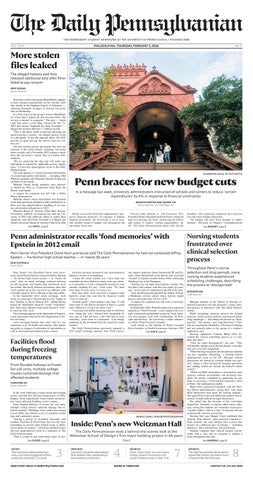
The alleged hackers said they released additional data after Penn failed to pay ransom
ANVI SEHGAL Senior Reporter
Notorious cybercrime group ShinyHunters appears to have claimed responsibility for the October 2025 data breach at the Graduate School of Education — releasing thousands of pages of internal University files on Wednesday.
In a Feb. 4 post on the group’s forum, ShinyHunters wrote that it leaked the data because Penn “did not pay a ransom or cooperate.” The post — which came days after a court filing claimed the Oct. 31, 2025 data breach “impacted less than 10 people” — alleged the incident affected 1.2 million records.
“This is the direct result of advisors advising you against paying a ransom,” the alleged hackers wrote in a document. “It has the opposite affect. Do NOT provoke us again and pay the ransom when we contact you.” The files include private documents that were not released in the initial breach, including University donor records and a November 2023 progress report from the University’s Action Plan to Combat Antisemitism.
“We are analyzing the data and will notify any individuals if required by applicable privacy regulations,” a University spokesperson wrote to The Daily Pennsylvanian.
The leak appears to contain personal information of several high-profile individuals — including 1968 Wharton graduate and President Donald Trump and members of his family.
Multiple Trump family members were internally labeled by Penn as “Confirmed Ultra High Net Worth” individuals.
A request for comment was left with a White House spokesperson.
Multiple donors whose information was included in the leak previously pledged to halt contributions to Penn over the administration’s handling of on-campus antisemitism allegations in 2023.
Wharton Board of Advisors Chair Marc Rowan, for instance, publicly cut financial ties with the University in 2023 and called for others to reduce their donations until then-Penn President Liz Magill and former University Board of Trustees Chair Scott Bok
See HACK , page 2
Penn braces for new budget cuts
In a message last week, University administrators instructed all schools and centers to reduce ‘certain expenditures’ by 4% in response to financial uncertainty
Nearly a year after Penn first implemented “proactive financial measures” in response to federal funding uncertainty, the University is set to institute another round of budget cuts throughout the upcoming fiscal year.
ANANYA KARTHIK AND DANNA CAI Senior Reporter and Staff Reporter
President Mark
outlined Penn’s financial plan in a message last week, instructing all schools and centers to reduce “certain expenditures” by 4%. The Daily Pennsylvanian spoke with faculty
members who expressed confusion and concerns over the latest budget reductions. “No budget cuts have been decided or imple
See BUDGET, page 3
Nursing students frustrated over clinical selection process
stated that he had not contacted Jeffrey Epstein — his former high school teacher — in “nearly 50 years” after an email exchange surfaced between an old classmate and Epstein that referenced Asch last month. But newly released documents show that Asch reached out to the convicted sex offender with a friendly email in 2012, offering to buy him coffee. In the September 2012 email exchange, Asch wrote in a message to Epstein that he’d be “happy to buy” Epstein “a cup of coffee in NY,” adding that he hoped the Manhattan financier would “remember” him. Days later, Epstein wrote back that he’d “love” to catch up with Asch.
The exchange appears in the thousands of Epsteinestate documents released by the Department of Justice on Friday.
Asch messaged Epstein four years after he was sentenced to an 18-month jail sentence after pleading guilty to charges of solicitation of prostitution as well as solicitation prostitution from a minor.
Facilities flood during freezing temperatures
From flooded hallways to frozen fan coil units, multiple college houses sustained damage that affected residents
CHRISTINE OH Senior Reporter
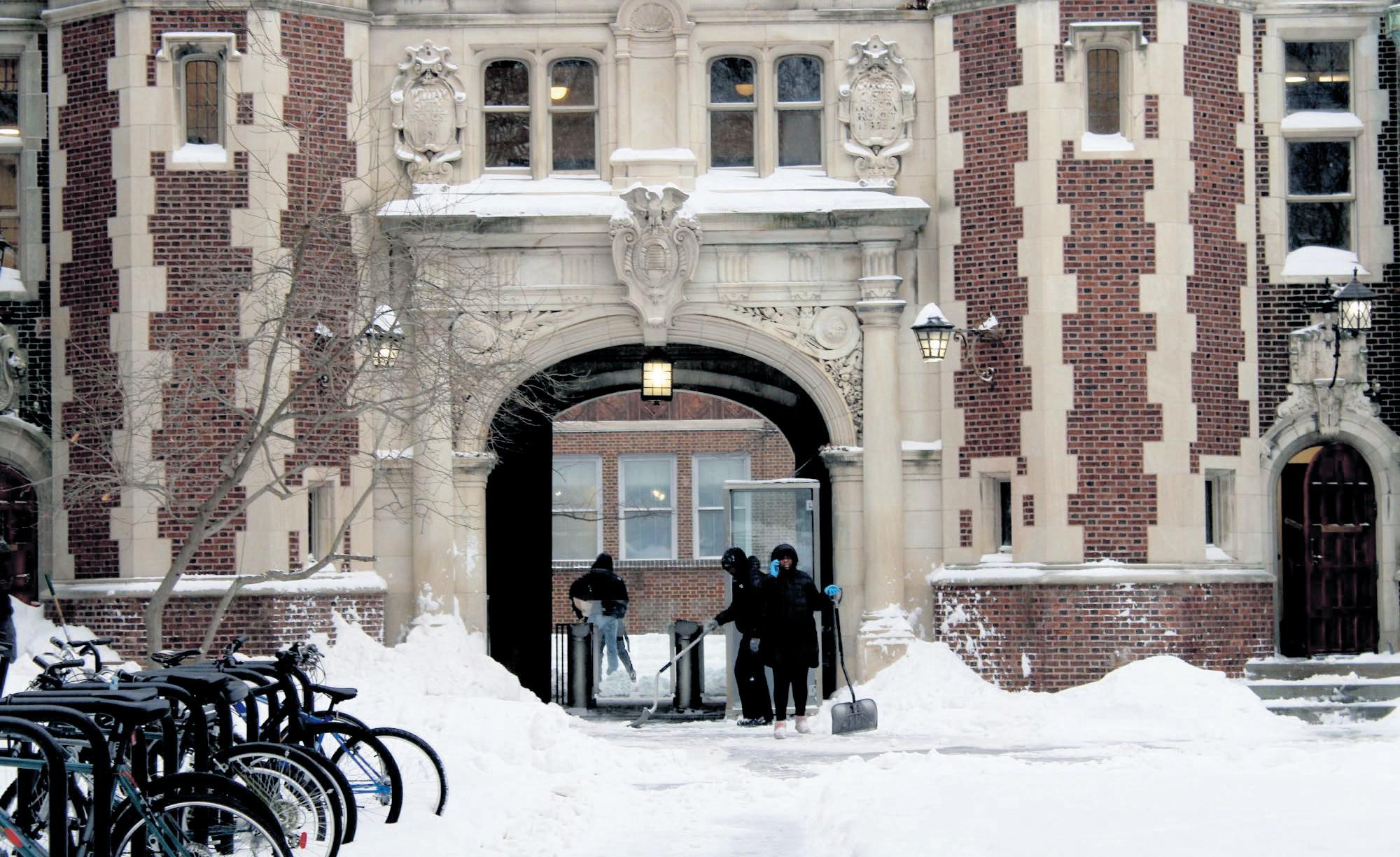
In the week following a winter storm that brought record snowfall and freezing temperatures to Philadelphia, Penn experienced water-related infrastructure issues affecting buildings across campus. From flooded hallways to frozen fan coil units, multiple college houses sustained damage that affected residents. Plumbing issues under and around Locust Walk also limited access to academic buildings and community spaces.
“During a period of sustained, unusually cold weather, Facilities & Real Estate Services has been responding to several water-related issues at different locations on campus,” a Facilities and Real Estate Services spokesperson wrote in a statement to The Daily Pennsylvanian.
“This is a time of year when these types of inciSee FLOOD, page 2
Asch has not been accused of any involvement in Epstein’s crimes or wrongdoing.
“I hope this email reaches you. I also hope you remember me from Dalton so many years ago where, as I remember it, I did a substantial amount of your calculus teaching for you,” Asch wrote. “It’s been more than 35 years since I’ve seen you.”
Four days later, Asch received a response from Epstein’s estate that said that the financier would “love to catch up.”
“Sounds great!” Asch replied a day later. “I will find a time to call. But let me know if there is a good time. Otherwise, I’ll just try when I can.”
“I sent that note before knowing what we all know now. Along the way I learned how despicable he was, and so I did not have a call with him or meet with him,” Asch wrote in a statement. “I am deeply saddened by the profound harm he caused his many victims.”
The Daily Pennsylvanian previously reported a 2015 email exchange between New York Univer-
sity adjunct professor James Rosenwald III and Epstein, where Rosenwald wrote that he and Asch had “toasted” to Epstein months before while celebrating Thanksgiving in the Hamptons.
“Epstein was my high school physics teacher. The last time I had contact with him was nearly 50 years ago,” Asch wrote in a statement to the DP at the time.
Asch and Rosenwald attended the Dalton School, a Manhattan private school where Epstein taught physics and math from 1974 to 1976.
A request for comment was left with a University spokesperson.
In September 2025, Penn President Larry Jameson announced “Penn Forward,” a new campuswide strategic framework spearheaded in part by Asch. Jameson also charged Asch with coordinating “In Principle and Practice,” the University’s earlier initiative on which “Penn Forward” expands.
Asch served as the director of Penn’s Leonard Davis Institute of Health Economics between 1998
See ASCH, page 2
The Daily Pennsylvanian took a behind-the-scenes look at the Weitzman School of Design’s first major building project in 60 years
2
Throughout Penn’s course selection and drop periods, many nursing students experienced scheduling challenges, describing the process as ‘disorganized’
ADDISON SAJI Staff Reporter
Multiple students at the School of Nursing expressed frustration over the program’s course selection process in interviews with The Daily Pennsylvanian.
While navigating selection process for clinical practices, many nursing students experienced scheduling challenges — describing the process as “disorganized,” “last-minute,” and “unprofessional.” Clinicals are required for a Bachelor of Science in Nursing and are typically taken in the spring of a student’s sophomore year.
Nursing sophomore Carliana Mejia Ortiz described the clinical scheduling process as “a complete shit show.” “They are super disorganized,” she said. “They will literally change you at the last minute, even after they give you your assignment.”
“Penn Nursing recognizes the frustrations students can face regarding scheduling,” a Nursing School spokesperson wrote to the DP. “Because clinical placements are hosted by external health care partners, timing is often dictated by hospital operations and staffing, which are outside the School’s direct control.”
“While our BSN curriculum is structured to meet rigorous national accreditation and licensing standards, we remain committed to supporting our students in receiving a well-rounded experience while at Penn,” the spokesperson added.
Mejia Ortiz expressed frustration with the Nursing School administration, saying they “care more about themselves than about the nursing students.” She urged Penn to provide additional support and resources to help students navigate the process. She added that the structure of the curriculum limited her “freedom” to explore other course offerings, noting that students are sometimes expected to “sacrifice either a club or a class” to keep up with the academically rigorous courseload.
Nursing first year Maggie Coors explained that clinicals help students “gain practical experience.” Each semester, she said, students take a course that focuses on a different area of nursing — including pediatrics, labor and delivery, and psychology. Students complete their clinical rotation concurrently with a class and are assigned to shadow a nurse throughout their day.
Provost John Jackson Jr. and Executive Vice
Dingfield
Weitzman Hall reopens to public after major renovation
The reimagined interior will include the headquarters for the Department of Fine Arts, individual art studios, community design studios, and several multipurpose spaces
ANVI
SEHGAL AND RYAN RUCKER Senior Reporter and Staff Reporter
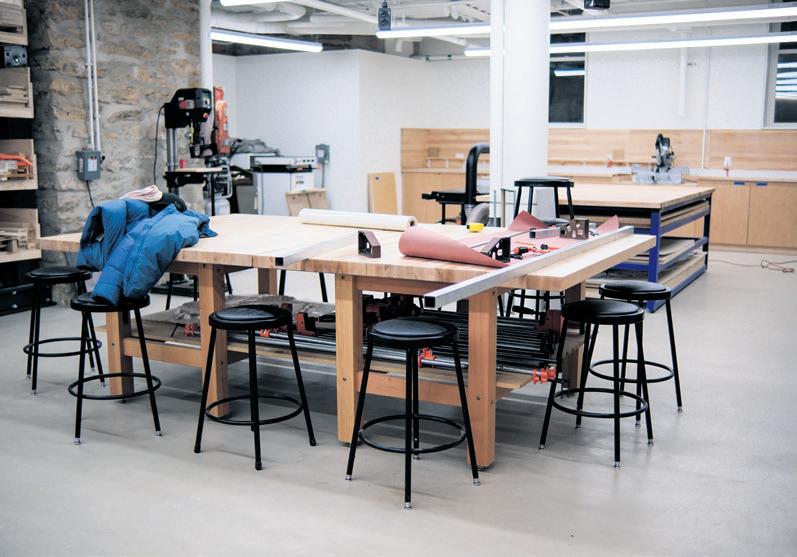
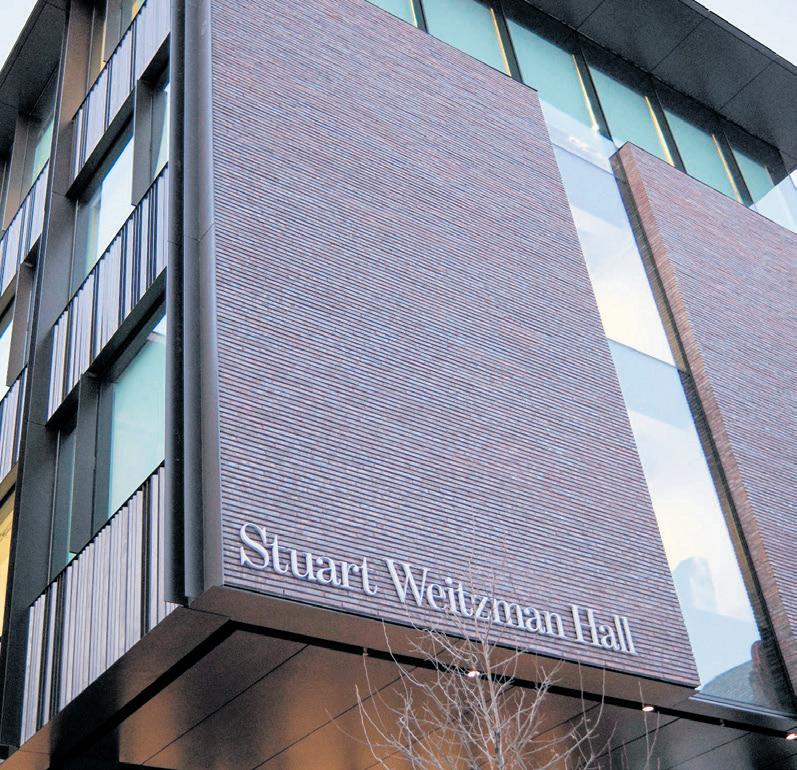
The Daily Pennsylvanian took a behind-the-scenes look at the newly renovated Stuart Weitzman Hall with Stuart Weitzman School of Design Dean Frederick Steiner ahead of the building’s unveiling on Feb. 5.
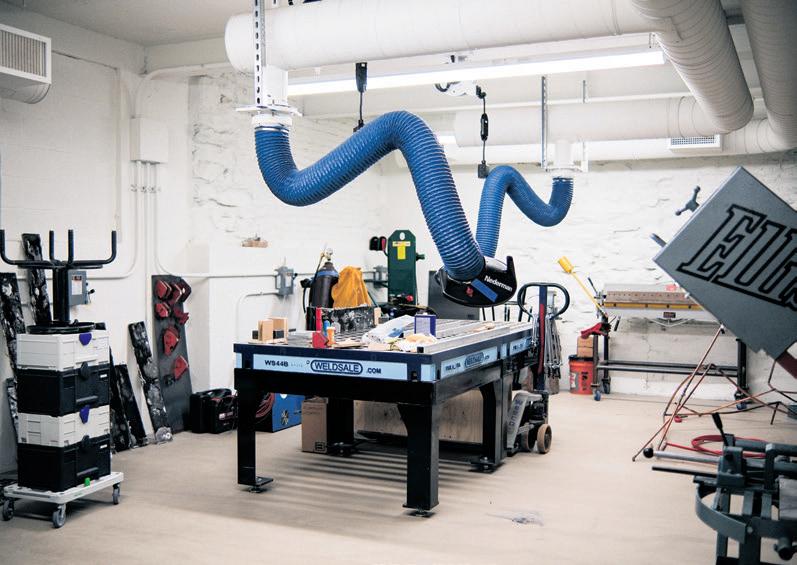
The $58 million renovation and expansion — the school’s first major building project in nearly 60 years — began in May 2024. The building’s reimagined interior will include the headquarters for the Department of Fine Arts, individual art studios, community design studios, student maker spaces, research facilities, and several multipurpose spaces designed to increase collaboration.
The project is spearheaded by partners from KieranTimberlake — an architecture firm founded by 1976 School of Design graduate Stephen Kieran and 1977 School of Design graduate James Timberlake.
Steiner told the DP that while the renovation will “improve the studios,” it was also “designed to bring all of the disciplines in the school together, and to have more interaction.”
, from front page
Though Coors has not yet started her clinicals, she said that the process of registering for her other nursing classes has been “very simple.”
Nursing sophomore Owen Heit, a transfer student, described the registration process as a “roller coaster,” leaving students “disoriented” and unhappy with their clinical placements. He also claimed that the process forces students to shift their schedules around “super last-minute.”
Heit added that he “didn’t know what to do” during course registration due to “a lack of education for transfer students.”
“I had to drop two of the classes I wanted to take,” Heit said.
Jeongmi Ahn, a sophomore in the Nursing School, said certain clinicals may be rescheduled to different times of the week — forcing some students to miss classes or meetings.
Ahn added that clinicals — some of which take place off campus — can cause other scheduling difficulties for students due to travel time.
“Lucky for me, I have one that’s only a 10-minute walk away from here, but one of my friends’ is a 30-minute drive away,” she said.
“I think they should just make a form where people can decide beforehand,” Ahn added while describing a ranking system for students to indicate their preferred availability. “We can make a clear schedule and submit it all together.”
, from front page
dents are more likely to occur throughout the city and region,” a spokesperson added.
On Jan. 24 — the night before the major coastal storm hit Philadelphia — Megan Edelman, associate director at Platt Student Performing Arts House, notified select students of a “major leak” affecting “several spots” in the building’s lobby.
“The Lobby, including the stage, kitchen, computer bank, and restrooms, is currently unavailable,” Edelman wrote.
In a Jan. 25 statement to the DP, Platt House Director Laurie McCall emphasized that “Platt House is not closed” and, while the lobby was “roped off,” rehearsal rooms “remained open.” Platt House was closed on Jan. 26-27 in line with the University’s suspension of operations due to the winter weather. On the day the building reopened, another leak was reported in the lobby.
On Jan. 30, residents also reported flooding in Kings Court English College House.
In an interview with the DP, Wharton first-year Malu Coelho — who lives on the second floor of Kings Court English College House — recalled receiving an email “around 2 p.m.” notifying her that “the building was experiencing some flooding, but it was under control.” When she returned to her room that afternoon, Coelho said she “couldn’t use the elevator because it was apparently flooded, and the stairs were also all full of water.”
“The hallway was flooded,” and there were “multiple machines” throughout the space “to dry the water,” Coelho told the DP. She added that the University stationed “huge” and “very noisy” turbines “in each room” to address the damage. Coelho recounted finding out her room had been unlocked and entered without her knowledge while she wasn’t present.
“All of the rooms on my floor were opened — like the staff opened them for us,” Coelho said. “We had no idea they were getting into our rooms. I had all of my personal stuff exposed.”
A request for comment was left with the house di-
“There’s a lot more space for interaction and review in Weitzman Hall,” the dean added. He also pointed to the significance of the building’s location — next to Meyerson Hall and Fisher Fine Arts Library — and highlighted the newly designed plaza between Weitzman Hall and the Lerner Center.
Senior Director of Communications Michael Grant described the “many different kinds of spaces” inside the building in an interview with the DP.
Steiner received his Master in Regional Planning, Master of Arts, and Ph.D. from Penn. He remembered struggling with learning in classrooms without natural light — an experience that inspired his desire to include large windows in all rooms, spaces, and staircases of the new building.
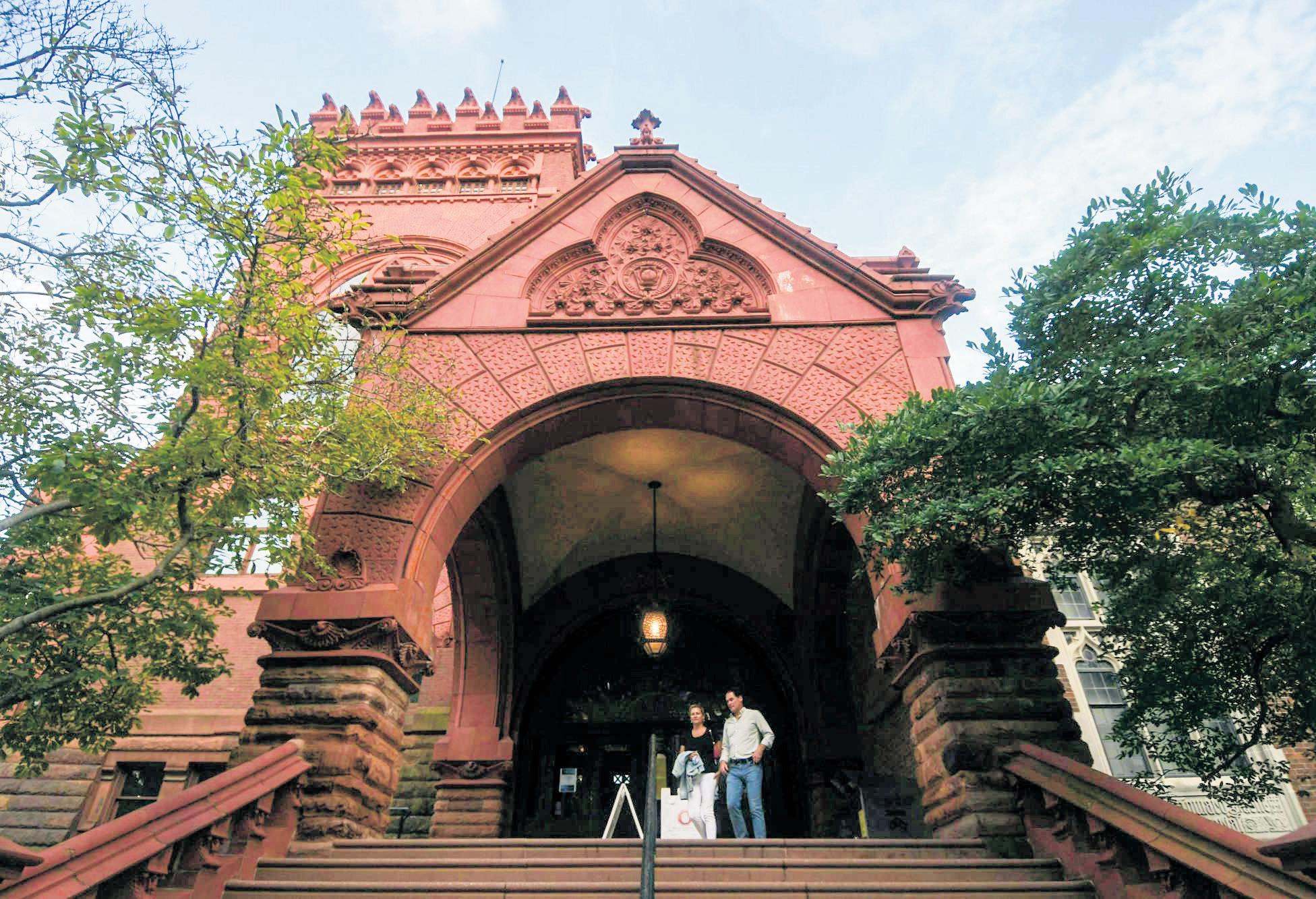
Acquired by Penn in 1899, the building originally housed the Foulke and Long Institute, an orphanage for young girls. The design team aimed to preserve several of the original elements — including a restoration of the building’s original bricks, which are visible throughout the development.
Although it would have been “easier” to rebuild from scratch, Steiner said that the team felt it was right to reuse the building from both “environmental” and “heritage” perspectives. They worked to balance modernizing water, heating, and energy systems to be more environmentally friendly while preserving “historic” structures.
The construction process was expected to take two years, but wrapped up in about 15 months, according to Grant. Director of Operations and Planning Karl Wellman also emphasized the importance of “having the right people” on the design and construction teams.
“It’s like an orchestra playing together,” Wellman told the DP. “When everybody’s in tune, it works well.”
The building features a gallery on the ground floor, which will host various exhibitions this year — including one for America’s 250th anniversary — this year.
“This space can be a gallery, it can be a lecture
HACK
, from front page
resigned from their posts. In response to Rowan’s request, 1983 Wharton graduate Jonathon Jacobson pledged to donate no more than $1 million until Magill announced her resignation — which eventually came in December 2023.
According to the leaked records, Jacobson’s most recent donation to the University was on May 30, 2025.
After making the same pledge, Lynne Tarnopol — a 1960 College and Wharton graduate — donated to Penn Hillel as recently as Oct. 3, 2025, the files show. 1969 College graduate Richard Wolf similarly threatened to end donations unless both Magill and Bok resigned. A $1 million donation was recorded from him on Dec. 23, 2024.
Among the other donors included in the leak were 2001 Wharton graduate Matthew Nord and 1986 Wharton Ph.D. graduate Bruce Jacobs — who both joined the backlash against Penn in 2023 but made donations two years later, according to the files.
that these events were “determined to be related to windows not being fully closed during the extreme cold.”
“The areas impacted have been cleaned and are being dried; additional repairs to an affected elevator shaft will take place over the coming weeks,” the statement continued.
On Jan. 31, a portion of Locust was taped off due to flooding and icy conditions — which a FRES spokesperson attributed to a “water main break” that blocked the front and side entrances to the ARCH building.
The recent leak also contained a 2023 file titled the “Antisemitism Action Plan Dashboard,” which mentions various initiatives to “develop solutions to call out and combat antisemitism” across the University.
The plan details the University’s strategy for responding to allegations of antisemitism across three focus areas: safety and security, engagement, and education.
According to the document, Penn was “on track” to review safety measures for religious spaces on campus. A separate measure to ensure the Penn community was informed about how to report antisemitism was marked “complete” but “ongoing.”
Since the breach, 18 Penn graduates filed classaction lawsuits against the University. The individual filings were later consolidated by a district judge.
The complaints alleged that Penn acted negligently in its cybersecurity measures and failed to accurately represent the scope of the breach. Over the past few weeks, seven of the original filings have been withdrawn.
The most recent court filing stated “UPenn confirmed that the breach population” for the incident was “less than 10 people.”
A University spokesperson previously told the DP that Penn completed a “comprehensive review” of the
hall, it can be a reception,” Grant said. “The building was designed for flexibility in these first-floor spaces because we know that all of those different things happen at different times. We’ll be inviting the Penn community and the neighborhood for different experiences and events.”
According to Wellman, Weitzman students were given the opportunity to follow the building’s development firsthand, turning the process into a realworld learning experience. She added that architecture and preservation students were present at all stages of the renovation, learning from the construction in real time.
“It exemplifies what we teach,” Steiner said. “Our disciplines are embodied in the building.”
and 2012. In his email to Epstein, Asch described his work over the “past 15 years or so,” adding that he oversaw “about 200 faculty” at the University. He also sent Epstein a link to LDI’s website and his personal online profile at the Wharton School.
“After Dalton I went to Harvard, then medical school at Cornell, then to the University of Pennsylvania for my residency and fellowship in internal medicine, where I also got an MBA from Wharton,” Asch wrote to Epstein as he recounted his professional achievements. “I joined the faculty at Penn after that in both the School of Medicine and at Wharton, and I’ve been there for more than 25 years.” Epstein previously donated major sums of money to multiple universities across the country, including Harvard University and the Massachusetts Institute of Technology.
“With fond memories,” Asch signed off his email.
cybersecurity incident and notified affected individuals. On Jan. 23, Penn removed its webpage about the data breach, which previously offered community guidance. Penn’s webpage previously claimed that the amount of data obtained by the hackers was “mischaracterized” by reports at the time. While the webpage advised community members to take steps to protect their personal information, it emphasized that the leaked data had not been linked to fraudulent activity. The breach first became apparent after a series of mass emails were sent to the Penn community from several University-affiliated addresses. Two days later, the alleged hackers told BleepingComputer — a cybersecurity news outlet — that they had breached Penn’s systems and downloaded data containing Penn donor history, estimated donor net worth, and demographic information. The cybercrime group previously wrote that the data would be “kept private for our own use for a short period of time, but it will be released publicly within the next 1-2 months after our group has used it.” The alleged hacker later told The Verge that the group planned to sell the data before releasing it publicly.
On Feb. 1, Harnwell College House residents were notified by email of a separate leak “on the water supply line” serving the building.
Chen was told to evacuate for the remainder of the retreat. He added that one of his “fellow club leaders” was “on the phone with facilities,” helping them adjust the club’s plans for the rest of the day.
“It just felt like campus was falling apart a little bit,” Chen added.
“The issue was addressed with the Philadelphia Water Department, and the building is operational,” a FRES spokesperson wrote. “Additional exterior repairs will be required and are being investigated.”
College senior Bill Chen was leading a retreat with the Asian Pacific American Leadership Initiative at the ARCH on the day of the flooding. Chen was told to evacuate due to “a pipe burst within the building.”
“Please be advised that an excavation crew will begin work tomorrow morning to perform repairs,” the email read. “These repairs may require temporary shutdown(s) of water service to the building.”
A FRES spokesperson also highlighted that the University’s facilities team plans to continue mitigating the ongoing issues.
“Facilities teams are assessing each situation based on its specific conditions and coordinating with appropriate partners as needed,” the statement read.
ASCH, from front page
FLOOD
PABLO CAMARGO
OSCAR VASQUEZ | DP FILE PHOTO
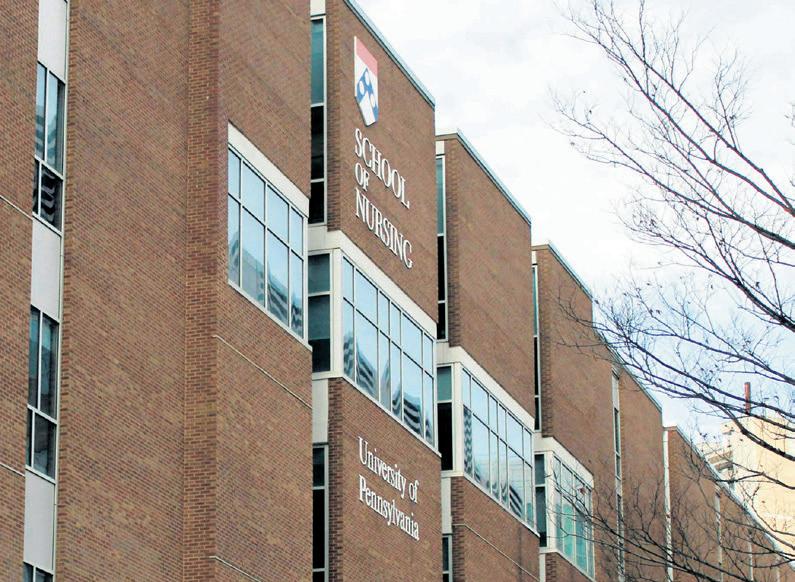
Side view of the Nursing School on Jan. 25, 2022.
PHOTO COURTESY OF TEDMED
David Asch serves as Penn’s senior vice president for Strategic Initiatives.
KENNY CHEN | SENIOR PHOTOGRAPHER
Penn recieves national award for community engagement efforts
The University will hold the distinction through 2032 alongside more than 230 other
Penn received a national award for community engagement efforts across the University’s 12 schools.
The American Council on Education and Carnegie Foundation for the Advancement of Teaching recognized the University with the 2026 Carnegie Community Engagement Classification last month. Penn will hold the distinction through 2032 alongside over 230 other United States institutions of higher education.
Netter Center for Community Partnerships Associate Director Rita Hodges, a 2005 College graduate and 2024 Graduate School of Education graduate, led Penn’s application process. In an interview with The Daily Pennsylvanian, she said that it is “really exciting” to see how the classification encourages universities to reach “a higher standard” of “community engagement.”
“They’re … embedding community engagement into the core academic mission — the research, teaching, and learning of the University — as well as emphasizing reciprocal, mutually beneficial partnerships,” Hodges explained. “Those were clearly priorities in this year’s application in particular, and those have been priorities of the Netter Center and the University of Pennsylvania for a very long time.”
Hodges said that there is no limit on the number of universities that can receive the classification, as long as they fulfill a “rigorous criteria,” meaning that the award recognizes their work “in a collaborative, not competitive, way.”
Over 120 people at Penn worked to fulfill the application’s 10-step process, according to Hodges. In the application, Penn highlighted the Net-
BUDGET, from front page
Director Annie Weinstein wrote to the DP. “Any actions that may result from this planning will be guided by our commitment to long-term financial sustainability, our academic mission, and a desire to preserve the flexibility of Schools and Centers.”
Jackson and Dingfield’s message — which comes after initial cost-cutting measures were implemented last year — attributed the new financial constraints to uncertainty over federal policy changes and rising costs across the University.
“As the impacts of federal policy changes have become clearer and costs continue to rise across the University, we are reaffirming our responsibility for careful financial management,” the Jan. 29 email stated.
Despite describing Penn’s current financial position as “better” than “anticipated a year ago,” Jackson and Dingfield asked schools and centers to take “proactive measures” that “thoughtfully manage costs and support our long-term financial outlook.”
“We took a pretty decent cut last year and were hoping it would rebound,” Earth and Environmental Sciences professor and Graduate Chair Leigh Stearns wrote to the DP. “It’s really hard to sustain research programs without students.”
In February 2025, the University instructed sev-
ter Center’s work in mobilizing resources to provide support to West Philadelphia public schools, which then become University-Assisted Community Schools.
Civic House’s work was also highlighted within the application, with a large focus on student efforts toward community engagement.
Executive Director Carrie Hutnick told the DP that the classification signals to prospective students that the University can help them “positively impact communities” and demonstrates that Penn “thinks about West Philadelphia as our neighbors.”
The application also featured the implementation of University-wide programs, such as Provost John Jackson Jr.’s creation of an Advisory Committee on Community Engaged Scholarship in December 2023, which aims to advance mutually supportive partnerships between the Penn and Philadelphia.
Hodges expressed that community engagement at Penn is an “ongoing process.”
“We can look at incredible growth and development that’s happened at the University of Pennsylvania — to increasingly prioritize and build it into the academic mission, and really emphasize sustained, place-based, mutually beneficial partnerships — and then also recognize where more work can and should be done,” Hodges said.
The Carnegie Foundation commended Penn’s application for demonstrating “excellent alignment among campus mission, culture, leadership, resources, and practices that support dynamic and noteworthy community engagement.”
This distinction marks a renewal of Penn’s previously awarded classifications in 2015 and 2006.
eral schools to cut Ph.D. admissions rates, and in some cases, after programs had already accepted students.
Those reductions to admissions came in response to federal policy changes — including the National Institutes of Health’s proposed 15% cap on indirect costs, which threatened $240 million in Penn’s research funding.
A month later, Penn outlined new financial guidelines for the University, such as a hiring freeze and a capital spending review.
Turkish Language Program coordinator and lecturer Feride Hatiboglu described how departments are still adjusting to last year’s reductions.
“In the near future we are going to feel more about its effects with decreasing student numbers and programs,” Hatiboglu wrote. “Under these circumstances budget cuts are the last thing we need.”
Graduate School of Education professor Julie Wollman echoed a similar sentiment and said that while schools were asked to prepare for potential reductions ahead of the upcoming fiscal year, “there are no budget cuts” yet.
She added that the University is asking schools to be ready “if there was a need to make budget reductions.”
The School of Engineering and Applied Science’s Associate Dean of Undergraduate Education Robert Ghrist wrote that he “understands” why Penn’s administration is pursuing the financial planning, calling it a “tough year.”
Ghrist added that if cuts are implemented, “what
is most important” to him is the “undergrad student body” and he will “take care of them above all.”
The budget cuts to schools across the University come as several Ivy League institutions have made similar reductions. On Monday, Princeton University announced further budget cuts following a previous 5-7% budget cut announced last year. Peer institutions such as Harvard University and Yale University face similar uncertainty surrounding hiring stability and graduate school funding.
In the Jan. 29 email, Jackson and Dingfield claimed Penn’s previous cost-cutting initiatives avoided “the more stringent measures announced by some of our peer institutions.” History and sociology of science Ph.D. candidate Sam Schirvar, who serves as an organizer for Graduate Employees Together — University of Pennsylvania, wrote that Penn has the resources to “weather this storm” and “should continue using its vast resources to fight these attacks on higher education.”
Annenberg School for Communication professor Jessa Lingel attributed the push for a 4% spending cut across schools and centers to a decision made by Penn Forward’s Operational Transformation working group — one of six committees established by the University’s new strategic framework. According to Lingel — who serves as a member of the Faculty Senate — Operational Transformation is the only working group without any faculty representation, which she argued is an indication
that only administrators are involved with “real decisions.”
“The way that these changes are being rolled out is just another reminder that we don’t actually have a seat at the table,” Lingel said. She added, “Faculty and staff spend decades of their lives working at this institution. I think we have a right to be a part of those conversations.”
SEAN FANG | DP FILE PHOTO
The Netter Center on Sept. 20, 2023.
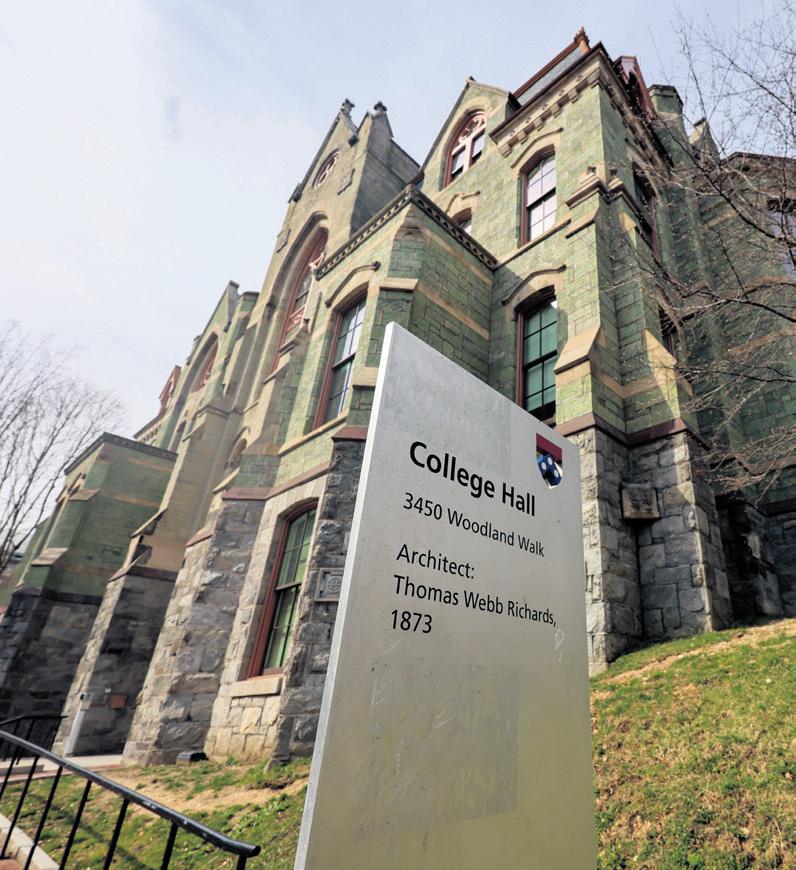
JEAN PARK | DP FILE PHOTO College Hall on March 20, 2025.
Why Penn will never change PENN UNSAID | We’re all part of the problem
Tradition. If there was ever a word to represent Penn, it would be this one. The 19th century architecture. The path on Locust Walk. Even the Benjamin Franklin statue that fraternity brothers piss on. There’s no denying that the Penn prestige was part of the reason we applied, but when does prestige become a prison? When do our traditions begin to trap us?
I don’t think I’m the only one who notices the serious complaint epidemic that exists on our campus. Whether it’s long club meetings, never-ending internship applications, or general academic anxiety, we find it far too easy to list the cons and impossible to name the pros. Most times, it’s second nature to blame Penn — not because we’re drowning, but for the lack of a life jacket.
And to be fair, there are several events I can name where our school did almost nothing to improve students’ wellbeing. But when it comes to a toxic campus culture, it might be time to start looking inward. Throughout Penn’s 285-year-long existence, I am certain no student ever expected their time here to be easy. Most of us arrived here not just prepared for, but excited by the prospect of a challenge. For those who submitted their scores, we know the average Penn student has over a 1510 SAT score, a 35 ACT score, and some of the most impressive extracurriculars known to man. And yet, therein lies the problem: we’ve become so used to a challenge, we accept the traditions that make our lives impossible. And consequently, at any hint that this
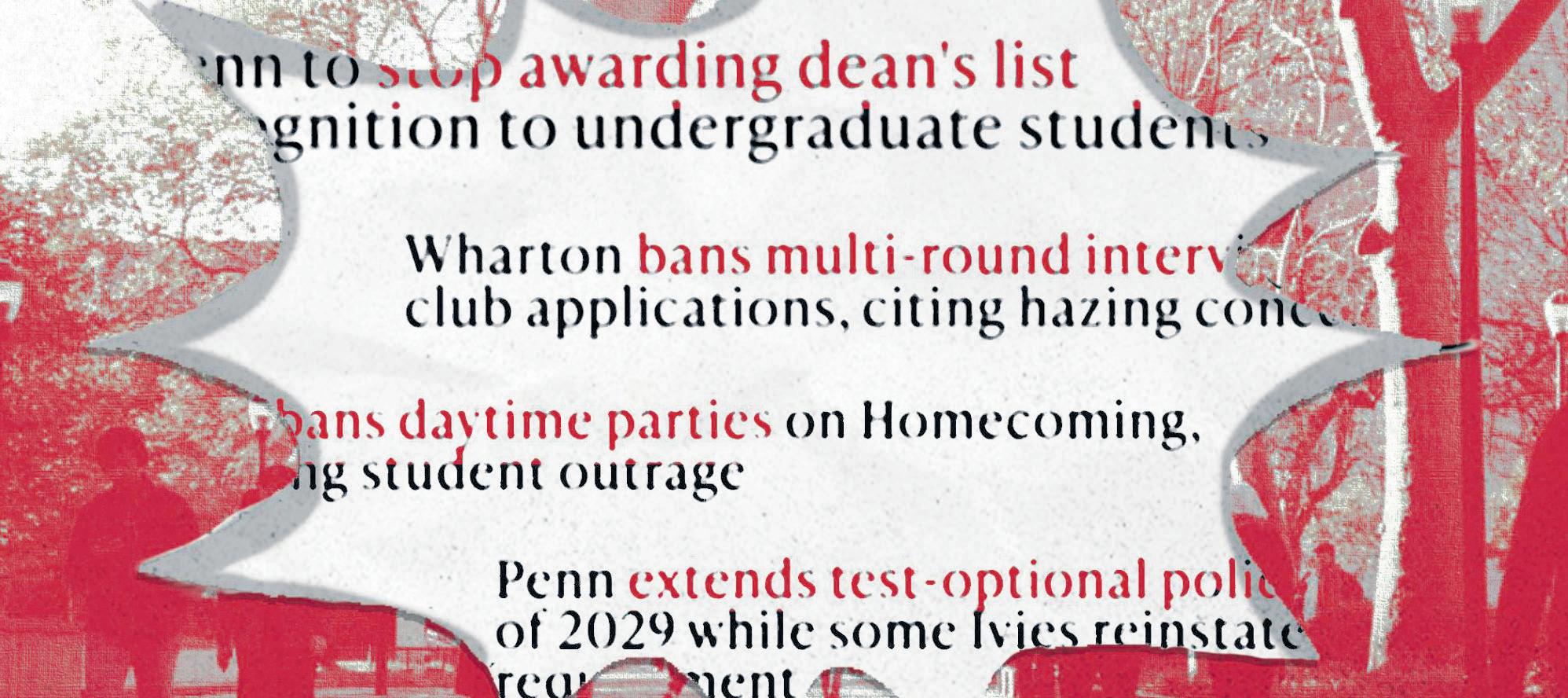
system of stress might improve, instead of relaxing, we resist. The fact is that even if Penn did everything to acknowledge the hyper-exclusivity and the academic anxiety, it wouldn’t make a difference if the students aren’t willing to part with these traditions in the first place. Penn might’ve removed the Dean’s List, but it doesn’t mean we don’t talk about our GPAs. Wharton ended multi-round interviews for clubs, and students now call them “coffee chats.” And even if they somehow were to forbid club applications for first years, kids would still find a way to dirty rush. Let’s face it: Penn will never change, but it’s not on them, it’s on us. There seems to be this misunderstanding that Penn students maintain stressful lives
Playing hard is hard work, too
DEW
TELL
| Work hard, play harder, and do absolutely nothing else
It’s freezing cold outside. And so us Penn students have our Canada Goose jackets and chic wool scarves hanging pretty on our coat racks. But more importantly, we’ve shut ourselves out. Going outside feels like a Herculean feat, and I personally have been spending an extortionate amount of time lounging around my dorm. The general malaise of campus has thrown me into an inexplicable wave of nostalgia for the warmer months, when campus would bustle hours into the night. The warmth seemed to draw people out, contributing to the constant hum of something going on, exuding an almost comforting sense of busyness. Under this lens, it’s then clear that the weather was not Penn’s only source of energy. For most Penn students, it was also the party scene. October and November found many of us oscillating seamlessly between midterm exam preparation and the festivities of Halloweekend and Homecoming. This work-hard-play-hard dynamic, grounded in equal commitments to both academic and social pursuits, is one of the most defining aspects of Penn, granting us the unofficial title of “the Social Ivy.” And for most, it seems to satisfy. Facing a week full of academic undertakings, the prospect of a night out is something to look forward to. Even an infrequent partygoer like me can appreciate the lively buzz of people going out as early in the week as Wednesday. But as temperatures have plummeted, the party scene has turned inward. On the heels of greek rush, social gatherings have progressed to something more exclusive, as pledge classes seek to connect internally through an organized social calendar. In conditions too cold
The Ivy Effect
(and even too exclusive) to “play hard” outside, one would expect that at such a social school, even unaffiliated students would find a new mode of play. But along with our parties has seemingly gone the outgoingness necessary to merit our “Social Ivy” status. I’ve noticed that most people who opted not to rush have decided to invest their time into academics and career prospects. We continue to cling to the extremes, where those who are pledging navigate packed weekends and those who aren’t pack their nights with homework and club applications instead. The intermediary, it seems, is completely foreign to us. I see now that the Penn “work-hardplay-hard” lifestyle entails working hard, playing hard, and practically noth -
MAHEE’S MIND | Penn’s shift from passion to prestige
As a sophomore who has now acclimated to the culture of Penn, I have made a distinct observation over the past few semesters. I have noticed the way ambition seems to quietly fade once people arrive here. The original goal for many of us was to stand out in our accomplishments and distinguish ourselves. But now, after getting into a top school, more and more students seem content to meet the bar instead of clear it. In conversations with my friends at other Ivy League schools, I hear the same observation: Collectively, the comfort achieved by making it to a top school has slowly eroded the burning fire that has gotten us here in the first place. I will add a caveat by saying that not every single person has slowed down; some people are far more “locked in” than others. But overall, our objectives have changed. Before, we were rewarded for standing out, pushing ourselves out of our comfort zones, competing, and excelling in our passions.
Now, the primary goal has become to land a high paying job at a brand name firm. There is absolutely nothing wrong with chasing a high paying job that will give you a good foundation to build an even greater career; in fact, that is the most rational choice. Rather, what worries me are the long-term consequences of this shift in ambitions.
Once recruiting is over, many people slowly fade their commitments and hobbies and stop chasing ambitious goals because
the main target has been secured. There are definitely a couple of factors that make this true at Penn more than other schools. For one, we have a huge finance pipeline that starts recruiting as early as sophomore year. So many of us use recruiting as our marker of success, trading taking notes in class for scrolling through Handshake. What starts as a reasonable means to reach our goals slowly hardens into a culture. At Penn, that culture is increasingly transactional, and it seeps into how we treat our time, our clubs, and even our relationships. We drop clubs as soon as we get a full-time offer. We drop people as soon as they don’t fit the perceived status tier we want to be associated with. We start to treat value as interchangeable with status instead of recognizing that the real, intrinsic value of life comes from a true alignment with the person you actually want to be. The transactional culture at Penn should be called out more. Calling things “performative” is not just some overused generational insult; it is a reflection of how aware we have become that social media, LinkedIn personas, and Penn Face are real and that most of us can see straight through them. At Penn, many cliques form less around genuine connection and more around convenience, proximity, or perceived status. When that becomes the norm, comfort at a top school is no longer just about having made it in; it subtly reshapes our sense of
because they like to suffer, but the truth is worse. It would be more understandable if we suffered for suffering’s sake, but we conform to such stressful systems because like everything else, it looks better on paper. We join a million clubs, take more credits than should be allowed, and get our master’s degrees for fun. Nobody talks about how their bodies scream for a break even as they adorn their classmates’ Instagram feeds with grins. What I’ve learned at Penn is that sometimes tradition isn’t throwing toast or running naked outside — it’s struggling with a smile. And when the majority of students have sacrificed their personal lives to gain the perks that come with studying here, they learn to live with the pain if that’s what it takes. But there’s far more to life than leadership positions in clubs and 90th-percentile test scores in organic chemistry. The issue is that we’re nowhere near to coming to that realization without acknowledging the existence of an issue in the first place. It’s true that Penn might not be our friend, but it’s definitely not the enemy either. No, our enemy is staring at us in the mirror. And it’s about time we fight back. Nobody can deny the importance of ambition or the necessity of sacrifice to achieve one’s goals, but we don’t have to resign ourselves to being miserable. Prestige doesn’t have to be a prison and tradition only traps us if we let it. So, close the laptop once in a while, stop checking LinkedIn every two seconds, and push beyond convention. For the sake of our school and our sanity, we must remember old habits die hard, but we don’t have to die alongside them.
LINDSAY MUNETON is a College junior studying sociology from Bergenfield, N.J. Her email address is lmuneton@sas.upenn.edu.
ing else. Though it gives the impression of balance — in which play recharges you for work, and work creates the desire to play — it instead represents an addiction to intensity and an inability to slow down. In truth, Penn’s form of “playing hard” is often just another thinly veiled form of working hard. While partying certainly can be fun, consider the ways in which it satisfies a Penn student’s desire to toil. A night out often requires you to carefully plan your outfit, coordinate with your friend group, and most importantly assign it space in your Google Calendar. Getting into a party might require you to tap into your network, which in the context of greek rush, turns the simple quest to find community into an arduous networking exercise. The objective
strays away from finding brotherhood and towards joining the house with the most clout. In this light it’s almost glaring how quickly Penn’s social scene can become another means to scratch the incessant itch to plan and accomplish. When we primarily spend our time on either end of the work spectrum, retreating to our rooms during gaps in our schedules, we unintentionally make work the exclusive venue for social interaction. When we limit our socialization to situations of work, whether studying, networking, or partying, our connections become contingent on productivity. This lends itself to the transactional feeling of many Penn relationships, and ultimately the sense that our school lacks community.
We don’t need to stop going out.
Playing hard is absolutely still a form of bona fide fun. But we can’t afford to treat it as the only form or even the most concentrated form. Along with our partying, we all must learn to play soft. During nights in, go to your RA’s events. Stay up late with friends watching trashy movies and talking about nothing. We must exercise our ability to convert our free time into something other than goal reaching or doomscrolling. Balance doesn’t necessarily entail spending equal time on both ends of the spectrum. There’s endless untapped fun in between the poles of academic ambition and alcohol consumption, and it’s begging to be discovered. It’s the only way to make it through the winter.
DEW UDAGEDARA is a College first year studying neuroscience from Long Beach, Calif. His email is dewdunu@ sas.upenn.edu.
which people, communities, and commitments are worth our time. What we should really be valuing is figuring out who we are as individuals, and then everything else becomes more natural: what career path is best suited for our skill sets, who the people we want to surround ourselves with are, and what impact we want to have on the world. These are the questions that are worth spending the most identity-shaping years of our lives to think about. Penn should be a means by which we find who we are and what we are meant to do in our lives, not a time where we become a flock of sheep.
The fact that most College of Arts and Sciences, Wharton School, and Engineering graduates all get funneled into the same two industries is a reflection of Penn’s culture. It is what happens when we never stop to figure out who we are in the first place. When we don’t know that, it becomes far too easy to trade our individuality and the fire that once set us apart for the safety of the flock.
MAHEE PATEL is a College sophomore studying economics from Iselin, N.J. Her email is mtpatel@sas.upenn. edu.
ANDY MEI | SENIOR DESIGNER
Columnist Lindsay Muneton explores Penn students’ part in perpetuating a toxic academic environment.
JACOB HOFFBERG | STAFF PHOTOGRAPHER
Columnist Mahee Patel argues that the comfort of having “made it” to an elite university has dulled Penn students’ prior ambitions.
ELLIE PIRTLE | DP FILE PHOTO
Columnist Dew Udagedara questions the notion that Penn’s party scene makes student life balanced.
done, forgetting all about it with no substantial action being taken. It’s all very elementary. We get mad, we vent, and we forget. We have signaled that we are good, upstanding citizens who will fight for what is right. Our job is done and we can rest easy knowing we have let society know where we stand. It is performative activism in its purest state. No action, just a show.
In the aftermath of the shooting of Alex Pretti by a United States Immigrations and Customs Enforcement official, I was deeply troubled by the conduct of those around me. Many were insisting the country had descended into fascism, circulating lists online of Democrats they believed should face primary challenges for their support of ICE. These were the same people who took aim at the Trump administration over mass deportations, the same people who blasted former President Joe Biden on Gaza. But these were also the same people who could not name a single elected official in the entire state of Pennsylvania nor their home state; the same people who said they were too lazy to call on their elected representatives to vote a certain way; the same people who,
If I weren’t in the newsroom last week making the graphic for the article “Inside the dismantling of Penn’s last major DEI holdout,” I never would have known what the Committee on Equity and Diversity was, or that it counted as the University’s final major Diversity, Equity, and Inclusion body — intended to report on and foster a diverse campus community. I don’t expect I’m alone in that, either. That obscurity is the first of many signs that the fight over DEI has long been a symbolic one rather than a substantive one — and that Penn was right to concede to the removal of DEI.
Over the past year, Penn has gradually acceded to the Trump administration’s executive orders and federal guidelines by systematically scrubbing DEI-related language and programs from its policies. Administrators have claimed that these changes were made to bring Penn in line with federal policy and the Trump administration’s executive orders, under threat of federal funding cuts. At the same time, many criticized these actions as capitulation to unfair demands, claiming that the loss of DEI policy would be devastating to the Penn community.
But now that the fight over DEI has seemingly come to an anticlimactic end, it’s time to come to terms with the fact that the University’s decision was the right one. The reasoning is simple: DEI, at least in the form it took at Penn, never justified the attention or risk it demanded. For the vast majority of students, it was more relevant as a buzzword than a policy that would actually influence their day-to-day life. This is evidenced nowhere more clearly than in The Daily Pennsylvanian’s own reporting, which focused on naming conventions rather than changes to specific services.
Real issues on campus are present in other forms — demanding improvements that require the resources and attention that were directed towards DEI. Take gradu-
ate student compensation, for example. The University’s graduate workers have spent years arguing for stipends that cover basic living expenses, and they offer services that are vital for advanced study at Penn. As such, protecting the funding streams that makes negotiations possible matters more than preserving a framework that never addressed compensation in the first place.
The same applies to mental health services and academic counseling. Penn has historically struggled with managing its wellness resources, creating a notoriously stressful academic environment among its community. Worse, these shortcomings disproportionately affect firstgeneration, low-income, and international students who lack appropriate resources, yet DEI policies have failed to address them. Improvements to these issues require funding and administrative focus, not symbolic commitments to these communities.
These points are perhaps encapsulated best by the case of Lia Thomas, when the 2022 College graduate and transgender athlete’s participation on the Penn women’s swim team placed the University in opposition to the Department of Education. The decision to settle with the Trump administration instead of pursuing extended litigation drew sharp criticism from many, who argued that the University was prioritizing economic incentives over the wellbeing of its students. However, contesting the ruling would have placed federal funding — necessary for financial aid, research grants, and more — at risk and thrown Penn’s campus into a state of uncertainty, harming many more.
To be clear, I don’t mean to say that the values of DEI don’t matter. I am arguing that they were never well served by the DEI framework. These values are best represented when students can afford to stay enrolled, when they receive the help they deserve, and when administrators appropriately respond when problems arise. Ultimately,
when asked if they wanted to go out and help register others to vote last summer, said no because it was too hot outside.
Unlike many countries in the world, the United States outlines freedom of expression, freedom to peacefully assemble, and freedom to petition the government in the First Amendment. So it begs the question, if these people are so enraged by what was going on right now, why haven’t any of them done anything about it? Why have they remained couch commanders directing plays from the comfort of their air-conditioned rooms? The answer: because it’s easier that way.
President John F. Kennedy, in a speech at Rice University, once said, “We choose to go to the Moon in this decade and do the other things, not because they are easy, but because they are hard,” and he was right. Caring about politics is not an easy thing to do. You have to research the issues, you have to go out into the blazing heat and frigid cold to back up your causes, and you have to persevere when things don’t go your way. That is why society confers so much respect for those who actually walk the walk. These people truly put their lives on pause and take the time to see through the change they want. They become the change they want to see.
To be clear, posting about politics on social media may have its merits, such as increasing visibility, but it does not absolve one from the responsibility to act
beyond the screen, nor does it earn moral authority or substitute for real participation. What is wrong is not the inaction but the attempts to position oneself as morally superior and therefore capable of judging others simply because a social media post was shared with the world. We, as a society and as a community, have a responsibility to treat political outrage as a starting point, not a proxy for authentic involvement. If we are going to speak with moral force, then we owe it to ourselves, and to those actually affected by the issues we claim to care about, to back that speech with action. That means learning the basic mechanics of the system we claim is broken. It means knowing who represents us, calling them, pressuring them, and holding them accountable even when it is boring, uncomfortable, or inconvenient. It means registering voters, canvassing, organizing, and showing up. Outrage without follow-through is not activism; it is just moral posturing. If we truly believe the stakes are as high as we say they are, then we must be willing to act accordingly. Not performing, not posturing, not forgetting once the moment passes — but persisting. We can do better. We must do better.
EDEN LIU is a College sophomore studying philosophy, politics, and economics from Taipei, Taiwan. His email is edenliu@sas.upenn. edu.
those outcomes are only possible if the University is given the necessary funds and bandwidth to resolve such concerns. Now that the last vestiges of DEI are beginning to be let go, Penn has the opportunity to leave branding behind and focus its attention on the issues that matter.
In order for Penn to create real positive change, the path forward is clear. Grant graduate student workers proper compensation for their efforts. Expand counseling services so students can be better seen when they need help. Improve academic support across all four undergraduate schools, especially for the students who need it most. Create a campus culture that addresses discrimination and harassment quickly rather than letting it get swept under the rug or caught up in bureaucracy. DEI was never worth its cost because it asked the
ery day. If it does, the end of DEI may mark the
ANDY MEI is a College first year studying economics and history from Palo Alto, Calif. His email is andymei@sas.upenn.edu.
CHENYAO LIU | SENIOR PHOTOGRAPHER
Columnist Eden Liu discusses performative outrage on campus.
PABLO CAMARGO TANG | STAFF PHOTOGRAPHER
Columnist Andy Mei argues that Penn’s fight with the Trump administration over diversity, equity, and inclusion language distracts from a more pressing reality for its students.
Carnathan | Penn men’s basketball is trending in the right direction
The Quakers’ win over Cornell showcased their potential on both ends
WALKER
CARNATHAN Former Sports Editor
Penn men’s basketball’s best half of the season came when the team needed it most.
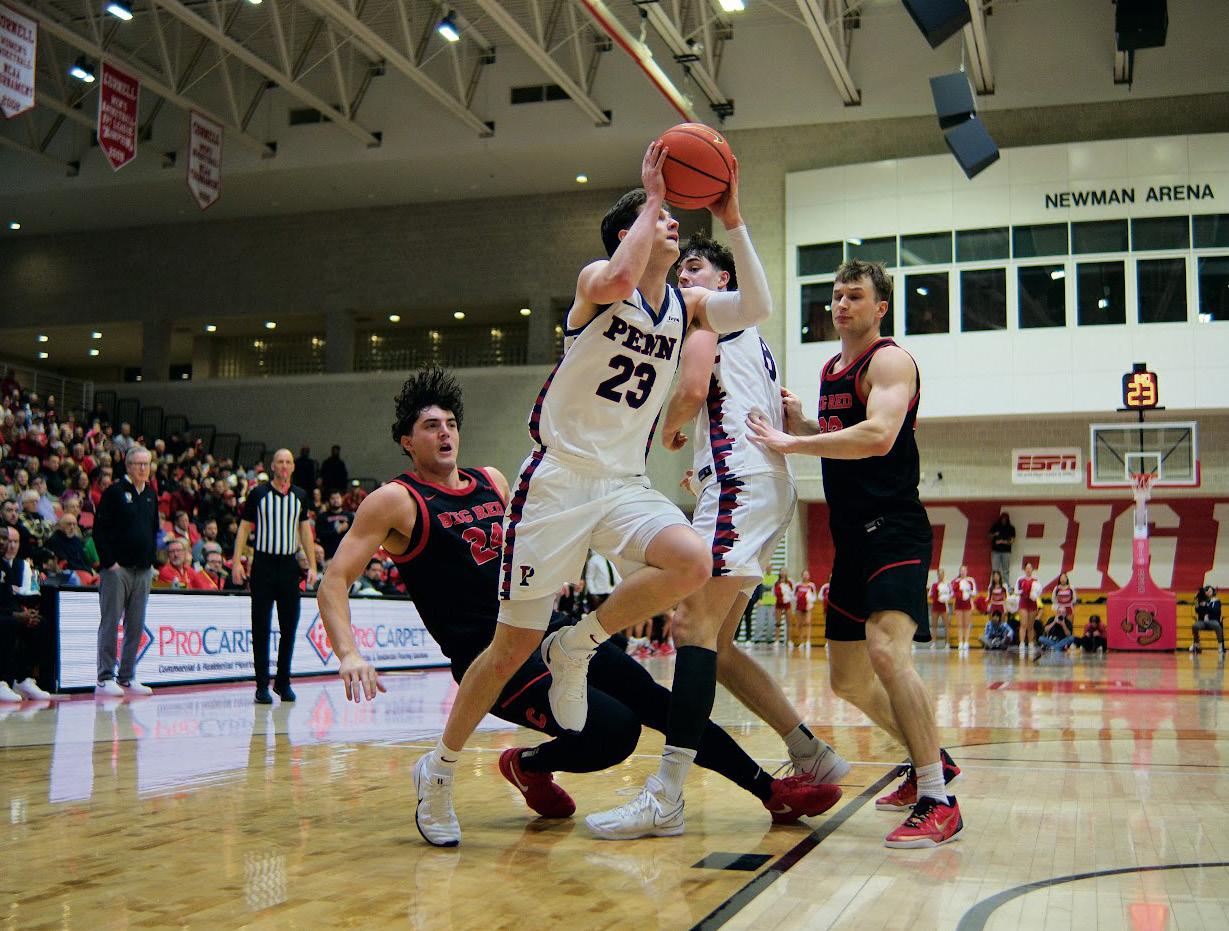
In a road matchup with Cornell (10-10, 3-4 Ivy) that threatened to drop the Quakers (10-10, 3-4) to 2-5 in conference play, Penn put together a first period to remember, storming out to a 23-point lead behind a 59% shooting clip, eight threes, and kinetic energy on defense.
“First half was about as good as you can play,” coach Fran McCaffery said of the team’s defensive execution against the Big Red.
Cornell punched back after halftime, cutting the lead to two thanks to a hot shooting stretch of their own. But the Quakers weathered the storm, getting to the free throw and stringing together timely baskets for their first win in Ithaca since 2022. From a standings perspective, the win helped keep Penn in the Ivy Madness picture — the Quakers are now one of three teams tied for fifth place in the Ancient Eight and trail fourth place by just one game. From a season perspective, it showed what the group is capable of despite an imperfect start to McCaffery’s first campaign.
A year ago, Penn was run off the court against the Big Red as Cornell coach Jon Jaques — a former player under then coach Steve Donahue when they were both at Cornell — beat Donahue at his own game: perimeter shooting. Jacques’s fast-paced offense detonated for 17 three-pointers in a 28-point victory, writing another chapter in a dismal campaign for Penn that ultimately resulted in Donahue’s dismissal.
McCaffery brought a similar style with him when he arrived in Philadelphia, one that emphasizes pace, movement, and generating quality looks from beyond. Penn is currently shooting 39.2% from three, good for 16th in the nation.
The Quakers’ full hand was on display in their 47.4% triple shooting effort in Ithaca. Senior guard/ forward Michael Zanoni led the team with 19 points and hit 3-for-4 shots from the perimeter, making the most of his frequent catch-and-shoot opportunities. McCaffery often schemes Zanoni open with pindown screens and curl actions, allowing him to catch at the wing or the elbow and either rise into a jumper or create space with his handle.
“I think my teammates and coaches do a good job keeping my confidence high, running actions for me,” Zanoni said. “And then when I get one, they run the same play.” Zanoni also knows how to move in space to maxi-
mize his clean looks. Here, he flares out to the wing before sliding to the corner where Dartmouth’s zone can’t reach him in time.
Zanoni has also had his share of off nights, including a combined 2-of-19 shooting performance across losses to Harvard and Yale. But he seems to have regained his rhythm on Penn’s New York road trip and has cemented himself as a legitimate co-star alongside senior guard/forward Ethan Roberts and junior forward TJ Power.
Another plus for Penn’s offense against the Big Red was its production from the center position. Junior forward Augustus Gerhart and freshman forward/ center Dalton Scantlebury have served as the team’s one-two punch at the big spot, and both bring unique advantages.
Gerhart, the Quakers’ starter, has progressed significantly over the course of the season to match McCaffery’s trademark pace. He is a solid screener and a tenacious offensive rebounder — his 2.6 offensive boards per game lead the Ivy League.
When playing alongside Roberts, Power, and Zanoni, Gerhart isn’t tasked with a significant scoring load, but he has his moments. At the start of the second half against Cornell, Gerhart took advantage of his matchup with Cornell’s 6-foot-2 guard Cooper Noard en route to four straight field goals. He finished with 13 points on the day, the third highest total of his collegiate career.
Scantlebury is an old school mosher who uses his considerable size and strength to bully opposing defenders on the block. His footwork is also a strong point, giving him the mobility necessary to capitalize on his backdown game. In a nonconference clash with Merrimack, Scantlebury rattled off 22 points on perfect shooting along with 13 rebounds, eight of which were offensive.
Both bigs have their flaws. Gerhart is a bit turnoverprone for the relatively little amount he handles the ball (he has five games with two or more TOs this season), while Scantlebury occasionally gets tunnel vision and forces contested looks. But together, the pair give McCaffery a tandem he can trust both this season and beyond.
“We got 25 points and 10 rebounds out of that position tonight,” McCaffery said of Gerhart and Scantlebury’s combined play against Cornell. “That tells you everything you need to know, statistically.”
Penn’s weak point, both this year and toward the end of Donahue’s tenure, has been the other side of
| STAFF PHOTOGRAPHER
Senior guard/forward Ethan Roberts goes up for a layup on Jan. 31.
the ball.
The Quakers rank seventh in the Ivy in opponent points per game and opponent field goal percentage, and protecting the basket has been especially difficult — the Red and Blue have surrendered over 40 points in the paint in four of their seven league games, including losses to Princeton, Yale, and Columbia. Gerhart and Scantlebury bear much of that burden as the team’s primary anchors, but they’ve often been put in rotation after Penn’s perimeter defenders let up penetrating drives.
The Quakers’ win over Cornell went a long way toward showing what the team is capable of defensively. Though the Big Red make their money from beyond the arc, their up-tempo offense places stress on the entire defensive front with a heavy dose of offball design.
But Penn was up to the challenge, limiting Cornell to 38.7% shooting in the first half and 45.2% overall.
The Quakers also combined for five blocks on the day including two from Scantlebury. Here, he swiftly rotates to help on Power’s rolling man, goes vertical, and gets the rejection. The post bucket at the other end is a bonus.
“I thought Scantlebury was really good anchoring the defense, but all of our perimeter guys were up,” McCaffery said. If Penn wants to achieve its goal of an Ivy Madness berth in McCaffery’s maiden voyage, it will have to be better than 3-4 during the second half of the conference slate. But with an effort like Saturday’s on the books, there’s reason to believe they can.
Women’s basketball upsets topranked Columbia
Six Penn players scored at least eight points in the game-winning effort
SOO YOUNG YOON Sports Reporter
What a night for Penn women’s basketball.
The game had everything a fan could hope for: a back-and-forth showdown with 12 lead changes, supported by a fired-up bench and an electrified crowd. The Quakers capped the night by beating top-seeded Columbia 64-55.
Coming into the game, Penn women’s basketball (12-7, 2-4 Ivy) was considered a heavy underdog against Columbia (14-5, 5-1). The Lions entered the Palestra coming off an upset victory over Ivy League preseason favorite Princeton while maintaining a perfect away record. The Quakers, on the other hand, suffered a tough loss to Cornell (8-12, 3-4) the night before — their first loss to the Big Red since 2017.
“We can’t get into records,” coach Mike McLaughlin said. “We have to win. We have to win a game to get another game. And it was that simple.”
Opposing defensive strategies
While Penn showed zone defense and prioritized protecting the paint in the first half, Columbia’s fullcourt press immediately challenged junior guard Mataya Gayle. Penn clamped down on the Lions defensively, led by junior center Tina Njike in the paint, who swatted away passes and hustled to close out on the three-pointers. Offensively, both Penn and Columbia struggled to gain momentum, their three-point percentages being 14.3% and 17.6%, respectively. The first half closed with a 25-25 tie.
Offensive shootout
The battle of the defenses turned into an offensive shootout in the second half. A few minutes in, Njike drew a double team and swung the ball to wide-open senior guard Simone Sawyer, who made the three-pointer. A few possessions later, Sawyer got the ball again and hit another as the bench erupted. Columbia guard Riley Weiss was an absolute momentum-killer for Penn. In the second half, Weiss took over the game for Columbia. When Njike extended Penn’s lead to four points, Weiss answered with a quick three-pointer to make it a one-point game.
Despite Weiss’s flurry in the second half, Penn’s offense thrived. In the fourth quarter, Gayle got the pick-and-roll going with Njike and dominated in the paint, scoring 10 points in the box compared with Columbia’s two. Gayle and Weiss also faced off in the final quarter, as the two went back and forth to finish with eight and 11 points, respectively. In the end, Penn exited with an upset victory, taking down the Lions 64-55. Despite the odds against a top team in the Ivy League, the Quakers covered the floor and hustled to make plays happen.
“We just wanted it,” Gayle said. “We know they’re a good team, but we put in our heads like today we’re gonna be the better team.”
Although the Quakers enjoyed a nice stretch of home games, Penn women’s basketball will be back on the road next weekend to face Princeton on Feb. 6.
FactCheck.org, the award-winning political website at the Annenberg Public Policy Center of the University of Pennsylvania, is now accepting applications for its 202627 undergraduate fellowship program. The next class of undergrads will be trained during an eight-week, paid summer program at FactCheck’s offices at APPC from May 26 to July 17. Those who are trained this summer must agree to work 10 to 15 hours per week at FactCheck.org during the fall and spring semesters, if their work merits continued employment.
The fellows at FactCheck.org help our staff monitor the factual accuracy of claims made by political figures in TV ads, debates, speeches, interviews, social media and news releases. Fellows conduct research, contribute to fact-checking articles for publication under the supervision of FactCheck.org staff, fact-check articles written by FactCheck.org and respond to questions from readers. The fellows must have an ability to write clearly and concisely, an understanding of journalistic practices and ethics, and an interest in politics and public policy. The fellows also must be able to think independently and set aside any partisan biases.
If you are interested, please submit your resume and two writing samples by the February 11 deadline to FactCheck.org. Deputy Director Rob Farley at rob.farley@factcheck.org. Please direct any questions about the program or application process to the same address.
CHRISTINA LE
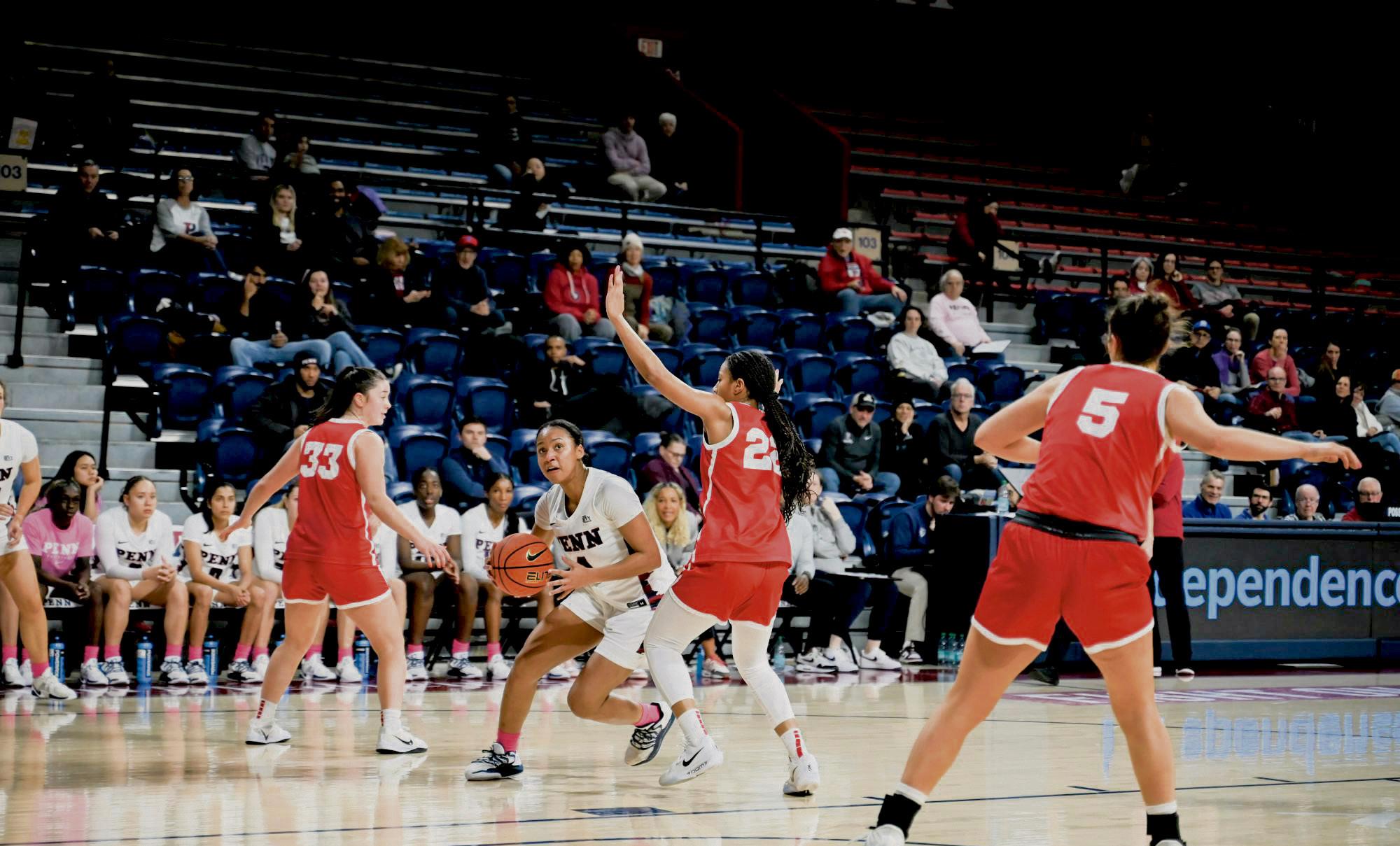
Senior guard Saniah Caldwell goes for a layup on Jan. 30.
KENNY CHEN | SENIOR PHOTOGRAPHER
Blue.
“We wanted to send a message that the season is still long and that we’re capable of competing for every trophy ahead,” Hafez said.
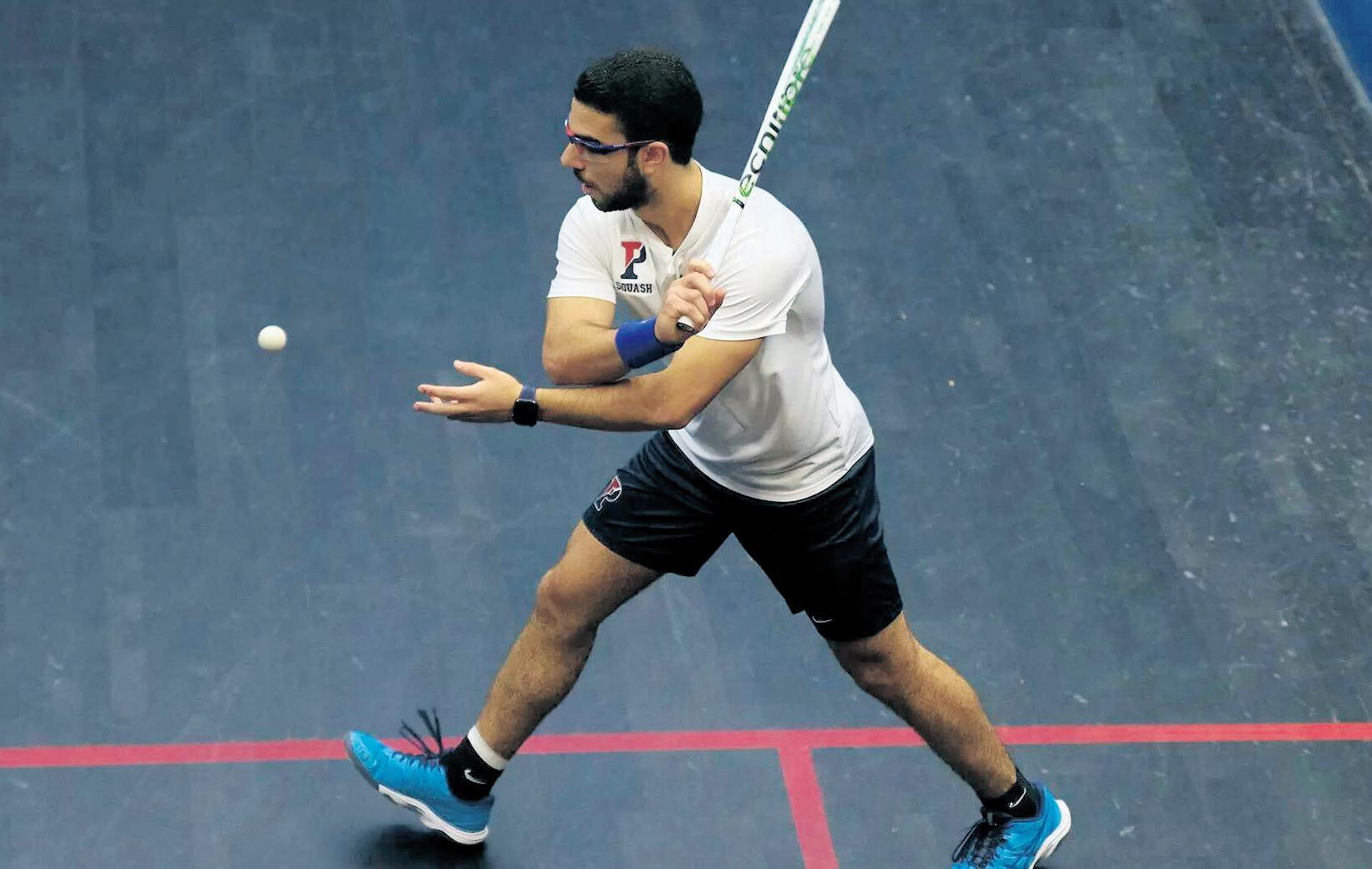
Freshman Alex Dartnell opened day one of the tournament for the Quakers, facing Dartmouth’s Arihant Kalamangalan Sunil. Dartnell dropped the first game 11-3 but came back to win the next two and advance to the second round. Sophomore Marwan Abdelsalam added to Penn’s win tally by taking down Nachiket Desai of Tufts in three straight games, while sophomore Rustin Wiser fell to Columbia’s Arhan Chandra. Junior Salman Khalil and senior Omar Hafez both received a first-round bye, the former entering the tournament as the No. 5 seed, and the latter as the No. 2 seed.
In the second half of day one, Khalil and Dartnell faced each other in the round of 32. The Quakeron-Quaker clash began with a nail-biting first game, which Dartnell clinched 12-10. Khalil answered right back, winning the next three games over Dartnell in a more convincing fashion. Abdelsalam also advanced, winning five games over Rohan Gondi of Yale. Hafez closed out day one with a dominant sweep against Philadelphia rival Nicolas Serna of Drexel.
The following day, Khalil faced off against Yusuf Sheikh of Columbia in a five-game thriller. Khalil took the first game 11-8, but Sheikh fought hard to win game two 11-9. Khalil then won the third game and, Sheikh evened the match again by taking game four. Although the match went the distance, Khalil showed no sign of exhaustion, dominating game five with a 11-2 win to clinch the match. Abdelsalam had a much better experience in the quar-
terfinals, sweeping Princeton’s Hollis Robertson in three games. Hafez added to the Quakers’ victory run against John Paul Tew of Virginia, only dropping game one and proceeding to win three games straight after that.
The third day of the tournament put a halt to the Red and Blue’s run, as Khalil and Abdelsalam both fell in straight games, the former to No. 4 seed Muhammad Irfan and the latter to No. 3 seed Joachim Chuah, both of Trinity. Hafez redeemed his team with a convincing victory against Benedek Takacs of Trinity, punching his ticket to the semifinals at Grand Central Terminal.
The next day of the tournament opened with an
air of déjà vu for Hafez, as he faced Joachim Chuah of Trinity for the second time in a week. The first iteration of this match in Hartford, Conn., was a clean sweep for Hafez, and this time around, the story barely changed. Hafez took down Chuah in four games, dropping only the third game and claiming his spot in the championship match.
All eyes were on Hafez as the commuters at Grand Central Terminal passed by the glass cage, the stage for the title match. They had a chance to witness Quaker history on the final day of the tournament as Hafez faced yet another Trinity foe in Irfan. With bragging rights on the line and the chance to be a part of collegiate squash history, the two players put each other to the test. Hafez managed to put away two games quickly, before Irfan halted his momentum in
Penn women’s squash sings the song of victory
The team is currently undefeated and looking to finish its Ivy League season strong
SONAL SUKHATME Sports Reporter
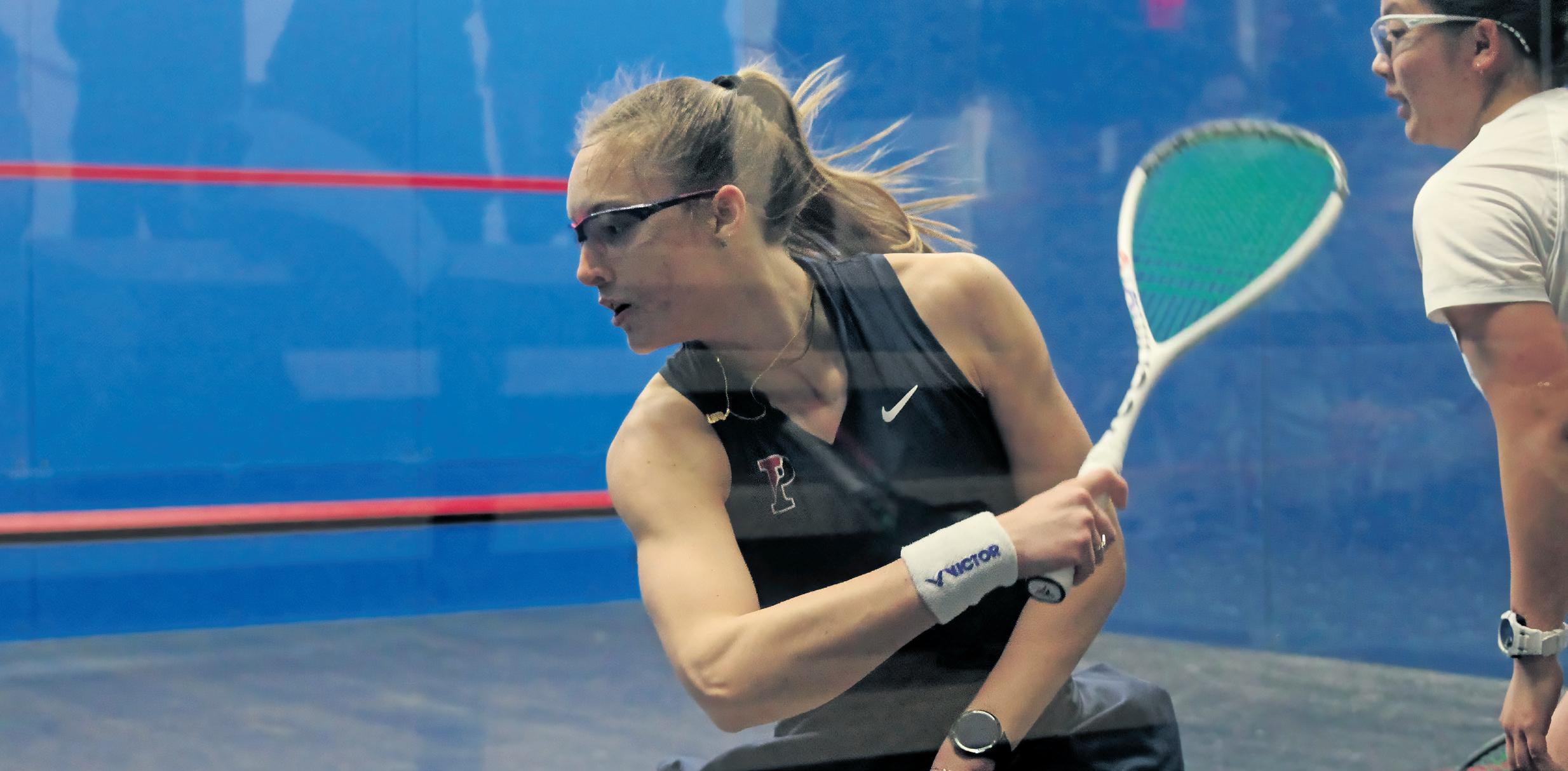
With three more matches left before the Ivy League Championships, Penn women’s squash is on a roll. At 11-0, the team is currently undefeated. What makes it even better: they’ve bageled all but three teams. This is a monumental season for the team after it has made huge strides in the past couple of years. Going from 8-8 three seasons ago to 15-4 last season was impressive, and now they’ve pushed themselves even further.
“First, our seniors this year … their steadiness and their ambitions to continue to try to crack the upper echelons of college squash have been really amazing,” coach Jack Wyant said about the team’s success. “And then they’ve been lucky to have the classes behind them that have all contributed a lot. And now I think you’re kind of seeing … how everything’s come together.” Wyant also noted how the men’s success has inspired the team, since the entire squash program is close-knit. The players’ tight bond is easy to see, according to Wyant, especially on drives home from matches which are filled with loud music and even louder singing.
After sweeping Haverford, Franklin & Marshall, Chatham, and Drexel, the team faced No. 3 Stanford and won 8-1. The following day, they beat No. 6 Virginia 7-2. Their dominance continued with a 9-0 win against No. 15 Georgetown.
Their next matchup was No. 5 Trinity, a school that has historically been tough for Penn to beat. Before this season, Trinity had won the last nine meetings. That didn’t stop the Quakers, who won 7-2. Strong performances from all players drove the team to the victory, making them the first team in the country to reach eight wins this season.
“You have to have the talent, so that’s first and foremost. But then beyond that, they have worked really hard and they’re very focused on achieving their goals and getting the most out of everyday practice
Senior men’s squash player Omar Hafez competes in a match.
PHOTO COURTESY OF PENN ATHLETICS
Junior women’s squash player Malak Khafagy competes in a match.
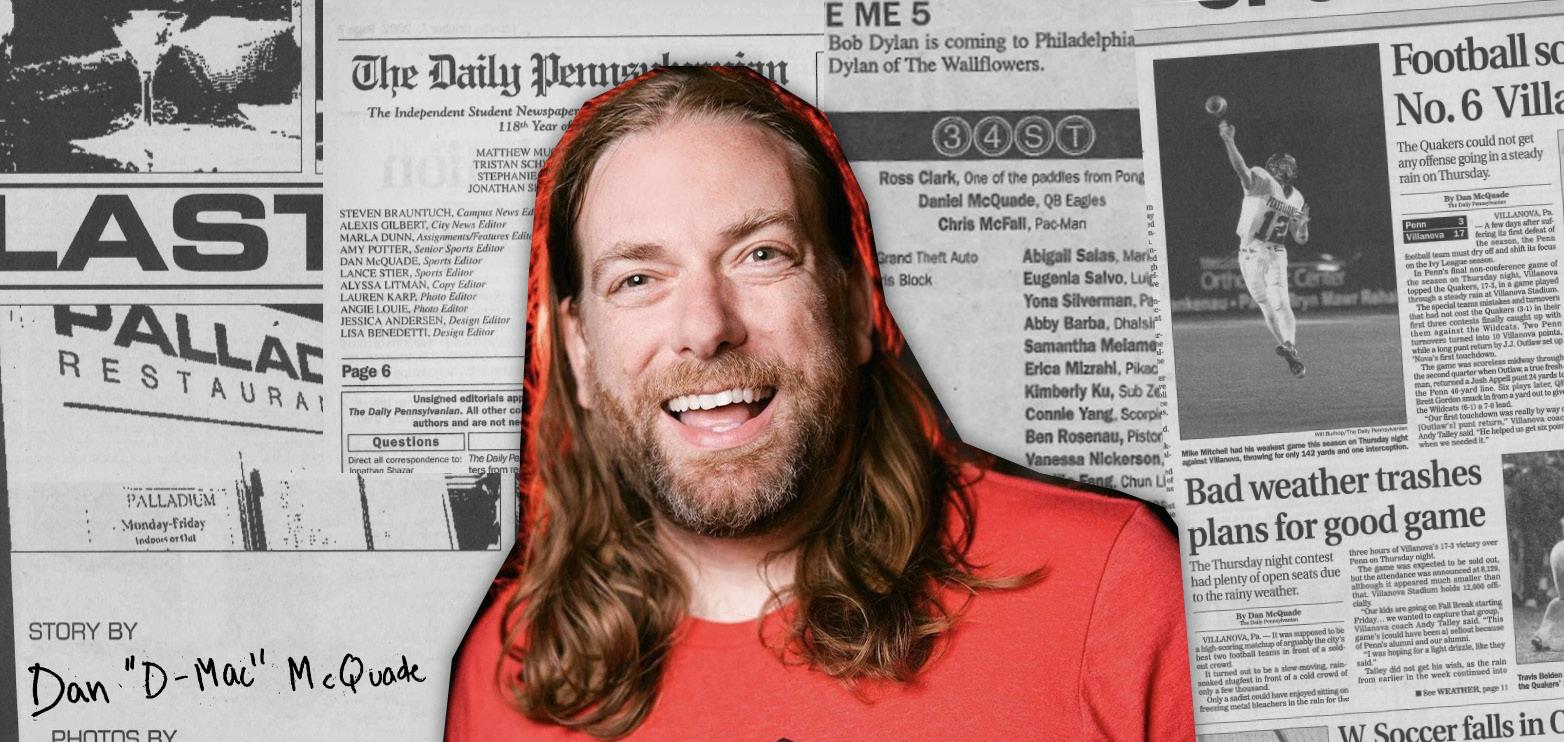
Remembering Dan McQuade
Daniel McQuade, a former editor and writer at The Daily Pennsylvanian, died on Wednesday of neuroendocrine cancer. He was 43. Before becoming widely known for charting Rocky’s absurdly long training montage run, posting a video that helped lead to Bill Cosby’s downfall, and poignantly documenting his fight against a rare cancer, McQuade — a 2004 College graduate — spent his formative years at the DP.
McQuade was a prolific sportswriter, columnist, DP Sports editor, and managing editor at 34th Street Magazine. D-Mac, as he was known at Penn, won back-to-back Michael A. Silver Writing Awards and was the DP’s Editor of the Year in 2002. He was a constant uplifting and joyous presence in the DP office and on road trips. Since his passing, tributes from friends and family have poured in, honoring the impact he had on those closest to him and his work for Philadelphia Magazine, Deadspin, Defector, and others. His colleagues from the DP complied their favorite memories and stories in honor of his memory. 2006 College graduate David Burrick, executive editor on the 121st Board
D-Mac was my first editor and, in many ways, was responsible for my love of the DP and greater Philadelphia. He taught me many of the basics of writing — how to construct a story, how to ask the right questions of coaches, and how to cut extraneous information. As I matured, he taught me other important traditions of working at the DP, including traveling together to the paper’s fateful final visit to Chicken Hutch in scenic Nashua, N.H. Prior to going to Penn, I had never really spent any time in Philadelphia. DMac provided an education on all the local traditions, such as the best places to get a cheesesteak and what time you had to arrive to get tickets to the Wing Bowl. After Penn, I would keep in touch with him through his amazing writing. His annual review of the Tshirts on the Wildwood Boardwalk was pitch perfect. The last time I reached out to him was several months ago to compliment him on his incredible piece on his battle with cancer. He will be dearly missed.
2003 College graduate Dave Zeitlin, DP Sports editor on the 117th Board
D-Mac and I came up together as sportswriters at the DP, covering some outstanding Penn basketball and football teams. While getting to sit on press row together at the Palestra and Franklin Field was awesome, the best parts were the random ways we’d make each other laugh on road trips. For the next 20plus years, we still talked about the overly intense Lafayette football player and the Brown football coach who stormed out of his own press conference; the time we were late to the 2002 playoff game for the Ivy hoops championship at Lafayette (Penn crushed Yale to make the NCAA tourney!) because a photog had to use the bathroom en route; the little kids’ basketball game we bet on at a Penn-Yale game in New Haven, Conn., which D-Mac wrote about multiple times since; and other moments that D-Mac had an uncanny ability to recall and relive through out-ofthe-blue emails and texts, just so we could share another laugh. (The fact that I’ll never get another one of those texts, or hear his amazingly loud laugh, is hard to accept.)
D-Mac and I remained close after college, hanging out at Philadelphia bars to play Quizzo, watch World Cup games, and of course go to the Palestra together. He had so many unique interests, curiosities, and passions that he shared with so many different friends, but for us it was our love of college hoops that was the glue to our friendship. When he wasn’t texting me about ridiculous parts from the “Air Bud” movies or “Ladybugs,” or recent sweet updates on his two-yearold son (he seemed so proud to be a new dad), he was sending live updates of Penn hoops games, photos of antique Quaker memorabilia, or stats about Penn’s insanely high three-point proficiency from the early 1990s and early 2000s (led by his favorite player, classmate, and 2004 College graduate Jeff Schiffner). Recently, we went back to Abner’s just before it closed for good to reminisce about the few times Penn reached 100 points and fans rushed across campus to get a free cheesesteak. And he joined my then nineyear-old son and me to watch Penn play Princeton in
the 2023 Ivy League tournament. (My son loved sitting next to him at Jadwin Gymnasium, and also getting interviewed by him later that year for an article D-Mac wrote on Messi playing against the Philadelphia Union.) The Quakers lost a tough one to their hated rivals and getting in and out of the Princeton parking lot was a mess. But we still enjoyed ourselves as always, especially watching another halftime game between little kids! I’ll be forever grateful for one last basketball road trip together.
Oh, and one more thing: the next day, D-Mac sent me an article he wrote about his day going to the Ivy tournament followed by a trip to Atlantic City, N.J. for the MAAC tournament with another friend. (I told you the man loved his college hoops!) “I got some stuff in there about how bad Princeton’s gym smelled,” he texted me then, and which I’m including here now, because I think he’d appreciate getting one last funny dig in at Princeton.
2004 College graduate Amy Potter, executive editor on the 119th Board
It’s hard to pinpoint a single, distinct memory of D-Mac because he was the background soundtrack of my entire college experience. His staccato laughter, enthusiastic and boisterous storytelling, and encyclopedic knowledge of everything sports and Philadelphia were my everyday.
We started as sports reporters together and then moved up the ranks, first as DP Sports editors and then onto leading the DP and Street. I spent more time with Dan than probably anybody else in college. We shared thousands of late nights rewriting headlines and wrangling unhurried reporters (you know who you are!). We traveled up and down the East Coast to cover games, and D-Mac entertained me with his hilarious reflections and insights in the car or train, on press row, and at postgame press conferences. His humor was inimitable and highly entertaining. D-Mac had a way of narrowing in on (what might seem like an irrelevant) detail in a story and irreverently making it the main character. Perhaps most importantly, he was my personal tour guide to Philadelphia. I naively moved to Philadelphia for college from New Mexico without any prior knowledge or connection to the city and was lucky enough to befriend Dan in the first few months. Dan helped pull me out of deep homesickness during my first year at Penn. D-Mac subsisted on a diet of primarily cheese pizza, soft pretzels, and french fries in college, so we went to diners across the city, often very late at night after putting the paper to bed. I am pretty sure I went to my first Phillies game with him (at the Vet!) and he made sure I knew about cultural institutions, like The Gallery mall and Wing Bowl. Dan gave it to you straight and was unambiguous with his opinions. At the core, D-Mac loved and cared for the people in his orbit; I was lucky enough to be one. My email and text history is littered with quick notes from Dan with a link to a story, and a remark on why he thought of me while reading it. I will miss him so much, and I hope to never, ever forget his laugh.
2001 College graduate Sebastian Stockman, DP Sports reporter
We shared a love for the bad lede.
You know the kind: the tortured metaphor that died on the rack, the analogy that doesn’t quite match up, the writer who’s trying to do too much. Dan McQuade loved to reference my first-ever story for the
DP (written when he was still in high school):
“The lyrics of the Bob Dylan song ‘Rainy Day Women’ are totally unrelated to track and field. The title, however, fittingly describes the Penn women’s track team as it attempts to repeat last year’s performance this weekend.”
Yeah, that’s the stuff.
Our 20-plus years of email and text correspondence are full of links to and snippets of what, one hopes, were absent-minded or hastily written ledes. We loved the absurd solemnity with which they were rendered and the seeming obliviousness — did you even read it out loud? — of the writer. Unstated but always present was an empathy for the writer. Sometimes you try to do too much! Happens to everyone!
My mental picture of Dan bears little resemblance to the pictures going around. Yes, of course, those
pictures are what he looked like. But, as happens sometimes, the headshot in my mental file for Dan is fixed to the time I met him: a fresh-faced, shorthaired, rail-thin rookie DP sportswriter. I was a veteran. We should have barely overlapped. I should have graduated just as he was getting his feet wet. But I didn’t (ever, if we’re going to get technical), and he became my editor, yet another who had to be trained that, in my lexicon, “deadline” meant “suggestion.”
We bonded over our love for Philadelphia characters (though my outsider’s appreciation couldn’t approach his bone-deep, born-here empathy). We attended at least one of those now-defunct orgies of bad taste and light blasphemy known as Wing Bowl. He always liked a story I’d written about Kenn Kweder the (still?!) Tuesday night headliner at Smokes’ who had and missed his big time shot in the ’70s. As recently as a year or so ago, he sent me a video of Kweder playing at a grocery store (?) on the day of the Super Bowl. When I saw that the Philadelphia 76ers had (rightly) held a moment of silence for one of Philadelphia’s great chroniclers and champions — with Dan’s face up on the Jumbotron next to a still-not-believable span of years — I texted several old colleagues, “Dan would have both thought this was ridiculous and deeply loved it, which is perfect because it’s how he felt about the city.”
2006 College graduate Jonathan Tannenwald, DP Sports reporter
Dan McQuade was my first editor at the DP, in the Sports section in the fall of 2002. For nearly a quarter-century afterward, he was so much more than that. Dan was, and remains, one of my journalism idols. He knew it because I told him, and I told him because I wanted him to know it. He appreciated it, one of the many compliments he gave me that meant so much.
For all the things he wrote about over the years, he was a brilliant sportswriter. He was as good at it a quarter-century ago, writing about Ugonna Onyekwe and Mike Mitchell, as he would go on to be about everything else. Some of us will always hold him as a sportswriter at heart.
Now the rafters of his beloved Palestra have a new ghost.
Above all, Dan was the most joyous kind of professional cynic, as we call this job, and as we call it ever less now because so few people do it with a conscience anymore.
This time has been searingly painful for so many people. I can’t imagine how it’s been for his wife and young son.
He would have told me to shut up by now, as he did often when I was being too nice to him. Alas, I will not; nor, I suspect, will anyone else who knew him.
2005 College graduate John Carroll, Street editor on the 120th Board
I worked at Street all four years at Penn. I knew DMac from high school, but we became closer during his time as managing editor at Street. Two memories from our time at DP:
1. When the second “Matrix” movie came out, I was in charge of the film section. I was a bit surprised when D-Mac insisted on running two reviews of the movie — mine and his. Did he not trust me? We had never done this before. Well, fast forward to the week of publication and my heart drops when I read D-Mac’s rebuttal to my review, which began: “John, you ignorant slut!” Yes, I had no idea at the time that Dan was referencing a famous “Weekend Update” bit from SNL. But when I saw him next, he was joyous: “I’ve been waiting months to use that line in print!”
And then it all made sense: Yes, it was a big film, but Dan had a big laugh in mind to justify it all.
2. D-Mac was a year ahead of me, and when he was graduating I was interested in taking over his position as managing editor. The one problem is that there were more qualified candidates with more experience throughout the paper. D-Mac, though, encouraged me to apply, walking me through the process and prepping me for the interview with the editorial board. And it was a great experience … up until, as I expected, I didn’t get the gig. I dreaded seeing him after that. I thought I had disappointed him. We went to the same high school, I long admired him and tried to follow in his footsteps, he helped me …
and I failed. I managed to avoid him until the end of year banquet, when he cornered as I tried to sneak out early. This is so ridiculous to think now, but I had that childhood sense of “oh no, I’m in trouble,” the type of conversation I doubt D-Mac ever had with anyone. And instead, he just wanted to tell me he was proud of me. A bit surprised, I asked him why, and he said he saw that I had signed up to return as a section editor. He thought it was the right thing to do, and he didn’t know he would do it if he was in my shoes. And the thing is, in recollecting this, everything Dan did was great advice. I got valuable experience, and I didn’t let a loss stop me from doing what I loved. But he was doing all of this at 21 years old! I feel like this is perspective many of us don’t have for years after college. He was wise beyond his years, which is why I always looked up to him and why I was proud to become his friend.
2003 College graduate Tristan Schweiger, managing editor on the 118th Board Most of my favorite memories of Dan from our DP days relate to how much he loved Philadelphia and all its storied institutions — like the Philadelphia Daily News, where his dad worked for many years. And Dan loved a good tabloid headline. At some point during the year when we were both on the editorial board, we took to amusing ourselves late at night after the next day’s paper had been put to bed (or, honestly, when we should have been working on getting the paper put to bed) by mocking up fake DP front pages in the style of the Daily News, complete with a red box that read “The Student Paper” where the real DN of course is “The People Paper.” The best were based on deranged voicemail “tips” we would get at the office. It’s the kind of thing that’s funny mainly to the people making the joke, but it’s one of my favorite memories of Dan and very much reflects how much he loved that city.
2004 College graduate Steve Brauntuch, editorial page editor on the 119th Board Most of my memories with D-Mac come from outside the Pink Palace — Sunday afternoons at Shula’s/ Top Dog watching football, trips to the Vet for dollar hot dog night to watch the Phillies lose to whoever was in town, and then watching him eat nothing but pizza for an entire year when we lived together senior year on Chestnut Street. But what I always remember and love about DMac was his desire to make himself and everyone else laugh. Nobody loved a meme more than him, and nobody went deep on inanity and nonsense more than him. The “Rocky” article was one of so many where he found something that was insanely dumb and taught a master course in picking it apart just because it made him laugh. The clip we shared between each other so many times was the “Family Guy” spoof on Madden and Summerall announcing a football game where Madden just screams “FOOTBALL!!!!” at the top of his lungs and scared Pat out of the booth. That’s the stuff I’ll miss most — the creativity, the sense of humor, and the desire to share those ridiculous moments with everyone he knew to make them laugh as much as he did.
2004 College graduate Lauren (Karp) Brooks, photo editor on the 118th Board One summer in college, D-Mac, Angie Louie, Jarrod Ballou and I randomly drove to Wildwood, N.J. I think we borrowed my mother’s car, but I can’t recall. Angie says it was an unusually cold summer day, but the details are hazy in my mind. What I do remember is the feeling of our friendship — Dan was always a willing companion for an adventure. We spent time driving around his neighborhood in Northeast Philadelphia. We went to movies. We walked around the city. We spent countless hours on the gravel topped roof of the DP. The banal became enchanting when Dan was there to notice the quirks and inconsistencies of people, places, and life. Sadly, I haven’t spoken to Dan in over 20 years, but when I read his article about having cancer, the sound of his voice was palpable — I could hear him reading along — the cadence of his voice, the inflections where his voice would have risen, and the burst of his laughter. The world is quieter and less interesting without D-Mac’s voice.
The Daily Pennsylvanian Sports alumni and colleagues compiled their favorite memories and stories in honor of Dan McQuade’s life and legacy