
MAKAYLA

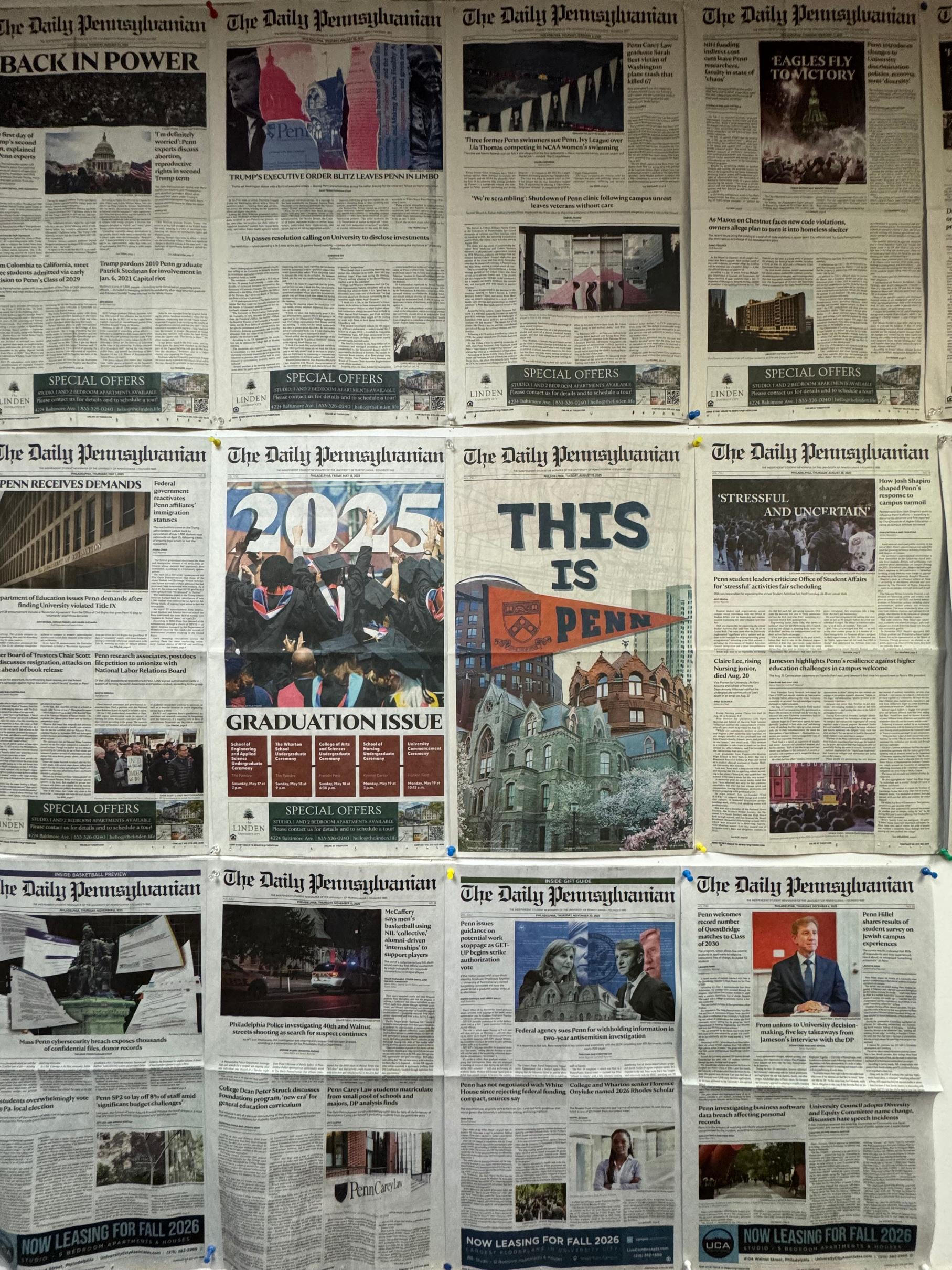
The Daily Pennsylvanian compiled a timeline of union efforts on and around campus over the last year
FINN RYAN Senior Reporter



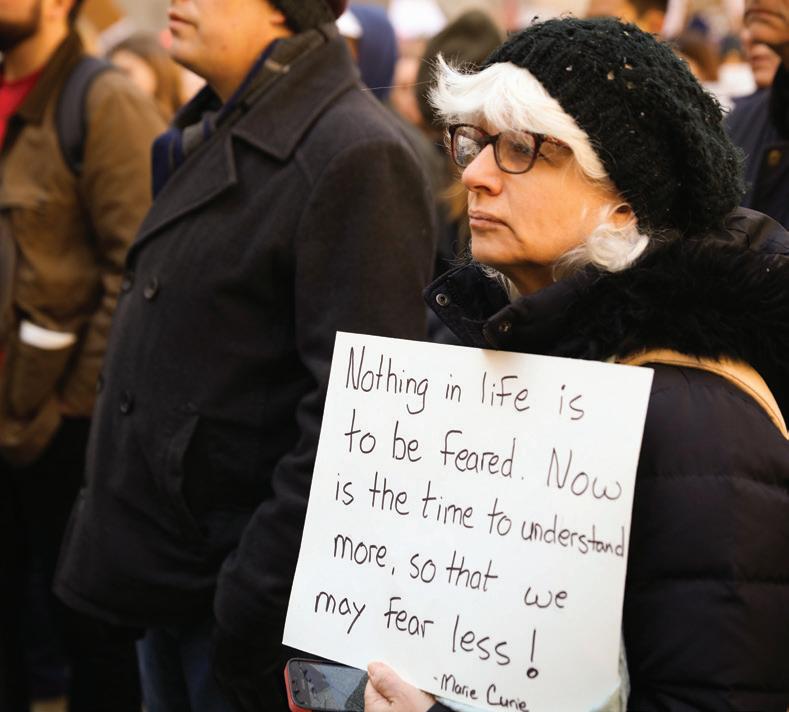
March 20 — Six campus unions and labor organizations, including the Penn chapter of the American Association of University Professors, organized a rally in protest of intensifying federal action against institutions of higher education.
April 15 — Employees at the former Saxbys location at 40th and Locust streets staged a “march on the boss,” alleging that the store changed its operating hours without proper notice.
April 24 — Penn’s research associates and postdocs filed a petition to form a union with the National Labor Relations Board.

June 11 — Workers at World Cafe Live, a University City music venue, staged a walkout in protest of their new management.
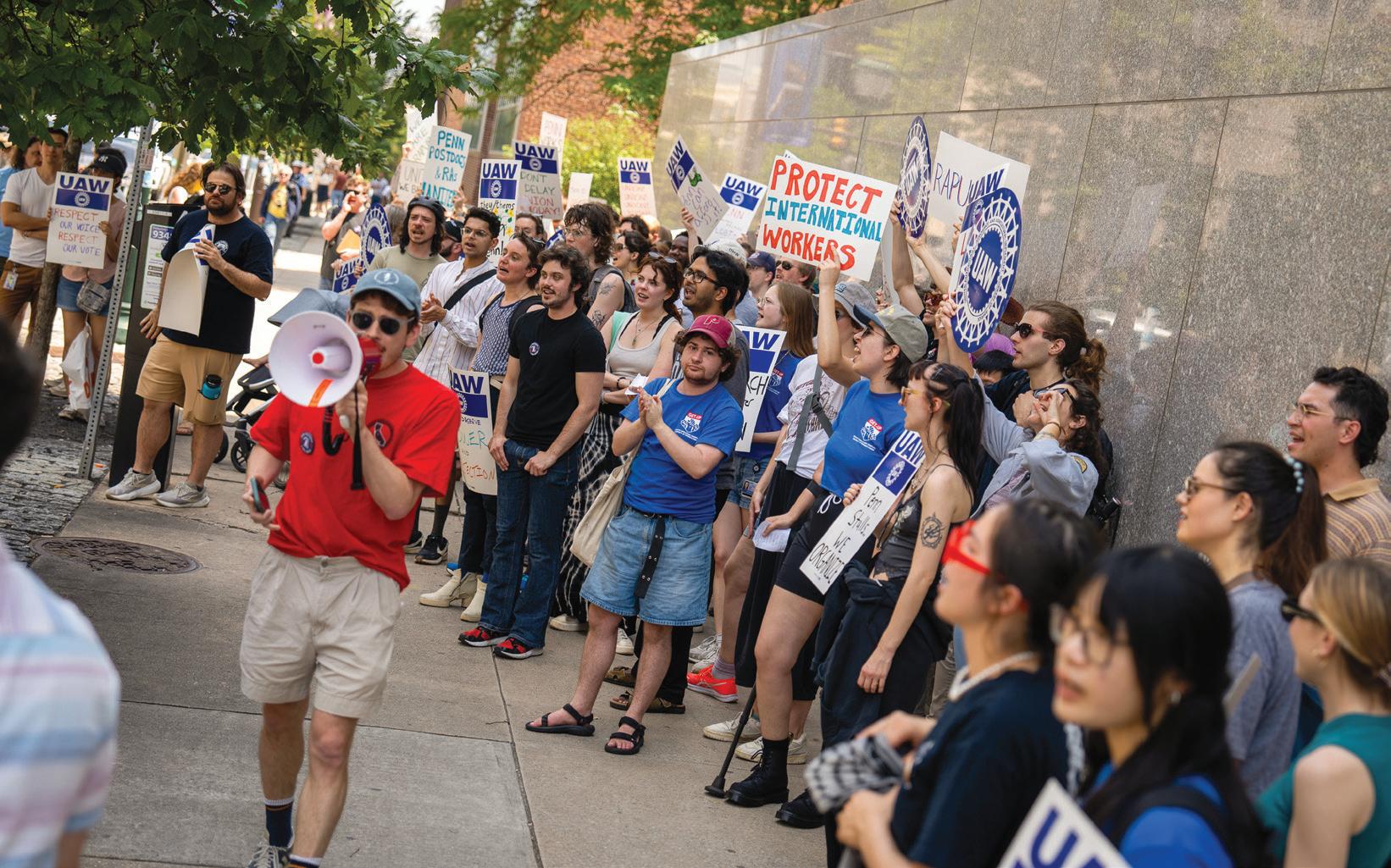
June 12 — Research associates and postdocs rallied outside of a University Board of Trustees meeting to criticize administrators’ “union-busting” tactics and demand a vote on unionization.
July 2 — Penn Museum Workers United — a chapter of Philly Cultural Workers United — unanimously authorized a strike. Seven days later, the union staged an informational picket to protest low wages and call for major contract improvements.
July 17 — Research Associates and Postdocs United at Penn voted to unionize by an overwhelming majority, making it the sixth union to join Penn’s campus in the last five years.
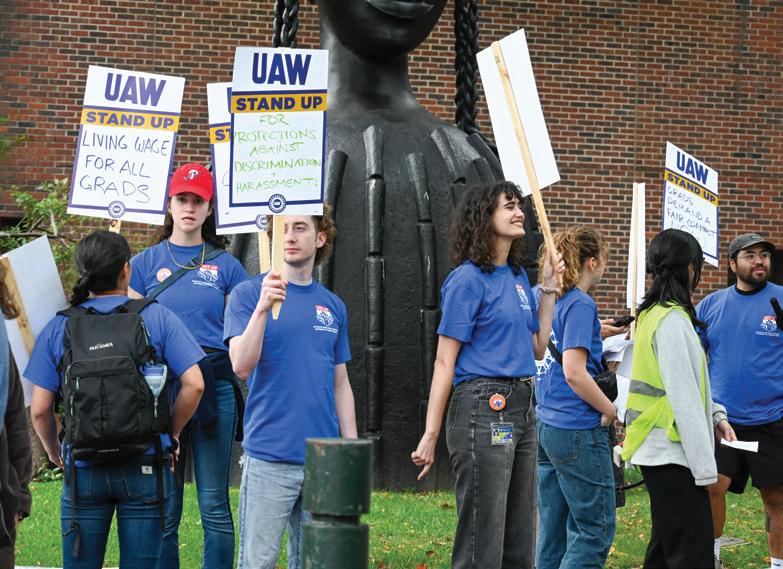
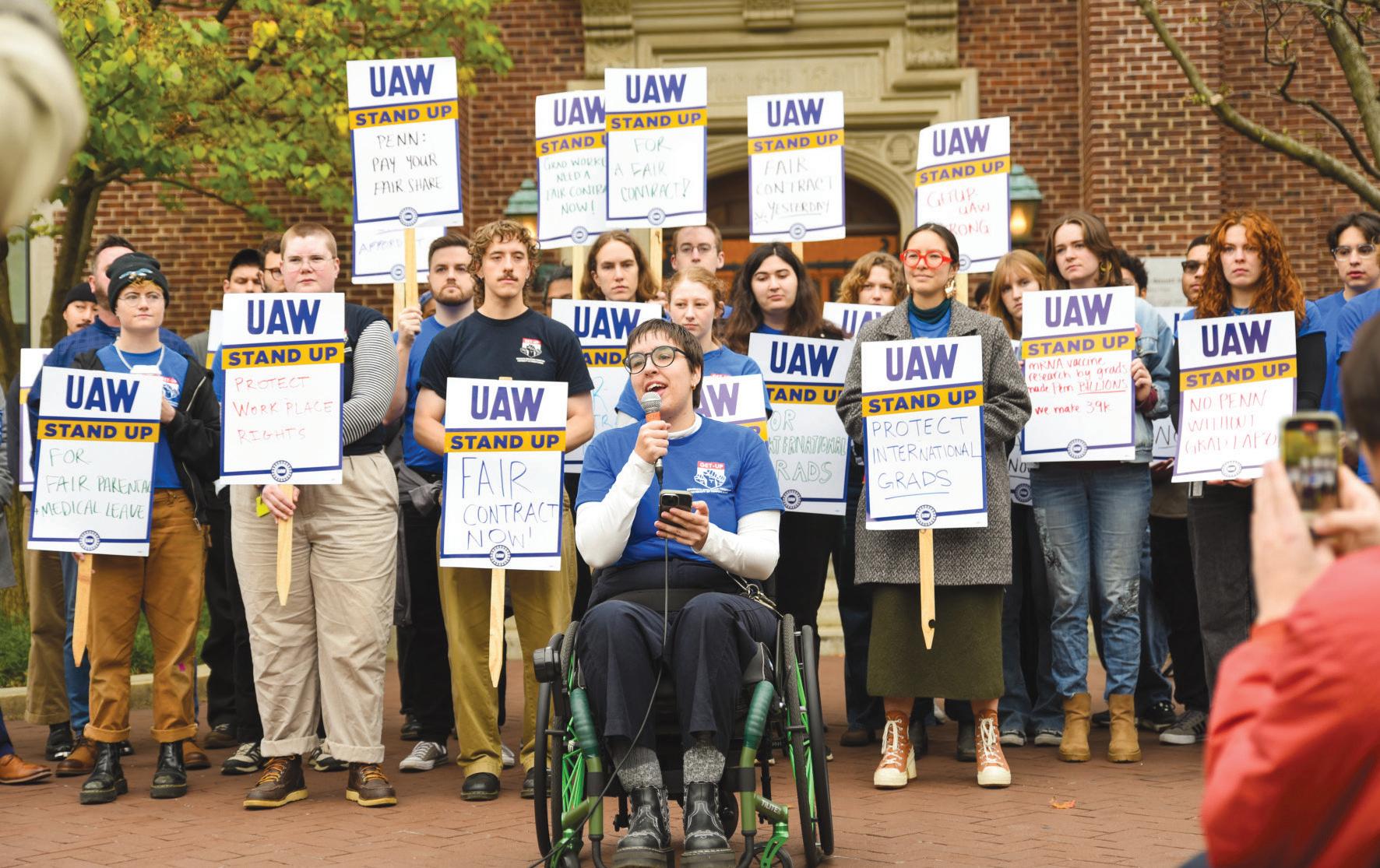
Oct. 8 — Over 500 workers picketed in support of GET-UP’s ongoing negotiations with University administrators. During the demonstration, GET-UP announced that its members began pledging to authorize a strike in the event Penn continued to reject the union’s proposed contract.
Oct. 14 — During a meeting, members of RAPUP’s newly established bargaining committee launched their initial demands in securing a contract with administrators.
Oct. 14 — Almost one year after starting negotiations with Penn, GET-UP reached a tentative agreement on the union’s proposal protecting students from harassment and discrimination.
Oct. 15 — The Coalition of Workers at Penn met to discuss the progress of unionized employees on campus, along with ways to show solidarity with the organizing
efforts of other Penn workers.
Oct. 27 — Ahead of a possible strike, the union representing Penn’s security officers organized numerous rallies throughout Philadelphia to call on Allied Universal Security Services — the University’s security contractor — to raise wages.
Nov. 12 — Following the rallies, Penn’s security guard union ratified a new contract to secure expanded protections and increased wages.
Nov. 21 — After a three-day voting period, GET-UP overwhelmingly decided to authorize a strike. Just days before, Penn’s Office of the Provost issued guidance to faculty and workers on a possible work stoppage. Dec. 9 — United RAs at Penn launched a petition that it said aims to stop the University from eliminating certain graduate resident advisor positions.






















The increase in national scrutiny of Penn coincided with a series of lawsuits against the University, federal investigations, and ongoing negotiations with the White House ISHA
CHITIRALA AND ANVI SEHGAL Senior Reporters
Over the past 12 months, Penn has been a recurring subject of federal scrutiny amid the White House’s attempts to enact reform across institutions of higher education.
This year — which began with 1968 Wharton graduate and President Donald Trump’s inauguration in January — was defined by heightened political attention on the University. The increase in national scrutiny coincided with a series of lawsuits against the University, federal investigations, and ongoing negotiations with the White House.
Trump signed a flurry of executive orders in the first few months of his second presidential term, quickly making good on several promises from the campaign trail.
Diversity, equity, and inclusion initiatives at Penn
On Jan. 20, Trump signed an executive order requiring universities that receive federal funding, including Penn, to terminate any DEI programs that could violate federal civil rights laws.
In response, Penn revised longstanding Universitywide policies and engaged in a widespread rollback of DEI initiatives over the following month — including scrubbing staff titles and renaming DEI offices — across the University’s four undergraduate and 12 graduate schools.
The Wharton School’s DEI undergraduate concentration and MBA major were both renamed to Leading Across Differences in March. Last month, a leaked memo from the Department of State identified Penn as an institution that the department will continue to support through federal research programs, claiming that the University showed “no evidence of DEI” in its hiring practices.
Federal immigration policies in action
Trump, who has frequently touted immigration reform over the course of his second presidential campaign, signed an executive order in January directing federal agencies to identify and deport noncitizen participants — including college students — in proPalestinian protests. In 2024, Penn was the center of numerous pro-Palestinian demonstrations, which came to a head during the spring Gaza Solidarity Encampment.
Amid visa uncertainty, Penn’s International Student and Scholar Services reaffirmed its commitment to the University’s over 9,000 international students. Among other recommendations, ISSS advised impacted students to avoid nonessential travel and seek guidance from campus and legal resources.
In April, ISSS reported that the federal government had revoked “at least three” Penn student visas and confirmed that five more were terminated later that month through Penn’s visa revocation monitoring.
Although the visas were reactivated later that month, a federal halt on student visa interviews announced in May threatened to delay the arrival of
incoming international first years in fall 2025. When the State Department resumed visa interviews, it implemented a thorough social media vetting process to identify messages thought “hostile” to the United States.
In September, the White House announced a $100,000 fee on new H-1B visa petitions, which The Daily Pennsylvanian’s analysis found put Penn at risk of paying millions of dollars to maintain its level of international employment. The same month, Penn sent a letter to the Department of Homeland Security, opposing a federal immigration rule floated in August that could disrupt international student enrollment.
Penn’s Title IX settlement
The Department of Education launched an investigation into Penn in February, claiming that the University’s decision to allow 2022 College graduate Lia Thomas, a transgender woman, to compete for Penn’s women’s swimming and diving team during the 2021-22 swimming and diving season violated Title IX.
The investigation came a day after Trump signed an executive order barring transgender women from participating in women’s sports. That month, three former Penn swimmers filed a lawsuit against the University, alleging that Thomas’ participation deprived them of “equal opportunities as women to compete and win while being denied the opportunity to protect their privacy in separate and equal locker rooms.”
One month later, the White House announced a freeze on $175 million in Penn’s federal funding, again citing the University’s failure to ban transgender student-athletes from women’s sports.
In April, the Education Department found Penn in violation of Title IX and asked the University to “voluntarily” comply with three demands within 10 days or risk losing federal funding. Penn entered a resolution agreement with the Education Department on July 1 and complied with all three of the department’s initial demands, becoming the first Ivy League university to settle with the Trump administration and earning back the $175 million in lost funding.
The decision was met with criticism from the Penn community, with some characterizing the move as a “betrayal” and a “dangerous precedent.” The lawsuit filed by three former Penn swimmers in February was also stayed in July, pending a ruling in a similar case.
Lawsuits and investigations against Penn
Over the course of 2025, Penn has faced several lawsuits and investigations alongside federal scrutiny over its alleged Title IX violations.
U.S. congressional Republicans announced an investigation into the Ivy League’s eight universities for alleged violations of antitrust in April. The letter, addressed to Penn President Larry Jameson, accused the Ivy League of colluding to raise tuition costs and engaging in unfair financial aid practices and demanded
that the University turn over documents related to admissions and communications in less than two weeks.
In July, Penn was issued a subpoena by the House Judiciary Committee, which accused the University of inadequately submitting documents for the committee’s ongoing price-fixing investigation.
Penn was also named as a defendant in a lawsuit filed in August that alleged that top universities also engaged in price-fixing by misusing the early decision admissions process.
A month later, a federal judge dismissed an October 2024 lawsuit alleging that Penn engaged in a price-fixing scheme that inflated tuition costs for students with divorced or separated parents. Penn is still among the five universities yet to settle an ongoing 2022 antitrust lawsuit — accusing Penn and 16 other universities of forming a “price-fixing cartel” — that could award defendants approximately $2 billion in damages.
In May, the Education Department launched an investigation into Penn’s foreign funding records after alleging the University had “inaccurate” and “incomplete” disclosures and gave Penn a 30-day deadline to comply.
The Education Department announced the launch of a new portal for colleges and universities to disclose sources of foreign funding in December, describing the issue as a “top priority” for the Trump administration.
In November, the U.S. Equal Employment Opportunity Commission filed a lawsuit against Penn, claiming that the University failed to provide documents requested for an investigation into its handling of antisemitism complaints from Jewish faculty and staff. Days after the filing, hundreds of Penn community
members signed a petition criticizing the lawsuit’s request for the names of Jewish students and faculty.
Trump’s preferential funding compact
In October, the White House approached nine universities, including Penn, with the “Compact for Academic Excellence in Higher Education” — an agreement that would have provided the University with preferential funding treatment in exchange for sweeping institutional reform.
The Oct. 1 document set forth guidelines that would have governed Penn’s admissions, pricing, and hiring practices. Higher-education institutions that signed the agreement were to receive “multiple positive benefits,” including “substantial and meaningful federal grants.”
Several provisions in the agreement directly mimicked a list of reform proposals circulated in 2023 by outgoing Wharton Board of Advisors Chair Marc Rowan. Rowan — the chief architect of the White House proposal — circulated the initial list of questions to the University Board of Trustees just days after successfully orchestrating a pressure campaign to oust then-Penn President Liz Magill and former Board of Trustees Chair Scott Bok.
Despite Rowan’s affiliation with the University, Penn became the third university to reject the compact after a two-week-long review process that involved consulting various members of the Penn community.
In a recent interview with the DP, Jameson stated that Penn hasn’t had “any further contact” with the federal government regarding the compact — but described the University’s historical relationship with the federal government as “powerful, amazing, and valuable.”






We memorize the personal hobbies of the banker at a Goldman Sachs information session. We know where our professors were educated. We know the hometowns, majors, and full names of classmates that we likely won’t see after college. Why? Because they probably sat a few rows in front of us in ECON 0100 or ACCT 1010. Yet, it’s hard for us to remember that there are people who unlock the doors to classrooms before our 8:30 a.m. classes and keep

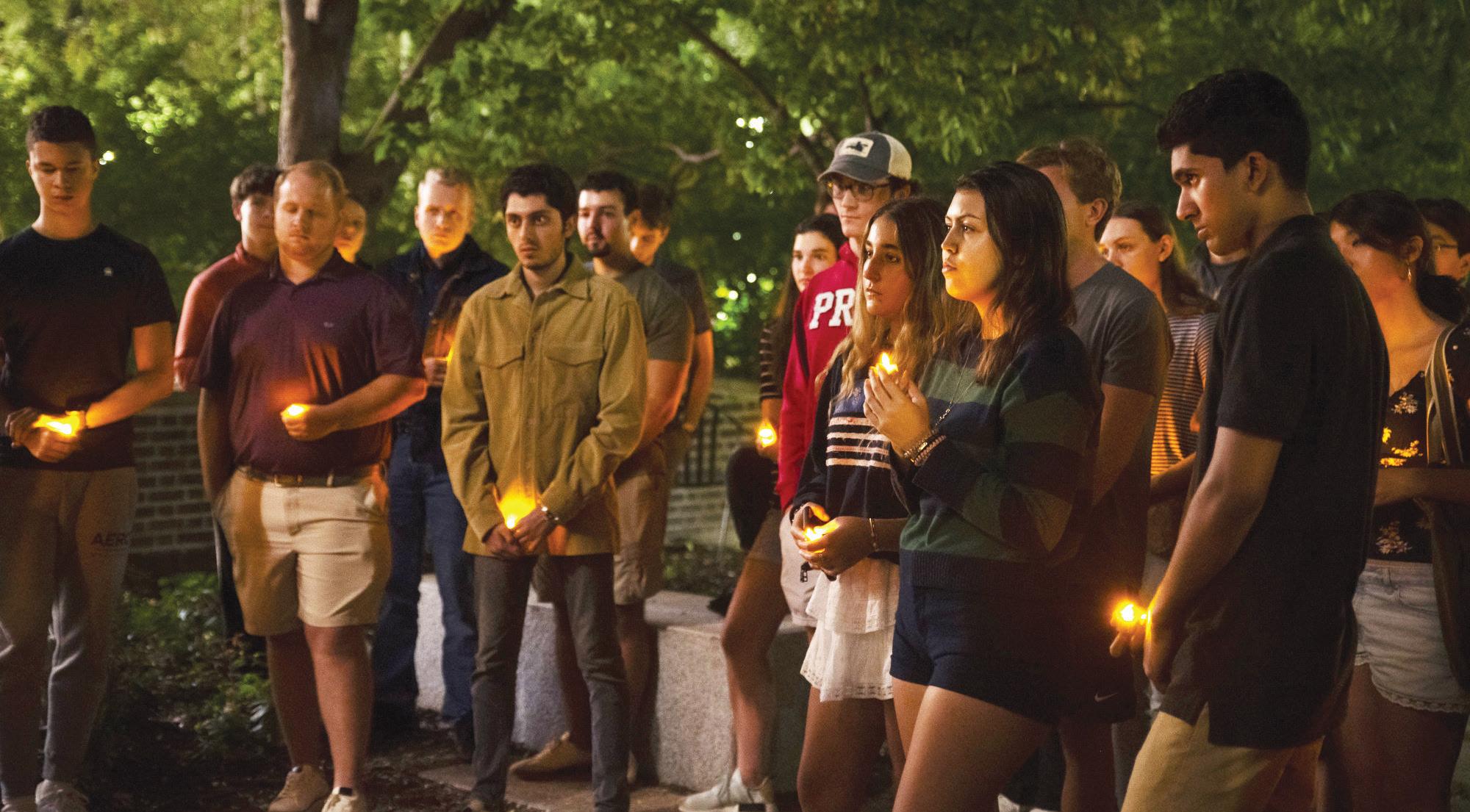
the Huntsman Hall group study rooms as immaculate as they always are. Many of these individuals remain nameless to us — but not faceless. We often see them in passing, but they largely go unrecognized by the students they serve. About two weeks ago, Penn employee Meaza Brown was killed in a hit-and-run. She worked as a custodian with Penn Residential Services. Brown was walking to work when the incident occurred. She was someone who kept our facilities conducive for all of our learning, and that is something we must all recognize.
Penn’s response to this tragedy was deafening. There was not a single message sent to the undergraduate body, no formal acknowledgement from the University, and not even a moment given to remember a person whose work touched the lives of thousands of students and faculty. This is upsetting, and, at the same time, deeply revealing of a broader phenomenon at Penn.
There is an unspoken hierarchy of those whose stories the institution believes are worth telling. When our community has experienced the loss of a student or faculty member, the institution highlights their contributions, impact, and legacy. When we lose a valued member of our essential staff, like Brown, who holds up the functioning of this campus, the institution is silent.
I’ve noticed that this isn’t just a one-off instance — it’s consistent. Ask yourself this: How many of us know the names of the people who clean the dining halls or work at the front desk of every academic building? How many of us greet them with a simple “hello” or “good morning” while walking to class?
If the University prides itself on the community it has to offer, we all need to think critically about whether that definition of “community” is all-encompassing or restricted to schemas we hold about what a University looks like. A community is one that covers its entire constituency with equal care; it requires both reciprocity and recognition.
DIYA-LOGUES | What optimizing for survival is doing to learning at Penn

When College senior Lily Heavey was 13, she fell in love with human anatomy. While other kids played video games, she spent her time poring over bone density and blood vessels, envisioning the day she’d put on a white coat. On her first day at Penn, Career Services gave her cautionary advice: “GPA is everything for medical school. Molecular biology is a safer course load.” Four years later, after slogging through organic chemistry, Lily is taking her first anatomy class as a senior.
Engineering junior Viktor Wittner chose computer science because he enjoyed building things. But early on, he noticed something strange. Classrooms were half empty. Friends shrugged off any content that wouldn’t appear on the midterm. The real so-called “success” existed outside the classroom: LeetCode, GitHub portfolios, internships, and technical interview drills.
As course selection for the spring semester returns, Lily and Viktor joined me and

thousands of Penn students in a ritual that now feels less like planning an education and more like risk management. We open Penn Course Review and scan for two numbers: difficulty and workload ratings, which are out of 4.0. Anything above a 3.0 fades into the background until our final selection of courses feels more like damage control than discovery. It leaves me with a sticky sense of unease as I think of the bright-eyed girl who once arrived on campus with the kind of idealism only an 18-year-old can summon. I wanted to be challenged, to learn anything and everything under the sun. Then, I watched artificial intelligence slowly swallow skills I had once taken pride in.
It wasn’t just coding; it was creating writing, music, and art. So I clung to the metric I could still control: my GPA. If that number stayed high, surely I was still capable? Capable enough to bypass the first filtering round and shift my attention to the next checkpoints: building projects, mass applying to internships, and chasing
You are networking wrong
Mentorship is the reason that I got into Penn. As someone with limited resources, there have been a large number of people who have given some form of time to help me. Which is why, when I arrived in Penn, fully culture-shocked by having to relearn vocabulary in a place where seemingly everyone has started before you (either by sheer effort or plain nepotism), one piece of vocabulary fortunately sounded all too familiar to me: “bigs” and “littles.” Those two words, with their own variations depending on club or community, demonstrate the amazing mentorship and networking culture here at Penn and the potential of these relationships to produce so many amazing things. Ask around, and an average freshman can count more than four mentors in their roster, with connections ranging from college housing to research and clubs. The University supports these relationships by having alumni and other members of the Penn community mentor students as well. But perhaps why the Class of 2029 is abuzz for these mentorships isn’t exactly because of the possibility of friendship, but the possibility for a club acceptance or an internship.
The fact is that Penn runs on the work of those we don’t necessarily acknowledge. Brown’s passing forces us to reckon with how we overlook the people who make our college experience possible, yet it shouldn’t take us a tragedy to recognize this. However, we do have collective agency in what the future looks like. I encourage the members of this community to start seeing those who fundamentally hold up this institution. Learn a name. Offer a genuine greeting. Say thank you. Let’s treat our support staff with the same interest and dignity that we afford to our professors and classmates. Back in elementary school, my teachers would consistently emphasize the “golden rule,” which is to treat others the way you’d want to be treated. If we want the fabric of the Penn community to be stronger, it is on us — students, faculty, and administrators — to ensure this rule is applied to everyone who allows this place to function.
After all, Penn will only be as strong as the people that it chooses to see.
ABHIRAM JUVVADI is a College and Wharton senior from Morrisville, N.C. studying history and finance. He currently serves as the president on the 141st Board of The Daily Pennsylvanian, Inc. His email is abhiram@sas. upenn.edu.
club leadership positions.
In a recent column in The Daily Pennsylvanian, Penn professor Daniel Hopkins proposed imposing mandatory grade deflation, arguing that inflated grades weaken Penn’s reputation for rigor in the eyes of employers and graduate schools. Crucially, he believes that tightened grading would force employers to take transcripts seriously again, thereby alleviating the student pressure to chase endless external signals. His concerns echo larger national conversations, including recent moves at Harvard University to reconsider stricter grading practices.
I don’t disagree with the diagnosis, but as a student, I do question the proposed cure. Both Hopkins and Harvard assume that if grades were tighter, the employer market would return to treating transcripts as its primary measure of talent. But the market is not waiting for universities to get tougher; it is simply looking elsewhere. According to the 2026 Job Outlook survey by the National Association of Colleges and Employers, nearly 70% of employers now prioritize skills-based hiring, with a focus on “experiential learning and/or work during college.” In every internship application I write, it feels overwhelmingly clear that beyond my grades, experiences outside the classroom — prior internships, clubs, and personal projects — are held in high importance. Beyond acting as an initial filter, GPA has lost its credibility for reasons deeper than grade inflation: The world now rewards agency, and merely being a passive student is not enough. All this, coupled with recruiting that now begins as early as sophomore year and the continual fears of AI industry disruptions, has created a student culture of chronic self-doubt and an employment culture that will not revert to valuing transcripts simply because grading gets harsher.
The bigger question, then, is not how to preserve old academic standards, but how to allow academia to adapt without surrendering its core
values. Rather than blaming students for chasing security with a safer course load, we should eliminate the GPA penalty for curiosity. What students need now is the freedom to experiment with ideas and disciplines without the looming threat of a professor who only allots a fixed quota of “A” grades or assessment questions designed to trap students rather than teach. We should give them space to love learning without forcing them to choose between intellectual risk and professional survival. Some of my most formative classes have been so-called “easy-As,” in which grades reflected attendance, preparation, and active discussion rather than high-stakes competition. And yet, their demand to think publicly, connect ideas across readings, and engage actively pushed me to consider topics in new, unique, interdisciplinary ways. I wouldn’t have had this experience in courses where I sat in a room drenched in fluorescent light, trying to outsmart a midterm designed to trick me. Courses that prioritize rigor through aspects like reflection, participation, and synthesis offer a different and yet equally rewarding form of intellectual labor. None of this is to serve as an argument against rigor, and I do still believe that conceptually “hard” classes are important to build grit. But true discipline in learning should emerge from depth and genuine engagement, not from fear of a grade. As more students grow dependent on AI to complete their assignments, academia must evolve to respond by rewarding interdisciplinary courses and original thoughts. Only then can we reinflate the spirit of learning and protect what makes the university classroom a place worth returning to.
DIYA CHOKSEY is a College sophomore from Mumbai, India studying cognitive science. Her email is dchoksey@sas.upenn.edu.
IN-ADYTION | Taking advantage of Penn’s network should mean so much more MAX MESTER | DP FILE
I mean, that’s what mentorships are for, right? Mentors serve as monuments to what a Penn education can bring, and having just the right mentor can get you into many places, everywhere, all at the same time. I’ve heard more than once of bigs getting their littles into clubs, meetings with professors, and even free tickets to sports games. So then why are we content with mentorships giving us the network of a lifetime, when they can give us a community of a lifetime as well? For some, many mentorship schemes simply aren’t designed to go further than that level of relationship. Especially in research or preprofessional settings, where bigs and littles are decided by professional interests, it can be hard to propel these dynamics into something more personal. Other than that, a person’s sheer number of mentors can be disorienting, and for a first-year class, where everything is new, exciting, tiring, and daunting all at the same time, making friends can feel artificial and forced. But with all the smoke and mirrors, we must realize that mentorships can be so much more. Penn mentorships, and in this case, bigs and
littles, offer the same pedagogical experience as any class but in a more intimate and technically more helpful setting. Take a big-little relationship at a cultural club, for example. These relationships do more than just getting you a friend to talk to and go to Kiwi Yogurt or Wawa with; they give you a person you cook hometown food with or go on spontaneous trips to find the best food in your culture with. In the grand scheme of things, relationships are what you make of them. But in the long and truly arduous quest to bag that consulting job or get into medical school, getting your consulting-club big to be something more than just a mentor might be just what you need. And so, to the Class of 2029, once you get
back on your feet, settle onto your routine or start to participate in club activities regularly, consider reaching out to the people you did a coffee chat with, or emailing a thank-you note to your PHINS leaders and peer advisors. Go beyond those coffee chats, and make the connections that transcend LinkedIn or Handshake. Because, even in a school of sellouts, one can still find the community of a lifetime.
ADY LOTIVIO is a College first year from Bicol, Philippines studying earth and environmental science. His email is jlotivio@sas.upenn.edu.

DOUBLE TAKES | The privilege of missing the point
Earlier this week, a guest column confidently announced that Penn is “not on stolen land,” because — wait for it — all land everywhere has been conquered at some point. Humans migrated! Tribes fought! Therefore, the phrase “stolen land” is unserious, and we should all just stop saying it. If this feels like a very convenient theory of history, that’s because it is.
The column states: “Conquest is a universal human story; it tells us how societies emerged, not whether they are capable of moral purpose.” No one is claiming the Lenape were the first or only people to set foot in the Delaware Valley. A land acknowledgement is not trying to reconstruct Paleolithic real estate norms. It’s about trying to force an institution that loves moral rhetoric but hesitates on moral clarity in its actions to say something uncomfortable out loud.
Discomfort is the whole point. The serious argument behind “stolen land” has never been about identifying original ownership, but about modern, settler-engineered dispossession: treaties deliberately broken, forced migrations, communities and livelihoods shattered. The Lenape were not pushed out in a great, highly visible war of conquest. They were subjugated by paperwork, legal deception, and other forms of quiet bureaucratic machinery. You don’t need a Ph.D. to see the difference between ancient population movement and a government that emerged only a couple centuries ago signing a treaty, violating it, and then congratulating itself for being “civilized.”
Reducing the settlement of the Americas into “everything has always been conquered” dissolves responsibility into a mist of historical inevitability. If everyone has been displaced since the dawn of time, then no displacer can be accountable for any wrong. It was never about land in the literal sense. The

point is not to hand over
College Green tomorrow.
Rather, it is to remind us that inequality today is not an abstract moral puzzle, but a material condition worth recognizing. Many Indigenous communities today are burdened with poorly funded schools, disproportionate environmental pressures, and life expectancies over a decade shorter than the national average. Indigenous dispossession created structural disadvantages that did not vanish when the frontier closed. Land acknowledgments do not adjudicate whose ancestors stood where first but gesture toward the legacies of removal that persist in shaping opportunity in the present.
This brings us to Penn. Penn is an expert in historical abstraction. It must be, otherwise the alternative is to face its very recent, documented role in bulldozing the Black Bottom, displacing Black families for the construction of the University City Science Center, and reshaping West Philadelphia through the abstraction of “urban renewal.” When you turn displacement into an administrative process, it doesn’t quite feel like violence. This reality makes it hard for us today to recognize that same logic when considering Indigenous dispossession. The century might’ve changed, but the underlying logic is the same.
For more proof that elite universities treat uncomfortable history contemptuously, look at Yale University. The school spent years defending one of its residential colleges being named after John C. Calhoun — the nation’s most prominent pro-slavery theorist in the early 19th century — and only removed a mural panel depicting enslaved people picking cotton after a Black staff member had to literally smash it in 2016. Yale published the name change on its official website with no mention of the years of protest efforts by students and staff that

COURTESY OF THE UNIVERSITY OF PENNSYLVANIA
Columnist Sohum Sheth argues that land acknowledgements are an important way to open up honest conversations.
precipitated its action.
Institutions like Penn do not lead moral change. They get dragged into it, protest the entire way, and then retroactively congratulate themselves. The recent column adopts the same posture, using complexity as a shield when it obscures power and rejecting simple, honest language when it demands accountability. The irritation at phrases like “stolen land” comes from insulation. When you grow up far from the communities harmed by dispossession, it is extremely easy to treat injustice as an intellectual game — something to be dissected, not felt. Complexities and nuances become a pastime, while rhetorical simplicity necessary for public moral recognition feels like somebody flipping over the board mid-game. The worldview of privilege is one in which suffering is far away from one’s bubble, systems are neutral, and the history you only experience through textbooks and TED Talks are always too complicated to mean anything actionable. It’s a worldview that is profoundly incomplete. Without sharp rhetoric, the people most buffered from the consequences of injustice will graduate to
CHARLOTTE’S WEB | Sorry, your $200,000 master’s degree just isn’t professional
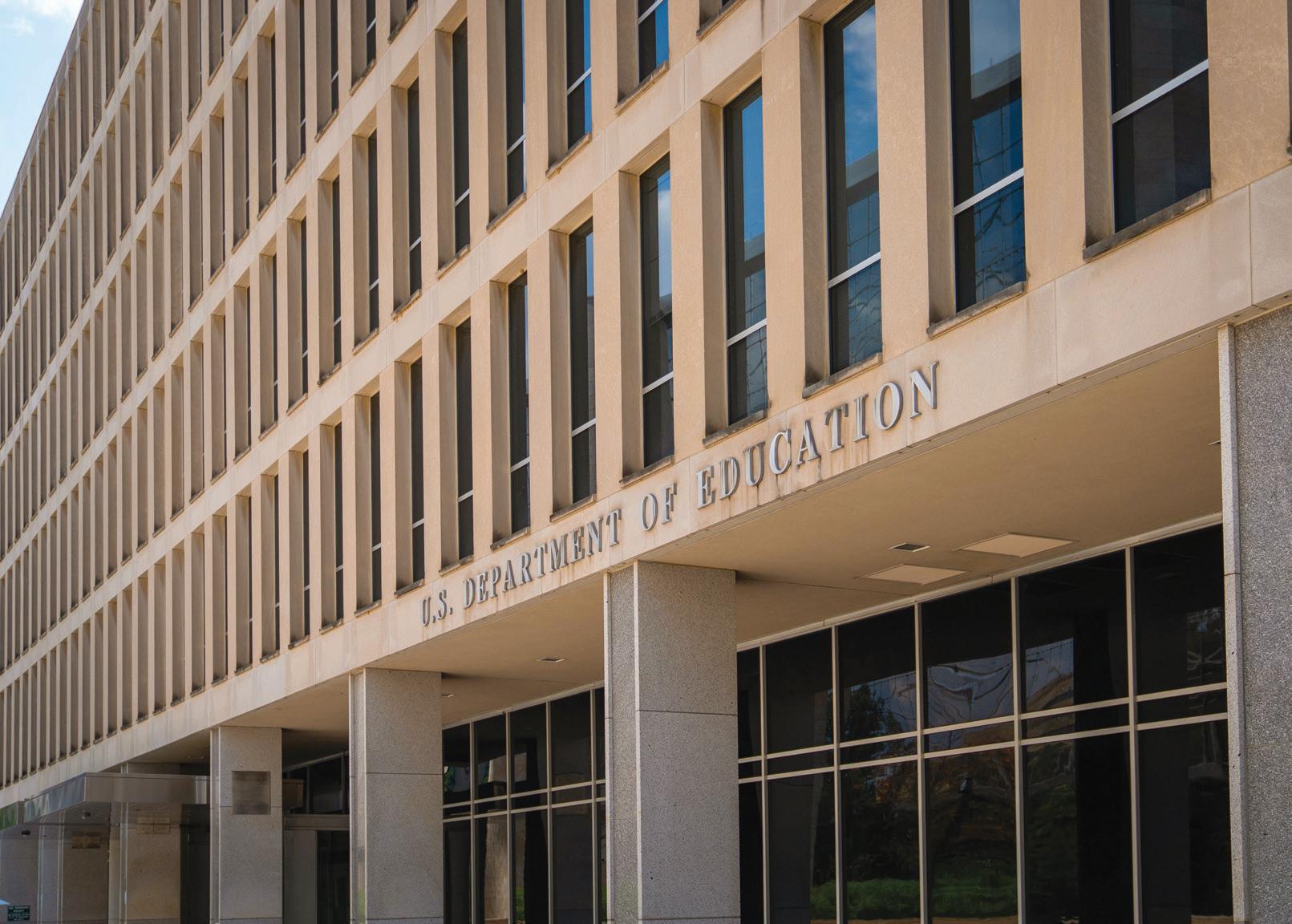
Columnist Charlotte Pulica claims the Education Department’s reclassification of professional degrees is most harmful to women and children.
Would you pay a stranger on the subway to give you a flu shot? Would you go to your taxi driver to oversee your recovery after a stroke? If you had a speech impediment, would you consult your six-year-old nephew on it first? Most likely not, because when it comes to your health and education, you want a professional.
Unfortunately, in the Department of Education’s eyes, my nephew and a trained nurse have the same degree of professionalism: that is, none.
Despite years of proven training and education, in early November, the Education Department reclassified what qualifies as “non-professional” higher degrees. But what exactly does this mean, and who does it affect most?
While there hasn’t been a comprehensive list of degrees released from one source, a minimum set of degrees has been confirmed to be labeled as “non-professional,” including nursing, education, physician assistants, physical
therapists, audiologists, architects, social workers, and accountants. What this means is that people seeking those degrees can only take out a federal loan of $20,500 annually and $100,000 total, meaning they otherwise have to pay out of pocket, or risk a private loan.
According to the One Big Beautiful Bill, President Donald Trump is eliminating the Grad PLUS program, which allows graduate students to borrow up to the cost of attendance. This, combined with the new extensive list of degrees no longer qualified for proportionate federal loans, makes higher education in specific fields nearly unattainable. And who is hit hardest by this new level of anti-education? The degrees omitted from professionalism are not random; the majority have one thing in common: They are in female-dominated fields.
Women account for 88% of nurses, 77% of teachers, 75% of physician assistants, 92% of audiologists, 70% of physical therapists, 60% of accountants, and 90% of social workers. Seven out of the eight “non-professional” degrees are femaledominated, and those are just the verified ones. It seems that with the rise in college-educated women comes the attempt to curb those achievements, and now it has come to simply slashing access to higher education altogether. As more women become college educated and enter the workforce, the people they’re trying to help put up more obstacles. However, with the Education Department’s latest attack on education comes another toll: the impact on children. If access to education, nursing, audiology, and social work degrees becomes limited, it won’t just be the employees suffering; it will also be the children who receive those benefits and services. Nursing and education fields have already been experiencing record labor shortages; this new classification and loan restriction will only further decrease interest in those careers.
THE VITAL SIGNS | Penn needs more considerate policies regarding sick days
Being a college student means going to class, studying, hopefully getting good grades, and, inevitably, getting sick often. College students tend to get sick more frequently than the average person, due to factors like close living quarters, increased social contact, and high stress levels, which increase the risk of infection. I myself have gotten sick three times already just this semester; I’ve been on antibiotics, antivirals, and have had so many cough drops I’ve stopped counting, basically eating them like candy. Because I am sick so frequently (which I literally cannot control because who wants to get sick?), I often feel guilty when I have to email my professors to say that I am not going to be in class and submit that dreadful course action notice. Even though I have heard my professors say time and time again that they’d prefer if we don’t come to class if we are feeling a bit sick, I still feel guilty. They’re probably reading the absence notification like, “Here we go again, Josh is sick, just like he was two weeks ago, and three weeks before that, he’s probably just lying at this point.” Meanwhile, I’ll genuinely be lying half-dead in bed with a 103-degree fever — an incubus of viral plague.
Most of my classes this semester offer three excused absences without a grade penalty, which simply is insufficient. The illnesses I have are often not 24-hour bugs, and tend to last several days, already putting me down two absences in each class if I choose not to attend for a few days. That said, if I’m sick again — which is inevitable; this semester I had strep and a cold at different points, and last fall I had strep and mono at the same time — I’ll have used up all three of my available excused absences, thus every absence thereafter could jeopardize my grade. This
doesn’t even take into consideration family emergencies, travel delays, death in the family, or any of the other excused absence reasons outlined in Path@ Penn’s Course Action Notices.
Given this, the grading system of many of Penn’s academic departments must undergo revision to accommodate sick days, and not just offer three excused absences. Further, participation points or pop quizzes should automatically be exempted for students missing class for personal health reasons. And if this means having to provide verification of illness, such as a doctor’s note, then so be it — if it means that my grade won’t suffer because I cannot stop coughing a thousand times in one hour to show proof that I am on 1,200 mg of amoxicillin per day, then by all means I’ll show proof that I am sick on my deathbed. Personally, I think that there should be no standard excused absence limit; it should all be on a case-bycase basis and at the discretion of the professor based on the student’s academic performance, effort, and integrity. We, as students, strive to make every attempt and initiative to attend class when necessary and receive an education endowing us with the knowledge and skills essential to endeavors in the postgraduate world. We want to go to class, but forgive us if we get sick a few times a semester and stay home a few times a semester because we don’t want to spread our illness to the rest of the class. Students, just stay home if you’re sick. No one wants to hear your sniffles — or much worse, catch your germs and replicate them a couple days later. It is important that you rest to support your immune system and safeguard a speedy recovery.
Professors and other educators, please consider adopting more lenient policies in drafting syllabi
take the reins of American business and government, gliding through life perceiving injustice as a mere intellectual problem. “Stolen land” isn’t an exercise of historical verdict; it’s an alarm designed to interrupt the narratives powerful institutions and their privileged alumni tell themselves. Allow it to sting.
The next time you hear a Penn admissions officer acknowledging the school’s legacy of dispossession to a group of touring families, know they are not drawing attention to some “losers” in the 10,000year sweepstakes of human migration. They’re normalizing honest conversations in a place that would otherwise perfect the art of deflection. If the words sound abrasive, that’s intentional. Soft language has never forced a powerful institution to confront itself — and it never will.
is a College first year from Jacksonville, Fla. studying philosophy, politics, and economics. His email is sheth0@sas. upenn.edu.
With a lack of employees comes a lack of resources. These resources are primarily available to children with special needs, learning and behavioral disorders, chronic illnesses, children in foster care, school counseling, and afterschool programs. Children who require intervention in various ways depend on these programs, which are run via education and health services, and they suffer when there is a shortage in these areas. At a time when both child literacy rates and children’s health are declining, should we really be penalizing degrees that help children the most?
The reasoning behind the new federal loan restriction is to hopefully force colleges to lower tuition by making it virtually impossible for students to pay the current price. However, as every ECON 0100 student will tell you, any sort of price ceiling imposed by the government results in a toll: loss of consumers. Not to mention that while this plan might pressure some schools, it won’t have the same effect on private or top 20 universities, because they’re already founded upon exclusivity. Regardless of the reasoning, the reclassification will result in a loss of students pursuing these degrees.
You may not want to get a flu shot from a stranger on the subway right now, but soon, you might have to. In times where higher education is so critical, why are we doing everything we can to make it inaccessible? At the end of the day, it won’t be the colleges suffering; it’ll be the dedicated, passionate people pursuing honorable degrees and the people who desperately need their services.
PULICA is a College first year from Enoch, Utah studying criminology and economics. Her email is cpulica1@sas.upenn. edu.

policies.
regarding student absences for personal health reasons. If a student is genuinely sick, it is in everyone’s
DAUGHERTY is a Nursing sophomore from Farmington, Conn. studying nursing. His email address is joshuacd@nursing.upenn.edu.

Several Penn alumni made national headlines this year, often linking the University to high-profle controversies
SAMANTHA HSIUNG AND RIANA MAHTANI
Senior Reporters
From the Oval Office to courtrooms, several Penn alumni made national headlines this year — repeatedly tying the University to high-profile controversies.
Donald Trump 1968 Wharton graduate and President Donald Trump’s return to the White House in January marked the beginning of a tumultuous year that continually brought federal politics to Penn’s campus. The administration’s executive actions and policy changes — particularly those addressing international student visas and diversity, equity, and inclusion efforts — directly impacted the Penn community.
In October, Penn rejected the White House’s

Compact for Academic Excellence in Higher Education, becoming the third university to decline the proposal after it received swift condemnation from across the Penn community.
The White House’s higher education compact — initially offered to Penn and eight other universities on Oct. 1 — would have provided preferential federal funding in exchange for the institutions’ commitments to significant governance and policy reforms. Provisions included a five-year tuition freeze, a cap on international student enrollment at 15%, and requirements to protect conservative viewpoints — changes that legal experts and civil rights groups characterized as “blatantly unconstitutional.”
Penn President Larry Jameson informed Secretary of Education Linda McMahon that the University was going to decline the offer on Oct. 16, writing that the University provided “focused feedback highlighting areas of existing alignment as well as substantive concerns.” The decision came after nearly 2,000 members of the Penn community signed a petition urging University leaders to reject the compact, as well as the Faculty Senate overwhelmingly passing a resolution opposing the agreement.
The Center for Ethics and the Rule of Law at University of Pennsylvania Carey Law School was a prominent critic of Trump’s use of executive power, filing amicus briefs challenging his attempts to federalize state National Guards. In August, CERL filed a brief in Newsom v. Trump, arguing that Trump’s order to place the California National Guard under federal control undermined federalism and violated the Posse Comitatus Act.
In November, CERL filed a second brief opposing Trump’s deployment of the National Guard to Chicago. The brief argued that Trump exceeded his statutory authority and threatened core constitutional principles.
Elon Musk
Trump appointed 1997 College and Wharton graduate Elon Musk to lead the Department of Government Efficiency, thrusting the tech billionaire into the national spotlight. Musk’s role overseeing proposed federal budget cuts raised concerns about potential impacts on research funding and government programs that support higher education institutions.
Musk’s simultaneous roles as a government official and CEO of multiple companies — including Tesla and SpaceX — also sparked debates about conflicts of interest and the concentration of power among tech billionaires in the Trump administration.
Luigi Mangione 2020 Engineering graduate Luigi Mangione was charged with murder as an act of terrorism


of life imprisonment without parole.
Mangione still faces a count of second-degree murder in New York, which carries a 25-year sentence if convicted.
While a student at Penn, Mangione studied at the School of Engineering and Applied Science and founded UPGRADE — the University’s first game development club. He graduated from Penn in 2020 with a bachelor’s and master’s degree in computer and information science and was inducted into Penn’s Eta Kappa Nu honor society for excellence in electrical and computer engineering.
Mangione suffered from back issues and “brain fog” — which he posted about frequently on Reddit. His posts also attributed his decline in academic success to these issues, detailing their negative impact on his overall well being.
“It’s absolutely brutal to have such a life-halting issue,” Mangione wrote of his brain fog in a Reddit post. “The people around you probably won’t understand your symptoms — they certainly don’t for me.”
At Penn, Mangione was also a member of Phi Kappa Psi — a University-affiliated fraternity. In a social media post, he claimed that his mental and physical issues were exacerbated by his fraternity’s “hell week.”
Charlie Javice
In September, 2013 Wharton graduate Charlie Javice was sentenced to just over seven years in federal prison after being found guilty on all charges of fraud and conspiracy in JP Morgan Chase’s $175 million acquisition of her startup, Frank. Frank — a for-profit financial aid assistance program — was founded by Javice in 2016 to help students navigate the federal financial aid application program and negotiate with colleges to receive more financial aid.


U
in the killing of UnitedHealthcare CEO Brian Thompson.
Mangione was initially indicted in the New York State Supreme Court on one count of first-degree murder “in furtherance of terrorism” and two counts of second-degree murder, as well as eight additional charges related to criminal possession of a weapon and forgery. He pleaded not guilty to all 11 state charges, along with separate charges in the Southern District of New York for murder through the use of a firearm, two stalking counts, and a firearm offense.
In September, Mangione was cleared of two New York State terrorism charges. Gregory Carro, the New York State Supreme Court justice overseeing the case, ruled that the charges were “legally insufficient.”
The dismissed charges were among the most serious counts Mangione faced and carried a sentence
JP Morgan initially filed the lawsuit against Javice in December 2022, alleging that Javice had lied about the number of her startup’s customers and created over 4 million fake user accounts. According to the lawsuit, Frank had fewer than 300,000 actual users.
“I am deeply sorry, and I am asking with all my heart for forgiveness,” Javice told Senior United States District Court judge Alvin Hellerstein during the trial, according to Bloomberg. “If it were within my power, I would never make the same mistake.”
As a part of the trial, 1984 Wharton graduate and Wharton Board of Advisors Chair Marc Rowan sent a letter of support to Hellerstein urging the court to “impose a lenient sentence” on Javice. In the letter, Rowan wrote that he hoped to “offer a more complete picture of who Charlie is as a person,” emphasizing that Javice “loved to help people who needed help.”












Penn received several threats from the federal government concerning its funding status throughout the year
WILLIAM GRANTLAND Senior Reporter
Cuts to Penn’s funding from the federal government resulted in significant impacts on University hiring and operations throughout the past year.
Throughout 2025, Penn has received threats from the federal government concerning its funding status, including instances where threats to withhold funding have been leveraged during negotiations. These disputes have impacted research, staffing, and graduate admissions rates.
NIH funding cuts affect graduate admissions
On Feb. 7, the National Institutes of Health announced a 15% funding cut that jeopardized $240 million in federal funding for Penn, a move which Penn President Larry Jameson called “serious” with “significant implications for Penn research programs.” Three days later, Penn joined 12 other universities nationwide in filing a lawsuit, which resulted in a judge temporarily halting the cut.
Three University project grants had their funding reinstated over the summer following appeals and a June federal court order.
Citing uncertainty in federal research funding, Penn directed department chairs in February to significantly reduce graduate admissions, and in some cases, to rescind acceptances that had already been made. According to documents obtained by The Daily Pennsylvanian, Perelman School of Medicine faculty were instructed to cut Ph.D. program admissions by 35%.
Then-Interim School of Arts and Sciences
Dean Jeffrey Kallberg called reductions to graduate admissions a “necessary cost-saving measure” in light of the impact of NIH funding cuts.
Eight months later, programs reported varying impacts, with SAS and Medical School professors reporting smaller-than-usual first-year Ph.D. student cohorts and potential impacts on teaching assistant availability. Multiple SAS professors reported a modest increase in the cap on admitted students for the 2026-27 cycle.
Penn Executive Vice President Mark Dingfield said in an interview with the DP that funding losses, including “a major cut to Medicaid or other areas of support,” require close monitoring and “conversation with the Health System leadership.”
He added that “outside credit rating agencies also look at [Penn and Penn Med] as one single entity,” meaning that “if the Health System or the University is not performing well … it affects our ability to borrow at certain rates.”
Hiring freezes across Penn Penn implemented a hiring freeze in March as a “proactive financial measure” in light of

disruptions caused by federal funding cuts, allowing schools to only hire faculty that schools deem “essential to their missions and their highest critical priorities,” and that staff hiring would be frozen except for “critical positions, student workers, and those funded by active grants or restricted sources.”
The hiring freeze came alongside a freeze on staff salary mid-year adjustments and a 5% reduction in non-compensation expenses across Penn’s schools and centers.
Staff reductions individually impacted several of Penn’s schools, with the School of Social Policy & Practice reducing its staff by 8% due to “significant budget challenges” and a need to “better align our staffing and resources with current enrollment and financial realities to build a strong, sustainable future.”
The Annenberg School for Communication also announced that it would not renew its part-time lecturers’ contracts for the 2025-26




academic year, with Annenberg School Dean Sarah Banet-Weiser saying the decision reflected the school’s “current financial reality.”
The White House targets Penn
On March 19, the Trump administration froze an additional $175 million in federal funding to Penn, citing Penn’s policies allowing transgender women to compete in women’s sports. A month later, the Department of Education announced that Penn had violated Title IX by allowing 2022 College graduate and former Penn swimmer Lia Thomas, who is a transgender woman, to compete on the women’s team.
Under a negotiated agreement announced on July 1, Penn agreed to comply with all Education Department demands regarding its Title IX compliance, including a statement affirming compliance with Title IX, the restoration of accolades that were “misappropriated” by transgender athletes, and apology letters to all
athletes affected.
On July 2, Jameson sent a letter to the Penn community reaffirming the University’s “unwavering” commitment to “ensuring a respectful and welcoming environment for all of our students.”
“At the same time, we must comply with federal requirements, including executive orders, and NCAA eligibility rules, so our teams and student-athletes may engage in competitive intercollegiate sports,” Jameson wrote.
In October, the White House invited Penn to sign a compact that would require adherence to a set of principles in order to receive preferential funding. Penn rejected the compact on Oct. 16.
The compact originally stated that while universities are “free to develop models and values other than those listed in the document,” they will “forgo federal benefit.”
Penn has received no further threats to its federal funding status as of time of publication.




The Daily Pennsylvanian compiled changes across individual schools and the University as a whole, highlighting new opportunities at the undergraduate, graduate, and faculty levels
GEORGE CHANG AND JACK GUERIN
Senior Reporters
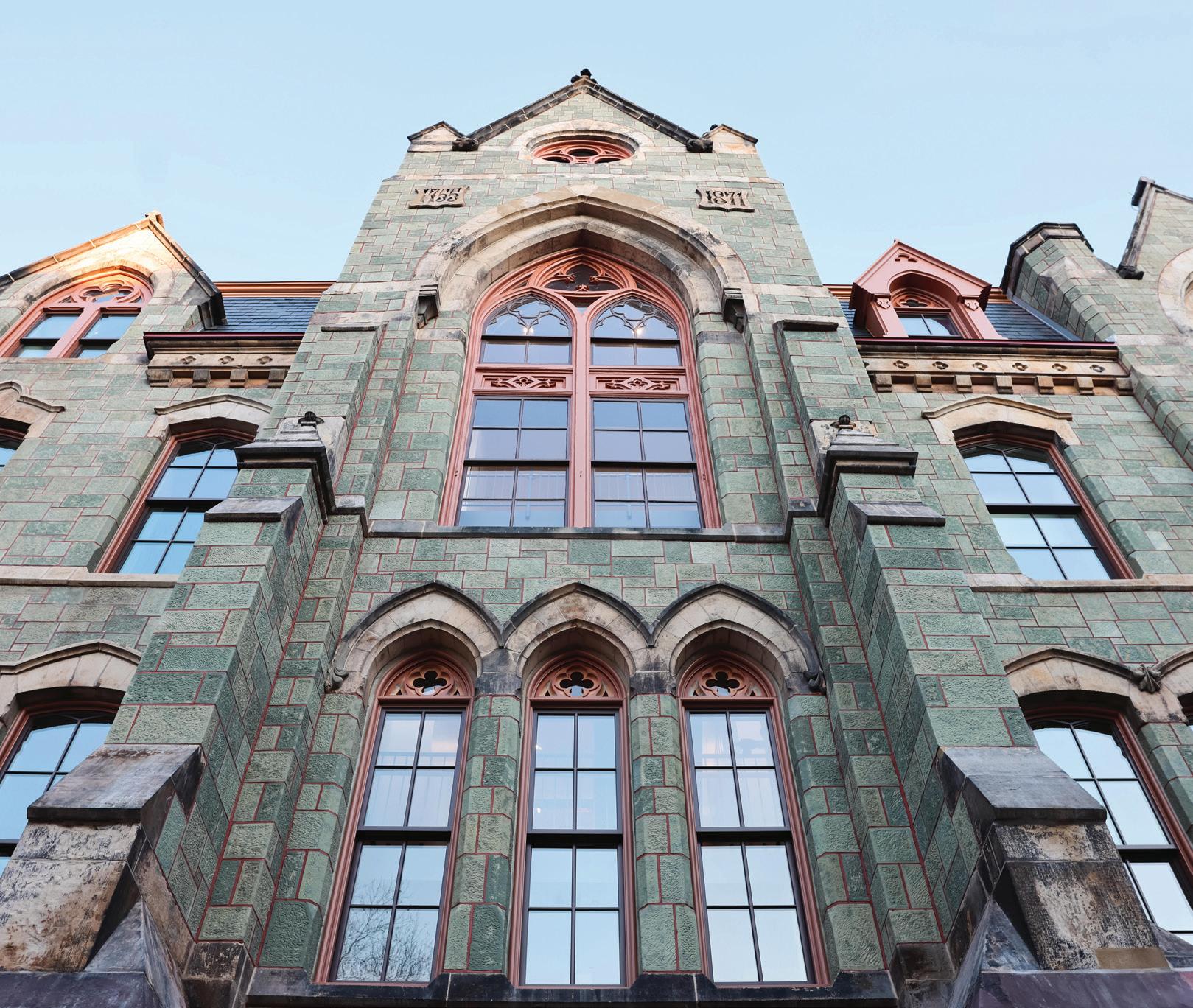
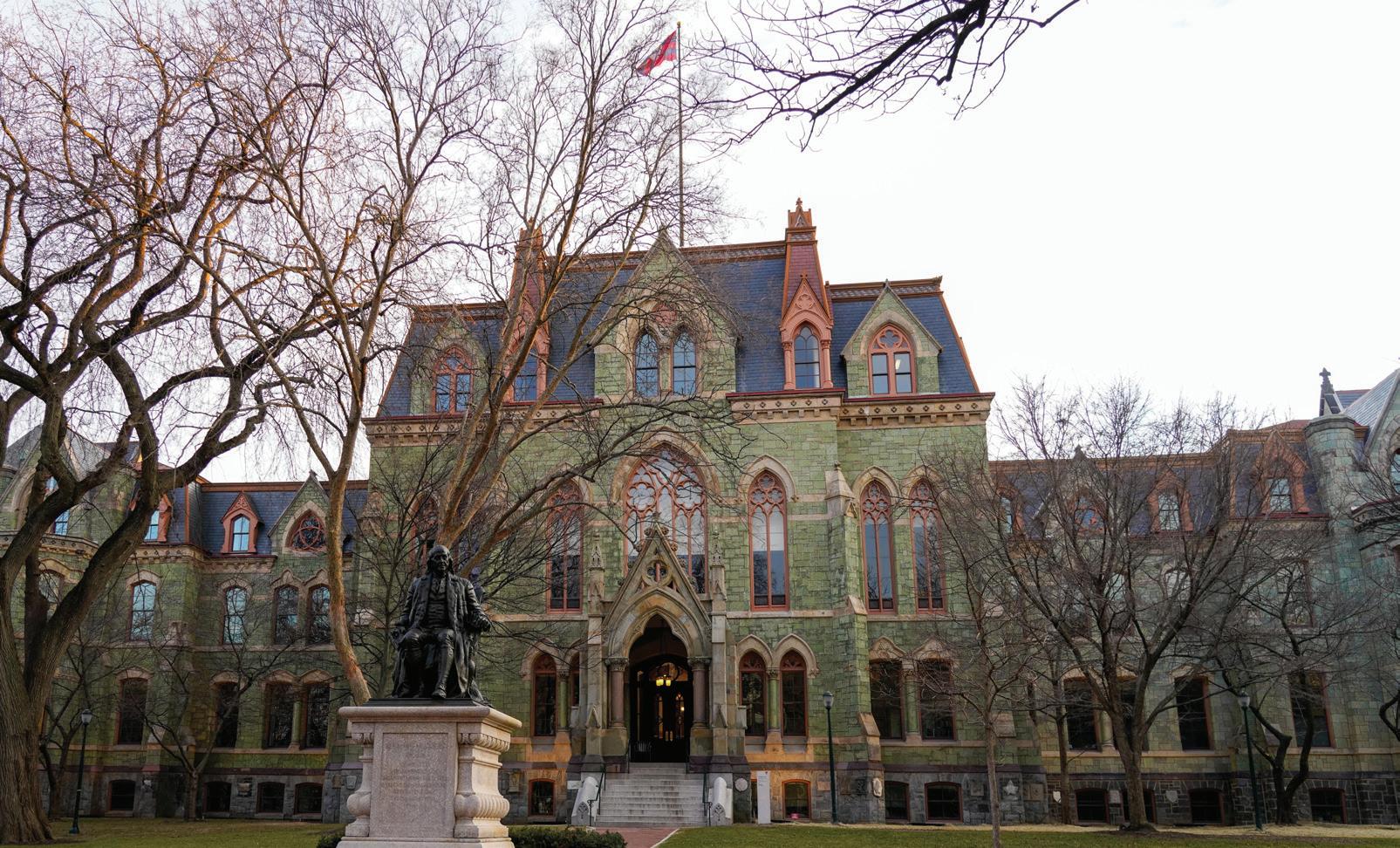
College Hall pictured on Feb. 25.
Penn implemented widespread academic and administrative initiatives to expand its focus amid a quickly changing external environment.
The Daily Pennsylvanian compiled changes across individual schools and the University as a whole, highlighting new opportunities at the undergraduate, graduate, and faculty levels. Those opportunities include new master’s degrees, expansions to the Office of the Provost, and a new strategic framework.
Five new master’s degrees
At the University Board of Trustees’ spring full board meeting in June, Penn announced five new master’s degrees across multiple of the University’s schools.
The one-year Master of Communication and Media Industries is the first non-doctoral degree at the Annenberg School for Communication and
JEAN PARK | DP FILE PHOTO
will enroll 15 students in its fall 2026 inaugural cohort.
Annenberg School Dean Sarah Banet-Weiser explained in the program’s announcement that it aims to “cultivate leaders” who are prepared to navigate the modern “dynamic media industries” and consider their future “expansively, ethically, and globally.”
The School of Social Policy & Practice announced a three-year doctorate in nonprofit administration — geared toward students interested in managing and leading nonprofit organizations at the “individual, organizational, and societal levels.”
The program is “designed to prepare visionary leaders for the nonprofit sector, [specifically] leaders equipped with both the conceptual frameworks and the practical tools to guide organizations toward building a better society,”
Director and SP2 professor Ram Cnaan wrote on its website.
The Wharton School launched a Master of Science in Quantitative Finance, marking the school’s first new degree in 50 years. The program will prepare students for careers in quantitative finance — teaching skills such as data analysis and coding — and will host its inaugural cohort, open to current Penn undergraduates, in fall 2026.
The degree was officially announced on Sept. 15 and funded by a record $60 million donation from Bruce Jacobs, a 1979 School of Arts and Sciences graduate, 1986 Wharton Ph.D. graduate, and former Wharton faculty member.
The Perelman School of Medicine announced two new master’s degrees, dividing the existing Master of Biomedical Informatics into separate programs: the Master of Clinical Informatics and the Master of Science in Biomedical Informatics.
The MCI is oriented towards educating clinical practitioners in clinical informatics, and the MSBMI aims to train “biomedical informatics researchers for [careers] in academia, healthcare, government, and industry.”
College Foundations pilot program
The College of Arts and Sciences piloted its College Foundations program in fall 2025 with an inaugural cohort of 120 first-year students. The program seeks to introduce incoming undergraduates to a “broad liberal arts education” through courses specifically designed to cover fundamental skills across the College.
In a June interview with the DP, Stephen A. Levin Family Dean Peter Struck explained that the curriculum consists of four courses that “focus on close reading, careful observation and analysis, and intensive discussion on core questions of purpose and meaning.”
Students in the pilot cohort are taking the new “Kite” and “Key” paired courses, a writing seminar, and a first-year seminar of their choice — for which they received priority registration. The program allows students to fulfill six College requirements in their first year.
“I’d like to see these Foundations courses become the foundation of a new General Education requirement at Penn,” Struck said. He added that “adjustments” would be made as University administrators “learn from our students and our classroom.”
Students have expressed mixed reactions to the program. Some told the DP they value its interdisciplinary nature, while others claimed they feel restricted by its requirements.
In spring 2026, faculty in the School of Arts and Sciences will vote before entering a period of “implementation to roll out a broader curriculum” next fall.
Expanding the Provost’s Office
Over the past two years, Provost John Jackson Jr.’s office has expanded in size and focus with the inclusion of new vice provost positions concentrated in the arts, climate change, undergraduate education, and graduate education.

In June, Jackson named professors Russell Composto and Kelly Jordan-Sciutto as the inaugural vice provosts for undergraduate and graduate education, respectively.
“This is the role, ultimately, that’s responsible for partnering faculty [and] deans with department chairs to make sure we bring in the top talent we can from all over the country and the world,” Jackson told the DP in October. “That’s the top researchers, that’s the top teachers, that’s fantastic students — and to do that well gets you really excited.”
Jackson also explained his office’s “concerted approach to the arts” with the help of Penn Vice Provost for the Arts Timothy Rommen.
On Sept. 29, Michael Mann — the inaugural vice provost for climate science, policy, and action — resigned from his role, citing the conflict between his scientific advocacy and Penn’s “established institutional neutrality policy.”
In October, administrators appointed Sanya Carley, the former faculty director of the Kleinman Center, to fill the position.
“She is one of the world’s leading experts on energy policy, especially related to affordability, decarbonization, and the impact of changing climate systems,” Jackson stated in the announcement. “She is a widely admired teacher, mentor, and collaborator who will be a dynamic catalyst across campus on issues of energy, climate, and sustainability.”
University-wide strategic framework
In September 2025, Penn President Larry Jameson announced a new strategic plan — titled “Penn Forward” — as a framework for the school’s future goals and values. He highlighted the initiative’s importance as the University adapts to “new challenges and opportunities.”
The plan outlined six working groups that consist of undergraduate students, graduate students, and postdoctoral students, as well as faculty, staff, and administrative support. The working groups, Jameson told the DP, will not be given “specific direction,” but rather will bring together “different perspectives” that “curate the very best ideas.”
A similar structure will be used to develop Penn’s artificial intelligence policy, though it will not yet be implemented uniformly across the University. In a September interview with the DP, Jameson noted that while “there’s no question that AI is going to have a major impact on virtually everything that we do,” he will not “steer” the University’s policy on it.
Instead, rules surrounding on-campus AI use will be left to the “Penn Forward” working groups, which will “study deeply, get information, speak with professors, [and] speak with students” to make well-informed decisions.
“‘Penn Forward’ is taking what I think are the really important abstract ideas and making them more tangible,” Jackson said in an October interview with the DP. “[We’re] making it clear to folks how we’re going to turn that stuff into things students and faculty experience more every day.”
Here’s what
Penn President Larry Jameson sat down with The Daily Pennsylvanian on three separate occasions this year, outlining his vision for the University’s future and role within

Penn President Larry Jameson’s second year at the helm of the University was marked by continued campus turmoil, administrative turnover, and federal scrutiny.
On March 13, the University Board of Trustees appointed Jameson as Penn’s 10th permanent president after serving for over a year in an interim capacity. Since then, he has sat down with The Daily Pennsylvanian on three separate occasions, outlining his vision for the University’s future and role within higher education.
In late March, the Trump administration froze $175 million in federal funding to Penn, citing the University’s failure to bar transgender athletes from women’s sports. In an interview with the DP the following month, Jameson addressed several policies from the White House under 1968 Wharton graduate and President Donald Trump that targeted higher education, including the funding freeze.
Though he attributed Penn’s relative silence on the Trump administration to the University’s institutional neutrality policy, a DP analysis found that several Ivy League institutions took markedly different public stances in criticizing the federal government despite also having institutional neutrality policies.
“I think it’s very important that I focus on issues that are relevant to Penn’s missions and operations,” Jameson said. “When it comes to commentary about the external world, let all members of our community develop their own points of view and decisions.”
Earlier this year, the University — in response to a Jan. 20 executive order — quietly removed references to diversity, equity, and inclusion from its webpages.
In April, when asked if the scrubbed sites indicated a shift in Penn’s commitment to DEI, Jameson said they were “in compliance with the executive order” and do not “change our culture and our values.”
“I would say that Penn has a very long-standing commitment to inclusion and non-discrimination,” Jameson said. “This goes back many decades here, and our track record of support for broad populations and being inclusive is extraordinary.”
At the time, Jameson told the DP that he had not ruled out taking legal action to restore the frozen funding.
Shortly after, a Department of Education investigation found that the University violated Title IX by allowing 2022 College graduate and former Penn swimmer Lia Thomas to compete on the women’s swimming and diving team. Penn entered a resolution agreement with the Education Department on July 1, becoming the first Ivy League university to settle with the Trump administration and earning back the $175 million in lost funding.
Following the announcement, Jameson sent a letter to the Penn community reaffirming the University’s “unwavering” commitment to “ensuring a respectful and welcoming environment for all of our students.”
“At the same time, we must comply with federal requirements, including executive orders, and NCAA eligibility rules, so our teams and student-athletes may engage in competitive intercollegiate sports,” Jameson wrote at the time.
categorized the framework as one of the “most important things that we’re doing.”
Jameson added that “not all of [the strategic plan] will roll out in a single moment.” While some recommendations might “roll out early,” he provided a tentative timeline of 2030 and beyond.
Months after the University’s July settlement with the Education Department, the White House approached Penn with a preferential funding compact. The document — titled the “Compact for Academic Excellence in Higher Education” — laid out guidelines that would govern Penn’s admissions, pricing, and hiring practices.
In exchange, higher education institutions that sign the agreement will receive “multiple positive benefits,” including “substantial and meaningful federal grants.”
Over the course of Penn’s two-week-long revision process, Jameson authored two emails to the University community and met with student and faculty leaders whose advice informed his decision.
In his initial emails, Jameson wrote that Penn’s


Dozens of Penn faculty members sent a letter to Jameson expressing concern over Penn’s decision to comply with federal demands. They called on University administrators to “[reverse] this decision and [challenge] the administration in court to the fullest extent possible.”
In September, Jameson sat down for an interview with the DP to discuss his goals entering the 2025-26 academic year.
Soon after, Jameson announced a new campuswide strategic framework — “Penn Forward” — his first major institutional effort as Penn’s 10th president. The initiative builds upon pillars established by the “In Principle and Practice” framework developed by former Penn President Liz Magill in 2023.
“In Principle and Practice” was a “conceptual framework,” Jameson told the DP in September, while the “Penn Forward” plan is a way to “develop more tangible, concrete, actionable, timely projects and activities.”
The plan outlines six working groups, comprising undergraduate students, graduate students, and postdoctoral scholars, alongside faculty, staff, and administrative support. The working groups, Jameson said, will not recieve “specific direction” but rather will bring together “different perspectives” that “curate the very best ideas.”
In a November interview with the DP, Jameson


response would “rely on a set of principles drawn from Penn’s values and mission.” He pointed specifically to ideals of free expression and non-discrimination as well as “adherence to American laws” and the Constitution of the United States.
On Oct. 16, Jameson sent a letter to the Penn community explaining that the University rejected the proposal.
“Earlier today, I informed the U.S. Department of Education that Penn respectfully declines to sign the proposed Compact,” the October email read. “As requested, we also provided focused feedback highlighting areas of existing alignment as well as substantive concerns.”
“Our sense is that funding should be based on competing for the best ideas,” Jameson said of Penn’s compact rejection in a November interview with the DP.
While he declined to comment on the University’s ongoing conversations with the White House, Jameson characterized Penn’s historical relationship with the federal government as “powerful, amazing, and valuable.”



































































































































































































































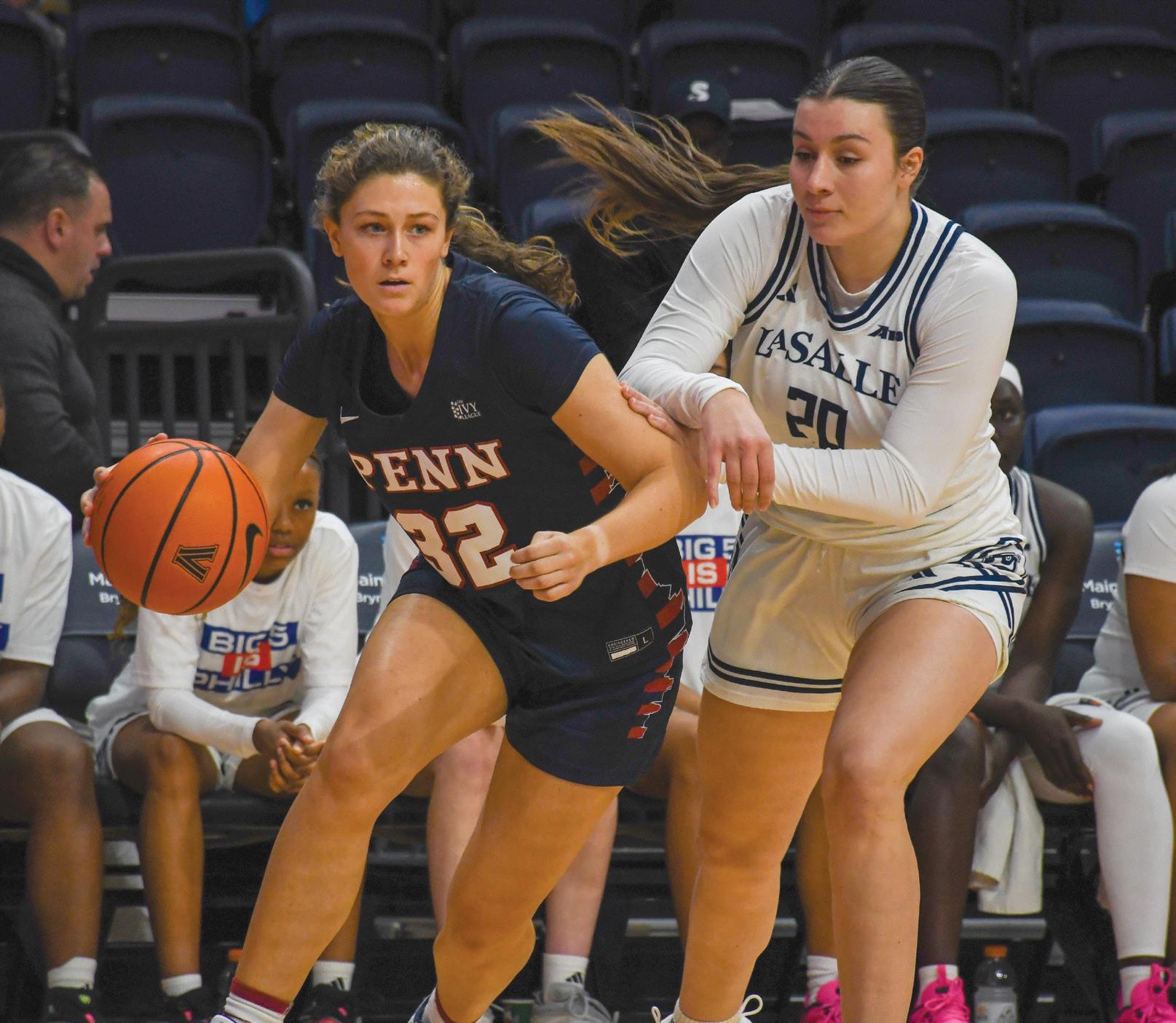
Sophomore guard Ashna Tambe spearheaded the Big 5 Classic victory with a career-high 11 points
KAIA FEICHTINGER-ERHART
Sports Reporter
VILLANOVA, Pa. — The Quakers ran it back for another Big 5 Classic win over La Salle.
In the second edition of the women’s Big 5 Classic, Penn women’s basketball took on La Salle in the fifth-place game, downing the Explorers 65-52 to secure fifth place in the Big 5.
The teams met under the same circumstances as last year at the inaugural Big 5 Classic at Finneran Pavilion, where Penn proved victorious.
This year, the Quakers (7-3, 1-2 Big 5) repeated their winning performance against the Explorers (4-6, 0-3). Sophomore forward Katie Collins led all scorers with 20 points, making nine of 15 field goals, while sophomore guard Ashna Tambe contributed a career-high 11 points.
“This game had crazy ebbs and flows to it,” coach Mike McLaughlin said. “I think we finished the game the right way. … It’s not an easy response when you have a big lead and kind of give it back a little bit, and that push and that response tells you about the character.”
Here’s how Penn women’s basketball claimed the win.
In a game of runs, the second quarter decided it all
Both teams struggled offensively in the first quarter, with the score at 11-10 and Penn holding onto the lead.
In the second frame, the Quakers pulled away, finishing with a 16-2 run at the end of the quarter. Senior guard Simone Sawyer scored five points during that run, while Tambe added a much-needed spark off the bench.
“I don’t know if we’d be sitting here today if it weren’t for [Tambe’s] effort,” McLaughlin said. “Proud of her growth. … She hasn’t played a whole lot here at Penn, but she has something about her that is very unique.”
After the second quarter, the Explorers never caught up, thanks in part to Tambe.
The sophomore made a jumper, a three-pointer,
COLUMN, from back page
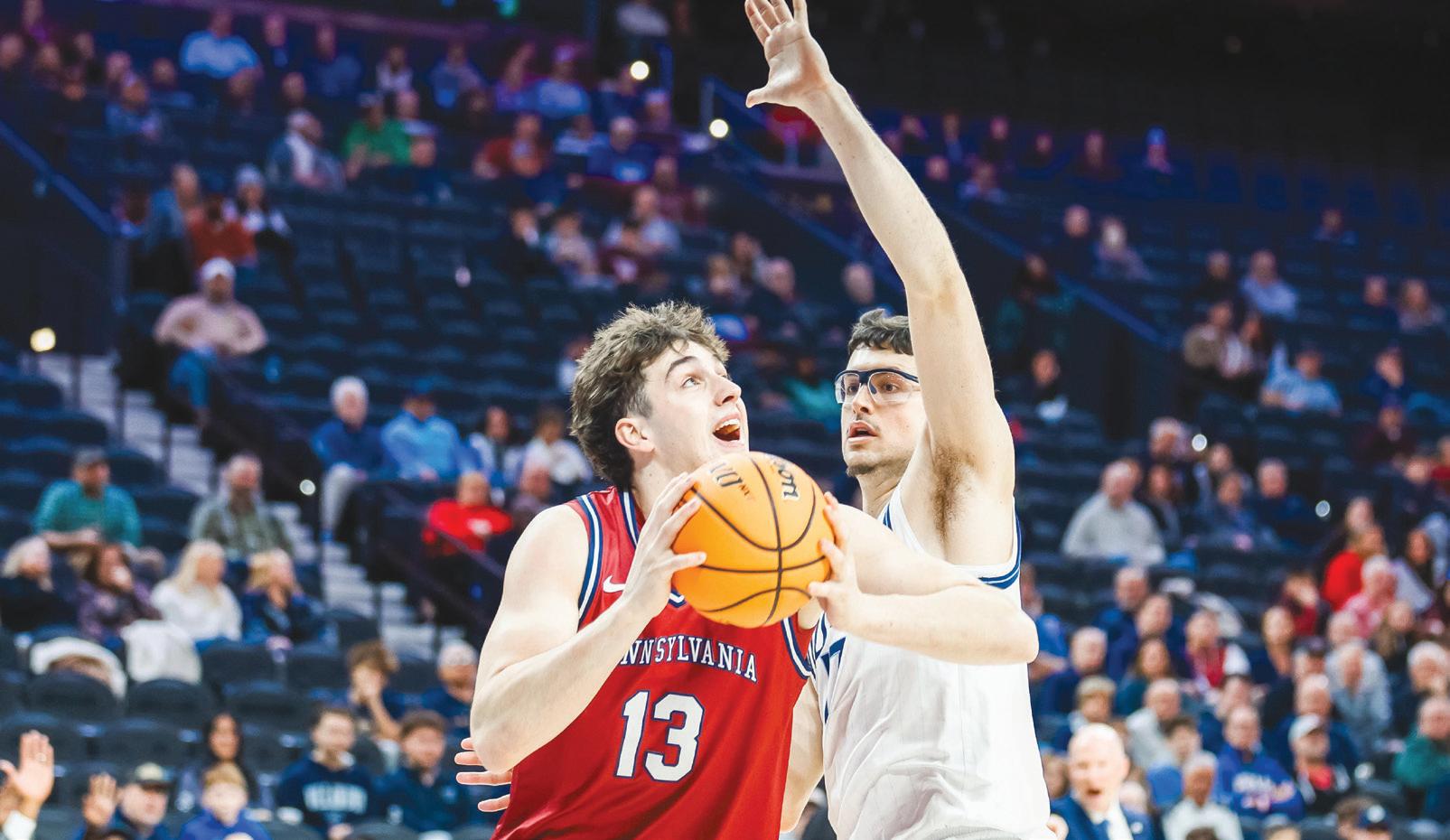
bench was being substituted in for some starters, the team still held its own against Villanova, only down by a maximum of eight points at one moment.
Defensively, sophomore forward Lucas Lueth was a spotlight. From press row, I watched Lueth hustle for the ball and press the opponents as they tried to bring the ball past the half-court. He contested everything in the air by swatting away floaters and passes. With our paint defense fully
and an and-one in quick succession at the start of the fourth quarter, which put Penn firmly out of reach of La Salle for the remainder of the game.
Junior center Tina Njike and Collins got the offense going
Njike put the first points on the board with a three-pointer, which ended up being Penn’s only made triple in the opening frame.
As the Penn offense struggled under La Salle’s aggressive man-to-man defense, making only five of 17 field goals. Njike and Collins combined to put up all 11 of Penn’s points in the quarter.
As the game continued, it remained Collins and Njike continued to fill out the Quakers’ box score. Collins flirted with a double-double, putting up 20 points and nine rebounds, while Njike added a double-double of her own, with 14 points and 13 rebounds.
Njike scored both of her attempted three-pointers during the game, which she credits to the work she put in over the summer.
“I told myself to really focus on it, and that it would hopefully pay off in this season,” Njike said.
“You’ve just got to trust the work that you put in.”
Penn faced troubles against the Explorers’ zone defense
After impressive showings in the past two weeks, the Quakers also faced some offensive struggles in Sunday’s matchup. La Salle switched to a 3-2 zone defense midway through the third quarter, catching Penn’s players off guard and forcing multiple steals and turnovers.
By the end of the afternoon, nearly half of the Explorers’ total points came off of turnovers. Penn adapted just in time to prevent La Salle from catching up.
“It was the zone [defense] that gave us the most trouble in that stretch,” McLaughlin said. “We started running a few more things, created a bit more movement. And sometimes it just takes a
exposed, I expect Lueth’s hustle and playmaking to see more minutes. I won’t disregard that Penn clearly struggled physically and athletically against Villanova. But, remember, this is a team that’s gone from last place in the Big 5 to second in just a year. This is a team that garnered a strong compliment of being “a sleeping giant” by Villanova coach Kevin Willard.
While a loss, the bright moments of the matchup and just Penn’s appearance in the title game proved the program is turning a corner towards success in the McCaffery era of the program. That improvement and outlook are worth celebrating this weekend.
basket. Once you make one, the second one gets a little easier.”
After two years at Villanova, Penn is exploring the idea of holding next year’s triple-header at the Palestra.
“It would be great for our University,”





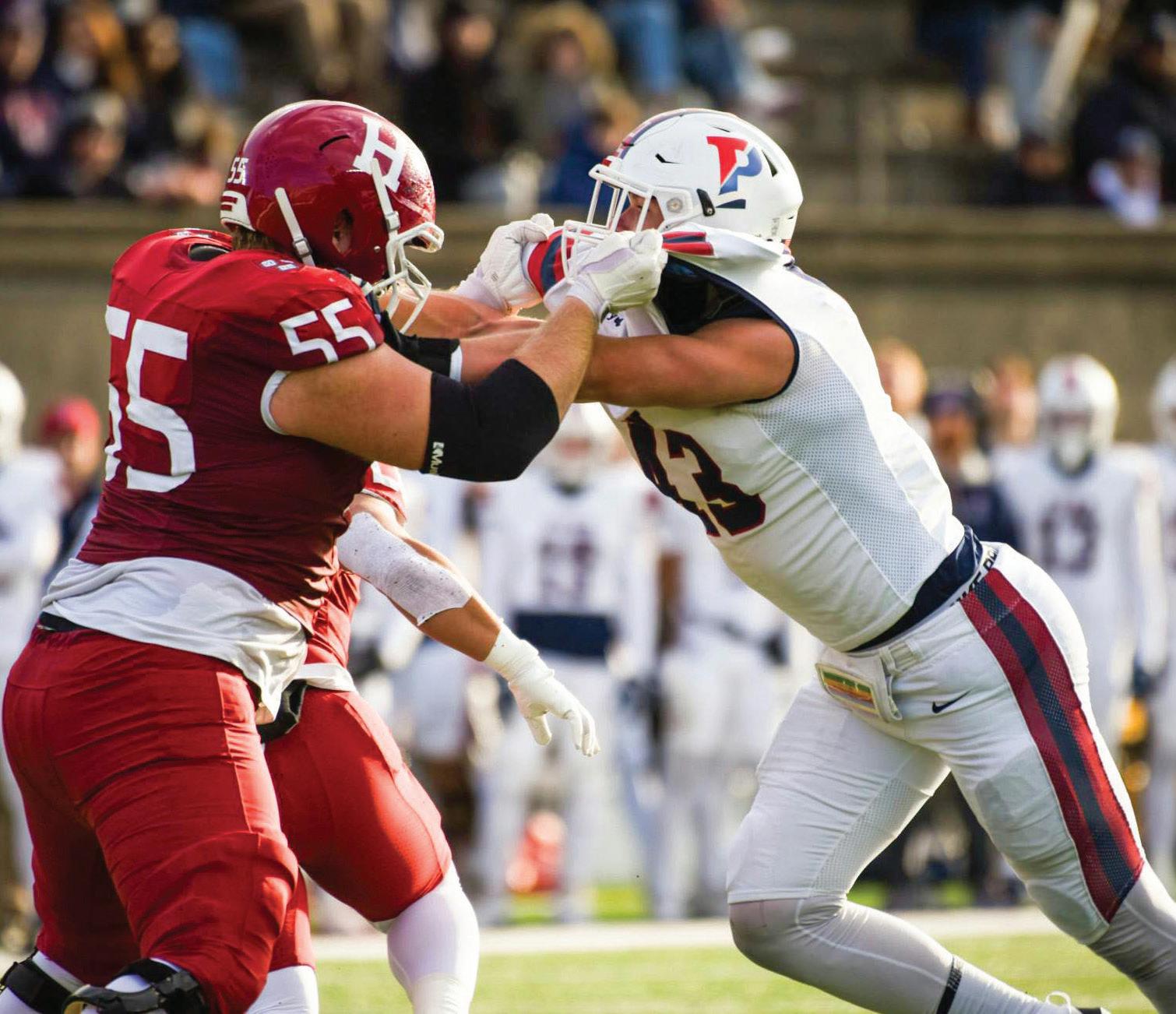
Rhodes Field, since the tournament will now take place at the top-ranked university each year. This fall’s tournament was held at Princeton. The season may not have ended with as many wins as in years past, but it did prove that men’s soccer can rise to the challenge when key players move on. The question going into next year is whether the team can do that again. Seniors Cayelli and Pratt will not be on the team come fall, and it will be standout goalkeeper Phillip Falcon III’s final year at Penn.
Women’s soccer
The Penn women’s soccer season started promisingly, with the team not losing a game until its seventh of the season against Villanova. But the team then hit a rough patch from that loss until mid-October, when it picked up one more win for the season against Harvard. With more ties than wins or losses, a season-ending tie with Yale at home was representative of women’s soccer’s mediocre season. The team ended with the same conference record as last year but demonstrated strong non-conference play.
Senior goalkeeper Annabel Austen won another first team All-Ivy and recorded multiple career highs, including 10 saves against Harvard in October. Austen will transfer to USC and continue showcasing her talents in California for her final year of eligibility. Junior forward Abbey Cook has continued to anchor the team with her offense, and next fall, she will be the one to look for as the team hopes to improve its conference record.
Penn field hockey
Penn field hockey entered the season excited and hopeful under new coach Scott Tupper, who came to Penn after serving as an assistant coach for Maryland. A former Olympian, he holds the Canadian record of 126 goals. With his playing, coaching, and recruiting experience, the team was looking for change under new leadership, and Tupper brought it.
The team ended its season with a 9-7 record overall, its highest total wins since 2021. The last game of the season was against Delaware, which Penn won in double overtime, representing the team’s renewed commitment to grit and precision. Three seniors, including midfielder Julia Ryan and defender Philine Klas, were named to the All-Ivy team. Ryan led the team in goals and points, and Klas in shots. Even though field hockey will lose four seniors who have started every game next season, the team hopes to improve from here. Next fall will be an exciting season to watch for this team.
Volleyball
Similar to field hockey, Penn volleyball also started this season with a new coach, Tyler Hagstrom. Hagstrom found a lot of success at Bucknell, where he coached previously and became their all-time winningest coach.
The season started strong, with volleyball notching an 8-6 record in non-conference action, which included three consecutive 3-0 sweeps for the first time since 2009. Following this momentum, Penn opened up Ivy League conference play against Princeton and Yale with two straight-sets losses. The Quakers did see a mid-season boost with a sweep against Columbia and No. 1 Cornell, both at home. But the highlight of the season was their win against three-time defending champion Yale, where their 3-2 comeback win ended Penn’s home-court losing streak against the Bulldogs. Junior outside hitter Zada Sanger exploded with 21 kills alongside sophomore outside hitter Jenna Garner, who hit a career-high of 21 digs.
As the team practices and continues to work on developing offense, next season will be a promising one.
PROGRAM, from back page
in the Ivy League since 1991. In 2010, Miller was fired after Penn began the season 7-0. Elsewhere in the Ivy League, coach Tommy Amaker took over a last-place Harvard team in 2008 and transformed it into an Ivy champion team just two years later.
Harvard’s rise to the spotlight came at the heels of a novel need-based financial aid system adopted in 2006, allowing its players to avoid loans even without external scholarships. But its rise was plagued with accusations of Harvard recruiting top basketball talent at the cost of lowering its academic standards.
Men’s cross country
With former stars Luke Johnson and Dylan Throop gone, Penn men’s cross country struggled a bit this season. It started the season on a high note, winning the Main Line Invitational in September. Junior runner Kofi Fordjour led the way for the team throughout the competitions, earning a personal-best time of 24:12.0 in the 8-kilometer. Fordjour paced the team in the following competitions, which proved to be challenging for the team. The men’s team finished seventh out of eight teams that competed at the Ivy League Heptagonal Championship and 10th out of 28 teams at the NCAA Mid-Atlantic Regional Championship. Discipline and running together was the focus this season, and hopefully next season will bring forth better results as the team tries to find its footing.
Women’s cross country
Penn women’s cross country had a stronger season, opening its season with a victory at the New Jersey Jam. Each competition was a chance for improvement, and the team took on the challenge. It placed eighth out of 40 teams at the Paul Short Run, improving six places from last year. For the last two competitions of the season, the Ivy League Heptagonal Championship and the NCAA Mid-Atlantic Regional Championship, the team placed fourth and sixth, respectively. Seniors Lara Cota and Anna Weirich and juniors Gabrielle Jones, Sarah Fischer, and Lily Murphy, among others, recorded personal bests throughout the season, showcasing the balanced strength throughout the team.
“I think a lot of [the rise of Harvard] had to do with the change in the financial aid structure and how that worked. And I think schools like Harvard took advantage of that,” Ugonna Onyekwe, who played for the Quakers from 1999-2003, said. “NIL has probably made it harder for teams like Penn or Ivy League teams to compete. … We were just a lot more talented than pretty much all other teams in the League at the time.”
“The Ivy League holds Penn back,” Alan Cotler, who played for Penn from 1970-72, said. “Penn is uniquely situated to be the Stanford of the East Coast. The other [Ivy League] schools are not. Because of Philly, the facilities, the exposure.”
Left in the lurch from Miller’s early departure, the Quakers turned to Allen as interim coach. A legendary player for the Quakers, Allen starred for Penn from 1992-95 and contributed to Penn’s record 48-game Ivy League winning streak. He graduated as the program’s all-time leader in both assists and steals. At the end of the 2009-10 campaign, Penn promoted Allen to a permanent position.
What followed was a tenure marred by both failure and controversy. After a 20-win campaign in 2012, Allen led Penn to three straight seasons of nine wins or less before being fired in 2015. Allen ended his tenure as the first program coach to not win a conference title since 1956.
Three years later, Allen testified to receiving over $300,000 in bribes from businessman Philip Esformes in exchange for helping Esformes’ son gain admission to Penn. The program was subsequently placed on two years of probation, while Allen himself received a 15-year show-cause
Men’s rowing
After a three-meet schedule, the heavyweight rowing team completed its fall season. In the season opener at the Head of the Charles in the Men’s Championship Eight Division, the Quakers placed 23rd in a field of 29 with their Club Eight A boat.
Despite a disappointing start, Penn quickly rebounded at the Head of the Schuylkill regatta with wins across Pairs, Frosh/Novice Fours, and Championship Fours, notching 2-1 in Championship Eights and second in the Club Eights A field.
The Princeton Chase concluded the Penn team’s fall season, with the Quakers taking third place in the Men’s Eight — which consisted of 42 boats.
Women’s rowing
Women’s rowing only had a two-meet fall schedule after the Navy Day Regatta, which typically opens the fall season, was canceled due to poor weather conditions. Despite this initial setback, women’s rowing dominated in its next regatta at the Head of the Schuylkill, where the team won gold and silver in each event across the five divisions. Penn proceeded to close its fall season with the Princeton Chase. The Quakers’ A boat placed 10th in a deep 60-boat field, with other Penn boats placing 21st, 22nd, and 23rd, respectively.
With great momentum, the women’s rowing team will head into preparations for the spring to reclaim the varsity eight national championship title from Yale.
Men’s golf
The Quakers opened their season at the Alex
penalty.
In the wake of Allen’s departure, Penn turned to a familiar face: Donahue, who had served as an assistant coach on Dunphy’s staff from 1990-2000. A noted tactician and Ivy League winner, Donahue had previously led Cornell to three straight Ancient Eight titles including a run to the Sweet Sixteen. In an evolving sport, Donahue’s three-point heavy attack seemed primed to relaunch Penn as a perennial power.
In the early going, it did just that. Donahue led the Quakers to an Ivy title in his third season, compiling a 12-2 conference clip behind a balanced attack. That 2017-18 season, Penn finished second in the conference in both points per game and points per game allowed and logged two sophomores, AJ Brodeur and Ryan Betley, in the conference’s top 10 scorers.
The 2017-18 season marked Donahue’s final 20-win season. In the years that followed, the Quakers slowly regressed thanks to a number of factors, namely their inability to recruit and retain top talent. In 2022, Donahue secured a class of just two freshman signees.
“Donahue’s staff did not do a good job of personally recruiting,” Cotler said.
Further, as the prevalence of the transfer portal rose steadily in college sports, Penn became a frequent victim of transfer losses.
In the spring of 2023, Ivy League Player of the Year Jordan Dingle transferred to St. John’s. Then, the following season, then-freshman Tyler Perkins left for crosstown rival Villanova after breaking the Penn program record for first-year scoring.
“Everyone wants to play and compete at the highest level, to prove that they belong, to prove that they’re one of the best. And so, if someone has that opportunity, and … make some money doing it, it’s almost a no-brainer,” Onyekwe said.
“[Before], there were only two options, either you were going to stay at Penn and be a student, or stay at Penn and play basketball and be a student,”
Jed Ryan, who played for Penn from 1996-99, said.
“There was no other option. And really that was because, [when] you came to the University, you came for the education.”
In a statement to the DP, Wren wrote that Penn
Lagowitz Memorial, completing ninth overall. In their first game, sophomore Ryan Chang led the team, finishing with a 2-over 218 for 11th place. In the strongest competition of the season, Penn finished in 11th at the Hamptons Intercollegiate, where it competed against four of the top 25 programs. The men’s team closed its season at the Big 5 championship in hopes of defending the Big 5 team title but ultimately fell short after finishing sixth. Looking ahead, both the men’s and women’s teams will be in full-preparation mode as they head to compete at the esteemed St. Andrews Links Collegiate next year, which will be streamed on national TV.
Women’s golf
Women’s golf started its season at the Nittany Lion Invitational, where freshman Mi Li came in third place at her first collegiate event, helping the team with a strong finish in sixth place. At the Princeton Invitational with fellow Ivy League competitors, the Penn team secured fifth place, with Li once again leading the leaderboard at first until the final round, in which she finished seventh. To close out the fall season, the women’s team just barely missed out on a title at the two-day Lehigh Invitational. Penn finished second out of the 15 participating teams, missing the team title by one stroke. Freshman Adrienne Ahn-Upton had a top-three individual finish at the invitational with the lowest round in the field. With the upcoming St. Andrews Links Collegiate, the women’s team will have time to prepare for one of the most prestigious events in collegiate golf.
losing talent to Power Four schools was “nothing new,” adding that the school would need to do a better job of “showcasing and celebrating the Penn experience,” which includes postgraduate job opportunities.
But Penn’s new staff has also produced new methods to counteract the University’s inherent recruiting disadvantages. On Nov. 6, McCaffery said that the program was utilizing alumni donations to fund “true NIL opportunities and paid internships,” for student-athletes — a first-of-its-kind measure in the Ivy League.
That endeavor is one of several ways McCaffery has turned Penn’s program upside down.
“I think it’s the intensity from our team,” star senior guard/forward Ethan Roberts said when asked about the biggest change under McCaffery’s leadership. “Practices feel so much more real, and the energy’s just different. The biggest change has been the hope that Fran’s given us, and how he’s poured into us already.”
“Former players and former coaches have rallied behind Fran McCaffery at this very important time for Penn basketball,” Littlepage, who gave McCaffery his first collegiate coaching job in 1982, said. “I am just delighted to see the number of former players who are connecting as a result of Fran being back … I think all that speaks to what a great choice it has been for the University.” Penn is off to a 6-4 start this season, including its first win over Saint Joseph’s since 2019 and a second-place finish in the Big 5 Classic.
McCaffery has wasted no time on the recruiting trail, securing commitments from three-star recruits Ethan Lin and Isaiah Carroll. The latter was the highest-rated recruit this decade for Penn men’s basketball, according to 247 Sports. In many ways, Penn’s new coach is positioned to restore a once-great program the way only a member of its glory days could.
“It’s so important to me, because I grew up in Philadelphia. And I sat right here every Saturday for many, many years, hoping that one day I’d get to play here,” McCaffery said. “Which I did. I coached here for one year a long time ago. And I’m so thrilled to be back here, helping continue what is one of the great traditions in college basketball.”

A tale of two programs, part two: Penn men’s basketball’s historic rise, fall, and quest to rise again
The program won 24 Ivy League titles from 1970 to 2007
WALKER CARNATHAN AND JUSTIN LEE Former Sports Editor and Sports Editor
This is part two of a two-part series chronicling the history of Penn’s men’s basketball program.
On March 10, 2025, Penn men’s basketball announced a familiar move: the program’s head coach was gone.
Seven months ago, former Penn men’s basketball coach Steve Donahue was fired after nine seasons at the helm — a return to square one for a team that had already been there repeatedly within the last two decades.
The Quakers fired three coaches between 2009 and 2025: first Glen Miller in 2009, then Jerome Allen in 2015, and Donahue earlier this year.
The turnover is reflective of the team’s on-court struggles. Since 2007, Penn has won just one Ivy League title, finished with a losing conference record nine times, and defeated rival Princeton just seven times. Allen finished with the lowest win percentage among Penn’s nine coaches from 1966 to 2025 with .386, while Miller won less than 50% of his games.
Fifteen days after Donahue’s exit, the Quakers hired legendary 1982 Wharton graduate Fran McCaffery as the next face of the program. After 15 years at high-major Iowa, McCaffery’s return to Philadelphia has sparked a new air of optimism. In
Before moving into the new year, let’s see how Penn sports performed this fall
HANNAH CHANG AND EMILIE CHI
Deputy Sports Editor and Sports Associate
Football
The 2025 season for Penn football was one marked by both high highs and low lows. The Quakers finished with an overall 6-4 record and 4-3 conference record, placing them third in the Ivy League, an improvement from last season but short of the title.
The season started with the Quakers looking like surprise contenders after a 4-1 start, including back-to-back conference wins over Dartmouth and defending champions Columbia, where senior wide receiver Jared Richardson topped 2,000 career receiving yards. Penn looked like it was been on a revenge tour, but September’s success halted with senior running back Julien Stokes’ mid-season leg injury after he had led the nation in punt return average. In their game against Harvard, the Quakers fought hard — with senior quarterback Liam O’Brien having an 80% completion rate and Richardson putting up three touchdowns — but ultimately lost to a heartbreaking last-second field goal, putting them out of contention for the Ivy League title and the FCS playoffs. A week later, Penn secured a win over rival Princeton to close their season. The season concluded with Richardson breaking 1,000 receiving yards, the sixth Quaker to achieve this record in a single season. Soon after, six key players — including Richardson, O’Brien, and senior wide receiver Bisi Owens — entered the transfer portal. Coach Ray Priore also stepped down from his position after 39 years with the program and two Ivy League titles.
With a massive upturn in the roster and a head coach spot to fill, the Quakers’ future stands uncertain as they seek to rebuild the roster and contend for the title next season.
Sprint football
The 2025 season for sprint football was a struggle, as it finished with a 5-2 overall record
and 3-0 in the CSFL South Division.
Penn suffered from blowout defeats against top competitors Army and Navy despite an impressive performance by junior quarterback Josh Johnson. The Quakers were able to end this threegame losing streak with a 14-0 blowout against Molloy led by Johnson and a dominant defense. Ultimately, their season closed with a 31-14 loss against Cornell and a 2-5 record, a massive decline from last year’s 5-2 season.
Many players received honors this season, with the team notching eight total CSFL honorees and three Player of the Week winners. Johnson earned himself first team defensive honors for leading the team in pass breakups and interceptions; offensive linebacker Luke Pajovich and wide receiver Jake Wang were both awarded first team offensive honors. Many more players also received second team and honorable mention recognitions.
With many postseason recognitions and as young talent develops, there is hope for next season to potentially compete for a title.
Men’s soccer
This season was a new start for Penn men’s soccer after former forward Stas Korzeniowski and former defender Leo Burney, who had anchored the team last season, graduated in the spring, leaving an opportunity for others on the team to step up. Senior midfielder Patrick Cayelli and senior defender Oliver Pratt rose to the occasion to keep the team competitive, with Cayelli winning Ivy League Offensive Player of the Week in November.
Ranked No. 3 in the Ivy League, the team ended its season with eight wins, five losses, and four ties. Though it was able to play in the Ivy League tournament, the team fell to Cornell in the semifinals. It was the first time the Ivy League tournament was not held at home at See RECAP, page 15
a statement to The Daily Pennsylvanian, 1996 College graduate and Athletics Director Alanna Wren wrote of McCaffery’s prowess as a recruiter and talent developer, noting his penchant for “turning around struggling programs.”
And while a new coach will bring change on many levels, the hurdles facing the team remain the same.
“There have always been challenges,” Craig Littlepage, who coached the Quakers from 1982-85, said. “[It’s been] an uphill fight, not just for the Ivies in general, but the University of Pennsylvania specifically.”
After Penn won its 24th conference crown during Miller’s first season in 2007, the team graduated a wave of key contributors that had been recruited by former coach Fran Dunphy. These included two-time Ivy League Player of the Year Ugonna Onyekwe, as well as leading scorer Mark Zoller and leading shot-blocker Steve Danley. With Dunphy’s top players out of the picture, the burden of recruitment fell onto Miller. In 2008, the Quakers went 18-13 overall, their first losing season since 2001. In 2009, they went 18-10 overall and 8-6 in conference play, their first losing season
Yoon | Even with a Big 5 championship loss, Penn should celebrate how far men’s basketball has come
The Quakers just lost the men’s Big 5 championship, but look how far the program has come
SOO YOUNG YOON
Sports Reporter
The Villanova student section roared as to my dismay as Villanova guard Bryce Lindsay sank his third three-pointer in just two minutes following halftime.
At this point in the Big 5 Classic championship game, Villanova was up 53-33 over Penn men’s basketball. Star senior guard/forward Ethan Roberts left the game soon after due to injury.
From there, the Wildcats took control and never looked back, ultimately winning their first Big 5 Classic title with a final score of 90-63.
As Villanova’s championship banner was raised, I looked back at my game notes to formulate my thoughts for this column.
“Penn struggles. Both on offense and defense.”
“Penn makes too many costly turnovers.”
“Why do we keep missing free throws?”
In a game where Penn lost by 27 points, it’s not easy to look to the positive. I originally planned to talk about how Penn lost its momentum on offense or its poor performance in the paint. But as I watched the Villanova players pose in front of their championship banner for photographers — something Penn men’s basketball was so close to doing for the first time since 2019 — something suddenly didn’t feel right. I stopped typing and thought more about the path to this moment.
Earlier this time last year, Penn was coming off an abysmal 93-49 loss against none other than Villanova, which was the team’s largest loss since 2009. Afterwards, Penn prepared for its the Big 5 Classic fifth-place game against Drexel, trying to stay out of last place in the Big 5. Despite being tied at the half, the Quakers could only score 17 points in the second frame, ultimately losing 60-47 to the
Dragons. With that, Penn’s record sat at 7-3. Fast forward a year, the team has changed a lot and come a long way.
After finishing sixth in the Big 5 last year, Penn executed statement wins against Saint Joseph’s and at Drexel to punch its ticket to the championship game. In these two games, the Quakers showed resilience and determination as they outscored their opponents for a combined 20 points in the second half. The hype was real, and one thing was undeniable: this isn’t the same team as last year.
Despite the hype building up around the team’s biggest game of the year, it was clear that Penn was outmatched all across the board. The team just couldn’t keep up with Lindsay’s relentless playmaking, nor could it score well when guarded by Villanova forward Duke Brennan, who was named MVP of the championship matchup.
It also didn’t help that Roberts exited the game following a scary injury. After he left the court, Penn could never find the offensive rhythm that it was looking for. On a big stage like this, the team lacked his crucial veteran presence.
But Penn had bright spots, specifically from beyond the arc. When the Wildcats came firing from deep, going 3-for-3 in the first three minutes. Penn responded by sinking two of its three three-pointers in the same span. The Quakers even managed to tie the game 27-27 with a huge three-point shot. By the end, Penn finished with an impressive efficiency from beyond the arc by making 11 of 22 total attempts.
In the first 15 minutes of the matchup as Penn’s
See PROGRAM, page 15 See COLUMN, page 14