Penn welcomes record number of QuestBridge matches to Class of 2030
The program, which allows low-income students to apply early to selective institutions free of charge, accepted 112 students
LAVANYA MANI Contributing Reporter
A record number of students matched with Penn in the QuestBridge National College Match for the Class of 2030.
According to a Dec. 1 announcement from Penn Admissions, 112 students were accepted through the program, which allows low-income students to apply early to selective institutions free of charge. Students who match with a college or university receive a fouryear scholarship.
This year’s cohort includes 83 first-generation college students.
In a statement to The Daily Pennsylvanian, Vice Provost and Dean of Admissions Whitney Soule described the cohort as a reflection of the University’s “bold thinking and culture of collaboration that makes [the Penn] community thrive,” adding that the group has “record representation in Nursing, Engineering, and Wharton, and more than 80 first-generation scholars.”
“We are energized by the future they’ll help shape and could not be more excited for all they will contribute to our community and the world beyond it,” Soule added.
According to a Dec. 1 press release from Penn Admissions, the cohort includes students from “106 different high schools across 24 states.” The group will now join over 600 current undergraduate QuestBridge scholars at Penn.
In total, the University admitted 259 students through QuestBridge last year, with 111 students admitted through the early, binding match program.
The QuestBridge scholars admitted are the first to be accepted into Penn’s Class of 2030. Later this month, the University will release admissions decisions for students who applied early decision. Last year, the Class of 2029 received over 9,500 early decision applications, an increase attributed to the University’s test-optional policy.
The Class of 2030 is the first group of applicants since Penn reinstated its standardized testing requirement.
The press release also highlighted many of the resources available to new students, including the Penn First Plus program, libraries, and the College Houses.
From unions to University decisionmaking, five key takeaways from Jameson’s interview with the DP
AYANA CHARI AND ANVI SEHGAL Senior Reporters
Amid administrative changes, national scrutiny, and escalating labor organization on campus, Penn President Larry Jameson sat down with The Daily Pennsylvanian for an interview.
During the Nov. 24 conversation, Jameson addressed the University’s relationship with the federal government and highlighted the role that students, faculty, and other campus stakeholders play in Penn’s future. He discussed the University’s approach in adapting to a rapidly changing environment and the values Penn maintains throughout its decision-making processes.
Here are five takeaways from Jameson’s recent sitdown interview with the DP.
Graduate student union bargaining Penn’s graduate student workers union, Graduate
Penn investigating business software data breach afecting personal records
Penn is in the process of notifying individuals whose personal information was compromised by the incident, according to a University spokesperson
ISHA CHITIRALA AND FINN RYAN Senior Reporters
Employees Together — University of Pennsylvania, voted to authorize a strike last month following a year of contract negotiations with Penn administrators. If a strike is called, graduate workers involved in teaching and research roles will stop performing all work duties.
“I certainly respect their right to do this and understand what some of the interests are that they’ve raised,” Jameson told the DP. “At the same time, the University really has an obligation to take care of the elements that are important to the University.”
Jameson reaffirmed his commitment to the “best education, the best research opportunities” at Penn, and the culture, policies, and procedures needed “to support those missions.”
GET-UP previously criticized Penn for “distribut[ing]
See JAMESON, page 2
Penn Hillel shares
results
of student survey on Jewish campus experiences
The survey results indicated that 85% of respondents said they experienced, heard about, or witnessed ‘something antisemitic’ at Penn
LAVANYA MANI Contributing Reporter
Penn Hillel shared the results of a University-wide survey it conducted that polled Jewish students about their experiences on campus.
The survey was circulated among Penn students beginning in February and collected responses throughout the 2025 spring semester. Its results — which were shared by Hillel at a webinar hosted for University alumni and parents of students two weeks ago — indicated that 85% of respondents said they experienced, heard about, or witnessed “something antisemitic” at Penn.
Franklin’s Forum, a Penn alumni newsletter, first published the results of the survey that were presented by Penn Hillel Executive Director Gabriel Greenberg during a webinar attended by alumni and parents of Penn students two weeks ago.
During the presentation, Greenberg highlighted six priorities for addressing antisemitism and maintaining Jewish students’ feelings of belonging — including “ensuring fairness in the classroom” and “building and restoring Jewish unity,” according to Franklin’s Forum. He noted that there had been a decrease in antisemitism since the survey’s release but stated that more progress was necessary.
A request for comment was left with a University spokesperson and Greenberg.
The survey asked students about their personal connection to their Jewish identities, their feelings about Israel and related discourse at Penn, and the extent to which they had heard of or experienced antisemitism on campus.
According to survey results, 96% of respondents were proud of their Jewish identity and 97% considered Judaism to be important in their lives.
Along with the 85% of students who said they experienced, heard about, or witnessed “something antisemitic” at Penn, 45% stated that they felt uncomfortable or intimidated because of their Jewish identity or relationship with Israel, and 31% said they felt the need to hide their identity. 29% and 26% of students responded that they felt unwelcome in certain campus spaces and experienced antisemitic or anti-Israeli comments from professors, respectively.
Jewish students surveyed offered varying opinions on See SURVEY, page 3
University Council adopts Diversity and Equity Committee name change, discusses hate speech incidents
A Dec. 2 motion renamed the body the ‘Committee on Community and Equal Opportunity’ and marked the second round of public debate over a name change
CHRISTINE OH AND ANANYA KARTHIK Staff Reporter and Contributing Reporter
Penn’s University Council approved an amendment to its bylaws renaming its Committee on Diversity and Equity on Wednesday.
The Dec. 3 motion — presented at an open forum in Houston Hall — renamed the body the “Committee on Community and Equal Opportunity” and marked the second round of public debate over a potential name change. An earlier proposal to adopt “Committee of Belonging” failed after students raised concerns.
Prior to the vote, Senior Vice President for Institutional Affairs Joann Mitchell outlined the context surrounding the name change, saying that “legal and legislative changes” prompted a review of committee names and standing charges across the University.
She added that the Penn Office of General Counsel advised revisiting language that referenced “affirmative action” or other terms affected by recent federal guidance.
Faculty Senate Past Chair Eric Feldman emphasized that the new name was developed following feedback during the October University Council meeting.
Feldman said the Faculty Senate tri-chairs met with student leaders, the Office of the General Counsel, and administrators to “understand the legal constraints” and then worked with students to identify language that would remain compliant with the law while “preserving the core responsibilities” of the committee.
A motion to call the question passed, and the amendment was approved by majority vote.
Several student groups reiterated concerns about
removing “diversity” and “equity” from the committee title. Representatives from the Latinx Coalition, Penn Association for Gender Equity, Penn for Immigrant Rights, Disabled Coalition, and UMOJA said that the proposed name still alters how the University presents its commitments to students from underrepresented groups.
“It doesn’t feel right to me and my conscience, on behalf of my constituents, to vote yes,” College junior Victoria Navarrete-Ortiz — who previously served as the external affairs chair for the Latinx Coalition — said during the forum. “If the name is going to be changed regardless … then I don’t think it makes sense for us to vote in favor.” College sophomore Kaison Wills — who serves as the political chair for Penn’s Association for Gender Equity — also spoke in opposition.
“The collaboration did not bring about the same meaning and purpose that the words ‘diversity,’ ‘equity’ and ‘inclusion’ hold,” Wills said. “Because our federal administration is attacking us for certain things, that doesn’t mean Penn needs to continuously back down from these challenges.”
Students also asked for clarification on the legal rationale behind the name adjustment. One representative asked whether the University was responding to “specific scrutiny” or federal action.
Mitchell replied that the Office of General Counsel could discuss the issue in more depth, but that the
See COUNCIL , page 3
KEVIN REN | STAFF PHOTOGRAPHER
Penn Med liable for
$12.25 million
in cancer misdiagnosis suit, Philadelphia jury says
Penn and physician Janos Tanyi were found liable for $12.25 million — or 35% of the total verdict
AYANA CHARI Senior Reporter
A Philadelphia jury reached a $35 million verdict against Penn Medicine and Main Line Health after a cancer misdiagnosis led the plaintiff to undergo a medically unnecessary full hysterectomy.
Penn and physician Janos Tanyi were found liable for 35% — or $12.25 million — of the total verdict. The decision came after the plaintiff, Isis Spencer, filed a complaint in January alleging “negligent and outrageous conduct.”
The suit named named Penn, Penn Med, the University’s health system, and Tanyi as defendants.
“I hope this verdict affirms the patient’s central role as the decision-maker and the physician’s obligation to provide them with all of the information and all of the options,” Glenn Ellis, Spencer’s lawyer, wrote in a statement to The Daily Pennsylvanian regarding the court’s decision.
A Penn Med spokesperson wrote to the DP that they will be appealing the verdict.
“We are disappointed by the jury’s verdict in this case that was unmoored to the evidence presented at trial on negligence and damages,” the spokesperson added. “Our physician reasonably relied on the pathology performed at a hospital outside our system that revealed a very aggressive cancer but which, unbeknownst to him, had been mixed up with another patient’s specimen.”
Spencer’s false-positive misdiagnosis was caused by contaminated biopsy slides at Main Line Health that mistook another person’s DNA for her own. After receiving the results, which indicated Spencer tested positive for grade 2-3 endometrial cancer, she sought a second opinion at Penn Med.
Despite a biopsy taken at Penn Med returning negative for cancer, Spencer was still encouraged to undergo a total
hysterectomy.
As part of the complaint, Spencer outlined the damages that occurred as a result of the misdiagnosis and the following hysterectomy.
According to the filing, Spencer — who was 45 years old at the time of the procedure — faced “surgically induced early menopause,” which led to symptoms such as “dizziness, nausea, and horrible migraines.”
“None of the tests ordered by Dr. Tanyi confirmed that Ms. Spencer had cancer,” the complaint read. “Despite failing to confirm her diagnosis of endometrial cancer, Dr. Tanyi insisted that Ms. Spencer did in fact have endometrial cancer and refused to conduct any additional testing to help explain why the biopsies were conflicting.”
Despite tests being reported back to Tanyi as “within normal limits,” he proceeded to act in line with Main Line Health’s findings, the suit alleges.
“Defendant Dr. Tanyi refused to conduct any additional testing and assured Ms. Spencer that the Main Line Biopsy was correct and that immediate surgery was her only real option,” the complaint read.
Spencer sought Tanyi’s opinion for the first time in February 2021. After performing multiple tests at the Hospital of the University of Pennsylvania, Tanyi completed the total hysterectomy in March 2021.
According to the complaint, Tanyi asked a nurse to relay news to Spencer that she had never had cancer in later that month, after a post-operative pathological examination of her tissue failed to show the presence of any cancer.
“While being told that she had cancer was incredibly scary and life altering, finding out that she never had cancer and never needed a total hysterectomy has been
Penn faculty, students react to range of AI policies across University classrooms
While multiple students and professors believe artifcial intelligence usage is inevitable in the classroom, others expressed a desire for more guidelines
COSTA GAY-AFENDULIS AND LIYA MA
Contributing Reporters
Penn’s administration took steps to prepare for an academic future incorporating AI.
As artificial intelligence increasingly affects academic life, Penn students and professors shared their reactions to the range of AI policies across the University in interviews with The Daily Pennsylvanian.
Penn’s math and engineering departments in particular have already started to incorporate AI into their curricula. While multiple students and professors interviewed by the DP believe AI usage is inevitable in the classroom, others expressed a desire for more guidelines out of worry that an overreliance on chatbots may discourage students from seeking more substantive help from professors or teaching assistants.
Penn’s administration has recently taken steps to prepare for an academic future including AI.
, from front page
misleading and confusing information” during the bargaining process — citing the University’s claim that choosing to strike could result in “separation from” employment.
Previous guidance from the Office of the Provost stated that “students are expected to attend classes even if it requires crossing picket lines.”
The union has four meetings planned with Penn administrators through the end of the calendar year, according to Jameson. The next bargaining session is scheduled for Dec. 4. A Penn spokesperson previously told the DP that the University has been “bargaining in good faith with the union over this initial contract and made significant progress.”
“This will ultimately, I think, get resolved in a good way,” Jameson said.
“Penn Forward” strategic framework implementation
Jameson first announced the University’s new strategic framework — titled “Penn Forward” — in a September interview with the DP. The initiative builds upon pillars of the “In Principle and Practice” framework developed by then-Penn President Liz Magill in 2023.
During his Dec. 1 interview with the DP, Jameson categorized the framework as one of the “most important things that we’re doing.”
“In Principle and Practice” was a “conceptual framework,” Jameson told the DP in September, while the “Penn Forward” plan is a way to “develop more tangible, concrete, actionable, timely projects and activities.”
The plan outlines six working groups that will consist of undergraduate students, graduate students, and postdoctoral scholars, as well as faculty, staff, and administrative support. Jameson said the initiative’s planning
unimaginably devastating,” the filing read. “Ms. Spencer now brings this lawsuit to hold the responsible healthcare providers accountable for their negligent and outrageous conduct.”
Main Line Health will not have to pay its portion of the verdict because it settled with Spencer in 2022 for an undisclosed amount. Penn Med plans to appeal the court’s ruling, according to The Philadelphia Inquirer.
to bring new tech to life, and translate that tech into tools that make the world a better place,” Ghrist said to the DP.
“Anytime something as revolutionary and potentially world-changing as AI comes out, this has to be part of what our engineering students learn how to use. Everybody’s got to be conversant with it and able to deploy if needed.”
Students interviewed emphasized the value of incorporating AI into their daily lives.
“AI will definitely become more prominent and useful within any technical field,” Engineering first year Vivian Chen said to the DP. “Learning how to develop a healthy relationship with AI early on is important.”
Ghrist has developed a chatbot for MATH 1410 that integrates with ChatGPT and is trained on the specific curriculum and notation of the course.
“Everything that I’m doing to build this problem generator, I’m showing my students how to do,” he said.
“I’m making available to them the same resource that I’m using, and I’m encouraging them to just spam out as many problems as possible.”
Engineering first year Gonzalo Vela, who is taking MATH 1410 this semester, noted the chatbot’s usefulness, stating that he has turned to it for questions before a quiz and “it gets the answer right away.”
Chen also felt that engineering classes “encourage using AI, but not as a sole source of information.” In this context, AI can “help you organize your thinking … and [is] a good way to get a broad overview of the topic.”
Ghrist uses AI to help generate exam questions as well.
“This engine gives me good ideas for multiple choice problems,” Ghrist said. “I have to edit these very carefully, but [with] the core ideas, I’m using AI to generate it.”
Before each exam, he also has the chatbot evaluate the test itself.
The verdict marks the largest in Philadelphia this year for medical malpractice and comes after HUP faced the single largest malpractice award in Pennsylvania history in April 2023.
A Philadelphia judge upheld a record $183 million medical malpractice verdict against HUP in February 2024, rejecting Penn Med’s post-trial
Chen noted that AI policies have become more lenient in general over the course of the fall semester, even in her humanities classes.
College first year Andreana Lee agreed, adding that in her creative writing class, she is able to use AI if it is “in a way that is creative and does anything new.”
Still, other classes — such as some computer science courses — prohibit AI use.
“If you just use [AI] for your code … you won’t ever learn anything,” Chen added. “A lot of coding is just problem solving and doing it by yourself, and that can only come through practice.”
Multiple students interviewed also acknowledged the limitations of using AI, citing concern over becoming overly dependent.
Vela expressed reservations, adding that AI “discourages us [from going] to office hours … because we can just ask the chatbot, so you don’t get that connection with the teacher.”
Students came to different conclusions on how Penn should address AI in classrooms.
Vela suggested that a better way to use it would be to “try to do [a problem] on your own and then check it with AI.” He also recommended that the University adopt more stringent rules.
“I’m sure students will still find a way to use it, but at least enforcing the rules a little bit more would be helpful,” he said. “Honestly, I don’t think they should really have [the chatbot].”
Ghrist also emphasized that students still need to be trusted to use the tool in a helpful manner.
“A core belief of mine is that we treat our students like the adults that they are and are becoming,” Ghrist said. “Removing the temptation altogether is a level of control that I am not so comfortable with.”
In a past interview with the DP, Penn Provost John Jackson Jr. stated the administration should “think long term” about the ways “AI portends for the future of what we do.” Moreover, in October, the University entered a cooperative artificial intelligence agreement with the Commonwealth of Pennsylvania seeking to develop guidelines for productive use of AI in education.
Robert Ghrist, a professor in the Mathematics and Electrical and Systems Engineering departments and the associate dean for undergraduate education for the School of Engineering and Applied Science, emphasized a similar sentiment.
“The job that we have at Penn Engineering is to train the next generation of inventors, of people who are going
committees have discussed “very high-level, innovative, specific, concrete ideas.”
Jameson added that “not all of [the strategic plan] will roll out in a single moment.” While some recommendations “can roll out early,” he provided a tentative timeline including 2030 and beyond.
“Whoever comes behind you will inherit a University that’s really ready to adapt to the future in a constructive way,” Jameson said. “The energy is super high.”
Penn’s relationship with the federal government
In July, Penn became the first Ivy League university to reach a settlement with the Trump administration.
The Department of Education launched an investigation into the University earlier this year, alleging that it violated Title IX for allowing 2022 College graduate and former Penn swimmer Lia Thomas to compete on the women’s swimming and diving team.
Penn agreed to the White House’s three demands in July, stripping Thomas’ records, issuing a Title IX statement, and sending letters to Thomas’ former competitors.
The University took a markedly different approach to dealing with the federal government when the White House approached the University on Oct. 1 with a preferential funding compact. Two weeks after being approached with the plan, Penn became the third university to reject the compact — a decision Jameson partially attributed to its restrictions on academic freedom during his interview with the DP.
Jameson declined to comment on the University’s ongoing conversations with the White House, but characterized Penn’s historical relationship with the federal government as “powerful, amazing, and valuable.”
“Our sense is that funding should be based on competing for the best ideas,” Jameson said about Penn’s compact rejection. “So those principles make sense. We identified some areas of separation … but I haven’t had any further contact about this. I don’t know what steps they will take and follow up on.”
“It gives me a report, saying that ‘I see you have covered these topics. You left off these topics. You have this many easy problems, this many moderate problems, this many really challenging problems,’” Ghrist said.
Ghrist shares the report with students after removing test answers, which he believes has “turned the stress style down a little bit.”
Incorporating AI also allows testing for different skills, Ghrist noted.
“No more writing out all the math details, [with] me checking your algebra and dinging you because you used the quadratic formula wrong,” he added. “This is higherorder conceptual thinking that I’m testing now.”
In the compact feedback he gave the White House, Jameson emphasized the importance of academic freedom, which he told the DP is the “bedrock of what makes American universities so effective in their creativity and innovation.”
“The ability to not always follow conventional wisdom, but to think differently, has allowed us to innovate and create,” Jameson added. “This is just a critical function of our identities as universities. I think if we were asked to be conformist, it would limit our ability to pursue these innovative ideas.”
Marc Rowan’s influence at Penn Jameson discussed the “advice” he has received from outgoing Wharton School Board of Advisors Chair Marc Rowan, who holds a 1984 bachelor’s degree and a 1985 MBA from the Wharton School and has been a prominent donor to Wharton.
In 2018, Rowan gave a $50 million gift — at the time the largest single contribution in the school’s history — and made an anonymous $10 million gift in May. The latter came around a year and a half after Rowan publicly announced that he was withholding donations to the University in protest of Penn’s response to campus antisemitism allegations.
“[Rowan] is very close to what goes on at the University, and, like many of our alumni, has views, as he shares privately and publicly about things we should do or don’t do at the University,” Jameson said. “I tend to listen to people’s viewpoints and take them into consideration.”
In May, Rowan publicly called for “fundamentally reforming” higher education across the country, arguing that the Trump administration was in a uniquely appropriate position to usher in an era of change. Rowan was a chief architect of the preferential federal funding compact presented to Penn in October — which mirrored a list of reform questions he presented to the University Board of Trustees in 2023.
Rowan also contributed millions of dollars to primarily
He further explained that professors must design assessments that acknowledge the reality of AI while still making learning the most rewarding choice.
“From a practical point of view, I think the onus is on the professor to make their course incentivize learning,” Ghrist said. “Anyone who is giving their students an essay as an assignment or giving take-home exams, they are not doing their students any favors.”
Looking to the future, multiple students interviewed expressed that AI use is inevitable, a sentiment Ghrist agreed with.
“Rather than say, ‘Wow, this is really difficult, we’re just going to ban it until we figure things out,’ I think it is much better to experiment — even if some of those experiments don’t turn out great,” Ghrist said.
Republican-aligned groups and candidates in the first two fiscal quarters of 2025, according to a recent DP analysis. Jameson emphasized that Rowan holds “public positions of his own choice,” along with his Wharton Board of Advisors position and previous role as a University trustee.
After Magill’s remarks during a 2023 congressional testimony faced national scrutiny, Rowan orchestrated a pressure campaign that ultimately led Magill and former Board of Trustees Chair Scott Bok to resign their positions.
Administrative decisions at the University Jameson explained that decision-making at Penn is a “step-wise process” rather than centralized directives at the level of the President or Provost’s Office.
University governance is distributed “very broadly” throughout Penn, Jameson explained, “which allows people who know the most about these topics to be the ones who are managing the content and the processes and procedures.”
Jameson also addressed Penn’s “faithful” responses to “complaints and inquiries” from various sources of scrutiny.
The United States Equal Employment Opportunity Commission recently alleged in a lawsuit that the University failed to provide documents for an antisemitism investigation. Jameson said that Penn has, in fact, “produced hundreds and hundreds” of documents.
“We’re always cooperative, but when there are situations that we feel that we need to stand up for the rights of either students or faculty or employees here, then we also take that position,” he continued.
He also confirmed that Penn sent a “congratulatory letter” to 1968 Wharton graduate and President Donald Trump when he was elected, but he that clarified administrators have sent letters to Penn’s affiliates “regardless of political party,” citing the University’s policy of institutional neutrality, which was first introduced in September 2024.
CHENYAO LIU | SENIOR PHOTOGRAPHER
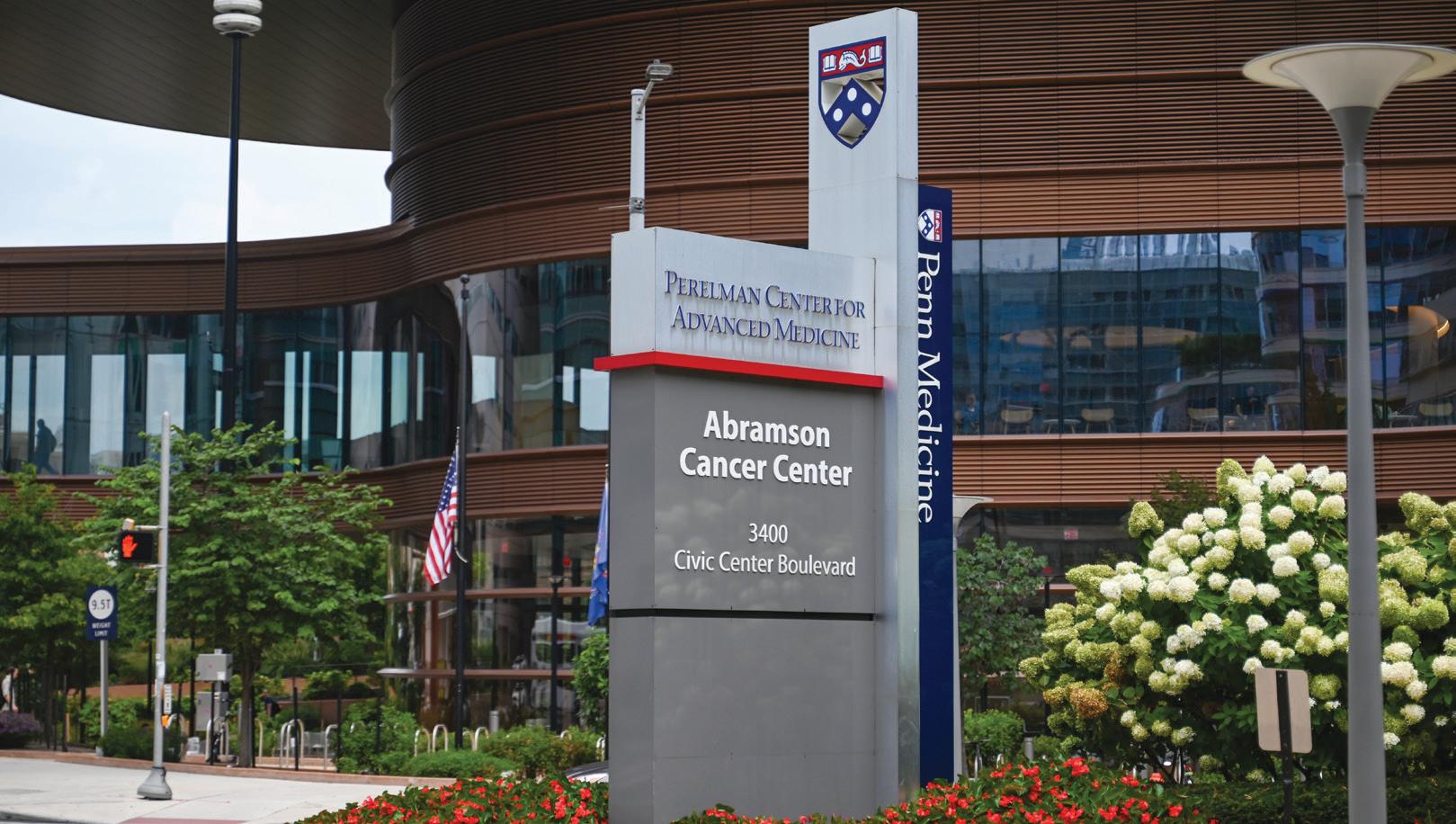
Penn Med’s campus pictured on Sept. 5.
SYDNEY CURRAN | STAFF PHOTOGRAPHER
JAMESON
Penn graduates named to 2026 Forbes 30 Under 30 social impact list for founding food-justice nonprofit
Alexandre Imbot and Eli Moraru were honored as co-founders of The Community Grocer, which provides hot, nutritious meals in accordance with federal guidance for people enrolled in the Supplemental Nutrition Assistance Program
JAMES WAN
Contributing Reporter
Imbot and Moraru were honored as co-founders of The
Penn Hillel hosts actor Jesse Eisenberg to discuss Jewish representation, film industry
In a conversation moderated by College sophomore Dylan Karz, Eisenberg discussed his Jewish identity and how it relates to his flm characters
ANANYA KARTHIK
Contributing Reporter
Penn Hillel and Wharton Undergraduate Media and Entertainment hosted writer, director, and actor Jesse Eisenberg to discuss Jewish representation in the entertainment industry on Tuesday.
The event was part of the Jackie Reses Speaker Series and drew roughly 100 attendees. In a conversation moderated by College sophomore Dylan Karz, Eisenberg discussed his own Jewish identity and how it relates to his film characters.
When asked about how his process for selecting roles has changed, Eisenberg said it now “intersects with the way I think about presenting Jews in media.”
He told the audience that many projects include “coded Jewish characters,” whom he described as characters who are written without explicit religious or cultural identifiers but are portrayed through familiar stereotypes.
“A perfect example is ‘Seinfeld,’” he said. “George Costanza is an Italian name. It’s an Italian character, but it’s coded as Jewish.”
He also said he avoids accepting roles that rely on narrow portrayals of Jewish identity.
“I just don’t ever want to play the one-dimensional
version of that thing, because I view it as a bad presentation of Jews,” Eisenberg said, adding that such depictions appear “in many, many movies” and are “so one-dimensional that I find it personally offensive.”
Eisenberg also spoke about the shift from theatrical releases to streaming platforms. He said that films spend less time in theaters because “the movie company can make more money when it’s on streaming.”
Citing the “Now You See Me” franchise, he said that while the first film was in theaters for about 10 weeks, the latest installment, now in its third week of its theatrical run, “is probably gonna get pulled [for streaming] soon.”
He attributed the trend to habits formed during the COVID-19 pandemic, adding that many viewers now wait to watch films at home rather than pay for theater tickets.
When asked about Aaron Sorkin’s planned follow-up film to “The Social Network,” Eisenberg said he did not want to continue being associated with Mark Zuckerberg.
During the question and answer portion of the event, Eisenberg confirmed that he plans to donate a kidney later this month. He said he first learned about altruistic kidney donation from a podcast and later underwent testing
In a statement to The Daily Pennsylvanian, Moraru — who graduated from Penn with a degree in political science and a minor in survey research and data analytics — described the significance of his inclusion on the list.
“This recognition from Forbes is a continuation of our shared mission to make eating well easier for all, the same mission that began on the street corner of 30th & Moore during our undergraduate years at Penn,” Moraru wrote. “We’re grateful to serve as stewards of a collective vision created by — and for — our neighbors, and we remain committed to carrying that vision forward every day.”
Imbot, who majored in environmental science at Penn, told the DP in 2023 that TCG helps community members access hot foods — which SNAP recipients are not permitted to buy with their benefits — by allowing them to purchase ingredients for a prepared meal.
According to TCG’s website, all food at the organization’s storefront is SNAP eligible, ranging “from breakfast to after-school snacks to family dinners.” After purchasing a meal kit, community members can “walk just next door” to exchange it for a hot version prepared by the Walton Avenue Resident Action Committee.
“This honor is not just about two individuals,” Imbot and Moraru wrote in a joint statement to the DP. “It’s a celebration of a collective effort: neighbors guiding our decisions, partners investing in our growth, young people shaping our workforce programs, and donors who believe
that access to fresh, healthy food is a right — not a privilege.”
TCG’s flagship location is located in Cobbs Creek at the intersection of 60th Street and Walton Avenue. Construction for its 2026 launch has continued after the organization broke ground at its storefront in September 2023 — an advancement made possible by the $100,000 award to the organization through the President’s Sustainability Prize, which former Interim Penn President Wendell Pritchett awarded to Moraru in April 2022.
“As we prepare for our launch, we invite partners, supporters, and donors to join us in this next chapter,” Imbot and Moraru added. “The momentum is real — and the opportunity to transform food access in Philadelphia and beyond has never been greater.”
In May 2024, TCG partnered with
at NYU Langone Health. Eisenberg said the decision reflects values he associates with his upbringing, referencing the Jewish concept of “tikkun olam,” or repairing the world.
When asked about depicting the Holocaust in “A Real Pain,” Eisenberg’s second directorial work, he said he aimed to avoid portrayals that felt self-congratulatory or melodramatic.
“When a movie does it in a way that feels exploitative of suffering, that’s really offensive,” he said.
He added that while filming at a concentration camp, he chose not to film certain scenes because the site felt “too hallowed, important, and sacred,” opting instead for “silent images of people looking.”
Eisenberg also reflected on how coded expectations around Jewishness shaped his early career. He described working on his first film, “Roger Dodger,” where the
director encouraged him to adjust his performance.
“Three days into shooting, he said, ‘Less like Woody Allen, more like Woody Harrelson,’” Eisenberg said.
“And I didn’t know what he meant. And now I do.” He told the audience the suggestion was “coded language,” as he was playing “a Midwestern, hasty kid” rather than a stereotype associated with neuroticism.
Before the event concluded, Eisenberg discussed how writing and acting shape the way he approaches conflict and perspective. He explained how he is drawn to stories built around two characters who want different things, because he rarely feels certain about his own views. Even when playing antagonists, he said that he approaches them as protagonists of their own narratives.
“When you’re playing a villain, you think, ‘I’m exactly right,’” he said. “As an actor, that’s how you have to think about it.”
University had been “reviewing committee names, policies, [and] procedures … on the advice of counsel” following the Trump administration’s crackdown diversity, equity, and inclusion in higher education. College junior and Undergraduate Assembly Vice President Musab Chummun encouraged the Council to consider how the vote related to the body’s procedural responsibilities.
“I think a vote towards yes really proves that this body can be one of change, and it can be one that moves towards goals that we each find are meaningful to the broader community at Penn,” Chummun said.
The Council meeting also included the provost’s report, during which Provost John Jackson Jr. introduced Vice Provost of the Arts Timothy Rommen — who provided updates on the University-wide arts strategy and ongoing construction projects.
These included Stuart Weitzman Hall and the forthcoming Platt Student Performing Arts Center, expected to open winter 2027.
streets.
HACK, from front page
Imbot and Moraru wrote. COUNCIL , from front page
states. Penn is in the process of notifying individuals whose personal information was compromised by the incident, according to a University spokesperson.
“The University of Pennsylvania was one of nearly 100-already identified organizations simultaneously impacted by the widely exploited Oracle E-Business Suite incident, involving a previously unknown security vulnerability in Oracle’s system,” the spokesperson wrote in a statement to The Daily Pennsylvanian.
SURVEY, from front page
the state of Israel. 84% of respondents believed that Israel has the right to self-determination, while only 62% would describe themselves as Zionists. 80% agreed with the statement that critiques of Israel often become antisemitic. Over 60% of students responded that they wanted a “space on campus free of antisemitism” and “wanted to be a part of a Jewish community.”
Over the past few years, concerns about antisemitism on Penn’s campus have drawn heightened national attention and increased scrutiny from the federal government.
In September 2023, the Palestine Writes Literature Festival drew criticism from students, alumni, and national Jewish groups who objected to the inclusion of speakers they alleged had made antisemitic remarks.
Despite a statement from then-Penn President Liz Magill condemning antisemitism, faculty members and prominent alumni donors urged the University to take a stronger position against the festival. As tensions escalated following Hamas’ Oct. 7, 2023 attack on Israel, members of the University Board of Trustees called for
College sophomore Lauren Watts raised concerns about campus climate following a video that circulated in October in which two students appeared to express racist remarks and racial slurs.
Watts also mentioned another incident where a “Black female student at Penn was violently and physically assaulted by a white male student at an off-campus event,” citing an UMOJA statement about the situation.
Toward the end of the meeting, Wharton junior and Undergraduate Assembly President Nia Matthews addressed the recent increase in local youth gathering near 40th and
During the open forum portion of the meeting, community members voiced concerns regarding COVID-19 mitigation and condemned the University’s July 1 settlement with the Department of Education regarding Title IX, which required that Penn strike the records of 2022 College graduate and transgender swimmer Lia Thomas.
the resignations of Magill and then-University Board of Trustees Chair Scott Bok.
After several instances of alleged antisemitism in the fall of 2023 — including threats against Hillel and Lauder College House and projections of pro-Palestinian messages onto campus buildings — Magill announced the University’s Action Plan to Combat Antisemitism. That same month, the Department of Education launched an investigation into Penn over allegations of campus antisemitism.
In December 2023, Magill faced widespread backlash for her congressional testimony, in which she said that it was “context dependent” whether calls for the genocide of the Jewish people violated Penn’s code of conduct. Days after her testimony, both Magill and Bok resigned.
Soon after Magill’s testimony, the United States Equal Employment Opportunity Commission launched an investigation into the University for its responses to campus antisemitism. This November, the agency sued Penn, claiming that it had not produced documents relevant to an ongoing antisemitism investigation.
In a response to the suit, Penn wrote that it has “cooperated extensively with the EEOC, providing over 100 documents, totaling nearly 900 pages.”
Matthews urged the University to respond with longterm community investment rather than heightened policing.
“Given how much Penn benefits from the surrounding community — its land, its labor, its culture, and its history
— I hope the University sees this not as a disruption, but as an opportunity to give back,” she said.
Matthews added that online discussions about the children had often been “racially coded or outright racist,” and called on students to “speak about West Philadelphia residents with respect, empathy, and awareness of the inequities that shape their lives.”
Penn has implemented “the patches that Oracle issued to resolve the vulnerability” and “has found no evidence that any of this information has been or is likely to be publicly disclosed or misused for fraudulent purposes,” the statement added.
In a Dec. 1 letter notifying impacted individuals, Penn wrote that its investigation — assisted by federal law enforcement and cybersecurity experts — discovered that “some data from Penn’s Oracle EBS had been obtained without authorization.” It remains unclear how many individuals were affected. According to information filed with the Office of the Maine Attorney General, the breach affected 1,488 state residents.
“Penn takes this incident very seriously and sincerely apologizes to everyone affected,” Penn’s letter read. “Protecting our community is of utmost importance, and we are committed to maintaining the privacy and security of your information.”
The November breach, first reported by BleepingComputer, followed a separate cybersecurity breach of an account affiliated with Penn’s Graduate School of Education that occurred in October. Hackers claiming responsibility for that breach alleged that they obtained data from 1.2 million students, alumni, and donors. Penn said that figure is “overstate[d].”
Penn has launched an investigation into the October hack and reported the incident to the Federal Bureau of Investigation. Several alumni have filed class-action lawsuits against the University following the October breach, alleging Penn did not sufficiently protect their personal data.
Several other Ivy League institutions have been affected by data breaches in recent months. In late November, donor records from Harvard University were accessed, and a similar database at Princeton University was also compromised. Dartmouth College and Harvard were also affected by the Oracle hack.
PHOTO COURTESY OF PENN TODAY
Moraru (left) and Imbot (right) started TCG, which helps to reimagine food stamps as real
PHOTO COURTESY OF PENN HILLEL
Eisenberg spoke at Penn Hillel on Dec. 2.
Walnut
CHENYAO LIU | SENIOR PHOTOGRAPHER
Hillel conducted a student survey focusing on Jewish life at Penn.
EBUNOLUWA ADESIDA | STAFF PHOTOGRAPHER
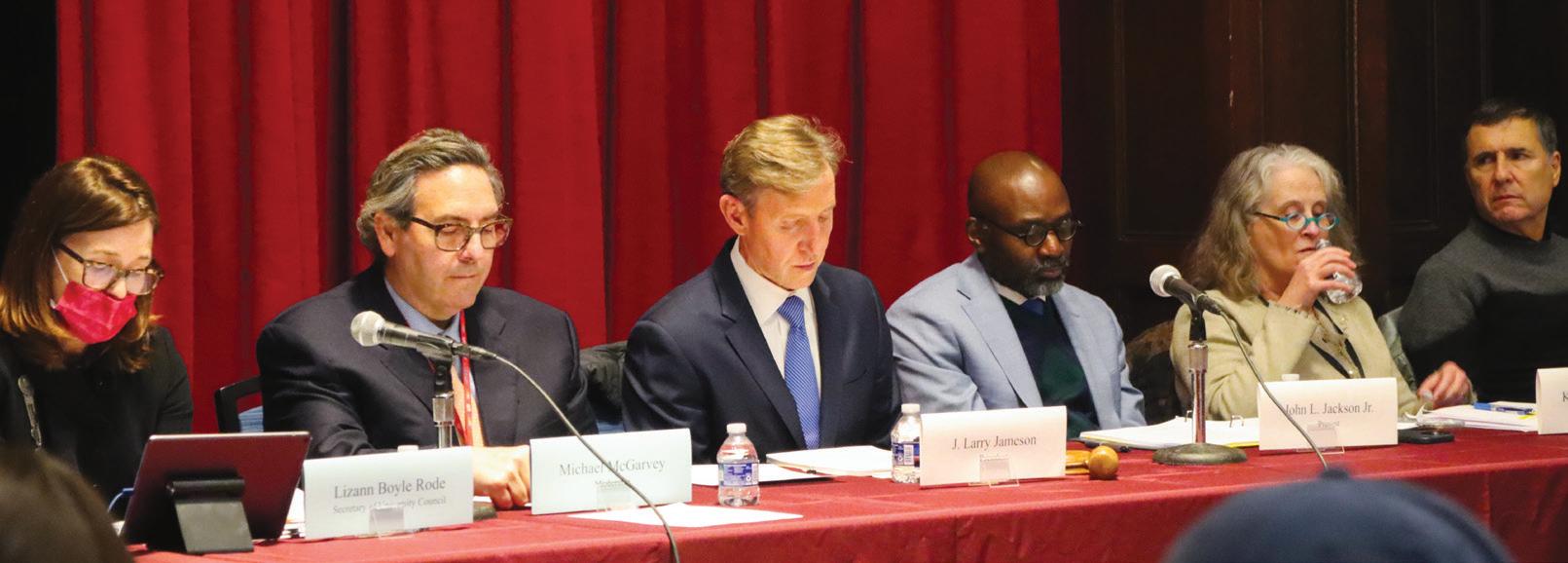
Penn administrators pictured at the University Council meeting on Dec. 3.
Your Halloween situationship got awkward. What now?
ASK AUDREY | Let’s talk about your Halloweekend...
Welcome back to “Ask Audrey,” my advice column where I do my best to answer your questions and weigh in with my advice. This week, we’ll be tackling the repercussions of one of the most drama-filled weekends of the semester: Halloween weekend, more commonly referred to as “Halloweekend.”
This week’s question: “I made bad decisions on Halloweekend and now I need to avoid this man’s advances. After certain things occurred between us, I would rather not continue our relationship (if you can even call it that). The issue is I keep seeing him everywhere and he keeps texting me. I want to let him down easy, but I don’t want to make it too awkward because we have some mutual friends. Please help!”
Yikes! Thank you for writing in with this. One of the great joys of Penn is being able to stroll down Locust Walk and see all of the people you’ve ever met here. It’s the greatest tool this school has against the loneliness epidemic. But one of the great drawbacks of Penn is that it becomes extremely challenging to avoid someone when you’d most like to, particularly if you have mutual friends.
I agree that you should try to avoid awkwardness as much as possible — you want to respect the fact that you had “certain things” occur between the two of you and that he may feel differently about it than you do. You also don’t want to create an uncomfortable situation for your mutual friends, who may feel weird about hearing the situation from both sides,
particularly if you’re both complaining about the other person.
I don’t know the extent of your previous relationship with this man, but I think if you’ve had any kind of previous interaction, you should have a conversation in person. When you have one of your unexpected run-ins, stop him and ask if he’s willing to chat for a bit sometime soon. Then, you can gently explain that you are not in a place to explore any kind of further relationship with him, but that you appreciate his interest. The best way to let someone down easy is to make them feel that nothing you’re feeling is because of any of their inherent flaws, and that you genuinely are flattered by the fact that they’re interested in you.
If you’re not feeling particularly flattered, or if you genuinely are turned off by an inherent flaw, try to remember that putting yourself on the line for someone you’re interested in is a scary thing to do, no matter who you are. The fact that he keeps texting you does show a willingness to take a risk, which I think you can appreciate separately from anything you might not really care for about him. If I’ve completely misconstrued the situation and this is a man you barely know who doesn’t seem super invested in you outside of doing “certain things” again, then I think you can have a similar conversation, but over text. I know that might be controversial to some nonGeneration Z readers, but if you guys haven’t interacted much in person in the past, doing
this conversation face-to-face might actually make things more awkward for both of you.
The last thing I’ll say on this is that if you decide you won’t let something get awkward, it won’t be. I firmly believe that awkwardness is a construct that you can take down with a simple mindset change, but as the person doing the letting down, you have to be the one to not allow the awkwardness to fester. If you see him in group settings after this conversation, be friendly and talk to him like you would to any other person there who you have mutual friends with. While this guy probably won’t be happy about this outcome, I’m fairly certain
that you will be able to move forward from this and keep the peace among your social circles. Good luck!
If you’re interested in submitting anonymously to “Ask Audrey,” feel free to do so here. All advice should be taken with a grain of salt.
AUDREY LEVENSON is a College junior from Pelham, N.Y. studying political science and English. Her email is audklev@sas.upenn.edu.
shares guidance on navigating the end of a situationship.
Polarization isn’t killing democracy. Our inability to listen
is
BEVAN’S BRIEF | Our democracy won’t function unless we confront our own epistemic bubbles
Following the 2024 presidential election, I wrote a piece in my high school paper about why I believe political differences should impact friendships. In it, I wrote that when political choice threatens others’ basic rights, that’s no longer a small disagreement; it’s a serious moral divide. If someone supports a candidate who refuses to respect people’s humanity, it’s hypocritical to insist that all political differences deserve respect. And if someone recognizes the harm but still chooses to ignore it, they’re condoning hatred and intolerance. To this point, I stated that I could coexist with people I disagree with on major issues, but real friendships can’t be built upon a cycle of agreeing to disagree. I now take a different perspective; in
hindsight, I realize my stance to be somewhat closed-minded, and perhaps even pointless. No matter how much someone might agree or disagree with you doesn’t actually matter. The basis of this argument does nothing to improve the social implications of politics at present and contributes absolutely nothing to improve the state of politics itself; it fails to engage with the problem. All it really succeeds in doing is giving people permission not to challenge their own views along with their views of the other side. In our polarized state, what we are in dire need of comes down to two simple things: pluricentric conversations and empathy.
In American society, we are divided by epistemic bubbles — types of social structures
Penn is not on stolen land
that fuel exclusion by omission, through natural ideological homogeneity. We belong to — and move through — our own separate communities, which leads to confirmation bias, and at worst, misinformation and isolation. Ideological differences fuel extreme polarization, as we can see in present-day politics. The most dangerous form of this polarization, arguably, is psychological polarization, when people doubt the values of the other side. And I am guilty of this, as seen in my previous article. In some cases, polarization doesn’t harm the function of a democratic nation, so long as there is not only peaceful coexistence but also trust and empathy between and across the political divide. And obviously, this is easier said than done; I still believe that central to this country’s politics in the present day is the disavowal of the rights of the many marginalized individuals in this country whose voices are suppressed — and certain voters are standing on the wrong side of a stark moral divide. Yet, I am still working on my own open-mindedness. Denying the humanity of voters with different political views is wrong, even when we disagree, and more importantly, it undermines the fundamentals of democracy. Democratic citizens need to be able to work together, regardless of their stances on certain issues. A healthy democracy depends on discourse rather than the imposition of will, and it thrives when we engage in pluricentric conversations — bringing in multiple perspectives
rather than isolating ourselves in harmful echo chambers. Fundamental to democracy is diversity — not just in race, culture, and religion, but in thought. So, of course, we will inevitably disagree on many beliefs and policies, but isn’t that the point?
I recently received a unique piece of advice in a video lecture from Graduate School of Education professor of history of education Jonathan Zimmerman: Every day, consume a news source that was not curated for you; otherwise, your worldview will remain unchallenged. To understand the world, we must understand those who are different from us. We must work to overcome our biases, and at the root of the problem of political divisiveness and polarization is, not surprisingly, the individual.
So when you find yourself sitting at the dinner table over winter break with that “crazy” uncle, and the topics of reproductive rights and immigration come up, try to have some empathy. And understand that, while hard to believe, it is still possible to hold shared values even with wildly opposing views. Everyone understanding this and acting accordingly is the only way our democracy will be able to function effectively.
SIENNA BEVAN is a College first year from Santa Monica, Calif. Her email is smbevan@sas.upenn.edu.
GUEST COLUMN | Why Penn’s land acknowledgement oversimplifes history and delegitimizes the United States
In the past few years it has become increasingly common to hear land acknowledgements at universities across the United States, including here at Penn. At no other time are these land acknowledgements more popular than around Thanksgiving, with some arguing that the holiday itself should be reframed or even abandoned. Meanwhile, social media has become filled with self-righteous content creators instructing us on how to reckon with the fact that we live on “stolen” or “conquered” land. This premise, however, collapses under even minimal historical scrutiny.
Human beings have never lived in a world of fixed, permanent ownership. We have migrated, conquered, traded, intermarried, displaced each other, and resettled since the beginning of time. To pretend that the land beneath Penn’s campus existed in some pristine, uncontested state until Europeans arrived is simply incorrect.
Land acknowledgements rest on the flawed premise that land can ever be “unconquered.” In reality, all land, everywhere, has changed hands through settlement, migration, and conquest since the dawn of civilization.
Many of Penn’s institutional materials state: “We recognize and acknowledge that the University of Pennsylvania stands on the Indigenous territory known as Lenapehoking, the traditional homelands of the Lenape, also called Lenni-Lenape or Delaware Indians.” This statement on its face is correct. However, the implication
that the Lenape were the first, uncontested, or permanent holders of this land is historically incomplete.
Archaeological research shows that the Delaware Valley has been inhabited for roughly 10,000 years, with different cultural groups inhabiting and engaging in frequent warfare in the region over millennia. The Lenape themselves entered the region gradually and were by no means the earliest inhabitants of what would eventually become West Philadelphia.
The land beneath Penn’s campus is part of a long, complex chain of settlement and resettlement, not an uncontested homeland belonging to one specific group. Land acknowledgements rest on the assumption that there is some identifiable “original owner” of a given territory and that political legitimacy depends on restoring land to that group.
However, the historical record, in Pennsylvania and everywhere else on Earth, shows that populations have shifted continuously for thousands of years. There is no coherent point in a long chain of conquests at which we can freeze history and declare that a certain group is the rightful and permanent owner of any land. Even if we tried to return land, the practical questions become unanswerable. To whom would it go? The Lenape as they existed in 1600? The Iroquois as they did in 1700? Or perhaps to the countless earlier communities whose names are now lost to history? Which civilization in
what moment of time deserves ownership?
Attempting to unwind centuries of demographic and political change inevitably becomes an exercise in selective morality. Why should one moment in history, presumably the arrival of the Europeans, be more significant than all the moments that came before it?
None of this is to deny the suffering that Indigenous peoples endured. The arrival of the Europeans brought disease, war, broken treaties, and profound cultural disruption. These injustices were real and left lasting wounds. Any honest account of American history must confront that past.
But acknowledging historical wrongdoings does not require embracing the idea that the United States is fundamentally immoral. That view misunderstands both the nature of history and the nature of the American project. If conquest alone renders a nation illegitimate, then no country or people on Earth can claim legitimacy, including the Lenape, Iroquois, or any civilization whose history includes migration, conflict, and expansion. Conquest is a universal human story; it tells us how societies emerged, not whether they are capable of moral purpose.
The United States’ legitimacy does not come from undoing its past, but from the principles it enshrines: liberty, equality, and the belief in self-determination. To say that the United States is irredeemable is to ignore the millions who have found opportunity, dignity, and freedom in this great
land. The country’s defining story is not one of genocide, but of an imperfect nation striving to achieve its perfect ideals. So next year in the spirit of Thanksgiving, let’s skip the land acknowledgement and take a moment to appreciate the opportunity to call the United States home.
BO GOERGEN is a College senior studying political history and international relations. His email is rgoergen@sas.upenn.edu.
HANNAH CHOI | STAFF PHOTOGRAPHER
Columnist Audrey Levenson
EMMI WU | DP FILE PHOTO
Columnist Sienna Bevan reflects on her prior position to examine how empathetic engagement with disagreement is key for democracy.
HANNAH CHOI | STAFF PHOTOGRAPHER
has amped up. It brought to light a sentiment that the administration can’t ignore: Penn’s PR needs to change direction. Penn was founded in 1740 and is the one of the oldest universities in the United States. It rose to prestige in the late 20th century and is now tied for No. 7 in the nation. Not only that, but it’s now No. 5 in terms of lowest acceptance rates, and its admission process is only getting more selective. Penn’s history is broad and full of notable successes, including creating the first medical and business schools in the United States, pioneering research in the medical and computational fields, and boasting a long list of successful, householdname alumni. It has been long regarded as a respectable and accomplished institution.
But does that still ring true today?
Recently, it seems the nation is facing a rising trend in anti-education sentiments that not only stem from the governmental slashing of funding, but also the idea — whether or not the job market reflects it — that a college education just isn’t valuable anymore. This puts Ivy League schools in a difficult place. With Penn’s reputation closely tied to the Wharton School, it’s hard to put this idea of elite political and business wealth against the new values our generation holds. It’s becoming increasingly apparent that Ivy League institutions are more about politics than education, and people are rarely happy with our political decisions.
Whether it be Penn’s decision to “negotiate” with Donald Trump over the proposed compact for preferential funding (we all know it loves constructive feedback), the decision to revoke Lia Thomas’ medals, or the questionable handling of antisemitism on campus from then-Penn President Liz Magill, the past few years, it seems, have been scandal after scandal for Penn. But it’s not just political events, it’s the value Penn has been pushing for over a hundred years: prestige. It’s not that people don’t accept the idea of prestige; it’s that Penn has created an image of elitism tied to politics that doesn’t sit well with the rest of the country. It’s a message that shouts to people teetering on anti-education: Colleges are political, not educational. There’s a
difference between innate and performative elitism. Penn used to be an institution that spoke for itself; its name alone carried the title of respect and priority. But now, with the lack of enthusiasm for high-level education, we seem to be manufacturing a picture of elitism through political decisions and glossy pamphlets. Unfortunately, it’s no longer appealing to the public. There’s no need for a top-10 school to promote wealth through political deals or put on a performative front telling the country about how amazing we are; we should be showing it.
Penn’s PR needs to shift away from trying to
project elitism onto the nation and move towards letting our actions speak for themselves — in a good way, for once. Instead of telling communities how much further above them Penn is, we should be working with them to make education more accessible. Instead of presenting a facade of perfection, we should promote transparency and accountability within education. And instead of tailoring every decision to politics, we should be focused on the people Penn is actually made up of: people from every corner of the world.
GSE being hacked was, at first, a humorous email that took over Sidechat for a day, but it
turned into a call to Penn’s administrative board. Prestige doesn’t come from money or political alliances; it comes from making a genuine impact on the community. So, what do we really want to be known for, elitism or prestige? After 285 years, it’s time for Penn to decide.
CHARLOTTE PULICA is a College first year from Enoch, Utah studying criminology and economics. Her email is cpulica1@sas.upenn. edu.
LAYLA NAZIF | STAFF PHOTOGRAPHER
Columnist Charlotte Pulica argues that the nation no longer cares about elitism in education.
Members of The Daily Pennsylvanian Sports department sent in their predictions for the championship matchup
THE DAILY PENNSYLVANIAN SPORTS DEPARTMENT
On Saturday, Penn men’s basketball will take on Villanova at the Xfinity Mobile Arena in the championship game of the Toyota Men’s Big 5 Classic. Tip-off is scheduled for 7:30 p.m.
Members of The Daily Pennsylvanian sent in their predictions for the title game.
Villanova wins: Conor Smith — deputy DP Sports editor I did not think Penn would beat Saint Joseph’s. I was wrong. I walked down 33rd Street to Drexel expecting a Penn loss. I was wrong. I do not expect to be wrong for a third time. Villanova is going to beat Penn on Saturday by double digits.
The Wildcats are coming off an impressive win against Temple, where they went on a 15-2 second half run to skirt past the Owls. New coach Kevin Willard’s team may be a few years out from competing for the Big East again, but the Wildcats look like they have a blossoming star in Villanova guard Acaden Lewis.
Alongside Lewis, two more Villanova guards are bound to give Penn coach and 1982 Wharton graduate Fran McCaffery a migraine this Saturday: Bryce Lindsay and former Quaker Tyler Perkins. I expect freshman guard Jay Jones, a lengthy 6-foot-4 player, to play a lot on Saturday to slow down Villanova’s impressive backcourt. Against La Salle on Saturday, Jones played the majority of the second half, and his defense was a major factor as to why Penn beat the Explorers.
For Penn to win, it will have to control the pace of the game, forcing Villanova to play as fast as the Quakers do. The Quakers are averaging 72.7 possessions per game to the Wildcats’ 67.5. If they can speed up Villanova, leading to turnovers and mistakes, Penn has a shot.
Penn wins: Kaia Feichtinger-Erhart — DP Sports reporter
Is it unlikely? Yes, of course.
Penn has only beaten the Wildcats four times in 25 total matchups. Only two of those wins have come in the last 23 years. Penn finished last year’s Big 5 Classic at the bottom of the standings, but this is the Quakers’ first time in a Big 5 Classic championship game in its current format, and it might as well lead to glory. After all, Penn has recently shown that Villanova is not unbeatable in Big 5 games. The last time the Wildcats had to travel to a matchup with Penn was two years ago, when they were defeated 76-72 in the Palestra. The likes of senior guard Cam Thrower and junior forward Augustus Gerhart certainly still remember what it feels like to send Villanova home in defeat.
On neutral ground this Saturday, the Quakers will get their first big chance to prove themselves under McCaffery’s helm. Who knows? Maybe Penn basketball will gift a very early Christmas gift to help students through the last weeks of the semester.
Villanova wins: Javier St. Remy — DP Sports associate Villanova is far and away the toughest opponent that the Quakers will face this season. The Wildcats boast a 6-1 record with their only loss coming against No. 9 BYU in their first game of the season. The
Wildcats have since won six-straight games, posting an average margin of victory of 18.5 points.
The Quakers are coming off of a disappointing double-digit Cathedral Classic loss to Hofstra in which the Red and Blue were limited to a mere 32.3% shooting accuracy from the floor. Penn also narrowly defeated La Salle — a team the Wildcats trounced by 15. With that being said, the Quakers will not be eviscerated as they were in last season’s 44-point blowout loss. The Quakers are a much better team this season, having won four of their last five games. Additionally, with last season’s NCAA Division-I leading scorer and former Villanova power forward Eric Dixon having graduated, this matchup should be far less lopsided.
I do expect this game to be competitive for the majority of the first half. The Wildcats’ strong talent and momentum going into this game make this their championship to lose.
The Wildcats are entering the Big 5 Classic championship on a six-game winning streak. The Quakers are entering this game with a statistically competitive matchup.
Senior guard/forward Ethan Roberts is leading the Quakers in points and steals per game with an average of 20.3 and 1.5 respectively, which is on par with Villanova’s leaders. Although Penn is entering the game with competitive statistics, Villanova has played more challenging teams compared to the Quakers. For example, Villanova lost by less than 10 points when it played against
MEN’S, from back page
McCaffery have been reborn.
“Coach McCaffery has done a good job of breaking down film,” junior forward TJ Power said. “Sometimes we’re outmatched in size and athleticism and talent, and we make up for that in preparation. So I expect us to be prepared and ready to go.”
Throughout the year, teams have tried and failed to stop the hydra that is Penn’s offensive attack. After Zanoni got off to a lightning start, scoring 50 points in two of the season’s first three games, teams began to face-guard him. That coverage opened opportunities for newcomers like Power and freshman center Dalton Scantlebury to take over in recent games.
After winning two out of three games in the Cathedral Classic, Scantlebury and Power took home weekly awards in the Big 5. Power won Big 5 Player of the Week, while Scantlebury won Big 5 co-Rookie of the Week as well as Ivy League Rookie of the Week.
“We have a lot of guys on any given night that can produce big numbers … that can create opportunity,” Zanoni said.
No. 9 BYU. On the other hand, when Penn played Providence, another Big East program, it lost by more than 20 points. In terms of the Big 5, Penn defeated La Salle by a mere two points to qualify for the title game, whereas Villanova defeated La Salle by 15 points. With Villanova performing better against better teams, I unfortunately believe that the Red and Blue will lose the Big 5 Classic championship game.
At least Penn will be the best team in Philadelphia proper, and we have the right to call ourselves a Philadelphia school, which — as a Philadelphia native — I think Villanova cannot.
One player who will be integral to a win is senior guard/forward Ethan Roberts. Before Thanksgiving, Roberts was named Lou Henson National Player of the Week and accrued multiple other weekly honors after dominant 30-plus scoring performances in both of Penn’s Big 5 victories. However, the Wildcats, led by guards Bryce Lindsay and Acaden Lewis and forward Duke Brennan, will be a challenge this weekend. Villanova has dominated every opponent outside of a narrow loss to No. 9 BYU in its season opener. Brennon leads the Big East in rebounds, while Lewis was named Big 5 co-Rookie of the Week alongside Scantlebury.
Former Quaker and current Villanova guard Tyler Perkins will also be key to a Wildcat victory. The versatile guard put up 21 and 19 points in the Wildcats’ wins against Old Dominion and Temple respectively. Perkins was notably playing for the Quakers during the team’s 2023 upset over Villanova.
Perkins and Roberts have both had strikingly similar roles for their respective programs. Each solidified themselves as a key piece on the offensive front, averaged double digit scoring, and served as leaders on teams featuring several new players. The Big 5 title could come down to a battle between Penn’s past and present.
GRACE CHEN | SENIOR PHOTOGRAPHER
Then-junior Michael Zanoni photographed in a shot against Drexel at the men’s Big 5 Classic on Dec. 7, 2024.
Clark | Penn’s new NIL initiative earned a spot at the Thanksgiving table
Men’s basketball’s new name, image, and likeness program gives the Ivy League a competitive edge
ELLIE
CLARK Sports Reporter
Instead of exchanging platitudes at the dinner table this holiday season, you should ask your family about the state of name, image, and likeness in college sports. Although my family never really took to sports beyond spectating, one of my cousins shines as a prospective Division-I baseball player. Even as a junior in high school, he’s already carefully considering whether or not to go the junior college route, which training camp he should prioritize, and if he should compete on an out-of-state team next summer for more exposure.
All of these decisions, coupled with an insane workout regimen and pitching for three teams, are
intentionally executed to get my left-handed pitcher cousin into the best baseball program possible.
Personally, I think he’d be a great pickup for the Quakers, who lost program-great left-handed pitcher Will Tobin, a 2025 College graduate, last spring. But while education is an important factor, my cousin will ultimately choose to go wherever NIL money talks, which is not the Ivy League.
For those unfamiliar, NIL deals refers to the sponsorship deals that a student-athlete can pursue to profit off their name, image, and likeness. The NCAA legalized NIL deals in July 2021 after immense student-athlete outcry and a series of antitrust suits. NIL was strengthened this summer after the courts
Basketball is pretty fast paced, so knowing the basics is helpful. And don’t fret, the announcers will help explain what’s going on — especially the enthusiastic ones at Xfinity Mobile Arena.
Which players should I watch out for?
ruled in favor of the student-athletes during House v. NCAA deliberations, requiring schools to adopt revenue-sharing models that pay student-athletes. The Ivy League notably opted out of the House settlement in January before a ruling was made.
Some student-athletes like Texas quarterback Arch Manning and BYU freshman forward AJ Dybantsa receive millions of dollars from individual NIL deals, while other athletic programs house NIL collectives benefiting a whole team.
In accordance with NCAA standards, the Ivy League allows legitimate NIL through third-party businesses, but it has a hard stance against collectives and direct payouts to athletes.
A few weeks ago, during a question and answer session, Penn men’s basketball coach Fran McCaffery, a 1982 Wharton graduate, stated that a new NIL “collective” was in place for the program.
McCaffery’s answer to the NIL question was carefully crafted to quell Ivy League fears. He emphasized legitimacy and potential internships — a perfect selling point for an institution engulfed in preprofessionalism.
Penn’s internship program supports a legion of student-athletes who already have to balance D-I athletics with rigorous academics, but it puts pressure on alumni to sponsor these positions and potentially pay Penn student-athlete interns different wages than interns who went through the typical professional recruiting process.
The application of this idea is still unclear, but providing more financial support for student-athletes incentivizes future generations to seriously consider the Ivy League for both its academic and athletic programs. As a result, this will make the Ivy League a more competitive and supportive athletic conference.
Although the Ivy League Instagram page likes to tout rankings and statistics that consistently place the Ivy League as the fifth strongest athletic conference, it fails to account for how NIL and new financial choices will drive the recruiting process. The Ivy League’s 88 nationally ranked teams mostly came from non-flagship sports.
The Ivy League has a flagship sports problem, which is exacerbated by the lack of NIL and athletic scholarships.
With the exception of the annual Harvard-Yale football faceoff, the general Ivy League student body does not engage with student athletics beyond supporting friends. The Quakers’ season-ending football game against Princeton two weekends ago had a listed attendance of just 3,093 spectators.
It’s discouraging as a student-athlete to attend an institution that doesn’t emphasize athletic greatness. Even bottom-of-the-barrel, Big Ten bum Maryland, whose lackluster attendance earned a write-up in the Washington Post three years ago, recorded a 46,185person turnout for its game against Michigan last weekend. Choosing which college to commit to is ultimately a business decision. Although the Wharton School is the strongest business school in the country, more and more prospective recruits are going to turn away from the Ivy League academic allure for lucrative NIL deals and scholarships at other institutions.
Penn’s new NIL initiative is a bold deviation from the Ivy League norm, but it’s just what the conference needs to remain competitive — or at least, that’s how my family sees it.
How does basketball work?
Similarly to other sports, the winner of a basketball game is determined by scoring more points than your opponent. Each team will have five players on the court at a time attempting to get the ball into their opponent’s basket or defend their own basket. Players score points by shooting the basketball into the hoop. Shots from anywhere within the circular arcs on the court are worth two points, while those beyond the arc are worth three points. Points can also be scored from the free-throw line if a player is fouled.
The structure of the game is two halves with a break in the middle. There are also several media timeouts spread out throughout the game.
Expect action from senior guard Ethan Roberts, who has averaged 20.3 points per game so far this season. The week before Thanksgiving, Roberts was named Lou Henson National Player of the Week for his scoring power in both of the Quakers’ previous Big 5 matchups.
Junior forward TJ Power will be a big contributor to his first Big 5 Classic after dropping a career high of 29 points last weekend against Big 5 foe La Salle. His debut with the Quakers this year is a strong step up from his quieter freshman and sophomore seasons at Duke and Virginia, respectively. Finally, be on the lookout for senior forward Michael Zanoni, who has become a sharp-shooting weapon this year in the Quakers’ arsenal.
ANNA VAZHAEPARAMBIL | DP FILE PHOTO
Sports columnist Ellie Clark writes in support of Penn’s NIL intiative.
GRACE CHEN | SENIOR PHOTOGRAPHER
Then-junior forward Johnnie Walter pictured going for a layup against Drexel at the men’s Big 5 Classic on Dec. 7, 2024.
LYDIA TONG | DP FILE PHOTO Sawyer pictured with the ball while playing against La
The biggest game of the year is here.
On Saturday, Penn men’s basketball will battle Villanova for the Toyota Men’s Big 5 Classic on neutral ground at the Xfinity Mobile Arena with tip-off set for 7:30 p.m.
The Quakers are looking for their first Big 5 championship since 2019 and first ever in the new “classic” format. Regardless of outcome, this matchup is a huge one in terms of momentum for the program in its first season under coach and 1982 Wharton graduate Fran McCaffery. Last year, the Quakers finished sixth in the Big 5. Whether it’s your first Penn men’s basketball game or your 10th, this matchup is a must-watch event. The Daily Pennsylvanian Sports department has got Penn students covered on the
must-knows about the game itself, tickets, and players to watch.
What is the Big 5? What is the Big 5 Classic?
The Big 5 is a historic association of six college basketball programs in the Philadelphia area: Penn, La Salle, Temple, Villanova, Saint Joseph’s, and Drexel. One may think, “So, there are six schools in the Big 5?” — there are indeed. Drexel was added as a sixth member of the Big 5 in 2023.
Along with this addition, the new format of competing for a Big 5 championship was announced. The Big 5 is broken down into two pods made up of three teams, and the standings within those pods dictate the seeding for a single-day triple-header at Xfinity Mobile Arena to decide
the Big 5 champion. The winners of each pod compete for the championship in the final game of the triple-header. Games to decide the runner-up and third-place teams precede the championship matchup.
Penn won its pod after defeating St. Joe’s and Drexel before Thanksgiving break, clinching its spot in the championship game. Villanova defeated Temple on Monday to also advance to the championship.
How do I get tickets? How can I get to the venue?
Penn Athletics is offering free tickets on a reservation basis as well as a free T-shirt and transportation to the arena.
After being reserved, tickets can be picked up at the Penn Athletics ticket office from 9 a.m.-5 p.m. on Thursday and Friday or at the Palestra from 5-7:30 p.m. on Thursday. Tickets that are not picked up during those times will be distributed at bus check-in.
The free bus transportation for students
the event.
EYES ON THE PRIZE
obviously a big stage in the Big 5 championship, something that we’ve circled and wanted to get … and we’re playing to win, so we’re excited,” senior forward Michael Zanoni said.
After handing the Quakers their worst loss in more than a decade last season, Villanova looks to maintain its dominance while also taking home citywide bragging rights along the way. This season, the Wildcats picked up victories with dominant performances over La Salle and Temple to earn the opportunity to win the Big 5 title.
“The opportunity to play at Xfinity Mobile Arena against a team of that caliber is a great opportunity for our program,” coach and 1982 Wharton graduate Fran McCaffery said in an interview with Crossing Broad. “Our guys have earned it and we’re looking forward to it.”
Characterized by their high tempo and diverse offensive firepower, the Quakers under
There’s a bit of deja vu in the air.
This weekend, Penn women’s basketball will battle La Salle for fifth place in the second-annual Toyota Women’s Big 5 Classic at Villanova’s Finneran Pavilion. The two played in the same match a year ago in the inaugural edition, and Penn is looking for a repeat performance.
Last season, the Quakers overpowered the Explorers 74-61 in the championship to take fifth place in the Big 5. In the game, four players notched points in double figures while Penn coach Mike McLaughlin secured his 250th win with the program.
“What they did since we went into this format [for the Big 5 Classic] has added a little excitement. There’s an end. There’s a definitive winner. There’s a definitive second place, third, and on. I think it made the first two games more purposeful,” McLaughlin said. “Being a part of it last
year was pretty exciting.”
“Big 5 has been fun every single year. It’s a super exciting opportunity, especially to play at Villanova and playing La Salle,” senior guard Simone Sawyer added.
McLaughlin is rolling out a similar squad this year. The offense is powered by junior guard Mataya Gayle, who is notching 10.6 points and 4.1 assists per game. Meanwhile, last year’s Ivy League Rookie of the Year and sophomore forward Katie Collins is averaging a team-high 11 points alongside hauling in 6.9 rebounds per contest. Collins primarily played the center position last year, but she has moved to power forward this season.
A notable departure for the Quakers this offseason was 2025 Wharton graduate Stina Almqvist, who led the team in total points last season and notched 1,110 points over her career.
McLaughlin has turned, in part, to junior center Tina Njike to help fill in Almqvist’s scoring prowess. Njike had a quiet first two years at Penn, partially due to injury, but she has averaged 9.3 points in eight starts at center this season.
“We flowed the ball through each other, played through the middle, played to our post kids.
We’re timely on our cuts. We’ve been very effective,” McLaughlin said.
Alongside Njike, senior guards Saniah Caldwell and Sawyer round out the Quakers’ offense.
“The Big 5 is just definitely a higher level,” Sawyer said, who is averaging 10.1 points per game. “All games mean a lot, but the Big 5 is a big deal in Philly.” Penn dropped both of its Big 5 matchups to Drexel and Saint Joseph’s. Against Drexel, Penn struggled early. The Dragons limited Penn to
just one point in the second quarter while Drexel poured it on from beyond the arc. Similarly, against St. Joe’s, Penn allowed run after run as the Hawks soared past Penn 74-53.
“We learned a lot from those games, and then even bringing [those lessons] into the games after, I think it showed,” said Gayle. “Going [in] to our third game, obviously, we want to get a win under our belt. We respect the team, but I think it’s definitely a pride game for us.”
“We’re all ready. We’re hungry to win,” Gayle continued. “These last two weeks, we’ve really grown a lot as a team. I think losing teaches you a lot as a team, and we’ve lost to some very talented teams. We’ve watched a lot of film, we’ve talked a lot, we’ve shot a lot.”
Like Penn, La Salle dropped both of its Big 5 matchups, falling to Temple and Villanova. See WOMEN’S, page 7