Penn spent record $770,000 lobbying federal government last quarter
According to a recently filed disclosure, Penn lobbied the federal government on several issues including financial aid and visas
KATHRYN YE
Staff Reporter
Penn spent $770,000 lobbying the federal government in the fourth quarter of 2025 — the highest single-quarter expenditure on record.
According to a recently filed disclosure, Penn lobbied the federal government on several issues — including higher education issues, international students and visas, student financial aid, and physician payment. This fiscal quarter, the University spent $510,000 internally and an additional $260,000 to retain the services of three external lobbying firms: BGR Group, Cassidy & Associates, and Mehlman Consulting. Penn listed Associate Vice President for Federal Affairs William Andresen and Penn Medicine Corporate Director for Government and Community Relations Kristen Molloy as individuals who lobbied on behalf of the University in its disclosure report.
A request for comment was left with a University spokesperson.
At the start of the last fiscal quarter of 2025 — which spanned from Oct. 1 to Dec. 31, 2025 — 1968 Wharton graduate and President Donald Trump’s administration presented Penn and eight other universities with a compact that promised preferential funding treatment in exchange for compliance with a set of sweeping guidelines. Just over two weeks later, Penn rejected the White House’s offer.
At the time, White House spokesperson Liz Huston told The Daily Pennsylvanian that any university “unwilling to assume accountability and confront these overdue and necessary reforms” will not benefit from “future government and taxpayers support.”
Penn continued to retain BGR Group — one of Washington’s largest lobbying firms — which it first contracted in May to advocate on its behalf with federal policymakers.
This quarter, the University paid the firm $140,000 to advocate on “issues related to higher education and research appropriations,” according to a filing.
Six BGR Group lobbyists represented Penn — including 1994 Penn graduate and Managing Director David Urban, who served as a senior advisor to Trump’s 2016 presidential campaign.
Penn spent $80,000 to retain the services of Cassidy & Associates and paid $40,000 to Mehlman Consulting.
Last year, a DP analysis projected that Penn would spend nearly $1.8 million lobbying the federal government in the fiscal year of 2025. In total, Penn’s lobbying expenditure in 2025 — both internal and external — totaled over $2 million.
Penn slams ‘unconstitutional’ federal antisemitism subpoena
A Tuesday filing stated that while the University has complied with agency demands, it remains unwilling to submit the personal information of Jewish faculty and students without their consent
ALEX DASH AND LAVANYA MANI Senior Reporter and Staff Reporter
Penn filed a brief on Tuesday challenging an Equal Employment Opportunity Commission subpoena that requested information about Jewish students, faculty, and campus groups.
The Jan. 20 filing echoed previous arguments made by Penn, stating that the University has complied with the agency’s demands but remains unwilling to submit personal information without the consent of the affected parties. The brief described the EEOC’s demands as “disconcerting but also entirely unnecessary,” arguing that disclosing private details would “erode trust between Penn and its employees and the broader Jewish community at Penn.”
In response to a request for comment, a University spokesperson told The Daily Pennsylvanian that the filing
is “comprehensive and speaks for itself.”
A request was left with the EEOC.
“The EEOC insists that Penn produce this information without the consent—and indeed, over the objections—of the employees impacted while entirely disregarding the frightening and well-documented history of governmental entities that undertook efforts to identify and assemble information regarding persons of Jewish ancestry,” Penn wrote in the brief.
The University argued that if the information requested by the EEOC — including home addresses and personal phone numbers — was somehow leaked, the individuals on the lists “could face real risk of antisemitic harm.”
Penn added that “anti-Jewish hate and violence are seriSee EEOC, page 7
Here’s how Penn plans to celebrate America 250 in the nation’s birthplace
The events will take place in partnership with several groups on campus and alongside initiatives at museums across Philadelphia
ARTI JAIN Senior Reporter
Penn Libraries has planned a series of performances, conferences, and exhibitions to celebrate the 250th anniversary of the signing of the Declaration of Independence.
In partnership with several groups on campus, the events will take place alongside initiatives at museums and institutions across Philadelphia. According to Lynne Farrington, the director of programs and senior curator of special collections for Penn Libraries, the planning process for the Semiquincentennial series began in 2021.
“We hope that … by putting out exhibitions and other programming, we can get people to think about these kinds of things and understand more of the history of the country and where it comes from,” Farrington said in an interview with The Daily Pennsylvanian.
As part of the Kislak Center for Special Collections, Rare Books and Manuscripts, Farrington leads programming for events honoring the Declaration of Independence and the subsequent American Revolution.
Other events include a discussion on Thomas Paine’s “Common Sense” pamphlet and a lecture on the printing process of the Declaration of Independence. Another exhibition — open from February to July — will highlight the revolutions in France, Haiti, and Philadelphia, along with an exhibition by the Museum of the American Revolution. History professor Emma Hart, who directs the McNeil Center for Early American Studies, participated in the “Common Sense at 250” panel on Jan. 15. Hart told the DP that she aimed to help students come to terms with “the commonly understood ideas of the revolution as a basis for the nation” and why those ideas have been “contested” since 1776. This spring, Hart will teach “Revolutionary Stories: Philadelphians and the American Revolution,” a course surrounding the stories of Philadelphia residents in 1776. The course is one of 15 specifically designed to celebrate the country’s anniversary. Manager of Penn’s Common Press Jessica Peterson is leading a yearlong program intended to guide participants through the original printing process of the Declaration of Independence and create “historically accurate” replicas of the document. Peterson told the DP that students “using their hands” to make documents has “really activated their understanding of history in a different way.’
“It’s really important to understand American his-
From data analysis to pattern recognition: Here’s how Penn Medicine
is
Across the University’s Health System, scientists are now using artificial intelligence to enhance their understanding of biological systems and modern medicine
As the use of artificial intelligence across medicine increases nationwide, The Daily Pennsylvanian spoke to professors, doctors, and researchers at the Perelman School of Medicine about how they are integrating AI and machine learning into their research.
Across the University of Pennsylvania Health System, scientists are now using AI to enhance their understanding of biological systems and modern medicine. According to multiple Penn Med faculty members, the technology has been used in a variety of ways — from conducting translational research and analyzing data to optimizing healthcare delivery.
Pattern detection and risk prediction
Radiology and Electrical and Systems Engineering professor Christos Davatzikos described how he uses AI to identify early signs of disease and inform preventative treatment plans in an interview with the DP. His lab — one of the first AI-guided radiation therapy projects in the field — used AI to develop methods to analyze brain MRI scans and predict the future progression of a tumor.
Davatzikos works with patients suffering from glioblastoma — a deadly form of brain cancer — and told the DP that AI pattern recognition helped lead to “much longer survival” of affected individuals.
He described AI as a “fundamental” research tool for detecting patterns, since the increasing number of biomarkers used to track diseases makes it “difficult” for one person to visualize how the brain is constantly changing.
“We look at the MRIs, and you don’t know where the tumor is infiltrating,” Davatzikos said. “But the AI is able to look at many different MRI contrasts and create a signature that predicts or detects very subtle changes that later give rise to tumor currents.”
Professor of psychiatry Birkan Tunç — who also serves as a research scientist at the Children’s Hospital of Philadelphia — told the DP that he uses AI to study “almost all psychiatric conditions,” including depression, anxiety, ADHD, and autism.
Tunç described how AI helps his team “capture cues and signals” from video or audio recordings and allows them to compare observations of individuals with au-
using artificial intelligence
SAMEEKSHA
PANDA AND ADDISON SAJI Senior Reporter and Staff Reporter
tism and other conditions. He added that identifying these “signatures” can aid in early diagnosis, which could be “very beneficial for families.”
Perelman School of Medicine Neurology professor Brian Litt is working on a project “testing implantable brain devices that talk to their hosts,” which incorporates AI to report fluctuating levels of risk.
“Your medical device might text you and say, ‘What did you do? Your probability of having a seizure just went up by 60%,’” Litt told the DP. “And you might have had a beer, or taken a new antibiotic or something like that.”
Large-scale data analysis
Informatics in Biostatistics and Epidemiology professor Li Shen described how he integrated AI into one of his major research projects — a machine learning and informatics method that analyzes data and identifies specific Alzheimer’s disease biomarkers.
“We want to identify genetic risk factors and also protective factors, because that can be used for drug development, to try to understand the disease mechanism and accelerate therapeutic discovery,” Shen told the DP.
Associate Dean for Computing at the Medical School Li-san Wang — who serves as co-director at the Center for Artificial Intelligence and Data Science for Integrated Diagnostics — also uses AI in his Alzheimer’s disease research.
In a statement to the DP, Wang wrote that in his research, AI could help integrate genetic findings with other types of biological data — such as RNA, protein, and epigenomic data — which could prove “essential” for understanding the biological mechanisms behind Alzheimer’s disease.
Professor of bioengineering, biochemistry, and biophysics Greg Bowman spoke with the DP about using AI in multiple aspects of his work.
Bowman described how he uses AI to design peptides that bind to proteins not previously considered “viable targets,” and at the data analysis stage.
“It is really useful for helping us find patterns that are difficult to pull out by eye, given the massive amounts of data we generate over time,” Bowman said.
Streamlining research workflows
Davatzikos noted that while AI has been fundamental to his work, general improvements in computational and mathematical methods also allowed his research process to evolve.
“For example, analyzing brain scans was an art by visual inspection,” Davatzikos told the DP. “Now we have tools that precisely go in and measure certain things.”
“My work has been primarily in making imaging more quantitative and more scientifically grounded,” he said.
According to Shen, using AI to help reduce “tedious time computing” has had a “big impact” on his research.
“It actually has all the knowledge rights available, say on the Internet, or whatever knowledge base it has access to ... so it can provide additional thoughts, new sales insights to the expert,” Shen said.
Litt spoke with the DP about Penn’s Center for Health Care Transformation and Innovation, which is using AI to assist in operating room scheduling across Penn’s hospitals.
“You have to be really smart about how you schedule time in operating rooms, if you have downtime, it’s pretty expensive,” Litt said. “There’s a special Penn Health tech fellow, Kevin Shea, who has an algorithm that could potentially save half a million dollars a month in downtime from the operating room by using AI to schedule.” Wang echoed Litt’s sentiment that AI can be beneficial for daily operations within his work — including data organization, annotation, and management — which he said remain “major challenges in large, collaborative research efforts.” He clarified, however, that AI remains “resource-intensive and expensive,” which places limitations on its potential uses.
Tunç also acknowledged that AI, in its current state, is a tool to “improve clinical workflows” and not a substitute for human labor.
“We never see it as a replacement, like trying to replace a human construct, because even the idea of psychology is a human construct,” Tunç said. “You need a human at the center.”replace a human construct, because even the idea of psychology is a human construct,” Tunç said. “You need a human at the center.” See AMERICA , page 3
MEHAK DHALIWAL | DP FILE PHOTO
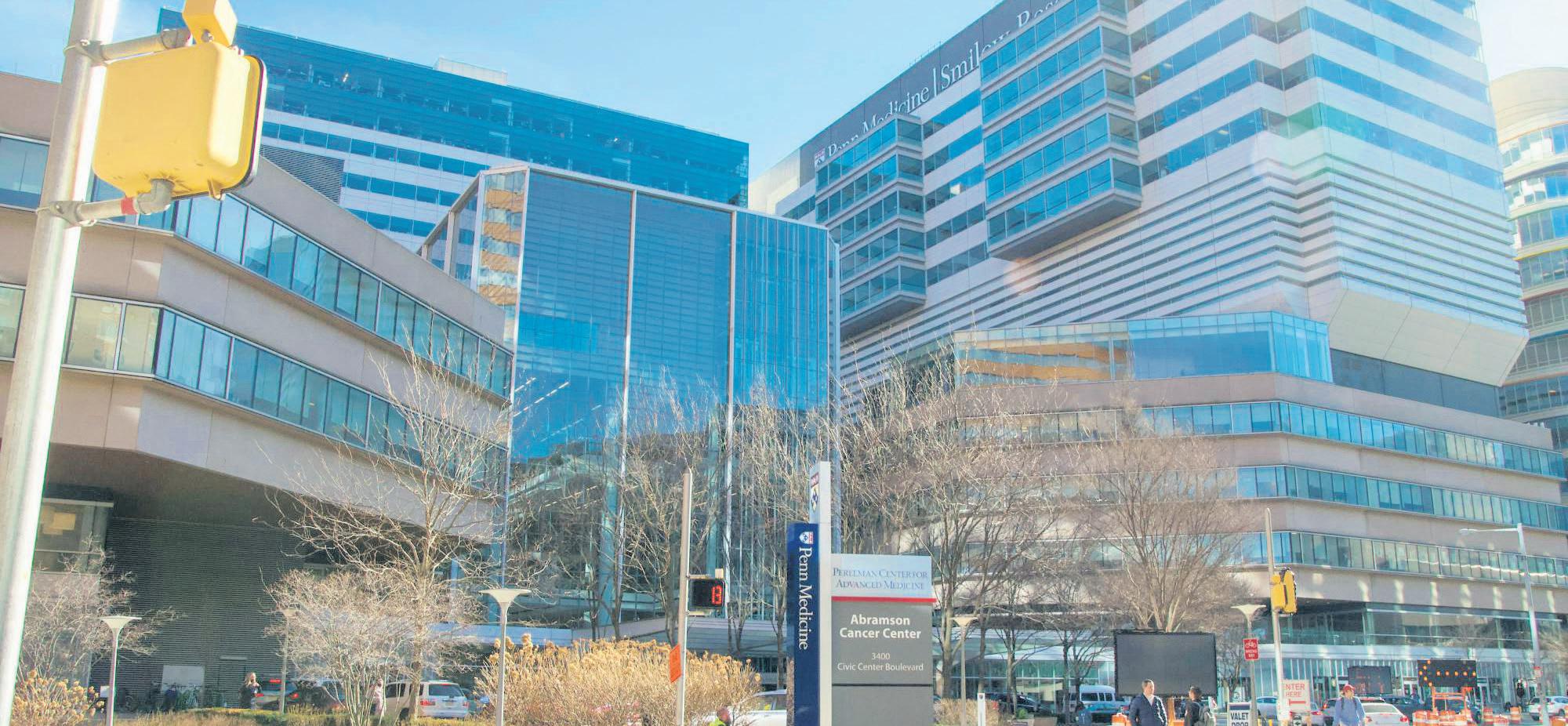
The Penn Medicine campus on Feb. 24, 2023.
CHENYAO LIU | STAFF PHOTOGRAPHER
Part
News
Penn honors Martin Luther King Jr. with day of service, monthlong symposium
The day’s community-centered programming included a children’s art and literacy project, a pet vaccination clinic, and a candlelight vigil
DANNA CAI, CANDICE FELDERER, AND LUKE PETERSEN Staff Reporters
EBUNOLUWA ADESIDA | SENIOR PHOTOGRAPHER
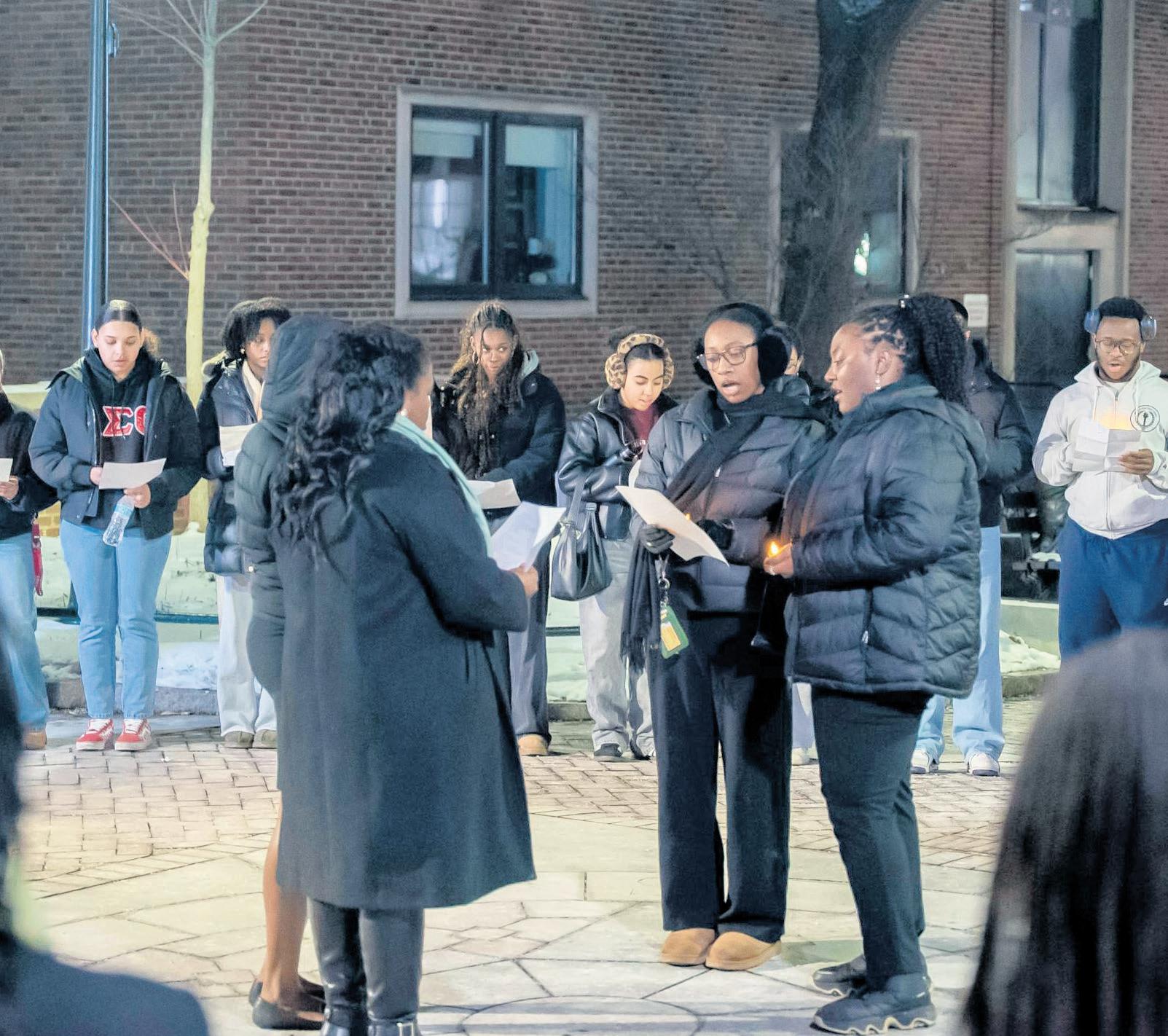
Students sing at Martin Luther King Jr. Day vigil on Jan. 19.
Penn’s African American Resource Center celebrated Martin Luther King Jr. Day on Monday with its annual day of service.
The day’s community-centered programming included a children’s art and literacy project, a pet vaccination clinic, and a candlelight vigil dedicated to King. The Jan. 19 day of service is part of AARC’s Martin Luther King Jr. Symposium, which began on Jan. 14 and will conclude on Feb. 6.
“Each year, beginning the month of January, the University of Pennsylvania and our surrounding communities come together to commemorate the life and legacy of Dr. Martin Luther King Jr.,” an AARC webpage read. “The commemoration reminds us of our interdependence and reaffirms our commitment to the betterment of our communities through civility and service.”
The Free Dog and Cat Wellness and Vaccination Clinic — primarily organized by students in the PennVet Shelter Medicine Club — took place at the Ryan Veterinary Hospital.
According to University of Pennsylvania School of Veterinary Medicine professor David Holt, the clinic provided physical examinations and essential vaccinations to nearly 300 pets. Volunteer clinicians from Penn Medicine and the Children’s Hospital of Philadelphia also provided screenings and free influenza shots to pet owners.
“We’re trying to serve people who don’t have regular access to vet care,” Holt — who supervised the clinic — told The Daily Pennsylvanian. “Their pets are part of their family.” Holt emphasized the importance of serving the Penn and broader Philadelphia community by offering professional services free of cost.
“In law school, my understanding is that pro bono work is emphasized, and that’s something that we want
to promote in the veterinary school as well,” Holt said. Van Pelt-Dietrich Library hosted the Penn Reads Literacy and Children’s Art Project — titled “Imagine A World…!” — where children participated in a theatrical, story time experience, explored the library, and bound a book to take home.
According to a Penn Libraries press release, the initiative — conceived as part of the MLK Symposium over a decade ago — aims “to improve literacy in Philadelphia and expand access to multicultural children’s books.”
In an interview with the DP, Penn Libraries Resource Management Coordinator and event co-organizer Rachelle Nelson explained that the event was “strictly dedicated towards kids in the community.” She emphasized that the program is intended to help younger children see the library not as “a place where you have to be quiet, but a place where you can have fun and learn and just enjoy yourself.”
Around 60 people attended the candlelight vigil honoring King, concluding the day’s programming. The vigil — which began at Du Bois College House and ended at Penn Women’s Center — was co-sponsored by Penn’s Alpha Phi Alpha fraternity and Alpha Kappa Alpha sorority.
“I think it’s important to not only volunteer on days like this, which is critically important, but also lean into Dr. King’s message,” University Chaplain and Vice President for Social Equity and Community Charles Howard told the DP at the event. “Listen to his words, which I think we need to hear now more than ever.” In the coming weeks, the symposium will continue with AARC-hosted lectures, community events, and award ceremonies in
Penn Medicine on ‘front lines’ of new drug crisis as withdrawal cases rise in Philadelphia
In interviews with The Daily Pennsylvanian, physicians and researchers at Penn Medicine highlighted their ongoing efforts to
MARIACRISTINA CALCAGNO Staff Reporter
Emergency rooms across Philadelphia have reported a rise in patients experiencing withdrawal from medetomidine, a veterinary sedative increasingly mixed with fentanyl.
The citywide crisis — which first drew attention in May 2024 — is fueled by medetomidine’s rapid and life-threatening onset of withdrawal symptoms. In interviews with The Daily Pennsylvanian, physicians and researchers at Penn Medicine highlighted their ongoing efforts to treat cases, both at the hospital and following a patient’s discharge.
“There is overlap in withdrawal from medetomidine and withdrawal from opioids,” Ashish Thakrar, an assistant professor at the Perelman School of Medicine, said in an interview with the DP. He added that withdrawal from both types of drugs has been linked to elevations in blood pressure and heart rate, along with nausea, vomiting, and tremors.
The increase in medetomidine within the city’s fentanyl supply comes amid the declining use of xylazine, a veterinary tranquilizer typically mixed with fentanyl that was made illegal for human use in Pennsylvania in May 2024.
According to research by the Philadelphia Department of Public Health, the percentage of street opioid samples with medetomidine grew from 29%
AMERICA , from front page
tory because of the way the world is right now,” she said. “Thinking about what democracy means and what declaring independence from England meant are actually very active concepts right now.”
According to Sean Quimby — who serves as the associate vice provost and director of the Kislak Center — Penn itself is “a product of the American Revolution.”
“That’s why it’s important that the University make an effort to really engage with 2026,” he said in an interview with the DP. “The ideals, the actual individuals, are so much a part of our own founding and early development.”
to 87% by November 2024, while xylazine’s percentage in samples across the city decreased from 97% to 42% during the same period.
Thakrar emphasized the difficulty of predicting severe cases of withdrawal, adding that the increase in medetomidine has led to an overall rise in hospital visits. According to The New York Times, Philadelphia public health records indicate an increase of nearly 4,500 hospital emergency department admissions between 2023 and 2025.
Emily Casey — a clinical pharmacy specialist in pain management and substance use disorders at Penn Medicine — told the DP that the Philadelphia health system “responded really well” to the crisis by making changes “very quickly in terms of the level of care that patients were needing.”
She added that the health system also responded by “changing the protocols and policies” associated with the drug’s withdrawal.
“It’s really hard,” Casey said. “We’re on the front lines. Us, Jefferson, and Temple are some of the only places in the United States seeing this.”
Despite the difficulty, some professionals pointed to the success of initial treatment measures.
In an interview with the DP, professor of Family Medicine and Community Health Judy Chertok
According to its website, Penn Libraries hopes to use the programs to explore “how history can help us better understand the present and create a sustainable and inclusive future.”
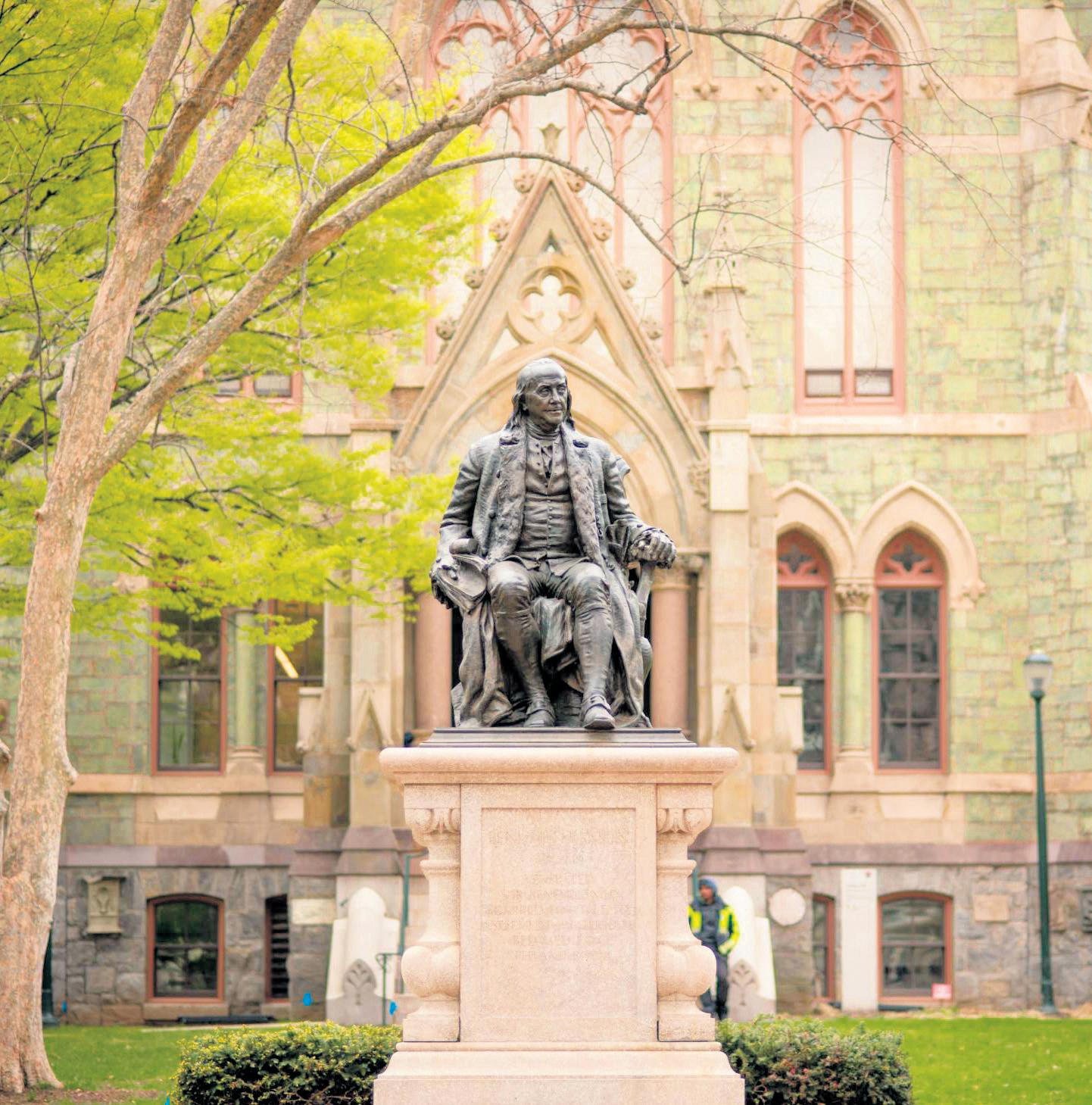
In a Jan. 14 message to the campus community, Penn President Larry Jameson highlighted other ways the University will celebrate the anniversary, including the installation of new banners featuring Benjamin Franklin.
The National Constitution Center and the University of Pennsylvania Carey Law School will also host a symposium on Feb. 26 to examine the historical and contemporary significance of the Declaration of Independence.
The programs coincide with Philadelphia’s “52 Weeks of Firsts," which spotlights various moments and inventions throughout the city’s history.
FactCheck.org, the award-winning political website at the Annenberg Public Policy Center of the University of Pennsylvania, is now accepting applications for its 202627 undergraduate fellowship program. The next class of undergrads will be trained during an eight-week, paid summer program at FactCheck’s offices at APPC from May 26 to July 17. Those who are trained this summer must agree to work 10 to 15 hours per week at FactCheck.org during the fall and spring semesters, if their work merits continued employment.
The fellows at FactCheck.org help our staff monitor the factual accuracy of claims made by political figures in TV ads, debates, speeches, interviews, social media and news releases. Fellows conduct research, contribute to fact-checking articles for publication under the supervision of FactCheck.org staff, fact-check articles written by FactCheck.org and respond to questions from readers. The fellows must have an ability to write clearly and concisely, an understanding of journalistic practices and ethics, and an interest in politics and public policy. The fellows also must be able to think independently and set aside any partisan biases.
If you are interested, please submit your resume and two writing samples by the February 11 deadline to FactCheck.org. Deputy Director Rob Farley at rob.farley@factcheck.org. Please direct any questions about the program or application process to the same address.
compared the rise of medetomidine to the beginning of the COVID-19 pandemic, in which the healthcare system rushed to assess symptoms and develop guidelines.
She said it has “been incredible to watch” pharmacists across the city collaborate on how to address the issue.
According to Thakrar, many approaches rely on tracking illicit drugs throughout the city. Multiple organizations — including PA Groundhogs and the Philadelphia Department of Public Health — release quarterly drug-checking reports.
“I think it’s vitally important for us to keep track of what is in the unregulated drug supply,” Thakrar said. “I think if we fund and invest in that, then we’ll be able to keep track early of what these changes are.”
The crisis also led to concerns about how to safely discharge patients, as many are homeless or cognitively impaired.
In an interview with the DP, Emily Avellino — the program manager for the Center for Opioid Recovery and Engagement at Penn Medicine — spoke to the need for more providers, better housing options, and improved overall stability for people with addiction, particularly in neighborhoods like Kensington.
of medetomidine withdrawal
ABHIRAM JUVVADI | SENIOR PHOTOGRAPHER
The Philadelphia skyline on April 13, 2023.
“That is our whole goal, to let them know that they’re still human,” Avellino said. “It’s up to us to provide that — even if it’s clothing, a snack, whatever that looks like — to get them to stay, go into treatment, and try to recreate a new life.”
ABHIRAM JUVVADI | SENIOR PHOTOGRAPHER
The Philadelphia skyline on Feb. 2, 2023.
In the past week, Philadelphia’s district attorney and several Pennsylvania police leaders have made a decision that matters more than most institutional responses to injustice in the last decade: they stopped cooperating with the United States Immigration and Customs Enforcement.
District Attorney Larry Krasner has stated that ICE agents who violate Pennsylvania law will be treated no differently than anyone else. Sheriff Rochelle Bilal has declined to provide personnel or institutional support for ICE operations. Both of these decisions are materially consequential. ICE does not function independently — it relies on the cooperation and support of city governments. Local police honor detainers, city jails hold individuals past their release dates, and multiple agencies share access to fingerprint databases and booking records. Federal immigration enforcement is an intergovernmental system sustained by local consent. So when Philadelphia withdrew that consent, it removed the infrastructure that turns federal authority into real enforcement.
After the murder of George Floyd, condemnation was widespread and often sincere. Corporations, universities, and governments announced reform agendas. Yet the underlying permission structure largely remained intact: budgets were preserved, along with inter-agency cooperation, and legal insulation. The language surrounding justice changed; the conditions enabling abuse did not.
Philadelphia’s decision affirms that state violence persists less because it escapes criticism and more because it remains operationally enabled. Detentions and deportations require a chain of cooperation, and enforcement power weakens when that chain is interrupted.
This is clearest in the context of ICE’s expansion under 1968 Wharton graduate and President Donald Trump. That expansion relied on nebulous discretionary authority and federal budget workarounds, which rapidly scaled ICE’s enforcement capacity while minimizing oversight. The implicit
Penn can be a lonely place.
The ICE office in Philadelphia on Jan. 21. assumption was that enforcement could retain legitimacy so long as it remained operationally secure, even as mechanisms of accountability deteriorated. That assumption actively damages civil society. Civil society is not an abstraction; it is a system of enforceable limits — both institutional and social — that constrain how power is exercised. Social movements such as Black Lives Matter rely on those constraints to function. Protest presumes that institutions remain responsive to public pressure because they can be compelled — through refusal — to stop enabling harm. When enforcement agencies are structured to outrun oversight, and other institutions continue cooperating despite knowing the
has no community
The design of our community — both physical and social — forces people to either overextend themselves in the name of social acceptance or risk not finding a community at all. Everyone at Penn has someone they see often and wave to, someone whose name they may or may not know. You spend your first week in PennCORP and congratulations — you’ve earned yourself someone to smile at every day for two semesters until it all just stops one day. Penn’s culture, shaped by preprofessionalism and social media, encourages shallow, performative connections that create a false sense of community and ultimately contribute to widespread loneliness. The social expectations we place on ourselves at this “work hard, play hard” school limit our ability to create meaningful relationships as we get caught up in the pursuit of social validation. As we chase productivity and our next summer internship, exploring friendships can feel frivolous unless it serves a purpose beyond simply developing relationships. And when every interaction is framed as a future opportunity, what incentive is there to be vulnerable and seek out people who maybe aren’t your ticket to that Goldman Sachs summer internship? In 2023, Vivek Murthy, then United States surgeon general, toured college campuses across the country to speak about his “5-for5 Connection Challenge” which encouraged students to take five actions for five consecutive days to express gratitude, offer someone
help, or ask for help. Along his visits, Murthy spoke with students, noting he heard from students who would say, “I feel like nobody really knows me for who I am. I feel like I can’t be myself.” These feelings are overwhelmingly common — studies show that many young adults crave closeness but doubt that their peers feel the same, preventing them from moving forward. News flash: We all do. With LinkedIn and Instagram being almost necessary social applications at Penn and in the age of sharing everything about your life online, is there even a point in talking to someone if you can know everything about them at the click of a button? Our social media activity has, in many ways, become the extent of our social lives. Following each other, liking posts, or reacting to someone’s new job update creates a false sense of closeness among peers. We can’t let this continue. We need to resist this culture of loneliness and social performance by investing in real friendships rather than settling for mere acquaintances. While building a network is important, there is more to relationships than just how you can use them to get what you want. The desire to have acquaintances or to keep people at such a distance mirrors the feeling of having followers online. We have this desire to be well known, but is there an equal reciprocal desire to know others as well?
We avoid the work of developing new
harm involved, those limits disappear.
At Penn, administrators often urge students to drive the conversation forward through dialogue, even as the University has adopted a policy of institutional neutrality that limits official public responses to events unrelated to campus operations. The University treats conversation as the primary mode of response while declining to endorse material constraints on power beyond campus operations. Penn assumes civil society is intact — that institutions will respond to legitimacy and pressure without being compelled. But when enforcement regimes are designed to evade oversight and persist through cooperation, conversation does not constrain harm. It
coexists with it. Philadelphia’s refusal demonstrates that strong civil society now survives only where institutions are willing to actively reimpose limits that have otherwise eroded. Universities may not wield police power, but they do exercise institutional discretion in ways that determine which forms of state action they will publicly legitimize. Penn could, without breaking the law or engaging in enforcement, affirm that noncooperation with ICE is constitutionally protected, publicly support sanctuary policies, or commit to refusing data sharing or institutional assistance if ever requested. These are not radical demands; they are choices about whether an institution will reinforce limits on power or be a deadweight while others pioneer refusal. By withdrawing cooperation, Philadelphia laid the groundwork for reimposing limits here — and, by extension, limits elsewhere. Institutions that continue working with ICE are not compelled by law or paralyzed by complexity; they are choosing to preserve operational order over accountability. Universities that decline to make similar choices are not neutral observers of this process, but beneficiaries of the assumption that someone more vulnerable will bear the cost of refusal.
Civil society does not endure through language alone. It depends on limits that check enforcement regimes antagonistic to public accountability. When the limits are weakened by state structures that evade oversight, refusal becomes the only effective corrective. Philadelphia acted on that reality. Penn should be honest about whether it is prepared to do the same.
friendships because it is easier and more convenient for our busy schedules. Penn didn’t create this culture on its own, its students did. And we reinforce it every time we choose convenience. These Locust Walk waves and online connections are constant interactions that do nothing to create real community.
This semester, I challenge you not to make another acquaintance, but to start developing a real friendship. Reach out and get to know someone new. It doesn’t always have to be a networking opportunity or a date. If you think someone is cool, open yourself to friendship and pursue it intentionally. Build a community for yourself. Yes, it can be hard and intimidating, but the only way to dismantle the social systems that make it so daunting is to start doing it.
2026 is being called the “analog year.”
Using paper products for journaling and planning is on the rise and screen time limits have become popular. But analog habits aren’t the solution to our loneliness epidemic. If we crave real-life experiences, we must do the relational work and stop waiting for the fairytale moment when friends or partners magically fall into our laps. Real life doesn’t reward passivity — it demands participation.
MARIE DILLARD is a College sophomore studying history and urban studies from Englewood, N.J. Her email is mdilla@sas.upenn.edu.
So many jobs, so much fear
ASK AUDREY | Let’s talk about job anxiety
Welcome back to another edition of Ask Audrey, the advice column in which I give you my take on your most pressing personal problems. This week, we’ll be talking about something that weighs heavily on the minds of most, if not all, Penn students: choosing the right job.
This week’s question: “How does one navigate the fear of not finding the right job to do in life, especially when most of us come to college with so many fascinating interests?”
The perennial question of the University of Pennsylvania! When I started this column, I suspected this question would come up sooner or later. I think you’d be hard pressed to find a Penn student who would earnestly argue that this school doesn’t have some level of pre-professionalism. It’s a natural question, so I thank you for writing in with it. You’re correct that many people come to college with a wide variety of fascinating interests. But I don’t think that’s something that ever has to go away. Even now, as a junior, there are still tons of topics that I want to learn more about (and am actively saving space for in my senior-year schedule — looking at you, Music department). Last semester, there were also several people in my history class who appeared to be above the age of 70 but were still actively pursuing a topic that engaged them. The fact that you have to choose a job doesn’t mean that you ever have to abandon other interests entirely. Applying that mentality can take some of the pressure off from finding one, singular, perfect fit of a job which, in all likelihood, does not exist. I would also note that very few people, particularly in this day and age, have one
them a lot of money quickly (read: consulting, finance, etc.). There are absolutely valid reasons to do this, particularly if you have loans or are financially supporting loved ones. However, I do want to emphasize that this is not the only path. If you have the opportunity to treat them as such, your early 20s when you first graduate college should be a period of continued exploration. In a time when you might not have children to feed or elderly parents to care for, you should be flexible in your approach to the professional world. The fear you’re feeling is real, but it shouldn’t prohibit you from exploring your passions, especially when you’re young.
Thank you for writing in. I’ve been thinking about fear a lot lately. I’m coming to the conclusion that fear is never a good enough reason to hold yourself back. If fear is the only reason you’re not pursuing something, take the leap and pursue it anyway. I’ll tell myself that, too. Oh, and one more thing — I think the Penn English department might take away the “Penn English” sticker on my wall if I didn’t point you to the novel “The Bell Jar” by Sylvia Plath. The passage in that book about fig trees might resonate with you.
If you’re interested in submitting anonymously to Ask Audrey, feel free to do so here. All advice should be taken with a grain of salt.
AUDREY LEVENSON is a College junior studying political science and English from Pelham, N.Y. Her email is audklev@sas.upenn.edu.
SOHUM SHETH is a College first-year studying philosophy, politics, and economics from Jacksonville, Fla. His email is sheth0@sas.upenn.edu.
PABLO CAMARGO TANG | STAFF PHOTOGRAPHER
LAYLA NAZIF | STAFF PHOTOGRAPHER Locust Walk on Oct. 5, 2025.
GABRIEL JUNG |
PHOTO
Pelt Library on Sept. 27, 2023.
An internet blackout. Thousands of protesters dead. An entire country’s economy collapsing while citizens struggle to get basic goods. This is not only the reality for those living in Iran — it is the reality for many Iranian students at Penn. As we prepare for new classes, a new semester, and a new year, we cannot ignore or dismiss what is happening right in front of us: the devastation of a country that many of our students call home. With the increase in sanctions and decrease in oil exports, inflation has risen to 48% in Iran, and the country’s economy has crashed. Citizens are being forced into bankruptcy and poverty by an unstable financial infrastructure that is completely out of their hands. For decades, Iran has been ruled by a highly unpopular regime, with up to 80% of Iranians agreeing that the system is completely illegitimate and oppresses the majority of the population.
After the Dec. 28 rial drop, protests began to spread throughout the country, with millions of Iranian citizens angered by the financial and governmental state of their nation. Then, the regime responded by killing thousands of protestors, shutting down schools, plunging the country into an internet blackout, and silencing millions of voices. But this tragedy stretches far beyond just the country of Iran; this is a situation affecting Penn students and Penn itself.
While most students are walking down Locust Walk looking for their classes and posting #FDOC selfies, students from Iran are stuck checking the news constantly, worrying about their family’s safety, and fighting just for this issue to be heard. Sana Dezhabad, a College sophomore from Shiraz, Iran, spoke about the fear, anxiety, and devastation she feels every day. “It has been 12 days that I have not been able to talk to my family … I know some people
who are just completely in the black; they don’t know if their families are safe,” she said. “We wake up every day, and we see the news, we see a new number of casualties … and we wonder, is that my mom, is that my family?”
These are students in your classes, your clubs, and your dorms. Students who deserve to have a college experience full of education and excitement are now watching their homes being terrorized. The importance of what’s happening cannot be overstated. Yet,
IN ADY-TION | We signed up for another level of homesickness
Every international student at Penn has been homesick at some point. The process is different for everyone; some become afflicted with it the first week of the semester and some the last. These feelings of longing revolve around the routines we once had with our families and friends, like the nights out or the simple trips together. But the similarity for all of us is that we chose to go to Penn — to leave everything behind — because we know this discomfort will help us change for the better. And so, we brave the discomfort and carry on. We do grow for the better, and we meet more and more people, but these actions always have their own trade-offs. The friend’s party we went to meant missing out on a text or a call from family. Getting a good night’s sleep meant not being able to call in for a friend’s birthday celebration. The movie sequel we watched here meant breaking the promise we made to watch it with friends at home. As more time passes, the more we notice that the people who made home what it is today are suddenly out of the picture. But yes, we did choose this. For many students, a school’s distance is even a challenge to be enjoyed rather than detested. I knew I wanted to attend a school that was far away because it meant I could have new kinds of opportunities that I would have
never gotten if I stayed. Still, the distance between international students and our loved ones creates an intense disconnection. At this point, we text our friends and family to catch up, but we don’t actually “live” the rest of our lives with them.
When Penn celebrated its Homecoming last semester, two super typhoons (or a Category 5 hurricane in the United States) hit the Philippines. And on those days, I could not shake off this irrational urge to constantly text my family and friends. I call it irrational because it was evident they were okay — we even got on a call while the typhoon was blaring. The uneasiness stayed because I was here, safe and sound, while my friends and family battled winds and rain, and suffered from power outages after. And it didn’t subside until the typhoons moved on. In the most basic sense, we are growing up without our loved ones, and they are moving on without us. That makes things so much scarier and bleaker, and I think this is also called homesickness. But this feels a bit different. It hits harder, and these feelings become more than just longing but a scary amalgamation of guilt, fear, and also envy. We wish for the close relationships and support systems we had before coming here; but we can’t have both. This is the cost of being international. We oc-
where is the support?
There has been a stunning lack of media coverage and public knowledge of Iran’s last 12 days, a lack of decisiveness from our president, and, frankly, a lack of support from our University. While the Penn Persian Society has been hard at work trying to bring awareness to Iran, Penn itself has been noticeably less willing. Dezhabad described Penn’s lack of support for the Penn Persian Society during this
but to actively suppress students’ voices is another. Penn has the resources and bandwidth to help these students in need but is actively choosing not to. We are watching atrocities happen right before our eyes; the least we can do is offer our support and raise awareness. So far, Penn
cupy this unique space where to grow means we have to inevitably let go of something. Presidential Penn Compact Professor of Philosophy Jennifer Morton describes these as “ethical costs,” defined as “difficult sacrifices” that many people make in order to “transcend the circumstances into which they are born.” In fact, the sheer guilt these separations hold can serve as a deal-breaker for many students. For many students, both domestic and international, choosing to stay home over traveling for school means being able to help raise younger siblings or save money for food and rent. What is perhaps the real consolation here is that the cost of these feelings will never linger forever. It will be there, and it will be unbearable. If you get through this alive though, you are said to stand to reap benefits that will stand the test of time. But the thing is, there is no guarantee that you will. I can’t promise those benefits, and I don’t think anyone can. The only way to make these costs worth it, is to make them worth it.
ADY LOTIVIO is a College first year studying earth and environmental science from Bicol, Philippines. His email is jlotivio@sas.upenn. edu.
cpulica1@sas. upenn.edu.
CHARLOTTE PULICA is a College first year studying communications and public relations from Enoch, Utah. Her email is
ANDY MEI | SENIOR DESIGNER
JESSE ZHANG | STAFF PHOTOGRAPHER A plane arrived at Philadelphia International Airport on Feb. 3, 2023.
Wharton reports higher median base salary, fewer employment offers for 2025 MBA graduates
According to the Wharton School’s latest career report, the median annual salary for 2025 MBAs working full time is $185,000, up from $175,000 in 2024
CANDICE FELDERER
Staff Reporter
The median annual salary for the Wharton School’s MBA Class of 2025 increased by $10,000 compared to the previous class, despite a continued decrease in employment offers and acceptance rates. According to Wharton’s latest career report, the median annual salary for 2025 Wharton MBAs working full time is $185,000, up from $175,000 in 2024. Of the 69% of 2025 graduates seeking employment, only 91% reported receiving at least one job offer — as opposed to 93% in 2024 and 97% in 2023.
The salary increase marks the first among MBAs working full time since 2022, when the reported number jumped from $155,000 to $175,000.
In addition to a lower percentage of reported job offers, 87% of the Class of 2025 reported full-time job acceptances — as opposed to 88% in 2024. These figures reflect similar trends at other peer MBA programs, including Stanford’s Graduate School of Business and New York University’s Stern School of Busi-
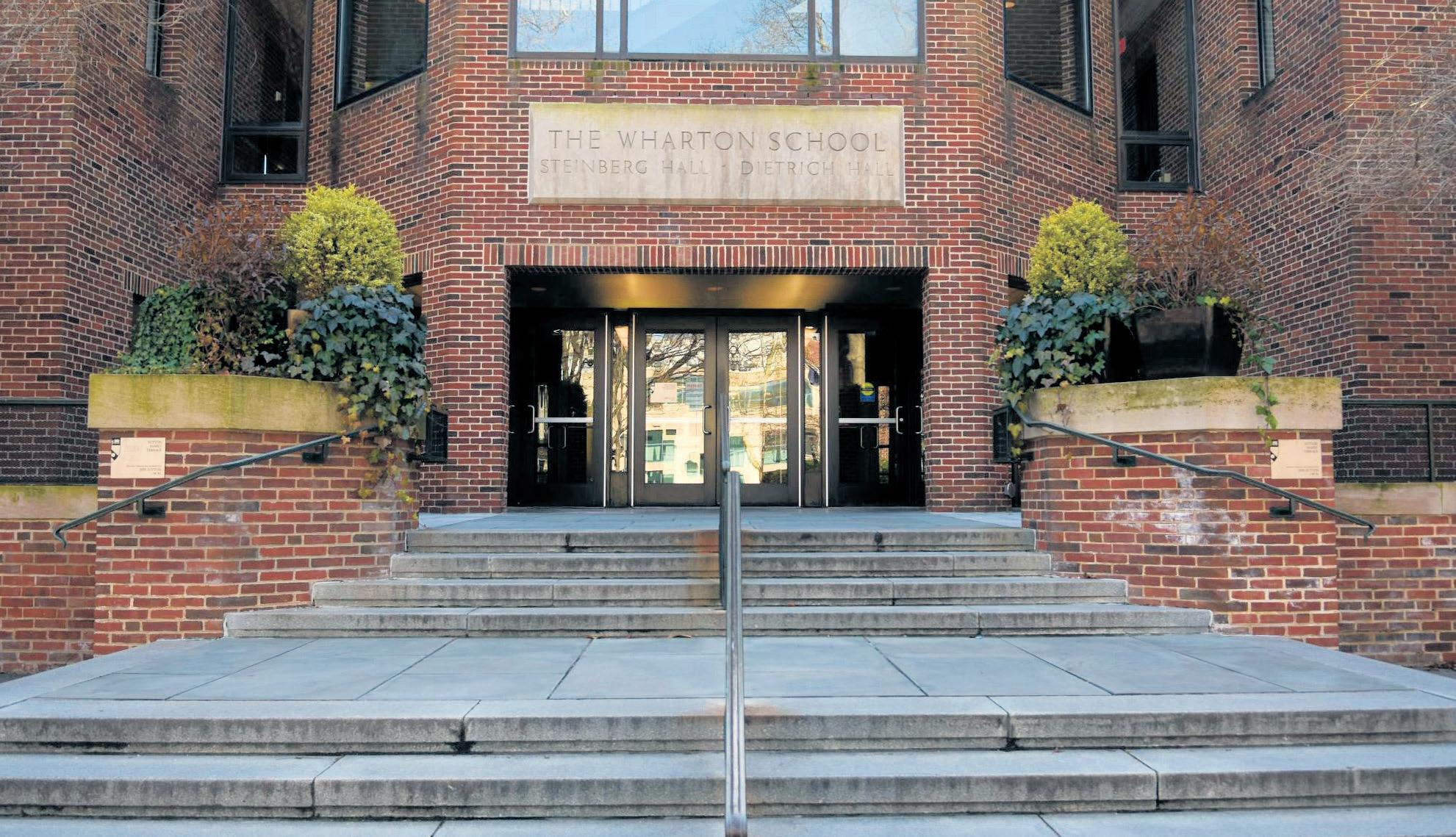
Steinberg-Dietrich Hall on Feb. 24, 2024.
ness. The decline in offers and acceptances comes amid a nationwide decrease in hiring for white-collar positions that started around 2024.
Despite the changes, Wharton MBA Career Management Director Samuel Jones wrote in a statement to The Daily Pennsylvanian that students have continued to “consistently secure outstanding roles” in the workforce.
Salaries in the school’s main full-time recruiting industries — financial services, consulting, and tech — have remained relatively consistent with past years.
Financial services — including hedge funds, insurance,
investment banking, and other industries — accounted for 38% of 2025 full-time job placements, remaining the largest destination with a median annual salary of $175,000.
The share of students who accepted consulting offers increased from 25% in 2024 to 28% in 2025, with the median base salary of $190,000 at both years.
Technology positions represented 15% of full-time placements among the Class of 2025, with a median salary of $164,250 compared to $162,750 in 2024.
Geographically, the Northeast United States continued to attract the largest share of Class of 2025 graduates
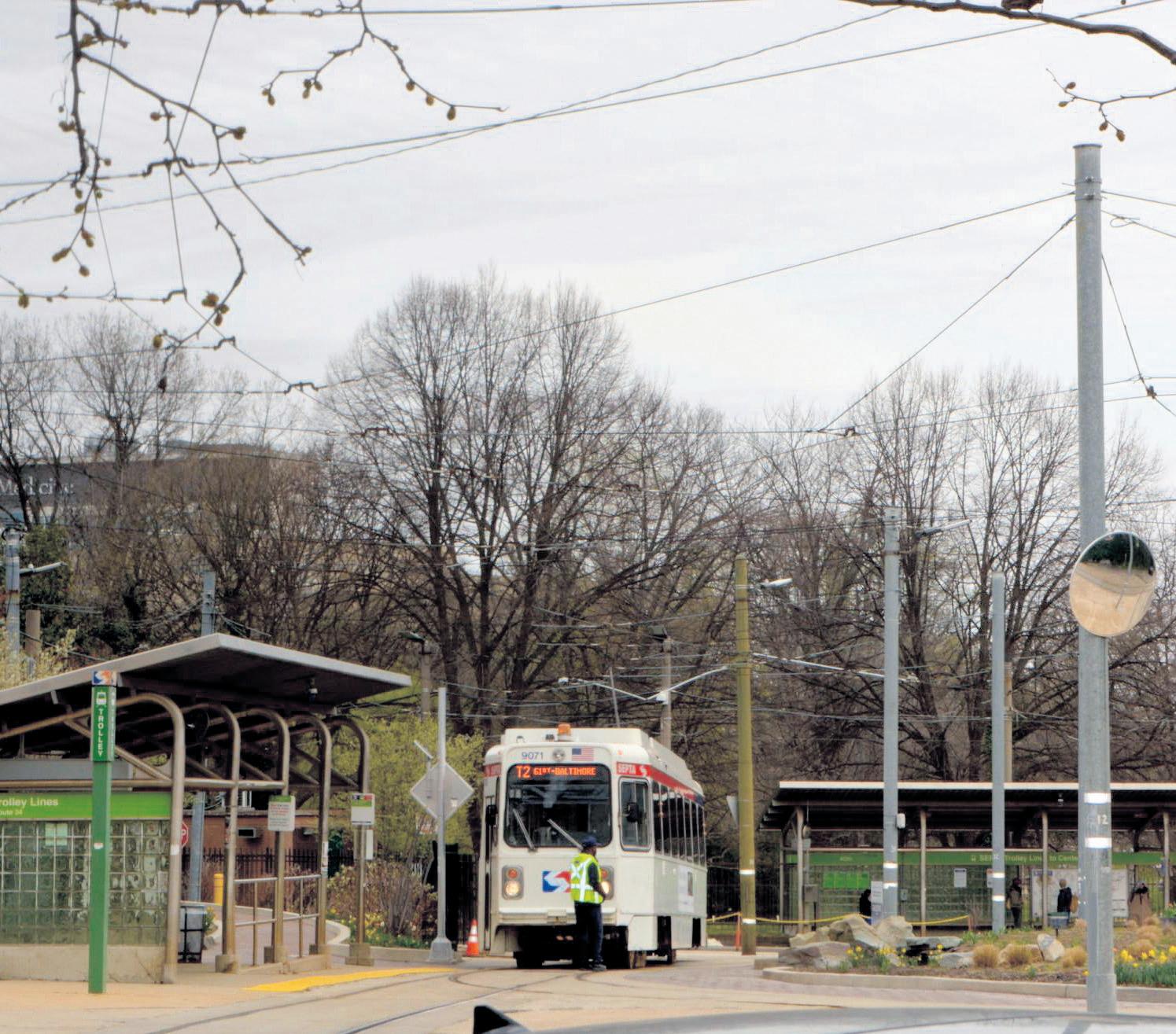
Penn students reflect on SEPTA trolley tunnel closure, renovation efforts
According to multiple Penn students, the closure increased travel times, forced commuters to seek alternative transportation methods, and added noise as trolleys diverted above ground
COSTA GAY-AFENDULIS Staff Reporter
After SEPTA reopened its trolley tunnel between Center City and University City on Jan. 13, The Daily Pennsylvanian spoke with students about how the disruption and return to service affected their daily lives. The closure, prompted by difficulties acquiring new wire equipment, began in early November and was extended until January because of unexpected delays. According to multiple Penn students, the closure increased travel times, forced commuters to seek alternative transportation methods, and added noise as trolleys diverted above ground.
College sophomore Greyson Forster, who is also a member of the SEPTA Youth Advisory Council, highlighted the inconvenience of the closure, noting in an interview with the DP that “losing 37th, 36th, and 33rd Street stations is hard for many people.” He added that the closure personally impacted his routines, primarily when traveling to areas around 22nd and 19th streets.
“While there are many alternatives — like the L at 34th and 40th and the buses — they don’t completely match the speed and coverage of the trolley tunnel on campus.”
College senior Aaliyah Campbell discussed the trolley’s safety compared to other options, mentioning in an interview with the DP that it “feels a little bit smaller, so it’s like you’re less likely to
run into something odd happening.”
She also emphasized the inconvenience of other transportation methods, including buses — which she said “are never actually there when they’re supposed to be.”
Instead of seeking other alternatives, Campbell said she “ended up walking a lot more than I used to.”
College sophomore David Tran had a similar experience, recalling in an interview with the DP that he chose “not to use public transit to go into Center City” following the closure.
Tran said that while many students felt the impacts of the closure, “a lot of Penn students don’t even leave the campus or leave the Penn bubble in the first place.”
During the tunnel’s closure, trolleys that previously ran underground used above-ground tracks on 38th, Spruce, and 40th streets. Multiple students said this increased commotion and noise in the surrounding area.
“It just feels so much more disturbing,” Campbell, who lives near the 40th Street tunnel portal, said. “My window isn’t really sealed properly, so there’s no blocking out their noise.”
She added that the trolleys also contributed to traffic and were slowed down by other aboveground vehicles.
“It’s also been disruptive to the drivers, because
people are used to being able to just pull off to the side of the street,” she said. “If you’re in the trolley’s way, they’re just laying on the horn for minutes at a time.”
According to Forster, the SEPTA Youth Advisory Council has pushed for greater accessibility and safety measures as part of a trolley modernization initiative.
He explained that the council is “fighting for getting trolley modernization done and getting away from these 40-year-old cars.” The project would replace current trolley poles, which were partially responsible for the closure.
“If SEPTA had stable capital funding for the past many years and the trolley modernization project was able to get done, this won’t even have happened,” Forster said.
Campbell similarly noted the need for the trolley system’s renovation.
“We’d be sitting outside in the cold for a while waiting for a trolley to come that just never did. I’d love it if they ran the trolleys closer to on time,” she told the DP.
The reopening comes amid SEPTA’s struggle for state funding. In August 2025, the agency faced a $213 million budget shortfall that threatened to cut service by half. To restore service, SEPTA was given permission to divert capital funding to cover the shortfall.
working full time, accounting for a majority of placements. In total, 94% of jobs were based in the United States.
“Wharton supports MBA students through a combination of industry-based, personalized career advising, data-driven tools, and strong partnerships with employers and alumni,” Jones wrote to the DP. “At the same time, our Industry Teams work year-round to maintain strong hiring pipelines and develop new opportunities, giving students access to both established and emerging roles across industries.”
ous threats to Jews” in the United States today, citing the 2018 shooting at the Tree of Life synagogue in Pittsburgh, Pa. and the firebombing of Pennsylvania Gov. Josh Shapiro’s home in April 2025. According to the document, the EEOC’s “extraordinary and unconstitutional” demands “implicates Penn’s substantial interest in protecting its employees’ privacy, safety, and First Amendment rights.”
In addition to the potential danger of the agency’s request, Penn highlighted that the EEOC’s lawsuit did not point to a particular allegation or incident of antisemitism. The University wrote that while it “immediately sought” more specific information to address the EEOC’s concerns, the agency “refused” to provide those details.
“If any party ‘delayed’ this investigation, it was the agency,” the brief continued. Penn also claimed that its “comprehensive offer” to notify employees of the EEOC’s investigation “eliminates any possible justification” for the agency’s request.
“Although purportedly in service of Penn’s Jewish employees, the EEOC’s demands have engendered fear and opposition across Penn’s Jewish community,” the filing argued. “The EEOC’s application fails the standards for judicial enforcement several times over and should be denied.”
The University’s Jan. 20 filing was accompanied by supporting declarations from multiple Penn affiliates, including MEOR Penn Executive Director Rabbi Rick Fox, Penn Hillel Executive Director Rabbi Gabriel Greenberg, and Vice Provost for University Life Hikaru Kozuma. Soon after, over 150 Jewish faculty members at Penn and several Penn-affiliated groups submitted briefs in support of the University’s challenge.
A faculty alliance, representing 11 of Penn’s 12 schools, urged the court to deny the EEOC’s request that the University prove why the subpoena should not be enforced.
“While the Alliance supports the EEOC’s efforts to combat antisemitism at Penn, its members are gravely concerned that the scope of the EEOC subpoena, which effectively seeks full lists of Jewish individuals at Penn and their personal information, invokes the troubling historical persecution of Jews, and threatens the personal security of the Alliance’s members,” the faculty alliance wrote. They clarified that while all members of the alliance are Penn employees, the group is not “formally affiliated with the University” and does not speak on its behalf.
According to the brief, the group was first formed under a different name “after the October 7, 2023 terrorist attacks on Israel and ensuing acts of antisemitism on U.S. college campuses.”
Earlier this month, five Penn affiliates — the national and Penn chapters of the American Association of University Professors, the University of Pennsylvania Carey Law School Jewish Law Students Association, the Penn Association of Senior and Emeritus Faculty, and the American Academy of Jewish Research — filed a motion to intervene as defendants in the lawsuit.
If granted, the motion would allow the groups to be treated as defendants and would require the proceedings to continue even if the University complied with the subpoena.
On Jan. 20, the affiliates also submitted a response to the EEOC’s motion to show cause, arguing that the agency’s request “does not meet the requirements for judicial enforcement.”
They stated that their concerns “far outweigh the government’s need for the information sought by the subpoena, which is based on no charge of any specific unlawful employment practice.”
The EEOC subsequently filed a memo in opposition to the groups’ motion to intervene, writing that there is “nothing unusual or new” about its investigation and that intervention is “unwarranted” and “should be denied.”
The agency claimed that although the affiliates may be “victims” of antisemitism, that “does not elevate” their status “to parties with standing to intervene.”
The EEOC issued its initial subpoena in July 2025 during an ongoing investigation into Penn, requiring the University to provide a list of received antisemitism complaints, names of members of Jewish-related campus groups, and Jewish Studies Program employees. In November 2025, the EEOC alleged Penn failed to comply with the agency’s requirements.
At the time, a University spokesperson told the DP that Penn “cooperated extensively” with the EEOC but that the University would not provide “personal and confidential” information of students and employees without their consent.
In November 2025, hundreds of members of the Penn community signed a petition criticizing the EEOC subpoena. The signatories brought forth concerns about the historical connotations of collecting the private information of Jewish faculty and students.
Per a court order, the EEOC must submit a brief in response to the University by Jan. 27.
CALEB CRAIN | DP FILE PHOTO
EEOC, from front page
The beginning of the Rick Santos era: Penn football
staff
Four Priore hires, two UNH holdouts, and one Columbia Lion join the program
ELLIE CLARK Deputy Sports Editor
New year, new coaching roster. Penn football will enter the 2026 season with a mix of new and familiar faces on the sideline.
After longtime coach Ray Priore departed the program last November, coaching trepidation was felt in his wake. Although former University of New Hampshire coach Rick Santos filled Priore’s spot within weeks, it was unclear whether or not he would retain Priore’s coaching core.
Over the past week, it was announced via Instagram that four Priore hires would stay with the program — some with their positions altered — joining three fresh faces hired by Santos.
Ryan Wilson Offensive line coach and co-offensive coordinator Ryan Wilson joins the program after two seasons on University of New Hampshire’s coaching staff. Wilson began his career with the Wildcats as assistant offensive line coach during the 2024 season before being promoted to co-offensive coordinator for the 2025 season.
UNH finished fourth in the Coastal Athletic Association last season with an 8-5 record, earning an at-large bid to FCS playoffs. The Wildcats went down in the first round of playoffs to No. 14 South Dakota State. UNH finished the season allowing the fifth-fewest sacks in the CAA, with 23. Before coming to UNH, Wilson served as offensive line coach at St. Francis University, then a Division I FCS program. While at St. Francis, he led a nationally-competitive offensive line unit that allowed 13 sacks over the 2022 season. This offensive line supported program record-setting performances in total touchdowns, passing touchdowns, and total points.
Wilson played Division II college ball at PennWest Edinboro as a three-year starting center, earning program Lineman of the Year awards in 2012 and 2013 while serving as team captain.
Ed Borden
Fellow Wildcat transfer Ed Borden will reprise hiFellow Wildcat transfer Ed Borden will reprise his role as co-offensive coordinator alongside Wilson in the 2026 season. Borden served on the UNH coaching squad from 2019-2025 in multiple capacities, including co-offensive coordinator, tight ends coach, and recruitment coordinator. Santos promot-
WOMEN
, from back page
Sawyer, in turn, was perfect from the threepoint line until the last two minutes of the game, four of five shots from beyond the arc, a substantial part of her 15 total points.
“I haven’t shot great the past few games, so it felt good to just keep shooting, and the confidence kind of came back for me,” Sawyer said.
Meanwhile, junior center Tina Njike had her third double-double of the season, scoring a team-high 16 points and grabbing 13 rebounds. Six of those were offensive rebounds, highlighting her key role in the Quakers’ offense.
Sophomore forward Katie Collins rounded out the quartet as one of the most impactful defensive players on the team. It took her a while to start scoring, but at the beginning of the fourth quarter, she scored six points in quick succes -
ed Borden to offensive play caller before the 2025 season commenced. After graduating from Bentley University in 2009, Borden worked in the UFL for the now-defunct Las Vegas Locomotives. Former Giants coach Jim Fassel served as head coach and president during Borden’s tenure, overseeing the back-to-back William Hambrecht Trophy winners.
Justin Stovall
Associate head coach and special teams coordinator Justin Stovall stands out as the only member of the coaching staff without any previous affiliation with Santos or Priore. Stovall comes to Philadelphia from the Big Apple, where he served as associate head coach and defensive coordinator for Columbia. The Melbourne, Fla. native was with the
sion — the only field goals for the Quakers over a four-minute stretch.
“I know numbers are what they are, but we wouldn’t have the success right now without Katie on the floor as much as she is,” McLaughlin said.
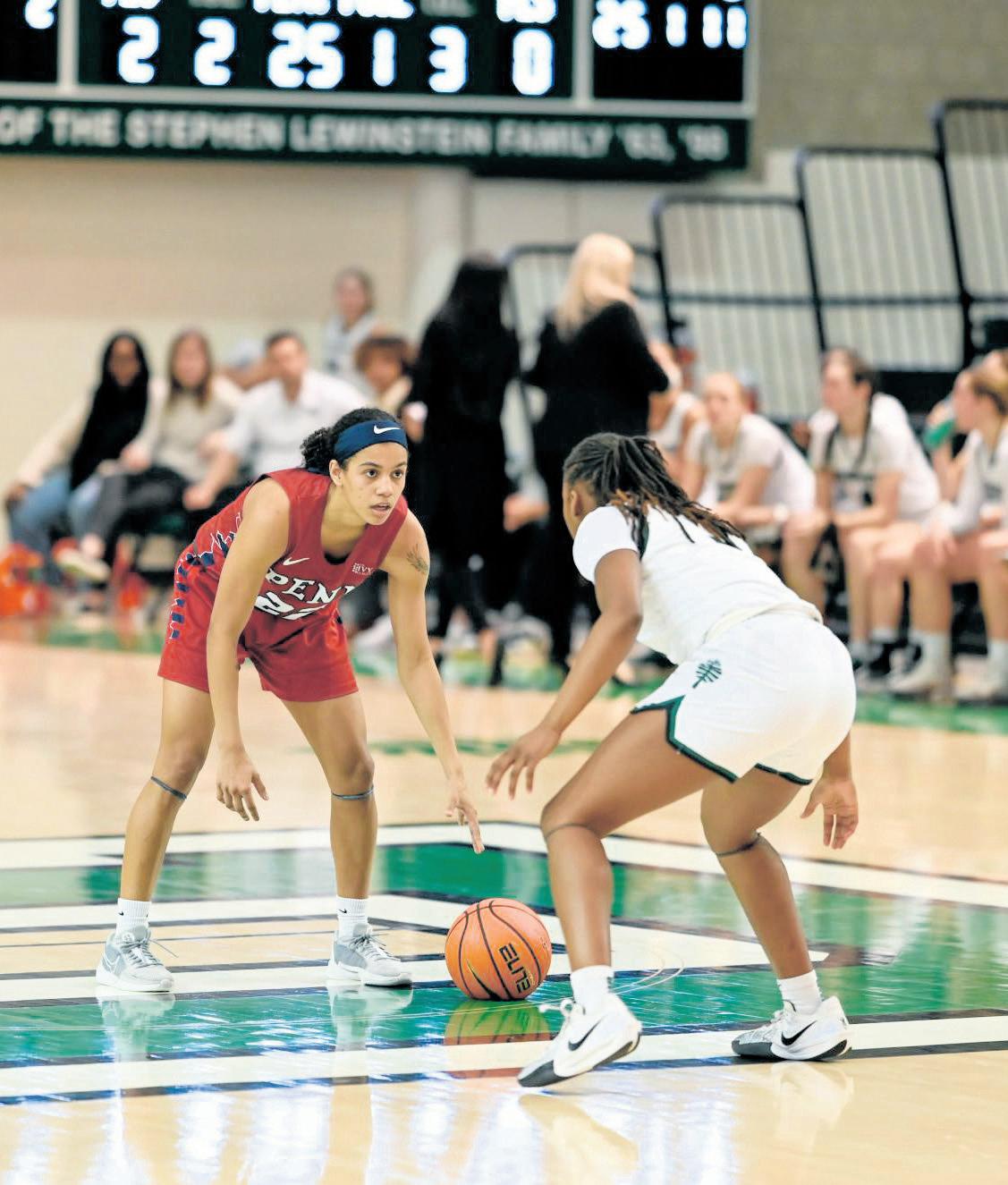
The full-court press works for the Quakers
Starting midway through the first quarter, Penn employed a full-court press, at times successfully trapping the Big Green in their own half. Even as the minutes dwindled in the fourth quarter, the Quakers rarely let up, squashing a late-game effort that cut the margin to two possessions.
In the second game of the weekend doubleheader, that physical and mental intensity was an impressive feat, which ultimately set the Quakers apart from Dartmouth.
The Quakers will take on Yale on Saturday, Jan. 24, in New Haven, Conn., a battle of two teams with the same conference record.
Lions for 11 seasons.
During Stovall’s tenure with the Lions, Columbia achieved the 2024 Ivy League title with the No. 2 defense in the nation, which allowed only 16.1 points per game. Columbia fell to last place in the conference during the 2025 season with a 2-8 record. Their defense ranked last in the conference as well, allowing 27.9 points per game.
Stovall played Division I football at Lafayette College in a dual linebacker and special teams role, where he saw action in 46 out of 47 games from 2003-2006. He began his coaching career at Franklin and Marshall College as a linebacker coach, then transitioned to various stints across the country.
Elias Miller and Joe Calise
Elias Miller and Joe Calise were retained in their
roles as director of football operations and video coordinator, respectively. Miller was appointed by Priore in April 2025 and previously served as the Penn men’s lacrosse assistant director of operations for three seasons. Calise joined the program in 2024 after two stints at Temple University.
Tyree Foreman Tyree Foreman was rehired by Santos but moved to the position of running backs coach. He previously served as tight ends coach for the Quakers during the 2025 season. Foreman came to the Quakers from Temple, where he served as running backs coach during the 2023 and 2024 seasons. He also served as running backs coach at Towson from 2019-2022.
Foreman played college football at UVA, where he was a three-year letter winner in the backfield. After graduation, he was awarded a free-agent contract with the San Diego Chargers and was later signed to the Chicago Bears’ practice squad. In 2003, Foreman was allocated to the NFL Europe, where he served as starting fullback for the Barcelona Dragons.
David Josephson
Former wide receivers coach and pass-game coordinator David Josephson will be utilized by Santos as safeties coach and recruiting coordinator. Josephson joined the Quakers in the 2024 season, where he served as tight ends coach. As wide receivers coach, Josephson oversaw the development of first team All-American senior Jared Richardson, who recently committed to Duke University for his final year of collegiate eligibility.
Josephson transitioned to coaching after his college football career at Division III powerhouse Johns Hopkins was cut short by injury in 2013. Johns Hopkins advanced to the playoffs every season during Josephson’s initial tenure as assistant coach. After a season in the Bay Area as Stanford’s graduate assistant coach, Josephson returned to Johns Hopkins, where he served as offensive coordinator and quarterbacks coach until 2022. It’s unclear whether or not previous Priore appointments, such as offensive coordinator Greg Chimera and recruiting coordinator Jon Dupont, will return to the program. will return to the program.
SUKHMANI KAUR | STAFF PHOTOGRAPHER
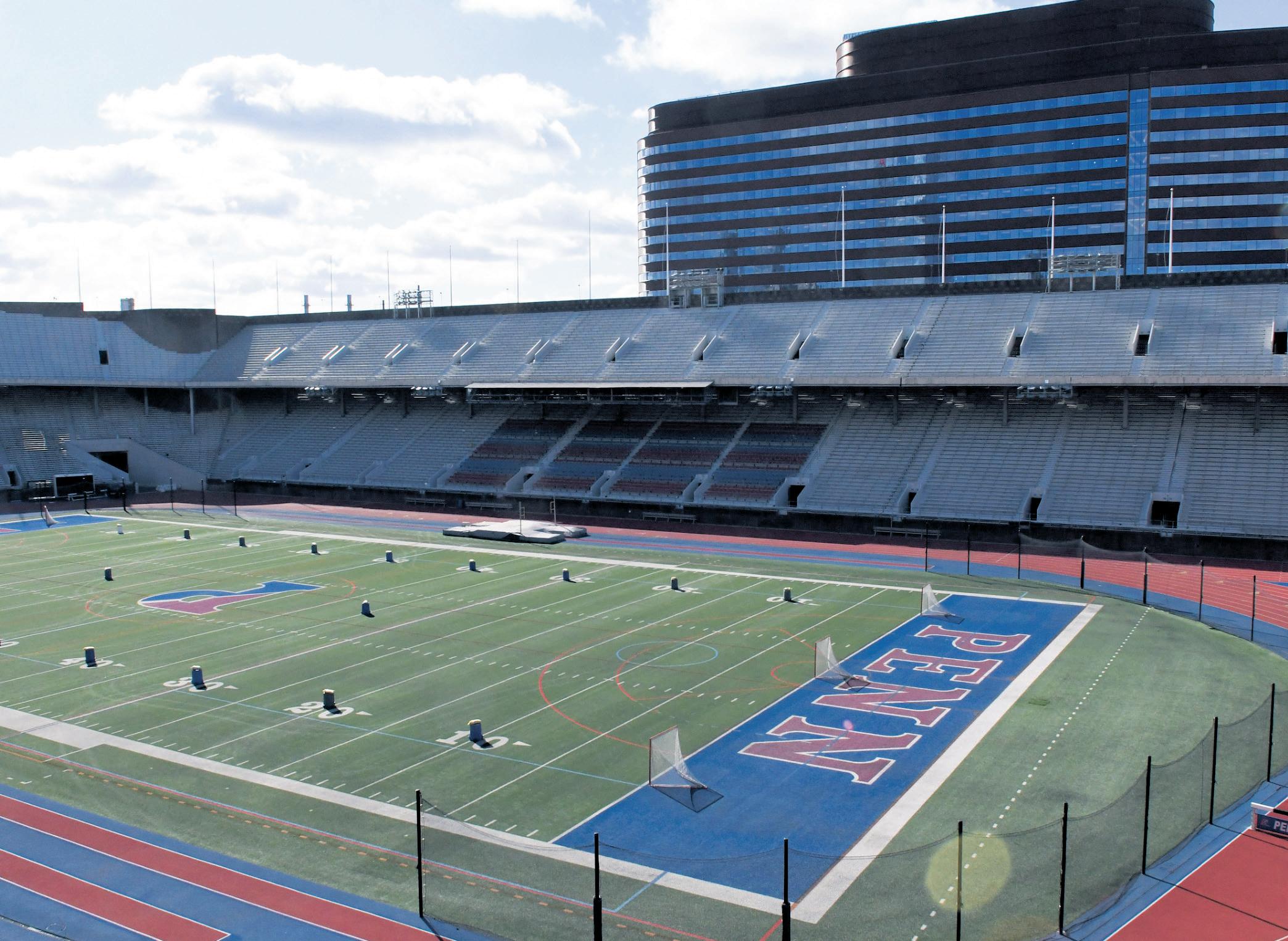
An empty Franklin Field on Jan. 30, 2021.
KENNY CHEN | SENIOR PHOTOGRAPHER
Then-sophomore guard Mataya Gayle drives during a game on Feb. 28, 2025.
Three Quakers land in NCAA top 25 at Quaker Invitational
Sprinters Fore Abinusawa, Shane Gardner, and Nayyir Newash-Campbell shined in their first meet of the New Year
ELLIE CLARK Deputy Sports Editor
Go big or go home. Penn track and field showed up and showed out for their third home meet of the indoor season, which saw many seasoned athletes make their 2026 debut.
Senior thrower Stella Inman opened the meet with a bang, shattering the standing meet record in the weight throw on her first lob in the preliminary flight. Inman improved the record on her second lob to break 19 meters for the first time this season, granting her a comfortable lead as she entered the finals.
The Windham, Maine native had another record-breaking performance with her final lob of the day, breaking the standing facility record by over a third of a meter. Inman’s 19.72-meter performance ranks No. 29 in the NCAA and No. 3 in program history at the time of writing.
Senior high jump specialist and three-time AllAmerican Kampton Kam made his senior season debut with a 2.11-meter performance. Kam enters the Ott Center after competing in the Southeast Asia Games last December, where he finished second to earn Singapore’s first medal in the event in 30 years. Kam earned the silver again on Saturday due to early failures, but he still surpassed the previous meet record mark. On the women’s side, sophomore and reigning Ivy League Outdoor High Jump champion Zofia Limbert made her season debut on the bar with a personal best 1.73-meter jump for the silver. Fellow Quakers junior Samantha Strydesky, freshman Yuliya Maslouskaya, and freshman Lydia Merrick followed close behind, all landing at 1.68-meters for No. 3, 4, and 5, respectively.
Action on the track began with a dynamic women’s mile field featuring 2020 Nursing alumna and 2024 Olympian Nia Akins. Akins led at the gun but was quickly overtaken by Villanova’s Tilly O’Connor in the first lap. It was neck-andneck between Akins and the Villanova distance trio until the 800, when Akins unexpectedly pulled out. O’Connor and her fellow Wildcats dominated the rest of the race, each finishing under 4:40 to rank in the top 20 in the NCAA at the time of writing.
Senior Lara Cota made her season debut in the mile, climbing from fourteenth to 10th in the final three laps. Fellow Quaker Alexa Matora made her collegiate debut, finishing eighth overall. Cota and Matora both notably put up a negative split during the last 400 to finish under five minutes. Short sprinters were corralled on the infield after distance action for the 60-meter dash and 60-meter hurdles. Program legends like senior sprinter Fore Abinusawa and senior sprints and hurdles specialist Shane Gardner made their triumphant return to the Ott Center for their final season of indoor competition.
Abinusawa dominated the 60 from preliminary rounds, winning the first heat by over a tenth of a second. She kept up the pace for the finals, coming in at a blazing 7.32 to best the field by 0.15 seconds. Abinusawa’s performance is currently tied for 21st in the NCAA.
Gardner entered the indoor season coming off an injury that cut outdoor competition short last spring. He immediately asserted his dominance in the 60-meter hurdles, winning his heat in the preliminary rounds by over a tenth of a second
WINTER , from back page
“How was your break?”
It’s the question that everyone asks once the spring semester starts. And the answers are pretty similar. Hung out with family and friends, traveled here or there, visited so-and-so.
While many may have gone to Florida over the holidays, it probably was to tan and relax — not to swim for four hours a day, “experiencing fatigue and pain,” like men’s swimming and diving junior distance specialist Robert Melsom.
Penn men’s and women’s swimming and diving had a training trip from Dec. 28, 2025 to Jan. 7, 2026 in Stuart, Fla. this year.
“The purpose of the training trip is to push each athlete to their physical limits, preparing them for the rest of the season and the remaining competitions,” Melsom wrote in a statement to The Daily Pennsylvanian.
Winter break is usually not a time when most Penn students think of pushing themselves “to their physical limits,” but for Penn’s studentathletes, it’s a different story.
Penn men’s and women’s basketball competed throughout the break. Penn men’s basketball played a game on New Year’s Eve and again on Jan. 5, 2026; Penn women’s basketball played a game on Dec. 30, 2025 and again on Jan. 3, 2026.
While Penn students had roughly three weeks to relax at home or vacation elsewhere, Penn basketball athletes had less than a week to spend time at home, while the swim team had to endure a 10- or 11-day training camp over New Year’s.
“We had to leave for [a] training trip the 28th [of December] and since I got back [home] the 19th I didn’t have nearly as much time at home as I would like,” Penn women’s swimming and diving senior distance specialist Sydney Bergstrom wrote in a statement to the DP.
Maybe it’s because they have less free time over the break, but the days off from practices and competitions were that much sweeter.
“It’s a short break, but it’s a nice reprieve from just the monotony of the season and being on campus and just getting away and off is nice,” men’s basketball junior center Augustus Gerhart said. But once those days with family were over, a switch was flipped. For swim, that meant “two hours of long course training (50 meters) in the morning and two hours of short course training (25 yards) in the afternoon,” senior men’s swimming and diving breaststroke specialist Neo Matsuyama wrote in a statement to the DP.
“There were no recovery practices; each practice was structured for improvement, consisting of pull, kick, technique work, and skills,” Melsom wrote.
“Every other day we would lift for about an hour after morning practice,” Bergstrom wrote. “The practices are all super intense but that is the expectation.” It was pretty much the same story for basketball. Gerhart, women’s basketball junior center Tina Njike, and women’s basketball sophomore forward Gabriella Kelley all conveyed the same
with a 7.79-second performance, running under the previous meet record mark. His time during the preliminary rounds ranks No. 22 in the NCAA at the time of writing. Gardner ultimately earned the bronze in the final after being bested by Rutgers’ Christopher
Serrao and Princeton’s Greg Foster. Serrao bulldozed the field, breaking his own Ott facility record by almost two-tenths of a second to finish in a blistering 7.55 seconds. Serrao is currently ranked second in the NCAA.
After runners vacated the infield, competition returned to the traditional track and field setup. Junior distance runner Lindsay Yakaboski climbed from sixth to third in five laps to finish in a personal record 2:54.58 in the 1000-meter run. Freshman Rianna Floyd got edged out at the line for the silver in her first collegiate 400 after
sentiment that practice was longer than usual. Just because it was the holiday season didn’t mean that they were allowed to let off any steam.
“The coaches pretty much emphasized getting the year off on the right foot,” Gerhart said. “You want to have an enjoyable New Year’s Eve instead of laying in bed thinking about all the shots that you missed and all of the blown assignments that you had.”
So, the team practiced with purpose and played on New Year’s Eve like they were the main event. Penn athletes ended the year only to welcome the new one with competitiveness and drive.
Despite the long hours away from home, the teams banded together to find their share of fun and relaxation amid intense competition. It was winter break, after all.
The Penn women’s basketball team went up to the high-rise rooftops to play games and watch the fireworks as Philadelphia welcomed 2026.
“We had dinner as a team and afterwards went to Wawa for a sweet treat, then returned and played Mafia or Catan,” Melsom wrote about the swim camp. “We also had two afternoons off to enjoy the beach, where we played football and volleyball and enjoyed the Atlantic waves.”
For men’s basketball, Gerhart said, “We watch movies together, play cards, whatever, to keep ourselves from going crazy.”
The team did a “Harry Potter” marathon in years past; this year, it was “Zootopia 2” and horror movies at Cinemark.
While the swimming and diving team enjoyed their time in Florida, the basketball teams were alone on an empty campus. Although, Njike wrote, “[it’s] nice to be alone in a sense since everything just feels a lot more relaxing,” it also meant that they were on a campus with no open facilities, including dining halls.
“I’m on a meal plan,” Gerhart said. “I shamelessly eat in the dining hall quite a bit as a junior.” And with the dining halls closed and him not being one to cook, “our kitchen is admittedly not the crème de la crème … it’s a little scary.”
He used the stipend the team receives for food during break to go out to eat with his teammates.
“Some people have different ways to allocate their funds to eat ramen every day for a week and then go to Ruth[’s] Chris, like buy themselves a steak,” he said, “It’s the Division I staple.”
Other places the team goes out to eat include Tampopo, Taco Taco Mexicano, which according to Gerhart is “fantastic,” Double Knot, and Schmear, with “hot honey bagels” and “wake ’n bacon” being popular choices.
Games were also a popular pastime for the men’s basketball team.
“Some of the guys came over to the house … we play a lot of cards,” Gerhart said. “We have guys that love to play poker and blackjack, obviously for no money … just betting push-ups and street cred.”
But it’s all within the confines of basketball.
“Everybody got to bed at a good hour because we’re all pretty exhausted from the game and want to recover well,” he said.
As teams spend time together every winter break, traditions have begun to form, similar to get-togethers non-athletes might engage in around the holidays.
“Every year, we have a tradition of walking to
leading most of the race.
Familiar foes took down standing facility records and established NCAA-leading performances. Former Arkansas All-American Jordan West threw 19.70 meters in the shot put to best the previous facility record by almost a meter.
Princeton’s Georgina Scoot jumped 13.47 meters in the triple jump, establishing a new NCAA lead. Foster dominated the long jump, taking down the facility record established just last week with an 8.07-meter jump.
Penn’s standout sprinters swept away the competition once again as the meet came to a close.
Freshman Jailyn Milord won her first collegiate 200 in 24.21, pulling away from fellow freshman Sofia Swindell off the final turn. Milord’s performance ties for eighth in the program record books.
downtown Stuart to get ice cream and sit by the Pier,” Bergstrom wrote. “This has always been so fun because I get to talk to people on the team I normally don’t train with that much because they swim different events. … Another tradition that started last year was playing the game Mafia every night.”
“Training camp is grueling, but the moments outside the pool make it worth it,” Matsuyama wrote. “Watching fireworks on New Year’s is always a highlight and a memory I look forward to every year.”
From Florida to Philadelphia, Penn athletes band together to celebrate the New Year. Penn gymnastics gets back on campus soon after Christmas, engaging in their own traditions to make the bleak empty campus feel merry and bright.
As Penn gymnastics junior Jackie Tunney wrote in a statement to the DP. “Every year our team does a secret snowflake, similar to secret santa and write funny poems for each other’s partner. For new years the team typically watches the countdown together and each class will go to dinner together in Center City.”
Men’s basketball does Secret Santa every year around Christmas time, although this year, the team has yet to exchange gifts due to logistical difficulties. Rest assured, Gerhart already has his gift prepared: “We can keep you tuned as to what everybody gets.”
But it’s less about the gifts and more about the camaraderie.
“It’s a very low budget Secret Santa, as you
On the men’s side, the Quakers went 1-2-3 in the 200, led by junior sprinter Nayyir NewashCampbell. Newash-Campbell and fellow junior Ryan Matulonis were in an interesting predicament after the other two runners in their heat scratched. As iron sharpens iron, teammate sharpens teammate. Each Quaker gave it their all to finish in personal best performances. NewashCampbell’s performance ranks No. 23 in the NCAA and No. 2 in the program record books at the time of writing, while Matulonis ranks No. 4 in the program books. Even more impressive performances look to follow the Quaker Invitational as the Penn track and field team sets their sights on the Penn Elite meet. Multi-event competition will begin on Jan. 22, while traditional track and field events will begin on Jan. 24.
can imagine it would be for college athletes,” he continued. “We are not getting paid, so our Secret Santa budget is like $10 per person … It’s more giggles than anything else.” On an empty campus, the team really only have each other for “giggles” and fun over break. The team “[tries] to hang out” together through food and games, letting loose as a respite from competition and grueling workouts.
“You can go out in some pretty crazy outfits and no one’s looking at you funky,” Gerhart said. “You can wear a groutfit on Locust and nobody cares … if it’s snowing, you’re going to rock boots with some Christmas PJs, which is a little different. But … our team’s pretty stylish and fashionable. So even our bad outfits look presentable.”
The teams find ways to bring a sense of home, even if they were apart from their families.
“It’s definitely hard not being able to see them throughout the year as much as most students are able to,” Kelley wrote. “The team is a second family too, so having a few weeks with lots of free time to hang out and explore the city together was fun.”
So in a way, these athletes spend winter break much like the rest of Penn students, adding in travel and meets. They try new places to eat, watch fireworks, play games, refuse to cook, and wear pajamas all day because it’s break and no one cares. As Kelley wrote, “It definitely felt like break, just a different type of break than most people experience.”
LYDIA TONG | DP FILE PHOTO
Sprinter Fore Abinusawa posed for a photoshoot on Feb. 20, 2025.
‘Twas the season for a ‘different kind of break’
From training camps to poker, here’s how Penn athletes spent their winter breaks
HANNAH
CHANG AND ELLIE CLARK Sports Editor and Deputy Sports Editor
See WINTER , page 9
Penn
men’s
basketball endures heartbreak and triumph over long weekend
The Quakers pulled off a second-half victory at Dartmouth and fell at the last second at Harvard
HANNAH CHANG AND JAVIER ST REMY Sports Editor and Sports Reporter
Penn men’s basketball faced two conference rivals — Dartmouth and Harvard — in New England over the long weekend.
On Saturday, the team defeated Dartmouth (9-8, 3-1 Ivy) by a score of 84-74, but the game wasn’t as easily won as the score suggests. The Quakers (9-8, 2-2) trailed behind the Big Green for much of the game before surging ahead in the second half.
Defense kept Penn alive in the first half
The Quakers defense kept the game competitive when turnovers slowed down their offense. Although the Quakers were not able to keep possession for long because of sloppy ball handling, the team still ran back to keep its defense tight.
Penn’s man-to-man coverage was a beauty to watch and clearly kept Dartmouth struggling to find open looks. Each player stuck to his man, each sticking close and staying light on his feet. The nimble defense stifled Dartmouth’s fiery offense to keep the score tied at 38 going into halftime.
Offense came alive in the second half
Penn’s offense woke up, and Dartmouth had no answer after halftime. In the second half, Penn shot 50% from the field and 50% from the three-point line, while Dartmouth shot 35.5% from the field and 20% from the three-point line.
The second half was also senior guard/forward Ethan Roberts and junior forward TJ Power’s offensive show time. Roberts and Power combined for 52 out of the team’s total 84 points, while the Penn bench contributed three points. Offensive rebounds, decreased turnovers, open lanes, and quick drives for delicate layups all added to a comfortable win. It was a different story on Monday when Penn lost at Harvard 64-63 in Cambridge, Mass. Although both teams entered looking to extend their win streak to three games, Harvard (10-8, 3-1) ul-
timately came away with a one-point win over the Quakers.
A game of momentum swings Roberts started the game off hot, scoring eight of the Quakers’ first 10 points to open with a 10-6 lead. But Penn’s shooting would quickly go cold with just three points in the next six-and-a-half minutes of the first quarter, leading the Crimson to take advantage with a seven-point scoring run.
Just when the momentum seemed to favor the Crimson, the pendulum swung yet again. Senior guard Cam Thrower entered with some muchneeded vitriol from the bench, hitting a big three to ignite another scoring run. The game ended with a total of 10 ties and nine lead changes.
A back-and-forth showdown to the last minute
With just 13 seconds left to go, a critical double clutch granted Harvard a 64-59 lead. But the Quakers refused to go away, getting to the line four times in the next 12 seconds to make it a one-point game. Sophomore forward Lucas Lueth intentionally fouled Harvard on an in-bounds play with 4.9 seconds left on the clock, giving the Quakers more time for a potentially game-changing play.
Harvard missed its only free throw shortly after, and sophomore guard AJ Levine was sent to the line after being fouled on a heave attempt from half court. He made the first shot to bring Penn within two.
Normally, a player would intentionally miss the second free throw so that his teammate could get the rebound and lay it back in for two extra points — which would tie the game. But, perhaps accidentally, Levine hit his second free throw, bringing the final score to 64-63. Penn men’s basketball will face current conference leader Yale at the Palestra on Saturday.
Penn women’s basketball falls to Harvard, beats Dartmouth in first doubleheader
weekend
The team suffered a tough loss to Harvard before turning its weekend around with a win over Dartmouth for its first victory in Ivy League play
EMILIE CHI AND KAIA FEICHTINGER-ERHART Sports Editor and Deputy Sports Editor
It had to get worse before it got better for the Red and Blue.
On Saturday, Penn women’s basketball fell to Harvard, 53-42, extending its losing streak to three in Ivy League play. Penn (10-6, 0-3 Ivy) started 0-3 in conference play for the first time since 2010, Mike McLaughlin’s first season as head coach.
Here’s where Penn struggled and what Harvard (9-7, 2-1 Ivy) did well on Saturday, resulting in the Quakers’ loss to the Crimson.
An ineffective full-court press
The game opened with fiery adrenaline.
From the get-go, the Quakers applied a fullcourt press that stifled the Crimson’s early scoring. Penn held Harvard to 3-13 in field goals and 1-3 from the three-point line in the first quarter. Penn led by 10, their largest lead of the game.
However, this defensive presence quickly dissipated, and so did Penn’s lead. In the second quarter, the Crimson countered with a press of their own, and the noticeably exhausted Quakers struggled to respond. Harvard outscored Penn 12-2 in the second quarter and 22-12 in the third quarter.
“We didn’t respond great,” coach McLaughlin said in a press conference. “We had some transition opportunities that we didn’t take advantage of. It’s just a question, maybe too many dry spells, you know, that made the difference in the game.”
Although the Quakers showed flashes of defensive energy in the beginning of each quarter, it ultimately was not enough to spark a scoring run.
Two points scored in the second quarter
Penn’s overall offense in this game can be exPenn’s overall offense in this game can be explained through one quarter — an offense that scored only two points in the second quarter.
The Quakers went 15-55 from the field and 5-21 from the three-point line as a collective team. Penn ended with a total score of 42 points, a stark drop from the 74.4-point average in Penn’s last two previous Ivy League games.
“You know, missing not good shots is never a good thing. I didn’t think we had great shots in the basket … we had opportunities. We did miss a couple of tough ones,” McLaughlin said.
Accumulated turnovers and missed layups resulted in several scoreless droughts in the second and third quarters, ultimately decided Penn’s fate.
“We scored like two points in about 11 minutes and that’s a tough one,” he said.
Harvard’s physicality
Although the Quakers seemed intent on proteAlthough the Quakers seemed intent on protecting the paint throughout the game, their dwindling defense led to the Crimson attacking the basket more frequently. Harvard’s physicality in the paint helped them generate free throws, while Penn struggled to convert field goals and three-pointers in the final two quarters. Harvard went perfect from the free-throw line, making all 13 attempts.
“Credit to them, they applied pressure really well,” junior guard Mataya Gayle said. “But I think we kind of got away from our principles, and that showed in our efficiency.”
“It’s not where anyone wants to be, but this team’s got a lot of basketball to go. Monday is really vital for this program to get where we need to go, and we’ll respond,” McLaughlin said.
The Quakers did, in fact, manage to turn it around.
In their second game of the weekend’s doubleheader, the Quakers were finally able to find their footing in Ivy League play as they beat Dartmouth 67-59. Both teams were seeking their first conference win of the season heading into the matchup, and it was a strong team effort that allowed the Quakers to pull through. Below is what the Quakers showed against the Big Green (9-8, 0-4 Ivy).
A must-win mentality
McLaughlin said on Saturday that Monday’s game would feel like a must-win, and he certainly managed to instill that mentality in his players. From tip-off to the final buzzer, the Quakers put their heart into every minute of the game. It was an intense game from the get-go, and several players for the Red and Blue ended up on the floor hustling for the ball at some point during all four quarters. The Quakers went the extra mile for this win, showing aggression in their full-court press and putting up six forceful blocks compared to the Big Green.
“If you’re good at [basketball], you have to play that way,” McLaughlin said. “It would have been a huge uphill battle to not have a win after four games, and we all know that, so I’m glad we played well against a good Dartmouth team.”
Four players, four unique strengths
TThe Quakers who scored more than 10 points had their roles cut out for them Monday. For Gayle, that meant running the full court to make a layup when she had the chance, driving through the Dartmouth defense, and kicking the ball out to wide-open senior guard Simone Sawyer for a three-pointer a few minutes later.