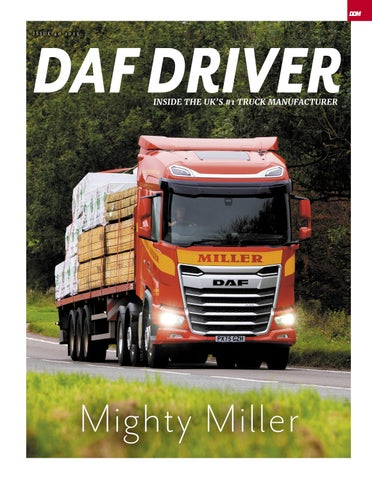

DAF DRIVER



Mighty Miller
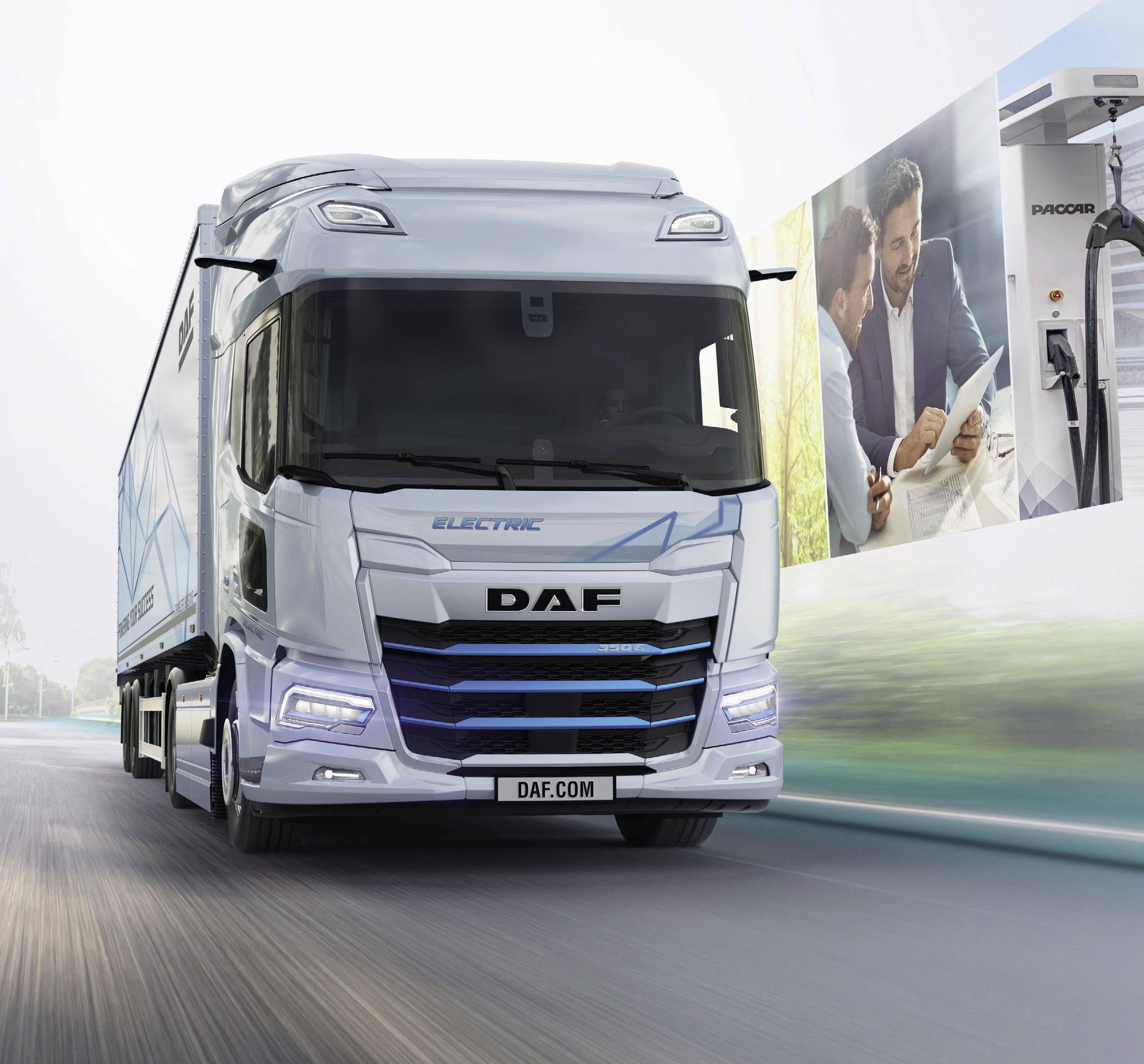




Powering your Success

DAF’s commitment is to help you make your business even more sustainable. Tailor-made solutions guarantee seamless operations, optimal return on investment and peace of mind. Together, we analyse your day-to-day activities. Providing insights on electric vehicles, charging solutions, connected and uptime services. We advice with route planning, charging strategy and offer driver training. DAF – powering your success on the road to sustainable transport. WWW.DAF.CO.UK/DAF-ELECTRIC
Driving zero emissions














WELCOME TO ISSUE 40 OF DAF DRIVER MAGAZINE!
“Some old-school drivers have resisted the introduction of this technology, but the advantages it offers in visibility and aerodynamics more than outweigh any perceived problems.”
Publisher - Matthew Eisenegger

FUTURE SHOCKS!
hanges are moving fast in the road transport industry now, and this latest issue of DAF Driver Magazine shows just what has been going on behind the scenes.
There’s an exclusive interview with DAF Trucks’ Design Director Bart van Lotringen, who reveals the secrets behind the aerodynamic styling of the New Generation of DAF trucks. Thanks to the brave anticipation of changes to EU dimensions laws, the DAF team was able to ensure that aerodynamic revisions to DAF truck cabs also yielded great improvements in space and comfort for the driver and increased the safety of both those inside and outside the cab. A winner all round.
A key change has been the substitution of conventional mirrors for a digital vision camera system. As DAF Driver Trainer Mandy Wannerton explains, some old-school drivers have resisted the introduction of this technology, but the advantages it offers in visibility and aerodynamics more than outweigh any perceived problems. If you’ve not had a chance to try the DAF system yet, I’d urge you to keep an open mind until you have.
And on the subject of traditions, heavy-haulage was the last application for the once much-loved ZF 16-speed gearbox. Legislative changes mean that it can no longer be offered even for the
ultra heavy-duty prime movers that were its last bastion against the tide of the 12-speed automated transmission, but can an automated 12-speeder really take its place in a Special Types heavy haulage vehicle?
There’s only one way to find out…try it out!
You can read how we got on on page 16, but again, be prepared to leave your preconceptions at home.
Nowhere is the pace of change quicker than in electric trucks. They form a small, but fastgrowing, segment of the overall market in the UK and the latest innovations from DAF Trucks are already making some of the earlier designs look distinctly old-fashioned. It’s hard to believe that the first electric DAFs were rolled out only in 2018, and there’s now an offering for every application from 12-tonne rigids to 4x2 tractors, with a variety of battery options to enable operators to fine-tune their vehicle in terms of range, price and payload.
We know some drivers are resistant to the idea of electrics, and we aren’t yet at the point where there is the technology or infrastructure to offer an electric solution for every mission, but it has to be said that you can’t drive an electric truck and fail to be impressed by the experience. Find out more on page 30, and don’t knock it unless you’ve tried it!
Enjoy the issue!
The Bigger Picture
Look out for the dynamic QR codes in this issue of DAF Driver magazine. Simply open the camera on your mobile device and point it at the code, then sit back for some exciting additional content.






p30
p24
FEATURES REGULARS
Can
DAF
EDITORIAL
Publisher: Matthew Eisenegger
Managing Editor: Richard Simpson
Designer: Harold Francis Callahan
Editorial Address: Commercial Vehicle Media & Publishing Ltd, 4th Floor 19 Capesthorne Drive, Eaves Green, Chorley, Lancashire. PR7 3QQ Telephone: 01257 231521
Email: matthew@cvdriver.com
ADVERTISING
Advertising Sales: David Johns Telephone: 01388 517906 Mobile: 07590 547343 Email: sales@cvdriver.com
DESIGN
Art Editor: Harold Francis Callahan Telephone: 01257 231521 Email: design@cvdriver.com
CONTRIBUTORS
Dean Barrett
Pip Dunn
Ronnie Hitchens
Karl Hopkinson
Chris Russon
Stevie Walker
Mark Ballantyne
PUBLISHER
Commercial Vehicle Media & Publishing Ltd, 4th Floor, 19 Capesthorne Drive, Eaves Green, Chorley, Lancashire. PR7 3QQ Telephone: 01257 231521
NOTE
The publisher makes every effort to ensure the magazine’s contents are correct. All material published in DAF Driver magazine is copyright and unauthorised reproduction is forbidden.
The Editors and Publisher of this magazine give no warranties, guarantees or assurances and make no representations regarding any goods or services advertised in this edition.
DAF Driver magazine is published under a licence from Commercial Vehicle Media & Publishing Ltd. All rights in the licensed material belong to Matthew Eisenegger or Commercial Vehicle Media and Publishing Ltd and may not be reproduced whether in whole or in part, without their prior written consent. DAF Driver magazine is a registered trademark.

If you are not going to keep this magazine for future reference please pass it on or recycle it.



MIGHTY MILLER


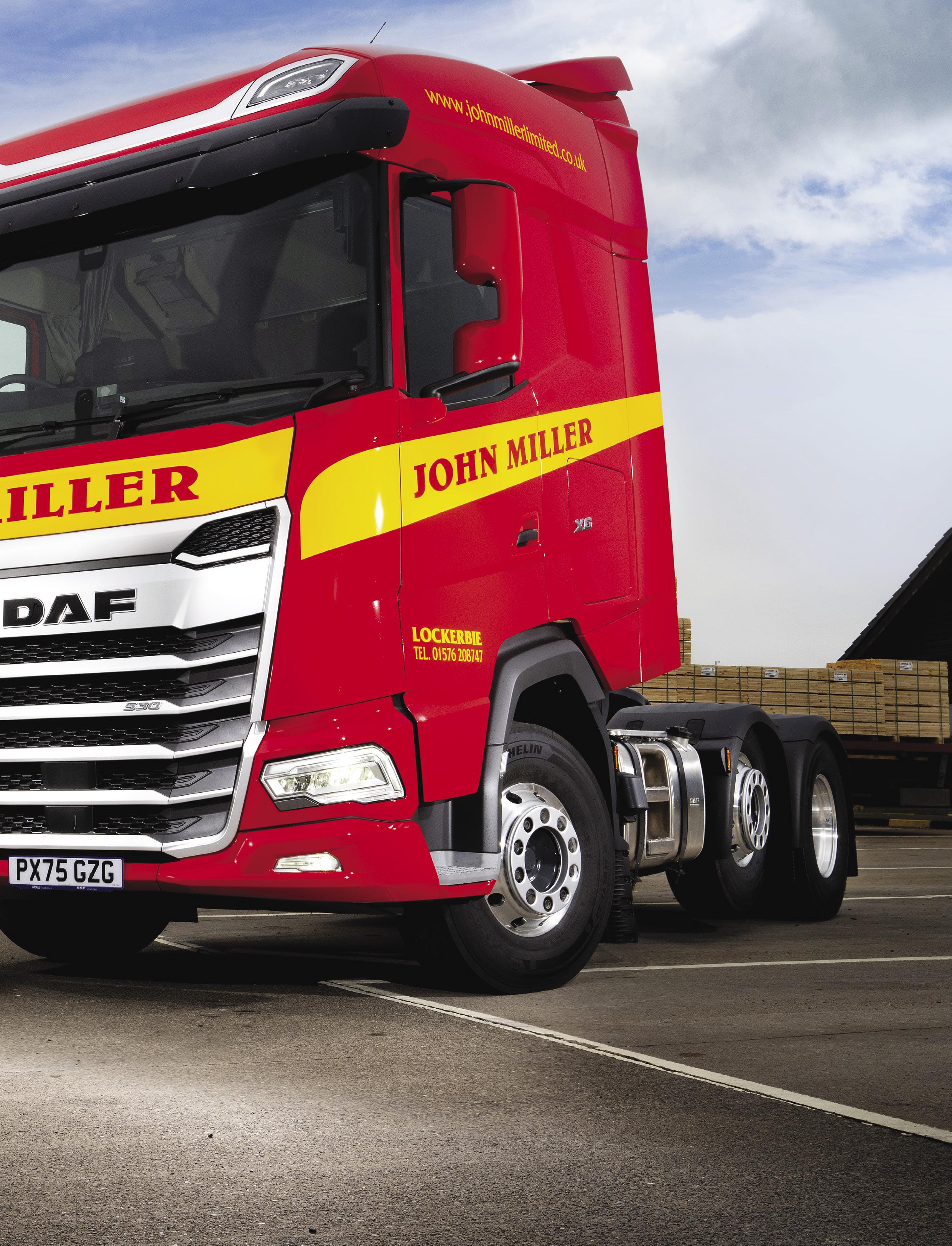

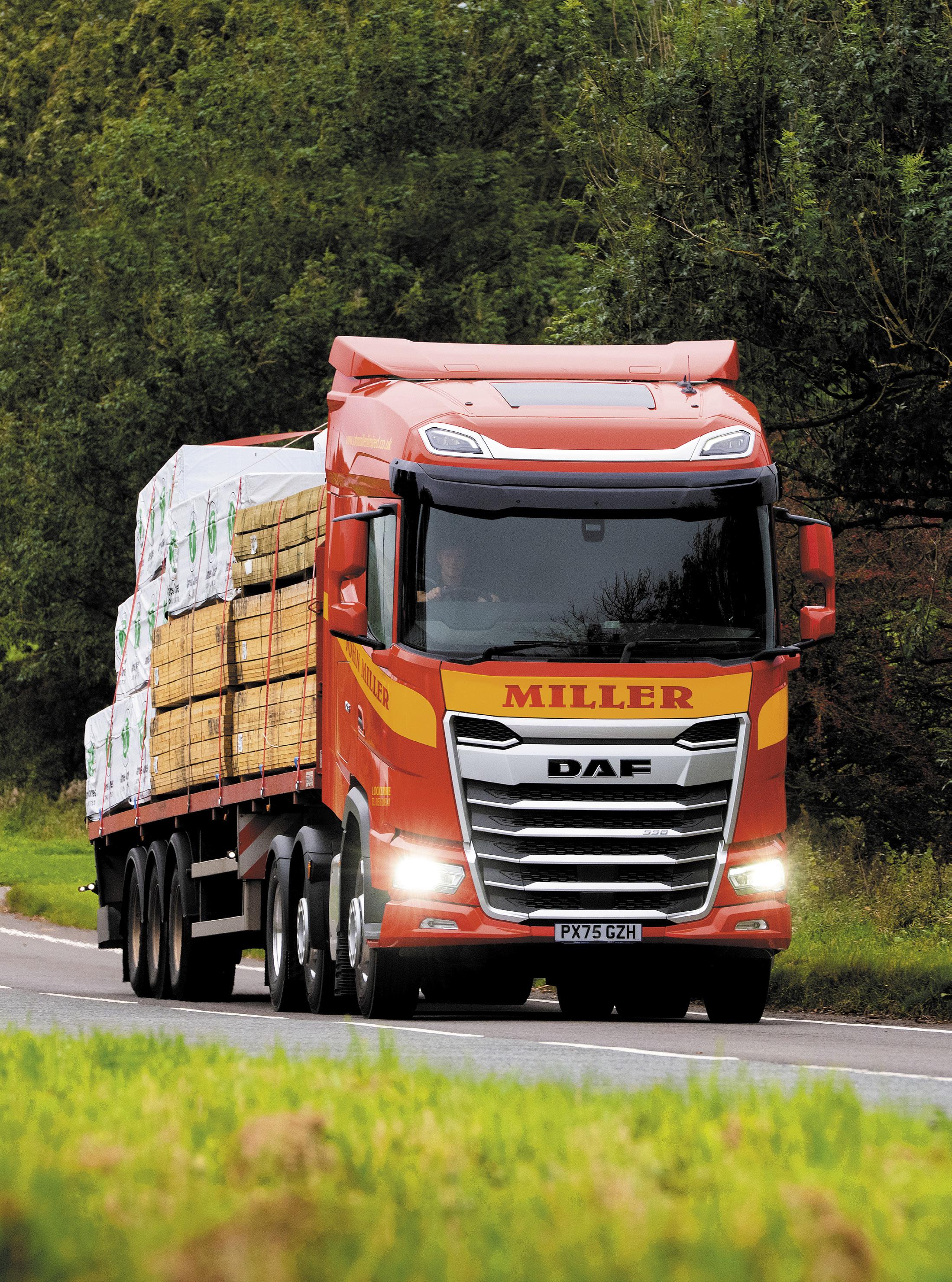
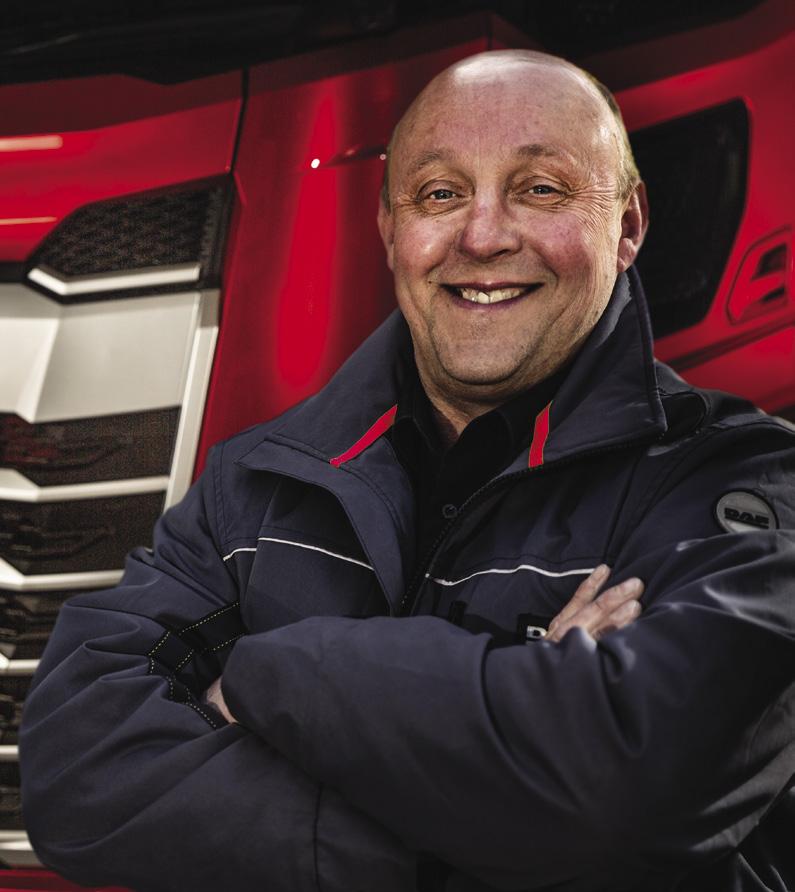
At the heart of Scotland’s haulage industry, John Miller Ltd has established itself as a champion of reliability, operational efficiency and a partner to some of the UK and Europe’s most demanding manufacturers.

Words: Ronnie Hitchens Photographs: Karl Hopkinson
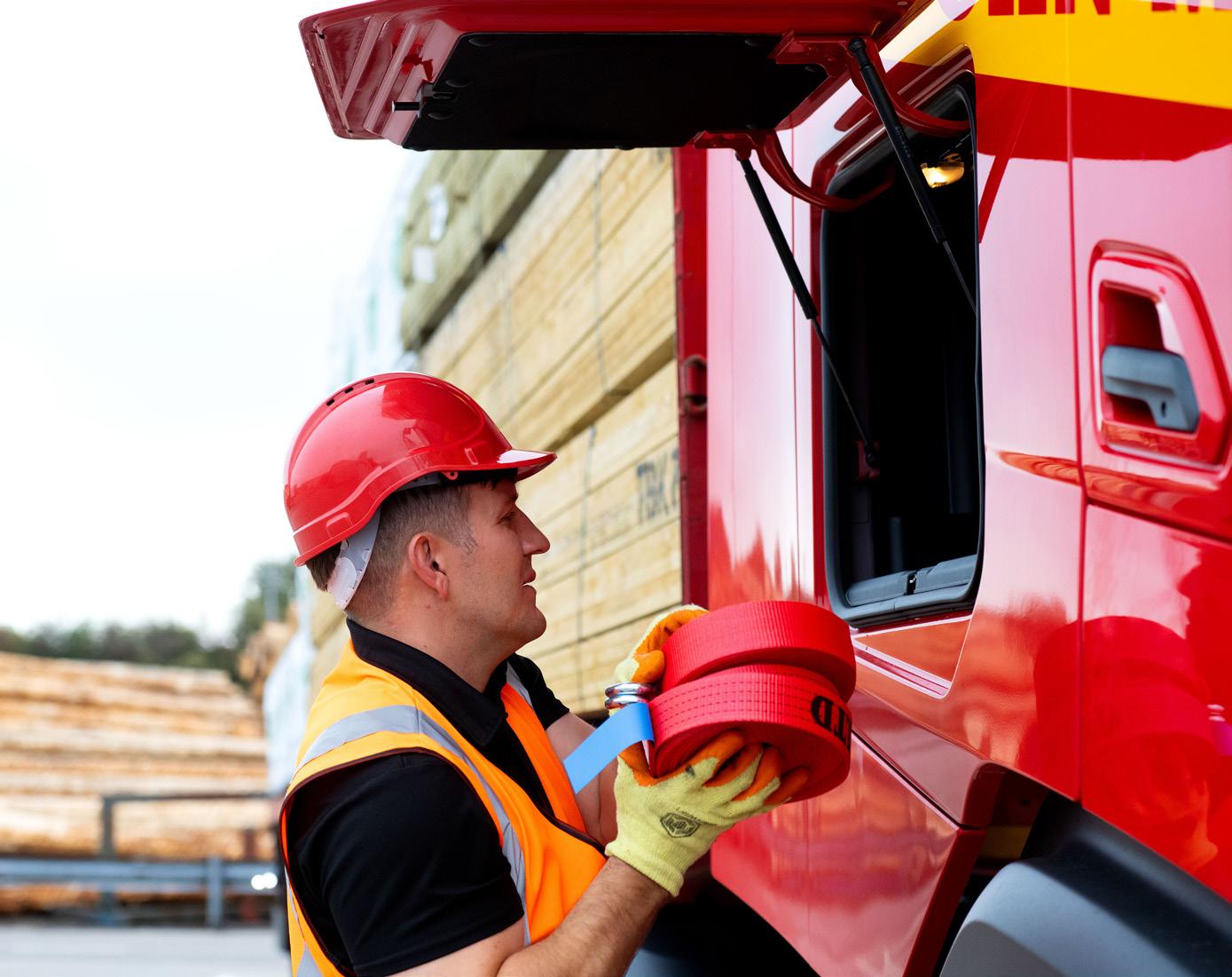
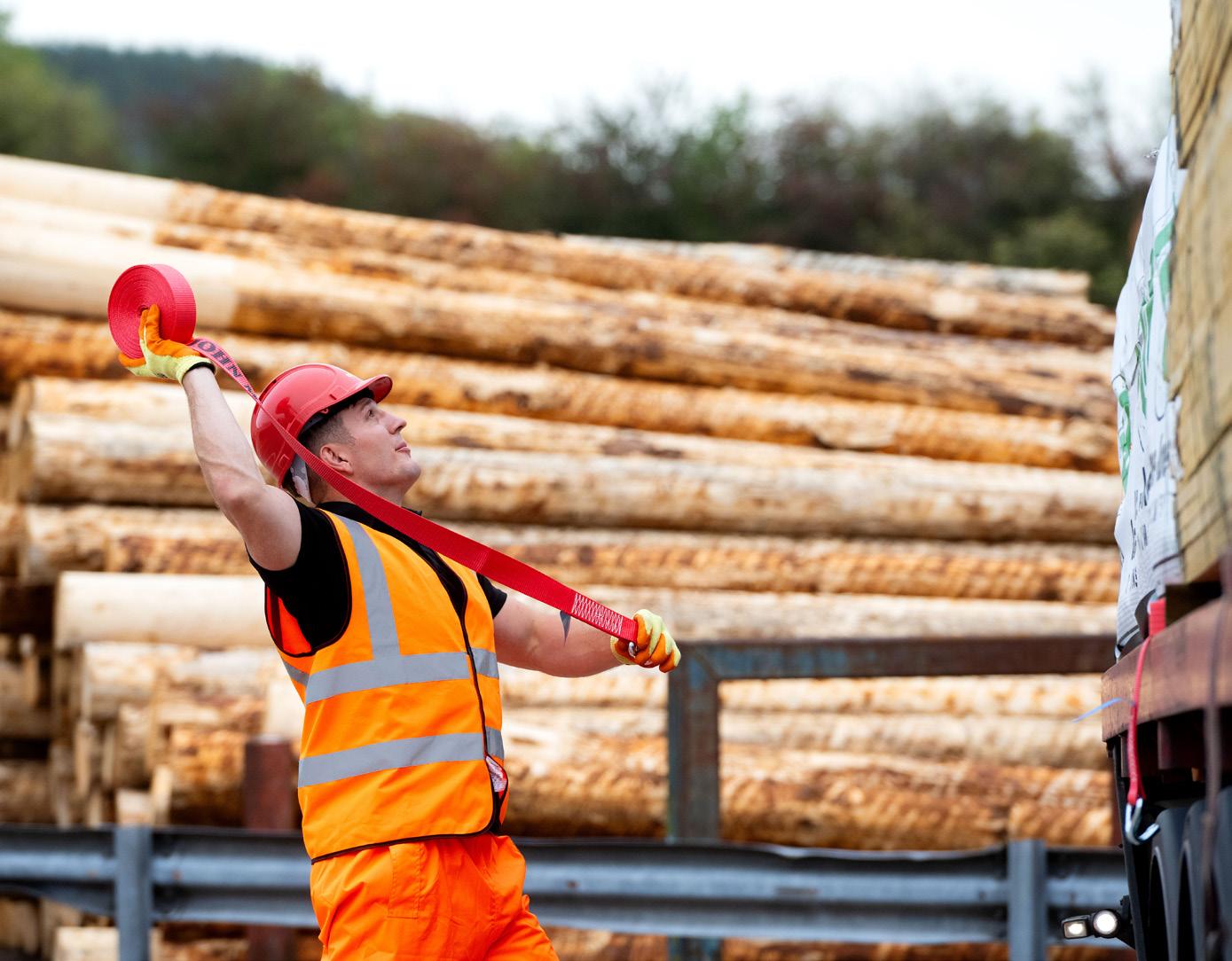
The company’s journey, steeped in family legacy and a relentless drive for technological improvement, offers a compelling case study in how modern operational choices – such as a decisive shift to a New Generation DAF fleet – shape profitability, sustainability and business reputation in today’s transport ecosystem.
Back in 1979, the Scottish border town of Dumfries was home to a young haulier with a single wagon and a clear ambition. John Miller, founder of what would become the iconic John Miller Transport, started out covering local timber and general haulage. But it didn’t take long for the business to outgrow its beginnings. As the 1980s progressed, the company seized opportunities to transport high-value computer parts between Ireland and Scotland at a time when the UK’s tech manufacturing sector was booming.
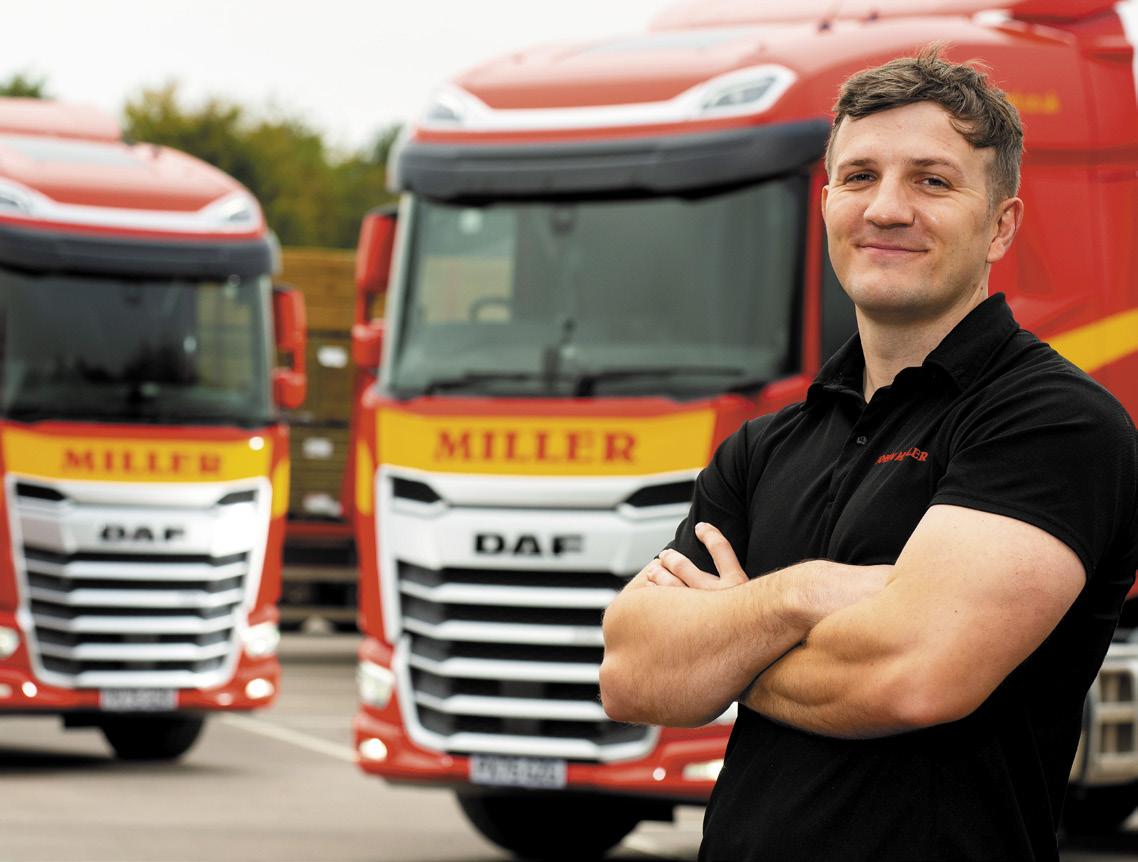
Operations Director and occasional driver, Ewan Miller, reflects on his father’s legacy: “Dad quickly built up the business,” he says, “moving components for big names like IBM and Hewlett Packard. The company’s lorries became well known on the roads and ferries between Ireland and Scotland. He also had major contracts with household brands such as Cadburys and Gillette, moving sensitive and high-value loads that needed to be delivered on time, every time.”
The business’s distinctive turquoise, white, and red livery became a familiar sight up and down the UK and across the Irish Sea. In 1995, this success was recognised at the highest level: John Miller Transport became Motor Transport Haulier of the Year; a first for a Scottish operation.
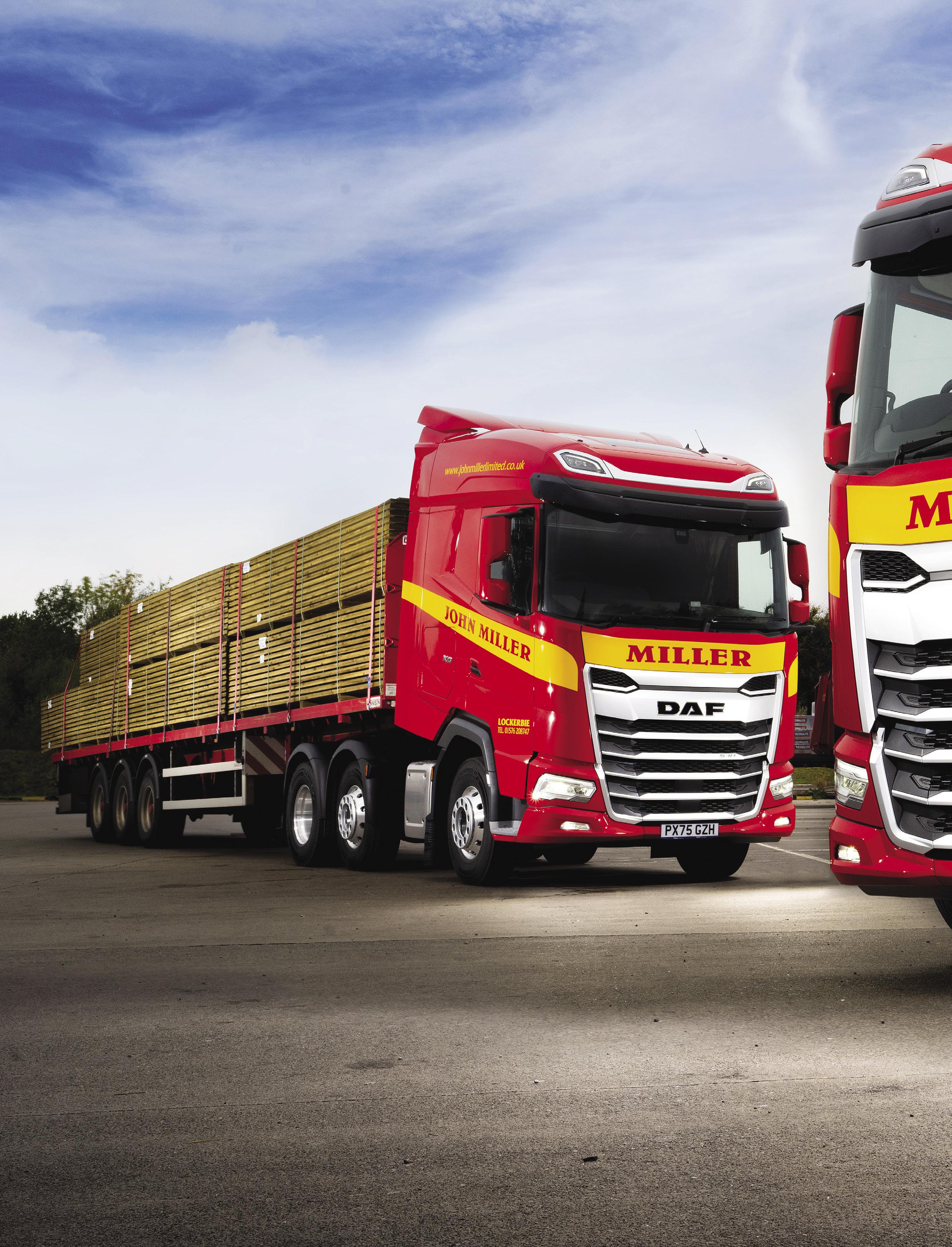
Then came change. Around the turn of the millennium, John Miller Transport was acquired by Securicor (now G4S). John stayed with the new owner as a director but, after several years, felt the call of independence once more. His new company, John Miller Ltd, made its mark with a bold new red-and-yellow livery, a focus on flatbed haulage for the construction sector, and a growing reputation for reliability.
Just-in-time
At the heart of the company’s philosophy is a commitment to just-in-time (JIT) logistics. For customers, especially those in manufacturing and construction, downtime is simply not an option. “Loading and delivering just in time, every day, is what we do,” Ewan states. “Our customers rely on us; their production lines depend on it. We simply must collect and deliver on time, no exceptions.”
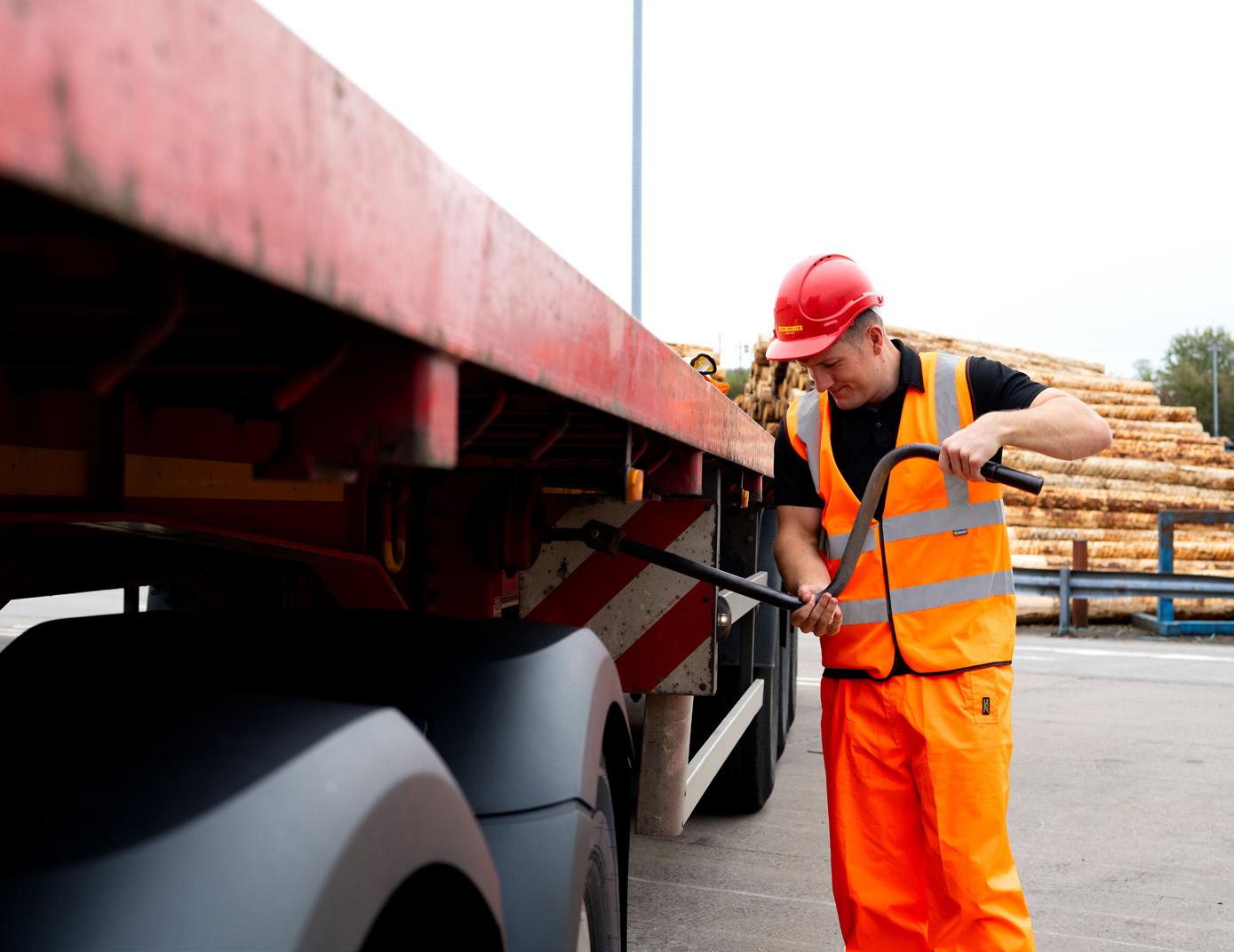
Ops Director and occasional driver
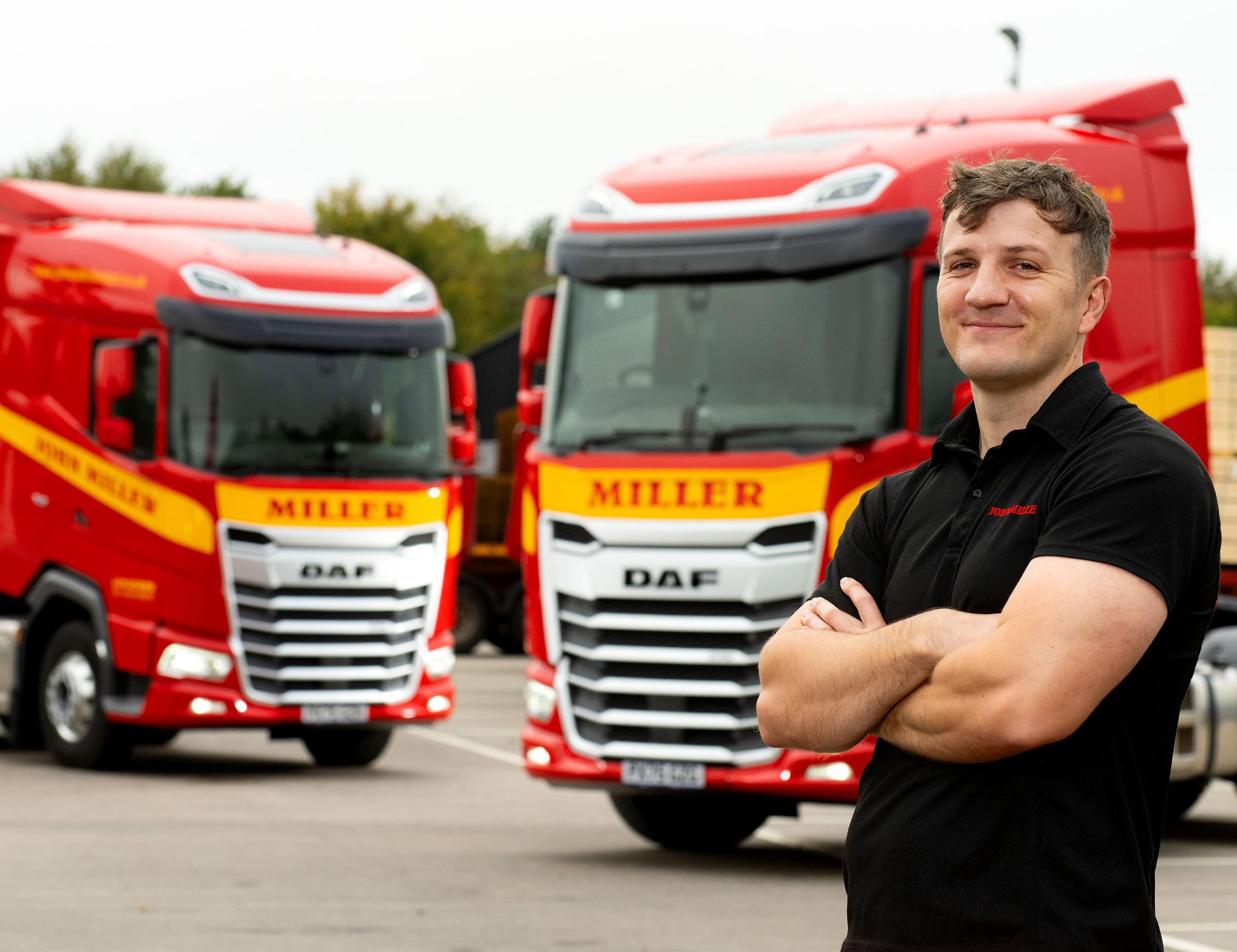
Ewan Miller gets his hands dirty
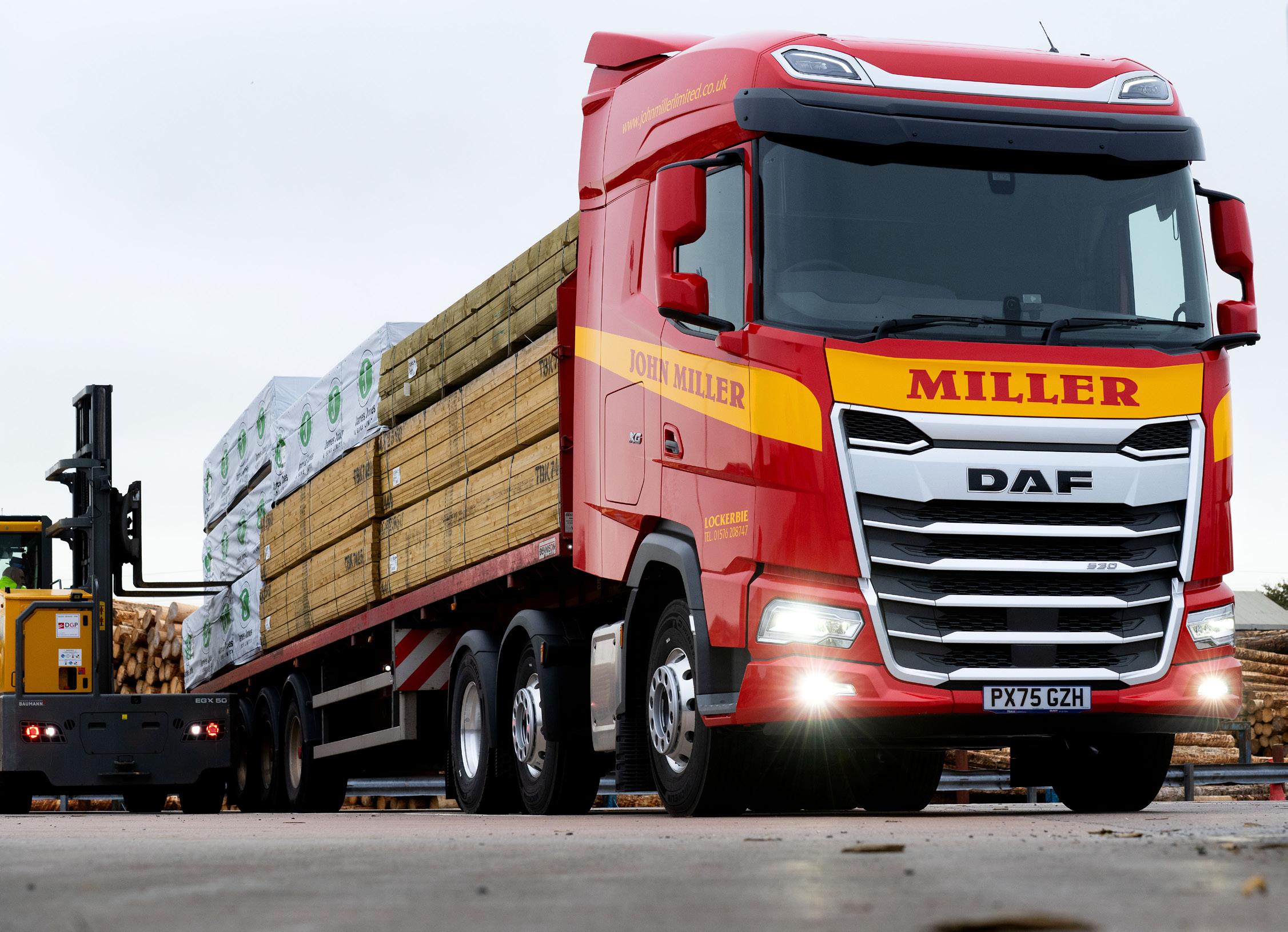
That operational reality places enormous pressure on both the equipment and the people involved. If even a single delivery is missed or delayed, the downstream impact on client supply chains can be severe. To minimise those risks, John Miller Ltd has carefully refined its fleet, its relationships with dealership partners and its operational procedures.
DAFs at forefront
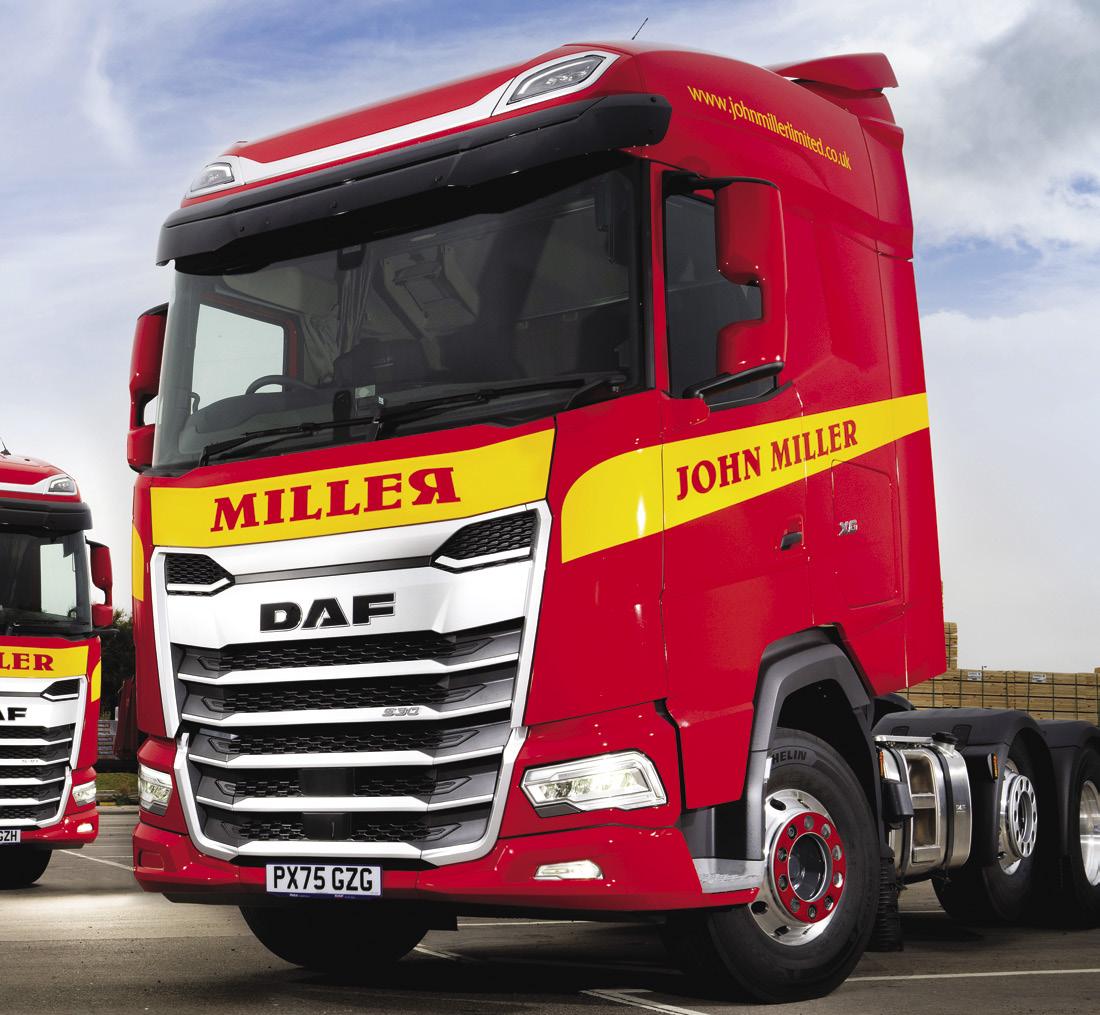
Today, John Miller Ltd runs a 60-strong fleet: 53 DAFs and seven Scanias. Over the last six years, it is the DAF marque that’s emerged as the overwhelming favourite. The reasons, says Ewan, are clear; local dealership support, robust after-sales service and vehicle reliability. “Ever since 1979 we’ve had DAFs in the fleet,” he says, “but it’s only in the last few years that they’ve made up the vast majority. Our local dealer, Motus in Dumfries, has been exceptional. When reliability is paramount and you’re running
trucks on JIT jobs, after-sales support is everything. DAF delivers that in spades.”
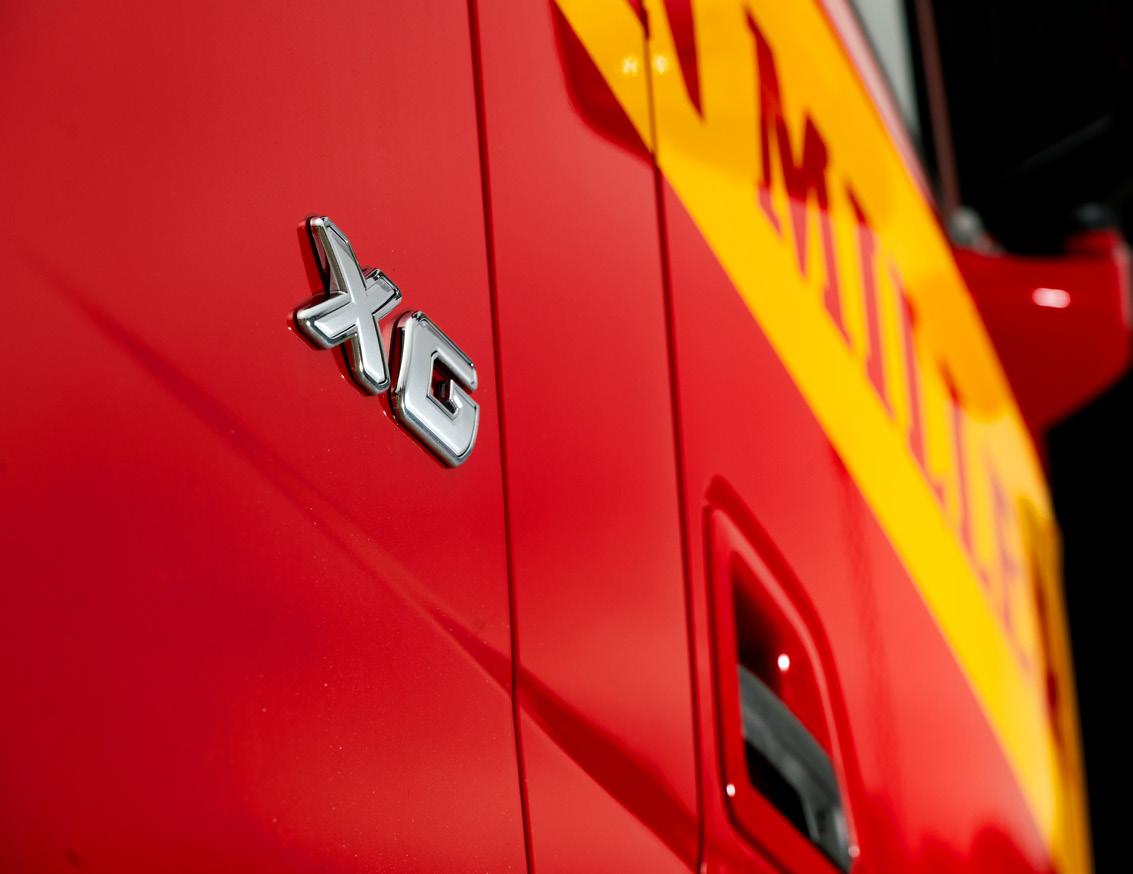
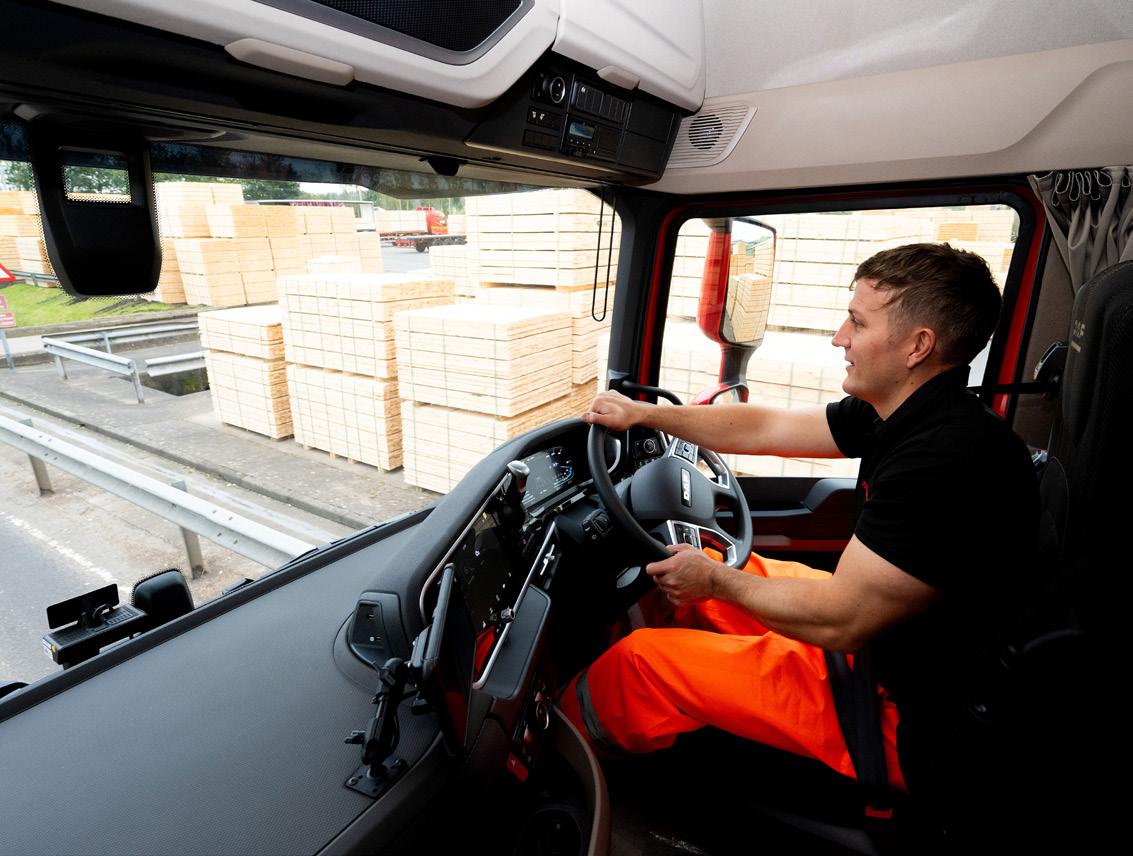
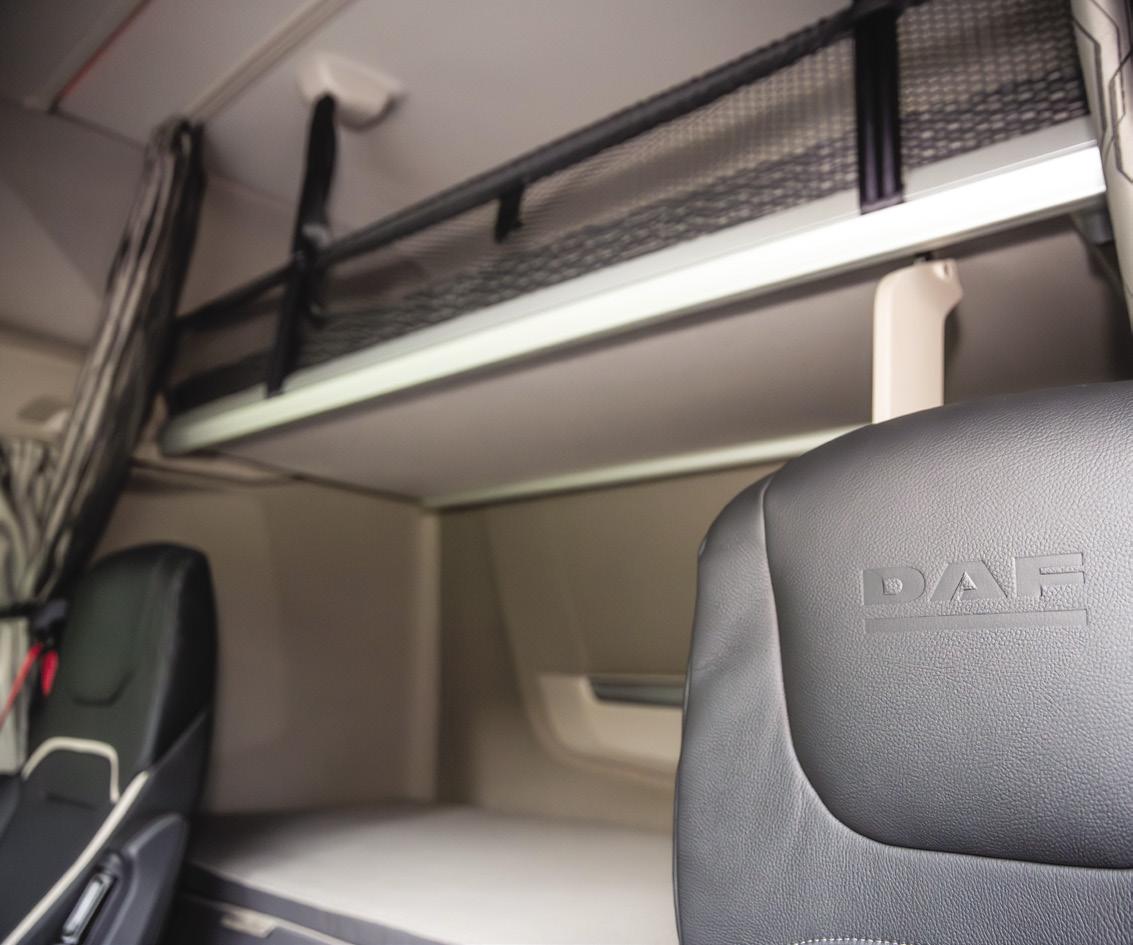
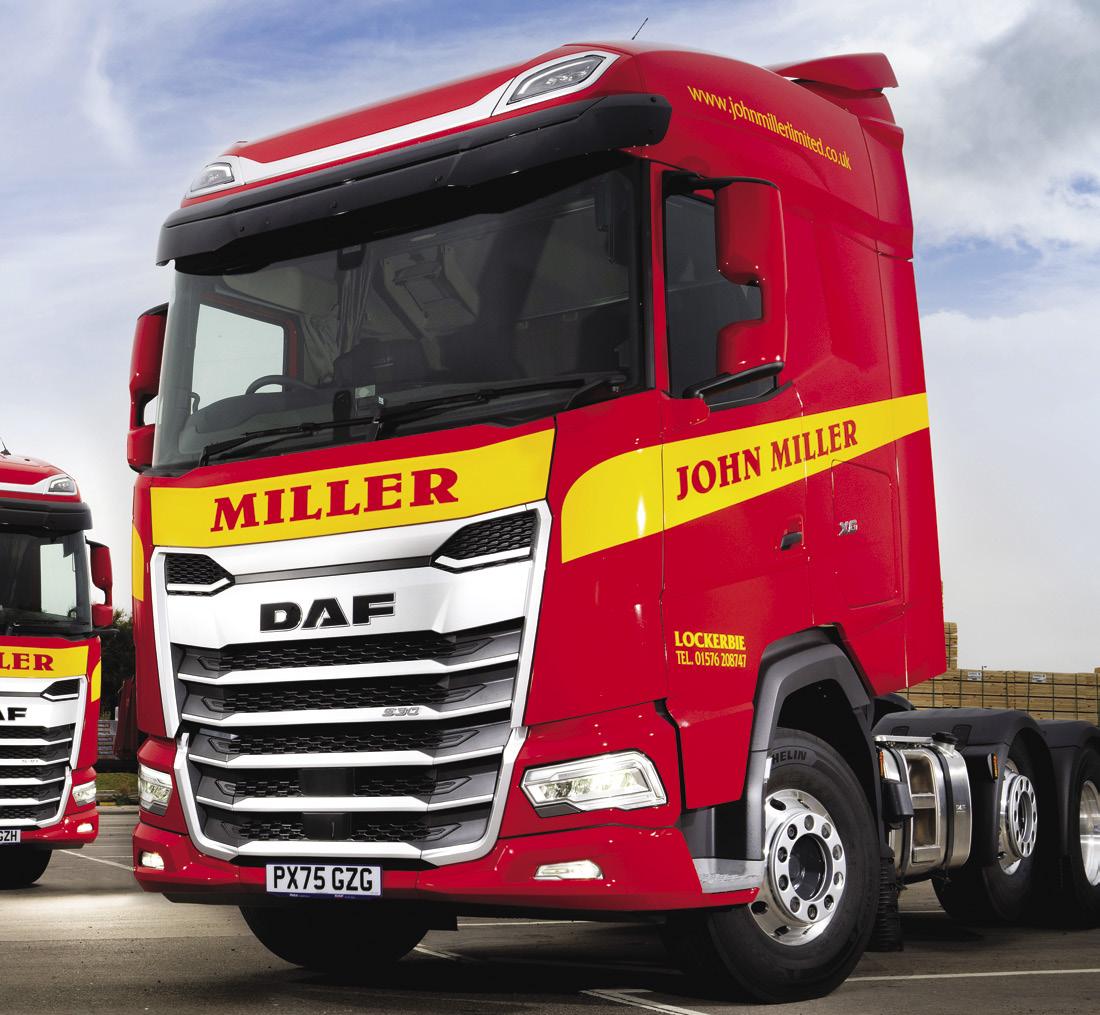
The latest additions, 25 New Generation DAFs, including a mix of XG and XF models, show the business’s nuanced approach to vehicle selection. The XGs, with their voluminous cabs, are preferred by drivers who spend the full week tramping. Each driver is typically assigned for four nights out at a stretch, so cab comfort, storage and amenities make a genuine difference to morale and retention.
“For our drivers, the XG is the gold standard, especially for longer jobs,” concedes Ewan, “You need that space when you’re living in a truck all week. But there’s a method in the deployment. We use the XF trucks for payloadsensitive work, like tanker and walking floor operations. The lighter cab means we get more payload on those jobs, and
there’s a slight edge in fuel efficiency as well.”
Fuel efficiency
It’s not just reliability that’s under the microscope. Fuel economy is a major aspect of the company’s commercial and environmental approach. The XF tanker fleet has recently recorded a significant 0.8 mpg improvement with its 2025 DAFs; a seemingly small number, but, when multiplied across annual mileages and multiple trucks, it translates into major financial and CO2 savings.
“EVERSINCE1979 WE’VEHADDAFS INTHEFLEET”
The New Generation DAF fleet is split into XG 6x2 tractors for the flat-bed ‘tramping’ work, while the XF 6x2s are exclusive to the tanker fleet
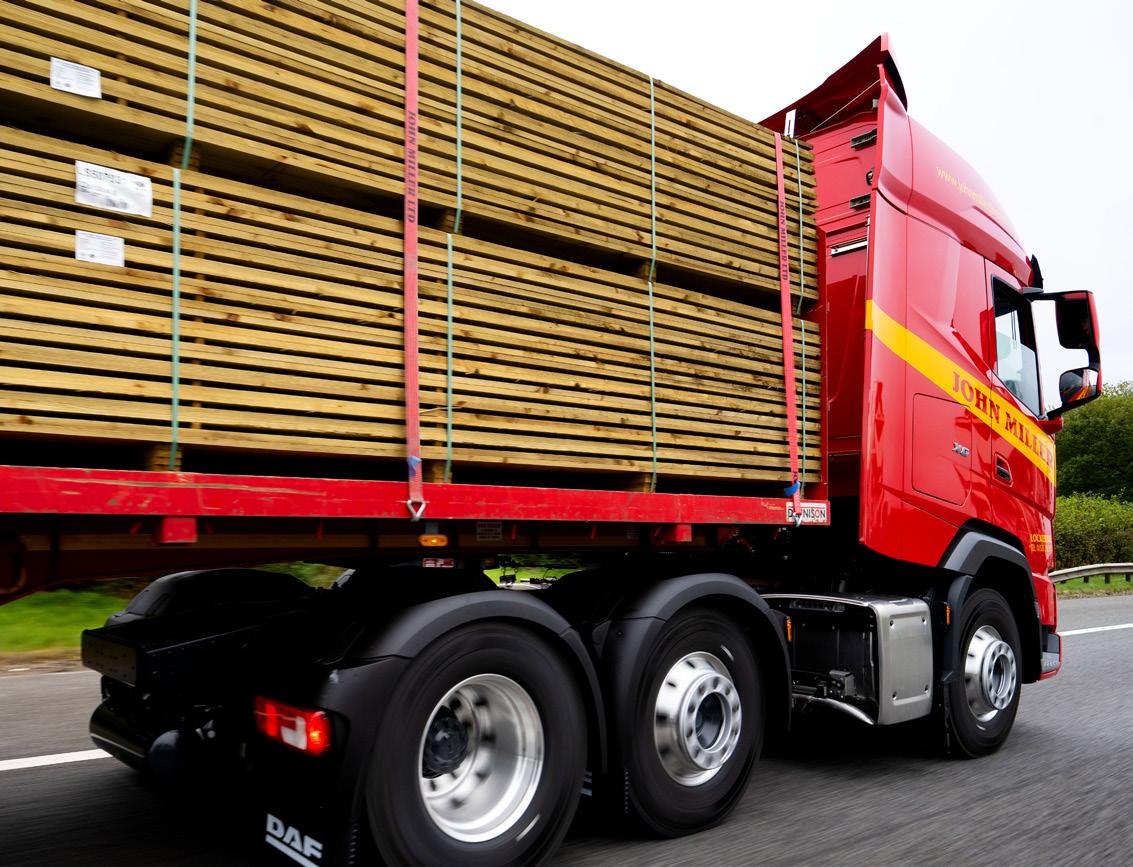
Many of the firm’s blue-chip clients, especially those in precast concrete and timber, are under significant pressure to reduce emissions and demonstrate environmental responsibility. John Miller Ltd’s continual investment in newer, more efficient trucks is, therefore, also delivering a tangible, competitive advantage, supporting their clients’ drive for sustainability as well as their own.
Strategic footprint
Modern haulage isn’t just about the trucks, it’s about having the right infrastructure in place to move goods efficiently from anywhere, anytime. Central to John Miller’s strategy is its Lockerbie base, ideally situated just off junction 17 of the M74. From there, the company can quickly dispatch vehicles further north into Scotland or south to England (and beyond), ensuring
that clients anywhere in the UK can be served at speed.
Additional operational centres in Glasgow, Carlisle, Warrington, Ellesmere Port and Stoke extend their service reach, helping the company maintain a tight grip on schedules while spreading the maintenance and support load across multiple hubs.
The human factor
None of these assets would matter without the right team. “Most of our drivers are trampers,” says Ewan, who chips-in with driving when required, “they’re away all week, every week. It’s essential that we’re giving them trucks they’re happy to live in and take pride in.”
Investment in the New Generation DAFs, particularly the XGs, has
delivered real benefits in retention, morale and performance. Drivers are typically assigned vehicles on a long-term basis, fostering a sense of ownership. While the XG’s ample space and comfort are universally appreciated, Ewan is candid about operational realities. “Look, the XF is a well-appointed, spacious cab, but a little smaller than the XG, and sometimes drivers grumble if they see a mate with an XG. But we explain the reasoning – some jobs demand as much payload as possible, so the lighter cab helps. It’s a trade-off, and our drivers understand that.”
John Miller Ltd runs a mix of flatbed and bulk-liquid tanker operations. Specialised work, such as walkingfloor contracts and tanker jobs, prioritise payload and fuel economy; so these are roles to which the XF units
are specifically assigned. While explicit client names are kept off the record, the company is proud to be the ‘number one haulier for the UK’s leading precast concrete manufacturer, a top European timber company, and the main haulage partner to Europe’s foremost waste-tobiodiesel producer’.
The expectations from these clients are exacting. 24/7/365 operational support, total reliability and a proactive approach to emissions reduction. Ewan credits the company’s logistical flexibility, backed by a modern, wellmaintained fleet and skilled staff, as key to winning and retaining significant contracts.
Family roots, professional standards
Somewhat surprisingly, Ewan is the only family member fully active in the business today. His siblings have
both taken different paths having been briefly involved at various times. The company, though, remains infused with the Millers’ emphasis on hard work, trust and integrity. That legacy is visible in day-to-day dealings, from tight-knit relationships with dealership partners to the way drivers are allocated equipment and treated as highly-valued professionals.
“As a business, we’re big enough to handle major contracts with some of the UK and Europe’s largest manufacturers, but we’re small enough to stay agile – close to our drivers, customers and suppliers,” Ewan reflects.
Future vision
Looking ahead, John Miller Ltd’s focus will remain on continual renewal; both in fleet and in culture. The
commitment to keeping the fleet modern and fuel efficient is matched by a willingness to invest in new operational systems, support tools and outreach (including, possibly, a more active presence on LinkedIn and other social media).
“In this industry, standing still isn’t an option,” admits Ewan, “Our clients need to know they can trust us tomorrow as much as they trust us today. That means new trucks, better fuel performance and always keeping the promise to deliver on time.”
From the company’s beginnings on the back roads of Dumfries to its current role as a vital link in some of Europe’s most efficient supply chains, John Miller Ltd remains a study in how tradition, innovation and partnerships can shape a business that’s built to last.
“For our drivers, the XG is the gold standard, especially for longer jobs. You need that space when you’re living in a truck all week.” Ewan Miller
Halo DB12 S joins Aston stable
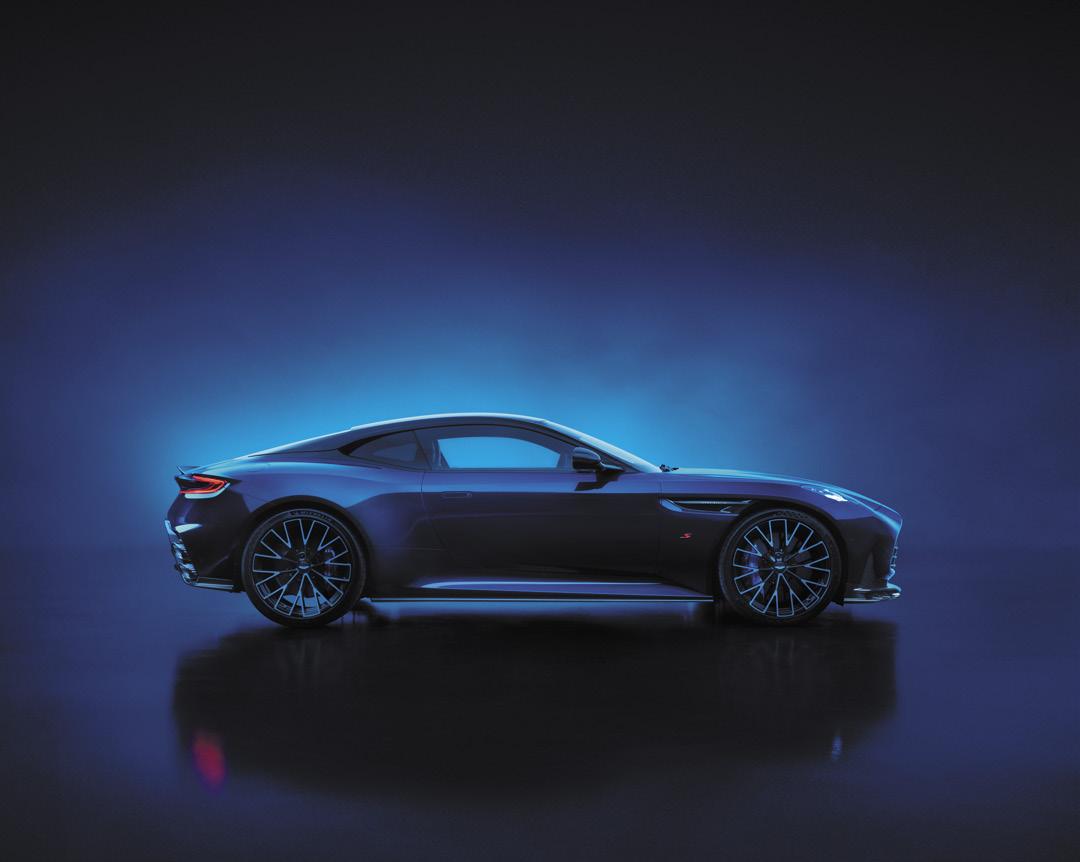
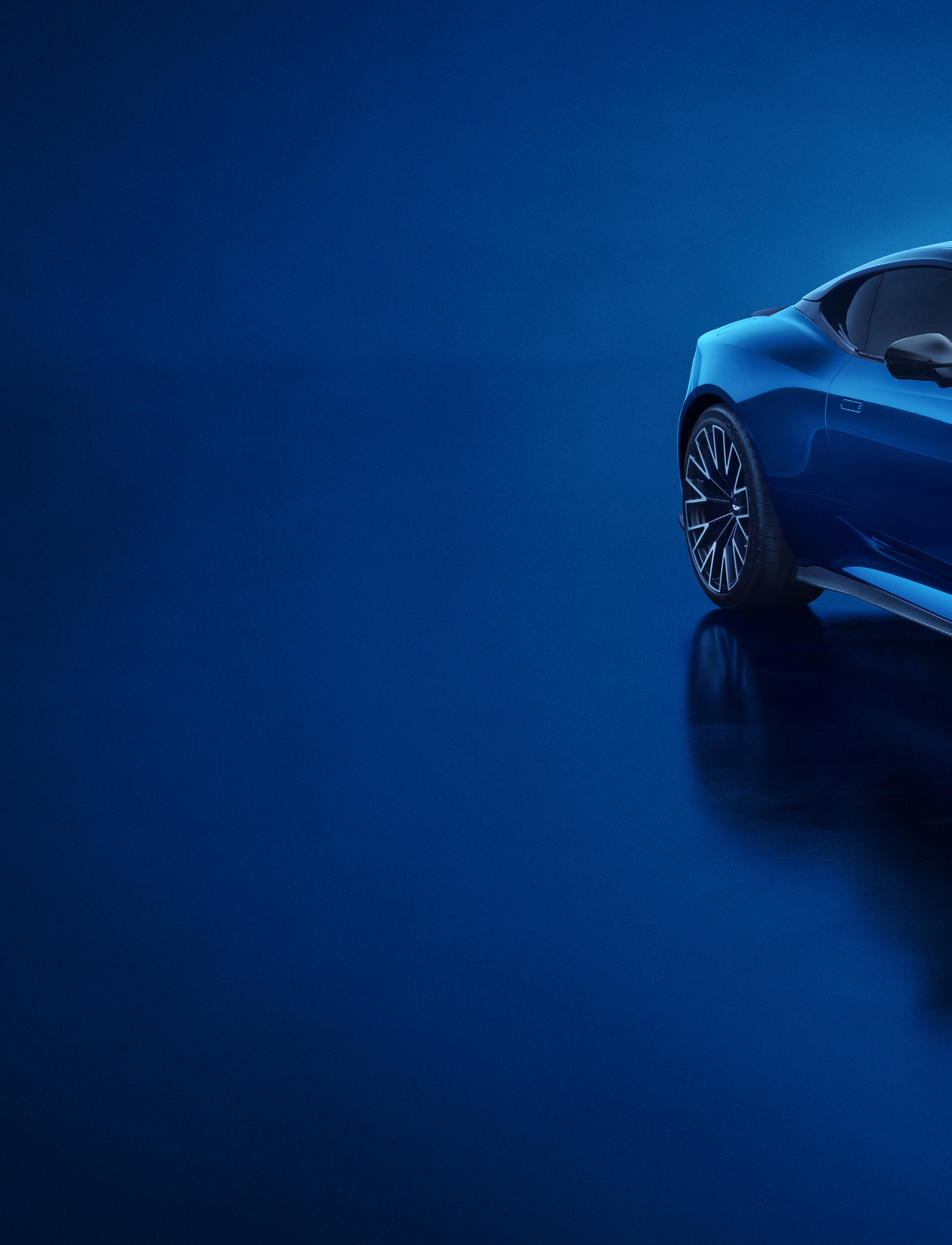
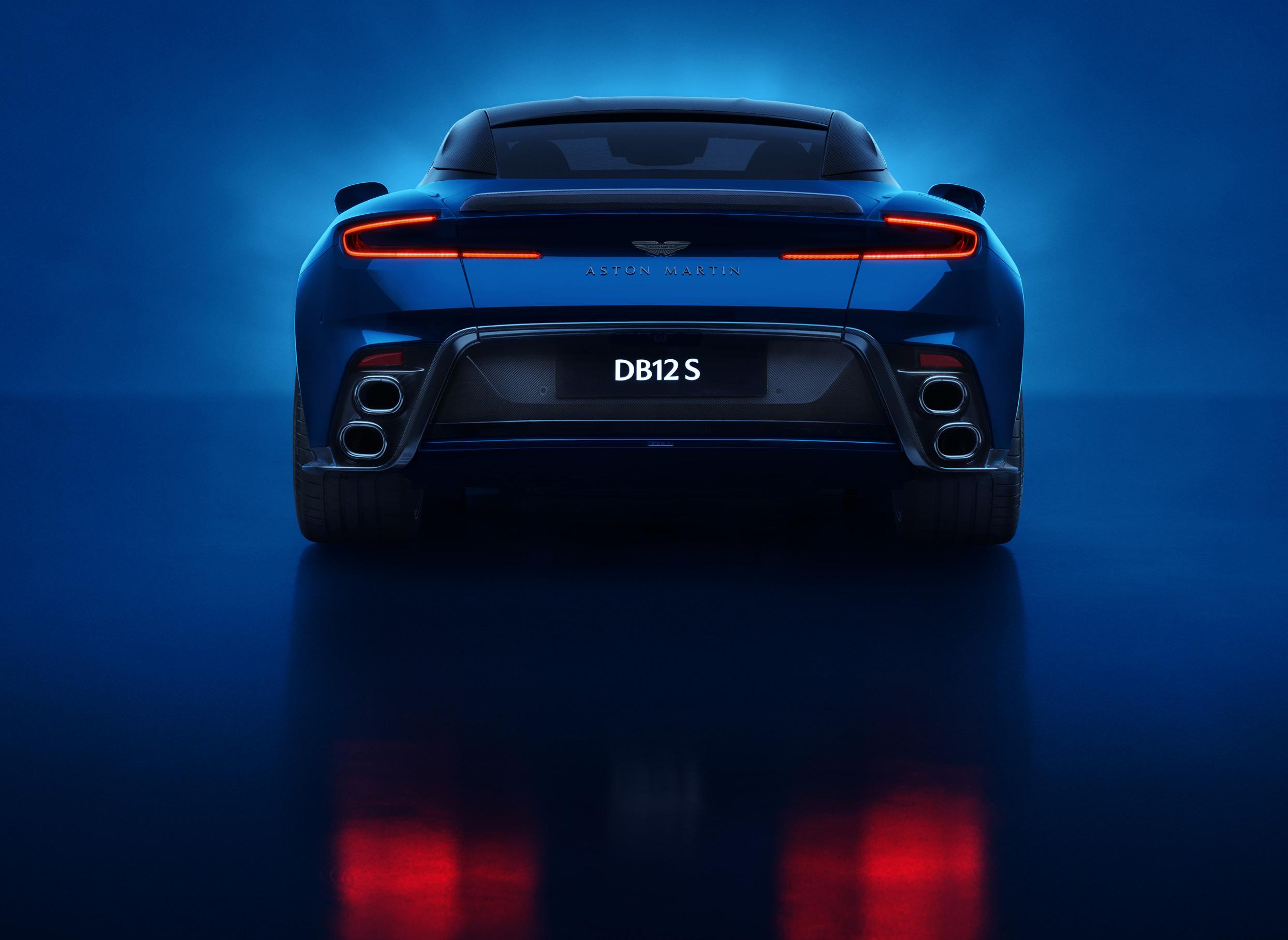
Aston Martin has announced a new DB12 halo model, the DB12 S.
Words: Chris Russon
Photographs: Aston Martin

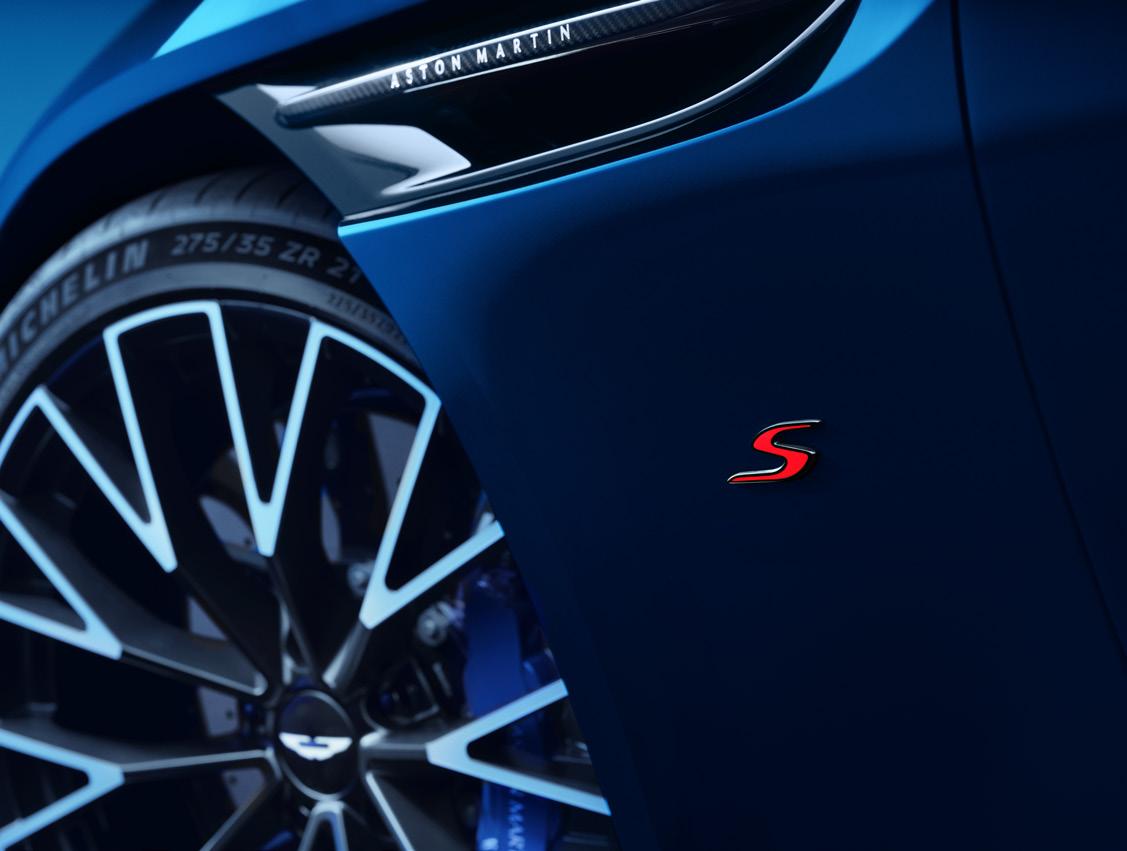
‘S’ badged denotes highest performance model
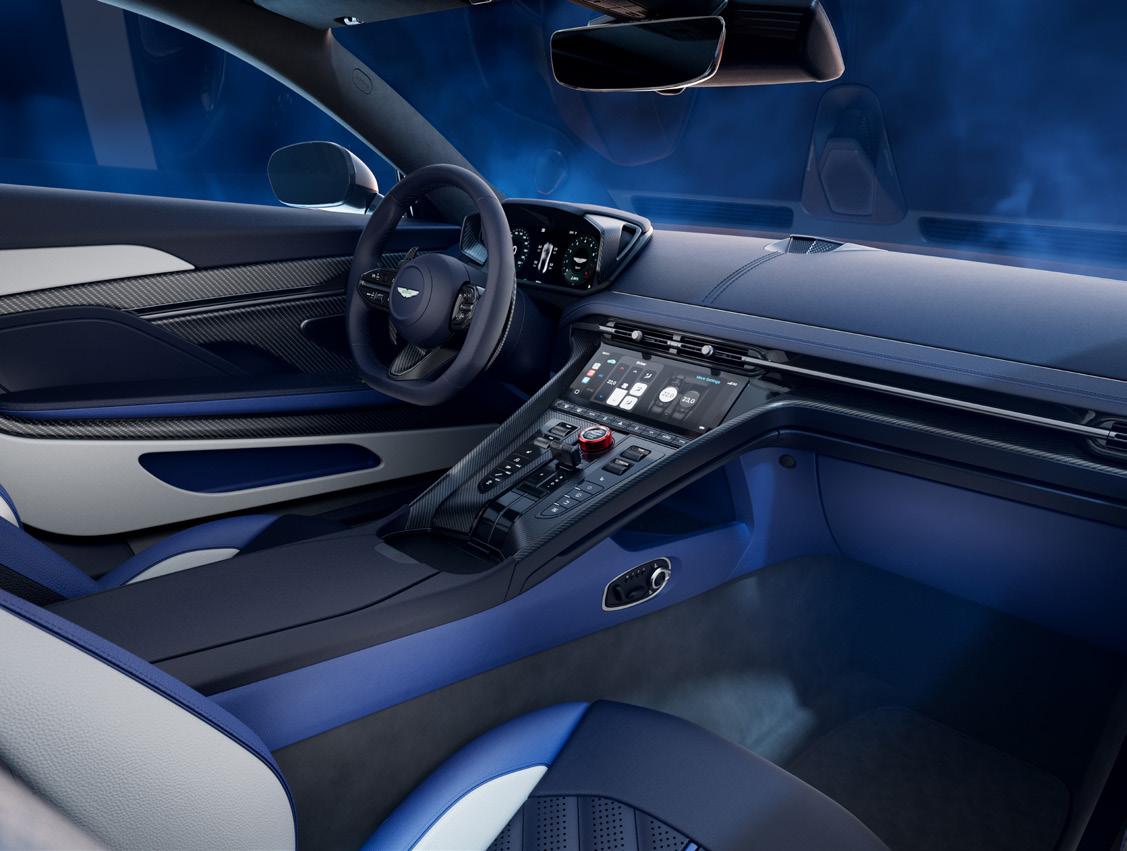
Taking the driver-focussed DB12 as its start point, DB12 S builds on that pioneering recipe of intensely dynamic ultra-luxury performance by adding more power and even greater dynamic prowess.
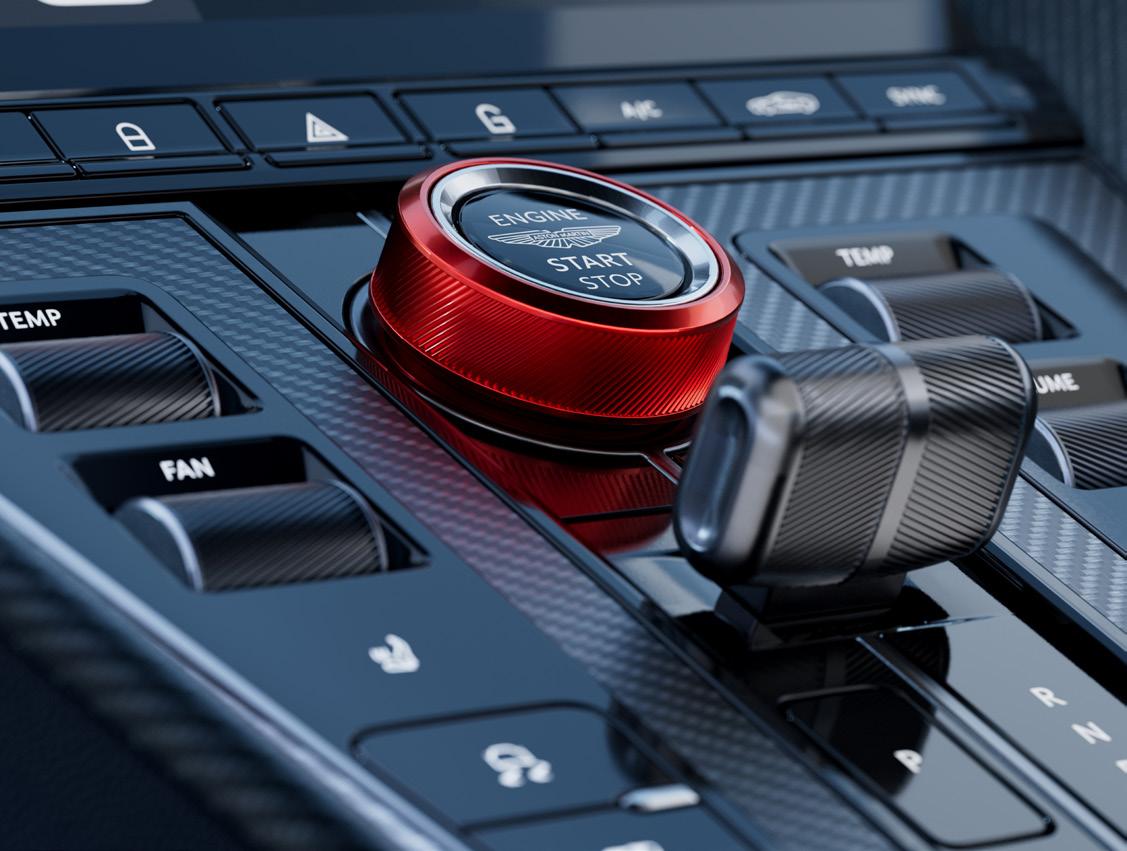
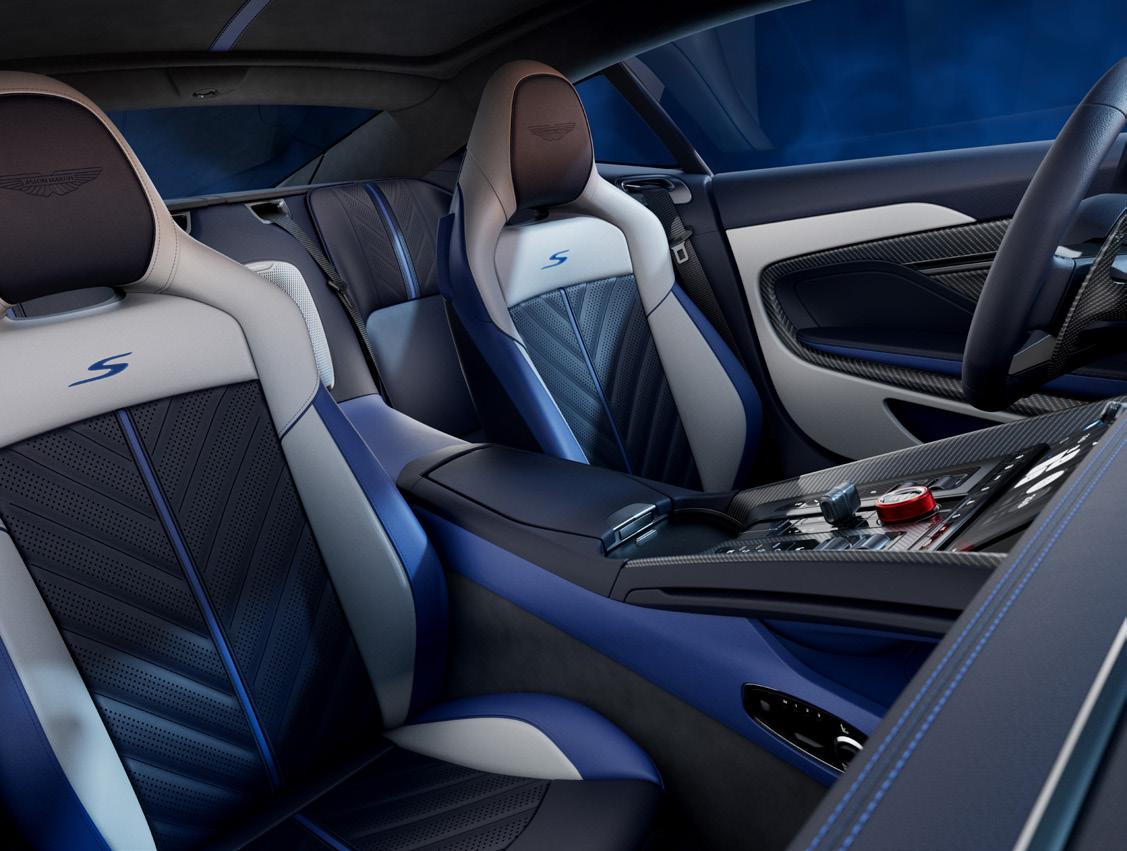
Together with striking exterior changes and extensive interior enhancements, DB12 S is the new pinnacle of Super Tourer.
Joining DBX S and Vantage S, DB12 S follows the convention of applying the ‘S’ suffix to the highest performing derivative of an established model.
This custom began in 1953 with the glorious DB3S road-racer. More recent examples include the first and second generation Vanquish S – launched in 2004 and 2016 respectively - V8 and V12 Vantage S models introduced in
2011 and 2013, and the magnificent four-seater Rapide S, also launched in 2013.
The heart of the DB12 S is an even more potent version of the Aston Martin 4.0-litre Twin-Turbo V8. Now with 700ps - an increase of 20ps - the DB12 S offers has a 202mph top speed.
In keeping with this intensified spirit, DB12 S features a distinctive new exhaust sound character.
The new quad tailpipe stainless steel sports exhaust system has been tuned to accentuate the engine frequencies throughout the rev range for added depth and potency.
Calibration changes to the powertrain have optimised the Launch Control system, reducing gearshift times by
“Thetechnologywe introducedwiththe DB12nowallowsus exceptionalscopeto exploreanewdepth ofcharacterand capabilitywithinthe samevehicleplatform”
Push to unleash 700ps
Quad tailpipes distinguish the ‘S’ model
more than 50 per cent and contributing to a 0.1sec improvement in 0-60mph time, which is now just 3.4 seconds.
Aston Martin engineers have further honed the throttle pedal calibration, introducing a more progressive throttle pedal feel with a new S-specific driveby-wire throttle map to give the driver a greater sense of connection and control.
Another significant upgrade for the DB12 S is the standard fitment of Carbon Ceramic Brakes which offer increased braking performance and thermal capacity together with a significant reduction in unsprung weight.
Aston Martin director of vehicle performance, Simon Newton said “The technology we introduced with
the DB12 now allows us exceptional scope to explore a new depth of character and capability within the same vehicle platform. With DB12 S we have carefully engineered a host of detailed changes, which, preserve signature levels of refinement, boost vehicle performance and amplify driver engagement. Having added this greater dynamic and performance bandwidth to DB12 S, we believe this elevates the Super Tourer ethos to a thrilling new level.”
Visually, the new DB12 S reflects its bolstered performance and sporting feel with a striking new look. Starting at the front, the DB12 S is identified by new dual element front splitter and bonnet louvres.
Moving to the flanks, the DB12 S features gloss black sill additions
and also continues the tradition of carrying S badges in key locations, specifically, on the bumpers just below each side strake.
At the rear there’s a fixed rear spoiler with a new rear diffuser, which allows stacked pairs of exhaust tailpipes.
Amongst the options offered on DB12 S are an Alcantara heated sports steering wheel, and the iconic Aston Martin wings applied to the seat headrests by an industry-first technique using both embossing and debossing for precision and sculptural depth.
The DB12 S is available to order now, in Coupe and Volante form, with prices starting from around £220,000 and deliveries are scheduled for the start of 2026.
BEAST OF BURDEN

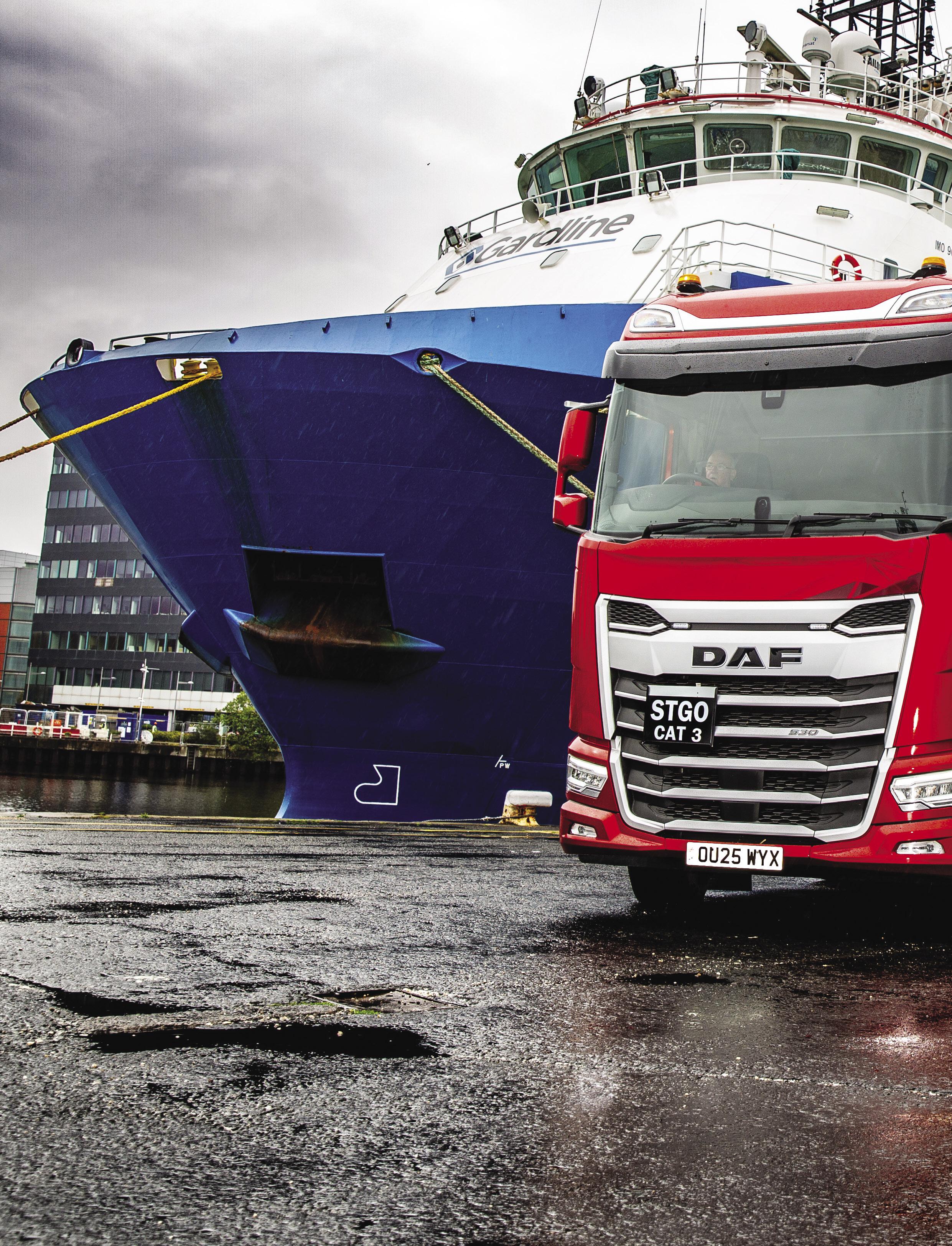

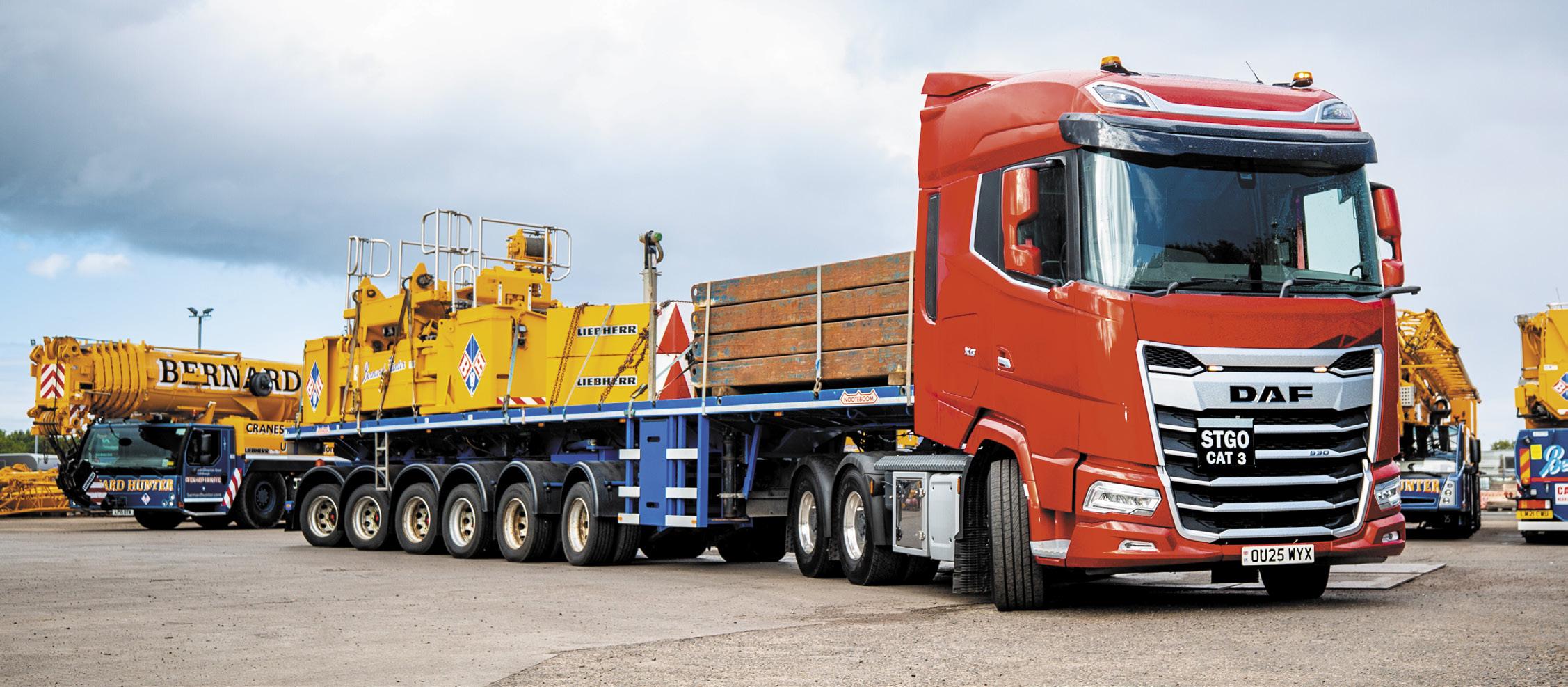
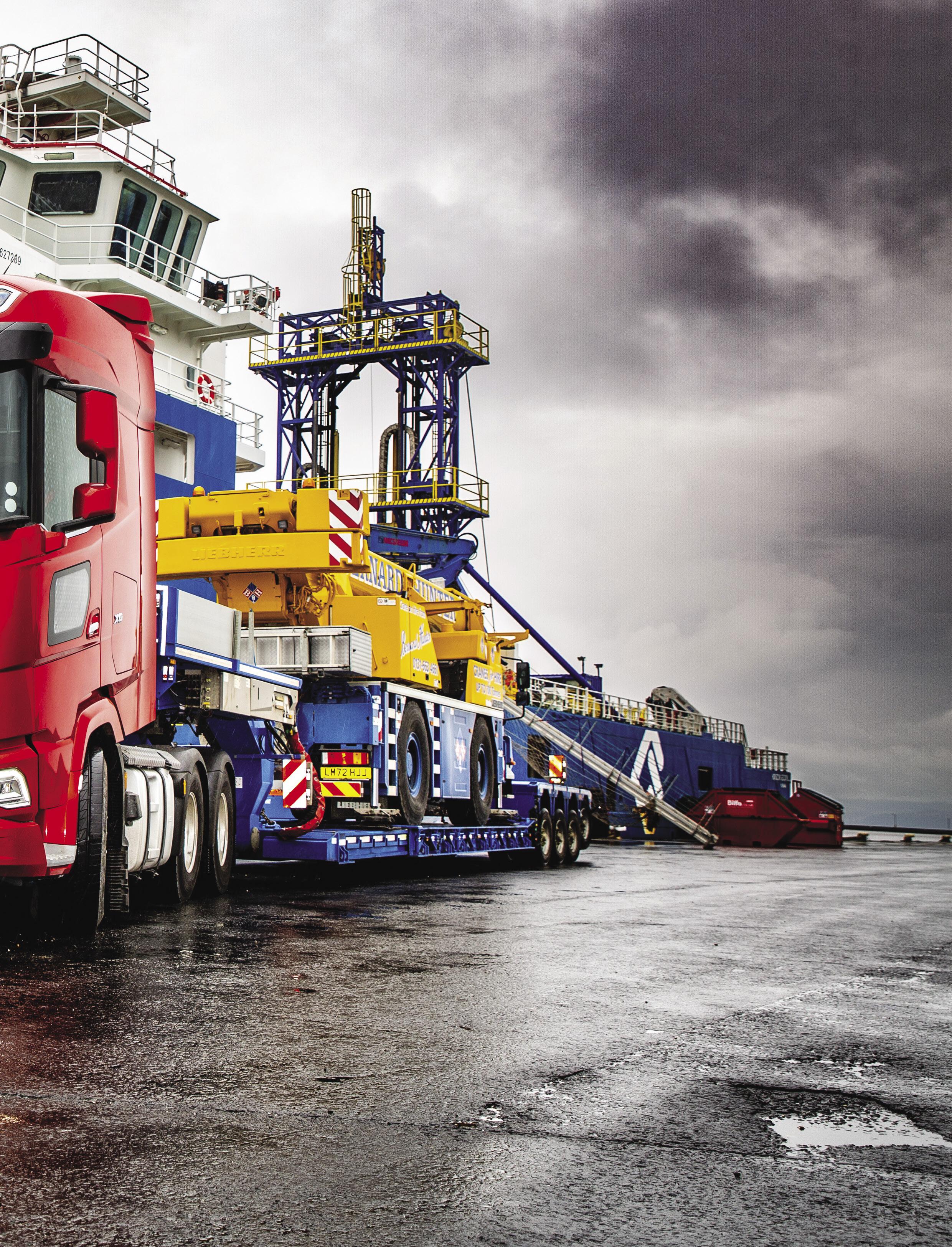
Will DAF’s shiny new XG 530FTT demo truck be beast enough to do Bernard Hunter Ltd’s donkey work?

Words: Stevie Walker
Photographs: Mark Ballantyne

“LOADEDWITHALLTHENECESSARYGUBBINS

DAF
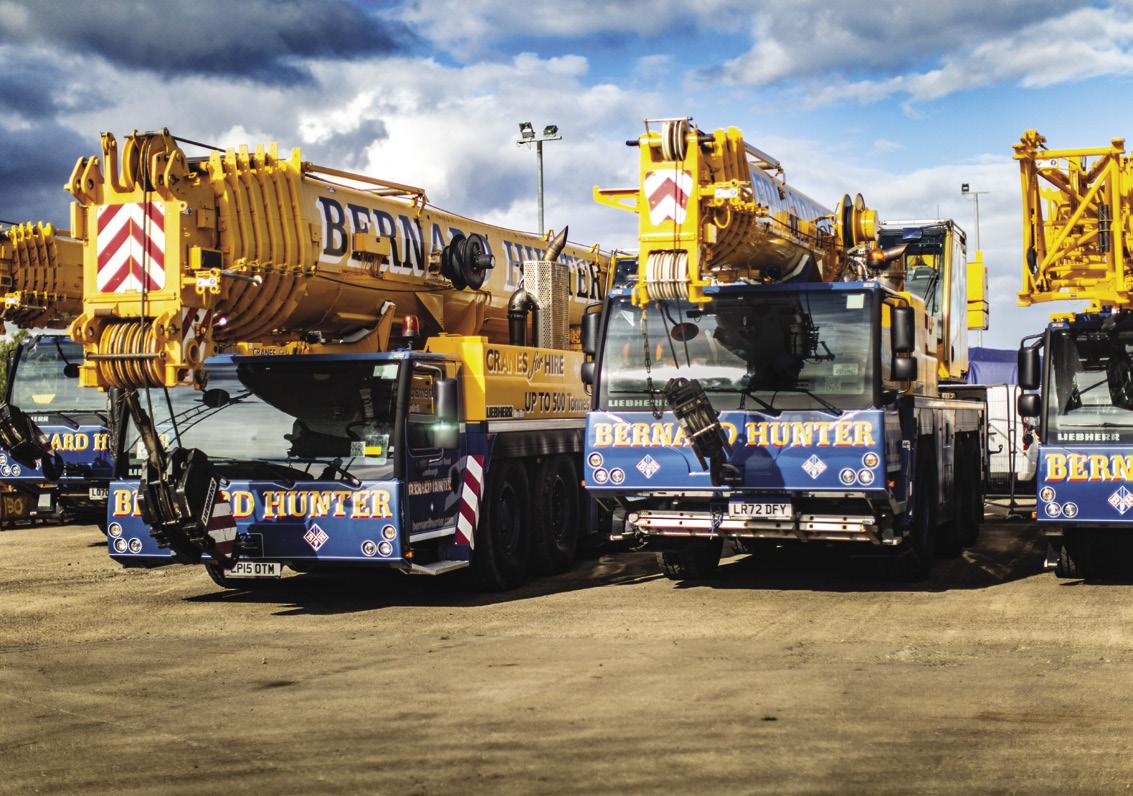
Press and Demonstration guru Mandy Wannerton’s eyes lit up when she spotted the field of donkeys from the offices of Bernard Hunter Mobile Cranes and Metal Recycling Ltd. Managing Director Mark Rafferty explains that the donkeys—currently munching their way through a valuable section of real estate within the company’s 18-acre premises—are seen as a lucky charm at Bernard Hunter Ltd and have been a constant throughout the company’s near 80-year history.
The one time the beasts were moved to different pastures, during the particularly hot summer of 1976, a string of unlucky events ensued until the donkeys were brought back on
site. For this reason they remain. That and, of course, the fact that they bring a smile to the faces of everyone who visits. We aren’t here to admire the donkeys, however. Our visit to the former Gilmerton Colliery site, situated within spitting distance of Edinburgh city centre, is to put to work an entirely different kind of beast—this one without the hair and pungent aroma, and hopefully a lot easier to handle. It comes in the shape of DAF’s latest demonstration truck, the XG 530 FTT.
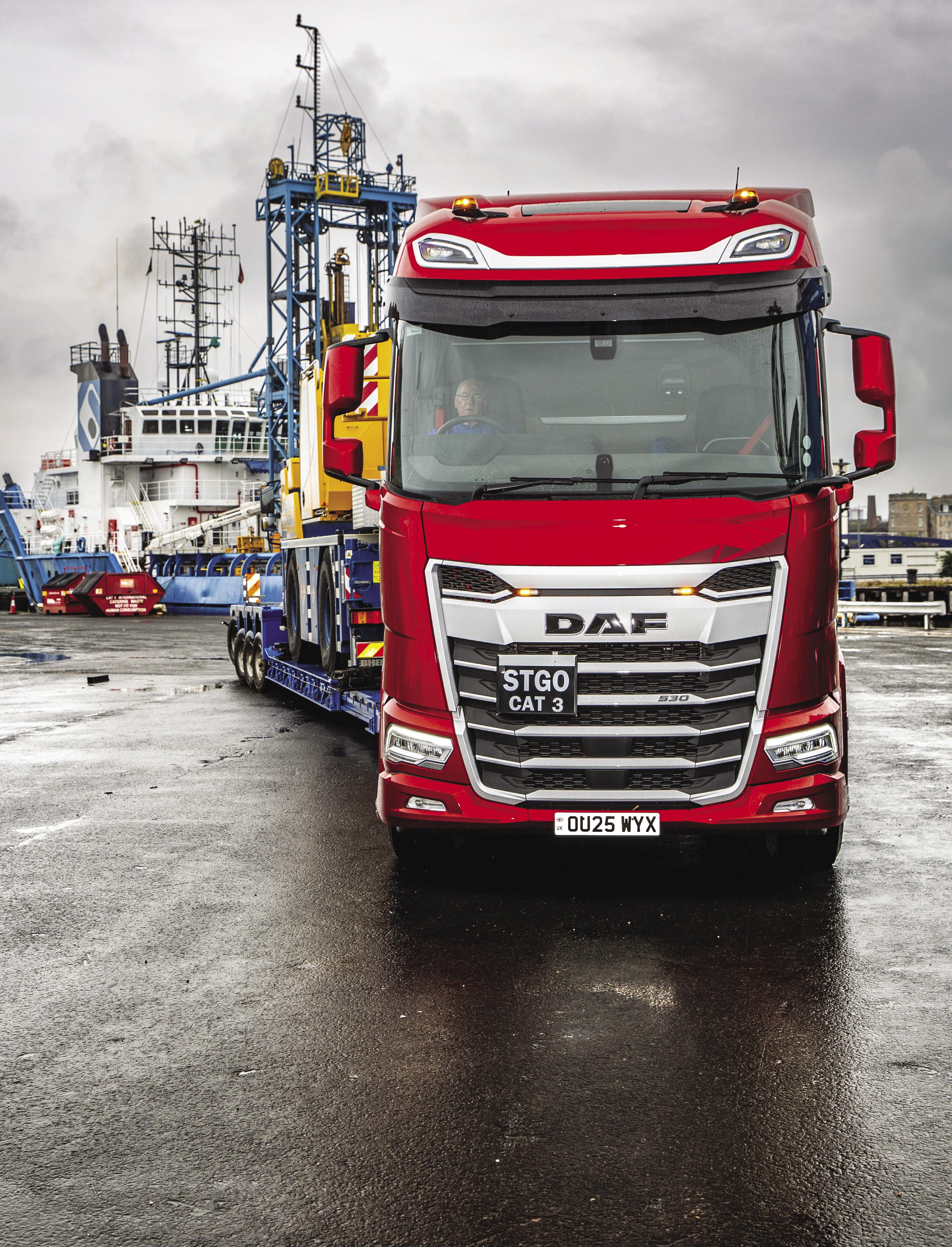
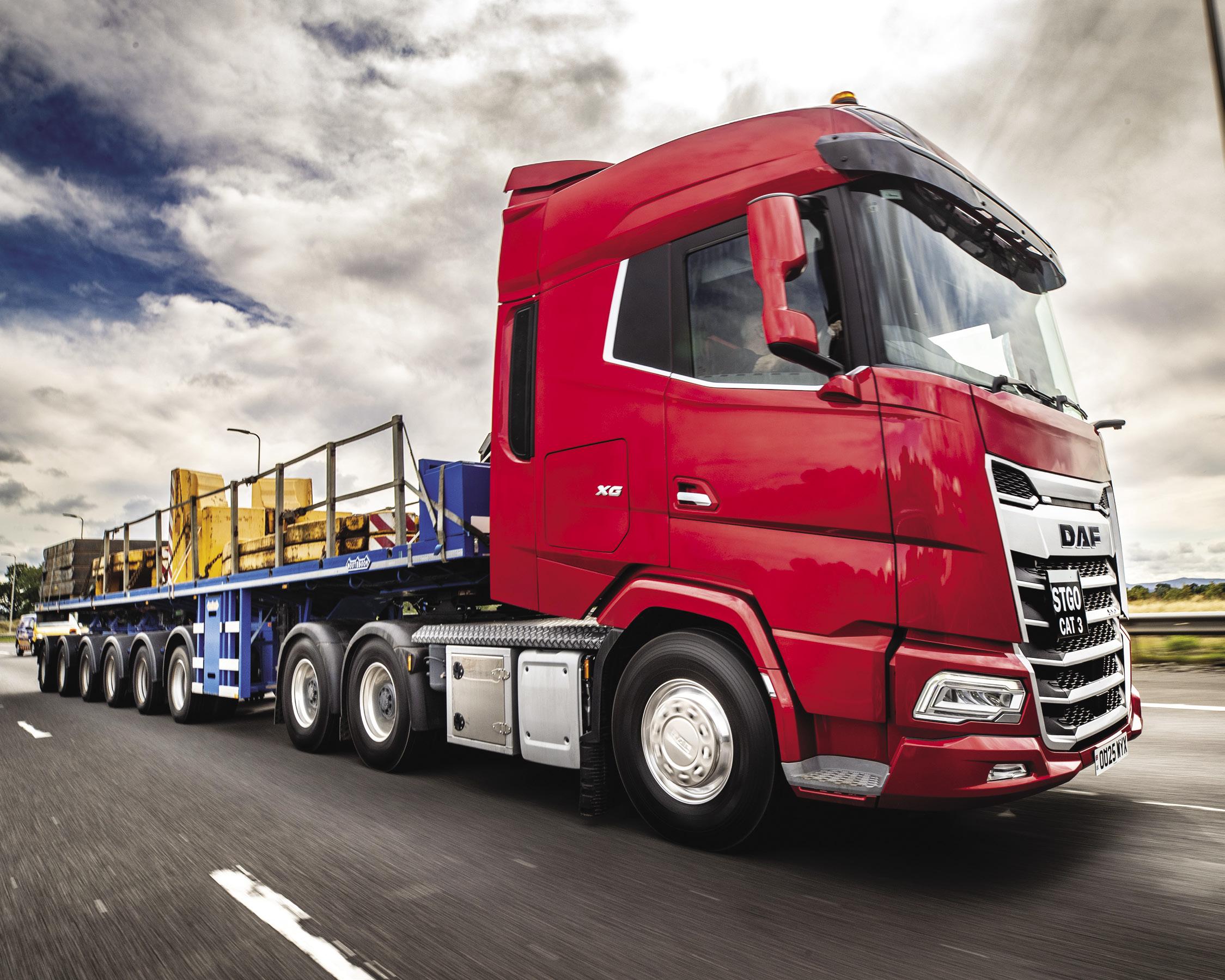
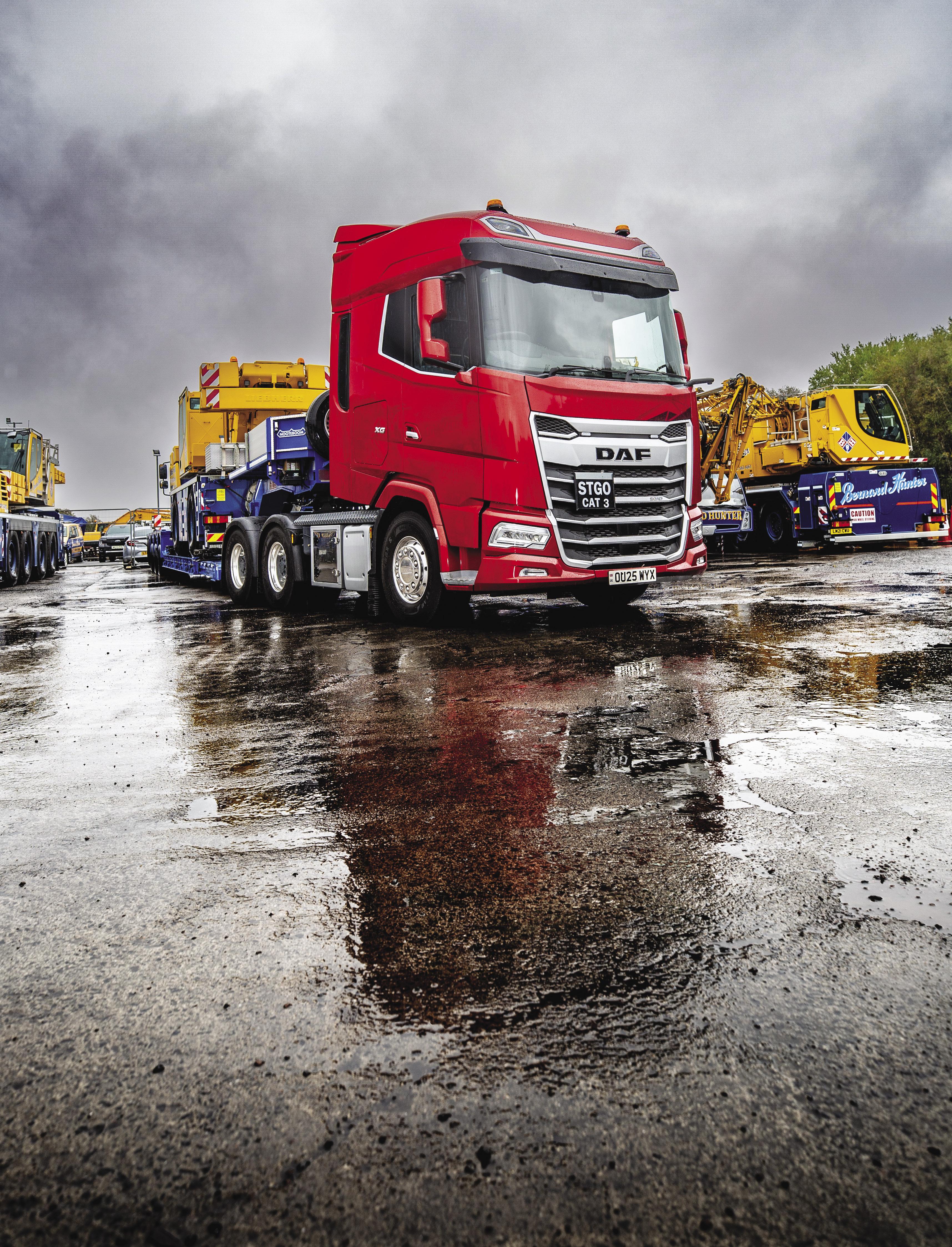
Spec’d by Ed Miles, DAF Product Marketing Manager, the FTT is taskready and loaded with all the necessary gubbins that make it a heavy-haulage tractor unit. Ed is passionate about his job; as part of the team that brought to life the UK30 Special Edition
XG+530 model unveiled at RTX25, he knows how to make a truck look good. Stunning though it is, this FTT is no show pony (there’s definitely an equine theme running here). It has been designed with a purpose: to demonstrate the capabilities of the 12-speed Traxon gearbox with the latest heavy-haulage software in the environment it was created for.
Many throughout Europe involved with spec’ing trucks for heavy haulage have mourned the loss of the 16-speed ZF gearbox. Its wide range of gearing made it the obvious choice for heavy applications. Both 12- and 16-speed Traxon options were originally offered on the DAF Range, but the 16-speed version has now been withdrawn from the European market by ZF.
Truck has 12-speed gearbox
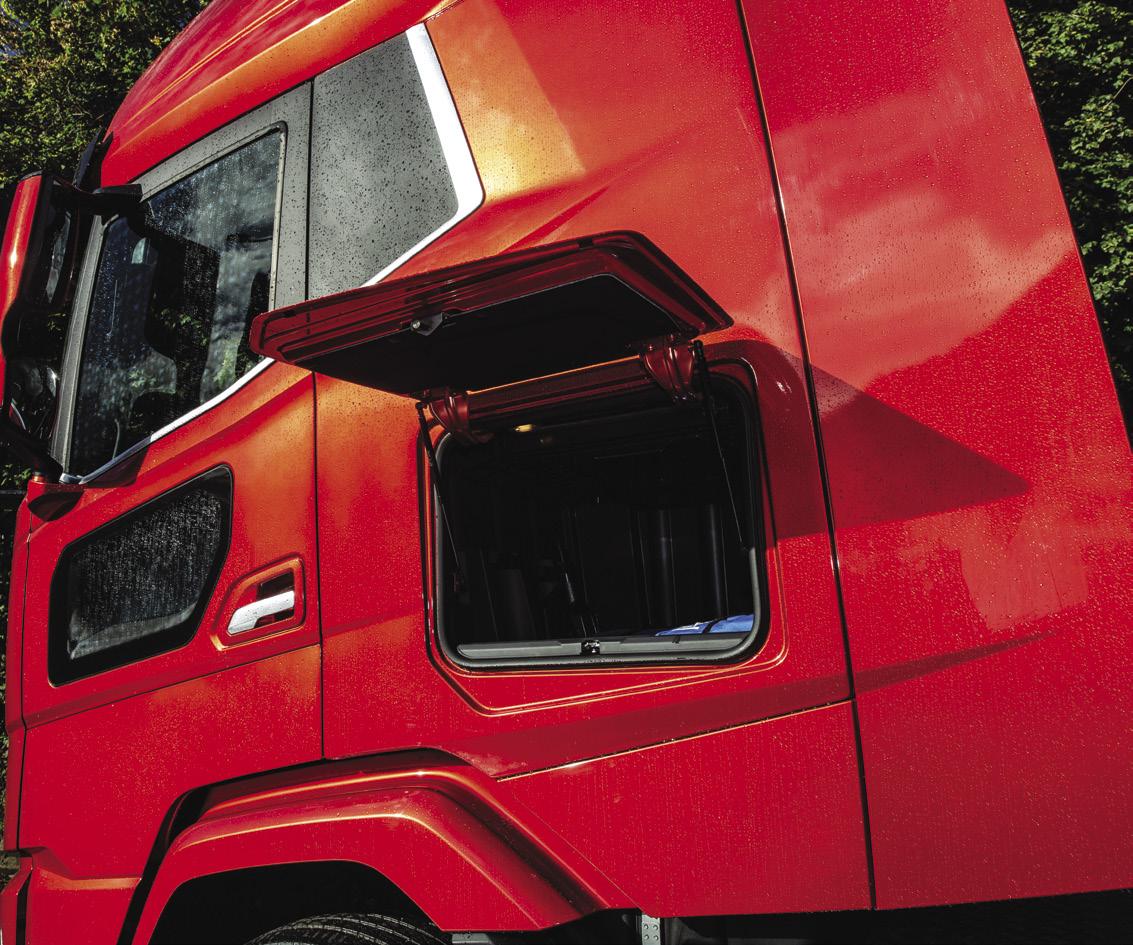
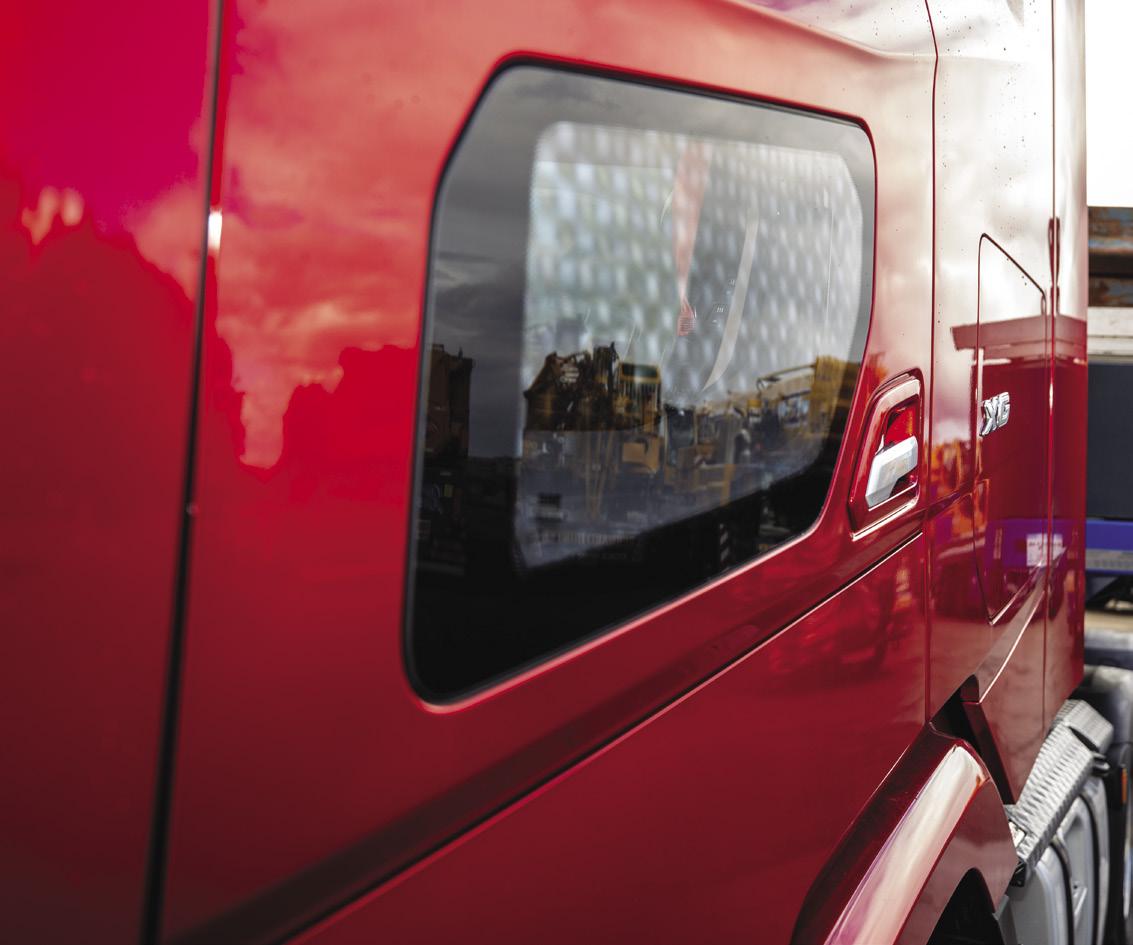
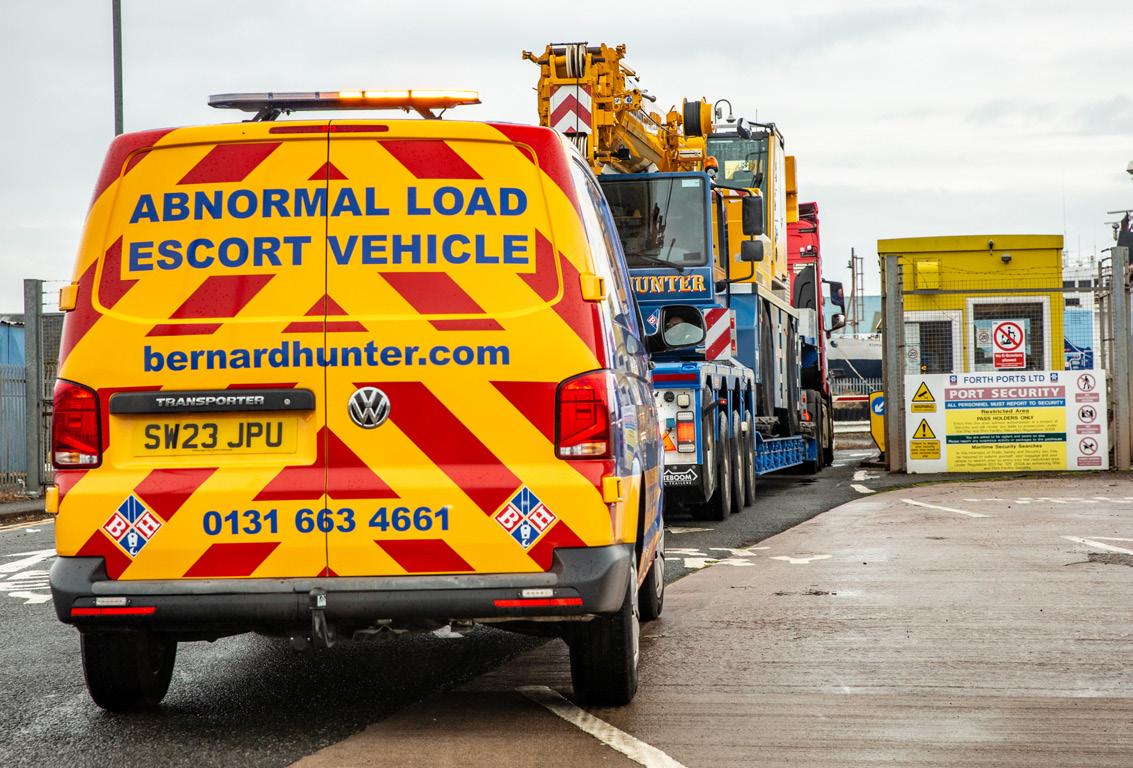
Parked among the sea of yellow and blue Bernard Hunter cranes, the metallic red XG sticks out like a sore thumb—albeit a very attractive sore thumb. The cranes, which range from little tow-along site lifts all the way up to the 700-tonne behemoth Liebherr LTM1650-8.1, are some of the most cutting-edge in the industry and the superstars of the Bernard Hunter show. But working quietly in the background, hauling the ballast weights, extra jibs and other paraphernalia required for every lifting task, are the heavy-haulage tractor units—a mixture of Mercedes and DAF. These beasts of burden often gross upwards of 120 tonnes: no lightweight task.
DAF has been present since 1999, and Bernard Hunter Ltd can lay claim to Scotland’s first-of-its-kind XF 510 FTT back in 2007. For this reason, it is the ideal place to showcase the XG and put it through its paces.
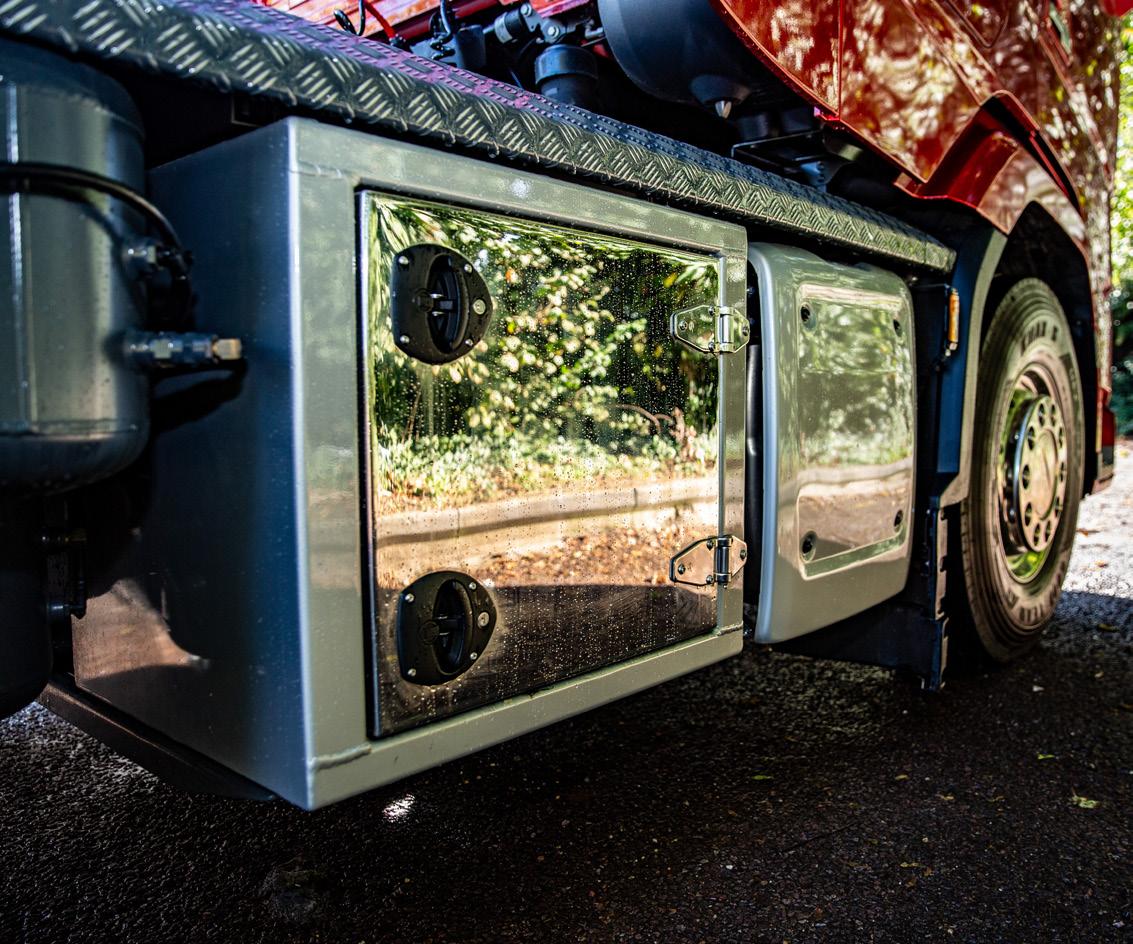
Much time has been spent getting the demo FTT right. With a 9-tonne front axle on 385/65 tyres and a 26-tonne air-suspended rear bogie on 315/80 Goodyear tyres, the truck looks taskready—especially with the heavyduty Jost (JSK38C1) fifth wheel. The decision to specify air suspension, against the industry norm of steel parabolic springs, comes with a slight weight-carrying penalty but offers potential customers the benefits of air:
improved ride and comfort, the ability to raise and lower ride height, and the axle-load monitoring facility to check imposed weight on the kingpin. Rydam Universal has added to the good looks of the truck with a stylish catwalk and a side-mounted tool locker on the 3.90m chassis.
The steepest route we could find out of the Scottish capital—the A68— immediately throws an enormous climb at us, and I instantly realise I’ve forgotten to knock off Eco mode. Not the place to be at 100-tonne gross on a climb like this. With the correct selection made, the XG knuckles down with a whole new gearing strategy, eating up the seemingly endless
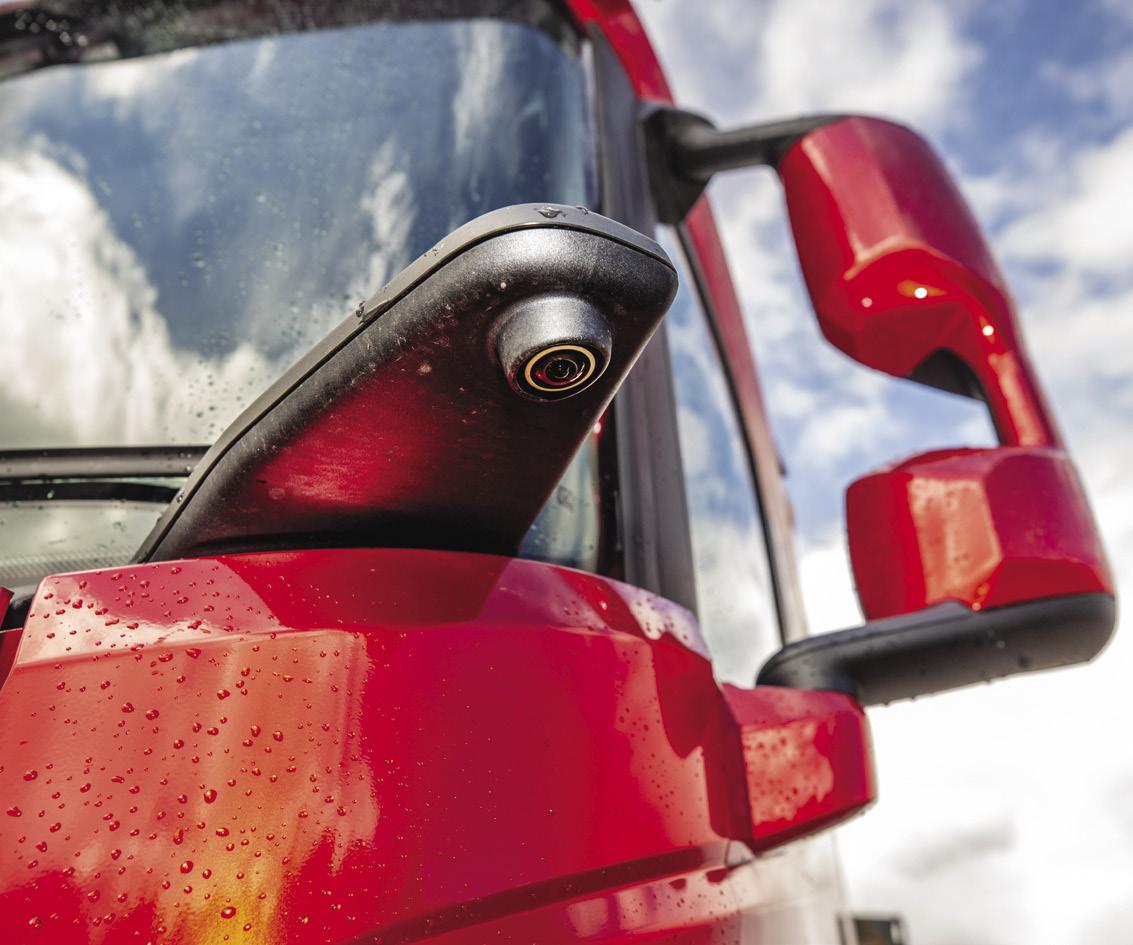
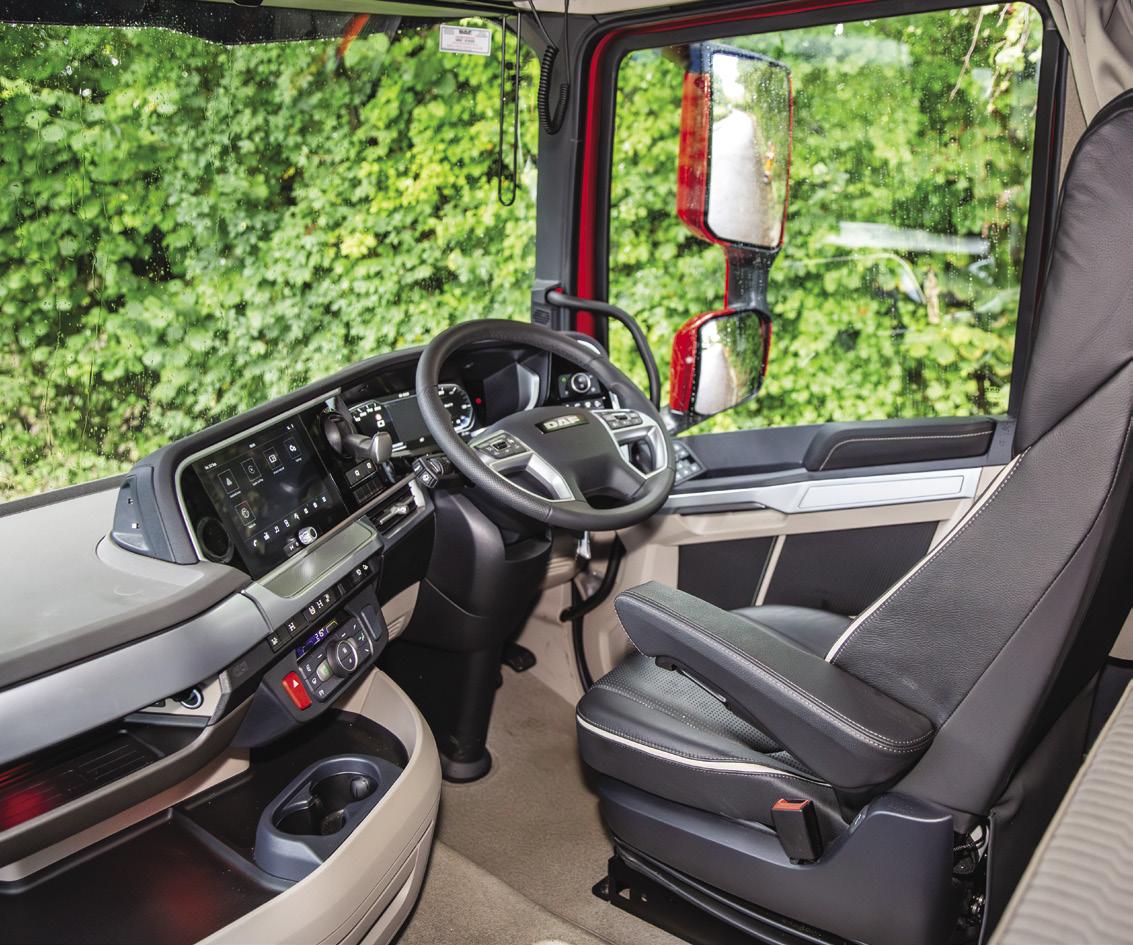
Kerb-view door and camera give excellent vision
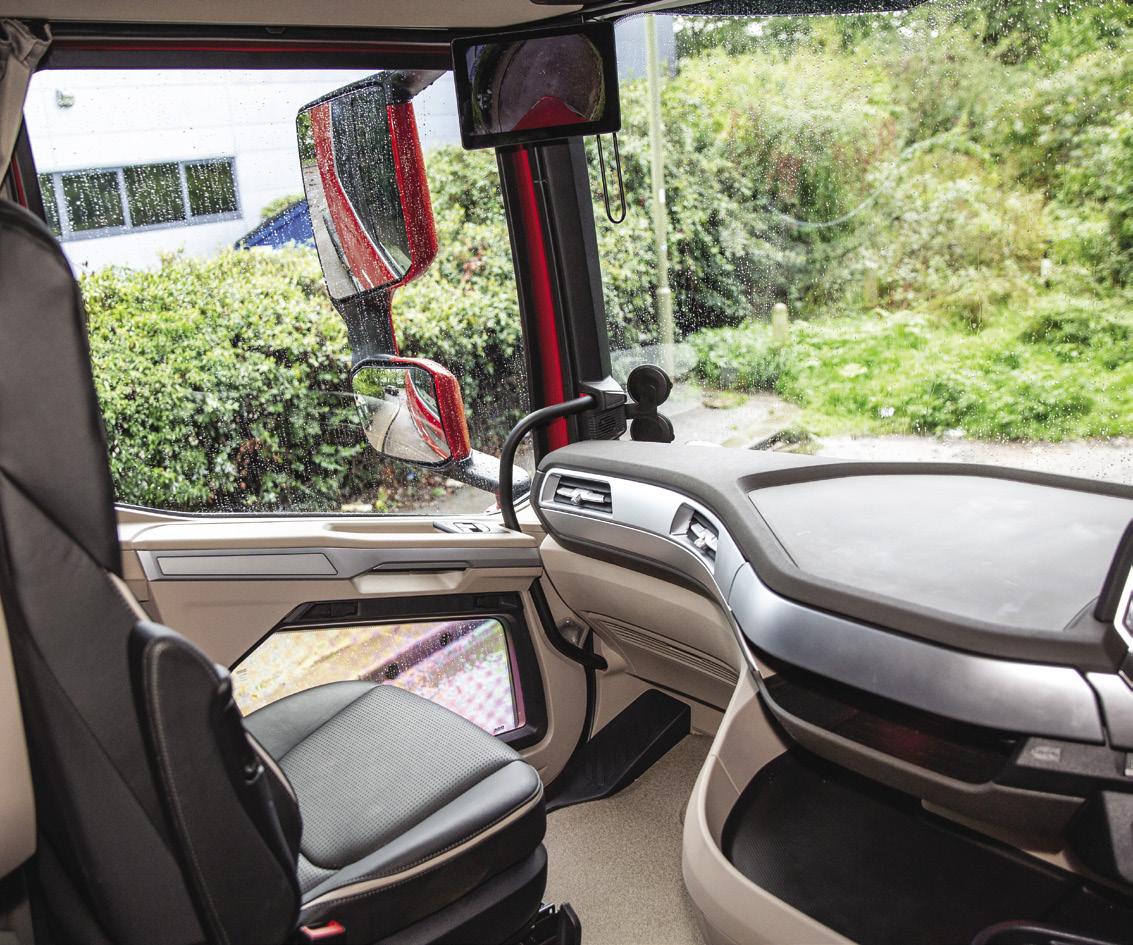
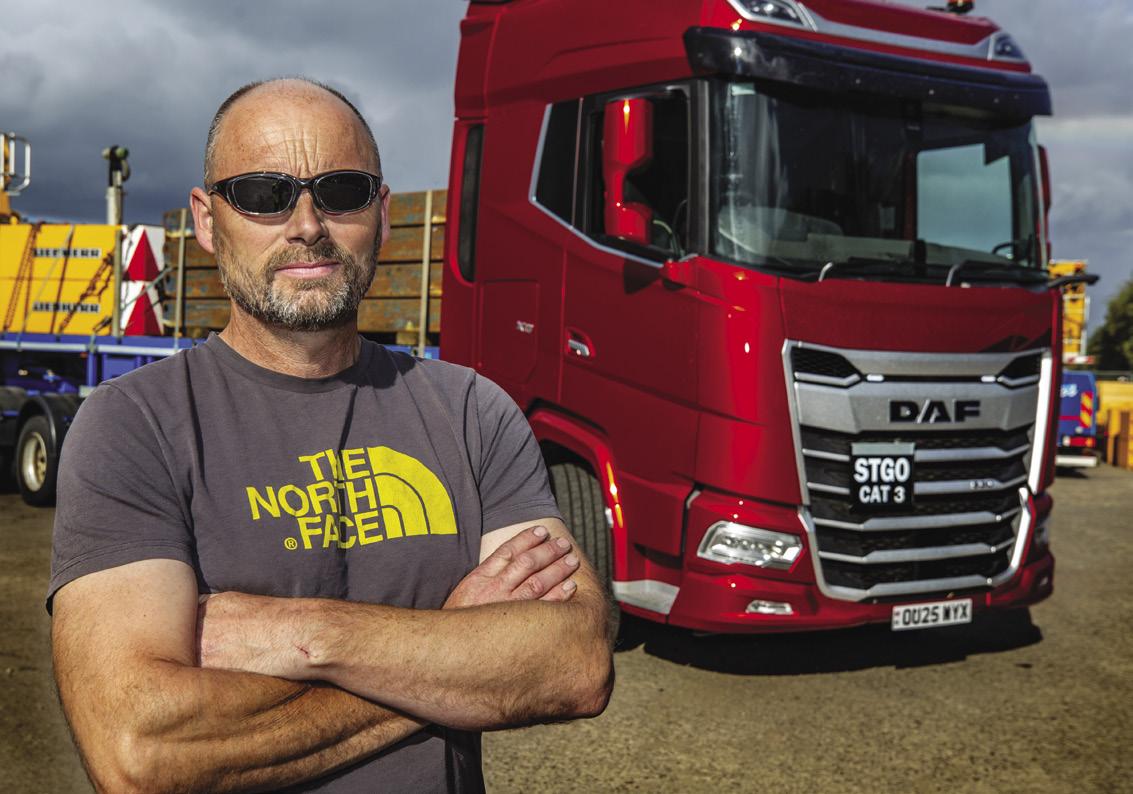
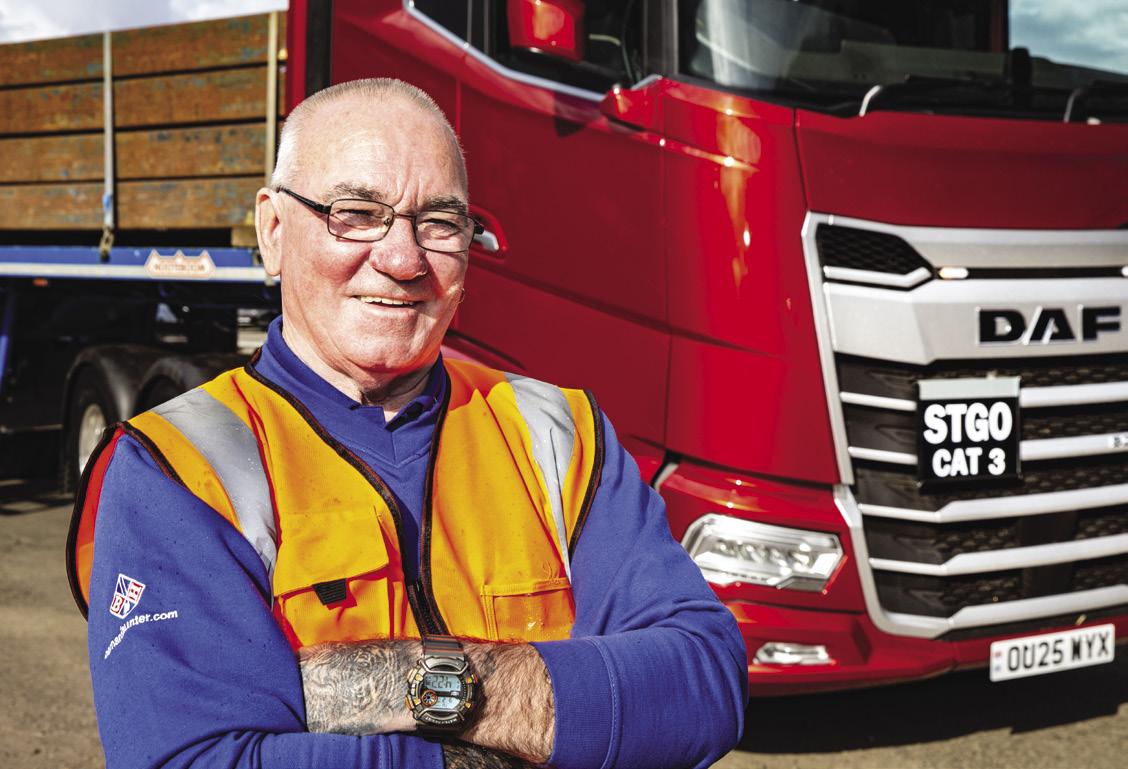
climb. My co-pilot for the run, veteran trucker Billy Moffat, is ultimately the man DAF has to impress. With 20 years under his belt at Bernard Hunter Ltd, Billy is amazed at how quiet the big DAF is; his own truck “would have been roaring its head off on this climb.”
As the gradient lessens, the 12-speed Traxon springs to life with lightningfast changes. This is what the software is all about: making changes that would be impossible with a manual and negating the need for the 16-speed version. It gets the best out of the 530 horses. Extremely fast gear-changes result in minimal loss of engine speed and momentum, yielding increased
speed, improved fuel economy and reduced engine stress.
The performance impresses us both.
The descent is equally impressive. With the DAF MX engine brake working in combination with the ZF Intarder, the 500kW of stopping power is outrageous, rendering my right foot redundant for the entire descent.
Controlled by the right-hand stalk, I use positions 1 and 2 to hold speed, only occasionally using the third position on the tightest corners.
Packed with all the latest ADAS safety kit required to conform with European
“PACKEDWITHALL THELATESTADAS SAFETYKITREQUIRED TOCONFORM


legislation, there is a lot going on in the XG: Drive-off Assist, Side and Turn Assist, Lane Departure Warning, Speed Limit Recognition, Drowsiness Detection—the list is endless, with lights and alarms gently making the driver aware of impending doom. It would be easy to assume that all this could be a little overwhelming for old-school drivers like Billy, but quite the contrary: he seems to have
embraced the technology and, like me, recognises the benefits of systems that take much of the sting out of driving. One thing I didn’t have to concern myself with is the truck— it pretty much looks after itself; I just have to point it in the right direction.
I have been astounded by both the gearbox and the engine-braking system. The fast and precise gear-
changes, coupled with the feeling of control delivered through the powerful braking system, are what make this an impressive heavy-haulage tool. The whole package appears to have impressed Billy: the comfort, quietness and overall performance are a gigantic leap from his current vehicle—impressive enough that he says he would be more than happy if the FTT were his next truck.
The author, Stevie Walker Yard is filled with cranes....
Billy Moffat
....and the field with donkeys.

HUNTER’S HISTORY
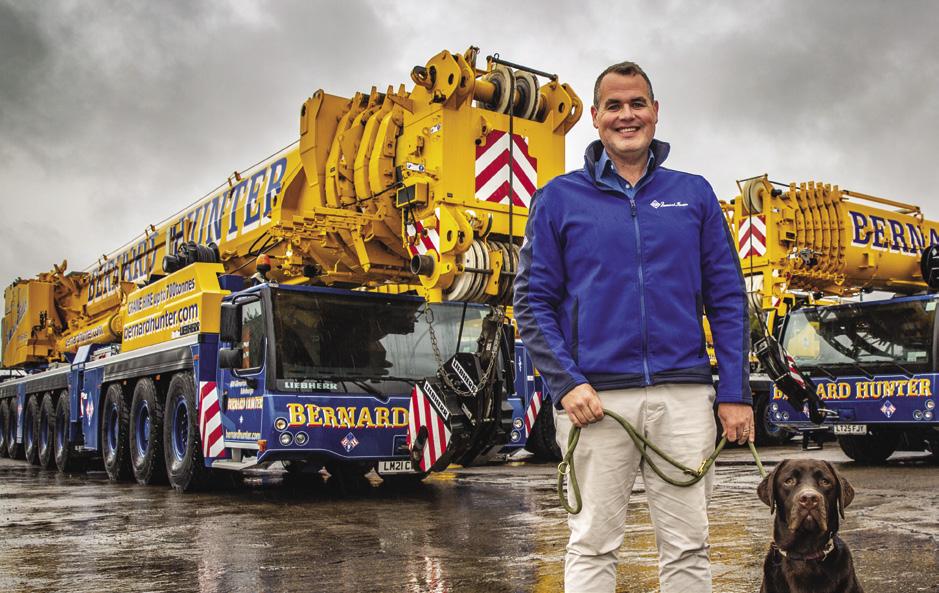
With one eye on the future, investment in the latest technology has always been key to the success of Bernard Hunter Ltd. The past, however, is equally important to Managing Director Mark Rafferty, who holds onto many of the values that underpin the company and have steered it on the right path to where it is today.
With awards in health and safety and staff training, this is a company that does not cut corners, implementing a maintenance programme that far exceeds the requirements of its sector.
The company was founded in 1946 by Bernard Hunter Senior. After surviving the horrors of World War II, Bernard was determined to forge a path to success using his grit and determination. With his newly-wed wife, Christina (Cuthbert), the couple made many sacrifices to create a future together. Through buying, selling and operating ex-military vehicles at their Seafield Road site—along with scrap-metal recycling, crane hire and even an Esso filling station selling cut-price fuel after the 1957 Suez crisis—the business grew steadily.




They eventually outgrew their Seafield Road site and moved to their current Gilmerton Colliery premises in 1972, and from here the business continues to flourish. Bernard Hunter Senior died in 1971 at the tender age of 49—a short but colourful life in which he made every second count. His legacy shines through and remains a part of Bernard Hunter Ltd to this day.

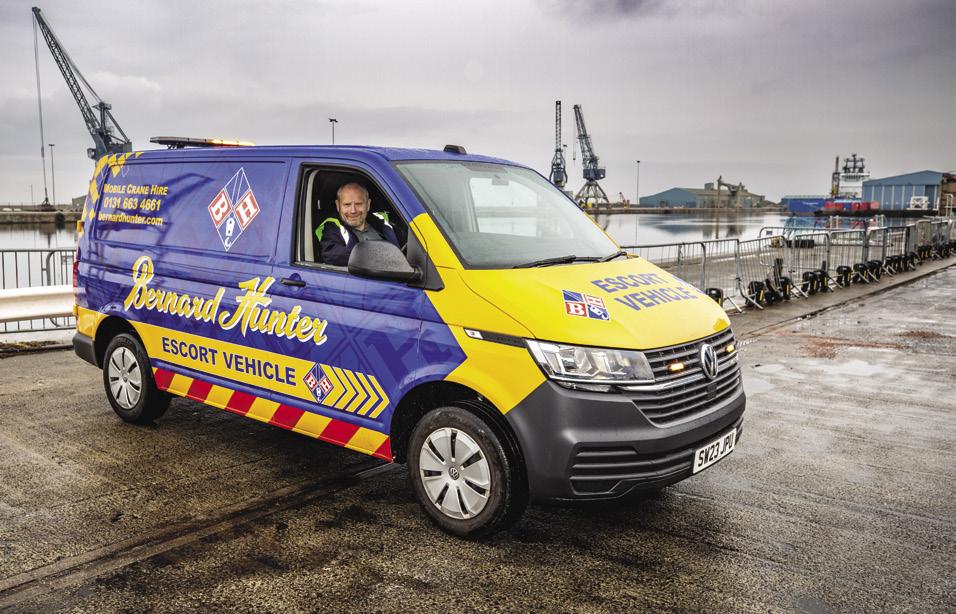


Mark Rafferty, MD with Murdo



LISTEN TO THE FORMAN


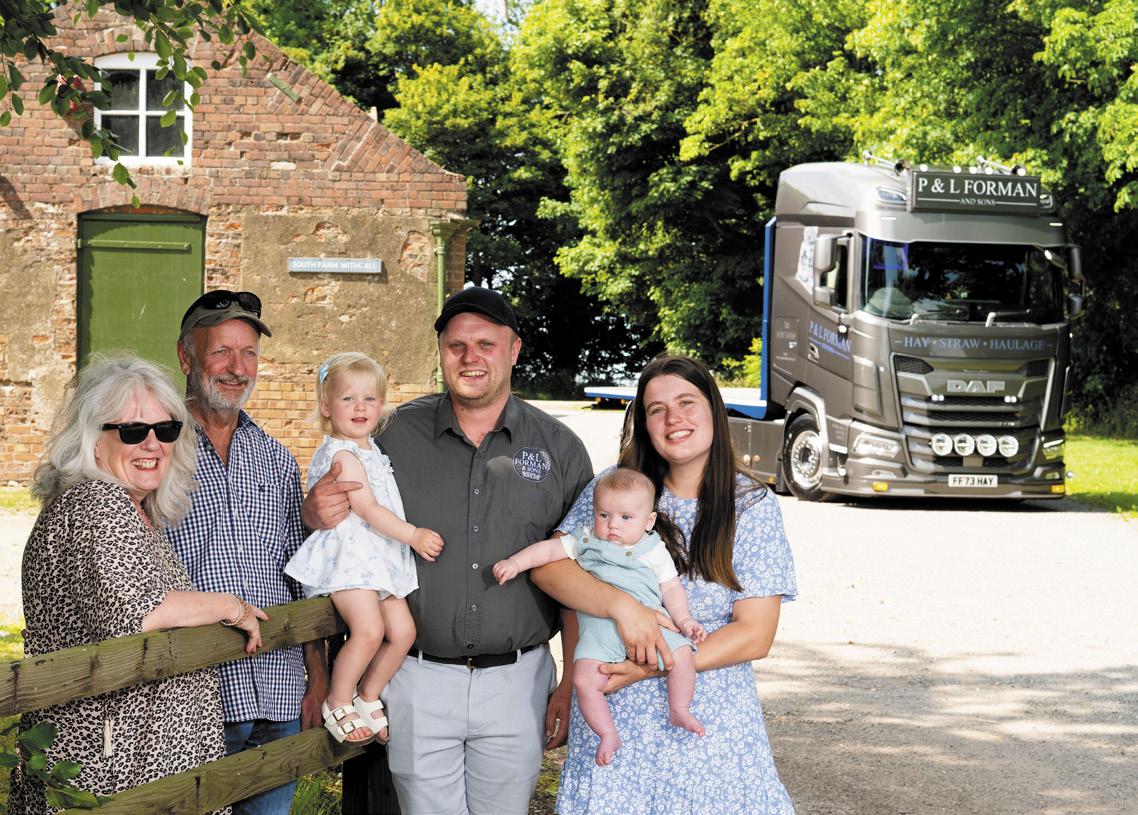
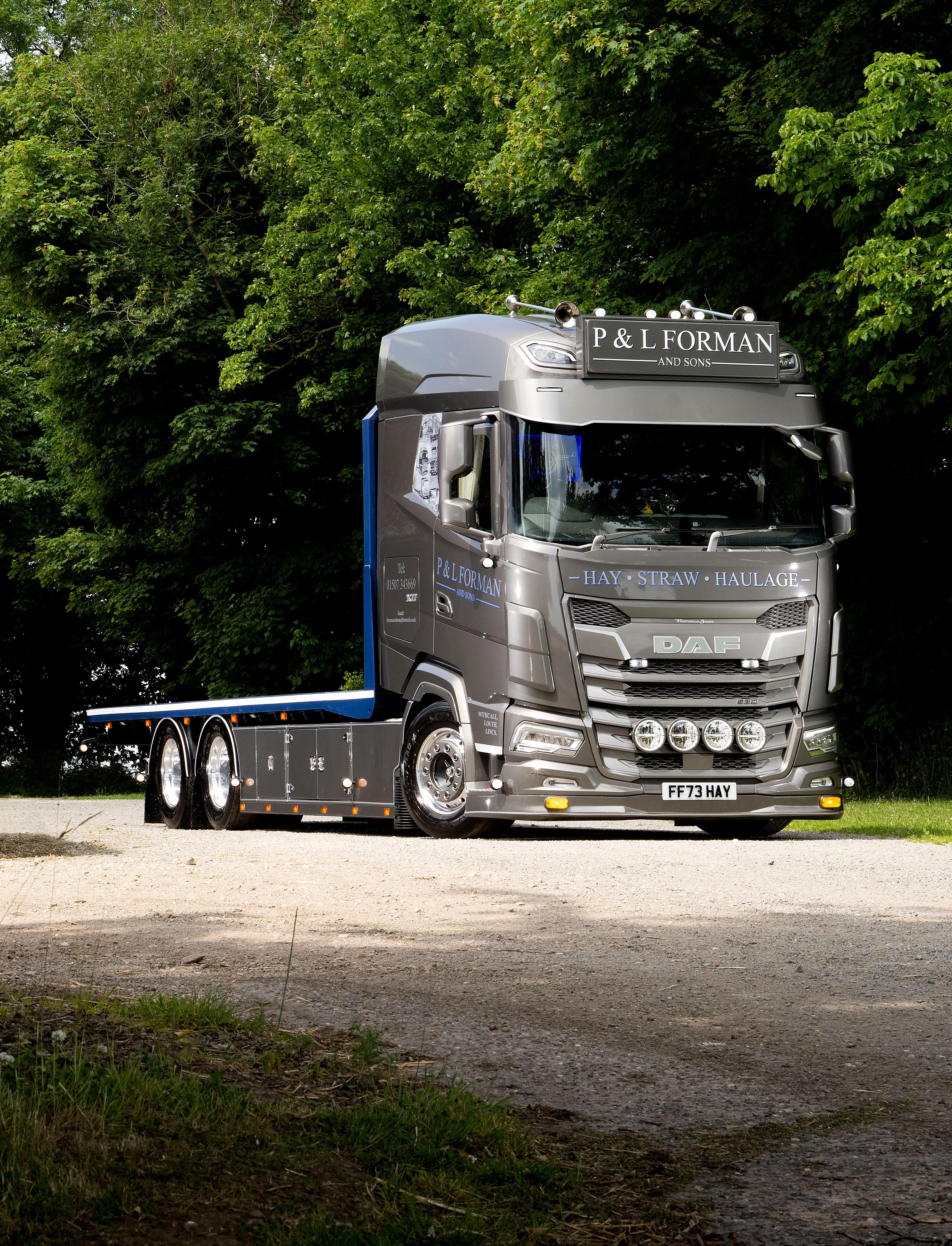
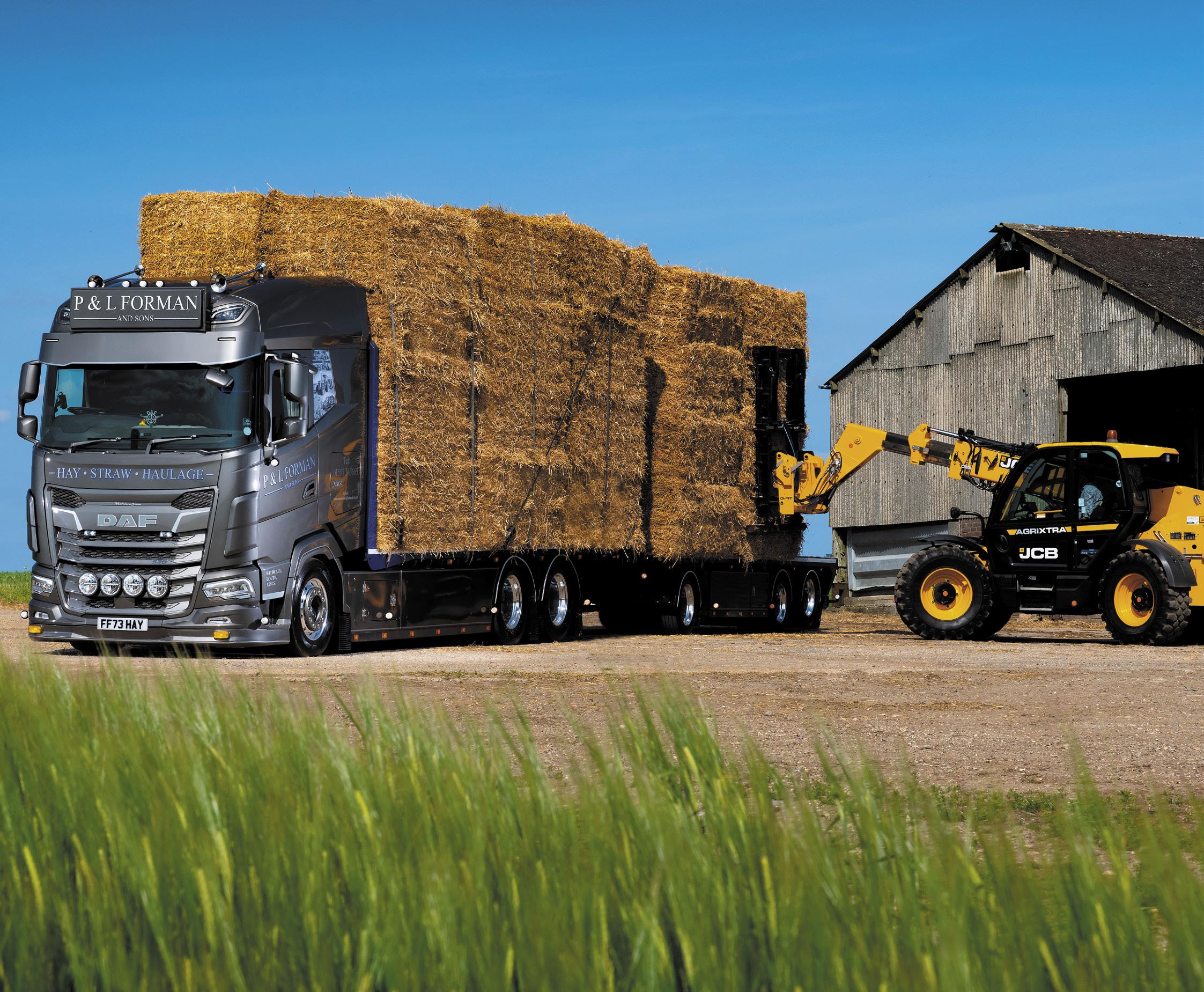
P&L Forman has a smart DAF XG530 drawbar used for hauling hay and straw; so naturally we headed to north Lincolnshire to see it.
Words: Pip Dunn
Photographs: Karl Hopkinson

P&L
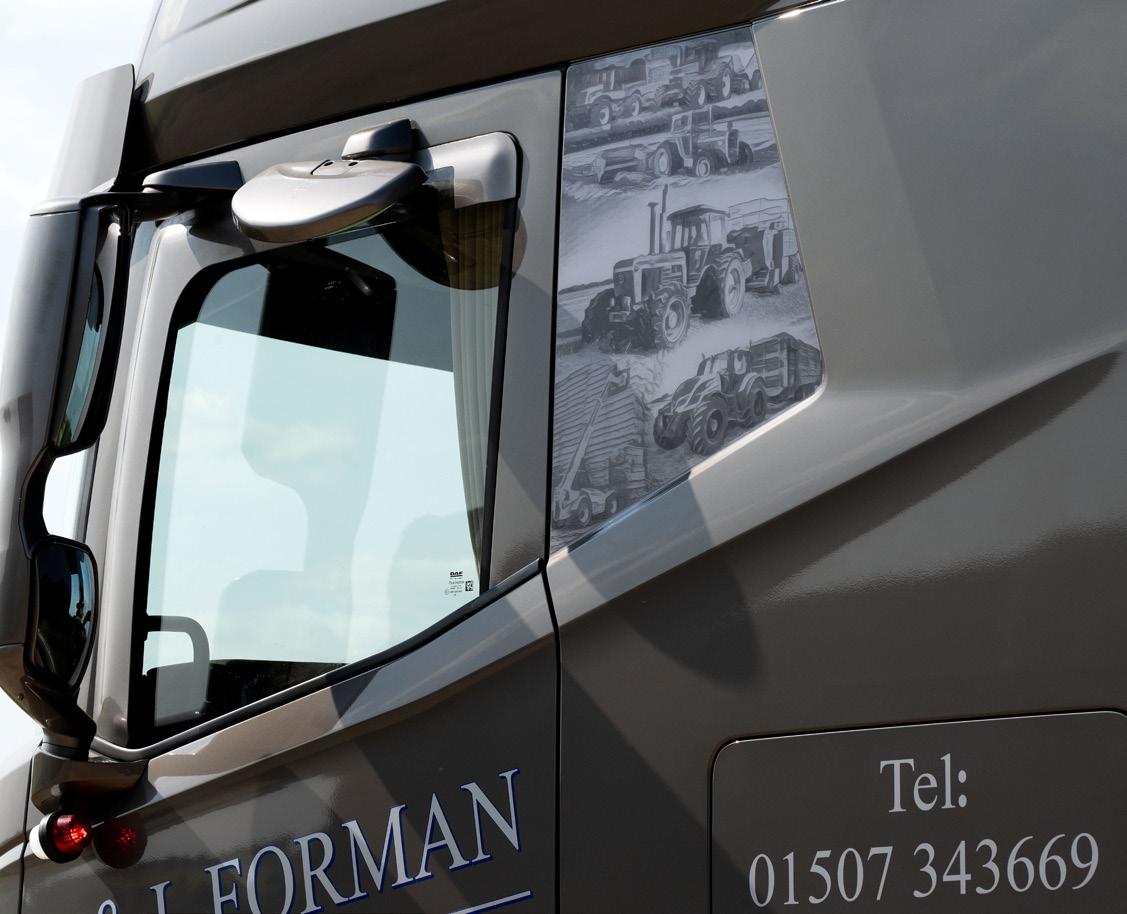
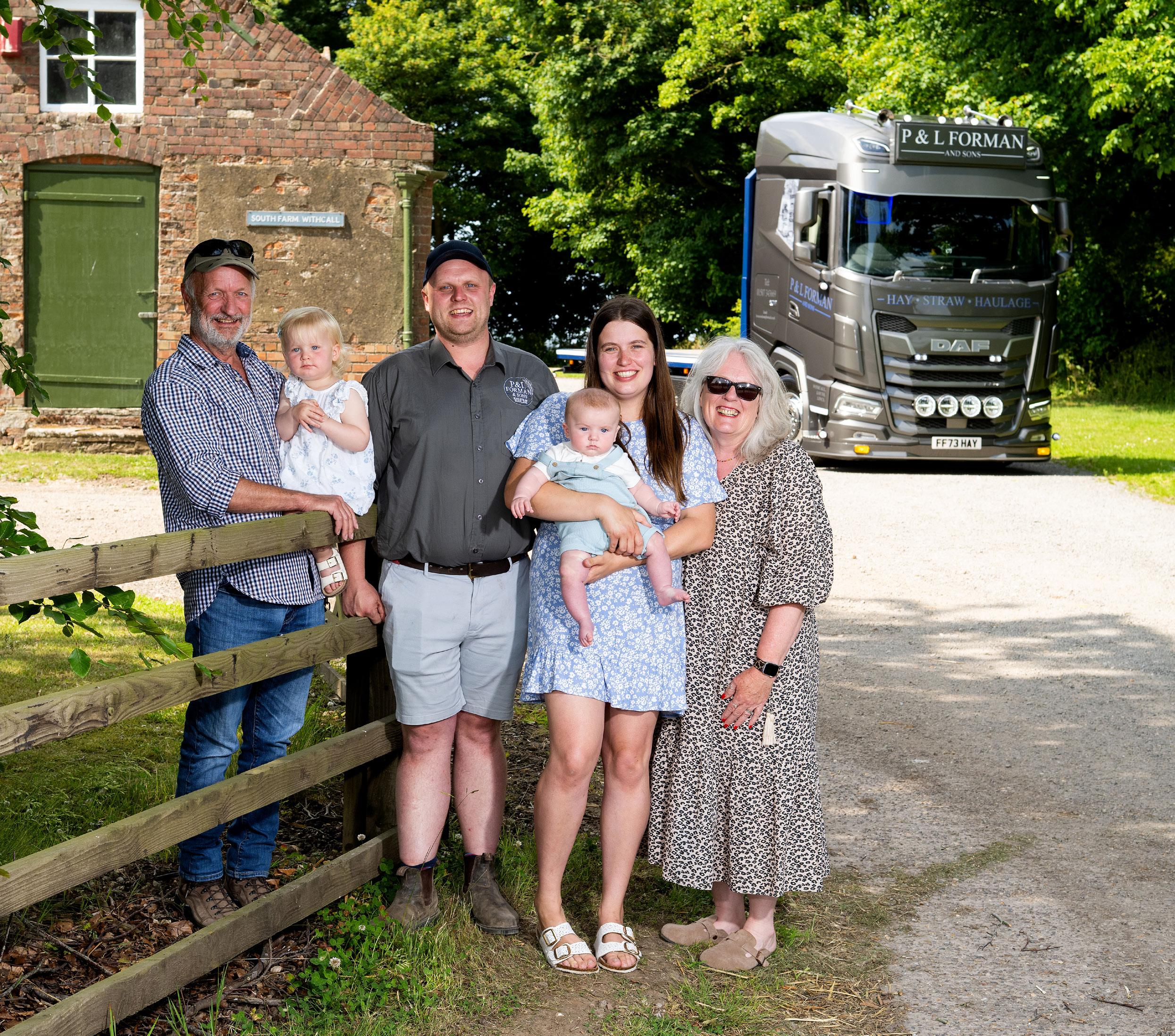
Forman & Sons was founded in 2001 by Paul and Linda Forman.
Paul has always been involved in agriculture and moving hay and straw, while Linda comes from a haulage background—her father owned a large haulage company in the ‘70s.
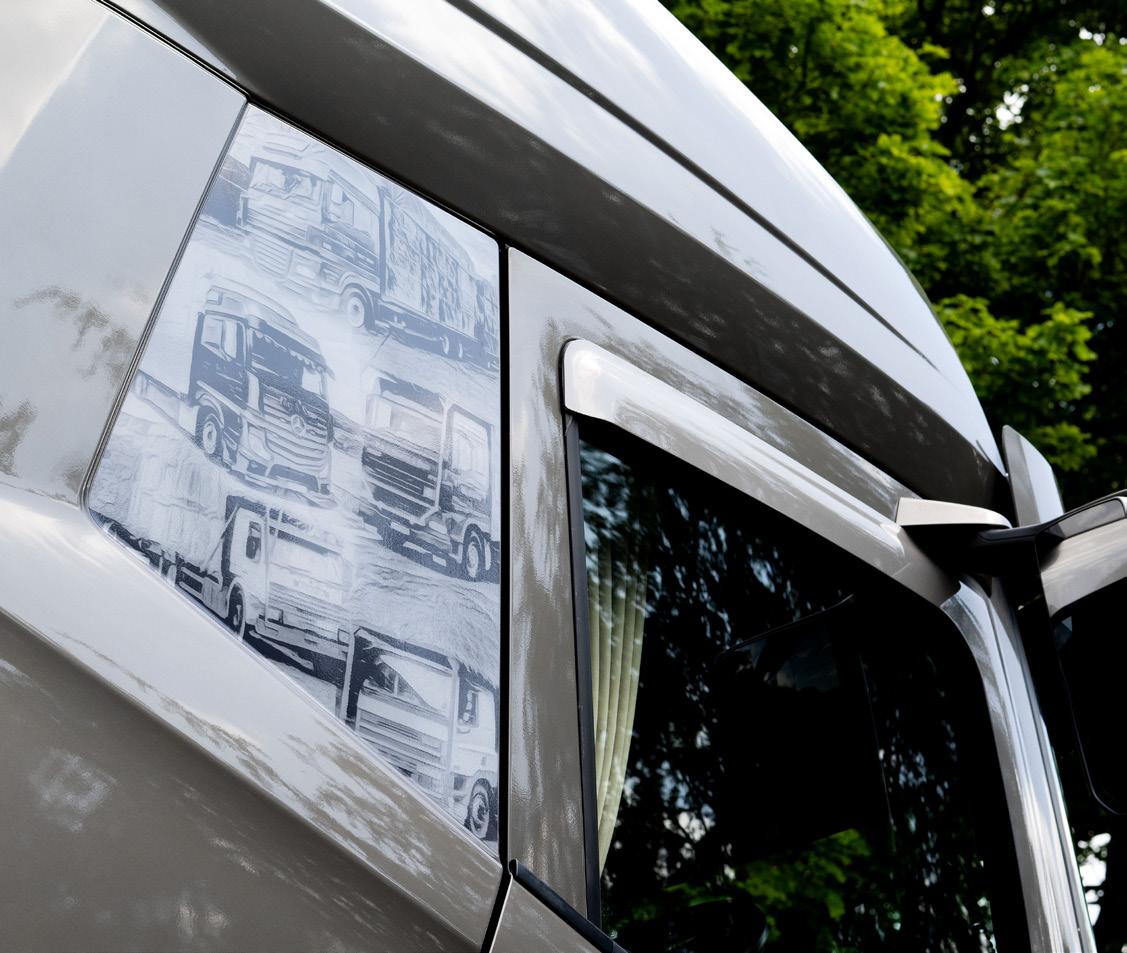
Paul passed his HGV test in 1981 and drove for a haulier moving hay before buying a DAF 85.400 in 2002 to move straw from Lincolnshire to Wales. The 85CF remained the only truck until 2009, when a 95.480 XF was added to the fleet.
Paul, now 65, and Linda made their youngest son Fred a partner in the
business after he passed his HGV test aged 18. He now runs the operation alongside his parents at Withcall, near Louth in the Lincolnshire Wolds.
Two frontline drawbar prime movers handle most of the work: a 71-plate XF530 Space Cab and a new 73-plate XG530. There is also a 2016 manual XF510 currently off the road, and an XF460 held in reserve.
“I do like DAFs; I like the product and the parts backup,” says Fred.
The XF530’s body includes an over-cab canopy that offers extra load length, but as Fred says: “Bales over the roof can be a pain if you need to tilt the cab.”
Most drawbars you see on the road these days have centre-bogie trailers with two or three fixed axles mounted centrally. Old-style A-frame dollies are now rarely seen in the UK, but Forman’s prefers this setup. Says Fred: “They carry the load better and there’s less tyre wear with them.”
Drawbars offer more advantages than simply load length; they are more operationally flexible than artics.
“We can do split drops, and they can be easier for some deliveries.” The trailer can be dropped, giving easier access to farms where longer trucks can’t get in. Forman’s has one centre-bogie trailer, worked with the XF530, but it will be changed soon.
A-frame dolly trailers are favoured
Reversing drawbars is not as difficult as many believe, and drivers soon adapt. Although the company specialises in hay and straw, having flatbeds means it can carry many other materials. Adds Fred: “We often haul timber and bricks as return loads. If it fits on the truck, we’ll carry it!”
However, when the company is flat out on its core business, it can be more cost-effective to return empty than risk being delayed by a backload that interferes with the next straw collection. “Basically, we’ll do any backloads if they fit in with us, but if we can get one, it really needs to be the same day.”
“We have a lot of loyal farmers who use us,” says Fred, “but we’ve had to
adapt to what they want, and farms are moving to bigger bales. We run at 16ft 6in high, which is the maximum.”
There are other challenges too: “There’s often no internet in some areas we go to, which makes Satnav difficult—and that’s a problem when some farms are really hard to find the first time. You do need good route knowledge.”
Fred drives the XG530 and Will Lovely drives the XF530. Two casual drivers fill in the gaps for holiday cover, sickness or extra work, bringing the spare trucks out when needed.
For the XG530, DAF came up trumps on the product, the price and the lead time. Fred says R&M contracts “don’t work
for us, as we still need to maintain the trailers at the same time.”
Forman’s opts for twin-tyre tag axles on its rigid chassis, and all trucks have front air suspension and transmission retarders. They typically cover about 115,000km a year, “and we keep them until they drop,” says Fred—“which is usually about ten years.”
The move to the New Generation XG meant a price increase over the old XF, but given a ten-year lifespan and major cab improvements, it hasn’t been an issue. The XG also has “every option ticked.”
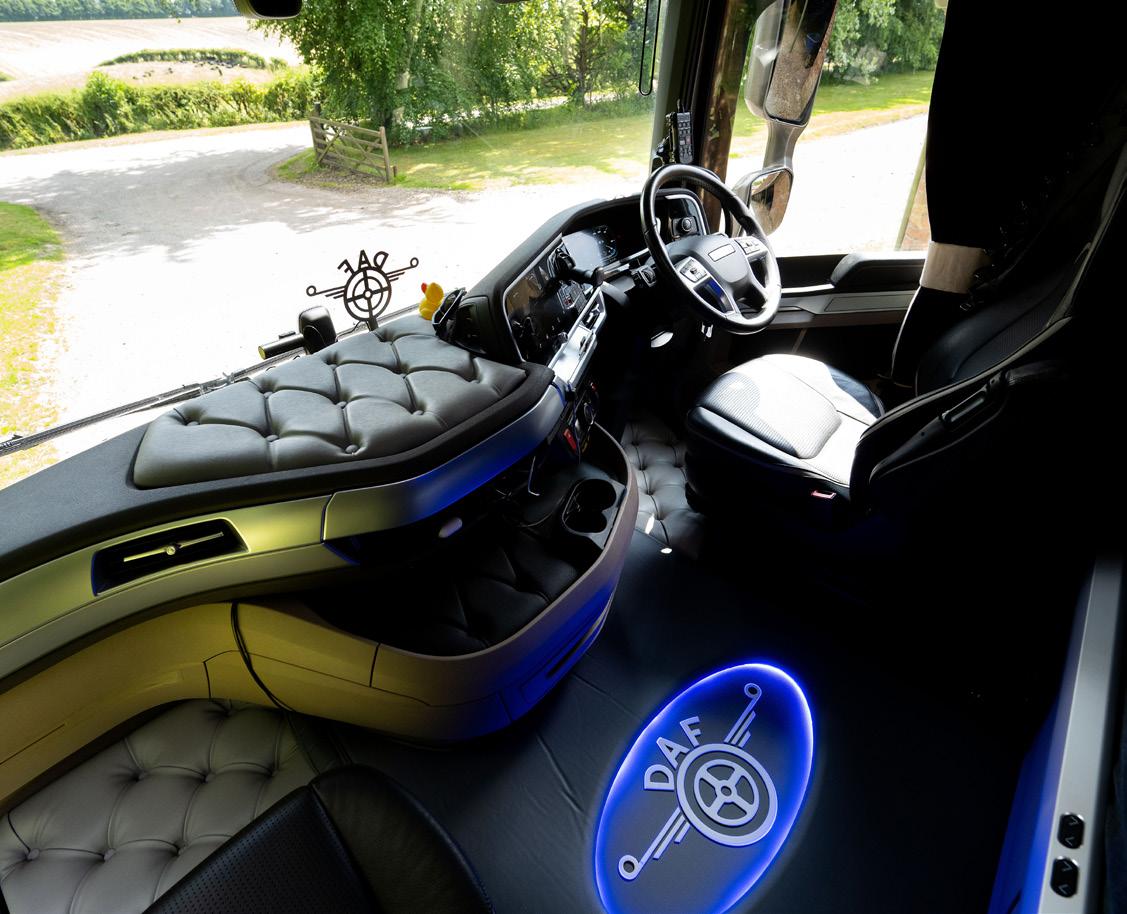
With drivers doing nights out, the company has moved from single-bunk
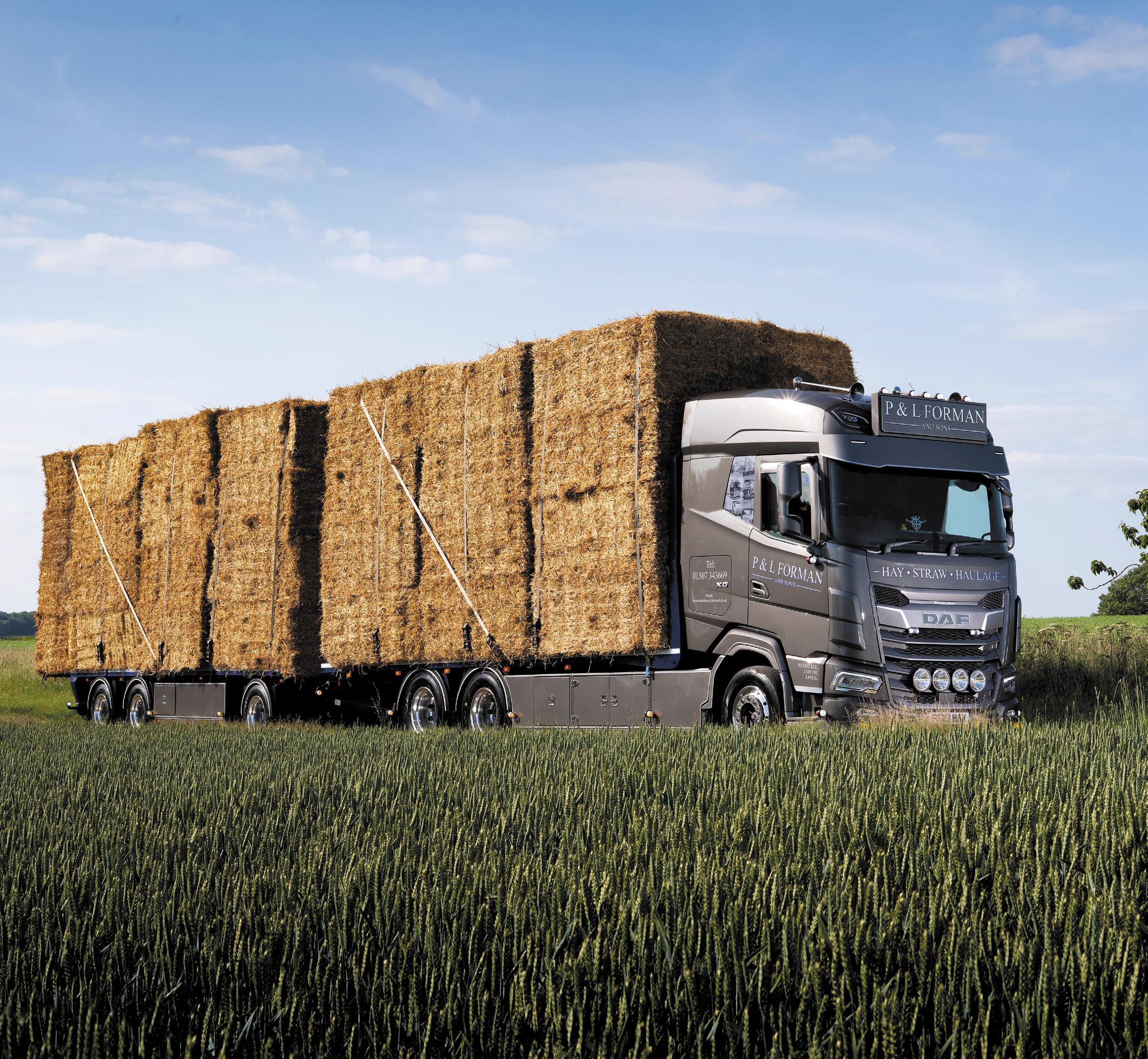
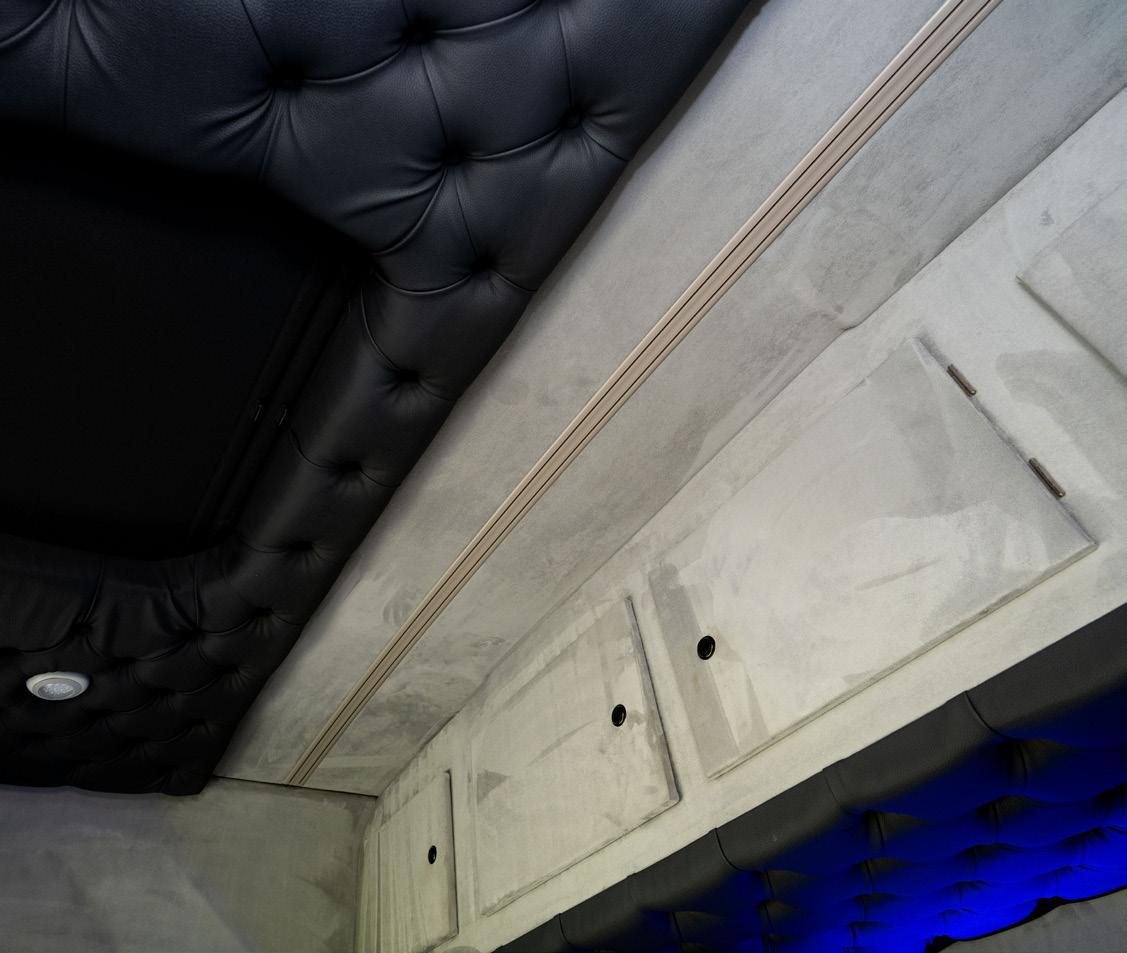
sleepers to high roofs for more living space. Drivers usually do three nights out a week but tend to get home midweek. And cabs don’t get much better than the XG, although the temptation to go for the larger XG+ has been resisted. The XF530 has a Space Cab rather than a Super Space Cab, but it has a canopy which the XG does not.
Given the brick-like aerodynamics of a fully laden straw lorry, the fact the XG is returning 7.5–8mpg when loaded—depending on weight and weather—is very good for this kind of
work. Empty, it manages around 13–14mpg.
The XF530 returns around 7mpg loaded and 11–12mpg empty. “The XG is so much better on fuel, and the gearbox is excellent,” adds Fred. Over the truck’s life, the fuel saving will more than offset the higher purchase price. The trucks carry a 27-tonne payload.
The XG530 was supplied through Ford & Slater in Lincoln. There have been no issues with the vehicle,
barring the occasional software-update recall. “It hasn’t had a spanner on it yet,” laughs Fred.
“DAFaid is very good indeed. We had a pump go in mid-Wales, and it was sorted that day. DAF is also very good with parts supply.”
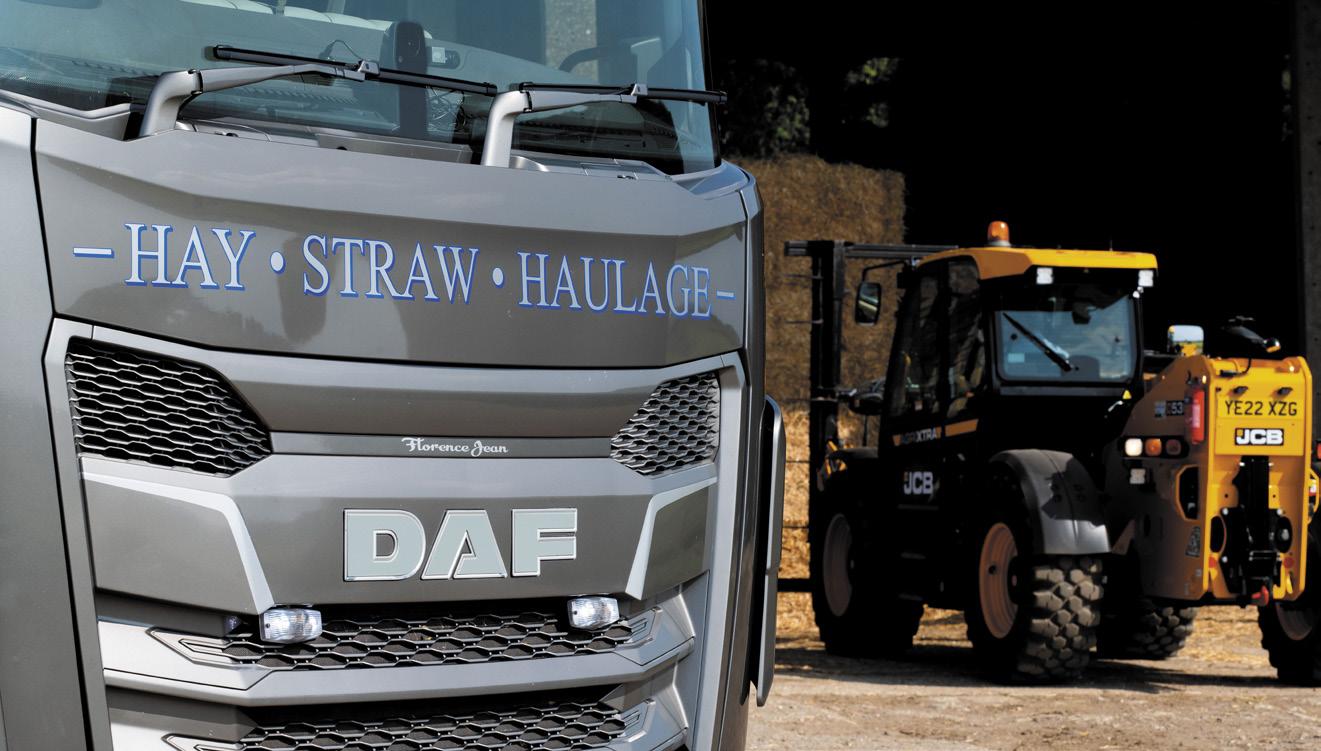
In graphite grey, with alloy wheels, smart side lockers and Danish headboards, Forman’s DAFs certainly stand out. But they’re not just there to look smart— they’re there to work. And by all accounts, they do that very well indeed.



ELECTRIFYING
Words: Dean Barrett
Photographs: DAF Trucks
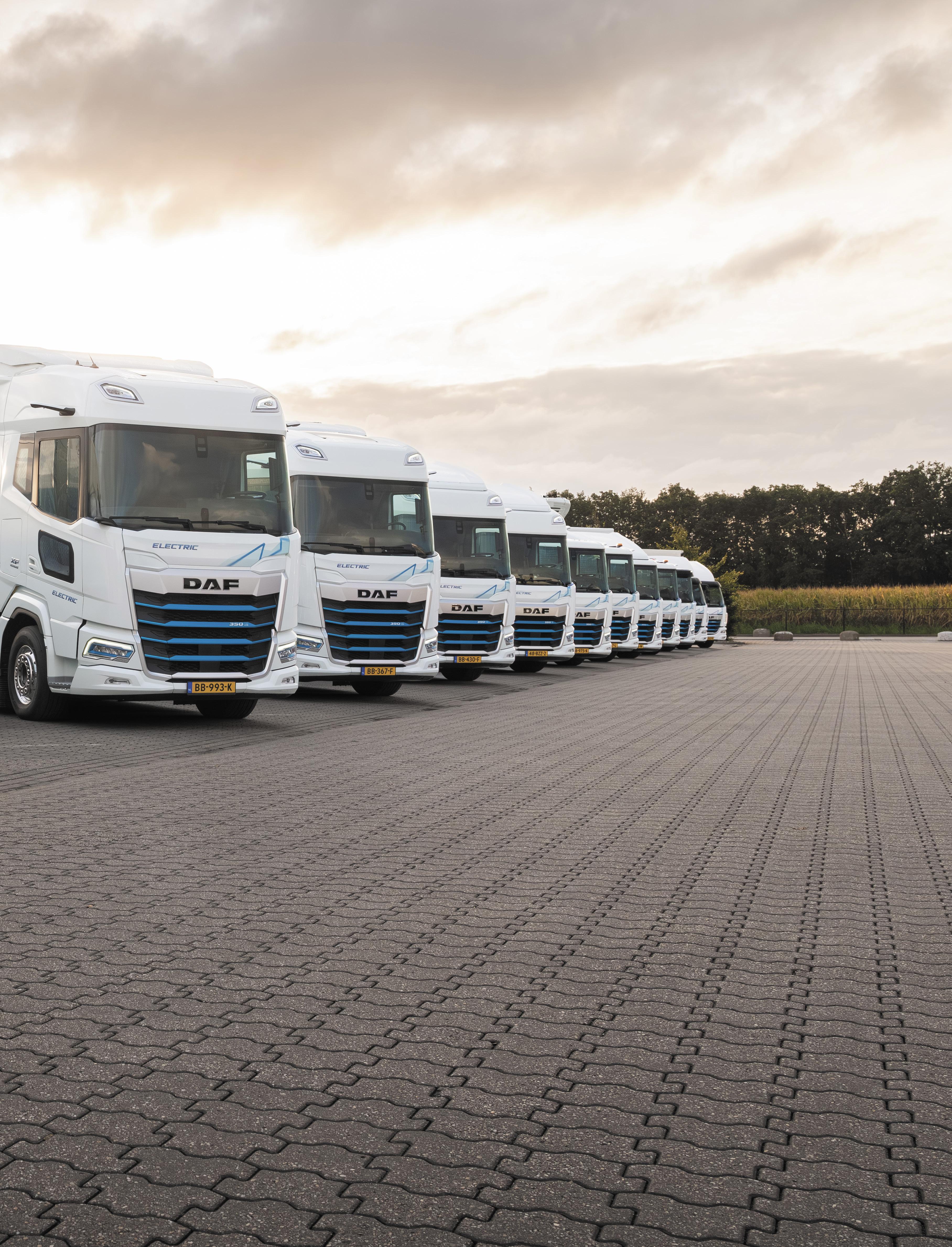
ELECTRIFYING CHANGE
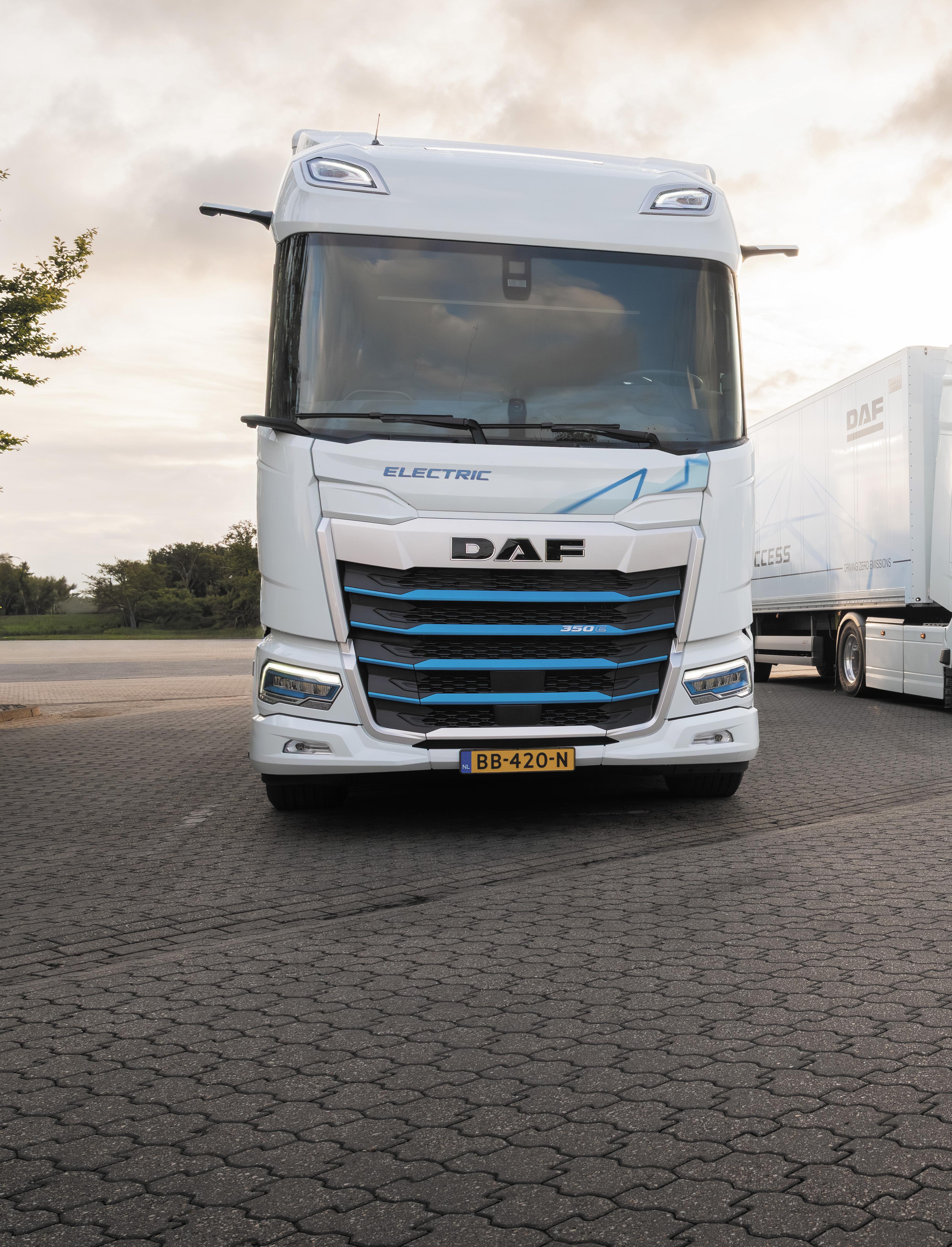
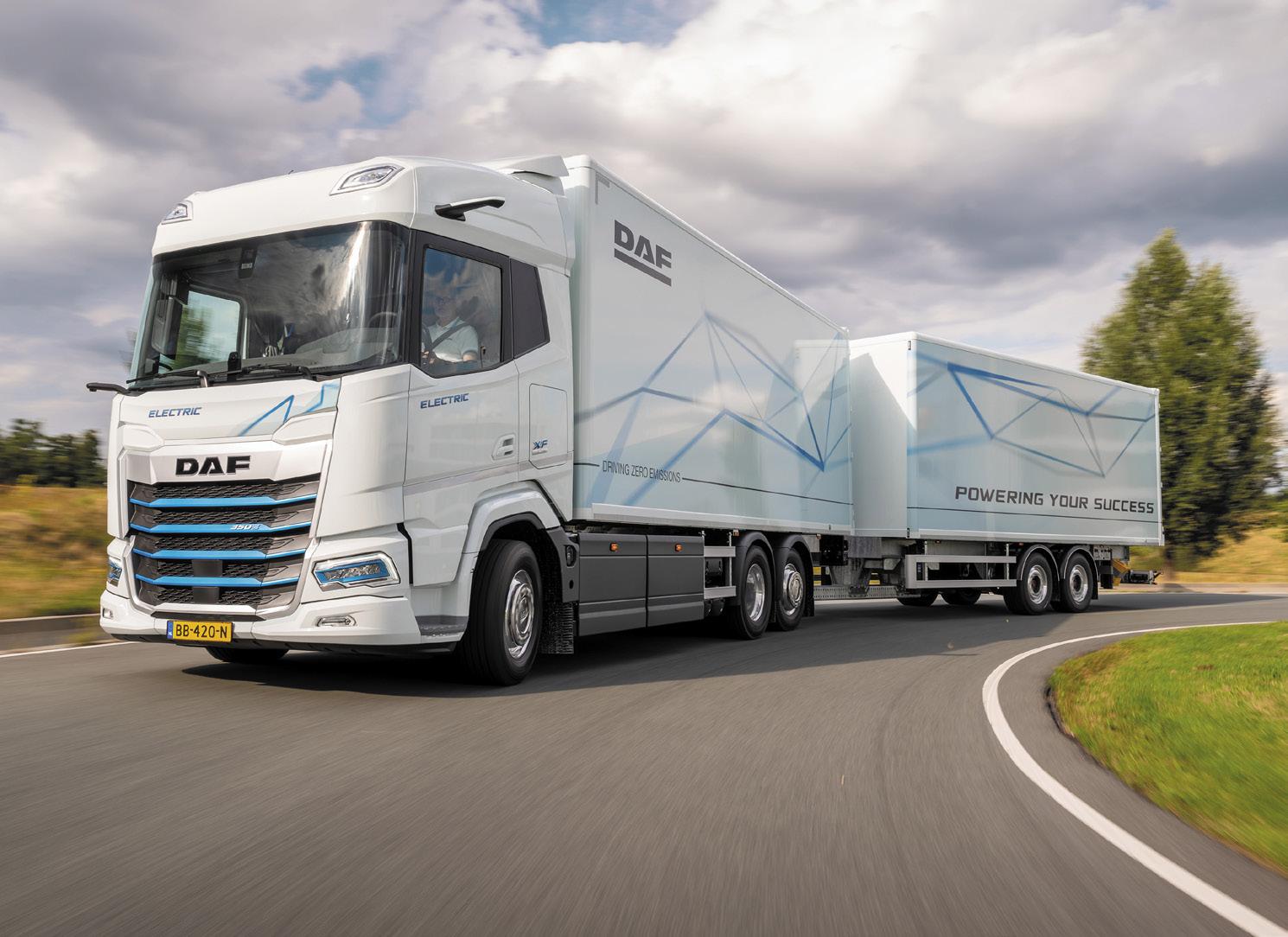
Electric trucks are evolving fast: DAF’s latest offerings tick all the boxes from 12-tonne rigids to 4x2 tractors with long-haul cabs


Electrifying change
DAF
began its journey into electric transport back in 2018 when the first battery-electric versions of the LF and CF appeared on European roads. Since then, the manufacturer has steadily developed its BEVs to produce what a modern electric truck needs to deliver in real-world distribution.
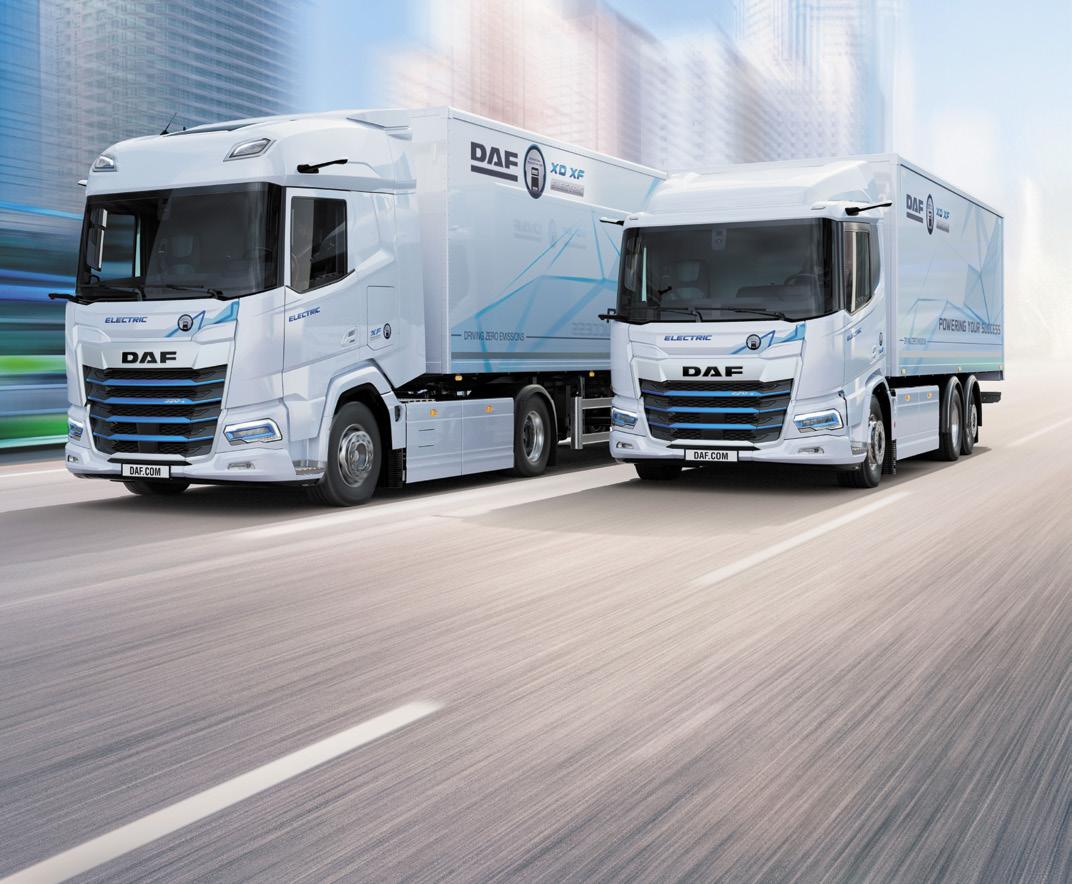
Now, that early progress has culminated in a new generation of zero-emission products: the XB Electric, XD Electric and XF Electric. Together, they give operators BEV options for everything from urban multi-drop to regional distribution and long-distance trunking.
The timing is important. Under current European legislation, CO2 emissions from trucks and buses must fall by 43% compared with 2019 levels by 2030. According to Raoul Wijnands, DAF’s senior product manager for testing, achieving this target will require around 400,000 electric trucks to be in operation across the continent. That’s a huge number, but DAF is positioning itself to ensure customers can begin their transition with confidence.
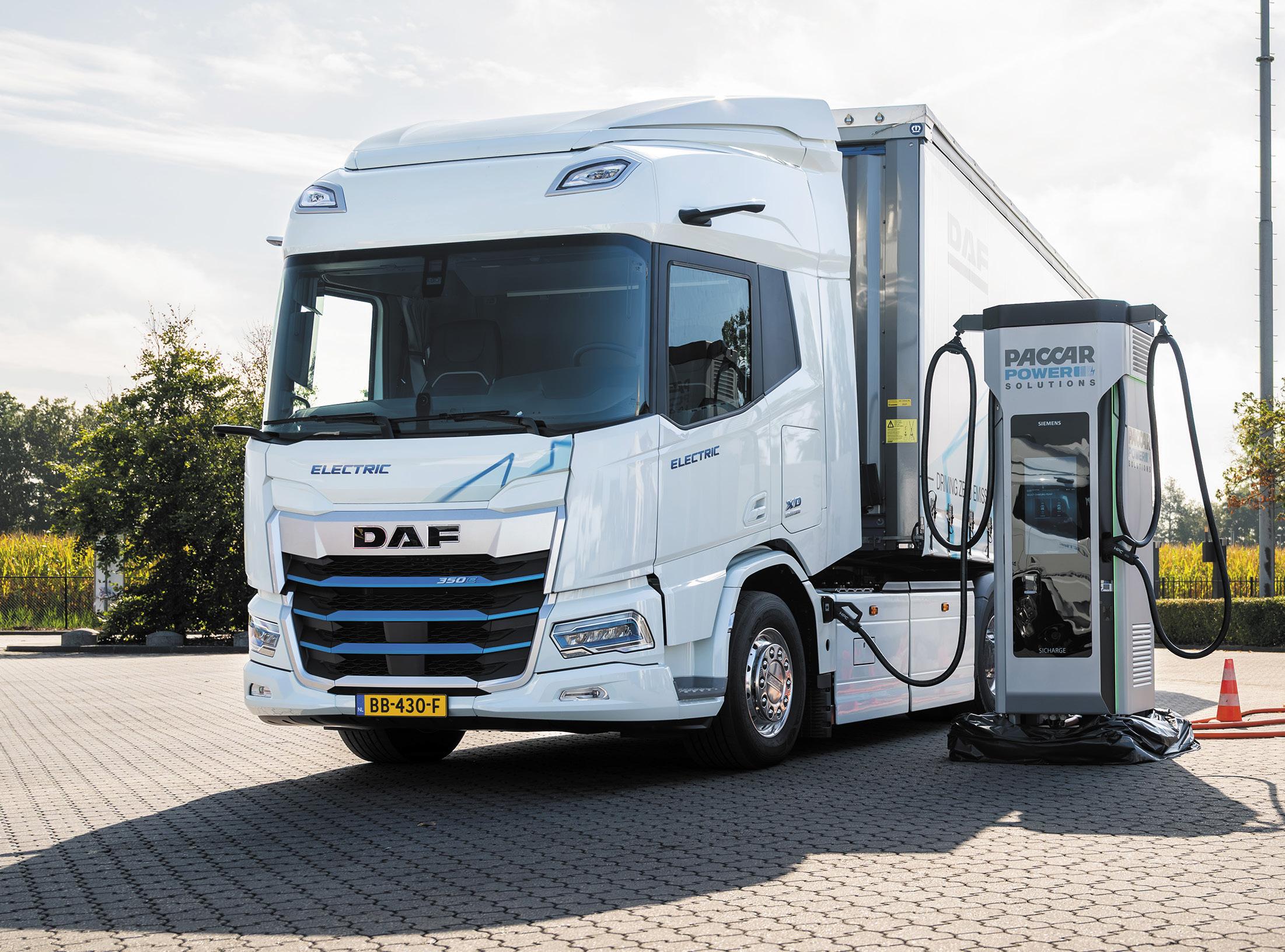
Of course, charging infrastructure across Europe and the UK will have to keep pace. But part of DAF’s approach has been to design electric trucks that can integrate easily into existing fleets where shorter routes, predictable duty cycles or
return-to-base operations already make battery-electric transport a realistic and attractive option. By offering multiple battery capacities, motor outputs and body configurations, DAF is ensuring these vehicles can serve a broad range of applications from day one.
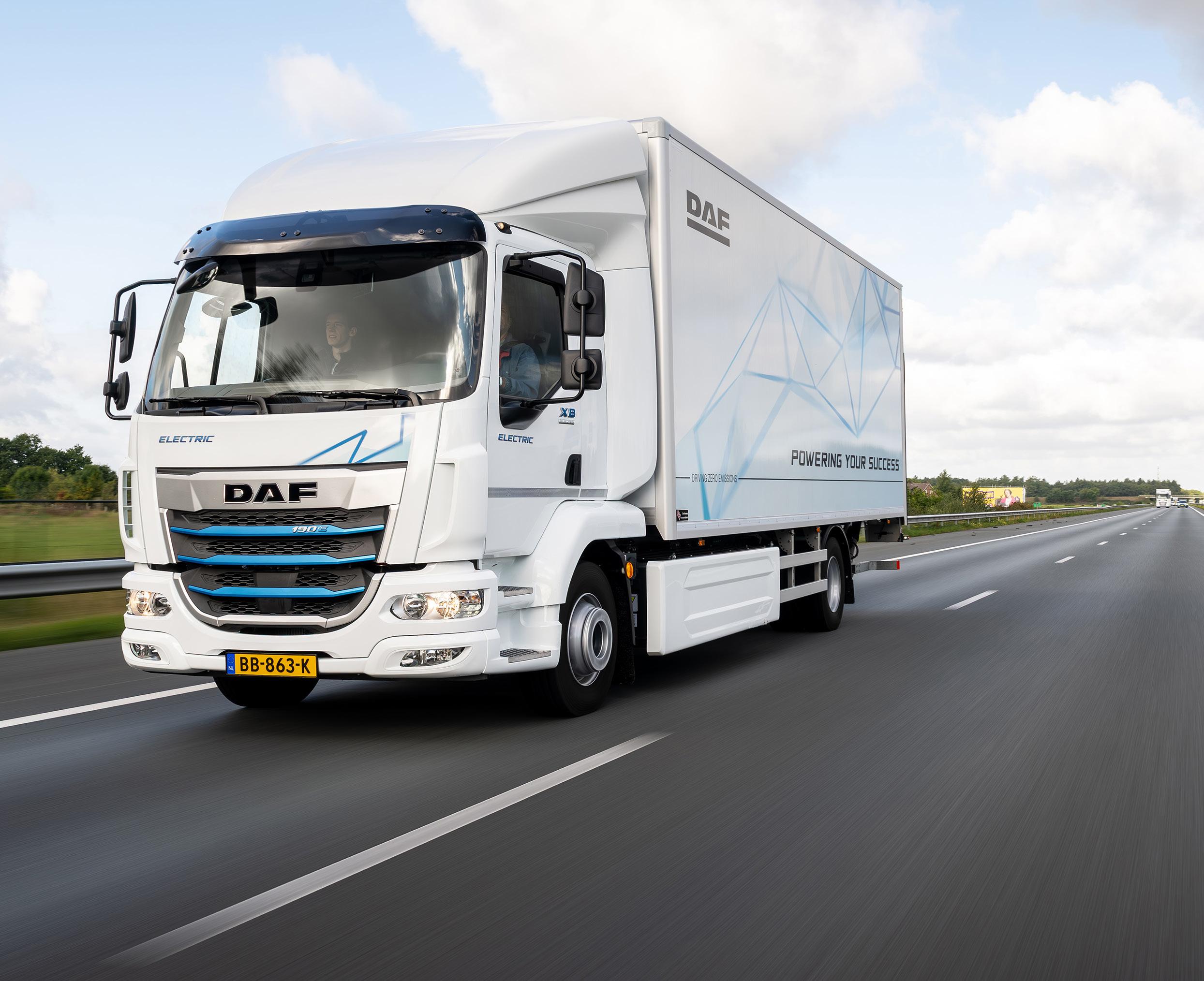
The smallest of the three new BEVs is the XB Electric: available as a 4x2 rigid at 12, 16 or 19 tonnes. Battery choices for the 12-tonner are 141kWh, 210kWh or 282kWh packs, with options for the two larger batteries only on the heavier trucks. Power comes from either the 120kW EX-M1 motor or the 190kW EXM2 motor, depending on gross vehicle weight. Operators can choose between Day Cab and Extended Day Cab versions,
XB Electric is lightweight option

and range is up to 350 km depending on specification and conditions.
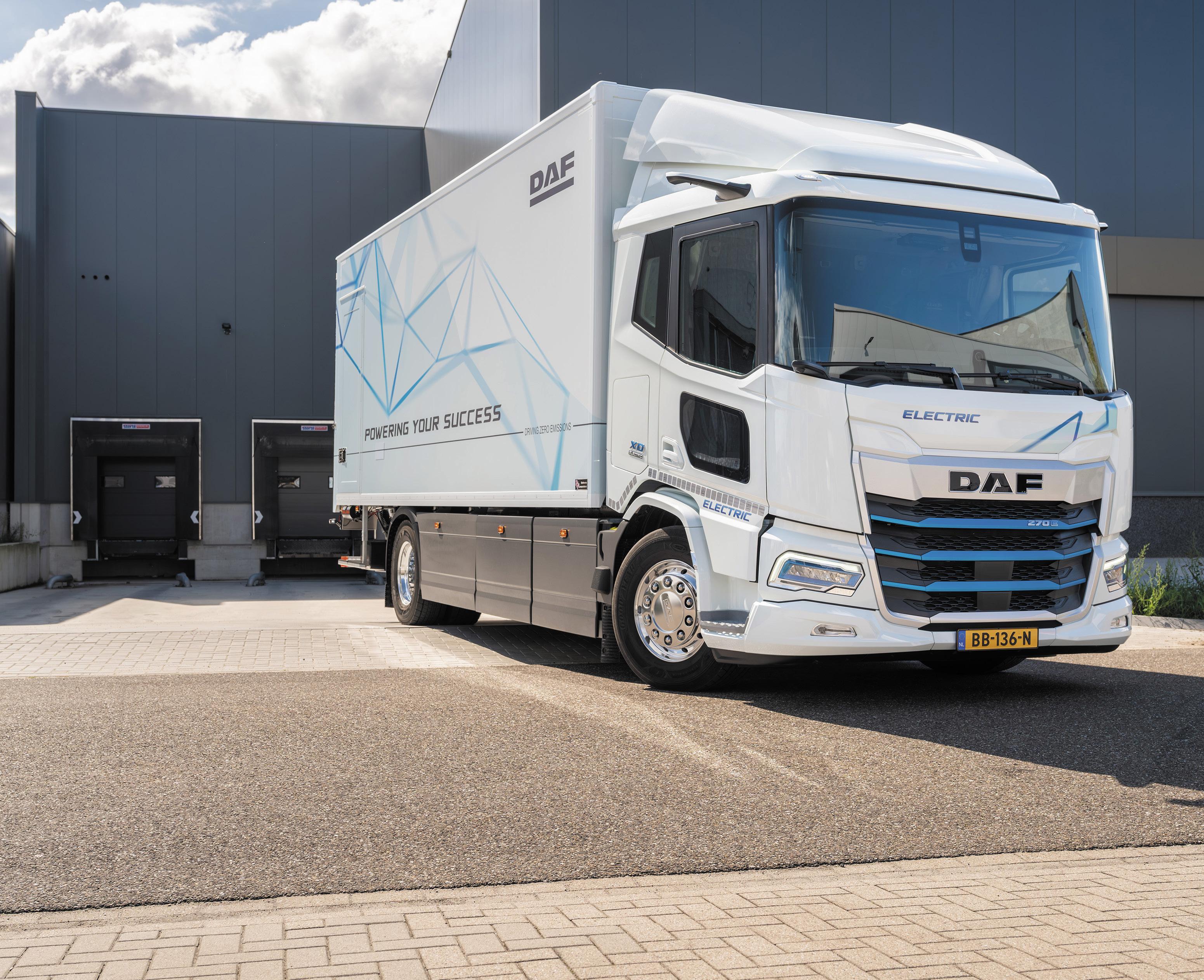
DAF’s XD Electric offers the widest flexibility. It’s designed for regional, urban and national distribution and is available with Day Cab, Sleeper Cab or High Roof Sleeper. Configurations include 4x2, 6x2 and 6x2 rear-steer rigids, plus a 4x2 tractor. Power options span the EX-D1 and EX-D2 motors, giving outputs from 170kW to 350kW. Battery packs are available in 315kWh, 420kWh or 525kWh capacities. GVWs range from 20.5 to 29 tonnes, while GCWs reach up to 50 tonnes. Maximum range is over 500 km, though DAF suggests 350420 km is a realistic working figure
when running at full weight in hilly conditions.
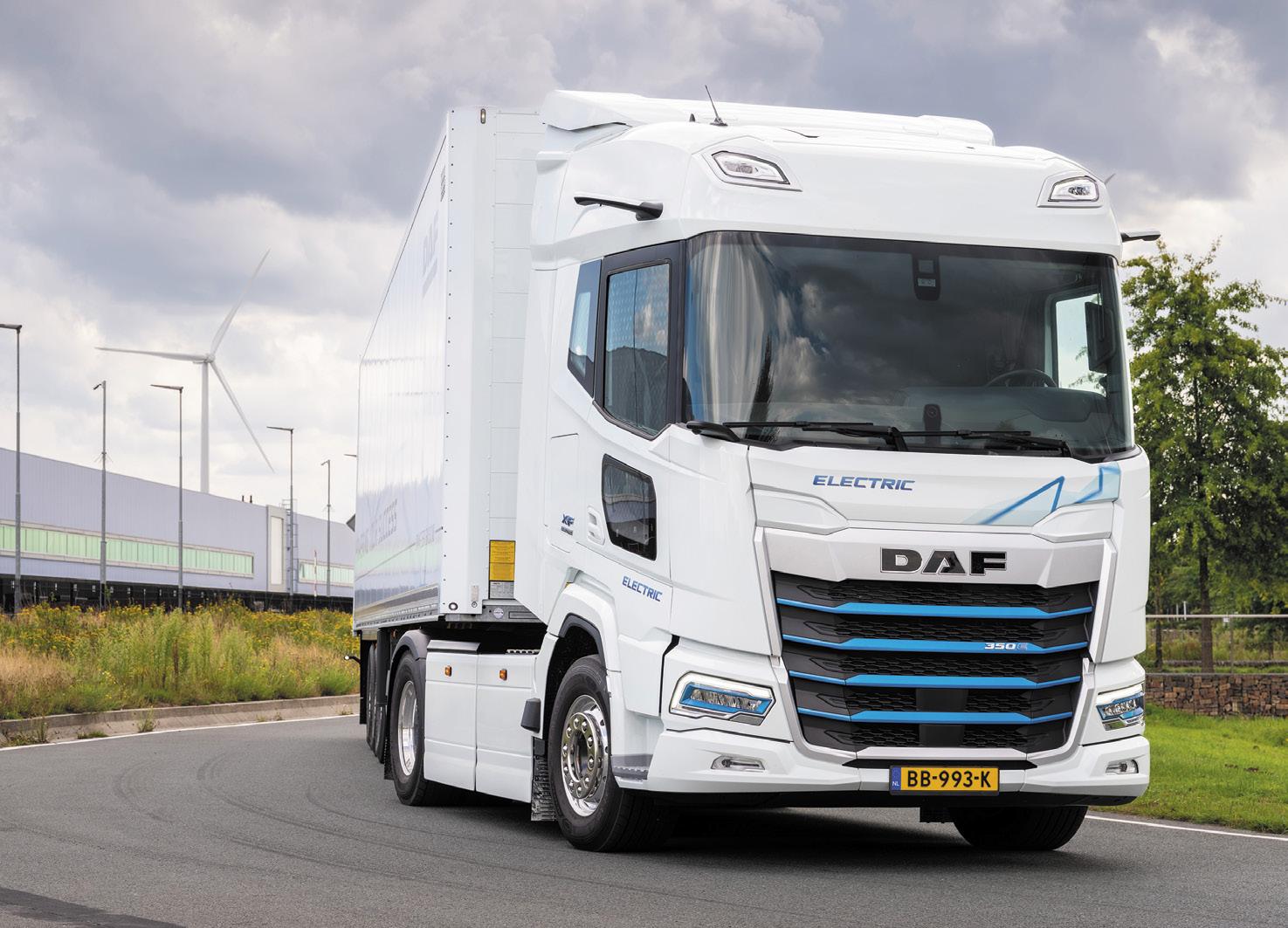
The XF Electric is positioned for the top end of the market. It uses the same three battery capacities as the XD and exclusively features the EX-D2 motor, delivering 270, 310 or 350kW. Cab choices are Sleeper or High Roof Sleeper. GVW and GCW limits mirror those of the XD, and maximum range likewise matches its mid-range sibling.
Test drives
A varied test route around Eindhoven showed how the new electric trucks perform in a variety of real-world scenarios. Our route included a
“THE190KW MOTOR PROVIDESBRISK ACCELERATION AROUNDTOWN”
XD Electric is avaialbe as rigid or tractor
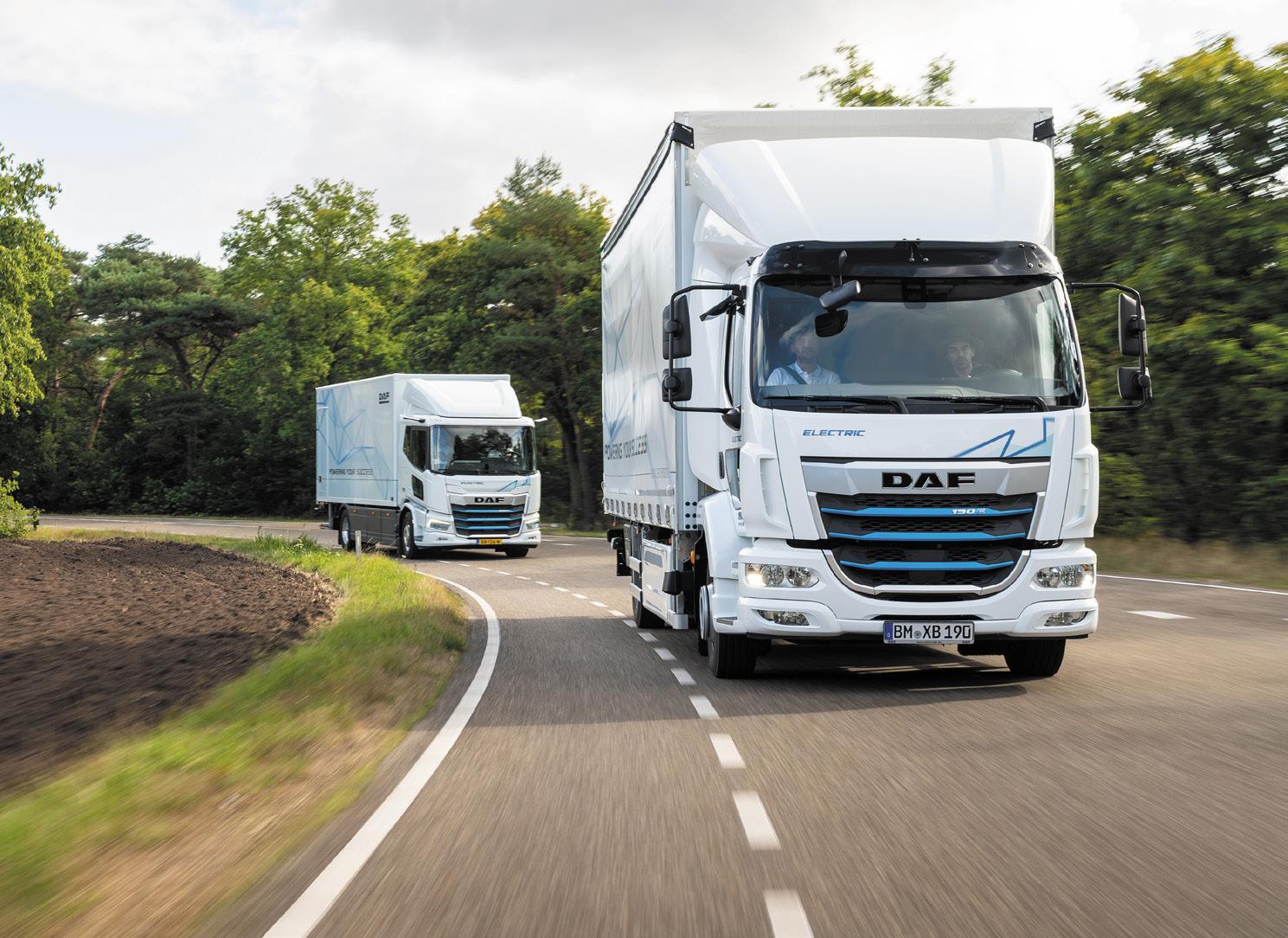
long motorway loop, tight village roads, A-roads, roundabouts, chicanes and slower sections with cyclists, pedestrians and changing traffic conditions.
The XF 350 FT Electric was the first truck of the day and it provided a superb introduction to DAF’s new generation of BEVs. Configured as a 4x2 tractor at 40 tonnes gross, it came paired with a twoaxle trailer and a High Roof Sleeper Cab.
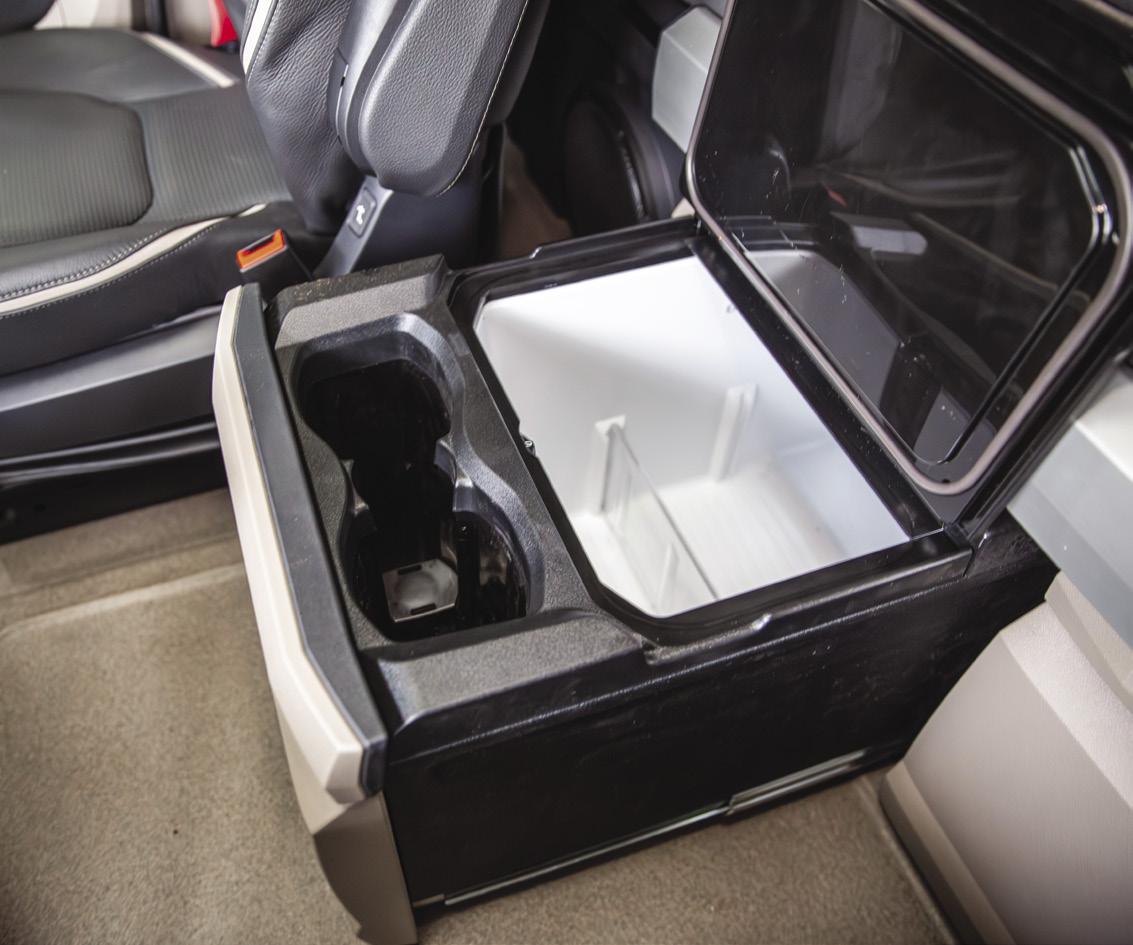
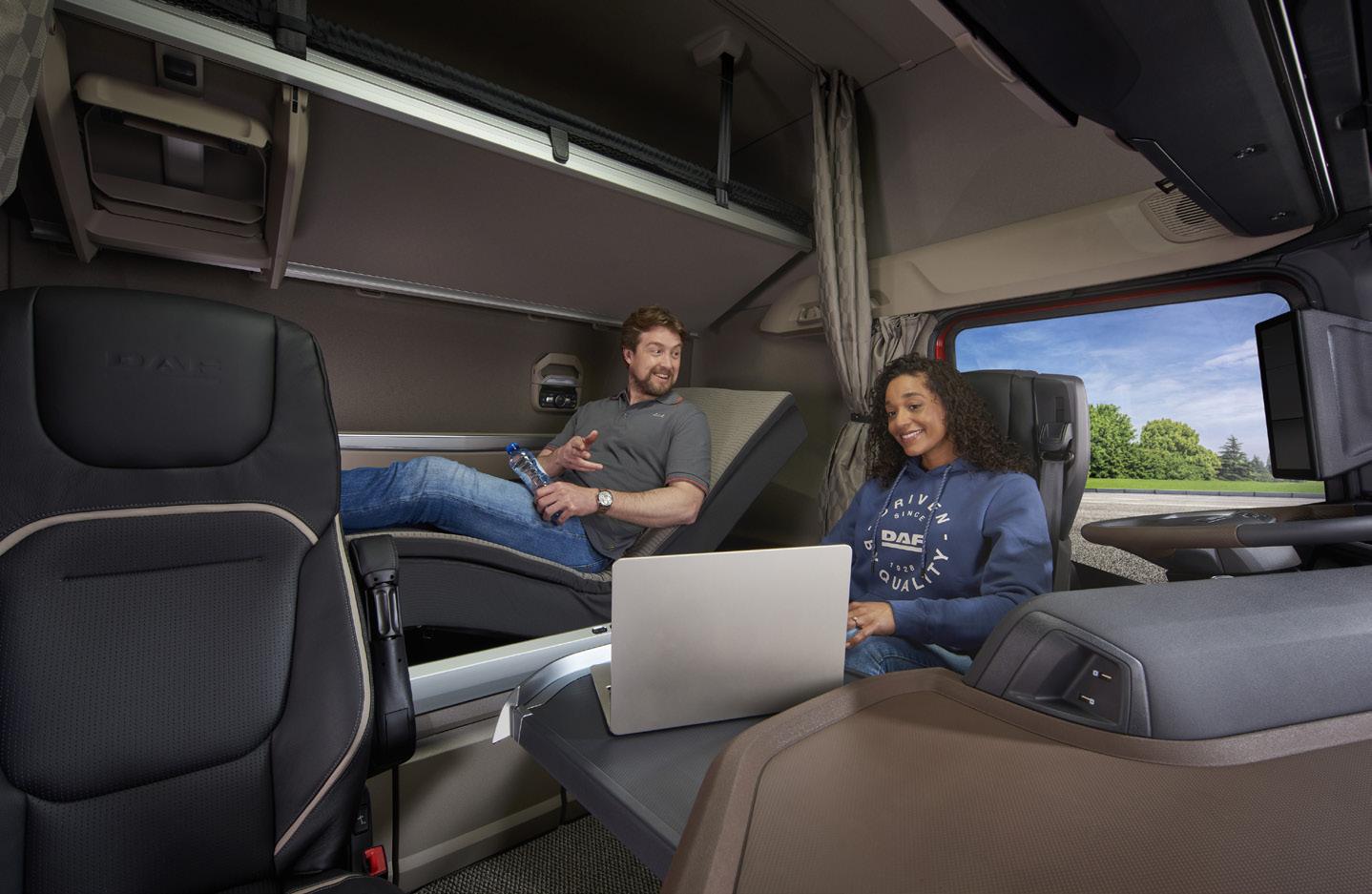
The specification was representative of a premium driver-oriented long-distance set-up: Xtra Leather Air driver’s seat, Xtra Comfort Mattress, fridge, cinema-style passenger seat and the familiar pullout table that many DAF drivers swear by. The XF feels built for long stints of uninterrupted cruising. With the 350kW motor delivering instant, smooth torque, the truck gathers pace easily and maintains it with almost no effort.
What stands out most, however, is the level of quietness. Without engine noise, the cab becomes a calm, spacious workspace where conversations with codrivers are refreshingly crystal clear. It’s an environment that encourages smooth driving and reduces fatigue.
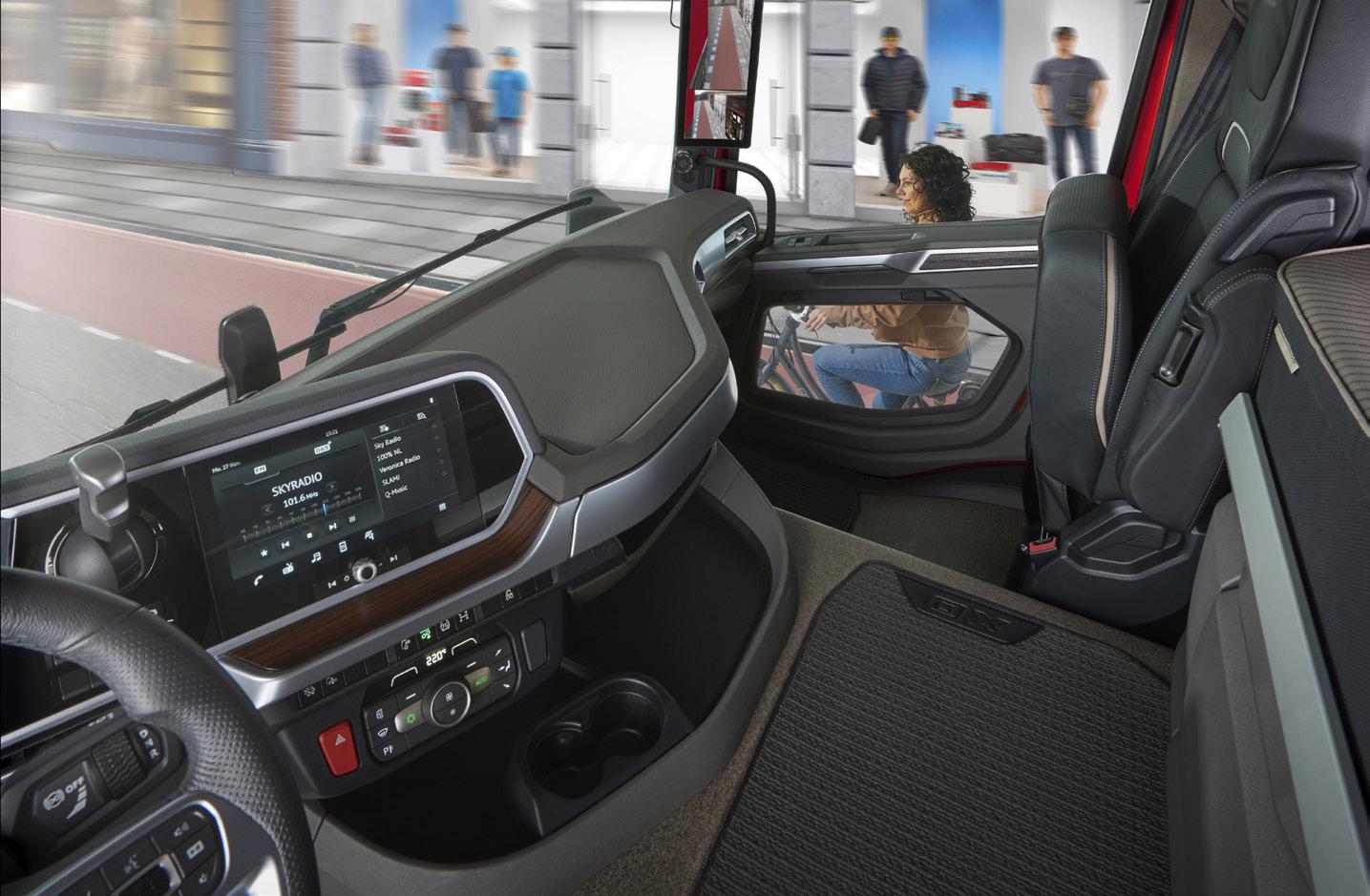
Visibility is excellent thanks to DAF’s digital mirrors, excellent Corner View camera and Kerb View Window fitted low in the passenger door. Together they give an uninterrupted awareness of the truck’s surroundings. This test vehicle achieves a three-star London DVS rating.
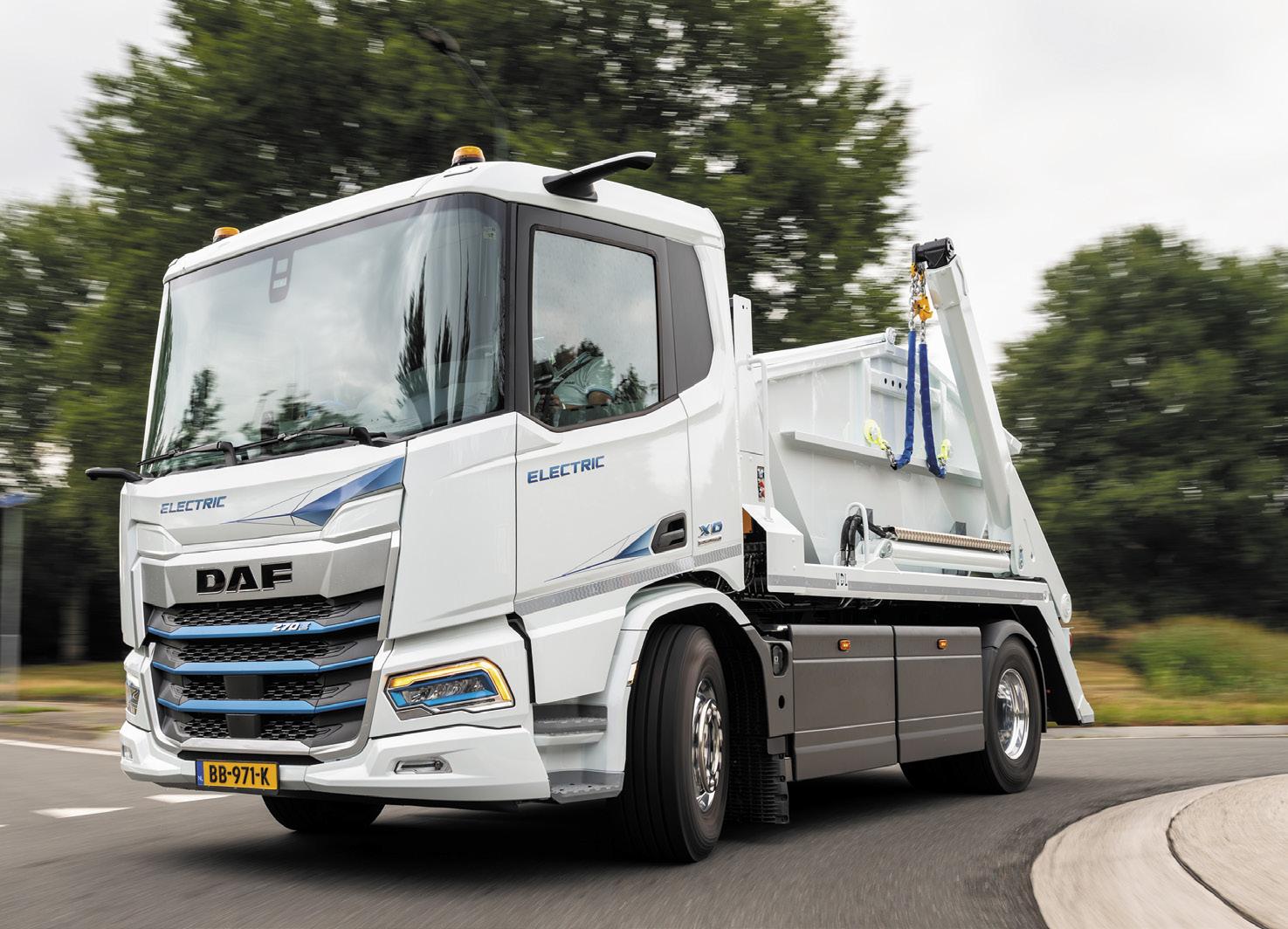
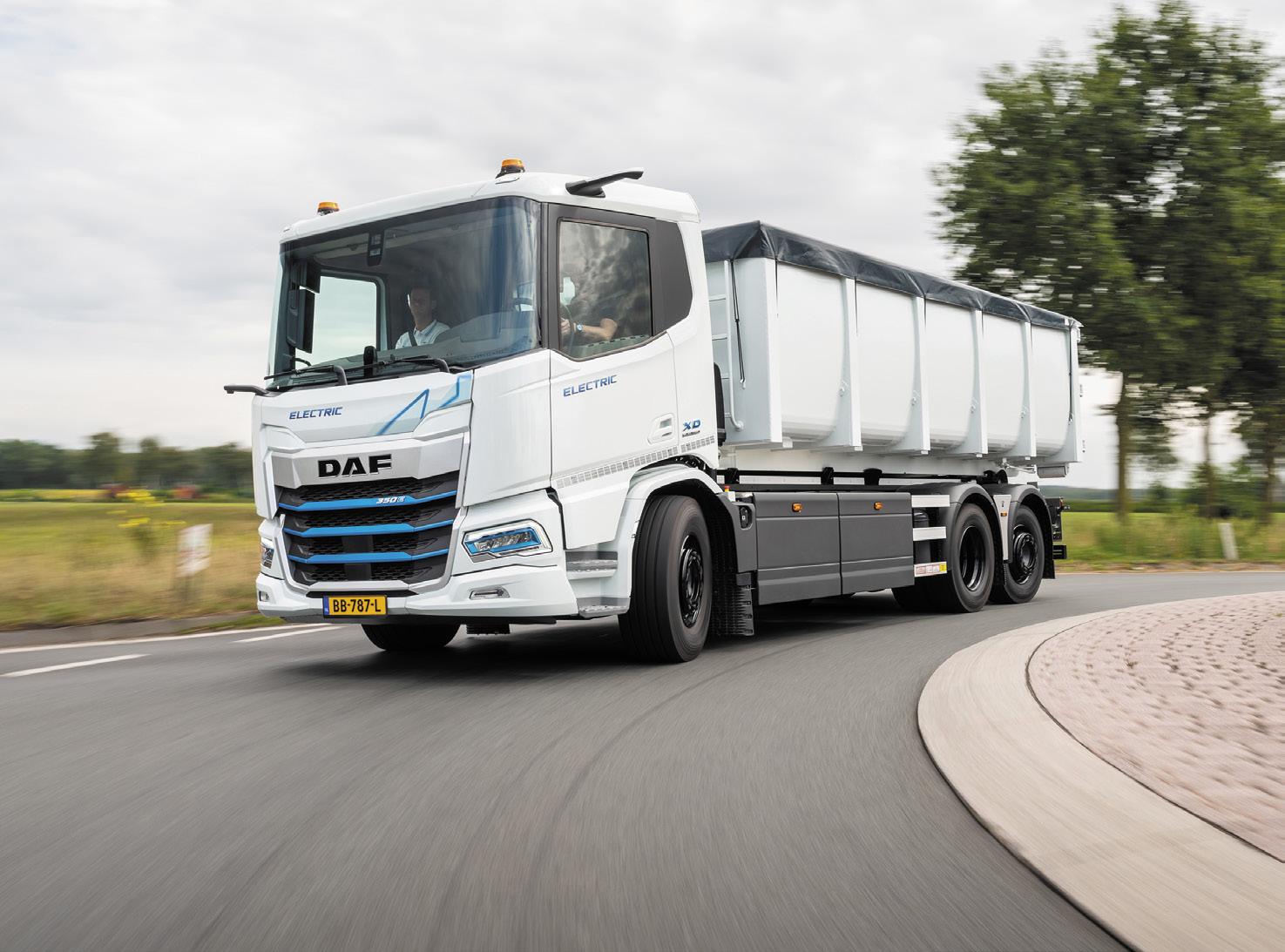
Regenerative braking is managed via a three-stage stalk, which becomes intuitive very quickly. The large power gauge on the driver’s display makes it easy to see when the truck is drawing energy and when it is feeding power back into the batteries.
DAF was keen to demonstrate its ‘intelligent one-pedal driving’ set-up, which means the driver can for the most part adapt to using just the throttle to control acceleration, cruising and braking. It soon becomes the natural way to operate the truck, especially when planning smooth deceleration for roundabouts or tighter sections.

On the motorway, stage one or two felt ideal, though we stepped up to stage three when decelerating on a couple of shorter off-ramps. Of course, the service brakes are also on hand, but with enough foresight you may not need to use them
XB Electric has conventional mirrors
XD Electric as SWB rigid
XD Electric in 6x2 rear-steer
too often. The route featured a broad mix of conditions: long motorway runs, flowing A-roads and a handful of tighter sections including narrow roundabouts and chicanes. These are the places where an electric powertrain’s smoothness truly shines. The XF handled it all with confidence, maintaining an even, predictable feel throughout. For operators who want a premium long-distance electric solution, the XF delivers a quiet, refined and highly capable driving experience.
After the XF we tried the smallest truck in the range: a 4x2, 14.5-tonne XB 190 FA Electric rigid with an Extended Day Cab. This part of the test route took us through a tight village, complete with narrow lanes, tree-lined verges, wide cycle lanes and a 30km/h limit. It was exactly the kind of environment where an electric distribution truck needs to excel – and the XB rose to the challenge.
The cab layout is practical and intuitive, ideal for fleets. Controls are straightforward, and everything a driver needs is close at hand. The XB on test used conventional mirrors and carries a threestar DVS rating. Despite the more compact footprint compared with the XD and XF, the driving position feels generous enough for a full working day.
A single-stage regenerative braking system is fitted to XB, controlled by a simple button on the steering wheel. While basic compared with the multi-stage systems in the larger models, it works cleanly and consistently. Drivers looking to maximise energy recovery simply need to choose their moments carefully – lifting early on approach to junctions or roundabouts and using smooth throttle control during slower sections. For typical distribution cycles involving shorter routes and regular returns to base, this is more than adequate.
The 190kW motor provides brisk acceleration around town and power delivery is reassuringly smooth. It feels nimble and easy to place on the road, even when navigating the tight pinch points common in Dutch village streets.
Ride comfort is impressive for a smaller rigid. It maintains the same calm found in the XD and XF, contributing to a relaxed, unhurried driving style. For operators looking for a dependable, quiet and energy-efficient urban truck with DAF’s familiar ergonomics, the XB Electric fits the bill perfectly.


XF Electric can run up to 50 tonnes
XF Electric 4x2 tractor
Charger availability is key to success
The final truck of the day was the 30-tonne XD 350 FT Electric, a 4x2 tractor with a Sleeper High Cab, and a two-axle trailer featuring a steered rear axle. With its combination of motorway, town and mixed rural sections, the XD had the most varied drive of the three –ideal for showcasing its versatility.
From the moment the combination was rolling, the XD felt reassuringly surefooted. Visibility is excellent – this model achieves a four-star DVS rating –and the driver’s environment is roomy, uncluttered and well thought out.
As with the XF, the XD uses a threestage regenerative braking system. One-pedal driving becomes second
nature, especially once you’ve located the ‘sweet spot’ in the accelerator that allows the truck to maintain speed smoothly during cruise. Lifting the pedal lets regen step in, recovering energy and slowing the vehicle without fuss. Stage zero allows the truck to free-roll, which is helpful on long, gentle descents or when you want to maintain momentum.
Performance from the 350kW motor is strong even under load, and the combination felt agile throughout the route. Roundabouts, junctions and short bursts of acceleration were all handled confidently, while motorway sections highlighted the XD’s relaxed cruising style.
Across the XB, XD and XF, DAF’s electric line-up leaves a consistently strong impression. Each model is thoughtfully engineered for its intended role, offering smooth performance, excellent refinement and the reassuring familiarity of DAF’s latest cab environment and ergonomics. The regenerative braking systems, power delivery and display layout all contribute to a driving experience that’s easy to adapt to.
DAF’s approach demonstrates clear readiness for the industry’s transition toward zero-emission heavy vehicles. These trucks deliver quiet operation, strong performance and impressive smoothness – qualities that drivers will appreciate immediately.
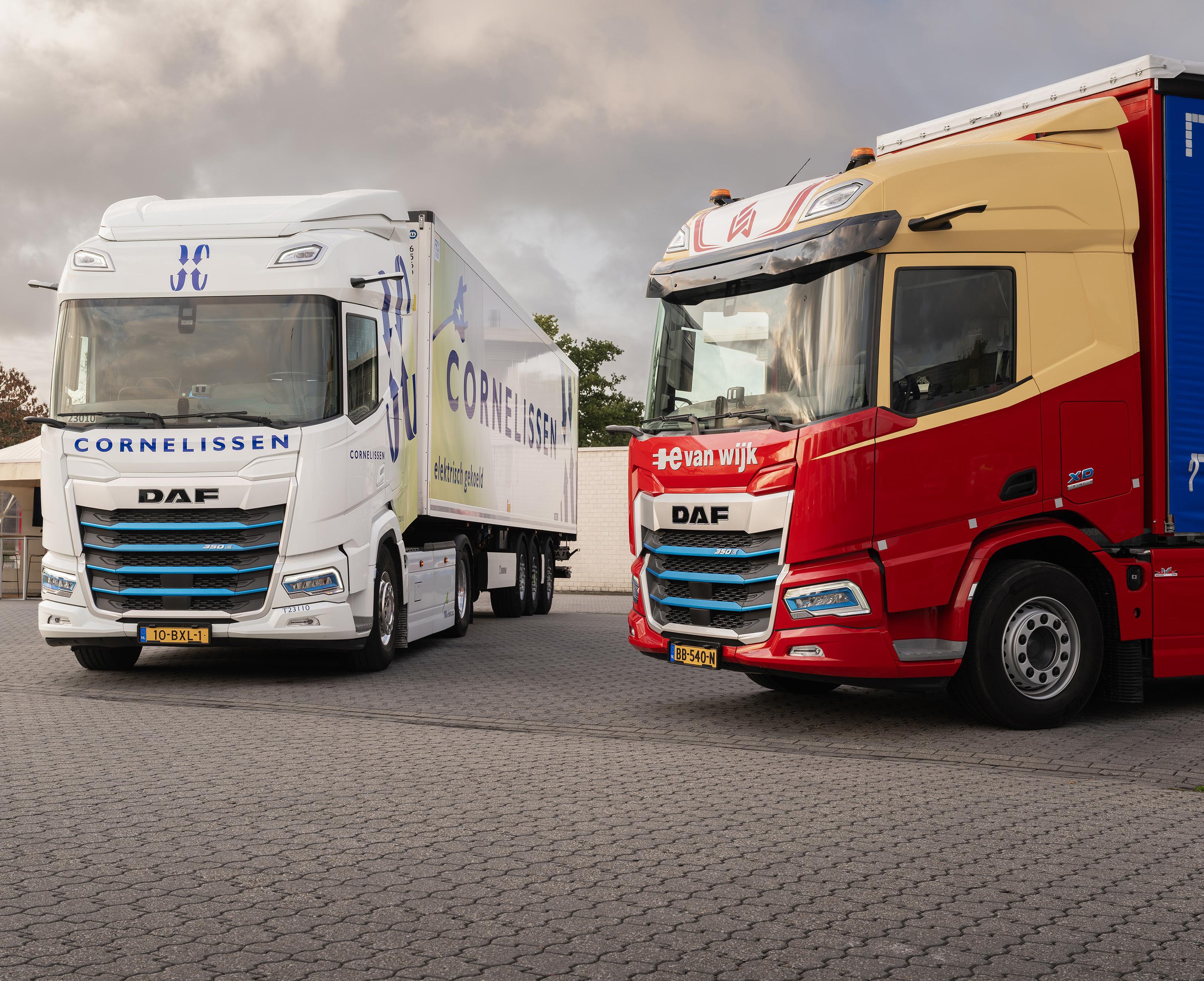
DAF Electric vehicles are already in operator service

DAF WIN BIGINTERNATIONAL TRUCK OF THE YEAR 2026
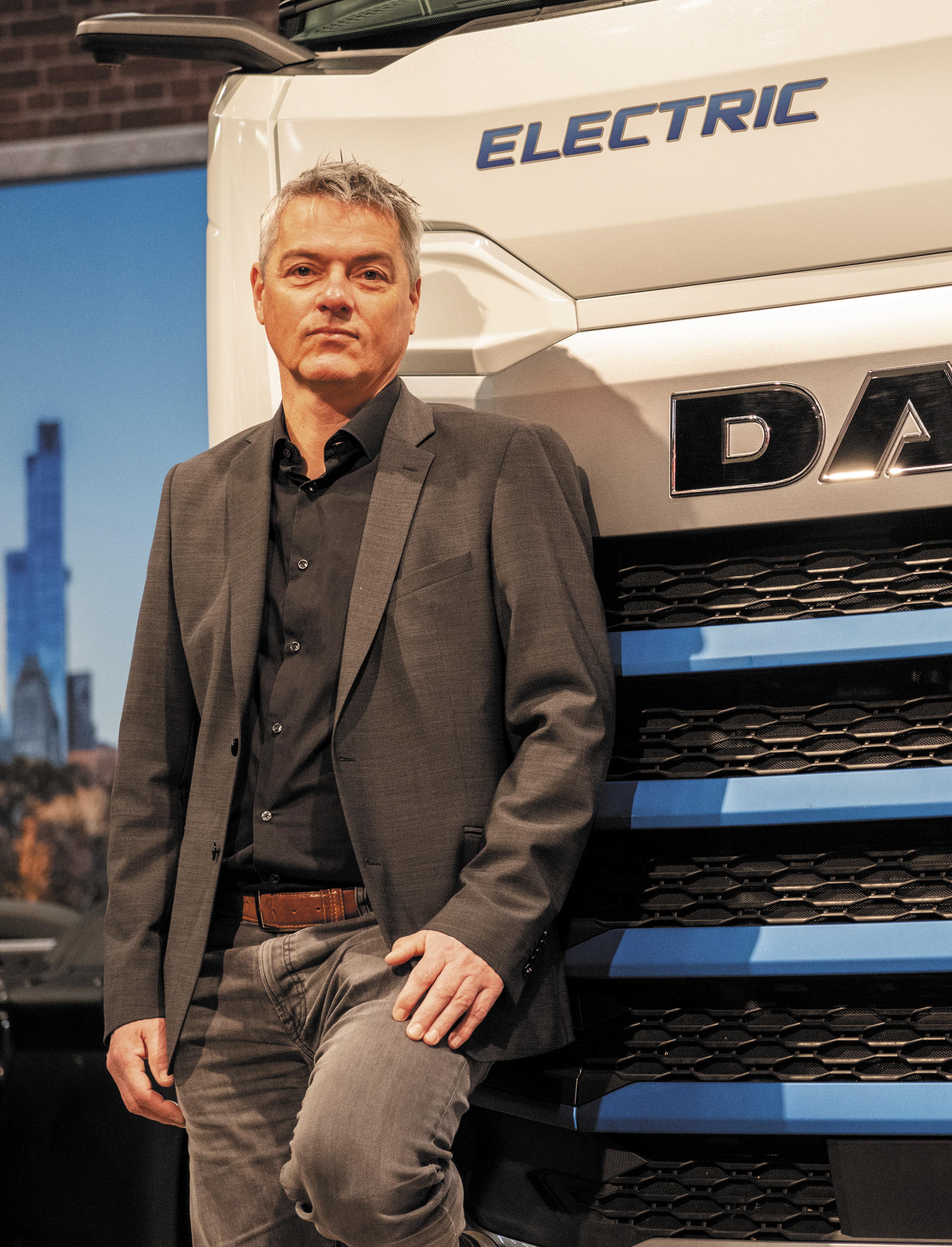
DAF’s New Generation XD and XF Electric trucks have been named International Truck of the Year 2026, marking a major milestone for the Dutch manufacturer and underscoring the rapid rise of zeroemission heavy vehicles across Europe.

The award—widely regarded as the most prestigious honour in the commercial vehicle sector—was presented to company president Harald Seidel during a ceremony at the Solutrans exhibition in Lyon, France. The win represents DAF’s third International Truck of the Year title in just five years, following victories for the New Generation XF/XG/XG+ in 2022 and the New Generation XD in 2023.

A win rooted in e iciency
Each year, the jury of the International Truck of the Year organisation selects a model launched within the previous twelve months that delivers the greatest contribution to road-transport efficiency. Evaluation covers technology, comfort, safety, drivability, environmental impact, energy efficiency and overall operating costs.
For 2026, the panel of 23 leading commercial-vehicle journalists from across Europe singled out the XD and XF Electric models for their standout energy efficiency, long driving ranges, and advanced electric architecture. Jurors praised the smooth, almost seamless driveline behavior and the trucks’ modular design, which allows operators to tailor battery capacity and axle configurations to different applications.
Florian Engel, chairman of the jury, noted that DAF’s decision to combine a central electric motor with a traditional rear axle delivered impressive results. He said the setup achieves energy efficiency on par with e-axle systems while offering ideal weight distribution and broad operational flexibility.
Power, range, and real-world capability



The award-winning trucks are powered by PACCAR’s EX-D1 and EX-D2 electric motors, producing between 170 kW (230 hp) and 350 kW (480 hp). They can be equipped with battery packs ranging from 210 to 525 kWh, enabling more than 500 km of zero-emission range on a single charge. With optimised charging strategies, operators can achieve over 1,000 km per day—an important benchmark for both regional and long-distance use.
Designed for urban distribution and full-scale logistics operations alike, the XD and XF Electric models combine low-mounted cabs, excellent aerodynamics, and advanced digital camera systems to maximise visibility and safety.
Pride—and momentum—for DAF
Calling the award “a moment of pride,” president Harald Seidel said the recognition highlights the company’s commitment to shaping the future of zero-emission transport. He added that the accolade affirms the brand’s dedication to delivering efficient, comfortable, and safe vehicles to its customers.
With its latest win, DAF strengthens its position as a leading innovator in the transition to electric road transport—signaling that the race toward cleaner logistics is not only accelerating, but reaching new milestones faster than ever.


NOSE FOR EFFICIENCY

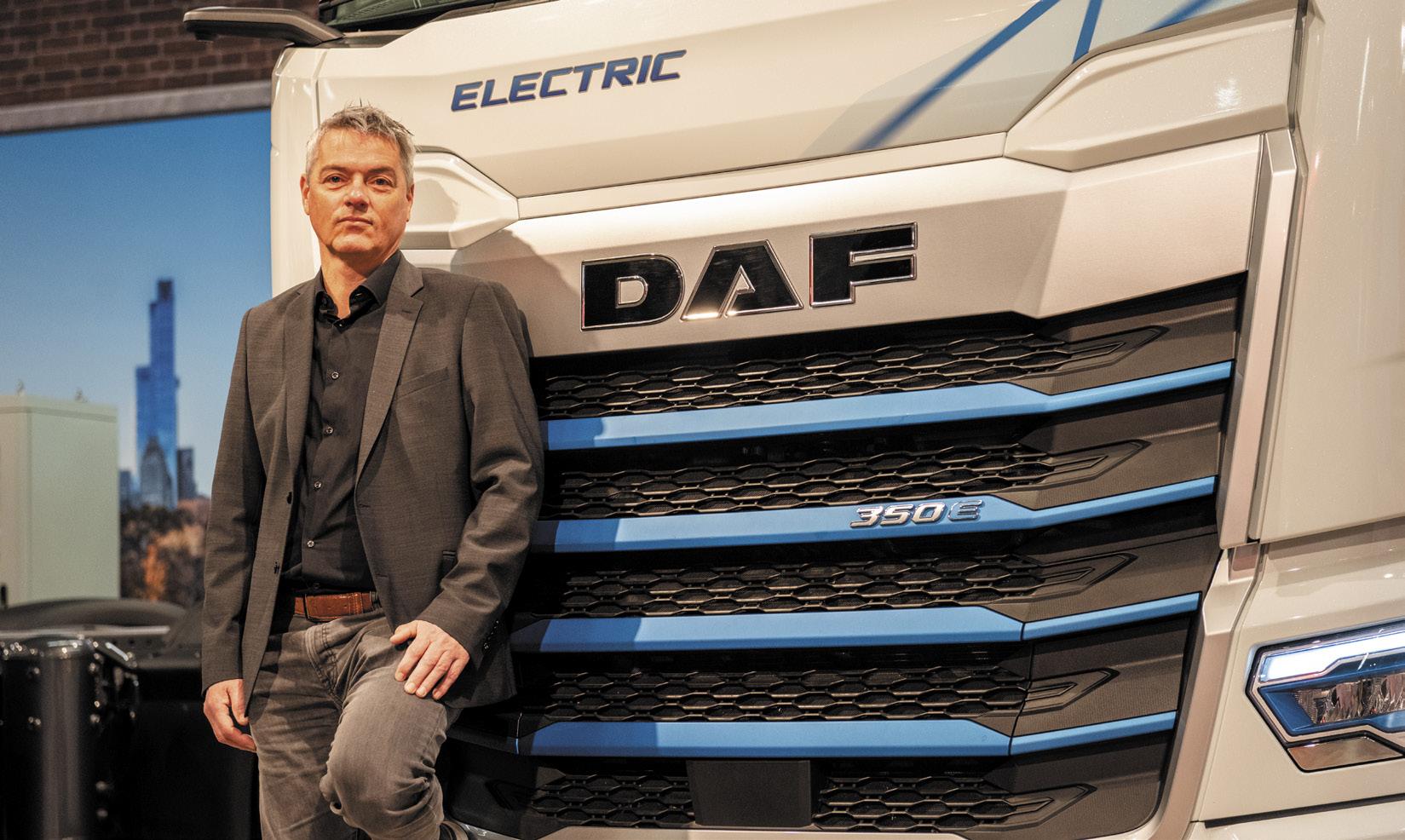
DAF Trucks’ Design Director Bart van Lotringen unlocks the secrets to the New Generation DAF’s improved aerodynamics.
Words: Brian Weatherley Photographs: DAF Trucks





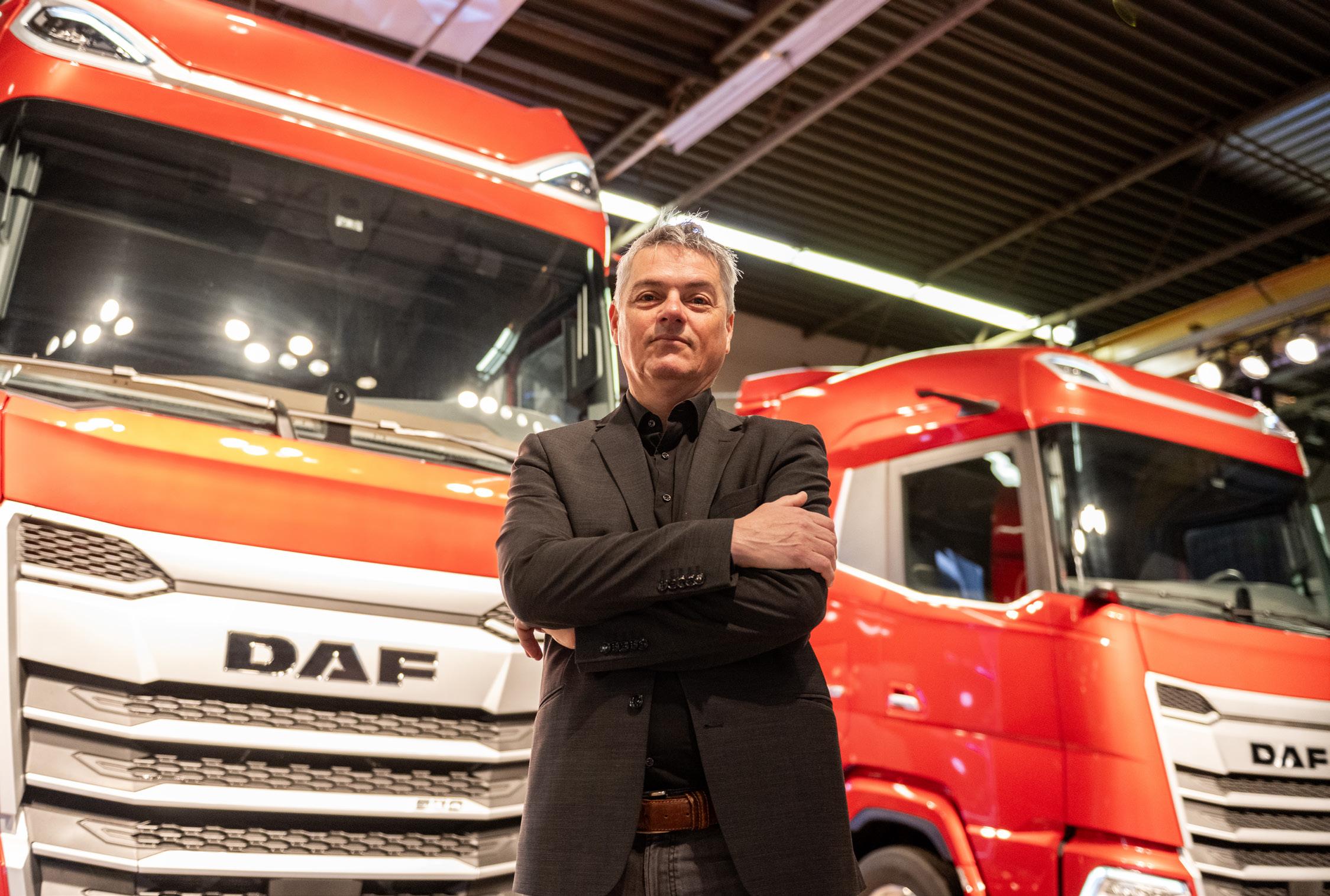
We’ve come to Eindhoven’s Hall B10, otherwise known as the ‘DAF Experience Centre’ where customers can see its latest products, to talk to DAF Trucks’ Design Director Bart van Lotringen about what makes the New Generation cabs so aerodynamically ‘slippery’. The ‘flame’ red DAF XG+ behind us is the perfect example of that all-important attention to detail. For the record, the flagship model in the New Generation range is also has the biggest sleeper cab on the market.
In 2014 DAF took the decision to develop a new range of heavy trucks with completely new cabs to replace the long-running XF and CF. Good news, only lurking in the background was the fact that the European Commission was looking at increasing LGV vehicle lengths to improve efficiency and safety.
Van Lotringen takes up the story: “We knew we were going to get extra lengths-but by how much?”
As rumours circulated of a frontal extension of anything between 500800mm, it left DAF’s engineers and van Lotringen’s design team trying to predict the future. “We were developing a new truck whilst not being 100% clear what the regulations were going to be.”
If the launch wasn’t to be delayed, DAF would have to take a calculated risk on which way the Brussels would jump. That meant keeping up a constant dialogue with the Commission’s experts to get regular updates on their thinking and priorities. Just half a year before the final regulation was clarified, it became clear the emphasis was going to be about the front portion of the cab.
“That gave us a little bit more freedom as you could make it as long as you want,” van Lotringen recalls.
Well, almost. Plonking an enormous elongated ‘aero nose’ on the front of the cab was out as the Commission wasn’t budging on existing rules for
artic turning circles. In the event, when DAF’s New Generation was unveiled in June 2021, all models from the XD upwards gained a frontal extension of 160mm, making DAF the first European
“ALLMODELS FROMTHEXD UPWARDSGAINED AFRONTAL EXTENSIONOF 160MM”
truck maker to take full advantage of the new EU 2019/1892 rules-finally applied from September 2020 and less than nine months before the New Generation’s arrival.
Eindhoven’s timing was perfect. Van Lotringen pays tribute to the DAF Board for pushing ahead with the new range in the face of that uncertainty. “We could have easily said ‘Let’s wait till all the regulations are here and then start’, but then we might have lost five or six years. Instead, we got a competitive advantage.”
It also helped that in-parallel to creating the New Generation range DAF pressed ahead with a brand-new cab paint facility at its Westerlo plant to handle those longer cabs. The ability to paint a bigger cab-the XG+ is 490mm longer than the old XF Super Space Cab, based on that 160mm extension at the front and a further 330mm also at the back-meant DAF could produce cabs that took full advantage of any revised length rules.
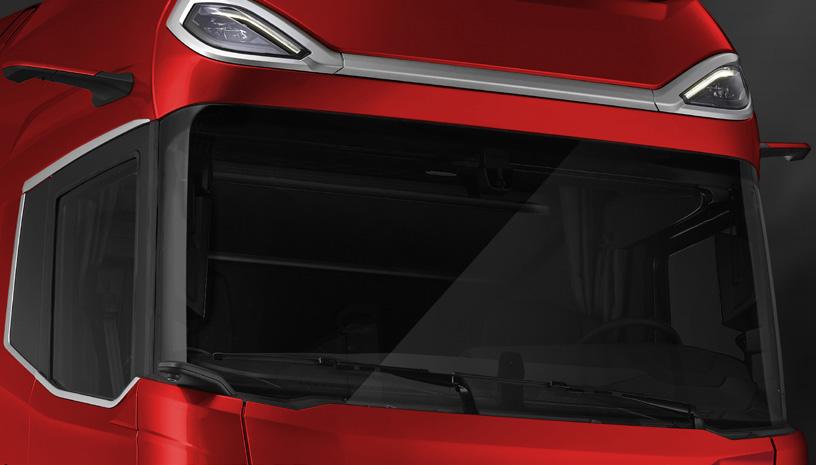
Standing in front of the bright red XG+ cab it’s obvious its extended nose is a major contributor to its 19% improvement in aerodynamic efficiency. However, pointing to its curvaceous front corners van Lotringen is keen to stress how important they are to making the XG+ and all the other New Generation cabs more ‘slippery’, whilst keeping them within turning circle constraints.
From above you can’t fail to notice how those front corners meld smoothly into the cab sides. Van Lotringen explains: “What we found was a ‘sweet spot’ with an elongation that allowed for a good ‘tapering’-so the airflow stays attached to the body. With the elongation of around 16cm on the front, combined with the heavily tapered sides, you create a parabolic shape like a wing of an aeroplane that creates suction.”
That suction is vital if you want the passing air (or ‘boundary layer’) to stick closely to the body sides. If the airflow breaks away from the body, you get drag-inducing vortices-the last thing you want for maximum fuel efficiency. Thus, the cab corners
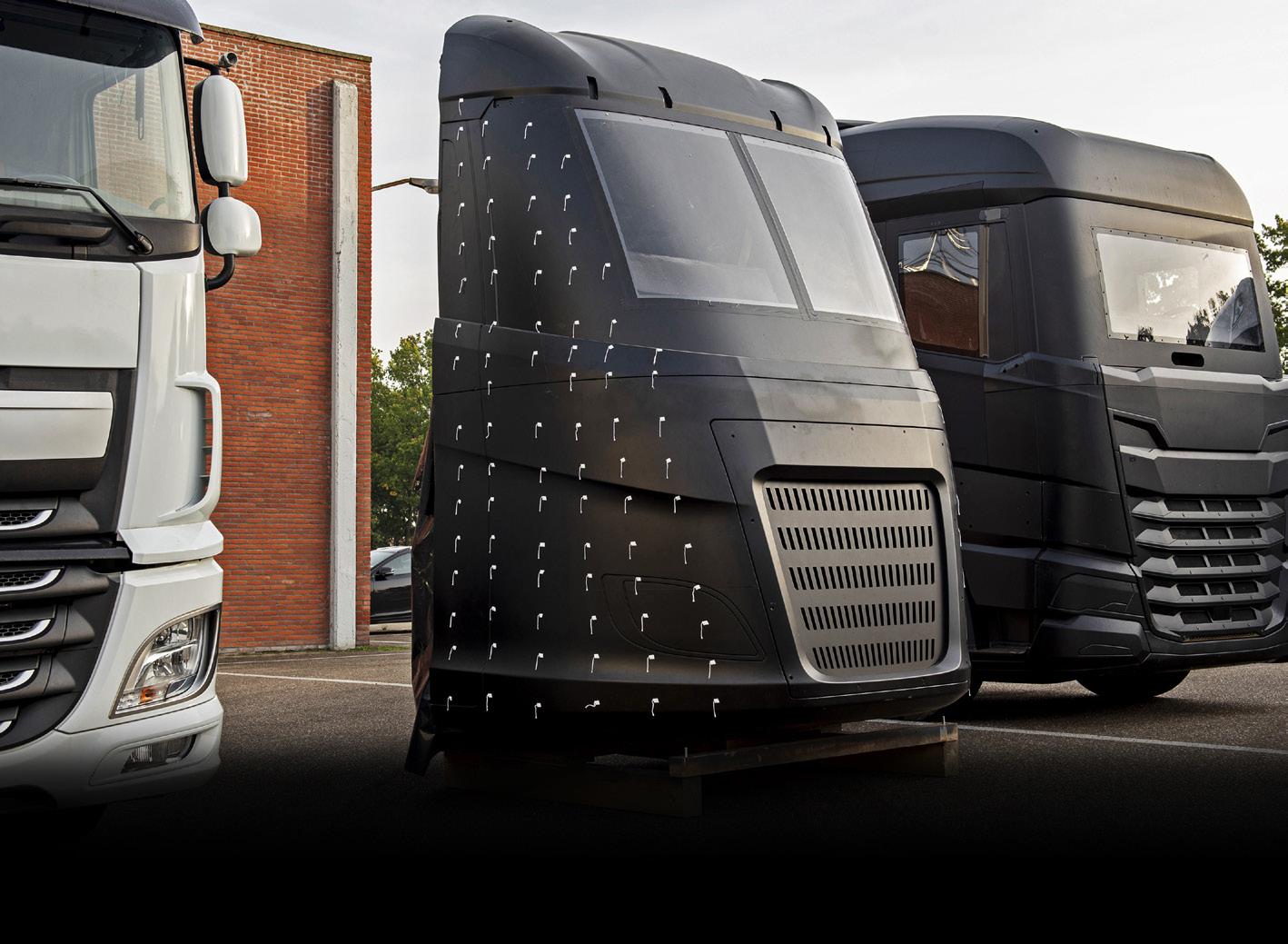
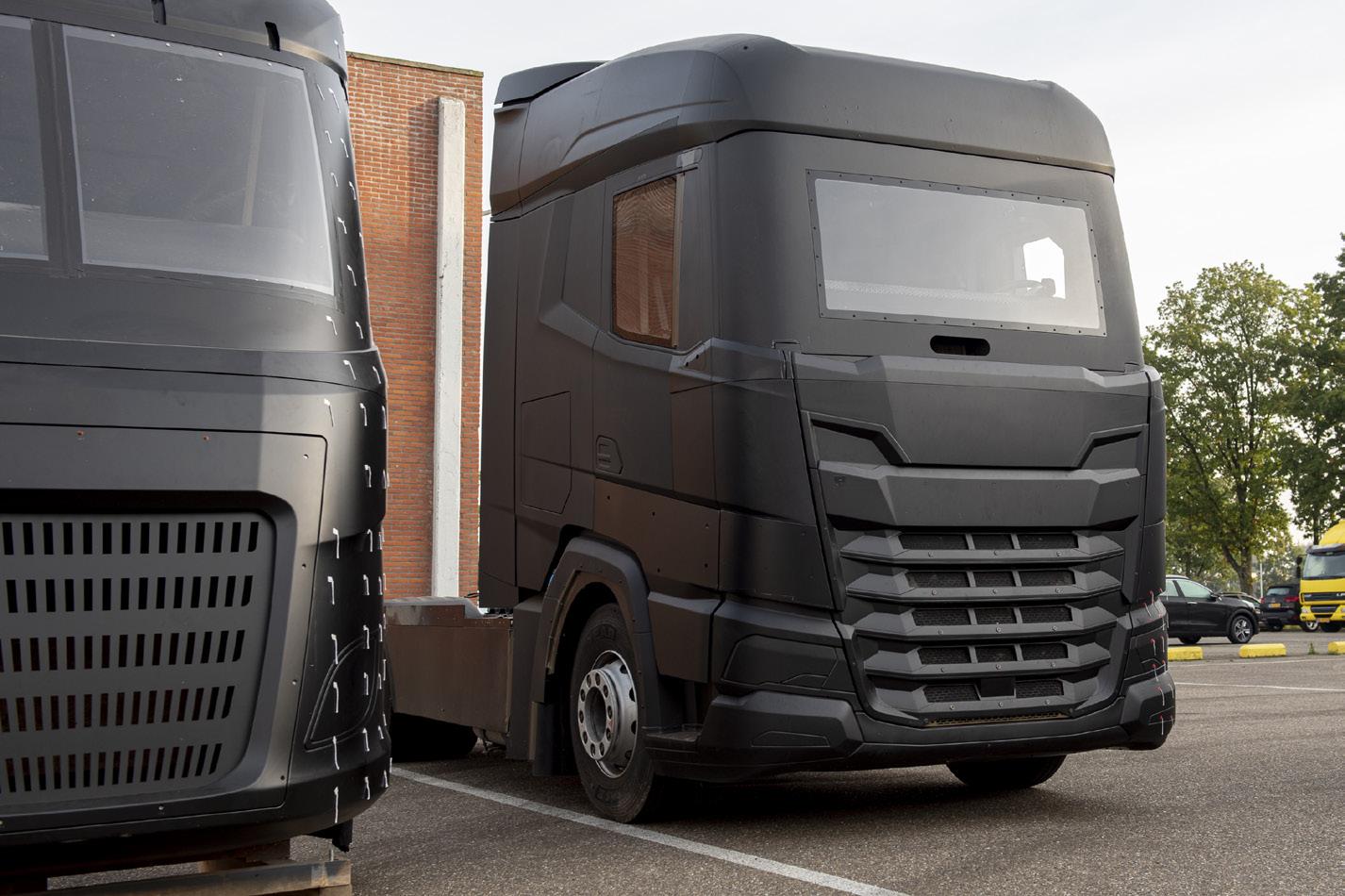
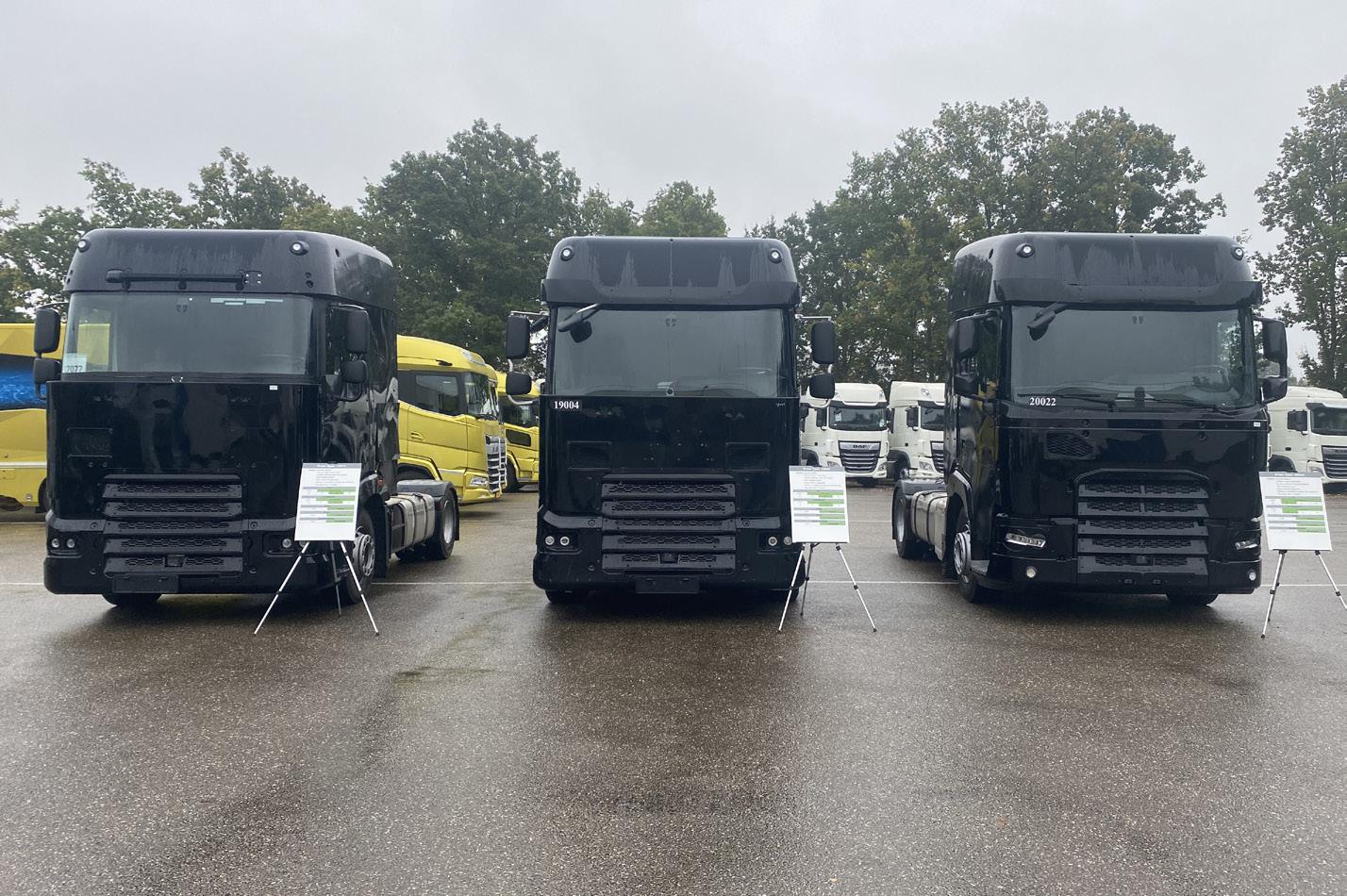
User clinics gave feedback during the design stage
... this is the eventual winner
Various versions of the new front were produced...
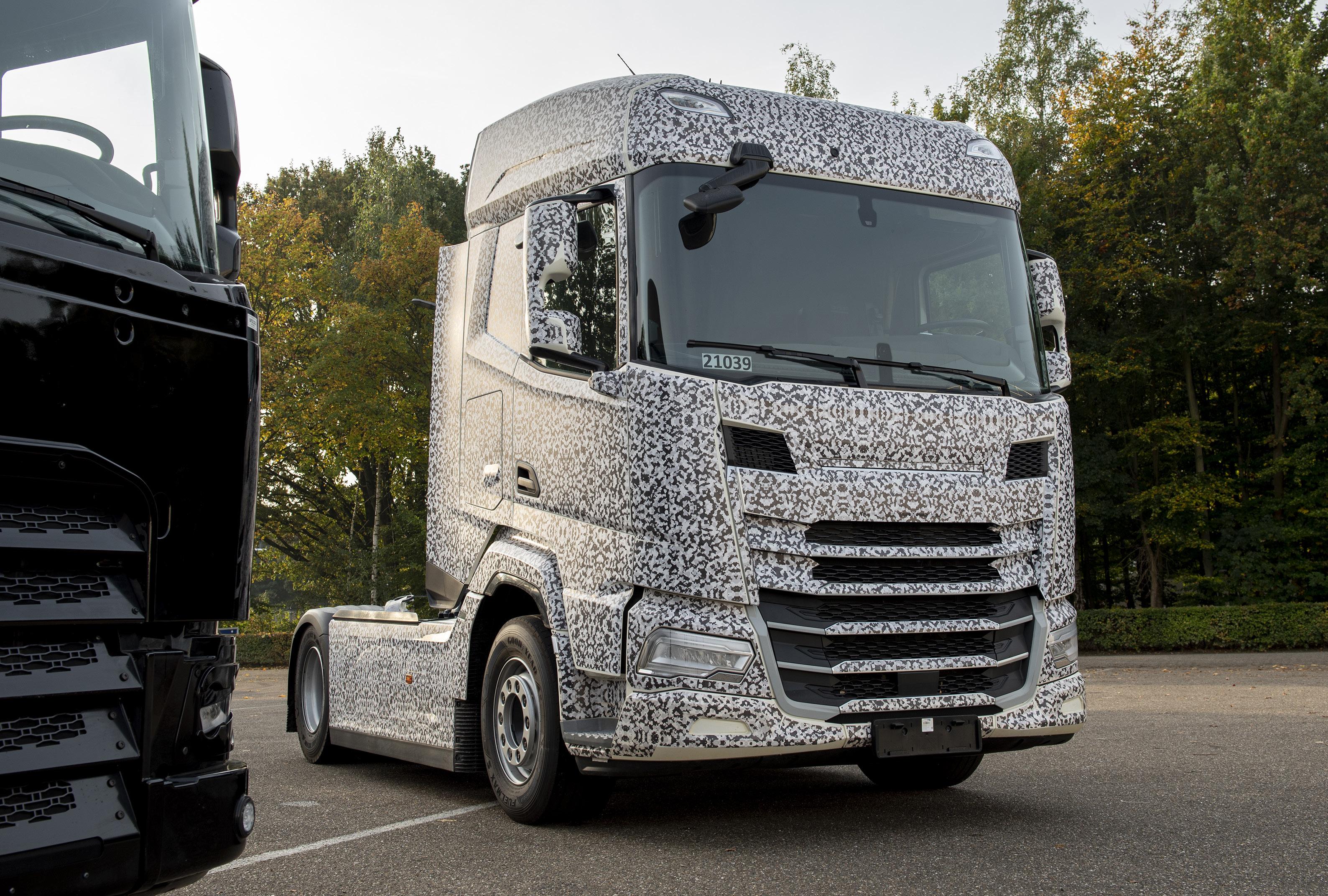
Development unit in camo livery
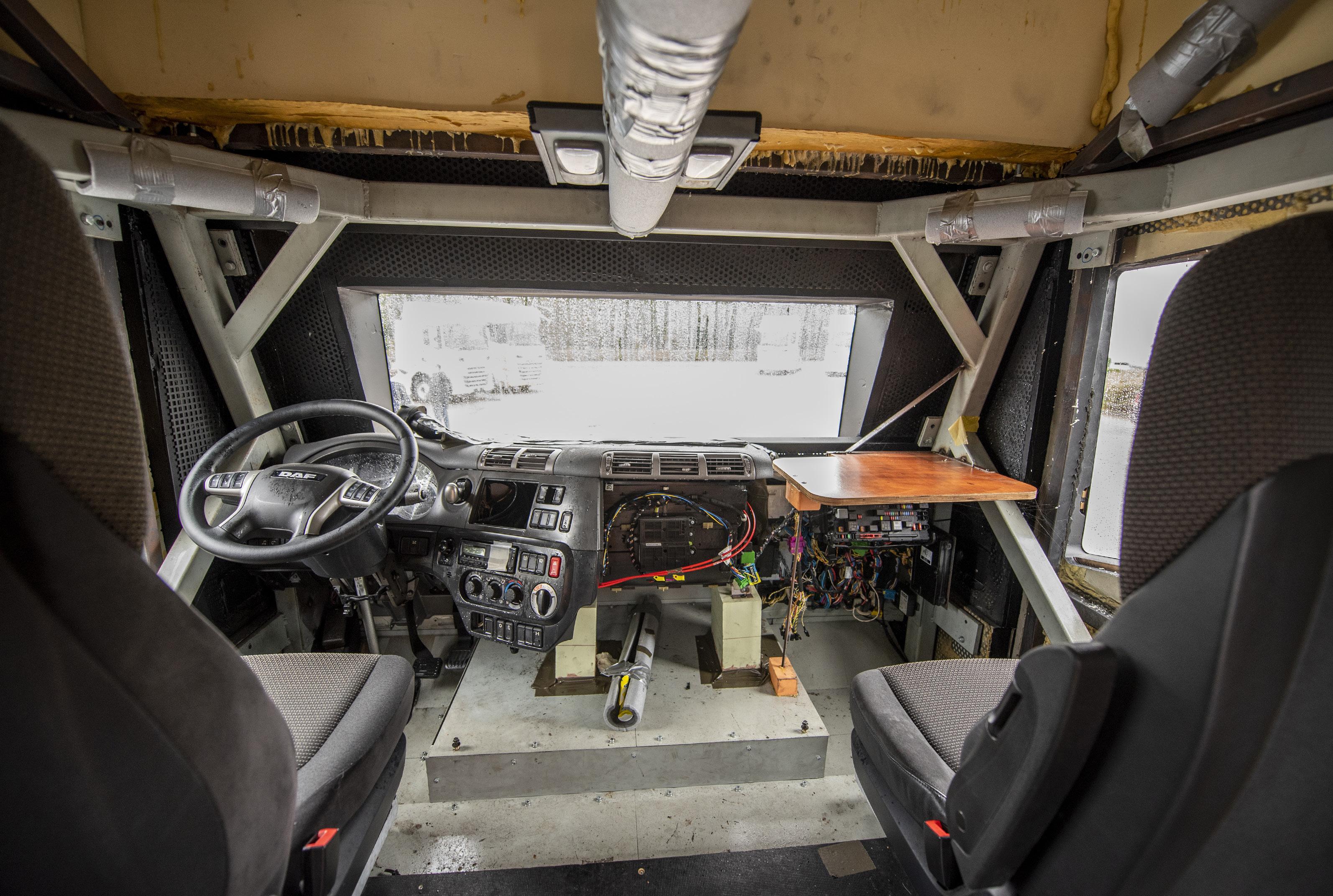
Interior mock-up in development
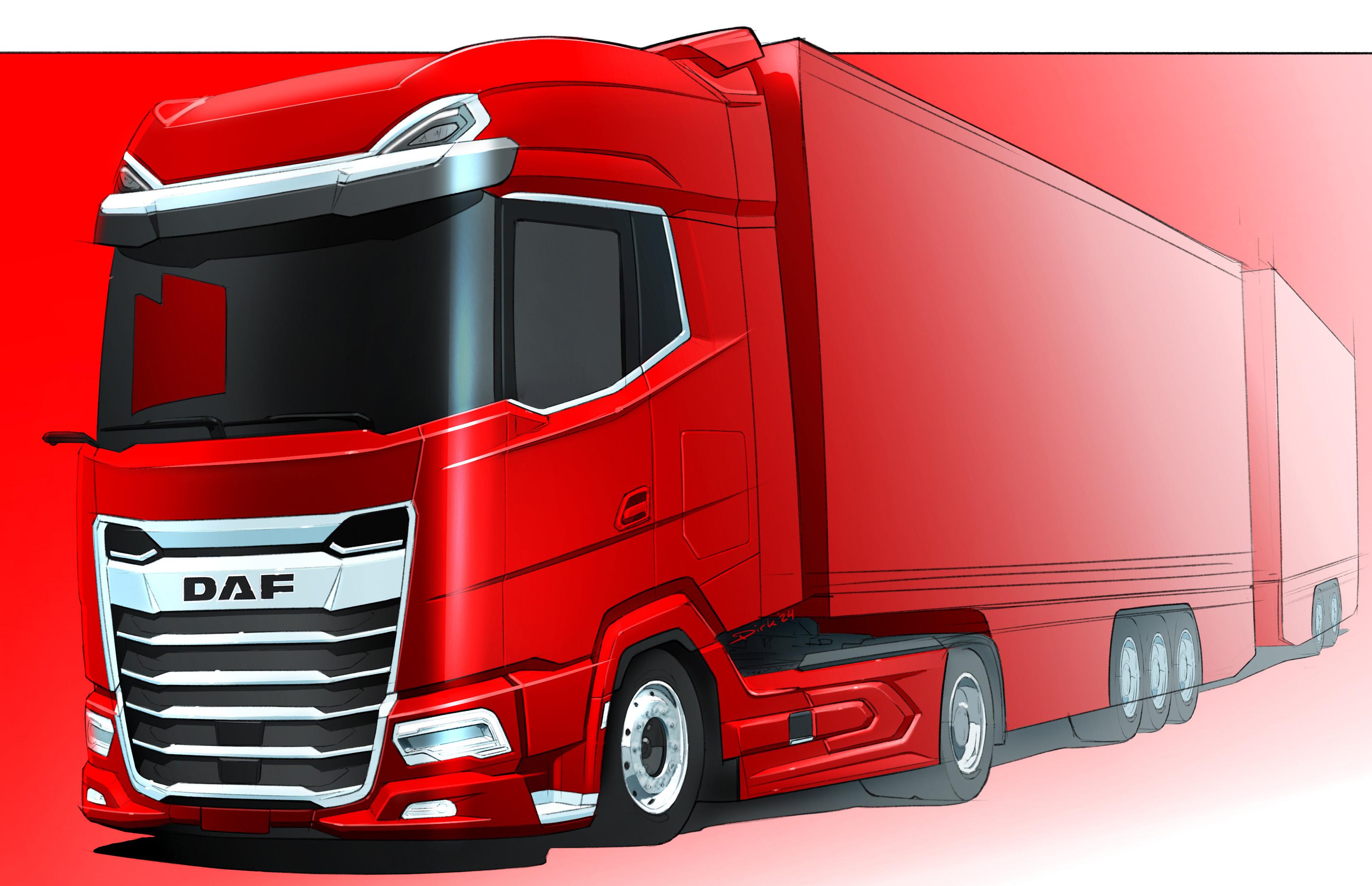
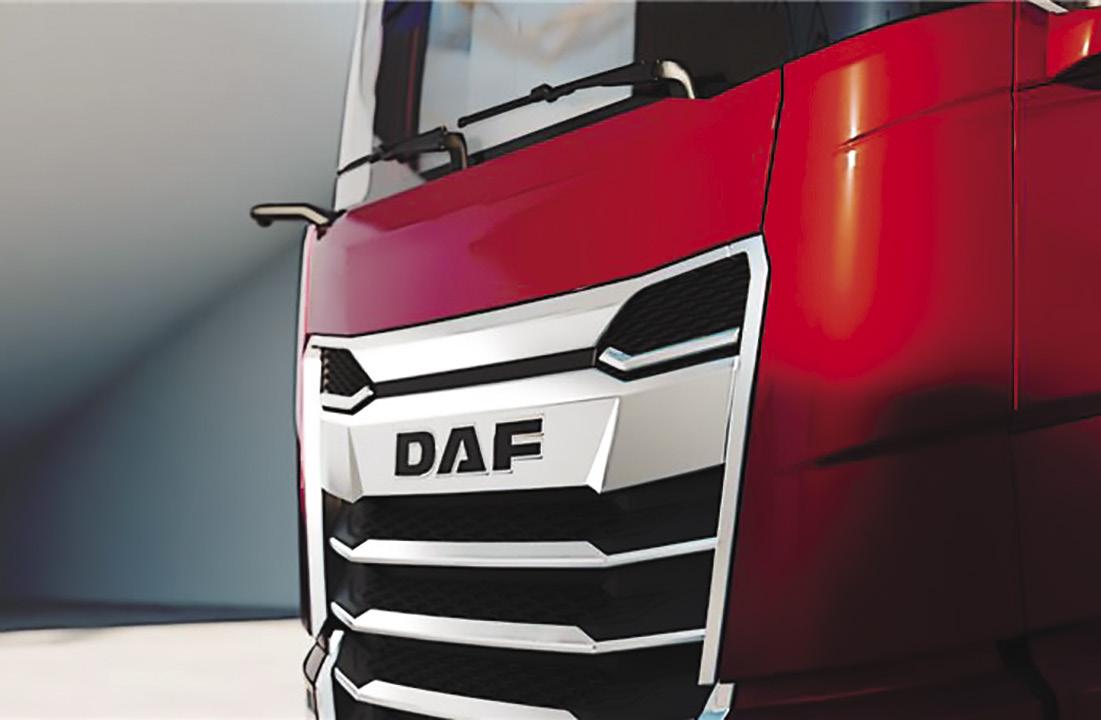
on DAF’s new range are critical to improved economy and it’s why van Lotringen says: “There’s nothing to be gained by going ‘longer’ at the front when this is where the highest velocity is… and that’s why it’s the heavily radiused shape it is.”
By ensuring the combined airflow over the front grille, bumper, lower valance and cab corners passes smoothly onto the tapered body sides of the cab DAF has delivered an average fuel efficiency gain of 6.5% on the New Generation.
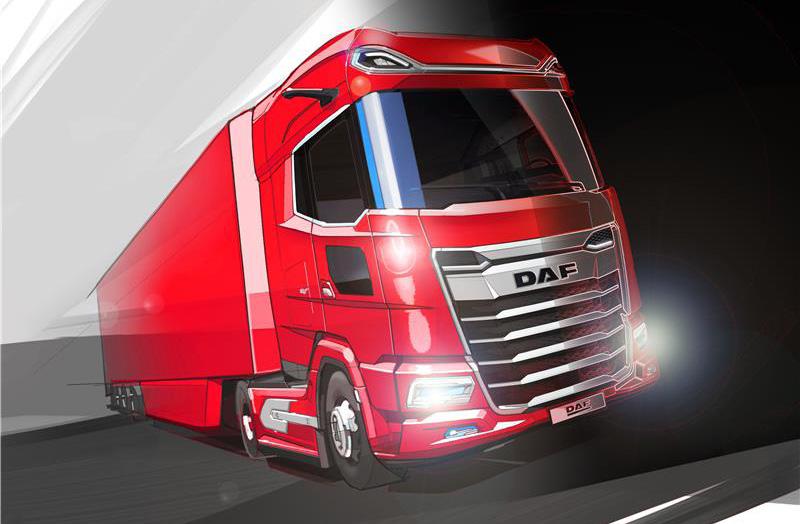
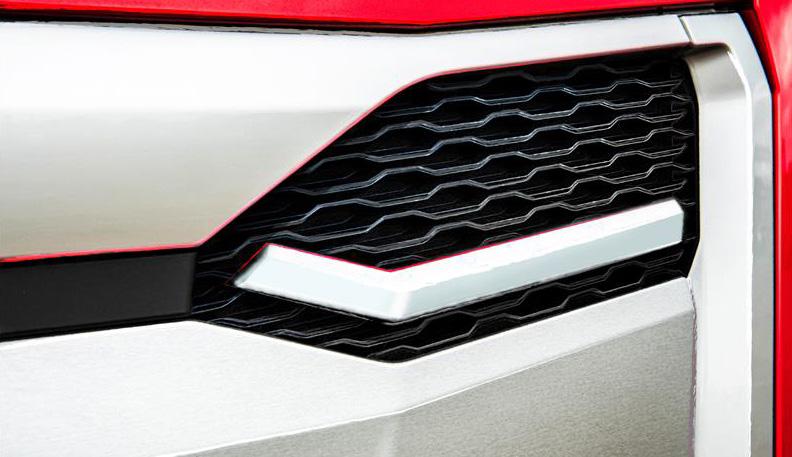
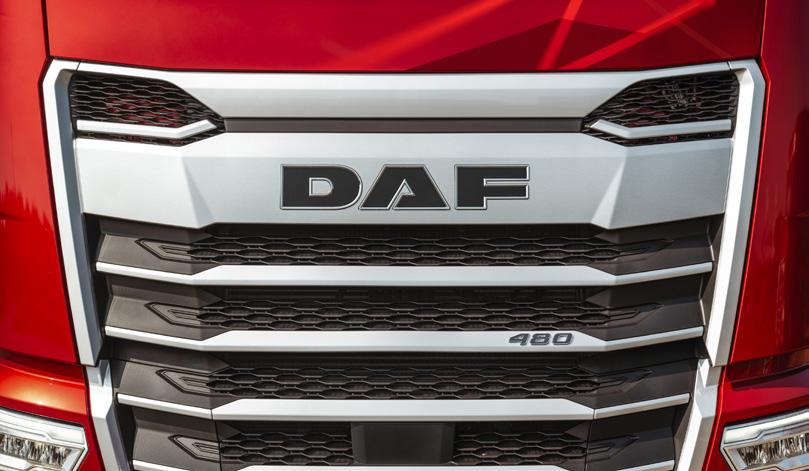
Handling the air that directly hits the front of the truck generates its own problems too as Van Lotringen says. “Here in the middle is what we call an area of stagnation, which is also where you need the cooling for the engine. So, it’s one thing leading the air around it [the front of the cab] but you also have-to direct it through the engine compartment.”
Once it’s inside the engine compartment the air has to pass smoothly through without spilling out,
causing more turbulence and drag. To stop the air escaping haphazardly, whilst avoiding it recirculating inside the compartment, DAF’s engineers developed special vanes fixed directly to the cooling pack that now channel the air through the engine tunnel and out over the top of the chassis.
Van Lotringen next gives us another example of attention to detail by pointing to the noticeably curved antispray system within the XG+’s steer axle wheel-well that aerodynamically
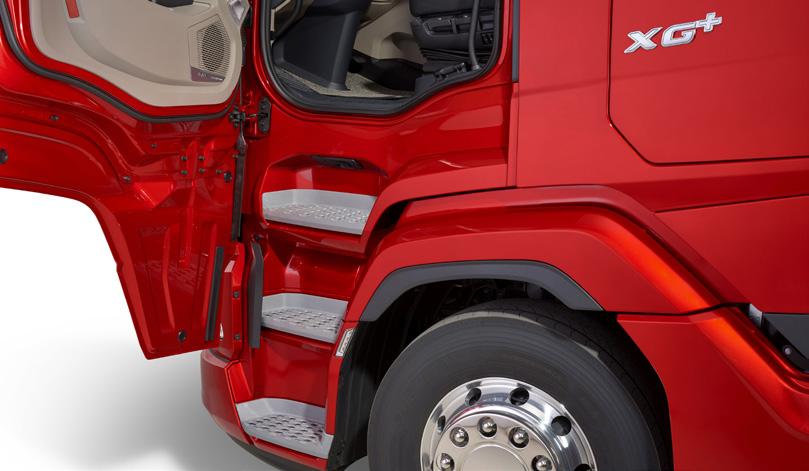
manages the exiting air. “There’s a lot of turbulence in the wheel-well that’s always trying to escape. Under the regulations any water coming in can’t simply fly out. So, there’s a double layer here where the water is first trapped [by horizontal corrugations] then flows down an inner panel and onto the road with minimum airborne spray. It’s a really clever design.”
Attaching the front wheel arch to the chassis frame, rather than the underneath of the cab as with the previous XF, has also reduced the gap between the top of the tyre and the wheel arch. “That means you can come closer to the wheel [thereby closing the airgap and reducing those vortices even further] and it remains more constant.”
By not going extra-long on the front of its big cabs, there’s been more room inside for the driver too, as van Lotringen confirms: “As we didn’t need so much length for the aerodynamics for the front, we could elongate the back of the cab and give the driver extra space.”
This increased driver space was one of the three gains the Commission wanted to achieve with its original length proposals: the others being improved aerodynamics and increased impact protection.
Getting customers on-board with any new truck design is never easy. To ensure they made the journey together with the New Generation, DAF held
several user clinics throughout the build-up to the launch. “We had a group of 20-30 drivers and, later, operators who worked alongside us for maybe 2½ years where they provided feedback on the designs.”
Following the industrialising of the new design both groups were invited back for their comments a week before the actual launch. That sounds to us like another gamble…what if they’d said: ‘We don’t like it!’ Happily, they did like it!
“They were just as excited as we were,” states van Lotringen, “because they felt ownership of the design and that we’d listened to them. For me that’s the most rewarding.”
Emphasis on interior space...
... and exterior visibilty



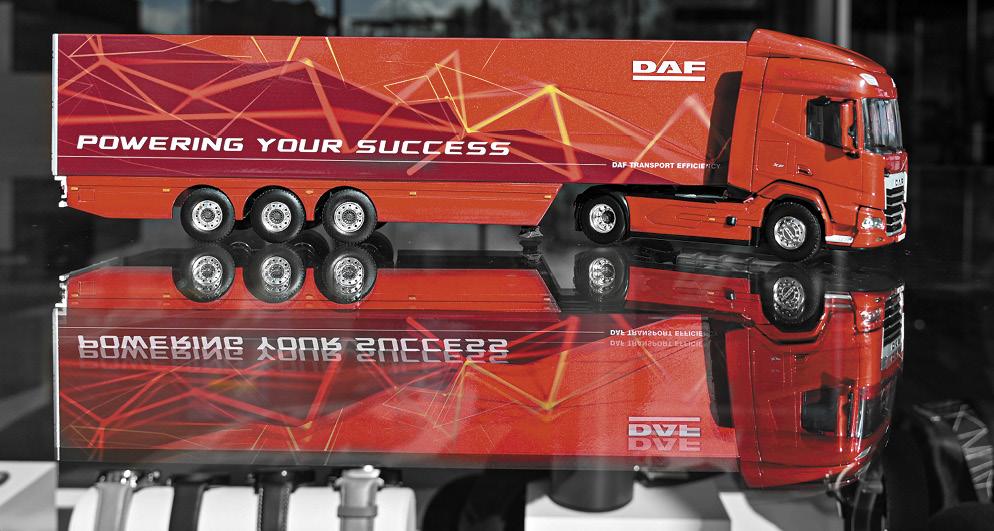
The prize in this edition is a DAF XG+ 4x2 tractor and tri-axle trailer miniature in 1:50 scale, for one lucky winner. Simply spot and mark the four differences on the images above. Once completed, either cut out or photocopy and post to DAF Driver magazine, 4th Floor, 19 Capesthorne Drive, Eaves Green, Chorley, Lancashire, PR7 3QQ
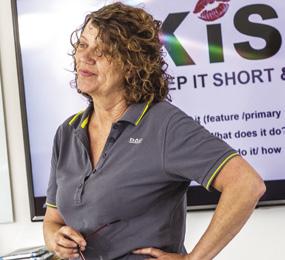
Mandy Wannerton is the DAF Press & Demonstration Driver
SEEING IS BELIEVING MEET MANDY
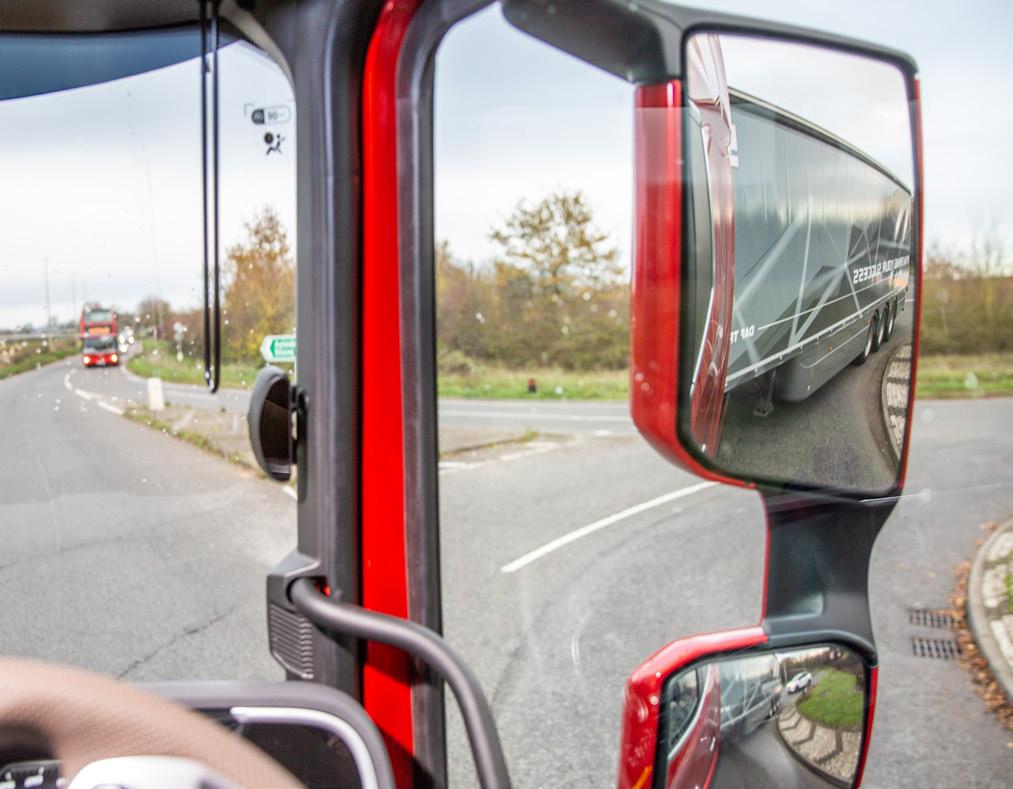
There is plenty of chatter, especially on social media, about the growing use of rear-view vision cameras to replace mirrors on heavy trucks. There are comments for and against cameras and, whilst many are valid, we still hear plenty of comments that are ill informed or are based on experience with earlier technology.
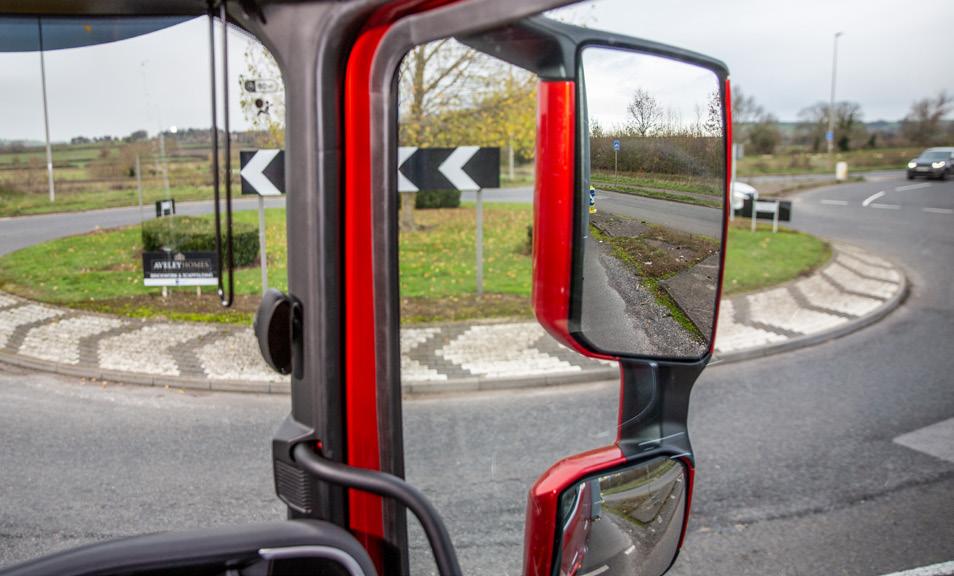
Alongside the DAF Digital Vision System, DAF also offers conventional mirrors and so, by running the same tests in the same weather and light conditions, we were able evaluate both
systems to show how they compare in a range of situations. There are still a lot of questions and comments surrounding cameras. It’s true it can take a little while to adjust when going from mirrors to monitors, but the thing to remember though is, it’s only how we view things that has changed and not our judgement - that old saying “ if in doubt don’t pull out“ is as true for cameras as it is for mirrors.
Stay safe, till next time Mandy.
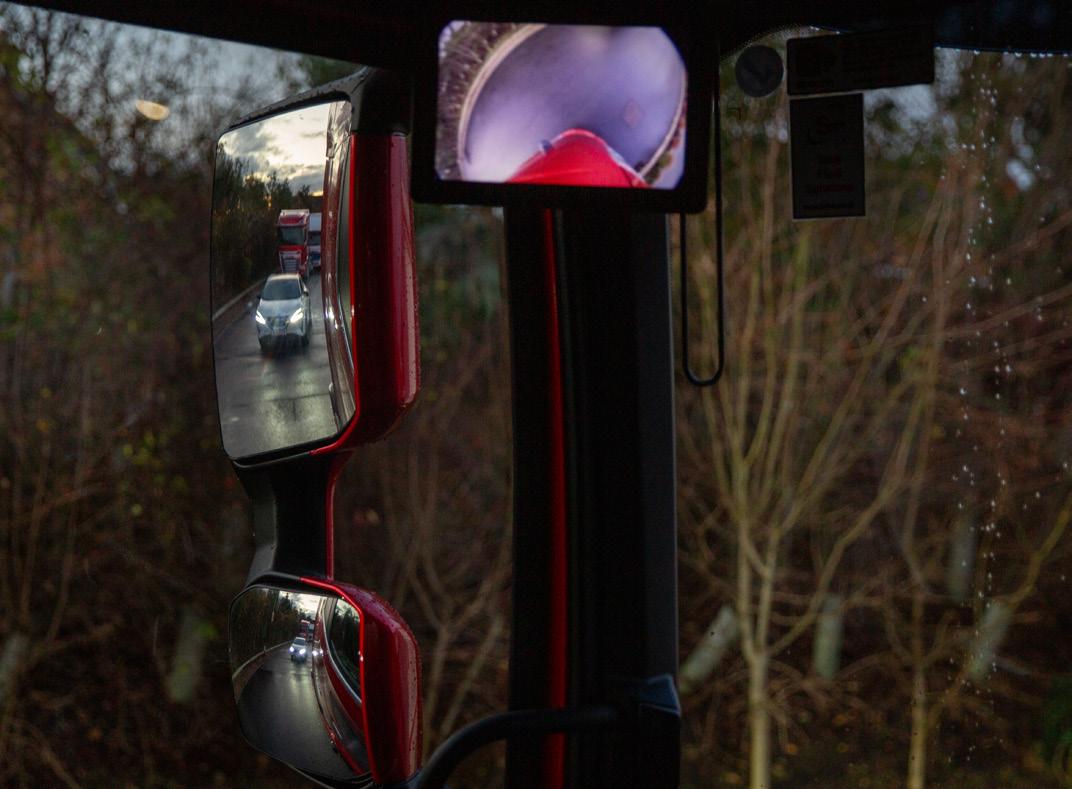
OVERTAKING LOW LIGHT
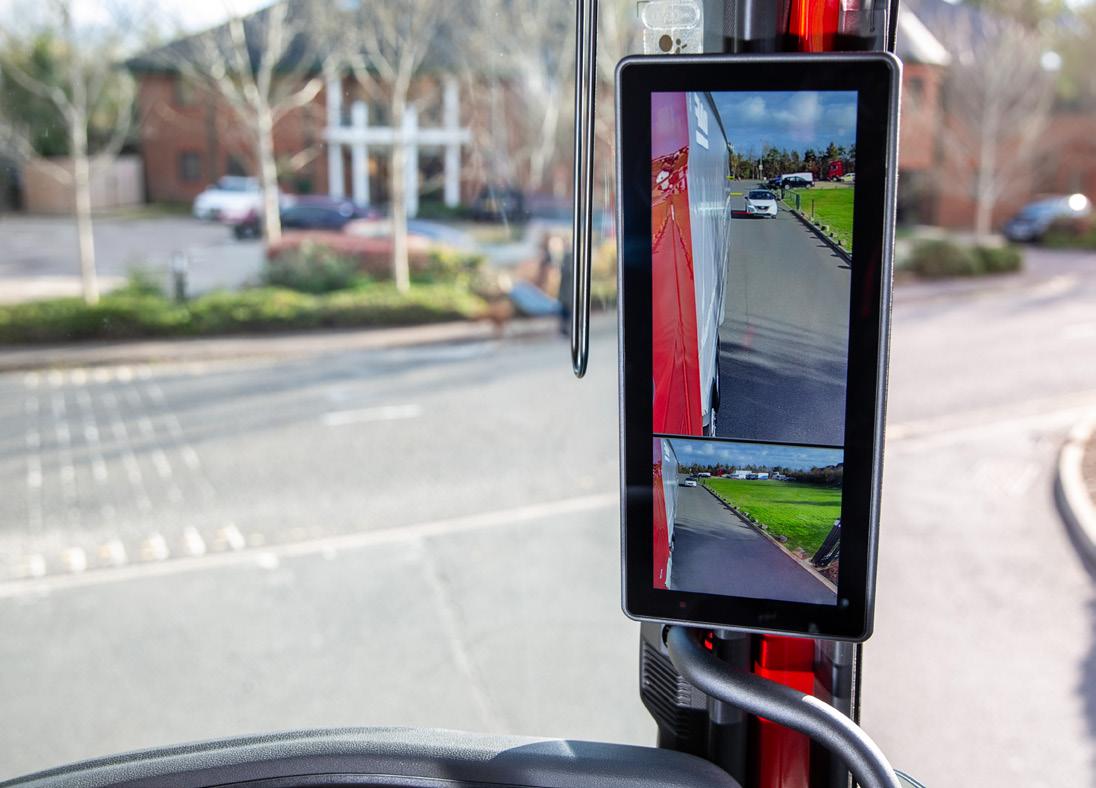
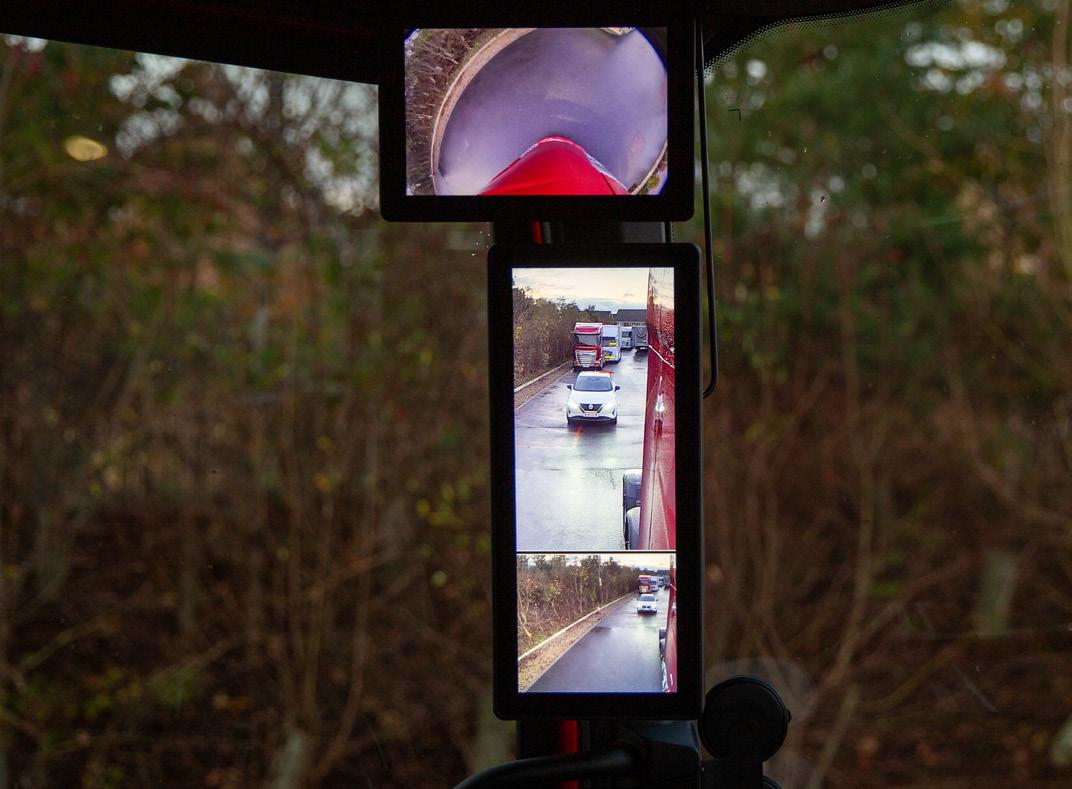
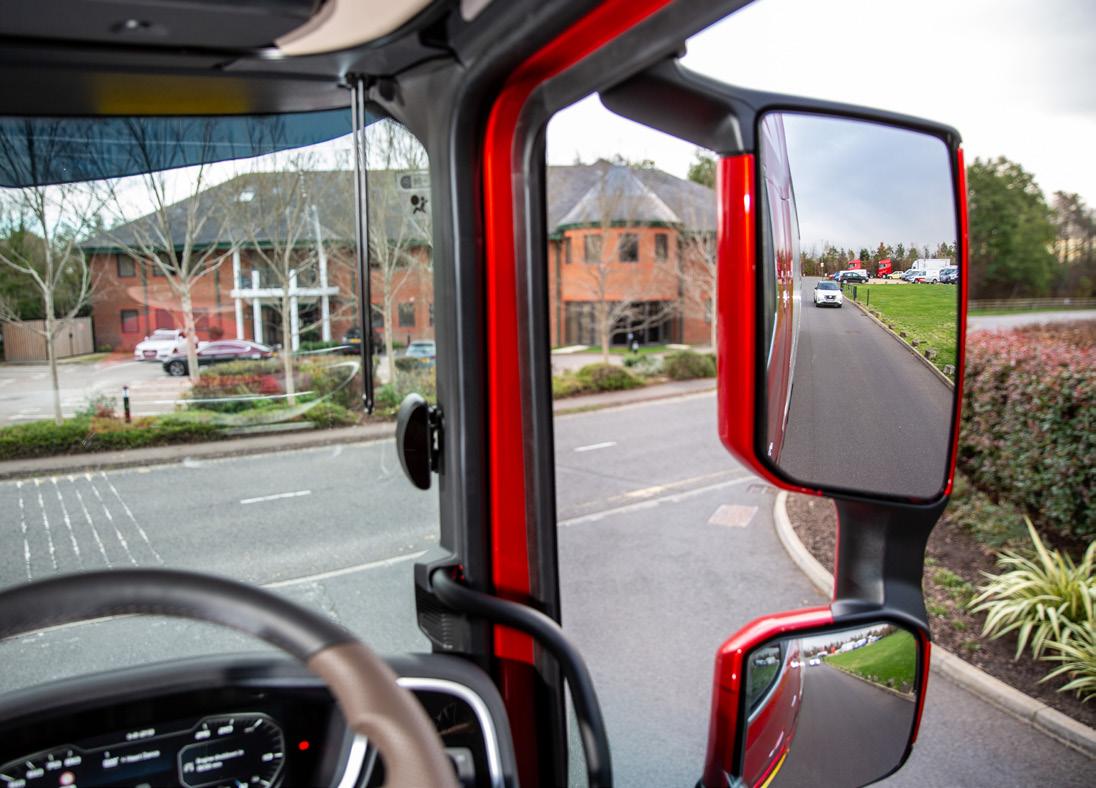
Coloured graduation marks on the screen (top) help the driver to judge the position of the rear of the trailer, and the distance to vehicles in the adjacent lane.
The camera monitors contain an inbuilt light sensor (top) helps maintain image brightness even in low light conditions.
ROUND THE BEND
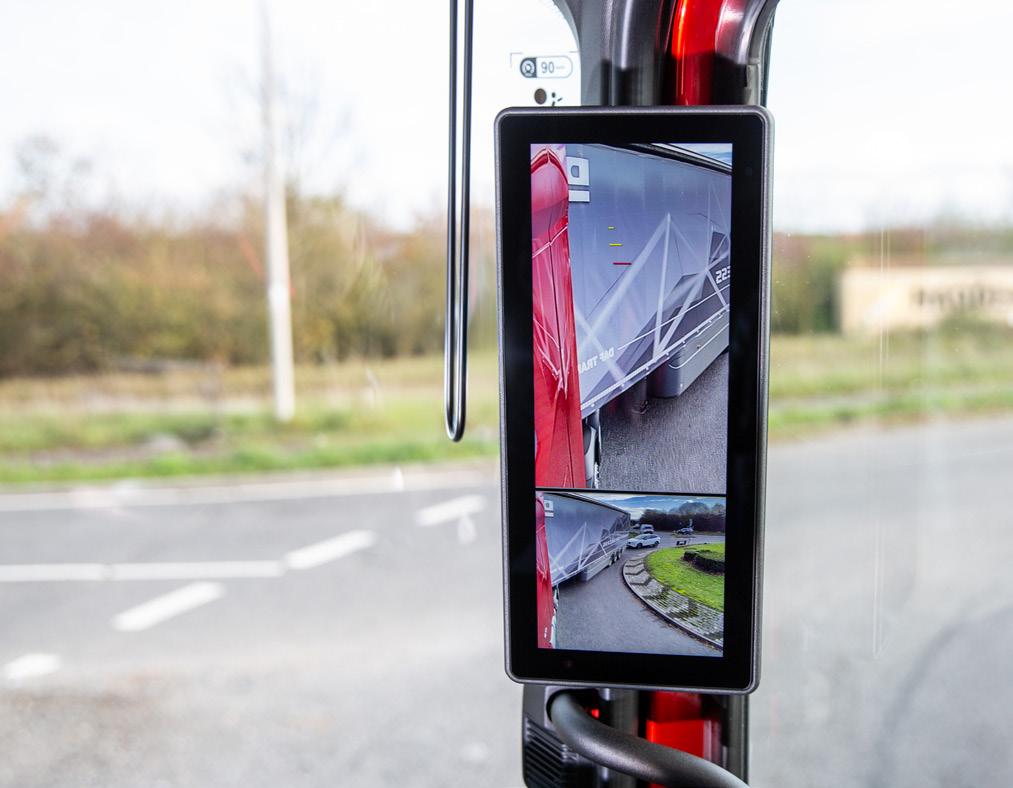
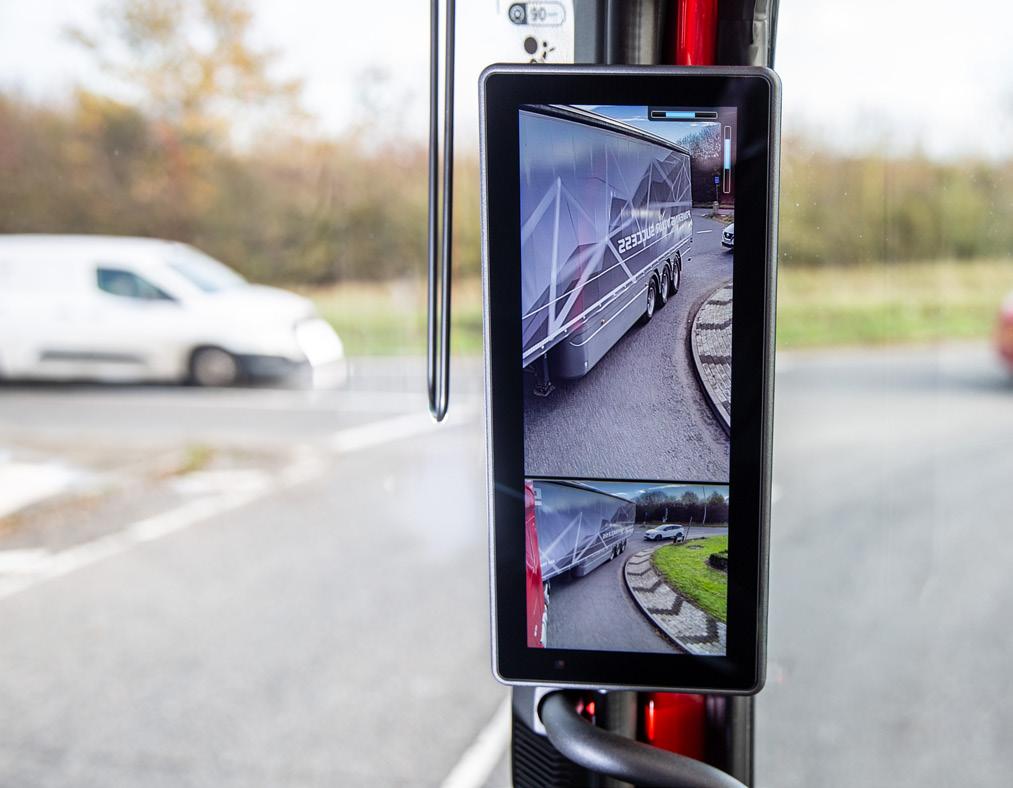
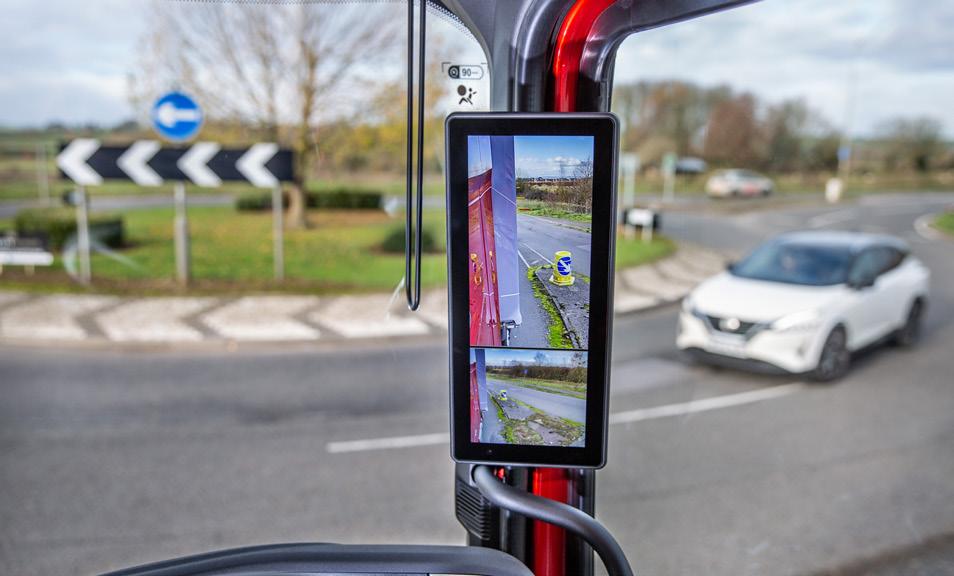
The camera can ‘autopan’ to follow the rear of the trailer whilst turning (middle). The top image shows the view when ‘autopan is switched off.
LIFE THROUGH THE
LENS
Rear-vision cameras have become more common over recent years, with most of the leading manufacturers now offering them as an alternative to the main and wide-angle rear-view mirrors on tractor units. There are several reasons for this trend.
SAFETY - IMPROVED DIRECT VISION
Conventional mirrors can block the driver’s view of other road users through the side window. Camera monitors are smaller and mounted less obtrusively on the A-pillar.
EFFICIENCY
The DAF Digital Vision system can reduce fuel consumption by more than 1% when operating on highway, saving hundreds of pounds per year.
IMPROVED VISIBILITY RAIN OR SHINE
The camera lens has a hydrophobic coating and the unit is heated to help dispel water and maintain a clear view in all weathers. (Over time the coating of the lens can become degraded or scratched allowing water droplets to remain. In which case the hydrophobic performance can be restored by application of PoorBoys World’s SuperHydrophobic Ceramic Coating).
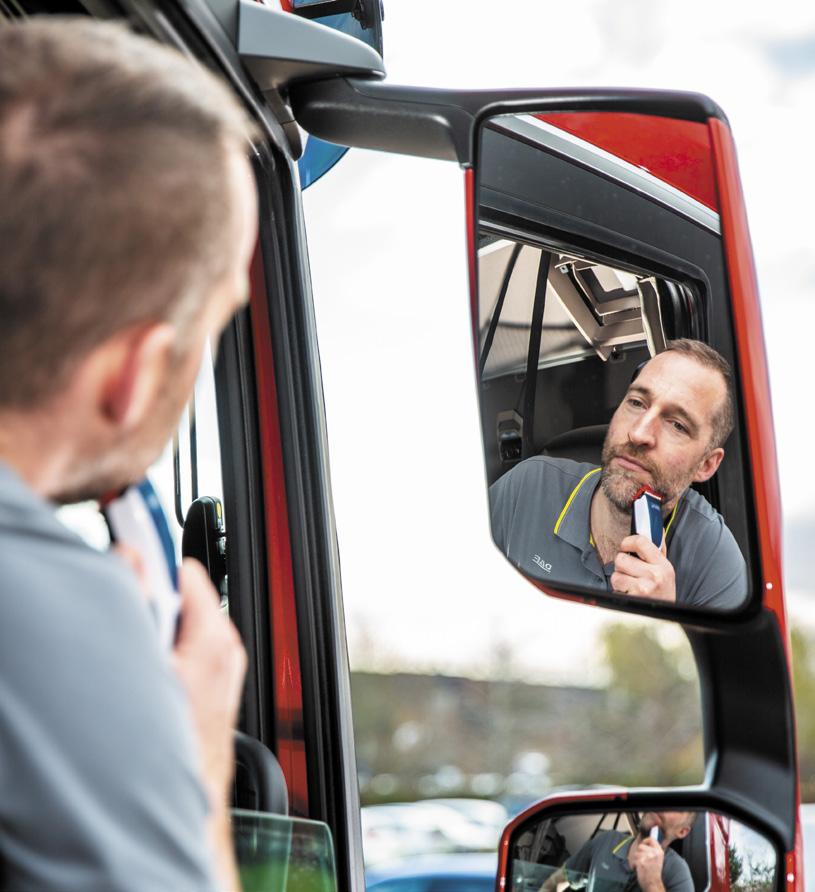
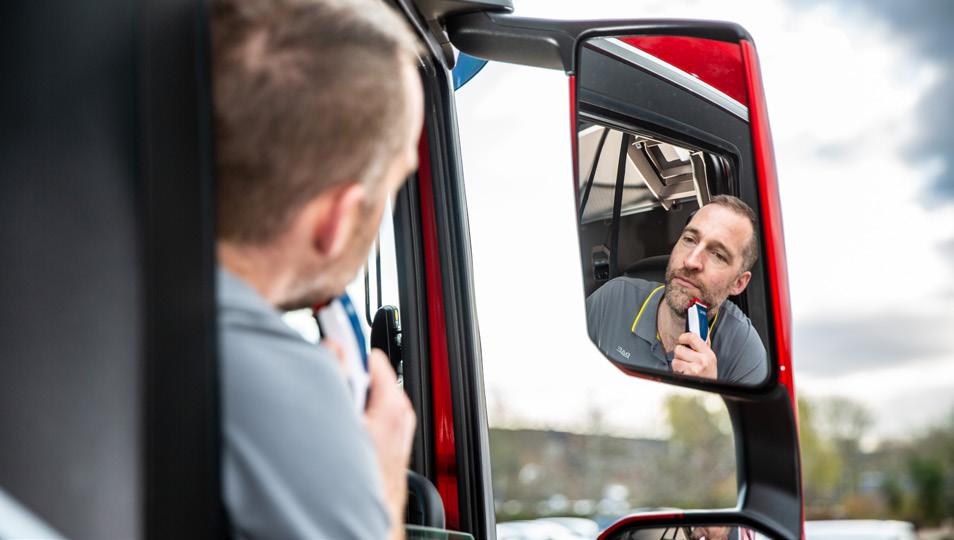
On the negative side, cameras make it more difficult to shave or, in my case, apply a bit of lippy!
MEET ALISTAIR MOFFATT
DAF now has Dealer Driver Trainers based across the country to help hand over new and used vehicles and we thought it would be good to get to know some of them a little bit better! In this edition we talk to Alistair Moffatt the DAF Dealer Driver Trainer at Motus in Carlisle, formerly Solway DAF.
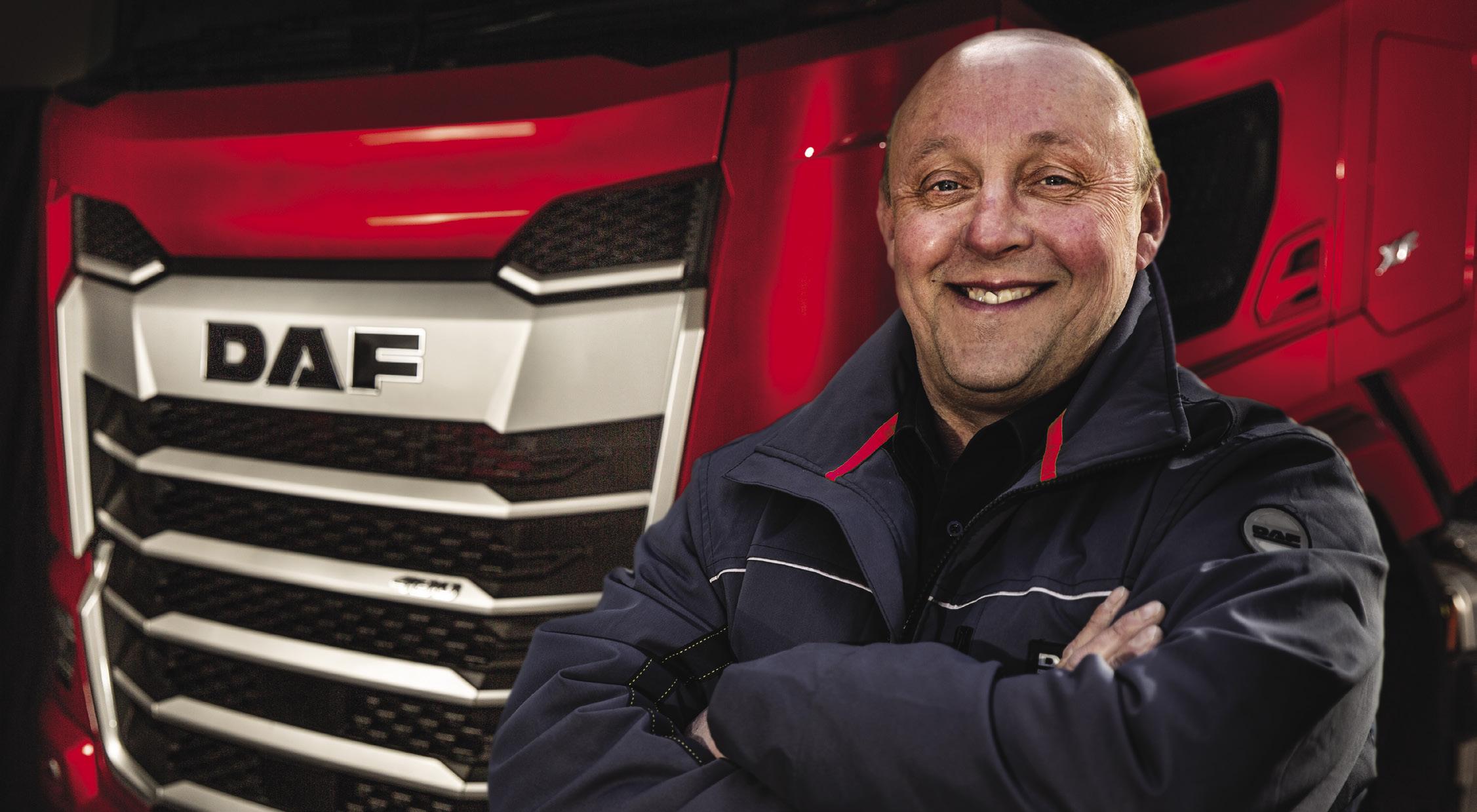
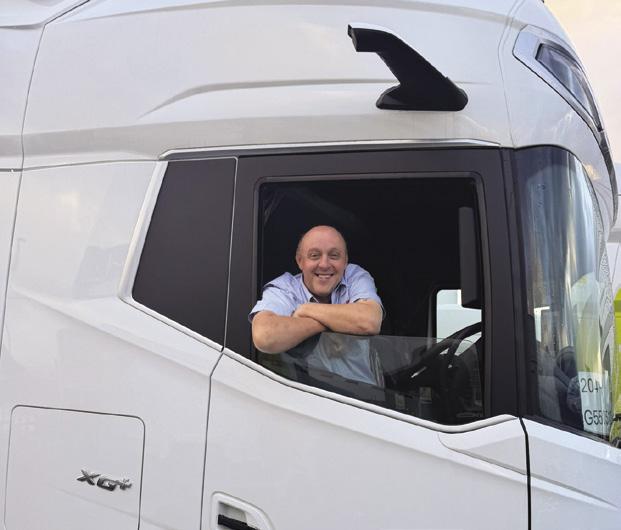
Alistair is married with three children and three grandchildren. He enjoys playing golf and likes to get over to Benidorm three to four times a year. If he had more time, he would love to get flying again. In the past he has been the Vice-Chair of school governors and coached and run youth football for age groups from fiveyear-olds to adult. He found providing opportunities for everyone, regardless of ability, to be very rewarding and he enjoyed working with a great bunch of kids, coaches and supportive parents.
Q: When did you first join the dealership and what was your first job there?
A: I joined Solway DAF on 1st October 2021 as a DAF Dealer Driver Trainer.
Q: What did you want to be when you were at school?
A: When I left school, I wanted to join the RAF, which I did as an Aircraft Electrician based at RAF Lossiemouth working on Buccaneer and Jaguar aircraft.
Q: When did you take your HGV test?
A: I passed my HGV in October 1990 and started with Robertsons in 1992. Over the years I have driven for several companies including the NAAFI. Before taking up my current role I was driving for Samworth Brothers.
Q: What do enjoy most about your role?
A: What I like most about the job is the Driver Training. Getting out with the drivers and showing a different way to drive the DAF, and what the truck can do. And the positive response I get makes it all worthwhile.
Q: Do you have a top tip for a driver getting his or her new DAF?
A: Take advantage of the Driver Training Voucher that comes with every new DAF. Trucks and truck systems have changed and are continuing to change so much.
Q: What car do you currently drive and if money was no object what would you have?
A: I currently have a KIA Niro, but if money were no object...probably a classic Mustang from the ‘60s.
Q: What other responsibilities do you have within your role at Motus Carlisle?
A: I am also the Transport Manager for the Solway region of Motus, including the depots in Carlisle, Dumfries, Penrith and Workington.
Q: If you weren’t doing this, what would your ideal job be?
A: I have been around trucks and logistics for so long, but my ideal job would be in aviation.

BORDERING ON INSANITY
By Richard Simpson, industry pundit
Only a tiny minority of British truck operators actually engage in regular international haulage. Years of what can seemingly only be explained as Government sabotage have seen to that.
Going right back to the 1990s, British hauliers have been faced with a succession of obstacles placed in their way by both Labour and Conservative Governments.
This sabotage began with excessive VED rates and the infamous Fuel Duty Escalator in the 1990s, which effectively penalised British operators while giving free-reign to foreign-registered trucks on UK roads. The damage was increased by a scheme which effectively fined truck operators for being the victims of crime: if stowaways were found in trucks, then the driver and operator each had to pay a ‘penalty’ of £2000 per stowaway.
If these punishments had been described honestly as what they were: fines; then they would have been illegal, but the Government dubbed them Fixed Penalties and applied them under civil rather than criminal law. This shifted the ‘burden of proof’ from prosecution to defence, and operators and drivers were required to prove they had done all they could to protect Britain’s borders including following a fairly useless ‘code of practice’ to obtain a discount on the penalties.
Meanwhile, rather than doing all it can to prevent illegal immigrants from entering the country as per its statutory duty, the Government’s own Border Force agency is regularly setting sail to gather illegal immigrants from the waters of the Channel and bring them to English shores. It is an absurd situation, but one which continues to this day.
Some hoped, perhaps naively, that Brexit might put a stop to all this nonsense, as it was all about ‘taking back control’ of ‘our borders’. In fact, all Brexit did on this front was to end the obligation which EU members had to take back asylumseekers who had already registered in their nations under the Dublin Agreement. In effect, we were stuck with them once their
feet touched British soil even if they had sought asylum elsewhere.
There was a considerable bonus from Brexit for some British international hauliers though. The increased paperwork generated by the return of border formalities served to scare some of the low-cost European hauliers who had undercut UK operators off the job. British operators took advantage of the Covid-induced temporary decline in intercontinental transport to recruit professionals skilled in the necessary paperwork to handle external EU border formalities, and for a brief few years the UK’s hauliers were able to regain share of the international market.
The benefits to the UK were considerable. British operators were buying trucks from British dealers, paying British road tax, and employing British drivers paying British income tax and National Insurance to handle international work.
Beyond that, it could be argued that there were benefits to road safety and the environment as the UK’s standards for maintaining and inspecting heavy goods vehicles are possibly the most rigorous in the whole world. For example: a British semi-trailer will probably undergo a workshop roadworthiness inspection every six weeks, have its brakes tested four times a year and be subject to a Government roadworthiness test every year. In contrast, European trailers tend to get a fairly cursory safety inspection once every two years.
But this happy situation could not last. Boris Johnson’s notorious ‘oven-ready’ Brexit deal ensured that the British international haulage sector would be well and truly stuffed. Contained within it, at the insistence of British negotiators desperate to show they had ‘taken back control of our borders’ was the now infamous 90/180 clause. This in effect prohibits most UK citizens from spending more than 90 out of any 180 consecutive days in the EU, and vice versa.
There are certain exemptions. These include train and airline crews, but
specifically not truck or coach drivers. At first, no one cared. No border official was going to waste time thumbing through drivers’ passports, trying to decipher entry and exit stamps, and then counting the number of days spent in the EU in the last 180 days.
But all that is changing now. The EU has introduced a new automated border Entry and Exit System (EES). This has in effect created a ‘paperless passport’ which uses biometric data to identify individuals rather than relying on those passport photos which make everyone look like a pantomime villain. Nothing wrong with that, except that it will automatically tally the number of days spent in the EU, and prohibit entry to those who have already clocked 90 days in the last 180. It’s also understood that it will work on exit, and highlight those who have over-stayed, although what penalty will be applied to them is not clear.
The threat to British operators and drivers is clear. Most days of the majority of export/import runs between the UK and the EU are spent on the continent, so the British are more disadvantaged than the Europeans. If is also unclear whether the British authorities will ever enforce the 90/180 rule against EU citizens. It seems they currently have no power or mechanism for doing this, and none is planned.
British hauliers have been lobbying Government MPs and Ministers in the hope of getting some kind of change to include truck and coach drivers in the list of exempted professions. Those who have bothered to reply have airily said that any reform would be in the hands of the EU (which is true), and that they are not minded to ask for it (which is shocking). The only consolation is that, at the time of writing, it appears that the EES technology doesn’t actually work! We can only hope that the situation continues until the penny finally drops for our crisis-riven Government. Meanwhile, let’s raise a festive glass to European IT failures!

DAF Dealer Network
UK & Ireland
The quality of a truck depends on the quality of the organisation behind it, which is why the DAF dealer network offers a unique advantage with the best geographical coverage of the UK, the most heavy truck experience and the longest opening hours of any truck franchise.
● Truck Sales, Parts and Service Dealers
Area Dealer name Postcode Telephone
ABERDEEN Norscot Truck & Van Ltd ★▲ EV AB23 8JZ 01224 824444
ASHFORD Channel Commercials PLC ★▲ EV TN23 1EH 01233 629272
AVONMOUTH MOTUS Commercials ▲◆ EV BS11 0YL 01173 042800
CARDIFF Watts Truck & Van Cardiff ★ EV CF11 8AT 02920 308595 CARLISLE MOTUS Commercials ★ EV CA3 0HD 01228 539394
CROYDON HTC Croydon ★ CR0 4TD 0208 683 6200 DERBY MOTUS Commercials ▲ EV DE22 4NB 01332 824371 EDINBURGH Lothian DAF ★▲ EV EH20 9QH 0131 440 4100 GLASGOW MOTUS Commercials EV G51 4TH 0141 425 1530
GRAYS Harris DAF ★▲◆
RM20 4AU 01708 864426 GUILDFORD HTC Guildford EV GU1 1RR 01483 594900
MOTUS Commercials ★▲ EV B63 2RL 01384 424500 HEATHROW HTC Heathrow ▲ EV SL3 0ED 01753 681818
HUDDERSFIELD MOTUS Commercials ▲ HD2 1UR 01484 300500
HULL MOTUS Commercials ▲ EV HU9 5PJ 01482 795111
IPSWICH Chassis-Cab Ltd ★ EV IP6 0RL 01473 833003
LEEDS Ford & Slater DAF ▲◆ EV LS28 6SD 01132 571701 LEICESTER Ford & Slater DAF ★ EV LE3 2JG 01162 632900 LIVERPOOL North West Trucks ▲ EV L36 6AJ 0151 480 0098
BT36 4PT 02890 342001
Lancashire DAF ★▲ EV PR5 8BW 01772 338111 READING HTC Reading ★ EV RG7 4AG 01189 300900 SHEFFIELD Ford & Slater DAF ▲ EV S13 9NR 0114 293 9200 SHREWSBURY Greenhous DAF ▲
ST6 2DE 01782 276600
WV13 3SF 01902 305090

9TG 01234 211241
MOTUS Commercials B33 0SL 0121 784 4023
BIRTLEY Ford & Slater DAF DH3 2SP 0191 406 8888
BLACKWELL H.W. Martin Fleet Maintenance Ltd DE55 5JY 01773 813313
BOURNEMOUTH Adams Morey Ltd ★ BH8 0BL 01202 524422
BRIDGWATER Adams Morey Ltd TA6 5LB 01278 550 970
BURTON ON TRENT MOTUS Commercials ◗ DE13 7AB 01283 248899
BURY ST EDMUNDS Chassis-Cab Ltd EV IP32 6NL 01284 768570
CAMBRIDGE Chassis-Cab Ltd ▲ PE28 9QR 0333 323 4040
CANTERBURY Channel Commercials PLC CT3 3DW 01304 841111
CARNFORTH Lakeland Trucks Ltd LA5 9DW 01524 734544
CASTLEFORD Pelican DAF ▲◆ WF10 5UB 01924 227722
CHESTERFIELD Ford & Slater DAF ▲ S40 2RG 01246 234213
CONWY Parrys Commercials Ltd LL28 5RA 01492 580303
CORBY Ford & Slater DAF ▲ NN17 4BA 01536 207980
COVENTRY Ford & Slater DAF ▲ CV3 4FL 02476 302856
CRAWLEY GB DAF Gatwick RH10 9NS 01293 537520
CRICK GB DAF DIRFT NN6 7BZ 01788 711699
CUMBERNAULD MOTUS Commercials ★ G67 3EH 0123 672 7771
DAVENTRY Brian Currie (Milton Keynes) Ltd ◗ NN11 8RF 01327 871770
DEESIDE MOTUS Commercials ◆ CH5 2QJ 01244 520853
DONCASTER MOTUS Commercials ▲ DN6 7BA 01302 727040
DONCASTER Fishlake Commercials Ltd ▲◆ DN8 4JD 01405 740086
DUMFRIES MOTUS Commercials DG2 0JE 01387 720820
DUNDEE Norscot Truck & Van Ltd ▲ DD2 4UH 01382 611166
DUNS J E Douglas and Sons ▲ TD11 3HS 01361 883411
DUNSTABLE HTC Dunstable LU5 4TP 01582 505464
EASTBOURNE Brewers DAF BN23 6PW 01323 745700
ELGIN Sheriffmill Motor Co Ltd IV30 6UH 01343 547121
FROME MOTUS Commercials ▲ BA11 2FD 01373 468520
GARVAGH TBF Thompson BT51 5JZ 02829 558353
HTC Greenford UB6 0FD 0208 9615863
MOTUS Commercials ◆ DN31 2TG 01472 362929 HEMEL
The extensive DAF national network delivers the best Back-Up in the business. Our flexible range of MultiSupport servicing, repair and maintenance options will help you control costs, minimise downtime and maximise vehicle availability. Out on the road, our legendary DAFaid roadside assistance service provides the leading average roadside assistance time in the industry.




GET YOUR TRUCK ALL READY FOR




































LIGHTING • ELECTRICAL • AIR & TYRE COMPONENTS
WORKSHOP • CONSUMABLES • VEHICLE CAR E
























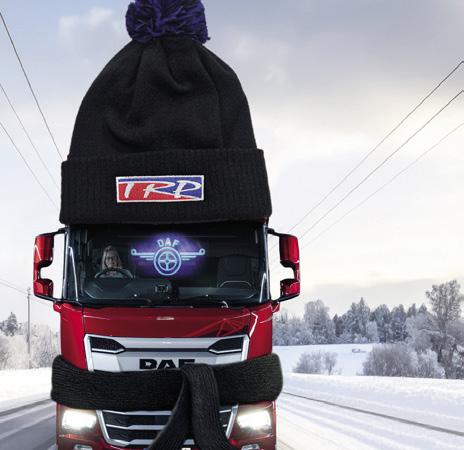
WE’VE GOT YOU COVERED THIS WINTER

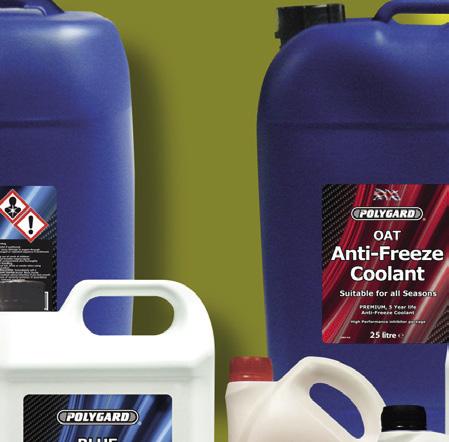
Ensure you have winter-grade anti-freeze and screenwash fluid





WE’VE GOT YOU COVERED THIS WINTER








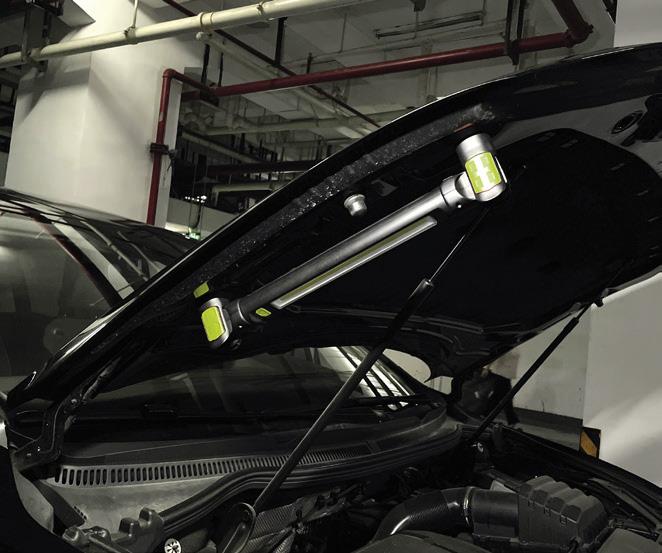
Don’t be left in the dark with our range of lamps & torches from Vision Lighting
















































THE NO.1 SUPPLIER OF ALL MAKES TRUCK, TRAILER & LCV PARTS









































































































































NEW TRP Wall Planner for 2026






Ask your DAF dealer or TRP store for a FREE TRP A1 Wall Planner
Perfect for planning servicing, ATF bookings, sta holidays and other important events throughout 2026.































































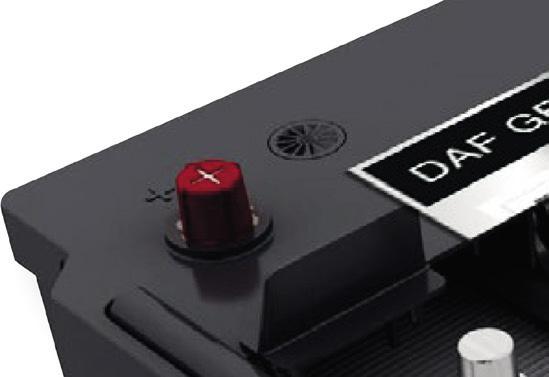
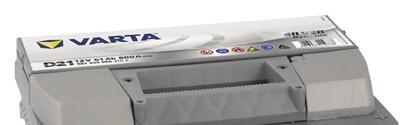
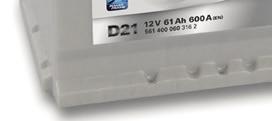
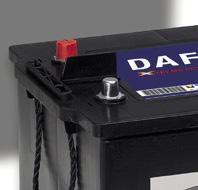
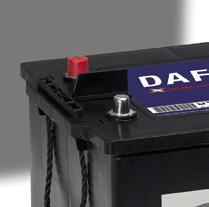
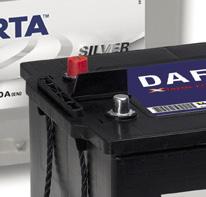
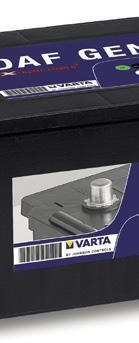
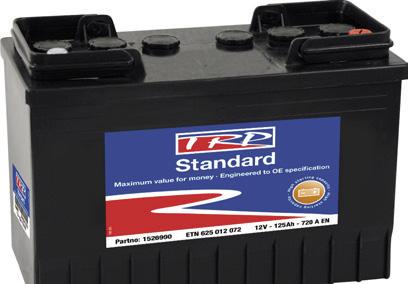
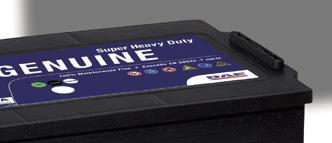
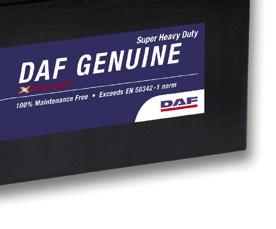
DAF Dealers carry a full range of batteries for all truck and LCV applications, including DAF Genuine, Varta and TRP batteries including Promotive, Endurance and Heavy Duty choices. Call your dealer for competitive prices.









As winter approaches, check your vehicle batteries are in good condition and ready for cold starts!


















































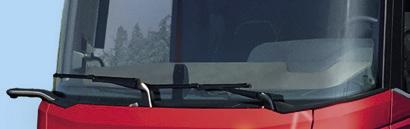










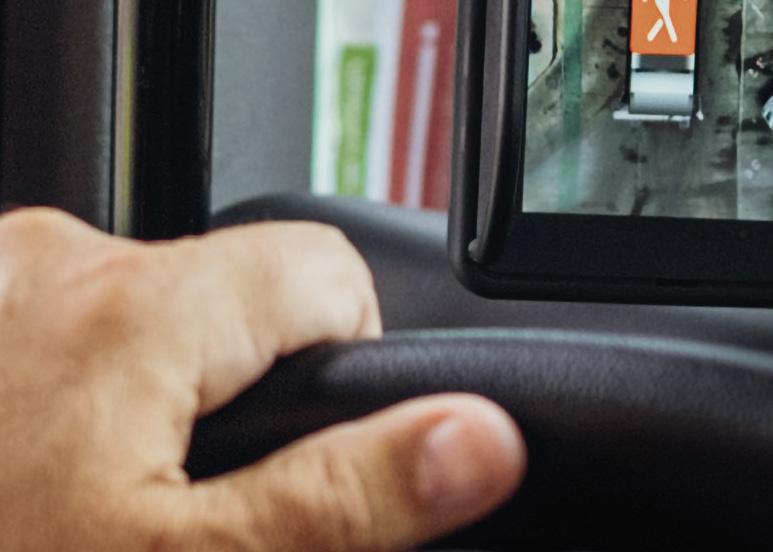





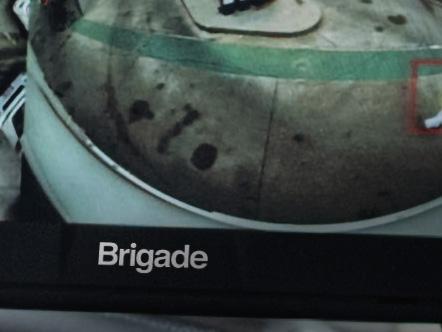


• Backeye®360 AI Intelligent detection is a 360-degree high-definition four-camera system enhanced by state of the art AI technology.
• Comprehensive view of surrounding area in a single image
• Audible and visual alerts when a pedestrian or cyclist is detected using AI
• Automatic calibration saves time on set-up and installation
• High resolution delivers a clear and sharp image displayed on the monitor


Backeye ® 360 AI Camera