KEEPING A WATCH ON STREAMING
Shofha CEO Medhat Karam on staying out of the big league of streamers and finding the right niche

ISSUE 150 | MARCH 2023 Licensed by Dubai Development Authority

Shofha CEO Medhat Karam on staying out of the big league of streamers and finding the right niche
Expand media production with a cloud-based solution that can be deployed and scaled on demand. Avid® | Edit On Demand provides a fully configured and secure virtual post-production environment in the cloud—complete with cloud-optimized Media Composer® software and Avid NEXIS® storage—making it easy to ramp up projects quickly. With simple weekly or monthly subscriptions, you can have teams collaborating from anywhere, whether editors are remote or on-premises.

Discover Avid | Edit On Demand avid.com/edit-on-demand
Leading Provider of All Avid’s Products in Qatar
GROUP Managing Director Raz Islam raz.islam@cpitrademedia.com
+971 (0) 4 375 5471
Managing Partner
Vijaya Cherian vijaya.cherian@cpitrademedia.com
+971 (0) 4 375 5472
Director of Finance & Business Operations
Shiyas Kareem shiyas.kareem@cpitrademedia.com
+971 (0) 4 375 5474
EDITORIAL Editor Vijaya Cherian vijaya.cherian@cpitrademedia.com
+971 (0) 55 105 3787
Sub Editor Aelred Doyle
ADVERTISING
Group Sales Director Sandip Virk sandip.virk@cpitrademedia.com
+971 (0) 50 929 1845
+44 (0) 7516 993 862
DESIGN

Art Director Simon Cobon Designer Percival Manalaysay
MARKETING & EVENTS
Events Executive Minara Salakhi minara.s@cpitrademedia.com +971 (0) 4 433 2856

Social Media Executive Dara Rashwan dara.rashwan@cpitrademedia.com
(0) 4 433 2856
CIRCULATION & PRODUCTION Data & Production Manager Phinson Mathew George phinson.george@cpitrademedia.com
(0)4 375 5476
DIGITAL SERVICES Abdul Baeis Umair Khan
FOUNDER Dominic De Sousa (1959-2015)

Ramadan will soon be upon us, and we have started to see some new announcements from streamers and broadcasters on the specials they plan to unveil during this period. Saudi Broadcasting Authority even came to Dubai to make a noise about its Ramadan programming. Hot on everyone’s list of new launches are original productions and then, before we know it, there will be a mad rush for eyeballs.
One player that has opted out of this equation is Shofha, a UAE-based platform with strong ties to the Egyptian market, as it is a product of ArpuPlus, part of parent company A15. Shofha has stayed under the radar for a long time, quietly building its assets and subscribers, catering to people in the middle and lower half of the pyramid and getting along quite handsomely, from what CEO Medhat Karam says.
Karam also heads ArpuPlus, a major venture builder and a top provider of digital entertainment and communication services for clients inside and outside the MENA region. Shofha is being prepped for an eventual sale, so while Karam is cautious about sharing too many numbers, the
one impressive figure he shared is that the platform is integrated with 30 telco operators across the MENA region. That is no small feat and seems to be having the desired effect in attracting subscribers, from what Karam has disclosed.
In other OTT news, Netflix has slashed subscription rates by 50% in some MENA countries, though not the more privileged Arab countries like the UAE and Saudi Arabia. This is an indication that things are further heating up in the streaming space. We were equally excited to see the result of a partnership between StarzPlay and Image Nation, which resulted in the streamer's first attempt at a horror original – and it doesn't disappoint. Speaking of streaming, the next BroadcastPro virtual summit is around the corner. If you haven't yet registered to attend our Future of Sports Broadcasting Summit at https://2023.fsbsummit.com, this is your last chance. Happy streaming!
VijayaLet’s
Editorial Director2023
Winning a BroadcastProME Manufacturer Award will be a recognised badge of excellence amongst clients and peers.

These awards celebrate the champions whose equipment and products play a key role in the dynamic output and performance of the region’s broadcast sector. They award the manufacturers, network operators and re-sellers whose equipment leads the way –whose out-of-the-box innovations deliver critical commercial ‘edge’, day in, day out. They honour the achievements of the pace-setters who have created a generational re-set across the industry as a whole in the last several years.
The inaugural event is brought to you by BroadcastProME, the brand that has for more than a decade been at the forefront of communicating key changes in the sector, lobbying for change and best practice and consistently raising the benchmark for the regional sector and beyond.
To ensure complete objectivity, the Awards are judged by a mixture of public votes and a specially recruited judging panel; they are influenced by one criteria only – the informed decision that the winners are truly the best-in-class.
We look forward to honouring your business!
05 NEWS
Gulfsat goes live with Ateme’s converged video headend; SBA reveals 2023 Ramadan plans; New MD at MBC Studios; New dates for Red Sea and El Gouna film festivals; OTTera MENA partners with Weyyak to deliver FAST channels; and more
14 PRODUCTION NOTES
Industry professionals at RED workshop in Dubai, organised by Advanced Media, share their experience

16 COVER – IN A LEAGUE OF ITS OWN MENA streamer Shofha has been running a quiet yet profitable operation in the MENA OTT space. CEO Medhat Karam outlines strategies that have made the platform successful


20 FOOTBALL FEVER
Qatari sports channel Alkass builds virtual studio in just three months to cover 2022 World Cup


24 A CLOSER LOOK AT CNN'S NEW ABU DHABI FACILITY
We bring you the low-down on the technology they invested in
28 VOX POP – CLOUD IN FOCUS
We ask industry professionals about the growing impact of cloud in broadcast spaces
34 TECH UPDATE – AOIP
Integrating an intercom system within an AOIP environment should be planned alongside building a facility, says Egor A. Tyagunov
36 GUEST COLUMN
Hasan Sayed Hasan on the benefits virtual production can bring to the Arab world
Gulfsat Communications has installed Ateme’s converged video headend solution at its London and Kuwait sites, serving 100 mainly Arabic-language channels. The new infrastructure enables Gulfsat to transmit SD and HD DTH services while future-proofing the system with OTT capabilities and UHD technologies.
Gulfsat needed to replace its video headend systems in London, which services
40 channels, and in Kuwait, which services 60 channels.
Rabih Salim, Technical Operations Director at Gulfsat, said: “Ateme presented a strong future-proofed technological solution coupled with an innovative business model, making it the right choice for Gulfsat’s requirements.”
The installations feature Ateme’s TITAN encoding and statistical multiplexing, an intelligent and cost-efficient bandwidth-saving technology.
The partnership will see SAE Institute Dubai launch a hands-on Producer/Engineer Lab starting on March 14 for music producers, musicians and DJs looking to enhance their skills. Malek, an internationally renowned music producer, mixing/mastering engineer and songwriter, has designed the new certification in collaboration with SAE Institute.

Egypt’s United Media Services has launched Al-Wathaeqya on Nilesat.
The channel went live last month with part one of an exclusive interview with Daesh’s Emir Haitham Abdelhamid. Parts two and three were also aired last month. The channel targets Egyptian and Arab
viewers. Journalist Sherif Saeed has been appointed to head the channel, and Ahmed Al-Deriny will take charge of the documentary production division.

The channel aims to present issues across sectors such as politics, society and economics to Egyptians in a holistic
The system is OTT-ready and features high-density encoding, which is expected to enable a greener service through lower energy consumption.
Rajesh Jagadish, Sales Director MEA at Ateme, added: “We are delighted not only to have won Gulfsat’s confidence for its own installations, but to also have built a strong partnership with its team to help other organisations in the region with similar technical requirements.”
manner. It will screen documentaries about nature, regional issues and prominent Egyptian figures, in addition to awardwinning productions. UMS noted that the channel had already acquired rights to exclusive content that would be aired free of charge.
MENA OTT TV episodes and movies will generate $5.69bn by 2028, doubling from $2.83bn in 2022, according to a new report by Digital TV Research. Turkey, Israel and Saudi Arabia together will account for 55% of the region’s revenues and the 13 Arabic-speaking countries will generate $2.47bn, up
from $1.28bn in 2022. AVOD will bring in $1.55bn, up from $1bn in 2022. Turkey will supply 62% of the total, with Israel on 11% and Saudi Arabia 10%.
SVOD is the revenue driver for OTT TV and video. SVOD revenues will reach $3.82bn in 2028, up by $1.8bn from $2.03bn in 2022. Simon
Murray, Principal Analyst at Digital TV Research, said: “We forecast 42m SVOD subscriptions by 2028, double from 21m at the end of 2022. Netflix will have 11m subscribers by 2028. Disney+ started in the Arabic countries, Israel and Turkey in 2022, with 7.22m subscribers expected by 2028.”
Saudi Broadcasting Authority (SBA) unveiled its schedule of programming for Ramadan 2023 at a high-profile event in Dubai. The entity aims to reach 2bn views with its new line-up. Programmes will cover the entire entertainment spectrum, from comedy, cookery and education to competitions. The shows will be broadcast on digital platforms and Twitch, as well as TV stations SBC and STV1.

SMC CEO Khalid Alkhudair
acquisitions to StarzPlay, with many new users watching it immediately upon subscription, lifting engagement within the platform by 20%.
said: “This is an exciting time for us and we are keen to fully assist our partners SBA, ensuring they get the required visibility during Ramadan for all the newlylaunched shows that will air.”

SBA CEO Mohammed Fahad Alharthi said: “We are thrilled with the announcement of the Ramadan 2023 programmes line-up. Our goal is to continue innovating and bringing together distinctive stories for our rapidly evolving audience.”
Kaboos, a StarzPlay original horror series produced in partnership with Image Nation Abu Dhabi, has reportedly broken viewership records for the streaming platform within 48 hours of the first two episodes premiering. Since release it has uplifted

Maaz Sheikh, CEO of StarzPlay, said: “The phenomenal success of Kaboos within such a short time frame has been beyond what we ever could have hoped for. It shows that StarzPlay’s commitment to delivering original, Arabicfirst content has been the correct path to take, and we are absolutely delighted that our subscribers are enjoying every horrifying moment. We hope that the success of Kaboos can create a path forward for more Arabic original content that audiences across the region can connect with.”
Michael Garin announced his retirement following an illustrious career that included fifteen years at the helm of the studio. Garin was appointed CEO in 2011, three years after the company was established. His long career as an entertainment executive began at Time-Life Television for a decade, after which he co-founded LorimarTelepictures, the company behind Dallas and Knots Landing He was also CEO of Central European Media Enterprises.
MBC Group has appointed Christina Wayne as Managing Director of MBC Studios. She takes over from Peter Smith, who will remain an advisor to the network.
Prior to joining MBC Studios, Wayne was the Principal Creative Executive and Head of Canada and Australia for Amazon Studios. In her new role, she will continue MBC Studios’ work in expanding the reach of its content to audiences around the world.


Euronews has partnered with Shahid to offer international news to the streaming company’s growing platform of news and entertainment content on demand. Euronews is reportedly the first and only international non-Arab media to provide a news channel within Shahid. This is the first agreement between the two media groups.
Maxime Carboni, Director of Worldwide Distribution at Euronews, said: “This
Dubai Bling will return for a second season on Netflix. The first season of the docu-soap was in the global top 10 for nonEnglish-language series for four weeks in a row and reached the top 10 list in 47 countries around the world, Netflix revealed.

Telestream has named Rhonda Bassett-Spiers CEO, effective immediately. She succeeds Dan Castles, who will retire from the CEO role and remain with the company through April to aid in the transition of BassettSpiers into her new role.

new partnership ... will give [Shahid's] subscribers a reliable view of events happening globally, as well as insights of external perspectives on the Arab world.”
Natasha Matos-Hemingway, Chief Commercial and Marketing Officer (CCMO) at Shahid, added: “Being the first and only international non-Arabic language media source on Shahid will allow viewers to access news content in several languages.”

The Red Sea International Film Festival (Red Sea IFF) has announced that the third edition will take place in Jeddah November 30 – December 9, 2023. The second edition presented 143 films from 66 countries
to 39,410 filmgoers and 4,345 film professionals, media members and students, with an overall percentage capacity increase of 12%. It also showcased seven new Saudi feature films and 16 short films.
StarzPlay has partnered with major Iraqi OTT player Almanasa. As part of the three-year agreement, StarzPlay will provide its core product catalogue of movies and TV shows for Almanasa subscribers, in addition to the StarzPlay Sports pack.
Earthlink, Iraq’s internet service provider,
will bundle the Almanasa platform as a premium bundle with its home internet packages to offer value-added benefits for users. The premium bundle is exclusive to EarthLink home internet users and will be included in their subscriptions.
AlMuheleb AlZaidy, CEO of Almanasa,
said: “We are proud to provide our subscribers in Iraq with additional content options from one of the region’s leading video streaming services. We believe that the StarzPlay Sports Package, especially Serie A, is an optimum entertainment need for our customers.”
OSN has announced the launch of an OSN Original Ramadan series, Stand Up! Ya Arab!, which will air throughout the holy month on linear channels OSN Yahala and OSN Comedy, and stream exclusively on OSN+. Each episode will feature 30 minutes of stand-up comedy talent from all over the Arab world.
The series was created
to become a platform for emerging Arab stand-up comedians and a showcase for Arab audiences to discover regional comedic talent. Stand Up! Ya Arab! will highlight 60 comedians from the Arab world, including Sheikha Al Khalidi, Mohamed Maher, Ammar Najjar, Stephanie Ghalbouni, Abdulla Al Ansari and Ghada Salah. The comedians chosen
for the series hail from 12 countries, including the UAE, Kuwait, Jordan, Saudi Arabia, Oman, Lebanon and Egypt. Giving a diverse group of comedians a stage to bring authentic, personal and relevant stories to an Arabicspeaking audience, the talent for Stand Up! Ya Arab! was chosen through a rigorous selection process, and brings a variety of dialects and narratives to a wide segment of regional viewers. Speaking about the series, Fiona Robertson, Acting Head of OSN Originals, said: “With viewer-centricity at the heart of OSN, we are dedicated to producing impactful original content that exceeds expectations and resonates with our regional audience. We created this OSN Original series so we could showcase emerging talent to comedy fans of all ages and demographics."
El Gouna Film Festival (GFF) has announced its return for a sixth edition after a one-year hiatus. It will take place in the Red Sea resort town October 13-20, while the festival’s industry arm, the CineGouna Platform, will run October 15-19.
Festival Artistic Director Intishal Al-Timimi said in a statement that the
OTT and FAST channels provider OTTera MENA has teamed up with Weyyak, Zee’s Arabic-language VoD platform. Under the deal, OTTera MENA will deliver new FAST channels that address diverse and specific genres to meet the entertainment needs of Weyyak viewers across MENA.

Stephen L. Hodge, Chairman/CEO of OTTera, said: “It is an honour for OTTera to be a proud partner in this endeavour, and we look forward to delivering more unique channels that will cater to the incredibly diverse MENA audience.”
one-year break “allowed GFF’s management to reflect on the artistic and organisational aspects of the festival and to focus on consolidating the role GFF has played so far in the development of the film industry regionally and internationally”.
GFF also announced that festival co-founder and entrepreneur Amr
Mansi has been appointed Executive Director, in line with the festival’s mission to offer delegates, guests and participants a productive experience which will grow and strengthen its role as a catalyst for the development of the industry in the region. Mansi succeeds Amal El Masri, Executive Director of the fourth and fifth editions.
Al-Timimi commented: “After five successful editions, we wanted to take some time to re-evaluate the programme and explore all our options and reflect on how best to take the festival forward. We now return, totally re-energised and inspired to resume our past efforts to encourage the development of the industry in the region.”
Digiturk recently deployed Irdeto’s integrated 360 Video Security Services to protect its premium content. With piracy rampant in the region, Irdeto’s additional services give Digiturk access to cardless conditional access, forensic watermarking (for both OTT and linear broadcast distribution) and advanced protection services. Irdeto’s suite of cyber services ensures that
broadcasts are protected for Digiturk’s valued customers through rapid identification and blocking of any illegally redistributed premium assets.
Digiturk started migrating to cardless technology in 2022 through Irdeto Cloaked CA, the most advanced and widely deployed cardless conditional access system worldwide. This update will result in cost efficiencies for Digiturk while still ensuring
Panasonic has appointed GSL Professional as its distribution partner in Oman, Kuwait and Iraq for broadcast pro-AV/projectors/flats and panel displays. With this expansion, Panasonic will offer AV and broadcast solutions through GSL Professional’s network. They will work together to provide businesses

and organisations with advanced pro-AV and broadcast solutions.
Ibrahim Abu Assi, Broadcast Department Head at GSL Professional, said: “With Panasonic’s innovative technology and our expertise in the industry, we are confident that this collaboration will bring significant value to our customers.”
the highest protection for pay-TV customers. By introducing Irdeto’s 360 Video Security solution, Digiturk ensures access to the latest technology to secure its pay-TV platform through a single supplier. Richard Frankland, SVP of Global Sales in Video Entertainment at Irdeto, said: “With operators worldwide now offering a broad range of contentbased services from set-top
boxes, the requirement for premium security is paramount. We’re pleased to be Digiturk’s primary video security partner, expanding the relationship through the deployment of Irdeto’s new Cloaked CA and watermarking solutions. We will provide the cybersecurity they need and enhance their ability to acquire premium content rights and ensure they remain protected.”
SynProNize, a Dubai-based content distribution and production company, has signed a deal with Evision for seven MX Player original series. The deal gives Evision exclusive MENA SVOD. SynProNize is the exclusive licensing representative for the entire catalogue of MX Player original content in MENA, Africa, Pakistan, Turkey, Eastern Europe and former USSR countries.
StarzPlay has signed a multi-year partnership with Egyptian VOD platform Watch IT to bring Arab talent and their most recent works to StarzPlay and Evision audiences, and Hollywood productions to Watch IT subscribers, at no extra cost.
StarzPlay subscribers will now have access to Watch IT’s entire content library of recent
and exclusive Arabic content, with more than 12,000 episodes and over 200 Arabic films. Watch IT subscribers will have access to the StarzPlay entertainment catalogue, including first-run Hollywood shows, movie premieres and popular anime productions. Watch IT titles have been available on StarzPlay since last month.
more deeply with Synamedia’s broader Video Network portfolio, the beIN deployment also incorporates Synamedia’s industry-leading Vivid compression module for the first time.
BeIN Media Group has added a 4K UHD channel to its OTT platform, beIN Connect. With the support of digital specialist Cognacq-Jay Image and Synamedia Quortex’s just-in-time processing, it was launched to MENA subscribers ahead of its coverage of the Qatar World Cup.
BeIN selected Cognacq-Jay Image and Synamedia after the two companies had demonstrated the ability to set up an HD channel in the cloud in under 90 minutes. As Quortex integrates
Cognacq-Jay Image’s team of experts optimised the QoE of the service’s headend and had responsibility for secure workflows, the transformation of content and 24/7 operations, as well as using Quortex to distribute content on all OTT channels in seconds. The new feature adapts to fluctuations in network infrastructure and audience demand, automatically scaling cloud resources up and down and leveraging spot instances that take advantage of spare cloud capacity at a fraction of the typical cost, while maintaining the quality of experience.
Marc Baillavoine, Senior Director of Cloud Products, Video Network at Synamedia, said: “beIN is one of the first customers to benefit from the closer integration of Quortex with Synamedia’s portfolio of video processing and delivery solutions.”

TOD, BeIN’s streaming platform, has introduced a new download feature for its entertainment portfolio, enabling subscribers to enjoy the content of

their choice offline and on the go. TOD subscribers will now be able to have up to 25 active downloads of their favourite movies or series at one time across all their registered devices. Additionally, viewers may download the same content on up to five supported devices with available storage space. By default, downloads will occur in standard quality; however, subscribers can opt for higher-quality videos if they wish. The downloaded videos will remain available on their devices for up to 30 days.

Israeli Opera House in Tel Aviv has invested in 27 x Robe ESPRITE moving lights – the first Robe products in the house – as part of a drive to invest in more LED lighting fixtures and futurebased technologies, said Head of Lighting Eyal Levi.
The Opera House runs an average of six or seven major productions per season, a mix of new and revivals, working with a series of leading international lighting designers and lighting directors, all known for their intricate work, critical eyes and diligence.


The new investment had been on the cards for some time, and Eyal arranged various tests and shootouts with a range of different products, from which Esprite was chosen as “the best-performing fixture to meet all our needs”.

In a statement, Eyal said: "Assisting in making this choice was the venue’s lighting department, comprising three programmers, two chief LX and 10 technicians, plus some key consultant LDs.
"There were four main criteria on which the luminaires were judged, the first being a good dimming system and the second being accurate shutters, which were equally as important."
Colour mixing was also critical. Eyal elucidates that this tends to be a subjective category with different LDs having different preferences and opinions, but the Esprite scored consistently well with all their LD consultants, who were additionally impressed with the range of tuneable whites and the excellent
flesh tones produced by the high-quality, high-CRI output.
Eyal added that the older and original discharge light source moving lights in the house which the Esprites were replacing sounded “like a bunch of tractors by comparison! This was no disrespect to the manufacturer (not Robe), but it illustrated very clearly and audibly … just how far moving light and LED technology had advanced the goalposts in 10 years.
"Although they had been
using those previous lights for many years, it wasn’t until they actually switched to the new LED fixtures that they appreciated the full impact of reducing the ambient noise emissions," he stated. Technical support was another crucial consideration when picking the brand, and Robe’s distributor, Danor Group Ltd, has built a reputation generally and already enjoyed a good working relationship with the Opera House.
Eyal now considers Robe as “among the leading” moving light manufacturers globally, adding that at Opera they prefer to work with a smaller and more streamlined number of brands for operational efficiency.
Apart from all of that, Eyal also reckons the price was “great value”.
Danor’s Erez Hadar commented: “It’s really a great honour for us to get the Esprites into the Opera House and to see them work so well for such a variety of different lighting designers. Robe has focused on optimising fixtures like Esprite for this exacting and challenging environment, and now all that hard work is now paying off.”
The lights are rigged in the overhead rig, mainly above the stage of the 1600-capacity venue, and are controlled via a grandMA3 console which is also new.
More than 80% of their incoming productions will have their own LD as part of the director’s creative team, and the other 20% are either lit by themselves in-house, or an LD is hired by the Opera for the project.
The FIFA World Cup has taken the Arab world by storm and is currently the talk of the town, but the MENA region is also home to many other sports from cricket, horse racing, sailing and martial arts to camel racing, golf and rugby. The region plays host to several international events, and media stakeholders are investing heavily in creating dramatic and immersive viewer experiences for sports fans on TV and streaming platforms. From suppliers and vendors to solution producers, broadcasters and streamers, everyone within the sports chain is looking at commercial and technical strategies to elevate their game.
The Future of Sports Broadcasting Summit will serve as a springboard for all stakeholders in sports media – clubs, global and regional sports producers, broadcasters, rights holders, tech visionaries and talent and other media platforms – to discuss new trends, address and tackle upcoming challenges and share innovative strategies.
This event presents you with an opportunity to interact and connect with regional industry decision makers and influencers. There are several innovative ways to sponsor, from interactive live polls to session background branding, and from lead generation campaigns to presentations.
2023 Webinar
The Future of Sports Broadcasting Summit will be streamed live as a webinar, spread over the course of two days, from 8 – 9 March, 2023. The virtual event will bring together high-level TV sports executives to share disruptive use cases and explore new opportunities and trends in the market.
Last month, Advanced Media concluded a three-day Red Foundation Workshop at the newly opened Ravenscar Film and Studios in Al Quoz. The workshop brought together a small gathering of directors, producers, camera assistants, production managers and film students. UK-based director of photography (DoP) Steve Johnson conducted the classes. It was based around the RED Digital Cinema DSMC3 cameras – the Komodo, V-Raptor and new V-Raptor XL.
Johnson, a self-trained filmmaker, has worked on several short films, music videos and feature films as DoP, but has more recently donned the film director hat with three feature films and another in preproduction to be shot later this year. As a big fan of RED cameras and an active participant in the RED Digital
Cinema community for more than 15 years, Johnson has taught courses in Amsterdam, Berlin, Brisbane, Dubai, London, Los Angeles, Moscow, Oslo and Singapore.
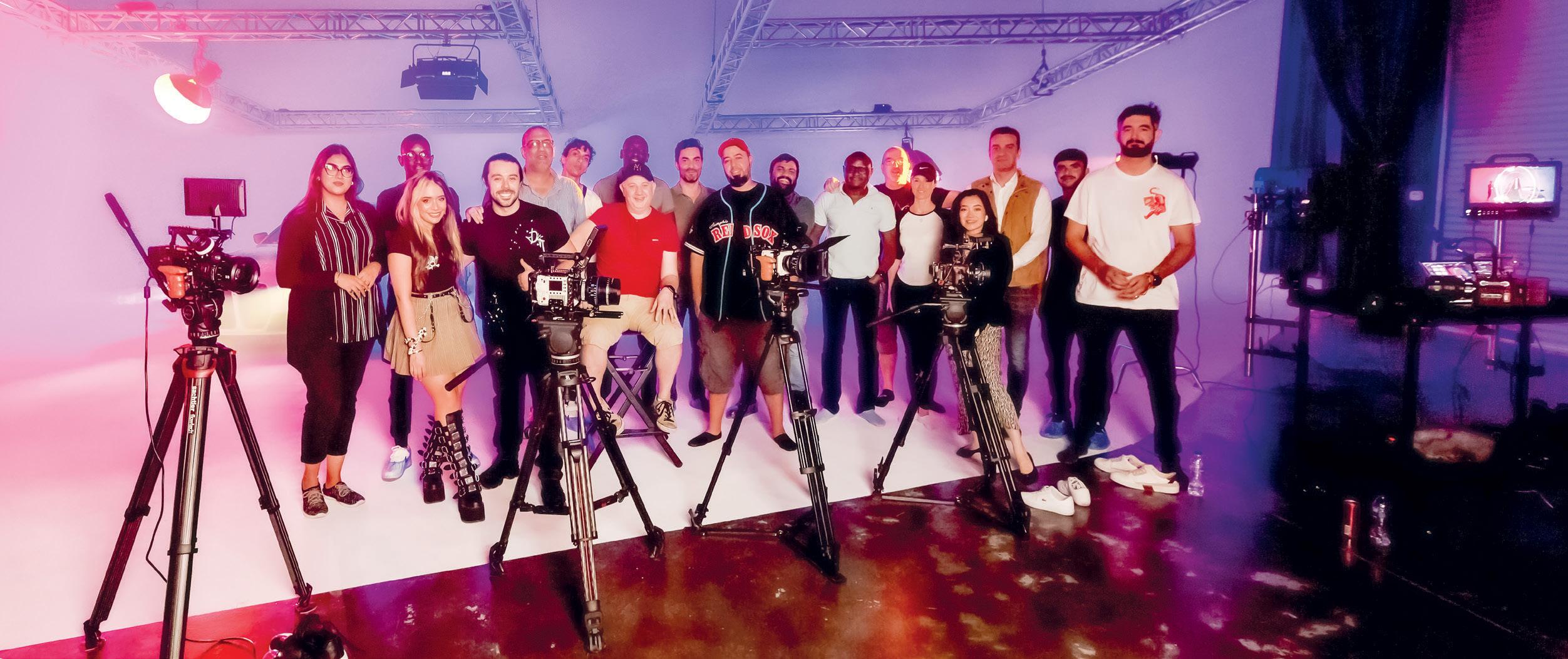
“With these being some of the leading cameras on high-end Hollywood films and streaming television shows, the course gives confidence to anyone wanting to use these cameras and get the best out of them,” Johnson explained to BroadcastPro ME. It covered everything “to do with the operation of the RED DSMC3 cameras ... calibration, camera operation, settings, resolution, compression, advanced features and working with the footage in post-production. By the end of the three days, all the students usually understand and feel confident in using the cameras and how to get the most out of the footage they shoot.”
Johnson is no newcomer to Dubai. He ran a similar course back in 2019 with Advanced Media, RED distributors in MENA. “It was nice to be asked back by Advanced Media to run the course. Only this time, I think we have improved it by having access to a larger studio with more shooting assignments for the students to help consolidate their learning.”
He said the quality of attendees was impressive. “Most of them already have a RED camera, be it a DSMC3 Komodo or a V-Raptor camera, so for them, being able to use their own camera on the course helps them become more confident and proficient. But even if you haven't bought a camera already, it doesn’t matter as we have the entire range available for students to use throu ghout the course. For this particular course, we had attendees from the UAE,
Ukraine, Zimbabwe, Egypt and the United States, which made it a truly international group of attendees.”
Arin Gharibian, a DIT from Mediamax Film Production, which owns a RED Komodo and the latest V-Raptor XL, said: “We use these cameras on a regular basis. I was amazed to learn new tips and tricks about these cameras. The knowledge will help me get the best result out of these cameras.”

Ihsan Salhia, a film director and producer and owner of Fast Films Motion Picture Production, also attended. “Before joining the Red Foundation workshop, I honestly didn’t know what to expect since I really know my way around the camera. But I was impressed with the workshop layout and how fun it was to follow along all the project tasks given. We have now started
implementing some of the steps taught at the workshop into our workflow and are able to get more out of our RED cameras just by following a few steps prior to and during post.”
It has been three years since Advanced Media hosted the RED
course, explained Ardalan Khosravi, the distributor’s RED Digital Cinema Brand Manager. “We have received so many requests for this course. It was great to host some amazing talents in one place from different countries. This platform gave us the opportunity to show the great potential of these cameras for better creativity and quality in the production.”
Although Advanced Media has been distributing RED cameras for a long time, it only became a MENA premium dealer in early 2022. It has the only authorised RED service centre in the region.


“Nearly 300 units of the RED Komodo and 50 units of RED Raptor have been sold in the region in the past few years. We believe the number will continue to grow with right exposure, display, training and education,” said Khosravi.


“With these being some of the leading cameras on high-end Hollywood films and streaming television shows, the course gives confidence to anyone wanting to use these cameras and get the best out of them”
Steve Johnson, Director of PhotographyArdalan Khosravi, RED Digital Cinema Brand Manager, Advanced Media. Arin Gharibian, DIT from Mediamax Film Production. Ihsan Salhia, owner of Fast Films Motion Picture Production. Steve Johnson, DoP and workshop instructor. The workshop was held at the newly opened Ravenscar Film and Studios in Al Quoz, Dubai.


MENA streaming platform Shofha has been running a quiet but profitable operation in the region’s OTT space since its launch in 2016.
In an exclusive interview with Vijaya Cherian , CEO Medhat Karam outlines the OTT roadmap and strategies that have made the platform successful
One of the Arab world’s best-known secrets is a UAE-based streaming platform that has quietly infiltrated the homes of thousands of Arabs over the last few years. Shofha, which means ‘watch’ in Arabic, has maintained a low profile since its launch seven years ago as a product of tech giant ArpuPlus, owned by A15, one of the MENA region’s largest internet and mobile conglomerates.
But that changed and the platform made headlines when it recently acquired exclusive MENA streaming rights for Egyptian romcom Bahebak, starring Tamer Hosni,. It was top of the charts in the Middle East and garnered $4.26m in MENA gross box office revenues on its opening weekend in theatres last July.
“Bahebak was a game changer for us,” agrees Medhat Karam, CEO of Shofha and ArpuPlus, a multi-million-dollar mobile value-added services company in MENA and Southeast Asia. “The market is full of giants and we are not playing in that league, although we are owned by a giant. We cater to the masses – people in the middle and at the bottom of the pyramid. We don’t do 50 productions a year, we don't get the latest and the most expensive content,
and we don’t target those who pay for the latest and the best content.
“Instead, we have a very good library of Arabic-language content that has a unique local flavour for each of the countries we operate in. Shofha is currently available in 15 countries in the MENA region, and its main USP is that it is integrated with 30 telco operators for billing and marketing. Our content is localised for Egypt, Tunisia, Saudi Arabia, the UAE, Algeria, Palestine, Qatar, Kuwait and Bahrain, among others.”
Content, therefore, is sourced from local producers. “We look for smart acquisitions and smart productions. We scour the market for content that offers the best value for money. They are not the most expensive productions or the most recent. Ours would be a couple of years old, but they would be content people would have wanted to watch but missed in the first few windows.”
Having said that, the company has started investing cautiously in a few productions of its own in the last couple of years.
“We are not looking at anything as prolific as other platforms,” says Karam. “We are doing around four to six productions a year, and that’s a mix of
movies, series and programmes. But we do have something new added to our content library every month.”

One of Shofha’s biggest USPs is its integration with 30 telco operators, thanks to ArpuPlus and its close ties with the telco market.
“Telco operators typically have hundreds of thousands of subscribers so we have leveraged that, especially in markets like Egypt and Saudi Arabia, and in that way we have differentiated ourselves from the other streamers. I think we have a very good footprint of integrations with operators; 30 operators is a large number,” explains Karam.
The platform’s business model reflects this. “Because our focus is on the masses, our subscription strategy includes daily, weekly and monthly options. This gives our
viewers the flexibility to subscribe for a few days, watch the show they came to watch and exit. So our strategy is very different from say a Netflix or a Disney.”
Despite this, Karam proudly claims that Shofha has been successful.
“We have always been very conscious of our investments when it comes to technology and content. At present, we follow a subscription video-on-demand model. A lot of our users prefer daily subscriptions. They may see something they like and get it added to their
mobile bill, which is how most of them pay. Our fee for a day is around AED 1.5 ($0.41). For a month, it is about AED 15 ($4).”
He says the easy-to-use entry and exit from the platform has helped endear the platform to users. “The ability to reach most of the people in a very simple and very nominal way, and in a very local way, has made us popular among subscribers. If you open our app for Tunisia, for instance, you will see a lot of Tunisian series.”
But having seen a 20-25% spike in user engagement with the new strategy to introduce the odd highimpact production, Karam says the team is now experimenting with various ways to bring in subscribers and ensure retention.
“With the Bahebak acquisition, we tried a different strategy from our
“We look for smart acquisitions and smart productions. We scour the market for content that offers the best value for money”
Medhat Karam, CEO, Shofha
usual and definitely it was a game changer for us. It is a good strategy as long as you're doing it carefully to manage your profitability. Our intent is to continuously surprise our viewers with teasers in the form of a brand-new production or a big-impact movie. But it won’t be with the frequency that you see with some of the other highprofile streamers, and we don’t do Ramadan specials. I think the market is flooded with enough productions during the Holy Month. We will continue to be very selective with these game changers.”
Occupying a different niche from the top streamers does not mean Shofha is free of competition. In fact, it has a bigger challenge with players in the IPTV market and pirates, says Karam. Shofha will eventually be prepped for a sale, and Karam is a veteran in this area of the business.
An engineering graduate, Karam has had the opportunity over the years to become well versed in internet business, mobile VAS and managing software companies. He has an outstanding record in managing budgets, setting strategic directions for companies, helping with product development and identifying potential opportunities and clients. Under his leadership, Shofha is being moulded as a profitable product that will continue to do well when it has passed into different hands.
Karam elaborates: “ArpuPlus’ parent company A15 works with several big names such as Facebook, Twitter, PayPal and companies in the fintech, e-commerce, social media management, software development and hosting space. Our objective is always to spin off companies from ArpuPlus. We act as a venture builder, where we spin off companies, grow them and sell them. We did that with TPay, which was launched in 2014 to enable mobile

payment, and sold it in 2018 to Helios, a British Nigerian investment group. We are building Shofha to take a similar route, and it’s one of many products emerging from the ArpuPlus stable.”
But for now, the company is focused on making the platform stronger and expanding into new markets. While it currently has only a subscription model, there are plans to explore
other business models and expand into new markets.
“Currently, we continue to see huge growth in the SVOD domain. The whole number of subscribers in the MENA region is still just a fraction of the total population, and there is so much scope to attract more viewers. Right now, we are looking to add more smart productions. For instance, we have just produced a six-episode drama series – generally we will be producing them in the range of six to ten episodes. We are also contemplating a FAST model within the next 18 months, but we have to see how to do it without cannibalising our SVOD model.”
Karam concludes: “We are also looking to expand into Africa. That’s a huge market and is just ideal for a platform like Shofha.”
“We don’t do Ramadan specials. I think the market is flooded with enough productions during the Holy Month. We will continue to be very selective with these game changers”
Medhat Karam, CEO, ShofhaKaram says Shofha is also looking at a possible expansion into Africa.
The Qatari sports channel built a virtual studio in just three months, moving the goalposts for broadcasting in the region

When it was confirmed that the 2022 World Cup would be held in Qatar, every regional sports broadcaster put its best foot forward to cover the tournament. With more than two decades in the sports broadcasting game, the team at Alkass Sports understood that a traditional approach wasn’t going to be enough to cover one of the biggest events on the sporting calendar.
“Local coverage of the World Cup was about far more than the event itself; it was an opportunity to represent Qatar on a massive scale and raise the bar for broadcasting in the country,” says Ali Majed, Director of the Creative Department at Alkass Sports. He explains that when that task first fell to the Alkass
team, it began with a branding ad that reflected the cultural significance of the event and the history of its host country, highlighting the traditions and the iconic skyline of Qatar.
“After working with virtual studio graphics on that branding project, I knew it was time for us to rethink the future of our broadcasts,” Majed explains. “Initially we were going to build several physical studios for the World Cup, but I felt like we could do so much more. I’d been following Zero Density for the past five years, seeing what they offer the market. We decided to forgo our physical set plans and propose the idea of a Zero Density-powered virtual studio to our management.”
When the management was briefed on how a virtual
studio would enable the Alkass team to create a realistic World Cup show and have multiple set designs in one green screen studio with endless innovative coverage options, they were all in. The only problem was they had just three months to do it all.

To help, the team contacted Zero Density, who were involved as technical advisers in the field with Alkass throughout the World Cup preparation and execution. “It was the first time we’d experienced a project of this scale in Qatar, and the pressure was on to ensure it could be completed to the high standards that audiences would expect within the limited time frame,” says Yavuz Bahadiroglu, Zero Density’s Global Partner Manager. “From the hardware to the lights and logistics, everything had to be built from the ground up. Zero Density’s expert team were on the ground from day one until the Cup was won.”
In order to create the virtual backdrops, first designs of Alkass Sports’s real-world studios were sent over to DreamWall, the company that would be creating the project’s virtual elements. DreamWall’s first challenge was to transform those plans into a virtual space that could be built and textured in Unreal Engine.
“We realised that the plans, intended for a real set, did not always match the 3D concept renderings,” explains Isabelle Denis, Sales Manager at DreamWall. “The concept renderings were flat in
terms of textures, and we had to find solutions to improve everything and achieve a realistic final result. It was a challenge to stay close to the concept and still give the impression of depth.”
DreamWall needed to deliver the virtual space while keeping pace with Alkass, which was readying its biggest coverage of the year. Together both teams had numerous discussions about every
detail of the virtual studio, from the tracking and camera setup to the number of anchors that would be on screen. “We even talked about the studio’s tables and whether they needed to be real or virtual, before the Alkass team settled on making them real,” recalls Denis.
Before unveiling the virtual studio to an audience of sports fans, the DreamWall and Alkass teams gathered copious references on each material with optimisation insights from Zero Density. They then used Unreal Engine’s texturing and shading capabilities to add subtle imperfections such as scratches and general wear and tear.

“It may sound like a small touch, but it avoids flat colours without detail, a dead giveaway that what the audience is seeing isn’t real. Striving for absolute realism and perfection in virtual sets can be limiting and detract from the overall aesthetic and believability,” says Denis.
DreamWall’s team created everything in Zero Density’s Reality Editor, the fork version of Unreal Engine. When creating a realistic virtual environment for broadcast, however, there are some big things to consider, like finding the right workstations, cameras, lenses, lights and more. Zero Density
“The pressure was on to ensure it could be completed to the high standards that audiences would expect within the limited time frame”
Yavuz Bahadiroglu, Global Partner Manager, Zero DensityThe virtual studio enabled the Alkass team to create a realistic World Cup show and have multiple set designs in one green screen studio with endless coverage options. Alkass was also keen to have its anchors teleport from one location to another.
provided consultancy on a wide range of topics, from the optimum size of the cyclorama to the ideal position of the lights and picking the right physical studio materials, in order to elevate the storytelling.

The final studio was built to include a 4.2m by 11.79m cyclorama painted with ChromaLight green basecoat and topcoat paints. The studio featured four Grass Valley LDX8000 cameras with Canon HDXS lenses, Stype technology for tracking and ARRI lights for cyclorama lighting. For the horsepower behind the production, Alkass opted for four Reality Engines running on RE AMPERE machines.
“We did everything in a short time, but we never settled for anything less than the best quality. We wanted top-notch results, or we would not do it, and it turned out the way we imagined it. As we warmed up to virtual studio production and with the trust that Zero Density’s support engineer
would be present, our teams kept pushing the envelope and adding more and more virtual elements and features to each show.”
It was later decided that AR elements would help to further enhance Alkass’ coverage of the event. Green screen together with AR had been rarely used in the region. After the initial conceptualisation stage, AR elements were created. All green screen and AR elements were then controlled from the same interface on RealityHub. The Alkass team then used real-time data integration for team lineups and player names through Excel data that was fed into RealityHub.
Alkass was also keen to have its anchors teleport from one location to another. To do this, the remote location set up a small green background, adjusted the angle of the view so it was the same one used at the main studio, then sent the sound and picture to the studio. All input was placed in a plane object using Zero Density technology linking the render engine to the tracking system, allowing the Alkass team to have a photorealistic augmented guest on their set that could be transmitted from anywhere in the world.
Alkass believes that its coverage of the World Cup was a huge success, paving the way for even more virtual elements in regional sports


“Local coverage of the World Cup was … an opportunity to represent Qatar on a massive scale and raise the bar for broadcasting in the country”
Ali Majed, Director of the Creative Services Department, Alkass SportsYavuz Bahadiroglu, Global Partner Manager, Zero Density. Isabelle Denis, Sales Manager, DreamWall Ali Majed, Director of the Creative Department at Alkass Sports. Before unveiling the virtual studio, the design teams gathered copious references on each material, then used Unreal Engine’s texturing and shading capabilities to add subtle imperfections to enhance photorealism.
broadcasting within Qatar. “By the time our work on the World Cup was complete, we had a fantastic football commentary show that cost us far less than a traditional broadcast, went above and beyond physical restraints with far more flexibility. And we did it all in just three months,” Majed adds.

Qatar is no stranger to huge sporting events and in the next 12 months alone there’s the Asian Cup, the World Championship, swimming and tennis, all of which will reach for the bar set by Alkass World Cup coverage. There’s even been a big investment in 4K to boost the quality of broadcast across the region. It’s safe to say that viewers can expect to see more and more virtual integration on their television sets.
“The technology has no limit in sports broadcasting,” says Majed. “It opens so many possibilities for instant replays, for a start. Then
















there are the various things you can do with AR, if you’re right there in the stadium you can open an app and instantly see information on all the players on the pitch, names, statistics through your phone. Thanks to the World Cup, regional sports broadcasting from now on is likely to be much more interesting than a conventional production.”

“The concept renderings were flat in terms of textures, and we had to find solutions to improve everything and achieve a realistic final result”
Isabelle Denis, Sales Manager, DreamWall
CNN went live from its multi-million-dollar broadcast facility in Abu Dhabi last month, marking a new chapter in the network’s history in the Middle East. In an interview with BroadcastPro ME , the Abu Dhabi team shares details of the new technologies that have helped launch the news operation into the future
On February 27, CNN launched its first full show using its brand-new studio facility in the Abu Dhabi Yas Creative Hub. The 600sqm bureau, home to 40 staff, has enabled the team to increase the scale and scope of its operation in the UAE. As one of the network’s key international production hubs alongside Atlanta, New York, London and Hong Kong, it marks the latest of several major investments in technology and editorial production for CNN.


“This brand-new bureau is a multimillion-dollar investment by CNN, which underscores how important this region is to the network,” Becky Anderson, Managing Editor of CNN Abu Dhabi & Anchor, tells BroadcastPro ME. “Its primary purpose is to tell stories about the region, from the region, but also to offer a regional perspective on global stories for audiences around the world. From a production
standpoint, what the new bureau brings is a far more technically versatile, efficient facility, geared towards collaborative workflows. Put simply, that means we can produce more dynamic programming on a set that gives us many more presentation options, and we are better integrated into CNN’s global systems. Beyond these walls, twofour54’s Yas Creative Hub is an inspiring environment for the creative industries here, a growing community of which we’re excited to be a part.”
From a technical standpoint, the new bureau has been designed to enable multiplatform content creation with hybrid digital and IP video/audio workflows. CNN’s hybrid AV stack combines the reliability and broad industry support of SDI and Dante with the flexibility of NDI, offering some new capabilities to the bureau.
“As the industry moves to IP, hybrid workflows became even more relevant.
“This brand-new bureau is a multi-milliondollar investment by CNN, which underscores how important this region is to the network”
Becky Anderson, Managing Editor of CNN Abu Dhabi & Anchor
We are able to combine core technologies into brand-new flexible systems. NDI then gives us the scalability and flexibility to enable cutting-edge creative production needs into the future. This, together with intelligent control surfaces, bring the technical and production teams into the forefront of high-tech operations,” explains Leo Tucker-Brown, Engineering Manager at CNN Abu Dhabi.
Daniel Symmonds, Senior Engineer and Project Manager, seconds this. “For a modest installation, 2110 is a costly and complicated undertaking and SDI alone potentially fails to take advantage of softwarecentric workflows. This hybrid approach has allowed us to create a technical palette which offers broad capabilities and multiple paths to enable the technical empowerment of our teams.”
The 80sqm studio will now be home to CNN International’s flagship current affairs programme, Connect the World with Becky Anderson. The facility incorporates three fully robotic camera systems from Videndum (formerly Vinten), a 10-million-pixel Unilumin video walls, four dedicated craft edit suites,


and a modern, open-plan newsroom with sit and stand desks and dedicated monitoring tools in every position.
In the studio, three large video walls and three reconfigurable portrait monitors create a canvas that enables the look and
feel of the space to be adapted very swiftly. These are combined with VizRT graphics engines and the deep M/E capabilities of the Newtek Tricaster Elite 2 switcher, which both have native NDI support and give the team a vast array of creative options. The Tricaster also has built-in tools for bringing in guests via popular video conferencing applications as well as for streaming out to social platforms. There is also a large green screen wall for ideas development.
The team is particularly proud of the flexibility of the newsroom: a production position can be tailored to suit a producer, technical operator or engineer at the press of a button. The bright open-plan newsroom layout offers ultrawide and dual-up displays in every seat for a tailored user experience. CNN also has a technical area which allows the team to bring capabilities such as live contributions or prompter operations, normally only found in a control room or a studio, into the newsroom. The facility also has five new downlink antennas, including one for regional feeds and SNG support.
The team has carefully planned out all areas of the facility with several technology additions
“IP-capable prompting now makes switching between our local and remote operation seamless”
Daniel Symmonds, Senior Engineer and Project Manager, CNN Abu DhabiBecky Anderson says the new facility will enable more dynamic programming.
and incremental upgrades. For instance, the inclusion of modern encoding techniques such as the Haivision Makito X4 means there are four bi-directional contribution lines, in place of the single paths found in the previous bureau.
“IP-capable prompting now makes switching between our local and remote operation seamless,” says Symmonds. “We now have fully rather than partially robotic camera pedestals. There are eight switcher M/Es where previously we had three. We also have shared online edit storage and cloud archive capabilities as well as a near complete elimination of analogue audio across workflows including comms. VM and KVM access to production tools eliminates duplication and centralises compute.”
The team also now has access to dynamic operator interfaces, along with a good mix of established and new video/audio processes. This has been achieved through Densitron touch controls for fully customised operator GUIs. By centralising the control of multiple vendors in one system, they have moved beyond panels which only operate one piece of equipment or one vendor’s solutions, to focus on workflows.
A big addition to the facility is media asset management capability with centralised fast storage. For this, the bureau has adopted
SIMedia as its MAM, playout and record solution and centralised its online storage on OpenDrives. This system supports NDI natively, and by centralising its core media repository has eliminated the need to transfer files between systems to make them available to that process.


“The flexibility we now have operationally supports a dual workflow,” says Jude Oommen, Senior Technical Director at CNN Abu Dhabi. “On the one hand, we can join our mothership in Atlanta for our two-hour daily newscast on CNN International; on the other, we can stream bespoke content without having to go across the Atlantic to support our local initiatives like CNN Academy, moderate virtual panels and create live, packaged content for our partners.”
The newsroom, however, has its fair share of challenges.
“By far the biggest challenge for the modern newsroom is the sheer amount of information available now through social media. It’s tremendously useful to be able to pull in sources from social platforms in a breaking news situation, but verifying it is essential, and that is a time-consuming and labourintensive process – especially when false or misleading information is being deliberately circulated. We’ve invested a lot in beefing up our capabilities on this across the network over the past decade. Tech has an important role to play in this, with data analysis, geo-location and other verification tools all now a mainstream part of the newsroom and playing a role in our investigations as well as breaking news. We’re not there yet, but I anticipate AI having an important role to play in this area in the future,” says Anderson.
“As the industry moves to IP, hybrid workflows became even more relevant”
Leo Tucker-Brown, Engineering Manager, CNN Abu DhabiJude Oommen, Senior Technical Director at CNN Abu Dhabi, says the new system supports a dual workflow, making operations more flexible.
Are cloud technologies receiving a warmer reception from companies today? Are we seeing greater cloud adoption within various areas of expertise, and how will this improve broadcast operations and workflows in the coming years? We ask industry professionals

scales dynamically with workloads. As more media workflows move to the cloud, multipoint monitoring with a single dashboard becomes a powerful tool, especially for OTT delivery. With access to real-time quality metrics from the contribution stage to the end-device stage, broadcasters and service providers have the power of data and the accompanying intelligence to identify and resolve problems immediately, as well as predict critical issues and even equipment failure.
Mathieu
With their ease of set-up and access, cloud technologies have generated considerable enthusiasm among consumers. Companies, however, have traditionally been more cautious about implementing them – a trend that goes back to the software-as-aservice days. The question is whether companies can deliver the same reliable performance, functionality and security with outsourced cloud technology as they do on their own.
In the streaming video market, that question has significantly raised the barrier to entry. Emerging providers must not only use cloud technologies to ensure a successful market launch, they must do it while competing directly against industry giants like Netflix and YouTube. The main hurdles they face are cost, performance and reversibility.
The best approach to dealing with the cost is to commit to a sustainable business model from the jump. Most cloud solutions offer competitive pricing at first, only to increase costs as the service becomes more widely adopted. So for streaming service providers, staying vigilant with the budget is essential.
In terms of performance, verification is key. Providers can only improve what they measure, so they can only boost performance once they’ve verified it. They shouldn’t settle for meeting the bare minimum listed in their service-
level agreements – they need to test the full scope of their service. The most overlooked of all these challenges is reversibility. Companies don’t want to be locked into a cloud technology that relies on a single outsourced solution to provide their own service. They want to be able to choose the best of several third-party options and the ability to maintain internal control over their service. While these three challenges need to be considered, cloud technologies have come a long way in the last few years. Companies that find innovative ways to use them will be highly rewarded.

The media industry is increasingly embracing cloud-based services and solutions. Due to the Covid-19 pandemic, 2022 saw an uptick in real-world use cases where the cloud was adopted on a wider scale across media workflows. File-based QC and monitoring in the cloud, for example, have provided further flexibility and agility for verifying and delivering massive amounts of content, while reducing costs by enabling media operators to only pay for services they use.
Another factor driving cloud adoption has been faster media processing that
Broadcasters and service providers are also increasingly turning to AI-/ ML-driven automated workflows and migrating their critical operations to the cloud. As a recent IABM report pointed out, AI/ML is supporting this migration by offering data-driven, automated workflows that include personalisation, metadata generation and data analytics.
The adoption of cloud-based solutions is especially true for streaming, where the ability to dynamically spin up and spin down content processing and monitoring systems at locations closest to customers is desired – paying only for what is used. Also helping the localisation of global content, today ML-based QC solutions include audio language detection and captions technologies that expedite the dubbing, caption creation and verification processes for many languages, enabling fast, high-quality content delivery to cater to a worldwide audience.
Finally, in today’s post-pandemic world, with work-from-home and hybrid working models, managing operations remotely is essential, and the cloud is instrumental in providing this capability. To consistently meet customer expectations for high QoE and QoS, broadcasters and service providers need to easily deploy and manage QC and monitoring systems within media workflows at any location and on any device. This can significantly expedite problem identification and resolution, which plays a crucial role in driving customer engagement and increasing profitability. So in 2023, finding and implementing the best cloud-based media QC and monitoring tools should be one of their highest priorities.
The biggest barrier to cloud adoption is risk. There’s still a lot of resistance to change out there, and this creates a technical debt between the first movers and the late adopters.
We live in a brave new world that’s moving fast, and those that don't adapt will be left behind. Broadcasters need to accept that the decisions they make today are going to have an impact on their future.
With a skills shortage looming, it will be a better future if we involve more of the people who are going to have to live with and implement these inevitable changes, so we can minimise the negative unintended
consequences and simplify the solutions. The choice is an illusion; we already know what we have to do. Playout in the cloud is already established and makes total sense; the next challenge will be moving live production there.
There’s a lot of inconsistency in what cloud actually means in reality. There’s a difference between operating in a browser (virtual machines) or operated by a browser (microservices). Add to that the complexity around integrating the services from different vendors, the glue that holds it all together, and there's some significant challenges for live production. The biggest challenge of all is cost. There is a fear of the cost of cloud; the prices have always been somewhat unpredictable but now ‘cloudflation’ must be priced in. This could lead to a degree of ‘cloud repatriation’ – shifting away from the cloud to on-premise infrastructure running cloud technology. Cloud repatriation could result in one third to one half the cost of running equivalent workloads in the cloud, with predictable costs.
James Gilbert Director of Product & Solution Management, Media – Rohde & Schwarz Broadcast and Media

There is a more mature response to cloud technologies from our customers and prospects than there was a few years ago. Cloud is no longer seen as an instant solution to improving efficiency and facilitating more flexible business models, though it can achieve both benefits with the right partner and change management approach.

“The biggest challenge of all is cost. There is a fear of the cost of cloud; the prices have always been somewhat unpredictable but now ‘cloudflation’ must be priced in. This could lead to a degree of ‘cloud repatriation’ – shifting away from the cloud”
The earlier concerns around security, availability and content location are no longer seen as show-stoppers, though outages on public cloud platforms are a reminder why redundancy across more than one availability zone and/or region is desirable for premium services.

For some content creators and owners, their own facility is still seen as the only safe place to process their assets, so for them at least public cloud is not an option. This thinking also applies to many national broadcasters, where their responsibilities for public service announcements under government direction precludes the use of third-party cloud infrastructure.
The economics of public cloud are also a challenge for many customers; for 24/7 channels a broadcaster needs justification and motive beyond operational cost to consider
migrating to a cloud-first approach. Where corporations are adopting a cloud-first strategy, it is often driven by what the future holds for delivering content to the consumer; more and more non-live content is consumed via VOD platforms which deliver over public internet, so public cloud is a natural fit for processing and orchestrating that content. Overall, we see two approaches being adopted. One is a hybrid approach, with on-premise virtualised or bare-metal infrastructure for 24/7 workloads augmented by public cloud for event-based pop-up channels or peak workloads. The second approach is to go all in, cloud-first – content is created, stored, processed and delivered from the cloud. The more dynamic broadcasters or service providers lean towards the second approach; more traditional public service or national broadcasters still value the on-premise infrastructure. Whichever approach is taken, softwaredefined virtualised solutions which can be deployed anywhere give content owners and broadcasters the freedom to evolve as consumers needs change.
Andrew WardAs of early 2023, the broadcast industry has learned the value of IT-based solutions and Cinegy has installed many such solutions for global providers. IT itself has moved many operations to the cloud, but broadcast was always constrained by the old model of ‘a virtual server somewhere else’, which was never intended for the broadcast use case. However, modern cloud-native broadcast solutions make use of more recent innovations. Service-
“Outages on public cloud platforms are a reminder why redundancy across more than one availability zone and/ or region is desirable for premium services”
based installations that run from containers offer a radical new way of providing broadcast infrastructure, and the SRT protocol provides a safe, stable output stream deliverable anywhere on the public internet.

As the IT supply chain woes caused by the Covid pandemic have led to difficulties sourcing server and peripheral components for on-prem installations, so more and more broadcasters are seeing the advantage of systems which do not need to be bought, can be expanded infinitely and take advantage of recent developments that have been proved to be robust and reliable.
With the possibility of removing capex from the equation, it becomes possible to specify larger systems. With the possibility of adding servers and services with a few mouse-clicks, it is trivial to upgrade installations. And using the SRT protocol for distribution brings a new range of signal management and distribution possibilities.

Overall, there is a growing interest in cloud solutions in the broadcast industry. However, there will continue to be a rationale for running certain processes in data centres. For example, if broadcasters
are using legacy platforms and dealing with predictable loads, the public cloud may not have an immediate business justification, as is the case with long-running IPTV technology.

We envision a hybrid future where broadcasters will adopt platforms that can run on-prem, in the public cloud, the private cloud and multiple clouds. The key driver is the implementation of cloud-native architectures in hybrid environments which offer broadcasters automatic scalability, encompassing DevOps, DevSecOps and other processes and practices.
Beyond the overall opportunities that cloud-native architectures offer the broadcast industry, there are also several real challenges to consider, like the need to adopt an industrial approach to security, leverage automation and AI to streamline operations, and systematise platform deployment observability.
Tap into new business potential as thousands of key buyers, thought leaders and decision makers from over 120 countries come together to design, shape and co-create the future.
Discuss and dive into trends, challenges, innovations and opportunities.
Explore, meet and exchange experiences with a diverse range stakeholders including industry executives, integrators, engineers, solutions providers and more.
focus on sustainable practices across the content creation and delivery ecosystem with special conference content and workshops.
by

Back in the early 2000s, before the first real audio-over-IP multicast broadcast audio solutions came about, everything was on analogue or AES3. Every channel required two or three copper wires to deliver, and it was always point to point. If you needed to run one of the channels to another place, then you needed more copper in that direction. Switching channels in real time involved large and expensive switching matrices. It got even more complicated when the workflow required multiple channels in the mix at the same time, and you had to switch them to and from multiple points around the facility or from the outside world.
That complexity, coupled with high maintenance and operational costs, is one reason the industry started moving toward audio-over-IP and media-over-IP. IP networks made it possible to do multicasting. Now everything is condensed on a network switch, which takes the place of expensive switching matrices, and all signals move over the network instead of copper multicores. Every port on that switch can access content from every other available port, and we use internet protocols to send the content across the facility, the country or the globe. The whole process is much simpler, and you can do it all with basic off-the-shelf equipment that makes the network less costly to maintain.
A few years back, when broadcasters started implementing AES67 and audio-over-IP in a viable way, intercom was one
of the last types of device on board. In fact, even today some vendors still offer intercom solutions that operate over analogue and AES3 cables, and not every console manufacturer includes intercom in its consoles. That means anyone who uses those products must handle intercom signals separately from the rest of the mix, which makes implementing a live broadcast more complex.
There are indeed plenty of manufacturers that have moved to IP-based systems, but the communication protocol between the intercom station and the belt packs is sometimes proprietary and still requires two or four wires. The hope is that all systems in the market will eventually be compatible. But that’s for another article.
Intercom signals are more than just behind-the-scenes crew communications, like when the producer tells the camera operator where to point the camera or cues the sound engineer to send the mix for a particular part of the broadcast. Intercom can be content as well, such as voiceover or translation. It is an integral part of the whole production, which is why it should be treated the same as the main audio essence. When you must integrate such content into the audio mix in real time, it pays to have intercom as part of the IP production network.
Suppose you have an old intercom system that can talk to 50 people but is technically unable to accommodate all 50 inputs and 50 outputs on the final feeds. That means you have to
It is important to design intercom into the audio-over-IP environment and have an intercom option for the mixing console when building the audio system for a facility, says Egor A. Tyagunov
condense all the signals into maybe five analogue or AES3 inputs and five outputs, or 10 and 10, which can become a complicated task. Of course you can create groups or party lines, joining teams of people together as one communication node, and not all of them need to be a source to the outside. But with a modern intercom system built for audio-over-IP, each source can be one point in network space, and you simply talk to this source in the network wherever you want. You can choose which voice, which back-feed of content or which part of the content you want to listen to.
Do you want to hear that particular side of the stadium? You can do it. Do you want to speak to that group of camera operators or join them together? No problem! Do you want to listen to the whole mix? Done. And you can do it all today with a virtual console or software intercom control panel (though physical devices still exist).
With intercom on the IP network, integrating intercom signals into the production is much more convenient. All you have to do is put a certain multicast IP source or audio channel in a certain video channel. The voice could be located anywhere with access to the network, whether on the other side of the facility or the


other side of the world. You can also have any AoIP source as the intercom back-feed to the voiceover artist, making it easier to direct and guide the speaker throughout the programme. It can be done in the same channel, with audio-over-IP as the controls, notifications, on-air lights, etc.
A few things to make it happen: Channel count and network capacity The number one thing to consider is how many people you must listen to and communicate with, which will determine how many channels you need. Basically, every person will become an audio channel and might need feedback audio or IFB, so you must be sure that you have the network capacity and the switching capability to handle them all, with some headroom for the future. In the process, you must be able to communicate with other networks too, such as when you gateway your intercom network into the audio-mixing network and to wherever the mixers and engineers embed the audio into the video. Think of clocking and sync in the network for both audio and video. IEEE1588
PTPv2 timing is important to rely on here. Certain modern switches can help too.
Plan for redundancy – Maybe extra connectivity to the outside world with remote branches or talent, an extra switch so you can create a completely independent delivery network for your audio signals, or extra electrical power to run the facility
and extra PoE capacity. Consider a monitoring system that will help spot problems before they go too far and can even automatically switch to backup, avoiding any interruptions.
Future-proofing – A true AES-67based audio-over-IP system is futureproof. Even if your video side still runs on SDI, an audio-over-IP network will integrate seamlessly whenever your facility moves to video-over-IP systems such as SMPTE ST 2110.
Expert advice – Get input from a good media networking technologist during the design stage. Without an expert you can end up paying much more than expected, because you might have to buy a new system sooner than planned or correct everything that has been done wrong.
Media-over-IP is the future and will still be functional even as technology evolves in the coming decades. With the current trend of virtualisation –where devices from the past become servers (physical or virtual) and all types of content become real-time data streams moving between them – audio-over-IP, including intercom, is a significant and very important part of this future-proof technology, which means you should invest no less in audio than in video.
In recent years, the entertainment production industry has been abuzz with the latest trend –virtual production, also known as volumetric LED studio production or XR production. This innovative technique revolutionises the way movies, TV shows and other forms of media are created by using real-time rendering to generate immersive virtual environments for live-action filming. And while major studios, production companies and filmmakers worldwide have readily embraced this cutting-edge technology, its adoption in the Arab world has been comparatively slow.
This can be attributed to the novelty of the technology, which demands significant investment in hardware, software and personnel training, as well as the limited number of high-end feature films and TV series productions in our region. Nevertheless, there is a growing interest in employing virtual production techniques in the region, as many film and TV studios in the GCC are racing to announce their XR/volumetric LED studios and sound stages.
Virtual production has the potential to offer significant benefits to the Arab world, given its rich cultural heritage and unique environments that can be used to create visually stunning content. Filmmakers in the region can develop highly immersive and elaborate worlds that showcase the region's architecture, landscapes and culture, which in turn can attract global audiences.
Will we see virtual production in other than a few movie productions? I cannot but remember the 3D buzzword
of 2010, when it was promoted that all movies will be produced in stereoscopic 3D, and this obviously never happened. Is it different this time?
It is improbable that virtual production will gain widespread prevalence any time soon. Like many new technologies and trends in the entertainment industry, it may experience periods of hype and excitement followed by slower or more limited adoption in the long run. Nonetheless, virtual production should be viewed as a set of techniques and approaches that can be applied in various ways to fulfil the specific needs and objectives of a production. Unlike stereoscopic 3D, which required audiences to wear special glasses and created logistical challenges for theatres, virtual production can be seamlessly integrated into existing production workflows, making it more practical and easier to adopt.
While it is doubtful that all movies and TV shows will transition to virtual production, we can anticipate its greater adoption as its benefits become more widely recognised, including for smaller-scale productions such as commercials, music videos and broadcast TV. Traditional production methods will always have a place, and many productions will use a combination of virtual and traditional techniques. Virtual production should be regarded as a powerful tool to enhance and complement the traditional production process.
Virtual production technology has made significant strides recently, with success in fields such as science fiction and fantasy genres that necessitate the creation of highly detailed and
fantastical environments too difficult or expensive to achieve with traditional production methods. However, there are still limitations to the level of detail that can be created, especially in highly realistic scenes. These cannot always be achieved in virtual environments, and some shots that require complex camera movements or intricate choreography may be more challenging to execute. Virtual production often requires more pre-planning and coordination to ensure that the virtual elements match up with the live-action footage. Apart from the creative and production process considerations and the expensive investment in technology, which could be a barrier for smaller studios or productions with limited budgets, a significant challenge is the need for new skillsets and expertise throughout the production process. Virtual production necessitates a profound understanding of CGI, realtime rendering and virtual environments, which are distinct from traditional production methods. The availability of highly skilled visual effects artists and technicians is absolutely critical. Virtual production will occupy a central position in film and television production. Ongoing advances in technology, coupled with the successful application of virtual production techniques in industries such as gaming and architecture, are poised to make this method more attainable, thereby driving its proliferation. As the need for elevated visual effects in media continues to surge, virtual production offers the way to satisfy this demand while simultaneously streamlining the production process, saving valuable time and resources.
Hasan R. Sayed Hasan is Managing Director of Master Media
“As the need for elevated visual effects in media continues to surge, virtual production offers the way to satisfy this demand”
Mezzanine, Galadari Automobiles Building
Sheikh Zayed Road, Dubai, UAE
