We would like to thank the following for their support in this process. Without them, this OSRP would not be possible.
First and foremost:
Residents of Holbrook
Holbrook’s Open Space Committee:
Carleen Sabusap, Chair
Denise Louis, Vice Chair
Eric Helfer
Brendan Potash
Alison Bowden
Will Conrad
Patricia Greely
Cristina Lucci-McShain
Holbrook’s Municipal Staff:
John DeLuca, Interim Superintendent, DPW
Eric Erskine, Director of Inspectional Services
Holly Rose, Director, Center on Aging
Patrick Harding, Assessor
Tiffany Sheehan, Treasurer
The faculty, staff, and students of the Conway School for their dedicated work and never -ending support.
Thank you.
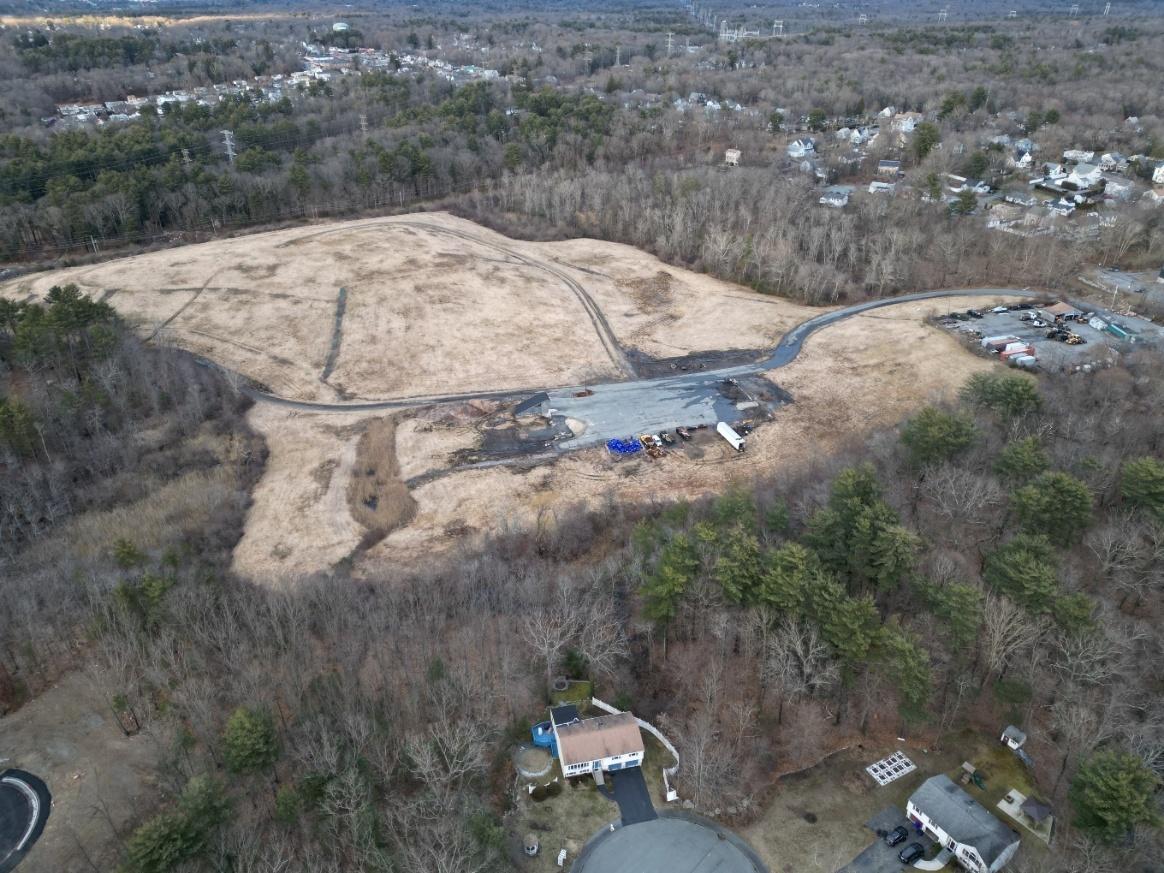
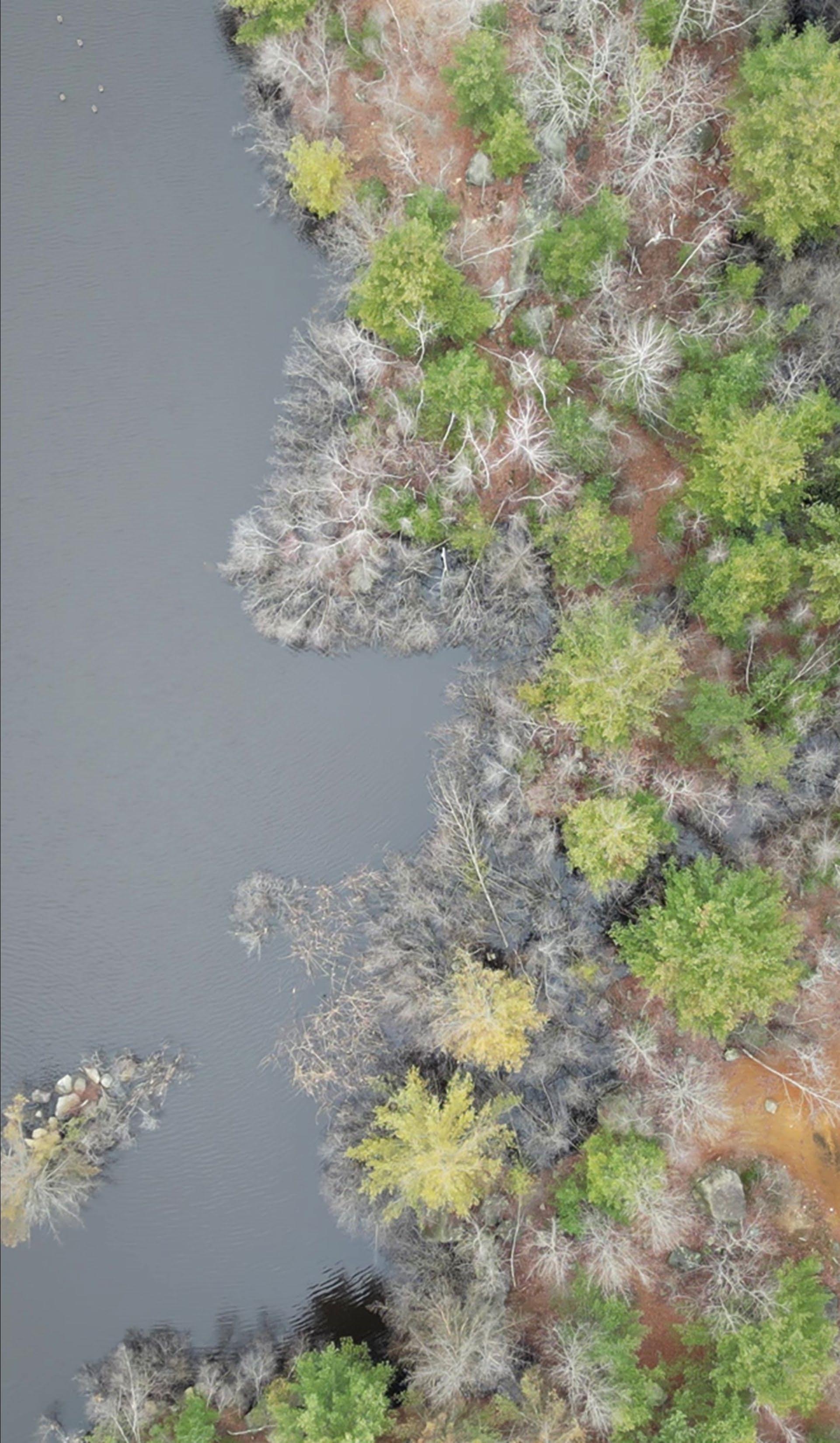
Cover photo taken by Nate Card
“Planning provides the opportunity to assess where you are, where you would like to go, and how you might get there. Planning now to protect important open space and recreational facilities can greatly enhance the attractiveness of your community and encourage growth in the future.”
Open Space Handbook
MA Department of Conservation & Recreation
Section 1: Plan Summary
This plan continues the efforts made by the Town of Holbrook to protect its natural resources, conserve open space, develop community gathering spaces, and provide well-maintained recreational opportunities for all its residents.
With this update of the Open Space and Recreation Plan, the Town of Holbrook reviews its existing resources, reflects on achievements and challenges encountered since the 2000 plan, and assesses its potential to improve open space and recreational opportunities for its residents. Holbrook has an abundance of undeveloped forested land and ecologically rich wetlands and is far less developed than surrounding towns. However, Holbrook faces challenges with accessing these open spaces and town owned properties. The town has a history of reactive zoning measures and is facing increasing pressures of development. This Open Space and Recreation Plan considers challenges the town is facing in the present and how those can be remedied in the future.
This Plan adheres to the structure provided by the Open Space and Recreation Planner’s workbook Section 2 includes a statement of purpose and outlines the planning process, and the public participation undertaken for this plan. Section 3 provides background information on Holbrook including its history, demographics data, and development patterns. Holbrook has been shaped, supported, and at times challenged by its soils, waters, and other natural features described in Section 4. Open spaces in Holbrook take many forms, from town-owned conservation areas and recreational resources to vacant and undeveloped parcels, all of which are included in Section 5 Sections 6 through 8 identify the Town’s future open space and recreation needs and outline community priorities. Lastly, a detailed seven-year action plan in Section 9 outlines priorities for addressing open space and recreational needs.
Throughout the public input process, common themes emerged to shape a community vision for Holbrook’s open space and recreational areas that include:
• Goal 1: Protect and improve water resources.
• Goal 2: Protect plant and wildlife habitat.
• Goal 3: Convert underutilized and poorly maintained open spaces into valuable community spaces.
• Goal 4: Improve walking and biking access and connectivity to open spaces and town destinations.
• Goal 5: Improve the active recreational experience.
• Goal 6: Establish a centralized gathering space for all generations to interact together outside.
• Goal 7: Improve collaboration and management.
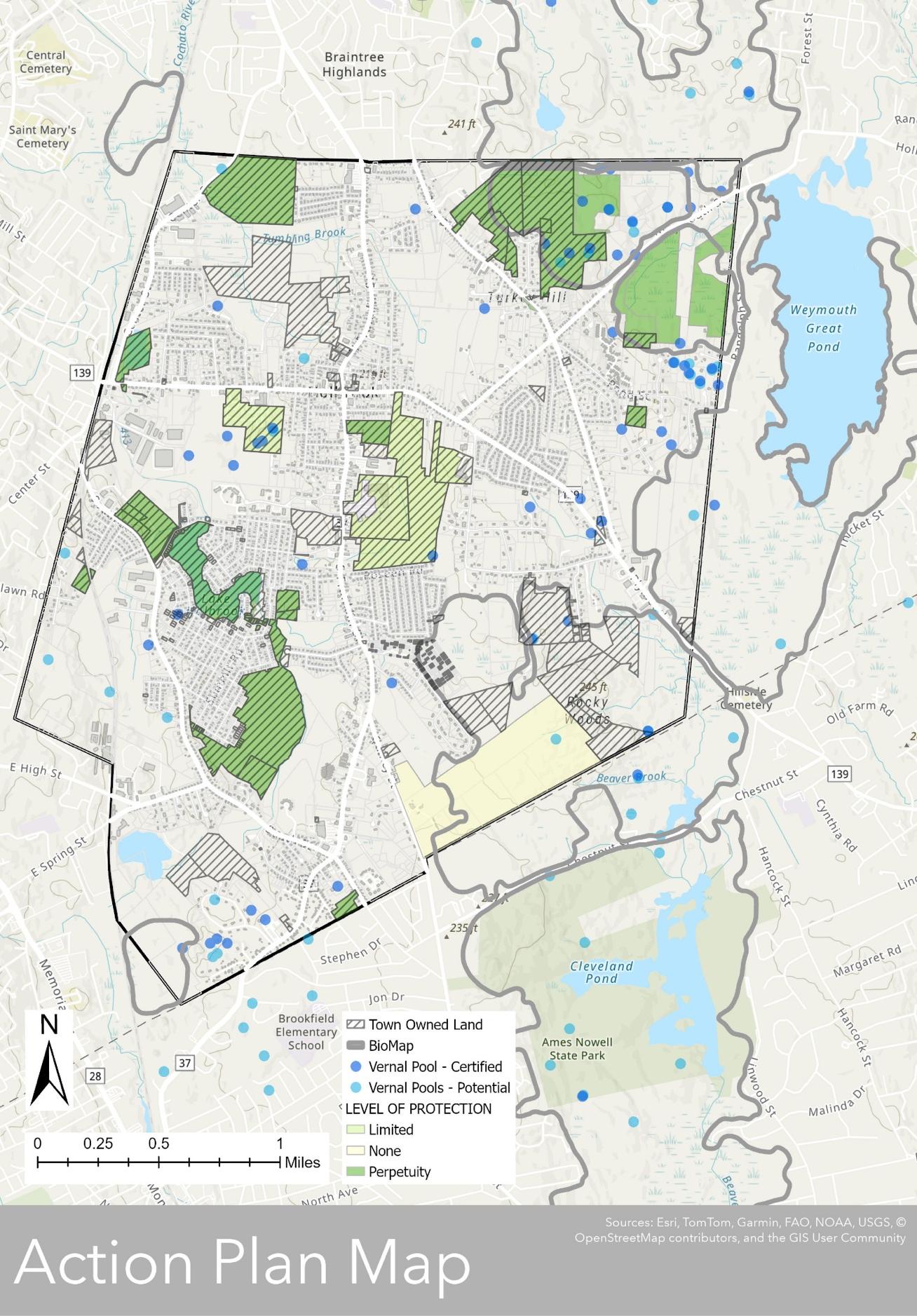
The following recommendations aim to enhance Holbrook’s open space and recreation resources, while priority should be given to connecting forest and natural areas to establish a network of walking trails both within Holbrook and extending into neighboring towns. Additionally, town-owned parcels with no protection and lands with limited protection should be reclassified to have permanent protection through Conservation Restrictions or Article 97, requiring a simple majority vote at Town Meeting. In the Environmental Justice areas, efforts should focus on improving shoreline amenities and creating new trails through existing conservation land (Donna Road Wellfields) and town-owned land (abutting Hamilton Way and Kane’s Pond). A design process exploring the configuration of a centralized community gathering space at the former JFK/school department site should be explored, with consideration of pedestrian connections to all parts of town. Existing outdoor athletic facilities, such as Sumner Field and Brookville Field, should be repaired and upgraded. Finally, all vernal pools in Holbrook should be protected from development and become NHESP certified pools.
As development pressures increase, strategic land conservation efforts are essential to maintaining ecological integrity and community resilience. Without proactive planning, critical habitats and natural resources will continue to be lost to fragmentation and degradation."
Losing Ground 2020 Nature’s Value in a Changing Climate Mass Audubon
Section 2: Introduction
A. STATEMENT OF PURPOSE
The purpose of the Open Space and Recreation Plan (OSRP) is to provide town decision-makers and the public with a detailed review and analysis of Holbrook’s open space, conservation, and recreation needs and to lay out a sevenyear action plan highlighting maintenance of facilities, improvement of recreational resources, and acquisition and protection of open space and recreation properties. A community’s OSRP, once approved by the Office of Energy and Environmental Affairs (EEA), specifically the Division of Conservation Services (DCS), makes the Town eligible for DCS grant programs for up to seven years. The Open Space and Recreation Plan (OSRP) for the town of Holbrook updates and builds upon the previous OSRP written in 2000. Twenty-five years later, Holbrook remains a predominantly residential community with an abundance of undeveloped ecologically sensitive lands.
Within the twenty-five years since the completion of the 2000 Open Space and Recreation Plan, some goals and action task have been implemented whiles others have not The town did make progress in the following ways, including the creation of an Open Space and Recreation Committee in 2023. Several vernal pools have been certified and received added protection, increasing from 7 NHESP-certified pools in 2000 to 53 in 2025. Updates may have been made to Sumner Field, and Brookville saw the addition of new and improved seating. A new JFK School opened in 2017 now serving k-12 (the old JFK and South St. Elementary schools have closed). For recreation, the Sean Joyce Field land was donated in 2005 and opened in May 2009, and Flint Field opened in June 2009. Additionally, the demolition of the icehouse around Lake Holbrook took place. For historic and cultural preservation, in 2006 and 2007 Holbrook had two properties added to the National Register of Historic Places the Holbrook Square Historic District, which extends along North Franklin Street from Union to Linfield Street, and the Roberts School, a oneroom schoolhouse built in 1873.
B. PLANNING PROCESS AND PUBLIC PARTICIPATION
Funded by the Office of Energy and Environmental Affairs (EEA), the town of Holbrook hired the Conway School to produce two planning documents. In 2024, Conway graduate students prepared Imagine Holbrook: A Vision Plan, the first phase of a two-phase project supported by a grant from the Office of Energy and Environmental Affairs. The second phase of the project was to prepare a draft of the OSRP in 2025. This draft was created in collaboration with the Holbrook Open Space and Recreation Committee and engaged Holbrook residents. The Open Space Committee (OSC) includes Carleen Sabusap (Chair, OSC), Denise Louis (Vice Chair, OSC), Eric Helfer (Planning Board), Brendan Potash (Open Space Committee member), Cristina McShain (Board of Health), Patricia Greely (Town Forest Committee), Alison Bowden (Open Space Committee member) and Will Conrad (Chair, Conservation Commission). The Holbrook Core Team which worked closely with Conway students included four members of the OSC (Carleen Sabusap, Denise Louis, Eric Helfer, and Brendan Potash). The Conway School graduate student team that worked on the OSRP draft comprised Laura Harrigan and Hannah Johnson.
Over the last 25 years, several town planning processes have taken place. In 2000, the Town developed an Open Space and Recreation Plan (OSRP), followed in 2005 by a Master Plan. More recently, the Holbrook Town Center Economic Development Study (2018) aimed to revitalize the downtown area by creating a unified identity, encouraging mixed-use, enhancing connectivity, and improving pedestrian movement. In 2021, the Town hired Environmental Partners and engaged in the Municipal Vulnerability Preparedness (MVP) assessment process. Communities that complete the MVP program become certified as MVP communities, making them eligible for grants and other opportunities. Holbrook has not applied for any MVP action grants. In 2024, the town worked with the Conway School to create a Vision Plan. The Vision Plan process included two community engagement events and a town-wide survey. This data and engagement feedback informed the 2025 OSRP process.
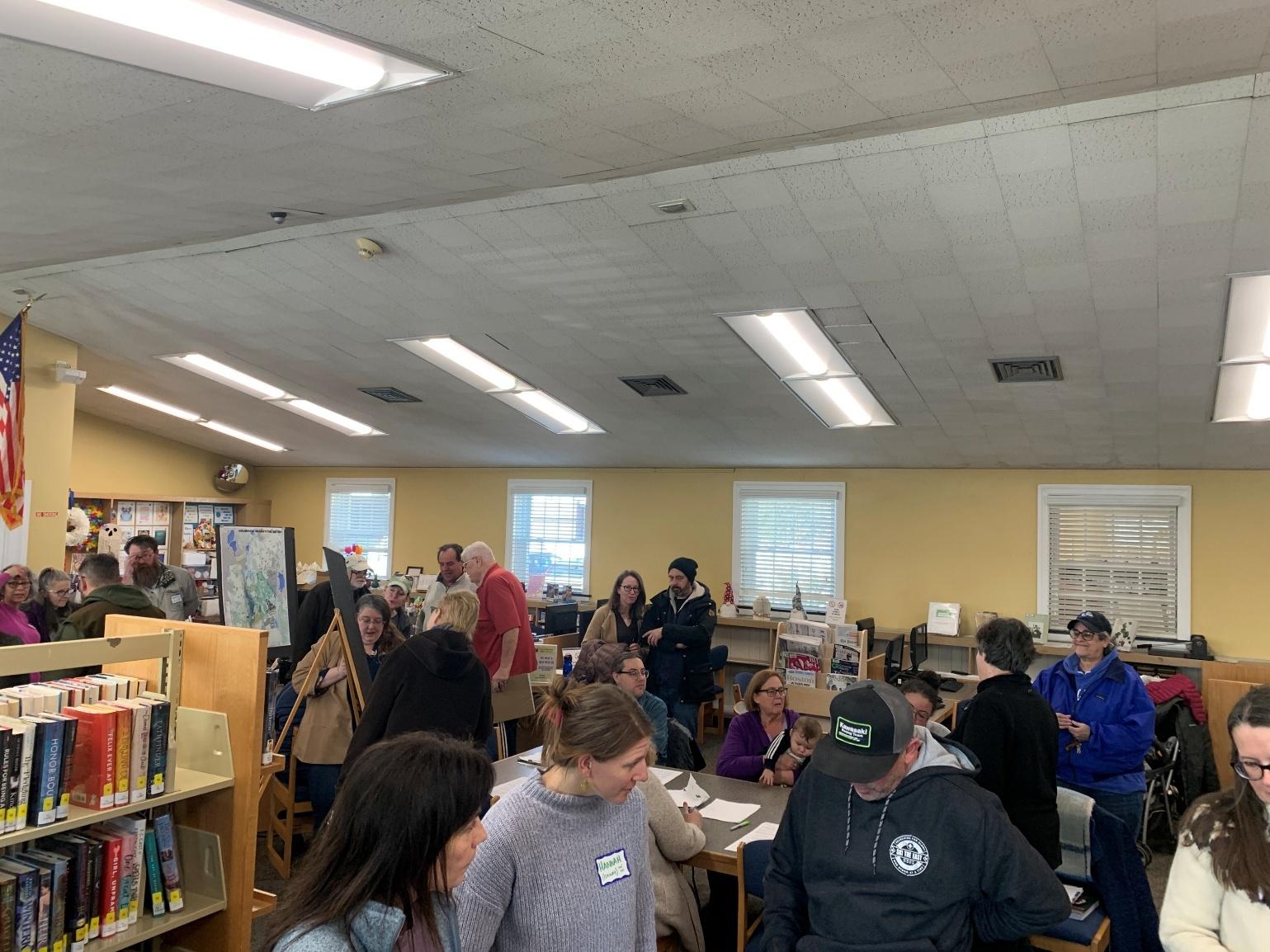
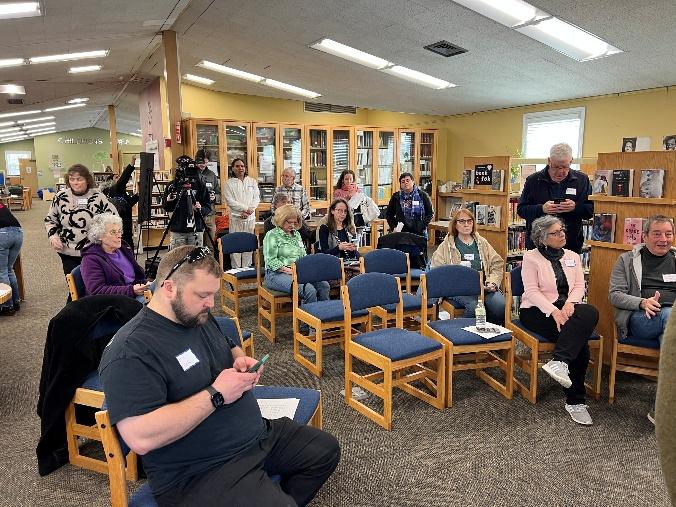
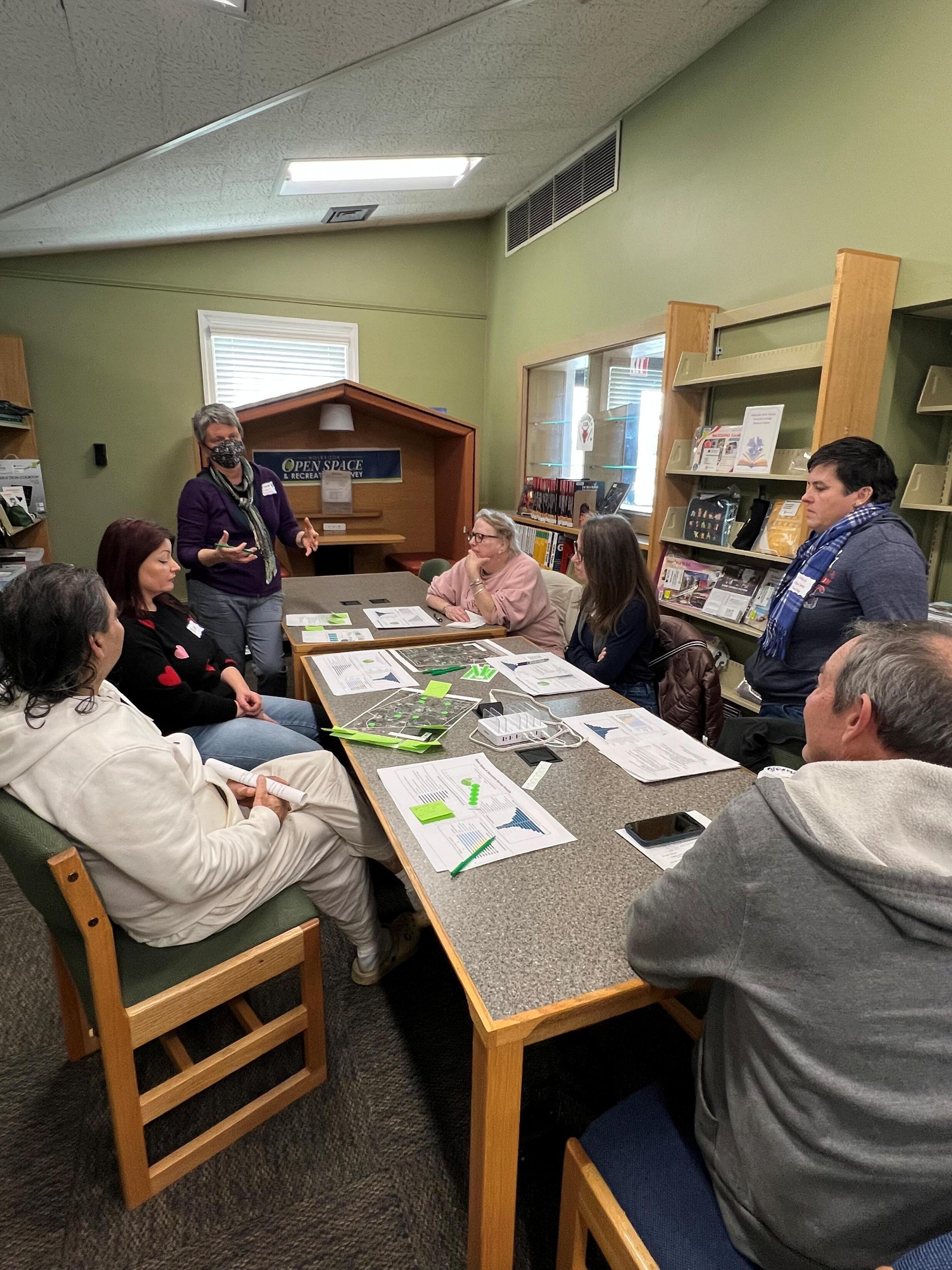
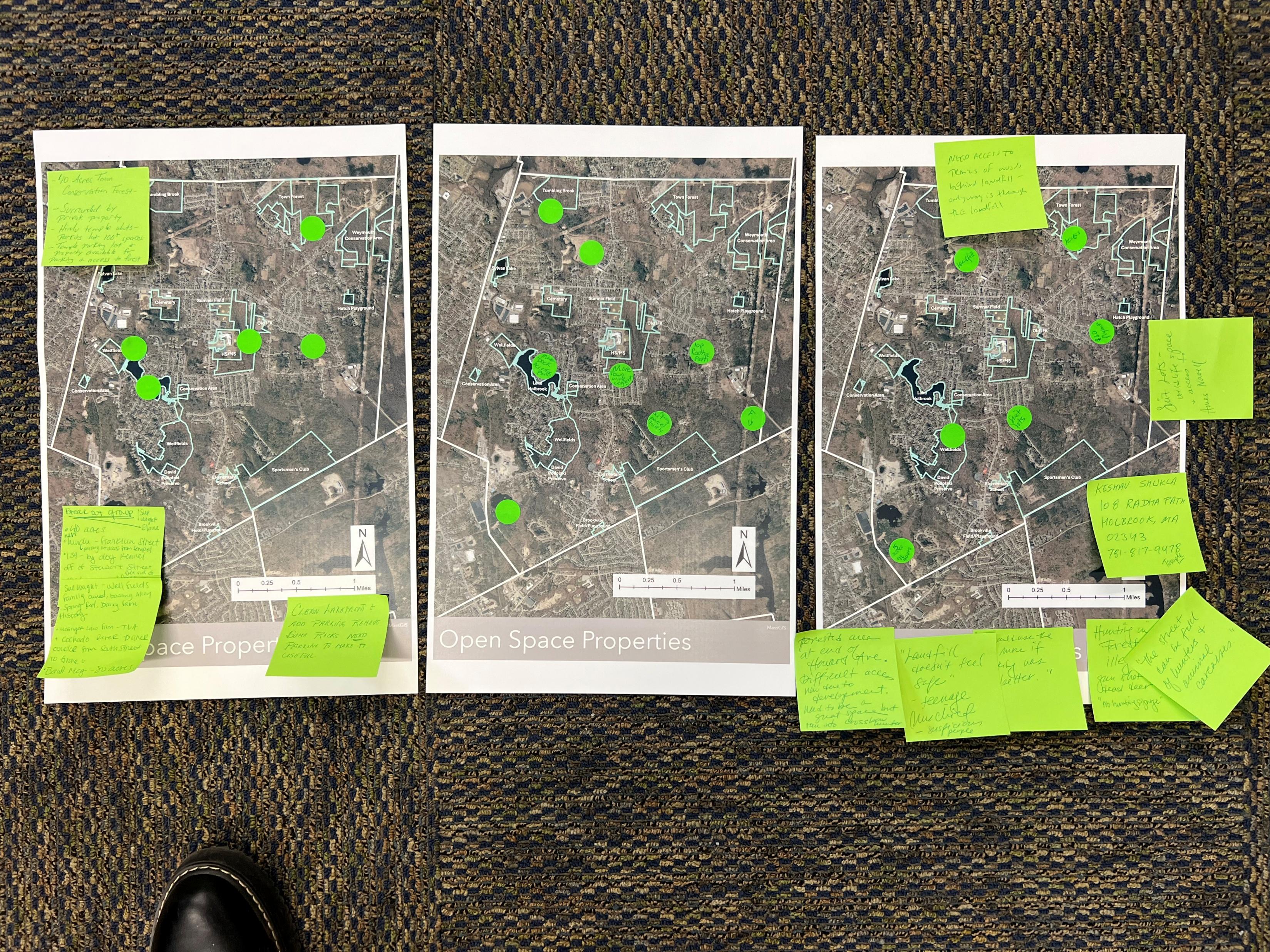
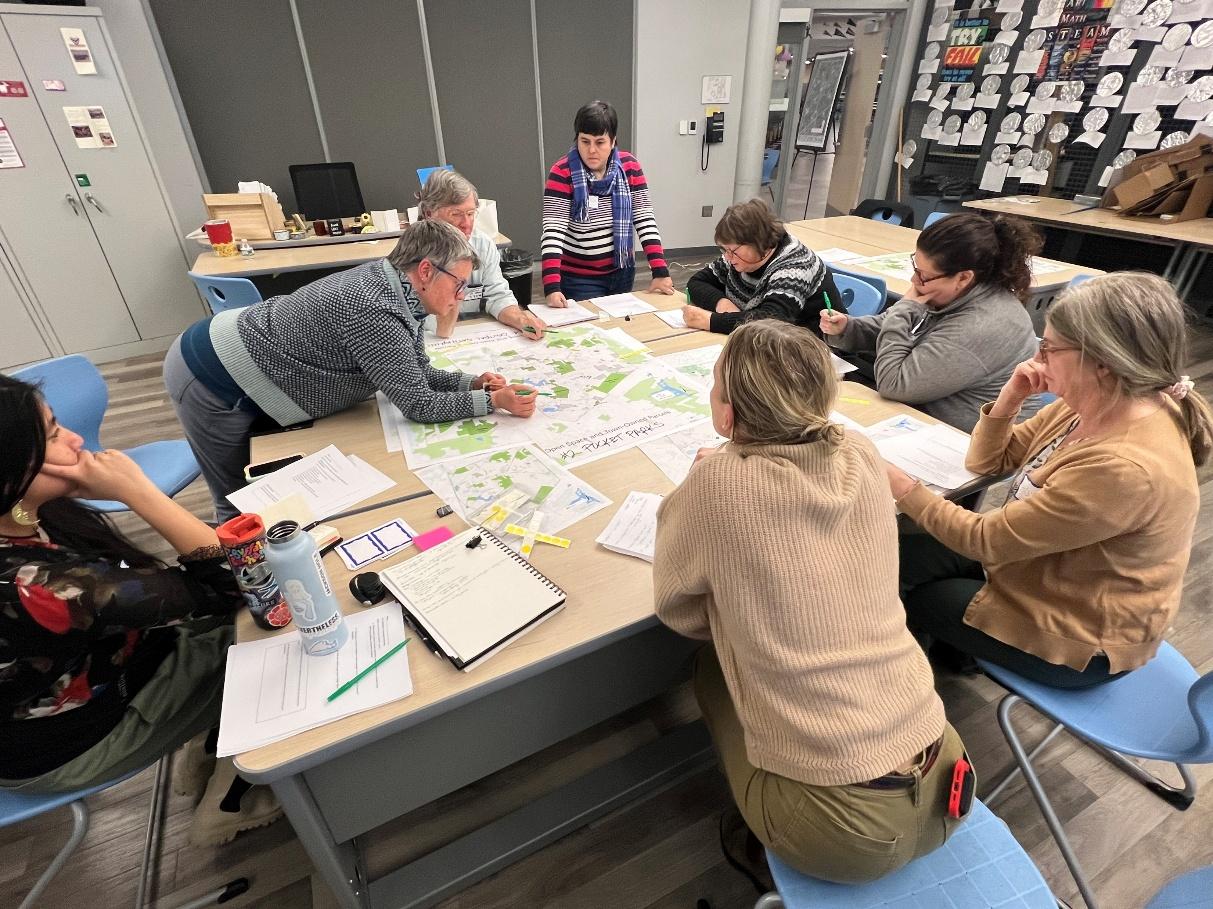
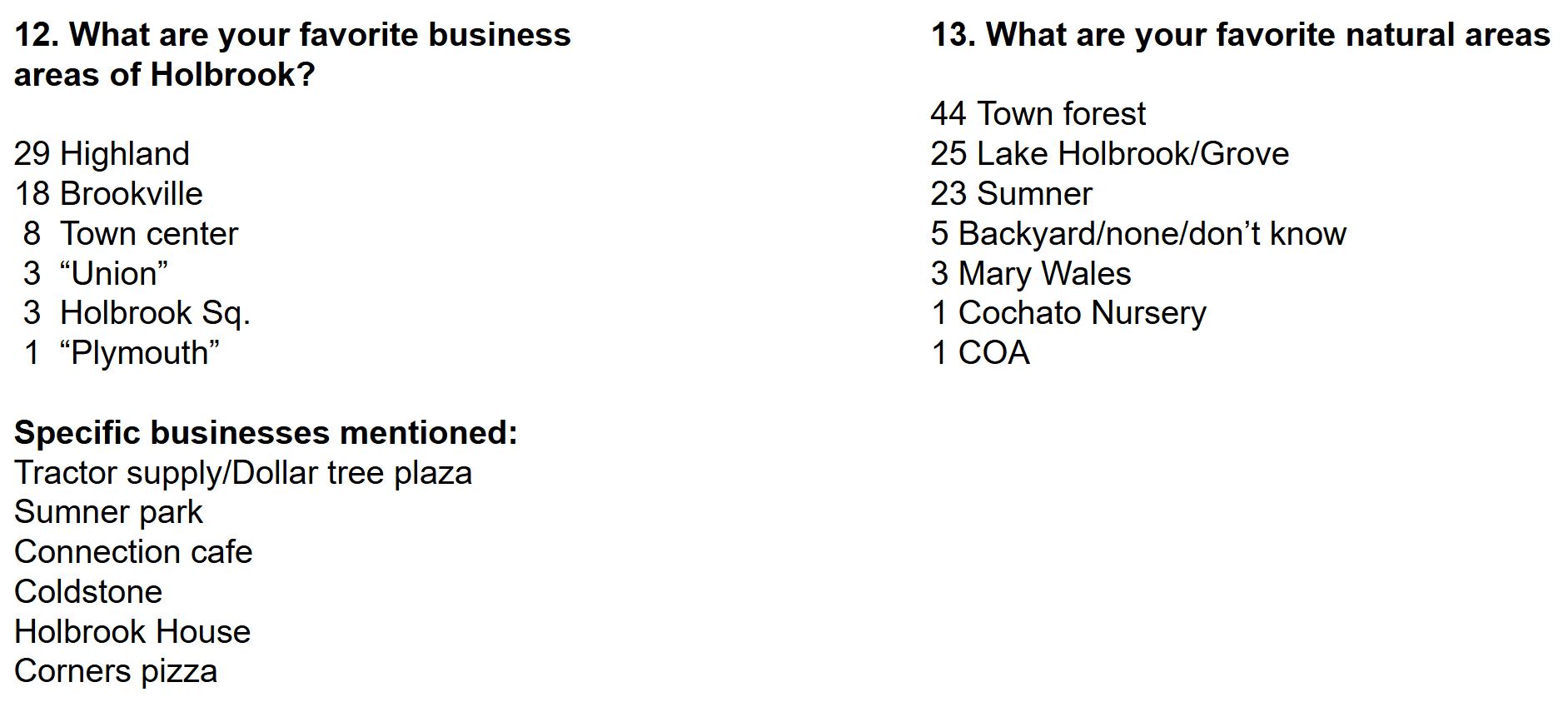
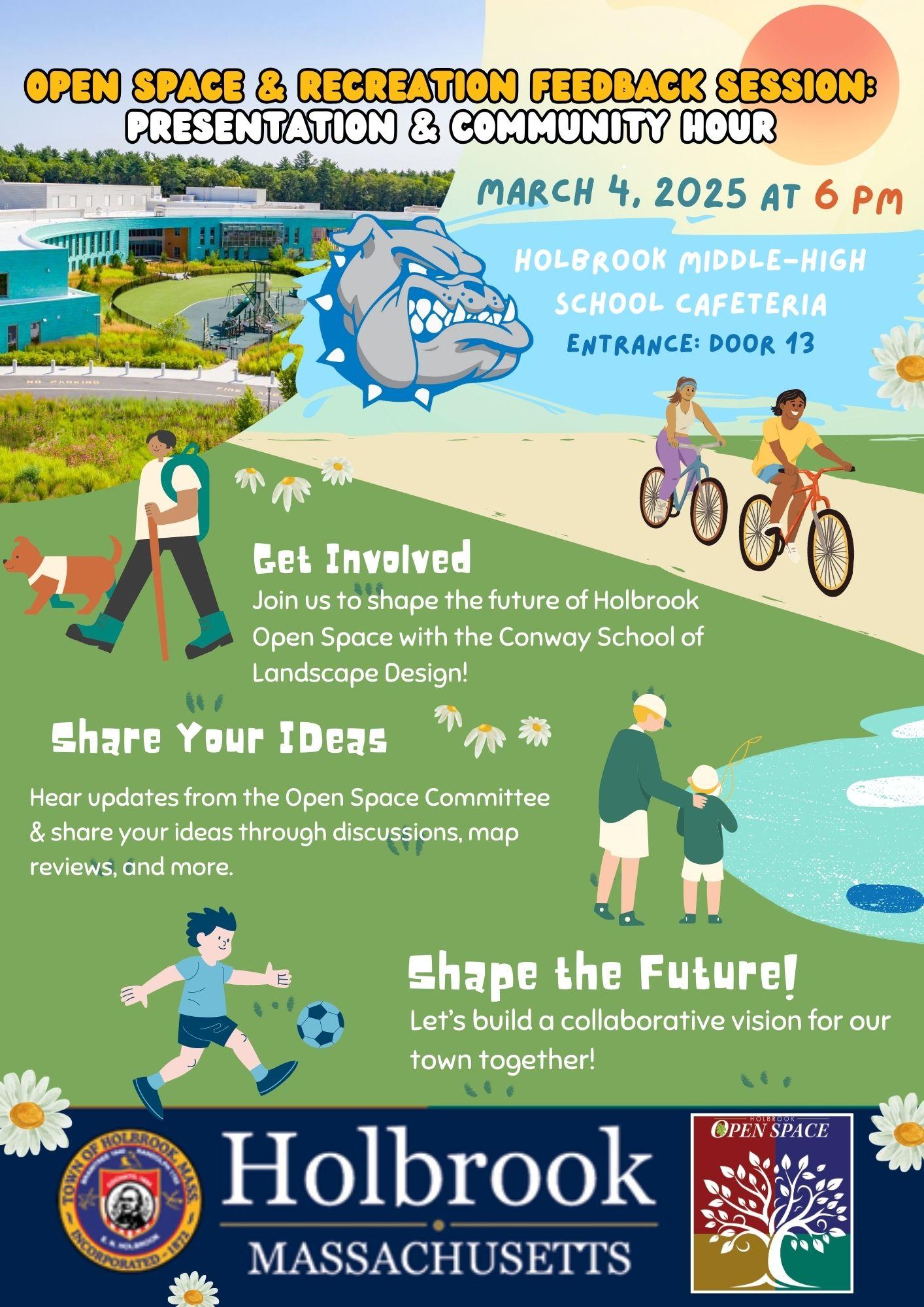
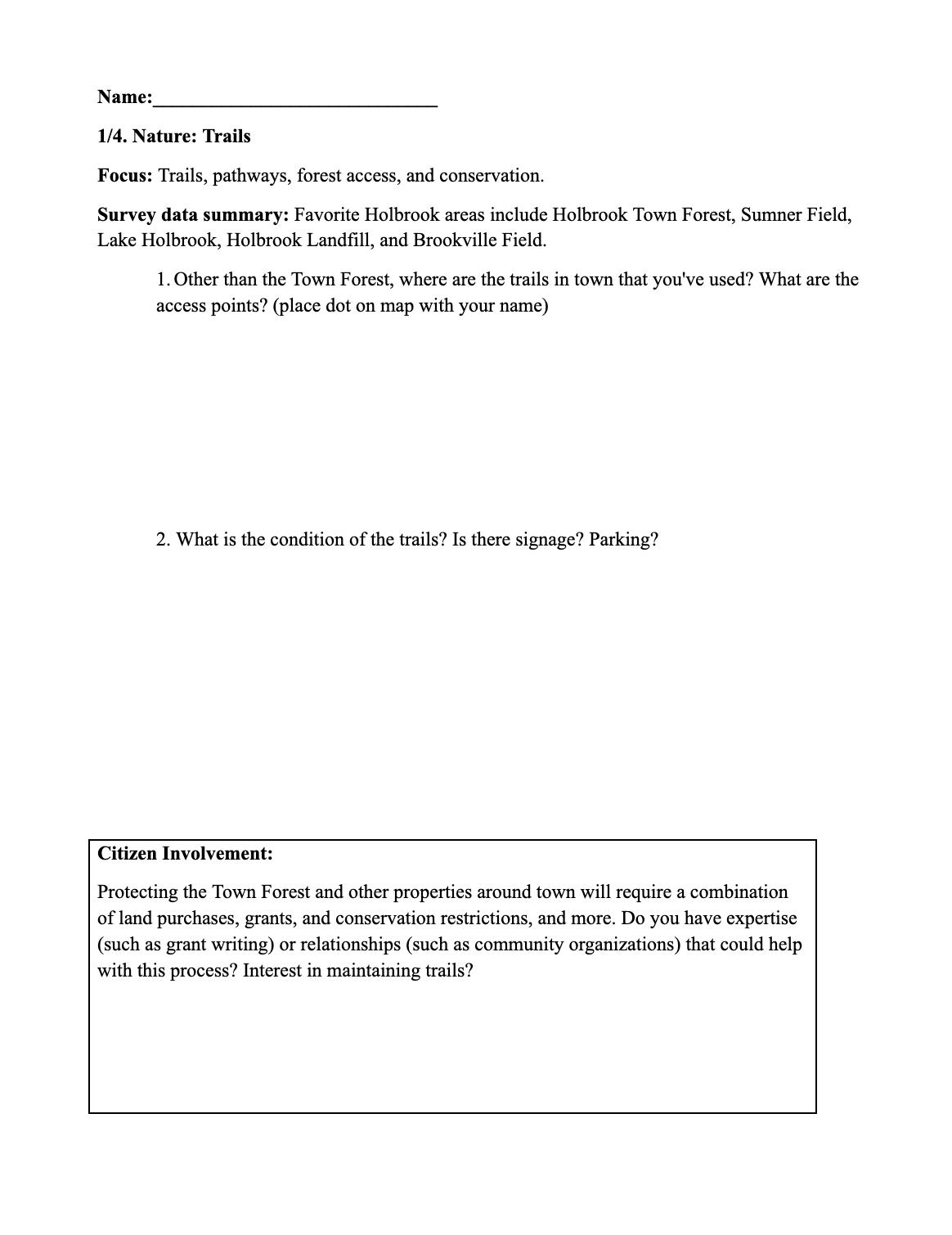
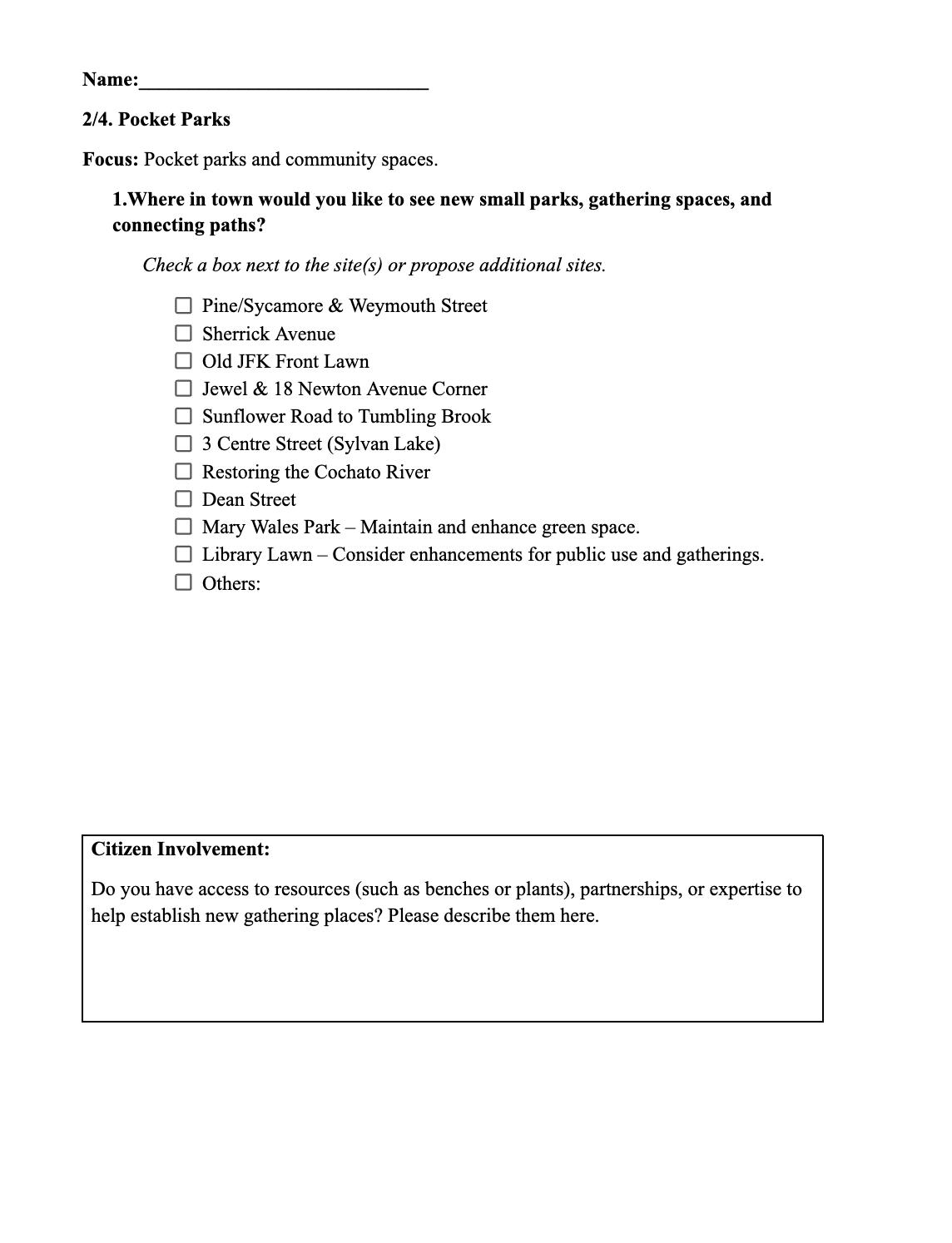
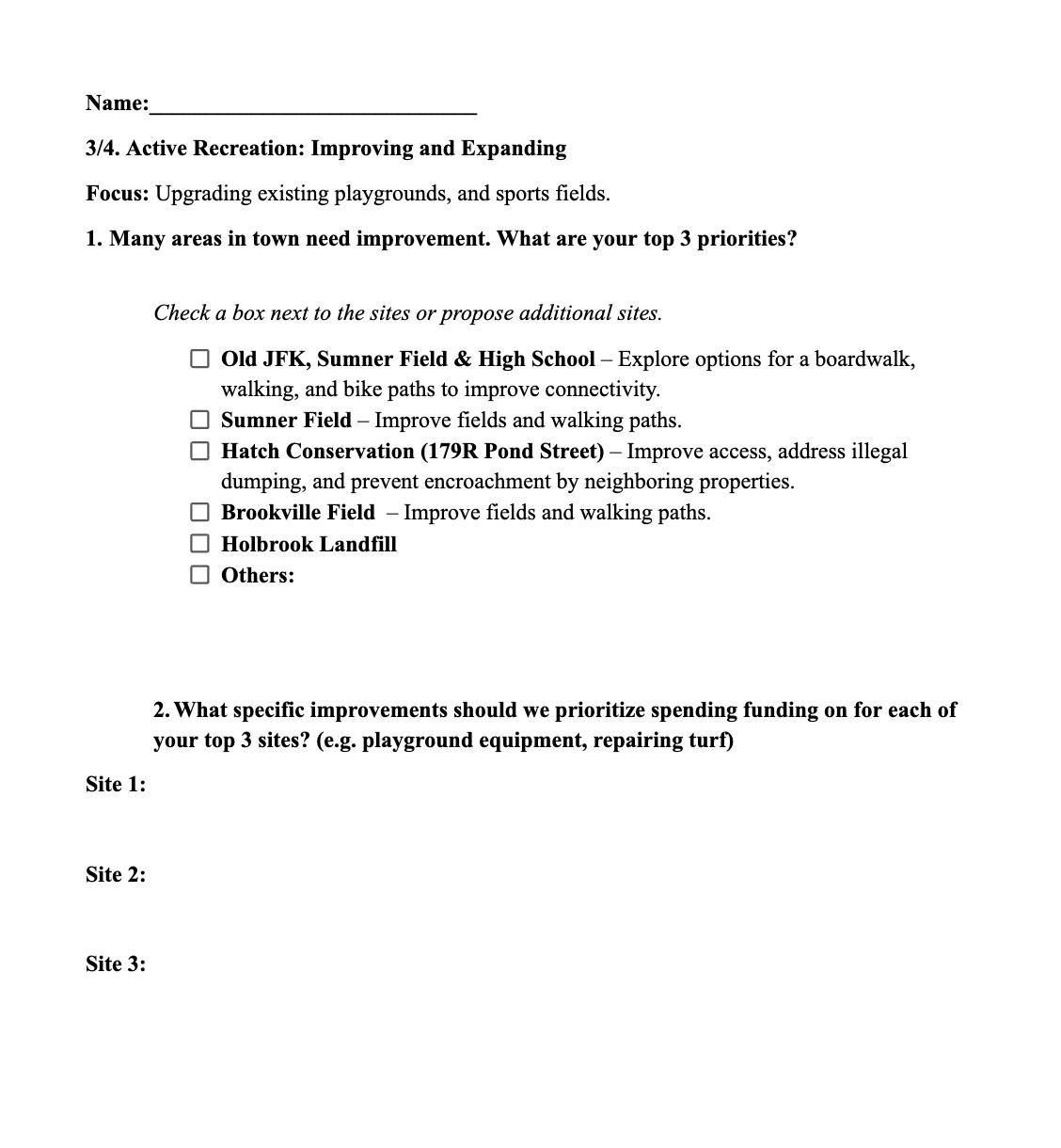
Building on the Vision Plan, the Open Space Committee (OSC) conducted a town-wide survey in the fall of 2024, gathering community input specifically on open space and recreation. In January 2025, Conway students began collaborating with the OSC to further engage residents in the planning process. Together, they organized and facilitated two community engagement events, held at the Holbrook Public Library and the JFK School. Both community engagement events locations are in the Town’s environmental justice communities. Both events used
visual tools and interactive mapping exercises These events were promoted through flyers, library newsletter, social media (Facebook and Instagram), and word-of-mouth.
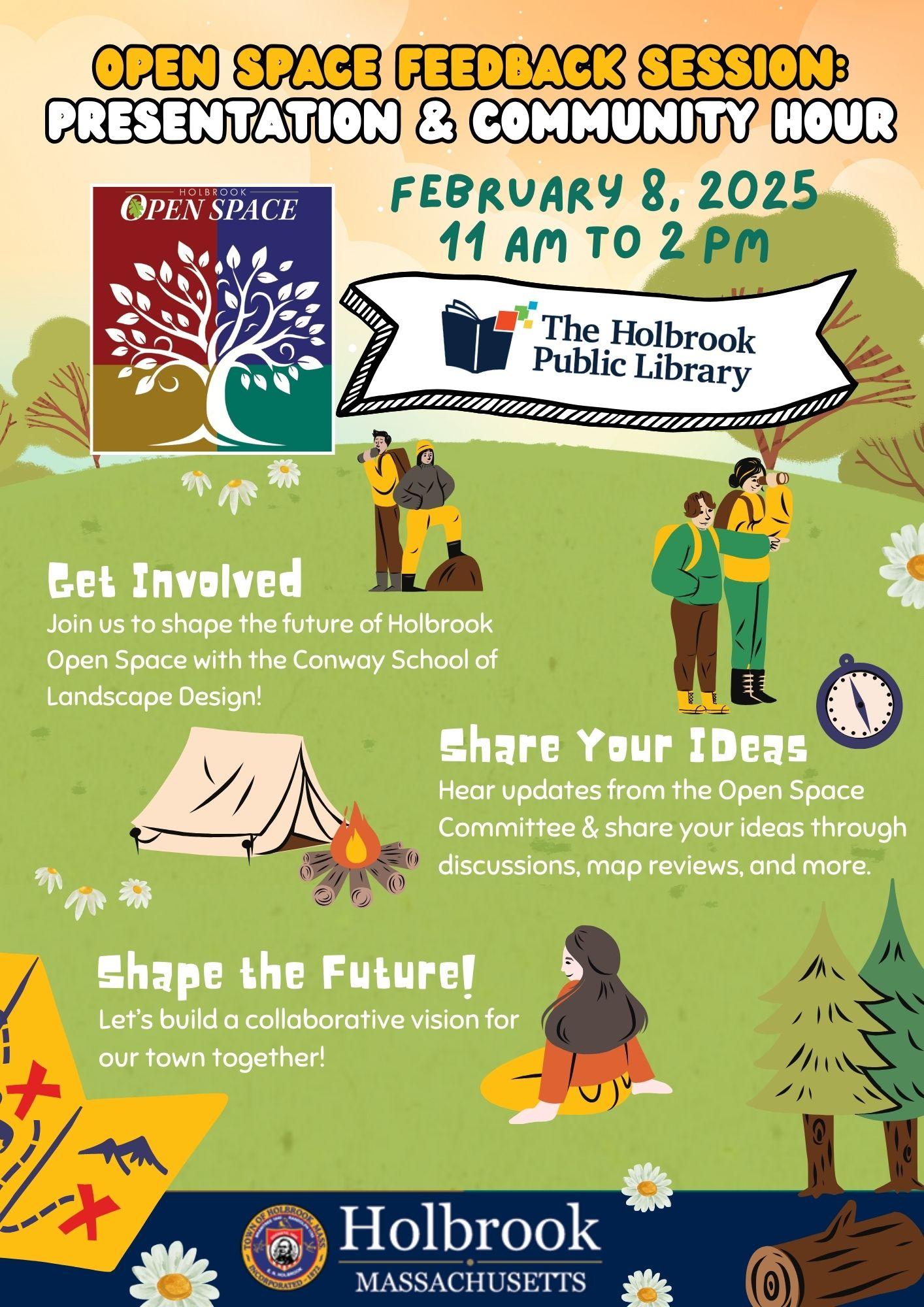
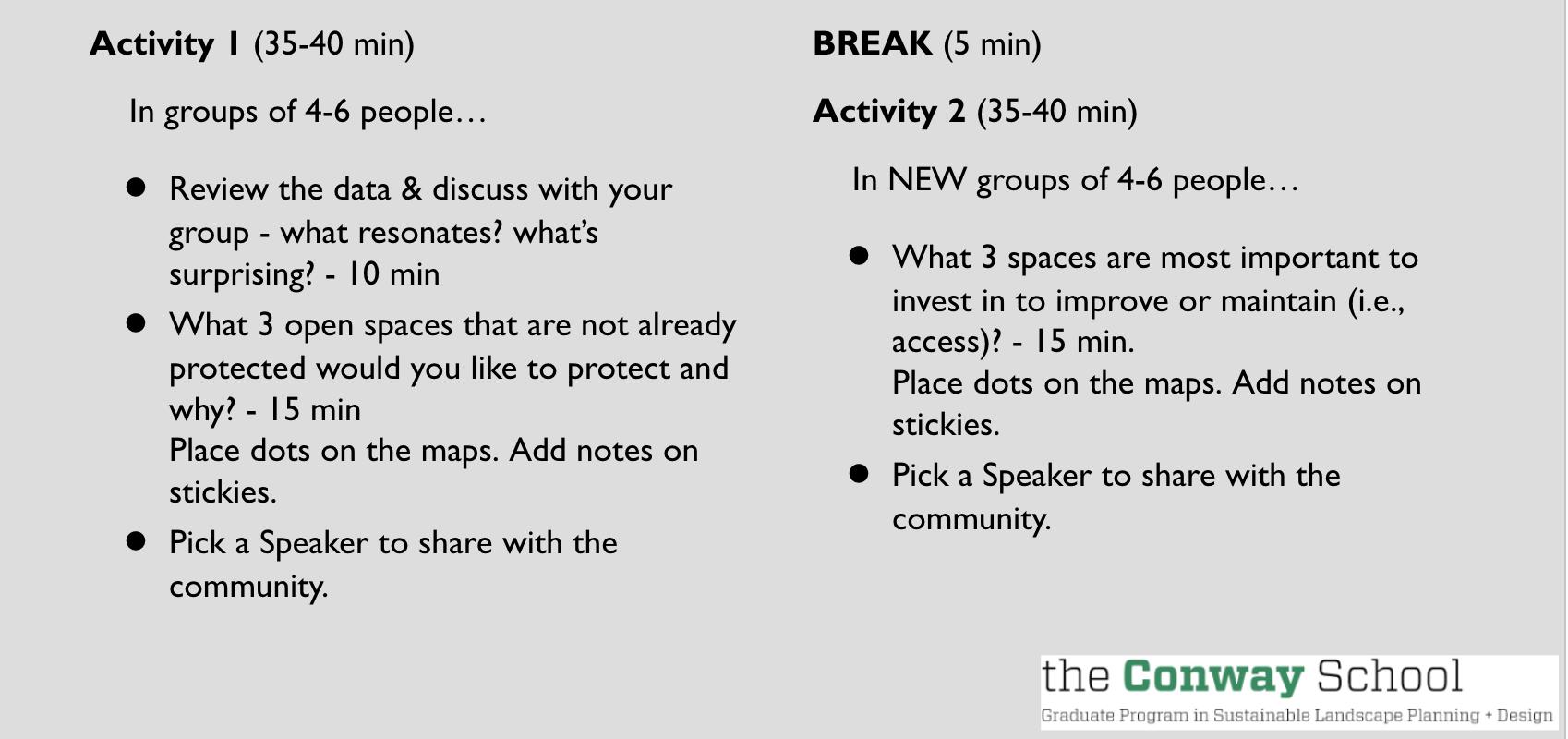
The first event, held on February 8, 2025, brought together 25 residents who shared their perspectives on the town’s open spaces and recreational areas. Discussions centered on improvements, concerns, interests, and long-term visions for the community’s open spaces.
At the second event, held on March 4, 2025, around 10 community members participated in a deeper analysis of the town’s recreational facilities. This session focused on exploring different vision scenarios and comparing the benefits of a dispersed network of recreational spaces versus a centralized community center.
With support from the Open Space Committee, and Conway School faculty and staff, and insights gathered from stakeholder interviews, Conway School students conducted the research and writing for this draft plan.
The public input process for this update was led by the Conway School students and the Holbrook Open Space Committee. The Conway School students and the Holbrook Core Team reflected on aspects of the 2000 OSRP plan that were not implemented to identify how best to set goals and objectives for conservation and development of the town moving forward. Through this process, areas and topics that were outside the scope of an OSRP came to light. To address the greater scope of these topics and issues, creating a comprehensive plan would serve the community well (the last master plan is from 2005). The planning and public input process is described further in Section 6.
“Planning allows you to confront and manage many aspects of the community’s growth and development in a way that preserves, protects and enhances the environment.”
Open Space Handbook
MA Department of Conservation & Recreation
Community Setting
Section 3: Community Setting
A. REGIONAL CONTEXT
Physical Location and Characteristics
The Town of Holbrook is in Norfolk County. It is a suburban community of 7.4 square miles (4,736 acres). Holbrook is adjacent to the towns of Braintree, Randolph, Avon, Weymouth, and Abington and the city of Brockton. Located sixteen miles southeast of Boston, Holbrook is largely a residential community with residents leaving town for work and amenities. Holbrook is a member community of Metropolitan Area Planning Council (MAPC), specifically the South Shore Coalition (SSC), a 13-community regional subgroup (Braintree, Cohasset, Duxbury, Hanover, Hingham, Holbrook, Hull, Marshfield, Norwell, Pembroke, Rockland, Scituate, and Weymouth).
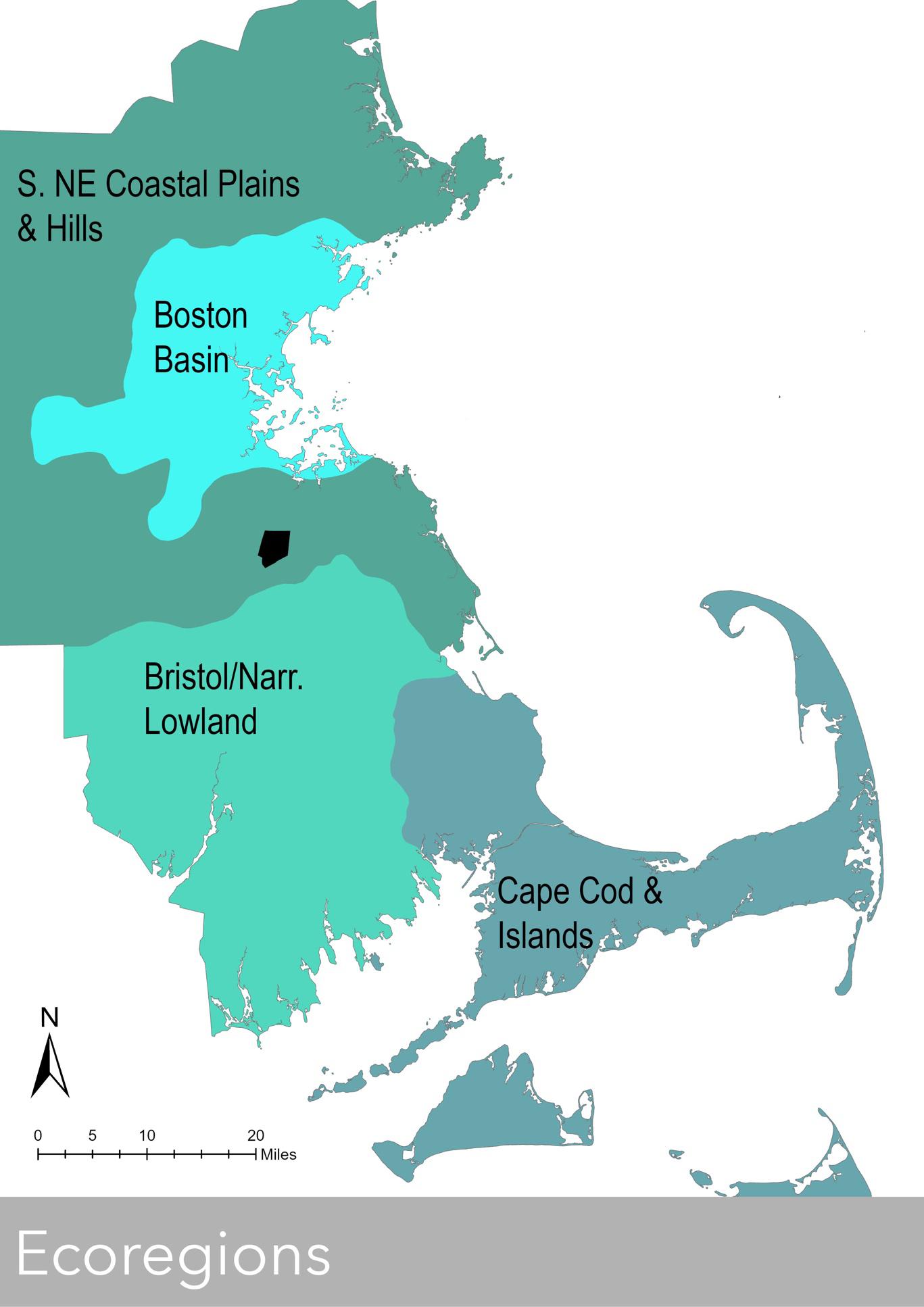
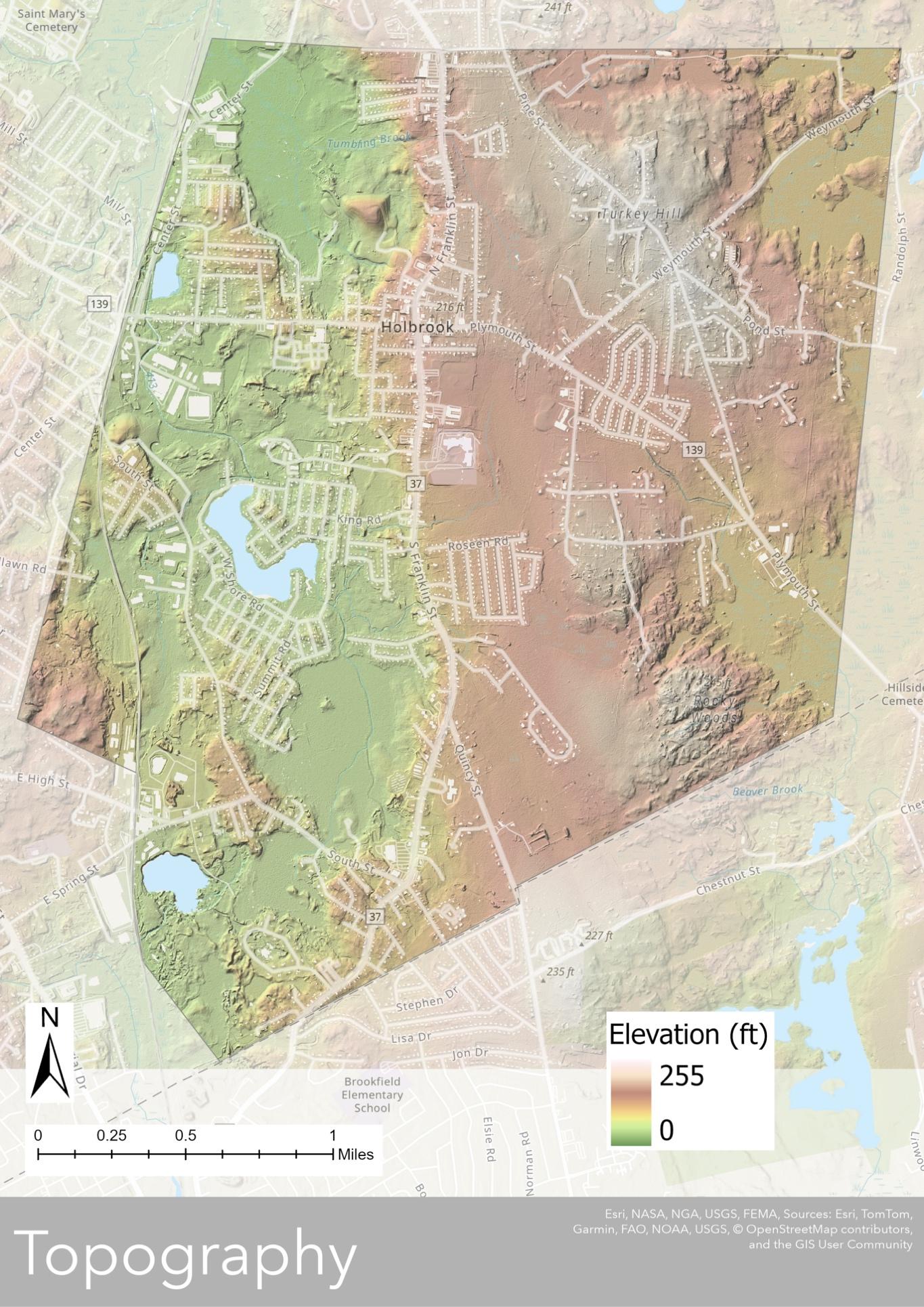
Holbrook’s physical landscape is shaped by its location within the Southern New England Coastal Plains and Hills Ecoregion, characterized by gently rolling terrain, glacial deposits, and a mix of upland and lowland areas (Map 3.1) Elevations range from 255 feet above sea level at Turkey Hill to approximately 100 feet around Lake Holbrook and Tumbling Brook (Map 3.2). The town’s topography, along with its history of glaciation, has led to a mix of sandy soils, wetlands, and rocky outcrops. These features influence land use and development, as low-lying areas with poor drainage and wetlands limit buildable space, while higher elevation areas with well-draining soils favor development. Additionally, the presence of wetlands and flood-prone areas requires careful planning to balance growth with environmental conservation and stormwater management.
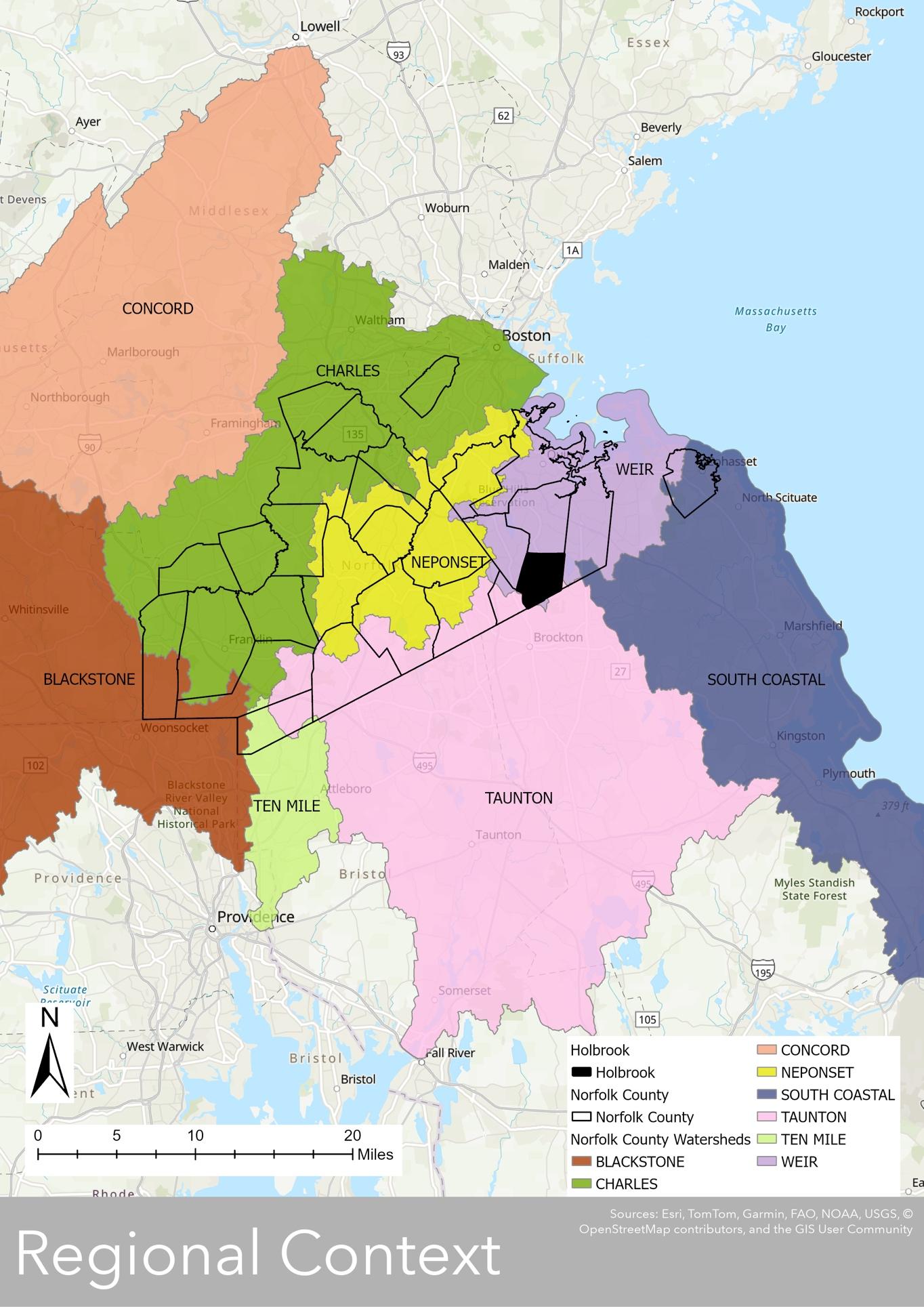
Holbrook falls within two watersheds, the Taunton and Weir River. The Taunton River watershed drains into Narragansett Bay, extending northward into town from the southern borders with Avon, Brockton, and Abington. Much of the town lies within the Weir River watershed and drains northward to Boston Harbor via the Cochato River and other smaller brooks (Map 3.3).
Regional Connectivity and Transportation
Holbrook is a mixed residential, industrial, and commercial community with a population of 11,320 (ACS 2023 5-year). Holbrook is a bedroom community, meaning many of its residents leave the town and commute into the city for work (most employment opportunities exist outside of Holbrook). Holbrook's proximity to urban areas makes it a desirable commuter community; both Boston and Providence are less than an hour away by car. Being a suburb outside of the Boston area, Holbrook’s development takes the form of primarily single-family dwellings. State highways include Route 37 running north to south through town, and Route 139 running east to west. These secondary roads (primarily two-lane roads) provide easy access to I-93, I-95, and I-90, located north and west of Town allowing for convenient access to Boston and the rest of the Northeast.
In 2022, 69.3% of workers in Holbrook drove alone to work, followed by folks who worked at home (13.3%) and those who used public transit to get to work (10.3%) (ACS 5-year Estimate).
The Holbrook/Randolph MBTA commuter rail stop on the Middleborough/Lakeville Line offers residents an easy, traffic-free route into Braintree, Quincy, and Boston. Additionally, public bus services are available from the Massachusetts Bay Transportation Authority (MBTA). The 230 Bus route operates in town and runs north to south along Route 37. The 230 Bus serves as a connector for Montello Station and Quincy Center Station, both train stations on the MBTA Commuter Rail. This route includes stops in Holbrook's town center, providing residents with direct access to both stations. The MBTA's bus route 238 operates between Quincy Center and the Holbrook/Randolph station.
Open Space Planning in Neighboring Communities
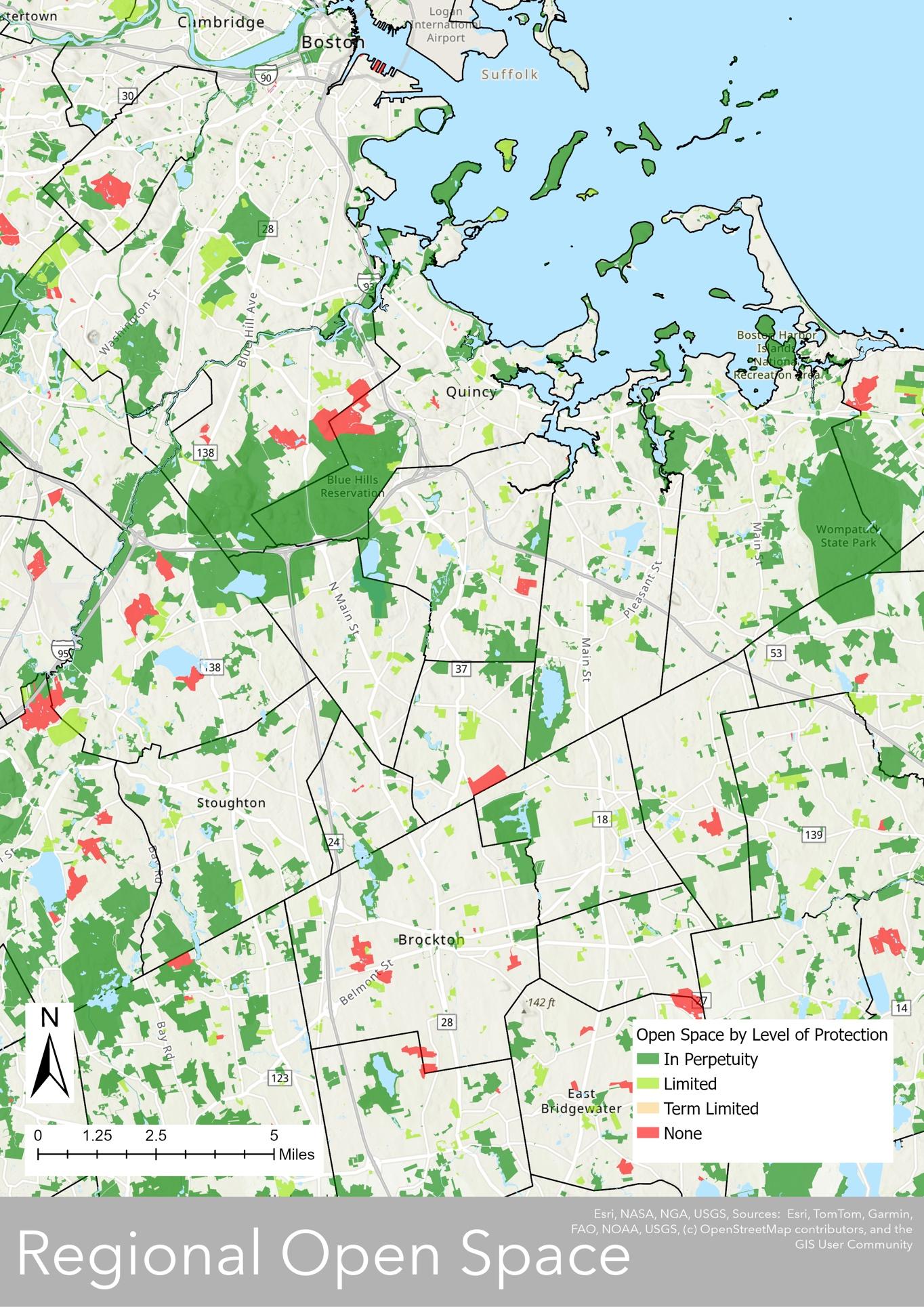
Planning for open space and recreation requires looking beyond the community in focus and considering the neighboring communities for a larger regional context (Map 3.4). The Open Space and Recreation Plans of the adjacent communities were reviewed for their relevance to open space in Holbrook. The status of these plans is as follows:
• Abington: In the process of updating spring 2025
• Avon: OSRP updated June 2022
• Braintree: OSRP updated 2018
• Brockton: OSRP updated 2022
• Randolph: OSRP updated 2015
• Weymouth: OSRP updated April 2020
Highlights of Regional Open Space and Recreation Resources
Cranberry Pond Conservation Land, Braintree:
The Cranberry Pond Conservation area is 140-acre property on the Braintree-Holbrook border. A trail connects the Cranberry Pond conservation area to the Holbrook Town Forest. This area has unique ecological features such as quaking sphagnum bogs, Atlantic white cedar swamps, Cranberry Brook, and Cranberry Pond (and carnivorous plant species including the sundew and the pitcher plant). The Cranberry Pond Conservation area lies within the Cranberry Brook ACEC (state-designated Area of Critical Environmental Concern) and includes approximately 1,050 acres of land associated with the Cranberry Brook Watershed.
Great Pond, Weymouth:
Great Pond is the public water supply source for the town of Weymouth and located just east of Holbrook’s eastern border. Due to the pond’s status as a source of public drinking water, active recreation is not permitted on the lake (no boating, swimming, or fishing). However, trails were recently added connecting Gifford Playground and Negus Park, providing an opportunity for passive recreational use.
Ames Nowell State Park, Abington:
Ames Nowell State Park is a 700-acre park located in Abington along the Brockton line and just south of Holbrook. Paved and unpaved walking trails wind through forest and wetlands. The park contains a man-made Cleveland Pond, which drains to Beaver Brook and provides opportunities for boating, and fishing. There is an opportunity for a connected greenbelt extending from the Cranberry Pond conservation area, through Holbrook along the high -tension power lines bordering Great Pond, all the way down to Ames Nowell State Park.
Blue Hills Reservation, Milton:
Covering over 7,000 acres across Milton, Quincy, Dedham, and Randolph, Blue Hills Reservation provides extensive outdoor recreational opportunities for the larger Boston suburbs and is operated by the Massachusetts Department of Conservation and Recreation (DCR). Great Blue Hill is one of the highest features in eastern Massachusetts. Blue Hills also has the Chickatawbut and Eliot Observation Towers and Blue Hill Meteorological Observatory. Blue Hills is a popular destination for hiking, horse trails, and wildlife observations. Blue Hills Reservation is approximately 15 minutes away by car.
D.W Field Park, Brockton:
D.W Field Park is a 737-acre park that connects Avon and Brockton through a parkway winding around the Brockton Reservoir and other ponds. D.W Park is great for walking, running, fishing, and bicycling. D.W. Field Golf Course is also a popular attraction for golfers.
Claire Saltonstall Bikeway:
Also known as the Boston to Cape Cod Bikeway, this 135-mile route is designated as Bike Route 1. It starts on the Charles River Bike Path in Boston, continuing along backroads, bike paths, and secondary roadways to the Cape, winding all the way to Provincetown, Massachusetts. A section of the bikeway passes through Holbrook via South Street and Linwood Street. Although the bikeway is not a dedicated open space resource in Holbrook, it brings cyclists through the town.
Wompatuck State Park:
Located in Hingham this park spans 3,526 acres of forests, streams, and ponds, offering a mix of open space and recreational opportunities. Visitors can enjoy hiking, biking, camping, and fishing, while exploring its history and wildlife. Wompatuck State Park is approximately 25 minutes away by car.
B. HISTORY OF THE COMMUNITY
Holbrook’s history is deeply connected to its land and industries, with the Massachusett people inhabiting the area now known as Holbrook for thousands of years. The Massachusetts tribe used and were connected to these lands by hunting, fishing, working quarries and planting fields of grains, corn, squash and beans, across a territory stretching from Salem to Plymouth. Just beyond Holbrook’s border, The Great Pond area is steeped in archaeological heritage, with artifacts such as a mishoon (dugout canoe) and projectile points discovered there, some of which are displayed at the Holbrook Historical Society. Turtle Rock, located on the Boundary Trail in Holbrook’s Town Forest, is believed to be a totem rock for the Massachusett people (Baker, 2018).
During the 17th century, the landscape of Holbrook and surrounding areas was deeply affected by colonial expansion and Native displacement. Despite the challenges of disease, resource depletion, and shifting alliances, Native groups maintained control of land south of Boston and Rhode Island for much of the 1600s. However, pressures from fur trade collapse, contested colonial boundaries, and English settlement ultimately forced the Massachusett people from their lands. After Kutchamakin’s death in 1654, his nephew Wompatuck was compelled to sell coastal lands including present-day Quincy, Braintree, Holbrook, and Randolph and relocate the group to Ponkapoag. A marker on Churchill’s Lane in Milton commemorates this forced migration along the “Indian Trail.” The King Philip’s War (1675–1676) further disenfranchised the local Native American community, forcing many into displacement some west of the Mississippi and others even overseas through enslavement (Neal, 2023; Jarzombek 2021).
Early colonial settlers in the area initially used the land as an agricultural community. Holbrook’s first industries included a gristmill and sawmill on the Cochato River, followed by blacksmith shops, taverns, and wheelwright shops. The area that is now the Town Forest was used for “bog iron,” a type of iron ore that forms from iron deposits in bogs or swamps. Early settlers continued to clear land and extract resources, creating a landscape with dispersed farms and small industrial areas. John French built the first recorded house in 1712 at what is now 240 Center Street. He operated a forge and gristmills. As more settlers arrived, the town’s early cart paths evolved into public roads, linking homes, farms, and industrial sites to the town centers (Center Street was constructed in 1724, followed by North Franklin Street, Plymouth Street, Union Street, and South Street in 1764). The town's first school was built in 1750, and Union Cemetery was established in 1754. The topography, waterways, and soils influenced early settlement patterns. The town’s rolling topography, combined with the presence of waterways like the Cochato River, influenced the placement of early mills and industrial sites, while the fertile but rocky soils dictated the locations of farms and pastures. Settlers concentrated along well-drained areas and near water sources, using the natural landscape to support agriculture, milling, and iron extraction.
By the 19th century, technological advances and industrial expansion accelerated settlement. The shoe industry became Holbrook’s dominant industry. Holbrook was also home to the nation’s first commercial machine-stitched boots. Captain Ezra Thayer pioneered the production of leather shoelaces. These industries were located along Center Street, North Franklin Street, Plymouth Street, Union Street, and South Street, which had evolved from early cart paths into public roads connecting homes, farms, and industrial sites to town centers.
Holbrook’s growth accelerated with the arrival of the Old Colony Railway in 1846, which became the dividing line between Holbrook and Randolph in 1872. The Civil War brought development as local businesses received government contracts for boots and shoes, expanding and modernizing production.
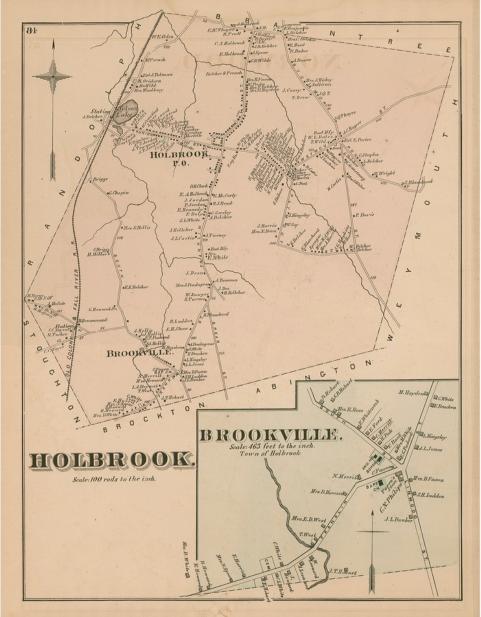
Until 1872, Holbrook was part of Randolph and known as East Randolph. On February 29, 1872 (Leap Year Day) Holbrook officially became a town. Map 3.5 shows a depiction of Holbrook in 1876.
The shoe manufacturing industry in Holbrook began to decline in the mid-20th century, particularly after World War II. As manufacturing shifted to other regions and countries with lower labor costs, Holbrook's shoe industry gradually faded. By the 1970s and 1980s, most of the local shoe factories had closed or transitioned to other industries.
From 1912 to 1983, Baird & McGuire operated a chemical mixing facility in Holbrook, producing products such as pesticides and solvents. In 1982, the EPA designated the site as a Superfund site due to hazardous waste disposal practices, which included direct discharge into soil and nearby water sources. Located near the Cochato River and a former municipal water supply well-field, the site posed significant environmental risks. Extensive remediation efforts followed, including the demolition of most structures, capping of contaminated areas, incineration of contaminated soil, and implementation of groundwater containment measures. The nearby well fields, located within 1,500 feet of
the site, were shut down in 1982, marking a significant environmental and public health concern in the town’s history There are ongoing remediation and continual five-year reviews of the site (EPA, Baird & McGuire Superfund Site Cleanup).
Holbrook transitioned from its historical roots in farming and shoe manufacturing to a predominantly residential community, with a small commercial corridor along its main roads. The post -war era saw a housing boom, with many residents commuting to jobs in the Greater Boston area, while local employment shifted towards service industries. Like many communities outside of Boston, Holbrook faces increasing development pressures. However, unlike other communities Holbrook has a landscape rich in forest and wetlands and will have to balance growth with the need to protect its natural resources.
C. POPULATION CHARACTERISTICS
Population Trends
Holbrook’s current population is 11,320 (ACS 2023 5-year). Between 1980 and 2020 Holbrook experienced some fluctuation in its population, however generally speaking the town has a stable population (Table 3.1). There was a period of population decline from 1980 to 2000, followed by stabilization in the 2000s, and a notable increase from 2010 leading up to 2020. Since 2020 the population has decreased slightly with a percent change of -0.7% (2020 11,405 vs 2023 11,320). Compared to the surrounding municipalities, Holbrook has experienced less population growth. Abington, Braintree, and Randolph show consistent population growth Avon had minor fluctuations but saw an increase in 2020. Brockton experienced a decline from 1980 to 2010 but saw a significant rise in 2020.
Table 3.1 Holbrook and Surrounding Town’s Populations
Source: U.S. Census data from 1980, 1990, 2000, 2010, and 2020 Age
Holbrook’s population, like much of the Commonwealth, is aging and will likely continue to do so. The median age of residents in town is 42.8, 10% higher than the Boston-Cambridge-Newton metropolitan area (ACS 2023 5-year). Holbrook’s population of residents 65 and older makes up 18% of the total population (Table 3.2). (Census profile: Holbrook, MA)
Table 3.3 shows age distribution from 2010 to 2020. The 0-14 age group saw a significant decline (-21.8%), indicating fewer young children in the population. The 15-19 age group had a dramatic increase (+85.1%), possibly due to inmigration. The 20-29 age group decreased sharply (-43.2%), suggesting young adults are leaving the area. The 65+ population grew (+29.9%), reflecting an aging community. Holbrook’s aging population trend will inform open space and recreation planning. Using American Community Survey data, 18.41% of the total population is under 18 (Table 3.2).
Table 3.2 Population of Holbrook by Age, 2023
Source: American Community Survey 2023 5-year estimates
Table 3.3 Age Distribution of Holbrook 2010 and 2020
Source: 2010 Census and 2020 Census
Race and Ethnicity
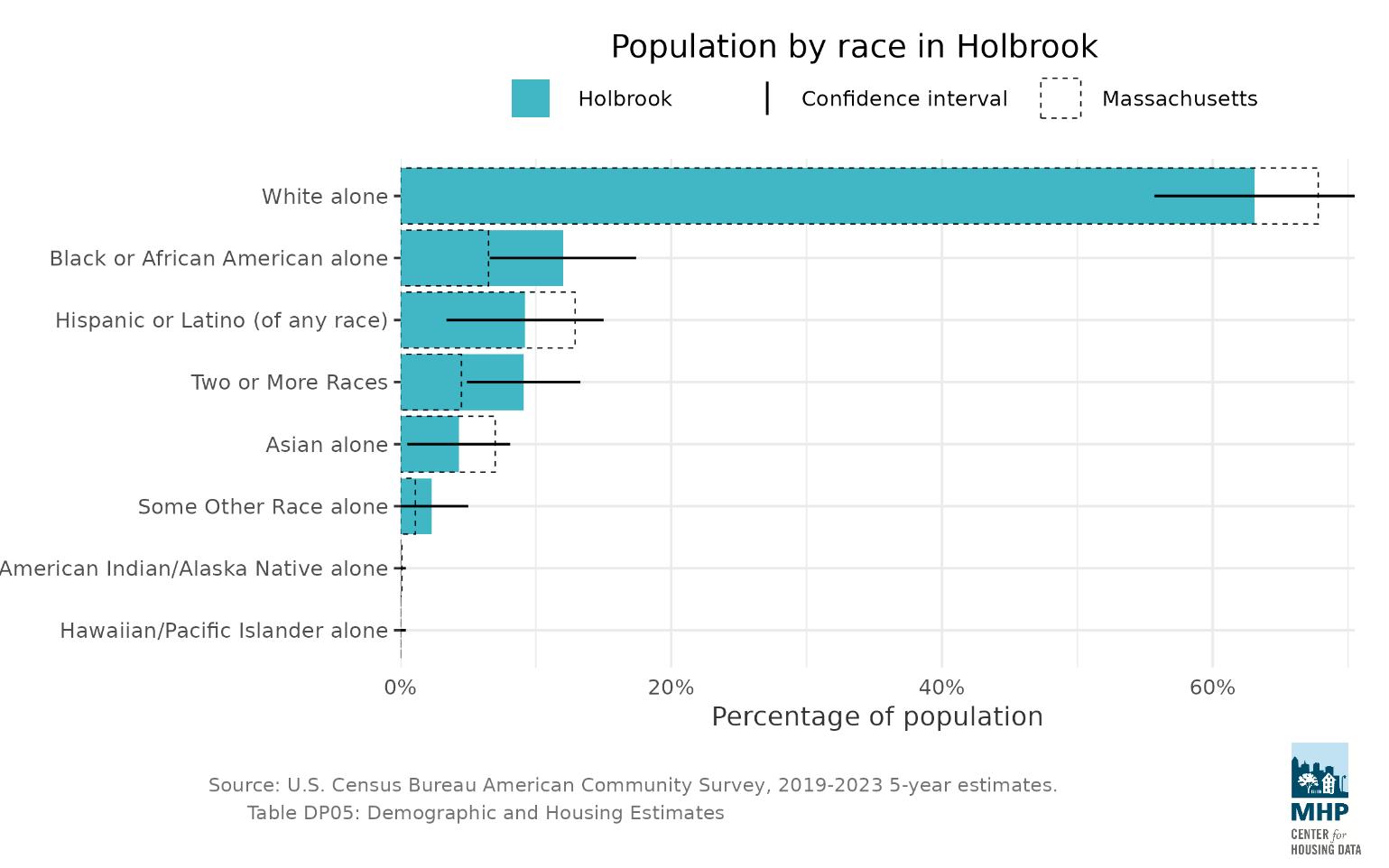
Much of the population of Holbrook is white (63%), followed by 12% Black, 4% Asian, 9% Hispanic, and 9% identifying as more than one race or ethnicity (Figure 3.1) (ACS 2023 5-year). According to 2010 Census data, in Massachusetts the diversity index (probability that two people chosen at random from population will be from different racial or ethnic groups, ranging from 0–no diversity to 100– complete diversity) was 40.4% and in Norfolk County the diversity index was 34.3%. In 2020 the State index rose to 51.6% and Norfolk County also rose to 47.8% (2010 Census and 2020 Census). In 2010, approximately 84.5% of Holbrook’s residents identified as White. The Black population accounted for 918 individuals, making up about 8.9% of the total. The Asian community consisted of
about 3.0% of the population. Additionally, 108 people, or approximately 1.0%, identified as belonging to another race, while 236 individuals, or 2.3%, reported being of two or more races (2010 US Census).
Figure 3.1 Population by Race in Holbrook
Household
Income and Employment
In 2023 the median family household income in Holbrook was $107,768 which is lower than the median household income for Norfolk County ($126,497) 6.60% of the population is living below the poverty line (747 out of 11,320). This is below the percentage for Norfolk County (7.70%) (Table 3.4).
Holbrook is generally not considered to be a large employment center. The town has a relatively small local economy, like most bedroom communities. Holbrook exports much of its workforce into other communities The top three employment sectors for those who live in Holbrook, MA, are Health Care & Social Assistance (22%), Finance & Insurance (11%), and Retail Trade (10%) (ACS 2023 5-year).
Table 3.5 highlights data on the labor force, employment and unemployment for Holbrook from 2010 to 2023. The data reveals a long-term decline in the unemployment rate from 2010 to 2023, with a significant spike in 2020 likely due to the COVID-19 pandemic. In 2010, unemployment stood at 8.9% and gradually decreased over the years, reaching a low of 3.3% in 2019. However, in 2020, unemployment surged to 10.9% possibly reflecting the widespread job losses caused by economic shutdowns. Following this peak, unemployment dropped to 6% in 2021, 4% in 2022, and stabilized at 3.6% in 2023. Despite these fluctuations, the labor force size has remained relatively stable, consistently ranging between 6,000 and 6,400 people. This suggests a steady working -age population, with employment levels seemingly rebounding after the pandemic. The data seems to suggest an overall positive trend, with the job market regaining pre-pandemic stability and unemployment rates returning to historically low levels.
Table 3.4 Per Capita Income, Median Household Income, and Percentage Below the Poverty Level for Holbrook and Norfolk County Geography
Source: American Community Survey 5-year estimates (2023), Census
Source: MA Department of Economic Research (DER)
Holbrook’s proximity to urban areas allows for most of its workforce to work outside of the town. Holbrook residents travel an average of 38.2 minutes to get to work. This is 1.3 times higher than the average in Massachusetts, 29.3 minutes (Holbrook Census Reporter). Additionally, 4.98% of Holbrook’s workforce are considered “super commuters” and travel more than 90 minutes to work (ACS 2023 5-year). The average car ownership in Holbrook is two cars per household.
Environmental Justice populations
Environmental justice is an analysis of demographic data that looks at features such as race, income, and ethnicity in relation to environmental factors such as air quality, water pollution, access to open space, or other environmental health related issues. People of color and people with limited income are more likely to live in areas with poor environmental quality toxic waste sites, high air pollution, and areas with poor water quality, lower quality housing, and less access to open space.
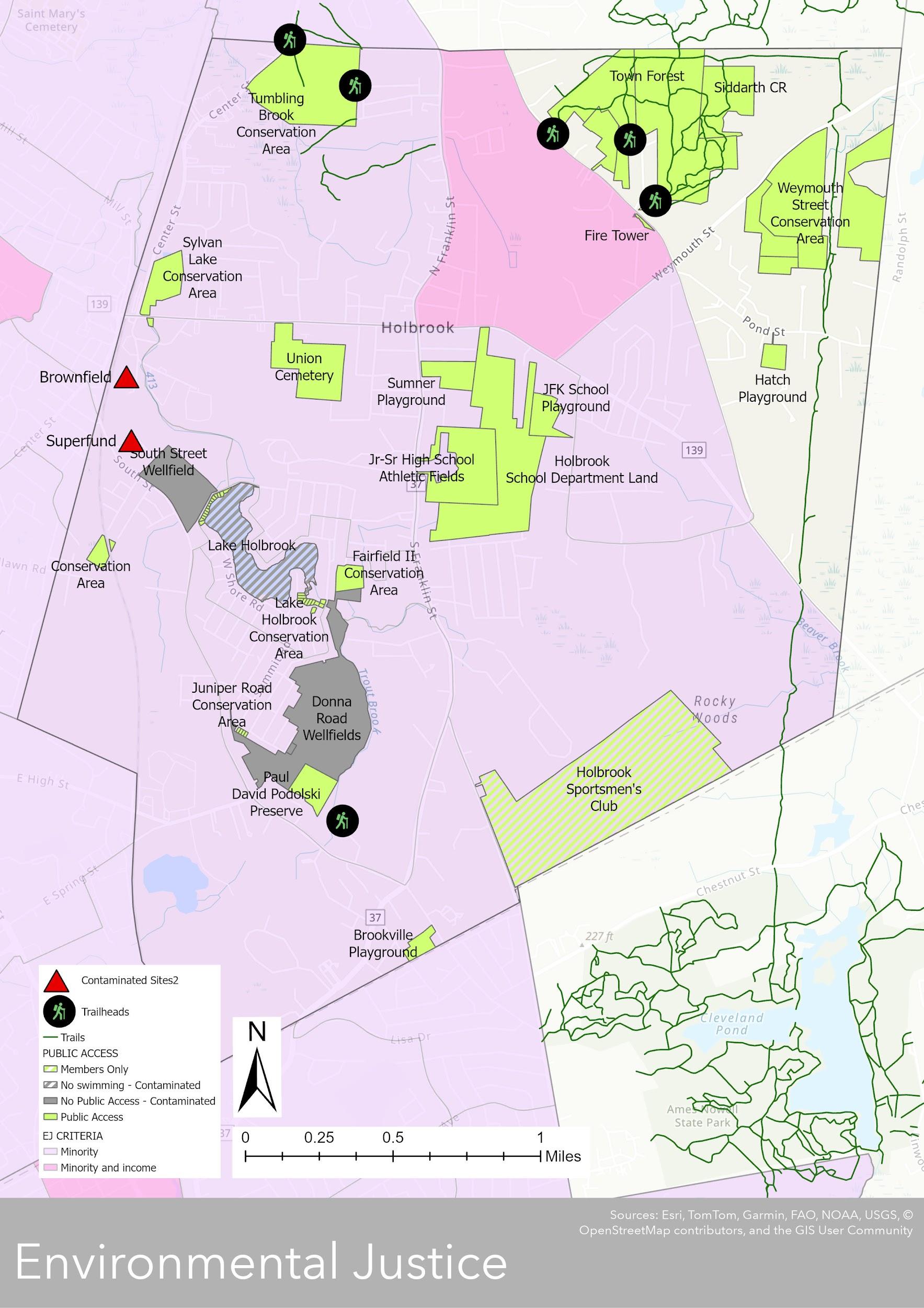
In Massachusetts, Environmental Justice (EJ) populations are identified as neighborhoods that meet one or more of the criteria: 1. the annual median household income is not more than 65% of the statewide annual median household income; 2. minorities comprise 40% or more of the population; 3. 25% or more of households do not have English language proficiency; or 4. minorities comprise 25% or more of the population and the annual median household income of the municipality in which the neighborhood is located does not exceed 150 % of the statewide annual median household income.
Using 2020 census data, eight out of nine census blocks in Holbrook are EJ populations (Map 3.6). The (purple) represents the populations that meet the criteria of 25% minority and median income is less than 150% of the statewide annual median income. The smaller area in (dark pink) shows the population where the annual median income is not more than 65% of the statewide annual income. English language isolation appears to be less of an issue. Opportunities to address open space and recreational needs in these areas are an important consideration of this plan and are discussed further in Section 5.
D. GROWTH AND DEVELOPMENT PATTERNS
Patterns and Trends
Holbrook’s development has followed common suburban trends outside of Boston, but it stands apart from neighboring towns due to its lower density, greater forest cover, and extensive wetlands. Holbrook is predominantly a residential community with a commercial corridor along its main roads. In the middle and late 20th century, residential development increased. The post-war era saw a housing boom, with many residents commuting to jobs in the Greater Boston area, while local employment shifted towards service industries.
However, Holbrook’s growth has been uniquely influenced by natural and infrastructural constraints. Limited capacity for on-site sewage disposal and access to municipal sewer and water infrastructure, as well as abundant wetlands and dense forest, likely slowed development over time. Holbrook’s commercial development is centered around the town center along Route 37 and Route 139. Lower density residential housing is common within the eastern portion of town and high to medium density residential is more typical around Lake Holbrook on the western side of town. Along Holbrook’s border with Randolph and Avon is the industrial zone.
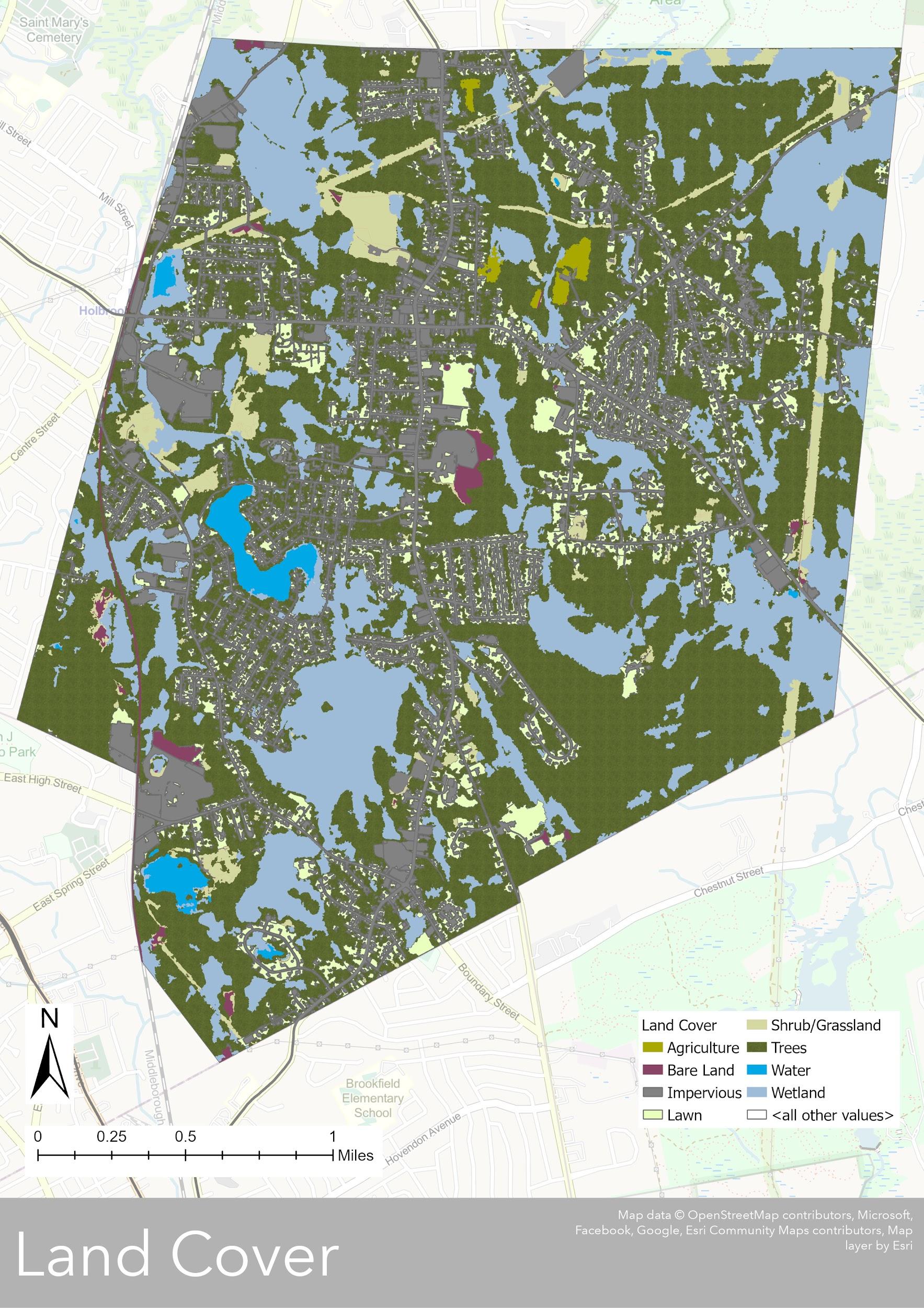
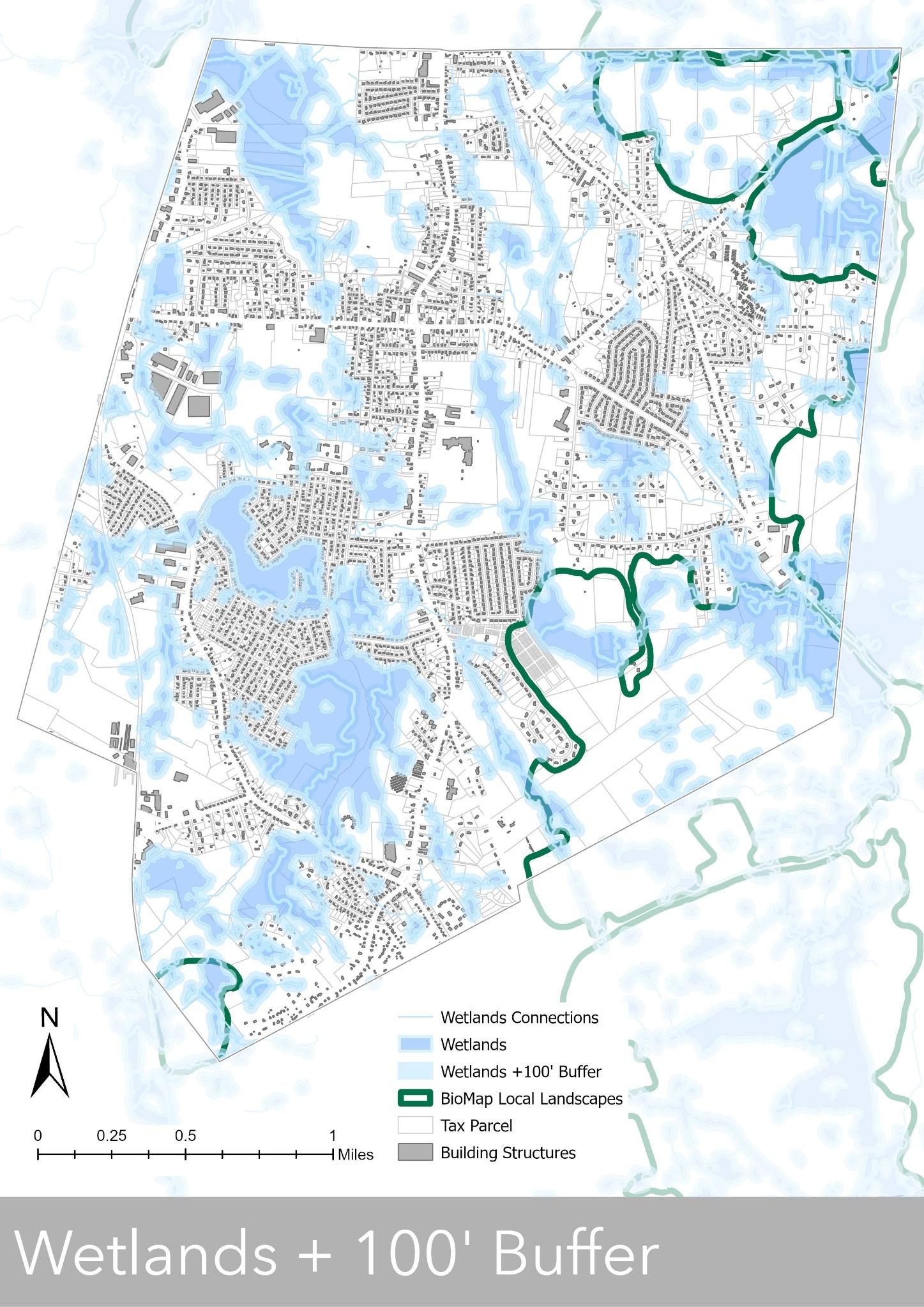
At least 21% of town is covered with wetlands, though this is likely an underestimate. The available wetlands data, based on 2005 aerial imagery, does not accurately account for all the wetlands, especially forested wetlands which are common in Holbrook. Despite this data limitation, the estimated wetland coverage is still 2 –4 times higher in Holbrook than in surrounding towns. Building within wetlands is difficult and requires a permitting process. Building within 100 feet of a wetland also requires a permit. Additionally, Holbrook has a dense tree canopy, covering 45% of the town significantly more than its neighboring communities (Table 3.6). Map 3.7 shows Holbrook’s landcover.
Unlike many towns, Holbrook lacks a common or centralized park space. This absence of a dedicated town common or large public park has shaped how residents engage with open space, often relying on smaller, more scattered recreational areas or on neighboring communities.
Table 3.6
MassGis Land cover 2016
Infrastructure
Transportation
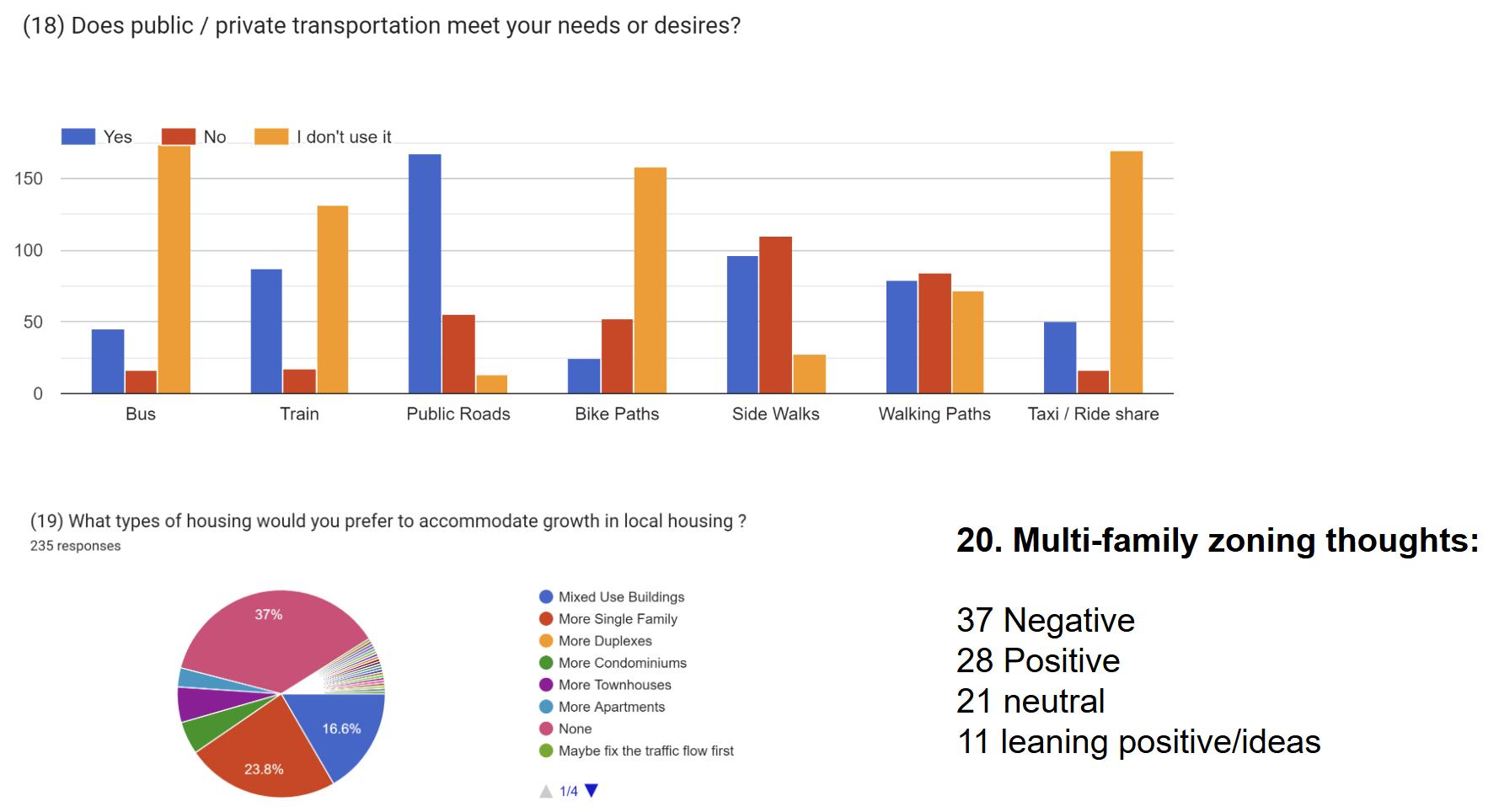
The transportation resources available to residents of Holbrook are a combination of State highway access with interstate connections in neighboring towns, and bus and commuter rail service. Holbrook is located south of Boston, with easy access to Interstates 93 and 95, as well as Route 495. Locally, Holbrook is served by Route 37 and Route 139. Route 37 runs north/south while Route 139 runs in an east/west direction. The town is serviced by the Massachusetts Bay Transit Authority’s Commuter Rail that runs north to south. The Holbrook/Randolph MBTA commuter rail station is on the Middleborough/Lakeville Line. This line runs between Middleborough/Lakeville and South Station in Boston, providing a connection to downtown Boston and the MBTA subway system. Holbrook is also served by the MBTA bus routes connecting the town to neighboring areas. The primary public bus routes in Holbrook include: MBTA Bus Route 238, which operates daily, connecting Holbrook/Randolph Station to Quincy Center Station; MBTA Bus Route 230, which connects Quincy Center Station to Montello Commuter Rail Station, passing through Holbrook and Braintree; and the 230 Bus runs up through the center of Holbrook along Route 37. Brockton has its own local transit system, the Brockton Area Transit (BAT) Authority. The BAT bus comes from Brockton to the Holbrook Line. Currently, there are no bike paths in Holbrook, and only one short bike lane, which runs along Route 37 for less than a mile. A section of the Claire Saltonstall Bikeway passes through Holbrook via South Street and Linwood Street, but there is no formal bike path.
Water Supply and Sewer System
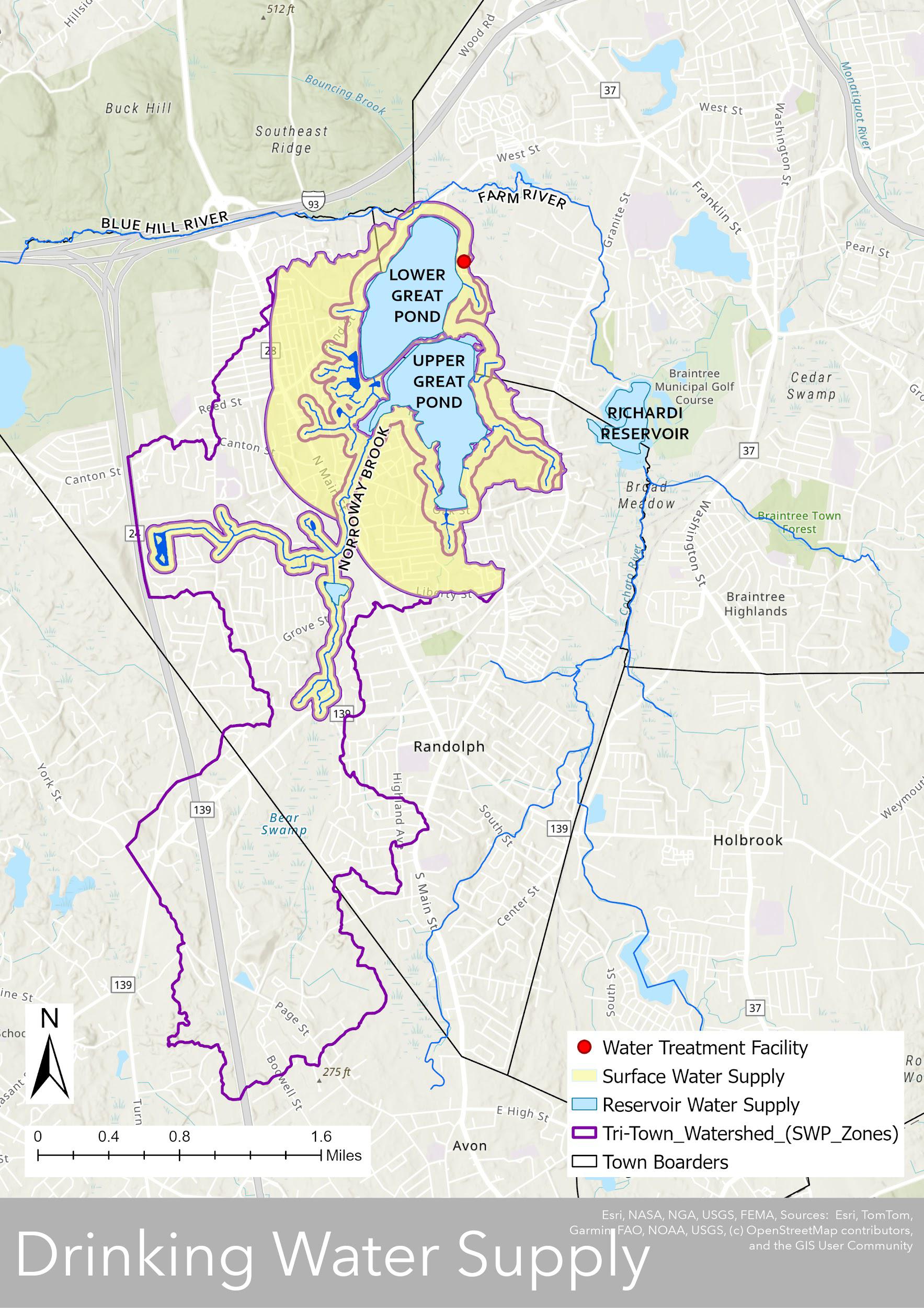
The availability of public water and sewage infrastructure is often a major determinant of where and how development occurs. In Holbrook, nearly two-thirds of the households are served by public water and sewer Holbrook shares its water supply with Braintree and Randolph in a tri-town water district which receives water from the Great Pond Reservoir System (Map 3.8). This system consists of three reservoirs: Great Pond, Upper Reservoir, and the Riccardi Reservoir. These resources are managed by the Tri-Town Board of Water Commissioners, which is composed of a representative of each of the three communities. In 2021, the commission approved construction of a new state-of-the-art facility to update the aging system and address growing community concerns over high levels of PFAS contamination detected in the drinking water. Construction of the new treatment facility is anticipated to be completed in January 2026.
Holbrook is served by the Massachusetts Water Resources Authority (MWRA) sewer network, which sends sewage to the Deer Island wastewater plant, which is then discharged into Boston Harbor. A separate facility in Quincy turns sewage sludge into fertilizer. Although there is poor septic compatibility in town due to soils, households that are not on the sewer system continue to use septic systems with leach fields.
Long Term Development Patterns
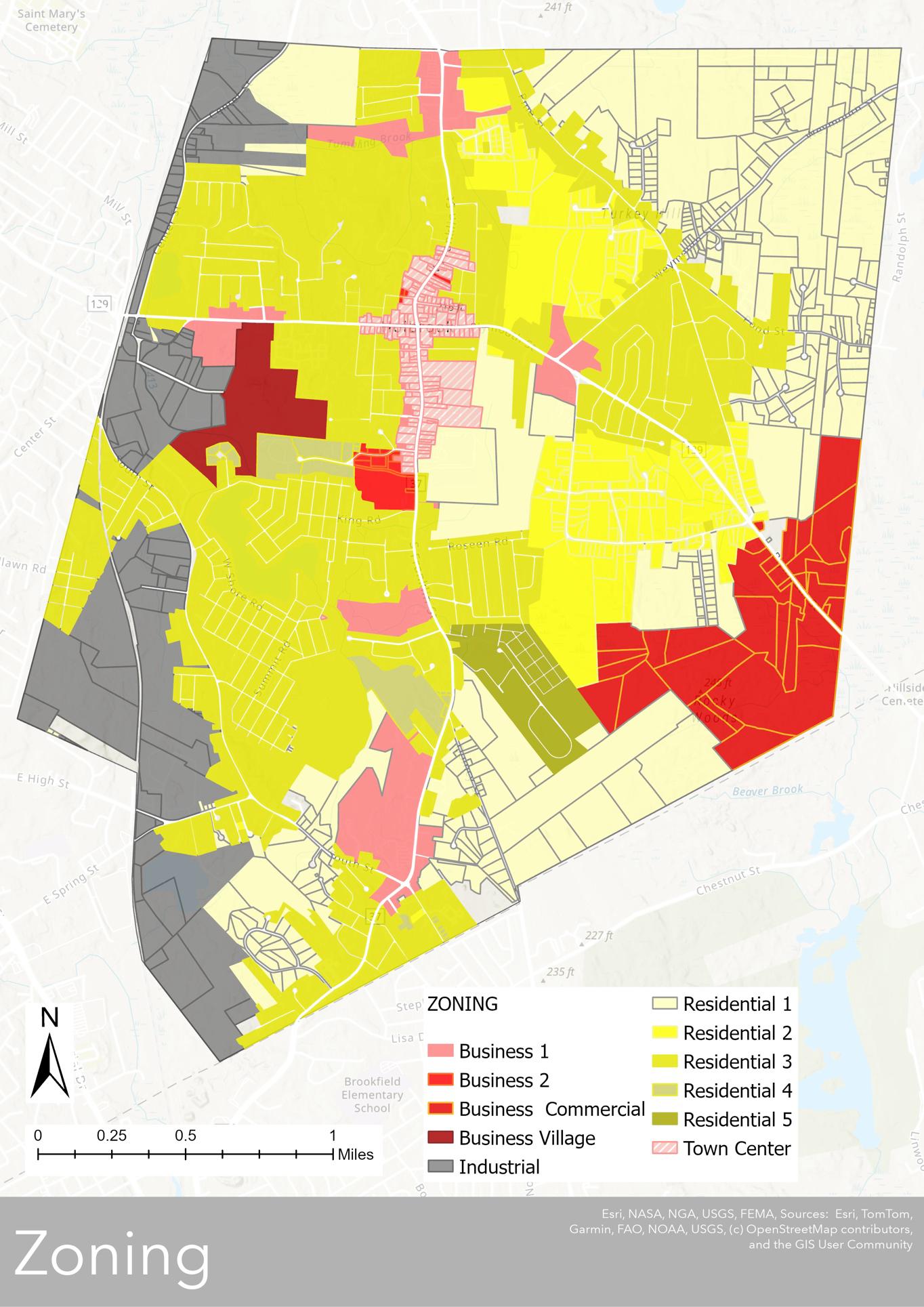
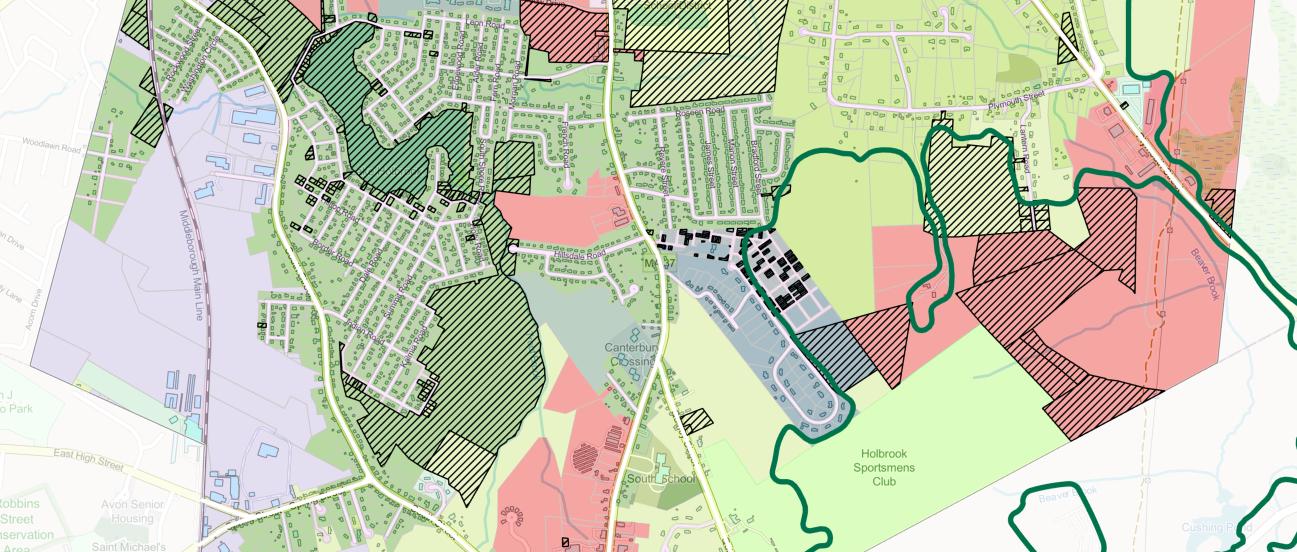
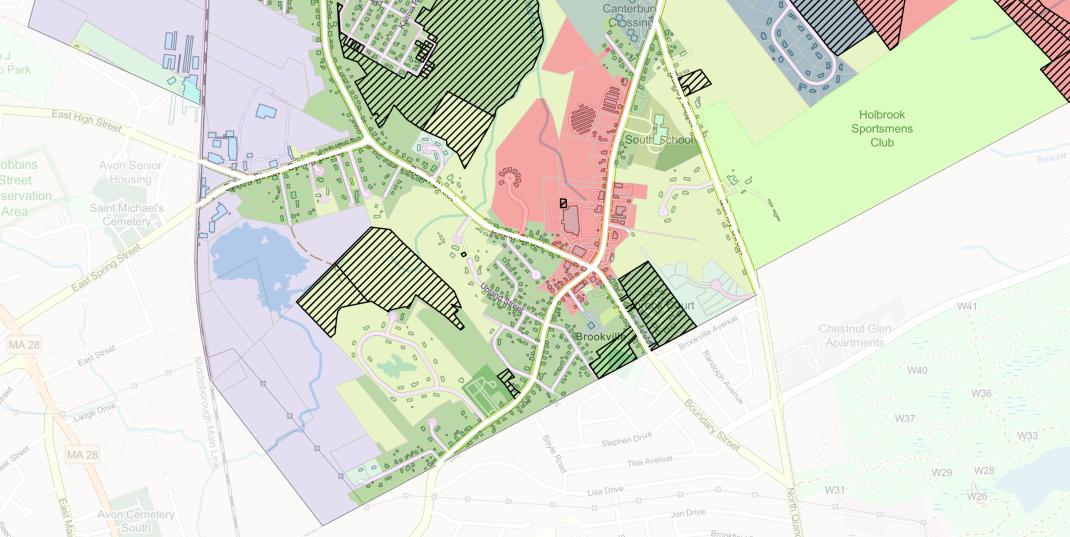
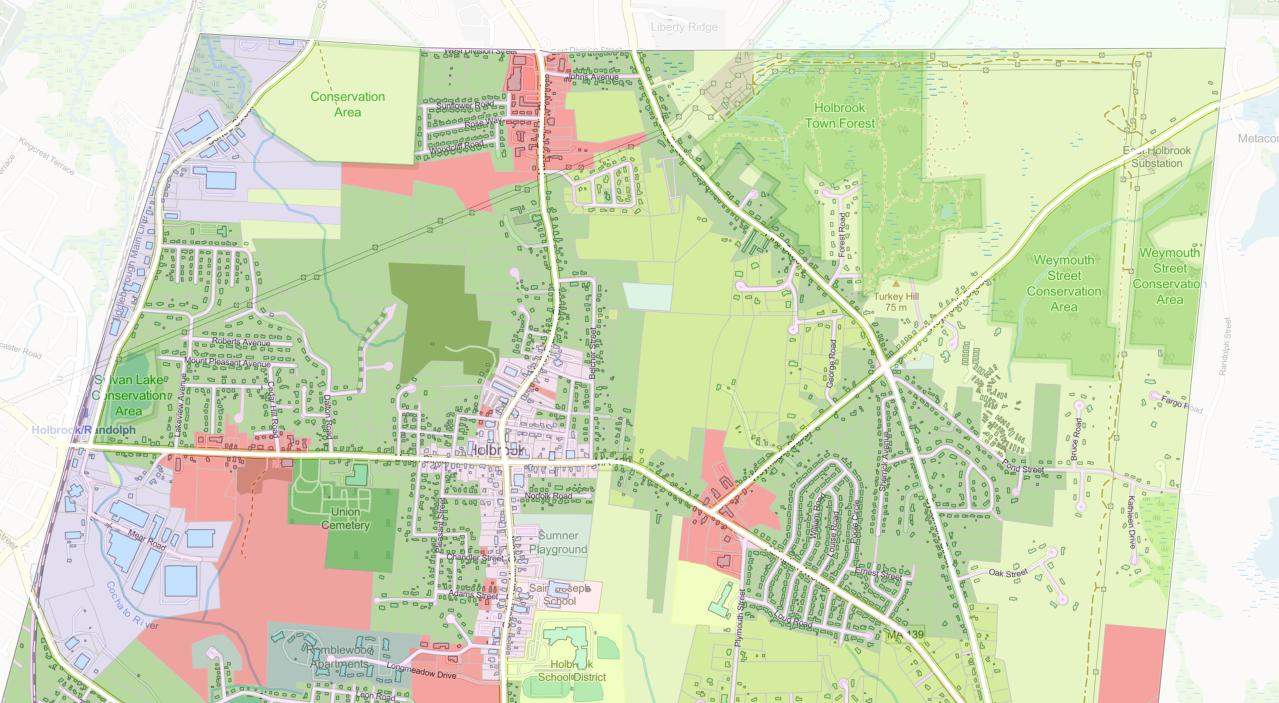
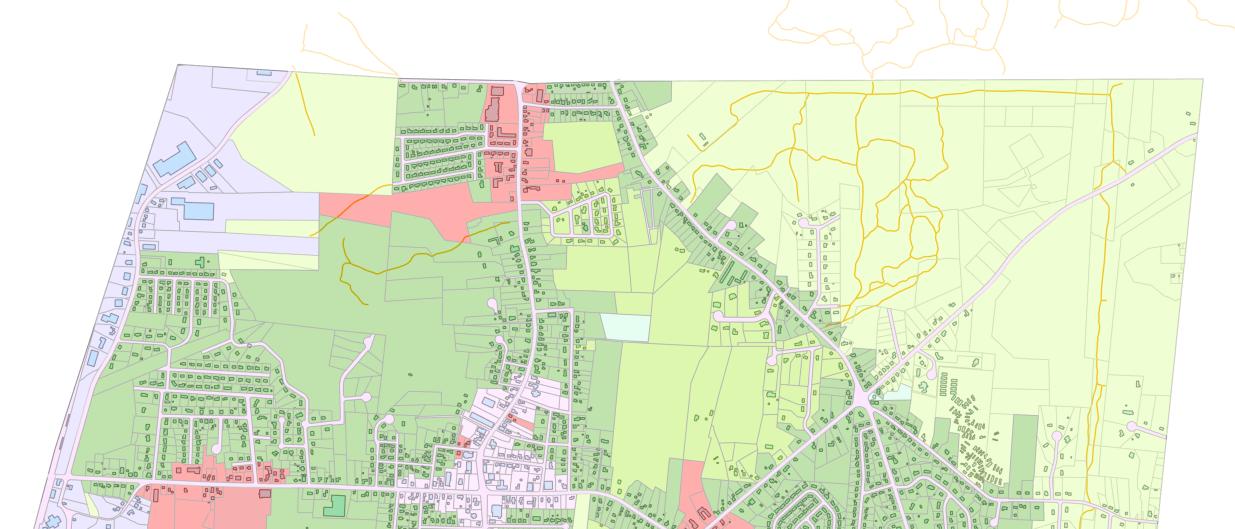
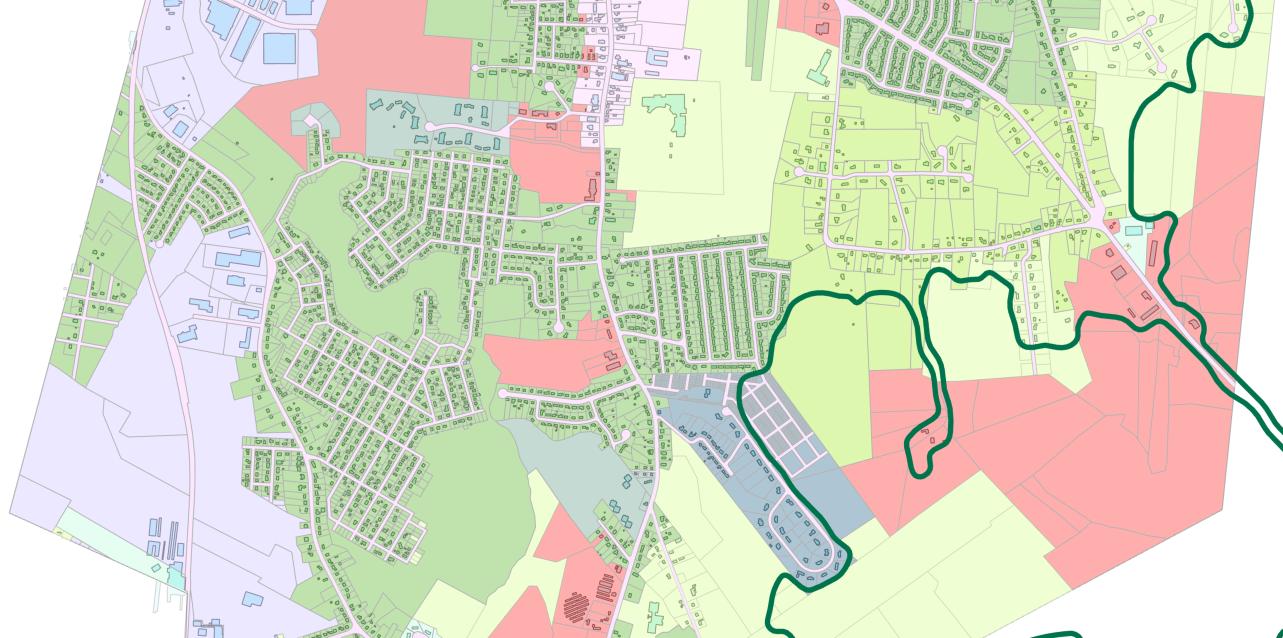
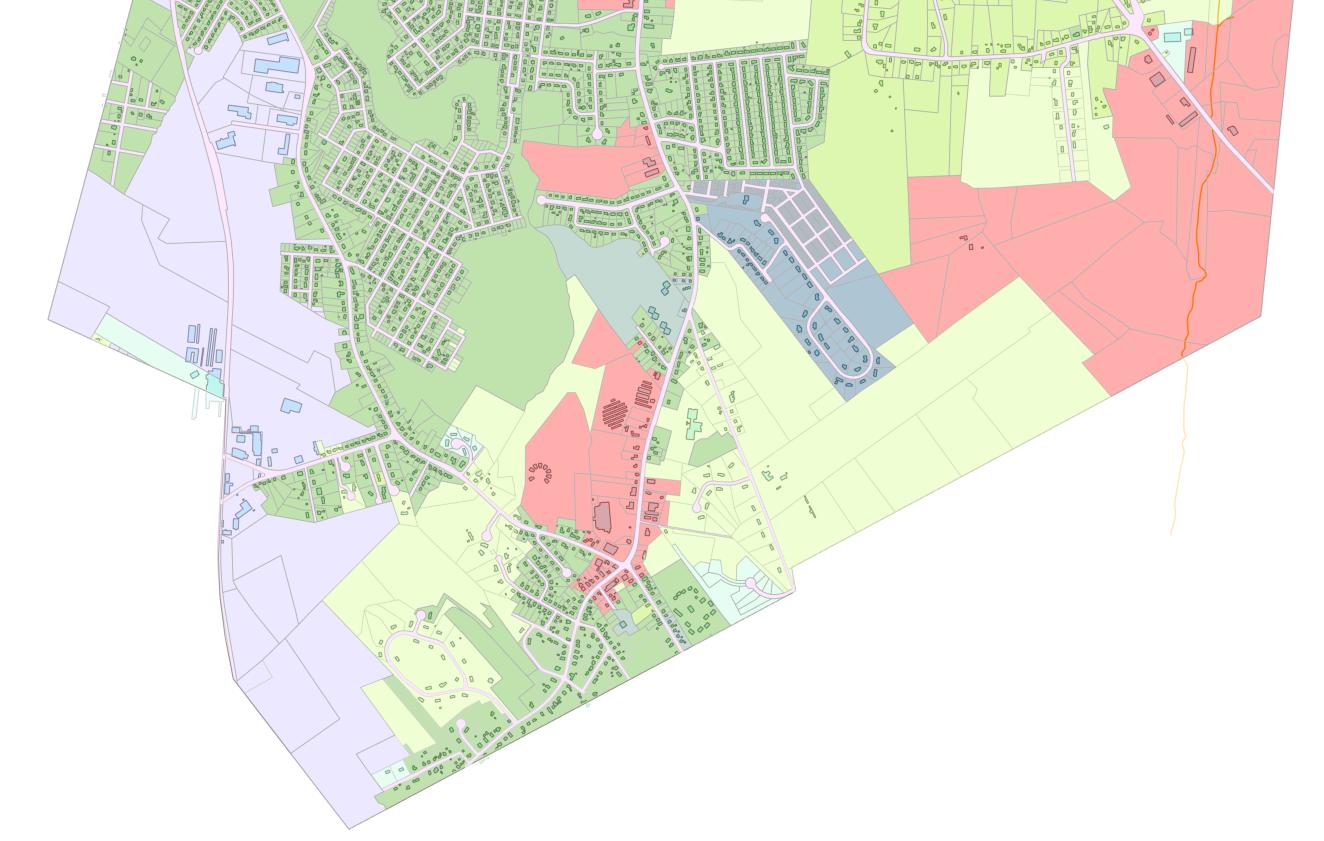
Like most communities, Holbrook’s growth patterns reflect land use regulations. Growth has largely occurred alongside grey infrastructure (roads, utilities under roads) with subdivisions expanding into green space. Holbrook’s current zoning is shown in Map 3.9. The Town of Holbrook’s zoning by-laws were last updated in September of 2019. There are ten original zoning districts, and six overlay districts that have been added throughout the years. The original zoning districts include five residential, four business/commercial, and one industrial district. The overlay districts include a floodplain protection, medical marijuana, town center, adult entertainment, and South School overlay district. Additionally, an MBTA multi-family zoning overlay has been adopted, however it is not included officially in the Zoning handbook. The state of Massachusetts required municipalities to add a multi-family zoning district within proximity to MBTA stations. Holbrook has proposed placing the MBTA multi-family zoning overlay in the industrial zoned area on the west side of town; this same area is also zoned for marijuana and adult entertainment. The overlay districts are not shown on Map 3.9.
There are five residential zones, which differ primarily in minimum lot size per dwelling unit. Residential zone 1 is zoned for the least dense housing, with a minimum lot size of 60,000 square feet. Single family dwellings are the only housing type permitted by right. Residential zone 2 has a minimum lot size of 40,000 square feet, and Residential zones 3 and 4 require a minimum lot size of 20,000 square feet. Residential zone 5 requires a minimum lot size of 30,000 square feet. Zone 4 allows two-family units, however none of the residential zones allow for multi-family housing by right. Two-family and multi-family are distinct categories in the zoning code.
According to tax assessor data, over 74% of residences are single-family detached homes, while 17% of residential land remains vacant. Only 3% of residential units are two-family homes. There are several building projects that have been approved that will add more single-family homes, townhouses, and condos. There are many undeveloped parcels in town that present a variety of challenges to developers, such as the presence of wetlands or forests, zoning restrictions, or limited access to existing rights-of-ways. These constraints to residential/commercial development may present opportunities for the town to pursue protection of these parcels as open space. The Town may also deprioritize these lands for acquisition, if likelihood of development is low.
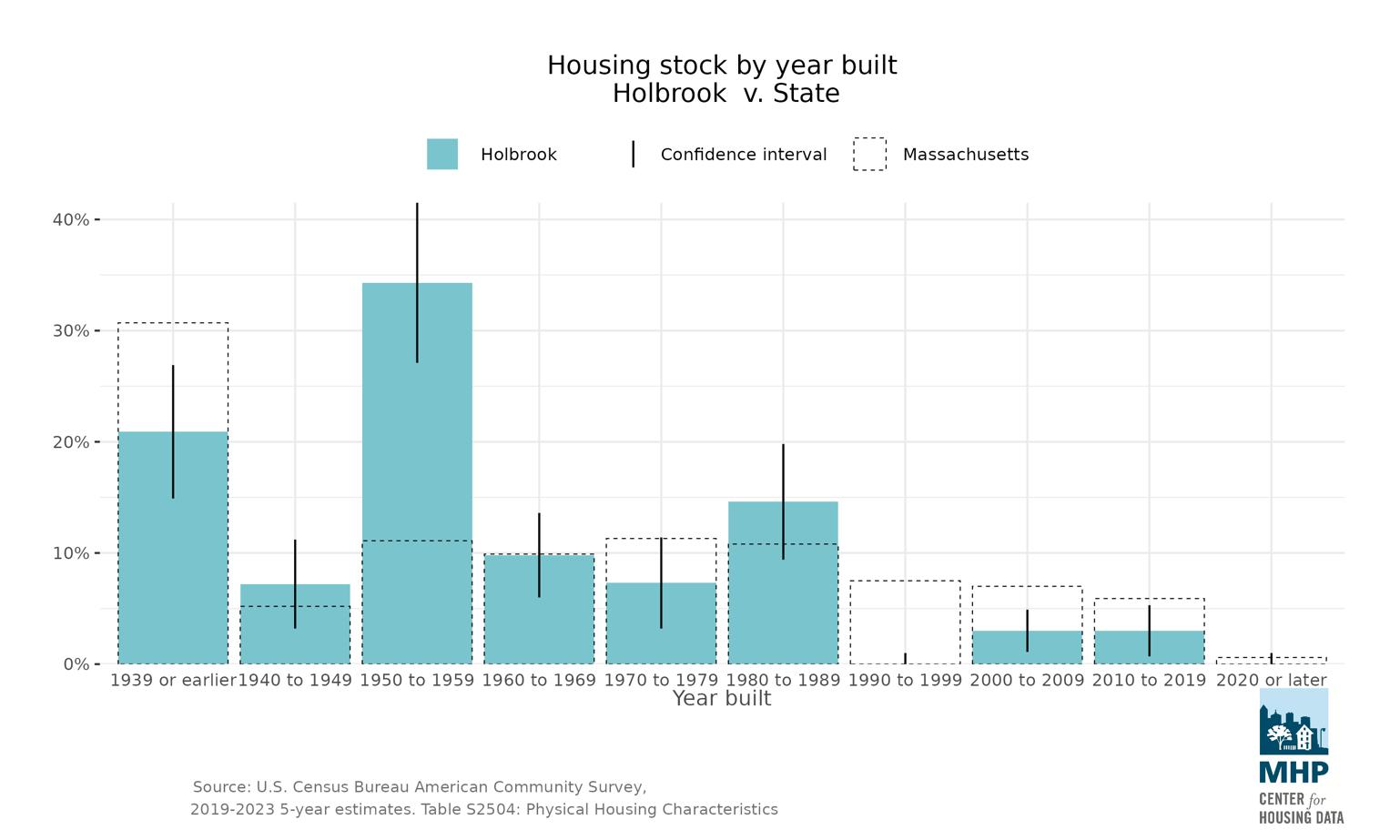
Massachusetts faces a significant housing shortage and production challenges, with limited availability and affordable options. To address this, the state has prioritized housing production and enacted Chapter 40B to promote the development of affordable housing. Under Chapter 40B, if a town has less than 10% of its housing listed on the Subsidized Housing Inventory (SHI), developers can bypass local zoning restrictions to build at higher densities provided 20%–25% of the new units are designated as affordable. According to MAPC, Holbrook is below this threshold, with 9.90% of its housing classified as affordable. Nearly a quarter of Holbrook's housing stock (21%) was built before 1939 An additional 42% of homes were constructed between 1940 and 1959, while 17% date from 1960 to 1979. More recent development has been slower, between 4%–8% of homes built since 2000, compared to the state average of 13% (Figure 3.2)( Massachusetts Housing Partnership).
The Town created a floodplain protection overlay district. The purposes of this district are to preserve and protect the streams and other water bodies in the town, to protect the public health and safety of persons and property against the hazards of flooding, to preserve and maintain the water table within the town, to assure the continuation of the natural flow pattern of the water courses providing safe and adequate flood water storage and runoff capacity, to protect the community against detrimental uses and developments, and to minimize losses by provisions designed to consider floodplain management programs in neighborhood areas.
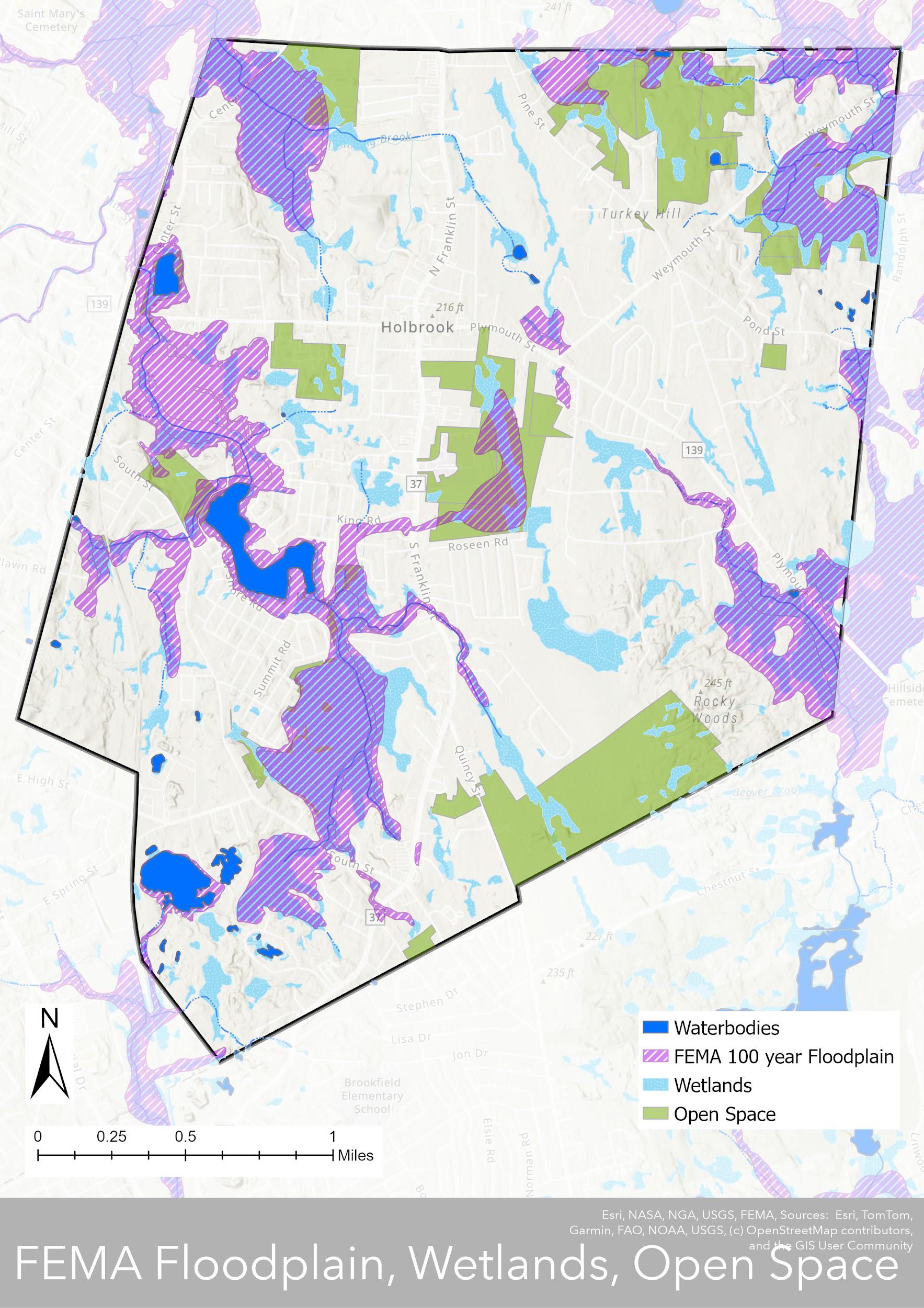
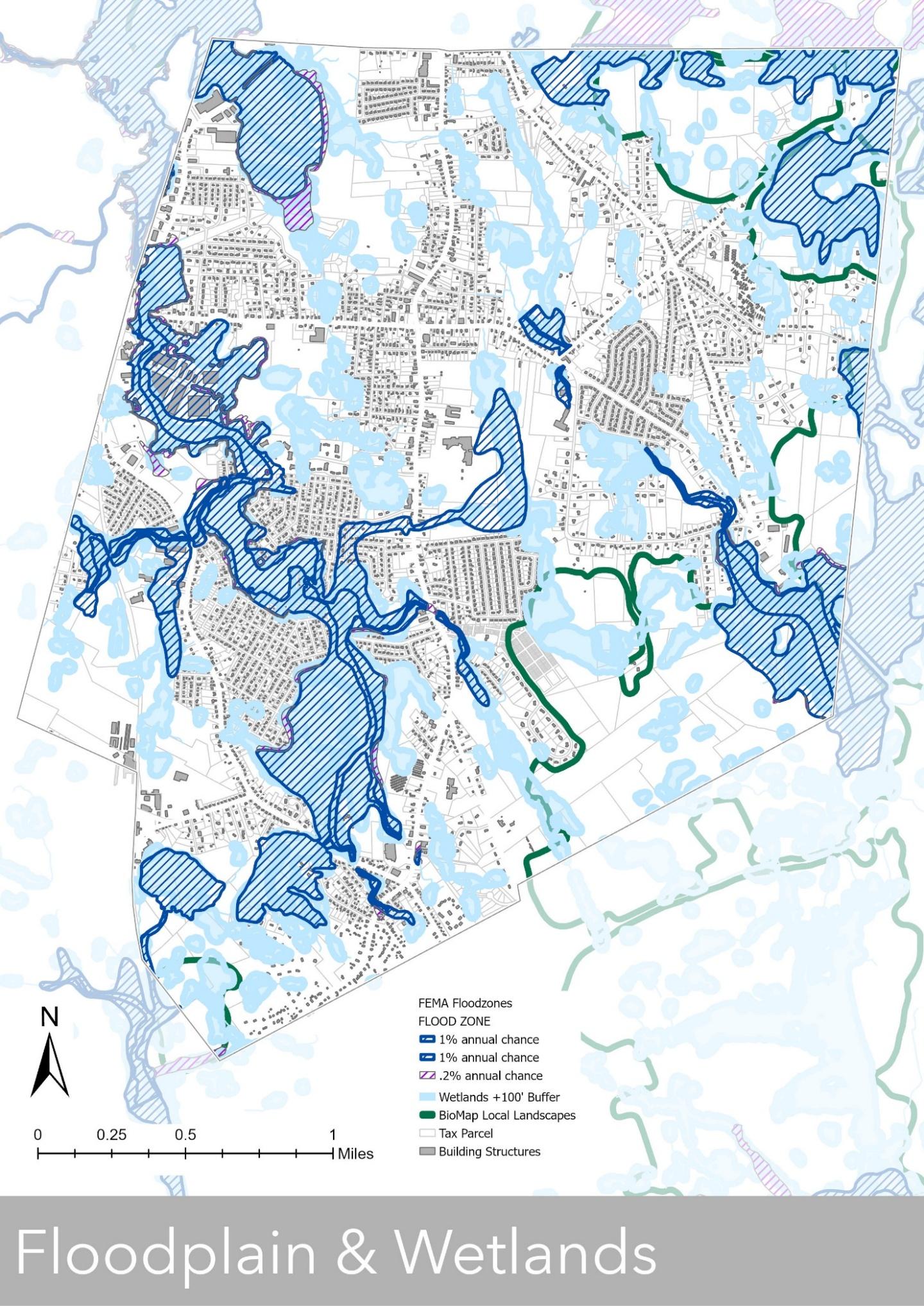
Holbrook’s floodplain overlay district is designated as Zone A and AE on the Norfolk County Flood Insurance Rate Map (FIRM) issued by the Federal Emergency Management Agency (FEMA) for the administration of the National Flood Insurance Program (Map 3.10). As part of this district, all proposed new construction, substantial additions/improvements, and construction of utilities within the one-hundred-year floodplain are required to comply with standards set by the FEMA.
Holbrook does not currently have a master/comprehensive plan. A comprehensive plan would help the town target areas for redevelopment and growth. Despite the number of undeveloped parcels, Holbrook has limited buildable land due to environmental constraints, zoning regulations, and infrastructure limitations. As demand for housing increases particularly affordable housing under Massachusetts Chapter 40B the town must balance development needs with open space preservation. Without careful planning, remaining green spaces could be lost to development, reducing opportunities for conservation, recreation, and climate resilience. A strategic approach to land use planning, including a comprehensive plan, would help Holbrook identify priority areas for growth while ensuring that critical open spaces are protected for future generations.
Holbrook
Lake Holbrook
Turkey Hill
Rocky Woods
Tumbling Brook
3.4 Regional Open Space Map for Norfolk County
Holbrook
Abington
Weymouth
Braintree
Randolph
Avon
Brockton
3.5 Historical Map of Holbrook, 1876
Map 3.7 Land Cover in Holbrook
Map 3.8 Tri-Town Drinking Water Supply
Map 3.10 FEMA Floodplain, Wetlands and Open Space
SECTION 4
Environmental Inventory and Analysis
Open space preservation plays a vital role in mitigating climate change by sequestering carbon, managing stormwater, and reducing urban heat island effects. Protecting these landscapes is a costeffective strategy for enhancing environmental and Nature’s Value in a Changing Climate
Section 4: Environmental Inventory and Analysis
A. GEOLOGY, SOILS AND TOPOGRAPHY
Holbrook is built upon a variety of land surfaces, the most prevalent being sand, gravel, till, bedrock, and alluvium. The geology, variable soils, forested wetlands, and gentle topography present both opportunities and challenges for development and conservation in Holbrook. Understanding these characteristics will be crucial for guiding future land use decisions, climate resilience, enhancing ecological preservation, and improving stormwater management.
Geology
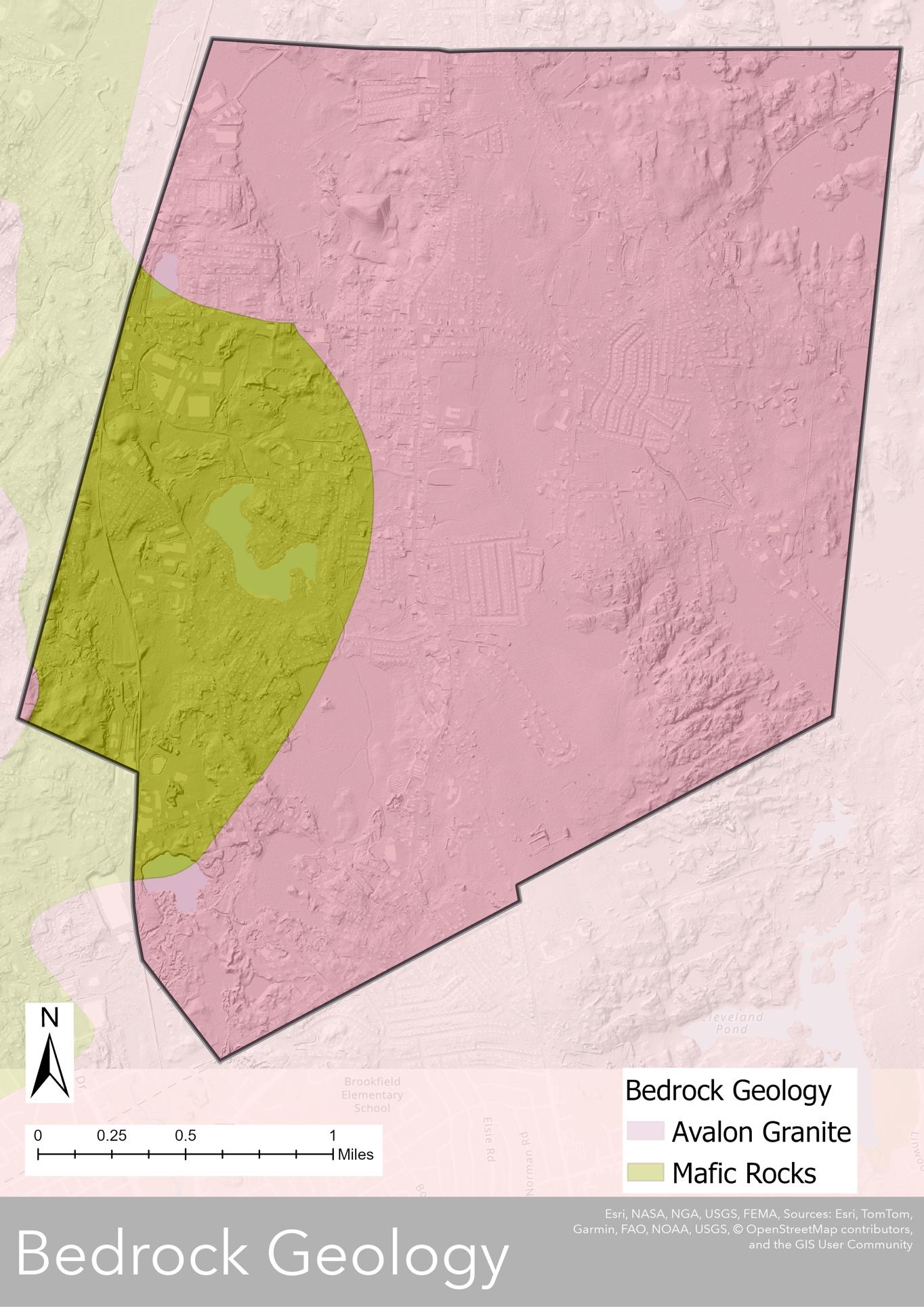
Like most of the Boston Basin, Holbrook’s bedrock geology consists of mostly igneous rocks. Holbrook's bedrock geology is predominantly Dedham granite, part of the Avalon Granite formation (Map 4.1). This granite is characterized by its coarse-grained texture and light coloration. In the west, the geology includes mafic rocks composed of diorite and diabase dikes and sills. In the Turkey Hill and Rocky Woods area there are locations with very shallow or exposed bedrock. Historically it is difficult for development to occur in areas with exposed ledge which could explain why these areas of town are sparsely populated.
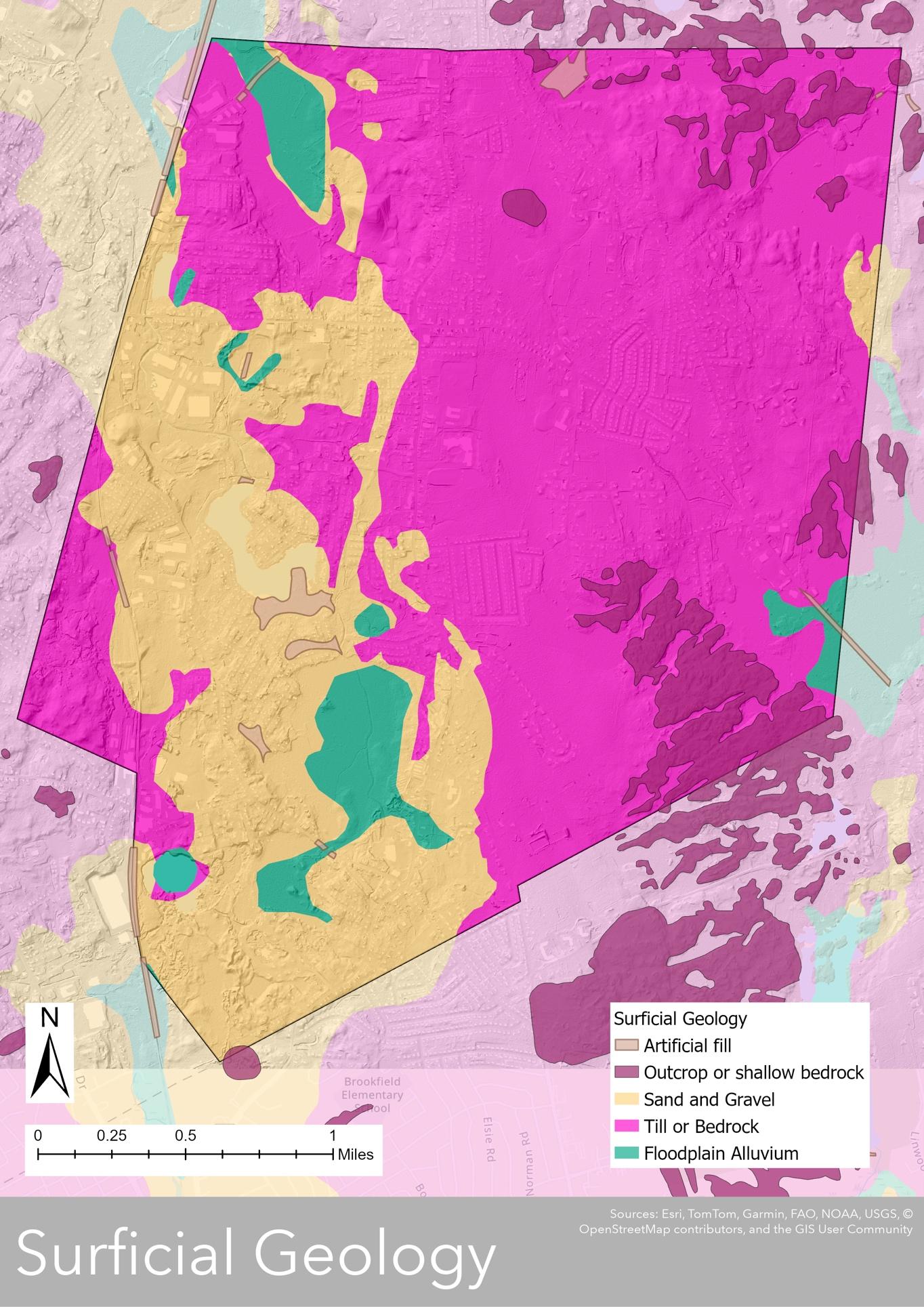
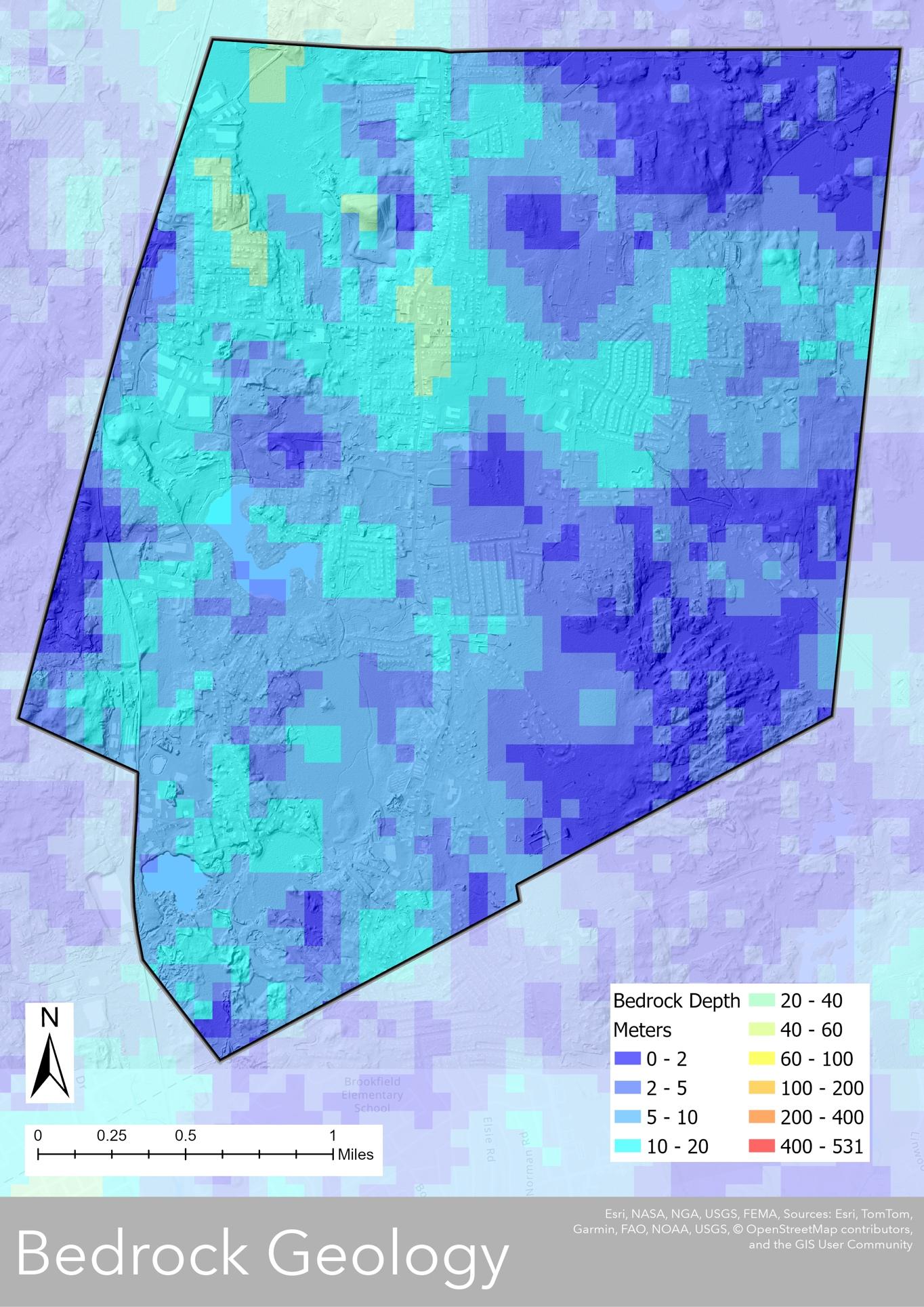
Holbrook’s surficial geology is the result of glaciers. During the last Ice Age, Holbrook was covered in an ice sheet. As temperature warmed and the glaciers began to recede, the melting ice sheet scraped the landscape and left behind deposits of sand and gravel. As the ice retreated, meltwater streams deposited glacial till and outwash materials, contributing to the current topography. The surficial geology of Holbrook consists of sand and gravel deposits, till and bedrock, and floodplain alluvium (Map 4.2). Sand and gravel deposits tend to be porous and locations for productive ground water aquifers. Many of the well fields in Holbrook (now contaminated) are in areas with sand and gravel deposits. Till, consisting of a variety of grain sizes clay, sand, gravel, and boulders is deposited from glacial ice. Glacial till deposits typically transmit groundwater poorly. Floodplain alluvium is sediment deposited by rivers in a floodplain, and is a mixture of clay, silt, sand, and organic materials. This deposit typically forms in lowland areas, like in wetlands or riparian zones. The floodplain alluvium is found in the Tumbling Brook wetlands, Cochato River and the Trout Brook wetlands. Holbrook has varying depth to bedrock, with much of the town characterized by relatively shallow bedrock (Map 4.3). Most of the bedrock is within 0 to 10 meters (0 to 32 feet) of the surface, suggesting any excavation or construction in these areas would encounter bedrock relatively quickly. However, there are scattered pockets with greater depth to bedrock, where depths range from 10 to 60 meters (32 to 196 feet). These deeper surface to bedrock areas are more common west of Route 37. The variation in bedrock depth may influence groundwater movement, soil composition, and the feasibility of certain types of development. Geology bedrock and surficial closely influences the character of a region because it affects what kinds of soils develop, what kinds of plants grow, and the topography.
Soils
Soils affect the land's viability for farming, forestry, recreation, construction, infrastructure, and waste disposal. Knowing the soils of a town can be useful for determining where to develop and grow and where to conserve.
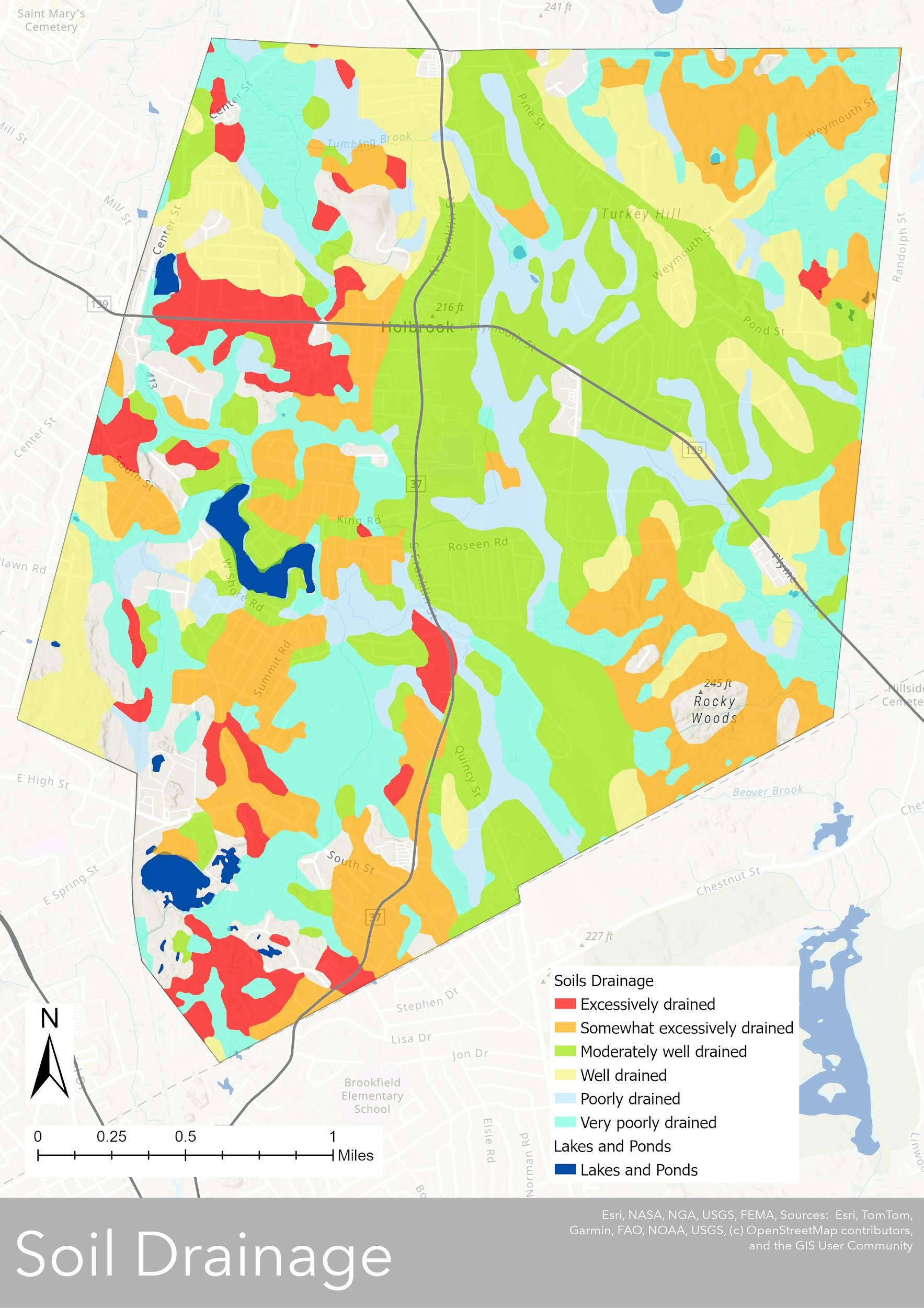
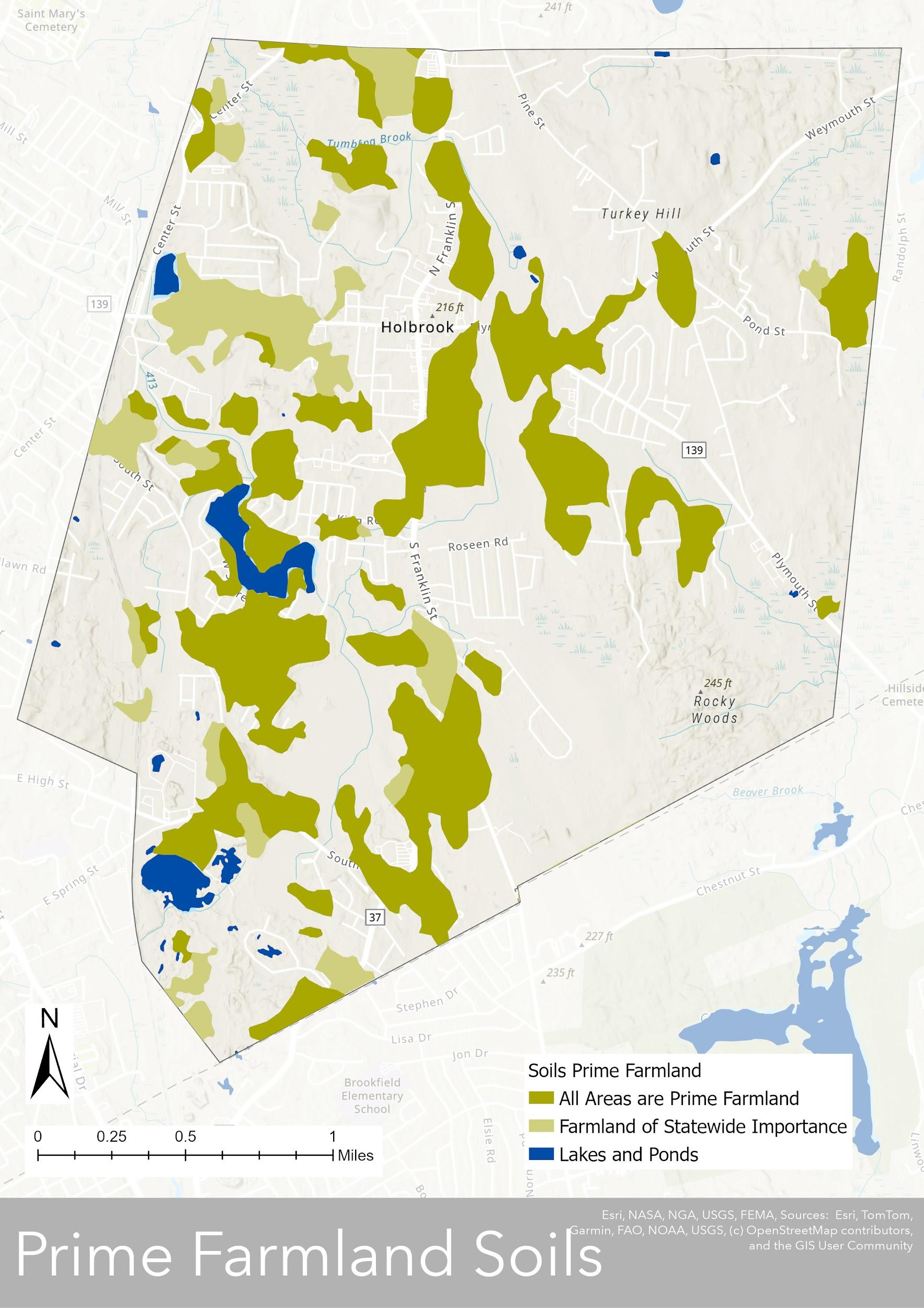
Holbrook's soils are largely derived from glacial till deposits. East of Route 37 soils are moderately well drained and somewhat excessively drained. West of Route 37 soil drainage runs the whole spectrum from excessively draining soils to very poorly drained (Map 4.4). Floodplain alluvium soils are also present in low-lying areas, particularly along the banks of the Cochato River and other streams. Holbrook also contains prime farmland soils and soils of statewide importance (Map 4.5). Prime farmland soils are defined by NRCS SSURGO-certified soils data as land that has the best combination of physical and chemical characteristics for producing sustained high yields of crops. Farms established in the early 19th century included dairy and vegetable farms; over time these parcels were sold and redeveloped as business or residential development. One farm remains in Holbrook today (Nihtila Farm).
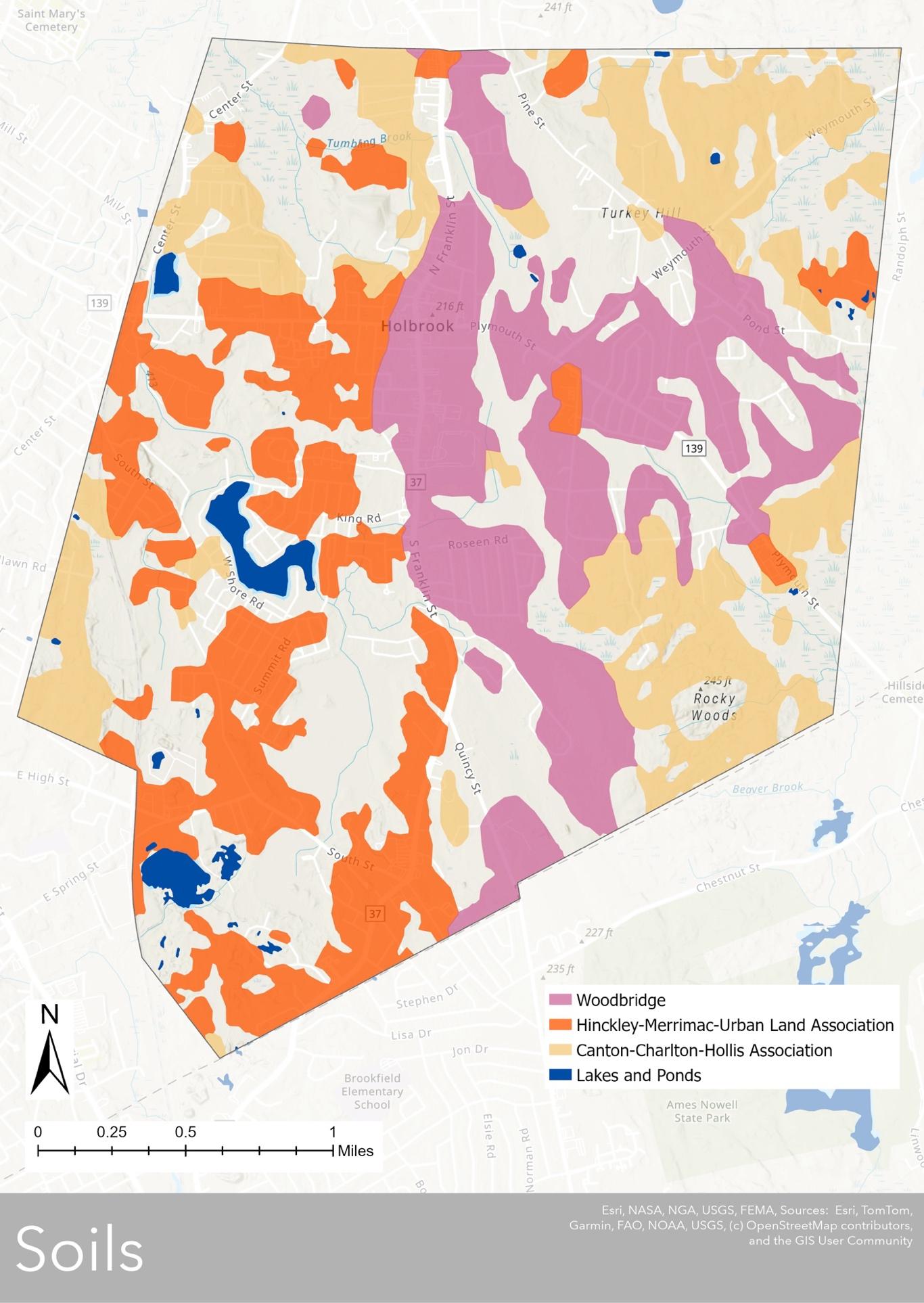
Soil associations are used to describe groups of soils that have distinct characteristics and consist of one or more major soils with several minor soils. The predominant soil association according to the Soil Survey of Norfolk and
Suffolk counties, is the Canton-Charlton-Hollis association, followed by the Hinckley-Merrimac-Urban Land Association, as well as Woodbridge soils (Map 4.6).
Canton-Charlton-Hollis Association:
This association consists of well-drained loamy soils formed in glacial till. The Canton soils are found on small, undulating hills near valleys. Charlton soils occupy low areas and saddles between ridges. The Hollis soils are found near rock outcrops and on tops of ridges. Most of the soils in Holbrook have a limited capacity to support septic systems. The Hollis soils are shallow and typically unsuitable for septic systems, while Canton soils risk groundwater pollution if used for septic absorption fields.
Hinckley-Merrimac-Urban Land Association:
This association features sandy and loamy glacial outwash soils that are excessively drained. Hinckley soils are located on kames and eskers, while Merrimac soils appear on terraces and plains. Urban land, where impervious surfaces like asphalt and concrete are common, is underlain with a mix of these soil types. Urban land soils are found in developed areas, particularly around the town center, neighborhoods, and major roadways. Groundwater contamination risks are elevated with these soils if used for septic systems.
Woodbridge soil:
This soil type is defined by fine sandy loam, with moderate permeability. Woodbridge soils follow along Route 37.
Wetland soils:
Wetland soils are also prevalent in various parts of Holbrook, particularly in the town's low-lying areas. These wetland soils provide vital ecological functions, supporting native plant and animal species while improving water quality by filtering pollutants. The presence of wetlands has historically limited development in certain parts of town, preserving valuable green space.
Topography
Holbrook is situated within the Southern New England Coastal Plains and Hills Ecoregion (Map 3.1). The landscape is characterized by small lakes, wetlands, and flat gently rolling terrain.
Holbrook’s topography greatly influenced its pattern of development. Most of Holbrook’s 7.4 square miles are gently rolling terrain. A ridge transects the town of Holbrook, along Route 37 running north-south. Glacial deposits of sand and gravel transect the Town along its north-south axis. Development of the town center followed this topography, and early industry was closely tied to the river and wetlands in town. To the east is Turkey Hill, the highest elevation in Holbrook, standing at 255 feet above sea level. The Topographic Map highlights these elevation highs and locations of exposed and shallow bedrock outcrops in the Turkey Hill and Rocky Woods area. In contrast, the western portion of town is characterized by lower elevations with gentle hills and flat expanses, including low-lying areas near Sylvan Lake and Lake Holbrook that are prone to seasonal flooding. Wetlands are abundant throughout Holbrook, across the topographic high and lows. The Town manages open space in both uplands and lowlands areas; though as discussed later, not all these spaces have trails and are easy to access.
B. LANDSCAPE CHARACTER
The character of a town how it feels to residents and visitors is extremely influential to how a community defines itself. The town of Holbrook is a largely residential community, made up of a higher density town center, a mix of high, medium, and low density suburban residential neighborhoods, and industrial areas concentrated around the train line.
Holbrook’s town center is located at the confluence of Route 37 and Route 139. Holbrook has two properties listed on the National Register of Historic Places (Table 4.1). These include Holbrook Square Historic District, which extends from N. Franklin to Union St. and Linfield St. and the Roberts School, the one -room schoolhouse built in 1873. In 2015, the Town added a Town Center overlay district to allow for mixed uses in the town center. This overlay was created to improve the public realm, create a more attractive Town Center, and encourage economic development or redevelopment. Currently there are 36 mixed-use parcels in this district.
Holbrook’s commercial areas are spread mostly along Route 37 and Route 139. These areas have large amounts of impervious surfaces paved parking lots and buildings. These areas have limited sidewalks and are generally described as an unsafe walking environment. Holbrook is a mostly single-family residential community (multi-family use is allowed only by special permit) with areas of development interrupted by wooded areas.
The elevation changes in Holbrook are not dramatic. The highest elevation areas of the town are residential neighborhoods located in the northeastern and southeastern corners, which are known as Turkey Hill and the Rocky Woods areas. The Grove neighborhood around Lake Holbrook is in a topographic low.
High tension electrical power lines run north to south on Holbrook’s eastern boundary and west to east cutting across the town near its border with Braintree. There are long corridors of open land underneath electric power lines, and a significant amount of the land is owned by utilities. There are emergent wetlands in this area and often rare plant species establish under the electrical lines.
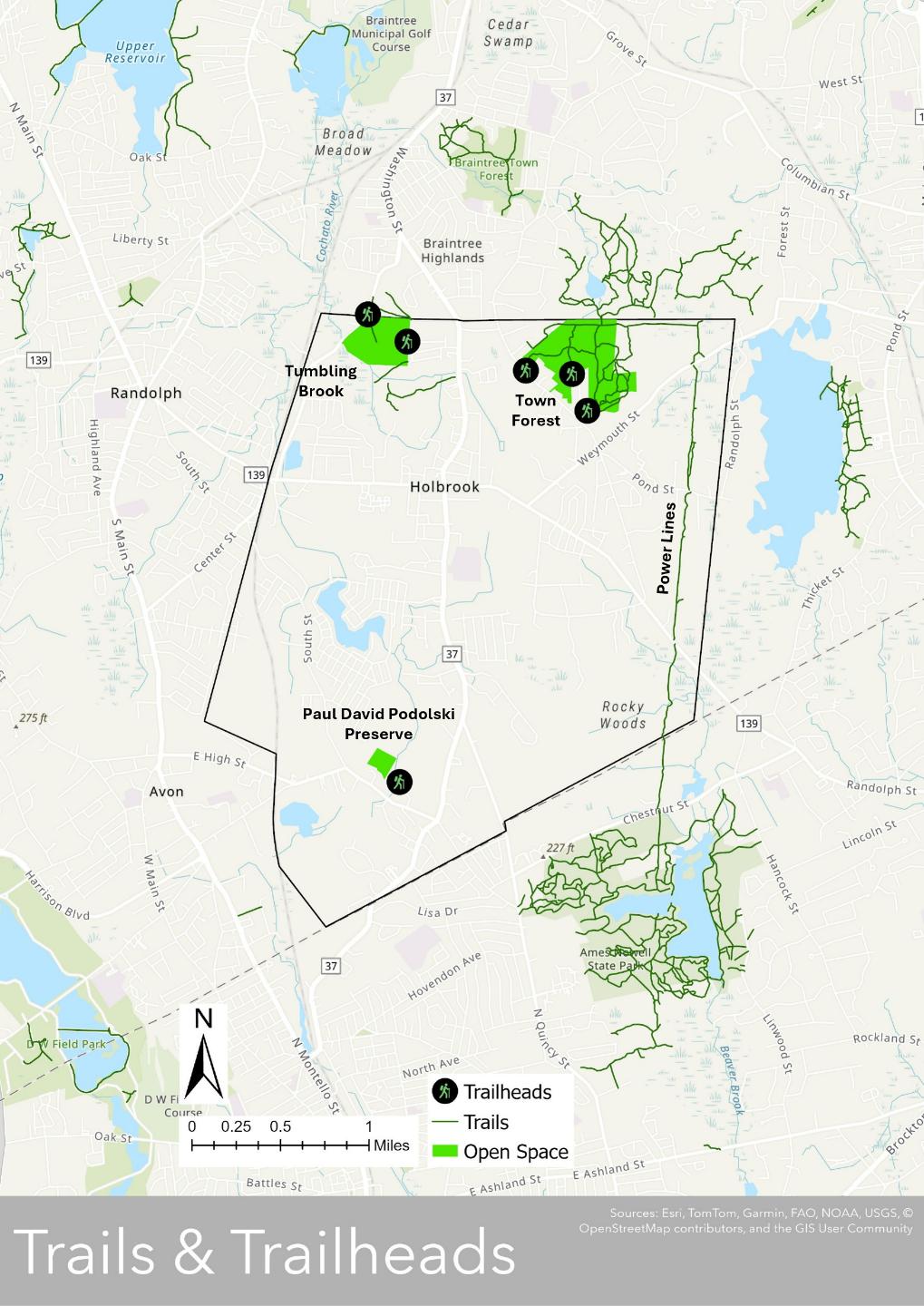
Holbrook’s most significant open space and recreational area is the Town Forest. The Town Forest is one of the more scenic areas in the town, located in the northeast corner of town along Weymouth Street and Pine Street. The Town Forest offers the residents of Holbrook a place of natural beauty and opportunities for passive recreation like hiking and wildlife watching. The Holbrook Town Forest abuts the Cranberry Pond Conservation Area in Braintree, a desirable open space area in that community.
Recently, a parcel of town-owned land adjacent to the Holbrook Town Forest was sold to a developer, resulting in changes to the landscape and raising concerns among some residents. This development borders critical natural areas and rare species habitat, highlighting the vulnerability of this ecologically significant land. The situation underscores an important reality town-owned land is not automatically protected in perpetuity from development. Without formal conservation measures, these areas may be at risk of future development, emphasizing the need for proactive land protection efforts where appropriate.
Table 4.1 Holbrook Sites on The National Register of Historic Places Property Location
C. WATER RESOURCES
Waterways
and Water Bodies
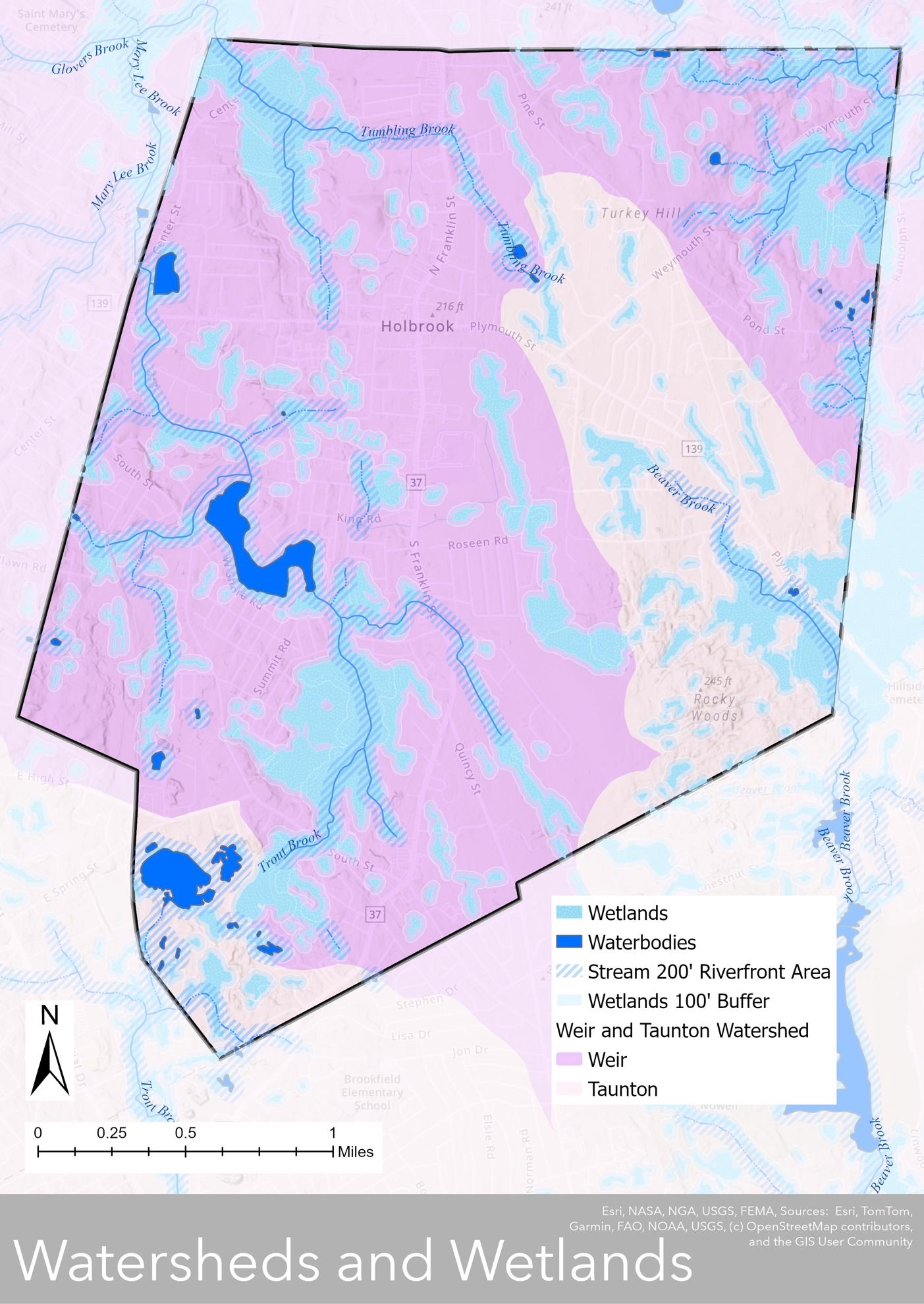
Holbrook falls within two watersheds, the Taunton and Weir River (Map 4.7). The Taunton River watershed is the second largest in Massachusetts and drains into Narragansett Bay, extending northward into town from the southern borders with Avon, Brockton, and Abington. Most of the town lies within the Weir River watershed and drains northward to Boston Harbor via the Cochato River and other smaller brooks.
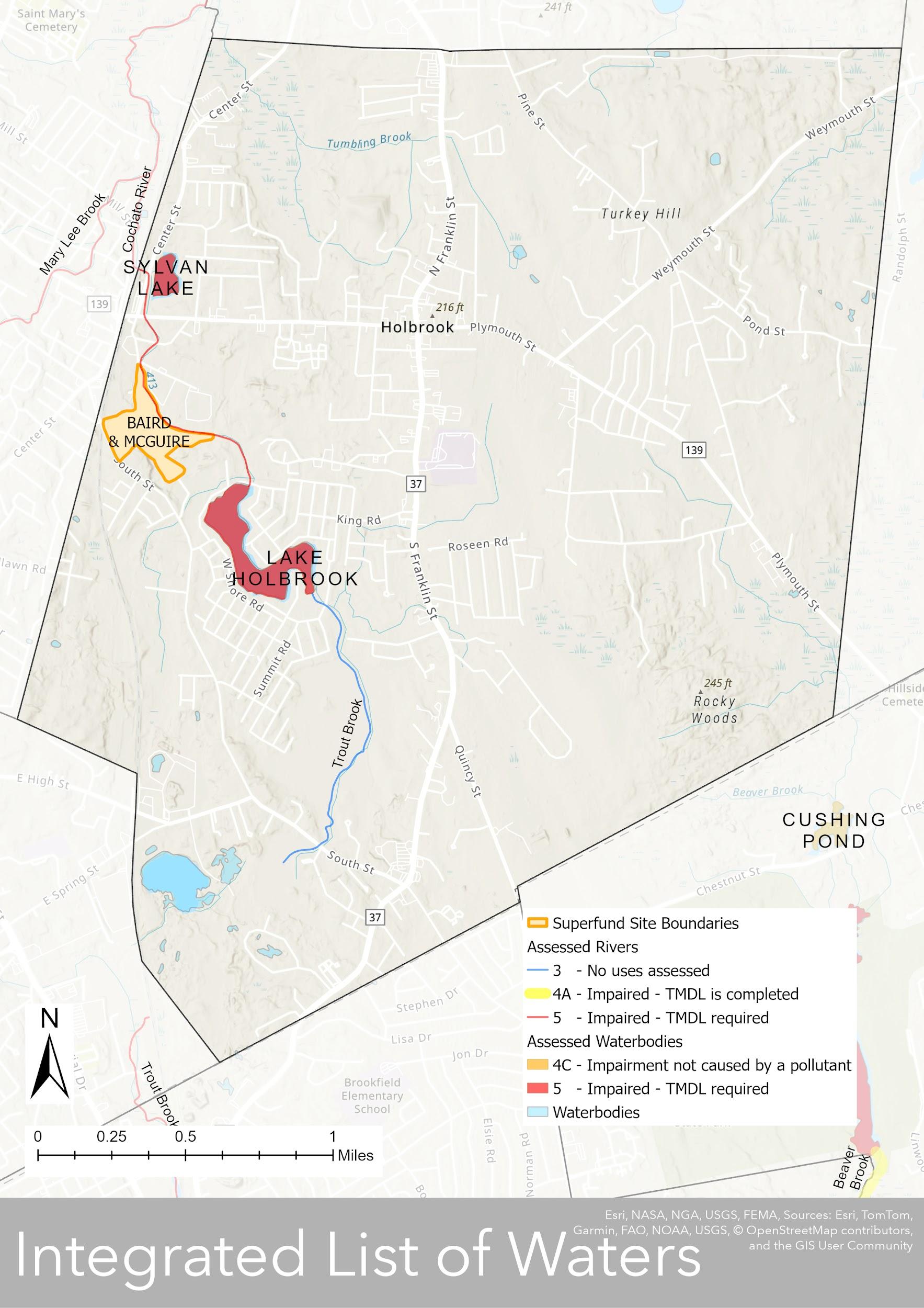
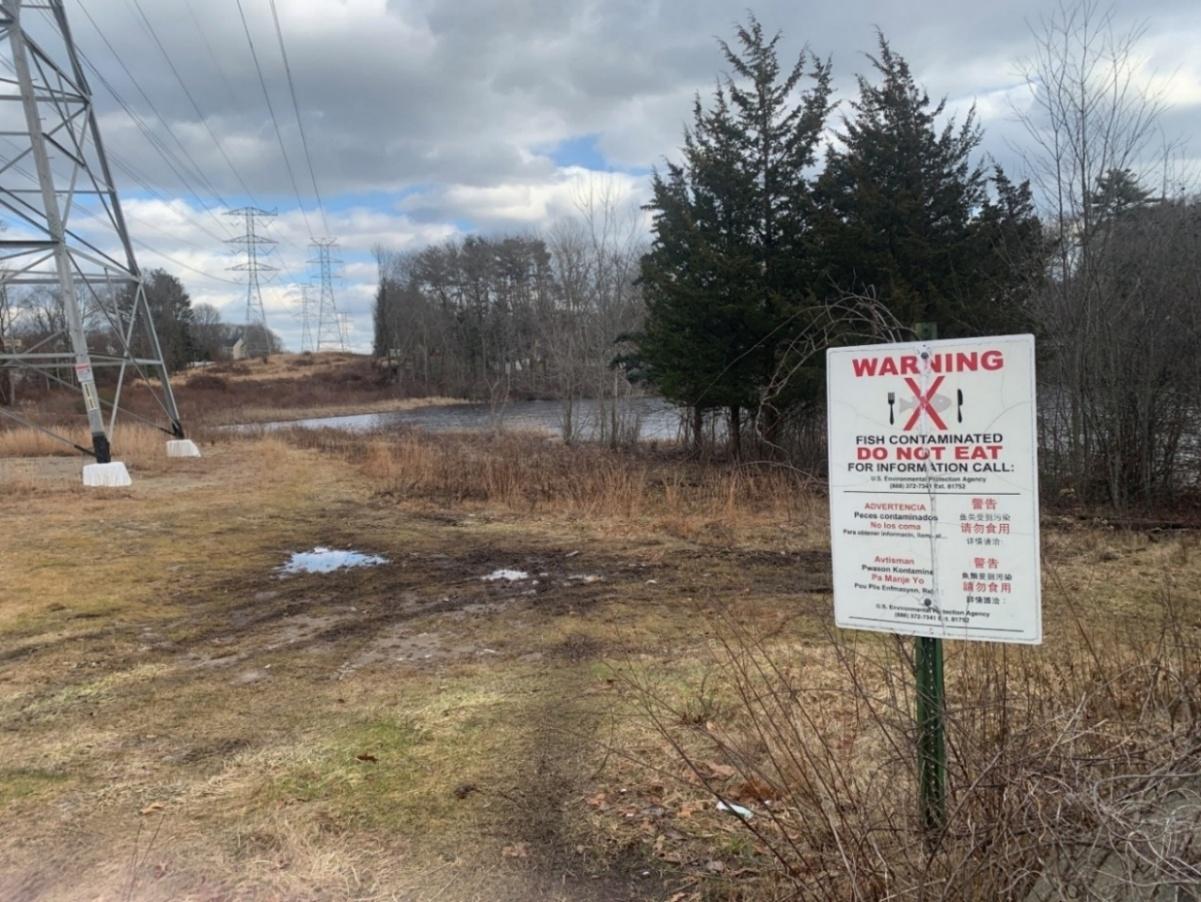
The Cochato River is the major river within the town. There are several smaller rivers in town including Trout Brook, Beaver Brook, and Tumbling Brook. There is no location for swimming in Holbrook. Sylvan Lake and Lake Holbrook are used for fishing; however, signs are posted at both locations advising against the consumption of fish caught from these bodies of water. Kane’s Pond is another fishing area in town, but it is not designated as open space and is surrounded by private land. Map 4.8 shows the impaired waterways in Holbrook.
Rivers and Streams
Cochato River:
The Cochato River has not been used as a water source for approximately forty years because of contamination from the Baird & McGuire site. The Cochato River is three and a half miles from the superfund site. The Cochato River is identified as impaired by the MassDEP 2022 Integrated List of Waters, due to Chlordane in sediment, DDT in sediment, copper, e. coli, lead, fecal coliform, and dissolved oxygen. The Cochato River is category 5 (waters requiring one or more TMDL or Total Maximum Daily Load). The Cochato is an outlet of Lake Holbrook, then flows into Farm River forming headwaters of Monatiquot River in Braintree. The Cochato River is 4.1 miles long.
Trout Brook:
Trout Brook headwaters are located southwest of South Street and the brook is an inlet for Lake Holbrook. Trout Brook is 1.2 miles long and identified as category 3, no uses assessed.
Tumbling Brook:
Located on the town’s north side the brook flows northwest through a large wetland before joining the Cochato River near the town’s northwest borders with Randolph and Braintree.
Lakes and Ponds
Sylvan Lake:
Sylvan Lake is contaminated and is identified as impaired by the MassDEP 2022 integrated list of waters due to chlordane, and DDT found in fish tissue. It covers 6 acres.
Lake Holbrook:
Lake Holbrook is very shallow, approximately 6 feet deep. Lake Holbrook was formed on top of a swamp when a dam was installed in the 1930’s. The dam is the origin point for the Cochato River, which flows northward through Sylvan Lake. Lake Holbrook is an impaired waterbody identified by MassDEP for nutrient/eutrophication biological indicators. The total lake area is 31 acres. There is very little vegetative buffer around the lake and some homes surrounding the lake are not on town sewer lines. The combination of minimal vegetative buffers and poor septic systems are contributing to the poor water quality of the lake.
Kane’s Pond (off Spring Street):
This pond originated as a gravel pit. During excavation a spring was hit, flooding the depression and forming a pond. There are no reports on the water quality.
Wetlands and Floodplain
Wetlands and Riparian Zones
A distinct feature of Holbrook is its vast amounts of wetlands. Wetlands provide wildlife habitat, flood storage, pollution abatement, and groundwater recharge. Most of the town’s wetlands are wooded and are in nearly every part of town (Map 3.7). Wetlands are protected through the Massachusetts Wetlands Protection Act, which applies to activity within the wetland and within 100 feet of wetlands bordering ponds, streams, and other water features. The Holbrook Conservation Commission administers this law and considers applications for activities in wetlands and buffer zones. The Wetlands Protection Act does not provide protection for many small, isolated wetlands. Towns can enact stricter wetland by-laws to protect these resources and their buffers; this is discussed in Section 9. The Massachusetts Rivers Protection Act protects an area extending 200 feet from a riverbank of a perennial river or stream. This riverfront area can play an important ecological role by serving as the recharge area for rivers, by providing habitat for riparian species, and by allowing riparian corridors to serve as effective migration corridors for species requiring larger habitat areas.
The pervasive presence of wetlands has largely constrained development in Holbrook. Developing in wetlands is not impossible however it is challenging for developers to do. When considering where to develop, it is important to prioritize uplands and infill within existing developed areas to reduce impact. Avoiding development in wetlands and floodplains would support climate resilience as these areas store and absorb floodwaters.
Floodplain
Floodplains in Holbrook are primarily defined by the Flood Hazard Area shown on Flood Insurance Rate Maps (FIRM) issued by FEMA (Map 3.10). The floodplain covers the Tumbling Brook Conservation Area, around Lake Holbrook, the Donna wellfield area, and extends past south street. The floodplain also extends between the new JFK school and the old JFK school. Lands within the floodplain are industrial building, residential neighborhoods and business. Some areas of the floodplain are protected open space
Drinking Water Supply
Due to past contamination of the local sources of public drinking water (surface waters and groundwater), Holbrook relies solely on water from a Tri-Town Water agreement with Braintree and Randolph. The three communities receive drinking water from Randolph/Braintree’s Upper and Lower Great Pond Reservoir, and Richardi Reservoir (Map 3.8). Water is pumped from the Richardi Reservoir to the Great Pond/Upper Reservoir when water levels in the Upper/Lower Great Pond Reservoir are low. The Cochato River, although once a part of the reservoir system, has not been feeding the system since 1983, when it was documented, that Baird McGuire had contaminated the river.
In 2019, the Tri-Town Water Board conducted testing for per- and polyfluoroalkyl substances (PFAS) in the finished water supply, and the results averaged 24.5 ppt (parts per trillion). This is below the federal health advisory limit of 70 ppt set by the EPA but above 20 ppt, the MassDEP standard. In response, efforts began to implement a treatment system to reduce PFAS contamination (Environmental Partners).
By 2021, growing community concerns over elevated PFAS levels in drinking water led to the approval of a new, state-of-the-art water treatment facility to replace the aging system. Originally expected to be completed in 2024, construction has since been delayed and is now projected to continue until at least 2026.
The Holbrook community is highly sensitive about its drinking water supply, especially after a previous contamination by Baird McGuire. This heightened awareness of the need for clean water could be directed toward more regional protection of open space parcels within the Tri-Town Watershed (Avon, Randolph, and Braintree). Preserving these areas will help safeguard the water supply from future contamination
Holbrook has several inactive water sources:
Donna Road Wellfield:
The Donna Road wellfield is located north of South Street in Trout Brook wetlands area. The wellfield consists of 20 small-diameter wells that are approximately 40 feet deep; the total yield is reported to be about 350 gallons per minute (gpm) or 0.5 mgd. The wellfield operation was discontinued in 1973 when high iron and manganese levels were found in the water.
South Street Wellfield:
The South Street wellfield consists of three wells in Holbrook with a total estimated maximum safe yield capacity of 0.31 MGD. The wells were closed in the early 1980s because of contamination with volatile organic chemicals.
The closing of the Donna Road Wellfield in the 1970’s and the remaining South Street well in the 1980’s forced Holbrook, Randolph, and Braintree to rely solely on the Great Pond System as a clean water supply. The Towns have implemented several conservation measures, including metering, water audits, leak detection and repair, public education, and promotion of efficient water-saving plumbing fixtures. All three Towns have also implemented water bans, which occasionally restrict or prohibit activities such as car washing and lawn watering.
D.VEGETATION
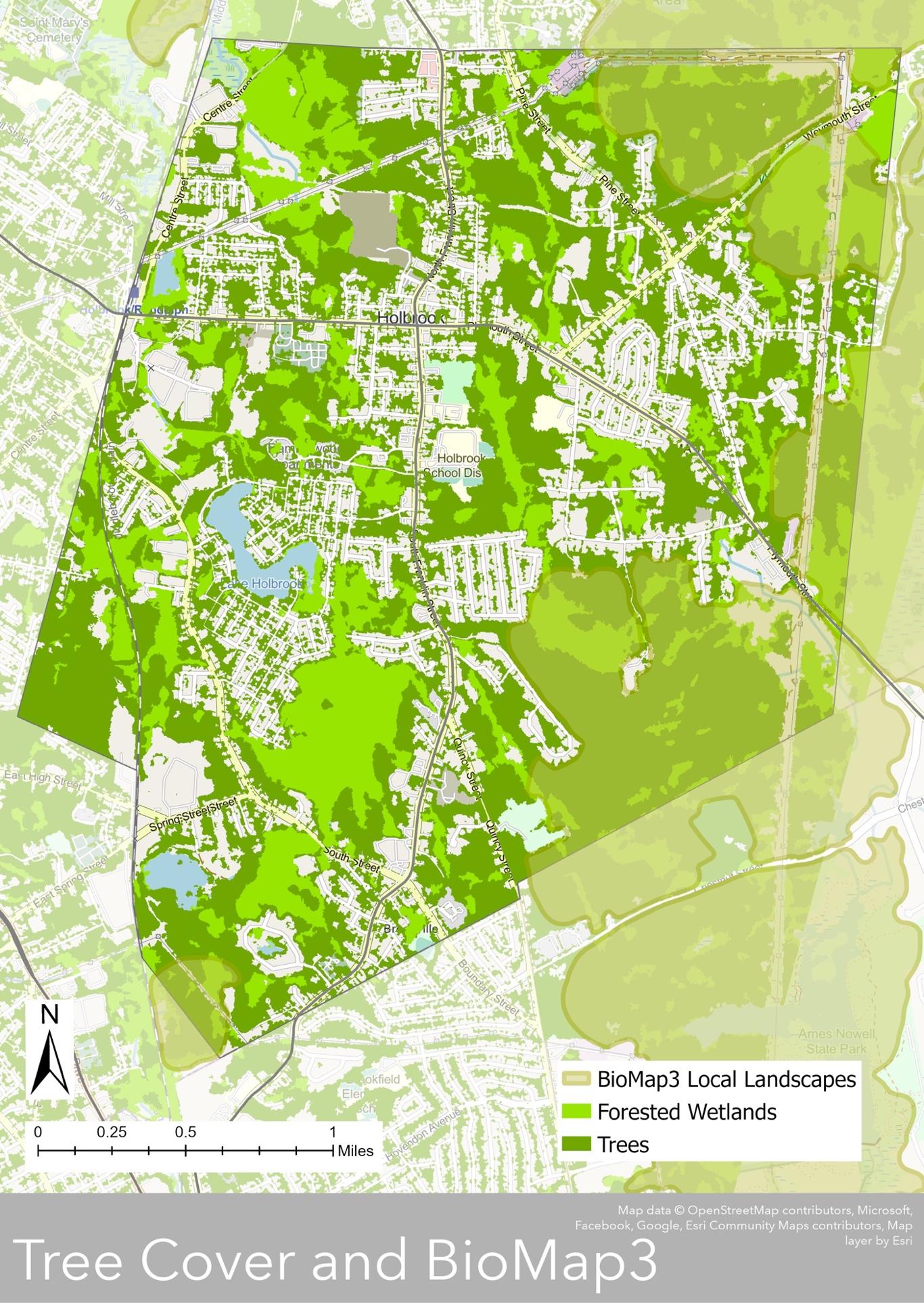
The vegetation of Holbrook resembles that of other Norfolk County towns; however, Holbrook’s abundance of forest and wetlands is notable (Map 4.7). Holbrook lies within the Southern New England Coastal Plains and Hills Ecoregion, an area made up of plains and low-lying hills. Holbrook has on average about 60% more tree canopy than the immediately surrounding communities (according to MassGIS Landcover data, 2016). This is especially noteworthy given its smaller size and proximity to Boston. The town has unique habitats and rare species; through responsible open space and recreational planning the town can encourage outdoor recreation in such places while also being sensitive to those ecosystems.
In developed areas of town, turf lawns and ornamental plantings are common. There is no formal public shade tree planting program in Holbrook. The Department of Public works is responsible for all tree maintenance and public tree plantings.
Upland Vegetation
The Southern New England Coastal Plains and Hills ecoregion supports a diverse range of vegetation shaped by soil composition, topography, and historical land use. Historically, these forests were dominated by oaks (Quercus spp.),
American chestnut (Castanea dentata), hickories (Carya spp.), eastern hemlock (Tsuga canadensis), and eastern white pine (Pinus strobus). However, land use patterns shape the landscape we see today clearing land for agriculture and livestock, and increased development in the form of residential neighborhoods, commercial areas, and industry. As a result, the region's natural landscapes have changed significantly (Southern New England Coastal Plains and Hills).
Today, the Coastal Plains and Hills ecoregion is characterized by dry to mesic oak and oak-pine forests, with dominant species including various oaks, eastern white pine, and eastern hemlock. Forested wetlands in the region commonly feature red maple (Acer rubrum), elm (Ulmus spp.), and ash (Fraxinus spp.). Holbrook contains several upland forest communities, including Northeastern Coastal and Interior Pine -Oak Forest and Appalachian (Hemlock) Northern Hardwood Forest. Descriptions of these plant communities are found in Nature Conservancy Northeast Habitat Map. Notable preserved forest stands can be found in the Town Forest, Turkey Hill, and Rocky Woods, all of which have trails either formal or informal.
Northeastern Coastal and Interior Pine Oak Forest:
The mixed forest of Holbrook is dominated by white pine, red oak, and hemlock, with red maple and white and black oak as common associates. Northern hardwoods like white ash and American beech appear as minor components. This forest community can be largely coniferous, with some nearly pure stands of white pine and red maple, while hemlock is often more abundant in moist settings. Throughout the region this forest community is widespread and in early to mid-successional stages, and heavily fragmented. Its current extent may be largely influenced by past land use and human alterations to the New England landscape. The associated species and ones of concern in pine-oak forests are found in Tables 4.2 and 4.3.
Table 4.2
Northeastern Coastal and Interior Pine Oak Forest Associated Species
Birds
Mammals
Herptiles
Plants (herbaceous understory)
Table 4.3
Black-and-white warbler, blue-headed vireo, brown creeper, eastern woodpewee, hermit thrush, ovenbird, pine warbler, scarlet tanager, veery, wood thrush
Appalachian (Hemlock) Northern Hardwood Forest: The second major forest community in Holbrook is the Appalachian (Hemlock) Northern Hardwood Forest. This hardwood forest is characterized by sugar maple, American beech, and yellow birch, sometimes mixed with eastern hemlock. Northern red oak and white oak are common but do not dominate, while black cherry, black birch, white pine, and tulip tree are typical in nutrient-rich or historically disturbed sites. Ecologically adaptable, it occupies low to mid-elevations across various topographies and bedrock types. The associated species and ones of concern in northern hardwood forests are found in Tables 4.4 and 4.5.
Table 4.4
Appalachian (Hemlock) Northern Hardwood Forest Associated Species
Appalachian (Hemlock) Northern Hardwood Forest Species of Concern
Birds
Mammals
Herptiles
Brown creeper, canada warbler, northern goshawk
Allegheny woodrat, indiana myotis, southern rock vole, southern water shrew, virginia northern flying squirrel
Cheat mountain salamander, eastern massasauga, green salamander, mountain earth snake, northern spring salamander
Insects Early hairstreak butterfly, spicebush swallowtail butterfly, West Virginia white
Plants (herbaceous understory)
Wetland Vegetation
American ginseng (Panax quinquefolius), Appalachian blue violet (Viola appalachiensis), black bugbane (Actaea racemosa), Case's ladies'-tresses (Spiranthes casei), hairy beardtongue (Penstemon hirsutus), laurentian bladder fern (Cystopteris laurentiana), mountain bugbane (Actaea podocarpa), small skullcap (Scutellaria parvula)
More than one-third of the threatened and endangered species in the United States live only in wetlands, and nearly half require wetlands at some point in their lives. Many other animals and plants depend on wetlands for survival (Massachusetts Wetlands).
Forested Wetlands (Mixed, Conifer and Deciduous):
Forested wetland communities cover approximately 885 acres in Holbrook. These wetlands are likely dominated by flood-adapted eastern white pines and are ecologically significant, providing habitat for vernal pools. They consist of conifer or mixed conifer-hardwood wetlands, where hemlock is typically present and may be dominant, often mixed with deciduous wetland trees such as red maple or black gum. Spruce is rarely found in these systems. These swamps are found at low to mid-elevations in poorly drained depressions, often near streams. The associated species and ones of concern in forested wetlands are found in Tables 4.6 and 4.7.
Table 4.6
Forested Wetlands (Mixed, Coniferous, and Deciduous) Associated Species
Shrub/scrub wetlands in Holbrook cover approximately 221 acres and develop in mineral soils that experience seasonal or temporary flooding. These wetlands often occur in transition zones between emergent wetlands and wooded swamps. As successional communities, they are commonly found in areas of regular disturbance, such as utility rights-of-way and electrical transmission corridors. Dominated by a mix of woody plants, shrub swamps feature species such as alders, silky dogwood, and winterberry. These wetlands provide critical nesting habitat for breeding birds, particularly within their dense shrub thickets. The associated species and ones of concern in shrub/scrub wetlands are found in Tables 4.8 and 4.9.
Table 4.8
Shrub/Scrub Wetlands Associated Species
Birds
Mammals
Alder flycatcher, American woodcock, common yellowthroat, least bittern, Nashville warbler, northern waterthrush, ruddy duck, sedge wren, swamp sparrow, Tennessee warbler, veery, wilson’s warbler, wilson's snipe, yellow warbler
Eastern cottontail, meadow jumping mouse, New England cottontail, northern bog lemming, northern short-tailed shrew, raccoon, smoky shrew, snowshoe hare, southern bog lemming, starnosed mole, Virginia possum, water shrew
Holbrook contains approximately 79.5 acres of emergent wetlands, dominated by herbaceous vegetation. These wetlands are typically found in isolated basins, and along stream edges. Scattered shrubs are often present but generally not abundant while trees are usually absent or only sparsely distributed in these wetland systems. The associated species and ones of concern in emergent wetlands are found in Tables 4.10 and 4.11.
Table 4.10
Emergent Wetlands Associated Species
Birds American bittern, American black duck, blue-winged teal, common gallinule, great blue heron, least bittern, marsh wren, pied-billed grebe, sora, swamp sparrow, Virginia rail, wood duck
Mammals Eastern cottontail, meadow jumping mouse, mink, moose, muskrat, raccoon, southern bog lemming, Virginia possum, water shrew
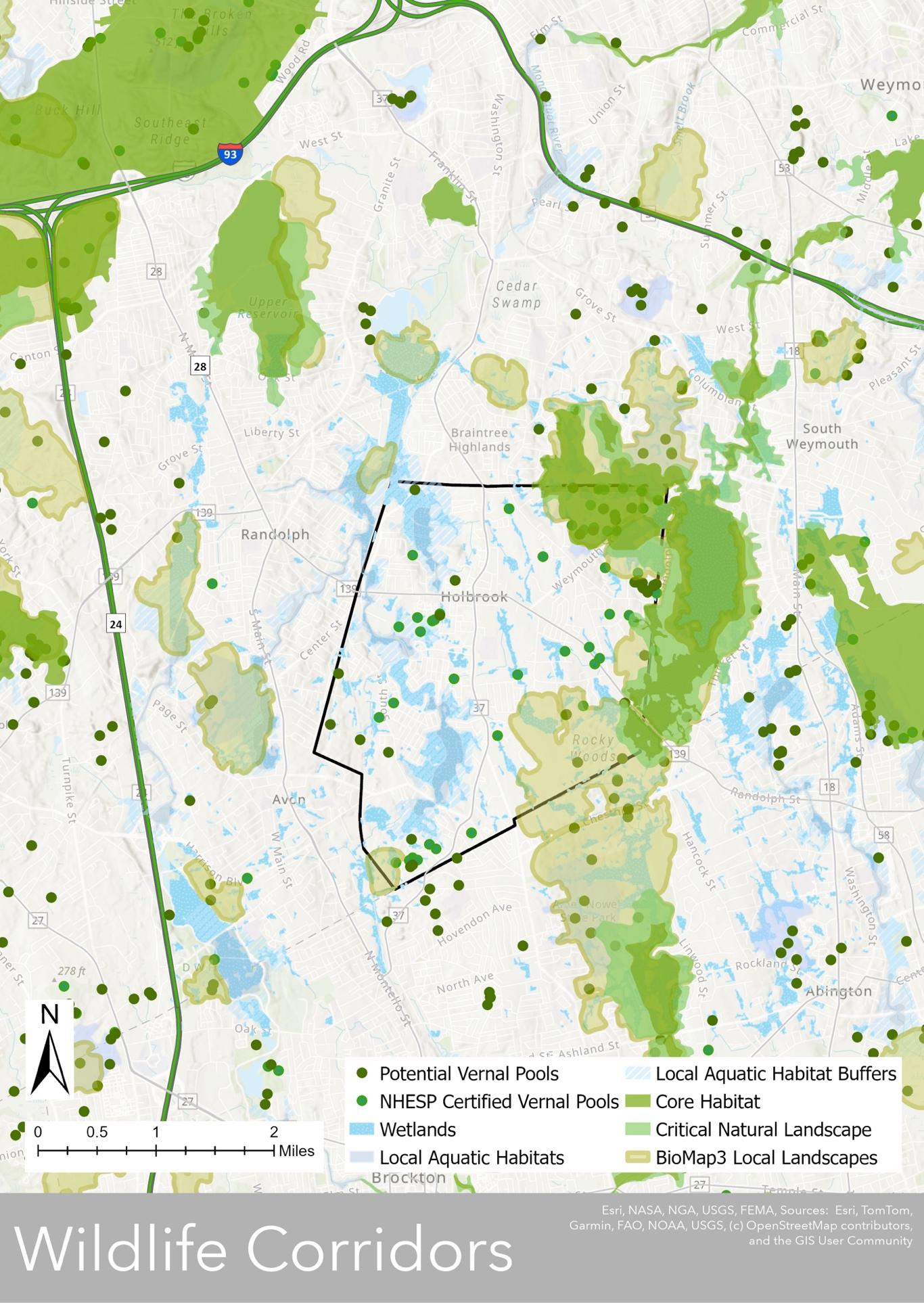
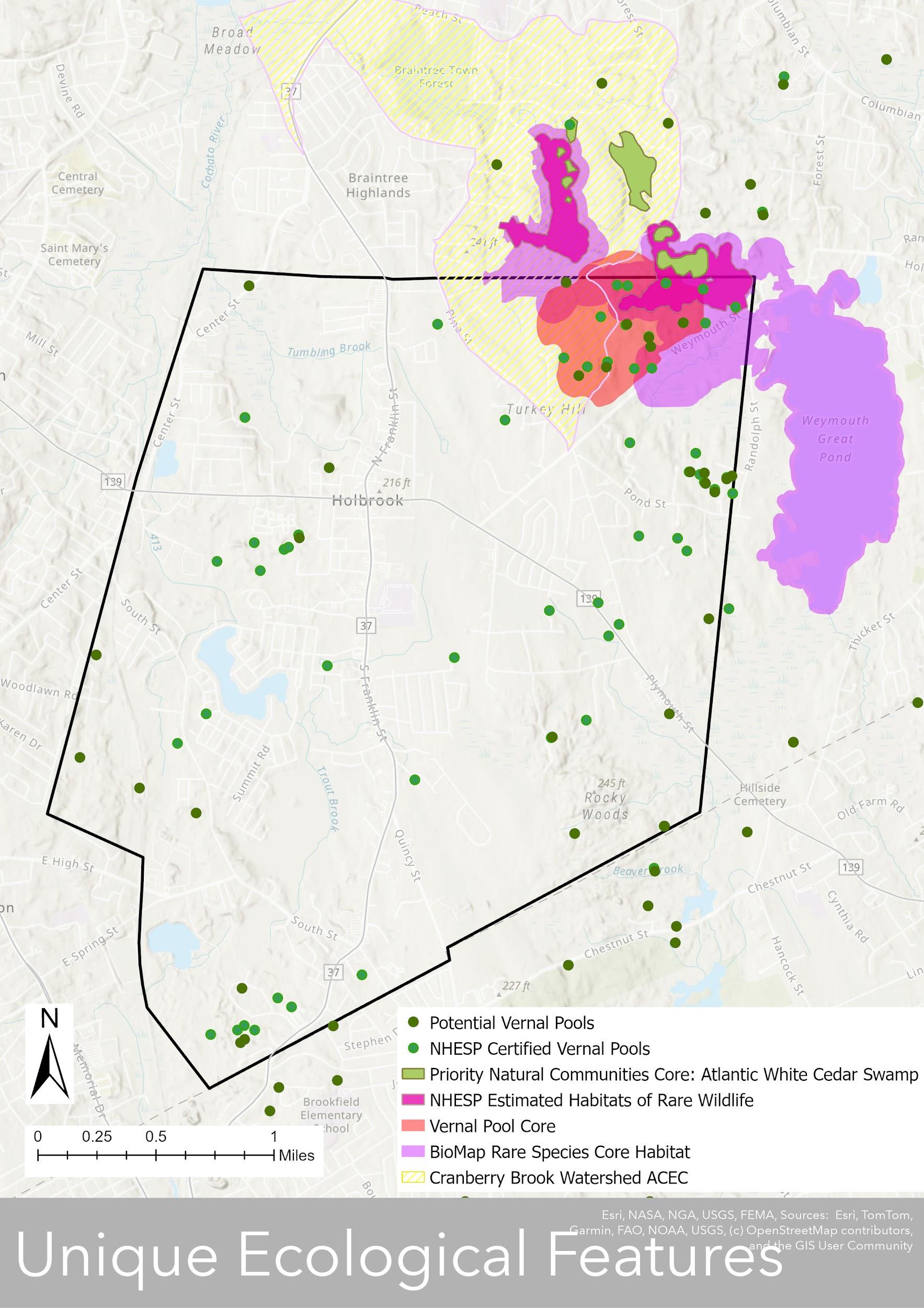
According to BioMap3 from the Natural Heritage and Endangered Species Program, Holbrook contains Core Habitat, Critical Natural Landscapes, Rare Species Habitat, Priority Natural communities and Areas of Critical Environmental Concern (ACEC). Core Habitats are areas that are critical for long term viability of rare species, exemplary natural communities, and resilient ecosystems. Critical Natural Landscapes are areas that are minimally impacted by development and serve as buffers to core habitats that enhance connectivity and resilience. Rare Species Core are areas that are critical to the long-term conservation of our most vulnerable species and their habitats. Priority Natural Communities are communities of plant and animal species with limited distribution (Massgis Data: BioMap: The Future of Conservation) (Map 4.10, 4.11).
According to NHESP, a portion of the Town Forest within the Cranberry Brook Watershed ACEC on the Holbrook/Braintree town line is an Atlantic white cedar swamp. Areas of critical environmental concern (ACEC) are designated by the Secretary of Energy and Environmental Affairs for the quality, uniqueness and significance of their natural and cultural resources. The designated ACEC shown on Map 4.12 is one out of only 30 ACEC designations in Massachusetts. The program is designed to increase appreciation and stewardship of these ecologically significant areas, but ACEC designation does not protect these lands, supersede local regulations or zoning, change or affect land ownership, allow public access on private property, or prohibit or stop land development. Effective open space planning, however, can be a tool to protect and make areas like this more accessible (Massgis Data: Areas of critical environmental concern).
E. FISHERIES AND WILDLIFE
Wildlife in Holbrook
Typical of suburban New England, Holbrook hosts habitat for coyote, deer, squirrels, and various bird species who utilize intact natural corridors for breeding, hunting, and movement. Wildlife in Holbrook can utilize undeveloped forested corridors and natural “highways” along electrical transmission lines. Wildlife corridors are essential for maintaining healthy ecosystems and promoting species survival. They facilitate gene flow, migration, and range expansion, which are crucial for genetic diversity, adaptation to climate change, and ecosystem functioning. Corridors also help minimize conflicts between wildlife and human activities and are integral to conservation planning efforts aimed at preserving biodiversity and ecosystem services.
Vernal Pools
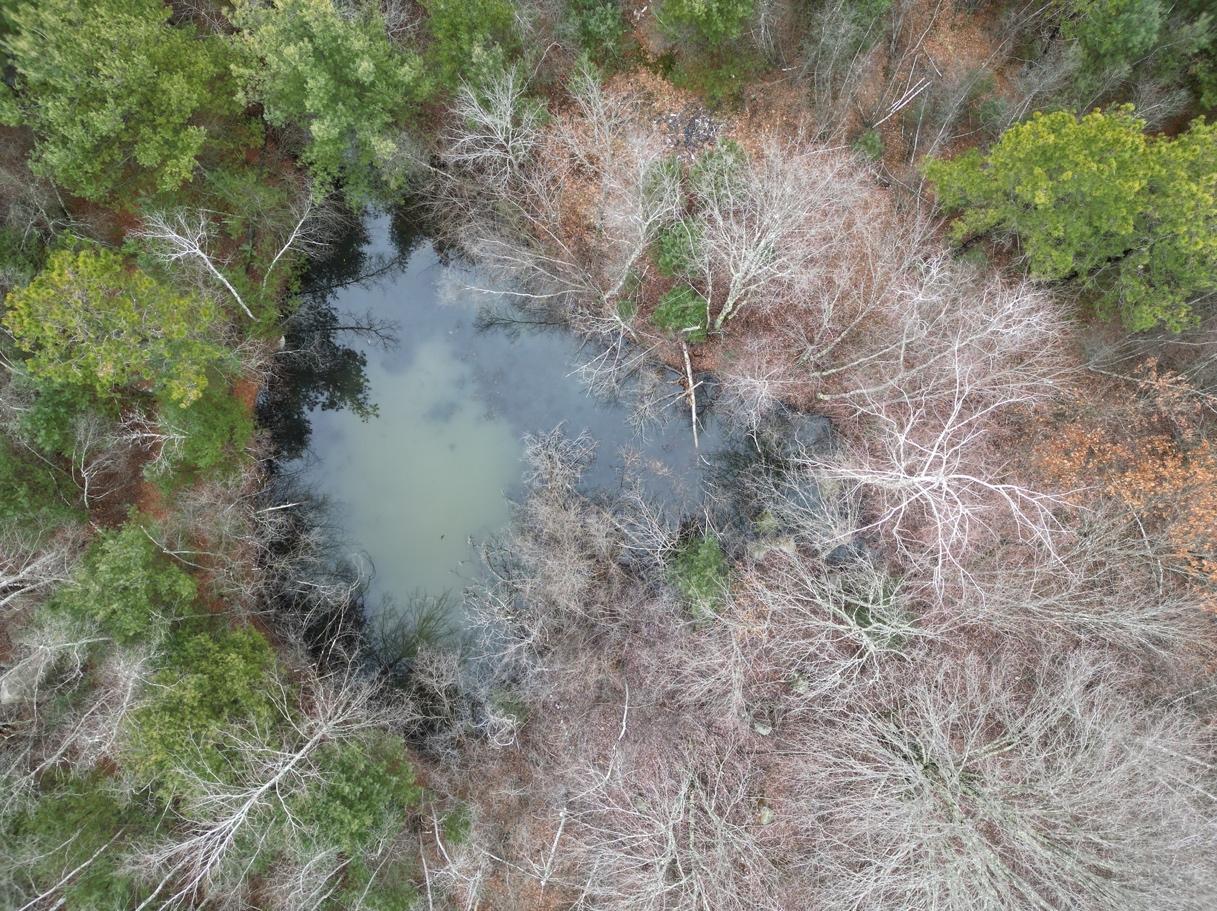
Vernal pools are a unique ecological habitat and are often home to several rare and endangered species. Vernal pools are temporary woodland ponds that fill with water from winter into spring and typically dry up by the end of summer. A critical feature of vernal pools is that these dry periods prevent fish from establishing permanent populations in the pools, which allows for the reproductive success of many amphibian and invertebrate species. According to the National Heritage and Endangered Species Program, Holbrook currently hosts 53 certified vernal pools. Additionally, there are 28 potential vernal pools.
To be certified, a vernal pool must have a documented dry period, no fish, and evidence of breeding vernal pool amphibians such as the wood frog (Rana sylvatica) or the presence of fairy shrimp (Branchinecta lynchi). Most of the certified vernal pools in Holbrook are in the Town Forest and in wetland areas.
Rare Wildlife Species
Several endangered and rare species have been documented in Holbrook, particularly in the northeast section of town near the Cranberry Pond Conservation Area. While specific species and their exact locations are not publicly available for their protection and to prevent poaching, examples of threatened or species of special concern in Holbrook, according to The Massachusetts Endangered Species Act (MESA), include the eastern box turtle, long-eared bat, mocha emerald (a rare dragonfly), and pale green orchid
Holbrook’s position on the watershed divide between the Narragansett Bay and Boston Harbor makes it an unlikely location to support habitat for river herring. However, the Holbrook Town Forest helps provide clean water and beneficial habitat conditions for herring downstream. Downstream in Braintree, river herring, such as the blueback herring a species of concern likely rely on Holbrook’s riparian wetlands and floodplains to support quality spawning, nursery, and refuge habitat Restoration efforts, including dam removals along the Monatiquot River in Braintree, aim to improve fish passage and habitat connectivity (Monatiquot River Restoration Project) These projects highlight how protecting Holbrook’s waterways and floodplains will support regional conservation efforts for migratory fish and other sensitive species.
Wildlife Corridors
Wildlife corridors are undeveloped lands which allow wildlife to move between large swaths of uninterrupted habitat. These corridors provide critical pathways for species to find food and water, seek nesting areas, and reproduce. Additionally, wildlife corridors play a key role in maintaining genetic diversity in populations. The greatest threat to wildlife corridors in Holbrook is habitat fragmentation due to development.
The forest cover map (Map 4.9) shows that the town’s largest and most intact forested areas are concentrated along the northeast, east, and southeastern borders. These forests are part of a broader, contiguous natural landscape block of approximately 3,200 acres spanning Braintree, Holbrook, Weymouth, Abington, and part of Brockton. This intact area provides valuable natural resources and recreational opportunities for residents and serves as a critical ecological corridor, linking larger core habitats across the region.
This corridor includes Braintree’s Cranberry Pond Conservation Area, the Holbrook Town Forest, Weymouth Great Pond water supply land, and Ames Nowell State Park in Abington, along with many privately owned parcels (Map 4.10). However, sprawling development continues to threaten these vital corridors, emphasizing the need for proactive land conservation and strategic planning to maintain habitat connectivity. Improving connectivity across
existing roads, such as through improvements to culverts to allow wildlife passage under the road may benefits public safety by reducing vehicle collisions with wildlife.
F. SCENIC RESOURCES AND UNIQUE ENVIRONMENTS
Holbrook does not have any designated scenic landscapes according to the Massachusetts Landscape Inventory: A Survey of the Commonwealth’s Scenic Area (1982). Building off the 1982 study, the Heritage Landscape Inventory program was developed in 2001 to assist communities in the identification of their heritage landscapes. Planners and policymakers realized the importance of historic landscapes as a critical tool for community planning. Holbrook did not participate in either of these studies.
However, Holbrook does contain unique ecological features (Map 4.11). According to NHESP, a portion of the Town Forest is within the Cranberry Brook Watershed ACEC. The Cranberry Brook Watershed ACEC was designated in 1983 and hosts large quaking sphagnum bogs as well as Atlantic White cedar swamp habitat on the town line separating Holbrook and Braintree.
On a clear day, residents standing on top of the towns capped landfill can enjoy scenic views of Blue Hills Reservation. This vantage point is valued for its panoramic views making it an optimal candidate become open space and recreational area in Holbrook.
G. ENVIRONMENTAL CHALLENGES
Holbrook faces environmental challenges typical of a developed suburban area with an industrial past. The town’s natural resources have been impacted by contamination from sources like early industries of shoe manufacturing, to more recent chemical mixing plants, PFAS, urban landfills, untreated stormwater drainage, and illegal dumping.
Superfund and Brownfield
From 1912 to 1983, Baird & McGuire operated a chemical mixing facility in Holbrook, dealing with pesticides, solvents, and other hazardous materials. In 1982, the EPA assessed the site and designated it a Superfund site due to hazardous waste disposal practices, including direct discharge into the soil and nearby water sources. Located near the Cochato River and a former municipal well field, the site poses ongoing environmental risks. Remediation efforts have included demolishing most structures, capping contaminated areas, incinerating polluted soil, and implementing groundwater containment measures. The well fields, located within 1,500 feet of the site, were shut down in 1982. A 2019 five-year review identified arsenic as an additional contaminant of concern. (EPA, Remediation System Evaluation Baird and McGuire Superfund Site).
Baird & McGuire is not the only contaminated site in Holbrook’s industrial corridor. The former Holbrook Chemical Corp. site has been designated a brownfield due to toxic chemical pollution from endrin aldehyde, hexachlorobenzene, tricholoroethene, and methylene chloride.
Located next to the MBTA rail line, the Holbrook Chemical Corp. site has been proposed for redevelopment as a transfer station. However, this plan has faced strong opposition from residents. The proposed transfer station would process over 1,000 tons of waste daily from across eastern Massachusetts. Residents' concerns include the scale of the operation, the site’s history of contamination, and its location within a FEMA-designated 100-year flood zone. The site is mostly forested, and any loss or degradation of upstream wetlands could further heighten flood risks (DEP TLA Holbrook)
Capped Landfill
Another contaminated site, a town-owned landfill near Town Hall, was officially capped in 1996. Although the landfill is not officially designated as open space, many residents already use it as an informal walking area. It also borders utility transmission lines that are commonly used for recreation and provides access to wetlands along Tumbling Brook and nearby vernal pools, highlighting its potential for ecological restoration, expanded public use and connectivity.
Climate Change
In 2021, Holbrook partnered with the consulting firm Environmental Partners to conduct a Municipal Vulnerability Preparedness (MVP) assessment. The top hazards identified during the Community Resilience Building Workshop
were increase in extreme heat days and heat waves, greater flooding from heavy rain events, higher drought risk, impacts from more intense storms, and flooding risks associated with sea level rise (MVP Community Resilience Building Workshop Summary of Findings Report, Town of Holbrook, 2021).
Open space plays a critical role in climate resilience, particularly within floodplains and wetlands. These areas can provide natural buffers along waterways, provide flood storage capacity, and recharge stormwater, helping to mitigate flood risks and maintain high water quality. Holbrook’s forested landscape will continue to provide cooling effects in the landscape, critical as more extreme heat days become the norm. Additionally, preserving and expanding open space promotes habitat connectivity, allowing ecosystems and wildlife to adapt to a changing climate while enhancing recreational opportunities for residents.
Impervious surfaces like pavement roads and parking lots absorb and retain heat, raising land surface temperatures and creating urban heat islands. These hot spots, where tree cover is minimal, can significantly warm stormwater runoff, which then flows into streams, disrupting aquatic habitats (Massachusetts Climate Change Assessment, 2022). The loss of tree cover exacerbates the urban heat effect, emphasizing the need for increased green spaces and tree cover to mitigate these effects
Equal Access to Open Space
Holbrook has the opportunity to ensure that open and recreational spaces are accessible to all of its residents. Currently, the most frequently used natural space is the Town Forest, which is in one of Holbrook’s more affluent neighborhoods. Meanwhile, neighborhoods identified as Environmental Justice populations have significantly less access to open space and recreational areas. EJ communities are more likely to live near contaminated sites and environmental hazards, and this trend holds true in Holbrook. However, some contaminated sites may be suitable for restoration as for open space. Former industrial sites present opportunities to support Holbrook’s open space and recreation goals; for example, habitat restoration within brownfields could enhance biodiversity and create new recreational spaces. As opportunities arise, Holbrook should prioritize equitable access to open spaces for all communities (more details are provided in Section 5 and Section 7)
Although Holbrook owns open space parcels, many are not easily accessible to the public. In several cases, new developments have restricted public access to natural areas, reducing recreational opportunities. These challenges highlight the need for proactive zoning and open space initiatives to protect public access and ensure future development meets community needs. This is especially prudent as temperatures rise; residents will increasingly seek outdoor spaces to stay cool.
Map
Map 4.3 Depth to Bedrock (meters)
Map
Map 4.9 Tree Cover and BioMap3
Map 4.10 Wildlife Corridors
Black arrow showing wildlife corridor.
SECTION 5
Inventory of Lands
“Your region’s open space offers significant community benefits. The forests, wetlands, trails, gardens, parks, historic sites, and other open spaces permanently conserved for public access will provide ecological, recreational, and health benefits to your local community for decades to come.”
Open Space Handbook
MA Department of Conservation & Recreation
Section 5: Inventory of Lands of Conservation & Recreation Interest
“Open space,” very generally, is land that is preserved, undeveloped, and/or used for recreation or conservation purposes. More specifically, it can be land that offers any of the following:
• Conserves natural or scenic resources and vistas
• Protects streams or water supply
• Promotes conservation of soils, wetlands, beaches, or tidal marshes
• Includes public parks, forests, wildlife preserves, nature reservations, or sanctuaries
• Offers outdoor recreation opportunities
• Preserves historic sites
• Preserves visual quality along highways or street corridors
It is also important to note that open space can be designated as public or private. Private open space may include membership-only clubs like golf courses or gun clubs. Sometimes open space is permanently protected from development, and sometimes parcels may have no protections at all. The section below describes different levels of protection.
LEVELS OF PROTECTION
(Definitions from MassGIS)
In Perpetuity (P) - Legally protected in perpetuity and recorded as such in a deed or other official document. Land is considered protected in perpetuity if it is owned by the town’s conservation commission or, sometimes, by the water department; if a town has a Conservation Restriction on the property in perpetuity; if it is owned by one of the state’s conservation agencies (thereby covered by article 97); if it is owned by a non-profit land trust; or if the town received federal or state assistance for the purchase or improvement of the property.
Private land is considered protected if it has a deed restriction in perpetuity, if an Agriculture Preservation Restriction has been placed on it, or if a Conservation Restriction has been placed on it.
Temporary (T) - Legally protected for less than perpetuity (e.g., short-term conservation restriction), or temporarily protected through an existing functional use. For example, some water district lands are only temporarily protected while water resource protection is their primary use.
These lands could be developed for other uses at the end of their temporary protection or when their functional use is no longer necessary. These lands will revert to unprotected status at a given date unless protection status is extended.
Limited (L) - Protected by legal mechanisms other than those above, or protected through functional or traditional use.
These lands might be protected by a requirement of a majority municipal vote for any change in status. This designation also includes lands that are likely to remain open space for other reasons (e.g., cemeteries and municipal golf courses).
None (N) - Totally unprotected by any legal or functional means. This land is usually privately owned and could be sold without restriction at any time for another use (e.g., scout camps, private golf course, and private woodland).
A. PRIVATE PARCELS
Holbrook has no private parcels in APR (Agricultural Preservation Restriction) or enrolled in Chapter 61. However, these methods of conservation should be promoted and private landowners encouraged to participate.
Chapter 61, 61A, and 61B is a voluntary program designed by the Massachusetts Legislature to tax real property in the Commonwealth at its timber resources, agricultural, or recreational value rather than its highest and best use (development) value. Landowners who enroll their land in the program receive property tax reductions in exchange for a lien on their property. The terms of the lien require that enrolled land remain in an undeveloped state and be managed for forest production, agricultural production, or recreation. Furthermore, the lien provides the municipal government of the city/town in which the enrolled property is located a right of first refusal should the landowner put the land up for sale while it is enrolled in the program. Towns may assign their right of first refusal to a state agency or a non-profit land trust. Landowners who develop their land while enrolled in the program, or for a period after withdrawing from the program, may be required to pay penalties. (Source: Town of Avon OSRP 2020 )
The Agricultural Preservation Restriction program is a voluntary program that offers a non-development alternative to farmland owners for their agricultural lands who are faced with a decision regarding future use and deposition of their farms. The program offers farmers a payment up to the difference between the “fair market value” and the “fair market agricultural value” of their farmland in exchange for a permanent deed restriction, which precludes any use of the property that will have a negative impact on its agricultural viability (MA DAR 2013). More recent APRs also include an “Option to Purchase Premises at Agricultural Value”, ensuring that protected farmland is not sold at prices beyond the reach of working farmers. Source: Town of Avon OSRP 2020
Private Lands
Holbrook Sportsmen’s Club: This private Rod & Gun Club was founded in 1940, with hunting, golf, pool, fishing, and archery, with emphasis on shooting activities. Offers NRA-certified courses in pistol, rifle, and shotgun. When active, gunfire can be heard through a large portion of the town. This parcel has no protection from development.
Siddarth CR: 23.5 acres required to be preserved as open space in exchange for permitting development of a 5-acre site adjacent to the Town Forest. 480 units are planned for a 55+ community as well as 2-3 bedroom single family homes in an association. Construction roads have been cleared, but development has halted. As with the Town Forest, this property includes Areas of Critical Environmental Concern, BioMap3 Rare Species habitats, and two vernal pools. Additionally, a portion of this space falls under the Natural Heritage and Endangered Species Program (NHESP) designation because it provides habitat for rare species that are protected under the MA Endangered Species Act. The site includes trails that connect to the Town Forest parcels.
Google Earth view as of March 2025 of Siddarth CR parcel and its associated development area.
Union Cemetery: Purchased in 1752, the cemetery holds over 3,000 graves, including the grave of Elisha & Sarah Holbrook’s infant son, Edward. Elisha was a benefactor of Holbrook, providing funds for the town hall and library upon its incorporation. The cemetery also serves as the final resting place for some members of the famed 54th Massachusetts Volunteer Infantry, an African-American regiment that served with distinction during the Civil War.
Photo of Union Cemetery by Scott C Carney posted on findagrave.com.
B. PUBLIC PARCELS
The following section describes municipal parcels in the order that they appear in the table.
Brookville Playground: Purchased by the town in 1910, this 4-acre parcel now includes a swingset and soccer field in poor condition. Half of the parcel is located in Holbrook, while the other half is located over the border in Brockton. The field is not irrigated. Facilities include a parking lot, port-o-let, and bench in the sun. The location is ideal for serving the Brookville section of town which lacks other facilities, particularly since the South School property
elementary school property included a playground, soccer fields, baseball field, and basketball court, among others. None of these have been replaced elsewhere in town.
Conservation Area neighborhoods to the north and south sides of the track, and an industrial area to the east. While this parcel sits in a forested corridor, it is not currently a desirable destination for public use due to the presence of the railroad and its inaccessibility.
Donna Road Wellfields: In 1965 several lots south of Lake Holbrook became Town property due to a “taking for water shed and supply purposes” by the Randolph-Holbrook Joint Board of Water Commission, and supplied the Town’s drinking water until 1973 when it was closed because high levels of iron and manganese were detected in the water (Randoph OSRP p. 36) Roughly around 2015, testing showed these wells to be free of harmful contaminants, and there was discussion of placing them back on-line, but that never happened. A successional forest is now the dominant land cover with trails on abutting properties. While the property does not appear to be fenced in, according to a number of individuals in town, it is unclear whether there is a posting to stay out of the property or if there are trails running through it. Reportedly, in some instances this is a dumping ground for yard debris and trash. The wetlands and standing water through this area may hamper accessibility.
Fairfield II Conservation Area: Located just east of Lake Holbrook with meandering trails, a parcel of approximately 5 acres deeded to the Town in 1963 “as a Park.”
Hatch Playground: The Hatch family deeded the property to the Conservation Commission in memory of their son. The major stipulation of the deed was that the Town would allow the use of the property by the Boy Scouts in the study and appreciation of nature and conservation. In the past, the Boy Scouts have used the property for camping, but the boundaries are not marked and now it is heavily vegetated so access is difficult. The entrance along Pond Street is narrow and abuts a residence, so entering the property feels like one is trespassing.
Brookville Field
Andersson
Holbrook Fire Tower: The property is owned by the state, and the original 70' tall iron tower was built with a $1,250 contribution from the towns of Avon, Stoughton, Weymouth, Randolph, Abington, and Holbrook and was first operated in 1926. In 1945, two-way radios were installed. In 1948, a new tower cab was built. At the end of the 1994 fire season, the tower use was discontinued. The tower was removed and scrapped in the fall of 2006. Source: http://firetower.org/lookouts/us/ma/holbrook-tower-site/
Holbrook Fire Tower pre-2006.
Holbrook Pre-K 12 School Fields: The new building and field complex was built in 2017, and was the largest public building project in town as of that date. The school combines grades K-12 under one roof, absorbing the students from the former JFK Middle School (which is now vacant) and South Street Elementary School (which has been sold and is now under development for single family and town homes) The copper patina panels of the curved façade were selected to mark the school’s distinction as the most important new building in town and to serve as a backdrop to highlight the native plant gardens in front of the school. The project was certified LEED Gold and boasts a 35% savings of water usage and 34% energy savings over baseline. In addition, the Town of Holbrook voted a permanent protection of 7.6 acres of Town-owned land adjacent to the school site for habitat preservation and restoration. The athletic fields include a combined turf field for football and soccer as well as a baseball field, a softball field, and a playground. Note that this property is not protected in perpetuity which leaves it vulnerable to future sale.
Holbrook School Department Land: This is a 70-acre parcel sandwiched between the new K 12 School and the former JFK Middle School, that was taken by the town by eminent domain in 1970 “to be acquired for school purposes” The property has wetlands running through its spine with no formal trails connecting the two school properties. Many residents would like to see trails and paths connecting the school properties, as this could be a convenient cut-through for several neighborhoods to the High School and center of town and would alleviate some vehicle traffic which is currently a problem. Given its central location in the town and between two key properties, this property could be a top prospect for permanent protection. It currently only has limited protection, and already portions of the space have been sold making the desired connections through the property to other areas more difficult (2 strips totaling 5.2 acres behind the old JFK school were sold in 1982)
Holbrook Town Forest: Totaling roughly 114 acres, the Town Forest is an ecologically rich area that features wetlands, a vernal pool (Elfin Pond), and glacial rock outcroppings and offers a trail network that connects to the Cranberry Pond Conservation Lands in Braintree via the powerlines that border the Forest to the north. There are three entrances: two on Pine Street, and the main entry at the end of Park Drive. Additional walk-in access points can be found throughout the abutting neighborhood, including the Wood Road cul-de-sac. Note that the abutting residential use conflicts with the public use of this space. The original forest entrance and main trail was taken to build this residential development in the 1970s. More recently a sidewalk was put on both sides of Park Road which constricted the road further for forest visitors, and created more congestion. Parking is limited at all entrances and unsafe at Pine Street due to the narrow shoulder, and also unsafe at Park Drive as there is no parking lot, just street parking that is congested. Cars have no ability to turn around without backing into a resident’s driveway. Hunting is allowed in the Forest which is reportedly a nuisance to some residents in the area, both due to the loud gunshots and the bloody game that is brought back to vehicles in full sight of the homes on the street, some with young children. While the community cherishes this resource, it is in deep need of basic amenities, including parking, signage, and snow clearing at the Park Drive trailhead. (The plow currently pushes snow from the street into a pile that blocks the entry.) Nearly the entire forest falls into an Area of Critical Environmental Concern designation, as well as BioMap3 Rare Species habitat. There are also three certified vernal pools in the Forest. A map of the trails is available on the Town’s website This is the only published trailway posted on the Town’s website.
JFK School Playground and Fields: When the new school was built in 2017, the JFK school was closed and is not currently in use. Facilities include a playground, baseball field, and softball field that are being minimally maintained. Due to its central location in town and proximity to the new school complex, many residents would like to see this property put to better use with walking connections made through the woodland behind to the new school. The Council on Aging has prepared a plan for a portion of the building to potentially house a senior center, and in the Town survey conducted over the winter of 2024/2025, many residents suggested a community gathering space or recreation center that would of the community, the town may want to consider this property as a top prospect for conservation in perpetuity it is currently vulnerable to a fate similar to the South School parcels because it has
Juniper Road Conservation Area parcels of land abutting the Donna Road Wellfields property at the southern end of the Grove neighborhood, procured by the town at a tax taking in 1973. The land is currently undeveloped and wooded.
Lake Holbrook: Lake Holbrook is a man-made lake formed on a swamp in the 1930s when a dam was installed on its northern edge. The dam continues maintain the water levels today, and is the origin point for the Cochato River which flows northward into Randolph. In 1970, the lake was deeded to the Town by the Holbrook Grove Association to be used for the protection of the natural and watershed resources of the town. The Conservation Commission may allow recreation as it deems appropriate. The deed requires that it must remain a lake and is not to be filled in or dredged. Motorboats are not allowed, likely due to the shallow depth of the lake, at just six feet Swimming is not allowed due to nutrient contamination from septic systems. The lake is designated impaired by MassDEP for nutrient/eutrophication biological indicators. (Lake area residences are converting to the Town sewer system. As of this writing, roughly five homes remained on septic.) Public access is along North Shore Road with an acre and a half of public lakefront space (Lake Holbrook Conservation Area) with picnic tables and benches, and a modest parking area. This area collects a lot of trash and many survey respondents in 2024/2025 requested that the area be cleaned more frequently.
Lake Holbrook Conservation Area: This area includes 27 small parcels that collectively constitute two areas around the lake: the shorefront area with public access to the lake along its northwest edge, and another area to the southeast point that connects the lake to the Donna Road Wellfields. The northeast parcels include picnic tables and benches, and a modest parking area. The southeast area is vacant and wooded and not being used for any particular purpose.
Paul David Podolski Preserve: A 10-acre parcel of land, at one time a cedar swamp, donated in 1993 to the Town by Alred L. and Eleanor J. Podolski in memory of Paul David Podolski who died on May 29, 1944 as a member of the Eighth Air Force of the United States Air Force. The land is wooded with trails accessible from Christie’s Way and formerly from Ford Avenue. A new home construction on the access point off Ford Avenue will now hamper public access and there does not appear to be an easement on any of the properties on Ford Avenue that would allow access without trespassing. Note that this is a pattern that seems to occur repeatedly in town: new development cuts off public access to woodlands and trails. To solve this, the Town could consider modifying its Subdivision Rules and Regulations with open space requirements that not only maintain but also improve public access with easements, signage, parking, and access points that are then published on trail maps that are distributed town-wide.
South Street Wellfield: Formerly provided the water supply for the Town, but is within 1,500 feet of the Baird & McGuire Superfund site and was closed in the early 1980s because of contamination with volatile organic chemicals The property has abandoned paved pathways running through it, but is fenced off and closed to the public due to contamination.
Lake Holbrook & Public Shoreline
North & South Rivers Watershed Association
Sumner Playground and Fields:
Home to Castle Canyon playground with swings, slides, and climbing structures, 2 basketball courts, a tennis court, 2 baseball fields, and 3 softball fields. The site also has a gazebo, concessions, picnic tables, a halfmile paved walking loop, and bathrooms. Upgrades are being considered including adding lights to the fields and parking lot, a shed over the irrigation system, new basketball and tennis courts, and upgrades to the concession and bathroom facilities.
Sylvan Lake Conservation Area: 11-acre lake with no public access across the street from the MBTA station. The area includes a portion of the Cochato River and a smaller parcel on the south side of Route 139. The water is contaminated although people fish there. Signs warn against consuming the fish.
Sumner Fields and Canyon Castle Playground
Sylvan Lake Conservation Area
Photo by Deb Stone
Tumbling Brook Conservation Area: Wooded area with minimal trails that abuts conservation land in Braintree, but does not appear to be connected to it with trails. This area offers a fantastic opportunity for hiking as it is beautiful, peaceful, and reasonably large at 55 acres, but awareness of it in town is quite low. Unmarked trailheads are located along Centre Street opposite the Allied Waste parking lot, and off the tip of Sunflower Road. A small shoulder along Centre Street offers unideal, tight parking. More ample parking is available across Centre Street in the Allied lot, but parking here requires a precarious street crossing without a crosswalk. A small, 0.13-acre lot on the Sunflower cul-de-sac is owned by the Town and could serve as a parking lot and trailhead area for access and publicity.
Weymouth Street Conservation Area: This area consists of four parcels that span the high-tension electrical line corridor abutting the town of Weymouth, and includes BioMap3 Rare Species habitat in addition to beautiful land As it doesn’t abut the Town Forest, it doesn’t currently connect to it, but could if land were preserved on one or two parcels in between the two conservation areas. Note that the three largest conservation parcels are owned and managed by Norfolk County, while the smallest parcel is owned by the Town of Holbrook. That parcel was a taxtaking by the Town in 1952, and is land-locked, with no public access from the neighborhoods on the southwest side. The town may consider inquiring with all landowners abutting this parcel about easement access in exchange for tax reduction so the community can better enjoy this land. It is unclear whether the three parcels owned by the County are open to public use – they may be restricted to preserve the integrity of the Weymouth Great Pond to the east, which serves as a reservoir.
Weymouth Conservation Area
Weymouth Great Pond
Holbrook Town Forest
Weymouth Street
Weymouth Street
Tumbling Brook Trails revealing animal tracks, but untouched by humans one week after snowfall. Community members have little awareness of this space.
HOW TO TACKLE CONSERVATION: IDENTIFYING PRIORITIES
There are several approaches to prioritizing lands for conservation. An easy place to start is with town-owned lands designated as open space but not permanently protected. In Holbrook, this would include the new high school and former JFK property, as well as the large parcel sandwiched between them. The school properties, or portions of them, could be permanently protected but still allow flexibility for future educational/school needs. (The South Street School property had identical temporary protection status and was then sold to a developer in 2021.) The parcel between the schools remains vulnerable, as evidenced by the long strips of land sold in that area that now reduce flexibility in creating connectivity through that property between the schools.
The next step, encouraged by the State, is to consider habitats that are critical for wildlife. This includes the BioMap, NHESP, ACECs, and Vernal Pools, all of which are shown on Map 5.2. The Town Forest, permanently protected, includes these habitats. Several other areas remain unprotected and vulnerable, so the Town could consider establishing a plan to tackle protecting each of these parcels The Town already owns several of the parcels located within these habitats a great place to start.
5.2. This map reveals high-value habitat (outlined in dark green), much of which remains unprotected from development
Map
TOWN-OWNED PARCELS OF SIGNIFICANCE TO CONSIDER FOR PROTECTION
White Rock Springs/Rocky Hill: the Town owns several forested parcels in the southeast corner of town totaling roughly 130 acres. Residents have cut casual trails through some of this area, but it remains a relatively unused area of town due to the lack of formal trails or signage, despite its high potential. This area has shallow and exposed bedrock, lacks sewer or water infrastructure, and has soils with poor suitability for septic according to MassGIS. It is therefore less desirable for development. The area is also critical habitat, so for numerous reasons may be an ideal area to formally preserve for passive recreation.
White Rock Springs/Rocky Hill: Several town-owned parcels in the Rocky Hill area overlap with the BioMap critical habitat areas (indicated by the green outline). Town zoning is shown underneath with existing buildings.
Landfill: Managed by the DPW, the capped landfill is not technically open to the public, but community members do walk its grounds and would like formalized access The site poses a bit of a hazard due to the deteriorating salt barn and DPW equipment that is housed there The open, elevated mound offers views to Blue Hills and Boston to the north, and across Holbrook to the south. It connects to trails along the high-tension electrical lines and into the Tumbling Brook Conservation Area. A wooded parcel to its southwest, where the Dalton Terrace extension is being developed, could also offer hiking trails to create a larger connected network of trails. Its proximity to senior housing would also make the area ideal for their use, but the steep slope into the property would need to be addressed and areas of seating and shade would likely need to be incorporated. The community has also suggested using the space for a dog park. The property has been under a lease agreement with Holbrook Meadows and Recreation who received a permit prior to COVID to dump contaminated fill on the site and then recap it this dumping never occurred, and that lease has now expired, leaving the Town free to make the space available to the community. Note that methane monitoring is in place per DEP consent order.
Landfill parcel.
Aerial imagery of the Landfill looking northeast.
Photo by Nate Card
Brownfield: A chemical plant formerly occupied and contaminated 11 acres at 3 Phillips Road. Contaminants include metals, PAHs, and VOCs, and the site is listed as Tier II. Tier II Brownfields are considered to have fewer associated health risks or complexities related to redevelopment. Responsibility for assessment and remediation rests primarily with the property owner or responsible party. MassDEP maintains a supervisory role but does not engage in continuous oversight. The site is currently forested and leased to TLA-Holbrook LLC, which has proposed redeveloping the area into a solid waste transfer station despite some resistance in town. Approvals have been delayed for a variety of reasons since the initial proposal was filed in 2017. Advantages of the project include revenue for the town and free trash collection. Disadvantages include noise and air quality, traffic congestion, and potential impacts to the wetlands, forests, and floodplain on the site. This site is wooded and abuts the new MBTA overlay district directly to its east. Should the solid waste station be built, prevailing winds could result in the area being highly undesirable for residences, conflicting with the intention of the overlay zoning. The property could also be a connecting point for the Grove neighborhood to its south to access the MBTA station by walking paths. Additionally, the site is located in the floodplain of the Cochato river, so removing vegetation, particularly trees, could reduce the land’s ability to mitigate floodwaters and associated damage.
Edgewood Park/Suit Lots: In the first decade of the 1900s, D.W. Baker divided this 42-acre parcel into several hundred smaller 80’x20’ lots as part of a marketing campaign for his tailoring business in Brockton. With every purchase of a suit from his store, the buyer would also receive the deed to one of the 1,600 square foot parcel fragments. Today, many of the deed-holders are now deceased or have forgotten about these plots, leaving many of them vacant and still wooded, with one exception: a Holbrook resident was able to successfully claim adverse possession of a 2-acre parcel in 2009, due to his efforts spanning back to the 1950s clearing, maintaining, and using that portion of the land for a variety of purposes from vehicle repair to a sewage disposal business (Tri-Town Sewage). (Note that the parcel is zoned residential.) The Town now owns roughly one-third of the parcels, scattered throughout the area, due to a tax-taking for unpaid taxes in 1966, as well as donations by several of the land-owners. The original owner has retained the deeds on 138 of the lots and as of March 2025 is working to deed them to the Town as conservation land in lieu of foreclosure. Ownership of roughly another 107 plots remains unknown or ambiguous with no one paying taxes to the Town. The Town could consider additional tax-takings (a potentially costly endeavor requiring the hiring of a lawyer for a Title search) or taking these properties by eminent domain. See the Conservation Partnership Grant Program outlined in the MA State Grant Program matrix in the Appendix, for title search funding support. Geographically, much of this area also falls within the BioMap critical habitat so could be a high priority for preservation http://masscases.com/cases/land/17/17lcr575.html
Parcel with proposed transfer station along the western-most edge of town showing the floodplain intersecting with the space. The MBTA overlay district is highlighted in yellow immediately to the east.
MBTA Overlay District
Town-owned parcels in Edgewood Park appear as black dots due to their tiny size. Note that many of these parcels also overlap with the BioMap critical habitat areas (indicated by the green outline).
Spring Lane/Hamilton Way: Two Town-owned wooded lots totaling 20 acres in the southwest corner of town abut several forested parcels with trails. These lots could provide an important connector to the Donna Road Wellfields and Paul David Podolski Conservation Area, expanding the trail network in the area.
Spring Lane/Hamilton Way parcels
PRIVATE PARCELS OF SIGNIFICANCE
Nihtila Farm: Agricultural land with a pick-your-own pumpkin patch on roughly 24 acres. While there are currently no designated Chapter 61A lands in Holbrook, this property could potentially qualify if the land-owner had interest. Agricultural Preservation Restrictions or APRs, in which the land would remain private but protected from development, could also be explored here as the property contributes to the scenic quality of the town
Sourced from Nihtila Farm FaceBook page.
Nihtila Farm parcel.
Between Pine Street and North Franklin Street: 76 acres spanning several parcels of undeveloped deeply forested land owned by a single land-owner could offer trails and neighborhood connections to the center of town and the Town Forest. While there are currently no designated Chapter 61 lands in Holbrook, this property could potentially qualify if the land-owner had interest. Note that this landowner has applied for development permits.
Parcels abutting the Town Forest: There are several small parcels abutting the Town Forest that are undevelopable due to lack of frontage that could be explored for conservation purposes to expand the trail system of the Forest. The
Opportunities to expand the Town Forest outlined.
Connector properties south of the School Properties: Two large wooded residential parcels between Edgewood Park suit lots and the school property offer a connection possibility both to the school lands and also for additional hiking trails. Over half of this acreage is also priority habitat. The Town may want to consider exploring protections and easements with these landowners.
Note the BioMap overlap shown outlined in dark green.
Industrial-Zoned Parcels in the Southwest Corner: Several forested parcels deemed “undevelopable” by the Town Assessor could be explored for preservation and new trails that could connect with existing abutting trails. Note that two parcels totaling thirty-six acres on the Avon border are owned by the Town of Avon and according to Avon’s 2022 OSRP, they were acquired in order to protect Avon’s wells: “This acquisition was particularly necessary given the lack of water supply protection zoning in Holbrook’s industrially zoned portion of Avon’s Zone II recharge area. The Old Colony Planning Council discussed appropriate zoning changes with the Holbrook Public Works Department and Planning Board in the late 1980s, but little happened, making acquisition the most protective option” (Avon OSRP 2022) Adjacent to these two parcels on the Avon side of the border are approximately 145 acres of Water Protection Land that protect Avon town wells from potentially contaminating industrial uses. Holbrook administrators may consider inquiring about whether the Avon-owned acreage in Holbrook could be preserved for public use by both communities
Industrial-zoned parcels outlined in blue. Existing and potential trail areas in magenta.
Avon Parcels
Connector Parcels: Two long narrow parcels offer the town an opportunity to connect Tumbling Brook and the Landfill to the Town Forest.
Tumbling Brook Town Forest
BIKE PATHS
Other than a half-mile bike lane along Route 37 between Union Street/Route 139 and King Road, there are no bike lanes, multi-use paths, or rail trails in town. The half-mile bike lane along Route 37 is shared with the bus stops. The Claire-Saltonstall Bikeway, a roughly 160-mile bikeway from Boston to Provincetown on Cape Cod, has a brief segment of approximately 1.25 miles running through the southwest corner of town, however it is not marked or designated in any way. It enters Holbrook traveling south via East Street, and exits to Abington via Linwood Street.
Map 5.3 Bike Paths
Claire
SaltonstallBikeway
Separated bike lane On-road bikeway
TRAILS
Holbrook’s trees account for 66% of its land cover (over 30% more on average than any of its neighbors) yet there are very few maintained, mapped, and publicized trails through these forested areas. The few trails that exist are in the Town Forest, Tumbling Brook Recreation Area, and along the high-tension electrical lines. All of these trails are along the north or east perimeter of town. The Town Forest loops connect to the Cranberry Pond Conservation Area in Braintree, while Tumbling Brook has just a few short out-and-back tracks that also cross the Braintree border. The top resident request from the Open Space Committee Survey conducted in winter 2024/2025 was for more trails, clearer signage at trailheads, better parking, and better maintenance of the existing trails. Several comments indicated the trails in the Town Forest were too short and “boring,” and expressed a desire for a larger network. There are no trails in town designated as all-persons or universally accessible. Note that there is a half-mile paved walking loop around Sumner Field.
Map 5.4 Trails
Ames Nowell State Park
Cranberry Pond
According to residents, the trailheads in town are lacking:
Town Forest off Park Drive: This is the main entry to the Town Forest with tight on-street parking in front of resident homes. This is a frequently visited area with hikers coming and going and there is no means for drivers to turn around without backing into residents’ driveways. There is no trailhead sign here. In winter, the plow pushes snow from the street in front of the entrance blocking it in and forcing hikers to scramble over it.
Town Forest at 255 Pine Street: There is a narrow shoulder along this at-times busy road that offers a few risky onstreet parking spots. The only trailhead sign in town is here. Also known as “the Long Entrance ”
Town Forest at 75 Pine Street: Known as “the Mann entrance,” across from the old fire tower site. Currently one parking spot, with some room for a second. With permission from the state, the Fire Tower site could offer more parking, if a crosswalk were installed for safety.
Left: The “Long Entrance” to the Town Forest off Pine Street showing the shoulder parking and only trailhead sign that exists in town. (Photo by Hannah Andersson.)
Top: Town Forest primary entrance at Park Drive, showing cramped parking. Bottom: Entry blocked by snow pile
Tumbling Brook at Sunflower Road: No signage, two parking spots.
Tumbling Brook at Centre Street: Parking is available at Allied Waste across the street from the trailhead. Access requires crossing a busy road on foot, which feels unsafe. The trail is not visible from the street, and there is no sign.
Christie’s Way: There is a parking lot here, and a visible sidewalk off the cul-de-sac lined with an allée of trees offers some indication that there is a trail behind one of the homes here. There is no actual signage, however, and despite the sidewalk, the proximity to the homes’ backyards gives the feeling of trespassing
Left: Tumbling Brook entrance as viewed from the parking area at Allied Waste across Centre Street. Right: Hidden trailhead at Tumbling Brook.
Left: Parking area on Christie’s Way. Right: Steps in the snow indicate the trail entry (sidewalk is hidden underneath) through an
Several other informal trails exist throughout town, but are not mapped or marked. Many residents will slip through the fence at the landfill to walk that area although it is not technically open to the public. It connects to Tumbling Brook via the powerlines. This is an area residents would like to see formally open to the public as it also offers considerable views to the Blue Hills Reservation and Boston beyond. Unmarked trails also exist behind Union Cemetery, in the wetland between the old and new schools, off of Roseen Road to the north, off Howard Avenue in the southwest corner of town, and likely in other areas.
The informal trails along the power lines offer the greatest connectivity, but they are not maintained other than as needed by the electrical company. Also, some of the terrain is difficult and the trails are not continuous. In the southeast corner of town, the powerline trail connects to neighboring Ames-Nowell State Park in Abington, which is a highly valued park to Holbrook’s residents.
Left: Power line path showing how the trail networks come and go. Photo by Nate Card. Right: Section along the powerlines where the trail is not articulated. Photo by Hannah
PARK AND OPEN SPACE EQUITY
Seven out of nine census blocks in town are designated as Environmental Justice communities by the Commonwealth of Massachusetts due to the higher percentage of minority populations. (See Map 3.6.) One of the nine blocks is EJ with a combined minority and low-income population. Proximity to public green space in Holbrook follows the typical pattern of areas of greater affluence being located nearer to parks and preserved natural spaces. The one census block in town that is not a designated EJ community is right next to the Town Forest and the Weymouth Conservation Area, which combined total 208 acres, or .24 acres per person (population 864 per the 2020 US Census Bureau). All other eight census blocks combined share a total of 88 acres of public open space, however if you remove Tumbling Brook which is tucked away in a difficult-to-access corner of town, that group is left with just 23 acres that are divided into 3- to 9- acre parcels and scattered throughout the area, thereby providing no trail network. That acreage per person equates to .002 (population 10,541). Even including Tumbling Brook acreage, the per-person acreage is .008 a tiny fraction of the .24 acreage available to the non-EJ communities.
Note that another 90 acres of “open space” located in the heart of these EJ census blocks are contaminated due to the Baird and McGuire Superfund site and closed to the public. Lake Holbrook, a 35-acre lake, is nestled inside The Grove community which has walking access to it, but there is no public trail loop around the lake, and the only public access point is off Shore Road at the western edge. Furthermore, the lake is contaminated primarily due to septic nutrient contamination and cannot be used for swimming.
Also notable is a Brownfield site located in one of the EJ blocks, where a former chemical company once stood. This site includes a few buildings and 11 acres of heavily wooded land along the Cochato River that could be remediated and converted to green space. Currently the Town is considering a proposal to grant permitting to a solid waste company to locate a transfer station there. An EPA Manual on Waste Transfer Stations recommends the following:
“During the site selection process, steps should be taken to ensure that siting decisions are not imposing a disproportionate burden upon low-income or minority communities. Overburdening a community with negative impact facilities can create health, environmental, and quality of living concerns. It can also have a negative economic impact by lowering property values and hindering community revitalization plans. These are just a few of the reasons environmental justice concerns need to be addressed when selecting a site for a waste transfer station.”
Recreation facilities including athletic fields are more centrally located in town and within a mile of most of Holbrook’s neighborhoods. The southeastern-most corner of town has the most limited access to fields with the small Brookville Playground and field being the only recreational amenity available. The “playground” here consists of a swingset, and the fields are in poor condition.
“You can’t tell a kid that it’s time to exercise; that’s a turn off…you have to say, “Let’s go to the park and have some fun! Then you get them to do some running, play on the swings, practice on the balance beam, and basically get a full workout disguised as play.”
Arnold
Schwarzenegger
Section 6: Community Vision
A. DESCRIPTION OF PROCESS
The research and planning process for this document included two phases and spanned 18 months shepherded by the
Phase II began roughly six months later and kicked off with another town-wide survey, this time specific to open space and recreation, that generated 187 responses. (See full 2025 Survey Results, located in the Appendix). Additionally, Zoom meetings and phone calls were conducted in winter 2025 with members of the Norfolk County Commissioner’s office and a variety of Holbrook town board members and citizens, including the DPW, Assessor, Town Arborist, Building Inspector, Planning Board Chair, Conservation Commission Chair, Chair of the Center on Aging, Treasurer, and a consulting agency hired to direct water and sewer activities.
Analysis of the feedback from all sources revealed the following needs:
• Community Recreation Center & Gathering Space to serve as the heart of the town. Other than the farmer’s market space along Union Street, there is currently no Town Common area that is centrally located in which all residents can gather. A community center could serve this function and also satisfy the need for a teen activity-space, another need mentioned frequently in the survey.
• Better use of Water Resources. Clean drinking water. Clean Lake Holbrook’s water and shoreline. Build a public dock for kayak access.
Community Meeting held February 4, 2024 at the Holbrook Library.
• Protect the Town Forest as the crown jewel of nature in town. Improve access to it (wayfinding, parking, trail signage), consider options for improving accessibility for all persons; acquire abutting land for more trails.
• Maintain Sumner field as the premiere athletic space in town. Improve the maintenance and management program here. Walking path, parking lot, and courts need repaving. Playground needs repairs and upgrading. Install lights on fields and in the parking lot for safety. Fields get trashed from overuse consider high-quality dedicated soccer fields elsewhere in town to allow these fields some rest.
• More trails, paths, hiking areas. Connect former JFK to the new school. Improve and create connections between open space properties for longer trail systems (Town Forest/Weymouth Road Area/high-tension line corridors/landfill, as well as neighboring connections to Cranberry Pond, Weymouth Great Pond, AmesNowell, etc.). Provide better walking access to the town center.
• Use of former JFK. This site is currently neglected and nearly abandoned and has huge potential given its acreage and central location in town.
• Brookville Fields. Another underutilized space with potential for more and better programming in an area that could serve an underserved part of town. Renovation should consider options for protecting and improving habitat quality in the adjacent wetland complex and a buried/piped stream that discharges along the west edge of the cleared field.
• Playgrounds. There is much interest in more neighborhood playgrounds scattered throughout town. The community could consider locating at least one accessible playground in each quadrant of town to avoid anyone having to cross major roads. Note that the heavy mention of playgrounds occurred almost exclusively in Question 10, where “playgrounds” are mentioned in the question itself. This could have resulted in skewed responses.
• Safety. Many comments about the need for safety in town, whether drinking water, sidewalk attention, quality of fields (rocks), lighting, equipment disrepair, etc.
• Trash. Mentioned multiple times across multiple questions. Trash at the athletic fields, along the lakeshore, and at the playgrounds.
Notably absent from the survey were comments about the Weymouth Conservation area (which is off-limits due to protections for the Weymouth Great Pond, which serves as a reservoir) or Hatch property, indicating the need for awareness, publicity, signage, and maintenance. The Tumbling Brook area could be included here too as it received only three mentions on the entire survey despite its beautiful tranquil trails.
Two more community engagement sessions were convened in February and March 2025 and attended by a total of 25 community members. Each session kicked off with a short presentation, sharing the results and input from Phase I, followed by breakout activities focused on the more specific themes that were now clearly emerging:
• Trails: What existing trails need signage, parking, maintenance? What trails have difficult access or entry points? Where can additional trail connections be made to each other or to neighborhoods?
• Neighborhood Parks: Where should small pocket parks and gathering spaces be located?
• Active Recreation: What repairs or improvements are needed at the town’s athletic fields and playgrounds?
Centralized Gathering: Where would be ideal for a centralized community space where all generations could gather? What facilities would you want to see there?
Community Meeting held February 8, 2025 at the Holbrook Library.
Highlights from the 2025 survey included the following:
• While all age groups were represented in the responses, 60% of respondents are 36 -55 years old.
• 75% of responses were from residents who have lived in town for more than 15 years; 89% from residents who have lived in town for more than 10 years.
• Top open space concerns included drinking water protection, lake and stream protection, wildlife protection, and active recreation.
• Top active recreation activities include walking/hiking, dog walking, wildlife watching, and gardening.
• Top passive recreation activities include “just being outside,” reading, and wildlife-watching.
• The favorite conservation/recreation area is Blue Hills Reservation, located in Milton (21%). The second favorite is the Town Forest (18%).
• Playgrounds received a mediocre satisfaction score of 3.1 (on a scale of 1 to 5 with 5 being dissatisfied with them).
• While there is significant interest in building more athletic fields & playgrounds (39%), there is slightly stronger interest in fixing what already exists (45%).
• When asked which facilities need improving, playgrounds topped the list at 27%, with Sumner coming next at 16%, followed by former JFK at 12%.
• When asked specifically if interested in creating more organized sports open spaces, 53% said yes, while only 29% were interested in just improving what exists. Just 18% had no interest in improvements or new spaces.
• Top quality of life improvements were clean water/safe drinking water at 20% and more walking/hiking spaces at 17%.
• Interest in preserving more forested and natural open space received the most overwhelming response in the entire survey at a resounding 71%.
• Protecting the forest received top interest at 40%.
• Top requests for additional recreational facilities include a recreation center at 62%, improved sidewalks at 58%, and improved trails, also at 58%.
• Natural areas, picnic areas, playgrounds, scenic areas, and wildlife habitat topped the list when asked generally what recreational options are most important, edging out other athletic facilities.
• For programming, top requests were for Adult wellness/fitness, youth summer camps, and youth fitness/wellness.
B. STATEMENT OF OPEN SPACE AND RECREATION GOALS
The Vision Statement that emerged from Phase I in 2024:
“We, the people of the town of Holbrook, Massachusetts, envision for ourselves a respectful, engaged, and climate-conscious community with abundant clean, safe, and walkable open space; where diversity of age, race, ability, and recreational interest is celebrated and supported; where residents are served by relevant local commerce and industry, smart density-aware planning and development, and a transparent and inclusive government; and where everyone enjoys a sense of belonging.”
With that vision as the foundation, the community’s feedback coalesces into these goals for the OSRP:
• Protect natural resources and biodiversity. Preserve the town’s forests, wetlands, waterways, and habitats and retain Holbrook’s wealth of natural assets that offers intrinsic climate-change resilience.
• Convert underutilized and poorly maintained areas into valuable community spaces. This includes the now-abandoned former school site, the landfill, and several parcels of “open space” that are not currently accessible or being used. Site pocket parks tucked into each neighborhood.
• Improve access and connectivity. Connect forested areas for a larger and more interesting trail network. Connect neighborhoods to the trails to reduce dependence on vehicles and encourage commuting -by-walking to ease traffic congestion. Improve awareness with clear signage and parking at trailheads, and publish trail maps. Ensure all neighborhoods in town have access to trails and parks. Improve sidewalk conditions and widen for safety.
• Improve the active recreational experience. Upgrade, repair, and maintain the existing active recreational areas and keep them clean. Expand active recreational sites to neighborhoods that have limited access.
• Establish a centralized gathering space for all generations to interact together outside. Centralized parks and green spaces play a crucial role in fostering social connections, supporting local events, and providing accessible outdoor recreation. Without such a space, opportunities for community interaction and engagement are limited.
• Direct development in alignment with the community’s goals. Encourage it where it’s desired and prevent it where it’s not wanted. Prevent development that starts and stops. Require adherence to regulations.
“Poorly planned or sprawling development reduces the capacity of the land to perform a wide range of valuable ecosystem services, while targeted land conservation coupled with green, sustainable development close to existing infrastructure can help minimize the impacts.”
Losing Ground 2020
Nature’s Value in a Changing Climate Mass Audubon
Analysis of Needs
Section 7: Analysis of Needs
Holbrook’s needs have been assessed through a variety of methods starting in fall 2023 with a Community Survey. The engagement timeline includes the following:
Fall 2023 – Community Survey #1
February 3, 2024 – Community Meeting #1
March 4, 2024 – Community Meeting #2
April 30, 2024 – Vision Plan Draft submitted to Open Space Committee
December 2024 – Community Survey #2 (OSRP focus)
February 8, 2025 – Community Meeting #3
March 4, 2025 – Community Meeting #4
A. SUMMARY OF RESOURCE PROTECTION NEEDS
Wildlife and Critical Habitat: Holbrook is rich in natural resources with wildlife designations including NHESP, ACECs, and rare species. Much of these areas are permanently protected as they lie inside the Town Forest, but there remains some land abutting the Forest that is unprotected. Also, six certified vernal pools lie in permanently protected land, 4 lie in open space with limited protection, and 38 remain unprotected. An additional 16 potential vernal pools are vulnerable as well. (See Map 5.2.)
Wildlife Corridors (and Connectivity): A large BioMap corridor exists along the eastern edge of town and extends into the Weymouth Great Pond area, and the Ames Nowell State Park to the south. Roughly two-thirds of the BioMap area intersecting with the northeast corner of town are protected. Along the eastern edge and southeast corner, however, none of the BioMapped land is protected. (See Map 5.2).
Waterways (Wetlands, Rivers, and Lakes): The Cochato River and impoundments Sylvan Lake and Lake Holbrook are impaired by stormwater runoff from impervious surfaces, adjacent septic systems, and contamination of ground- and surface waters from the Baird & McGuire Superfund Site. Interventions to improve habitat and water quality are needed. Watershed areas draining to existing public water supplies require enhanced protection and management to ensure clean water, and the rich network of wetlands that absorb floodwaters and support wildlife, all need protection. Lake shores need trash maintenance.
Forests: A highly valuable resource at 66% of land cover, provides climate-change resilience, and is the most valued aspect of town according to the survey responses. With just 11.5% of this forested land cover permanently protected, there’s a sizable gap to close to preserve this resource.
Trail Networks (and Sidewalks): The only documented and published trails are those in the Town Forest. Additional existing trails need to be identified, blazed, and marketed for public awareness. Trailheads need signage and parking. Trails need to be kept clean of trash. Responses also noted that connectivity for pedestrians is limited in some areas by issues such as utility poles in the center of many town center sidewalks making passage unsafe and not leaving enough room for baby strollers.
B. SUMMARY OF COMMUNITY’S NEEDS
Maintenance and Upgrades at Active Recreation Facilities: Repairs, improvements, and upgrades are desperately needed at all existing facilities. Sumner Park is the center of athletic and active outdoor recreation, and as such, needs top priority as a space to maintain and upgrade. Brookville Field, located in the underserved south end of town, is currently in poor condition and does not offer much value in its current state. An overhaul should be considered here. There is also some interest in new facilities particularly given that the Sumner fields are in such constant use and stress from wear and tear. Baseball and softball get primary billing here, and as soccer received many mentions in the survey, the town could explore installing a high-quality soccer field elsewhere in town. Currently, a lot of soccer activity occurs over the line in Avon as the towns have a combined HolbrookAvon Youth Soccer League (HAYSA). Playgrounds also featured prominently in the feedback from the community. Building at least one playground in each quadrant might be greatly appreciated .
Centralized Gathering for all Ages: Many residents expressed desire for old and young to be able to mix and interact. Seniors would appreciate seating options in the shade in summer and in the sun for warmth in winter. Programming should include elements appropriate to younger teens, such as a skatepark.
Permanent Protections: The former JFK school and abutting School Department Land need their conservation status changed from limited to permanent so neither can be sold off and so they remain available to the community. The Town could also consider permanently protecting the high school property, but in a manner that allowed development to occur as needed for educational purposes.
Pocket Parks: There is a desire for smaller gathering and resting space throughout town with benches/covered seating (shade) and gardens.
Better Distribution of Resources: EJ neighborhoods need more parks and better access. Transforming the Donna Road Wellfields into a vibrant trail network would go a long way toward filling this gap.
C. MANAGEMENT NEEDS & POTENTIAL CHANGES OF USE
Education: Board and committee members could become well-versed in strategies and tools available to protect and preserve open space and guide development Possible workshop topics include Zoning & Subdivision Regulations, Natural Resource by-laws (wetlands, tree, solar, etc.), SmartGrowth, and Climate Change Resilience.
Staffing: Several boards are staffed with volunteer or part-time residents with limited time.
Funding: The Town may be able to address some of its open space needs using existing operating budgets and/or increased volunteer efforts. Nevertheless, the Town would be well served to pursue additional and reliable sources of funding for sustained effort and improvements. Most notably, the Community Preservation Trust Fund remains untapped in Holbrook. The Town could canvass the public to determine whether the community would support the adoption of the Community Preservation Act, which would add a surcharge to local property taxes, but also provide the Town with matching distributions from the Trust Fund. Where goals and objectives of this OSRP overlap with other goals such as climate resilience, funding sources such as the MVP should be considered.
Coordination with Neighboring Towns: OSRPs of several of the surrounding communities reference endeavors that require coordination with Holbrook, such as the TriTown water facility in Randolph, or protection of wells in Avon from contaminated areas in Holbrook that drain into them. These documents occasionally express difficulty in coordinating with Holbrook. Additionally, several large parks and conservation areas just outside Holbrook’s borders in Braintree (Cranberry Pond), Weymouth (Weymouth Great Pond), and Abington (Ames Nowell Park) could have added trail connections to supplement the Town’s hiking network.
Comprehensive Planning: During the OSRP planning process, several items emerged that are beyond its scope and may indicate the need for a town-wide Comprehensive Plan (CP). The Comprehensive Plan is a long-term policy document that outlines a town’s vision for future growth, development, preservation, and overall quality of life. It provides a framework for decision-making around land use, housing, economic development, transportation, open space, and more. During the OSRP process specifically, several topics more appropriate to the CP arose:
• Traffic congestion through the main roads in town.
• Residential development patterns allowing an unusually high rate of cul-de-sac communities that may not be in the town’s best interest.
• Residential development patterns that are permitting sprawl and fragmentation of forested land. A CP can outline proactive development strategies related to in-fill and SmartGrowth districts that allow for greater density of housing (Chapter 40R), while also protecting the tree canopy one of the town’s most precious resources.
• Development timelines that tend to start and stop, leaving the community with many areas of town under construction, and increasing likelihood of erosion.
• An MBTA overlay district proposed in a paved industrial area in a floodplain.
• Leasing of town-owned land to businesses that may detract from the visual appeal of the community and also preclude the community’s ability to use these spaces (e.g., landfill and brownfield) given the lengthy, years-long legal processes that are holding these spaces captive in the interim.
• Potential non-compliance with Chapter 40B/Affordable Housing. The State requires that a minimum of 10% of housing stock in every town is designated under Chapter 40B. According to MAPC data as of 2020, Holbrook was just shy of this target at 9.9%. Not complying with this law puts the town at risk of being subject to development that is then legally permitted to not comply with local zoning.
https://datacommon.mapc.org/browser/datasets/392
• Sidewalk safety.
The Comprehensive Plan can distill work from the OSRP, the MVP, the Vision process, and current zoning and bylaws to provide the town with a clear and proactive resource management strategy to guide development over the next several decades.
Massachusetts SCORP 2023
Current MA Statewide Comprehensive Outdoor Recreation Plan (SCORP) goals are important to keep in mind when analyzing town needs as a municipality’s alignment with state goals will enhance its likelihood of funding. As stated in Governor Maura Healey’s letter of submission with the 2023 document, “The SCORP helps guide the distribution of federal money from the Land and Water Conservation Fund (LWCF) to state agencies and municipalities for the acquisition of open space, renovation of existing parks, development of new parks, and trail development.” The 2023 update identifies the following goals:
1) Improve access to beaches and other water-based recreation facilities. The SCORP states “In a time of changing climate, water in parks and open spaces provides a respite in hot summer months, critical to the health of our citizens, not only as a recreational amenity, but as a cooling feature.” While Holbrook is not a coastal town, aspects of the state objectives below do mesh directly with needs echoed in the community:
• Prioritize the acquisition of land that will increase access to freshwater or ocean beaches.
• Support park development projects that involve waterbased recreation, such as water spray parks, pools, kayak/canoe launch areas, fishing, etc.
• Support the acquisition of land that will protect water supply and also be open for recreation.
2) Support trail projects. State surveys indicated that hiking trails ranked number three in both the top types of outdoor recreational areas respondents would like to see more of or to see improved. In addition to their recreational merits, “trails…have been shown to improve public health…provide economic benefits to neighborhood businesses abutting them, and increase community pride.” Objectives include:
• Acquire land that will facilitate trail connections to local parks and recreation areas, as well as connect and/or complete existing trail networks.
• Acquire land that will create new opportunities for trails or walking paths, particularly EJ Census blocks.
• Construct trails on previously acquired land that are accessible to people with disabilities.
Holbrook Alignment
(see Action Plan for more detail)
ü Clean up of Shore Road.
ü Replacement of turf with native vegetation along Shore Road.
ü New benches and picnic tables at Shore Road and other town -owned properties around the lake.
ü Dock installation .
Holbrook Alignment (see Action Plan for more detail)
ü Permanent protections on townowned land in forested areas with trails (Rocky Hill area).
ü Existing trails blazed and maintained, including signage and parking (Town Forest, Weymouth, Tumbling Brook, high -tension corridors).
ü New trail connections between existing conservation properties developed (Town Forest, Weymouth Area, Tumbling Brook).
ü New or clarified trail connections to properties outside town (Cranberry Pond, Nowell Ames State Park).
ü New trails blazed in existing EJ open spaces (Donna Road Wellfields).
3) Create and renovate neighborhood parks, especially to benefit the underserved. Basketball, dance, fitness classes, dog parks, and picnic areas were the top mentioned items. Objectives include:
• Prioritize funding neighborhood parks in EJ areas, especially new parks.
• Continue to promote park design as a tool for climate change resilience.
• Support the development of neighborhood park-type amenities, such as water spray parks, dog parks, community gardens.
• Add to the network of parks that provide space for community gatherings, such as farmers’ markets and community festivals.
4) Create opportunities, especially for the underserved, to enjoy protected natural areas. The top three outdoor recreational interests for respondents include nature preserves/wildlifewatching areas, protecting wildlife habitat, and creating open space. Objectives include:
• Make previously acquired natural areas more accessible by creating campsites, kayak/canoe launches, trailheads, overlooks, and turnouts, etc. with attention paid towards amenities that accommodate people with disabilities.
• Acquire new blocks of land with preference to those parcels that are designated as EJ, or the trailhead is within a half-mile of a transit stop.
• Acquire land mapped as Core Habitat, Critical Natural Landscape, and Local and Regional Components in BioMap where habitat-compatible public access can be accommodated.
Holbrook Alignment (see Action Plan for more detail)
ü Repair, upgrades, and maintenance at Sumner Field (accessible to all including EJ).
ü Repair, upgrades, and maintenance at Brookville Field (EJ community).
ü Addition of neighborhood playgrounds in each quadrant of town (EJ communities)
ü Transformation of landfill into a park.
ü Transform ation of former JFK school site into community park and gathering space
Holbrook Alignment (see Action Plan for more detail)
ü Trailheads added throughout town.
ü Remediation and repurposing of forested Brownfield site (quarter mile to MBTA) for community use.
ü Acquisition and/or permanent protection of all lands mapped as BioMap core habitat.
SECTION 8
Goals and Objectives
“Sumner Field and Brookville need total renovation, updates.”
“We need more non-sports areas like trails, walking parks, and areas to entice wildlife to.”
Holbrook Residents 2025 Open Space Committee Survey
Section 8: Goals and Objectives
The Town has identified seven goals through a series of surveys, community engagement sessions, and resident interviews conducted over a two-year period from fall of 2023 through spring of 2025. Combined, the goals illustrate a vision that protects the town’s natural resources, provides equitable community access to enjoy them, offers recreational opportunities to meet the needs of all residents, and improves the community’s health, safety, and wellbeing.
1. Protect and improve water resources.
Objective A: Protect wetlands.
Objective B: Improve water quality at Lake Holbrook and Sylvan Lake.
Objective C: Protect and improve water quality of Cochato River and its floodplain.
Objective D: Protect vernal pools.
2. Protect plant and wildlife habitat.
Objective A: Permanently protect all core habitats and critical natural landscapes.
Objective B: Preserve habitat corridors beyond the BioMap.
Objective C: Monitor and manage the spread of invasive species.
Objective D: Expand open space requirements in the town Subdivision Rules and Regulations.
3. Convert underutilized and poorly maintained open spaces into valuable community spaces.
Objective A: Transform the landfill into a highly used public asset.
Objective B: Transform the former JFK school property into a highly used public asset.
Objective C: Transform Hatch Playground into a public asset as specified in its deed.
Objective D: Determine a plan for utilizing small town-owned open space parcels (Fairfield, Junipers, Lake Holbrook lots).
Objective E: Reclaim Edgewood Park/Suit Lots.
Objective F: Protect town-owned lands in perpetuity.
4. Improve walking and biking access and connectivity to open spaces and town destinations.
Objective A: Expand trail networks for walking and hiking.
Objective B: Create a bike path system.
Objective C: Ensure equity of access to trails.
Objective D: Ensure public awareness and wayfinding of trails.
Objective E: Enable walking access to town center destinations to alleviate traffic.
5. Improve the active recreational experience.
Objective A: Prioritize Sumner Fields and Playground in maintenance program
Objective B: Revamp Brookville Field.
Objective C: Revitalize former JFK School property.
Objective D: Repair and upgrade smaller neighborhood spaces (Ramblewood, etc.).
6. Establish a centralized gathering space for all generations to interact together outside.
Objective A: Identify a location and desired program for this gathering space.
7. Improve collaboration and management.
Objective A: Provide training and education for town employees on planning tools and strategies.
Objective B: Provide training to town-employees on grant-writing and funding sources.
Objective C: Re-align zoning with community vision.
Objective D: Pursue all lands of conservation interest.
Objective E: Incorporate OSRP into town and community decision-making and management practices.
Objective F: Think regionally and work collaboratively with other towns.
Objective G: Build partnerships with land trusts and government entities.
Objective H: Ensure public is aware of all open spaces.
Seven-Year Action Plan
“With careful planning and design, we can protect land and develop at the same time. By working with nature and incorporating it into our community development plans, we can retain the many services nature offers and reduce local infrastructure costs such as engineered solutions to flooding or water pollution.”
Losing Ground 2020 Nature’s Value in a Changing Climate Mass Audubon
Section 9: Seven-Year Action Plan
Seven goals with associated Action Items have been identified through a series of surveys, community engagement sessions, and resident interviews conducted over a two-year period from fall of 2023 through spring of 2025. Combined, the goals illustrate a vision that protects the Town’s natural resources, provides equitable community access to enjoy them, offers recreational opportunities to meet the needs of all residents, and improves the community’s health, safety, and well-being. The Action Items should be reviewed annually, updated, and re-evaluated as needed.
ACTION PLAN MAP
The map on the next page illustrates the key actions for the town of Holbrook:
• Connect priority forest and natural areas to create a network of walking and trails both inside Holbrook and linked to conservation properties in neighboring towns. This area also overlaps with the BioMap – a critical resource area.
• Protect Reclassify town-owned parcels from “no protection” in the Rocky Hill area, or “limited protection” in the school department lands, to “permanent protection” through a Conservation Restriction or Article 97. Reclassification requires a simple majority vote at Town Meeting.
• Invest Prioritize Environmental Justice area in the Grove for improved shoreline amenities, for new trails through existing conservation land (Donna Road Wellfields), and new trails through town-owned land (abutting Hamilton Way and Kane’s Pond).
• Connect & Gather Develop a centralized community gathering area at former JFK/school department land that is pedestrian accessible from all quadrants of town.
• Repair and upgrade existing outdoor athletic facilities (Sumner Field and Brookville Field).
• Protect all vernal pools from development, and certify “potential” vernal pools.
Key for Responsible Parties on the Goals pages:
Potential Responsible Parties for Implementation
A – Assessor
CC – Conservation Commission
DPW – Department of Public Works
COA – Council on Aging
PB – Planning Board
OSC – Open Space Committee
SB – Select Board
SJF – Sean Joyce Foundation
Other Acronyms
CPA – Community Preservation Act
CPTC – Citizen Planner Training Collaborative
CR – Conservation Restriction
MAPC – Metropolitan Area Planning Commission
Brookville Field
Sumner Field
GOAL 1: PROTECT AND IMPROVE WATER RESOURCES.
Action Items
Objective A: Protect wetlands.
1 Research benefits of enacting a wetlands by-law that offers greater protection than that offered by the MA Wetlands Protection Act. See below for examples in other MA towns. Run impact scenarios to help guide parameters. Refer to Wetlands Buffer Map 9.2
2 Evaluate areas where water quality is compromised to determine if it would be feasible to re-zone in a manner that would reduce development or mitigate impacts
3 Evaluate zoning code to identify opportunities to increase open space requirements per lot while minimizing sprawl
4 Acquire properties for conservation in wetland and buffer zones to preclude development, as they become available and resources allow.
Objective B: Improve water quality at Lake Holbrook and Sylvan Lake.
1 Encourage vegetated buffer along shoreline.
2 Educate homeowners in lake areas on negative impact of turf along waterways to encourage conversion of turf areas to native plant and pollinator habitats. Create a community goal of 10% turf reduction in lake communities. Encourage elimination of fertilizers, pesticides, and herbicides.
3 Reduce or replace turf at Shore Road with native plant habitats.
4 Put town-owned parcels around Lake Holbrook under Conservation Restrictions to preclude future development (thereby protecting the water from additional pollution).
5 Create inventory of Grove area parcels that are undeveloped and approach owners about acquisitions or putting CRs on them to preclude future development (to protect the water).
Objective C: Protect and improve the water quality of the Cochato River and its floodplain.
1 Amend subdivision by-laws to protect riparian buffer zones along streams and rivers. Refer to Floodplain Map 9.3
2 Re-vegetate town-owned parcels in the floodplain.
Objective D: Protect vernal pools.
1 Include protections for the pools in the new wetlands by-law if enacted.
2 Certify uncertified vernal pools by partnering with a certification entity such as Mass Audubon or NHESP.
3 Educate the community about the value of vernal pools through workshops, Town Meeting presentations, social media posts, etc.
Wetland By-Law Case Studies
Weston, MA: Weston's Wetlands Protection By-law was adopted at their Annual Town Meeting 2023 and became effective on March 4, 2024. Their by-law protects isolated wetlands and vernal pools not protected by the state Wetlands Protection Act. For more detail, see…
A town posting providing a summary of their regulations and why they matter: https://www.westonma.gov/CivicSend/ViewMessage/message/195527
The town website page about the by-law: https://www.westonma.gov/1819/Wetlands-Protection -Bylaw-and-Regulation
The content of the regulation: https://www.westonma.gov/DocumentCenter/View/37335/Wetlands-Protection -Bylaw FINALPDF
Ashland, MA: Ashland’s by-law provides a 25 foot No Disturb Zone to wetlands, banks, or waterbodies, and protects certified and potential vernal pools.
Town website linking to their wetland by-law: https://www.ashlandmass.com/494/Wetlands-Protection -Bylaw-and-Regulation
Westborough, MA: Westborough’s by-law affords their Conservation Commission greater authority to protect wetland and water resources.
Town website linking to their wetland by-law: https://www.westboroughma.gov/1017/Wetland-Laws-and-Regulations
Plainfield, MA: A proposed wetlands by-law that did not pass the Town Meeting vote offers another example Holbrook could consider. Added protections would have included the following:
• Designation of the buffer zone as a Resource Area with a 50 foot minimum No Disturbance Zone, affording it more protection.
• Extending the 200-foot Riverfront Resource Area to intermittent streams.
• Application of a regulated 100-foot buffer to any wetland, not just those bordering a body of water
• The discretionary ability to require a continuous vegetated strip of up to 100 feet of buffer zone or 200 feet of Riverfront.
• Extending protection to “Potential Vernal Pools” identified by Mass GIS and Certified Vernal Pools not located in Resource Areas.
• Expansion of Vernal Pool buffer zone from 100 to 200 feet.
Minutes from a September 2021 meeting where the by-law was discussed: https://www.plainfield-ma.us/media/206
GOAL 2: PROTECT PLANT AND WILDLIFE HABITAT.
Action Items
Objective A: Permanently protect all core habitats and critical natural landscapes.
1 Put all town-owned parcels intersecting the BioMap into CR or Article 97.
2 Inventory all other parcels intersecting the BioMap and discuss CRs with landowners.
3 Research potential benefits of adopting a Tree By-Law to restrict removals. See below for examples in other Massachusetts towns.
4 Coordinate preservation efforts with the towns of Abington, Weymouth, and Braintree where they have parcels in the shared BioMap spaces along the east edge of town.
Objective B: Preserve habitat corridors beyond the BioMap.
1 Maintain an up-to-date inventory of lands of conservation interest.
2 Amend Subdivision by-laws to protect open spaces along wildlife corridors.
3 Amend Zoning to encourage SmartGrowth and in-fill and discourage sprawl.
4 Research Transfer of Development Rights programs to determine if establishing these would be feasible for Holbrook. See below for examples.
Objective C: Monitor and manage the spread of invasives.
1 Educate homeowners about the impact of invasive species and how to remove them.
2 Create an invasives management plan that includes volunteers or a partnership with a Land Trust to control them at key open space properties in town.
Objective D: Expand open space requirements in the Town Subdivision Rules & Regulations
1 Consider adopting the Model Subdivision Regulations prepared by the Pioneer Valley Planning Commission, with appropriate modifications that accommodate Holdbrook’s needs and circumstances. (see Resources).
2 Consider adopting the Open Space Residential Development Bylaw prepared by the Pioneer Valley Planning Commission (see Resources).
Tree Preservation By-Law Case Studies
Concord, MA: Enacted in 2017, this bylaw requires residential property owners to preserve trees over six inches in diameter within a lot's setback area during major development projects.
Wellesley, MA: Effective 2011 and amended in 2020, Wellesley's bylaw mandates property owners to protect certain trees and critical root zones during construction projects. If trees are removed, owners must replace them or contribute to a special tree fund
https://wellesleyma.gov/DocumentCenter/View/21769/Wellesley-Tree-Preservation -Bylaw?bidId= Bedford, MA: Bedford's policy requires that no town tree shall be pruned or removed without a permit, ensuring the health and safety of public shade trees.
This is a planning strategy used to balance development with land conservation. TDR lets landowners in a "sending area" (places the town wants to protect) sell their development rights to landowners in a "receiving area" (places the town wants to grow), who can then build more densely than zoning would normally allow.
1. Sending Area = Places to protect (e.g., farmland, wetlands, forests)
• Landowners give up the right to develop their land (often permanently).
• In exchange, they can sell those development rights.
2. Receiving Area = Places suitable for higher-density development
• Developers in these zones can buy those rights to build more units, higher buildings, or mixeduse projects.
Example:
• A farmer owns 50 acres in a protected zone.
• Instead of selling the land for a subdivision, they sell the development rights (e.g., 25 housing units).
• A developer buys those rights and adds 25 extra units to a downtown apartment project.
Benefits:
• Preserves open space and rural character
• Focuses development in walkable, serviced areas
• Provides landowners a financial incentive to conserve land
The town's zoning bylaw addresses farmland protection. The Farmland Preservation Bylaw (§ XVII) establishes a transfer of development rights program to permanently protect farmland and agricultural soils within the town. It establishes the Agricultural -Residential zone as the Farmland Preservation District, within which all parcels of at least five acres are eligible for TDR; rights may be transferred to the Receiving District of Business and Industrial zones with frontage on designated major roadways within the town. The ordinance describes the process for certifying development rights and the special permit process for transferring those rights, and establishes dimensional and density regulations and design standards for TDR development. The ordinance also establishes an alternate cash contribution method for purchasing agricultural preservation restrictions.
GOAL 3: CONVERT UNDERUTILIZED AND POORLY MAINTAINED OPEN SPACES INTO VALUABLE COMMUNITY SPACES.
Action Items
Objective A: Transform landfill into a highly used public asset.
1 Create a committee dedicated to planning this space.
2 Resolve the Holbrook Meadows lease.
3 Partner with the DPW to repair the salt barn and/or cordon it off from the public for safety.
4 Partner with the DPW to cordon off equipment or relocate it for public safety.
5 Designate a parking area either outside the gates at Maple Ave or inside.
6 Improve appearance of entry area so it's more inviting Install welcoming signage, clean trash, install landscaping and benches, and post clear public hours.
7 Work with a consultant to create a site design considering potential uses including trails, gardens, seating, dog park space, lighting etc. throughout the property.
Objective B: Transform former JFK school property into a highly used public asset.
1 Create a committee dedicated to planning this space.
2 Continue community conversations about ideal programming for the space, ensuring all demographics give input.
3 Work with a consultant to create a site design considering potential program elements and connecting trails to the K-12 school and other key destinations in town.
4 Implement an invasives management program for species that have taken over the woodland edge.
Objective C: Transform Hatch Playground into a public asset as specified in its deed.
1 Evaluate the property and determine what is required to make it accessible. Include vegetation management and signage at street entry.
2 Partner with the Boy Scouts to program, manage, and maintain the property.
3 Determine an educational use specific to nature study as required in the deed.
Objective D: Determine a plan for utilizing small town-owned open space parcels (Fairfield, Junipers, Lake Holbrook lots)
1 Create a committee dedicated to creating plans for these spaces.
2 Evaluate each property to determine its potential.
3 Build pocket parks with seating, buddy benches, picnic tables, native planting.
4 Create awareness that these areas exist once they are made available.
5 Develop a maintenance and stewardship plan.
Objective E: Reclaim Edgewood Park/Suit Lots
1 Determine if eligible for the Conservation Partnership Grant Program (see details in Appendix – MA State Grant Programs)
2 Hire a title attorney to track down all deeds.
3 Determine how to approach land-owners and whether tax-taking, eminent domain, or purchase is appropriate.
4 Protect land in perpetuity and make accessible to the public via trails.
Objective F: Protect town-owned lands.
1 Put all appropriate town-owned parcels into CR or Article 97.
2 If TLA Holbrook concludes without permitting, determine a plan for this space. Its forested location along the river and near the MBTA station could be ideal for community use.
GOAL 4: IMPROVE WALKING AND BIKING ACCESS AND CONNECTIVITY TO OPEN SPACES AND TOWN DESTINATIONS.
Action Items
Objective A: Expand trail networks for walking and hiking.
1 Create a trails committee and/or work with a trails consultant, such as Wildlands Land Trust.
2 Seek and maintain funding support – for example MA Trails Grant (See Appendix –MA State Grant Programs)
3 Inventory all existing trails and entry points in town, including facilities (parking, signage, etc.)
4 Create and publish a new trail map that includes the Town Forest, Weymouth Road Conservation Area, Cranberry Conservation Area (Weymouth), high-tension line corridors, Tumbling Brook, and the landfill. Consider also including Ames Nowell State Park. Include all access points and install signage at all access points. Replace Town Forest trail map on the Town website with this new map of larger connections, and publish/post/advertise it around town. Partner with neighboring towns as/if needed.
5 Determine where additional neighborhood connections can be made to access the existing trails.
6 Determine where new trails can be added and connected considering boardwalk needs through wetland areas. Consider Donna Road Wellfields as top priority given its location in the heart of Holbrook’s EJ community. Also prioritize neighborhoods with potential walking access to school to ease vehicle congestion.
7 Modify the Subdivision Rules and Regulations to ensure public trail access is maintained and enabled through open space easements, signage, and post-construction maintenance. See “Model Subdivision Regulations” in Resources section.
8 Work with Temple owners (on Radha Path) to establish a trail easement and public access to land behind the property.
Objective B: Create a bike path system.
1 Identify destinations in town that would be ideal to have biking access to.
2 Determine where separated bike paths or bikes lanes could be installed from each quadrant of town to those destinations.
Objective C: Ensure equity of access to trails.
1 Identify gaps in the trail system. Determine which neighborhoods are underserved and are more than a half mile away
2 Establish a plan to add trails and connect them into larger networks.
3 Determine where paved trails are needed for biking and accessibility.
Objective D: Ensure public awareness and wayfinding of trails.
1 Determine where parking and signage is needed at access points and execute.
2 Publish trail maps: post on Town's website, at trailheads, and key locations around town (i.e., library, schools, etc.).
Objective E: Enable walking access to town center destinations to alleviate traffic.
1 Create list of desirable town center destinations for walking & biking access.
2 Evaluate sidewalk conditions to the desired points.
3 Create a plan to repair, widen, or create sidewalks, prioritizing communities with densest populations.
Action Items
Objective A: Prioritize Sumner Fields & Playground in Maintenance Program
1 Create committee dedicated to this space.
2 Determine specific repairs needed, including to parking lot, walking track, basketball & tennis courts, concessions, playground, bathrooms, etc.
3 Determine which specific facility upgrades are needed, including lights on fields and in parking lot for safety.
4 Create a maintenance plan to ensure all facilities and amenities are in top shape.
Objective B: Revamp Brookville Field
1 Create committee dedicated to this space.
2 Determine gaps in programming: does existing program of soccer field, swingset, bench, and port-a-potties satisfy the community's needs?
3 Develop a plan to improve the condition of the soccer field.
4 Add programming as desired by the community.
Objective C: Revitalize Former JFK School Property
1 In coordination with Goal 3, Objective B, determine active recreational programming needs for this space. Canvass the community, considering community feedback already provided (skatepark, graffiti park, racetrack facilities, soccer field, pickleball, buddy benches, sun/shade seating, grills, etc.)
Objective D: Repair and Upgrade Smaller Neighborhood Spaces (Ramblewood, etc.)
1 Create inventory of these spaces and identify responsible parties
GOAL 6: ESTABLISH A CENTRALIZED GATHERING SPACE FOR ALL GENERATIONS TO INTERACT TOGETHER OUTSIDE. Timeline
Action Items
Objective A: Identify a location and desired program for this gathering space.
1 Engage the community in a design process to envision the potential of the former JFK site.
2 Work with a consultant to create a concept plan for the site.
GOAL 7: IMPROVE COLLABORATION AND MANAGEMENT
Action
Items
Objective A: Provide training and education for town employees on planning tools and strategies.
1 Investigate MAPC classes, seminars, and resources and share topics and dates with all town administrators and volunteers.
2 Investigate Citizen Planner Training Collaborative (CPTC) classes and seminars.
Objective B: Provide training to town employees on grant-writing and funding sources.
1 Connect with the local land trust for support (Wildlands Trust).
2 Connect with MAPC
Objective C: Realign Zoning with Community Vision
1 Assess Zoning, by-laws, and Subdivision Rules and Regulations to identify adjustments needed, considering resource protection needs, SmartGrowth, and lowimpact development requirements.
2 Perform stakeholdering and prepare publicity campaign to educate citizens about the value of zoning adjustments.
Objective D: Pursue all lands of conservation interest
1 Maintain inventory of all appropriate parcels and update annually.
2 Conduct annual outreach to landowners, educating on protection strategies & staying current on any potential property sales.
Objective E: Incorporate OSRP in town and community decision-making and management practices.
1 Educate community members about turf, invasive management, and good land stewardship.
2 Develop land management plans for all parcels to provide thoughtful stewardship.
3 Monitor town and private CR lands for compliance.
4 Check in with Norfolk County Commissioners regarding the management of their lands in Holbrook.
Objective F: Think regionally and work collaboratively with other towns
1 Build relationships with key contacts in Avon, Randolph, Braintree, Weymouth, Abington, and Brockton.
2 Discuss management plans on Holbrook properties owned outright or jointly by other towns and institutions (Avon & Norfolk County Commissioners)
Objective G: Build partnerships with land trusts & government entities.
1 Identify all potential candidates (Wildlands Trust, Mass Audubon, CPA)
2 Begin outreach.
Objective H: Ensure public is aware of all open spaces.
“Studies show a correlation between the proximity of communities to green space and lower levels of mental illness.”
Losing Ground 2020 Nature’s Value in a Changing Climate Mass Audubon
Section 10: Public Comments
“And into the forest I go to lose my mind and find my soul.”
John Muir
Section 11: References
Baker, Fred Hanson. Holbrook History May Be Waiting to Be Unearthed. The Enterprise. July 24, 2018. https://www.enterprisenews.com/story/news/local/2018/07/24/holbrook-history-may bewaiting/11351534007/.
Bplant.Org. Southern New England Coastal Plains and Hills. https://bplant.org/region/802. (Last accessed March 23, 2025)
Bplant.Org. Ecoregions of Massachusetts https://bplant.org/region/802.
Census Reporter. Census Profile: Holbrook, MA. https://www.censusreporter.org/profiles/16000US2530420-holbrookma/ (Last accessed March 20, 2025)
Chino, Mike. Urban Sprawl Repair Kit Offers Simple Plans to Fix Suburbia. Inhabitat. August 19, 2009. https://inhabitat.com/urban-sprawl-repair-kit-offers-simple-plans-to-fix-suburbia/(Last accessed March 14, 2025)
Department of Economic Research. Labor Market Information https://lmi.dua.eol.mass.gov/lmi/CitiesAndTowns/LmiArea?GA=05&A=000123. (Last accessed March 20, 2025)
Executive Office of Energy and Environmental Affairs Division of Conservation Services Massachusetts Statewide Comprehensive Outdoor Recreation Plan 2023 (SCORP). June 23, 2023.
Federal Geographic Data Committee, Wetlands Subcommittee. Adapted from Cowardin, Carter, Golet and LaRoe Classification of Wetlands and Deepwater Habitats of the United States August 2013. https://www.fws.gov/sites/default/files/documents/Classification-of-Wetlands-and-Deepwater-Habitats-of-theUnited-States-2013.pdf
Gorman, Tom. Holbrook’s New School Construction Project Topped Off. The Patriot Ledger. April 19, 2016. https://www.patriotledger.com/story/news/education/2016/04/19/holbrook-s-new-schoolconstruction/31407570007/ (Last accessed March 6, 2025)
Hanson, Fred. Judge Rules in Favor of Holbrook Transfer Station. October 27, 2020. https://www.patriotledger.com/story/news/politics/county/2020/10/27/judge-rules-in-favor-of-holbrook-transferstation/42893213/ (Last accessed March 13, 2025)
Holbrook Town Forest Committee. Map of Holbrook Town Forest. 2009. https://www.holbrookma.gov/DocumentCenter/View/368/Map-of-the-Holbrook-Town-Forest-PDF (Last accessed March 9, 2025); https://www.holbrookma.gov/322/Town-Forest-Committee (Last accessed March 9, 2025)
Jarzombek, Mark. The “Indianized” Landscape of Massachusetts. February 2021. https://placesjournal.org/article/theindianized-landscape-of-massachusetts/?cn-reloaded=1&cn-reloaded=1&cn-reloaded=1 - ref_34
Mass Audubon. Losing Ground 2020. 2020. https://www.massaudubon.org/our-work/publications-resources/losingground (Last accessed February 21, 2025)
Massachusetts Department of Conservation and Recreation. Reading the Land: Massachusetts Heritage Landscapes. A Guide to Identification and Protection. https://www.mass.gov/doc/reading-the-land-massachusetts-heritage-landscapes-a-guide-toidentification-and-protection/download
Massachusetts Department of Environmental Protection. TLA-Holbrook LLC Solid Waste Transfer Station, Holbrook 2025. https://www.mass.gov/info-details/tla-holbrook-llc-solid-waste-transfer-station-holbrook (Last accessed March 6, 2025)
Massachusetts Endangered Species Act (MESA) https://www.mass.gov/info-details/ma-endangered-species-actmesa-overview
Massachusetts Executive Office of Energy and Environmental Affairs. 2022 Massachusetts Climate Change Assessment: Volume II – Statewide Report. Dec. 2022, www.mass.gov/doc/2022-massachusetts-climate-change-assessmentdecember-2022-volume-ii-statewide-report/download
Massachusetts Housing Partnership. “Center for Housing Data.” Center for Housing Data , www.mhp.net/data#datatown. (Last accessed March 28 2025.)
Massachusetts Office of Coastal Zone Management. https://www.mass.gov/info-details/massachusetts-wetlands
MassGIS. Protected and Recreational OpenSpace. January 2025. https://www.mass.gov/info-details/massgis-dataprotected-and-recreational-openspace (Last accessed March 6, 2025)
MassGIS MassGIS Data: Soils SSURGO-Certified NRCS. November 2021. www.mass.gov/info-details/massgis-datasoils-ssurgo-certified-nrcs (Last accessed March 21, 2025.
MassGIS. Massgis Data: BioMap: The Future of Conservation. November 2022. www.mass.gov/info-details/massgis-databiomap-the-future-of-conservation (Last accessed March 24, 2025)
MassGIS. Massgis Data: Areas of Critical Environmental Concern. April 2009. www.mass.gov/info-details/massgis-dataareas-of-critical-environmental-concern. (Last accessed March 24, 2025)
Mass.gov TLA-Holbrook LLC Solid Waste Transfer Station, Holbrook https://www.mass.gov/info-details/tla-holbrookllc-solid-waste-transfer-station-holbrook
Metropolitan Area Planning Council. Basic Housing Needs Assessment for Holbrook. Housing, MA: The Massachusetts Housing Data Portal. March 2025. http://www.housing.ma/holbrook/report
Metropolitan Area Planning Council. Downtown Holbrook Strategic Plan. March 2018, https://www.mapc.org/wpcontent/uploads/2020/03/Downtown-Holbrook-Plan-FINAL-DRAFT-w Appendix.pdf
Monatiquot River Restoration Project. Monatiquot River Restoration Project | Braintree, MA, http://braintreema.gov/310/River-Fisheries-Restoration (Last accessed March 25 2025)
National Recreation and Park Association. 2024 NRPA Agency Performance Review. 2024. https://www.nrpa.org/siteassets/research/2024-agency-performance-review.pdf (Last accessed March 9, 2025)
Natural Heritage Endangered Species Program, Massachusetts Division of Fisheries and Wildlife. Massachusetts Endangered Species Act. 2025. https://www.mass.gov/ma-endangered-species-act-mesa-regulatory-review (Last accessed March 5, 2025)
The Nature Conservancy. https://www.maps.tnc.org/nehabitatmap/
Neal, Daniel R. The Indianized Landscape of Massachusetts. Places Journal. 2023. https://placesjournal.org/article/theindianized-landscape-of-massachusetts/?cn-reloaded=1&cn%20reloaded=1#ref_34
North and South Rivers Watershed Association. Holbrook Playground and Sumner Field. https://www.nsrwa.org/listing/holbrook-playground-and-sumner-field/ (Last accessed March 5, 2025)
North and South Rivers Watershed Association. Lake Holbrook. https://www.nsrwa.org/listing/lake-holbrook/ (Last accessed March 5, 2025)
Northampton Subdivision Regulations. April 21, 2016. https://northamptonma.gov/DocumentCenter/View/24961/Northampton-Subdivision-Regulations?bidId= (Last accessed March 20, 2025)
Old Colony Planning Council. Open Space and Recreation Plan, Town of Avon. June 2022. file:///C:/Users/lchar/Downloads/Avon_OSRP_2022.pdf
Pioneer Valley Planning Commission. Land Development and Management in the Pioneer Valley after COVID-19. 2022. Pioneer Valley Planning Commission. Model Subdivision Regulations. 2019. https://www.pvpc.org/sites/default/files/PVPC%20Model%20Subdivision%20Regulations.pdf
Rideout, Jeanne M. Graves Lost in Mists of the Past Wicked Local. July 26, 2016. https://www.wickedlocal.com/story/journal-sun/2016/07/26/graves-lost-in-mists-past/27431701007/ (Last accessed March 6, 2025)
Sutcliffe, Kate, Paul Catanzaro, Sarah Wells. Open Space Handbook: A Guide to Community Conservation in Massachusetts. UMass, Amherst. July 2021. https://masswoods.org/sites/masswoods.org/files/pdf-docppt/Open%20Space%20Handbook.pdf (Last accessed March 24, 2025)
Town of Braintree. Monatiquot River Restoration Project. Braintree, MA. https://braintreema.gov/310/River-FisheriesRestoration . (Last accessed March 23, 2025)
Town of Holbrook. Holbrook Zoning By-Law. September 11, 2019. https://www.holbrookma.gov/DocumentCenter/View/260/Zoning-by-Laws-September-11-2019 4-PDF
Town of Holbrook. MVP Community Resilience Building Workshop Summary of Findings Report. April 2021.
Tri-Town Water District. https://tri-town-water-district-apexmapping.hub.arcgis.com/pages/watershed-supply
United States Census Bureau. 2025. https://data.census.gov/profile/Holbrook_CDP,_Massachusetts?g=160XX00US2530420 (Last accessed March 9, 2025)
United States Census Bureau. Racial and Ethnic Diversity in the United States: 2010 Census and 2020 Census . Census.Gov. November 6, 2024. www.census.gov/library/visualizations/interactive/racial-and-ethnic-diversity-in-the-unitedstates-2010-and-2020-census.html
United States Census Bureau. Massachusetts: 2010. Summary Population and Housing Statistics. December 2012. https://www2.census.gov/library/publications/2012/dec/cph-1-23.pdf (Last accessed March 24, 2025)
United States Census Bureau Mean Income in the Past 12 Months (in 2023 Inflation-Adjusted Dollars). American Community Survey, ACS 5-Year Estimates Subject Tables, Table S1902, 2023, https://data.census.gov/table/ACSST5Y2023.S1902?t=Income+and+Poverty&g=160XX00US25%2030420 . (Last accessed March 11, 2025)
United States Census Bureau. ACS Demographic and Housing Estimates. American Community Survey, ACS 5-Year Estimates Data Profiles, Table DP05, 2023, https://data.census.gov/table/ACSDP5Y2023.DP05?q=DP05&g=060XX00US2502102935,2502%20107740,250 2130455,2502156000,2502178972,2502300170,2502309000 (Last accessed March 11, 2025)
United States Department of Agriculture Soil Conservation Service in cooperation with the Massachusetts Agricultural Experiment Station Soil Survey of Norfolk and Suffolk Counties, Massachusetts 1989
United States Environmental Protection Agency. Baird & McGuire Superfund Site. https://cumulis.epa.gov/supercpad/cursites/csitinfo.cfm?id=0100252 (Last accessed March 12, 2025)
United States Environmental Protection Agency. Waste Transfer Stations: A Manual for Decision-Making. 2002. https://www.epa.gov/sites/default/files/2016-03/documents/r02002.pdf (Last accessed March 9, 2025)
United States Environmental Protection Agency. Remediation System Evaluation, Baird and Mcguire Superfund Site https://19january2021snapshot.epa.gov/sites/static/files/2015-06/documents/baird_and_mcguire.pdf
US Legal. Open Space Law and Legal Definition. 2025. https://definitions.uslegal.com/o/open-space/ (Last accessed March 6, 2025)
Watershed Planning Program. Division of Watershed Management, Bureau of Water Resources Massachusetts Department of Environmental Protection. May 2023. Final Massachusetts Integrated List of Waters for the Clean Water Act 2022 Reporting Cycle https://www.mass.gov/doc/final-massachusetts-integrated-list-of-waters-for-the-cleanwater-act-2022-reporting-cycle/download
ADDITIONAL SOURCES AND AGENCIES
Citizen Planner Training Collaborative. https://masscptc.org/
Everything Holbrook FaceBook page. (Last accessed March 7, 2025)
Flansburgh Architects. https://www.flansburgh.com/portfolio/jfk-elementary-school-holbrook-middle-high-school/ (Last accessed March 12, 2025)
Metropolitan Area Planning Council (MAPC) – Holbrook’s Regional Planning Agency 60 Temple Place Boston, MA 02111 617-451-2770 www.mapc.org
Town of Holbrook FaceBook page. (Last accessed March 7, 2025)
USDA Forest Service. i-Tree. https://www.itreetools.org/ (Last accessed February 22, 2025)
Wildlands Land Trust https://wildlandstrust.org/ Karen Grey, Executive Director 774-343-5121 x100 kgrey@wildlandstrust.org
Wildlands can partner with the town in a variety of ways, including...
• Approaching landowners to discuss, educate about, and negotiate conservation, easements, or acquisition
• Identifying state and private funding sources and negotiating with them.
• Managing Conservation Restrictions.
• Design and install trails.
• Training land volunteers to inspect properties, maintain trails, etc.
APPENDICES
“Those who contemplate the beauty of the earth find reserves of strength that will endure as long as life lasts. There is something infinitely healing in the repeated refrains of nature the assurance that dawn comes after night, and spring after winter.”
Acquisition of conservation land by nonprofit entities
ALLOWABLE USES OF FUNDS
Purchase of an agricultural preservation restriction
Affordable housing, outdoor recreation, historic preservation, and open space protection
Acquisition or costs associated with acquisition (e.g., title search, survey, legal fees, and baseline documentation report)
Land acquisition that protects the public drinking water supply and its quality
Land acquisition for conservation and recreation
Purchase large, unique, unfragmented conservation and working landscapes to sustain the integrity and resilience of ecosystems and the viability of local farm and forest economies
Acquisition, development, and renovation of parks, trails, and conservation areas
Purchase of land in fee simple, or purchase of a CR or a watershed preservation restriction in existing wells/intakes, in planned wells/intakes, or for groundwater recharge
Purchase of land in fee simple or purchase of a CR; land may be forest, field, wetland, wildlife habitat, or a unique natural, cultural, or historic resource; some farmland also qualifies
Purchase of land in fee simple for conservation, forestry, agriculture, or water supply; purchase of a conservation, agricultural preservation, or watershed preservation restriction; towns with a population below 6,000 may use funds to develop a park or playground
• Acquisition: acquisition cost of land • Renovation/ development: engineering, design, construction, construction supervision • Trails: development and marking of trails
GRANT AMOUNT REQUIREMENTS ELIGIBILITY
Up to $10,000 per acre
State match of funds by participating communities.
• Acquisition: up to $85,000; grants may fund up to 50% of total project costs • Due diligence for gifts: up to $10,000
Up to $350,000; grants may fund up to 50% of total project costs
Farms must be at least 5 acres in size, have been devoted to agriculture for the two immediately preceding tax years, and produce at least $500 in sales for the first 5 acres and $5 for each additional acre
Approval at Town referendum to add a surcharge of up to 3% on local property taxes
Projects must include conveyance of a conservation restriction to a municipality, a federal or state agency, or a nonprofit corporation
Land must allow public access for passive recreation and be currently unprotected; the Massachusetts Department of Environmental Protection must ap prove of the acquisition for water supply purposes
Up to $400,000; grants must fund between 52% and 70% of total project costs Public access to the land
20% of the funding must come from partners, such as a land trust, municipality, or landowner donation
All municipalities
The community’s OSRP must demonstrate support for the specific project
All municipalities
Community must have an up-to-date OSRP
Up to $1,250,000; grants may fund up to 50% of total project costs
Project must protect at least 500 acres of land; at least 500 acres of the parcels must be contiguous or linked to other permanently protected lands
Up to $1,000,000 if project will have an impact on climate resiliency, up to $750,000 for all other projects; minimum award is $50,000; grants may fund up to 50% of total project costs
Public access allowed; for recreation projects, acquired/renovated land must be dedicated as parkland
Applications must be submitted jointly by two or more of the following: municipality; nonmunicipal public water supplier; nonprofit 501(c)(3) organization; government agency
Municipalities that have an OSRP that is under review or approved; federally recognized tribes
MassTrails Grants
mass.gov/guides/masstrail s-grants
Municipal Vulnerability Preparedness Program (MVP) resilient.mass.gov/home.h tml
PARC Grant Program (Parkland Acquisitions and Renovations for Communities Grant Program) mass.gov/servicedetails/parklandacquisitions-andrenovations-forcommunities-parc-grantprogram
Identify climate hazards, assess vulnerabilities, and improve resilience to climate change impacts
Trail and shared-use pathway development, design, engineering, permitting, construction, and maintenance, including amenities that support trails
Nature-based solutions for climate-change resilience that center environmental justice and equity.
Between $5,000 and $100,000, with up to $300,000 for projects demonstrating critical regional connections 20% match by grantees required, with higher matched percentages given priority
Up to $2,000,000
Acquire and develop land for parks and outdoor recreation
Improve and protect urban forests
Acquire parkland, build a new park, or renovate existing parks
Up to $400,000; grants must fund between 52% and 70% of total project costs
Projects that result in sustained improvement in capacity for urban and community forestry, including but not limited to community organization development, tree inventories, tree plantings, and forestry master planning
• Up to $30,000 • 50/50 match rate for all projects; 75/25 match for projects in environmental justice neighborhoods
Public access to the land; projects must be suited to outdoor recreation
Demonstrated community support and landowner permission for trail construction
Submit an intent to apply notice by October 1; full proposals due November 1
All MA municipalities
Year-round population of at least 35,000 residents OR a town of any size that has an authorized park/recreation commission (see mass.gov for additional qualification opportunities for smaller towns) Community has an up-to-date OSRP
All communities eligible for funding under $7,000; projects over $7,000 must be in a community designed Tree City USA
SECTION PAGE PHOTOGRAPHY
Section 1: Holbrook Town Forest stream, photo by Nate Card
Section 2: Lake Holbrook, photo by Nate Card
Section 3: Holbrook Town Hall and Winthrop Congregational Church, photo by Nate Card
Question 1: How many years have you lived in Holbrook?
Question 2: What is your age?
Responses
Question 3: How important are the following aspects of open space preservation to you?
(1 = MOST; 5 = LEAST)
Scenic roadways
Rural character
Historic
Agriculture/local food
Passive recreation
Active Recreation
Wildlife
Lake/stream protection
Drinking water
Question 4: What types of active recreation do you do and how frequently?
What types of active recreation do you do & how frequently?
Other
Skiing
Frisbee
Skateboarding
Golfing
Boating (sail, power, kayak, etc)
Ice skating / sledding
Target Shooting
Football
Biking / mountain biking
Basketball
Swimming
Baseball/Softball
Running Soccer
Gardening
Wildlife watching
Dog walking
Walking/hiking
Daily Weekly Monthly Once or twice a year Never
Question 5: Where do you do these activities?
5) Where do you do these activities?
Holbrook
HTF
My back yard locally or out of town
Most activities are done in town at sumner, we utilize other towns swimming and we do hike blue hills
In Holbrook and swim at the Y backyard
my home and around my neighborhood, generally
Here and areas close by
Mostly in Holbrook
Disabled, mobility impaired.
Locally
Holbrook Braintree
I go to the holbrook forest, the holbrook/ weymouth reservoir, the park in the center of town
Holbrook
Town Forest, local forests, parks, neighborhood outside in the woods or the track
Brockton cape cod
usually at a ymca or if i have the equipment at home.
Holbrook Town Forest, sidewalks, home/lawn
My neighborhood and i bowl in brockton Parks
Local parks
Outside in various places depending on the season, I walk in my neighborhood in Holbrook daily but, almost all other activities are in neighboring towns
Wherever able
Mostly in NH
neighborhood and with the town of holbrook
In Holbrook and surrounding towns
Nearby towns
Mostly at my parents home in Maine unless I walk the track at the school
Yard; neighborhood
Around the lake, try to go theough the walking paths but they are junk now
Town forest/trails and around town
Another town
Gym, Home, Rec center, forest
Blue hills, Braintree, Club, neighborhood, sumner field
Holbrook
Holbrook mostly at home
Sumner field, town forest, pool circle neighborhood, Home,park….
None
Surrounding towns and cities
Around town
Holbrook/Braintree conservation land
Like to walk at powers farm in Randolph Gym, new Hampshire
Ames Nowell, Cape
Some in Holbrook...some in my hometown and some in my husband's hometown
AMES PARK
In town and surrounding towns
Sumner field
my neighborhood
all over New England
Holbrook
Pickleball in Hyde Park, Middleton and Norwell
Holbrook, Braintree
Home, Lake Shores area, Blue Hills trails, Ames Norwell park
Ames Nowell, Blue Hills, Boston Harbor
Mostly in my immediate neighborhood and the Lake Holbrook area. Occasionally I take walks in state parks and national parks, depending on locations.
Sumner, Holbrook SC, Lantern Rd, neighbors house
State parks
Sumner field, public school fields, Brookville field, Town Forest, Streets and sidewalks
I walk the dog in town and do everything else elsewhere.
Locally
At home
Sumner
Summer field
Sports - mostly the fields at Sumner, Brookville, HMHS
Around town
Near my house or at further away parks
Gym and other open fields
Locally , Ames Nowell , Pond Meadow
In woodsy areas in town
Ponkapoag in Canton, 3 mile loop around a lake
Mainly around my home/local neighborhood
Locally
Quincy or out of state or Holbrook if appropriate
Home, except boating which varies
Different places
Around my neighborhood
All over
Union street or Holbrook JFK school or st. Joseph’s
Surrounding area
Usually look for places in Google
Backyard, blue hills
Home, friends and families homes and around my neighborhood
Home, Holbrook Town Forest, locations that accommodate
Local streets & Pond Meadow park Braintree
Around town
Other towns
Holbrook
Town forest and sumner field and town roads.
Around town Fields
Holbrook Town Forest
Holbrook woods and other local areas
Around
Various locations
Holbrook,Weymouth
Sumner field, Holbrook Forest, Holbrook Sportsman Club
South shore
outside or a gym
Holbrook
In my school.
Holbrook
Sumner Field for softball and Fall soccer, basketball at high school gym, walk to school daily, Avon Butler school for Spring soccer
All over south shore
On the sidewalks around town
Local parks or travel locally.
holbrook massachusetts
Inthw
Indoor recreational gyms
Around the neighborhood and the town of holbrook. Also in the town of Braintree.
I play basketball at home. I play frisbee in Canada. I garden at home. I golf in Connecticut. I go ice skating in Weymouth. I run everywhere. I skateboard in Cape Cod.I play soccer in Cape Cod. I swim at hotels. I play archery at Connecticut. I walk around my neighborhood.
Ymca
Holbrook Town Forest, other state parks
my yard , the Town Forest, other local parks
Holbrook, Blue Hills, NH, ME
Walking around neighborhood, walking around lake, town forest
Cape COD, POWERS Farm, around my neighborhood
Elsewhere
Summer field
Summer field
neighborhoods, sumner field, brookville, the school
Everywhere
N/a
Home, local parks, neighboring parks, cape cod
Around the grove
I do most of these activities in my backyard, at the grove lake, at the park, some of the sports i mostly do in other towns as there isn’t much for sports other than school programs instead of just being able to hang out with friends and chill.
Holbrook
Lake Holbrook
Indoors and outdoors, parks and water areas
Outside and indoors.
Holbrook
Park or water area
At home live on the lake
Outside, park, and gym
all different places, your survey is not very good, questions do not have focus or direction. to what your trying to get answers for.
Not in this town
Other towns because Holbrook doesn't offer them to our children
It depends on the activities, but I would love more places to walk in Holbrook
YMCA, backyard, Sumner, Blue Hills, Wompatuck, pond meadow park
Sumner fields
town forest, town parks, ocean, streets
conservation land in Holbrook and surrounding towns, stoughton ymca
outside
I play basketball at the park , my drive way , or the school gym
Sumner field, Brookville field, high-school turf
Gardening at home. Hiking at Ames Norwell and other state parks, Holbrook Town Forest. Dog waking around my neighborhood and other neighborhoods, in a park.
My house or with my friends
Sumner fields, pond meadow park
Town fields, school, yard, and neighborhood
Local trails, community/club pools, town forest, local parks, seaside, rivers
Baseball field, YMCA, school
Holbrook town forest, shooting range
Parks
Grove streets and around the lake, wildlife watching grove back yards, otherwise biking and walking at wompatuck and DW Fields park, Abington dog park has paved path and rocks so good for all seasons, . and Quincy dog park has green turf (both no mud)
Grove streets and around the lake, wildlife watching grove back yards, otherwise biking and walking at wompatuck and DW Fields park, Abington dog park has paved path and rocks so good for all seasons and Quincy dog park has green turf (both no mud). I played softball for the Holbrook School and the town. Lastly, I swim in my grandparents in ground pool in their backyard.
Grove streets and around the lake, wildlife watching grove back yards, otherwise biking and walking at wompatuck and DW Fields park, Abington dog park has paved path and rocks so good for all seasons and Quincy dog park has green turf (both no mud)
While visiting places with hills, people with pools
While at home and on vacation
Question 6: What types of passive recreation do you do and how frequently?
What types of passive recreation do you do and how frequently?
Other
Video Gaming
Attending Sports
Music/Instrumental/Singing
Watching Wildlife Sitting on a Bench
Watching Movies
Reading
Just Being Outside
Question 7: Where are your favorite conservation and recreation areas and why?
What are your favorite Recreation & Conservation areas?
Blue Hills Reservation (Milton)
Holbrook Town Forest*
Sumner Field*
Pond Meadow Park (Braintree)
Lake Holbrook*
Ames Nowell State Park (Abington)
Wompatuck State Park (Hingham)
Powers Farm (Randolph)
Holbrook Landfill* DW Fields
Brookville Field*
World's End (Hingham)
High Ts/Powerline Trails*
Tumbling Brook*
Webb Park (Weymouth)
*Holbrook properties
7) Top conservation/rec areas and why?
Tumbling Brook beautiful green space. Landfill for open vastness and sunsets. Bench please
Town Forest, World's End, Ponkapoag. They're close, semi wild and open space
Blue hills- lots of wild life and dpw bc it’s close
Lake Holbrook because I can walk to it.
AMES KNOLL OR POND MEADOW PARK
Sumner park
Lakeside retreats and parks - are calming
Holbrook Braintree because they have a nice water stream and nice Town Forest
Public parks, conservation areas. Warm in the sun cool in the shade and restorative for the mind and body.
Pond Meadow, Cranberry Pond. Wild life
the airsoft field in bridge water because I can be active in my way.
i dont really have one since i dont usually have the time or the transportation to go to one.
Holbrook Town forest - nearby and not too crowded
I like to see nice landscapes and views around the state and new england
Town lake, boating; park for walks; town forest
Ames Norwell and Blue Hills. They offer trail systems for hiking and water access for fishing via kayak
Pond meadow has great nature walks in paved trails. Sunset lake is beautiful but, residents only. Rockland has a nice rail trail.
New Hampshire - second home there library
Lake Holbrook
Sharon, beautiful and clean
Holbrook Town Forest and Blue Hills. The landscape, the wildlife, the sounds
Town forest and parks
Park
Parks and gyms most to see most to do
Pond meadow, Blue hills, Bare Cove
Town Forest for its peaceful, natural setting with many opportunities to enjoy nature
The closed landfill for its great views, easy walking path, location to town square.
Mary Wales Holbrook Park for its benches to sit and enjoy being outdoors
Grove Lake minus the geese
Tumbling Brook for its natural setting
Library lawn for its additional space for library activities
Holbrook
Local power lines, I own an off-road motorcycle
I like the trails at the land fill and around that area. Hidden gem
Dw fields park, Holbrook grove lake
Used to l Iike the blue hills
My yard
Landfill and power line areas. Accessibility
Cains pond Holbrook. It behind my house and it peaceful.powers farm is a beautiful place nice walk paths.nice wildlife. Tranquility Blue hills and Ames Nowell park. They fit the area and have hiking trails, nice scenery and wildlife. I can bring my dogs.
In other towns that have recreational areas... Ames Nowell, wampatuck, Massasoit state park
Around Lake Holbrook because it has all types of wild life, areas to get together, and us nuce to walk around.
Blue Hills, lots of trails and things to do
Lake Holbrook with shore roads to walk on. Castle Island in South Boston. Blue Hills Reservation. The trails aren't too challenging (I'm 79 years old) and the scenery is more than adequate. I enjoy viewing and experiencing the changing seasons and varieties of fauna and flora that come with each one.
Local-Webb Park, Audubon centers
Closest to Holbrook Ames Nowell convenient location
Other state parks in the south shore Norwell Hingham and. As far south to Falmouth
Sumner Field and the first behind my house
Pond Meadow
Hiking because it's something I can do with my dogs.
Local parks and forests because nature is grounding. Also local game fields for my children's sports.
Blue hills, lots of open space.
N/A
The playground in town near Dunkin.
Home mostly not many spaces to do it outside
Ames Nowell - local & feels safe
Woods behind the cimetary
Pope John Paul park, Dorchester because of the scenery, paved path, seeing other families enjoying it. Negative is the commute to get there.
Pond meadow Braintree, state parks due to longer walks in pretty settings
Town Forest for the peace and quiet.
Powers Farm in Randolph. Hiking, kayaking. fishing.
Blue Hills - Same stuff as above plus larger play area, picnic areas and swimming. YMCAs
Movies, YMCA,
Holbrook forest. Brookville park
The town forest
There’s not many around here.
Blue hills because there are kid friendly trails, picnic area(fort), science facility, animal museum, live animals, unique species of wildlife, winter sports
Sumner field is a great area for residents , parking could me better.
Holbrook Town Forest because it’s closest to me.
When I drive around and I see a good spot.
I will stop and just hangout.
My daughter plays in spring sports ,that is when I go to the fields and watch her play.
Abington state park because it is so large
Blue hills - love nature
Everything
Town forest and sumner field
Fun activities for kids and families
Holbrook Town Forest
Blue hills mountain in canton
Don’t know
Sumner, Weymouth Ice Rink
Sumner field has bathrooms and a snack shack.
I don't know
Soccer , because I like soccer and when I going to a park I playing soccer.
Powers Farm in Randolph is a beautiful spot for a small hike, observe wildlife, enjoy time with family or girl scout troop.
Sumner Field to watch my daughter play soccer and softball, and for my husband to play softball in an adult league, and for myself to walk along the walking path.
All over the South Shore because we have diverse landscapes and ecosystems
None in town
Holbrook Town Forest, Nihitla Farms, Sumner Field, Old JFK Field
holbrook basketball courts
The park on south Franklin and the library they have so many great activities for kids all ages.
Blue hills
The Sumner Field area for sports and the park. Additionally, the school park and the blue park in Braintree.
My favorite area is the school playground.
None
Quite trees areas, like the Holbrook Town Forest, Blue Hills, Wampatuck. Lands End
We enjoy walking the Holbrook Town Forest, and the Braintree ACEC, also Blue Hills, and in Sharon.
Blue Hills/Town Forest - lots of trails and wildlife. Sumner and Brookville b/c that's where my kids and myself play sports at various times of the year.
Powers farm - it's a scenic walk, sumner walking path
Na
Sumner because it’s the only one Sumner field for softball
Sumner field, it has a lot of opportunities to be outside all in once location
None
The lake and the wetlands
The park, the lake, and at sporting events because those are the places i can hang out with friends, i can do some chill fishing with my friends at the lake, and at sporting events it’s enjoyable to just watch sports and cheer on the team i like the most
Holbrook lake
Lake Holbrook watching the wildlife and fishing. But the lake needs dredging badly.
Pond meadow, brookville, sumner
Blue Hills hiking. It is a pretty place to hike.
Blue hills. Nice walking area. Worlds end
Blue hills, lake Holbrook, pond meadow
My back yard
On a field with friends or kids playing games
Not in Holbrook, because this town doesn't have what I'm looking for
I use the playground areas and fields a lot with my family
Blue Hills and Wompatuck - variety of skill level trails
Sumner Field, I have kids who play sports and love the playground
Holbrook Town Forest is a nice little forest with trails to walk or bike on, can bring dog on walks. Sean Joyce field for the youth soccer and softball leagues
holbrook town forest, blue hilla reservation, wildlands trust properties, town lamds around SE MA (Sharom, easton, plymouth) at my house , because it usually the most convenient place or in my neighborhood.
Ames Norwell state park is really nice, because it is not heavily populated, it's well maintained, it's big, and I can take my dog there easily.
My favorite conservation areas in Holbrook is probably sumner field because you can play soccer, baseball, softball, fly rc's planes, and much more.
Pond meadow park, bear cove park. Plenty of open space to ride bikes, walk, upkept well
The town's fields as this is where we spend the majority of our time enjoying watching the children of this town play sports.
Towns with access to public walking trails, river access, seaside communities. Areas preferred are those with ease of access and areas that are maintained, e.g., signage/rules/oversight/maintenance.
Question 8: How satisfied are you with the playgrounds?
satisfied are you with
Question 9: Are you interested in creating more sports fields & playgrounds?
Are you interested in creating more sports fields & playgrounds?
Improve what we have & build more.
Improve what we have.
# of Responses
Question 10: What facilities need improving and/or where would you build more?
Comments
10) Please explain your answer. What needs improving and/or where would you build more?
We have enough
Sumner is over used. The grass has no time to rest which leads to less quality fields. Brookvilles fields are in terrible shape, so many roc ks. It is almost unsafe. The area behind the old jfk school is completely under utilized. It would be amazing to another sumner field there. Maybe put soccer there, build up a flag complex at Brookville that could be utilized for lacrosse. Walking paths and benches. Add wildflowers or public gardens.
More playgrounds in neighborhoods and at the lake
Playgrounds for children under 10
make sure what we have are in good condition and used before building more.
Sumner park is over used since all sports play there year round. It needs to rest for grass to grow. There was a plan proposed to add recreation space behind old jfk and add miles of passive walking tracks to connect school, sumner and area behind JFK. This would add needed open field space, courts for active recreation. Along with walking and passive recreation space on the walking paths. This also invluded new and improved playgrounds, basketball and water park.
We need a dedicated area for our soccer program.
There are other needs that get ignored and need to be addressed
Any available space other than knocking down trees and Forest would be great to improve and have more recreational activity for children adults etc so we can help keep everyone happy together maybe build more homeless shelters for people like myself as wel l
The area where the kennedy was, a potential real dog park
I’m not well informed. But in my experience towns are better at building playgrounds than maintaining them. I would like to see play areas created and maintained for our children.
We need places for our families to enjoy at all ages. There is land we created that's been forgotten (flint field) and fix JFK for indoor use
we already have so many
the playground / area around the dunkin and walgreens. make that walkway cleaner and cooler.
Survey what kids like to do, keep maintenance up
Add amenities to e siting fields
There seems to be enough cleared space already. I would prefer to ensure we have forested areas that allow access for trails
Larger and safer for more inclusion and more sitting areas for adults. We need more walking trails off the main roads and a place to fish or kayak or both. A community center would be wonderful and with a pool would be amazing. Maybe even some grown up activities like exercise stations. More blue drop stations too!
More common space
Clean up trash and broken equipment
the children in the town need more areas for safe play. the plymouth st side of holbrook needs a playground
Protect the lake. Provides open space & recreation for all ages.
I don't know where to build. Holbrook seems to be to focused on building homes and apartments.
Important for the mental & physical health
I would like to see an indoor rec center built in town, a place for town youth sports programs that are separate from school, so they have a place to practice and play games, without having to coordinate with school programs for scheduling time in gym. Also, I would like to see artificial turf install at Brookville, or any other vacant town land for use by flag football, soccer, programs etc. Possibly , a dome like structure, similar to union point Weymouth that would protect the turf and be useful during winter months for off season sports clinics and training..
Fix the ones they have
More so rec centers
The playground at Sumner is not accessible to people/children of all abilities, it is outdated, it is unsafe, it is not attractive or mentally stimulating, it is not big enough, it is not near enough to bathrooms for young families, limited seating, no wifi access, no lighting, no shade structures
Soccer field floods, Walking path is in poor condition and isnt safe for walking…especially during games. Parking is very limited and poorly designed. Lights needed to allow the basketball/tennis court to be used later into the early evening. Limited benches. No shade structures. No wifi access. No access to drinking water. People do not clean up after their dogs.
There should be smaller playgrounds in neighborhoods i.e. a playground at Grove Lake or Brookville. Every neighborhood would benefit from a small park with benches or with pollinator gardens, rain gardens, vegetable gardens et c… good for passive recreation, good for the environment, good for community building….
An amphitheater/outdoor performance space & art installations would be great additions to our public lands as not everyone participates in organized sports or sports period & adding more sports fields without adding cultural space first does not provide a fair balance of land use to our community.
Everything seem fine for the youth
Improve -The playground and courts at summer field, jfk fields, brookville field and build playground.
Fields needing an upgrade and proper maintenance, expanded areas for relaxation and viewing
I have no kids and can't use it myself
We need more community areas for our children...we have a jfk school that has been abandoned that is a waste of space that could be utilized
Sumner playground is not wheelchair not elderly friendly. A high fence that blocks the view of traffic and sound would be nice. A newer safer playground is needed. More benches and picnic tables so it’s usable for adults without kids too.
Maybe a bigger park in Brookville. Walking path.
Proper maintenance and upkeep/replacement of the equipment. Better landscaping
More for teens
Children including teens need areas like skateboarding parks....walking areas that are actually opened not like the high school that locks the track.... outside safe walking areas..... playgrounds with areas for little ones to ride trikes..or scooters.... The open spaces for sp orts need to be more well defined and intentional.
Toddler play ground with closed in fence
Sumner Field walkway needs to be reproved, Brookfield field needs to be revamped, Flintfield needs to be revamped.
We need more areas for kids to play a new park dog park more soccer field options
no space
add to the things we already have at the fields.
Some of the playgrounds I have been to are in disrepair and or dirty
We have neglected areas and we need to spend money and time on other open spaces
Improve the areas we have. There are plenty of areas for sports and playgrounds. We need more areas for older teens and adults to enjoy.
What we have it good, would benefit with a water splash pad during summer months. Avoid building more condo/town houses and use it for parks and recreation
More playgrounds in the different sections of town (north-south-east-west) would be beneficial to the children, as long as they had access to them and safety in crossing the streets. The one playground in the town center is nice but more would be nice.
Sumner need baseball fields improved, Brookville field needs graded, JFK School needs improved and soccer/football fields added
We can go to the big playground in Braintree just a couple blocks north of Holbrook. I'd like to see something like that on the other side of our town.
Enough funding has been spent on youth (new school building) and there are plenty of activities for them posted from the library. I don't have kids so none of this benefits me. I'd prefer to focus on how I can benefit living in this town at this time.
The playground is a little outdated. The wood chips aren't the best. They get moved away from certain areas (under the swings, for example) and rarely ever get smoothed back out. Shorter kids can't get on the swings when this is like this.
Soccer field space
Better, cleaner facilities.
We need more field space and better field conditions. The fields are uneven, full of dips and by season end the grass fields are more dirt than grass. Soccer needs a dedicated field so they don’t have to move nets around each season. etc. We need Basketball courts indoors and outdoor. The courts at the park at minimum should be redone with new backboard and lights. The school needs to do better and support our youth programs. Getting field time and gym time shouldn’t be so difficult, the rec programs feed into the school sports they should recognize that and support it. The old JFK has plenty of field space and the building should be converted to a rec center with multiple basketball, futsol and other courts like volleyball, pickleball and an indoor track. Having lights at fields other than the school would help provide more options for practices and games. The space should be connected to Sumner with a bike and running path.
Cleaner, bigger playgrounds and better fields and courts for all sports
More updated equipment at the central playground
More options
We need a good soccer field - there are more than kids in the community
A disc golf course by the landfill and power lines would clean the area, creates no pollution, would be an outlet for youngsters and adults for an unique activity
The old dump location old dump location
Improved tennis courts are essential! Currently cracked and not safe and net could be in better condition
Upgrading what exists
i don’t have kids in sports, but we seem to have plenty of space for group sports and my child loves our playgrounds. I would love to see some options for adults; pickleball, swimming, golf…..
Better interaction, future
Brookville park is a torn up field with old swings. It could have a great playground and newer field
We don't seem to take care of our existing playgrounds very well
More playgrounds or expanded improved and or community center
The playground in Holbrook isn’t great, the slide was broken for a long time, could use another playground too.
Small space and old attractions
We have great sports fields, as long as they are maintained/cleaned up. Our playground is small compared to other towns
Add more parking at sumner field
The playgrounds could use shade sails and leveling the ground. Addition of a net climber or vista rope would add to the area visually as well as fun for kids of all ages
I think we should do something with the old building that are not use in holbrook.
Clean up
I would like a safe place for youth groups to meet for indoor and outdoor activities.
Clean needles: lock at dusk better equipment
Moee community
It would be nice to pave some of the paths in the woods (not all of them obviously).
Housing
Children need activities and safe places to be active
Softball field and large diamond should not be crushed stone and the fields I think could be adjusted to make more room
It would be nice to have a large indoor space for kids to hang out at and play sports or games during the cold or really hot months. The old JFK would be a great spot.
More sports fields for our growing town and rec sports!!
Yes because creating something is good and when you are kids you do something when you are big you can better
Our Holbrook playground is definitely showing lots of wear and tear, and is very outdated. Would love to see an upgrade to this, or at least replace rusting parts, like the bridge.
We desperately need a full time dedicated soccer field. Our youth soccer league doesn't have a "home". Sumner field is really dedicated to baseball/softball, and the Brookville fields are dedicated to Flag football. Our Youth Soccer program also has to pay an arm and a leg to play at the Holbrook high school field. I don't think we should be charging our youth programs to utilize a town owned field. I understand charging for utilizing the lights and a custodian to unlock the field and turn on/off the lights, but they shouldn't be charged for the field itself.
The Parking Sumner Field is great, but I think we could do something more at the soccer fields in Brookville
Holbrook needs a dedicated youth/teen center in the location of the old JFK school. There is no indoor recreational space for Holbrook youth and town sports. I am interested in being a part.
we need a recreation center in holbrook because holbrook has no buildings where the kids can go inside have fun and feel safe and holbrook has a bunch of buildings that are not in use anymore that can be renovated.
Add different structures for the kids to explore outdoors. It is so important for their development to be able to socialize with peers and explore free play outdoors.
Bathroom and snack shack
The athletic fields need updating for drainage and seating.
I think that we could improve the safety at our playground and add stuff for handicap children.
Places for kids to play sports and bikings
Current areas are in non compliance for ADA, and poorly maintained. Fix these and re-assess
I'd like to see more playgrounds for differently abled children
Sumner playground, Sumner basketball courts, Brookville 'playground' (it's just a swing set currently) could use improvement. Possible other locationsOld JFK school, open space behind the DPW on Maple St. There are trails or paper roads that go from the old JFK to the new school - could anything be done there? When I first moved to town I remember seeing kids using them coming home from school before it became overgrown.
Would like to see more playgrounds. Hopefully within walking distance of each neighborhood
We need more walking paths. The sidewalks are in poor condition and are unsafe. The town needs to upgrade all the roads and sidewalks. More attention needs to be paid to unkempt properties and the disregard for historical homes that used to be the pride of Franklin street.
it seems there are lots of fields; they need to be modernized. do that, then reassess
Utilize old school properties, unused properties
Playgrounds could be updated. Softball/baseball and soccer fields need updating and upkeep.
Cleanliness, in town
The town playground and basketball courts need to be updated. I love that children of all ages can hang out and get exercise but there are no lights or public restrooms. I do understand that not all people are respectful of these spaces and that sometimes creates problems but lights would be a great addition to these spaces. The softball field should be respected just as much as the baseball field. There should be lights there as well. Soccer should have their own fields.
Lights at Sumner Field, covered dugouts, dog park, near union st bowling alley.
Clean the lake and areas around it
There needs to be a bigger variety of sports for kids to play, I think adding more leagues to the town and getting more sports it would benefit massively such as Swimming and hockey, A recreation center so even in the summer people can practice hockey
More is always nice
I think we need more areas to be active
The Holbrook park could use some improvement. I would build more in any open spaces in Holbrook. Clean the lake!
Siumner could be improved. Brookville too
Improve on brookville and summer fields
The play ground needs to be updated
Lights for the ball fields. Refurbishment of the old JKF area for town/ kids/ youth activities
town center park needs fixing, the baseball fields are good but overused for soccer and baseball so end of season they are beat up, Brookville field/ playground is awful. kenedy is basically abandoned, that could be renovated. we go to braintree playground way more often than Holbook.
Utilize the empty school property on Plymouth St.
More areas for the kids to do more sports and more academic activities
It would be nice to have another playground area in town- maybe a splash pad for the summer more bathroom access, better parking (Sumner), a public garden would be nice - area that would make more sense for a farmers market (attached to playground/field), more biking areas, basketball hoops that are lower or adjustable for a range of ages
We have on decent space for sports, we need more space so that each sport has a designated area. It would be nice to have an updated playground for the children
There are several vacant lots and unused buildings. We have one real playground in the center of town. There should be one near Brookville and a playground on either end of town near rt 139
sumner field needs some upgrades and i think the forest around it would be nice for outdoor trails
I think we could use more buildings because holbrook town doesn’t really have a lot of activities for kids to do and get outside.
Sumner doesn’t drain and we need more fields
There aren't many parks to wander through. I only know of one playground for children and it is very small and old. Where the old school was, where the old Friendly's was, near the old candel pin bowling, behind the Cemetery near the commuter rail
All of the playgrounds are graffiti, trashed. Many broken pieces. No shade anywhere
The playgrounds could use a refresh and I would love if we could utilize the old jfk fields more.
I do not utilize these spaces, so I defer to families who may benefit from improved sports fields/playgrounds if needed.
Expand the current ones, build more on public land
No more sports improvements for current spaces. Teens in this town could use a safe place to gather and have fun with friends. They should have activities for everyone especially non-athletic kids where they can enjoy each other’s company, socializing and finding similar interests outside of sports and making new friends.
I think no more sports improvements for current sports spaces. Teens in this town could use a recreational center for a safe place to gather and have fun with their friends. They should have activities for all, even those not athletic. All people have different interest so sports shouldn’t be the only thing the towns money goes to.
No more sports improvements for current spaces. Teens in this town could use a safe place to gather and have fun with friends . They should have activities for everyone especially non-athletic kids where they can enjoy each other’s company, socializing and finding similar interests outside of sports and making new friends.
The field behind the old JFK...but so often Canada Geese/dog Droppings ruin the site...drug issues there are another issue [but police monitor it very often...on "not scheduled" times to keep buyers/sellers/users off guard {hopefully]
The more community access the better quality of life. Tennis court vs hop scotch vs basketball court I can no say what we are in most need of. Every neighborhood should have a place play and reflect.
Question 11: Are you interested in creating more organized sports open spaces?
Are you interested in creating more organized sports open spaces?
Improve what we have & build more.
Improve what we have.
# of Responses
Question 12: Please explain your answer. What needs improving and/or where would you build more? (Please note redundancy with Question 10.)
12) Please explain your answer. What needs improving and/or where would you build more?
We have enough
See above
Don’t know
Sumner park is over used since all sports play there year round. It needs to rest for grass to grow. There was a plan proposed to add recreation space behind old jfk and add miles of passive walking tracks to connect school, sumner and area behind JFK. This would add needed open field space, courts for active recreation. Along with walking and passive recreation space on the walking paths.
Soccer needs a dedicated set of fields
Not interested
We used to use the indoor turf when we were kids off of south street and it was awesome. I enjoyed playing sports there and attending events with family and friends.
Same as playgrounds a well planned space utilization plan with adequate funding to keep them properly maintained is something we should be able to do as a community.
See other answer
we already have many
Old elementary school ground build community rec center with indoor/outdoor pool and splash pad. Gym
im not sure i dont really do much in holbrook.
Accessible and attractive open spaces for all
Advertise, get more participation, more people involved
Seem to have enough open space already
Having food trucks or snack stands at local sporting areas. Grown up rec leagues or places to have them. Lights at more of the fields and parks.
Open to learning more all of it Families
Same as above
I would like to see an indoor rec center built in town, a place for town youth sports programs that are separate from school, so they have a place to practice and play games, without having to coordinate with school programs for scheduling time in gym. Also, I would like to see artificial turf install at Brookville, or any other vacant town land for use by flag football, soccer, programs etc. Possibly , a dome like structure, similar to union point Weymouth that would protect the turf and be useful during winter months for off season sports clinics and training.
Fix the one they have
More places for kids to exercise safely. These kids are fat and lazy.
See earlier responses
Everything seems too notch
JFK fields are not usable and there is space for more fields to be created and improved with the existing space.
Level surfaces…viewing areas…look at other towns …ie.Rockland has a great field in neighborhood behind their Council on Aging building
Too old and disabled for sports
More benches, seating. More bathrooms and hand washing stations.
Sumner field and Brookville needs total renovation, updates
Teen options
Fields for sports need improvement. Why can't something be put at the old JFK
Open property
not a lot of existing opennspace grounds
Upgrade, clean what we have
Indoor Basketball, youth/adult indoor sports
We gave 2 sports areas between sumner field and brookville. Improve those areas instead of frasting more. We need more non-sports areas like trails, walking parks and areas to entice wild life to.
Entering and leaving summer field during youth games creates a bottle neck for traffic.
Athletic fields and buildings are quite adequate but always need maintenance work from time to time.
Sumner needs baseball fields graded and drainage added, JFK needs same for baseball and use open space for soccer/football. Brookville needs graded and maintained
I'd like to see the Brookville field get some improvements. Maybe something that would draw kids from Brockton, Avon, and Abington.
There needs to be more organizations for adults in town. I've never seen advertising for adult softball teams, and etc. I'd love to join a team but often what I search on Google are for either Boston or South Shore (Pembroke and further south) which are too far for me to reach to after getting out of work.
There seems to be enough fields. Some need some updating. Like the first softball field with the diamond dust. That looks great. Maybe add some small bleachers for spectators. There's also some unused space behind the baseball field at the HS. Brookville field is basically a blank canvas.
Soccer fields
See response to 10
Same as q10
Let people go out
We have nice fields
I tried to create and push for a disc golf course to the town but there was no interest at all even though it would be close to no cost for the town.
Old dump location
Fields properly drained and maintained is probably first step. I would defer to soccer and little league for their opinion if “more” fields needed. My kids are old for organized sports so not sure what the current needs are.
Town is too small gor more fields.
same as above
Slides and other equipment is always broken
There’s a lot of area at the old school on Plymouth street that could be utilized
I hear the new school isn’t big enough for children it supposed to educate
See above
We could use a street hockey rink, or hockey rink at the old JFK or Brookville for the street hockey rink
Brookfield field needs to be leveled out as it floods a lot.
Separate area for soccer would be great especially during spring rec season
Opcao de atividades gratuitas para crianças
Because I like sports
Would love to see a dedicated space for permanent soccer fields. If we have land behind Sumner, or behind the old JFK, those would be great locations. We would also need parking spaces for the field.
Soccerfield at Brookville
Holbrook needs a dedicated youth center in the location of the old JFK school. There is no indoor recreational space for Holbrook youth and town sports. I am interested in being a part.
preferably a building that is close to the school
The park on south Franklin is old and could use a face lift and some new play structures
The parking area adjacent to the field closest to the higachi school could be used for additional sports area.
I think that we should add an ice skating rink for skaters and hockey players.
volleyball courts
Better access and equip for ADA. maintain parking lot and basketball/tennis area better. Monitor Dog poop. Fix flooding on ball fields and stop using wetlands for storage!
Not everyone plays organized sports. They have enough fields for now, including at the school.
Sumner Field - more lighting, redo the walkway around the fields. Brookville field - level out the area (project was started on a grant a few years ago and was told by a Selectboard member at the time that another grant was being worked on to finish but n ever heard anything else. Possible other locationsArea behind DPW, Old JFK (unsure what is going on with that property)
I don’t know specifically. Hope that ballfields are up to standards for town youth sports
1. We need a new senior center with opportunities for both indoor and outdoor activities. 2. A community center is needed to provide recreation for all community members.
same answer as above
Old school properties and unused properties
It’s would be nice to have more space for kids to participate in sports rather than summer field for both soccer and baseball/softball.
It would be nice to have an indoor location for basketball, football, sports to play in the winter. Like a bubble.Relying on the Middle/High school is not reliable.
Cleanliness
Improve first and show success in that particular area
Ice rink and a town hockey team or a school team
Maintain or and have lake Holbrook better Sumner and Brookville need to be redone
Brookville and Sumner fields.
Clean the lake!
Better fields at sumner and brookville
The space is ok but just add things to the space
Just keep maintaining and upgrade as we go for needs
Legion Memorial Field weymouth is a great example of what could be at sumner field. the far baseball field (closest to st josephs removed for full time soccer/ football lacrosse ect field
See previous answer
More recreational activities for the children living in the town rec center or a community center
I love the Sean Joyce area- let's focus on maintaining that area
see above
Sumner field at this time is set up primarily for baseball/softball, however other sports are stuck looking for different space each season. It would be nice if there was atleast one other designated space for soccer/football with level fields
Sean Joyce is coming together as a really nice complex. A similar thing should be done at the Brookville field. That would open up more space for kids from Abington, Brockton, Randolph and Avon in addition to Holbrook kids. Bigger and more localized youth leagues are beneficial and put less strain on parents who have to take their kids to practices and games. If the parents didn't feel like they'd have to drive to Bridgewater and R aynham and other towns far away they may be more willing to get their kids more involved in local sports.
more sports fields
Yes because a lot of kids play sports so having an open space can get kids together for them to have great time but also be active,
To my knowledge there are only one set of fields, near the school. Where the old school was, where the old Friendly's was, near the old candel pin bowling, behind the Cemetery near the commuter rail.
I would want to add field hockey as a sport for the town and we could either use the school field to play on and or sumner field
The old JFK would be an ideal spot to build additional sports fields.
Access to a public pool would be nice not necessarily within Holbrook, but a partnership with a nearby community.
Not interested in more organized sports but be nice to offer youth more social activities and clubs that are more casual (no required attendance but opportunities to explore and make memories).
I am not interested in creating a more organized sports open spaces because our town is already involved in a lot of sports already. It would be nice to offer youth more social activities and clubs that are more casual, engaging, and fun.
Not interested in more organized sports but be nice to offer youth more social activities and clubs that are more casual (no required attendance but opportunities to explore and make memories).
Why the MHS was built without a pool/indoor walking track/racketball areas is too insane to compute! Did they not know that Holbrook is in New England? We have snow, freezing rain and enjoy less that 90 days of good weather/year.
The towns open space plan should provide for every neighborhood. Sports, play, outdoor performance and places to gather should be throughout the town.
Question 13: What recreation and quality of life improvements should Holbrook make?
Top Comments
13) What recreation and quality of life improvements should Holbrook make?
Access to open space and clean rivers
More wooded, natural open spce
We need more space for children’s activities. A recreation building that is multi use would be great. An area for seniors to use during the day. A place to have a full summer rec program
Plant more trees. Prevent developers from cutting down trees.
We need safe drinking water and preservation of our National Forest
more recreational walking spaces, maybe through sections of nature
Town needs to support those who have been working for years to improve programs and spaces for all residents. Give them the support and resources to make positive things happen in Holbrook.
Not sure yet
More homeless shelters
Improvements to the library
Young or old, athlete, birdwatcher or musician Holbrook should have outdoor options for you.
More local areas to exercise for all ages, or physical conditions
add an airsoft field or a reenactment spot
Community rec center still not sure.
More walkable town center
The bowling alley should be bought up and renovated, have an activity in town for kids indoors as well during winter months
More walking paths; fix the lakefront area; clean the lake it’s a great asset
Better trail systems that have access for trail running and hiking
Better access to places to walk fish and kayak.
More opportunities for adults to use recreation areas and have picnics, lunches or even more trash barrels that are picked up regularly.
Drinking water fixes pls
claen water more places for childerns activities
more rec room for the children
Clean up the lake before it gets overgrown beyond repair. It has almost filled in completely between South Shore & Juniper Roads.
Community spaces/activities
Water improvement. Traffic improvement. It would be great if we had a community center for kids and adults with activities and space for adults sports, activities and kids things too
Water
Clean water!!
More activities for children
Something simiar to the YMCA pools, gum, courts all indoors so the kids can exercise year round
Improvements to our existing open space & recreation spaces (better parking, better signage, better access, better accommodations to allow for uses by people of all physical abilities, neurological levels, and ages) would improve quality of life. Improving the sports fields would allow for better/additional usage without an immediate need to add more sports fields which could wait for more land to become available.
Water
Connect the jfk school the Holbrook public school and summer field with walking paths, and repurpose the jfk school building itself. Clean the grove lake. Make the land fill accessible for walking and ATV recreation.
Expand for the youth, more than two basketball courts or one tennis court…so summer rec programs can be held again …Look at the town Census break down of ages…
Need more handicap facilities
need more basketball courts and playgrounds
Keep the fields up we have now
End to end town trail. Mark already used trails
As a new resident to Holbrook I see lots of woods but don’t know where paths are and where is safe to walk. Can trails be marked with big signs at the trailheads? If there aren’t trails can we make some? I love hiking and walking in the woods.
Water
Add more walking paths. Update fields and playgrounds. Add to the Grove area maybe add a pavilion.
Put active permenant machines at castle canyon, research parks in Europe, every park have adult exercise options in same area
We need better defined areas for all residents to enjoy the outside.
Focus on water
Usable, drinkable water. The sidewalks and roadways in the town are horrific. Those sidewalks are danger, and I brought it to the Towns attention.
A grocery store
fix roadways and sidewalks
Pickleball Courts ,�
Preserve open spaces, create gathering spots for neighbors (benches, gardens, sidewalks, create a walkable town. Free up traffic congestion for safety
Create a recreation center for all ages. Our town youth need a positive place to gather with mentors who can guide them. Our youth in this town get into too much trouble, with fighting, bullying, and getting into trouble. If they had a positive place to gather, things might improve for this demographic. Also, it creates a place for our seniors to also gather as the senior center is good, but having all ages work together can under one roof would be ideal. Classes could be put together like art classes, book clubs, table tennis, etc. seniors mentoring our youth. It would strengthen our community and provide a safe haven for some.
Too new to say
An ice skating rink would be nice and more park spaces could be established throughout the main residential areas.
Track for racing cars and motorcycles
Permanent lights at Sumner Field. Better paths through the various forests in Holbrook for walking, biking, etc.
I really think the drinking water situation needs to be top of the list. Then recreation activities/organizations mentioned above. A run club, maybe, except there are so many potholes it's not super safe especially during the winter short timeframe for daylight.
Fix the water problem.
Cleaner, more welcoming open areas. So much litter everywhere
More hiking trails.
Clubs and malls
Walking areas
Outlets for teens with bike park, by the old landfill.
Drinkable water. Dog friendly walking paths with family friendly play structures
Better usable tennis court and maybe even increase to more courts!
Fix the water is #1
clean water. i hope every single response includes this.
More sports
Better walking paths in Holbrook forest
Fixing broken equipment
More family and kid friendly
Holbrook should invest everything they can into our schools and teachers. Our teachers should be some of the highest paid teachers. It would create a buzz for Holbrook in a huge way. Short term it would be difficult to see immediate return on investment but long term would would have a massive impact on everyone.
Clean drinking water and access to state park
Youth recreation center
Alot
More hiking and walking trails, ice rink
More handicapped access, better sidewalks without big holes and bumps so wheelchairs and scooters can go by without fear of falling.
I enjoy my walks in the town forest it has improved my quality of life
Conservation and sustainability
Children/teen center
CLEAN WATER TO DRINK! We pay all this money and don’t even have access to clean drinking water.
Better water quality lower water prices
improve drinking water!!!!!
Mais opcao de esporte
Making main street downtown for Holbrook.
We need a local grocery
Recreation improvements would be new soccer fields. Quality of life improvements would be a new COA and Library. Both need mo re space and having both together would really benefit our Seniors as well as all residents!
Fixing the drinking water problem
Holbrook needs a dedicated youth/teen recreation and cultural arts center and a space for seniors to engage in physical activities
fix the water and bring a new food restaurant that’s not pizza
Providing clean water will increase the quality of life significantly.
Indoor options
I think that Holbrook should finally fix our water.
need more trees along roads and bike lanes and benches and better sidewalks.
Better places to walk, and more trees along street roads. Better parking for the Town Forest, and less big scale development. And we need a supermarket.
Build on the dog park that took the place of the playground at the old JFK; re-surface the walking path around Sumner. Adding lights to both of that areas
Trail maintenance in town forest, require developers to replace every tree they cut down, educational opportunities for nature appreciation - labeled pollinator gardens, explore waterways
Address the property blight. It is rampant. E.g. Bell Laundry, abandoned properties, …add parks, open spaces, and walking paths.
walking paths, more and different retail options, like a bookstore or small market
Drinkable water
Children /Teens need a recreation center
Improve facilities, hire someone to monitor the basketball courts at Sumner. It’s difficult to enjoy the space and bring children when kids/young adults are screaming profanities at each other on the courts.
Softball and baseball fields, better dugouts, drainage
Location for a youth center
Better roads cleaner parks and lake
Lake Holbrook clean up
Fishing, Swimming, Boating.
Use of lake holbrook
Make more family friendly parks and entertainment spaces. Also making Lake Holbrook swimmable.
Clean the lake! So it can better utilized Expand on Haysa and focus on retaining students to the school with sports.
Use of lake Holbrook for swimming and other recreational activities
Dredge the lake make it so people can swim in it would be great for the town
DRINKING WATER!!!
One localized area like the “Holbrook facebook pages” but that is town run without comments on to inform the public with the facts. These fact will be spelled out in compliance with a 3rd grade reading level, so nothing can be misconstrued.
more town kid activities/ the trunk or treat was a good start.
All
Activities for the children to keep them busy and out of trouble
Skating rink and a community swimming pool
Drinking water more accessible. Gas lines. Composting program. trash included in taxes
More safe walking paths, recreation/sports areas with lights so that kids/teens have somewhere to play later into the evenings
Anything but pickleball courts.
protect wild open space
Just more stuff for all age groups to do in general.
Holbrook should work on cleaning up roads, sidewalks, and having a presentational standard for businesses and homes. A number of things look uncared for or run down.
Improve lake Holbrook, for swimming in the summer and skating and hockey in the winter
Better utilize existing spaces (old JFK)
I urge the town to reinstate no-hunting policies in our public parks and forests, aligning with the original vision for these natural spaces when they were established (as documented in historical annual Town Reports and newspaper archives). Allowing hunting in these areas disrupts their intended use as safe havens for both residents and wildlife. The sounds of gunfire both within the park and within homes near the forest, and the threat of stray arrows and bullets create an atmosphere of fear and anxiety, undermining the peace that our parks are meant to provide. Additionally, encounters with deceased animal remains from hunters (most whom do not even reside in Holbrook, and use our street to change clothes and set up their weapons) dressing their kills on trails and the distressing visuals of dead animals being dragged through trails and onto the streets and sidewalks in front of our homes where children play, leaving blood behind. This not only detracts from the beauty and serenity we all cherish but is a public health hazard.
By restoring the no-hunting status and enforcing leave no trace behind (i.e., no hunting blinds, tree stands, trail cameras, deer attractants, et c.), we reaffirm our commitment to providing safe and welcoming open spaces and environments for all members of our community while preserving the integrity of our natural ecosystems. This step is crucial for ensuring that our parks remain spaces of peace and natural beauty for cur rent and future generations. Thank you for considering this important issue.
More third places (parks, playgrounds, bike trails, nature trails)
More bike lanes, running track, bike trails
Public swimming pool
Repave the grove streets and create paved paths in forest and other areas where people can walk dogs, ride bikes, run etc and not be on the main road. Put strategically placed benches in town and create peaceful serene spots or sitting gardens for residents of all ages to take in sunsets and sunrises.
I think Holbrook should repave the grove streets and create paved paths in forests and other areas where people can walk dogs, ride bikes, run, etc. and not be on the main road. We should also put strategically placed benches and create peaceful spots for residents of all ages to take in sunsets and sunrises.
Repave the grove streets and create paved paths in forest and other areas where people can walk dogs, ride bikes, run etc and not be on the main road. Put strategically placed benches in town and create peaceful serene spots or sitting gardens for residents of all ages to take in sunsets and sunrises.
Lose the offensive idea of a "Transport Facility" [euphonism for SMELLY, INFESTED DUMP], complete with more traffic jams than South Street already suffers. Improve water facilities.
Increase access to town forest. Add places to sit and relax.
Question 14: Are you interested in preserving more forested and natural open spaces?
Are you interested in preserving more forested and natural open spaces?
Improve what we have & conserve more.
Improve what we have.
# of Responses
Question 15: Explain your answer. What needs improving and/or which areas should we conserve?
Top Comments
15) Please explain your answer. What needs improving and/or which areas should we conserve?
More land acquisition and protection
Try to save what's left. Circular walking venues. Keep what's wild wild.
I think we should maintain what we have- no more building in the forest. Perhaps expand a walking path between school, summer and jfk
Protect and preserve the town forest and the opening at the lake precious nature resources they cannot be replaced.
Lake Holbrook can be a huge reaource for Holbrook want needs to be done to “clean” it up.
Not sure, am fairly new to Holbrook
All that are available
Once public space is gone it is gone. Conserving what we have, expanding should the opportunity arise will improve quality of life for residents.
Stop killing our trees and pushing the wildlife out becasue we need to protecte what we have
Clean and make accessible for mountain biking
nottt sureee
Please protect and care for the town forest
Lake could be cleaned up, forest areas protected , paths cleaned and improved
Conserve wooded areas and provide clear access points for people to enjoy them.
We should conserve of the open space we currently have and designate it for recreation and safe wildlife habitats.
Parks and rec all
LAKE HOLBROOK. Don't build more artificial recreational/play areas. Clean up & protect the lake.
Again we just keep building and building and not protecting our open land
Preserve the town forest
Wetlands
Town forest could be spruced up so it’s a more pronounced trail
Accessibility, parking, signage,
I do understand forests are for recreation. It’s a shame to remove more of them
Trail marking and mapping new trails that already exist. Create better parking and signage
Preserve and protect…too many “valuable “ buildings have been destroyed as well as there surroundings….
Holbrook town foresr
No more building.
Because there is none in Holbrook, aside from the town forest and there isn't parking.
Town forest
Not sure
almost too little now
Parking , well marked trails , regular maintenance and security, - town forest and surrounding areas
We need to conserve our land here. Our little town can only handle so much traffic. And with climate change, we need to hang on to what we have to lessen the affects.
Forested areas become overgrown with Japanese knotweed that is killing the plants and trees that exist. Forested and open spaces need better maintenance.
Holbrook Town Forest always needs much supervision and improvement and private abutters need to be kept at bay.
We need residences fuck the woods
Taking on more will leave more neglected when the funding runs out.
I don't think we can add more land to conserve. But we can take better care of what we do have. Better paths and trails with trash cans at the entrance/exit and signs asking people to please use them.
We have a town forest but the trails are so boring. I wish they would the trails would loop so you don't end up away from where you parked. Add more wood art or different dimensions like bridges, boardwalks, more plants other than just the existing trees.
Would love more safe nature trails
Preservation is always great!
We are plowing all the natural beauty over
Clean the woods from people l,iving in there andpolluting the whole area [behind the cimetary)
Conserve the Holbrook town forest
Maintain what we already have.
clean the water then worry about other spaces
Conserve the forested areas
Stop destroying nature for buildings
We need to improve the quality of life for our residents, not the deer and rats.
It would be great to see areas around the school become farmland. Creating programs that could include farming, generating food that could be sold at the farmers market. Which would generate money for the program itself to be reinvested.
I love walking through parks and places where we can see more wild life and just enjoy the space.
Forest areas there is a lot of wildlife
Original life
Natural forests, farms, parks
All areas should be conserved that have not already been destroyed by man and his greed
Nature needs preservation
Clean up the forest paths so they’re more accessible
Yes because when you are garden is good
We have the Holbrook Town Forrest, that could be improved with parking spaces. Alot of people don't use this beautiful piece of our town, because they don't know where to park. So I would suggest preserving this land, but I don't think we need to preserve any additional land. We need to utilize other available land with sports fields.
Return the Eagle Scout project if it hasn’t already been and continue to clean up our forests
Make sure the town forest stays a forest and the land remains usable for residents wishing to engage in small farming.
just keep what we have
All forested area
This town does a terrible job at this. Please put a moritorium on selling forested land off to developers! Preserve these areas for wildlife, water protection and passive recreation. And get a tree bylaw to protect trees!
More areas all over , like pocket parks and better parking for the forest. Get 32 property back that was sold to Siddharth, as it has ruined the forest.
The Town Forest
Improve clearing at Holbrook Lake (North Shore Rd)- less grass to be mowed, more benches, trees, and play area, control goose population, remove invasives (purple loosestrife)
expand the town forest
Stop building in town forest
I think Holbrook has enough forested space for the size of the town.
Fields
Conserve the lake and the wetlands
I think that we need to protect our forests, but also expand our town, as long as the town continues the projects and doesn’t move away from them and leave the land undeveloped
Lake Holbrook cleaning and monitoring
Stop building houses on conservation land.
A lot of forested areas could be cleaner and taken more care of.
USE OF LAKE HOLBROOK
Don’t know specifically besides the lake
More benches on the beach end of the lake
The trees! They create oxygen!
improve for single family and affordable living , not more condos and complex's.
Another open space park
We should just continue to conserve the existing forests around Holbrook. I'm not sure if there are forests that are privately owned, but undeveloped. If there are there should be an effort to return that land to the town unless the owner is also trying to keep the land undeveloped. All forests should have at least one path that can be walked and easily cleaned up occasionally. Either by volunteer or by the DPW.
More areas in side of holbrook with trees more nature around the lake more cleaning with landscaping and general trash.
Forested places with paths, hiking trails are wonderful for being out in nature and walking dogs.
One area I believe that the park down in Brookeville should be taken care of better and we should update the playground. The one thing that I think we should conserve is lake Holbrook, down in the Grove, having that good in the winter will attract others t o Holbrook allow businesses to get more sales lowering the taxes in the end.
Don't build on every open space in town, covert some available spaces to parks / recreation areas.
By preserving more forested areas, we can thoughtfully plan access points, such as adequate parking, to enhance community use and minimize disruption. As a neighbor to a Town Forest entrance, our narrow dead-end street often deals with an overabundance of parked cars and unleashed dogs, leading to noise, trash in yards, standing vehicle pollution, restricted driveway access, and public safety concerns due to double and triple parking. Addressing these access issues through careful planning would alleviate the burdens on residents and ensure that emergency vehicles can access these areas when needed.
We should not have sold Holbrook town forest lands to real estate developers
We should conserve all the forest, less building and more conserving.
Make town forest more intriguing to want to go to and paved for all ages if not already.
Make the town forest more intriguing to wanting to go to and pave for all ages if not already.
Make town forest more intriguing to want to go to and paved for all ages if not already.
Spaces allowable to use even when school is in session....clean up areas which attract ""critters"...[Near PO and old JFK]. The Little League Parents do a Yeoman's effort to keep that area safe/clean/poop & critter free during sport seasons but it needs more DPW assistance all year round
Town forest and any publicly owned land should have an improvement plan and an action list.
Question 16: What additional recreational facilities do you think Holbrook needs?
What additional Recreational Facilities do you think Holbrook needs?
Recreation center
Improved sidewalks
Trails
Children's play areas
Bike paths
Benches
Dog park
Swimming pool
Natural undeveloped areas
Sports fields
Tennis courts
Question 17: What other recreational facilities does Holbrook need?
Comments
17) What other recreational facilities does Holbrook need?
More bike lanes along roads
We need a rec department for sure. An indoor basketball facility, a place to run a quality youth program for summer and beyond
Boat/kayak dock at the lake
New senior center, gardens
field (I would totally run it and be honored
See above idk about others but SWIMMING POOL is a big one!
Renovate bowling alley on union street
Better dog parks
all the checked items
Lake Holbrook & the Town Forest. Pay attention to them & protect them.
Pickleball courts
Rec center, skating rink (indoor/outdoor ice or roller).
YMCA youth center
Community center which could function as more than just a recreational/sports facility
I just don’t know on this one.
If needing additional we should look at other surrounding communities as how they achieved development…
An active, accessible inclusive senior centers
Much bigger dog park and a indoor facility for kids and young adults
A pool
First and foremost sidewalks.
Combo exercise areas
Skate board park
Dog park
More parks
Pickleball
Nothing more to add to the above.
Track for racing cars and motorcycles
Swimming pool would be amazing.
Other towns utilize swimming pools to have open swim times and teach swim lessons
Just to expound on my choices on the previous question. "Ice time" is in demand for hockey parents. I'm not a hockey parent, but if we had an ice rink we could bring in revenue from neighboring towns to pay for it. Having been involved in youth sports for a couple years now I see that even a town like Raynham would probably have lots of people willing to drive half an hour to support their youth hockey.
Softball fields
Basketball courts and more outdoor fields with lights
Pickleball court
None
Pickleball courts
A community center for the young and old
Pickleball
Places for young kids to go when they want to hang out with there friends.
Community together
Pickleball court.
Swimming pool, children's play areas
A recreational center would be a nice place for all holbrookians to gather but not at the cost of wildlife areas being disturbed.
Town gardens
Street Hockey Rinks
Basketball
Sports field
I think a joint COA/LIBRARY building would be extremely beneficial to our town.
Holbrook needs a dedicated senior recreation facility and a youth / teen recreational facility. Also a cultural arts center.
Gym
indoor sports and swimming
A community center would add a safe space for both adults and children to enjoy. It could have services such as homework help, childcare, gym classes, cooking classes, etc.
parking for Town Forest, and a little ADA access!
Trees and benches for natur walking and relaxing.
Education around public access points to lake, town maintained dock
anything that will allow people to fully enjoy the town
Drinkable water
Roller skating
Na
Trails/paths
If I had to pick one I would say a rec center would be HUGE! recreation basketball has grown so much over the years and as my daughters age out it would have been nice to have a place to practice. This would help all sports if it had a Gymnasium: Large ope n space for sports like basketball, volleyball, and indoor soccer.
Fitness Center: Equipped with exercise machines, weights, and cardio equipment
Locker Rooms: Changing areas with showers for participants
Multi-purpose Rooms: Flexible spaces for various activities like yoga, dance classes, arts and crafts. Meeting Rooms: Smaller spaces for community groups to gather
Recreation Department Offices: Administrative area for staff to manage programs and registrations. Pool: Indoor swimming pool with associated facilities
Specialized Rooms (depending on the community): Dance studio, art room, game room, senior center space It doesn't need to include all of these but just to give some ideas. This would allowed everyone in the community to use the space. Charge a yearly membership to generate some income to pay staff.
Youth & teen center
Trails
Recreation center with variety sports such as Hockey, Basketball, Swimming, Archery, something that the kids and community ca n enjoy without having to travel far to find
Fishing and lake kayaking
Dredge Lake Holbrook
Holbrook Lake.
Use of lake Holbrook year round
We don’t need more, we need to upgrade our existing.
A town pool/open space area
More activity offered to children
additional basketball court
Rec center
walking trail from sumner field to old jfk area would help connect the town greatly
More trails, improved sidewalks and public spaces - maintained bushes, flower beds, greenery in front of buildings and on the roadway. More hiking trails that allow well trained off leash dogs.
Nothing
N/A
Most visitors to the Town Forest are dog owners, highlighting a clear need for additional safe spaces for dog walking in our community (leashed and unleashed spaces). Providing multiple options for pet owners would better accommodate this demand and enhance the town's amenities for residents.
Would love to have a public pool, kids love pools in the summer and its hard to find accessible/affordable ones.
Educational activities for all
Painting, pottery/ceramic crafting, place to play Pickle Ball, ping Pong, shoot Pool, karaoke, comedy shows high school teens and up, Darts, Arcade, picnic areas, dog parks (all season friendly-not muddy!) walking and biking areas. The old ice house in grove could be removed and a beautiful park or garden area with benches and picnic area and/or dog park could be added…adding ways to boat on lake Holbrook.
Other recreational facilities that Holbrook need or could have includes painting, pottery/ceramic crafting, place to play Pickle Ball, ping Pong, shoot Pool, karaoke, comedy shows high school teens and up, Darts, Arcade, picnic areas, dog parks (all season friendly-not muddy!) walking and biking areas. The old ice house in grove could be removed and a beautiful park or garden area with benches and picnic area and/or dog park coul d be added…adding ways to boat on lake Holbrook.
Painting, pottery/ceramic crafting, place to play Pickle Ball, ping Pong, shoot Pool, karaoke, comedy shows high school teens and up, Darts, Arcade, picnic areas, dog parks (all season friendly-not muddy!) walking and biking areas. The old ice house in grove could be removed and a beautiful park or garden area with benches and picnic area and/or dog park could be added…adding ways to boat on lake Holbrook.
Indoor/enclosed areas for use all year. It should have A/C, heat, and several rooms to include social interactions, pool table?, crafting rooms, an auditorium for speakers and events...even when school is in session. AND....a place for the community to VOTE without having to cancel school [the MHS building group never thought of that problem, I guess]
I am not expert enough to decide.
Question 18: Which recreational options are the most important for you?
Which Recreational Options Are Most Important for You ?
Golf course
Boat Access
Basketball Courts Off
Historic sites
Athletic Fields (Soccer/Baseball/Softball)
Wildlife habitat
Scenic areas
Playgrounds
Picnic Areas
Natural Areas
Question 19: Are more recreational programs needed?
Are more organized recreational programs
Question 20: What recreational programs do you or your family need?
What recreational programs do you or your family need?
Other
Youth summer camps
Youth sports programs
Youth learn-to-swim programs
Youth fitness/wellness
Youth art/dance/performing arts
Water fitness programs
Tennis programs with leagues
Programs for teens
Programs for people with disabilities
Preschool programs
Nature/environmental programs
Boating/sailing programs
Before/after school programs
Adult sports programs
Adult fitness/wellness Programs for 50+
Adult art/dance/performing arts
Yes No I don't use it
Question 21: What other recreational programs does Holbrook need?
21) What other RECREATIONAL PROGRAMS does Holbrook need?
Volunteer programs to support and help with recreation
We need a velodrome to encourage alternative athletic opportunities and bring in destination tourism.
Walking club
Where you keep talking about water activites/ boating/ etc.. isn’t the grove lake insanely unsafe to swim in? So is that the option were talking about?
‘Walking’ tours of historical areas and public spaces. cant think of any not sure!
Adult activities, art classes, yoga etc
Na
Summer camps offering 7/8am-4/5pm for working households. Other towns offer and I feel like we could benefit offering as town to keep our kids in town vs. sending to Abington, Rockland etc..
Swimming, exercise
Ice Hockey
See above
Interested community involvement programs
It needs to centralized recreational program that can organize and facilitate the programs we have and develop more based on needs and wants of residents.
I’m not in need …but all of the above were needed as our children grew…and the expanded diverse population could benefit now…
All of the above
Pickle ball court Abington has them at their senior center.
Teen art or sport activity spot. Combine senior center with young.Maybe old time skills seniors can teach teens, connect the community.
Summer programs for kids that’s affordable improve the Gounds that town already have
I would only be in favor of the above if the town committed to regular maintenance and monitoring and a salary for someone to oversee the management . Doesn’t make sense to build it then have it deteriorate and become dangerous or an eyesore. Thank You
Teen & Youth mentorship programs
No other suggestions. All of the above sections cover it all.
Race track for cars and motorcycles
We do a really good job at giving our youth recreational opportunities. I don't know what we have for seniors, but I suspect it's fairly weak.
Winter sports. Like a ski trips to the blue hills.
Unsure at this time
Though I answered no above because my own family would not use, additional programming and physical programs for kids are always helpful to families!
More
All these are needed but this is Holbrook and limited to its size for development of these places
Summer camps!
Before and after school program
Youth Summer Camps, conference room space for Girl Scout meetings, younger adult (25-45 year old) programs
Holbrook youth/teen center.
I was the director of the Brookline Teen Center for 3 years before moving to Holbrook.
As mentioned above a community center would be excellent.
I think that Holbrook needs a video production camp.
cross country skiing, and hunting-free year round hiking in the town forest
Community Garden and pocket parks
1. Enhanced programs for seniors. 2. Programs for adults with disabilities. 3. Walking paths. programs for all ages; more senior stuff outside of the cliquey coa.
Youth lacrosse
Summer camps
My daughter are beggining to age out of recreational sports but I can say that makes the town great. the community - house values go up if the community is good.
Travel Summer Camp
Hockey, Archery, Swimming,
Lake Holbrook activities as fishing and picnic park
Dredge Lake Holbrook so the community can enjoy a plethora of recreational activities.
Clean lake
Clean Holbrook Lake.
After school programs
None
Summer camp for school age children
More activity for the children to do to stay out of trouble and keep them active
A summer rec program
I can only speak for my family and I've already outlined the things we need and some things I'd like to see based on other families I know.
Adult sports recreation options would be nice: such as tennis, pickleball, etc. A dog walking / trail walking group would be lovely. Even better if somebody a guide would talk about local flora and fauna. An arts and crafts recreation option would be fun. Community cooking classes would be good. Community dog training classes would be fun. And all of these would be great ways to build community.
Nothing really
Summer camp for kids!
Safe socializing areas for our elders
Archery, painting/pottery (like old south shore pottery), outdoor dining options with live music (singing and guitar), mini golf, bowling, pool hall with darts, seasonal festivals or a fair.
I think Holbrook needs programs like archery, paint/pottery(like old South Shore Pottery), outdoor dining with live music(singing and guitar), mini golf, bowling, pool hauling with darts, holiday and seasonal festival or fairs, etc.
Archery, painting/pottery (like old south shore pottery), outdoor dining options with live music (singing and guitar), mini golf, bowling, pool hall with darts, seasonal festivals or a fair.
Whatever they want...with enough people to plan, supervise, support, work and endorse for the long haul...not just long enough to try once or twice.
Library or town hall as organizational center for all town activities. Need information on girl scouts, next town nature walk, how to register for… here it is.
11:00 am - 11:10 am
• Sign-In and Welcome Activity. Welcome attendees, direct to sign-in sheet.
11:10 am - 11:15 am
• Opening Presentation
o Open Space Committee Introduction
o Overview of goals and agenda for the day
11:15 am - 11:35 am
• Conway Presentation
o Introduction - Laura/Hannah
o Review Goals & Agenda
§ Learn what open spaces are most important to the community
§ How to conserve land
§ Activities (assign notetakers and speakers)
11:35 am - 12:15 pm (35 - 40 min, announce 5 min wrap up)
• Activity 1: Open Space Feedback
o Explain the data set - 2 min
o Each person to digest data privately - 5 min
o Group conversation: What are you seeing and do you agree or disagree? - 10 min
o Hand out Maps: Holbrook Open Space with levels of protection & ownership; Map of valuable habitat; Map of trails; Map of bodies of water
o Explain how to read the Maps - 2 min
o Individually - What spaces would you protect? (place dots on individual 8.5x11 maps) - 5 min
o Group Activity - Discuss and place dots on 11x17 map with top 5 spaces to protect - 15 min
o Group conversation: What are you seeing and do you agree or disagree? 10 min
o Hand out Maps of Holbrook Sports Fields, Playgrounds
o Explain how to read the Maps - 1 min
o Individually - What spaces are the most important to invest in (protect or maintain/clean)? (place dots on individual 8.5x11 maps) - 5 min
o Group Activity - Discuss and place dots on 11x17 map with top 5 spaces to protect - 15 min
1:00 pm - 1:10 pm
• Wrap-Up and Next Steps
o Summary of key insights from breakout sessions
o Thank you to participants and closing remarks
o Direction for next steps and ongoing community engagement
The Conway School is the only institution of its kind in North America. Its focus is sustainable landscape planning and design, and its graduates are awarded a Master of Science in Ecological Design. Each year, students from diverse backgrounds are immersed in real-world design and planning projects, ranging from sites to cities to regions.