Los Angeles is home to many remarkable arts writers, whose words and insights are at the heart of our most essential conversations. For those who are part of the Rabkin Prize-winning community, and so many others, thank you for the work you do.
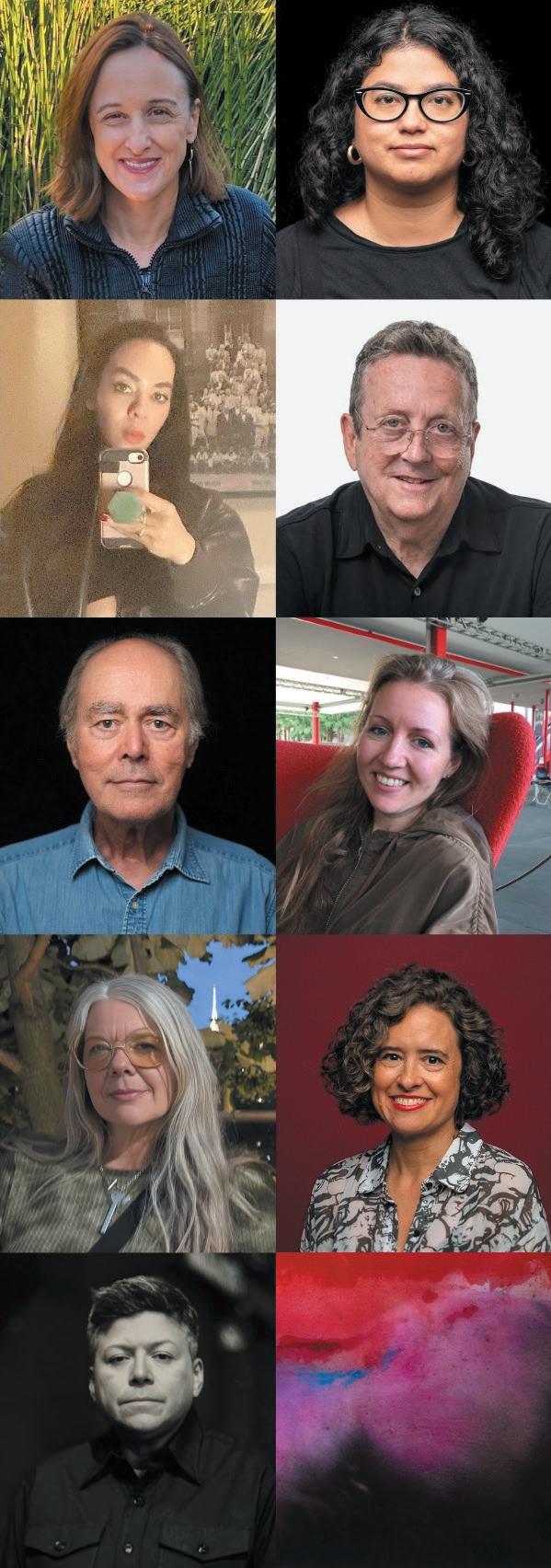
The Rabkin Foundation celebrates the creative and intellectual contributions of today’s arts writers, across the U.S. LA-based prize winners include, from top and left to right: Jori Finkel (2023), Eva Recinos (2025), Harmony Holiday (2023), Christopher Knight (2020), Thomas Lawson (2024), Catherine Wagley (2019), Shana Nys Dambrot (2022), Carolina Miranda (2017), and Raquel Gutiérrez (2021).


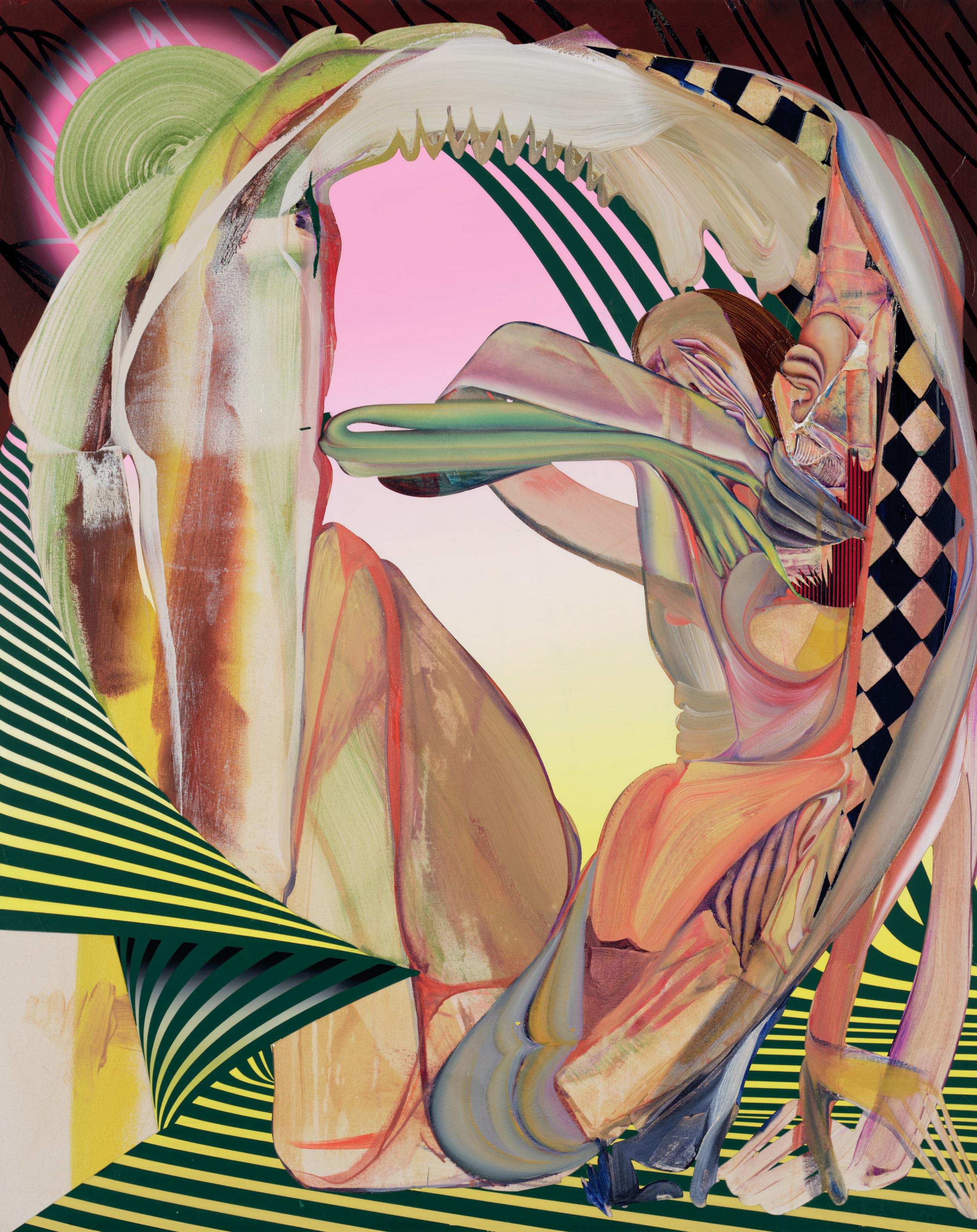

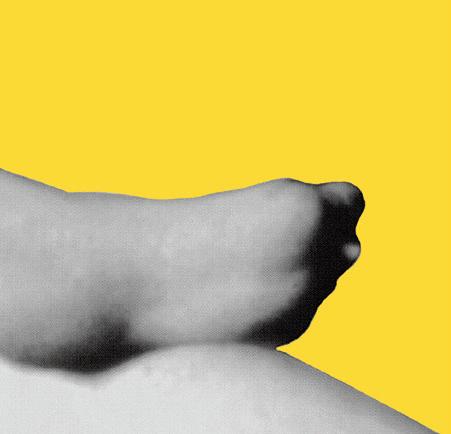
Last month, at the start of 2026, I did a tarot reading for myself and pulled The Tethered One (commonly known as The Hanged Man)—a card illustrated with a man hanging by his feet from a wooden post, looking pensive. I pulled the card in a bit of a rush, and in the weeks that followed, I didn’t really know what to make of it. The start of a new year often invites talk of goal-setting and improved routines. But The Tethered One (as I have come to understand it) is really a card about waiting. It’s about simply being… not the easiest mode to embody in early-January.
As I was editing this issue around the same time, themes kept emerging that seemed to echo The Tethered One’s encouragement to wade in liminal spaces. Aleina Grace Edwards writes about artists who use art to process grief, creating something material to tease out that which is the most intangible— death and loss. Vera Petukhova takes this notion further, writing about artists who use scent in their work—here the art object isn’t really an object at all, but something airborne and diffuse. The olfactory, she writes, “resists capture. It eludes the image economy and compels the body to register presence in real time.” In this way, the immaterial has the capacity to help us feel more embodied by grounding us in the present moment.
Perhaps this duality—between the immaterial and a feeling of presence— is an apt descriptor for The Tethered One. And, across this issue, themes of rootedness are also abundant. Dual reviews reflect on the Hammer Museum’s Made in L.A. 2025, on view
through March. One considers the socio-political consequences of a self-proclaimed “no ideas biennial,” which might sidestep the nuanced regional issues that many of the artists in the exhibition engage with. The other delves into the immersive video works in the exhibition, many of which spotlight the Angeleno zeitgeist. Later, Olivia Gauthier interviews artist Kelly Wall, discussing her work’s ability to embrace the fauxness of Tinseltown alongside nature and the sublime: Wall talks about how L.A. is poised on the edge of the Pacific, placing our city in direct proximity to the unknown. When I pulled The Tethered One, my initial thought was that the card was asking me for inaction, a “wait and see” kind of response. But in fact, stillness doesn’t need to equate to passivity. Tarot teacher, author, and podcaster Lindsay Mack described the card as “showing up in kinship and support, saying ‘I will help to root you in the areas that are asking for your attention.’”1 Perhaps what this card offers at the beginning of a new year is permission to resist heaving ourselves into results, deliverables, and goalsetting, instead encouraging rooting in, staying still, and digging deeper into that which demands our attention.
Lindsay Preston Zappas Founder, Editor-in-Chief, & Executive Director
1. Lindsay Mack, host, Tarot for the Wild Soul, episode 150. “Monthly Medicine: February is Clarify,” January 29, 2021, https://www.tarotforthewildsoul.com/episodestranscripts/ep-150-monthly-medicine-february-isclarify#:~:text=The%20Tethered%20One%20is%20 absolutely,Tethered%20One%20cyclesidestep%20 and%20coming with.
Scent, Attention, and the Post-Immersive Turn
Vera Petukhova
On Tarot Art’s Evolution
Evan Nicole Brown
Art as Memorial in Lotusland
Aleina Grace Edwards
Made in L.A. 2025
Curating Around Social Urgencies
How Artists
Refuse Quietism
Liz Hirsch
Smog and Mirrors
The Versatility of Video Art
Nora Kovacs
Interview with Kelly Wall
Olivia Gauthier
Marta Makes Magic
Photos and text: Claire Preston
Alex Heilbron at as-is
—Ashlyn Ashbaugh
Desperate, Scared, But Social at UC Irvine Langson
Orange County Museum of Art
—Caroline Ellen Liou
Manoucher Yektai at Karma
—Tara Anne Dalbow
Minnie Pwerle, Emily Pwerle, Molly Pwerle, Galya Pwerle at Château Shatto
—Reuben Merringer
MONUMENTS at MOCA and The Brick
—Qingyuan Deng





























Contemporary Art Review Los Angeles is an essential voice made in and for Los Angeles. Founded in 2015 by artist and writer Lindsay Preston Zappas, Carla is a nonprofit organization and publishing platform that is dedicated to providing critical, thoughtful, and inclusive perspectives on contemporary art. Our quarterly print magazine is an active source of dialogue on Los Angeles’s art community and is available for free in over 160 galleries and art spaces in L.A. and beyond.
Editor-in-Chief & Executive Director
Lindsay Preston Zappas
Managing Editor Evan Nicole Brown
Contributing Editor Allison Noelle Conner
Graphic Designer Satoru Nihei
Copy Editor Rachel Paprocki
Administrative Assistant Sierra Burton
Color Separations
Echelon, Los Angeles
Printer Solisco Printed in Canada
Submissions
For submission guidelines, please visit contemporaryartreview.la/submissions, and direct all submissions to submit@contemporaryartreview.la.
Inquiries
For general inquiries, contact office@contemporaryartreview.la.
Advertising For ad inquiries and rates, contact ads@contemporaryartreview.la.
W.A.G.E.
Carla pays writers’ fees in accordance with the payment guidelines established by W.A.G.E. in its certification program.
Copyright All content © the writers and Contemporary Art Review Los Angeles.
Social Media
Instagram: @contemporaryartreview.la
Cover Image
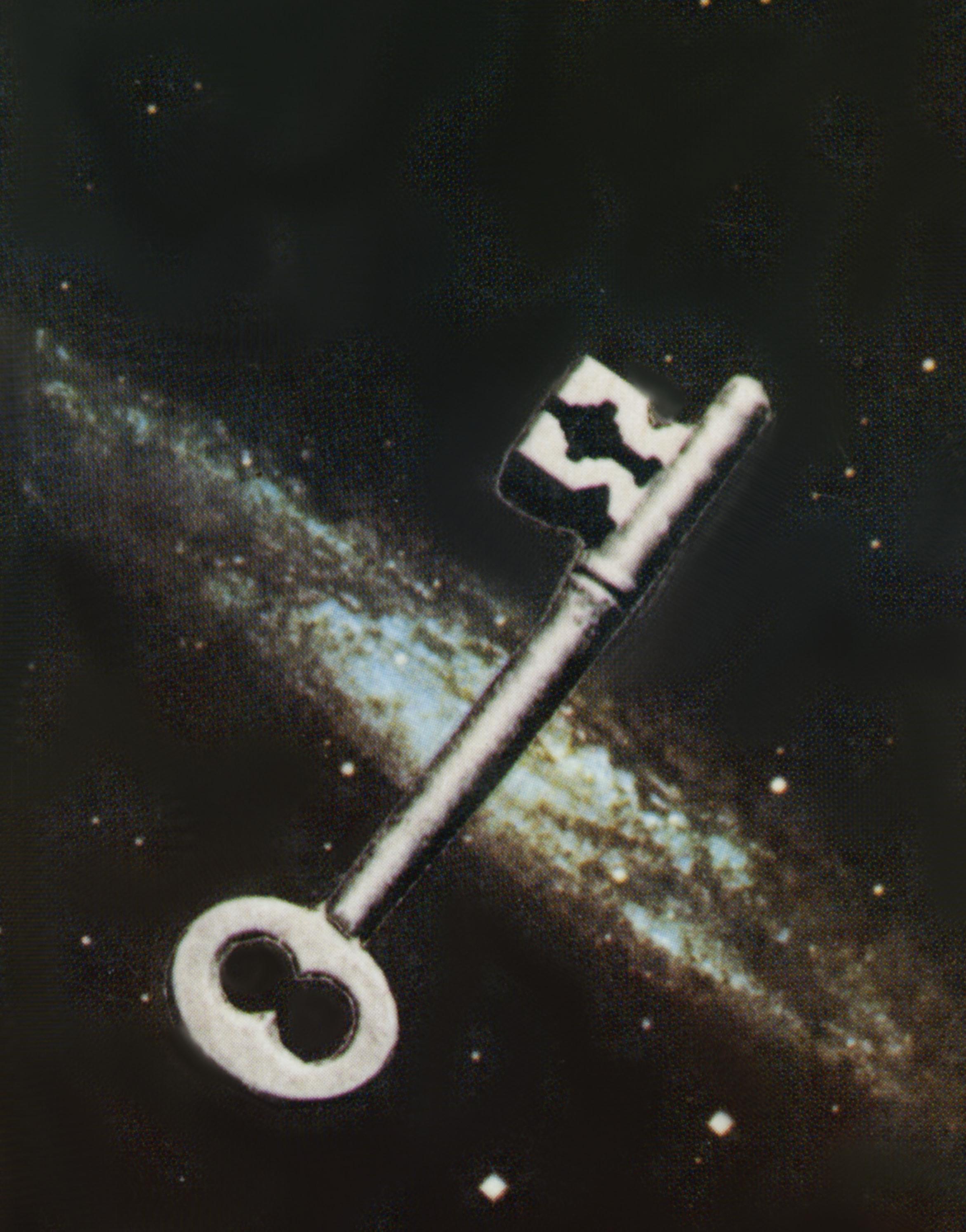
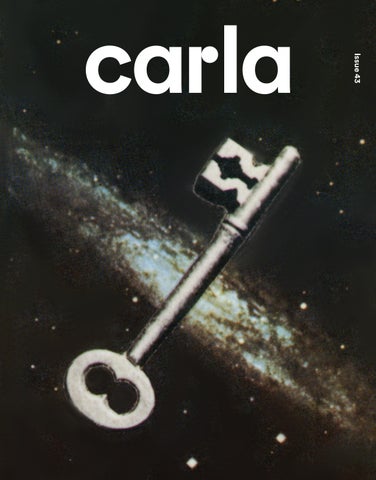
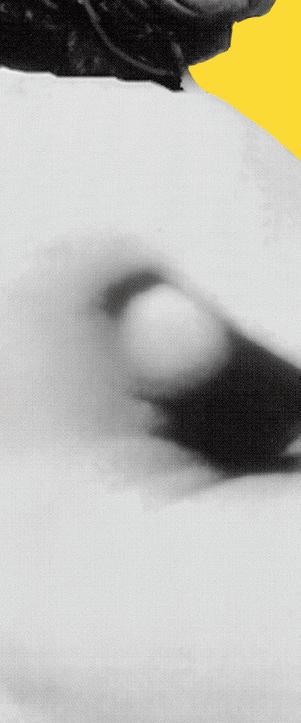
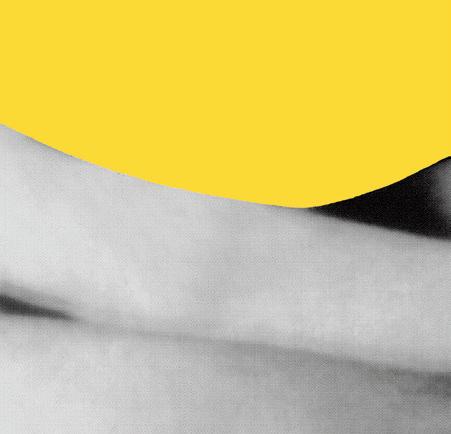
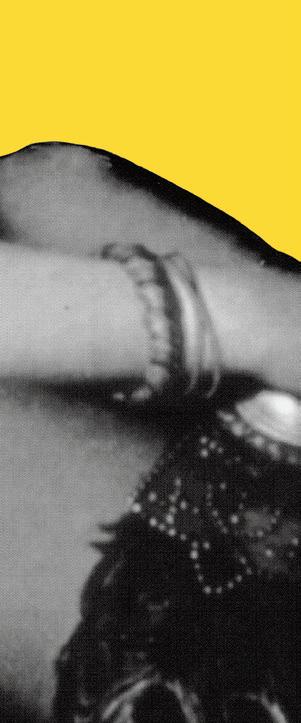
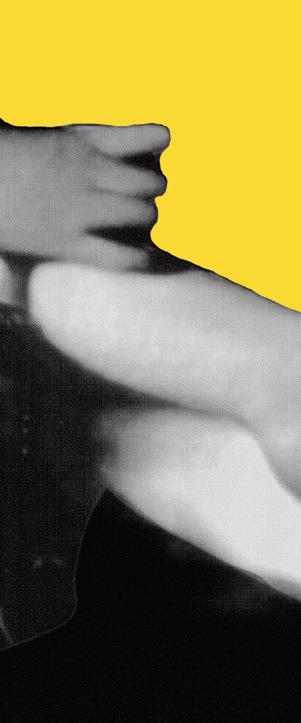
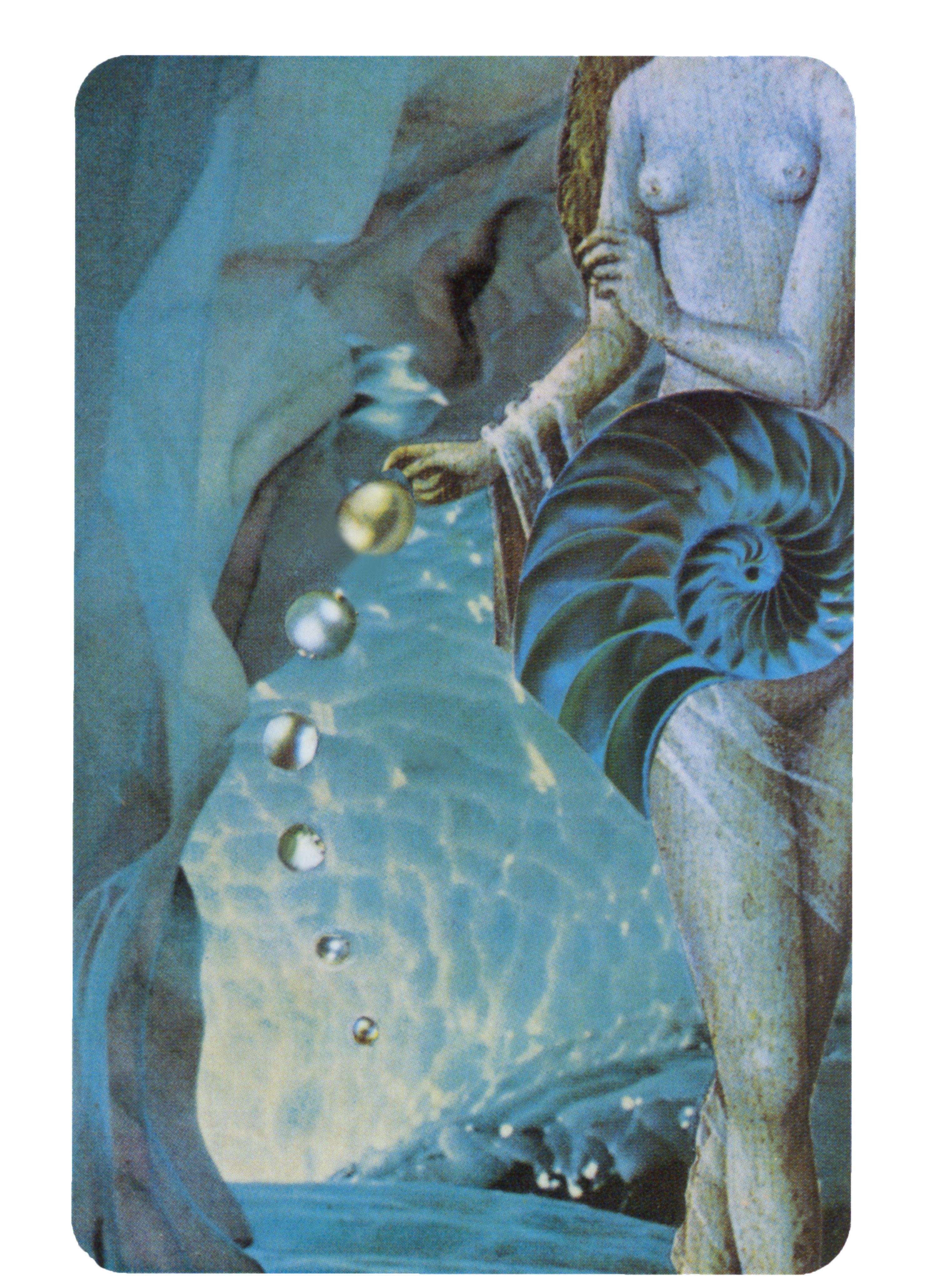
Penny Slinger, Way Through, 1977 (2010/2025). Archival inkjet print from original collage, 8 × 13 inches. Image courtesy of the artist and Gallery 33.
Contributors
Lindsay Preston Zappas is an L.A.-based artist, writer, and the founder of Carla. She received her MFA from Cranbrook Academy of Art and attended Skowhegan School of Painting and Sculpture in 2013. Her writing has appeared in Track Changes: A Handbook for Art Criticism, KCRW, Carla, ArtReview, Flash Art, SFAQ, Artsy, LACanvas, and Art21 Recent solo exhibitions include those at the Buffalo Institute for Contemporary Art (Buffalo, NY), OCHI (Los Angeles), and City Limits (Oakland).
Evan Nicole Brown is a Los Angeles-born writer, editor, and journalist who covers the arts and culture. Her work has been featured in Architectural Digest, Dwell, Getty Magazine, The Hollywood Reporter, L.A. Times Image, The New York Times, T Magazine, and elsewhere. She is also the founder and host of Group Chat, a conversation series and creative salon in L.A.
Allison Noelle Conner is an arts and culture writer based in Los Angeles.
Satoru Nihei is a graphic designer with an MFA from Cranbrook Academy of Art. His work has been featured in The Tokyo TDC Design Annual, METROPOLIS, Graphic Design: The New Basics, and other publications, and has been showcased internationally at exhibitions including the Golden Bee Global Biennale of Graphic Design, Peru Design Biennial, Graphic Matters, Trnava Poster Triennial, Shenzhen International Poster Festival, and others. He judged the 2019 PRINT Magazine Regional Design Awards and received the Golden Bee Award in both 2022 and 2024.
Rachel Paprocki is an editor and librarian who lives and bikes in Los Angeles.
Sierra Burton is an art professional and preparator based in Los Angeles. They were a participant in The Broad’s Diversity Apprenticeship Program and a 2025 ArtTable Fellow serving as a digital archivist for the Betye Saar Catalogue Raisonné at Roberts Projects.
Board of Directors
Lindsay Preston Zappas, Executive Director MJ Brown Trulee Hall
Joseph Daniel Valencia
Membership
Carla is a free, grassroots, and artist-led publication. Club Carla members help us keep it that way. Become a member to support our work and gain access to special events and programming across Los Angeles.
Carla is a registered 501(c)(3) nonprofit organization; all donations are tax-deductible. To learn more, visit join.contemporaryartreview.la.
Thank you to all of our Club Carla members for supporting our work. A special thank you to our La Brea and Western members: Anthony Cran, Tim Disney, Sarah Ippolito, Tiffiny Lendrum, Rebecca Morris, Jobert Poblete, Michal Hall Bravo Ramirez & Octavio Bravo Ramirez, The Raskin Family Foundation, Anjelica & Neil Sarkar, Ian Stanton, Shahrzad Zarrinnam, Critical Minded, Solid Art Services, and West of West Architecture + Design.
Carla is grateful for the many individuals, foundations, and supporters who make our work possible. We are supported in part by:
Los Angeles Distribution
Central
1301 PE
7811 Gallery
Anat Ebgi (Wilshire)
Arcana Books
Artbook @ Hauser & Wirth
as-is.la
Babst Gallery
Baert Gallery
Bel Ami
Billis Williams Gallery
Canary Test
Central Server Works Press
Charlie James Gallery
Château Shatto
Cheremoya
Cirrus Gallery
Clay ca
Commonwealth and Council
Craft Contemporary
D2 Art (Westwood)
David Kordansky Gallery
David Zwirner
dublab
Ebony Repertory Theatre at Nate Holden Performing Arts Center
Fernberger
François Ghebaly
FOYER–LA
Francis Gallery
Gana Art Los Angeles
Giovanni’s Room
Hannah Hoffman Gallery
Harkawik
Harper’s Gallery
Heavy Manners Library
Helen J Gallery
Human Resources
ICA LA
JOAN
Jurassic Magic Mid-City
Jurassic Magic MacArthur Park
KARMA
l.a.Eyeworks
LACA
Lisson Gallery
Los Angeles Municipal Art Gallery
Louis Stern Fine Arts
Luis De Jesus Los Angeles
M+B
MAK Center for Art and Architecture
Make Room
Matter Studio Gallery
Megan Mulrooney
Michael Werner Gallery
MOCA Grand Avenue
Monte Vista Projects
Morán Morán
Moskowitz Bayse
Murmurs
Nazarian / Curcio
Night Gallery
NOON Projects
O-Town House
OCHI
Official Welcome
One Trick Pony
Pace
Paradise Framing
Perrotin Los Angeles
Patricia Sweetow Gallery
Rajiv Menon Contemporary
REDCAT (Roy and Edna Disney CalArts Theater)
Regen Projects
Reparations Club
Roberts Projects
Royale Projects
Sea View
Sebastian Gladstone
Smart Objects
SOLDES
Sprüth Magers
Steve Turner
St. Elmo Village
The Box
The Fulcrum
The Hole
The Journal Gallery
The Landing
The Poetic Research Bureau
The Wende Museum
Thinkspace Projects
Tierra del Sol Gallery
Tiger Strikes Asteroid
Timothy Hawkinson Gallery
Track 16
Tyler Park Presents
USC Fisher Museum of Art
Village Well Books & Coffee
Webber
Wönzimer
East
Feminist Center for Creative Work
Gattopardo
GGLA
John Doe Gallery
Junior High la BEAST gallery
Marta
Nicodim Gallery
North Loop West
OXY ARTS
Parrasch Heijnen Gallery
Philip Martin Gallery
Rusha & Co.
South Gate Museum and Art Gallery
Staklena Kuća
The Armory Center for the Arts
The Pit Los Angeles
Umico Printing and Framing
Vielmetter Los Angeles
Vincent Price Art Museum
Wilding Cran Gallery
North
albertz benda
ArtCenter College of Design
ArtCenter College of Design, Graduate Art Complex
The Aster LA
Forest Lawn Museum
South
Angels Gate Cultural Center
D2 Art (Inglewood)
Experimentally Structured Museum of Art
Long Beach City College
The Den
Torrance Art Museum
West
18th Steet Arts
Beyond Baroque Literary Arts Center
Dorado 806 Projects
Laband Art Gallery at LMU
Marshall Gallery
Otis College of Art and Design
ROSEGALLERY
Von Lintel
Beverly’s (New York, NY)
Bortolami Gallery (New York, NY)
Bread & Salt (San Diego, CA)
Buffalo Institute for Contemporary Art (Buffalo, NY)
Chess Club (Portland, OR)
DOCUMENT (Chicago, IL)
Et al. (San Francisco, CA)
Fresno City College (Fresno, CA)
High Desert Test Sites (Joshua Tree, CA)
Left Field (Los Osos, CA)
Level of Service Not Required (La Jolla, CA)
Los Angeles Valley College (Valley Glen, CA)
OCHI (Ketchum, ID)
Libraries/Collections
Alfred University Scholes Library of Ceramics (Alfred, NY)
Baltimore Museum of Art (Baltimore, MD)
Bard College, CCS Library (Annandale-on-Hudson, NY)
California Institute of the Arts (Valencia, CA)
Charlotte Street Foundation (Kansas City, MO)
Cranbrook Academy of Art (Bloomfield Hills, MI)
Getty Research Institute (Los Angeles, CA)
Los Angeles Contemporary Archive (Los Angeles, CA)
Los Angeles County Museum of Art (Los Angeles, CA)
Maryland Institute College of Art (Baltimore, MD)
Midway Contemporary Art (Minneapolis, MN)
Museum of Contemporary Art (Los Angeles, CA)
Pepperdine University (Malibu, CA)
San Francisco Museum of Modern Art (San Francisco, CA)
School of the Art Institute of Chicago (Chicago, IL)
The Metropolitan Museum of Art (New York, NY)
University of California Irvine, Langston IMCA (Irvine, CA)
University of Minnesota Duluth, Tweed Museum of Art (Deluth, MN)
University of Pennsylvania (Philadelphia, PA)
University of Washington (Seattle, WA)
Walker Art Center (Minneapolis, MN)
Whitney Museum of American Art (New York, NY)
Yale University Library (New Haven, CT)
Scan to access a map of Carla’s L.A. distribution locations.
Geosmin, a compound responsible for the smell of wet soil and petrichor, the earthy scent after rain, is a bacterial byproduct that our noses detect at vanishingly low concentrations, more than almost any other naturally occurring compound. Some scientists believe that our sensitivity to this scent evolved because geosmin signals the presence of fresh water or fertile soil, helping humans locate resources vital for survival.1 When we detect geosmin, it activates specific olfactory receptors and can trigger strong memory and emotional responses. For me, that fresh smell has always signaled a reset, as well as nostalgia, clarity, and a sensation of being connected to nature.
In Southern California, where water has always been both scarce and engineered, geosmin becomes more than a smell; it’s a sensory reminder of the systems (from the ecological to the political to the bodily) that sustain life. Artists like Emily Endo, Se Young Au, and Sarana Mehra have mobilized this kind of olfactory trigger in their artistic practices. Their works reveal how olfaction can serve as a medium for narrative and memory, offering an experience that hints at a different form of immersion, one that follows a sensory logic that moves through memory pathways and into the limbic system. This type of viewer immersion stands in sharp contrast to the digitally amplified environments that have dominated the past two decades, where novelty, scale, and visual intensity overwhelm the nervous system and trigger dopamine reward cycles.
Last decade’s immersive economy shaped how audiences engage with art, transforming experience itself into a commodity of visual and affective consumption. Beginning in the early 2010s with high-profile installations like Random International’s Rain Room (2012) and the launch of Meow Wolf’s House of Eternal Return (2016), the immersive turn emerged alongside social media and new projection technologies that merged entertainment, marketing, and installation art into a single visual regime. Between 2019 and 2022, at least half a dozen companies across North America and Europe staged competing immersive Van Gogh exhibitions.2 Moving through these environments is closer to navigating a staged set rather than encountering an artwork. In these spaces, visitors are guided through directed pathways of light, sound, and large-scale projection, often pausing to take photos as the installations prompt a continuous cycle of watching, recording, and sharing. These experiences turn artists’ imagery into a franchised template for mass-produced “experiential” culture. These so-called immersive environments also monetize attention, converting physical presence into shareable content.
In her 2006 essay “The Mediated Sensorium” art historian and critic Caroline A. Jones observes that “each new wave of technological innovation brings us…still more elaborate fantasies of a fuller sensual life, while at the same time sharpening the feeling that our sensual past is receding.”3 For Jones, the issue is not nostalgia but how shifting media environments reset our sensory norms. As the spectacle-driven immersive economy reached saturation, its own mechanisms began to reveal their limits. What once promised emotional connection increasingly produced exhaustion, a cycle of image consumption mistaken for experience. Yet from this fatigue, another mode of practice has emerged.
What artists reveal through their use of scent is a broader shift: a move away from large-scale environments engineered for affect and attention
Vera Petukhova
capture, toward forms of embodied experience that anchor the viewer in their own sensorium. This postimmersive shift does not abandon stimulation but re-orients it through the body in a process that contracts scale, slowing perception and rerouting attention from vision to sensing, bringing the sensual past into the present. Scent, in particular, resists capture. It eludes the image economy and compels the body to register presence in real time.
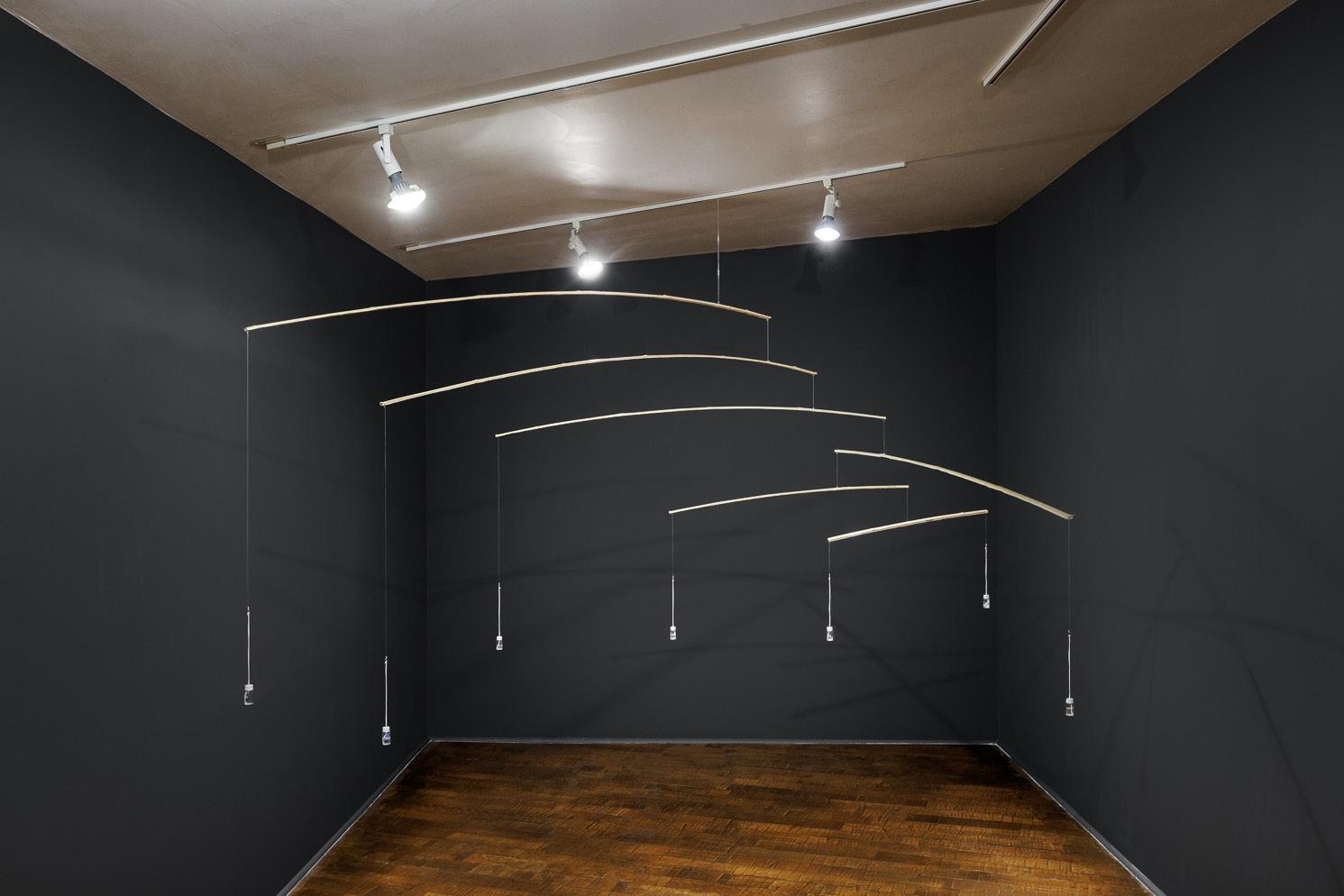
In 2025, Ether: Aromatic Mythologies at Craft Contemporary was the museum’s first exhibition centered on scent. Featuring works by Au, Mehra, Sean Raspet, Karola Braga, and other artists working in installation, sculpture, and olfactory design, the exhibition unfolded within the main gallery space where each artwork created its own atmospheric pocket, some offering diffused environmental scents, others delivering more focused olfactory encounters through vessels, sculptural forms, or interactive components. Together, the works formed a sensory field that invited visitors to move slowly, tuning into smell as a primary mode of engagement. Curated by Saskia Wilson-Brown, founder of the Institute for Art and Olfaction (IAO), the exhibition framed olfaction as narrative and as material. Maki Ueda’s Olfactory Labyrinth ver. 8 – The Revival of Oikaze (2025), for instance, suspended dozens of small scent-filled bottles from a gently moving mobile; as the air shifted, notes of wood, herbal smoke, and florals drifted through the space, deconstructing the olfactory elements in a scene inspired by the Japanese novel The Tale of Genji. “What made this exhibition possible,” Wilson-Brown told me, “was this openness to consider scent as a form of creative expression on par with any other.” The timing is not incidental. When Wilson-Brown founded IAO in 2012, “there were maybe a couple dozen artists working with
scent, globally. Today it’s far more common. It’s not enough to fill a gallery with the scent of earth, anymore. How are we expanding the medium as a creative expression? The new generation of artists working with scent are faced with this challenge, and this is good: It’s gone beyond a gimmick.” The proposition of Ether was that immersion can be atmospheric and embodied without being photogenic. “Olfactory work is a little less conducive to [immersive] fatigue precisely because it is un-Instagrammable,” Wilson-Brown said. “I couldn’t share it, like it, forward it. I had to live it. This has value.”
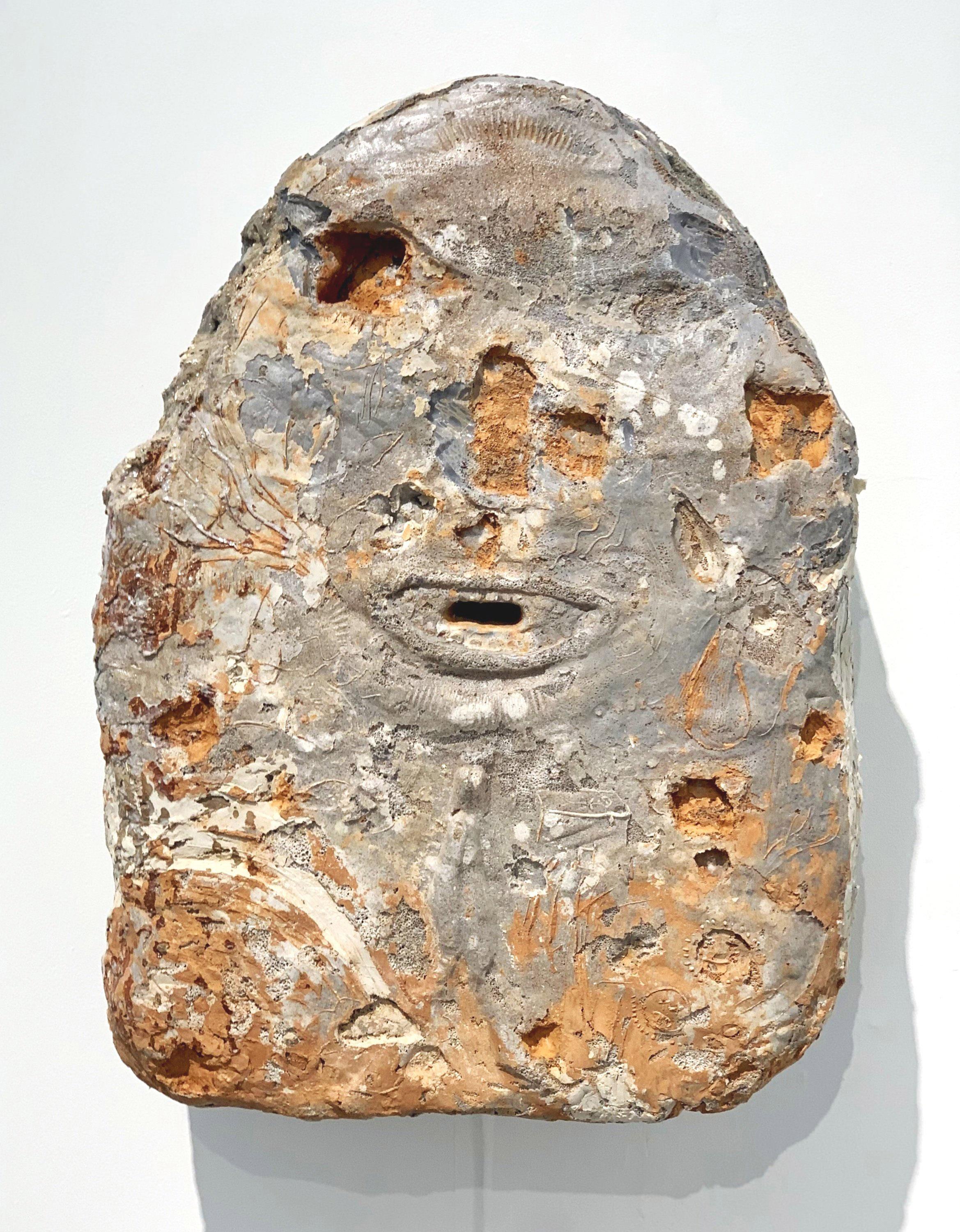
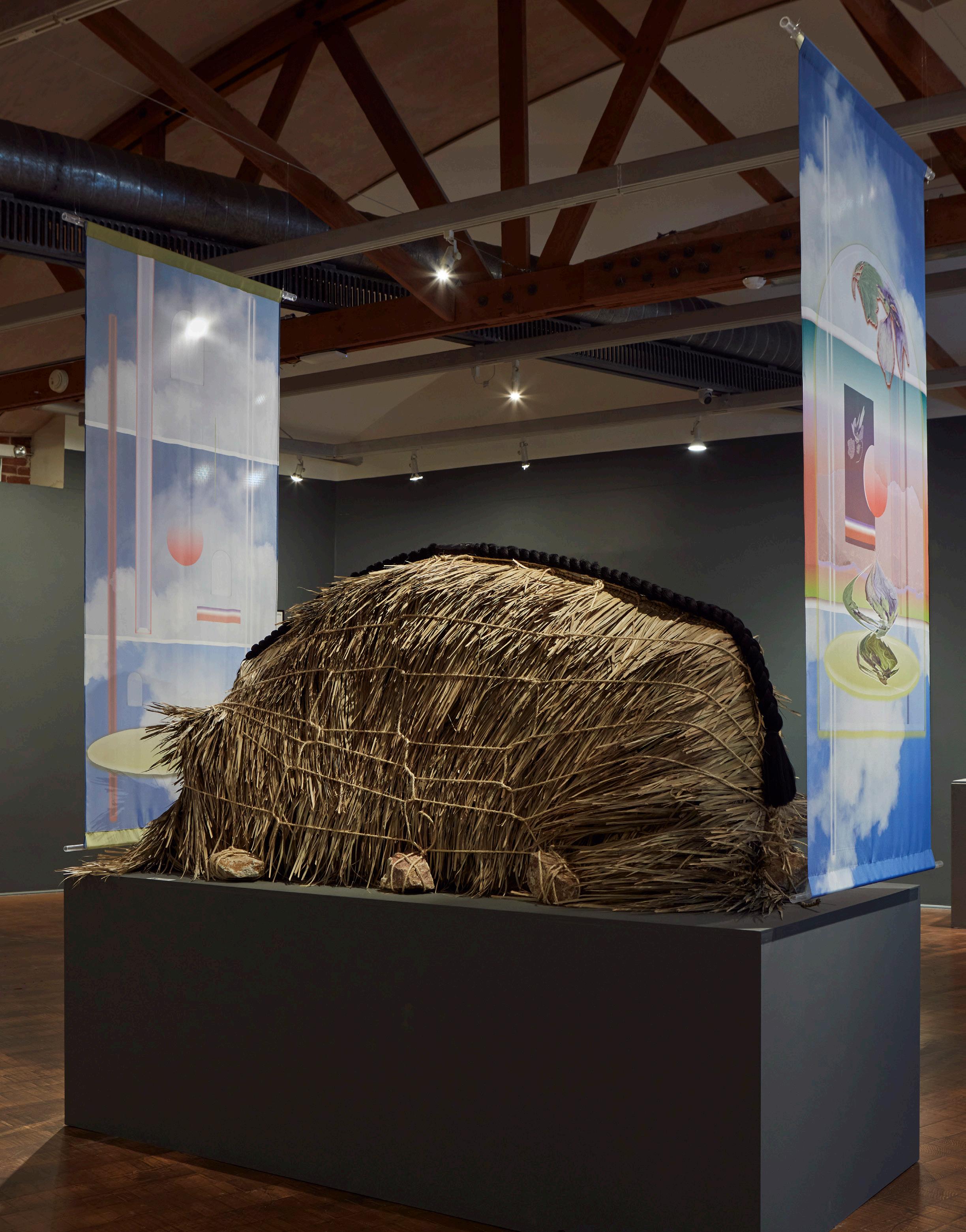
In the exhibition, Sarana Mehra presented a series of three sculptural works resembling unearthed ancient votives. Grainy, textured objects in clay and plaster, each bore the faint imprint of a face or partial corporeal form. One of the sculptures, Vent (2025), omitted a custom scent called Dyspnea created in collaboration with IAO in the wake of the pandemic. Taking its name from the clinical term for shortness of breath, the fragrance is intentionally unpleasant, recalling halitosis or bad breath to force awareness of breathing and proximity. The sculpture visibly vented vapor from a slitted mouth, creating an atmosphere that is both communal and contaminating. The piece proposes that embodied immersion is not always pleasurable. It can evoke vulnerability and disgust. Se Young Au’s Meet You At No Gun Ri (Unbridgeable Gulf) (2025), also included in Ether, built a site for mourning. A straw mound shaped like a coffin, crossed by a dark long braid and flanked by silk banners, recalled the Korean chobun, the temporary grave where a body decomposes before the bones are permanently buried. The accompanying scent, derived from the unmistakably musky costus plant, similar to unwashed hair, anchored the work in corporeal reality. Standing before the piece, grief registered not as an idea but as a physical current. The sensation moved straight through my body, sharper than almost anything I had
felt previously from a single artwork. And it was not by looking; it was about being in the atmosphere the work produced. Later reflection on the feeling I had when viewing Au’s work clarified how scent enters through the body to construct a world of association and memory. Au remarked that “scent asks the audience to be present, to be embodied.” As an art form, olfaction positions the audience as a receiver rather than a viewer. Collectively, these artists propose a model of immersion that is diffused and calls the viewer into a sensory realm, reframing immersion as attentiveness rather than overstimulation.
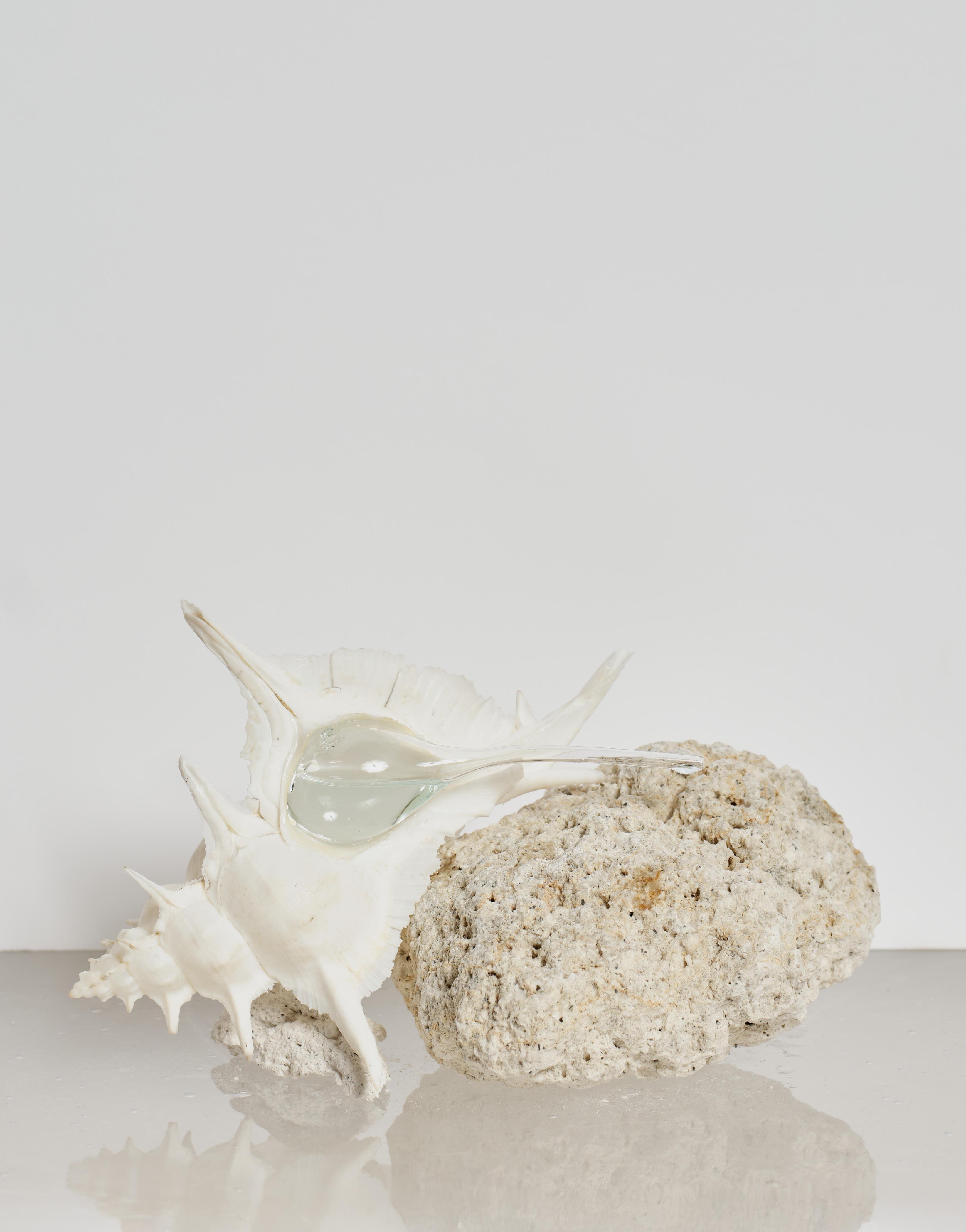
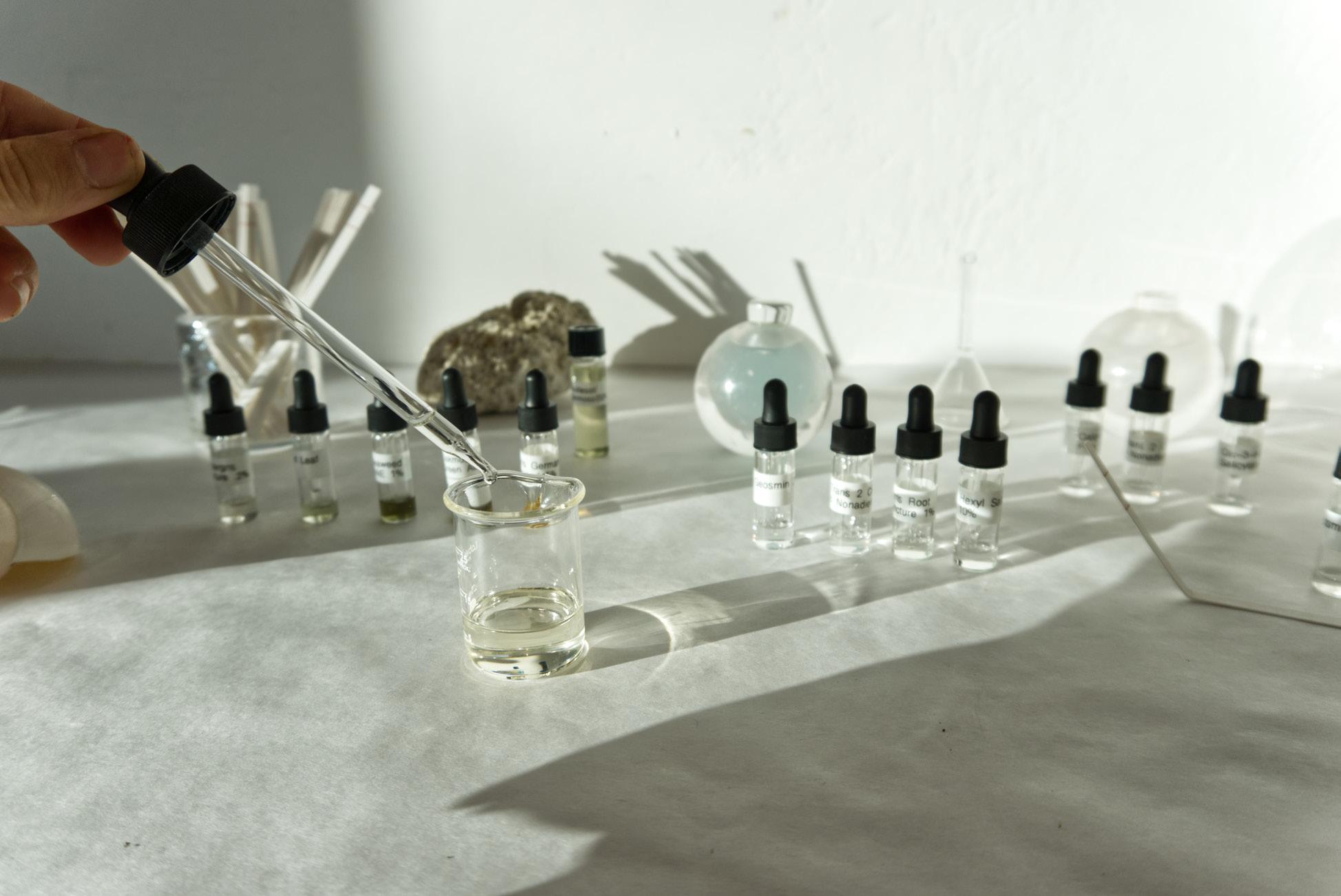
Artists who engage with sensory mediums are recalibrating toward lived experience, a shift that finds clear articulation in the work of Emily Endo, whose sculptures and scents build quiet worlds that unfold through duration and proximity. In Endo’s sculptures, scent moves through glass tubes and into porous stone, slowly seeping and pooling until the object becomes a circulating system. When we spoke, Endo was preparing for their largest installation to date, which will open in early 2026 at the Kohler Arts Center in Wisconsin. In describing the work and its sensory logic, Endo described the atmospheric environment: Suspended glass vessels shaped like elongated droplets and mirrored bulbs hold custom fragrances that drip onto carved stone forms. Resembling mineral remnants, the stones absorb and diffuse the scent over hours, creating an immersion of scent and material in the space. Endo works alchemically with metal, glass, and stone, pairing fragile, transparent chambers with dense, grounding materials. The scent composition for the Kohler work draws from geosmin, petrichor, ozone, orchid extracts, and metallic notes inspired by the iris plant, alongside marine notes, referencing qualities of glass materials. Together, these aromas unfold in time, with the top, middle, and base notes emerging in sequence, creating a sensory narrative about the permeability of the body and the
movement of water through stone, skin, and air. Rather than relying on visual dominance, Endo’s work operates through duration; the longer you stay with it, the more its material and olfactory logic reveals itself. The work asks for time, reiterating an idea that several of the artists I spoke to for this essay noted: Olfaction is a time-based medium.
Before working with scent, Endo created visually spectacular installations built from large constructed environments and sculptural elements like glass and horsehair. Their shift toward scent marks a deliberate move away from visual dominance and material footprints. Their goal shifted from image-making to constructing materially modest yet sensorially dense environments in which the nose becomes a direct line to memory and affect. Situated in the High Desert, Endo’s studio resonates with Southern California’s long tradition of treating perception itself as material, with the light, air, and environment as active agents in creating an artistic experience. This openness underwrites a lineage of ephemeral practice as in the perceptual investigations of the Light and Space movement of the 1960s and ’70s, and the conceptual use of weather, light, and atmosphere in later environmental and installation-based works. Today, the IAO and artists like Endo use scent to merge environment and body, folding spatial environment and perception into the work itself. Scent extends that lineage of the Light and Space movement while resisting the visual economy that once enveloped it. Instead, scent engages an ecology of place and memory. Au’s use of the costus plant renders grief as bodily and intimate, conjuring the smell of holding a loved one close. Mehra’s anti-fragrance marks air as risk. Across these works, scent becomes a way to work directly with earthy and bodily materials, not as representations but as ephemeral atmospheres that unfold through time. Au describes scent as a way of building landscapes, and each of these artists
creates environments that can only be apprehended somatically. The viewer must experience it through their own sensing body.
In his essay “Air,” philosopher Bruno Latour reflects on Peter Sloterdijk’s concept of “sphereology,” asking what it means to be in the world.4 To be in is to be “inside some sphere, some atmo-sphere.” Art and nature, Latour argues, have merged into a “continuous sensorium.”5 That description read literally inside Ether. The artworks were not containers for images but devices that conditioned an atmosphere. They revealed immersion as an existential condition: These works didn’t transport the viewer elsewhere; they sharpened somatic awareness of the spheres we already inhabited.
If the last decade of immersion revealed the limits of visual spectacle and overstimulation, the next might center on the nervous system, drawing on the systems that help us feel grounded and on the limbic pathways where memory and emotion take shape. Scent introduces a tempo that contrasts the rapid pace of modern life: slower, somatic, durational. Taken together, works by Mehra, Au, and Endo articulate the beginnings of a different sensory logic. Here, olfactory practice is a method for foregrounding permeability, interdependence, and the subtle registers of experience. The proposition of the post-immersive is not a retreat from technology but a return to the body as an instrument of knowing. Sloterdijk’s sphereology and Latour’s writing on air are useful because they reframe environment itself as medium: something we are always inside, shaping, and shaped by. Artists working with scent and atmosphere don’t simulate immersion; they expose its infrastructure. Because these works make environment perceptible as medium, they imply ecological responsibility. What comes next is an expanded field of sensory experimentation that asks us to slow down, be embodied, and reimagine with
the worlds we are already inside. The post-immersive isn’t just about a solitary experience, it exposes the ways in which we are all interdependently connected, breathing the same air.
Vera Petukhova is a Los Angeles-based curator originally from Minsk, Belarus, and co-founder of Rip Space, a project space focused on new media and future-oriented art practice. She received her MA in Curatorial Practice from the School of Visual Arts. She has curated exhibitions at The Bronx Museum, CalArts, and Detroit Art Week, with past roles at Performa, The Kitchen NYC, Visions2030, and Tribeca Festival.
1. I. J. Bear and R. G. Thomas, “Nature of Argillaceous Odour,” Nature 259 (1976): 394–396.
2. Martin Bailey, “Van Gogh ‘immersive experiences’: A guide to the global battle now reaching London,” Adventures with Van Gogh blog, The Art Newspaper, June 4, 2021, https://www.theartnewspaper. com/2021/06/04/van-gogh-immersive-experiencesa-guide-to-the-global-battle-now-reaching-london.
3. Caroline A. Jones, “The Mediated Sensorium,” in Sensorium: Embodied Experience, Technology, and Contemporary Art, ed. Caroline A. Jones (Cambridge, MA: MIT Press, 2006), 11.
4. Bruno Latour, “Air,” in Jones, Sensorium, 106; Peter Sloterdijk, Spheres, translated by Wieland Hoban, 3 vols. (Los Angeles: Semiotext(e), 2011–2016).
5. Latour, 106.
At its most reduced, the act of looking at art is an exercise in extracting meaning from visual choices that exist on a plane outside of spoken or written language: the gesture of a brush stroke, the form of a sculpture, the blending of multiple colors to create a more nuanced hue. A viewer can observe an artwork in an instant, but true resonance with a piece emerges from deeper engagement with it, when details beyond the superficial form a subtext that allows for greater truth and heightened perception.
The act of divination, then, is not so dissimilar from the act of seeing. Both are exercises in seeking more, using the visual to uncover metaphorical meaning. A close analysis of an aesthetic object mirrors the way divination practices like cartomancy have been used to connect with spirit—both activities are united by a visual decoding process that necessitates some magical thinking and a belief that the unseen is just as present as what is visible to the naked eye.
Tarot cards, illustrated tools for divination, are based on a set of standard images associated with specific messages. This approach to spiritual guidance came to prominence in the fifteenth century after the development of playing cards, which were used as fortune-telling devices before tarot cards were introduced. Traditional tarot imagery is claimed to have originated in central Europe in the 1400s. One of the earliest known decks to use the 22 Major Arcana and 56 Minor Arcana structure (still utilized today) was commissioned by the Sola Busca family from an unknown Venetian artist circa 1490 to be used for casual game playing.1
According to philosopher and tarot historian Michael Dummett, “it was only in the 1780s, when the practice of fortune-telling with regular playing cards had been well established for at least two decades, that anyone began to use the tarot pack for cartomancy.”2
Over the next few centuries, tarot—as a system, and vessel for visual art— was gradually reimagined. The most popular tarot deck, which has endured for over a century and inspired myriad others, is the Rider-Waite-Smith deck, illustrated by Pamela Colman Smith and published in 1909. Over the years, countless artists have used tarot’s iconic symbols and archetypes to reinterpret longstanding themes associated with cards like Temperance or The High Priestess. While tarot cards represent fixed spiritual concepts, as culture and society have evolved across eras, so too have the cards (and their affiliated artworks). Today, tarot is a method of personal self-discovery and reflection, and even a pathway toward more inclusive commentary on—and energy reading of—society writ large.
In contemporary culture, tarot remains relevant and has even gained popularity in recent years due to widespread disillusionment with society as designed. The fluidity of tarot’s role in culture, from providing leisure to prediction to emotional clarity, is a testament to the cards’ power, which is really the power of a well-defined set of symbols. Particularly during times of both personal and socio-political turmoil, people turn to tarot for answers to core human questions. During the pandemic (and years of cultural change and political upheval flanking it), tarot has re-emerged as an appealing counterpoint to mainstream thinking and a solution to engineered confusion. The allure of tarot art in an era of political uncertainty, technological advancement, and a culture that cycles rapidly through various trends and ideas is not that it promises any certainty, but instead that it invites creative interpretation driven by personal perspective: The symbols
Evan Nicole Brown
offer guidance, but not a set of ordered rules to live by.
Tarot cards have long been a site for artistic exploration, perhaps due to their reliance on a set of rich archetypical images which resonate with many artists’ related desire for universality in their work. Not only are the symbols of tarot aesthetically interesting, they are also useful visual tools for telling stories and drawing conclusions about the human condition.
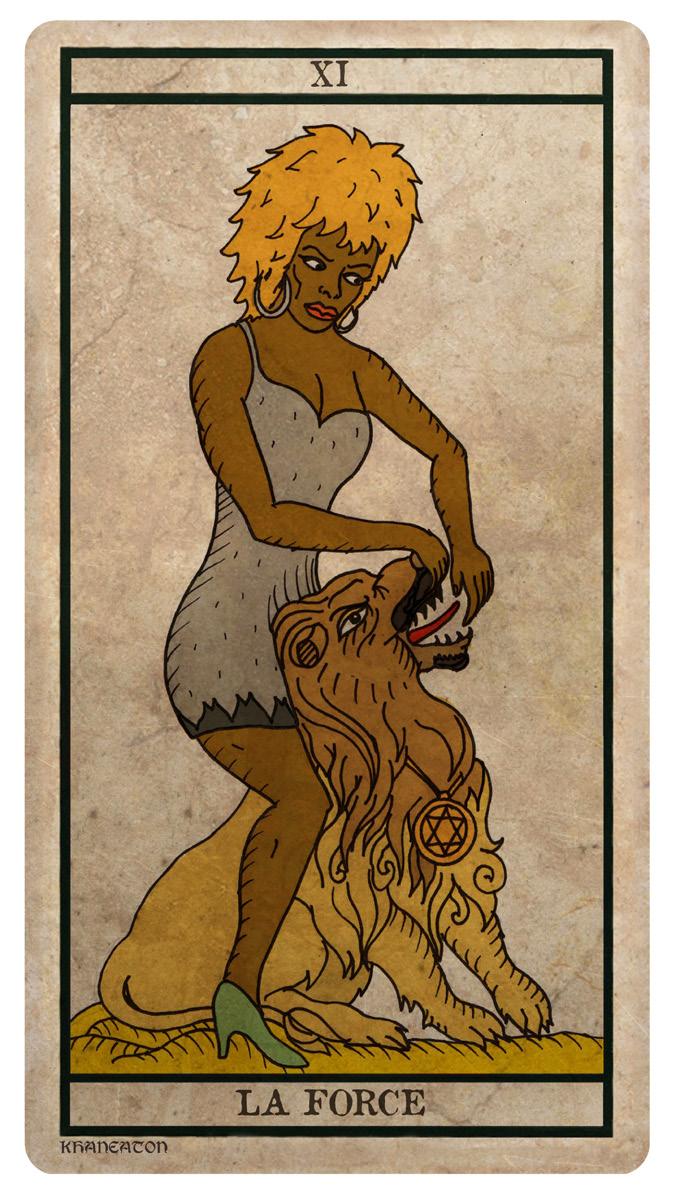
The symbols depicted on tarot cards in the Major Arcana have remained more or less consistent throughout the ages: The Strength card is usually depicted with a woman holding the jaws of a lion; The World, a dancing figure surrounded by a laurel wreath. The development of a codified visual language for the tarot deck means that the meanings are impossible to separate from the imagery. These esoteric, pre-coded meanings behind tarot illustrations make them seductive ready-mades for artists to engage as graphic templates to reinterpret in their own image and style. In this way, artists who dabble in the realm of arcana art are less interested in creating singular works anew than they are in adding to the chorus of artistic and philosophical voices that have formed the legacy of cartomancy that is now as wide as it is deep.
Twentieth-century Surrealists interpreted tarot symbols to investigate the self as opposed to events. The art and cultural movement that blossomed in 1920s Paris was rooted in an exploration of the unconscious mind, symbols-as-codes, and freedom from logic. Inspired by Sigmund Freud and Carl Jung’s study of dreams and archetypes, Surrealists viewed tarot cards as oracular tools for personal reflection and psychoanalysis.
Salvador Dalí’s “Universal Tarot” deck, published in 1984, borrowed inspiration from other artists, resulting in a collage-like menagerie of references
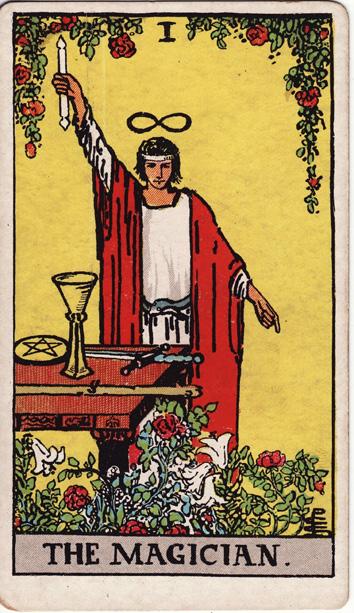
and iconography that reimagined tarot’s traditional motifs. The Magician card, symbolizing manifestation and new beginnings, is traditionally depicted as a figure holding a wand upright, along with a workbench displaying a wand, sword, cup, and pentacle (the suits of the Minor Arcana). In Dalí’s deck, he himself is depicted as The Magician, except flowers are replaced by flames, his arms are crossed as if to embrace himself, and his workbench is instead populated by bread, a glass of liquor, and his characteristic melting clock.
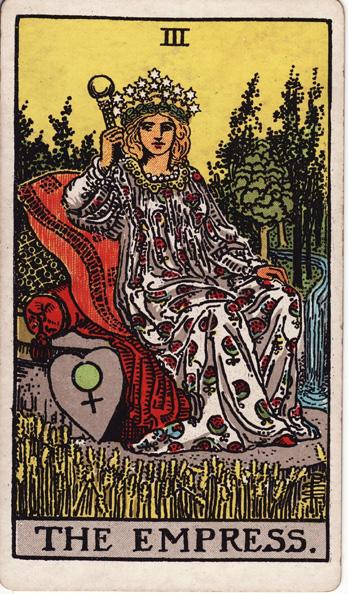
Dalí visualized his wife, Gala, as The Empress—in an art historical twist, Gala’s face is superimposed atop the statue of a goddess depicted in Eugène Delacroix’s painting Greece on the Ruins of Missolonghi (1826).
And Dalí’s Lovers card is derivative of Jan Gossaert’s painting Neptune and Amphitrite (1516),3 with the addition of a flower and a butterfly, a symbol of transformation Dalí often returned to in his enigmatic environments. Though Dalí’s deck departs from the visual codes associated with standard tarot cards, his reinterpretations are still legible, their original meanings retained. Case in point: Dalí’s Ten of Swords is illustrated with the assassination of Julius Caesar, a perfect visual shorthand for the theme of betrayal the card represents.
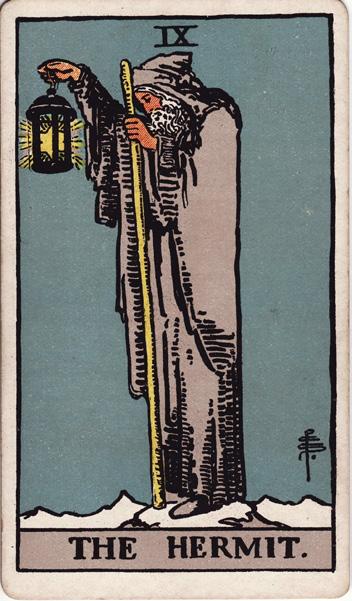
Fellow Surrealist artist Leonora Carrington’s 1939 painting Portrait of Max Ernst can be interpreted as a variation on the classic Hermit card. It shows Ernst, her fellow artist and longtime mutual muse, cloaked and carrying a lantern-like object, much like the Hermit is traditionally depicted. In 2017, Susan Aberth, a professor of art history, discovered a small collection of Carrington’s illustrated tarot cards (known as her “Major Arcana Tarot deck,” which she had created in the 1950s)—previously unknown, shrouded like a secret in a private collection. “When you see the cards,” Aberth has said, “you realise they were central to her entire production, including the question of what is the nature of the esoteric.
What makes the cards so unique is that they were her own tools for exploring her own personal consciousness.”4
Carrington’s interpretation of The Moon, for instance, is deeply rooted in Mesoamerican mythology and Indigenous witchcraft, inspired by her years living in Mexico City. Her version shows two wolves howling at a moon in its fullest phase painted over a silver leaf backdrop. In one approach to reading the card, the artist’s own personal consciousness shows up in this rendering: The howling of the wolves toward the luminary most associated with feminine energy potentially mirrors the noise of Carrington’s own mind, as described in her 1972 memoir Down Below. Today, artists continue in this tradition of tarot deck reinterpretation.
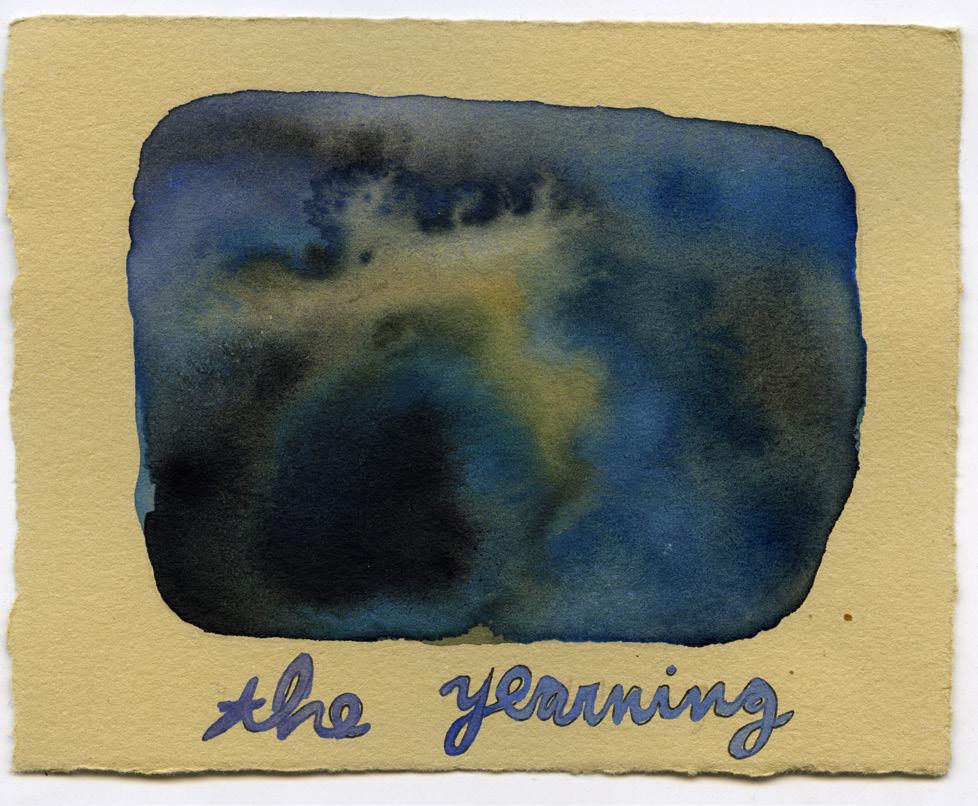
L.A.-based artist Isa Beniston’s colorful “Gentle Thrills Tarot” deck is “a tool to connect both outward to the universe and inward to your intuition with its weird, wonderous, and whimsical messages,”5 as evidenced by her line-heavy Star card anchored by a non-traditional, singular all-seeing eye. Ceramic artist Julia Haft-Candell describes her own limited-edition “Infinite Deck” as being made up of her ongoing “glossary of symbols.”6 The deck eschews tarot’s traditional characters and motifs (like The Sun, Devil, and Hanged Man) for more tangible totems like The Knot, The Chain, and The Braid, along with images for abstract concepts like The Yearning, to emphasize the generative potential of the absurd.
There is perhaps no greater absurdity than reality itself, and artist Mieke Marple’s tarot-inspired works acknowledge how fraught and directionless the world feels today. Marple’s 2018 interpretations of traditional Major Arcana were included in ARCANA (October 8–November 15, 2025), an exhibition at Gallery 33, a boutique jewel box gallery nestled inside The Georgian Hotel in Santa Monica. Curator Jessica Hundley, editor of Taschen’s Library of Esoterica series, brought
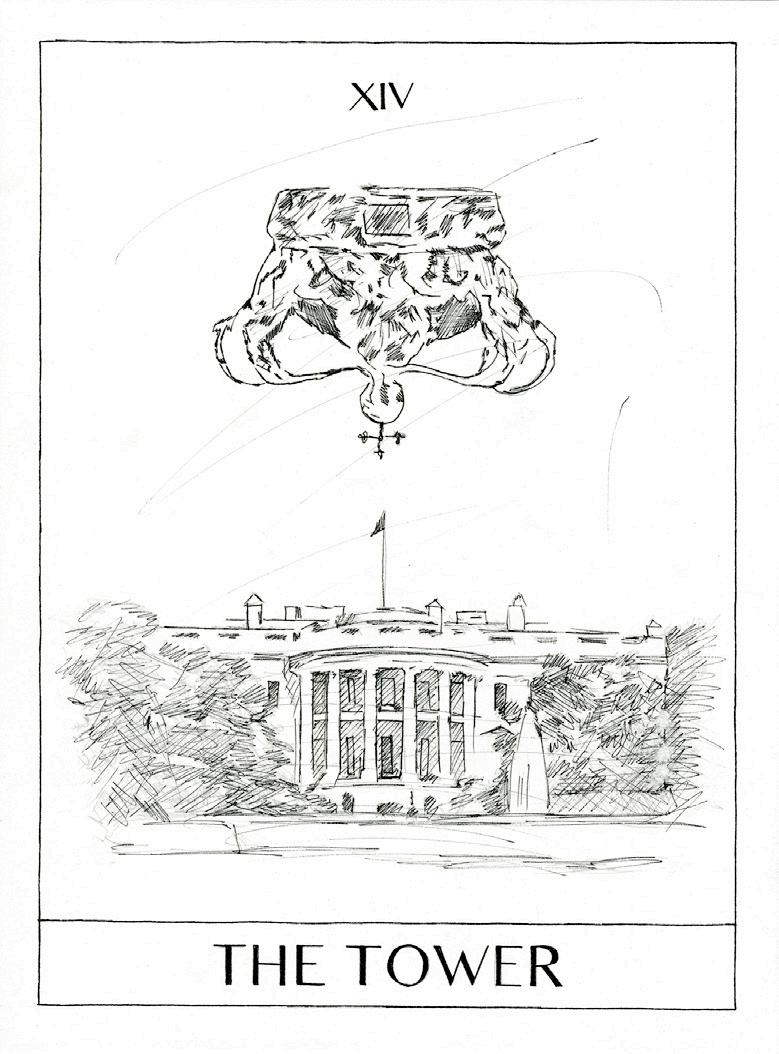
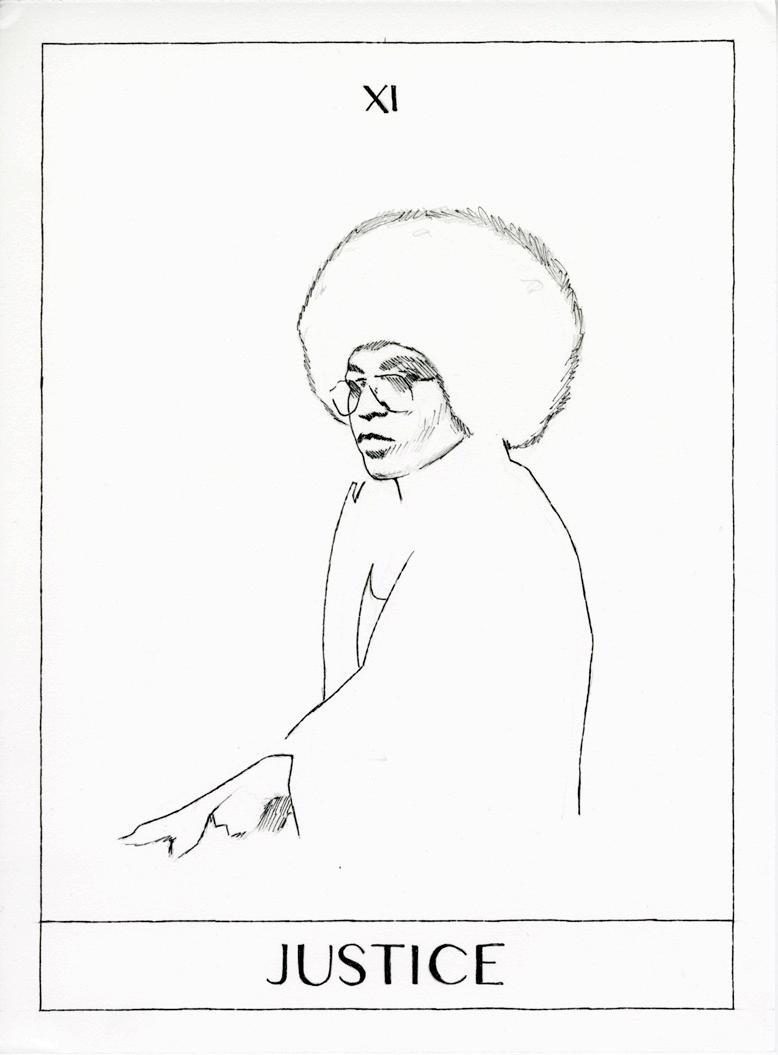
together 13 contemporary artists who have illustrated, painted, and designed tarot cards or created works of art inspired by the Major and Minor Arcana. Marple’s deck directly acknowledges the political weight of contemporary (and historical) moments in American democracy: The Justice card is a portrait of activist Angela Davis, The Tower card portrays the White House with an upside-down royal crown hanging in the balance above it. The Tower symbolizes sudden change, a crisis moment, a disruption in the order of things to make way for new growth. While traditional Tower cards depict a tower struck by lightning and figures leaping from the burning building to show the intensity of the destruction, Marple’s rendering takes this meaning a step further. Her deck was published in 2018, in the milieu of the midterm elections during President Donald Trump’s first term. The polarized political moment called for consideration of what the White House (itself a symbol of power) truly represents. Marple’s card seems to infuse this context with her own personal reflection, illustrating her own beliefs (or questions). The structure of tarot offers a way to subtly, under the guise of mysticism and play, address injustices—or, at the very least, call attention to them by showing rather than telling. As a result, many artists have reimagined tarot decks that correct a historic lack of inclusive representation. Michael Eaton and King Khan’s “The Black Power Tarot” deck, also on view in ARCANA, replaces traditional tarot figures with recognizable Black entertainers like Tina Turner and Tupac Shakur.
While some artists work within the restrictions of the tarot deck, other artists extract tarot’s symbols, rich with spiritual codes, from the context of cards and repurpose them into other mediums. Feminist Surrealist artist Penny Slinger (who co-created “The Tantric Dakini Oracle Deck” in 1977) has long been interested in the self,
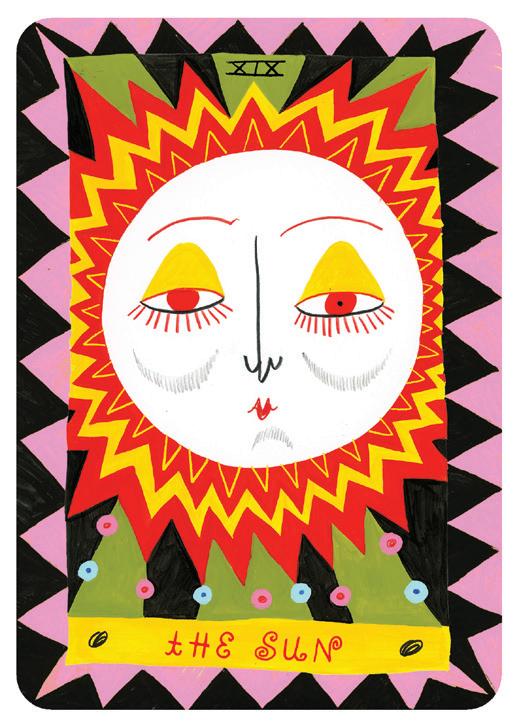
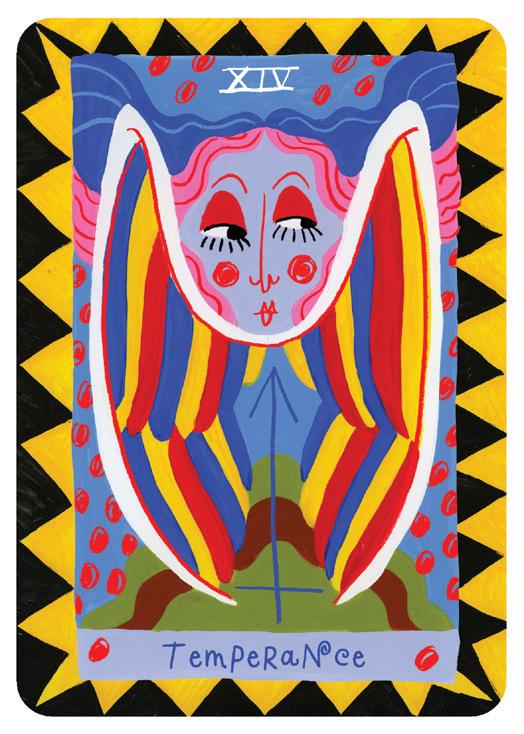
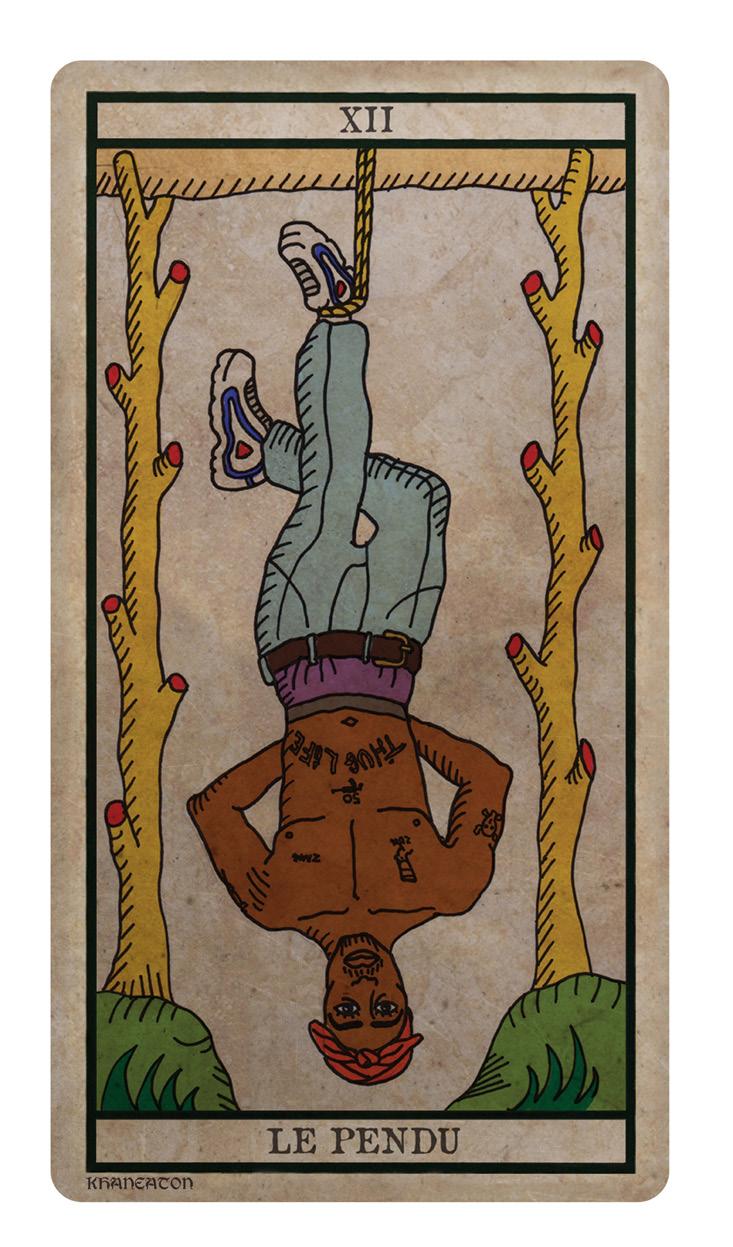
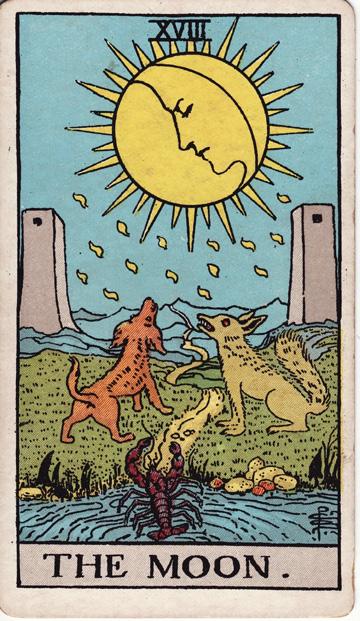
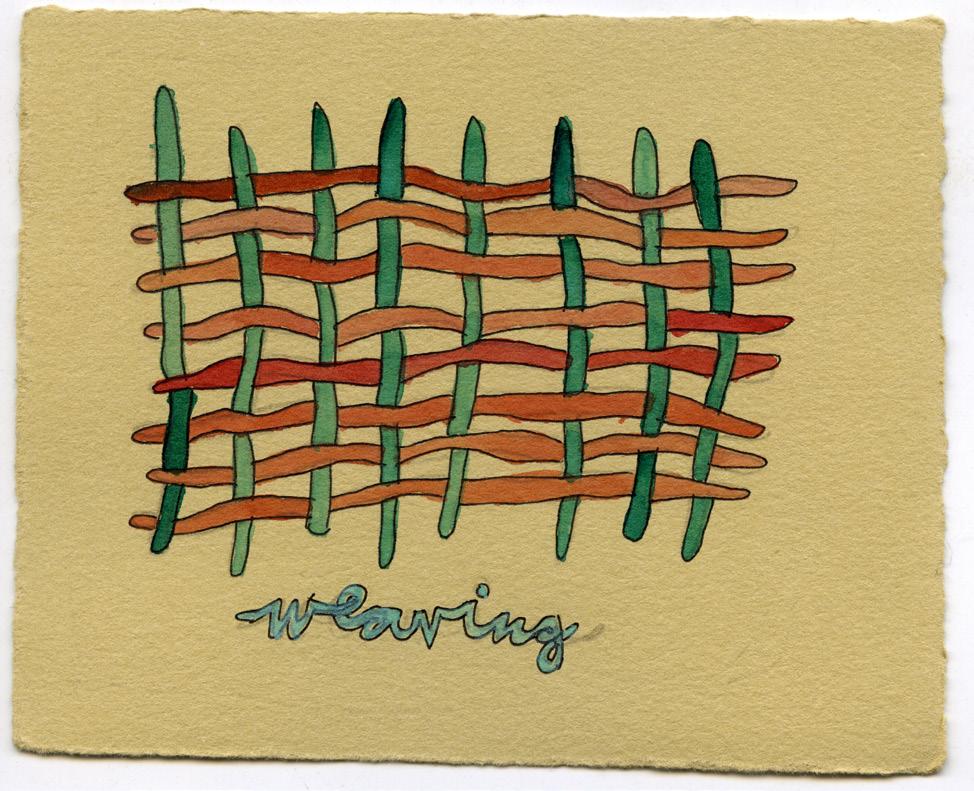
the erotic, and the subconscious. Her artworks on view in ARCANA exemplified this interest through their reliance on symbols, without being tied to tarot-specific iconography. White Lady/Mother of Pearl, 1977 (2010/2025) and Way Through, 1977 (2010/2025) are collages rooted in environments like the cosmos and the sea, and she uses symbols like the nautilus shell and a skeleton key to allude to pathways toward unlocking the divine. And while these objects don’t necessarily mirror ones seen in tarot decks, Slinger’s treatment of them in her compositions—like floating totems designed to conjure inquiry—reflects the way tarot cards use symbols as storytelling devices.
Elena Stonaker’s painting
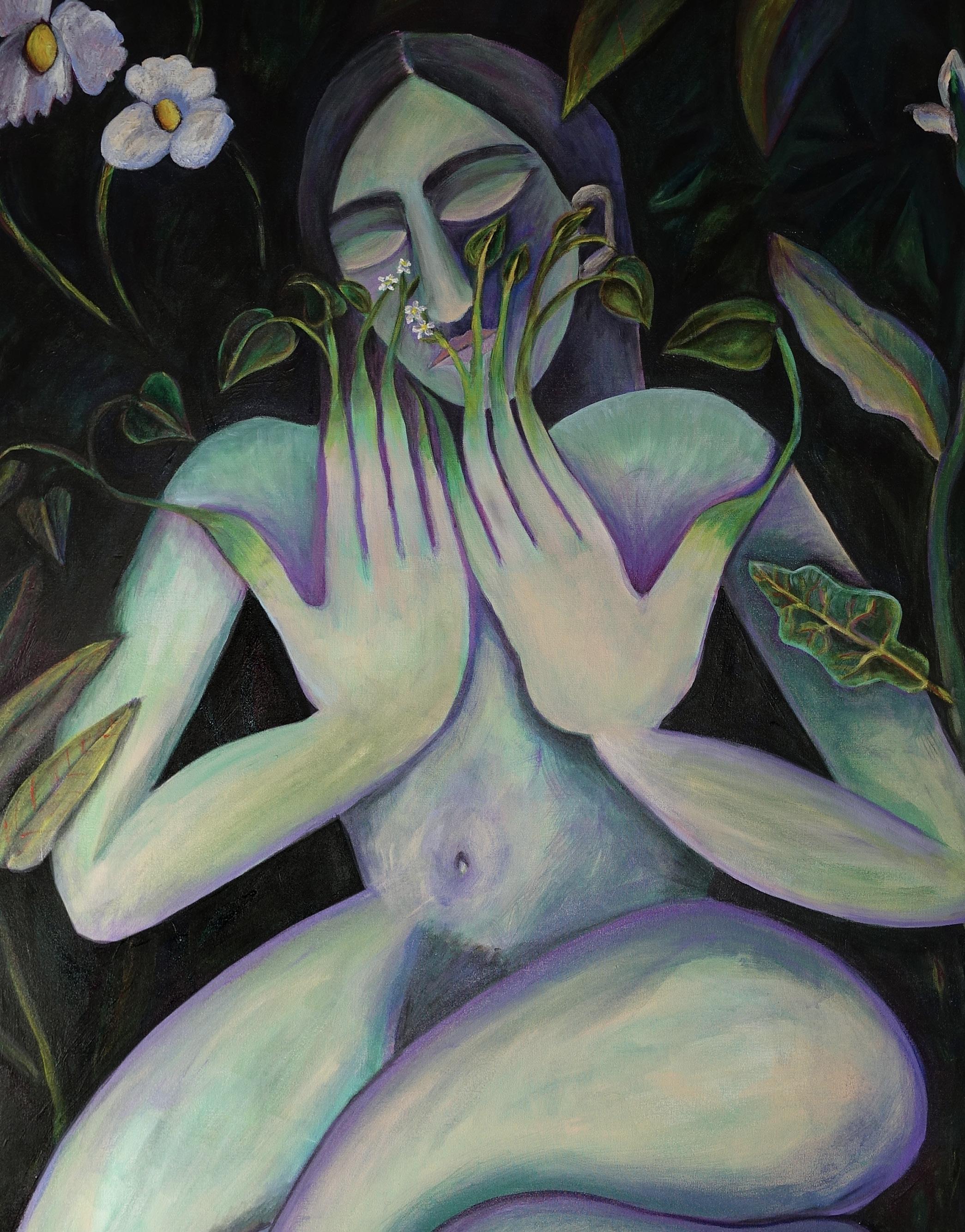
The Portal (2025), also included in ARCANA, shows a calla lily, a flower representing purity and rebirth, braided into a woman’s hair. And She Blooms (2021) is an acrylic portrait of a fullfigured woman whose fingertips bear leaves that spiral into flowers blooming in the darkness around her. These works both recall The Empress card, which features a crowned woman in a lush garden as a symbol of fertility, abundance, and the archetype of Mother Earth; they wink at tarot’s themes without outright illustrating them. Stonaker’s paintings demonstrate that even when the viewer may not default to drawing a direct visual reference to tarot, the associated themes and messages are implied thanks to the artist’s application of a robust feminine figure intertwined with nature as a stand-in for similar, yet more codified images.
As evidenced by the range of artistic interpretations on display in ARCANA, this visual genre has evolved to be more diverse with time, but as a symbolic vocabulary, its meanings have not changed in the mainstream much since the fifteenth century. The cards’ glyphs retain their interior definitions even when the style of their surroundings change, or when they are removed from their surroundings altogether.
Contemporary artists’ attraction to exploring the visual codes of an
ancient practice lies in the fact that universal truths and archetypical images will always be compelling formulas to investigate in art. The symbols are familiar and the cards are established objects, but are not so rigid that they cannot be adapted for new aesthetic goals. And as with any artistic genre or movement, tarot decks contain gestural clues that reveal details about the era in which they were made— revealing visual trends and styles as much as political or social truths that serve as a timestamp of culture and the artist’s personal consciousness.
A study of tarot cards (and the genre of arcana art they’ve given birth to) is ultimately a lesson in the power of association. Even when we experience symbolically-loaded objects in new styles and different contexts, we are still conditioned to understand what they represent in the etheric realm, their spiritual import and meaning codified in the minds and spirits of whomever chooses to opt into seeing.
Evan Nicole Brown is a Los Angeles-born writer, editor, and journalist who covers the arts and culture. Her work has been featured in Architectural Digest, Dwell, Getty Magazine, The Hollywood Reporter, L.A. Times Image, The New York Times, T Magazine, and elsewhere.
1. The Queen’s Sword. “Sola-Busca Tarot by Mayer: A Piece of History | the Queen’s Sword,” January 15, 2016, https://www.thequeenssword.com/sola-busca-tarotby-mayer/.
2. Michael Dummett, The Game of Tarot: From Ferrara to Salt Lake City (London: Duckworth, 1980).
3. Nina Kravinsky, “See Surreal Tarot Cards Designed by Salvador Dalí for a James Bond Movie,” Smithsonian Magazine, November 7, 2019. https://www. smithsonianmag.com/smart-news/see-surreal-tarotcards-designed-salvador-dali-james-bondmovie-180973506/.
4. Susan Aberth quoted by Peter Beaumont, “Tarot Cards Reveal Hidden Thoughts of Surrealist Genius Leonora Carrington,” The Guardian, November 26, 2022, https:// www.theguardian.com/artanddesign/2022/nov/26/ tarot-cards-reveal-hidden-thoughts-of-surrealist-geniusleonora-carrington.
5. Gentle Thrills, “The Gentle Thrills Tarot,” n.d., https:// gentlethrills.com/pages/the-gentle-thrills-tarot.
6. Julia Haft-Candell, “Artists at Work: Julia Haft-Candell,” by Anna Katz, East of Borneo, January 28, 2022, https:// eastofborneo.org/articles/artists-at-work-julia-haftcandell.
I should tell you I went to see 2025’s Made in L.A. presentation at the Hammer Museum in October a few days after one of my friends passed away— the first time a death had been so personal to me, and so sudden. This edition of Made in L.A. has no title and no theme. Plenty has already been made of curators Essence Harden and Paulina Pobocha’s statement that Los Angeles’s “dissonance is perhaps its most distinguishing feature,”1 but no matter how this turn of phrase frustrates or evades, there really is some truth to it. Ten months after some of the most destructive wildfires the city has ever seen, it’s beautiful out. It’s unseasonably warm, and lately, there’s been a diffuse mist in the air, making for spectacular sunrises and sunsets. Yet each dreamy day is punctuated by ongoing immigration raids—people plucked from their families, their communities, their homes. Lotusland,2 as Mike Davis sometimes calls L.A. in his seminal book City of Quartz, sits on at least five major fault lines.
A certain amount of denial serves us—a denial that feels, in the early stages of grief, especially potent. I wandered rather absently through the first half of the biennial, letting my subconscious rove. Mostly I thought of a high school field trip to the museum, walking through the same gallery, trying to remember if my friend was there, too. On my phone, I looked through old photos and Facebook posts—I needed evidence we had affected each other. I wanted to close the distance between us again, to access a plane where we both existed.
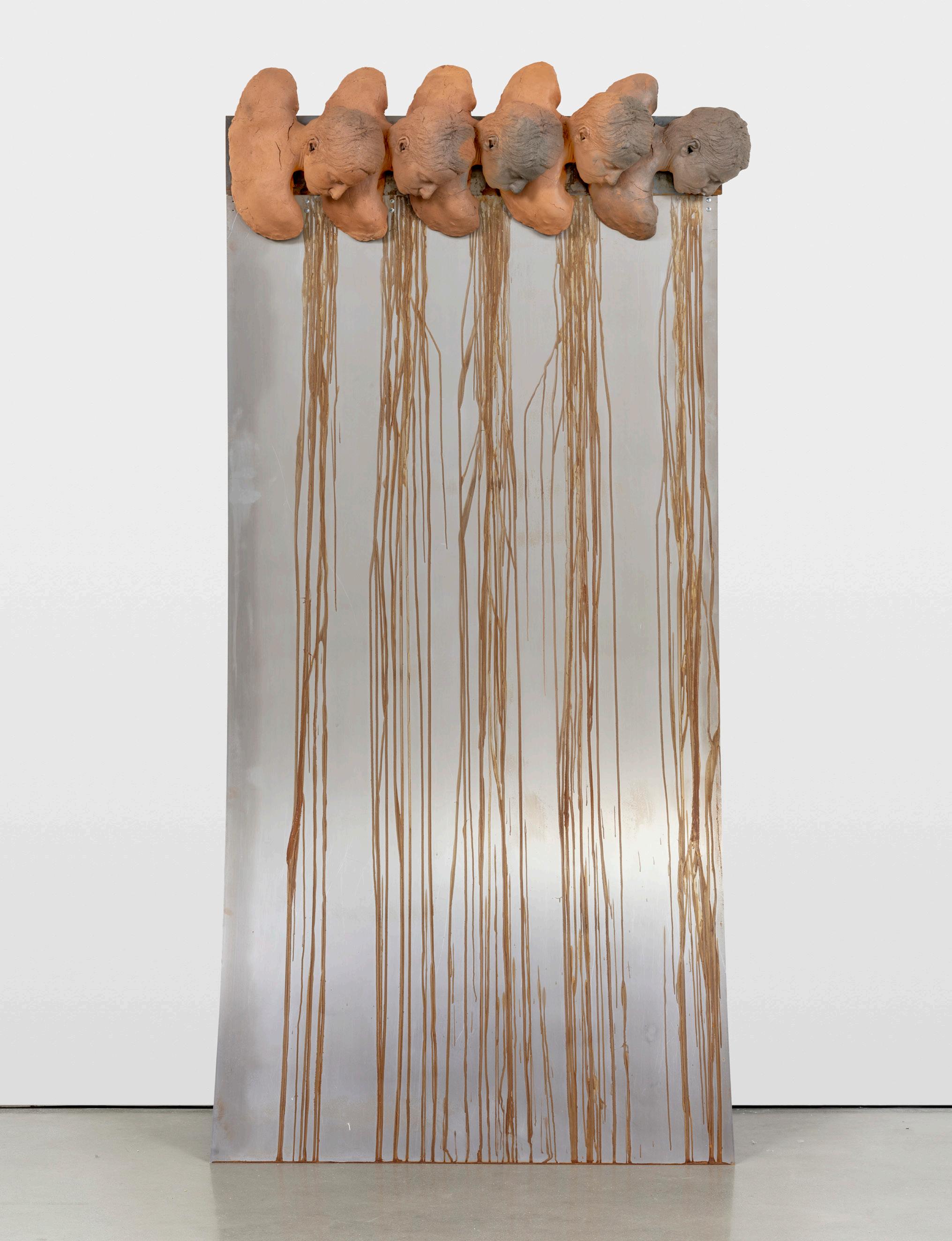
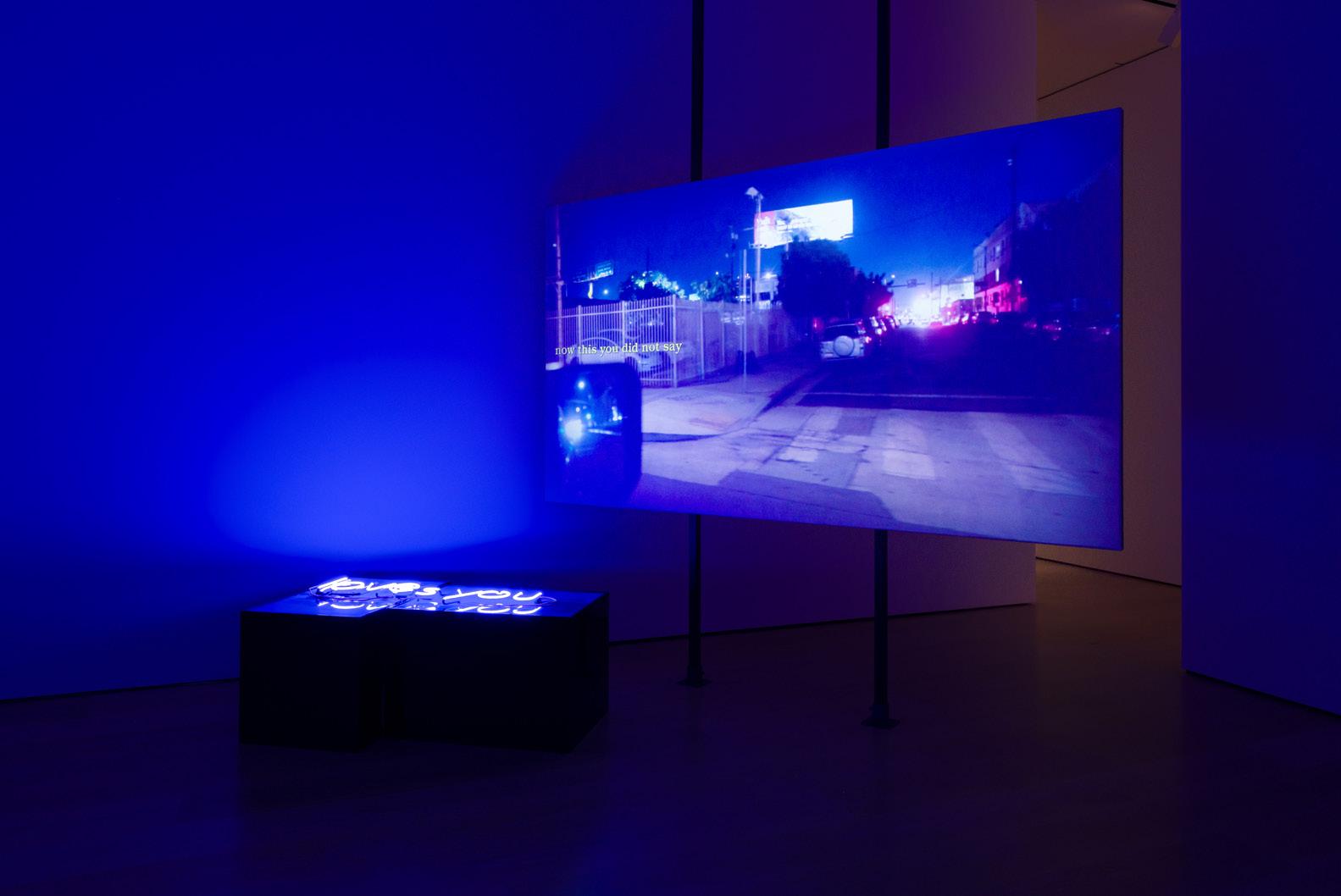
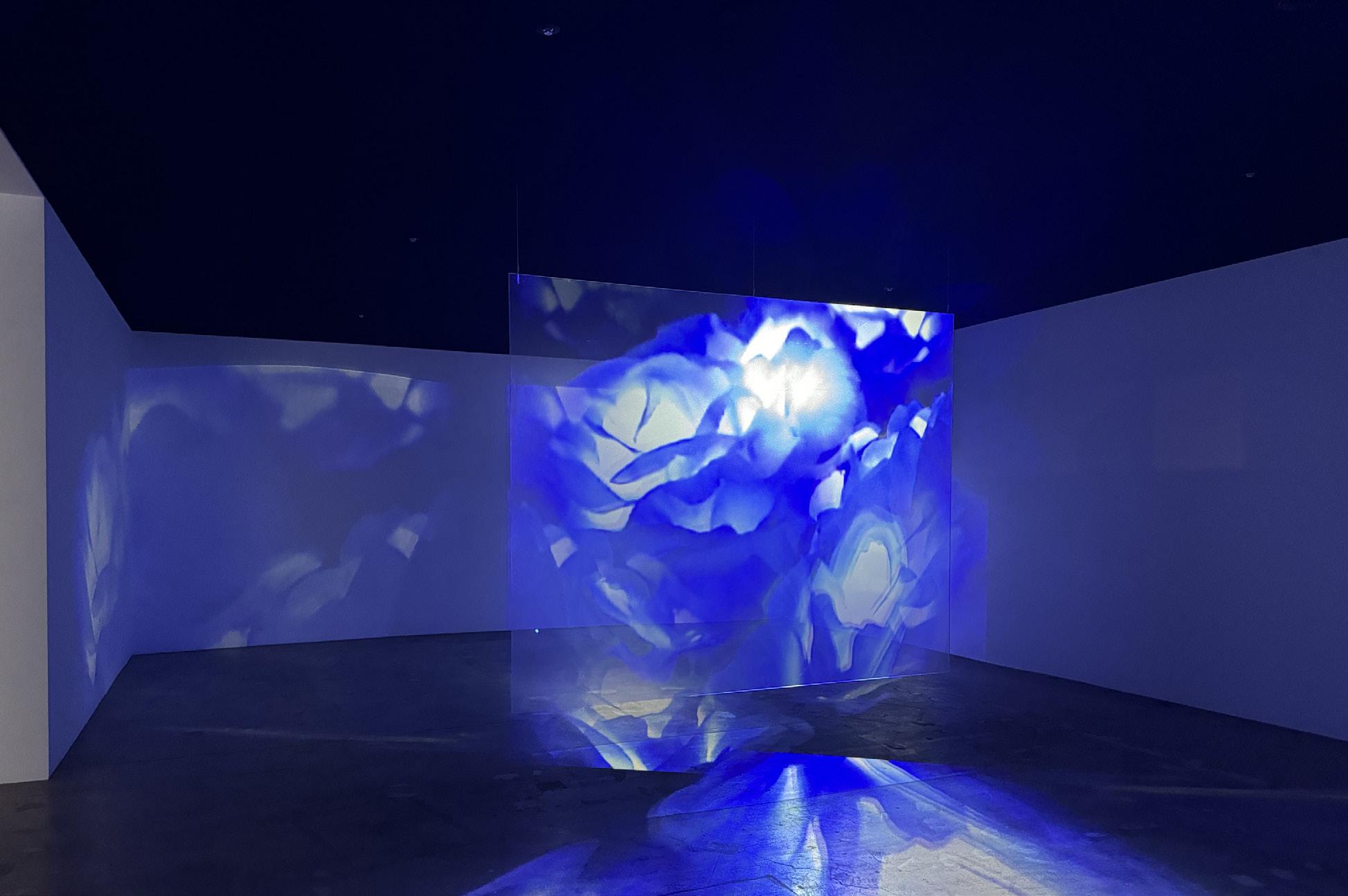
I stood for a while in Freddy Villalobos’s installation, waiting for the stone to speak, for I know nothing of aventure (2025). It is a small, dark room with the walls painted black. Two plinth-like sculptures along the periphery glow with purple neon phrases: ’til somebody / loves you. In the center, a video is projected on a frescoed wall: It’s a first-person vantage, the view of a ghost, taking a night drive up Figueroa Street—the same route Sam Cooke’s body took to the morgue after he was shot at the Hacienda Motel (now an apartment building) in South L.A. The elegiac installation is a dynamic memorial, mapping time through the sound and image. The plinths are topped with frescoes, too, which reverberate and disintegrate, their dust trapped under a thick layer of fiberglass. This past year, in Made in L.A. and beyond, I’ve seen local artists use their personal archives of images and experiences to reckon with varying degrees of loss and the overwhelming dissonance of grief, creating visceral sculptural installations that serve as communal sites of processing and reconciliation. Opened in late spring 2025, Jackie Castillo’s solo exhibition at the Institute of Contemporary Art, Los Angeles (ICA LA), Through the Descent, Like the Return, was born from a brief but vivid moment of destruction she witnessed: On a usual walk through her Mid-Wilshire neighborhood, she watched builders tossing Spanish terracotta tiles off a roof and into a dumpster, where they crashed and shattered. In the ICA LA gallery, Castillo arrested that image, transmuting these iconic architectural details —symbolic of her home and family in Los Angeles, as well as the nefarious legacies of colonialism—into sculptures. Elegant arcs of orange shingles laddered from floor to ceiling and down again, each sweep of tiles suspended in time and space with rebar, a choreography outside the normal bounds of physics. The sculptures required you to weave through the room, observing the installation and other visitors from various angles, their bodies reconfigured
Aleina Grace Edwards
between the tiles—it was enchanting. For Castillo, this installation was restorative, a way of creating an enduring archive of her neighborhood and its history, as well as her own family’s labor (her father and sister helped her craft the structures). “Unlike the moment where I saw [the tiles] falling and heard them cracking, they never crash here,” she explained. “There was one tile on the floor, like a corner shaved down to lay perfectly flat. It seemed to fall through the floor, and continue on to a different space and time, perhaps to return.” As the exhibition title and Castillo’s language suggest, this notion of return, of memories resurfacing and reanimating, is central. On one wall, there was a photograph of rebar towers reaching to a cloud-spotted sky— Castillo’s grandfather built them atop his family home in Mexico, where Castillo visited often as a child. “My grandfather passed away in 2013, and it was the hardest thing I’ve gone through,” Castillo told me. “[This exhibition] considers the cycling of time, and people, and place, and material.” In this way, Castillo creates a simultaneity: The dead and living, the tender and tragic, all exist together.
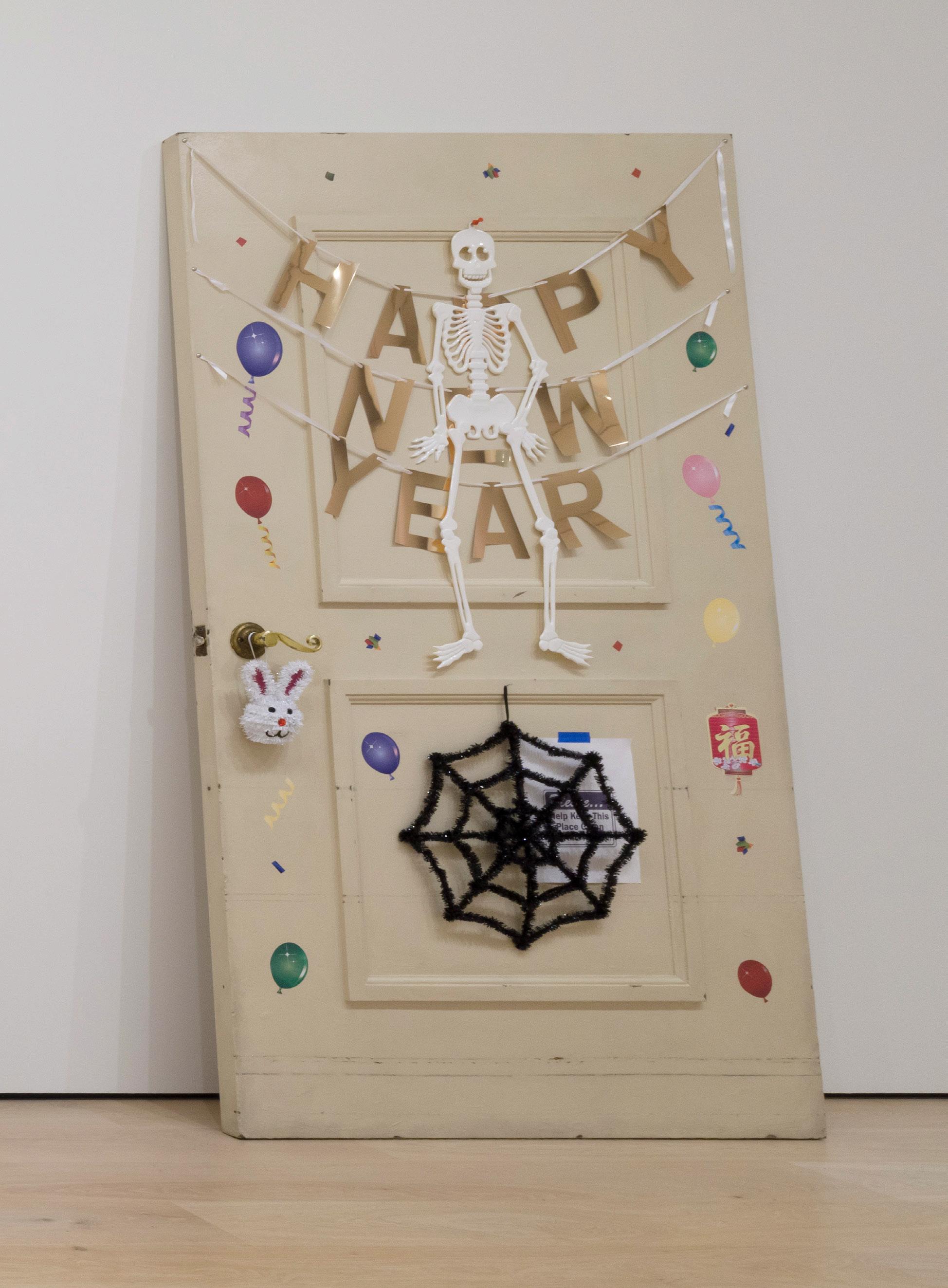
Amanda Ross-Ho has been grappling with the mortality of a family member, too: Her father has been living in a medical care unit for the past five years, and she’s been his primary caretaker. Her 2025 Made in L.A. presentation includes four enormous replicas of the door to his room there, meticulously remade right down to the dings and scuffs, draped in holiday decorations. The doors are called Untitled Thresholds (FOUR SEASONS) (2025), but they offer a perplexing mix of time markers: There’s a “Happy New Year” sign with a paper skeleton and a black cobweb, a wet-paint warning accompanied by hearts and Easter bunnies. Ross-Ho purposefully scrambled the chronology of the decorations: “I’d always taken pictures of my father’s facility,” she explained, and “the whole installation is enacting a glitch, based on a photo I had of a forgotten Halloween spiderweb next
to Chinese New Year decorations.” Indeed, in her work at the Hammer, the skeleton sits on top of a gold “Happy New Year” sign, surrounded by balloons and confetti stickers. Death and life at once, as told by Party City decor. The doors represent the contamination of memory, the collapse of years and experiences accumulating in a camera roll that doesn’t make much sense. Ross-Ho described time as her medium and subject. “The currency of time in the medical unit is about taking stock, about accounting for one’s time, calculating the time remaining, and how to give that value… There is no pure moment,” Ross-Ho continued. “There’s always an interruption.” Grief leaves us disoriented, sorting through the detritus of our minds and emotions, trying to get the details straight.
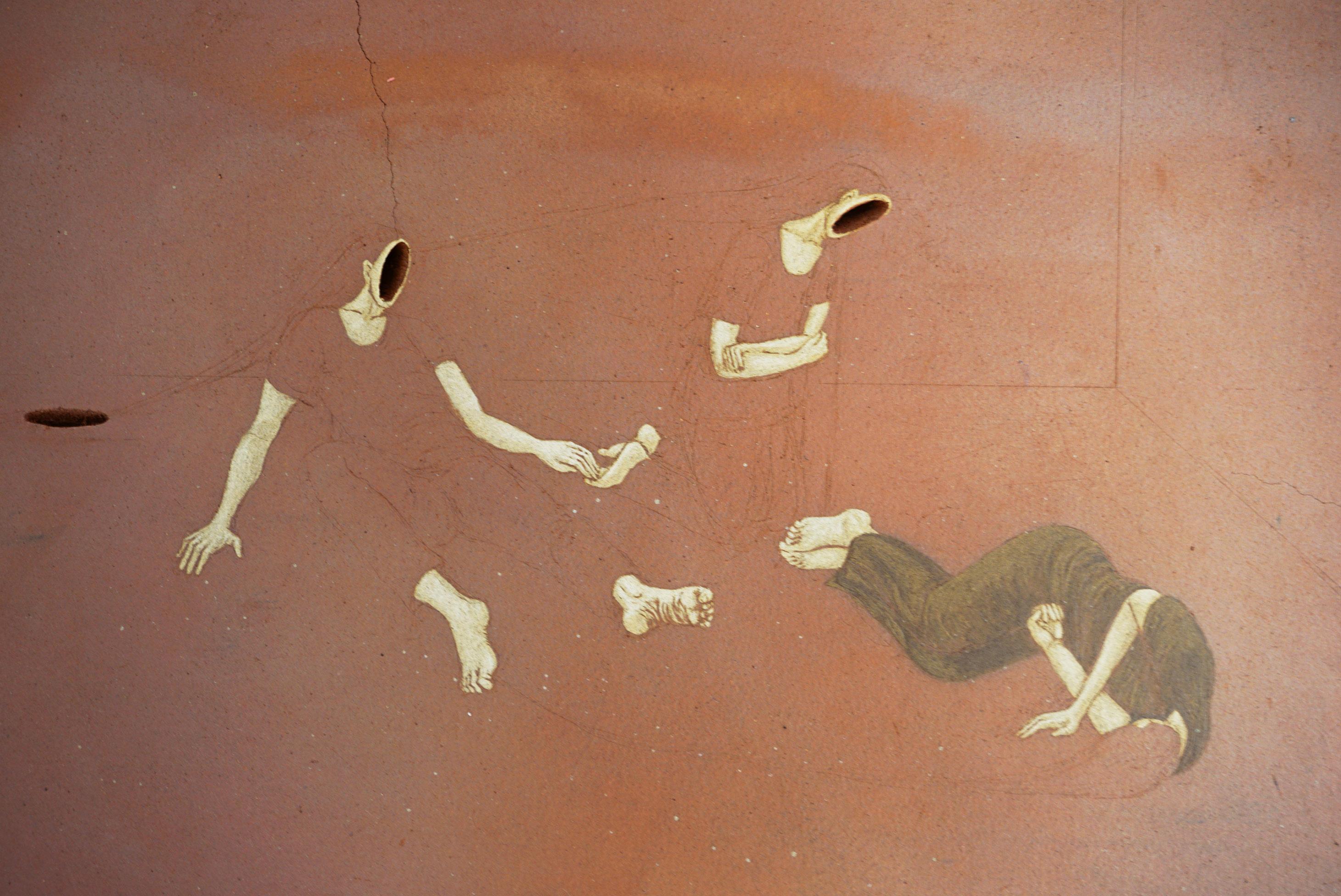
Like Ross-Ho, Iranian-born Roksana Pirouzmand considers the strata of time, materializing the points of contact between past and present in her figurative ceramic and sculptural pieces, where duplicative bodies converge in one scene or moment, touching, pushing, and pulling at one another. In Counting the Days Until (2022), a 16-inch ceramic tablet on view in Murmurs’s Felix Art Fair booth in February 2025, three etched women tumble across a spare room, dark holes punched into the clay where their faces should be, thin lines of hair tethering them head-to-toe. “I was painting these bodies like beads,” Pirouzmand explained. “The faces could become doorways that the thread could pass through, bringing another body with it.” Though she has used family photos in past work, Pirouzmand inspects herself in her newer pieces— these are different versions of the same body, her body. By showing all these figures in one frame, Pirouzmand acknowledges her own evolution and the losses it implies. At Jeffrey Deitch’s It Smells Like Girl group show in September, I stood under a nearly ninefoot-tall steel and ceramic sculpture with five busts of Pirouzmand’s likeness arranged along the top of a metal
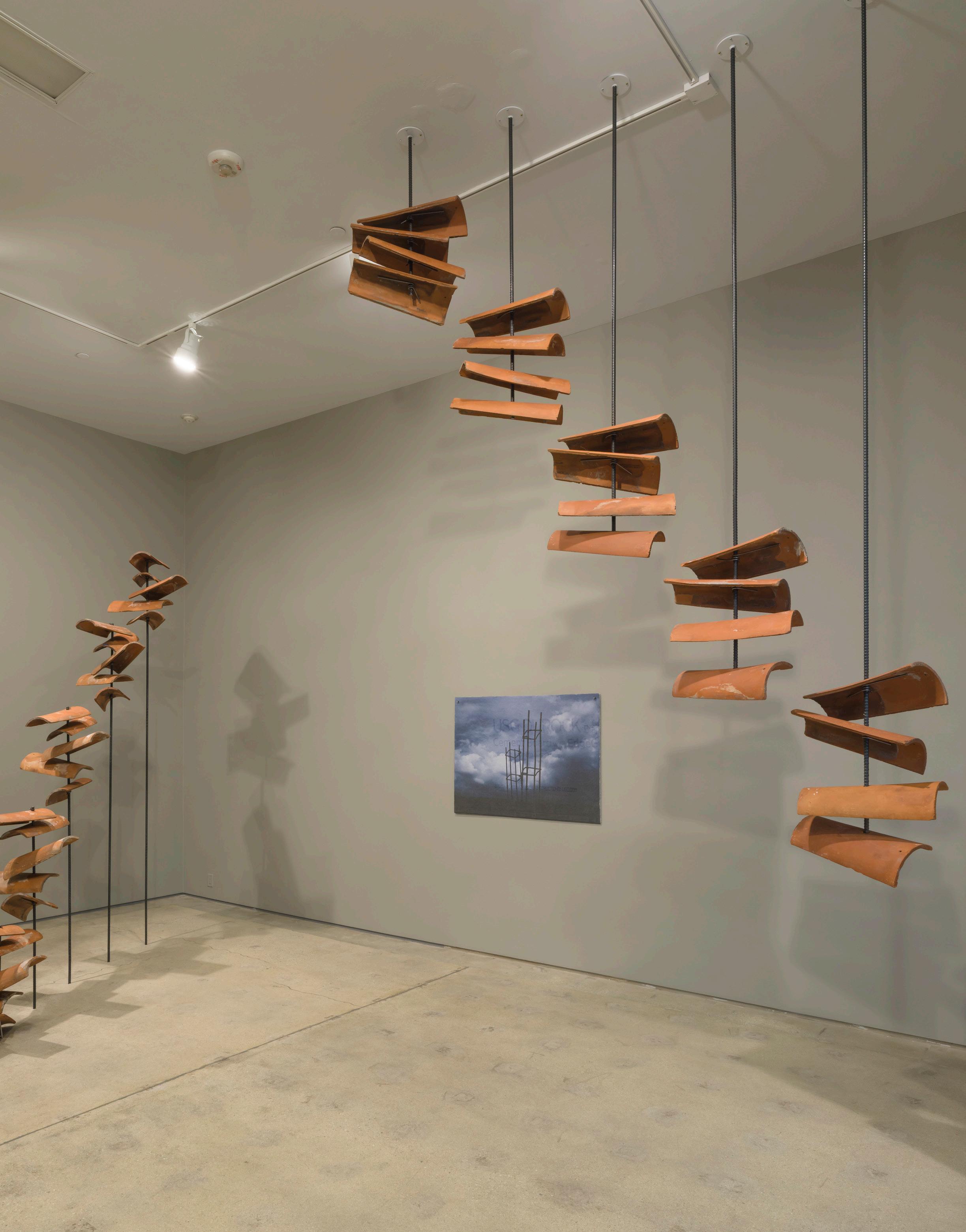
sheet, cheek to neck in a serial effigy.3 From left to right, the figures became more patinated, the last with her face pressed against the metal, skin gone grey. Up close, you could see the cracks across the figures’ necks and shoulders. Rust ran from their faces, dripping down the sheet and to the floor like red tears. “Erosion is a resilience, and a sorrow,” Pirouzmand said, by way of explaining the relationship between change and grief. The visceral texture of the clay, the changing sheen of metal—the physicality of Pirouzmand’s pieces renders them akin to entropic altars. There is a sense, looking at the aching intimacy of her figures and the deterioration of her materials, that she shows shifts in psychological states, mourning past selves who, like memories, can never be perfectly preserved. “Destruction is just a form of change,” Pirouzmand concluded. When I spoke to Villalobos about his Made in L.A. installation, he pointed to the potency of a certain destructive force, too. “It’s more revealing when something cracks,” he observed. So he breaks convention: His lengthy, looping video denies us the clarity and conclusion of a linear timeline. The soundscape—composed of chopped-and-screwed versions of songs—has no high or mid-tones, more felt than heard. Villalobos’s work has a “phonic materiality”:4 The work, like grief, punctures our sense of space, creating a hole we might step through. He showed me the dust accumulating under the plexiglass on his plinths as the soundtrack slowly shakes them to pieces, and I thought again of earthquakes, of disasters and ruptures, but also of accrual—there is a sedimentary quality to Villalobos’s work. Personal and political histories are stacked along his route down Figueroa, so close to where generations of his family have lived. Living in the place where I grew up, I can’t escape what’s happened here before, either. I’ve been to the same places across many years, with old and new people. I live two blocks from my childhood home—it’s so easy to
conjure the past. Lately I’ve been imagining my friend at every threshold, just out of sight, always about to walk into the room. I come back to Ross-Ho’s doors, to the door itself as an extended possibility, a portal my friend might pass through at any moment. Death prompts a reconsideration of the material logic of time, and in response, these artists grasp at ephemeral moments, freezing and dilating the transitions between one state and the next, evaluating and articulating the effects of one body on another, whether they are immediate, or many years removed. They are looking at fires burning and cooling, buildings rising and falling, bodies moving, embracing, breaking. These works render the physical dimensions of grief and frame loss as a portal through time and space. We share our space with death, always. But in these works, there might also be safe passage to the next place.
Born and raised in Los Angeles, Aleina Grace Edwards is an arts writer and essayist focused on preserving and promoting locally-rooted arts and culture.
1. Jonathan Griffin, “In L.A., a Loss of Nerve at the Hammer, but Art Hits in the Galleries,” The New York Times, October 23, 2025, https://www.nytimes.com/2025/10/23/arts/ design/review-hammer-museum-galleries-los-angeles. html; Alex Paik, “Made in L.A.’s Anti-Curation Doesn’t Work,” Hyperallergic, November 9, 2025, https:// hyperallergic.com/1055851/hammer-museum-made-inla-2025-anti-curation-doesnt-work/.Made in L.A. 2025, Hammer Museum, https://hammer.ucla.edu/ exhibitions/2025/made-la-2025.
2. “Lotusland” is derived from Homer’s Odyssey, which featured an island-dwelling people who consumed lotuses for their narcotic effect, effectively numbing themselves against life’s difficulties.
3. In a dream: I ran after you on a freeway. Then I was in a room. I don’t remember who it was but she told me I should go to my mom. Then I was crying at her feet (2025). Ceramic patina, steel, 102 × 48 × 24.5 inches.
4. Villalobos referenced Fred Moten’s concept of “phonic materiality” articulated in his 2003 book, In the Break: The Aesthetics of the Black Radical Tradition (University of Minnesota Press).
Two perspectives on the Hammer Museum’s biennial.
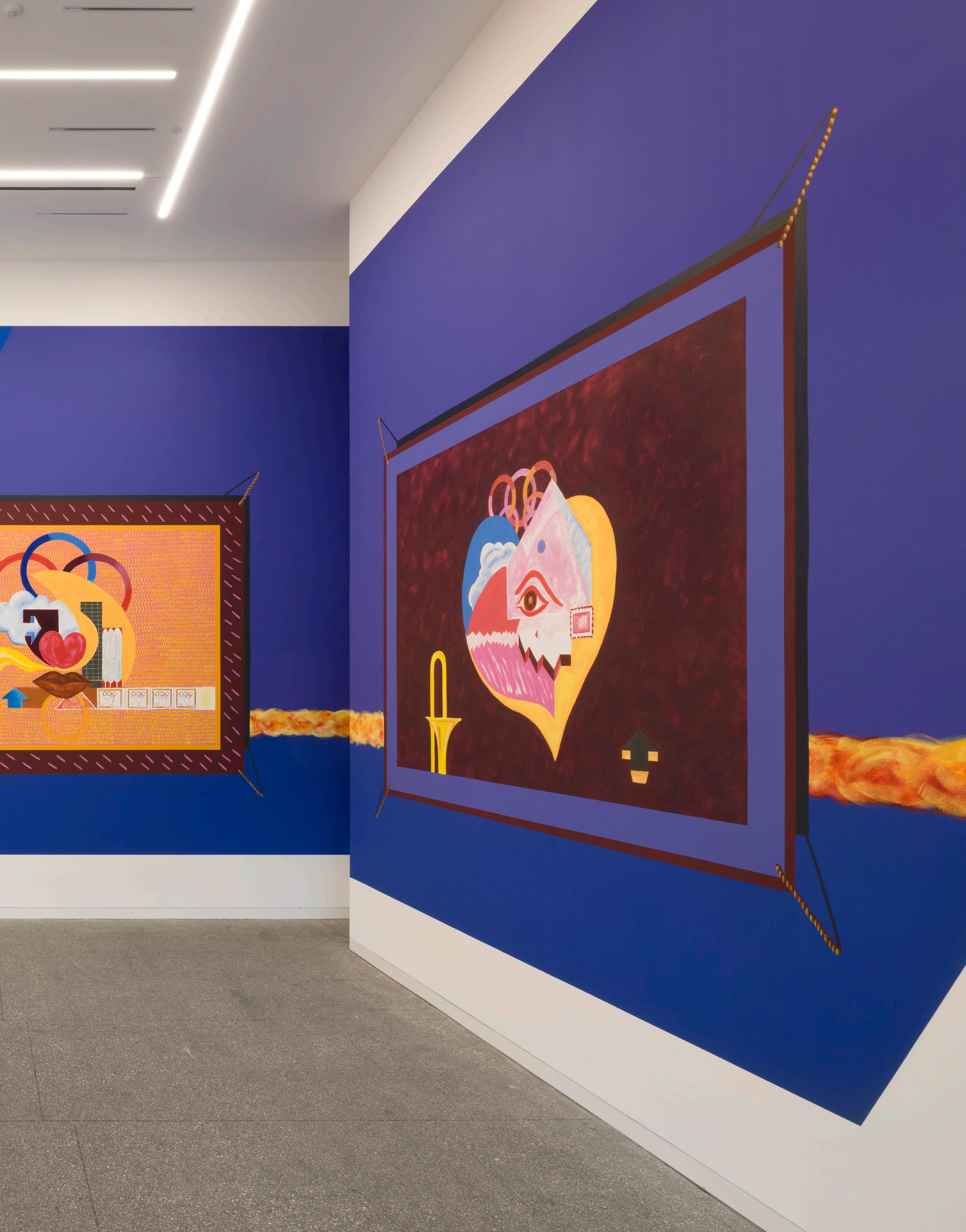
In 1983, as Los Angeles prepared to “sanitize the city”1 ahead of the 1984 Summer Olympic Games, Alonzo Davis, artist and co-founder of Leimert Park’s Brockman Gallery, was appointed director of the Olympic Mural Project by Olympic Arts Festival director Robert Fitzpatrick. Davis oversaw ten freeway-scale commissions along major corridors. His own contribution to the project, Eye on ’84, was a triptych (now lost) that absorbed and reworked the Olympic rings through Blankets, his series of layered fabrics and textures, which he began in 1980.2 Davis approached the commission pragmatically. Recognizing that Olympic funds would be funneled into art regardless, he sought to redirect those resources often toward Black and Latino artists who might otherwise be excluded, and toward muralism as a medium rooted in Los Angeles’s grassroots visual culture. Further, he believed murals could offer Angelenos a visual “break” to outlast the Games.3 Yet the project also belonged to a broader Olympic apparatus that deployed art as a means to uplift while masking intensifying displacement campaigns around the city.
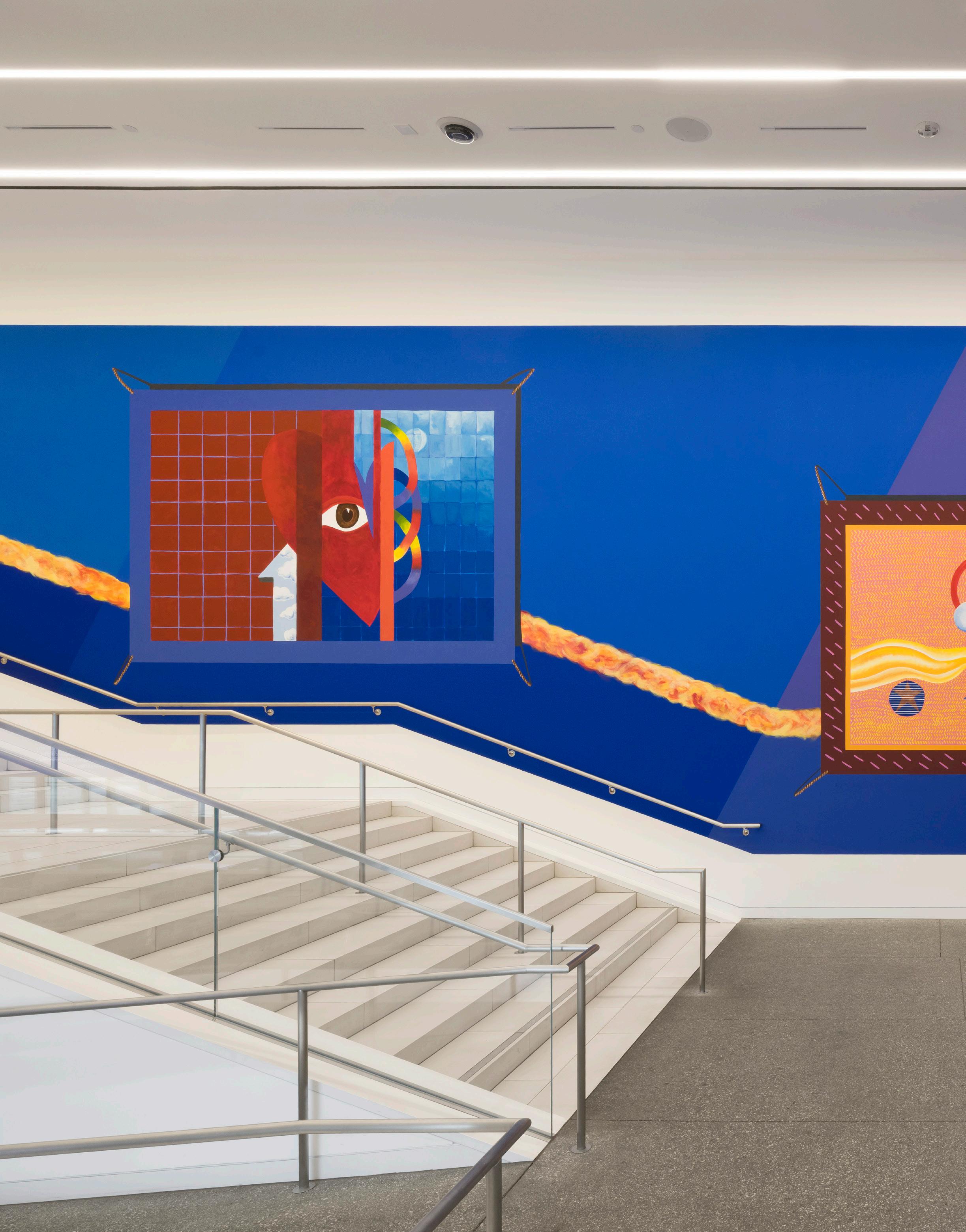
Four decades later, as Los Angeles readies itself for the 2028 Olympics, the Hammer’s Made in L.A. 2025 opens with a recreation of Eye on ’84. The 3B Collective, a group of Indigenous, Chicano, and Mexican
artists and educators, re-executed Davis’s mural at the Hammer. Its floating hearts and arrows (incorporated as a symbolic language gesturing toward celebration) remain vivid, but the exhibition presents the piece as a neutral welcome rather than a politically entangled artifact of redevelopment. In doing so, the curators sidestep the work’s historical conditions—the contradictions of civic uplift—which now echo uncomfortably in the city’s current Olympic cycle. The mural’s repainted blues sharpen the contrast between past and present: Removed from its original context, what once weathered public struggle becomes bright interior decor. The recreation could have served as a hinge between eras; instead, the show lets those threads drift.
This example reveals a central tension of Made in L.A. 2025: While many of the artists included confront pressing socio-political ideas in their work, the show’s framing sidelines the context of the political pressures with which they engage. A vitrine next to the Davis mural includes color photos of the original Olympic murals, both Davis’s and others, but offers little interpretive context. The absence of background on the work—its ties to Olympic-era clearance—and the diminished visibility of the muralists who revived it for this exhibition show how the curators’ strategy of “no ideas” might also flatten meaning. What disappears, then, is not only memory of past precedents, but also the recognition of present conditions that they map onto; what remains is a willingness to gesture toward urgency without naming sources. To assert “no ideas” amid genocide, wide-scale censorship, and state violence is to mistake neutrality for care. In a city reshaped by policing and housing precarity, this evasiveness feels untenable, an unexplored opportunity to engage with what it means to live in Los Angeles now. And yet, within this cautious frame, certain artists still refuse quietism.
Alake Shilling’s giant inflatable Buggy Bear Crashes Made in L.A. (2025), to my eye, nods to the confrontational
Liz Hirsch
stance of a union rat, though there is no didactic material connecting the Bear to L.A.’s long history of union struggle, or ongoing museum workers’ efforts to unionize.4 Patrick Martinez’s fallen mural raises the spectre of ICE, though the wall text makes reference only vaguely to undefined “social, economic, and political realities.”
Ali Eyal’s painting, by contrast, is accompanied by text that directly names the geopolitics of U.S. intervention in Iraq, framing the work within post-9/11 imperial aftermaths. The difference suggests the exhibition sooner addresses political violence when the locus is elsewhere. By comparison, works engaging Los Angeles’s own regimes of urban renewal are left to speak for themselves and rendered diffuse rather than situated.
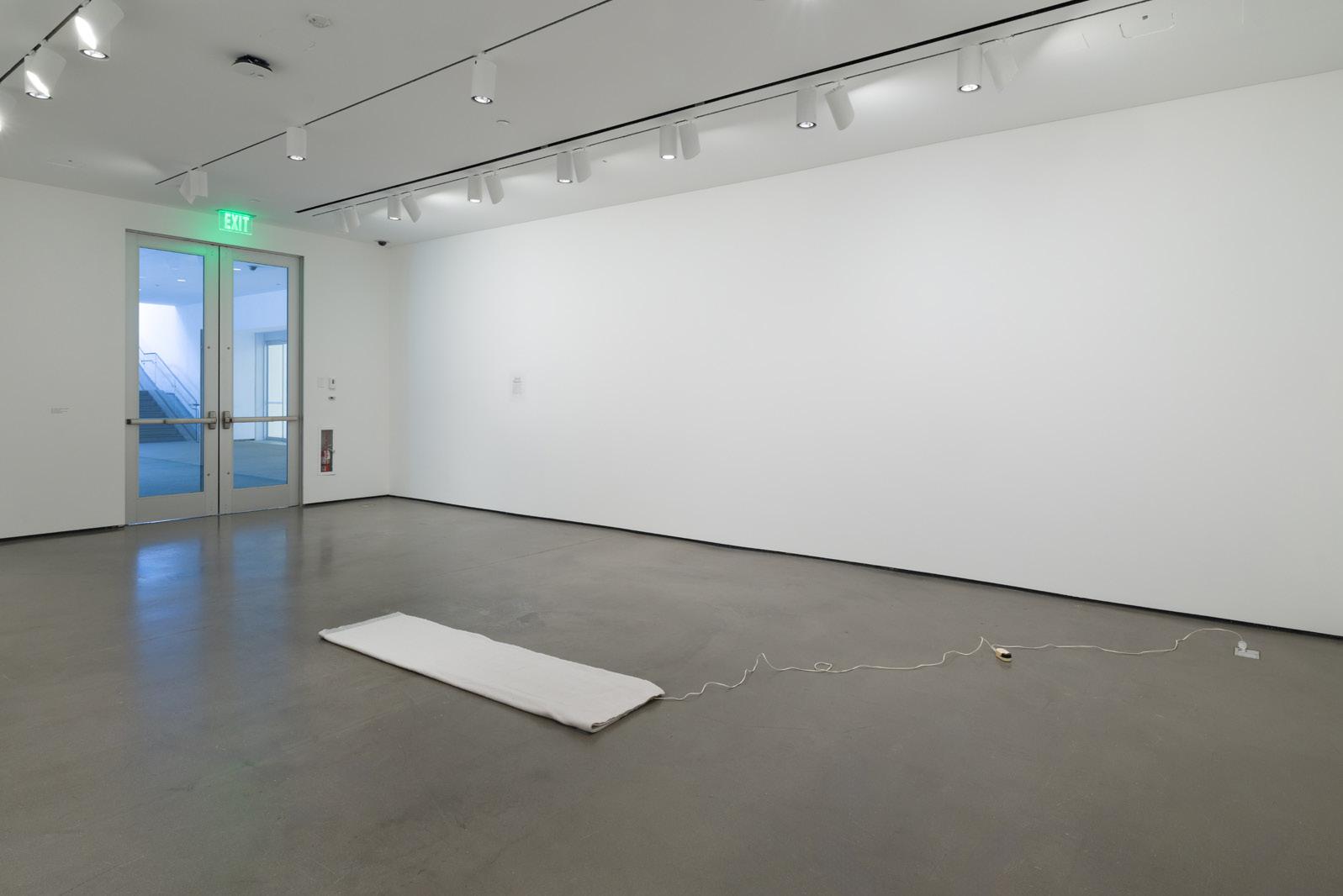
John Knight’s Quiet Quality (1974), starkly installed in its own gallery, pairs a folded electric blanket with a real estate ad promising a racially-coded “quiet” suburban escape. The juxtaposition exposes how comfort is marketed to some while others are structurally excluded. Made in the mid-1970s, Knight’s piece—like the Davis mural— feels unsettlingly current: The conditions it invokes have only intensified. Yet unlike Davis’s work, which depends on historical framing to register its political contradictions, Quiet Quality manifests through its literalism. The electric blanket is not a metaphor but an object of survival; the real estate ad does not allude to exclusion but names it directly. And yet, Knight’s refusal of interpretive text (observed here and in the exhibition catalogue) means the clarity isn’t a guarantee. The blanket’s scale, original purpose, and latent warmth summon Los Angeles’s homelessness crisis, making tangible the dyad of care and scarcity, but the absence of curatorial framing underscores how easily even the most pointed work can be absorbed into the exhibition’s broader atmosphere of restraint. The works that resonate most sharply across the biennial are those pressing against the show’s evasive
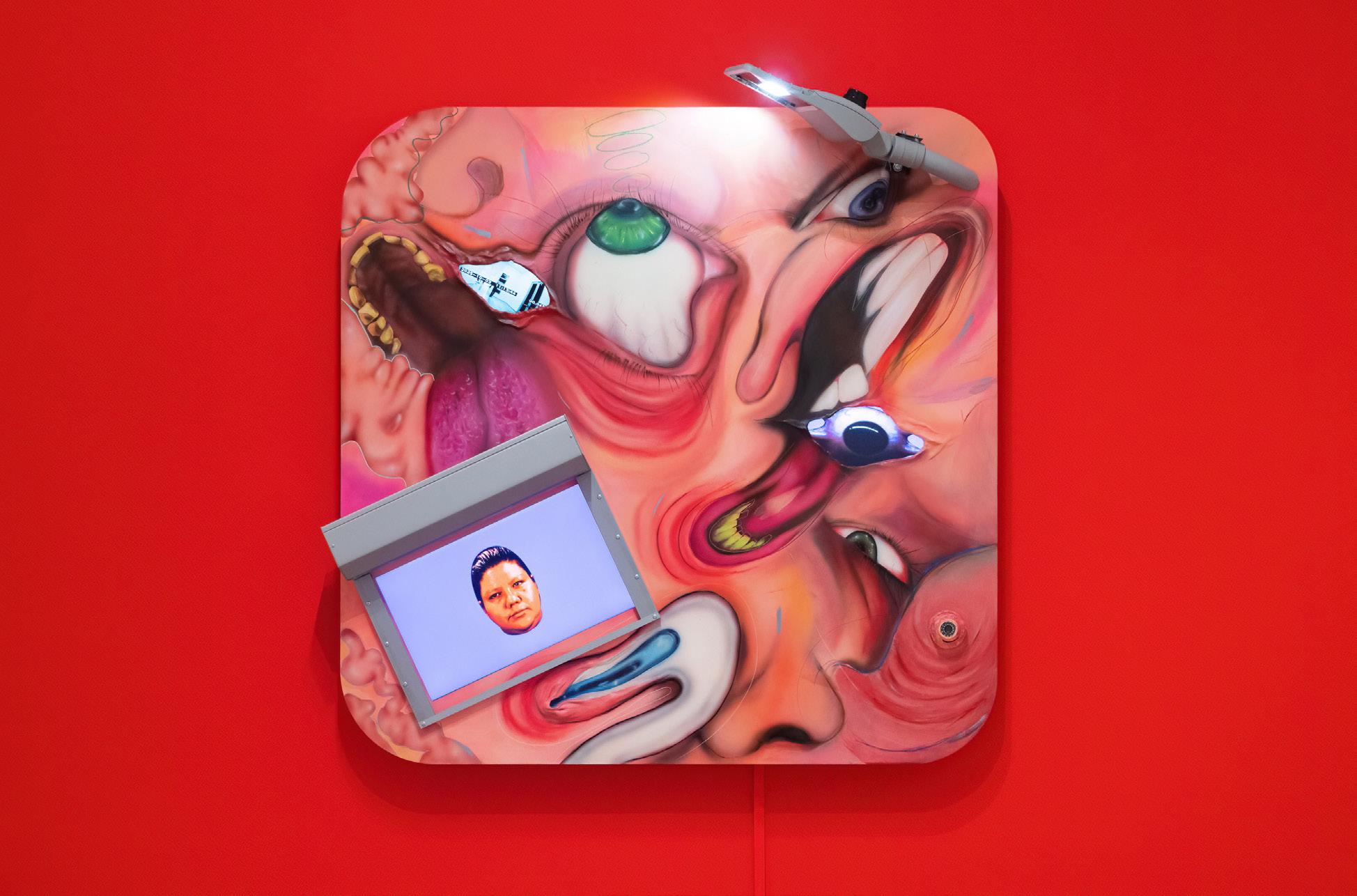
framing, embedding their social commentary more overtly into the objects themselves. Gabriela Ruiz’s Collective Scream (2025) presents viewers with disembodied painted faces—contorted and suspended against a saturated field—so that standing before it feels like being pulled into a chorus of unresolved emotion. An LED floodlight and surveillance camera disrupt this immersion, shifting the dynamic between viewer and painting: The work films us as we look at (or film) it, the live feed of museum-goers appearing on monitors embedded in the artwork. The color red triggers a small gate that occasionally closes over one embedded video feed, temporarily exhibiting a behavioral change—an action that mimics the arbitrary thresholds governing who is seen, blocked, or flagged in monitored spaces. Whether through cameras or gates, Ruiz makes it impossible to imagine oneself outside the systems that watch. In a city where surveillance shapes how certain bodies move through public space, Collective Scream renders those conditions unmistakable. Kelly Wall threads a similarly interactive needle. Her matte-black Fade to Black (2025), a wishing-well sculpture made of metal pegboard, steel, and fake rocks, pairs with Wistful Thinking (2025), a penny-press installed across the Hammer’s terrace. Visitors press and toss flattened coins into the water. The devalued penny (now no longer minted currency) becomes an emblem of desire, loss, and a thinning social contract. Wall reveals the friction between symbolic value and economic precarity, showing how even the smallest denomination carries social charge. Ultimately, the works that linger in the mind are those refusing to let Los Angeles remain an unnamed backdrop by collapsing the distance between form and lived condition. This is not about political virtue, but instead what curatorial framing, or a lack thereof, can activate or dampen. Several socially attuned works—including those by Davis and
Knight, but also Freddy Villalobos’s mapping of Black death and urban memory, Na Mira’s projection on glass addressing militarized space in South Korea, and Bruce Yonemoto’s reworking of U.S. war propaganda and Nazi-era footage—are charged, yet are left to carry their discursive weight largely on their own within the exhibition’s minimal framing. Some of these artists embed their social frameworks into the material and address of the work itself, making them harder to neutralize.
In contrast, works in the exhibition that are more engaged with aesthetic and formal considerations felt more at home within the non-descript framing. Peter Tomka’s slightly blurry blackand-white photographs (drying dishes, chest hair, a painting of trees engulfing a building) quietly frame private moments; Hanna Hur’s monochrome paintings highlight surface and texture; and Brian Rochefort’s off-kilter ceramics delve into textural experimentation. The contrast of conceptual and aesthetic focus across the show is perhaps to be expected in a biennial, yet it is one that could have been better shaped by intentional curatorial choices. Instead, broadly speaking, we are left to piece together histories, meanings, and contexts, pulling out how the works speak to the lived reality of L.A. for ourselves.
Liz Hirsch is an art historian based in Los Angeles. She is an Assistant Professor of Contemporary Art/Media Studies at Otis College. Her work spans modernism to the present, with particular interest in experimental forms, collaborative networks, and the social and political conditions that shape artistic production and reception. She is also the co-founder of 839, a contemporary art gallery in Hollywood.
1. In John Malpede’s 1984 performance Olympic Update: Homelessness in Los Angeles, he utters these words in his portrayal of Peter Ueberroth, president of the Los Angeles Olympics Organizing Committee. Malpede was critical of the city’s attempt to erase visible poverty in advance of the Games. See Linda Frye Burnham, “Hands Across Skid Row: John Malpede’s Performance Workshop for the Homeless of LA,” The Drama Review (1987), 144.
2. Alonzo Davis interviewed by Karen Anne Mason, April 1991. African American Artists of Los Angeles, Oral History Program, University of California, Los Angeles. Transcript, Charles E. Young Research Library, Department of Special Collections, UCLA.
3. Davis and Mason, April 1991.
4. Mike Davis and Jon Wiener, Set the Night on Fire: L.A. in the Sixties (New York: Verso, 2020).
“The town was one giant audition,” asserts the narrator in THEATER (2025), a five-part film by Calla Henkel and Max Pitegoff, on view in Made in L.A. 2025 at the Hammer Museum. Los Angeles functions as both a backdrop and an allegory in THEATER and across Made in L.A. 2025 more broadly. While the exhibition stops short of offering any cohesive curatorial insight about the city and its art scene, it does make a strong case for the continued significance and subversive potential of video art in a place known for its relentless image-making. Spanning short-form videos, immersive installations, and a feature-length film, the video works in Made in L.A. 2025 demonstrate how versatile the camera can be as an artistic tool, capable not only of capturing a singular moment but of documenting the accumulating layers of time. Through experimentations in perspective, light, and movement—and how these elements correspond to memory, history, and place—several artists in Made in L.A. 2025 reveal an image of Los Angeles that is at once glamorous and mundane: a site of constant reinvention, where
Nora Kovacs
process becomes a performance in and of itself.
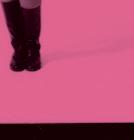
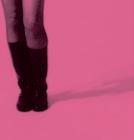
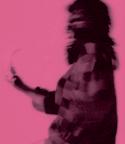
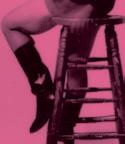
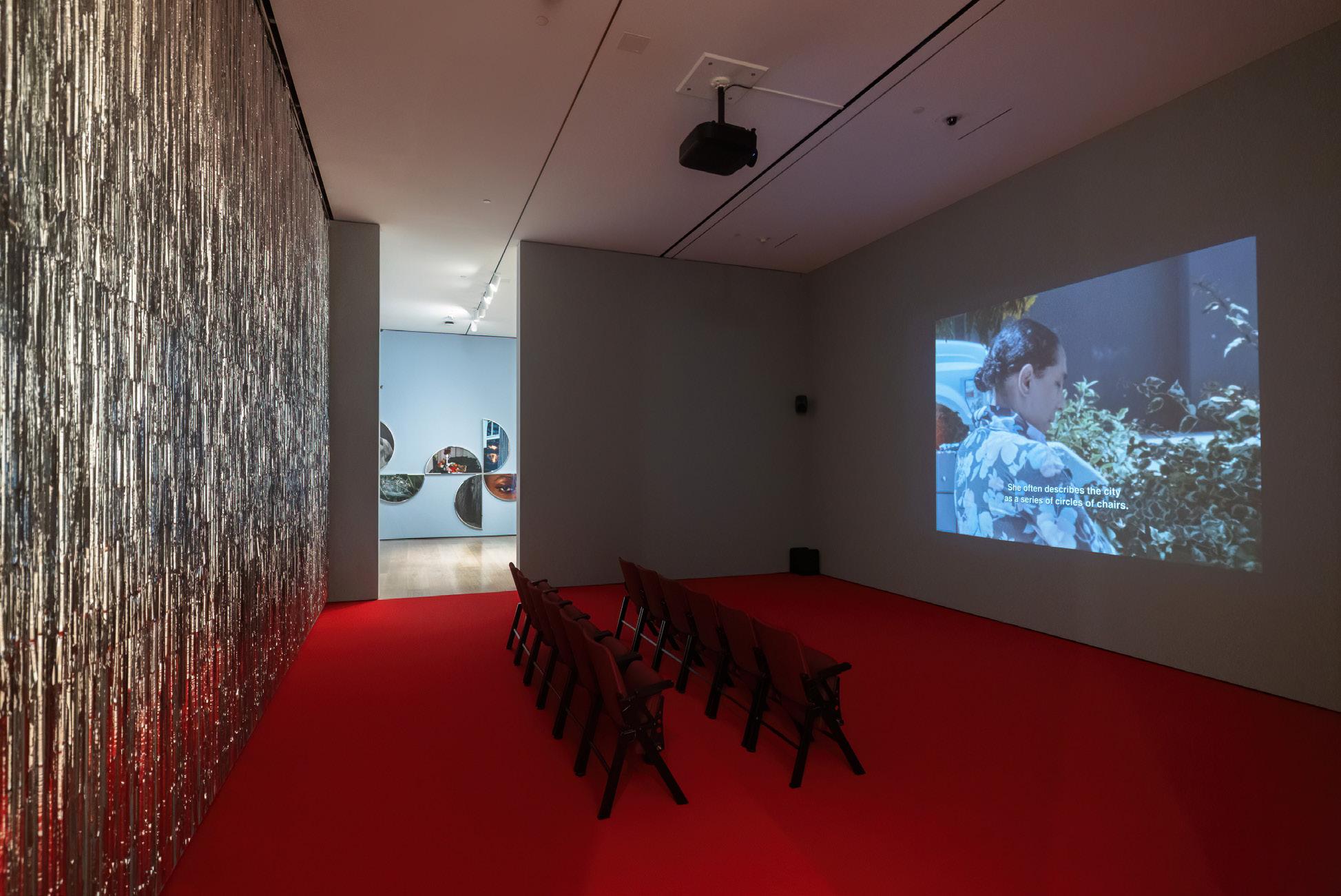
Self-referential, illusory, and delightfully navel-gazing, THEATER follows the pursuits of Kennedy, a fictional character who buys a black box theater on Santa Monica Boulevard and attempts to form an ensemble. The film incorporates footage shot on 16mm film during rehearsals at Henkel and Pitegoff’s very own New Theater Hollywood, a small theater that the two founded in 2024. We see artist Tarren Johnson dancing on stage in black high-heeled boots, actress Kaia Gerber applying lipliner in a mirror. Narrated only by subtitles, these scenes evoke the theatrical drama of silent films while the work’s playful existentialism and use of jump cut editing refers to the techniques of the French New Wave. The combination of documentary footage and fictional narrative gives THEATER a dreamlike quality, reinforced by the physical elements—red carpet, theater seats, tinsel, and a large mirror—that accompany the film’s installation. These objects not only operate as extensions of the film’s content but involve the viewer in its conceptual framework. What we are presented with in THEATER is not a perfected performance or a final product but a love letter to collective gathering—the repetitive rehearsals, preparatory rituals, and meandering obsessions that comprise a life in Hollywood.
Though similarly immersive, Na Mira’s work involves a more painterly approach to video. Sugungga (Hello) (2024) takes its title from one of five surviving stories of the Korean pansori storytelling tradition in which epic tales are performed by a solo singer and a drummer. In the story of Sugungga, a Dragon King of the Southern Sea suffers from an illness that can only be cured by the liver of a rabbit. In Mira’s work, two video channels are projected onto opposite sides of a sheet of holographic glass. One channel slowly moves along the surface of a large outdoor sculpture of a rabbit, while
the other depicts spiraling footage taken from a cab ride in Seoul, South Korea. Refracted and distorted through the holographic glass, the videos flicker across the gallery walls in a textured and disorienting frenzy. Beyond a narrative or documentary device, Mira uses the camera to reconstruct the sensorial experience of driving through an urban landscape —at times slow and up close, wide and frantic at others. It is as if, in the process of moving through a city—be it Seoul, Los Angeles, or any other —its buildings, structures, and objects are moving too, animated by the myths and stories of its past.
Freddy Villalobos continues the conversation between camera and cityscape in waiting for the stone to speak, for I know nothing of aventure (2025). The video is shot from a moving car that travels the north-south route of Figueroa Street in Los Angeles, beginning at the hotel where singer Sam Cooke was shot and killed in 1964 and making its way to the morgue where his body was taken. Though the camera’s position in the passenger seat does not move, its frame contains many simultaneous perspectives: a sense of constant forward motion, fleeting glimpses of illuminated storefronts, the car’s own shadow cast onto those buildings, and the confined reflection of the rearview mirror. As these vantage points slow down and speed up in tandem with the car, the heavy bass of the film’s soundtrack reverberates throughout the gallery space as well as the viewer’s body. This visceral intensity imbues Villalobos’s work with an ominous undertone, inviting further consideration of the ways in which tragedy and violence are inscribed into the physical landscape of a city. Villalobos uses the camera to not only excavate what might be forgotten or overlooked in the day-today but to construct a metaphor for the coexistence of past, present, and future. Congested freeways and well-trodden paths are more than just transitory spaces; they bear witness to the ever-changing faces of Los
Angeles. The tiresome daily task of traversing the city emerges here as a way to honor and reflect upon what has changed and what remains the same.
This examination of the meditative, potentially transcendent, power of monotony is taken one step further in Mike Stoltz’s contribution, which consists of found images and experimental videos displayed across five screens of various sizes. Pinktoned (2025) and Pinktoned (Exploded View) (2025) distill the medium of film into its material components: image, sound, and time. Photographic slides from a rummage sale at Echo Park Film Center depict the busy streets of Los Angeles, lined with movie posters for the 1976 documentary Underground. The colors of the photographs have degraded over time, settling into hues of pink as if to look back at the past through a rose-colored lens. On a nearby screen, bold lines of black and white overlap and overtake one another in a mathematical dance. Together these patterns form an optical soundtrack, a method of storing audio on film popularized in the 1920s. Here, Stoltz presents us with a visual representation of pink noise, a calming sound similar to white noise. The final component, time, is represented by observational footage shot from the artist’s studio in East Hollywood. Pedestrians wait at crosswalks, smoke cigarettes, swipe fingers across phone screens. Their casual movements reveal the poetry that can be found in moments of transition, in the slow passing of time. Film is a sensitive medium, Stoltz reminds us, attuned to nuance and vulnerable to decay. By unraveling its material qualities, the artist pays homage to process in and of itself: to the trial and error of constructing an image, telling a story, or shaping a perspective. For the video artists in Made in L.A. 2025, the camera is not only a tool for documenting their surroundings but a portal through which they can access the less legible aspects of inhabiting a place. Their works hone
in on the memories, movements, and sensations that inform our perceptions, both personal and collective, whether consciously or not. In Los Angeles, it can often feel as though we are neither here nor there, constantly in transit, always in pursuit of something bigger, better, or more dazzling than the present. Sprawling and starry-eyed, it is a place where glamorized fictions collide with the quiet truths of our daily lives. Perhaps, the artists in Made in L.A. 2025 seem to suggest, it is somewhere in between these failed dreams and actualized fantasies —in the auditions and rehearsals, the slow drives and hurried commutes —that an image of Los Angeles comes into view.
Nora Kovacs is a Hungarian-American arts professional based in Los Angeles. Her writing has been published by Art in America, AQNB, Berlin Art Link, Burnaway, the Julia Stoschek Foundation, Pelican Bomb, Public Parking, and This Is Tomorrow. Nora holds a BA in global liberal studies from New York University and an MA in curating contemporary art from Royal College of Art. 39
When I first met Kelly Wall, she recounted the experience of visiting Utah for the first time, where, upon seeing the red rocks she thought, “Wow, it’s just like at Disneyland!”
Growing up in Los Angeles, Wall, as myself, was surrounded by fabrications of the natural environment reflected back in slickly painted faux rocks and plastic flora and fauna. The irony of being surrounded by nature in Southern California yet having it represented in theatrical, kitschy installations is a quintessentially L.A. experience that articulates the mirage of Hollywood looming over the coastal metropolis.
Wall’s sculptures pay homage to, and often emulate, forms of commodity culture, tourism, and entertainment in order to interrogate their forms and functions. She draws influence from the film and television industry, making work that roots itself partially in facsimile. Her sculptures take up the forms of props, often using the playful language of Hollywood set design to comment on concepts of nostalgia and the zeitgeist of Los Angeles, yet notably, all of the pieces and parts of her sculptures are fabricated by hand. As she recounts, her works are not ready-mades but are as close to the “real” thing as possible, engaging in a challenge of visual play that embraces consumerism while rejecting its means.
On the occasion of the 2025 Made in L.A. biennial at the Hammer Museum, Wall invited me to her studio to discuss her newest sculptural works: a fountain made of coffee mugs, a functioning penny press, and racks of glass postcards depicting Los Angeles vistas.
For Wall, the materials she uses are integral to the meaning of her works, and wordplay adds further context. Fade to Black (all works 2025), a black circular fountain topped with black mugs stacked on a central pillar, conjures notions of theme parks or memorials. The mugs themselves are handmade but reference ubiquitous souvenir mugs, their handmade quality probing the materiality of the nondescript objects that circulate in tourism and entertainment economies. Resting on top of the mug stack, a single white mug reads “Once Upon a Time…,” and as the title suggests, the subsequent mugs all literally fade to black in a gradient. Wall utilizes this wordplay to dually refer to the common opening line of Disney fairytales and the ending of scripts—both references nodding to tropes of storytelling. The phrase might even contain a tinge of pessimism within the context of the recent downturn of the film and TV industry, which supports a huge sector of L.A.’s economic infrastructure.
Installed at the Hammer, the fountain acts as a moody counterpart to Wall’s more optimistic Wistful Thinking, a custom penny press in the style of a wishing well —white text painted on the top reads “Well Wishes.” Fully functional, the work produces a flattened penny once cranked, each inscribed with messages such as “you are here” and “something to hold on to.”
The sculpture’s proximity to the fountain invites visitors to toss their penny and make a wish, engaging in an exercise of hopes and dreams in the city of stars.
Alongside these two works was Something to Write Home About, a group of postcard racks equipped with dozens of powdered glass postcards, each picturing L.A. skyscapes in dusty blues, pinks, and saturated cerulean. All together they make up a larger view of the quintessentially cinematic L.A. sunsets, a motif of the city that is perpetually trying to be captured
Olivia Gauthier
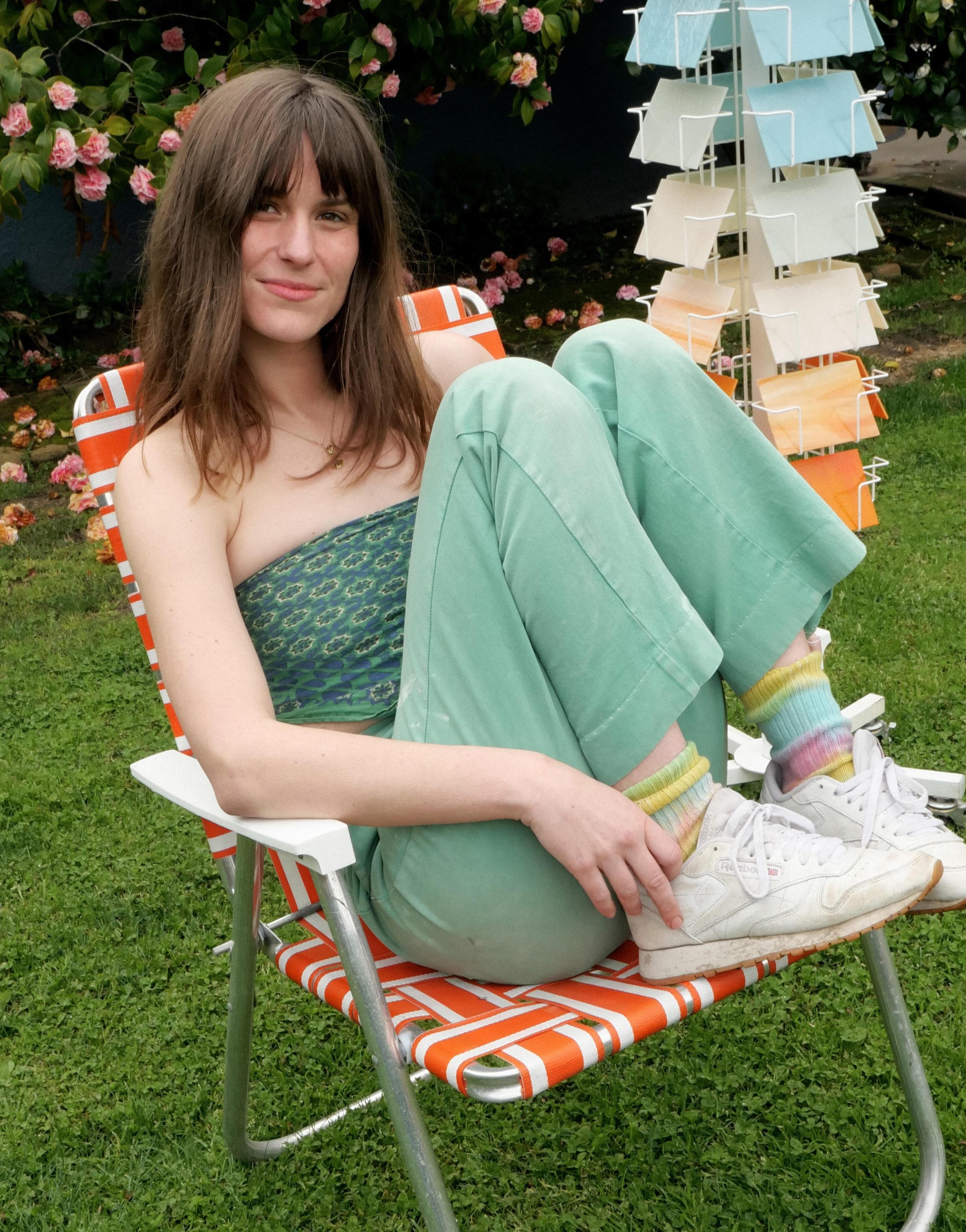
and always slightly out of reach. I spoke with Wall in her studio about her works for Made in L.A. 2025, our conversation percolating on Wall’s relationship to language, materiality, and the ways in which nature and the sublime inform her both her practice and our shared sense of existential ennui.
Olivia Gauthier: When did you begin making these works for Made in L.A. specifically?
Kelly Wall: It was in February [2025] when I really started working on the postcard pieces. And that was just doing testing, because it took me like six weeks of doing tests before I got to actually start pieces, you know?
OG: So was the penny press already in production?
KW: No. I worked on the postcards from mid-February until May. And then I went on this road trip, kind of a little research slash one-year engagement road trip with my partner. And we went up north and hit all of the penny presses we could find on the roadside. Because I knew I wanted to hit this roadside aesthetic.
OG: You said something about how you put in extra labor to make your sculptures look like the objects they are meant to represent, but without commercially producing them. You mentioned with the mugs—you could have easily sourced that out.
KW: I always think about using whatever material feels necessary for the idea. And that’s really important to my practice because in sculpture all you have are the materials and the title cards to relay ideas through form. And so materials are a huge part of that content. I don’t want to have to explain all the work; the material and the form [should] be doing that, you know. And so with glass—I’ve been doing glass stuff for a little bit now—I feel like I’m exploring it because it holds a lot of ideas
that I’m interested in with my practice: the way that it doesn’t fade over time, this fragility that it has, the way it plays with light and changes throughout different lighting contexts. Light makes it change in [the same way that] perception works…in the way that we see things.
OG: You’ve also talked about the idea of facsimile or the trompe l’oeil effect.
KW: [With] the penny press, I really wanted it to relate back to the movie industry and [that] prop aesthetic. The movie industry in L.A. dying was a big part of it. […] I wanted it to just have that plasticy, fake look. [It’s similar to] how at Disneyland, you see the rock formations and you're like, “Oh, I know what this is referencing.” But it’s obviously the fake version of that thing.
OG: What you said about rock formations makes me think about nature… I think we both had a similar shared experience of growing up in L.A., so wildfires have already always been around, but they’ve never felt so destructive or so uncontrollable; and how that affects our relationship to the place that we’re in.
KW: These ideas of stories that were told about what we could have in our future, and as capitalism continues on, just realizing that it feels like [there is a] deadline to those things. … Especially with the fires…the last ones that just happened in January broke the barrier and destroyed huge chunks of the city that will permanently change Los Angeles and what it looks like. It’s this disillusionment of what we thought was laying ahead, but then also this idea of nostalgia, how it can be a dangerous thing to look back and think that it's this better thing in the past and how that’s actually not real. [I’m] just trying to hold both of those things and understand, while experiencing disillusionment...and sadness about things changing. It can feel desperate to hold onto something, which is where souvenirs play this
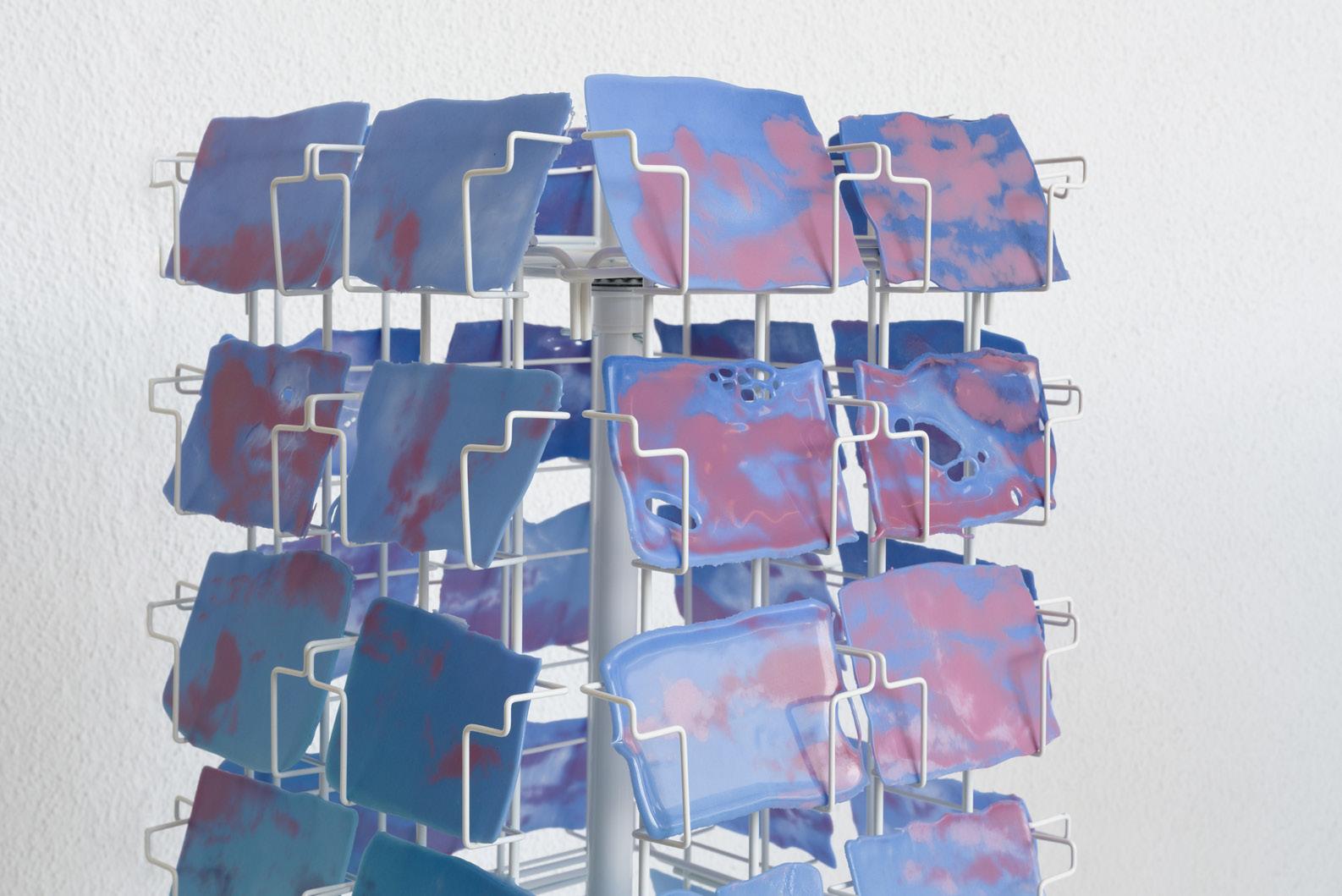
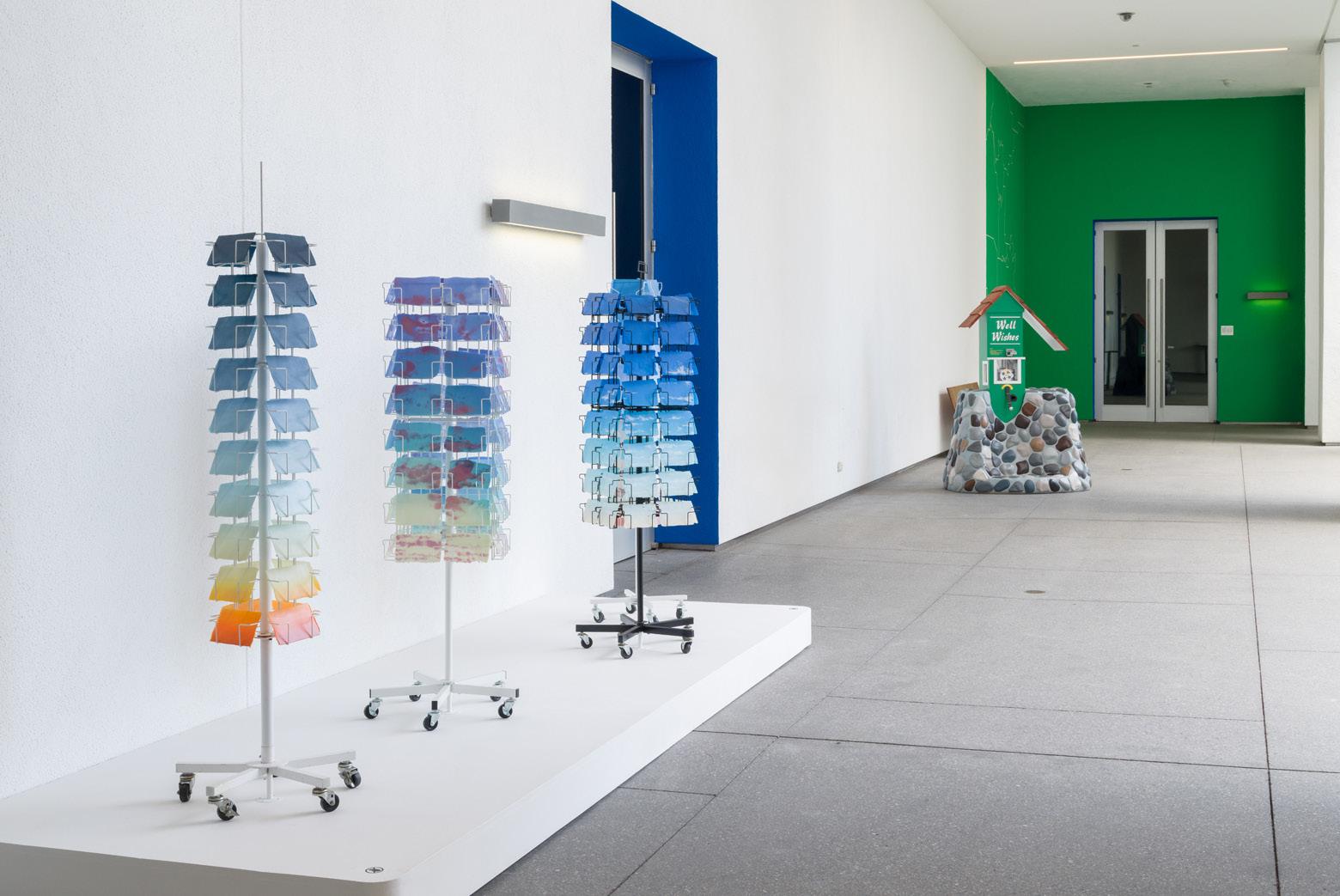
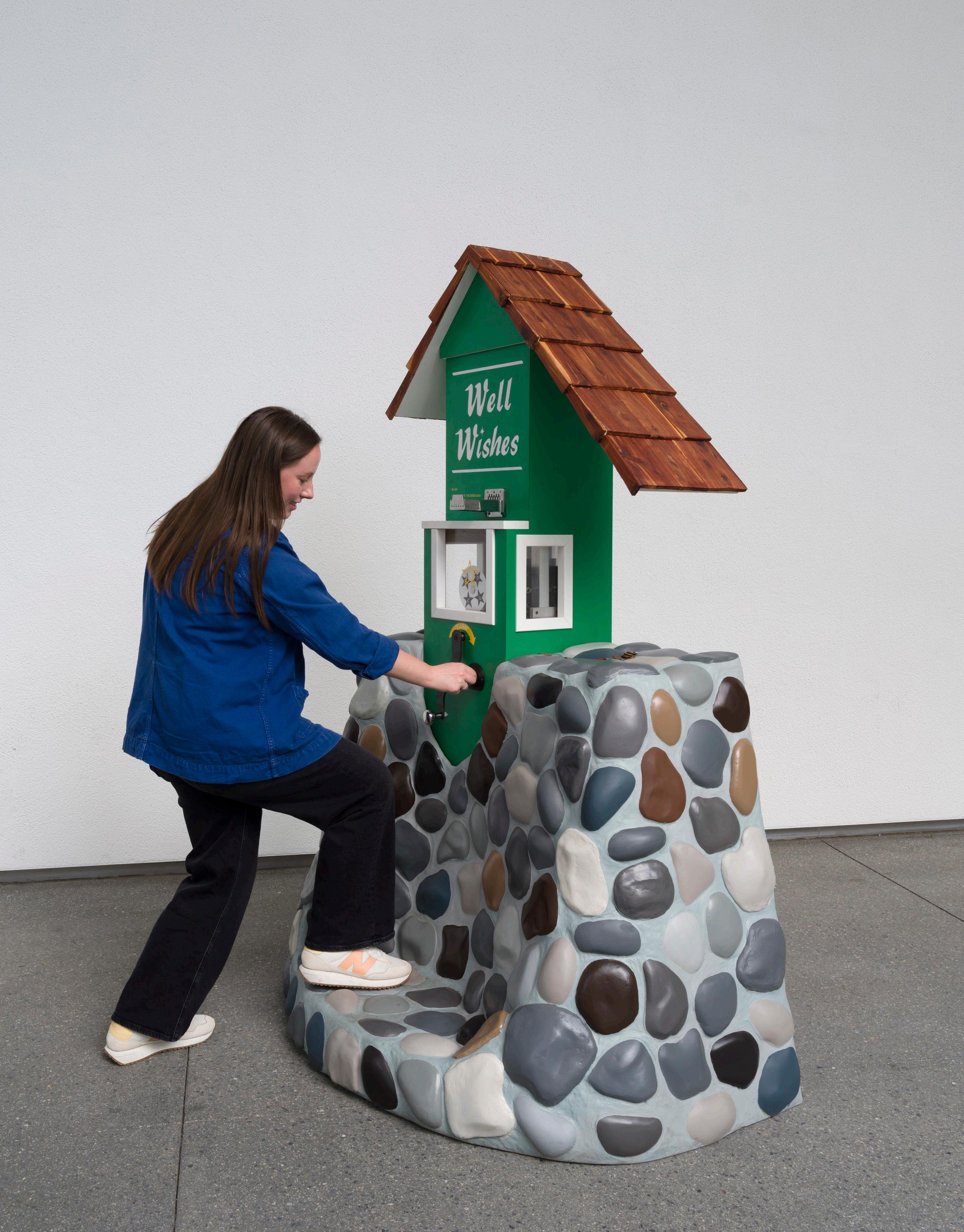
role of holding onto little memories. The mugs or the key chains or postcards, or whatever, are of a slightly bygone era.
OG: How does nostalgia relate to kitsch? I think that’s a big part of the work. I know Mike Kelley is one of your influences. I’m interested in your relationship to conveying an emotional state or mood in the work.
KW: I love[d] reading “Notes on ‘Camp’” [by Susan Sontag]. It was written in the ’60s, so when it talks about things that are campy, it’s things from that era. But if you’re reading something that’s that old, I’ll often think, “Well is camp the same thing now?”
There’s one section that's about how [representing] nature is always kitsch or it’s always camp. It’s like fake grass, or a fake Christmas tree or those fake rocks that people hide their keys under…. I don't know if it relates back to the movie industry and just growing up here and prosthetics forming my first interest in making [things], but [there is this] idea that anything can be anything…. Kitsch and prop are overlapping circles.
OG: When you were making the fountain piece, how were you looping in these references to the movie industry, or even references to language with phrases like “once upon a time,” which brings us to Disney fairytales. You pair that with the title Fade to Black, which along with the form of the fountain nods to remembrance or memorializing something.
KW: It feels like [so many] things are coming to an end right now. And I don’t know if I was just really depressed while working on this whole show, with things happening in our government…AI rapidly increasing, and people just losing jobs. It feels like every industry is hurting. So [with] that piece, I kind of was using the destruction of the fires, and also the movie industry to talk about, more personally in our area,
[these] feelings of the end. The fountain being all black, it could be read as this burnt thing. It could be read as the end of a script, where before it says the end, it says “fade to black.”
OG: Could we talk a little bit more about your relationship to language? On the back of the penny press there’s a wooden bucket that says “tender.” There’s also text inside the bucket— a hand-painted found poem of sorts.
KW: I used to try to avoid language because it felt just inadequate to get ideas across. And that’s why I chose to make art and do sculpture…. Language is interesting because it’s so clunky and the things that I didn’t like about it actually could be [used as] a tool, as a material, and could add nuance or add to this confusion that’s happening.
For the penny press, the title is Wistful Thinking, but the text on the front of it says, “Well Wishes.” I was thinking about this idea of the end without overtly saying “the end.”
[Like] the sunsets being a symbol of the end or “fade to black” being what happens at the end of a movie, “Well Wishes” is how you would sign the end of a card, it’s like a sign off…. The instructions [that are painted on the well] are also kind of a tongue-incheek allusion to L.A. I actually had it made with star shapes that had question marks in it, so that when you turn the handle [to make a penny], you have to line up the stars. So [you] turn your hand till the stars align, and then insert one penny. [A]nd then it says, “Keep turning to make a lasting impression.” And it’s like a lasting impression, that idea of, you know, fame or something.
So I think language has been really fun. And you know, a lot of L.A. artists have played with language in the past, like Ed Ruscha. He did a bunch of The End pieces. [A]t one point the fountain was gonna have the word “the end” on a lot of the mugs and I was like, “You know what? I feel like it’s better if it’s just hovering out of sight, but present.”
OG: You mentioned taking road trips for research. Whenever I’m driving up and down the coastline, I get this sensation of being in proximity to the sublime.
KW: I’ve always been really drawn to the coast. I live near the beach and I have for the last like 15 years…. I’ve always been really drawn to driving up PCH with the windows down, especially at night when it feels like you’re on the threshold between totally packed society on one side, and totally vast [nothingness]—almost like a vacuum that’s equal pressure, on the other side of the ocean.
If you just zoomed out and looked at a map, you’d really just be on the threshold of this line between a huge continent and this huge blue [space]. It’s weird to call it nothingness because it’s not; it’s so full also.
OG: There’s these different dichotomies…I definitely think that that comes through in the postcards. We’re always trying to take pictures of the sky to try and capture that feeling. It’s literally impossible. That’s an interesting gesture in the postcards too, since each one can represent the sky on its own, but then altogether they create this larger skyline. That breaking apart and coming together relates to this inability to kind of grasp the expanse of something.
KW: I like the idea of the sublime, like you’re saying. It’s so vast and I feel like that vastness just makes me feel more human and more connected to the cycle of a day. [We] can get so caught up in, like, capitalism and consumerism... [T]hey say, “Go outside and look at a tree and It’ll make you feel better in like 10 minutes”—and it’s so true. I’ve always loved [that] about L.A. It’s a city, but we have so much access to nature. We're so lucky. I don't want to make, like, environmental work or political work, but…I’m making work about my experience and my experience is turning to nature
for things…. Political stuff is happening around me…and [when I] bring nature into my work I feel like I'm trying to point to nature as being, like, the external force…and maybe [it has] answers for us.
Olivia Gauthier is a writer and gallery director based in Los Angeles. Her work has previously been published in Art in America, The Brooklyn Rail, BOMB, and Hyperallergic. She holds an MA in art history from CUNY Hunter College.
Kelly Wall (b. 1990 Los Angeles, CA) received a BFA in Sculpture from Otis College of Art and Design and an MFA from California Institute of the Arts. Across myriad subjects and media, Wall’s work often elicits nostalgia, using memory loaded objects to invite viewers to project themselves into the work. California, as place and idea, is paramount in Wall’s work. Wall lives and works out of Mar Vista, CA and teaches sculpture at UCLA and Otis.
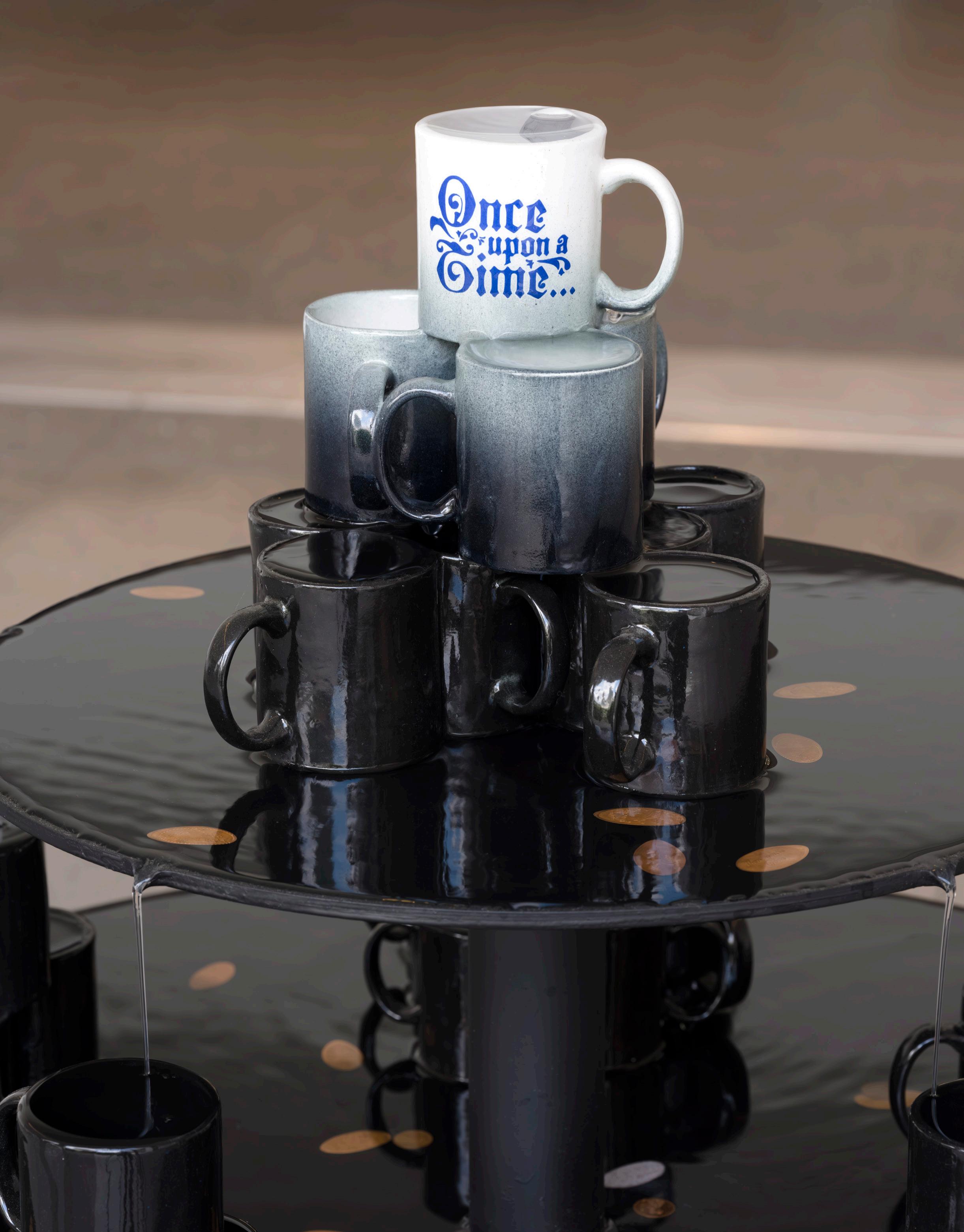
The Silver Lake-based gallery Marta is an experimental cauldron that stirs vast visual cultures and mediums together. In 2019, the gallery sprang from co-founders and curators Benjamin Critton (whose background is in publications and typography) and Heidi Korsavong (production and interiors). The nature of its inception is paramount to understanding its influence; as a host of multidisciplinary makers and their objects, Marta serves as a refined playground where art and design meet, fostering an expansive space where creatives can explore relationships between the two.
The collaborative vision that Critton and Korsavong share has the power to create magic.
The two ritually frequent the Los Angeles Flower Market downtown to adorn their space with seasonal shapes and infuse it with fragrances. Roused by the market’s endemic metal plant stands and wooden bleachers on wheels, Critton and Korsavong observe structural inspiration everywhere. Serving as both a marketplace
and communal space, Marta has assembled 51 exhibitions of various scales under its roof.
With a commitment to physical space and accessibility, Marta outgrew its humble origins in an Echo Park studio to its current location, a former truck garage, which is large enough to allow for an artist loft on site. Each show is the result of multiple minds traveling together on a thematic sojourn; through scrupulous research and careful curiosity, Critton and Korsavong revere history while also encouraging contemporary context to mold output. The dealers’ choice to generally work with one artist at a time reveals a foundational value of deep understanding and narrative focus. With a passion for blending artistic influences and breaking down barriers between disciplines, Marta balances the utilitarian with the conceptual.
The Dealers is a year-long photo series featuring up-and-coming art dealers in L.A.
Photos and text by Claire
Preston
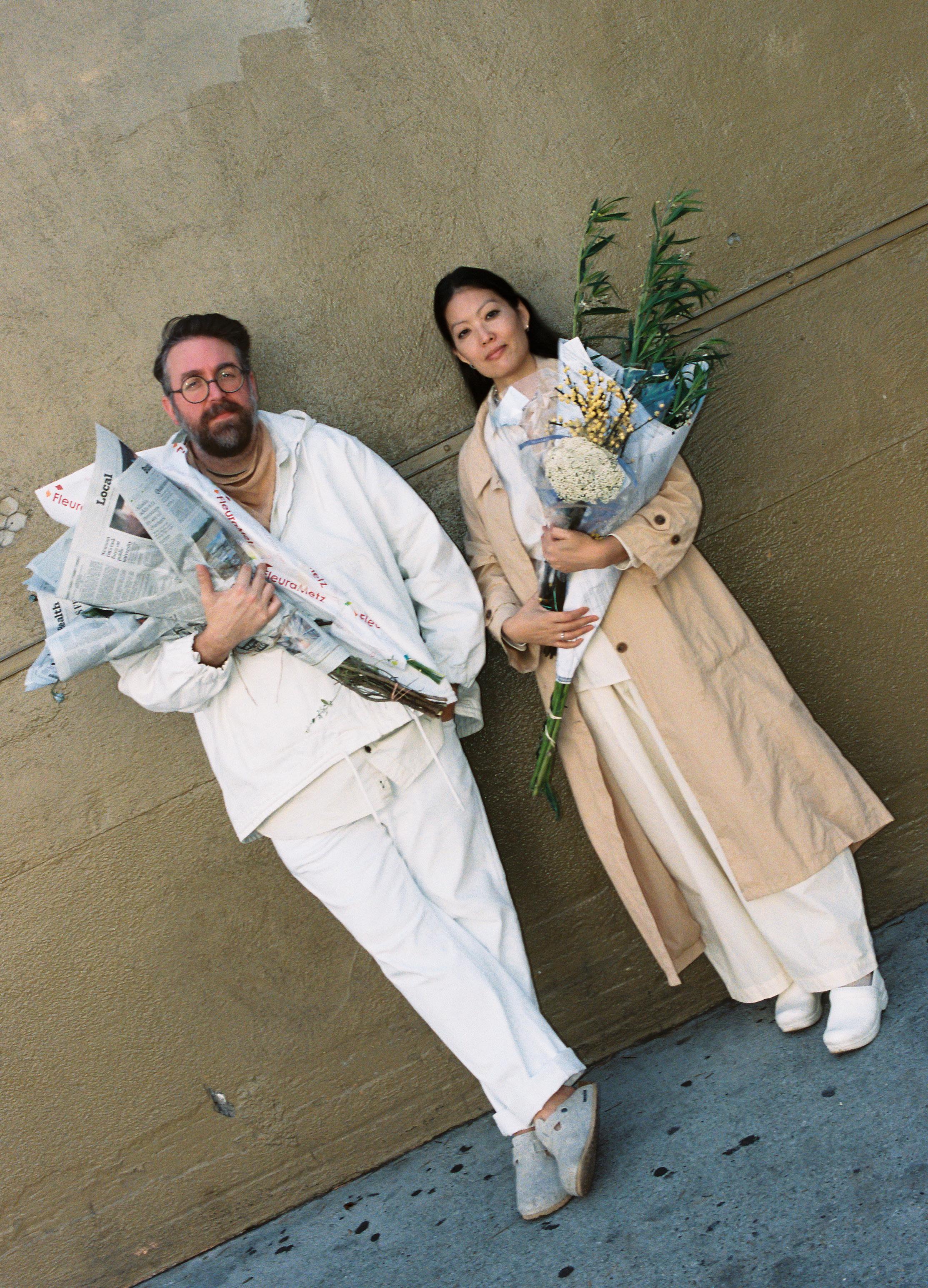
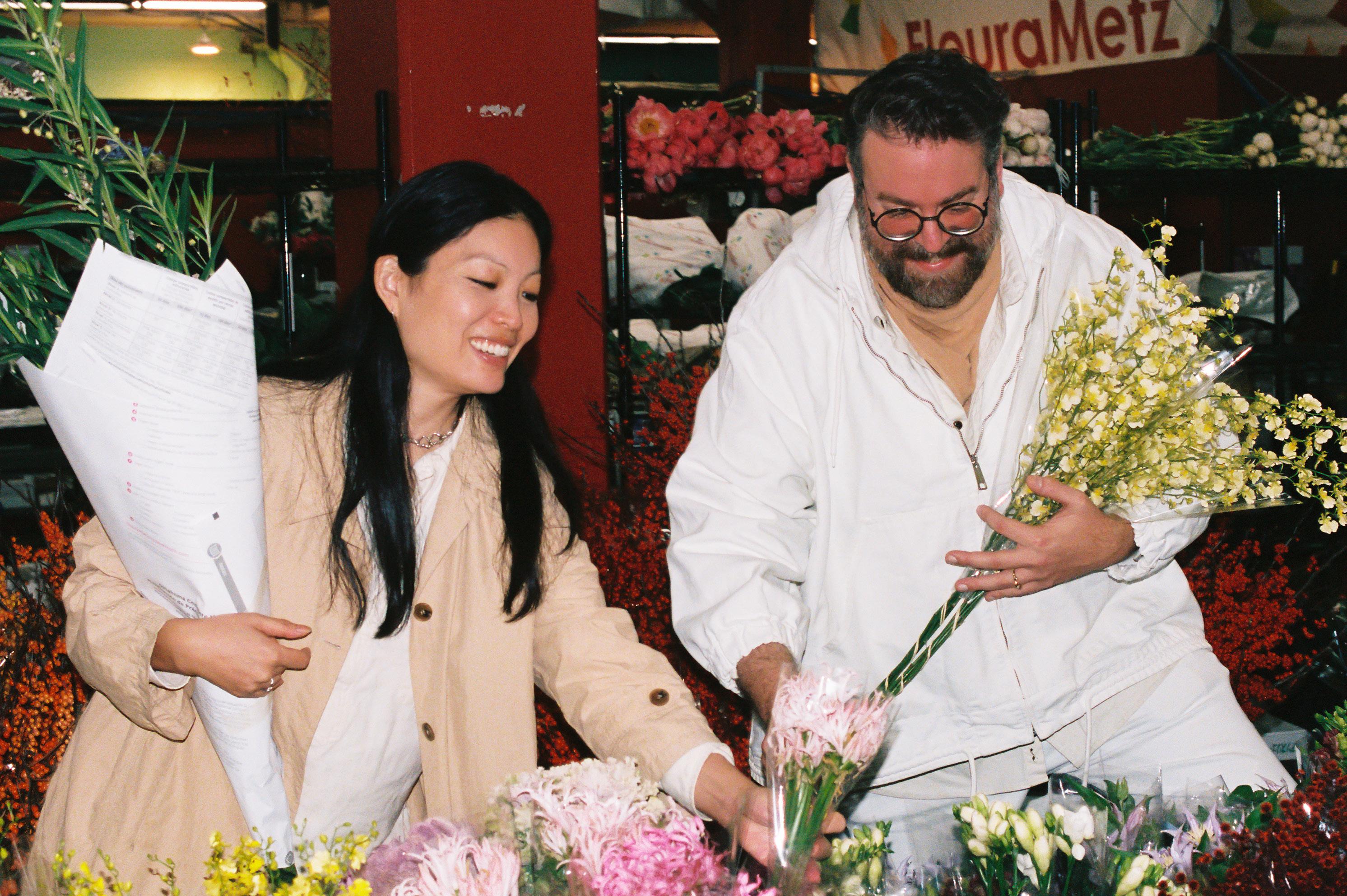
What kind of dealer are you?
Benjamin Critton: Tentative; loath; cautious.
In your opinion, what responsibilities do galleries have beyond sales?
Heidi Korsavong: Provide support to the practice, and interpretation and context to the work.
Why do you deal?
HK: To have a close relationship with artists and an intimacy with their work. I’m optimistic about a world in which art is central.
BC: Because I love all the other structures that surround the act itself. Dealing, for me, is more like a tolerable, fascinating, and sometimes-diverting byproduct of all the other excellent things it necessitates.
How do you think the gallery model will evolve?
HK: More collaborations and intersections with other industries and disciplines.
BC: Galleries will likely get more niche and idiosyncratic, and will probably be better for it.
What is your relationship to risk?
HK: Risk is necessary for forward movement.
BC: We bathe in it daily but are not inherently fond of it.
Best advice you have received?
HK: Stay nimble.
BC: In graduate school, the artist and designer Paul Elliman visited for a workshop; I don’t
remember the brief or theme. At some point, I was really in it—deep in the toil, getting existential. And Paul was sitting at my desk-studio with me, and after a long pause in the conversation, he said to me empathetically: “Ben—it’s just fucking graphics.” And since then, in my internal monologue, I have taken the liberty of replacing the term ‘graphics’ with anything of need.
What advice do you have for artists on gallery etiquette?
HK: Communicate honestly and respectfully.
BC: Be really gentle and maybe really subtle with a pitch. If geography is on your side, save that pitch until a third or fourth visit to the gallery.
Which artists dead or alive would you start collecting, given money was no constraint?
HK: Etel Adnan, On Kawara, Shiro Kuramata, and Eva Hesse.
BC: A baker’s dozen: Etel Adnan, Richard Artschwager, Daniel Buren, Jeremy Frey, Hasui Kawase, Donald Judd, Ellsworth Kelly, Giorgio Morandi, Magdalene Odundo, Fairfield Porter, Edward Ruscha, Arlene Shechet, Franz Erhard Walther.
What makes a piece of art ‘important’?
HK: Continuity and contribution.
Who are some of your favorite players in the field and why?
HK: Paula Cooper. Her holistic approach and respect for artists.
BC: Here in Los Angeles, we really admire Nonaka-Hill (Rodney & Taka) and Karma (Brendan Dugan). Brendan gave me one of my first jobs. It had nothing to do with gallery operations. It was in 2009 and Karma [the gallery] was very nascent; Brendan and Siniša [Mačković] ran a design practice called An Art Service from the back of Karma [the bookstore], and I helped design a new graphic identity for Dakis Joannou’s DESTE Foundation.
Any rules you live by?
HK: Make it nice.
BC: Make it nice.
What do you value most in working with an artist?
HK: Different viewpoints, constant reminder of what it means to be human.
BC: Esprit de corps.
How does your approach in selling objects differ from selling fine art?
BC: It honestly doesn’t. I think more so than other dealers, however, we are nearly always thinking about sitting, about how a work can or will live in domestic or institutional space.
Favorite institution?
HK: Dia Beacon.
BC: In Los Angeles: Los Angeles County Museum of Art. In the U.S.: Dia Beacon. In the world: Sir John Soane’s Museum.
Any studio visit red flags?
HK: Entitlement and impatience, though it’s more about the chemistry.
BC: Showing only full-cooked work. We really like—maybe need—to see works in progress, experiments, notions, things half-cooked alongside fullyrealised works.
How do you measure long-term success for an artist you represent?
HK: They are able to provide a decent life for themselves and their families on their terms; physical and mental space to create as often as they like; ability to participate in a sustained and meaningful dialogue alongside their peers and contemporaries.
Do you think art fairs are helping or hurting the gallery model?
BC: Net hurting, but their spirit is meaningful and salvageable.
Is there a book, film, or person that has shaped how you work?
HK: In Praise of Shadows by Jun’ichirō Tanizaki.
BC: Bernard Rudofsky’s Architecture Without Architects; Paul Virilio’s Bunker Archeology, Bern Porter’s Found Poems.
What architectural building encapsulates your style?
HK: Utsav House by Studio Mumbai.
BC: Jim and Helen Ede’s Kettle’s Yard in Cambridge, England.
Do you believe in art world karma?
HK: I believe in integrity.
BC: Yes. And emphatically.
September 13–October 25, 2025
I am most aware of screens when they break. A crack, a dead pixel, hardware on the fritz: These malfunctions, like knotted muscles or strained eyes, snap me out of the endless scroll and back to material reality. Alex Heilbron’s paintings provoke a similar awareness. The six works in All Systems Fail, her recent solo show at as-is gallery, seemed charged with the kind of friction our devices are designed to minimize, the kind that arises when the sleek, symbolic order of digital systems collides with physical laws of embodiment, breakdown, and decay. Heilbron borrows images from the internet, then laboriously hand-glitches them. Working first in vector files, she translates these digital images into vinyl stencils that she applies to five-by-seven-foot canvases, paints over, then removes. The resulting works stage material encounters with digital chaos, prompting viewers to consider the mutual entanglement of the digital and physical worlds. Here, glitches brought us to our senses.
The paintings in All Systems Fail felt like handcrafted datamoshes. Digitally-coded motifs like gratings and grids, matrices of hole-punched circles, and the stock image of a four-petalled flower proliferated across all six paintings. Reiterated in various states of glitch—enlarged and
cropped here, stretched and pixelated there—these motifs are layered on top of each other, painted almost entirely in shades of pink, blue, and yellow. In Output System (all works 2025), a cobalt grid of four-petalled flower icons overlays a pink and yellow mishmash of partial grids and irregular patches. Transgressing these grids’ borders is an olive green scribble, pixelated at its edges as if “hand” drawn with a computer mouse. In size and texture, the work insists on its own materiality: This is a painting that was executed with a human body. Yet the painting process seems to have been infiltrated by digital systems, even as the artist hand-manipulated those systems to create the work. Here and throughout the exhibit, the paintings felt like digital decompositions, as if constant touch had worn holes in a JPEG file, or a computer virus had infected a flowering plant. By making manifest the distortions inherent in replicating and storing digital information, Heilbron’s paintings gesture toward the ways the digital sphere and embodied experiences mediate and warp each other. The four-petalled flower icon, ubiquitous in these paintings, is a symbolic representation of a physical bloom—but flattened, blandly symmetrical, its form translated into the purely symbolic language of the digital. The flower’s relationship to its referent is complicated further as it is copied, its copies are copied, and generation loss accrues. The Tools Dig Deeper (Pictorial) centers a mesh of yellow and black flowers arranged in a tight grid. This
iteration of the flower-grid is overwritten with a scrawled pattern of pixelated lines and surrounded by a cobalt field of black patches and pale pink circles. The grids of flowers and circles recall lines of binary code; in context, they echo the hole-punches in the paper punched cards of early computer programming. The painting as a whole, meanwhile, made me think of a motherboard that had been soaked with rain. Looking at the painting, then, one sees the code, the graphical display, and the painter’s handiwork at once, each element invading and disrupting the others. Digital tools and innovations often advertise as easy-to-use, seamless: These technologies will fold smoothly into our lives— whether we want them to or not. (Meanwhile, somewhere, invisible and ignored human labor assembles and maintains them.) By breaking apart the visual markers of digital spaces, Heilbron reminds us that the rigid order of those systems is conditional: We can shape them, impact them, and if needed, resist them. The second law of thermodynamics holds that disorder increases; in a closed system, like our universe, every process, every exchange of energy, causes an increase in entropy. Looking at Heilbron’s paintings, I am reminded how possible it is to map this physical law onto the exchange of digital information. The more abundant and iterated digital data and images are, the more chaos seems to grow, as static and blur increase and the wild hallucinations of algorithmic entities threaten to corrode the same troves of knowledge that train them. Meanwhile, our attention scatters, dispersed
Ashlyn Ashbaugh
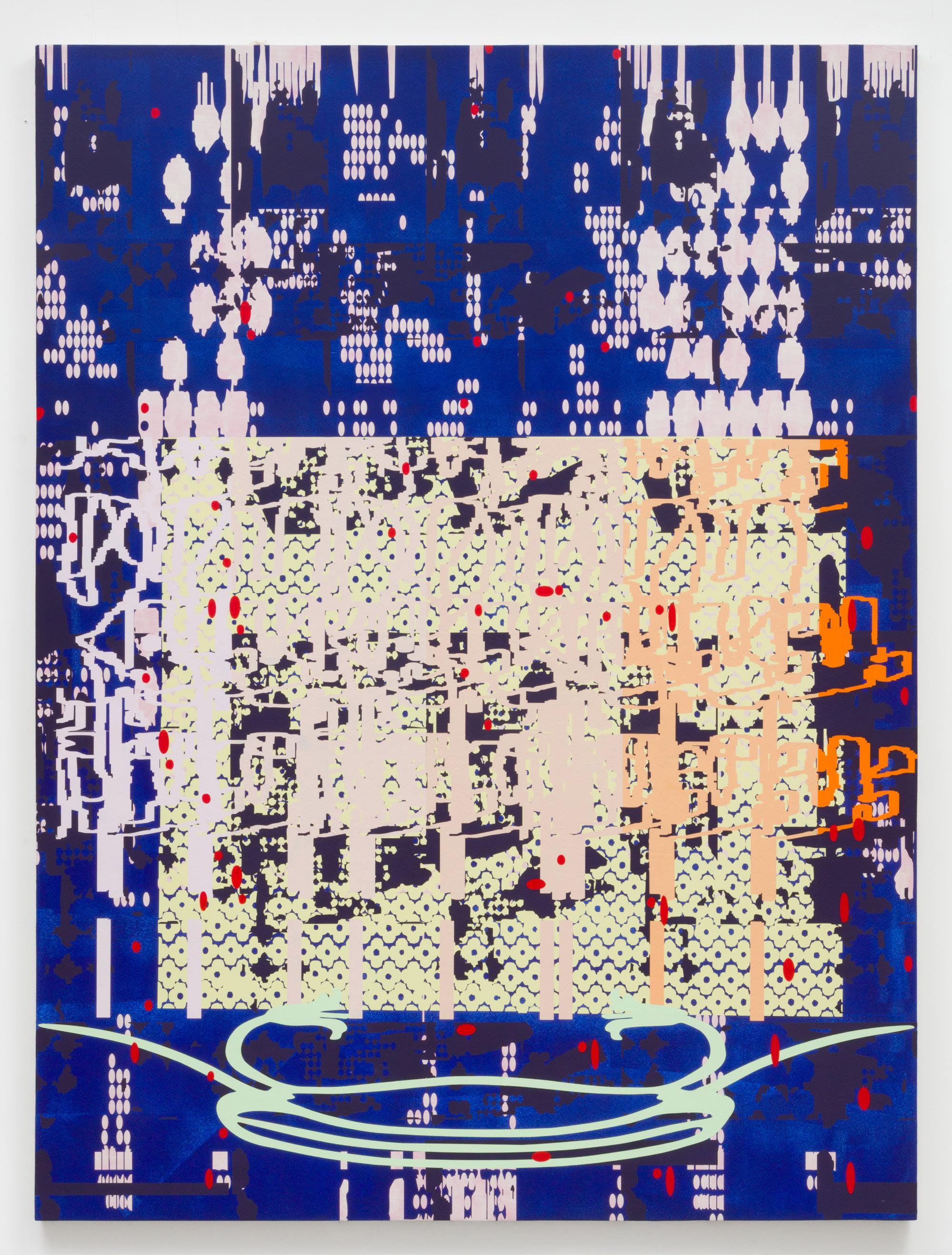
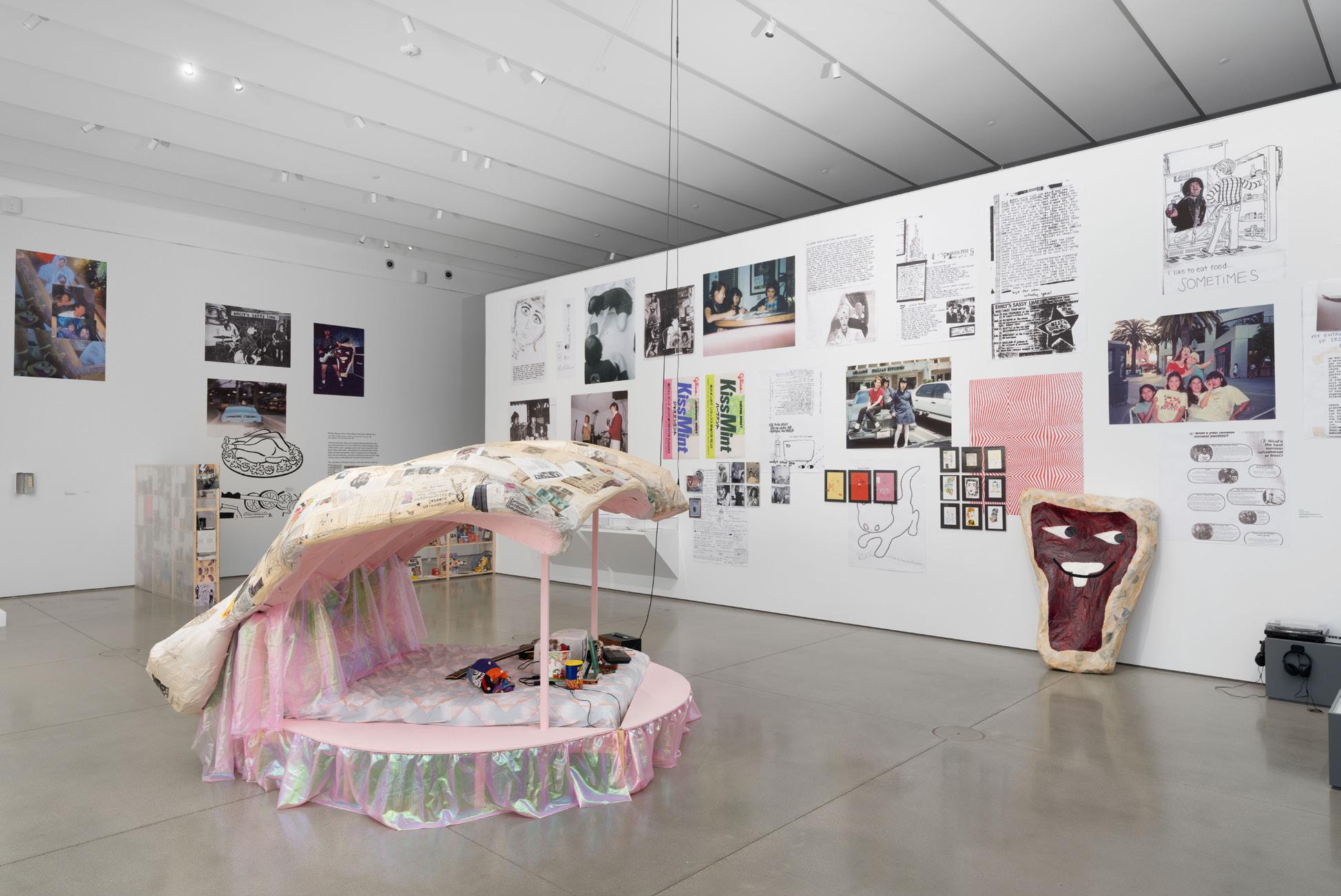
between apps that insist we organize our thoughts and orient our bodies according to engineered interfaces. Like my thumb moving over a cracked screen, the paintings in All Systems Fail reminded me of just that —system failure—and located fractures in the digital order, sites where sensory, embodied awareness interrupts the scroll.
January
The 2025 edition of the California Biennial at the Orange County Museum of Art (OCMA), curated by Courtenay Finn and Christopher Y. Lew with Lauren Levig, borrowed its title Desperate, Scared, But Social from the debut album of the 1990s riot grrrl punk band Emily’s Sassy Lime to explore the theme of adolescence. While “desperate” and “scared” capture the “awkwardness, anxiety, and myriad pressures” of being a teenager, as described by the exhibition curators, “social” was the operative word.1 The Biennial is anchored in the practices of 12 artists, tracing a constellation of relationships that demonstrate how work can result from social bonds. Throughout the exhibition, formal dialogues and thematic
crossovers often emerged out of the artists’ personal connections to one another, rather than from art historical references. Featuring a stunning array of ephemera including zines, letters, and diary entries alongside artworks, Desperate, Scared, But Social reversed the usual logic of the exhibition to center the narratives of people circulating within a social sphere, rather than those of images circulating within a gallery space. The Biennial’s presentation of ephemera next to and as artwork posited artmaking as incidental to being, with art functioning as just another way to archive life, instead of as its organizing principle.
Emily’s Sassy Lime (the palindrome is cleverly abbreviated as ESL) took center stage with a wide assortment of ephemera, documentation, and artwork that recounted the history of the band, including a listening station, a bookshelf, and individual vitrines dedicated to band members Emily Ryan, Amy Yao, and Wendy Yao. Instead of relying on first-person narration, the artists allowed objects—from a Calvin Klein poster and a TIME magazine covering the murder of Gianni Versace, to a tonguein-cheek print of “IN RICE WE SURVIVE” and an elementary school award for “quietest in the classroom”—to convey everything from the cultural zeitgeist of the ’90s to how the teenagers felt navigating their Asian American identities. An oversized clamshell bed at the center of the gallery instantly situated the viewer in the familiar world of a teenage bedroom plastered with memorabilia, underlining
how the teenage aesthetic of pastiche is fundamentally one of DIY. The practice of gathering images and objects, after all, is not just a means of self-expression; it is one of self-fashioning. The vitrines showcased how the teenage projected self is indistinguishable from the actual self, just as art objects were indistinguishable from non-art objects—where a simple idea for “the quintessential e.s.l. pin,” drawn by Emily Ryan in a letter to Wendy Yao, displayed in one case, later manifested as the band’s official pin, on view in a nearby case.
It’s no accident that the pin took form through correspondence, as an exchange of ideas between friends. These relational threads appeared throughout the Biennial, beginning with the members of ESL, who have known several of the exhibiting artists since their teenage days (Seth Bogart, Miranda July, Brontez Purnell, Deanna Templeton), worked with others later in their careers (Bogart, Purnell, and Stanya Kahn exhibited at 356 Mission Road, the artist-run space founded by Wendy Yao, Laura Owens, and Gavin Brown), and even influenced a new generation of teenage punk musicians (the Linda Lindas).
Each artist, in turn, brought with them another rabbit hole of connections. Bogart, for example, who was an early pen-pal of ESL, formed lasting friendships through writing letters and making zines—relationships that led him to play in bands with Purnell and later to mount his first exhibition at 356 Mission. On view were his ceramic renderings of publications and zines by figures like
Caroline Ellen Liou
Purnell and Joey Terrill, their respective titles—Johnny Would You Love Me if My Dick Were Bigger and Homeboy Beautiful—painted tenderly by hand. The uneven, handmade surface of the ceramic served as a material embodiment of the exhibition’s ethos—an homage to the influences that shaped Bogart, even as he reshapes them in turn.
Not all the relationships throughout the show were directly connected to ESL or to a specific social scene; the Biennial drew attention to other forms of relationships as well, such as the familial bonds present in the works of Stanya Kahn and Griselda Rosales, both of whom collaborated with their children. The exhibition also recognized the often-overlooked relationship with the self, showing how one’s memory, emotion, and identity continually evolve over time. An immersive installation by Heesoo Kwon, for example, played with her family archive to reflect on the relationship between life and its narration. Childhood photographs were faded, enlarged, distorted, and—in one surprising lenticular version—altered to include an alien, standing behind what seems to be the artist’s mother. The images embody the uncanniness of memory, in which some details are not pictured, while others that may be insignificant or incidental are woven into a larger narrative, revealing how memory and history can become simultaneously more real and more fictional over time.
Another example included the bright pink gallery dedicated to the work of Deanna
Templeton, which featured ephemera and journals collected from the artist’s adolescence. A teenage suicide note, which reads, “P.S. Can I please have a big funeral, with all my friends and stuff, and let everyone no [sic] it was a suicide, otherwise this dying was a waste,” paired with a polished presentation of the artist’s recent photographs, is a poignant reminder of how nowestablished artists were once just teenagers, too. What resonated most powerfully throughout the exhibition was the framing of ephemera, doodles, documentation, and artwork with equal importance, emphasizing artistic practice as a process shaped as much by relationships as by time. By presenting artwork as the visual counterpart to the participating artists’ firstperson accounts, Desperate, Scared, But Social drew upon ESL’s punk origins to approach the biennial like a zine: part collage, part oral history. The result reflected the DIY ethos of the riot grrrl movement, formed by the desire to tell its own story. As an early manifesto of Riot Grrrl proclaimed, “We’re tired of being written out—out of history, out of the ‘scene,’ out of our bodies. For this reason we have created our zine and scene.”2 Here, the artists in Desperate, Scared, But Social similarly created their own scenes, filled with their own references and relationships, and with them, their own histories.
1. Orange County Museum of Art, “Orange County Museum of Art Announces Details of CALIFORNIA BIENNIAL 2025: Desperate, Scared,
But Social,” exhibition press release, December 17, 2024.
2. Emma, Riot Grrrl 5, quoted in Stephen Duncombe, Notes from Underground: Zines and the Politics of Alternative Culture (London: Verso, 1997), 66.
September 20–November 1, 2025
What made Paul Cézanne revolutionary, observed D.H. Lawrence in his essay “Introduction to These Paintings,” was his “intuitive awareness of touch.”1 With it, Cézanne restored the presence and substance that modernity’s strictly “mentaloptical” mode of perception had drained from art.2 Upon entering Beginnings at Karma, curated by Negar Azimi, it was immediately clear that Manoucher Yektai painted with a similarly intuitive hand, intent on apprehending the world through sensation, not sight alone. Gathering works from the first two decades of his career, the exhibition traced the abundant materiality that would sustain Yektai’s practice for the rest of his life. Each lushly colored, thickly impastoed canvas invited a haptic encounter: pigment asperous and furrowed, ridged like tilled earth; then suddenly smooth as buttercream with voluptuous curls and contours that catch the overhead light. Restoring tactility to sight, the exhibition replaced intellectual parsing with sensing, reminding us of the body’s role in perception at a time when vision is increasingly mediated by the digital. Compared to the frictionless simulacrum of the screen,
Tara Anne Dalbow
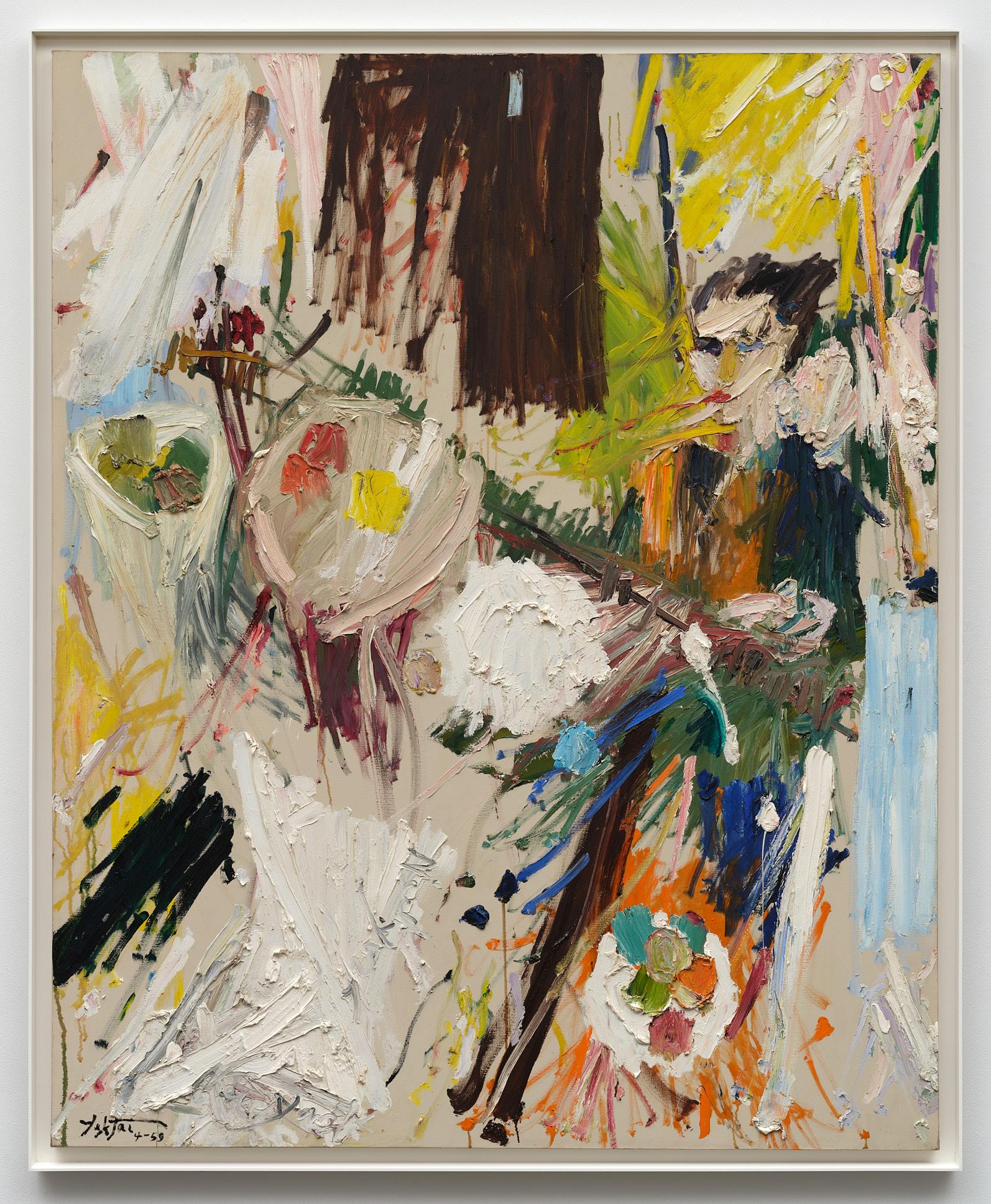
the density of Yektai’s surfaces felt invariably alive.
Born in Tehran in 1921, Yektai studied in Paris and New York before establishing himself amid the fervor of postwar abstraction. Often associated with Jackson Pollock and Willem de Kooning, his early encounters with Persian miniatures and Pierre Bonnard, Édouard Vuillard, and Cézanne at the École des Beaux-Arts complicate that lineage. While his gestures carry the emotive energy and spontaneity of abstract expressionism, they remain tethered to the conventions of genre—still life, landscape, and portraiture—and the perceptual discipline of European modernism. Building, literally and figuratively, upon his classical education, he piled paint onto his canvas, even as he kept one eye on his subject. That balance between attention and excess animated the earliest works in Beginnings
On the left wall of the gallery, two gridded compositions registered the formal abstraction that surrounded Yektai upon settling in New York City. In Untitled (1950), vertical daubs of tangerine, lilac, and ochre are imperfectly divided by streaks of black. Already, the weight of his marks threatened the stability of the flat plane. Farther down, Untitled (1953–54) appears as a palette on which the artist tested the outer limits of the relationship between gesture, density, and gravity. At its center, a churn of scraped and sculpted pigment achieves a quasi-bas relief dimensionality. Textures from puckered to scooped preserve the pressure and velocity of the artist’s spatula and palette
knife, rendering the act of painting and the image it yields indistinguishable. The paint, so thickly and insistently applied, becomes its own subject. Accumulated layers affirm the immediacy of matter, especially when contrasted with the illusive, pixelated photographs I’d scrolled through earlier that morning in preparation for my visit to the gallery.
Yektai moderates that intensity in Untitled (1954), concentrating color at the center of a larger canvas, more than five feet tall, surrounded by restless swipes of white, taupe, and sand. As if giving substance to space itself, creamy drags of paint both surround and support a cluster of orange and violet marks—perhaps incipient fruit, like those that would later populate his tablescapes. Beside it, another untitled work from the same year exemplifies his preference for alla prima painting, wet pigments layered in quick succession: Undulating ribbons of lavender and cerulean streak across slabs of white, while floral whirls of pastel pink and orange are limned with adjacent shades of marigold and chartreuse. The startling pictorial depth dares viewers to reach out, run their fingers across the viscous topography of color.
In the adjoining gallery, gestures began to solidify as shapes. The impasto that once overwhelmed form now lent it weight. In these early still lifes, Yektai doesn’t depict fruit, flower vases, and cigar cases so much as reconstitute them. Congealed daubs of oil lend a lemon its roundness, a wine bottle
its volume. What distinguishes Yektai from his abstract expressionist peers is his fidelity to the physical world. Rather than striving for the sublime, he reproduced what he could grasp, feel, see. In this way, paint was both medium and message, a theory and its proof. “I’m searching for a firm truth, one that fulfills my own expectations,” Yektai said in a 1976 interview, adding that he sought to imbue his work with that truth “that is hard to shake.”3 He found it in the irrefutable thereness of the tangible, conveyed through the viscosity of oil paint, where touch, sight, and shape are indivisible. How prescient this insistence on authenticity seems amidst the widespread manipulation of our “mental-optical” attentions through misinformation and highly persuasive synthetic media.
Having proven that paint could stand for the inanimate, Yektai tried to translate life.
A row of five paintings captured the vitality of the artist’s garden, in particular his tomato plants. Propulsive vertical lines and tangled ropes of pigment in Untitled (1964) replicate the fecundity of the natural world. His answer to the problem of expressing life’s motion and mutability in a static medium is to collapse time: folding growth and decay, the gradual flux of change, into a single frame. Here, furrowed tracts of green, from emerald to pea, crisscross an umber stem, their ends splayed in every direction; scattered red, white, and teal orbs protrude from the canvas. Recalling Cézanne’s pledge to amaze Paris with an apple,4 Yektai once told his friend Larry Rivers, “I want
to paint an apple until it flies!”5
The declaration underscored his intention to push the inanimate apple, or tomato, beyond representation into ecstatic aliveness.
Lawrence’s call for a return to the “intuitive awareness of touch” and physical presence feels newly urgent as more of our world turns virtual.6 Against this spectral digital realm, the sensuous materiality of Yektai’s canvases reasserts the messy, frenzied, delicious, and demanding reality of threedimensional life. Their visceral tactility resists the flat, frictionless logic of the screen and posits seeing as something enacted through the body. Each drag and ridge of pigment restores a sense of contact—between vision and substance, between us and the world. For Yektai, this contact was a kind of revelation: To attend to the vitality of matter is to recognize the vitality within ourselves.
1. D. H. Lawrence, “Introduction to These Paintings” (1929), Phoenix: The Posthumous Papers of D. H. Lawrence, ed. Edward D. McDonald (Heinemann, 1936), p. 556.
2. Lawrence, “Introduction to These Paintings,” p. 556.
3. “That Lyricism Called Painting: Aydin Aghdashloo interviews Manoucher Yektai,” Rastakhiz, 1976; reprinted in Herfe-Honarmand 15 (Spring 2006): 131–37, trans. Media Farzin.
4. Philadelphia Museum of Art, Cézanne, May 30–Aug. 18, 1996, exhibition catalogue (New York: Harry F. Abrams, 1996), 383.
5. Negar Azimi, curatorial statement for Perfect Strangers: Leyly Matine-Daftary and Manoucher Yektai, Dastan Gallery at Frieze’s No.9 Cork Street, London (2024); Lawrence, “Introduction,” p. 556.
6. Lawrence, “Introduction,” p. 556.
September 13–October 25, 2025
Along the walls of Château Shatto last fall were alluring brushstrokes and dabs of the individually distinct and collectively harmonious Pwerle sisters, four artists from the Alyawarre or Anmatyerre language groups in central Northern Territory, Australia. All 13 abstract canvases in the show were painted in acrylic on canvas, starting with a black ground. Some layer intense primaries in long meditative strokes, others meditate on nuanced ochre curves nested and vibrating against each other. Against the black, the lines and loops become a handwriting that distinguishing one artist from the next. Together the work creates a collision and coalescence of perspective in the shocks of luminosity that erupt at the start of each stroke, fading as the paint emptied from the bristles. This collision of vibrant color amidst a dark expanse echoes the origins of Australia’s Western Desert Art Movement, born in the face of forced assimilation and repression, in which connection to land and tradition met with colonial expansion intent on seizing and erasing it.
Painted during regular work sessions between 2000 and 2008, each of the 13
paintings (including a collaborative work) bear the same title, Awelya Atnwengerrp. Referring to the women’s ceremonial traditions of the Alyawarre and Anmatyerre language groups, awelya rituals involve painting the upper half of women’s bodies with ochre motifs of nature and movement, followed by ceremonial song, dance, and the sharing of Dreamings, stories and embodied knowledge at the heart of identity and reality. The Pwerle sisters, in their 70s and 80s at the time these works were painted, had only just begun to translate their ephemeral bodypainting practices to the permanence of acrylic. The paintings glow with a mixture of both discovery and familiarity. Of the four Pwerle sisters, Minnie (c. 1920–2006) was the first to pick up brushes and acrylic paint. For most of her life, she painted the bodies of women who participated in the awelyas. In 1999, when she was almost 80, her daughter, artist Barbara Weir, first provided her with art supplies after she expressed an interest in painting. Her emphatic circles and lines draw from her Dreamings and her connection to the land and its abundant fruits. As Minnie began to gain a following with her artwork, Weir encouraged Minnie’s three sisters to join at regular workshops held every six weeks, each completing their individual paintings in one sitting.1 The result is a snapshot of what one imagines to be a focused state of family consciousness, repetitive strokes and dabs applied in close company yielding the ticking pulse of connection,
Reuben Merringer
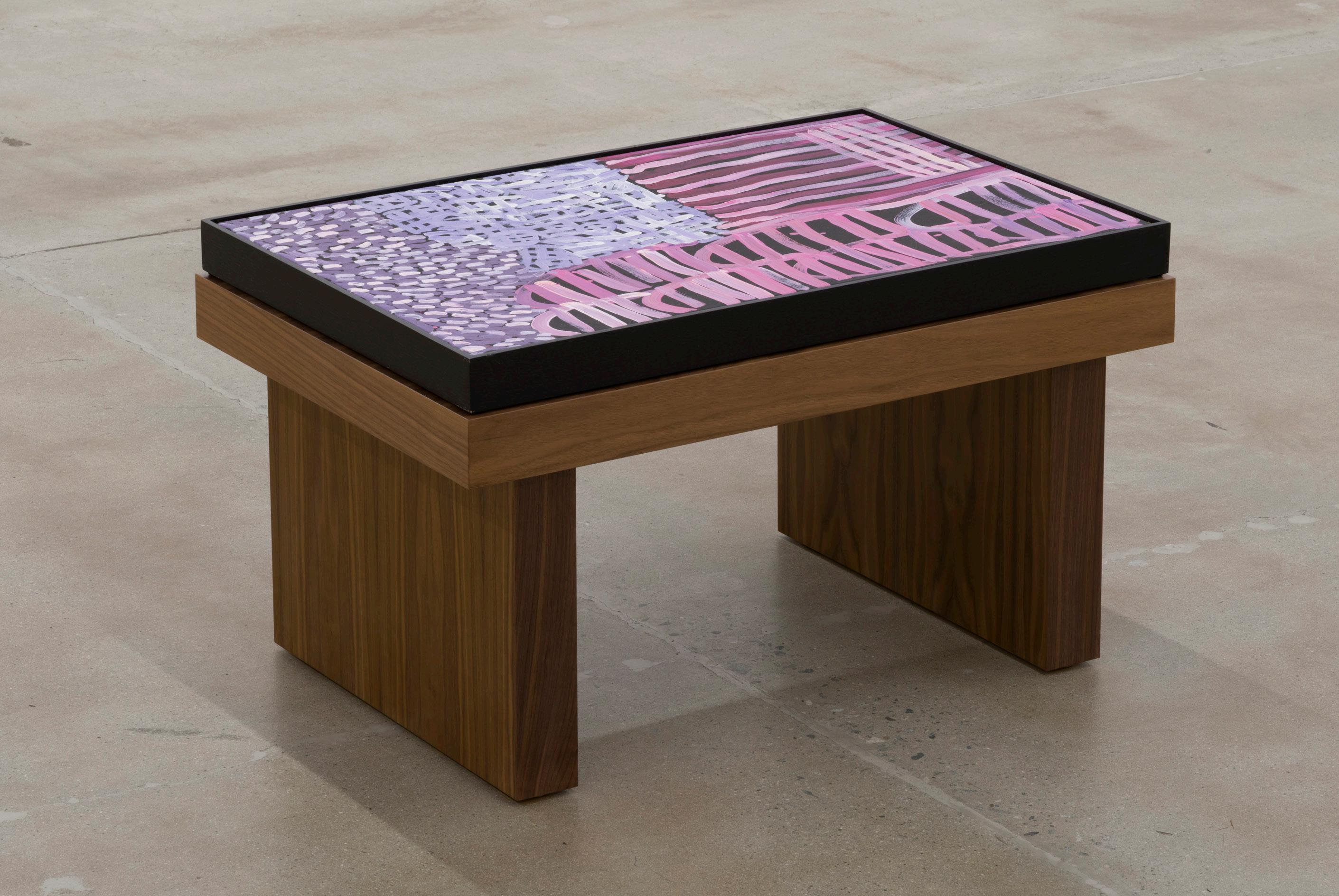
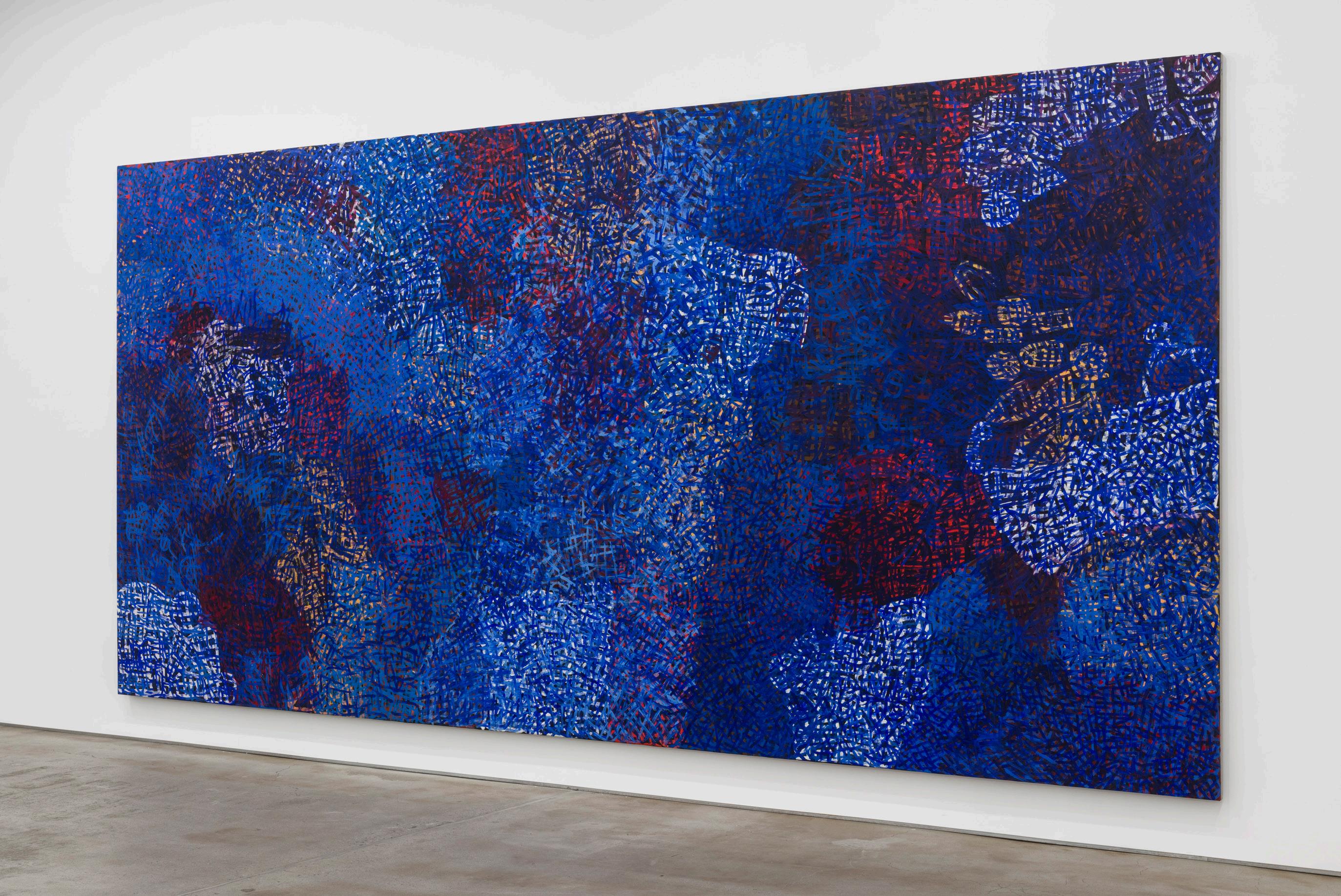
using synthetic polymer paint to reach into thousands of years of Aboriginal tradition.
The artists of Australia’s Western Desert Art Movement first adopted new methods of preserving Indigenous heritage in the face of settler colonialism.2 It began in Papunya, one of many Aboriginal settlements established by the Australian government in the 1950s with the intention to assimilate Indigenous families into groups with little prior contact with each other, to live like white Australians.3 In the face of active cultural suppression, this close proximity fostered considerable artistic crosspollination as artists began to record ancestral Dreaming narratives, previously only told in ceremonies, in modern materials made available in the settlements.4 By 1972, the Papunya Tula artists began to express, in acrylic, traditional cultural motifs previously painted on soil or human skin. The Pwerles followed this tradition after a lifetime of practicing traditional bodypainting in their region of Utopia, which was formed by Aboriginal people.
Minnie’s six individual works in the exhibition displayed her characteristically straight and confident strokes and circles on a dark ground. Two vertical canvases from 2000, placed side by side, created a kind of narrative break between them. The left canvas conveys drift and displacement while emphasizing Minnie’s persistent mark-making: Rusty orange strokes rise and steady at the center, like wildfire smoke organizing into billows above a blaze. The right canvas keeps the
rust-on-black palette, but its strokes undulate like long grasses in wind, interrupted by a burst of luminous blues and greens radiating from a blue-white loop in the upper left. A thin line of black underpainting left untouched at the edges underscores the painting’s limited space, heightening the tension of navigating a finite picture plane, rather than implying an infinite expanse extending beyond it.
The other sisters’ works display their own unique mark-making: Molly’s (born c. 1919) broad blue and white stripes cascade like water. Galya (born c. 1930) employs a dabbing technique, blotting vibrant unmixed color that, against the black ground, creates a blossomy dappled effect across three canvases that were hung together as a triptych. Galya’s canvases also leave a narrow border of black underpainting running along the edge, balancing visual abundance with a somber acknowledgment of finitude. Emily’s (born c. 1922) two canvases differ sharply in scale and color, yet both feature densely layered, multidirectional strokes whose restless details cohere into a stable, resolute whole. The larger work, over 18 feet wide, dominated the back wall of the gallery, a cosmos with interwoven reds and yellows flickering through a dense blue mesh, nebulous, nocturnal, evoking dreams and deep time. From a distance, its crossstrokes dissolve into an overcast night sky, woven to contain mysterious blooms of color trying to emerge.
A collaborative centerpiece the size of a classroom
desk rested horizontally on a stand in the middle of the gallery. The dabs, stripes, and crossovers collide and complement each other while distinguishing their unique handwriting. Displayed as a tabled piece for the exhibition, the painting forefronts its making more as object than as image. But even more than its own making, the painting emphasizes the preservation of ceremonial practices through shared acts of gathering and making. Though Indigenous painting practices were born within colonialism, for the Pwerles, their blurred, mutated colors and forms resist the ordered engines of imperialism. Their paintings foreground collective energies that are able to resist assimilation and keep tradition in the present tense.
1. Pwerle Gallery, “Pwerle – Aboriginal Art Gallery,” accessed November 16, 2025, https://pwerle.com.au/.
2. National Museum of Australia, “Papunya Tula,” accessed November 14, 2025, https://www.nma.gov.au/definingmoments/resources/papunya-tula.
3. National Museum of Australia, “Papunya collection,” accessed November 15, 2025, https://www.nma.gov.au/ explore/collection/highlights/papunyacollection.
4. National Museum of Australia, “Western Desert art,” accessed November 14, 2025,https://www.nma.gov.au/ exhibitions/warakurna/western-desertart.
5. National Museum of Australia, “Papunya collection,” accessed November 15, 2025, https://www.nma.gov.au/ explore/collection/highlights/papunyacollection?utm.
October 23, 2025–May 3, 2026
In her 2021 essay collection On Freedom: Four Songs of Care and Constraint, Maggie Nelson, à la Michel Foucault, expresses skepticism that a momentary act of resistance can produce everlasting change. Rather, Nelson argues that structural change ultimately comes from everyday practices of self-creation incessantly contesting the powers that be. Nelson’s lucid dissection of the limits and conditions of aesthetic and political freedom feels particularly poignant five years later in our current context, where American museums are increasingly under attack by the Trump administration. MONUMENTS—a sprawling exhibition co-presented by the Museum of Contemporary Art (MOCA) and the Brick that examines the racialized history of monument construction in the United States through juxtaposing 19 artist commissions with decommissioned American monuments —contests similar concerns regarding who controls history and consequently our senses of freedom. Particularly, the exhibition asks whether, when racist monuments are torn down, this act repairs historical injustice and its amnesia or merely performs a symbolic gesture while political violence and disenfranchisement persist.
Curated by Hamza Walker of MOCA, Bennett Simpson
of The Brick, and artist Kara Walker, the show manages to reposition decommissioned monuments associated with Confederate history as tragicomic parodies of the times they represent. Stripped from their original contexts (most of these statues were decommissioned during the first Trump presidency), sullied with graffiti and paint by protesters, and confined to stark galleries at MOCA Geffen, these monuments appear melancholic or burdened by historical guilt.1 Such is the case for Josephus Daniels (1985), Confederate Soldiers and Sailors Monument (1903), Matthew Fontaine Maury (1929), and Jefferson Davis (1907): no longer elevated, sometimes sidelined or lying on the museum floor, appearing like out-of-step, worn down relics, appendices to contemporary works included in the exhibition. The exhibition’s scenography ensures that these monuments, divorced from oppressive power dynamics, become instrumentalized raw materials for contemporary artists to analyze, rework, and respond to. In many ways, newer works in the exhibition act as counter-monuments to the “official” histories that monuments represent. This juxtaposition reveals not only the radical fragility of freedom, but also points to the fact that freedom, like art objects, requires constant maintenance, while also having the potential to gain new life through reinterpretation.
Among the commissions that respond to the memory culture associated with Confederate monuments and the myth of the Lost Cause,2
works that deliberately sidestep the authoritarian grammar of the monument felt most compelling. Bethany Collins’s Love is dangerous (2024–25) is a work about the story of the first Memorial Day—Collins traced the origins of Memorial Day celebrations back to formerly enslaved Black people in Charleston, South Carolina, and the work reveals how the joy of liberation can easily be corrupted by vapid commercialization.3
Consisting of a carved stone slab and stone rose petals, Love is dangerous is made from the appropriated granite base of a decommissioned Thomas J. “Stonewall” Jackson equestrian statue previously installed in Charlottesville, Virginia.4 Collins’s quiet work, scattered and lying flat as if left to decay, declines domination’s language. Instead, it posits that despite the best efforts of historical and political amnesia, remnants of repressed liberatory stories await rediscovery. Walter Price’s Cadence series (2022–24), set in the same room as the Matthew Fontaine Maury statue, are laboriously rendered oceanic landscape paintings. The embodied, heavily textured marks—partially made by the artist walking on his canvases—boasts an exuberant, vitalistic palette of orange, red, saturated green, and deep blue. The paintings are invested in the artist’s experience in the Navy. Though, as if in rebuff to Maury, a Confederate naval officer considered to be a founder of oceanography, his work refuses to inherit the military’s traumatic histories of segregation and
Qingyuan Deng
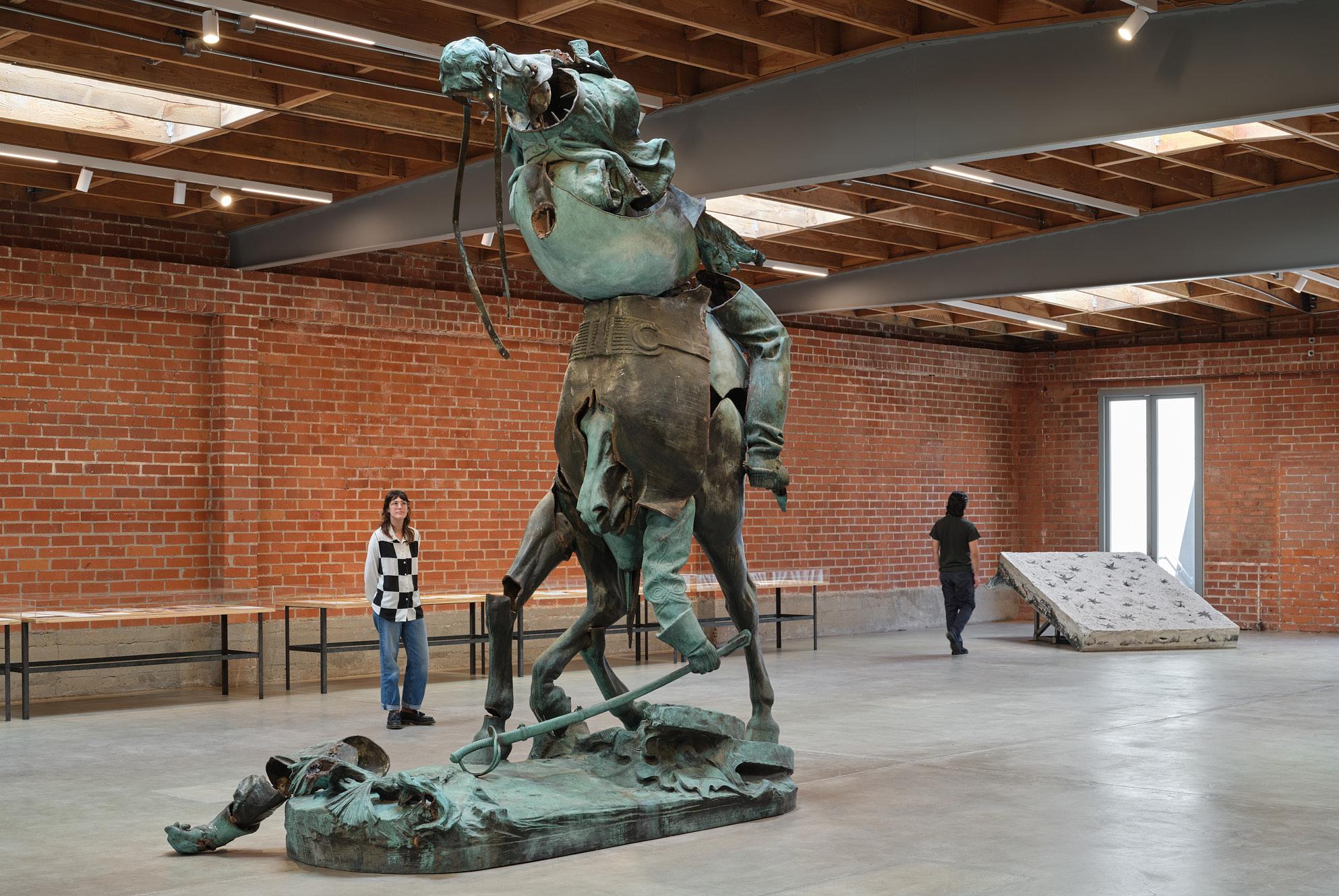
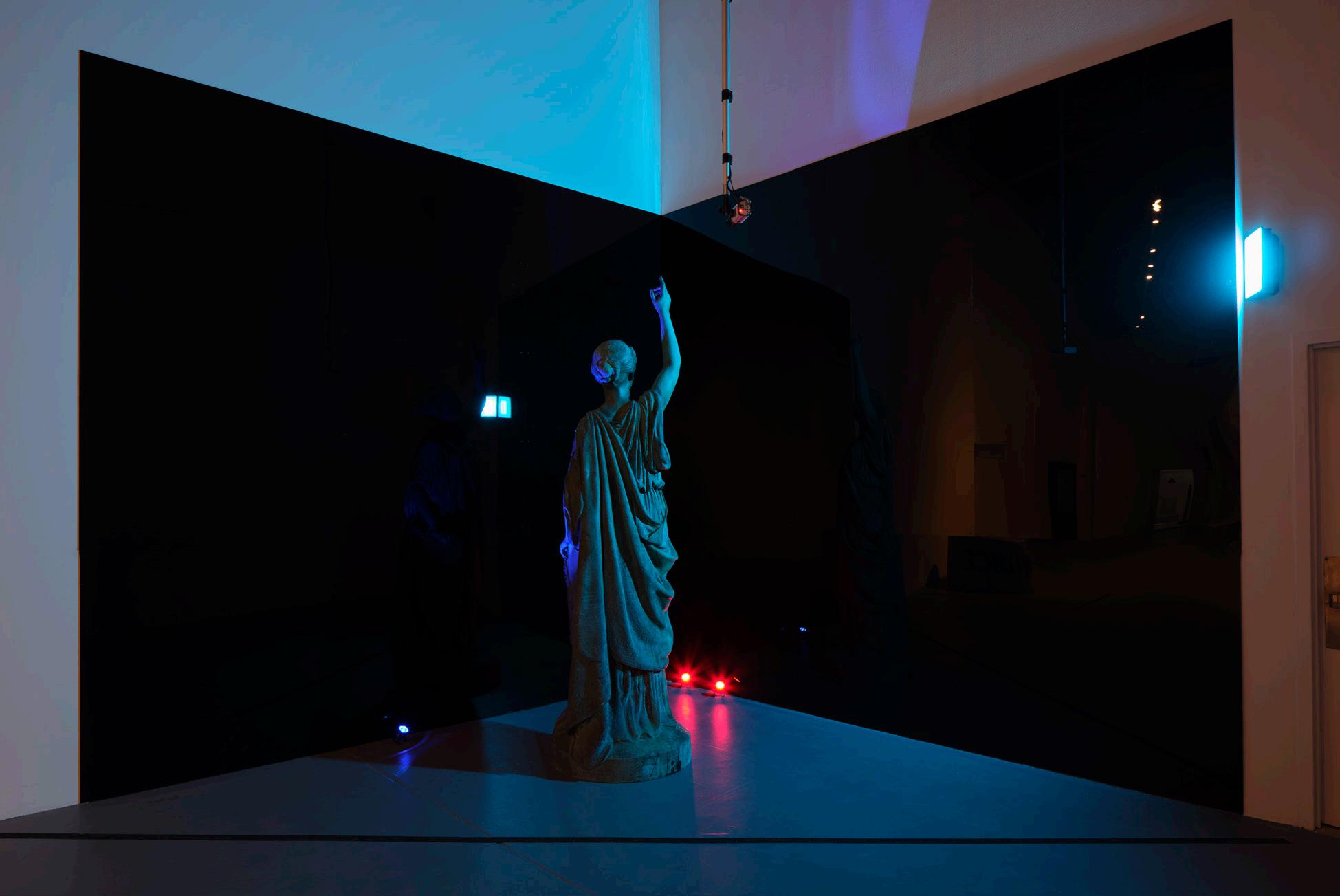
racist and imperialistic violence, deploying abstraction toward canceling out militaristic visual language. Other artists forego abstraction, appropriating Confederate statues to warp and decontextualize their meaning. Cauleen Smith’s enticing The Warden (2025) employs a CCTV surveillance camera to zoom into—and interact with—the original Vindicatrix (1907) statue (nicknamed Miss Confederacy), which was removed from the top of the Jefferson Davis Monument in Richmond, Virginia in 2020.5 The sculpture is installed in a back corner of the museum, lit with menacing lighting and set within a black reflective backdrop. The CCTV camera zooms in on the statue’s arm, positioned with an upward-pointing finger, and the footage is then relayed on live feed video that appears on several monitors throughout the exhibition. Flattening the statue’s message of harm into abstract flows of data, Smith turns the visual language of surveillance, often deployed in racist policing, against itself. Rather than toppling violent monuments, the artist speculates an emergent language of technology that is capable of altering and revising, in real time, the revisionist narratives embedded in Confederate monuments. The exhibition’s high note is Unmanned Drone (2023) by Kara Walker, the sole artist exhibited at The Brick. The work is a monumental sculpture made from splintering and reassembling parts of Charles Keck’s 1921 equestrian statue of Stonewall Jackson (the same statue that Collins used a fragment from). Walker
and the rest of the curatorial team acquired this monument from the city council of Charlottesville, which solicited proposals for reconfiguring decommissioned statues in ways that do not venerate their toxicity.6 In Walker’s version, the sculpture is a headless horseman, overwrought with exhaustion, on the edge of failure, and unable to shoulder the unfinished business of history. Eerily devotional and desirous, no longer heroic, the sculpture is a fitting metaphor for how official memory culture can also be overturned by the symbolic violence it enforces. Overcoming the prescriptive tendency of monuments, Unmanned Drone is a durable redress for repair, alive, revisable, and responsive. If the freedoms we aspire to always already harbor seeds of contradiction, particularly manifested in how hegemonic and oppositional cultures marshal remembrance, amnesia, and speculation against each other, then the question of MONUMENTS is how to erect counter-monuments that respond to the turmoil of unresolved history. True freedom is responding to new conditions, revising definitions, practices, and aesthetic histories whenever necessary.
1. Rachel Treisman, “Nearly 100 Confederate Monuments Removed in 2020, Report Says; More Than 700 Remain,” NPR, February 12,2021, https://www.npr.org/2021/02/23/ 970610428/nearly-100-confederatemonuments-removed-in-2020.
2. The Lost Cause myth is a pseudohistorical interpretation of the American Civil War that presents the Confederate cause as honorable and tragic, downplaying the central role of slavery. This narrative claims the conflict was primarily about states’ rights and portrays enslaved people as content.
3. Olivia B. Waxman, “The Overlooked Black History of Memorial Day,” Time,
May 22, 2020, https://time. com/5836444/black-memorial-day/.
4. “Equestrian statue of Stonewall Jackson (Charlottesville, Virginia),” Wikipedia, last modified November 2, 2025, https://en.wikipedia.org/wiki/ Equestrian_statue_of_Stonewall_ Jackson_(Charlottesville,_Virginia). collection?utm.
5. Laura Vozzella, “‘Miss Confederacy’ Statue Removed as Workers Rid Richmond of Confederate Icons,” The Washington Post, July 8, 2020, https://www.washingtonpost.com/ local/virginia-politics/miss-confederacystatue-removed-as-workers-ridrichmond-of-confederate-icons/2020/ 07/08/2a69600a-c127-11ea-b4f6cb39cd8940fb_story.html.
6. MONUMENTS press talk with Hamza Walker, Bennett Simpson, and Kara Walker, MOCA Geffen, October 16, 2025.
Photo Essay Contributor and Featured Artists
Based in Los Angeles, Claire’s experience includes creative production (event/photo), film photography, and artist marketing/management. She is skilled in understanding a vision, building on ideas, and wrangling humans for execution.
Marta is a Los Angeles-based, globally-engaged art gallery. Founded by partners Benjamin Critton and Heidi Korsavong in 2019, the gallery makes space for artists to experiment with the utility of design, and for designers to explore the abandonment of function. Marta’s curatorial, publication, and event programs take interest in the process and facilitators of a work’s creation as well as the narrative of its creator(s). Marta embraces the intersection of and the transition between disciplines, advocates for diversity in practices and practitioners, and promotes broad access to the arts.
Review Contributors
Ashlyn Ashbaugh (she/her) is a writer who lives in Los Angeles.
Caroline Ellen Liou currently works as a Curatorial Assistant at the Institute of Contemporary Art, Los Angeles (ICA LA). She graduated with a BFA in painting from the Rhode Island School of Design, USA in 2014; an MA in contemporary Chinese art and geopolitics from the Courtauld Institute of Art, UK in 2017; and a degree in curatorial studies from the Fondazione Sandretto Re Rebaudengo, Italy in 2018.
Tara Anne Dalbow is a writer living in Los Angeles. Her critical work can be found in the Los Angeles Times, Artforum, Interview, Bomb, Los Angeles Review of Books, ARTnews, Frieze, Momus, Art Basel, Artsy, and elsewhere.
Reuben Merringer is a Los Angeles-based artist, writer, and educator whose work threads the lineages of language and image through the process-based exploration of materials, natural phenomena, and writing.
Qingyuan Deng is a writer, curator, and translator based between New York and Shanghai.
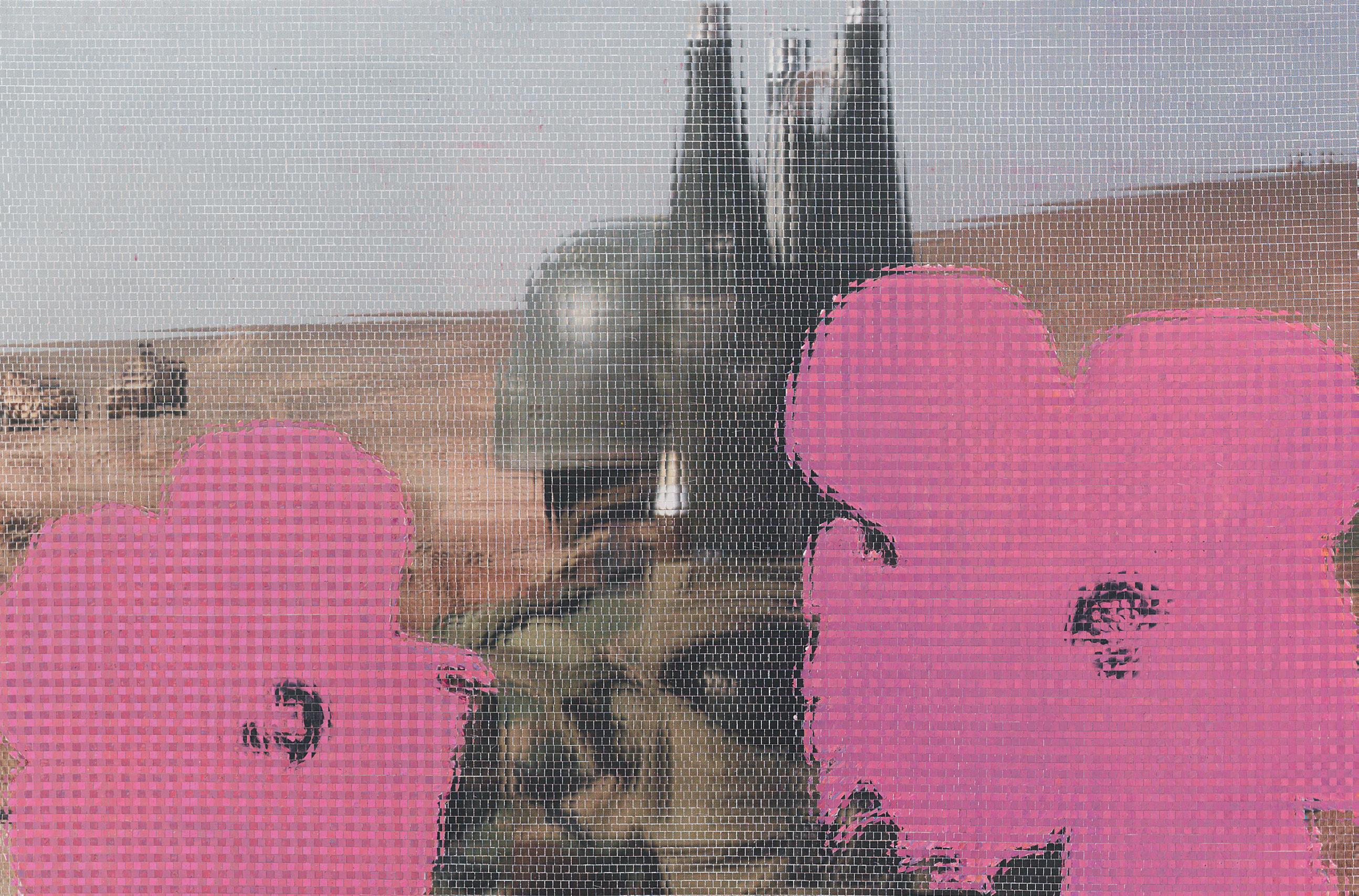

February 21–June 28, 2026

pomona.edu/museum
Between the Eyes #6, Afghanistan Citizens, American Soldier/Andy Warhol, ‘Flowers,’ 1964 (detail), 2010. Courtesy of Leslie Buchbinder.

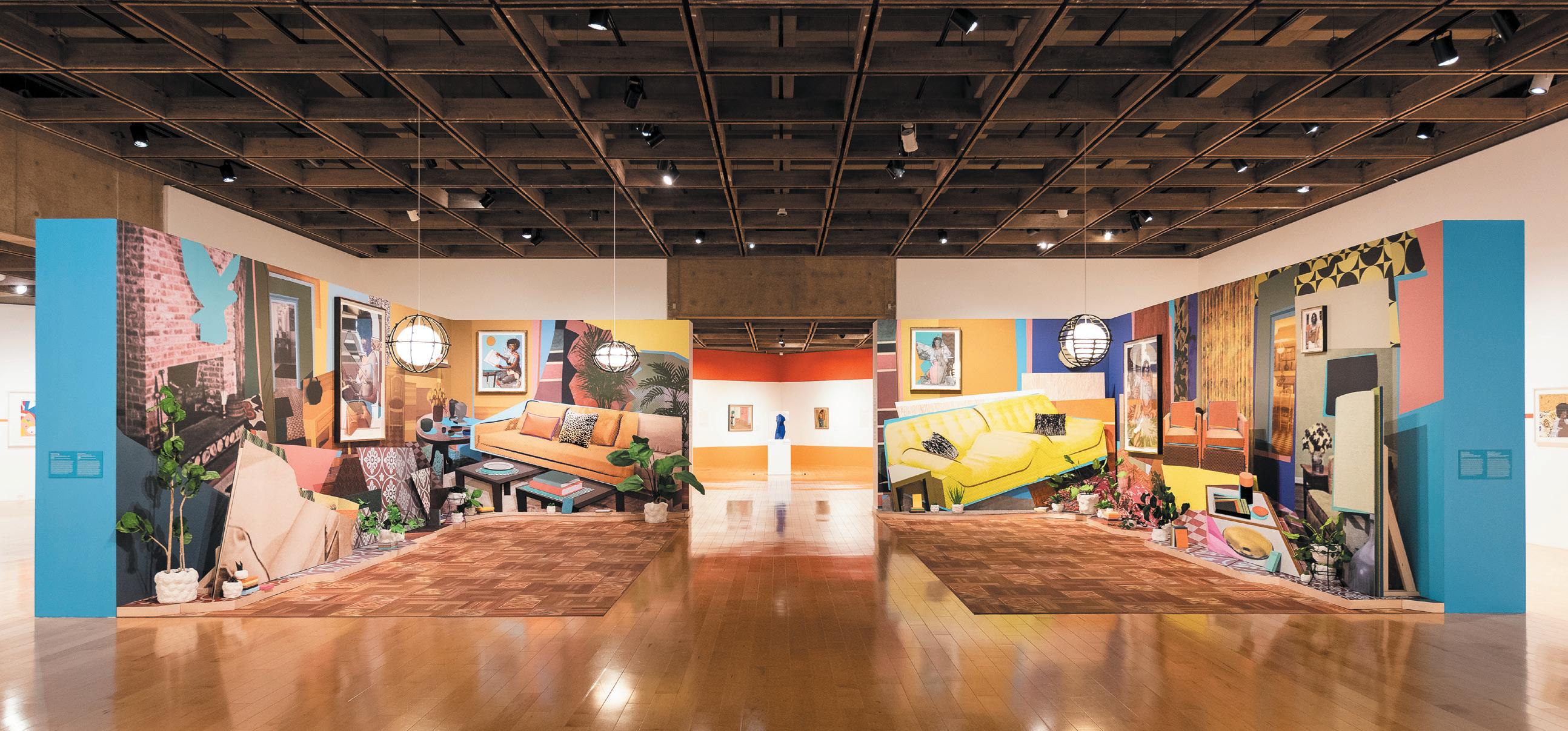
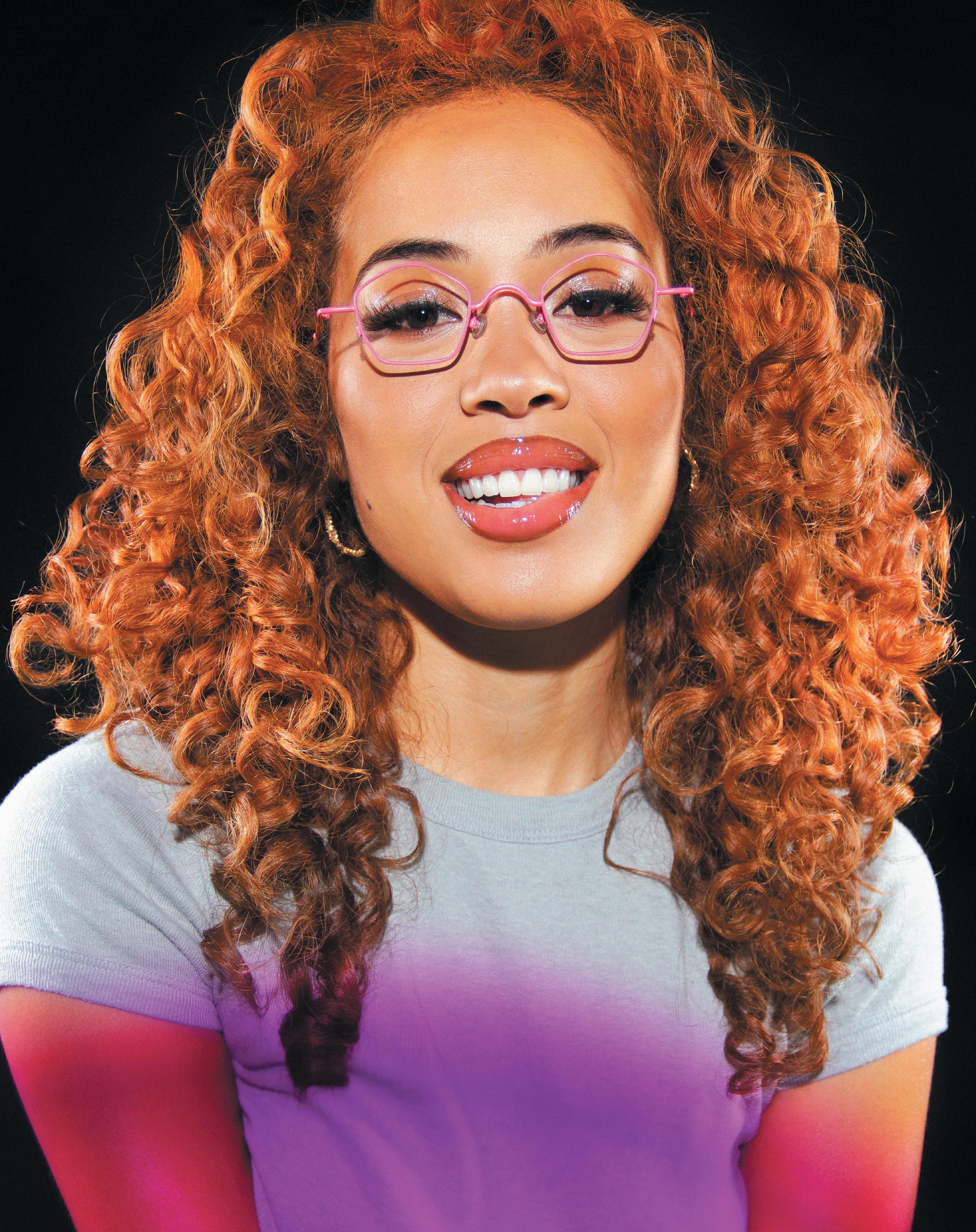
On view through August 2, 2026
MOCA Grand Avenue
250 S Grand Ave, Los Angeles, CA 90012
Image: Michael Asher, MAK Center for Art and Architecture, West Hollywood, California, USA, How Many Billboards? Art in Stead, February 8–June 30, 2010. Billboard designed by Michael Asher, located on Glendale Boulevard. Courtesy of the MAK Center / Photograph by Gerard Smulevich. Michael Asher Archive, © Michael Asher Foundation.