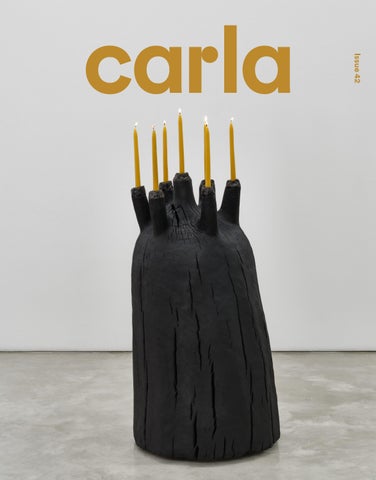
Issue 42
Our Lady J photographed by Josef Jasso
900 N Fairfax Avenue • Los Angeles • laeyeworks.com
Winter 2025
Letter from the Editor In grad school, I wrote an essay called “Kill Your Heroes.” In sprawling prose, I mused about the ghosts of our past. “How does an artist face the insurmountable task of acknowledging, then overcoming, the histories before us?” I pondered. “Every pencil line and drilled hole must embody and expand upon the canon.” That’s the funny thing about time: With every day that passes, more history falls into the rearview—history that informs each of our own understandings of the world and the work that we do (or make) within it. How do we then move forward with this mass of art history on our backs? This issue finds artists referencing their artistic forebearers in order to reframe them—to stretch their works into the present moment, using the past to shape a new discourse. Aleina Edwards writes about the enduring notions of beauty, perfection, symmetry, and idealism that Classical pottery upholds—notions that still undergird contemporary understandings of self, body, and an imagined ideal. Edwards speaks to the efforts of three contemporary female ceramicists to reconfigure these weighty historical forms, and how “deconstructing them can help us articulate new terms.” Artist Noah Davis often operated within a similar logic, invoking past masterpieces in order to visualize his own work within their ranks, reimagining an art canon that could be inclusive of his community in South L.A. “Who decides what art endures, and what is that longevity based on?” asks Evan Nicole Brown in this issue’s review of the
Issue 42
late artist’s traveling survey. Later, Janelle Zara writes about Devin Troy Strother’s practice of quoting other notable artists while exposing his own vulnerability in the process. What is notable about these artists—Strother and Davis, along with the ceramicists Staros, Little, and Blumenfield—is that a melange of homage and critique often occurs in their work. Davis mimics a Rothko to incorporate the spirit of the famed artist within his lived reality. Staros queers the amphora even as she animates its traditional form. There is reverence encoded in these gestures. And yet, they also acknowledge that the power structures that often hold up, dictate, or honor these forebearers no longer support us in the present. Systems like a fixed “canon” no longer serve us. “Perhaps I won’t kill my heroes…” I posited in my grad school essay, thinking about the various art historical and cultural references my own work cribbed. “But I will dance with them.” The artists in this issue engage in this dance too, dually honoring history while wrenching it from its original context to add meaning that might better serve our contemporary moment (often offering an inclusivity that past models neglected). Naturally, these remakes will soon become history themselves, and the cycle of remixing the past will continue, becoming ever more complex, fragmented, and pregnant with meaning than what came before. Lindsay Preston Zappas Founder, Editor-in-Chief, & Executive Director
Contents
8
Speculation vs. Need Nancy Buchanan’s American Dream #7 Catherine G. Wagley
16
48–64
Reimagining Movement for Visual Art Spaces
Noah Davis at The Hammer —Evan Nicole Brown
Dancing in Galleries Steven Vargas
Reviews
24
Daniela García Hamilton at Charlie James Gallery —Karla Méndez
Women Ceramicists Breaking the Mold of Classical Beauty
Erin Calla Watson at Ehrlich Steinberg —Sebastian Zinn
Degenerate Forms Aleina Grace Edwards
32
Interview with Eduardo Medrano, Jr. & Alfonso Gonzalez, Jr. of John Doe Gallery Leah Perez
40
The Dealers Sara Lee Hantman Frames The View Photos and text: Claire Preston
Jorinde Voigt at Marc Selwyn Fine Arts —Teresa Fleming Dan John Anderson at Night Gallery —Jessica Simmons-Reid Devin Troy Strother at ArtCenter —Janelle Zara
how to be a
L R I G A L L I ERR
GU
Through April 12 Research Institute at the Getty Center
FREE ADMISSION Plan your visit Images: Hot Flashes logo and contact sheets (details), about 1987–1993, Guerrilla Girls. Mixed media. Courtesy Guerrilla Girls. © Guerrilla Girls. Design © 2025 J. Paul Getty Trust
Colophon
Contemporary Art Review Los Angeles is an essential voice made in and for Los Angeles. Founded in 2015 by artist and writer Lindsay Preston Zappas, Carla is a nonprofit organization and publishing platform that is dedicated to providing critical, thoughtful, and inclusive perspectives on contemporary art. Our quarterly print magazine is an active source of dialogue on Los Angeles’s art community and is available for free in over 160 galleries and art spaces in L.A. and beyond. Editor-in-Chief & Executive Director Lindsay Preston Zappas Managing Editor Evan Nicole Brown Contributing Editor Allison Noelle Conner Graphic Designer Satoru Nihei Copy Editor Rachel Paprocki Administrative Assistant Aaron Boehmer Color Separations Echelon, Los Angeles Printer Solisco Printed in Canada Submissions For submission guidelines, please visit contemporaryartreview.la/submissions, and direct all submissions to submit@contemporaryartreview.la. Inquiries For general inquiries, contact office@contemporaryartreview.la. Advertising For ad inquiries and rates, contact ads@contemporaryartreview.la. W.A.G.E. Carla pays writers’ fees in accordance with the payment guidelines established by W.A.G.E. in its certification program. Copyright All content © the writers and Contemporary Art Review Los Angeles. Social Media Instagram: @contemporaryartreview.la Cover Image Dan John Anderson, Seven Sisters (2025). Claro walnut and beeswax, 49 × 20 × 21 inches. Image courtesy of the artist and Night Gallery. Photo: Ed Mumford.
Contributors Lindsay Preston Zappas is an L.A.-based artist, writer, and the founder of Carla. She received her MFA from Cranbrook Academy of Art and attended Skowhegan School of Painting and Sculpture in 2013. Her writing has appeared in Track Changes: A Handbook for Art Criticism, KCRW, Carla, ArtReview, Flash Art, SFAQ, Artsy, LACanvas, and Art21. Recent solo exhibitions include those at the Buffalo Institute for Contemporary Art (Buffalo, NY), OCHI (Los Angeles), and City Limits (Oakland). Evan Nicole Brown is a Los Angeles-born writer, editor, and journalist who covers the arts and culture. Her work has been featured in Architectural Digest, Dwell, Getty Magazine, The Hollywood Reporter, L.A. Times Image, The New York Times, T Magazine, and elsewhere. Allison Noelle Conner is an arts and culture writer based in Los Angeles. Satoru Nihei is a graphic designer with an MFA from Cranbrook Academy of Art. His work has been featured in The Tokyo TDC Design Annual, METROPOLIS, Graphic Design: The New Basics, and other publications, and has been showcased internationally at exhibitions including the Golden Bee Global Biennale of Graphic Design, Peru Design Biennial, Graphic Matters, Trnava Poster Triennial, Shenzhen International Poster Festival, and others. He judged the 2019 PRINT Magazine Regional Design Awards and received the Golden Bee Award in both 2022 and 2024. Rachel Paprocki is an editor and librarian who lives and bikes in Los Angeles. Aaron Boehmer is a writer based in New York City. He covers the arts, culture, and politics and has written for The Nation, Texas Monthly, Los Angeles Review of Books, The Drift, and others. Board of Directors Lindsay Preston Zappas, Executive Director MJ Brown Trulee Hall Joseph Daniel Valencia Membership Carla is a free, grassroots, and artist-led publication. Club Carla members help us keep it that way. Become a member to support our work and gain access to special events and programming across Los Angeles. Carla is a registered 501(c)(3) nonprofit organization; all donations are tax-deductible. To learn more, visit join.contemporaryartreview.la. Thank you to all of our Club Carla members for supporting our work. A special thank you to our La Brea and Western members: Philippe Browning, Anthony Cran, Tim Disney, Sarah Ippolito, Tiffiny Lendrum, Rebecca Morris, Jobert Poblete, Michal Hall Bravo Ramirez & Octavio Bravo Ramirez, Laurie & Rick Raskin, Anjelica & Neil Sarkar, Ian Stanton, Michael Zappas, Critical Minded, Solid Art Services, and West of West Architecture + Design.
Los Angeles Distribution Central
East Feminist Center for Creative Work Gattopardo GGLA John Doe Gallery Junior High la BEAST gallery Marta Nicodim Gallery OXY ARTS Parrasch Heijnen Gallery Philip Martin Gallery Rusha & Co. South Gate Museum and Art Gallery Staklena Kuća The Armory Center for the Arts The Pit Los Angeles Umico Printing and Framing Vielmetter Los Angeles Vincent Price Art Museum Wilding Cran Gallery North
Experimentally Structured Museum of Art Long Beach City College The Den Torrance Art Museum West 18th Steet Arts Beyond Baroque Literary Arts Center Dorado 806 Projects L.A. Louver Laband Art Gallery at LMU Marshall Gallery Otis College of Art and Design ROSEGALLERY Von Lintel Outside L.A. Bortolami Gallery (New York, NY) Bread & Salt (San Diego, CA) Buffalo Institute for Contemporary Art (Buffalo, NY) Chess Club (Portland, OR) DOCUMENT (Chicago, IL) Et al. (San Francisco, CA) Fresno City College (Fresno, CA) High Desert Test Sites (Joshua Tree, CA) Left Field (Los Osos, CA) Level of Service Not Required (La Jolla, CA) Los Angeles Valley College (Valley Glen, CA) Museum of Contemporary Art San Diego (La Jolla, CA) OCHI (Ketchum, ID) Libraries/Collections Baltimore Museum of Art (Baltimore, MD) Bard College, CCS Library (Annandale-on-Hudson, NY) Charlotte Street Foundation (Kansas City, MO) Cranbrook Academy of Art (Bloomfield Hills, MI) Getty Research Institute (Los Angeles, CA) Los Angeles Contemporary Archive (Los Angeles, CA) Los Angeles County Museum of Art (Los Angeles, CA) Maryland Institute College of Art (Baltimore, MD) Midway Contemporary Art (Minneapolis, MN) Museum of Contemporary Art (Los Angeles, CA) Pepperdine University (Malibu, CA) San Francisco Museum of Modern Art (San Francisco, CA) School of the Art Institute of Chicago (Chicago, IL) The Metropolitan Museum of Art (New York, NY) University of California Irvine, Langston IMCA (Irvine, CA) University of Minnesota Duluth, Tweed Museum of Art (Deluth, MN) University of Pennsylvania (Philadelphia, PA) University of South Florida St. Petersburg (St. Petersburg, FL) University of Washington (Seattle, WA) Walker Art Center (Minneapolis, MN) Whitney Museum of American Art (New York, NY) Yale University Library (New Haven, CT)
albertz benda ArtCenter College of Design ArtCenter College of Design, Graduate Art Complex The Aster LA Forest Lawn Museum South Angels Gate Cultural Center D2 Art (Inglewood)
Scan to access a map of Carla’s L.A. distribution locations.
Distribution
1301 PE 7811 Gallery Anat Ebgi (Wilshire) Arcana Books Artbook @ Hauser & Wirth as-is.la Babst Gallery Baert Gallery Bel Ami Billis Williams Gallery Canary Test Central Server Works Press Charlie James Gallery Château Shatto Cheremoya Cirrus Gallery Clay ca Commonwealth and Council Craft Contemporary D2 Art (Westwood) David Kordansky Gallery David Zwirner dublab Ebony Repertory Theatre at Nate Holden Performing Arts Center Fernberger François Ghebaly FOYER–LA Francis Gallery Gana Art Los Angeles Giovanni’s Room Hannah Hoffman Gallery Harkawik Harper’s Gallery Heavy Manners Library Helen J Gallery Human Resources ICA LA JOAN Jurassic Magic Mid-City Jurassic Magic MacArthur Park KARMA LACA Lisson Gallery Los Angeles Municipal Art Gallery Louis Stern Fine Arts Luis De Jesus Los Angeles M+B MAK Center for Art and Architecture Make Room Matter Studio Gallery Megan Mulrooney Michael Werner Gallery MOCA Grand Avenue Monte Vista Projects Morán Morán Moskowitz Bayse Murmurs Nazarian / Curcio Night Gallery NOON Projects O-Town House OCHI Official Welcome One Trick Pony Pace
Paradise Framing Perrotin Los Angeles Patricia Sweetow Gallery REDCAT (Roy and Edna Disney CalArts Theater) Regen Projects Reparations Club Roberts Projects Royale Projects Sea View Sean Kelly Sebastian Gladstone Smart Objects SOLDES Sprüth Magers Steve Turner St. Elmo Village Tanya Bonakdar Gallery The Box The Fulcrum The Hole The Journal Gallery The Landing The Poetic Research Bureau The Wende Museum Thinkspace Projects Tierra del Sol Gallery Tiger Strikes Asteroid Track 16 Tyler Park Presents USC Fisher Museum of Art Village Well Books & Coffee Webber Wönzimer
Speculation vs. Need Nancy Buchanan’s American Dream #7
8
“They already know what we need, because they always cut off what we need,” says the community organizer Alice Harris. She is speaking with passionate clarity about the disenfranchisement of Watts, though you have to lean down and get close to see her face, visible on a miniature TV screen, barely bigger than a playing card. The TV is nestled at the back of an ornate, slightly garish living room, the biggest piece of furniture in a dollhouse-scale space that conjures a cross between The Gilded Age and Sex and the City. Nancy Buchanan made this artwork, American Dream #7: The Price is Wrong, with her collaborator Carolyn Potter in 1991. The diorama and the 13-minute video, with its documentary-style in-situ interviews and found footage, grate against one another. The juxtaposition is the point. American Dream #7 was by no means the centerpiece of Truthfully, Nancy Buchanan, the artist’s recent retrospective at The Brick, but it was physically centered in the space; the diorama stood on a waist-high plinth in the middle of one of the largest sections of the gallery, halfway through the retrospective. The first time I visited the show I went right toward it because my two-year-old thought the little trees surrounding the white exterior walls looked like ice cream cones. Then I kept coming back to its handmade details—the silver satellite dish protruding from the roof, the gold-rimmed Art Deco furniture, the faux marble floors, and the complete lack of windows, as if to suggest the
Catherine G. Wagley
inhabitants of this comically ornate room had no desire to see outside. American Dream #7 combines interests that have propelled Buchanan’s work since her student days. It was collaboratively made by two women with divergent sensibilities (“Carolyn had more of a pleasant take on things, and I wanted kind of an ironic edge,” Buchanan told me), and manages to be sensual and accessible despite growing out of Buchanan’s deep, ongoing research into real estate and speculation in California. The diorama was made in Potter’s home, amidst all her crafting materials and tools, and it feels intimate and domestic, even though the video pulls from interviews and footage taken all over the city, often with urban and suburban vistas, and from televised news and commercials. It is omnivorous while also focused, something that can be said of Buchanan’s practice on the whole. Nearly every work in the show at The Brick warranted a close read, and perhaps because of this I felt the need to limit my scope, to look closely at one project in order to begin to understand, and then convey, what compels me about Buchanan’s critical precision and aesthetic flexibility. “It’s related to my investigation of speculation versus need,” Buchanan said when I asked her where American Dream #7 came from. She has been exploring this chasm between the reality of people’s lives and mythology-driven capitalist aspiration for years, with California as a recurring subject. The artist has lived in Los Angeles since childhood, punctuated by a stint teaching and living in Wisconsin in the early 1980s (where she asked Midwesterners what they thought of California for a video called California Stories, 1983). She enrolled at UCLA, paused her education to marry and have a son, then later enrolled in the first-ever class of art students at University of California, Irvine in the mid-1960s. The just-founded school arguably had the most experimental art program in the region (there were no rules, and the faculty included artists escaping
Feature 9
Nancy Buchanan, American Dream #7: The Price is Wrong (collaboration with Carolyn Potter) (1991). Mixed media sculpture with video, 13:11 minutes. Images courtesy of the artist and The Brick. Photos: Ruben Diaz.
10
Top: Nancy Buchanan, American Dream #4 (1982). Pastel and pencil on paper. Image courtesy of the artist and The Brick.
Bottom: Nancy Buchanan, American Dream #3: Sweet Dreams (1981). Pastel and pencil on paper. Image courtesy of the artist and The Brick.
the “stodginess” of academia, as Buchanan remembered one of her most supportive professors, Light and Space artist Robert Irwin, putting it).1 Buchanan went right from the bachelor’s program into UCI’s first MFA class. With her classmates Chris Burden and Barbara T. Smith, she co-founded the cooperative gallery F Space, where Burden had a friend shoot him in the arm (Shoot, 1971) and Buchanan performed Hair Transplant (1972) with her classmate Robert Walker. In front of an audience, she shaved Walker’s mustache (which he had grown for the occasion), chest hair, underarm hair, and pubic hair and then cut her own long red hair and affixed it to Walker’s newly bare body parts. She also made a rug out of hair around that time, which the critic Barbara Rose, visiting from New York, called “disgusting.”2 The declaration excited Buchanan, who wanted her art to be visceral, not just intellectual.3 By the time she finished school, she was a single mother, a budding activist (she had joined Students for a Democratic Society, but, because she worried about who would care for her son if she got arrested, she made spaghetti for students participating in the sit-ins rather than participating herself)4 and an artist making images, performances, and videos. Within five years of graduation, she belonged to multiple feminist collectives, including the ad hoc Double X collective, and undertook a massive project using redacted FBI files related to her father, Louis Ridenour, Jr., a scientist and government consultant who had died suddenly when Buchanan was thirteen, who believed the public needed to better understand the threat of nuclear warfare. The interviews with atomic experts she did for that project informed the American Dream series, which she began in the late 1980s and included six drawings in addition to six dioramas- with-videos that she made with Potter. When she researched her father’s world, she had been struck by the way nuclear weapons—which threatened
even those who lived in proximity to their testing and production—had been twisted by politicians to support the idea of American exceptionalism. The American Dream series started with drawings of mushroom clouds that referenced the way 1980s American capitalism was shaped by a return of Cold War conservatism (one cloud in the show is made of ice cream and another reveals Ronald Reagan’s grinning face), but the series evolved to explore how American exceptionalist logic widened the gap between deceptive, speculation-soaked aspiration and peoples’ lived experiences. Buchanan’s idea for dioramas came in the late 1980s. As an art market boom coincided with a real estate market boom in Southern California, artists had started making massive video installations, turning a once intimate medium into spectacle in a way that capitulated to the art market while also literally requiring real estate. Buchanan, instead, decided to make small videos. “That was my reaction to people doing these huge projections,” she told me. She looked for tiny monitors and imagined putting them inside a domestic, interior space. She had taken a crafting workshop with Potter, a talented teacher, artist, and miniaturist who passed away in 2024, and at first, Buchanan hired Potter to make a 1950s-style interior to hold one of her small videos. Potter’s expertise and imagination—“She could make anything,” Buchanan said5—elevated the project so significantly that Buchanan quickly realized she was a collaborator on the project, not a fabricator. The first artwork they made together, American Dream #6 (1988), featured a modest 1950s living room in disarray (unread newspapers were spread across the floor), and the TV set played old commercials and the Army-McCarthy hearings, held after Senator Joseph McCarthy accused the US Army of bending to communist influence. Their next collaboration was American Dream #7, a turning point in the series. While Cold War exceptionalism remained a haunting specter,
11
12
the work was grounded in the moment in which it was made, and the video and the diorama evolved together. Potter and Buchanan drove around the hills of northern Pasadena when they were planning American Dream #7 and saw a number of McMansions under construction. They toured one house, and Buchanan filmed as the real estate agent showed them a bathroom that was bigger than the kitchen. They based their diorama for American Dream #7, loosely, on McMansion energy. The white exterior would look like a ranch-style house if not for the irregularly placed Corinthian columns. Inside, the two longest walls are lined with a gaudy gold and red
wallpaper that Buchanan and Potter made themselves, photocopying dollhouse wallpaper and using heat to apply foil accents. Tiny faded Persian-style rugs accent the faux- marble floor. They put leopard print upholstery on the antique chairs and framed tiny prints of historic and contemporary masterpieces—most of them portraits of royals or other wealthy figures—in ornate gold frames. Above the mantle, between gold candlesticks, there’s a tiny Roy Lichtenstein print of a woman with a thought bubble above her head, which reads “I can see the whole room and there’s no one in it.” Buchanan said, “We had fun with that.” The room
13
is full of figureheads but otherwise uninhabited, ostentatious but not apparently lived-in, while on the tiny TV screen, flanked by speakers bigger than the coffee table, the video’s narrative highlights the gap between acquisition-driven mindsets and fights for survival. The video unfolds in intuitive, collage-like ways. Buchanan filmed much of the footage herself, though she also borrowed from the news and commercials, and the aesthetic quality varies. Sometimes, it looks like a news feature, with the subject positioned strategically in front of an urban or suburban landscape. Sometimes, the footage—shot from a moving
vehicle, for instance—has a more provisional quality. At the start of the video, the late activist Michael Zinzun, who became Buchanan’s close collaborator in the 1980s, stands in front of the Dorothy Chandler Pavilion at The Music Center, saying, “I am here to remind you that there is no document of culture that is not at the same time a document of barbarism.” Then the camera pans through downtown, and we see, just briefly, Barbara Kruger’s red, white, and blue Untitled (Questions) (1990/2018) looming on the side of MOCA’s Geffen Contemporary. (“Who is beyond the law? Who is bought and sold? Who is free to choose?” the mural asks
Nancy Buchanan, American Dream #8: Untitled (Relief) (collaboration with Carolyn Potter) (1999). Mixed media sculpture with video, 7 minutes and 58 seconds. Image courtesy of the artist and The Brick. Photos: Ruben Diaz.
14
in large, all-caps text.) A year after Buchanan made this video, in 1992, the mural would appear in photographs of the National Guard, sent by the first Bush administration to police the city after the 1992 uprisings—and 34 years later, in summer 2025, it would become a backdrop for Immigrations and Customs Enforcement agents sent by the Trump administration to make an example of the city. In Buchanan’s footage, the mural is just a mural, one flashpoint in the bigger battle between activists and cultural critics who want the accountability that precedes greater equity and those motivated by power accumulation. Then we are again with Buchanan and Potter (though neither appears in the footage) perusing McMansions in the foothills, before an opportunist lifted from a TV commercial tells us how we could retire in five years if we just flip the real estate around us. From there, we go to historian Mike Davis, speaking seriously as the suburban sprawl unfolds behind him—“another example of housing without housing for people that work for a living,” quipped Buchanan. Davis, who wrote piercingly about real estate’s taint on California, was a visiting professor at CalArts, where Buchanan taught when she was working on American Dream #7 (she was on the faculty from 1988 to 2012). They filmed outside the CalArts campus in Valencia, and Davis talked loosely about the city of Los Angeles’s “lack of commitment to redevelop the economic base and the housing stock of the distressed areas of the city” and how speculative developments kept spreading out toward the Mojave Desert. We see a protest in the streets of Century City, and then the camera pans up to show people in tuxes and evening dresses looking down from the high-up balcony of the Century Plaza Hotel, built during a speculative boom in the early and mid-1960s. In the video, there is an ever-present tension between those agitating for structural change and the omnipresent evidence of speculative desire.
The video ends with footage of the 1989 funeral of murdered political activist and Black Panther Party co-founder Huey P. Newton. The congressman Ron Dellums is speaking, saying that marching through Washington, D.C. isn’t enough. Everyone needs to go to the Capitol and stay, to protest everyday: “Say ‘negotiate with me to end poverty…to right the wrongs, to challenge the evil, and to make this whole world a better place for our children, and our children’s children.’ ” The mourners cheer loudly enough to drown Dellums out. They have gathered because a Black Panther Party leader has been murdered in the same streets he wanted to protect. A just world feels further away, and tackling an intransigent system is an uphill battle, even if plenty of people are still fighting. It is not right to say that American Dream #7 is prescient. It emerged from and spoke to its moment. It is, though, a testament to the power of the speculative impulse, and the late capitalist forces that propel and protect this impulse, that the artwork still feels so relevant. It is also a testament to what Buchanan’s work does so well: use close attention as the method of structural critique. The tenderly crafted and rendered details invite viewers to linger and make the work feel accessible, even intimately personable, as it excavates systemic harms. At The Brick, on the wall across from American Dream #7, hung American Dream #8: Untitled (A Relief) (1999), another collaboration with Potter. Over a span of years, Buchanan filmed a development in her Mount Washington neighborhood as construction started, stalled due to lack of funds, restarted, and stalled again. The video, which documents the exorbitantly expensive, disruptive, and never-complete project, is embedded in a recreation of the hill interrupted by scaffolding and concrete leading to nowhere. A neighbor wrote in the wet concrete, “I am going to burn this down when you are done, I promise,” and
Potter and Buchanan replicated this message, making a record of the kind of local resistance that is so often made to feel insignificant—if not invisible—by systems that privilege the desires of the few over the needs of everyone else. Catherine G. Wagley is a writer and editor based in Los Angeles. Her book She Wanted Adventure, about supporting each other while living through and around art, is forthcoming from FSG.
1. David Helps, oral history with Nancy Buchanan, UCLA Center for Oral History Research, 2021, https://oralhistory. library.ucla.edu/catalog/21198-zz002kpr0q?counter= 1&q=center. 2. Amelia Jones, “Amelia Jones in dialogue with Nancy Buchanan, ‘Truly for Real,’” Archive of Women Artists Research and Exhibitions (AWARE), Oct. 22, 2021, https:// awarewomenartists.com/en/magazine/reellementpour-de-vrai-nancy-buchanan-en-conversation-avecamelia-jones/. 3. Jones, “Amelia Jones in dialogue with Nancy Buchanan.” 4. Helps, oral history with Nancy Buchanan. 5. Nancy Buchanan, exhibition walkthrough, The Brick, September 18, 2025.
15
Will Rawls, [siccer] (performance view) (2023) with Katrina Reid, keyon gaskin, and jess pretty. Performance at REDCAT in April 2025. Image courtesy of the artist and REDCAT. Photo: Angel Origgi.
Dancing in Galleries Reimagining Movement for Visual Art Spaces
The REDCAT stage is covered in green props. The walls and floors are nearly bare, the occasional sprig of cattails sprouting from the floor. Choreographer Will Rawls sits at the corner of the stage, looking at the audience, and holding a remote in his hand. He presses the button. A camera, propped in the downstage corner, fills the silence of the stage with a click every few seconds as it takes a series of stop-motion photos in this neon green bayou. Five dancers emerge, dodging the shots, bunkering behind the props, only jumping into the spotlight to craft exaggerated characters for the camera. Their movement switches from soft and supple steps, emphasizing the transition between positions, to erratic shifts. Rawls’s work, [siccer] (2023), explores the mistreatment of Black bodies in media by juxtaposing the personalities of the performers with the characters they perform for each camera click, displaying how Black people navigate the camera’s surveillance. The title of the work is inspired by the Latin adverb sic, which indicates incorrect spelling and is often employed against Black Vernacular English. Throughout the three-day run of the performance last April, audiences witnessed Rawls experiment with cinematic and audio technologies in real time. However, the performance didn’t end there. On the other side of Downtown L.A., in the main gallery of the Institute of Contemporary Art, Los Angeles (ICA L.A.), [siccer] continued with an exhibition that was on view through the summer. A neon green hue lit the
Steven Vargas
space. Empty picture frames last seen on stage at REDCAT hung from the ceiling, obscuring or enhancing projections on the wall. The same dancers that performed at REDCAT appeared in projections that covered the gallery walls and the sprigs of cattails were scattered across the floor alongside beanbag chairs. It felt like walking into the photographs that were taken by Rawls on stage, turning the performance’s ending statement into an ellipsis. With [siccer], Rawls uses dance as a bridge between his performance and his installation, allowing the work’s themes to continue to grow and expand across mediums. Dance in gallery or museum spaces is nothing new, but the intention is evolving. In Los Angeles, a city with a scrappy ecosystem of movement artists but without a dance epicenter, the ephemerality of the artform feels heightened amid the financial impacts of the pandemic, which led to the shuttering of dance studios and performance spaces. Many dance artists have turned to unconventional venues. This adaptation has led many performers to explore how performance might be sustained within a visual art context. Museums and galleries can offer dance a valuable element: time. Typically, commissions by performance spaces impose time constraints on choreographers, requiring them to create within a week or three and then present the work on a single night or weekend.1 Their creations materialize as quickly as they depart. This limits both the artists’ exploration and the viewers’ meditation on the performance. By contrast, museums and gallery spaces often exhibit exhibitions for months, allowing broader engagement with a work. ICA LA senior curator Amanda Sroka told me that she was excited to bring Rawls’s work to the museum so that it could be shown in its fullness. It’s a trend that Sroka hopes to continue and share with other institutions. “L.A., as a city, has always been a place where performance-based work has thrived and it feels like now it is being more
17
18
integrated into the ecosystem here” at galleries and museums, she said. That Rawls’s work, known for its multidisciplinary approach, adapted well within a visual context was no surprise. Rather than building the work as two separate programs, an exhibition and a performance, [siccer] was conceptualized to be a dynamic whole. In one of the videos at the ICA LA exhibition, the five performers— Holland Andrews, keyon gaskin, jess pretty, Katrina Reid, and Jeremy Toussaint-Baptiste—laboriously presented alternate, inauthentic versions of themselves for the camera, striking dramatic and hyperbolic poses for the camera. In the floor-toceiling projection, Andrews lets out a silent scream, slowly moving their head until it is momentarily obscured by a shadow created by a hanging frame in the gallery space. Their frustration is briefly hidden from the viewer, and when they return, they present a façade of joy. The same movement took place on stage at REDCAT, here mediated and edited by the camera. The through-line between performance and exhibition expanded the work, allowing each dancer’s explorations time to grow—the viewer was granted access to the juxtaposing personas portrayed on- and off-camera, adding subtext to Rawls’s meditations on Blackness and what it means to be Black in the public eye. “When seeing the installation, you have this after-image, this echo of the performance,” Sroka said. “The thing that I found really striking was the deep connectedness of these two parts. Within the installation, you’re seeing the bodies, the images that get captured through the camera, and then the performance is all the slippery stuff that goes uncaptured.” I encountered the “slippery stuff” first —the raw messiness that went into creating the video piece. The live work felt, then, like a deconstruction of a photo shoot, exposing the conversations that went into making each image. In the performance, the characters discuss their search for genre in
a world seeking to contain their artistry; Toussaint-Baptiste describes his relationship to racism by comparing himself to Kermit the Frog, singing “It’s Not Easy Being Green.” At ICA LA, the exhibition was more muted and precise, displaying the fruits of the performers’ labor. The exhibition —mediated portrayals of Black bodies— was the byproduct of Black production. But the live performance was Black production at work, revealing all the unspoken truths about racism that are often left on the cutting room floor and out of a final product. In the live performance, the artists debate on whether a move is supposed to look more structured or loose, working together to get the image right. The result is stiff. In contrast, when the cameras are off, they dance authentically without monitoring how they look. The camera embodies the impact of surveillance, showcasing how a single image can skew the reality of Black life. ⁂ Typically, dance is utilized in art spaces as an activation for another visual exhibition by simply presenting choreography within the gallery space. For example, Gagosian welcomed A.I.M by Kyle Abraham to perform works from their repertoire in the Social Abstraction exhibition in July 2024,2 and in June 2025, Jeffrey Deitch welcomed VOLTA into its gallery space to perform a new work within The Abstract Future exhibition.3 As supplemental programming, neither visual art nor dance performance is fully dependent on the other to tell its story. Sometimes, dance is the subject of an exhibition in a museum space, but not the mode of creation. This is commonplace for retrospective exhibitions like Edges of Ailey at The Whitney,4 or Merce Cunningham, Clouds and Screens, on display at LACMA from October 2018 to March 2019.5 Such exhibitions often fail to support the living aspect of performance, displaying
19
Qwenga, Infinite Rehearsal (2023–24). Performance at Institute of Contemporary Art, Los Angeles from October 7, 2023 to January 14, 2024. Images courtesy of the artist and ICA LA.
Simone Forti, Slant Board (1961). Performance with plywood and rope, 10 minutes, at MOCA Grand Avenue, January 29, 2023. Image courtesy of the artist and MOCA. Photo: Elon Schoenholz.
archival artifacts rather than choreographed examples of their movement in real time. But institutions like ICA LA have recently been exploring how dance can enter exhibition spaces more fruitfully. Simone Forti, a 2023 retro spective exhibition of the notorious performance artist and choreographer at the Museum of Contemporary Art (MOCA), included performances from Forti’s Dance Construction series (1960–61) throughout the run of the show. Notably, the performances of Slant Board (1961) enhanced the exhibition by giving her historical work a new voice. In the piece, performers travel up and down a slanted wooden ramp, using ropes to traverse while discovering new routes and exploring the effort it takes to keep going. For the exhibition, MOCA brought in local artists to recreate the piece. In rehearsals, Forti supported new ideas shared by the artists and allowed for her historic work to morph. Because of her previous support of performance and new media at the Future Fields Commission (a biennial award by the Philadelphia Museum of Art for time-based media artists), Sroka’s appointment as senior curator of ICA LA was promising to dance and performance artists who were eager for more exhibition venues.6 Before [siccer], another exhibition Sroka curated (assisted by Seanna Rihanna Latiff, Getty Marrow Curatorial Intern) was the experimental collaboration between choreographer Chris Emile and No)one. Art House, in which the gallery space was dedicated to the artists as a rehearsal space. The 2023–24 exhibition, Infinite Rehearsal, which ran for three months, constantly changed.7 Throughout the course of the show, artists Emile, Shauna Davis, Marcella Lewis, Jobel Medina, Cody Perkins, Jordan Slaffey, and Qwenga rehearsed in the space, and visitors could observe both the process and final presentations. For Sroka, the performers needed to receive the support and resources of an exhibition curation rather than
the short-term funding of public programming because, in addition to space, curation offered more funding and hands-on institutional support. The exhibition particularly solved a common issue of space for dancers. In 2020, California’s AB5 law went into effect, establishing firmer eligibility requirements for independent contractors. This led to backlash when performing artists working with certain institutions no longer qualified for compensation.8 This constriction was compounded by the pandemic, when LA studio and rehearsal spaces closed, including EDGE Performing Arts Center, The Sweat Spot, and Pieter (which has since reopened with a new model), among others.9 Dance practices are logistically sustained by grant applications, fundraising, and self-producing. One day during the run of Infinite Rehearsal, Sroka checked in to find Davis sitting on the bench with her laptop, working on a grant application. “She’s like, ‘I think it’s really important that visitors understand that the labor of performance is also working on these grants,’” Sroka recalled. “It was cool because there were those moments that were more unexpected for me of how we get into these conversations around what it means to be a dancer, this laboring body.” Unlike visual artists, sales from choreographers’ and dancers’ work cannot be used to fund further creation. Performers have taken another hit with recent budget cuts at the federal, state, and municipal levels.10 For instance, the Los Angeles County Department of Arts and Culture budget was slashed by over $1.7 million in July, directly impacting organizational, community impact, and arts internship grants.11 Visual arts institutions that invest in dance and performance are starting to address this lack, but many don’t have the architecture to offer physical support for dancers, such as Marley and sprung flooring, which provide bounce and shock absorption.12 “In the museum context, we’ve figured out how to care for more traditional art mediums, be it painting, sculptures,
21
22
drawings, and photography, but our ability to care for the living is still very much in process,” Sroka said. The struggle for space and time is a practical duet that performers have with the act of creation. By alleviating this struggle for time and duration, the very act of dance in a space like a visual arts institution has the potential to expose the slipperiness that happens off-stage, visualizing the (often) invisible labor of making a performance. Rawls created his exhibition presentation and performance to be one entity, according to Sroka. One cannot exist without the other. The additive thrust of both presentations gave viewers a more expansive look into Rawls’s varied practices. After viewing the performance leg of Rawls’s presentation, and stepping into the gallery space, I could envision all the movement happening beyond the frame in the installation video. I could hear Holland’s scream. As art spaces begin to embrace performance and dance, they offer essential support to movement artists. But dance also offers something to the visual arts—a way to think differently about time and our bodies in space. “There is this commitment to attention when you’re watching a performance, a commitment to engaging in some way,” Sroka said. “It’s so easy, I think, in our society to disengage and to disassociate, and so performance holds you in time. [Performance is] a contraction and expansion of time as we know it.” Steven Vargas is a writer, dancer, and actor whose work focuses on the intersections of media, performance and social change. He is a former Los Angeles Times arts reporter and his work has also appeared in USA Today, Flaunt, ARTnews, Dance Magazine, and Alta Journal.
1. Rachel Rizzuto, “So You Got a Commission: Here’s How to Make the Time Count,” Dance Magazine, October 6, 2021, https://dancemagazine.com/ choreography-commission/#gsc.tab=0. 2. Gagosian, “A.I.M by Kyle Abraham,” July 19, 2024, https://gagosian.com/news/2024/06/18/aim-by-kyleabraham-social-abstraction-performance-beverly-hills/. 3. Jeffrey Deitch, “VOLTA Performance in The Abstract Future,” June 27, 2025, https://deitch.com/los-angeles/ events/volta-performance-in-the-abstract-future. 4. Whitney Museum of American Art, “Edges of Ailey,” https://whitney.org/exhibitions/edges-of-ailey. 5. LACMA, “Merce Cunningham, Clouds and Screens,” https://www.lacma.org/art/exhibition/mercecunningham-clouds-and-screens. 6. Deborah Vankin, “ICA LA announces Amanda Sroka as its new senior curator,” Los Angeles Times, July 12, 2022, https://www.latimes.com/entertainment-arts/ story/2022-07-12/ica-la-announces-new-curator . 7. ICA LA, “Infinite Rehearsal with Chris Emile and No)one. Art House,” Oct. 23, 2023, https://www.theicala.org/en/ exhibitions/134-infinite-rehearsal-with-chris-emile-andno-one-art-house. 8. Jerald Raymond Pierce, “California’s AB 5: Not as Easy as ABC,” American Theatre, February 21, 2020, https:// www.americantheatre.org/2020/02/21/californias-ab5-not-as-easy-as-abc/. 9. Jeff Slayton, “The effects of the pandemic on dance in Los Angeles – Part IV: Funding/Mixed Feelings,” LA Dance Chronicle, September 23, 2020, https://www. ladancechronicle.com/the-effects-of-the-pandemic-ondance-in-los-angeles-part-iv-funding-mixed-feelings/. 10. Lauren Harvey, ‘A state of emergency’: How L.A. dance groups are pivoting amid steep funding cuts,” Los Angeles Times, July 30, 2025, https://www.latimes. com/entertainment-arts/story/2025-07-30/trumpfunding-cuts-arts-la-dance-nea-grants-eliminated. 11. “2025-26 Grant Program Budget Impacts,” LA County Department of Arts & Culture, June 10, 2025, https://www. lacountyarts.org/2025-26-grant-program-budgetimpacts. 12. Rachel Rizzuto, “New Creative Possibilities Between Museums and Dance Artists,” Dance Magazine, November 11, 2024, https://dancemagazine.com/ museums-dance-artists/#gsc.tab=0.
23
Top: Will Rawls, [siccer] (performance view) (2023) with Holland Andrews, Katrina Reid, Jeremy Toussaint-Baptiste, jess pretty, and keyon gaskin. Performance at REDCAT in April 2025. Image courtesy of the artist and REDCAT. Photo: Angel Origgi.
Bottom: Will Rawls, [siccer] (installation view) (2023). Portland Institute of Contemporary Art (PICA), September 23–November 5, 2023. Image courtesy of PICA.
Cammie Staros, Looking as One Shouldn’t (2024). Ceramic, pebbles, and shells, 70.25 × 17.5 × 17.5 inches. Image courtesy of the artist and Nazarian / Curcio.
Degenerate Forms
the harmony of structure and surface, form and function as quintessentially beautiful—and thus good and important. In architecture, columns and domes symbolize stability and control; marble busts of leaders add gravitas to government buildings and museum halls; and collections of decorative pottery and sculptures are testaments to individual affluence and aesthetic superiority. J. Paul Getty spent his lifetime amassing what is now a collection of some forty thousand Greek and Roman antiquities at the Villa, emblematic of his own search for “true and lasting beauty.”3 The first art museum I ever visited was Many of the vessels in the Villa the Getty Villa in Malibu. I was schoolare slender, long-necked amphorae or age, and I remember small rooms big-bellied krater—the language for with slick stone floors, each one filled with stark black- and red-figure ceramic them is so blatantly anatomical—but vessels behind glass. In the sixth century they’re also symmetrical, balanced, and contained—all things a real human BCE, Athenian artisans industrialized body is not. Yet, aesthetic judgments the production of these vessels, which rooted in ancient standards are often were widely exported in the ancient baked into the health and wellness world.1 Male potters ran workshops staffed by expert workmen and painters, rhetoric aimed at women in the US. When I was 10, I was diagnosed with adhering to the aesthetic standards scoliosis, a fairly common orthopedic of the day: Plato understood perfect condition in young girls that causes physical beauty as an unattainable the spine to curve with growth. Initially, goal we must nonetheless keep striving the doctor told me I was crooked, for, and Aristotle said beauty was and throughout years of treatment, defined by order, symmetry, and my illness was always articulated in definiteness.2 Though their sizes and such aesthetic terms. Crooked, humped, dimensions vary, most vessels were wheel-thrown, smooth, and thin-walled, uneven—these attributes signified my defect. I had little pain and few funceach piece bound by expectations tional problems, but my body was visibly of compositional balance and formal unruly, with flared ribs and skewed symmetry. Their surfaces show scenes hips. It was difficult, then, to resist mythological and mundane, like the promise of cures: a back brace, Herakles wrestling the Nemean Lion, physical therapy, strength training, wedding processions, or women workweight loss. Growing up in the 2000s, ing at home. The most elaborate of it was impossible to ignore the tempting the vases were features of symposiums, links between being small and feeling all-male drinking parties where elite culture was cultivated and corroborated. safely contained. Social media has since exacerbated this yearning for the The painted vessels passed between security found in a perfect body and men reflected their shared stories face: take TikTok’s inverted filter4— and values, and reinforced their vision which, much to users’ dismay, reveals of themselves as the actors and chroniyour “real” (and usually more asymmetclers of history—and women as the rical) face—or the growing obsession equivalent of household objects to be with Pilates for sculpting and shaping collected and controlled. the body. Like Plato and Aristotle, After centuries of enshrinement and exposure, Classical forms engender we seem to believe our value is rooted in beauty, and beauty depends on a certain authority. We’ve been condihaving the right kind of body (read: tioned to trust their quality, to interpret
Women Ceramicists Breaking the Mold of Classical Beauty
Aleina Grace Edwards
25
26
male and white) in the right kind of order (conventional and non-disabled). If recreating and aggrandizing these highly regulated objects has been a means of social control and assertion of power across time and culture, then deconstructing them can help us articulate new terms of beauty and belonging. Clay, with its inherent hybridity—it is both soft and hard, expressive and utilitarian —is especially useful in the hands of women ceramicists interrogating categorical distinctions. As ceramicist Alison Britton wrote in the early 1990s, the “varied traditional range of ceramics,” from urinals to teacups, creates a “feeling of openness, of ambiguity…of intriguingly blurred categories.”5 By invoking familiar forms and their histories while experimenting with scale, symbol, and structure, women ceramicists can use the vessel to introduce change, excess, and unruliness, remixing classical definitions of a valuable object—and, by extension, a valuable person. ⁂ While Cammie Staros’s vessels resemble those of the Greeks in shape, color, and decorative style, none of them look quite “right” according to typical standards. All hand-built, they wobble and swell, with lumpy bellies and lopsided handles cocked like errant elbows. Some look like they’re melting, as if blasted by the tectonic forces of the earth; others are inverted, well-formed, but simply turned upside down on their mouths. “I came to ceramics because I was obsessed with Greek figure vases,” Staros explains. “I was thinking about language, objects, and bodies, and the various relationships between them.” To interrogate the Greek vessel was to investigate the origin story, as she’s called it, of Western art history.6 To call renewed attention to these vessels, to their historic meanings and implications, Staros disrupts them. Reclining Nude (2015)—a reference to the many nudes of the Western
canon—literally lounges, propped on its side and supported by one of its spindly handles, on a white wooden pedestal that mimics an ancient column. There’s the gesture of a smile spreading across its body; on its stem, one eye stares at us, unblinking. It’s a cheeky, cycloptic subversion of our expectations, failing to meet the rules governing good pottery (the vase has fallen) and good figuration (the figure implied is asymmetrical and fantastical). “Display strategies have always been an interest of mine,” Staros continues. “And sculpture has the ability, a lot more than wall pieces do, to redefine the exhibition as a spatial experience.” Walking among Staros’s work, there’s a triangulation between viewer, object, and the shared space. Moving among her tilting and tenuous sculptures brings you back to your body. You wonder how something like The Weight of Recognition (2021)—a nearly ten-foot-tall tower of amphorae stacked and joined with small steel balls—stays upright. Their physical vulnerability makes the works more relatable—rather than recursive images of perfection, the works are uncanny portraits. In the tower of amphorae, stacked like vertebrae and secured with metal, I see my own spine. In the glitches and distortions of Looking as One Shouldn’t (2024), I see my body, forever changing, as terrifying as that is. This kind of physical confrontation and material negotiation is also central to Jasmine Little’s sculptural work, which uses surprising scale while scrambling cultural references. The first time I saw one of her giant stoneware sculptures, I almost ran into it. There was a trio of columnar vessels, each nearly my height, tucked into the foliage around Nina Johnson’s outdoor cabana at this year’s Felix Art Fair. There is a humility and humanity to Little’s vessels—and despite their impressive sculptural scale, calling them vessels does feel apt. “There are high and low associations with their forms,” Little told me when I visited her studio. “It looks like a Greek vessel,
27
Top: Cammie Staros, Reclining Nude (2015). Ceramic, wood, and paint, 44 × 25 × 40.5 inches. Image courtesy of the artist and Nazarian / Curcio.
Bottom: Jasmine Little at Nina Johnson Gallery booth, Felix Art Fair, February 19–23, 2025 (installation view). Image courtesy of the artist and Nina Johnson Gallery. Photo: Paul Salveson.
28
Jasmine Little, Le Malicieux (2025). Stoneware, 45 × 17 inches. Image courtesy of the artist and La Loma Projects.
but it’s similar to a sewer pipe or a trash can,” she said, referring to their cylindrical shapes. All her vessels are slab-built, and though they’re similar, there are subtle variations in their proportions. Little allows each piece to assume its own physique as she builds, responding to the form as it emerges rather than imposing a system of measurements on each vessel. I think of the back brace that molded me as I grew and wonder what shape I would have taken without medical intervention. The imagery on Little’s vessels follows the narrative tradition of the Greeks, but they are more reflexive than didactic or aspirational. They’re composite vignettes of classical and contemporary subjects, juxtaposing old and new images of women in fragmented narratives. On one side of Le Malicieux (2025), there's a scene spliced into four vertical panels: A female figure towers, but she has no head and no arms. Smaller, winged characters encircle the sculpture, carving and chiseling at the large figure’s shoulders, her cracked thighs. At first, I wasn’t sure if I was looking at an act of destruction or restoration, but the work’s title, which translates to “the mischievous,” nods to the grinning, impish figures messing with the sculpture. Little told me the woman on Le Malicieux was inspired by a Vanessa Beecroft sculpture on display in the Manhattan SKIMS store, and I recast the imps as agitators, chipping away at hegemonic beauty ideals. If Kim Kardashian and her brand represent the pressure to reshape the body to meet current cultural standards, then Le Malicieux stands in defiance. Through her dynamic investigations of the vessel form, L.A.-born Jenny Hata Blumenfield addresses these questions of complicity and composition, creating distinctly feminine forms that refuse containment. Blumenfield, who is half-American, has explained how people in Japan, trying to make sense of her identity, have simply asked: What are you? Her response: I am half.7 Rather than try to reconcile such dualities within herself or her work,
Blumenfield splits her vessels—abstract takes on female figures—in two. Her 2022 vessel Nude Figure Vase has an obviously undulating shape, its femininity reinforced by the implications of its title—like Staros’s Reclining Nude, it hearkens back to centuries of women depicted by men, sumptuous and passive. There’s an illusion of wholeness, depending on which angle you view the piece from, but it’s composed of two dissected halves, with a negative space in the middle, the sides adjoined by a central flattened piece. Its red-orange center evokes Greek terracotta, or a body cut open on the operating table. But there will be no closure here: Blue glaze on the sides of the vessel adds an ethereal, unbounded quality to the work. There’s an expansiveness to this form—the divide is generative, not debilitating. In stoneware pieces from the past few years, like Feminine Body of Unknown Origin (2023), Blumenfield also uses subtle kintsugi techniques to fuse two vessel halves and emphasize what she refers to as “moments of separation,” which she sees as metaphors for personal histories. A Japanese art form and philosophy celebrating imperfection, kintsugi is about rejoining: Artisans would traditionally fuse broken pottery or tableware with golden resin, accentuating their cracks to highlight their imperfections. By using kintsugi to bridge the halves of Feminine Body, Blumenfield honors the act of assembly. In her work, disintegration isn’t a problem, but a material reality. I’ve been slow to embrace this worldview, to accept inevitable inter ruptions and breakdowns. Scoliosis is idiopathic, meaning there’s no known cause for it—the term comes from the Greek, too, translating to something like “personal suffering,” or a pain of one’s own. The implication was always that the scoliosis was somehow my fault, my responsibility to resolve. Before my spine was fused, I was desperate for a solution, eager to be straightened out and sewed up better than before. But scoliosis is chronic— even a fusion doesn’t completely fix it. There’s still a visible curve in my
29
30
lower back; nerve pain persists between my shoulders. It’s taken me all of 15 years since my surgery to understand embodiment is always ongoing work. Fusions do secure the spine, but their success depends on the body’s plasticity, its ability to integrate new bone, blood, and metal. There’s a scar from my neck to my mid-back, a long pink line that grows a little darker every year. I find that despite myself, I don’t try to cover it up anymore. By destabilizing traditional vessels, Staros, Little, and Blumenfield challenge our culture’s longstanding fixations on symmetry and containment, and the limited modes of embodiment and expression these rules allow. I’ve only ever grasped at feeling beautiful by the usual definitions, starving, aching, and straining toward a deeply ingrained and misogynistic fantasy of perfection. But with their swelling, slumped, and split forms, these artists create a conception of beauty very different from Getty’s. They introduce mutablity and idiosyncracy—in their hands, the body is metamorphic and unrestrained. These vessels are not shrines to old ideals—they are impartial mirrors, reflecting feminine forms without demanding their obedience. They visualize a world where women’s bodies are not sites of subjugation, but sovereignty. Born and raised in Los Angeles, Aleina Grace Edwards is an arts writer and essayist focused on preserving and promoting locally-rooted arts and culture.
1. John Boardman, “The Athenian Pottery Trade,” Expedition Magazine 21, no. 4 (August 1979), Penn Museum, https://www.penn.museum/sites/expedition/ the-athenian-pottery-trade/. 2. Nancy L. Etcoff, Survival of the Prettiest: The Science of Beauty (New York: Knopf Doubleday, 2000), 15. 3. Collector's Choice: J. Paul Getty and His Antiquities, Getty Museum, accessed August 13, 2025, Getty.edu, exhibition no. 103PBE, https://www.getty.edu/art/ collection/exhibition/103PBE. 4. Sami Roberts, “You Realize That TikTok’s Inverted Filter Is Designed to Destroy Our Self-Esteem, Right?” Cosmopolitan, May 7, 2021, https://www.cosmopolitan. com/style-beauty/beauty/a36354759/tiktok-invertedfilter-self-esteem/. 5. Alison Britton, “Use, Beauty, Ugliness and Irony,” Seeing Things: Collected Writing on Art, Craft and Design (London: Occasional Papers, 2013), 120. 6. Art & Art History, CU Boulder, “Cammie Staros: Visiting Artist Lecture,” YouTube, streamed March 29, 2022, https://www.youtube.com/watch?v=ivU4_qi2Qs0. 7. Christie’s, “Studio Visit with Ceramic Artist Jenny Hata Blumenfield | Christie’s,” YouTube, March 19, 2020, https:// youtu.be/dO9sJLPfF6M?feature=shared.
31
Jenny Hata Blumenfield, Nude Figure Vase, The Vessel As Female Series (2022). Stoneware. Image courtesy of the artist. Photo: John Yu.
Interview with Eduardo Medrano, Jr. & Alfonso Gonzalez, Jr. of John Doe Gallery 32
Eduardo Medrano, Jr. and Alfonso Gonzalez, Jr., a commercial photo grapher and artist respectively, met in a high school airbrush class the two jokingly say they both failed. Now, more than 15 years later, the artists are collaborating on an artist-run gallery space, John Doe Gallery, along with friend Angel Castro. Though Castro did not participate in this conversation, he plays an integral role at the gallery, assisting with installations and maintaining the space. Tucked away in downtown L.A.’s Santee Alley, the gallery represents the streets of L.A. with which the trio was raised and pushes for a future that honors that culture. Location was specifically important to Medrano, who sees “the street” as an identifier of where he and his co-founders come from. Santee Alley—known originally as Los Callejones and more commonly as the Fashion District—holds cultural significance for Mexican Americans as a place where many families gather on weekends to buy fabric, bootleg items, and party supplies.
Leah Perez
While many galleries are named after the owners, John Doe subverts this tradition by reflecting the ephemerality of physical spaces and representing a sort of anonymity. Medrano says it's the pseudonym used by law enforcement to refer to an unidentified deceased person. (Medrano says he often receives emails eerily addressed to a “Mr. John Doe.”) Santee Alley, where some of the labor force is undocumented, was also a target of the Trump administration's ICE raids this summer. In August, the gallery hosted a benefit show for families affected by ICE, selling prints produced by White Label Editions and featuring works from artists Michael Alvarez, Michael BardalesUrióstegui, Shizu Saldamando, and Josiah O’Balles, among others. Two summers after John Doe Gallery celebrated their two-year anniversary, I sat down with Medrano and Gonzalez to discuss how they situate their business within the landscape of the L.A. art scene, particularly in a time when political art is becoming less popular in the art market and the federal government continues to defund any mention of DEI, resulting in a censorship of the arts. When I sat down with the pair, only a few weeks had passed since unprecedented ICE raids first began, and Santee Alley was still feeling the effects. Still, as more and more commercial galleries have closed their L.A. locations in recent months (often citing a declining economy), John Doe is not worried: They continue to build a unique gallery model that is inclusive of friends, family, and community, prioritizing people over sales. Leah Perez: How did your own experiences as artists influence your approach to this space? What were the types of things that you wanted to course-correct? Eduardo Medrano, Jr.: I had a photo studio [I was using]... and I thought [what] was really cool about having
Interview
Image courtesy of the artists and John Doe Gallery. Photo: Willie Gomez.
the studio was just having an open door for friends to come by and hang out. Two years ago I was like, I want to do something [similar], but I wanted to do a space where we could show art and also maybe have a shop where we sell books, zines, [items by] friends that [make] clothes. So I started looking around downtown and I wanted a space that was on the street—then I found this spot. When I got the space, I hit up Alfonso [and] Angel… The idea was just to have a place to be at and hang out and have conversations and show art.
34
Alfonso Gonzalez, Jr.: I used to organize shows, whether it was art shows with my friends or backyard [music] shows. When there wasn’t a space, we created a space. When I began pursuing my art [practice], there weren’t really opportunities for me to show… You know, tapping into the art world is a very difficult thing. It’s very exclusive and not inviting. [What] I began doing was bringing that DIY sort of thing into just basically organizing shows with friends ‘cause I knew how to do it. I never really thought of myself as a curator or never wanted to have a gallery, necessarily. But when Eduardo opened the space, we started brainstorming programming and that’s how I came to be involved here. LP: Because you mentioned your experience of the art world as being exclusive, how do you go about combating that here? I know you do barbecues at your openings—how do you see them playing a role in combating art world exclusion? EM: I think the barbecue thing comes from a very familial [thing] for me. That’s how [we grew up]... Every Sunday or every Saturday there was a barbecue. Every weekend, you know, all my cousins would get together at my grandma’s house. I think doing the barbecue is like an extension of that. AG: Most commercial galleries are free [to visit]… But a lot of people don’t realize that. [So] I think a very intentional
thing that we do is make it accessible [and] welcoming. You know, we invite friends who aren't gonna spend anything, but just having them here is a win. LP: I think there's something super communal about breaking bread with people. Eduardo, you mentioned your grandma handmakes the tortillas, and that’s what makes people feel welcome. And I saw some teenagers here—are they your friends? EM: [They are] our younger friends. We try to, you know, in some ways hopefully inspire them… We know their dad or their moms, and now they’re here and we’re able to kind of introduce them to the arts. AG: We try to have programming that involves them too… It’s cool because you get artists that are in their 60s or 70s that we show here, along with kids [for] their first art [show], you know? LP: How does working with a range of artists (from early in their careers to well-established ones who might have gallery representation) influence how you go about making sales and engaging with the art market? EM: Whether the market is down or not, it doesn’t really make a difference for us ’cause we’re so early on [in this]… I think there’s a lot of shifts happening, whether it’s galleries that have been around for [20 to 30 years] closing, maybe because of burnout or because of the market slowing down, or because of many other reasons… I think there’s more opportunities to come because of those things happening. AG: Before last year, I think the art market was booming and I always felt skeptical about it... I saw a lot of mediocre work have success, but I know that that’s not sustainable. [...] I think a lot of galleries try to copy what the big blue chip mega galleries are doing. So they’re all chasing the same [collectors]. In L.A., [there’s]
35
The opening reception and celebration of Firme Atelier's bridal collection, Till Death Do Us Part, held at John Doe Gallery on May 25, 2024. Images courtesy of John Doe Gallery. Photos: Willie Gomez.
36
Top: Brendan Lynch & Matt McCormick, Enter And Exit Through The Same Gate (installation view) (2025). Image courtesy of the artists and John Doe Gallery.
Bottom: Mia Scarpa, To Star (installation view) (2025). Image courtesy of the artist and John Doe Gallery.
way less collectors than in New York. L.A. is booming with artists… [so] then there’s an oversaturation of art with not that many collectors. We do [have some] overlap with some [collectors who] have bought here too, but there’s like a whole other group of people who feel comfortable with us, who don’t even know what BLUM [Gallery]1 is. They don’t know that the market is down, they don’t read ArtNews… They see a cool artwork, and they’re able to buy it… Some of these people that have bought from us, it’s like we understand where they’re coming from…and we could build that trust and that rapport so that we’re not competing with everybody trying to sell to the same 20 people in L.A. EM: We’re sometimes showing artists that are showing for the first time or emerging very early on and the price points are a bit more accessible. So that opens the door for other artists who want to [buy something to] support an artist or, you know, maybe someone that never bought or collected artwork wanting to buy something here...’cause they want to support the space and the artists. LP: You also frequently show artists from Mexico; can you speak more to that? AG: We do a lot of traveling shows. We’ve done stuff in Mexico… We’re working on stuff in Japan. We've done stuff in Miami. It’s like basically another DIY backpack, luggage art show. There’s this momentum and energy and expansion… We figure out ways of getting access to space ’cause there’s so many vacant spaces that aren’t being used. EM: I think [it’s] really important to show in different spaces and bring L.A. artists with us… We did a show here with our friends Yope Projects, a collective from Oaxaca [of] six artists, and then we did a show at their space. They have a small gallery space…and we brought artists from L.A. over there.
I think it’s also very important to have a space to be able to talk and hang out… Sometimes we just bring two [suitcases] full of small works, sometimes it's rolled up and we’re like, you know, mounting it and stretching it on the spot. LP: The DIY spirit definitely comes through. What is your advice for your young friends who may want to do something like this? EM: To find ways to do it without overthinking it. Maybe not like spending a ton of effort [or putting] money into it in the beginning, keeping it very tight... I grinded [the gallery] floors down with my friends… I got $400 bucks and I could rent the machine or pay someone $2,000 to do it. Not only would I rather do it myself to save the money, but it also builds this longer friendship [where] we are all in this together. I remember early on friends of mine putting shows on, on the street [or] under the bridge…things like that. Find a space or build a space. AG: Don’t wait for permission. I think a lot of artists are like, “Okay, once I get my MFA or once I get my studio, or once I get the gallery, or once I get that studio visit, or once I make the sale.” A lot of that shit doesn’t come, or it takes a long time to come. LP: There’s never gonna be a right moment. I’ve seen a lot of discourse lately about the fact that L.A. doesn’t have third spaces and it’s especially important right now to have things like this so that people remember that they’re not alone. Our people are making the decision to be outside in the face of violence and celebrate. AG: Exactly. And, sort of, not hide [cultural] things that inspire us. [Instead] to be proud of it and present it in a way that shows everyone else how important [it is]. It’s not like whiteness [is the only thing that’s valuable]. I think street shit is valuable and it should be included in [our] history and part of the conversation.
37
LP: I was here for a walkthrough recently, and that was a couple weeks after the ICE raids started in L.A. and the artists were having this conversation about the artist’s political obligation in these times. EM: I think for me being first generation Mexican-American—and my parents [going from] being “illegal,” then being granted amnesty…and then citizenship—I think the space itself is somewhat political. It’s a place for us to have a voice, to have opinions, to have conversations. This is why we started this space—to show who we are, where we come from and where we’re about and not be afraid of that.
38
AG: Sometimes, it’s like if you’re working in the studio alone and you see all this going on in the news, it’s overwhelming. It’s like, Wow, what the hell do I do? But when you do it with a group of people and you actually raise real money, and you donate that and give back, then it feels okay. Like there is importance, there is power—we can do something, we can make a change. It’s very difficult to do it by yourself. But that’s the cool thing about the space; it’s like collectively, that’s where [it] happens. We’re gonna continue to use the platform and the space to be able to do that. 1. BLUM Gallery announced in July 2025 that all gallery locations in Los Angeles and Tokyo would be closing.
Leah Perez is a writer and curator based in Los Angeles, CA. She holds an MA in Curatorial Studies from the Roski School of Art and Design at USC. Leah’s curatorial and writing praxis merges abolition and art as a means of institutional liberation and cultural empowerment. She has written for Flash Art Magazine, Artillery Magazine, and Charlie James Gallery. Eduardo Medrano, Jr. (b. 1991, Los Angeles) is the founder of John Doe Gallery and a Los Angeles-based art dealer shaping the city’s next generation contemporary art scene. Raised in the San Gabriel Valley, Medrano’s early life was steeped in the energy of graffiti, skateboarding, and DIY creative culture. After earning a BFA in Photography from the ArtCenter College of Design, Medrano honed his craft through collaborations with global brands, turning childhood passions into professional opportunities. Alfonso Gonzalez, Jr. (b. 1989, Los Angeles) lives and works in Los Angeles. Alfonso Gonzalez Jr.’s process honors the narratives embedded within the adapting Los Angeles landscape. Serving as a form of historical documentation, the viewer is embraced with excavated visual markers such as handpainted signs, formal advertisements as landmarks, car culture, and architecture to name a few. Select solo exhibitions include NO PARKING, Matthew Brown (2025) This Was Here, Jeffrey Deitch, New York (2024) and There Was There, Matthew Brown, Los Angeles (2022).
39
Top: Uber Lopez Enamorado poses with his work during the opening of his solo exhibition, Blue Hues, at John Doe Gallery on September 22, 2024. Image courtesy of John Doe Gallery. Photo: Willie Gomez.
Bottom: Jaime Muñoz (left) pictured at the opening of his solo exhibition, The meaning is the end, on February 22, 2024. Image courtesy of John Doe Gallery. Photo: Willie Gomez.
THE DEALERS SARA LEE HANTMAN FRAMES THE VIEW
Much like her favorite painting La Quietude by Kees Van Dongen, a color-rich reverie of sleeping spirits, Sara Lee Hantman captivates with a calm confidence. Since opening her gallery Sea View in January 2023, Hantman has hosted 25 exhibitions. Designed by artist Jorge Pardo as a home studio in the late 1990s, the gallery’s original Mount Washington space welcomed guests with sea breeze-colored mosaics, towering eucalyptus trees, and a warm, wooden glow. Having recently moved to a new location in a historic 1920s Hollywood home, Sea View continues to invite artist friends and art-curious neighbors inside for conversation, harmonious color compositions, and John Daly cocktails. With a chic contemporary roster spanning the globe, Hantman is part East Coast hustler, part West Coast romantic. Kindling intimacy through special attention to detail, Hantman presents her artists’ work with considerable thought
and research, curating her book shelf accordingly. As an art history graduate from New York University, Hantman derives inspiration from archival “picture books,” often visiting the Brand Library in Glendale to browse its renowned collection. Her stack of checked out titles, which includes Diane Keaton’s California Romantica and a book on Indian contemporary art, New Delhi New Wave, provides rich references that hint at Sea View’s infinite horizon. Inspired by the serenity of nature and distinctive architecture, Hantman also enjoys this cultural institution for its Verdugo Mountain range backdrop, arabesque style, and high vantage point of the city (the library’s official name is El Miradero, meaning “lookout”). Through her attention to detail and welcoming environment, it’s clear Hantman not only cares about the view, but she cares that you see it too. The Dealers is a year-long photo series featuring up-and-coming art dealers in L.A.
Photos and text by Claire Preston
What kind of dealer are you? An optimistic one. What changes would you like to see in the art industry? More authenticity, more soul. How do you think the gallery model will evolve? Less overhead. Gallery models are already changing rapidly to accommodate the generational shift and a more wary art world. We’re working within a global art market that is more connected than it ever was, yet most of my relationships depend on real, in-person experiences. The old model prioritized online sales, high-speed growth, and
satellite gallery expansions that felt half-baked. Add heavy political and economic instability to the mix—not to mention, the overwhelming number of exhibitions and previews—and collectors and advisors are more likely to support those who are positioned close by, in their own community, the places they can walk or drive to. For me, over the last 15 years, those face-to-face conversations—either in the gallery, on the phone, or at an art fair, where I could spend enough time on the ground—led to actual growth and longtime support.
What is your relationship to risk? You have to be able to take sizable risks every day as a gallerist. I opened Sea View with a $25,000 commission in my pocket and four weeks to put a program together. But it was so much more than a leap of faith, and I don’t believe in blind risks. I ran the numbers, I made some back-up plans, and I had a lot of calls with friends —the collectors, dealers, and artists—who helped me see the big picture. I’ve luckily never had to find the money outside my initial investment to continue growing.
Best advice you have received? Look for what you notice but no one else sees. Worst advice you have received? Wait for a better time. What advice do you have for artists on gallery etiquette? Honestly, I’d say gallerists should ask artists for their thoughts on etiquette. But for artists, I’d say, deliver the same level of professionalism and reliability you expect from your gallerists. Which artists dead or alive would you start collecting given money was no constraint? Let’s say dead, because the list would be way too long: Philip Guston, Lee Lozano, Ruth Asawa, Richard Diebenkorn, Lee Bontecou, Eleonore Koch, Bob Thompson, Cy Twombly, Jackie Winsor, Miyoko Ito, Grigoris Semitekolo, Benedetta Cappa, Egon Schiele, Albert Pinkham Ryder —I’m cutting myself off.
Who are some of your favorite players in the field and why? Gladstone, Greene Naftali, Michael Werner, Matthew Marks, Marc Selwyn, and Stuart Shave Modern Art—because through all the trends, ups and downs, these gallerists haven’t sacrificed their standards for quality and talent. What do you value most in working with an artist? Trust. Do you think art fairs are helping or hurting the gallery model? You have to be selective, but I am of the camp that thinks they’re helping.
What do you think separates a good artist from a great one? Sincere and intense conviction. Any studio visit red flags? Nonchalance. How can I care if you don’t? Is there a book, film, or person that has shaped how you work? Sylvia Beach. In your opinion, what responsi bilities do galleries have beyond sales? Paying everyone before you pay yourself, checking in with your artists’ goals, being responsive, and collaborating with other galleries, advisors, and curators.
48
Top: Noah Davis, Pueblo del Rio: Arabesque (2014). Oil on canvas, 48 × 72 inches. Image courtesy of the Estate of Noah Davis and David Zwirner. Collection of Miguel. Photo: Kerry McFate.
Bottom: Noah Davis, Noah Davis (installation view) (2025). Image courtesy of the Estate of Noah Davis and Hammer Museum. Photo: Jeff McLane.
Noah Davis at The Hammer One morning, while I was driving down Vermont Avenue, traffic slowed to a stop. I was three cars behind a yellow school bus with its hazard lights on, ostensibly waiting for someone to return to the driver’s seat. As it turned out, the driver of the bus was a maintenance worker who had been tasked with covering up graffiti tags on a city wall. I spotted her nearby, passing her paint roller up and down the muted gray building façade, creating an imperfect rectangle in a slightly different shade of grey. I was observing the creation of what the late artist Noah Davis called “hood Rothkos,” a nod to the large, rectangular color fields of Mark Rothko’s abstract expressionist paintings. As I drove away, I considered that this fleeting moment was impactful likely because it mirrored the way Davis elevated the mundane to the level of mythology. The artist consistently found ways to transform the everyday experiences of Black life in particular into scenes woven with art history, personal narrative, and magic. Davis dubbed these hyper-local cityscape versions of Rothkos as “hood” in an effort to code-switch between Rothko’s elite, internationally- known aesthetic and a more culturally specific version of the same idea. “I guess you can say I’m fascinated with instances where Black aesthetics and modernist aesthetics collide,” Davis
Evan Nicole Brown
Duchamp—sometimes going as far as copying previously produced artworks outright. At the Hammer, a lavender-lit room set aglow by fluorescent lights à la Dan Flavin housed a collection of pieces that made up some of Davis’s 2015 show, Imitation of Wealth, which was originally held at his much-beloved Underground Museum, a space he founded with his wife (the artist Karon Davis) on Washington Boulevard in 2012. The show featured copycat versions of career- defining works by other sneakily clever artists: a sand and mirror corner work akin to indoor “Non-Site” pieces by Earthwork artist Robert Smithson; a vitrine- encased vacuum mimicking Jeff Koons’s New Hoover Convertible (1980); and a bottle rack identical to Marcel Duchamp’s readymade, Bottle Rack (1914). The Imitation of Wealth show manifested after Davis was unable to successfully secure museum loans of the aforementioned works to exhibit in his own institution, located in South L.A.; in these instances of intentional mimicry, Davis was not imitating wealth as much as he was satirizing it. Though he literally referenced past artists in these works, Davis’s trickster spirit2 evoked folkloric allegory: Instead of being defeated by denial from white institutions, he bested the system by creating artworks that slyly comment on the arbitrariness of value. And if value is in the eye of the beholder, then so too is what we choose to commemorate. Much of what Davis canonized on his canvases were references to Black life,
Reviews
June 8–August 31, 2025
once said.1 This collision is also evident in his depiction of Black ballerinas in housing projects, seen in Pueblo del Rio: Arabesque (2014), which similarly unites the stilted upper-class appeal of ballet with urban vernacular. At the Hammer in Los Angeles, where the first institutional survey of Davis’s work was recently on view, we saw Davis traveling through space and time, exhibiting relationships with the past (legacy artists), present (quotidian realities), and future (ruminations on the afterlife) in a way that conveyed how deeply he was committed to documenting histories and creating art for audiences both contemporary and in the future, particularly as he surrendered to the cancer diagnosis that claimed his life at age 32 in 2015. The traditional art canon is somewhat infamously compromised by an ahistorical lack of imagination; the “greats,” as we know them, are fossilized into history and cultural memory for many without truly knowing why. Who decides what art endures, and what is that longevity based on? Davis seemed to reach toward these questions through various styles and subject matter, often blending Black aesthetics and L.A. vernacular culture with allusions to Western art history—perhaps to reflexively answer them for himself. He performed this questioning perhaps no more blatantly than through his playful adaptation of the styles popularized by mainstream darlings, including Piet Mondrian, Édouard Manet, and even Marcel
49
50
often blended with references to the “masters” (a loaded double entendre, if you zoom out). While the painter’s imitations were a comment on the market, the art historical canon, and larger systems of power, some of his other series illustrate how the aesthetics of the canon (styles we’ve inherited as era- and movement-defining defaults) can be artfully inserted alongside more intimate cultural codes to create new meaning. The Missing Link 3 (2013) shows a man with a briefcase walking through a city block, a “hood Rothko” in the background framing his foregrounded body. The muted color palette of greys, deep teals, and desaturated purples suggests the drudgery of heading to (or from) a long day at work; the man’s posture implies that he has planted his steps on this stretch of sidewalk—in this precise way—so many times that he has become a part of the scenery. This series struck me as a quieter attempt than Imitation of Wealth to hold a mirror up to the art world, asking it to look at itself when answering the question of what deserves to be pedestaled and what is allowed to wither unremarkably into the past. Davis’s painting instantly becomes legitimized (or, less easily ignored) thanks to the presence of a Rothkolike gesture, complicating the establishment’s historically natural impulse to neglect the beauty of Black figuration. And beyond this challenging of dominant narratives, these works made the aesthetics of white masterpieces more accessible to Davis’s Black, L.A. community.
Davis craftily used pre-existing styles (read: proven templates of artistic success) as conceptual readymades for him to map his own would-be artistic legacy onto, reworking it in his own image and vision. Davis’s referencing of art historical giants was his way of manifesting that he too join the pantheon of the canon; by bringing together the specificity of Black subject matter with canonical expressions of modern art, he was creatively in conversation with these artists in an attempt to decode what it means to build a legacy, both personally and collectively. Often, the only difference between Art and art, as it were, is who creates it. Ultimately, Davis’s oeuvre is unified by his fixation on the fact that what we create is how we’re remembered, and the subject matter of his paintings that make blatant art historical references point to an artist’s preoccupation with their own lasting contributions to the industry. Mortality is intrinsic to this line of thinking and exemplified in Painting for My Dad (2011), a depiction of the artist’s father staring down the abyss of the afterlife. In other bodies of work in Noah Davis at the Hammer, we were let into other details of a life well lived: The show included paintings depicting youth at a swimming pool and falling in love as a young adult, as well as a series of collages made with his son from a hospital bed as Davis himself grew closer to joining the realm of the ancestors. Davis’s references and mimicries became a way for him to insert himself into the lasting narrative;
the blending of past, present, and future in his works comes from a deep fascination with what was, and what will be once we become infinite. 1. Quoted in William Poundstone, Noah Davis at the Hammer, June 9, 2025, http://lacmaonfire.blogspot. com/2025/06/noah-davis-at-hammer. html. 2. In folklore from the Akan people of Ghana, Anansi the spider is a frequently recurring character, most commonly associated with wit, cleverness, knowledge, and stories to share with the culture. As a trickster, he occasionally is greeted with trouble, but is always triumphant thanks to his sharp and swift ability to outsmart powerful opponents. Bernadette Giacomazzo, All That’s Interesting, September 20, 2024, https:// allthatsinteresting.com/anansi.
Daniela García Hamilton at Charlie James Gallery June 21–August 2, 2025 Walking into Daniela García Hamilton’s Amanecer / Atardecer at Charlie James Gallery felt like entering a family photo album, snapshots and memories spilled out into magnificent form. Drawing from photographs passed through generations as well as recollections that exist only in memory, first- generation Mexican-American painter García Hamilton grants the viewer an intimate look into the textures of intergenerational domestic family life. We see a nephew midstride across tiled floors, a grandfather’s hat hanging on the wall. Her works on canvas, which utilize both oil paint and embroidery, transform these everyday gestures into portraits of memory, cultural resilience, and survival. You could read
Karla Méndez
her work as a reclamation of craft, but her practice positions domestic embroidery not as nostalgia but as a conceptual strategy for resisting cultural erasure. The threads in her work function as connective tissue across time and place, binding family members who may have never met, and suturing together fragments of a diasporic family history into a resilient whole. From afar, the works appeared to be paintings; thick swatches of linework build up her figures. Up close, pieces like Toyota (2025) and S.A.Hamilton (Mexicano/ Americano) (2025) revealed themselves as intricately hand-embroidered canvases. Employed on surfaces as large as 48 × 48 inches, embroidery became monumental. In Toyota, García Hamilton’s technique allows thread to behave like paint. Against an oil-painted gradient background that shifts from blue to green, then to purple and pink, three men recline in the bed of a pickup truck, as if resting after a long day’s work. Their bodies press close and they lean into one another in a gesture of both rest and intimacy. Stitches in varying tones of purple, blue, and orange mimic shadow and light, producing the impression of sunlight glancing off a shoulder or folding into the creases of a shirt. The pickup truck and pants the men wear, reduced to embroidered black sketchlike outlines, contrast the dense, luminous surface of their colorfully embroidered faces and shirts. Here, the softness of thread on canvas transforms depictions of physical labor, memorializing
fleeting moments of strain. In García Hamilton’s hands, embroidery does more than soften—it preserves, ensuring that these labors of survival aren’t lost to erasure. Her use of embroidery as both medium and metaphor aligns with a growing movement of Latinx artists such as Tanya Aguiñiga and Carolina Caycedo, who are reclaiming ancestral craft, domestic labor, and personal narrative as acts of resistance and remembrance. Embroidery has deep roots in Indigenous and Latin American traditions. In Hidalgo, Mexico, tenangos are vibrant textiles that record ancestry, land, and spirituality; in Guatemala, huipiles, woven and embroidered blouses, encode community and identity. Similarly, in García Hamilton’s hands, embroidery becomes a vehicle for familial memory, stitching her relatives’ stories into the fabric of art history and creating a living record of personal, political, and spiritual life. By merging embroidery with oil painting, a medium long tied to the Western canon, she collapses the hierarchy between craft and fine art. Oil, once the pinnacle of mastery, becomes ground for embroidery’s narrative force—an inversion that privileges ancestral ways of remembering over Western traditions, binding past and present while resisting cultural erasure. In the triptych La Sala (The Living Room) (2025), which occupied the left wall of the front room, figures are caught mid-gesture—a phone passed, a mother helping her daughter into a jacket. In the third panel, a figure outlined in black thread is
depicted mid-step, only a third of his body visible, as if he might continue into the middle panel but instead disappears into the seam. His vanishing evokes the unseen presences that linger in these domestic spaces, ancestors that shape the room as much as its visible inhabitants. Behind the couch, windows open onto a bright blue sky painted in oil, and the floor is adorned with a traditional Spanish tile pattern stitched in purple thread. Through close crops and depictions of the quotidian, García Hamilton places the viewer among them, part of the living room’s quiet choreography, making them a participant in the scene so that they feel the weight of kinship. Through these intimate details, she conveys that despite waves of migration and inevitable change, these familial scenes affirm the resilience of family ties. On the same wall, Jálale (2025) depicts an accordion, rendered in the exhibition’s signature blues, purples, and golds. The instrument, tied to Mexican Norteño music, honors the soundtracks of family gatherings while nodding to the “in-between” cultural space of the MexicanAmerican experience, as the music style was formed in south Texas but draws its influences from Mexican musical traditions.1 In the back room, Sueña (2024) invited viewers into a more private space: A child sleeps under both a traditional Mexican blanket and an L.A. Rams blanket, his head resting on a pillow that features cartoon ghosts skateboarding. Taken together, these works use emblems of Mexican
51
Daniela García Hamilton, La Sala (The Living Room) (detail) (2025). Hand embroidery and oil on canvas triptych, 27 × 60 inches. Image courtesy of the artist and Charlie James Gallery, Los Angeles. Photo: © Yubo Dong.
54
Erin Calla Watson, Flightless Bird, American Mouth (2025). UV print on mirrored glass, 60 × 48 inches. Image courtesy of the artist and Ehrlich Steinberg, Los Angeles. Photo: Evan Walsh.
culture, music, and textiles as markers of both continuity and change. They honor cultural inheritance while gesturing toward the hybrid spaces of assimilation and preservation, tradition, and contemporary influence. In contrast to much of the work in the show, White washed (2024) uses only ballpoint pen to create an image devoid of color. The piece depicts younger members of García Hamilton’s family, dressed in distinctly American attire—a Mickey Mouse T-shirt, Crocs—as markers of a present moment with no visible ties to ancestral heritage. Seen after the explosion of color in the embroidered canvases, this feels like a quiet meditation on the next generation, the children who will carry forward family stories and tradition. The title doubles as commentary, raising questions about assimilation: Has the vibrancy of certain cultural traditions faded over time? What happens to identity when parts of a family’s visual and material heritage are erased? The absence of embroidery is striking, as if to underscore that without the thread —those ancestral bonds— something risks being lost. Together, these works form a portrait not just of one family but of a layered cultural experience shaped by movement across borders, inherited memory, and daily negotiations around preservation and erasure. In Amanecer / Atardecer, by orchestrating where embroidery appears and where space is left open, García Hamilton used thread to record transient family moments
that might otherwise be lost to time, transforming everyday life into a living archive asserting cultural survival. 1. Texas State Historical Association, “The Evolution of Música Norteña: A Cultural Journey,” Texas State Historical Association, November 1, 1995, https:// www.tshaonline.org/handbook/entries/ musica-nortena.
Erin Calla Watson at Ehrlich Steinberg May 31–July 26, 2025 The five sizeable prints in Nymph, Erin Calla Watson’s recent exhibition at Ehrlich Steinberg, immersed viewers in a sequence of accidents, transgressions, and uncanny lines of sight. Watson’s greyscale images of outmoded interiors in disarray are only speciously legible. Rendered on mirrored glass, these works persistently disrupt our gaze by furnishing run-ins with our own tenebrous reflections, transforming the act of apprehension into an agitating chain of double takes. Watson’s scenes in this exhibition were drawn from The Lonely Doll, a series of 10 children’s books made by photographer Dare Wright between 1957 and 1981. Using text and staged blackand-white photos, Wright chronicled a burgeoning family relationship between a girl doll (named Edith), a stuffed bear, and his impish cub, manipulating the three figurines with invisible fishing line to render allegories of mischief and bonhomie, impertinence and paternalism. In Watson’s slick UV prints, the doll and the bears are absent, yet the settings and material consequences
Sebastian Zinn
of their actions remain eerily conspicuous. Cut down to a knee-high perspective, we confront a haphazard knee-high tower of books collapsing from atop an ottoman in Supermassive Black Hole (all works 2025). A glass pendulum clock on the ornate mantlepiece overhead looks to be tumbling down, too. Flightless Bird, American Mouth lands the viewer in a clothes closet. Through louvered doors, we peer out at a steely vanity set, where the words “Mr. Bear is just a silly old thing” are scribbled across an ovoid mirror in lipsticked letters. So Yesterday provides a supplementary close-up of the same graffiti. It shows a handheld mirror resting on the dressing table that casts back an inversion of the ‘Mr.’ written on the vanity, emphasizing the funhouse effects latent in specular surfaces. In Glory Box, we see evidence of an impromptu haircut at the foot of a tidy bed, and a child’s portrait and spider’s web traced in a naive hand across the white expanse of the overhanging sheets. Whereas Dare Wright’s fables invite the reader’s seamless self-projection, Watson’s prints simultaneously stimulate and frustrate the viewer’s instinct for identification and narrative. They convey causal indeterminacy, foregrounding infractions and abuses that unfold with no perpetrator or victim in sight. By emitting wavering reflections and alternating between a child’s and an adult’s point of view, the prints engender the sense that protean versions of our selves may haunt the world they portray. They goad viewers to search their minds
55
56
for memories that could be situated within these contexts, awakening corresponding feelings of dread, exhilaration, shame, and indignation. Squaring up against Watson’s works, we may feel they animate opposite attitudes and personas within us, clashing rebellious juvenile impulses against austere attempts at self-governance. Though they masquerade as photos, Watson’s compositions are snapshots of virtual 3D environments extrapolated from Wright’s images. Comparisons between the original pictures and Watson’s prints reveal omnipresent textural smoothening, an enhanced appearance of corporeal volume, and slight shifts in the overall field of view. The books and perfume bottles that have migrated to Watson’s world, for example, have been plumped up and wiped clean of any text that might distinguish them. Watson’s art is one of both formal invention and bricolage. The contour drawings that appear on the bed sheets in Glory Box and on two pieces of paper in the foreground of Supermassive Black Hole superimpose motifs from illustrations by Henry Darger (1892–1973). A self-taught and reclusive artist, Darger created hundreds of watercolors and collages to illuminate his fantasy novel In the Realms of the Unreal (c. 1910s–1930s), a capacious account of a war waged by a Christian alliance to liberate a population of child-slaves from a patriarchal nation. Piqued by his depictions of nude prepubescent girls with penises, as well as their maltreatment by adult men, many have speculated
about possible correspondences between Darger’s biography and his oeuvre. Critics have alternately treated Realms as an expression of Darger’s wish to adopt children, and as evidence that he was a pedophile, or that he may have been queer or gender dysphoric.1 Dare Wright’s biographer was likewise keen to interpret The Lonely Doll as a metaphor for its author’s desire to reunite with her brother and father.2 If Watson’s deft choreography of these intertexts evokes such psycho-biographic readings, it seems to be as a diverting feint. Consider, also, her decision to freight her artworks with still more potential meanings by appropriating titles from ’90s and aughts pop songs.3 Rather than disclosing information about Watson’s identity (other than the scope of her interests), her prints center allusions and omissions as aesthetic sites that elicit extravagant interpretations from viewers, reflecting our discrete biases. The most jarring picture in Nymph depicts the Twin Towers ascending high into the Manhattan skyline. Their familiar silhouettes jump out as the only exterior scene in the exhibition, and the sole image of a premises that has not (yet) been altered by an act of iconoclasm. Captured from a low angle and bisected by the railings of an urban patio, the shot represents one among millions of exchangeable vantages. With its title (When I was a young boy, My father took me into the city, To see a marching band), salvaged from the opening lyrics of My Chemical Romance’s
multi-platinum 2006 single “Welcome to the Black Parade,” the work calls attention to the eclectic psychological impacts of mass events. It indicates that some experiences are so confounding in their scale and severity, and so distorted by ensuing cycles of repression, substitution, and mythmaking, that they can never be reconciled by an individual, much less a nation. A symbol of the current zeitgeist—one that’s been shaped by paranoid domestic and foreign policies— the Towers portend our interminable and mercurial search for the phantom enemy within. 1. Jessica Yu, In the Realms of the Unreal, Diorama Films, March 2004; John MacGregor, Henry Darger: In the Realms of the Unreal (Delano Greenidge Editions, 2002); Michael Bonesteel, Henry Darger: Author/Artist (Intuit Art Museum, 2017). 2. Jean Nathan, The Secret Life of the Lonely Doll: The Search for Dare Wright (New York: Henry Holt, 2004). 3. Portishead, “Glory Box,” Dummy, Island Records, 1994; Hilary Duff, “So Yesterday,” Metamorphosis, Hollywood Records, 2003; Iron & Wine, “Flightless Bird, American Mouth,” The Shepherd’s Dog, Sub Pop Records, 2007; Muse, “Supermassive Black Hole,” Black Holes and Revelations, A&E Records Limited, 2006.
Jorinde Voigt at Marc Selwyn Fine Arts June 8–August 2, 2025 Drawings by Jorinde Voigt have a strange tendency to become less legible the longer you spend with them, their vibrant forms dividing into intricate diagrams that belie the ephemerality of their subject matter. Her works, some of which span over six feet in length, are full of bristling arrows and
Teresa Fleming
57
Jorinde Voigt, Disappearance Beobachtungen im Jetzt (2015). Ink, India ink, oil pastel, pastel, and graphite on paper, framed, 86.75 × 55.25 inches; 90.75 × 59.5 inches. Image courtesy of the artist, Marc Selwyn Fine Art, and David Nolan Gallery.
58
radiant sine waves rendered at an outsized scale, overlaid with gestural splashes of vibrant color and limned in gold and silver. Circling the galleries of Jorinde Voigt: Works on Paper at Marc Selwyn Fine Arts, you moved through a visual syllabus of Voigt’s extensive studies in 18 works—the subjects of which ranged from astronomical (as in Epicurus’s theory of an eternal universe, its elliptical orbital paths rendered in minute graphite markings) to romance (as in a series of radiant, rosy works inspired by Niklas Luhmann’s writings on the history of love). Many readings of Voigt’s work have characterized it as an attempt to translate its varied subjects to a visual medium, adopting a form that might approximate the experience of love (or music, or the night sky) firsthand.1 But Voigt seems most preoccupied by the question of how to represent those embodied feelings behind her subject matter (which often resists articulation), her array of academic citations often at odds with the overwhelming affective power of her work. Voigt’s abstractions excavate this tension, illustrating the irony of our attempts to catalogue and create order from our formless encounters with sublime subject matter. In Disappearance Beobachtungen im Jetzt (2015), Voigt’s diagrammatic sketches give way to more dimensional forms. Imagined as an illustration when Voigt was engaging with Carl Jung’s work on human development, amorphous subjects dot the composition resembling shimmering, interlocked organs, pierced with pale
cilia and dripping with dried ink. A rosy cloud billows above a magenta-spattered anchor, whose protrusions extend across the canvas, one limb spiraling into fleshy, puckered orifices while the other sublimates into a series of ascending concentric circles. There’s a joyful exuberance and intimacy to her vibrant, distorted forms, which shimmer with glossy dimensionality against their vacant white backdrop, but the effect is tempered by an often overwhelming suffusion of detail: The longer one looks at the work, the more markings emerge, faint lines of graphite that undergird the luminescent forms. Tracing the contours of Voigt’s hypersaturated abstractions, they appear like marginalia: a series of static, monochrome labels that attempt to taxonomize their impossible forms. This tension between the initial dramatic illumination of Voigt’s fantastic subjects and the slow burn of its spectral notations reflects the irony of an attempt to academize romance. What does it mean to pin down love (or even lust) as a subject of study, to dissect and diagram something both embodied and ephemeral? Voigt’s loose insertions of ink, which spill across the boundaries of her fine linework, re-insert the sensorial world of color and gesture into her rendition of Luhmann’s treatise, staking out space for the aspects of romance that resist articulation, remaining suspended somewhere in the blurred outlines of her hovering forms. In this way, her works wed the intimate to the universal in a kind of dream logic, translating their
subject matter through the affective responses it invokes in the bodies of her viewing subjects. On the opposite wall of the gallery, Voigt’s works turn to more utilitarian modes of mark-making, appropriating the iconography of musical scores to test the limits of their signification and imagine alternate modalities. In Ludwig van Beethoven/Sonate Nr. 6 (Opus 10 Nr. 2), #3 (2012), an abstracted transcription of Beethoven’s piano sonatas, musical staffs appear splayed out across the page in a swirl of threads that even Voigt, a classically trained musician, might struggle to decode. But legibility is beside the point for this series. Her swaths of color evolve as they move across the page, their saturated pigment softening into faded tones variegated with visible brush strokes, and dissolving into staccato- dripping segments evoking the rapid stroke of the artist’s free movement across the page. These works read like a kind of gestural record, evidence of the artist’s hand in motion, which might also mirror the passage of a pianist’s fingers across the keys. Sound, Voigt reminds us, is movement in the most literal sense: The vibrations of a string struck with a hammer resonate across a room and into the listener’s body. The static score is the aberration, the single still point between the activity of creation and the profound capacity for sound to animate physical and emotional responses. With its dynamic expression, Voigt’s work unites our intellectual and innate understandings of music as
Dan John Anderson, Threshold (2025). Cedar, stained glass, and aluminum, 102 × 72 × 29.5 inches. Image courtesy of the artist and Night Gallery. Photo: Ed Mumford.
60
an animating force, a product and a source of motion played out across time. In doing so, she captures something elided in the static bars of the classical score, a kind of embodied knowledge that transcends the formalized signifiers which codify it. It is this attention to what falls through the cracks of language and notation that seems to occupy Voigt. In her hands, language is cast like a net across its subjects, a skein that may conform to the shape of its contents even if it fails to capture their totality. And yet for all her attention to the fallibilities of signifiers, Voigt remains optimistic about our capacity to connect across the gulf of individual experience, to harness a creative impulse to convey the interior sensory world of one’s own body. For all her commitment to critical and philosophical inquiry, her work seems instead to suggest that these modes of thought carry us back to our most basic modes of being, building up layers of symbolism around the truths that our bodies knew all along. Rather than attempting to create a language that speaks to a universal subject, she holds fast to the specifics of sensorial experience, allowing a viewer a glimpse of the subject matter that remains just out of reach. 1. Federico Florian, “Jorinde Voigt,” Art in America, April 2, 2015; Scott Lyall, “Jorinde Voigt,” ArtForum, October 2012.
Relic, Reliquary, Requiem in
Yucca Valley studio, where Dan John Anderson his he predominantly works at Night Gallery outside. As such, these
objects—four large, carved wood sculptures with variously charred surfaces, plus one smaller totemic shape cast My first impression of Dan in bronze—read as formal John Anderson’s exhibition extensions of the natural at Night Gallery was olfactory. desert landscape, home to A warm, resinous scent a panoply of strange lifeforms lingered in the space—redoand globular rock masses lent of cedar or petrichor— hewn by time. In the gallery, bringing a sensory simulacrum they occupied the middle of the natural world into of the room, forming a stagan otherwise white cube room, gered circle that naturally conferring a sense of ceredrew the viewer into the center, mony. The ambrosial scent as if the works were engaging emitted by Anderson’s amorin ceremonial communion. phous and often monumental Together (and perhaps partly carved wood sculptures due to the physicality of their indexes the technical process creation), Anderson’s objects of their creation, which recalled the dismembered involves fastidiously torching the sculpted wood, blackening and scattered appendages of a large sculptural body: its veneer. Standing amongst a monumental pair of singed these objects and registering hands (Threshold, all works their burnt fragrance, more 2025), an erect shard of bone akin to incense than charcoal, (Sentinel), and a disembodied reminded me of catching head with patinated bronze the fleeting aromas of plant eyes (Terra Seer). Their life in the wilderness—earthy uncanny silhouettes were scents rife with the sublime. enhanced by their undulating, As the body registers scent through the physical inhalation rippling surfaces, byproducts of Anderson’s reductive of molecules, to smell an sculptural process, which artwork is to quite literally includes eroding the wood consume it, which in this instance felt like a sacramental grain with a wire brush, revealing the cellular structures anointment. Here, by invoking and underlying growth rings the sensual, malleable, and of the original trees themselves often enigmatic material —an effect that frames elemenproperties of earthen matter tal change over time as an —and in turn nodding to extant property of the work. natural sculptural processes Standing in the middle of such as erosion and petrificathese often-imposing objects tion—Anderson’s objects aroused the perception ultimately posit the organic of being perceived—a sense as a quality of the divine, of reciprocal looking that a quality heightened by the recalled a mirage that I’ve exhibition’s encoded referoften experienced in my own ences to worship and ritual. time in the desert, where Anderson, who lives groves of muscular trees can and works in California’s suddenly mime as forests of High Desert, created the five humanoid forms. sculptures in his exhibition
July 12–August 23, 2025
Jessica Simmons-Reid
The sense of embodiment that pervades these works (in conjunction with their loose circular installation) lent the entire exhibition a ritualistic air, a quality amplified by the show's title, which positioned the sculptures as elegies or relics—perhaps ancient ones, given their intrinsic connections to the prehistoric desert landscape. The inclusion of nonorganic materials such as stained glass, an ancient form of adornment now predominantly associated with Gothic cathedrals (Threshold), and lit beeswax candles, stalwart ceremonial tools (Seven Sisters), cemented the exhibition’s esoteric, liturgical undertones. Threshold particularly embodies these associations. Straddling figuration and abstraction and carved from two massive, blackened cedar trunks, the work takes the shape of two hands reaching skyward, as evidenced by the presence of ten finger-like digits. A hexagon-shaped hole, plugged by luminous segments of ruby and crimson stained glass, appears below the fingers of each upright hand, precisely where the palms would be. These voids pierce the works from front to back, a gesture that simultaneously suggests a window and a wound, specifically the stigmata, a mark of holiness inflicted upon the flesh. With this material nod to an esoteric phenomenon, the sculpture-as-body enacts the myth of the divine, invoked here as an elemental force of nature. At over eight feet tall, Threshold was the exhibition’s most monumental work; from a distance, its stained-glass wounds resemble a pair of gleaming eyes, mirroring the ones in the more
spirituality, and communion, overtly figurative Terra Seer Relic, Reliquary, Requiem and positioning the work hinted at the mystical as the exhibition’s presiding potential of terrestrial matter, monastic presence. emphasizing the human Adorned with seven desire to connect with the burning candles, Seven Sisters cosmic unknown. By forging nods to the tools of ritual while this connection, Anderson also introducing the element ultimately suggests that of time, much like the works’ our natural, earth-forged embedded tree rings. In relics represent the sacred this sculpture, carved from objects most worthy a single walnut specimen, of enshrining. seven tentacular limbs extend upward from the top of a charred, tubular trunk, its sinuous shape reminiscent of the highly anthropomorphic desert trumpet plant, native to the Mojave. Each tentacle cradles a honey-colored March 22–July 26, 2025 candle, which over time dripped down onto the rich Devin Troy Strother’s If Haim black wood, creating rivulets Steinbach was my baby’s of improvisational marks that echo the gestural vocabu- daddy (2019) is essentially a black wall shrunk down lary of the larger sculpture. to the scale of a painting and While the burning flame and melting wax index the passage mounted with tiny colorful shelves, each lined with of time in the gallery, the Emoji-sized sculptures of collected works themselves cats, basketballs, busts reference natural geologic in Blackface, and other motifs processes that occur over unfathomably long timeframes, that frequently reappear in the artist’s work. Translating such as erosion (a reductive 81-year-old Steinbach’s force echoed by Anderson’s shelves of found objects own subtractive techniques) into Strother's comedic and and petrification. Terra Seer, aesthetic language, the piece for example, recalls the derives from a younger artist silhouette of a wind-whipped looking at an older artist's boulder, while Mutation, work and recognizing his the only entirely bronze work own interests reflected back in the show, bears a striking resemblance to petrified wood, at him—that of displaying odd combinations of cultural its living form eternally calciartifacts in ways that give them fied. Ultimately, Anderson’s new meaning. It’s homage rituals of making, which he verging on parody, as spelled has referred to as improvisaout for us in the title; baby’s tional collaborations with his materials, mirror the impro- daddy is just a funnier way of saying conceptual precedent. vised rituals of the natural The piece appeared this landscape itself, continuously summer in Dancing in the Dark, sculpted by elemental forces an exhibition at Strother’s so astounding as to appear alma mater ArtCenter College divine. Imbuing the natural of Art and Design. In a show aspects of his materials with overflowing with video works, formal references to ritual,
Devin Troy Strother at ArtCenter
Janelle Zara
61
62
Devin Troy Strother, The Garage (installation view) (2025). Mixed media installation. Image courtesy of the artist and Williamson Gallery, ArtCenter.
paintings, installations, and sculptures, If Haim Steinbach captured a few consistent conceptual and visual elements of Strother’s work: overt references to art history; simultaneously reverent and irreverent humor; absurd combinations of imagery and found objects; and comedic applications of Black visual and linguistic vernaculars. Split between ArtCenter’s skylit Williamson Gallery and darkened Mullin Gallery, Dancing in the Dark was also a show of contrasts, where these throughlines at times appeared more tidy or chaotic, confident or uncertain, colorful or muted along the progression of Strother’s career. Gathering works from 2012 onward, the show offered a strikingly intimate look at the non-linear evolution of an artist’s identity—not identity in terms of sexuality or race, but as art historian Linda Nochlin put it, “a self-consistent language of form”1 that must be worked and reworked over time. Mounted at the entrance of the sunny Williamson Gallery, If Haim Steinbach marked the approximate chronological and physical midpoint of the space, where to the left, the newest works formed an expansive installation of sculpture and assemblage. To the right, a neat row of collaged paintings featured a signature of Strother’s early work: figures of wavy, exaggerated limbs, cut from paper and layered with items ranging from empty drug baggies to hardened paint chips harvested from the studio floor. Titles and imagery made various references to artists like Robert Motherwell and John
McCracken, and recurring instances of Blackface and AAVE in titles like Nigga I Ain’t Playin With You Said Ke’Shawna to Na’Wanda (2012) sheathed racial provocations in carefree humor. This was younger Strother’s way of mocking the art world’s insatiable appetite for Black culture, the inescapable burden of his early commercial and critical success. The mood was colorful, exuberant, and self-assured. In a recent interview, Strother expressed the desire to distance himself from his early works: “At a certain point…painting was becoming so commonplace that I eventually didn’t want to be associated with it.”2 The opposite side of the room captured this markedly less buoyant mood, dismantling the graphic concerns of image-making in favor of three-dimensional installations. More flesh tones than rainbows, the messy glass retail displays of his Puente Hills series (2025) featured sepia-toned photographs and other personal ephemera, marking a turn inward that grew more pronounced with The Garage (2025). The freestanding studio, modeled after an installation by Jason Rhoades, radiated with nostalgia, uncertainty, and self-doubt, where images of the artist’s recently passed mother lined the interior. The exterior meanwhile was scrawled with a line of criticism written by Roberta Smith, and it was not positive: “But generally Mr. Strother needs to get off the bench and live up to the standards he has already set for himself.”3 The stark contrast between Strother’s older
and newer work offered a remarkably candid depiction of an artist’s midcareer—an inflection point at the end of one’s youth, often marred by disillusionment and the uncertainty of what happens next. These sentiments were literally at the center of the Mullin Gallery with Untitled (Cube) (2025), a room of transparent plastic sheeting where Strother had performed Paint Office Zombie (2024) live at The Pit last year. Referencing Paul McCarthy’s Painter (1995), Paint Office Zombie also adopted McCarthy’s improvisational method of art-making by dissociation, of reaching inward and allowing those emotions to freely run their course. It was a painting tutorial allowed to spiral into slapstick mayhem, with Strother continuously slipping and falling as assistants relentlessly squirted him with acrylic paint. Throughout, he lamented the state of his market and the perils of midcareer: “You can see this cube as the limbo that I’m in.”4 Presented here as a multichannel video, Paint Office Zombie, alongside new paintings in the style of Philip Guston and a new video in the style of Chris Burden, marked a shift in Strother’s use of historical references. Rather than homage in recognition of historical precedent, they read more as experiments in reentering his own practice through the lens of another. As an endless font of inspiration, art history is a place artists often go to find themselves as easily as they get lost. Strother said as much at the end of Paint Office
63
64
Zombie: “Sometimes you need to figure out how to reinvent yourself. [...] But see, I still don’t have the inspiration, so I’m just going to lay down.” As a midcareer survey, Dancing in the Dark catches Strother at an impasse most artists would prefer to keep hidden, but in his vulnerability, he offers viewers an important revelation: To be an artist is less an identity than a process—one of constant exploration, rearrangement, and relocating one’s position in relation to all that already exists. In Strother’s continuously expanding practice of arranging displays of cultural artifacts, Dancing in the Dark is his largest installation to date, presenting individual bodies of work as iterations of this much larger project and all its highs and lows. The bright spot in the Mullin Gallery was The Los Angeles Confidential (2024), a neon-lit, Chroma key-green kiosk of Hollywood film scripts that takes Strother’s displays of found objects in a wholly new aesthetic direction, a preview perhaps of new bodies of work to come. The word “midcareer” suggests a halfway point, leaving endless and exciting possibilities ahead. 1. Linda Nochlin, “Why Have There Been No Great Women Artists?” ARTnews, January 1971. 2. Margaux Ogden, “Devin Troy Strother,” BOMB Magazine, June 11, 2025. https:// bombmagazine.org/articles/2025/06/ 11/devin-troy-strother-by-margauxogden/. 3. Roberta Smith, “Devin Troy Strother: ‘Space Jam’,” The New York Times, February 5, 2015. https://www.nytimes. com/2015/02/06/arts/design/ devin-troy-strother-space-jam.html. 4. Devin Troth Strother, Paint Office Zombie, The Pit, Los Angeles, CA, December 14, 2024.
Photo Essay Contributor and Featured Subject Based in Los Angeles, Claire Preston’s experience includes creative production (event/photo), film photography, and artist marketing/management. She is skilled in understanding a vision, building on ideas, and wrangling humans for execution. Sara Lee Hantman is the founder of Sea View in Los Angeles. With over 15 years of gallery experience between New York and Los Angeles, Hantman operates an artist-first, alternative model to the traditional white cube, primarily focusing on discovery and transhistorical dialogues amongst artists and designers. Review Contributors Evan Nicole Brown is a Los Angeles-born writer, editor, and journalist who covers the arts and culture. Her work has been featured in Architectural Digest, Dwell, Getty Magazine, The Hollywood Reporter, L.A. Times Image, The New York Times, T Magazine, and elsewhere. Karla Méndez is an arts and culture writer based in Berkeley, California. Her work is rooted in examining the self-representation of Black and Latin American womxn in visual art, poetry, and performance. She has written for the Boston Art Review, Black Women Radical, Elephant Magazine, and Variable West. She is a Ph.D. art history student at UC, Berkeley. Sebastian Zinn (b. 1995, Portland, Oregon) is a writer in Los Angeles. Teresa Fleming is a writer and arts worker based in L.A., where she works at the Hammer Museum. She received her MA in Visual & Critical Studies from the School of the Art Institute of Chicago, and has previously worked at the Art Institute of Chicago and Museum of Contemporary Art Chicago. Jessica Simmons-Reid is an artist, writer, and critic based in Los Angeles and Joshua Tree, CA. Her writing has appeared in Artforum, Carla, frieze, Momus, and The New York Times. She is a 2024 recipient of AICA’s Young Critic Prize. Janelle Zara is a Los Angeles-based freelance journalist and the author of Becoming an Architect, a title in Simon & Schuster’s Masters at Work series. You can find her work in a variety of publications focusing on art, design, and architecture, including The Guardian, T Magazine, Artnet, and many others. Her favorite In-N-Out location is the one outside LAX.
the-brick.org
On view through May 3, 2026 The Geffen Contemporary at MOCA and The Brick
Jon Henry, Untitled #9, Newburgh, NY, 2015. Courtesy of the artist.
moca.org
SEE IT TODAY Get tickets at thebroad.org
Robert Therrien, No title (table leg), 2019. Wood and metal. Robert Therrien Estate. Photo by Josh White / JWPictures.com
LOS ANGELES APARTMENTS www.westofwest.com
Camilla Taylor Unkindness November 8, 2025 - January 10, 2026
706 Heliotrope Dr, Los Angeles, CA 90029
Shop Carla Merch!
NEW
Featuring the new Ten Year Carla Tee & Tote www.shop.contemporaryartreview.la
Photo: Leah Rom
Carla is free, grassroots, and artist-led. Club Carla members keep it that way!
Join our vibrant art community! Members support Carla’s dedication to critical dialogue, and also get special access to artist-focused events and a subscription to the quarterly magazine. Come explore the L.A. art world with us! Join Club Carla! join.contemporaryartreview.la