State Supplement sponsored by:
PACIFIC NORTHWEST EDITION
A Supplement to:
SHIP WITHIN 48 HOURS SAME DAY PARTS AVAILABILITY
®
BACKED BY A 75 YEAR BUSINESS
October 27 2019 Vol. IV • No. 22
24 HOUR TECHNICAL SUPPORT
Thousands in Service!
“The Nation’s Best Read Construction Newspaper… Founded in 1957.”
Affordable Price. Premium Service.
Your Pacific Northwest Connection – Patrick Kiel – 1-877-7CEGLTD – pkiel@cegltd.com
Port of Seattle’s $500M Terminal 5 Project Under Way
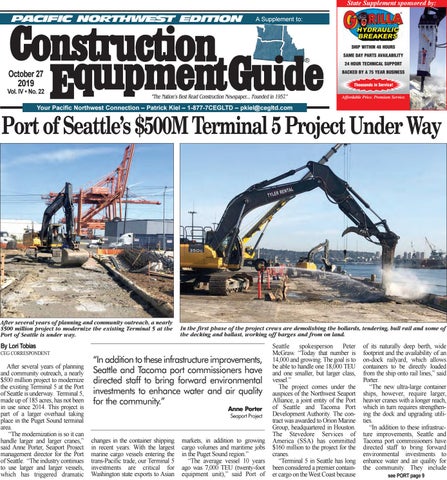
After several years of planning and community outreach, a nearly $500 million project to modernize the existing Terminal 5 at the Port of Seattle is under way.
In the first phase of the project crews are demolishing the bollards, tendering, bull rail and some of the decking and ballast, working off barges and from on land.
By Lori Tobias CEG CORRESPONDENT
After several years of planning and community outreach, a nearly $500 million project to modernize the existing Terminal 5 at the Port of Seattle is underway. Terminal 5, made up of 185 acres, has not been in use since 2014. This project is part of a larger overhaul taking place in the Puget Sound terminal area. “The modernization is so it can handle larger and larger cranes,” said Anne Porter, Seaport Project management director for the Port of Seattle. “The industry continues to use larger and larger vessels, which has triggered dramatic
“In addition to these infrastructure improvements, Seattle and Tacoma port commissioners have directed staff to bring forward environmental investments to enhance water and air quality for the community.” Anne Porter Seaport Project
changes in the container shipping in recent years. With the largest marine cargo vessels entering the trans-Pacific trade, our Terminal 5 investments are critical for Washington state exports to Asian
markets, in addition to growing cargo volumes and maritime jobs in the Puget Sound region.” “The average vessel 10 years ago was 7,000 TEU (twenty-foot equipment unit),” said Port of
Seattle spokesperson Peter McGraw. “Today that number is 14,000 and growing. The goal is to be able to handle one 18,000 TEU and one smaller, but larger class, vessel.” The project comes under the auspices of the Northwest Seaport Alliance, a joint entity of the Port of Seattle and Tacoma Port Development Authority. The contract was awarded to Orion Marine Group, headquartered in Houston. The Stevedore Services of America (SSA) has committed $160 million to the project for the cranes. “Terminal 5 in Seattle has long been considered a premier container cargo on the West Coast because
of its naturally deep berth, wide footprint and the availability of an on-dock railyard, which allows containers to be directly loaded from the ship onto rail lines,” said Porter. “The new ultra-large container ships, however, require larger, heavier cranes with a longer reach, which in turn requires strengthening the dock and upgrading utilities. “In addition to these infrastructure improvements, Seattle and Tacoma port commissioners have directed staff to bring forward environmental investments to enhance water and air quality for the community. They include see PORT page 9
Page 2 • October 27, 2019 • www.constructionequipmentguide.com • Pacific Northwest Supplement • Construction Equipment Guide
Oregon Logging Conference 2020 Open for Registration By Jennifer Hetrick CEG ASSOCIATE EDITOR Registration is now open for the 82nd Oregon Logging Conference (OLC) to be held at the Lane County Events Center and Fairgrounds, Eugene, Ore., February 20-22, 2020. Attendees will experience education, friendly competition and socializing centered on the theme. “Working Forests, Carbon Keepers.” The conference begins with the OLC opening session breakfast on Thursday, Feb. 20, 2020 with a presentation by Keynote Speaker Dr. Moore. According to his biography, Dr. Patrick Moore is an informed and provocative speaker who inspires new ways of thinking about environmental challenges. His views are refreshing, informative and relevant. He is focused on the promotion of sustainability and consensus building among competing concerns. He calls for issues to be discussed on the basis of accurate scientific data, and the creation of sustainable solutions. OLC President Greg Stratton said, “While Mr. Moore may not always tell you what you want to hear, I have found him to be honest and truthful. I believe politics are based on opinions and agendas,” Stratton continued, “but science should be proven and validated with facts.” The OLC is offering two days of business sessions on 18 industry
The annual Oregon Logging Conference always features a large display of the latest in equipment and technology for the industry.
related topics led by 26-plus experts in the field for which attendees can earn 11 professional logger credits/8 SAF-CF. The “Logging, Construction, Trucking & Heavy Equipment Expo” gives attendees the opportunity to view the latest technology in logging and construction equipment on display inside and outside at the Lane County Fairgrounds.
Participants also may register for the 11th Annual Log Loader Competition, scheduled for the second two days of the conference. Social events include the 17th annual “Desserts for Dreams,” which benefits the “Human Trafficking: In Our Backyard” program and the social reception and buffet dinner on Friday evening. Saturday is Family Day at the
OLC, a free event open to conference attendees and the public. This annual favorite will offer many activities including wildlife exhibits, make your own bird feeder, a cross-cut saw demonstration and plenty of logging equipment to explore. “The Oregon Logging Conference is packed with unique opportunities for forestry profes-
sionals to network and learn more about their trade. The 2020 conference will certainly live up to its reputation as being the best logging, construction, trucking and heavy equipment shows west of the Mississippi,” said Stratton, For more information visit www.oregonloggingconference.co m or contact the OLC at 541-6869191. CEG Attendees can participate in the 11th Annual Log Loader competition at the 2020 Oregon Logging Conference.
Family Day has been a part of the Oregon Logging Conference for more than a decade and always attracts kids of all ages to participate in the many activities available.
Construction Equipment Guide • Pacific Northwest Supplement • www.constructionequipmentguide.com • October 27, 2019 • Page 3
YOU ARE INVIITED
POWE ER DA AY YS NOV V 15 5TH TH & 16 16TH 9 AM - 3 PM P
Demo the unstoppable FAE machines, get behind a PrimeT Tech, ech, skid steer mulcher, mulcher excavator mulccher and forestry tiller! RSVP required with M Mike@pactractor or.com to reserve a spot!
PAC TR AC TOR AND G LOB AL: THE LEADING DEAL LERS F O R FAE AND PRIM METE CH ON THE WE S T C OA S T!
Page 4 • October 27, 2019 • www.constructionequipmentguide.com • Pacific Northwest Supplement • Construction Equipment Guide
Construction Phase of Puget Sound Gateway Under Way Gov. Jay Inslee joined state and local officials at the Port of Tacoma to help The Washington Department of Transportation (WSDOT) kick off the construction phase on the Puget Sound Gateway Program. The Gateway Program includes two projects — SR 167 completion in Pierce County and SR 509 completion in King County — new connections to the Ports of Seattle and Tacoma and manufacturing and industrial centers that will enhance the state’s national and global economic competitiveness. “These two projects will help Washington
NORTHWESTERN PUBLISHING 2019 Issue#
Closing
Publishing
24
November 14
November 24
26
December 12
December 22
River valleys and the Seattle/Bellevue metropolitan area. Currently, the highway terminates at Meridian Road in Puyallup. WSDOT will build 4 mi. of new highway to complete the missing link between SR 167 in Puyallup and I-5 in Fife. The SR 167 Project also includes a new a 2-mi. connection from I-5 to the Port of Tacoma.
SR 509 in King County Extending SR 509 will increase connectivity between Seattle and south King County and also provide a much-needed north-south alternative to I-5. Additionally, the SR 509 extension will create a new southern “By completing SR 167 and SR 509, access point to Sea-Tac Airport and serve we are closing two of the state’s International as an alternative to I-5, SR 99, and local streets. major transportation gaps.” “By completing SR 167 and Roger Millar SR 509, we are closing two of the state’s major transportation Washington State Department of Transportation Secretary gaps. But these aren’t just WSDOT projects,” said Secretary of Transportation state stay competitive in the global market- Roger Millar. “Eighteen local jurisdictions place by providing critical ‘last mile’ con- want to see these projects completed and nections between one of the nation’s largest have shown their support by contributing distribution centers and the ports of Tacoma $130 million toward their construction.” The majority of Puget Sound Gateway and Seattle,” said Inslee. “This is exactly the kind of smart investment we need to make to Program funding comes from the 2015 address our transportation priorities because Connecting Washington transportation revit pays dividends that include thousands of enue package. Additional funding will come new jobs, easier access to our ports for from tolls, local contributions, and potential Washington state products, and more trans- federal grants. Gateway Program construction is divided portation choices.” into two stages; stage 1 projects will be constructed between 2020 and 2026 and stage 2 SR 167 in Pierce County SR 167 serves as a primary highway con- projects will be constructed between 2024 nection between the Kent and Puyallup and 2028.
New Seattle NHL Arena on Schedule for Summer of 2021 SEATTLE (AP) The arena for Seattle’s NHL expansion franchise remains on track to open sometime in the summer of 2021. Construction officials said that the entire bowl of the former KeyArena has been demolished and excavation work is ongoing. Officials hope to begin digging down 15 ft. from the current floor by year’s end and to spend most of 2020 constructing the new seating bowl from the bottom up.
Ken Johnsen, who is overseeing the construction project for Oak View Group and the NHL franchise, said the most challenging part so far has been putting in supports to take on the weight of the 44 million-lb roof, which is staying in place. The new arena is being built under the roof, which has historical landmark status. Johnsen says the budget for the project remains around $930 million. CEG
Construction Equipment Guide • Pacific Northwest Supplement • www.constructionequipmentguide.com • October 27, 2019 • Page 5
www.modernmachinery.com Kent, WA (800) 669-2425 Rochester, WA (800) 304-4421 Spokane, WA (800) 541-0754 Boise, ID (800) 221-5211 Pocatello, ID (800) 829-4450 Billings, MT (800) 735-2589 Kalispell, MT (800) 434-4190
“WE PU USH EVERYTTHING TO O THE LIM
Missoula, MT (800) 332-1617 Eugene, OR (800) 826-9811 Portland, OR (800) 950-7779 Magadan, Russia 011-7-41326-99298 Yuzhno-Sakhalinsk, Russia 011-7-42424-69051
See Us at North Hall: N10825
MORE RELLIABLE. “How does Komatsuu work for our construction business? First it’ their reliable, qualityy designed and built equipment. W afford downtime, andd Komatsu’s products a in our book. The support pport we receive from our dealer is outstanding as well. Trraining, parts, financing have experienced p the he best personal p care with Komatsu. They just work best for us!”
Hunter and Clint Shackelford Shackelford Construction truction / Yaazoo City,
That t’s s why hy y I am K Koma ma komattsuamerica.com
ca Corp. All Rights Reserved 036 © 2018 Komatsu America
Page 6 • October 27, 2019 • www.constructionequipmentguide.com • Pacific Northwest Supplement • Construction Equipment Guide
Manitowoc MLC300 Helps in Washington Bridge Project Ceccanti, a Tacoma, Wash.-based construction company, needed a crane with superior maneuverability that could handle heavy loads at great heights to assist with the replacement of an old wooden bridge in Ridgefield, Wash. The contractor found the Manitowoc MLC300 crawler crane had the right features to get the job done in the shortest time possible. “We chose the MLC300 because of its superior capacity at radius and its maneuverability when compared to similar cranes in its range, and even larger cranes,” said Jake Brockmoller, project manager at Ceccanti. “This crawler crane’s radius allowed service of 75 percent of the job with help from the derrick barge. We would have certainly lost time and money if we had deployed other equipment.” The work in Ridgefield started last February. Initially, the contractor had the job
The MLC300 was positioned on a bulkhead built on the shore of the river. From there, the crane enabled Ceccanti to set shaft cages, position casings, place girders and all other construction support to take place without moving.
November. By then, the singlelane wooden bridge will be replaced by a two-lane concrete bridge that will pass over railroad tracks on the opposite riverbank. Brockmoller explained that the MLC300 was positioned on a bulkhead built on the shore of the river. From there, the crane enabled Ceccanti to set shaft The MLC300 features a 386 ton capacity and 334.6 cages, position casings, place ft. boom, which also can be fitted with a 315 ft. luff- girders and all other construction support to take place without ing jib. moving. The MLC300 lifted scheduled to take 14 months to complete, girders as heavy as 66.5 ton to heights of 65 but now it is going to wrap up approximately ft. and rebar cages as heavy as 61 ton to as five months ahead of schedule, in high as 125 ft.
Western Pacific Crane & Equipment was instrumental in helping Ceccanti find the best crane to efficiently complete the job in Ridgefield. Working from its Arlington, Wash., regional facility, Western Pacific consulted with Ceccanti on the nature of the project and helped the company conclude that the MLC300’s strong load chart at long radii would be needed for the lifts from one side of the river. Western Pacific helped Ceccanti determine that the company could save money by deploying the MLC300 over alternative lifting strategies. “As a Manitowoc crane distributor we strive to support our customers with the best consultation and support service possible,” said Randy DeFosse, general manager at Western Pacific. “This project presented a
multitude of logical challenges. The versatility and best-in-class capacity of the MLC300 were the perfect solution to our customers’ needs and job site requirements. We are pleased to hear that the crane is not only getting the job done but helping Ceccanti to save time and money in the process.” The MLC300 features a 386 ton capacity and 334.6 ft. boom, which also can be fitted with a 315 ft. luffing jib. It comes standard with Manitowoc’s CCS (crane control system) that offers a user-friendly interface, two full-graphic displays mounted horizontally for better visibility, a jog dial for easier data input and ergonomic joysticks. For more information, visit www.manitowoc.com.
Amtrack Announces Support of ODOT’s Grant Application In support of an Oregon Department of Transportation (ODOT) grant application, Amtrak announced a matching $750,000 contribution to reduce delays in the Pacific Northwest Rail Corridor. ODOT’s grant application, if successful, will restore an out-of-service siding between Portland and Salem. Restoring this siding will improve on-time performance on a rail line segment where the largest cause of delay to Amtrak Cascades customers is freight train interference. “Oregon’s Amtrak network operates on tracks owned, maintained and dispatched by freight railroads. Because the freight railroads make all dispatching decisions, they have a tremendous amount of influence over schedule, often prioritizing their own trains over our customers,” said Richard Anderson, Amtrak president and CEO. “We are thrilled to invest in the Oregon City Siding Project and further the first
phase that will not only reduce delays but will contribute to the economic competitiveness of the region.” The Oregon City Siding rehabilitation project was selected by ODOT to be one of three projects the agency will sponsor for the U.S. Department of Transportation’s Better Utilizing Investments to Leverage Development (BUILD) Discretionary Grants program. The BUILD program emphasizes improved access to reliable, safe and affordable transportation for communities in urban and rural areas, such as projects that improve infrastructure conditions, address public health and safety, promote regional connectivity or facilitate economic growth or competitiveness. BUILD is a highly competitive grant program for surface transportation infrastructure projects that have a significant local, regional or national impact.
Plans for restoring the Oregon City Siding include laying new track, ties and equipping both ends with power-operated switches and switch heaters to avoid snow delays in the winter. After the completion of the Oregon City Siding Project, ODOT will work to secure funding for an additional track on an adjacent 3-mi. section between Oregon City and an existing siding to the south. This two-phase project will result in 5 mi. of a new double-track section between Portland and Salem, significantly reducing congestion and delays caused by freight trains and other Amtrak trains. On-time performance of the Amtrak Cascades service between Portland and Eugene is frequently impacted by delays caused by freight trains and other Amtrak trains. This project will help reduce these delays so that Amtrak customers arrive at their destination on time.
Construction Equipment Guide • Pacific Northwest Supplement • www.constructionequipmentguide.com • October 27, 2019 • Page 7
Contact your local dealer:
WASHINGTON: Seattle, WA 8207 South 216th Street Kent, Washington 98032 206.762.5933 Manager: Brian Burke bburke@PacWestMachinery.com Spokane, WA 4030 East Trent Avenue Spokane, Washington 99202 509.534.5933 Manager: Scott Upton supton@PacWestMachinery.com
OREGON: Portland, OR 19255 NE Sandy Boulevard Portland, Oregon 97230 503.252.5933 Manager: Tim Hurst thurst@PacWestMachinery.com Eugene, OR 1550 Irving Road Eugene, Oregon 97402 541.302.3762 Manager: Tim Hurst thurst@PacWestMachinery.com
PacWestMachinery.com
Page 8 • October 27, 2019 • www.constructionequipmentguide.com • Pacific Northwest Supplement • Construction Equipment Guide
Oregon Repeals 1995’s Tsunami-Zone Construction Ban NEWPORT, Ore. (AP) With sunlight sparkling off surrounding Yaquina Bay, workers are putting up an ocean-studies building, smack in the middle of an area expected to one day be hit by a tsunami. Experts say it’s only a matter of time before a shift in a major fault line off the Oregon coast causes a massive earthquake that generates a tsunami as much as seven stories tall. Even as work on Oregon State University’s Marine Studies Building was under way in Newport, the Legislature went a step further and repealed a ban on construction of new “critical facilities” in tsunami inundation zones, allowing fire stations, police stations and schools to be built in the potential path of a tsunami. Passage of the bill in June was little noticed during one of the most tumultuous legislative sessions in Oregon history. But it has since been roundly criticized — including by Gov. Kate Brown, who told journalists the bill’s passage was one of her disappointments, even though she signed the measure and previously said it benefited economic development. Chris Goldfinger, an Oregon State University professor and an earthquake geologist, says putting the $60 million oceanography building in the path of a tsunami is “beyond ironic,” and allowing even more construction threatens lives in favor of development. “It’s foolhardy. In every other country in the world, best practice for tsunamis is avoidance, not building in a tsunami zone,” Goldfinger said at a symposium for journalists in Newport that included a tour of the construction project. Proponents of the university facility point out that the building will withstand strong earthquakes and be higher than the biggest tsunami. It will feature a rooftop evacuation site that can accommodate more than 900 people, accessed via an exterior ramp. Two days of supplies will be kept on the roof, said Cinamon Moffett, research facility coordinator for the marine center. Once the water subsides, survivors would be evacuated to a community college on a nearby hill, she said. An earthquake in the Cascadia
Proponents of the university facility point out that the building will withstand strong earthquakes and be higher than the biggest tsunami.
subduction zone, which extends in the ocean off Northern California to Canada’s Vancouver Island, has a 37 percent probability of happening off Oregon in the next 50 years, with a slightly lower chance of one striking near Washington State, Goldfinger said. Cascadia earthquakes have an average magnitude of around nine, making them among the world’s biggest. Evidence of a Cascadia earthquake’s awesome destructive power is visible 30 miles up the coast from Newport. There, a “ghost forest” of Sitka spruces juts up from a beach in the tiny town of Neskowin. An earthquake 2,000 years ago likely caused the ground beneath the trees to plunge, and tsunami debris buried them. The remnants were partially uncovered by storms in 1997. Today, the barnacle-encrusted trees stand like sentinels, facing the Pacific Ocean with vacation homes and a motel nearby. The last time the ocean reared up from a Cascadia earthquake was in 1700. The estimated magnitude nine quake sent a tsunami across the Pacific into the coast of Japan, where it flooded farm fields, damaged fishermen’s shacks and ascended a castle moat. In the Pacific Northwest and Canada, the impact was far worse, and is described in the folklore of indigenous peoples. Oregon became a leader in tsunami preparedness when the
Legislature, in 1995, banned construction of certain public facilities in inundation zones. Vancouver Island in Canada’s British Columbia province was slammed by the 1700 tsunami. But no law prohibits construction of public buildings in tsunami zones there, according to Emergency Management BC. Washington State requires municipalities and counties to establish rules to limit development in areas that are frequently flooded or could be hit by tsunamis, landslides or other calamities. California has no state-mandated development restrictions in tsunami zones, said Rick Wilson, senior engineering geologist with the California Geological Survey. But the state recently adopted new language in its building code requiring that certain types of buildings be constructed to withstand tsunami forces, Wilson said. Other states are moving to do the same, using standards from the American Society of Civil Engineers. Japan, reacting to a 2011 earthquake and tsunami that left more than 18,000 dead or presumed dead, passed a law allowing towns to set tsunami warning zones and make evacuation and reconstruction plans. The government is spending 1 trillion yen ($9 billion) to build giant seawalls around the northern coastline. Moving to higher ground is not required,
though some coastal communities have done so. “Oregon has gone from sort of a leader in this to full reverse,” said Goldfinger, who was attending a seismology conference in Japan when the 2011 earthquake hit. Oregon lawmakers overwhelmingly repealed the 1995 construction ban in June, as tensions in the Capitol ratcheted up over Republican opposition to a bill addressing global warming. Few people attended hearings at which lawmakers from coastal districts testified in favor of the repeal. Democratic Rep. David Gomberg, one of its sponsors, told members of a House committee to imagine the impacts if the state banned new schools, parking garages and police and fire stations in their communities. “What would be the consequence of that, to your ability to get insurance on your home, your ability to attract a new business into a neighborhood that’s not safe enough for fire departments, your ability to resell your home in a neighborhood not safe enough for police departments?” Gomberg asked. He said the state geology department should “help us rather than to stop … our communities growing, thriving or continuing.” Gomberg said his bill gives the department responsibility for advising where a new inundation line should be and how risks can be mitigated. He also said he will
introduce legislation for Oregon to adopt the American Society of Civil Engineers’ tsunami and earthquake building standards. Republican Sen. Brian Boquist, who was at the center of a Republican walkout over the global warming bill, was the only senator to vote against the repeal. Boquist said in an email that it allows public entities to build, knowing full well the buildings will not survive a tsunami. It is too soon to tell if coastal cities will use the new leeway to build facilities in inundation zones. Some have been doing the opposite. The town of Seaside, 70 mi. northwest of Portland, is moving schools out of the tsunami zone. Newport Mayor Dean Sawyer said his city has no plans to build critical facilities in the inundation zone. But he praised the Marine Studies Building for its rooftop evacuation site, which can fit the population of an entire neighborhood of his fishing town. “We consider it to be a unique solution,” he said. Meanwhile, the Corvallis Gazette-Times noted in an editorial that while it is possible to design a building that can survive an earthquake and tsunami, “that doesn’t answer the question of why we should take the risk in the first place.” The newspaper urged lawmakers to reassess the new law when they convene next year.
Construction Equipment Guide • Pacific Northwest Supplement • www.constructionequipmentguide.com • October 27, 2019 • Page 9
SEATTLE/TACOMA 253.722.5560 SPOKANE 509.534.1900 MT.VERNON 360.488.3948 PORTLAND 503.254.5100 BEND/PRINEVILLE 541.447.5293 EUGENE 541.342.7700
Crews Work on Barges, Land for Phase I of Port of Seattle Project PORT from page 1
updating stormwater treatment systems and installing ‘shore power’ infrastructure, which allows a vessel to plug into electricity while at berth, substantially reducing air emissions,” Porter continued. “The plan also includes technology improvements to manage truck flow around the terminal and a railroad ‘quiet zone’ to reduce noise impacts for the surrounding community.” The project broke ground in July 2019. In the first phase of the project crews are demolishing the bollards, tendering, bull rail and some of the decking and ballast, working off barges and from on land. They also are driving new and deeper piles Once completed, phase one will include new electrical infrastructure with a new primary substation, crane rails, bollards, fendering and an underwater toe wall. New cranes will be placed on the north dock during phase two of the project. Phase two also will involve demolishing and reconstruction of the southern part of the dock. When completed, the south dock also will have a new underwater toe wall, crane rails, bollards and fendering. Dredging of both the north and south berths will take place once phase two is complete. Because the port is so close to residential areas, the Port of Seattle worked closely with the community to
mitigate factors that would interrupt daily life. “We met regularly at scheduled community organization meetings, neighborhood councils, community groups, Chambers of Commerce,” McGraw said. “We’d go and present to them our plans and then we would host open houses as well. We displayed images of what the terminal would look like and the structures involved. Been doing that for the past couple of years at least.” One major challenge is negating noise. To that end, the Port has restricted the hours for pile driving, and require construction equipment to use low-frequency back-up alarms. “They’re pretty noisy,” Porter said. “That will wake you up at night. Other challenges we’ve faced include running into unknown site conditions. When we’re driving pile, they can run into obstruction in the sediment. They either have to relocate the pile or cut it. And we can only work in the water six months of the year because of salmon migration. We try to avoid the season the juvenile salmon are migrating, so we’re not allowed to do in-water work, between Feb. 15 and Aug. 15.” Phase one of the project is set to be completed by 2021 with phase two slated to be finished in 2023. CEG
Challenges on the project include crews hitting obstructions in the sediment while they are driving pile, which means they to have to either cut the pile or place it in a different location.
Page 10 • October 27, 2019 • www.constructionequipmentguide.com • Pacific Northwest Supplement • Construction Equipment Guide
Idaho Highway Project Lettings
The Idaho Department of Transportation received bids for transportation-related improvement projects. Following is a list of some of the projects let.
• Concrete Placing Company Inc. — $24,661,970 • Central Paving Company Inc. — $24,934,509 • Sunroc Corporation — $28,556,752 County: Nez Perce Project No.: A020(020) Project: Main Street pedestrian improvements, Lewiston Engineers Estimate: $259,490 Contractors and Bid Amounts: • Crea Construction Inc. — $284,760 • Knox Concrete LLC — $297,280
County: Elmore Project No.: A020(162) Project: STC-3738 — Strike Dam road improvements, Mountain Home Highway. Engineers Estimate: $583,421 Contractors and Bid Amounts: • Robison Logging & Excavation — $691,209 • Knife River Corporation-Mountain West — $731,227 • Concrete Placing Company Inc. — $1,011,875 • Sunroc Corporation — $1,154,570
Counties: Shoshone and Benewah Project No.: A019(786) Project: STC-5711 — St. Joe River Road pavement rehab. Engineers Estimate: $4,037,559 Contractors and Bid Amounts: • Interstate Concrete & Asphalt — $3,432,888 • Coeur d’Alene Paving Inc. — $3,772,426 • Poe Asphalt Paving Inc. — $4,128,124 • Knife River Corporation – Mountain West — $5,175,000
County: Bonner Project No.: A020(211) Project: SMA-7895 — Kootenai cutoff road pedestrian improvements, Ponderay. Engineers Estimate: $115,055 Contractors and Bid Amounts: • Interstate Concrete & Asphalt — $154,732 • TML Construction Inc. — $219,307 County: Kootenai Project No.: A013(874) Project: STC-5740 — West Riverview Drive, Post Falls Highway. Engineers Estimate: $682,574 Contractors and Bid Amounts: • Northwest Grading Inc. — $531,577 • T LaRiviere Equipment & Excavation — $753,528
• Scarsella Bros. Inc. — $20,884,101 • N A Degerstrom Inc. — $21,239,938 • Halme Construction — $26,318,751 • Apollo Inc. — $27,354,370
County: Kootenai Project Nos.: A019(883) and A019(234) Project: U.S. 95, north corridor access improvements. Engineers Estimate: $7,625,566 Contractors and Bid Amounts: • Apollo Inc. — $8,994,144 • Interstate Concrete & Asphalt — $11,162,325
County: Latah Project No.: A018(944) Project: SH-6, north and south SH-9 turnbays. Engineers Estimate: $1,615,927 Contractors and Bid Amounts: • Knife River Corporation-Mountain West — $1,434,000 • Crea Construction Inc. — $1,479,286 • Scarsella Bros. Inc. — $1,839,867
County: Kootenai Project No.: A020(794) Project: Junction SH-53 IC, UPRR Bridge. Engineers Estimate: $23,553,004 Contractors and Bid Amounts:
County: Canyon Project No.: A020(799) Project: I-84, Karcher IC to Northside Boulevard. Engineers Estimate: $22,402,692 Contractors and Bid Amounts:
County: Boise Project No.: A007(215) Project: SH-55, Payette River Bridge, Horseshoe Bend. Engineers Estimate: $10,970,605 Contractors and Bid Amounts: • Braun-Jensen Inc. — $10,890,000 • Cascade Bridge LLC — $11,086,079 • Wadsworth Brothers Construction Company Inc. — $11,797,424 • Knife River Corporation-Mountain West — $12,495,905 County: Bingham Project No.: A012(445) Project: Groveland Road, SH-39 to U.S. 26/Pioneer Rd. Engineers Estimate: $1,906,170 Contractors and Bid Amounts: • Staker & Parson Companies d/B/A Idaho Materials Construction — $1,635,228 • Depatco Inc. — $1,838,888 • Gale Lim Construction LLC — $2,187,831
Construction Equipment Guide • Pacific Northwest Supplement • www.constructionequipmentguide.com • October 27, 2019 • Page 11
Telehandler e s
Visit your local Pettib bo one dealer:
7625 N.E. Killlingsworth St. Portland, Oregon 97218
(800) 356-6243 www.land dmarkequipment.com
WSDOT Awards Contract for I-405 Widening, Express Lanes For drivers who regularly experience congestion on Interstate 405 between Renton and Bellevue, help is on the way. The Washington State Department of Transportation (WSDOT) announced the award of a design-build contract to start construction on the I-405, Renton to Bellevue Widening and Express Toll Lanes project. The contractor Flatiron West, Inc.-The Lane Construction Corporation Joint Venture (Flatiron/Lane) submitted the apparent best value proposal of $705 million. When the project opens in 2024, it will add new capacity to create a dual express toll lane system between State Route 167 in Renton and Northeast Sixth Street in Bellevue. The project will also build two new southbound auxiliary lanes, and rebuild several I-405 interchanges to accommodate the additional roadway. “The first phase of the project, the I405/SR 167 Interchange Direct Connector, opened to traffic in February ahead of schedule and under budget,” said Kim Henry, I405/SR 167 program administrator. “This next phase will really be key to improving the challenges facing drivers south of I-90
and will help provide new options for commuters along the entire corridor.” The project also will build portions of King County’s 42-mi. Eastrail and new infrastructure to support Sound Transit’s I405 Stride Bus Rapid Transit system. The I405 project is designed to improve speeds and trip reliability for all travelers and support the new BRT line. “Sound Transit has worked closely with WSDOT to implement the region’s longstanding vision for I-405,” said Bernard van de Kamp, Sound Transit’s East Corridor development director. “We have made a significant investment in this project to ensure fast, reliable trips for the thousands of people who will ride Sound Transit’s Stride bus rapid transit every day starting in 2024. With connections to light rail and local transit, Stride BRT will be an important component of the regional transit network.” WSDOT expects to give Flatiron/Lane notice to proceed on the first phase of design and construction activities later this year. People who drive this corridor can expect to see construction activities start in early 2020.
Efficiency & High Performance.
Page 12 • October 27, 2019 • www.constructionequipmentguide.com • Pacific Northwest Supplement • Construction Equipment Guide
The LH50M Industry material handler represents efficiency and high performance. The standard Liebherr regenerative power system assures maximum handling while, at the same time, achieving lower fuel consumption. Quiet operation with the highest payload is guaranteed by the large, sturdy undercarriage. The attachment of the machine is available in a variety of versions and is thus always optimally matched to your respective application.
18060 Des Moines Memorial Dr. Seattle, WA 98148 3909 NW Fruit Valley Rd Vancouver, WA 98660