State Supplement sponsored by:
PACIFIC NORTHWEST EDITION
A Supplement to:
SHIP WITHIN 48 HOURS SAME DAY PARTS AVAILABILITY
®
BACKED BY A 75 YEAR BUSINESS
May 12 2019 Vol. IV • No. 10
24 HOUR TECHNICAL SUPPORT
Thousands in Service!
“The Nation’s Best Read Construction Newspaper… Founded in 1957.”
Affordable Price. Premium Service.
CALL 800-367-4937 Your Pacific Northwest Connection – Patrick Kiel – 1-877-7CEGLTD – pkiel@cegltd.com
*On approved credit • Financing Available
ITD Finds Innovative New Method to Replace 17 Bridges Idaho Department of Transportation photo
Idaho Department of Transportation photo
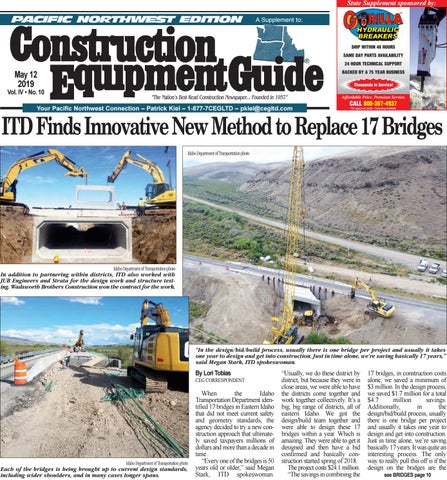
In addition to partnering within districts, ITD also worked with JUB Engineers and Strata for the design work and structure testing. Wadsworth Brothers Construction won the contract for the work.
“In the design/bid/build process, usually there is one bridge per project and usually it takes one year to design and get into construction. Just in time alone, we’re saving basically 17 years,” said Megan Stark, ITD spokeswoman.
By Lori Tobias CEG CORRESPONDENT
Idaho Department of Transportation photo
Each of the bridges is being brought up to current design standards, including wider shoulders, and in many cases longer spans.
When the Idaho Transportation Department identified 17 bridges in Eastern Idaho that did not meet current safety and geometry standards, the agency decided to try a new construction approach that ultimately saved taxpayers millions of dollars and more than a decade in time. “Every one of the bridges is 50 years old or older,” said Megan Stark, ITD spokeswoman.
“Usually, we do these district by district, but because they were in close areas, we were able to have the districts come together and work together collectively. It’s a big, big range of districts, all of eastern Idaho. We got the design/build team together and were able to design these 17 bridges within a year. Which is amazing. They were able to get it designed and then have a bid confirmed and basically construction started spring of 2018. The project costs $24.1 million. “The savings in combining the
17 bridges, in construction costs alone, we saved a minimum of $3 million. In the design process, we saved $1.7 million for a total $4.7 million savings. Additionally, in the design/bid/build process, usually there is one bridge per project and usually it takes one year to design and get into construction. Just in time alone, we’re saving basically 17 years. It was quite an interesting process. The only way to really pull this off is if the design on the bridges are the see BRIDGES page 10
Page 2 • May 12, 2019 • www.constructionequipmentguide.com • Pacific Northwest Supplement • Construction Equipment Guide
Two Record-Setting Concrete Pours Take Place in Washington A new record for the largest continuous concrete pour was set in Washington state for the foundation of the Lincoln Square South tower. However, it was short-lived; as less than a month later, the tower next to it beat the record. Vital to both high-profile concrete pours were Putzmeister placing systems, seven truck-mounted boom pumps and a high-pressure trailer pump — all supplied by Ralph’s Concrete Pumping Inc. of Seattle. The two skyscrapers, part of a $1.2 billion Lincoln Square Expansion II project, offer a 1.5 million sq. ft. mixed-use development in the heart of downtown Bellevue. The site consists of Class A offices, including a six-level, 2,200-car underground parking garage, 231 luxury residences, 245-guestroom W Hotel, as well as
Ralph’s Concrete Pumping supplied the concrete placing equipment to continuously place 13,400 cu. yd. (10,245 cu m) of concrete in 16 hours for the first of two record-setting pours in Washington state.
A new record for the largest continuous concrete pour was set in Washington state when 13,690 cu. yd. (10,467 cu m) of concrete was placed in 24 hours for the foundation of the 450-ft. (137.16 m) tall north tower at Lincoln Square.
upscale retail, restaurants and entertainment. Having consumed an approximate total of 140,000 cu. yds. (107,037 cu m) of concrete, the three-year project is complete with occupancy ongoing. Building the impressive structures was not an easy feat. The area is two city blocks long and one city block wide, so after the earth was excavated, nearly three million pounds (1,360 t) of rebar was installed to prepare the site for a 10-ft.-thick (3.05 m) concrete foundation. For the first mat, two 40Z-meter detachable placing booms, plus five 61-meter and two 40Z-meter boom pumps continuously placed 13,400 cu. yds.
(10,245 cu m) of concrete in 16 hours to set the first record in January 2015. Access to the foundation was 75 ft. (22.86 m) below street level. In the hole, a 40Z-meter placing boom with a Putzmeister tower was installed in a footing early on, as it would be used for both the mat pour and for the climb to the top of the 32-story high rise. Another 40Z-meter placing boom also was set atop a freestanding tower with a ballasted base. This configuration avoided pouring another footing. From street level, concrete was supplied to each placing boom by two 40Z-meter truck-mounted boom pumps. Each unit pushed
A combined hotel and luxury apartment tower and a new office high rise are included in the Lincoln Square Expansion II project in downtown Bellevue, Wash.
concrete directly from their hoppers through 5-in. (12.5 cm) pipeline that traveled down the sides of the hole and then horizontally to the two different placing boom towers — the pipe stretched 500 ft. (152.40 m) to one placing boom location, 175 ft. (53.34 m) to the other. Meanwhile, five 61-meter boom pumps were set up around the hole’s perimeter; they provided long 183 ft. 9 in. (56 m) horizontal reaches with plenty of reach to access all parts of the large area. “An enormous amount of strategic planning was required to execute a pour of this size,” said Jacob Gribble, co-owner of Ralph’s. “Our equipment pumped flawless-
ly during the long pour, and all went according to plan.” Another Record Less than a month later, Ralph’s was on site once again to handle a new record-setting pour of 13,690 cu. yd. (10,467 cu m) of concrete in 24 hours. This was for the 450ft. (137.16 m) tall North Tower (hotel and residences). However, this time, it was not only the size but the complexity of the mat pour that made this both a new state record as well as a feat of ingenuity. Gribble said, “When comparing the two pours, the second one was definitely the most logistically dif-
ficult because we had to think outside the box and figure out innovative ways to set up concrete placing equipment as access to the area was extremely limited.” Concrete pumps were not allowed to set up in a neighboring parking lot, which would have offered perfect access and convenience to the site. Since permission was refused, creative solutions were developed, which required five placing booms (a mix of 38and 40Z-meter sizes), six 61-meter boom pumps, a high-pressure trailer pump and literally thousands of feet of pipeline. The mounting configurations of see POURS page 8
Construction Equipment Guide • Pacific Northwest Supplement • www.constructionequipmentguide.com • May 12, 2019 • Page 3
Contact your local dealer:
WASHINGTON: Dealer Name Seattle, WA 8207 South 216th Street City, ST Kent, Washington 98032 123.456.7890 206.762.5933 Manager: Brian Burke City, ST bburke@PacWestMachinery.com 123.456.7890 Spokane, WA 4030 East Trent Avenue City, ST Spokane, Washington 99202 123.456.7890 509.534.5933 Manager: Scott Upton City, ST supton@PacWestMachinery.com 123.456.7890
OREGON: City, ST OR Portland, 123.456.7890 19255 NE Sandy Boulevard Portland, Oregon 97230 503.252.5933 City, ST Manager: Tim Hurst 123.456.7890 thurst@PacWestMachinery.com City, ST OR Eugene, 123.456.7890 1550 Irving Road Eugene, Oregon 97402 541.302.3762 City, ST Manager: Tim Hurst 123.456.7890 thurst@PacWestMachinery.com
Some companies have you choose power or fuel efficiency. You chose both.
City, ST
PacWestMachinery.com 123.456.7890
Volvo developed the industry’s first fuel efficiency guarantee so you never have to compromise on performance or productivity. And with CareTrack machine monitoring, you can focus your attention on more important things — like growing your business. Learn more at volvoce.com/na.
DEALER LOGO
Push Boundaries.
Page 4 • May 12, 2019 • www.constructionequipmentguide.com • Pacific Northwest Supplement • Construction Equipment Guide
Community Celebrates Completion of $5.3M Caveman Bridge Renovation
Oregon Department of Transportation photo
The event included dedication of the refurbished Redwood Empire sign by the city of Grants Pass. Oregon Department of Transportation photo
Oregon Department of Transportation photo
The $5.3 million renovation of the Caveman Bridge, which first opened in 1931, was observed.
A community celebration and rededication of two iconic Grants Pass historic features was held May 3 at the Tap Rock and Riverside Inn overlooking the Caveman Bridge. The $5.3 million renovation of the Caveman Bridge, which first opened in
1931, was observed followed by the dedication of the refurbished Redwood Empire sign by the city of Grants Pass. “It’s notable when a community takes an image of a bridge and makes it part of its logo,” said ODOT Historian Chris Bell. “That tells me this structure is very much a part of
The 18-month renovation of Caveman Bridge included cosmetic and structural repairs, including seismic upgrades, new rails and lights, deck resurfacing and a total renovation of the aging concrete bridge surface.
the DNA of Grants Pass and its people.” The 18-month renovation of Caveman Bridge by contractor H.P. Civil of Stayton was finished in February. It included cosmetic and structural repairs, including seismic upgrades, new rails and lights, deck resurfacing and a total renovation of the aging con-
crete bridge surface. A brass plaque will be unveiled to commemorate the bridge designed by famed Oregon bridge designer Conde McCullough. For more information, visit cavemanbridge.com.
ITD Contractor Removing Hazard Trees on I-90 Near Fourth of July Pass Idaho Transportation Department photo
The Lorenzo Bridge rehabilitation is expected to be completed this fall.
Work Under Way on Lorenzo Bridge Construction began April 29 on the Lorenzo Bridge on U.S.-20 in Madison County. The bridge rehabilitation is expected to be completed this fall. “This rehabilitation will entail re-surfacing of the bridge deck, replacing the guardrail, improving the bridge approaches and finishing with new pavement,” said ITD Project Manager Alecia Johnson. “This project will greatly improve and extend the lifespan of the bridge.” Drivers can expect traffic delays for the duration of the project. Reduced speed limits will be in effect and traffic will be shifted over periodically to single lane two-way traffic.
Beginning in late April, contractors began removing hazard trees along two miles of Interstate 90 near Fourth of July Pass to enhance highway safety. Trees can be hazardous when they fall, shade roadways and cause icy conditions in winter as well as hide any approaching wildlife. Work will last for approximately one month during which travelers can expect work on the shoulders. Trees on the eastbound side will be removed first, followed by trees on the westbound side. Drivers may encounter single-lane or possibly two-lane closures of I-90. Full closures will be less than 10 minutes and may be necessary when logging tall or dead trees near the interstate. Crews will determine the need for and timing of these closures on site. The contractor will remove dead and dying trees from 200 acres of state property while also harvesting other trees in the area to cover operating costs.
Idaho Transportation Department photo
The contractor will remove dead and dying trees from 200 acres of state property while also harvesting other trees in the area to cover operating costs.
“It’s important to do this work when we can because trees can fall on the road or act as obstacles when people drive off the road,” operations engineer Jerry Wilson said. “We’ve found a way to let experts remove these trees at no extra cost to the taxpayers, while enhancing their safety.” In the past, ITD has hired help to remove trees that could not be safely removed with its own employees and
equipment, with a recent contract charging $1,000 per tree. “Given the number of trees that need to be removed in this section, that wasn’t feasible,” Wilson said. “If this process works well, ITD could continue to use similar partnerships to increase safety along the entire corridor.” For more information, visit itdprojects.org/i90trees.
Construction Equipment Guide • Pacific Northwest Supplement • www.constructionequipmentguide.com • May 12, 2019 • Page 5
hhh aVeVcdR_U\VReed _Ve
))) #($ #%*$ m #!) (%$ !)''
3.
3.
3.
3.
3.
3.
(;
3.
3.
3.
3.
Page 6 • May 12, 2019 • www.constructionequipmentguide.com • Pacific Northwest Supplement • Construction Equipment Guide
Construction Resumes on Historic McCullough Bridge Oregon Department of Transportation photos
Construction on the $31.4 million project is scheduled for completion in October 2021.
After a six-month break from construction, U.S. 101 motorists should expect to see more work on McCullough Bridge. The latest project will rehabilitate the steel structure by removing rust, replacing rivets and repairing damaged steel before repainting the bridge. A crosswalk will be installed at Ferry Road at the south
The latest project on the McCullough Bridge will rehabilitate the steel structure by removing rust, replacing rivets and repairing damaged steel before repainting the bridge.
end of the bridge. Over the next two years, motorists crossing the bridge should expect intermittent nighttime (7 p.m. to 7 a.m.) lane closures and brief delays each Sunday night to Friday morning. Motorists also should watch for daytime shoulder closures. The lane closures will allow
prime contractor Vimas Painting Co. to install and maintain an enclosure around the work area. One sidewalk of the bridge will remain open at all times. Pedestrians will be able to cross U.S. 101 at East Bay Drive at the north end of the bridge and the new crosswalk at Ferry Road. Bicyclists will still be able to use
the beacons at either end of the bridge, or they may walk their bike on the one open sidewalk. Construction on the $31.4 million project is scheduled for completion in October 2021. Over the past decade, McCullough Bridge has seen two large rehabilitation projects that replaced the rails, resurfaced the
$120M Rogue Valley Expressway Opens After nearly three years of construction, the new Rogue Valley Expressway opened May 1. Striping and signing contractors completed their work on the expressway and signal turn-on and final sign installation was scheduled for the night of April 30. This completes nearly three years of
ODOT photo
ODOT photo
The four-lane, $120 million expressway begins east of I-5 Exit 30 and diverges from Crater Lake Highway southeast of the Rogue Valley International-Medford Airport.
percent of the traffic on Oregon 62 — the 4.5-mi.long expressway will mean a savings of about five minutes in travel time. The speed limit is 55 mph. ODOT is reminding motorists to use caution at After nearly three years of construction, the the new traffic control internew Rogue Valley Expressway opened May 1. sections, both at the north end of the expressway with construction and 15 years of planning the new signal south of White City and on a project designed to improve safety the new south-end merge points. Knife River Materials of Central and congestion. For through-motorists — about 30 Point constructed the facility. The final
design was developed with the help of a local citizens. The four-lane, $120 million expressway begins east of I-5 Exit 30 and diverges from Crater Lake Highway southeast of the Rogue Valley International-Medford Airport. The expressway spans Coker Butte and Vilas Roads, and connects at a signalized intersection south of White City. $100 million of the project was funded the 2009 Oregon Jobs and Transportation Act. For more information, visit oregon.gov.
travel lanes, and applied a cathodic protection treatment to the concrete sections of the bridge to prevent corrosion. The historic milelong bridge has been repainted every 15 to 20 years since it opened in 1936. For more information, visit www.McCulloughBridge.com.
Pesticide Damage...
Crews Removing Trees Along U.S. 20 Near Sisters, Ore. Crews, under contract with the Forest Service, began removing hazard trees along U.S. 20 west of Sisters, Ore., on April 29. The project is expected to last three weeks and be completed by May 22. During the project personnel with the Oregon Department of Transportation will provide traffic control Monday through Friday during daytime hours from 7 a.m. until 3:30 p.m. The herbicide Perspective compromised the trees and they need to be removed to ensure public safety in the highway corridor. Approximately 2,100 trees will be removed on both sides of the highway over a distance of 12.5 mi. Most of the trees will be felled and decked nearby for use as wood products under guidance from the Oregon Department of Agriculture. A few of the trees will be cut and left in place or may be topped to provide habitat for wildlife. Motorists can expect to see equipment and personnel in close vicinity to the highway and anticipate delays of no greater than 20 minutes.
Construction Equipment Guide • Pacific Northwest Supplement • www.constructionequipmentguide.com • May 12, 2019 • Page 7
Kent, WA (800) 669-2425 Rochester, WA (800) 304-4421 Spokane, WA (800) 541-0754 Boise, ID (800) 221-5211 Pocatello, ID (800) 829-4450 Billings, MT (800) 735-2589
“THEY JUS ST WORK BETTER! W
Kalispell, MT (800) 434-4190 Missoula, MT (800) 332-1617 Eugene, OR (800) 826-9811 Portland, OR (800) 950-7779 Magadan, Russia 011-7-41326-99298
A TRUSTEED NAME. “At Selge Constrruction, we’re a family business. s. We’ve a wide range of projects, built on a foundation of integrity knowledge and qquality workmanship. Selge hass gained respect throughout the Midwest for the highest quality work built in the safest way possiible. Komatsu builds a quality product that performs as prom mised and helps us get the job done. Th why Komatsu woorks for me!”
Marv Selge ge / Selge Construction, Inc. / Niles, MI
Yuzhno-Sakhalinsk, Russia 011-7-42424-69051
That’s t s why hy I am K Koma matsu ts komatsuamerica.com
035 © 2019 Komatsu America Corp. All Rights Reserved
Page 8 • May 12, 2019 • www.constructionequipmentguide.com • Pacific Northwest Supplement • Construction Equipment Guide
Ralph’s Concrete Pumping Plays Role in Record Pours POURS from page 2
the five placing boom towers varied. A placing boom with a tower on the south side was already in place from the first pour and would be used again and two more towers with ballasted bases were installed outside the mat on the west side. In addition, two footings were poured for two freestanding towers in the middle of the hole (east side). These two towers, in particular, would become a part of the foundation because after the mat pour was finished, the placing boom and upper tower sections were removed, and the remaining 10-ft. (3 m) tower section at the bottom ended up buried in the concrete. To be flush with the concrete, any pieces of the tower section sticking above the concrete were sawed off. Gribble said, “It turned out to be a logical, as well as economical, solution.” Supplying the concrete to the five placing booms were four 61-meter boom pumps at street level. The units used .16H pump cells, capable of up to 210 cu. yd. an hour (160 cu m) outputs, as well as standard high-pressure SValves, so there was plenty of volume and pressure. Plus, a BSA 2110 HP-D trailer pump, capable of outputs up to 133 cu. yd. an hour (102 cu m), also was utilized to pump the concrete. An extensive amount of pipeline traveled down the sides of the deep hole and went in various directions to reach each placing boom tower. OSS Solves Setup Dilemma Another resourceful approach to access the pour involved two 61-meter boom pumps, facing cab-to-cab, that were set up in a narrow alley on the north side. The setup in the extremely tight confines was only possible due to the one-sided support (OSS) outrigger system. OSS reduces the outrigger extension on one side of the unit to create an overall smaller machine footprint. In this case, the outrigger width was reduced by 10 ft. (3.05 m), which enabled a tight fit in the spot. OSS has been a standard feature on Putzmeister 61-meter boom pumps since 2006 when the model was introduced, and its benefit has proven beneficial.
“This setup would have been impossible without OSS on our Putzmeister boom pumps,” Gribble said. More than 80 mixer trucks from five local concrete plants dispatched a selfconsolidating concrete mix that was specified for the bottom 18 in. (45.7 cm) of the foundation to ensure proper concrete consolidation where large concentrations of reinforcing bars occur. The remaining foundation used a low-heat concrete mix to minimize temperature differential between the
placing booms, Series II is an absolute ‘must’,” said Gribble. Series II features exclusive hydraulic connection technology where the operator can easily couple and uncouple individual colorcoded hydraulic hoses while not under pressure. Plus, as the placing booms do not require counterweight, time and labor savings were realized. Other efficiencies also were noted. “With the 50-foot Putzmeister tower, we could pour two floors and then jump the tower compared to Ed Sozinho photo only one floor per jump, which The two skyscrapers, at 32- and 41-stois more common with other ries tall relied on Putzmeister concrete systems,” said Gribble. “This is placing systems for the significant because, with fewer rise to the top levels. jumps, it reduces expensive crane costs.” When tackling the high rises, Gribble said, “One of the biggest obstacles was the very hot mixes — high strength, high heat — which made pumping challenging.” To accommodate the difficult mixes, two BSA 14000 HP-D trailer pumps with 8 in. (20 cm) cylinders and powerful 630 hp (47 kW) Cat engines provided the power to reach the top level. They were especially put to the test when they needed to accommodate the 9C mixes, which were super hot. The trailer pumps have the capability to provide both high outputs up to 133 cu. yd. an hour (102 cu m), center of the mat and the exposed top and high pressures up to 2,176 psi (150 surface. bar) — both on the rod side. “Everything went exceptionally well,” said Gribble. “Our Putzmeister Experience Counts equipment delivered the necessary volThe general contractor, Bellevueume, as well as provided really smooth based GLY Construction Inc. was concrete outputs during the round-the- selected to handle the colossal project. clock pour.” Having worked with Ralph’s for decades, its past experience led it again Rising With Efficiency to rely on the company’s concrete placAfter two successful mat pours, the ing services. The pumper has been in massive six-level garage that covered business since 1965 so experience is the entire footprint, along with a three- prevalent, and the fleet is expansive, level podium commons area and the serving customers from 11 offices two skyscrapers rose quickly from the across Washington and Oregon. ground. The larger 61-meter boom Previously under the direction of Skip pumps, with vertical heights up to 197 Gribble, the company is now owned ft. 2 in. (61 m), were used whenever and operated by his three sons — possible to place concrete for anything Jacob, Josh and Isaac — who grew up within their reach. However, in the business. Skip, although still Putzmeister placing systems were the involved with long-term decisions, is main source of concrete placement for enjoying semi-retirement in Arizona, the two skyscrapers, with a crane flying with his sons carrying on his legacy. four placing booms among eight strateFor more information about gically placed tower locations. Putzmeister, visit “For a quicker process of flying the www.PutzmeisterAmerica.com.
SPECS
Developer: Kemper Development Company — Bellevue, Wash. Architects: Sclater Partners Architects — Seattle, Wash.; and HKS Architects General Contractor: GLY Construction, Inc. — Bellevue, Wash. Ready Mix Supplier: Cadman Heidelberg Cement Group — Bellevue, Wash. Concrete Pumping Contractor: Ralph’s Concrete Pumping Inc. — Seattle, Wash. with 11 locations: Malby, Lakewood, Ellensburg, Wenatchee, Twisp, Moses Lake, Yakima, Richland, Wash.; and Portland and Salem, Ore. Equipment: Putzmeister placing system with 38- and 40Z-meter detachable placing booms with Series II, TG10 bolt towers with freestanding and ballasted base mounting configurations; 40Z-meter and 61-meter truckmounted boom pumps; BSA 2110 HP-D trailer pump; BSA 14000 HP-D trailer pumps
Concrete pumps were not allowed to set up in a neighboring parking lot, which would have offered perfect access and convenience to the site. Since permission was refused, creative solutions were developed, which required five placing booms (a mix of 38- and 40Zmeter sizes), six 61-meter boom pumps, a high-pressure trailer pump and literally thousands of feet of pipeline.
Construction Equipment Guide • Pacific Northwest Supplement • www.constructionequipmentguide.com • May 12, 2019 • Page 9
SEATTLE/TACOMA 253.722.5560 SPOKANE 509.534.1900 MT.VERNON 360.488.3948 PORTLAND 503.254.5100 BEND/PRINEVILLE 541.447.5293 EUGENE 541.342.7700
After 35 Years, Landmark Equipment Owner Retires After 35 years as the owner of Landmark Equipment, Earl Rund is retiring and has sold the business to long-time employees John Gunderson and Rick Nivens. The existing staff has more than 125 years of combined Pettibone experience ensuring that all of its customers’ Pettibone needs will be met. In addition to Pettibone equipment, Landmark can assist with all brands of forklift repairs, parts, rentals and sales. Landmark has expanded its services to include JLG, Skyjack and Genie. Rund, Gunderson and Nivens would like to thank customers for their business over the years and look forward to helping in the future. Landmark Equipment is located at 7625 N.E. Killingsworth St., Portland, Ore. 97218. For more information, call 800/356-6243 or visit landmarkequipment.com.
Material Handling
Pettibone Cary-Lift First in Pole Handling
(L-R): John Gunderson, Earl Rund and Rick Nivens
7625 N.E. Killingsworth St. Portland, Oregon 97218 (800) 356-6243 www.landmarkequipment.com
Page 10 • May 12, 2019 • www.constructionequipmentguide.com • Pacific Northwest Supplement • Construction Equipment Guide
ITD Finds Way to Save Time, Money Replacing Bridges BRIDGES from page 1
same. For bridges like this, smaller highways over rivers, creeks and canals, most of the designs are going to be very similar, if not the same. Fortunately, all of our different team members realized that before they attempted the design/build process.” In addition to partnering within districts, ITD also worked with JUB Engineers and Strata for the design work and structure testing. Wadsworth Brothers Construction won the contract for the work. The 17 bridges are in five different locations. Wadsworth was able to save costs by grouping the bridges together and getting the work done in one area rather than moving off to another part of the state. “For example, we started with four in one location and when those were complete he moved to five other bridges,” Young said. “The bridges were all within 10 miles of each other. They were working on those at the same time, not working at one here and another 100 miles away. With that he was able to keep The 17 bridges are in five different locations. the equipment use down. There was shuffling around of equipment, but he did pretty good at keeping it to a minimum. The number one big thing he used was his crane. He had one big crane on site. All the other equipment was pretty normal, what would expect for a bridge project. Nothing that would make me think it was awesome, except for this crane. I looked at this crane and said, ‘Man this thing is massive.’” Equipment consists of: • Kobelco CK1600-II (160-ton lattice boom crawler crane) • Kobelco CK1100-II (110-ton lattice boom crawler crane) • Grove RT760 (60-ton hydraulic rough terrain crane) • Cat 335F hydraulic excavator • Komatsu PC360LC hydraulic excavator Each of the bridges is being brought up to current design standards, including wider shoulders, and in many cases longer spans. “The width is to better accommodate shoulders and also longer to better accommodate the water way underneath,” said Bryan Young, ITD engineering manager. “A lot of time we even raised them to better accommodate the hydraulics and bring everything up to standard. Most are deep foundation pile driving, and in most cases, there are concrete voided slab girders. All of these bridges are on two-lane Idaho Department of Transportation photo highways, and all were done under phase construcWhen the Idaho Transportation Department identition. Phase one, all traffic is on one side of bridge, fied 17 bridges in Eastern Idaho that did not meet using traffic signal for traffic control. You go in and current safety and geometry standards, the agency put all the traffic on one side and demolish the side decided to try a new construction approach that you were working on. You build that bridge back, ultimately saved taxpayers millions of dollars and then you take all the traffic put on that new structure more than a decade in time.
while you do phase two.” Nine of the bridges were in environmentally sensitive areas, restricting the in-water work to a window of eight weeks and calling for an innovative approach. “What the contractor did was they built as much of the structure in phase one as they could, while leaving the old abutments in the water in place. And then when they got to phase two, they were able to plan it, so that during the water work window, they took the old abutments out.” Eight bridges remain to be completed in 2019. Work has begun on three of those with five more on the Lemhi River to start this spring. “They are all fairly similar,” said Stark. “The only challenge ahead is the detour routes. Some of these bridges are in harder to access areas because they are in between mountain ranges. The only challenge that we foresee is trying to find a promising detour.” The project is slated for compleIdaho Department of Transportation photo tion in the fall of 2019. CEG
Idaho Department of Transportation photo
“The savings in combining the 17 bridges, in construction costs alone, we saved a minimum of $3 million. In the design process, we saved $1.7 million for a total $4.7 million savings,” said Megan Stark, ITD spokeswoman.
Construction Equipment Guide • Pacific Northwest Supplement • www.constructionequipmentguide.com • May 12, 2019 • Page 11
NORTHWESTERN PUBLISHING 2019 Issue#
Closing
Publishing
12
May 30
June 9
14
June 27
July 7
16
July 25
August 4
18
August 22
September 1
20
September 19
September 29
22
October 17
October 27
24
November 14
November 24
26
December 12
December 22
Efficiency & High Performance.
Page 12 • May 12, 2019 • www.constructionequipmentguide.com • Pacific Northwest Supplement • Construction Equipment Guide
The LH50M Industry material handler represents efficiency and high performance. The standard Liebherr regenerative power system assures maximum handling while, at the same time, achieving lower fuel consumption. Quiet operation with the highest payload is guaranteed by the large, sturdy undercarriage. The attachment of the machine is available in a variety of versions and is thus always optimally matched to your respective application.
18060 Des Moines Memorial Dr. Seattle, WA 98148 3909 NW Fruit Valley Rd Vancouver, WA 98660