PACIFIC NORTHWEST EDITION
A Supplement to:
®
April 12 2020 Vol. II • No. 8
“The Nation’s Best Read Construction Newspaper… Founded in 1957.” Your Pacific Northwest Connection – Patrick Kiel – 1-877-7CEGLTD – pkiel@cegltd.com
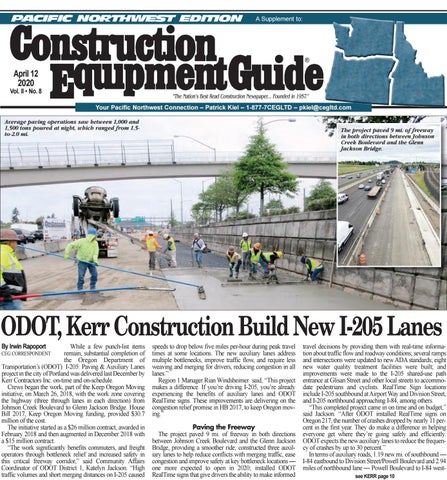
Average paving operations saw between 1,000 and 1,500 tons poured at night, which ranged from 1.5to-2.0 mi.
The project paved 9 mi. of freeway in both directions between Johnson Creek Boulevard and the Glenn Jackson Bridge.
ODOT, Kerr Construction Build New I-205 Lanes By Irwin Rapoport
While a few punch-list items remain, substantial completion of the Oregon Department of Transportation’s (ODOT) I-205: Paving & Auxiliary Lanes project in the city of Portland was delivered last December by Kerr Contractors Inc. on-time and on-schedule. Crews began the work, part of the Keep Oregon Moving initiative, on March 26, 2018, with the work zone covering the highway (three through lanes in each direction) from Johnson Creek Boulevard to Glenn Jackson Bridge. House Bill 2017, Keep Oregon Moving funding, provided $30.7 million of the cost. The initiative started as a $26 million contract, awarded in February 2018 and then augmented in December 2018 with a $15 million contract. “The work significantly benefits commuters, and freight operators through bottleneck relief and increased safety in this critical freeway corridor,” said Community Affairs Coordinator of ODOT District 1, Katelyn Jackson. “High traffic volumes and short merging distances on I-205 caused CEG CORRESPONDENT
speeds to drop below five miles per-hour during peak travel times at some locations. The new auxiliary lanes address multiple bottlenecks, improve traffic flow, and require less weaving and merging for drivers, reducing congestion in all lanes.” Region 1 Manager Rian Windsheimer said, “This project makes a difference. If you’re driving I-205, you’re already experiencing the benefits of auxiliary lanes and ODOT RealTime signs. These improvements are delivering on the congestion relief promise in HB 2017, to keep Oregon moving.” Paving the Freeway The project paved 9 mi. of freeway in both directions between Johnson Creek Boulevard and the Glenn Jackson Bridge, providing a smoother ride; constructed three auxiliary lanes to help reduce conflicts with merging traffic, ease congestion and improve safety at key bottleneck locations — one more expected to open in 2020; installed ODOT RealTime signs that give drivers the ability to make informed
travel decisions by providing them with real-time information about traffic flow and roadway conditions; several ramps and intersections were updated to new ADA standards; eight new water quality treatment facilities were built; and improvements were made to the I-205 shared-use path entrance at Glisan Street and other local streets to accommodate pedestrians and cyclists. RealTime Sign locations include I-205 southbound at Airport Way and Division Street, and I-205 northbound approaching I-84, among others. “This completed project came in on time and on budget,” said Jackson. “After ODOT installed RealTime signs on Oregon 217, the number of crashes dropped by nearly 11 percent in the first year. They do make a difference in helping everyone get where they’re going safely and efficiently. ODOT expects the new auxiliary lanes to reduce the frequency of crashes by up to 30 percent.” In terms of auxiliary roads, 1.19 new mi. of southbound — I-84 eastbound to Division Street/Powell Boulevard and 2.94 miles of northbound lane — Powell Boulevard to I-84 westsee KERR page 10
Page 2 • April 12, 2020 • www.constructionequipmentguide.com • Pacific Northwest Supplement • Construction Equipment Guide
3D AUTOMAT TION INCREASES ASES YOUR PRODUCTION N • Dig to grade accurately urately without slowing down wn • No worry grading because ecause there is no over diggingg • The machine ine you have been waiting for: r: Big, Fast, Accurate te
www.modernmachinery.com
Kent, WA (800) 669-2425 Rochester, WA (800) 304-4421 Spokane, WA (800) 541-0754 Boise, ID (800) 221-5211 Pocatello, ID (800) 829-4450 Billings, MT (800) 735-2589 Kalispell, MT (800) 434-4190 Missoula, MT (800) 332-1617 Eugene, OR (800) 826-9811 Portland, OR (800) 950-7779
SUPP PORTED WITH PRIDE
Construction Equipment Guide • Pacific Northwest Supplement • www.constructionequipmentguide.com • April 12, 2020 • Page 3
Contact your local dealer:
WASHINGTON: Seattle, WA 8207 South 216th Street Kent, Washington 98032 206.762.5933 Manager: Brian Burke bburke@PacWestMachinery.com Spokane, WA 3515 N. Sullivan Rd. Spokane Valley, Washington 99216 509.534.5933 Manager: Scott Upton supton@PacWestMachinery.com
OREGON: Portland, OR 19255 NE Sandy Boulevard Portland, Oregon 97230 503.252.5933 Manager: Tim Hurst thurst@PacWestMachinery.com Eugene, OR 1550 Irving Road Eugene, Oregon 97402 541.302.3762 Manager: Tim Hurst thurst@PacWestMachinery.com
PacWestMachinery.com
Page 4 • April 12, 2020 • www.constructionequipmentguide.com • Pacific Northwest Supplement • Construction Equipment Guide
Carter & Company to Deliver I-84 Graham Road Project By Irwin Rapoport CEG CORRESPONDENT
Carter & Company Inc. (C&C) crews began work on the Oregon Department of Transportation’s (ODOT) $18.7M, I-84 Graham Road Bridges Project in the city of Troutdale in February 2019 and are looking at beating the delivery date of December 2020. Progress has been swift with the new westbound bridge completed last September and the expectation of completing the new eastbound bridge in April, and the Graham Road improvements this spring and summer. The construction zone covers the I-84Graham Road/257th Interchange. The plan of attack was based on building a two-lane temporary bridge between the old bridges and shifting traffic onto the temporary bridge while each of the old bridges was demolished and reconstructed. In order to build the detour bridge in the median, Carter & Company had to first install temporary shoring, consisting of steel soldier pile and timber lagging, along with temporary ragwalls, which stayed in place while each of the existing bridges was demolished and excavated. With the help of CAD drawings, they were able to precisely locate their temporary piling and steel beams such that the temporary detour bridge fit between the existing bridges with inches to spare on all four corners. Construction Work “This was a pretty tight window to fit our bridge in,” said Colby Fleck, Carter & Company’s project manager. “We had to adjust the location of stone columns, temporary bridge piling, shoring piling, excavation limits and the detour bridge to fit within the horizontal constraints given, all while maintaining a minimum vertical clearance under the bridge and maintaining pedestrian access. It was quite the balancing act because when you adjust one thing it impacts everything else. This was probably the biggest challenge of this project, but it set us up for success through multiple stages of work thereafter.” ODOT’s Resident Engineer, Region 1 (Portland Metro Area), Chris Aguon said, “We’re going to pour the deck on the eastbound bridge deck very soon if the weather permits it. Aguon noted that the new bridges are being built at the same locations as the old ones. “This is standard ODOT bridge construction and thankfully there are not a lot of constraints.” The old, 110-ft. long, three-span continuous concrete deck girder bridges, two-lanes in each direction and with a vertical clearance of 13.5 ft., are being replaced with single span, precast, pre-stressed, and post-ten-
The demolition of the concrete bridge could be tough on the equipment. Carter & Company Inc. is a firm believer in carrying out routine maintenance to ensure its machines operate efficiently.
sioned concrete box girder bridges that are 105 ft. long and have two-lanes. Due to their design, they can better accommodate truck traffic and improve overall traffic flow. They will have a vertical clearance of 17.25 ft., bridge lighting, a security fence and retaining walls. The other elements include widening Graham Road from two lanes to three between the Frontage Roads and adding a 10-ft. sidewalk and 6-ft. bike lane on the east side of Graham Road to provide safer access and improved connections for pedestrians and cyclists. “The I-84 bridges are aging and must be replaced,” said Katelyn Jackson, ODOT’s community affairs coordinator, Region 1. “In particular, the westbound bridge surface
The work required serious coordination among the various Carter & Company Inc. equipment operators.
has shown severe deterioration in recent years. The vertical clearance under the bridges is only 13.5 feet which is too short to safely accommodate the passage of large trucks and oversized vehicles. Where Graham Road passes under I-84, there are narrow shoulders and no designated pedestrian sidewalks. Furthermore, the existing two lanes on Graham Road under the bridges are not wide enough to accommodate the increase in northbound traffic, generated by new industrial development north of I-84.” Connecting the Freeway Jackson added that the bridges are an important freeway connection to many
industrial businesses at the eastern end of the Columbia industrial corridor. In 2015, average daily traffic volumes for cars and trucks on I-84 over Graham Road was 25,300 and in 2017, average daily traffic on Graham Road was 15,000. “The new infrastructure will support connections to this important employment area,” Jackson said, “and improve safety and capacity for all travelers in the area of this interchange.” A well attended public outreach campaign took place in 2016 to 2017 and the final design for the new infrastructures, prepared by David Evans and Associates Inc. was submitted in July 2018. see CARTER page 8
At times the construction site became very constrained with all the equipment on site. Crews from Carter & Company Inc. are looking to deliver the project ahead of schedule.
This aerial photo provides a view of the area where the bridge replacement is taking place. The increase in industrial activity is one of the reasons for the project.
Construction Equipment Guide • Pacific Northwest Supplement • www.constructionequipmentguide.com • April 12, 2020 • Page 5
Page 6 • April 12, 2020 • www.constructionequipmentguide.com • Pacific Northwest Supplement • Construction Equipment Guide
Idaho Highway Project Lettings
The Idaho Department of Transportation received bids for transportation-related improvement projects. Following is a list of some of the projects let.
• Western Construction Inc. — $3,131,000 • Staker & Parson Companies d/b/a Idaho Materials & Construction — $3,380,000 • Knife River Corporation - Mountain West — $3,456,789
County: Jefferson Contract ID: 20222190909 Contract Description: Sage Junction Poe Weigh-InMotion I-15 and SH-33. Contract Time: 60 working days. Contractors and Bid Amounts: • DL Beck Inc. — $1,027,197 • Depatco Inc. — $1,057,459 • Winspear Construction LLC — $1,234,959
County: Kootenai Contract ID: 20795191028 Contract Description: U.S. 95, Garwood Road grade separation and frontage roads. Contract Time: Nov. 30, 2021 completion date. Contractors and Bid Amounts: • Apollo Inc. — $11,235,040 • Scarsella Bros. Inc. — $11,545,095 • M.A. Deatley Construction Inc. — $12,482,383
County: Ada Contract ID: 19944191015 Contract Description: U.S. 20/26, Chinden; Locust Grove to Eagle. Contract Time: Nov. 18, 2020 completion date. Contractors and Bid Amounts: • Staker & Parson Companies d/b/a Idaho Materials & Construction — $10,137,187 • Sunroc Corporation — $10,529,529 • Central Paving Company Inc. — $11,131,533 • Knife River Corporation - Mountain West — $11,538,727
County: Cassia Contract ID: 20170180905 Contract Description: SH-81, Declo to Burley. Contract Time: 50 working days. Contractors and Bid Amounts: • Western Construction Inc. — $5,697,000 • Kloepfer Inc. — $5,762,978 • Knife River Corporation - Mountain West — $6,247,777 • H-K Contractors Inc. — $6,260,005
County: Blaine Contract ID: 19130180906 Contract Description: U.S 93, Jones Road to Silver Creek Bridge. Contract Time: 80 working days. Contractors and Bid Amounts: • Western Construction Inc. — $4,646,464 • Knife River Corporation - Mountain West — $5,265,000 County: Valley Contract ID: 01004190827 Contract Description: SH-55, Smith’s Ferry to Round Valley. Contract Time: Nov. 15, 2021 completion date. Contractors and Bid Amounts: • M.A. Deatley Construction Inc. — $25,693,420 • Knife River Corporation - Mountain West — $29,132,848
County: Nez Perce Contract ID: 20233180327 Contract Description: U.S 95 - Webb Road to Aspen Lane and cul-de-sac to Mission Creek Road. Contract Time: 45 working days. Contractors and Bid Amounts: • Poe Asphalt Paving Inc. — $2,588,805 • Knife River Corporation - Mountain West — $2,850,000 • Valley Paving & Asphalt Inc. — $3,098,459 County: Lincoln Contract ID: 19863180910 Contract Description: SH-75, Old U.S. 93 to Richfield. Contract Time: 40 working days. Contractors and Bid Amounts:
County: Canyon Contract ID: 13486190725 Contract Description: STP-8423, Colorado and Holly signal/pedestrian improvements, Nampa. Contract Time: Sept. 15, 2020 completion date. Contractors and Bid Amounts: • Hawkeye Builders Inc. — $972,099 • Sunroc Corporation — $987,987 County: Jerome Contract ID: 20133181002 Contract Description: SH-25, Tiger Drive to junction U.S. 93. Contract Time: 20 working days. Contractors and Bid Amounts: • Staker & Parson Companies Dba Idaho Materials & Construction — $2,494,494 • Western Construction, Inc. — $2,568,295 • Knife River Corporation - Mountain West — $3,100,000
Construction Equipment Guide • Pacific Northwest Supplement • www.constructionequipmentguide.com • April 12, 2020 • Page 7
OREGON TRACTOR Sales, Rentals, Service and Parts IF YOU’RE NOT MOVING, YOU’RE NOT EARNING.
0%
for 36 MONTHS* on NEW models Contact your local dealer www.hceamericas.com
Check us out at
6457 N.E. Columbia Blvd. 4373 Hwy. 99 South Portland, OR. 97218 Roseburg, OR. 97470 Ph. 503-282-7211 Ph. 541-679-6211
COMPLETE FLEET DIAGNOSTICS
%
Booth N11601 and Booth F6914 March 10th-14th, 2020
Hi MATE onboard diagnostics lets you monitor your equipment from anywhere and alerts you to potential issues before they become a problem, keeping you up and running and earning more.
MOBILE& DESKTOP
TOMORROWSEDGETODAY.COM
At Oregon Tractor, we have the expertise to help you with your equipment needs. We realize not everyone can justify new equipment, so we continue to provide job ready used equipment. Our service and parts departments are available to help keep your equipment running on the job.
Offering Flexible Equipment Financing
Page 8 • April 12, 2020 • www.constructionequipmentguide.com • Pacific Northwest Supplement • Construction Equipment Guide
Temporary Bridges Help Construction of New Structures CARTER from page 4
“We did what we could to make sure that neighbors and users of this section of the road knew what to expect and what was coming,” said ODOT Information Officer Don Hamilton, Region 1. “The height of the bridges is what it’s all about. There’s been a significant amount of industrial development north of I-84 in this area and Troutdale, including a major Amazon distribution center. There is also a small airport not too far away and the Portland International Airport is about eight miles from the area. All of this is critical for some of the industrial development that we’re expecting in the area.” The lifespan of the new bridges is approximately 75 years.
SUBCONTRACTORS
The other subcontractors include: • Anderson’s Erosion Control • Robotics Inc. • Hatch Western Company LLC • All About Flagging • Specialized Pavement Marking • 4S Signs • Storie Barrier Corp. • Willamette Fence Co. • Roger Langeliers Construction • Cutting Edge Concrete Cutting LLC • R2M2 Rebar & Stressing Inc. • NorthStar Electrical Contractors • Malcolm Drilling Company Inc.
EQUIPMENT
C&C is using: • Cranes: a Link-Belt 82 ton and a Lima 90 ton • Excavators: several Doosan 235s and a Link-Belt 3400 with a concrete muncher • Forklifts: a Genie GTH842 telescopic and GTH642 • Skid steer: Takeuchi Tl12 skid steer, which was purchased for the project.
The explosive growth of the area’s industrial park is leading to upgrades in transportation infrastructure.
The Design “The design is much more substantial, will last longer and carry more loads,” said Aguon. “The girders are stronger than the old ones and the foundations are stout. We have driven pile at the abutments and installed ground improvements around at each end of the bridge. We placed stone columns around the abutments and in the situation where we have an earthquake, they should be pretty stable.” The traffic management plan is based on lane closures and detours, with social media being utilized to inform motorists and pedestrians about weekly construction updates and lane closures. “All businesses and recreational accesses are expected to be open during construction,” said Jackson. “Travelers should watch for flaggers and traffic pattern changes. Detour signs will be posted during roadway closures. Graham Road will require daytime and nighttime single-lane closures between NW Frontage Road (south) and NW Frontage Road (north).” Speed limits in the work zone have been reduced to 50 mph during construction to protect motorists and construction workers, with radar speed trailers placed in advance of the work zone to get drivers to slow down. “Like on any project, traffic is always a concern,” said Aguon, “and from the start we put together a plan to keep traffic moving. We have pedestrians coming through the site, trucks carrying freight from Amazon and a couple of significant service stations. It’s the last stop before you get into I-84 heading east. It’s a good work zone and we’ve got room on either side of the bridge for the construction.”
C&C has maintained a solid safety record on the job site and in terms of utilities, Troutdale has relocated a waterline and Frontier has also relocated a fiber Line. General Contractor Relations “They’re pretty good to work with,” said Aguon. “Colby Fleck, their project manager, is definitely on the ball and keeping the project moving. Stacy Bowers, the project superintendent, is a very experienced bridge builder — he’s Johnny-on-the-spot when it comes to planning and executing the work.” Demolition The demolition of the eastbound bridge was completed in just over 24 hours between Friday night and Saturday afternoon on the weekend of Oct. 12, with Graham Road closed to facilitate the work. “They demolished the bridge from the top and ends and then worked their way towards the bridge bents,” said Aguon. “Once they cleared enough and had the concrete removed from the deck, they moved their equipment down to the roadway below. The material was placed on the road and hauled off rapidly.” A similar plan was followed for the demolition of the westbound bridge, which was taken down last May. Construction of the new westbound bridge began in May 2019 with crews doing mainly day shifts, with some night operations. “Seven box girders for each bridge were trucked in and set from the detour bridge with cranes placed on either side of the new bridge,” said Aguon. “This was done in the middle of the night with very minimal
impact to traffic.” The crews also did some ground improvements — adding retaining walls to either side of Graham Road. There was a substantial amount of work. Operations to build the new eastbound bridge began last October. As noted, the winter rains will determine when the concrete deck can be poured. Some of the initial road work has begun, with crews going down to the subgrade to build up the lanes to match the elevation of the raised bridges. Major road work will occur once the westbound bridge is completed. This will include widened roads, the installation of swales, signal upgrades and various plantings. Aguon is pleased with the progress of the project. “It looks like they will be ahead of schedule,” he said. Carter & Company is responsible for the bridge work, Knife River Corp, Northwest for the paving, and Dirt & Aggregate Interchange Inc. for the earthwork and site preparation. Peak days have seen more than 30 construction workers on site. The amounts of materials being removed and brought in are still being tabulated, with rebar and other materials from the demolitions being sent to recycling centers. Fleck appreciates the support of ODOT. “They have been helpful and flexible in getting lane closure outside the times that are shown in the special provisions,” he said. “This makes our work more efficient and helps to get the job done.” Dirt & Aggregate purchased a new excavator and a grader for the project. “We run some older equipment compressor and manlifts, so we do have electrical and hydraulic issues on those,” said Fleck. “We have our own mechanic, who has a mechanic’s truck to do repairs at our construction sites. Routine maintenance was key to ensuring the cranes and other equipment operated efficiently.” C&C purchases and rents equipment from Feenaughty Machinery Company in Portland, Peterson Cat in Portland, and Cessco Inc. in Portland. “We didn’t rent that much equipment because we own a lot of our equipment and we have a good variety,” said Fleck. “If we have too many jobs at one time, then we’ll rent. We have our own lowboy and trick drivers and move equipment around to make the best use of it. A lot of the equipment that we bought in the last five to 10 years — Doosan and Takeuchi — has been from Feenaughty. We’re on a first name basis with their people. They are very familiar with what we own and what we need. We’ve had a good working relationship with them for many years.” CEG
Construction Equipment Guide • Pacific Northwest Supplement • www.constructionequipmentguide.com • April 12, 2020 • Page 9
SEATTLE/TACOMA 253.722.5560 SPOKANE 509.534.1900 MT.VERNON 360.488.3948 PORTLAND 503.254.5100 BEND/PRINEVILLE 541.447.5293 EUGENE 541.342.7700
West Seattle Bridge Still Needs More Support Before Repairs SEATTLE (AP) — The West Seattle Bridge needs additional support before contractors enter the 600-ft. arched span to complete scheduled repairs needed so the bridge can be reopened for traffic, city officials said. Seattle Mayor Jenny Durkan announced the emergency bridge closure after a sudden acceleration of cracks within its hollow girders, the Seattle Times reported. Photos from the Seattle Department of Transportation show cracks that lengthened 5 ft. (1.5 meters) since August, including 2 ft. (0.6 meters) of growth from March 6 to March 23. Uneven weight loads played a role in the cracks because a bus lane was added to the then-six-lane crossing last decade, Transportation Director Sam Zimbabwe told The Times. Including traffic, 80 percent of the bridge's weight is the bridge itself, indicating the cracks likely have multiple causes, Zimbabwe said. Durkan said she expects the bridge to be closed for months. Matt Donahue, city roadway structures director, said recently that the bridge can still support its own weight, and he's not con-
cerned about it sagging or collapsing. “We're taking all measures to protect the integrity of the bridge,” Donahue said, adding that engineering began recently to make a shoring plan. “We're looking at shoring as part of a medium-term repair program.”
The West Seattle Bridge began to show cracks, including 2 ft. of growth from March 6 to March 23.
Since the bridge closed, the lower swing bridge is restricted to transit, emergency vehicles and freight, while other traffic must detour through the peninsula's southern hillsides and the Duwamish industrial area.
Page 10 • April 12, 2020 • www.constructionequipmentguide.com • Pacific Northwest Supplement • Construction Equipment Guide
Portland’s Paving, Auxiliary Lane Project Improves Safety KERR from page 1
bound and I-84 eastbound to Killingsworth Street were constructed. The northbound auxiliary between Oregon 224 and Sunnyside Road/Sunnybrook Boulevard is still being constructed. The signs, 36 overhead freeway, 26 variable speed advisory and six variable message, often required large mobile cranes to lift them into place. “Nearly 1,015 feet worth of concrete foundations were poured for 24 sign structures, some going down as deep as 61 feet,” said Jackson, who noted that 17 new structures were raised, including a sign bridge spanning both directions of I205 at the Johnson Creek Bridge and other sign bridges, and cantilevers and monotube structures along I-205 in each direction. Design and Infrastructure ODOT engineers and staff designed the new roads and infrastructure. The auxiliary lanes will not increase capacity. The average daily traffic on this section of I-205 is 168,000 trips. The traffic plan was based on lane closures and detours to keep motorist and construction workers safe and maximize the construction, which had crews working 24/7 for several consecutive months. David Finnigan, Kerr Contractor’s project manager, knew that the project had many challenges. “Traffic control was the biggest challenge, especially at night with the lane closures when you could have crews working in the middle of the travel lanes,” he said. They allowed travel lanes to be closed from about 8 p.m. to 5:30 a.m. for a single lane closure and 10 p.m. to 5 a.m. for a double-lane closure, so there was a short amount of time for the milling and paving operations. There was a lot of night work — we worked probably six-to-eight months straight at night during the 2018 and 2019 construction season. It was difficult for the crews and we lost some people. Night work is not for everybody, but we tried to be flexible and rotate people around if possible. We also tried to re-arrange the traffic control so that we could work to areas during the day instead of at night. “There were very few utility issues and the ones that were issues, were known about from the beginning,” he added. “Our relationship with ODOT started off a little rocky, but as the project went forward, an excellent working relationship developed. When we had questions or issues arise, we received the most timely responses we’ve ever seen from ODOT. This started off as a $26 million dollar project and then we got another $15 million project — a trigger project that had to be completed on time so that the state legislature could increase the gas tax. We met their timelines.” Getting the Job Done The repaving operations went smoothly. The plan of attack had crews start on the fast lane, moving southbound, then northbound in the fast lane. Crews then proceeded in a loop headed southbound in the middle lane and then the middle lane moving northbound. Finally, the slow lane southbound prior to going to the northbound lanes and doing the same. “This was done so we wouldn’t have to move the equipment all the way back to the south end of the project,” said Finnigan. “Most of this was done at night. We had some issues with de-lamination of the existing asphalt pavement section of the roadway, that had 2.5 inches of asphalt over 10 inch concrete panels. In some of the areas where the mill
came through, there would be asphalt left on top of the concrete. We also did some improvement of subgrade for the widening of the additional lanes, and in some of those areas, we had to go deeper due to subgrade issues and replace with large rock. But that is to be expected when the shoulders of the roadway are exposed to the elements for years.” Average paving operations saw between 1,000 and 1,500 tons poured at night, which ranged from 1.5-to-2.0 mi. Last spring the southbound auxiliary lane was opened to traffic, while the northbound lanes were opened in the summer and late fall respectively. “The plan of attack was to do the bulk of our excavation first and install the manholes, inlets, and storm pipes,” said Finnigan. “Then we placed the aggregate base, concrete panels, and the new asphalt paving. Our crews were working in multiple areas — we had two lanes to build in phase 1 and one in phase 2. For the widening and auxiliary lanes we also had to remove the existing storm pipe and place new storm pipes, manholes, and inlets at the edge of the new lanes. For phase 1 of the project, we opened the southbound auxiliary lane in nine months. We spent a lot of time planning the work schedule and it proceeded as planned.” The new water treatment facilities had new swells constructed and existing ones renovated. “The work did go well,” said Finnigan. “It was done by Fox Erosion Control, one of the subcontractors, because a special mix for water control and filtration, goes into the swells that filter the storm water run-off. Our crews performed the excavation for this element of the work.” Crews installed 58 signs, with many of them installed at night and 24 requiring deep pile foundations. Much of this was done in the second phase of the project. “To get the structures up, we had to first drill concrete foundations that were roughly 30-feet deep at each of the locations — about five-to-six feet in diameter,” said Finnigan. “We put in steel reinforcement cages. The foundations had to be done quickly before the ground caved in. Shoring helped to keep the shafts open. In some spots we encountered ground water, which made it more difficult to put the foundations in. Those would take three days a piece and we progressed as best we could.” Laying Groundwork The foundation work was subcontracted to Pacific Foundation, which was using highly specialized equipment that included excavator mounted drill rigs and oscillators. It was crucial to keep this equipment in pristine shape to meet the benchmarks, especially as much of this work was done during lane closures. Electricians often installed the wiring and conduits for the electronic signs at night, as well as drilling underneath the highway to hook up the new systems to existing power sources. Many sign structures are massive in size and heavy, which required cranes to lift and set them in place. “Three of the structures, that were truss bridges, spanning over the entire northbound lanes, were delivered during a weekend closure,” said Finngan. “During phase 2, ODOT allowed us to perform a weekend closure of the northbound I-205 for four miles. We not only raised three structures, but we milled and paved nearly all of the area, putting down about 15,000 tons. “ A typical sign took three days to install, with one day or one night shift to hoist the vertical posts, another to construct the bridge onsite, and a third day to hoist and install the bridge.
The largest bridge was placed on the Glenn Jackson Bridge, which connects Oregon to Washington State via I205. “For this installation we had a special freeway closure,” said Finnigan. “We detoured traffic to the I-5, another northsouth freeway located to the west. Finnigan was assisted by Jay Hedberg, the project manager for phase 2, and Steven Cespedes and Amrutha Das, the project engineer for phase 1. “Hedberg was a big part,” said Finnigan. “The team dynamic was pretty good and we all worked well together.” Peak days had around 25 Kerr and subcontractors for the day shift and a similar number for the night shift when paving operations occurred. The subcontractors included Lee Contractors for bridge joints and concrete paving, Aaken Electric for electrical work on phase 2, and Coral Construction for sign installation. Crews removed 120,000 lbs. of asphalt and replaced it with a similar amount. “Recycling was big,” said Finnigan. “We typically recycle all of the asphalt on the project and all of the concrete recycled either into the project or in others in the area.” What Was Used Equipment brought in by Kerr (Hitachi, Komatsu, John Deere, Cat, and Vogele) included: various cranes; excavators — a John Deere 245G LC; dozers — a John Deere 550K; loaders — a John Deere 644 K, a Hitachi ZX85USB-5 and a Takeuchi TB260; Mogli pavers, a Cat AP1000D rubber tire with BG elevator attached, and a Vogele super track paver with BG elevator attached; and Hamm rollers — 130s, 140s, and 120s. The elevators allowed Kerr to run belly dump trucks and drop the asphalt on the ground in windrows in front of the paving operation. “This allowed us to pave as fast as possible,” said Finnigan. Maintenance was taken seriously. “When they were doing the paving at night, they had their own mechanic onsite,” said Finnigan. “During the day, we had a mechanic dedicated to all the jobs in the area.” Kerr Construction has a sizeable fleet, which is engaged in many projects in the Portland area and dedicating resources for maintenance ensures the equipment operates efficiently. “We typically don’t rent equipment,” said Finnigan, “but when we do it is typically for smaller, specialized items.” The firm purchases and rent equipment from local and regional dealerships. “Good communications with the dealerships is important,” said Finnigan. “We have people at the office that are always talking with the owners of the dealerships.” Kerr Contractors also is being pro-active and has shared ownership in local dealerships, as it has done with subcontractors, suppliers, and other construction resources, such as the one it uses for shoring operations. “By no means was this an easy project,” said Kerr. “Having good communications with the owner is very important and you have to keep them in the loop and work with them though issues as they are solved for the best interest of the project.” The following video, produced by ODOT, shows the improvements that were made: https://www.youtube.com/watch?v=6jEfsdCXNUY&feature=youtu.be. CEG
Construction Equipment Guide • Pacific Northwest Supplement • www.constructionequipmentguide.com • April 12, 2020 • Page 11
NORTHWESTERN PUBLISHING 2020 Issue#
Closing
Publishing
10
April 30
May 10
12
May 28
June 7
14 16 18
June 25 July 23 August 20
July 5 August 2 August 30
Issue# 20
Closing
Publishing
September 17 September 27
22
October 15
October 25
24
November 12
November 22
26
December 10
December 20
Efficiency & High Performance.
Page 12 • April 12, 2020 • www.constructionequipmentguide.com • Pacific Northwest Supplement • Construction Equipment Guide
The LH50M Industry material handler represents efficiency and high performance. The standard Liebherr regenerative power system assures maximum handling while, at the same time, achieving lower fuel consumption. Quiet operation with the highest payload is guaranteed by the large, sturdy undercarriage. The attachment of the machine is available in a variety of versions and is thus always optimally matched to your respective application.
18060 Des Moines Memorial Dr. Seattle, WA 98148 3909 NW Fruit Valley Rd Vancouver, WA 98660