441
59
75
GEORGIA STATE EDITION
Cornella 19
A Supplement to:
Rome 85 27
Athens 441
Atlanta
20
Madison Augusta
85
20
Griffin 1
129
Milledgeville
75
La Grange
Macon
301
185 19
®
16
Dublin
Swainsboro Oak Park
Columbus
Statesboro
341 441 16
Lyons Americus
December 21 2016
Dorchester
341
Cuthbert
75
Albany
84
Douglas Tifton
82
95
82
Blakely
Pearson
“The Nation’s Best Read Construction Newspaper… Founded in 1957.”
301
1
82
Vol. XVIII • No. 26
Savannah
McRae Cordele
27
27 84
Moultrie
19 319
84
Bainbridge
Valdosta Thomasville
Waycross Brunswick 82
1 441
Your Georgia Connection: Rich Olivier, Atlanta, GA • 1-800-409-1479
$400M Dalton Expansion to Extend Transco Pipeline By Cindy Riley
In Georgia, construction is underway on the massive dalton Expansion project, which calls for a new pipeline laterally connecting the transco natural gas pipeline to an existing electric generating facility operated by oglethorpe power Corp. the $400 million investment involves a local distribution company run by Atlanta Gas Light Company and the municipality of Cartersville, Ga. the pipeline will be complete in 2017. “We have tremendous internal expertise to execute major pipeline projects like our dalton expansion,” said Chris stockton, a spokesman of Williams, the tulsa, okla.-based energy company operating the transco pipeline. “A big part of this is working very closely with our customers to determine what their needs are, and timing requirements, so that we can develop a realistic, executable project schedule.” the dalton Expansion project will consist of 115 mi. (185 km) of new steel pipe ranging from 16 to 30 in. (40 to 76 cm) in diameter, extending from the existing transco pipeline in Coweta County, Ga., and providing service to new delivery points in paulding and Murray Counties. the project was designed to transport approximately 448,000 dekatherms of natural gas per day. Williams’ personnel are responsible for a number of development functions, including project management, engineering, drafting, business development, land acquisition, environment permitting, regulatory affairs and survey. “Construction on the new 21,000-horsepower compressor station in Carroll County broke ground in August 2016,” said stockton. “the initial site prep work is nearly complete. Compressor foundations have been poured and pipe fabrication is underway. Construction on the 115-mile pipeline lateral is also underway, kicking off with preparations initiated on the two pipeline contractor yards.” the compressor facility design called for two approximately 11,000-horsepower gas turbine-driven compression units, four natural gas after-coolers, one emergency generator, two electric air compressors and an air storage tank. A pre-engineered metal building will serve as a warehouse/workshop with roll-up doors for storing spare parts and equipment. two above ground storage tanks for waste oil and oily water are included in the plans, along with a security fence enclosing all equipment. the gas turbines and the attached compressors will be installed within a metal building to both limit noise from the gas turbines and the compressors and to provide protection from the elements. Most above ground piping also will be insulated to minimize noise. As for the overall project, stockton said any pipeline proj-
CEG CorrEspondEnt
ect of this size presents unique challenges. “Managing potential environmental and landowner issues, while balancing the requirements of the various state and federal permitting agencies, requires a tremendous amount of planning and coordination,” stockton said. “there are so many moving pieces with a project of this size. All of the various Williams functional areas, along with third party consultants, have to be well-synchronized to execute the project deliverables and maintain the customer schedule.” the pipeline was designed to transport enough natural gas to meet the daily needs of about two million homes, based on a calculation by the American Gas Association. stockton said getting public feedback was key. “We are regulated by the Federal Energy regulatory
Commission (FErC). prior to submitting our formal application to obtain a Certificate of public Convenience and necessity, FErC encourages applicants to engage in what they call the ‘pre-filing’ process. this consists of extensive outreach to key project stakeholders such as landowners, public officials, environmental groups and state and local agencies, to identify any potential issues with the project design prior to submitting a formal application with FErC. “We participated in the pre-filing process for dalton, hosting numerous public meetings to solicit feedback on the route. We adopted some of this feedback, making modifications to the route to avoid potential issues which would become larger issues during the application’s regulatory review process.” see PIPELINE page 2
Williams photo
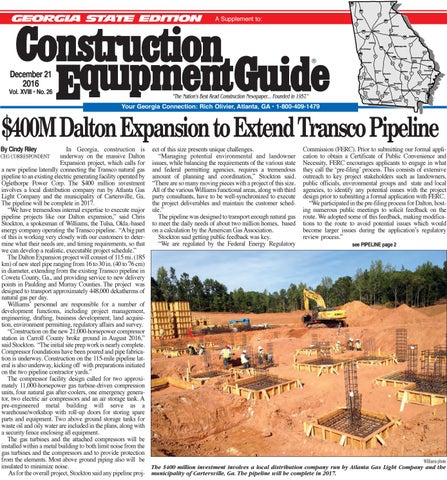
The $400 million investment involves a local distribution company run by Atlanta Gas Light Company and the municipality of Cartersville, Ga. The pipeline will be complete in 2017.
Page 2 • December 21, 2016 • www.constructionequipmentguide.com • Georgia State Supplement • Construction Equipment Guide
Pipeline Project Resembles Moving Assembly Line PIPELINE from page 1
Stockton said that environmental analysis efforts were extremely comprehensive. “During the analysis of potential pipeline routes, extra effort is taken to identify sensitive areas of ecological or historic significance,” said Stockton. “Teams of field scientists, archaeologists and biologists conduct detailed environmental surveys and evaluations of potential study corridors, searching for threatened or endangered species, sensitive wildlife and vegetation habitats, wetlands and water bodies and areas of archaeological significance. “Williams works very hard to minimize impacts to landowners and the environment. Williams sites pipeline corridors within or adjacent to existing utility corridors, when practical, to minimize environmental disturbances. That is the case for the vast majority of the Dalton project. It will run parallel to an existing Georgia Power transmission corridor.” In March 2016, FERC issued its environmental assessment of the project. It assesses the potential environmental effects of the construction and operation of the project, in accordance with the requirements of the National Environmental Policy Act (NEPA). Stockton said it was important for Williams
to work with landowners and various agencies, to design and construct the project in a manner that minimizes environmental and landowner impacts. “First, it’s the expectation of the regulatory agencies who ultimately authorize whether or not to permit the proposed facilities. They will not authorize construction if we do not take appropriate steps to minimize impacts on people and the environment,” Stockton said. “Second, we want to be a good neighbor, and that begins with working with affected landowners and communities to identify potential routing issues, and hopefully work collaboratively to reach solutions which are mutually beneficial.” Ground surveys also are a crucial step in the process. A pipeline construction project resembles a moving assembly line, with a large project usually split into manageable lengths, using highly specialized teams. Each spread is composed of various crews, with specific responsibilities. As one crew completes its work, the next group moves into position to complete its part of the construction process. Early in the process, utility lines and agricultural drainages are located and marked to see PIPELINE page 6
Williams photo
“We have tremendous internal expertise to execute major pipeline projects like our Dalton expansion,” said Chris Stockton, a spokesman of Williams, the Tulsa, Okla.based energy company operating the Transco pipeline.
Construction Equipment Guide • Georgia State Supplement • www.constructionequipmentguide.com • December 21, 2016 • Page 3
ARTICULATED DUMPS
DOZERS
MOTOR GRADERS
WHEEL LOADERS
COMPACTION
CRAWLER LOADERS
EXCAVATORS
HAMMER MACHINES
Page 4 • December 21, 2016 • www.constructionequipmentguide.com • Georgia State Supplement • Construction Equipment Guide
Construction Equipment Guide • Georgia State Supplement • www.constructionequipmentguide.com • December 21, 2016 • Page 5
Page 6 • December 21, 2016 • www.constructionequipmentguide.com • Georgia State Supplement • Construction Equipment Guide
Dalton Expansion to Add 115 Mi. of New Steel Pipe PIPELINE from page 2
prevent accidental damage during pipeline construction. Next, the pipeline’s centerline and the exterior right of way boundaries are staked. The pipeline right-of-way is cleared of vegetation. The first essential part of right-of-way clearing in farmland areas involves removing the topsoil. If the topsoil is not fully removed prior to construction, it may be permanently damaged by the pipeline work, due to rutting, compaction and the inversion and mixing of the soil layers. To avoid this, a minimum of 12 in. (30 cm) of topsoil has to be stripped and stored safely. It is segregated and stockpiled away from the pipeline trench, the excavated spoil, the pipe assembly area and the traffic zone. Crews use backhoes or trenching machines to excavate a pipeline trench. The soil that is excavated during ditching operations is temporarily stockpiled on the non-working side of the trench. Individual joints of pipe are strung along the right of way adjacent to the excavated ditch and arranged so they are accessible to construction personnel. A mechanical pipebending machine bends individual joints of pipe to the desired angle at locations where there are significant changes in the natural ground contours or where the pipeline route changes direction. After the stringing and bending are complete, the pipe sections are aligned, welded together and placed on temporary supports along the edge of the trench. All welds are then visually and radio graphically inspected. Line pipe, normally mill-coated or yardcoated prior to stringing, requires a coating at the welded joints. Prior to the final inspection, the entire pipeline coating is electronically inspected to locate and repair any coating faults or voids.
The pipe assembly is lowered into the trench by side-boom tractors. The trench is backfilled using a backfilling or bladed equipment. No foreign materials are permitted in the trench. After backfilling, the pipeline is hydrostatically tested following federal regulations. Test water is obtained and disposed of in accordance with applicable federal, state and local regulations. Restoration also is critical. After the pipeline is backfilled and tested, disturbed areas are restored to their original contours as much as possible. Williams conducts follow-up inspections of all disturbed areas after the first and second growing seasons to ensure the success of revegetation. Revegetation in agricultural areas is consid-
ered successful if crop yields are similar to adjacent undisturbed portions of the same field. Stockton said the existing Transco natural gas pipeline has served Georgia for more than 60 years, delivering about one-third of all of the natural gas consumed in the state. “The Transco pipeline provides service to major local distribution companies such as Atlanta Gas Light, the largest natural gas distribution company in the Southeast. The Transco pipeline system includes about 700 miles of pipe in Georgia, and four existing compressor facilities. “Most consumers don’t give much thought to the large-scale infrastructure necessary to deliver natural gas to their homes, or provide their electricity. However, proj-
Williams photo
The Dalton Expansion project will consist of 115 mi. (185 km) of new steel pipe ranging from 16 to 30 in. (40 to 76 cm) in diameter.
ects like our Dalton project are critical in order to ensure that consumers can continue to enjoy reliable, affordable access to natural gas to meet the region’s growing energy needs.” According to Kristie Benson, spokesperson, Atlanta Gas Light, the company is investing $210 million in the new Georgia pipeline and will have a 50 percent ownership interest. “The Dalton project will bring low-cost shale gas to Atlanta Gas Light customers by 2017. Atlanta Gas Light has signed a longterm capacity arrangement with Transco that will support its efforts to provide diverse sources of natural gas supplies to our customers, resolve current and long-term supply planning for new capacity, enhance system reliability and generate economic development in the areas served.” Benson said customers will benefit greatly from the Dalton pipeline. Atlanta Gas Light provides natural gas delivery service to more than 1.5 million customers in Georgia. In operation since 1856, the company is one of the oldest corporations in the state. It operates and maintains the infrastructure that delivers gas to customers of certified natural gas marketers. Williams is currently executing more than a dozen other major expansions along its Transco pipeline system through the 2018 timeframe, adding about seven billion cu. ft. in additional pipeline capacity. Williams expects to place about $1.7 billion in additional capital expansions into service in 2016, and $4 billion in capital in 2017. The Dalton project is included in the 2017 capital forecast. (This story also can be found on Construction Equipment Guide’s website at www.constructionequipmentguide.com.) CEG
Williams photo
In Georgia, construction is under way on the massive Dalton Expansion project, which calls for a new pipeline lateral connecting the Transco natural gas pipeline to an existing electric generating facility operated by Oglethorpe Power Corp.
Construction Equipment Guide • Georgia State Supplement • www.constructionequipmentguide.com • December 21, 2016 • Page 7
Page 8 • December 21, 2016 • www.constructionequipmentguide.com • Georgia State Supplement • Construction Equipment Guide