State Supplement sponsored by:
441
59
75
Cornella 19
Rome 85 27
Athens
GEORGIA STATE EDITION
A Supplement to:
441
Atlanta
20
Madison Augusta
85
20
Griffin 1
129
Milledgeville
75
La Grange
Macon
301
185 19
16
Dublin
Swainsboro Oak Park
Columbus
Statesboro
341 441 16
Lyons Americus
Savannah
McRae
301
1
Cordele
27 82
Dorchester
341
Cuthbert
75
Albany
84
Douglas Tifton
82
95
82
Blakely
Pearson 27 84
Moultrie
19 319
Bainbridge
84
Valdosta Thomasville
Waycross Brunswick 82
SHIP WITHIN 48 HOURS
1 441
®
SAME DAY PARTS AVAILABILITY 24 HOUR TECHNICAL SUPPORT BACKED BY A 75 YEAR BUSINESS Thousands in Service!
“The Nation’s Best Read Construction Newspaper… Founded in 1957.” Your Georgia Connection: Rich Olivier, Atlanta, GA • 1-800-409-1479
Affordable Price. Premium Service.
CALL 800-367-4937 *On approved credit • Financing Available
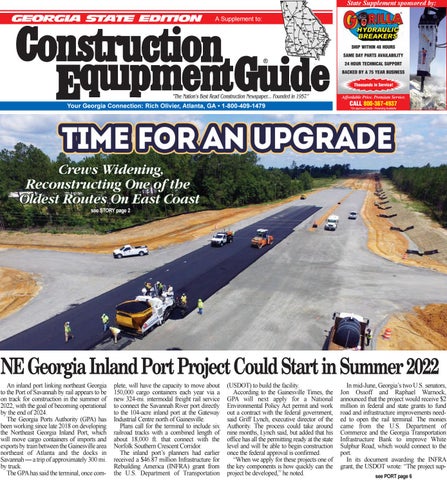
see STORY page 2
NE Georgia Inland Port Project Could Start in Summer 2022 An inland port linking northeast Georgia to the Port of Savannah by rail appears to be on track for construction in the summer of 2022, with the goal of becoming operational by the end of 2024. The Georgia Ports Authority (GPA) has been working since late 2018 on developing the Northeast Georgia Inland Port, which will move cargo containers of imports and exports by train between the Gainesville area northeast of Atlanta and the docks in Savannah — a trip of approximately 300 mi. by truck. The GPA has said the terminal, once com-
plete, will have the capacity to move about 150,000 cargo containers each year via a new 324-mi. intermodal freight rail service to connect the Savannah River port directly to the 104-acre inland port at the Gateway Industrial Centre north of Gainesville. Plans call for the terminal to include six railroad tracks with a combined length of about 18,000 ft. that connect with the Norfolk Southern Crescent Corridor. The inland port’s planners had earlier received a $46.87 million Infrastructure for Rebuilding America (INFRA) grant from the U.S. Department of Transportation
(USDOT) to build the facility. According to the Gainesville Times, the GPA will next apply for a National Environmental Policy Act permit and work out a contract with the federal government, said Griff Lynch, executive director of the Authority. The process could take around nine months, Lynch said, but added that his office has all the permitting ready at the state level and will be able to begin construction once the federal approval is confirmed. “When we apply for these projects one of the key components is how quickly can the project be developed,” he noted.
In mid-June, Georgia’s two U.S. senators, Jon Ossoff and Raphael Warnock, announced that the project would receive $2 million in federal and state grants to fund road and infrastructure improvements needed to open the rail terminal. The monies came from the U.S. Department of Commerce and the Georgia Transportation Infrastructure Bank to improve White Sulphur Road, which would connect to the port. In its document awarding the INFRA grant, the USDOT wrote: “The project supsee PORT page 6
Page 2 • August 11, 2021 • www.constructionequipmentguide.com • Georgia State Supplement • Construction Equipment Guide
United Infrastructure Group Leads $62.9M Highway Work
The project has McLendon installing more than 25,000 linear ft. of pipe. Crews used Cat 325 excavators and Komatsu 270 wheel loaders to perform this task.
By Irwin Rapoport
The Georgia Department of Transportation (GDOT), via a $62.9 million project, is widening and reconstructing 9.403 mi. of on U.S. 1/SR 4 beginning south of SR 147 (Plant Hatch) and extending south of George Hill Road (CR 106). The contract for the project, taking place in Appling and Toombs counties, was awarded to United Infrastructure Group Inc. The work also includes the construction of four bridges and approaches. The section of the highway is being widened from one lane in each direction to two lanes in each direction. The project, which has a contract time of 840 days, began on July 23, 2020 and will be delivered on Nov. 10, 2022. A major subcontractor on the project is McLendon Enterprises Inc. (MEI), which secured a $29.5 million contract from UIG that has the firm clearing and grubbing 100
CEG CORRESPONDENT
Demolition of existing roadway, headwalls and culverts should yield approximately 16,000 tons of asphalt milling and 15,000 tons of concrete.
acres of forests and fields. It is engaging in 475,000 cu. yds. of earthwork, installing more than 25,000 linear ft. of pipe, placing 146,000 tons of graded aggregate base course for the new lanes and placing 169,000 tons of hot mix asphalt. “This project is one of last four remaining U.S. 1 widening projects to the complete the four lanes of U.S. 1 from Waycross to Wadley [127 linear miles],” said Sean M. Scott, McLendon’s chief engineer. “U.S. 1 widening has been ongoing for more than 20 years in Georgia. The existing U.S. 1 roadway was originally Portland Cement Concrete paving that has been widened and overlayed through the years. Its current condition exhibits cracking linear and transverse, joint separation and some joint heaving as a 1940s constructed roadway should. “Many of the widening projects are removing the existing PCC roadway and replacing with a new typical section, some are retaining the PCC and adding a substantial overlay
United Infrastructure Group Inc., along with McLendon Enterprises Inc. (MEI), are widening and reconstructing 9.403 mi. of on U.S. 1/SR 4 beginning south of SR 147 (Plant Hatch) and extending south of George Hill Rd (CR 106).
to correct the existing cracking issues,” he added. “The bridges being removed and replaced also are circa 1940 construction. Three of the four remaining projects, all in Toombs County, are currently under construction contracts. This section of construction starts at the Altamaha River and stretches north to the city of Lyons.” This section of U.S. 1 carries 6,800 vehicles daily, with an expected increase to 9,500 per day by 2042. “The widening will allow better traffic flow and safer passing of heavy trucks,” said Scott, “which make up 20 percent of the daily traffic.” The new lanes and bridges were designed by the Georgia Department of Transportation. “The bridge construction over the Altamaha River is plagued with a seasonal limitation for river access due to the sturgeon spawning season,” said Scott. “This allowed UIG to operate in the river waterway only during July 1 to August 15 and December 15 to January 15. This accelerated their efforts in establishing barge brigades and coffer dams for drilled shaft construction during these periods so that they could continue work inside their established isolated areas during the rest of the year.” The traffic management plan utilizes lane closures and short term detours for the removal and reconstruction of two state route intersections. “After the intersection reconstruction, stage traffic shifts will be utilized to shift all traffic to the new stage 1 constructed lanes allowing the removal, rehabilitation, and new construction of the existing lanes,” said Scott. “After completion of the existing lane stage, traffic will be split onto its final directional lanes and the final layer of asphalt will be placed, along with signing and marking for final alignment. “Local law enforcement has been extremely helpful with control of work zone speeding,” he added, “assisting with traffic interruption activities and informing first responders, school systems, our Georgia Power nuclear plant managers and the traveling public of impending traffic shift activities.” see HIGHWAY page 6
Construction Equipment Guide • Georgia State Supplement • www.constructionequipmentguide.com • August 11, 2021 • Page 3
Page 4 • August 11, 2021 • www.constructionequipmentguide.com • Georgia State Supplement • Construction Equipment Guide
Atlanta, GA 404.696.7210 Birmingham, AL 205.841.6666 Madison, AL 256.350.0006 Mobile, AL 251.633.4020 Montgomery, AL 334.262.6642 Oxford, AL 256.832.5053 Tuscaloosa, AL 205.848.4147 Pensacola, FL 850.479.3004
Construction Equipment Guide • Georgia State Supplement • www.constructionequipmentguide.com • August 11, 2021 • Page 5
Page 6 • August 11, 2021 • www.constructionequipmentguide.com • Georgia State Supplement • Construction Equipment Guide
Contractors Praise GDOT for Quick Decisions On Project HIGHWAY from page 2
UIG is currently working on bridges 1, 2, 3 and 4 right. Based upon the completion of the stages, only bridge 4 left will remain to be constructed following the demolition of the existing bridge 4. MEI has completed more than 90 percent of Phase 1 earthwork, along with more than 70 percent of Phase 1 subgrade construction and placement of first lift GABC base. “We will shift traffic onto the Phase 1 roadway in December of this year and begin on Phase 2 demolition, earthwork, storm drain, box culverts, GABC and paving,” said Scott. GDOT, according to Scott, is doing whatever is necessary to support UIF and MEI. “The GDOT team assigned to the project has been very easy to work with and has made quick decisions on all minor issues to date,” Scott said. “We are in a very rural area and cooperation with the residents along the project has been very positive. Widening projects always carry utility relocation issues, but we started early to help the utility companies by coordinating our clearing efforts to the areas of relocation and were rewarded with utility relocations happening ahead of schedule. We own property along the project area and have plenty of space for field offices, material sources, material storage, etc. “The clearing and grubbing operations began in July 2020 and was completed last January,” Scott added. “We own our own logging equipment so we utilized it to remove all merchantable timber prior to the clearing and grubbing operation. Clearing was accomplished using a Cat 336 excavator, a Komatsu 210 excavator, Cat D6N and D6T dozers and Komatsu 270 wheel loaders.” With the clearing of the forests and fields, the earthwork could start. “We performed two earthwork operations simultaneously,” said Scott. “We had an on-site crew utilizing Komatsu 360i GPS integrated excavators loading either Volvo 30 ton or over the road 10 wheel dump trucks. Another crew was placing borrow material excavated from our pit with a Cat 345 excavator being loaded over the road 10 wheel dump trucks. All material was being bladed into place by Cat D6N GPS dozers and Komatsu 61i GPS dozers. Subgrade crews then utilized Cat 140M GPS motor graders to fine grade
Road construction began with the placing of 146,000 tons of graded aggregate base course for the new lanes.
before placing GABC.” The project has McLendon installing more than 25,000 linear ft. of pipe. “All pipe needed was supplied and stored near the point of installation,” said Scott. “Other inventory needed was stockpiled for later use.” Pipe crews used Cat 325 excavators and Komatsu 270 wheel loaders. Road construction began with the placing of 146,000 tons of graded aggregate base course for the new lanes. “GABC is 10 inches of final thickness,” said Scott. “GDOT specs require it to be placed in two lifts, a 6-inch lift followed by a 4-inch lift to finish. We were able to start GABC installation while still working subgrade in other areas and earthwork in other areas due to our project length of over nine miles.” The GABC will be covered with 5 in. of 25mm superpave asphalt, then 2 in. of 19mm superpave asphalt during phasing. Upon final traffic alignment and completion of stage construction, a final layer of 1.5 in. of 12.5mm superpave will “top” out the project. Bridge 1 is 4,080 ft. long; bridge 2 is 300-ft. long, bridge
3 is 380-ft. long; and bridges 4 left and right are 360-ft. long each. Bridge 1 has five 140-ft. spans over the river, with shorter spans over the floodplain area. The 140-ft. spans are the longest on the project. “The bridge construction is also very neat as bridge one has drilled shafts were chosen as the method of construction for the Altamaha River bents,” said Scott. Assisting with management on the project are Project Manager Joel Hussey, General Superintendent Buddy Collins, Superintendent Rocky Flowers, Grade Foremen Steven Porter, Brandon Landrum and Pipe Foreman Lance Story. “This team is extremely strong in experience, accuracy of work, production and work very well together,” said Scott. On peak days McLendon will have 20 to 25 employees on-site. “We subcontract very little work as we self-perform all of our subcontract items,” said Scott. Demolition of existing roadway, headwalls and culverts should yield approximately 16,000 tons of asphalt milling and 15,000 tons of concrete. “We will utilize the asphalt milling at our asphalt plant in Toombs County,” said Scott. “We will stockpile and crush the demo concrete into usable base material for local projects in the county. We recycle everything that is feasible on all our construction projects and send very little to landfills.” The amounts of new materials are still being tabulated. McLendon takes maintenance seriously. “We have mechanics that operate out of our Vidalia shop that go to projects as needed for routine maintenance, repairs, etc.,” said Scott. “General maintenance will avoid big costly repairs, so we stress this to our operators and mechanics. We try to keep extra GPS electronics on each project in case something like a cable or antennae is damaged or a major electronic device goes bad so that we can continue working as we are dependent upon our GPS technology.” McLendon purchases and rents equipments from local and regional dealerships. “We have a great relationship with Yancey Brothers, Tractor Equipment Company, Flint Equipment and Roadtec,” said Scott. CEG
GPA Expects Port Work to Alleviate Wait Times at Port of Savannah PORT from page 1
ports economic vitality by reducing freight travel times by providing a direct freight rail link to the Port of Savannah; it will reduce the need for containers moving between the Gainesville area and the seaport … by truck.” Lynch told the Gainesville news outlet that the GPA has identified customers for the inland port but does not have contracts worked out yet. There could also be a potential for positive environmental impacts with the inland port, he said, because “for every truck that we can move to rail, it’s a truck mile saved [and] emissions saved.” The Times reported that the GPA was
denied a grant for the same project in 2020, but Tim Evans, the vice president of economic development at the Greater Hall Chamber of Commerce, said the Authority had to wait its turn for the competitive grant. He explained that the GPA had received a federal grant in 2019 but was not allowed to get one two years in a row. “The feedback that we received last year was that the application was really, really good, but there is a political preference, or just a reality, that those INFRA dollars get spread around and don’t get to go to the same places every time,” Evans remarked to the Gainesville newspaper. He explained that the Northeast Georgia Inland Port and its connecting rail will help
Rendering of the proposed Inland Port.
alleviate wait times at the Port of Savannah because rather than waiting for a limited supply of truck drivers and trailer frames to transport containers, arriving ships can load
directly onto a railcar. “Just like the Silk Road provided a new trade route between Europe and the Far East this provides a new route for existing trade traffic for industries that are either exporting or importing products that go into their production lines,” Evans said to the Times. It is hard to estimate if the new inland port would cause enough new growth that could lead to increased truck traffic, he noted, adding that the number of containers the Gainesville facility is expected to handle each year is less than what a Walmart or Amazon distribution center would handle. “The truck traffic that this is expected to generate is actually already on the roads,” Evans said.
Construction Equipment Guide • Georgia State Supplement • www.constructionequipmentguide.com • August 11, 2021 • Page 7
Page 8 • August 11, 2021 • www.constructionequipmentguide.com • Georgia State Supplement • Construction Equipment Guide