CALIFORNIA STATE EDITION
A Supplement to:
October 25 2020 Vol. I • No. 22
“The Nation’s Best Read Construction Newspaper… Founded in 1957.” Your California Connection – 1-800-523-2200 – www.cegltd.com
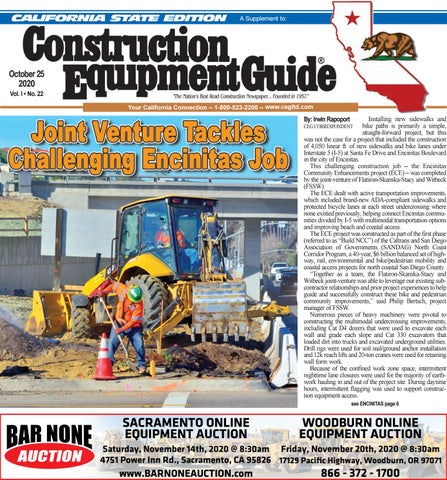
Installing new sidewalks and bike paths is primarily a simple, straight-forward project, but this was not the case for a project that included the construction of 4,050 linear ft. of new sidewalks and bike lanes under Interstate 5 (I-5) at Santa Fe Drive and Encinitas Boulevard in the city of Encinitas. This challenging construction job – the Encinitas Community Enhancements project (ECE) – was completed by the joint-venture of Flatiron-Skanska-Stacy and Witbeck (FSSW). The ECE dealt with active transportation improvements, which included brand-new ADA-compliant sidewalks and protected bicycle lanes at each street undercrossing where none existed previously, helping connect Encinitas communities divided by I-5 with multimodal transportation options and improving beach and coastal access. The ECE project was constructed as part of the first phase (referred to as “Build NCC”) of the Caltrans and San Diego Association of Governments (SANDAG) North Coast Corridor Program, a 40-year, $6 billion balanced set of highway, rail, environmental and bike/pedestrian mobility and coastal access projects for north coastal San Diego County. “Together as a team, the Flatiron-Skanska-Stacy and Witbeck joint-venture was able to leverage our existing subcontractor relationships and prior project experiences to help guide and successfully construct these bike and pedestrian community improvements,” said Philip Bertsch, project manager of FSSW. Numerous pieces of heavy machinery were pivotal to constructing the multimodal undercrossing improvements, including Cat D4 dozers that were used to excavate each wall and grade each slope and Cat 330 excavators that loaded dirt into trucks and excavated underground utilities. Drill rigs were used for soil nail/ground anchor installation and 12k reach lifts and 20-ton cranes were used for retaining wall form work. Because of the confined work zone space, intermittent nighttime lane closures were used for the majority of earthwork hauling in and out of the project site. During daytime hours, intermittent flagging was used to support construction equipment access.
By: Irwin Rapoport
CEG CORRESPONDENT
see ENCINITAS page 6
SACR RAMENTO ONLINE EQUIIPMENT AUCTION
WOODBURN O ONLINE EQUIPMENT A AUCTION
Saturday, No ovember 14th, 2020 @ 8:30am Friday, November 20th, 2020 @ 8:30am 4751 Power Inn Rd., Sacramento, CA 95826 17129 Pacific Highway, Woodburn, odburn, OR 97071
www.BARNONEAUCTION.com
866 - 372 - 1700
Page 2 • October 25, 2020 • www.constructionequipmentguide.com • California State Supplement • Construction Equipment Guide
Construction Equipment Guide • California State Supplement • www.constructionequipmentguide.com • October 25, 2020 • Page 3
FINANCING AND EXTENDED PROTECTION BUILT FOR THE WAY YOU DO BUSINESS For a limited time, take advantage of 1.9%* financing for 36 months when you also purchase a Customer Value Agreement (CVA) on your new Cat® Utility Compactors. Customer Value Agreements mean: • Protection with a 3-year/1,500 hour Powertrain + Hydraulics + Technology Equipment Protection Plan (EPP) • Hassle-free maintenance with 1,500 hours of Planned Maintenance with genuine Cat Parts • Productivity and reliability with 24/7 asset monitoring through Cat.com or VisionLink® Contact your Cat dealer today.
www.hawthornecat.com San Diego & Hawaii 800-437-4228
www.holtca.com Central Northern California 800-452-5888
www.petersoncat.com Bay Area & Northern California, Oregon, and Southwest Washington 844-349-4353
www.quinncompany.com Central & Southern California 888-842-2155
Terms subject to change. Certain restrictions apply. Offer valid from January 1-December 31, 2020 for qualifying customers. Special financing and EPP offer applies to Cat Utility Compactors models: CB1.7, CB1.8, CB22B, CB24B, CB24B XT, CC24B, CB32B, CB34B, CB36B, CC34B. 3-year/3,000 hours Powertrain + Hydraulics EPP offer available through Cat Financial Insurance Services only. This special offer available through participating Cat dealers in North America only. Contact your Cat dealer to confirm participation and to see if you qualify. This marketing tool does not represent a contract or obligation of any kind between Cat Financial Insurance Services, its parent or affiliates, and the equipment owner. For details on any dealer agreement, including a complete description of the terms, conditions, and/or exclusions, contact your local Cat dealer. All graphics and lists in this marketing tool are provided solely for general information purposes and are not intended to be a solicitation or an offer to sell any product or service. *CAT DEALERS ONLY: For terms, conditions, and/or exclusions of Equipment Protection, see the appropriate Cat Financial Insurance Services Equipment Protection Plan Service Guide found at https://warranty.cat.com/en/global-guide/caterpillar-financialinsuranceservices.html. These guides are the only safe source for Equipment Protection programs. To the extent that the above publication(s), bulletin(s), and/or any designated contract(s) are ambiguous or inconsistent with the policy language, the policy language shall determine the coverage under this policy. © 2020 Caterpillar. All Rights Reserved. CAT, CATERPILLAR, LET’S DO THE WORK, their respective logos, “Caterpillar Yellow”, the “Power Edge” and Cat “Modern Hex” trade dress as well as corporate and product identity used herein, are trademarks of Caterpillar and may not be used without permission. www.cat.com / www.caterpillar.com
Page 4 • October 25, 2020 • www.constructionequipmentguide.com • California State Supplement • Construction Equipment Guide
Busiest, Most Congested Rail in State Gets $20M Upgrade Caltrans recently announced it is receiving a $20 million federal grant to improve the busiest, most congested rail junction in California. The award from the U.S. Department of Transportation Better Utilizing Investments to Leverage Development (BUILD) Transportation Grants program will help fund the Stockton Diamond Grade Separation Project, which will elevate a set of tracks at the delay-stricken intersection to create free-flowing movement along passenger and freight rail lines, and allow for future expansion. Construction on the project, currently in the approval and environmental review phase, is scheduled to begin in 2022. It is the only rail project in the nation to receive a BUILD grant. “This critical project will improve both passenger and freight rail while pushing economic growth in the San Joaquin Valley. The project will help reduce delays, improve air quality and expand access to the Port of Stockton,” said Toks Omishakin, director of Caltrans. The $237 million project is a partnership between Caltrans, the San Joaquin Regional Rail Commission (SJRRC), Union Pacific (UP) Railroad and Burlington Northern Santa Fe (BNSF) Railway. The result will be a
grade separation of two north-south UP railroad tracks from two east-west BNSF tracks at the most congested railway junction in California. The grade separation will be an improvement over the current ground-level intersection, which significantly delays freight trains serving their nationwide networks and the Port of Stockton, limits freight capacity growth and inhibits the expansion of Amtrak San Joaquins and Altamont Corridor Express (ACE) passenger services through the region. “Untangling the Diamond will provide immediate benefits to residents of Stockton, support our plans to expand both the ACE commuter rail service and San Joaquin County’s intercity passenger rail service, and improve freight movements throughout the region,” said SJRRC Chair Christina Fugazi. “We are extremely proud that this was the only rail project in the nation to win a BUILD award.” The project also includes bike, pedestrian and roadway improvements at 10 local road crossings in Stockton, enhancing safety and access for residents. “This is a transformational project, which will bring significant improvements to passenger and freight rail service, as well as enhanced pedestrian, bike and vehicle access, safe-
ty and air quality to the Stockton community,” said BNSF Executive Director of Public Affairs Lena Kent. “We stand ready to work in collaboration with all parties to help move it through environmental review and into construction.” Federal BUILD grants invest in surface transportation infrastructure and are awarded for projects that will have a significant local or regional impact. BUILD funding can support roads, bridges, transit, rail, ports or intermodal transportation “Union Pacific Railroad recognizes the importance of the Stockton Diamond Grade Separation Project in not only improving freight and passenger rail service, but also in fostering economic growth and public benefits to the City of Stockton, San Joaquin Valley and Northern California Megaregion,” said Adrian Guerrero, general director of public affairs for Union Pacific Railroad. “Union Pacific is excited to continue the partnership with SJRRC, Caltrans, BNSF and other stakeholders to support, develop and advance this significant infrastructure investment.” For more information about the Stockton Diamond Grade Separation Project, visit www.stocktondiamond.com.
Crews Continue Work on Highway 50 Echo Bridge Replacement
Construction crews continue to work on the Highway 50 Echo Summit bridge replacement project under one-way traffic control. Crews are removing debris from the old bridge and working on the barrier walls. Striping is underway.
Construction Equipment Guide • California State Supplement • www.constructionequipmentguide.com • October 25, 2020 • Page 5
City Celebrates Reopening of Gerald Desmond Bridge The Port of Long Beach and city officials held a celebration to kick off the official opening of the Gerald Bridge Replacement Project. The second highest cable-stayed bridge opened to the public on Oct. 5 The new bridge — consisting of 18 million lbs. of structural steel and 75 million lbs. of rebar — has two towers standing 515-ft. tall, making the bridge the largest structure in Long Beach and casts a shadow over the original Gerald Desmond Bridge, which served the nation’s secondlargest port for 52 years. While officials and VIPs stood atop the bridge to celebrate, the ceremony was not open to the public because of the ongoing coronavirus pandemic. City and port leaders celebrated at the $1.46 billion bridge’s completion. The project to replace the old Gerald Desmond Bridge — too low to serve the larger cargo ships of today and wearing down from increasing truck traffic — began in 2013, with more than 350 massive concrete pilings providing the foundations for the monumental undertaking. The new bridge, with its 2,000-ft. span, is intended to last 100 years, requiring little maintenance, according to officials, thanks in part to special joints at each end of the main span. At the ceremony, Mayor Robert Garcia said the unnamed bridge will connect “Long Beach to the rest of the country.” A procession of 30 low- and zero-emissions cargo trucks took the honorary “first drive” across the bridge, followed by 34 classic cars from different eras — meant to capture the port’s 109-year history. Five planes from Torrance’s Tiger Squadron performed a flyover, in formation, to pay tribute to Terminal Island’s legacy as a former U.S. Navy base. And a boat parade saw water-spouting fireboats, police boats and tall ships circle the waters below. “This is a historic day for our city and for the nation,” Garcia said. “We know that this project is a phenomenal marvel of architecture and infrastructure. It connects our port and the world to each other.” Toward the end of its run, the Gerald Desmond had seen more than 15 percent of the nation’s imported cargo, valued at $170 billion, travel across it. That task will now fall to its successor “This new bridge is another major milestone in the Port’s ongoing commitment to remain the most advanced and most competitive port in the world,” said Port of Long Beach Executive Director Mario Cordero. “It is much more than a convenient roadway. It is a critical link in the global movement of cargo.”
The second highest cable-stayed bridge opened to the public on Oct. 5.
The new bridge consists of 18 million lbs. of structural steel, 75 million lbs. of rebar and has two towers standing 515-ft. tall.
The project to replace the old Gerald Desmond Bridge began in 2013 with more than 350 massive concrete pilings providing the foundations for the monumental undertaking.
Feds Grant $1.2B for Transbay Corridor Core Capacity Project
The project, with a total cost of $1.2 billion, will improve capacity on the existing BART heavy rail system between the city of Oakland and downtown San Francisco.
The U.S. Department of Transportation’s Federal Transit Administration (FTA) announced a $1.2 billion grant agreement with the San Francisco Bay Area Rapid Transit District (BART) for the Transbay Corridor Core Capacity project in San Francisco. “This investment in California will improve public transportation and support economic recovery in the Bay Area,” said FTA Deputy Administrator K. Jane Williams. “This project will allow BART to operate additional trains through the Transbay Tube, helping to alleviate crowding and increase capacity in this critical corridor.” The project will improve capacity on the existing BART heavy rail system between the city of Oakland and downtown San Francisco. The total project cost is $2.7 billion with $1.2 billion in funding committed
through FTA’s Capital Investment Grants (CIG) Program. Williams added that “this federal funding is an economic boost for the Bay Area as the project will create jobs and help communities recover from the COVID-19 public health emergency.” FTA’s CIG program provides funding for major transit infrastructure projects nationwide. Projects accepted into the program must go through a multi-year, multi-step process according to requirements in law to be eligible for consideration to receive program funds. With this announcement, FTA has advanced funding for 40 new CIG projects throughout the nation under the Trump administration since Jan. 20, 2017, totaling approximately $10.7 billion in funding commitments.
Page 6 • October 25, 2020 • www.constructionequipmentguide.com • California State Supplement • Construction Equipment Guide
Cat dozers and excavators were used to excavate each wall and grade each slope. Crews then used excavators to load dirt into trucks and excavated underground utilities.
In total, 15,000 cu. yds. of dirt were removed, 4,650 tons of asphalt were placed and 500 cu. yds. of concrete were used for new sidewalks, curbs and gutters.
Multiple Firms Team Up to Construct Pathways Under I-5 ENCINITAS from page 1
In total, 15,000 cu. yds. of dirt were removed, 4,650 tons of asphalt were placed and 500 cu. yds. of concrete were used for new sidewalks, curbs and gutters. Additionally, the project created 4,050 linear ft. of sidewalk and 1,580 linear ft. of retaining walls that featured 1,254 cu. yds. of concrete and 222,077 lbs. of steel. Excess material removed from the project site was brought to an on-site crusher mobilized by North American Recycling and Crushing in a nearby construction staging yard to be made into base for use on additional I-5 freeway infrastructure projects. Construction Timeline To create the construction zone, crews first restriped the roadway toward the north end of both Santa Fe Drive and Encinitas Boulevard to create space needed to build these improvements. Crews then set K-rail concrete barriers and installed signage to ensure the safety of passing motorists and construction crews. The team also set up pedestrian detours to provide pedestrians with safe access through each undercrossing, away from the work area. Beginning the process, crews first demolished and removed the existing slope paving and performed a series of three separate lifts to remove soil and install ground anchors and soil nails to stabilize the slopes located at each bridge abutment. Afterwards, crews used shotcrete to reinforce the ground anchors and soil nails, helping create the skeleton of the new curved retaining wall. The exterior portion of the wall façade was then tied with rebar, formed and cast with concrete to enhance the retaining wall’s aesthetic appearance with an “aloha wave” pattern. Once completed, crews used the widened space to build new ADA-compliant sidewalks and dedicated bicycle lanes that are protected by a concrete barrier connected to the bridge columns. Rock cobble blankets also were installed adjacent to new sidewalks as an added aesthetic hardscape feature and for erosion control benefits. This construction process was then replicated on the north sides of each street
to complete the project. Build NCC crews upgraded the surrounding intersections with new traffic signals to more efficiently manage traffic on the freeway on- and off-ramps and new bridge soffit lighting to help guide pedestrians, bicyclists and motorists through the undercrossings at night, as well as relocating underground utility infrastructure, improving area drainage and repaving the asphalt roadway for a new, smooth finish. The demolition and removal of the existing slope paving was not an easy task. Surveying was first performed to establish the face of the walls. A dozer was then used to cut a vertical face no more than 5-ft. tall to create the first lift. The resulting dirt excavation was used to create an access bench wide enough for the drill rig to sit on.. Once the excavation was complete, the drill rig would drill the holes determined by the survey, the team set ground anchors/soil nails in the holes, and then filled the voids with high strength grout. The next step was to use shotcrete to reinforce the ground anchors and soil nails to create the skeleton of the new curved retaining wall. First, crews hung the reinforcing steel and the drainage boards, and set a guide wire to prepare for shotcrete. Shotcrete was applied to the vertical face using the guide wire to establish the correct thickness and face of wall. After the shotcrete cured for seven-days, crews stressed the ground anchors to 48 kips. Once all testing was complete, crews proceeded with excavating the next lift. This process continued until the bottom of the wall was reached. Formliner was used inside the concrete forms to create the “aloha wave” pattern on the cast in place portion of the walls. With K-rail in position, crews used temporary overnight lane closures to install new concrete barriers between the bridge columns to create the protected bike lanes. These barriers were created with gang wooden forms that had no treatment on them. After crews over-excavated and recompacted the soil below, forms were placed on one side, steel reinforcement was installed and the opposite side form was
installed. Concrete was then placed in a monolithic manner, or “all in one pour,” to fill the gap between the columns. On-site mechanics performed regular maintenance as needed during non-work hours. FSSW purchased and rented various construction vehicles and equipment from dealerships including RDO Equipment Co., Hawthorne CAT, Otay Mesa Sales, as well as used JVowned equipment. Subcontractors on the project included HMS Construction Inc. who performed electrical work, AVAR Construction Inc. who performed soil nail and ground anchor construction activities, and Calmex Engineering Inc. who performed paving operations at each undercrossing. Once the south sides of the streets were completed in mid2019, the new sidewalks and bike lanes were opened to facilitate pedestrian access as crews transitioned operations to the north sides of each street. Work on the north sides began in mid-2019 and finished in summer 2020. Project Planning The first stage of the two-stage ECE project focused on constructing improvements, first along the south sides of each street undercrossing and, upon completion, transitioning to the north side of each street undercrossing. This approach ensured that bicyclist and pedestrian access would always be maintained on the opposite side of the undercrossing across from the active construction zone and limited traffic impacts to intermittent overnight travel lane closures. “Prior to construction, Caltrans and FSSW participated in early discussions to develop a comprehensive project design and approach to the Encinitas Community Enhancements project,” said Steve McMillan, senior resident engineer with Caltrans. “This process is referred to as Construction Manager General Contractor, or CMGC, and it provided our contractor the opportunity to share input and feedback on the overall constructability and timeline of the project to ensure our success.” see ENCINITAS page 10
Construction Equipment Guide • California State Supplement • www.constructionequipmentguide.com • October 25, 2020 • Page 7
This funding will assist the department’s work throughout the state, including the FixSac5 HOV and Los Angeles County improvement projects along Interstate 5.
State Receives $493 Million Federal Funds From FHWA Caltrans announced that the state will receive more than $493 million in additional transportation funding from the Federal Highway Administration’s (FHWA) annual August redistribution. “These federal funds will help Caltrans and local agencies invest in improving the transportation system throughout California. California has a reputation for maximizing its federal funding and successfully launching infrastructure projects on time, and these additional funds represent our reward for that proven track record,” said Toks Omishakin, Caltrans director. Each year, when certain federal transportation funding remains unspent before deadlines, those funds revert to a federal pool and are redistributed to states like California that have completed all requirements and are prepared to use the additional federal funds before the end of the federal fiscal year. This year, the federal pool totaled about $4.7 billion — of which California received more than 10 percent of the total
and more than any other state. Caltrans received roughly $312 million of the $493 million, and local transportation agencies could receive up to $181 million. This funding will assist the department’s work throughout the state, including the FixSac5 HOV and Los Angeles County improvement projects along Interstate 5 designed to enhance safety, improve traffic flow, reduce congestion, encourage ridesharing, decrease surface street traffic and improve air quality. Most of the projects that will received redistribution funding are already allocated by the California Transportation Commission and are underway using state dollars until federal money becomes available. This additional funding will allow Caltrans and local communities to continue tackling California's infrastructure maintenance needs along with state funding from Senate Bill 1, the Road Repair and Accountability Act of 2017.
Caltrans received roughly $312 million of the $493 million, and local transportation agencies could receive up to $181 million.
NEXT ISSUE CLOSES: November 12, 2020
Page 8 • October 25, 2020 • www.constructionequipmentguide.com • California State Supplement • Construction Equipment Guide
Integrated Express Solutions...
Liberty Canyon Overpass Crossing Construction Crews Will Receive $5M Donation from WCB Reach Milestone With APM System at LAX
Currently in planning stages, the $88-million land bridge will consist of a 200-ft. long overpass across the 101 Freeway at Liberty Canyon.
A California agency that funds wildlife conservation initiatives across the state announced it will give $5 million toward construction of the Liberty Canyon wildlife bridge in Agoura Hills, according to a report. Currently in planning stages, the $88-million land bridge will consist of a 200-ft. long overpass across the 101 Freeway at Liberty Canyon. Workers hope to break ground on the construction next year, the report said. At its quarterly meeting, the Wildlife Conservation Board (WCB), an independent state agency that funds environmental initiatives, approved more than $25 million in grants to help restore and protect fish and wildlife habitat throughout California. The monies include a $5-million gift to the National Wildlife Federation for the Liberty Canyon Wildlife Overpass Crossing. The wildlife federation is working with the California Department of Fish and Wildlife, the California State Coastal Conservancy, Caltrans, the city of Agoura Hills and the Santa Monica Mountains Conservancy to build the bridge for animal migration. Hemmed in by Southern California’s freeways and urban development, big predators like mountain lions face a possibility of extinction within 50 years, biologists say. The wildlife crossing will be a major tool in helping both large and small animals travel safely across the local freeway. According to meeting minutes, the board recently said, “The Liberty Canyon area . . . has been identified as the ideal location for a wildlife crossing over U.S. 101. Prime habitat, contiguous with large swaths of protected habitat north and
south of this connection, has already been protected on both sides of the freeway. “Connecting these areas would give mountain lions and numerous other species living in these highly fragmented habitats the room they need to roam, mate and thrive.” WCB called Liberty Canyon a “biodiversity hotspot,” and said, “This location is the best remaining connection between undeveloped open space in the Santa Monica Mountains to the south and the Simi Hills and Los Padres National Forest to the north.” The WCB funding comes from Proposition 68, the statewide parks and water bond act of 2018. “The board felt it was a great and long overdue project and was pleased that we could be a partner in the project,” Donnelly said. The National Wildlife Federation is leading the wildlilfe crossing fundraiser with its #SaveLA Cougars campaign, and to date $15.4 million has been donated, said Beth Pratt, the wildlife federation’s California regional director. “With the money raised to date, we have secured enough to keep Caltrans funded through next spring, so there are no delays in the project at this time and, indeed, the team is making great progress on final design and engineering,” Pratt said. “We understand these are challenging times, and human health and safety must be a priority. Yet the extinction timeline for mountain lions is not on pause, and we must build this crossing on time or mountain lions may not have a future in the Santa Monica Mountains,” she said.
Balfour Beatty, as part of the LAX Integrated Express Solutions joint venture team, completed an important milestone in the delivery of Los Angeles International Airport’s (LAX) Automated People Mover (APM) by placing concrete for the first segment of the 2.25-mi. elevated guideway and completing structural steel erection activities for the Maintenance and Storage Facility (MSF). When complete, the project will play a key role in delivering a long-term transformative transportation solution that eases traffic congestion, provides reliable access to airline terminals and brings jobs and opportunities to the Los Angeles community. The concrete placement for the first segment of the elevated guideway is a critical component of Los Angeles World Airport’s (LAWA) Landside Access Modernization Program (LAMP), setting the foundation for the APM’s electric train system that will transport travelers into and out of LAX. In addition to the approximately 1,000 cu. yds. of concrete for the construction of the first guideway deck, the 9-acre MSF site has vertically erected all buildings that will operate and maintain the APM trains and systems. “Concrete placement for the first segment of guideway represents the latest achievement in a series of significant critical construction milestones for our team,” said Sharon Gookin, project director at LINXS Constructors. “It is exciting to see our team’s hard work and effort has come together in a visually demonstrative way.” An estimated 72,000 cu. yds. of concrete will be used to construct the entire guideway which includes foundation piles, columns, guideway deck and concrete tracks. A significant construction milestone for the LAX AMP project, approximately 304 major concrete placements will be delivered for the entire APM system which will lead the way for the construction of the system’s concrete tracks and the steel erection of the future APM stations. “These milestones highlight LINXS Constructors’ phenomenal progress to bring Los Angeles World Airport’s vision to life with LAX’s Automated People Mover,” said Brian Cahill, president of Balfour Beatty in California. “Our team has a great deal to be proud of as we work together with our partners to deliver a long-term, transformative and energy-efficient solution for travelers across the world.” To reach the structural milestone on the MSF, 1.5 million lbs. of steel were used to vertically erect the main, mezzanine and train wash buildings. With roofing installation underway, the 90,000-sq.-ft. facility will be built to LEED Gold standards and will incorporate several sustainable design elements including a solar photovoltaic generation system, and an onsite train wash that will use recycled water. The MSF will be complete in 2021 in anticipation for the first APM train car deliveries. The APM electric train system will connect LAX passengers to airline terminals, a rental car facility, a parking facility and the Metro’s regional transit system.
Construction Equipment Guide • California State Supplement • www.constructionequipmentguide.com • October 25, 2020 • Page 9
Flatiron, Turner to Build San Diego Intl. Airport Terminal A Turner-Flatiron joint venture was taxiing times, resulting in reduced greenawarded a contract to build a new $2.265 bil- house gas emissions. An underground fuellion airport terminal at San Diego delivery system will reduce the need for International Airport. trucks to deliver fuel to aircrafts and result in The 1.2 million-sq.-ft. building with 30 less emissions and quicker turnarounds at gates will replace the existing 1960’s era ter- the gates. minal. Construction will begin in late 2021 The Turner-Flatiron team has completed once all environmental permits are issued. previous work together at San Diego Construction will take place in two stages to International Airport and at airports in San ensure that the current number of gates Francisco, Oakland, Sacramento and remain available during the build out. Denver. The team brings together Flatiron’s During the first phase, scheduled to open in experience in airside construction as well as first quarter of 2025, 19 new gates will be runway and taxiway operations with added. The next phase, scheduled to open in Turner’s experience in airport terminal and early 2027, will add 11 new gates. When concourse commercial structures. work is complete, the airport will have a total of 62 gates. The new terminal will offer passengers more seating in the gate area, restaurants and shops, as well as additional security checkpoints with more lanes. The terminal will offer a range of sustainable and energy-efficient features. A series of airfield improve- During the first phase, scheduled to open in ments, including new, redesigned first quarter of 2025, 19 new gates will be taxiways, will help reduce aircraft added.
Semi - Custom Rebuilt Vocational Trucks
2008 International DURASTAR 4300…$24,000 W001691, 2,500 Gallon Tank DT 466, 6 Speed
2012 International DuraStar 4300 …$46,000 W002771, 2,500 Gallon Tank, Automatic
2008 International DURASTAR 4300…$24,000 W001696, 2,500 Gallon Tank DT 466, 6 Speed
2012 FREIGHTLINER M2…$60,000 W002890, New 12’ Dump Bed, Automatic
Two locations in California to Serve You!
14635 Valley Blvd. Fontana, CA 92335
909.822.2200
10918 Shoemaker Ave. Santa Fe Springs, CA 90670
www.scottequip.com
C A L L U S T O D AY !
562.777.0775
Page 10 • October 25, 2020 • www.constructionequipmentguide.com • California State Supplement • Construction Equipment Guide
Demolition, Removal of Existing Slope Tough on Workers ENCINITAS from page 6
Community Impact Steve Vaus, SANDAG’s chair and mayor of Poway, is pleased to see the new infrastructure open to the public. “These much-needed improvements increase coastal access and offer great multimodal options for all to enjoy the outdoors,” he said. “These newly upgraded pathways are just one example of our combined efforts to improve highway, rail, environmental and coastal access for all San Diegans.” “Bike paths and pedestrian spaces are crucial links to the state transportation system,” said Gustavo Dallarda, Caltrans District 11 director. “Together, they help get people where they want to go safely. In coordination with SANDAG and our transportation partners, we will continue to aid in the development and construction of enhanced access to alternative modes of transportation.” The Build NCC program began in 2017 and is anticipated to be complete in 2022. The $869 million project is funded through a combination of federal, state and local sources, including the TransNet program, a voter approved half-cent countywide sales tax that helps fund regional transportation projects. The highway portion of Build NCC is estimated to cost $663 million. An aesthetic element also was included via a public art installation with the theme “Encinitas Up Close” that reflects the culture of the five communities of Encinitas. Early collaboration between Caltrans, SANDAG and the city also resulted in an added project benefit – a new public canvas for community art. Retaining walls lining both sides of the Santa Fe Drive street undercrossing feature 53 mosaic The Encinitas Community Enhancements project (ECE) was completed by the joint-venture of Flatiron-Skanska-Stacy and Witbeck (FSSW).
The project created 4,050 linear ft. of sidewalk and 1,580 linear ft. of retaining walls that featured 1,254 cu. yds. of concrete and 222,077 lbs. of steel.
art panels designed by teams of local students from San Dieguito High School Academy and community artists. These panels, commissioned by the city, each measure 3 by 5 ft. and feature artistic designs or expressions that reflect the city’s vibrant coastal culture and were embedded within the new retaining walls in late August 2020. At Encinitas Boulevard, 3-ft.-tall horizontally curved mosaics created by professional artists will be installed at all four corners of the undercrossing as part of this collaboration in early 2021.
“This project provided a great opportunity for our local artists of all ages,” said Encinitas Mayor Catherine Blakespear. “The talent and teamwork exhibited in these art pieces offer a great representation of our coastal communities. We’re thrilled to work with Caltrans and SANDAG to incorporate the community art and showcase all that our city has to offer.” The city has already completed the installation of 53 mosaic art panels on the north and south sides of the Santa Fe Drive undercrossing. CEG
Construction Equipment Guide • California State Supplement • www.constructionequipmentguide.com • October 25, 2020 • Page 11
San Francisco, CA
650-532-9200
Page 12 • October 25, 2020 • www.constructionequipmentguide.com • California State Supplement • Construction Equipment Guide
EXTRE T EME S STRE ENGT TH
Central California Power JCB 19487 Broken Ct, Shafter, CA 93263 (661) 589-2870 www.ccp-jcb.com
SoCal JCB 14675 Valley Blvd., Fontana, Ca. 92335 866-522-7225 www.socaljcb.com
QMC QMC JCB 3820 S. K Street, Tulare, CA 93274 (559) 686-1579 961 E. 3rd Street. Hanford, CA 93230 (559) 582-9393 www.quality-mc.com
N&S Tractor 1960 Highway 20 Colusa, CA 95932 (530) 458-2166 2173 Blossom Street Dos Palos, CA 93620-2313 (209) 392-2161 600 S. State Highway 59 Merced, CA 95341-6928 (209) 383-5888 1340 W. Charter Way Stockton, CA 95206 (209) 944-5500 1215 West Glenwood Ave Turlock, CA 95380-5703 (209) 634-1777
The all-new JCB X-series ex exccaavvaattors are here, delivveering the perffo ormance yo you need to get the job done and the dependability you need to drive down costs. Longer service intervals, eff fffo orrttless con o trro ol and industry-leading operaattor comffo orrtt are just parrtt of the new JCB X-series experience … backkeed by a naattionnwide dealer and n parts distribution network yo you can count on. To learn more about the new JCB X-series exca To ava vators visiit w w w.jcb.com or contact your JCB dealerr..
827 North Tehama St Willows, CA 95988 (530) 934-3382
/JCBNA
@JCBNA
w.jcb.com .jcb.com j JCBNA www
5405
3056 Colusa Highway Yuba City, CA 95993 (530) 923-7675 www.nstractor.com